Cambridge IGCSE Physics 0625 — 2018 Oct/Nov Paper 4 · Variant 3
0625/43/O/N/18 · 10 questions · 80 marks · ≈90 min
The question paper and its mark scheme, free to read here and free to download. This is Cambridge’s own paper, exactly as it was sat.
Question paper16 pages
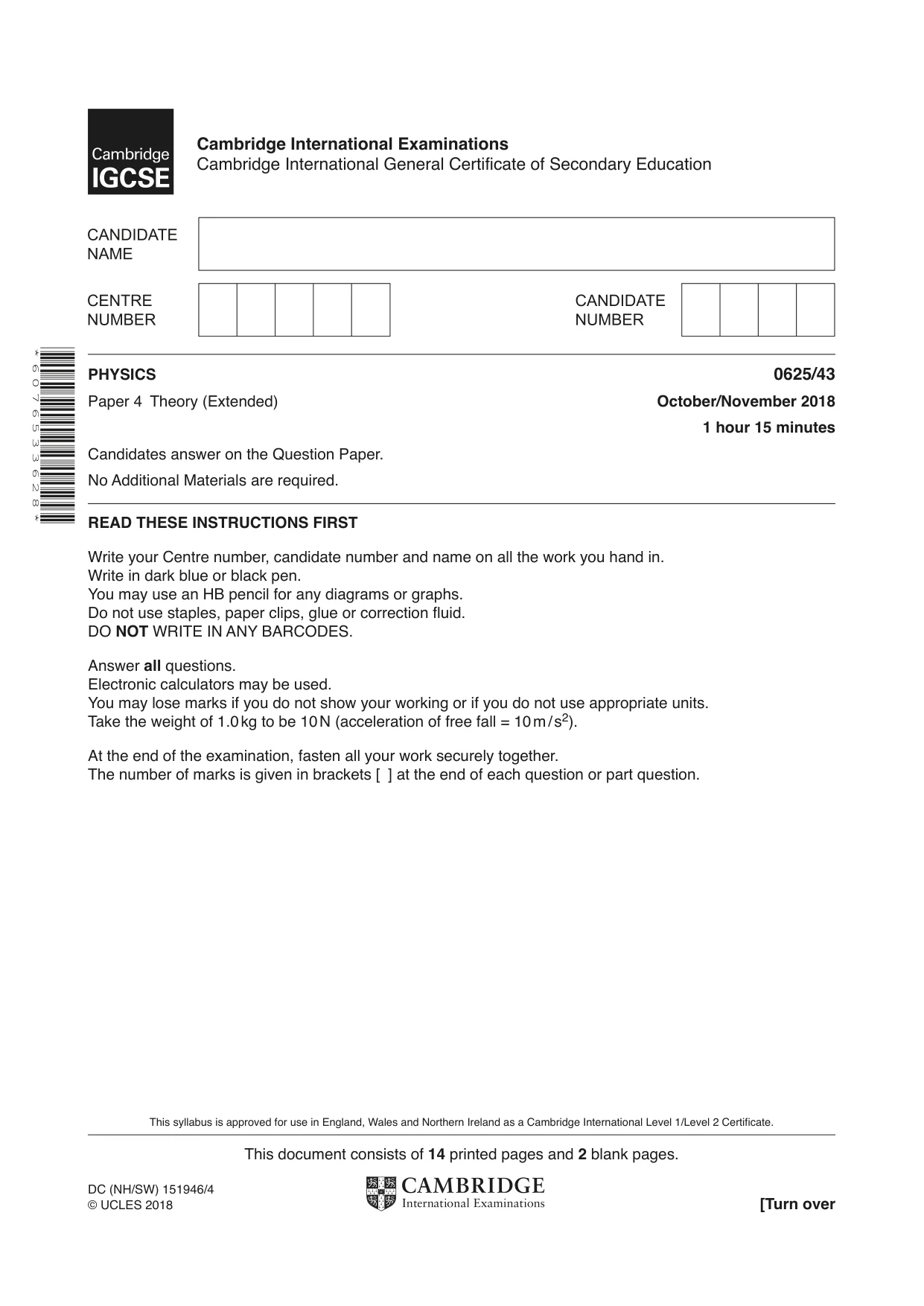

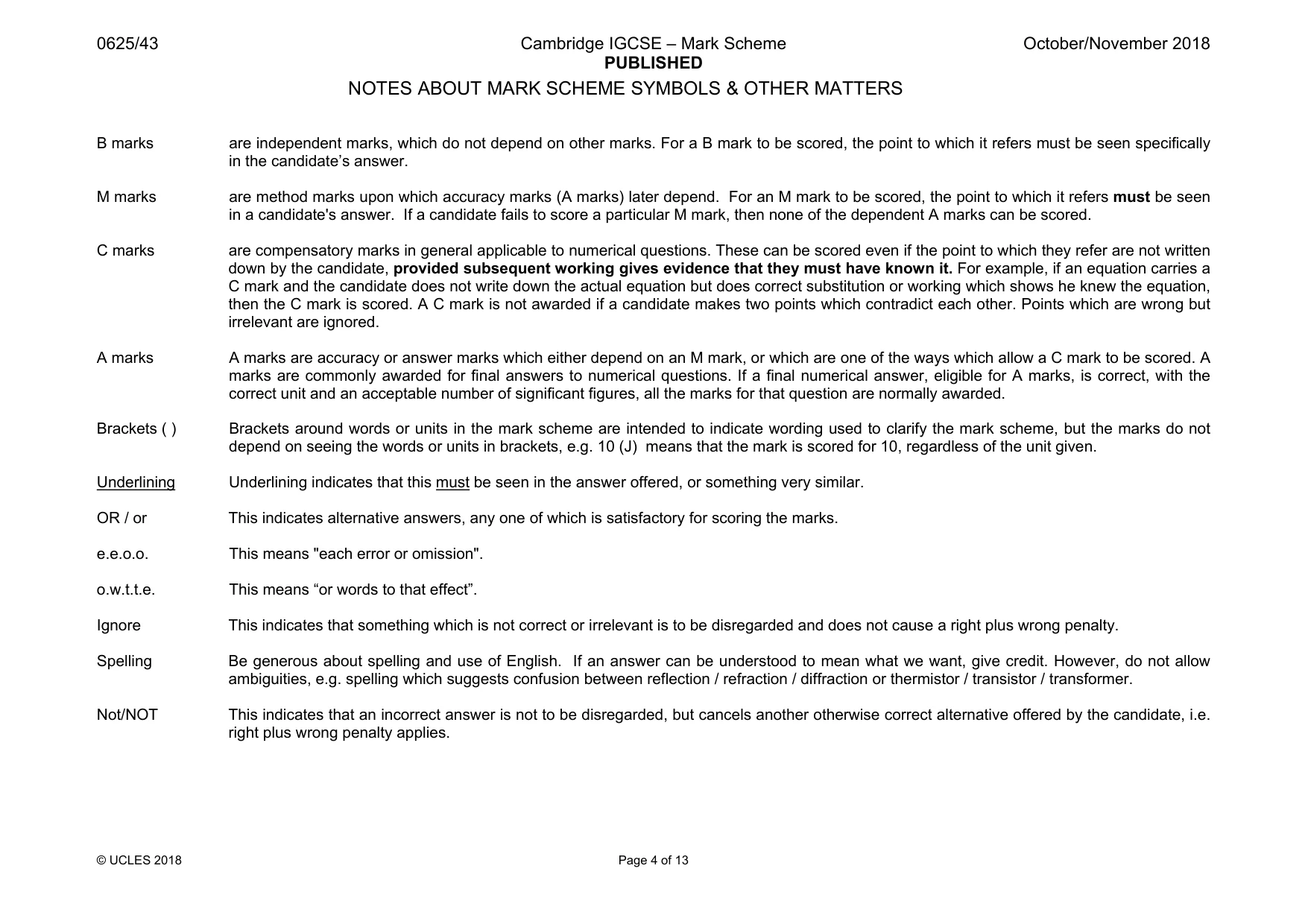
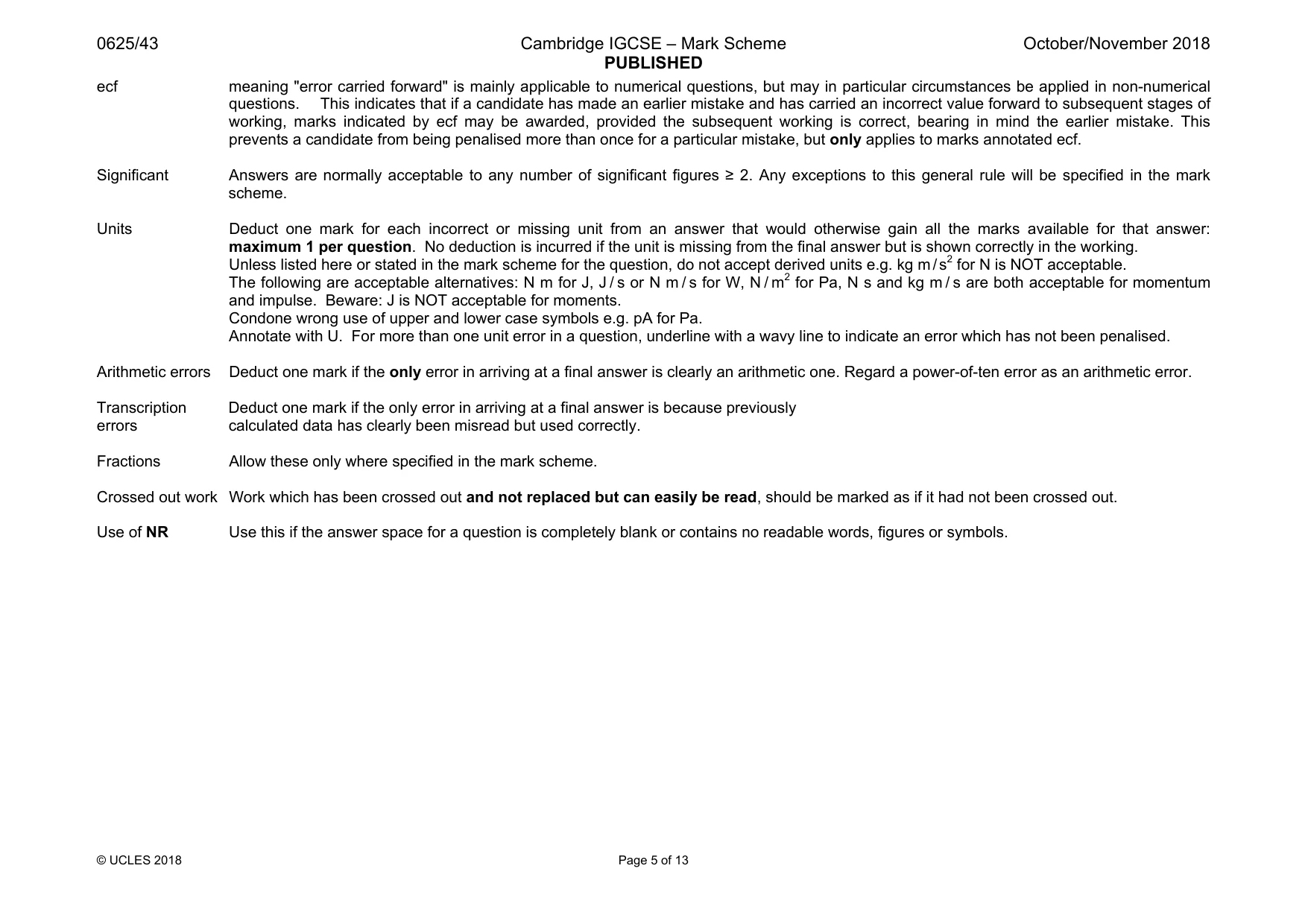
Mark scheme13 pages
Answers below. Sit the paper first if you are practising.
Questions as text
Q1 · The distance-time graph for a moving car
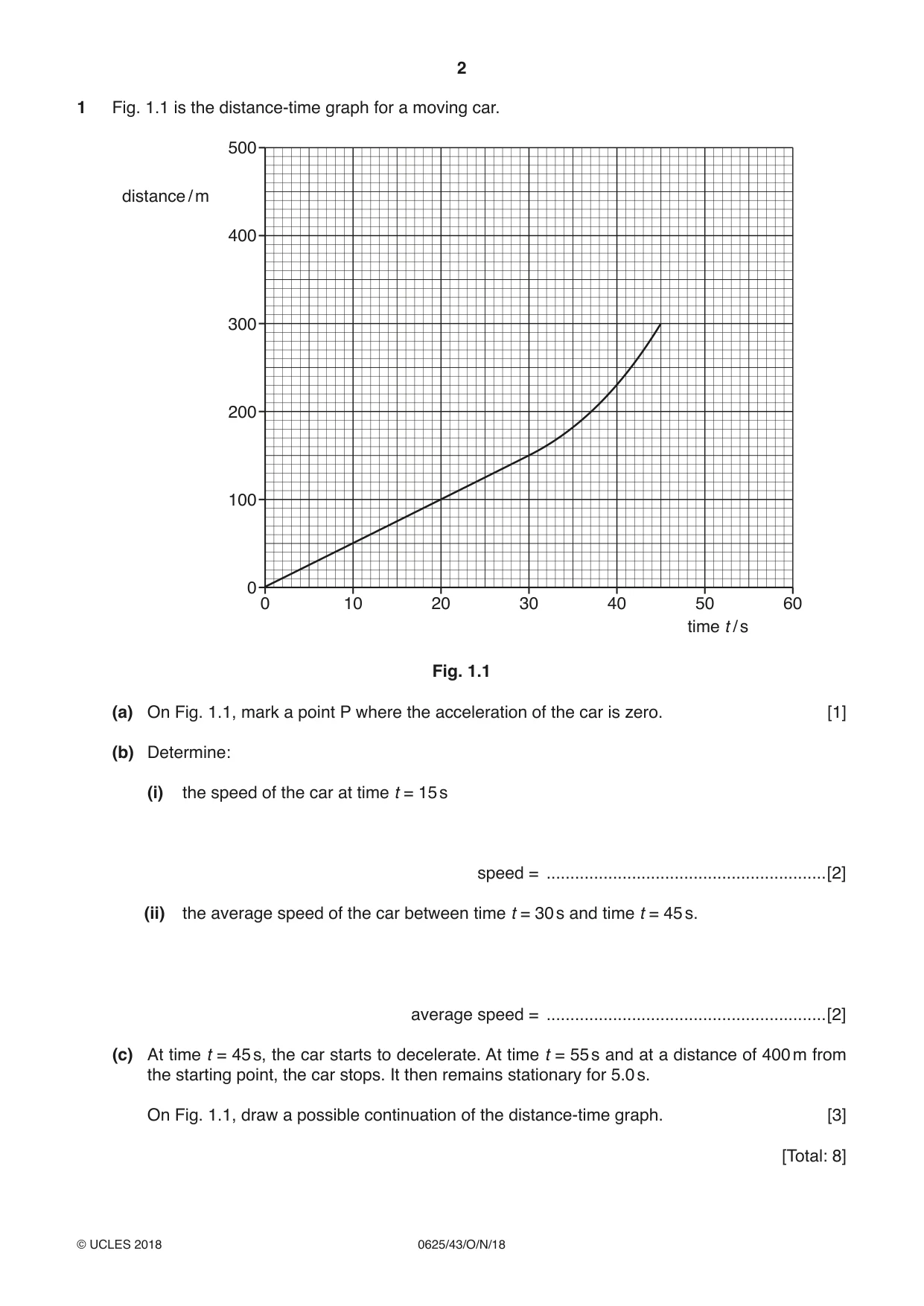
1 Fig. 1.1 is the distance-time graph for a moving car. 500 distance / m 400 300 200 100 0 0 10 20 30 40 50 60 time t / s Fig. 1.1 (a) On Fig. 1.1, mark a point P where the acceleration of the car is zero. [1] (b) Determine: (i) the speed of the car at time t = 15 s speed = ...........................................................[2] (ii) the average speed of the car between time t = 30 s and time t = 45 s. average speed = ...........................................................[2] (c) At time t = 45 s, the car starts to decelerate. At time t = 55 s and at a distance of 400 m from the starting point, the car stops. It then remains stationary for 5.0 s. On Fig. 1.1, draw a possible continuation of the distance-time graph. [3] [Total: 8]
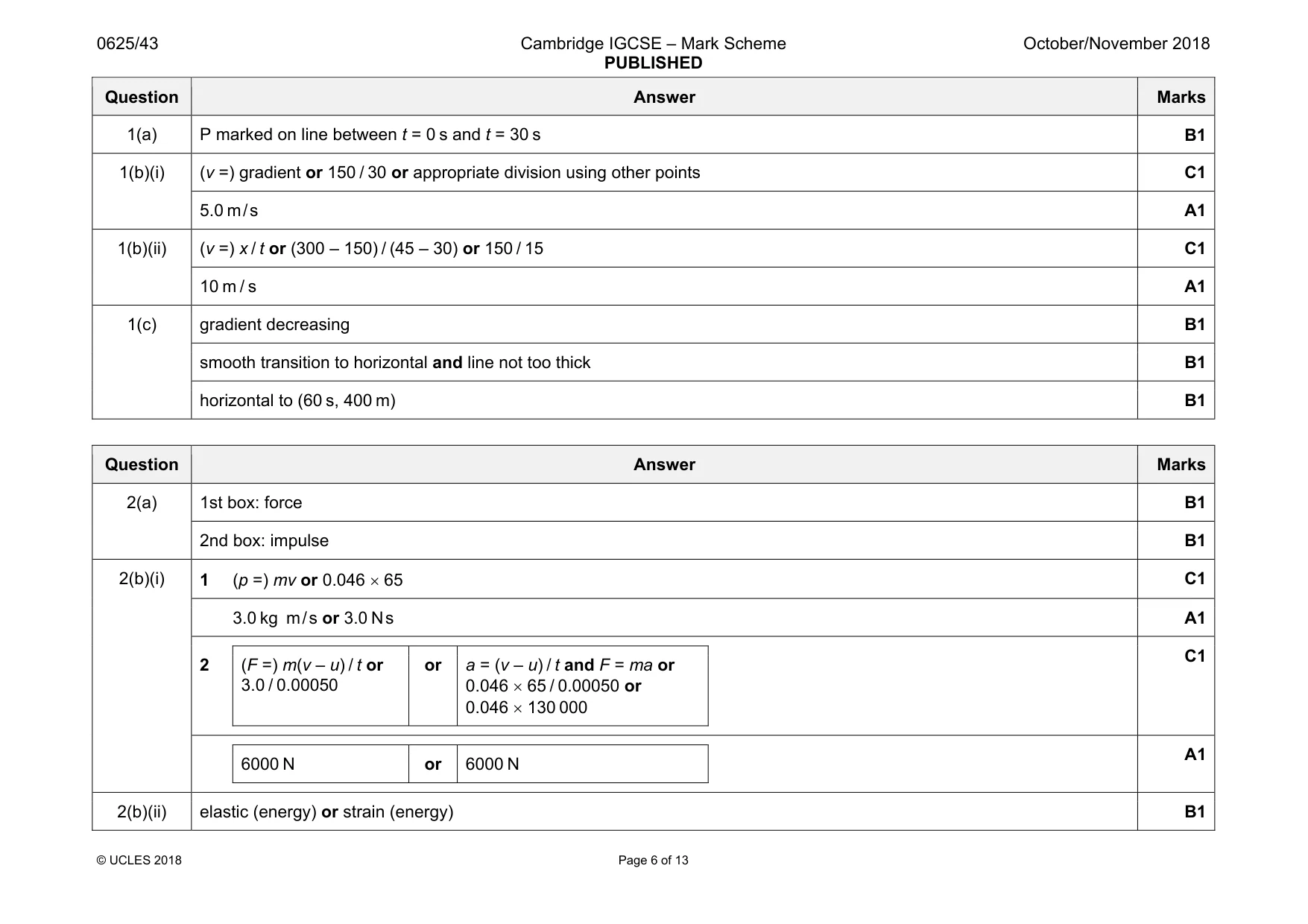
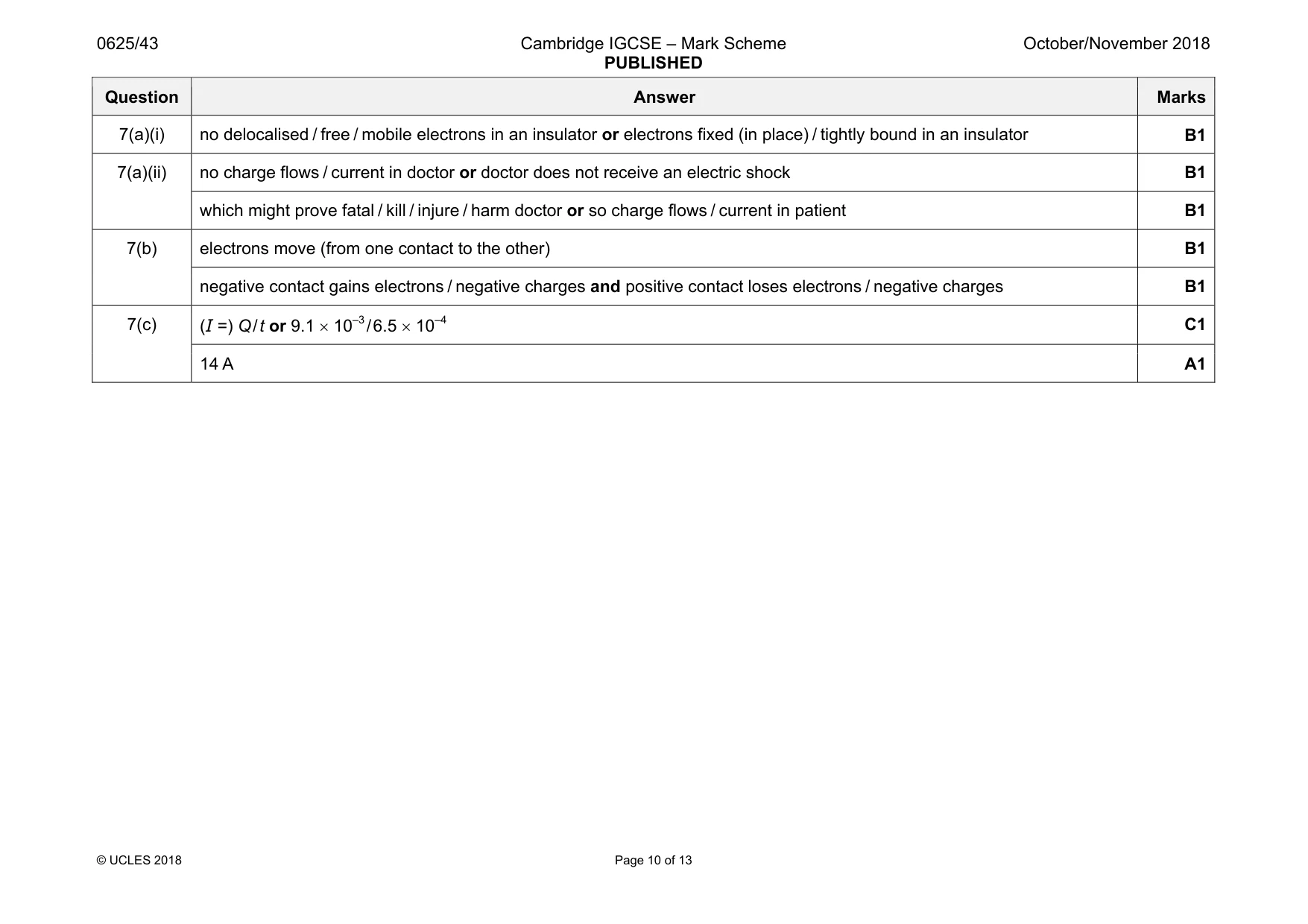
Mark scheme: 1(a) P marked on line between t = 0 s and t = 30 s B1 1(b)(i) (v =) gradient or 150 / 30 or appropriate division using other points C1 5.0 m / s A1 1(b)(ii) (v =) x / t or (300 – 150) / (45 – 30) or 150 / 15 C1 10 m / s A1 1(c) gradient decreasing B1 smooth transition to horizontal and line not too thick B1 horizontal to (60 s, 400 m) B1
Question 2
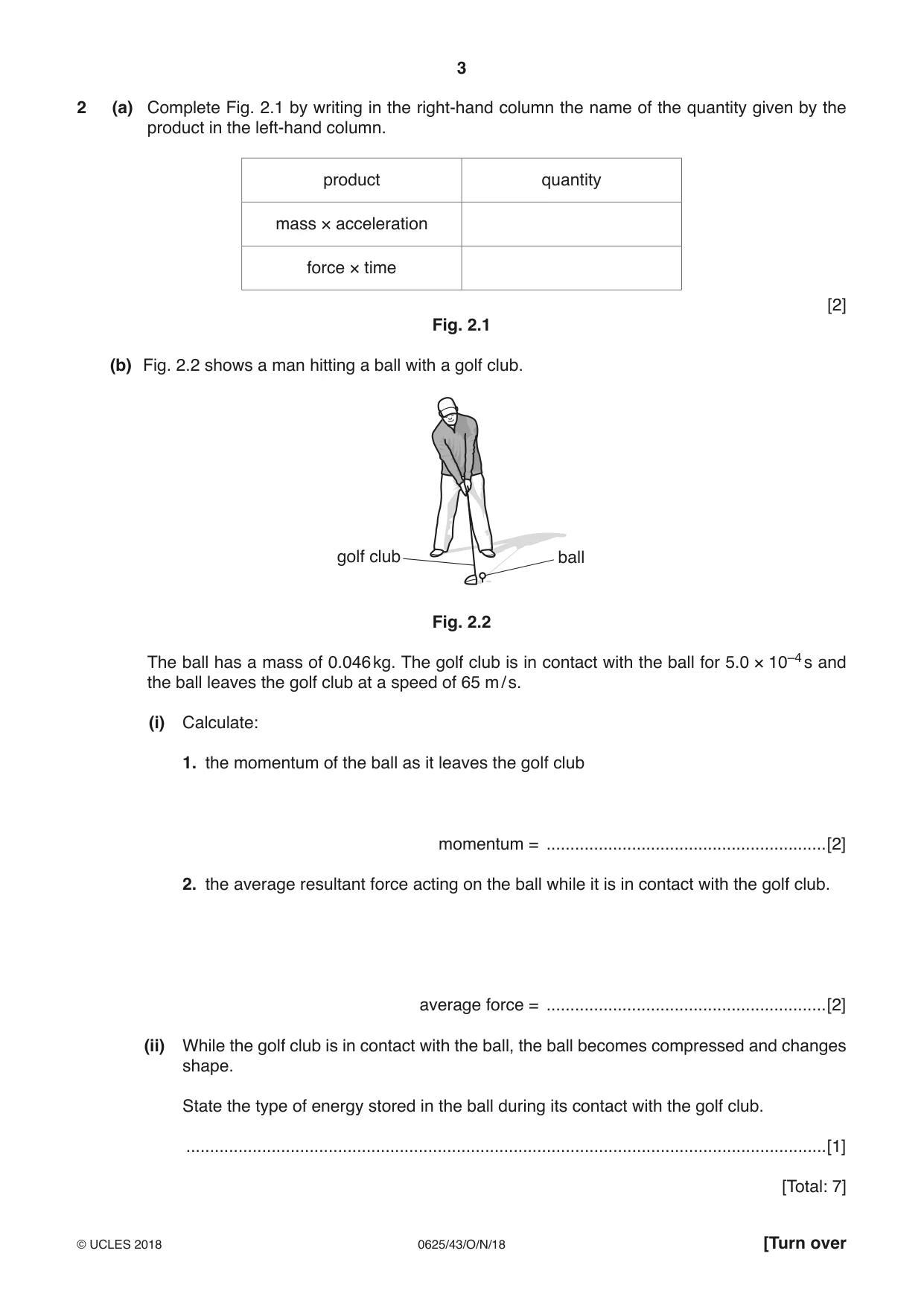
2 (a) Complete Fig. 2.1 by writing in the right-hand column the name of the quantity given by the product in the left-hand column. product quantity mass × acceleration force × time [2] Fig. 2.1 (b) Fig. 2.2 shows a man hitting a ball with a golf club. golf club ball Fig. 2.2 The ball has a mass of 0.046 kg. The golf club is in contact with the ball for 5.0 × 10⁻⁴ s and the ball leaves the golf club at a speed of 65 m / s. (i) Calculate: 1. the momentum of the ball as it leaves the golf club momentum = ...........................................................[2] 2. the average resultant force acting on the ball while it is in contact with the golf club. average force = ...........................................................[2] (ii) While the golf club is in contact with the ball, the ball becomes compressed and changes shape. State the type of energy stored in the ball during its contact with the golf club. .......................................................................................................................................[1] [Total: 7]
Mark scheme: 2(a) 1st box: force B1 2nd box: impulse B1 2(b)(i) 1 (p =) mv or 0.046 × 65 C1 3.0 kg m / s or 3.0 N s A1 2 (F =) m(v – u) / t or 3.0 / 0.00050 or a = (v – u) / t and F = ma or 0.046 × 65 / 0.00050 or 0.046 × 130 000 C1 6000 N or 6000 N A1 2(b)(ii) elastic (energy) or strain (energy) B1
Q3 · The density of mercury is 1.4 × 10⁴ kg / m3
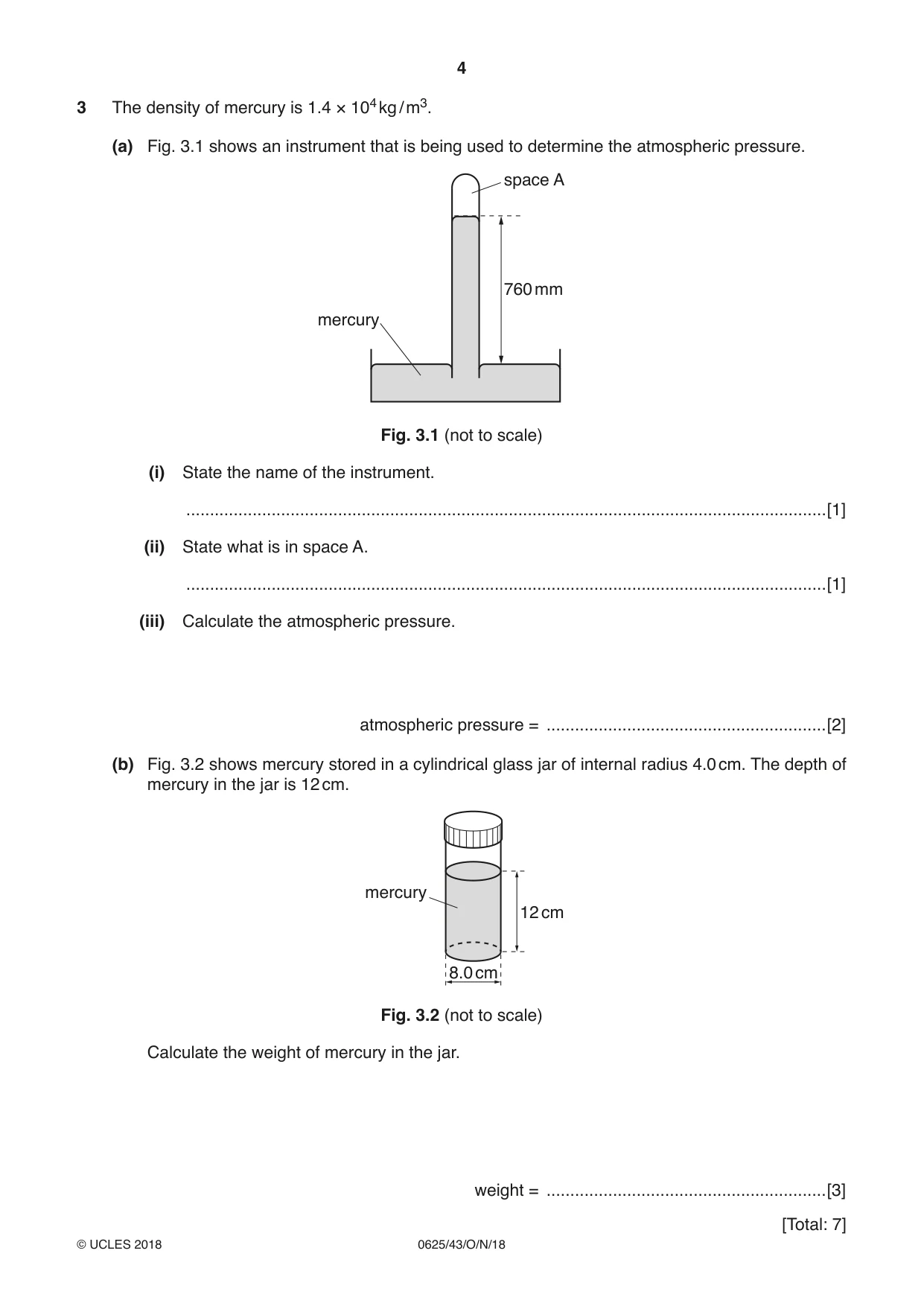
3 The density of mercury is 1.4 × 10⁴ kg / m3. (a) Fig. 3.1 shows an instrument that is being used to determine the atmospheric pressure. space A 760 mm mercury Fig. 3.1 (not to scale) (i) State the name of the instrument. .......................................................................................................................................[1] (ii) State what is in space A. .......................................................................................................................................[1] (iii) Calculate the atmospheric pressure. atmospheric pressure = ...........................................................[2] (b) Fig. 3.2 shows mercury stored in a cylindrical glass jar of internal radius 4.0 cm. The depth of mercury in the jar is 12 cm. mercury 12 cm 8.0 cm Fig. 3.2 (not to scale) Calculate the weight of mercury in the jar. weight = ...........................................................[3]
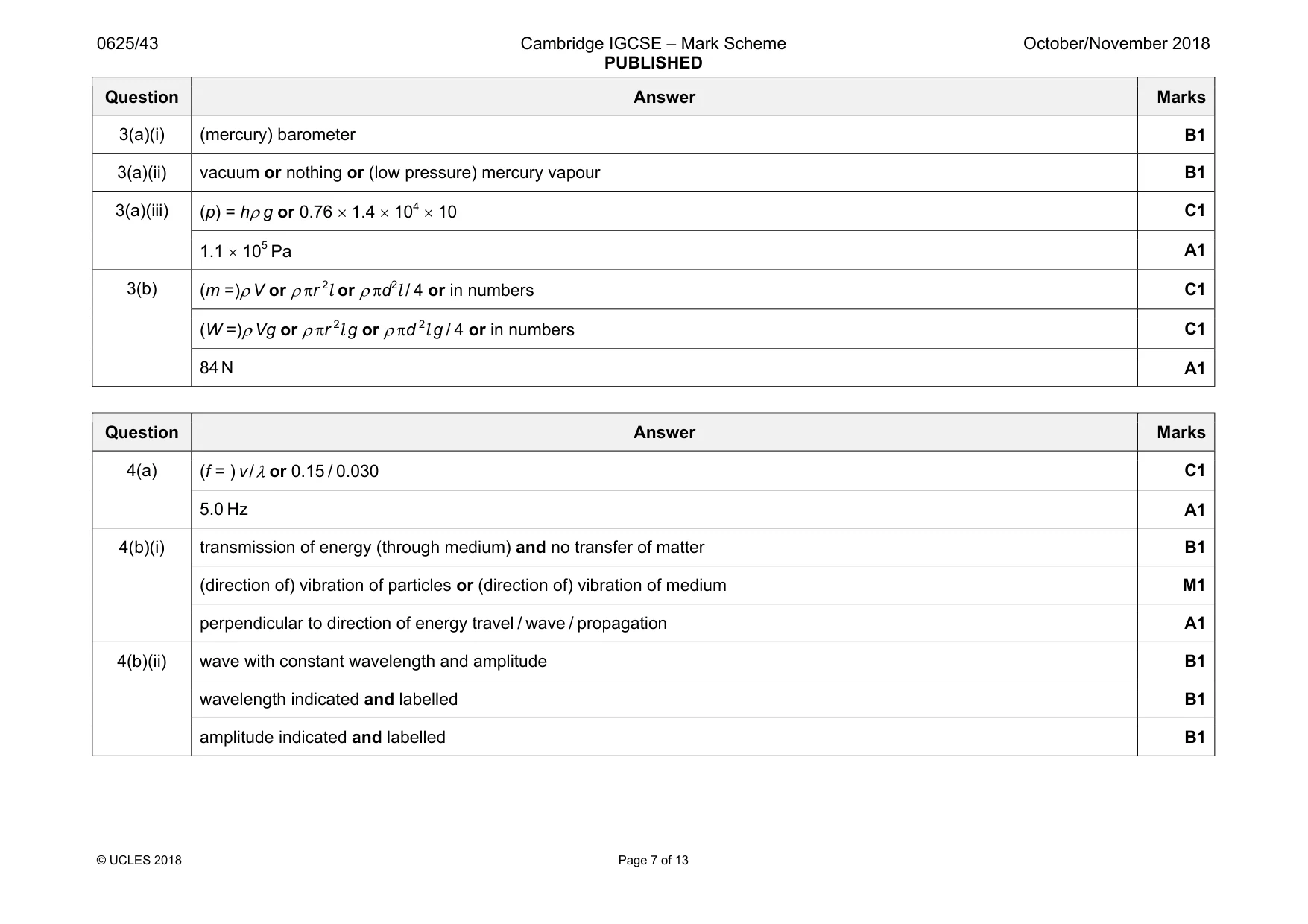
Mark scheme: 3(a)(i) (mercury) barometer B1 3(a)(ii) vacuum or nothing or (low pressure) mercury vapour B1 3(a)(iii) (p) = hρ g or 0.76 × 1.4 × 104 × 10 C1 1.1 × 10⁵ Pa A1 3(b) (m =)ρ V or ρ πr 2l or ρ πd2l / 4 or in numbers C1 (W =)ρ Vg or ρ πr 2l g or ρ πd 2l g / 4 or in numbers C1 84 N A1
Q4 · A wave is travelling across the surface of water in a tank at a speed of 0.15 m / s
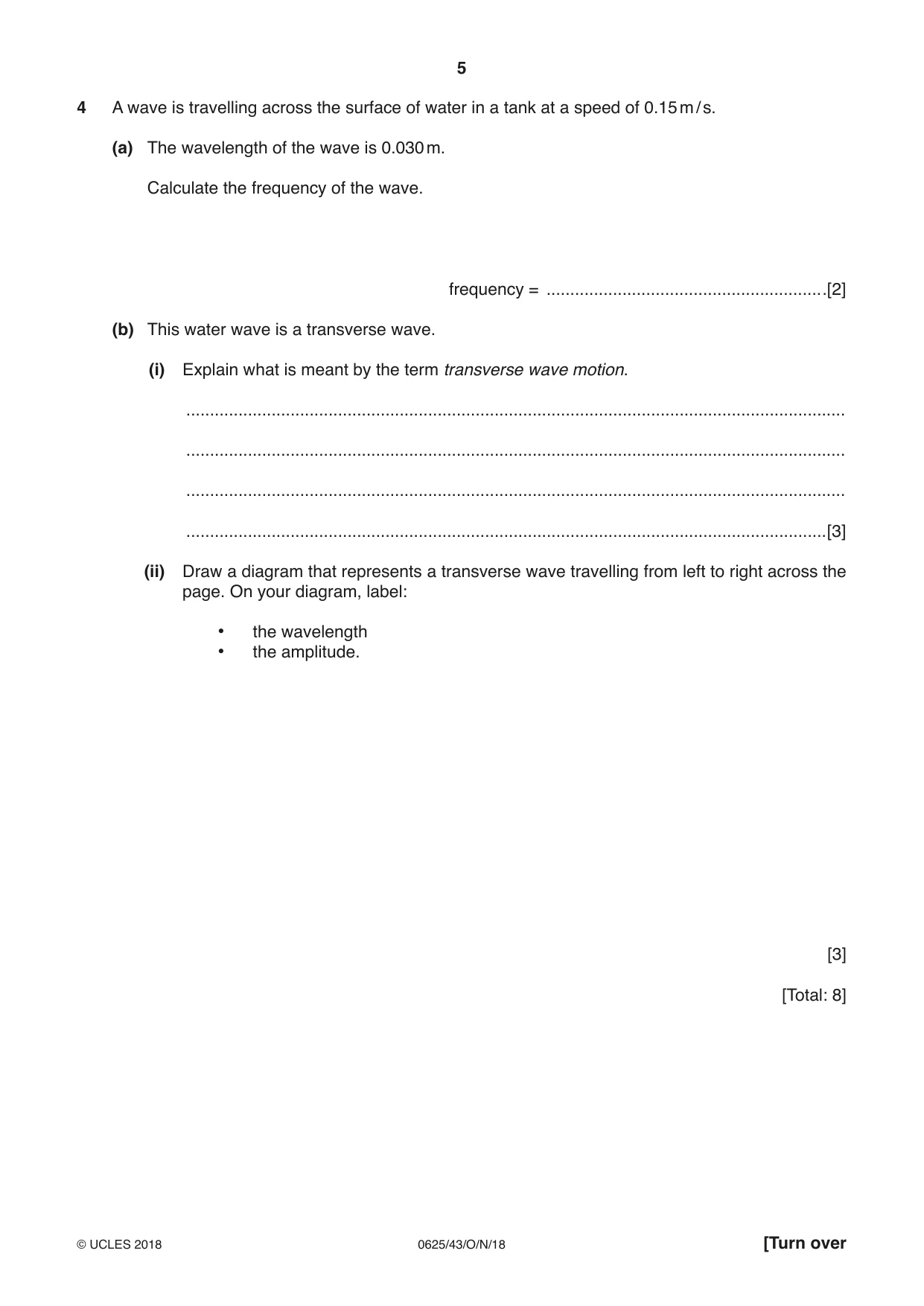
4 A wave is travelling across the surface of water in a tank at a speed of 0.15 m / s. (a) The wavelength of the wave is 0.030 m. Calculate the frequency of the wave. frequency = ...........................................................[2] (b) This water wave is a transverse wave. (i) Explain what is meant by the term transverse wave motion. ........................................................................................................................................... ........................................................................................................................................... ........................................................................................................................................... .......................................................................................................................................[3] (ii) Draw a diagram that represents a transverse wave travelling from left to right across the page. On your diagram, label: • the wavelength • the amplitude. [3] [Total: 8]
Mark scheme: 4(a) C1 5.0 Hz A1 4(b)(i) transmission of energy (through medium) and no transfer of matter B1 (direction of) vibration of particles or (direction of) vibration of medium M1 perpendicular to direction of energy travel / wave / propagation A1 4(b)(ii) wave with constant wavelength and amplitude B1 wavelength indicated and labelled B1 amplitude indicated and labelled B1
Q5 · A student is supplied with a small block of iron, a thermometer and an electrical heater…
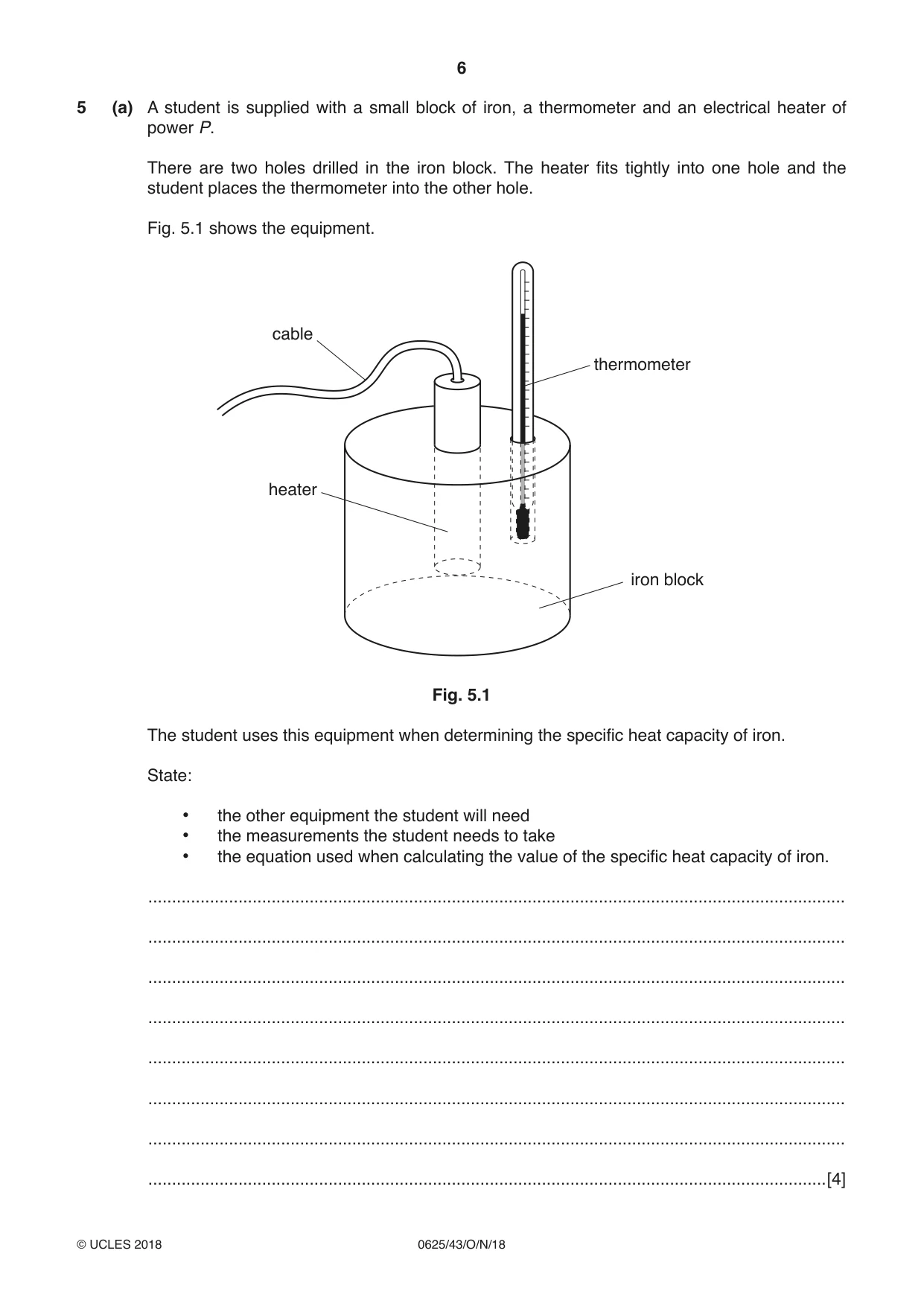
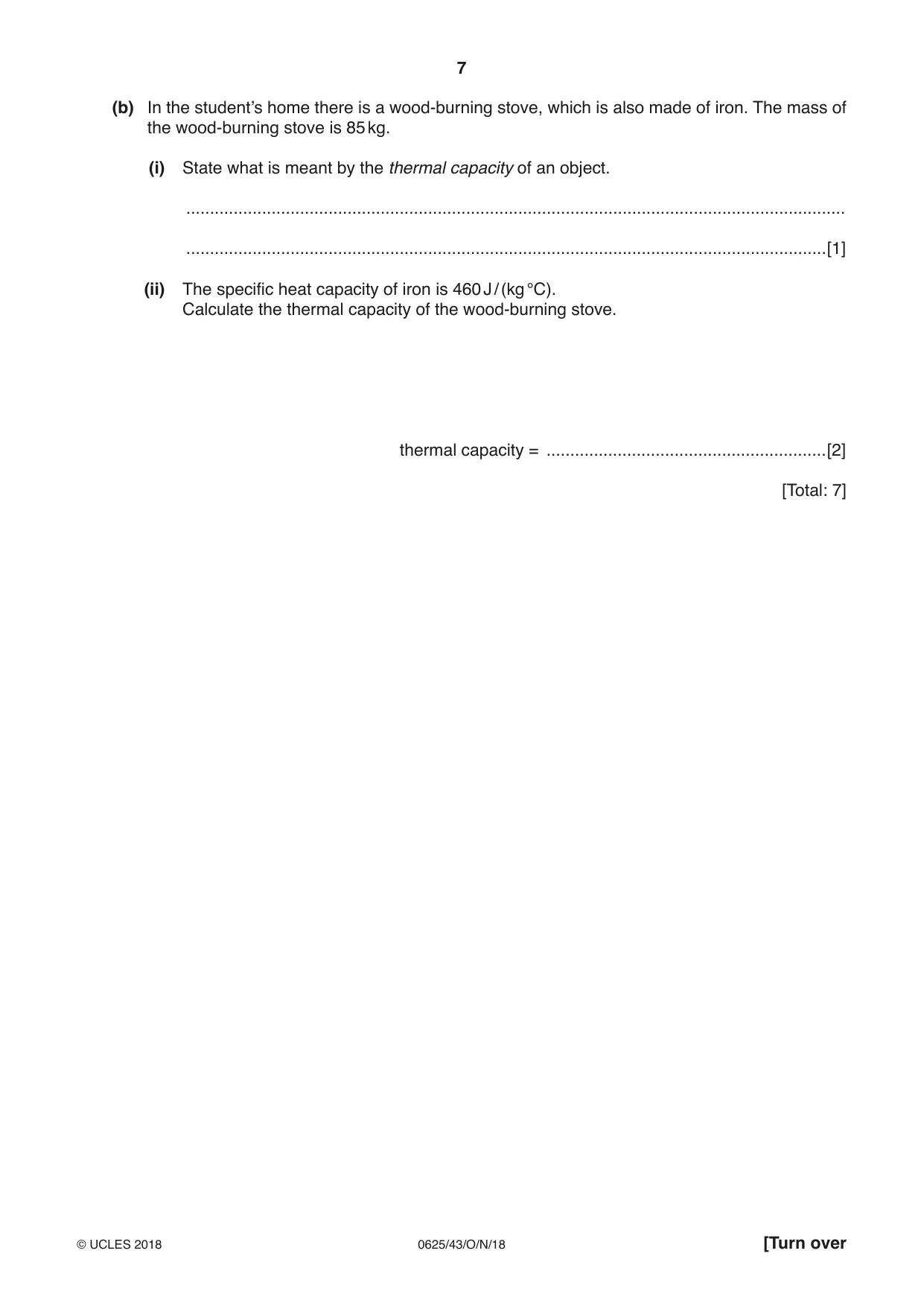
5 (a) A student is supplied with a small block of iron, a thermometer and an electrical heater of power P. There are two holes drilled in the iron block. The heater fits tightly into one hole and the student places the thermometer into the other hole. Fig. 5.1 shows the equipment. cable thermometer heater iron block Fig. 5.1 The student uses this equipment when determining the specific heat capacity of iron. State: • the other equipment the student will need • the measurements the student needs to take • the equation used when calculating the value of the specific heat capacity of iron. ................................................................................................................................................... ................................................................................................................................................... ................................................................................................................................................... ................................................................................................................................................... ................................................................................................................................................... ................................................................................................................................................... ................................................................................................................................................... ...............................................................................................................................................[4] (b) In the student’s home there is a wood-burning stove, which is also made of iron. The mass of the wood-burning stove is 85 kg. (i) State what is meant by the thermal capacity of an object. ........................................................................................................................................... .......................................................................................................................................[1] (ii) The specific heat capacity of iron is 460 J / (kg °C). Calculate the thermal capacity of the wood-burning stove. thermal capacity = ...........................................................[2] [Total: 7]
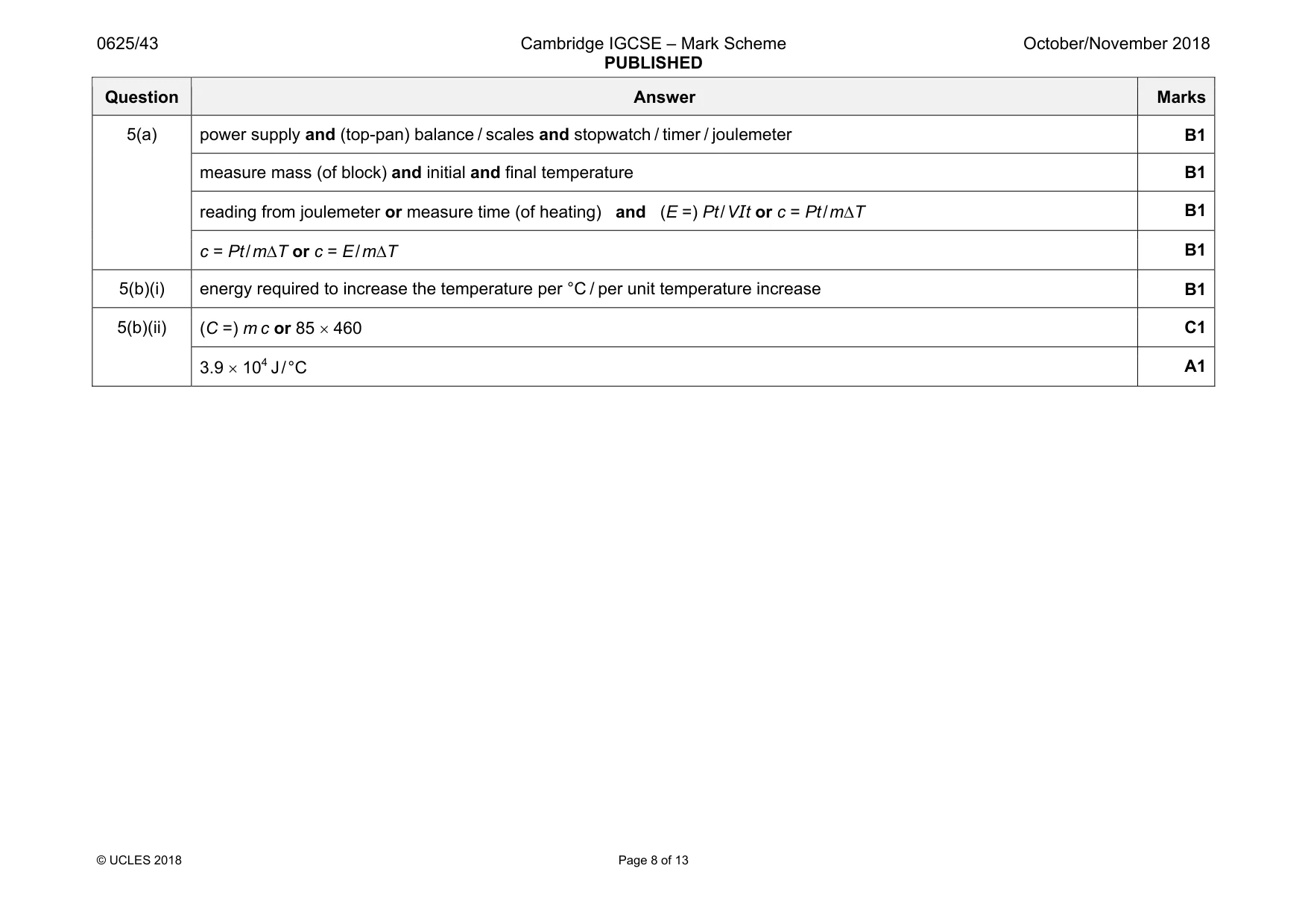
Mark scheme: 5(a) power supply and (top-pan) balance / scales and stopwatch / timer / joulemeter measure mass (of block) and initial and final temperature B1 reading from joulemeter or measure time (of heating) and (E =) Pt / VIt or c = Pt / m∆T B1 c = Pt / m∆T or c = E / m∆T B1 5(b)(i) energy required to increase the temperature per °C / per unit temperature increase B1 5(b)(ii) (C =) m c or 85 × 460 C1 3.9 × 10⁴ J / °C A1
Q6 · White light incident at point X on a glass prism
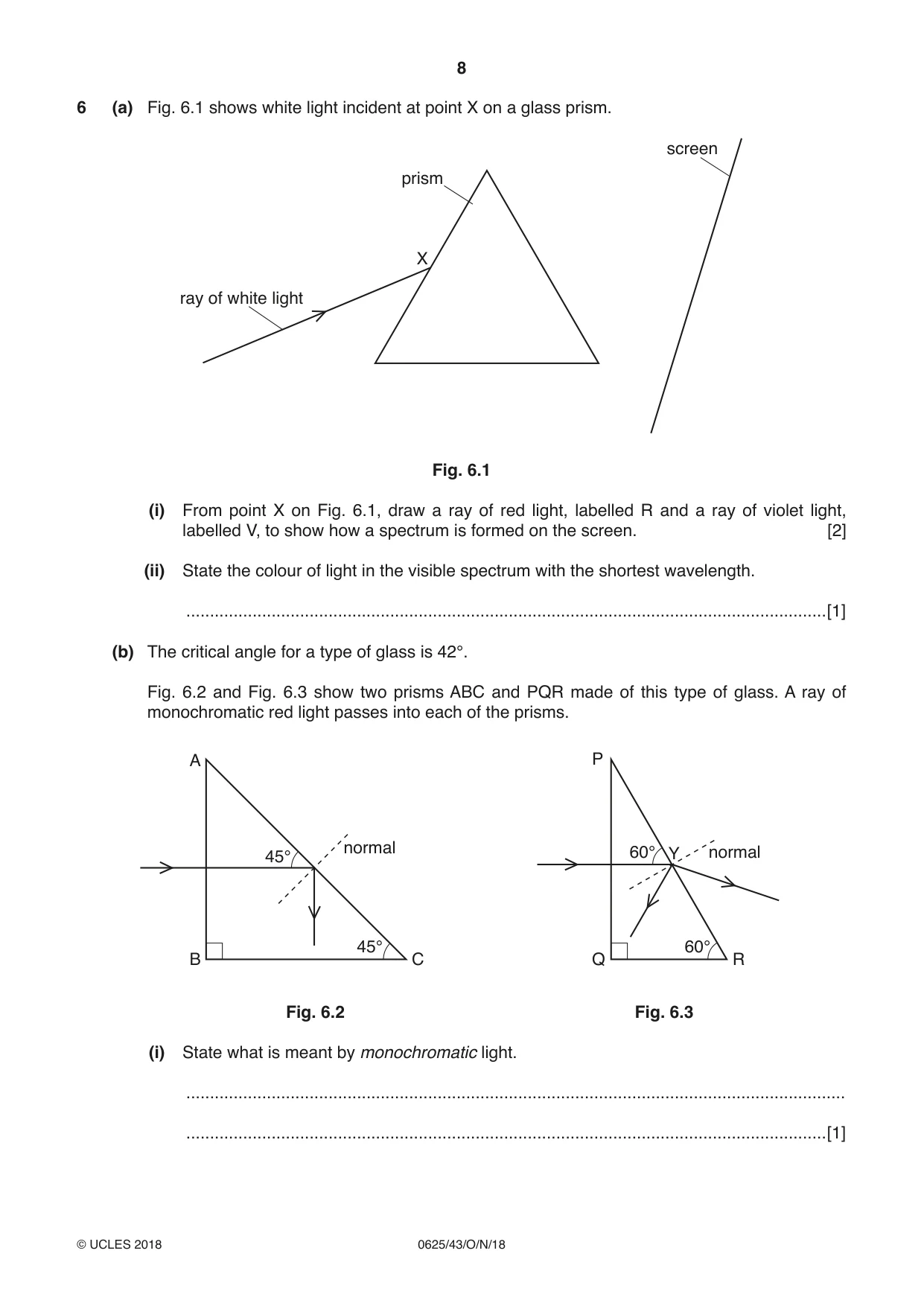
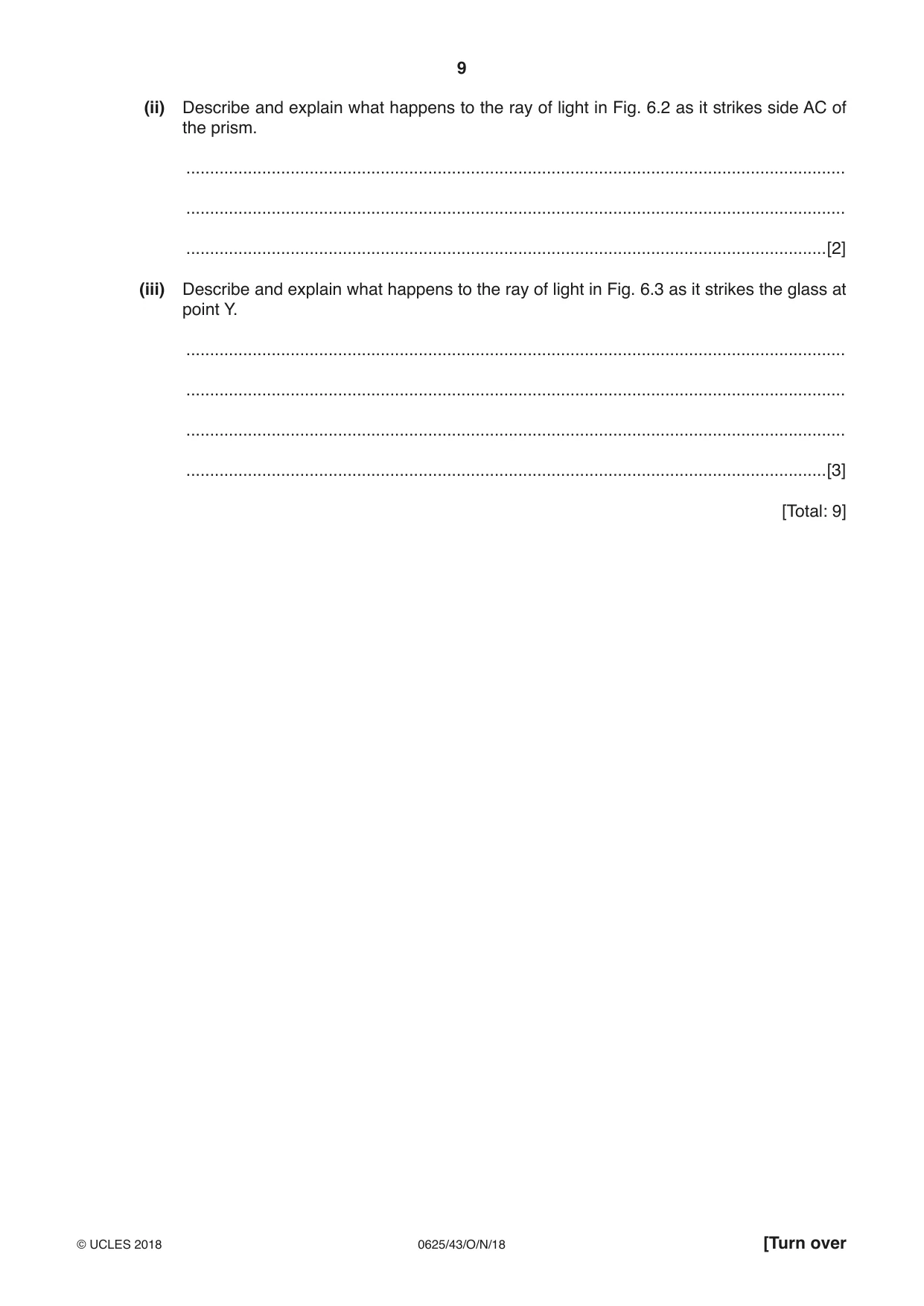
6 (a) Fig. 6.1 shows white light incident at point X on a glass prism. screen prism X ray of white light Fig. 6.1 (i) From point X on Fig. 6.1, draw a ray of red light, labelled R and a ray of violet light, labelled V, to show how a spectrum is formed on the screen. [2] (ii) State the colour of light in the visible spectrum with the shortest wavelength. .......................................................................................................................................[1] (b) The critical angle for a type of glass is 42°. Fig. 6.2 and Fig. 6.3 show two prisms ABC and PQR made of this type of glass. A ray of monochromatic red light passes into each of the prisms. A P normal 60° Y normal 45° 45° 60° B C Q R Fig. 6.2 Fig. 6.3 (i) State what is meant by monochromatic light. ........................................................................................................................................... .......................................................................................................................................[1] (ii) Describe and explain what happens to the ray of light in Fig. 6.2 as it strikes side AC of the prism. ........................................................................................................................................... ........................................................................................................................................... .......................................................................................................................................[2] (iii) Describe and explain what happens to the ray of light in Fig. 6.3 as it strikes the glass at point Y. ........................................................................................................................................... ........................................................................................................................................... ........................................................................................................................................... .......................................................................................................................................[3] [Total: 9]
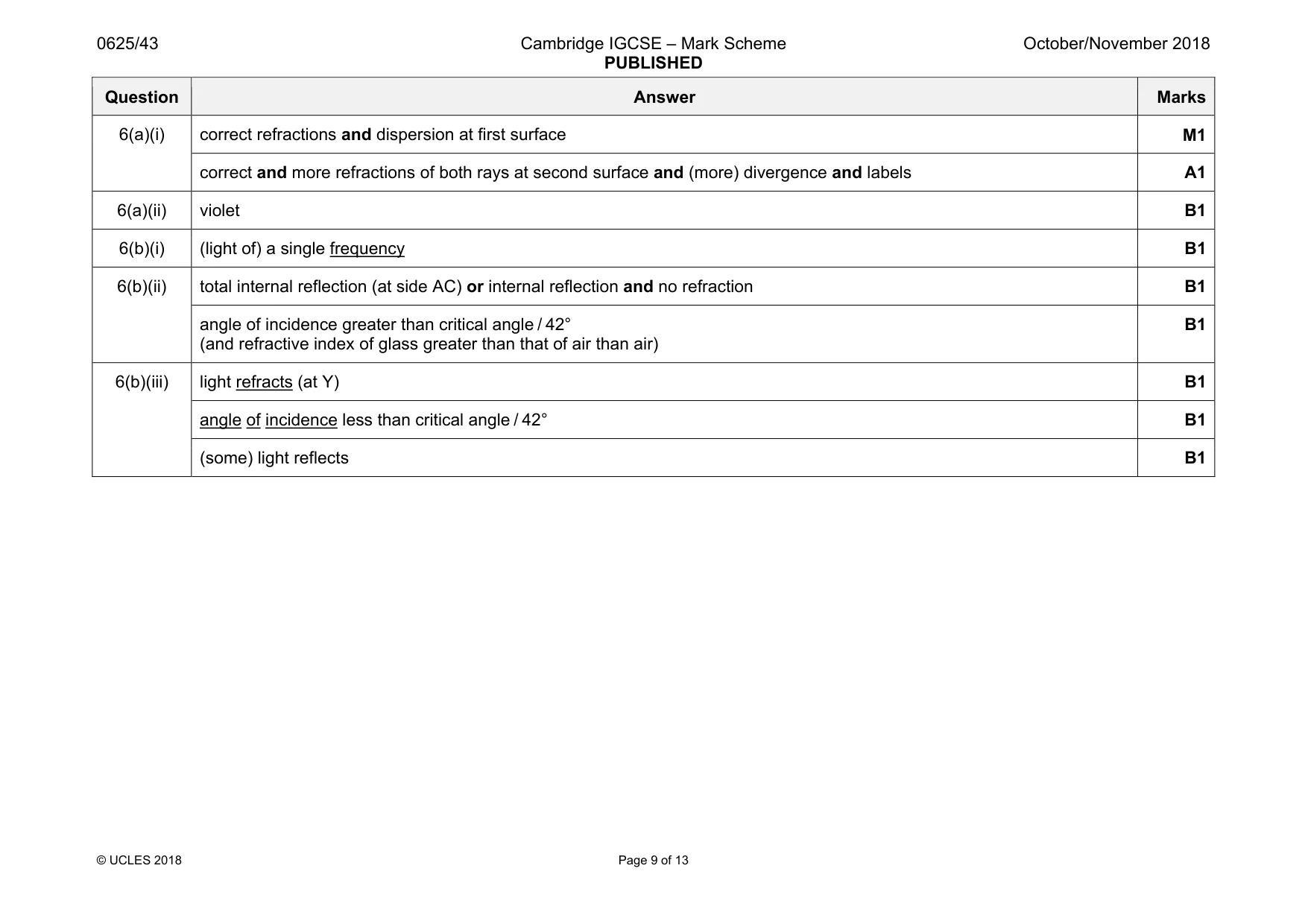
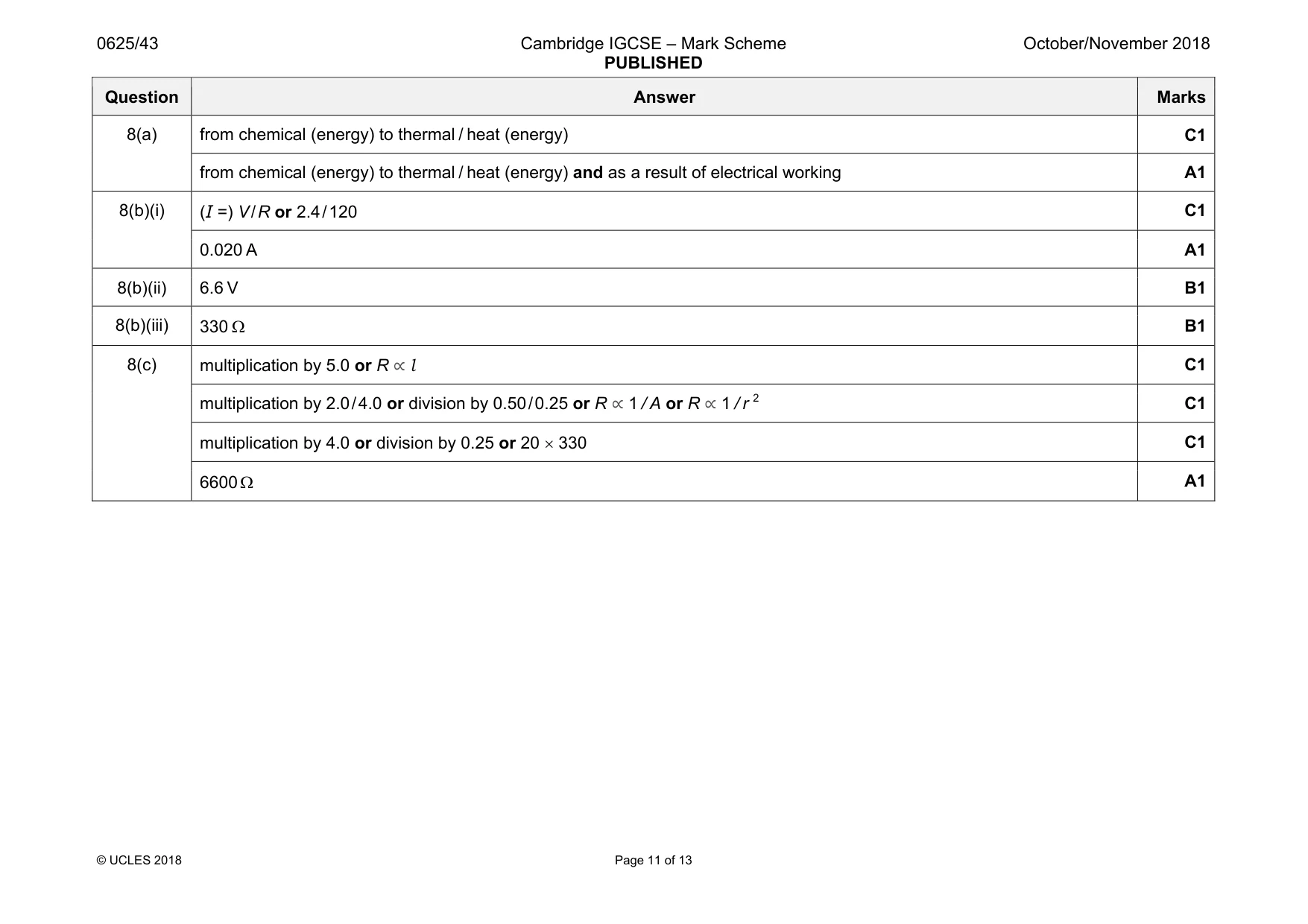
Mark scheme: 6(a)(i) correct refractions and dispersion at first surface M1 correct and more refractions of both rays at second surface and (more) divergence and labels A1 6(a)(ii) violet B1 6(b)(i) (light of) a single frequency B1 6(b)(ii) total internal reflection (at side AC) or internal reflection and no refraction B1 angle of incidence greater than critical angle / 42° (and refractive index of glass greater than that of air than air) B1 6(b)(iii) light refracts (at Y) B1 angle of incidence less than critical angle / 42° B1 (some) light reflects B1
Q7 · A defibrillator is a machine that sends an electrical charge through the heart of a…
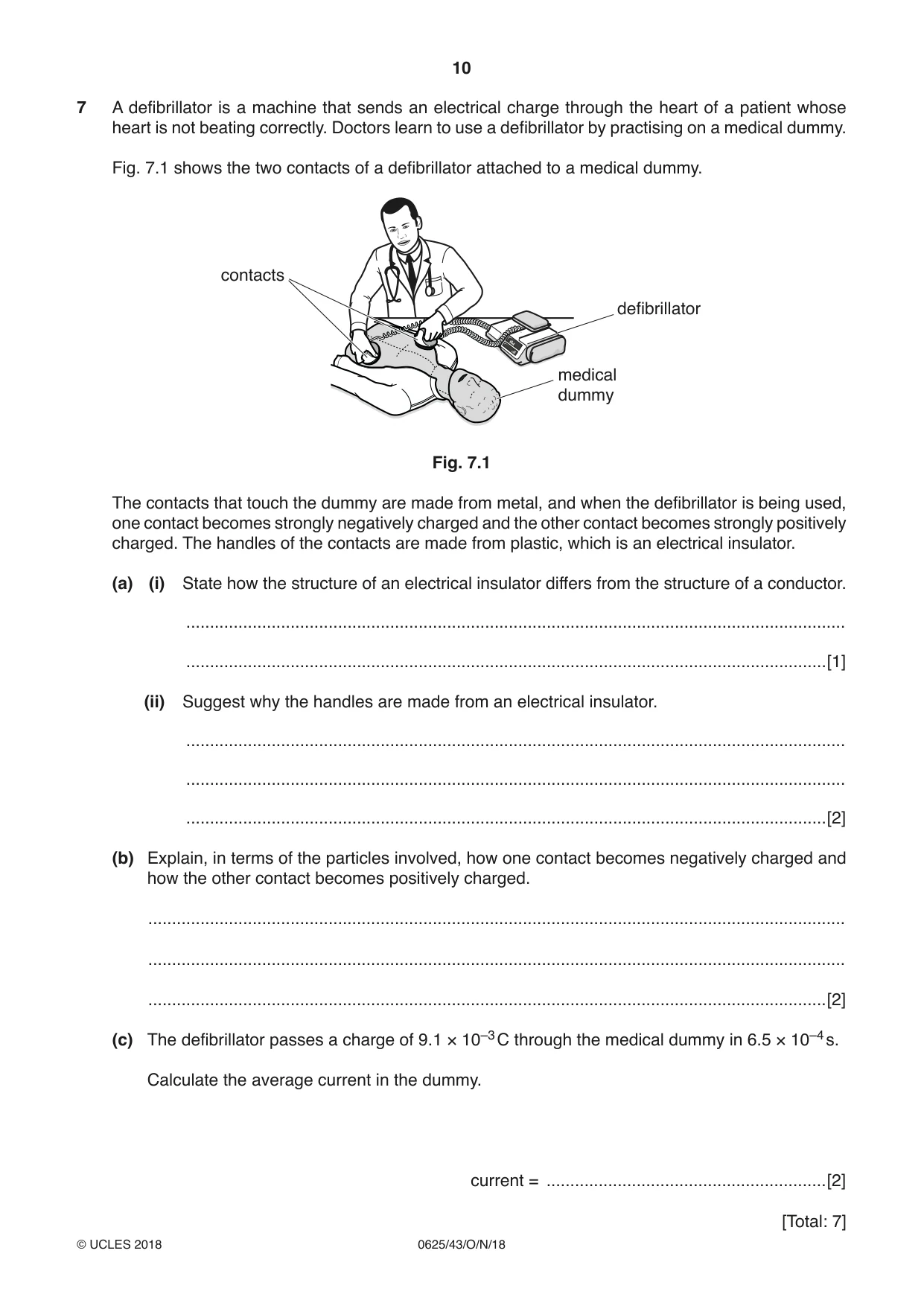
7 A defibrillator is a machine that sends an electrical charge through the heart of a patient whose heart is not beating correctly. Doctors learn to use a defibrillator by practising on a medical dummy. Fig. 7.1 shows the two contacts of a defibrillator attached to a medical dummy. contacts defibrillator medical dummy Fig. 7.1 The contacts that touch the dummy are made from metal, and when the defibrillator is being used, one contact becomes strongly negatively charged and the other contact becomes strongly positively charged. The handles of the contacts are made from plastic, which is an electrical insulator. (a) (i) State how the structure of an electrical insulator differs from the structure of a conductor. ........................................................................................................................................... .......................................................................................................................................[1] (ii) Suggest why the handles are made from an electrical insulator. ........................................................................................................................................... ........................................................................................................................................... .......................................................................................................................................[2] (b) Explain, in terms of the particles involved, how one contact becomes negatively charged and how the other contact becomes positively charged. ................................................................................................................................................... ................................................................................................................................................... ...............................................................................................................................................[2] (c) The defibrillator passes a charge of 9.1 × 10⁻³ C through the medical dummy in 6.5 × 10⁻⁴ s. Calculate the average current in the dummy. current = ...........................................................[2] [Total: 7]
Mark scheme: 7(a)(i) no delocalised / free / mobile electrons in an insulator or electrons fixed (in place) / tightly bound in an insulator B1 7(a)(ii) no charge flows / current in doctor or doctor does not receive an electric shock B1 which might prove fatal / kill / injure / harm doctor or so charge flows / current in patient B1 7(b) electrons move (from one contact to the other) B1 negative contact gains electrons / negative charges and positive contact loses electrons / negative charges B1 7(c) (I =) Q / t or 9.1 × 10⁻³ / 6.5 × 10⁻⁴ C1 14 A A1
Q8 · A 9.0 V battery is connected to a 120 Ω resistor in series with wire P
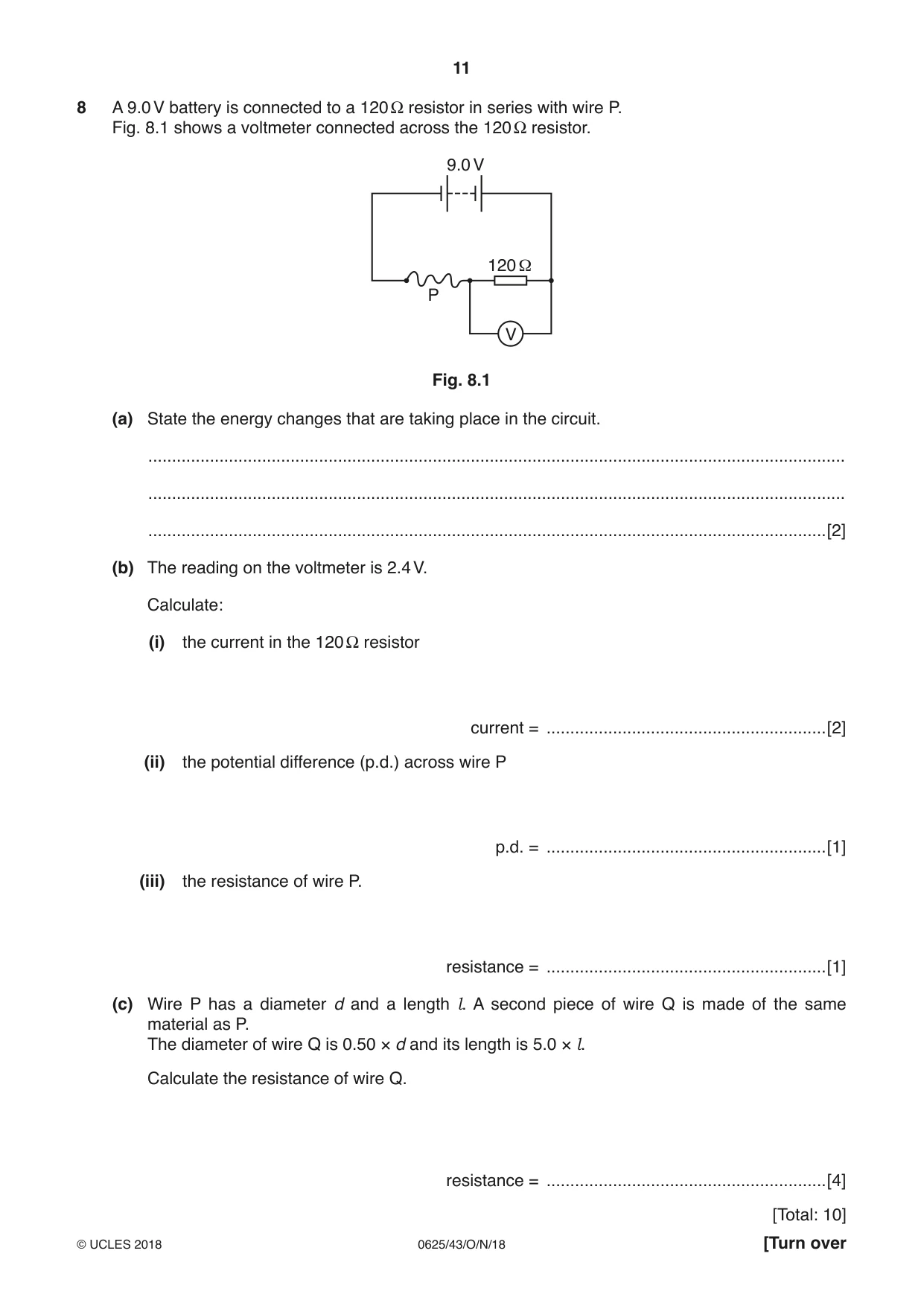
8 A 9.0 V battery is connected to a 120 Ω resistor in series with wire P. Fig. 8.1 shows a voltmeter connected across the 120 Ω resistor. 9.0 V 120 Ω P V Fig. 8.1 (a) State the energy changes that are taking place in the circuit. ................................................................................................................................................... ................................................................................................................................................... ...............................................................................................................................................[2] (b) The reading on the voltmeter is 2.4 V. Calculate: (i) the current in the 120 Ω resistor current = ...........................................................[2] (ii) the potential difference (p.d.) across wire P p.d. = ...........................................................[1] (iii) the resistance of wire P. resistance = ...........................................................[1] (c) Wire P has a diameter d and a length l. A second piece of wire Q is made of the same material as P. The diameter of wire Q is 0.50 × d and its length is 5.0 × l. Calculate the resistance of wire Q. resistance = ...........................................................[4] [Total: 10]
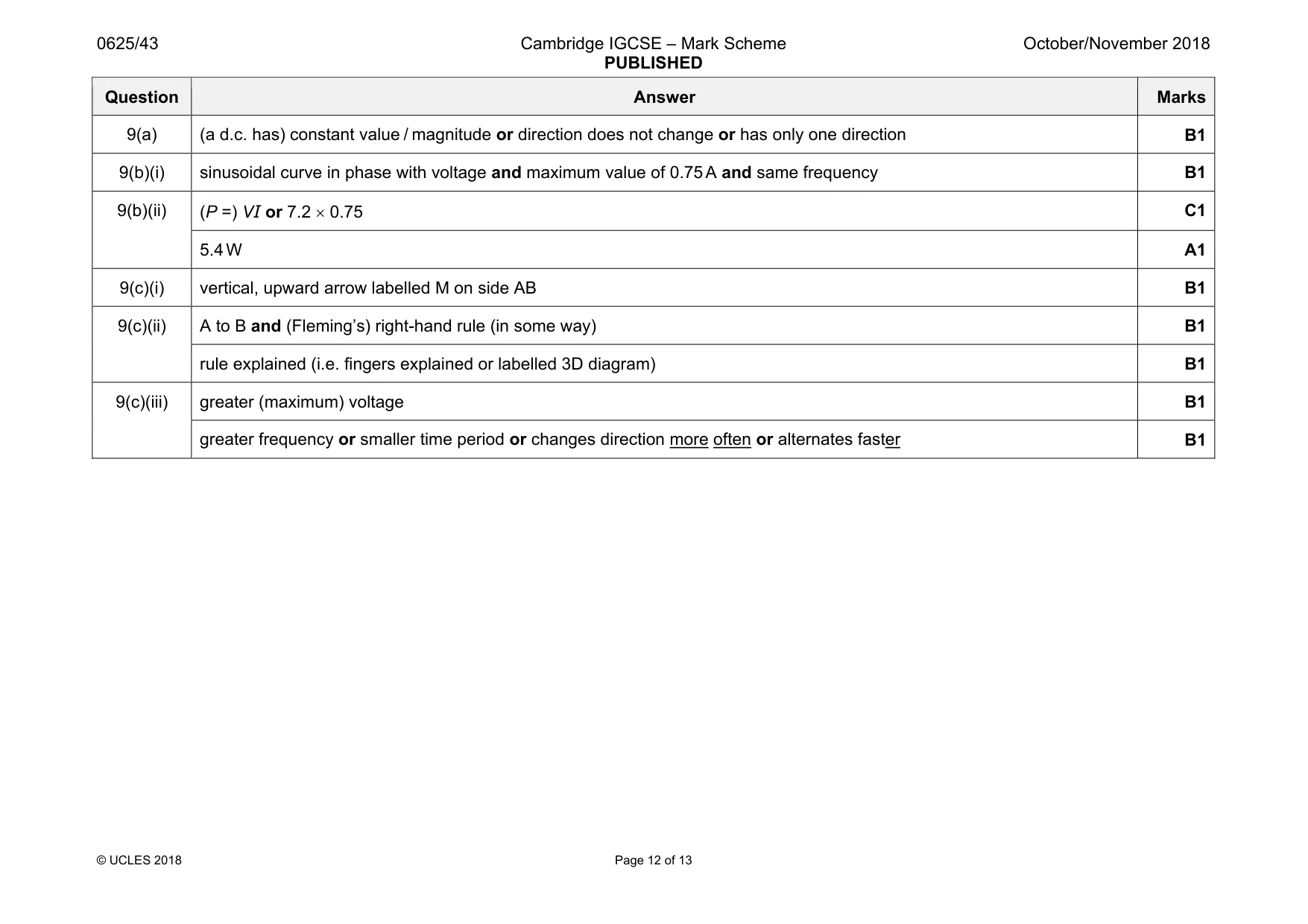
Mark scheme: 8(a) from chemical (energy) to thermal / heat (energy) C1 from chemical (energy) to thermal / heat (energy) and as a result of electrical working A1 8(b)(i) (I =) V / R or 2.4 / 120 C1 0.020 A A1 8(b)(ii) 6.6 V B1 8(b)(iii) 330 Ω B1 8(c) multiplication by 5.0 or R ∝ l C1 multiplication by 2.0 / 4.0 or division by 0.50 / 0.25 or R ∝ 1 / A or R ∝ 1 / r 2 C1 multiplication by 4.0 or division by 0.25 or 20 × 330 C1 6600 Ω A1
Q9 · Describe how a direct current (d.c.) differs from an alternating current (a.c.)
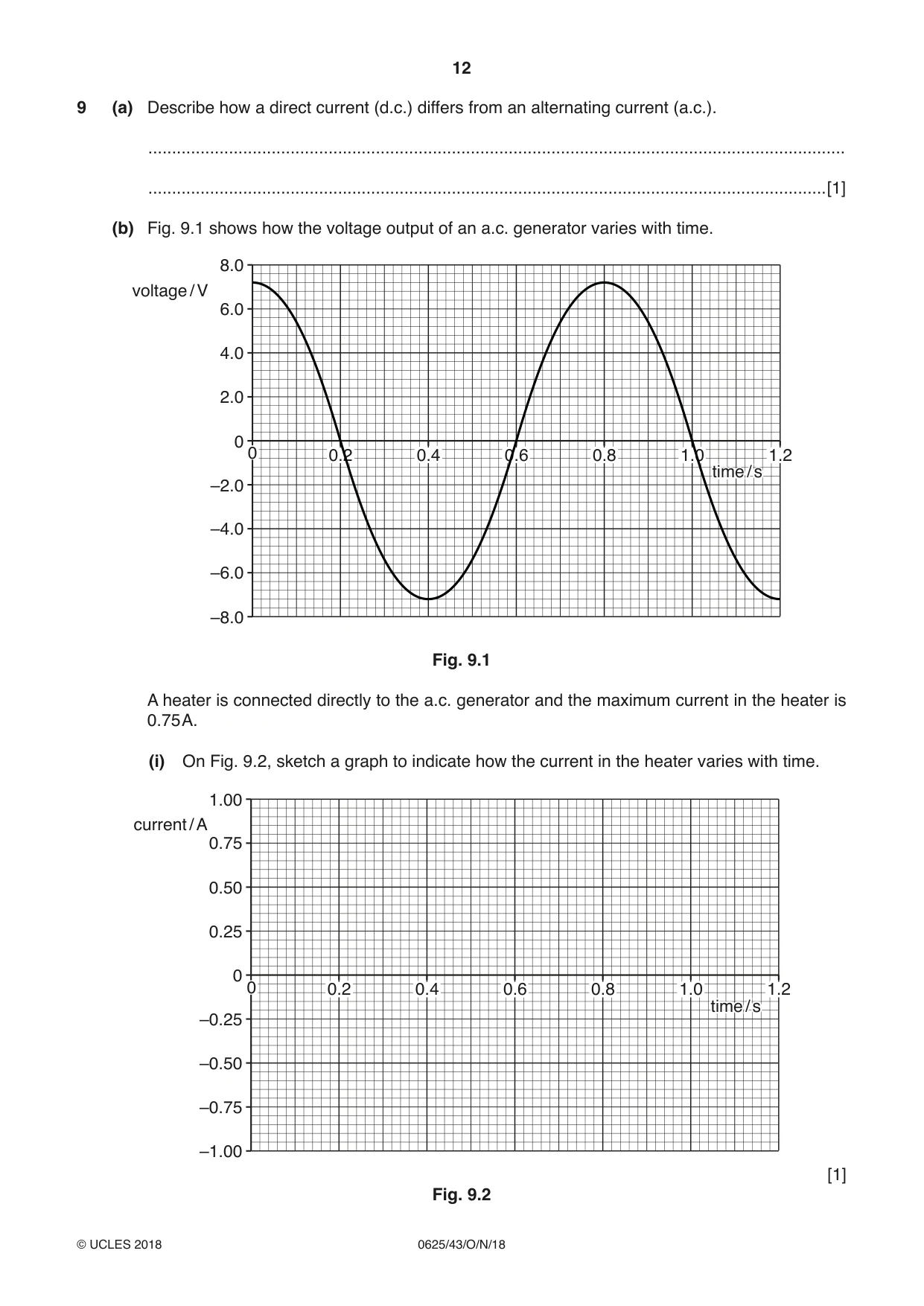
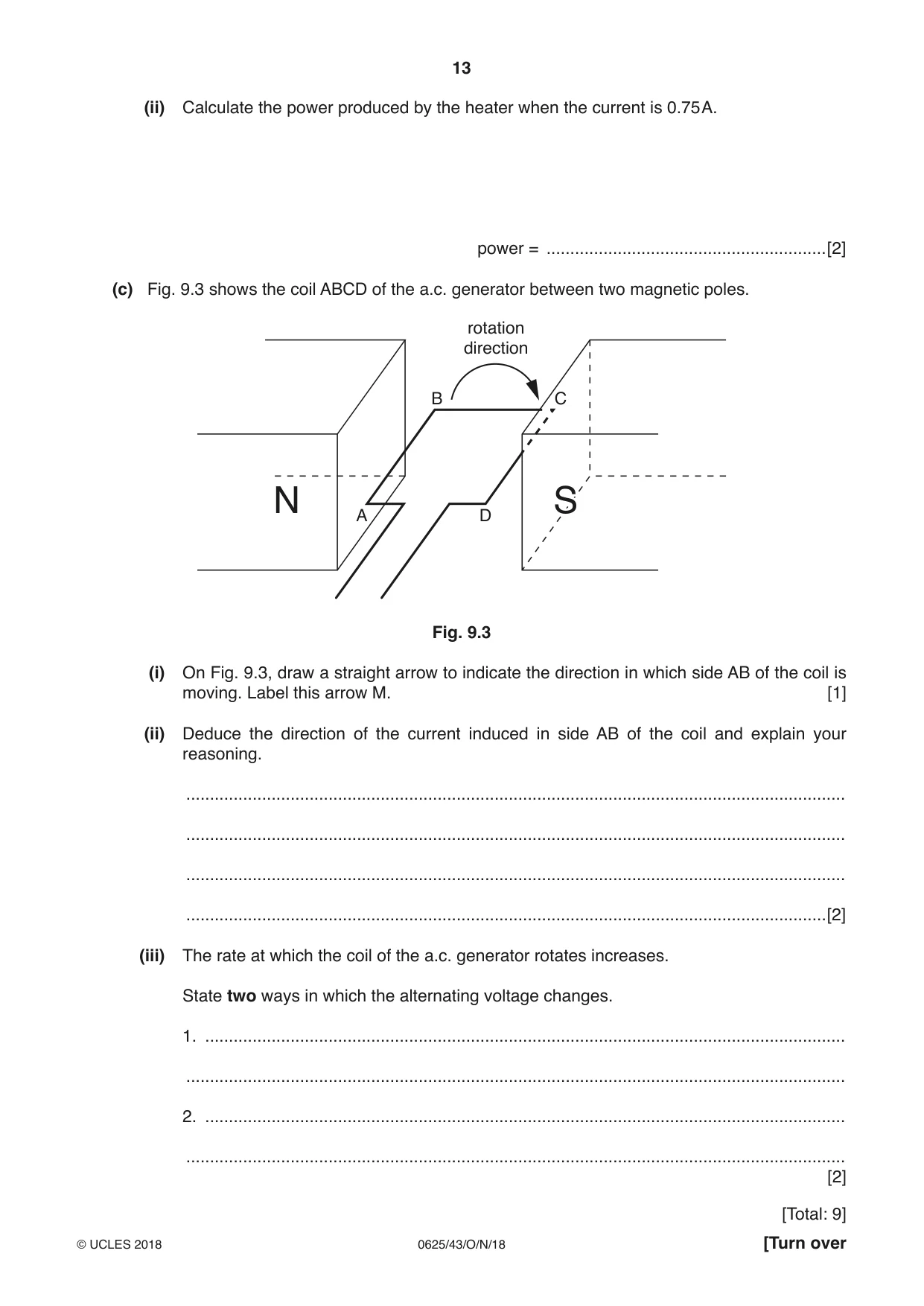
9 (a) Describe how a direct current (d.c.) differs from an alternating current (a.c.). ................................................................................................................................................... ...............................................................................................................................................[1] (b) Fig. 9.1 shows how the voltage output of an a.c. generator varies with time. 8.0 voltage / V 6.0 4.0 2.0 0 0 0.20.2 0.40.4 0.60.6 0.80.8 1.01.0 1.21.2 timetime // ss –2.0 –4.0 –6.0 –8.0 Fig. 9.1 A heater is connected directly to the a.c. generator and the maximum current in the heater is 0.75 A. (i) On Fig. 9.2, sketch a graph to indicate how the current in the heater varies with time. 1.00 current / A 0.75 0.50 0.25 0 0 0.20.2 0.40.4 0.60.6 0.80.8 1.01.0 1.21.2 timetime // ss –0.25 –0.50 –0.75 –1.00 [1] Fig. 9.2 (ii) Calculate the power produced by the heater when the current is 0.75 A. power = ...........................................................[2] (c) Fig. 9.3 shows the coil ABCD of the a.c. generator between two magnetic poles. rotation direction B C N A D S Fig. 9.3 (i) On Fig. 9.3, draw a straight arrow to indicate the direction in which side AB of the coil is moving. Label this arrow M. [1] (ii) Deduce the direction of the current induced in side AB of the coil and explain your reasoning. ........................................................................................................................................... ........................................................................................................................................... ........................................................................................................................................... .......................................................................................................................................[2] (iii) The rate at which the coil of the a.c. generator rotates increases. State two ways in which the alternating voltage changes. 1. ....................................................................................................................................... ........................................................................................................................................... 2. ....................................................................................................................................... ........................................................................................................................................... [2] [Total: 9]
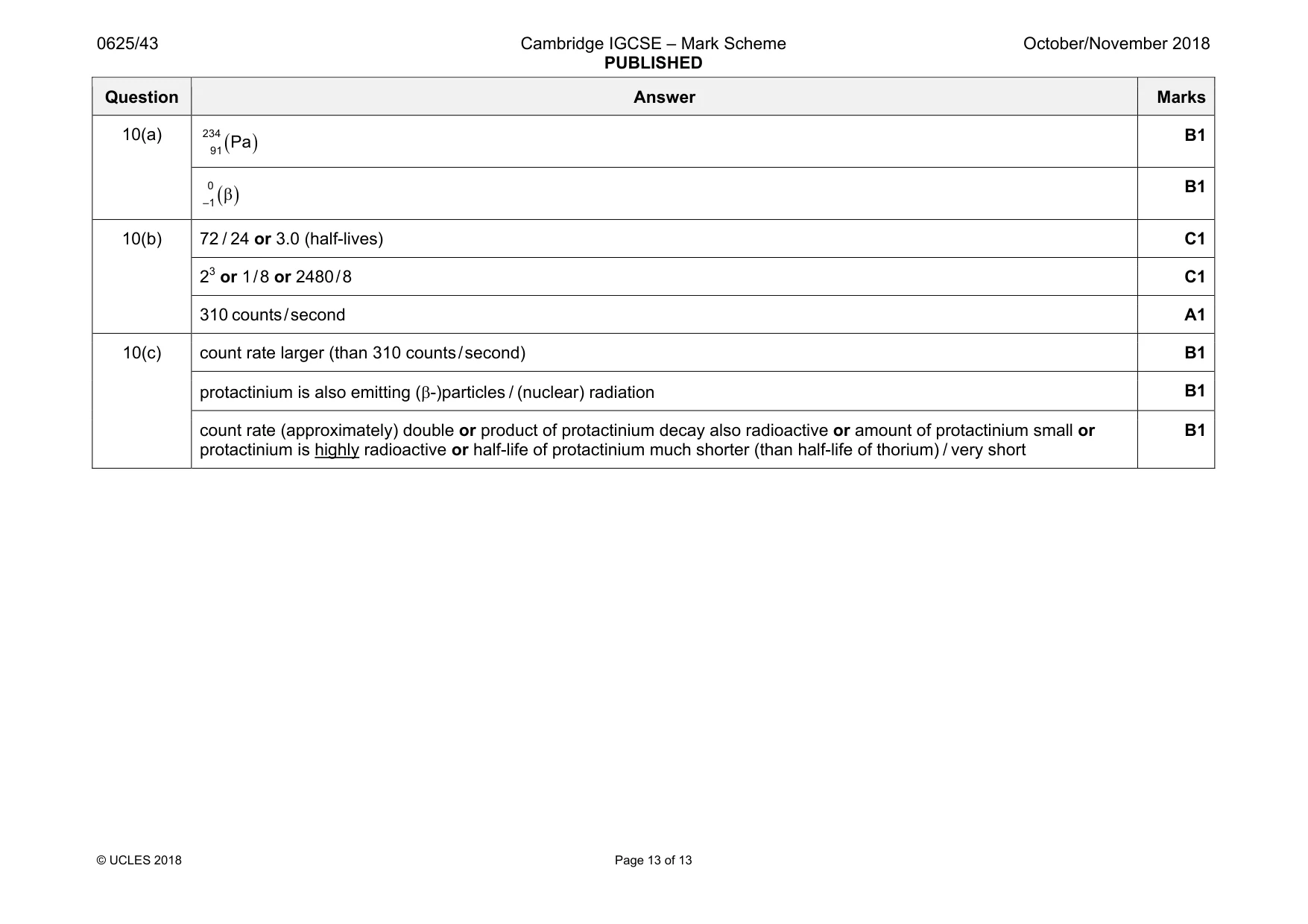
Mark scheme: 9(a) (a d.c. has) constant value / magnitude or direction does not change or has only one direction B1 9(b)(i) sinusoidal curve in phase with voltage and maximum value of 0.75 A and same frequency B1 9(b)(ii) (P =) VI or 7.2 × 0.75 C1 5.4 W A1 9(c)(i) vertical, upward arrow labelled M on side AB B1 9(c)(ii) A to B and (Fleming’s) right-hand rule (in some way) B1 rule explained (i.e. fingers explained or labelled 3D diagram) B1 9(c)(iii) greater (maximum) voltage B1 greater frequency or smaller time period or changes direction more often or alternates faster B1
Q10 · Thorium-234 (23940Th) is radioactive
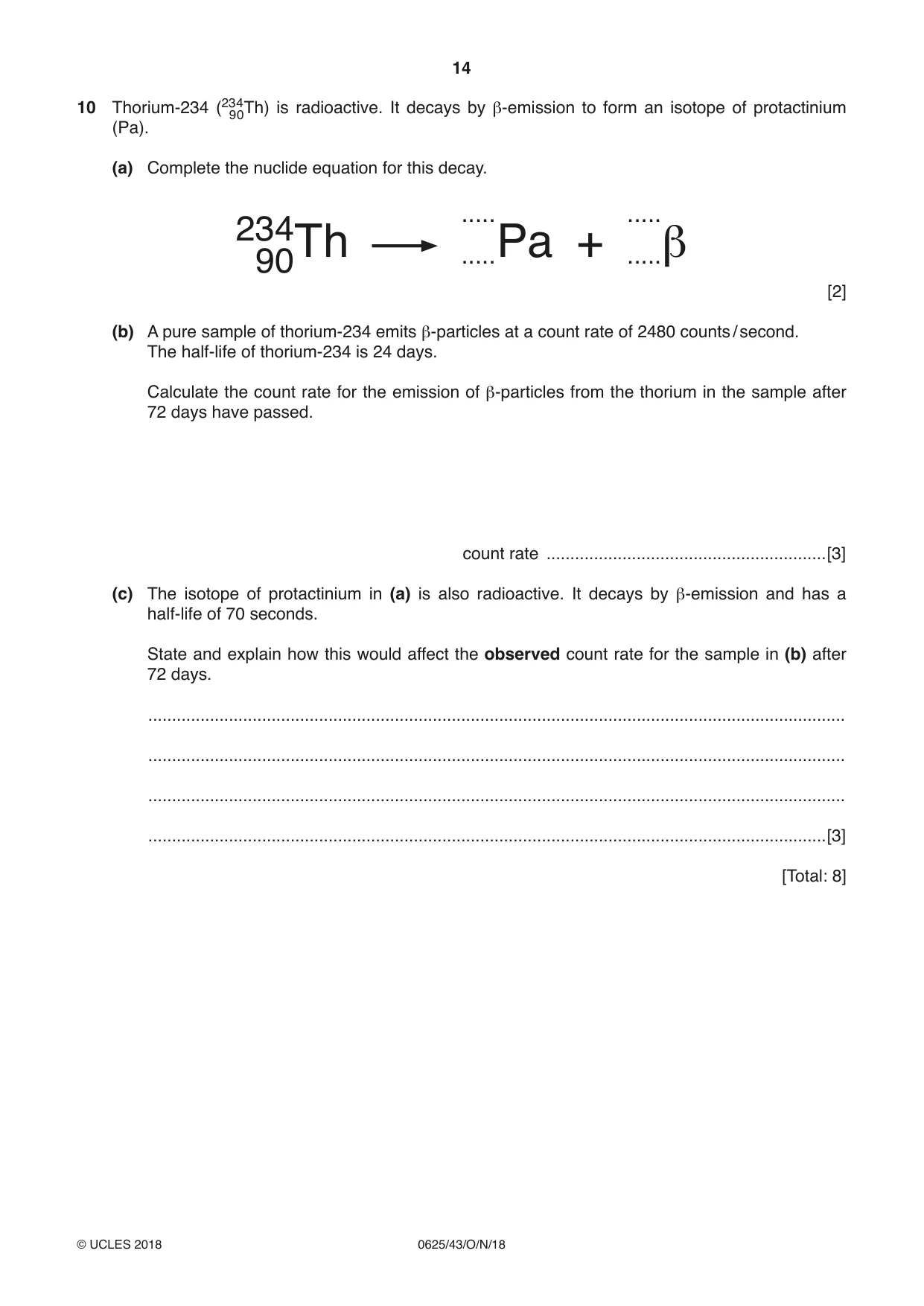
10 Thorium-234 (23940Th) is radioactive. It decays by β-emission to form an isotope of protactinium (Pa). (a) Complete the nuclide equation for this decay. ..... ..... 23 4 .....Pa + .....β 9 0Th [2] (b) A pure sample of thorium-234 emits β-particles at a count rate of 2480 counts / second. The half-life of thorium-234 is 24 days. Calculate the count rate for the emission of β-particles from the thorium in the sample after 72 days have passed. count rate ...........................................................[3] (c) The isotope of protactinium in (a) is also radioactive. It decays by β-emission and has a half-life of 70 seconds. State and explain how this would affect the observed count rate for the sample in (b) after 72 days. ................................................................................................................................................... ................................................................................................................................................... ................................................................................................................................................... ...............................................................................................................................................[3] [Total: 8]
Mark scheme: 10(a) ( ) 234 91 Pa B1 ( ) 0 –1 β B1 10(b) 72 / 24 or 3.0 (half-lives) C1 23 or 1 / 8 or 2480 / 8 C1 310 counts / second A1 10(c) count rate larger (than 310 counts / second) B1 protactinium is also emitting (β-)particles / (nuclear) radiation B1 count rate (approximately) double or product of protactinium decay also radioactive or amount of protactinium small or protactinium is highly radioactive or half-life of protactinium much shorter (than half-life of thorium) / very short B1
What was in this paper
The subtopics covered by these 10 questions, and how many questions each got. Open one in a new tab to see every Cambridge question on it.
What you needed in this session
Cambridge’s own grade thresholds for 2018 Oct/Nov, Paper 4 · Variant 3. A higher threshold means an easier paper — the bar moves with how the cohort did.