Cambridge IGCSE Physics 0625 — 2022 Oct/Nov Paper 4 · Variant 1
0625/41/O/N/22 · 9 questions · 80 marks · ≈90 min
The question paper and its mark scheme, free to read here and free to download. This is Cambridge’s own paper, exactly as it was sat.
Question paper20 pages

Mark scheme16 pages
Answers below. Sit the paper first if you are practising.
Questions as text
Q1 · Two blocks, A and B, are joined by a thin thread that passes over a frictionless pulley
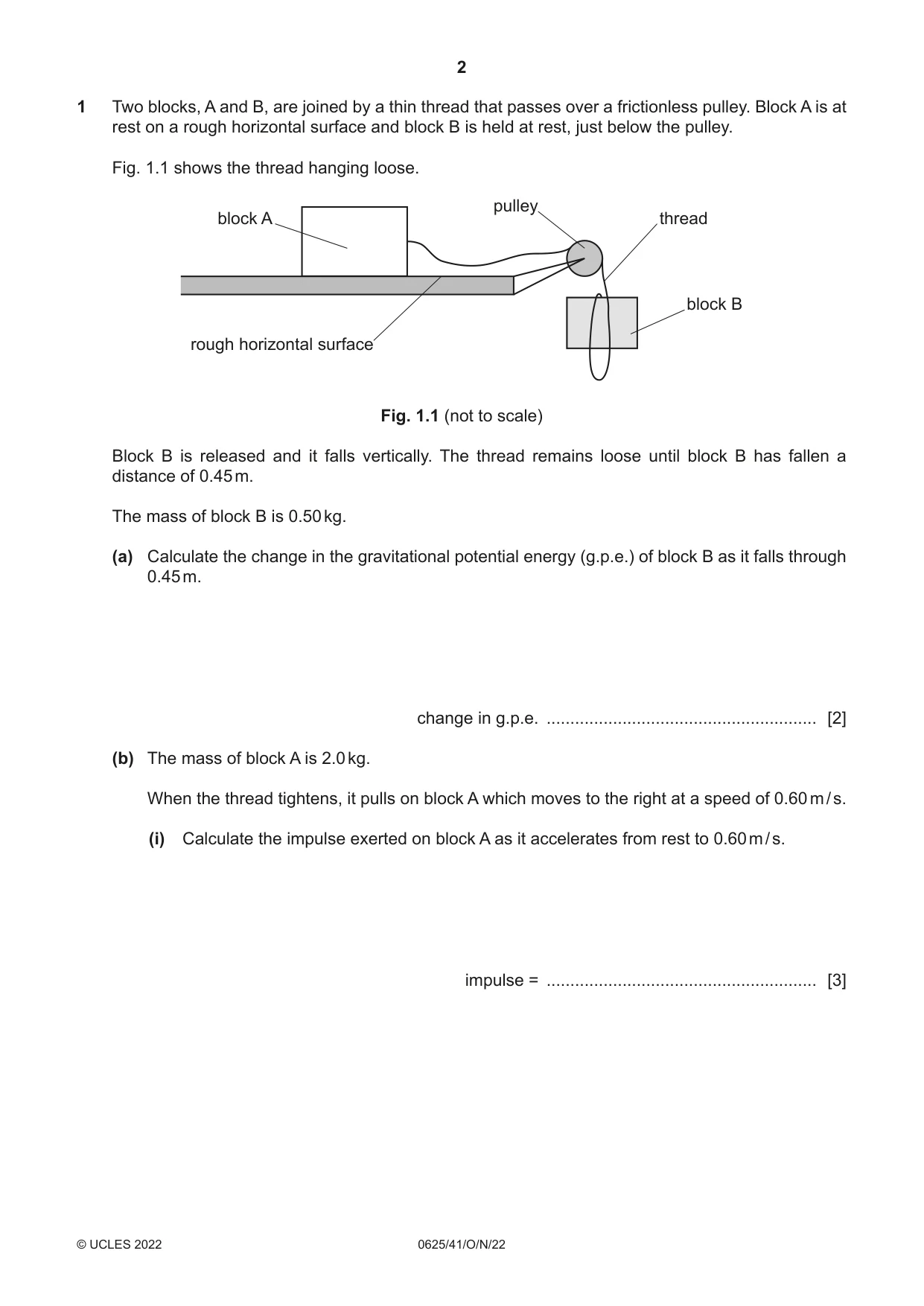
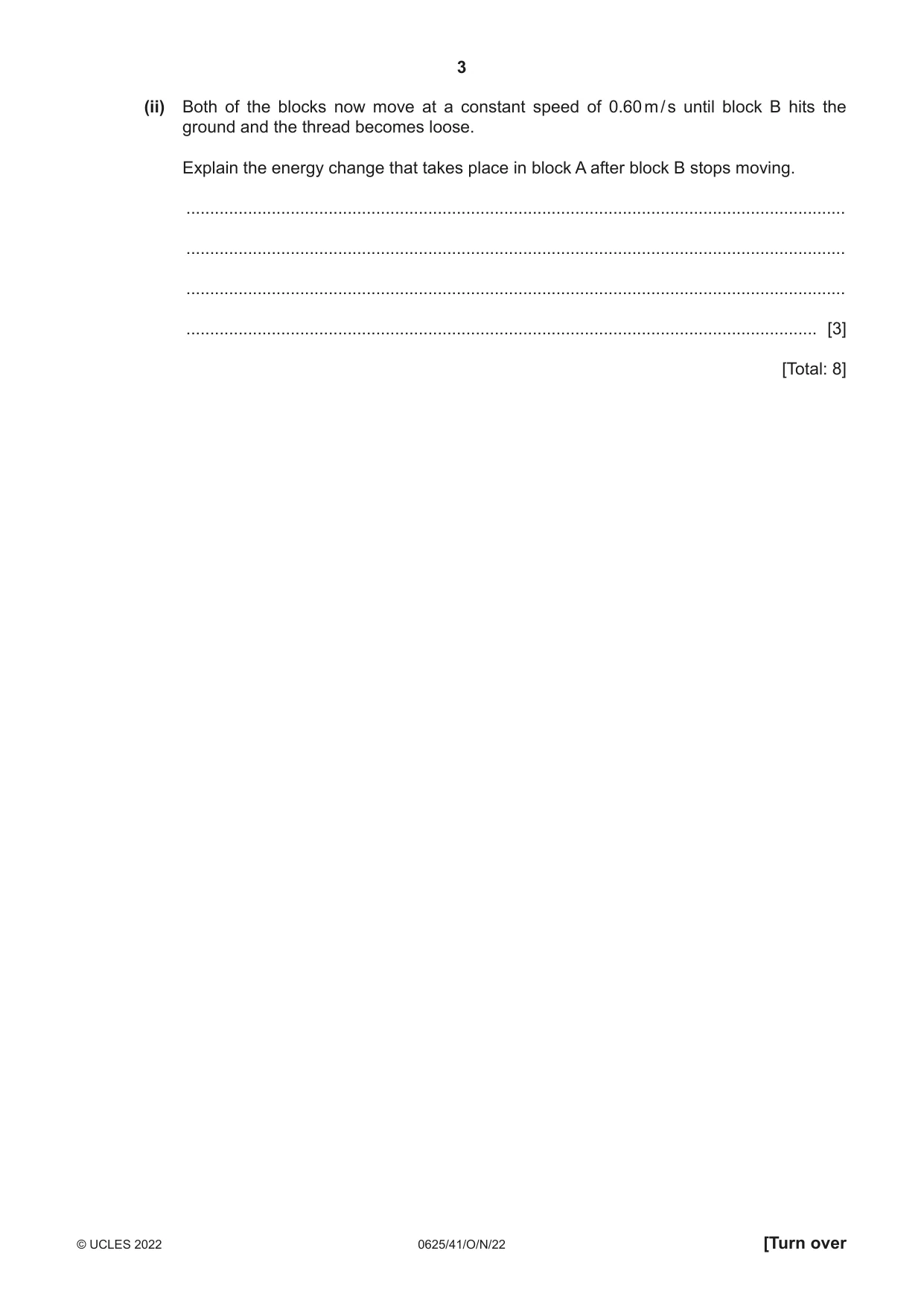
1 Two blocks, A and B, are joined by a thin thread that passes over a frictionless pulley. Block A is at rest on a rough horizontal surface and block B is held at rest, just below the pulley. Fig. 1.1 shows the thread hanging loose. pulley block A thread block B rough horizontal surface Fig. 1.1 (not to scale) Block B is released and it falls vertically. The thread remains loose until block B has fallen a distance of 0.45 m. The mass of block B is 0.50 kg. (a) Calculate the change in the gravitational potential energy (g.p.e.) of block B as it falls through 0.45 m. change in g.p.e. ......................................................... [2] (b) The mass of block A is 2.0 kg. When the thread tightens, it pulls on block A which moves to the right at a speed of 0.60 m / s. (i) Calculate the impulse exerted on block A as it accelerates from rest to 0.60 m / s. impulse = ......................................................... [3] (ii) Both of the blocks now move at a constant speed of 0.60 m / s until block B hits the ground and the thread becomes loose. Explain the energy change that takes place in block A after block B stops moving. ........................................................................................................................................... ........................................................................................................................................... ........................................................................................................................................... ..................................................................................................................................... [3] [Total: 8]
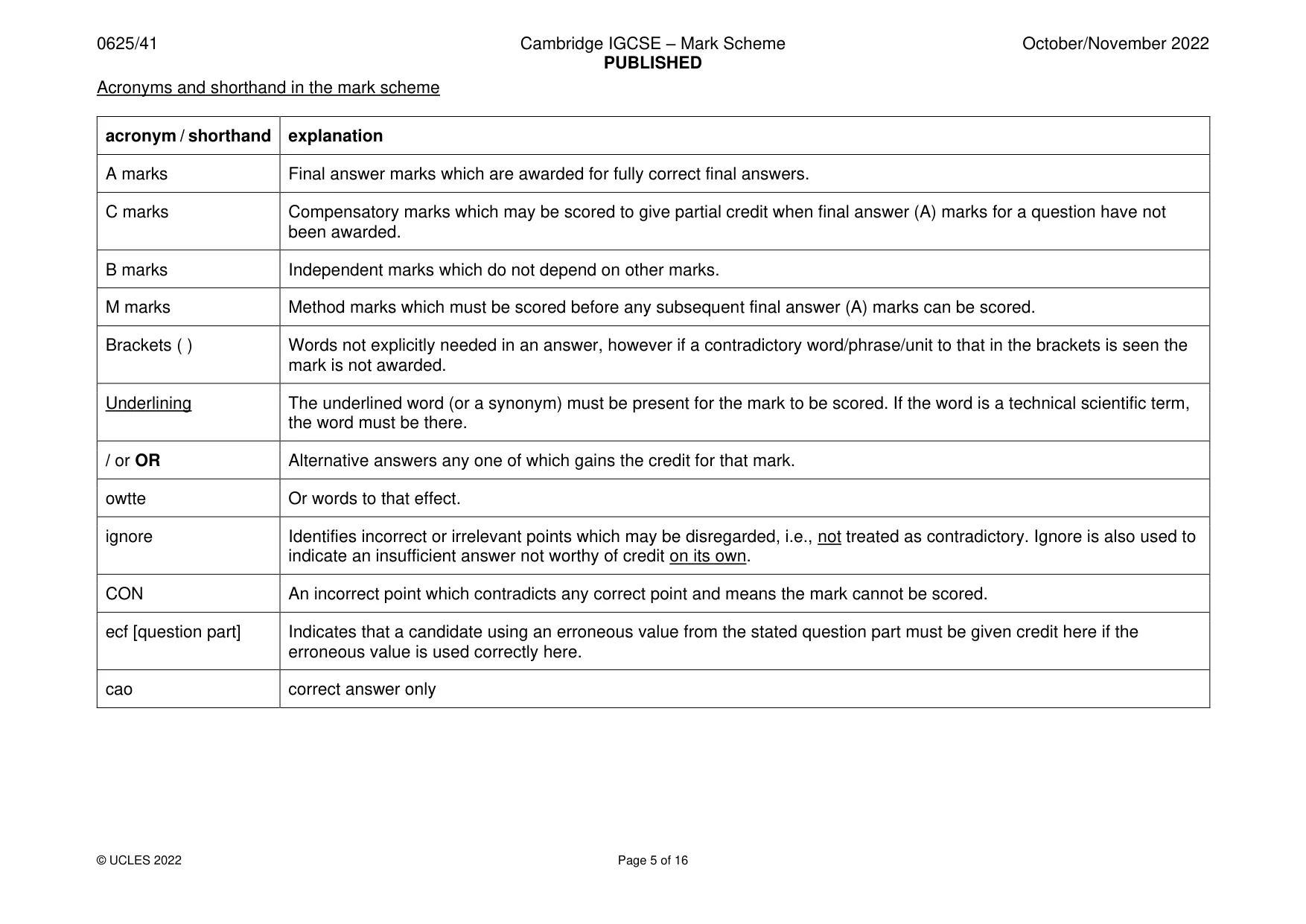
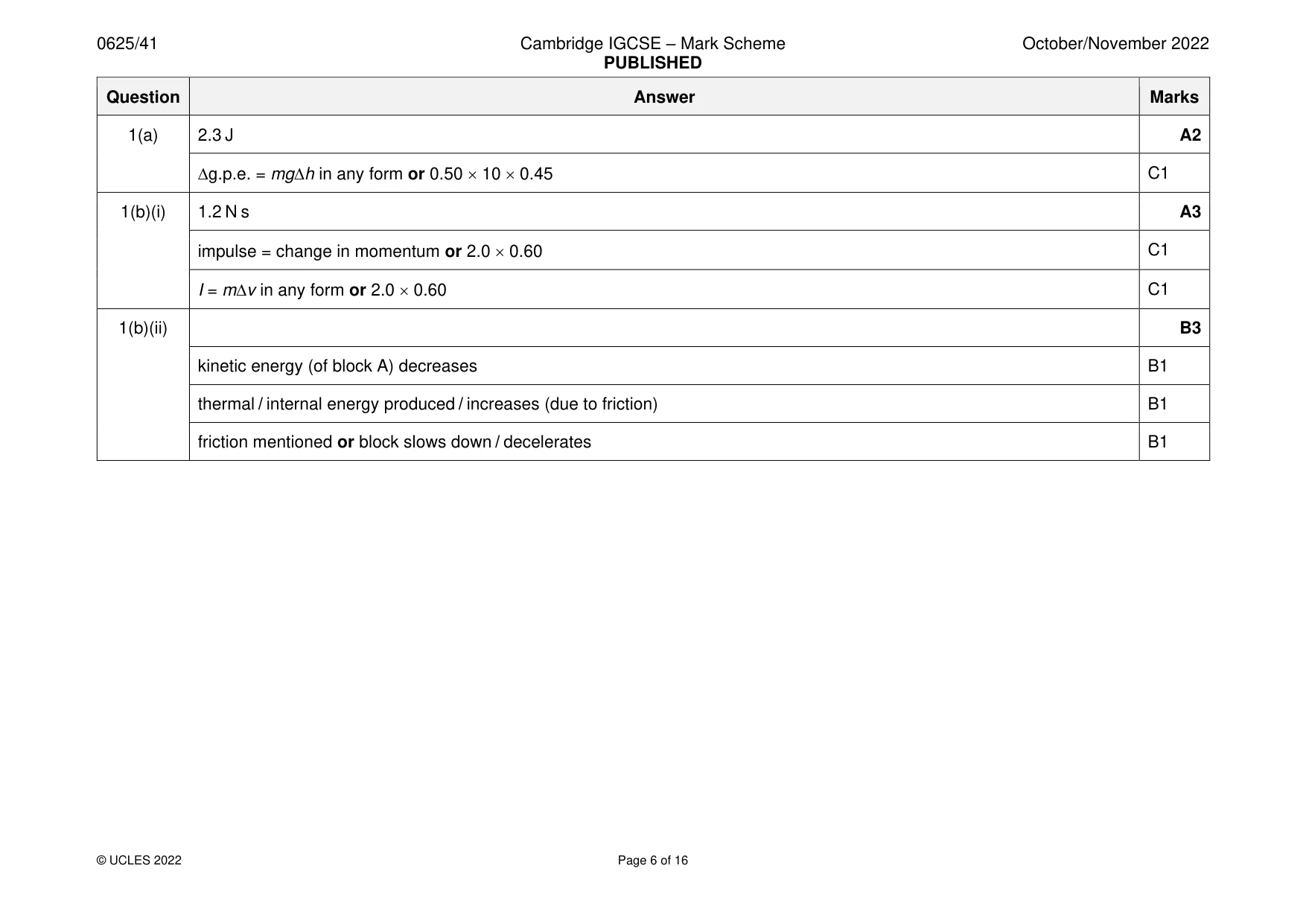
Mark scheme: Question Answer Marks 1(a) 2.3 J A2 g.p.e. = mgh in any form or 0.50 10 0.45 C1 1(b)(i) 1.2 N s A3 impulse = change in momentum or 2.0 0.60 C1 I = mv in any form or 2.0 0.60 C1 1(b)(ii) B3 kinetic energy (of block A) decreases B1 thermal / internal energy produced / increases (due to friction) B1 friction mentioned or block slows down / decelerates B1
Q2 · A force is a vector quantity
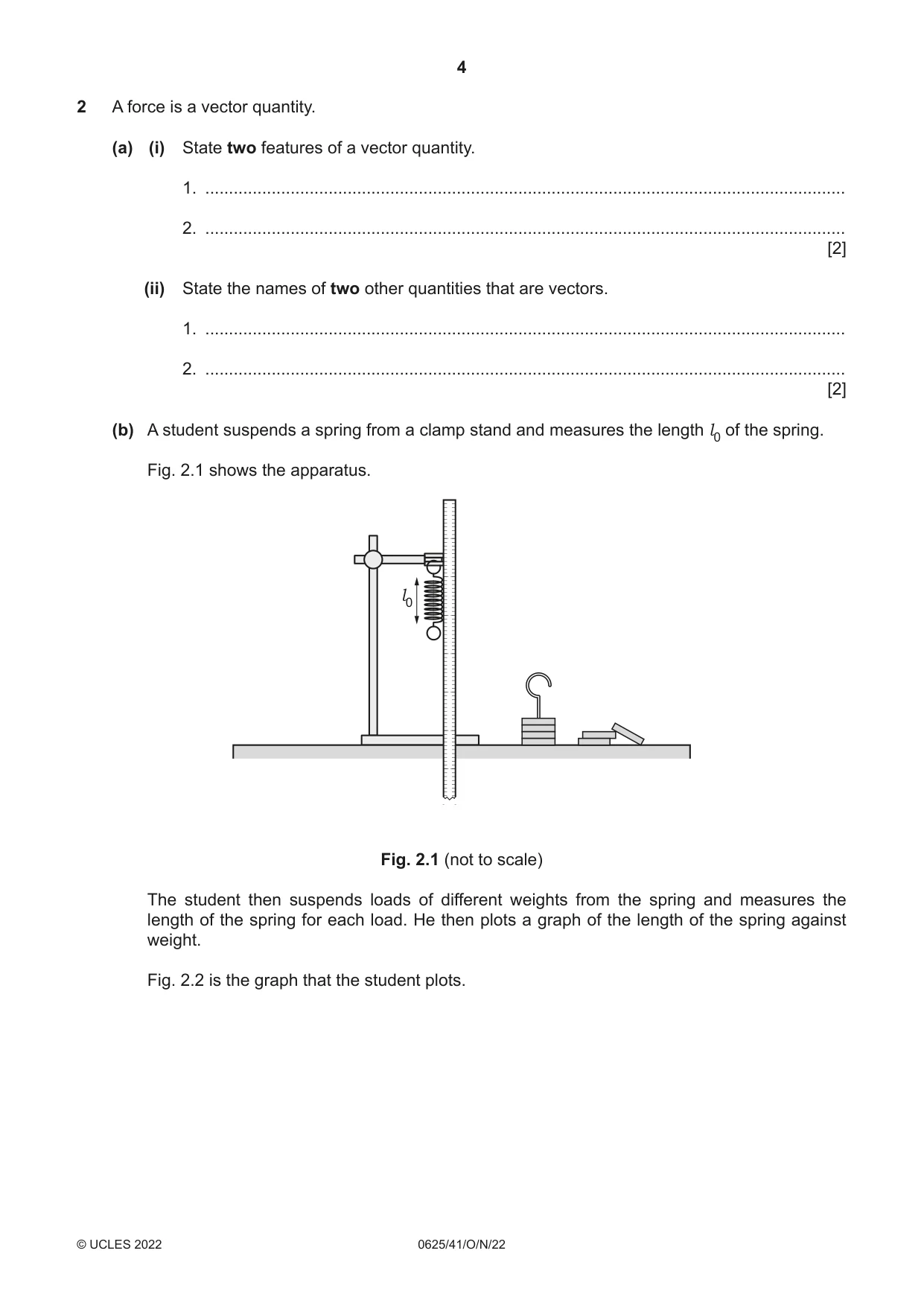
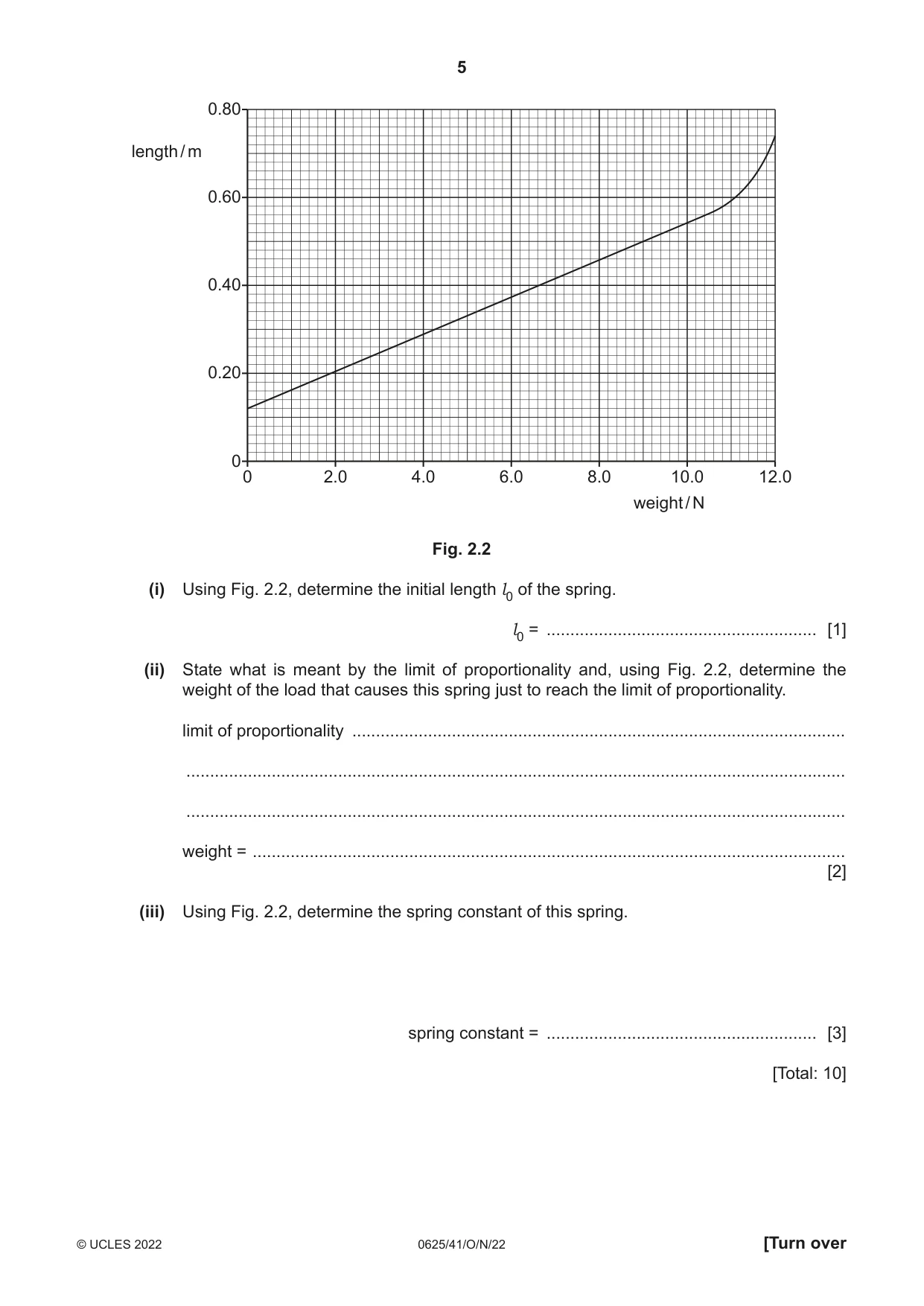
2 A force is a vector quantity. (a) (i) State two features of a vector quantity. 1. ....................................................................................................................................... 2. ....................................................................................................................................... [2] (ii) State the names of two other quantities that are vectors. 1. ....................................................................................................................................... 2. ....................................................................................................................................... [2] (b) A student suspends a spring from a clamp stand and measures the length l0 of the spring. Fig. 2.1 shows the apparatus. l0 Fig. 2.1 (not to scale) The student then suspends loads of different weights from the spring and measures the length of the spring for each load. He then plots a graph of the length of the spring against weight. Fig. 2.2 is the graph that the student plots. 0.80 length / m 0.60 0.40 0.20 0 0 2.0 4.0 6.0 8.0 10.0 12.0 weight / N Fig. 2.2 (i) Using Fig. 2.2, determine the initial length l0 of the spring. l0 = ......................................................... [1] (ii) State what is meant by the limit of proportionality and, using Fig. 2.2, determine the weight of the load that causes this spring just to reach the limit of proportionality. limit of proportionality ........................................................................................................ ........................................................................................................................................... ........................................................................................................................................... weight = ............................................................................................................................. [2] (iii) Using Fig. 2.2, determine the spring constant of this spring. spring constant = ......................................................... [3] [Total: 10]
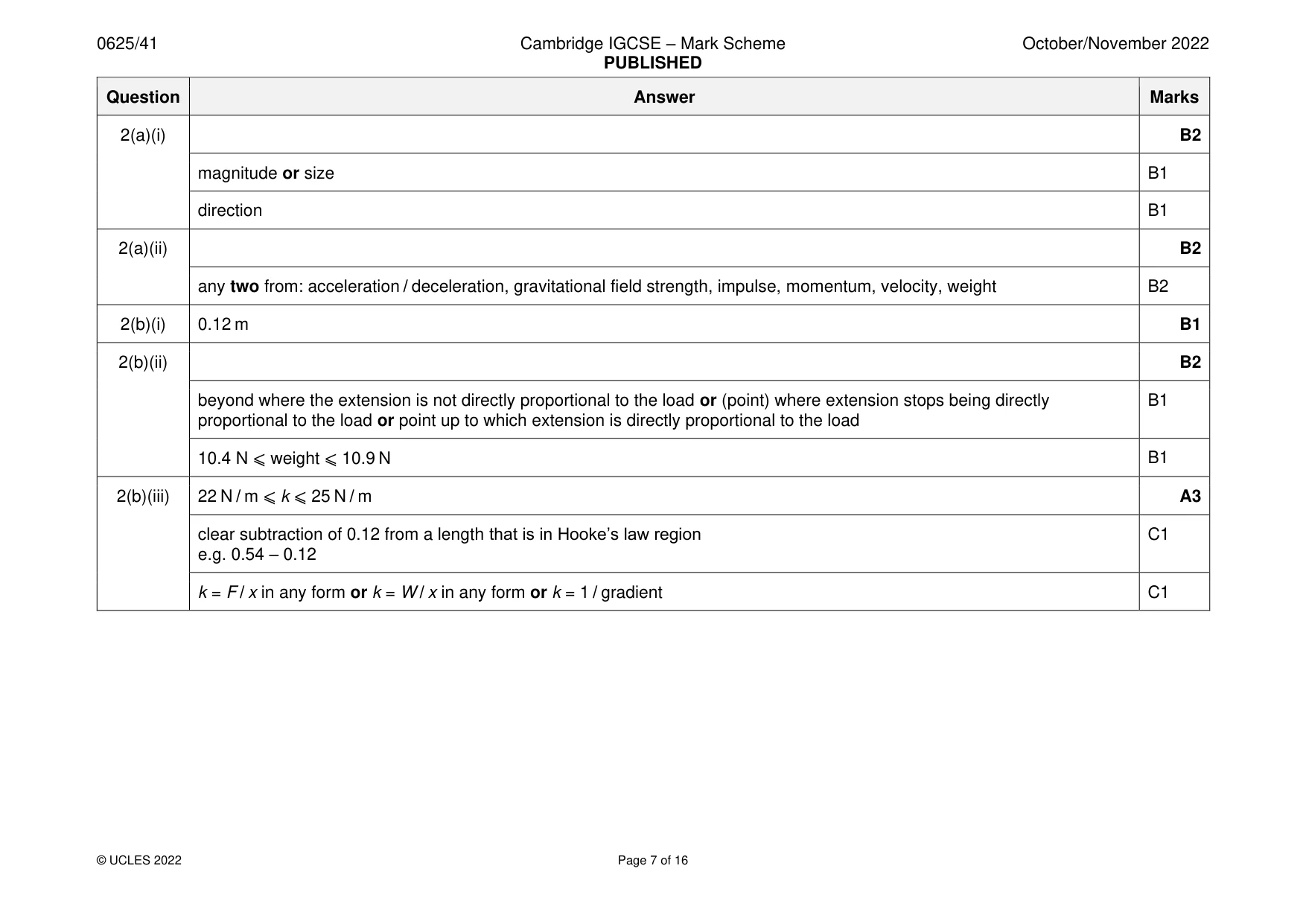
Mark scheme: 2(a)(i) B2 magnitude or size B1 direction B1 2(a)(ii) B2 any two from: acceleration / deceleration, gravitational field strength, impulse, momentum, velocity, weight B2 2(b)(i) 0.12 m B1 2(b)(ii) B2 beyond where the extension is not directly proportional to the load or (point) where extension stops being directly B1 proportional to the load or point up to which extension is directly proportional to the load 10.4 N ⩽ weight ⩽ 10.9 N B1 2(b)(iii) 22 N / m ⩽ k ⩽ 25 N / m A3 clear subtraction of 0.12 from a length that is in Hooke’s law region C1 e.g. 0.54 – 0.12 k = F / x in any form or k = W / x in any form or k = 1 / gradient C1
Q3 · A rock climber, of total mass 62 kg, holds herself in horizontal equilibrium against a…
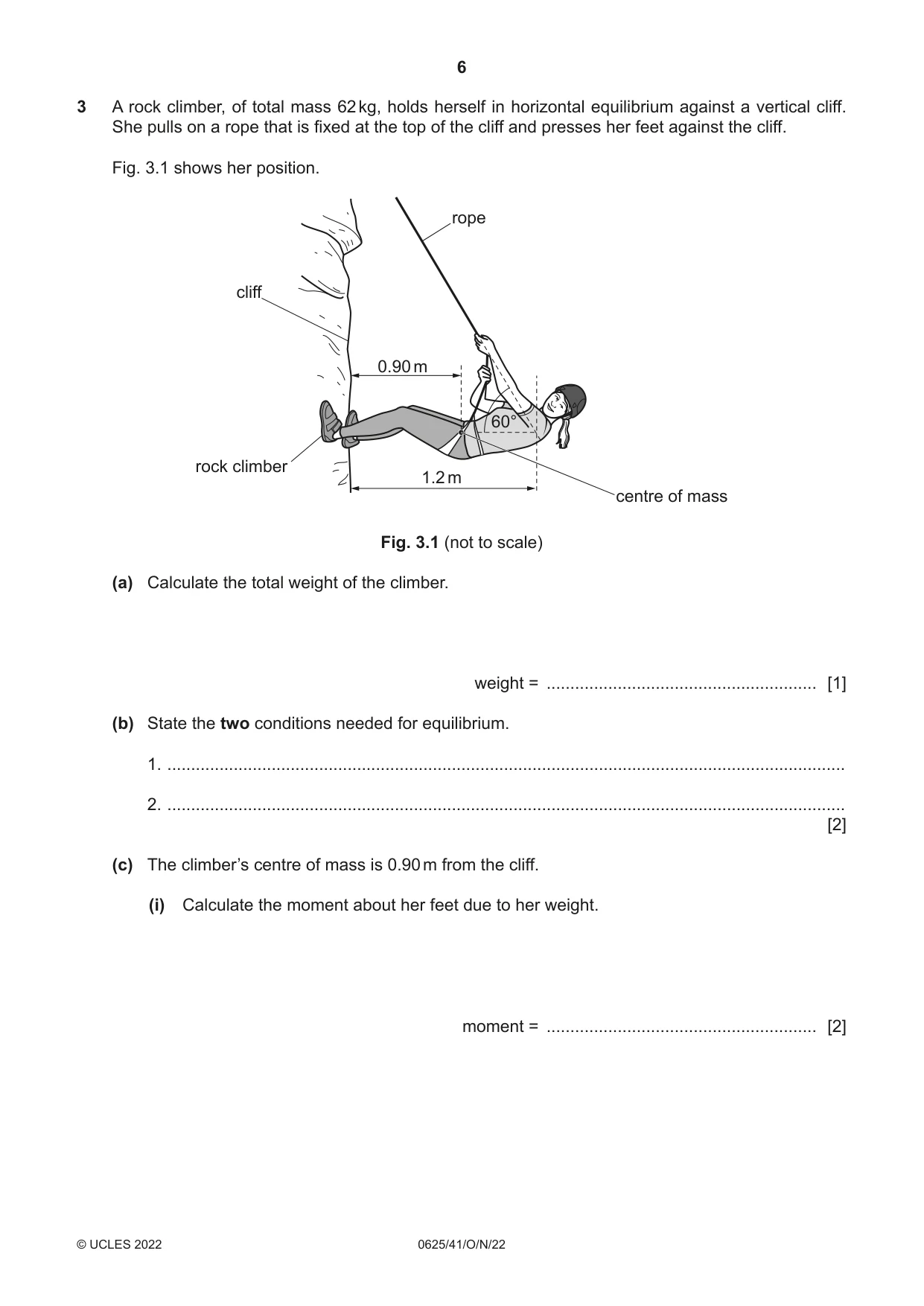
3 A rock climber, of total mass 62 kg, holds herself in horizontal equilibrium against a vertical cliff. She pulls on a rope that is fixed at the top of the cliff and presses her feet against the cliff. Fig. 3.1 shows her position. rope cliff 0.90 m 60° rock climber 1.2 m centre of mass Fig. 3.1 (not to scale) (a) Calculate the total weight of the climber. weight = ......................................................... [1] (b) State the two conditions needed for equilibrium. 1. ............................................................................................................................................... 2. ............................................................................................................................................... [2] (c) The climber’s centre of mass is 0.90 m from the cliff. (i) Calculate the moment about her feet due to her weight. moment = ......................................................... [2] (ii) The line of the rope meets the horizontal line through her centre of mass at a distance of 1.2 m from the cliff, as shown in Fig. 3.1. The rope is at an angle of 60° to the horizontal. Determine the tension in the rope. tension = ......................................................... [3] [Total: 8]
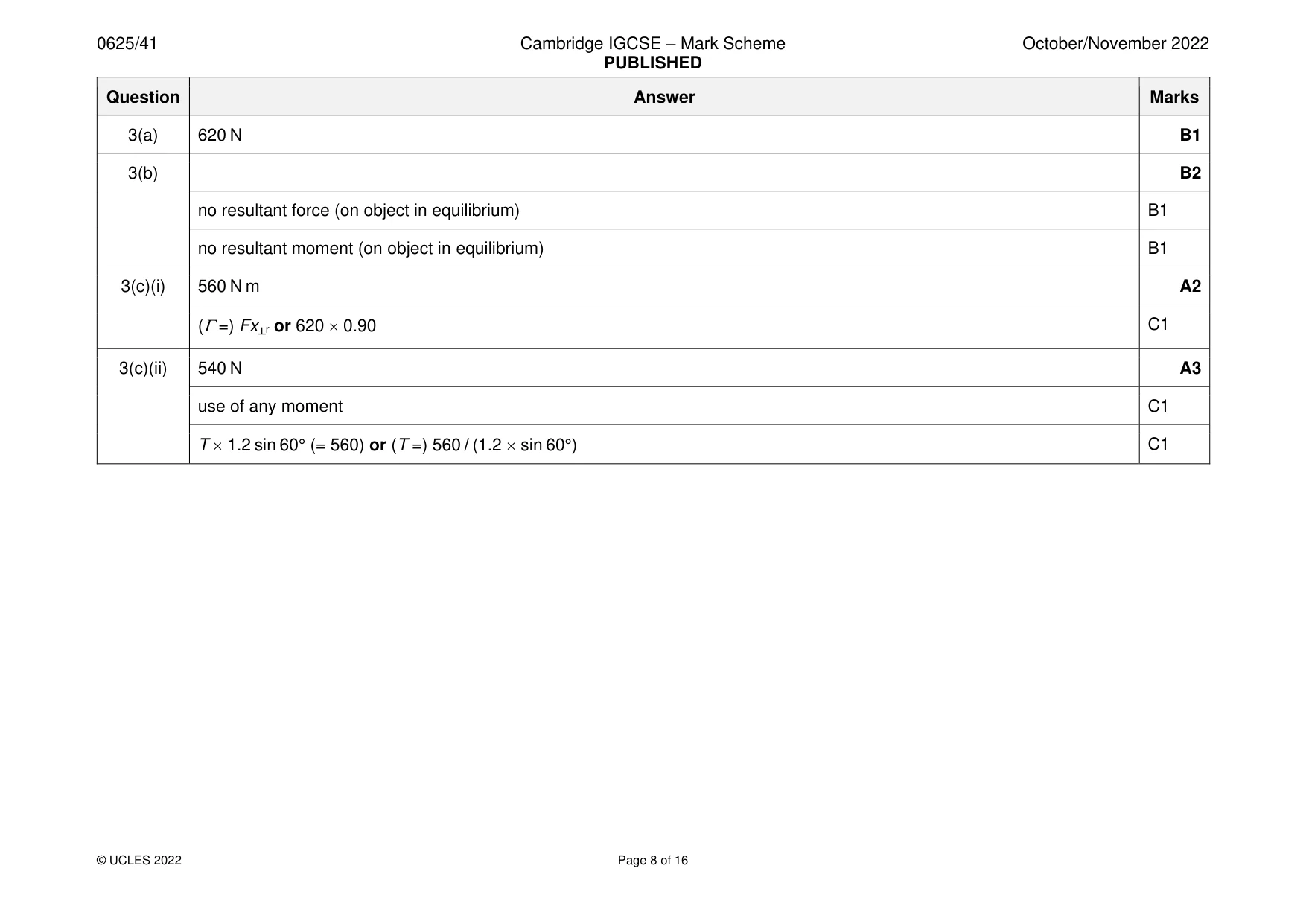
Mark scheme: 3(a) 620 N B1 3(b) B2 no resultant force (on object in equilibrium) B1 no resultant moment (on object in equilibrium) B1 3(c)(i) 560 N m A2 (=) Fx┴r or 620 0.90 C1 3(c)(ii) 540 N A3 use of any moment C1 T 1.2 sin 60° (= 560) or (T =) 560 / (1.2 sin 60°) C1
Q4 · A quantity of gas is trapped by a piston in a cylinder with thin metal walls
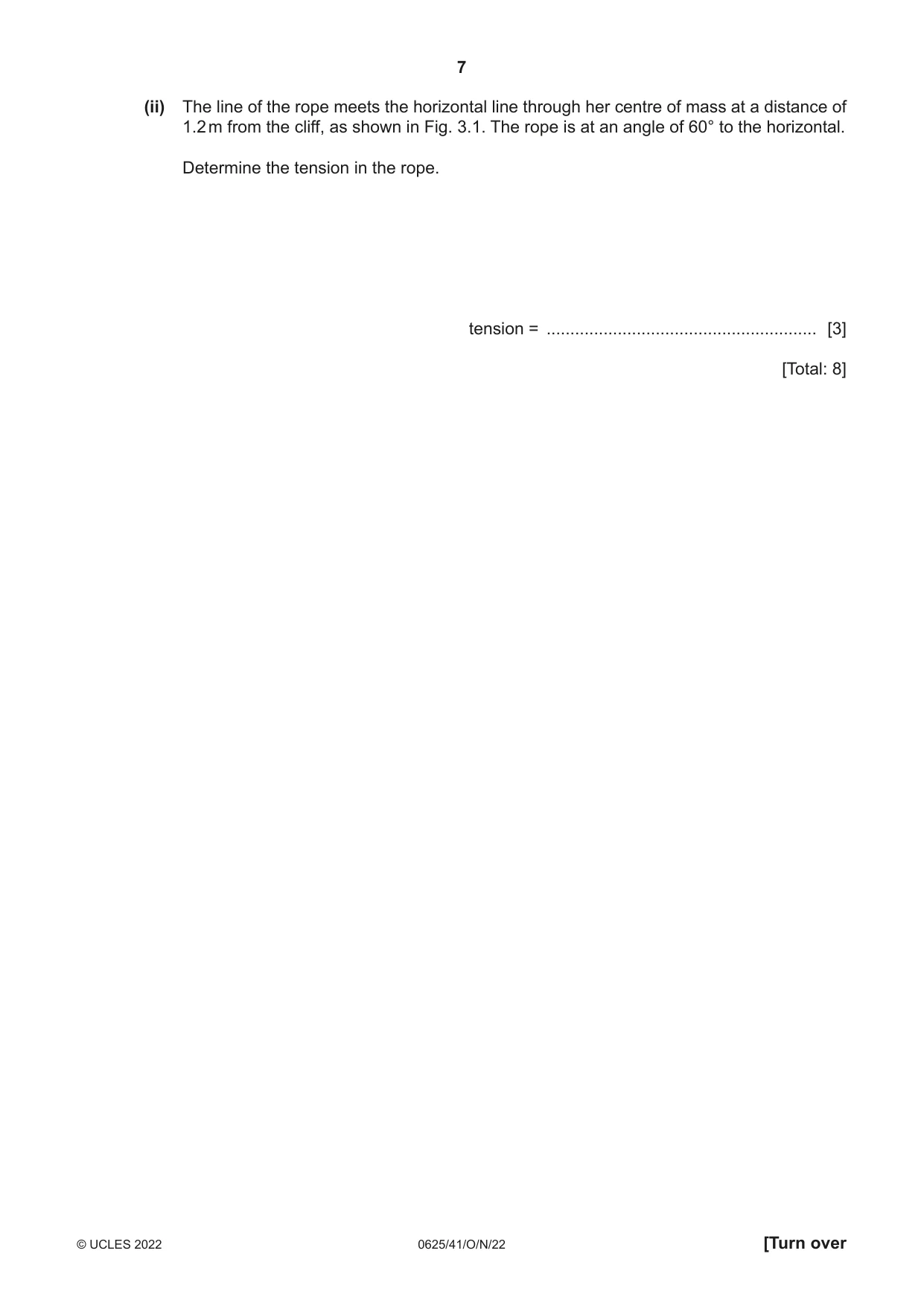
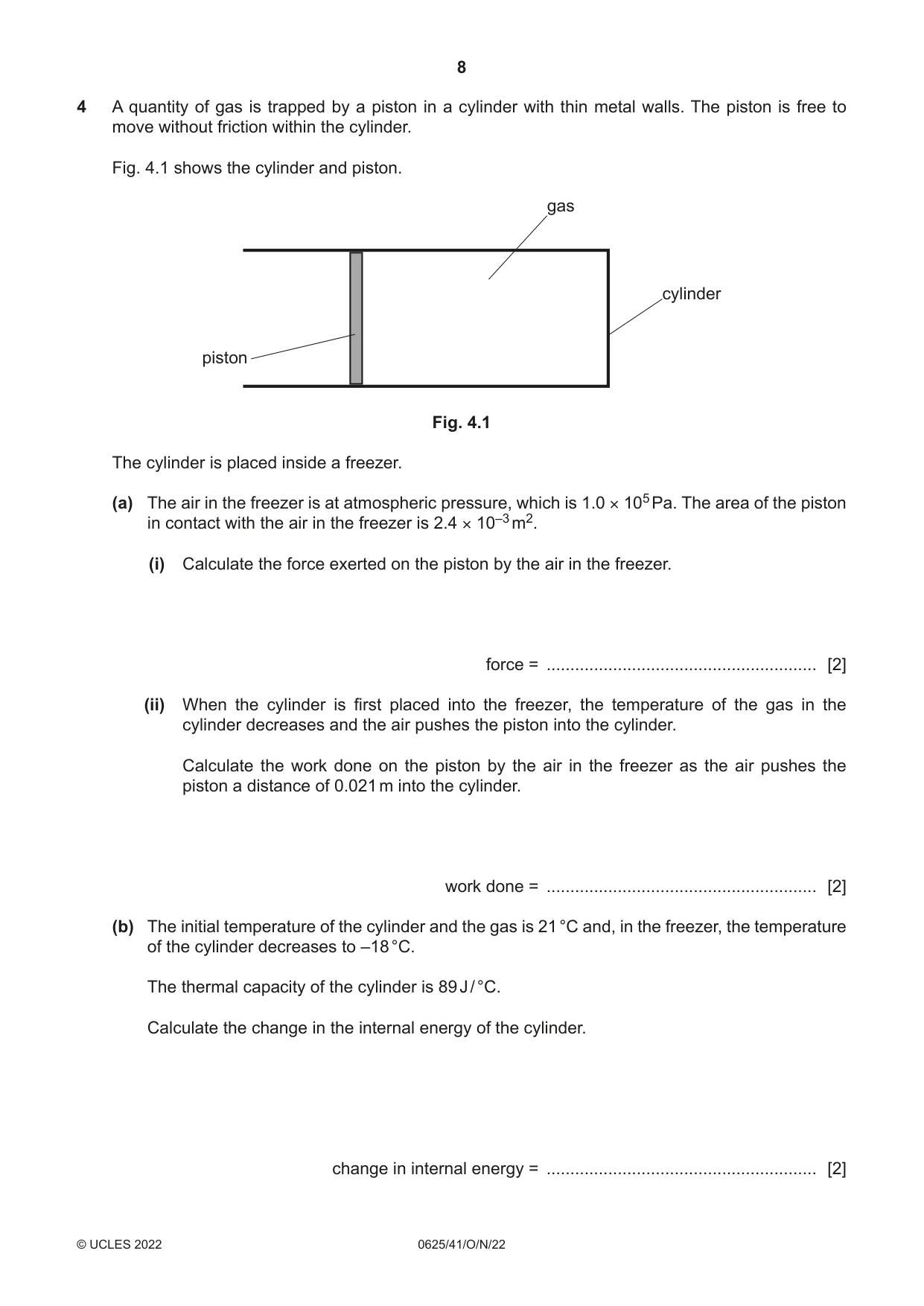
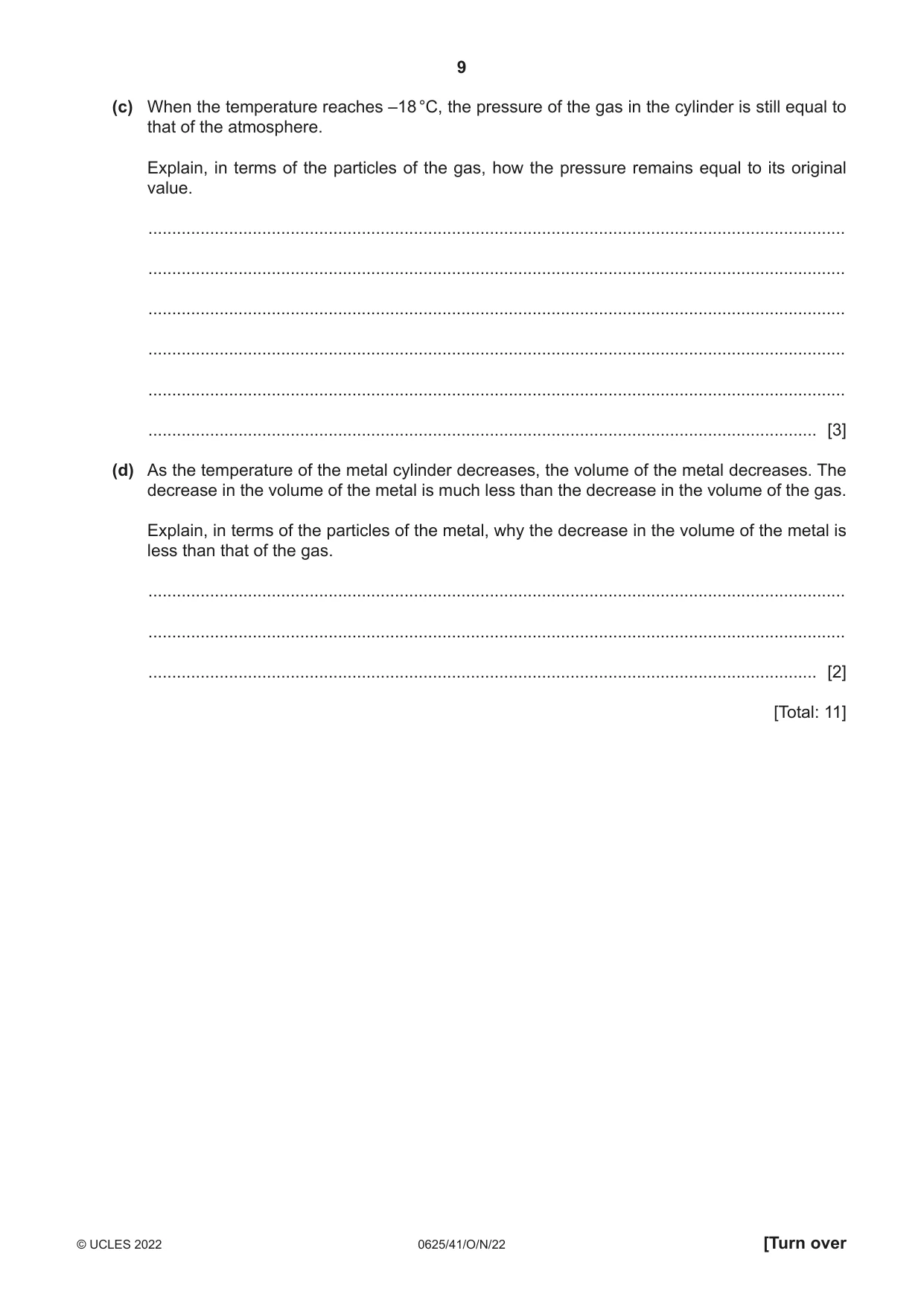
4 A quantity of gas is trapped by a piston in a cylinder with thin metal walls. The piston is free to move without friction within the cylinder. Fig. 4.1 shows the cylinder and piston. gas cylinder piston Fig. 4.1 The cylinder is placed inside a freezer. (a) The air in the freezer is at atmospheric pressure, which is 1.0 × 10⁵ Pa. The area of the piston in contact with the air in the freezer is 2.4 × 10⁻³ m2. (i) Calculate the force exerted on the piston by the air in the freezer. force = ......................................................... [2] (ii) When the cylinder is first placed into the freezer, the temperature of the gas in the cylinder decreases and the air pushes the piston into the cylinder. Calculate the work done on the piston by the air in the freezer as the air pushes the piston a distance of 0.021 m into the cylinder. work done = ......................................................... [2] (b) The initial temperature of the cylinder and the gas is 21 °C and, in the freezer, the temperature of the cylinder decreases to –18 °C. The thermal capacity of the cylinder is 89 J / °C. Calculate the change in the internal energy of the cylinder. change in internal energy = ......................................................... [2] (c) When the temperature reaches –18 °C, the pressure of the gas in the cylinder is still equal to that of the atmosphere. Explain, in terms of the particles of the gas, how the pressure remains equal to its original value. ................................................................................................................................................... ................................................................................................................................................... ................................................................................................................................................... ................................................................................................................................................... ................................................................................................................................................... ............................................................................................................................................. [3] (d) As the temperature of the metal cylinder decreases, the volume of the metal decreases. The decrease in the volume of the metal is much less than the decrease in the volume of the gas. Explain, in terms of the particles of the metal, why the decrease in the volume of the metal is less than that of the gas. ................................................................................................................................................... ................................................................................................................................................... ............................................................................................................................................. [2] [Total: 11]
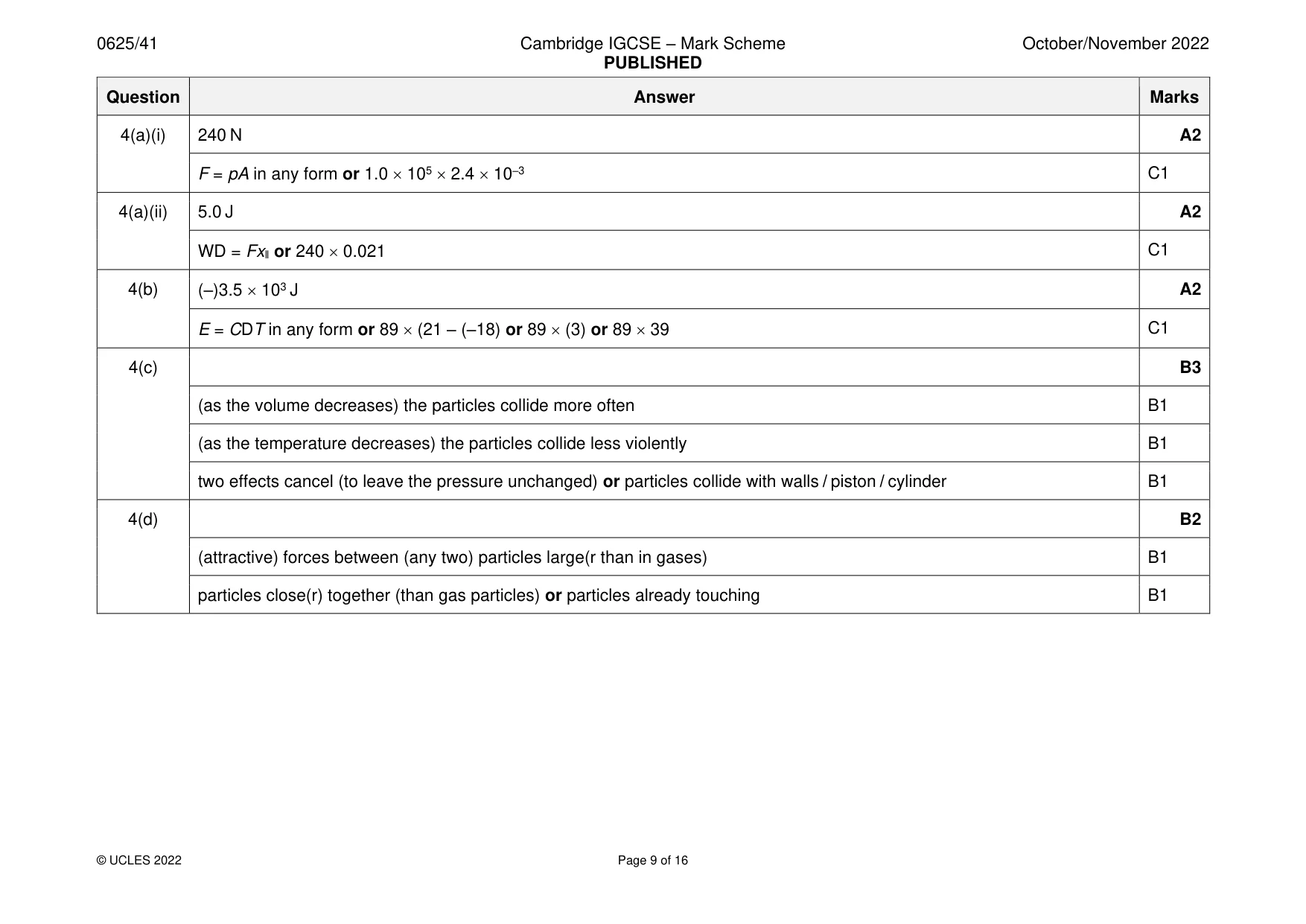
Mark scheme: 4(a)(i) 240 N A2 F = pA in any form or 1.0 105 2.4 10–3 C1 4(a)(ii) 5.0 J A2 WD = Fx‖ or 240 0.021 C1 4(b) (–)3.5 103 J A2 E = CDT in any form or 89 (21 – (–18) or 89 (3) or 89 39 C1 4(c) B3 (as the volume decreases) the particles collide more often B1 (as the temperature decreases) the particles collide less violently B1 two effects cancel (to leave the pressure unchanged) or particles collide with walls / piston / cylinder B1 4(d) B2 (attractive) forces between (any two) particles large(r than in gases) B1 particles close(r) together (than gas particles) or particles already touching B1
Q5 · A heater in a bathroom
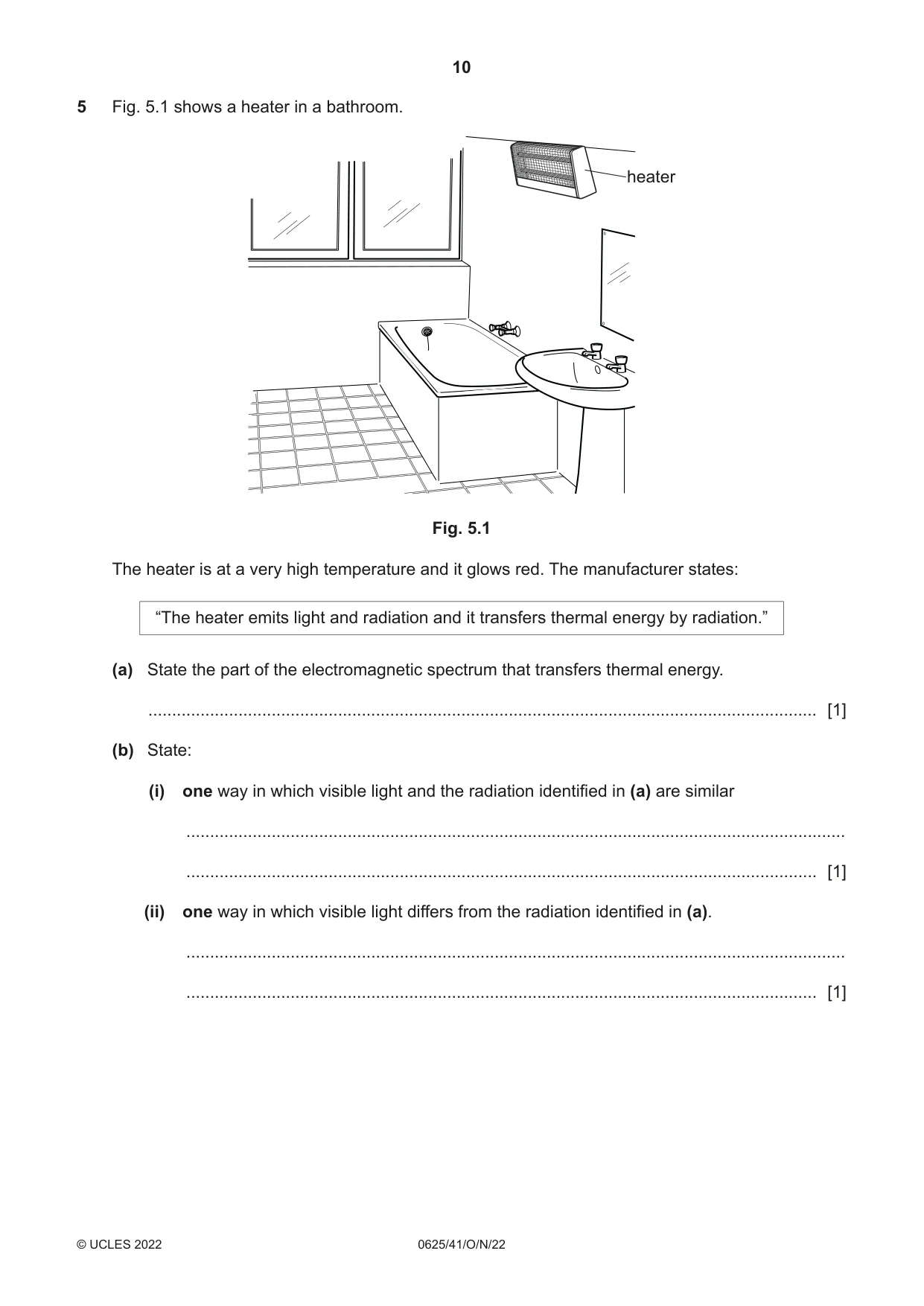
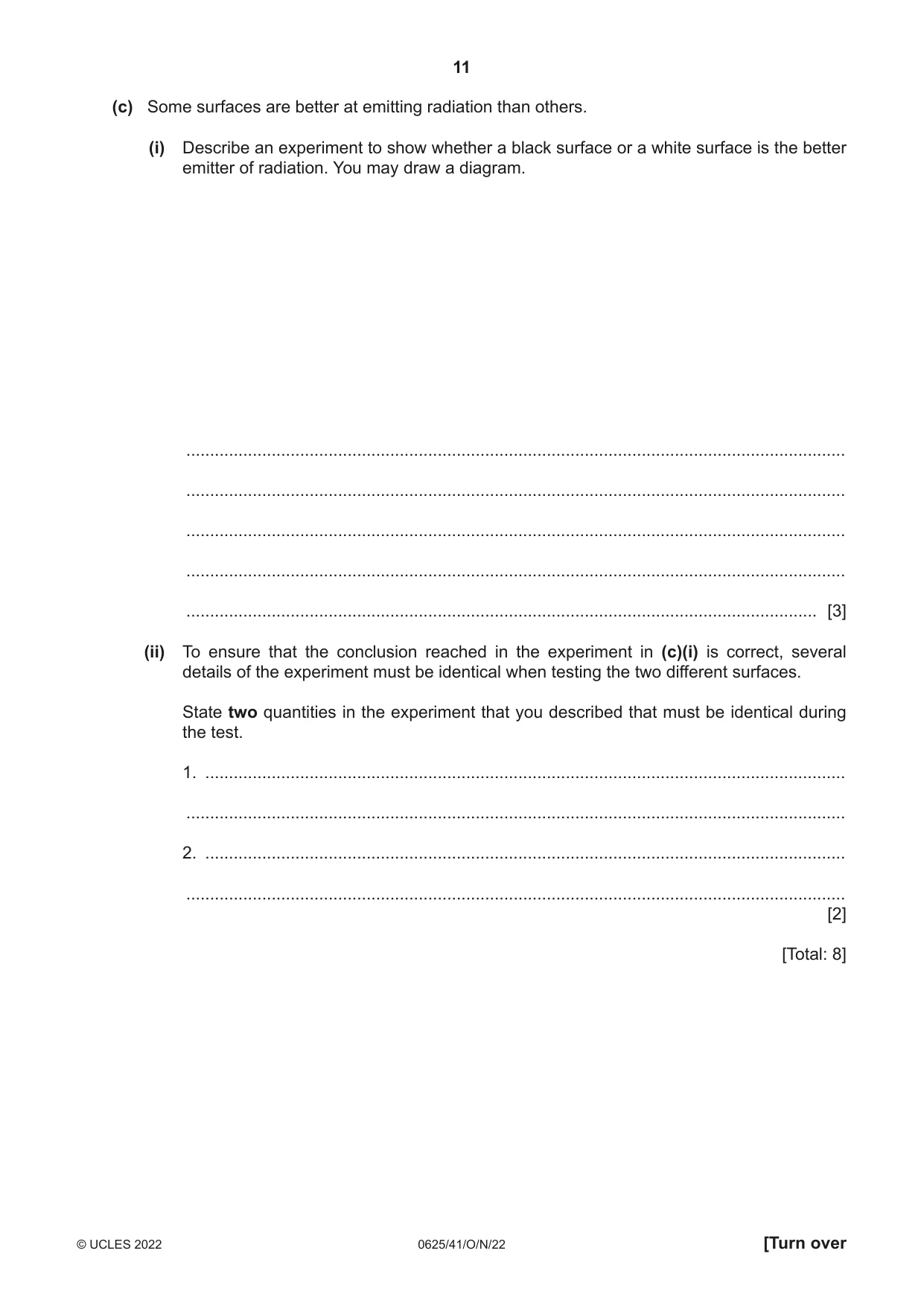
5 Fig. 5.1 shows a heater in a bathroom. heater Fig. 5.1 The heater is at a very high temperature and it glows red. The manufacturer states: “The heater emits light and radiation and it transfers thermal energy by radiation.” (a) State the part of the electromagnetic spectrum that transfers thermal energy. ............................................................................................................................................. [1] (b) State: (i) one way in which visible light and the radiation identified in (a) are similar ........................................................................................................................................... ..................................................................................................................................... [1] (ii) one way in which visible light differs from the radiation identified in (a). ........................................................................................................................................... ..................................................................................................................................... [1] (c) Some surfaces are better at emitting radiation than others. (i) Describe an experiment to show whether a black surface or a white surface is the better emitter of radiation. You may draw a diagram. ........................................................................................................................................... ........................................................................................................................................... ........................................................................................................................................... ........................................................................................................................................... ..................................................................................................................................... [3] (ii) To ensure that the conclusion reached in the experiment in (c)(i) is correct, several details of the experiment must be identical when testing the two different surfaces. State two quantities in the experiment that you described that must be identical during the test. 1. ....................................................................................................................................... ........................................................................................................................................... 2. ....................................................................................................................................... ........................................................................................................................................... [2] [Total: 8]
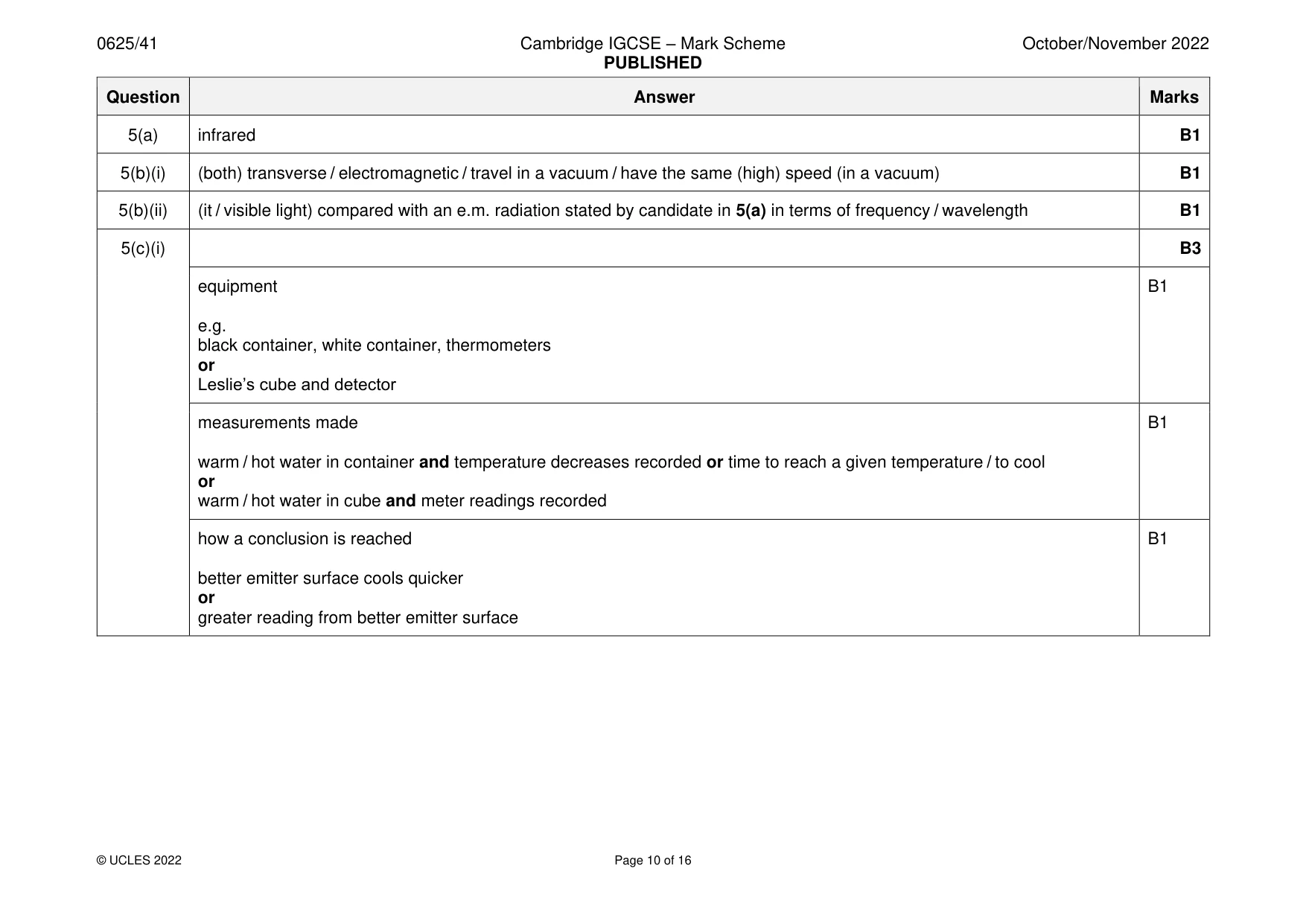
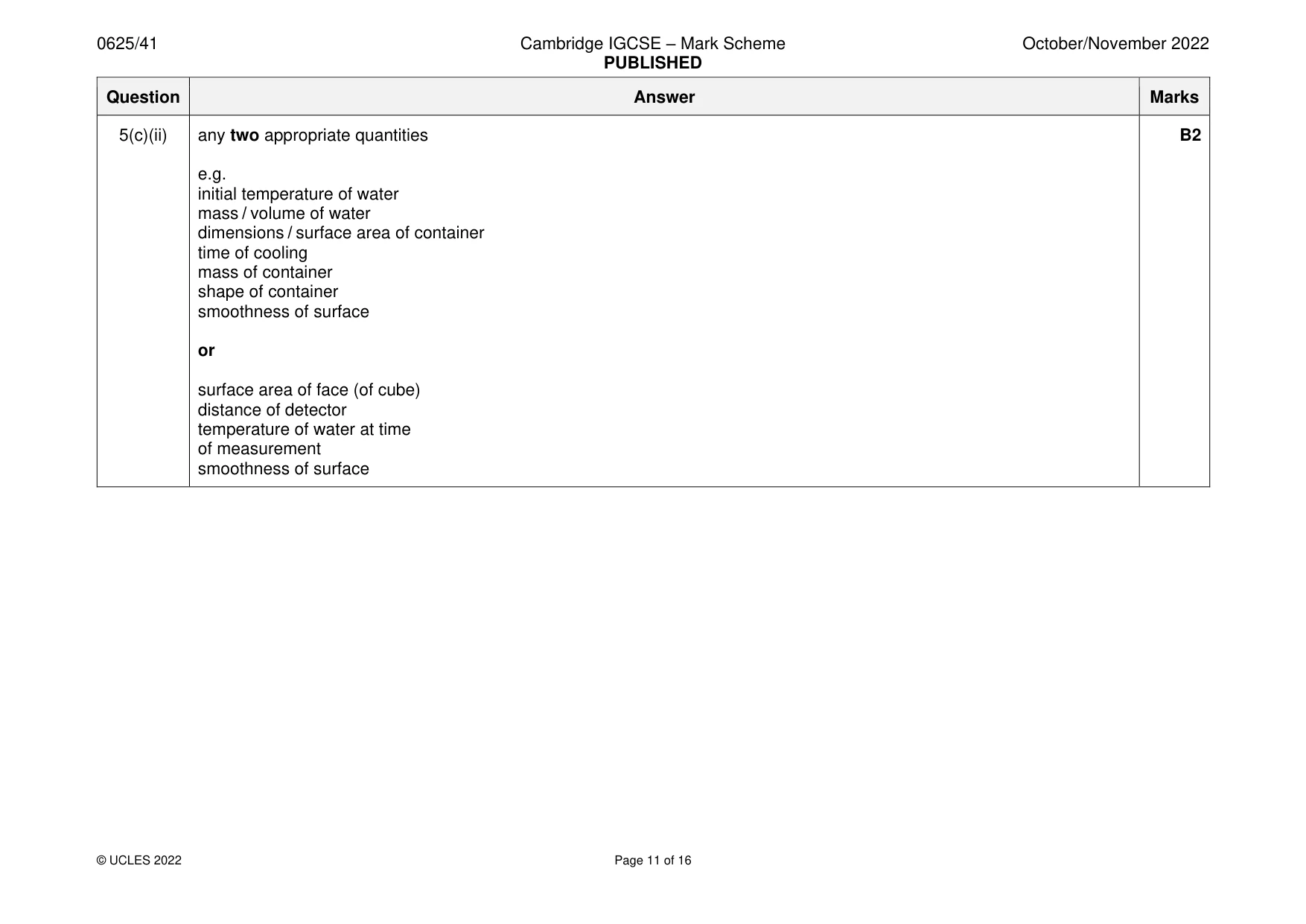
Mark scheme: 5(a) infrared B1 5(b)(i) (both) transverse / electromagnetic / travel in a vacuum / have the same (high) speed (in a vacuum) B1 5(b)(ii) (it / visible light) compared with an e.m. radiation stated by candidate in 5(a) in terms of frequency / wavelength B1 5(c)(i) B3 equipment B1 e.g. black container, white container, thermometers or Leslie’s cube and detector measurements made B1 warm / hot water in container and temperature decreases recorded or time to reach a given temperature / to cool or warm / hot water in cube and meter readings recorded how a conclusion is reached B1 better emitter surface cools quicker or greater reading from better emitter surface 5(c)(ii) any two appropriate quantities B2 e.g. initial temperature of water mass / volume of water dimensions / surface area of container time of cooling mass of container shape of container smoothness of surface or surface area of face (of cube) distance of detector temperature of water at time of measurement smoothness of surface
Q6 · The red light produced by a laser is monochromatic
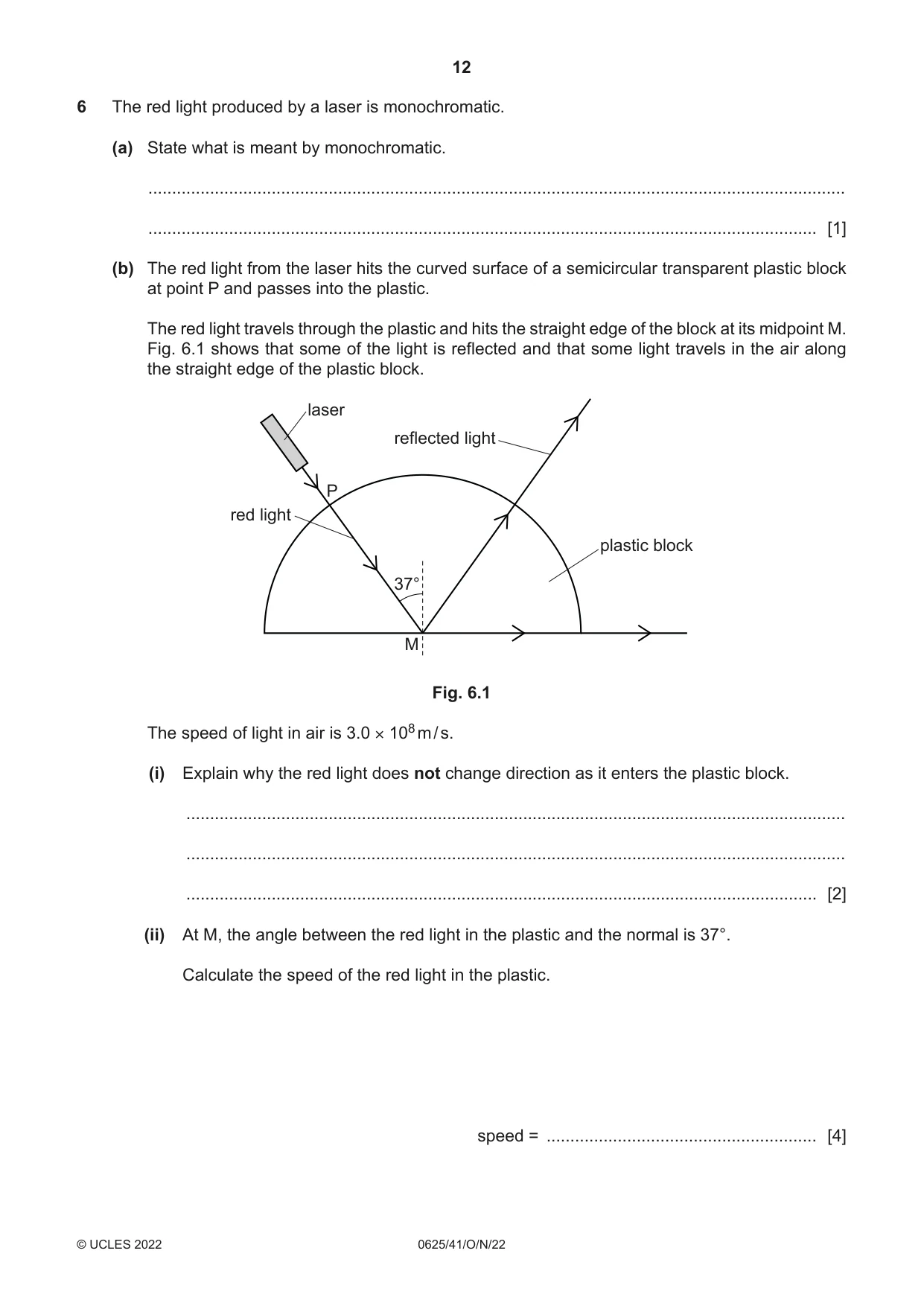
6 The red light produced by a laser is monochromatic. (a) State what is meant by monochromatic. ................................................................................................................................................... ............................................................................................................................................. [1] (b) The red light from the laser hits the curved surface of a semicircular transparent plastic block at point P and passes into the plastic. The red light travels through the plastic and hits the straight edge of the block at its midpoint M. Fig. 6.1 shows that some of the light is reflected and that some light travels in the air along the straight edge of the plastic block. laser reflected light P red light plastic block 37° M Fig. 6.1 The speed of light in air is 3.0 × 10⁸ m / s. (i) Explain why the red light does not change direction as it enters the plastic block. ........................................................................................................................................... ........................................................................................................................................... ..................................................................................................................................... [2] (ii) At M, the angle between the red light in the plastic and the normal is 37°. Calculate the speed of the red light in the plastic. speed = ......................................................... [4] (iii) In the plastic, blue light travels slightly slower than red light and so the critical angle for blue light is smaller than the critical angle for red light. The laser that emits red light is replaced by one that emits blue light. Now blue light enters the block at P and hits the straight edge at M. Explain what happens to the blue light after it hits the straight edge at M. ........................................................................................................................................... ........................................................................................................................................... ........................................................................................................................................... ..................................................................................................................................... [3] [Total: 10]
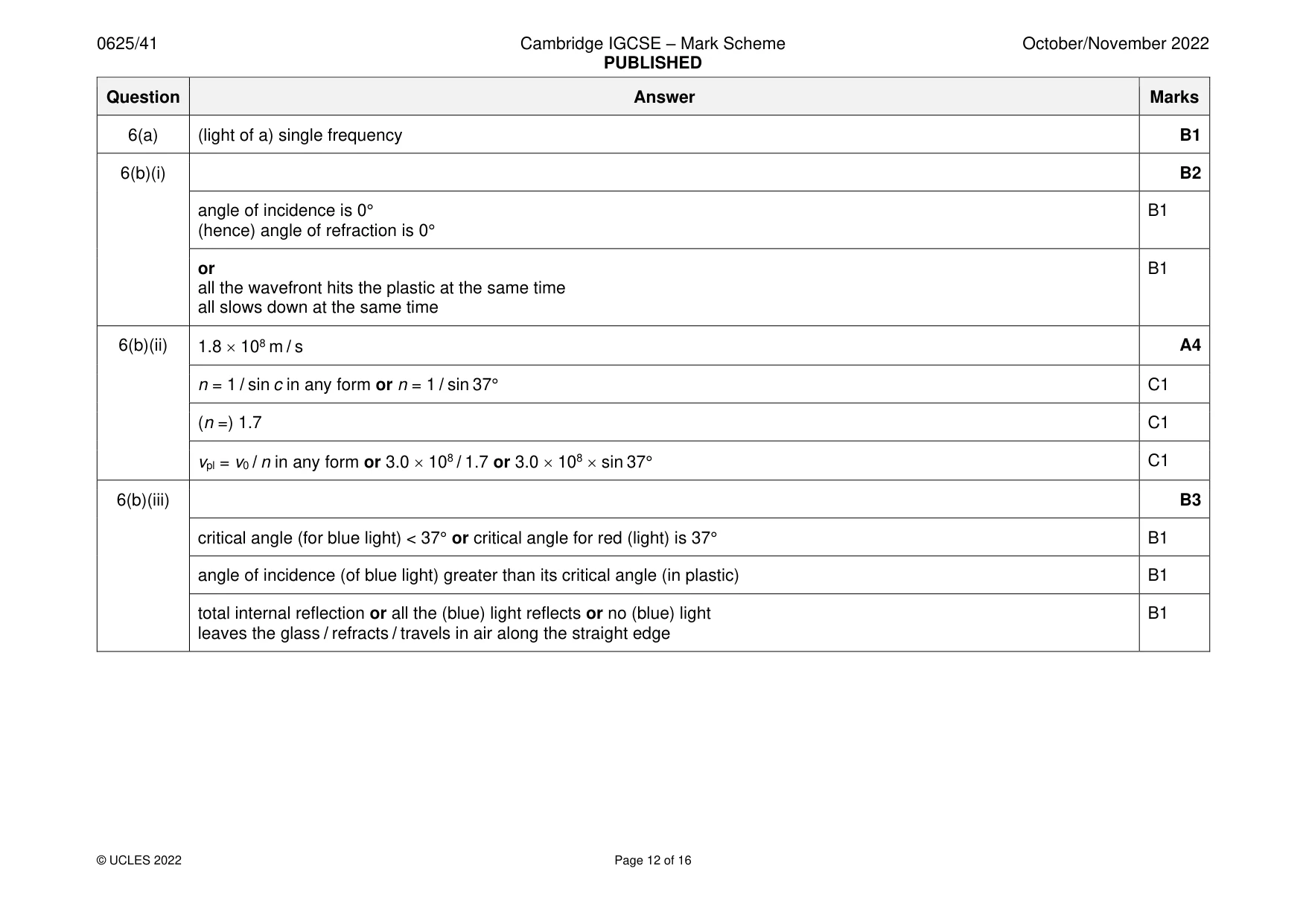
Mark scheme: 6(a) (light of a) single frequency B1 6(b)(i) B2 angle of incidence is 0° B1 (hence) angle of refraction is 0° or B1 all the wavefront hits the plastic at the same time all slows down at the same time 6(b)(ii) 1.8 108 m / s A4 n = 1 / sin c in any form or n = 1 / sin 37° C1 (n =) 1.7 C1 vpl = v0 / n in any form or 3.0 108 / 1.7 or 3.0 108 sin 37° C1 6(b)(iii) B3 critical angle (for blue light) < 37° or critical angle for red (light) is 37° B1 angle of incidence (of blue light) greater than its critical angle (in plastic) B1 total internal reflection or all the (blue) light reflects or no (blue) light B1 leaves the glass / refracts / travels in air along the straight edge
Q7 · The electric starter motor in a car is switched on and off using a relay
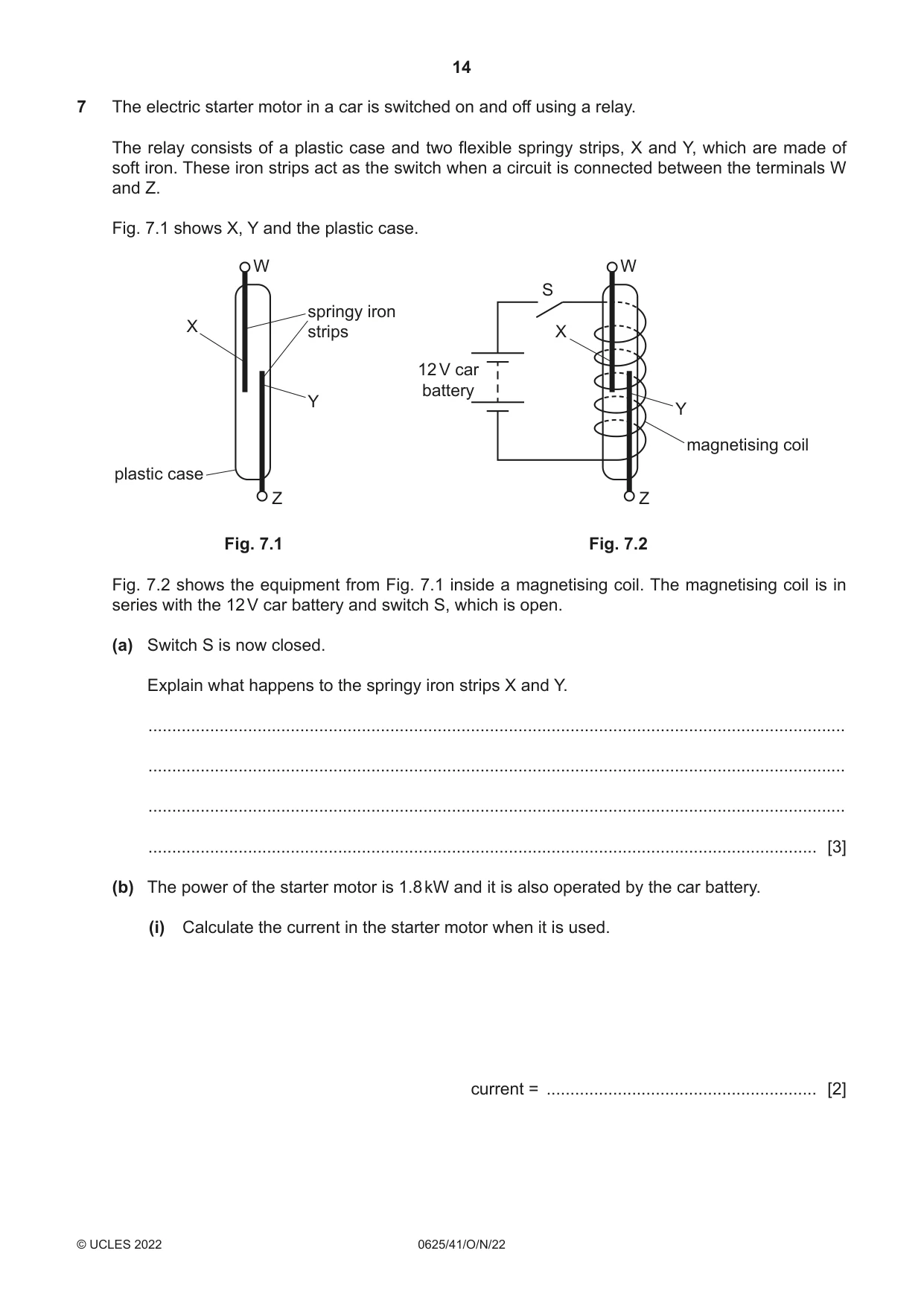
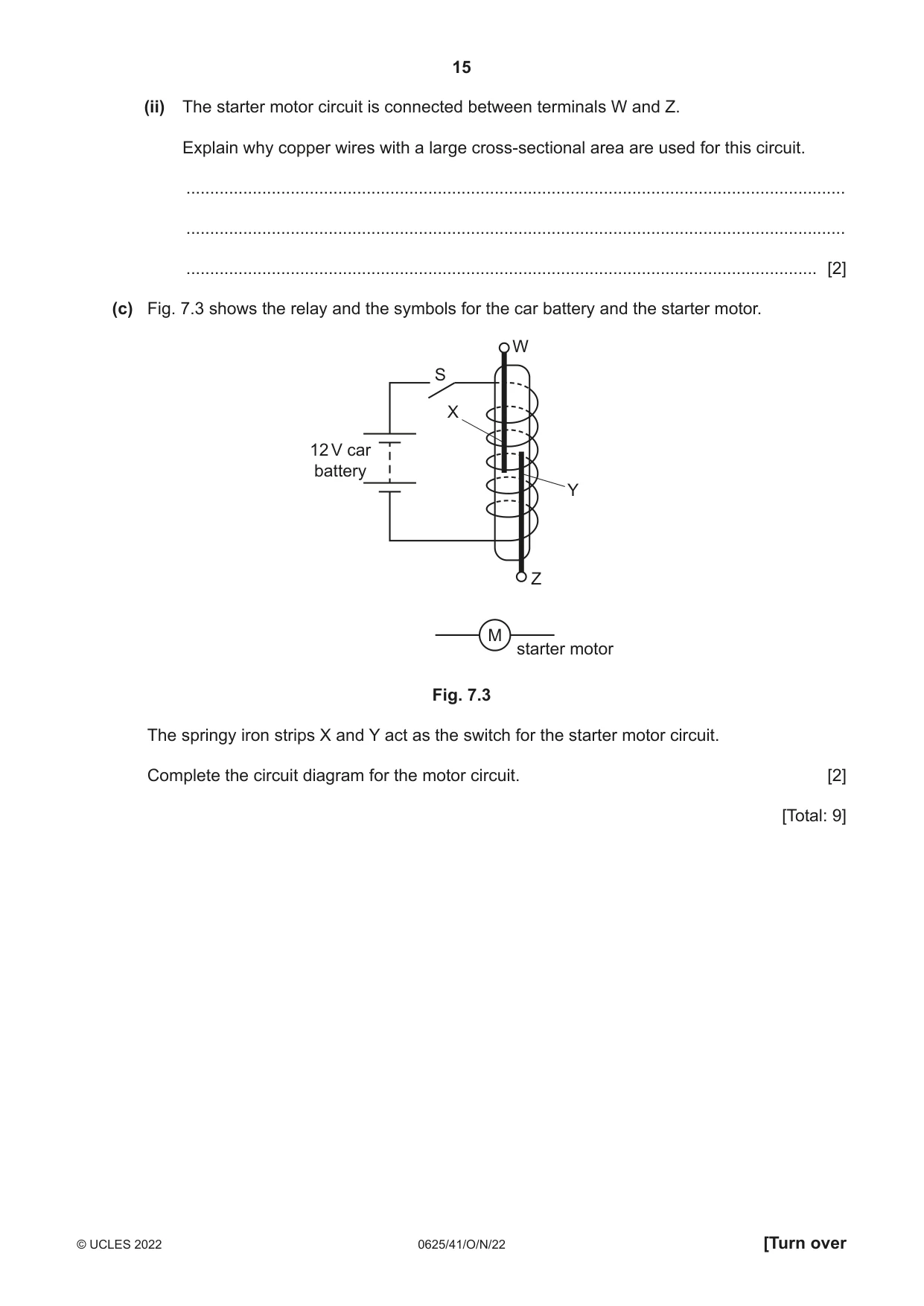
7 The electric starter motor in a car is switched on and off using a relay. The relay consists of a plastic case and two flexible springy strips, X and Y, which are made of soft iron. These iron strips act as the switch when a circuit is connected between the terminals W and Z. Fig. 7.1 shows X, Y and the plastic case. W W S springy iron X strips X 12 V car battery Y Y magnetising coil plastic case Z Z Fig. 7.1 Fig. 7.2 Fig. 7.2 shows the equipment from Fig. 7.1 inside a magnetising coil. The magnetising coil is in series with the 12 V car battery and switch S, which is open. (a) Switch S is now closed. Explain what happens to the springy iron strips X and Y. ................................................................................................................................................... ................................................................................................................................................... ................................................................................................................................................... ............................................................................................................................................. [3] (b) The power of the starter motor is 1.8 kW and it is also operated by the car battery. (i) Calculate the current in the starter motor when it is used. current = ......................................................... [2] (ii) The starter motor circuit is connected between terminals W and Z. Explain why copper wires with a large cross-sectional area are used for this circuit. ........................................................................................................................................... ........................................................................................................................................... ..................................................................................................................................... [2] (c) Fig. 7.3 shows the relay and the symbols for the car battery and the starter motor. W S X 12 V car battery Y Z M starter motor Fig. 7.3 The springy iron strips X and Y act as the switch for the starter motor circuit. Complete the circuit diagram for the motor circuit. [2] [Total: 9]
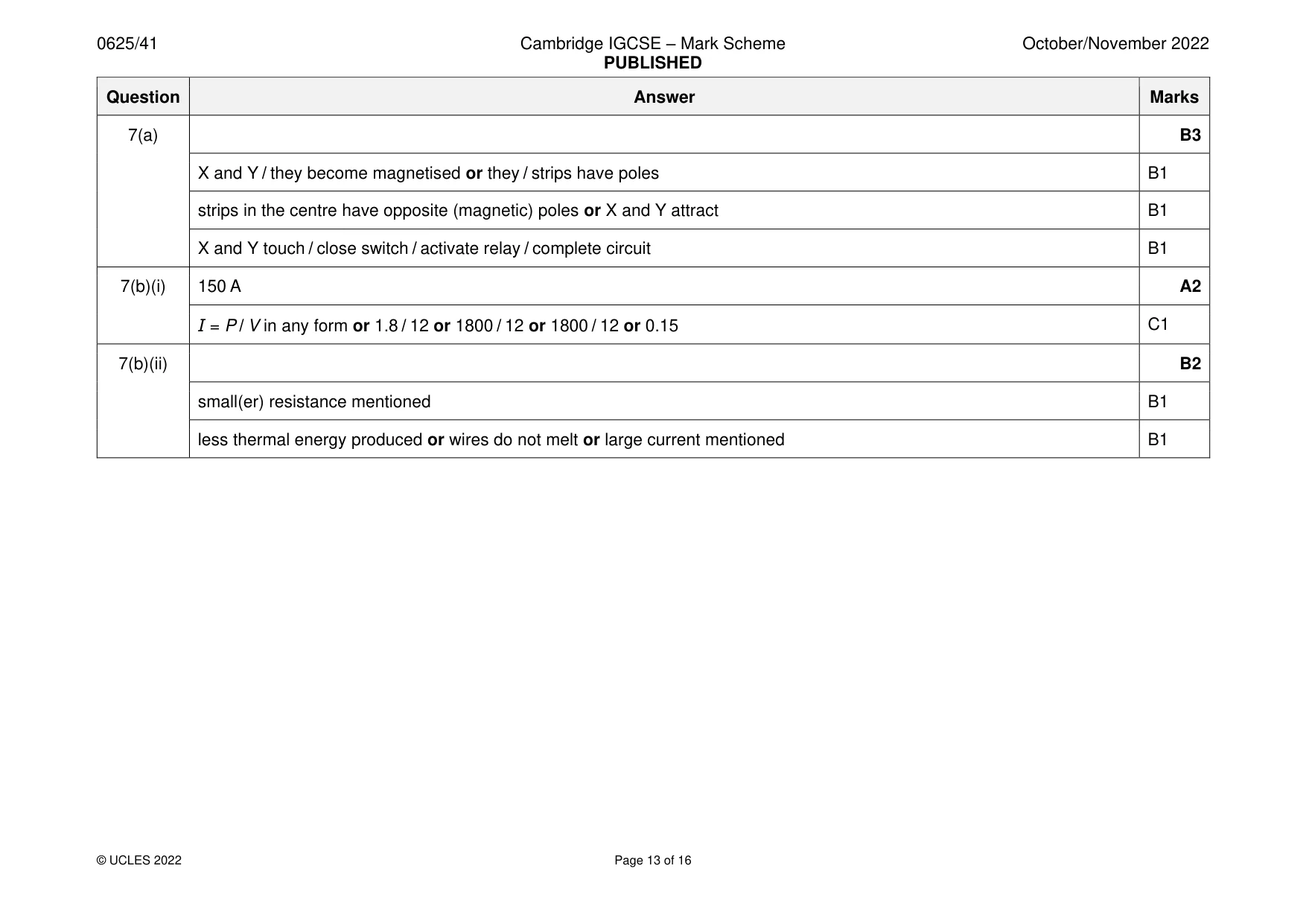
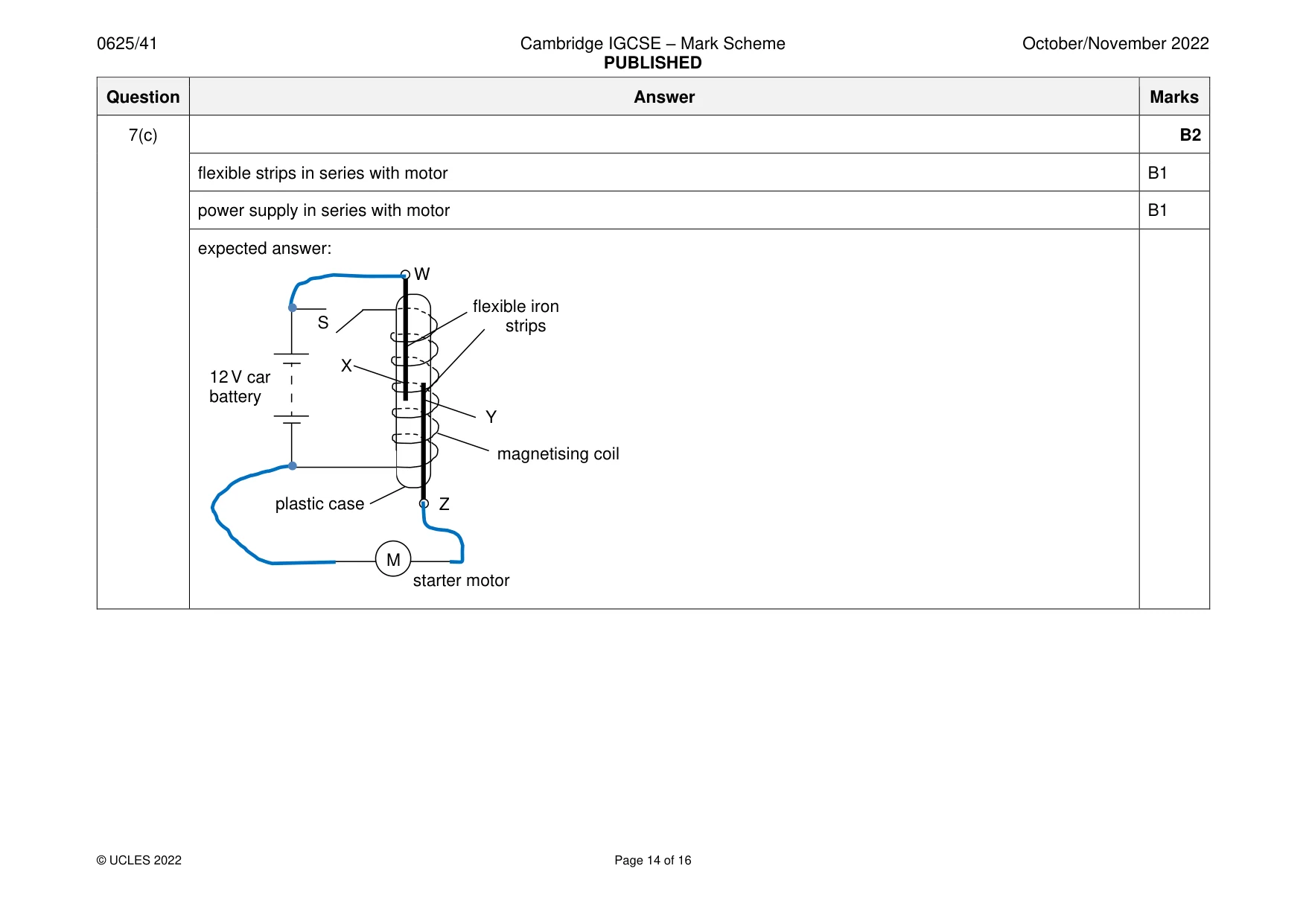
Mark scheme: 7(a) B3 X and Y / they become magnetised or they / strips have poles B1 strips in the centre have opposite (magnetic) poles or X and Y attract B1 X and Y touch / close switch / activate relay / complete circuit B1 7(b)(i) 150 A A2 I = P / V in any form or 1.8 / 12 or 1800 / 12 or 1800 / 12 or 0.15 C1 7(b)(ii) B2 small(er) resistance mentioned B1 less thermal energy produced or wires do not melt or large current mentioned B1 7(c) B2 flexible strips in series with motor B1 power supply in series with motor B1 expected answer: W flexible iron S strips X 12 V car battery Y magnetising coil plastic case Z M starter motor
Q8 · The unit of the two electrical quantities electromotive force (e.m.f.) and potential…
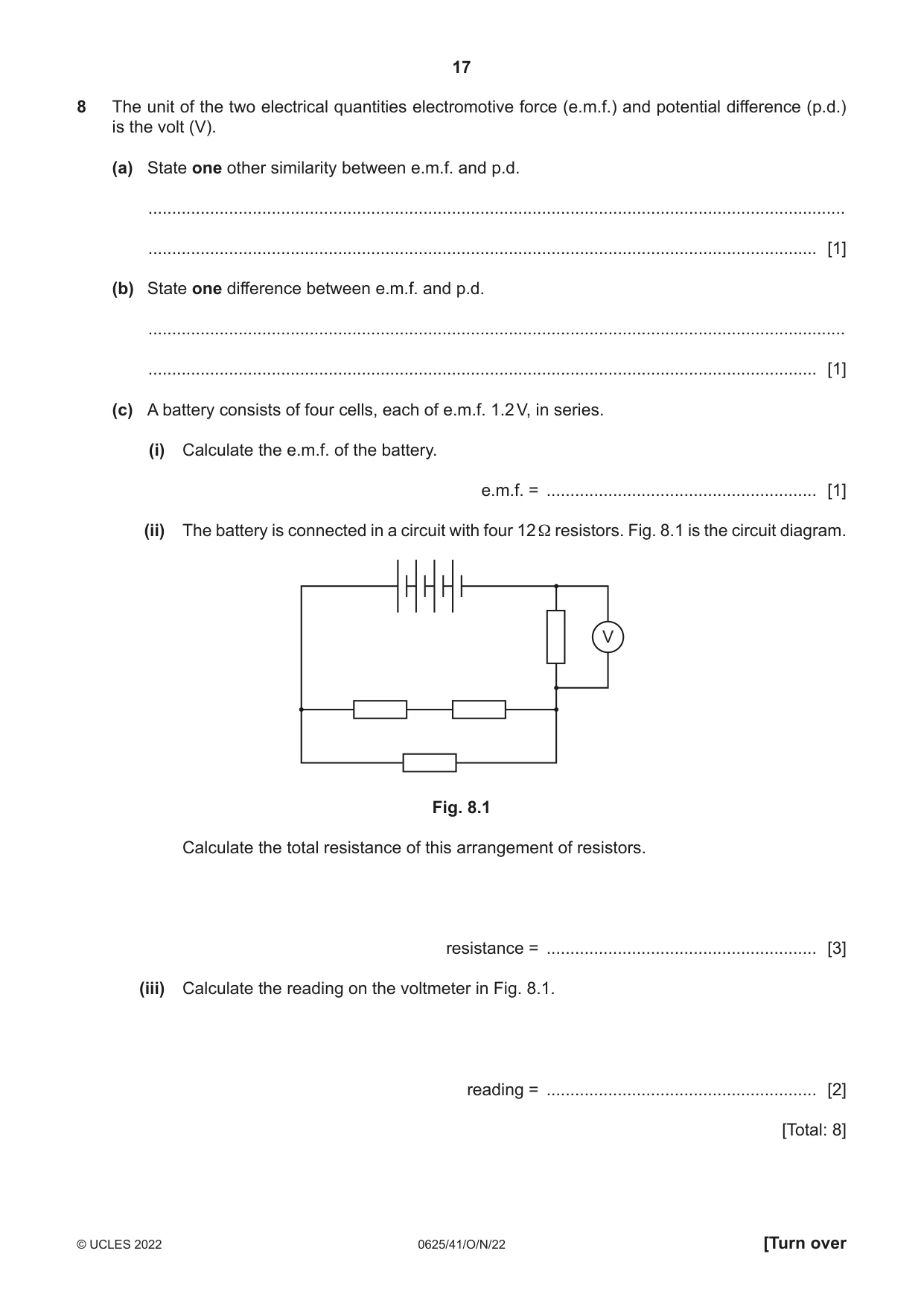
8 The unit of the two electrical quantities electromotive force (e.m.f.) and potential difference (p.d.) is the volt (V). (a) State one other similarity between e.m.f. and p.d. ................................................................................................................................................... ............................................................................................................................................. [1] (b) State one difference between e.m.f. and p.d. ................................................................................................................................................... ............................................................................................................................................. [1] (c) A battery consists of four cells, each of e.m.f. 1.2 V, in series. (i) Calculate the e.m.f. of the battery. e.m.f. = ......................................................... [1] (ii) The battery is connected in a circuit with four 12 Ω resistors. Fig. 8.1 is the circuit diagram. V Fig. 8.1 Calculate the total resistance of this arrangement of resistors. resistance = ......................................................... [3] (iii) Calculate the reading on the voltmeter in Fig. 8.1. reading = ......................................................... [2] [Total: 8]
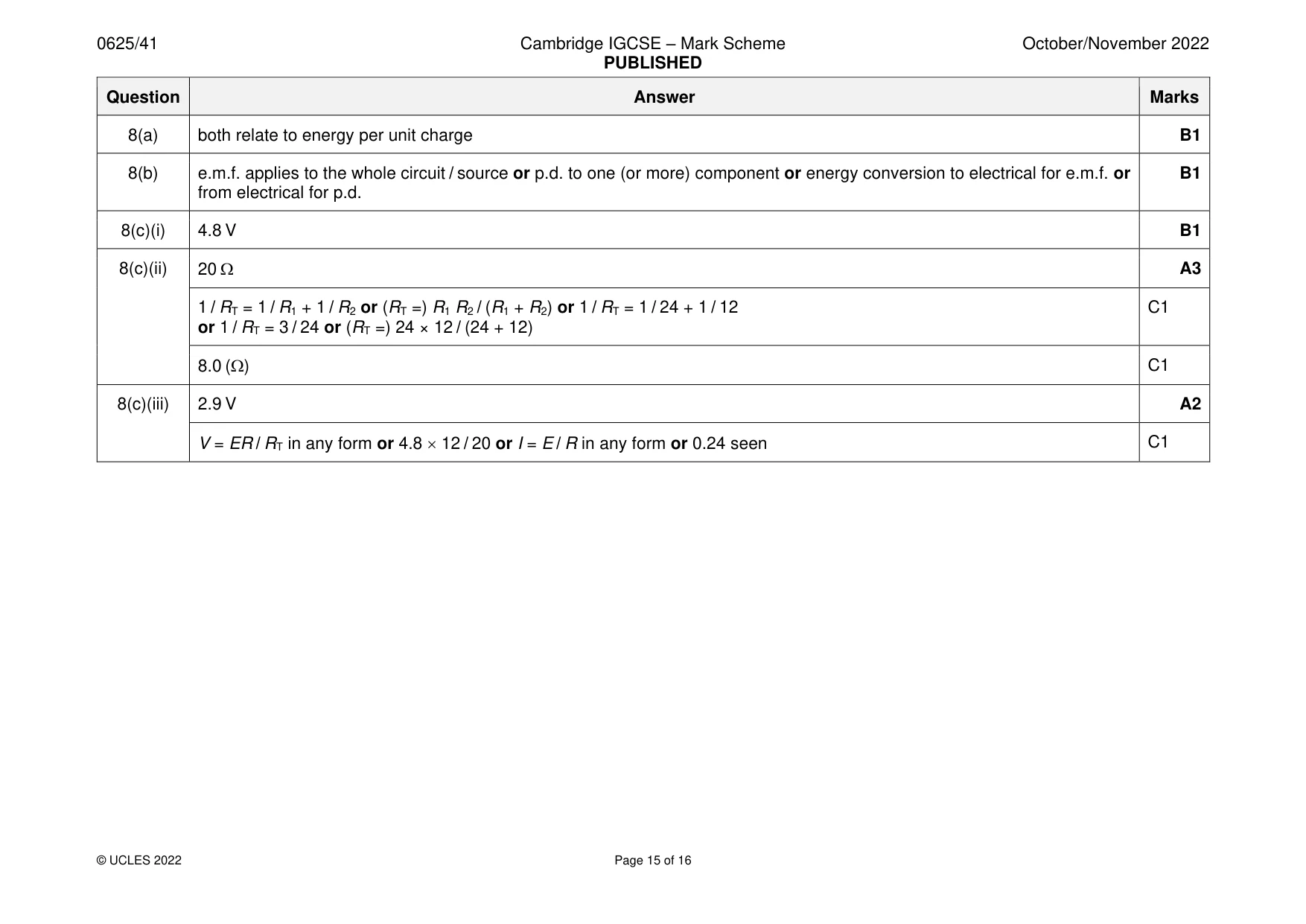
Mark scheme: 8(a) both relate to energy per unit charge B1 8(b) e.m.f. applies to the whole circuit / source or p.d. to one (or more) component or energy conversion to electrical for e.m.f. or B1 from electrical for p.d. 8(c)(i) 4.8 V B1 8(c)(ii) 20 A3 1 / RT = 1 / R1 + 1 / R2 or (RT =) R1 R2 / (R1 + R2) or 1 / RT = 1 / 24 + 1 / 12 C1 or 1 / RT = 3 / 24 or (RT =) 24 × 12 / (24 + 12) 8.0 () C1 8(c)(iii) 2.9 V A2 V = ER / RT in any form or 4.8 12 / 20 or I = E / R in any form or 0.24 seen C1
Q9 · Only one isotope of gold occurs naturally on Earth
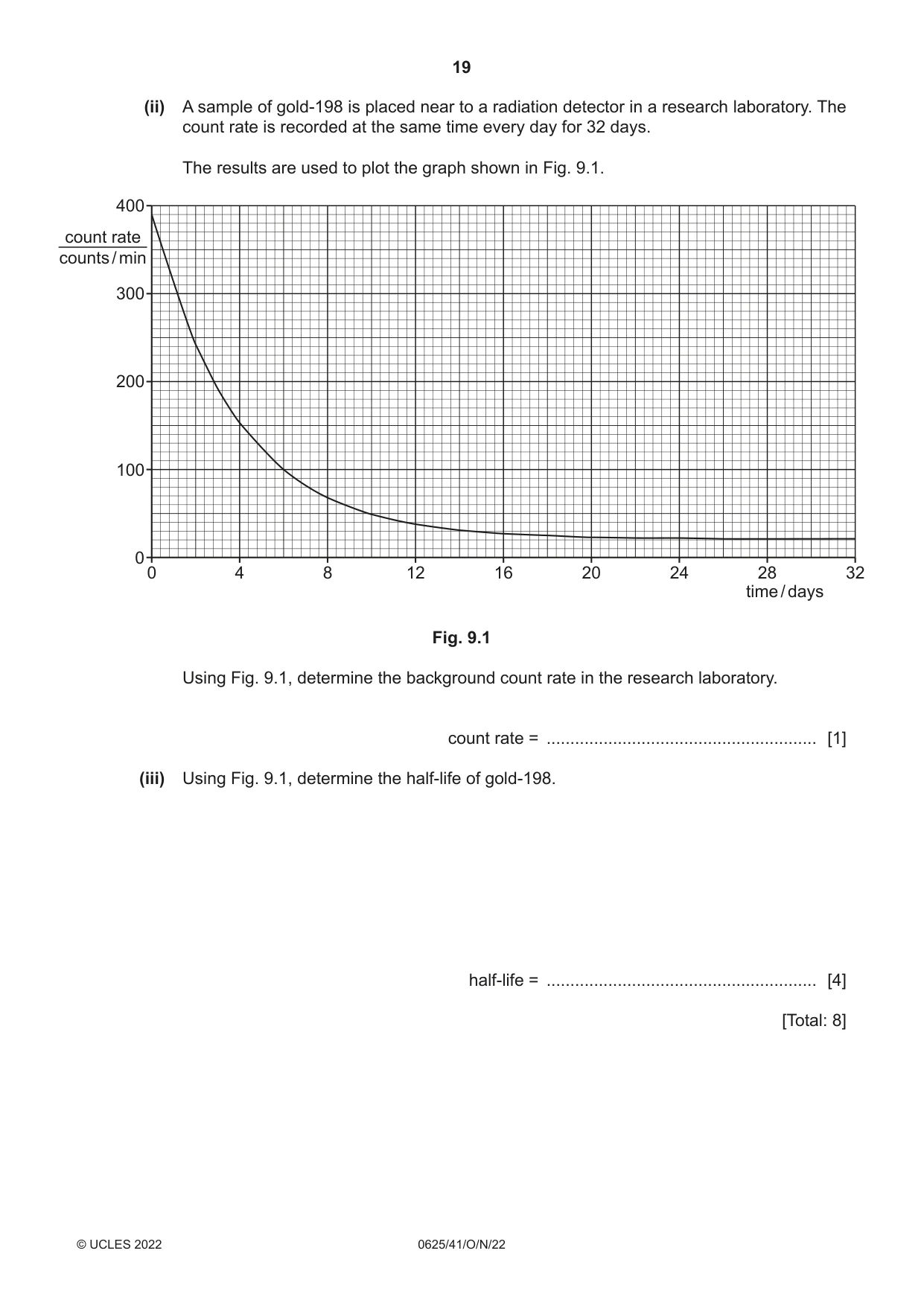
9 Only one isotope of gold occurs naturally on Earth. (a) State what this indicates about the nuclear structure of all the naturally occurring atoms of gold on Earth. ................................................................................................................................................... ............................................................................................................................................. [1] (b) There are several artificially produced isotopes of gold. Gold-198 (19879 Au) is an artificial isotope which is used in medicine and in scientific research. Gold-198 decays by β (beta)-emission to a stable isotope of mercury. (i) Determine the number of protons and the number of neutrons in a nucleus of this isotope of mercury. number of protons = ............................................................... number of neutrons = ............................................................... [2] (ii) A sample of gold-198 is placed near to a radiation detector in a research laboratory. The count rate is recorded at the same time every day for 32 days. The results are used to plot the graph shown in Fig. 9.1. 400 count rate counts / min 300 200 100 0 0 4 8 12 16 20 24 28 32 time / days Fig. 9.1 Using Fig. 9.1, determine the background count rate in the research laboratory. count rate = ......................................................... [1] (iii) Using Fig. 9.1, determine the half-life of gold-198. half-life = ......................................................... [4] [Total: 8]
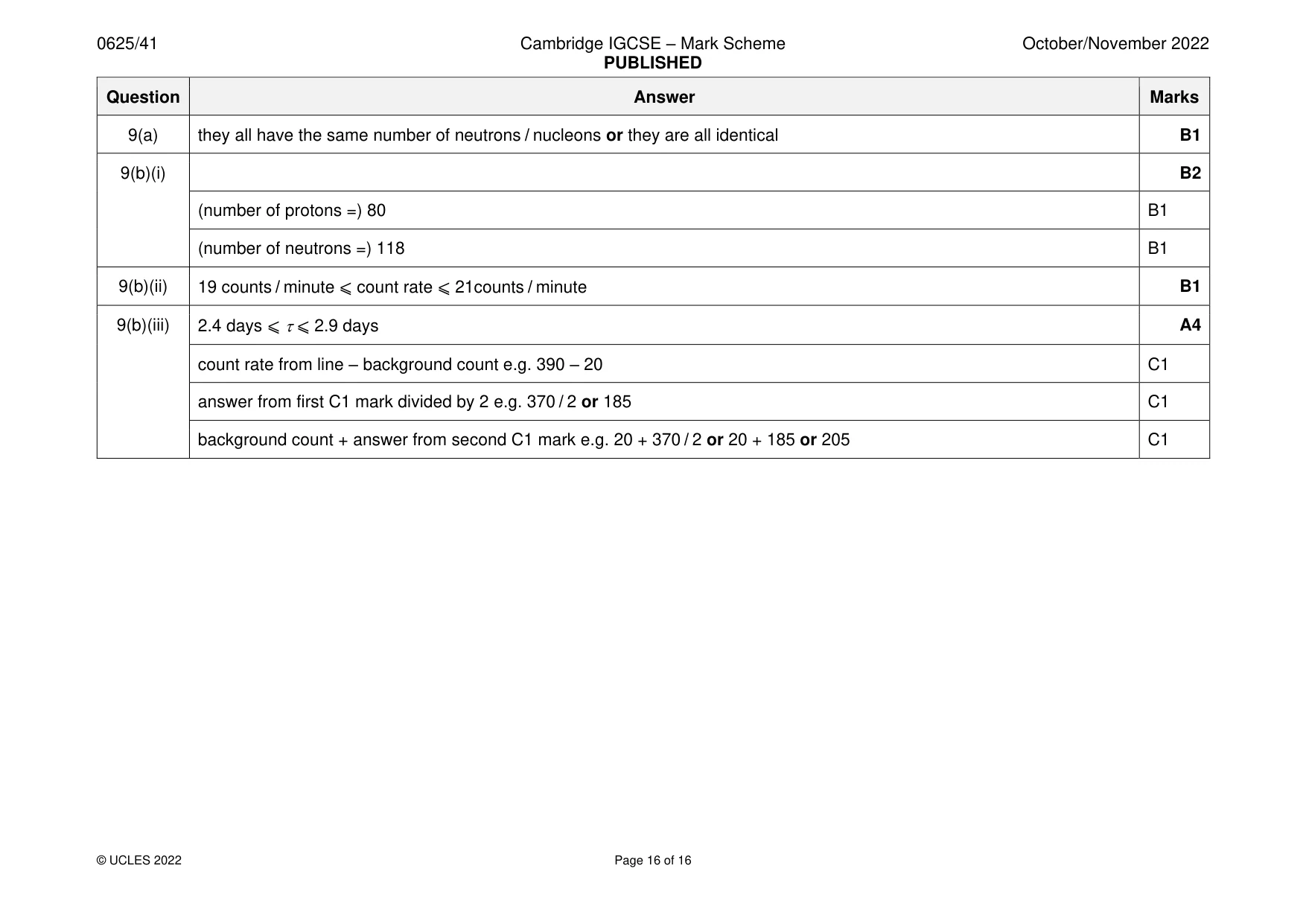
Mark scheme: 9(a) they all have the same number of neutrons / nucleons or they are all identical B1 9(b)(i) B2 (number of protons =) 80 B1 (number of neutrons =) 118 B1 9(b)(ii) 19 counts / minute ⩽ count rate ⩽ 21counts / minute B1 9(b)(iii) 2.4 days ⩽ ⩽ 2.9 days A4 count rate from line – background count e.g. 390 – 20 C1 answer from first C1 mark divided by 2 e.g. 370 / 2 or 185 C1 background count + answer from second C1 mark e.g. 20 + 370 / 2 or 20 + 185 or 205 C1
What was in this paper
The subtopics covered by these 9 questions, and how many questions each got. Open one in a new tab to see every Cambridge question on it.
What you needed in this session
Cambridge’s own grade thresholds for 2022 Oct/Nov, Paper 4 · Variant 1. A higher threshold means an easier paper — the bar moves with how the cohort did.