Cambridge IGCSE Physics 0625 — 2024 Oct/Nov Paper 4 · Variant 3
0625/43/O/N/24 · 10 questions · 80 marks · ≈90 min
The question paper and its mark scheme, free to read here and free to download. This is Cambridge’s own paper, exactly as it was sat.
Question paper20 pages
Mark scheme18 pages
Answers below. Sit the paper first if you are practising.

Questions as text
Question 1
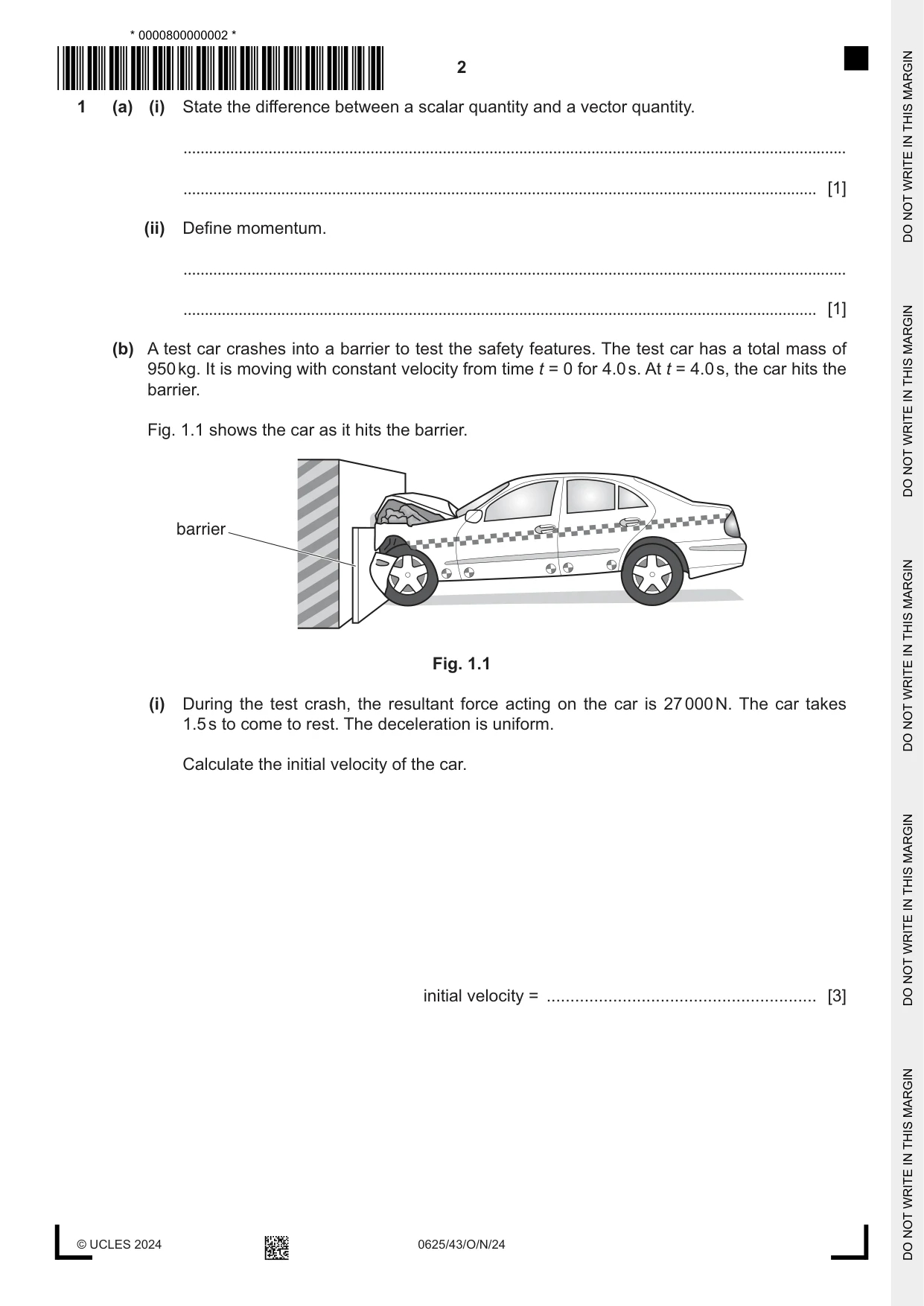
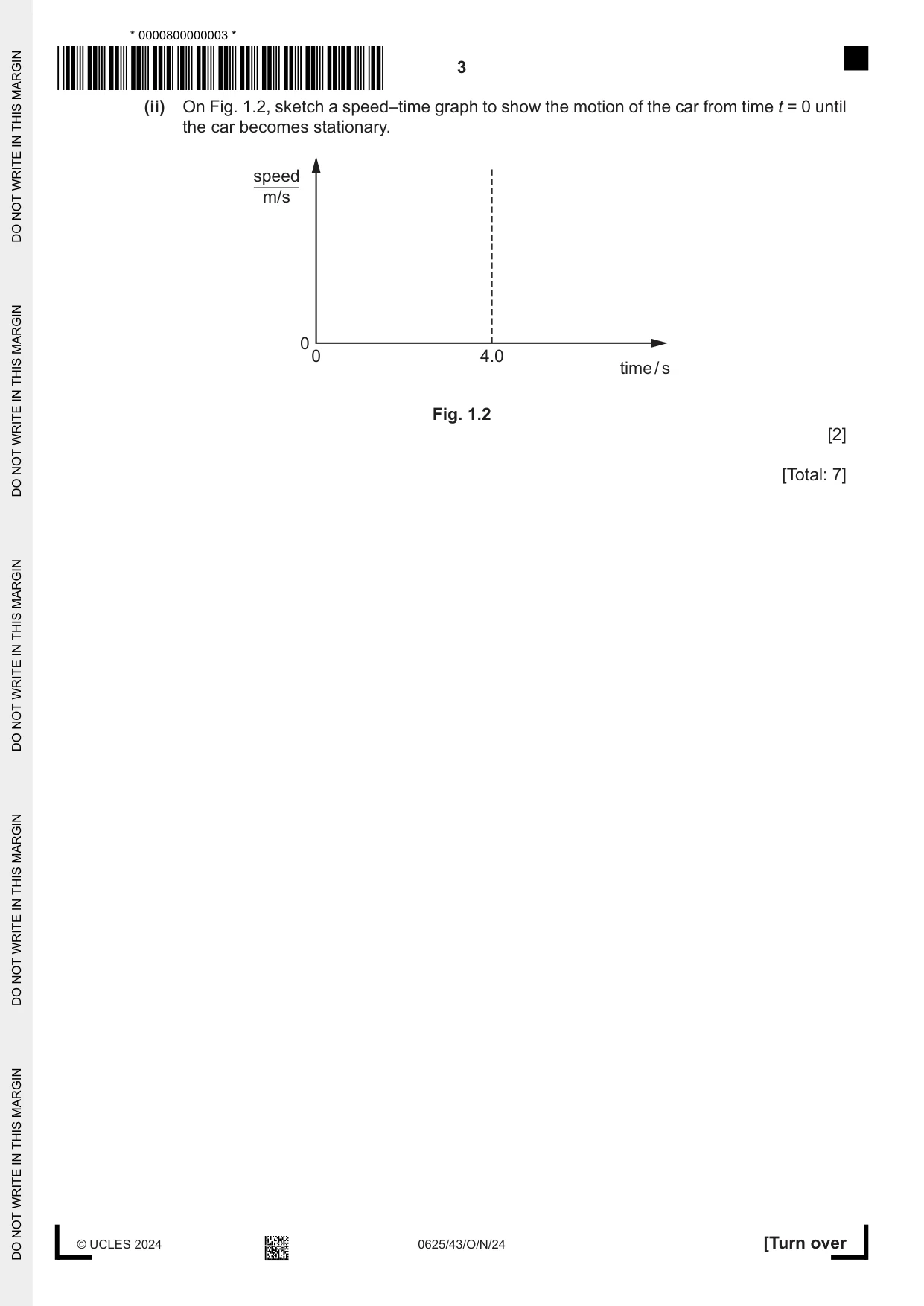
(ii) Define momentum. (b) A test car crashes into a barrier to test the safety features. The test car has a total mass of 950 kg. It is moving with constant velocity from time t = 0 for 4.0 s. At t = 4.0 s, the car hits the barrier. Fig. 1.1 shows the car as it hits the barrier. barrier Fig. 1.1 (i) During the test crash, the resultant force acting on the car is 27 000 N. The car takes 1.5 s to come to rest. The deceleration is uniform. Calculate the initial velocity of the car. initial velocity = ......................................................... [3] (ii) On Fig. 1.2, sketch a speed–time graph to show the motion of the car from time t = 0 until the car becomes stationary. speed m/s 0 0 4.0 time / s Fig. 1.2 [2] [Total: 7]
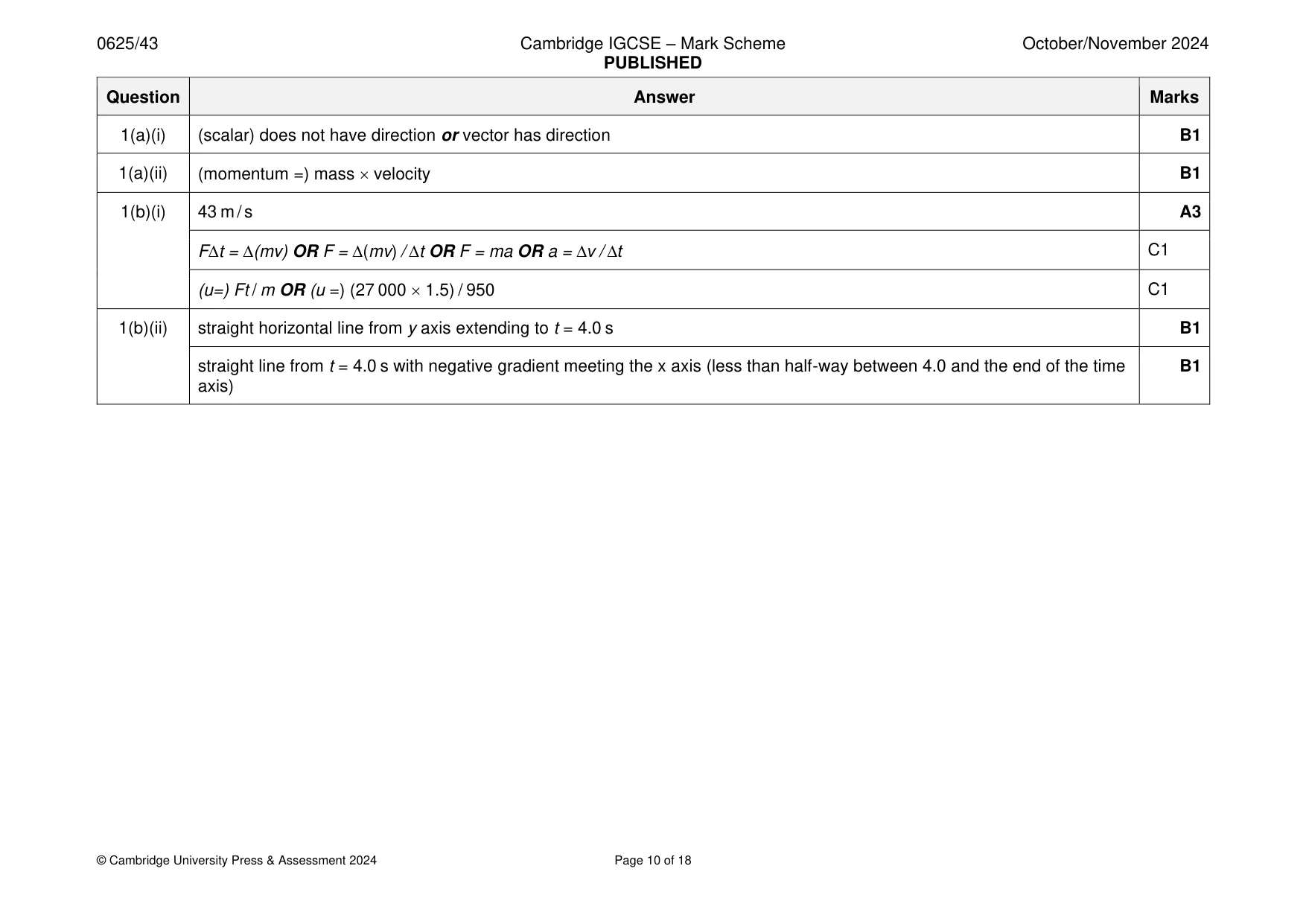
Mark scheme: Question Answer Marks 1(a)(i) (scalar) does not have direction or vector has direction B1 1(a)(ii) (momentum =) mass velocity B1 1(b)(i) 43 m / s A3 Ft = (mv) OR F = (mv) / t OR F = ma OR a = ∆v / ∆t C1 (u=) Ft / m OR (u =) (27 000 1.5) / 950 C1 1(b)(ii) straight horizontal line from y axis extending to t = 4.0 s B1 straight line from t = 4.0 s with negative gradient meeting the x axis (less than half-way between 4.0 and the end of the time B1 axis)
Q2 · Describe an experiment to determine the spring constant of a spring
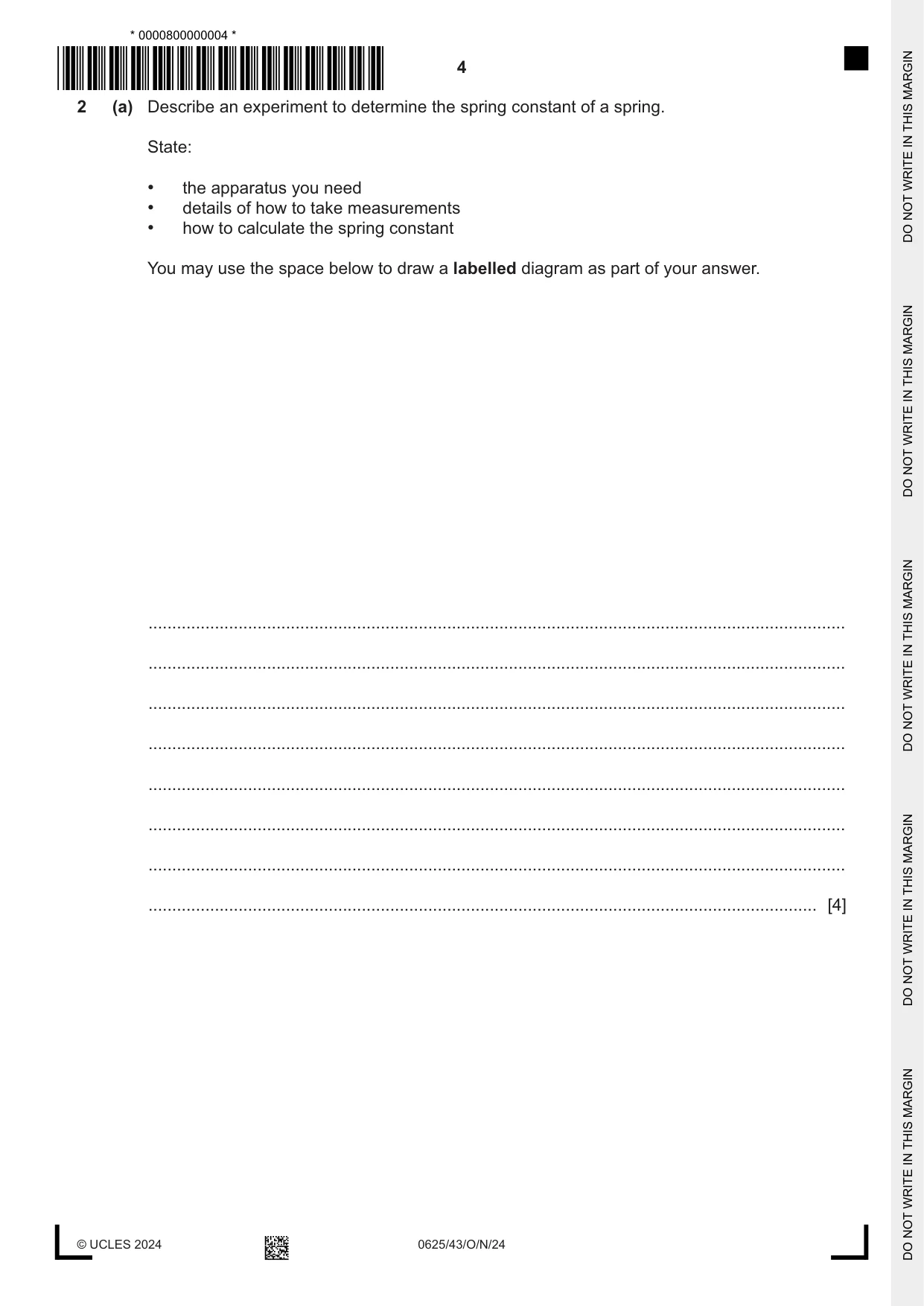
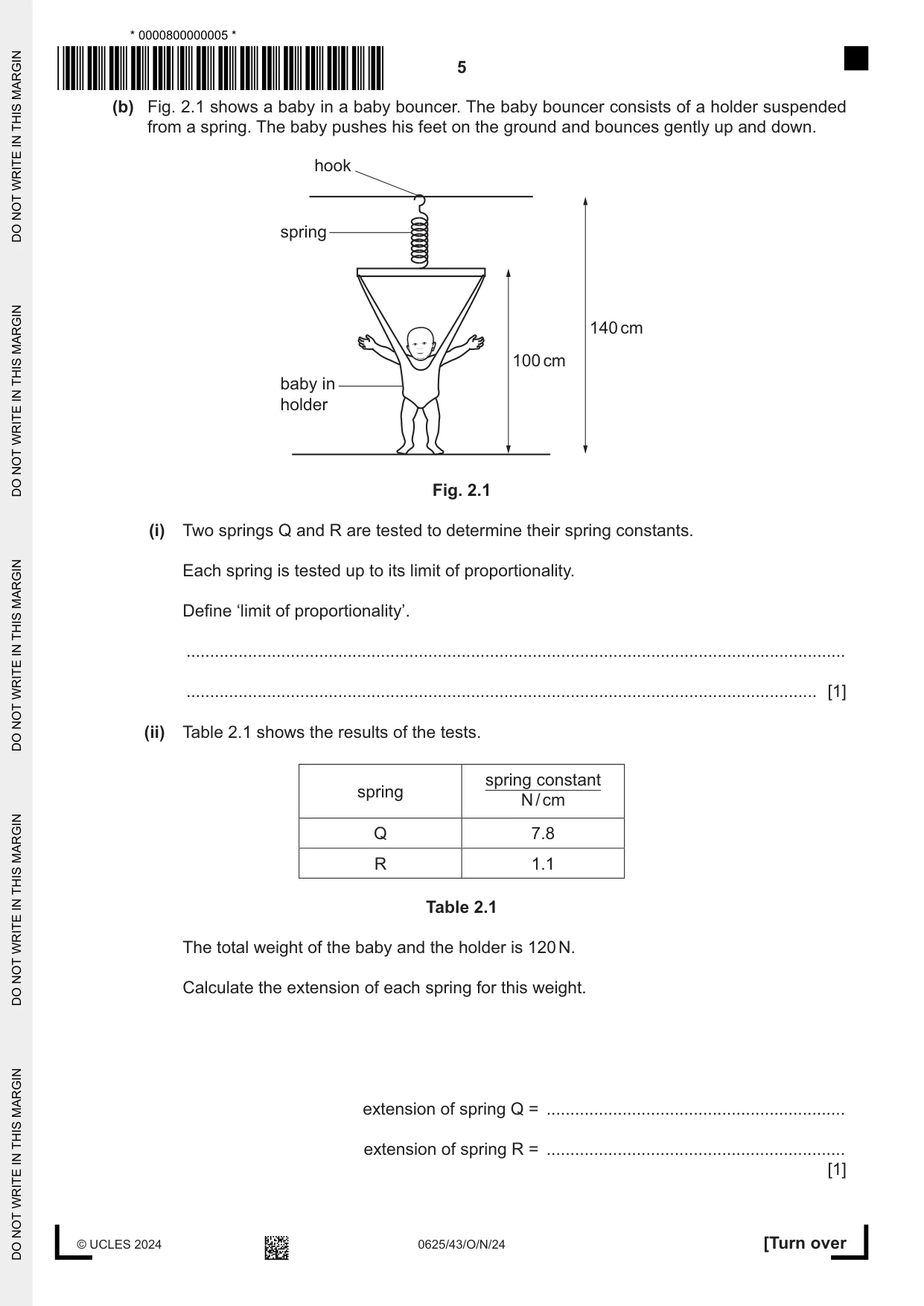
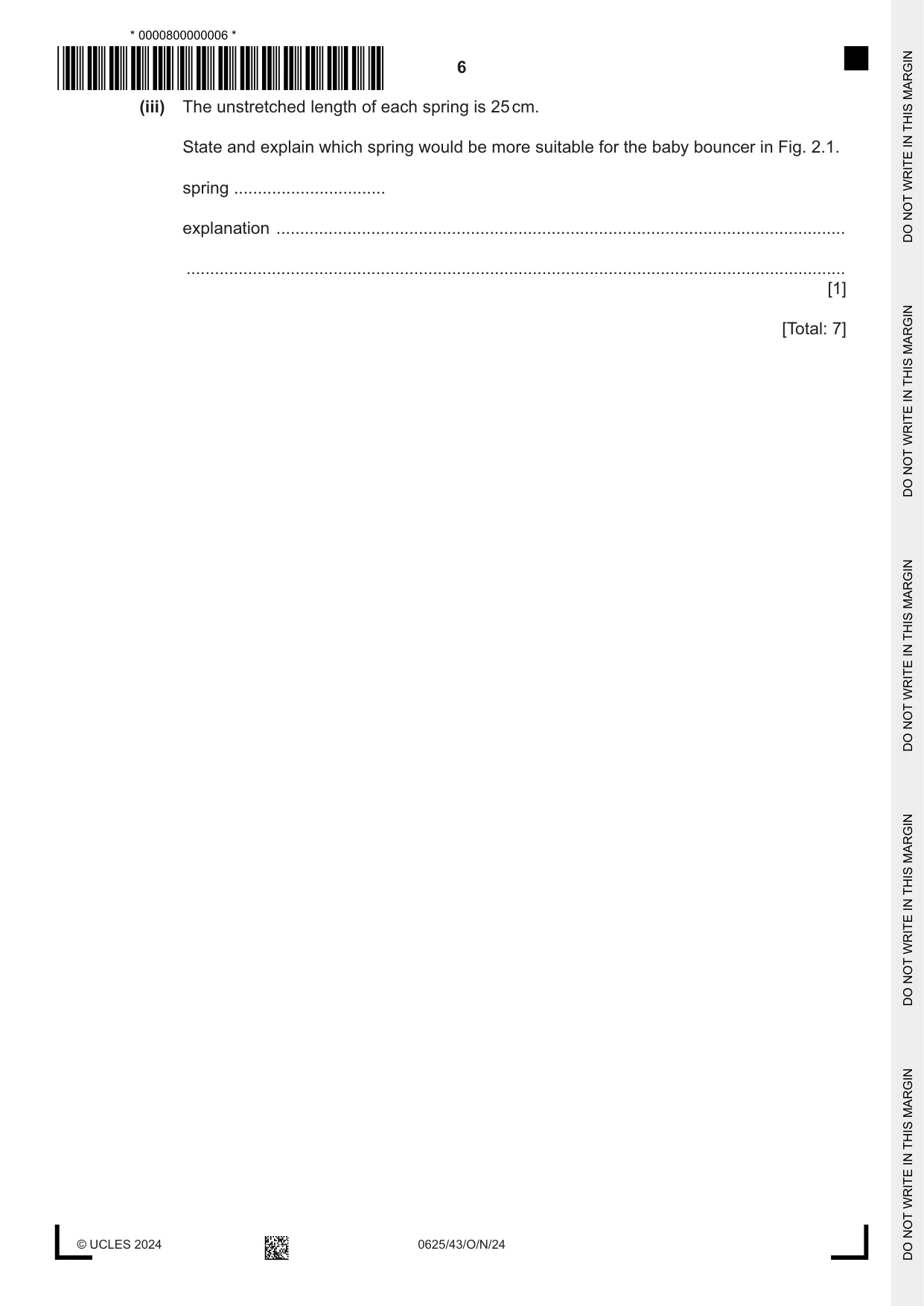
2 (a) Describe an experiment to determine the spring constant of a spring. State: • the apparatus you need • details of how to take measurements • how to calculate the spring constant You may use the space below to draw a labelled diagram as part of your answer. ................................................................................................................................................... ................................................................................................................................................... ................................................................................................................................................... ................................................................................................................................................... ................................................................................................................................................... ................................................................................................................................................... ................................................................................................................................................... ............................................................................................................................................. [4] (b) Fig. 2.1 shows a baby in a baby bouncer. The baby bouncer consists of a holder suspended from a spring. The baby pushes his feet on the ground and bounces gently up and down. hook spring 140 cm 100 cm baby in holder Fig. 2.1 (i) Two springs Q and R are tested to determine their spring constants. Each spring is tested up to its limit of proportionality. Define ‘limit of proportionality’. ........................................................................................................................................... ..................................................................................................................................... [1] (ii) Table 2.1 shows the results of the tests. spring constant spring N / cm Q 7.8 R 1.1 Table 2.1 The total weight of the baby and the holder is 120 N. Calculate the extension of each spring for this weight. extension of spring Q = ............................................................... extension of spring R = ............................................................... [1] (iii) The unstretched length of each spring is 25 cm. State and explain which spring would be more suitable for the baby bouncer in Fig. 2.1. spring ................................ explanation ........................................................................................................................ ........................................................................................................................................... [1] [Total: 7]
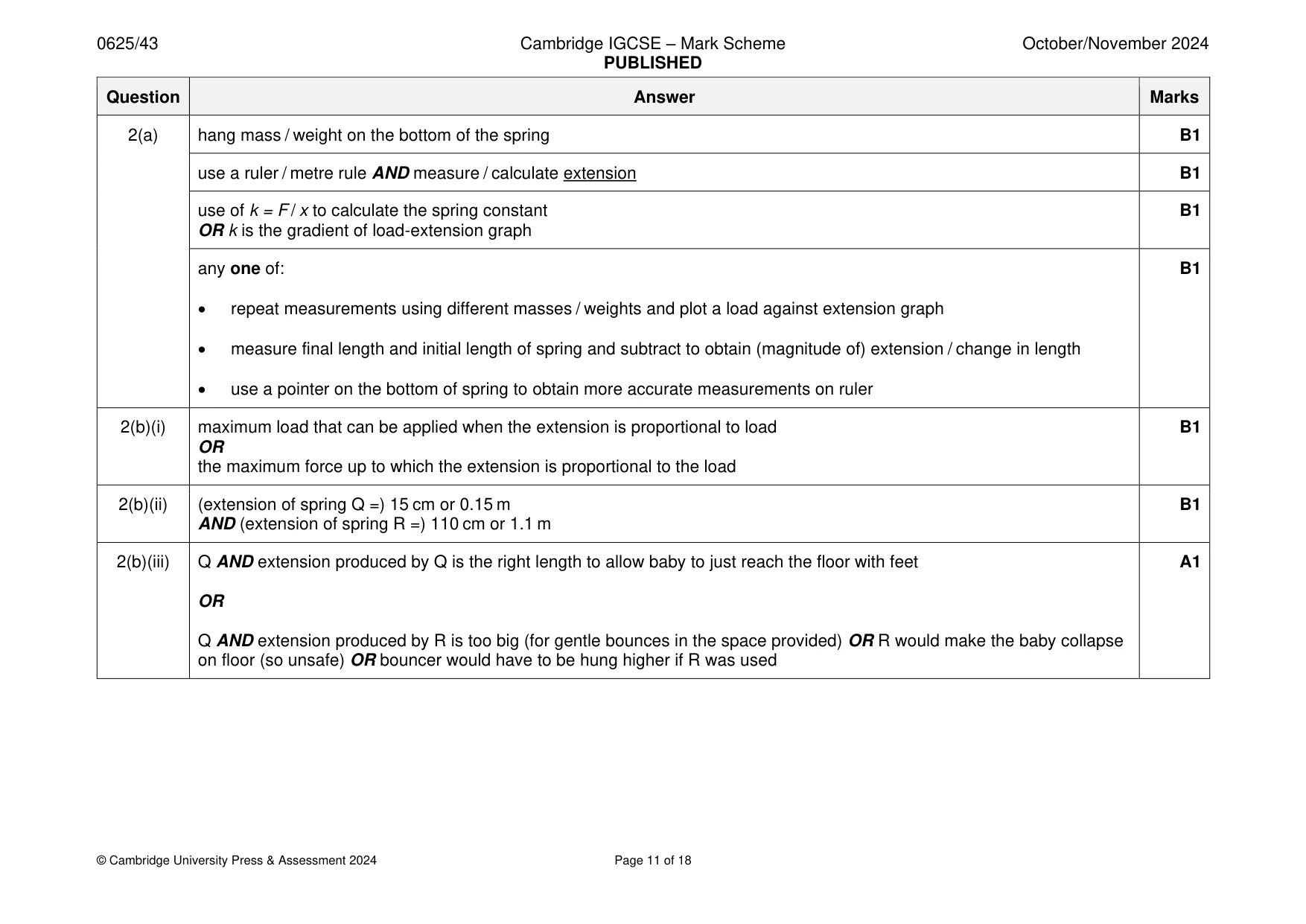
Mark scheme: 2(a) hang mass / weight on the bottom of the spring B1 use a ruler / metre rule AND measure / calculate extension B1 use of k = F / x to calculate the spring constant B1 OR k is the gradient of load-extension graph any one of: B1 • repeat measurements using different masses / weights and plot a load against extension graph • measure final length and initial length of spring and subtract to obtain (magnitude of) extension / change in length • use a pointer on the bottom of spring to obtain more accurate measurements on ruler 2(b)(i) maximum load that can be applied when the extension is proportional to load B1 OR the maximum force up to which the extension is proportional to the load 2(b)(ii) (extension of spring Q =) 15 cm or 0.15 m B1 AND (extension of spring R =) 110 cm or 1.1 m 2(b)(iii) Q AND extension produced by Q is the right length to allow baby to just reach the floor with feet A1 OR Q AND extension produced by R is too big (for gentle bounces in the space provided) OR R would make the baby collapse on floor (so unsafe) OR bouncer would have to be hung higher if R was used
Q3 · A portable shower used on a campsite
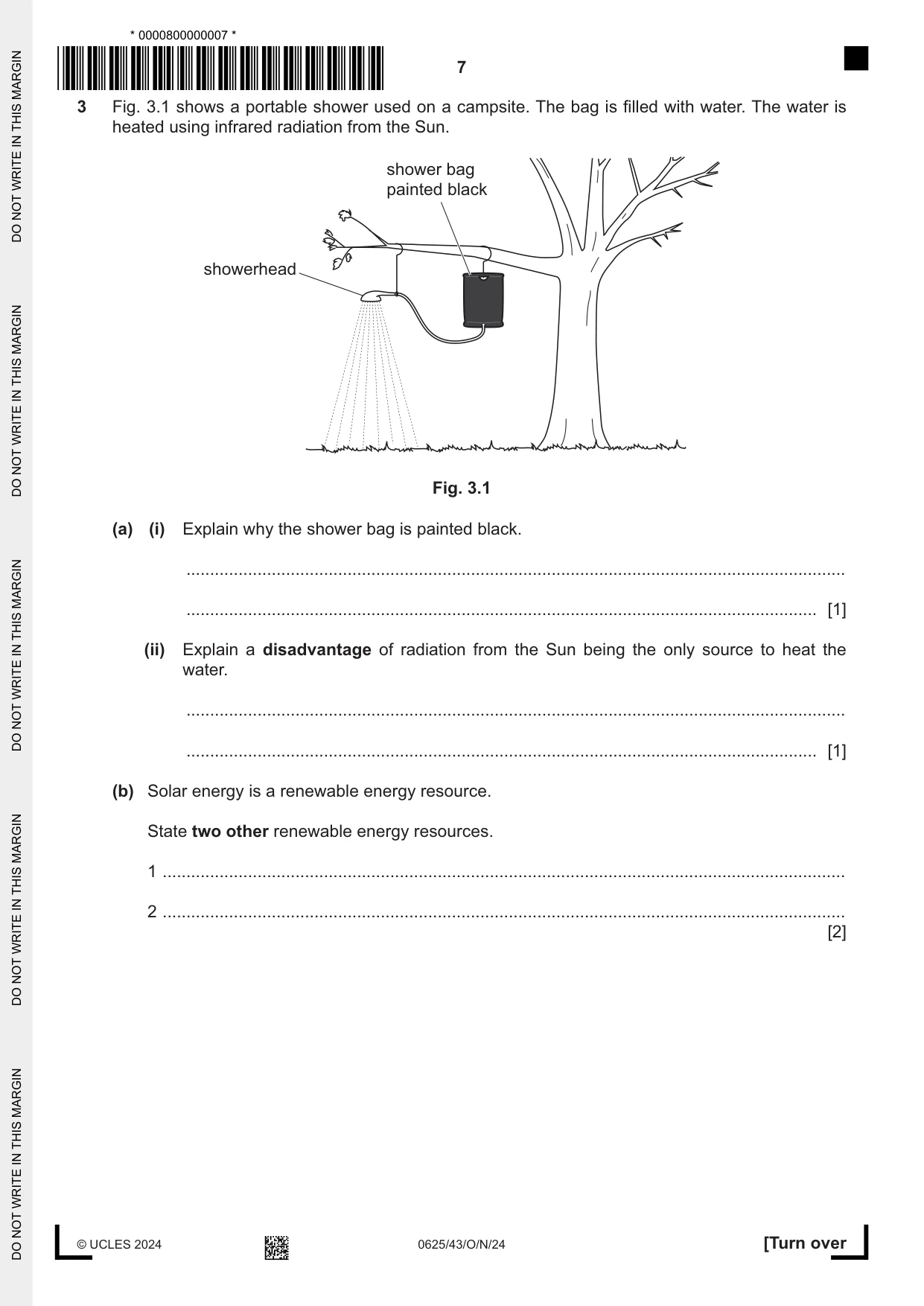
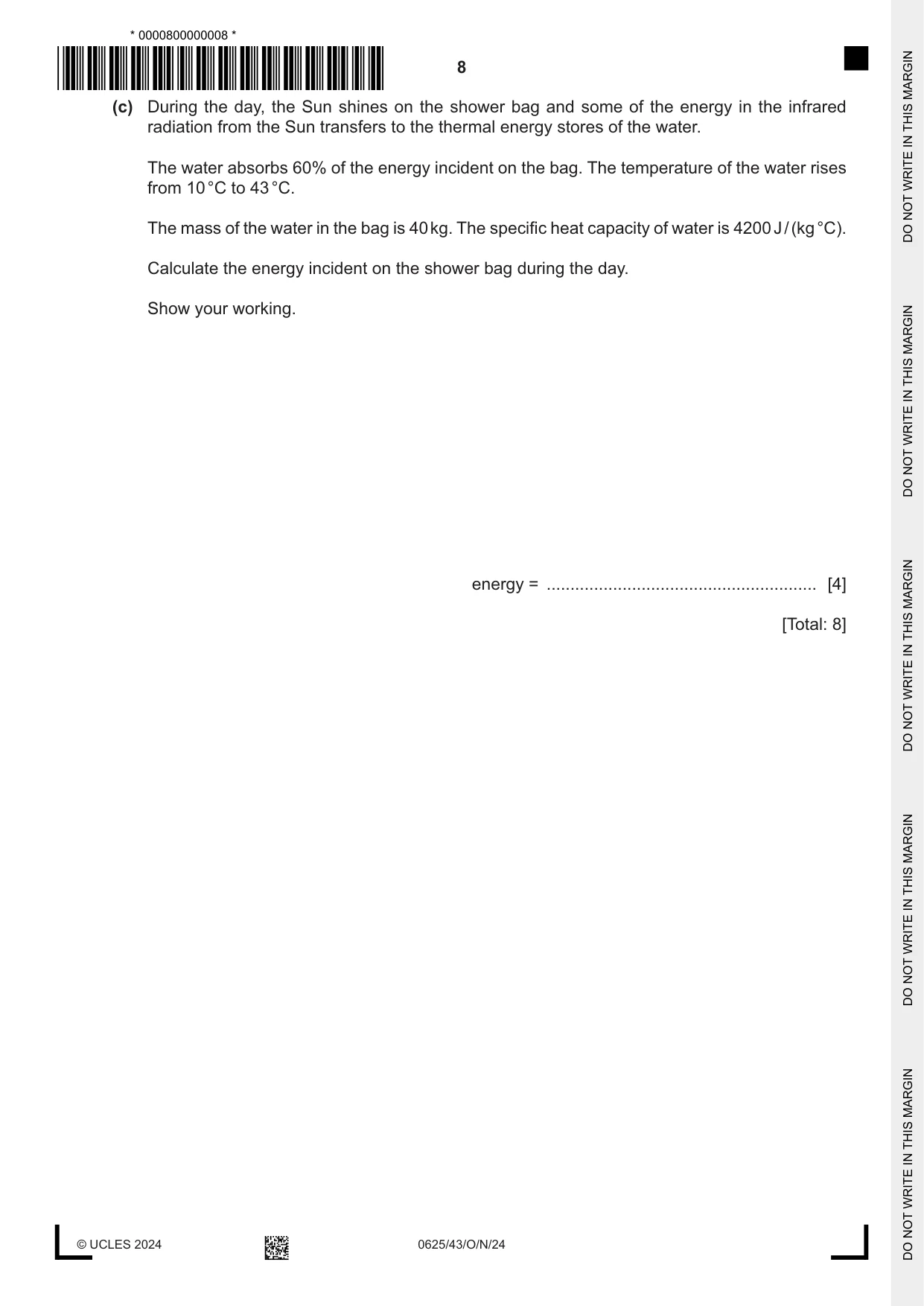
3 Fig. 3.1 shows a portable shower used on a campsite. The bag is filled with water. The water is heated using infrared radiation from the Sun. shower bag painted black showerhead Fig. 3.1 (a) (i) Explain why the shower bag is painted black. ........................................................................................................................................... ..................................................................................................................................... [1] (ii) Explain a disadvantage of radiation from the Sun being the only source to heat the water. ........................................................................................................................................... ..................................................................................................................................... [1] (b) Solar energy is a renewable energy resource. State two other renewable energy resources. 1 ................................................................................................................................................ 2 ................................................................................................................................................ [2] (c) During the day, the Sun shines on the shower bag and some of the energy in the infrared radiation from the Sun transfers to the thermal energy stores of the water. The water absorbs 60% of the energy incident on the bag. The temperature of the water rises from 10 °C to 43 °C. The mass of the water in the bag is 40 kg. The specific heat capacity of water is 4200 J / (kg °C). Calculate the energy incident on the shower bag during the day. Show your working. energy = ......................................................... [4] [Total: 8]
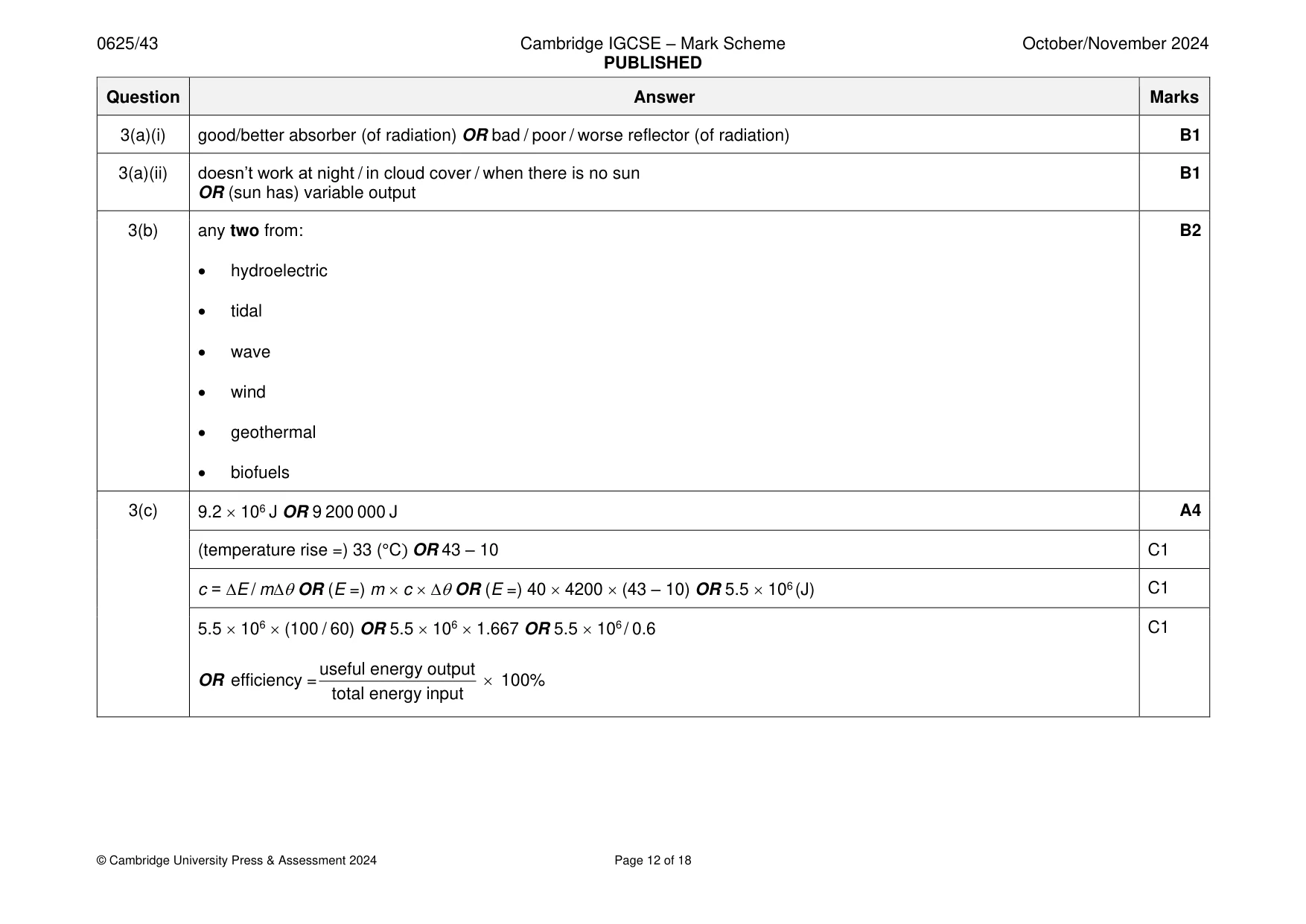
Mark scheme: 3(a)(i) good/better absorber (of radiation) OR bad / poor / worse reflector (of radiation) B1 3(a)(ii) doesn’t work at night / in cloud cover / when there is no sun B1 OR (sun has) variable output 3(b) any two from: B2 • hydroelectric • tidal • wave • wind • geothermal • biofuels 3(c) 9.2 106 J OR 9 200 000 J A4 (temperature rise =) 33 (°C) OR 43 – 10 C1 c = ∆E / m∆OR (E =) m c OR (E =) 40 4200 (43 – 10) OR 5.5 106 (J) C1 5.5 106 (100 / 60) OR 5.5 106 1.667 OR 5.5 106 / 0.6 C1 useful energy output OR efficiency = 100% total energy input
Q4 · A ray of light as it enters the side of a plastic block
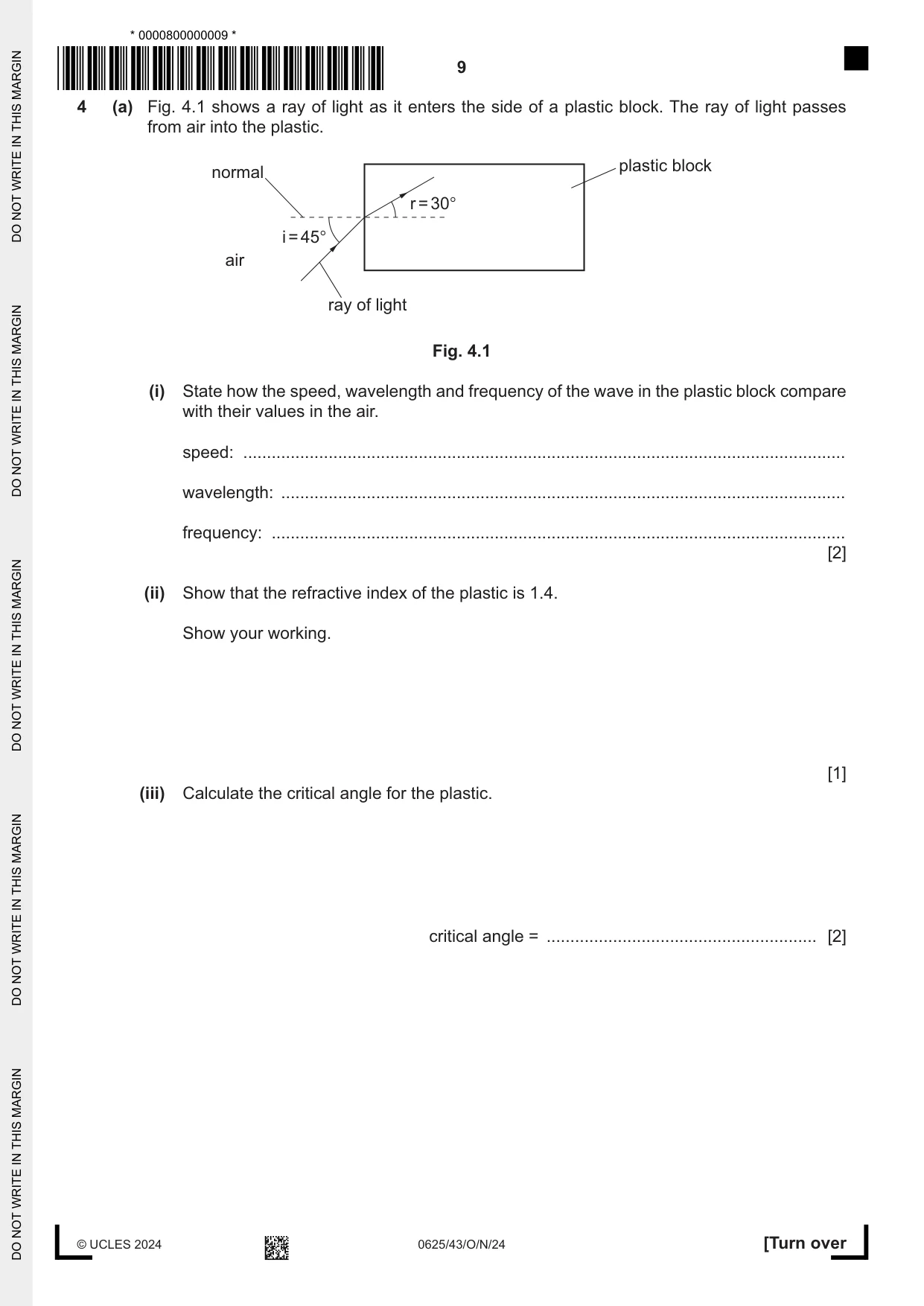
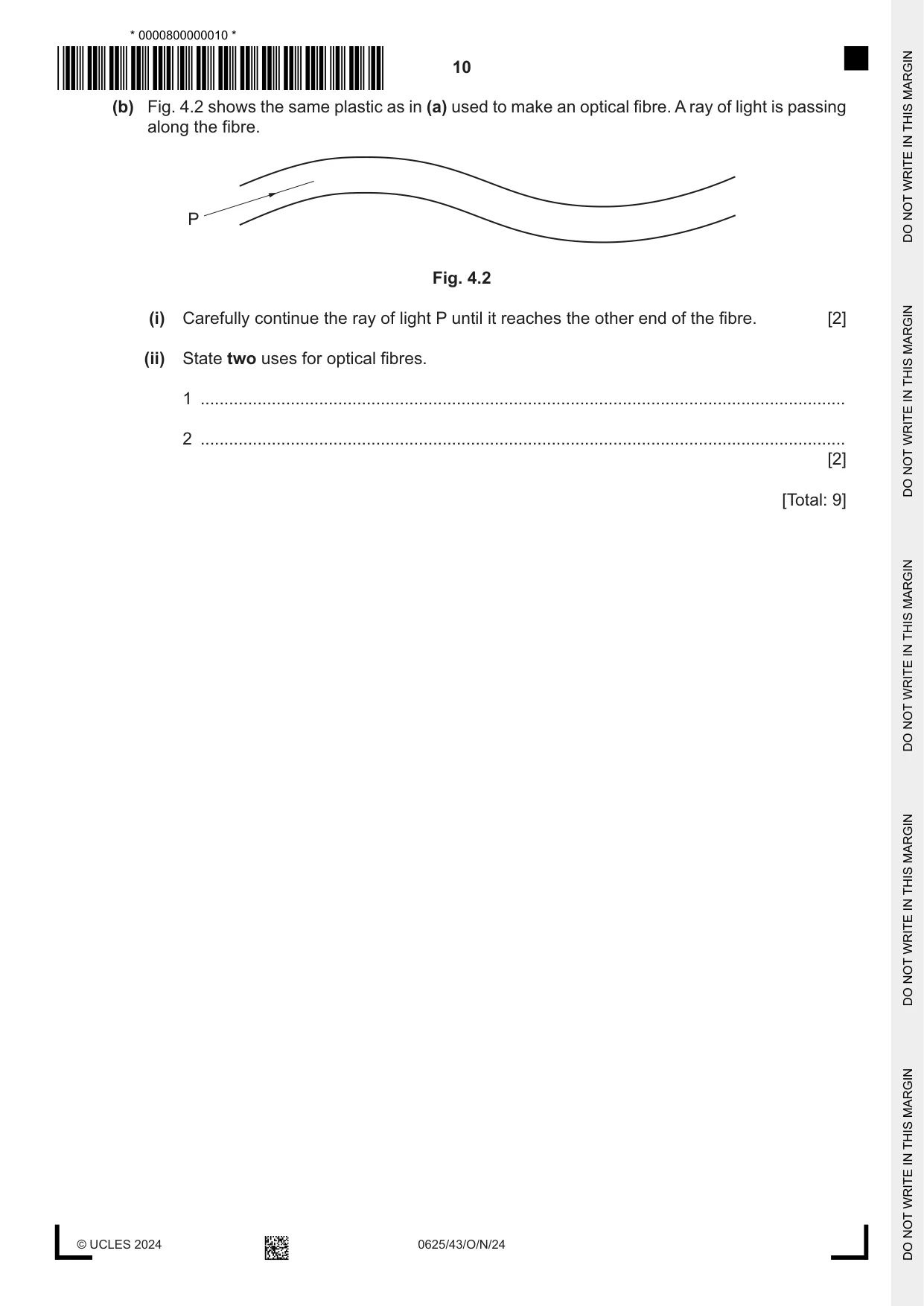
4 (a) Fig. 4.1 shows a ray of light as it enters the side of a plastic block. The ray of light passes from air into the plastic. plastic block normal r = 30° i = 45° air ray of light Fig. 4.1 (i) State how the speed, wavelength and frequency of the wave in the plastic block compare with their values in the air. speed: ............................................................................................................................... wavelength: ....................................................................................................................... frequency: ......................................................................................................................... [2] (ii) Show that the refractive index of the plastic is 1.4. Show your working. [1] (iii) Calculate the critical angle for the plastic. critical angle = ......................................................... [2] (b) Fig. 4.2 shows the same plastic as in (a) used to make an optical fibre. A ray of light is passing along the fibre. P Fig. 4.2 (i) Carefully continue the ray of light P until it reaches the other end of the fibre. [2] (ii) State two uses for optical fibres. 1 ........................................................................................................................................ 2 ........................................................................................................................................ [2] [Total: 9]
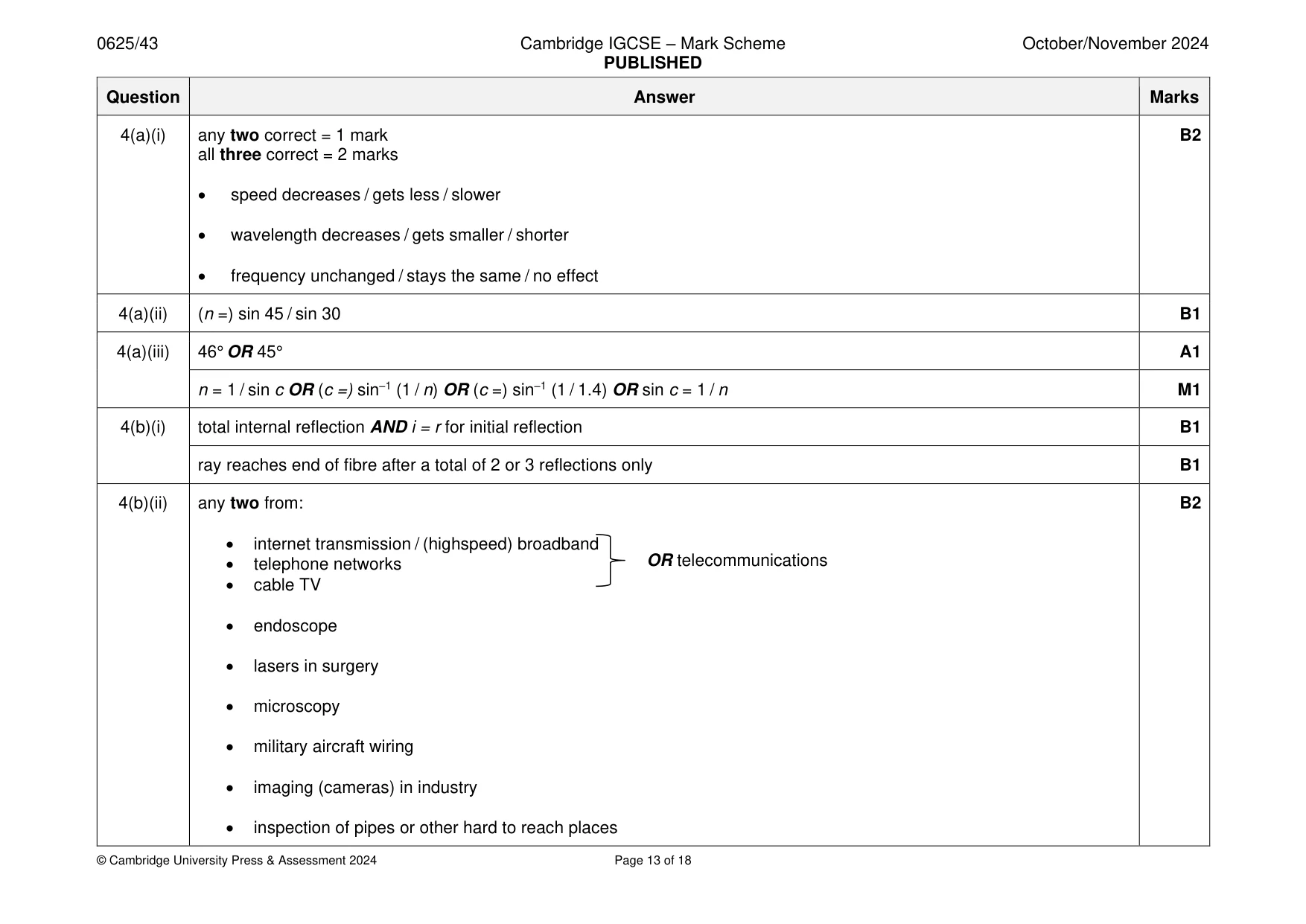
Mark scheme: 4(a)(i) any two correct = 1 mark B2 all three correct = 2 marks • speed decreases / gets less / slower • wavelength decreases / gets smaller / shorter • frequency unchanged / stays the same / no effect 4(a)(ii) (n =) sin 45 / sin 30 B1 4(a)(iii) 46° OR 45° A1 n = 1 / sin c OR (c =) sin–1 (1 / n) OR (c =) sin–1 (1 / 1.4) OR sin c = 1 / n M1 4(b)(i) total internal reflection AND i = r for initial reflection B1 ray reaches end of fibre after a total of 2 or 3 reflections only B1 4(b)(ii) any two from: B2 • internet transmission / (highspeed) broadband • telephone networks OR telecommunications • cable TV • endoscope • lasers in surgery • microscopy • military aircraft wiring • imaging (cameras) in industry • inspection of pipes or other hard to reach places
Q5 · A metal sphere S
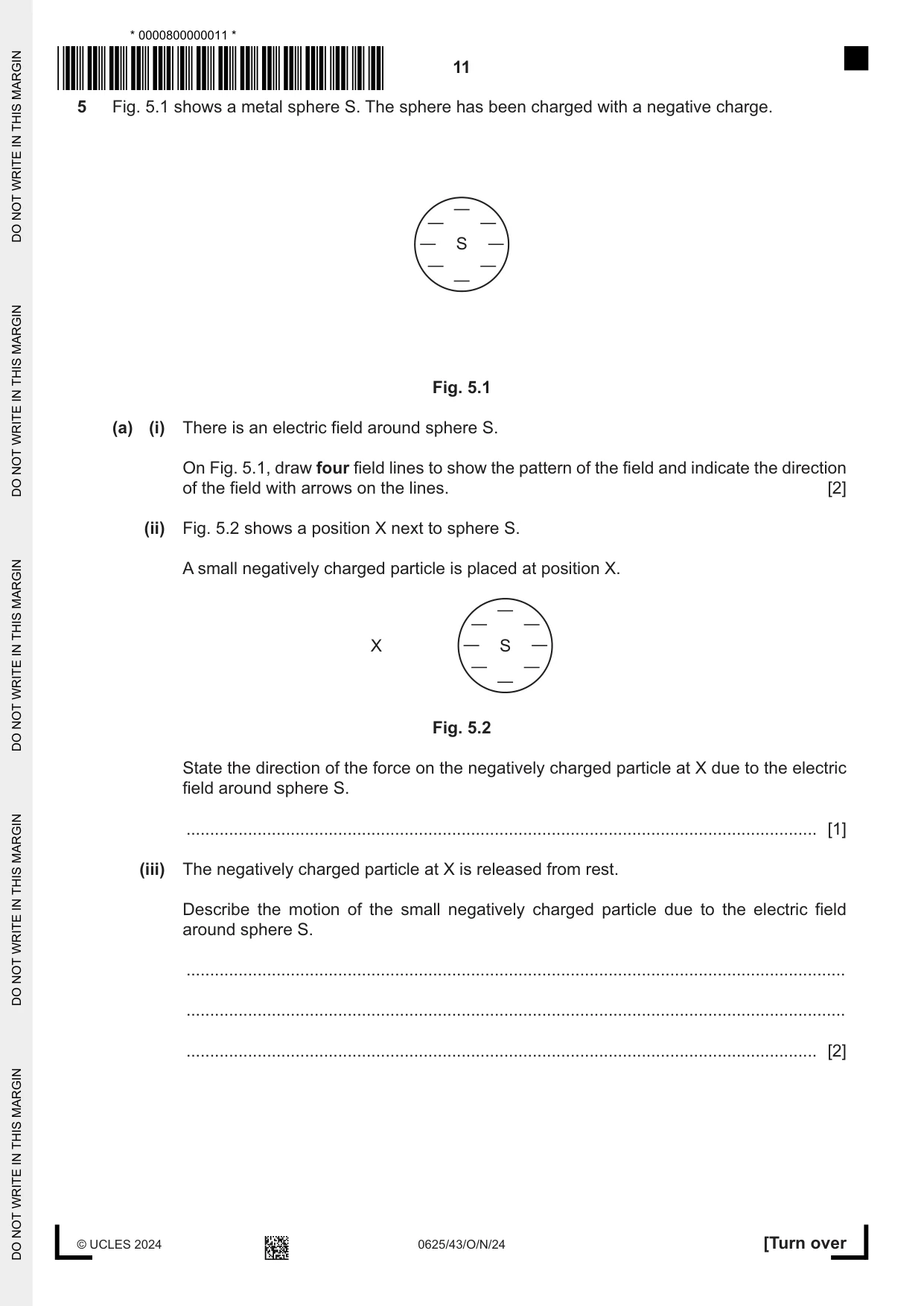
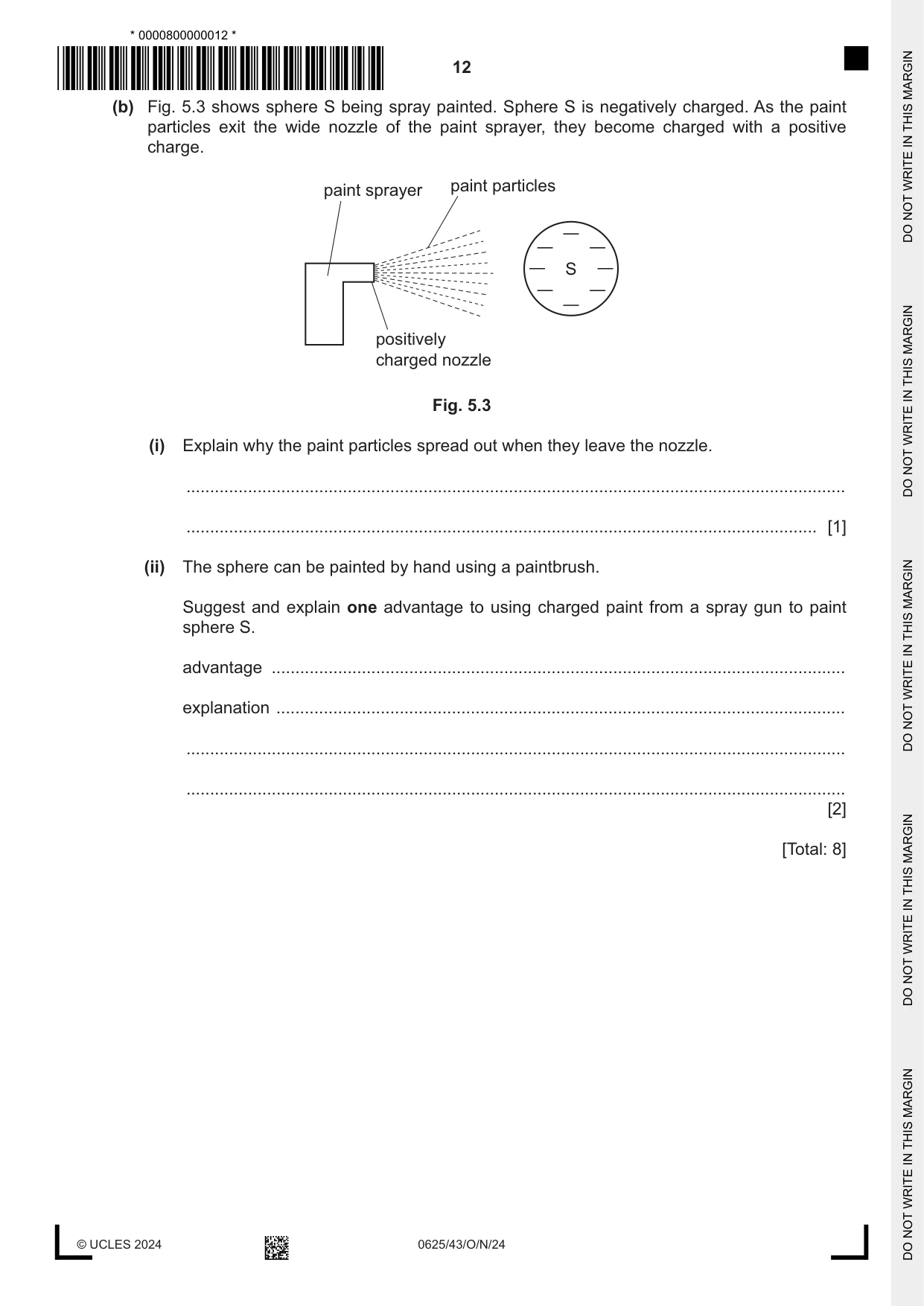
5 Fig. 5.1 shows a metal sphere S. The sphere has been charged with a negative charge. S Fig. 5.1 (a) (i) There is an electric field around sphere S. On Fig. 5.1, draw four field lines to show the pattern of the field and indicate the direction of the field with arrows on the lines. [2] (ii) Fig. 5.2 shows a position X next to sphere S. A small negatively charged particle is placed at position X. X S Fig. 5.2 State the direction of the force on the negatively charged particle at X due to the electric field around sphere S. ..................................................................................................................................... [1] (iii) The negatively charged particle at X is released from rest. Describe the motion of the small negatively charged particle due to the electric field around sphere S. ........................................................................................................................................... ........................................................................................................................................... ..................................................................................................................................... [2] (b) Fig. 5.3 shows sphere S being spray painted. Sphere S is negatively charged. As the paint particles exit the wide nozzle of the paint sprayer, they become charged with a positive charge. paint particles paint sprayer S positively charged nozzle Fig. 5.3 (i) Explain why the paint particles spread out when they leave the nozzle. ........................................................................................................................................... ..................................................................................................................................... [1] (ii) The sphere can be painted by hand using a paintbrush. Suggest and explain one advantage to using charged paint from a spray gun to paint sphere S. advantage ......................................................................................................................... explanation ........................................................................................................................ ........................................................................................................................................... ........................................................................................................................................... [2] [Total: 8]
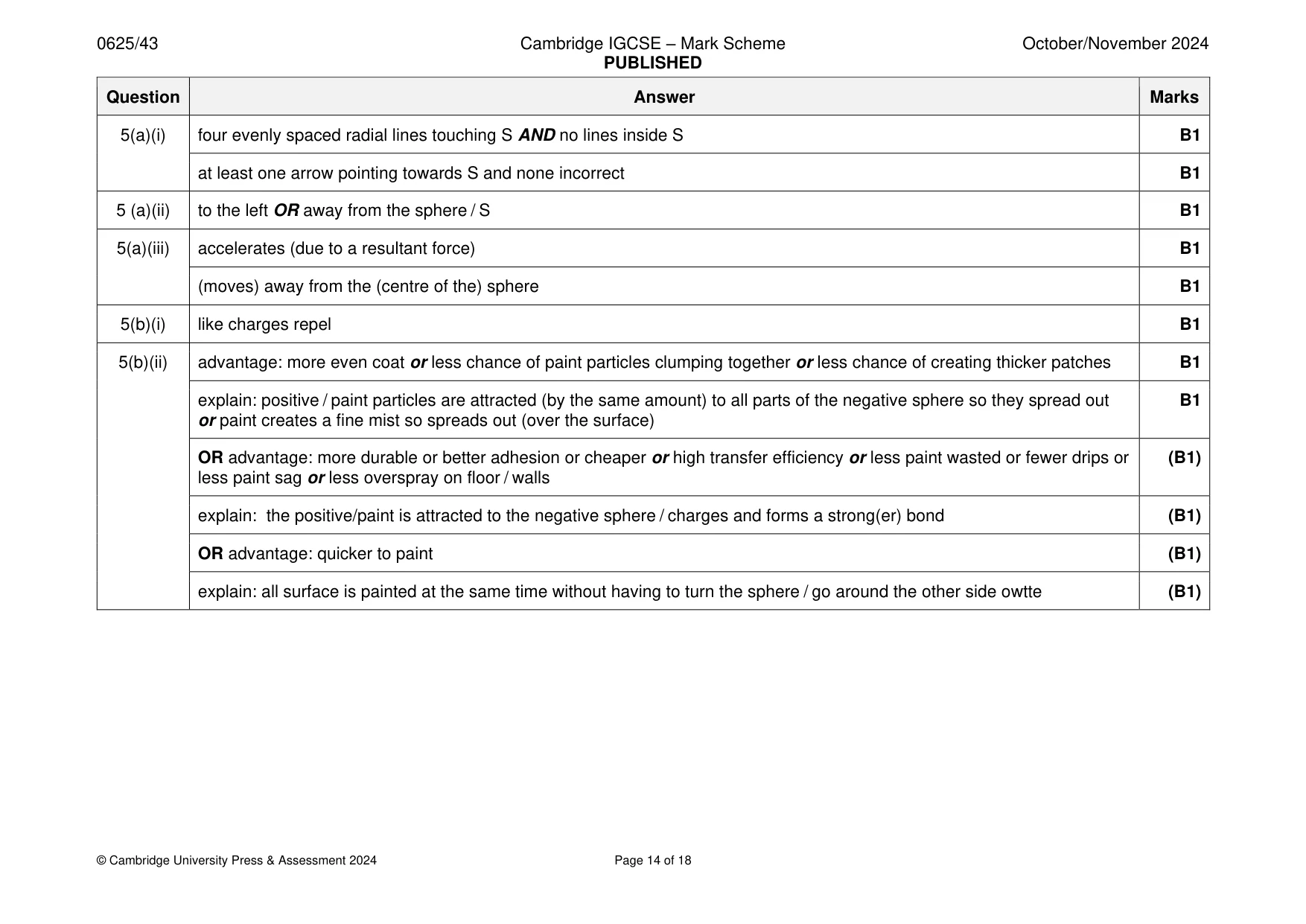
Mark scheme: 5(a)(i) four evenly spaced radial lines touching S AND no lines inside S B1 at least one arrow pointing towards S and none incorrect B1 5 (a)(ii) to the left OR away from the sphere / S B1 5(a)(iii) accelerates (due to a resultant force) B1 (moves) away from the (centre of the) sphere B1 5(b)(i) like charges repel B1 5(b)(ii) advantage: more even coat or less chance of paint particles clumping together or less chance of creating thicker patches B1 explain: positive / paint particles are attracted (by the same amount) to all parts of the negative sphere so they spread out B1 or paint creates a fine mist so spreads out (over the surface) OR advantage: more durable or better adhesion or cheaper or high transfer efficiency or less paint wasted or fewer drips or (B1) less paint sag or less overspray on floor / walls explain: the positive/paint is attracted to the negative sphere / charges and forms a strong(er) bond (B1) OR advantage: quicker to paint (B1) explain: all surface is painted at the same time without having to turn the sphere / go around the other side owtte (B1)
Q6 · A car windscreen is covered in condensation (small droplets of water)
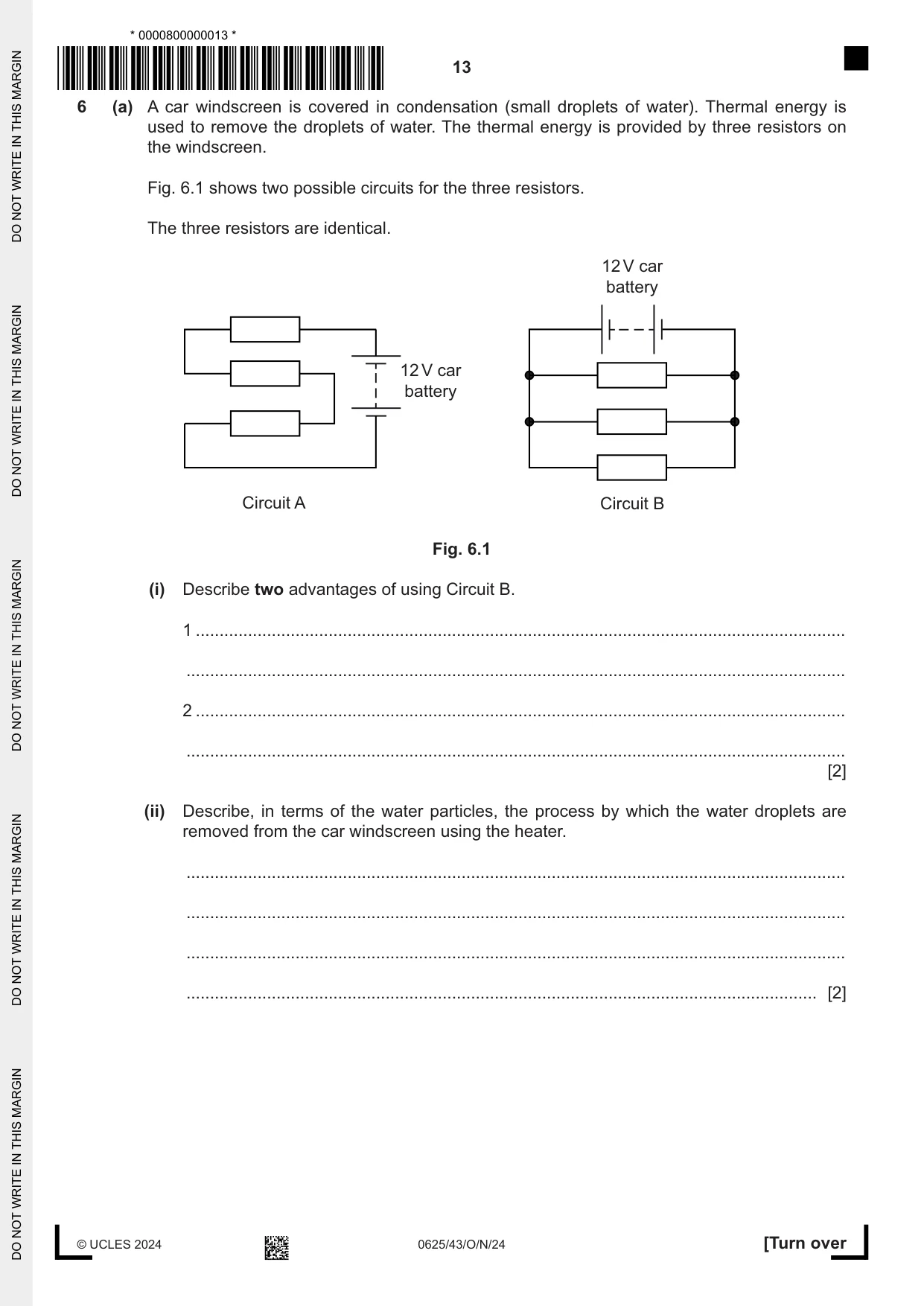
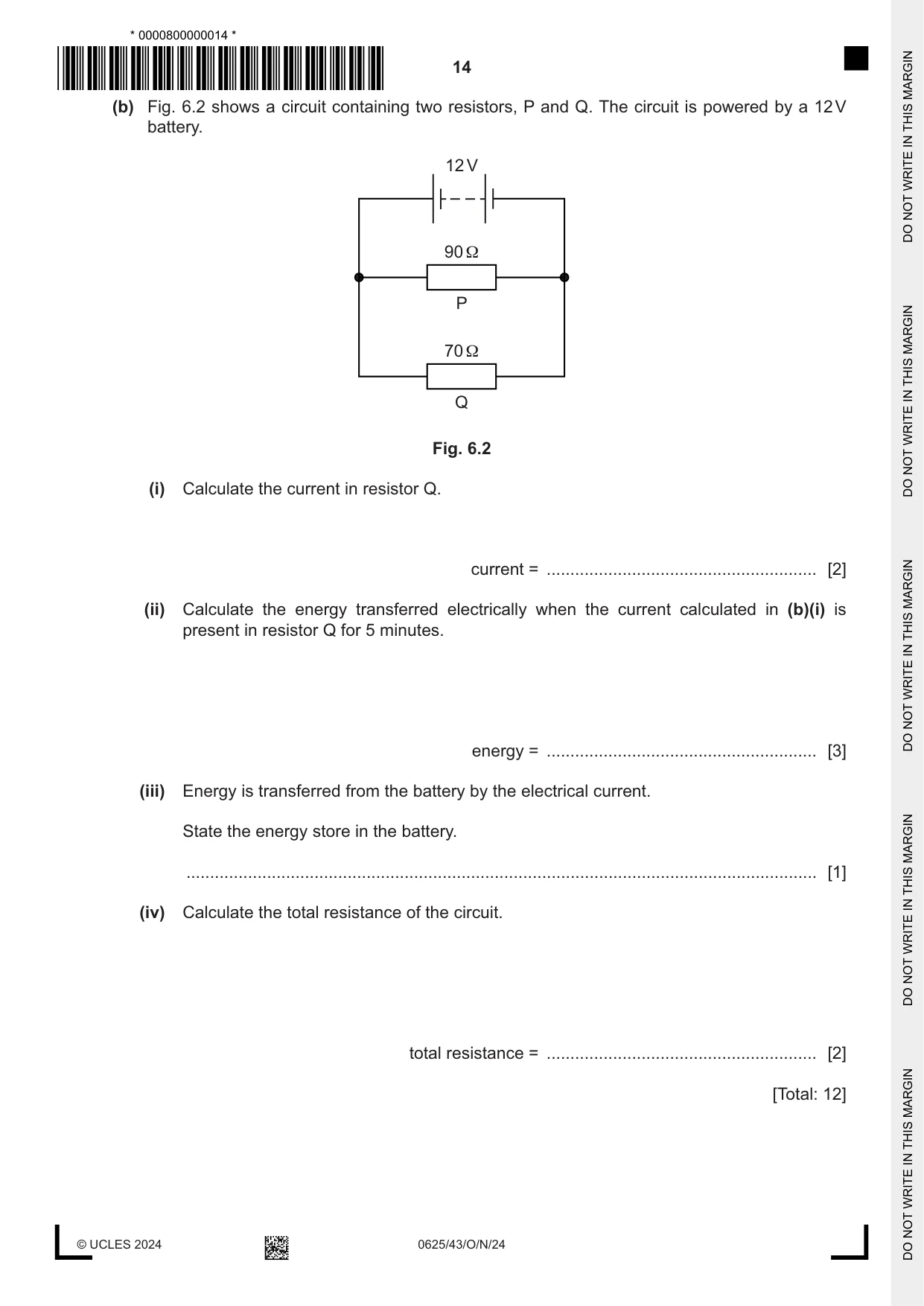
6 (a) A car windscreen is covered in condensation (small droplets of water). Thermal energy is used to remove the droplets of water. The thermal energy is provided by three resistors on the windscreen. Fig. 6.1 shows two possible circuits for the three resistors. The three resistors are identical. 12 V car battery 12 V car battery Circuit A Circuit B Fig. 6.1 (i) Describe two advantages of using Circuit B. 1 ......................................................................................................................................... ........................................................................................................................................... 2 ......................................................................................................................................... ........................................................................................................................................... [2] (ii) Describe, in terms of the water particles, the process by which the water droplets are removed from the car windscreen using the heater. ........................................................................................................................................... ........................................................................................................................................... ........................................................................................................................................... ..................................................................................................................................... [2] (b) Fig. 6.2 shows a circuit containing two resistors, P and Q. The circuit is powered by a 12 V battery. 12 V 90 Ω P 70 Ω Q Fig. 6.2 (i) Calculate the current in resistor Q. current = ......................................................... [2] (ii) Calculate the energy transferred electrically when the current calculated in (b)(i) is present in resistor Q for 5 minutes. energy = ......................................................... [3] (iii) Energy is transferred from the battery by the electrical current. State the energy store in the battery. ..................................................................................................................................... [1] (iv) Calculate the total resistance of the circuit. total resistance = ......................................................... [2] [Total: 12]
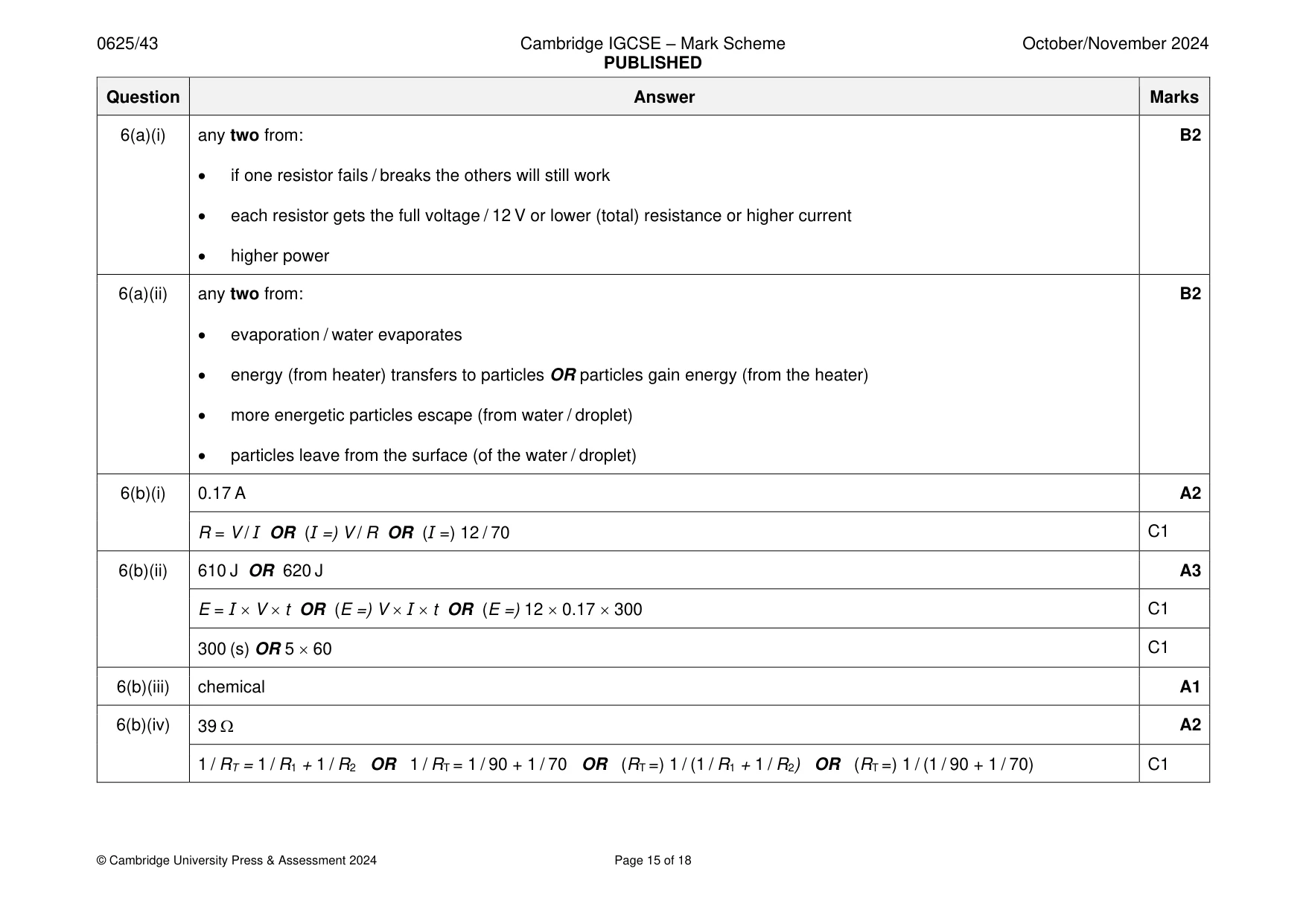
Mark scheme: 6(a)(i) any two from: B2 • if one resistor fails / breaks the others will still work • each resistor gets the full voltage / 12 V or lower (total) resistance or higher current • higher power 6(a)(ii) any two from: B2 • evaporation / water evaporates • energy (from heater) transfers to particles OR particles gain energy (from the heater) • more energetic particles escape (from water / droplet) • particles leave from the surface (of the water / droplet) 6(b)(i) 0.17 A A2 R = V / I OR (I =) V / R OR (I =) 12 / 70 C1 6(b)(ii) 610 J OR 620 J A3 E = I V t OR (E =) V I t OR (E =) 12 0.17 300 C1 300 (s) OR 5 60 C1 6(b)(iii) chemical A1 6(b)(iv) 39 A2 1 / RT = 1 / R1 + 1 / R2 OR 1 / RT = 1 / 90 + 1 / 70 OR (RT =) 1 / (1 / R1 + 1 / R2) OR (RT =) 1 / (1 / 90 + 1 / 70) C1
Q7 · A barrier at the entrance to a car park
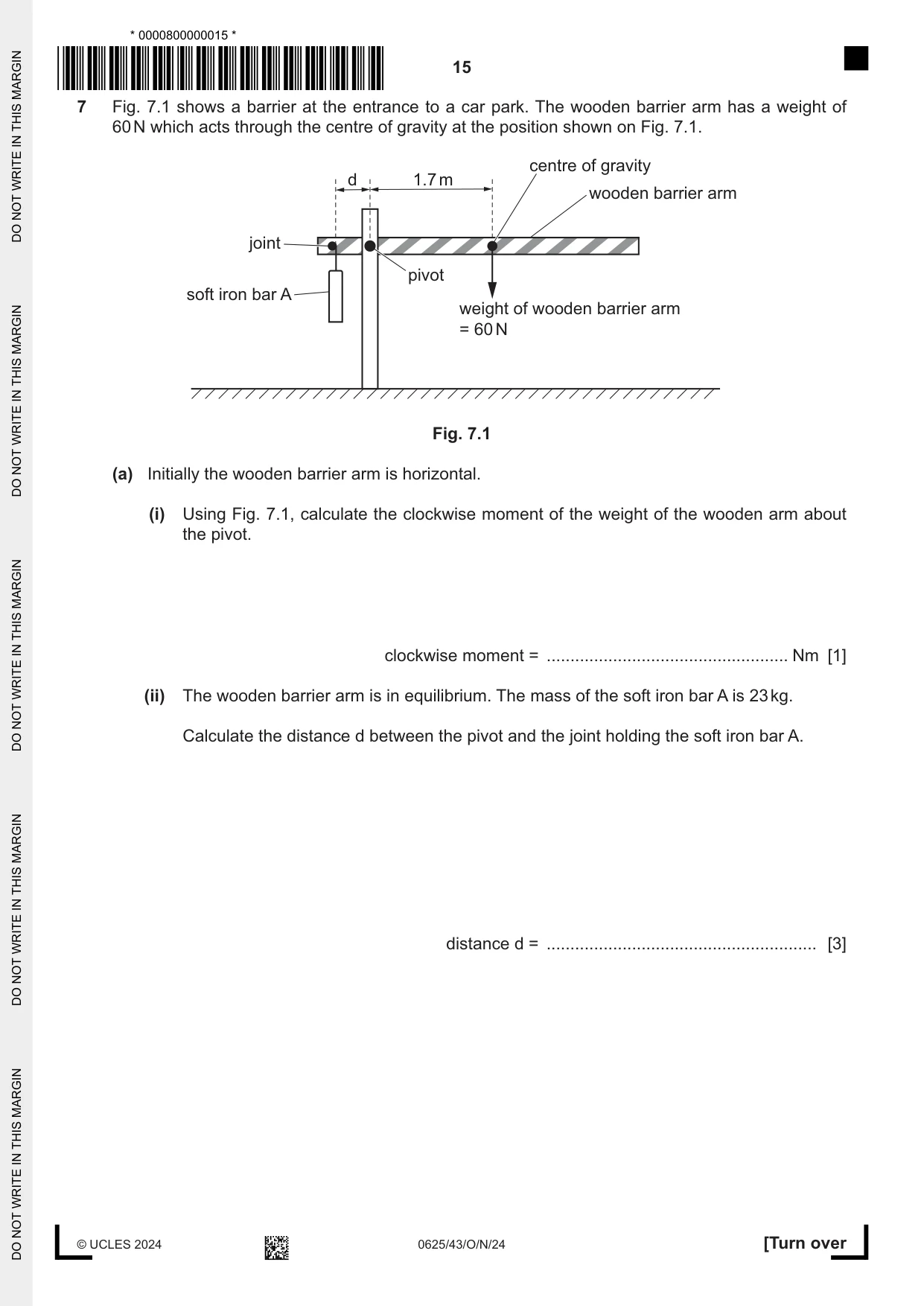
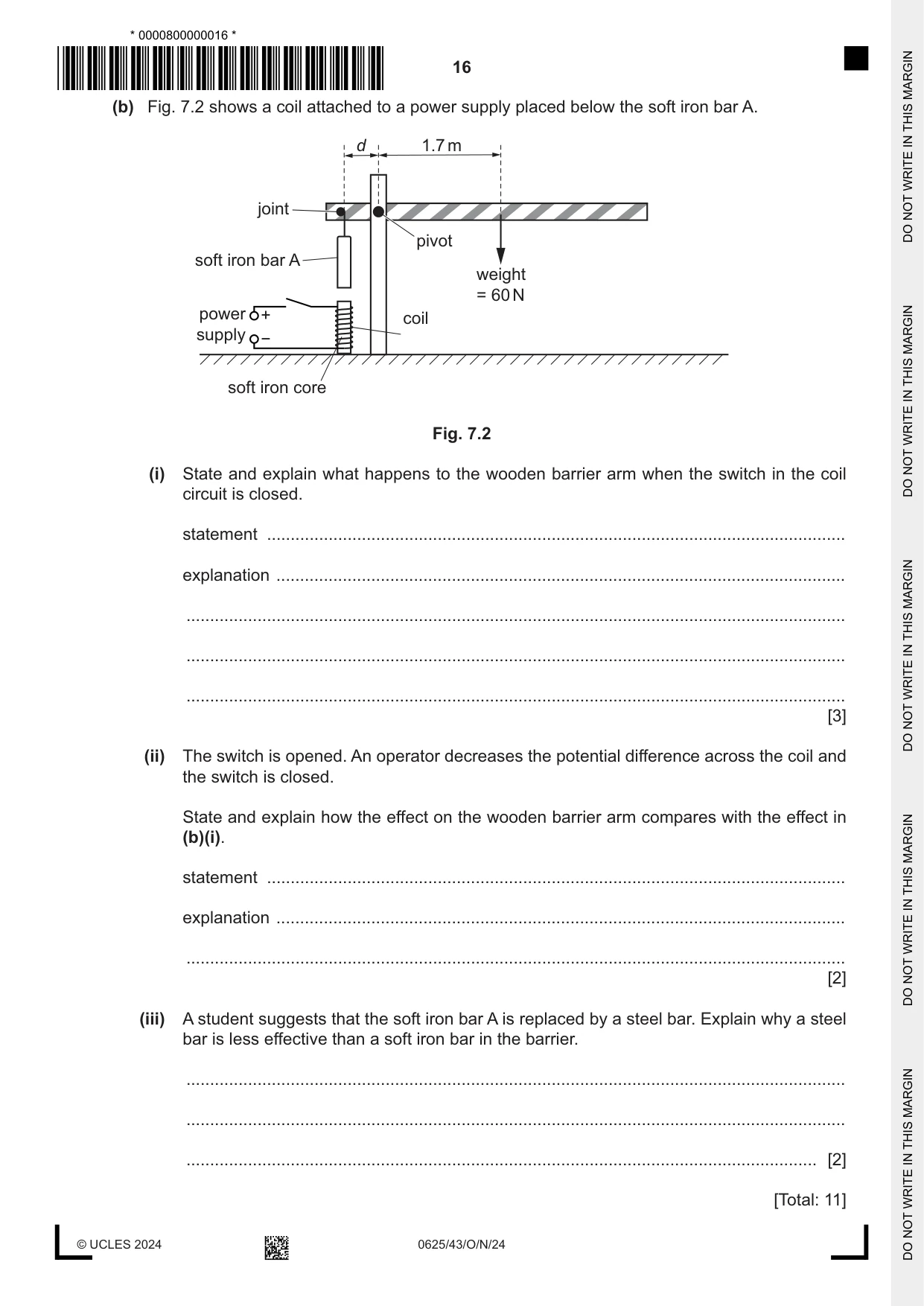
7 Fig. 7.1 shows a barrier at the entrance to a car park. The wooden barrier arm has a weight of 60 N which acts through the centre of gravity at the position shown on Fig. 7.1. centre of gravity d 1.7 m wooden barrier arm joint pivot soft iron bar A weight of wooden barrier arm = 60 N Fig. 7.1 (a) Initially the wooden barrier arm is horizontal. (i) Using Fig. 7.1, calculate the clockwise moment of the weight of the wooden arm about the pivot. clockwise moment = ................................................... Nm [1] (ii) The wooden barrier arm is in equilibrium. The mass of the soft iron bar A is 23 kg. Calculate the distance d between the pivot and the joint holding the soft iron bar A. distance d = ......................................................... [3] (b) Fig. 7.2 shows a coil attached to a power supply placed below the soft iron bar A. d 1.7 m joint pivot soft iron bar A weight = 60 N power + coil supply − soft iron core Fig. 7.2 (i) State and explain what happens to the wooden barrier arm when the switch in the coil circuit is closed. statement .......................................................................................................................... explanation ........................................................................................................................ ........................................................................................................................................... ........................................................................................................................................... ........................................................................................................................................... [3] (ii) The switch is opened. An operator decreases the potential difference across the coil and the switch is closed. State and explain how the effect on the wooden barrier arm compares with the effect in (b)(i). statement .......................................................................................................................... explanation ........................................................................................................................ ........................................................................................................................................... [2] (iii) A student suggests that the soft iron bar A is replaced by a steel bar. Explain why a steel bar is less effective than a soft iron bar in the barrier. ........................................................................................................................................... ........................................................................................................................................... ..................................................................................................................................... [2] [Total: 11]
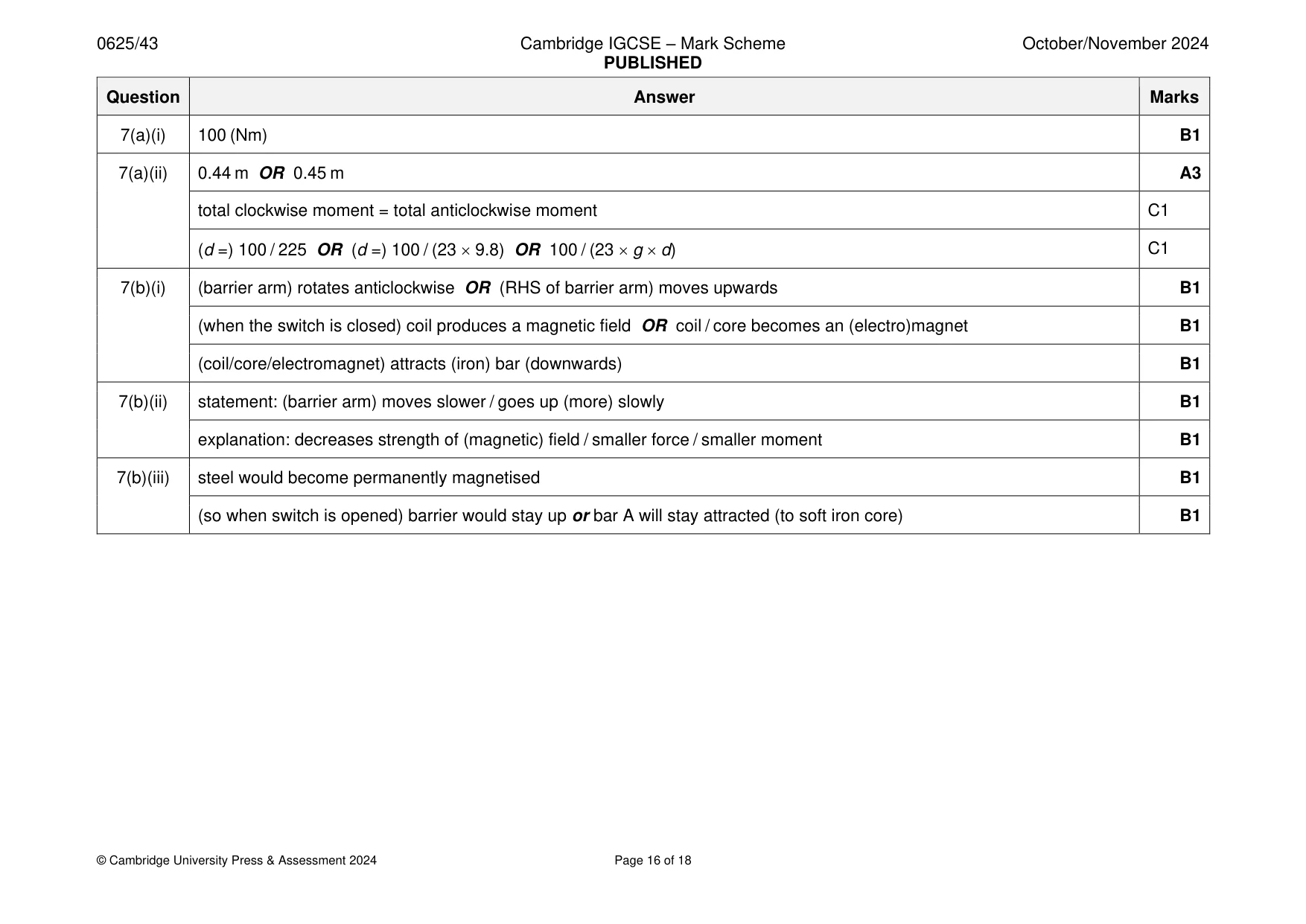
Mark scheme: 7(a)(i) 100 (Nm) B1 7(a)(ii) 0.44 m OR 0.45 m A3 total clockwise moment = total anticlockwise moment C1 (d =) 100 / 225 OR (d =) 100 / (23 9.8) OR 100 / (23 g d) C1 7(b)(i) (barrier arm) rotates anticlockwise OR (RHS of barrier arm) moves upwards B1 (when the switch is closed) coil produces a magnetic field OR coil / core becomes an (electro)magnet B1 (coil/core/electromagnet) attracts (iron) bar (downwards) B1 7(b)(ii) statement: (barrier arm) moves slower / goes up (more) slowly B1 explanation: decreases strength of (magnetic) field / smaller force / smaller moment B1 7(b)(iii) steel would become permanently magnetised B1 (so when switch is opened) barrier would stay up or bar A will stay attracted (to soft iron core) B1
Q8 · An isotope of boron is used in the treatment of cancer in the brain
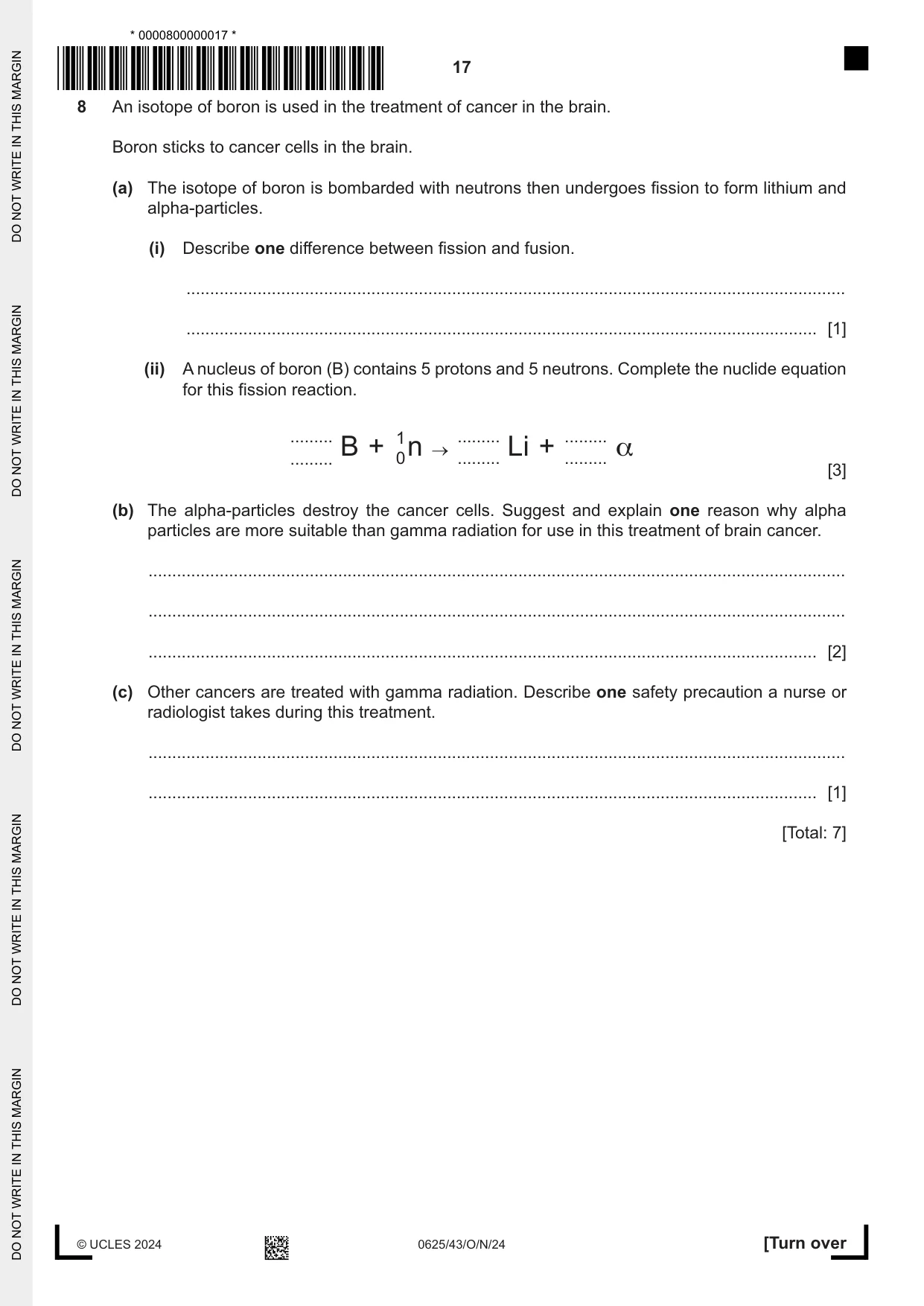
8 An isotope of boron is used in the treatment of cancer in the brain. Boron sticks to cancer cells in the brain. (a) The isotope of boron is bombarded with neutrons then undergoes fission to form lithium and alpha‑particles. (i) Describe one difference between fission and fusion. ........................................................................................................................................... ..................................................................................................................................... [1] (ii) A nucleus of boron (B) contains 5 protons and 5 neutrons. Complete the nuclide equation for this fission reaction. ......... B + 10n .................. Li + .................. α ......... [3] (b) The alpha‑particles destroy the cancer cells. Suggest and explain one reason why alpha particles are more suitable than gamma radiation for use in this treatment of brain cancer. ................................................................................................................................................... ................................................................................................................................................... ............................................................................................................................................. [2] (c) Other cancers are treated with gamma radiation. Describe one safety precaution a nurse or radiologist takes during this treatment. ................................................................................................................................................... ............................................................................................................................................. [1] [Total: 7]
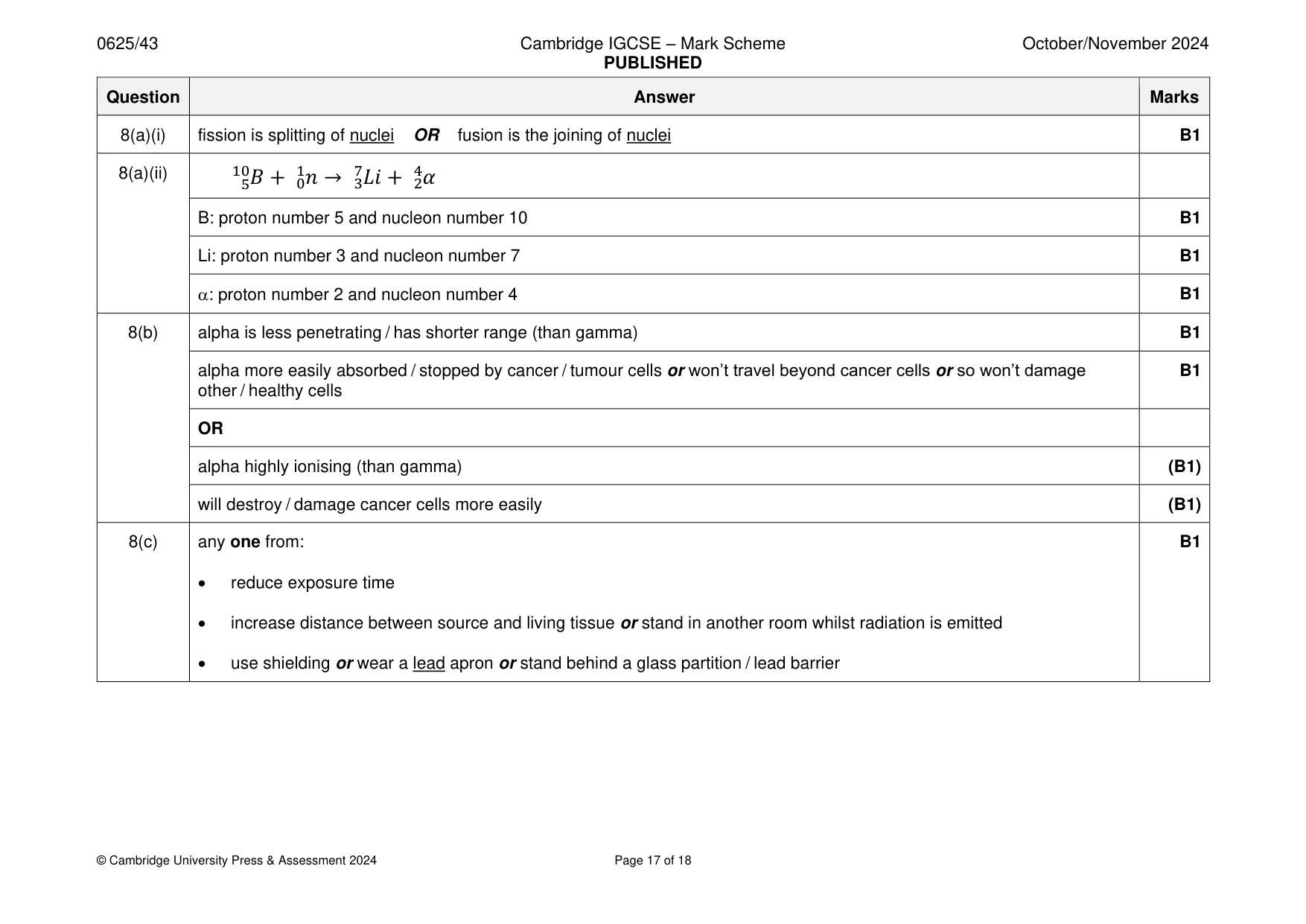
Mark scheme: 8(a)(i) fission is splitting of nuclei OR fusion is the joining of nuclei B1 8(a)(ii) 10 5𝐵+ 10𝑛 → 73𝐿𝑖 + 42𝛼 B: proton number 5 and nucleon number 10 B1 Li: proton number 3 and nucleon number 7 B1 : proton number 2 and nucleon number 4 B1 8(b) alpha is less penetrating / has shorter range (than gamma) B1 alpha more easily absorbed / stopped by cancer / tumour cells or won’t travel beyond cancer cells or so won’t damage B1 other / healthy cells OR alpha highly ionising (than gamma) (B1) will destroy / damage cancer cells more easily (B1) 8(c) any one from: B1 • reduce exposure time • increase distance between source and living tissue or stand in another room whilst radiation is emitted • use shielding or wear a lead apron or stand behind a glass partition / lead barrier
Q9 · A diagram of a transverse wave
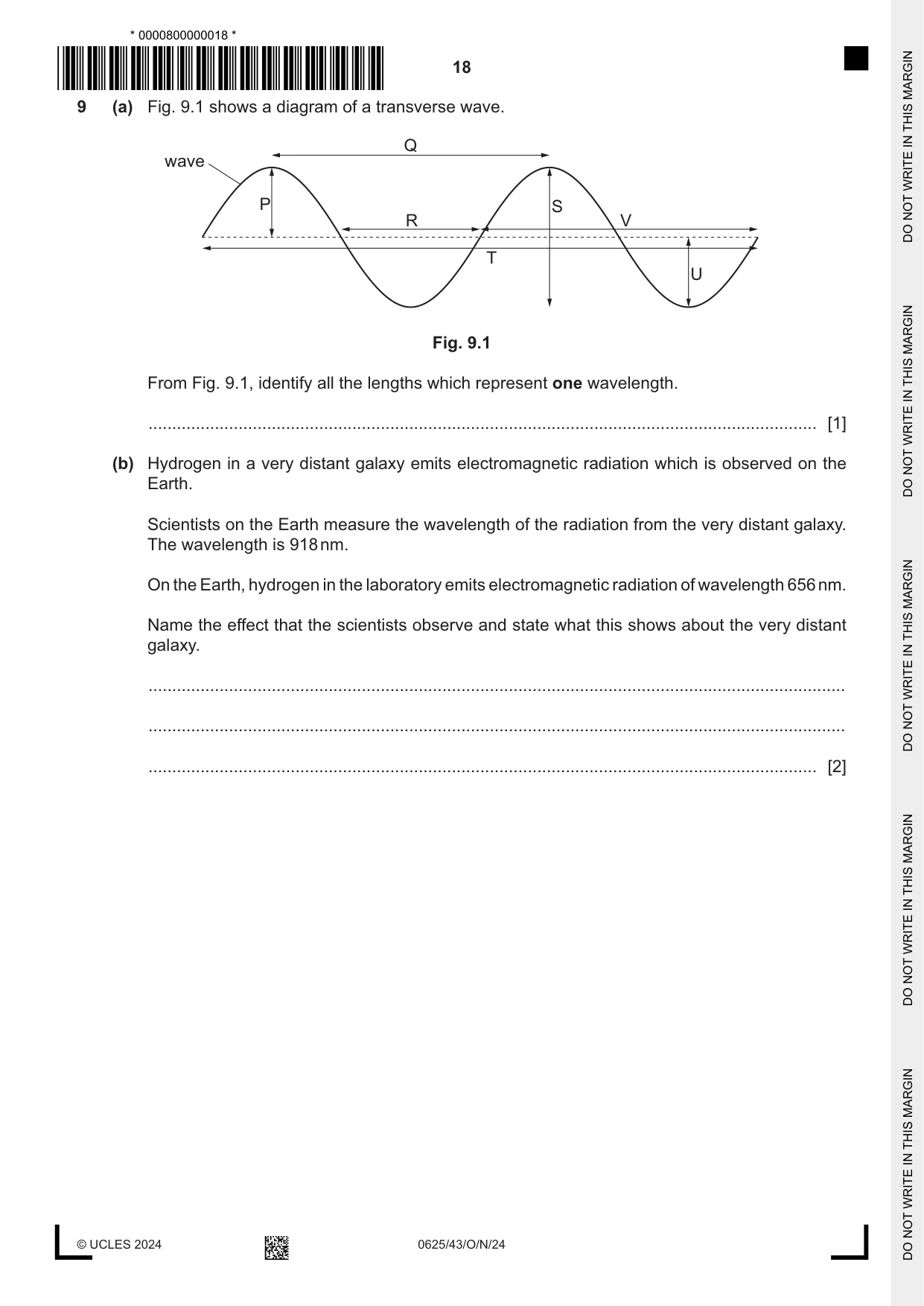
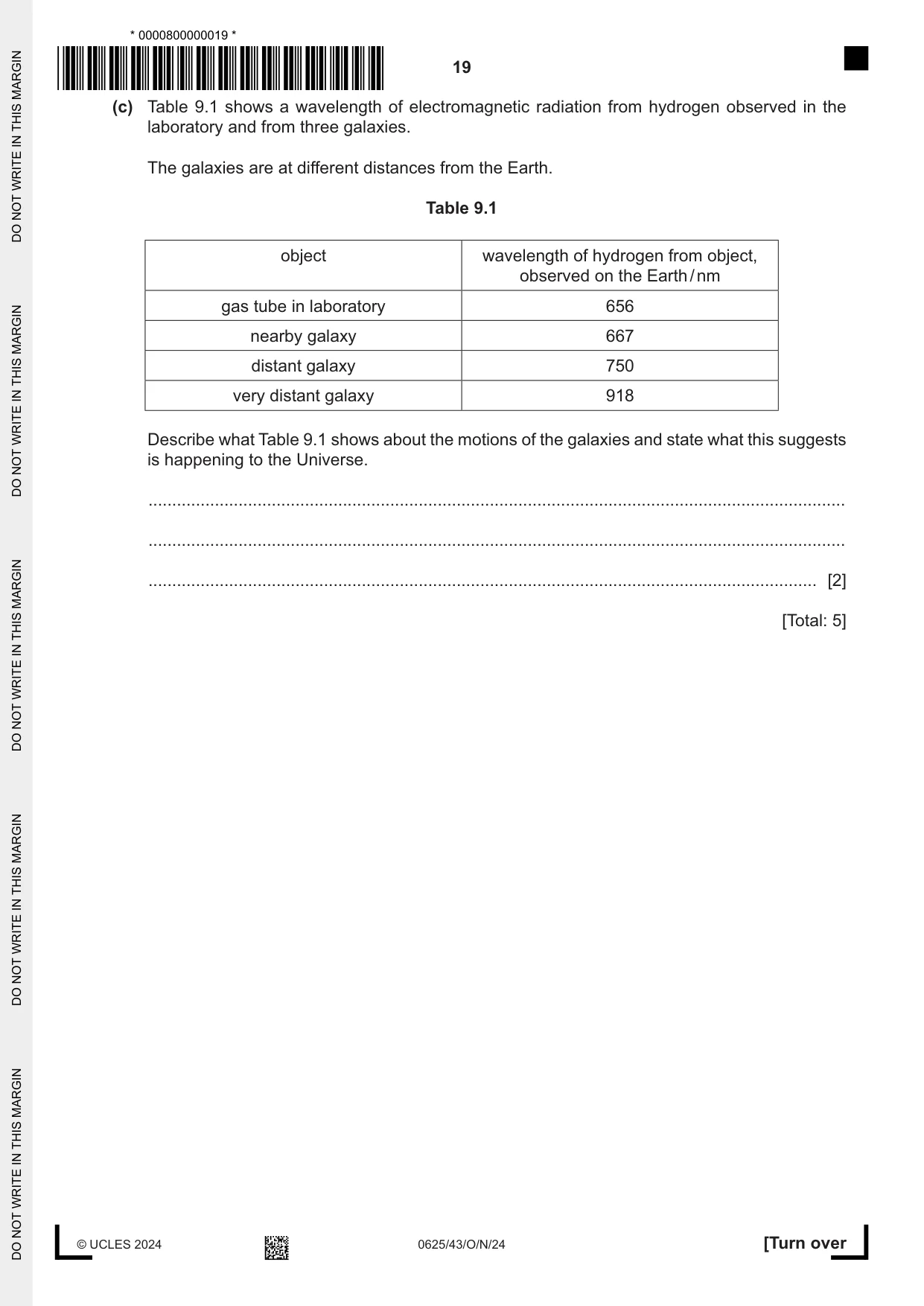
9 (a) Fig. 9.1 shows a diagram of a transverse wave. Q wave P S R V T U Fig. 9.1 From Fig. 9.1, identify all the lengths which represent one wavelength. ............................................................................................................................................. [1] (b) Hydrogen in a very distant galaxy emits electromagnetic radiation which is observed on the Earth. Scientists on the Earth measure the wavelength of the radiation from the very distant galaxy. The wavelength is 918 nm. On the Earth, hydrogen in the laboratory emits electromagnetic radiation of wavelength 656 nm. Name the effect that the scientists observe and state what this shows about the very distant galaxy. ................................................................................................................................................... ................................................................................................................................................... ............................................................................................................................................. [2] (c) Table 9.1 shows a wavelength of electromagnetic radiation from hydrogen observed in the laboratory and from three galaxies. The galaxies are at different distances from the Earth. Table 9.1 object wavelength of hydrogen from object, observed on the Earth / nm gas tube in laboratory 656 nearby galaxy 667 distant galaxy 750 very distant galaxy 918 Describe what Table 9.1 shows about the motions of the galaxies and state what this suggests is happening to the Universe. ................................................................................................................................................... ................................................................................................................................................... ............................................................................................................................................. [2] [Total: 5]
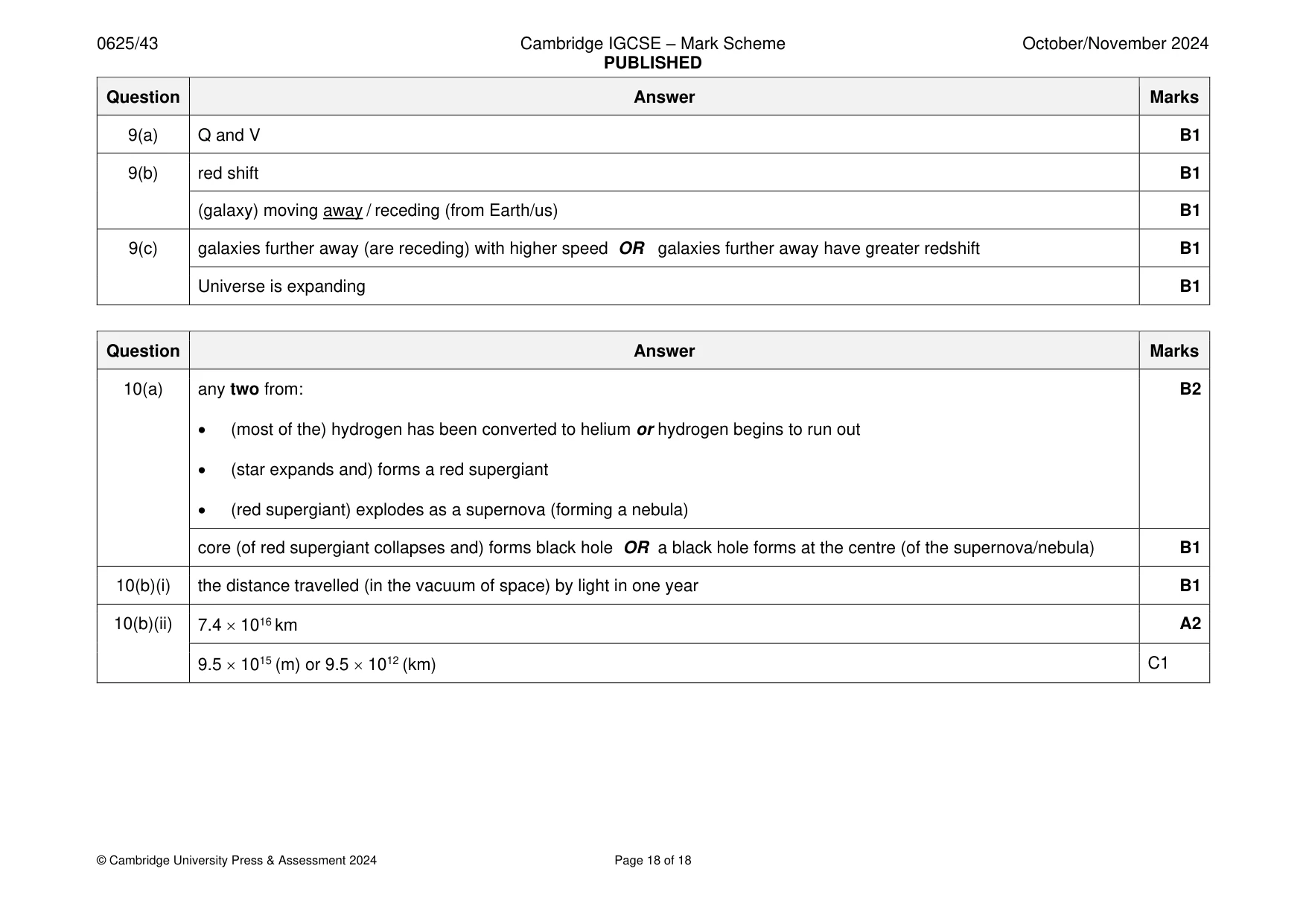
Mark scheme: 9(a) Q and V B1 9(b) red shift B1 (galaxy) moving away / receding (from Earth/us) B1 9(c) galaxies further away (are receding) with higher speed OR galaxies further away have greater redshift B1 Universe is expanding B1
Q10 · Stars more massive than the Sun can eventually form black holes
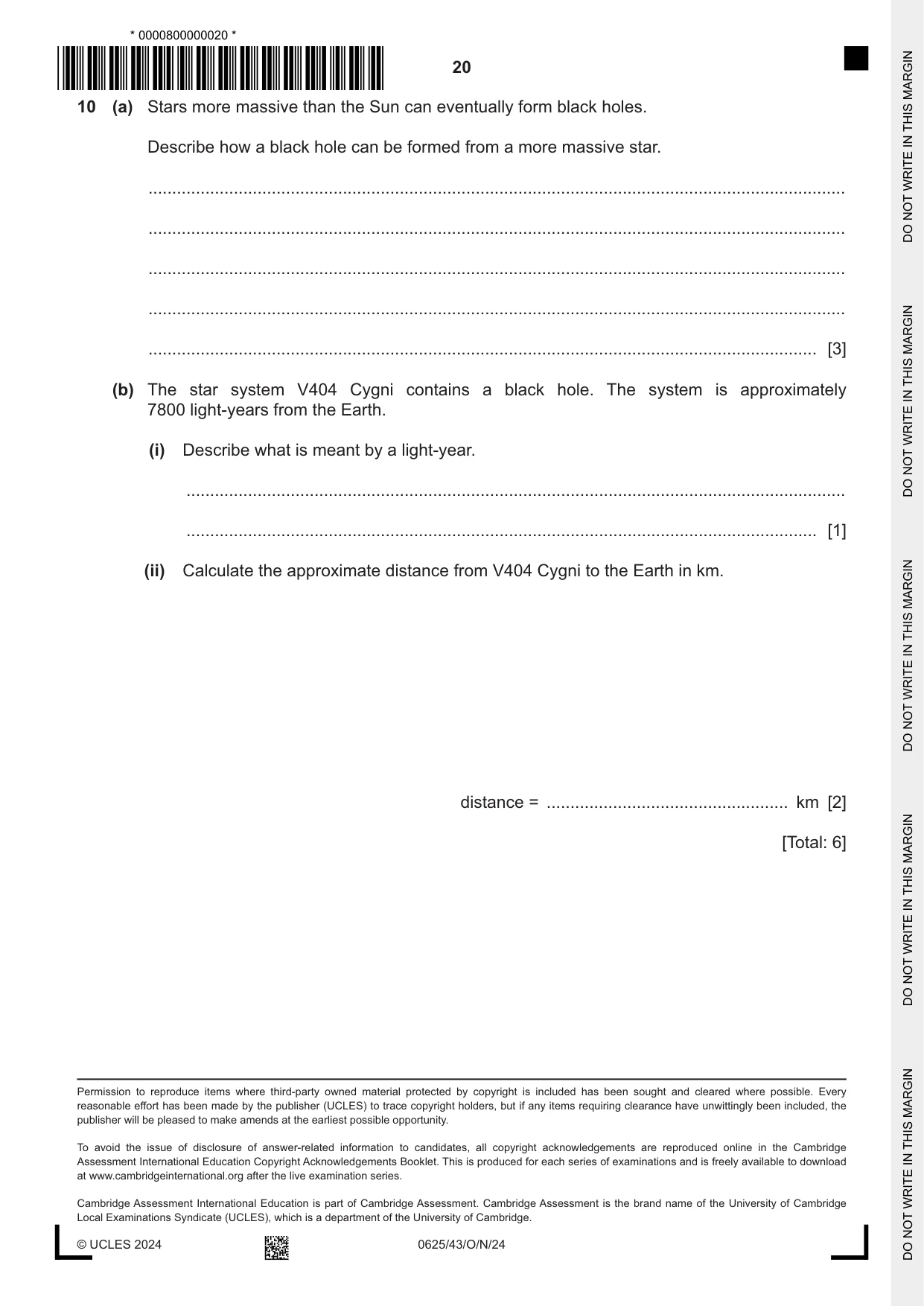
10 (a) Stars more massive than the Sun can eventually form black holes. Describe how a black hole can be formed from a more massive star. ................................................................................................................................................... ................................................................................................................................................... ................................................................................................................................................... ................................................................................................................................................... ............................................................................................................................................. [3] (b) The star system V404 Cygni contains a black hole. The system is approximately 7800 light‑years from the Earth. (i) Describe what is meant by a light‑year. ........................................................................................................................................... ..................................................................................................................................... [1] (ii) Calculate the approximate distance from V404 Cygni to the Earth in km. distance = ................................................... km [2] [Total: 6]
Mark scheme: 10(a) any two from: B2 • (most of the) hydrogen has been converted to helium or hydrogen begins to run out • (star expands and) forms a red supergiant • (red supergiant) explodes as a supernova (forming a nebula) core (of red supergiant collapses and) forms black hole OR a black hole forms at the centre (of the supernova/nebula) B1 10(b)(i) the distance travelled (in the vacuum of space) by light in one year B1 10(b)(ii) 7.4 1016 km A2 9.5 1015 (m) or 9.5 1012 (km) C1
What was in this paper
The subtopics covered by these 10 questions, and how many questions each got. Open one in a new tab to see every Cambridge question on it.
What you needed in this session
Cambridge’s own grade thresholds for 2024 Oct/Nov, Paper 4 · Variant 3. A higher threshold means an easier paper — the bar moves with how the cohort did.