Cambridge IGCSE Physics 0625 — 2021 Oct/Nov Paper 4 · Variant 2
0625/42/O/N/21 · 11 questions · 80 marks · ≈90 min
The question paper and its mark scheme, free to read here and free to download. This is Cambridge’s own paper, exactly as it was sat.
Question paper16 pages

Mark scheme16 pages
Answers below. Sit the paper first if you are practising.
Questions as text
Q1 · A space rocket accelerating away from a launch pad
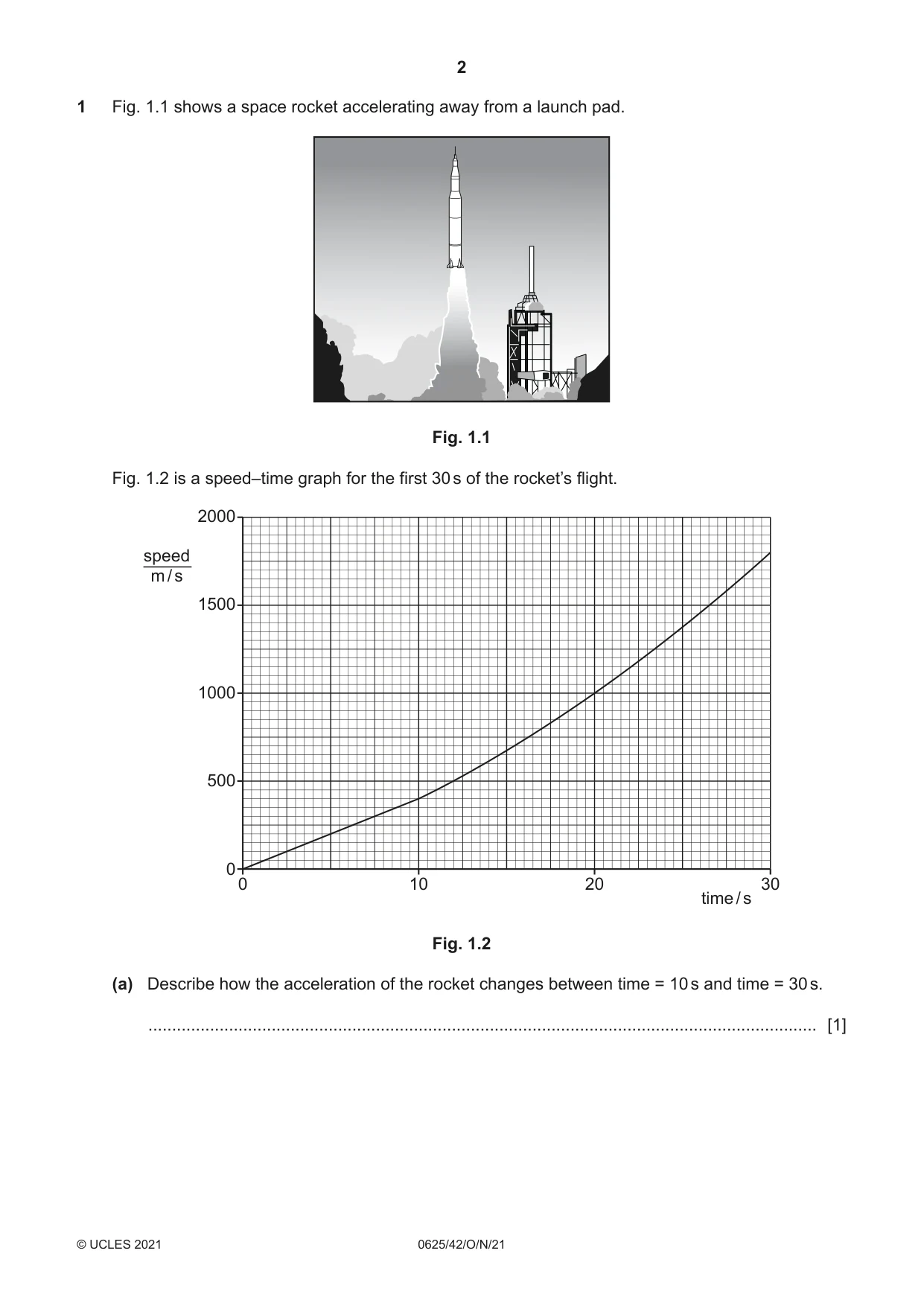
1 Fig. 1.1 shows a space rocket accelerating away from a launch pad. Fig. 1.1 Fig. 1.2 is a speed–time graph for the first 30 s of the rocket’s flight. 2000 speed m / s 1500 1000 500 0 0 10 20 30 time / s Fig. 1.2 (a) Describe how the acceleration of the rocket changes between time = 10 s and time = 30 s. ............................................................................................................................................. [1] (b) By drawing a tangent to the graph, determine the acceleration of the rocket at time = 25 s. acceleration = ........................................................ [2] (c) Determine the distance travelled by the rocket between time = 0 and time = 10 s. distance = ......................................................... [2] [Total: 5]
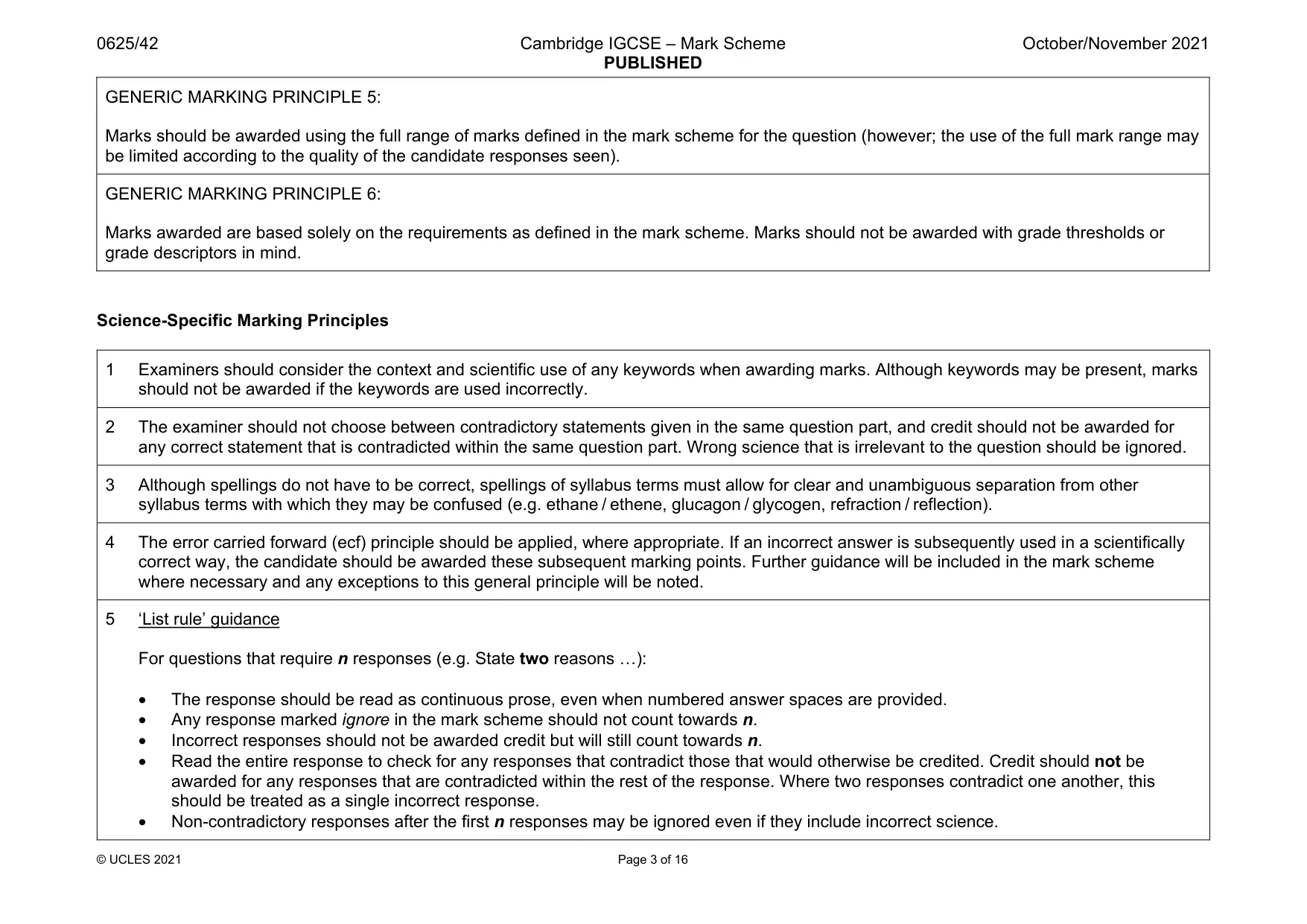
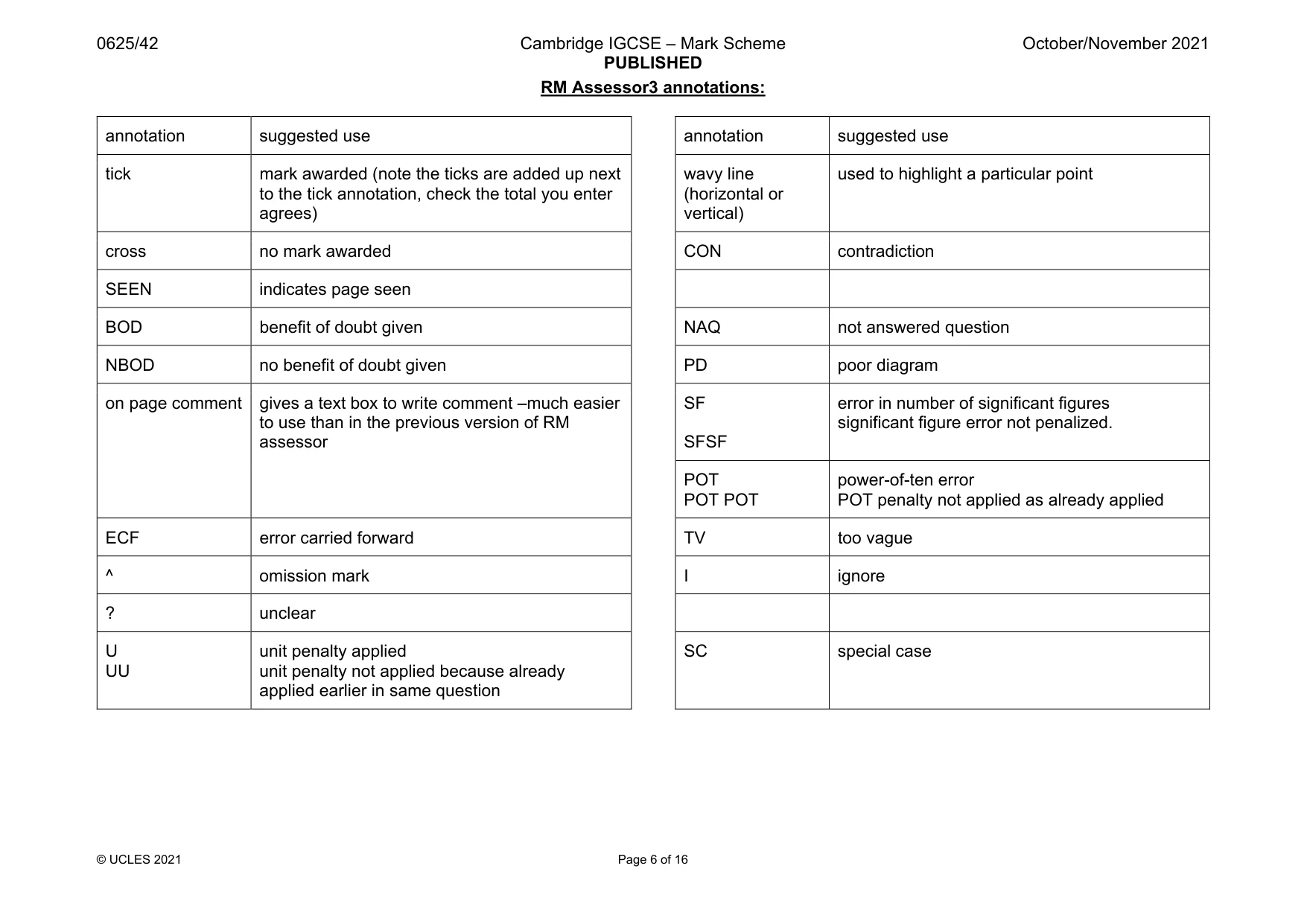
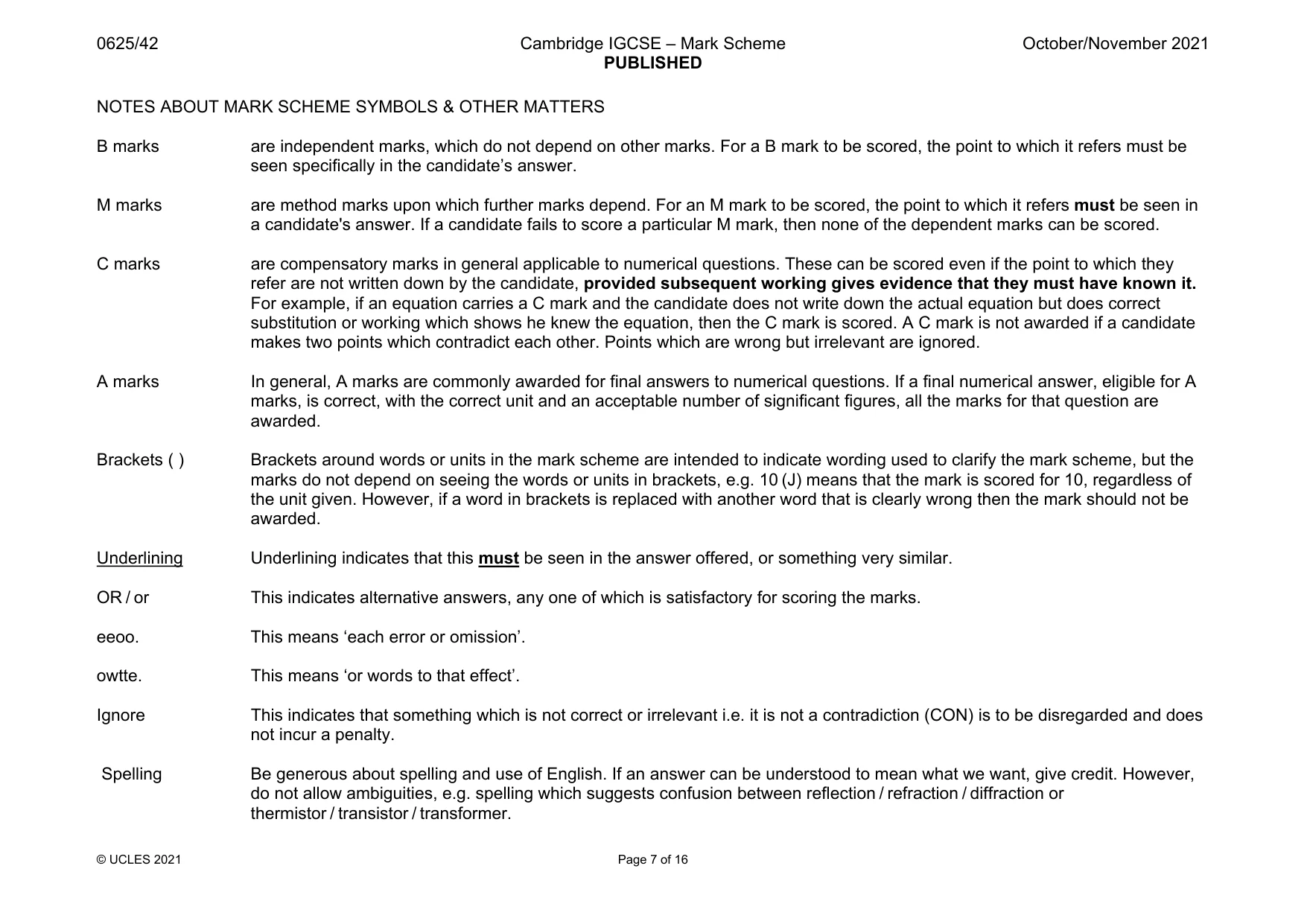
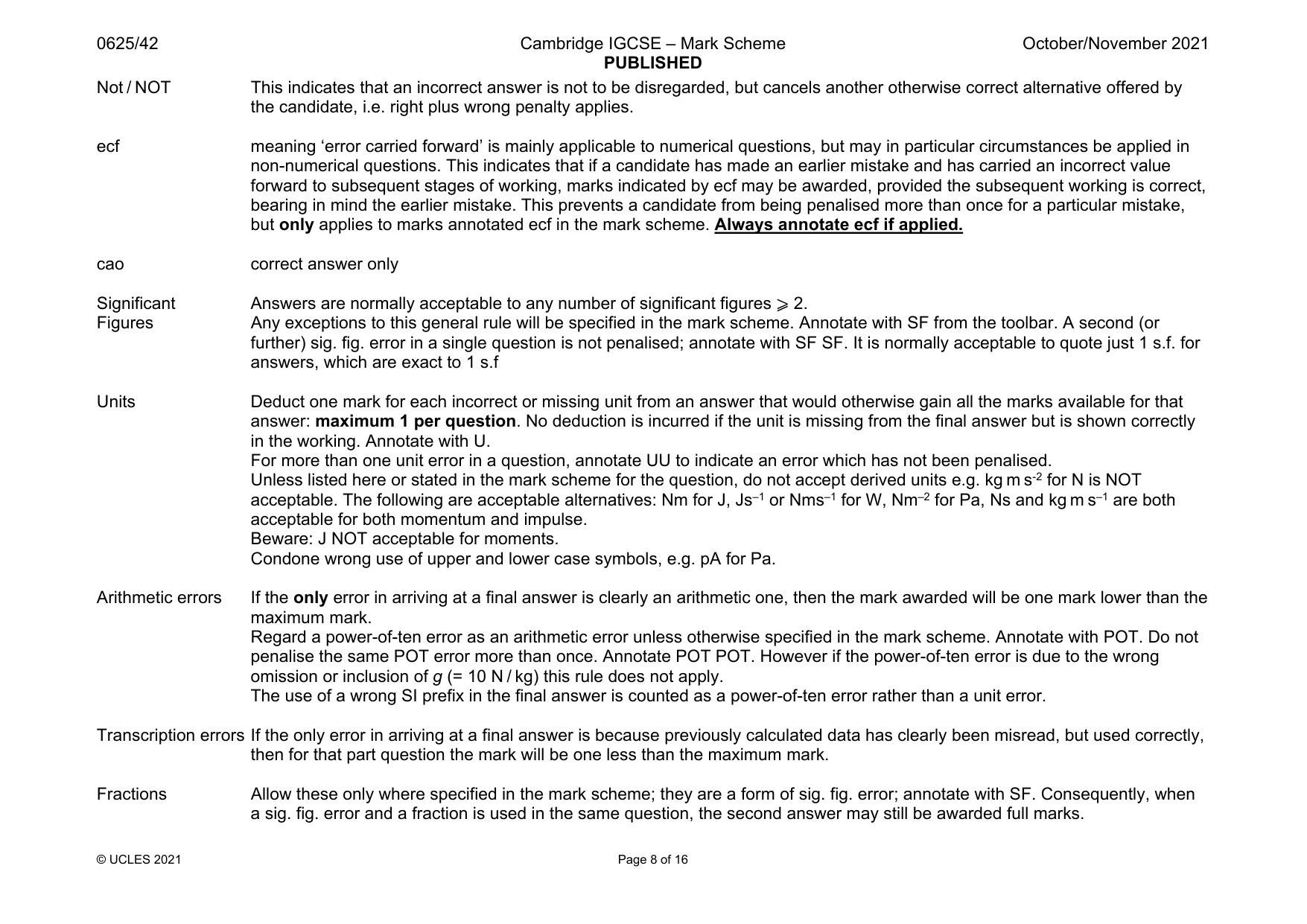
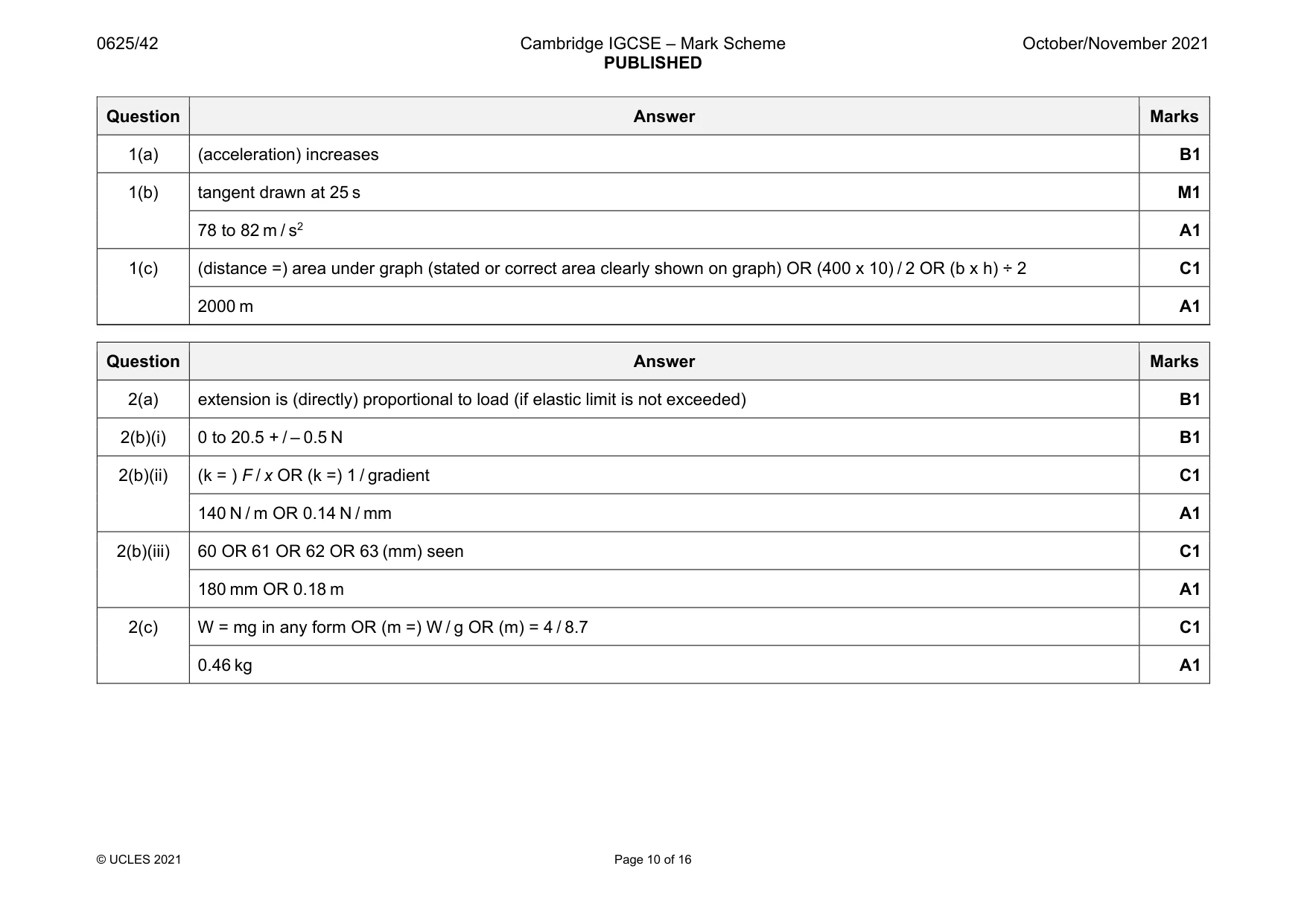
Mark scheme: 1(a) (acceleration) increases B1 1(b) tangent drawn at 25 s M1 78 to 82 m / s2 A1 1(c) (distance =) area under graph (stated or correct area clearly shown on graph) OR (400 x 10) / 2 OR (b x h) ÷ 2 C1 2000 m A1
Question 2
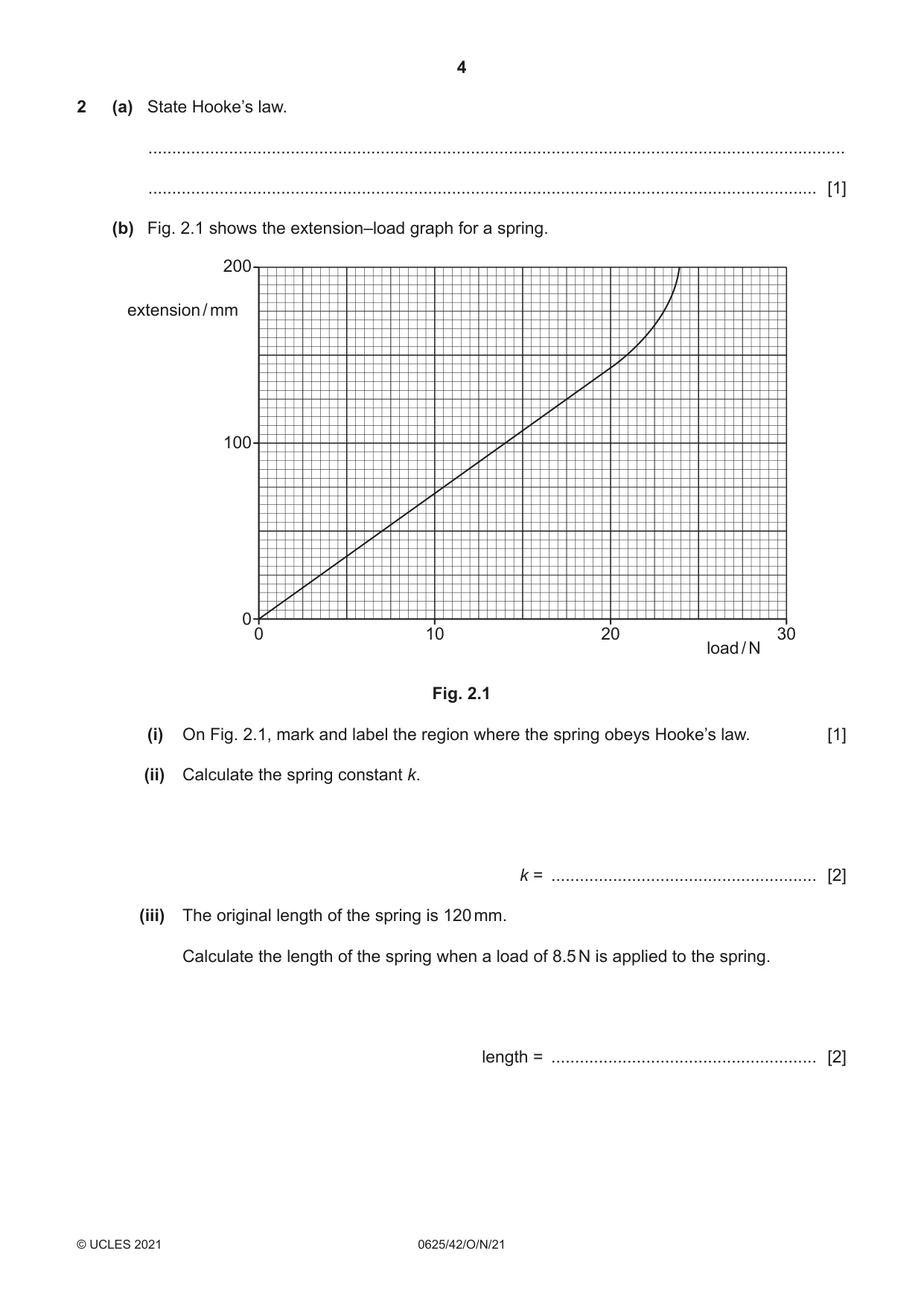
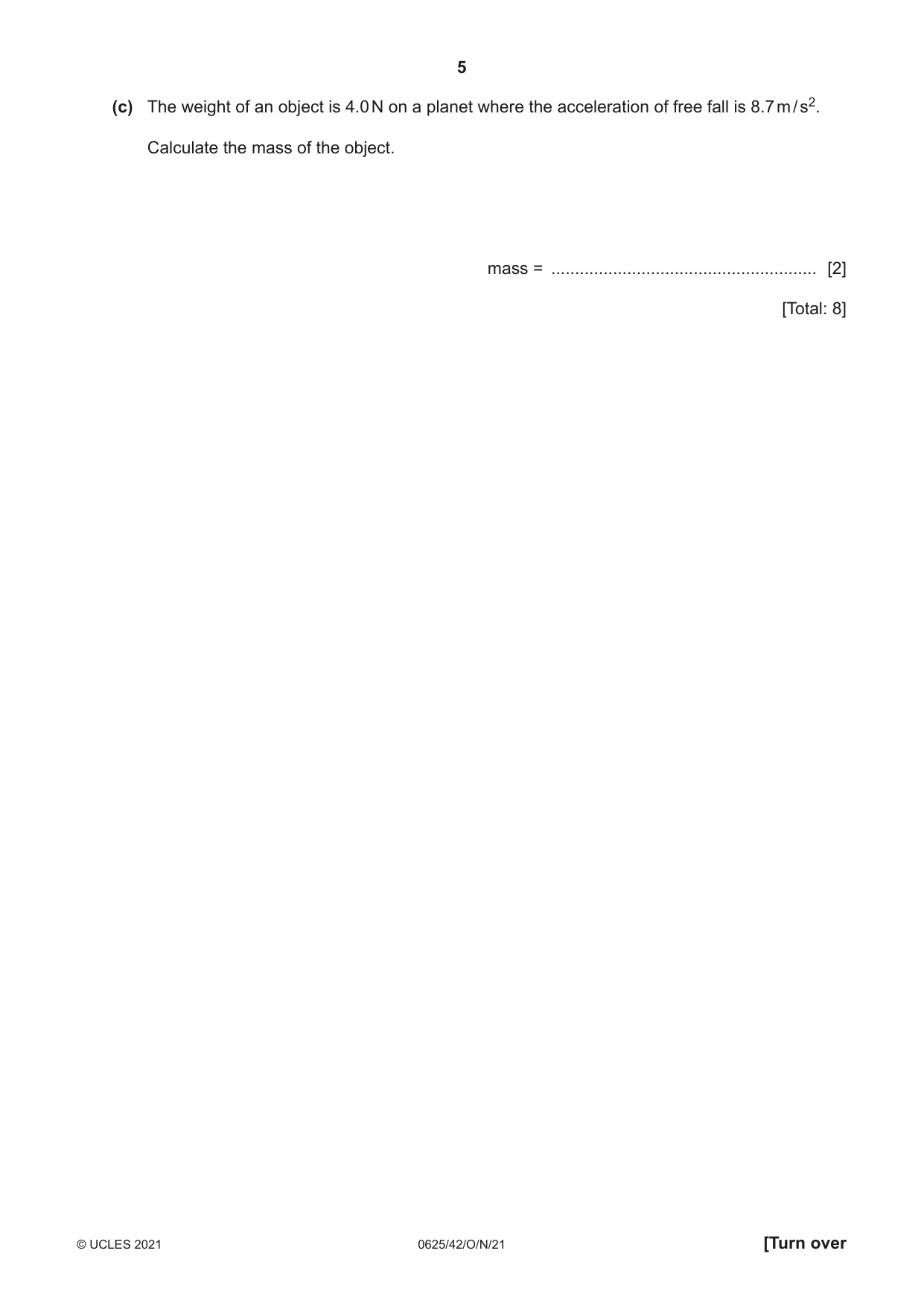
2 (a) State Hooke’s law. ................................................................................................................................................... ............................................................................................................................................. [1] (b) Fig. 2.1 shows the extension–load graph for a spring. 200 extension / mm 100 0 0 10 20 30 load / N Fig. 2.1 (i) On Fig. 2.1, mark and label the region where the spring obeys Hooke’s law. [1] (ii) Calculate the spring constant k. k = ........................................................ [2] (iii) The original length of the spring is 120 mm. Calculate the length of the spring when a load of 8.5 N is applied to the spring. length = ........................................................ [2] (c) The weight of an object is 4.0 N on a planet where the acceleration of free fall is 8.7 m / s2. Calculate the mass of the object. mass = ........................................................ [2] [Total: 8]
Mark scheme: 2(a) extension is (directly) proportional to load (if elastic limit is not exceeded) B1 2(b)(i) 0 to 20.5 + / – 0.5 N B1 2(b)(ii) (k = ) F / x OR (k =) 1 / gradient C1 140 N / m OR 0.14 N / mm A1 2(b)(iii) 60 OR 61 OR 62 OR 63 (mm) seen C1 180 mm OR 0.18 m A1 2(c) W = mg in any form OR (m =) W / g OR (m) = 4 / 8.7 C1 0.46 kg A1
Q3 · A collision at very slow speed between two cars travelling along a straight road
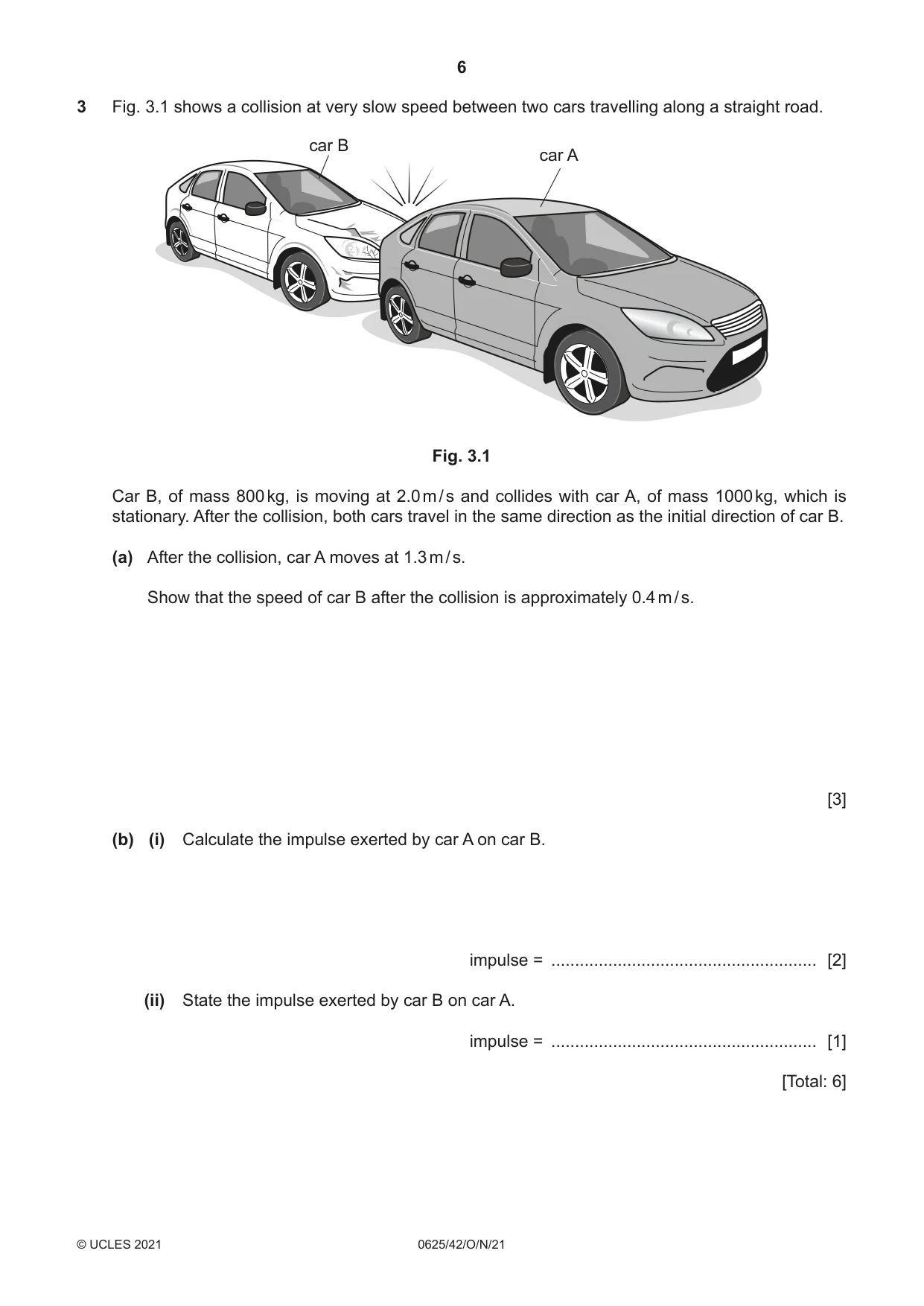
3 Fig. 3.1 shows a collision at very slow speed between two cars travelling along a straight road. car B car A Fig. 3.1 Car B, of mass 800 kg, is moving at 2.0 m / s and collides with car A, of mass 1000 kg, which is stationary. After the collision, both cars travel in the same direction as the initial direction of car B. (a) After the collision, car A moves at 1.3 m / s. Show that the speed of car B after the collision is approximately 0.4 m / s. [3] (b) (i) Calculate the impulse exerted by car A on car B. impulse = ........................................................ [2] (ii) State the impulse exerted by car B on car A. impulse = ........................................................ [1] [Total: 6]
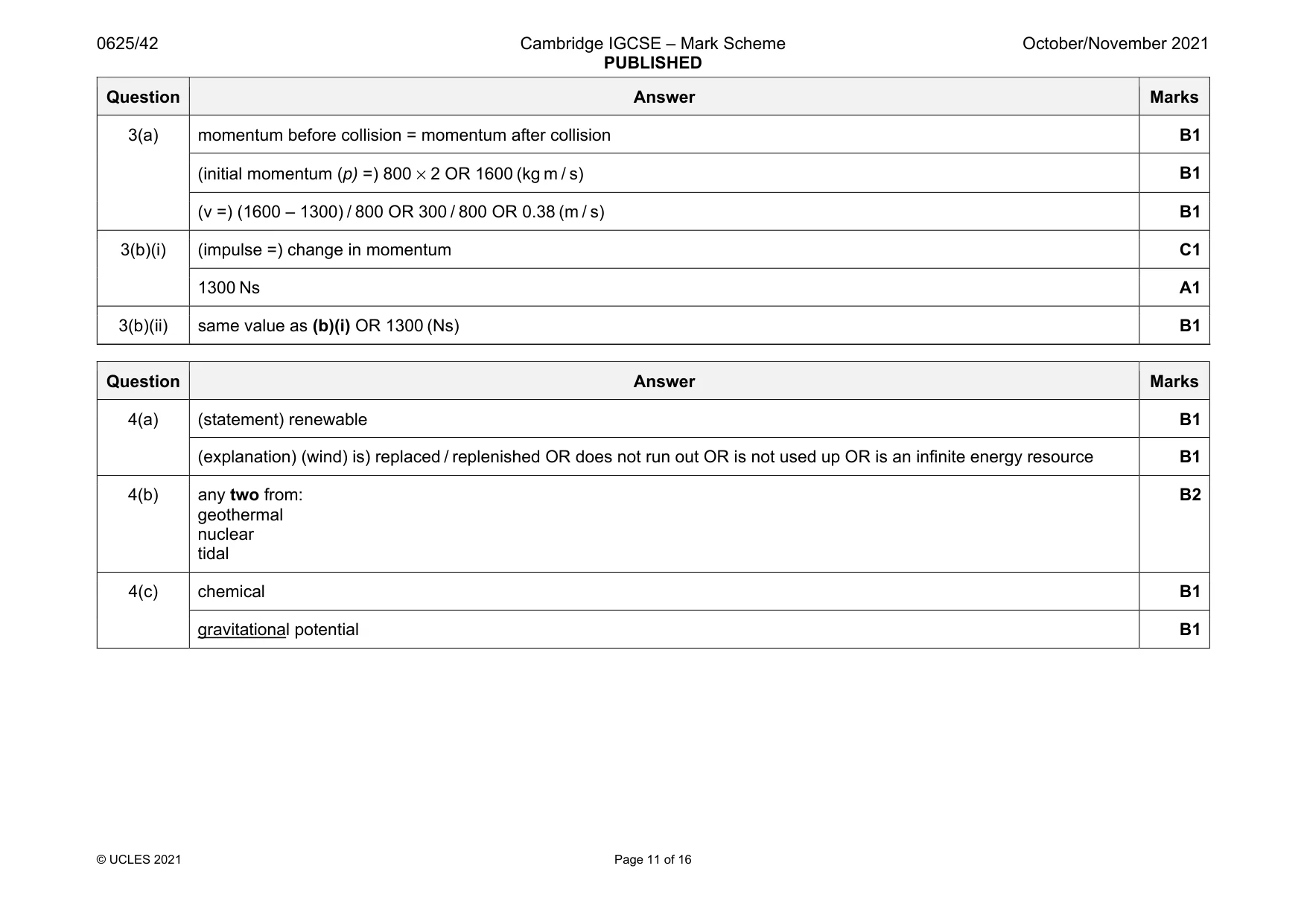
Mark scheme: 3(a) momentum before collision = momentum after collision B1 (initial momentum (p) =) 800 × 2 OR 1600 (kg m / s) B1 (v =) (1600 – 1300) / 800 OR 300 / 800 OR 0.38 (m / s) B1 3(b)(i) (impulse =) change in momentum C1 1300 Ns A1 3(b)(ii) same value as (b)(i) OR 1300 (Ns) B1
Q4 · A power station uses wind energy to generate electricity
4 (a) A power station uses wind energy to generate electricity. State and explain whether this method of generating electricity is renewable. statement .................................................................................................................................. explanation ............................................................................................................................... ................................................................................................................................................... ................................................................................................................................................... [2] (b) State two energy resources that do not have the Sun as their source. 1 ................................................................................................................................................ 2 ................................................................................................................................................ [2] (c) For each energy resource, state the form of energy stored in: fossil fuels ................................................................................................................................. water behind hydroelectric dams. ............................................................................................. [2] [Total: 6]
Mark scheme: 4(a) (statement) renewable B1 (explanation) (wind) is) replaced / replenished OR does not run out OR is not used up OR is an infinite energy resource B1 4(b) any two from: geothermal nuclear tidal B2 4(c) chemical B1 gravitational potential B1
Q5 · A thermocouple thermometer is used to determine the temperature difference between a…
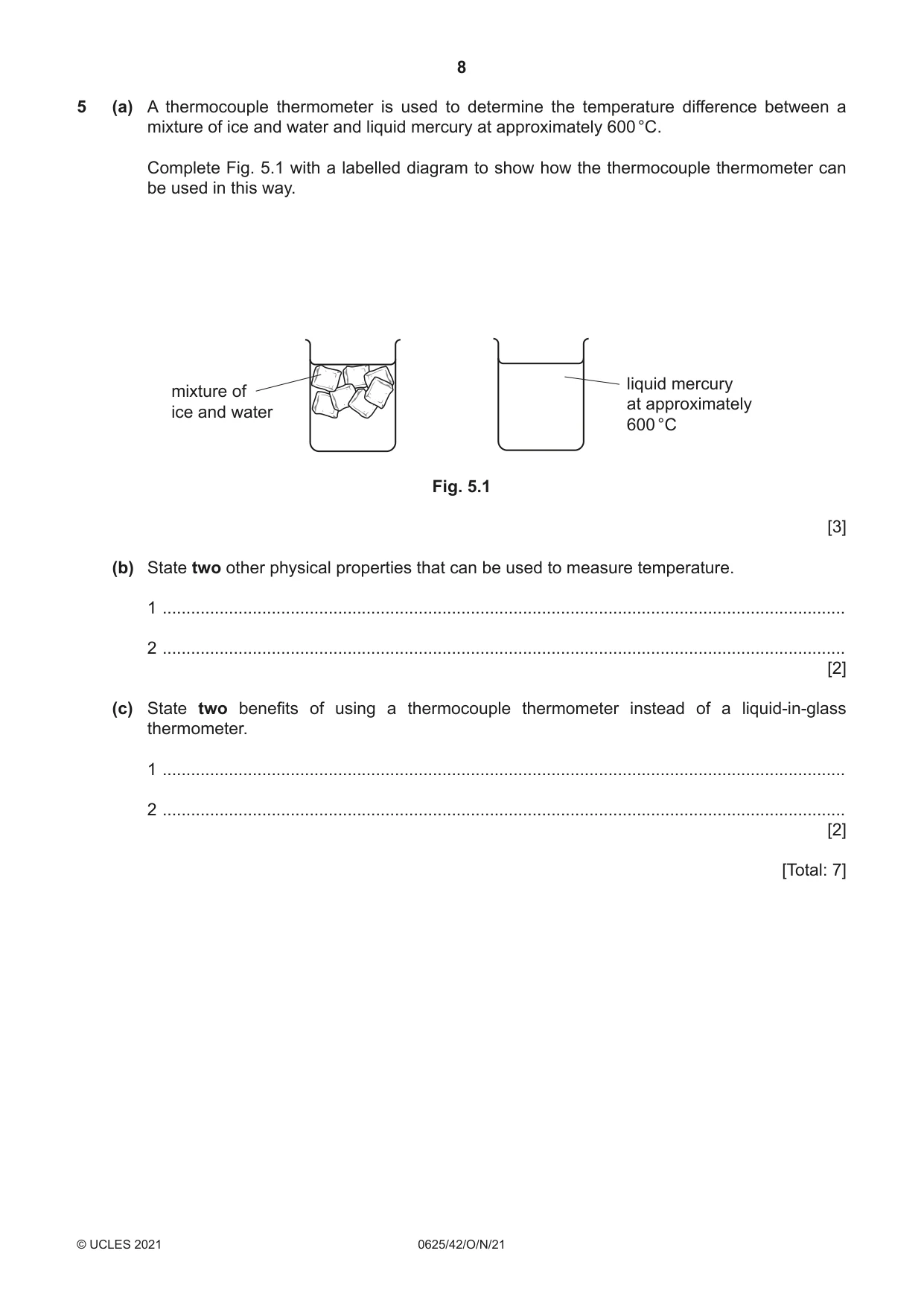
5 (a) A thermocouple thermometer is used to determine the temperature difference between a mixture of ice and water and liquid mercury at approximately 600 °C. Complete Fig. 5.1 with a labelled diagram to show how the thermocouple thermometer can be used in this way. liquid mercury mixture of at approximately ice and water 600 °C Fig. 5.1 [3] (b) State two other physical properties that can be used to measure temperature. 1 ................................................................................................................................................ 2 ................................................................................................................................................ [2] (c) State two benefits of using a thermocouple thermometer instead of a liquid-in-glass thermometer. 1 ................................................................................................................................................ 2 ................................................................................................................................................ [2] [Total: 7]
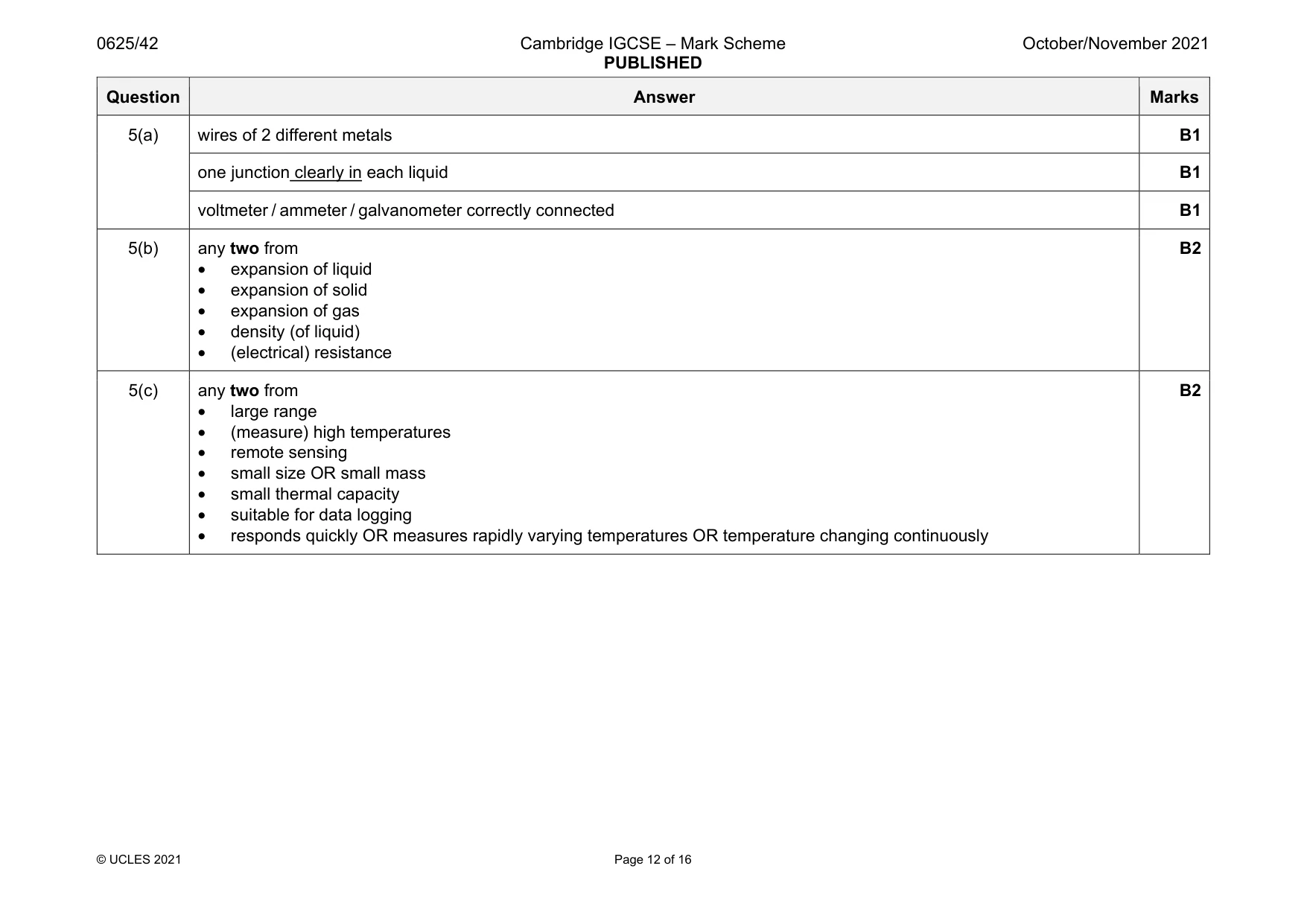
Mark scheme: 5(a) wires of 2 different metals B1 one junction clearly in each liquid B1 voltmeter / ammeter / galvanometer correctly connected B1 5(b) any two from • expansion of liquid • expansion of solid • expansion of gas • density (of liquid) • (electrical) resistance B2 5(c) any two from • large range • (measure) high temperatures • remote sensing • small size OR small mass • small thermal capacity • suitable for data logging • responds quickly OR measures rapidly varying temperatures OR temperature changing continuously B2
Q6 · Particles of a material in which a sound wave is travelling
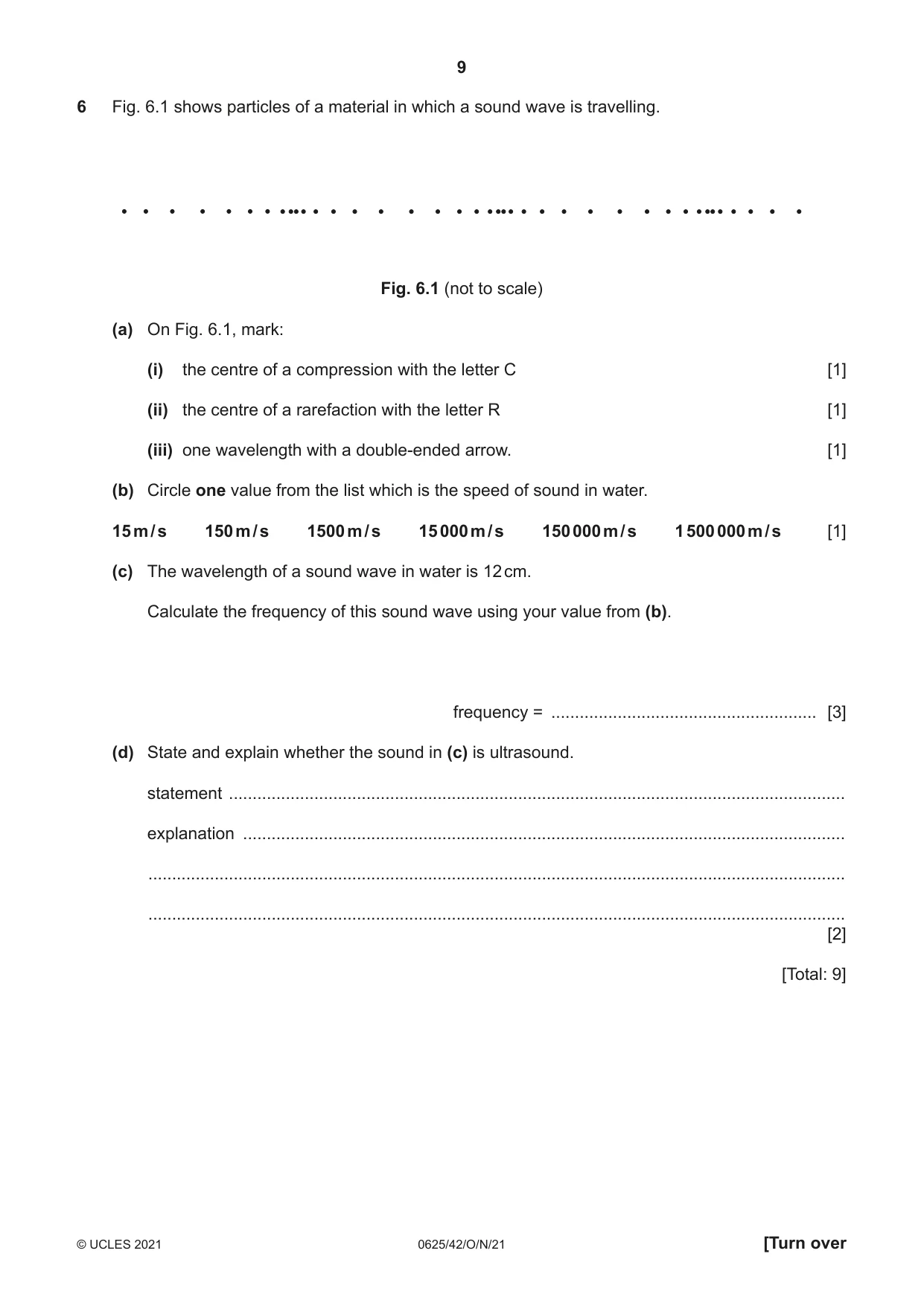
6 Fig. 6.1 shows particles of a material in which a sound wave is travelling. Fig. 6.1 (not to scale) (a) On Fig. 6.1, mark: (i) the centre of a compression with the letter C [1] (ii) the centre of a rarefaction with the letter R [1] (iii) one wavelength with a double-ended arrow. [1] (b) Circle one value from the list which is the speed of sound in water. 15 m / s 150 m / s 1500 m / s 15 000 m / s 150 000 m / s 1 500 000 m / s [1] (c) The wavelength of a sound wave in water is 12 cm. Calculate the frequency of this sound wave using your value from (b). frequency = ........................................................ [3] (d) State and explain whether the sound in (c) is ultrasound. statement .................................................................................................................................. explanation ............................................................................................................................... ................................................................................................................................................... ................................................................................................................................................... [2] [Total: 9]
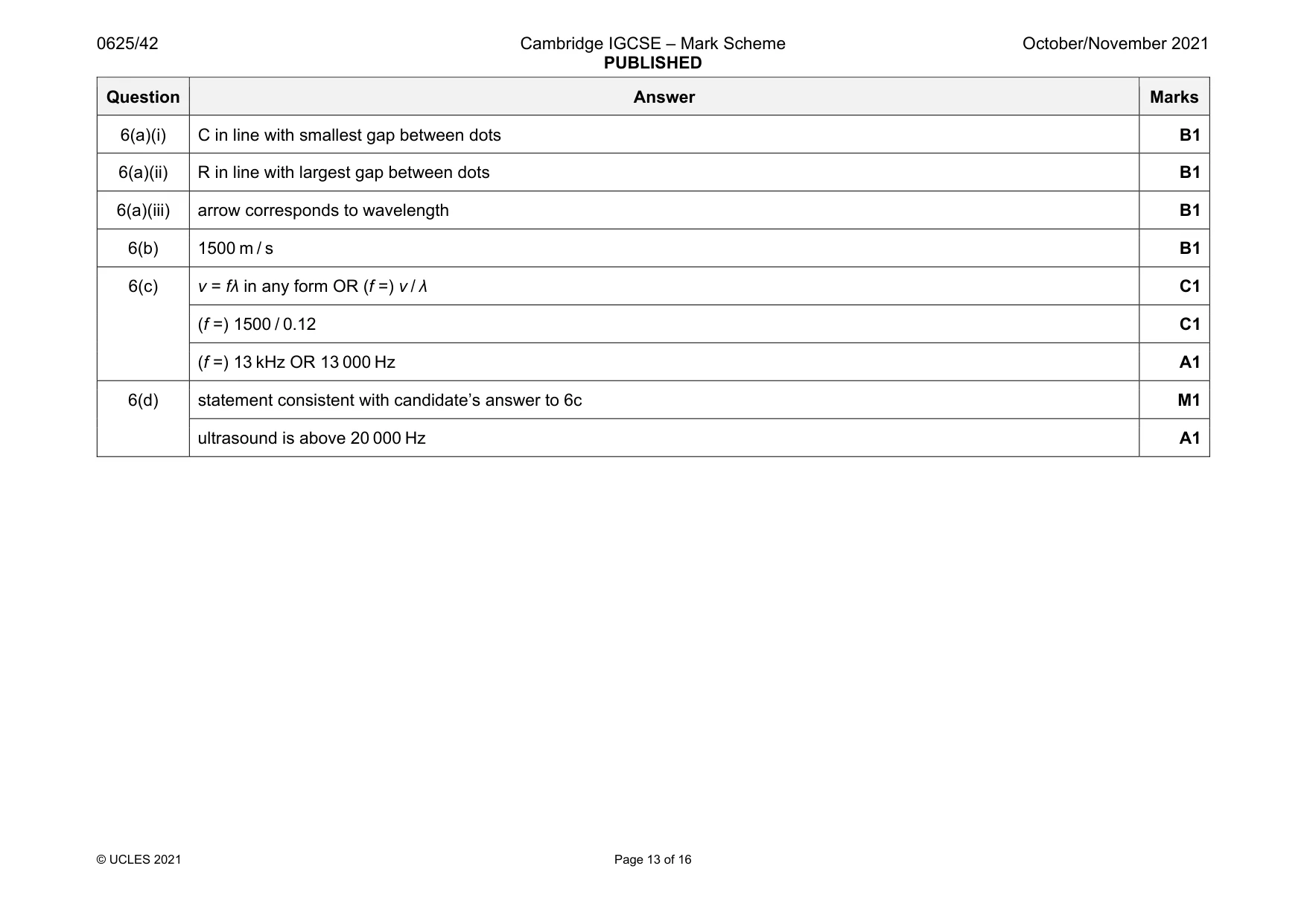
Mark scheme: 6(a)(i) C in line with smallest gap between dots B1 6(a)(ii) R in line with largest gap between dots B1 6(a)(iii) arrow corresponds to wavelength B1 6(b) 1500 m / s B1 6(c) v = fλ in any form OR (f =) v / λ C1 (f =) 1500 / 0.12 C1 (f =) 13 kHz OR 13 000 Hz A1 6(d) statement consistent with candidate’s answer to 6c M1 ultrasound is above 20 000 Hz A1
Q7 · A ray of light approaching face AB of a glass prism of refractive index 1.5
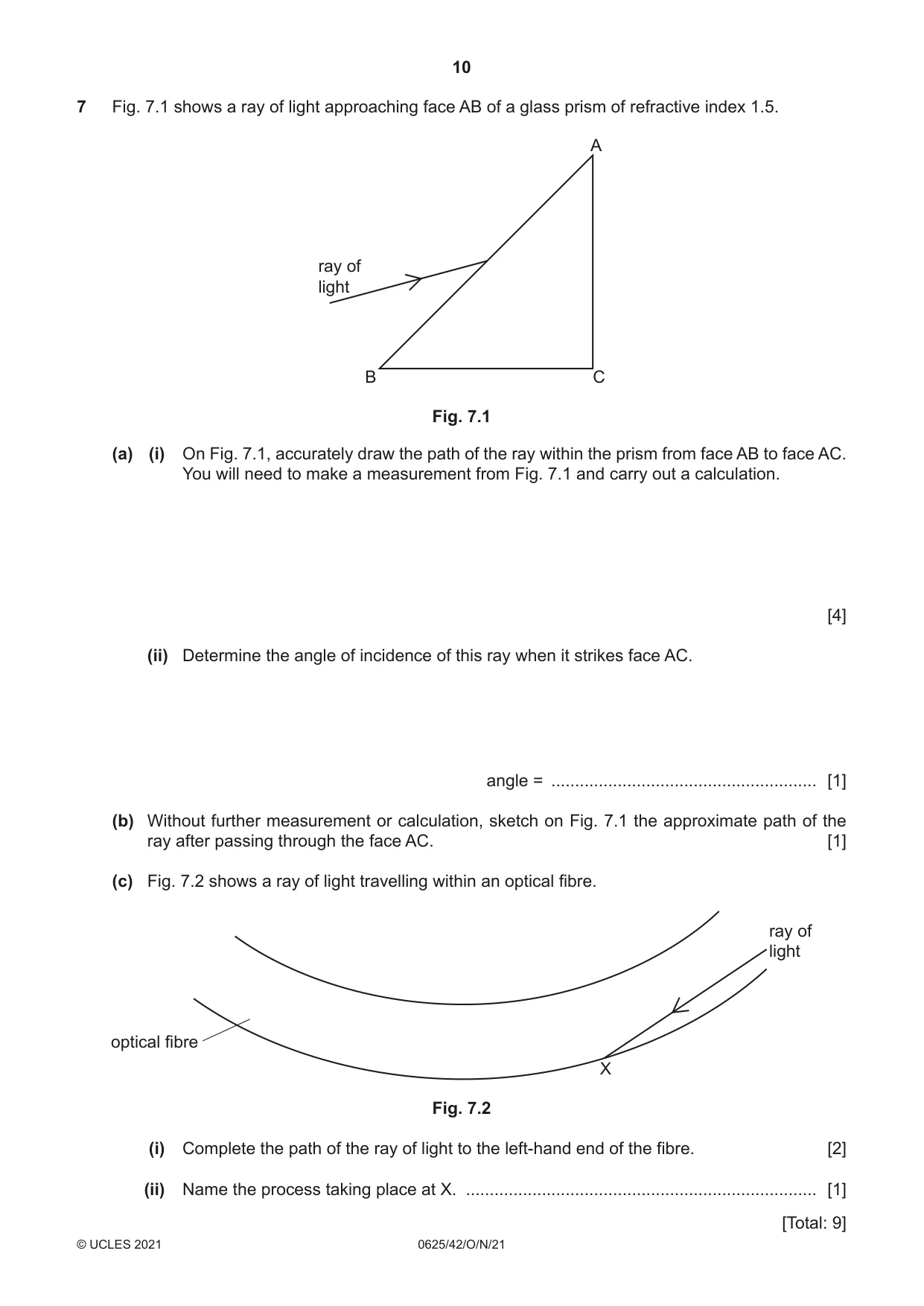
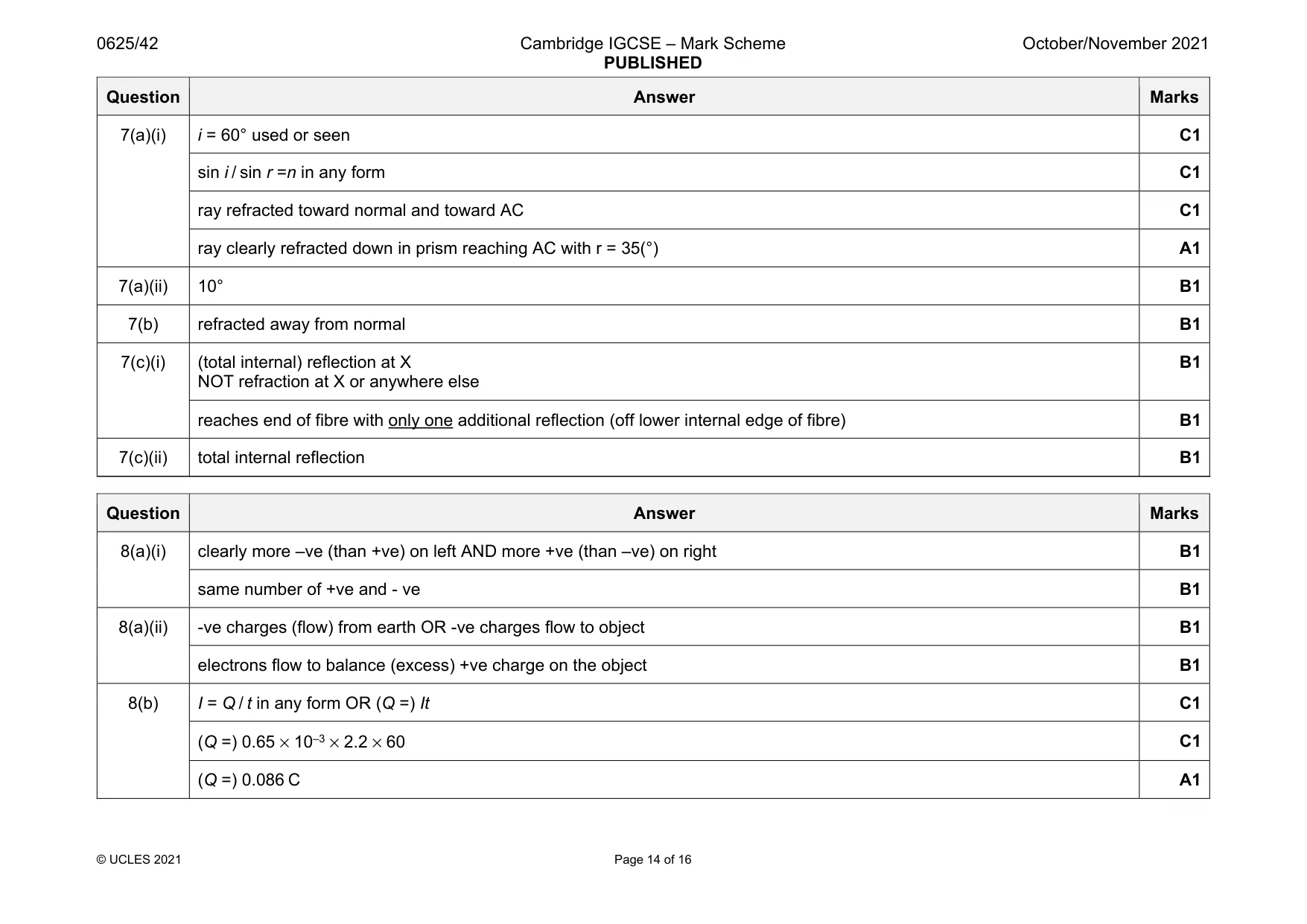
7 Fig. 7.1 shows a ray of light approaching face AB of a glass prism of refractive index 1.5. A ray of light B C Fig. 7.1 (a) (i) On Fig. 7.1, accurately draw the path of the ray within the prism from face AB to face AC. You will need to make a measurement from Fig. 7.1 and carry out a calculation. [4] (ii) Determine the angle of incidence of this ray when it strikes face AC. angle = ........................................................ [1] (b) Without further measurement or calculation, sketch on Fig. 7.1 the approximate path of the ray after passing through the face AC. [1] (c) Fig. 7.2 shows a ray of light travelling within an optical fibre. ray of light optical fibre X Fig. 7.2 (i) Complete the path of the ray of light to the left-hand end of the fibre. [2] (ii) Name the process taking place at X. .......................................................................... [1] [Total: 9]
Mark scheme: 7(a)(i) i = 60° used or seen C1 sin i / sin r =n in any form C1 ray refracted toward normal and toward AC C1 ray clearly refracted down in prism reaching AC with r = 35(°) A1 7(a)(ii) 10° B1 7(b) refracted away from normal B1 7(c)(i) (total internal) reflection at X NOT refraction at X or anywhere else B1 reaches end of fibre with only one additional reflection (off lower internal edge of fibre) B1 7(c)(ii) total internal reflection B1
Q8 · A conducting object A, initially uncharged, held on an insulating stand
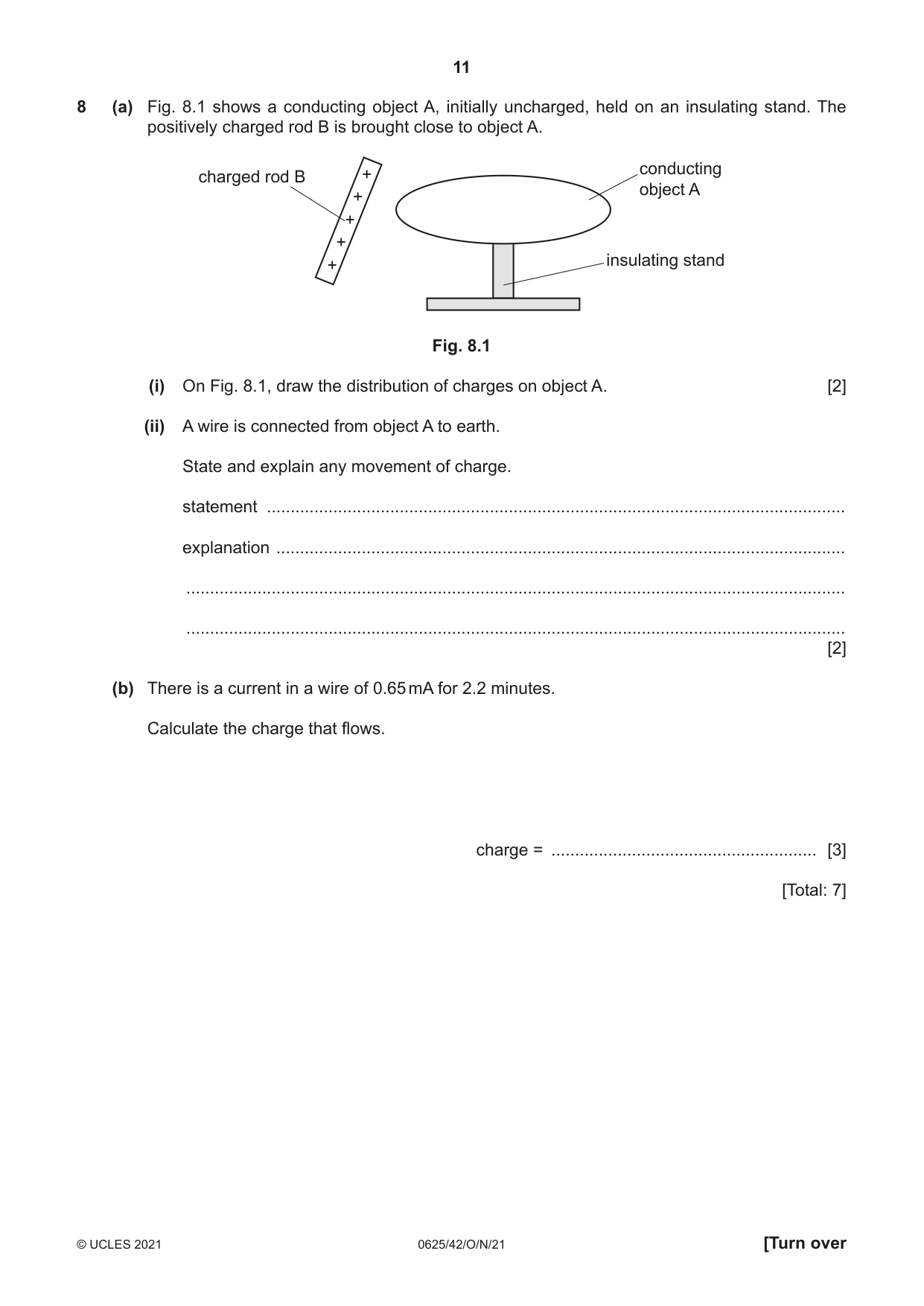
8 (a) Fig. 8.1 shows a conducting object A, initially uncharged, held on an insulating stand. The positively charged rod B is brought close to object A. conducting charged rod B + object A + + + insulating stand + Fig. 8.1 (i) On Fig. 8.1, draw the distribution of charges on object A. [2] (ii) A wire is connected from object A to earth. State and explain any movement of charge. statement .......................................................................................................................... explanation ........................................................................................................................ ........................................................................................................................................... ........................................................................................................................................... [2] (b) There is a current in a wire of 0.65 mA for 2.2 minutes. Calculate the charge that flows. charge = ........................................................ [3] [Total: 7]
Mark scheme: 8(a)(i) clearly more –ve (than +ve) on left AND more +ve (than –ve) on right B1 same number of +ve and - ve B1 8(a)(ii) -ve charges (flow) from earth OR -ve charges flow to object B1 electrons flow to balance (excess) +ve charge on the object B1 8(b) I = Q / t in any form OR (Q =) It C1 (Q =) 0.65 × 10–3 × 2.2 × 60 C1 (Q =) 0.086 C A1
Q9 · A cell of electromotive force (e.m.f.) 1.5 V and a battery of e.m.f
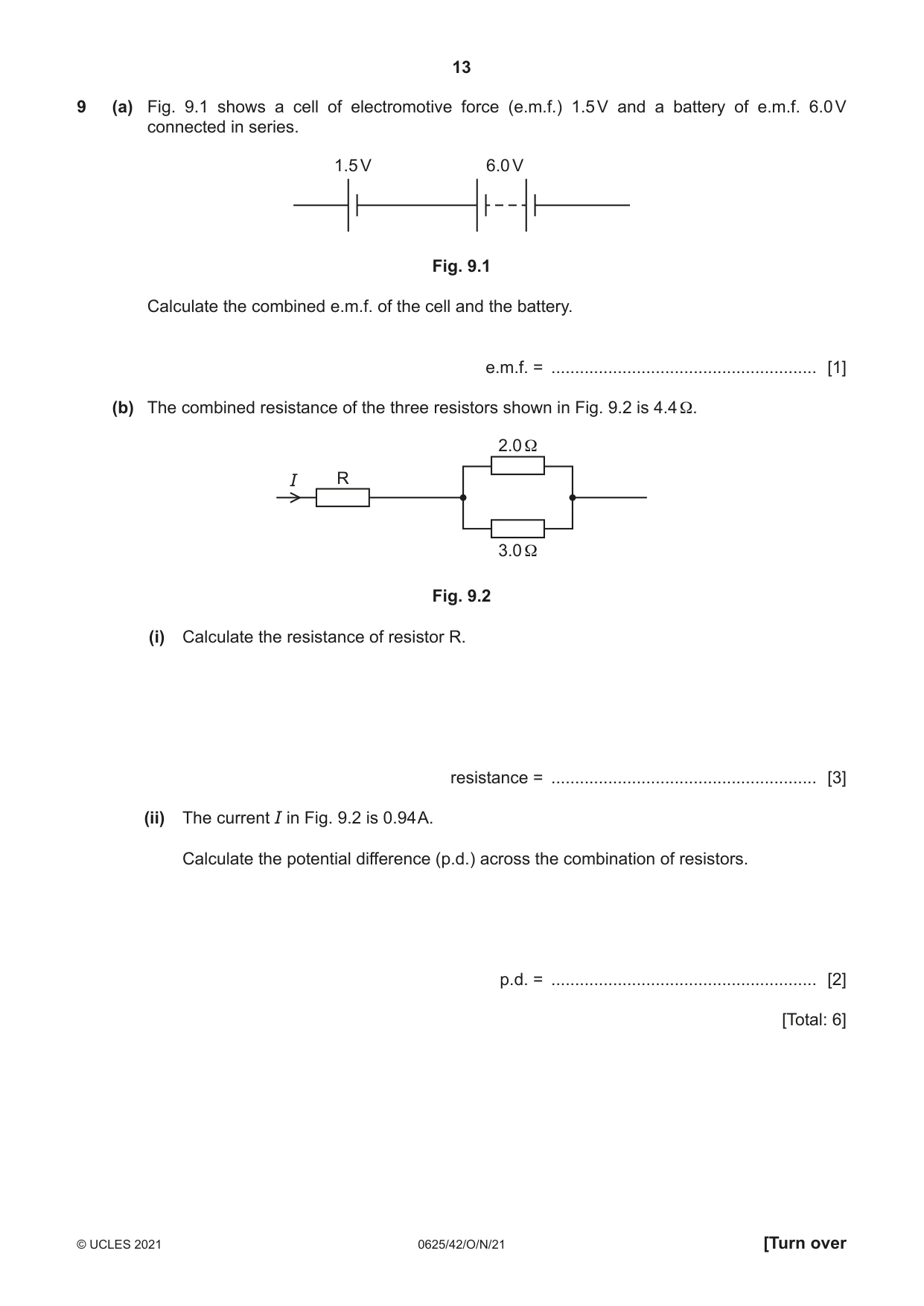
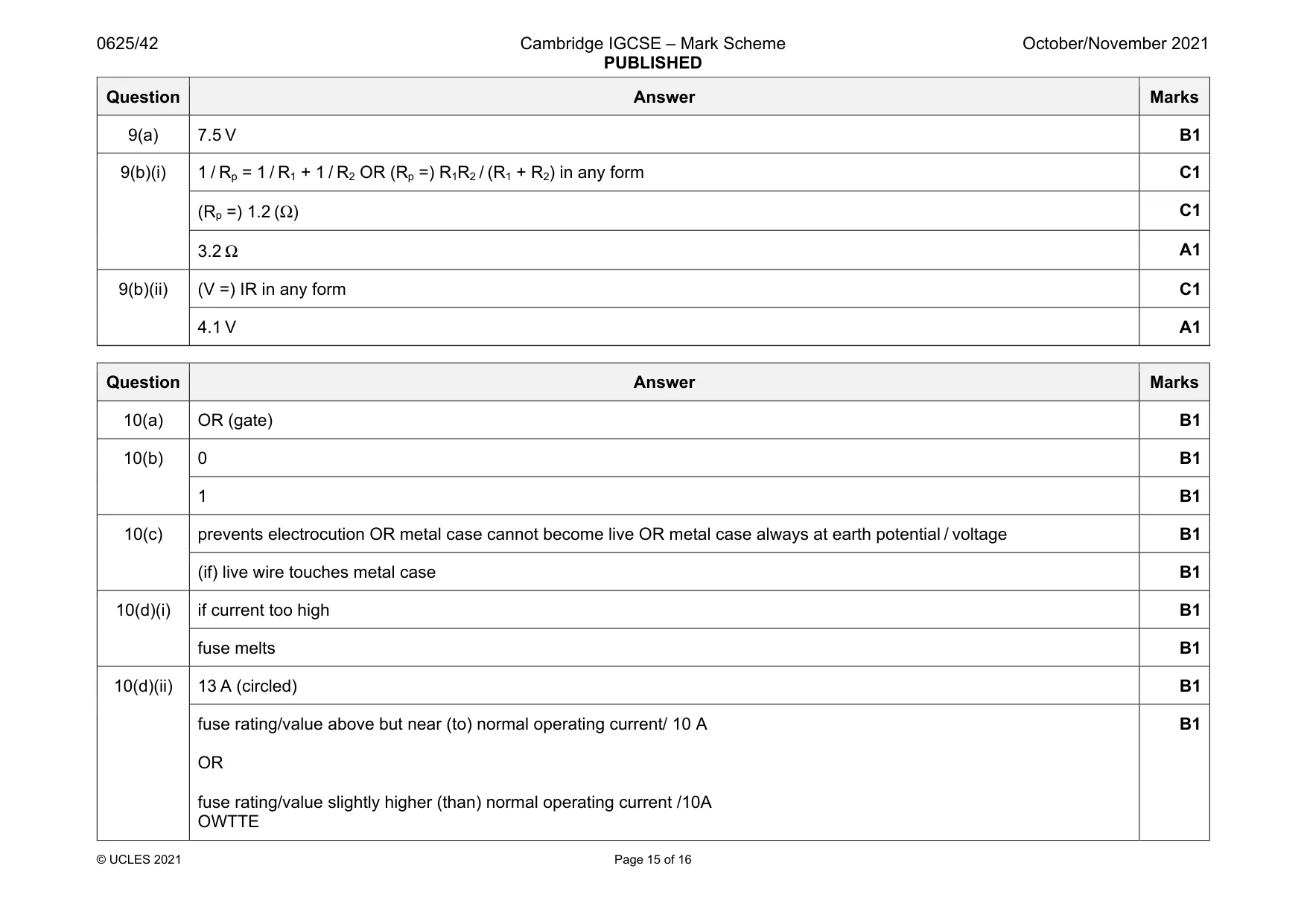
9 (a) Fig. 9.1 shows a cell of electromotive force (e.m.f.) 1.5 V and a battery of e.m.f. 6.0 V connected in series. 1.5 V 6.0 V Fig. 9.1 Calculate the combined e.m.f. of the cell and the battery. e.m.f. = ........................................................ [1] (b) The combined resistance of the three resistors shown in Fig. 9.2 is 4.4 Ω. 2.0 Ω I R 3.0 Ω Fig. 9.2 (i) Calculate the resistance of resistor R. resistance = ........................................................ [3] (ii) The current I in Fig. 9.2 is 0.94 A. Calculate the potential difference (p.d.) across the combination of resistors. p.d. = ........................................................ [2] [Total: 6]
Mark scheme: 9(a) 7.5 V B1 9(b)(i) 1 / Rp = 1 / R1 + 1 / R2 OR (Rp =) R1R2 / (R1 + R2) in any form C1 (Rp =) 1.2 (Ω) C1 3.2 Ω A1 9(b)(ii) (V =) IR in any form C1 4.1 V A1
Q10 · Name the logic gate shown in Fig
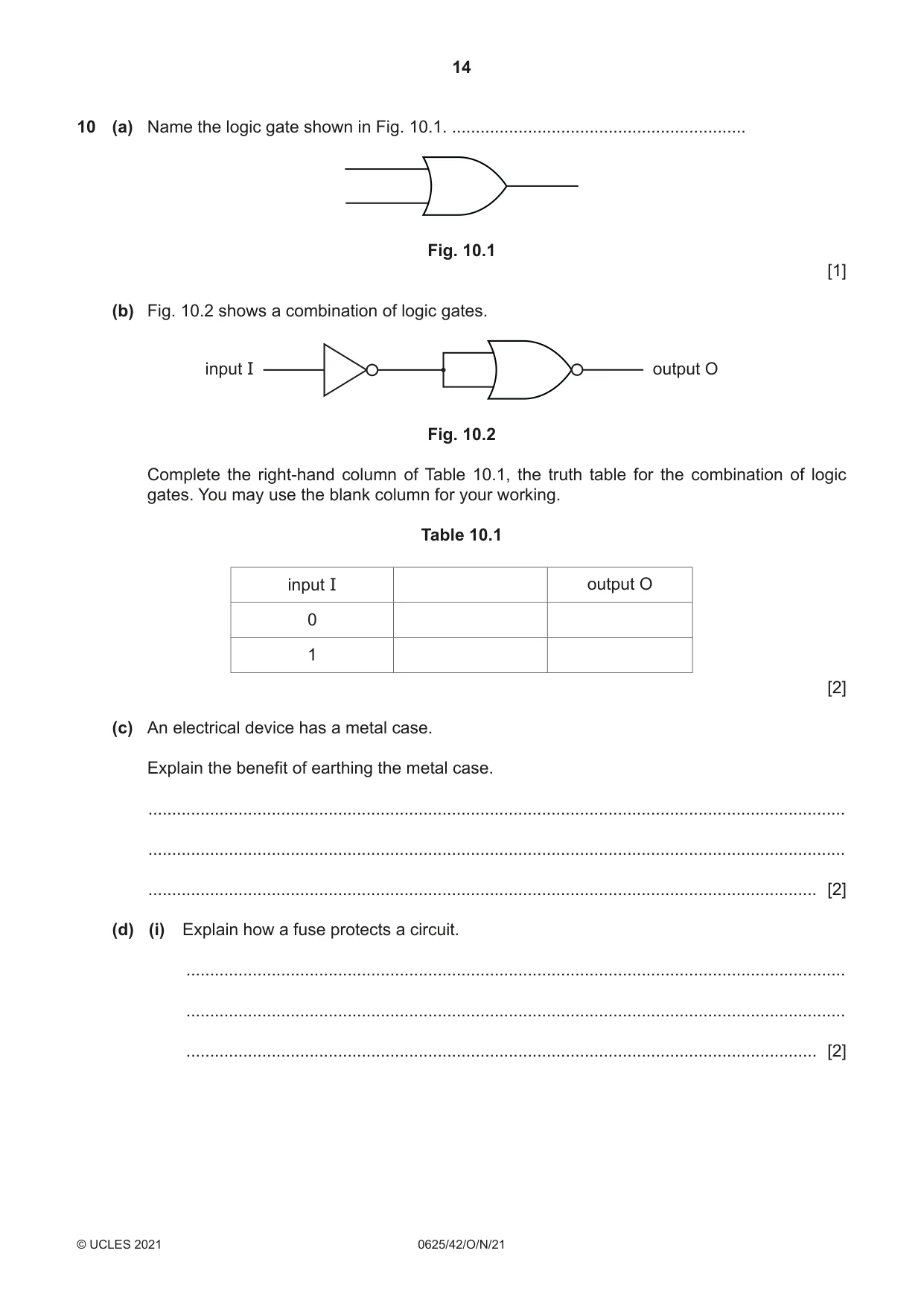
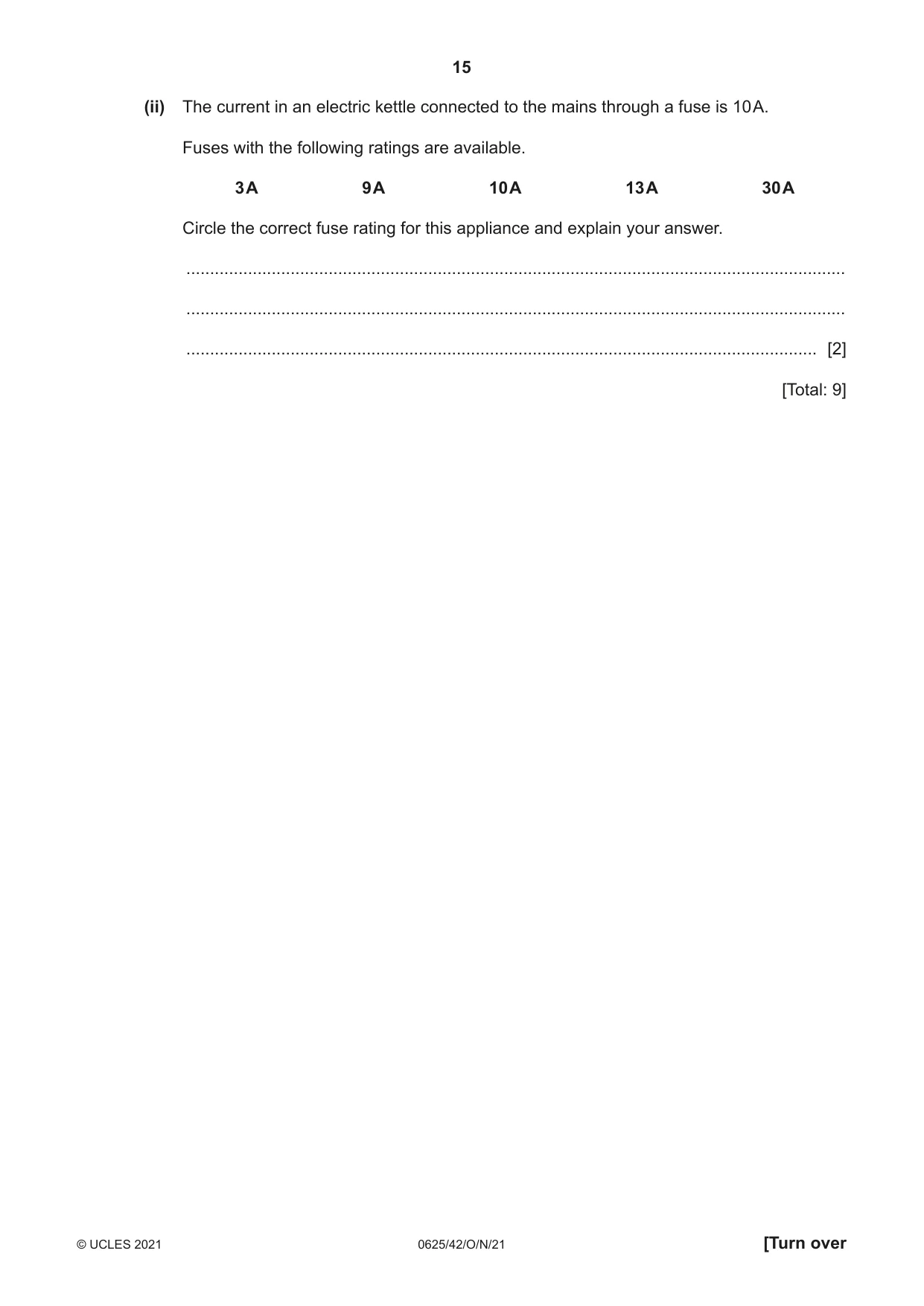
10 (a) Name the logic gate shown in Fig. 10.1. .............................................................. Fig. 10.1 [1] (b) Fig. 10.2 shows a combination of logic gates. input I output O Fig. 10.2 Complete the right-hand column of Table 10.1, the truth table for the combination of logic gates. You may use the blank column for your working. Table 10.1 input I output O 0 1 [2] (c) An electrical device has a metal case. Explain the benefit of earthing the metal case. ................................................................................................................................................... ................................................................................................................................................... ............................................................................................................................................. [2] (d) (i) Explain how a fuse protects a circuit. ........................................................................................................................................... ........................................................................................................................................... ..................................................................................................................................... [2] (ii) The current in an electric kettle connected to the mains through a fuse is 10 A. Fuses with the following ratings are available. 3 A 9 A 10 A 13 A 30 A Circle the correct fuse rating for this appliance and explain your answer. ........................................................................................................................................... ........................................................................................................................................... ..................................................................................................................................... [2] [Total: 9]
Mark scheme: 10(a) OR (gate) B1 10(b) 0 B1 1 B1 10(c) prevents electrocution OR metal case cannot become live OR metal case always at earth potential / voltage B1 (if) live wire touches metal case B1 10(d)(i) if current too high B1 fuse melts B1 10(d)(ii) 13 A (circled) B1 fuse rating/value above but near (to) normal operating current/ 10 A OR fuse rating/value slightly higher (than) normal operating current /10A OWTTE B1
Q11 · Describe the composition and structure of a neutral atom of beryllium-8, which has a…
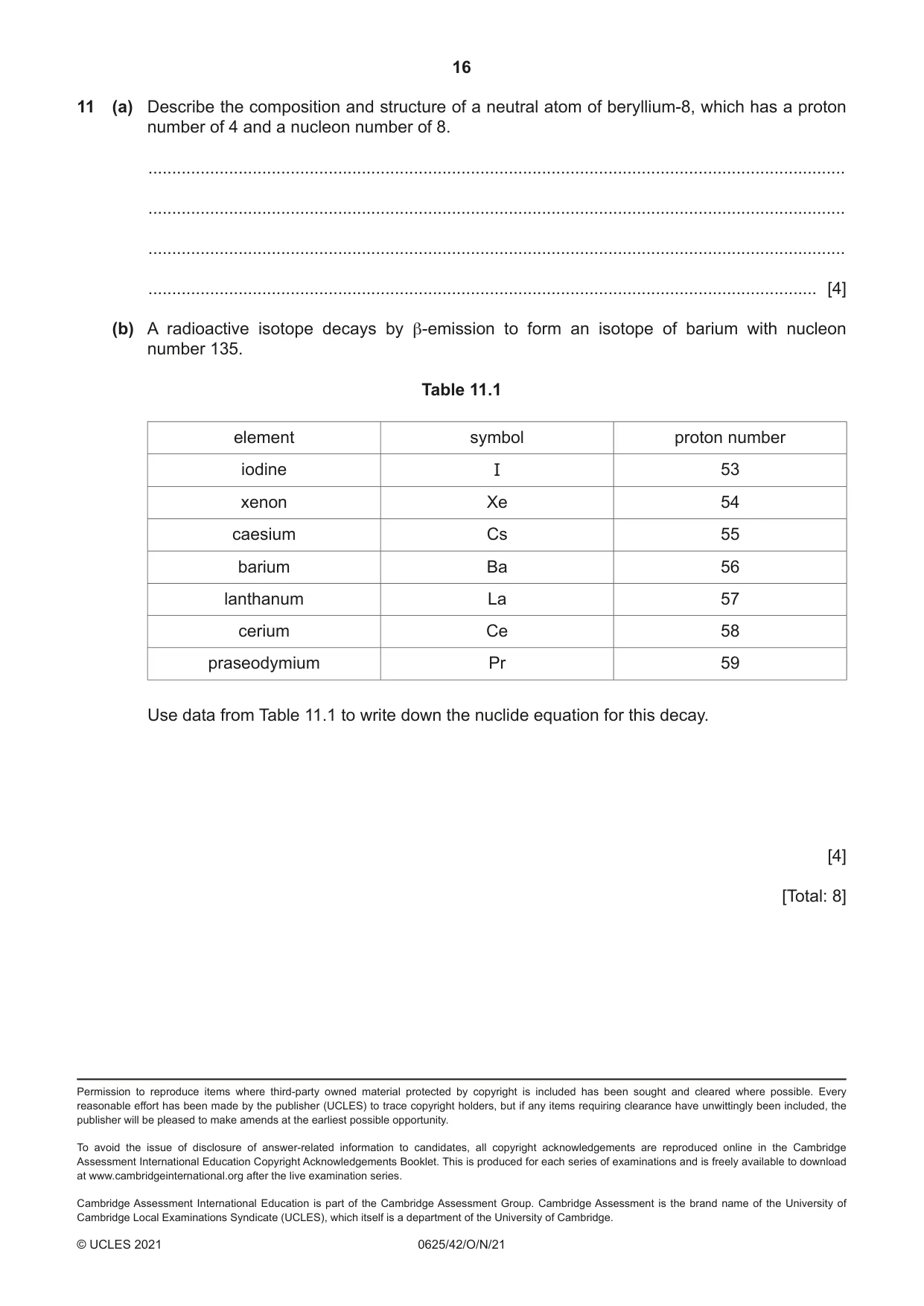
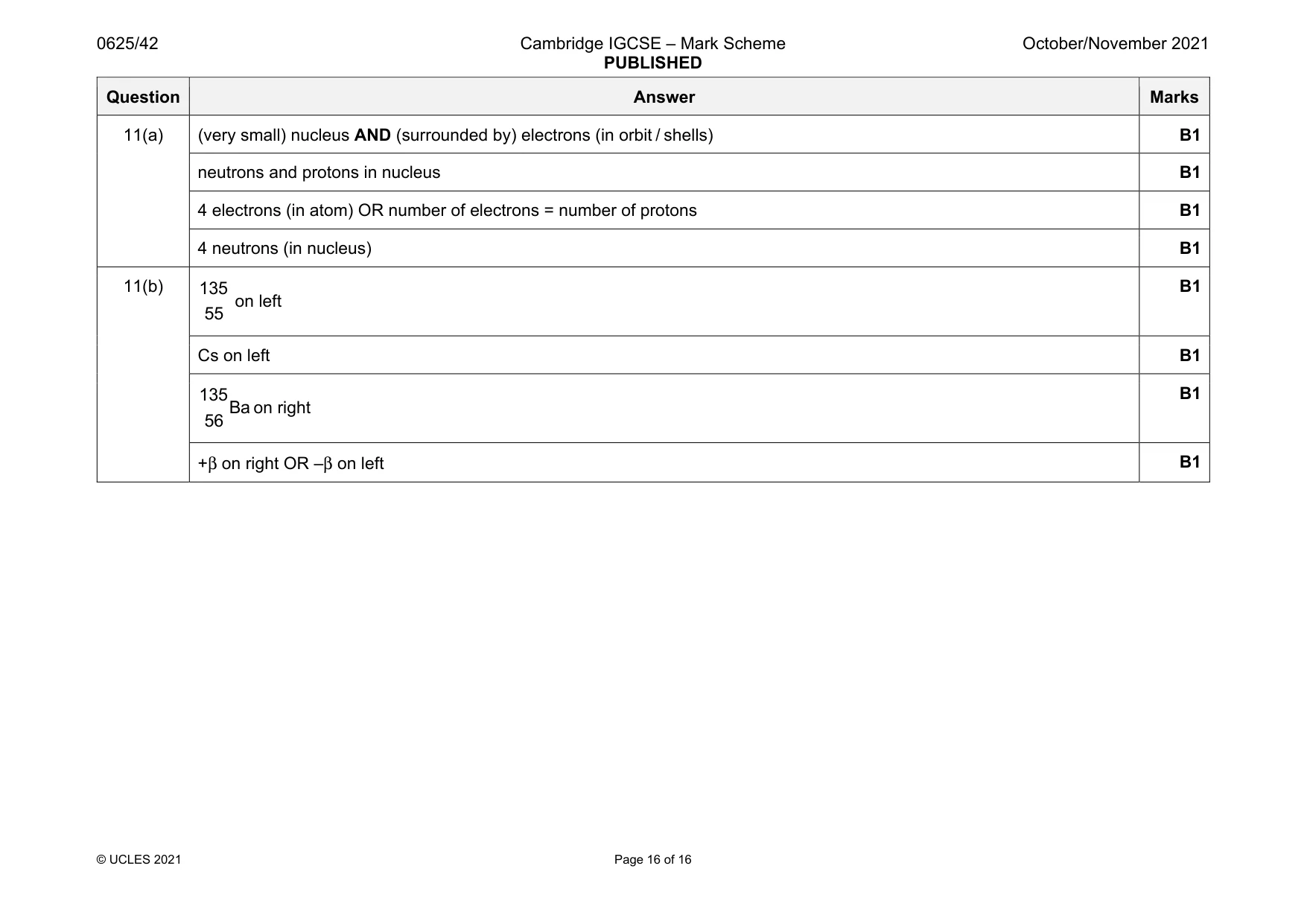
11 (a) Describe the composition and structure of a neutral atom of beryllium-8, which has a proton number of 4 and a nucleon number of 8. ................................................................................................................................................... ................................................................................................................................................... ................................................................................................................................................... ............................................................................................................................................. [4] (b) A radioactive isotope decays by β-emission to form an isotope of barium with nucleon number 135. Table 11.1 element symbol proton number iodine I 53 xenon Xe 54 caesium Cs 55 barium Ba 56 lanthanum La 57 cerium Ce 58 praseodymium Pr 59 Use data from Table 11.1 to write down the nuclide equation for this decay. [4] [Total: 8]
Mark scheme: 11(a) (very small) nucleus AND (surrounded by) electrons (in orbit / shells) B1 neutrons and protons in nucleus B1 4 electrons (in atom) OR number of electrons = number of protons B1 4 neutrons (in nucleus) B1 11(b) 135 55 on left B1 Cs on left B1 135Ba 56 on right B1 +β on right OR –β on left B1
What was in this paper
The subtopics covered by these 11 questions, and how many questions each got. Open one in a new tab to see every Cambridge question on it.
What you needed in this session
Cambridge’s own grade thresholds for 2021 Oct/Nov, Paper 4 · Variant 2. A higher threshold means an easier paper — the bar moves with how the cohort did.