Cambridge IGCSE Physics 0625 — 2021 Feb/March Paper 4 · Variant 2
0625/42/F/M/21 · 10 questions · 80 marks · ≈90 min
The question paper and its mark scheme, free to read here and free to download. This is Cambridge’s own paper, exactly as it was sat.
Question paper16 pages
Mark scheme10 pages
Answers below. Sit the paper first if you are practising.
Questions as text
Q1 · A piece of glass of thickness 2.0 cm and area 0.15 m2
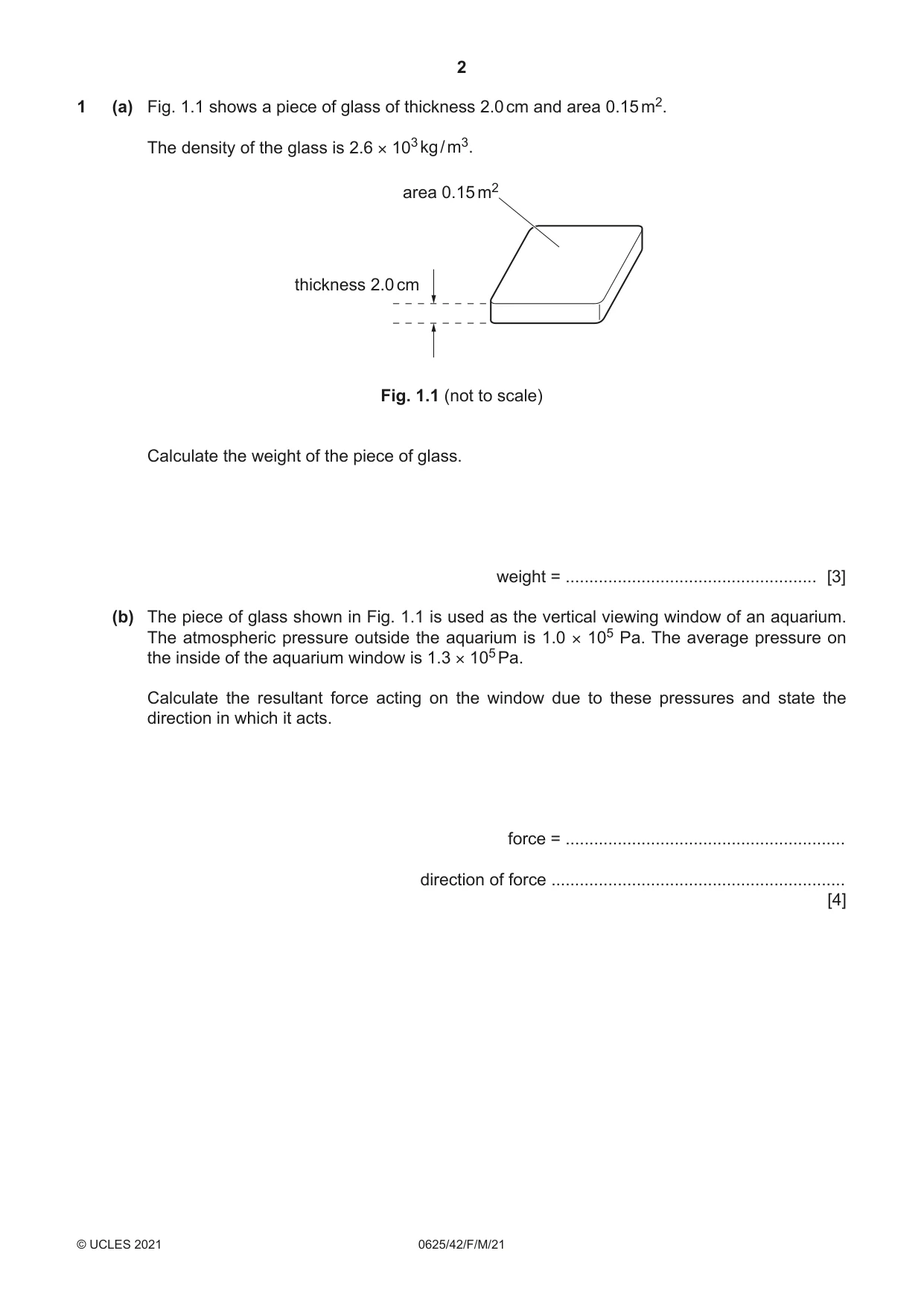
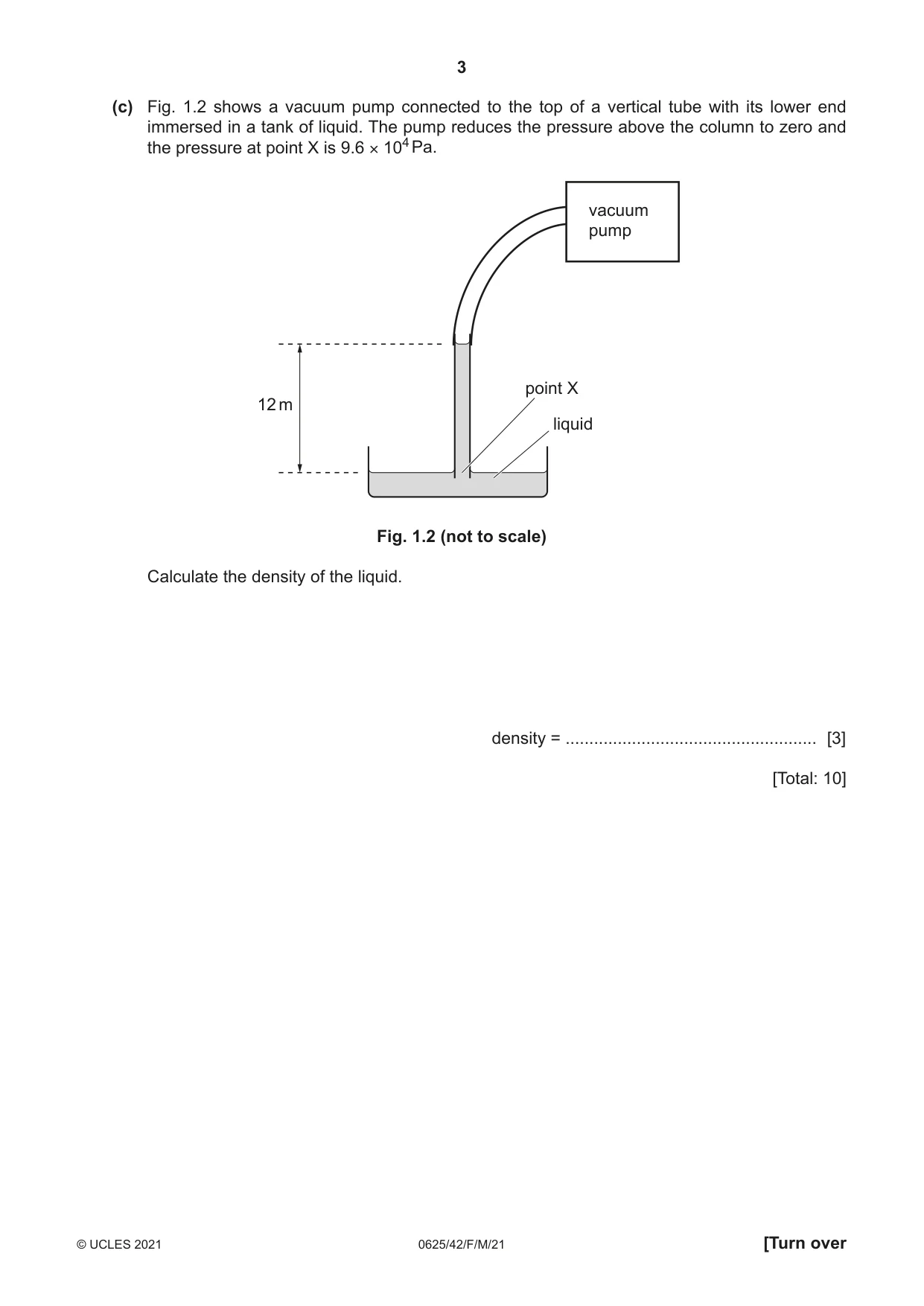
1 (a) Fig. 1.1 shows a piece of glass of thickness 2.0 cm and area 0.15 m2. The density of the glass is 2.6 × 10³ kg / m3. area 0.15 m2 thickness 2.0 cm Fig. 1.1 (not to scale) Calculate the weight of the piece of glass. weight = ..................................................... [3] (b) The piece of glass shown in Fig. 1.1 is used as the vertical viewing window of an aquarium. The atmospheric pressure outside the aquarium is 1.0 × 10⁵ Pa. The average pressure on the inside of the aquarium window is 1.3 × 10⁵ Pa. Calculate the resultant force acting on the window due to these pressures and state the direction in which it acts. force = ........................................................... direction of force .............................................................. [4] (c) Fig. 1.2 shows a vacuum pump connected to the top of a vertical tube with its lower end immersed in a tank of liquid. The pump reduces the pressure above the column to zero and the pressure at point X is 9.6 × 10⁴ Pa. vacuum pump point X 12 m liquid Fig. 1.2 (not to scale) Calculate the density of the liquid. density = ..................................................... [3] [Total: 10]
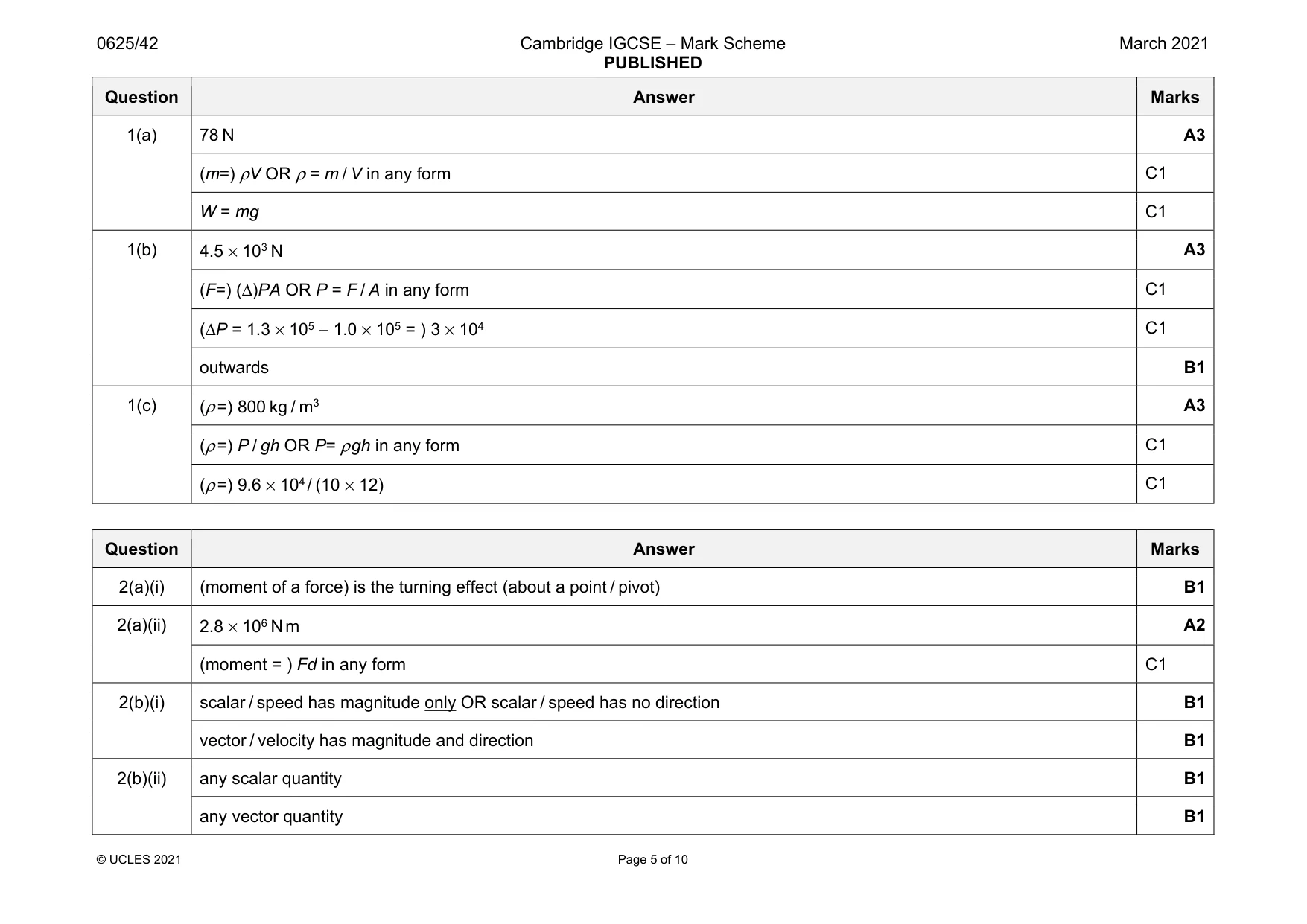
Mark scheme: 1(a) 78 N A3 (m=) ρV OR ρ = m / V in any form C1 W = mg C1 1(b) 4.5 × 10³ N A3 (F=) (Δ)PA OR P = F / A in any form C1 (ΔP = 1.3 × 10⁵ – 1.0 × 105 = ) 3 × 10⁴ C1 outwards B1 1(c) (ρ =) 800 kg / m3 A3 (ρ =) P / gh OR P= ρ gh in any form C1 (ρ =) 9.6 × 10⁴/ (10 × 12) C1
Q2 · State what is meant by the moment of a force about a point
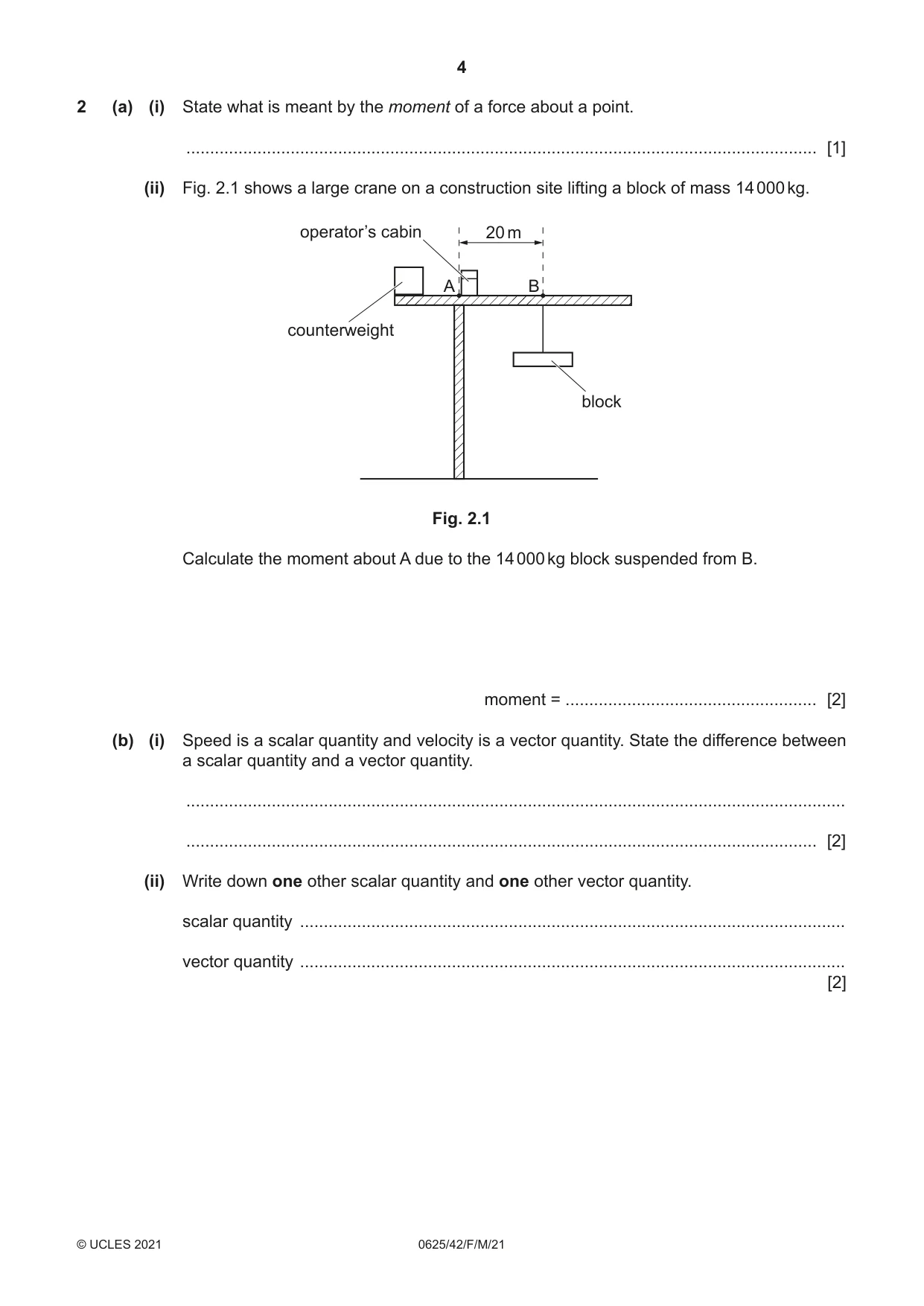
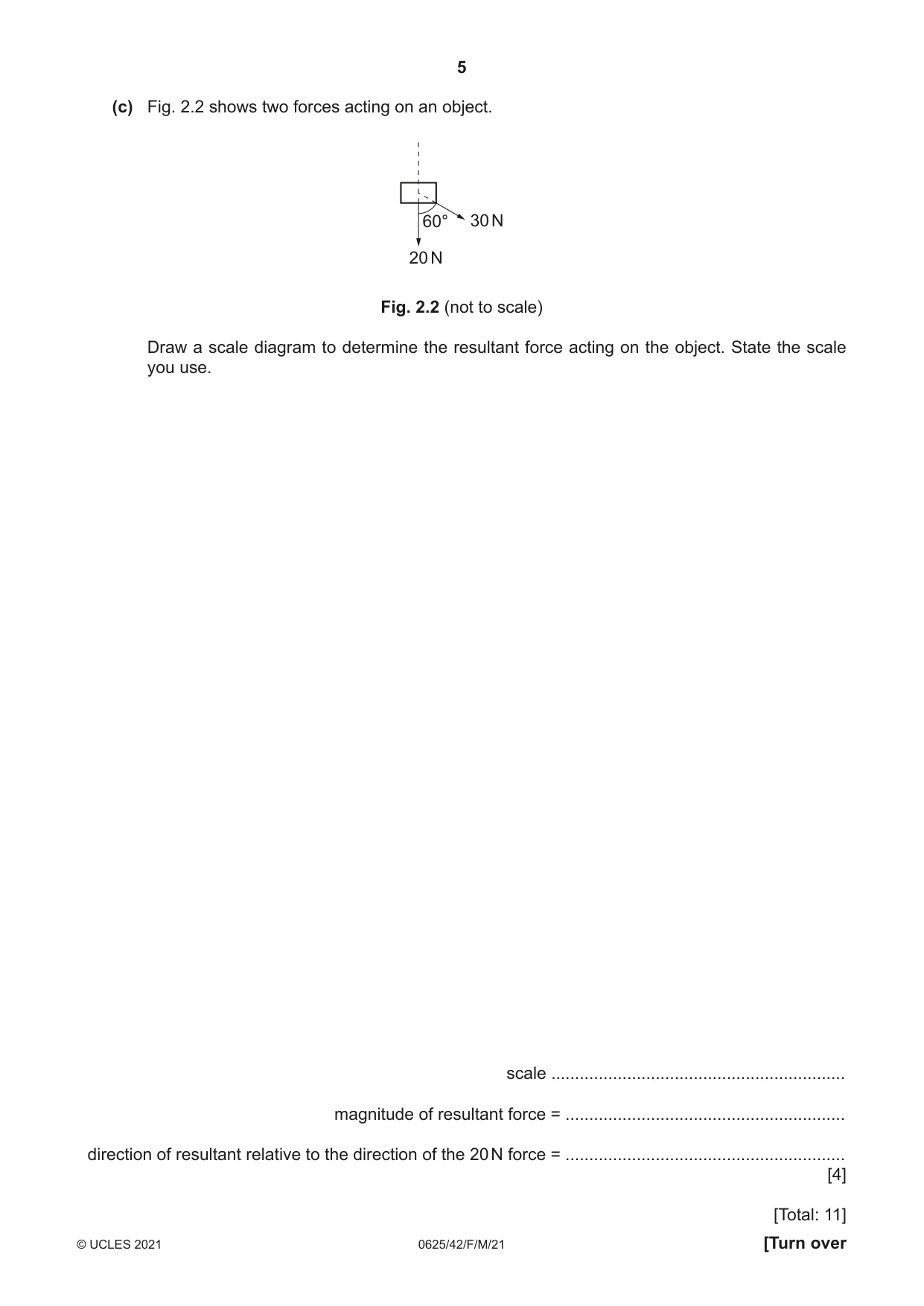
2 (a) (i) State what is meant by the moment of a force about a point. ..................................................................................................................................... [1] (ii) Fig. 2.1 shows a large crane on a construction site lifting a block of mass 14 000 kg. operator’s cabin 20 m A B counterweight block Fig. 2.1 Calculate the moment about A due to the 14 000 kg block suspended from B. moment = ..................................................... [2] (b) (i) Speed is a scalar quantity and velocity is a vector quantity. State the difference between a scalar quantity and a vector quantity. ........................................................................................................................................... ..................................................................................................................................... [2] (ii) Write down one other scalar quantity and one other vector quantity. scalar quantity ................................................................................................................... vector quantity ................................................................................................................... [2] (c) Fig. 2.2 shows two forces acting on an object. 60° 30 N 20 N Fig. 2.2 (not to scale) Draw a scale diagram to determine the resultant force acting on the object. State the scale you use. scale .............................................................. magnitude of resultant force = ........................................................... direction of resultant relative to the direction of the 20 N force = ........................................................... [4] [Total: 11]
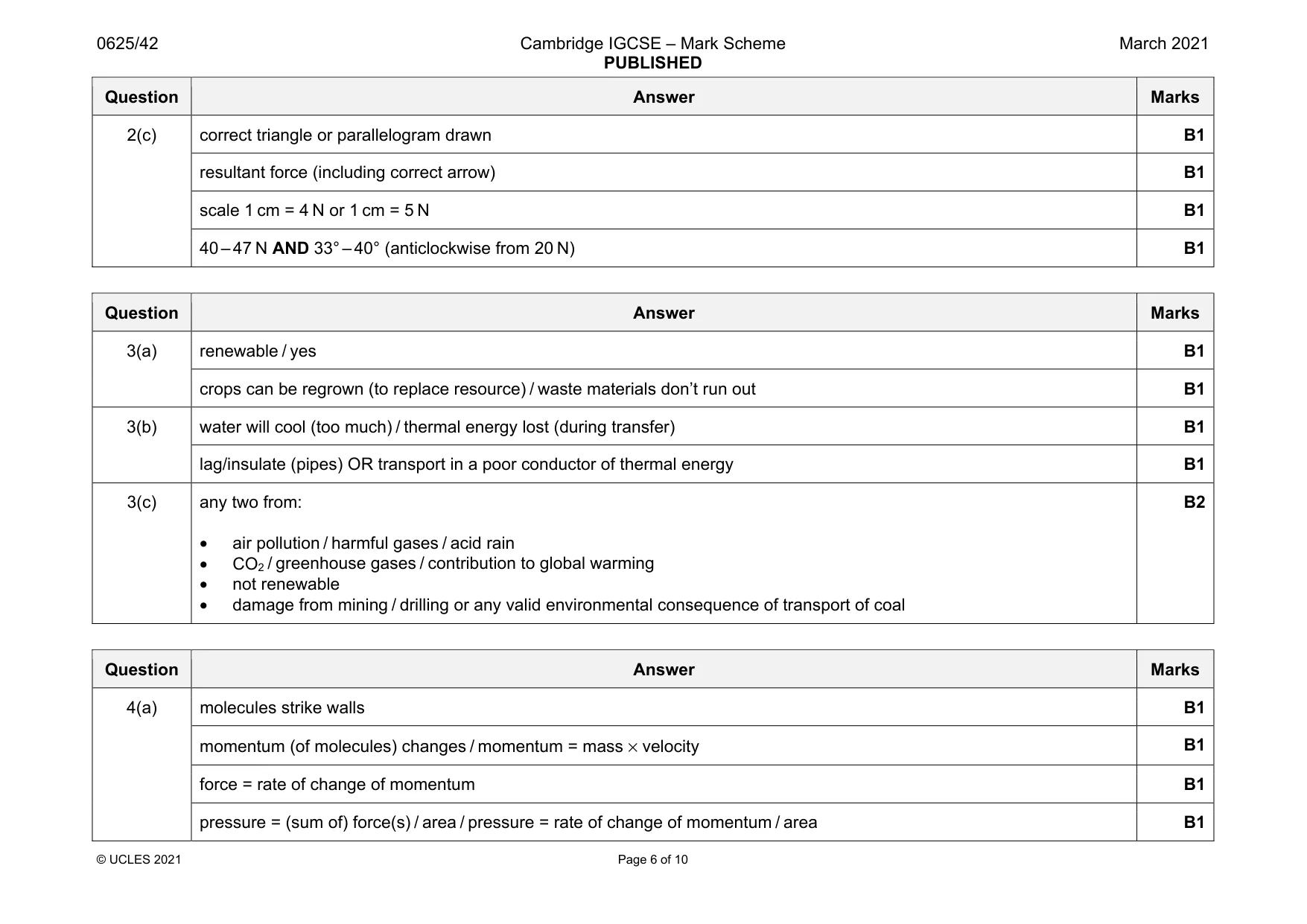
Mark scheme: 2(a)(i) (moment of a force) is the turning effect (about a point / pivot) B1 2(a)(ii) 2.8 × 10⁶ N m A2 (moment = ) Fd in any form C1 2(b)(i) scalar / speed has magnitude only OR scalar / speed has no direction B1 vector / velocity has magnitude and direction B1 2(b)(ii) any scalar quantity B1 any vector quantity B1 Question Answer Marks 2(c) correct triangle or parallelogram drawn B1 resultant force (including correct arrow) B1 scale 1 cm = 4 N or 1 cm = 5 N B1 40 – 47 N AND 33° – 40° (anticlockwise from 20 N) B1
Q3 · A power station burns waste materials from farm crops to generate electricity
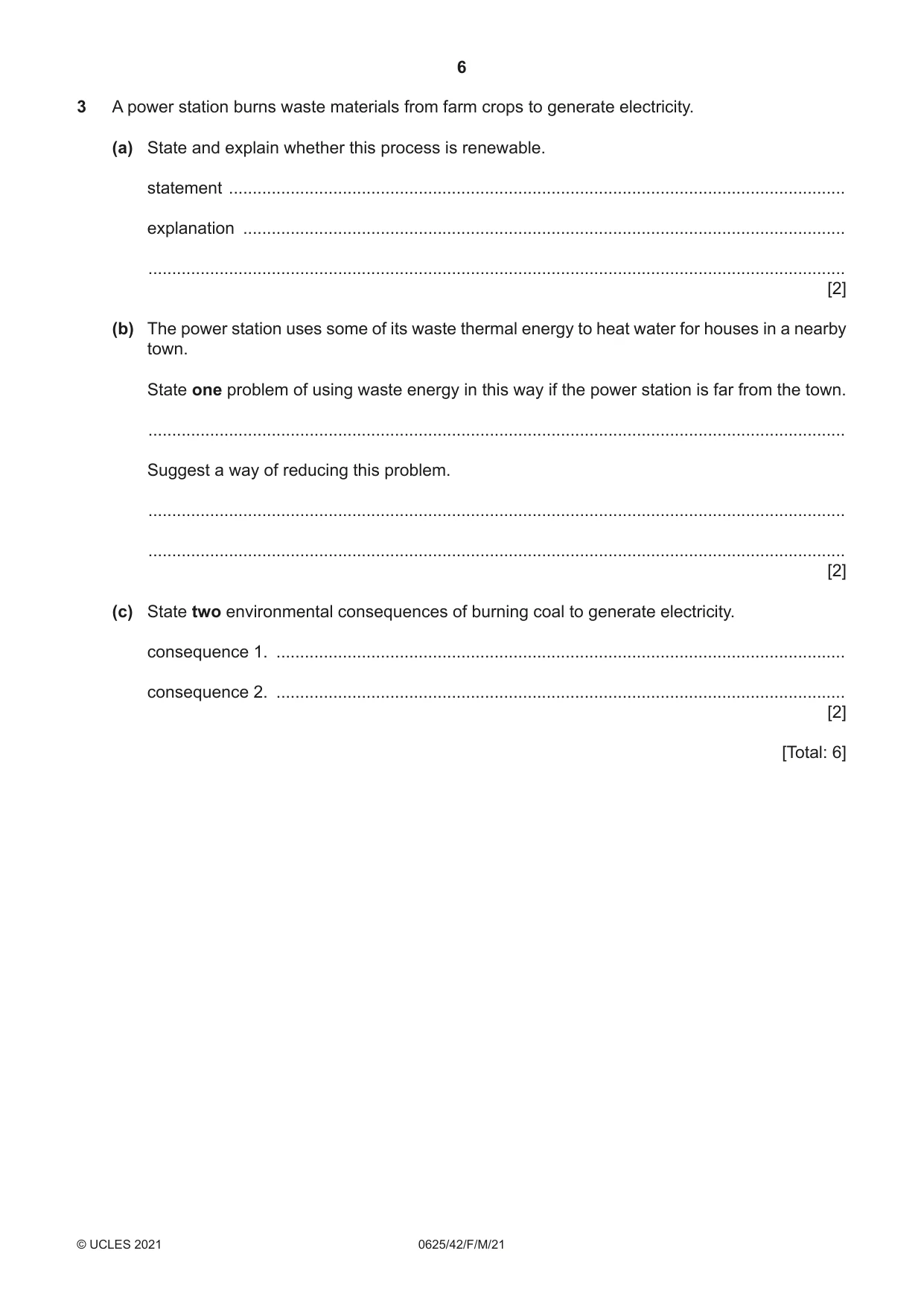
3 A power station burns waste materials from farm crops to generate electricity. (a) State and explain whether this process is renewable. statement .................................................................................................................................. explanation ............................................................................................................................... ................................................................................................................................................... [2] (b) The power station uses some of its waste thermal energy to heat water for houses in a nearby town. State one problem of using waste energy in this way if the power station is far from the town. ................................................................................................................................................... Suggest a way of reducing this problem. ................................................................................................................................................... ................................................................................................................................................... [2] (c) State two environmental consequences of burning coal to generate electricity. consequence 1. ........................................................................................................................ consequence 2. ........................................................................................................................ [2] [Total: 6]
Mark scheme: 3(a) renewable / yes B1 crops can be regrown (to replace resource) / waste materials don’t run out B1 3(b) water will cool (too much) / thermal energy lost (during transfer) B1 lag/insulate (pipes) OR transport in a poor conductor of thermal energy B1 3(c) any two from: • air pollution / harmful gases / acid rain • CO2 / greenhouse gases / contribution to global warming • not renewable • damage from mining / drilling or any valid environmental consequence of transport of coal B2
Q4 · In terms of the momentum of molecules, explain how a gas exerts pressure on the walls of…
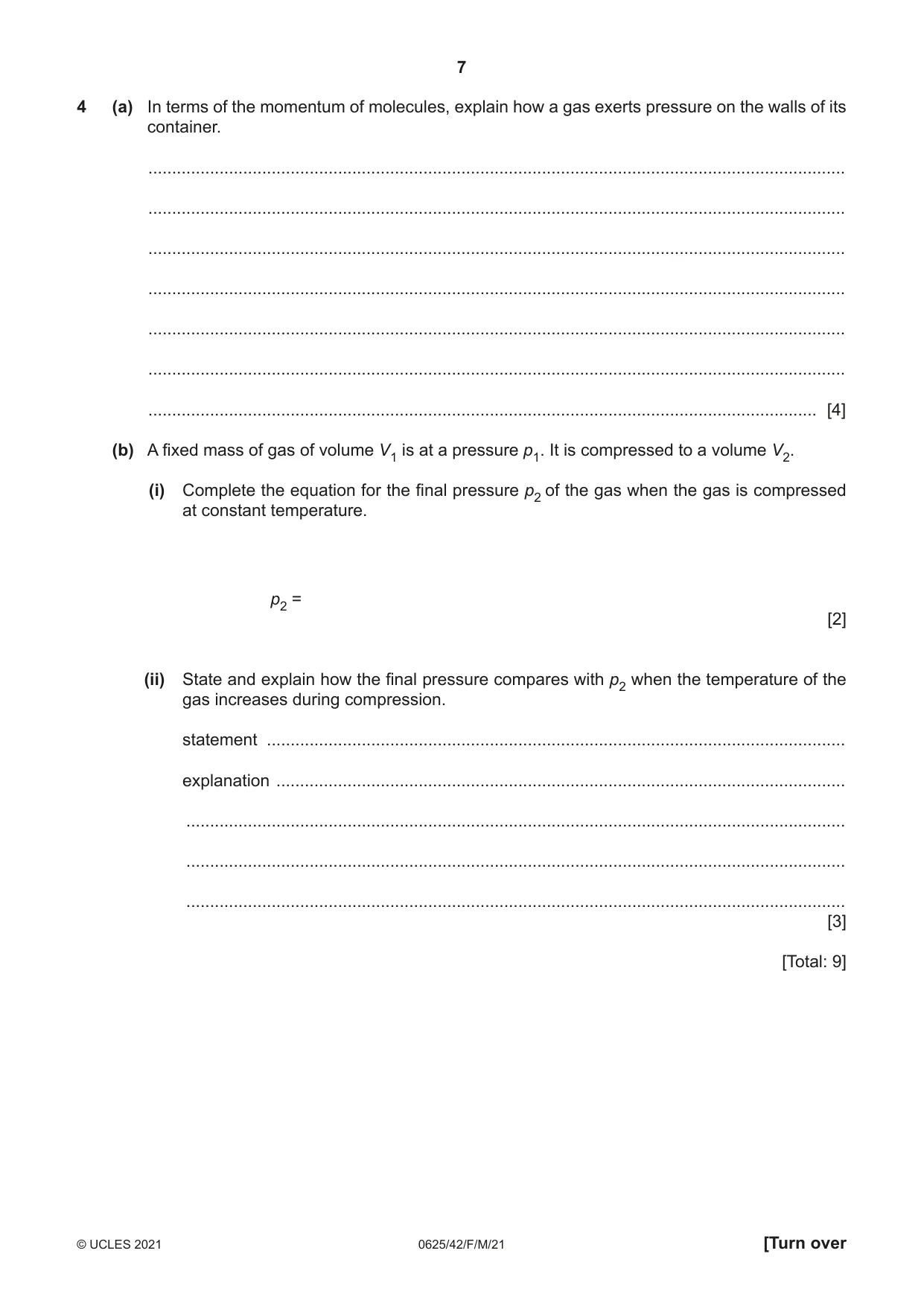
4 (a) In terms of the momentum of molecules, explain how a gas exerts pressure on the walls of its container. ................................................................................................................................................... ................................................................................................................................................... ................................................................................................................................................... ................................................................................................................................................... ................................................................................................................................................... ................................................................................................................................................... ............................................................................................................................................. [4] (b) A fixed mass of gas of volume V1 is at a pressure p1. It is compressed to a volume V2. (i) Complete the equation for the final pressure p2 of the gas when the gas is compressed at constant temperature. p2 = [2] (ii) State and explain how the final pressure compares with p2 when the temperature of the gas increases during compression. statement .......................................................................................................................... explanation ........................................................................................................................ ........................................................................................................................................... ........................................................................................................................................... ........................................................................................................................................... [3] [Total: 9]
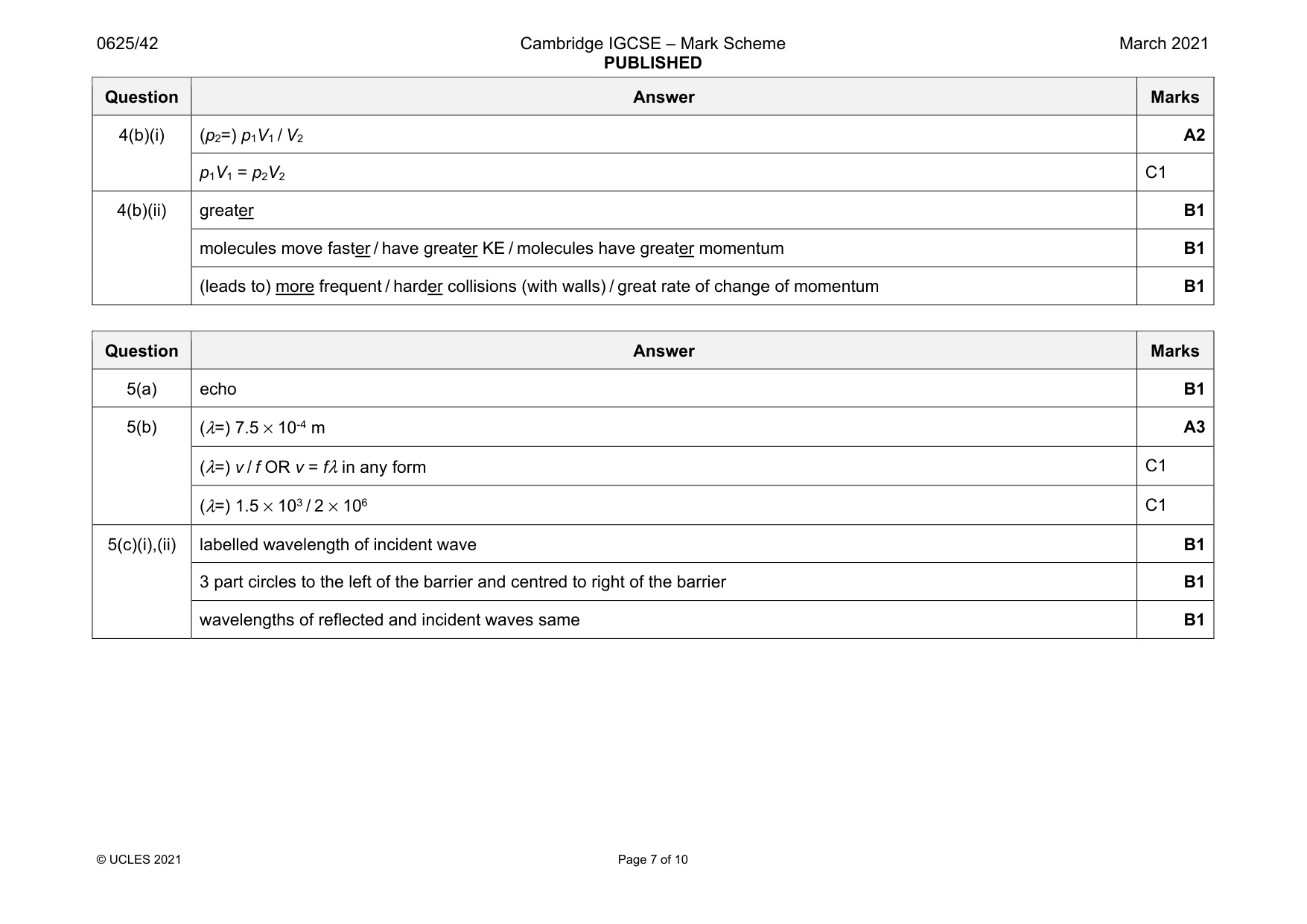
Mark scheme: 4(a) molecules strike walls B1 momentum (of molecules) changes / momentum = mass × velocity B1 force = rate of change of momentum B1 pressure = (sum of) force(s) / area / pressure = rate of change of momentum / area B1 Question Answer Marks 4(b)(i) (p2=) p1V1 / V2 A2 p1V1 = p2V2 C1 4(b)(ii) greater B1 molecules move faster / have greater KE / molecules have greater momentum B1 (leads to) more frequent / harder collisions (with walls) / great rate of change of momentum B1
Q5 · State the name of the reflection of a sound wave or ultrasound wave
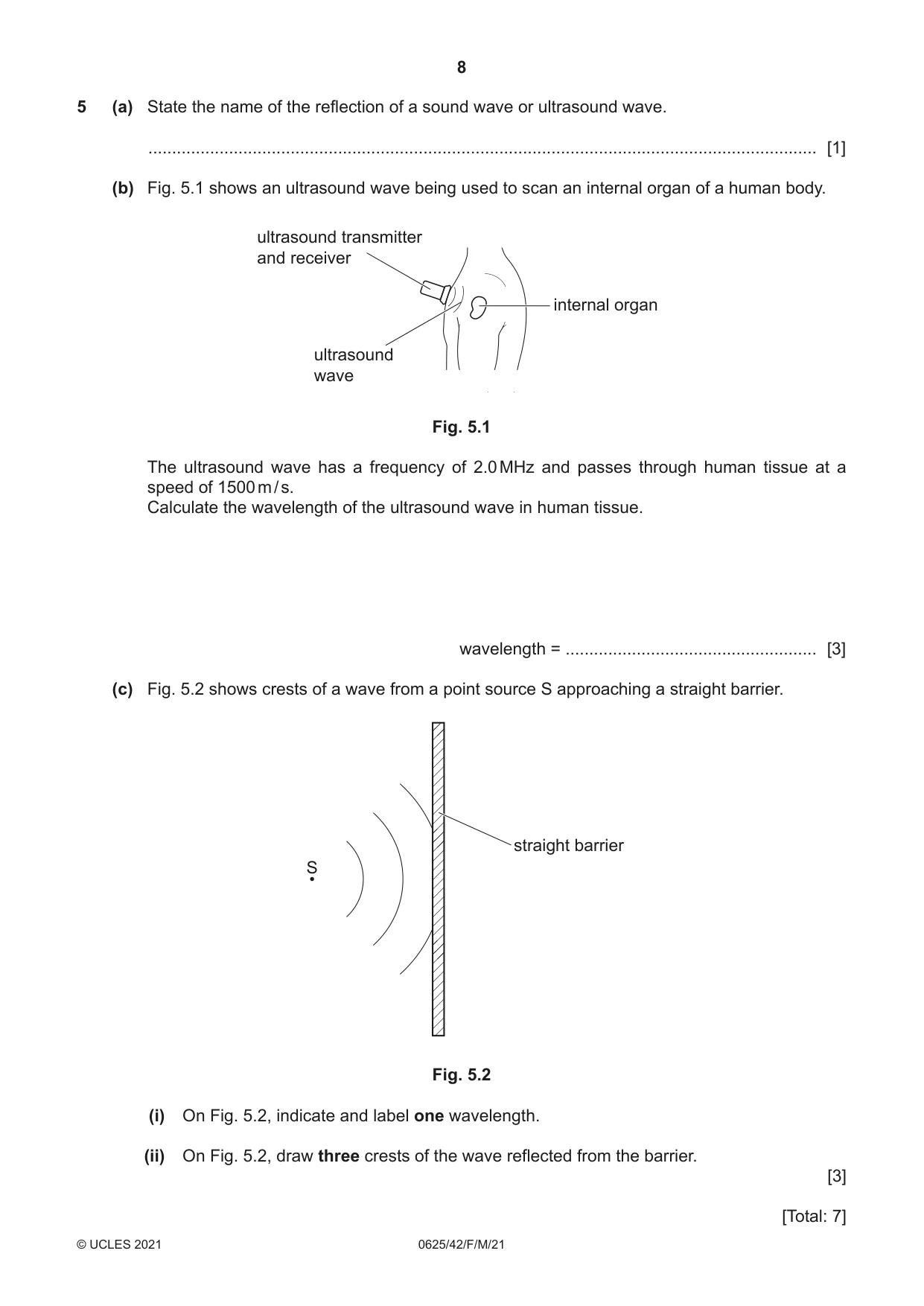
5 (a) State the name of the reflection of a sound wave or ultrasound wave. ............................................................................................................................................. [1] (b) Fig. 5.1 shows an ultrasound wave being used to scan an internal organ of a human body. ultrasound transmitter and receiver internal organ ultrasound wave Fig. 5.1 The ultrasound wave has a frequency of 2.0 MHz and passes through human tissue at a speed of 1500 m / s. Calculate the wavelength of the ultrasound wave in human tissue. wavelength = ..................................................... [3] (c) Fig. 5.2 shows crests of a wave from a point source S approaching a straight barrier. straight barrier S Fig. 5.2 (i) On Fig. 5.2, indicate and label one wavelength. (ii) On Fig. 5.2, draw three crests of the wave reflected from the barrier. [3] [Total: 7]
Mark scheme: 5(a) echo B1 5(b) (λ=) 7.5 × 10⁻⁴ m A3 (λ=) v / f OR v = fλ in any form C1 (λ=) 1.5 × 10³ / 2 × 10⁶ C1 5(c)(i),(ii) labelled wavelength of incident wave B1 3 part circles to the left of the barrier and centred to right of the barrier B1 wavelengths of reflected and incident waves same B1
Q6 · A full scale diagram showing a converging lens, the two principal focuses F1 and F2 and…
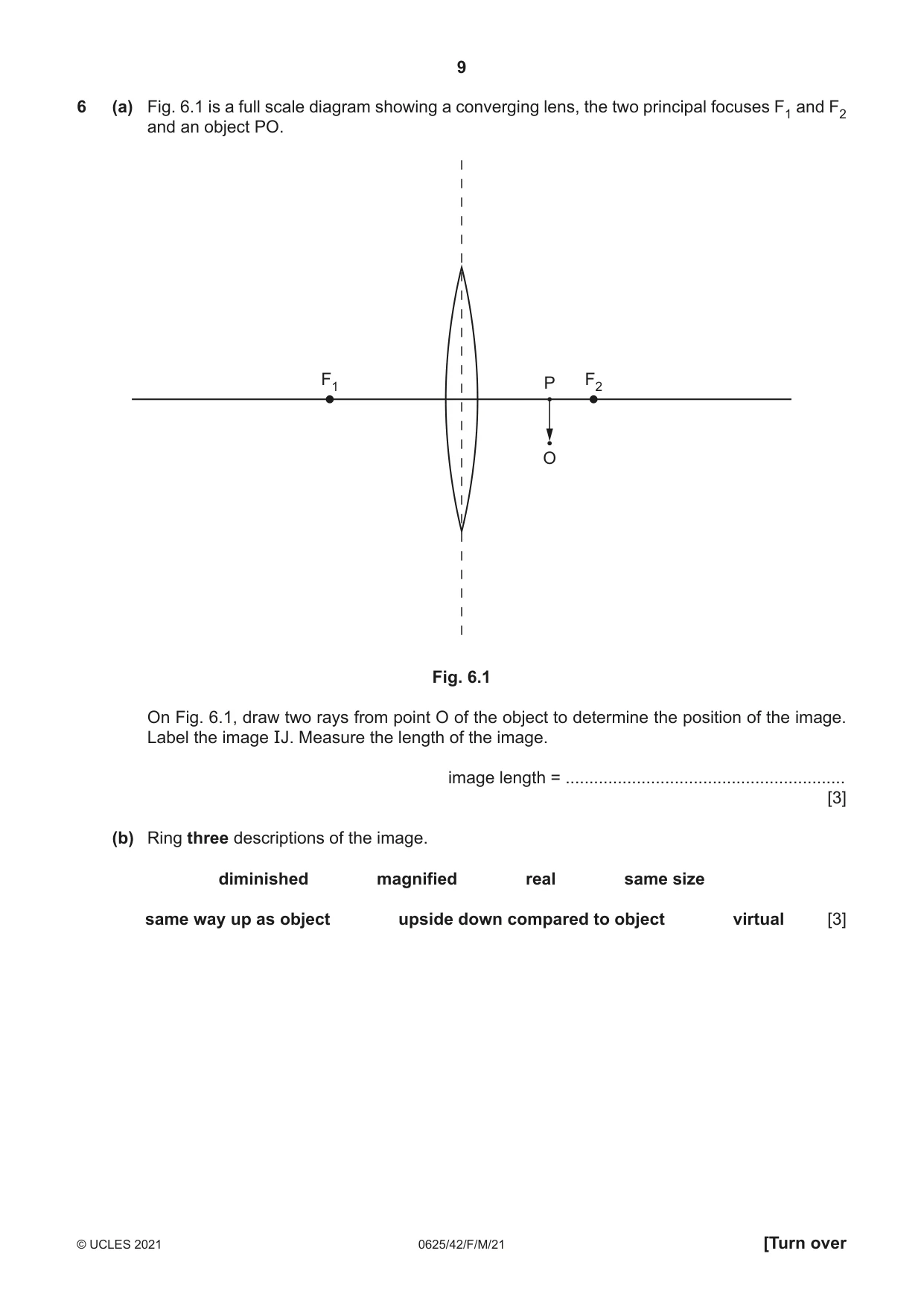
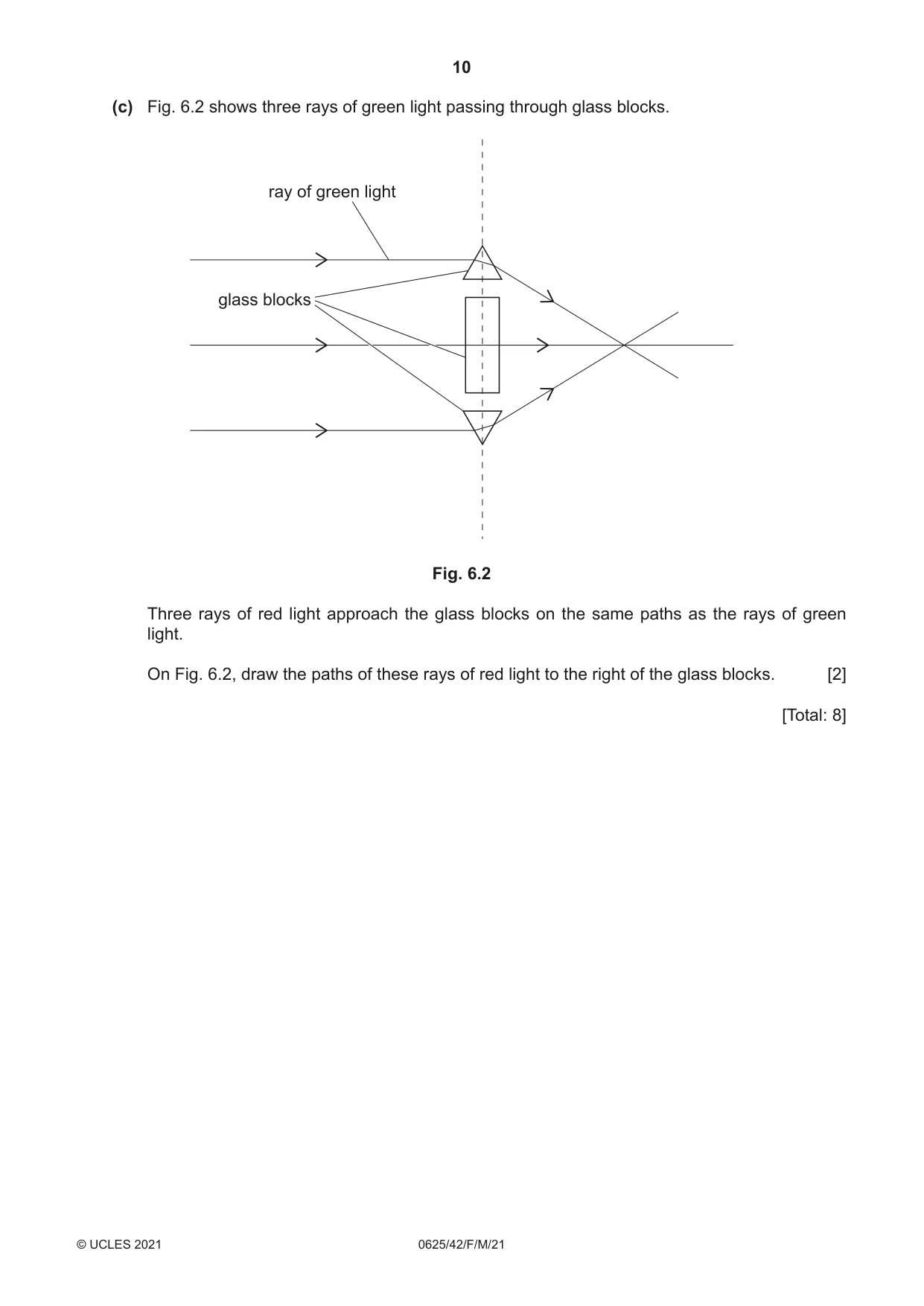
6 (a) Fig. 6.1 is a full scale diagram showing a converging lens, the two principal focuses F1 and F2 and an object PO. F1 P F2 O Fig. 6.1 On Fig. 6.1, draw two rays from point O of the object to determine the position of the image. Label the image IJ. Measure the length of the image. image length = ........................................................... [3] (b) Ring three descriptions of the image. diminished magnified real same size same way up as object upside down compared to object virtual [3] (c) Fig. 6.2 shows three rays of green light passing through glass blocks. ray of green light glass blocks Fig. 6.2 Three rays of red light approach the glass blocks on the same paths as the rays of green light. On Fig. 6.2, draw the paths of these rays of red light to the right of the glass blocks. [2] [Total: 8]
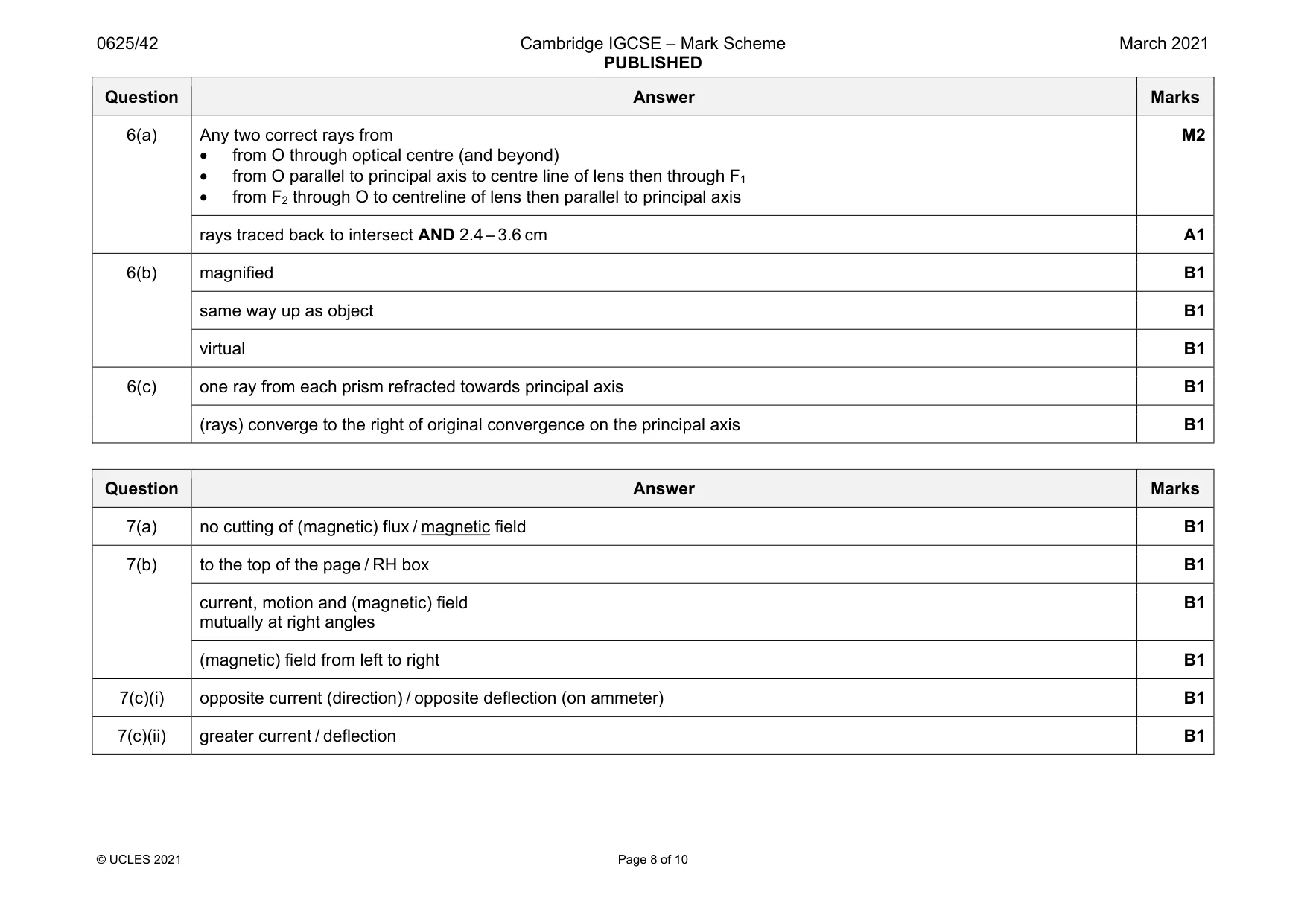
Mark scheme: 6(a) Any two correct rays from • from O through optical centre (and beyond) • from O parallel to principal axis to centre line of lens then through F1 • from F2 through O to centreline of lens then parallel to principal axis M2 rays traced back to intersect AND 2.4 – 3.6 cm A1 6(b) magnified B1 same way up as object B1 virtual B1 6(c) one ray from each prism refracted towards principal axis B1 (rays) converge to the right of original convergence on the principal axis B1
Q7 · A horizontal conducting wire XY between two opposite magnetic poles
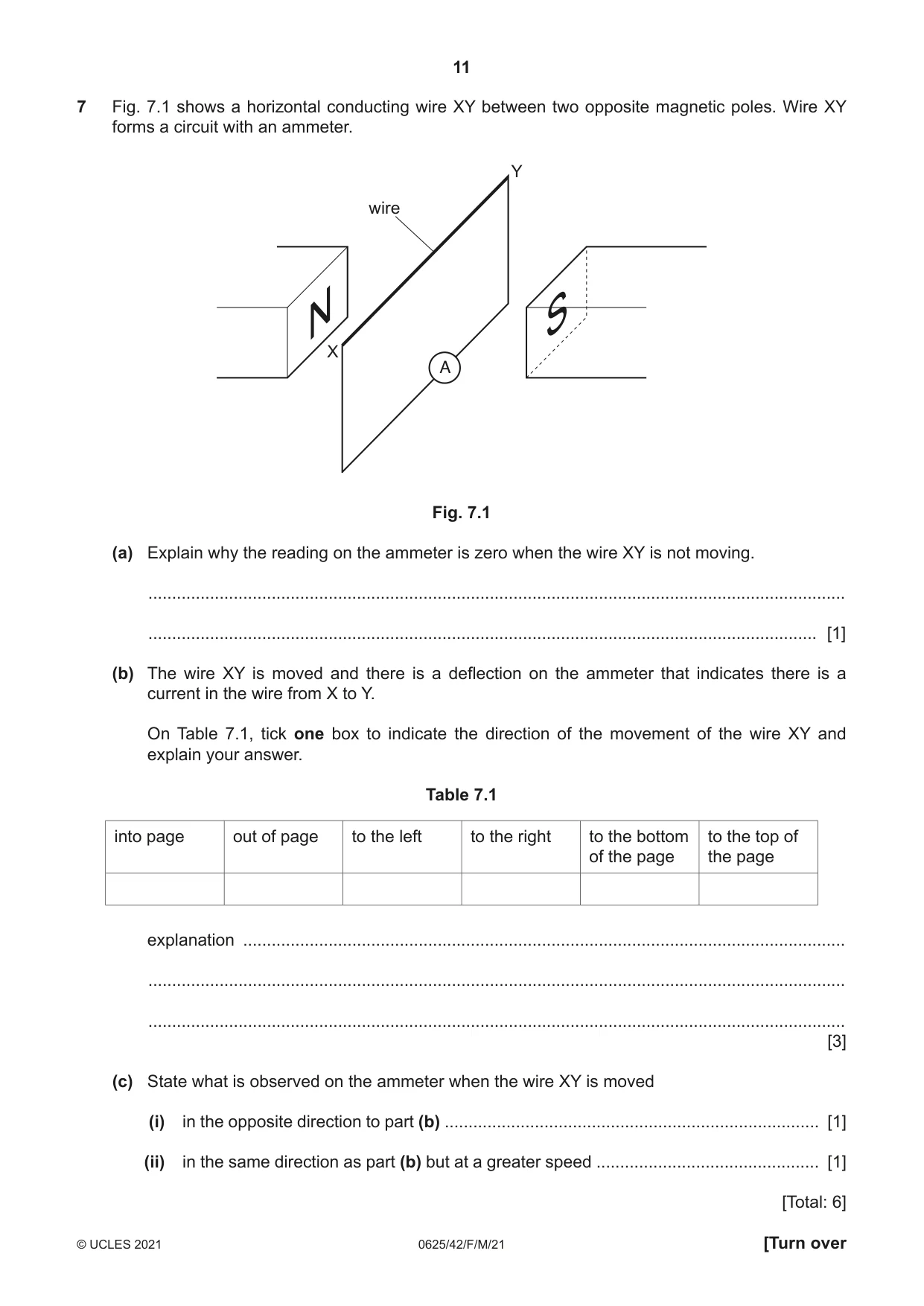
7 Fig. 7.1 shows a horizontal conducting wire XY between two opposite magnetic poles. Wire XY forms a circuit with an ammeter. Y wire NX S A Fig. 7.1 (a) Explain why the reading on the ammeter is zero when the wire XY is not moving. ................................................................................................................................................... ............................................................................................................................................. [1] (b) The wire XY is moved and there is a deflection on the ammeter that indicates there is a current in the wire from X to Y. On Table 7.1, tick one box to indicate the direction of the movement of the wire XY and explain your answer. Table 7.1 into page out of page to the left to the right to the bottom to the top of of the page the page explanation ............................................................................................................................... ................................................................................................................................................... ................................................................................................................................................... [3] (c) State what is observed on the ammeter when the wire XY is moved (i) in the opposite direction to part (b) ............................................................................... [1] (ii) in the same direction as part (b) but at a greater speed ............................................... [1] [Total: 6]
Mark scheme: 7(a) no cutting of (magnetic) flux / magnetic field B1 7(b) to the top of the page / RH box B1 current, motion and (magnetic) field mutually at right angles B1 (magnetic) field from left to right B1 7(c)(i) opposite current (direction) / opposite deflection (on ammeter) B1 7(c)(ii) greater current / deflection B1
Q8 · Define electromotive force (e.m.f.)
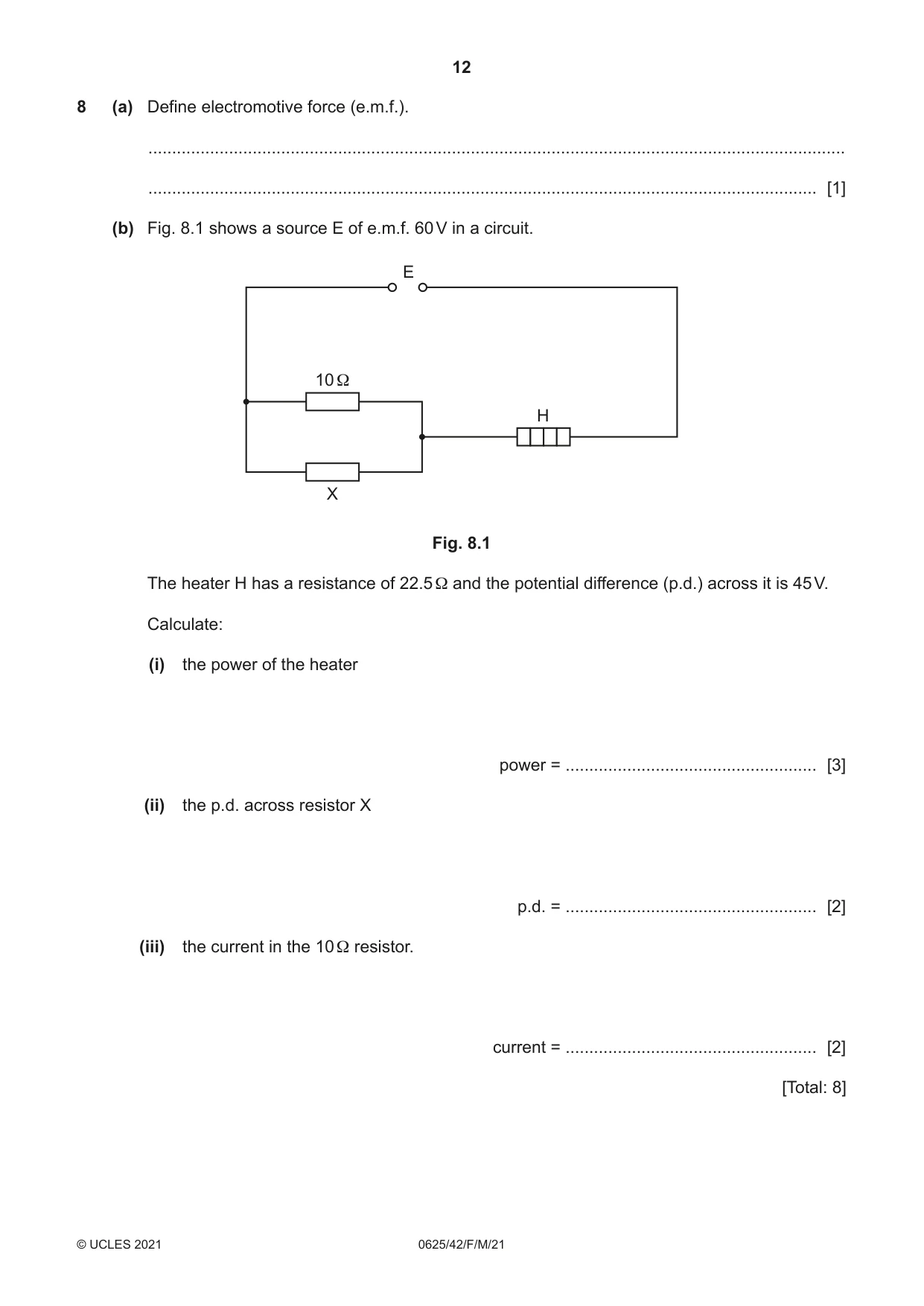
8 (a) Define electromotive force (e.m.f.). ................................................................................................................................................... ............................................................................................................................................. [1] (b) Fig. 8.1 shows a source E of e.m.f. 60 V in a circuit. E 10 Ω H X Fig. 8.1 The heater H has a resistance of 22.5 Ω and the potential difference (p.d.) across it is 45 V. Calculate: (i) the power of the heater power = ..................................................... [3] (ii) the p.d. across resistor X p.d. = ..................................................... [2] (iii) the current in the 10 Ω resistor. current = ..................................................... [2] [Total: 8]
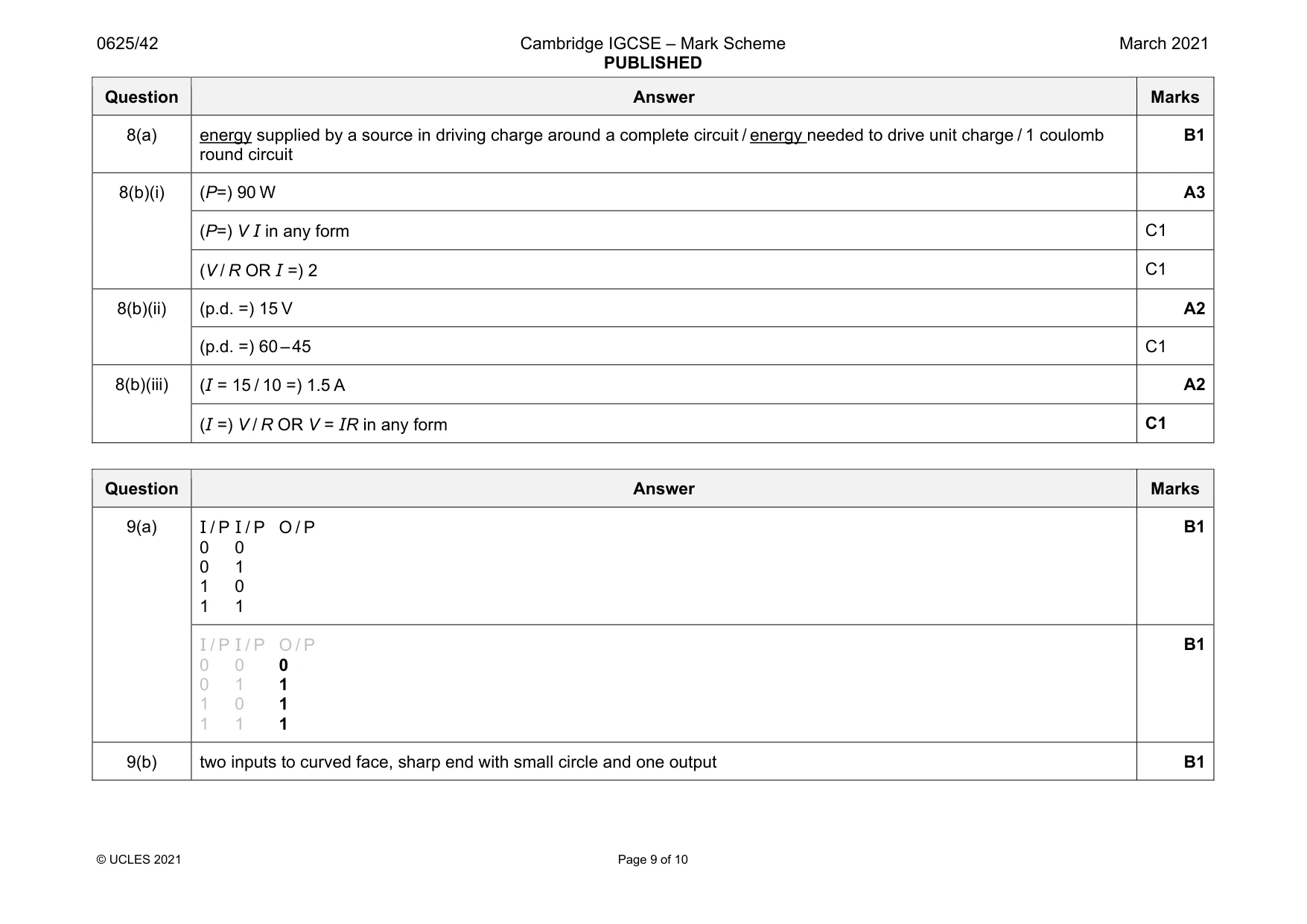
Mark scheme: 8(a) energy supplied by a source in driving charge around a complete circuit / energy needed to drive unit charge / 1 coulomb round circuit B1 8(b)(i) (P=) 90 W A3 (P=) V I in any form C1 (V / R OR I =) 2 C1 8(b)(ii) (p.d. =) 15 V A2 (p.d. =) 60 – 45 C1 8(b)(iii) (I = 15 / 10 =) 1.5 A A2 (I =) V / R OR V = IR in any form C1
Q9 · Write down the truth table for an OR gate
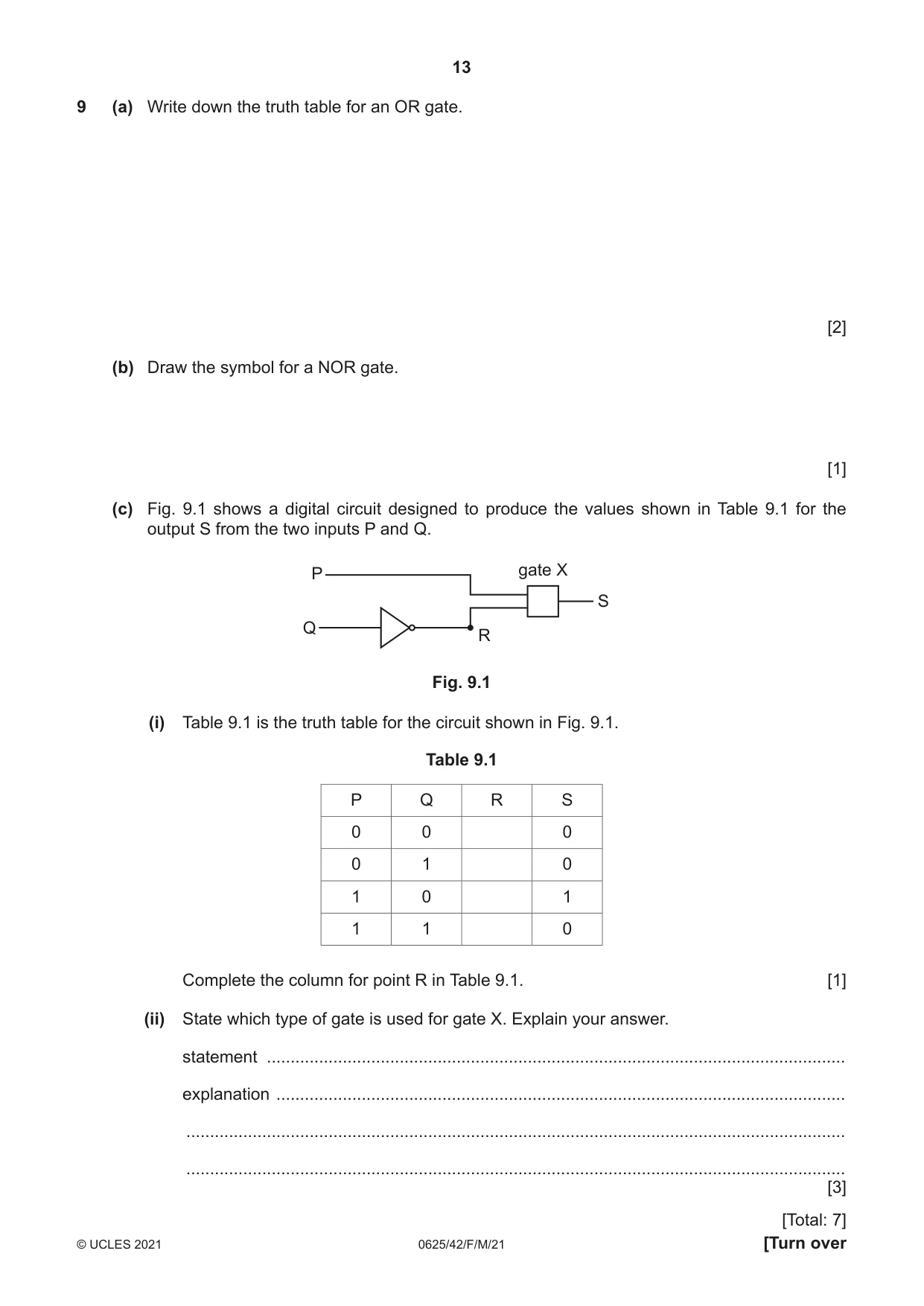
9 (a) Write down the truth table for an OR gate. [2] (b) Draw the symbol for a NOR gate. [1] (c) Fig. 9.1 shows a digital circuit designed to produce the values shown in Table 9.1 for the output S from the two inputs P and Q. P gate X S Q R Fig. 9.1 (i) Table 9.1 is the truth table for the circuit shown in Fig. 9.1. Table 9.1 P Q R S 0 0 0 0 1 0 1 0 1 1 1 0 Complete the column for point R in Table 9.1. [1] (ii) State which type of gate is used for gate X. Explain your answer. statement .......................................................................................................................... explanation ........................................................................................................................ ........................................................................................................................................... ........................................................................................................................................... [3] [Total: 7]
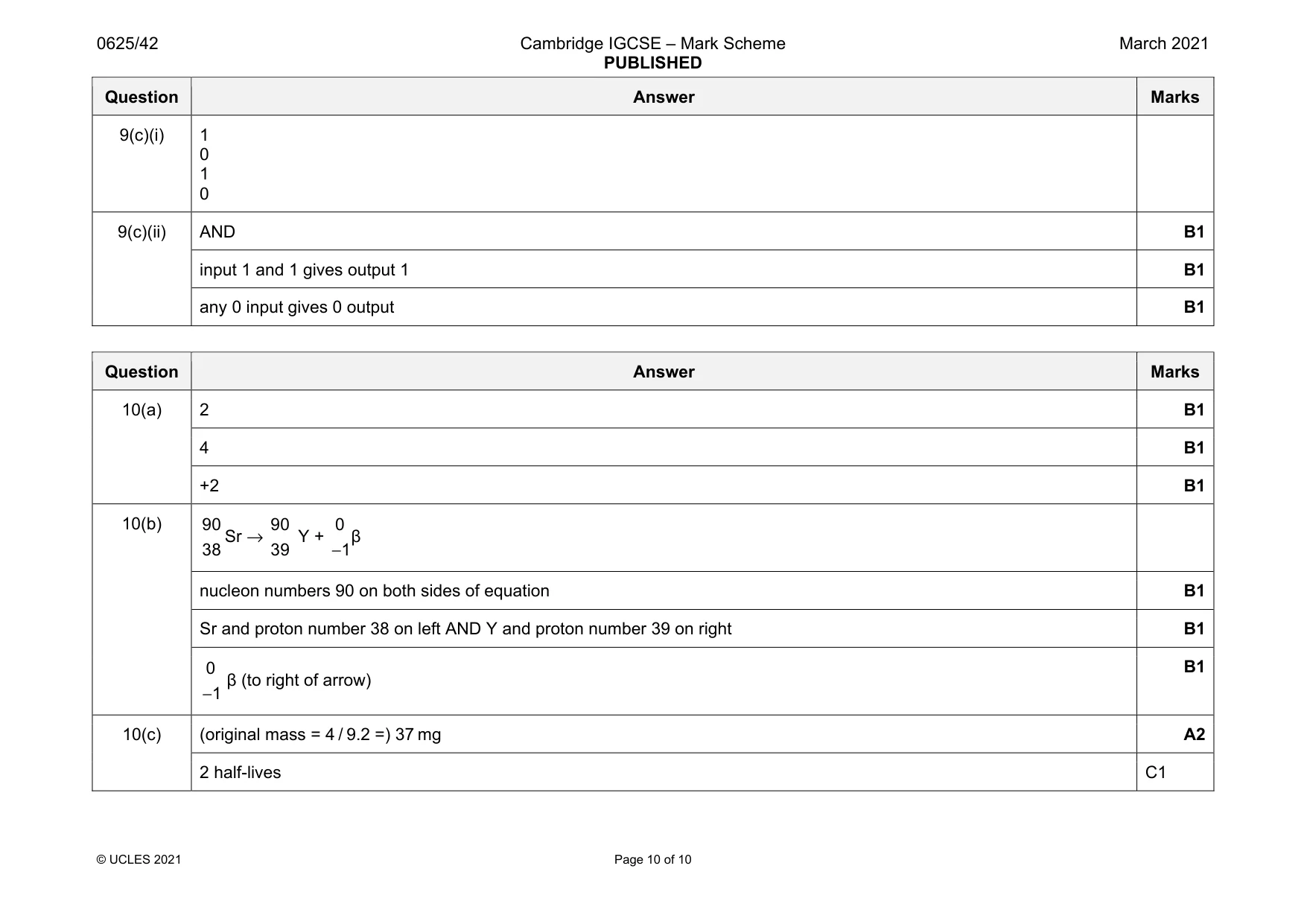
Mark scheme: 9(a) 0 0 0 1 1 0 1 1 I / P I / P O / P 0 0 0 0 1 1 1 0 1 1 1 1 B1 9(b) two inputs to curved face, sharp end with small circle and one output B1 Question Answer Marks 9(c)(i) 1 0 1 0 9(c)(ii) AND B1 input 1 and 1 gives output 1 B1 any 0 input gives 0 output B1
Q10 · State the proton number, nucleon number and the value of the charge on an α-particle
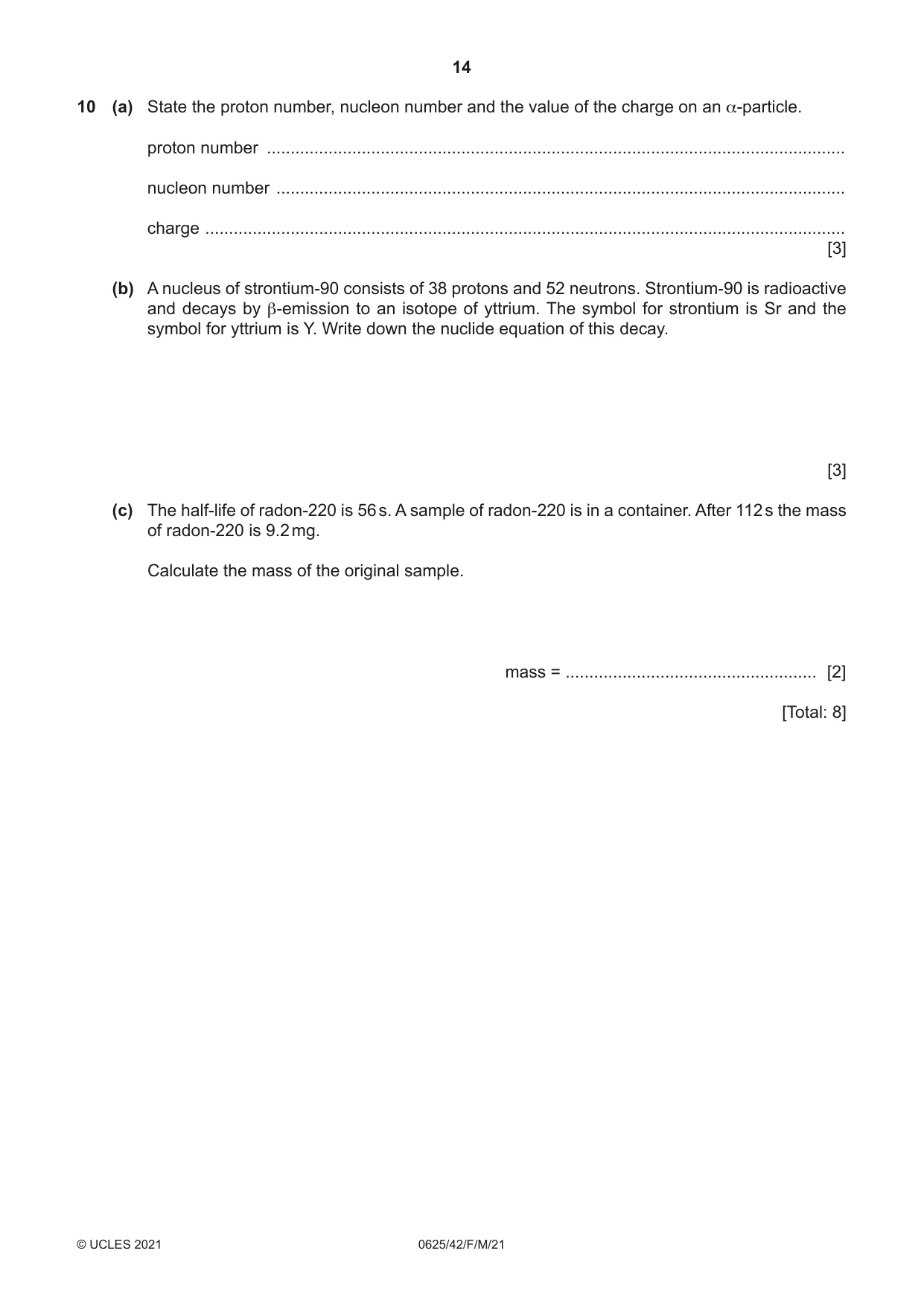
10 (a) State the proton number, nucleon number and the value of the charge on an α-particle. proton number .......................................................................................................................... nucleon number ........................................................................................................................ charge ....................................................................................................................................... [3] (b) A nucleus of strontium-90 consists of 38 protons and 52 neutrons. Strontium-90 is radioactive and decays by β-emission to an isotope of yttrium. The symbol for strontium is Sr and the symbol for yttrium is Y. Write down the nuclide equation of this decay. [3] (c) The half-life of radon-220 is 56 s. A sample of radon-220 is in a container. After 112 s the mass of radon-220 is 9.2 mg. Calculate the mass of the original sample. mass = ..................................................... [2] [Total: 8]
Mark scheme: 10(a) 2 B1 4 B1 +2 B1 10(b) 90 38 Sr → 90 39 Y + − 0 1β nucleon numbers 90 on both sides of equation B1 Sr and proton number 38 on left AND Y and proton number 39 on right B1 − 0 1 β (to right of arrow) B1 10(c) (original mass = 4 / 9.2 =) 37 mg A2 2 half-lives C1
What was in this paper
The subtopics covered by these 10 questions, and how many questions each got. Open one in a new tab to see every Cambridge question on it.
What you needed in this session
Cambridge’s own grade thresholds for 2021 Feb/March, Paper 4 · Variant 2. A higher threshold means an easier paper — the bar moves with how the cohort did.