Cambridge IGCSE Physics 0625 — 2025 May/June Paper 4 · Variant 2
0625/42/M/J/25 · 10 questions · 80 marks · ≈90 min
The question paper and its mark scheme, free to read here and free to download. This is Cambridge’s own paper, exactly as it was sat.
Question paper20 pages
Mark scheme19 pages
Answers below. Sit the paper first if you are practising.
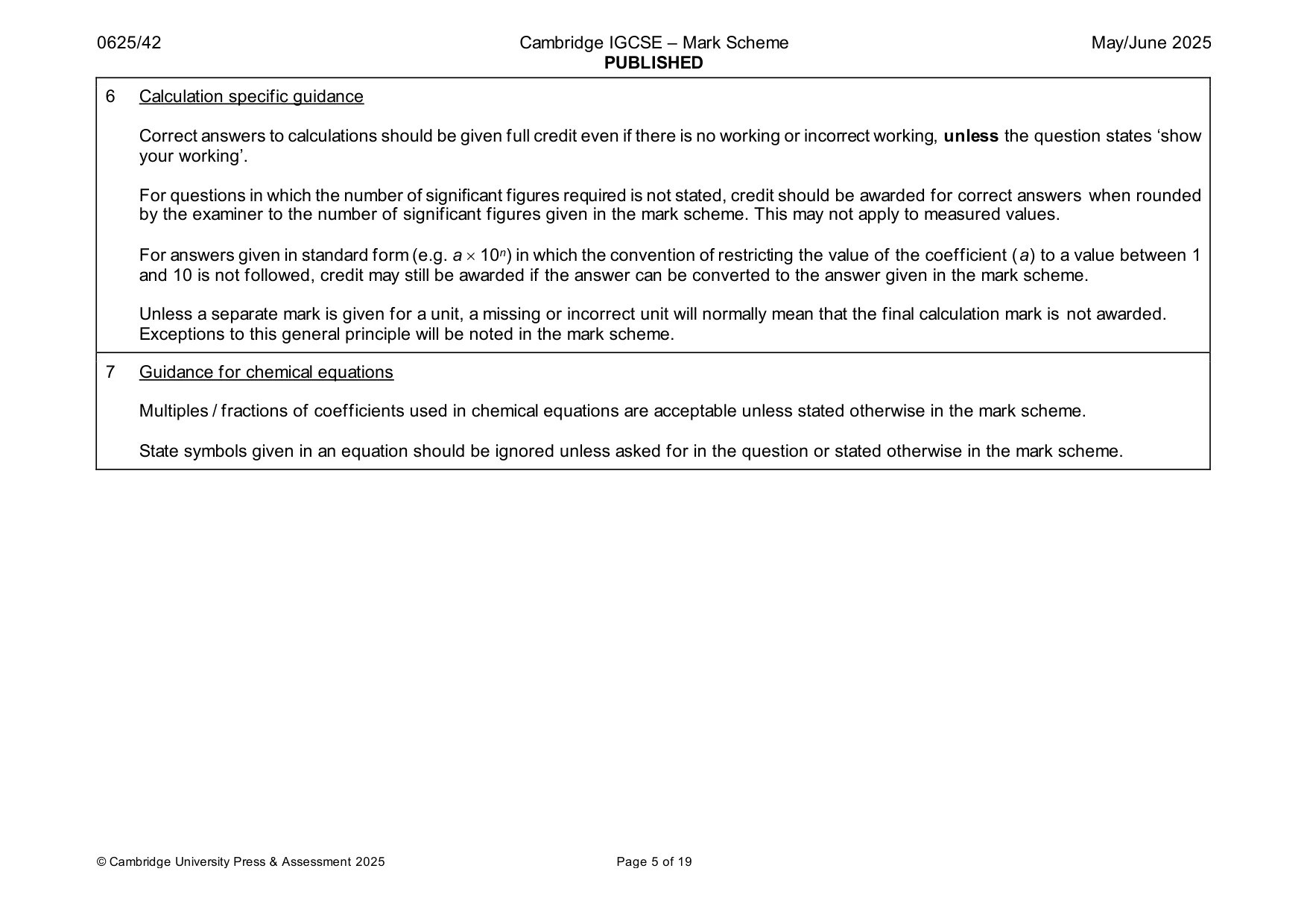
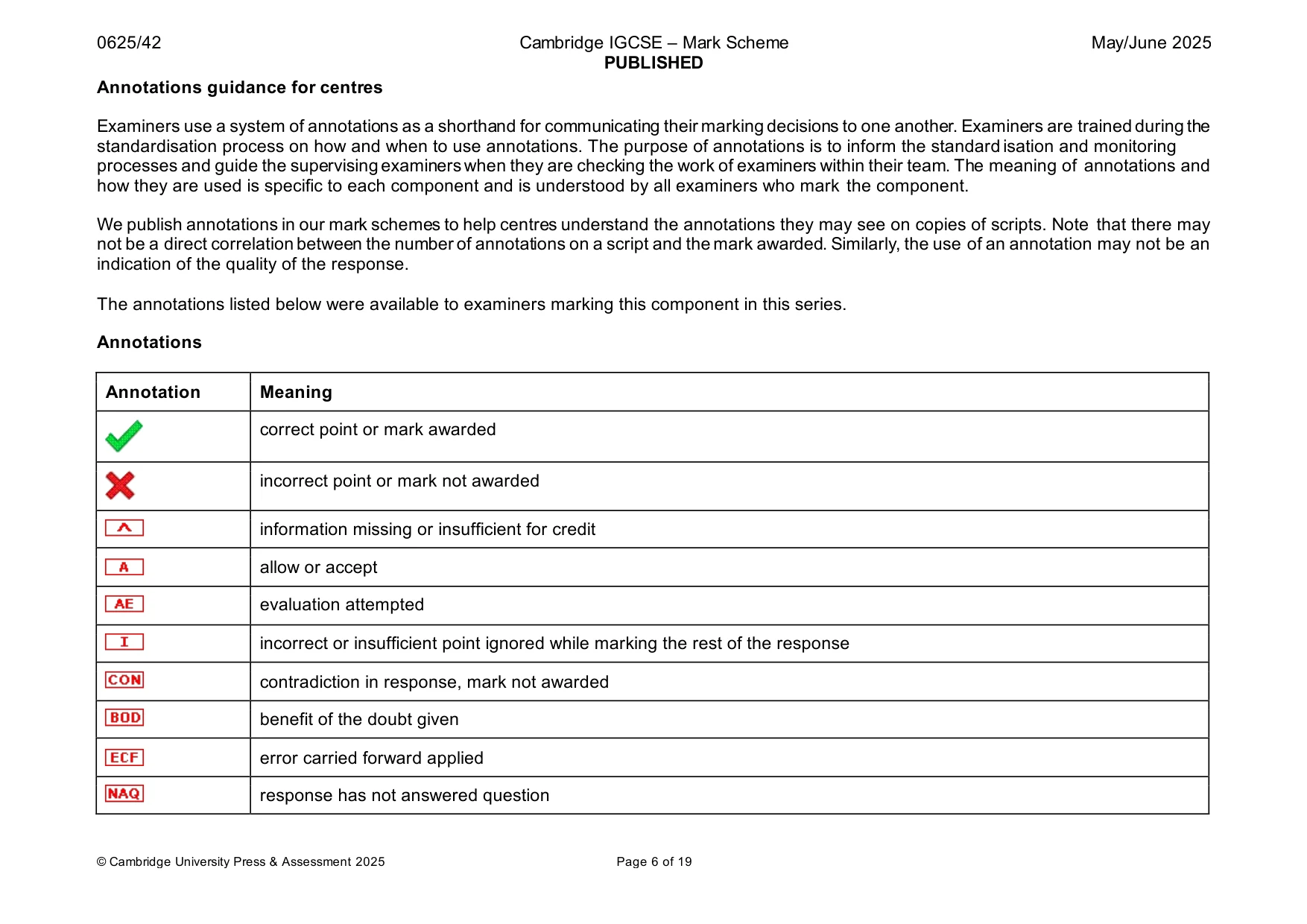
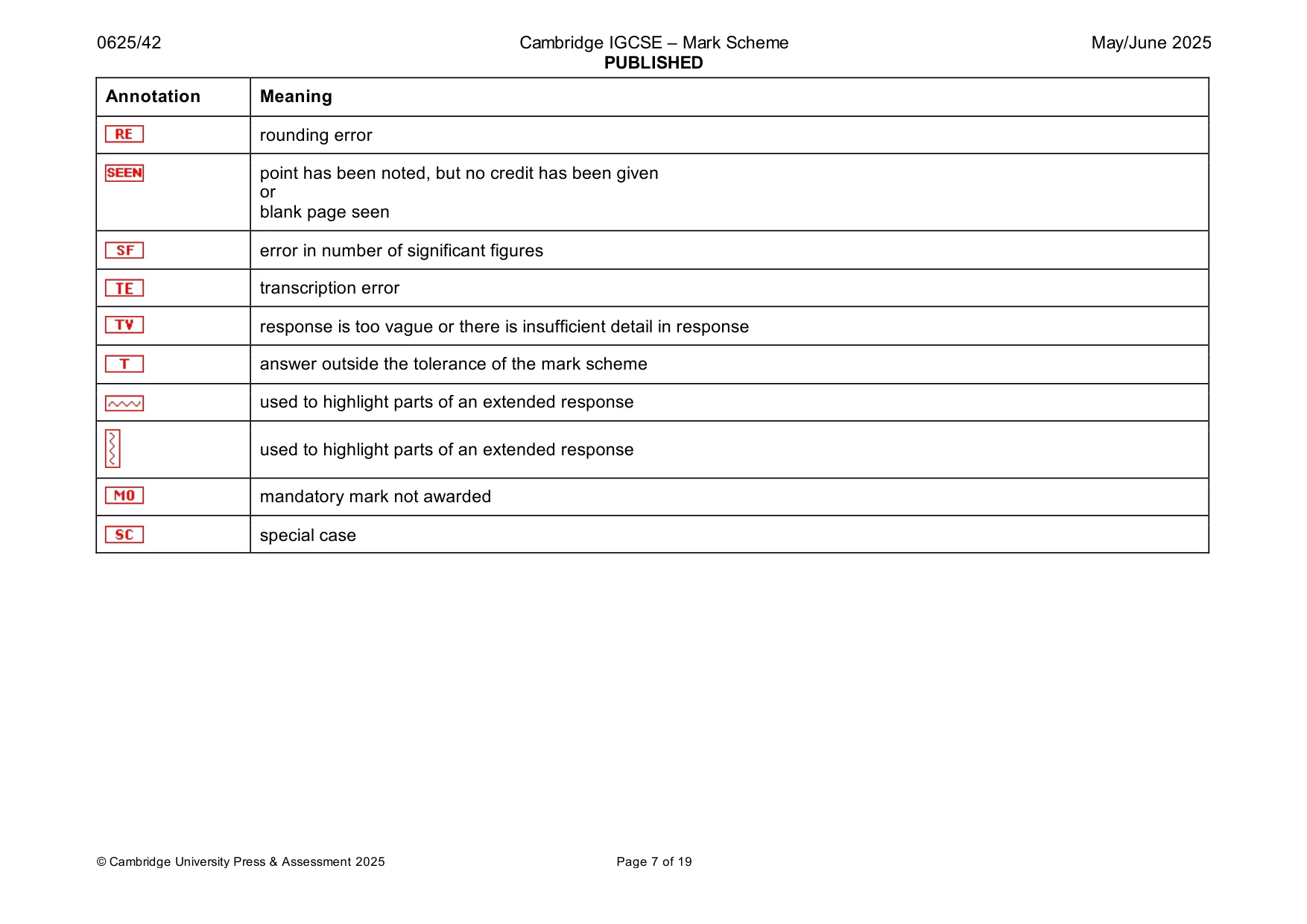
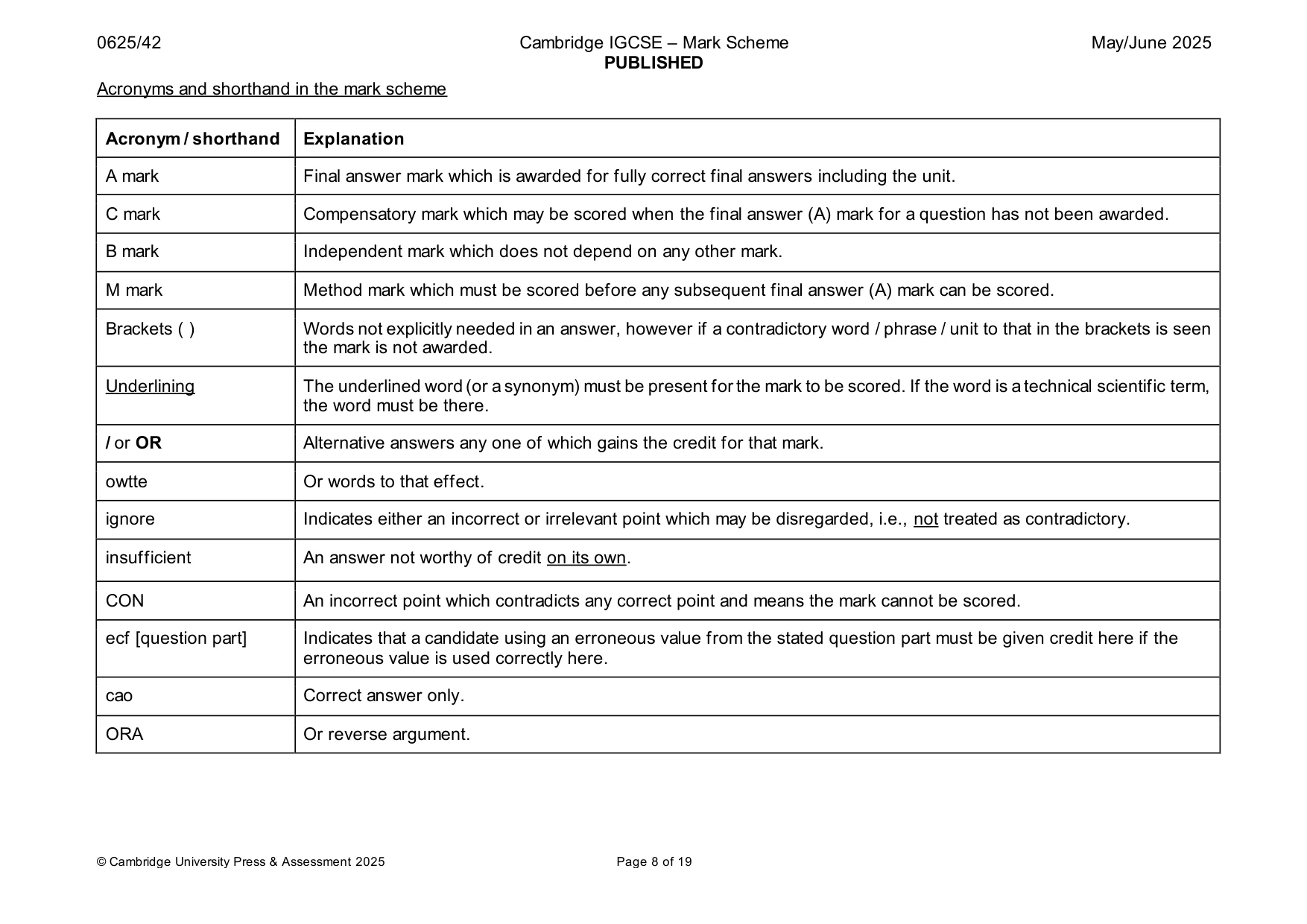
Questions as text
Q1 · A speed–time graph for an ice skater
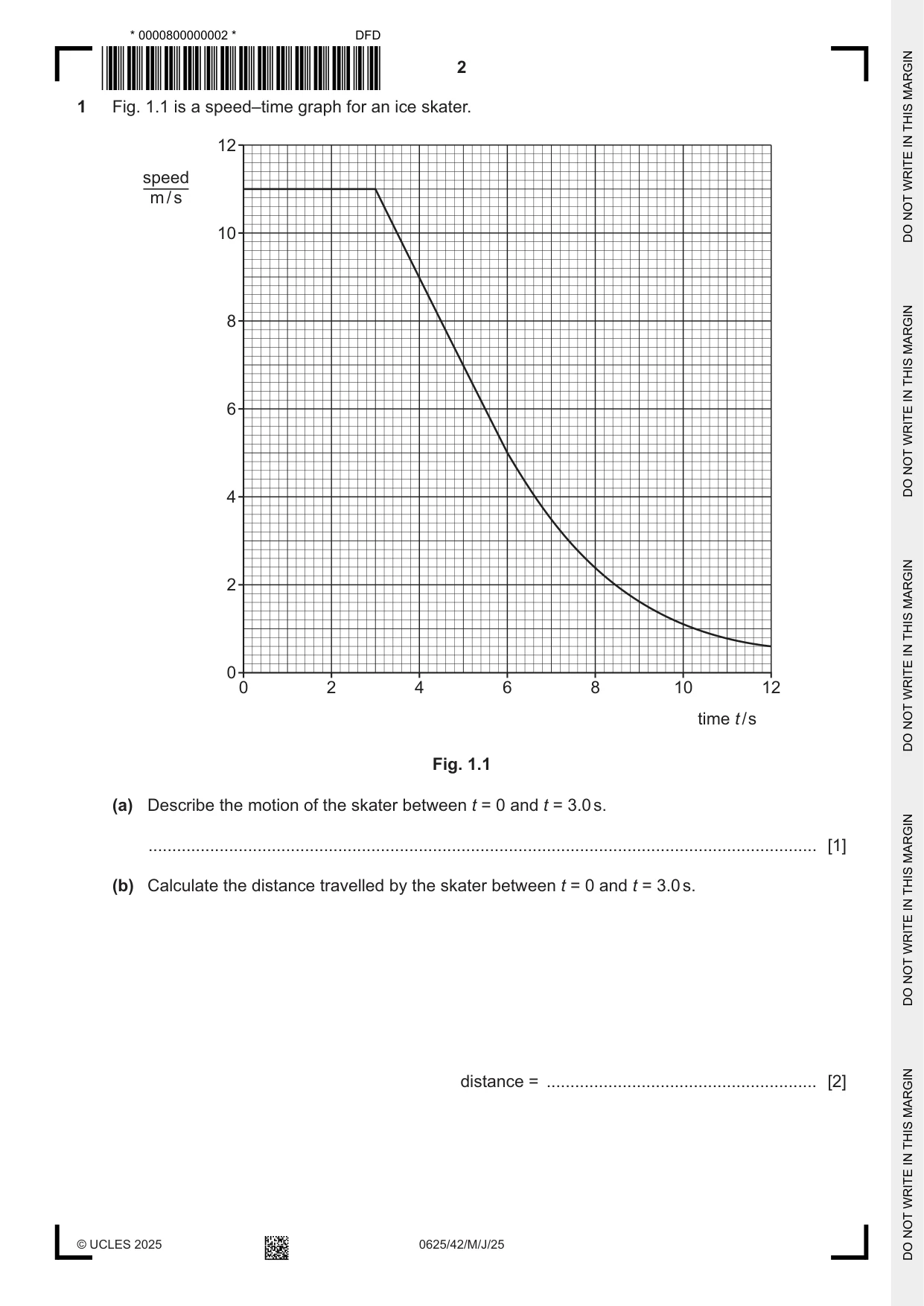
1 Fig. 1.1 is a speed–time graph for an ice skater. 12 speed m / s 10 8 6 4 2 0 0 2 4 6 8 10 12 time t / s Fig. 1.1 (a) Describe the motion of the skater between t = 0 and t = 3.0 s. ............................................................................................................................................. [1] (b) Calculate the distance travelled by the skater between t = 0 and t = 3.0 s. distance = ......................................................... [2] (c) (i) State what is meant by deceleration. ..................................................................................................................................... [1] (ii) Draw a tangent to the graph at t = 9.0 s. Use the tangent to calculate the deceleration of the skater at t = 9.0 s. deceleration = ......................................................... [3] [Total: 7]
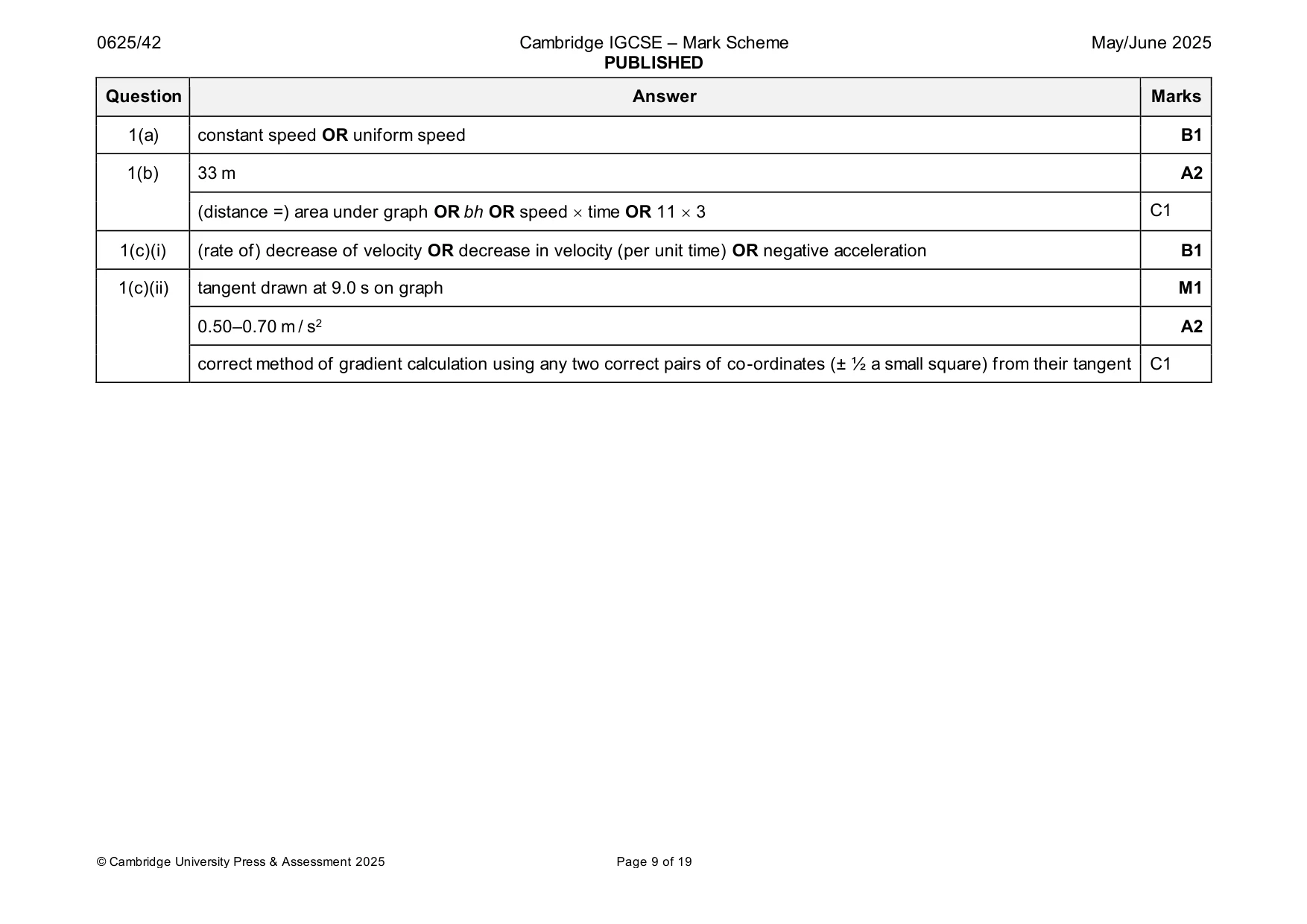
Mark scheme: Question Answer Marks 1(a) constant speed OR uniform speed B1 1(b) 33 m A2 (distance =) area under graph OR bh OR speed time OR 11 3 C1 1(c)(i) (rate of) decrease of velocity OR decrease in velocity (per unit time) OR negative acceleration B1 1(c)(ii) tangent drawn at 9.0 s on graph M1 0.50–0.70 m / s2 A2 correct method of gradient calculation using any two correct pairs of co-ordinates (± ½ a small square) from their tangent C1
Q2 · A balanced, uniform metre ruler made of wood
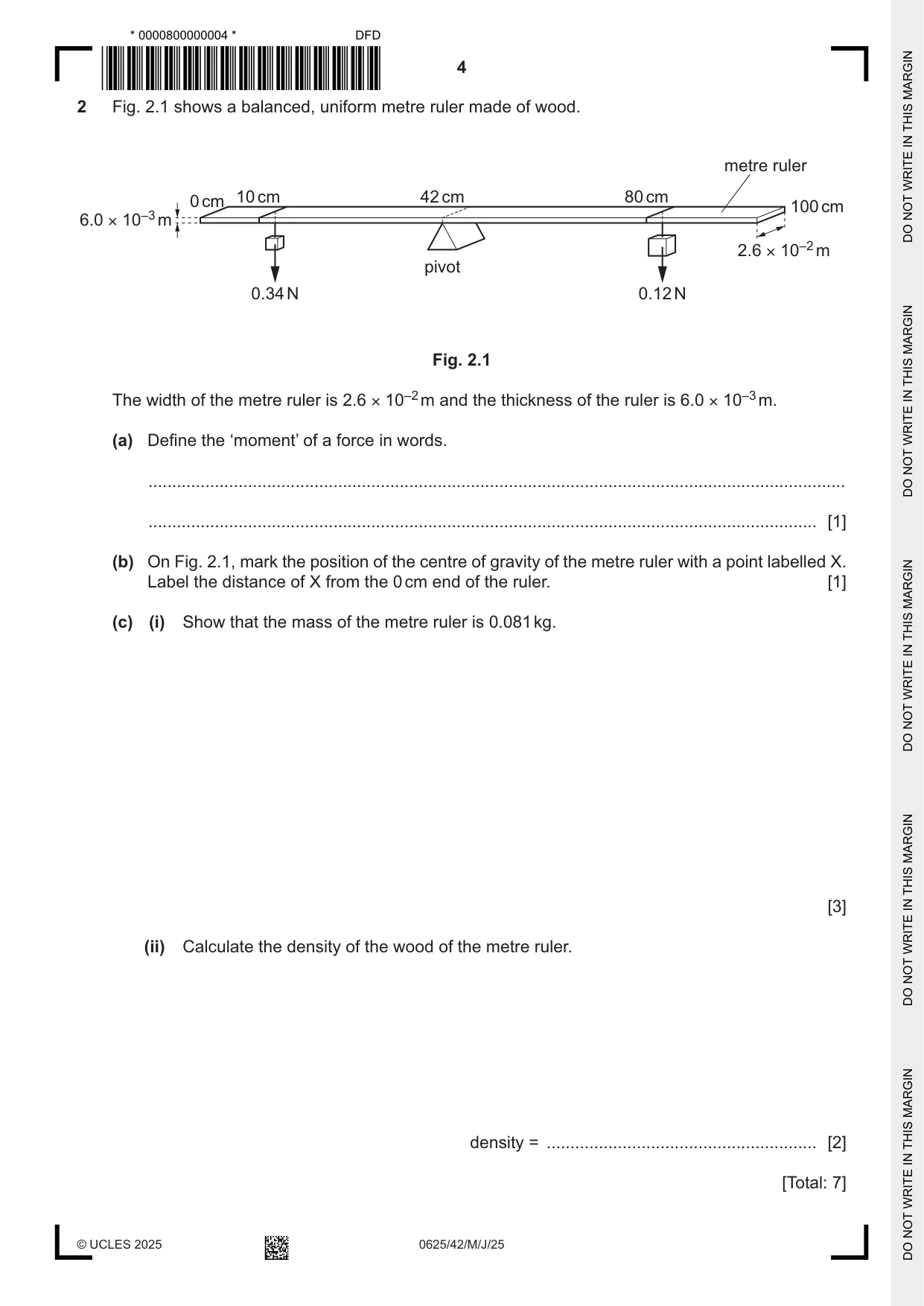
2 Fig. 2.1 shows a balanced, uniform metre ruler made of wood. metre ruler 0 cm 10 cm 42 cm 80 cm 100 cm 6.0 × 10⁻³ m 2.6 × 10⁻² m pivot 0.34 N 0.12 N Fig. 2.1 The width of the metre ruler is 2.6 × 10⁻² m and the thickness of the ruler is 6.0 × 10⁻³ m. (a) Define the ‘moment’ of a force in words. ................................................................................................................................................... ............................................................................................................................................. [1] (b) On Fig. 2.1, mark the position of the centre of gravity of the metre ruler with a point labelled X. Label the distance of X from the 0 cm end of the ruler. [1] (c) (i) Show that the mass of the metre ruler is 0.081 kg. [3] (ii) Calculate the density of the wood of the metre ruler. density = ......................................................... [2] [Total: 7]
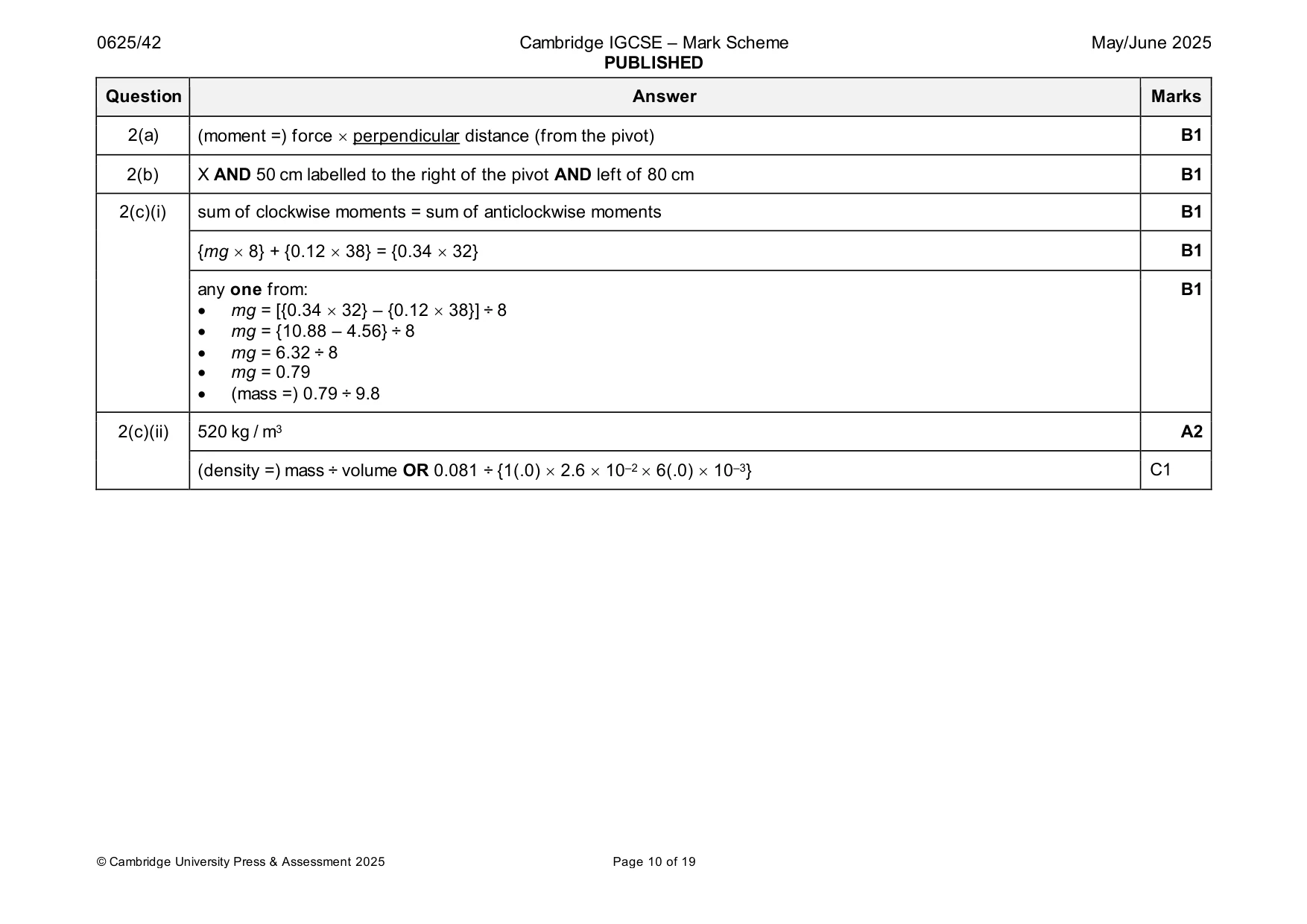
Mark scheme: 2(a) (moment =) force perpendicular distance (from the pivot) B1 2(b) X AND 50 cm labelled to the right of the pivot AND left of 80 cm B1 2(c)(i) sum of clockwise moments = sum of anticlockwise moments B1 {mg 8} + {0.12 38} = {0.34 32} B1 any one from: B1 • mg = [{0.34 32} – {0.12 38}] ÷ 8 • mg = {10.88 – 4.56} ÷ 8 • mg = 6.32 ÷ 8 • mg = 0.79 • (mass =) 0.79 ÷ 9.8 2(c)(ii) 520 kg / m3 A2 (density =) mass ÷ volume OR 0.081 ÷ {1(.0) 2.6 10–2 6(.0) 10–3} C1
Question 3
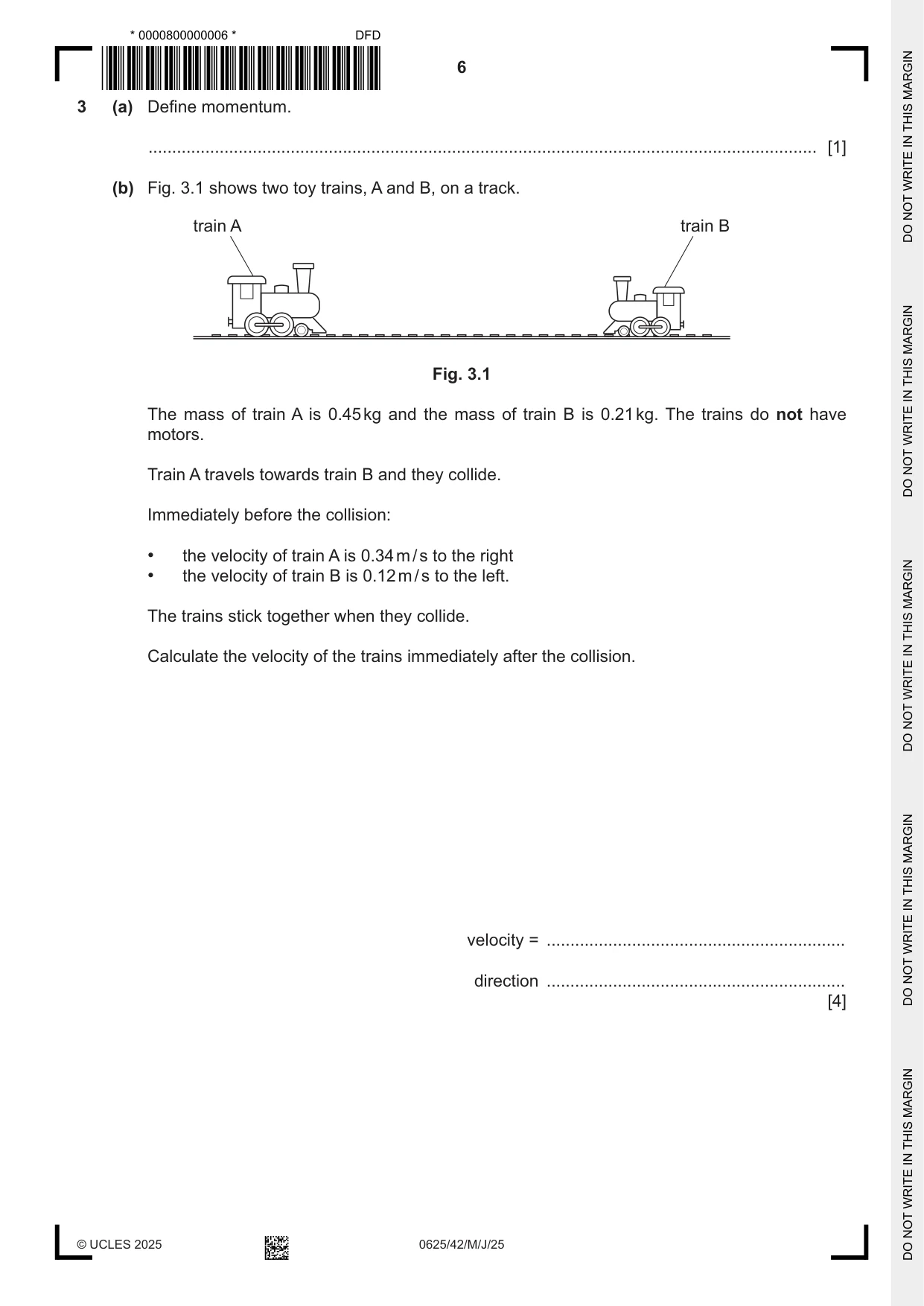
3 (a) Define momentum. ............................................................................................................................................. [1] (b) Fig. 3.1 shows two toy trains, A and B, on a track. train A train B Fig. 3.1 The mass of train A is 0.45 kg and the mass of train B is 0.21 kg. The trains do not have motors. Train A travels towards train B and they collide. Immediately before the collision: • the velocity of train A is 0.34 m / s to the right • the velocity of train B is 0.12 m / s to the left. The trains stick together when they collide. Calculate the velocity of the trains immediately after the collision. velocity = ............................................................... direction ............................................................... [4] (c) A different train is travelling with a momentum of 0.26 kg m / s. The train slows down and stops after 2.1 s. Calculate the average force acting on the train during this time. average force = ......................................................... [2] [Total: 7]
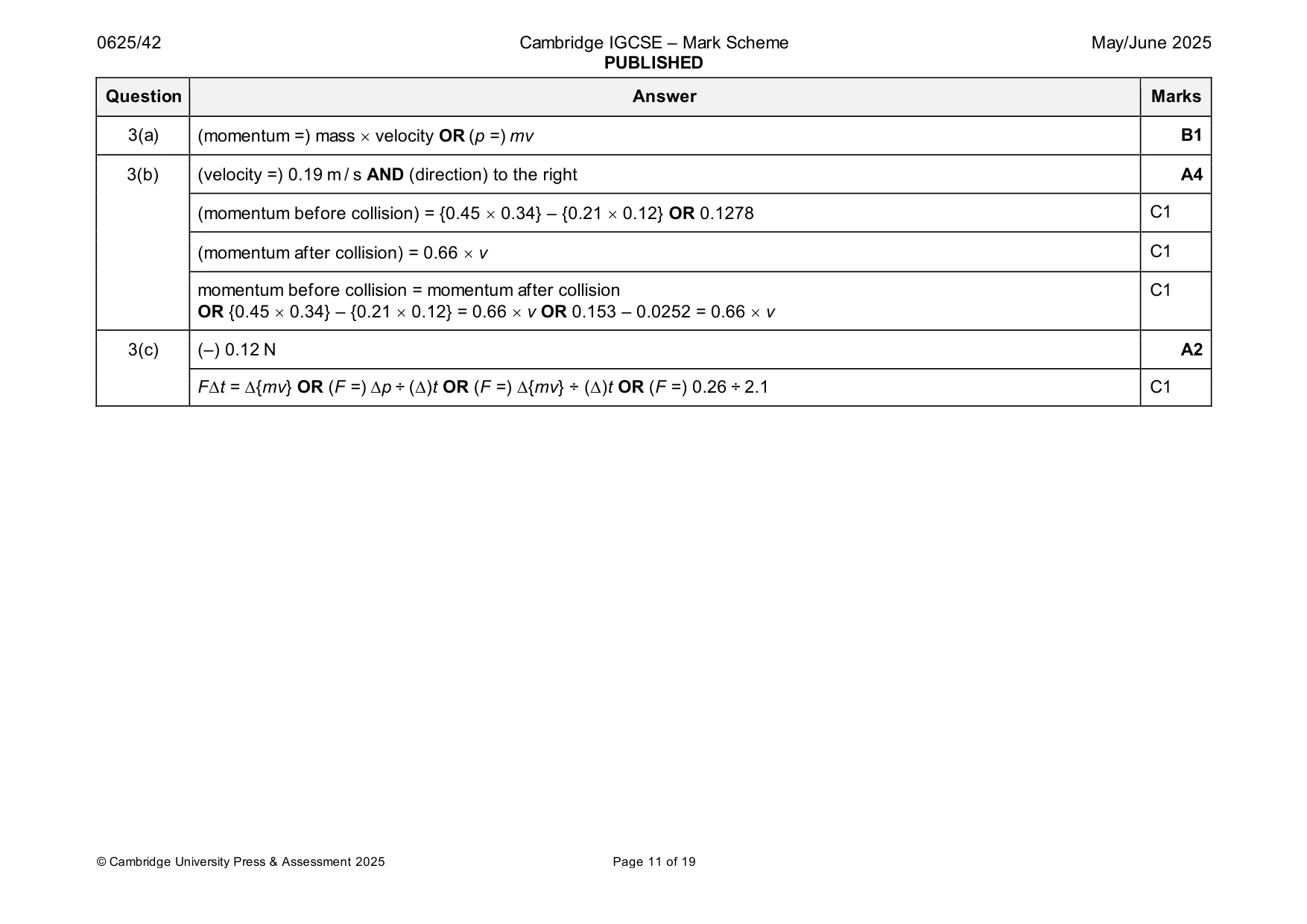
Mark scheme: 3(a) (momentum =) mass velocity OR (p =) mv B1 3(b) (velocity =) 0.19 m / s AND (direction) to the right A4 (momentum before collision) = {0.45 0.34} – {0.21 0.12} OR 0.1278 C1 (momentum after collision) = 0.66 v C1 momentum before collision = momentum after collision C1 OR {0.45 0.34} – {0.21 0.12} = 0.66 v OR 0.153 – 0.0252 = 0.66 v 3(c) (–) 0.12 N A2 F∆t = ∆{mv} OR (F =) ∆p ÷ (∆)t OR (F =) ∆{mv} ÷ (∆)t OR (F =) 0.26 ÷ 2.1 C1
Q4 · Two metal containers, A and B
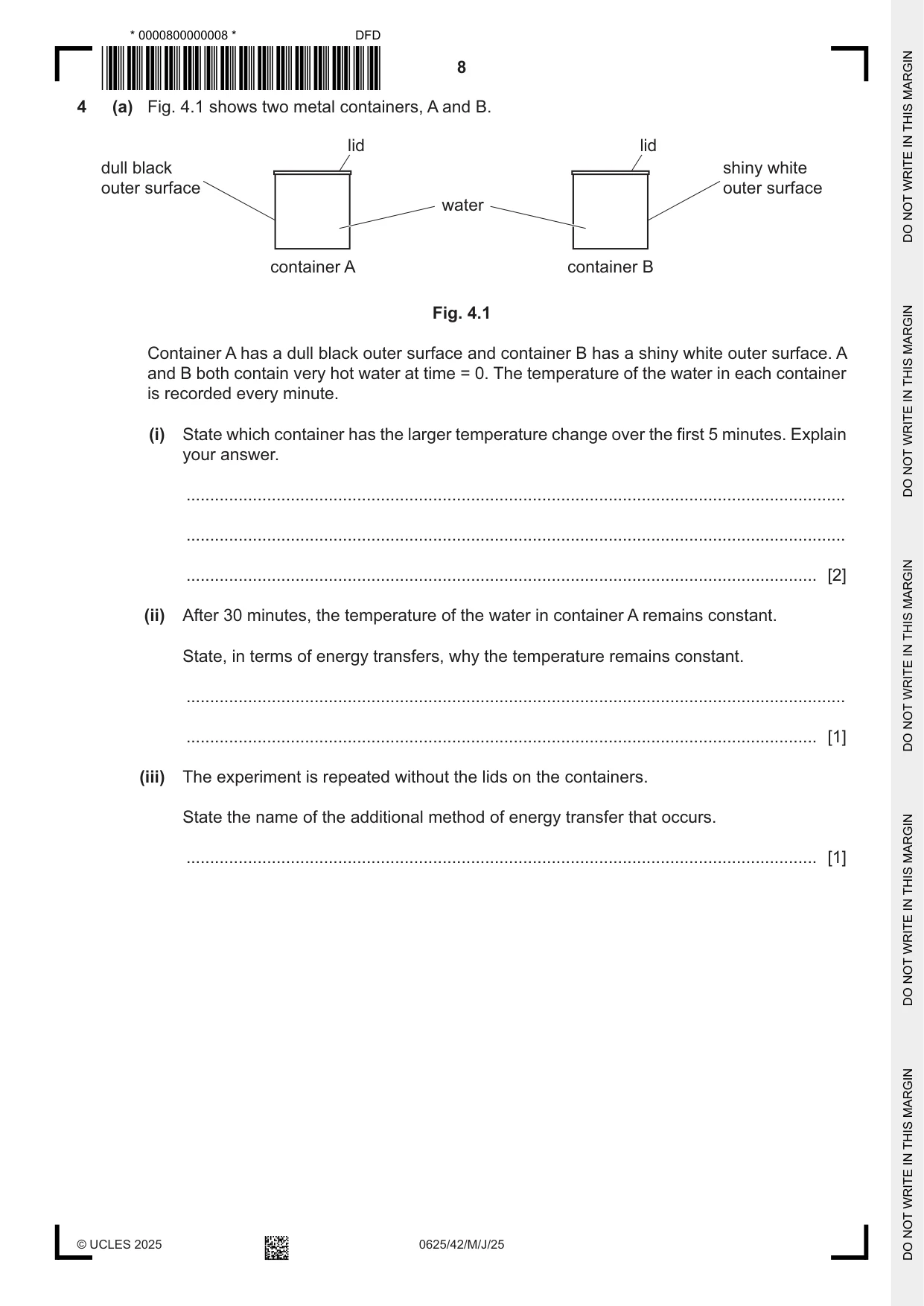
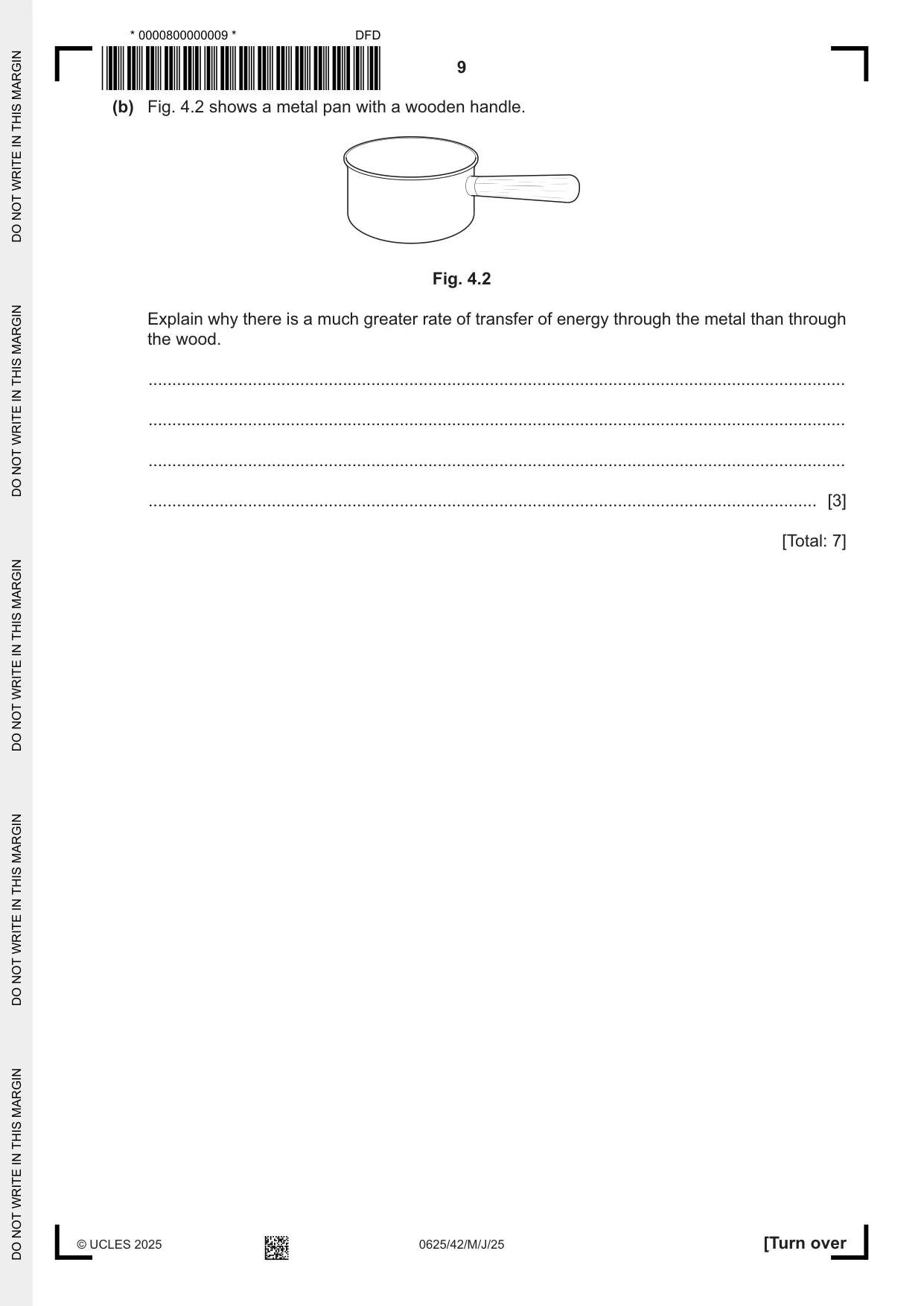
4 (a) Fig. 4.1 shows two metal containers, A and B. lid lid dull black shiny white outer surface outer surface water container A container B Fig. 4.1 Container A has a dull black outer surface and container B has a shiny white outer surface. A and B both contain very hot water at time = 0. The temperature of the water in each container is recorded every minute. (i) State which container has the larger temperature change over the first 5 minutes. Explain your answer. ........................................................................................................................................... ........................................................................................................................................... ..................................................................................................................................... [2] (ii) After 30 minutes, the temperature of the water in container A remains constant. State, in terms of energy transfers, why the temperature remains constant. ........................................................................................................................................... ..................................................................................................................................... [1] (iii) The experiment is repeated without the lids on the containers. State the name of the additional method of energy transfer that occurs. ..................................................................................................................................... [1] (b) Fig. 4.2 shows a metal pan with a wooden handle. Fig. 4.2 Explain why there is a much greater rate of transfer of energy through the metal than through the wood. ................................................................................................................................................... ................................................................................................................................................... ................................................................................................................................................... ............................................................................................................................................. [3] [Total: 7]
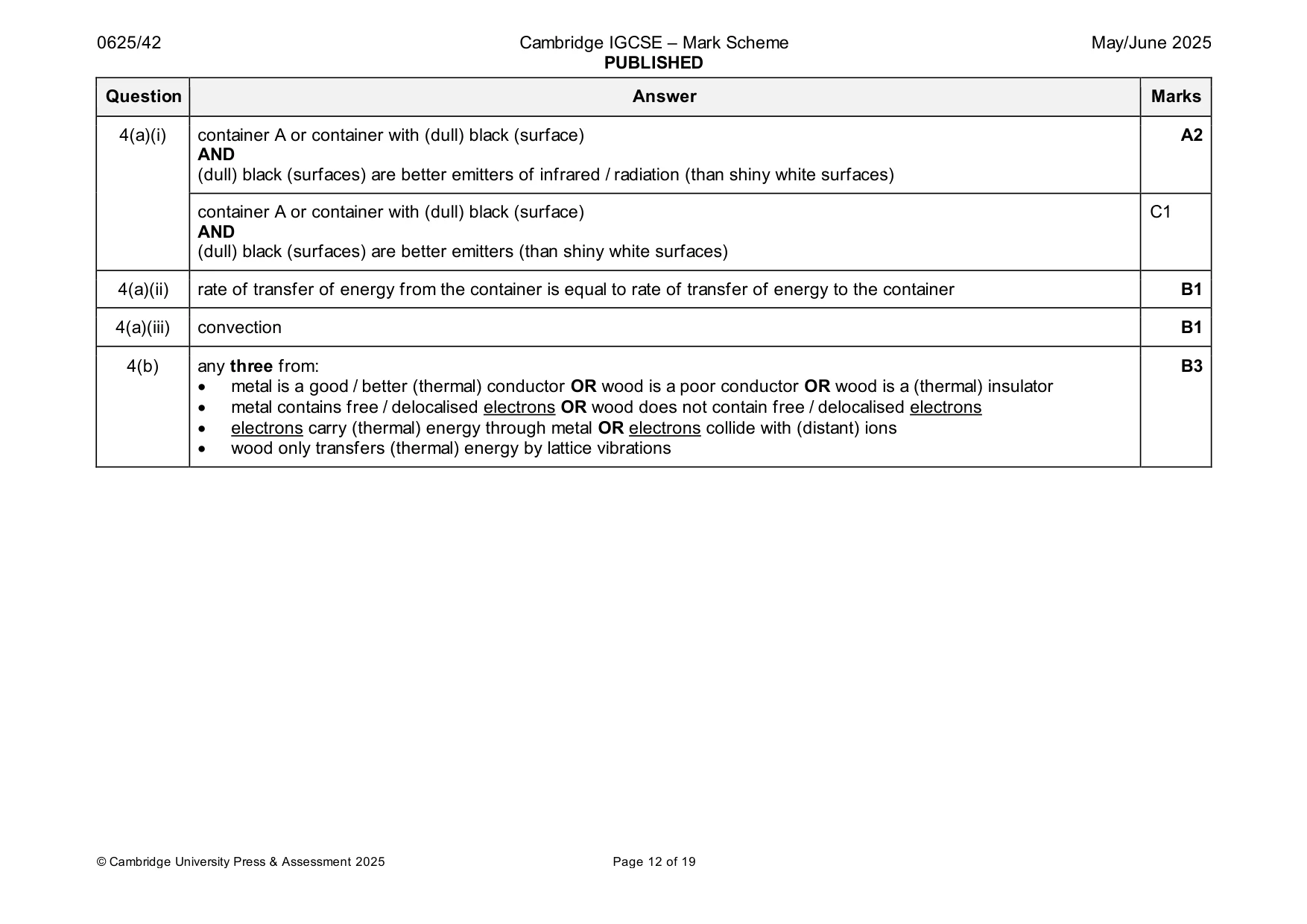
Mark scheme: 4(a)(i) container A or container with (dull) black (surface) A2 AND (dull) black (surfaces) are better emitters of infrared / radiation (than shiny white surfaces) container A or container with (dull) black (surface) C1 AND (dull) black (surfaces) are better emitters (than shiny white surfaces) 4(a)(ii) rate of transfer of energy from the container is equal to rate of transfer of energy to the container B1 4(a)(iii) convection B1 4(b) any three from: B3 • metal is a good / better (thermal) conductor OR wood is a poor conductor OR wood is a (thermal) insulator • metal contains free / delocalised electrons OR wood does not contain free / delocalised electrons • electrons carry (thermal) energy through metal OR electrons collide with (distant) ions • wood only transfers (thermal) energy by lattice vibrations
Q5 · Describe an experiment to determine the speed of sound in air
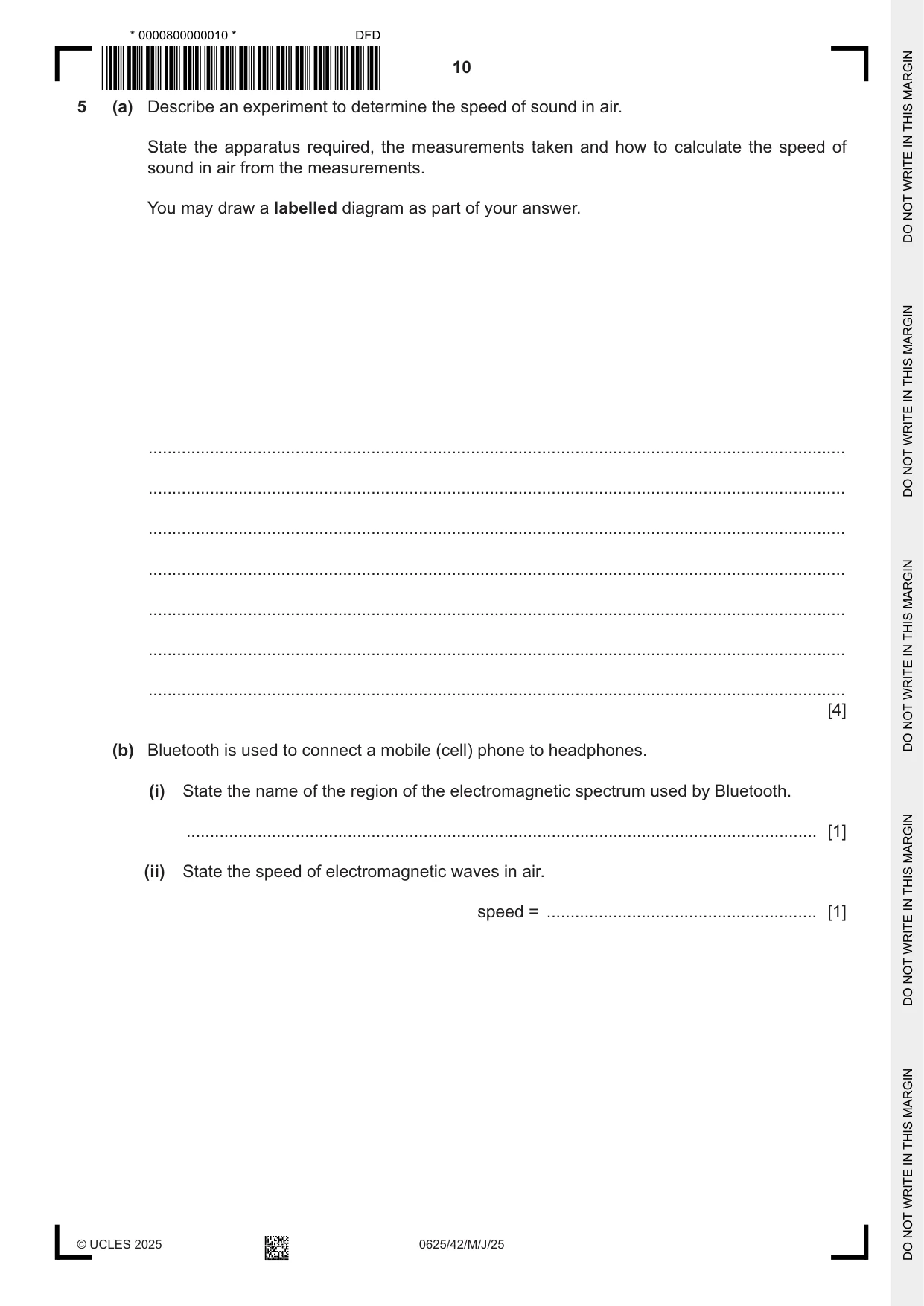
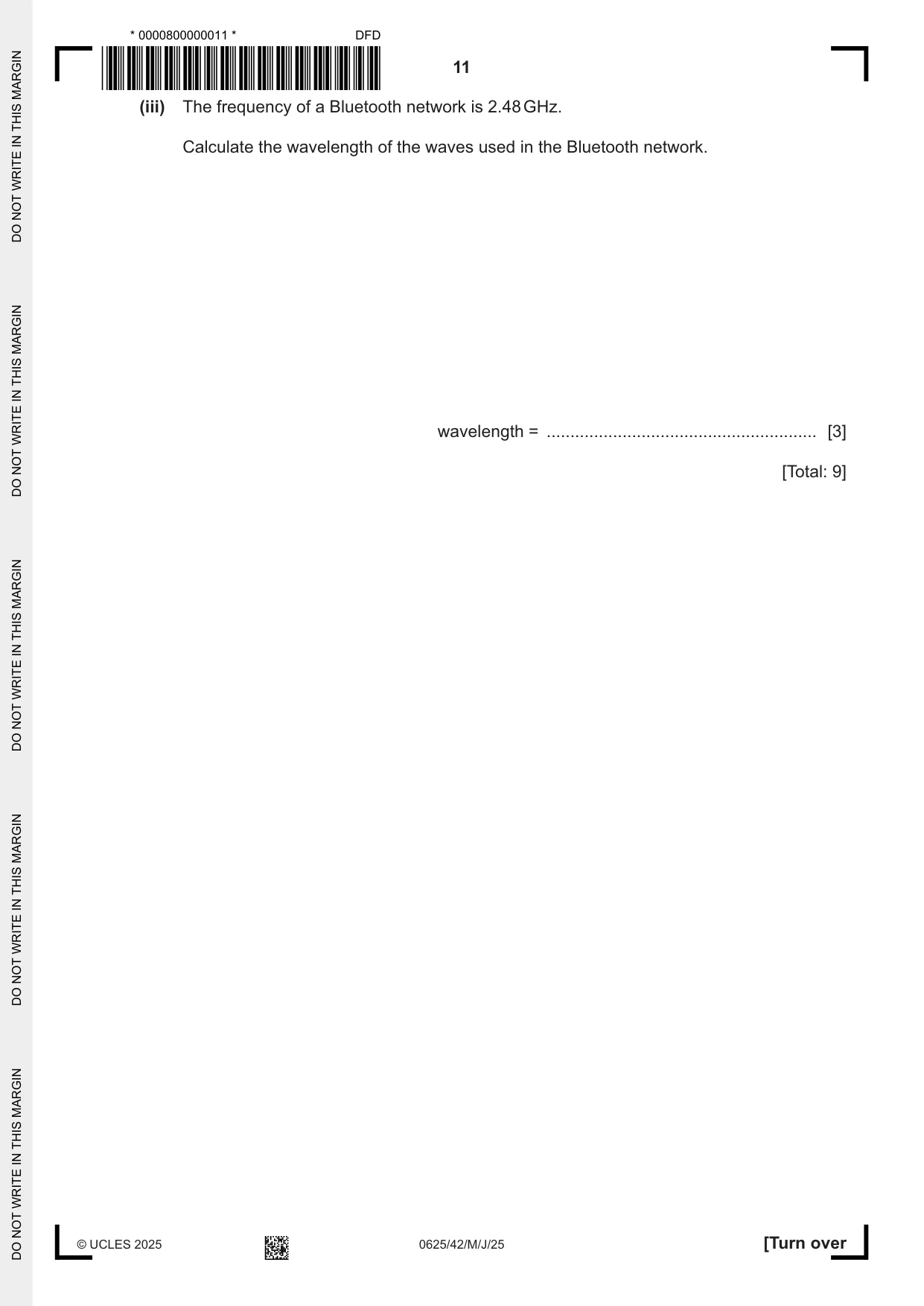
5 (a) Describe an experiment to determine the speed of sound in air. State the apparatus required, the measurements taken and how to calculate the speed of sound in air from the measurements. You may draw a labelled diagram as part of your answer. ................................................................................................................................................... ................................................................................................................................................... ................................................................................................................................................... ................................................................................................................................................... ................................................................................................................................................... ................................................................................................................................................... ................................................................................................................................................... [4] (b) Bluetooth is used to connect a mobile (cell) phone to headphones. (i) State the name of the region of the electromagnetic spectrum used by Bluetooth. ..................................................................................................................................... [1] (ii) State the speed of electromagnetic waves in air. speed = ......................................................... [1] (iii) The frequency of a Bluetooth network is 2.48 GHz. Calculate the wavelength of the waves used in the Bluetooth network. wavelength = ......................................................... [3] [Total: 9]
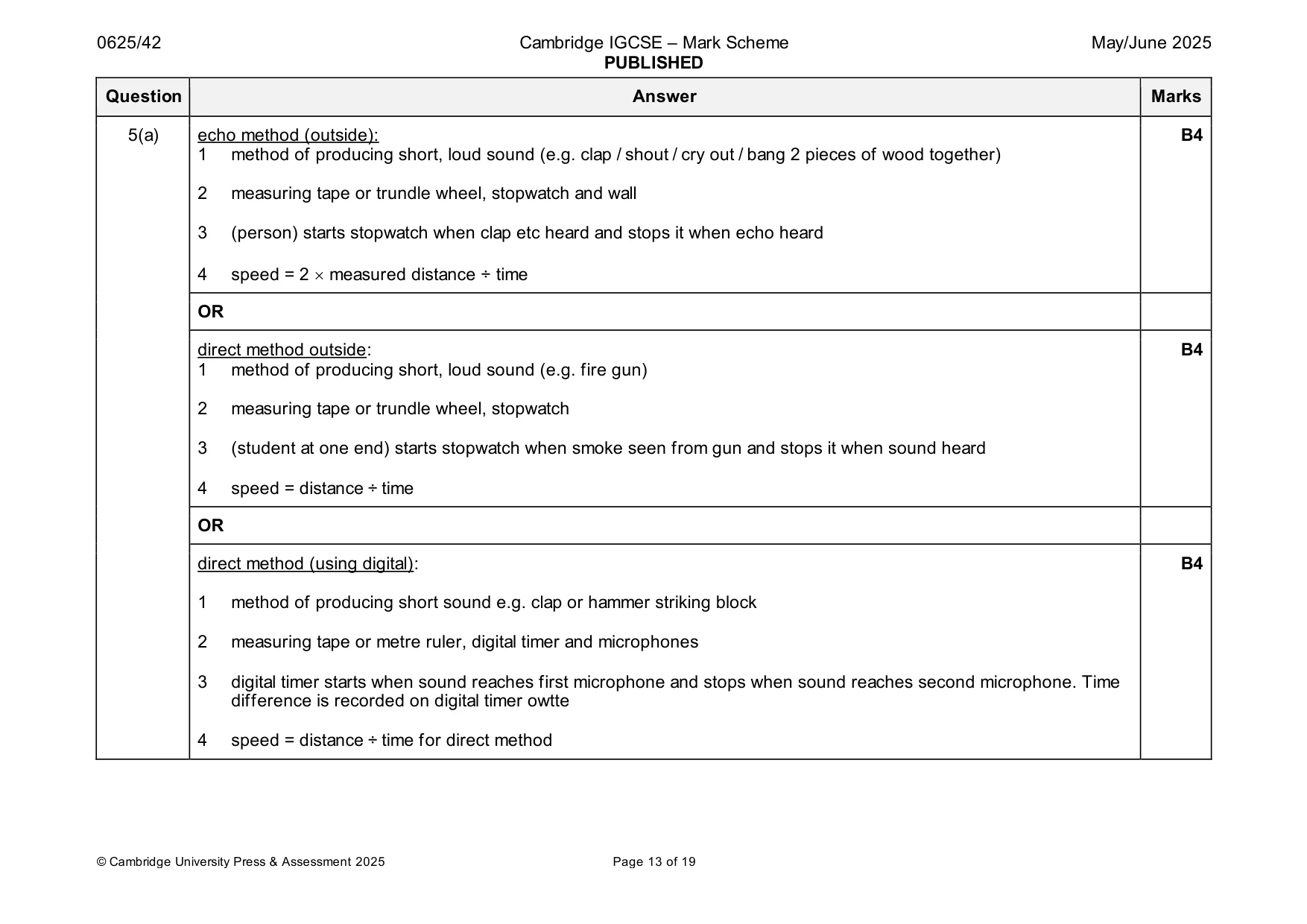
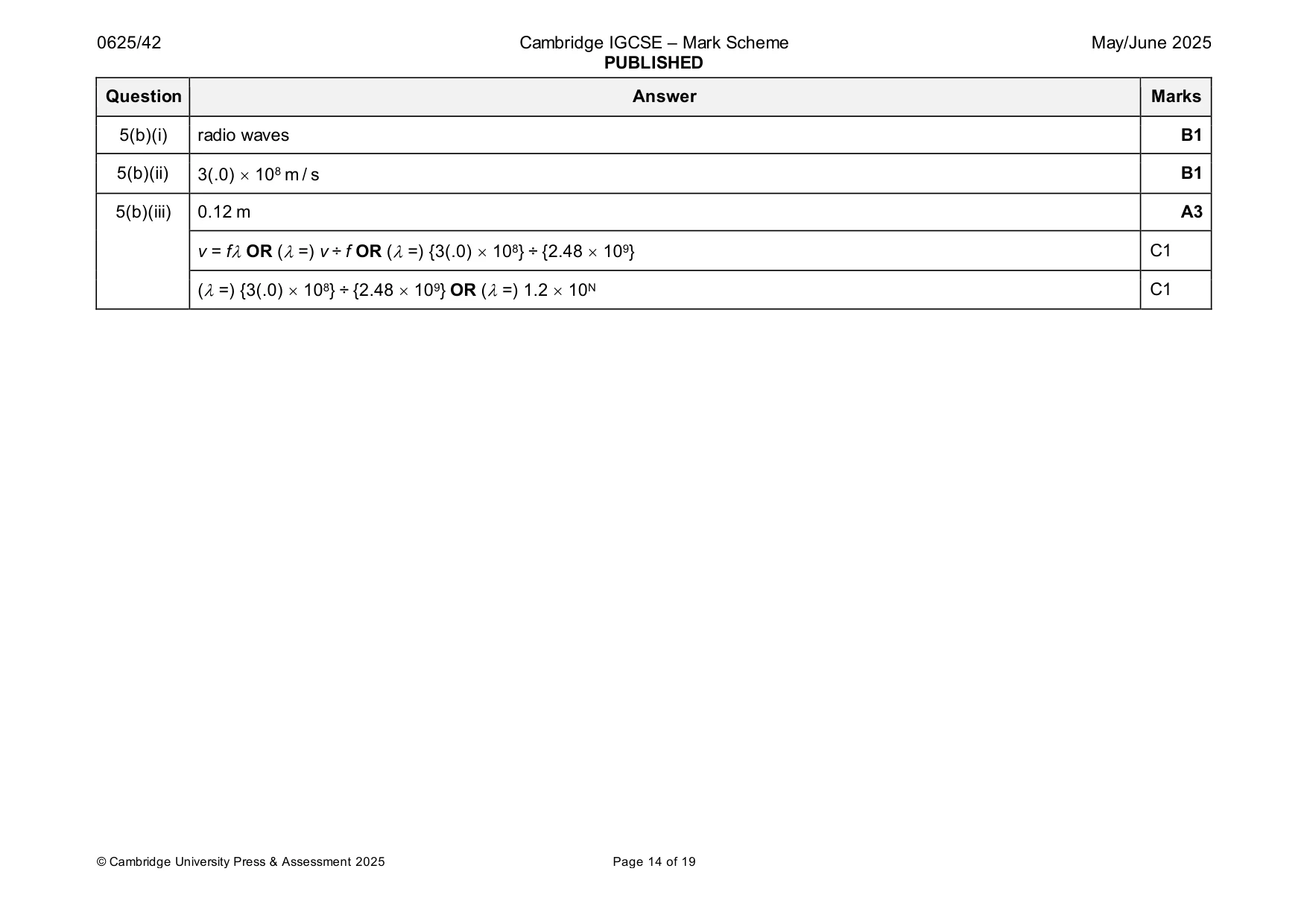
Mark scheme: 5(a) echo method (outside): B4 1 method of producing short, loud sound (e.g. clap / shout / cry out / bang 2 pieces of wood together) 2 measuring tape or trundle wheel, stopwatch and wall 3 (person) starts stopwatch when clap etc heard and stops it when echo heard 4 speed = 2 measured distance ÷ time OR direct method outside: B4 1 method of producing short, loud sound (e.g. fire gun) 2 measuring tape or trundle wheel, stopwatch 3 (student at one end) starts stopwatch when smoke seen from gun and stops it when sound heard 4 speed = distance ÷ time OR direct method (using digital): B4 1 method of producing short sound e.g. clap or hammer striking block 2 measuring tape or metre ruler, digital timer and microphones 3 digital timer starts when sound reaches first microphone and stops when sound reaches second microphone. Time difference is recorded on digital timer owtte 4 speed = distance ÷ time for direct method 5(b)(i) radio waves B1 5(b)(ii) 3(.0) 108 m / s B1 5(b)(iii) 0.12 m A3 v = fOR (=) v ÷ f OR (=) {3(.0) 108} ÷ {2.48 109} C1 (=) {3(.0) 108} ÷ {2.48 109} OR (=) 1.2 10N C1
Q6 · A full-size diagram of a lens and an image I of an object
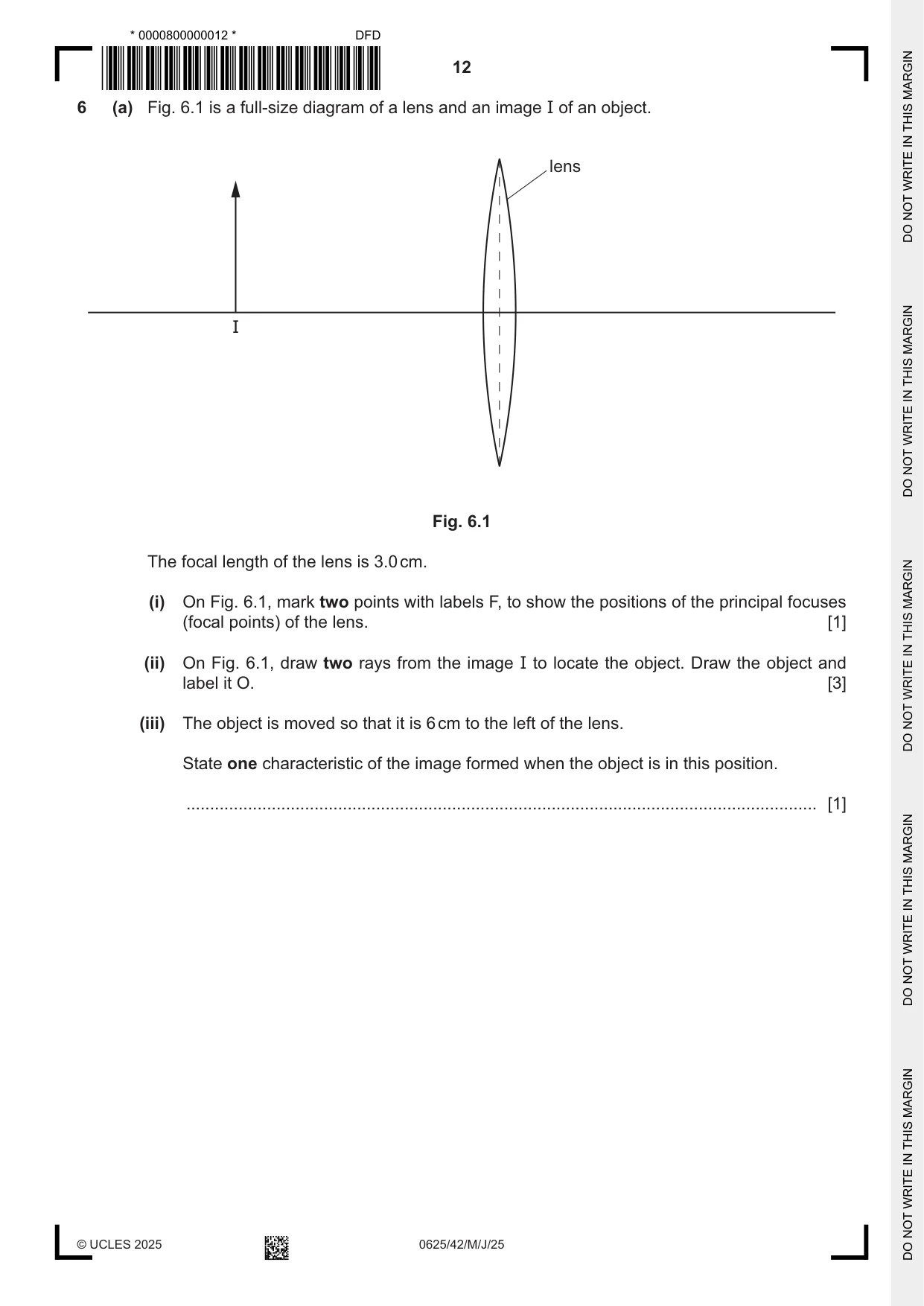
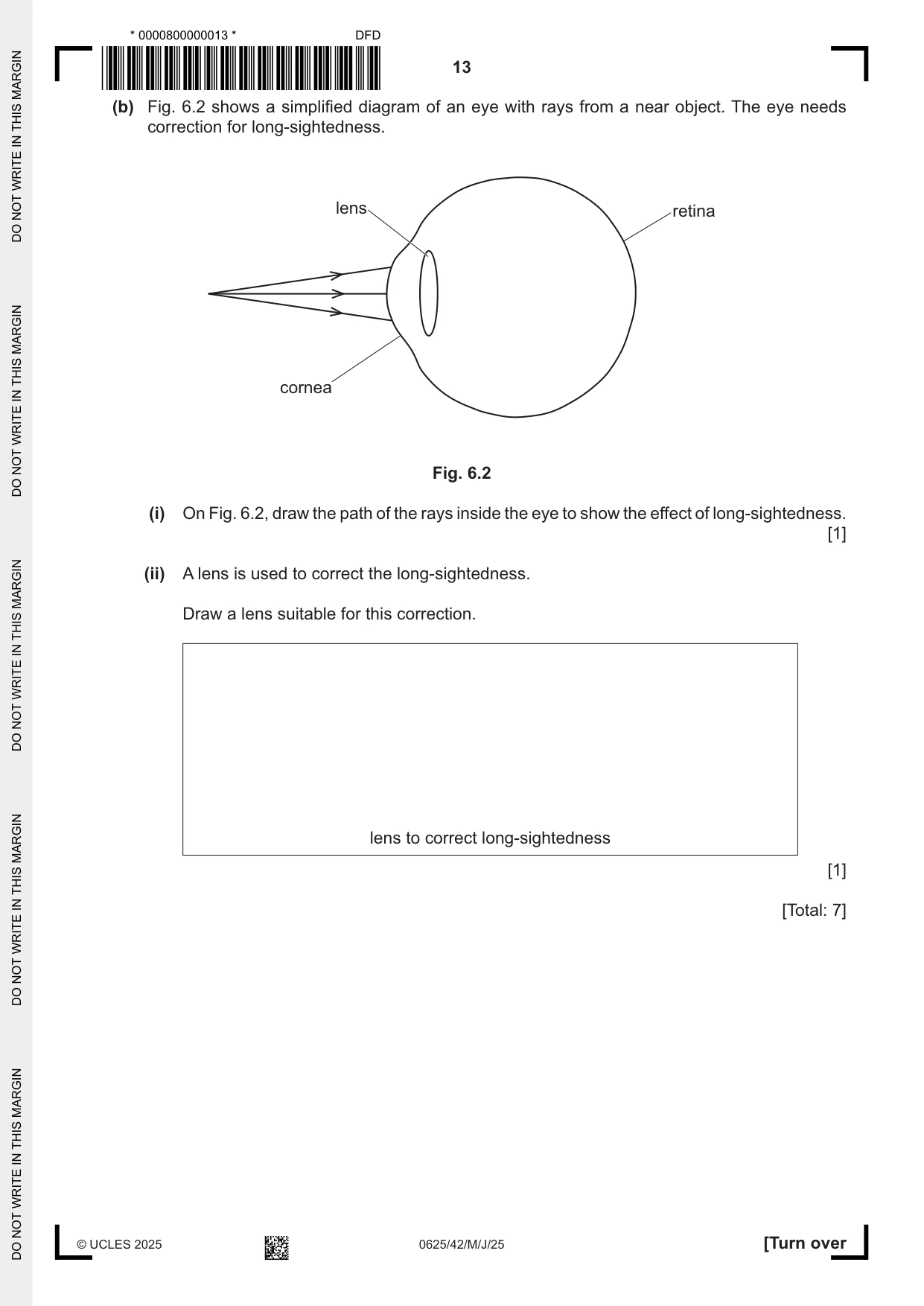
6 (a) Fig. 6.1 is a full-size diagram of a lens and an image I of an object. lens I Fig. 6.1 The focal length of the lens is 3.0 cm. (i) On Fig. 6.1, mark two points with labels F, to show the positions of the principal focuses (focal points) of the lens. [1] (ii) On Fig. 6.1, draw two rays from the image I to locate the object. Draw the object and label it O. [3] (iii) The object is moved so that it is 6 cm to the left of the lens. State one characteristic of the image formed when the object is in this position. ..................................................................................................................................... [1] (b) Fig. 6.2 shows a simplified diagram of an eye with rays from a near object. The eye needs correction for long-sightedness. lens retina cornea Fig. 6.2 (i) On Fig. 6.2, draw the path of the rays inside the eye to show the effect of long-sightedness. [1] (ii) A lens is used to correct the long-sightedness. Draw a lens suitable for this correction. lens to correct long-sightedness [1] [Total: 7]
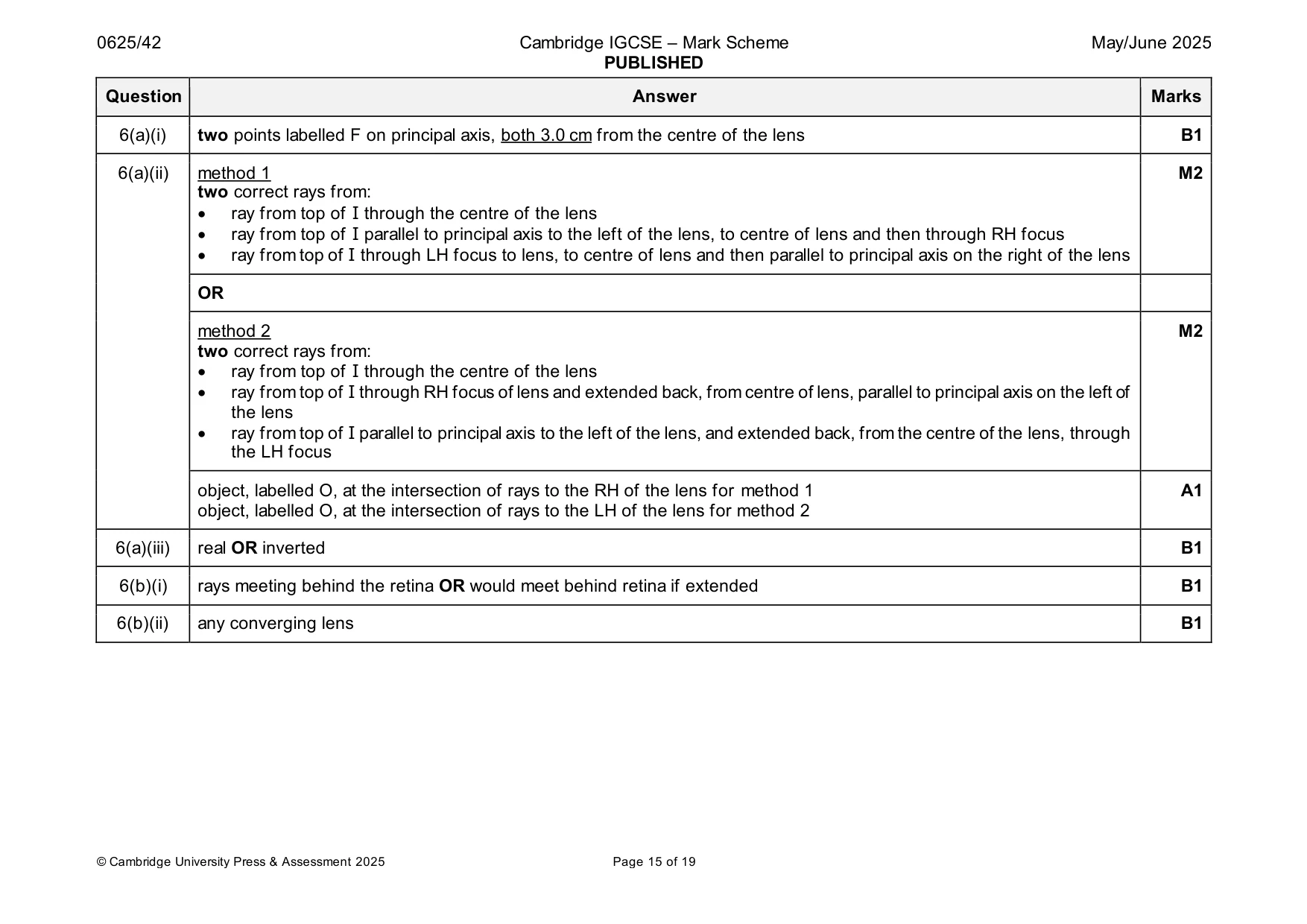
Mark scheme: 6(a)(i) two points labelled F on principal axis, both 3.0 cm from the centre of the lens B1 6(a)(ii) method 1 M2 two correct rays from: • ray from top of I through the centre of the lens • ray from top of I parallel to principal axis to the left of the lens, to centre of lens and then through RH focus • ray from top of I through LH focus to lens, to centre of lens and then parallel to principal axis on the right of the lens OR method 2 M2 two correct rays from: • ray from top of I through the centre of the lens • ray from top of I through RH focus of lens and extended back, from centre of lens, parallel to principal axis on the left of the lens • ray from top of I parallel to principal axis to the left of the lens, and extended back, from the centre of the lens, through the LH focus object, labelled O, at the intersection of rays to the RH of the lens for method 1 A1 object, labelled O, at the intersection of rays to the LH of the lens for method 2 6(a)(iii) real OR inverted B1 6(b)(i) rays meeting behind the retina OR would meet behind retina if extended B1 6(b)(ii) any converging lens B1
Q7 · State what is meant by an electric field
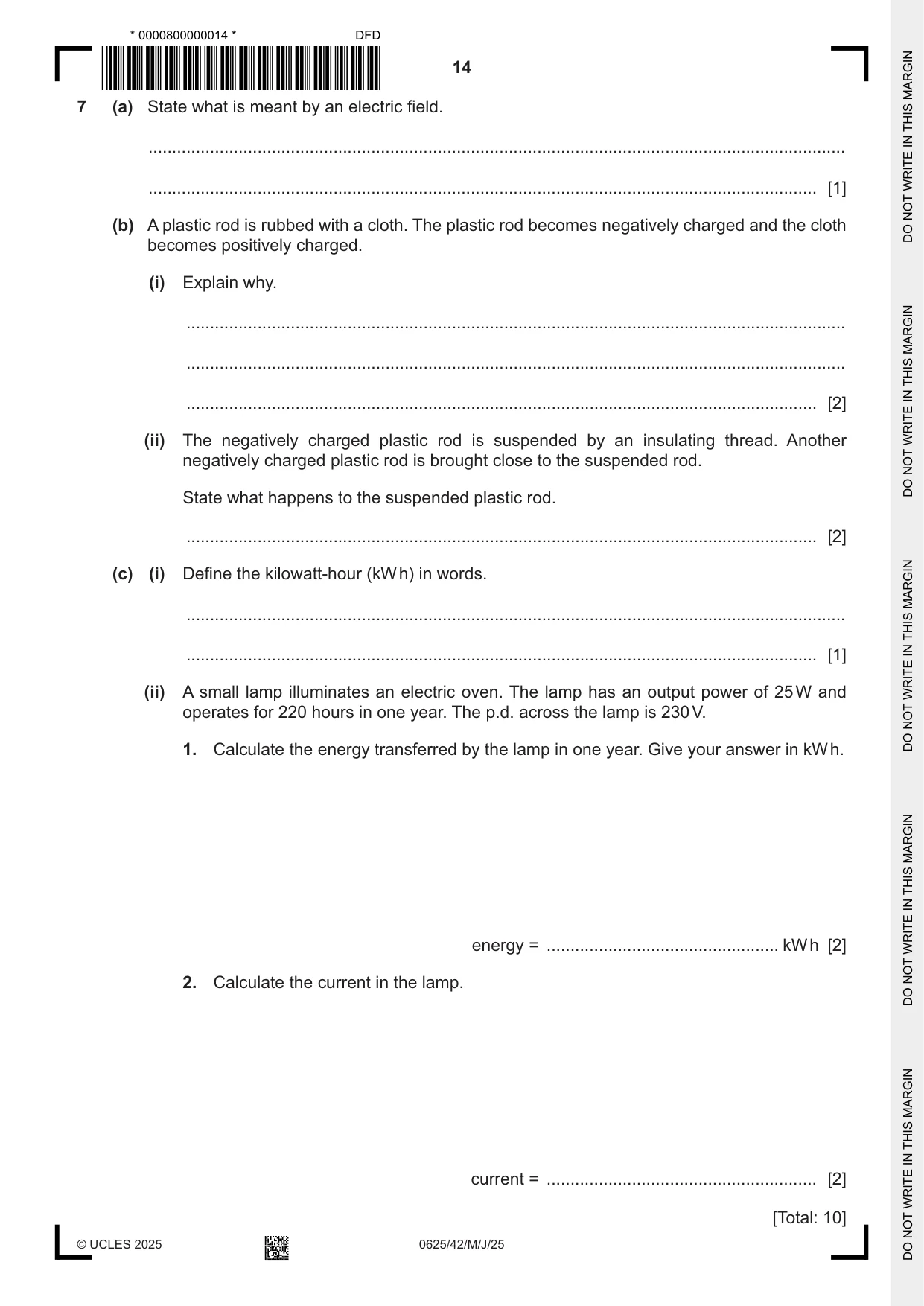
7 (a) State what is meant by an electric field. ................................................................................................................................................... ............................................................................................................................................. [1] (b) A plastic rod is rubbed with a cloth. The plastic rod becomes negatively charged and the cloth becomes positively charged. (i) Explain why. ........................................................................................................................................... ........................................................................................................................................... ..................................................................................................................................... [2] (ii) The negatively charged plastic rod is suspended by an insulating thread. Another negatively charged plastic rod is brought close to the suspended rod. State what happens to the suspended plastic rod. ..................................................................................................................................... [2] (c) (i) Define the kilowatt-hour (kW h) in words. ........................................................................................................................................... ..................................................................................................................................... [1] (ii) A small lamp illuminates an electric oven. The lamp has an output power of 25 W and operates for 220 hours in one year. The p.d. across the lamp is 230 V. 1. Calculate the energy transferred by the lamp in one year. Give your answer in kW h. energy = ................................................. kW h [2] 2. Calculate the current in the lamp. current = ......................................................... [2] [Total: 10]
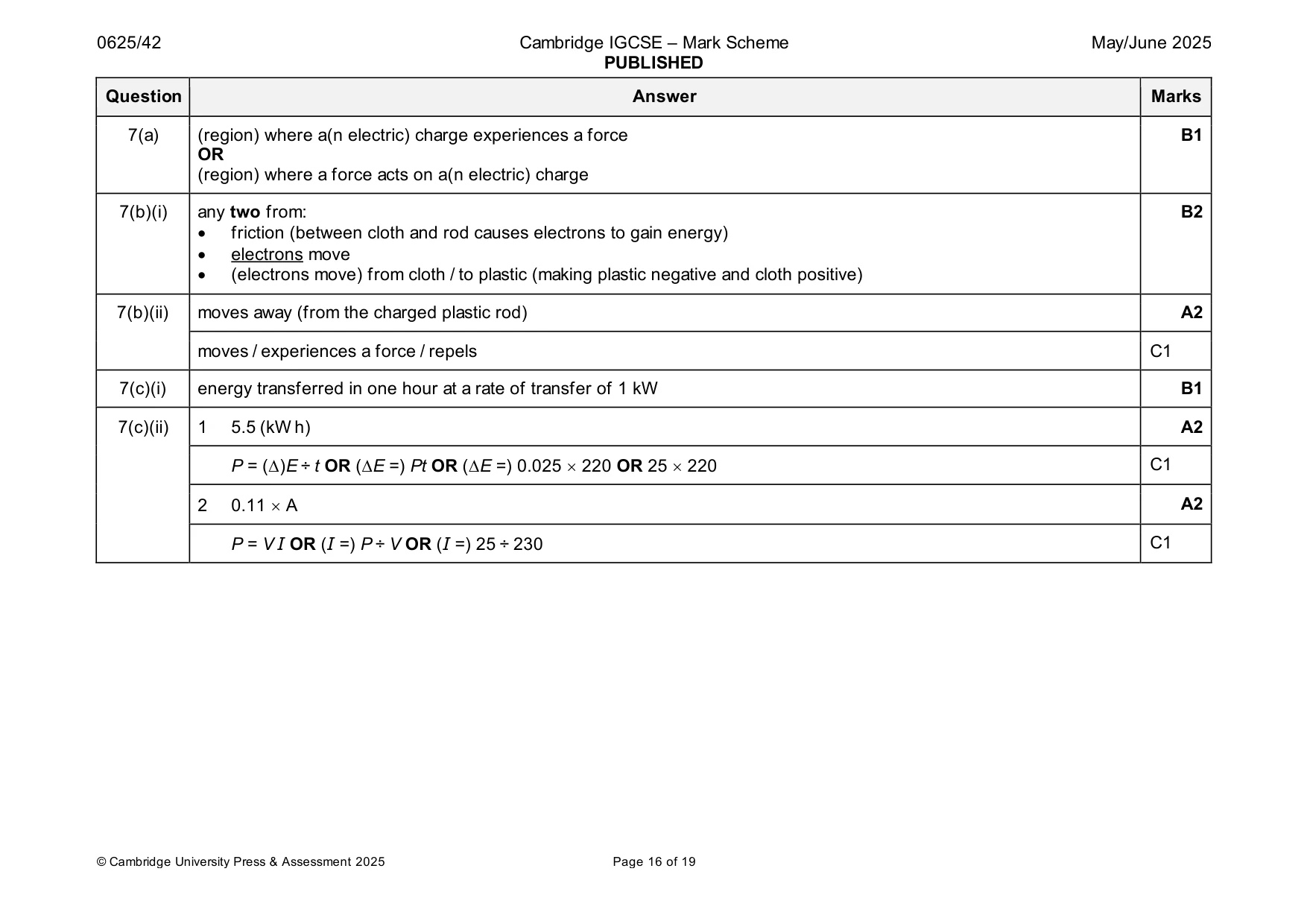
Mark scheme: 7(a) (region) where a(n electric) charge experiences a force B1 OR (region) where a force acts on a(n electric) charge 7(b)(i) any two from: B2 • friction (between cloth and rod causes electrons to gain energy) • electrons move • (electrons move) from cloth / to plastic (making plastic negative and cloth positive) 7(b)(ii) moves away (from the charged plastic rod) A2 moves / experiences a force / repels C1 7(c)(i) energy transferred in one hour at a rate of transfer of 1 kW B1 7(c)(ii) 1 5.5 (kW h) A2 P = (∆)E ÷ t OR (∆E =) Pt OR (∆E =) 0.025 220 OR 25 220 C1 2 0.11 A A2 P = V I OR (I =) P ÷ V OR (I =) 25 ÷ 230 C1
Q8 · A simplified diagram of an a.c
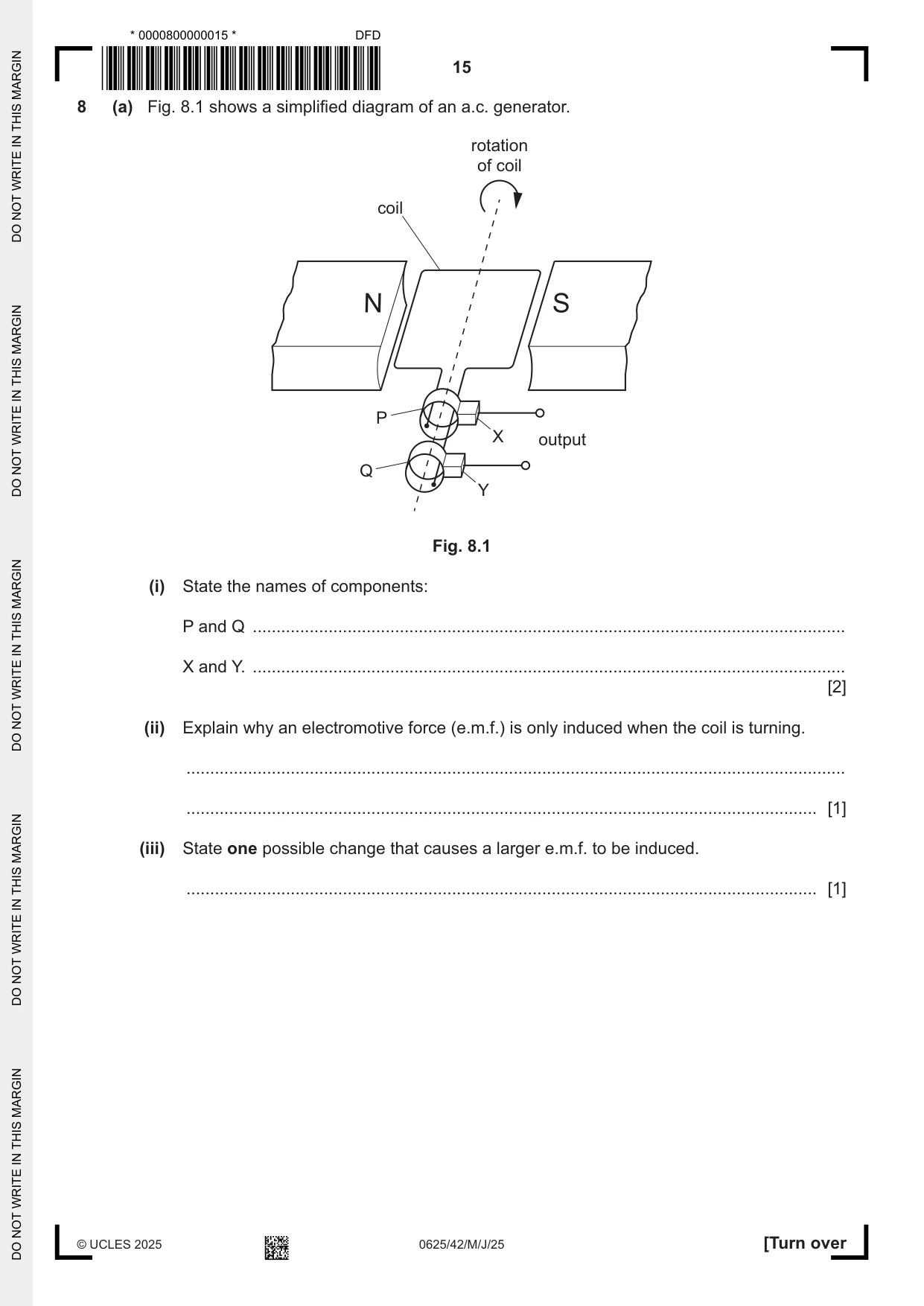
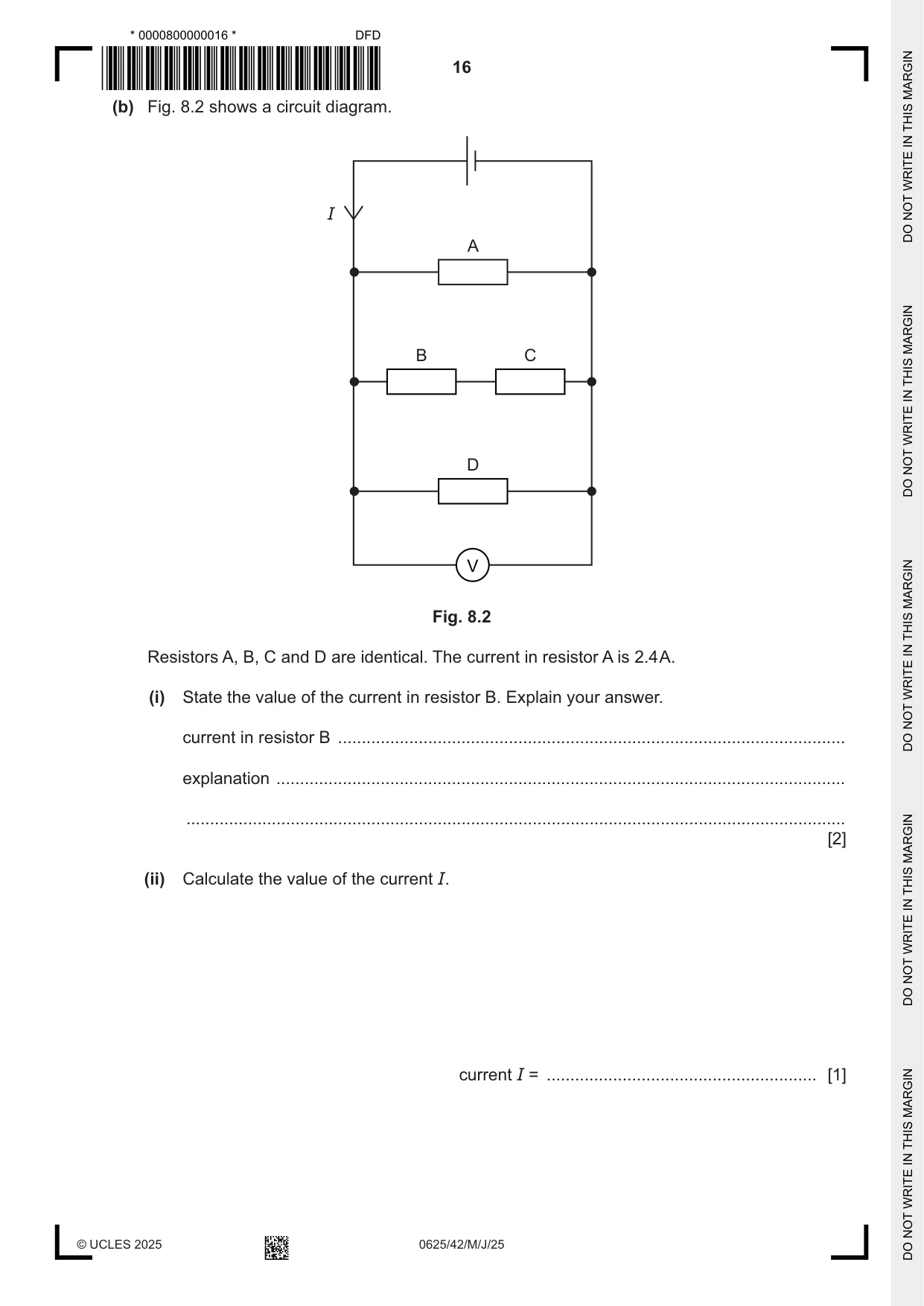
8 (a) Fig. 8.1 shows a simplified diagram of an a.c. generator. rotation of coil coil N S P X output Q Y Fig. 8.1 (i) State the names of components: P and Q ............................................................................................................................. X and Y. ............................................................................................................................. [2] (ii) Explain why an electromotive force (e.m.f.) is only induced when the coil is turning. ........................................................................................................................................... ..................................................................................................................................... [1] (iii) State one possible change that causes a larger e.m.f. to be induced. ..................................................................................................................................... [1] (b) Fig. 8.2 shows a circuit diagram. I A B C D V Fig. 8.2 Resistors A, B, C and D are identical. The current in resistor A is 2.4 A. (i) State the value of the current in resistor B. Explain your answer. current in resistor B ........................................................................................................... explanation ........................................................................................................................ ........................................................................................................................................... [2] (ii) Calculate the value of the current I. current I = ......................................................... [1] (iii) The reading on the voltmeter is 5.0 V. Calculate the resistance of resistor A. resistance = ......................................................... [2] [Total: 9]
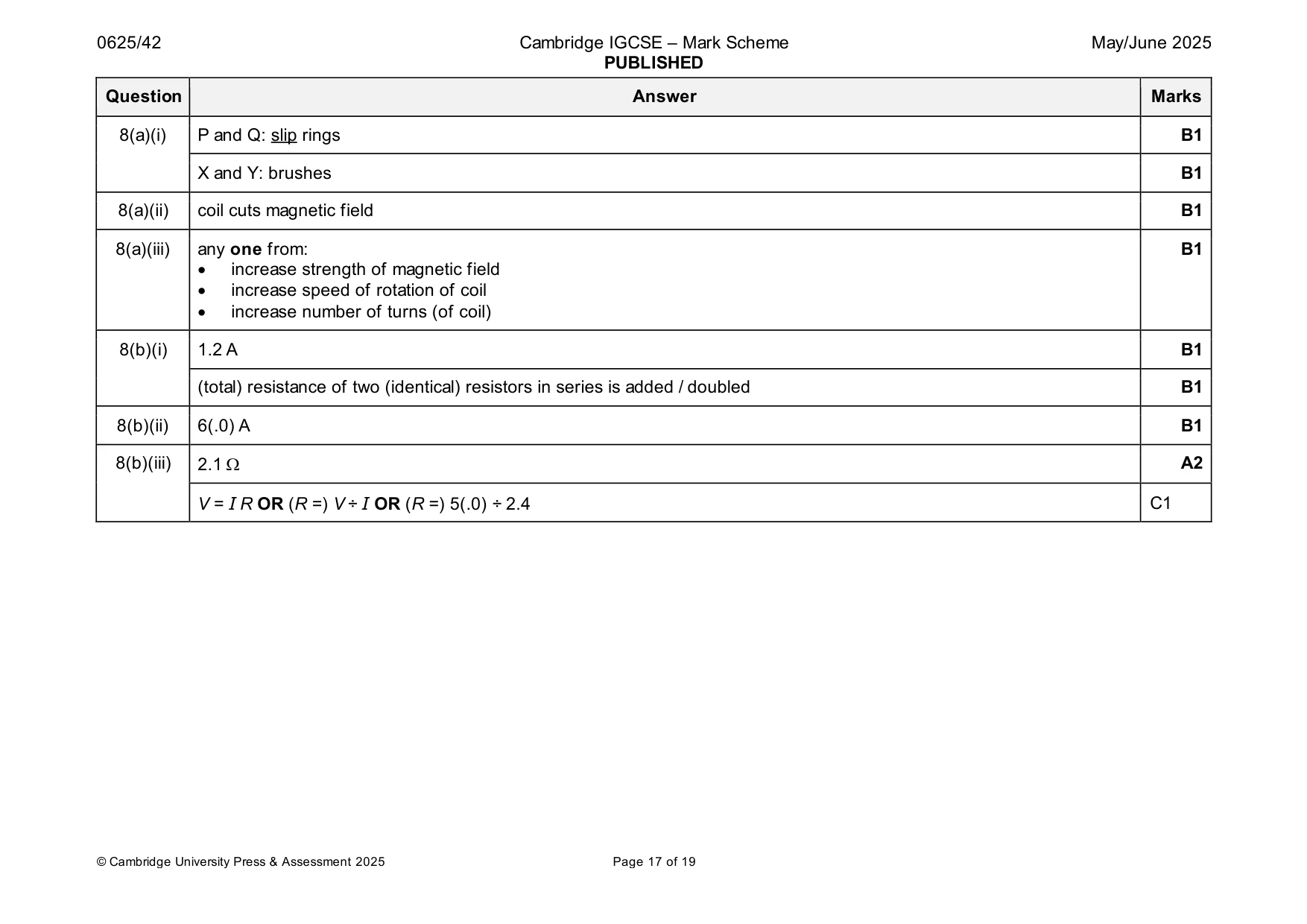
Mark scheme: 8(a)(i) P and Q: slip rings B1 X and Y: brushes B1 8(a)(ii) coil cuts magnetic field B1 8(a)(iii) any one from: B1 • increase strength of magnetic field • increase speed of rotation of coil • increase number of turns (of coil) 8(b)(i) 1.2 A B1 (total) resistance of two (identical) resistors in series is added / doubled B1 8(b)(ii) 6(.0) A B1 8(b)(iii) 2.1 A2 V = I R OR (R =) V ÷ I OR (R =) 5(.0) ÷ 2.4 C1
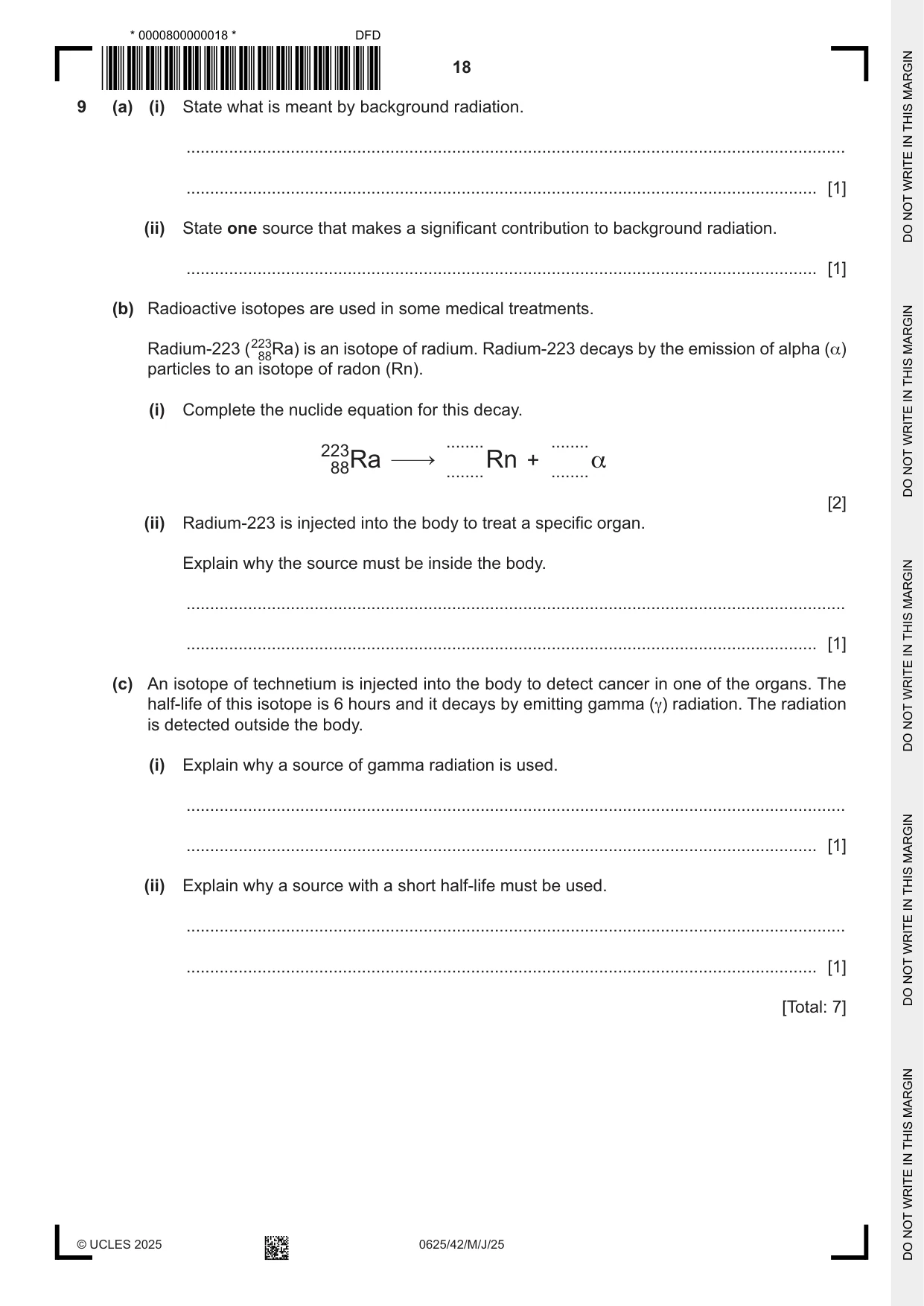
Q9 · State what is meant by background radiation
9 (a) (i) State what is meant by background radiation. ........................................................................................................................................... ..................................................................................................................................... [1] (ii) State one source that makes a significant contribution to background radiation. ..................................................................................................................................... [1] (b) Radioactive isotopes are used in some medical treatments. Radium-223 (22388Ra) is an isotope of radium. Radium-223 decays by the emission of alpha (α) particles to an isotope of radon (Rn). (i) Complete the nuclide equation for this decay. ........ ........ 223 88Ra ........ Rn + ........ α [2] (ii) Radium-223 is injected into the body to treat a specific organ. Explain why the source must be inside the body. ........................................................................................................................................... ..................................................................................................................................... [1] (c) An isotope of technetium is injected into the body to detect cancer in one of the organs. The half-life of this isotope is 6 hours and it decays by emitting gamma (γ) radiation. The radiation is detected outside the body. (i) Explain why a source of gamma radiation is used. ........................................................................................................................................... ..................................................................................................................................... [1] (ii) Explain why a source with a short half-life must be used. ........................................................................................................................................... ..................................................................................................................................... [1] [Total: 7]
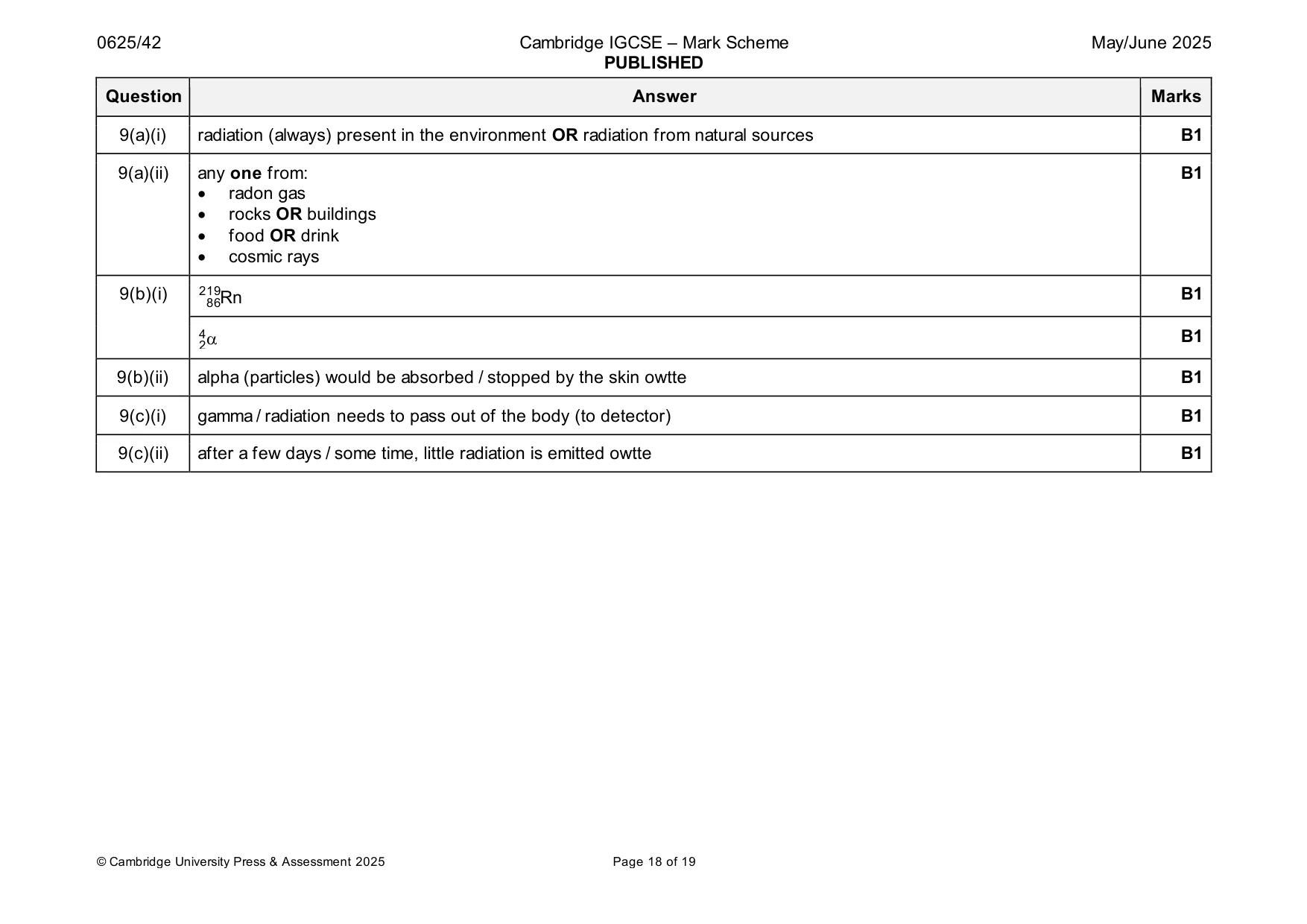
Mark scheme: 9(a)(i) radiation (always) present in the environment OR radiation from natural sources B1 9(a)(ii) any one from: B1 • radon gas • rocks OR buildings • food OR drink • cosmic rays 9(b)(i) 219 86Rn B1 4 2 B1 9(b)(ii) alpha (particles) would be absorbed / stopped by the skin owtte B1 9(c)(i) gamma / radiation needs to pass out of the body (to detector) B1 9(c)(ii) after a few days / some time, little radiation is emitted owtte B1
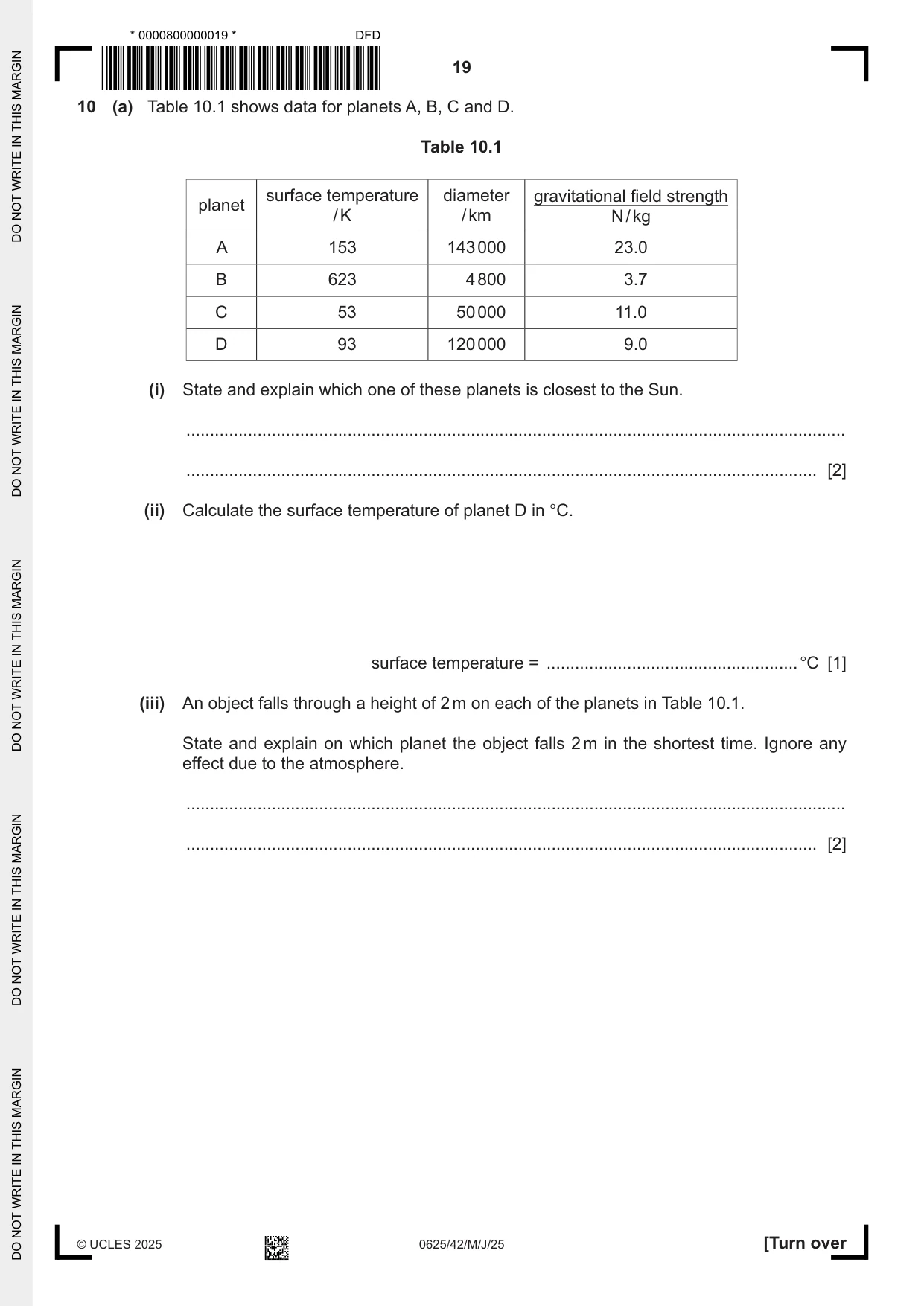
Q10 · Data for planets A, B, C and D
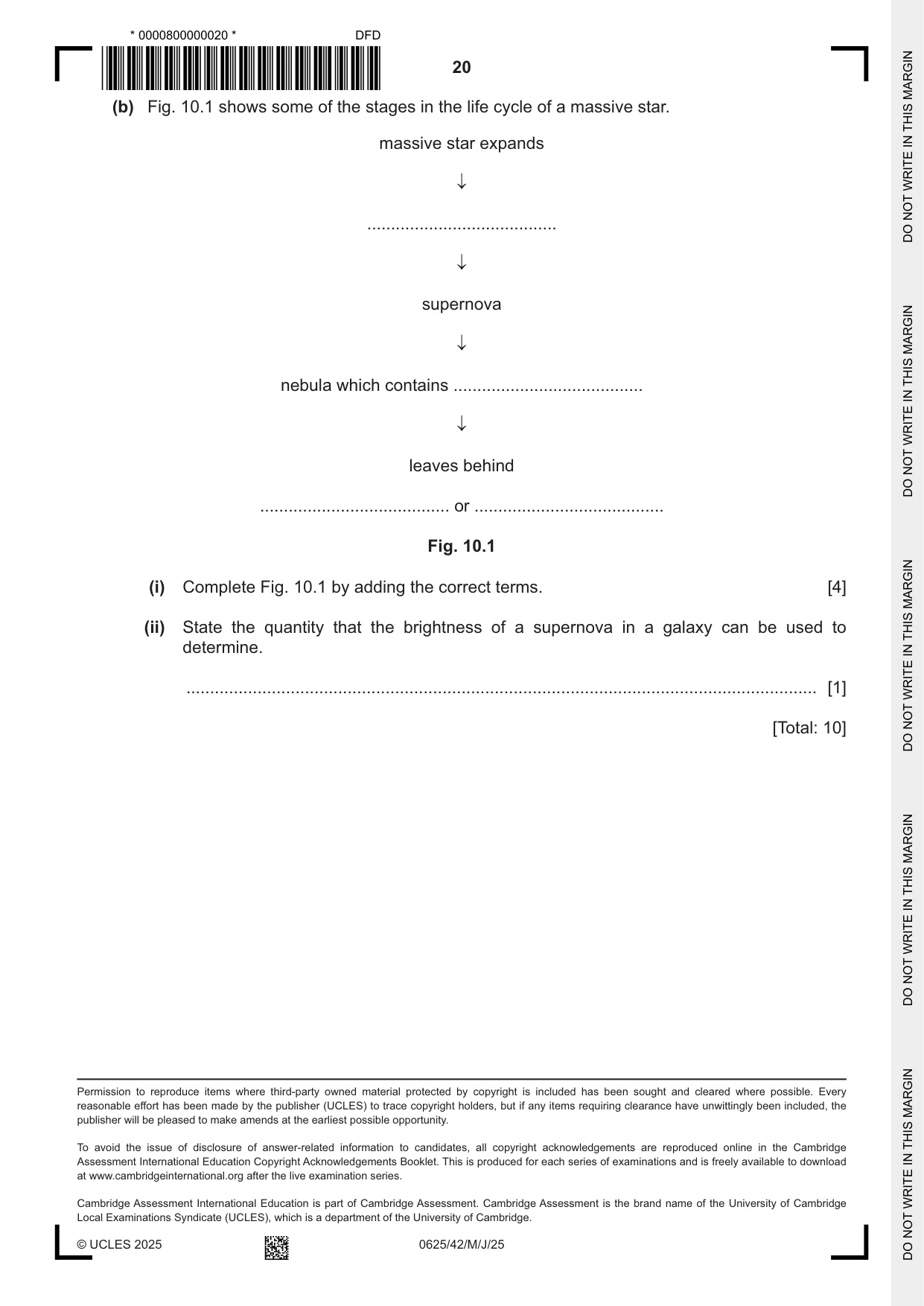
10 (a) Table 10.1 shows data for planets A, B, C and D. Table 10.1 surface temperature diameter gravitational field strength planet / K / km N / kg A 153 143 000 23.0 B 623 4 800 3.7 C 53 50 000 11.0 D 93 120 000 9.0 (i) State and explain which one of these planets is closest to the Sun. ........................................................................................................................................... ..................................................................................................................................... [2] (ii) Calculate the surface temperature of planet D in °C. surface temperature = ..................................................... °C [1] (iii) An object falls through a height of 2 m on each of the planets in Table 10.1. State and explain on which planet the object falls 2 m in the shortest time. Ignore any effect due to the atmosphere. ........................................................................................................................................... ..................................................................................................................................... [2] (b) Fig. 10.1 shows some of the stages in the life cycle of a massive star. massive star expands ........................................ supernova nebula which contains ........................................ leaves behind ........................................ or ........................................ Fig. 10.1 (i) Complete Fig. 10.1 by adding the correct terms. [4] (ii) State the quantity that the brightness of a supernova in a galaxy can be used to determine. ..................................................................................................................................... [1] [Total: 10]
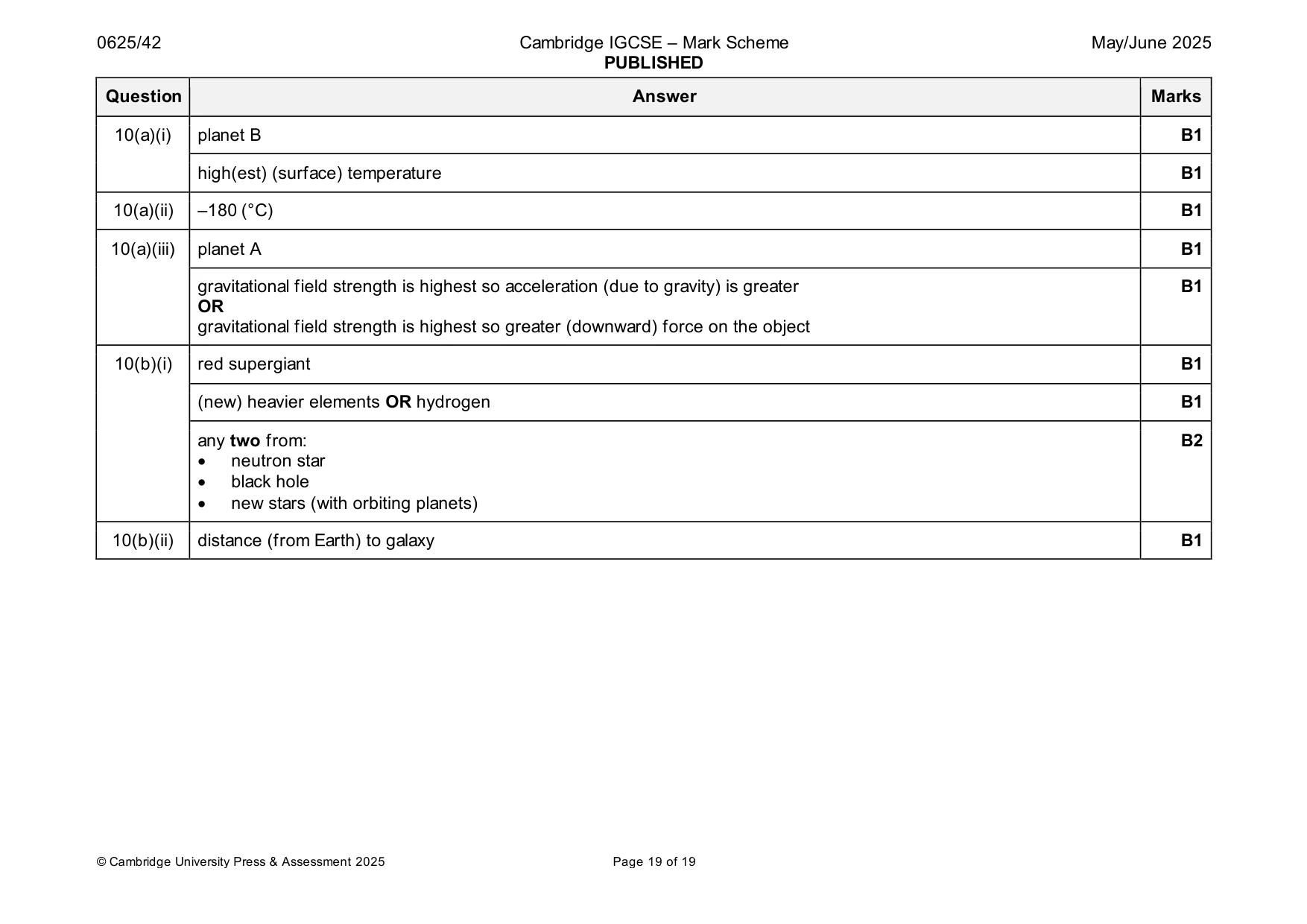
Mark scheme: 10(a)(i) planet B B1 high(est) (surface) temperature B1 10(a)(ii) –180 (°C) B1 10(a)(iii) planet A B1 gravitational field strength is highest so acceleration (due to gravity) is greater B1 OR gravitational field strength is highest so greater (downward) force on the object 10(b)(i) red supergiant B1 (new) heavier elements OR hydrogen B1 any two from: B2 • neutron star • black hole • new stars (with orbiting planets) 10(b)(ii) distance (from Earth) to galaxy B1
What was in this paper
The subtopics covered by these 10 questions, and how many questions each got. Open one in a new tab to see every Cambridge question on it.
What you needed in this session
Cambridge’s own grade thresholds for 2025 May/June, Paper 4 · Variant 2. A higher threshold means an easier paper — the bar moves with how the cohort did.