Cambridge IGCSE Physics 0625 — 2017 Oct/Nov Paper 4 · Variant 3
0625/43/O/N/17 · 10 questions · 80 marks · ≈90 min
The question paper and its mark scheme, free to read here and free to download. This is Cambridge’s own paper, exactly as it was sat.
Question paper16 pages
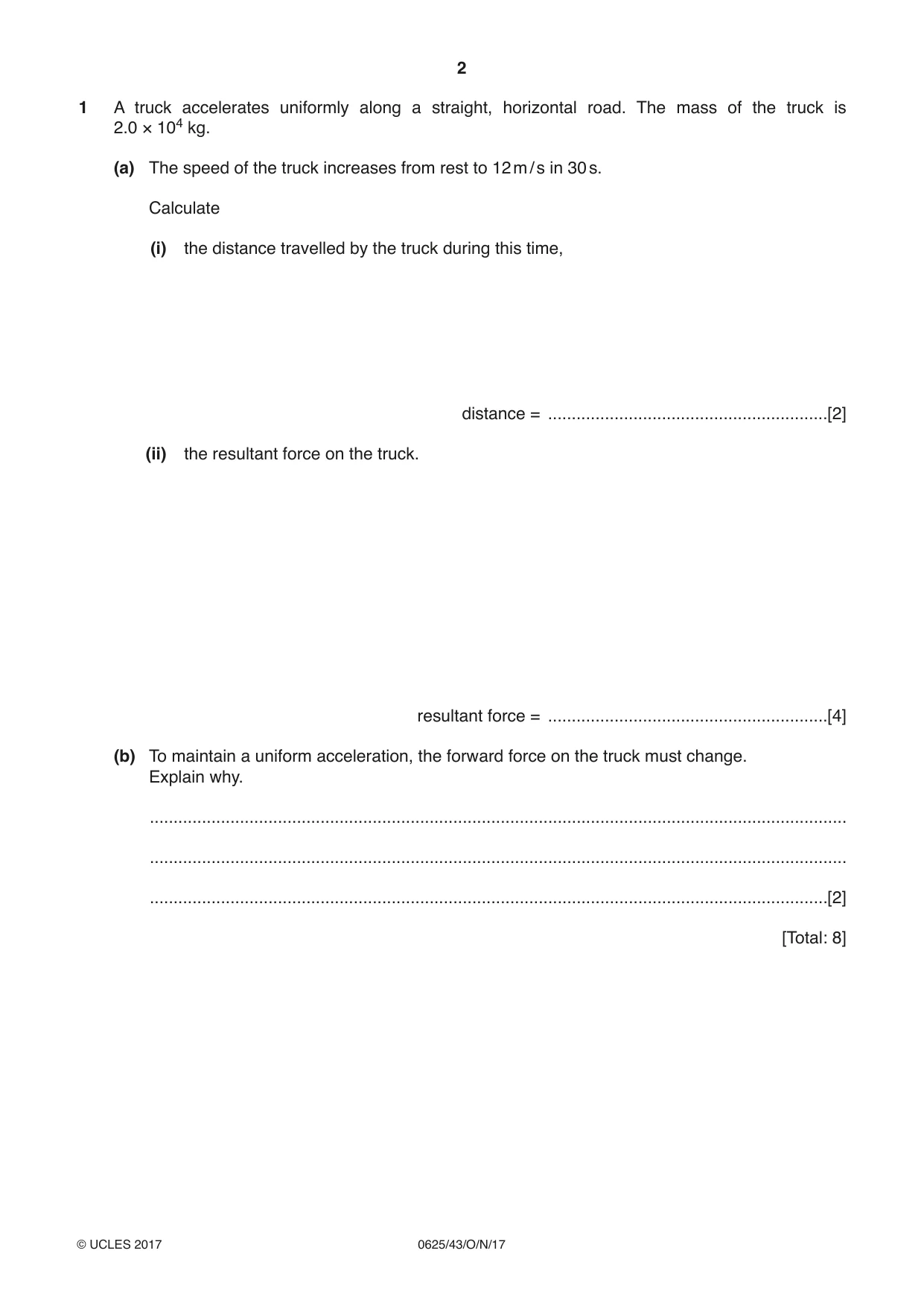

Mark scheme7 pages
Answers below. Sit the paper first if you are practising.
Questions as text
Q1 · A truck accelerates uniformly along a straight, horizontal road
1 A truck accelerates uniformly along a straight, horizontal road. The mass of the truck is 2.0 × 10⁴ kg. (a) The speed of the truck increases from rest to 12 m / s in 30 s. Calculate (i) the distance travelled by the truck during this time, distance = ...........................................................[2] (ii) the resultant force on the truck. resultant force = ...........................................................[4] (b) To maintain a uniform acceleration, the forward force on the truck must change. Explain why. ................................................................................................................................................... ................................................................................................................................................... ...............................................................................................................................................[2] [Total: 8]
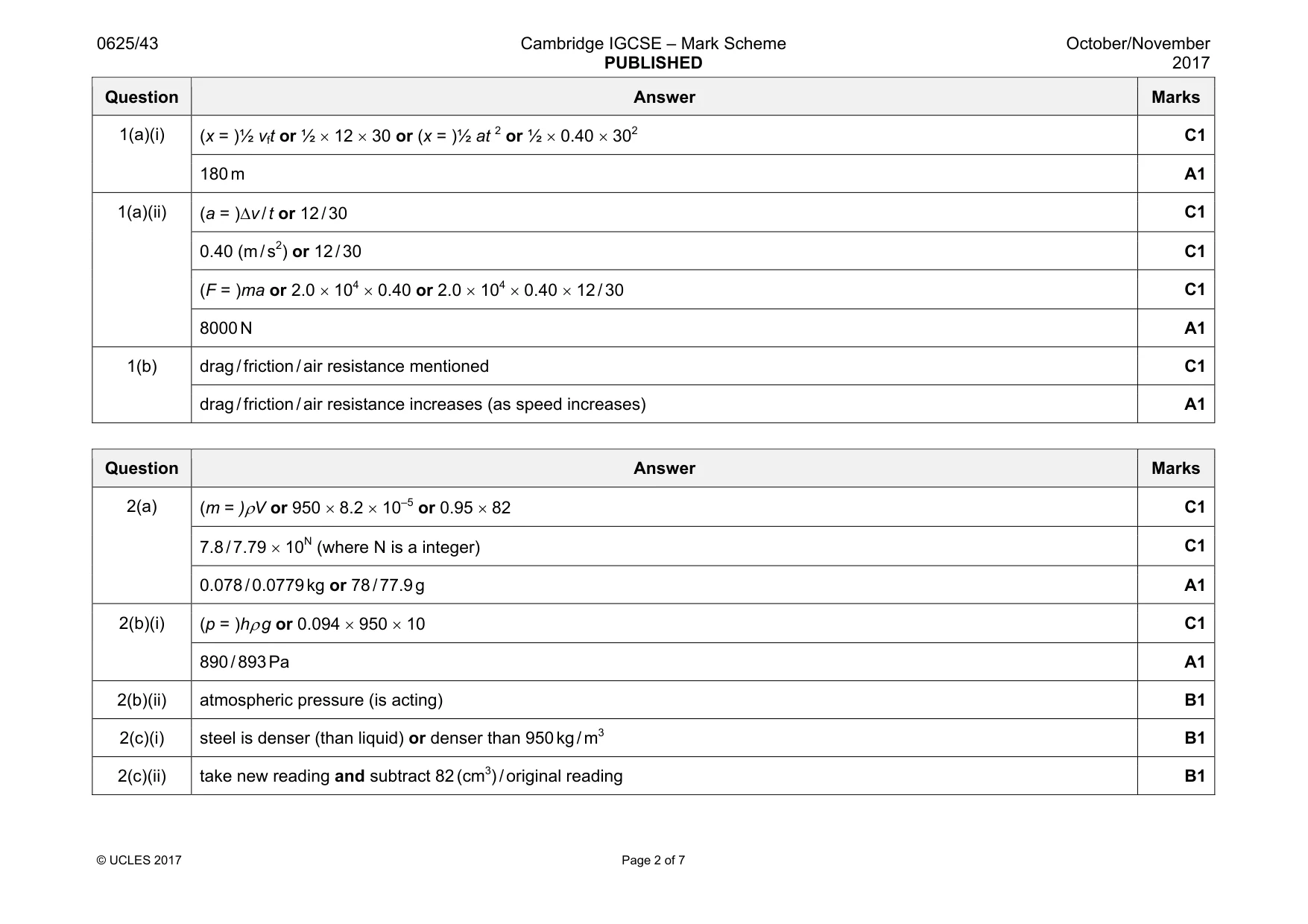
Mark scheme: 1(a)(i) C1 180 m A1 1(a)(ii) (a = )∆v / t or 12 / 30 C1 0.40 (m / s2) or 12 / 30 C1 (F = )ma or 2.0 × 104 × 0.40 or 2.0 × 104 × 0.40 × 12 / 30 C1 8000 N A1 1(b) drag / friction / air resistance mentioned C1 drag / friction / air resistance increases (as speed increases) A1
Q2 · A measuring cylinder that contains a coloured liquid
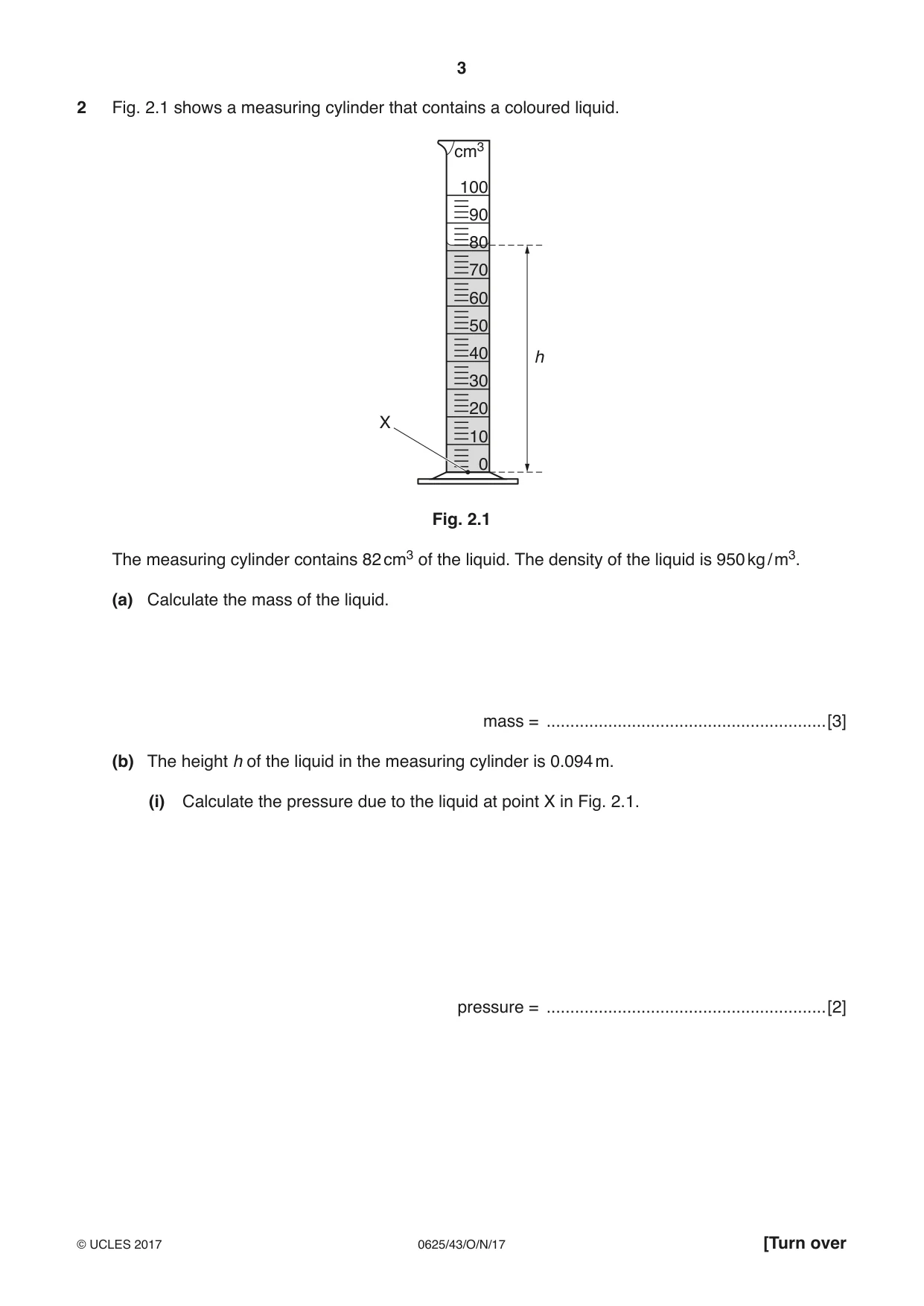
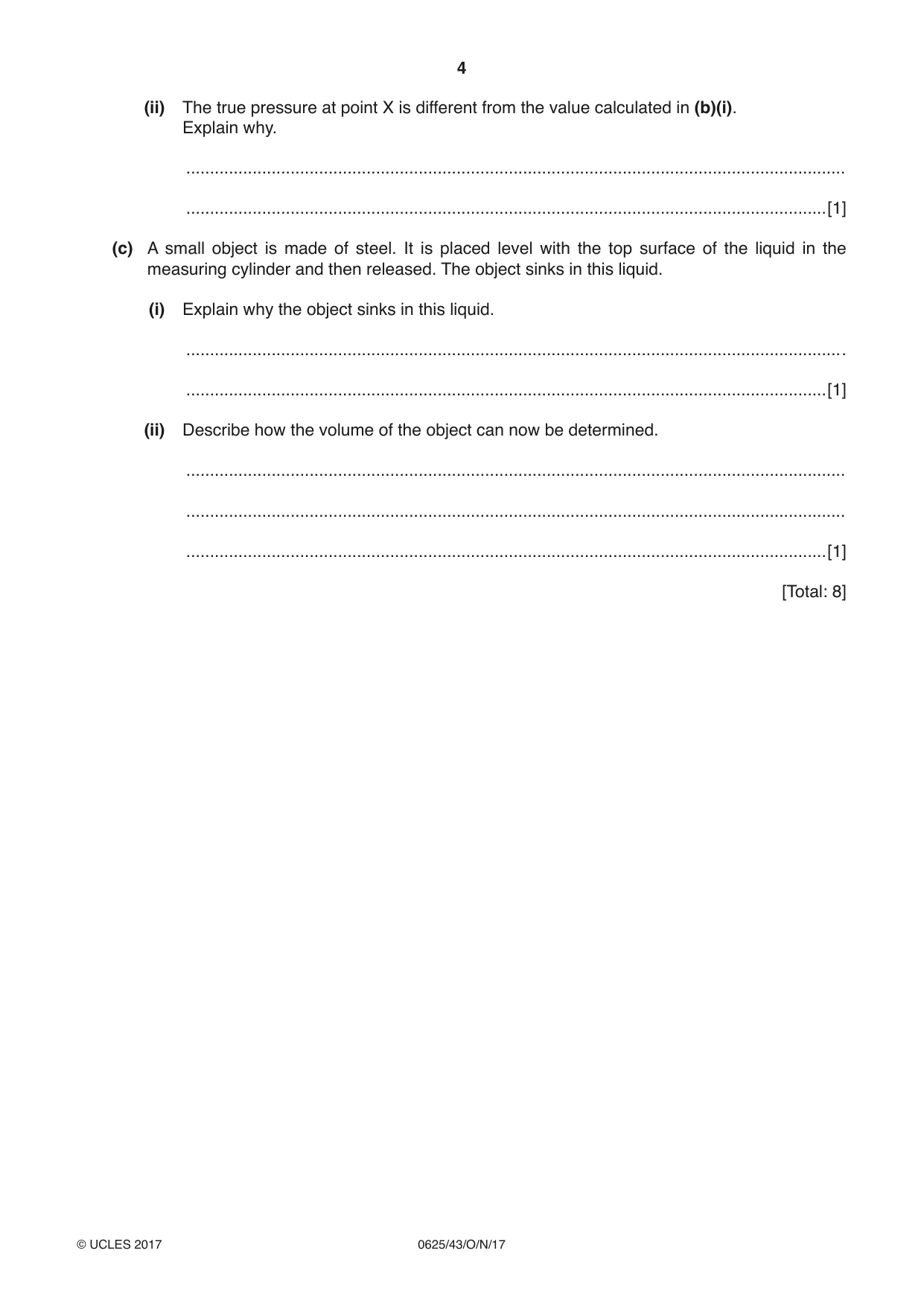
2 Fig. 2.1 shows a measuring cylinder that contains a coloured liquid. cm3 100 90 80 70 60 50 40 h 30 20 X 10 0 Fig. 2.1 The measuring cylinder contains 82 cm3 of the liquid. The density of the liquid is 950 kg / m3. (a) Calculate the mass of the liquid. mass = ...........................................................[3] (b) The height h of the liquid in the measuring cylinder is 0.094 m. (i) Calculate the pressure due to the liquid at point X in Fig. 2.1. pressure = ...........................................................[2] (ii) The true pressure at point X is different from the value calculated in (b)(i). Explain why. ........................................................................................................................................... .......................................................................................................................................[1] (c) A small object is made of steel. It is placed level with the top surface of the liquid in the measuring cylinder and then released. The object sinks in this liquid. (i) Explain why the object sinks in this liquid. ........................................................................................................................................... .......................................................................................................................................[1] (ii) Describe how the volume of the object can now be determined. ........................................................................................................................................... ........................................................................................................................................... .......................................................................................................................................[1] [Total: 8]
Mark scheme: 2(a) C1 7.8 / 7.79 × 10N (where N is a integer) C1 0.078 / 0.0779 kg or 78 / 77.9 g A1 2(b)(i) (p = )hρ g or 0.094 × 950 × 10 C1 890 / 893 Pa A1 2(b)(ii) atmospheric pressure (is acting) B1 2(c)(i) steel is denser (than liquid) or denser than 950 kg / m3 B1 2(c)(ii) take new reading and subtract 82 (cm3) / original reading B1
Q3 · Solar cells that use radiation from the Sun to generate electricity
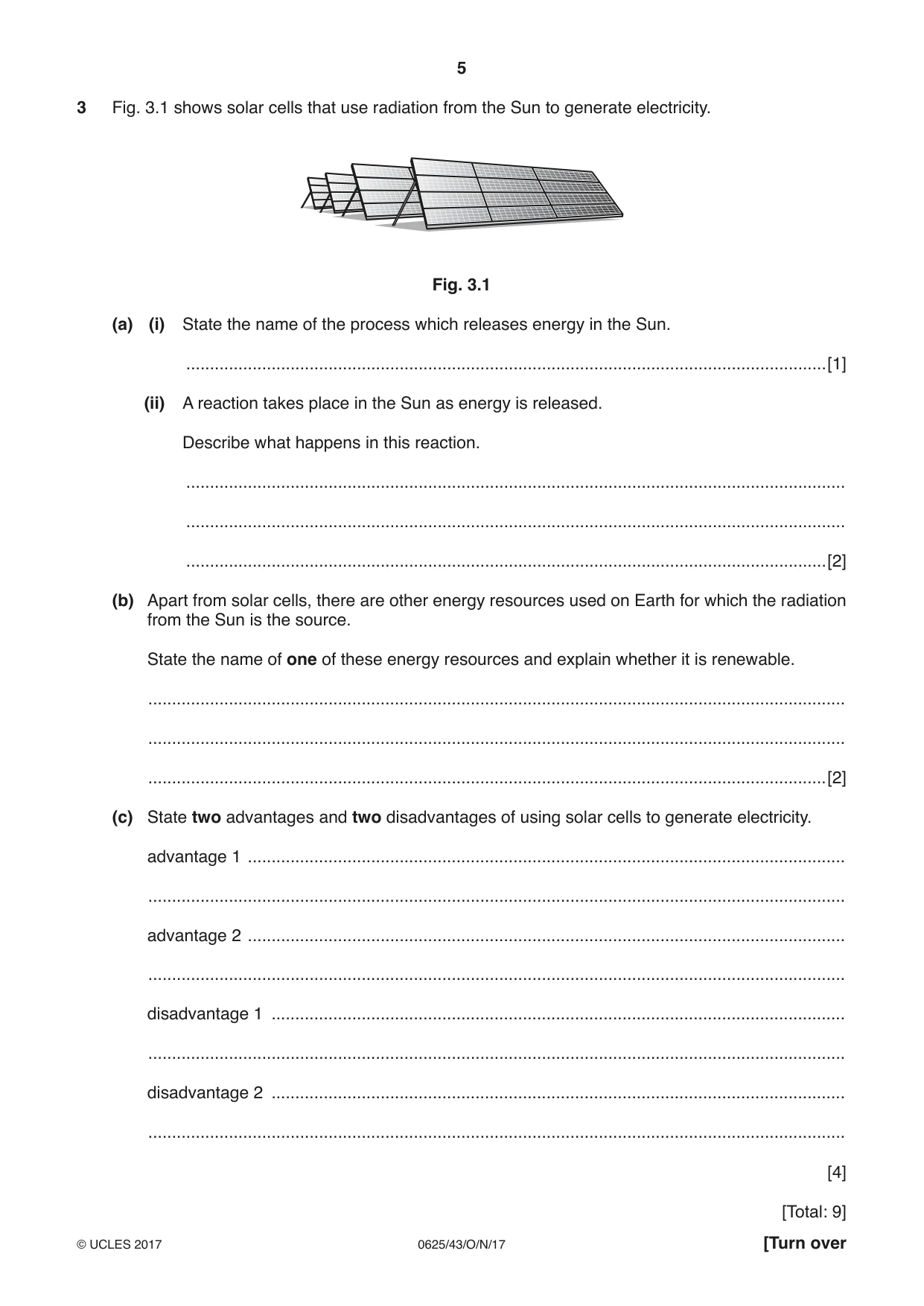
3 Fig. 3.1 shows solar cells that use radiation from the Sun to generate electricity. Fig. 3.1 (a) (i) State the name of the process which releases energy in the Sun. .......................................................................................................................................[1] (ii) A reaction takes place in the Sun as energy is released. Describe what happens in this reaction. ........................................................................................................................................... ........................................................................................................................................... .......................................................................................................................................[2] (b) Apart from solar cells, there are other energy resources used on Earth for which the radiation from the Sun is the source. State the name of one of these energy resources and explain whether it is renewable. ................................................................................................................................................... ................................................................................................................................................... ...............................................................................................................................................[2] (c) State two advantages and two disadvantages of using solar cells to generate electricity. advantage 1 .............................................................................................................................. ................................................................................................................................................... advantage 2 .............................................................................................................................. ................................................................................................................................................... disadvantage 1 ......................................................................................................................... ................................................................................................................................................... disadvantage 2 ......................................................................................................................... ................................................................................................................................................... [4] [Total: 9]
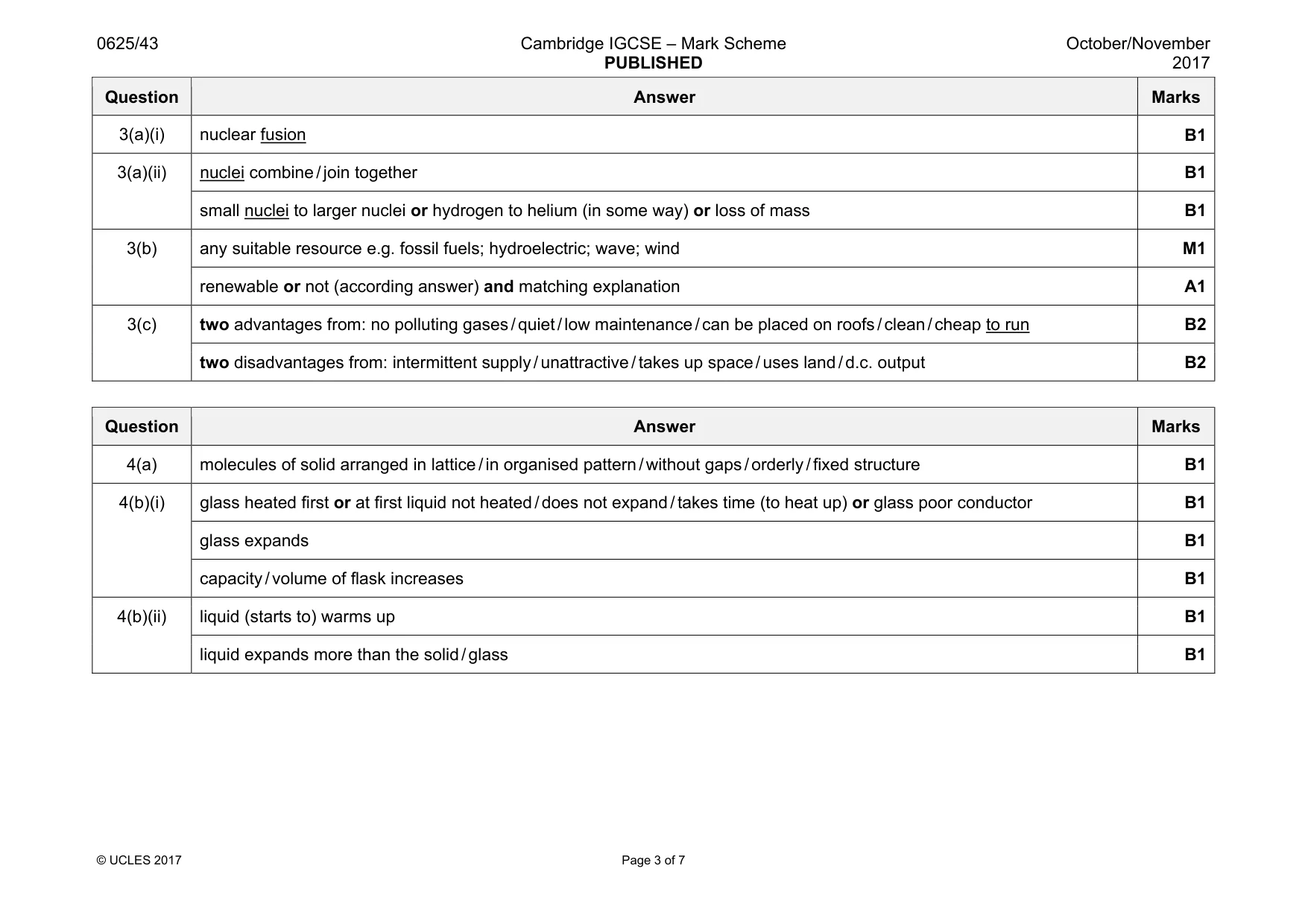
Mark scheme: 3(a)(i) nuclear fusion B1 3(a)(ii) nuclei combine / join together B1 small nuclei to larger nuclei or hydrogen to helium (in some way) or loss of mass B1 3(b) any suitable resource e.g. fossil fuels; hydroelectric; wave; wind M1 renewable or not (according answer) and matching explanation A1 3(c) two advantages from: no polluting gases / quiet / low maintenance / can be placed on roofs / clean / cheap to run B2 two disadvantages from: intermittent supply / unattractive / takes up space / uses land / d.c. output B2
Q4 · The molecules of most liquids are, on average, slightly further apart than the molecules…
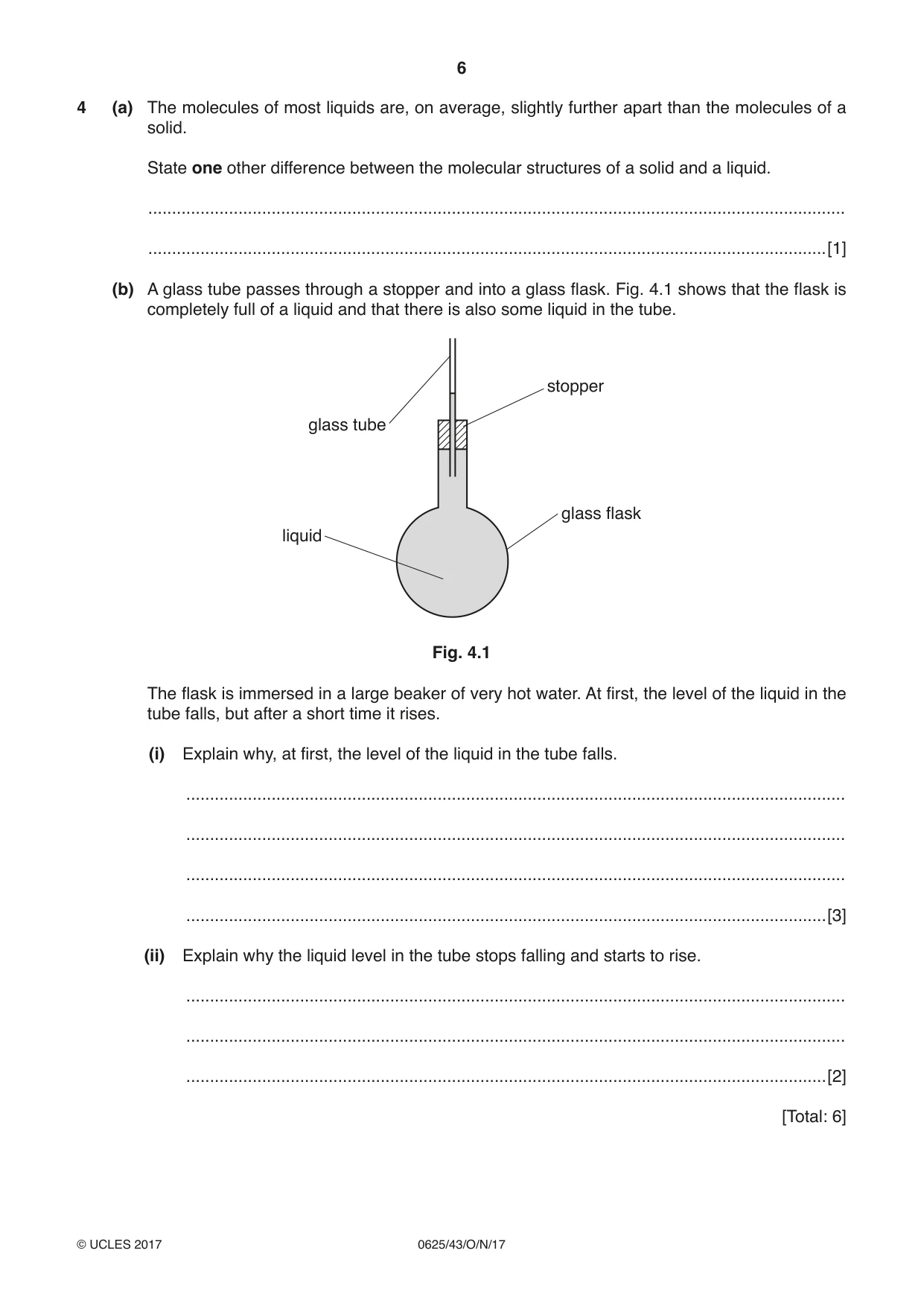
4 (a) The molecules of most liquids are, on average, slightly further apart than the molecules of a solid. State one other difference between the molecular structures of a solid and a liquid. ................................................................................................................................................... ...............................................................................................................................................[1] (b) A glass tube passes through a stopper and into a glass flask. Fig. 4.1 shows that the flask is completely full of a liquid and that there is also some liquid in the tube. stopper glass tube glass flask liquid Fig. 4.1 The flask is immersed in a large beaker of very hot water. At first, the level of the liquid in the tube falls, but after a short time it rises. (i) Explain why, at first, the level of the liquid in the tube falls. ........................................................................................................................................... ........................................................................................................................................... ........................................................................................................................................... .......................................................................................................................................[3] (ii) Explain why the liquid level in the tube stops falling and starts to rise. ........................................................................................................................................... ........................................................................................................................................... .......................................................................................................................................[2] [Total: 6]
Mark scheme: 4(a) molecules of solid arranged in lattice / in organised pattern / without gaps / orderly / fixed structure B1 4(b)(i) glass heated first or at first liquid not heated / does not expand / takes time (to heat up) or glass poor conductor B1 glass expands B1 capacity / volume of flask increases B1 4(b)(ii) liquid (starts to) warms up B1 liquid expands more than the solid / glass B1
Q5 · A silver spoon has a thermal capacity of 7.2 J / °C
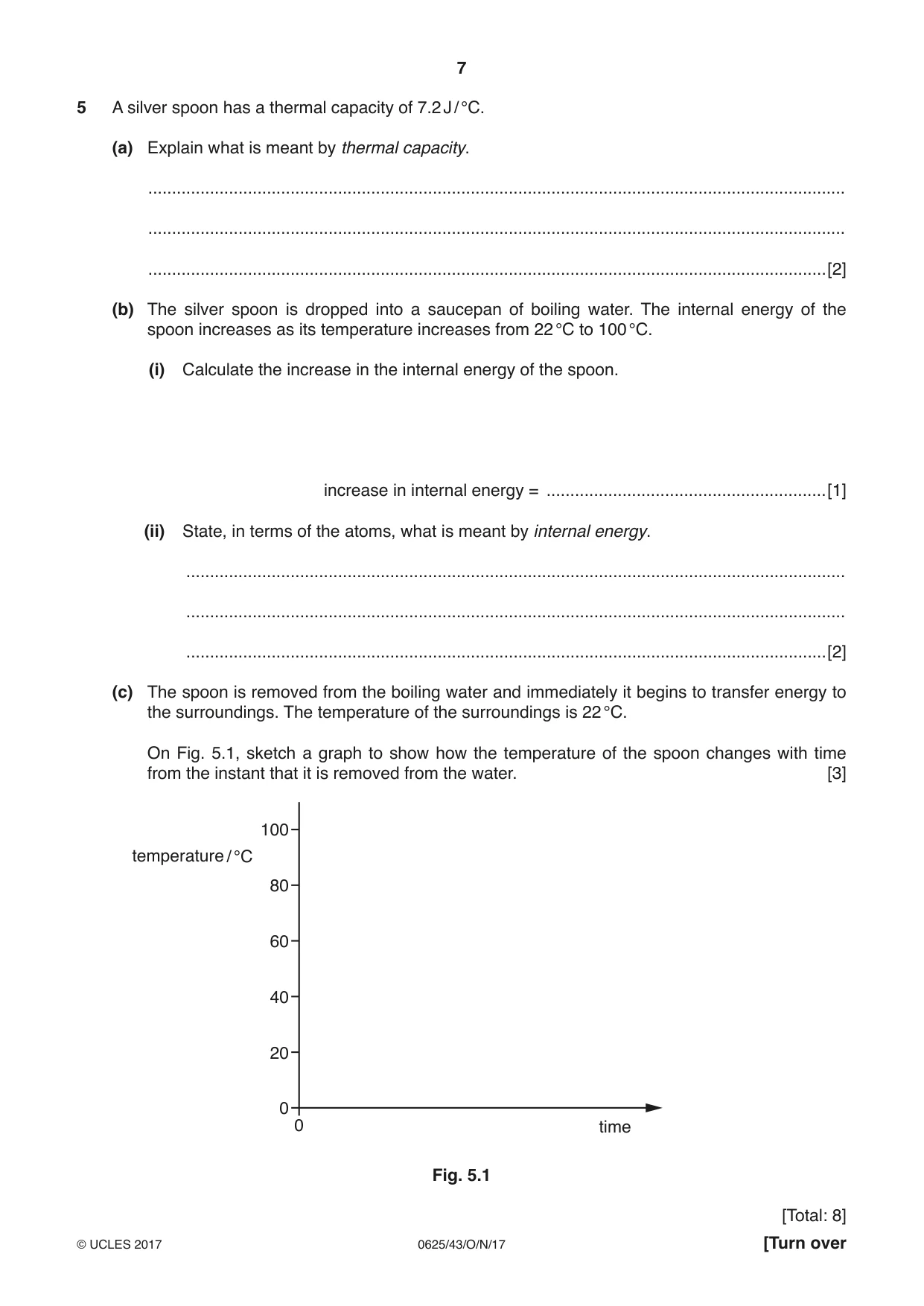
5 A silver spoon has a thermal capacity of 7.2 J / °C. (a) Explain what is meant by thermal capacity. ................................................................................................................................................... ................................................................................................................................................... ...............................................................................................................................................[2] (b) The silver spoon is dropped into a saucepan of boiling water. The internal energy of the spoon increases as its temperature increases from 22 °C to 100 °C. (i) Calculate the increase in the internal energy of the spoon. increase in internal energy = ...........................................................[1] (ii) State, in terms of the atoms, what is meant by internal energy. ........................................................................................................................................... ........................................................................................................................................... .......................................................................................................................................[2] (c) The spoon is removed from the boiling water and immediately it begins to transfer energy to the surroundings. The temperature of the surroundings is 22 °C. On Fig. 5.1, sketch a graph to show how the temperature of the spoon changes with time from the instant that it is removed from the water. [3] 100 temperature / °C 80 60 40 20 0 0 time Fig. 5.1 [Total: 8]
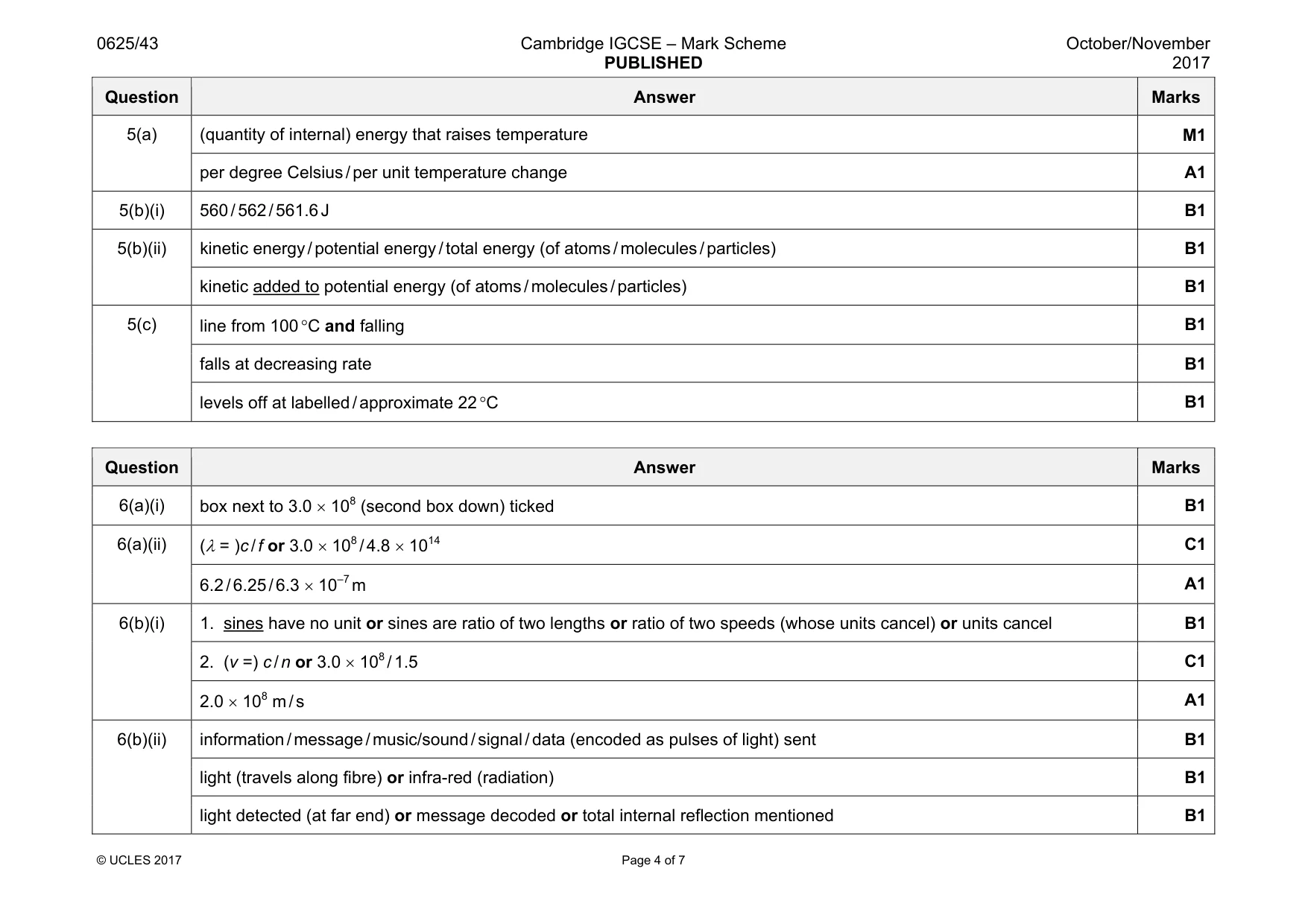
Mark scheme: 5(a) (quantity of internal) energy that raises temperature M1 per degree Celsius / per unit temperature change A1 5(b)(i) 560 / 562 / 561.6 J B1 5(b)(ii) kinetic energy / potential energy / total energy (of atoms / molecules / particles) B1 kinetic added to potential energy (of atoms / molecules / particles) B1 5(c) line from 100 °C and falling B1 falls at decreasing rate B1 levels off at labelled / approximate 22 °C B1
Q6 · Visible light is one component of the electromagnetic spectrum
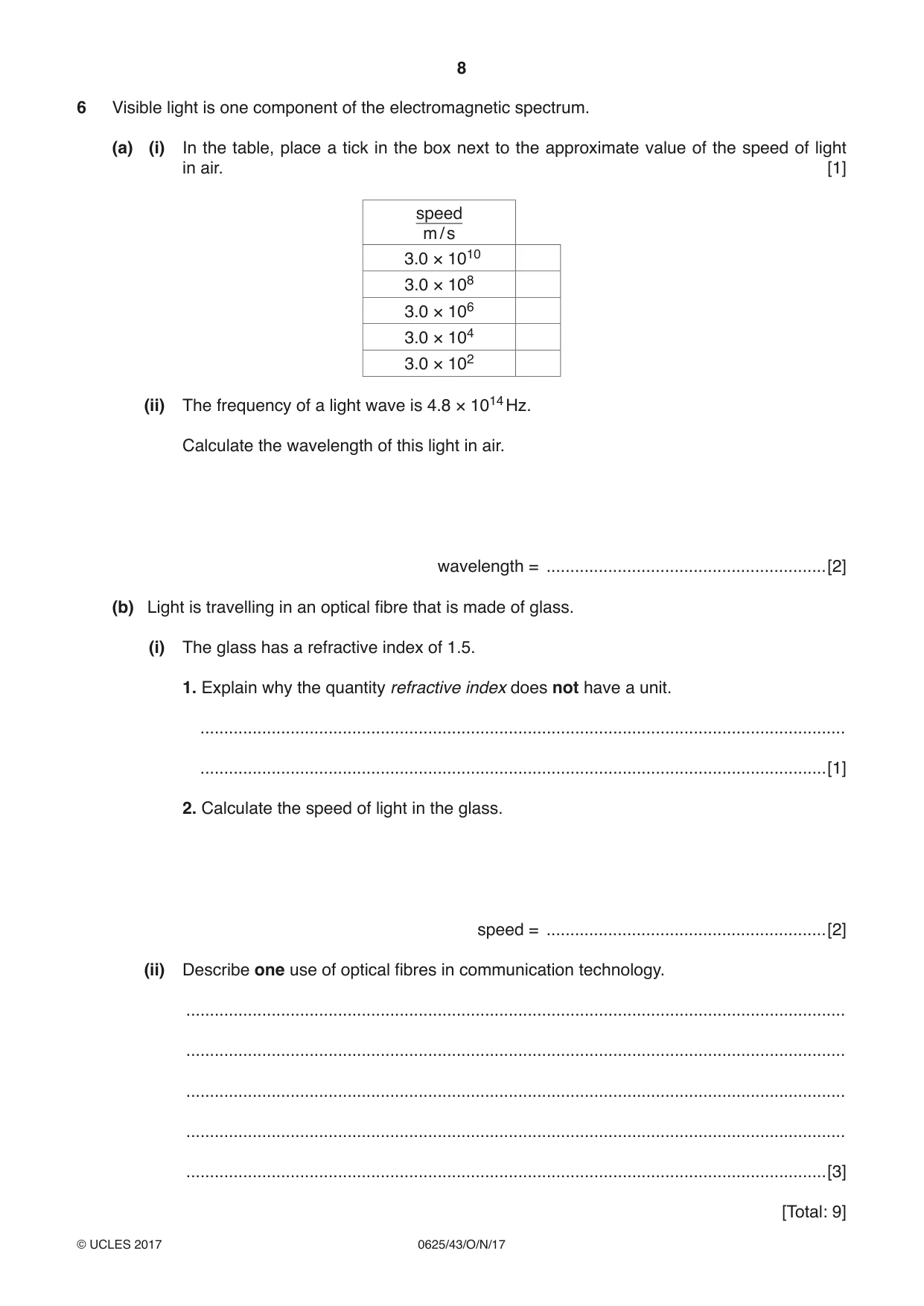
6 Visible light is one component of the electromagnetic spectrum. (a) (i) In the table, place a tick in the box next to the approximate value of the speed of light in air. [1] speed m / s 3.0 × 10¹⁰ 3.0 × 10⁸ 3.0 × 10⁶ 3.0 × 10⁴ 3.0 × 10² (ii) The frequency of a light wave is 4.8 × 10¹⁴ Hz. Calculate the wavelength of this light in air. wavelength = ...........................................................[2] (b) Light is travelling in an optical fibre that is made of glass. (i) The glass has a refractive index of 1.5. 1. Explain why the quantity refractive index does not have a unit. ........................................................................................................................................ ....................................................................................................................................[1] 2. Calculate the speed of light in the glass. speed = ...........................................................[2] (ii) Describe one use of optical fibres in communication technology. ........................................................................................................................................... ........................................................................................................................................... ........................................................................................................................................... ........................................................................................................................................... .......................................................................................................................................[3] [Total: 9]
Mark scheme: 6(a)(i) B1 6(a)(ii) (λ = )c / f or 3.0 × 10⁸ / 4.8 × 10¹⁴ C1 6.2 / 6.25 / 6.3 × 10⁻⁷ m A1 6(b)(i) 1. sines have no unit or sines are ratio of two lengths or ratio of two speeds (whose units cancel) or units cancel B1 2. (v =) c / n or 3.0 × 10⁸ / 1.5 C1 2.0 × 10⁸ m / s A1 6(b)(ii) information / message / music/sound / signal / data (encoded as pulses of light) sent B1 light (travels along fibre) or infra-red (radiation) B1 light detected (at far end) or message decoded or total internal reflection mentioned B1
Q7 · A converging lens and its principal axis
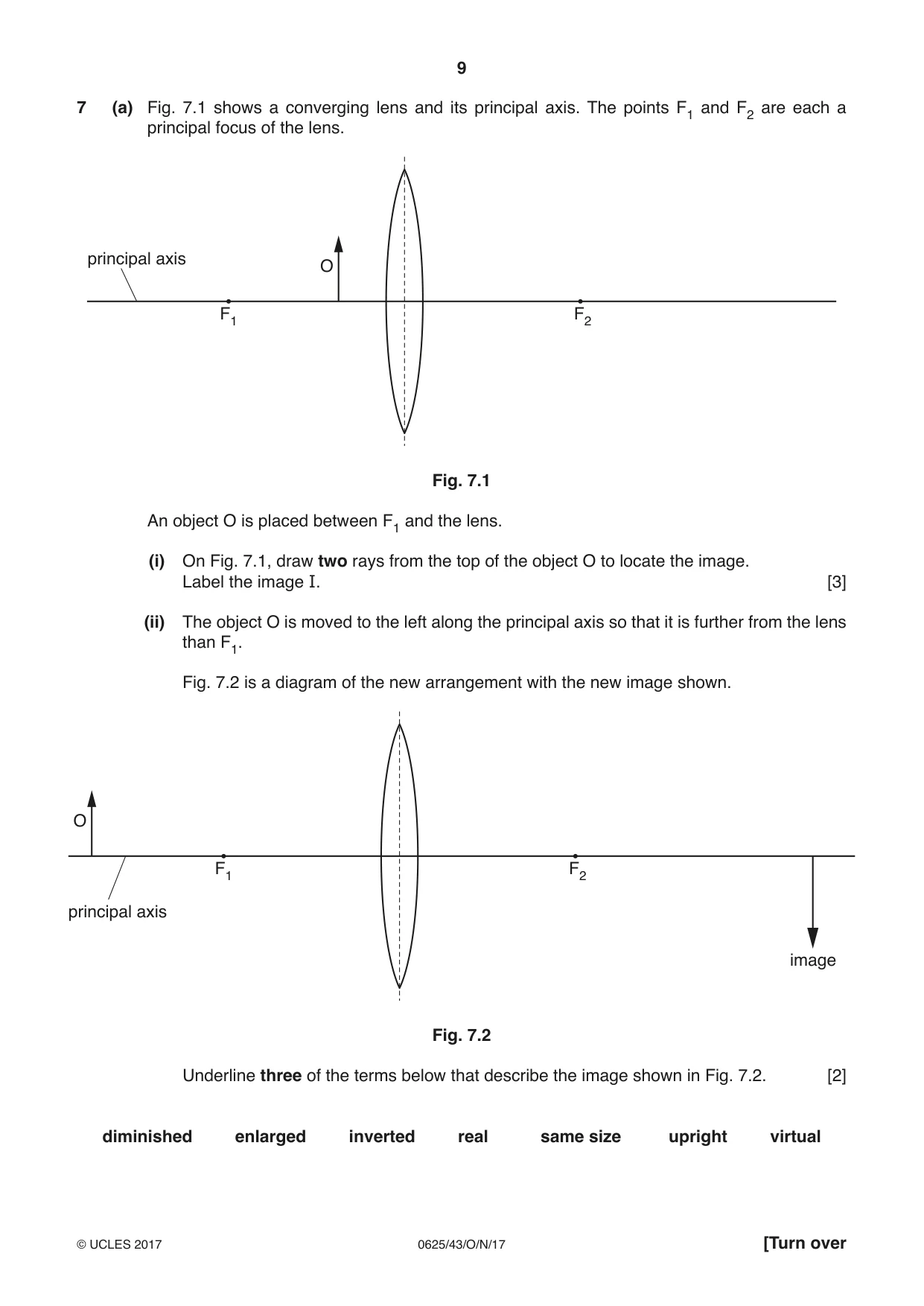
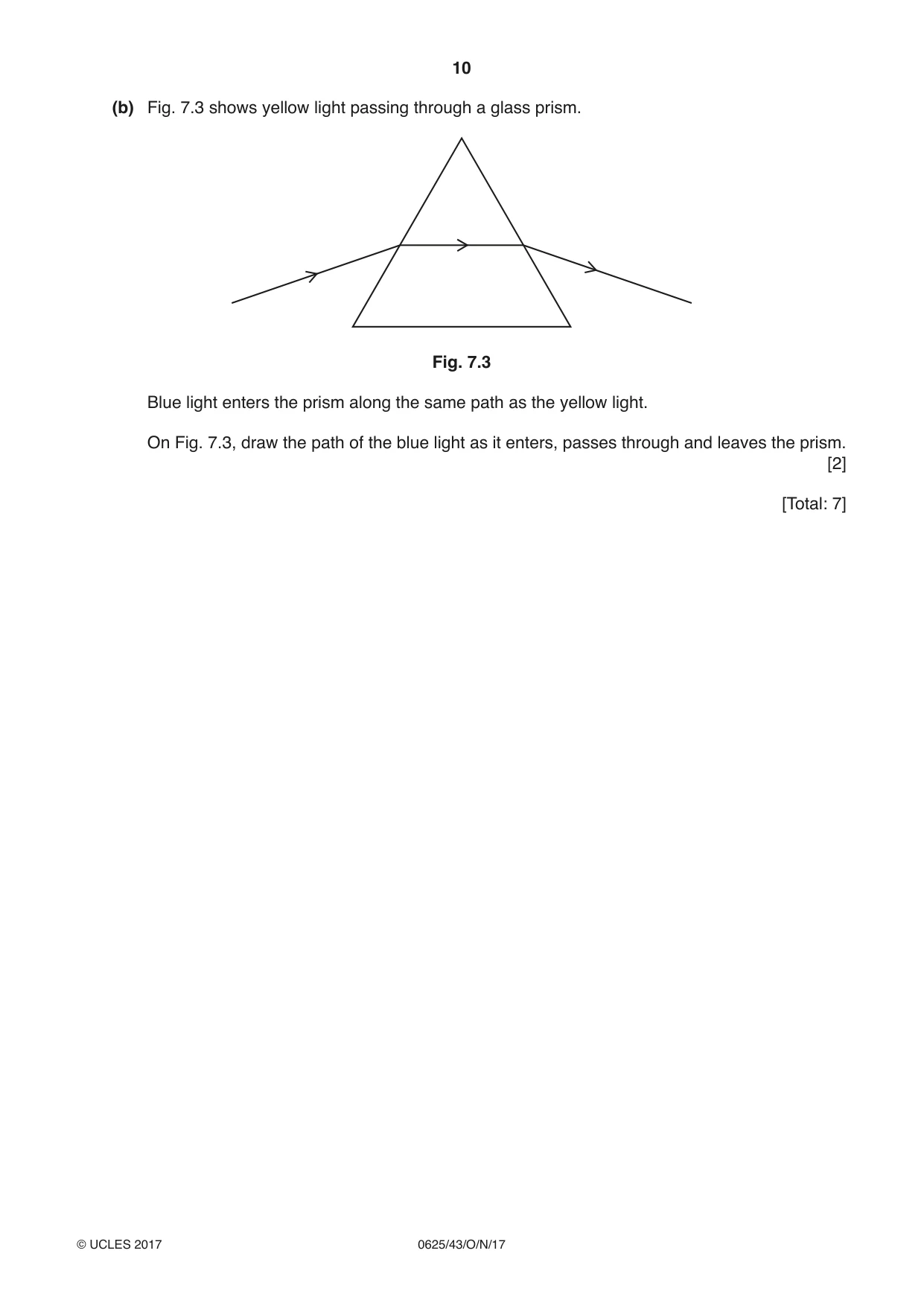
7 (a) Fig. 7.1 shows a converging lens and its principal axis. The points F1 and F2 are each a principal focus of the lens. principal axis O F1 F2 Fig. 7.1 An object O is placed between F1 and the lens. (i) On Fig. 7.1, draw two rays from the top of the object O to locate the image. Label the image I. [3] (ii) The object O is moved to the left along the principal axis so that it is further from the lens than F1. Fig. 7.2 is a diagram of the new arrangement with the new image shown. O F1 F2 principal axis image Fig. 7.2 Underline three of the terms below that describe the image shown in Fig. 7.2. [2] diminished enlarged inverted real same size upright virtual (b) Fig. 7.3 shows yellow light passing through a glass prism. Fig. 7.3 Blue light enters the prism along the same path as the yellow light. On Fig. 7.3, draw the path of the blue light as it enters, passes through and leaves the prism. [2] [Total: 7]
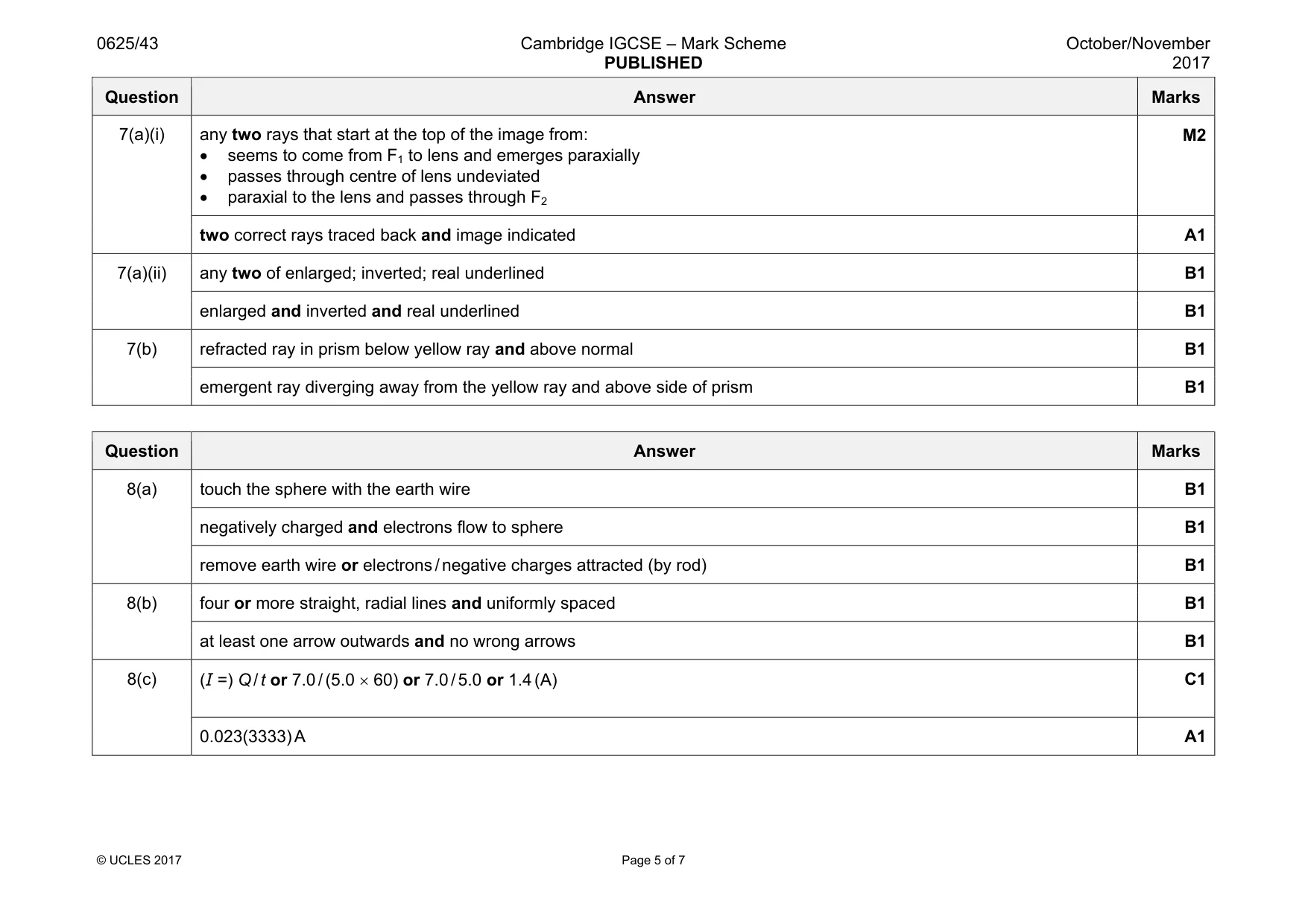
Mark scheme: 7(a)(i) any two rays that start at the top of the image from: • seems to come from F1 to lens and emerges paraxially • passes through centre of lens undeviated • paraxial to the lens and passes through F2 M2 two correct rays traced back and image indicated A1 7(a)(ii) any two of enlarged; inverted; real underlined B1 enlarged and inverted and real underlined B1 7(b) refracted ray in prism below yellow ray and above normal B1 emergent ray diverging away from the yellow ray and above side of prism B1
Q8 · An uncharged conducting sphere on an insulating stand placed close to a positively…
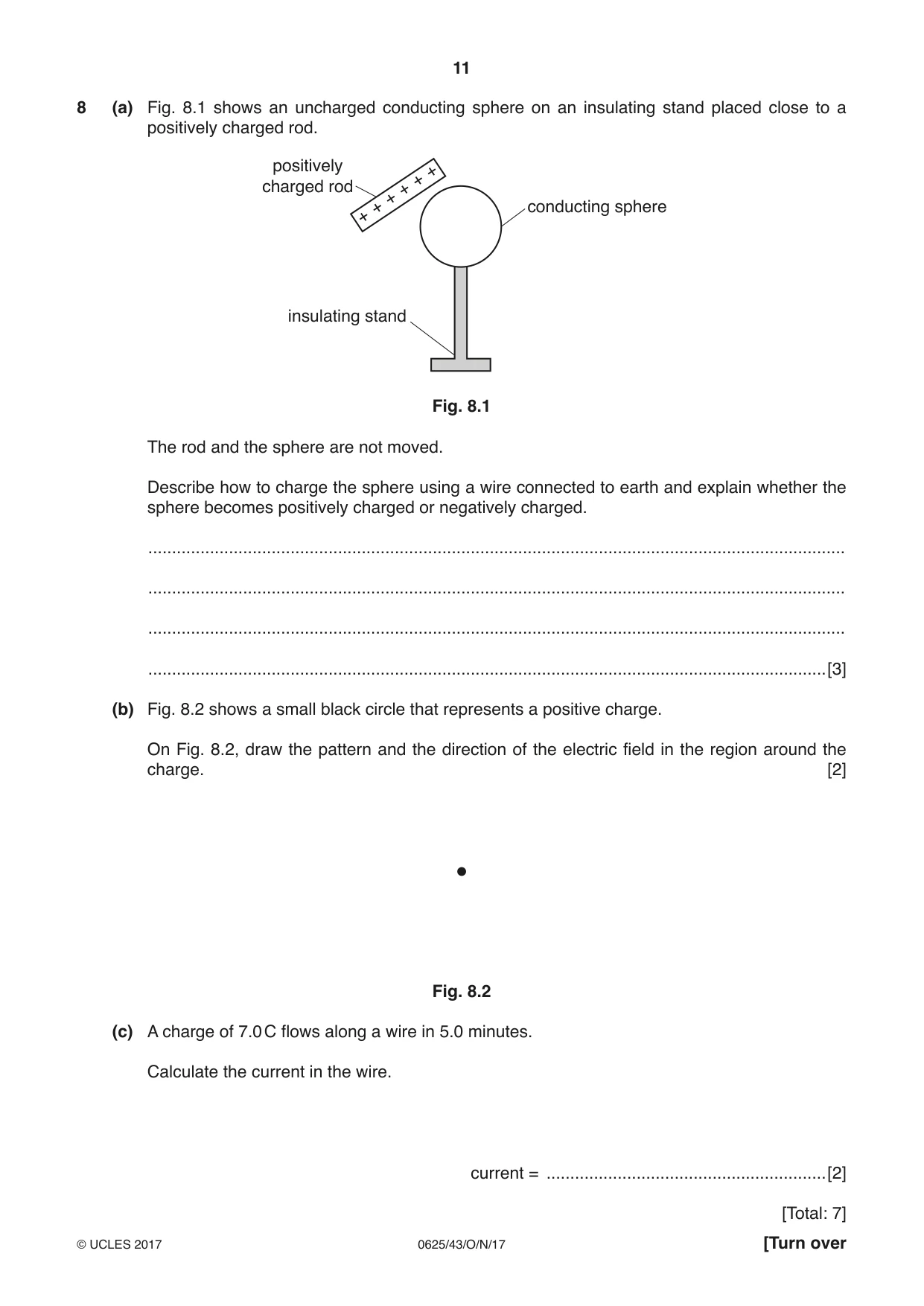
8 (a) Fig. 8.1 shows an uncharged conducting sphere on an insulating stand placed close to a positively charged rod. positively + + charged rod + + + conducting sphere + insulating stand Fig. 8.1 The rod and the sphere are not moved. Describe how to charge the sphere using a wire connected to earth and explain whether the sphere becomes positively charged or negatively charged. ................................................................................................................................................... ................................................................................................................................................... ................................................................................................................................................... ...............................................................................................................................................[3] (b) Fig. 8.2 shows a small black circle that represents a positive charge. On Fig. 8.2, draw the pattern and the direction of the electric field in the region around the charge. [2] Fig. 8.2 (c) A charge of 7.0 C flows along a wire in 5.0 minutes. Calculate the current in the wire. current = ...........................................................[2] [Total: 7]
Mark scheme: 8(a) touch the sphere with the earth wire B1 negatively charged and electrons flow to sphere B1 remove earth wire or electrons / negative charges attracted (by rod) B1 8(b) four or more straight, radial lines and uniformly spaced B1 at least one arrow outwards and no wrong arrows B1 8(c) (I =) Q / t or 7.0 / (5.0 × 60) or 7.0 / 5.0 or 1.4 (A) C1 0.023(3333) A A1
Q9 · The structure of an alternating current (a.c.) generator
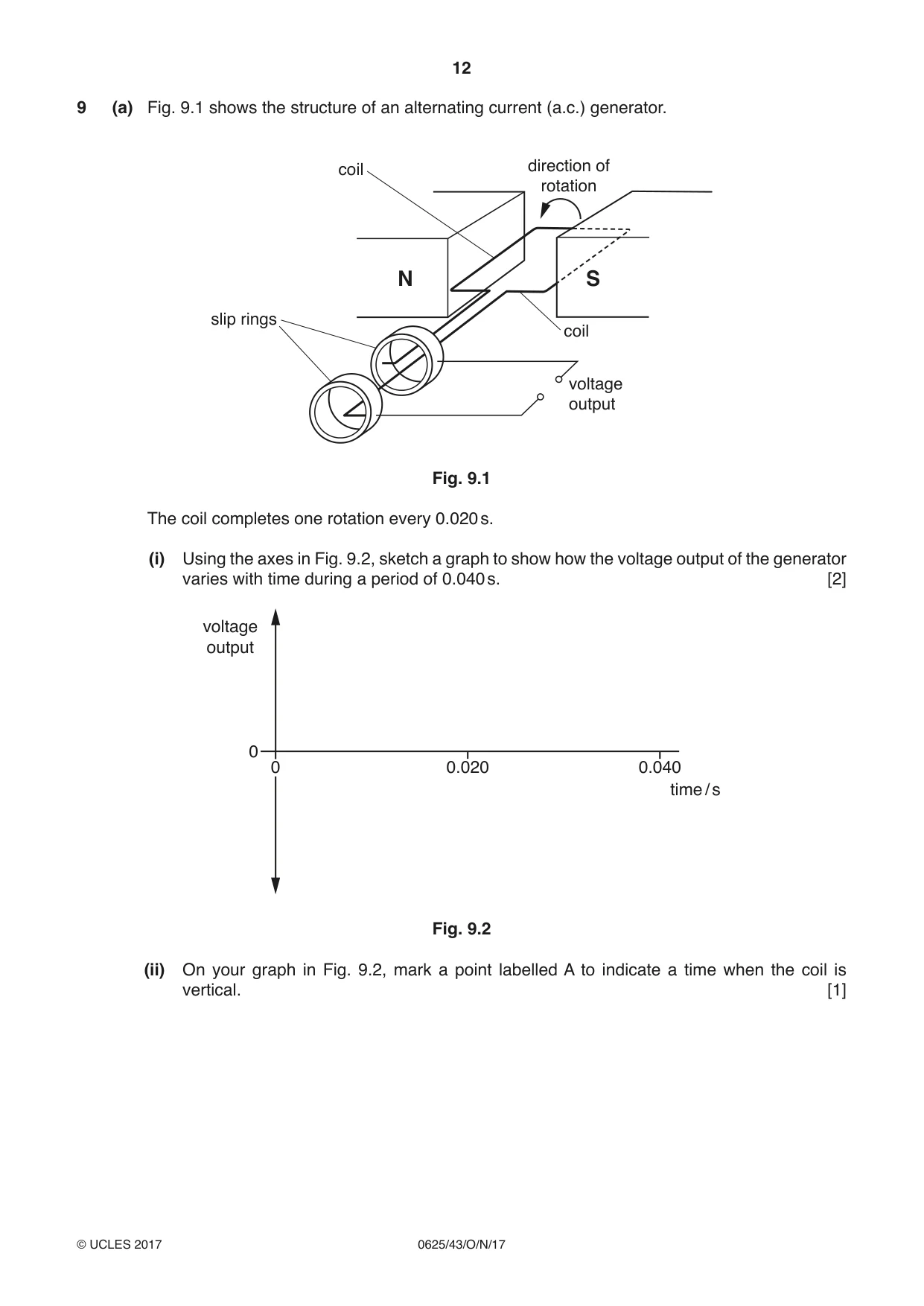
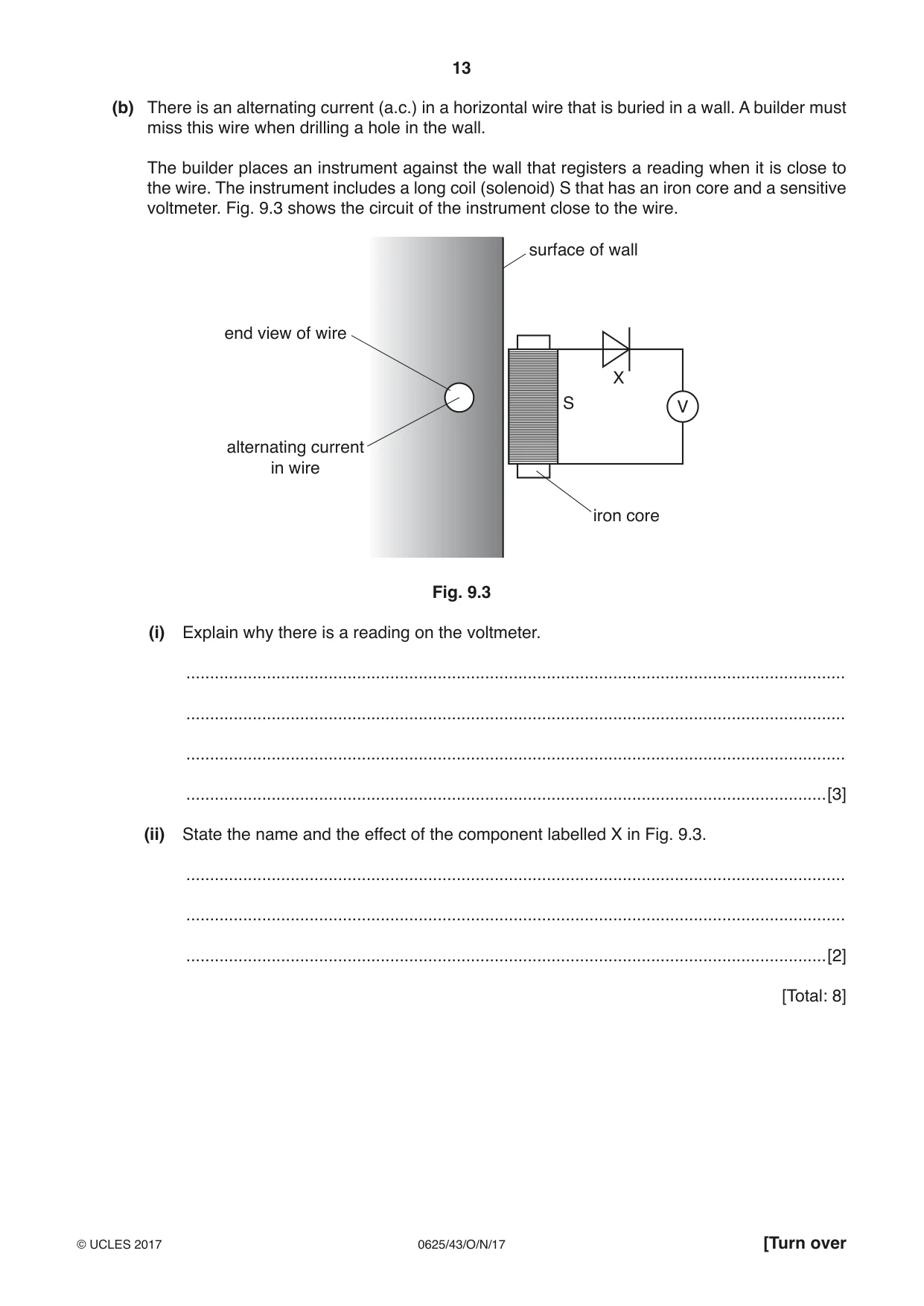
9 (a) Fig. 9.1 shows the structure of an alternating current (a.c.) generator. coil direction of rotation N S slip rings coil voltage output Fig. 9.1 The coil completes one rotation every 0.020 s. (i) Using the axes in Fig. 9.2, sketch a graph to show how the voltage output of the generator varies with time during a period of 0.040 s. [2] voltage output 0 0 0.020 0.040 time / s Fig. 9.2 (ii) On your graph in Fig. 9.2, mark a point labelled A to indicate a time when the coil is vertical. [1] (b) There is an alternating current (a.c.) in a horizontal wire that is buried in a wall. A builder must miss this wire when drilling a hole in the wall. The builder places an instrument against the wall that registers a reading when it is close to the wire. The instrument includes a long coil (solenoid) S that has an iron core and a sensitive voltmeter. Fig. 9.3 shows the circuit of the instrument close to the wire. surface of wall end view of wire X S V alternating current in wire iron core Fig. 9.3 (i) Explain why there is a reading on the voltmeter. ........................................................................................................................................... ........................................................................................................................................... ........................................................................................................................................... .......................................................................................................................................[3] (ii) State the name and the effect of the component labelled X in Fig. 9.3. ........................................................................................................................................... ........................................................................................................................................... .......................................................................................................................................[2] [Total: 8]
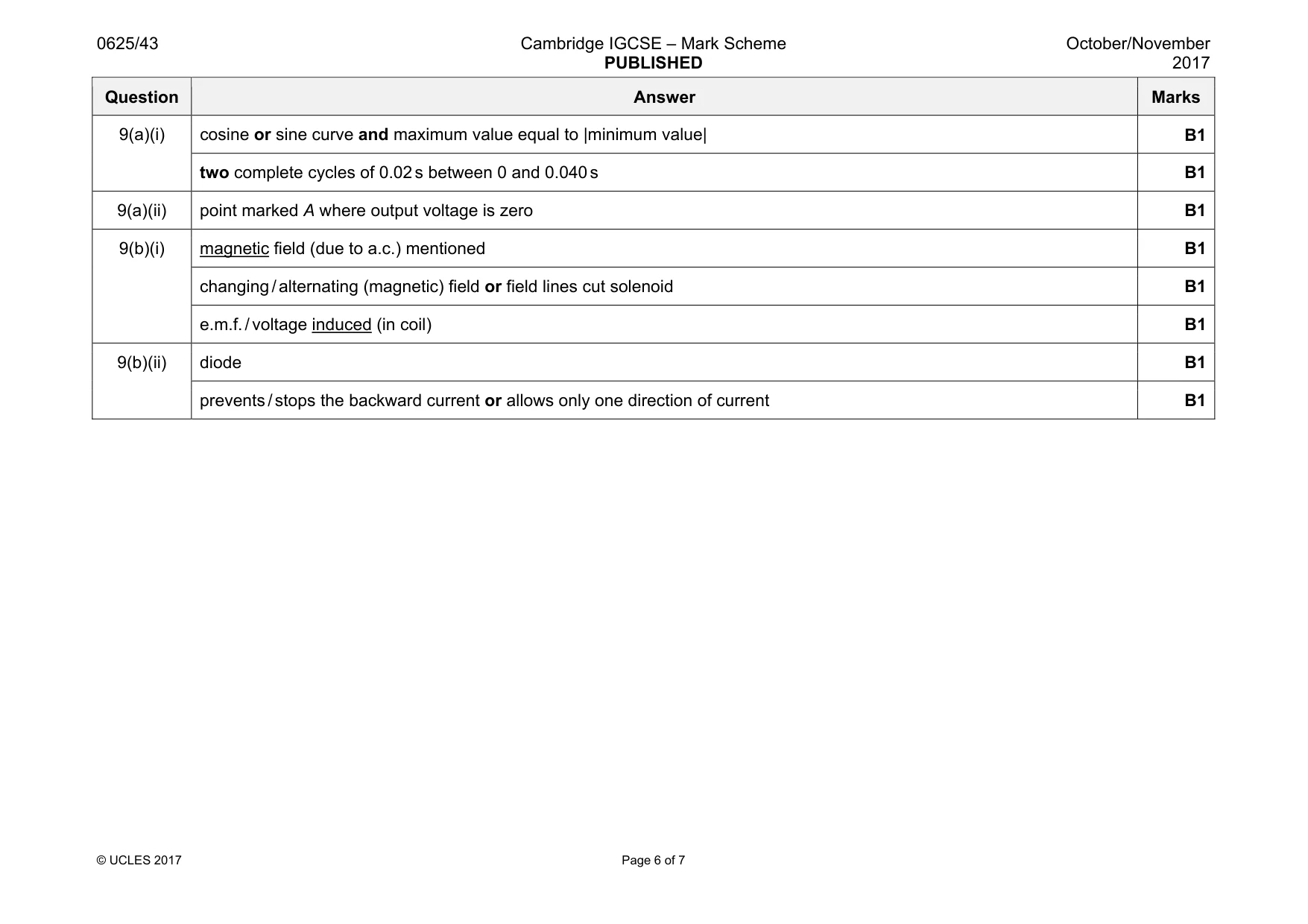
Mark scheme: 9(a)(i) cosine or sine curve and maximum value equal to |minimum value| B1 two complete cycles of 0.02 s between 0 and 0.040 s B1 9(a)(ii) point marked A where output voltage is zero B1 9(b)(i) magnetic field (due to a.c.) mentioned B1 changing / alternating (magnetic) field or field lines cut solenoid B1 e.m.f. / voltage induced (in coil) B1 9(b)(ii) diode B1 prevents / stops the backward current or allows only one direction of current B1
Q10 · State the nature of γ-rays
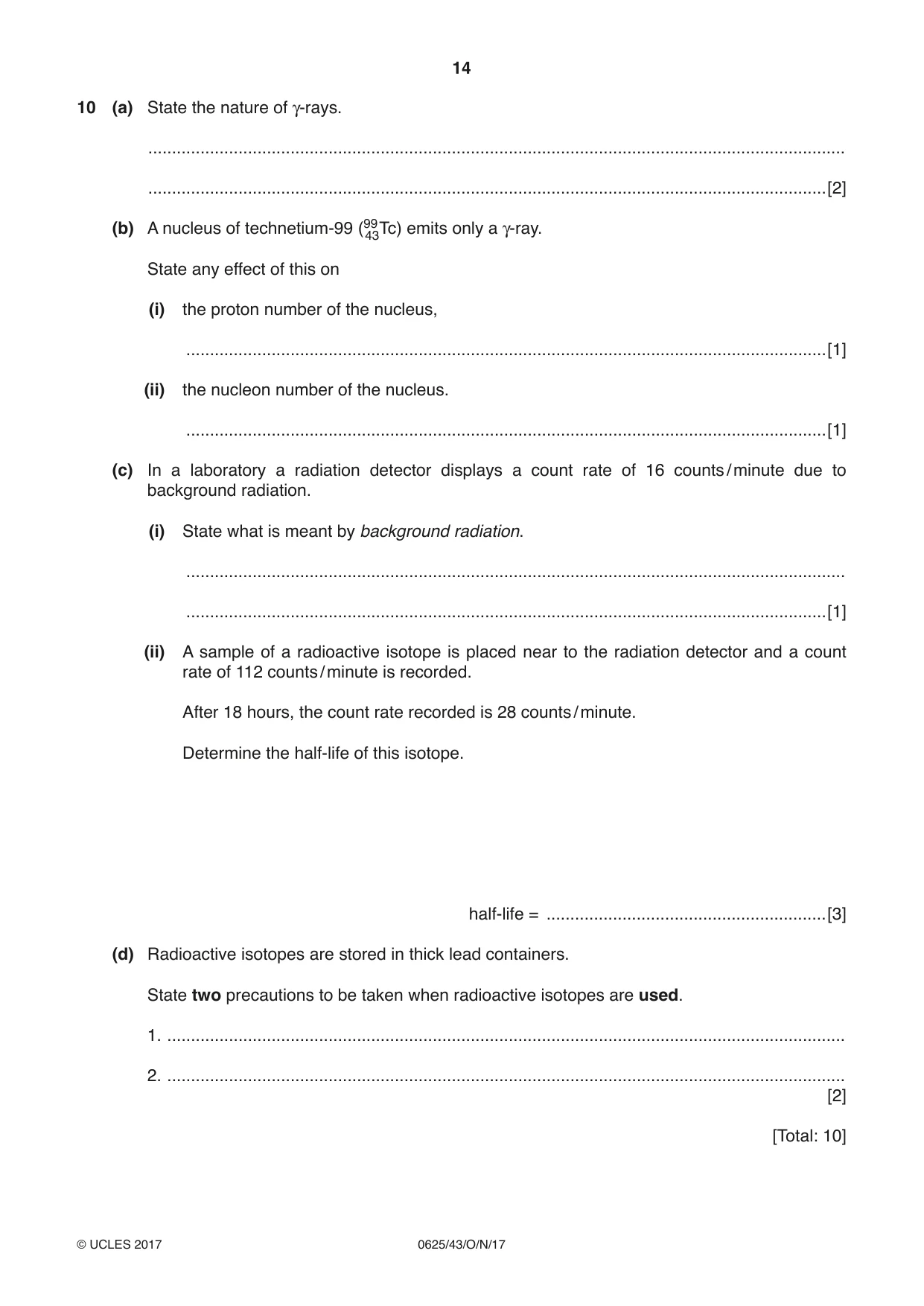
10 (a) State the nature of γ-rays. ................................................................................................................................................... ...............................................................................................................................................[2] (b) A nucleus of technetium-99 (9943Tc) emits only a γ-ray. State any effect of this on (i) the proton number of the nucleus, .......................................................................................................................................[1] (ii) the nucleon number of the nucleus. .......................................................................................................................................[1] (c) In a laboratory a radiation detector displays a count rate of 16 counts / minute due to background radiation. (i) State what is meant by background radiation. ........................................................................................................................................... .......................................................................................................................................[1] (ii) A sample of a radioactive isotope is placed near to the radiation detector and a count rate of 112 counts / minute is recorded. After 18 hours, the count rate recorded is 28 counts / minute. Determine the half-life of this isotope. half-life = ...........................................................[3] (d) Radioactive isotopes are stored in thick lead containers. State two precautions to be taken when radioactive isotopes are used. 1. ............................................................................................................................................... 2. ............................................................................................................................................... [2] [Total: 10]
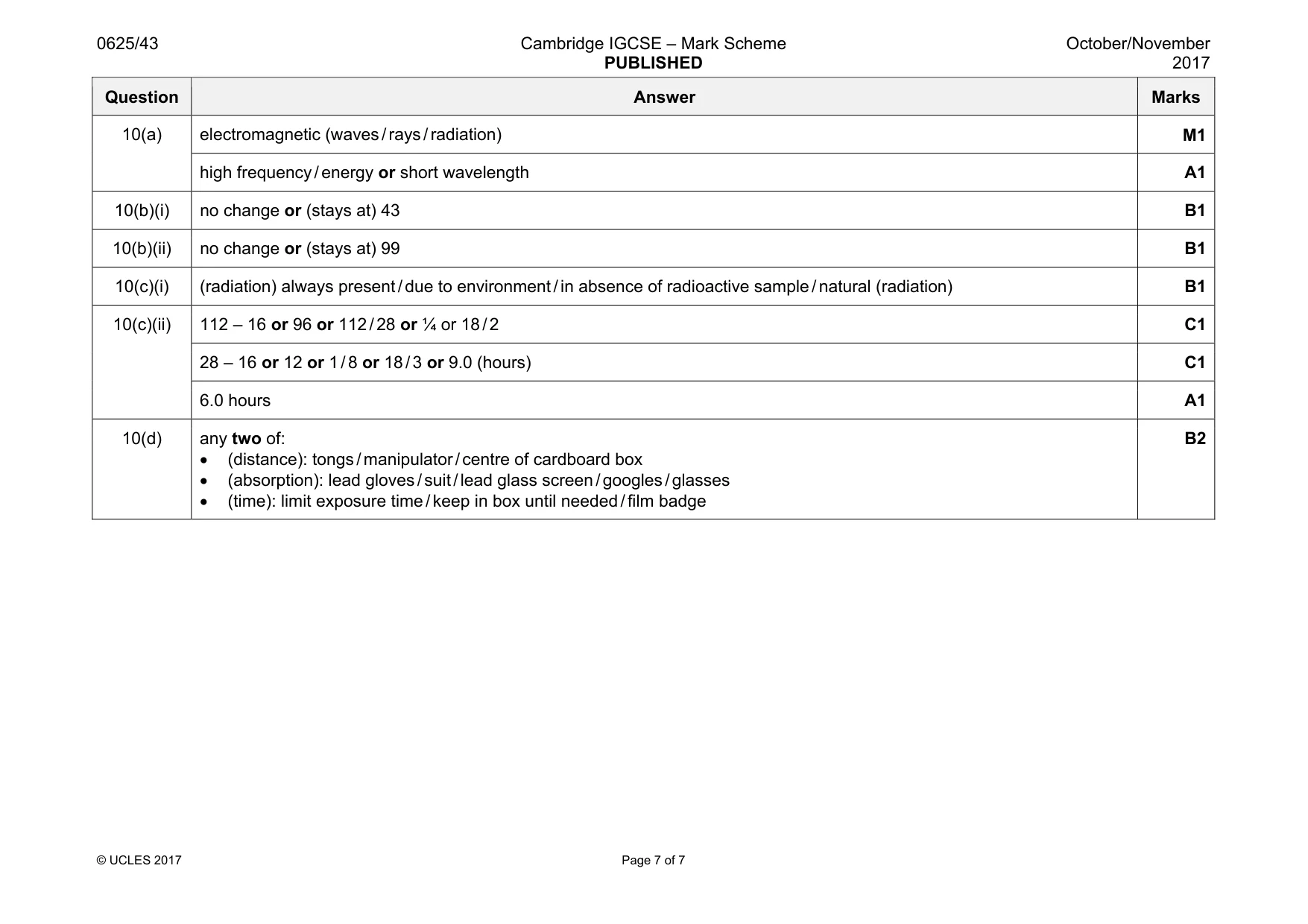
Mark scheme: 10(a) electromagnetic (waves / rays / radiation) M1 high frequency / energy or short wavelength A1 10(b)(i) no change or (stays at) 43 B1 10(b)(ii) no change or (stays at) 99 B1 10(c)(i) (radiation) always present / due to environment / in absence of radioactive sample / natural (radiation) B1 10(c)(ii) 112 – 16 or 96 or 112 / 28 or ¼ or 18 / 2 C1 28 – 16 or 12 or 1 / 8 or 18 / 3 or 9.0 (hours) C1 6.0 hours A1 10(d) any two of: • (distance): tongs / manipulator / centre of cardboard box • (absorption): lead gloves / suit / lead glass screen / googles / glasses • (time): limit exposure time / keep in box until needed / film badge B2
What was in this paper
The subtopics covered by these 10 questions, and how many questions each got. Open one in a new tab to see every Cambridge question on it.
What you needed in this session
Cambridge’s own grade thresholds for 2017 Oct/Nov, Paper 4 · Variant 3. A higher threshold means an easier paper — the bar moves with how the cohort did.