Cambridge IGCSE Physics 0625 — 2023 Feb/March Paper 4 · Variant 2
0625/42/F/M/23 · 10 questions · 80 marks · ≈90 min
The question paper and its mark scheme, free to read here and free to download. This is Cambridge’s own paper, exactly as it was sat.
Question paper16 pages
Mark scheme13 pages
Answers below. Sit the paper first if you are practising.
Questions as text
Q1 · A boat crosses a river
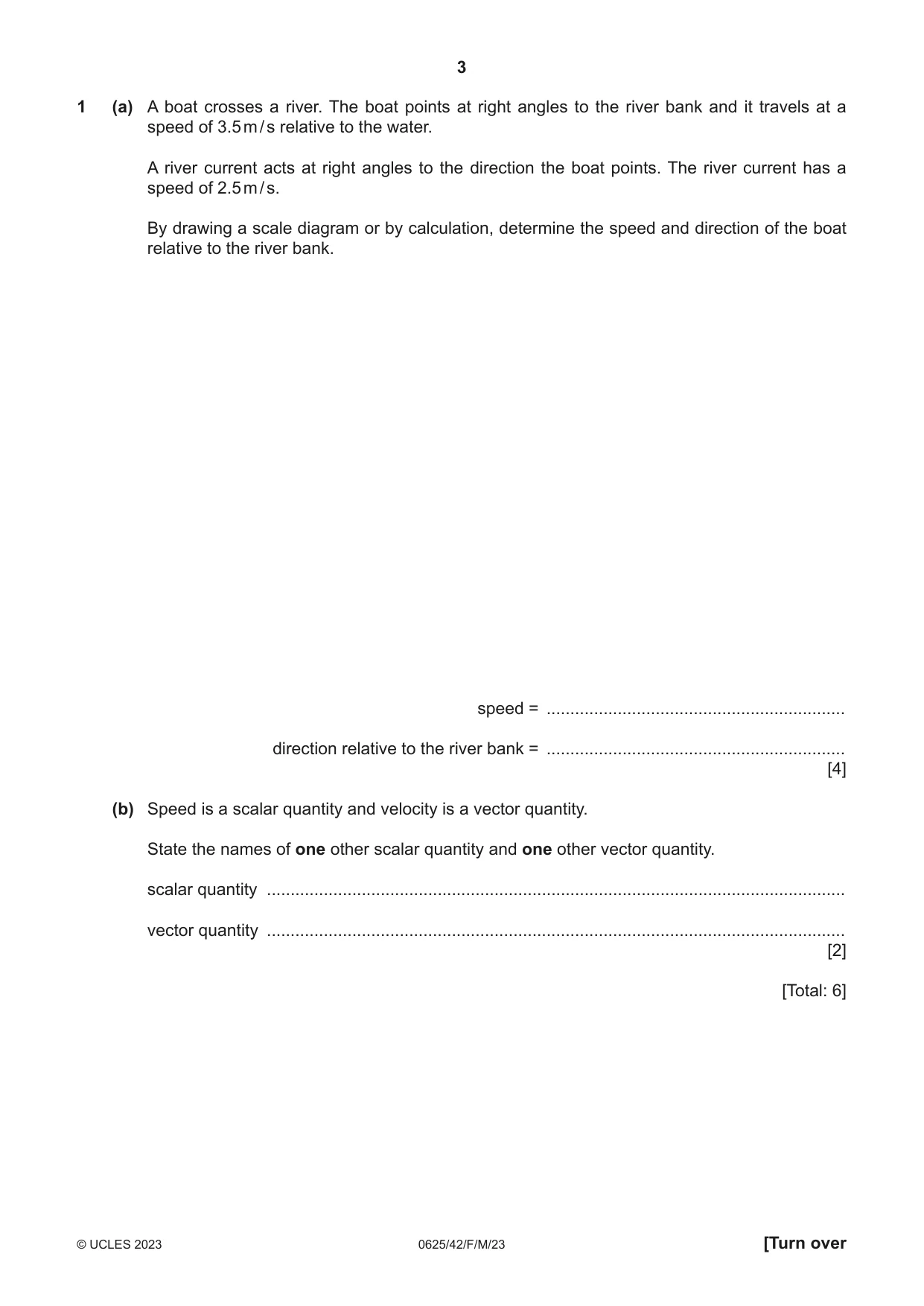
1 (a) A boat crosses a river. The boat points at right angles to the river bank and it travels at a speed of 3.5 m / s relative to the water. A river current acts at right angles to the direction the boat points. The river current has a speed of 2.5 m / s. By drawing a scale diagram or by calculation, determine the speed and direction of the boat relative to the river bank. speed = ............................................................... direction relative to the river bank = ............................................................... [4] (b) Speed is a scalar quantity and velocity is a vector quantity. State the names of one other scalar quantity and one other vector quantity. scalar quantity .......................................................................................................................... vector quantity .......................................................................................................................... [2] [Total: 6]
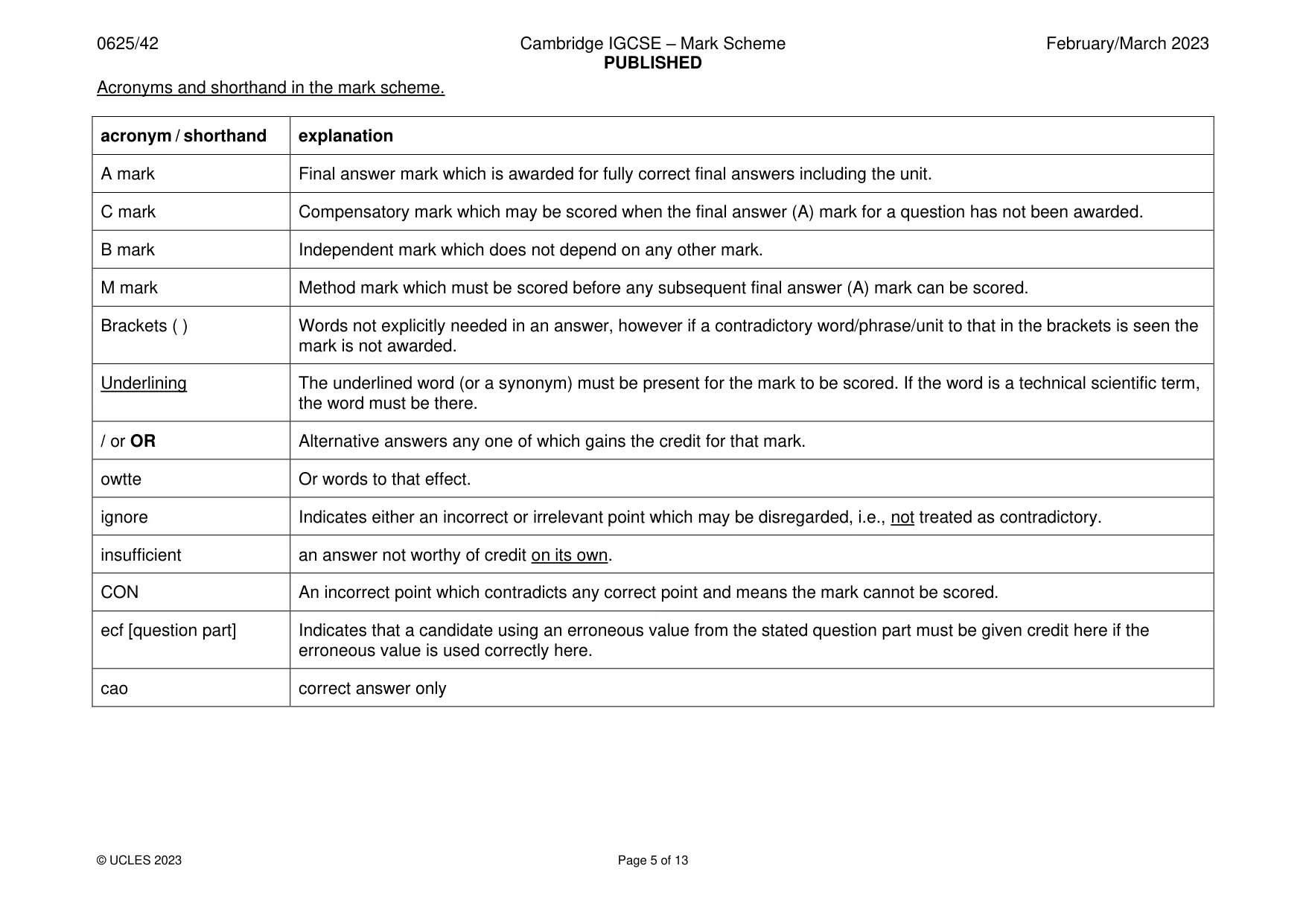
Mark scheme: Question Answer Marks 1(a) A2 speed = 4.3 m / s speed = 4.3 m / s (C1) correct vector triangle or rectangle drawn use of Pythagoras’ theorem e.g. a2 + b2 = c2 OR (speed =) 2.5 2 + 3.5 2 ( ) A2 direction = 54° or 55° direction = 54° or 55° (C1) resultant velocity vector (including arrow) use of trigonometry to find angle e.g. tan = 3.5 / 2.5 1(b) a scalar quantity B1 distance, time, mass, energy, temperature a vector quantity B1 force, weight, acceleration, momentum, electric field strength, gravitational field strength
Q2 · A ship loaded with containers
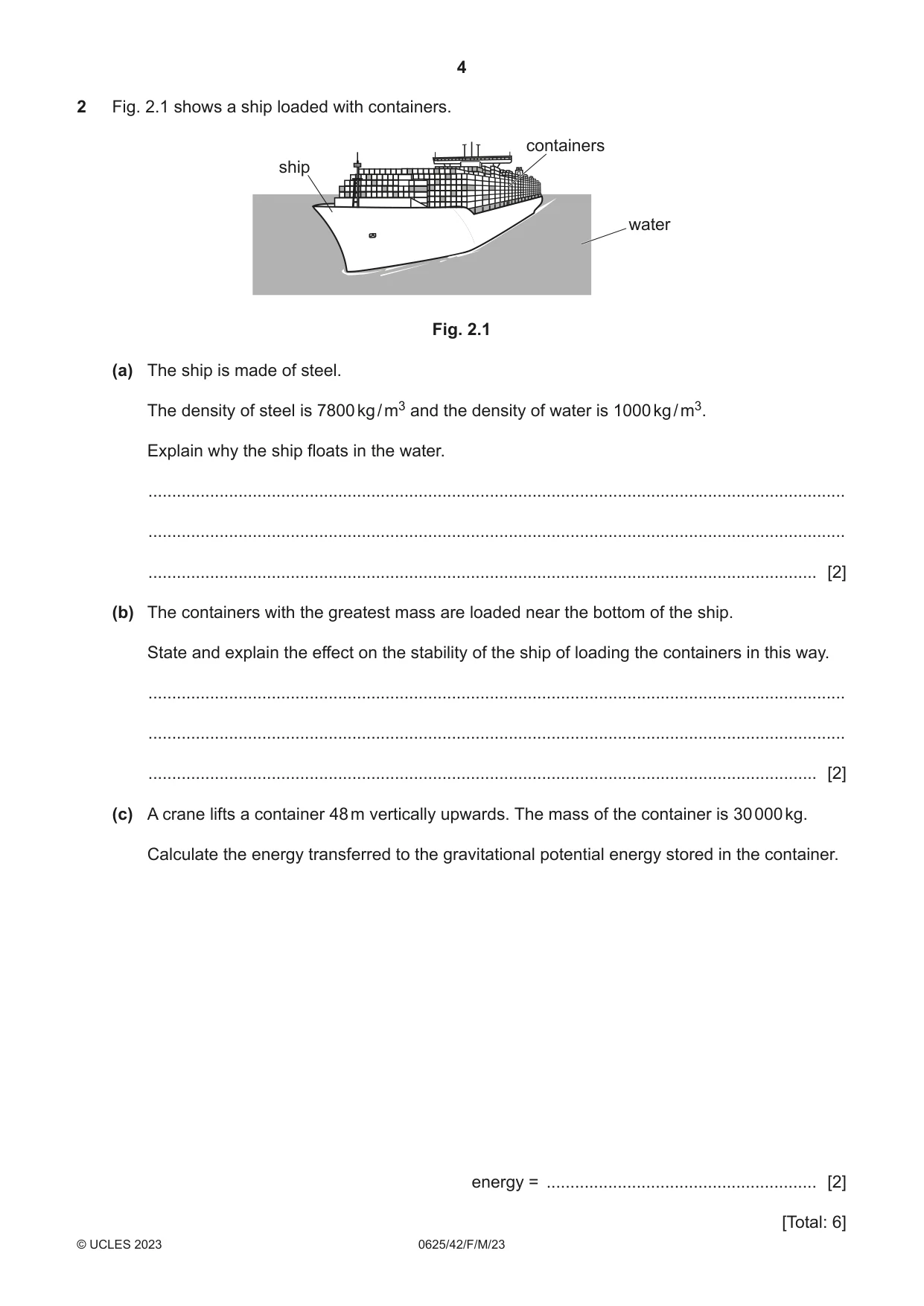
2 Fig. 2.1 shows a ship loaded with containers. containers ship water Fig. 2.1 (a) The ship is made of steel. The density of steel is 7800 kg / m3 and the density of water is 1000 kg / m3. Explain why the ship floats in the water. ................................................................................................................................................... ................................................................................................................................................... ............................................................................................................................................. [2] (b) The containers with the greatest mass are loaded near the bottom of the ship. State and explain the effect on the stability of the ship of loading the containers in this way. ................................................................................................................................................... ................................................................................................................................................... ............................................................................................................................................. [2] (c) A crane lifts a container 48 m vertically upwards. The mass of the container is 30 000 kg. Calculate the energy transferred to the gravitational potential energy stored in the container. energy = ......................................................... [2] [Total: 6]
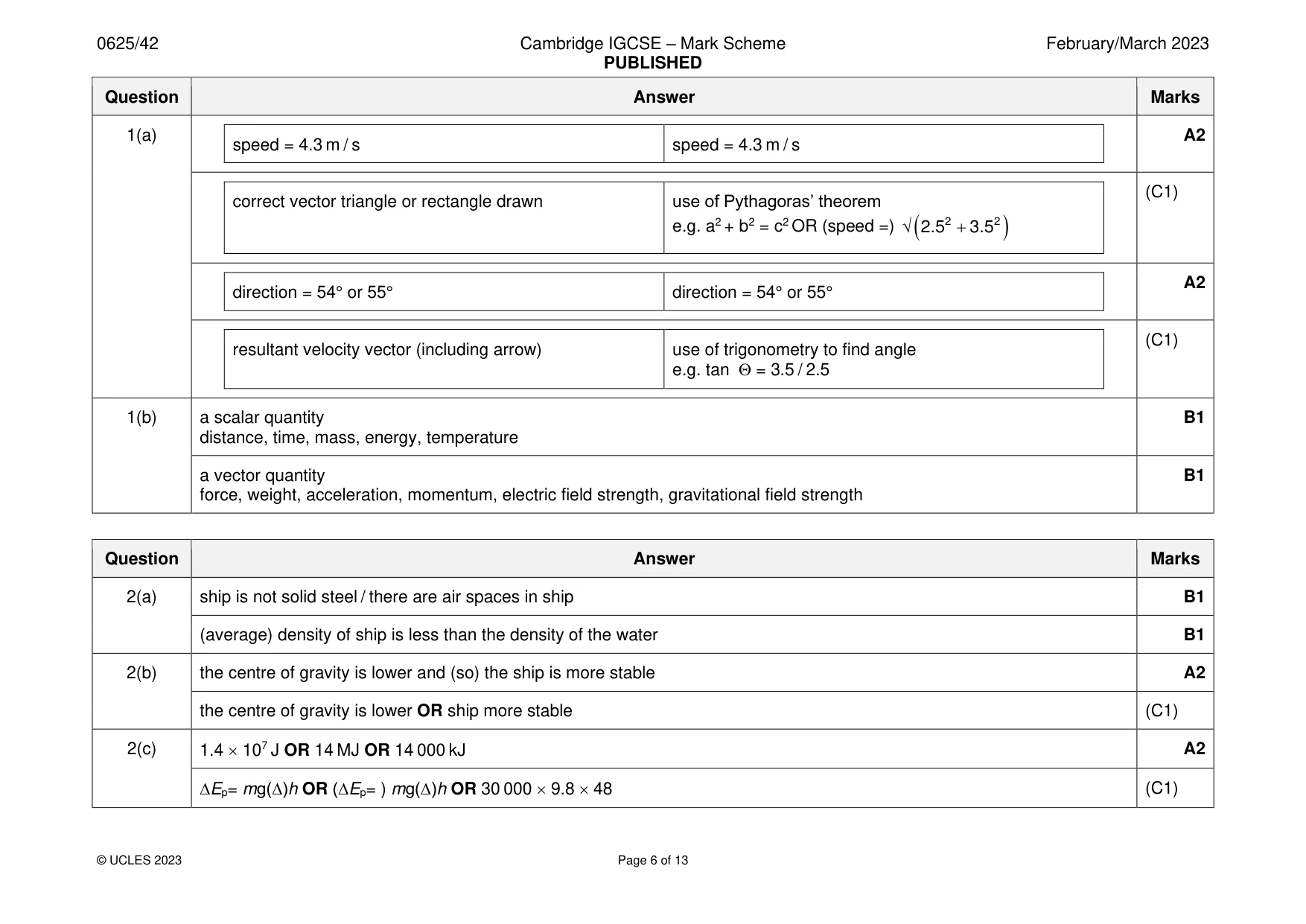
Mark scheme: 2(a) ship is not solid steel / there are air spaces in ship B1 (average) density of ship is less than the density of the water B1 2(b) the centre of gravity is lower and (so) the ship is more stable A2 the centre of gravity is lower OR ship more stable (C1) 2(c) 1.4 107 J OR 14 MJ OR 14 000 kJ A2 ∆Ep= mg(∆)h OR (∆Ep= ) mg(∆)h OR 30 000 9.8 48 (C1)
Q3 · State the principle of conservation of energy
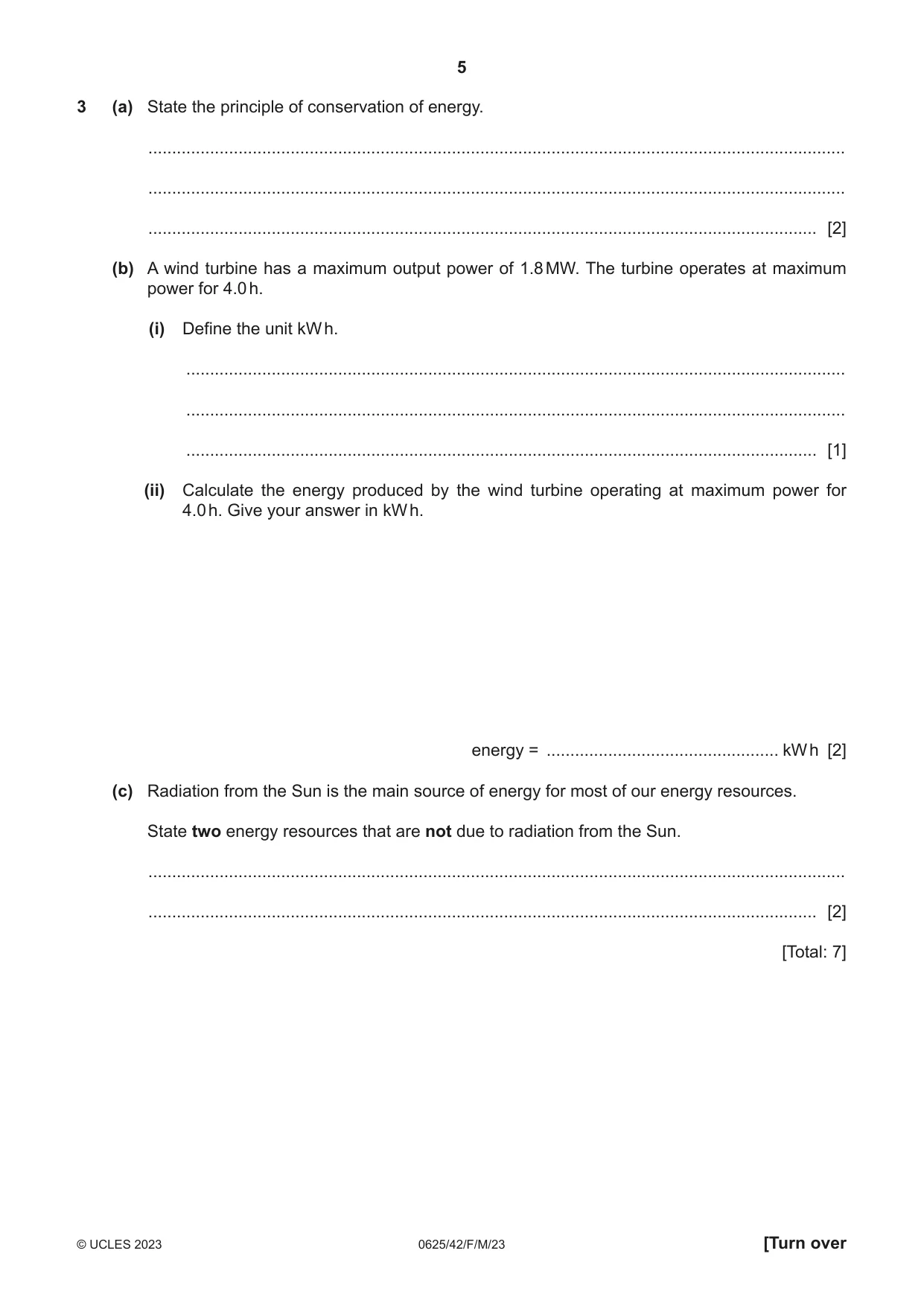
3 (a) State the principle of conservation of energy. ................................................................................................................................................... ................................................................................................................................................... ............................................................................................................................................. [2] (b) A wind turbine has a maximum output power of 1.8 MW. The turbine operates at maximum power for 4.0 h. (i) Define the unit kW h. ........................................................................................................................................... ........................................................................................................................................... ..................................................................................................................................... [1] (ii) Calculate the energy produced by the wind turbine operating at maximum power for 4.0 h. Give your answer in kW h. energy = ................................................. kW h [2] (c) Radiation from the Sun is the main source of energy for most of our energy resources. State two energy resources that are not due to radiation from the Sun. ................................................................................................................................................... ............................................................................................................................................. [2] [Total: 7]
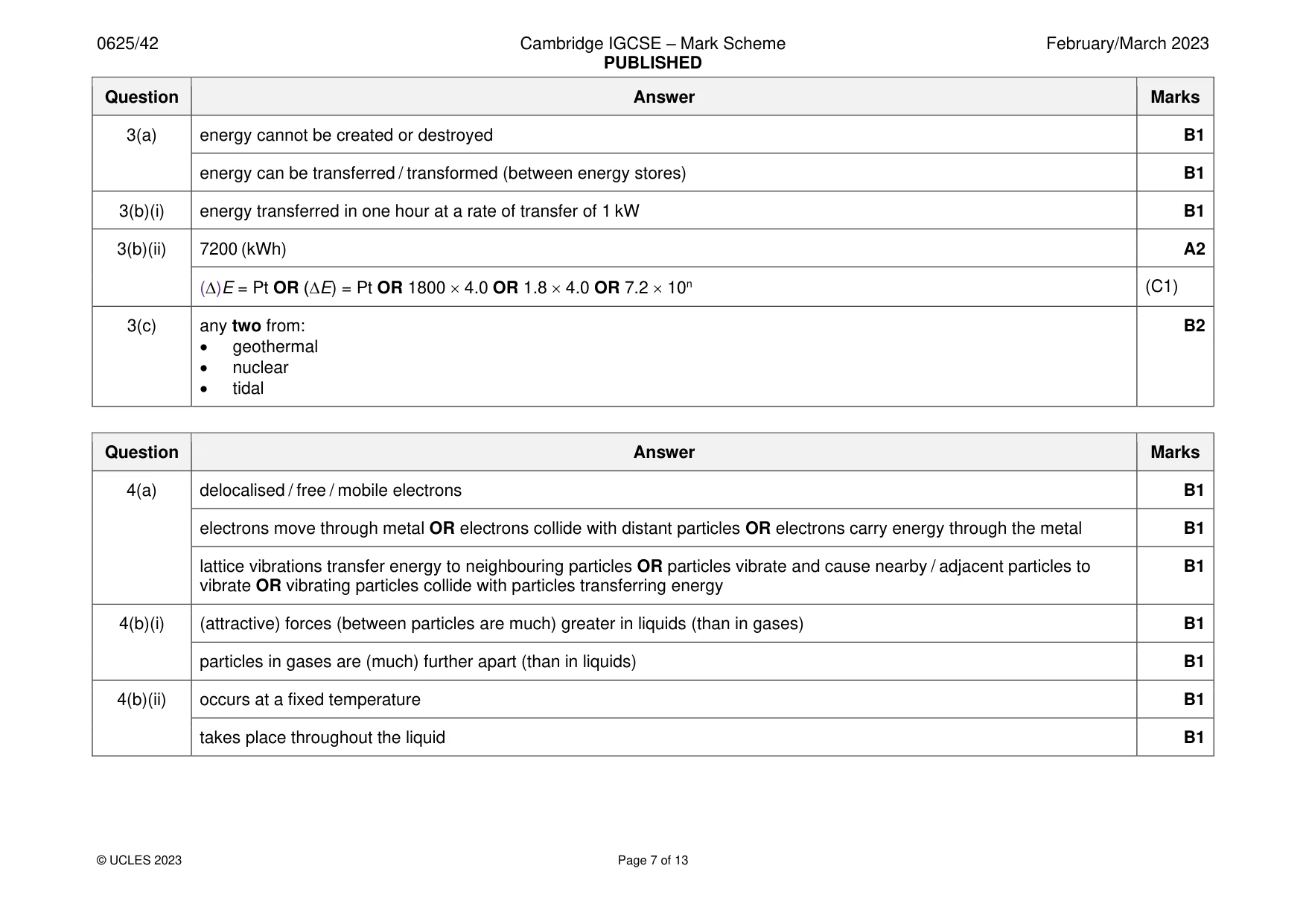
Mark scheme: 3(a) energy cannot be created or destroyed B1 energy can be transferred / transformed (between energy stores) B1 3(b)(i) energy transferred in one hour at a rate of transfer of 1 kW B1 3(b)(ii) 7200 (kWh) A2 (∆)E = Pt OR (∆E) = Pt OR 1800 4.0 OR 1.8 4.0 OR 7.2 10n (C1) 3(c) any two from: B2 • geothermal • nuclear • tidal
Q4 · A metal pan on an electric hotplate
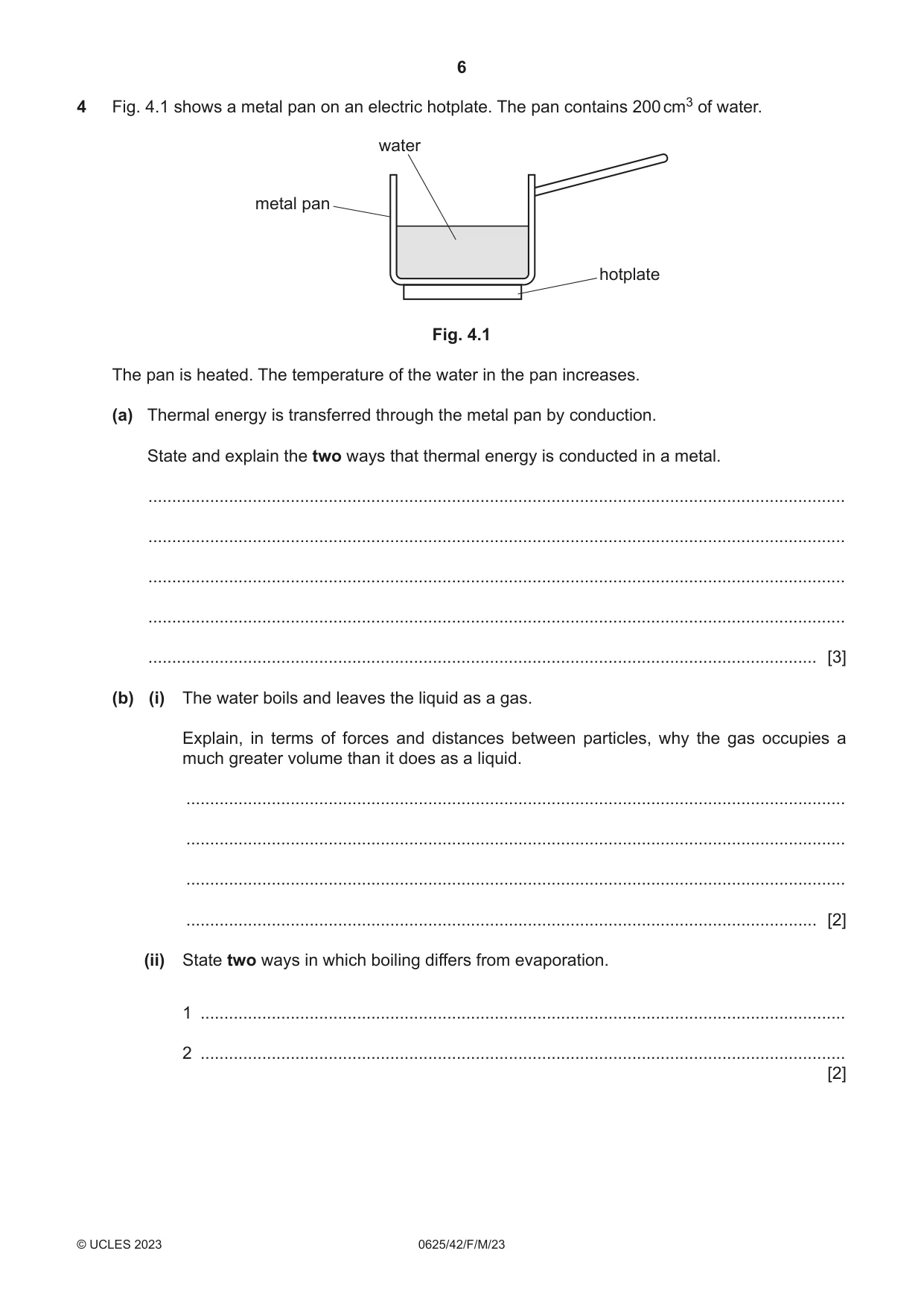
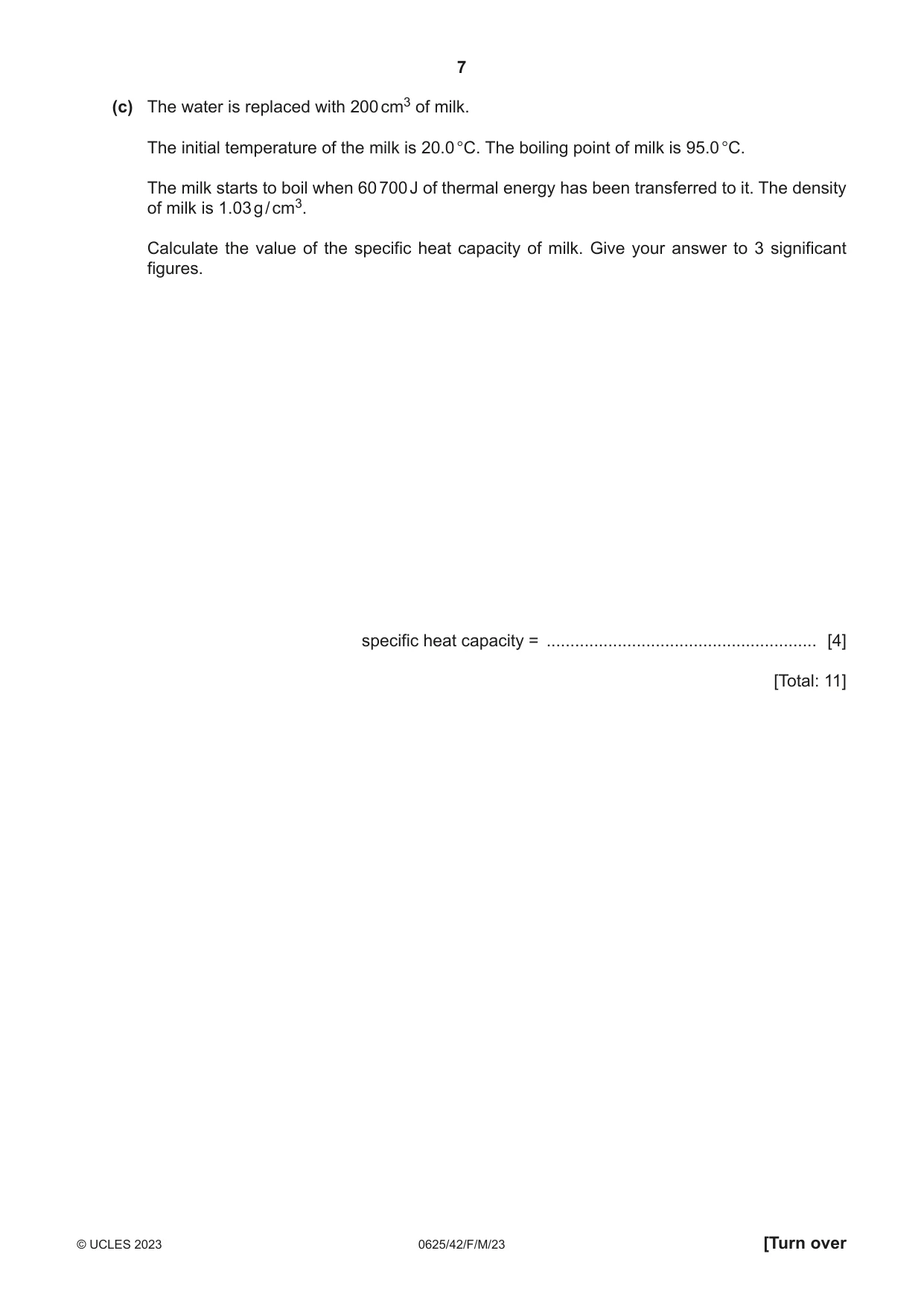
4 Fig. 4.1 shows a metal pan on an electric hotplate. The pan contains 200 cm3 of water. water metal pan hotplate Fig. 4.1 The pan is heated. The temperature of the water in the pan increases. (a) Thermal energy is transferred through the metal pan by conduction. State and explain the two ways that thermal energy is conducted in a metal. ................................................................................................................................................... ................................................................................................................................................... ................................................................................................................................................... ................................................................................................................................................... ............................................................................................................................................. [3] (b) (i) The water boils and leaves the liquid as a gas. Explain, in terms of forces and distances between particles, why the gas occupies a much greater volume than it does as a liquid. ........................................................................................................................................... ........................................................................................................................................... ........................................................................................................................................... ..................................................................................................................................... [2] (ii) State two ways in which boiling differs from evaporation. 1 ........................................................................................................................................ 2 ........................................................................................................................................ [2] (c) The water is replaced with 200 cm3 of milk. The initial temperature of the milk is 20.0 °C. The boiling point of milk is 95.0 °C. The milk starts to boil when 60 700 J of thermal energy has been transferred to it. The density of milk is 1.03 g / cm3. Calculate the value of the specific heat capacity of milk. Give your answer to 3 significant figures. specific heat capacity = ......................................................... [4] [Total: 11]
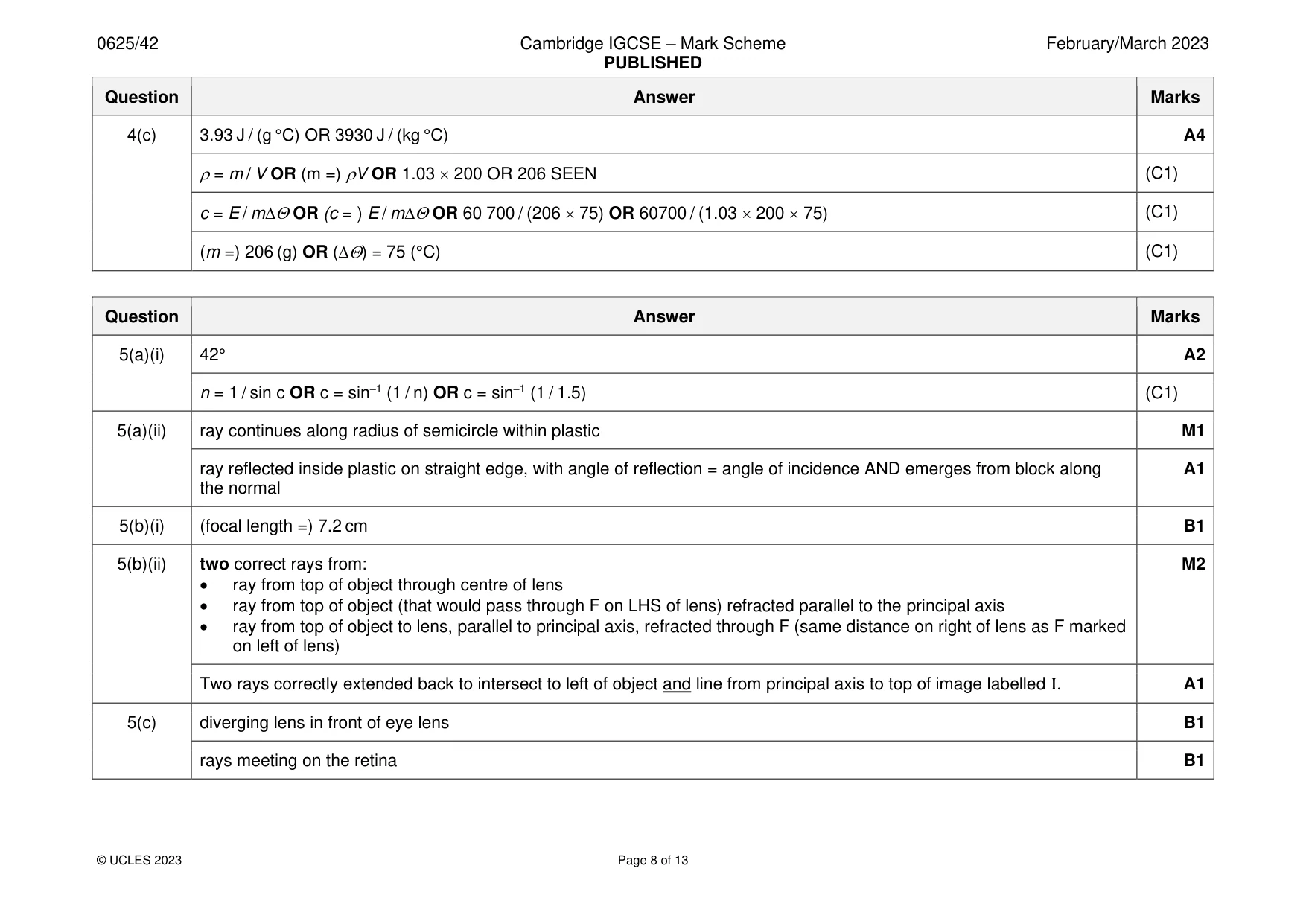
Mark scheme: 4(a) delocalised / free / mobile electrons B1 electrons move through metal OR electrons collide with distant particles OR electrons carry energy through the metal B1 lattice vibrations transfer energy to neighbouring particles OR particles vibrate and cause nearby / adjacent particles to B1 vibrate OR vibrating particles collide with particles transferring energy 4(b)(i) (attractive) forces (between particles are much) greater in liquids (than in gases) B1 particles in gases are (much) further apart (than in liquids) B1 4(b)(ii) occurs at a fixed temperature B1 takes place throughout the liquid B1 4(c) 3.93 J / (g °C) OR 3930 J / (kg °C) A4 = m / V OR (m =) V OR 1.03 200 OR 206 SEEN (C1) c = E / m∆OR (c = ) E / m∆OR 60 700 / (206 75) OR 60700 / (1.03 200 75) (C1) (m =) 206 (g) OR (∆) = 75 (°C) (C1)
Q5 · A semicircular transparent plastic block
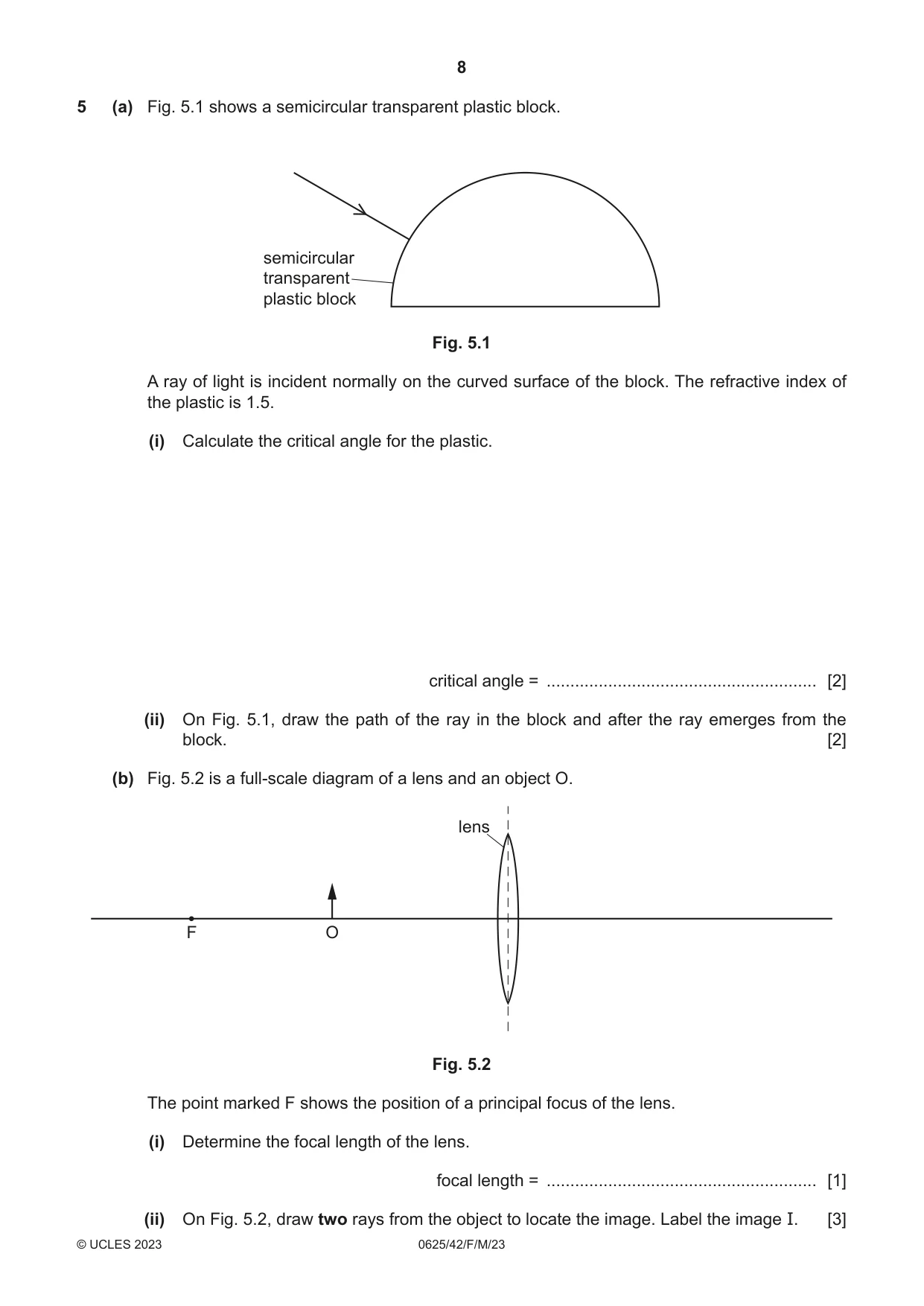
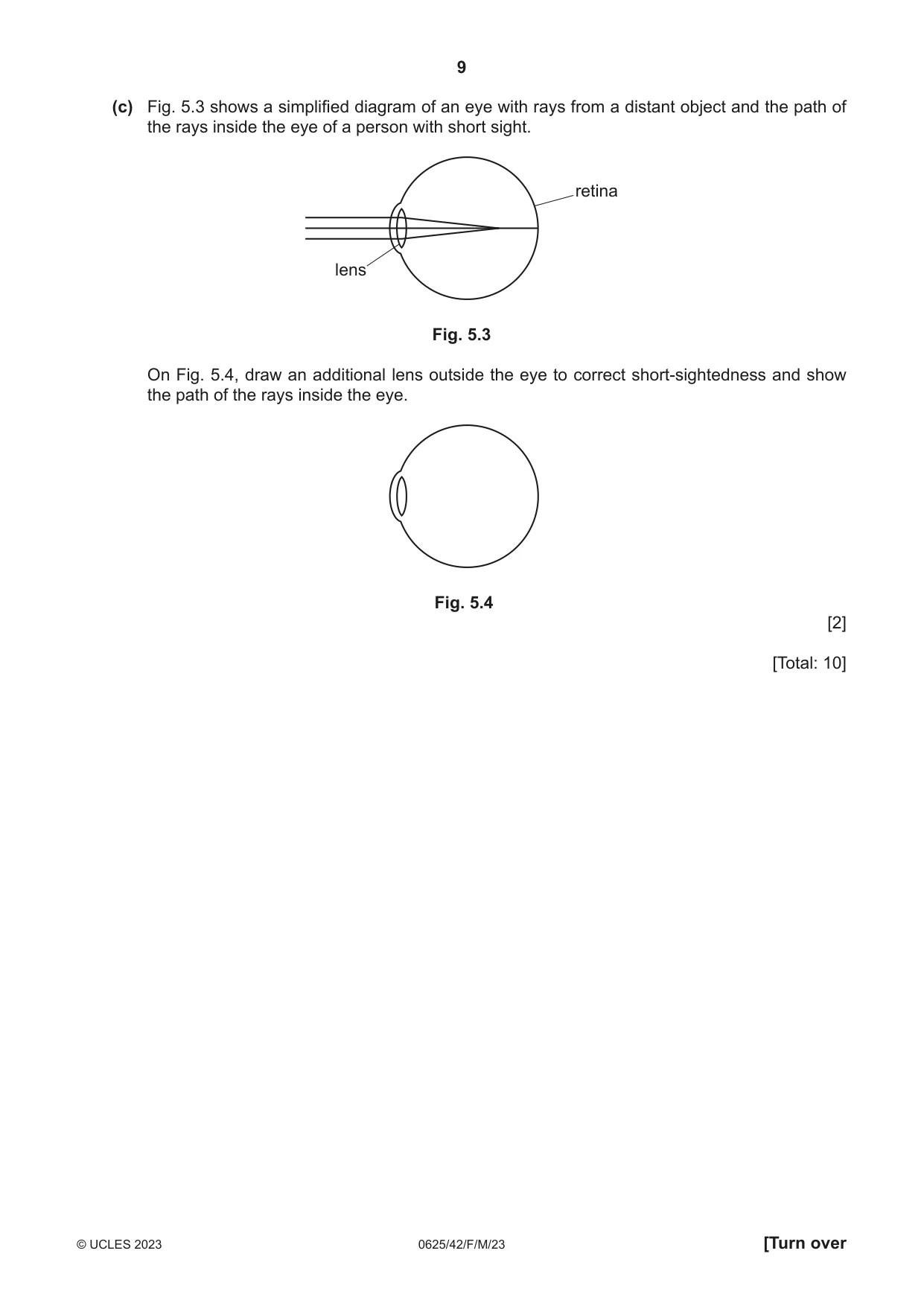
5 (a) Fig. 5.1 shows a semicircular transparent plastic block. semicircular transparent plastic block Fig. 5.1 A ray of light is incident normally on the curved surface of the block. The refractive index of the plastic is 1.5. (i) Calculate the critical angle for the plastic. critical angle = ......................................................... [2] (ii) On Fig. 5.1, draw the path of the ray in the block and after the ray emerges from the block. [2] (b) Fig. 5.2 is a full‑scale diagram of a lens and an object O. lens F O Fig. 5.2 The point marked F shows the position of a principal focus of the lens. (i) Determine the focal length of the lens. focal length = ......................................................... [1] (ii) On Fig. 5.2, draw two rays from the object to locate the image. Label the image I. [3] (c) Fig. 5.3 shows a simplified diagram of an eye with rays from a distant object and the path of the rays inside the eye of a person with short sight. retina lens Fig. 5.3 On Fig. 5.4, draw an additional lens outside the eye to correct short‑sightedness and show the path of the rays inside the eye. Fig. 5.4 [2] [Total: 10]
Mark scheme: 5(a)(i) 42° A2 n = 1 / sin c OR c = sin–1 (1 / n) OR c = sin–1 (1 / 1.5) (C1) 5(a)(ii) ray continues along radius of semicircle within plastic M1 ray reflected inside plastic on straight edge, with angle of reflection = angle of incidence AND emerges from block along A1 the normal 5(b)(i) (focal length =) 7.2 cm B1 5(b)(ii) two correct rays from: M2 • ray from top of object through centre of lens • ray from top of object (that would pass through F on LHS of lens) refracted parallel to the principal axis • ray from top of object to lens, parallel to principal axis, refracted through F (same distance on right of lens as F marked on left of lens) Two rays correctly extended back to intersect to left of object and line from principal axis to top of image labelled I. A1 5(c) diverging lens in front of eye lens B1 rays meeting on the retina B1
Q6 · Sound waves have compressions and rarefactions
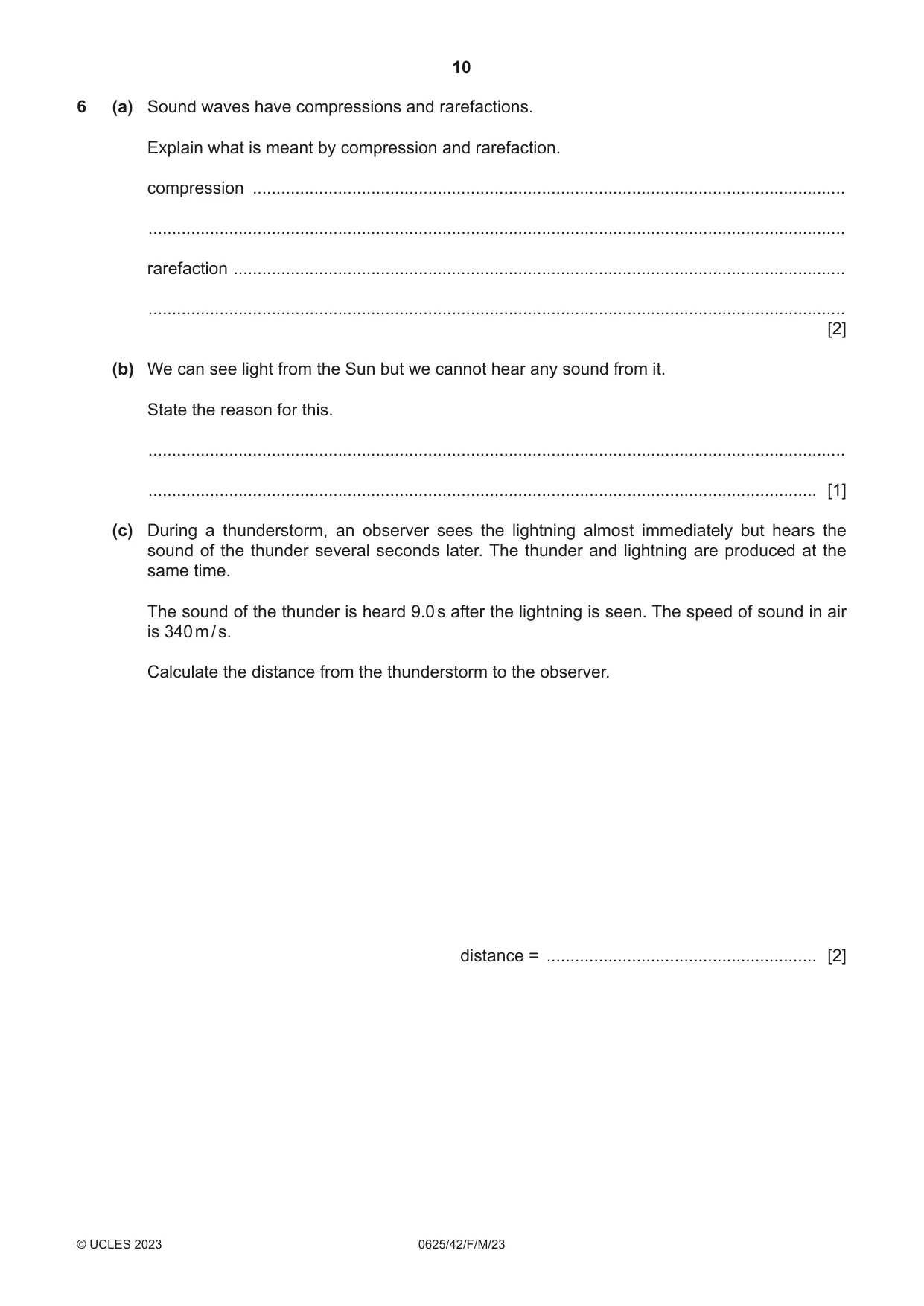
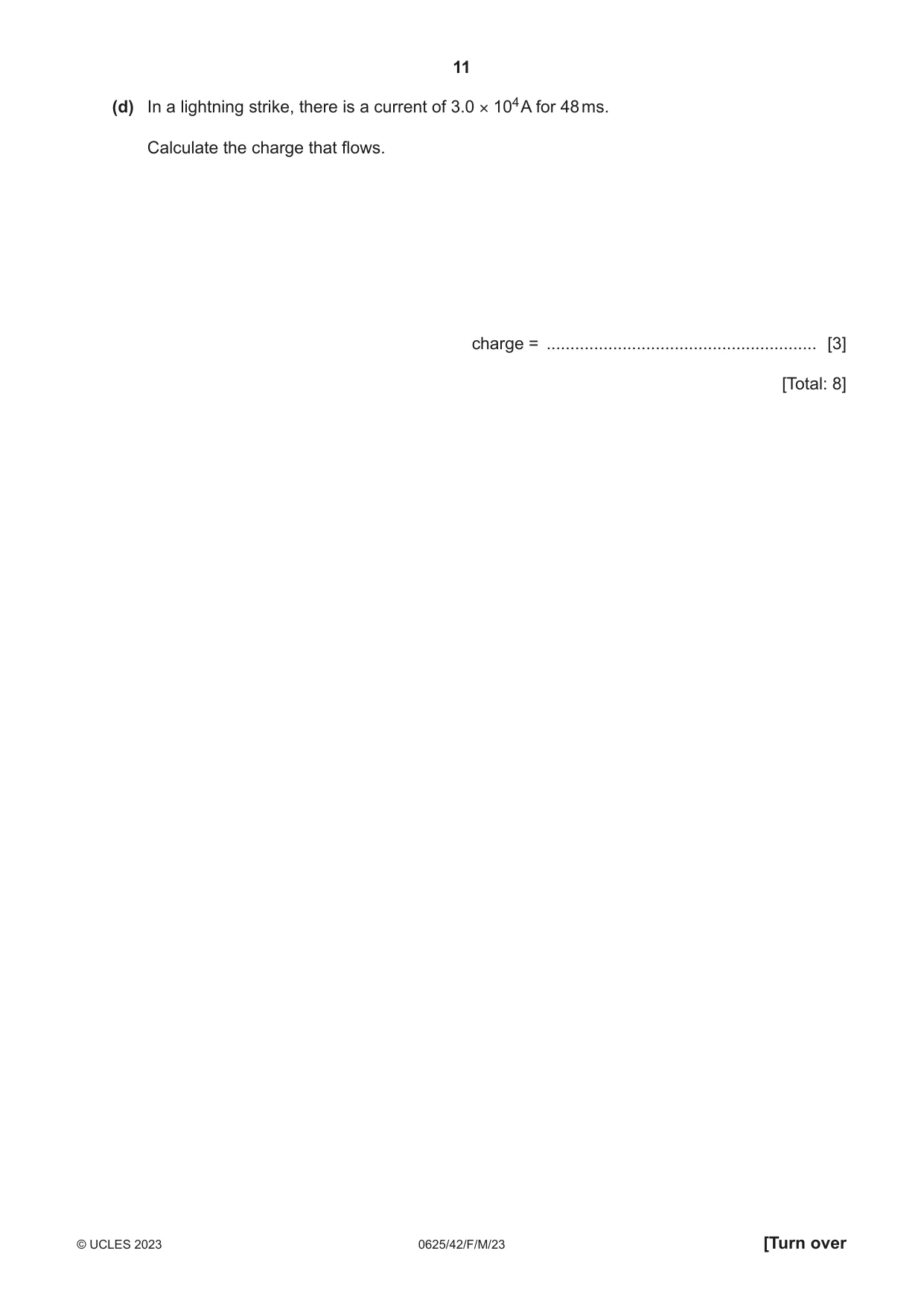
6 (a) Sound waves have compressions and rarefactions. Explain what is meant by compression and rarefaction. compression ............................................................................................................................. ................................................................................................................................................... rarefaction ................................................................................................................................. ................................................................................................................................................... [2] (b) We can see light from the Sun but we cannot hear any sound from it. State the reason for this. ................................................................................................................................................... ............................................................................................................................................. [1] (c) During a thunderstorm, an observer sees the lightning almost immediately but hears the sound of the thunder several seconds later. The thunder and lightning are produced at the same time. The sound of the thunder is heard 9.0 s after the lightning is seen. The speed of sound in air is 340 m / s. Calculate the distance from the thunderstorm to the observer. distance = ......................................................... [2] (d) In a lightning strike, there is a current of 3.0 × 10⁴ A for 48 ms. Calculate the charge that flows. charge = ......................................................... [3] [Total: 8]
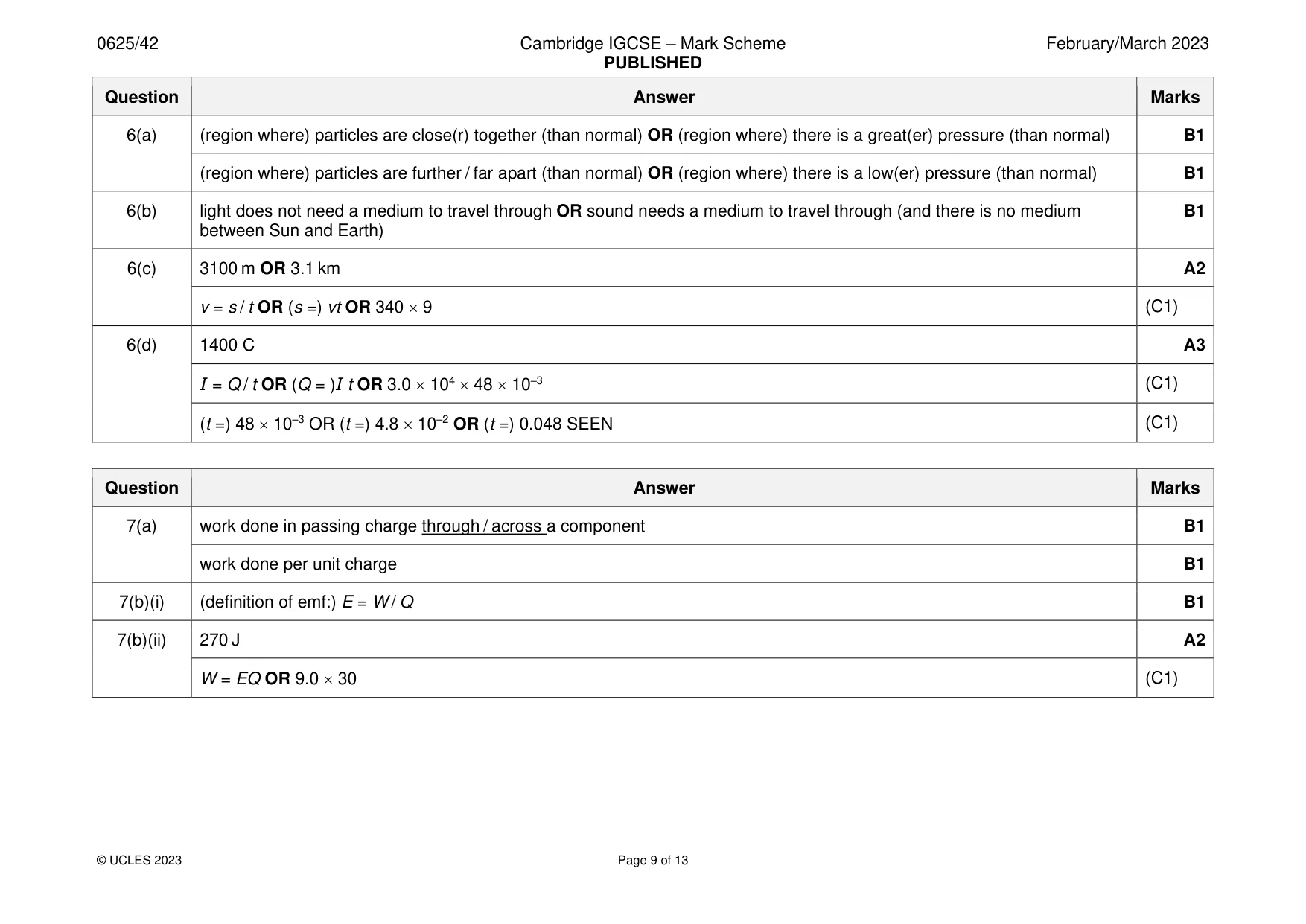
Mark scheme: 6(a) (region where) particles are close(r) together (than normal) OR (region where) there is a great(er) pressure (than normal) B1 (region where) particles are further / far apart (than normal) OR (region where) there is a low(er) pressure (than normal) B1 6(b) light does not need a medium to travel through OR sound needs a medium to travel through (and there is no medium B1 between Sun and Earth) 6(c) 3100 m OR 3.1 km A2 v = s / t OR (s =) vt OR 340 9 (C1) 6(d) 1400 C A3 I = Q / t OR (Q = )I t OR 3.0 104 48 10–3 (C1) (t =) 48 10–3 OR (t =) 4.8 10–2 OR (t =) 0.048 SEEN (C1)
Q7 · Define potential difference (p.d.)
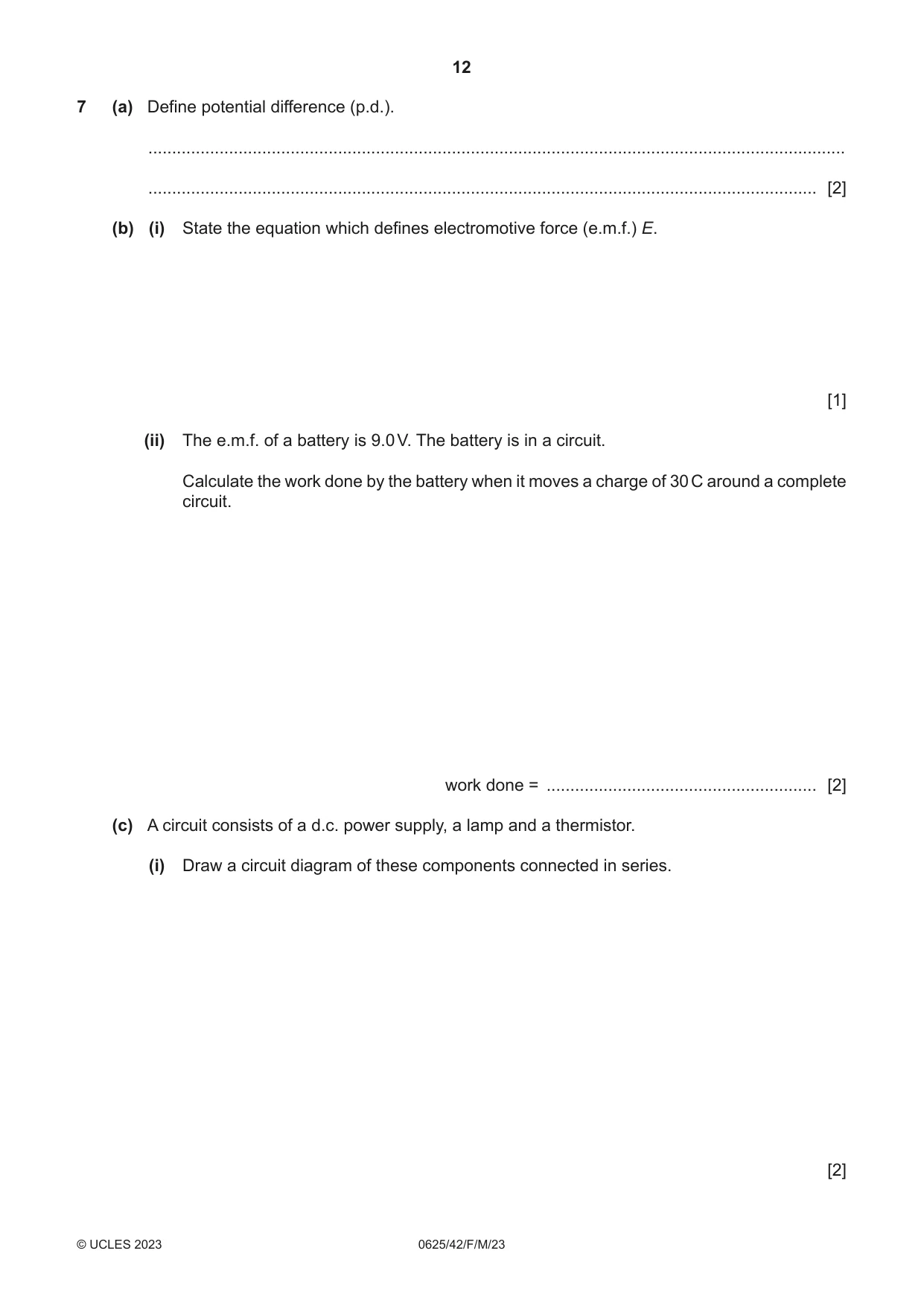
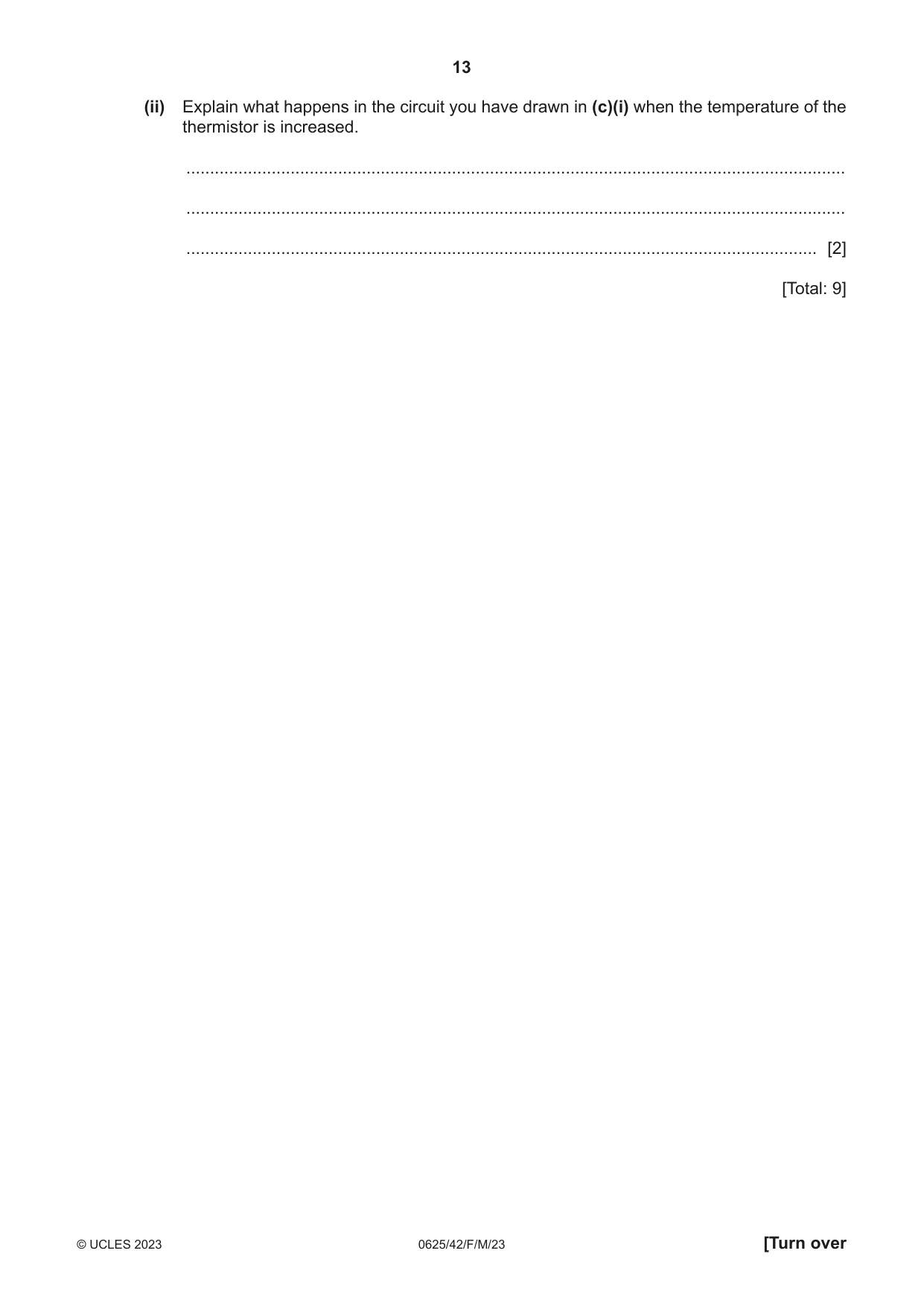
7 (a) Define potential difference (p.d.). ................................................................................................................................................... ............................................................................................................................................. [2] (b) (i) State the equation which defines electromotive force (e.m.f.) E. [1] (ii) The e.m.f. of a battery is 9.0 V. The battery is in a circuit. Calculate the work done by the battery when it moves a charge of 30 C around a complete circuit. work done = ......................................................... [2] (c) A circuit consists of a d.c. power supply, a lamp and a thermistor. (i) Draw a circuit diagram of these components connected in series. [2] (ii) Explain what happens in the circuit you have drawn in (c)(i) when the temperature of the thermistor is increased. ........................................................................................................................................... ........................................................................................................................................... ..................................................................................................................................... [2] [Total: 9]
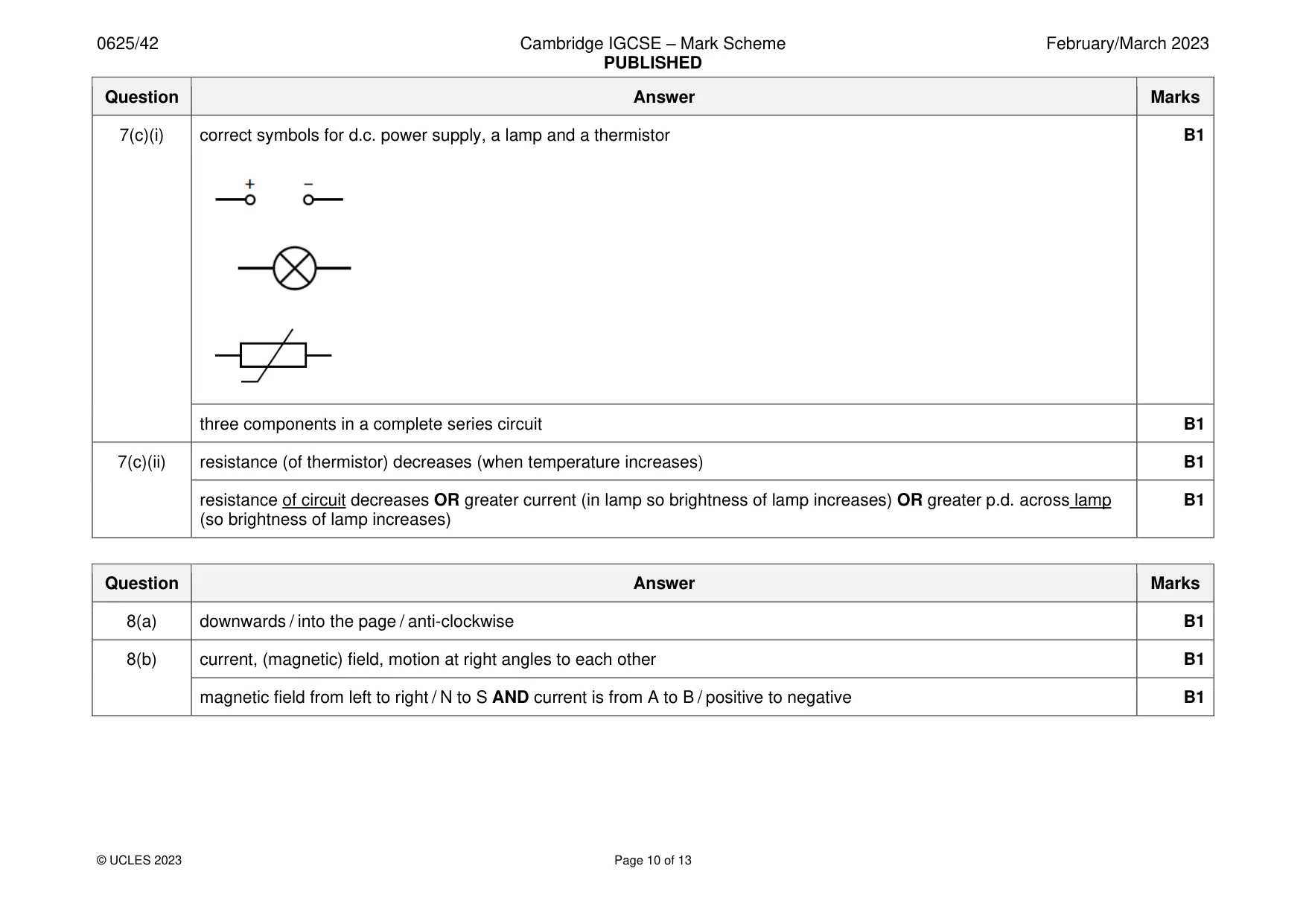
Mark scheme: 7(a) work done in passing charge through / across a component B1 work done per unit charge B1 7(b)(i) (definition of emf:) E = W / Q B1 7(b)(ii) 270 J A2 W = EQ OR 9.0 30 (C1) 7(c)(i) correct symbols for d.c. power supply, a lamp and a thermistor B1 three components in a complete series circuit B1 7(c)(ii) resistance (of thermistor) decreases (when temperature increases) B1 resistance of circuit decreases OR greater current (in lamp so brightness of lamp increases) OR greater p.d. across lamp B1 (so brightness of lamp increases)
Q8 · A horizontal, flat coil in a magnetic field coil axis B N A S Fig
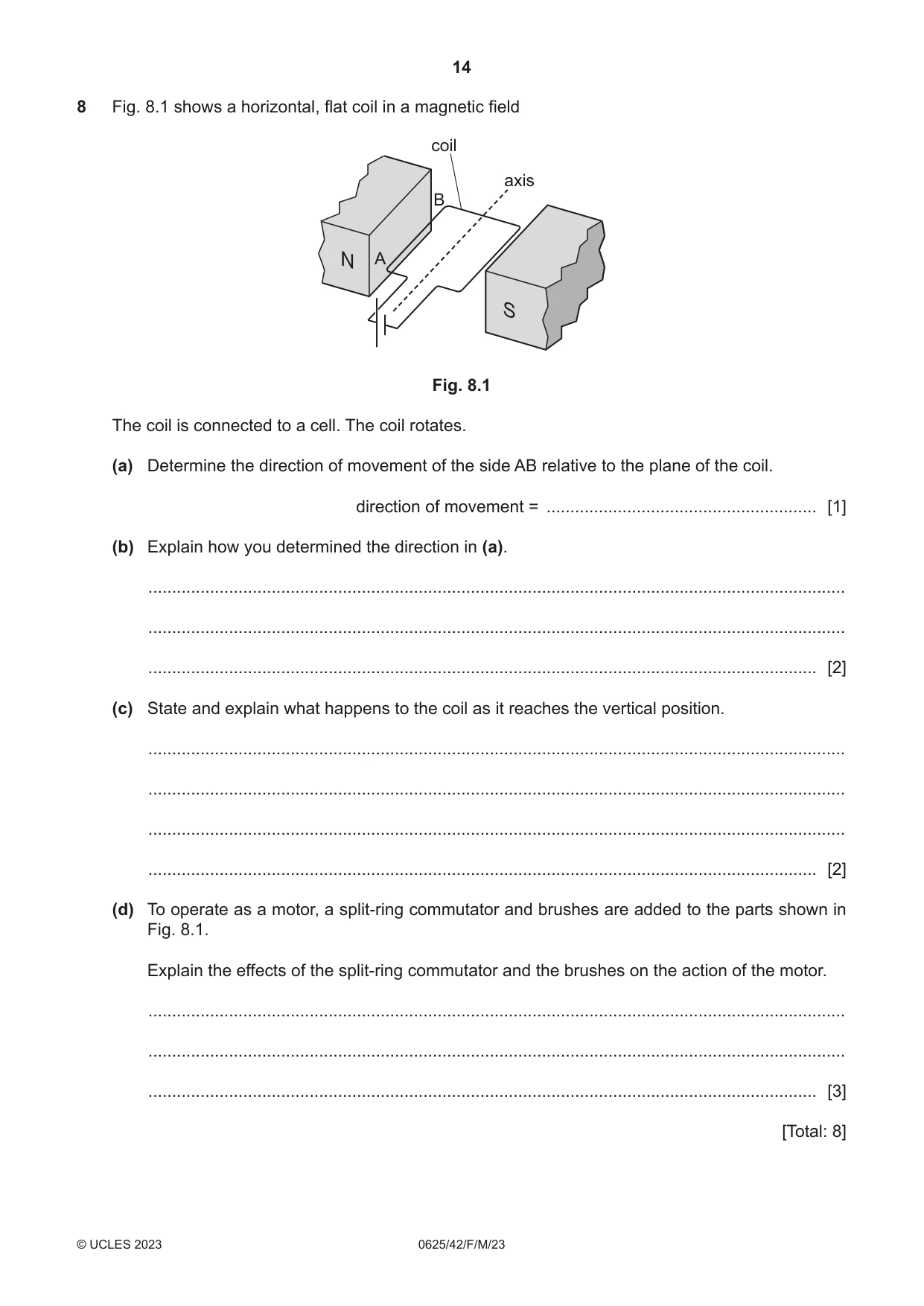
8 Fig. 8.1 shows a horizontal, flat coil in a magnetic field coil axis B N A S Fig. 8.1 The coil is connected to a cell. The coil rotates. (a) Determine the direction of movement of the side AB relative to the plane of the coil. direction of movement = ......................................................... [1] (b) Explain how you determined the direction in (a). ................................................................................................................................................... ................................................................................................................................................... ............................................................................................................................................. [2] (c) State and explain what happens to the coil as it reaches the vertical position. ................................................................................................................................................... ................................................................................................................................................... ................................................................................................................................................... ............................................................................................................................................. [2] (d) To operate as a motor, a split‑ring commutator and brushes are added to the parts shown in Fig. 8.1. Explain the effects of the split‑ring commutator and the brushes on the action of the motor. ................................................................................................................................................... ................................................................................................................................................... ............................................................................................................................................. [3] [Total: 8]
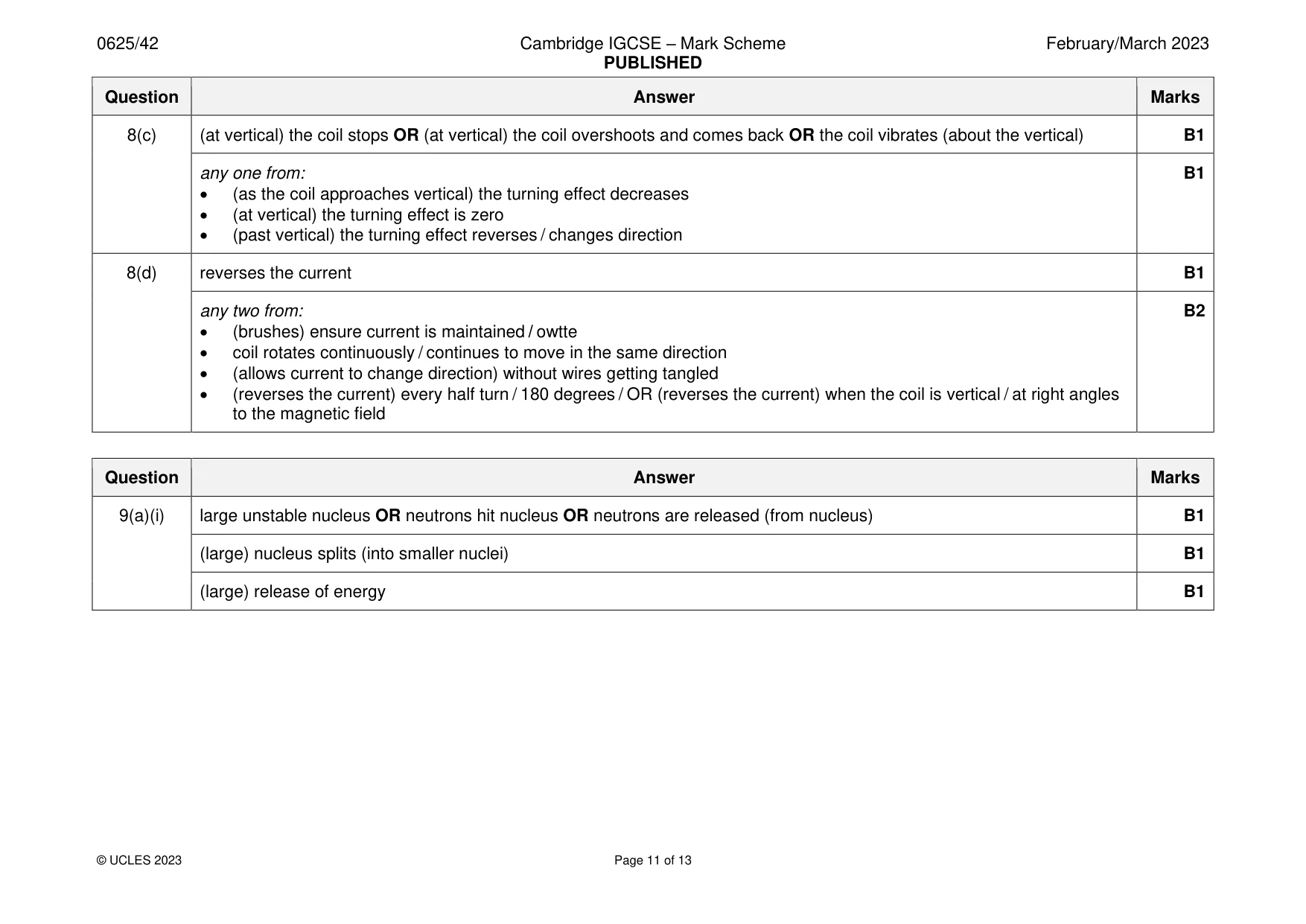
Mark scheme: 8(a) downwards / into the page / anti-clockwise B1 8(b) current, (magnetic) field, motion at right angles to each other B1 magnetic field from left to right / N to S AND current is from A to B / positive to negative B1 8(c) (at vertical) the coil stops OR (at vertical) the coil overshoots and comes back OR the coil vibrates (about the vertical) B1 any one from: B1 • (as the coil approaches vertical) the turning effect decreases • (at vertical) the turning effect is zero • (past vertical) the turning effect reverses / changes direction 8(d) reverses the current B1 any two from: B2 • (brushes) ensure current is maintained / owtte • coil rotates continuously / continues to move in the same direction • (allows current to change direction) without wires getting tangled • (reverses the current) every half turn / 180 degrees / OR (reverses the current) when the coil is vertical / at right angles to the magnetic field
Q9 · A nuclear power station has a reactor where controlled nuclear fission of uranium‑235…
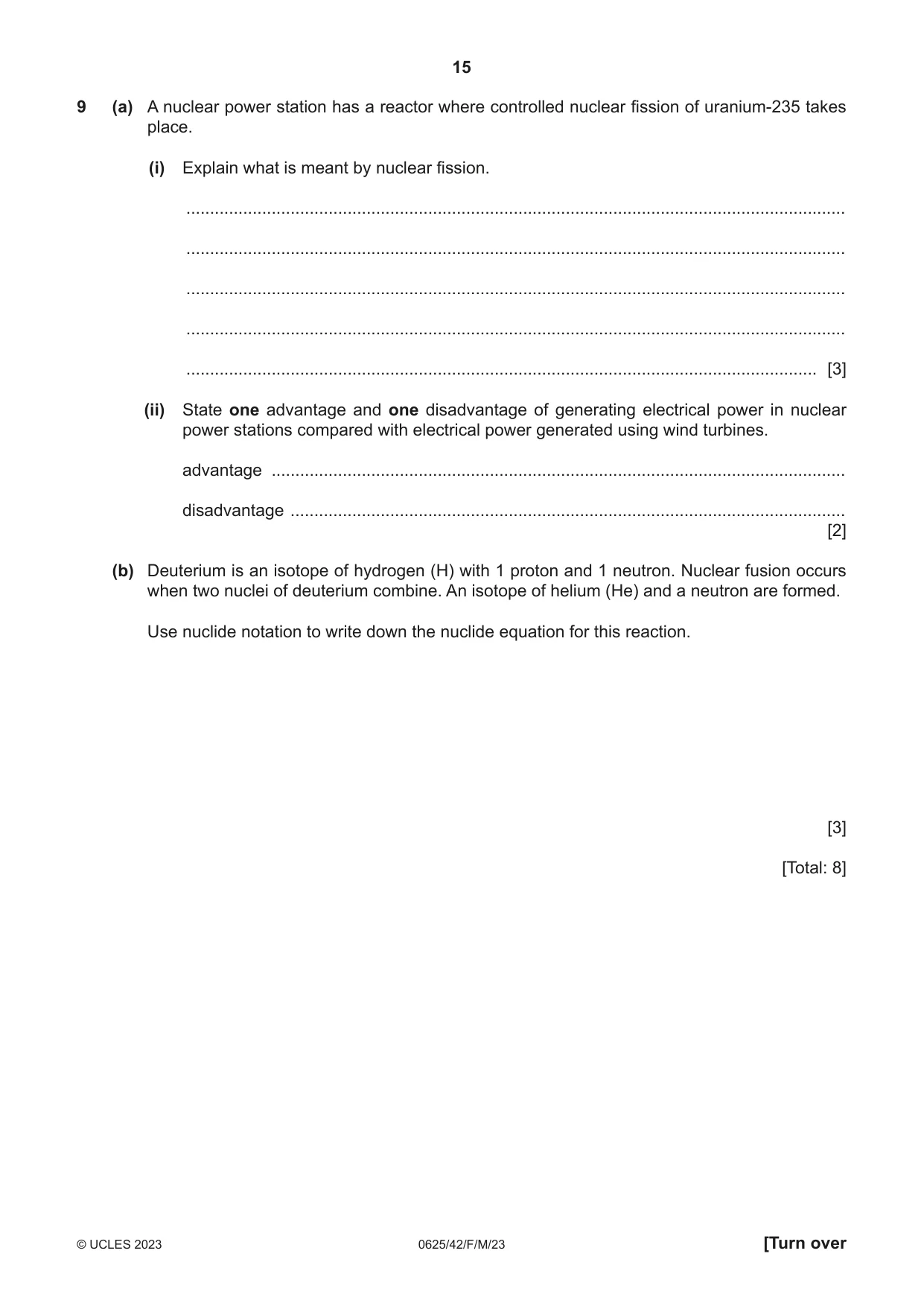
9 (a) A nuclear power station has a reactor where controlled nuclear fission of uranium‑235 takes place. (i) Explain what is meant by nuclear fission. ........................................................................................................................................... ........................................................................................................................................... ........................................................................................................................................... ........................................................................................................................................... ..................................................................................................................................... [3] (ii) State one advantage and one disadvantage of generating electrical power in nuclear power stations compared with electrical power generated using wind turbines. advantage ......................................................................................................................... disadvantage ..................................................................................................................... [2] (b) Deuterium is an isotope of hydrogen (H) with 1 proton and 1 neutron. Nuclear fusion occurs when two nuclei of deuterium combine. An isotope of helium (He) and a neutron are formed. Use nuclide notation to write down the nuclide equation for this reaction. [3] [Total: 8]
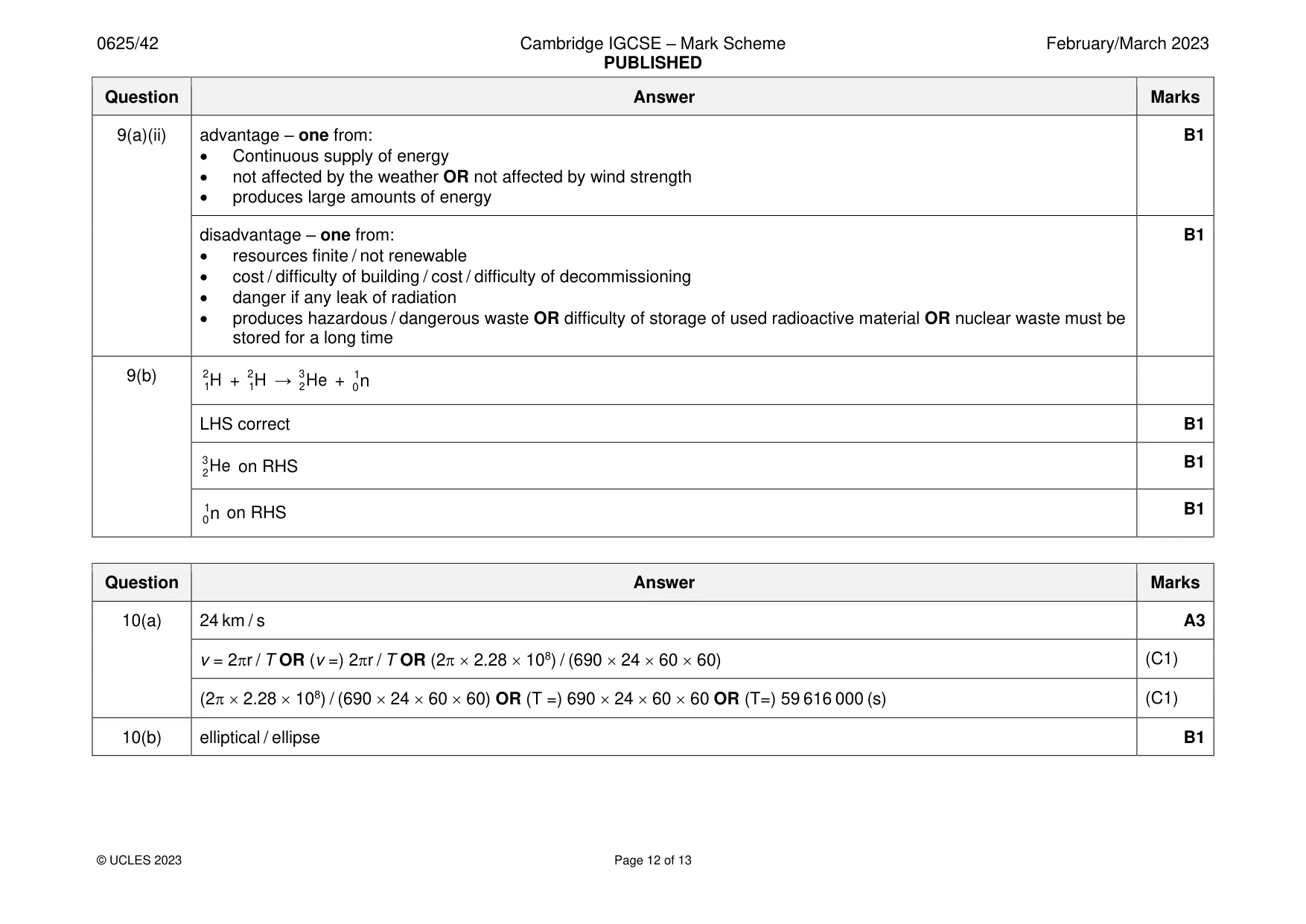
Mark scheme: 9(a)(i) large unstable nucleus OR neutrons hit nucleus OR neutrons are released (from nucleus) B1 (large) nucleus splits (into smaller nuclei) B1 (large) release of energy B1 9(a)(ii) advantage – one from: B1 • Continuous supply of energy • not affected by the weather OR not affected by wind strength • produces large amounts of energy disadvantage – one from: B1 • resources finite / not renewable • cost / difficulty of building / cost / difficulty of decommissioning • danger if any leak of radiation • produces hazardous / dangerous waste OR difficulty of storage of used radioactive material OR nuclear waste must be stored for a long time 9(b) 21H + 21H → 32He + 0n1 LHS correct B1 32He on RHS B1 0n1 on RHS B1
Q10 · The time taken for Mars to orbit the Sun is 690 Earth days
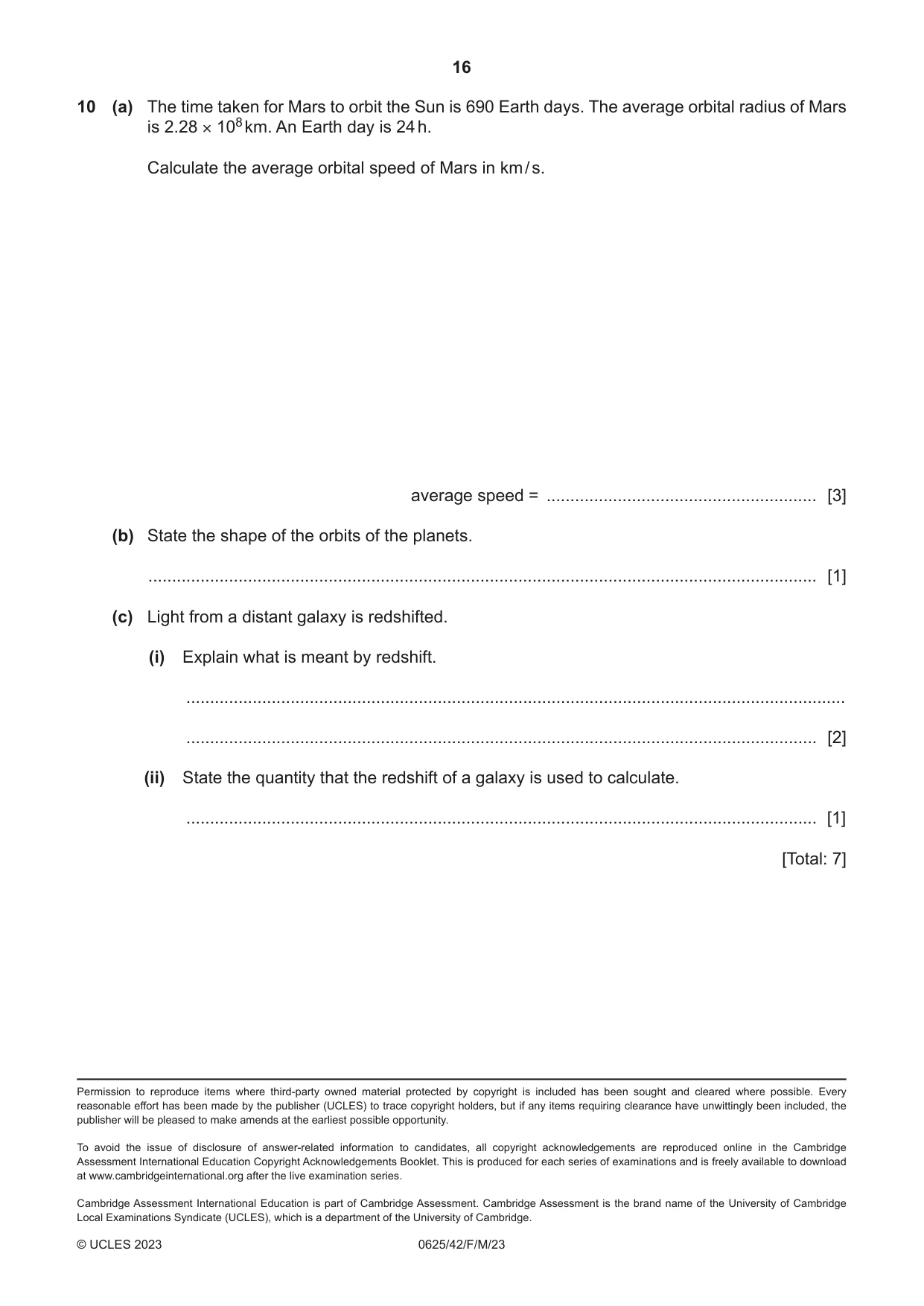
10 (a) The time taken for Mars to orbit the Sun is 690 Earth days. The average orbital radius of Mars is 2.28 × 10⁸ km. An Earth day is 24 h. Calculate the average orbital speed of Mars in km / s. average speed = ......................................................... [3] (b) State the shape of the orbits of the planets. ............................................................................................................................................. [1] (c) Light from a distant galaxy is redshifted. (i) Explain what is meant by redshift. ........................................................................................................................................... ..................................................................................................................................... [2] (ii) State the quantity that the redshift of a galaxy is used to calculate. ..................................................................................................................................... [1] [Total: 7]
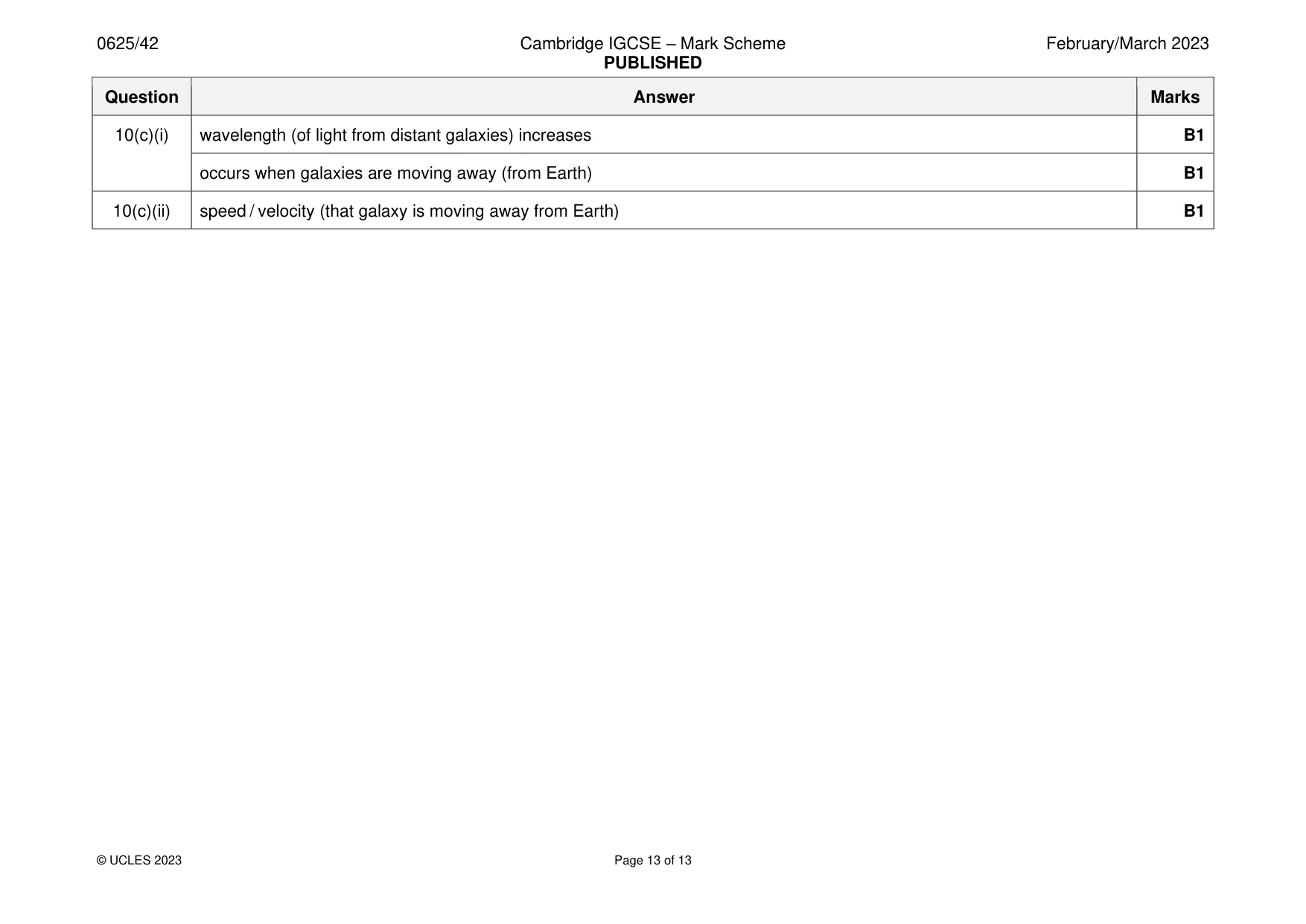
Mark scheme: 10(a) 24 km / s A3 v = 2r / T OR (v =) 2r / T OR (2 2.28 108) / (690 24 60 60) (C1) (2 2.28 108) / (690 24 60 60) OR (T =) 690 24 60 60 OR (T=) 59 616 000 (s) (C1) 10(b) elliptical / ellipse B1 10(c)(i) wavelength (of light from distant galaxies) increases B1 occurs when galaxies are moving away (from Earth) B1 10(c)(ii) speed / velocity (that galaxy is moving away from Earth) B1
What was in this paper
The subtopics covered by these 10 questions, and how many questions each got. Open one in a new tab to see every Cambridge question on it.
What you needed in this session
Cambridge’s own grade thresholds for 2023 Feb/March, Paper 4 · Variant 2. A higher threshold means an easier paper — the bar moves with how the cohort did.