Cambridge IGCSE Physics 0625 — 2021 May/June Paper 4 · Variant 3
0625/43/M/J/21 · 10 questions · 80 marks · ≈90 min
The question paper and its mark scheme, free to read here and free to download. This is Cambridge’s own paper, exactly as it was sat.
Question paper16 pages
Mark scheme10 pages
Answers below. Sit the paper first if you are practising.
Questions as text
Q1 · A load suspended from a spring
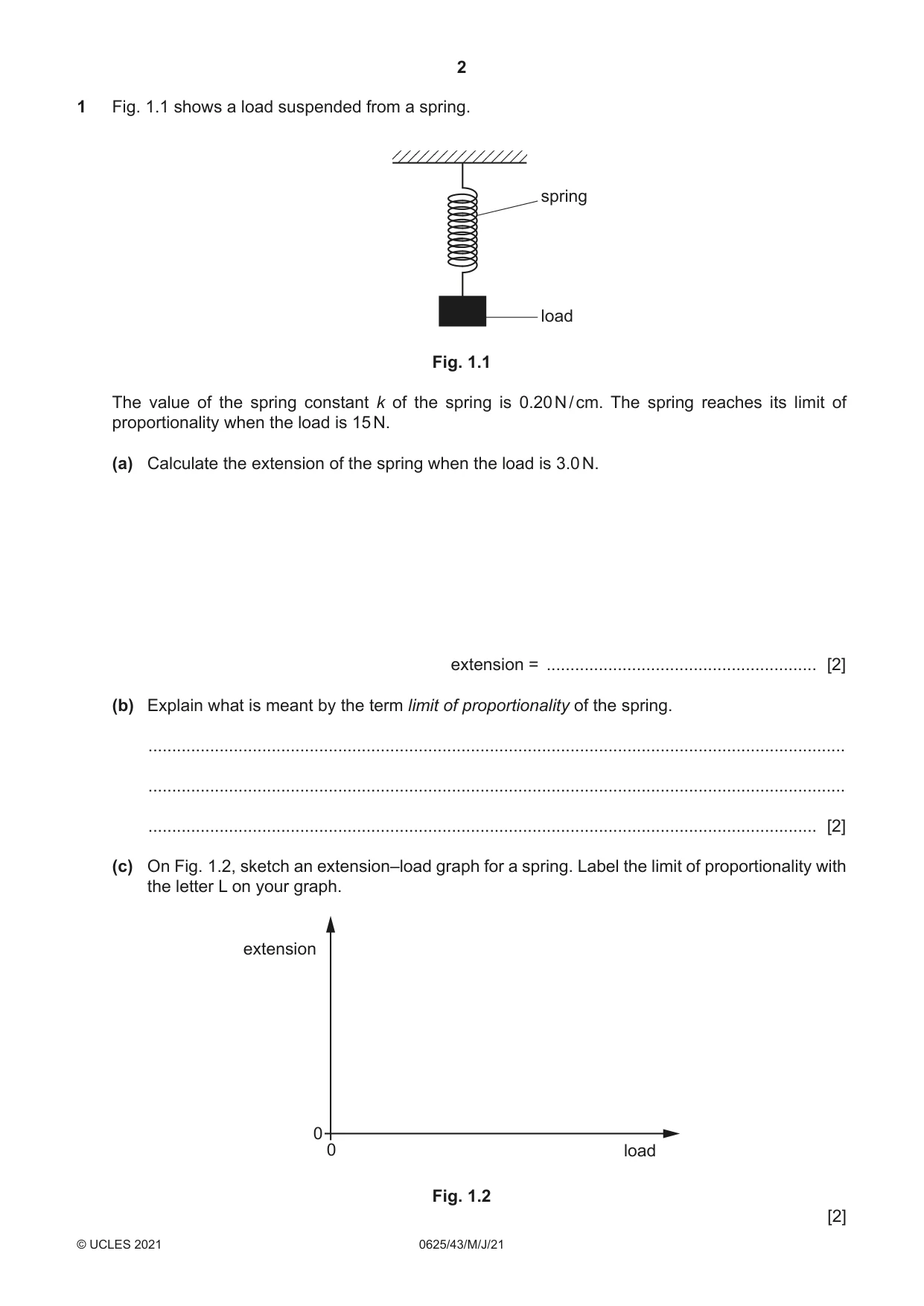
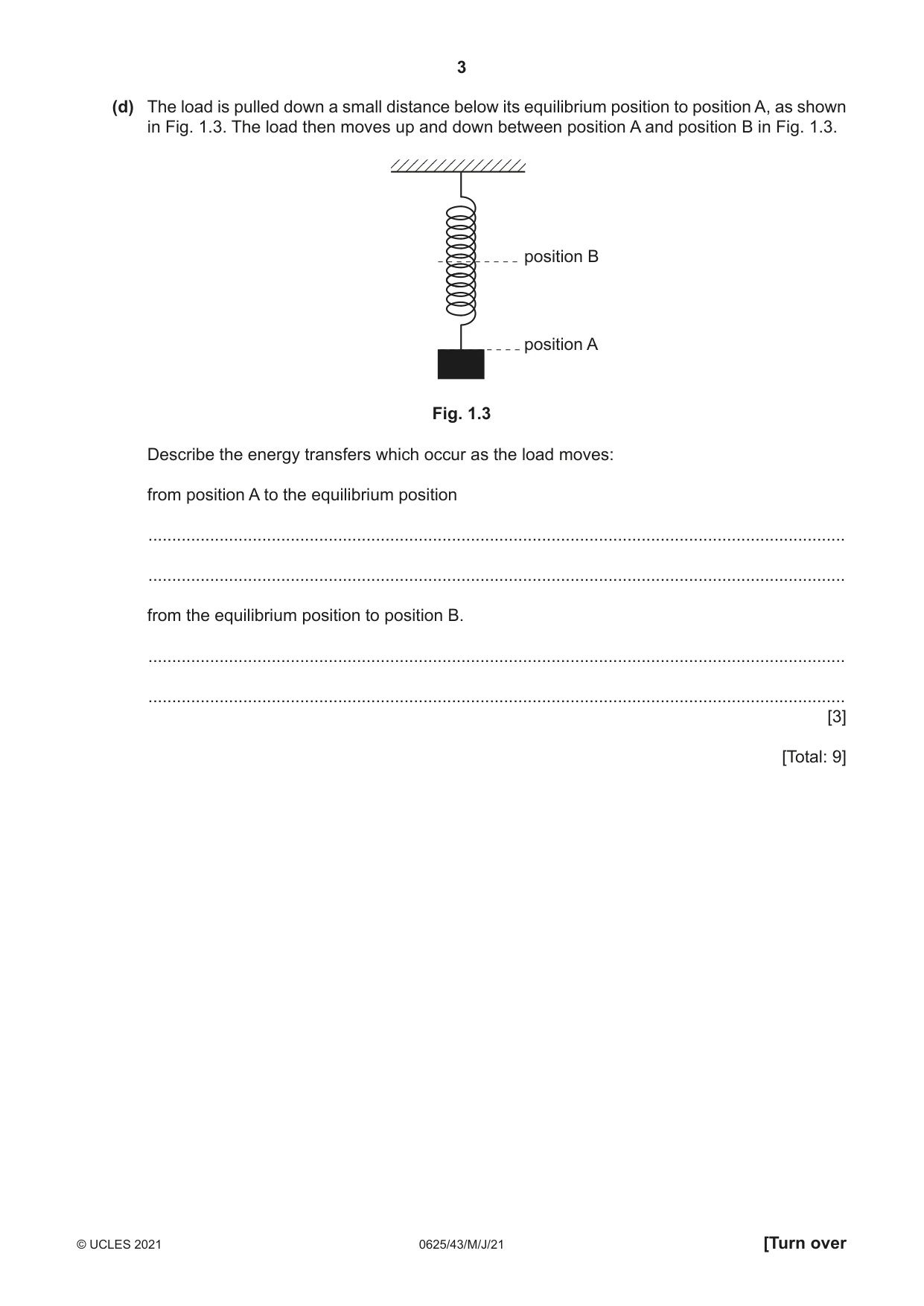
1 Fig. 1.1 shows a load suspended from a spring. spring load Fig. 1.1 The value of the spring constant k of the spring is 0.20 N / cm. The spring reaches its limit of proportionality when the load is 15 N. (a) Calculate the extension of the spring when the load is 3.0 N. extension = ......................................................... [2] (b) Explain what is meant by the term limit of proportionality of the spring. ................................................................................................................................................... ................................................................................................................................................... ............................................................................................................................................. [2] (c) On Fig. 1.2, sketch an extension–load graph for a spring. Label the limit of proportionality with the letter L on your graph. extension 0 0 load Fig. 1.2 [2] (d) The load is pulled down a small distance below its equilibrium position to position A, as shown in Fig. 1.3. The load then moves up and down between position A and position B in Fig. 1.3. position B position A Fig. 1.3 Describe the energy transfers which occur as the load moves: from position A to the equilibrium position ................................................................................................................................................... ................................................................................................................................................... from the equilibrium position to position B. ................................................................................................................................................... ................................................................................................................................................... [3] [Total: 9]
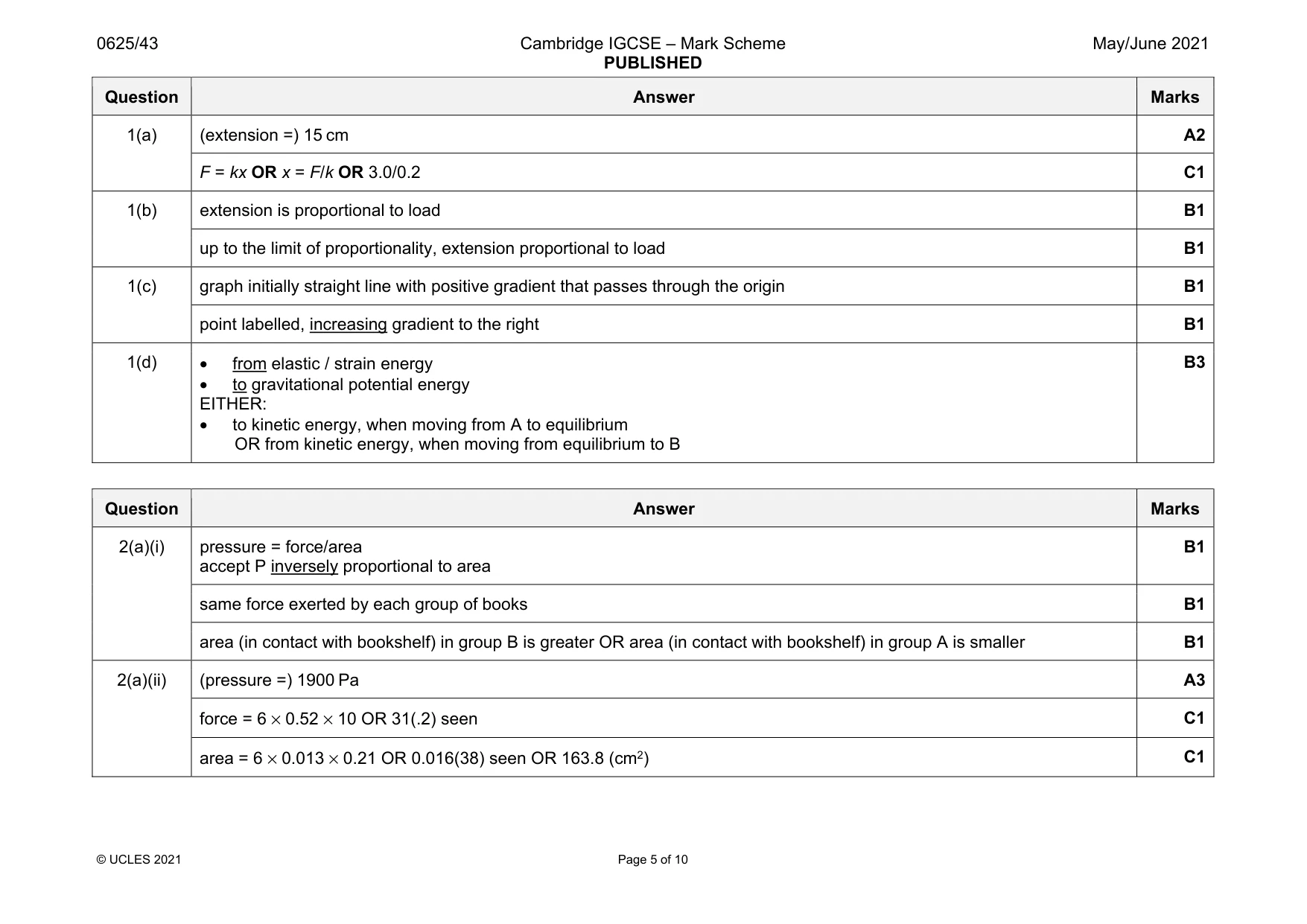
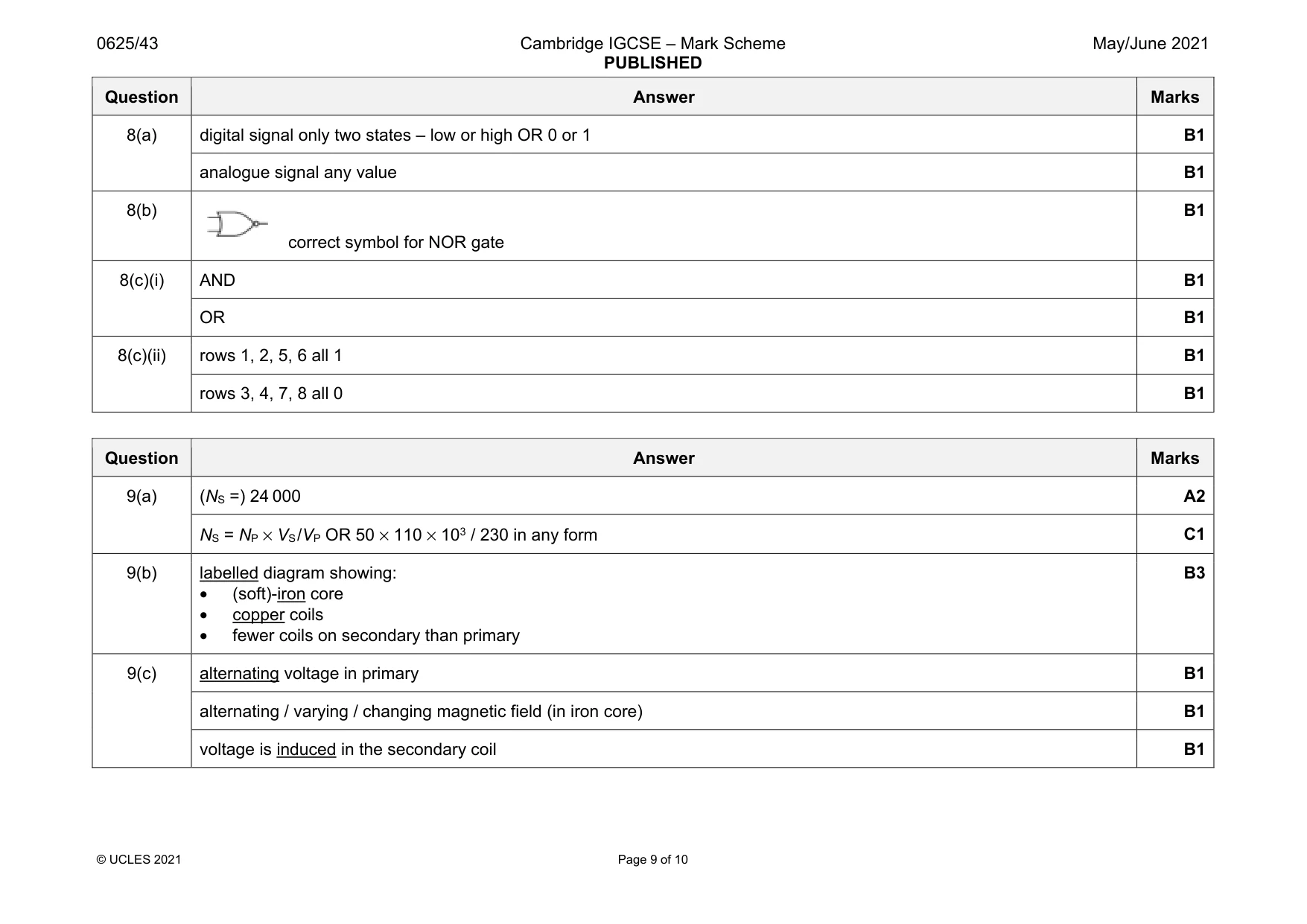
Mark scheme: 1(a) (extension =) 15 cm A2 F = kx OR x = F/k OR 3.0/0.2 C1 1(b) extension is proportional to load B1 up to the limit of proportionality, extension proportional to load B1 1(c) graph initially straight line with positive gradient that passes through the origin B1 point labelled, increasing gradient to the right B1 1(d) • from elastic / strain energy • to gravitational potential energy EITHER: • to kinetic energy, when moving from A to equilibrium OR from kinetic energy, when moving from equilibrium to B B3
Q2 · A bookshelf with two groups of books A and B on it
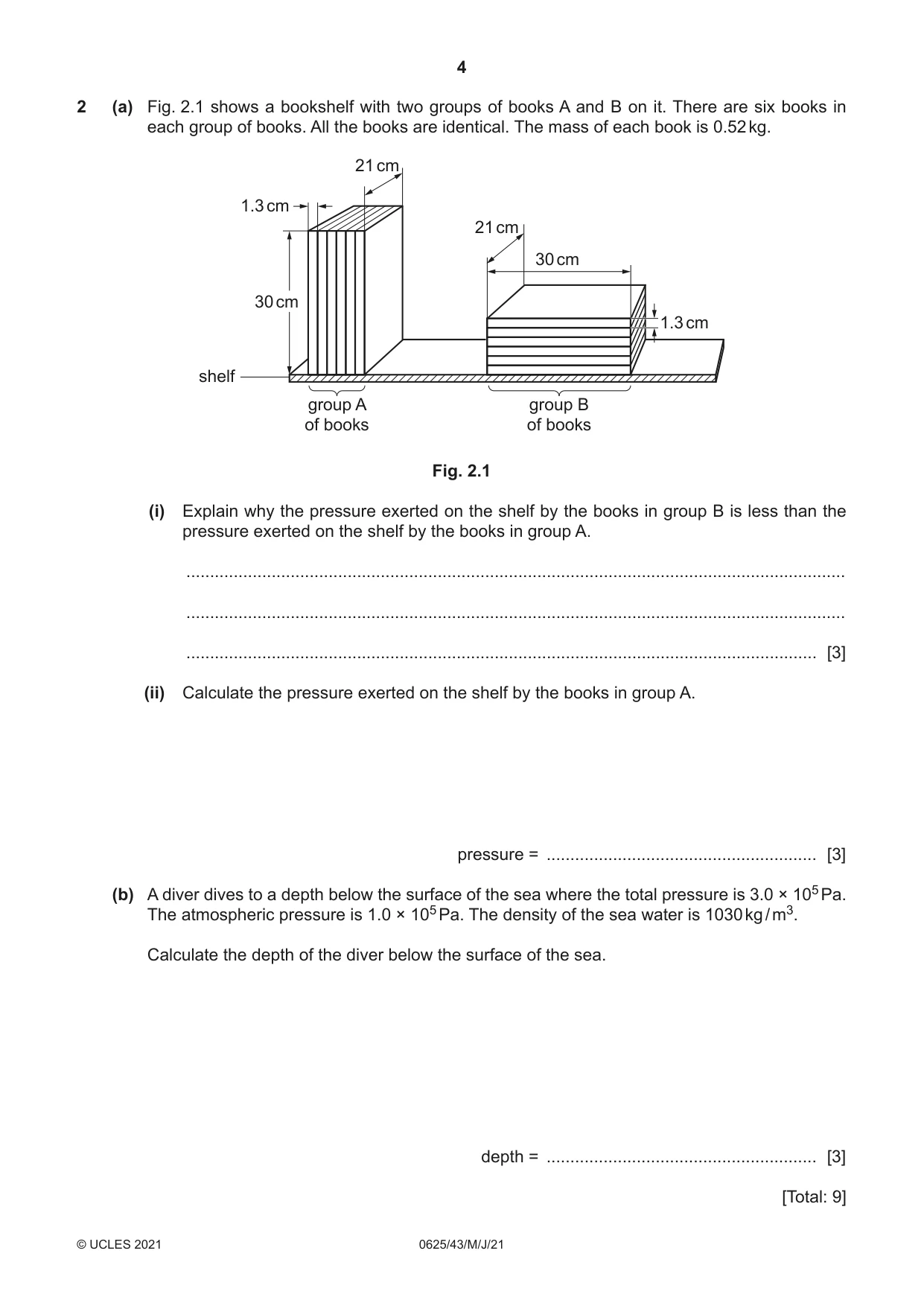
2 (a) Fig. 2.1 shows a bookshelf with two groups of books A and B on it. There are six books in each group of books. All the books are identical. The mass of each book is 0.52 kg. 21 cm 1.3 cm 21 cm 30 cm 30 cm 1.3 cm shelf group A group B of books of books Fig. 2.1 (i) Explain why the pressure exerted on the shelf by the books in group B is less than the pressure exerted on the shelf by the books in group A. ........................................................................................................................................... ........................................................................................................................................... ..................................................................................................................................... [3] (ii) Calculate the pressure exerted on the shelf by the books in group A. pressure = ......................................................... [3] (b) A diver dives to a depth below the surface of the sea where the total pressure is 3.0 × 10⁵ Pa. The atmospheric pressure is 1.0 × 10⁵ Pa. The density of the sea water is 1030 kg / m3. Calculate the depth of the diver below the surface of the sea. depth = ......................................................... [3] [Total: 9]
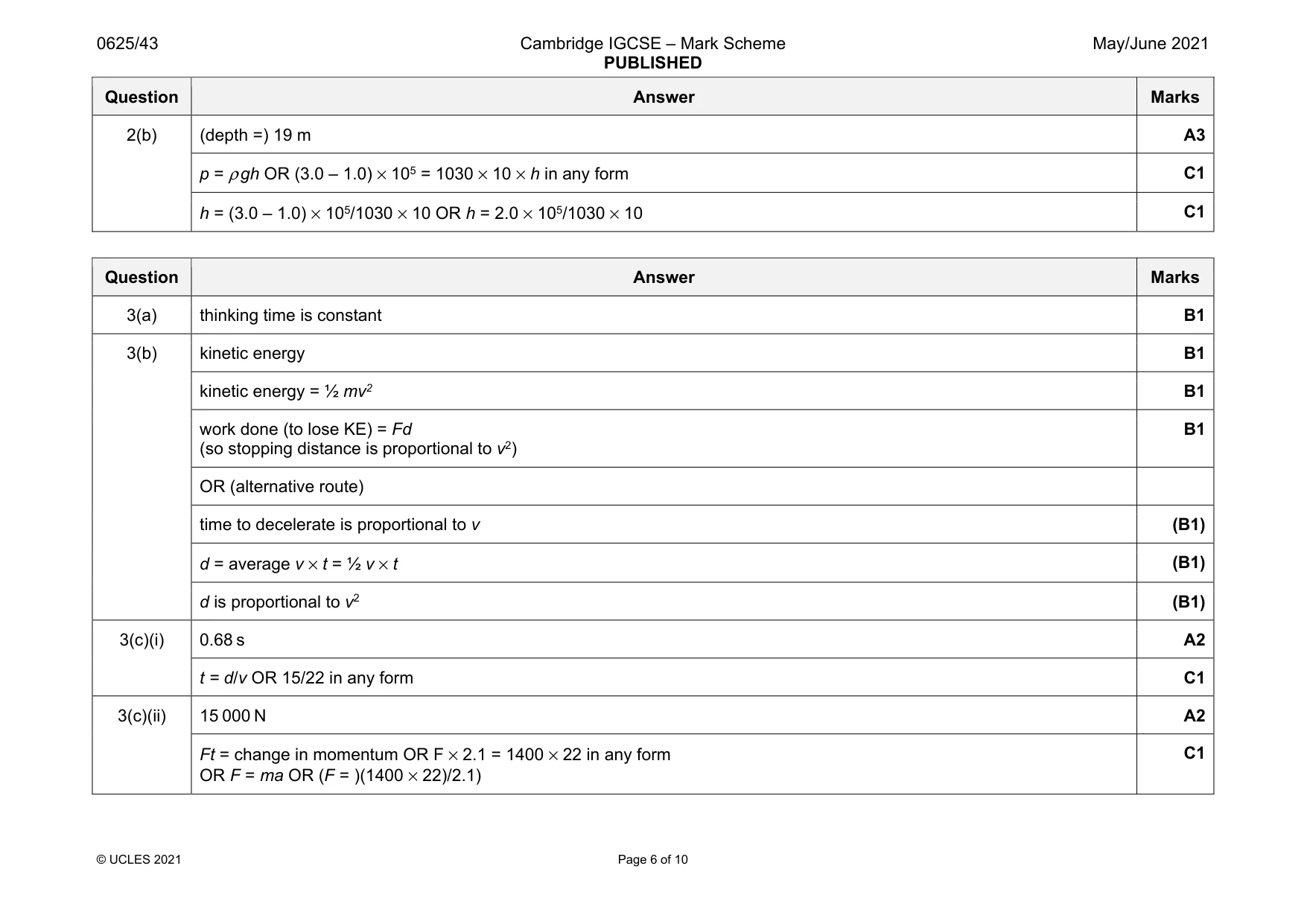
Mark scheme: 2(a)(i) pressure = force/area accept P inversely proportional to area B1 same force exerted by each group of books B1 area (in contact with bookshelf) in group B is greater OR area (in contact with bookshelf) in group A is smaller B1 2(a)(ii) (pressure =) 1900 Pa A3 force = 6 × 0.52 × 10 OR 31(.2) seen C1 area = 6 × 0.013 × 0.21 OR 0.016(38) seen OR 163.8 (cm2) C1 Question Answer Marks 2(b) (depth =) 19 m A3 p = ρ gh OR (3.0 – 1.0) × 105 = 1030 × 10 × h in any form C1 h = (3.0 – 1.0) × 105/1030 × 10 OR h = 2.0 × 10⁵/1030 × 10 C1
Q3 · A car travels at constant speed v on a horizontal, straight road
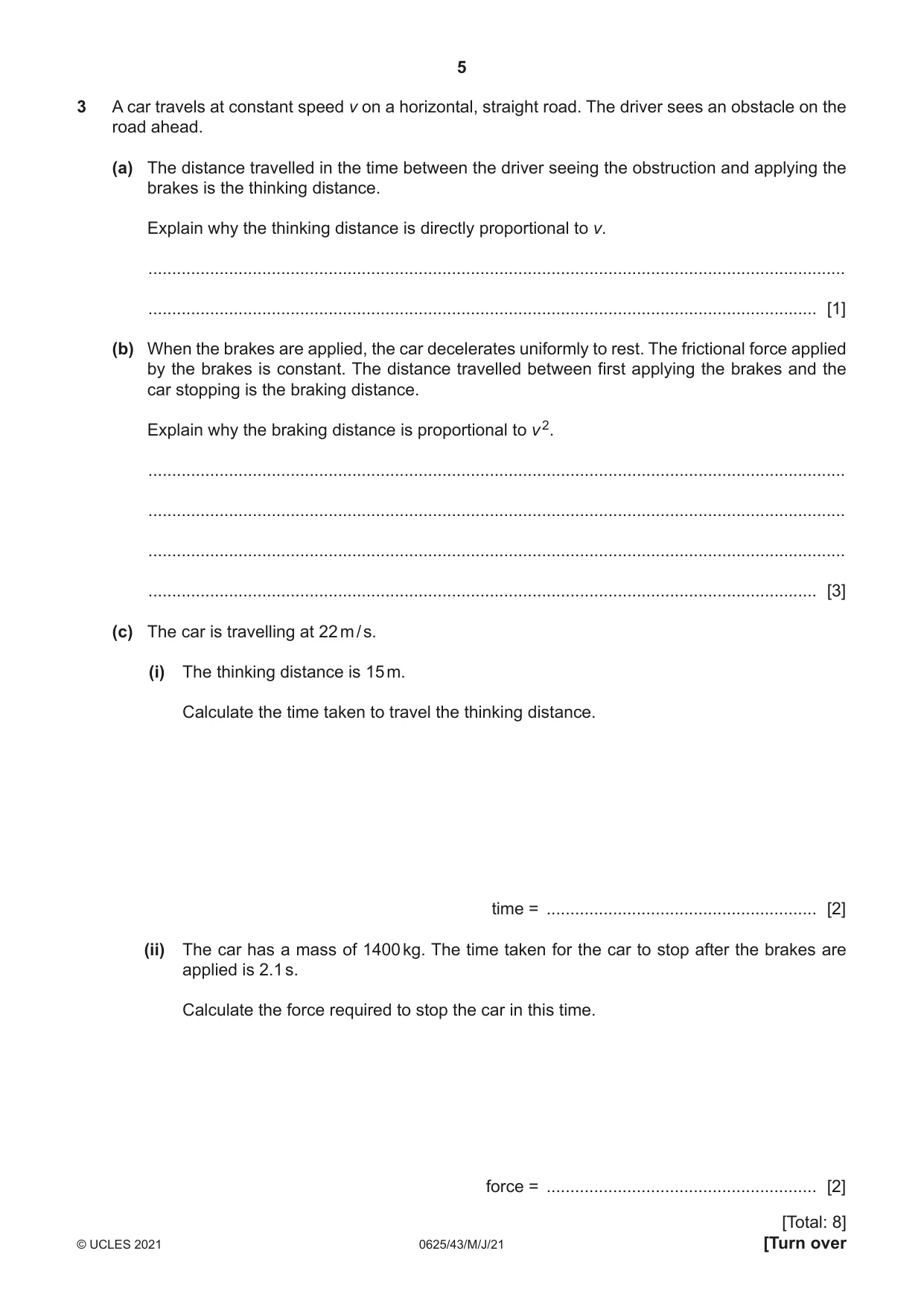
3 A car travels at constant speed v on a horizontal, straight road. The driver sees an obstacle on the road ahead. (a) The distance travelled in the time between the driver seeing the obstruction and applying the brakes is the thinking distance. Explain why the thinking distance is directly proportional to v. ................................................................................................................................................... ............................................................................................................................................. [1] (b) When the brakes are applied, the car decelerates uniformly to rest. The frictional force applied by the brakes is constant. The distance travelled between first applying the brakes and the car stopping is the braking distance. Explain why the braking distance is proportional to v 2. ................................................................................................................................................... ................................................................................................................................................... ................................................................................................................................................... ............................................................................................................................................. [3] (c) The car is travelling at 22 m / s. (i) The thinking distance is 15 m. Calculate the time taken to travel the thinking distance. time = ......................................................... [2] (ii) The car has a mass of 1400 kg. The time taken for the car to stop after the brakes are applied is 2.1 s. Calculate the force required to stop the car in this time. force = ......................................................... [2] [Total: 8]
Mark scheme: 3(a) thinking time is constant B1 3(b) kinetic energy B1 kinetic energy = ½ mv2 B1 work done (to lose KE) = Fd (so stopping distance is proportional to v2) B1 OR (alternative route) time to decelerate is proportional to v (B1) d = average v × t = ½ v × t (B1) d is proportional to v2 (B1) 3(c)(i) 0.68 s A2 t = d/v OR 15/22 in any form C1 3(c)(ii) 15 000 N A2 Ft = change in momentum OR F × 2.1 = 1400 × 22 in any form OR F = ma OR (F = )(1400 × 22)/2.1) C1
Q4 · Define specific latent heat of fusion
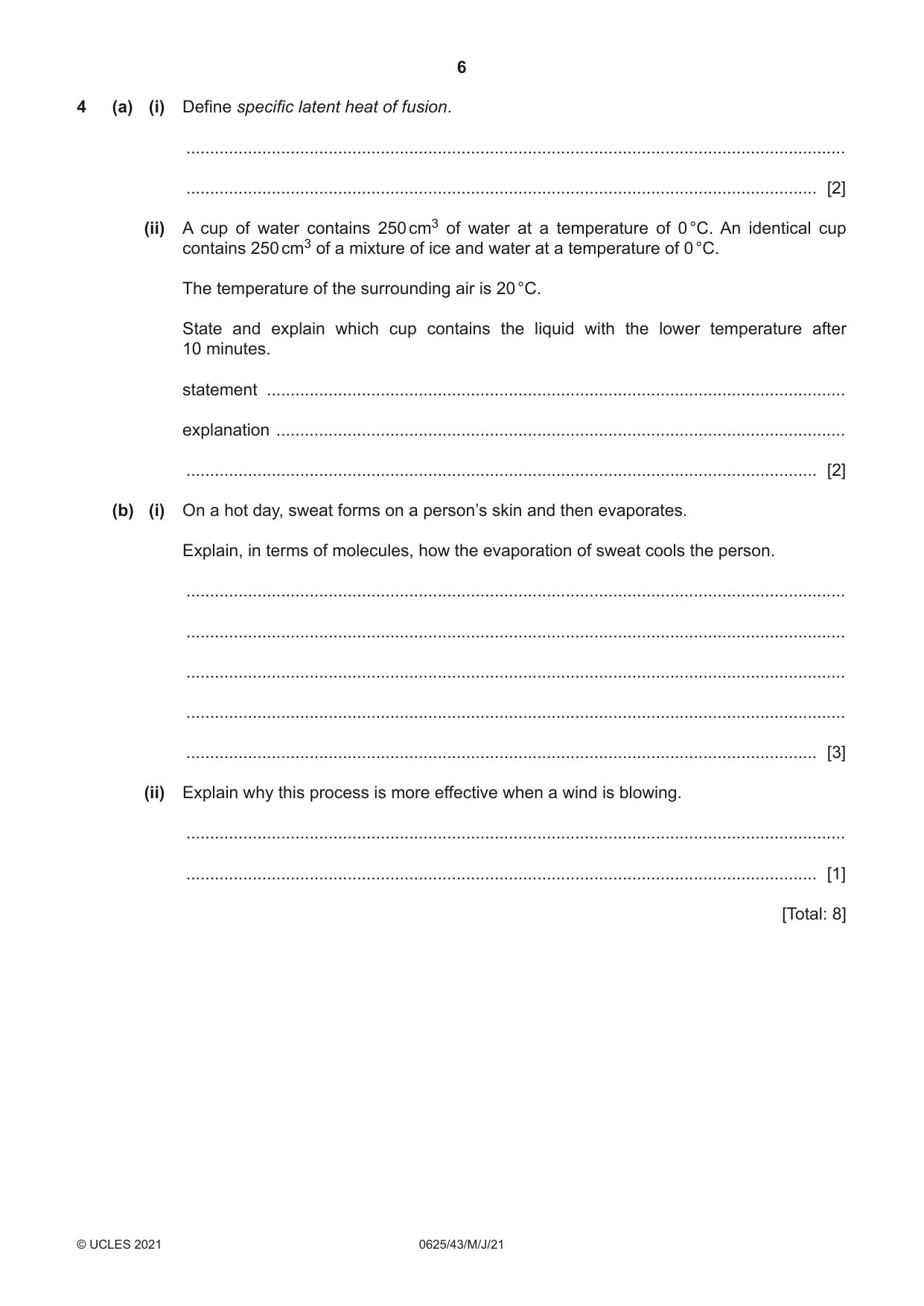
4 (a) (i) Define specific latent heat of fusion. ........................................................................................................................................... ..................................................................................................................................... [2] (ii) A cup of water contains 250 cm3 of water at a temperature of 0 °C. An identical cup contains 250 cm3 of a mixture of ice and water at a temperature of 0 °C. The temperature of the surrounding air is 20 °C. State and explain which cup contains the liquid with the lower temperature after 10 minutes. statement .......................................................................................................................... explanation ........................................................................................................................ ..................................................................................................................................... [2] (b) (i) On a hot day, sweat forms on a person’s skin and then evaporates. Explain, in terms of molecules, how the evaporation of sweat cools the person. ........................................................................................................................................... ........................................................................................................................................... ........................................................................................................................................... ........................................................................................................................................... ..................................................................................................................................... [3] (ii) Explain why this process is more effective when a wind is blowing. ........................................................................................................................................... ..................................................................................................................................... [1] [Total: 8]
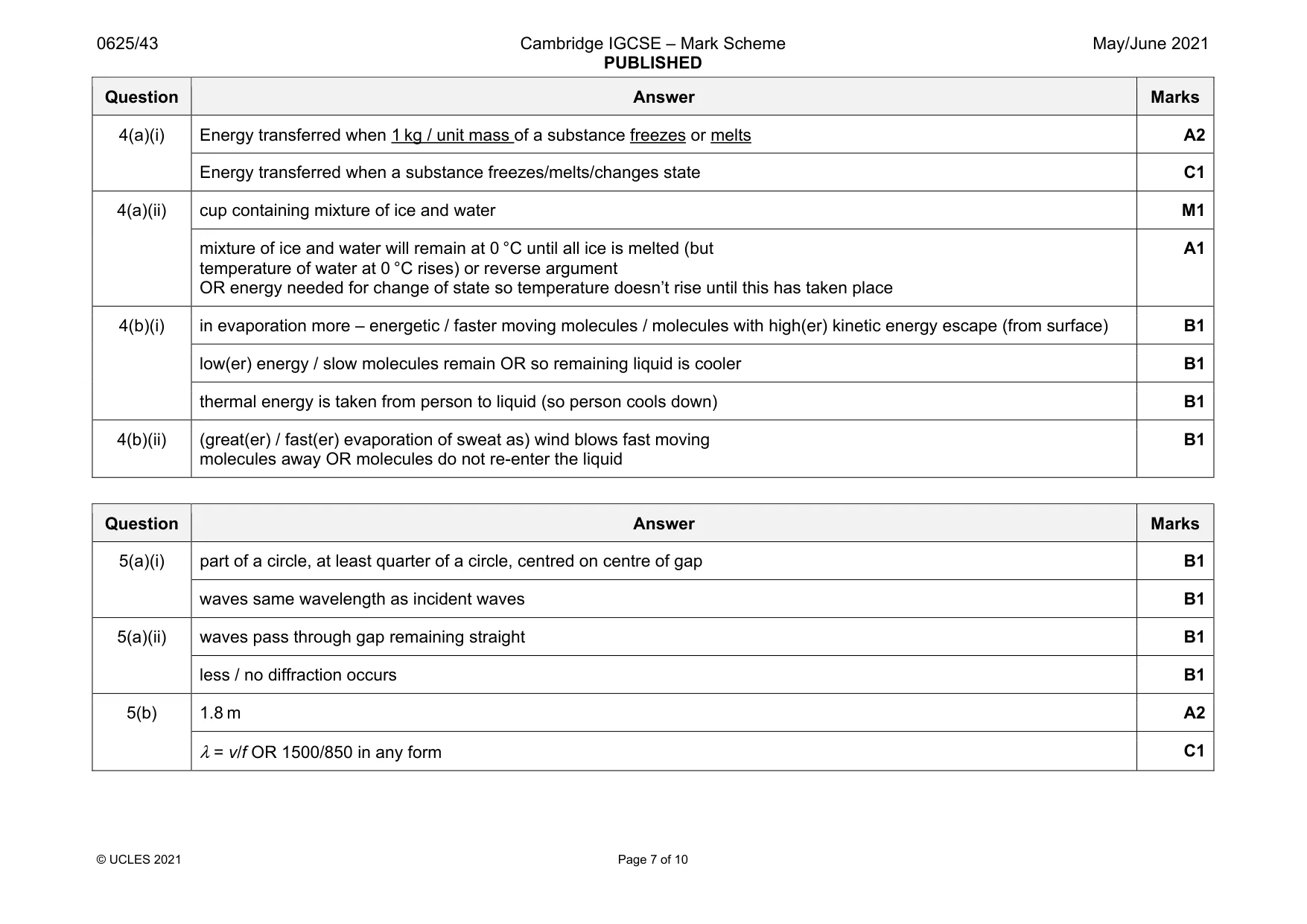
Mark scheme: 4(a)(i) Energy transferred when 1 kg / unit mass of a substance freezes or melts A2 Energy transferred when a substance freezes/melts/changes state C1 4(a)(ii) cup containing mixture of ice and water M1 mixture of ice and water will remain at 0 °C until all ice is melted (but temperature of water at 0 °C rises) or reverse argument OR energy needed for change of state so temperature doesn’t rise until this has taken place A1 4(b)(i) in evaporation more – energetic / faster moving molecules / molecules with high(er) kinetic energy escape (from surface) B1 low(er) energy / slow molecules remain OR so remaining liquid is cooler B1 thermal energy is taken from person to liquid (so person cools down) B1 4(b)(ii) (great(er) / fast(er) evaporation of sweat as) wind blows fast moving molecules away OR molecules do not re-enter the liquid B1
Q5 · A wave on the sea approaching a harbour
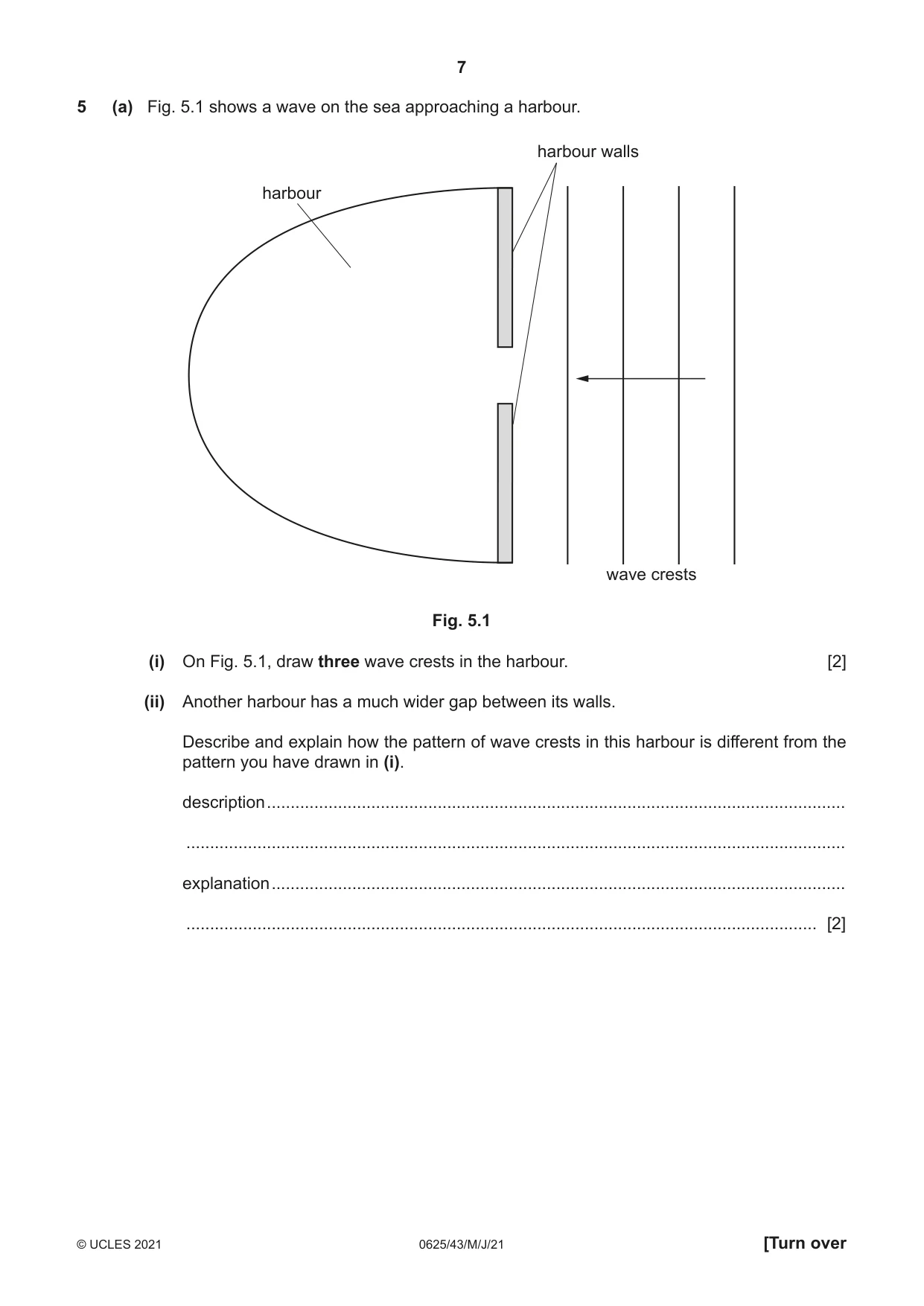
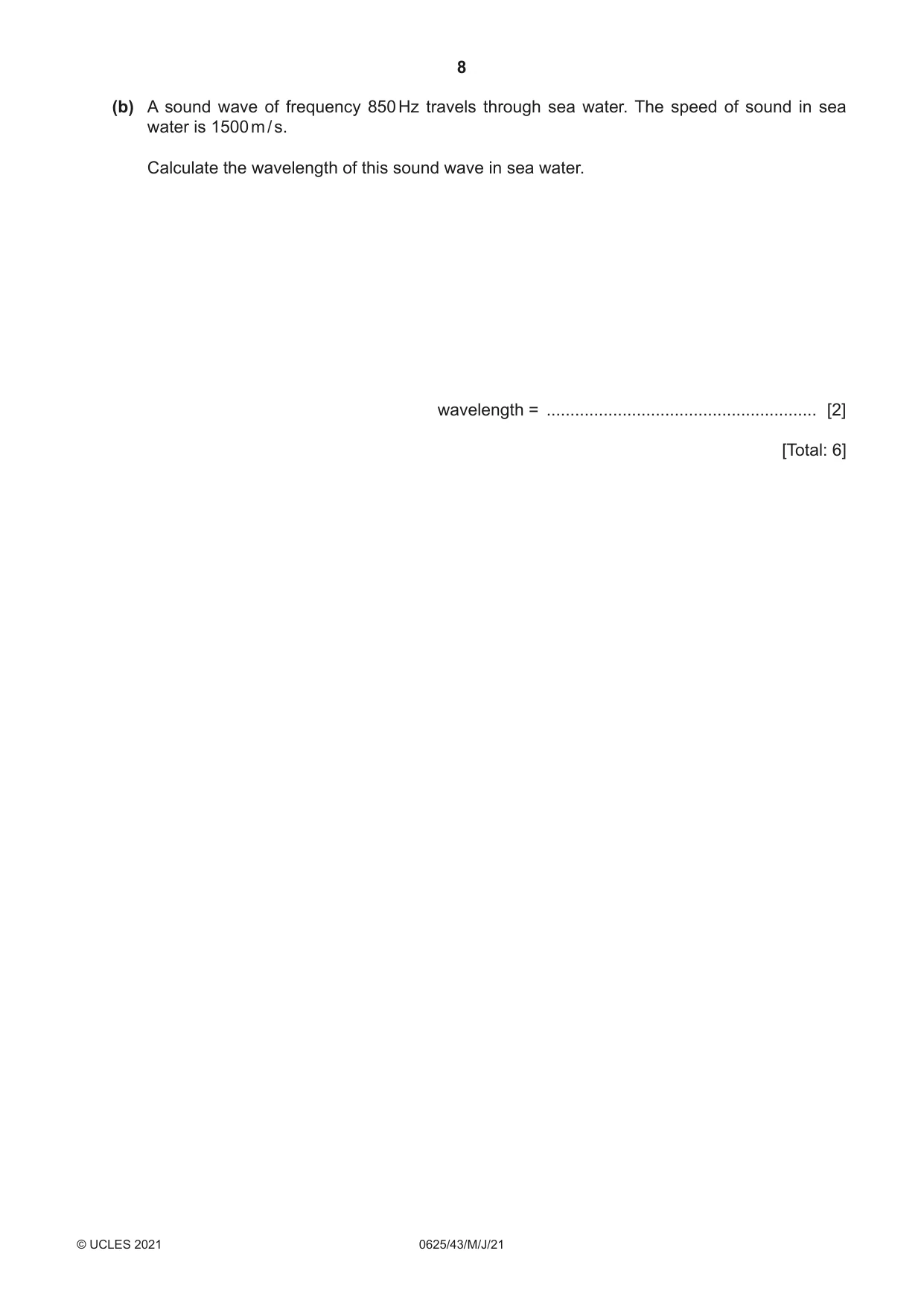
5 (a) Fig. 5.1 shows a wave on the sea approaching a harbour. harbour walls harbour wave crests Fig. 5.1 (i) On Fig. 5.1, draw three wave crests in the harbour. [2] (ii) Another harbour has a much wider gap between its walls. Describe and explain how the pattern of wave crests in this harbour is different from the pattern you have drawn in (i). description .......................................................................................................................... ........................................................................................................................................... explanation ......................................................................................................................... ..................................................................................................................................... [2] (b) A sound wave of frequency 850 Hz travels through sea water. The speed of sound in sea water is 1500 m / s. Calculate the wavelength of this sound wave in sea water. wavelength = ......................................................... [2] [Total: 6]
Mark scheme: 5(a)(i) part of a circle, at least quarter of a circle, centred on centre of gap B1 waves same wavelength as incident waves B1 5(a)(ii) waves pass through gap remaining straight B1 less / no diffraction occurs B1 5(b) 1.8 m A2 λ = v/f OR 1500/850 in any form C1
Q6 · A full-scale diagram of a lens and an object O
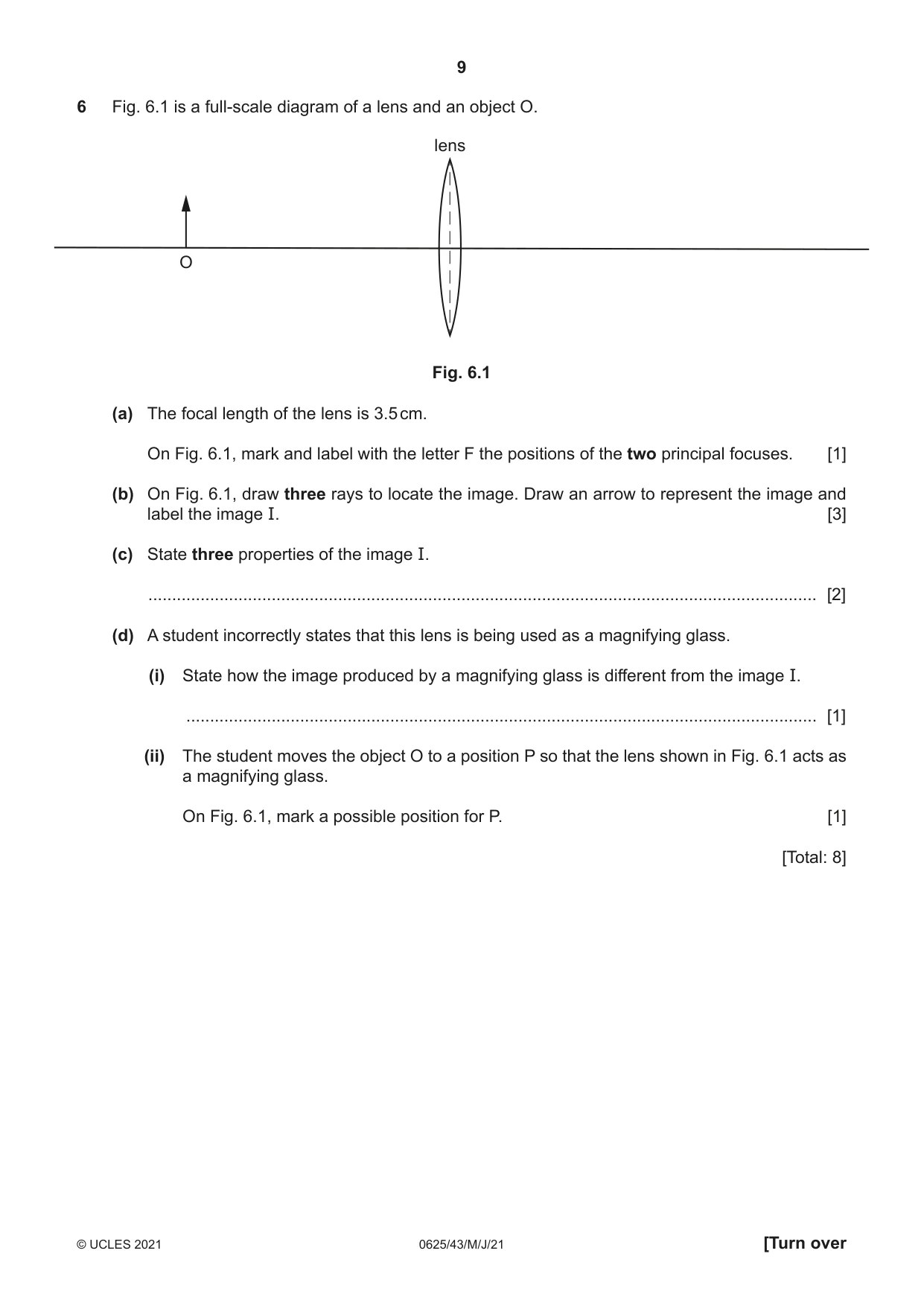
6 Fig. 6.1 is a full-scale diagram of a lens and an object O. lens O Fig. 6.1 (a) The focal length of the lens is 3.5 cm. On Fig. 6.1, mark and label with the letter F the positions of the two principal focuses. [1] (b) On Fig. 6.1, draw three rays to locate the image. Draw an arrow to represent the image and label the image I. [3] (c) State three properties of the image I. ............................................................................................................................................. [2] (d) A student incorrectly states that this lens is being used as a magnifying glass. (i) State how the image produced by a magnifying glass is different from the image I. ..................................................................................................................................... [1] (ii) The student moves the object O to a position P so that the lens shown in Fig. 6.1 acts as a magnifying glass. On Fig. 6.1, mark a possible position for P. [1] [Total: 8]
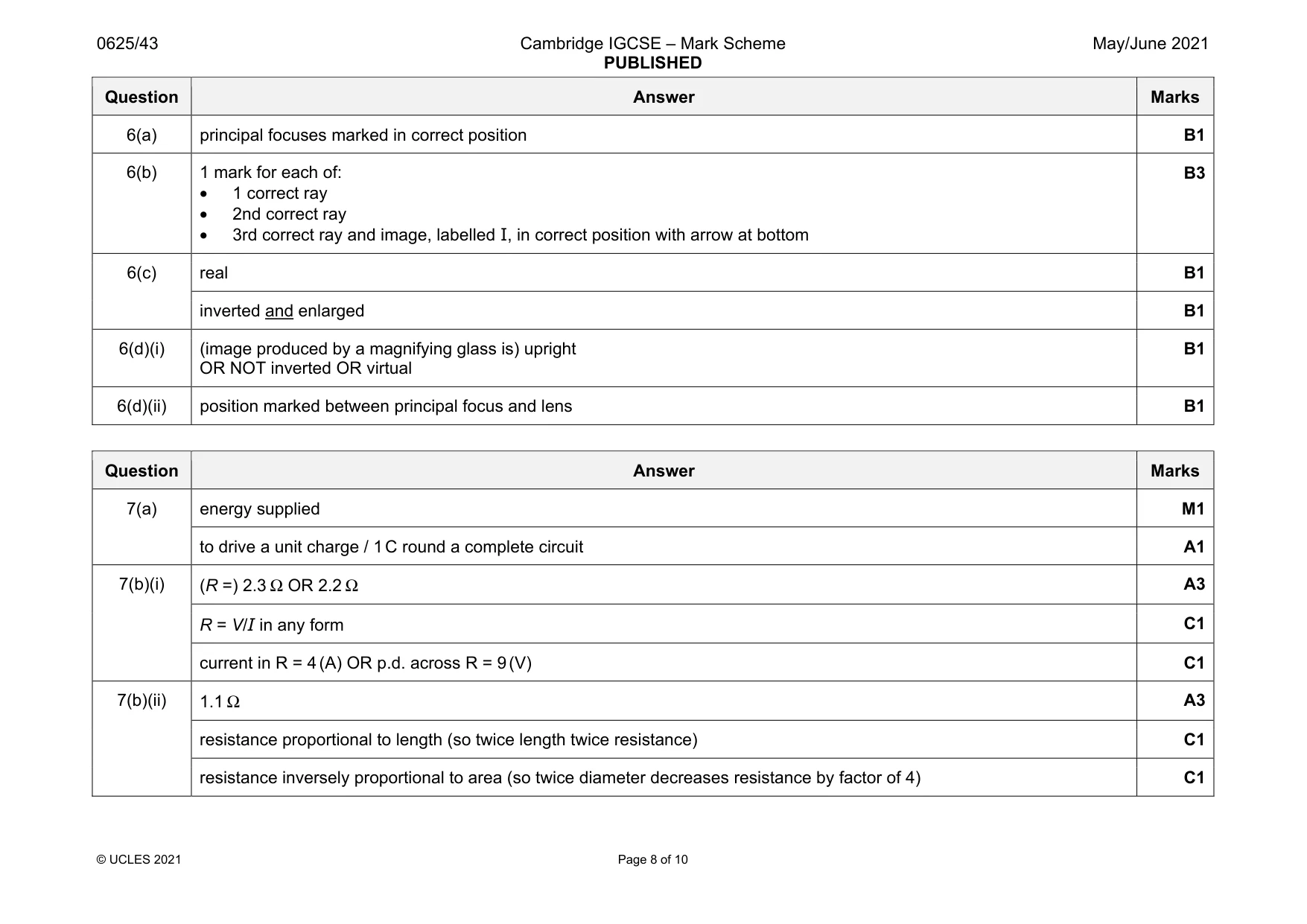
Mark scheme: 6(a) principal focuses marked in correct position B1 6(b) 1 mark for each of: • 1 correct ray • 2nd correct ray • 3rd correct ray and image, labelled I, in correct position with arrow at bottom B3 6(c) real B1 inverted and enlarged B1 6(d)(i) (image produced by a magnifying glass is) upright OR NOT inverted OR virtual B1 6(d)(ii) position marked between principal focus and lens B1
Q7 · Define electromotive force (e.m.f.)
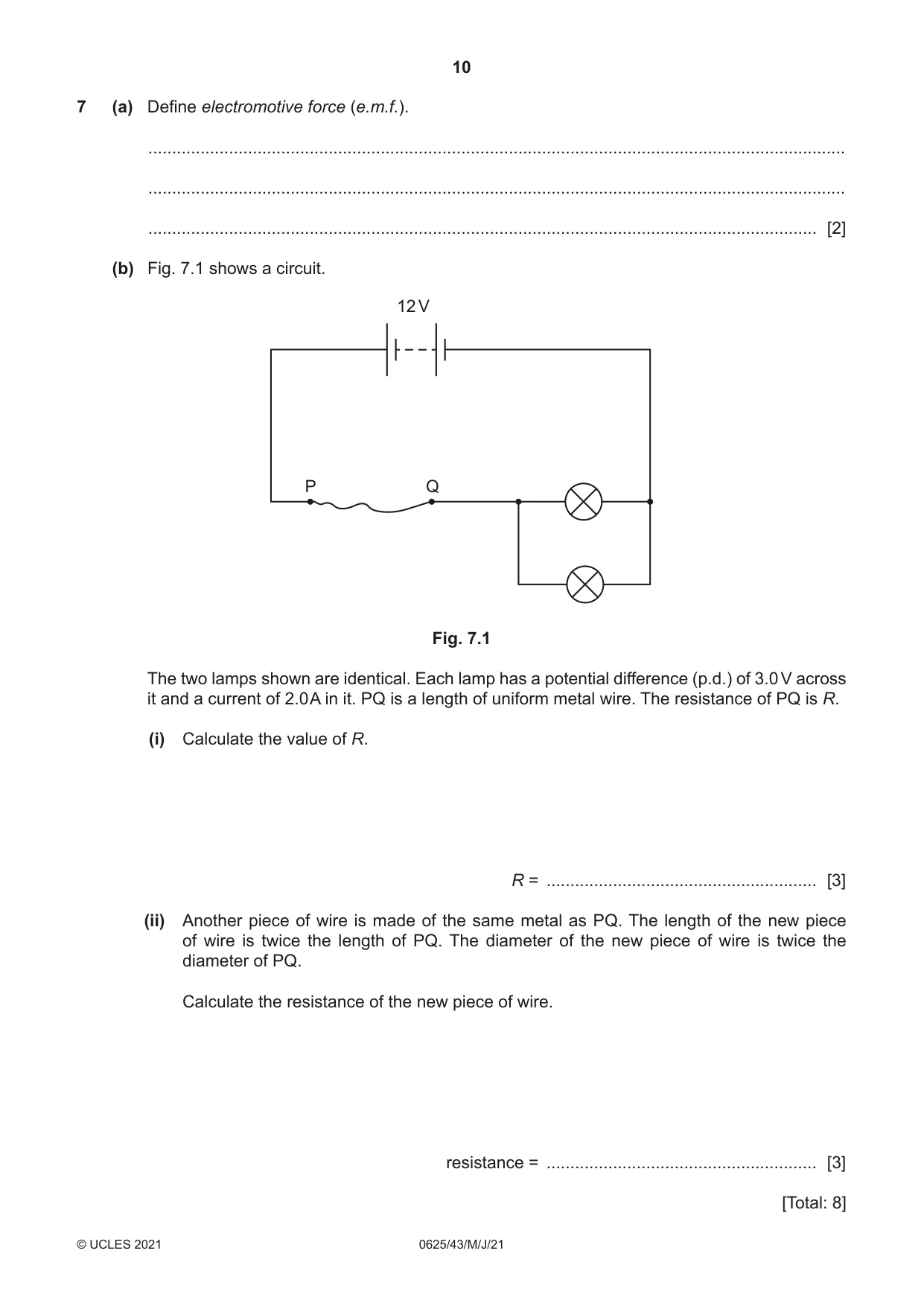
7 (a) Define electromotive force (e.m.f.). ................................................................................................................................................... ................................................................................................................................................... ............................................................................................................................................. [2] (b) Fig. 7.1 shows a circuit. 12 V P Q Fig. 7.1 The two lamps shown are identical. Each lamp has a potential difference (p.d.) of 3.0 V across it and a current of 2.0 A in it. PQ is a length of uniform metal wire. The resistance of PQ is R. (i) Calculate the value of R. R = ......................................................... [3] (ii) Another piece of wire is made of the same metal as PQ. The length of the new piece of wire is twice the length of PQ. The diameter of the new piece of wire is twice the diameter of PQ. Calculate the resistance of the new piece of wire. resistance = ......................................................... [3] [Total: 8]
Mark scheme: 7(a) energy supplied M1 to drive a unit charge / 1 C round a complete circuit A1 7(b)(i) (R =) 2.3 Ω OR 2.2 Ω A3 R = V/I in any form C1 current in R = 4 (A) OR p.d. across R = 9 (V) C1 7(b)(ii) 1.1 Ω A3 resistance proportional to length (so twice length twice resistance) C1 resistance inversely proportional to area (so twice diameter decreases resistance by factor of 4) C1
Q8 · State the difference between an analogue signal and a digital signal
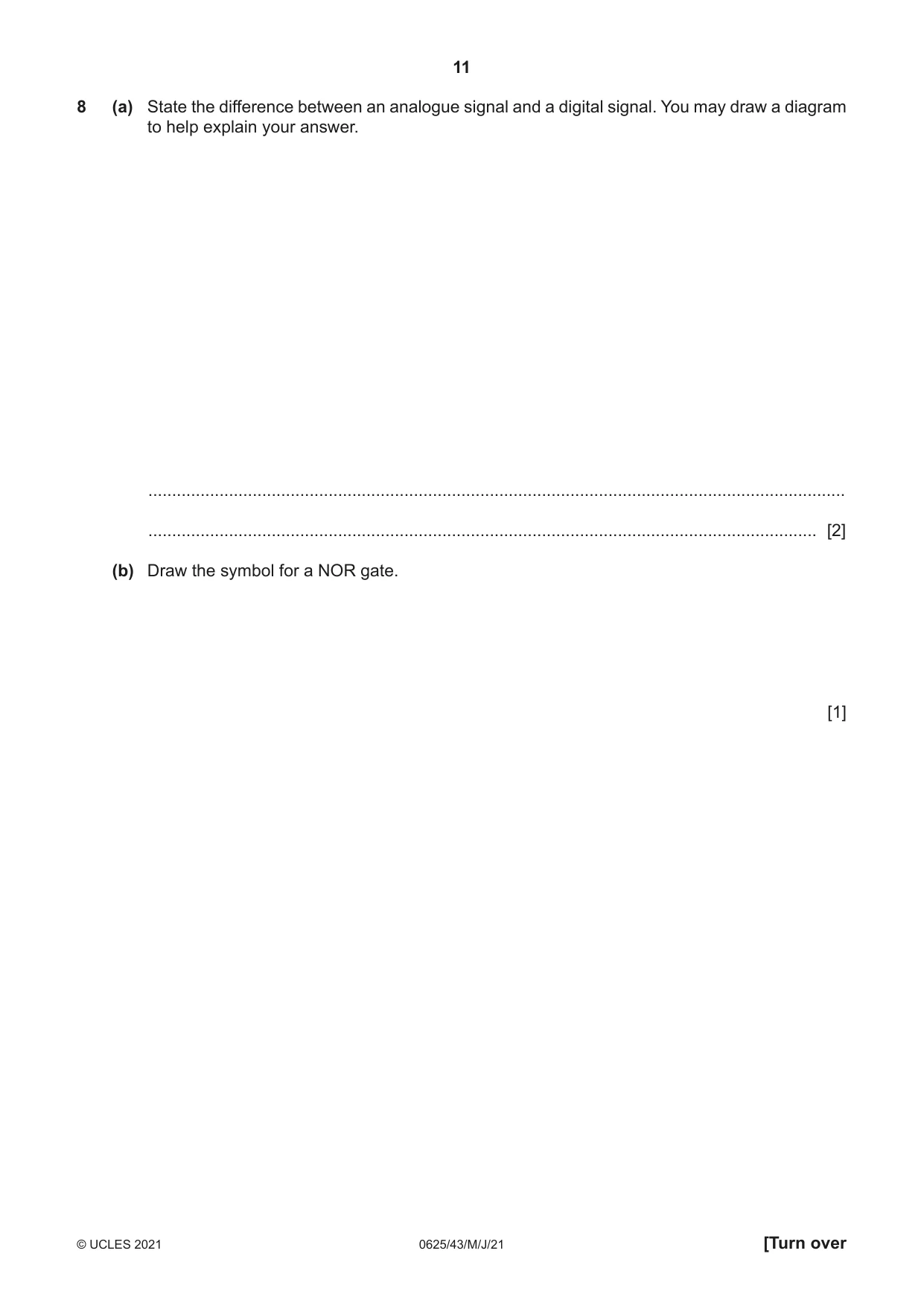
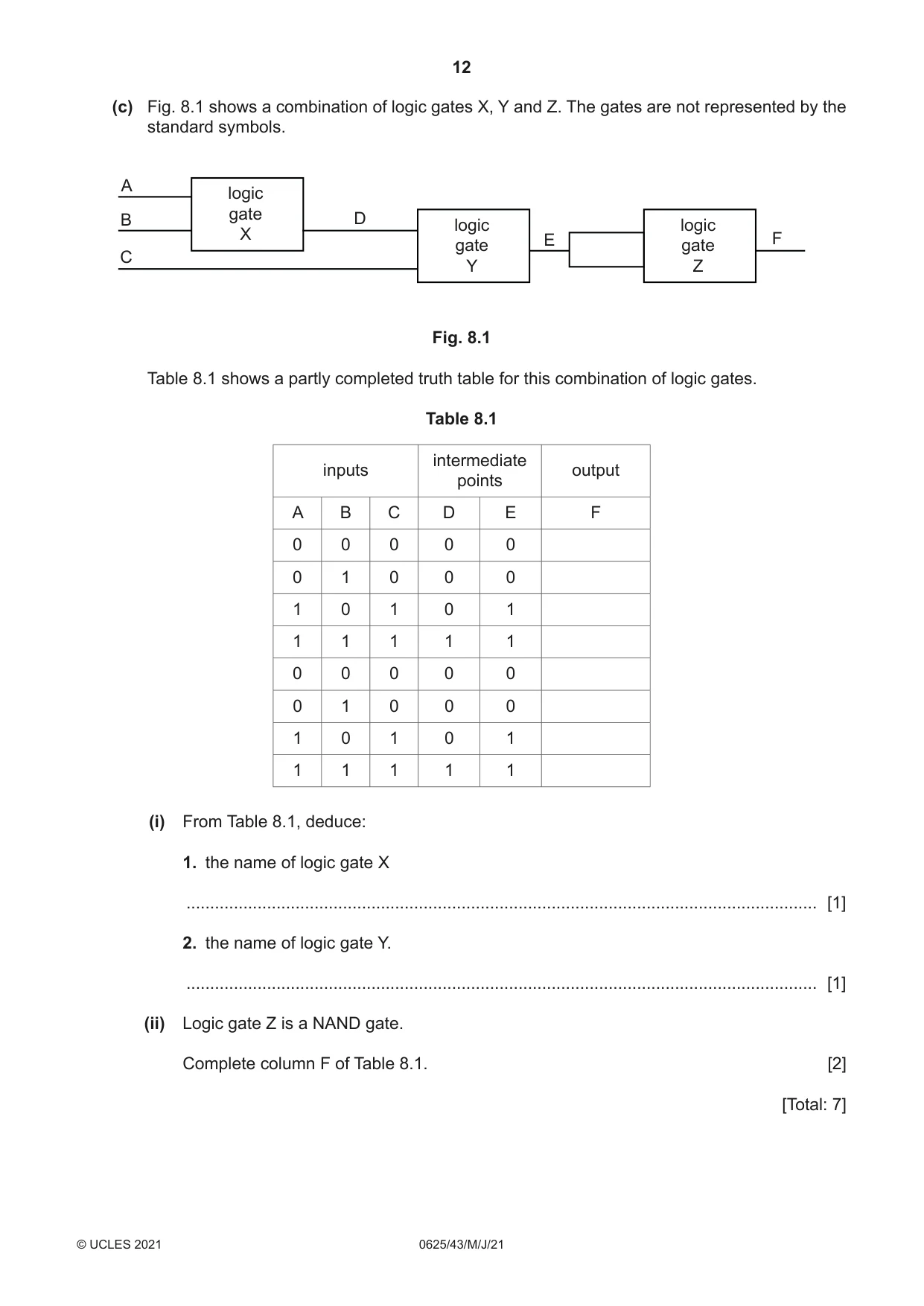
8 (a) State the difference between an analogue signal and a digital signal. You may draw a diagram to help explain your answer. ................................................................................................................................................... ............................................................................................................................................. [2] (b) Draw the symbol for a NOR gate. [1] (c) Fig. 8.1 shows a combination of logic gates X, Y and Z. The gates are not represented by the standard symbols. A logic gate D B logic logic X E F gate gate C Y Z Fig. 8.1 Table 8.1 shows a partly completed truth table for this combination of logic gates. Table 8.1 intermediate inputs output points A B C D E F 0 0 0 0 0 0 1 0 0 0 1 0 1 0 1 1 1 1 1 1 0 0 0 0 0 0 1 0 0 0 1 0 1 0 1 1 1 1 1 1 (i) From Table 8.1, deduce: 1. the name of logic gate X ..................................................................................................................................... [1] 2. the name of logic gate Y. ..................................................................................................................................... [1] (ii) Logic gate Z is a NAND gate. Complete column F of Table 8.1. [2] [Total: 7]
Mark scheme: 8(a) digital signal only two states – low or high OR 0 or 1 B1 analogue signal any value B1 8(b) correct symbol for NOR gate B1 8(c)(i) AND B1 OR B1 8(c)(ii) rows 1, 2, 5, 6 all 1 B1 rows 3, 4, 7, 8 all 0 B1
Q9 · An X-ray machine requires a supply of 110 kV
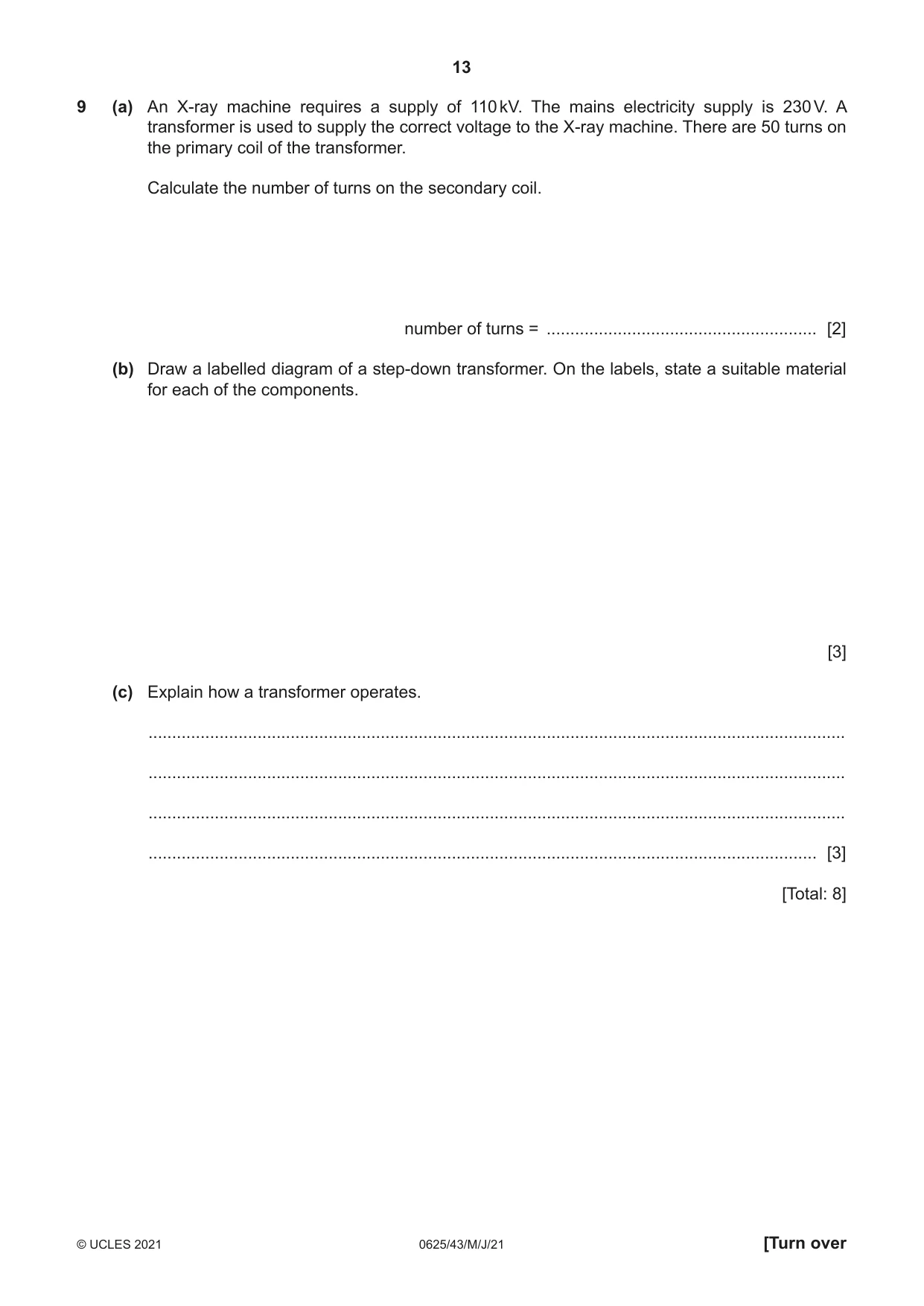
9 (a) An X-ray machine requires a supply of 110 kV. The mains electricity supply is 230 V. A transformer is used to supply the correct voltage to the X-ray machine. There are 50 turns on the primary coil of the transformer. Calculate the number of turns on the secondary coil. number of turns = ......................................................... [2] (b) Draw a labelled diagram of a step-down transformer. On the labels, state a suitable material for each of the components. [3] (c) Explain how a transformer operates. ................................................................................................................................................... ................................................................................................................................................... ................................................................................................................................................... ............................................................................................................................................. [3] [Total: 8]
Mark scheme: 9(a) (NS =) 24 000 A2 NS = NP × VS /VP OR 50 × 110 × 103 / 230 in any form C1 9(b) labelled diagram showing: • (soft)-iron core • copper coils • fewer coils on secondary than primary B3 9(c) alternating voltage in primary B1 alternating / varying / changing magnetic field (in iron core) B1 voltage is induced in the secondary coil B1
Q10 · A beam of radiation in a vacuum
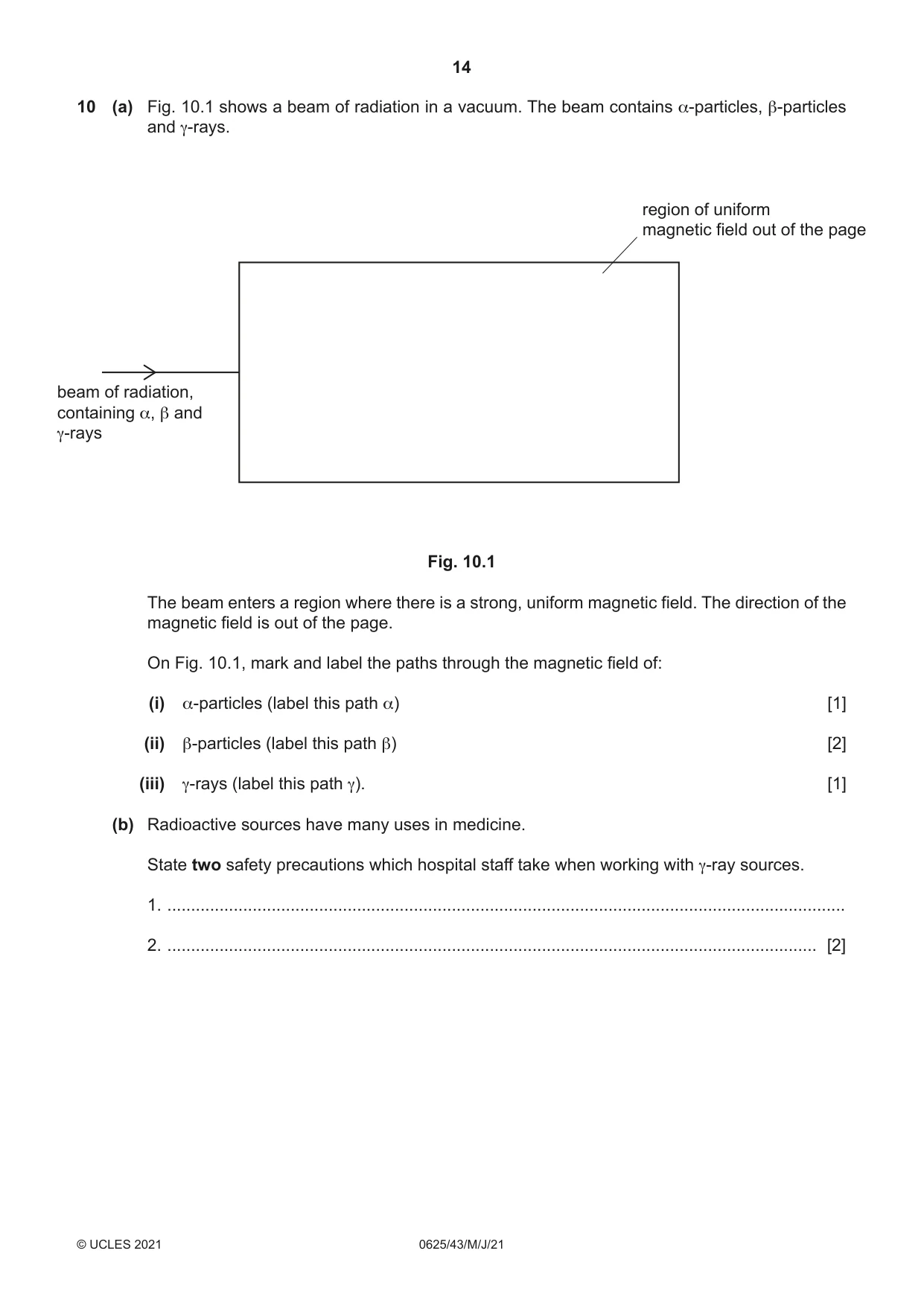
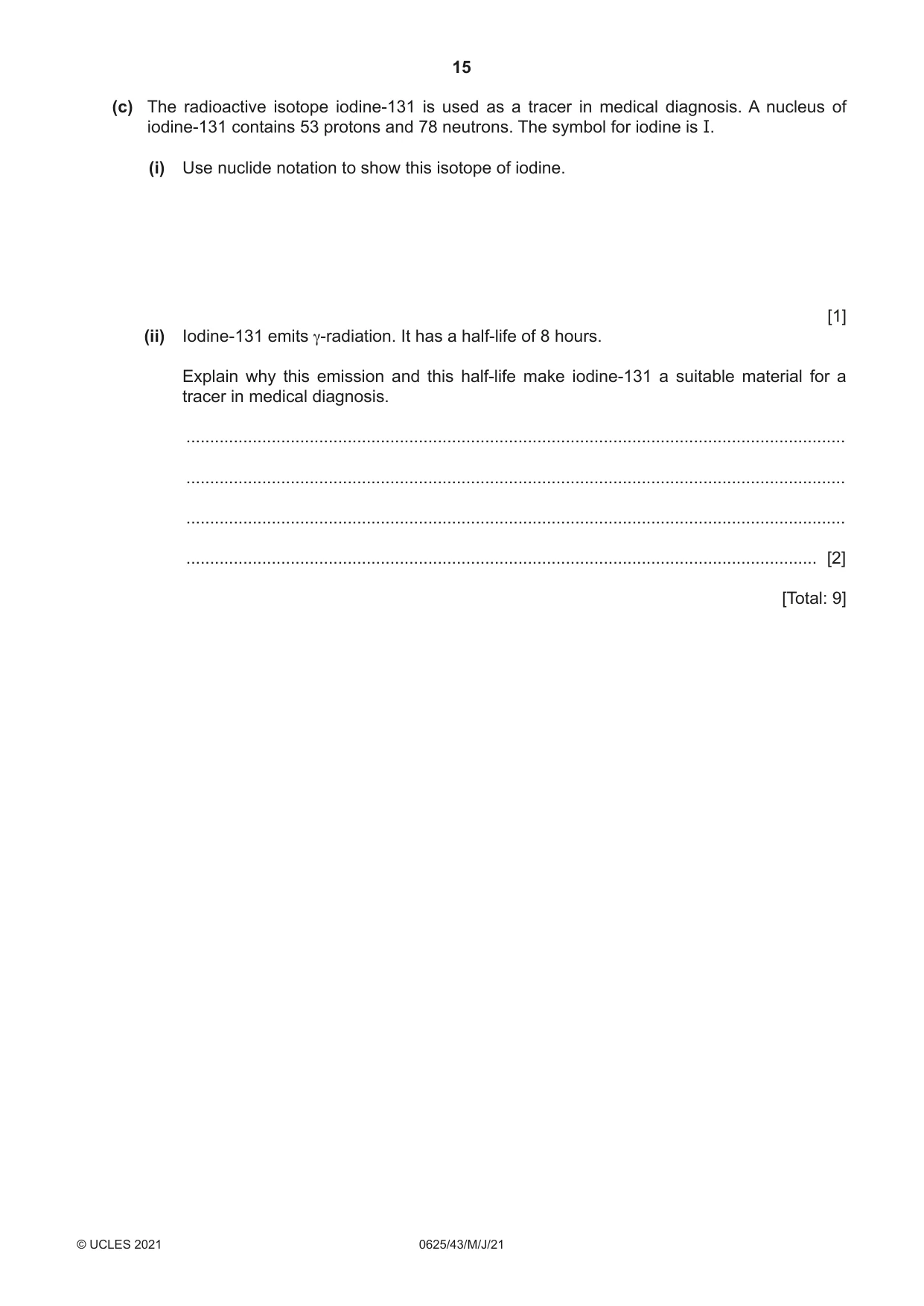
10 (a) Fig. 10.1 shows a beam of radiation in a vacuum. The beam contains α-particles, β-particles and γ-rays. region of uniform magnetic field out of the page beam of radiation, containing α, β and γ-rays Fig. 10.1 The beam enters a region where there is a strong, uniform magnetic field. The direction of the magnetic field is out of the page. On Fig. 10.1, mark and label the paths through the magnetic field of: (i) α-particles (label this path α) [1] (ii) β-particles (label this path β) [2] (iii) γ-rays (label this path γ). [1] (b) Radioactive sources have many uses in medicine. State two safety precautions which hospital staff take when working with γ-ray sources. 1. ............................................................................................................................................... 2. ......................................................................................................................................... [2] (c) The radioactive isotope iodine-131 is used as a tracer in medical diagnosis. A nucleus of iodine-131 contains 53 protons and 78 neutrons. The symbol for iodine is I. (i) Use nuclide notation to show this isotope of iodine. [1] (ii) Iodine-131 emits γ-radiation. It has a half-life of 8 hours. Explain why this emission and this half-life make iodine-131 a suitable material for a tracer in medical diagnosis. ........................................................................................................................................... ........................................................................................................................................... ........................................................................................................................................... ..................................................................................................................................... [2] [Total: 9]
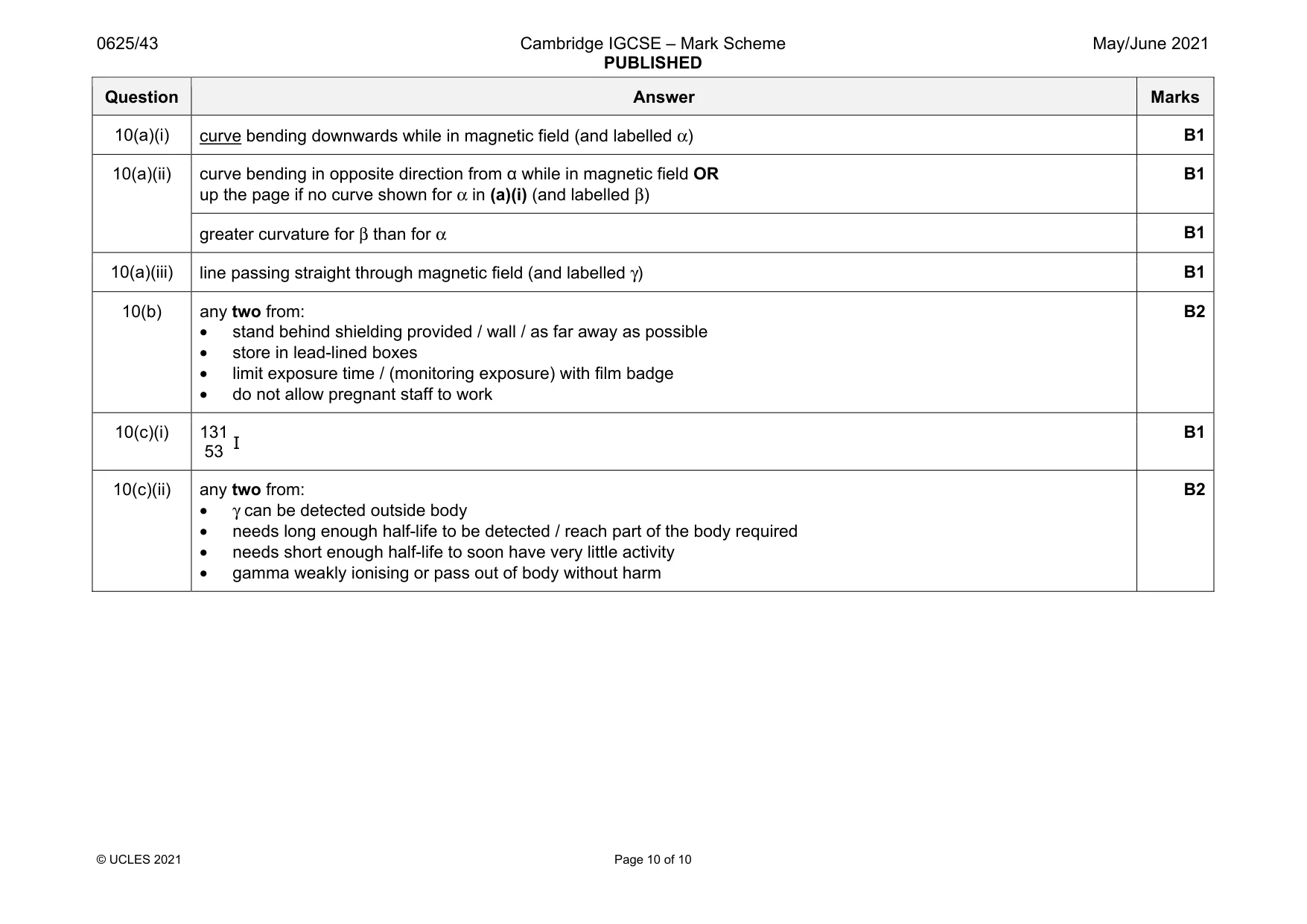
Mark scheme: 10(a)(i) curve bending downwards while in magnetic field (and labelled α) B1 10(a)(ii) curve bending in opposite direction from α while in magnetic field OR up the page if no curve shown for α in (a)(i) (and labelled β) B1 greater curvature for β than for α B1 10(a)(iii) line passing straight through magnetic field (and labelled γ) B1 10(b) any two from: • stand behind shielding provided / wall / as far away as possible • store in lead-lined boxes • limit exposure time / (monitoring exposure) with film badge • do not allow pregnant staff to work B2 10(c)(i) 131 53 I B1 10(c)(ii) any two from: • γ can be detected outside body • needs long enough half-life to be detected / reach part of the body required • needs short enough half-life to soon have very little activity • gamma weakly ionising or pass out of body without harm B2
What was in this paper
The subtopics covered by these 10 questions, and how many questions each got. Open one in a new tab to see every Cambridge question on it.
What you needed in this session
Cambridge’s own grade thresholds for 2021 May/June, Paper 4 · Variant 3. A higher threshold means an easier paper — the bar moves with how the cohort did.