Cambridge IGCSE Physics 0625 — 2022 May/June Paper 4 · Variant 3
0625/43/M/J/22 · 10 questions · 80 marks · ≈90 min
The question paper and its mark scheme, free to read here and free to download. This is Cambridge’s own paper, exactly as it was sat.
Question paper16 pages
Mark scheme11 pages
Answers below. Sit the paper first if you are practising.
Questions as text
Q1 · A battery provides energy to an electric car
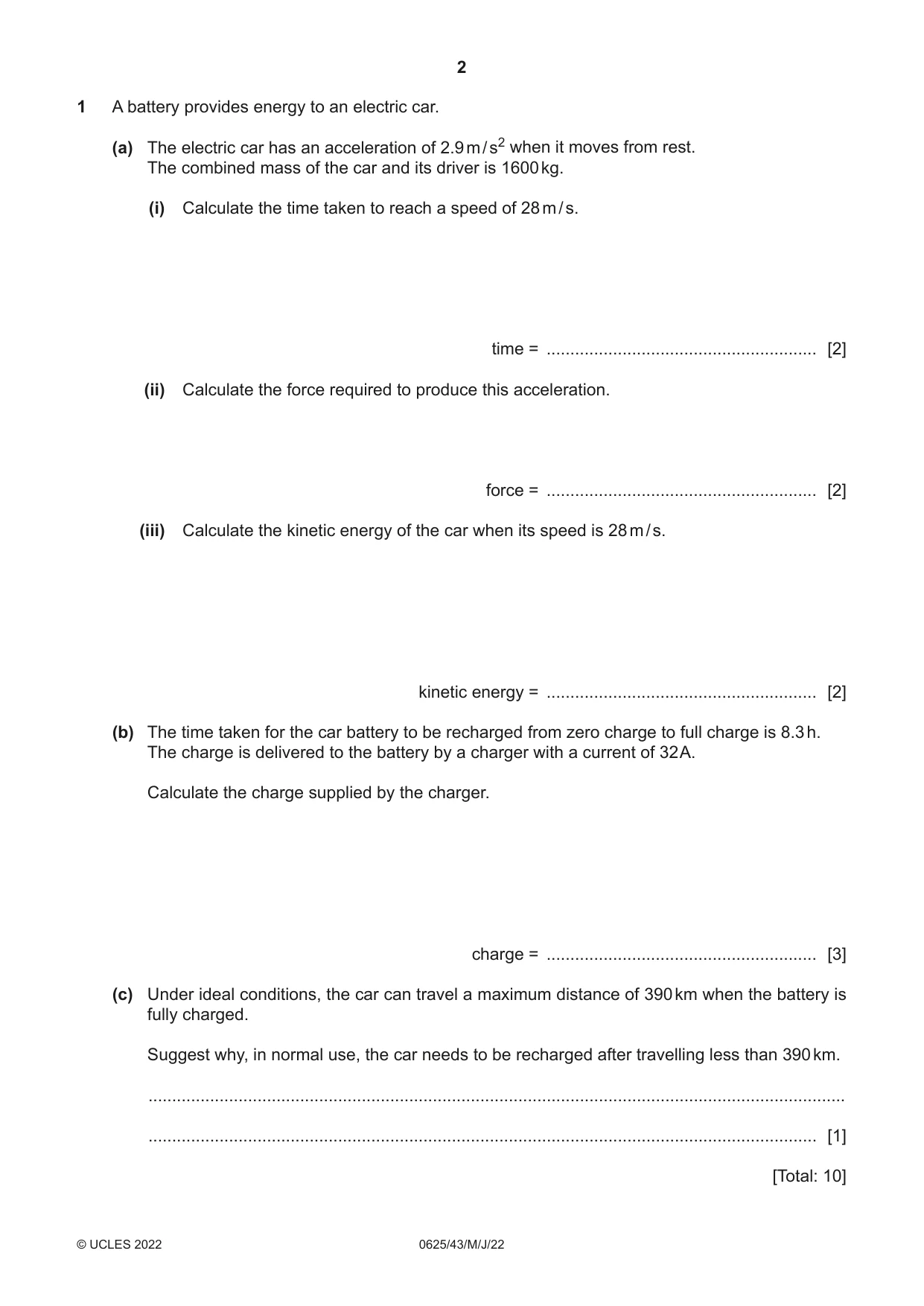
1 A battery provides energy to an electric car. (a) The electric car has an acceleration of 2.9 m / s2 when it moves from rest. The combined mass of the car and its driver is 1600 kg. (i) Calculate the time taken to reach a speed of 28 m / s. time = ......................................................... [2] (ii) Calculate the force required to produce this acceleration. force = ......................................................... [2] (iii) Calculate the kinetic energy of the car when its speed is 28 m / s. kinetic energy = ......................................................... [2] (b) The time taken for the car battery to be recharged from zero charge to full charge is 8.3 h. The charge is delivered to the battery by a charger with a current of 32 A. Calculate the charge supplied by the charger. charge = ......................................................... [3] (c) Under ideal conditions, the car can travel a maximum distance of 390 km when the battery is fully charged. Suggest why, in normal use, the car needs to be recharged after travelling less than 390 km. ................................................................................................................................................... ............................................................................................................................................. [1] [Total: 10]
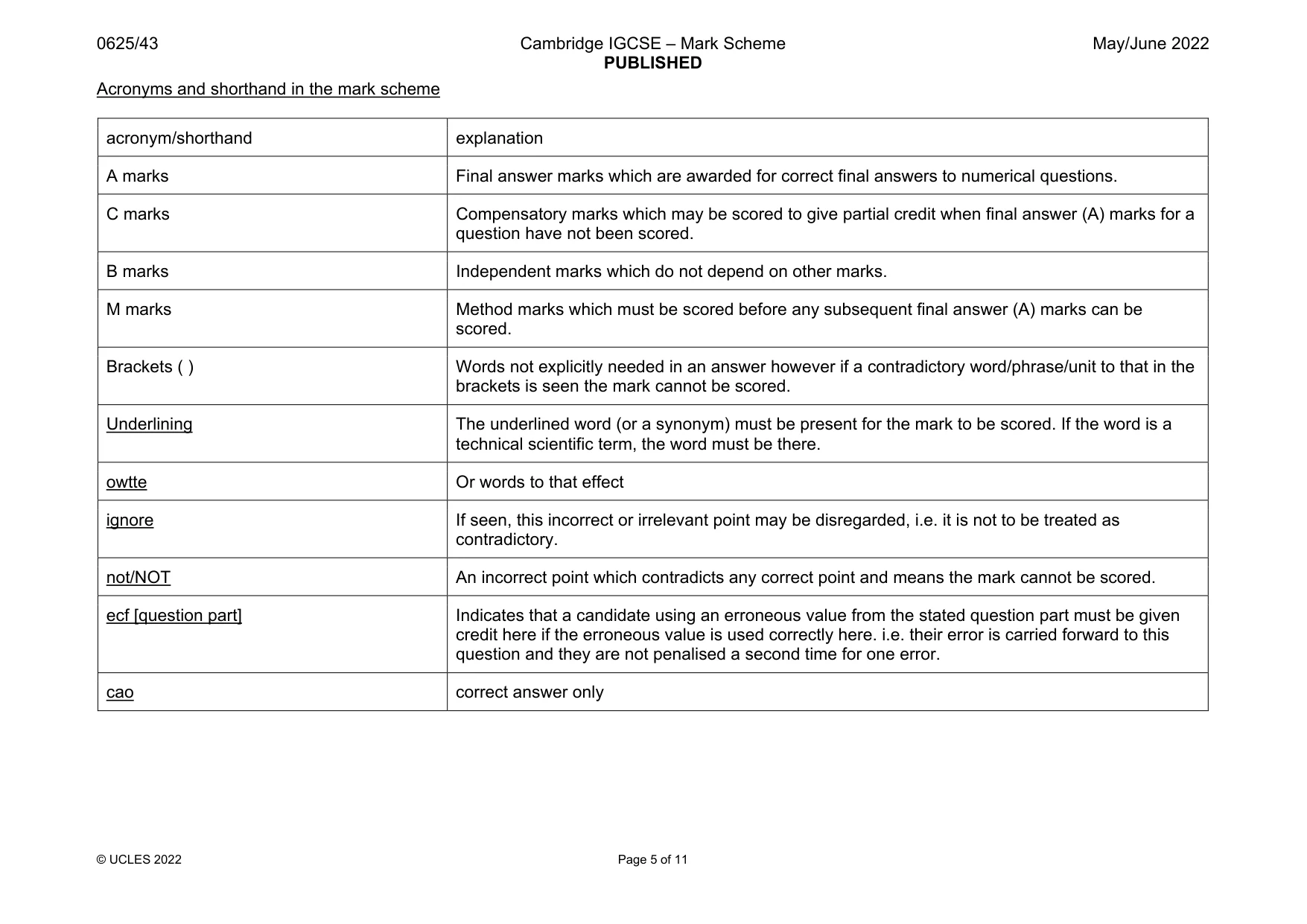
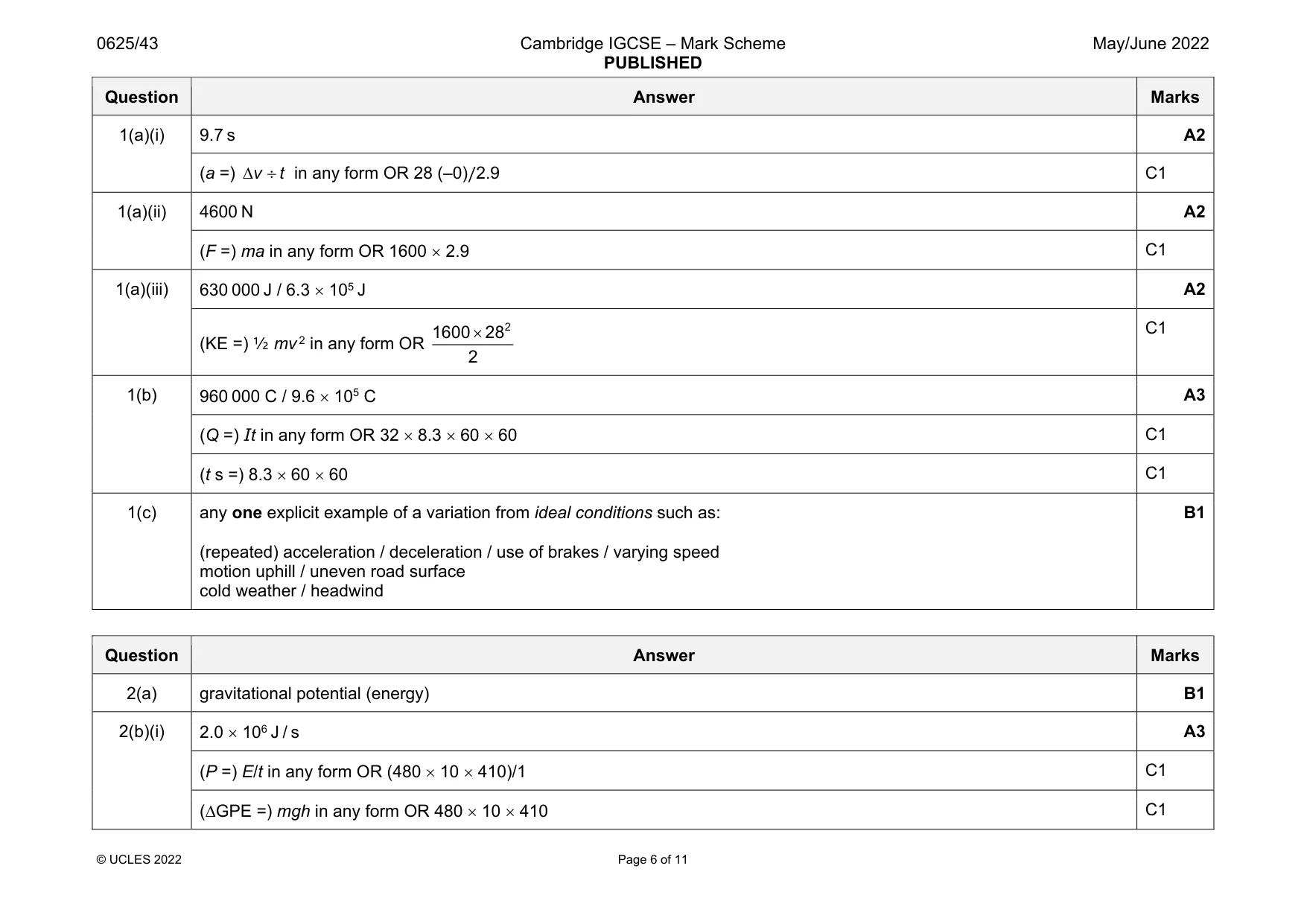
Mark scheme: 1(a)(i) 9.7 s A2 (a =) v t in any form OR 28 (–0)/2.9 C1 1(a)(ii) 4600 N A2 (F =) ma in any form OR 1600 2.9 C1 1(a)(iii) 630 000 J / 6.3 105 J A2 (KE =) ½ mv 2 in any form OR 2 1600 28 2 C1 1(b) 960 000 C / 9.6 105 C A3 (Q =) It in any form OR 32 8.3 60 60 C1 (t s =) 8.3 60 60 C1 1(c) any one explicit example of a variation from ideal conditions such as: (repeated) acceleration / deceleration / use of brakes / varying speed motion uphill / uneven road surface cold weather / headwind B1
Q2 · Water is held behind a dam in a hydroelectric power scheme
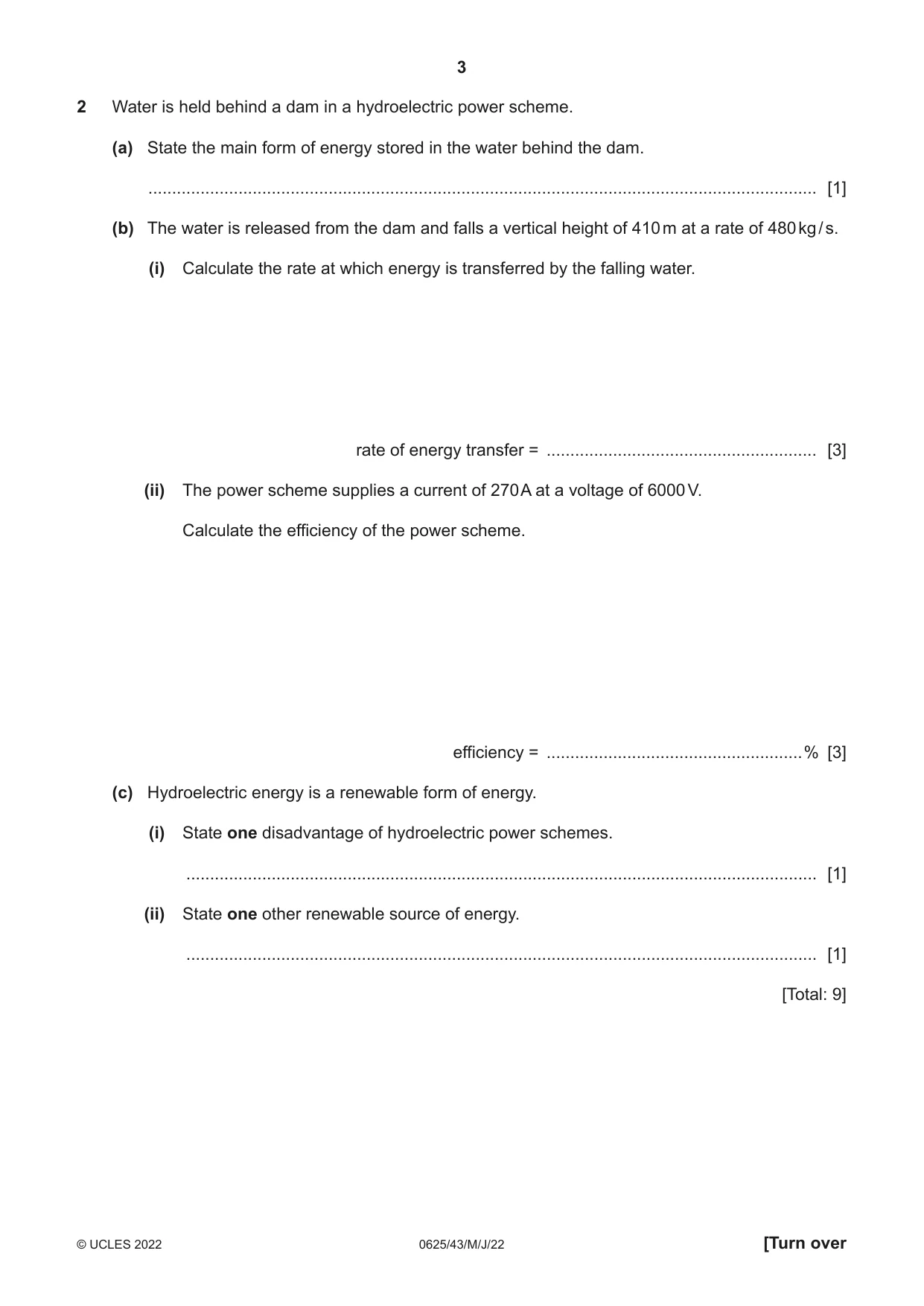
2 Water is held behind a dam in a hydroelectric power scheme. (a) State the main form of energy stored in the water behind the dam. ............................................................................................................................................. [1] (b) The water is released from the dam and falls a vertical height of 410 m at a rate of 480 kg / s. (i) Calculate the rate at which energy is transferred by the falling water. rate of energy transfer = ......................................................... [3] (ii) The power scheme supplies a current of 270 A at a voltage of 6000 V. Calculate the efficiency of the power scheme. efficiency = ......................................................% [3] (c) Hydroelectric energy is a renewable form of energy. (i) State one disadvantage of hydroelectric power schemes. ..................................................................................................................................... [1] (ii) State one other renewable source of energy. ..................................................................................................................................... [1] [Total: 9]
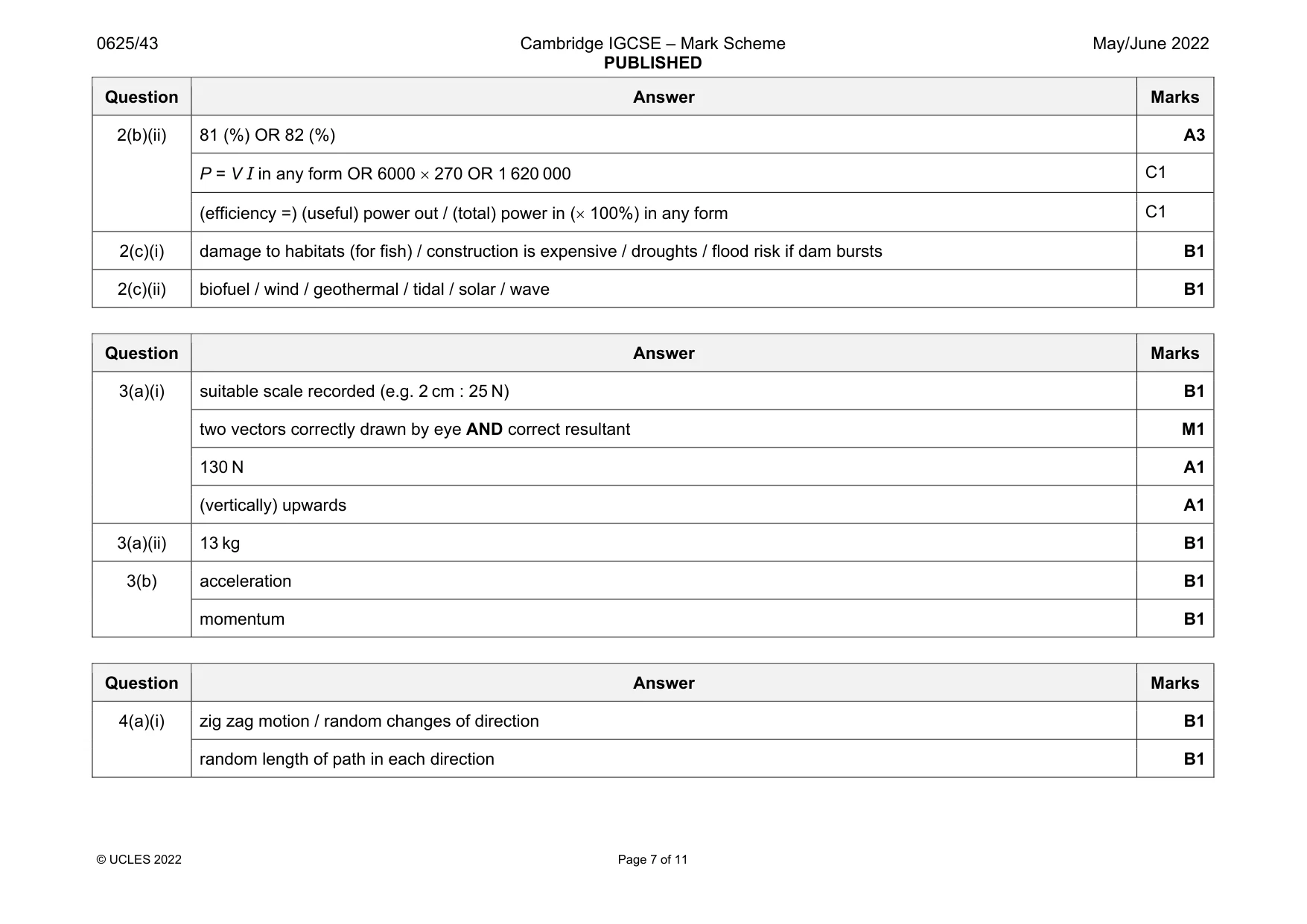
Mark scheme: 2(a) gravitational potential (energy) B1 2(b)(i) 2.0 106 J / s A3 (P =) E/t in any form OR (480 10 410)/1 C1 (∆GPE =) mgh in any form OR 480 10 410 C1 Question Answer Marks 2(b)(ii) 81 (%) OR 82 (%) A3 P = V I in any form OR 6000 270 OR 1 620 000 C1 (efficiency =) (useful) power out / (total) power in ( 100%) in any form C1 2(c)(i) damage to habitats (for fish) / construction is expensive / droughts / flood risk if dam bursts B1 2(c)(ii) biofuel / wind / geothermal / tidal / solar / wave B1
Q3 · A boat stored in a shed
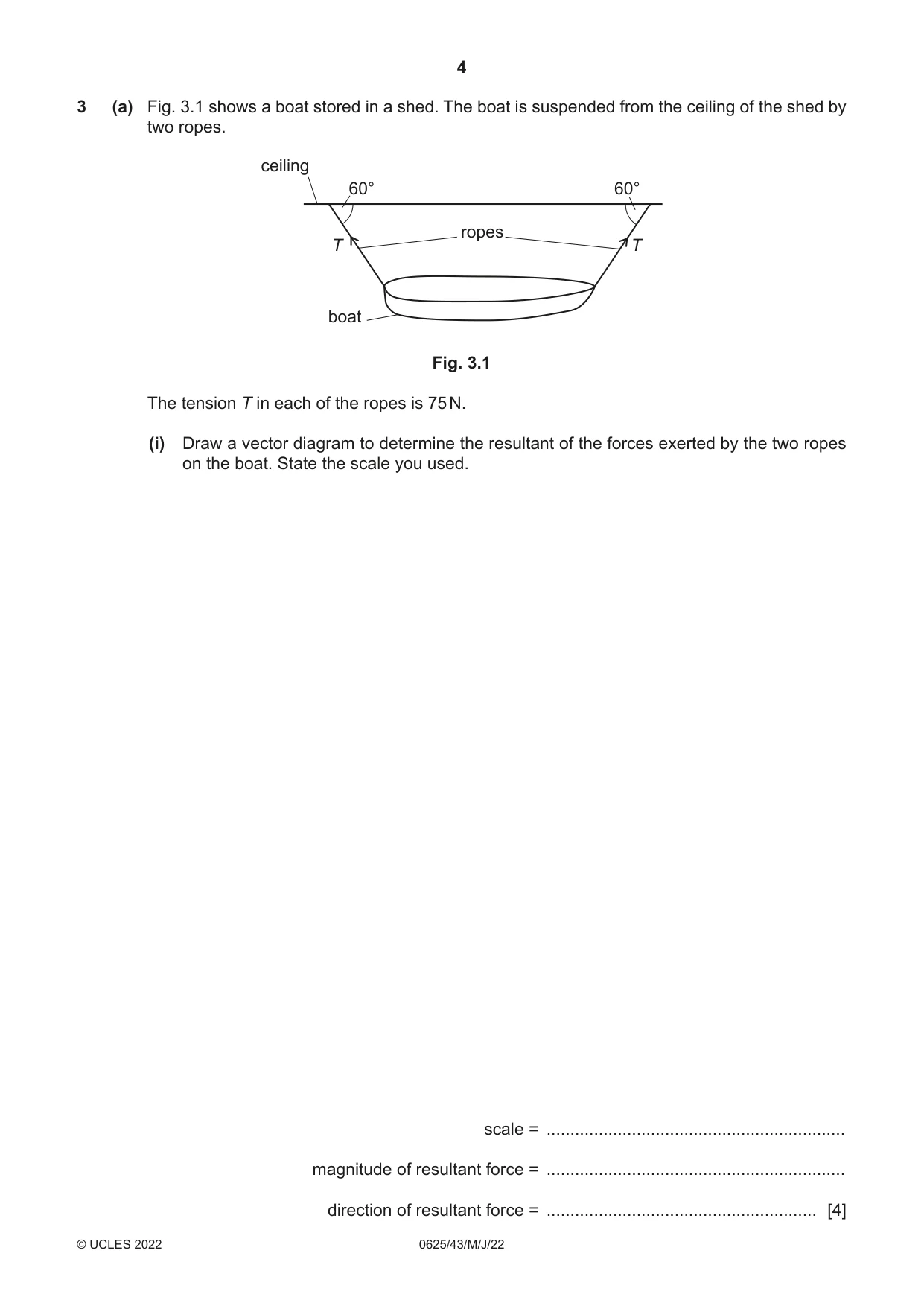
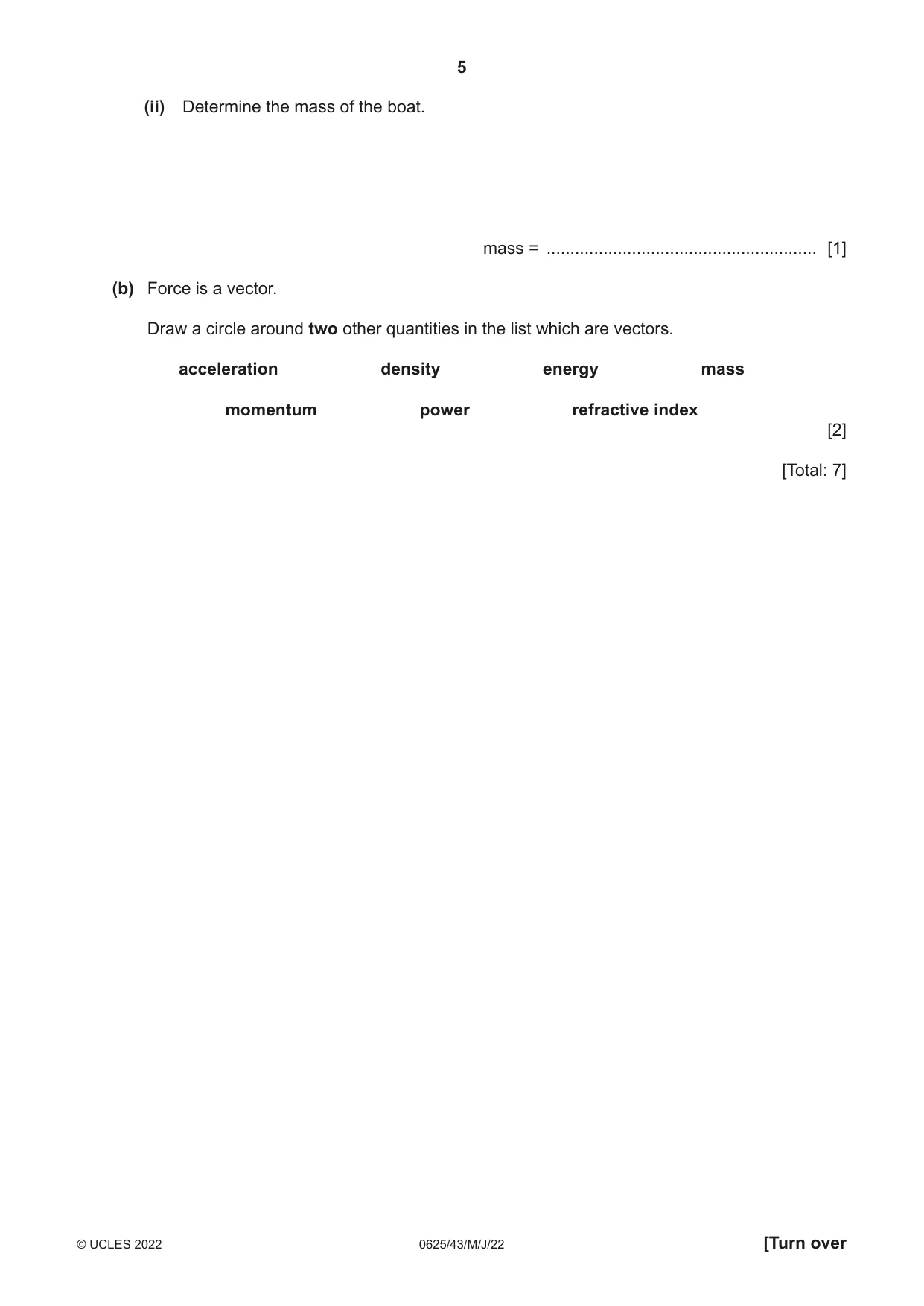
3 (a) Fig. 3.1 shows a boat stored in a shed. The boat is suspended from the ceiling of the shed by two ropes. ceiling 60° 60° ropes T T boat Fig. 3.1 The tension T in each of the ropes is 75 N. (i) Draw a vector diagram to determine the resultant of the forces exerted by the two ropes on the boat. State the scale you used. scale = ............................................................... magnitude of resultant force = ............................................................... direction of resultant force = ......................................................... [4] (ii) Determine the mass of the boat. mass = ......................................................... [1] (b) Force is a vector. Draw a circle around two other quantities in the list which are vectors. acceleration density energy mass momentum power refractive index [2] [Total: 7]
Mark scheme: 3(a)(i) suitable scale recorded (e.g. 2 cm : 25 N) B1 two vectors correctly drawn by eye AND correct resultant M1 130 N A1 (vertically) upwards A1 3(a)(ii) 13 kg B1 3(b) acceleration B1 momentum B1
Q4 · Apparatus used to observe the motion of smoke particles (Brownian motion)
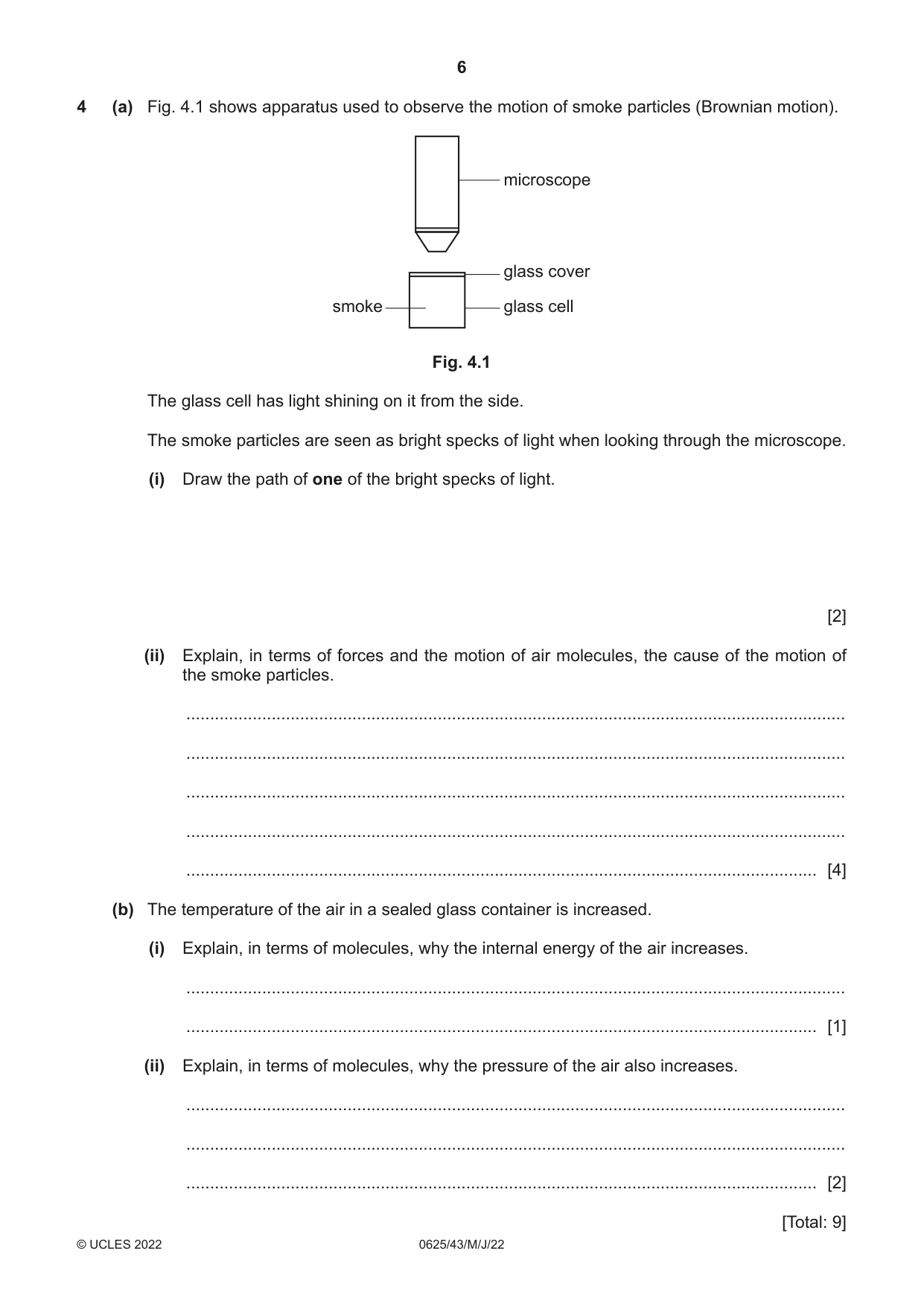
4 (a) Fig. 4.1 shows apparatus used to observe the motion of smoke particles (Brownian motion). microscope glass cover smoke glass cell Fig. 4.1 The glass cell has light shining on it from the side. The smoke particles are seen as bright specks of light when looking through the microscope. (i) Draw the path of one of the bright specks of light. [2] (ii) Explain, in terms of forces and the motion of air molecules, the cause of the motion of the smoke particles. ........................................................................................................................................... ........................................................................................................................................... ........................................................................................................................................... ........................................................................................................................................... ..................................................................................................................................... [4] (b) The temperature of the air in a sealed glass container is increased. (i) Explain, in terms of molecules, why the internal energy of the air increases. ........................................................................................................................................... ..................................................................................................................................... [1] (ii) Explain, in terms of molecules, why the pressure of the air also increases. ........................................................................................................................................... ........................................................................................................................................... ..................................................................................................................................... [2] [Total: 9]
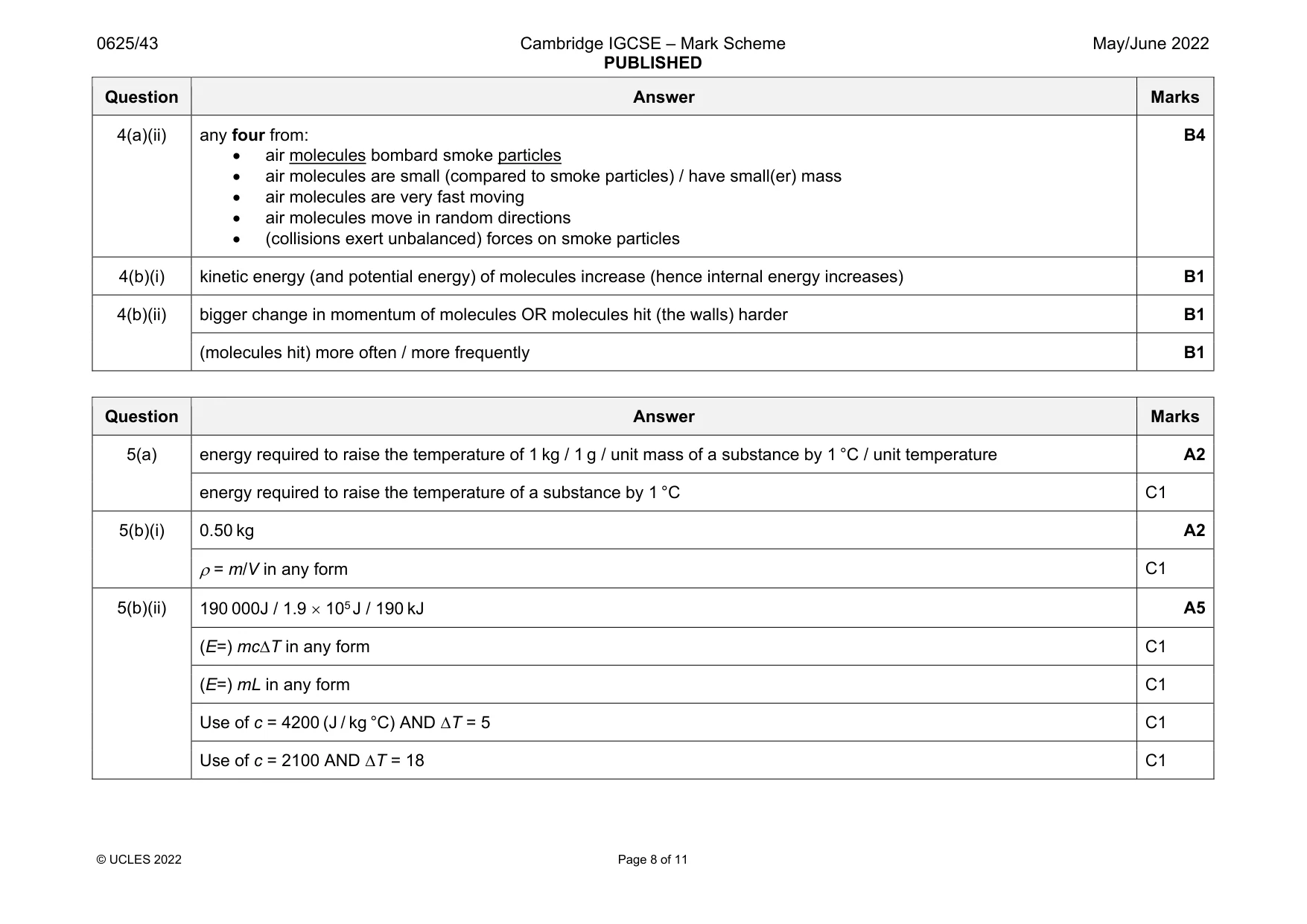
Mark scheme: 4(a)(i) zig zag motion / random changes of direction B1 random length of path in each direction B1 Question Answer Marks 4(a)(ii) any four from: air molecules bombard smoke particles air molecules are small (compared to smoke particles) / have small(er) mass air molecules are very fast moving air molecules move in random directions (collisions exert unbalanced) forces on smoke particles B4 4(b)(i) kinetic energy (and potential energy) of molecules increase (hence internal energy increases) B1 4(b)(ii) bigger change in momentum of molecules OR molecules hit (the walls) harder B1 (molecules hit) more often / more frequently B1
Q5 · Define specific heat capacity
5 (a) Define specific heat capacity. ................................................................................................................................................... ............................................................................................................................................. [2] (b) A bowl contains 500 cm3 of water at a temperature of 5.0 °C. The bowl of water is placed in a freezer for several hours. When the bowl is removed from the freezer, it contains ice at a temperature of –18.0 °C. The density of water is 1000 kg / m3. (i) Calculate the mass of water in the bowl when it is placed in the freezer. mass = ......................................................... [2] (ii) The specific heat capacity of water is 4200 J / (kg °C). The specific heat capacity of ice is 2100 J / (kg °C). The specific latent heat of fusion of water is 3.3 × 10⁵ J / kg. Calculate the energy given out as the water cools from 5.0 °C to ice at –18.0 °C. energy = ......................................................... [5] [Total: 9]
Mark scheme: 5(a) energy required to raise the temperature of 1 kg / 1 g / unit mass of a substance by 1 °C / unit temperature A2 energy required to raise the temperature of a substance by 1 °C C1 5(b)(i) 0.50 kg A2 = m/V in any form C1 5(b)(ii) 190 000J / 1.9 105 J / 190 kJ A5 (E=) mc∆T in any form C1 (E=) mL in any form C1 Use of c = 4200 (J / kg °C) AND ∆T = 5 C1 Use of c = 2100 AND ∆T = 18 C1
Q6 · Crests of a plane water wave approaching a barrier with a gap
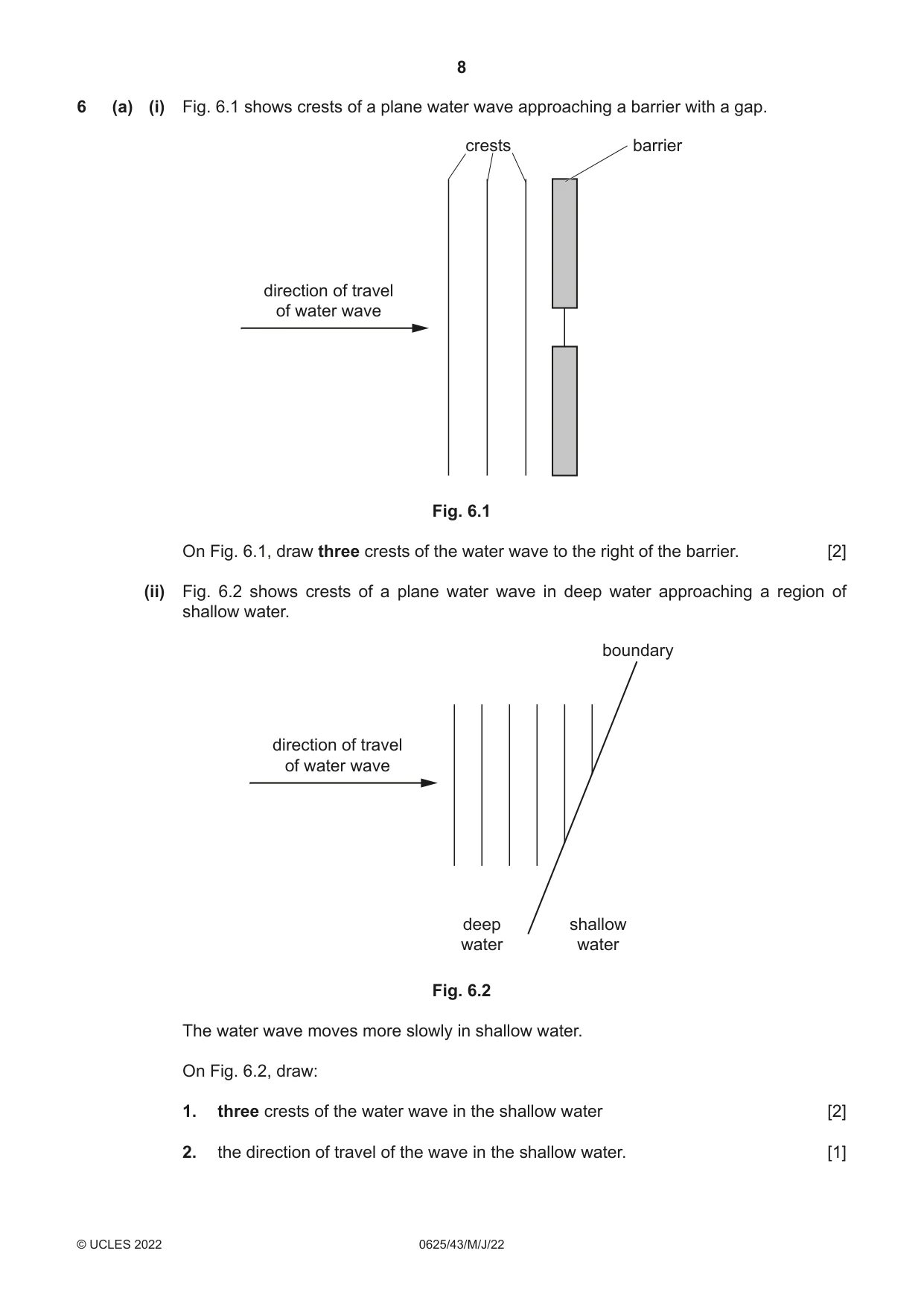
6 (a) (i) Fig. 6.1 shows crests of a plane water wave approaching a barrier with a gap. crests barrier direction of travel of water wave Fig. 6.1 On Fig. 6.1, draw three crests of the water wave to the right of the barrier. [2] (ii) Fig. 6.2 shows crests of a plane water wave in deep water approaching a region of shallow water. boundary direction of travel of water wave deep shallow water water Fig. 6.2 The water wave moves more slowly in shallow water. On Fig. 6.2, draw: 1. three crests of the water wave in the shallow water [2] 2. the direction of travel of the wave in the shallow water. [1] (b) State two ways in which transverse waves differ from longitudinal waves. 1. ............................................................................................................................................... ................................................................................................................................................... 2. ............................................................................................................................................... ................................................................................................................................................... [2] (c) (i) State a typical value of the speed of sound in water. ..................................................................................................................................... [1] (ii) Explain why sound travels faster in water than in air. ..................................................................................................................................... [1] [Total: 9]
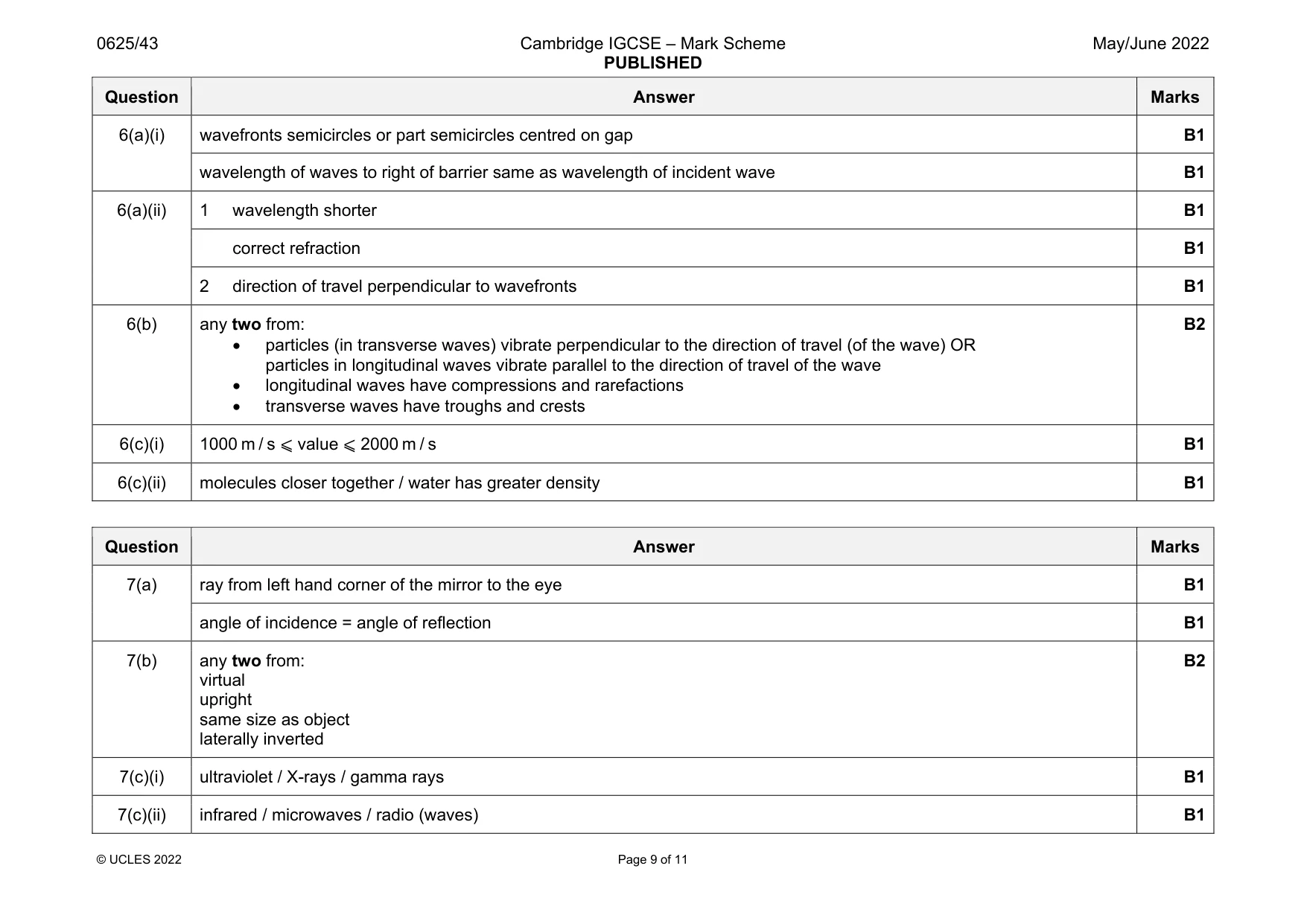
Mark scheme: 6(a)(i) wavefronts semicircles or part semicircles centred on gap B1 wavelength of waves to right of barrier same as wavelength of incident wave B1 6(a)(ii) 1 wavelength shorter B1 correct refraction B1 2 direction of travel perpendicular to wavefronts B1 6(b) any two from: particles (in transverse waves) vibrate perpendicular to the direction of travel (of the wave) OR particles in longitudinal waves vibrate parallel to the direction of travel of the wave longitudinal waves have compressions and rarefactions transverse waves have troughs and crests B2 6(c)(i) 1000 m / s ⩽ value ⩽ 2000 m / s B1 6(c)(ii) molecules closer together / water has greater density B1
Q7 · A plan view of a room
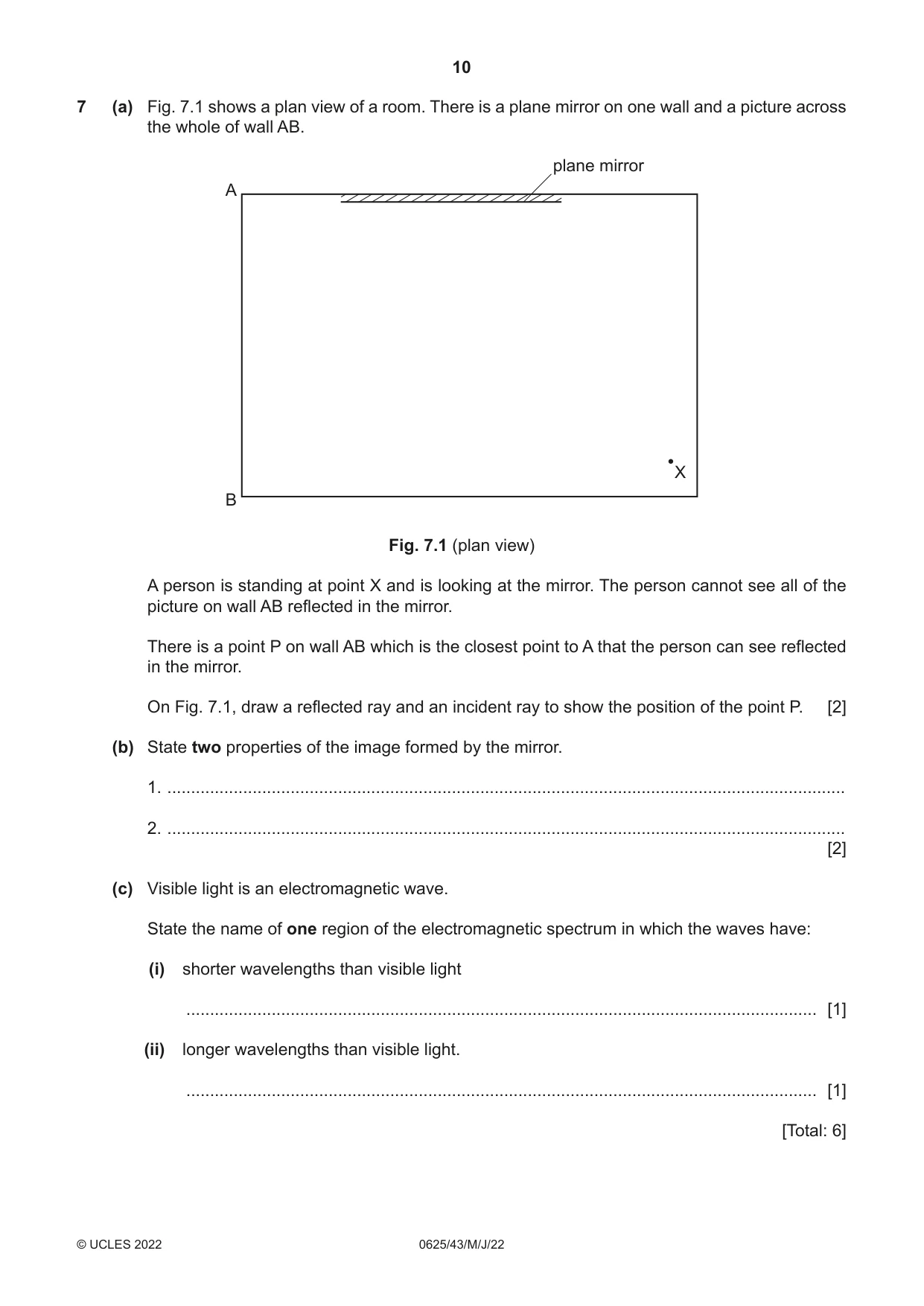
7 (a) Fig. 7.1 shows a plan view of a room. There is a plane mirror on one wall and a picture across the whole of wall AB. plane mirror A X B Fig. 7.1 (plan view) A person is standing at point X and is looking at the mirror. The person cannot see all of the picture on wall AB reflected in the mirror. There is a point P on wall AB which is the closest point to A that the person can see reflected in the mirror. On Fig. 7.1, draw a reflected ray and an incident ray to show the position of the point P. [2] (b) State two properties of the image formed by the mirror. 1. ............................................................................................................................................... 2. ............................................................................................................................................... [2] (c) Visible light is an electromagnetic wave. State the name of one region of the electromagnetic spectrum in which the waves have: (i) shorter wavelengths than visible light ..................................................................................................................................... [1] (ii) longer wavelengths than visible light. ..................................................................................................................................... [1] [Total: 6]
Mark scheme: 7(a) ray from left hand corner of the mirror to the eye B1 angle of incidence = angle of reflection B1 7(b) any two from: virtual upright same size as object laterally inverted B2 7(c)(i) ultraviolet / X-rays / gamma rays B1 7(c)(ii) infrared / microwaves / radio (waves) B1
Question 8
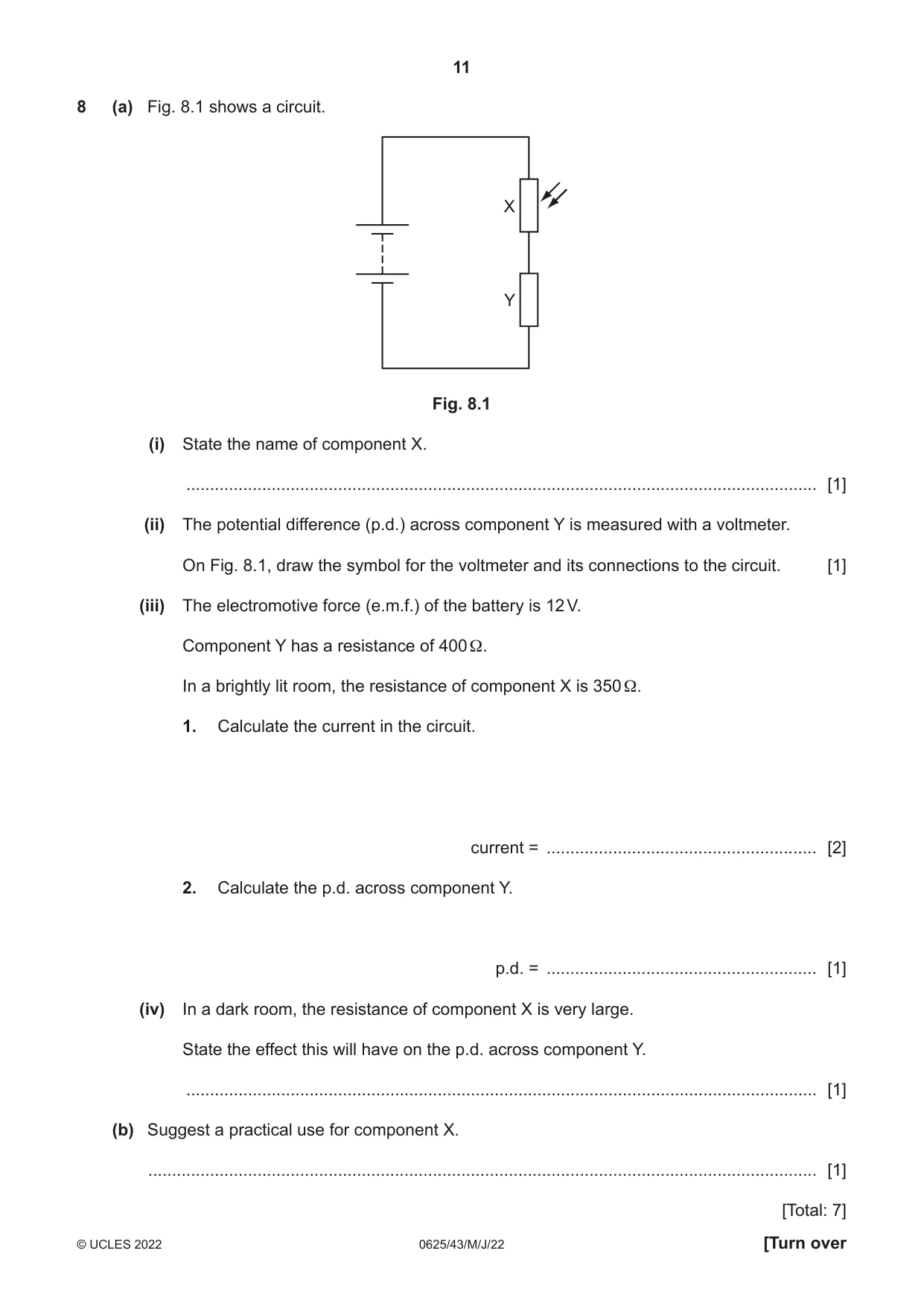
8 (a) Fig. 8.1 shows a circuit. X Y Fig. 8.1 (i) State the name of component X. ..................................................................................................................................... [1] (ii) The potential difference (p.d.) across component Y is measured with a voltmeter. On Fig. 8.1, draw the symbol for the voltmeter and its connections to the circuit. [1] (iii) The electromotive force (e.m.f.) of the battery is 12 V. Component Y has a resistance of 400 Ω. In a brightly lit room, the resistance of component X is 350 Ω. 1. Calculate the current in the circuit. current = ......................................................... [2] 2. Calculate the p.d. across component Y. p.d. = ......................................................... [1] (iv) In a dark room, the resistance of component X is very large. State the effect this will have on the p.d. across component Y. ..................................................................................................................................... [1] (b) Suggest a practical use for component X. ............................................................................................................................................. [1] [Total: 7]
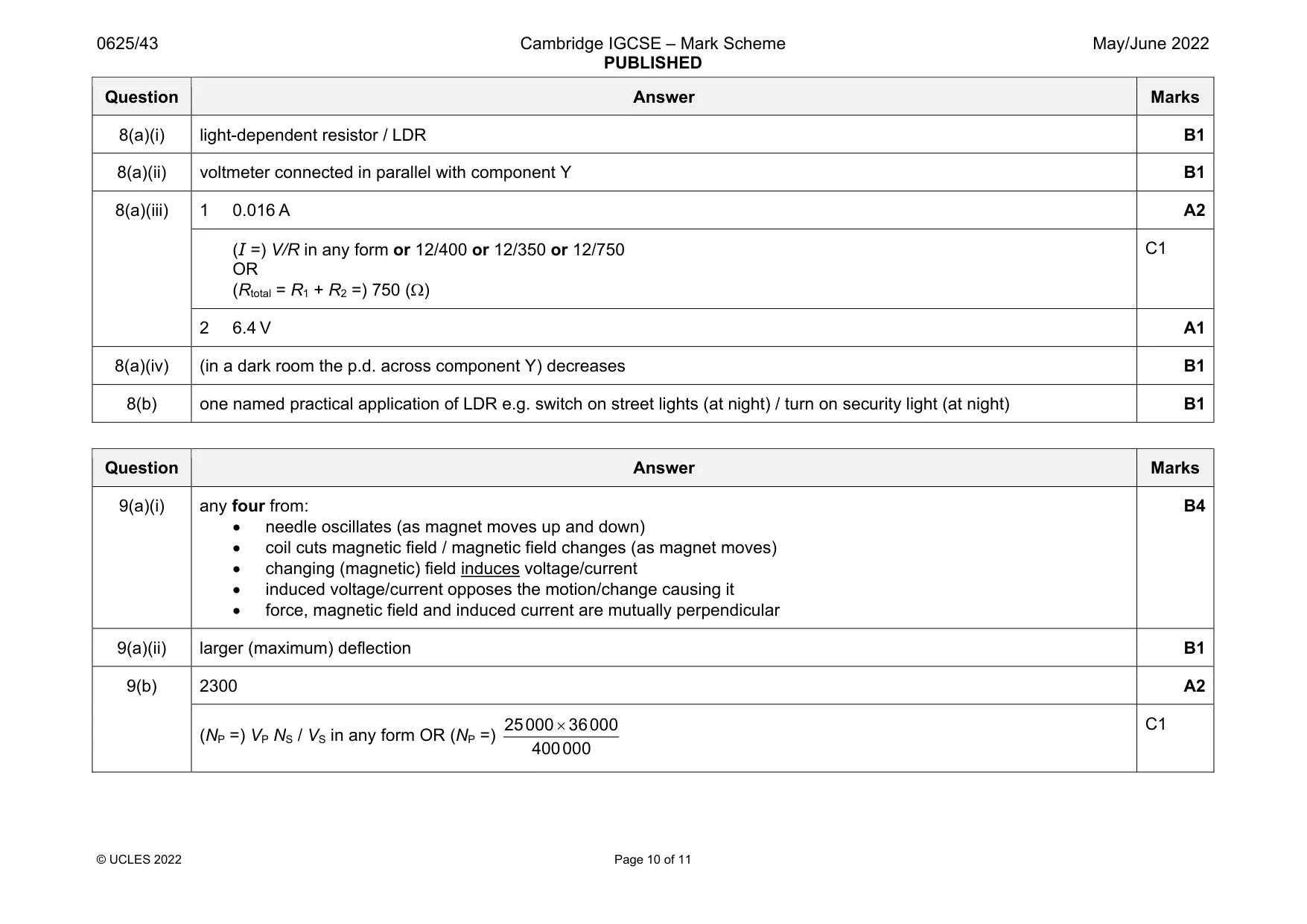
Mark scheme: 8(a)(i) light-dependent resistor / LDR B1 8(a)(ii) voltmeter connected in parallel with component Y B1 8(a)(iii) 1 0.016 A A2 (I =) V/R in any form or 12/400 or 12/350 or 12/750 OR (Rtotal = R1 + R2 =) 750 () C1 2 6.4 V A1 8(a)(iv) (in a dark room the p.d. across component Y) decreases B1 8(b) one named practical application of LDR e.g. switch on street lights (at night) / turn on security light (at night) B1
Q9 · A magnet on the end of a spring and a coil of wire connected to a sensitive centre-zero…
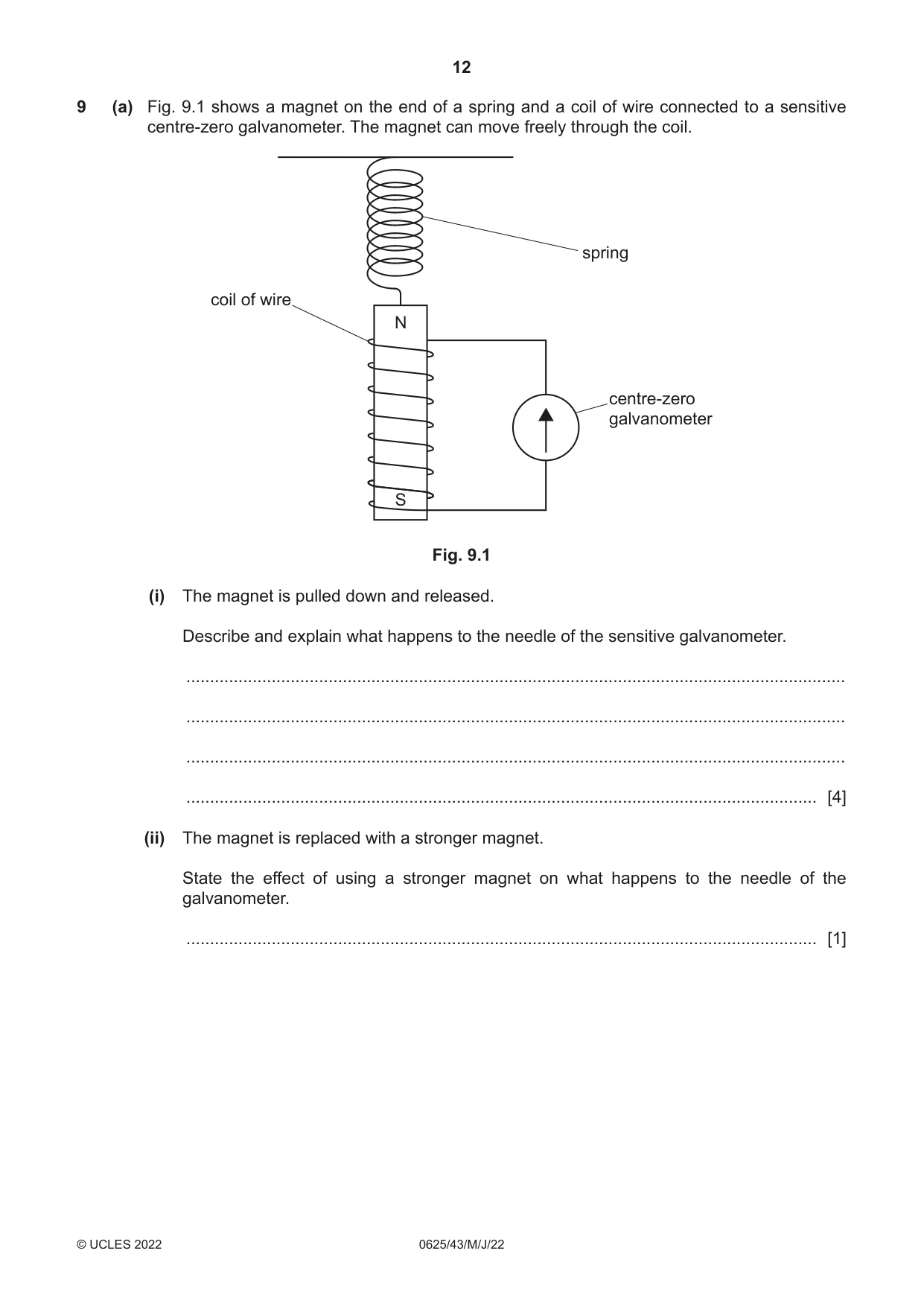
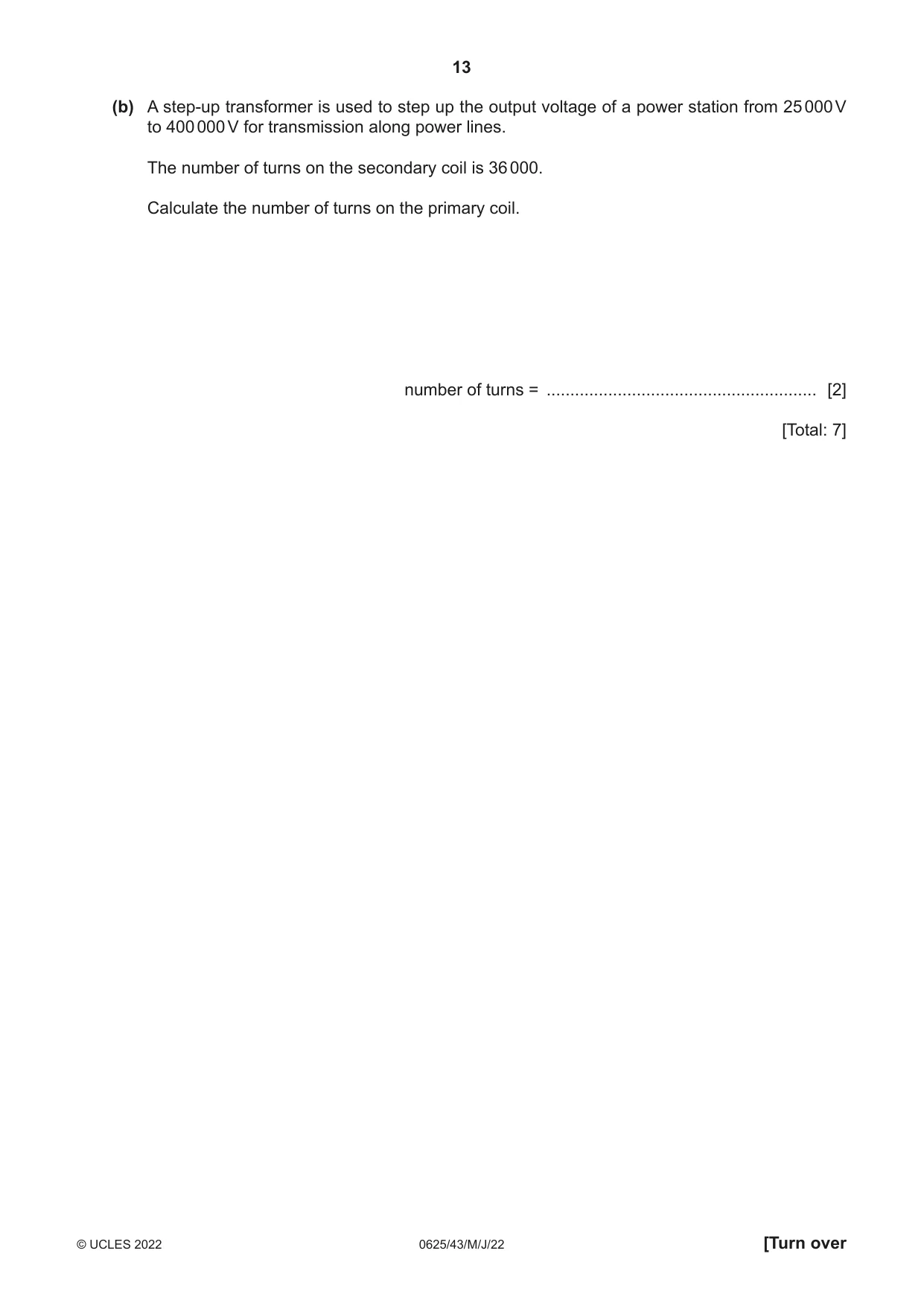
9 (a) Fig. 9.1 shows a magnet on the end of a spring and a coil of wire connected to a sensitive centre-zero galvanometer. The magnet can move freely through the coil. spring coil of wire N centre-zero galvanometer S Fig. 9.1 (i) The magnet is pulled down and released. Describe and explain what happens to the needle of the sensitive galvanometer. ........................................................................................................................................... ........................................................................................................................................... ........................................................................................................................................... ..................................................................................................................................... [4] (ii) The magnet is replaced with a stronger magnet. State the effect of using a stronger magnet on what happens to the needle of the galvanometer. ..................................................................................................................................... [1] (b) A step-up transformer is used to step up the output voltage of a power station from 25 000 V to 400 000 V for transmission along power lines. The number of turns on the secondary coil is 36 000. Calculate the number of turns on the primary coil. number of turns = ......................................................... [2] [Total: 7]
Mark scheme: 9(a)(i) any four from: needle oscillates (as magnet moves up and down) coil cuts magnetic field / magnetic field changes (as magnet moves) changing (magnetic) field induces voltage/current induced voltage/current opposes the motion/change causing it force, magnetic field and induced current are mutually perpendicular 9(a)(ii) larger (maximum) deflection B1 9(b) 2300 A2 (NP =) VP NS / VS in any form OR (NP =) 25000 36000 400000 C1
Q10 · A student places a sample of an isotope of protactinium (Pa-234) near a radiation detector
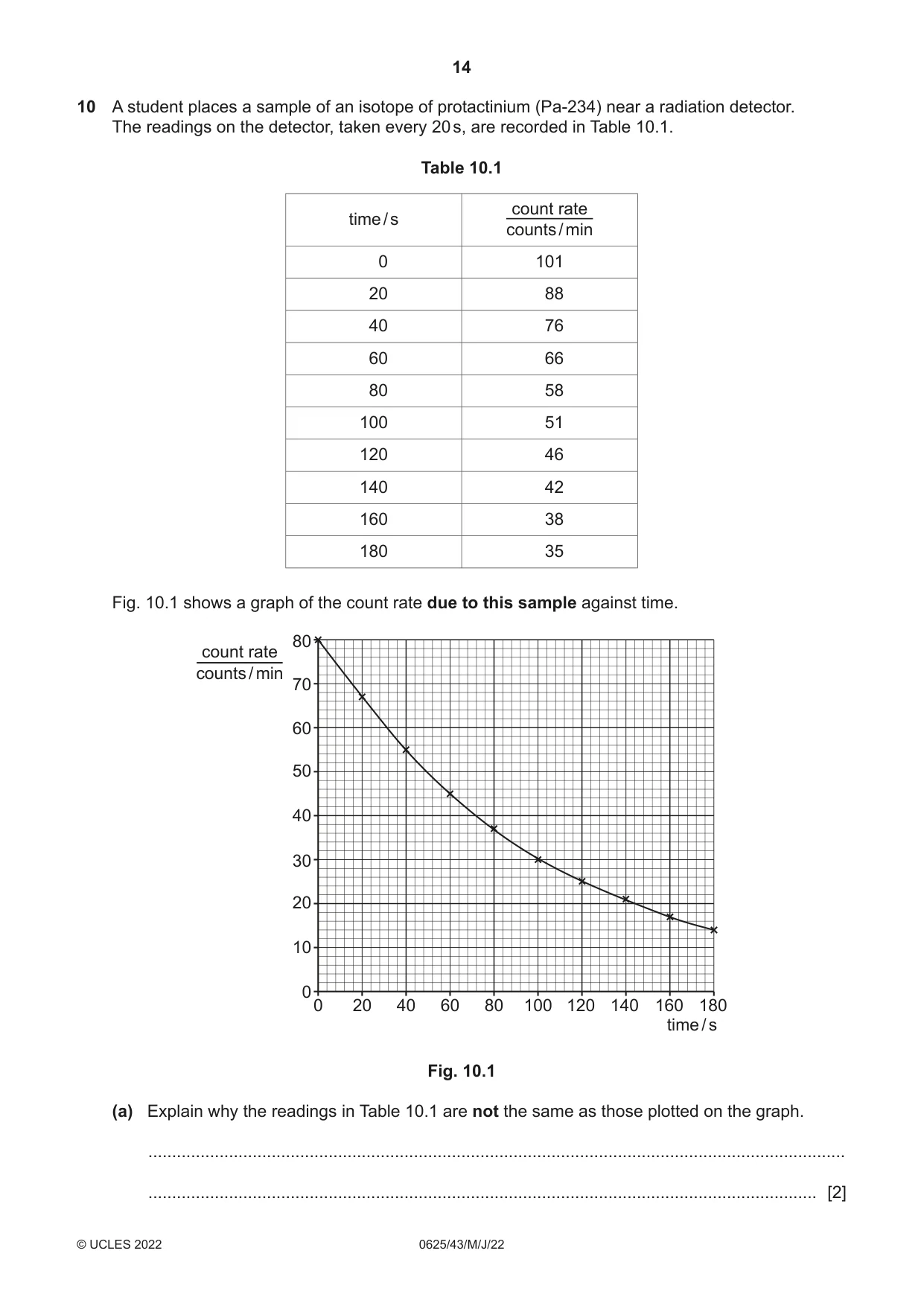
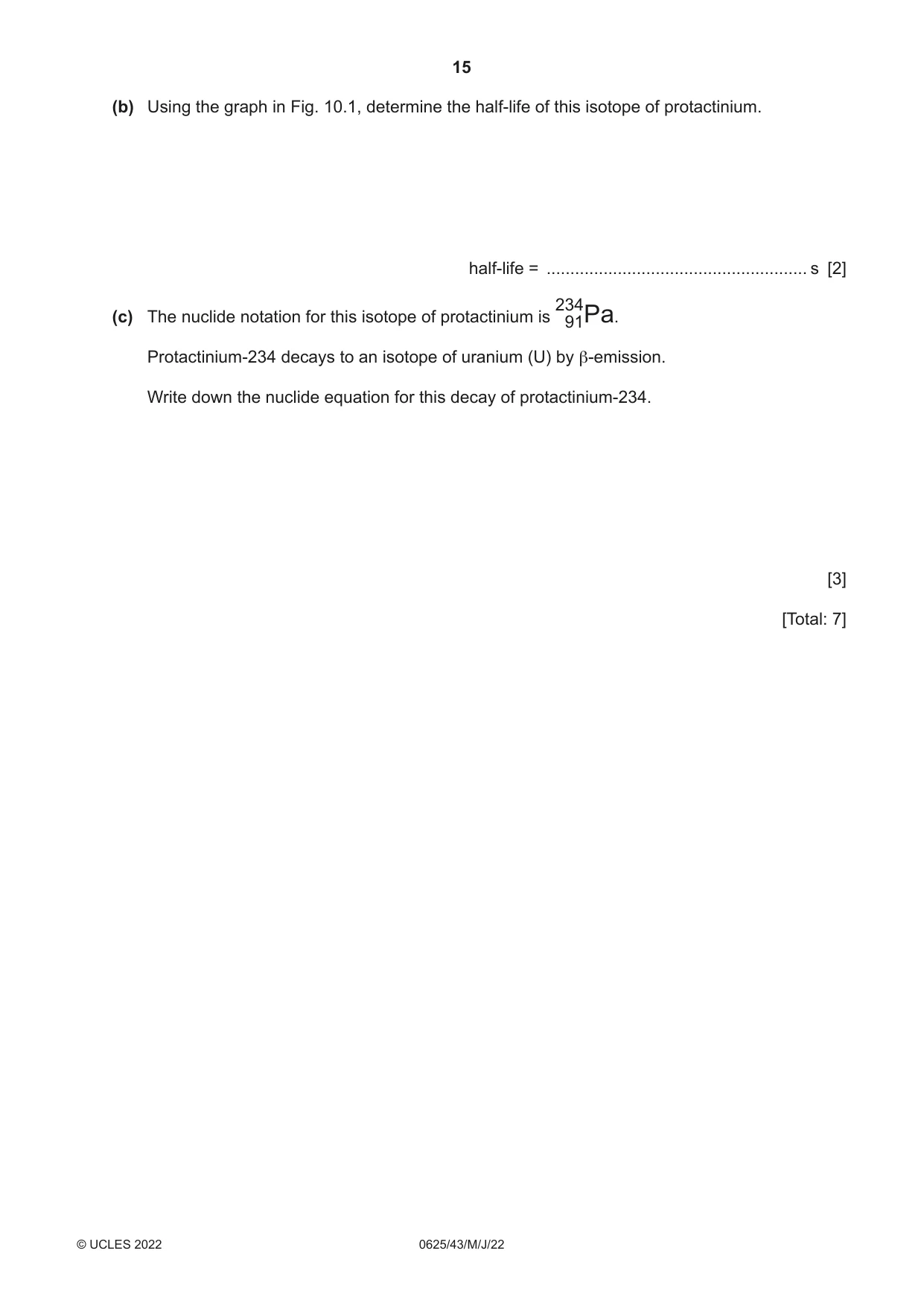
10 A student places a sample of an isotope of protactinium (Pa-234) near a radiation detector. The readings on the detector, taken every 20 s, are recorded in Table 10.1. Table 10.1 count rate time / s counts / min 0 101 20 88 40 76 60 66 80 58 100 51 120 46 140 42 160 38 180 35 Fig. 10.1 shows a graph of the count rate due to this sample against time. 80 count rate counts / min 70 60 50 40 30 20 10 0 0 20 40 60 80 100 120 140 160 180 time / s Fig. 10.1 (a) Explain why the readings in Table 10.1 are not the same as those plotted on the graph. ................................................................................................................................................... ............................................................................................................................................. [2] (b) Using the graph in Fig. 10.1, determine the half-life of this isotope of protactinium. half-life = ....................................................... s [2] 234(c) The nuclide notation for this isotope of protactinium is 91Pa. Protactinium-234 decays to an isotope of uranium (U) by β-emission. Write down the nuclide equation for this decay of protactinium-234. [3] [Total: 7]
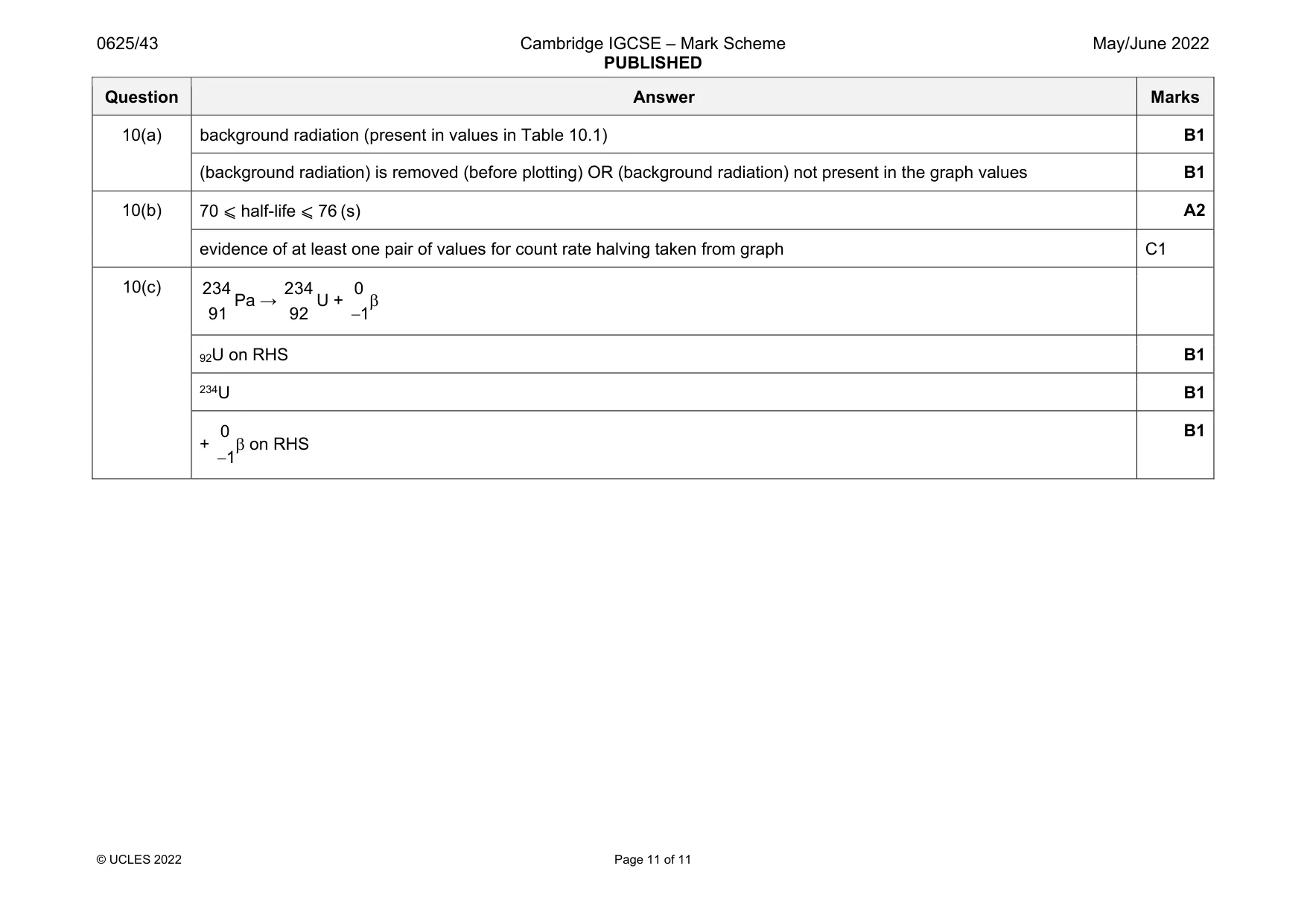
Mark scheme: 10(a) background radiation (present in values in Table 10.1) B1 (background radiation) is removed (before plotting) OR (background radiation) not present in the graph values B1 10(b) 70 ⩽ half-life ⩽ 76 (s) A2 evidence of at least one pair of values for count rate halving taken from graph C1 10(c) 234 91 Pa → 234 92 U + 0 1 92U on RHS B1 234U B1 + 0 1 on RHS B1
What was in this paper
The subtopics covered by these 10 questions, and how many questions each got. Open one in a new tab to see every Cambridge question on it.
What you needed in this session
Cambridge’s own grade thresholds for 2022 May/June, Paper 4 · Variant 3. A higher threshold means an easier paper — the bar moves with how the cohort did.