Cambridge IGCSE Physics 0625 — 2022 Oct/Nov Paper 4 · Variant 2
0625/42/O/N/22 · 10 questions · 80 marks · ≈90 min
The question paper and its mark scheme, free to read here and free to download. This is Cambridge’s own paper, exactly as it was sat.
Question paper16 pages
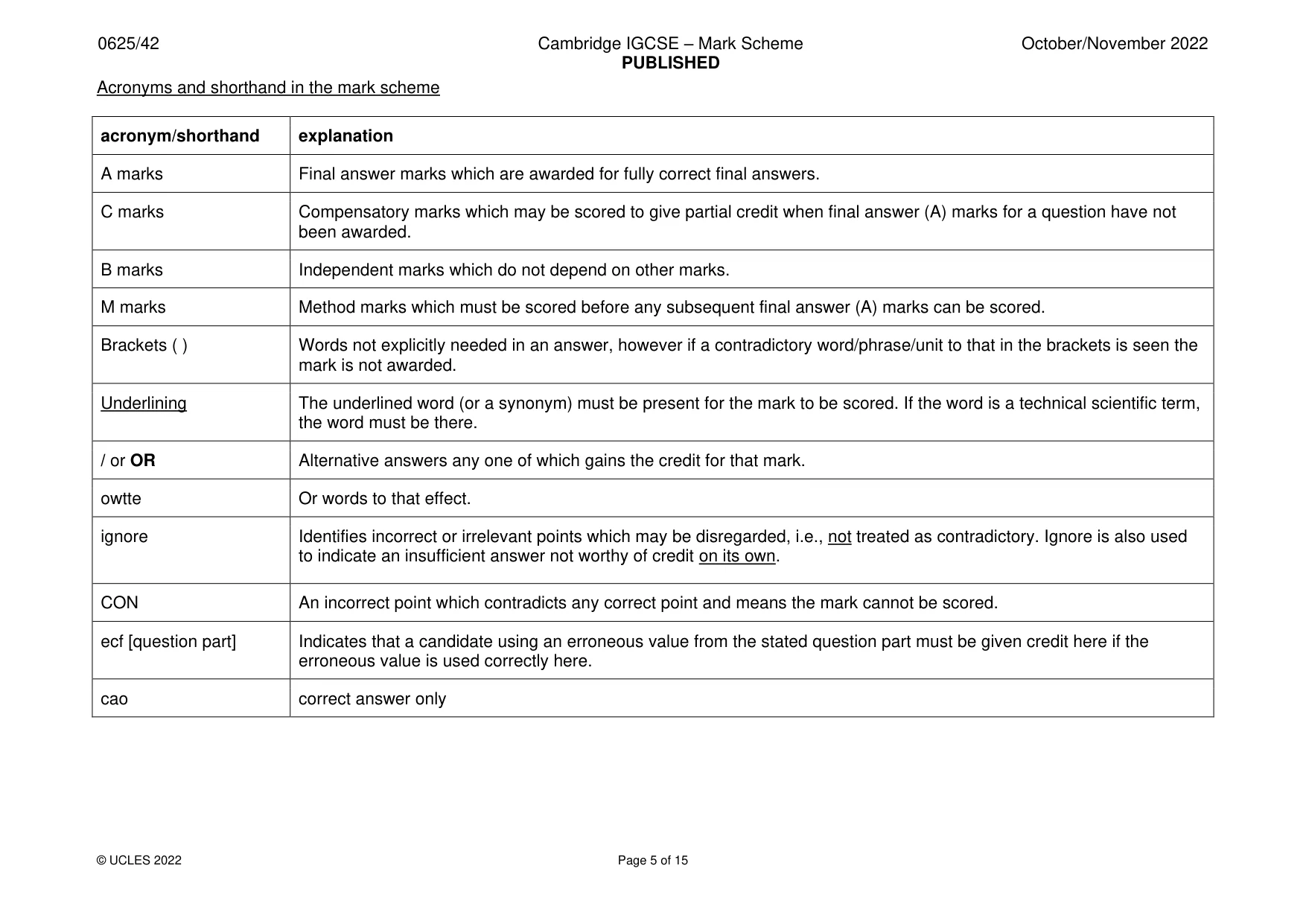
Mark scheme15 pages
Answers below. Sit the paper first if you are practising.
Questions as text
Q1 · Sea water flowing down a channel into a tank without splashing
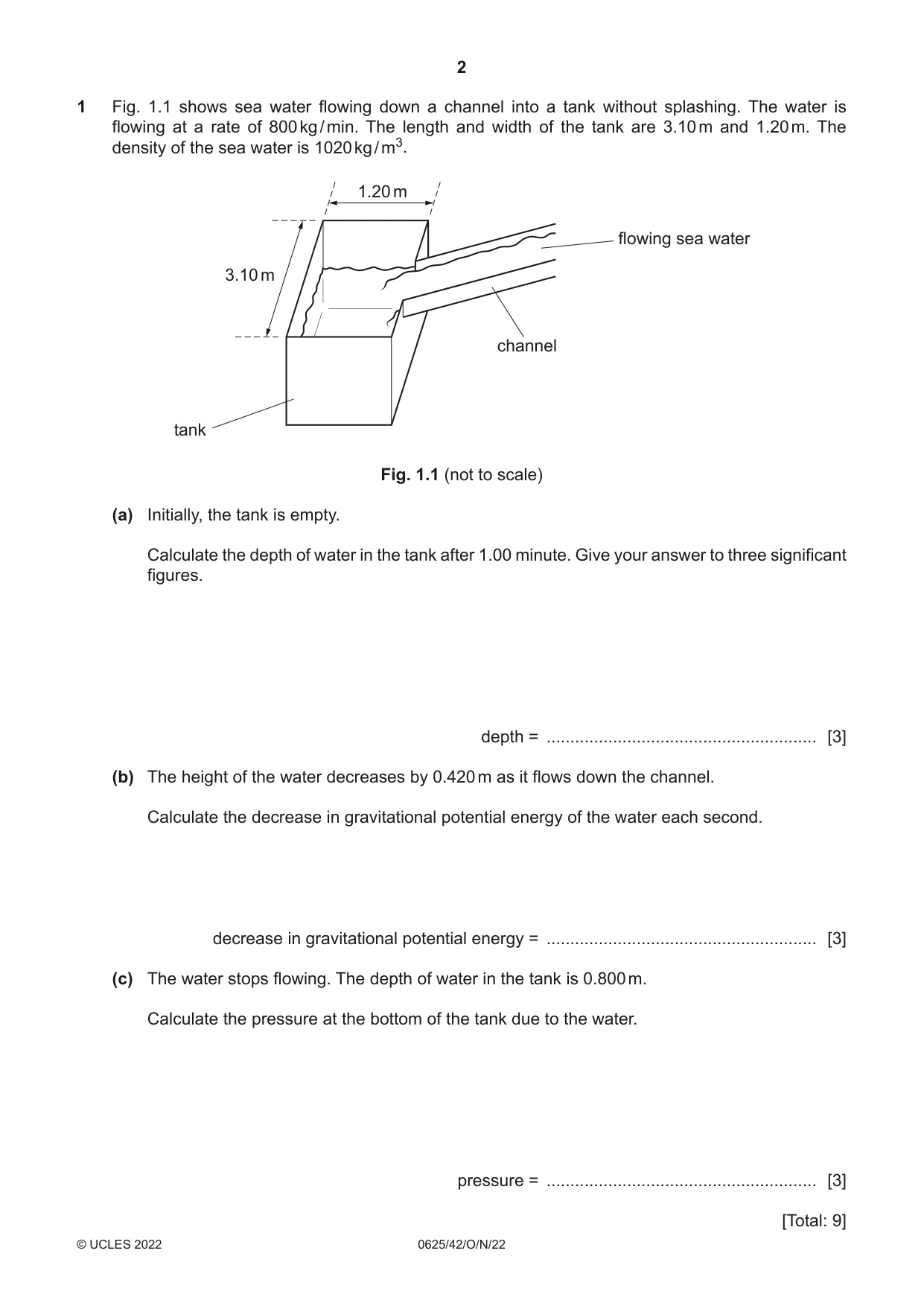
1 Fig. 1.1 shows sea water flowing down a channel into a tank without splashing. The water is flowing at a rate of 800 kg / min. The length and width of the tank are 3.10 m and 1.20 m. The density of the sea water is 1020 kg / m3. 1.20 m flowing sea water 3.10 m channel tank Fig. 1.1 (not to scale) (a) Initially, the tank is empty. Calculate the depth of water in the tank after 1.00 minute. Give your answer to three significant figures. depth = ......................................................... [3] (b) The height of the water decreases by 0.420 m as it flows down the channel. Calculate the decrease in gravitational potential energy of the water each second. decrease in gravitational potential energy = ......................................................... [3] (c) The water stops flowing. The depth of water in the tank is 0.800 m. Calculate the pressure at the bottom of the tank due to the water. pressure = ......................................................... [3] [Total: 9]
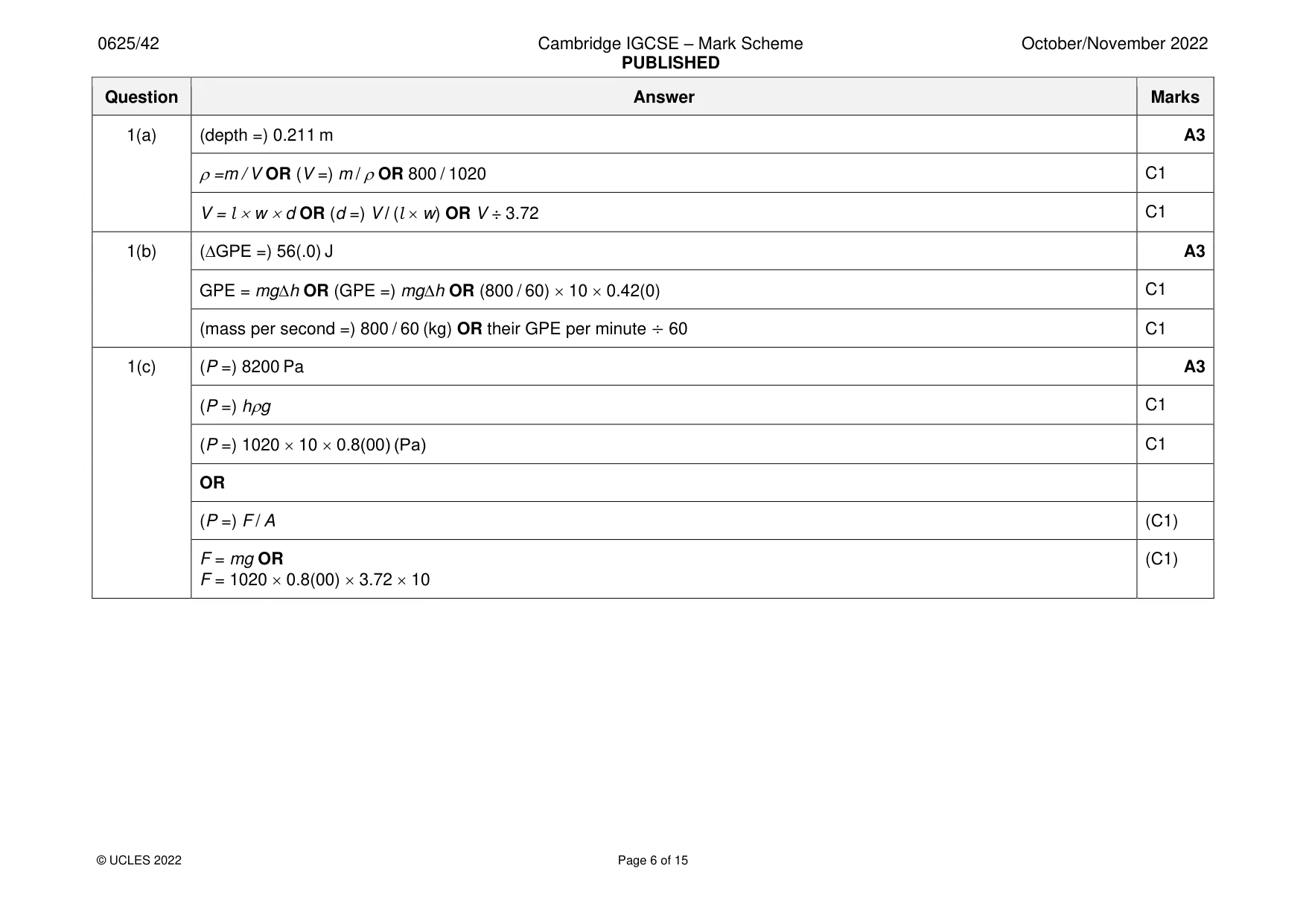
Mark scheme: Question Answer Marks 1(a) (depth =) 0.211 m A3 =m / V OR (V =) m / OR 800 / 1020 C1 V = l w d OR (d =) V / (l w) OR V ÷ 3.72 C1 1(b) (∆GPE =) 56(.0) J A3 GPE = mg∆h OR (GPE =) mg∆h OR (800 / 60) 10 0.42(0) C1 (mass per second =) 800 / 60 (kg) OR their GPE per minute ÷ 60 C1 1(c) (P =) 8200 Pa A3 (P =) hg C1 (P =) 1020 10 0.8(00) (Pa) C1 OR (P =) F / A (C1) F = mg OR (C1) F = 1020 0.8(00) 3.72 10
Q2 · A pendulum swings with a time period of approximately one second
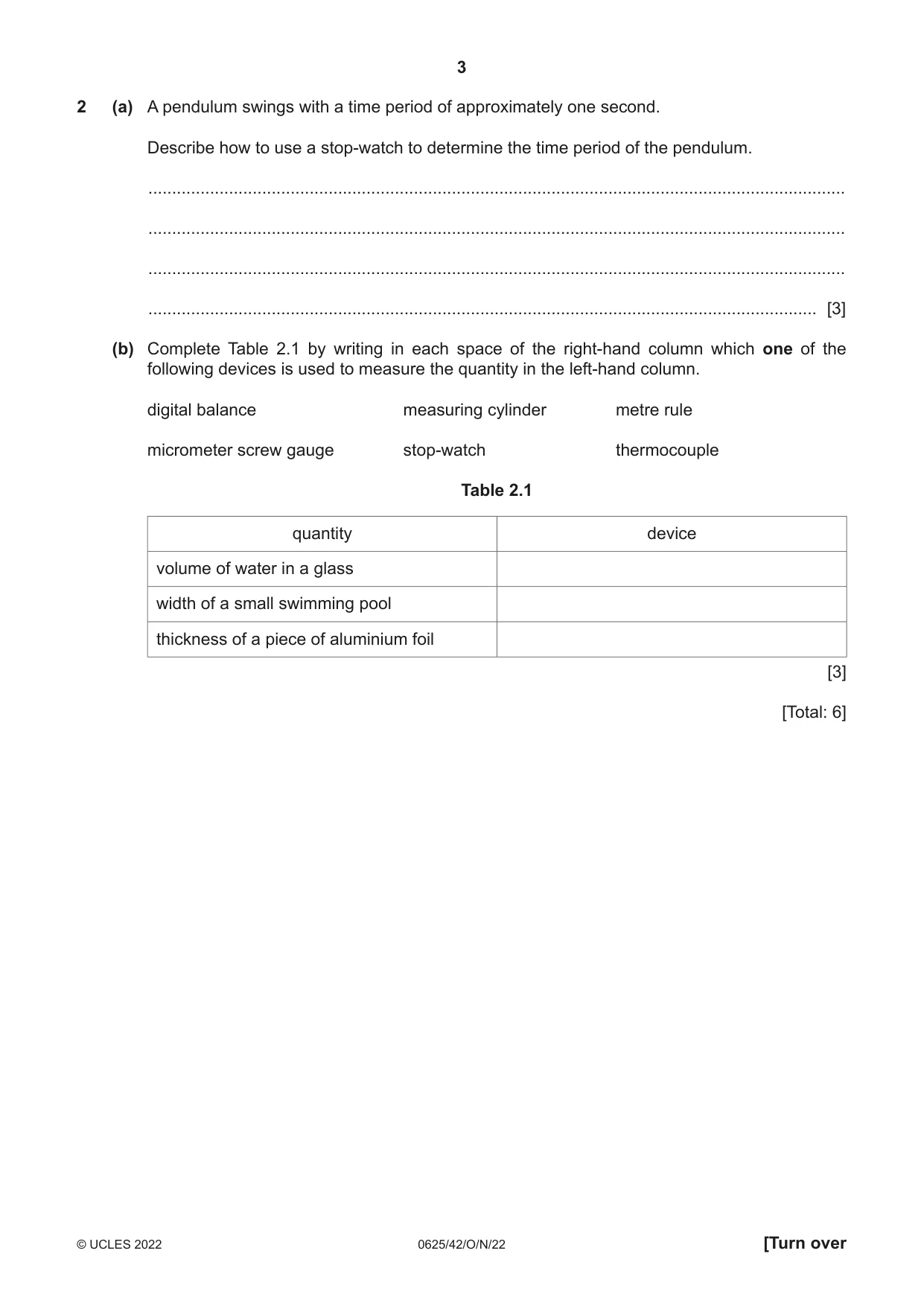
2 (a) A pendulum swings with a time period of approximately one second. Describe how to use a stop-watch to determine the time period of the pendulum. ................................................................................................................................................... ................................................................................................................................................... ................................................................................................................................................... ............................................................................................................................................. [3] (b) Complete Table 2.1 by writing in each space of the right-hand column which one of the following devices is used to measure the quantity in the left-hand column. digital balance measuring cylinder metre rule micrometer screw gauge stop-watch thermocouple Table 2.1 quantity device volume of water in a glass width of a small swimming pool thickness of a piece of aluminium foil [3] [Total: 6]
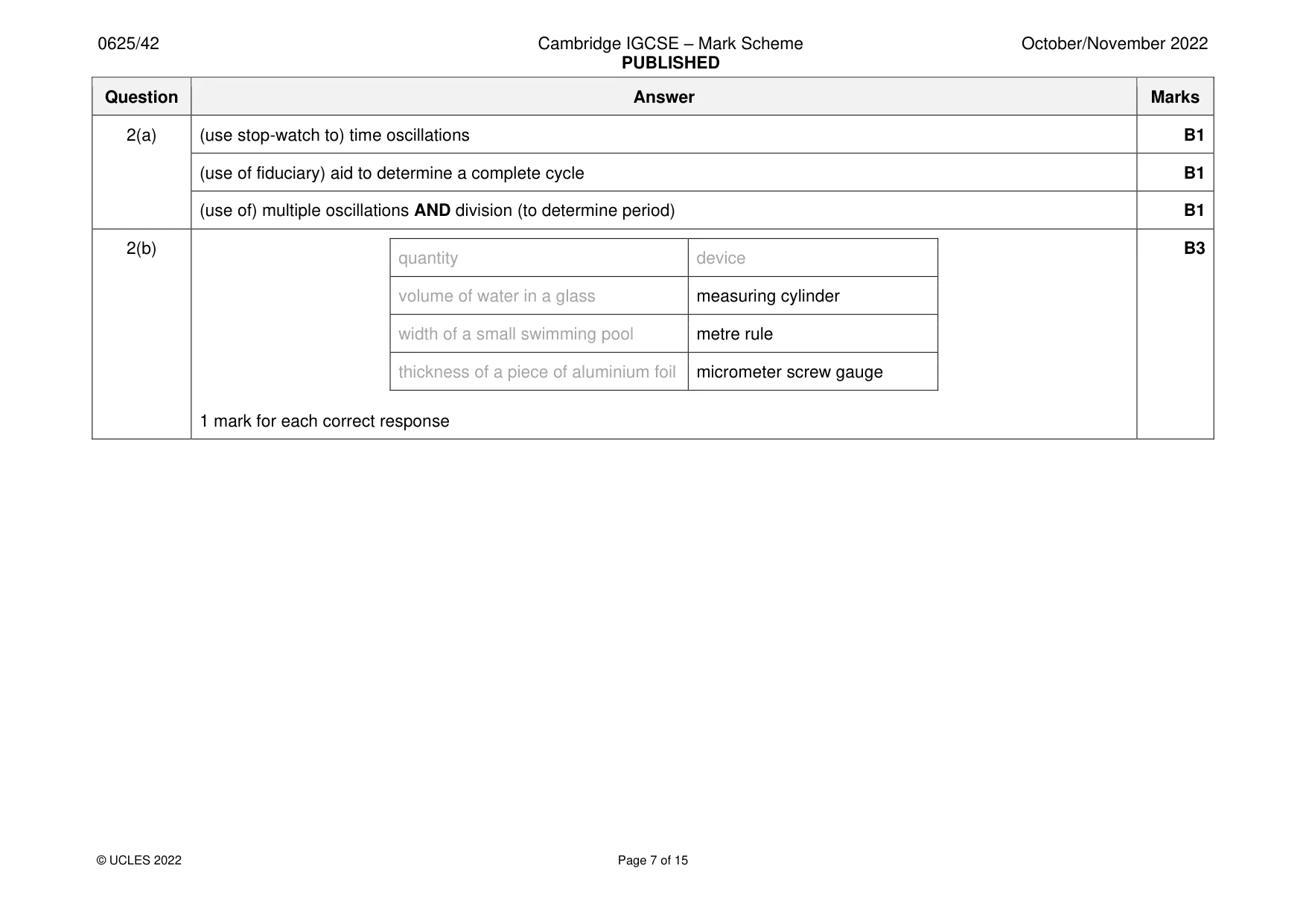
Mark scheme: 2(a) (use stop-watch to) time oscillations B1 (use of fiduciary) aid to determine a complete cycle B1 (use of) multiple oscillations AND division (to determine period) B1 2(b) B3 quantity device volume of water in a glass measuring cylinder width of a small swimming pool metre rule thickness of a piece of aluminium foil micrometer screw gauge 1 mark for each correct response
More questions on Physical quantities and measurement techniques
Q3 · Tidal power derives most of its energy from the Moon and part of its energy from the Sun
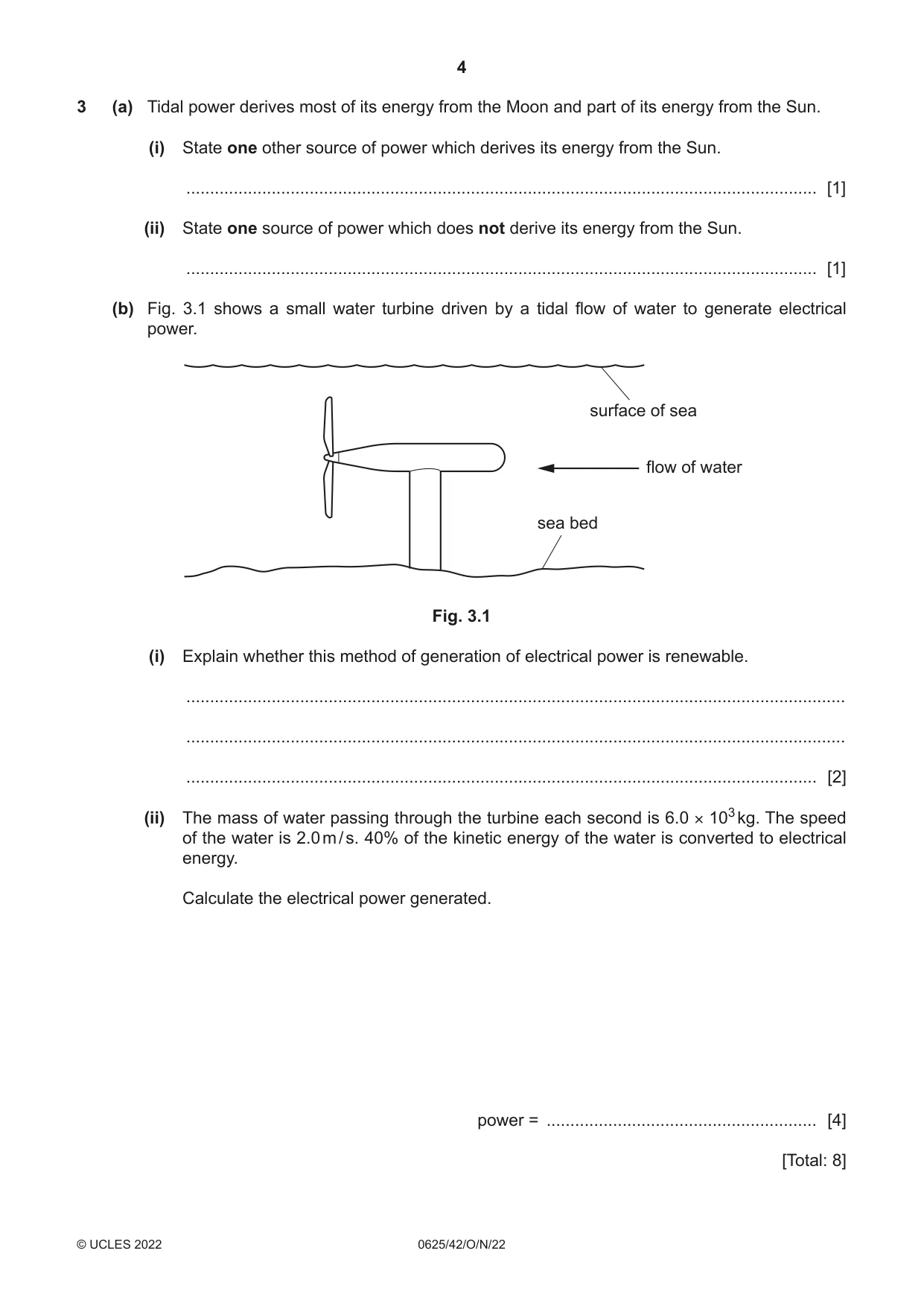
3 (a) Tidal power derives most of its energy from the Moon and part of its energy from the Sun. (i) State one other source of power which derives its energy from the Sun. ..................................................................................................................................... [1] (ii) State one source of power which does not derive its energy from the Sun. ..................................................................................................................................... [1] (b) Fig. 3.1 shows a small water turbine driven by a tidal flow of water to generate electrical power. surface of sea flow of water sea bed Fig. 3.1 (i) Explain whether this method of generation of electrical power is renewable. ........................................................................................................................................... ........................................................................................................................................... ..................................................................................................................................... [2] (ii) The mass of water passing through the turbine each second is 6.0 × 10³ kg. The speed of the water is 2.0 m / s. 40% of the kinetic energy of the water is converted to electrical energy. Calculate the electrical power generated. power = ......................................................... [4] [Total: 8]
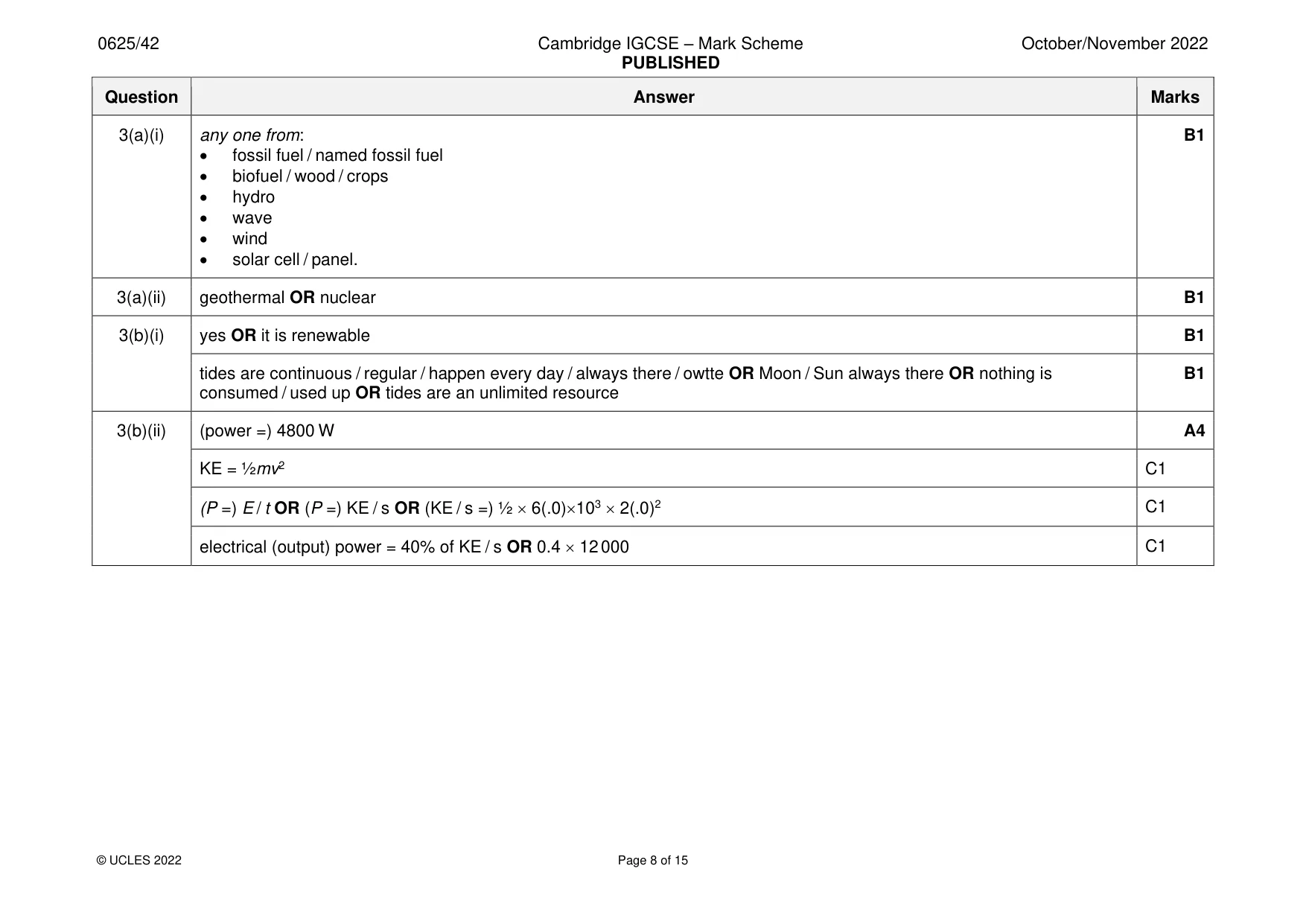
Mark scheme: 3(a)(i) any one from: B1 • fossil fuel / named fossil fuel • biofuel / wood / crops • hydro • wave • wind • solar cell / panel. 3(a)(ii) geothermal OR nuclear B1 3(b)(i) yes OR it is renewable B1 tides are continuous / regular / happen every day / always there / owtte OR Moon / Sun always there OR nothing is B1 consumed / used up OR tides are an unlimited resource 3(b)(ii) (power =) 4800 W A4 KE = ½mv2 C1 (P =) E / t OR (P =) KE / s OR (KE / s =) ½ 6(.0)103 2(.0)2 C1 electrical (output) power = 40% of KE / s OR 0.4 12 000 C1
Q4 · Explain, in terms of the momentum of particles, how a gas exerts a pressure
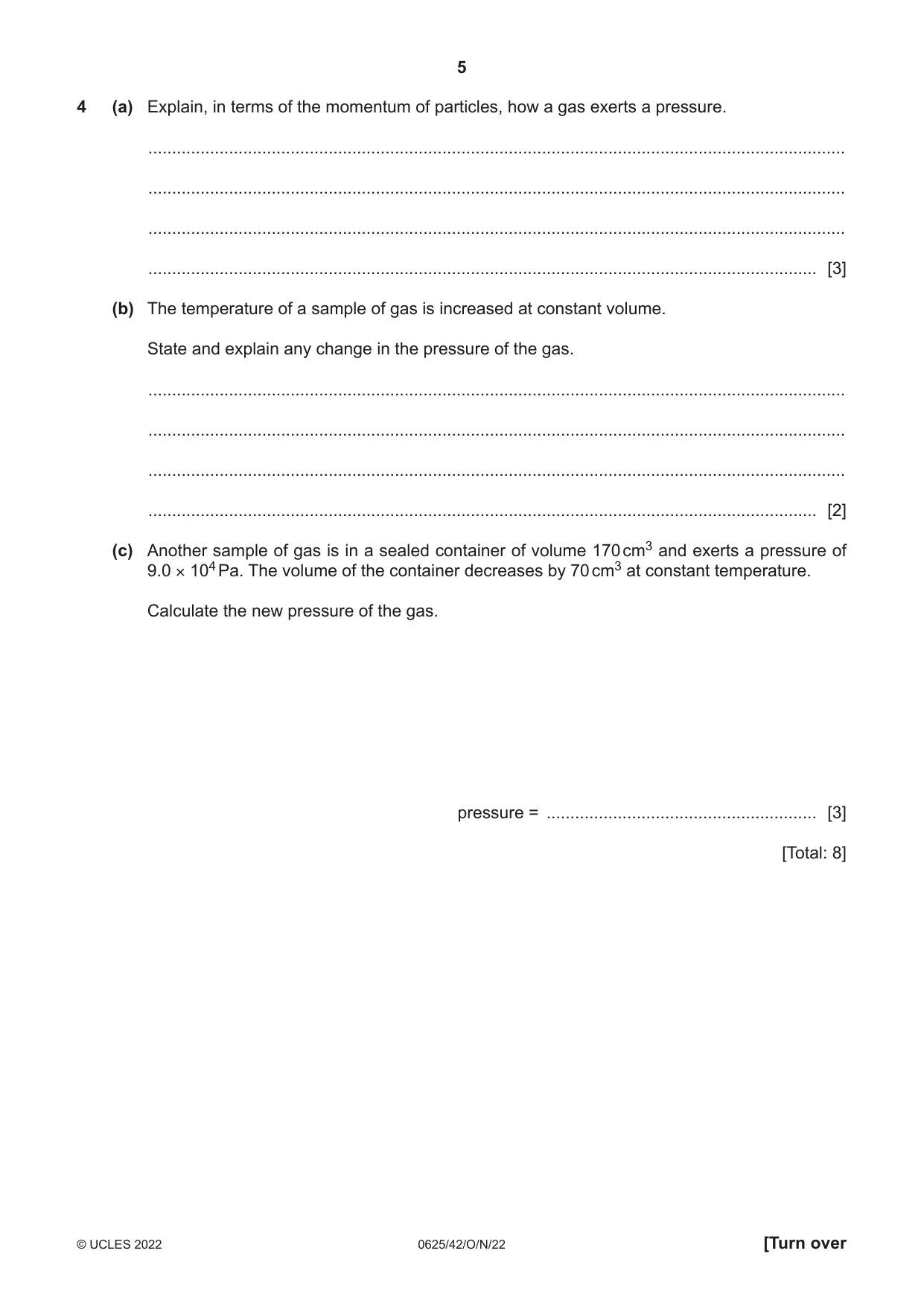
4 (a) Explain, in terms of the momentum of particles, how a gas exerts a pressure. ................................................................................................................................................... ................................................................................................................................................... ................................................................................................................................................... ............................................................................................................................................. [3] (b) The temperature of a sample of gas is increased at constant volume. State and explain any change in the pressure of the gas. ................................................................................................................................................... ................................................................................................................................................... ................................................................................................................................................... ............................................................................................................................................. [2] (c) Another sample of gas is in a sealed container of volume 170 cm3 and exerts a pressure of 9.0 × 10⁴ Pa. The volume of the container decreases by 70 cm3 at constant temperature. Calculate the new pressure of the gas. pressure = ......................................................... [3] [Total: 8]
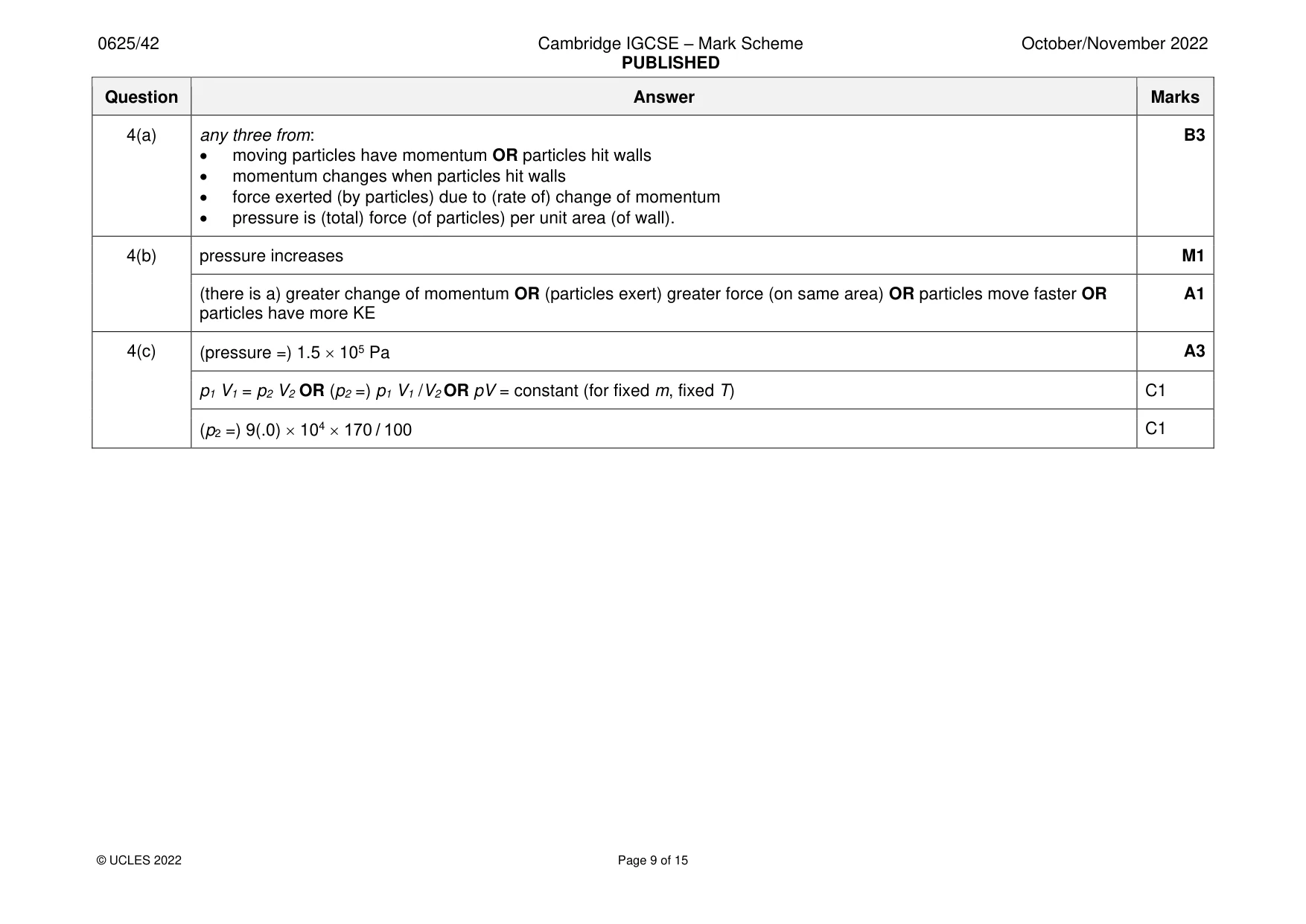
Mark scheme: 4(a) any three from: B3 • moving particles have momentum OR particles hit walls • momentum changes when particles hit walls • force exerted (by particles) due to (rate of) change of momentum • pressure is (total) force (of particles) per unit area (of wall). 4(b) pressure increases M1 (there is a) greater change of momentum OR (particles exert) greater force (on same area) OR particles move faster OR A1 particles have more KE 4(c) (pressure =) 1.5 105 Pa A3 p1 V1 = p2 V2 OR (p2 =) p1 V1 /V2 OR pV = constant (for fixed m, fixed T) C1 (p2 =) 9(.0) 104 170 / 100 C1
Q5 · An aluminium block after leaving a furnace in a factory
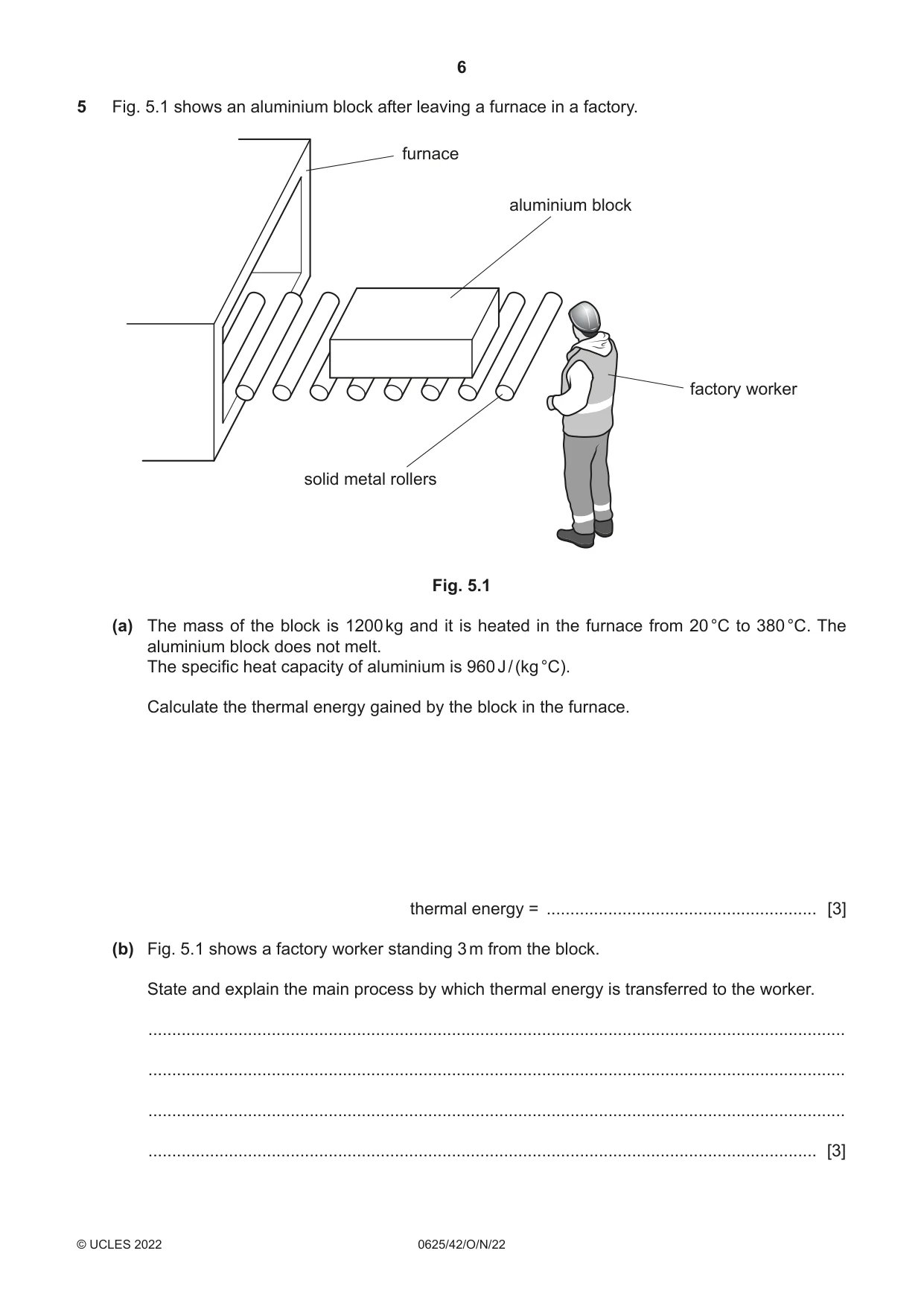
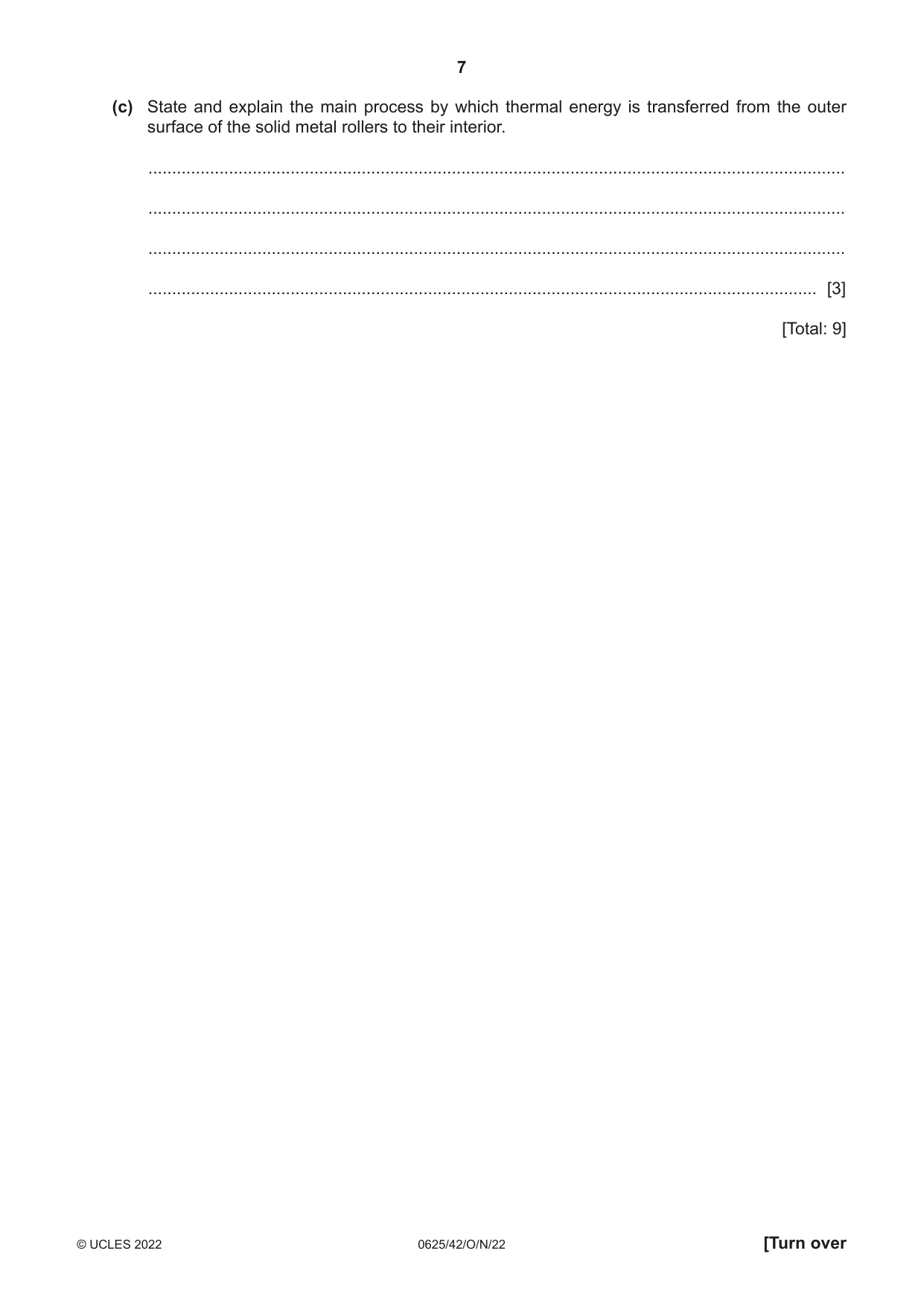
5 Fig. 5.1 shows an aluminium block after leaving a furnace in a factory. furnace aluminium block factory worker solid metal rollers Fig. 5.1 (a) The mass of the block is 1200 kg and it is heated in the furnace from 20 °C to 380 °C. The aluminium block does not melt. The specific heat capacity of aluminium is 960 J / (kg °C). Calculate the thermal energy gained by the block in the furnace. thermal energy = ......................................................... [3] (b) Fig. 5.1 shows a factory worker standing 3 m from the block. State and explain the main process by which thermal energy is transferred to the worker. ................................................................................................................................................... ................................................................................................................................................... ................................................................................................................................................... ............................................................................................................................................. [3] (c) State and explain the main process by which thermal energy is transferred from the outer surface of the solid metal rollers to their interior. ................................................................................................................................................... ................................................................................................................................................... ................................................................................................................................................... ............................................................................................................................................. [3] [Total: 9]
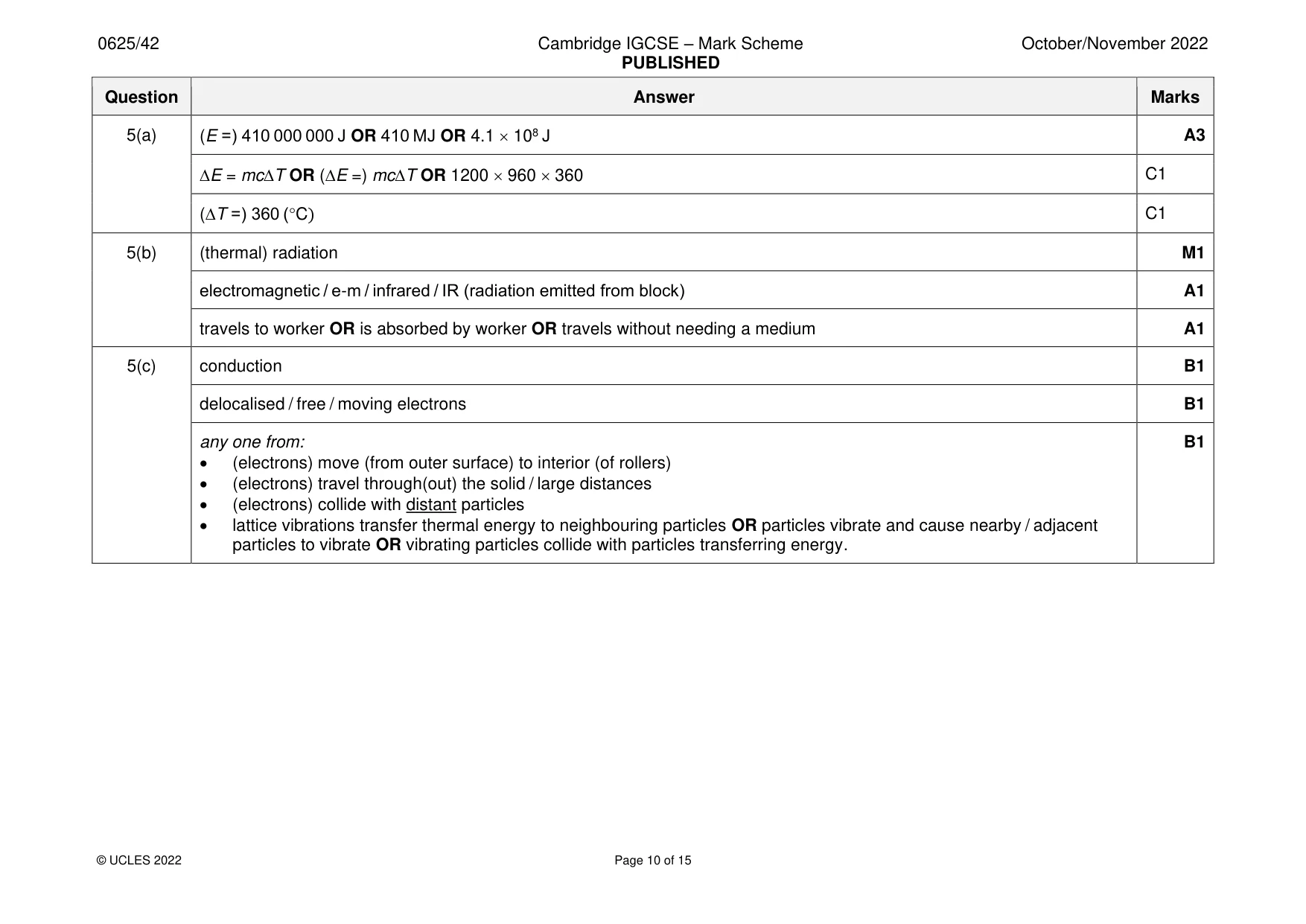
Mark scheme: 5(a) (E =) 410 000 000 J OR 410 MJ OR 4.1 108 J A3 E = mcT OR (E =) mcT OR 1200 960 360 C1 (T =) 360 (°C) C1 5(b) (thermal) radiation M1 electromagnetic / e-m / infrared / IR (radiation emitted from block) A1 travels to worker OR is absorbed by worker OR travels without needing a medium A1 5(c) conduction B1 delocalised / free / moving electrons B1 any one from: B1 • (electrons) move (from outer surface) to interior (of rollers) • (electrons) travel through(out) the solid / large distances • (electrons) collide with distant particles • lattice vibrations transfer thermal energy to neighbouring particles OR particles vibrate and cause nearby / adjacent particles to vibrate OR vibrating particles collide with particles transferring energy.
Q6 · A converging lens and an object OX
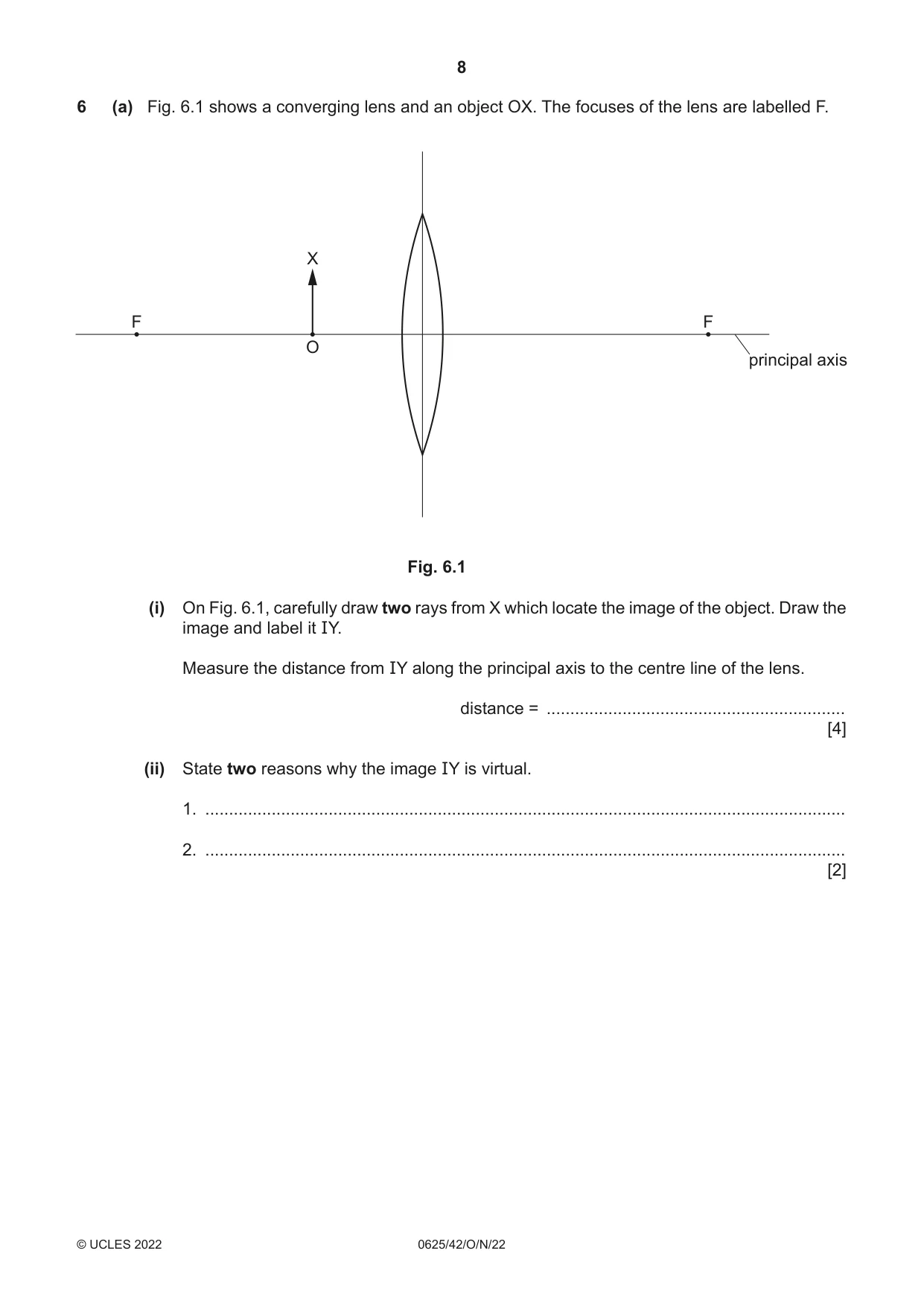
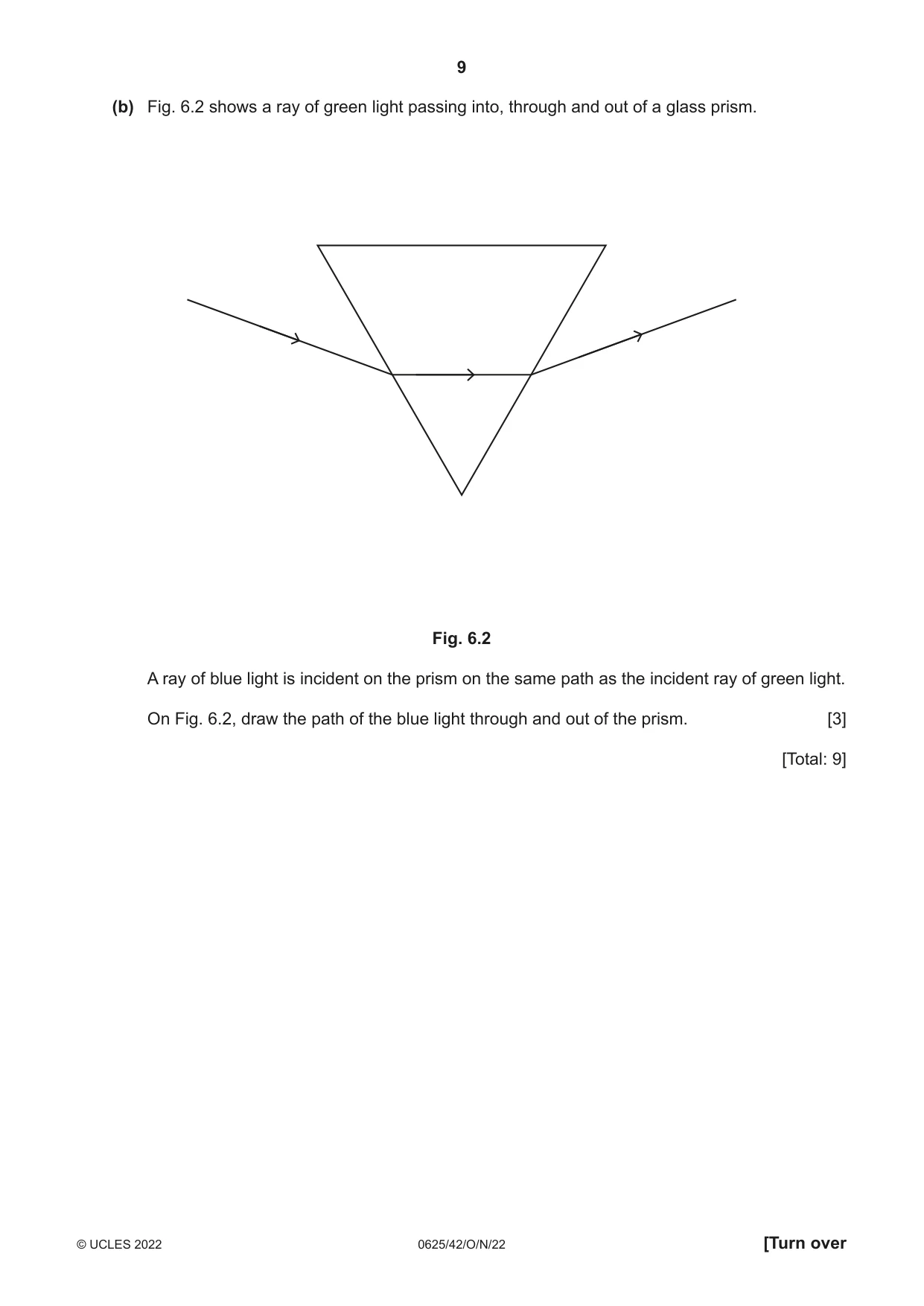
6 (a) Fig. 6.1 shows a converging lens and an object OX. The focuses of the lens are labelled F. X F F O principal axis Fig. 6.1 (i) On Fig. 6.1, carefully draw two rays from X which locate the image of the object. Draw the image and label it IY. Measure the distance from IY along the principal axis to the centre line of the lens. distance = ............................................................... [4] (ii) State two reasons why the image IY is virtual. 1. ....................................................................................................................................... 2. ....................................................................................................................................... [2] (b) Fig. 6.2 shows a ray of green light passing into, through and out of a glass prism. Fig. 6.2 A ray of blue light is incident on the prism on the same path as the incident ray of green light. On Fig. 6.2, draw the path of the blue light through and out of the prism. [3] [Total: 9]
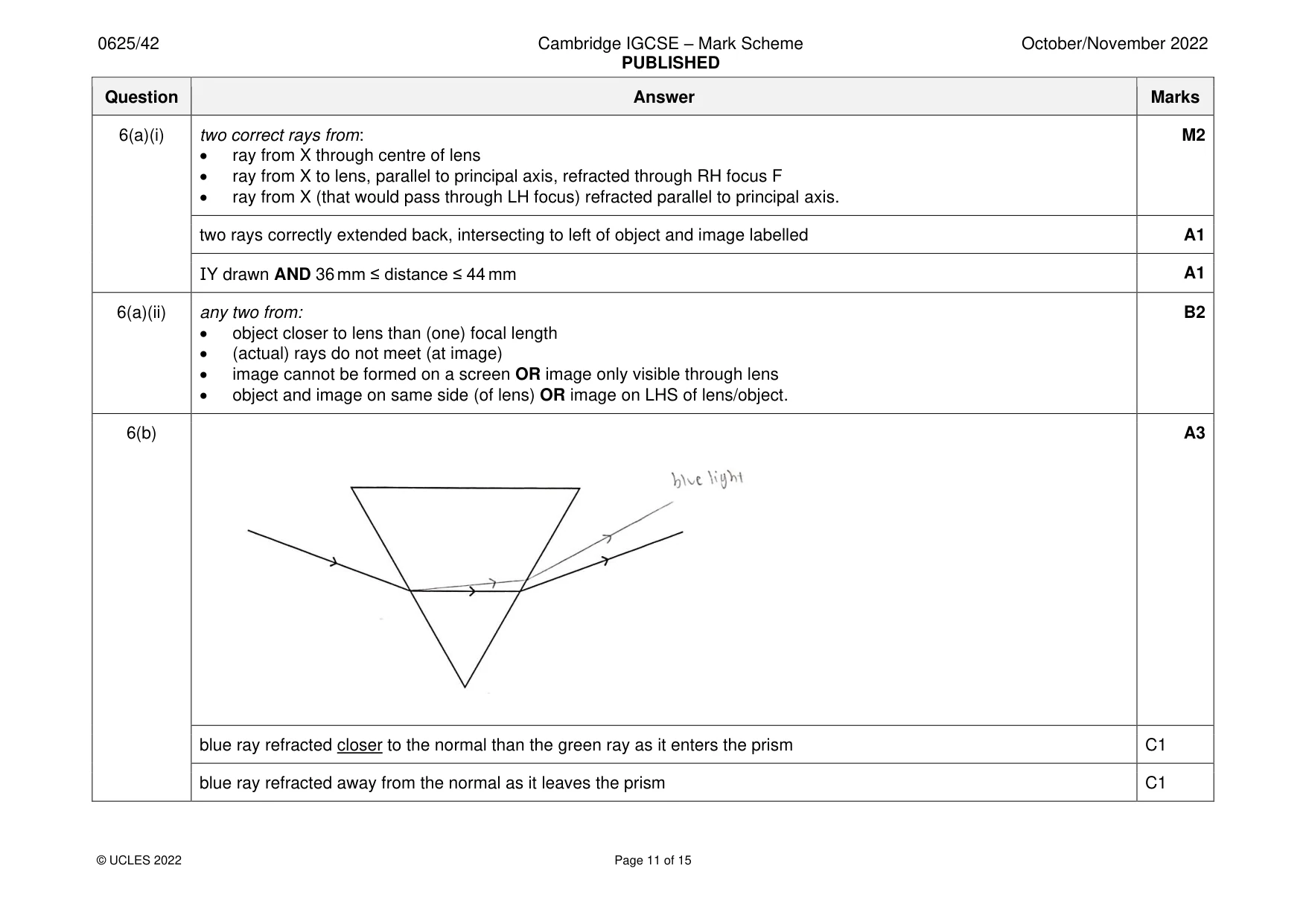
Mark scheme: 6(a)(i) two correct rays from: M2 • ray from X through centre of lens • ray from X to lens, parallel to principal axis, refracted through RH focus F • ray from X (that would pass through LH focus) refracted parallel to principal axis. two rays correctly extended back, intersecting to left of object and image labelled A1 IY drawn AND 36 mm ≤ distance ≤ 44 mm A1 6(a)(ii) any two from: B2 • object closer to lens than (one) focal length • (actual) rays do not meet (at image) • image cannot be formed on a screen OR image only visible through lens • object and image on same side (of lens) OR image on LHS of lens/object. 6(b) A3 blue ray refracted closer to the normal than the green ray as it enters the prism C1 blue ray refracted away from the normal as it leaves the prism C1
Q7 · This question is about the magnetic fields around bar magnets
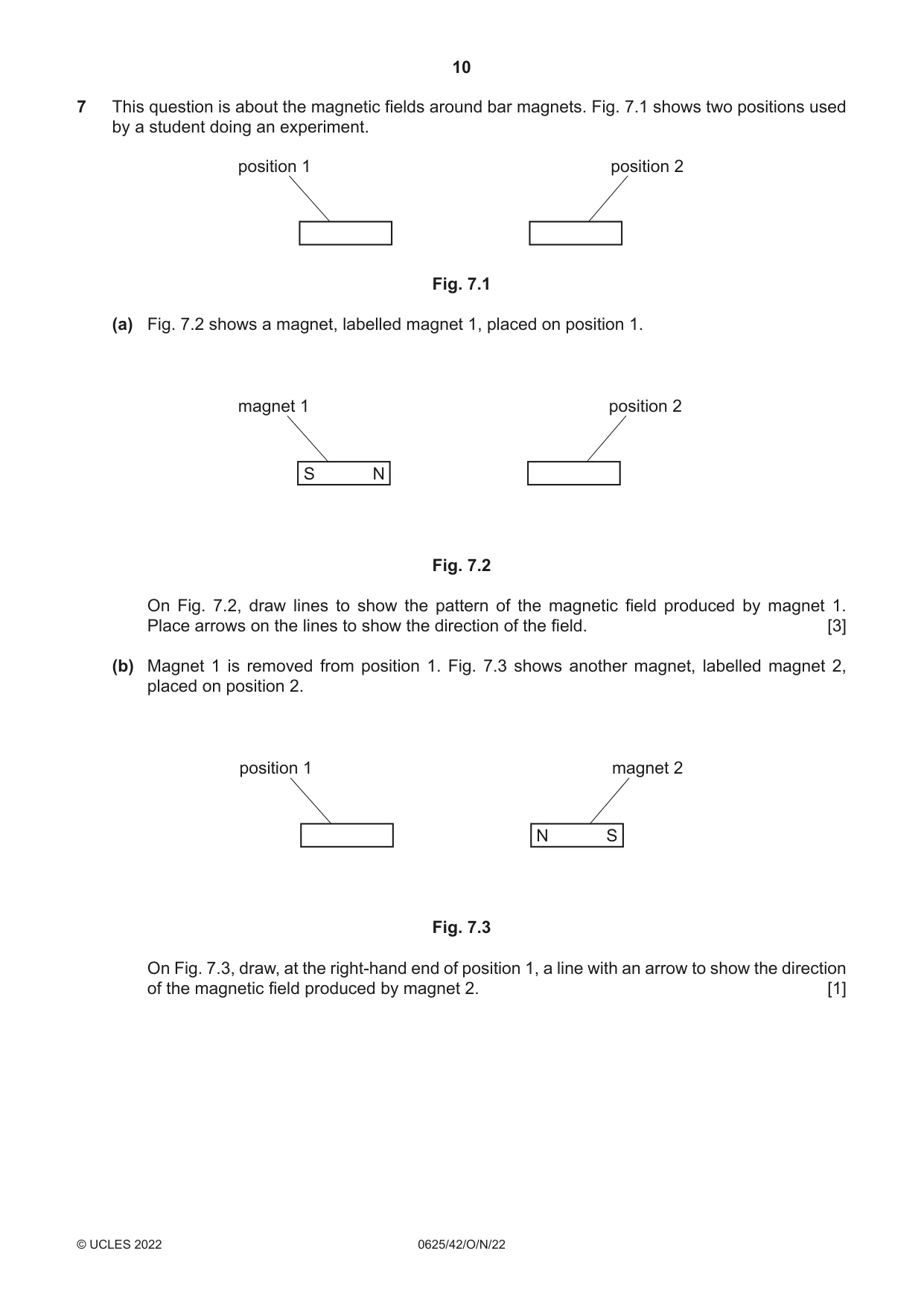
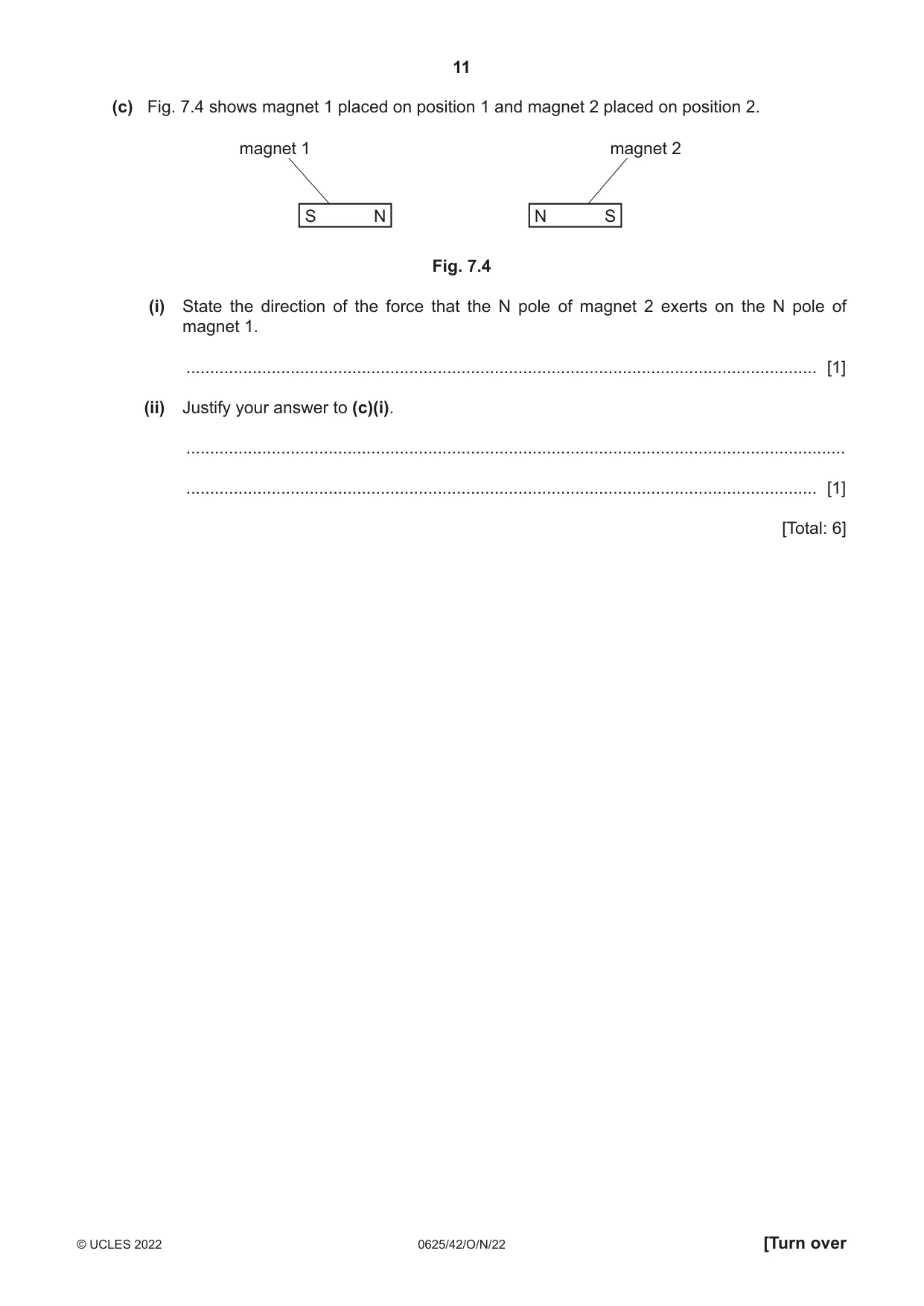
7 This question is about the magnetic fields around bar magnets. Fig. 7.1 shows two positions used by a student doing an experiment. position 1 position 2 Fig. 7.1 (a) Fig. 7.2 shows a magnet, labelled magnet 1, placed on position 1. magnet 1 position 2 S N Fig. 7.2 On Fig. 7.2, draw lines to show the pattern of the magnetic field produced by magnet 1. Place arrows on the lines to show the direction of the field. [3] (b) Magnet 1 is removed from position 1. Fig. 7.3 shows another magnet, labelled magnet 2, placed on position 2. position 1 magnet 2 N S Fig. 7.3 On Fig. 7.3, draw, at the right-hand end of position 1, a line with an arrow to show the direction of the magnetic field produced by magnet 2. [1] (c) Fig. 7.4 shows magnet 1 placed on position 1 and magnet 2 placed on position 2. magnet 1 magnet 2 S N N S Fig. 7.4 (i) State the direction of the force that the N pole of magnet 2 exerts on the N pole of magnet 1. ..................................................................................................................................... [1] (ii) Justify your answer to (c)(i). ........................................................................................................................................... ..................................................................................................................................... [1] [Total: 6]
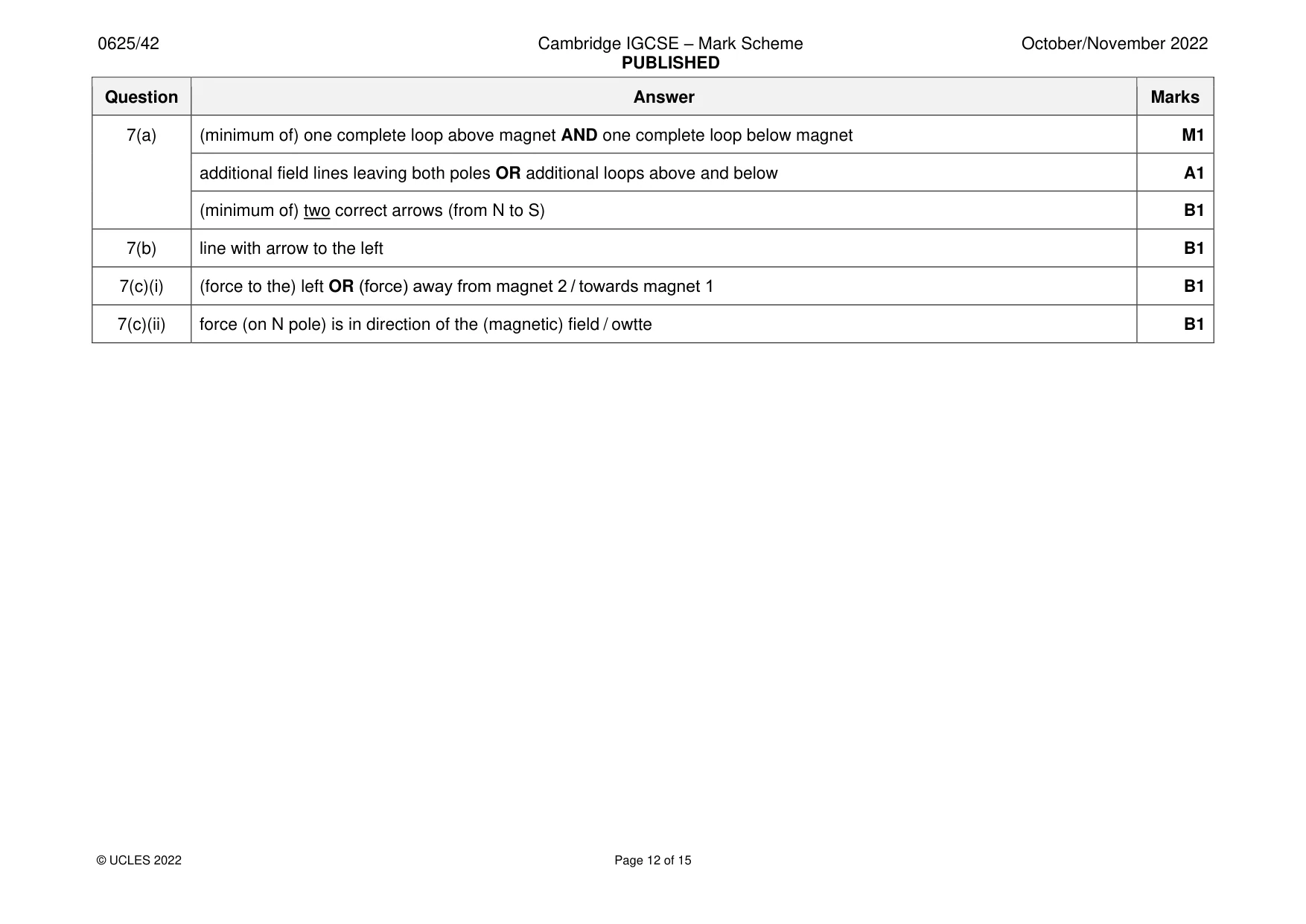
Mark scheme: 7(a) (minimum of) one complete loop above magnet AND one complete loop below magnet M1 additional field lines leaving both poles OR additional loops above and below A1 (minimum of) two correct arrows (from N to S) B1 7(b) line with arrow to the left B1 7(c)(i) (force to the) left OR (force) away from magnet 2 / towards magnet 1 B1 7(c)(ii) force (on N pole) is in direction of the (magnetic) field / owtte B1
Question 8
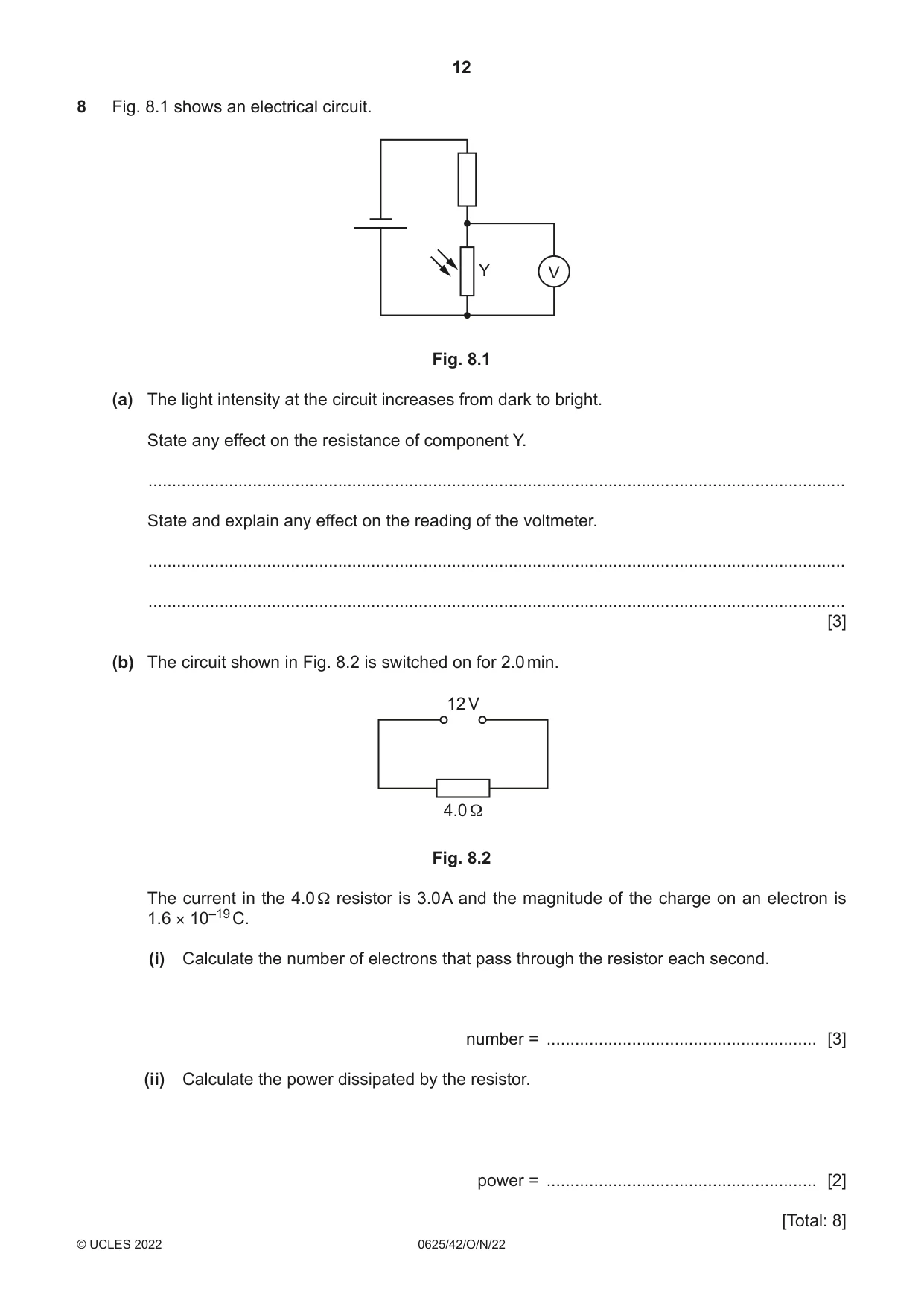
8 Fig. 8.1 shows an electrical circuit. Y V Fig. 8.1 (a) The light intensity at the circuit increases from dark to bright. State any effect on the resistance of component Y. ................................................................................................................................................... State and explain any effect on the reading of the voltmeter. ................................................................................................................................................... ................................................................................................................................................... [3] (b) The circuit shown in Fig. 8.2 is switched on for 2.0 min. 12 V 4.0 Ω Fig. 8.2 The current in the 4.0 Ω resistor is 3.0 A and the magnitude of the charge on an electron is 1.6 × 10⁻¹⁹ C. (i) Calculate the number of electrons that pass through the resistor each second. number = ......................................................... [3] (ii) Calculate the power dissipated by the resistor. power = ......................................................... [2] [Total: 8]
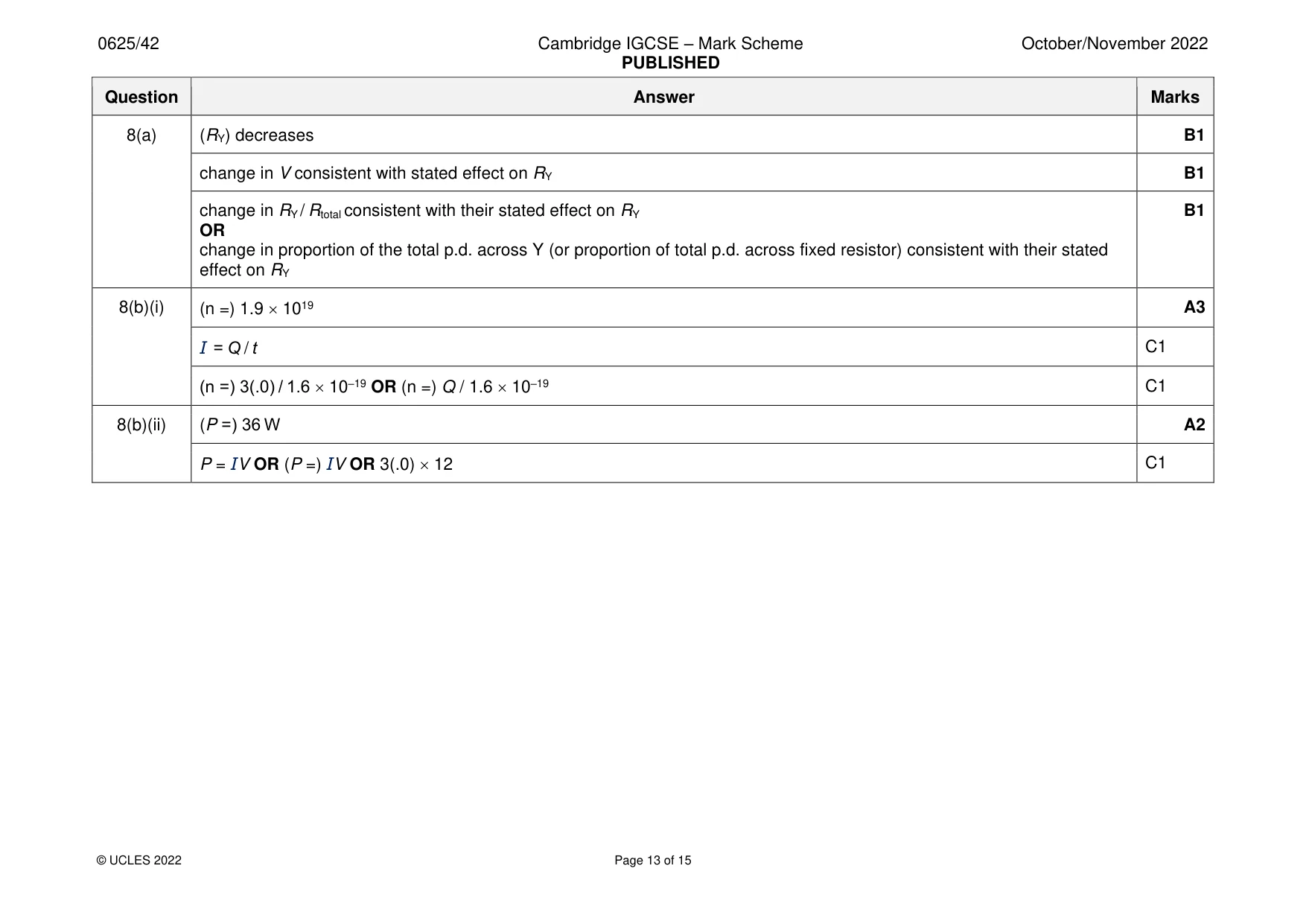
Mark scheme: 8(a) (RY) decreases B1 change in V consistent with stated effect on RY B1 change in RY / Rtotal consistent with their stated effect on RY B1 OR change in proportion of the total p.d. across Y (or proportion of total p.d. across fixed resistor) consistent with their stated effect on RY 8(b)(i) (n =) 1.9 1019 A3 I = Q / t C1 (n =) 3(.0) / 1.6 10–19 OR (n =) Q / 1.6 10–19 C1 8(b)(ii) (P =) 36 W A2 P = IV OR (P =) IV OR 3(.0) 12 C1
Q9 · Draw the symbol for: (i) a diode [1] (ii) a NOT gate
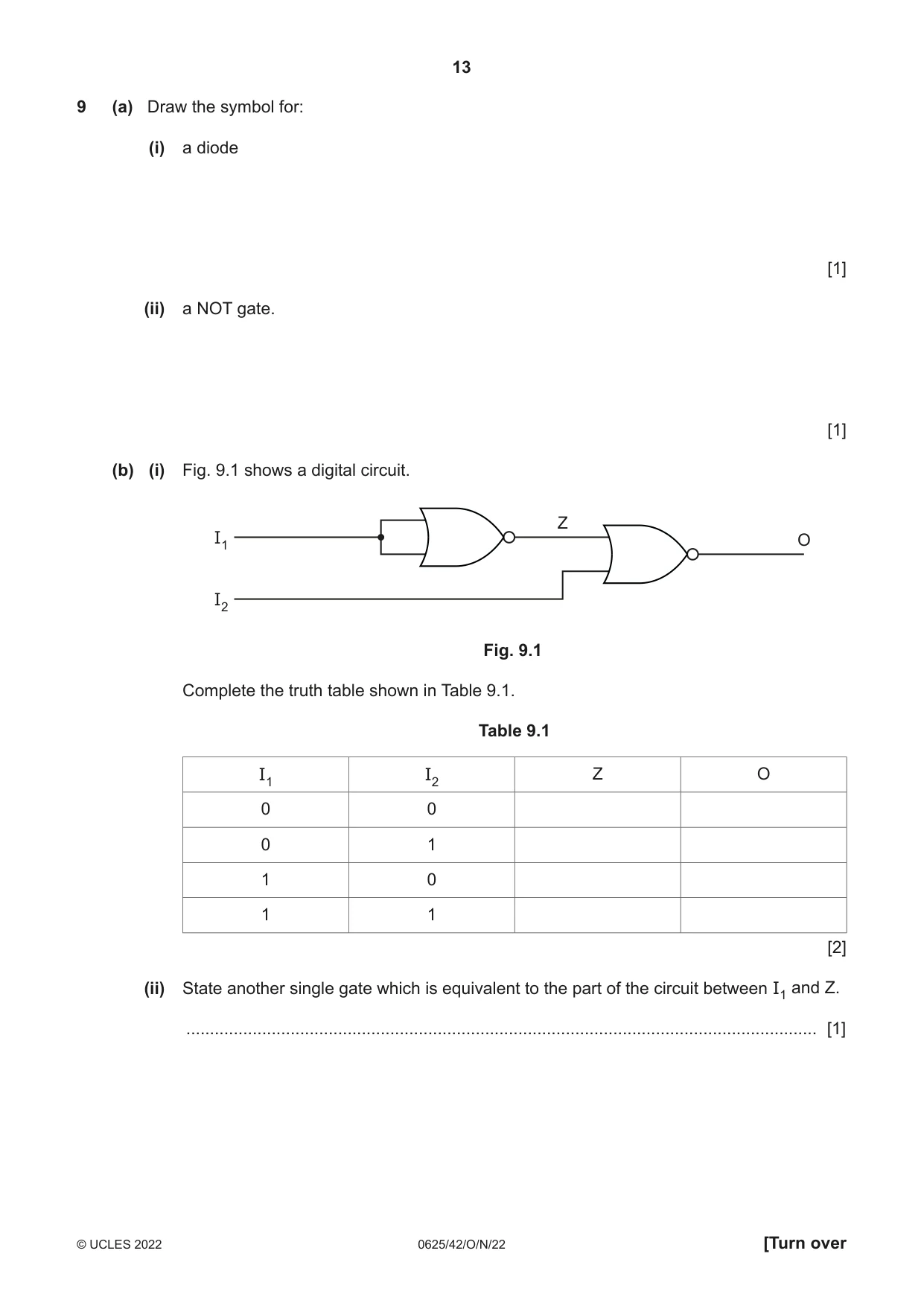
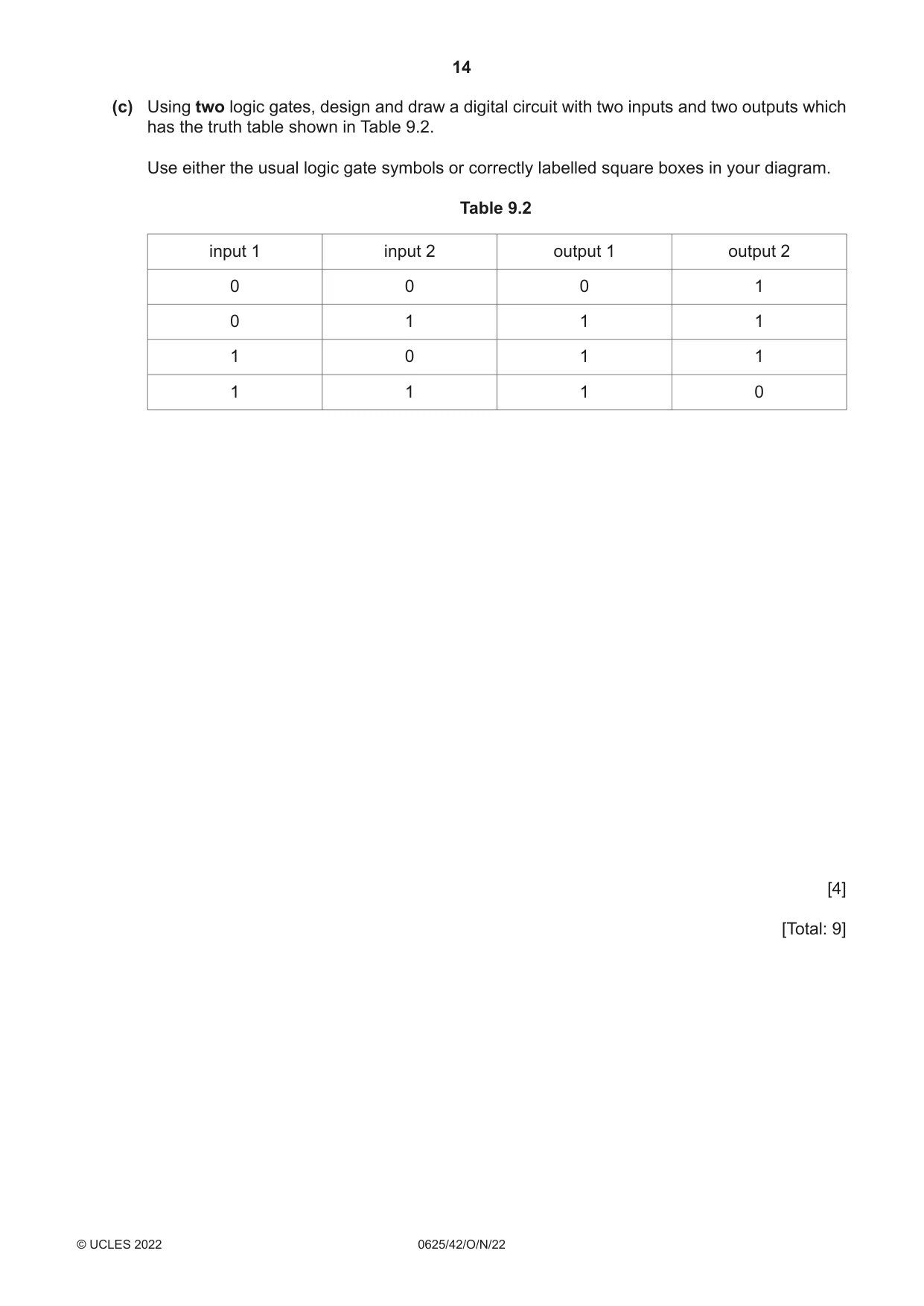
9 (a) Draw the symbol for: (i) a diode [1] (ii) a NOT gate. [1] (b) (i) Fig. 9.1 shows a digital circuit. Z I1 O I2 Fig. 9.1 Complete the truth table shown in Table 9.1. Table 9.1 I1 I2 Z O 0 0 0 1 1 0 1 1 [2] (ii) State another single gate which is equivalent to the part of the circuit between I1 and Z. ..................................................................................................................................... [1] (c) Using two logic gates, design and draw a digital circuit with two inputs and two outputs which has the truth table shown in Table 9.2. Use either the usual logic gate symbols or correctly labelled square boxes in your diagram. Table 9.2 input 1 input 2 output 1 output 2 0 0 0 1 0 1 1 1 1 0 1 1 1 1 1 0 [4] [Total: 9]
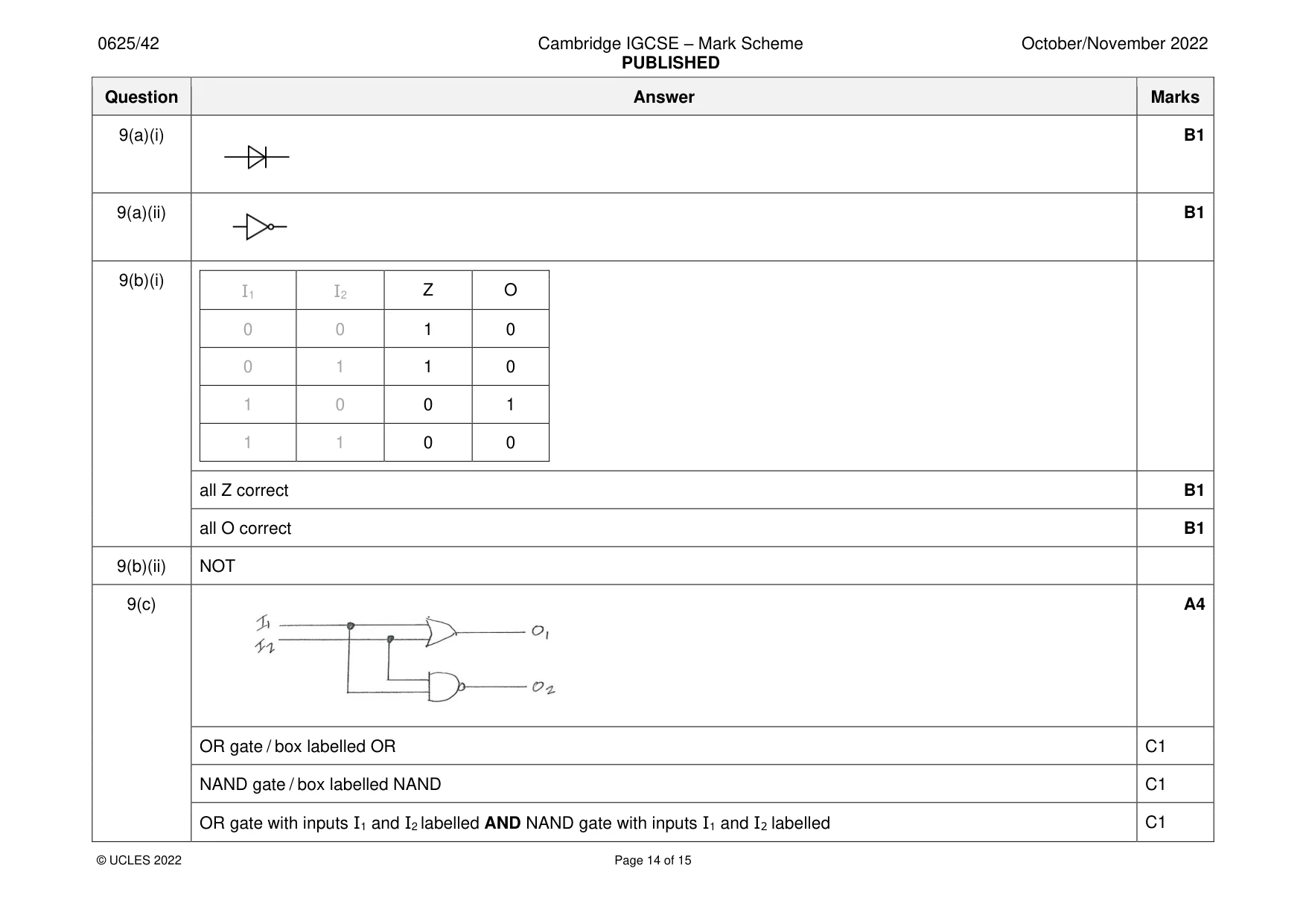
Mark scheme: 9(a)(i) B1 9(a)(ii) B1 9(b)(i) I1 I2 Z O 0 0 1 0 0 1 1 0 1 0 0 1 1 1 0 0 all Z correct B1 all O correct B1 9(b)(ii) NOT 9(c) A4 OR gate / box labelled OR C1 NAND gate / box labelled NAND C1 OR gate with inputs I1 and I2 labelled AND NAND gate with inputs I1 and I2 labelled C1
Q10 · The magnitude of the charge on a β (beta)-particle is 1.6 × 10⁻¹⁹ C
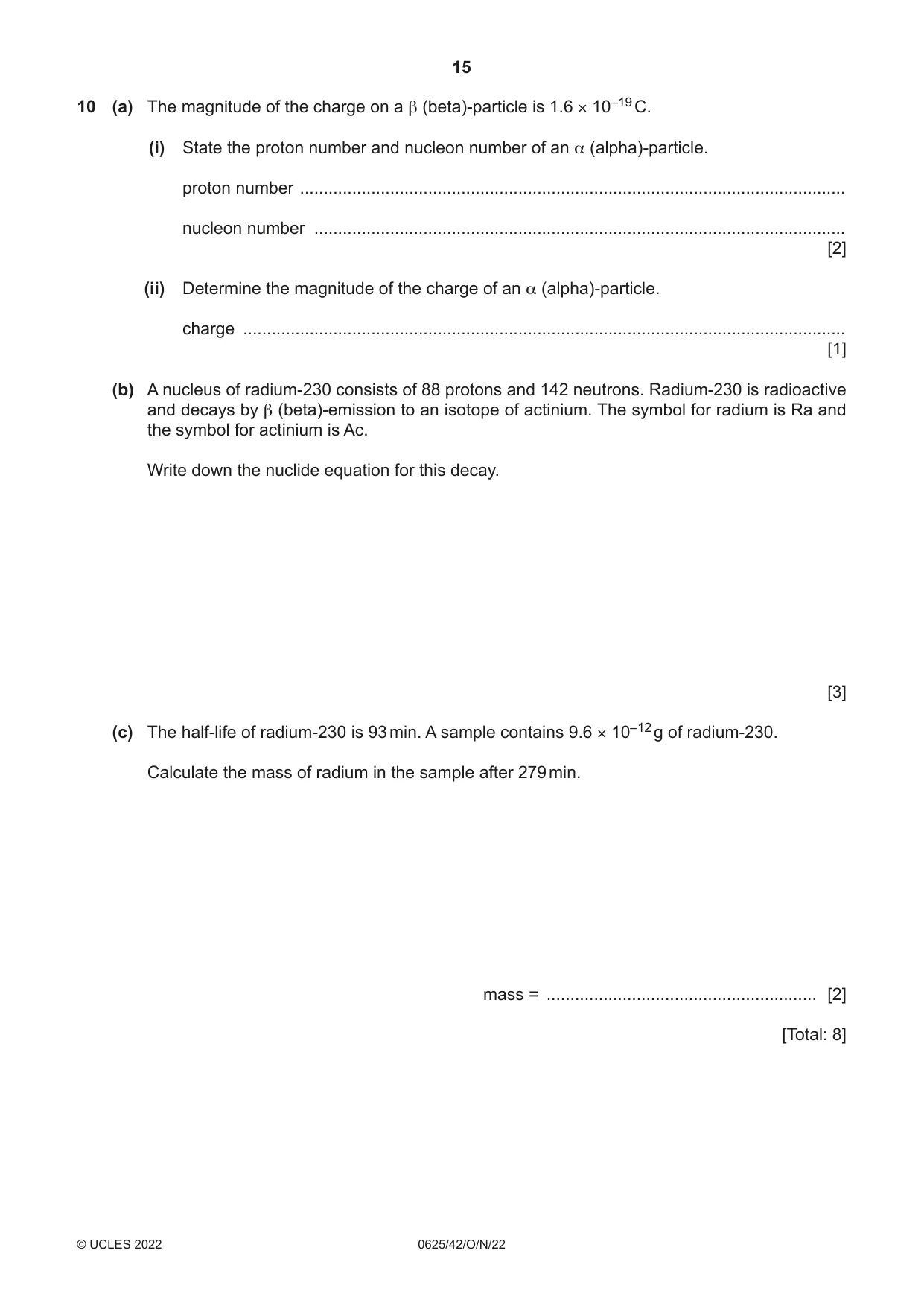
10 (a) The magnitude of the charge on a β (beta)-particle is 1.6 × 10⁻¹⁹ C. (i) State the proton number and nucleon number of an α (alpha)-particle. proton number ................................................................................................................... nucleon number ................................................................................................................ [2] (ii) Determine the magnitude of the charge of an α (alpha)-particle. charge ............................................................................................................................... [1] (b) A nucleus of radium-230 consists of 88 protons and 142 neutrons. Radium-230 is radioactive and decays by β (beta)-emission to an isotope of actinium. The symbol for radium is Ra and the symbol for actinium is Ac. Write down the nuclide equation for this decay. [3] (c) The half-life of radium-230 is 93 min. A sample contains 9.6 × 10⁻¹² g of radium-230. Calculate the mass of radium in the sample after 279 min. mass = ......................................................... [2] [Total: 8]
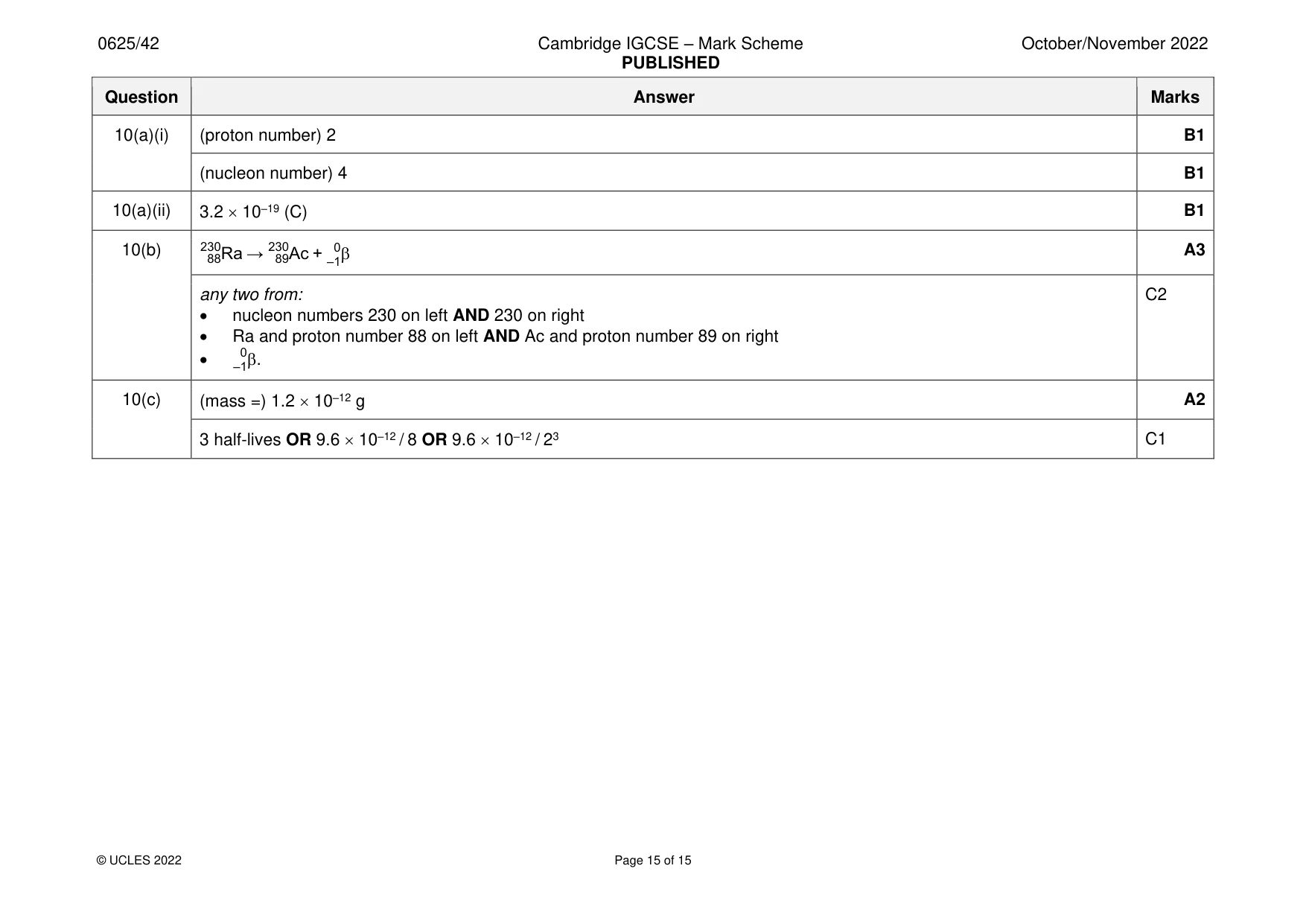
Mark scheme: 10(a)(i) (proton number) 2 B1 (nucleon number) 4 B1 10(a)(ii) 3.2 10–19 (C) B1 10(b) 230 88 Ra → 23089 Ac + –10 A3 any two from: C2 • nucleon numbers 230 on left AND 230 on right • Ra and proton number 88 on left AND Ac and proton number 89 on right • 0 . –1 10(c) (mass =) 1.2 10–12 g A2 3 half-lives OR 9.6 10–12 / 8 OR 9.6 10–12 / 23 C1
What was in this paper
The subtopics covered by these 10 questions, and how many questions each got. Open one in a new tab to see every Cambridge question on it.
What you needed in this session
Cambridge’s own grade thresholds for 2022 Oct/Nov, Paper 4 · Variant 2. A higher threshold means an easier paper — the bar moves with how the cohort did.