Cambridge IGCSE Physics 0625 — 2016 Oct/Nov Paper 4 · Variant 2
0625/42/O/N/16 · 11 questions · 80 marks · ≈90 min
The question paper and its mark scheme, free to read here and free to download. This is Cambridge’s own paper, exactly as it was sat.
Question paper20 pages

Mark scheme9 pages
Answers below. Sit the paper first if you are practising.
Questions as text
Q1 · A student travelling down a hill in an unpowered vehicle
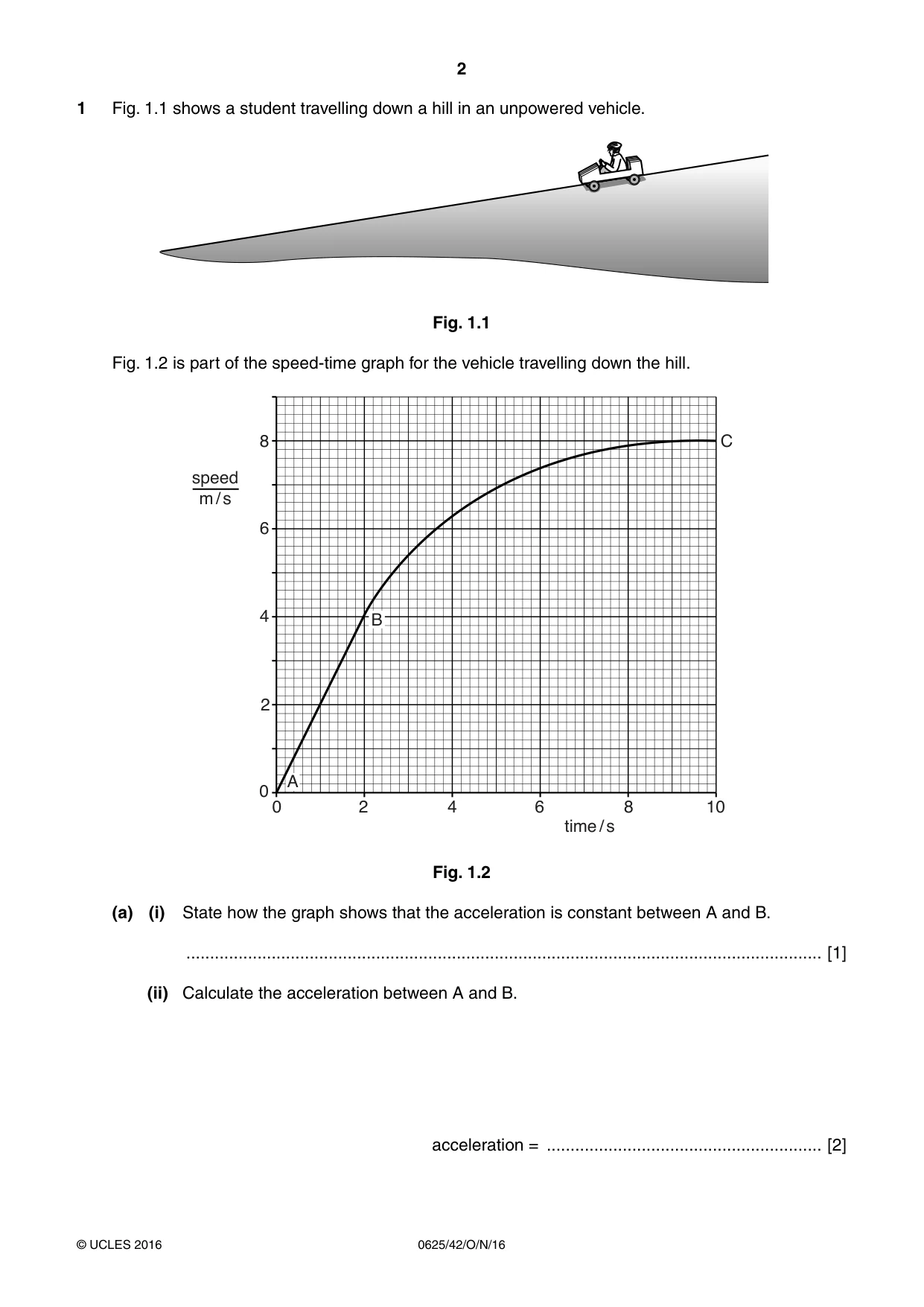
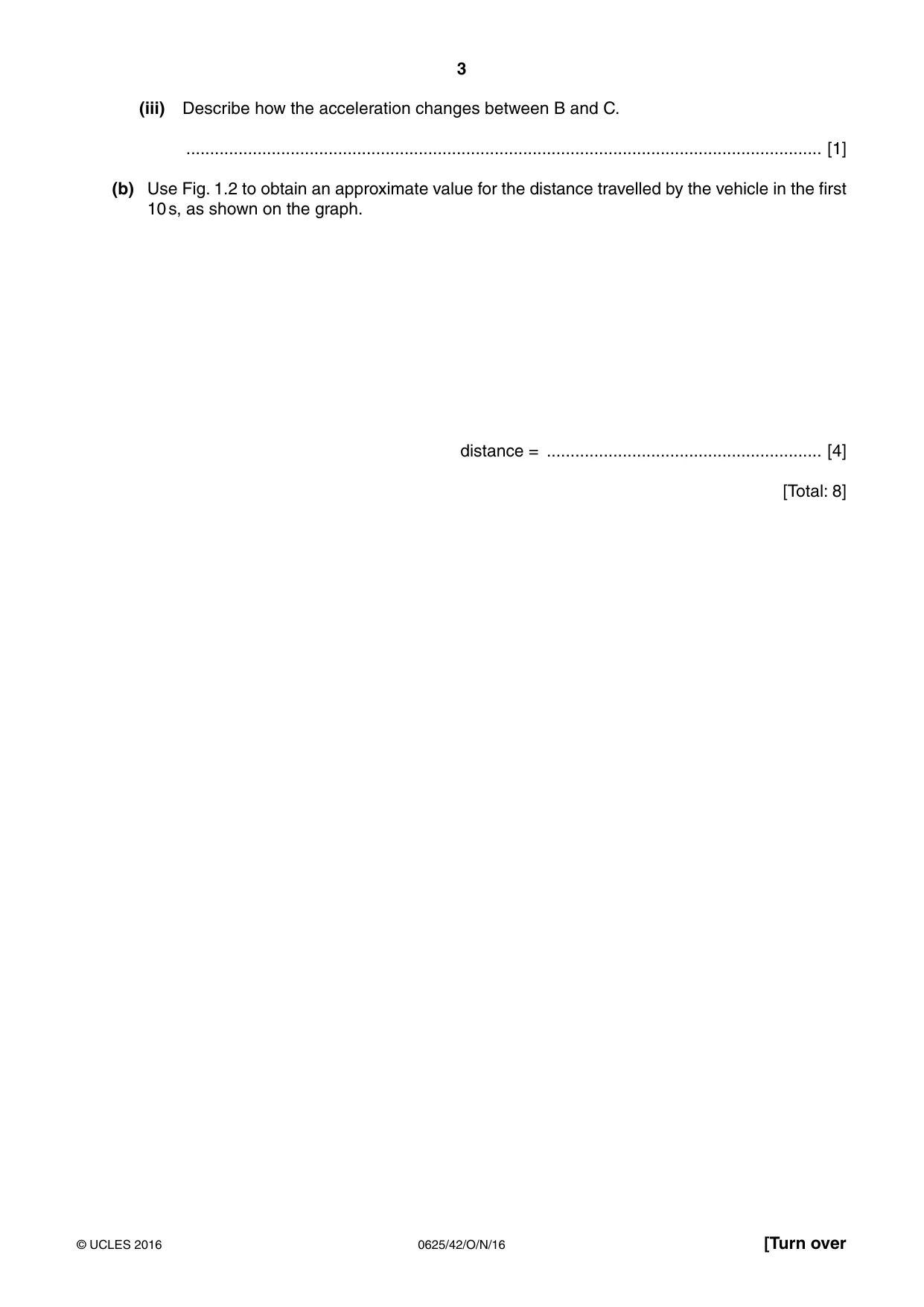
1 Fig. 1.1 shows a student travelling down a hill in an unpowered vehicle. Fig. 1.1 Fig. 1.2 is part of the speed-time graph for the vehicle travelling down the hill. 8 C speed m / s 6 4 B 2 A 0 0 2 4 6 8 10 time / s Fig. 1.2 (a) (i) State how the graph shows that the acceleration is constant between A and B. ...................................................................................................................................... [1] (ii) Calculate the acceleration between A and B. acceleration = .......................................................... [2] (iii) Describe how the acceleration changes between B and C. ...................................................................................................................................... [1] (b) Use Fig. 1.2 to obtain an approximate value for the distance travelled by the vehicle in the first 10 s, as shown on the graph. distance = .......................................................... [4] [Total: 8]
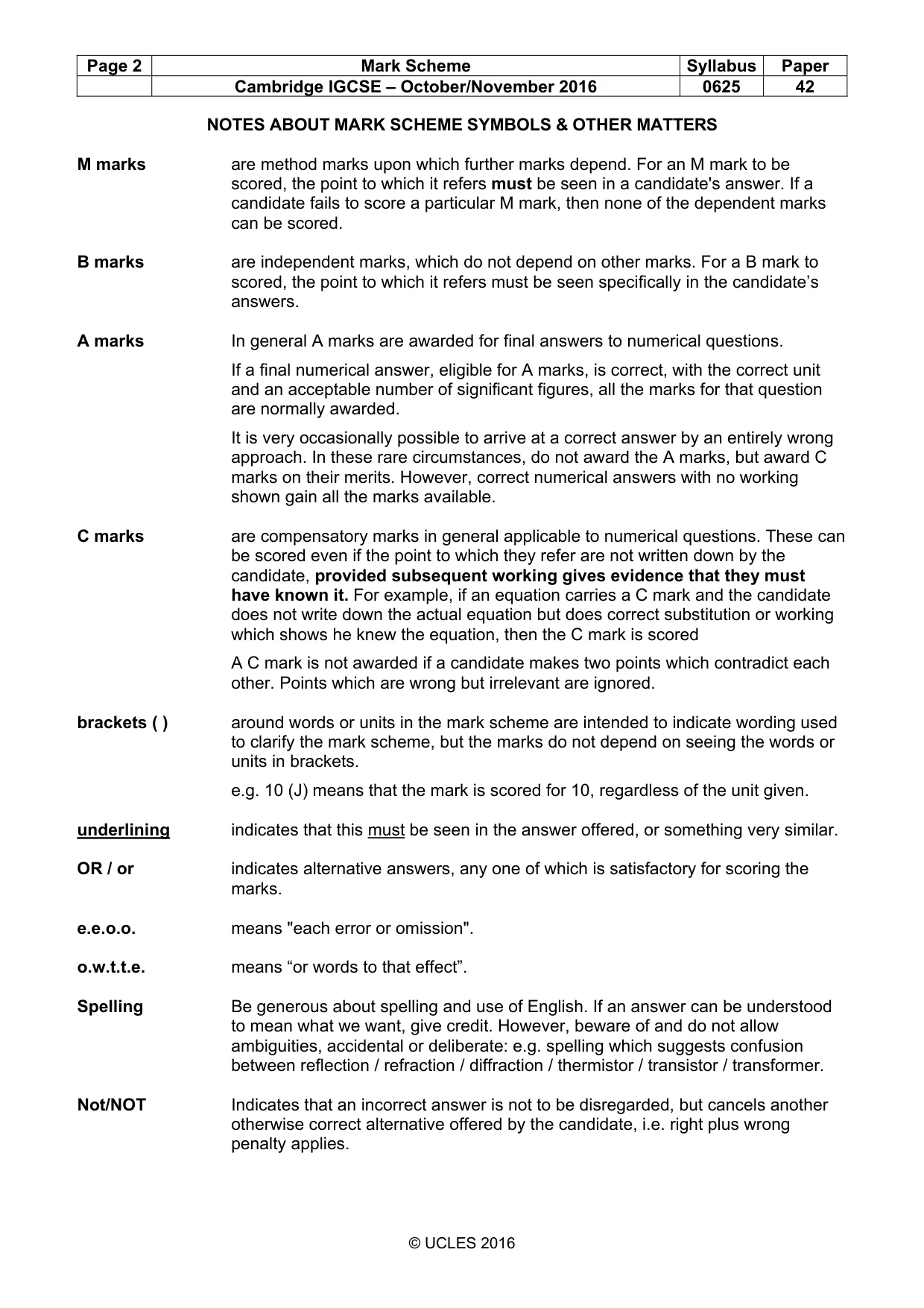
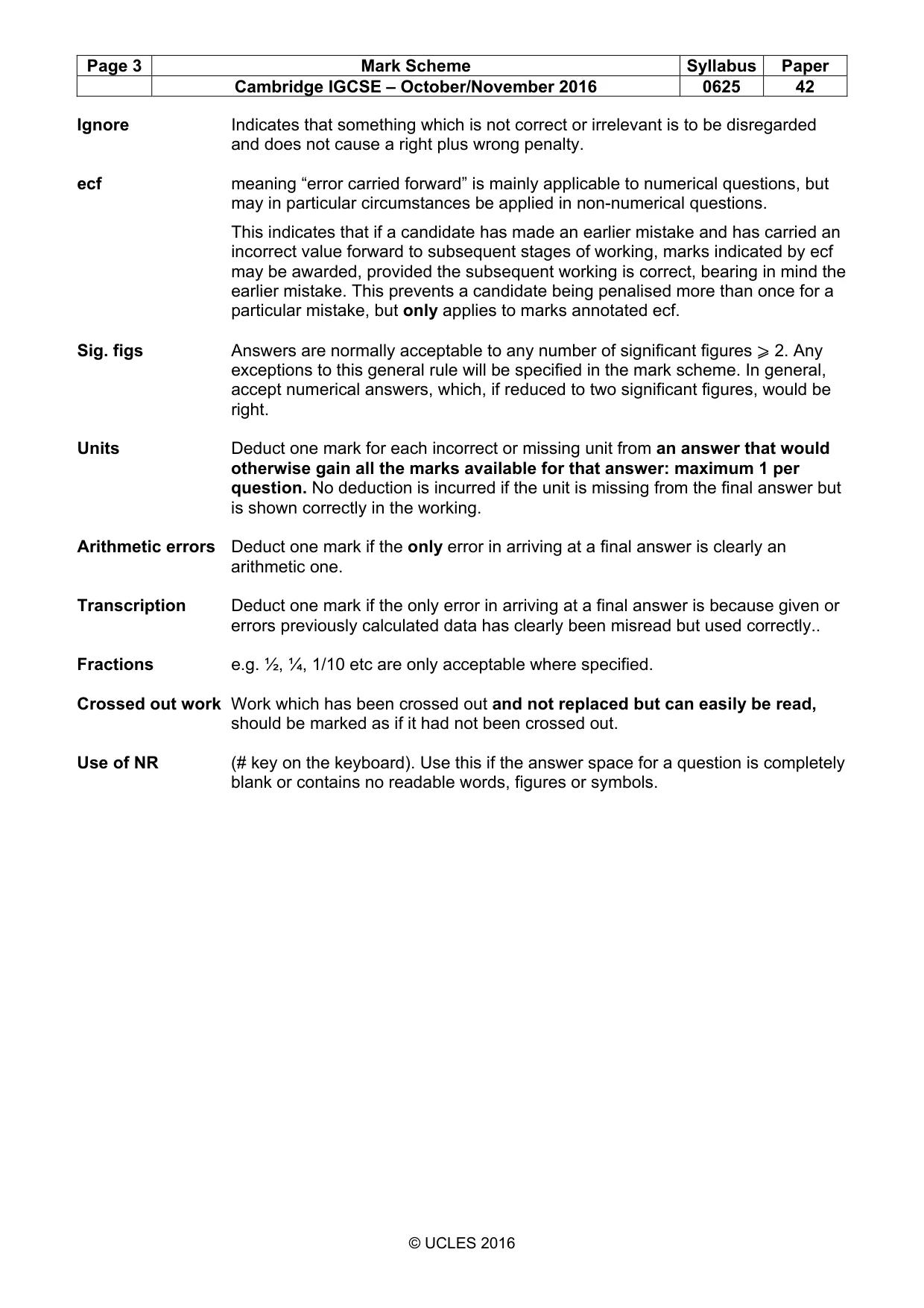
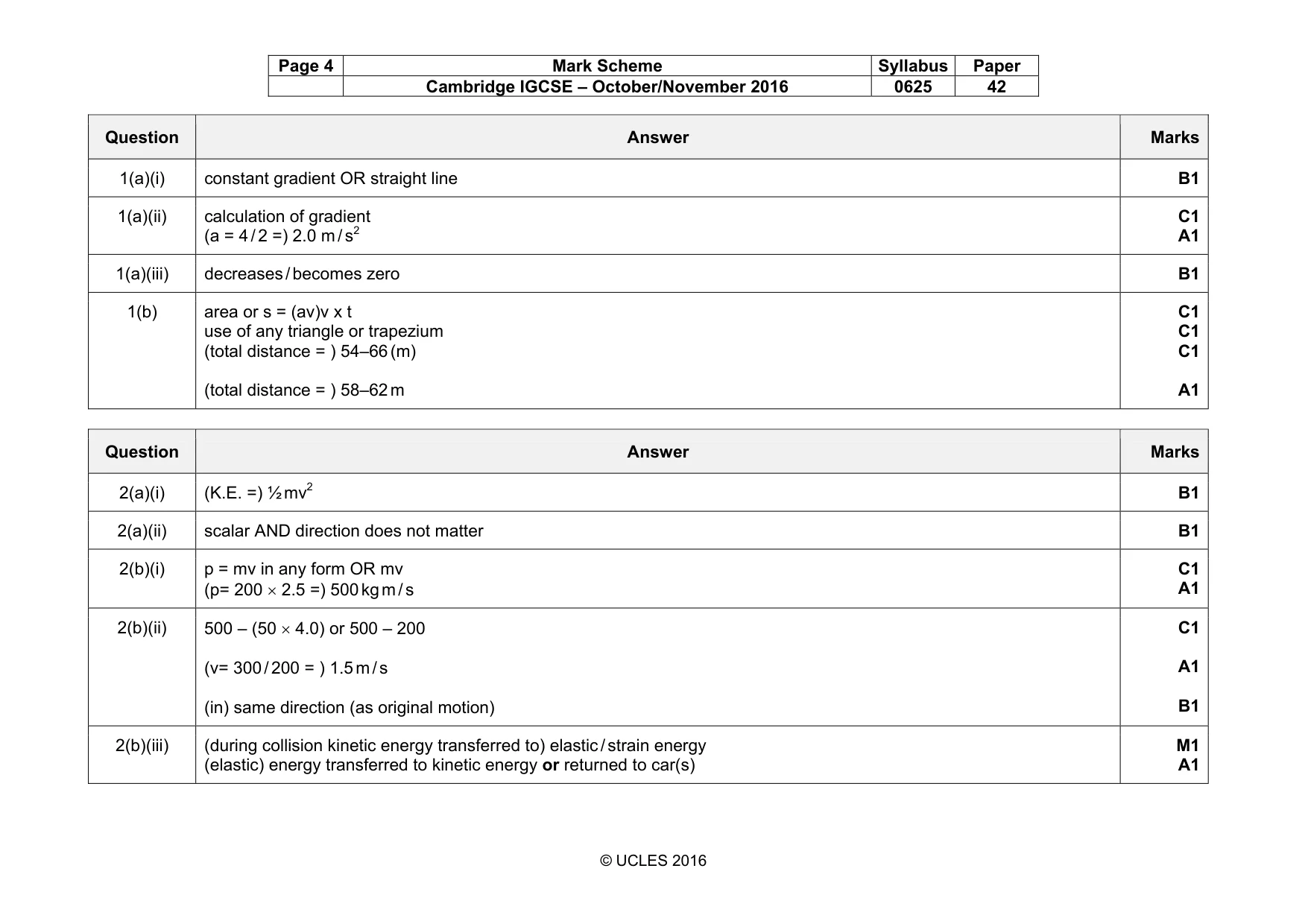
Mark scheme: 1(a)(i) constant gradient OR straight line B1 1(a)(ii) calculation of gradient (a = 4 / 2 =) 2.0 m / s2 C1 A1 1(a)(iii) decreases / becomes zero B1 1(b) area or s = (av)v x t use of any triangle or trapezium (total distance = ) 54–66 (m) (total distance = ) 58–62 m C1 C1 C1 A1
Q2 · State an expression for the kinetic energy of an object of mass m that is moving with a…
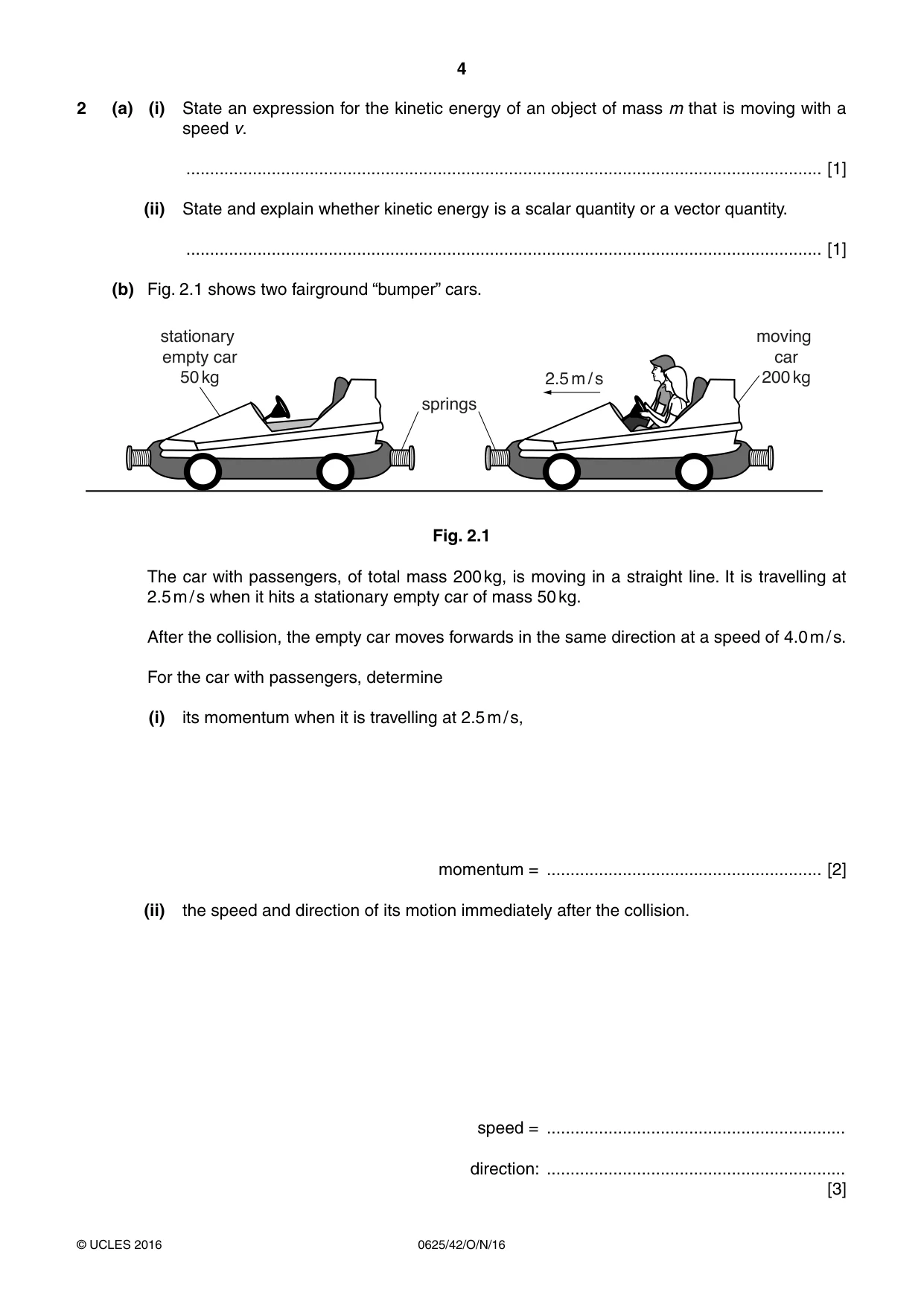
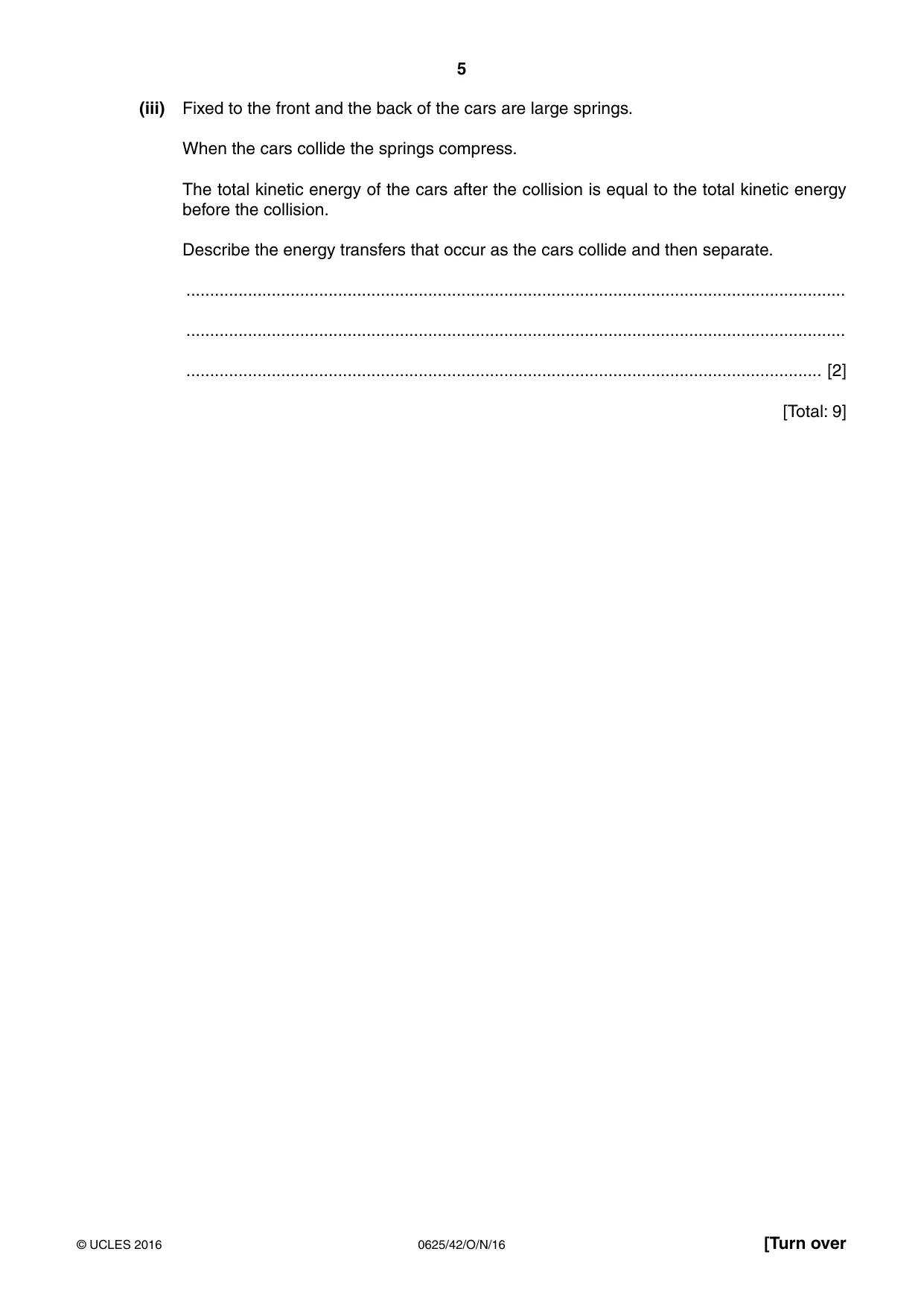
2 (a) (i) State an expression for the kinetic energy of an object of mass m that is moving with a speed v. ...................................................................................................................................... [1] (ii) State and explain whether kinetic energy is a scalar quantity or a vector quantity. ...................................................................................................................................... [1] (b) Fig. 2.1 shows two fairground “bumper” cars. stationary moving empty car car 50 kg 2.5 m / s 200 kg springs Fig. 2.1 The car with passengers, of total mass 200 kg, is moving in a straight line. It is travelling at 2.5 m / s when it hits a stationary empty car of mass 50 kg. After the collision, the empty car moves forwards in the same direction at a speed of 4.0 m / s. For the car with passengers, determine (i) its momentum when it is travelling at 2.5 m / s, momentum = .......................................................... [2] (ii) the speed and direction of its motion immediately after the collision. speed = ............................................................... direction: ............................................................... [3] (iii) Fixed to the front and the back of the cars are large springs. When the cars collide the springs compress. The total kinetic energy of the cars after the collision is equal to the total kinetic energy before the collision. Describe the energy transfers that occur as the cars collide and then separate. ........................................................................................................................................... ........................................................................................................................................... ...................................................................................................................................... [2] [Total: 9]
Mark scheme: 2(a)(i) B1 2(a)(ii) scalar AND direction does not matter B1 2(b)(i) p = mv in any form OR mv (p= 200 × 2.5 =) 500 kg m / s C1 A1 2(b)(ii) 500 – (50 × 4.0) or 500 – 200 (v= 300 / 200 = ) 1.5 m / s (in) same direction (as original motion) C1 A1 B1 2(b)(iii) (during collision kinetic energy transferred to) elastic / strain energy (elastic) energy transferred to kinetic energy or returned to car(s) M1 A1
Q3 · A mercury barometer correctly set up to measure the atmospheric pressure in mm Hg…
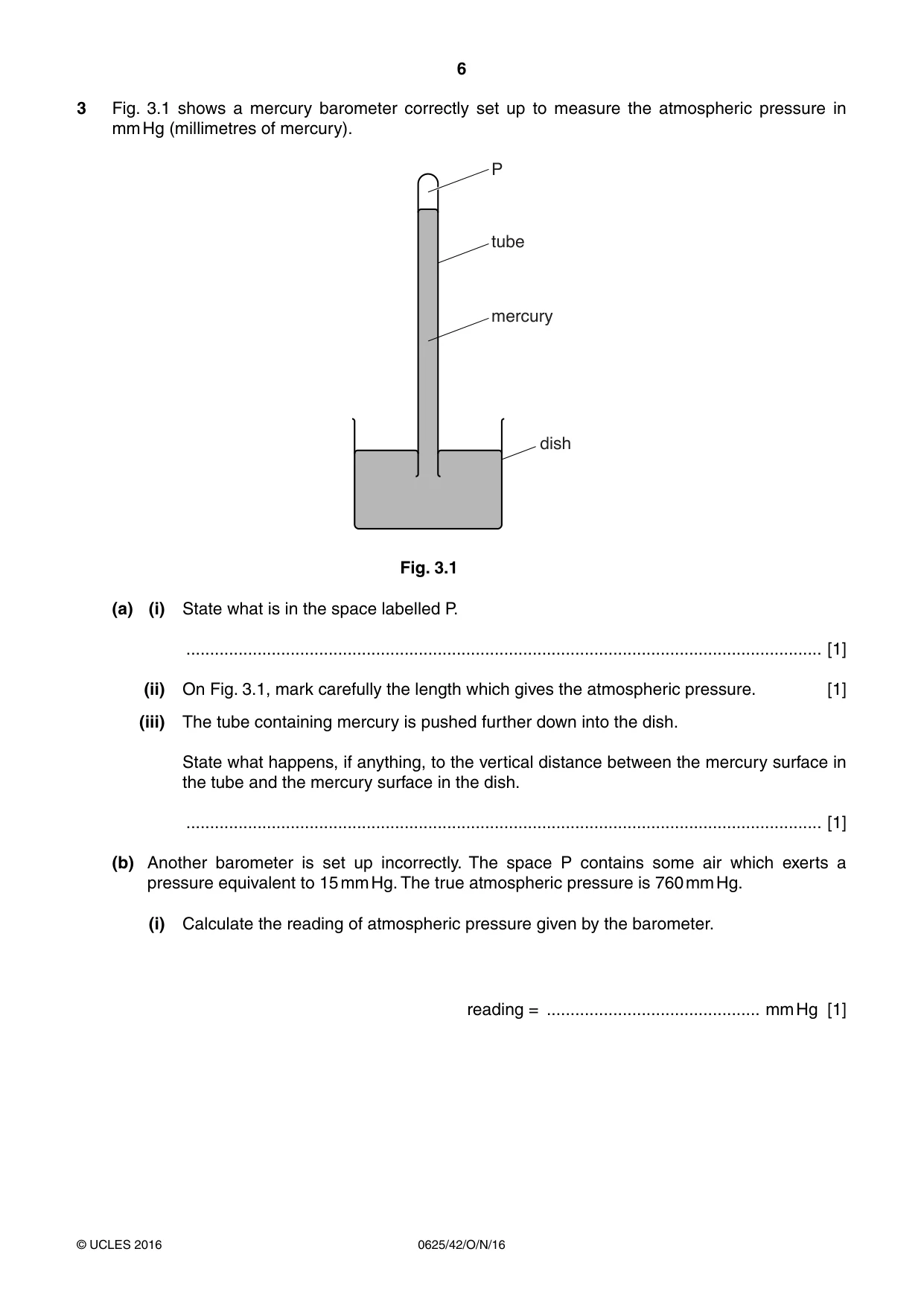
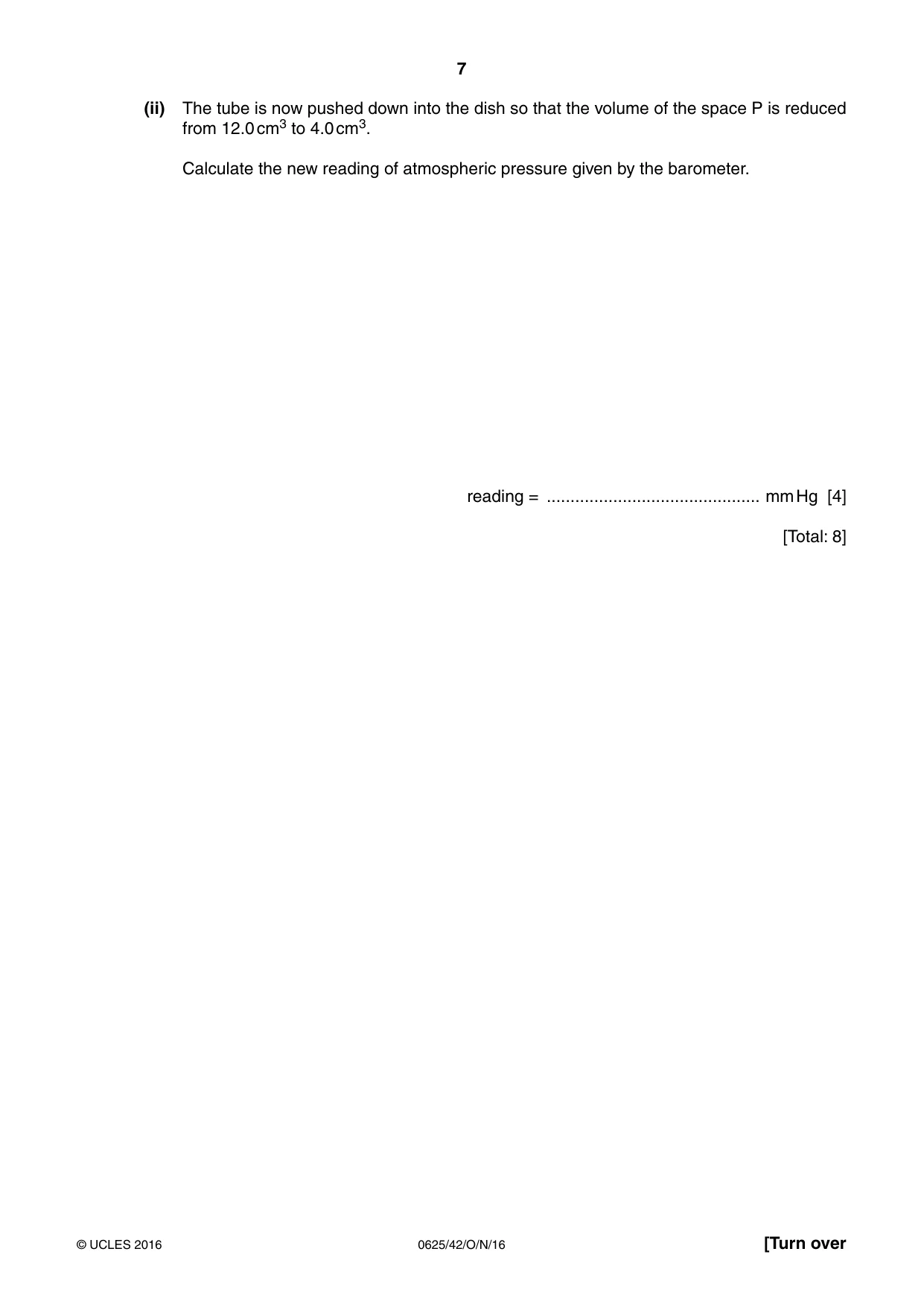
3 Fig. 3.1 shows a mercury barometer correctly set up to measure the atmospheric pressure in mm Hg (millimetres of mercury). P tube mercury dish Fig. 3.1 (a) (i) State what is in the space labelled P. ...................................................................................................................................... [1] (ii) On Fig. 3.1, mark carefully the length which gives the atmospheric pressure. [1] (iii) The tube containing mercury is pushed further down into the dish. State what happens, if anything, to the vertical distance between the mercury surface in the tube and the mercury surface in the dish. ...................................................................................................................................... [1] (b) Another barometer is set up incorrectly. The space P contains some air which exerts a pressure equivalent to 15 mm Hg. The true atmospheric pressure is 760 mm Hg. (i) Calculate the reading of atmospheric pressure given by the barometer. reading = ............................................. mm Hg [1] (ii) The tube is now pushed down into the dish so that the volume of the space P is reduced from 12.0 cm3 to 4.0 cm3. Calculate the new reading of atmospheric pressure given by the barometer. reading = ............................................. mm Hg [4] [Total: 8]
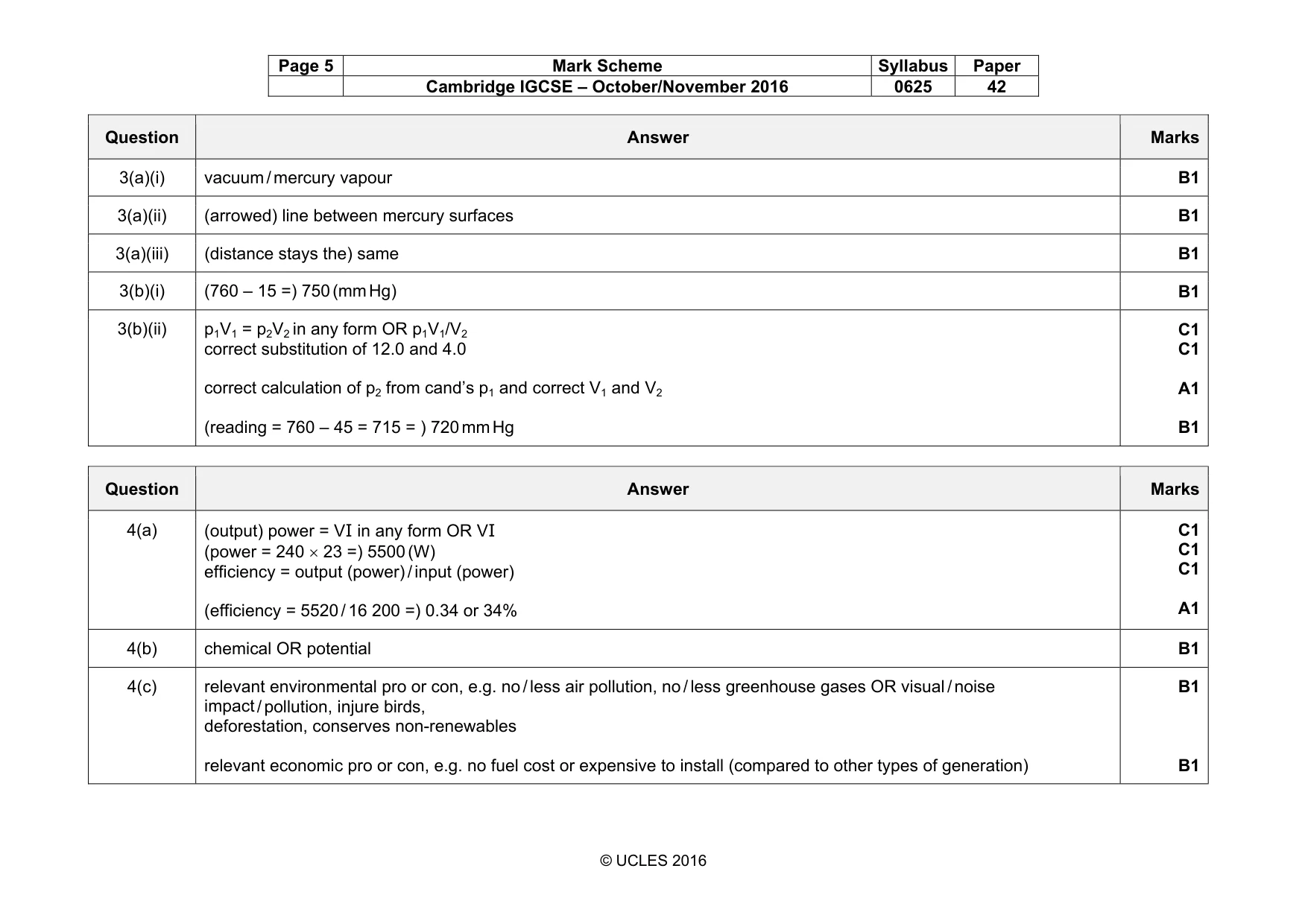
Mark scheme: 3(a)(i) vacuum / mercury vapour B1 3(a)(ii) (arrowed) line between mercury surfaces B1 3(a)(iii) (distance stays the) same B1 3(b)(i) (760 – 15 =) 750 (mm Hg) B1 3(b)(ii) p1V1 = p2V2 in any form OR p1V1/V2 correct substitution of 12.0 and 4.0 correct calculation of p2 from cand’s p1 and correct V1 and V2 (reading = 760 – 45 = 715 = ) 720 mm Hg C1 C1 A1 B1
Q4 · A small wind turbine drives a generator to provide electricity for an isolated village
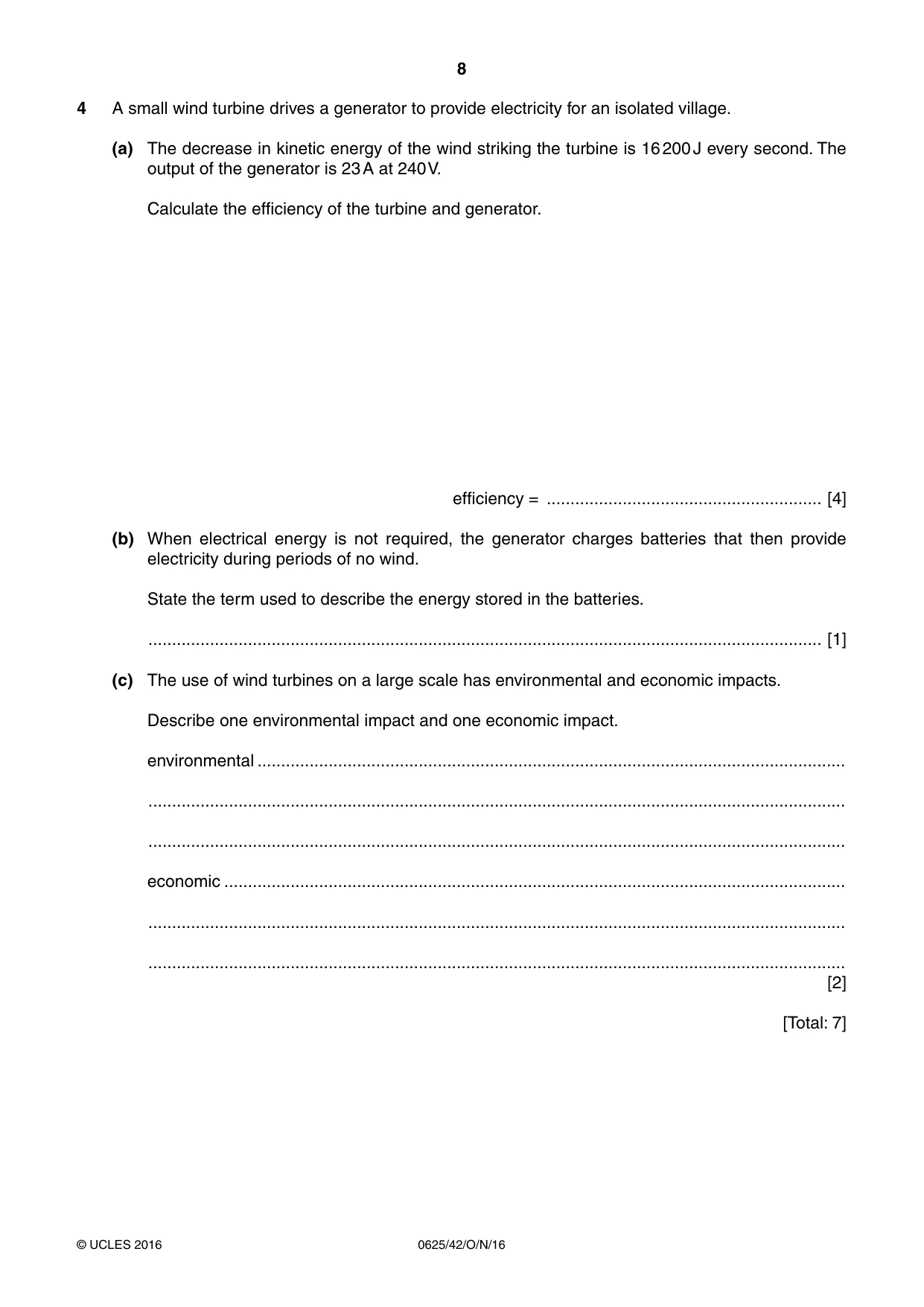
4 A small wind turbine drives a generator to provide electricity for an isolated village. (a) The decrease in kinetic energy of the wind striking the turbine is 16 200 J every second. The output of the generator is 23 A at 240 V. Calculate the efficiency of the turbine and generator. efficiency = .......................................................... [4] (b) When electrical energy is not required, the generator charges batteries that then provide electricity during periods of no wind. State the term used to describe the energy stored in the batteries. .............................................................................................................................................. [1] (c) The use of wind turbines on a large scale has environmental and economic impacts. Describe one environmental impact and one economic impact. environmental ............................................................................................................................ ................................................................................................................................................... ................................................................................................................................................... economic ................................................................................................................................... ................................................................................................................................................... ................................................................................................................................................... [2] [Total: 7]
Mark scheme: 4(a) (power = 240 × 23 =) 5500 (W) efficiency = output (power) / input (power) (efficiency = 5520 / 16 200 =) 0.34 or 34% C1 C1 C1 A1 4(b) chemical OR potential B1 4(c) relevant environmental pro or con, e.g. no / less air pollution, no / less greenhouse gases OR visual / noise impact / pollution, injure birds, deforestation, conserves non-renewables relevant economic pro or con, e.g. no fuel cost or expensive to install (compared to other types of generation) B1 B1
Q5 · State a comparison of (i) the arrangement of the molecules in ice and in liquid water…
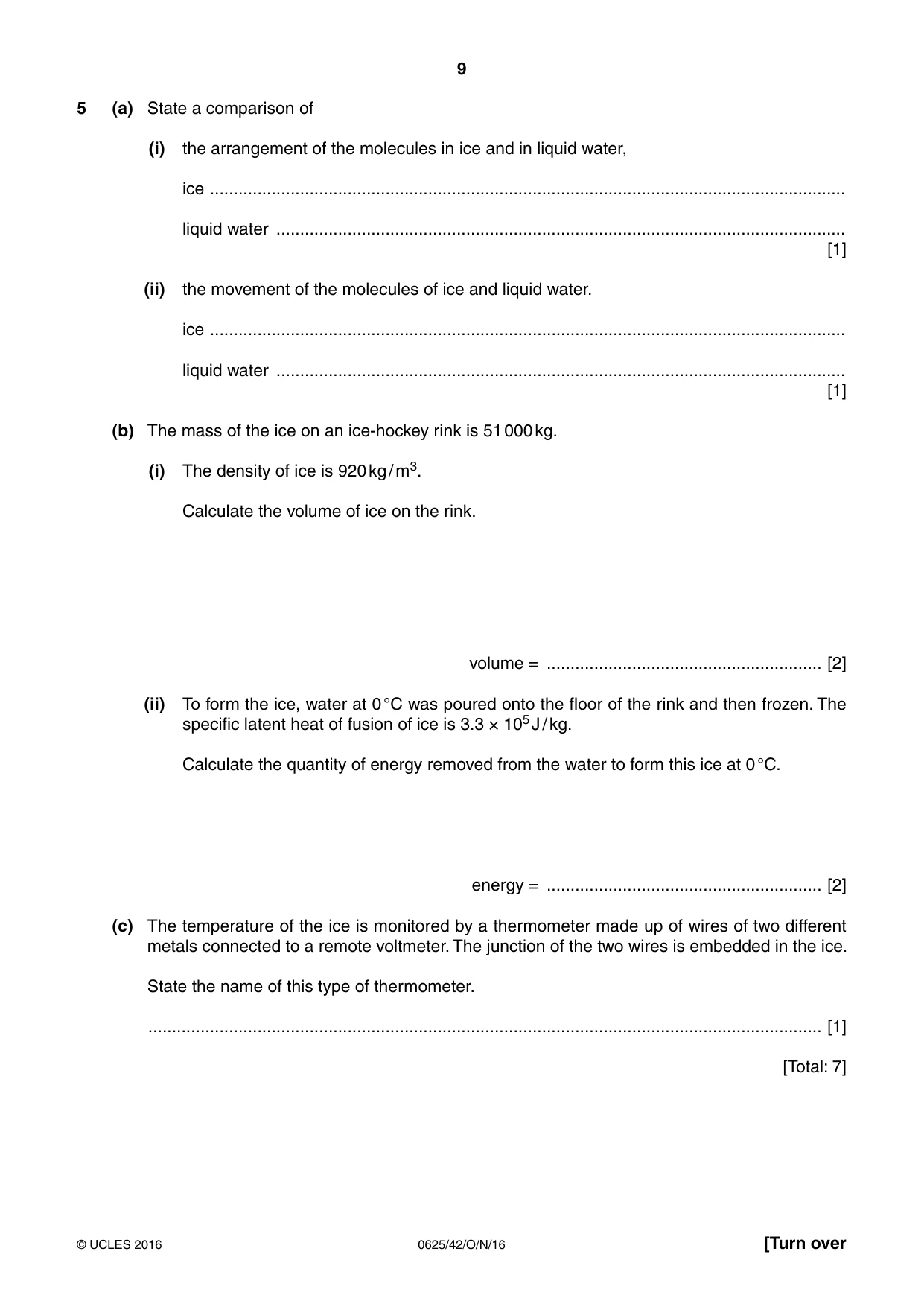
5 (a) State a comparison of (i) the arrangement of the molecules in ice and in liquid water, ice ...................................................................................................................................... liquid water ........................................................................................................................ [1] (ii) the movement of the molecules of ice and liquid water. ice ...................................................................................................................................... liquid water ........................................................................................................................ [1] (b) The mass of the ice on an ice-hockey rink is 51 000 kg. (i) The density of ice is 920 kg / m3. Calculate the volume of ice on the rink. volume = .......................................................... [2] (ii) To form the ice, water at 0 °C was poured onto the floor of the rink and then frozen. The specific latent heat of fusion of ice is 3.3 × 10⁵ J / kg. Calculate the quantity of energy removed from the water to form this ice at 0 °C. energy = .......................................................... [2] (c) The temperature of the ice is monitored by a thermometer made up of wires of two different metals connected to a remote voltmeter. The junction of the two wires is embedded in the ice. State the name of this type of thermometer. .............................................................................................................................................. [1] [Total: 7]
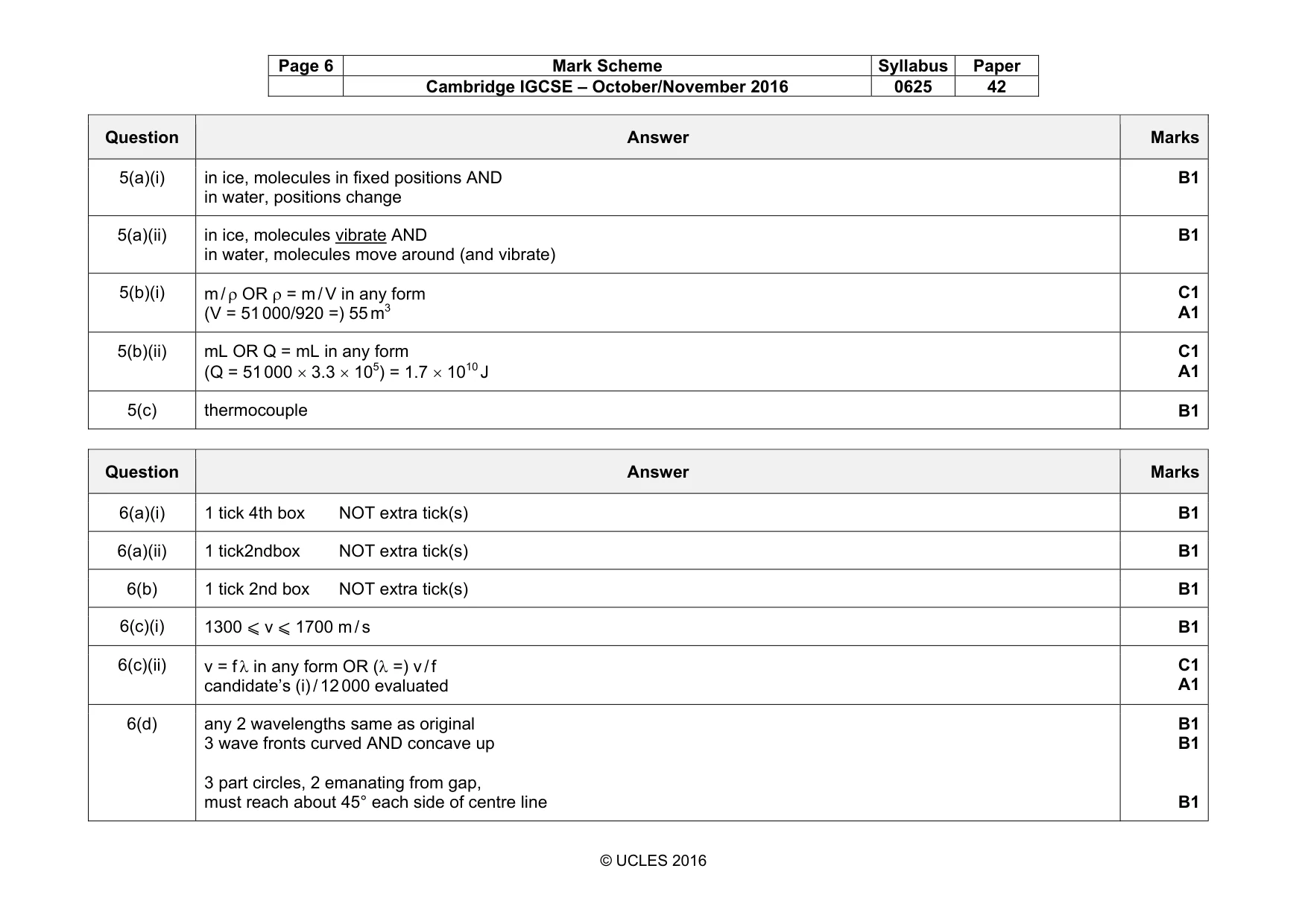
Mark scheme: 5(a)(i) in ice, molecules in fixed positions AND in water, positions change B1 5(a)(ii) in ice, molecules vibrate AND in water, molecules move around (and vibrate) B1 5(b)(i) m / ρ OR ρ = m / V in any form (V = 51 000/920 =) 55 m3 C1 A1 5(b)(ii) mL OR Q = mL in any form (Q = 51 000 × 3.3 × 105) = 1.7 × 10¹⁰ J C1 A1 5(c) thermocouple B1
Q6 · The pitch of a sound wave increases
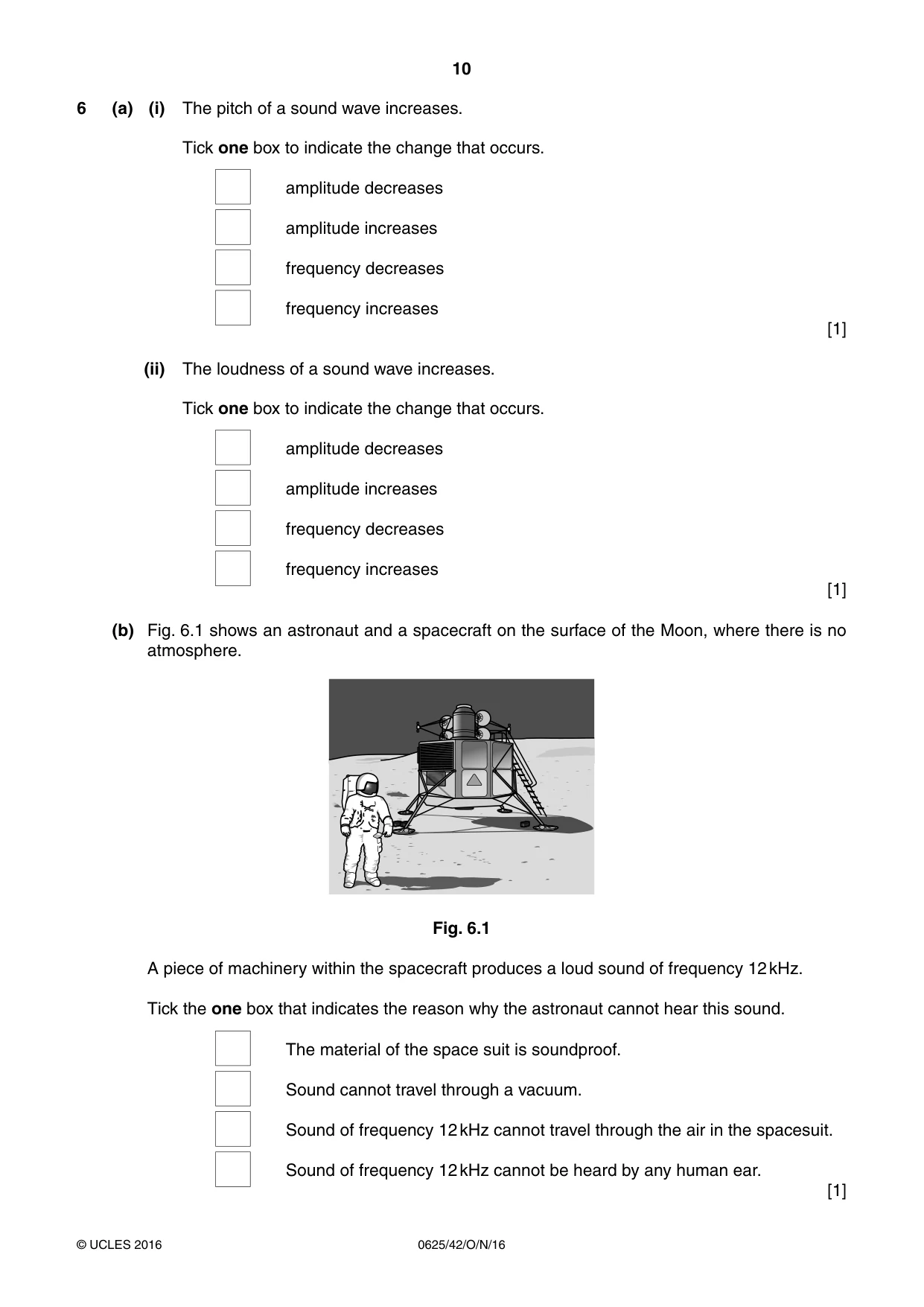
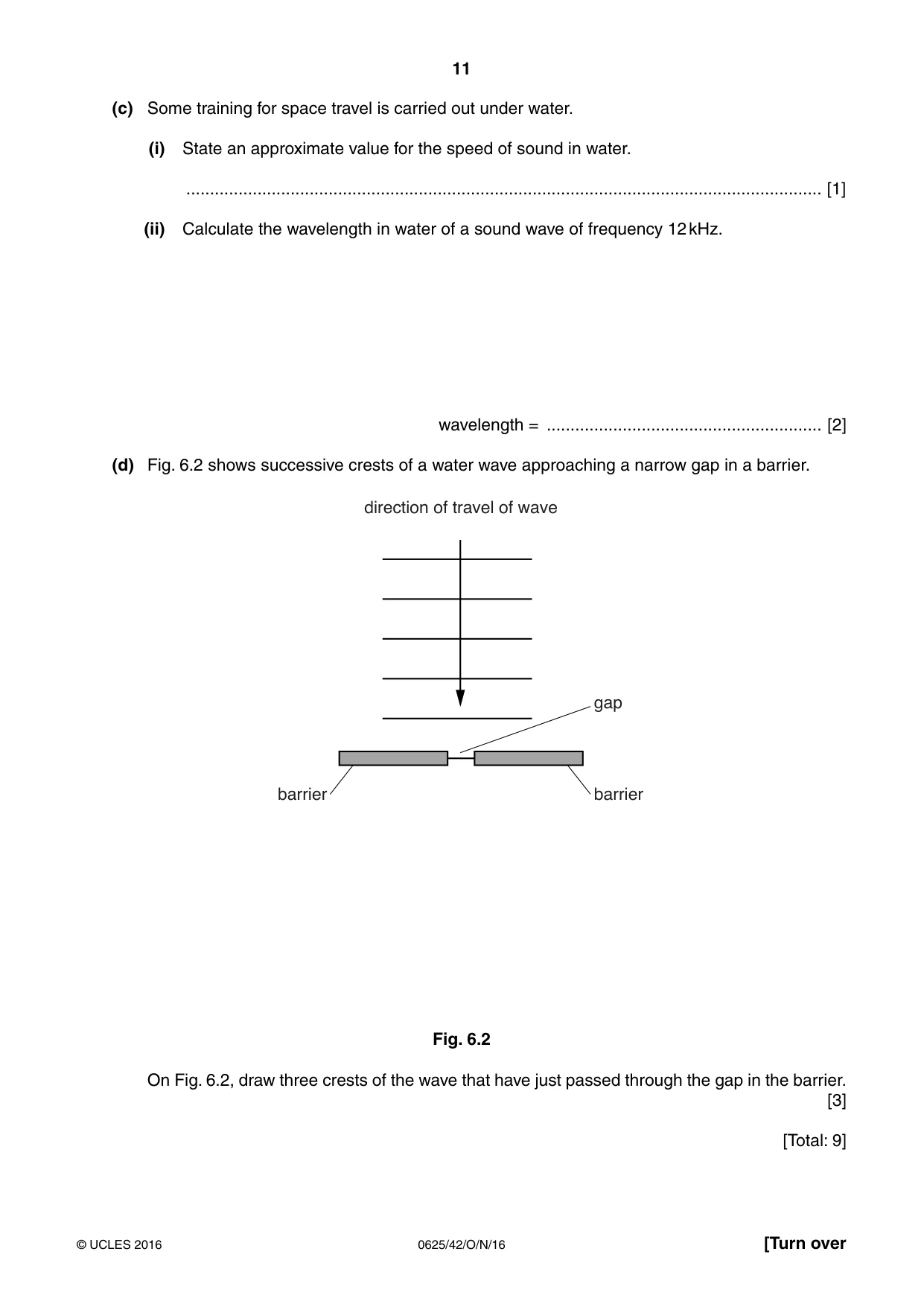
6 (a) (i) The pitch of a sound wave increases. Tick one box to indicate the change that occurs. amplitude decreases amplitude increases frequency decreases frequency increases [1] (ii) The loudness of a sound wave increases. Tick one box to indicate the change that occurs. amplitude decreases amplitude increases frequency decreases frequency increases [1] (b) Fig. 6.1 shows an astronaut and a spacecraft on the surface of the Moon, where there is no atmosphere. Fig. 6.1 A piece of machinery within the spacecraft produces a loud sound of frequency 12 kHz. Tick the one box that indicates the reason why the astronaut cannot hear this sound. The material of the space suit is soundproof. Sound cannot travel through a vacuum. Sound of frequency 12 kHz cannot travel through the air in the spacesuit. Sound of frequency 12 kHz cannot be heard by any human ear. [1] (c) Some training for space travel is carried out under water. (i) State an approximate value for the speed of sound in water. ...................................................................................................................................... [1] (ii) Calculate the wavelength in water of a sound wave of frequency 12 kHz. wavelength = .......................................................... [2] (d) Fig. 6.2 shows successive crests of a water wave approaching a narrow gap in a barrier. direction of travel of wave gap barrier barrier Fig. 6.2 On Fig. 6.2, draw three crests of the wave that have just passed through the gap in the barrier. [3] [Total: 9]
Mark scheme: 6(a)(i) 1 tick 4th box NOT extra tick(s) B1 6(a)(ii) 1 tick2ndbox NOT extra tick(s) B1 6(b) 1 tick 2nd box NOT extra tick(s) B1 6(c)(i) 1300 ⩽ v ⩽ 1700 m / s B1 6(c)(ii) v = f λ in any form OR (λ =) v / f candidate’s (i) / 12 000 evaluated C1 A1 6(d) any 2 wavelengths same as original 3 wave fronts curved AND concave up 3 part circles, 2 emanating from gap, must reach about 45° each side of centre line B1 B1 B1
Q7 · In the space below, draw the circuit symbol for a thermistor
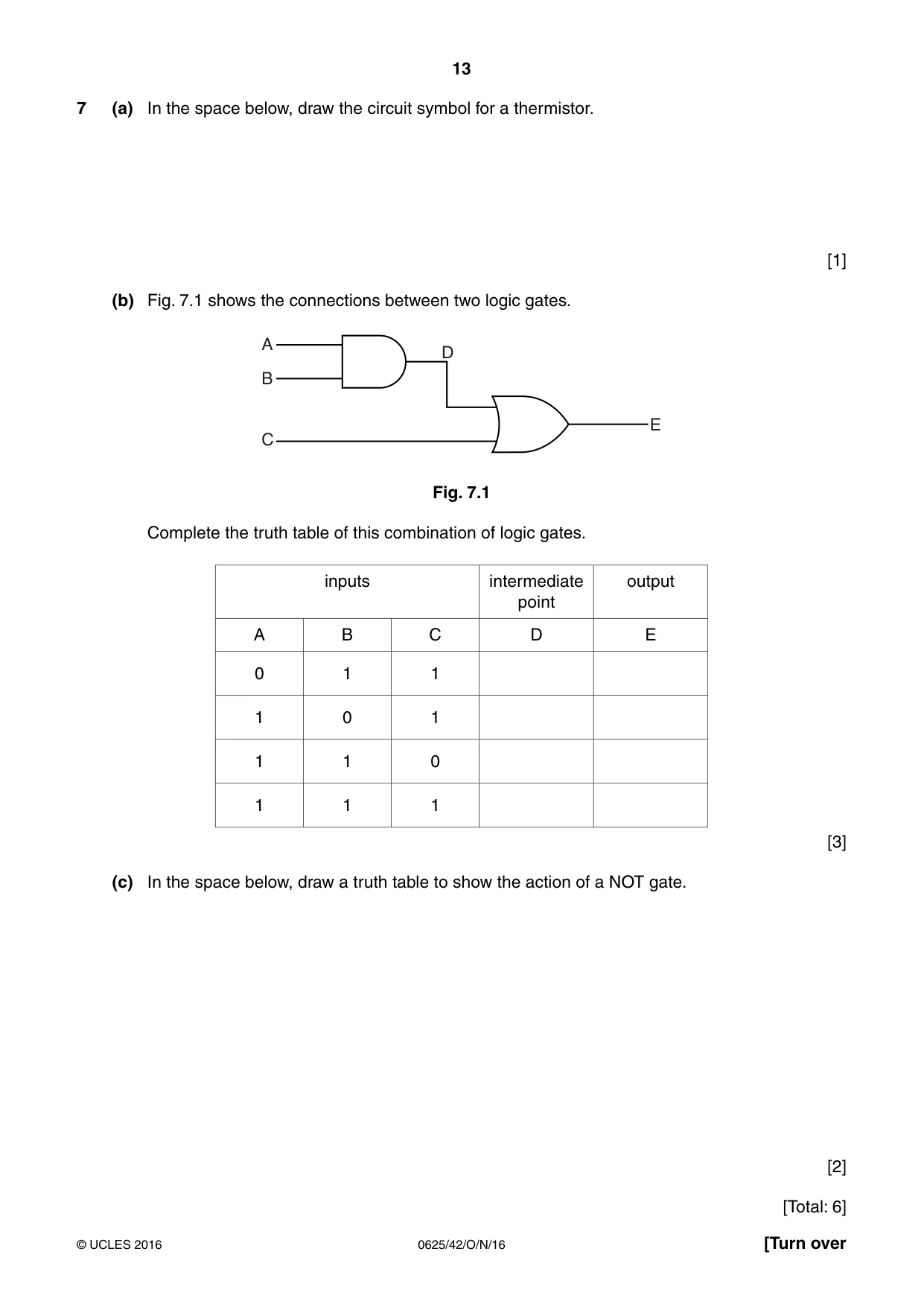
7 (a) In the space below, draw the circuit symbol for a thermistor. [1] (b) Fig. 7.1 shows the connections between two logic gates. A D B E C Fig. 7.1 Complete the truth table of this combination of logic gates. inputs intermediate output point A B C D E 0 1 1 1 0 1 1 1 0 1 1 1 [3] (c) In the space below, draw a truth table to show the action of a NOT gate. [2] [Total: 6]
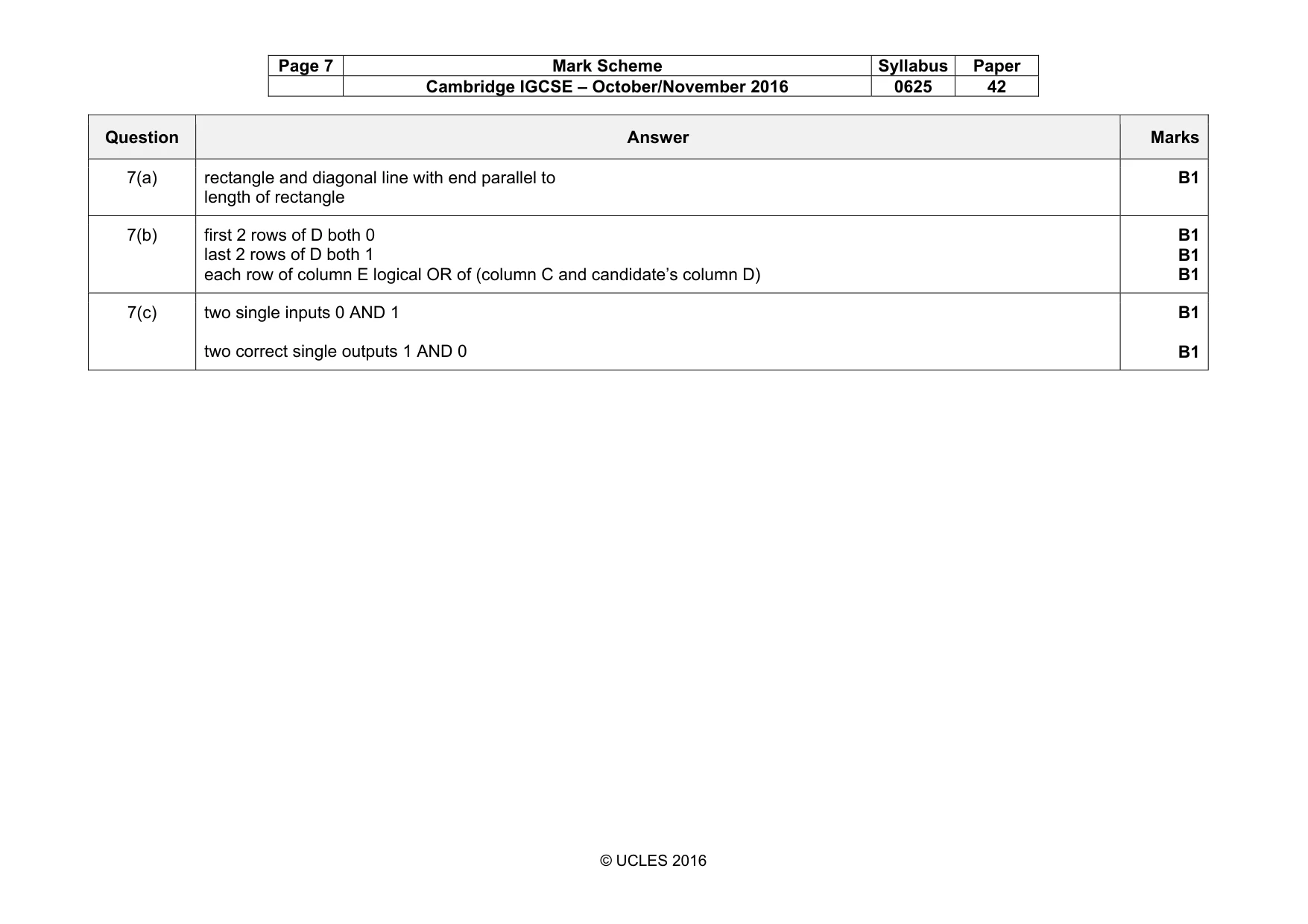
Mark scheme: 7(a) rectangle and diagonal line with end parallel to length of rectangle B1 7(b) first 2 rows of D both 0 last 2 rows of D both 1 each row of column E logical OR of (column C and candidate’s column D) B1 B1 B1 7(c) two single inputs 0 AND 1 two correct single outputs 1 AND 0 B1 B1
Q8 · A student draws a diagram to represent the electromagnetic spectrum
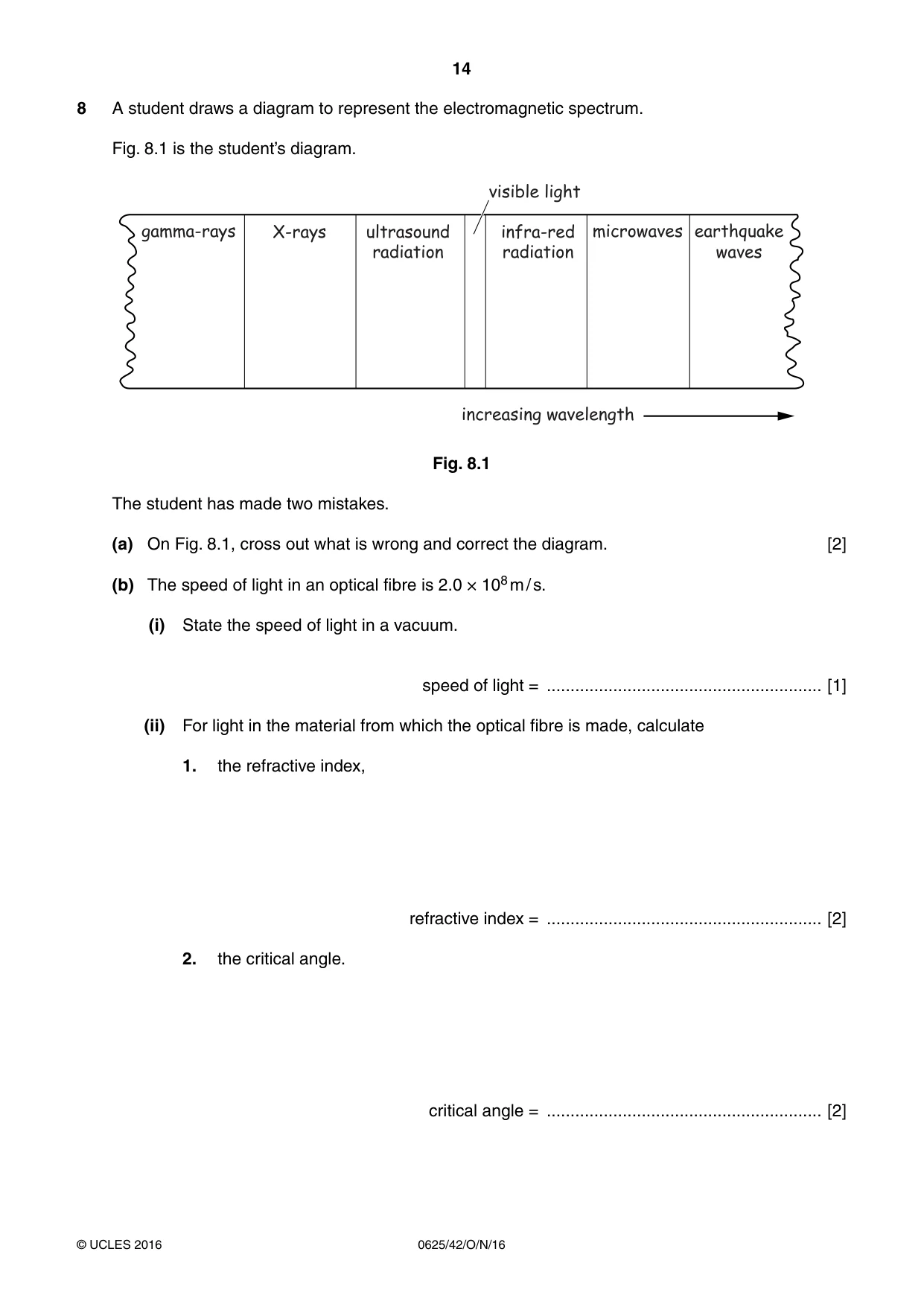
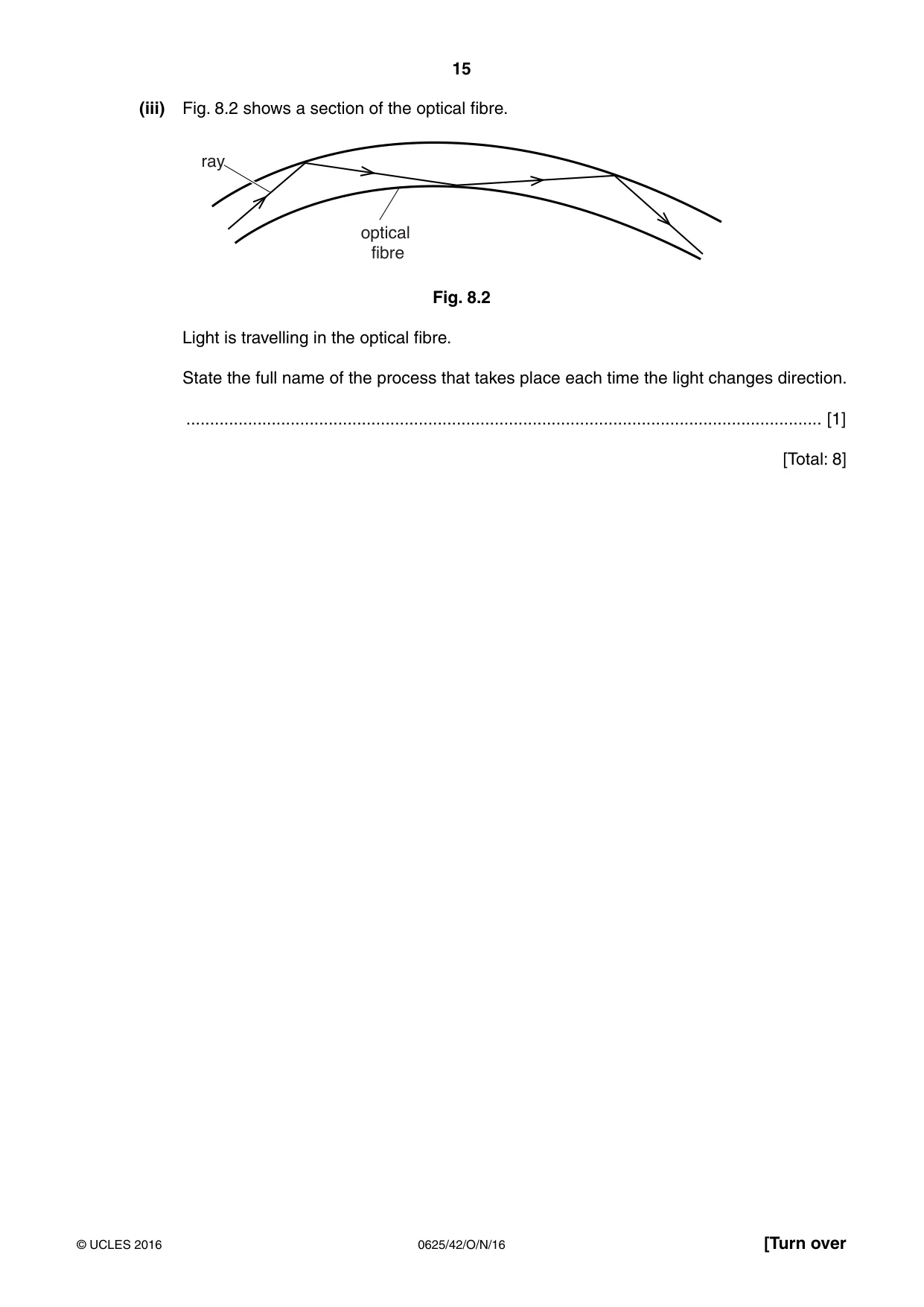
8 A student draws a diagram to represent the electromagnetic spectrum. Fig. 8.1 is the student’s diagram. visible light gamma-rays X-rays ultrasound infra-red microwaves earthquake radiation radiation waves increasing wavelength Fig. 8.1 The student has made two mistakes. (a) On Fig. 8.1, cross out what is wrong and correct the diagram. [2] (b) The speed of light in an optical fibre is 2.0 × 10⁸ m / s. (i) State the speed of light in a vacuum. speed of light = .......................................................... [1] (ii) For light in the material from which the optical fibre is made, calculate 1. the refractive index, refractive index = .......................................................... [2] 2. the critical angle. critical angle = .......................................................... [2] (iii) Fig. 8.2 shows a section of the optical fibre. ray optical fibre Fig. 8.2 Light is travelling in the optical fibre. State the full name of the process that takes place each time the light changes direction. ...................................................................................................................................... [1] [Total: 8]
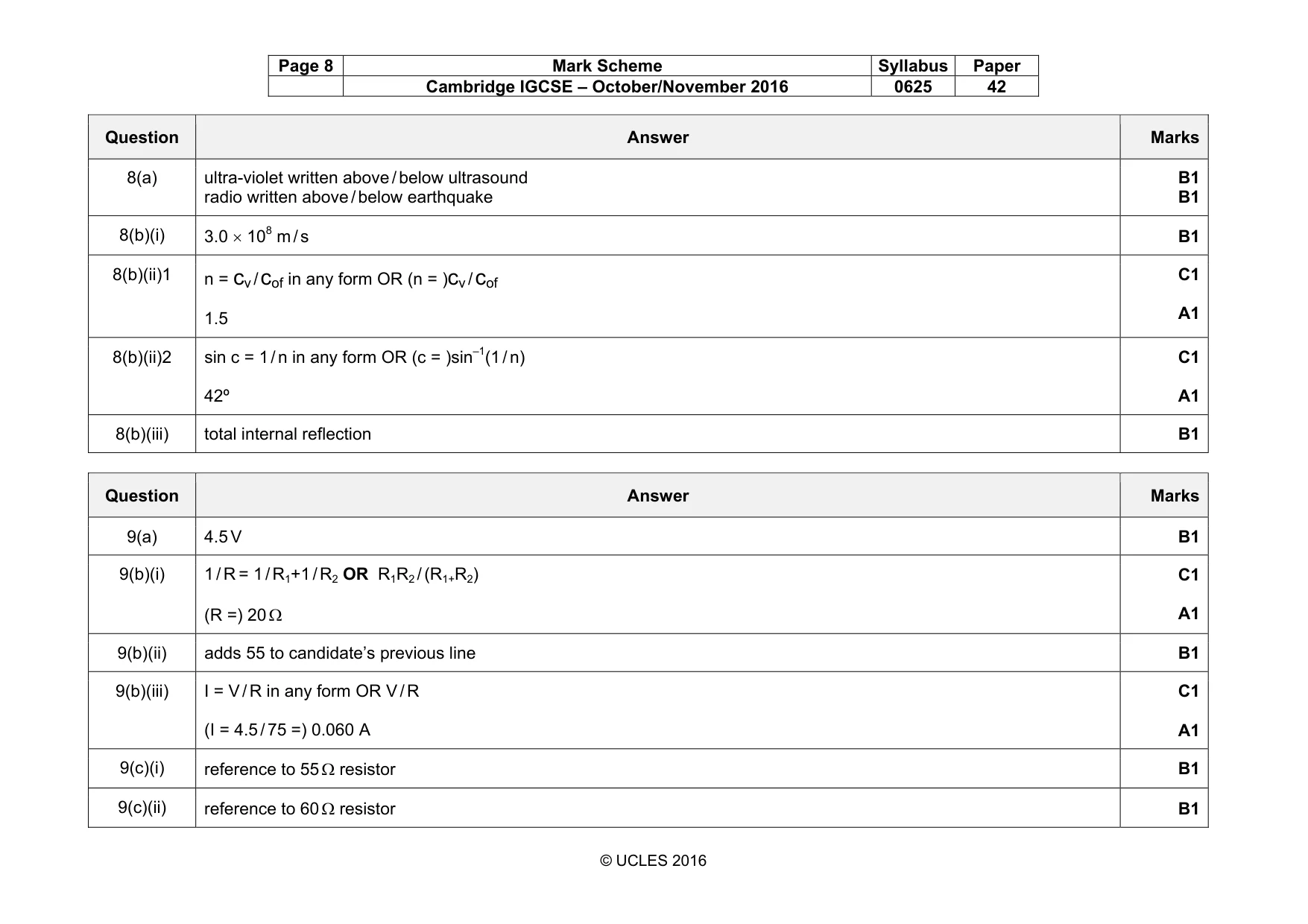
Mark scheme: 8(a) ultra-violet written above / below ultrasound radio written above / below earthquake B1 B1 8(b)(i) 3.0 × 10⁸ m / s B1 8(b)(ii)1 n = cv / cof in any form OR (n = )cv / cof 1.5 C1 A1 8(b)(ii)2 sin c = 1 / n in any form OR (c = )sin–1(1 / n) 42º C1 A1 8(b)(iii) total internal reflection B1
Question 9
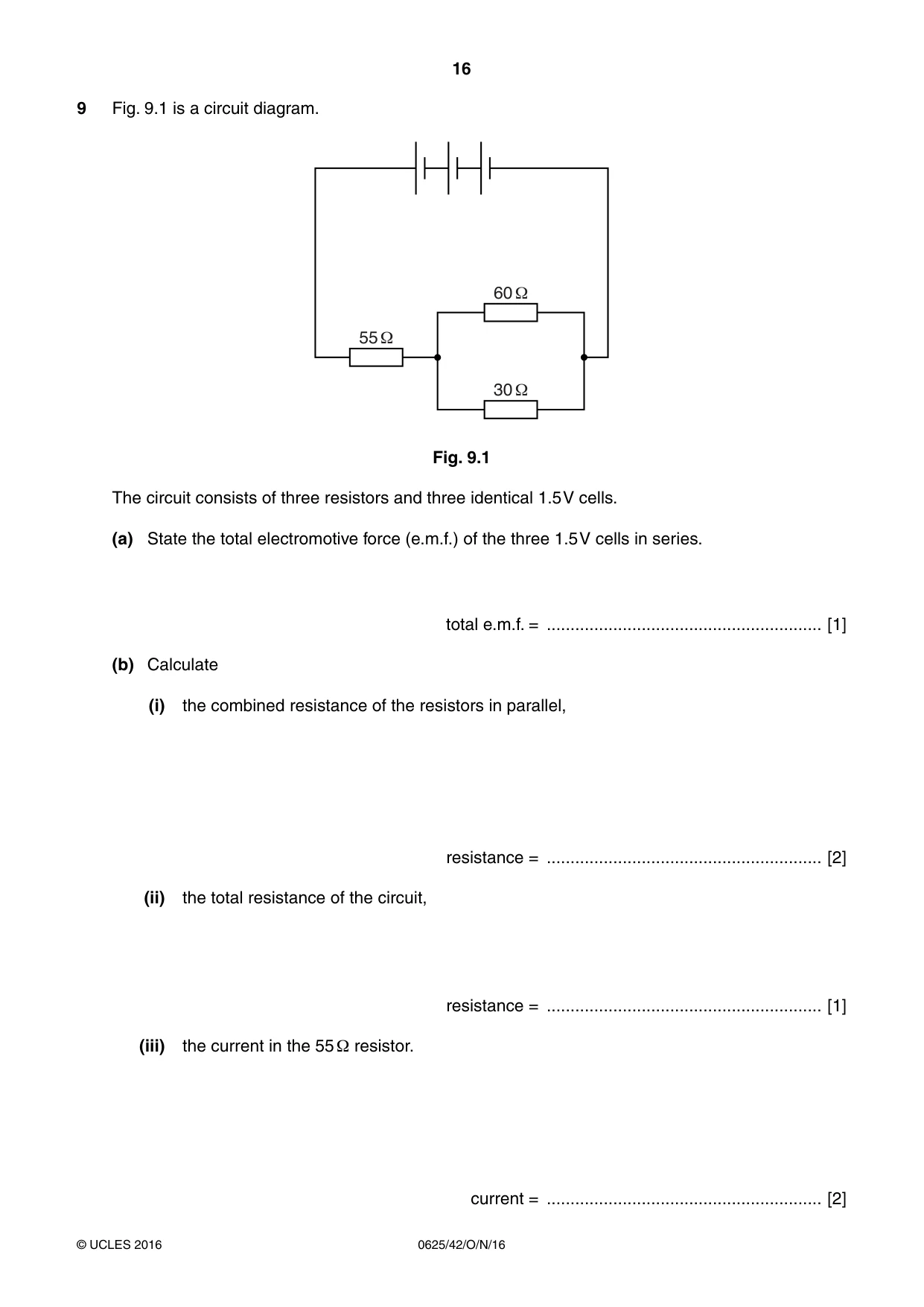
9 Fig. 9.1 is a circuit diagram. 60 1 55 1 30 1 Fig. 9.1 The circuit consists of three resistors and three identical 1.5 V cells. (a) State the total electromotive force (e.m.f.) of the three 1.5 V cells in series. total e.m.f. = .......................................................... [1] (b) Calculate (i) the combined resistance of the resistors in parallel, resistance = .......................................................... [2] (ii) the total resistance of the circuit, resistance = .......................................................... [1] (iii) the current in the 55 Ω resistor. current = .......................................................... [2] (c) The currents in the 30 Ω, the 55 Ω and the 60 Ω resistors are all different. State the resistance of the resistor in which the current is (i) the largest, resistance = .......................................................... [1] (ii) the smallest. resistance = .......................................................... [1] [Total: 8]
Mark scheme: 9(a) 4.5 V B1 9(b)(i) 1 / R = 1 / R1+1 / R2 OR R1R2 / (R1+R2) (R =) 20 Ω C1 A1 9(b)(ii) adds 55 to candidate’s previous line B1 9(b)(iii) I = V / R in any form OR V / R (I = 4.5 / 75 =) 0.060 A C1 A1 9(c)(i) reference to 55 Ω resistor B1 9(c)(ii) reference to 60 Ω resistor B1
Q10 · The size of the charge on an electron is e
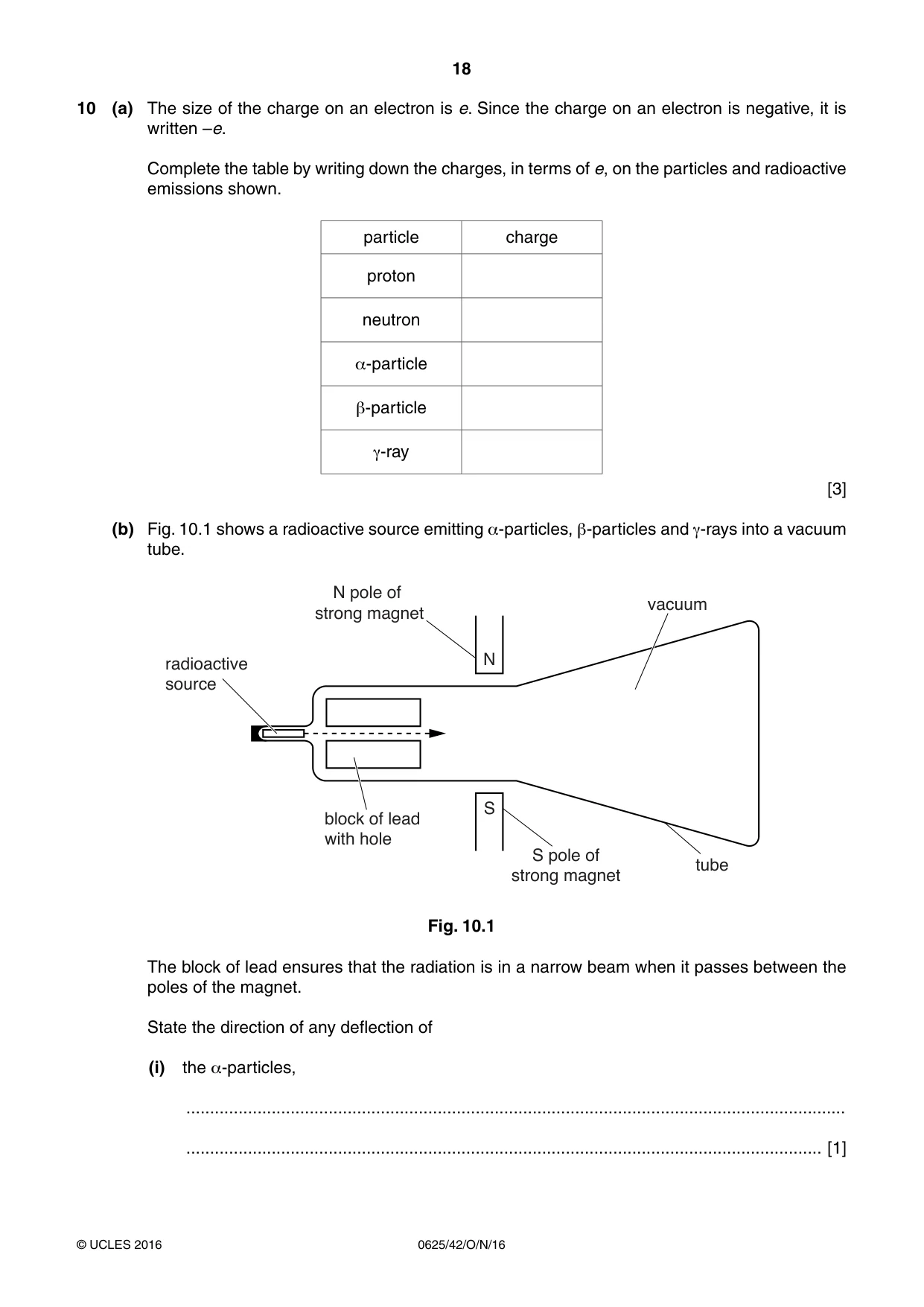
10 (a) The size of the charge on an electron is e. Since the charge on an electron is negative, it is written –e. Complete the table by writing down the charges, in terms of e, on the particles and radioactive emissions shown. particle charge proton neutron α-particle β-particle γ-ray [3] (b) Fig. 10.1 shows a radioactive source emitting α-particles, β-particles and γ-rays into a vacuum tube. N pole of vacuum strong magnet radioactive N source S block of lead with hole S pole of tube strong magnet Fig. 10.1 The block of lead ensures that the radiation is in a narrow beam when it passes between the poles of the magnet. State the direction of any deflection of (i) the α-particles, ........................................................................................................................................... ...................................................................................................................................... [1] (ii) the β-particles, ........................................................................................................................................... ...................................................................................................................................... [1] (iii) the γ-rays. ........................................................................................................................................... ...................................................................................................................................... [1] [Total: 6]
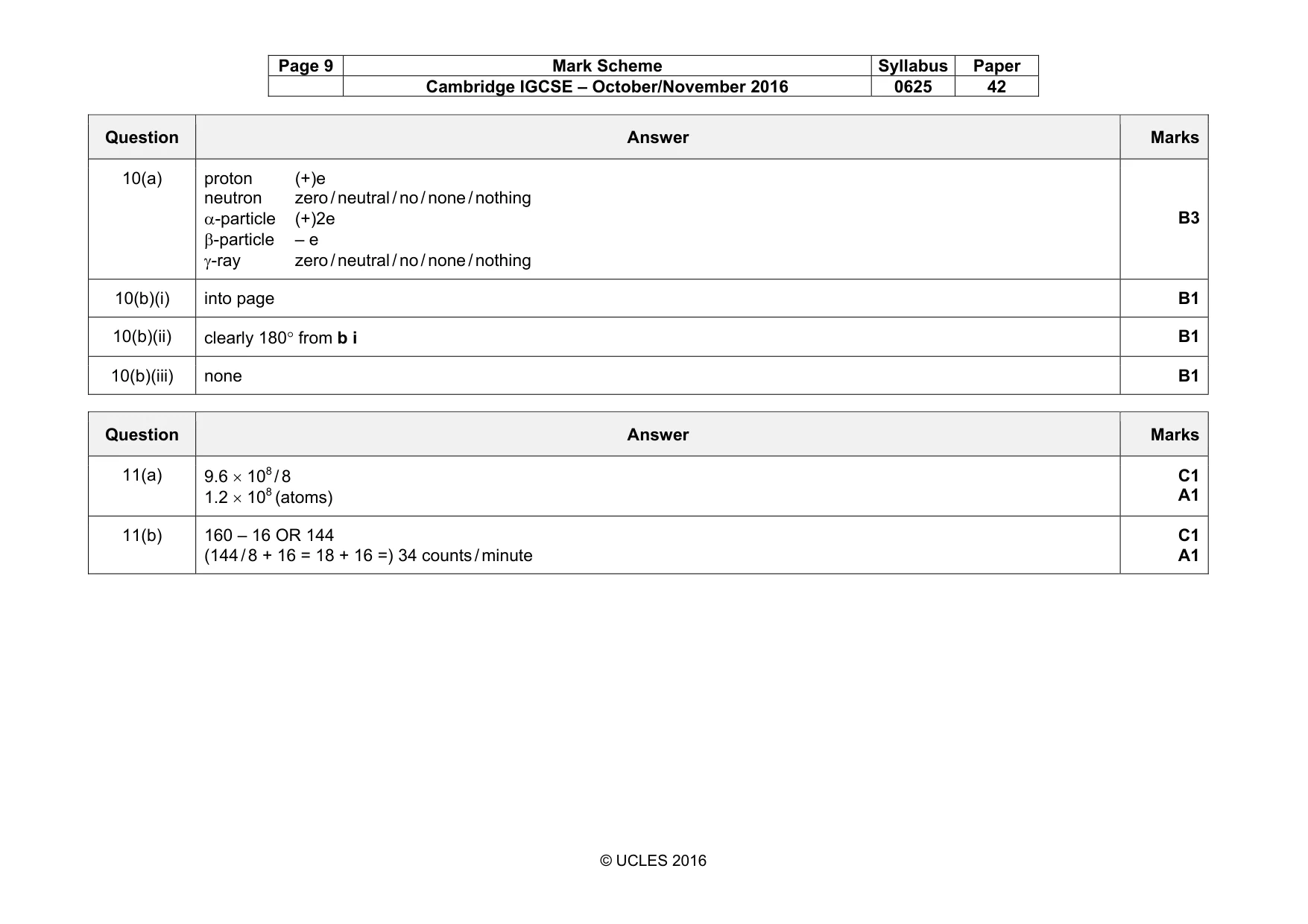
Mark scheme: 10(a) proton (+)e neutron zero / neutral / no / none / nothing α-particle (+)2e β-particle – e γ-ray zero / neutral / no / none / nothing B3 10(b)(i) into page B1 10(b)(ii) clearly 180° from b i B1 10(b)(iii) none B1
Q11 · A radioactive nuclide has a half-life of 4.0 days
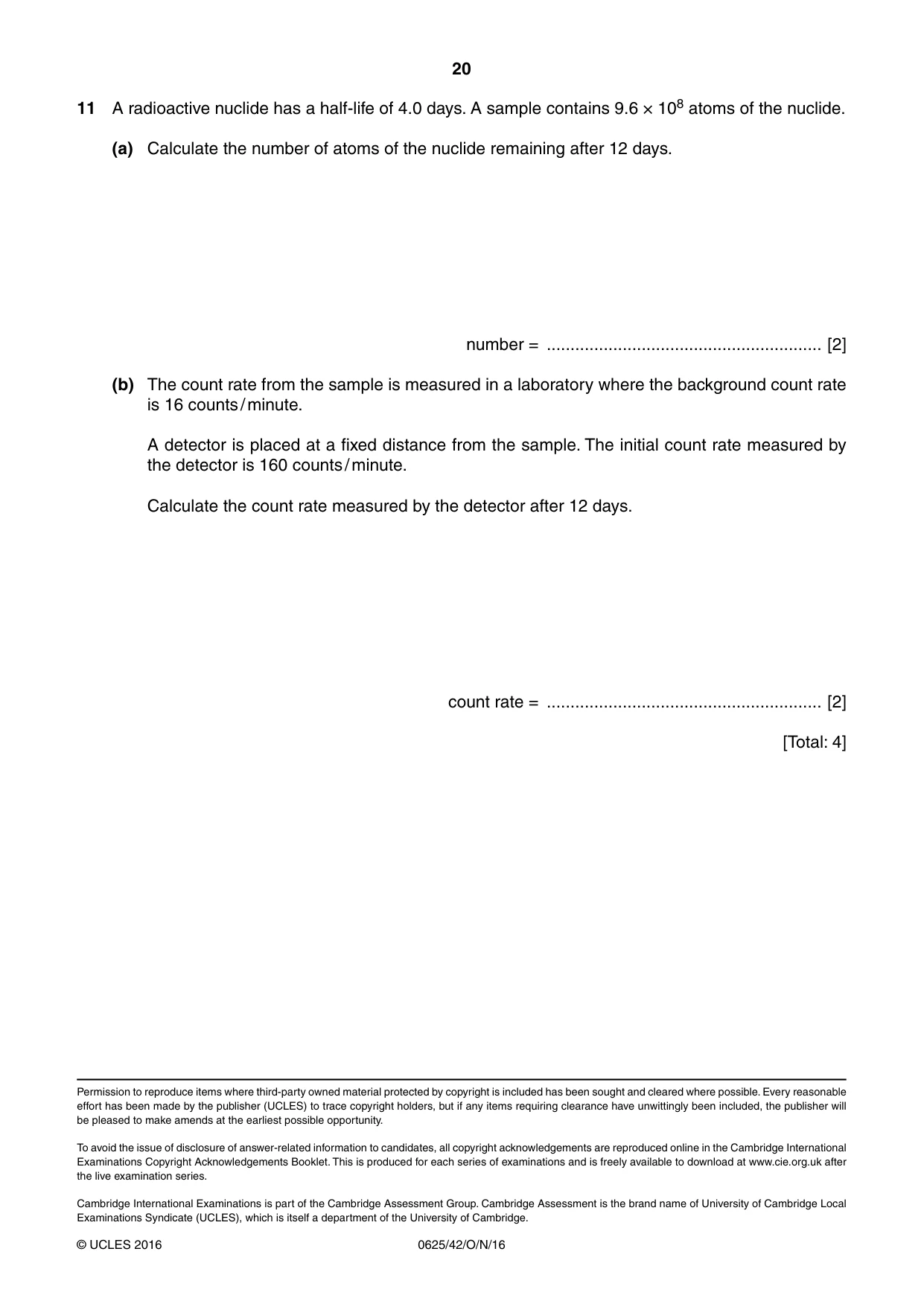
11 A radioactive nuclide has a half-life of 4.0 days. A sample contains 9.6 × 10⁸ atoms of the nuclide. (a) Calculate the number of atoms of the nuclide remaining after 12 days. number = .......................................................... [2] (b) The count rate from the sample is measured in a laboratory where the background count rate is 16 counts / minute. A detector is placed at a fixed distance from the sample. The initial count rate measured by the detector is 160 counts / minute. Calculate the count rate measured by the detector after 12 days. count rate = .......................................................... [2] [Total: 4]
Mark scheme: 11(a) / 8 1.2 × 10⁸ (atoms) C1 A1 11(b) 160 – 16 OR 144 (144 / 8 + 16 = 18 + 16 =) 34 counts / minute C1 A1
What was in this paper
The subtopics covered by these 11 questions, and how many questions each got. Open one in a new tab to see every Cambridge question on it.
What you needed in this session
Cambridge’s own grade thresholds for 2016 Oct/Nov, Paper 4 · Variant 2. A higher threshold means an easier paper — the bar moves with how the cohort did.