Cambridge IGCSE Physics 0625 — 2017 May/June Paper 4 · Variant 3
0625/43/M/J/17 · 11 questions · 80 marks · ≈90 min
The question paper and its mark scheme, free to read here and free to download. This is Cambridge’s own paper, exactly as it was sat.
Question paper20 pages
Mark scheme10 pages
Answers below. Sit the paper first if you are practising.
Questions as text
Q1 · Acceleration is a vector quantity
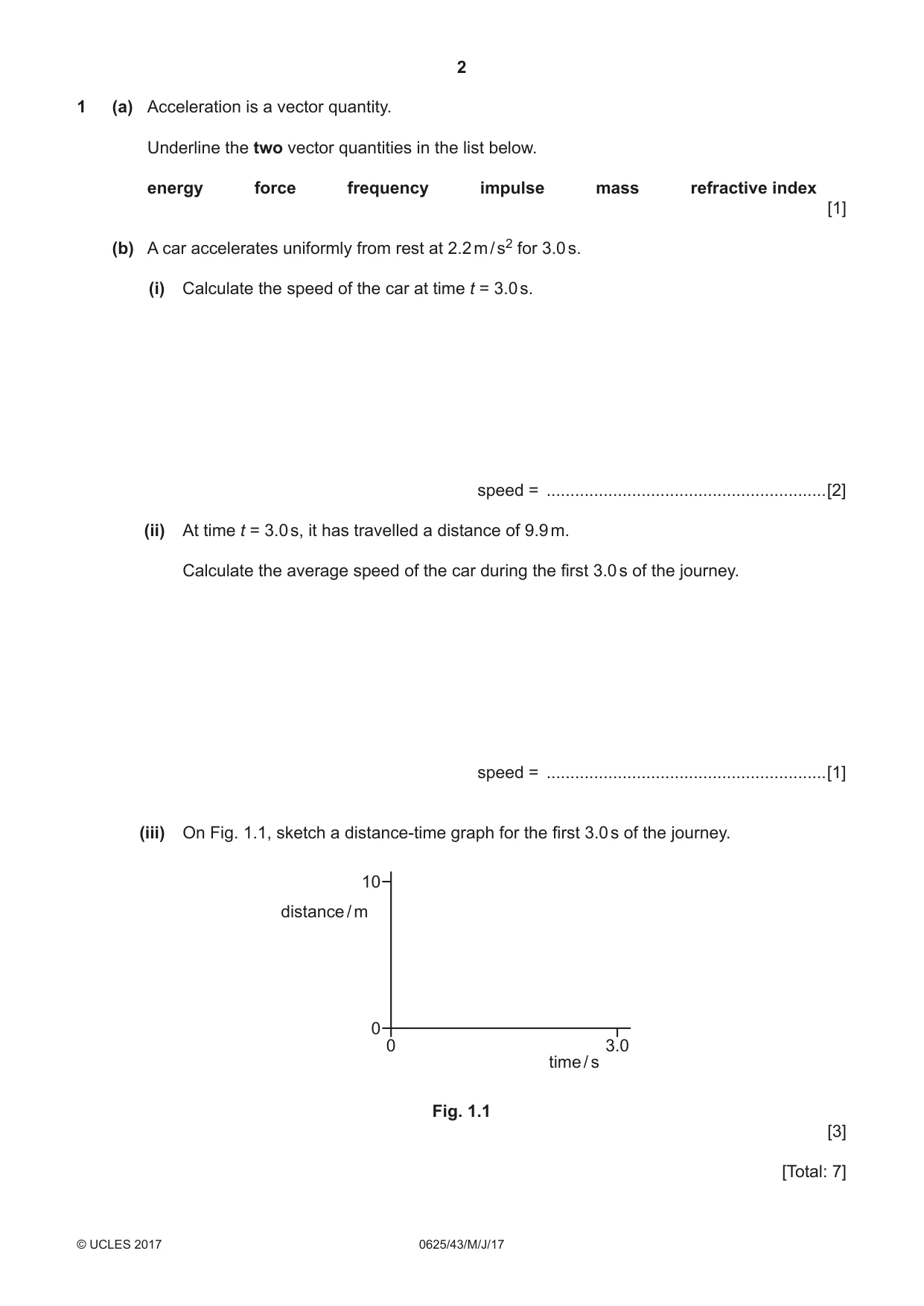
1 (a) Acceleration is a vector quantity. Underline the two vector quantities in the list below. energy force frequency impulse mass refractive index [1] (b) A car accelerates uniformly from rest at 2.2 m / s2 for 3.0 s. (i) Calculate the speed of the car at time t = 3.0 s. speed = ...........................................................[2] (ii) At time t = 3.0 s, it has travelled a distance of 9.9 m. Calculate the average speed of the car during the first 3.0 s of the journey. speed = ...........................................................[1] (iii) On Fig. 1.1, sketch a distance-time graph for the first 3.0 s of the journey. 10 distance / m 0 0 3.0 time / s Fig. 1.1 [3] [Total: 7]
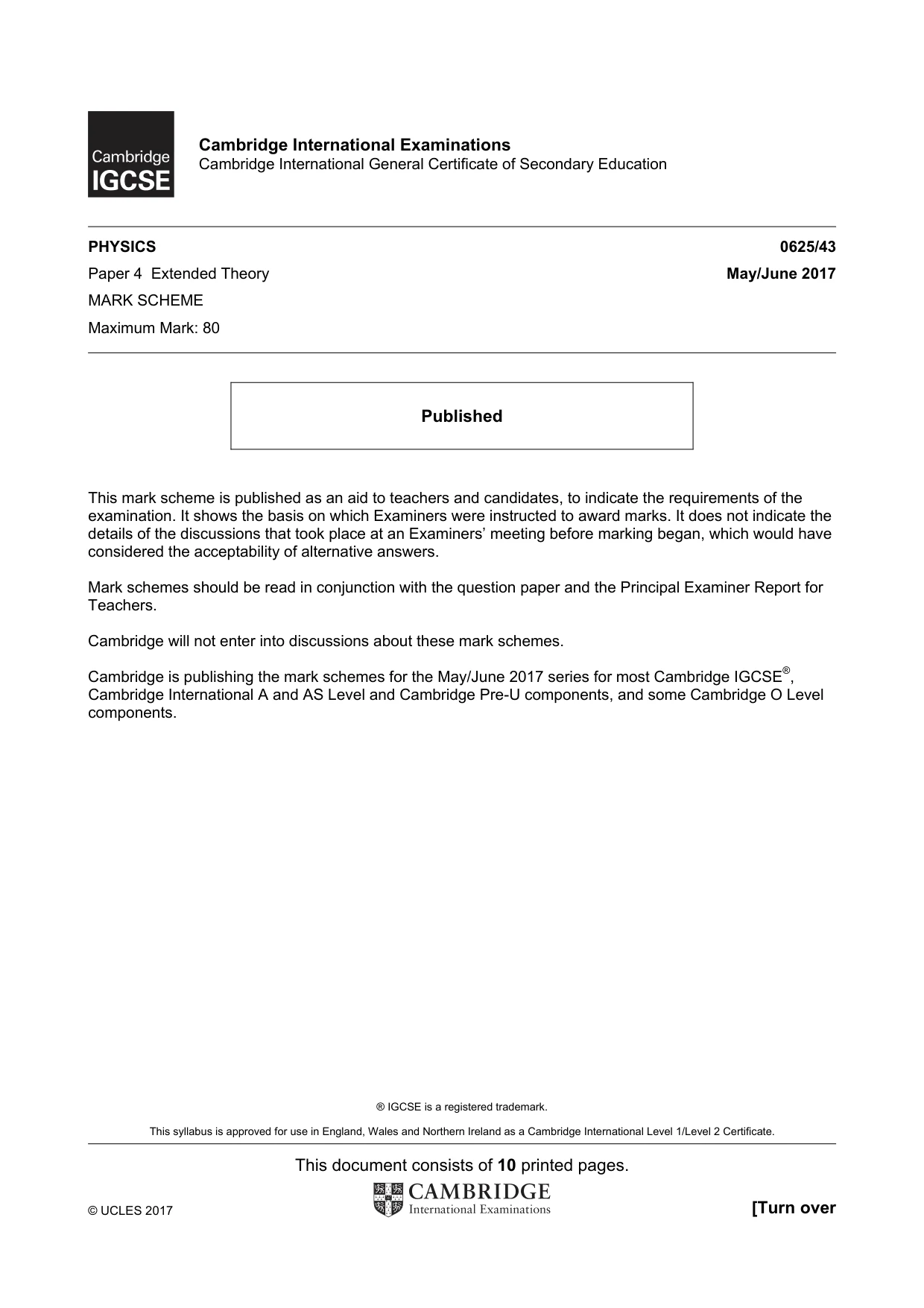
Mark scheme: 1(a) force and impulse underlined B1 1(b)(i) (v =) at OR 2.2 × 3.0 C1 6.6 m / s A1 1(b)(ii) 3.3 m / s B1 1(c) curve/line starts at origin B1 initial gradient zero OR curve passing through (3.0, 9.9) B1 gradient increasing (with time) B1 Total: 7
Q2 · State the word equation that defines momentum
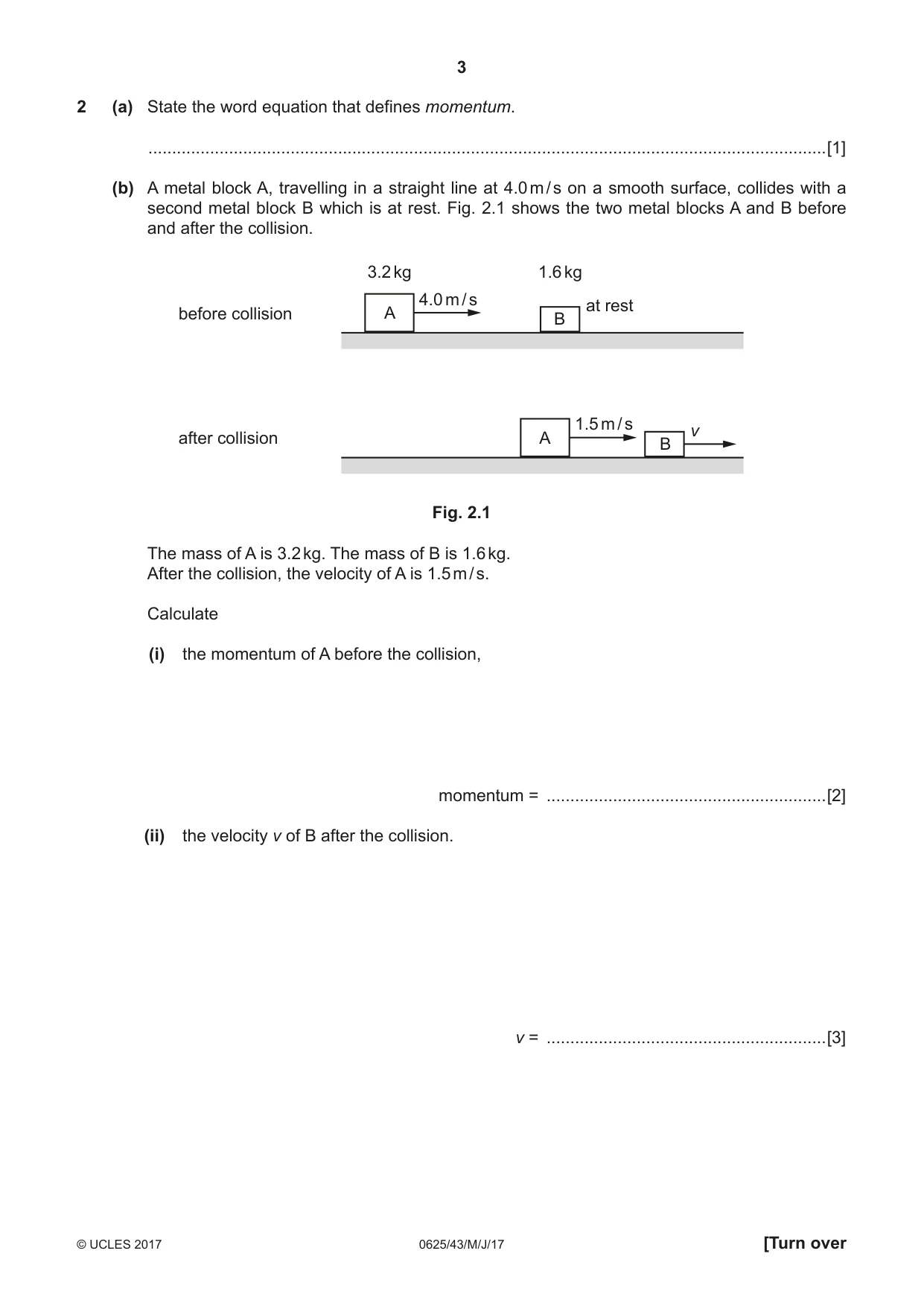
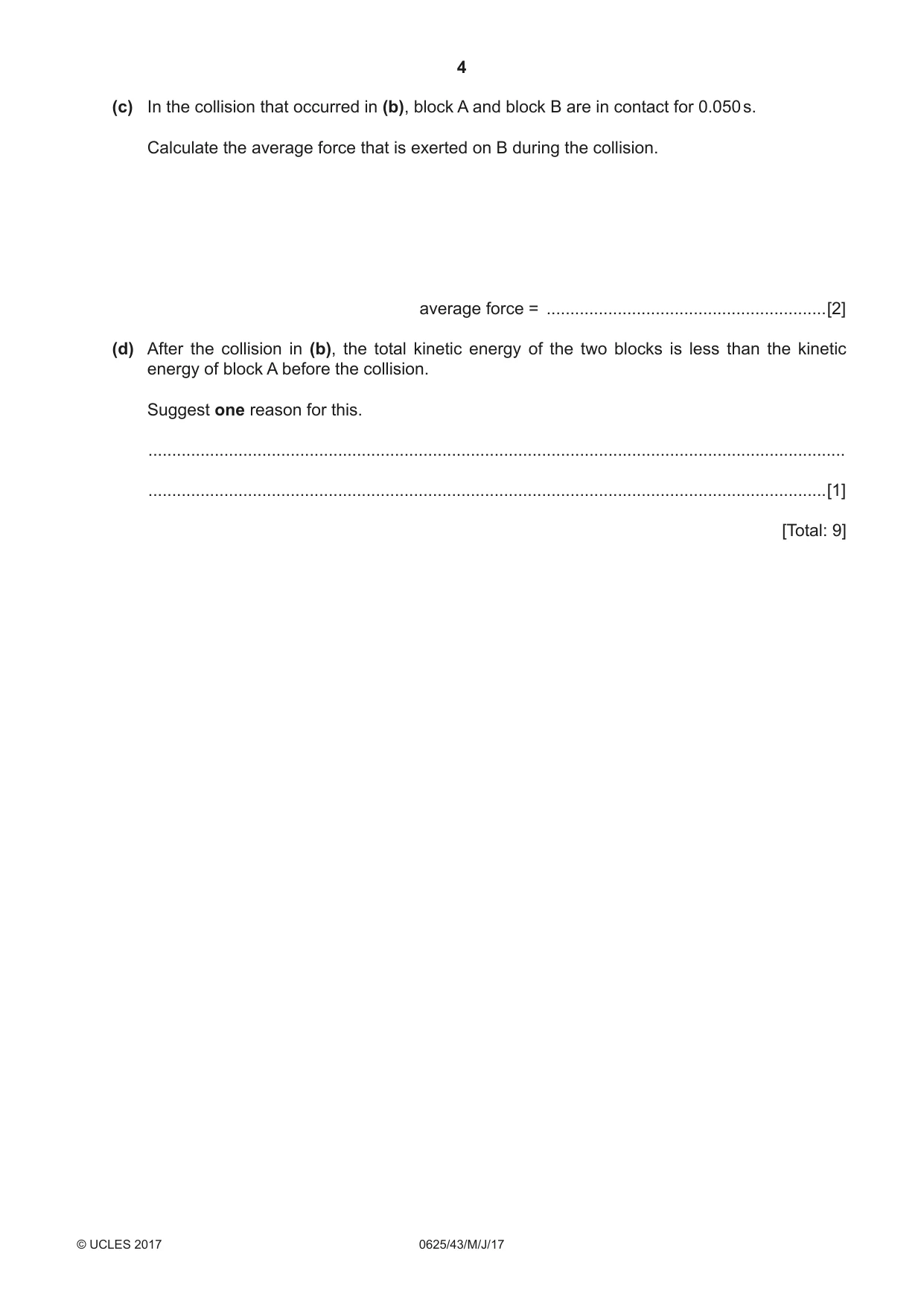
2 (a) State the word equation that defines momentum. ...............................................................................................................................................[1] (b) A metal block A, travelling in a straight line at 4.0 m / s on a smooth surface, collides with a second metal block B which is at rest. Fig. 2.1 shows the two metal blocks A and B before and after the collision. 3.2 kg 1.6 kg 4.0 m / s at rest before collision A B 1.5 m / s v after collision A B Fig. 2.1 The mass of A is 3.2 kg. The mass of B is 1.6 kg. After the collision, the velocity of A is 1.5 m / s. Calculate (i) the momentum of A before the collision, momentum = ...........................................................[2] (ii) the velocity v of B after the collision. v = ...........................................................[3] (c) In the collision that occurred in (b), block A and block B are in contact for 0.050 s. Calculate the average force that is exerted on B during the collision. average force = ...........................................................[2] (d) After the collision in (b), the total kinetic energy of the two blocks is less than the kinetic energy of block A before the collision. Suggest one reason for this. ................................................................................................................................................... ...............................................................................................................................................[1] [Total: 9]
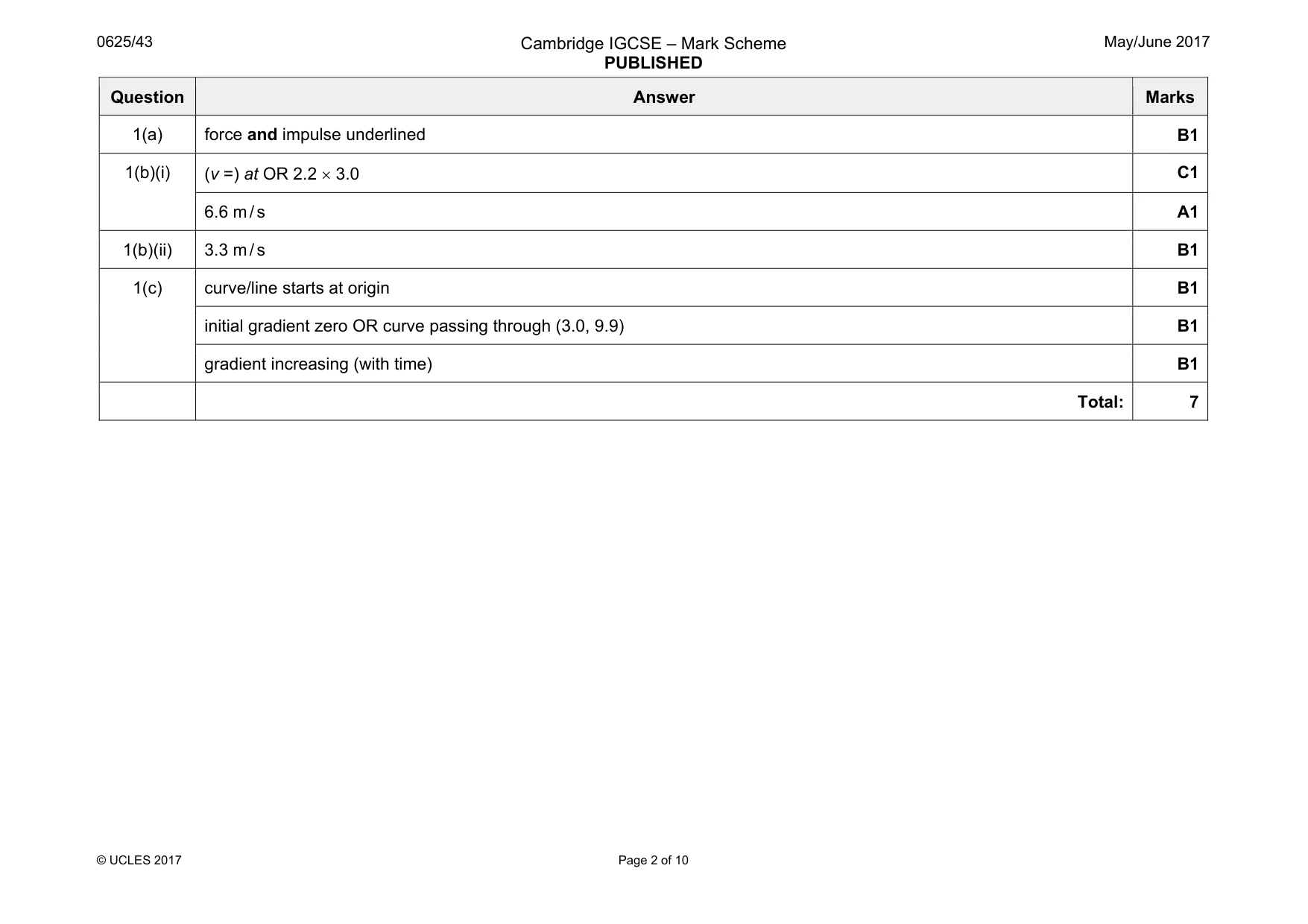
Mark scheme: 2(a) B1 2(b)(i) (p = )3.2 × 4.0 C1 13 kg m / s A1 2(b)(ii) momentum conserved C1 12.8 – (3.2 × 1.5) OR 12.8 – 4.8 OR 8.0 OR 8.0 ÷ 1.6 C1 5.0 m / s A1 2(c) (F = ) p t ∆ ∆ or 8.0 ÷ 0.050 C1 160 N A1 2(d) internal energy (of blocks) increase OR thermal energy/sound energy (lost/produced at collision) B1 Total: 9
Q3 · A block of wood has a volume of 210 cm3 and a mass of 180 g
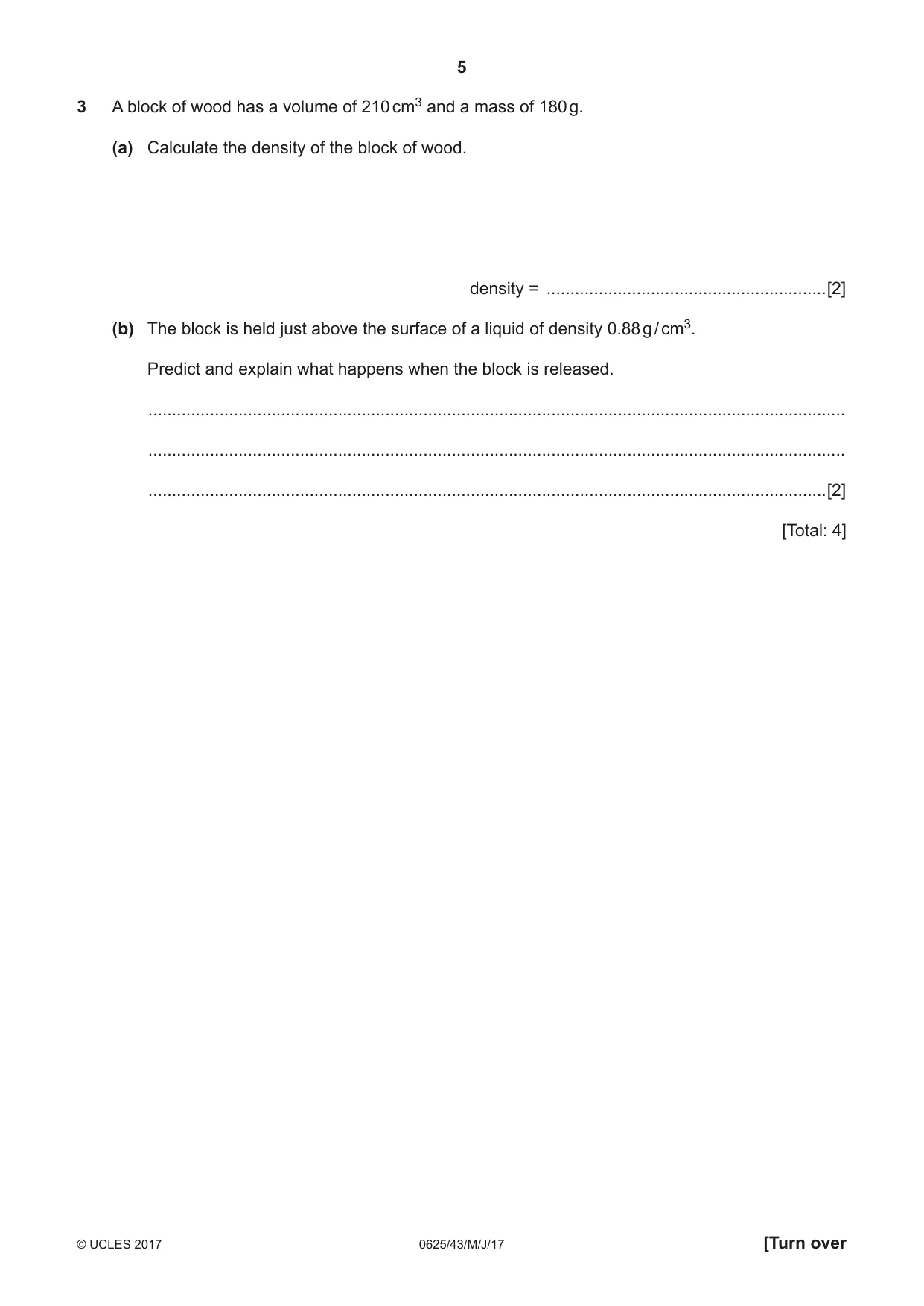
3 A block of wood has a volume of 210 cm3 and a mass of 180 g. (a) Calculate the density of the block of wood. density = ...........................................................[2] (b) The block is held just above the surface of a liquid of density 0.88 g / cm3. Predict and explain what happens when the block is released. ................................................................................................................................................... ................................................................................................................................................... ...............................................................................................................................................[2] [Total: 4]
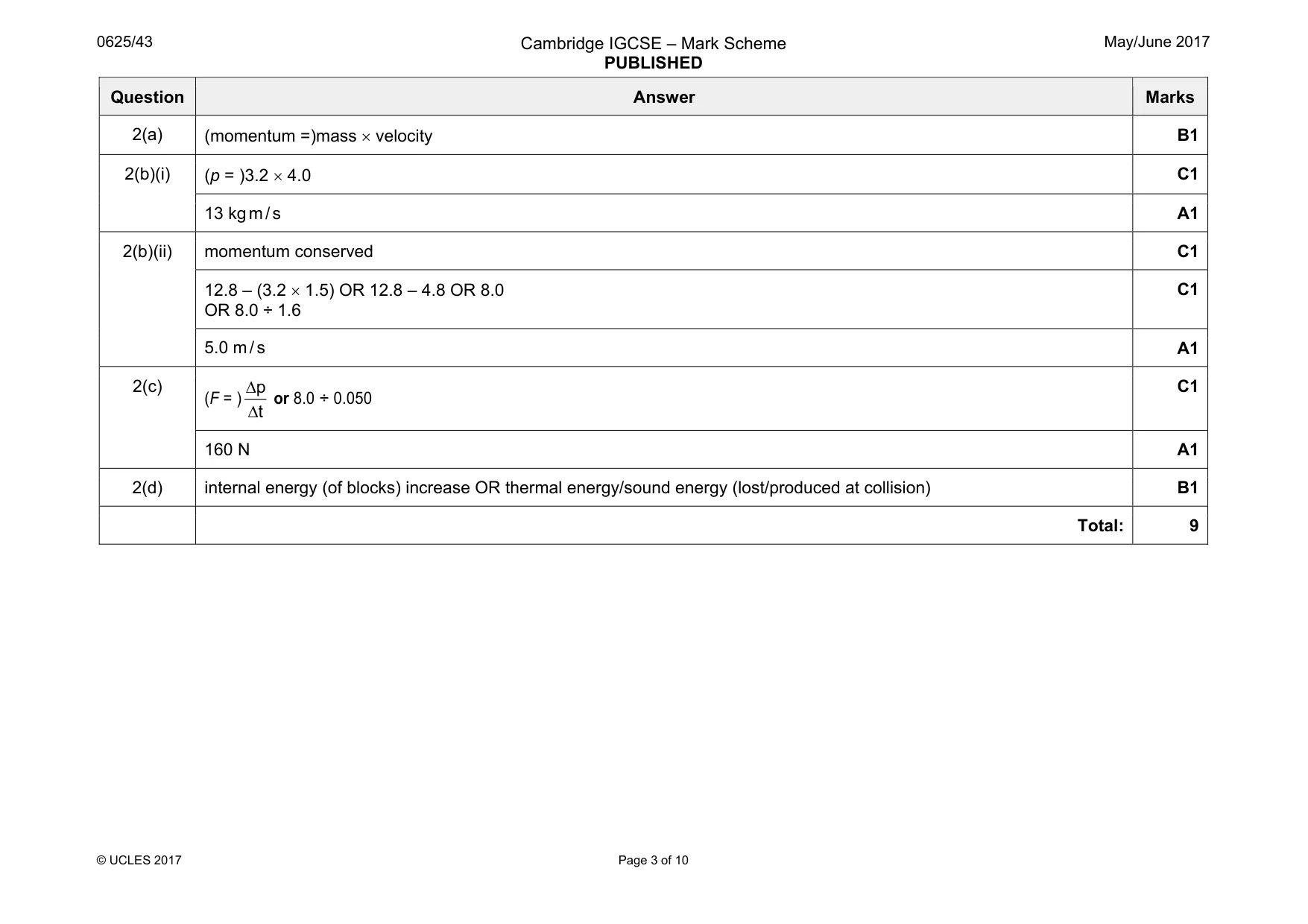
Mark scheme: 3(a) (ρ = ) m V OR 180 ÷ 210 OR 0.18 ÷ 210 C1 0.86 g / cm3 A1 3(b) floats OR words to the same effect B1 density of wood is less than density of liquid B1 Total: 4
Q4 · In the braking system of a car, the brake pedal rotates about a pivot when the pedal is…
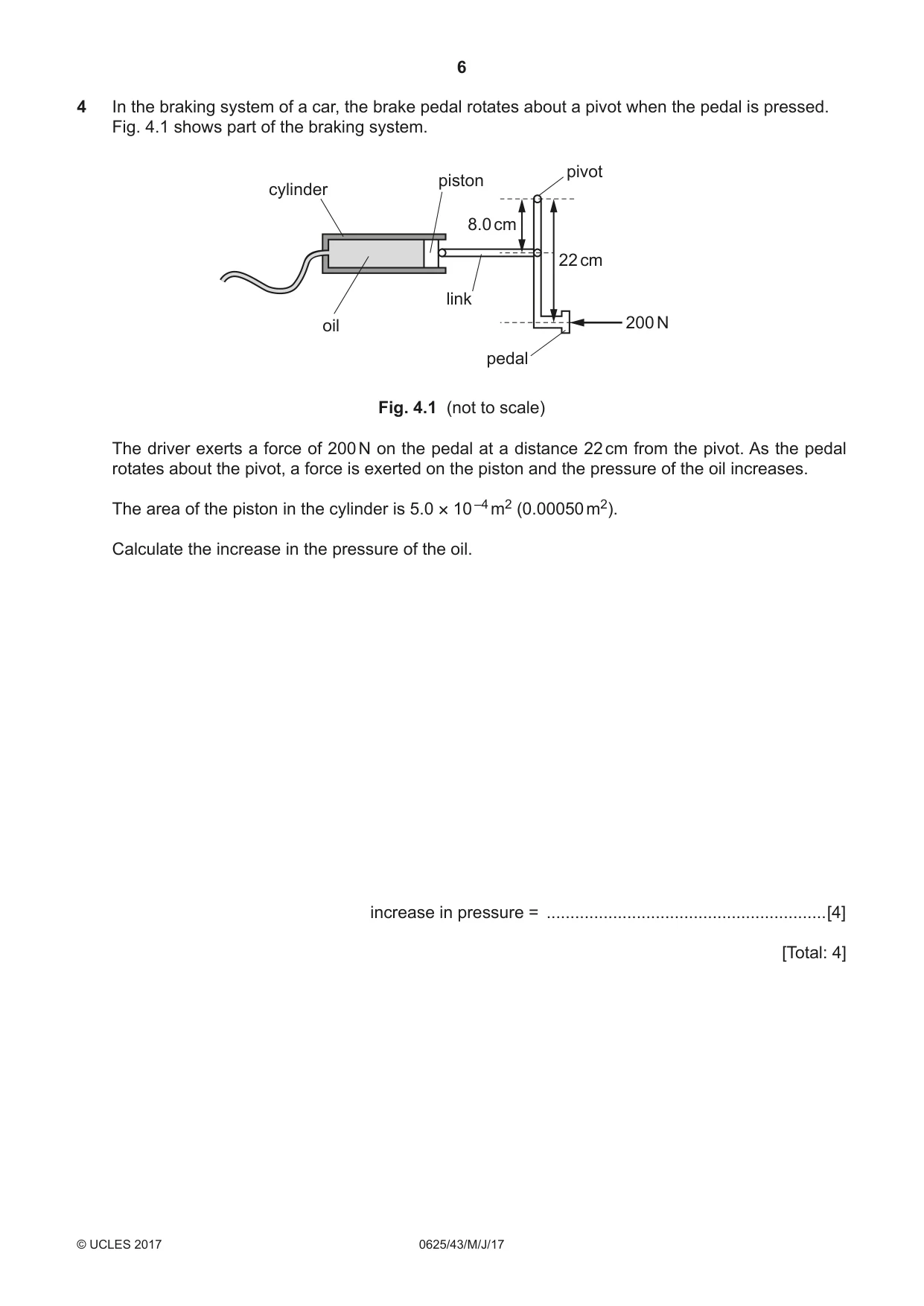
4 In the braking system of a car, the brake pedal rotates about a pivot when the pedal is pressed. Fig. 4.1 shows part of the braking system. pivot piston cylinder 8.0 cm 22 cm link oil 200 N pedal Fig. 4.1 (not to scale) The driver exerts a force of 200 N on the pedal at a distance 22 cm from the pivot. As the pedal rotates about the pivot, a force is exerted on the piston and the pressure of the oil increases. The area of the piston in the cylinder is 5.0 × 10 –4 m2 (0.00050 m2). Calculate the increase in the pressure of the oil. increase in pressure = ...........................................................[4] [Total: 4]
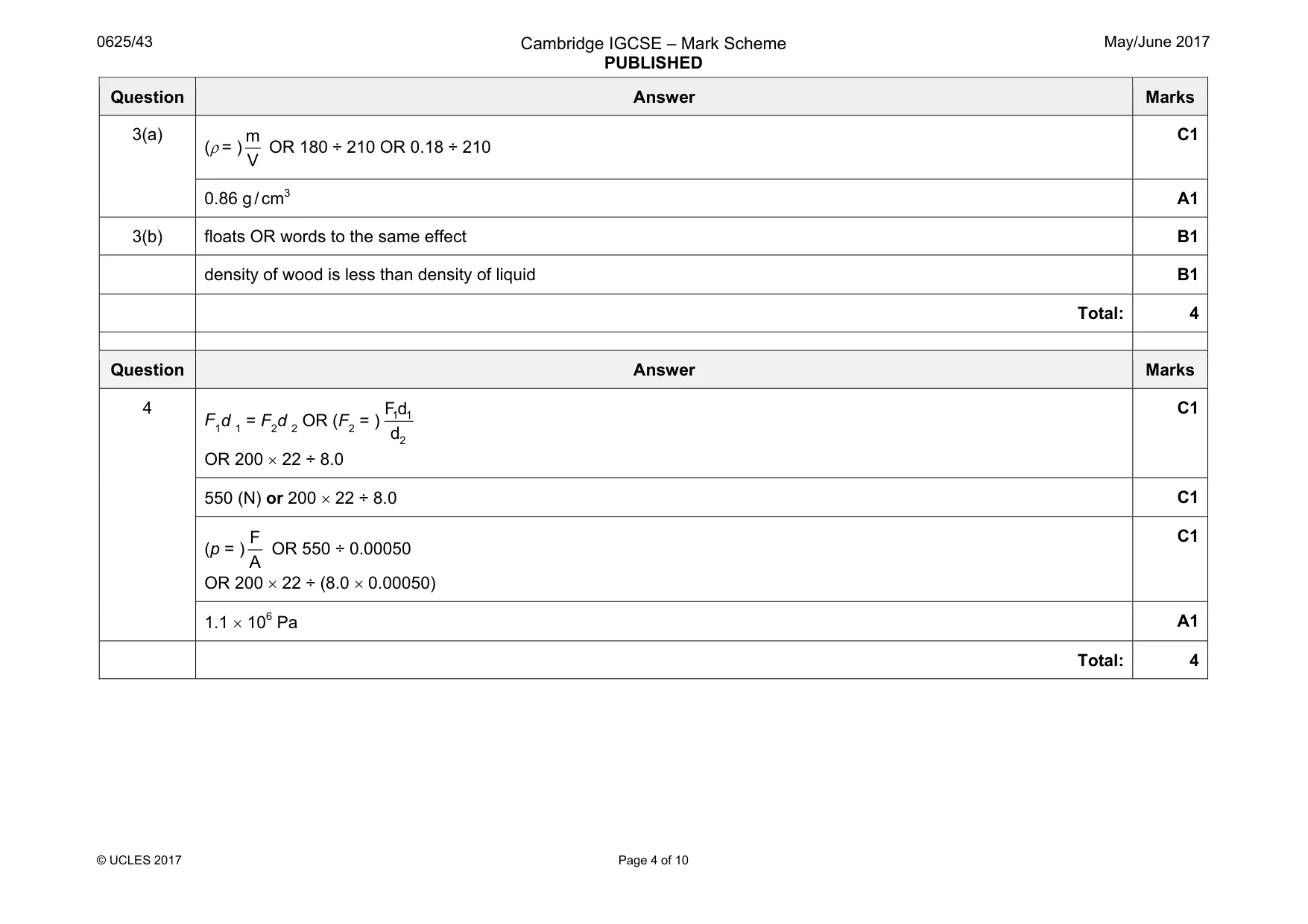
Mark scheme: 4 F1d 1 = F2d 2 OR (F2 = ) 1 1 2 Fd d OR 200 × 22 ÷ 8.0 C1 550 (N) or 200 × 22 ÷ 8.0 C1 (p = ) F A OR 550 ÷ 0.00050 OR 200 × 22 ÷ (8.0 × 0.00050) C1 1.1 × 10⁶ Pa A1 Total: 4
Q5 · A footballer and a referee are discussing a puddle of water that has formed on the pitch
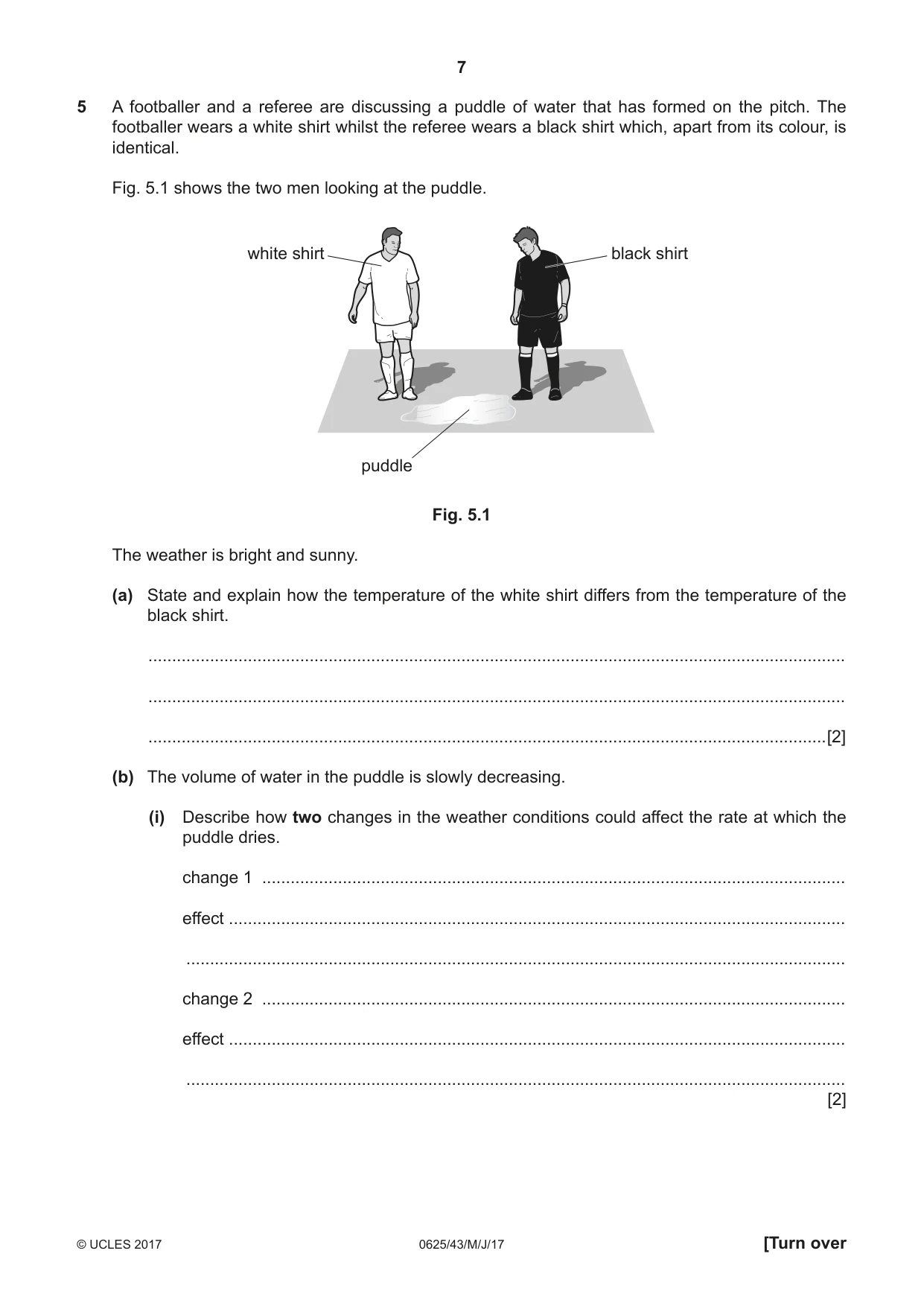
5 A footballer and a referee are discussing a puddle of water that has formed on the pitch. The footballer wears a white shirt whilst the referee wears a black shirt which, apart from its colour, is identical. Fig. 5.1 shows the two men looking at the puddle. white shirt black shirt puddle Fig. 5.1 The weather is bright and sunny. (a) State and explain how the temperature of the white shirt differs from the temperature of the black shirt. ................................................................................................................................................... ................................................................................................................................................... ...............................................................................................................................................[2] (b) The volume of water in the puddle is slowly decreasing. (i) Describe how two changes in the weather conditions could affect the rate at which the puddle dries. change 1 ........................................................................................................................... effect .................................................................................................................................. ........................................................................................................................................... change 2 ........................................................................................................................... effect .................................................................................................................................. ........................................................................................................................................... [2] (ii) Explain, in terms of the water molecules, what happens as the puddle dries. ........................................................................................................................................... ........................................................................................................................................... .......................................................................................................................................[2] [Total: 6]
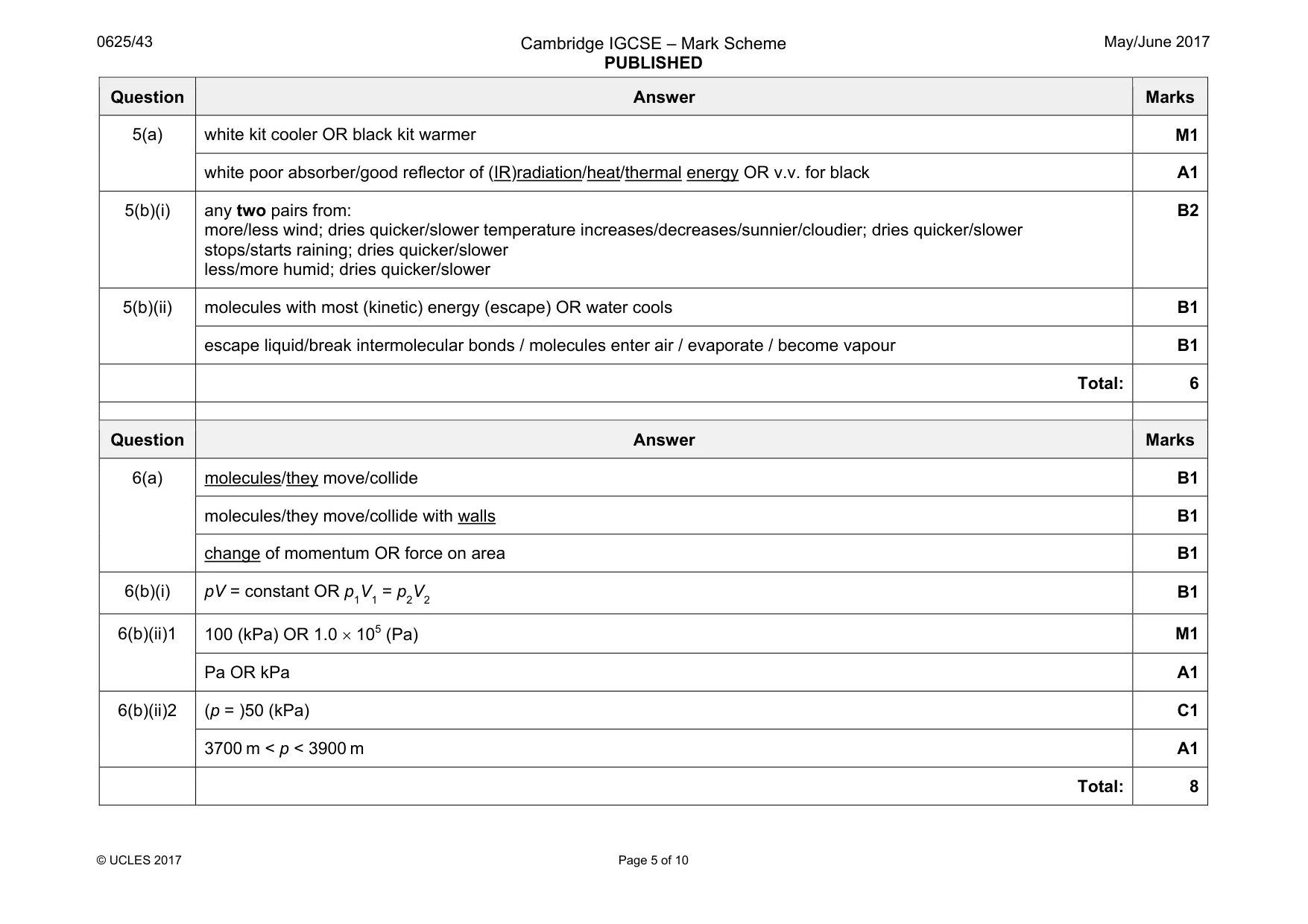
Mark scheme: 5(a) white kit cooler OR black kit warmer M1 white poor absorber/good reflector of (IR)radiation/heat/thermal energy OR v.v. for black A1 5(b)(i) any two pairs from: more/less wind; dries quicker/slower temperature increases/decreases/sunnier/cloudier; dries quicker/slower stops/starts raining; dries quicker/slower less/more humid; dries quicker/slower B2 5(b)(ii) molecules with most (kinetic) energy (escape) OR water cools B1 escape liquid/break intermolecular bonds / molecules enter air / evaporate / become vapour B1 Total: 6
Q6 · A child releasing a balloon filled with helium
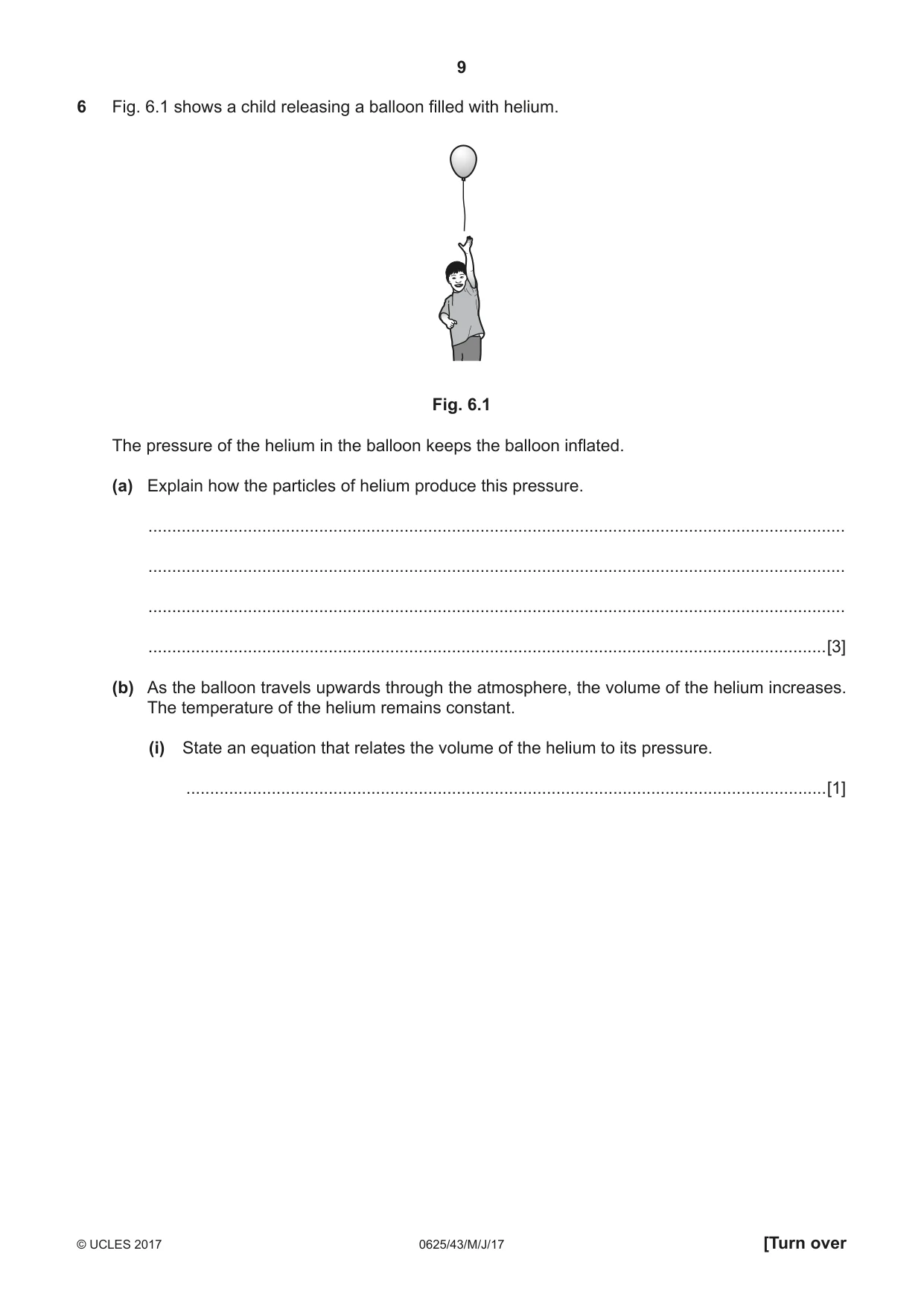
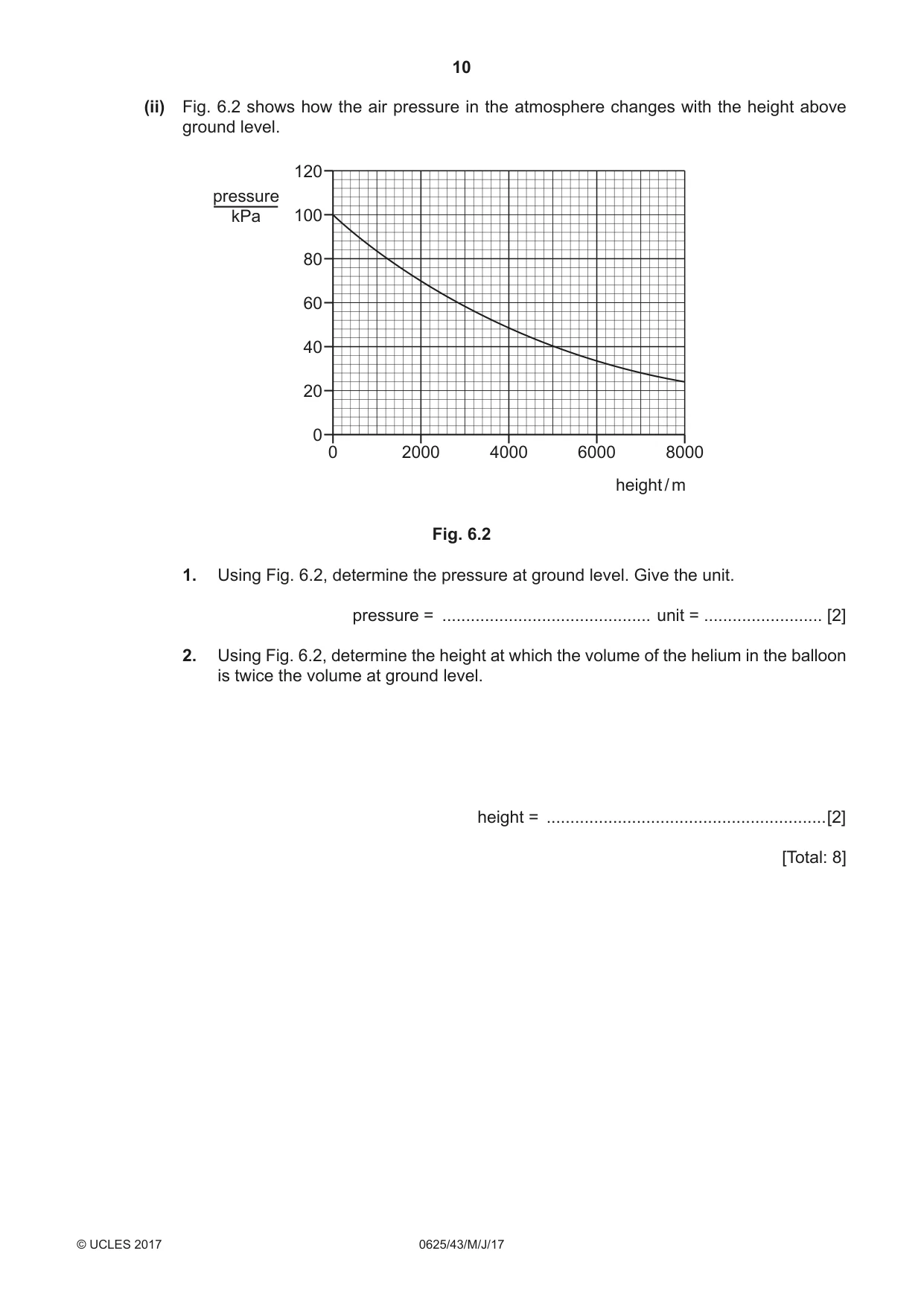
6 Fig. 6.1 shows a child releasing a balloon filled with helium. Fig. 6.1 The pressure of the helium in the balloon keeps the balloon inflated. (a) Explain how the particles of helium produce this pressure. ................................................................................................................................................... ................................................................................................................................................... ................................................................................................................................................... ...............................................................................................................................................[3] (b) As the balloon travels upwards through the atmosphere, the volume o f the helium increases. The temperature of the helium remains constant. (i) State an equation th at relates the volume of the helium to its pressure. .......................................................................................................................................[1] (ii) Fig. 6.2 shows how the air pressure in the atmosphere changes with the height above ground level. 120 pressure kPa 100 80 60 40 20 0 0 2000 4000 6000 8000 height / m Fig. 6.2 1. Using Fig. 6.2, determine the pressure at ground level. Give the unit. pressure = ............................................ unit = ......................... [2] 2. Using Fig. 6.2, determine the height at which the volume of the helium in the balloon is twice the volume at ground level. height = ...........................................................[2] [Total: 8]
Mark scheme: 6(a) molecules/they move/collide B1 molecules/they move/collide with walls B1 change of momentum OR force on area B1 6(b)(i) pV = constant OR p1V1 = p2V2 B1 6(b)(ii)1 100 (kPa) OR 1.0 × 10⁵ (Pa) M1 Pa OR kPa A1 6(b)(ii)2 (p = )50 (kPa) C1 3700 m < p < 3900 m A1 Total: 8
Q7 · A loudspeaker is built into the side of a swimming pool
7 A loudspeaker is built into the side of a swimming pool. The loudspeaker produces sound waves in the water of wavelength 0.25 m. (a) (i) The frequency of the sound waves is 6.0 kHz. Calculate the speed of the sound waves in water. speed of sound waves in water = ...........................................................[2] (ii) State a typical value for the speed of sound in air. speed of sound in air = ...........................................................[1] (iii) State and explain, for the sound produced by the loudspeaker, how the wavelength of the sound in air compares with the wavelength of the sound in water. ........................................................................................................................................... .......................................................................................................................................[1] (b) Sound is a longitudinal wave. Explain what is meant by a longitudinal wave. ................................................................................................................................................... ................................................................................................................................................... ...............................................................................................................................................[2] (c) The sound emerges from the loudspeaker through a gap. The sound diffracts as it passes through the gap. (i) State how the width of the gap affects the diffraction. ........................................................................................................................................... .......................................................................................................................................[1] (ii) State how the wavelength of the sound affects the diffraction. ........................................................................................................................................... .......................................................................................................................................[1] [Total: 8]
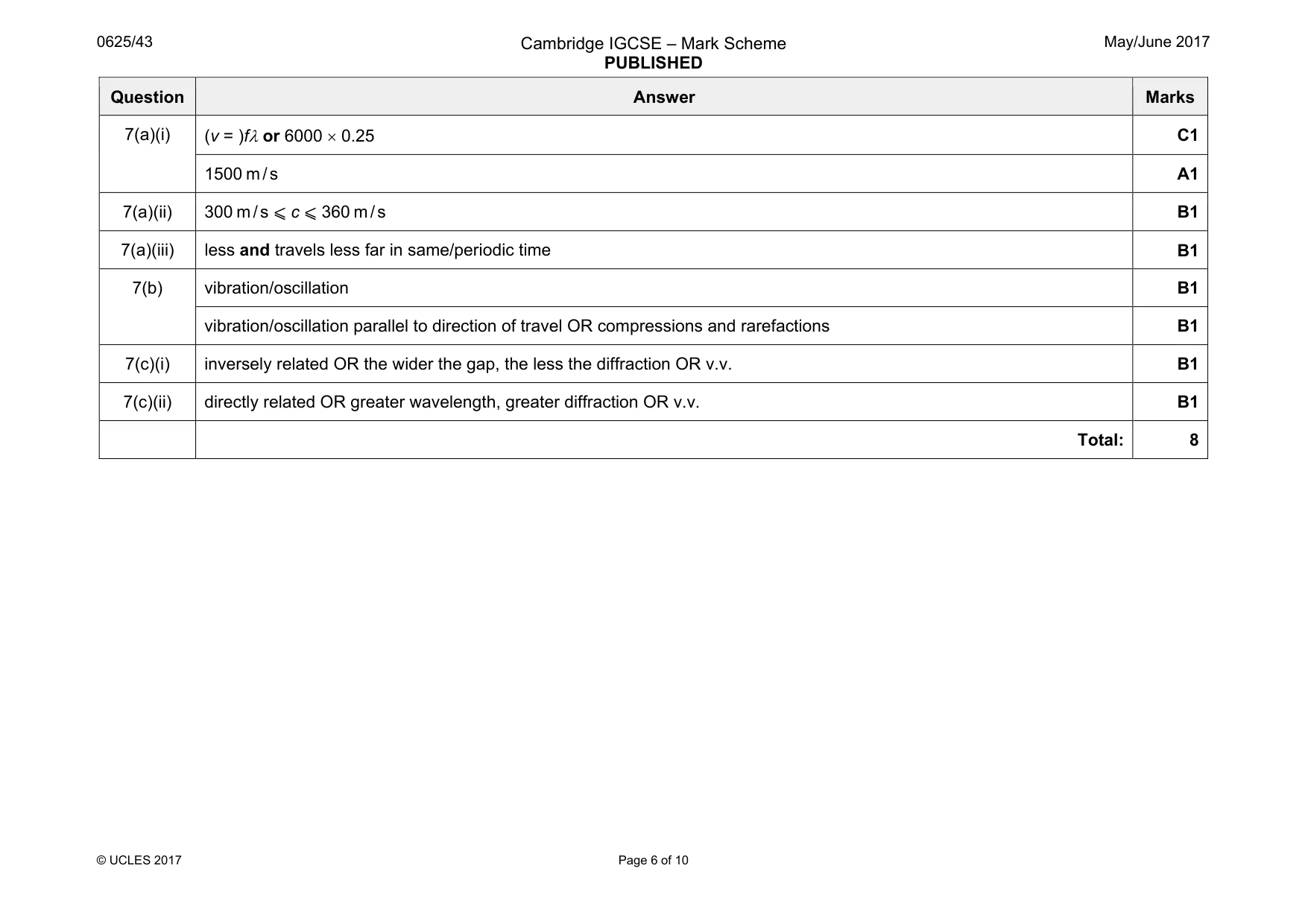
Mark scheme: 7(a)(i) C1 1500 m / s A1 7(a)(ii) 300 m / s ⩽ c ⩽ 360 m / s B1 7(a)(iii) less and travels less far in same/periodic time B1 7(b) vibration/oscillation B1 vibration/oscillation parallel to direction of travel OR compressions and rarefactions B1 7(c)(i) inversely related OR the wider the gap, the less the diffraction OR v.v. B1 7(c)(ii) directly related OR greater wavelength, greater diffraction OR v.v. B1 Total: 8
Q8 · Red light travelling in air strikes the curved surface of a semi-circular glass block at P
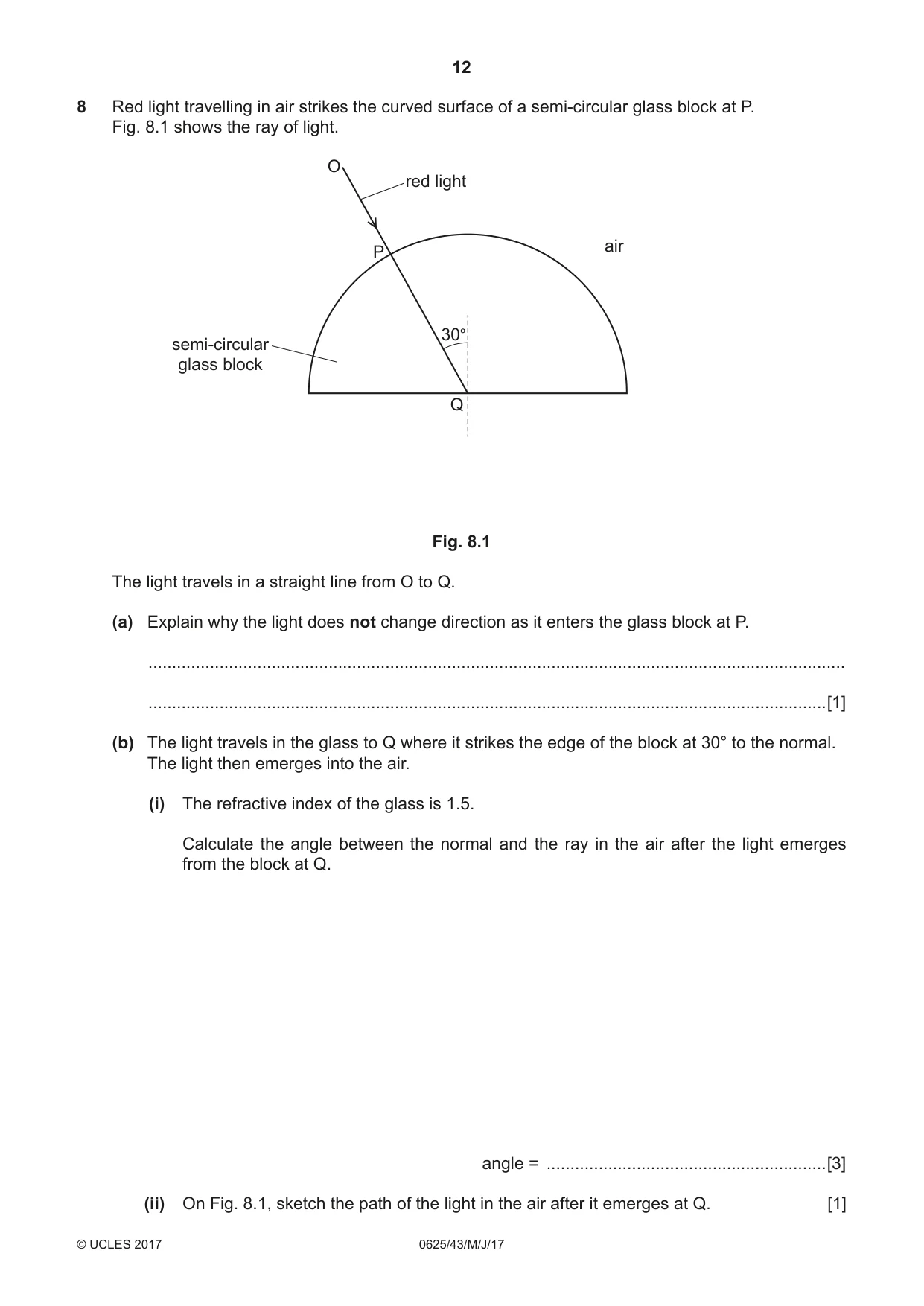
8 Red light travelling in air strikes the curved surface of a semi-circular glass block at P. Fig. 8.1 shows the ray of light. O red light air P 30° semi-circular glass block Q Fig. 8.1 The light travels in a straight line from O to Q. (a) Explain why the light does not change direction as it enters the glass block at P. ................................................................................................................................................... ...............................................................................................................................................[1] (b) The light travels in the glass to Q where it strikes the edge of the block at 30° to the normal. The light then emerges into the air. (i) The refractive index of the glass is 1.5. Calculate the angle between the normal and the ray in the air after the light emerges from the block at Q. angle = ...........................................................[3] (ii) On Fig. 8.1, sketch the path of the light in the air after it emerges at Q. [1] (c) The direction of the light striking the curved surface of the glass block is changed. The angle between the ray and the normal at Q gradually increases from 30° to 90°. Describe what happens to the light that strikes the block at Q as this angle increases. ................................................................................................................................................... ................................................................................................................................................... ................................................................................................................................................... ................................................................................................................................................... ................................................................................................................................................... ...............................................................................................................................................[3] [Total: 8]
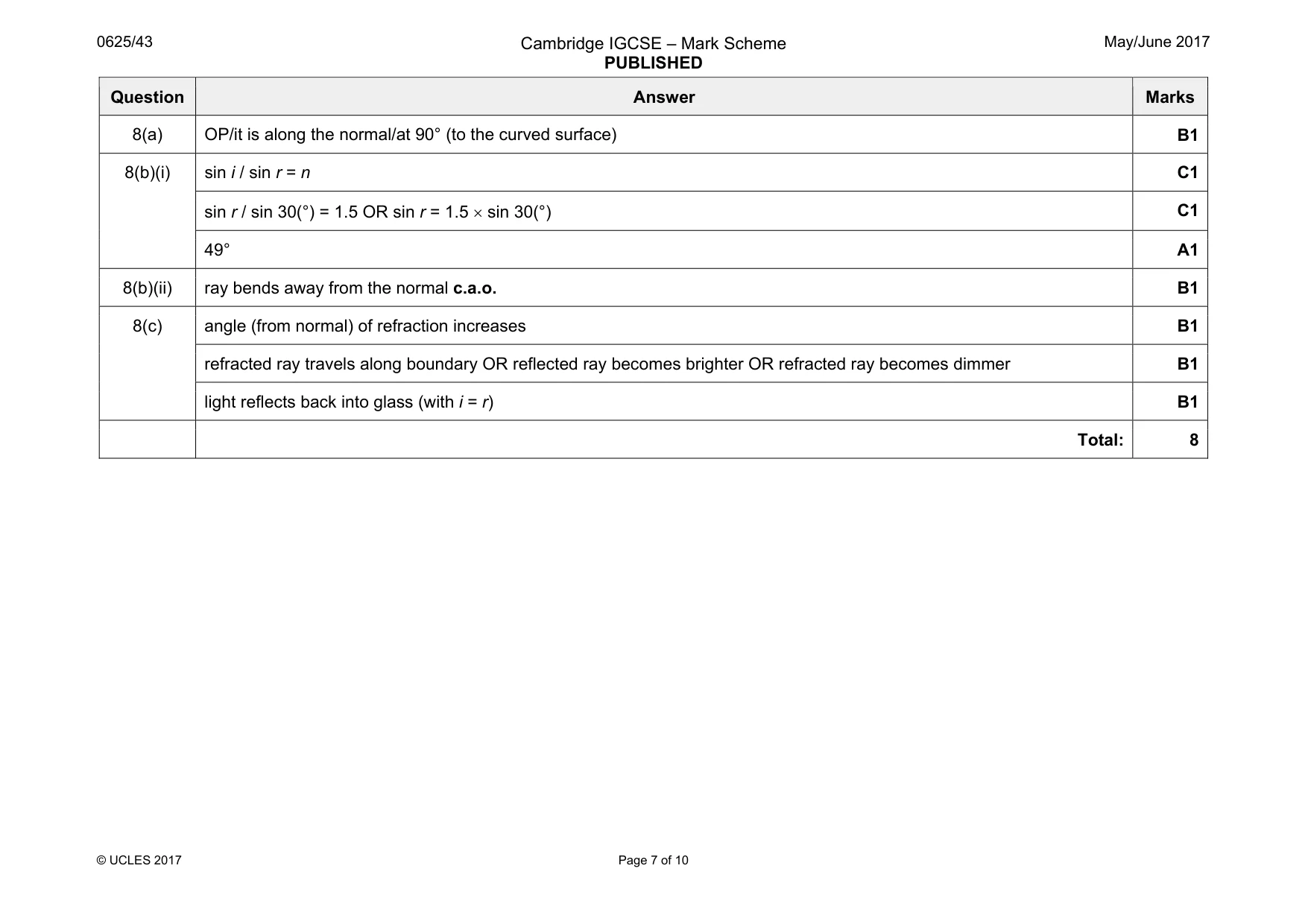
Mark scheme: 8(a) OP/it is along the normal/at 90° (to the curved surface) B1 8(b)(i) sin i / sin r = n C1 sin r / sin 30(°) = 1.5 OR sin r = 1.5 × sin 30(°) C1 49° A1 8(b)(ii) ray bends away from the normal c.a.o. B1 8(c) angle (from normal) of refraction increases B1 refracted ray travels along boundary OR reflected ray becomes brighter OR refracted ray becomes dimmer B1 light reflects back into glass (with i = r) B1 Total: 8
Q9 · A 12 V battery is connected in series to a 24 W lamp and to a parallel pair of identical…
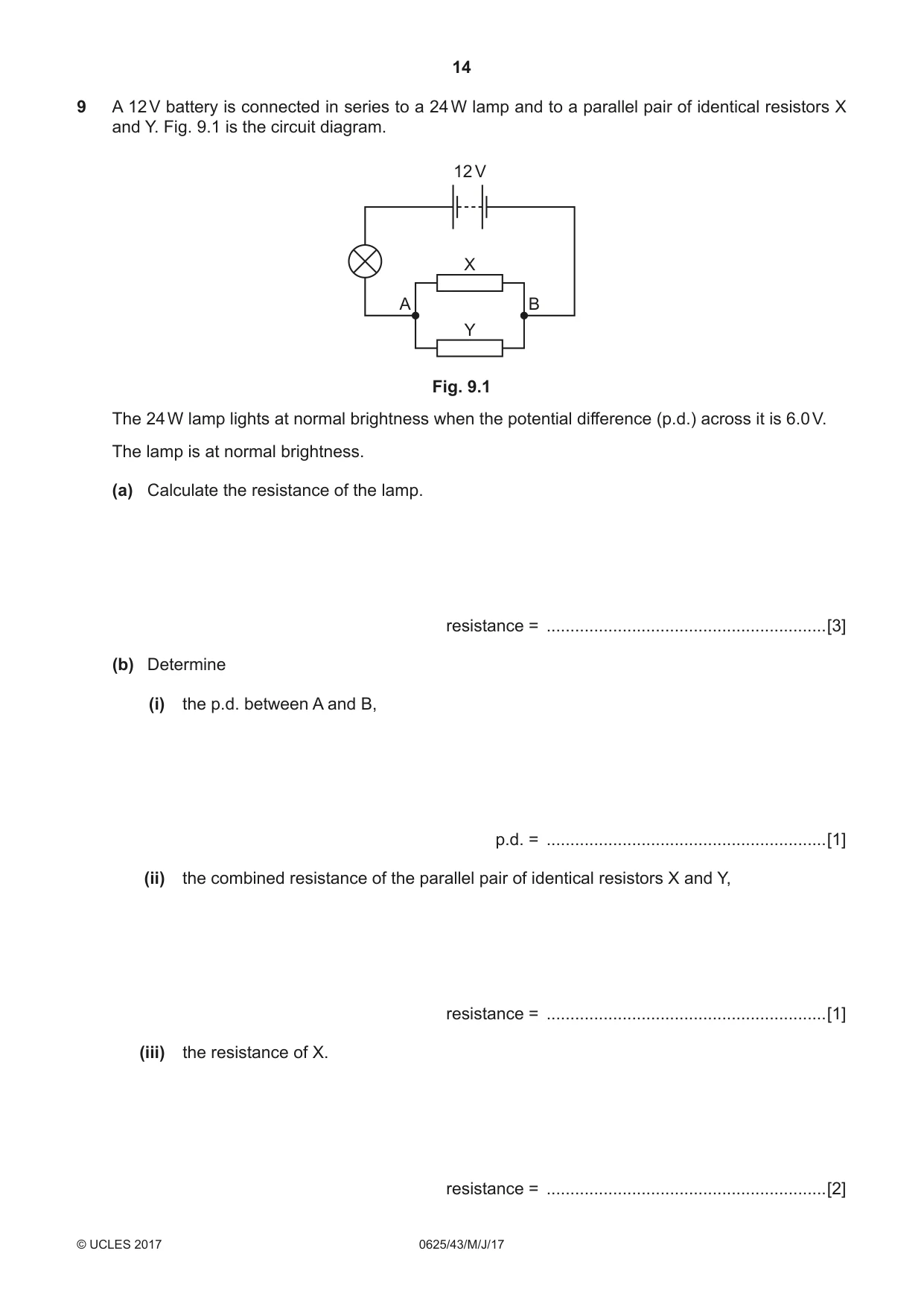
9 A 12 V battery is connected in series to a 24 W lamp and to a parallel pair of identical resistors X and Y. Fig. 9.1 is the circuit diagram. 12 V X A B Y Fig. 9.1 The 24 W lamp lights at normal brightness when the potential difference (p.d.) across it is 6.0 V. The lamp is at normal brightness. (a) Calculate the resistance of the lamp. resistance = ...........................................................[3] (b) Determine (i) the p.d. between A and B, p.d. = ...........................................................[1] (ii) the combined resistance of the parallel pair of identical resistors X and Y, resistance = ...........................................................[1] (iii) the resistance of X. resistance = ...........................................................[2] (c) Resistor X is removed from the circuit in Fig 9.1. Explain why the lamp becomes dimmer. ................................................................................................................................................... ................................................................................................................................................... ................................................................................................................................................... ...............................................................................................................................................[2] [Total: 9]
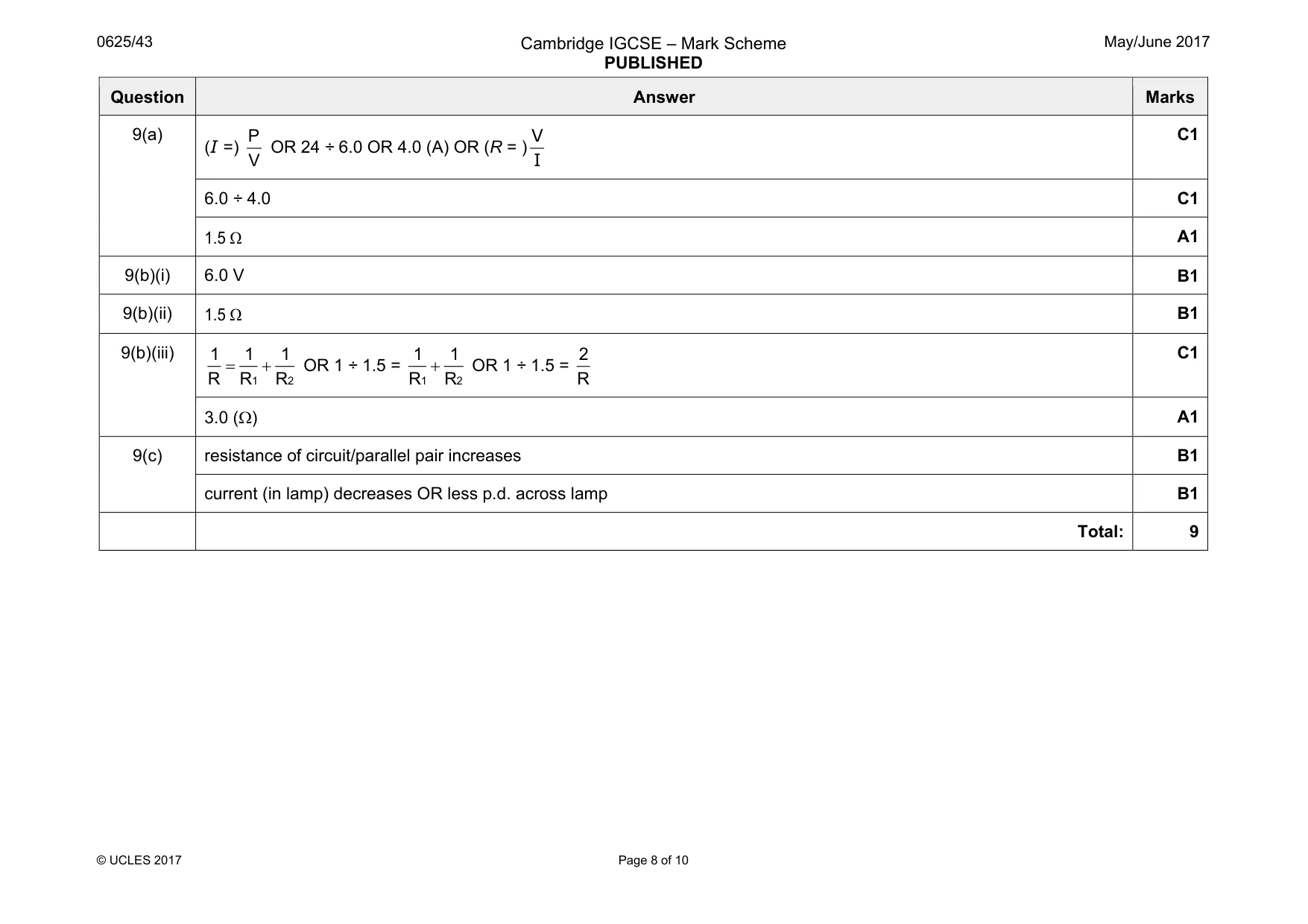
Mark scheme: 9(a) (I =) P I C1 6.0 ÷ 4.0 C1 1.5 Ω A1 9(b)(i) 6.0 V B1 9(b)(ii) 1.5 Ω B1 9(b)(iii) 1 2 1 1 1 R R R = + OR 1 ÷ 1.5 = 1 2 1 1 R R + OR 1 ÷ 1.5 = 2 R C1 3.0 (Ω) A1 9(c) resistance of circuit/parallel pair increases B1 current (in lamp) decreases OR less p.d. across lamp B1 Total: 9
Q10 · A transformer that consists of two coils P and Q, and an iron core
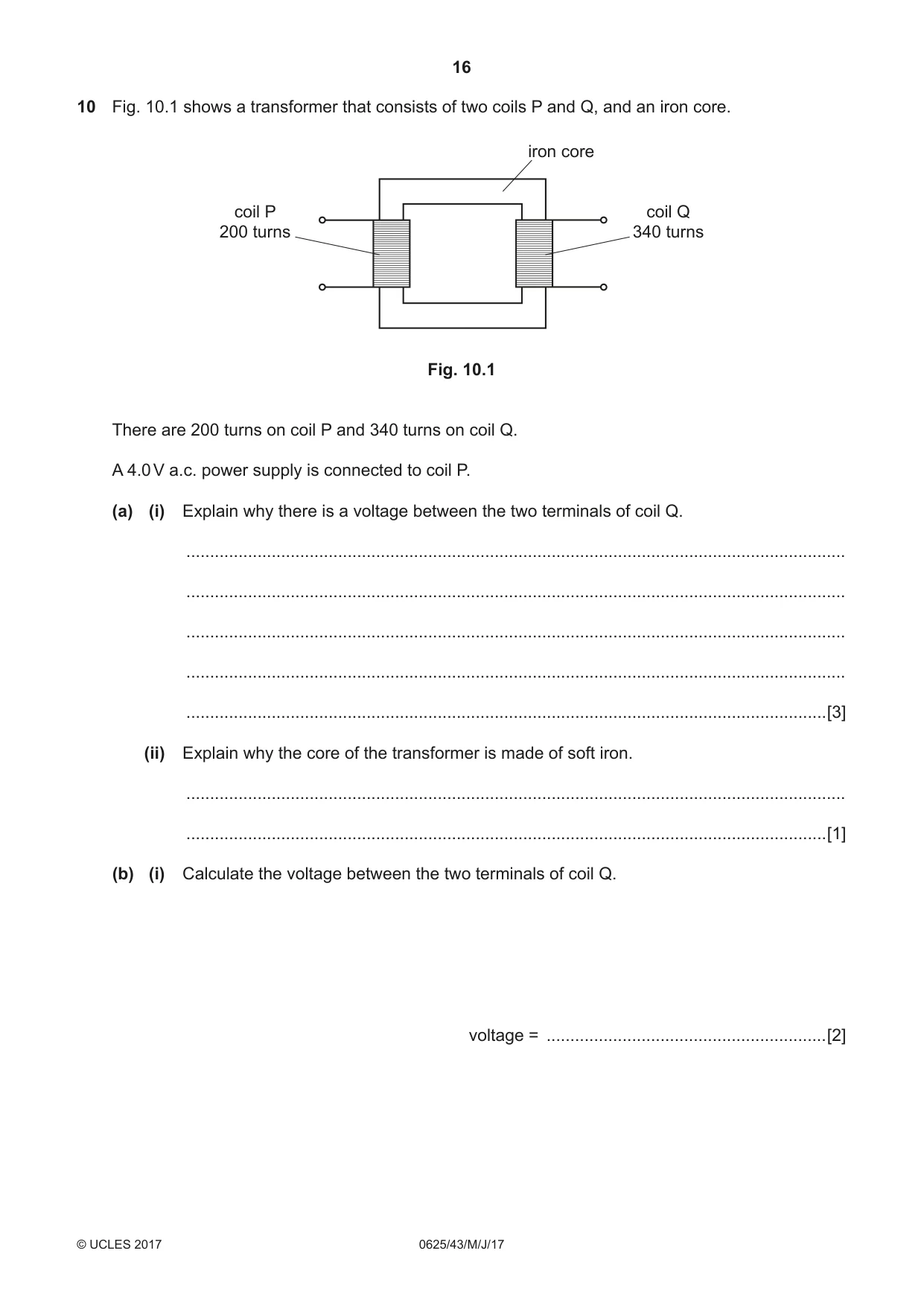
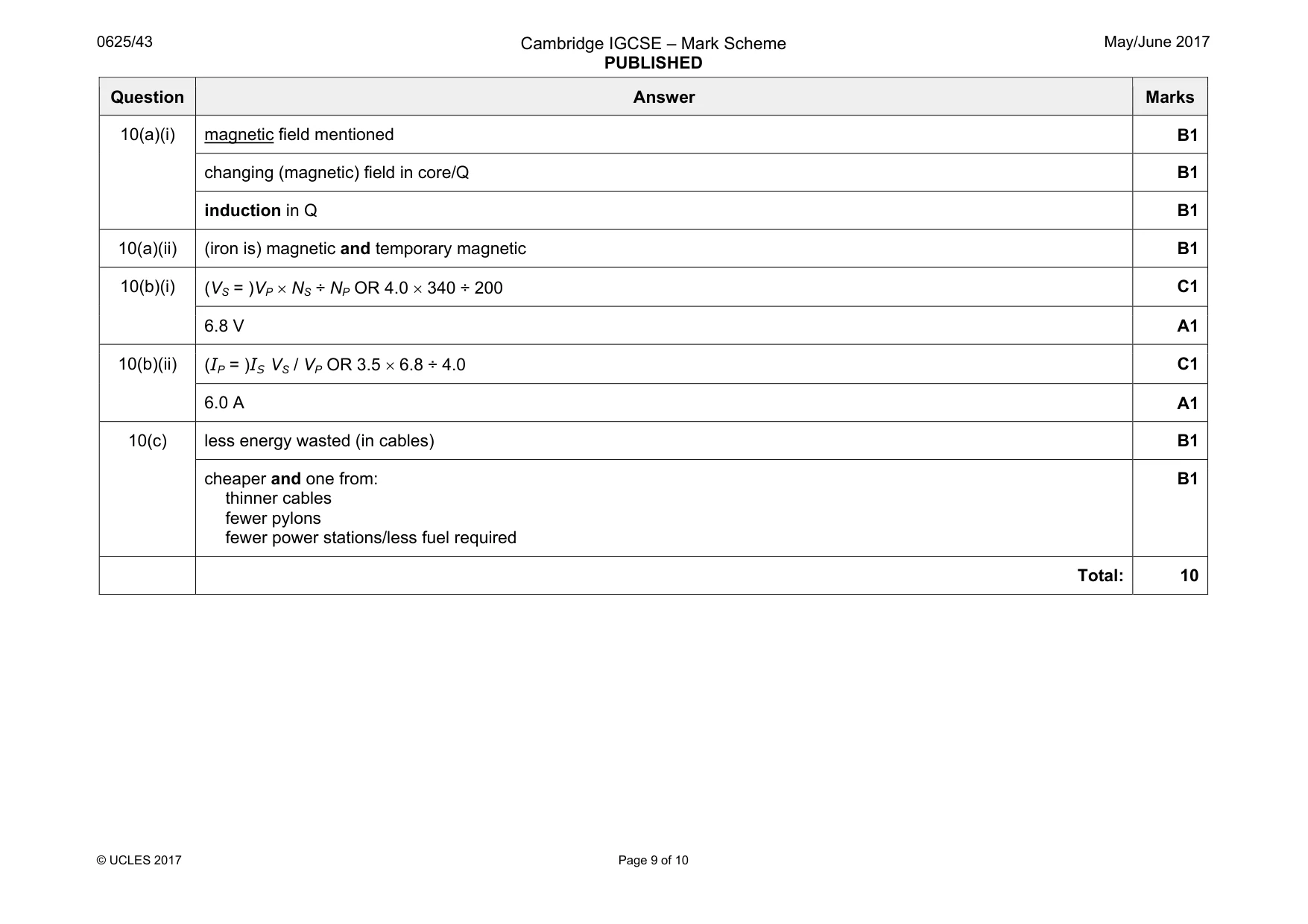
10 Fig. 10.1 shows a transformer that consists of two coils P and Q, and an iron core. iron core coil P coil Q 200 turns 340 turns Fig. 10.1 There are 200 turns on coil P and 340 turns on coil Q. A 4.0 V a.c. power supply is connected to coil P. (a) (i) Explain why there is a voltage between the two terminals of coil Q. ........................................................................................................................................... ........................................................................................................................................... ........................................................................................................................................... ........................................................................................................................................... .......................................................................................................................................[3] (ii) Explain why the core of the transformer is made of soft iron. ........................................................................................................................................... .......................................................................................................................................[1] (b) (i) Calculate the voltage between the two terminals of coil Q. voltage = ...........................................................[2] (ii) A heater is connected to coil Q. The current in the heater is 3.5 A. The transformer is 100% efficient. Calculate the current in coil P. current = ...........................................................[2] (c) A transformer is used to step up the voltage before electrical energy is transmitted over long distances. State and explain one economic effect of transmitting electrical energy at a high voltage. ................................................................................................................................................... ................................................................................................................................................... ................................................................................................................................................... ...............................................................................................................................................[2] [Total: 10]
Mark scheme: 10(a)(i) magnetic field mentioned B1 changing (magnetic) field in core/Q B1 induction in Q B1 10(a)(ii) (iron is) magnetic and temporary magnetic B1 10(b)(i) (VS = )VP × NS ÷ NP OR 4.0 × 340 ÷ 200 C1 6.8 V A1 10(b)(ii) (IP = )IS VS / VP OR 3.5 × 6.8 ÷ 4.0 C1 6.0 A A1 10(c) less energy wasted (in cables) B1 cheaper and one from: thinner cables fewer pylons fewer power stations/less fuel required B1 Total: 10
Q11 · Equipment that is used to investigate the effect of a magnetic field on the path of a…
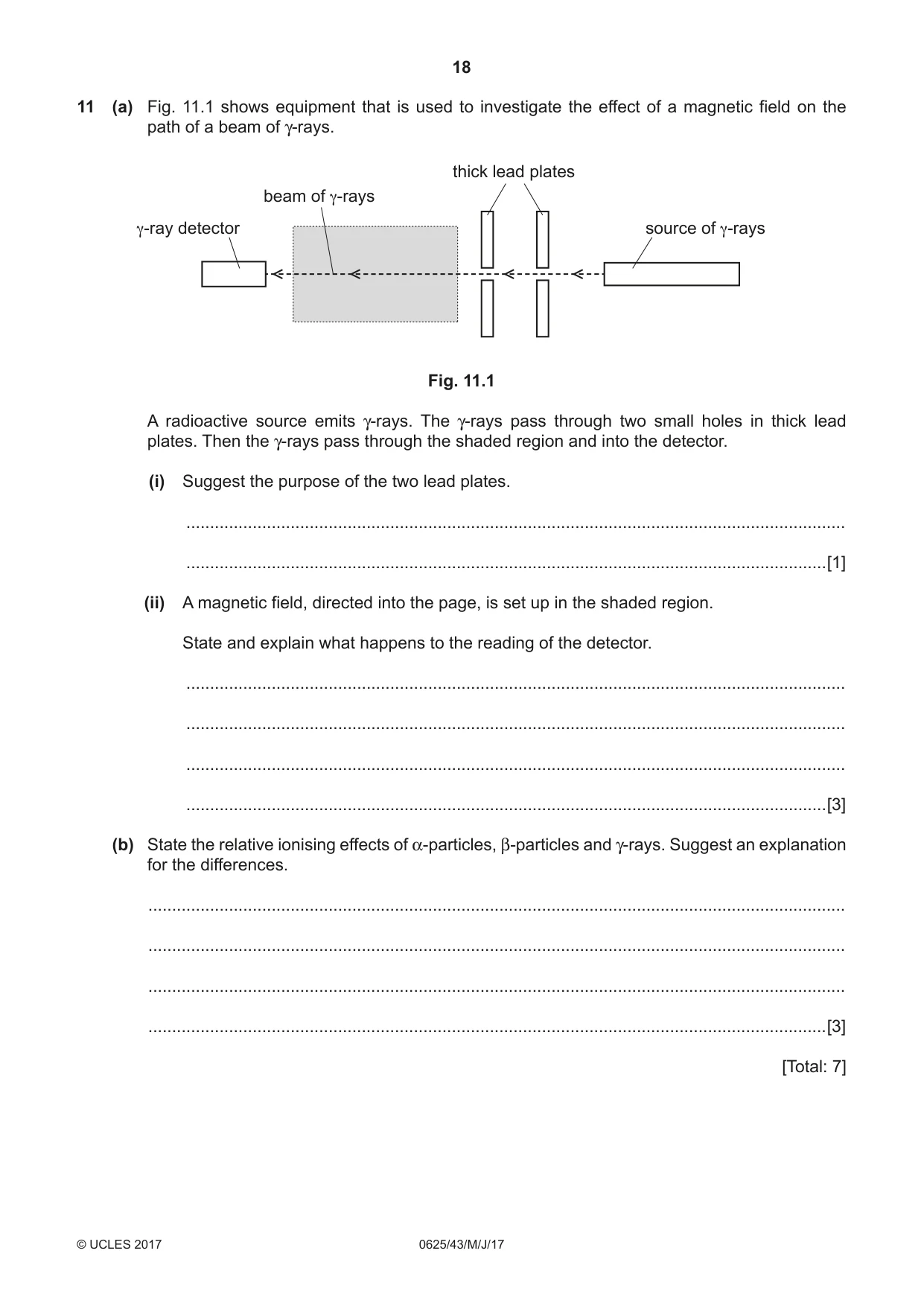
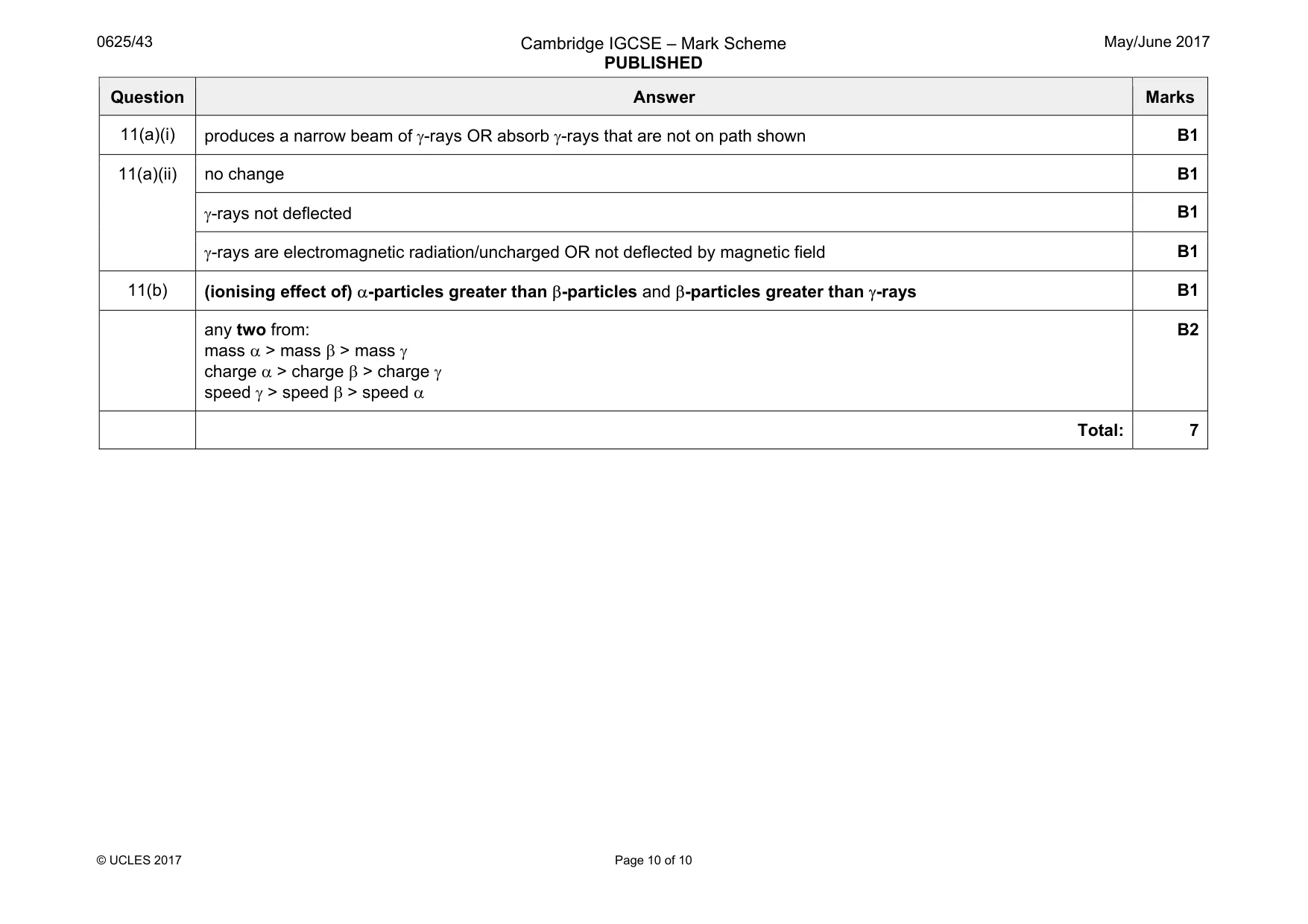
11 (a) Fig. 11.1 shows equipment that is used to investigate the effect of a magnetic field on the path of a beam of γ-rays. thick lead plates beam of γ-rays γ-ray detector source of γ-rays Fig. 11.1 A radioactive source emits γ-rays. The γ-rays pass through two small holes in thick lead plates. Then the γ-rays pass through the shaded region and into the detector. (i) Suggest the purpose of the two lead plates. ........................................................................................................................................... .......................................................................................................................................[1] (ii) A magnetic field, directed into the page, is set up in the shaded region. State and explain what happens to the reading of the detector. ........................................................................................................................................... ........................................................................................................................................... ........................................................................................................................................... .......................................................................................................................................[3] (b) State the relative ionising effects of α-particles, β-particles and γ-rays. Suggest an explanation for the differences. ................................................................................................................................................... ................................................................................................................................................... ................................................................................................................................................... ...............................................................................................................................................[3] [Total: 7]
Mark scheme: 11(a)(i) B1 11(a)(ii) no change B1 γ-rays not deflected B1 γ-rays are electromagnetic radiation/uncharged OR not deflected by magnetic field B1 11(b) (ionising effect of) α-particles greater than β-particles and β-particles greater than γ-rays B1 any two from: mass α > mass β > mass γ charge α > charge β > charge γ speed γ > speed β > speed α B2 Total: 7
What was in this paper
The subtopics covered by these 11 questions, and how many questions each got. Open one in a new tab to see every Cambridge question on it.
What you needed in this session
Cambridge’s own grade thresholds for 2017 May/June, Paper 4 · Variant 3. A higher threshold means an easier paper — the bar moves with how the cohort did.