Cambridge IGCSE Physics 0625 — 2016 May/June Paper 4 · Variant 1
0625/41/M/J/16 · 11 questions · 80 marks · ≈90 min
The question paper and its mark scheme, free to read here and free to download. This is Cambridge’s own paper, exactly as it was sat.
Question paper20 pages
Mark scheme11 pages
Answers below. Sit the paper first if you are practising.
Questions as text
Q1 · A bus travels at a constant speed
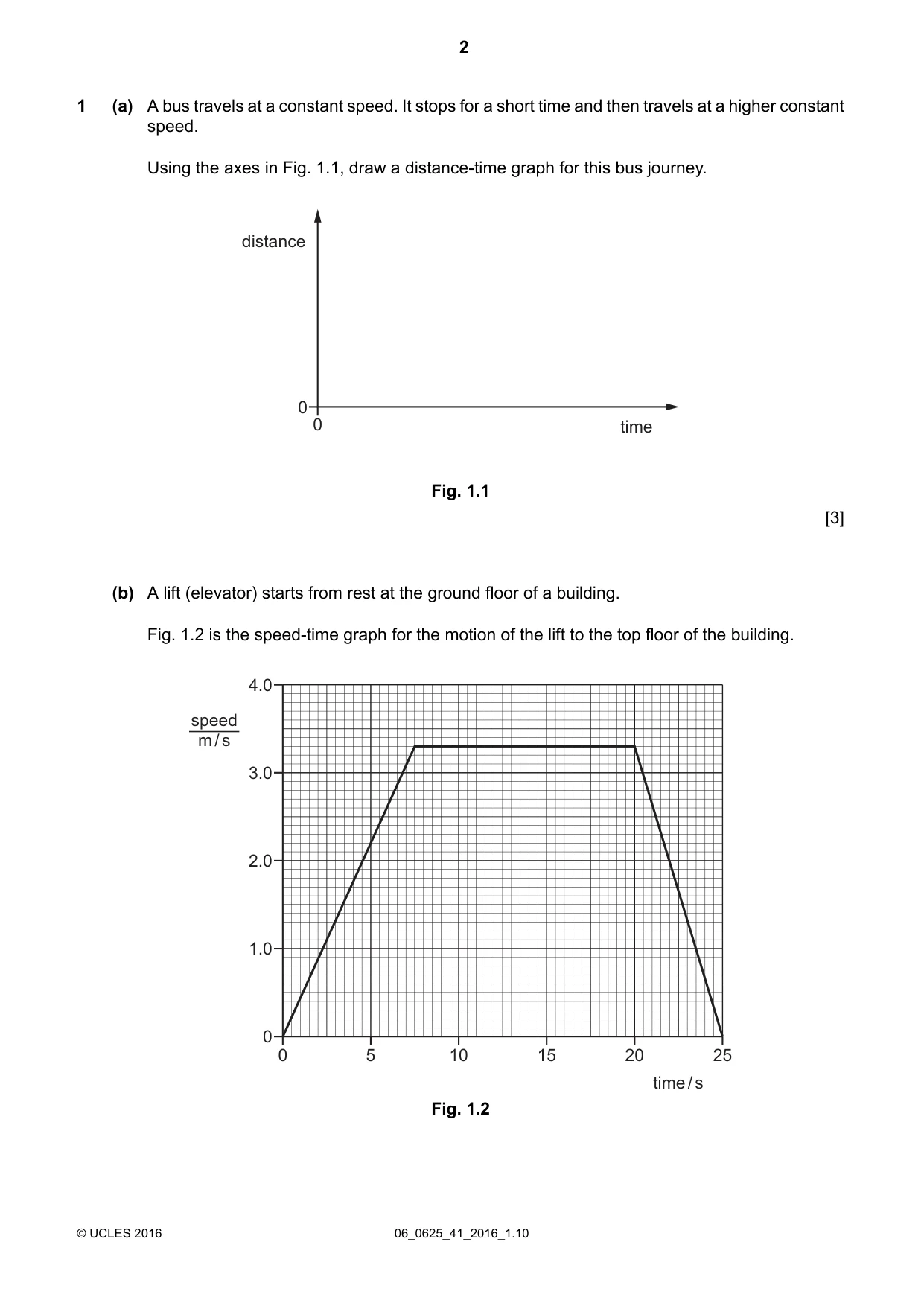
1 (a) A bus travels at a constant speed. It stops for a short time and then travels at a higher constant speed. Using the axes in Fig. 1.1, draw a distance-time graph for this bus journey. distance 0 0 time Fig. 1.1 [3] (b) A lift (elevator) starts from rest at the ground floor of a building. Fig. 1.2 is the speed-time graph for the motion of the lift to the top floor of the building. 4.0 speed m / s 3.0 2.0 1.0 0 0 5 10 15 20 25 time / s Fig. 1.2 Use the graph to determine the distance from the ground floor to the top floor of the building. distance =................................................................. [4] [Total: 7]
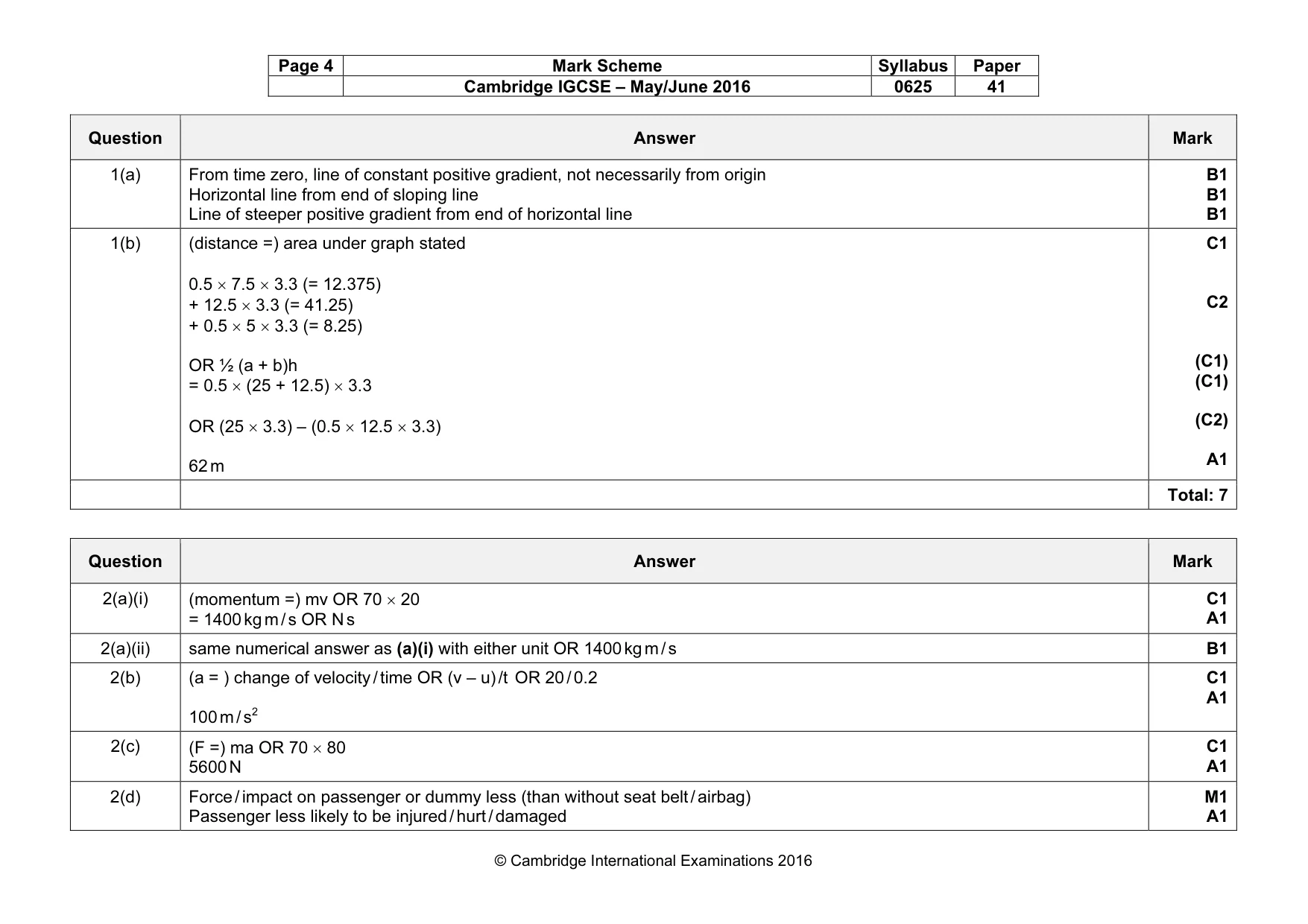
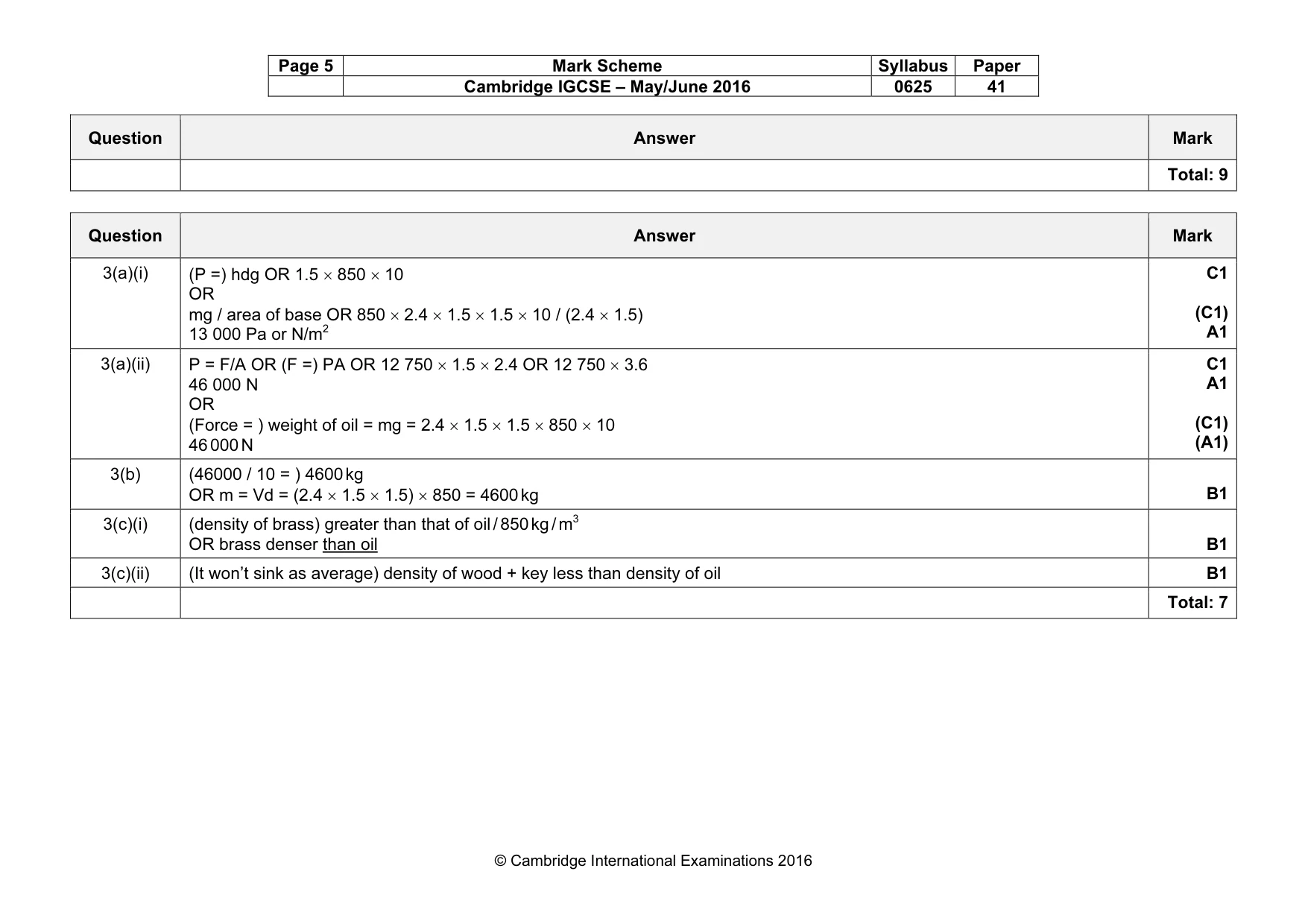
Mark scheme: 1(a) From time zero, line of constant positive gradient, not necessarily from origin Horizontal line from end of sloping line Line of steeper positive gradient from end of horizontal line B1 B1 B1 1(b) (distance =) area under graph stated 0.5 × 7.5 × 3.3 (= 12.375) + 12.5 × 3.3 (= 41.25) + 0.5 × 5 × 3.3 (= 8.25) OR ½ (a + b)h = 0.5 × (25 + 12.5) × 3.3 OR (25 × 3.3) – (0.5 × 12.5 × 3.3) 62 m C1 C2 (C1) (C1) (C2) A1 Total: 7
Q2 · A dummy of mass 70kg used in a crash test to investigate the safety of a new car
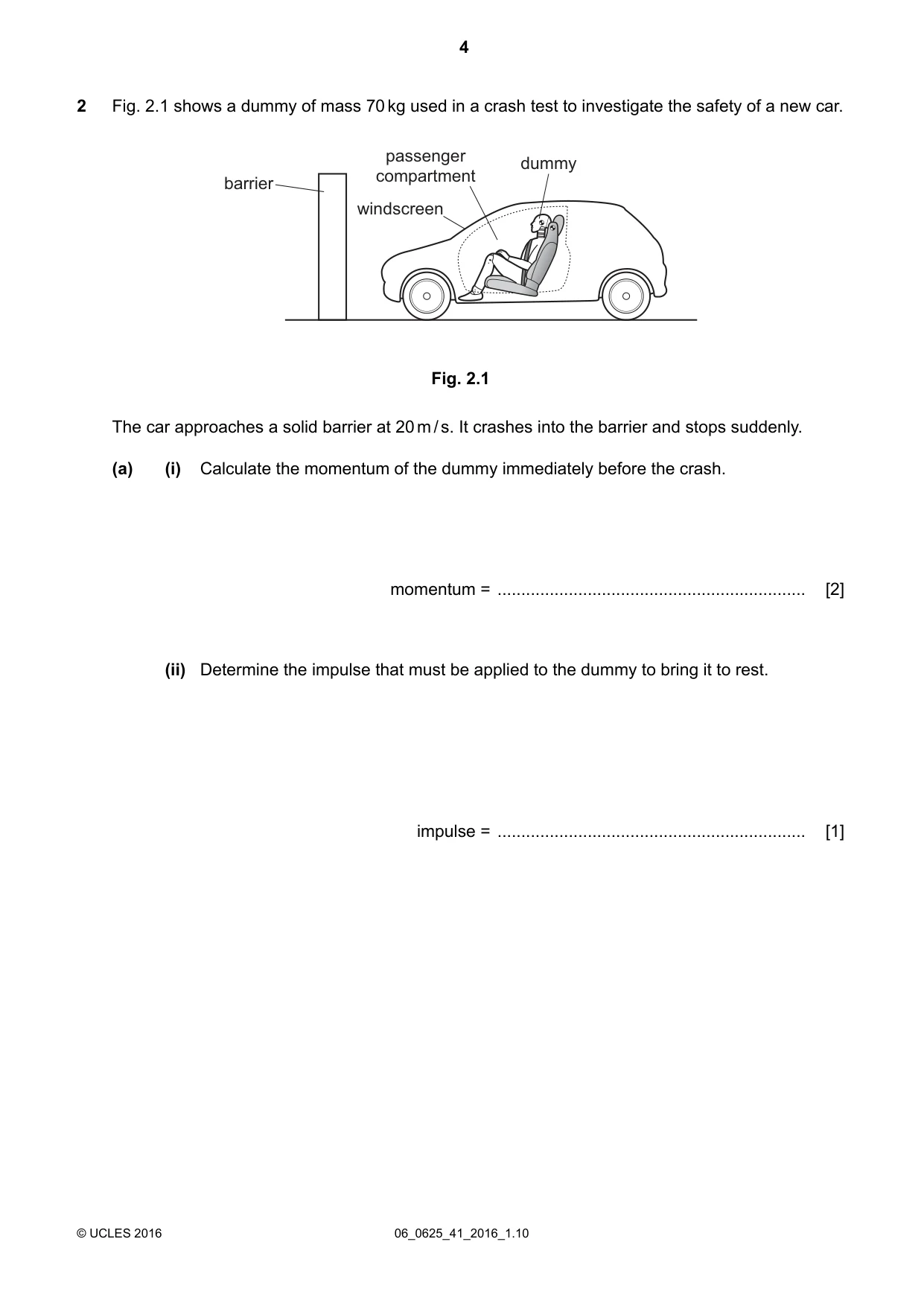
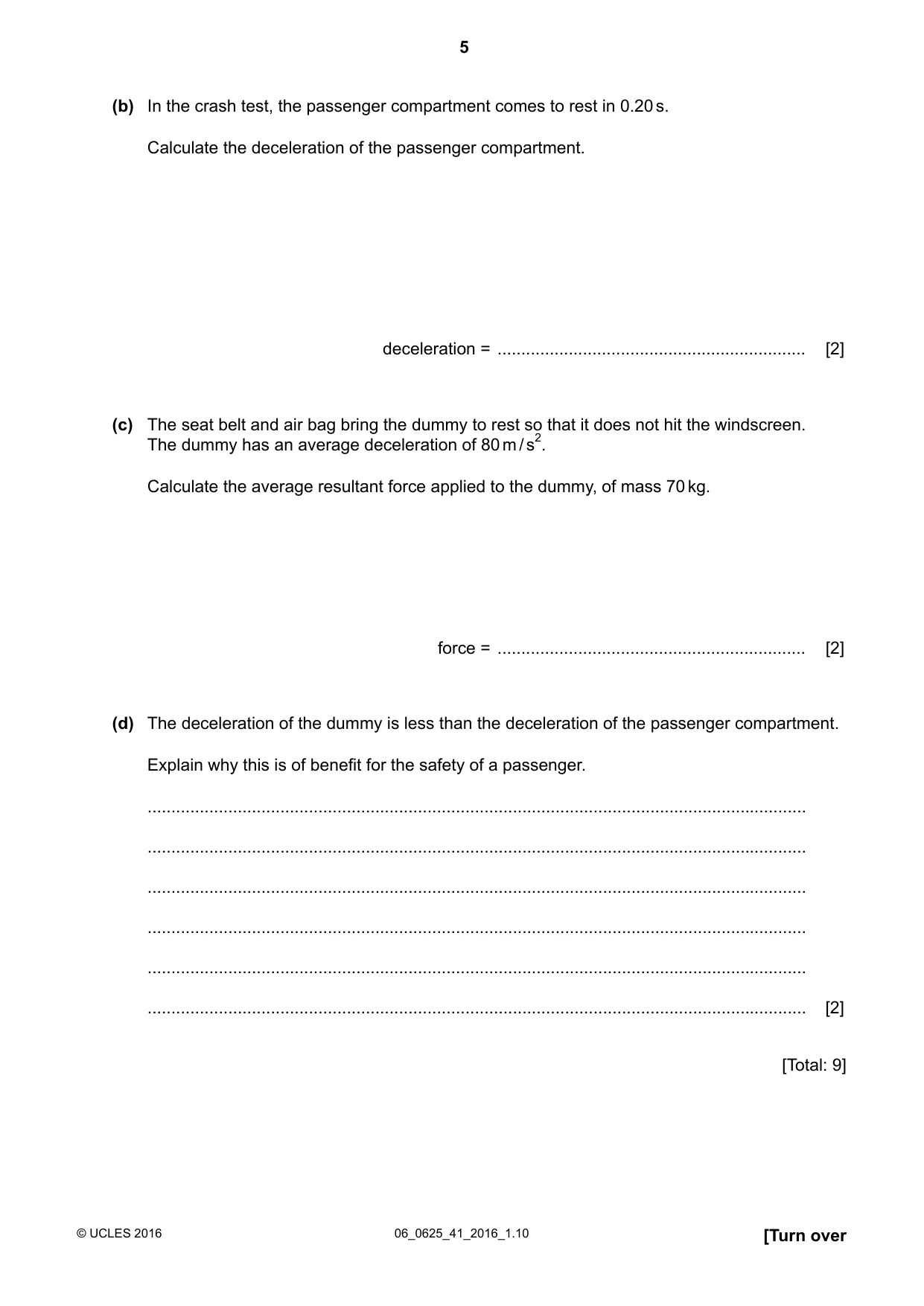
2 Fig. 2.1 shows a dummy of mass 70kg used in a crash test to investigate the safety of a new car. passenger dummy compartment barrier windscreen Fig. 2.1 The car approaches a solid barrier at 20m/s. It crashes into the barrier and stops suddenly. (a) (i) Calculate the momentum of the dummy immediately before the crash. momentum = ................................................................. [2] (ii) Determine the impulse that must be applied to the dummy to bring it to rest. impulse = ................................................................. [1] (b) In the crash test, the passenger compartment comes to rest in 0.20s. Calculate the deceleration of the passenger compartment. deceleration = ................................................................. [2] (c) The seat belt and air bag bring the dummy to rest so that it does not hit the windscreen. The dummy has an average deceleration of 80m/s2. Calculate the average resultant force applied to the dummy, of mass 70kg. force = ................................................................. [2] (d) The deceleration of the dummy is less than the deceleration of the passenger compartment. Explain why this is of benefit for the safety of a passenger. ........................................................................................................................................... ........................................................................................................................................... ........................................................................................................................................... ........................................................................................................................................... ........................................................................................................................................... ........................................................................................................................................... [2] [Total: 9]
Mark scheme: 2(a)(i) (momentum =) mv OR 70 × 20 = 1400 kg m / s OR N s C1 A1 2(a)(ii) same numerical answer as (a)(i) with either unit OR 1400 kg m / s B1 2(b) (a = ) change of velocity / time OR (v – u) /t OR 20 / 0.2 100 m / s2 C1 A1 2(c) (F =) ma OR 70 × 80 5600 N C1 A1 2(d) Force / impact on passenger or dummy less (than without seat belt / airbag) Passenger less likely to be injured / hurt / damaged M1 A1
Q3 · An oil tank that has a rectangular base of dimensions 2.4m by 1.5m
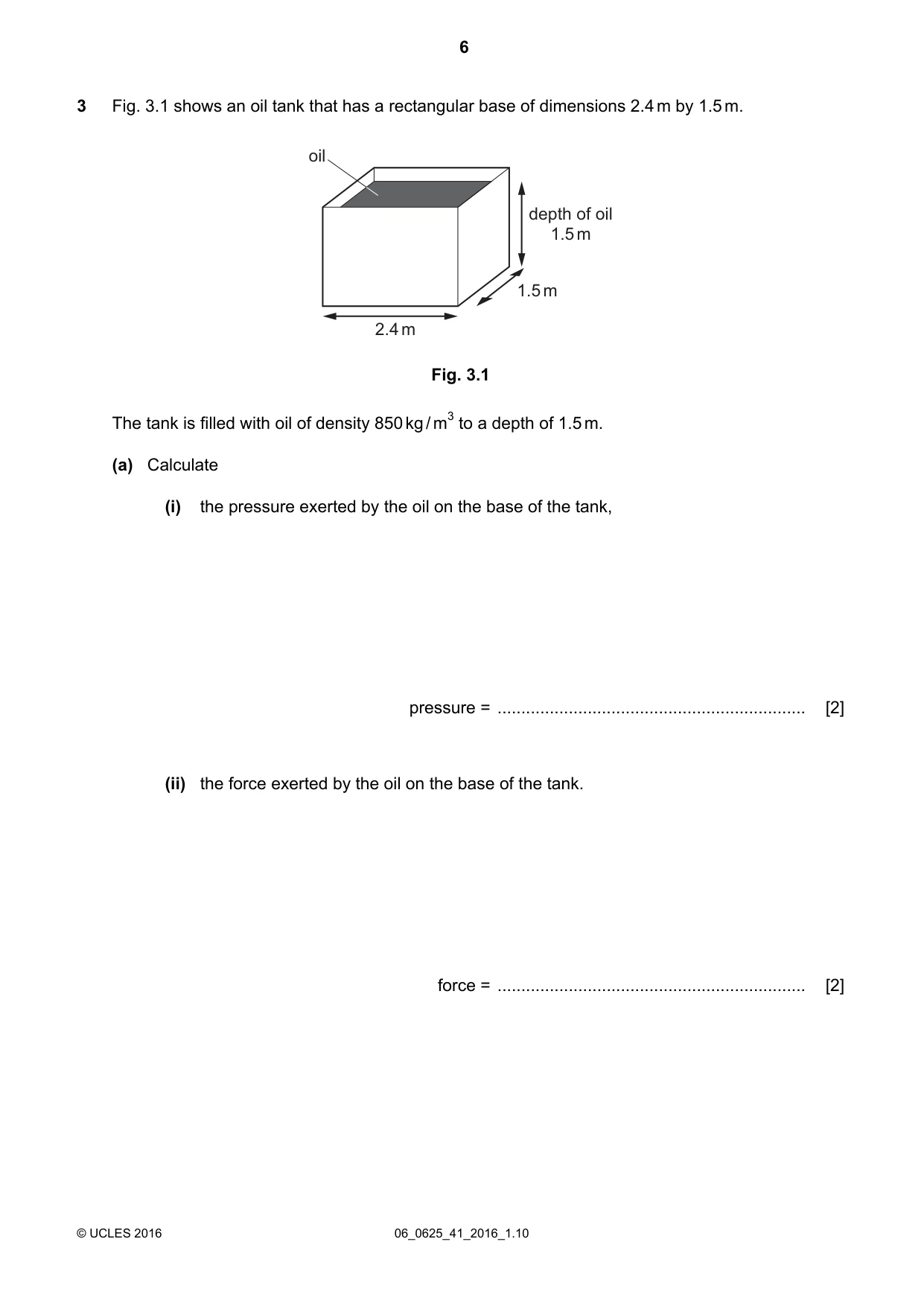
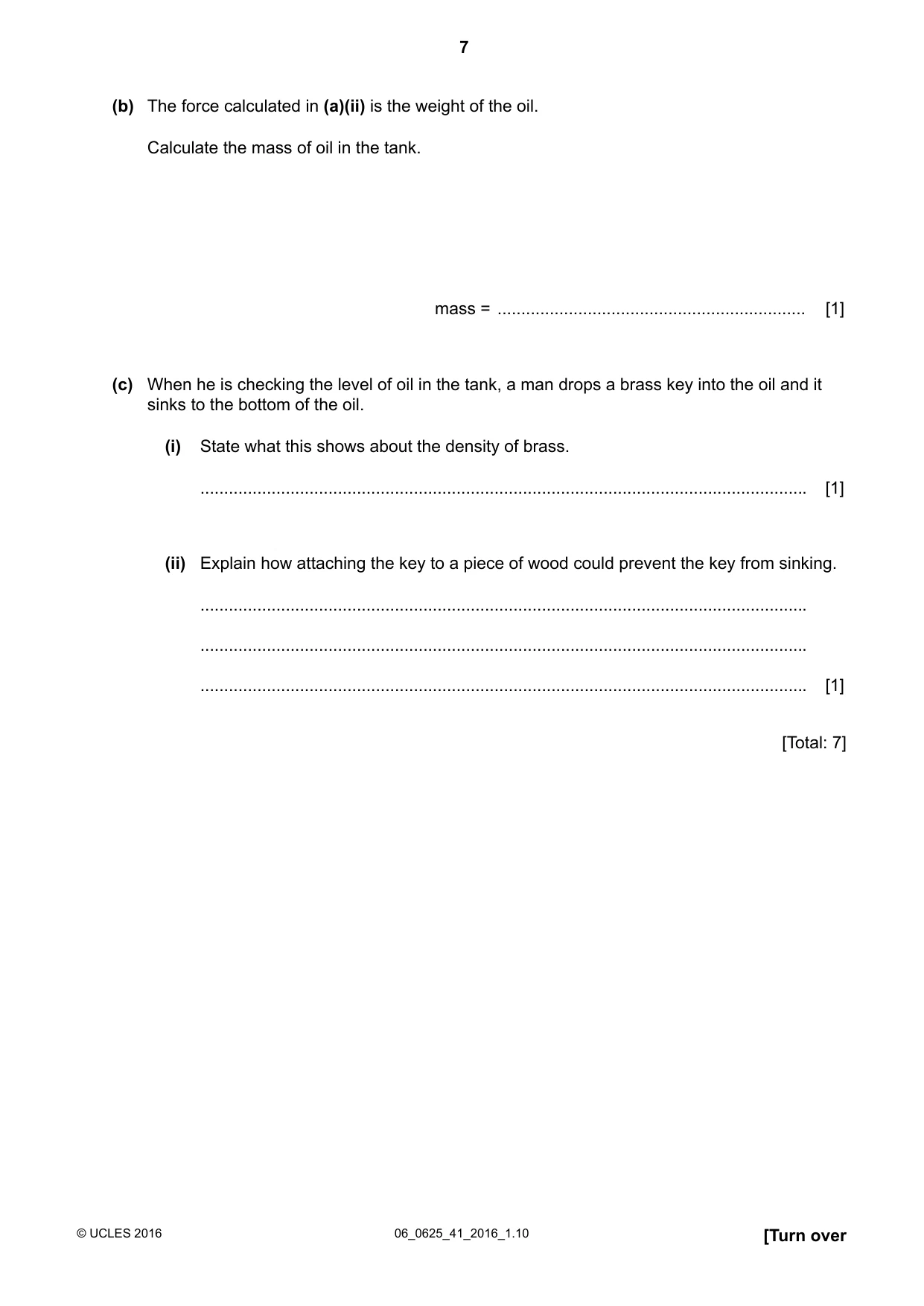
3 Fig. 3.1 shows an oil tank that has a rectangular base of dimensions 2.4m by 1.5m. oil depth of oil 1.5 m 1.5 m 2.4 m Fig. 3.1 The tank is filled with oil of density 850kg/m3 to a depth of 1.5m. (a) Calculate (i) the pressure exerted by the oil on the base of the tank, pressure = ................................................................. [2] (ii) the force exerted by the oil on the base of the tank. force = ................................................................. [2] (b) The force calculated in (a)(ii) is the weight of the oil. Calculate the mass of oil in the tank. mass = ................................................................. [1] (c) When he is checking the level of oil in the tank, a man drops a brass key into the oil and it sinks to the bottom of the oil. (i) State what this shows about the density of brass. ................................................................................................................................ [1] (ii) Explain how attaching the key to a piece of wood could prevent the key from sinking. ................................................................................................................................ ................................................................................................................................ ................................................................................................................................ [1] [Total: 7]
Mark scheme: 3(a)(i) (P =) hdg OR 1.5 × 850 × 10 OR mg / area of base OR 850 × 2.4 × 1.5 × 1.5 × 10 / (2.4 × 1.5) 13 000 Pa or N/m2 C1 (C1) A1 3(a)(ii) P = F/A OR (F =) PA OR 12 750 × 1.5 × 2.4 OR 12 750 × 3.6 46 000 N OR (Force = ) weight of oil = mg = 2.4 × 1.5 × 1.5 × 850 × 10 46 000 N C1 A1 (C1) (A1) 3(b) (46000 / 10 = ) 4600 kg OR m = Vd = (2.4 × 1.5 × 1.5) × 850 = 4600 kg B1 3(c)(i) (density of brass) greater than that of oil / 850 kg / m3 OR brass denser than oil B1 3(c)(ii) (It won’t sink as average) density of wood + key less than density of oil B1 Total: 7
Q4 · Explain, in terms of molecules, why it is possible to compress a gas, but not a liquid
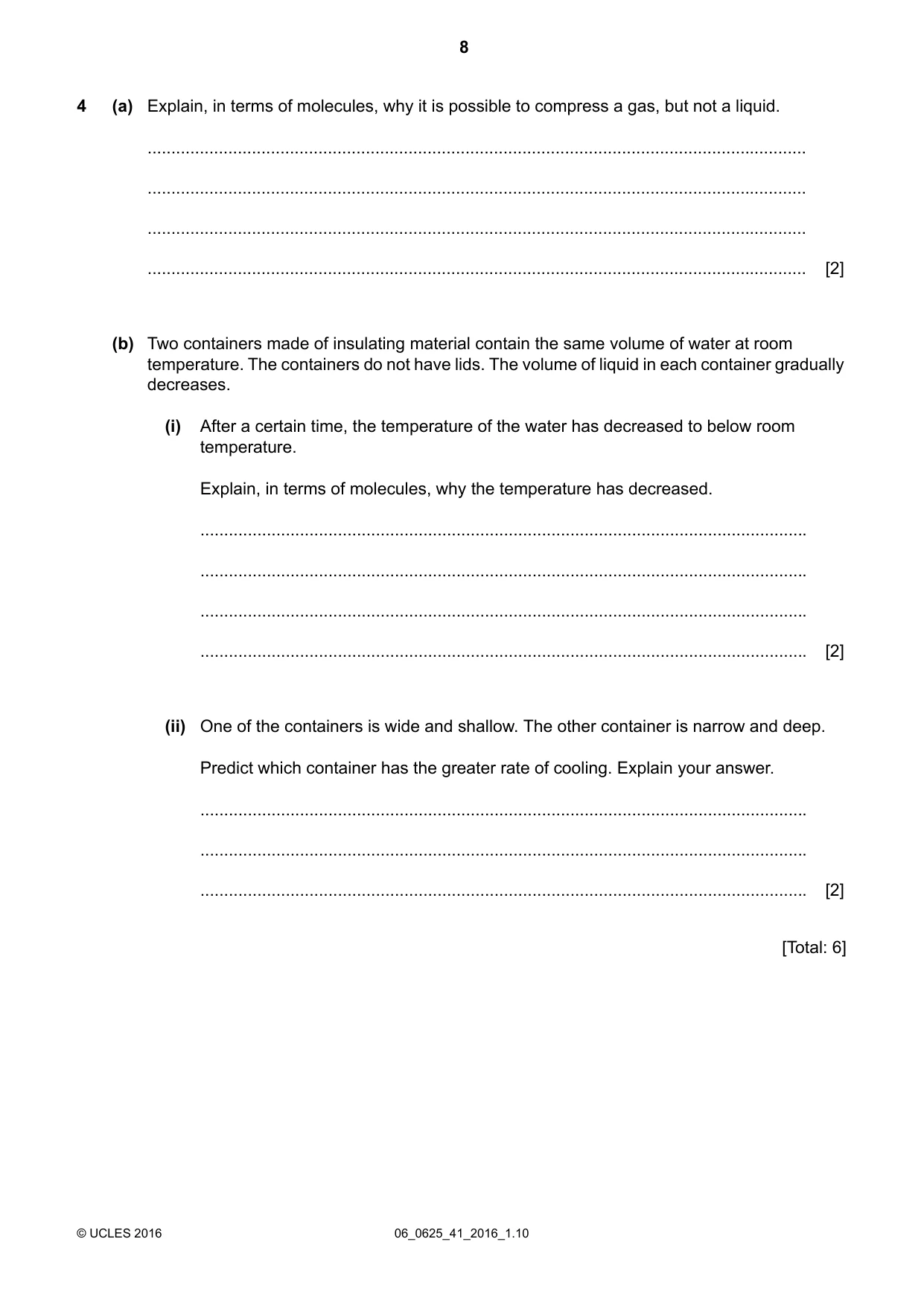
4 (a) Explain, in terms of molecules, why it is possible to compress a gas, but not a liquid. ........................................................................................................................................... ........................................................................................................................................... ........................................................................................................................................... ........................................................................................................................................... [2] (b) Two containers made of insulating material contain the same volume of water at room temperature. The containers do not have lids. The volume of liquid in each container gradually decreases. (i) After a certain time, the temperature of the water has decreased to below room temperature. Explain, in terms of molecules, why the temperature has decreased. ................................................................................................................................ ................................................................................................................................ ................................................................................................................................ ................................................................................................................................ [2] (ii) One of the containers is wide and shallow. The other container is narrow and deep. Predict which container has the greater rate of cooling. Explain your answer. ................................................................................................................................ ................................................................................................................................ ................................................................................................................................ [2] [Total: 6]
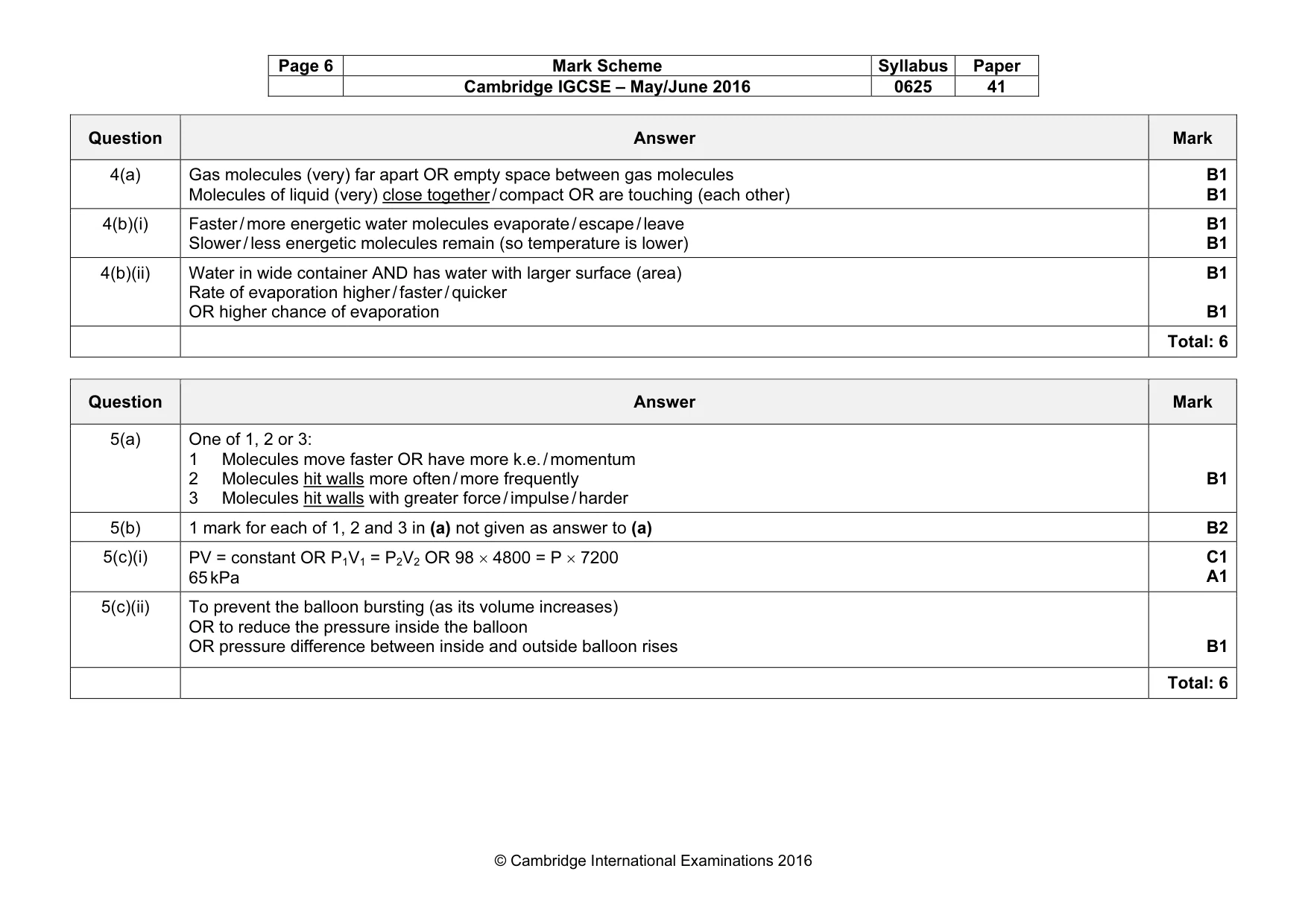
Mark scheme: 4(a) Gas molecules (very) far apart OR empty space between gas molecules Molecules of liquid (very) close together / compact OR are touching (each other) B1 B1 4(b)(i) Faster / more energetic water molecules evaporate / escape / leave Slower / less energetic molecules remain (so temperature is lower) B1 B1 4(b)(ii) Water in wide container AND has water with larger surface (area) Rate of evaporation higher / faster / quicker OR higher chance of evaporation B1 B1 Total: 6
Q5 · State what happens to the molecules of a gas in a sealed container when the temperature…
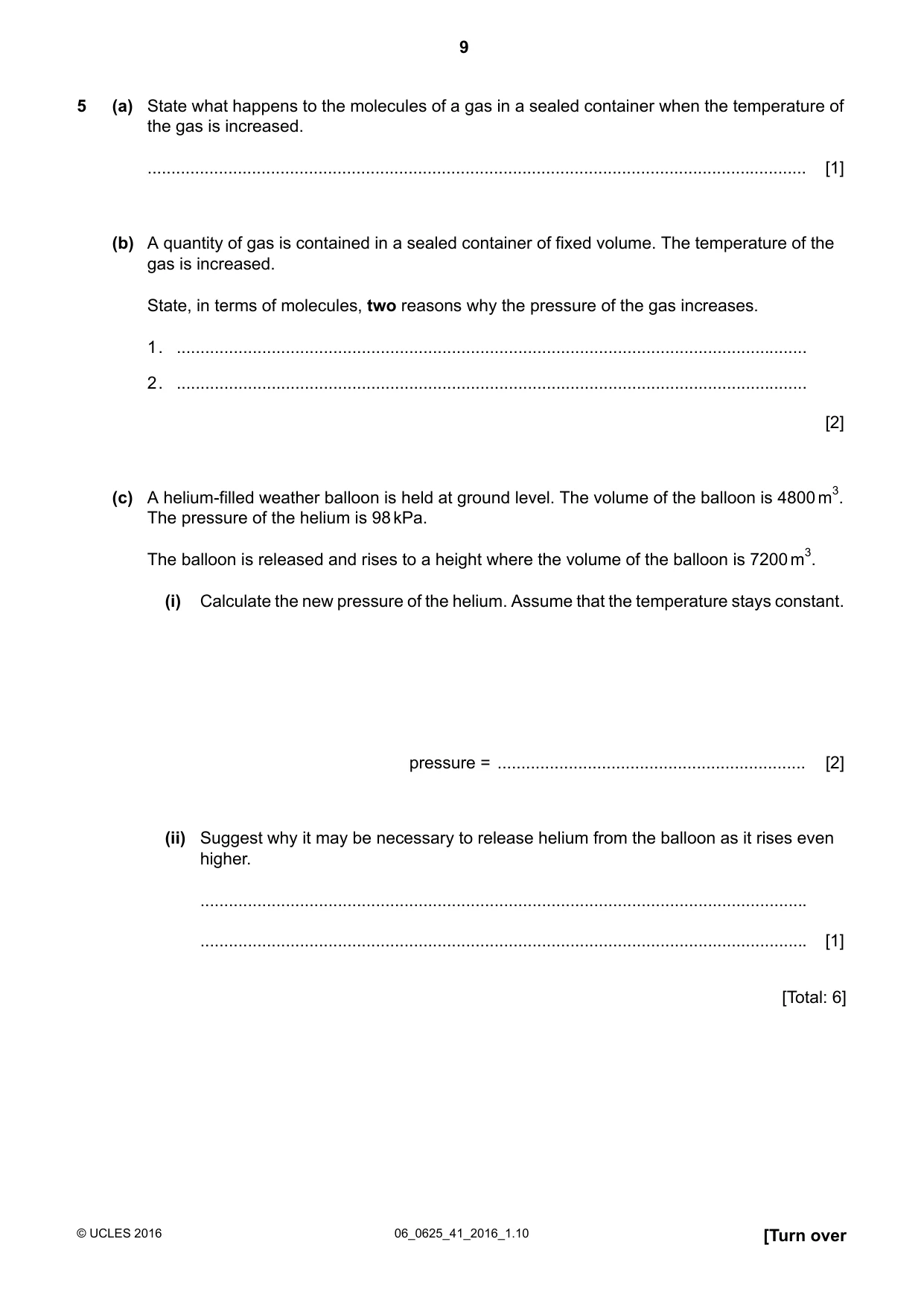
5 (a) State what happens to the molecules of a gas in a sealed container when the temperature of the gas is increased. ........................................................................................................................................... [1] (b) A quantity of gas is contained in a sealed container of fixed volume. The temperature of the gas is increased. State, in terms of molecules, two reasons why the pressure of the gas increases. 1. ..................................................................................................................................... 2. ..................................................................................................................................... [2] (c) A helium-filled weather balloon is held at ground level. The volume of the balloon is 4800m3. The pressure of the helium is 98kPa. The balloon is released and rises to a height where the volume of the balloon is 7200m3. (i) Calculate the new pressure of the helium. Assume that the temperature stays constant. pressure = ................................................................. [2] (ii) Suggest why it may be necessary to release helium from the balloon as it rises even higher. ................................................................................................................................ ................................................................................................................................ [1] [Total: 6]
Mark scheme: 5(a) One of 1, 2 or 3: 1 Molecules move faster OR have more k.e. / momentum 2 Molecules hit walls more often / more frequently 3 Molecules hit walls with greater force / impulse / harder B1 5(b) 1 mark for each of 1, 2 and 3 in (a) not given as answer to (a) B2 5(c)(i) PV = constant OR P1V1 = P2V2 OR 98 × 4800 = P × 7200 65 kPa C1 A1 5(c)(ii) To prevent the balloon bursting (as its volume increases) OR to reduce the pressure inside the balloon OR pressure difference between inside and outside balloon rises B1 Total: 6
Q6 · Two students are measuring the speed of sound
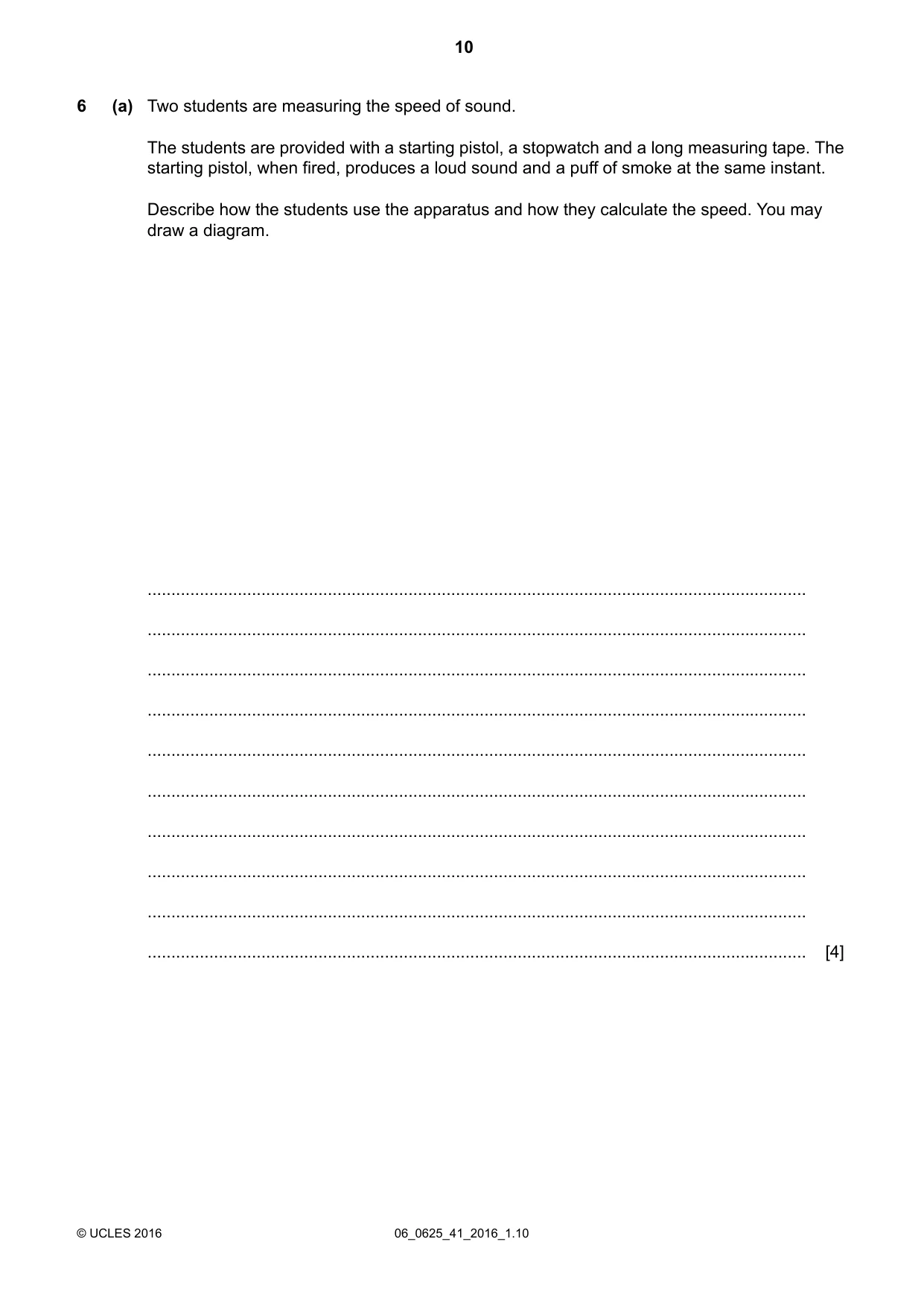
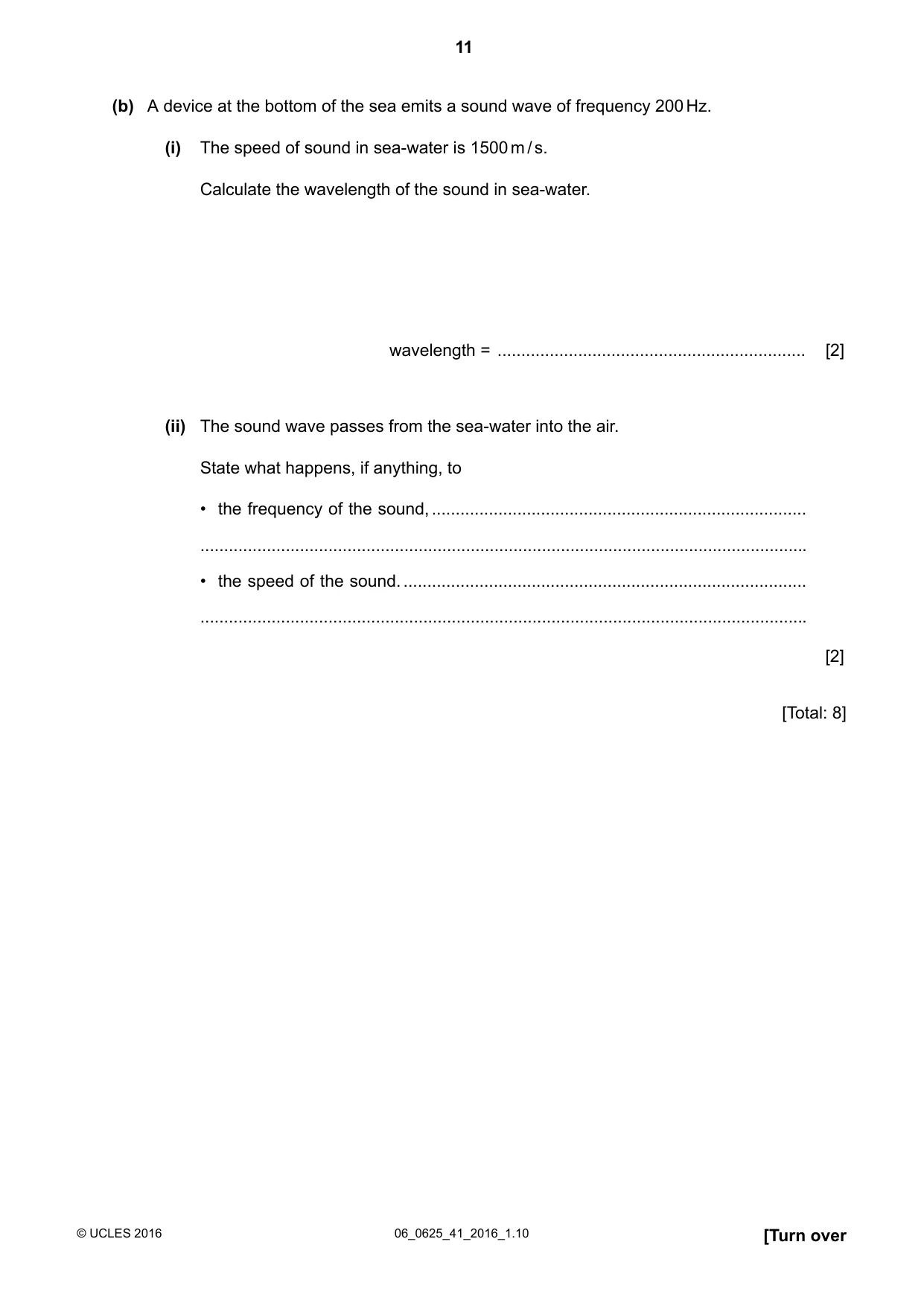
6 (a) Two students are measuring the speed of sound. The students are provided with a starting pistol, a stopwatch and a long measuring tape. The starting pistol, when fired, produces a loud sound and a puff of smoke at the same instant. Describe how the students use the apparatus and how they calculate the speed. You may draw a diagram. ........................................................................................................................................... ........................................................................................................................................... ........................................................................................................................................... ........................................................................................................................................... ........................................................................................................................................... ........................................................................................................................................... ........................................................................................................................................... ........................................................................................................................................... ........................................................................................................................................... ........................................................................................................................................... [4] (b) A device at the bottom of the sea emits a sound wave of frequency 200Hz. (i) The speed of sound in sea-water is 1500m/s. Calculate the wavelength of the sound in sea-water. wavelength = ................................................................. [2] (ii) The sound wave passes from the sea-water into the air. State what happens, if anything, to • the frequency of the sound,............................................................................... ................................................................................................................................ • the speed of the sound...................................................................................... ................................................................................................................................ [2] [Total: 8]
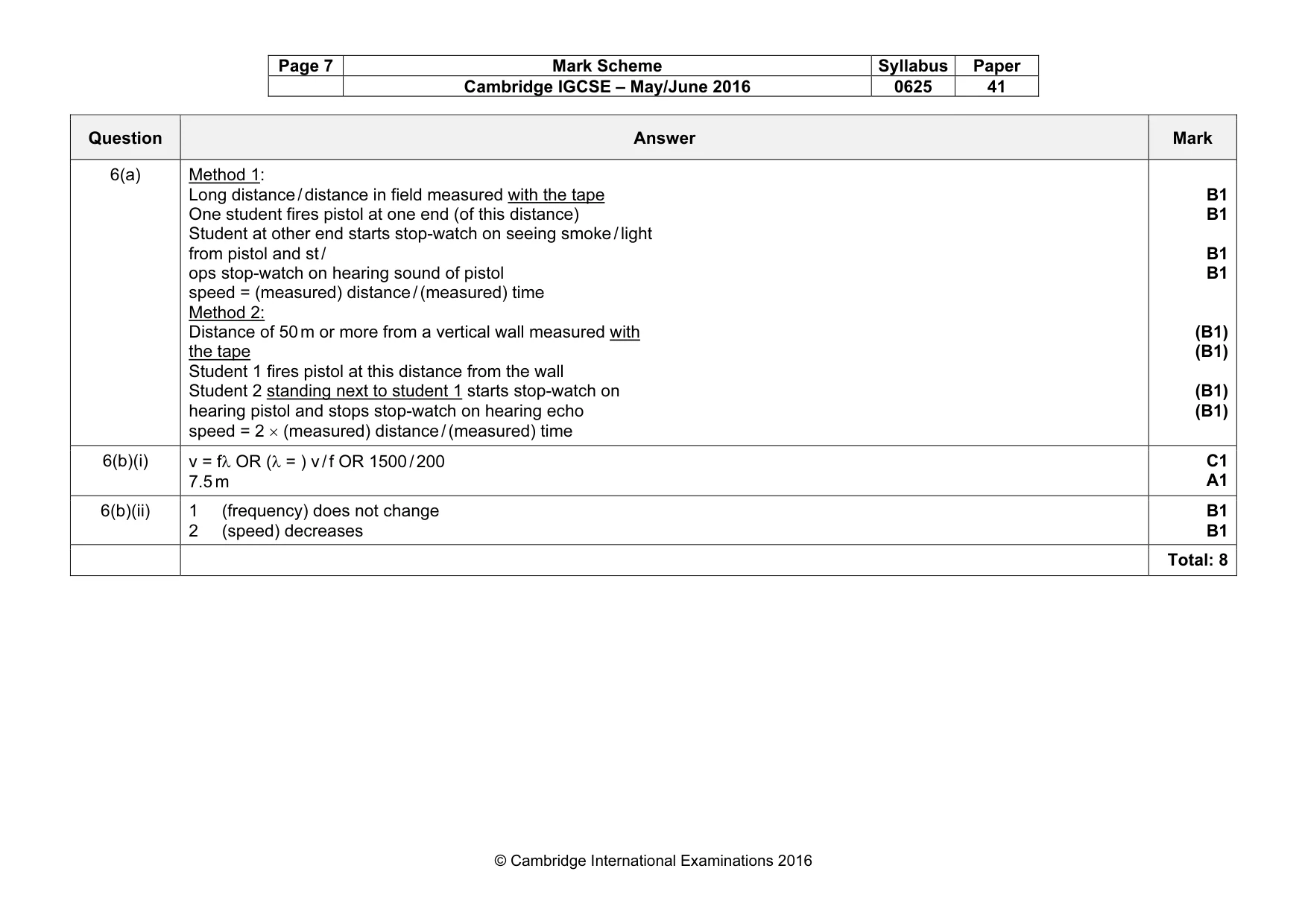
Mark scheme: 6(a) Method 1: Long distance / distance in field measured with the tape One student fires pistol at one end (of this distance) Student at other end starts stop-watch on seeing smoke / light from pistol and st / ops stop-watch on hearing sound of pistol speed = (measured) distance / (measured) time Method 2: Distance of 50 m or more from a vertical wall measured with the tape Student 1 fires pistol at this distance from the wall Student 2 standing next to student 1 starts stop-watch on hearing pistol and stops stop-watch on hearing echo speed = 2 × (measured) distance / (measured) time B1 B1 B1 B1 (B1) (B1) (B1) (B1) 6(b)(i) v = fλ OR (λ = ) v / f OR 1500 / 200 7.5 m C1 A1 6(b)(ii) 1 (frequency) does not change 2 (speed) decreases B1 B1 Total: 8
Q7 · A ray of light passes through a length of curved optical fibre
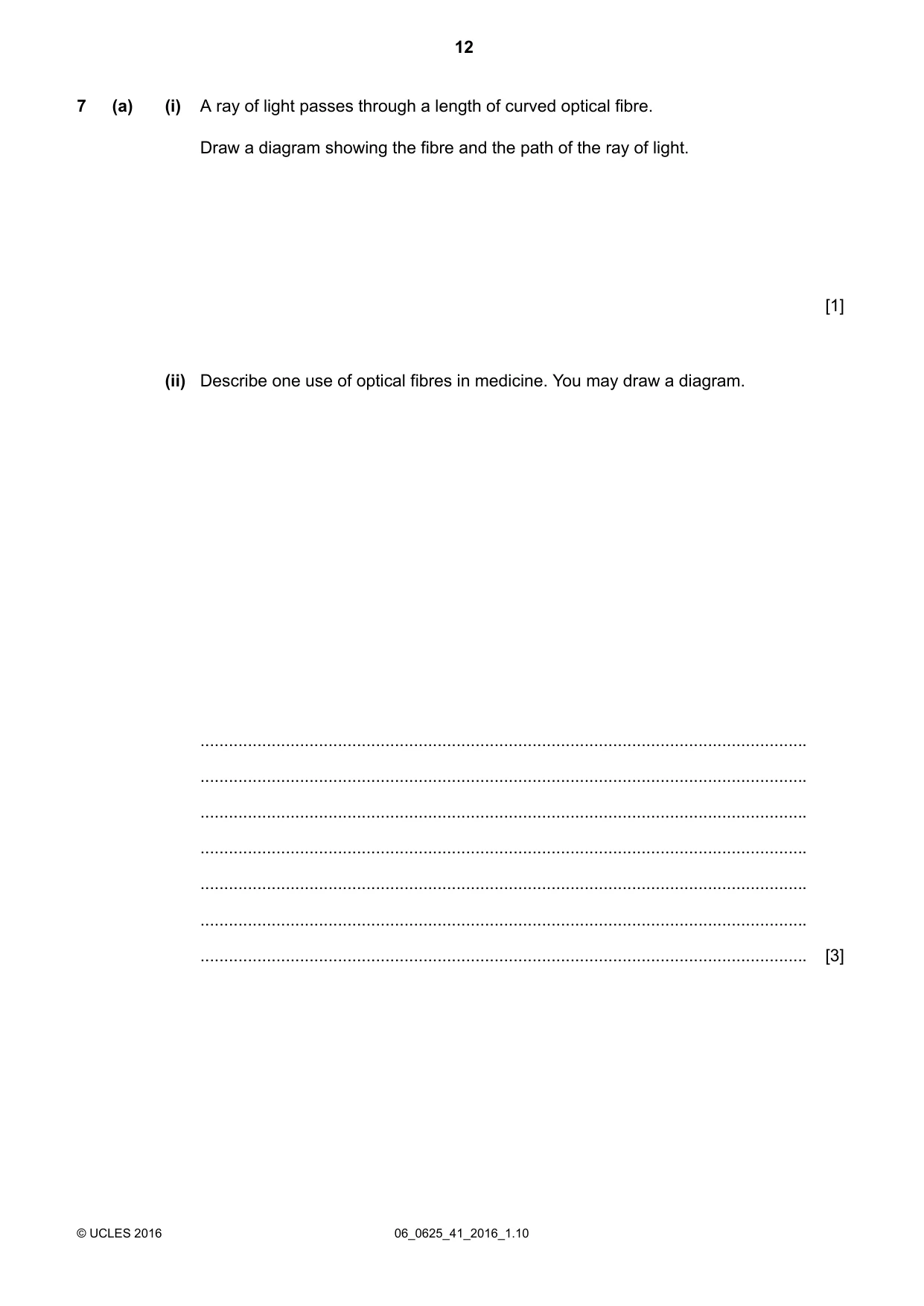
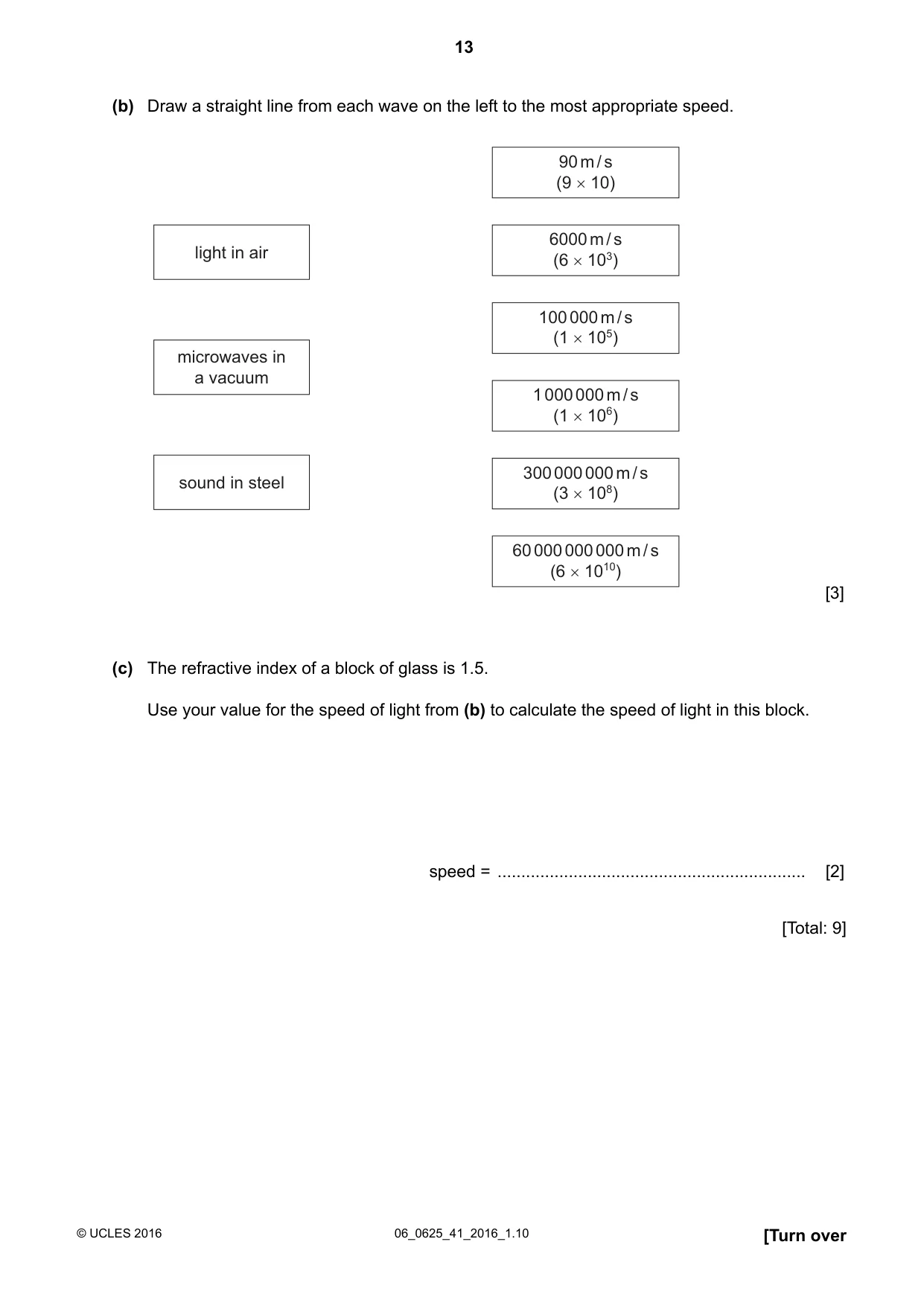
7 (a) (i) A ray of light passes through a length of curved optical fibre. Draw a diagram showing the fibre and the path of the ray of light. [1] (ii) Describe one use of optical fibres in medicine. You may draw a diagram. ................................................................................................................................ ................................................................................................................................ ................................................................................................................................ ................................................................................................................................ ................................................................................................................................ ................................................................................................................................ ................................................................................................................................ [3] (b) Draw a straight line from each wave on the left to the most appropriate speed. 90 m / s (9 × 10) 6000 m / s light in air (6 × 10³) 100 000 m / s (1 × 10⁵) microwaves in a vacuum 1 000 000 m / s (1 × 10⁶) 300 000 000 m / s sound in steel (3 × 10⁸) 60 000 000 000 m / s (6 × 10¹⁰) [3] (c) The refractive index of a block of glass is 1.5. Use your value for the speed of light from (b) to calculate the speed of light in this block. speed = ................................................................. [2] [Total: 9]
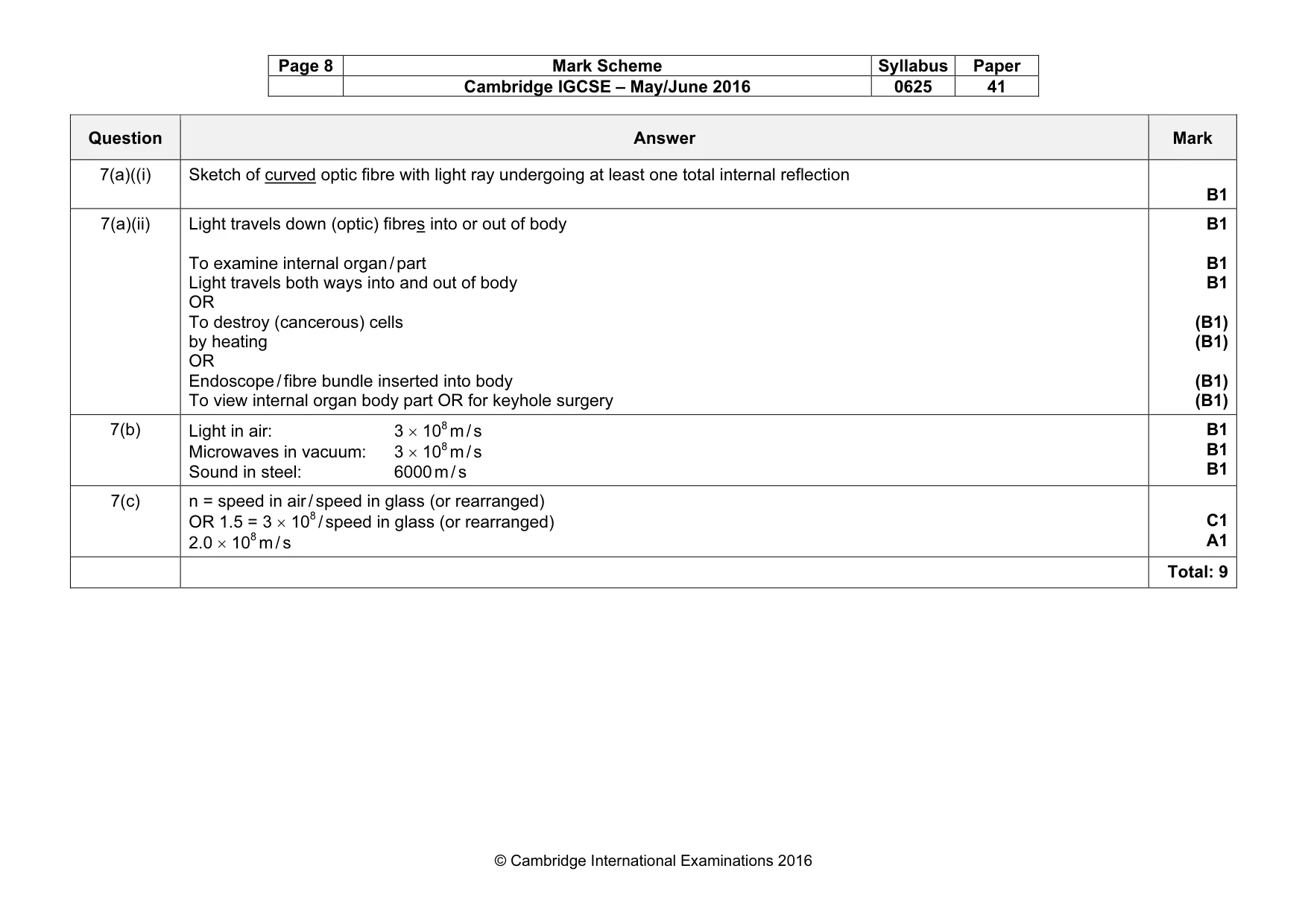
Mark scheme: 7(a)((i) Sketch of curved optic fibre with light ray undergoing at least one total internal reflection B1 7(a)(ii) Light travels down (optic) fibres into or out of body To examine internal organ / part Light travels both ways into and out of body OR To destroy (cancerous) cells by heating OR Endoscope / fibre bundle inserted into body To view internal organ body part OR for keyhole surgery B1 B1 B1 (B1) (B1) (B1) (B1) 7(b) Light in air: 3 × 10⁸ m / s Microwaves in vacuum: 3 × 10⁸ m / s Sound in steel: 6000 m / s B1 B1 B1 7(c) n = speed in air / speed in glass (or rearranged) OR 1.5 = 3 × 10⁸ / speed in glass (or rearranged) 2.0 × 10⁸ m / s C1 A1 Total: 9
Q8 · Two straight, vertical wires X and Y pass through holes in a horizontal card
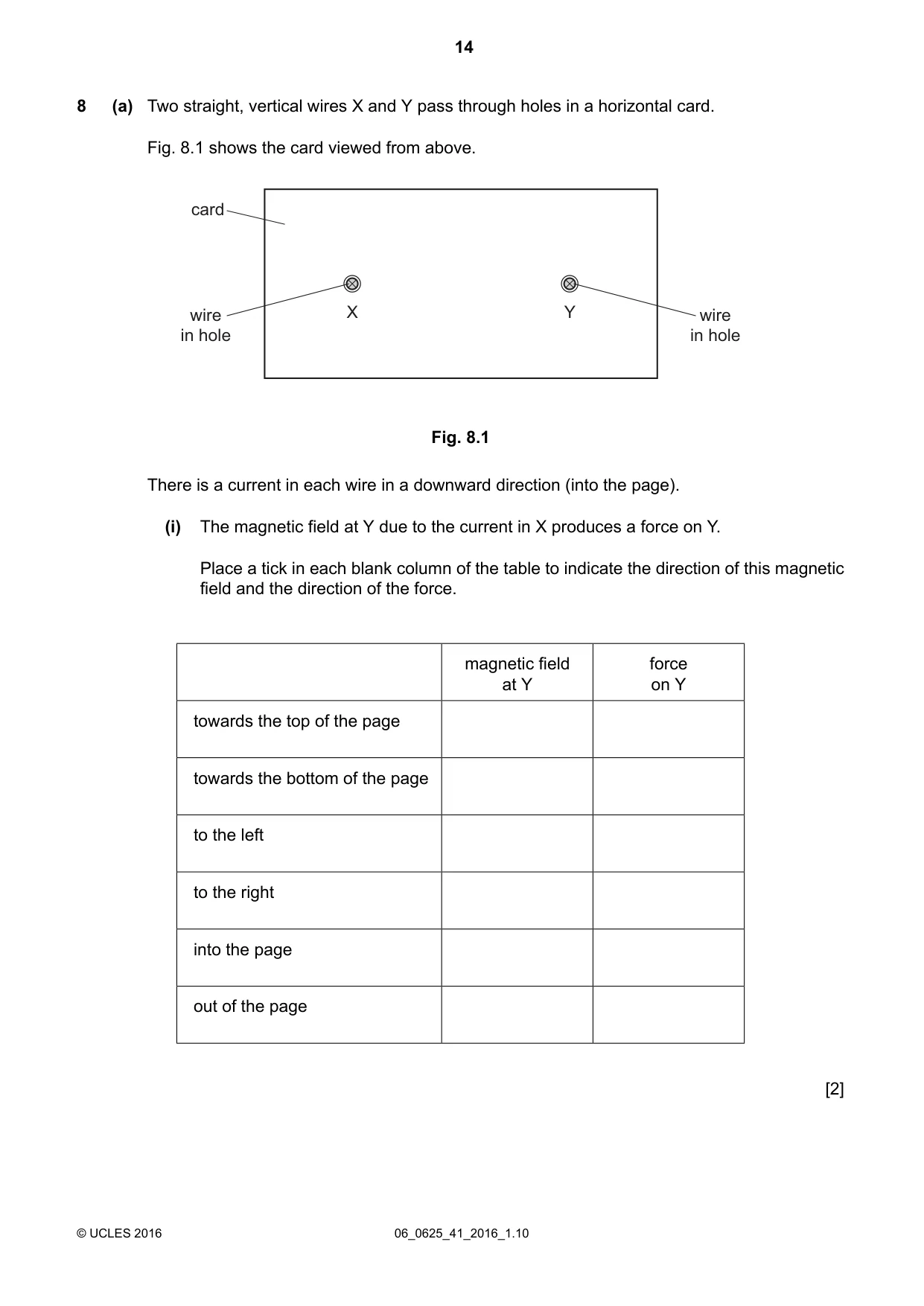
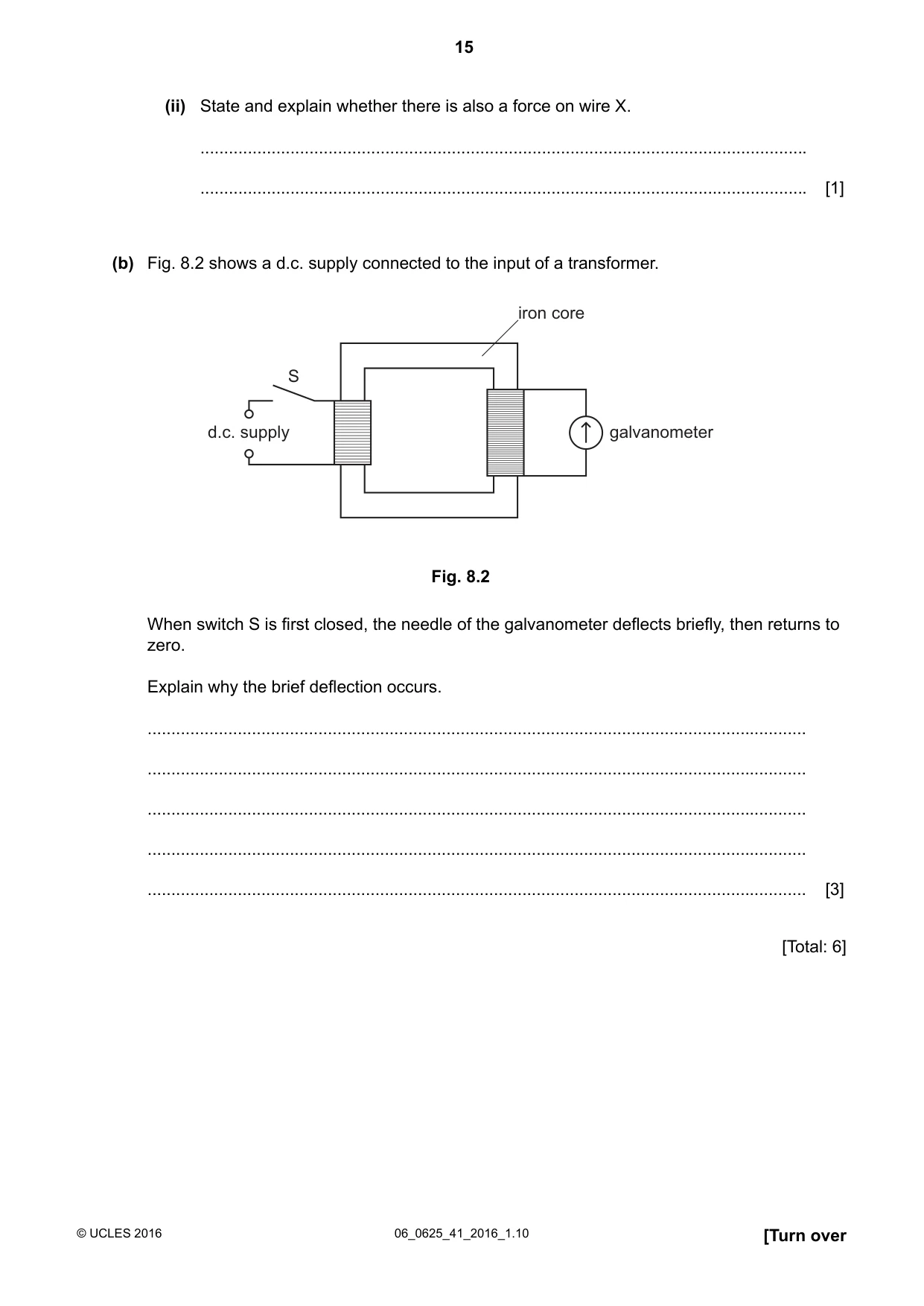
8 (a) Two straight, vertical wires X and Y pass through holes in a horizontal card. Fig. 8.1 shows the card viewed from above. card wire X Y wire in hole in hole Fig. 8.1 There is a current in each wire in a downward direction (into the page). (i) The magnetic field at Y due to the current in X produces a force on Y. Place a tick in each blank column of the table to indicate the direction of this magnetic field and the direction of the force. magnetic field force at Y on Y towards the top of the page towards the bottom of the page to the left to the right into the page out of the page [2] (ii) State and explain whether there is also a force on wire X. ................................................................................................................................ ................................................................................................................................ [1] (b) Fig. 8.2 shows a d.c. supply connected to the input of a transformer. iron core S d.c. supply galvanometer Fig. 8.2 When switch S is first closed, the needle of the galvanometer deflects briefly, then returns to zero. Explain why the brief deflection occurs. ........................................................................................................................................... ........................................................................................................................................... ........................................................................................................................................... ........................................................................................................................................... ........................................................................................................................................... [3] [Total: 6]
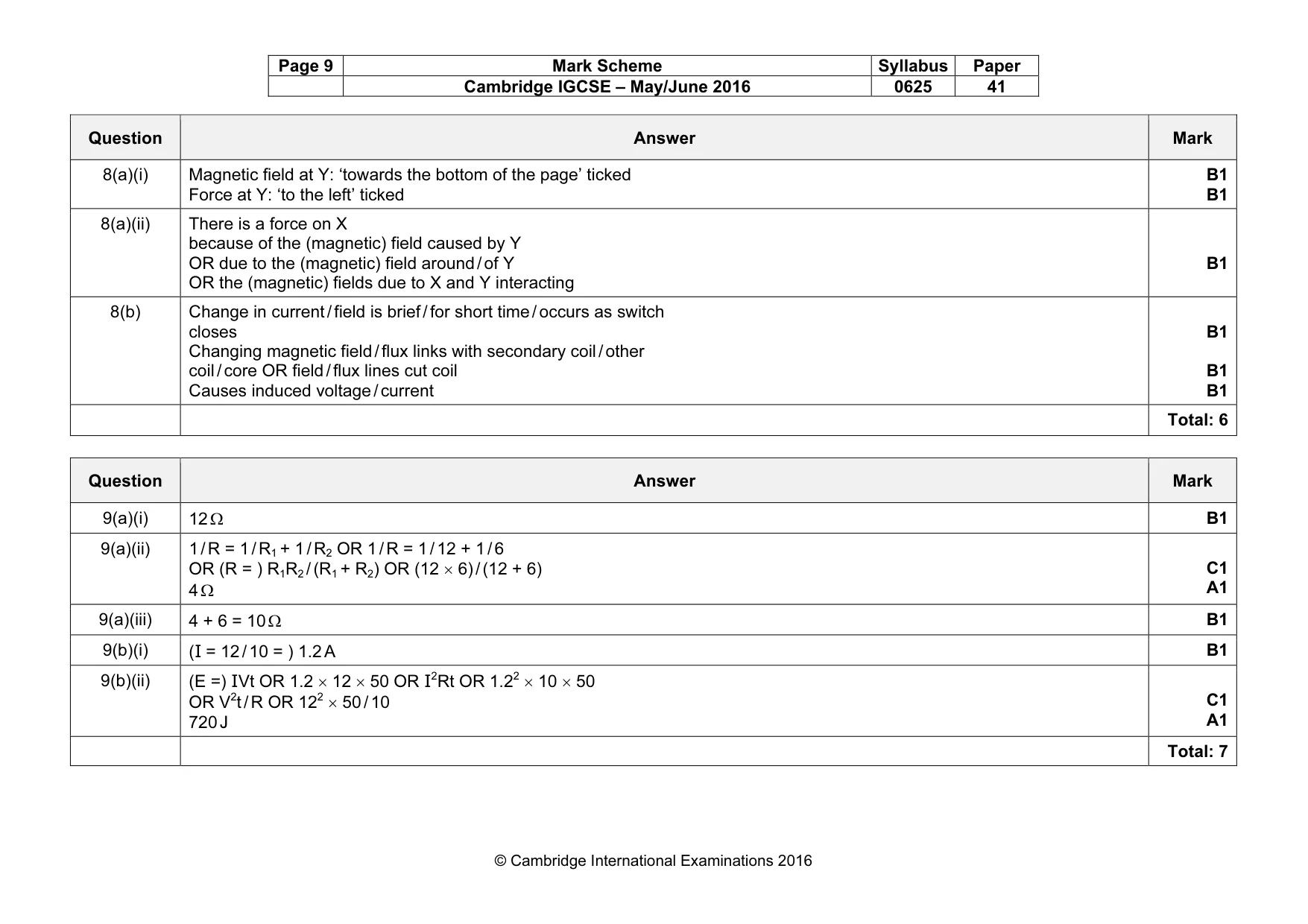
Mark scheme: 8(a)(i) Magnetic field at Y: ‘towards the bottom of the page’ ticked Force at Y: ‘to the left’ ticked B1 B1 8(a)(ii) There is a force on X because of the (magnetic) field caused by Y OR due to the (magnetic) field around / of Y OR the (magnetic) fields due to X and Y interacting B1 8(b) Change in current / field is brief / for short time / occurs as switch closes Changing magnetic field / flux links with secondary coil / other coil / core OR field / flux lines cut coil Causes induced voltage / current B1 B1 B1 Total: 6
Q9 · A 12V battery connected in a circuit containing resistors A, B, C and D
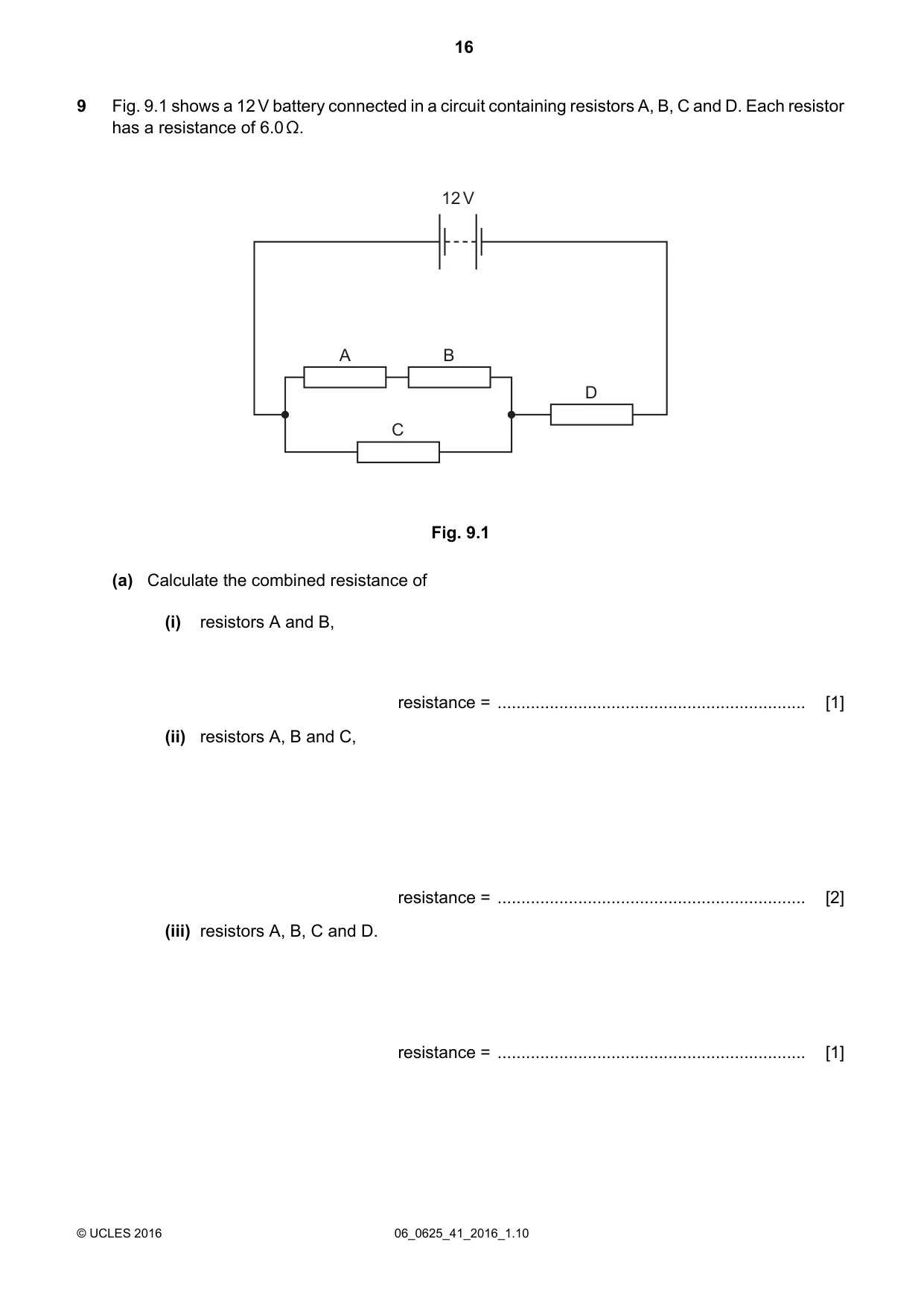
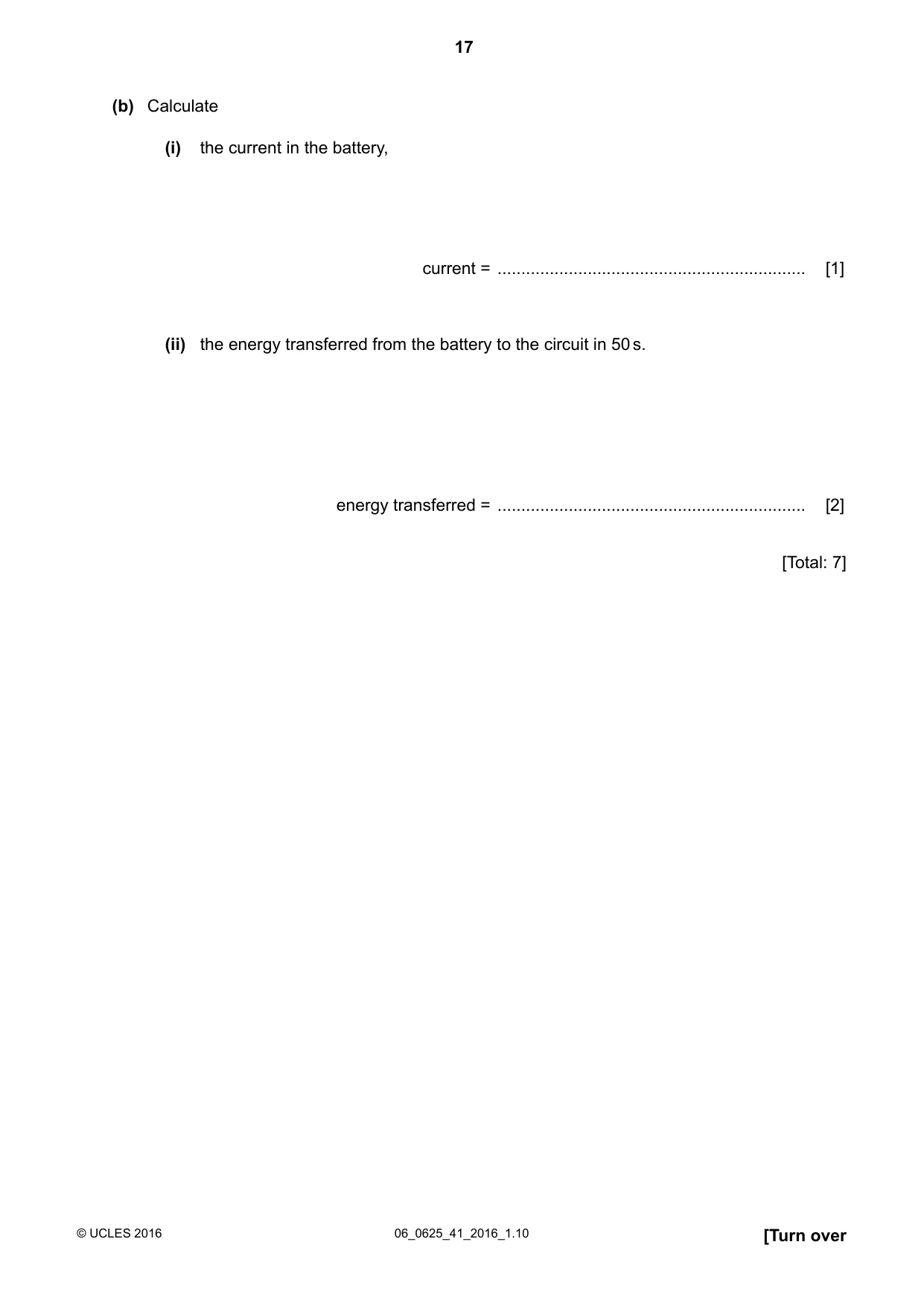
9 Fig. 9.1 shows a 12V battery connected in a circuit containing resistors A, B, C and D. Each resistor has a resistance of 6.0Ω. 12 V A B D C Fig. 9.1 (a) Calculate the combined resistance of (i) resistors A and B, resistance = ................................................................. [1] (ii) resistors A, B and C, resistance = ................................................................. [2] (iii) resistors A, B, C and D. resistance = ................................................................. [1] (b) Calculate (i) the current in the battery, current = ................................................................. [1] (ii) the energy transferred from the battery to the circuit in 50s. energy transferred = ................................................................. [2] [Total: 7]
Mark scheme: 9(a)(i) 12 Ω B1 9(a)(ii) 1 / R = 1 / R1 + 1 / R2 OR 1 / R = 1 / 12 + 1 / 6 OR (R = ) R1R2 / (R1 + R2) OR (12 × 6) / (12 + 6) 4 Ω C1 A1 9(a)(iii) 4 + 6 = 10 Ω B1 9(b)(i) (I = 12 / 10 = ) 1.2 A B1 9(b)(ii) (E =) IVt OR 1.2 × 12 × 50 OR I2Rt OR 1.22 × 10 × 50 OR V2t / R OR 122 × 50 / 10 720 J C1 A1 Total: 7
Q10 · The symbol for a circuit component
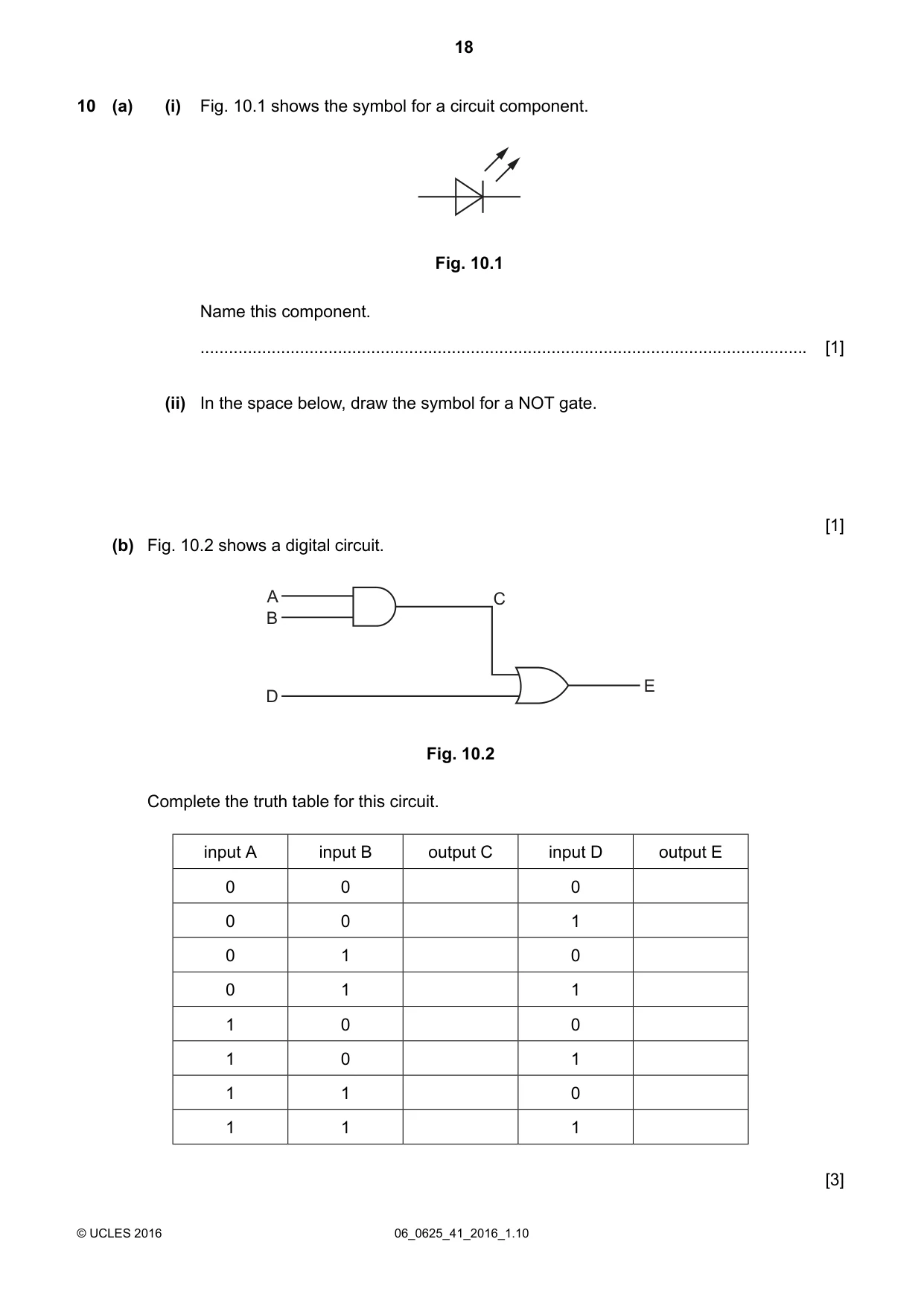
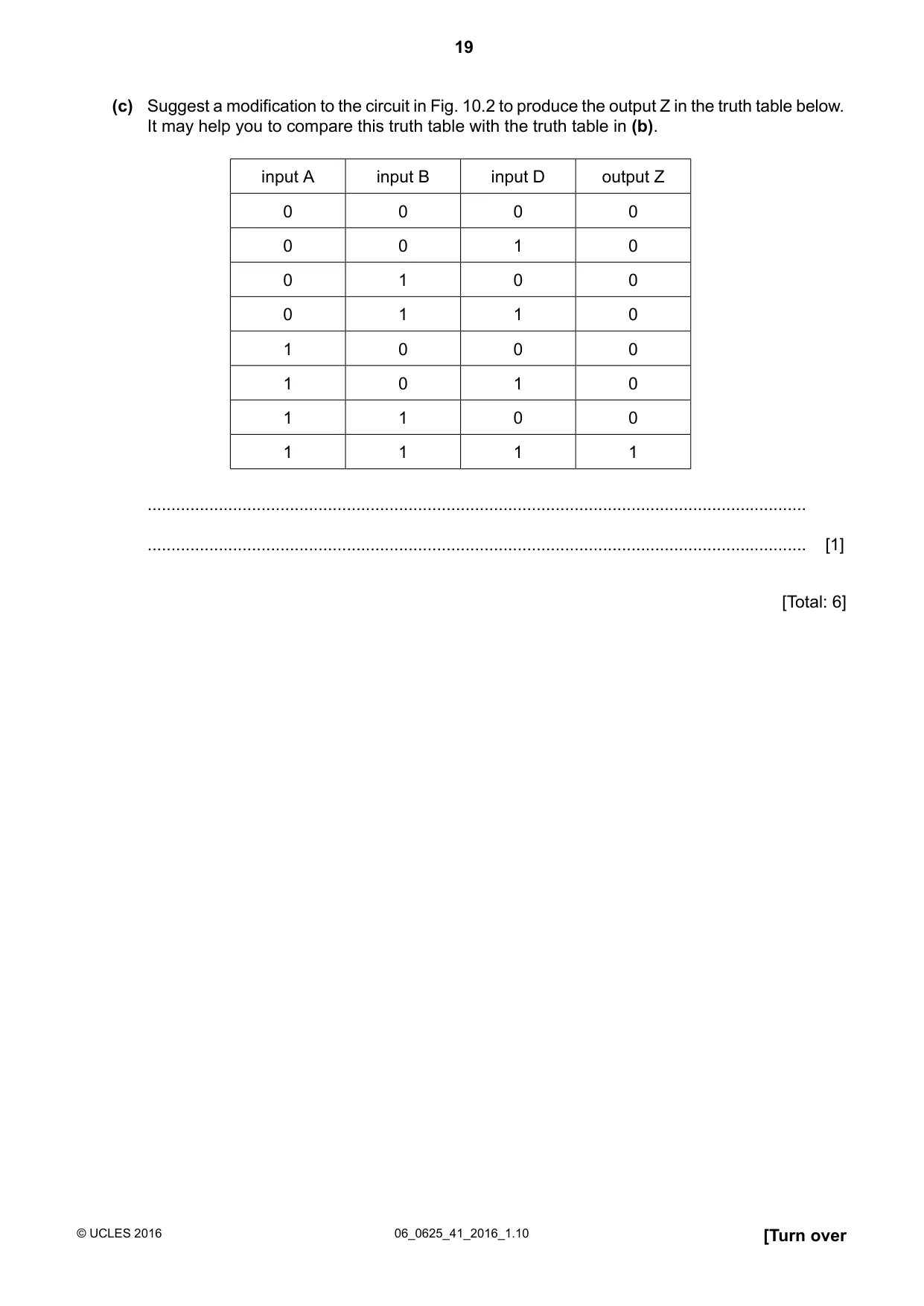
10 (a) (i) Fig. 10.1 shows the symbol for a circuit component. Fig. 10.1 Name this component. ................................................................................................................................ [1] (ii) In the space below, draw the symbol for a NOT gate. [1] (b) Fig. 10.2 shows a digital circuit. A C B E D Fig. 10.2 Complete the truth table for this circuit. input A input B output C input D output E 0 0 0 0 0 1 0 1 0 0 1 1 1 0 0 1 0 1 1 1 0 1 1 1 [3] (c) Suggest a modification to the circuit in Fig. 10.2 to produce the output Z in the truth table below. It may help you to compare this truth table with the truth table in (b). input A input B input D output Z 0 0 0 0 0 0 1 0 0 1 0 0 0 1 1 0 1 0 0 0 1 0 1 0 1 1 0 0 1 1 1 1 ........................................................................................................................................... ........................................................................................................................................... [1] [Total: 6]
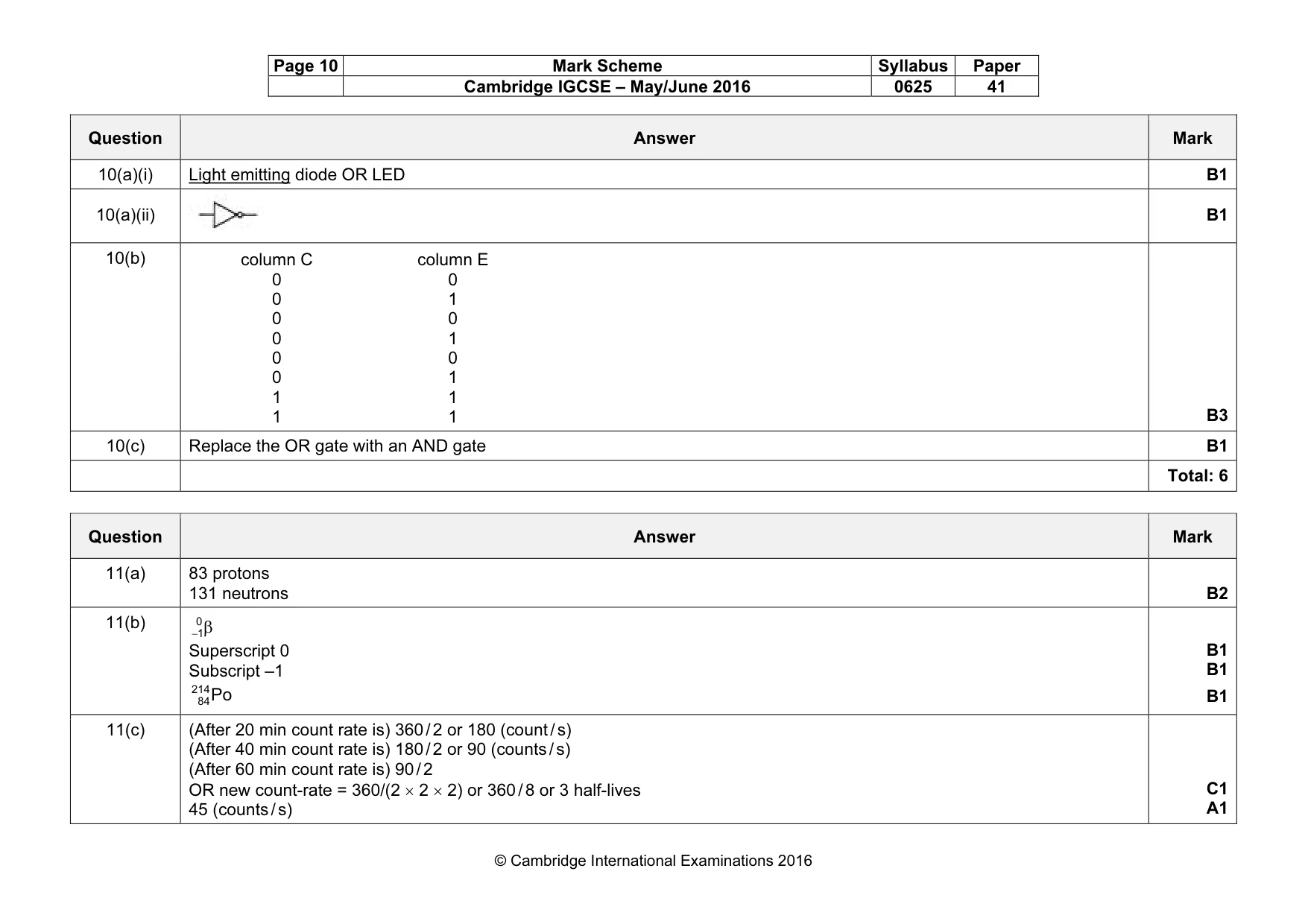
Mark scheme: 10(a)(i) Light emitting diode OR LED 10(a)(ii) B1 10(b) column C column E 0 0 0 0 0 0 1 1 0 1 0 1 0 1 1 1 B3 10(c) Replace the OR gate with an AND gate B1 Total: 6
Question 11
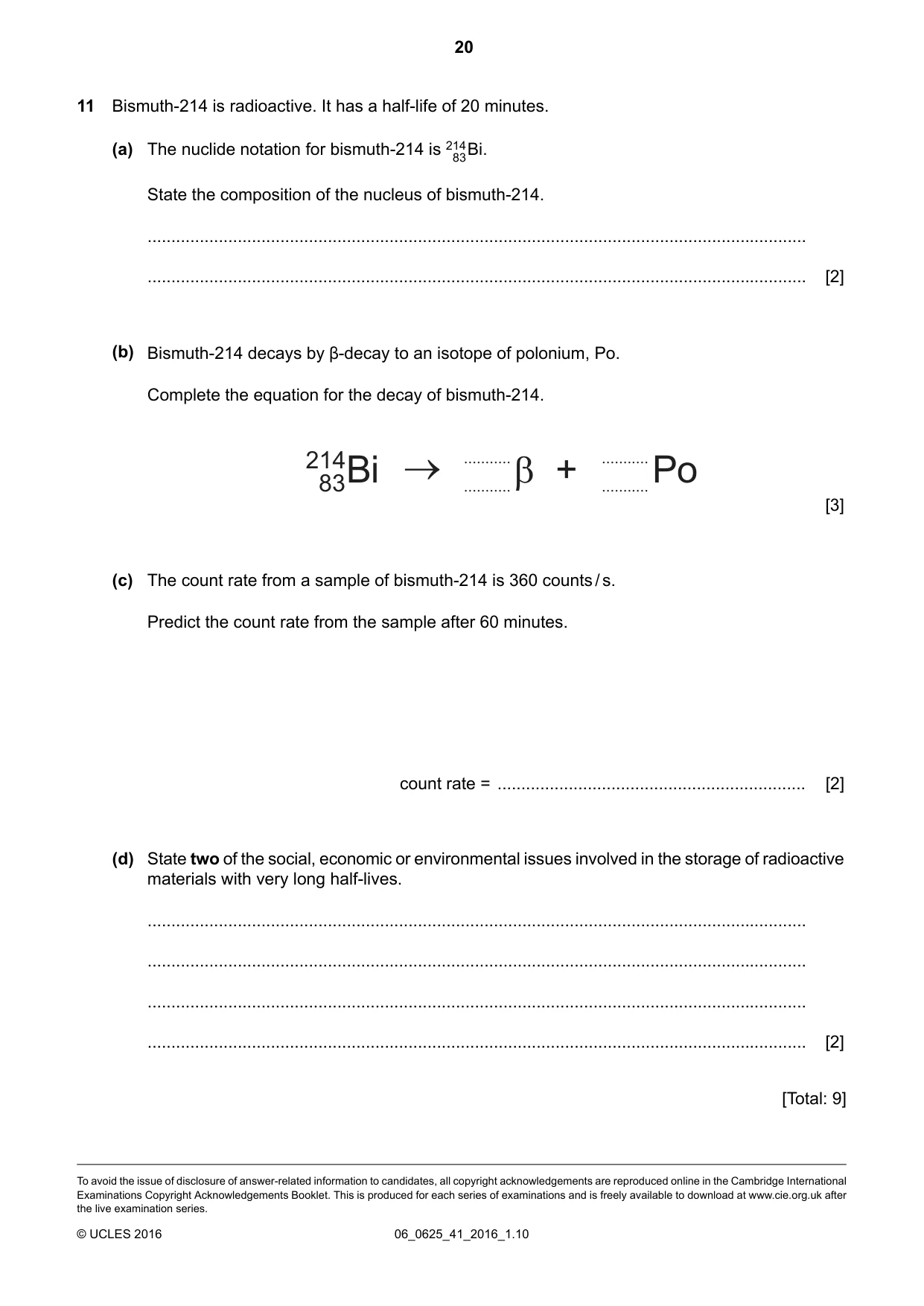
11 Bismuth-214 is radioactive. It has a half-life of 20 minutes. (a) The nuclide notation for bismuth-214 is Bi. State the composition of the nucleus of bismuth-214. ........................................................................................................................................... ........................................................................................................................................... [2] (b) Bismuth-214 decays by β-decay to an isotope of polonium, Po. Complete the equation for the decay of bismuth-214. → ........... 214Bi ........... β + ...................... Po 83 [3] (c) The count rate from a sample of bismuth-214 is 360 counts/s. Predict the count rate from the sample after 60 minutes. count rate = ................................................................. [2] (d) State two of the social, economic or environmental issues involved in the storage of radioactive materials with very long half-lives. ........................................................................................................................................... ........................................................................................................................................... ........................................................................................................................................... ........................................................................................................................................... [2] [Total: 9]
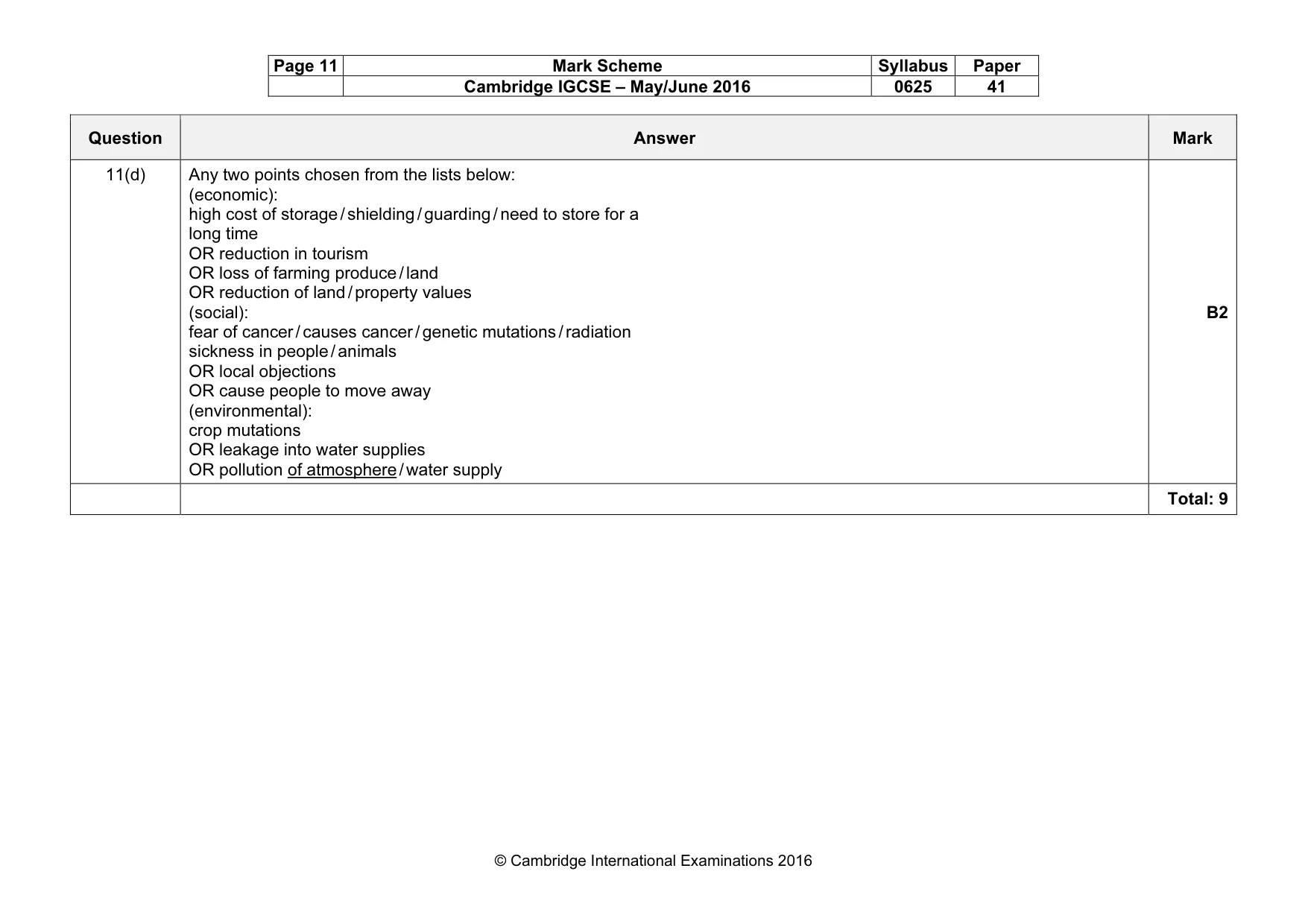
Mark scheme: 11(a) 83 protons 131 neutrons B2 11(b) 0 1 −β Superscript 0 Subscript –1 214 84Po B1 B1 B1 11(c) (After 20 min count rate is) 360 / 2 or 180 (count / s) (After 40 min count rate is) 180 / 2 or 90 (counts / s) (After 60 min count rate is) 90 / 2 OR new count-rate = 360/(2 × 2 × 2) or 360 / 8 or 3 half-lives 45 (counts / s) C1 A1 Question Answer Mark 11(d) Any two points chosen from the lists below: (economic): high cost of storage / shielding / guarding / need to store for a long time OR reduction in tourism OR loss of farming produce / land OR reduction of land / property values (social): fear of cancer / causes cancer / genetic mutations / radiation sickness in people / animals OR local objections OR cause people to move away (environmental): crop mutations OR leakage into water supplies OR pollution of atmosphere / water supply B2 Total: 9
What was in this paper
The subtopics covered by these 11 questions, and how many questions each got. Open one in a new tab to see every Cambridge question on it.
What you needed in this session
Cambridge’s own grade thresholds for 2016 May/June, Paper 4 · Variant 1. A higher threshold means an easier paper — the bar moves with how the cohort did.