Cambridge IGCSE Physics 0625 — 2017 Oct/Nov Paper 4 · Variant 1
0625/41/O/N/17 · 11 questions · 80 marks · ≈90 min
The question paper and its mark scheme, free to read here and free to download. This is Cambridge’s own paper, exactly as it was sat.
Question paper16 pages

Mark scheme10 pages
Answers below. Sit the paper first if you are practising.
Questions as text
Q1 · The speed-time graph for the motion of a car
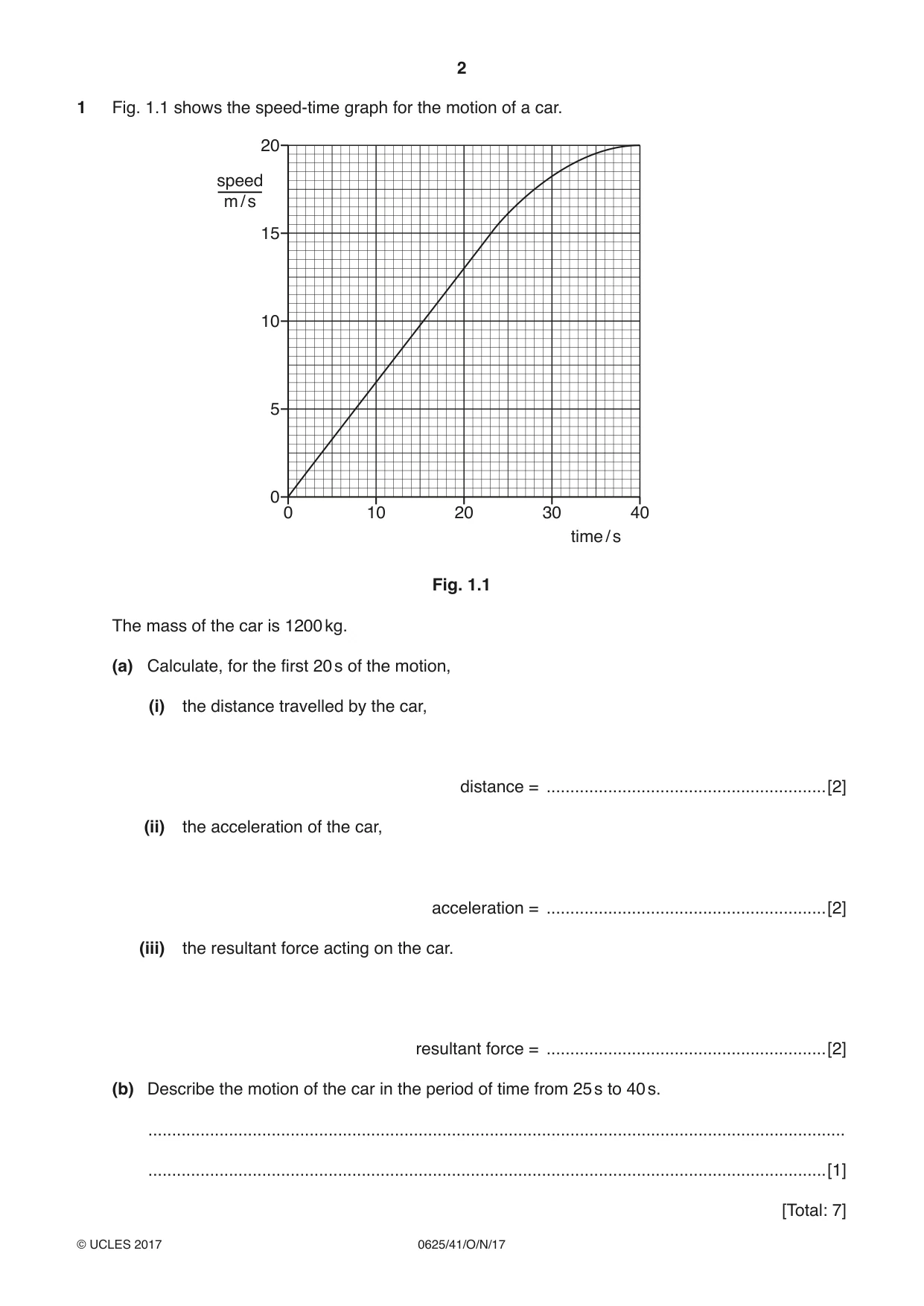
1 Fig. 1.1 shows the speed-time graph for the motion of a car. 20 speed m / s 15 10 5 0 0 10 20 30 40 time / s Fig. 1.1 The mass of the car is 1200 kg. (a) Calculate, for the first 20 s of the motion, (i) the distance travelled by the car, distance = ...........................................................[2] (ii) the acceleration of the car, acceleration = ...........................................................[2] (iii) the resultant force acting on the car. resultant force = ...........................................................[2] (b) Describe the motion of the car in the period of time from 25 s to 40 s. ................................................................................................................................................... ...............................................................................................................................................[1] [Total: 7]
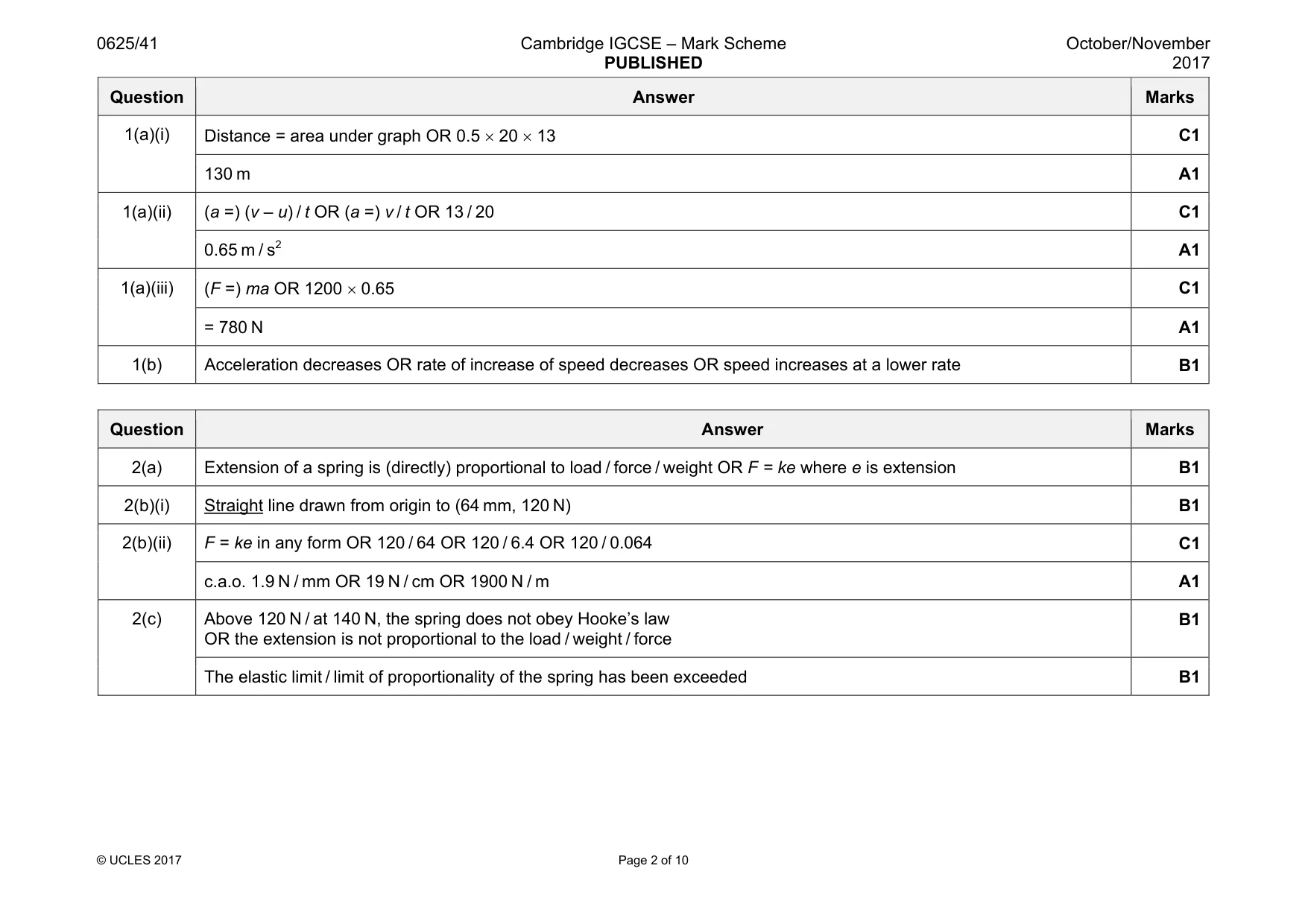
Mark scheme: 1(a)(i) C1 130 m A1 1(a)(ii) (a =) (v – u) / t OR (a =) v / t OR 13 / 20 C1 0.65 m / s2 A1 1(a)(iii) (F =) ma OR 1200 × 0.65 C1 = 780 N A1 1(b) Acceleration decreases OR rate of increase of speed decreases OR speed increases at a lower rate B1
Question 2
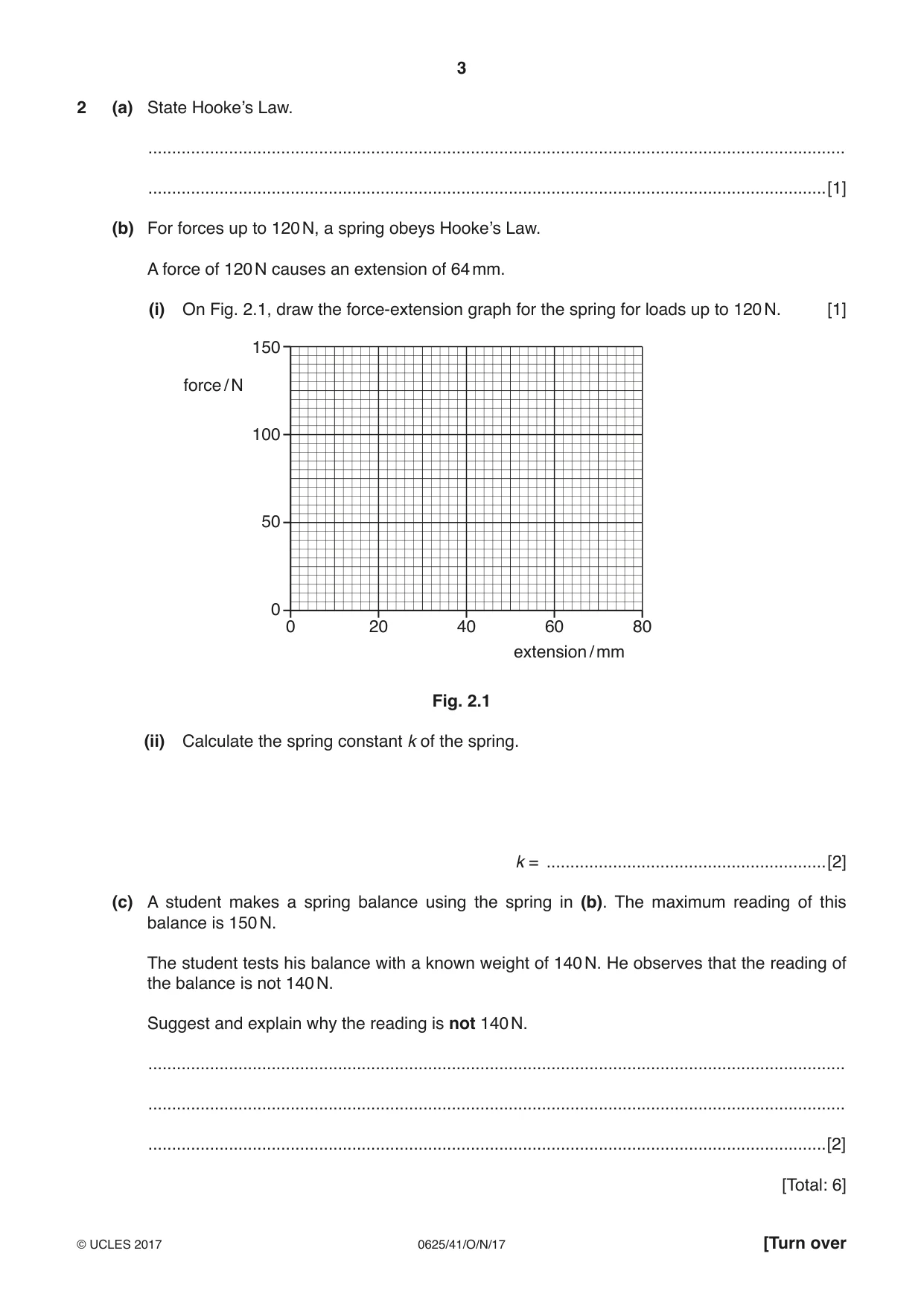
2 (a) State Hooke’s Law. ................................................................................................................................................... ...............................................................................................................................................[1] (b) For forces up to 120 N, a spring obeys Hooke’s Law. A force of 120 N causes an extension of 64 mm. (i) On Fig. 2.1, draw the force-extension graph for the spring for loads up to 120 N. [1] 150 force / N 100 50 0 0 20 40 60 80 extension / mm Fig. 2.1 (ii) Calculate the spring constant k of the spring. k = ...........................................................[2] (c) A student makes a spring balance using the spring in (b). The maximum reading of this balance is 150 N. The student tests his balance with a known weight of 140 N. He observes that the reading of the balance is not 140 N. Suggest and explain why the reading is not 140 N. ................................................................................................................................................... ................................................................................................................................................... ...............................................................................................................................................[2] [Total: 6]
Mark scheme: 2(a) Extension of a spring is (directly) proportional to load / force / weight OR F = ke where e is extension B1 2(b)(i) Straight line drawn from origin to (64 mm, 120 N) B1 2(b)(ii) F = ke in any form OR 120 / 64 OR 120 / 6.4 OR 120 / 0.064 C1 c.a.o. 1.9 N / mm OR 19 N / cm OR 1900 N / m A1 2(c) Above 120 N / at 140 N, the spring does not obey Hooke’s law OR the extension is not proportional to the load / weight / force B1 The elastic limit / limit of proportionality of the spring has been exceeded B1
Q3 · All the sides of a plastic cube are 8.0 cm long
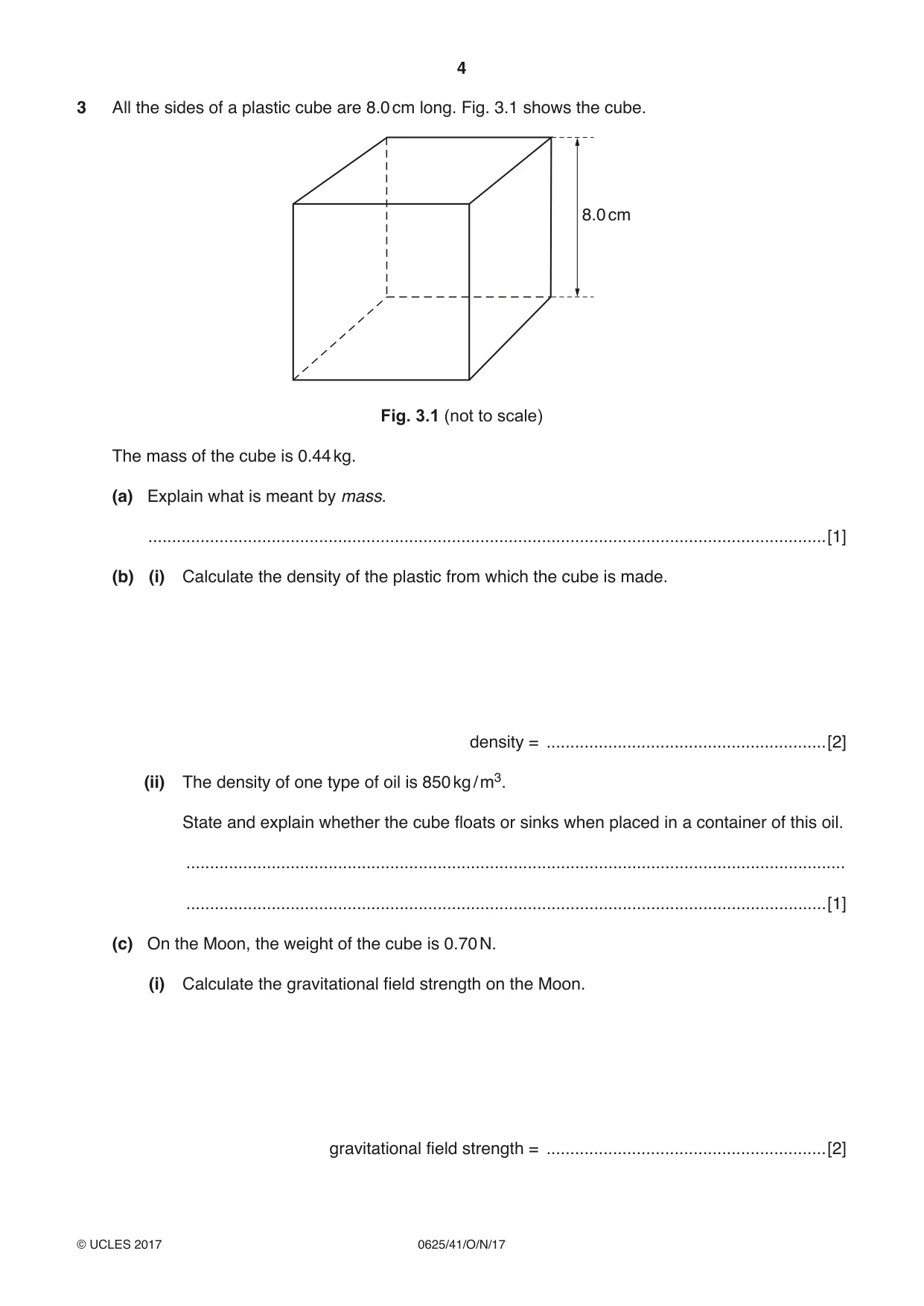
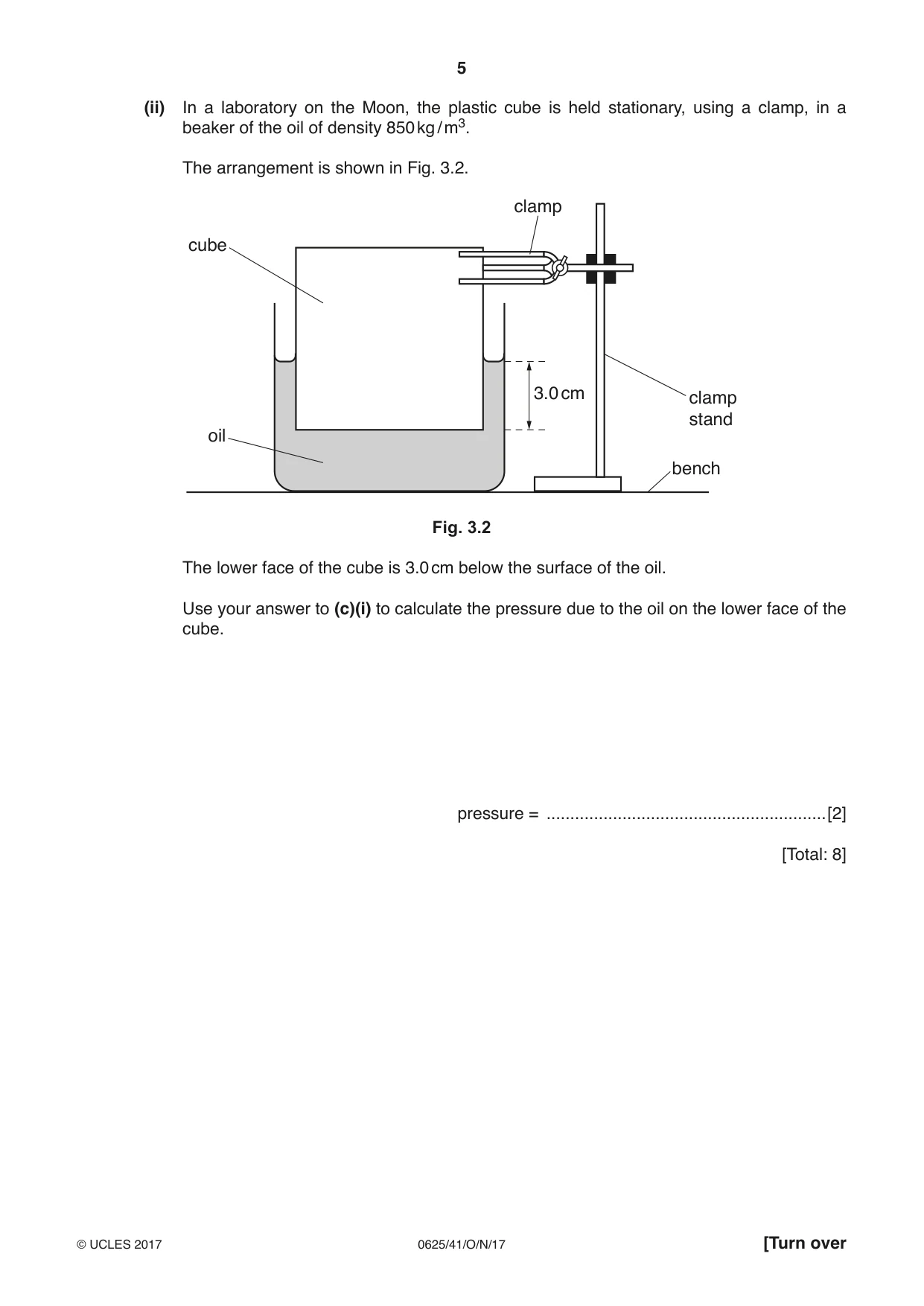
3 All the sides of a plastic cube are 8.0 cm long. Fig. 3.1 shows the cube. 8.0 cm Fig. 3.1 (not to scale) The mass of the cube is 0.44 kg. (a) Explain what is meant by mass. ...............................................................................................................................................[1] (b) (i) Calculate the density of the plastic from which the cube is made. density = ...........................................................[2] (ii) The density of one type of oil is 850 kg / m3. State and explain whether the cube floats or sinks when placed in a container of this oil. ........................................................................................................................................... .......................................................................................................................................[1] (c) On the Moon, the weight of the cube is 0.70 N. (i) Calculate the gravitational field strength on the Moon. gravitational field strength = ...........................................................[2] (ii) In a laboratory on the Moon, the plastic cube is held stationary, using a clamp, in a beaker of the oil of density 850 kg / m3. The arrangement is shown in Fig. 3.2. clamp cube 3.0 cm clamp stand oil bench Fig. 3.2 The lower face of the cube is 3.0 cm below the surface of the oil. Use your answer to (c)(i) to calculate the pressure due to the oil on the lower face of the cube. pressure = ...........................................................[2] [Total: 8]
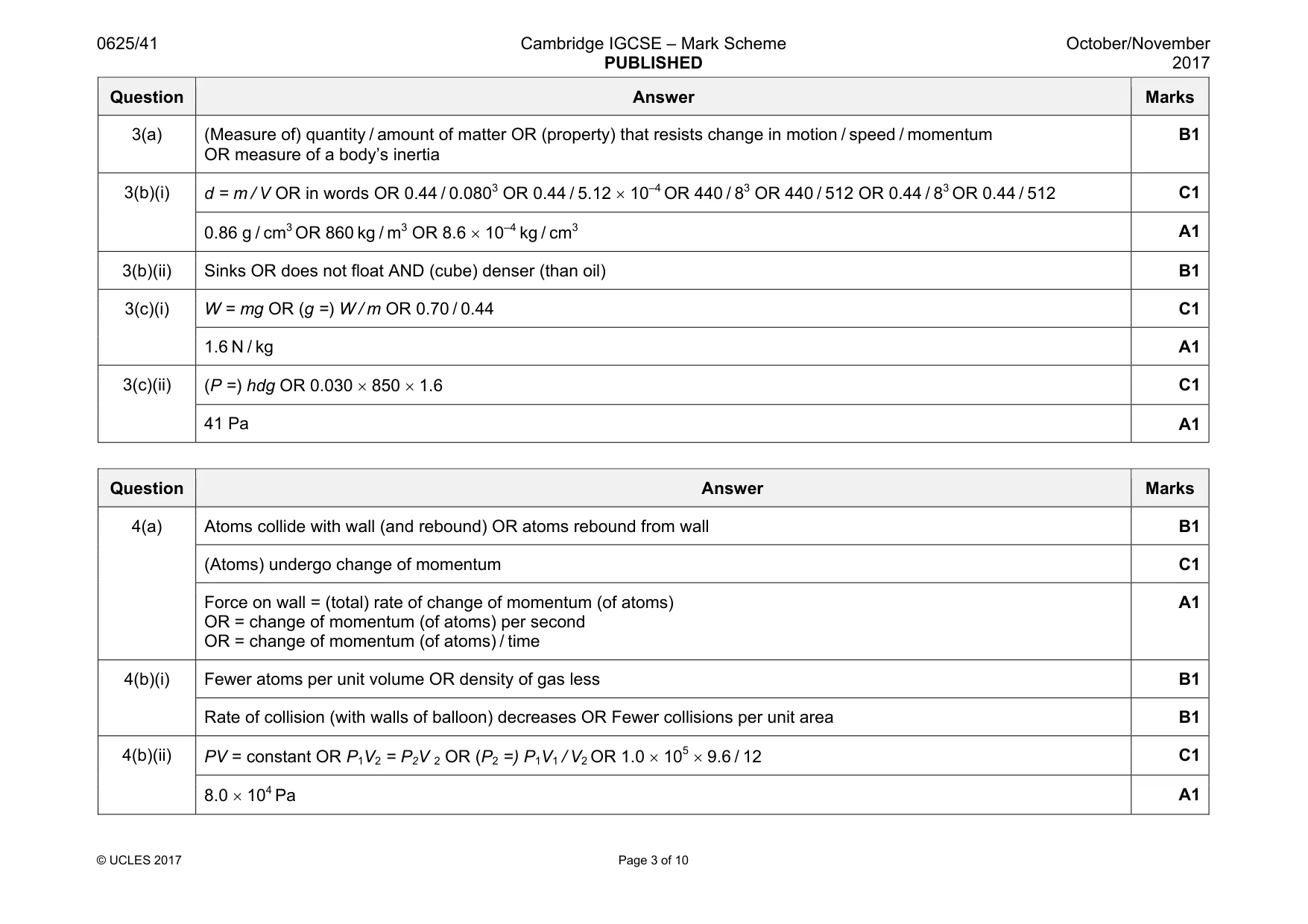
Mark scheme: 3(a) (Measure of) quantity / amount of matter OR (property) that resists change in motion / speed / momentum OR measure of a body’s inertia B1 3(b)(i) d = m / V OR in words OR 0.44 / 0.0803 OR 0.44 / 5.12 × 10⁻⁴ OR 440 / 83 OR 440 / 512 OR 0.44 / 83 OR 0.44 / 512 C1 0.86 g / cm3 OR 860 kg / m3 OR 8.6 × 10⁻⁴ kg / cm3 A1 3(b)(ii) Sinks OR does not float AND (cube) denser (than oil) B1 3(c)(i) W = mg OR (g =) W / m OR 0.70 / 0.44 C1 1.6 N / kg A1 3(c)(ii) (P =) hdg OR 0.030 × 850 × 1.6 C1 41 Pa A1
Q4 · A balloon filled with helium that is used to lift measuring instruments to a great height…
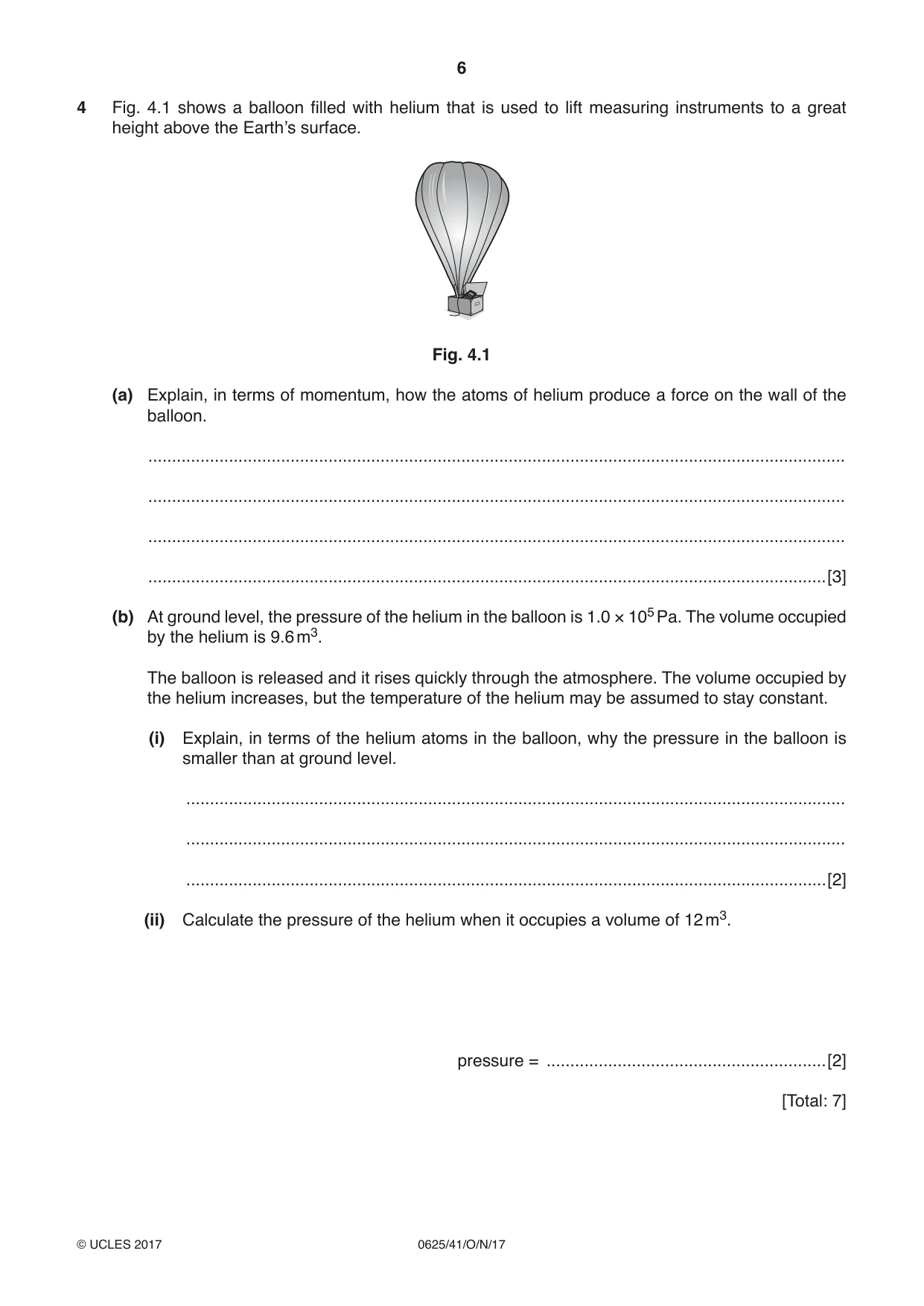
4 Fig. 4.1 shows a balloon filled with helium that is used to lift measuring instruments to a great height above the Earth’s surface. Fig. 4.1 (a) Explain, in terms of momentum, how the atoms of helium produce a force on the wall of the balloon. ................................................................................................................................................... ................................................................................................................................................... ................................................................................................................................................... ...............................................................................................................................................[3] (b) At ground level, the pressure of the helium in the balloon is 1.0 × 10⁵ Pa. The volume occupied by the helium is 9.6 m3. The balloon is released and it rises quickly through the atmosphere. The volume occupied by the helium increases, but the temperature of the helium may be assumed to stay constant. (i) Explain, in terms of the helium atoms in the balloon, why the pressure in the balloon is smaller than at ground level. ........................................................................................................................................... ........................................................................................................................................... .......................................................................................................................................[2] (ii) Calculate the pressure of the helium when it occupies a volume of 12 m3. pressure = ...........................................................[2] [Total: 7]
Mark scheme: 4(a) Atoms collide with wall (and rebound) OR atoms rebound from wall B1 (Atoms) undergo change of momentum C1 Force on wall = (total) rate of change of momentum (of atoms) OR = change of momentum (of atoms) per second OR = change of momentum (of atoms) / time A1 4(b)(i) Fewer atoms per unit volume OR density of gas less B1 Rate of collision (with walls of balloon) decreases OR Fewer collisions per unit area B1 4(b)(ii) PV = constant OR P1V2 = P2V 2 OR (P2 =) P1V1 / V2 OR 1.0 × 105 × 9.6 / 12 C1 8.0 × 10⁴ Pa A1
Q5 · A wave passes through a gap in a barrier
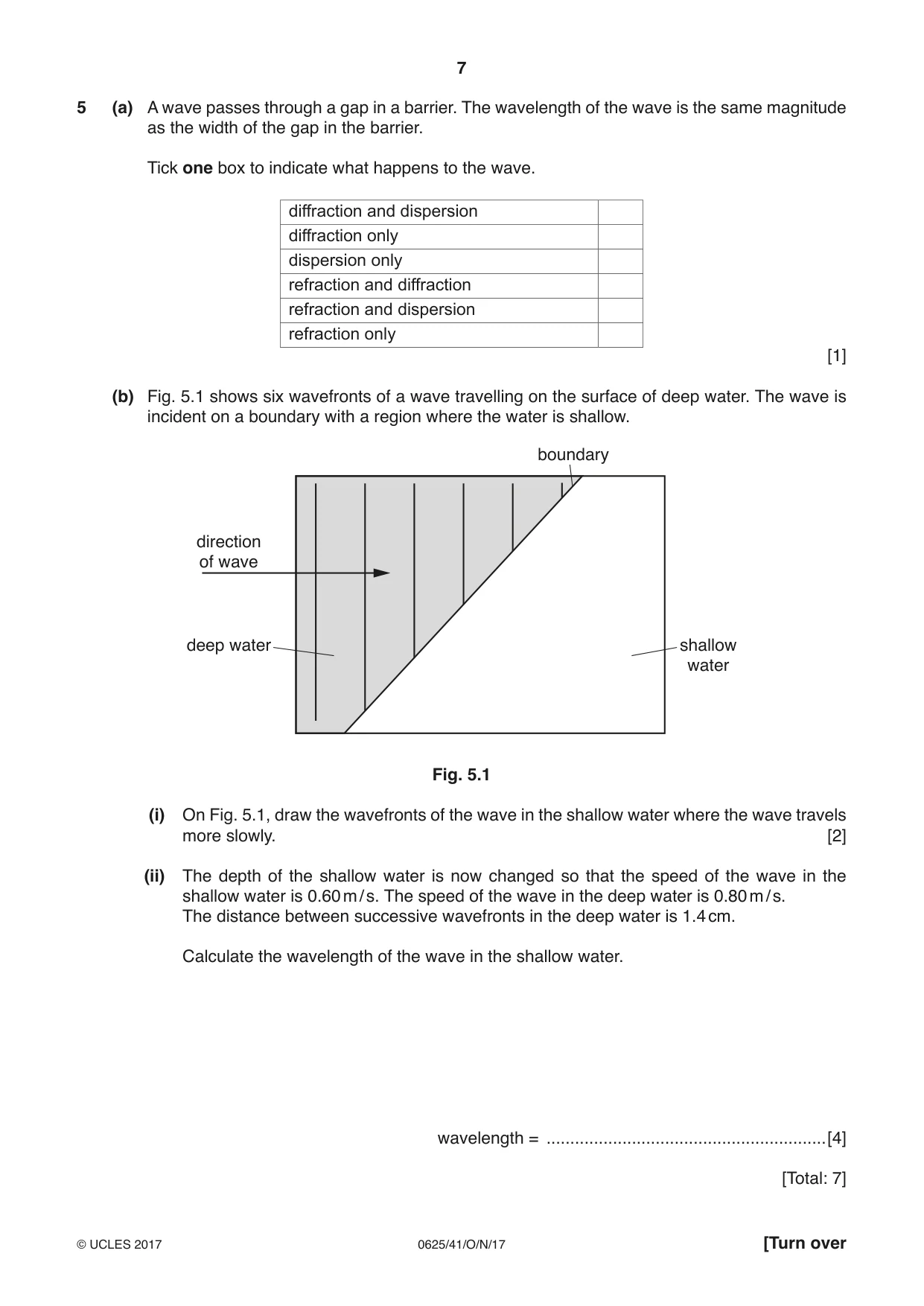
5 (a) A wave passes through a gap in a barrier. The wavelength of the wave is the same magnitude as the width of the gap in the barrier. Tick one box to indicate what happens to the wave. diffraction and dispersion diffraction only dispersion only refraction and diffraction refraction and dispersion refraction only [1] (b) Fig. 5.1 shows six wavefronts of a wave travelling on the surface of deep water. The wave is incident on a boundary with a region where the water is shallow. boundary direction of wave deep water shallow water Fig. 5.1 (i) On Fig. 5.1, draw the wavefronts of the wave in the shallow water where the wave travels more slowly. [2] (ii) The depth of the shallow water is now changed so that the speed of the wave in the shallow water is 0.60 m / s. The speed of the wave in the deep water is 0.80 m / s. The distance between successive wavefronts in the deep water is 1.4 cm. Calculate the wavelength of the wave in the shallow water. wavelength = ...........................................................[4] [Total: 7]
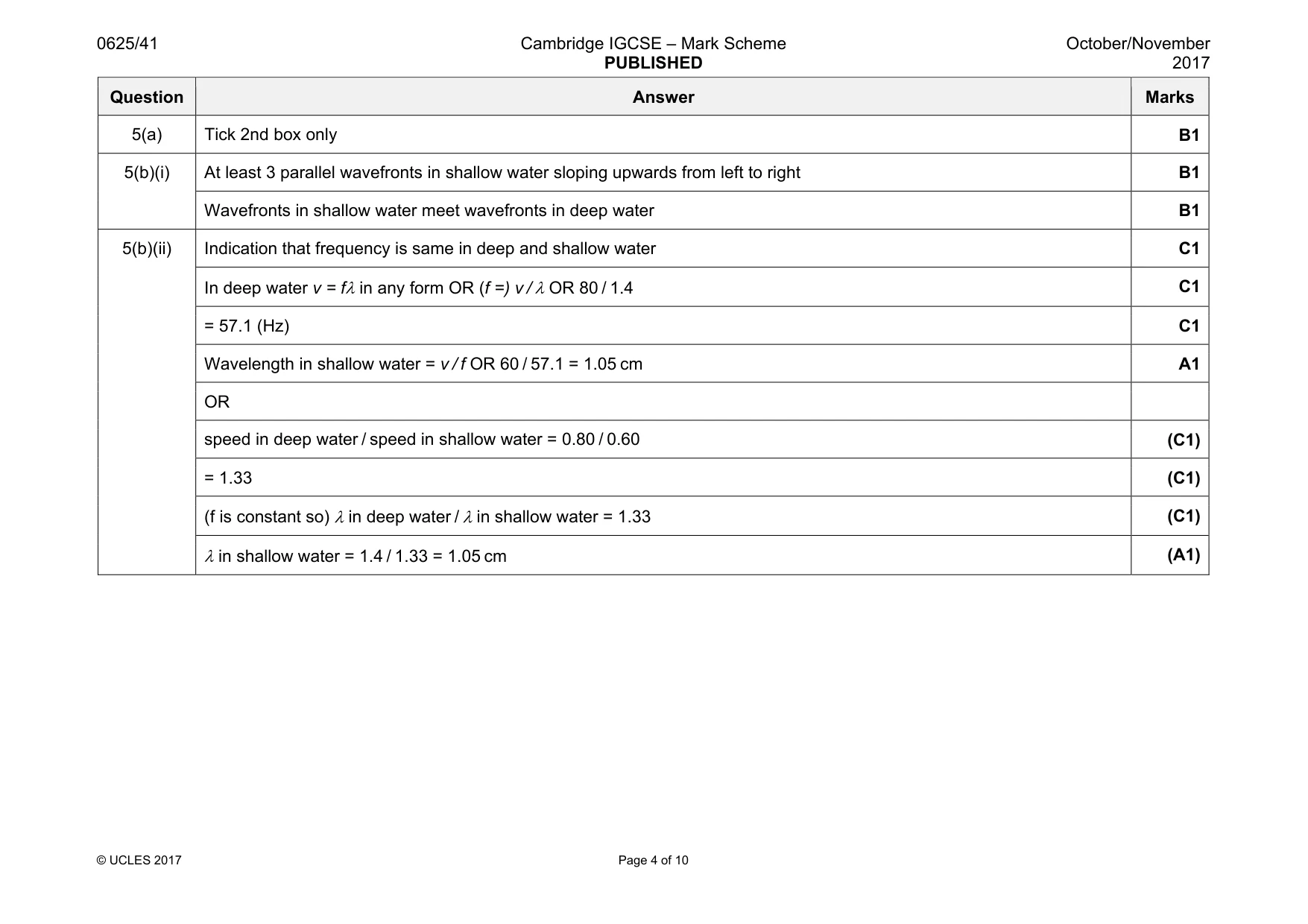
Mark scheme: 5(a) Tick 2nd box only B1 5(b)(i) At least 3 parallel wavefronts in shallow water sloping upwards from left to right B1 Wavefronts in shallow water meet wavefronts in deep water B1 5(b)(ii) Indication that frequency is same in deep and shallow water C1 In deep water v = fλ in any form OR (f =) v / λ OR 80 / 1.4 C1 = 57.1 (Hz) C1 Wavelength in shallow water = v / f OR 60 / 57.1 = 1.05 cm A1 OR speed in deep water / speed in shallow water = 0.80 / 0.60 (C1) = 1.33 (C1) (f is constant so) λ in deep water / λ in shallow water = 1.33 (C1) λ in shallow water = 1.4 / 1.33 = 1.05 cm (A1)
Q6 · The left-hand column of the table shows some possible speeds of a sound wave
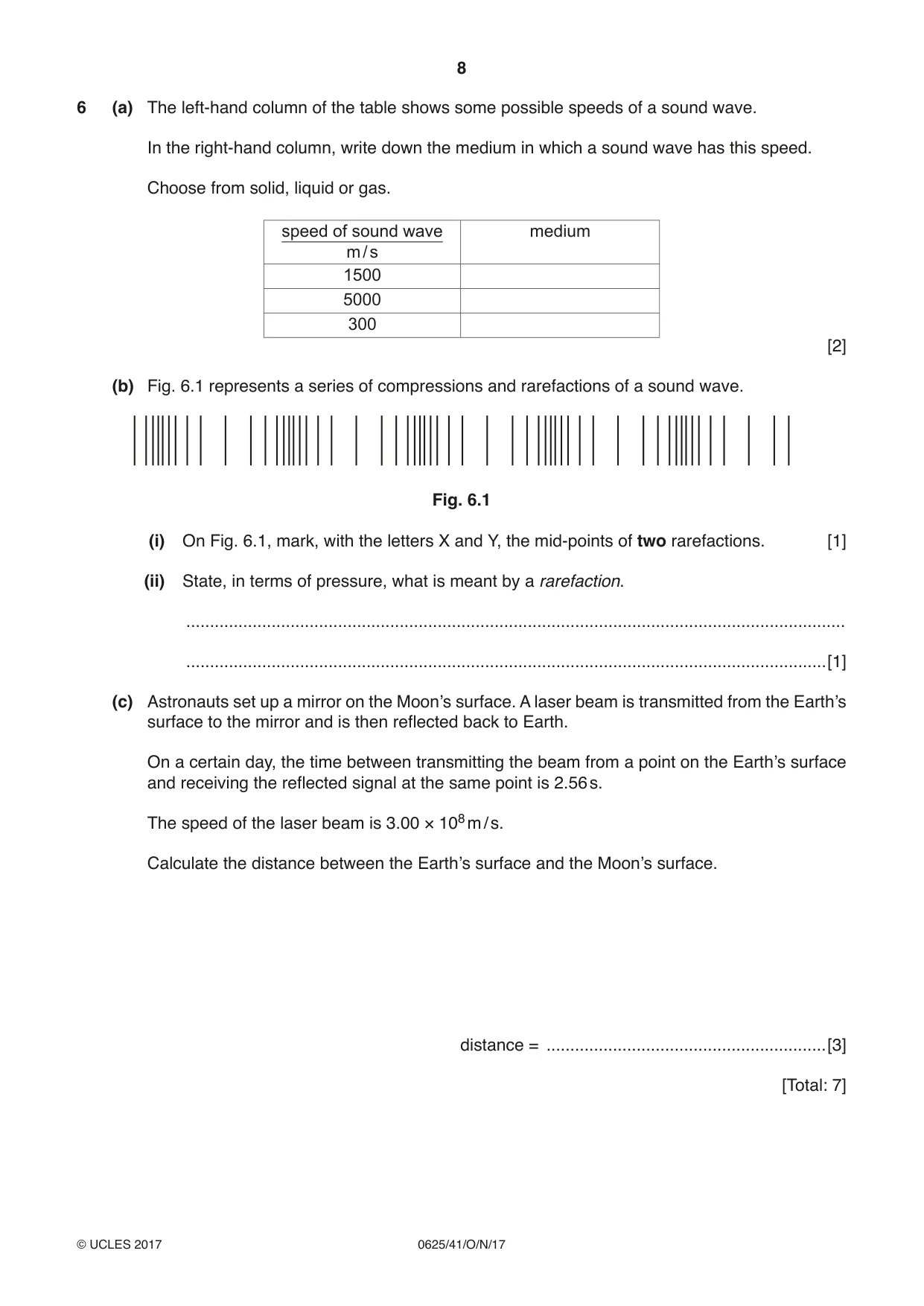
6 (a) The left-hand column of the table shows some possible speeds of a sound wave. In the right-hand column, write down the medium in which a sound wave has this speed. Choose from solid, liquid or gas. speed of sound wave medium m / s 1500 5000 300 [2] (b) Fig. 6.1 represents a series of compressions and rarefactions of a sound wave. Fig. 6.1 (i) On Fig. 6.1, mark, with the letters X and Y, the mid-points of two rarefactions. [1] (ii) State, in terms of pressure, what is meant by a rarefaction. ........................................................................................................................................... .......................................................................................................................................[1] (c) Astronauts set up a mirror on the Moon’s surface. A laser beam is transmitted from the Earth’s surface to the mirror and is then reflected back to Earth. On a certain day, the time between transmitting the beam from a point on the Earth’s surface and receiving the reflected signal at the same point is 2.56 s. The speed of the laser beam is 3.00 × 10⁸ m / s. Calculate the distance between the Earth’s surface and the Moon’s surface. distance = ...........................................................[3] [Total: 7]
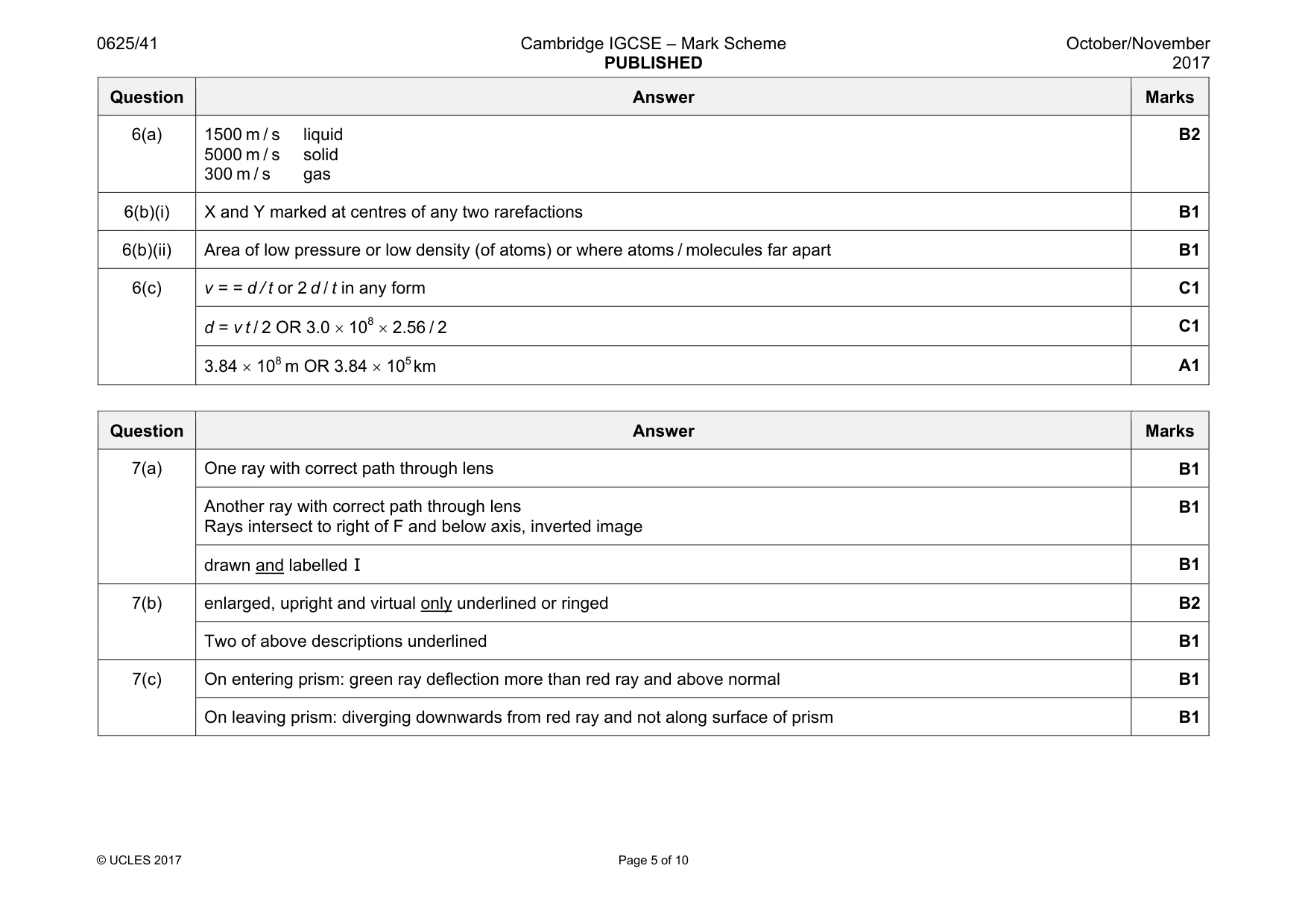
Mark scheme: 6(a) 1500 m / s liquid 5000 m / s solid 300 m / s gas B2 6(b)(i) X and Y marked at centres of any two rarefactions B1 6(b)(ii) Area of low pressure or low density (of atoms) or where atoms / molecules far apart B1 6(c) v = = d / t or 2 d / t in any form C1 d = v t / 2 OR 3.0 × 108 × 2.56 / 2 C1 3.84 × 10⁸ m OR 3.84 × 10⁵km A1
Q7 · A converging lens and its principal axis
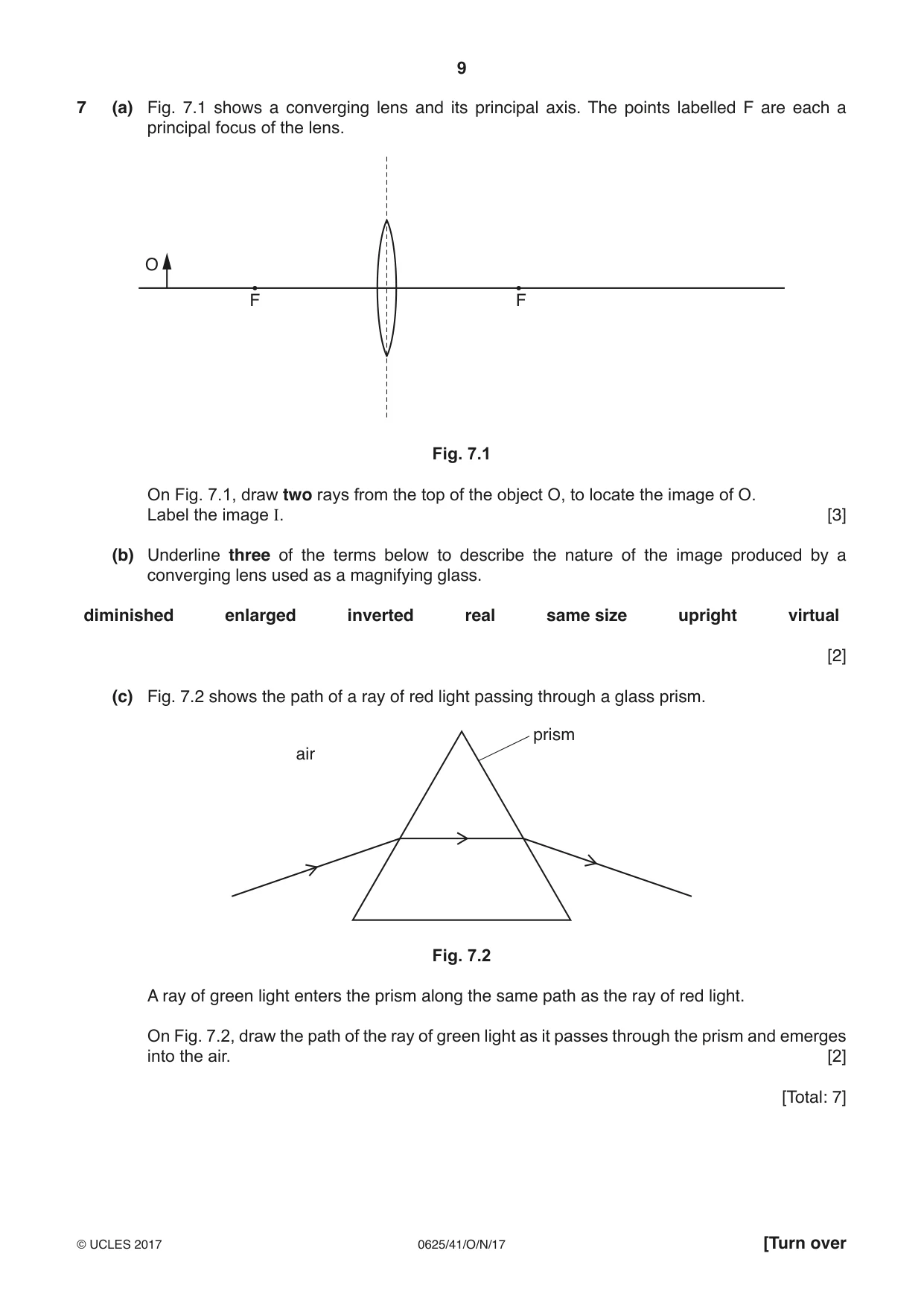
7 (a) Fig. 7.1 shows a converging lens and its principal axis. The points labelled F are each a principal focus of the lens. O F F Fig. 7.1 On Fig. 7.1, draw two rays from the top of the object O, to locate the image of O. Label the image I. [3] (b) Underline three of the terms below to describe the nature of the image produced by a converging lens used as a magnifying glass. diminished enlarged inverted real same size upright virtual [2] (c) Fig. 7.2 shows the path of a ray of red light passing through a glass prism. prism air Fig. 7.2 A ray of green light enters the prism along the same path as the ray of red light. On Fig. 7.2, draw the path of the ray of green light as it passes through the prism and emerges into the air. [2] [Total: 7]
Mark scheme: 7(a) One ray with correct path through lens B1 Another ray with correct path through lens Rays intersect to right of F and below axis, inverted image B1 drawn and labelled I B1 7(b) enlarged, upright and virtual only underlined or ringed B2 Two of above descriptions underlined B1 7(c) On entering prism: green ray deflection more than red ray and above normal B1 On leaving prism: diverging downwards from red ray and not along surface of prism B1
Q8 · Describe a renewable process by which electrical energy is obtained from the energy…
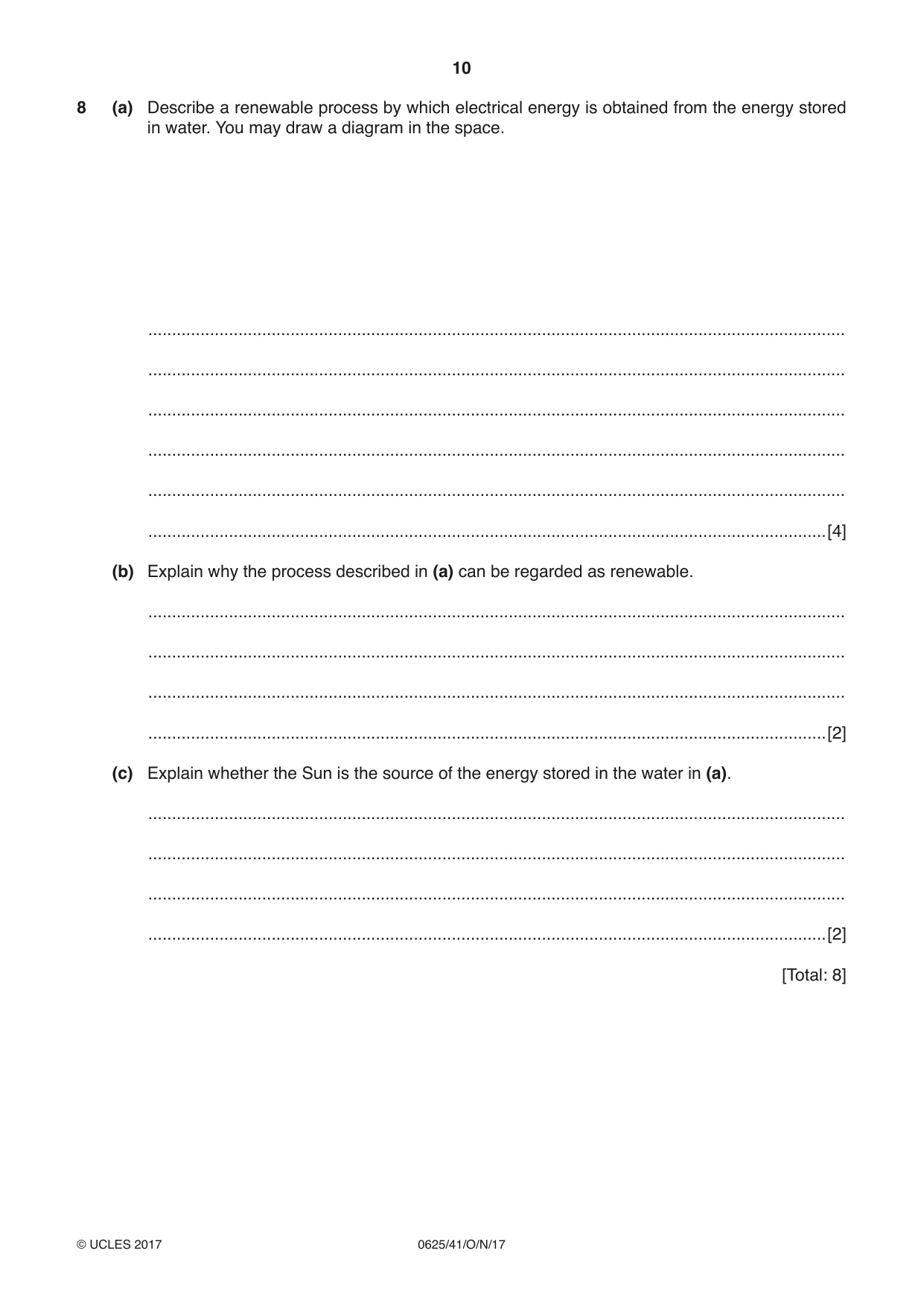
8 (a) Describe a renewable process by which electrical energy is obtained from the energy stored in water. You may draw a diagram in the space. ................................................................................................................................................... ................................................................................................................................................... ................................................................................................................................................... ................................................................................................................................................... ................................................................................................................................................... ...............................................................................................................................................[4] (b) Explain why the process described in (a) can be regarded as renewable. ................................................................................................................................................... ................................................................................................................................................... ................................................................................................................................................... ...............................................................................................................................................[2] (c) Explain whether the Sun is the source of the energy stored in the water in (a). ................................................................................................................................................... ................................................................................................................................................... ................................................................................................................................................... ...............................................................................................................................................[2] [Total: 8]
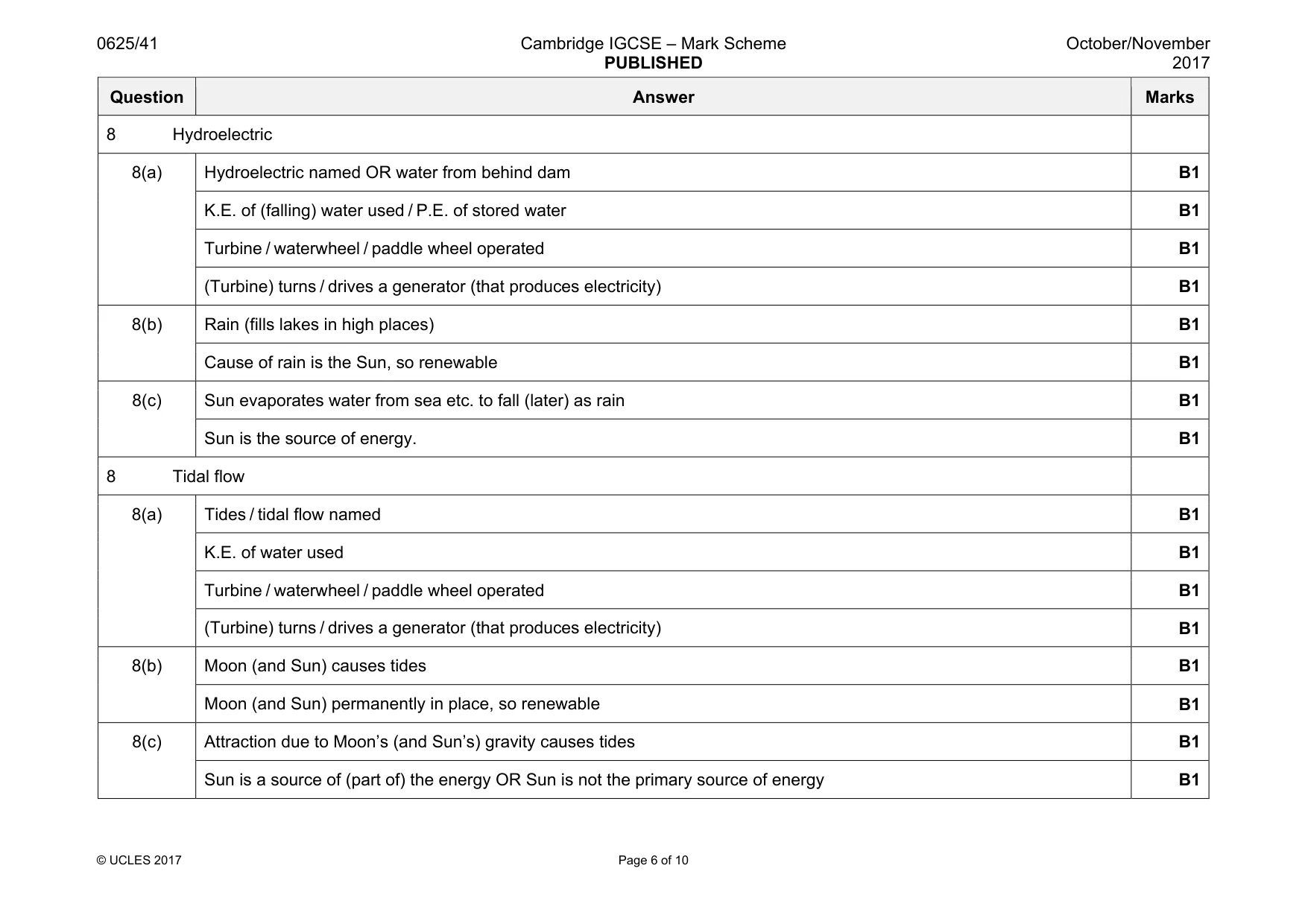
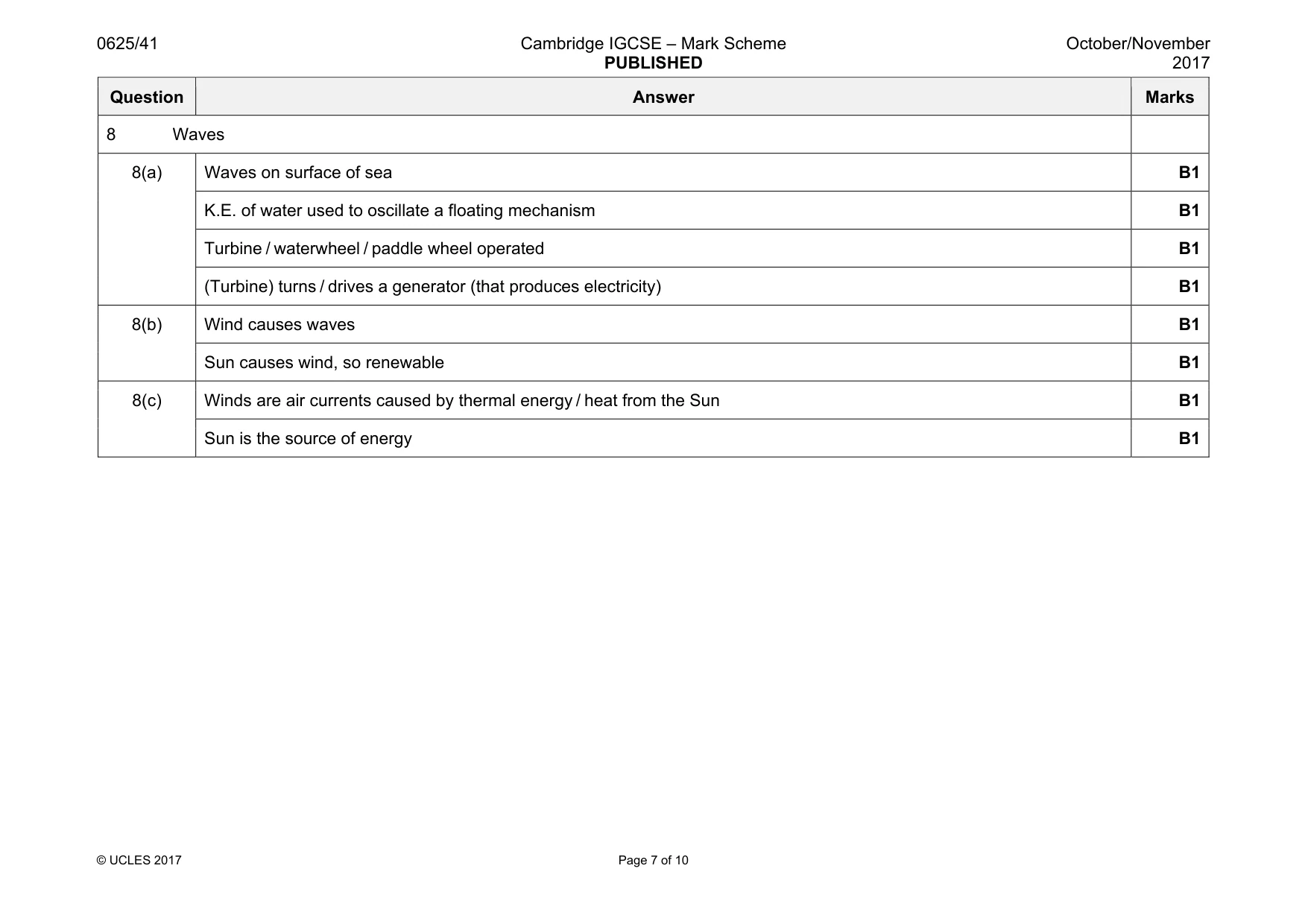
Mark scheme: 8 Hydroelectric 8(a) Hydroelectric named OR water from behind dam B1 K.E. of (falling) water used / P.E. of stored water B1 Turbine / waterwheel / paddle wheel operated B1 (Turbine) turns / drives a generator (that produces electricity) B1 8(b) Rain (fills lakes in high places) B1 Cause of rain is the Sun, so renewable B1 8(c) Sun evaporates water from sea etc. to fall (later) as rain B1 Sun is the source of energy. B1 8 Tidal flow 8(a) Tides / tidal flow named B1 K.E. of water used B1 Turbine / waterwheel / paddle wheel operated B1 (Turbine) turns / drives a generator (that produces electricity) B1 8(b) Moon (and Sun) causes tides B1 Moon (and Sun) permanently in place, so renewable B1 8(c) Attraction due to Moon’s (and Sun’s) gravity causes tides B1 Sun is a source of (part of) the energy OR Sun is not the primary source of energy B1 Question Answer Marks 8 Waves 8(a) Waves on surface of sea B1 K.E. of water used to oscillate a floating mechanism B1 Turbine / waterwheel / paddle wheel operated B1 (Turbine) turns / drives a generator (that produces electricity) B1 8(b) Wind causes waves B1 Sun causes wind, so renewable B1 8(c) Winds are air currents caused by thermal energy / heat from the Sun B1 Sun is the source of energy B1
Q9 · A circuit with three 1.5 V cells
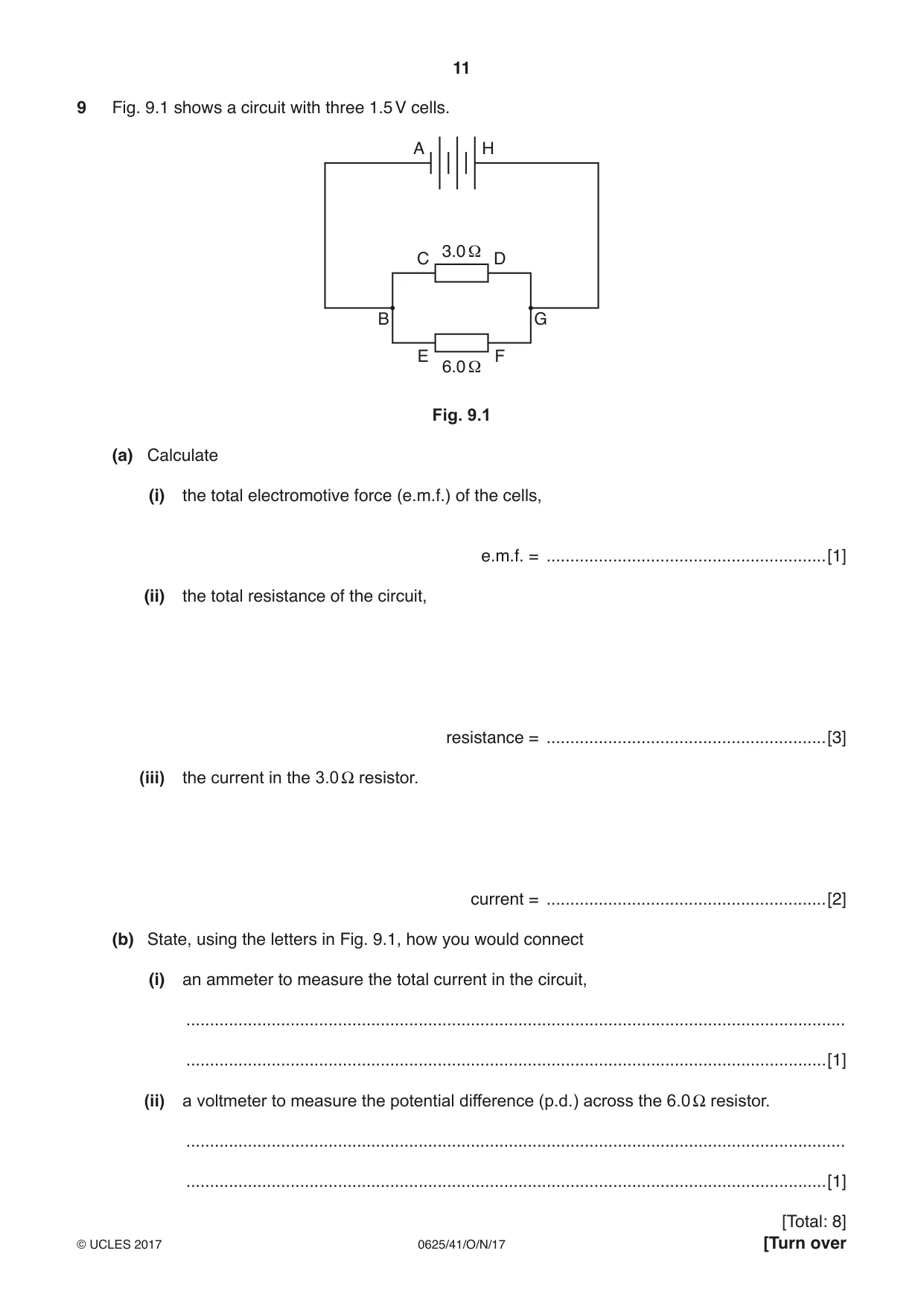
9 Fig. 9.1 shows a circuit with three 1.5 V cells. A H 3.0 Ω C D B G E F 6.0 Ω Fig. 9.1 (a) Calculate (i) the total electromotive force (e.m.f.) of the cells, e.m.f. = ...........................................................[1] (ii) the total resistance of the circuit, resistance = ...........................................................[3] (iii) the current in the 3.0 Ω resistor. current = ...........................................................[2] (b) State, using the letters in Fig. 9.1, how you would connect (i) an ammeter to measure the total current in the circuit, ........................................................................................................................................... .......................................................................................................................................[1] (ii) a voltmeter to measure the potential difference (p.d.) across the 6.0 Ω resistor. ........................................................................................................................................... .......................................................................................................................................[1]
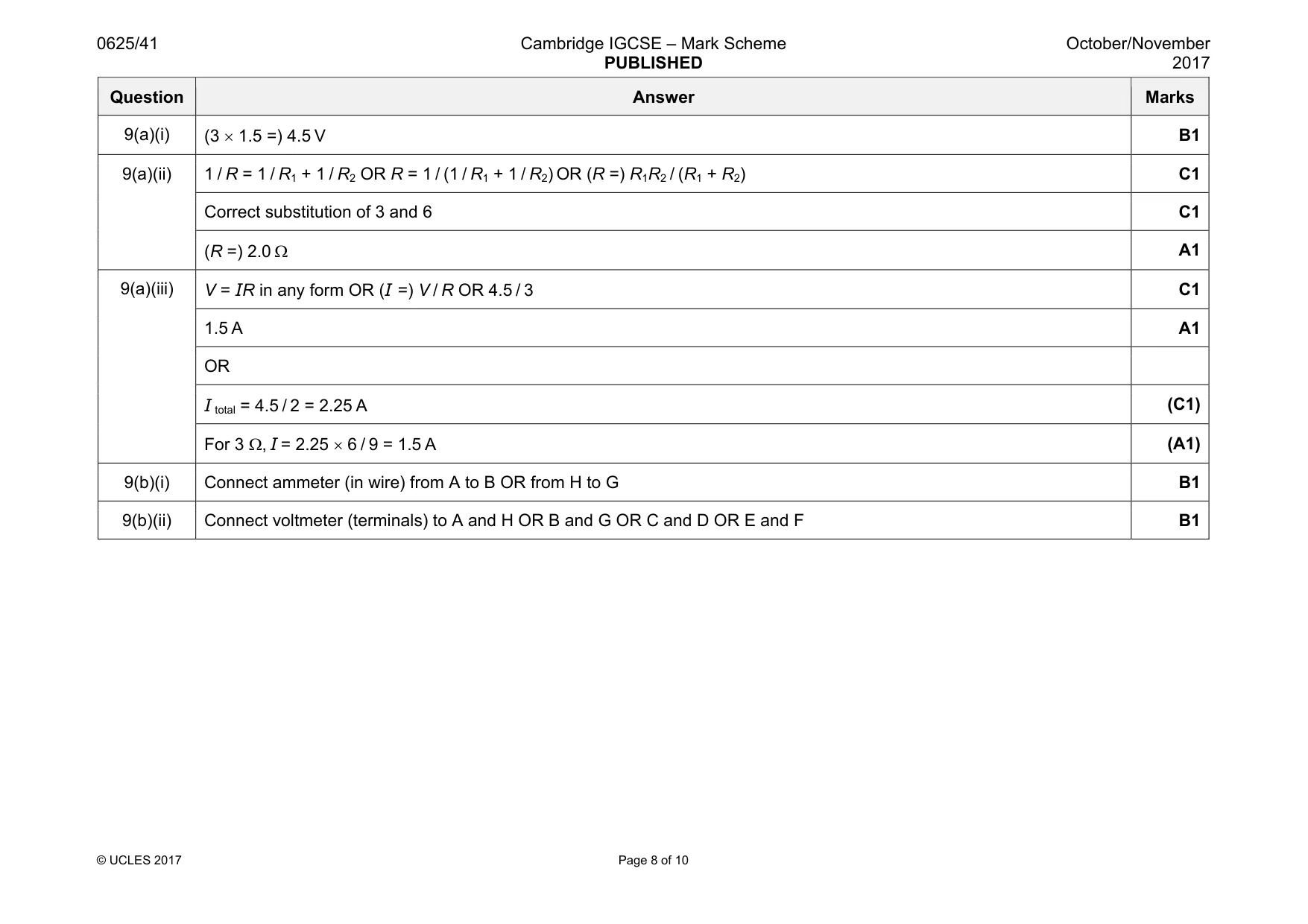
Mark scheme: 9(a)(i) B1 9(a)(ii) 1 / R = 1 / R1 + 1 / R2 OR R = 1 / (1 / R1 + 1 / R2) OR (R =) R1R2 / (R1 + R2) C1 Correct substitution of 3 and 6 C1 (R =) 2.0 Ω A1 9(a)(iii) V = IR in any form OR (I =) V / R OR 4.5 / 3 C1 1.5 A A1 OR I total = 4.5 / 2 = 2.25 A (C1) For 3 Ω, I = 2.25 × 6 / 9 = 1.5 A (A1) 9(b)(i) Connect ammeter (in wire) from A to B OR from H to G B1 9(b)(ii) Connect voltmeter (terminals) to A and H OR B and G OR C and D OR E and F B1
Q10 · Draw the circuit symbol for a diode
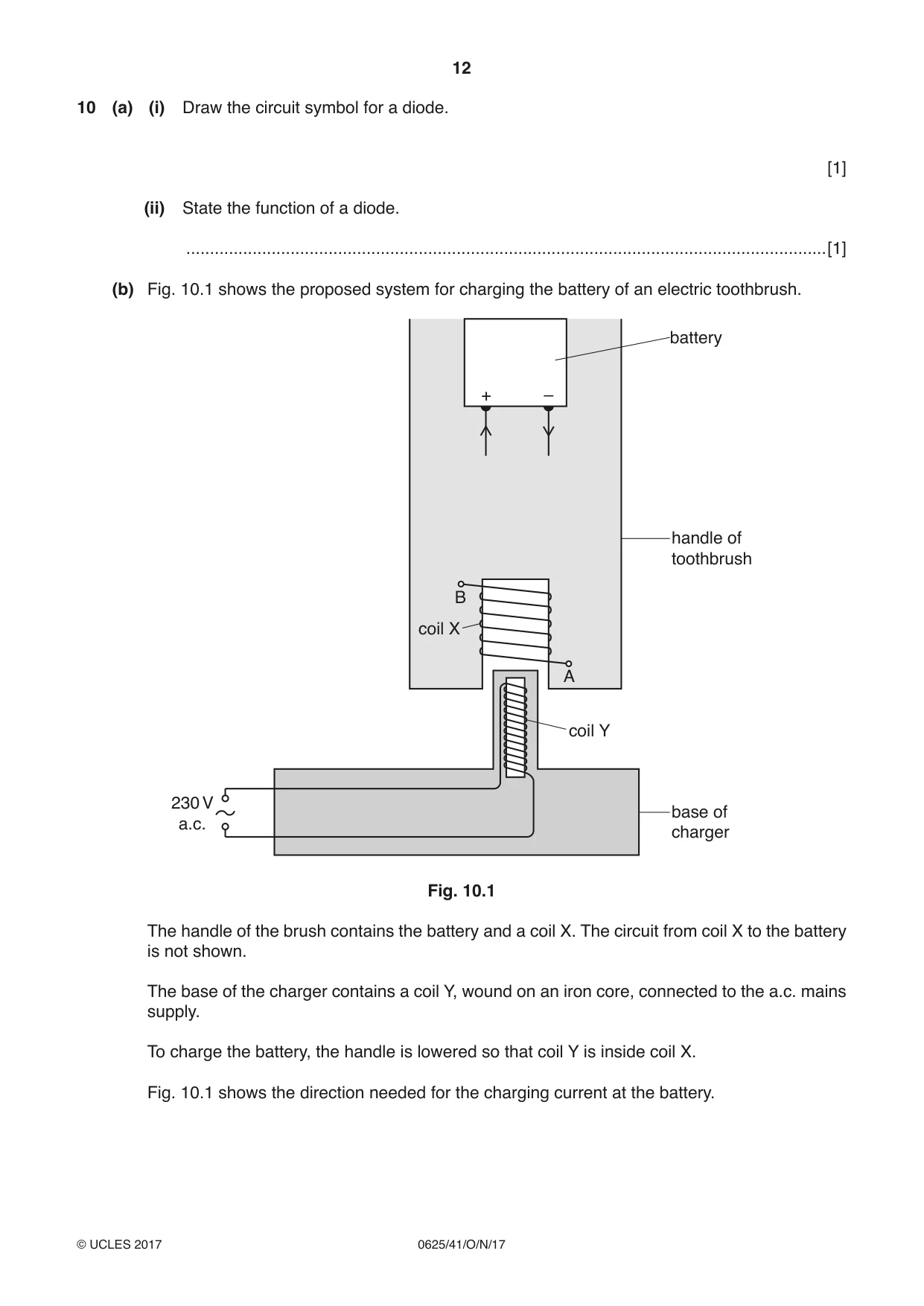
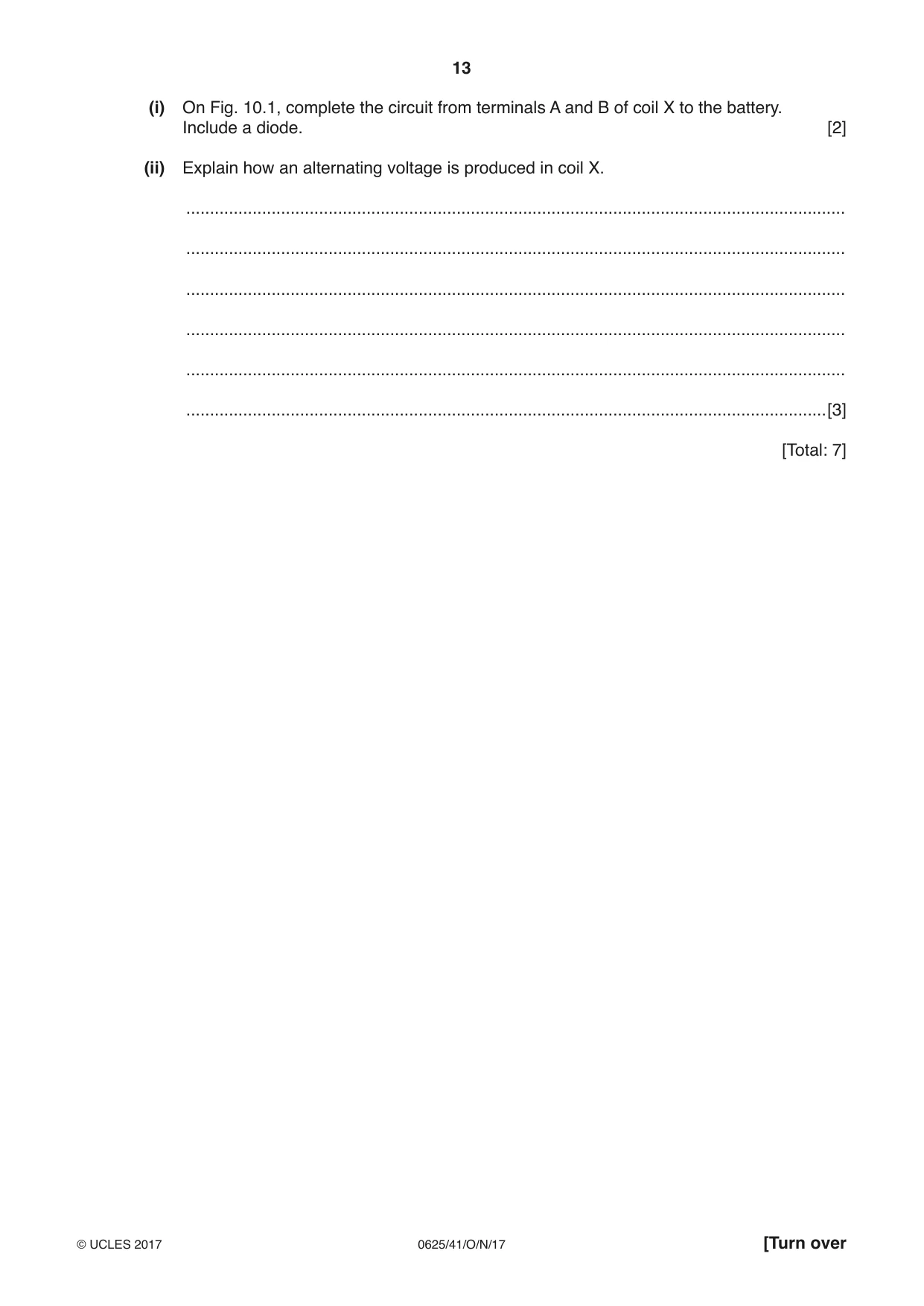
10 (a) (i) Draw the circuit symbol for a diode. [1] (ii) State the function of a diode. .......................................................................................................................................[1] (b) Fig. 10.1 shows the proposed system for charging the battery of an electric toothbrush. battery + – handle of toothbrush B coil X A coil Y 230 V base of a.c. charger Fig. 10.1 The handle of the brush contains the battery and a coil X. The circuit from coil X to the battery is not shown. The base of the charger contains a coil Y, wound on an iron core, connected to the a.c. mains supply. To charge the battery, the handle is lowered so that coil Y is inside coil X. Fig. 10.1 shows the direction needed for the charging current at the battery. (i) On Fig. 10.1, complete the circuit from terminals A and B of coil X to the battery. Include a diode. [2] (ii) Explain how an alternating voltage is produced in coil X. ........................................................................................................................................... ........................................................................................................................................... ........................................................................................................................................... ........................................................................................................................................... ........................................................................................................................................... .......................................................................................................................................[3] [Total: 7]
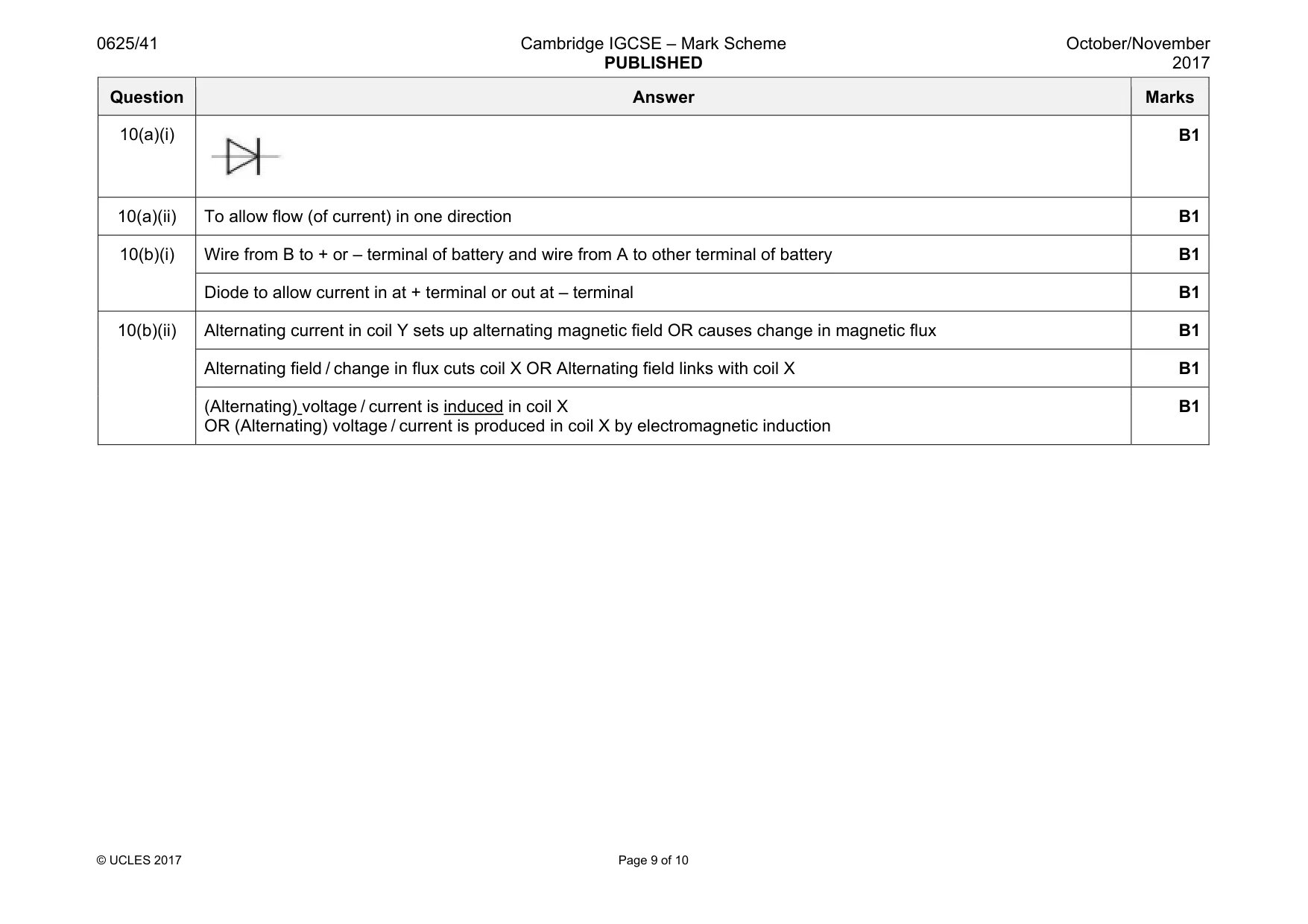
Mark scheme: 10(a)(i) B1 10(a)(ii) To allow flow (of current) in one direction B1 10(b)(i) Wire from B to + or – terminal of battery and wire from A to other terminal of battery B1 Diode to allow current in at + terminal or out at – terminal B1 10(b)(ii) Alternating current in coil Y sets up alternating magnetic field OR causes change in magnetic flux B1 Alternating field / change in flux cuts coil X OR Alternating field links with coil X B1 (Alternating) voltage / current is induced in coil X OR (Alternating) voltage / current is produced in coil X by electromagnetic induction B1
Q11 · The radioactive isotope carbon-14 (146 C) emits β-particles as it decays
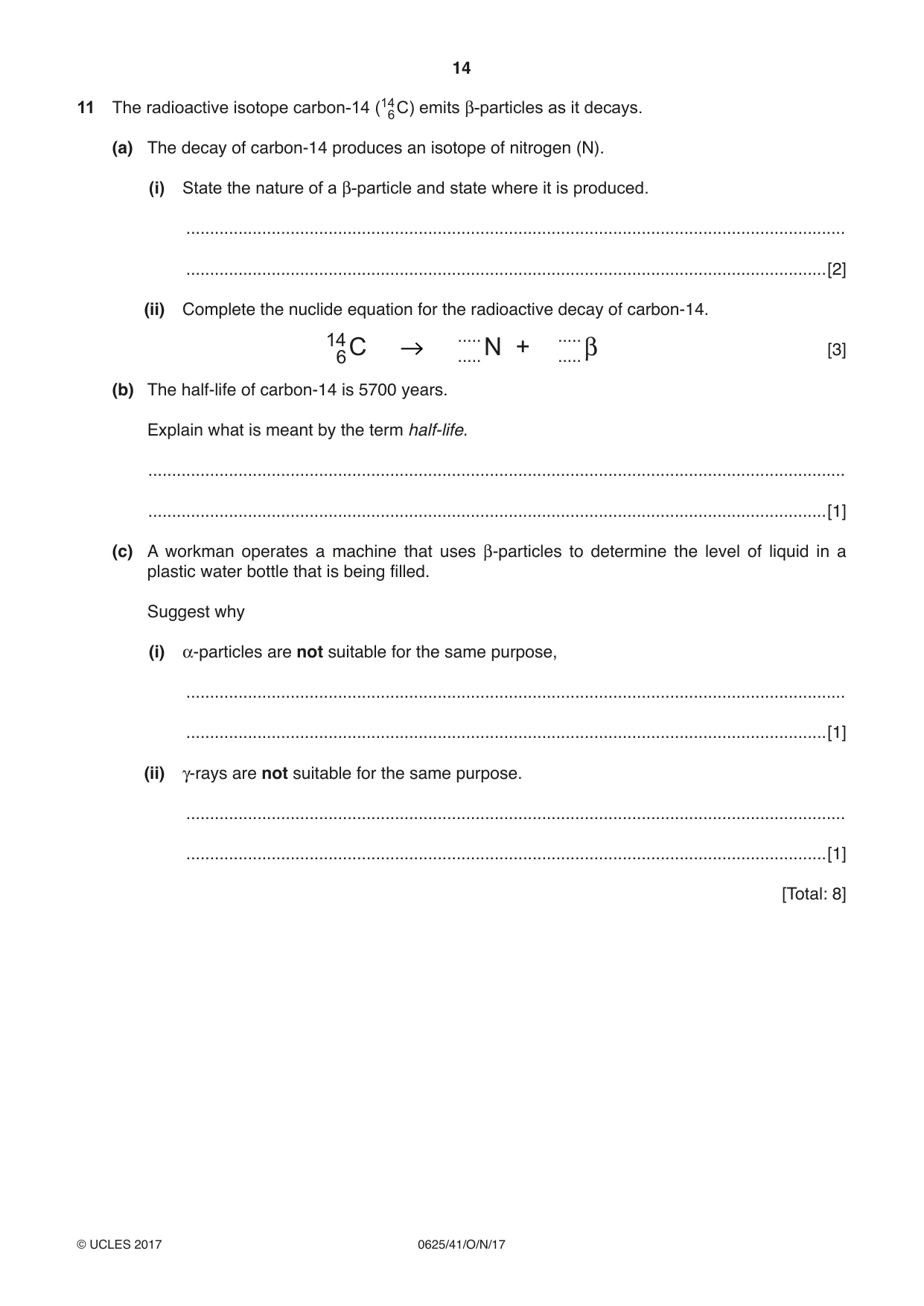
11 The radioactive isotope carbon-14 (146 C) emits β-particles as it decays. (a) The decay of carbon-14 produces an isotope of nitrogen (N). (i) State the nature of a β-particle and state where it is produced. ........................................................................................................................................... .......................................................................................................................................[2] (ii) Complete the nuclide equation for the radioactive decay of carbon-14. 14 ..... ..... C + [3] 6 .....N .....β (b) The half-life of carbon-14 is 5700 years. Explain what is meant by the term half-life. ................................................................................................................................................... ...............................................................................................................................................[1] (c) A workman operates a machine that uses β-particles to determine the level of liquid in a plastic water bottle that is being filled. Suggest why (i) α-particles are not suitable for the same purpose, ........................................................................................................................................... .......................................................................................................................................[1] (ii) γ-rays are not suitable for the same purpose. ........................................................................................................................................... .......................................................................................................................................[1] [Total: 8]
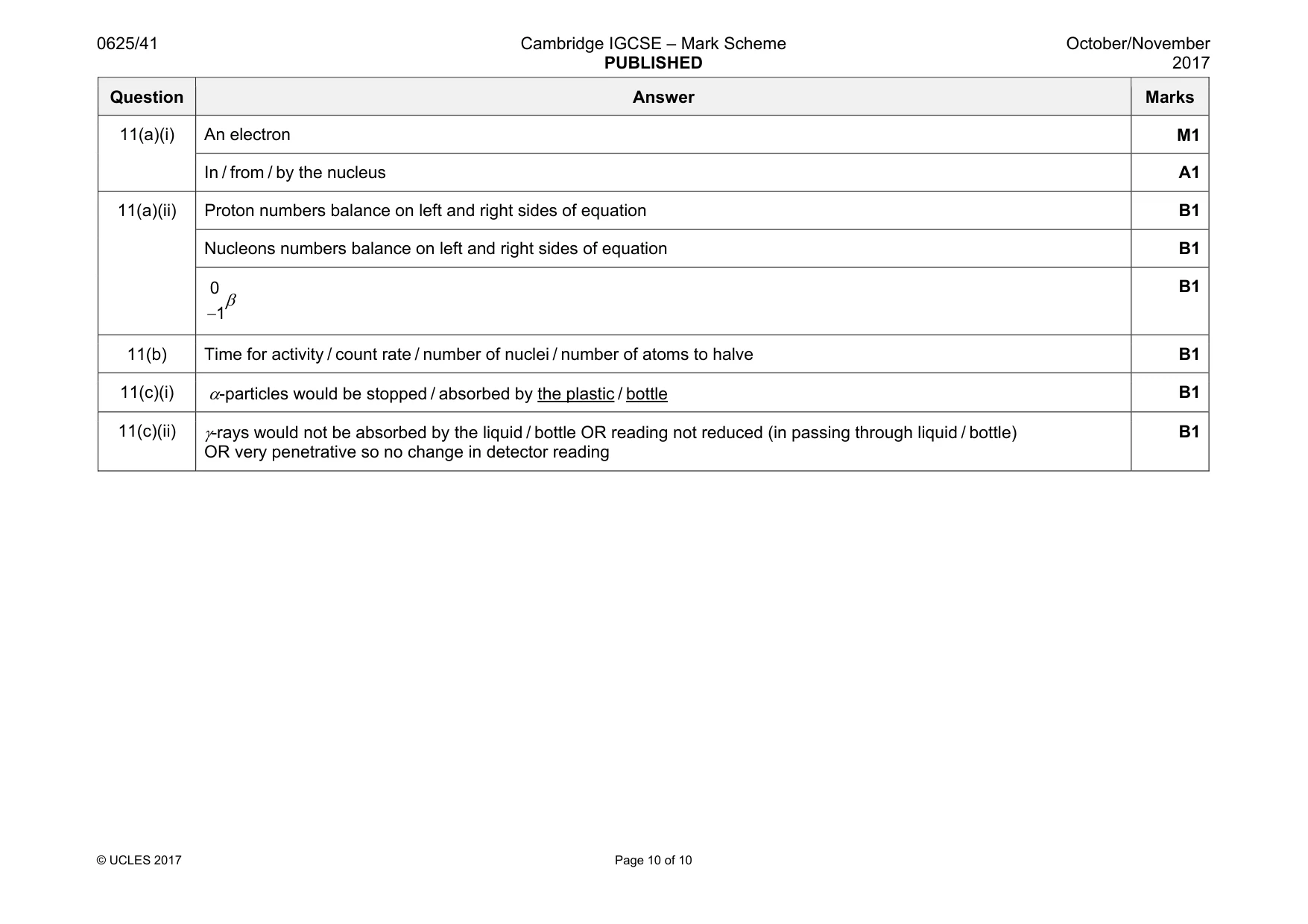
Mark scheme: 11(a)(i) An electron M1 In / from / by the nucleus A1 11(a)(ii) Proton numbers balance on left and right sides of equation B1 Nucleons numbers balance on left and right sides of equation B1 0 1 −β B1 11(b) Time for activity / count rate / number of nuclei / number of atoms to halve B1 11(c)(i) α-particles would be stopped / absorbed by the plastic / bottle B1 11(c)(ii) γ-rays would not be absorbed by the liquid / bottle OR reading not reduced (in passing through liquid / bottle) OR very penetrative so no change in detector reading B1
What was in this paper
The subtopics covered by these 11 questions, and how many questions each got. Open one in a new tab to see every Cambridge question on it.
What you needed in this session
Cambridge’s own grade thresholds for 2017 Oct/Nov, Paper 4 · Variant 1. A higher threshold means an easier paper — the bar moves with how the cohort did.