Cambridge IGCSE Physics 0625 — 2025 Oct/Nov Paper 4 · Variant 2
0625/42/O/N/25 · 10 questions · 80 marks · ≈90 min
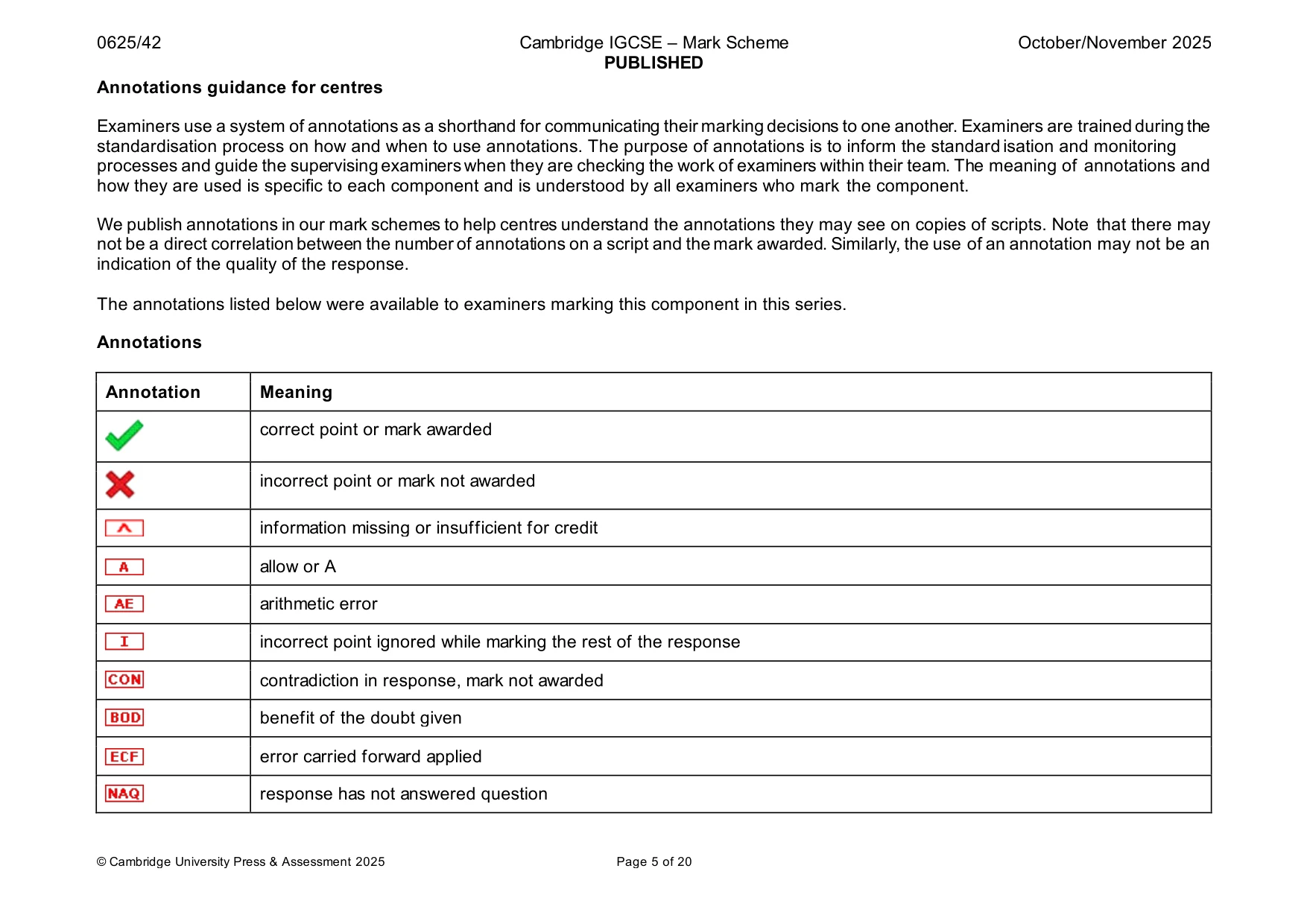
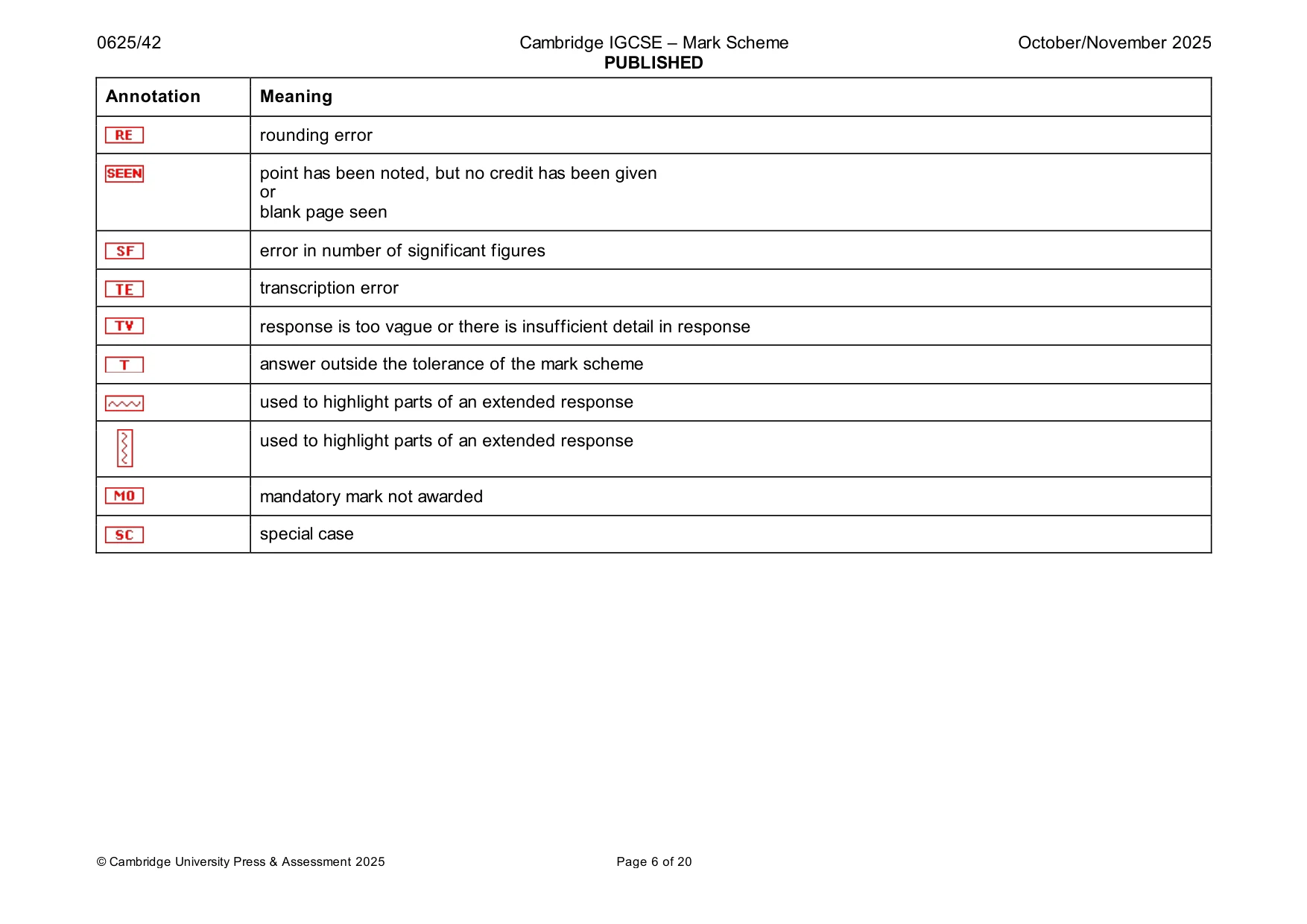
The question paper and its mark scheme, free to read here and free to download. This is Cambridge’s own paper, exactly as it was sat.
Question paper20 pages
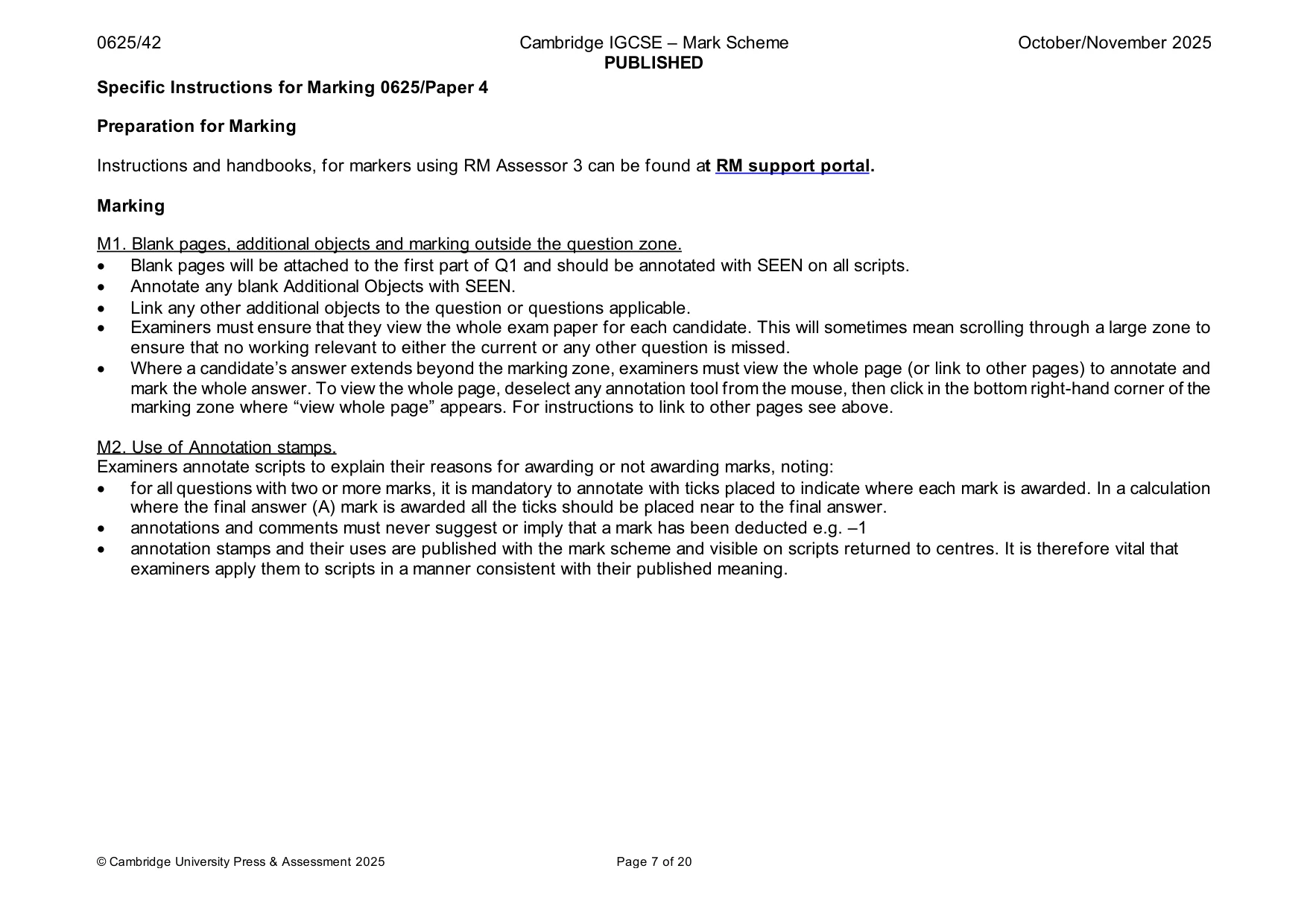
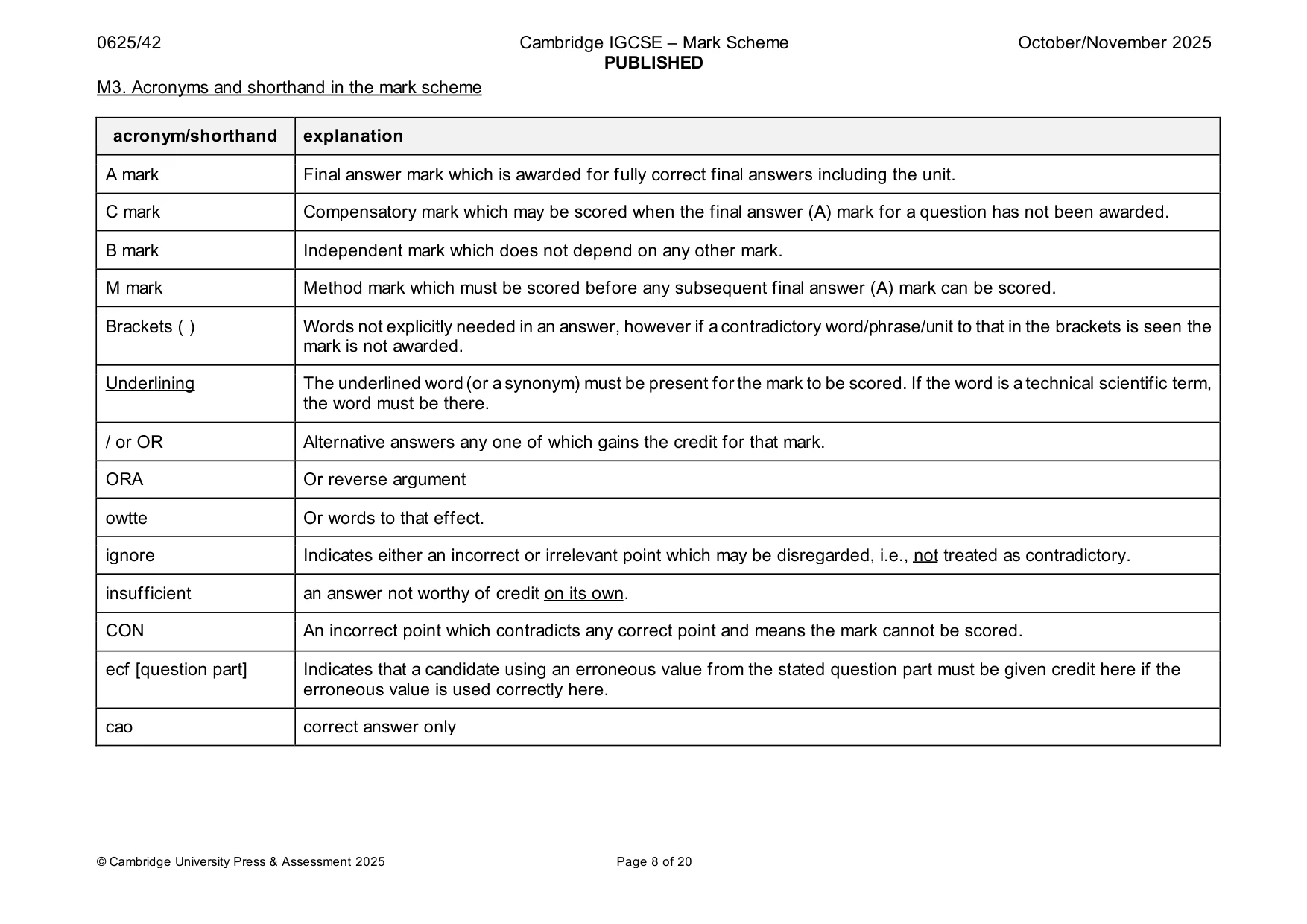
Mark scheme20 pages
Answers below. Sit the paper first if you are practising.
Questions as text
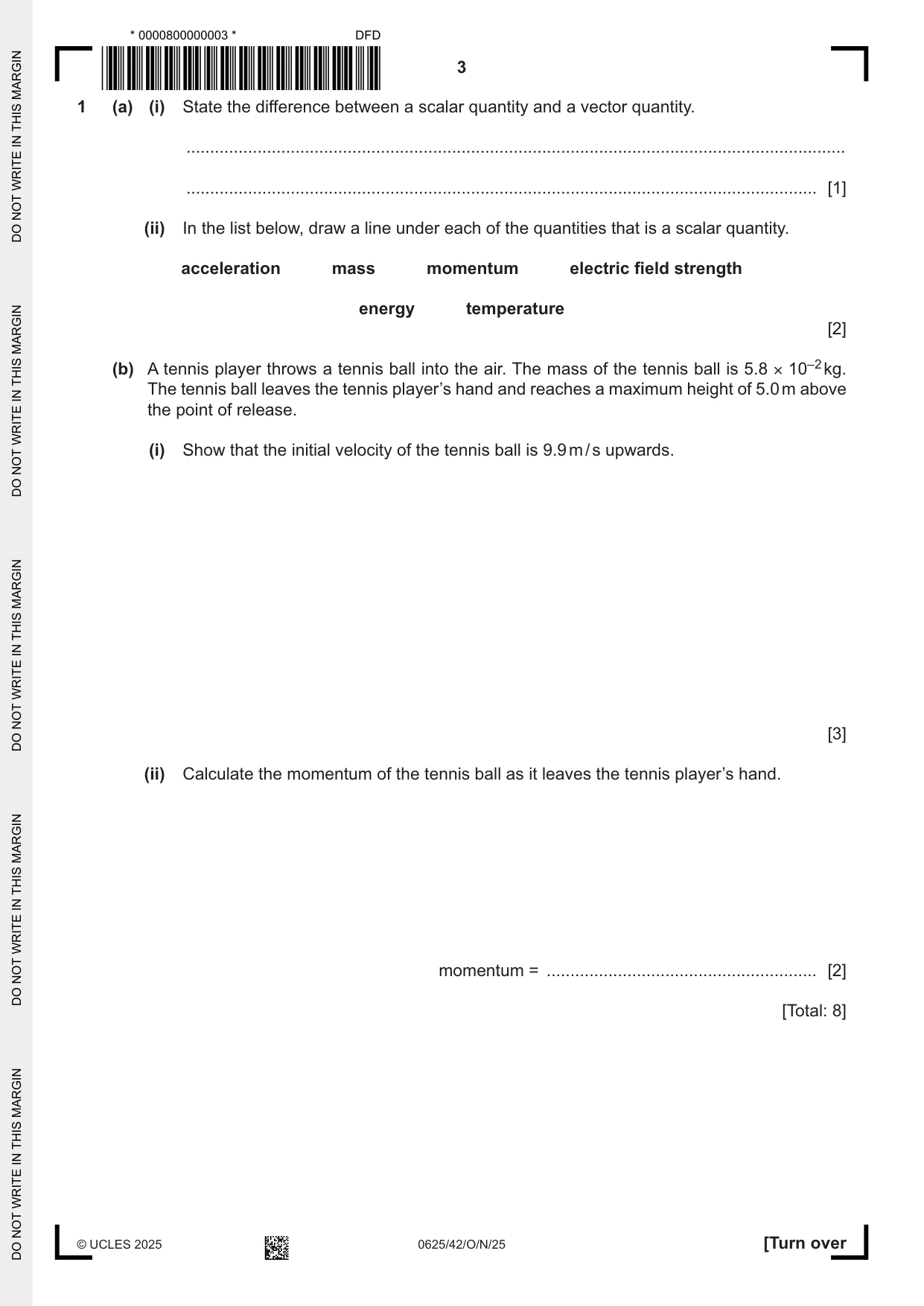
Q1 · State the difference between a scalar quantity and a vector quantity
1 (a) (i) State the difference between a scalar quantity and a vector quantity. ........................................................................................................................................... ..................................................................................................................................... [1] (ii) In the list below, draw a line under each of the quantities that is a scalar quantity. acceleration mass momentum electric field strength energy temperature [2] (b) A tennis player throws a tennis ball into the air. The mass of the tennis ball is 5.8 × 10⁻² kg. The tennis ball leaves the tennis player’s hand and reaches a maximum height of 5.0 m above the point of release. (i) Show that the initial velocity of the tennis ball is 9.9 m / s upwards. [3] (ii) Calculate the momentum of the tennis ball as it leaves the tennis player’s hand. momentum = ......................................................... [2] [Total: 8]
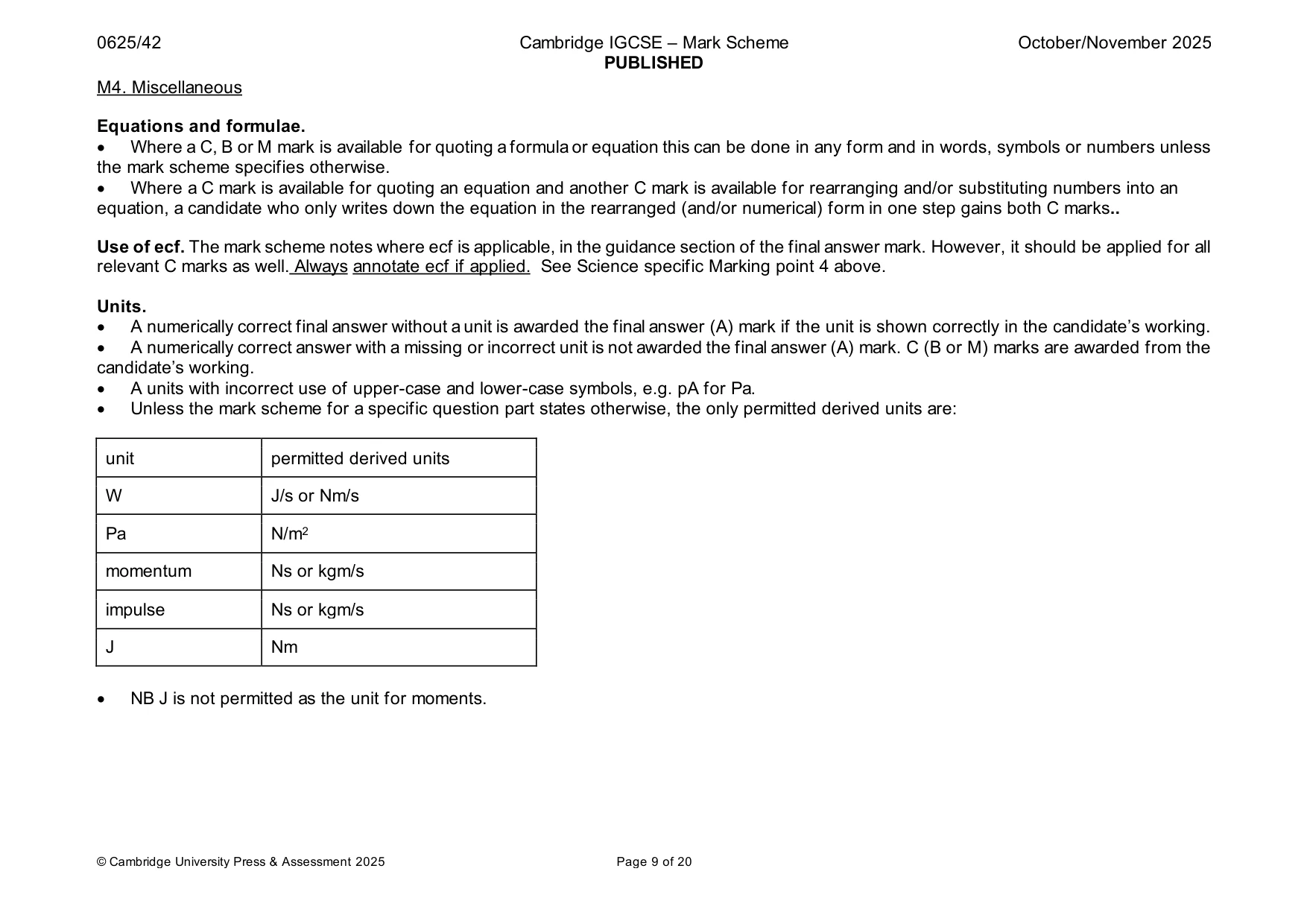
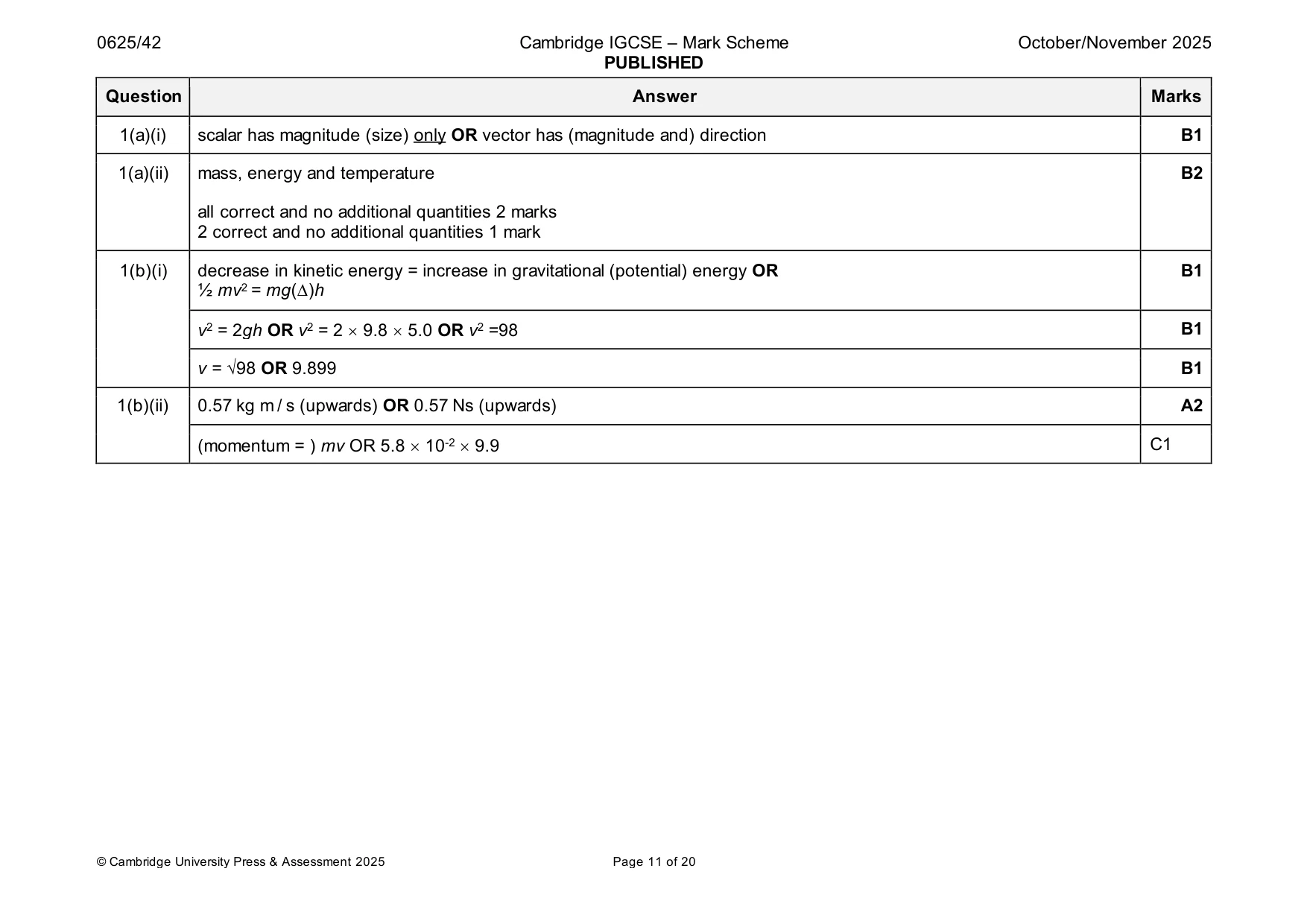
Mark scheme: Question Answer Marks 1(a)(i) scalar has magnitude (size) only OR vector has (magnitude and) direction B1 1(a)(ii) mass, energy and temperature B2 all correct and no additional quantities 2 marks 2 correct and no additional quantities 1 mark 1(b)(i) decrease in kinetic energy = increase in gravitational (potential) energy OR B1 ½ mv2 = mg()h v2 = 2gh OR v2 = 2 9.8 5.0 OR v2 =98 B1 v = √98 OR 9.899 B1 1(b)(ii) 0.57 kg m / s (upwards) OR 0.57 Ns (upwards) A2 (momentum = ) mv OR 5.8 10-2 9.9 C1
More questions on Physical quantities and measurement techniques
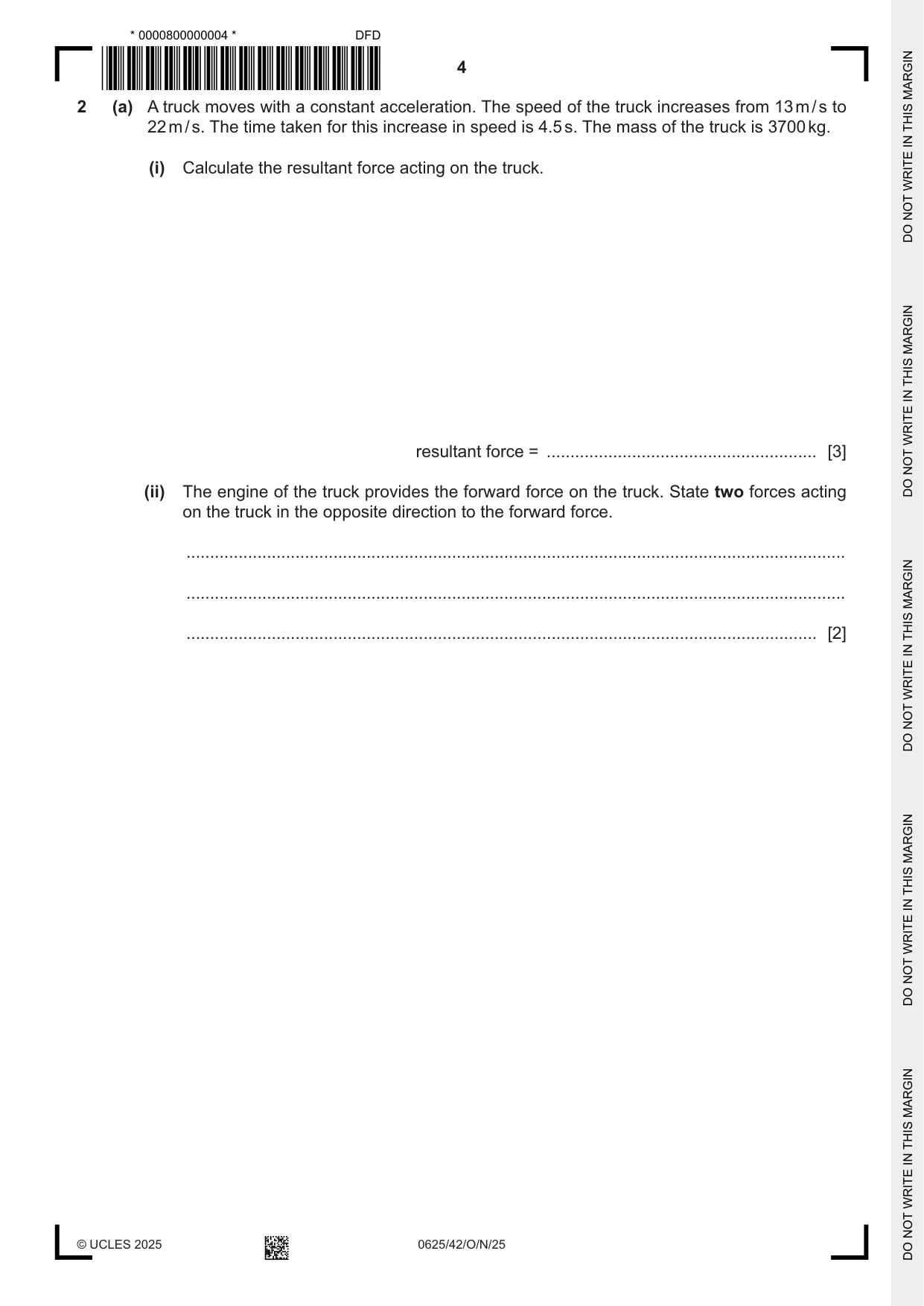
Q2 · A truck moves with a constant acceleration
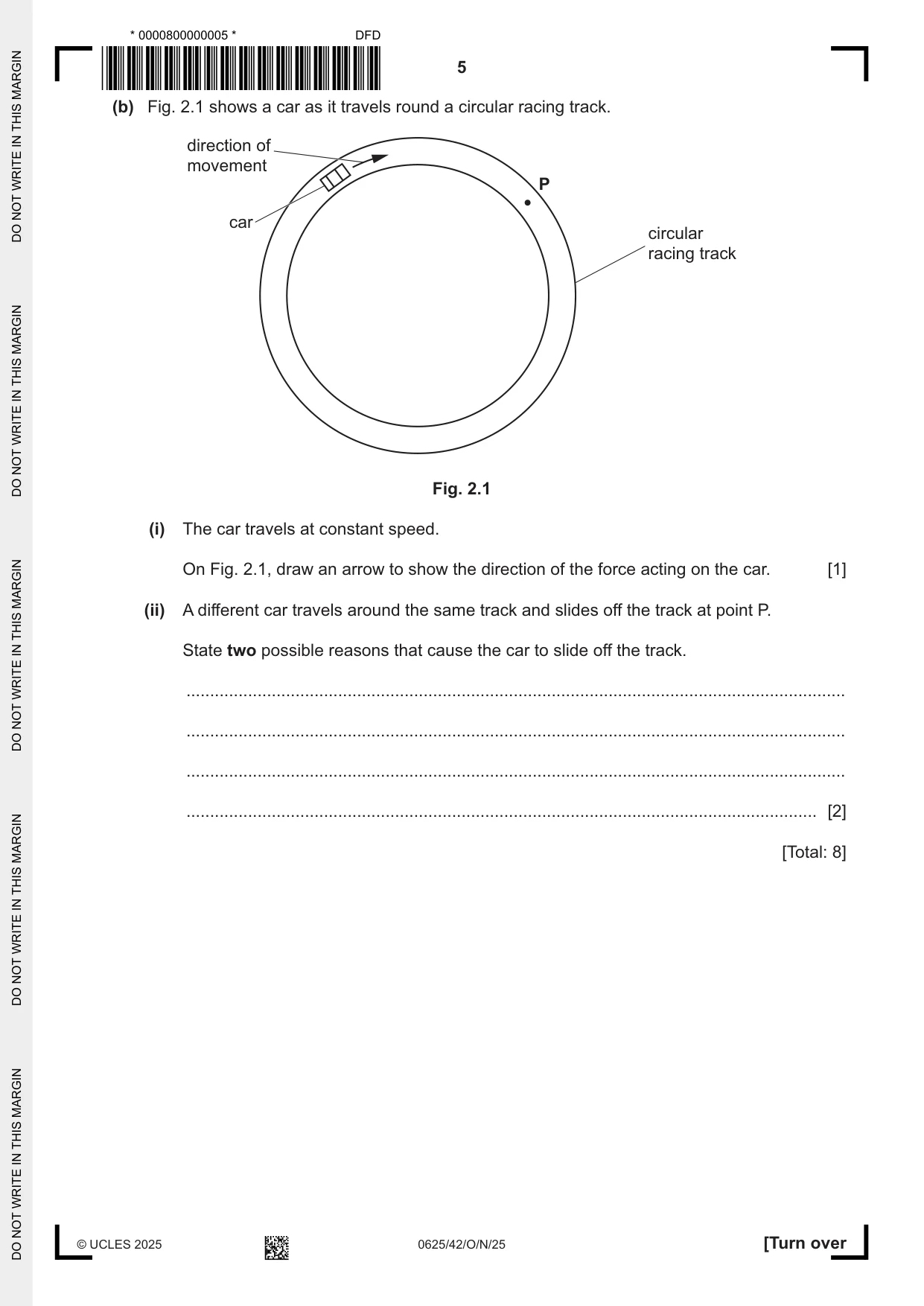
2 (a) A truck moves with a constant acceleration. The speed of the truck increases from 13 m / s to 22 m / s. The time taken for this increase in speed is 4.5 s. The mass of the truck is 3700 kg. (i) Calculate the resultant force acting on the truck. resultant force = ......................................................... [3] (ii) The engine of the truck provides the forward force on the truck. State two forces acting on the truck in the opposite direction to the forward force. ........................................................................................................................................... ........................................................................................................................................... ..................................................................................................................................... [2] (b) Fig. 2.1 shows a car as it travels round a circular racing track. direction of movement P car circular racing track Fig. 2.1 (i) The car travels at constant speed. On Fig. 2.1, draw an arrow to show the direction of the force acting on the car. [1] (ii) A different car travels around the same track and slides off the track at point P. State two possible reasons that cause the car to slide off the track. ........................................................................................................................................... ........................................................................................................................................... ........................................................................................................................................... ..................................................................................................................................... [2] [Total: 8]
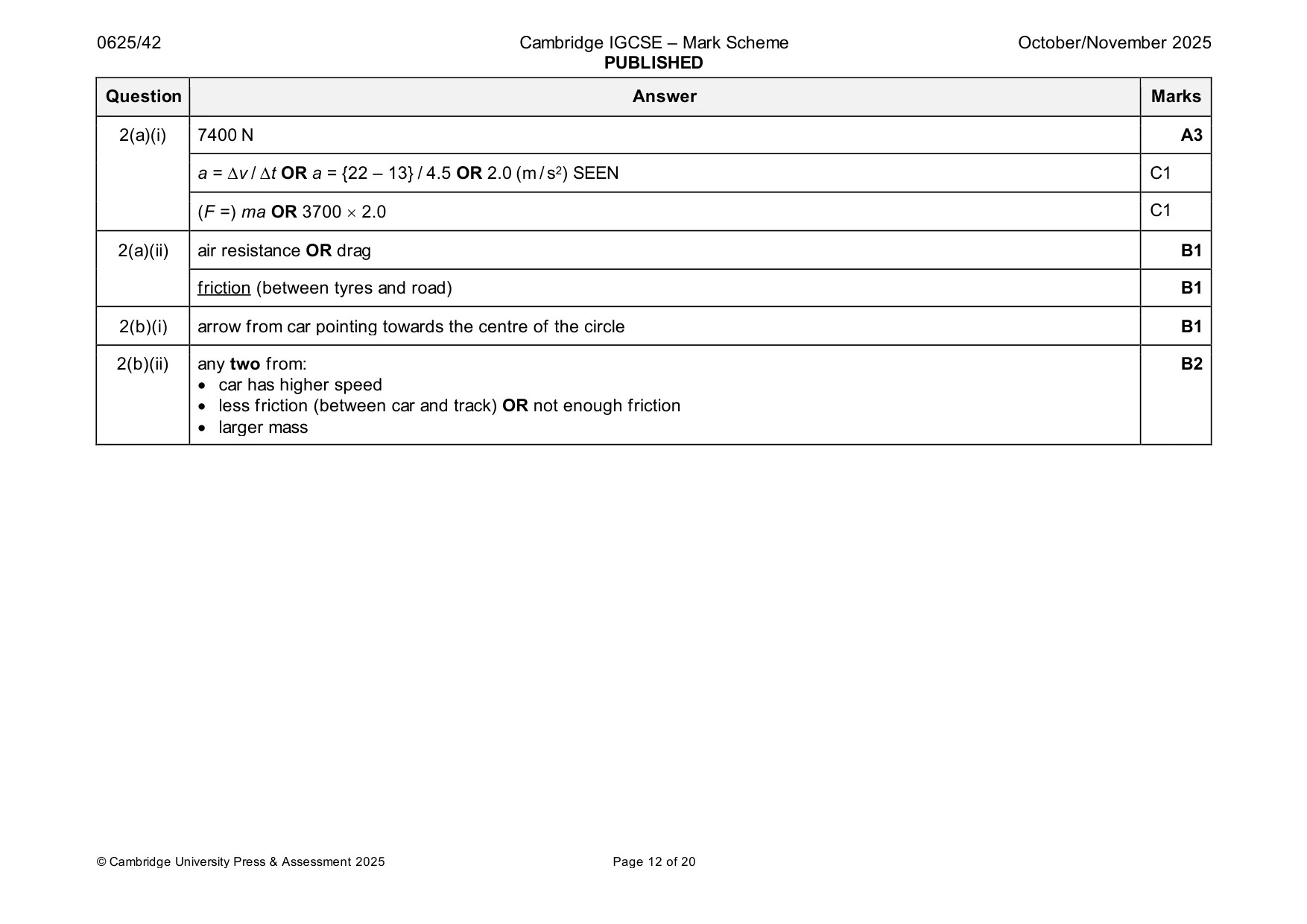
Mark scheme: 2(a)(i) 7400 N A3 a = ∆v / ∆t OR a = {22 – 13} / 4.5 OR 2.0 (m / s2) SEEN C1 (F =) ma OR 3700 2.0 C1 2(a)(ii) air resistance OR drag B1 friction (between tyres and road) B1 2(b)(i) arrow from car pointing towards the centre of the circle B1 2(b)(ii) any two from: B2 • car has higher speed • less friction (between car and track) OR not enough friction • larger mass
Q3 · Black solar panels installed on the roof of a house and a large rechargeable battery
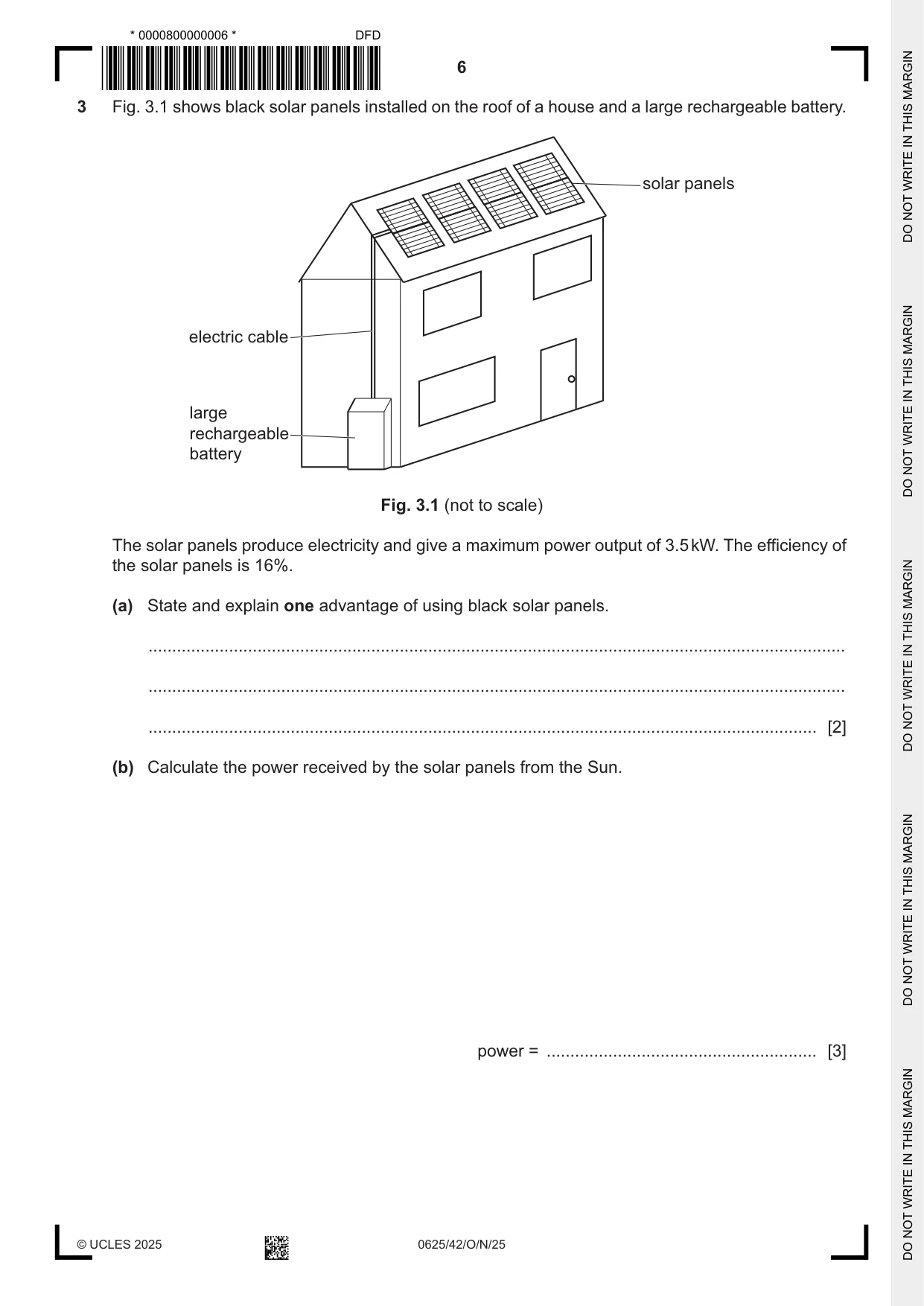
3 Fig. 3.1 shows black solar panels installed on the roof of a house and a large rechargeable battery. solar panels electric cable large rechargeable battery Fig. 3.1 (not to scale) The solar panels produce electricity and give a maximum power output of 3.5 kW. The efficiency of the solar panels is 16%. (a) State and explain one advantage of using black solar panels. ................................................................................................................................................... ................................................................................................................................................... ............................................................................................................................................. [2] (b) Calculate the power received by the solar panels from the Sun. power = ......................................................... [3] (c) The solar panels produce direct current (d.c.) and household appliances use alternating current (a.c.). State the difference between alternating current and direct current. ................................................................................................................................................... ............................................................................................................................................. [1] (d) Suggest one advantage of storing energy in the large rechargeable battery. ................................................................................................................................................... ............................................................................................................................................. [1] (e) Calculate the charge that flows into the battery when there is a current of 4.0 A for 2.0 hours. charge = ......................................................... [3] [Total: 10]
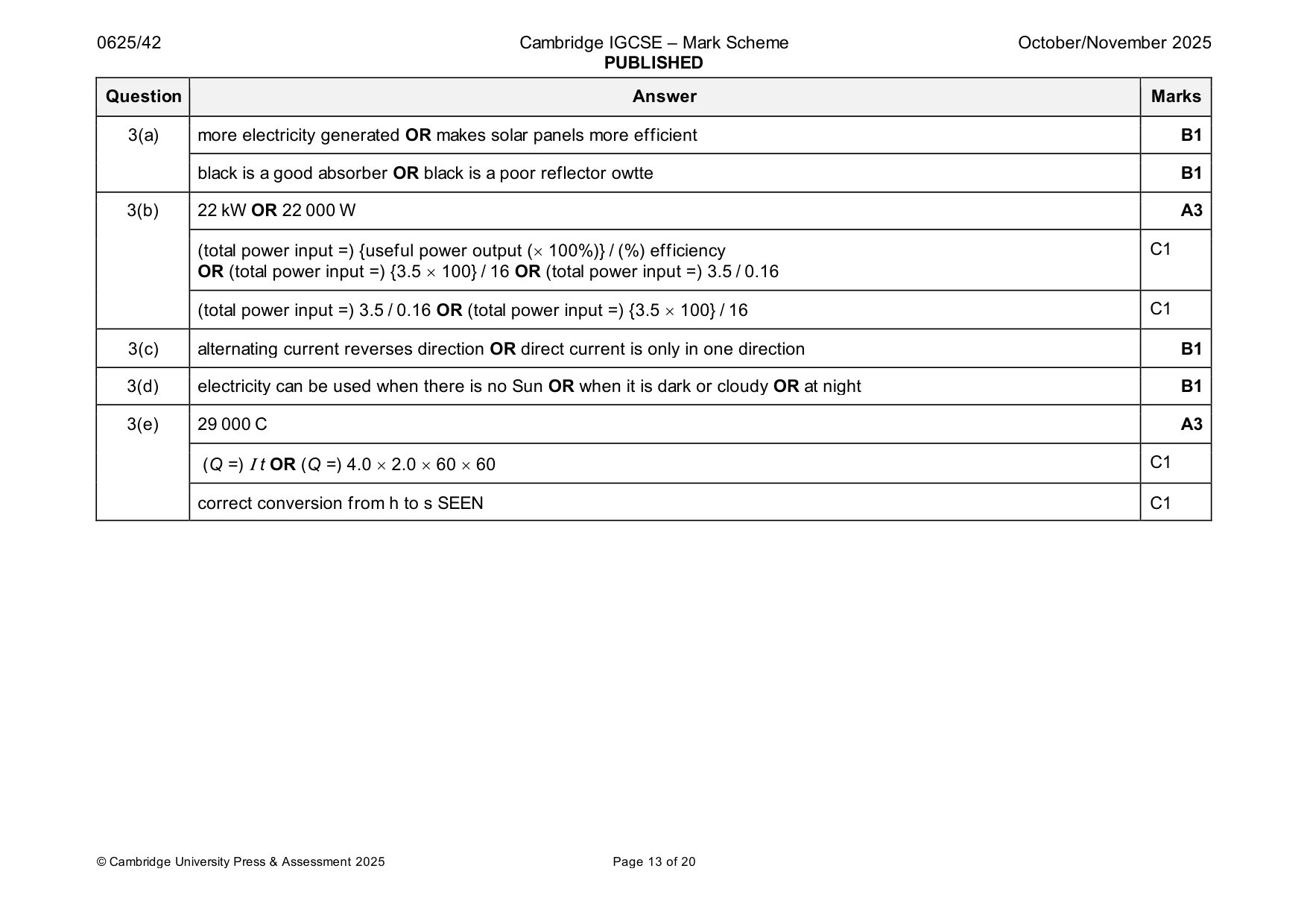
Mark scheme: 3(a) more electricity generated OR makes solar panels more efficient B1 black is a good absorber OR black is a poor reflector owtte B1 3(b) 22 kW OR 22 000 W A3 (total power input =) {useful power output ( 100%)} / (%) efficiency C1 OR (total power input =) {3.5 100} / 16 OR (total power input =) 3.5 / 0.16 (total power input =) 3.5 / 0.16 OR (total power input =) {3.5 100} / 16 C1 3(c) alternating current reverses direction OR direct current is only in one direction B1 3(d) electricity can be used when there is no Sun OR when it is dark or cloudy OR at night B1 3(e) 29 000 C A3 (Q =) I t OR (Q =) 4.0 2.0 60 60 C1 correct conversion from h to s SEEN C1
Q4 · Gas trapped in a cylinder by a piston
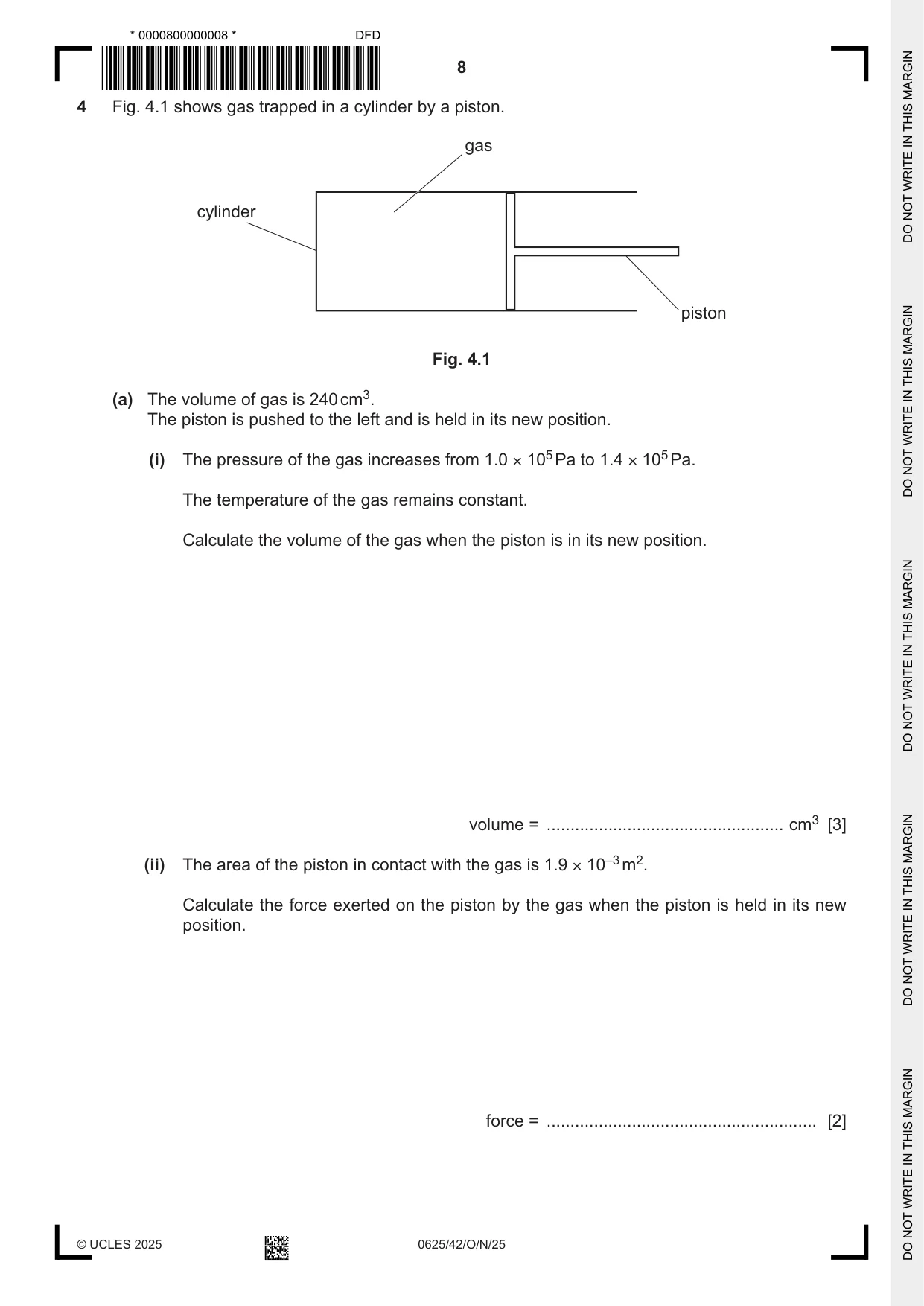
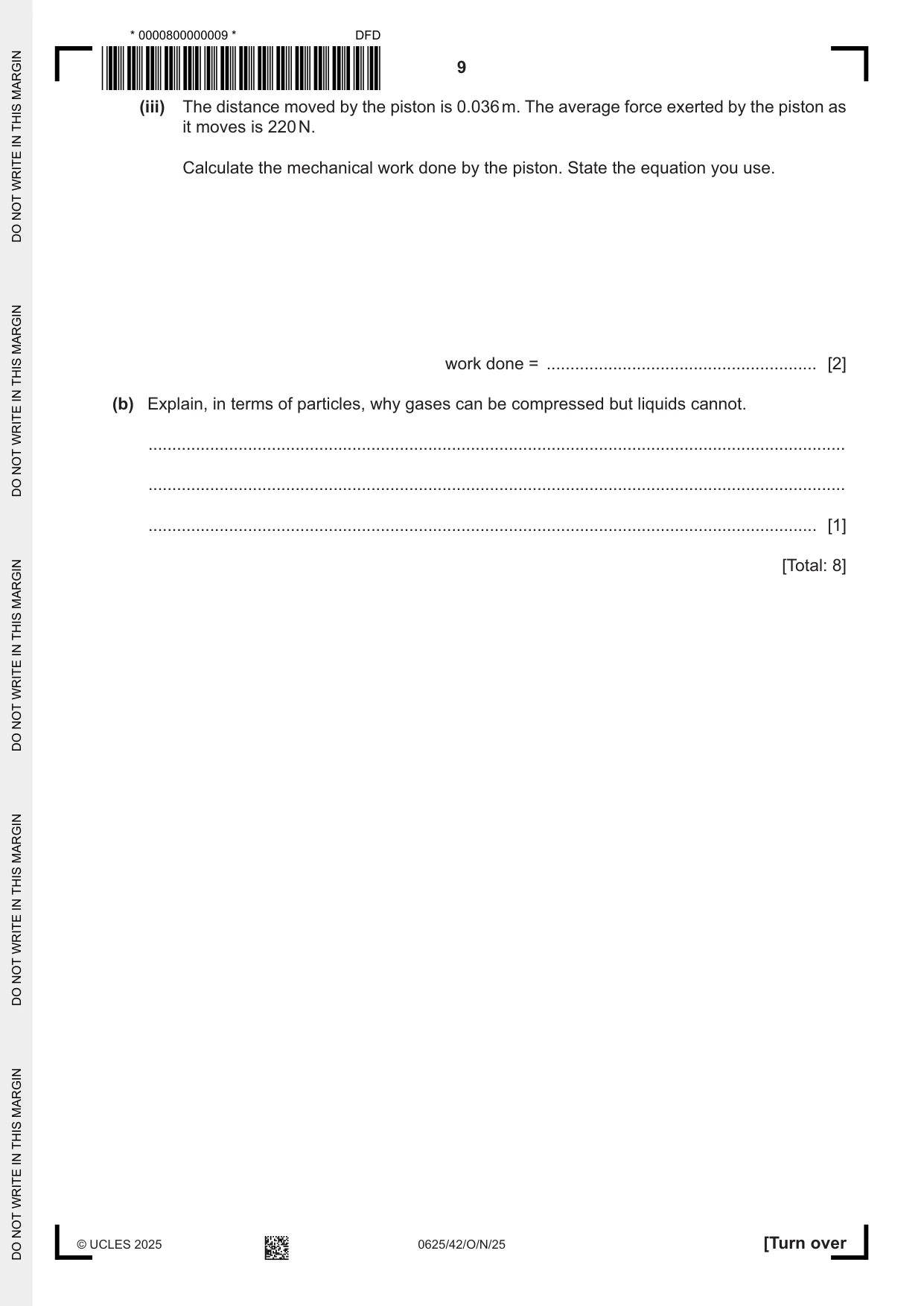
4 Fig. 4.1 shows gas trapped in a cylinder by a piston. gas cylinder piston Fig. 4.1 (a) The volume of gas is 240 cm3. The piston is pushed to the left and is held in its new position. (i) The pressure of the gas increases from 1.0 × 10⁵ Pa to 1.4 × 10⁵ Pa. The temperature of the gas remains constant. Calculate the volume of the gas when the piston is in its new position. volume = .................................................. cm3 [3] (ii) The area of the piston in contact with the gas is 1.9 × 10⁻³ m2. Calculate the force exerted on the piston by the gas when the piston is held in its new position. force = ......................................................... [2] (iii) The distance moved by the piston is 0.036 m. The average force exerted by the piston as it moves is 220 N. Calculate the mechanical work done by the piston. State the equation you use. work done = ......................................................... [2] (b) Explain, in terms of particles, why gases can be compressed but liquids cannot. ................................................................................................................................................... ................................................................................................................................................... ............................................................................................................................................. [1] [Total: 8]
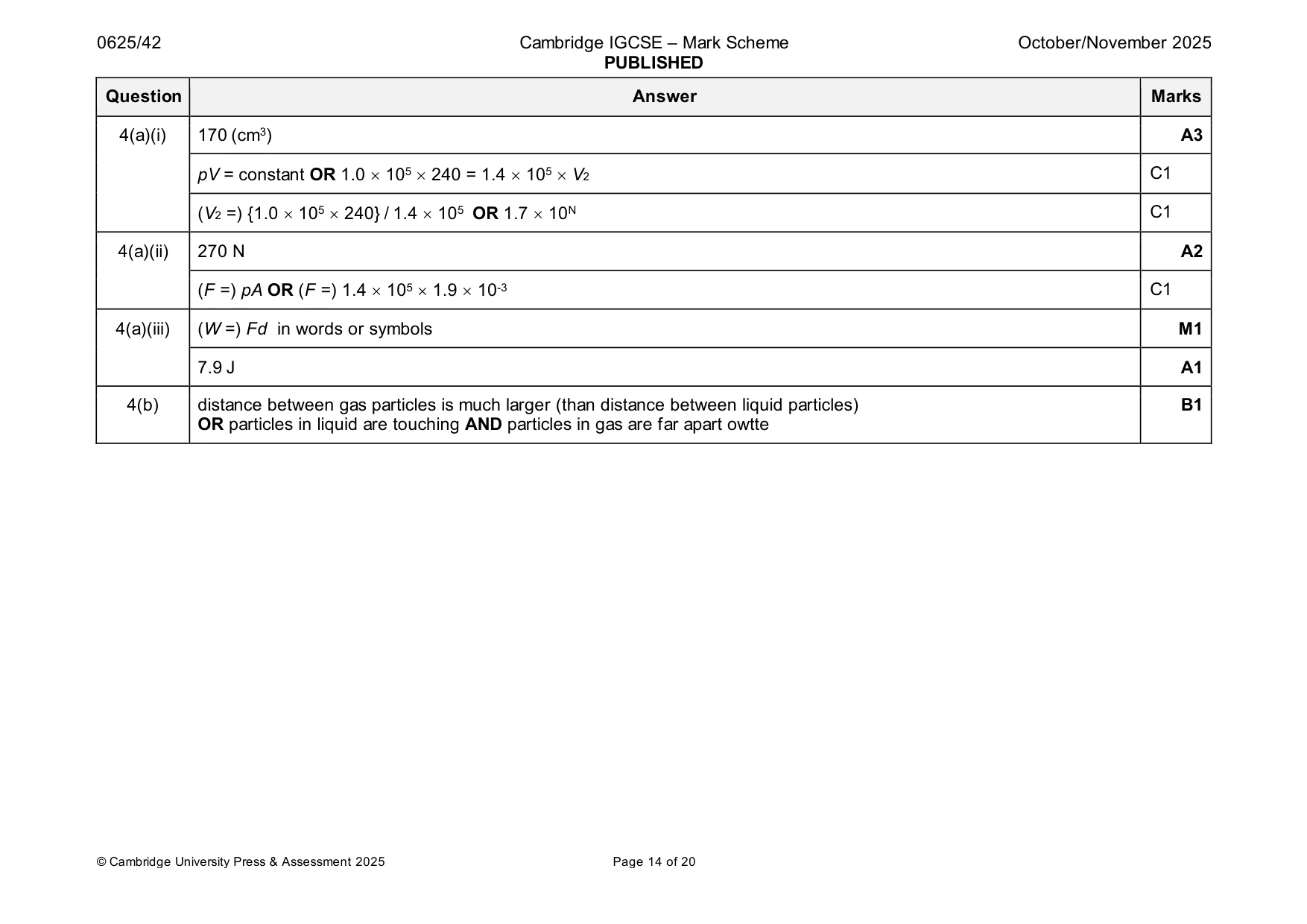
Mark scheme: 4(a)(i) 170 (cm3) A3 pV = constant OR 1.0 105 240 = 1.4 105 V2 C1 (V2 =) {1.0 105 240} / 1.4 105 OR 1.7 10N C1 4(a)(ii) 270 N A2 (F =) pA OR (F =) 1.4 105 1.9 10-3 C1 4(a)(iii) (W =) Fd in words or symbols M1 7.9 J A1 4(b) distance between gas particles is much larger (than distance between liquid particles) B1 OR particles in liquid are touching AND particles in gas are far apart owtte
Q5 · There is a large puddle of water on a road
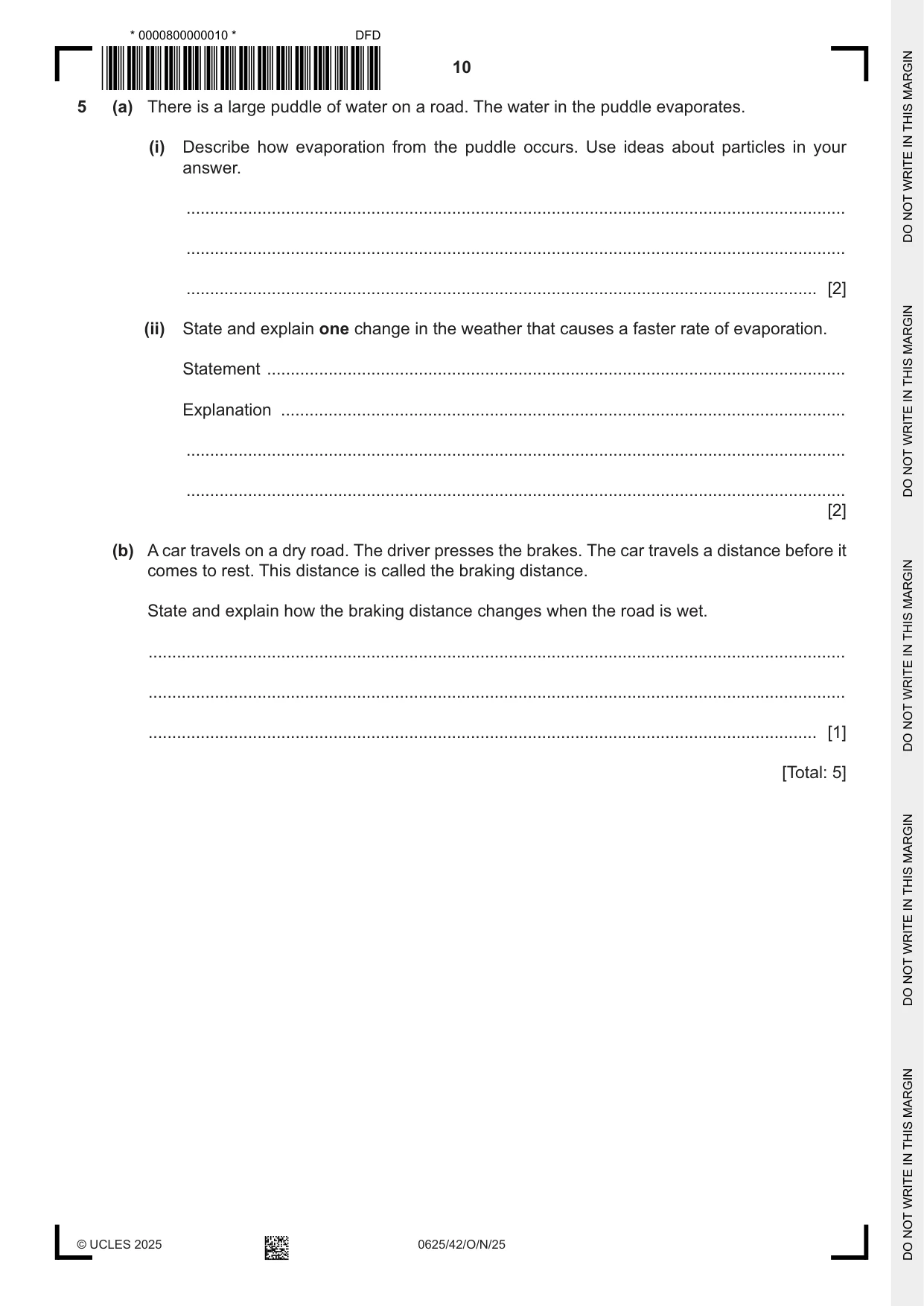
5 (a) There is a large puddle of water on a road. The water in the puddle evaporates. (i) Describe how evaporation from the puddle occurs. Use ideas about particles in your answer. ........................................................................................................................................... ........................................................................................................................................... ..................................................................................................................................... [2] (ii) State and explain one change in the weather that causes a faster rate of evaporation. Statement .......................................................................................................................... Explanation ....................................................................................................................... ........................................................................................................................................... ........................................................................................................................................... [2] (b) A car travels on a dry road. The driver presses the brakes. The car travels a distance before it comes to rest. This distance is called the braking distance. State and explain how the braking distance changes when the road is wet. ................................................................................................................................................... ................................................................................................................................................... ............................................................................................................................................. [1] [Total: 5]
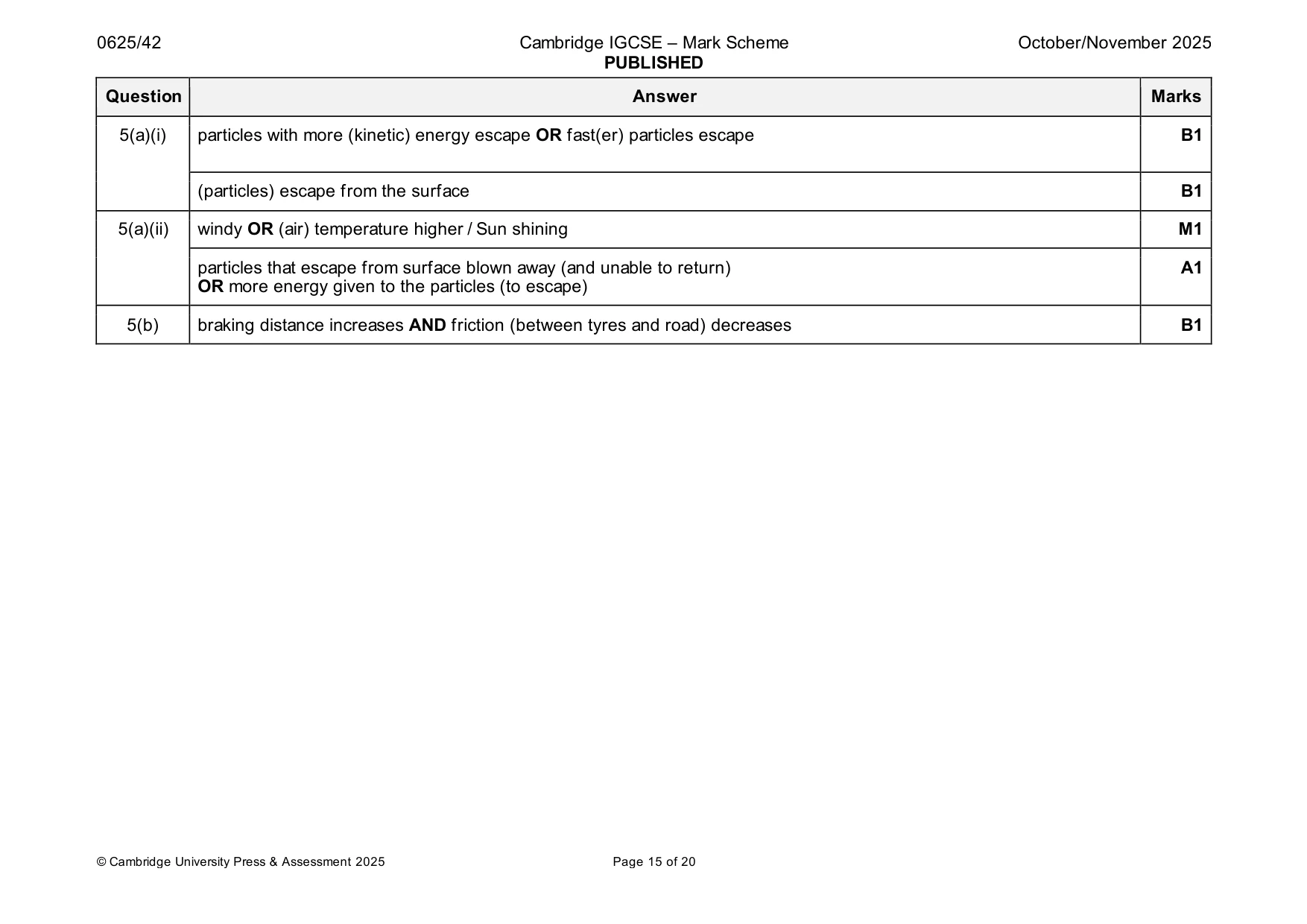
Mark scheme: 5(a)(i) particles with more (kinetic) energy escape OR fast(er) particles escape B1 (particles) escape from the surface B1 5(a)(ii) windy OR (air) temperature higher / Sun shining M1 particles that escape from surface blown away (and unable to return) A1 OR more energy given to the particles (to escape) 5(b) braking distance increases AND friction (between tyres and road) decreases B1
Q6 · Successive crests of a water wave approaching a boundary
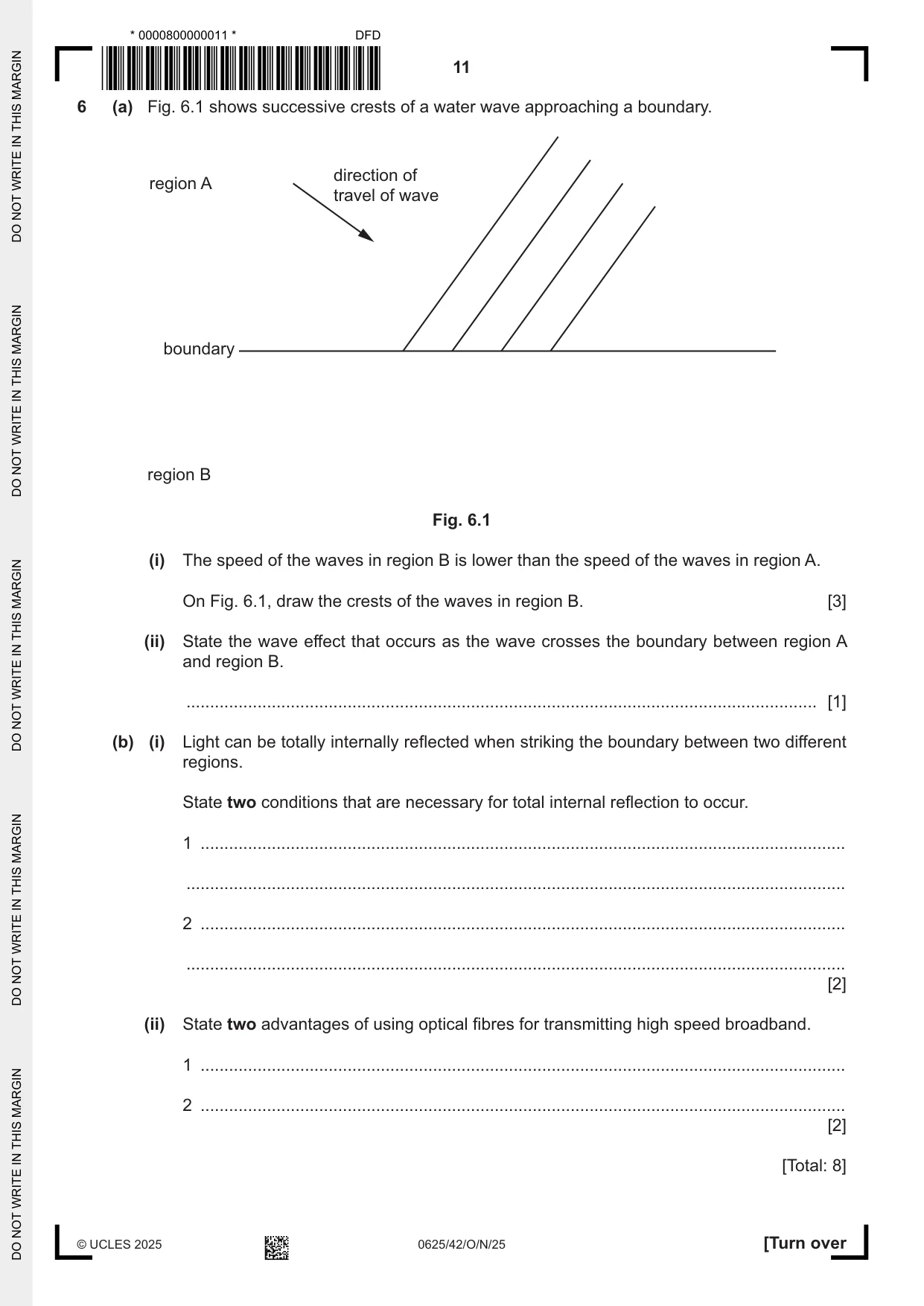
6 (a) Fig. 6.1 shows successive crests of a water wave approaching a boundary. direction of region A travel of wave boundary region B Fig. 6.1 (i) The speed of the waves in region B is lower than the speed of the waves in region A. On Fig. 6.1, draw the crests of the waves in region B. [3] (ii) State the wave effect that occurs as the wave crosses the boundary between region A and region B. ..................................................................................................................................... [1] (b) (i) Light can be totally internally reflected when striking the boundary between two different regions. State two conditions that are necessary for total internal reflection to occur. 1 ........................................................................................................................................ ........................................................................................................................................... 2 ........................................................................................................................................ ........................................................................................................................................... [2] (ii) State two advantages of using optical fibres for transmitting high speed broadband. 1 ........................................................................................................................................ 2 ........................................................................................................................................ [2] [Total: 8]
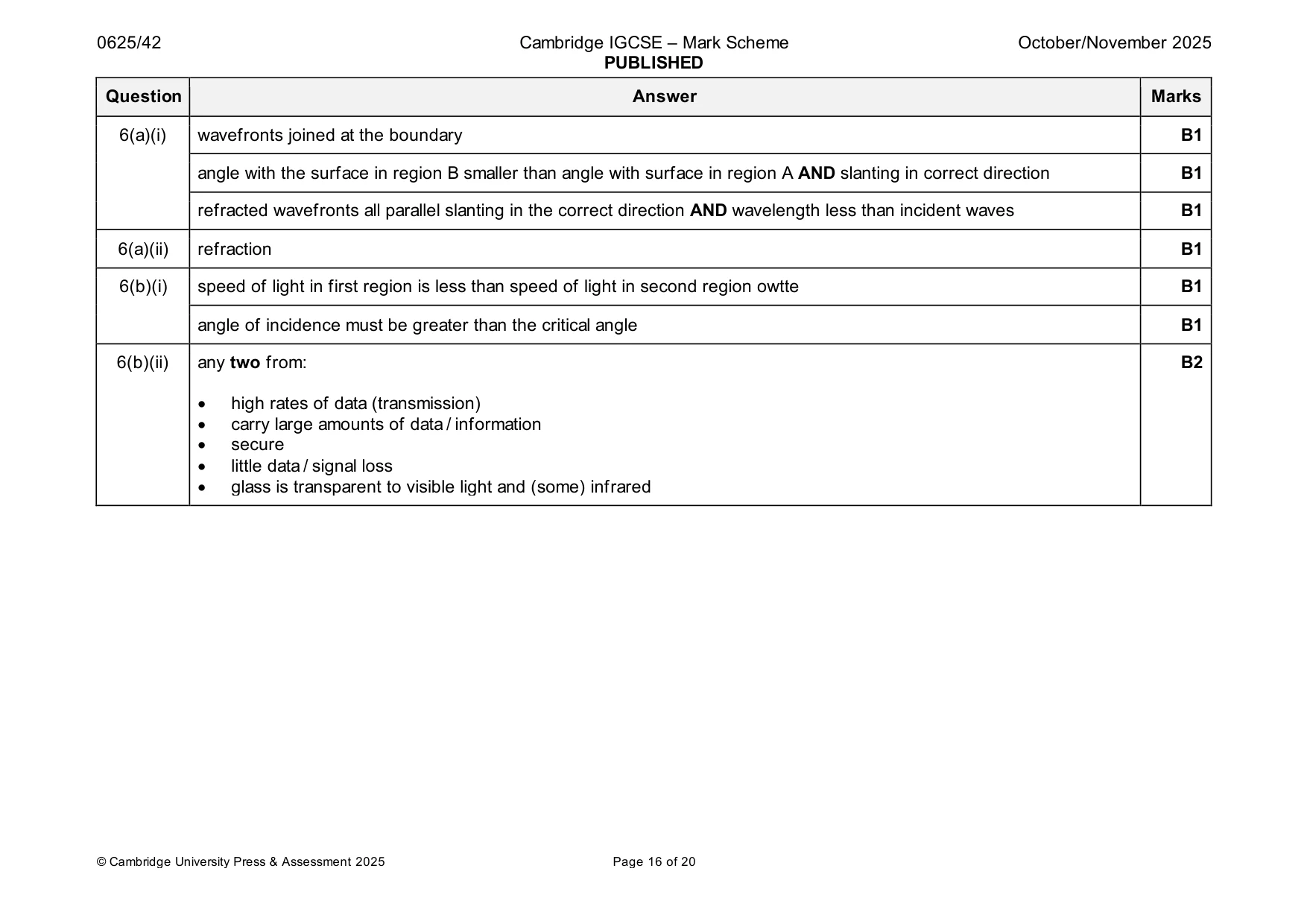
Mark scheme: 6(a)(i) wavefronts joined at the boundary B1 angle with the surface in region B smaller than angle with surface in region A AND slanting in correct direction B1 refracted wavefronts all parallel slanting in the correct direction AND wavelength less than incident waves B1 6(a)(ii) refraction B1 6(b)(i) speed of light in first region is less than speed of light in second region owtte B1 angle of incidence must be greater than the critical angle B1 6(b)(ii) any two from: B2 • high rates of data (transmission) • carry large amounts of data / information • secure • little data / signal loss • glass is transparent to visible light and (some) infrared
Q7 · A circuit consists of an a.c
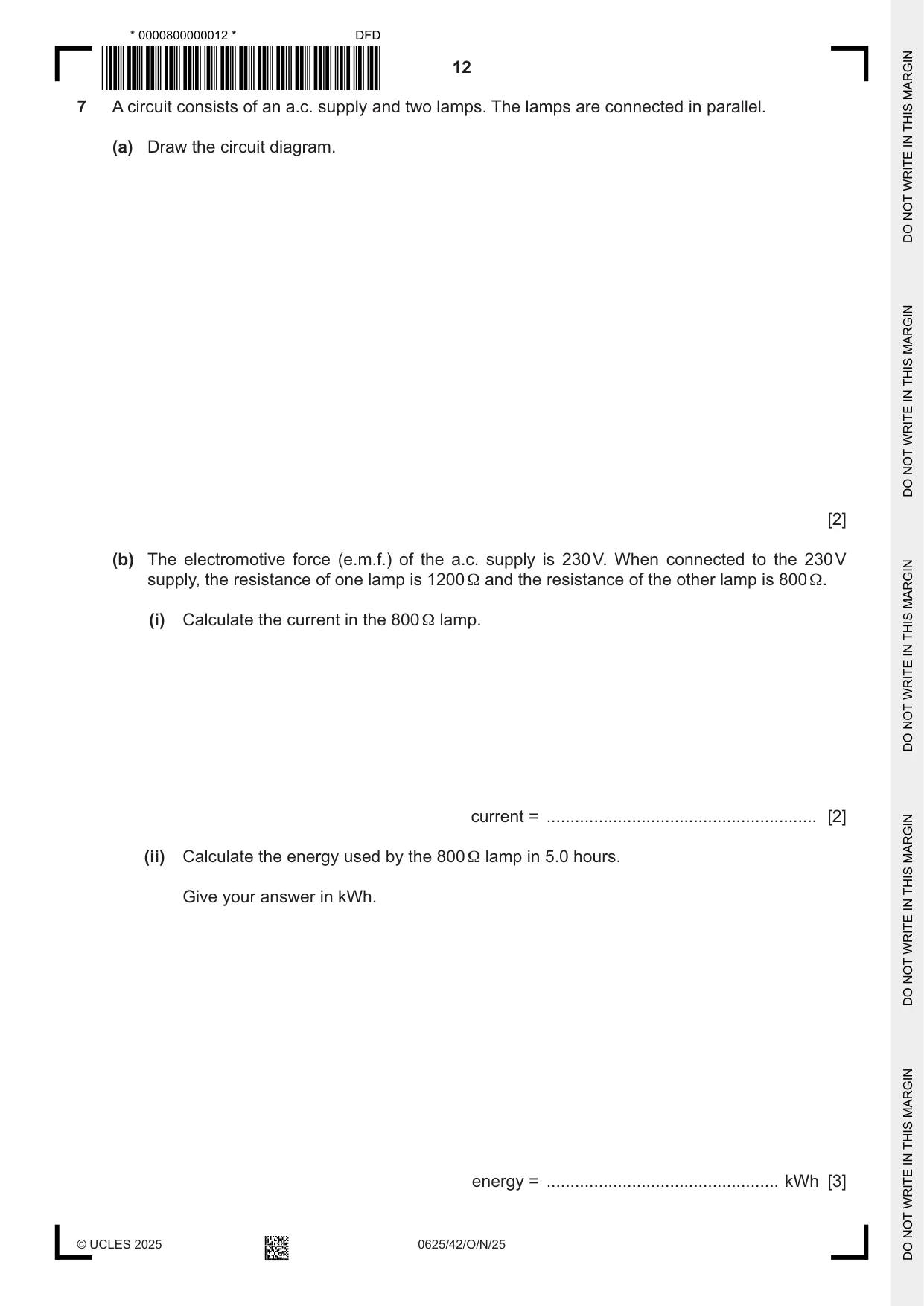
7 A circuit consists of an a.c. supply and two lamps. The lamps are connected in parallel. (a) Draw the circuit diagram. [2] (b) The electromotive force (e.m.f.) of the a.c. supply is 230 V. When connected to the 230 V supply, the resistance of one lamp is 1200 Ω and the resistance of the other lamp is 800 Ω. (i) Calculate the current in the 800 Ω lamp. current = ......................................................... [2] (ii) Calculate the energy used by the 800 Ω lamp in 5.0 hours. Give your answer in kWh. energy = ................................................. kWh [3] (iii) Calculate the combined resistance of the two lamps in this circuit. resistance = ......................................................... [2] [Total: 9]
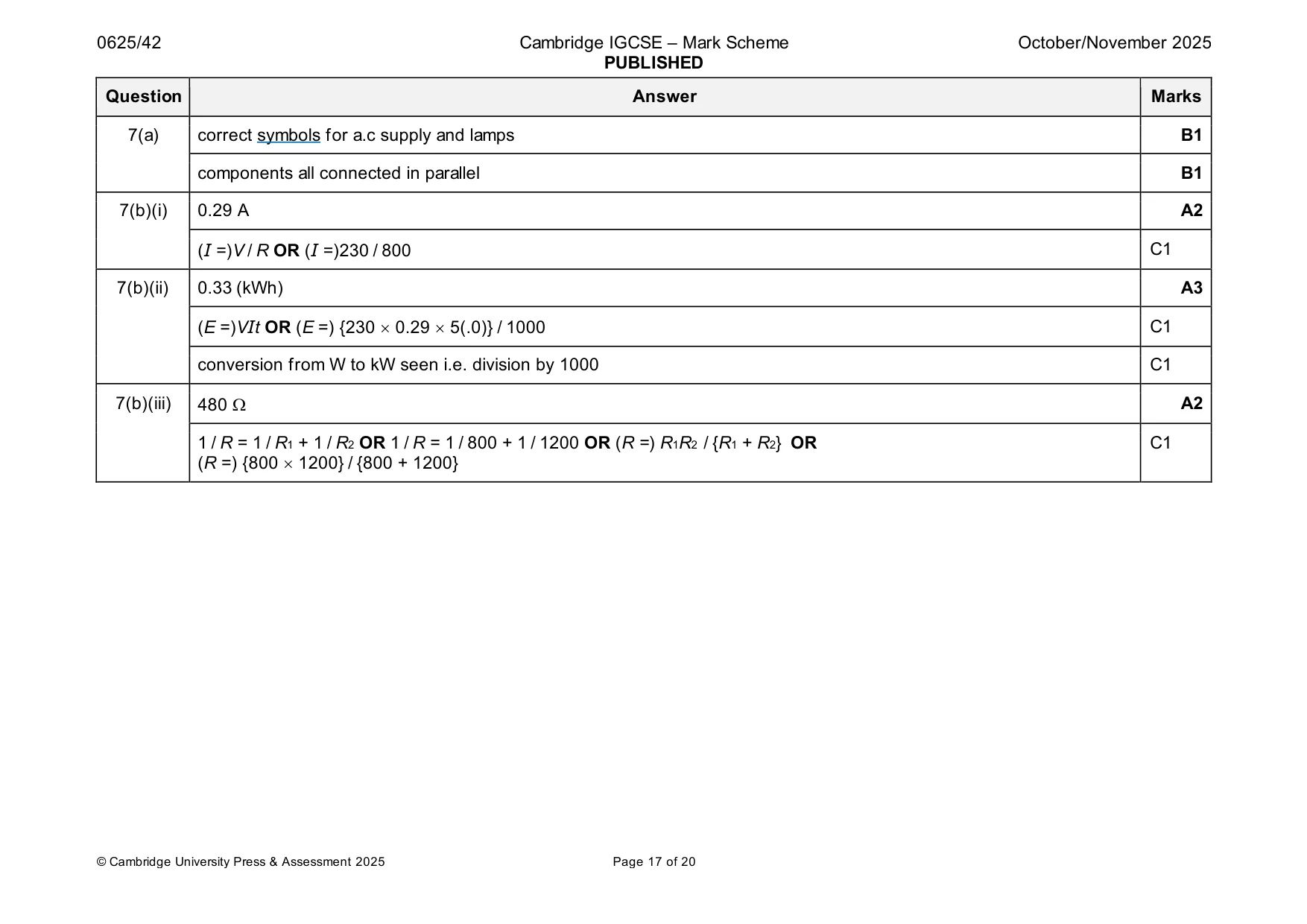
Mark scheme: 7(a) correct symbols for a.c supply and lamps B1 components all connected in parallel B1 7(b)(i) 0.29 A A2 (I =)V / R OR (I =)230 / 800 C1 7(b)(ii) 0.33 (kWh) A3 (E =)VIt OR (E =) {230 0.29 5(.0)} / 1000 C1 conversion from W to kW seen i.e. division by 1000 C1 7(b)(iii) 480 A2 1 / R = 1 / R1 + 1 / R2 OR 1 / R = 1 / 800 + 1 / 1200 OR (R =) R1R2 / {R1 + R2} OR C1 (R =) {800 1200} / {800 + 1200}
Q8 · State what is meant by a magnetic field
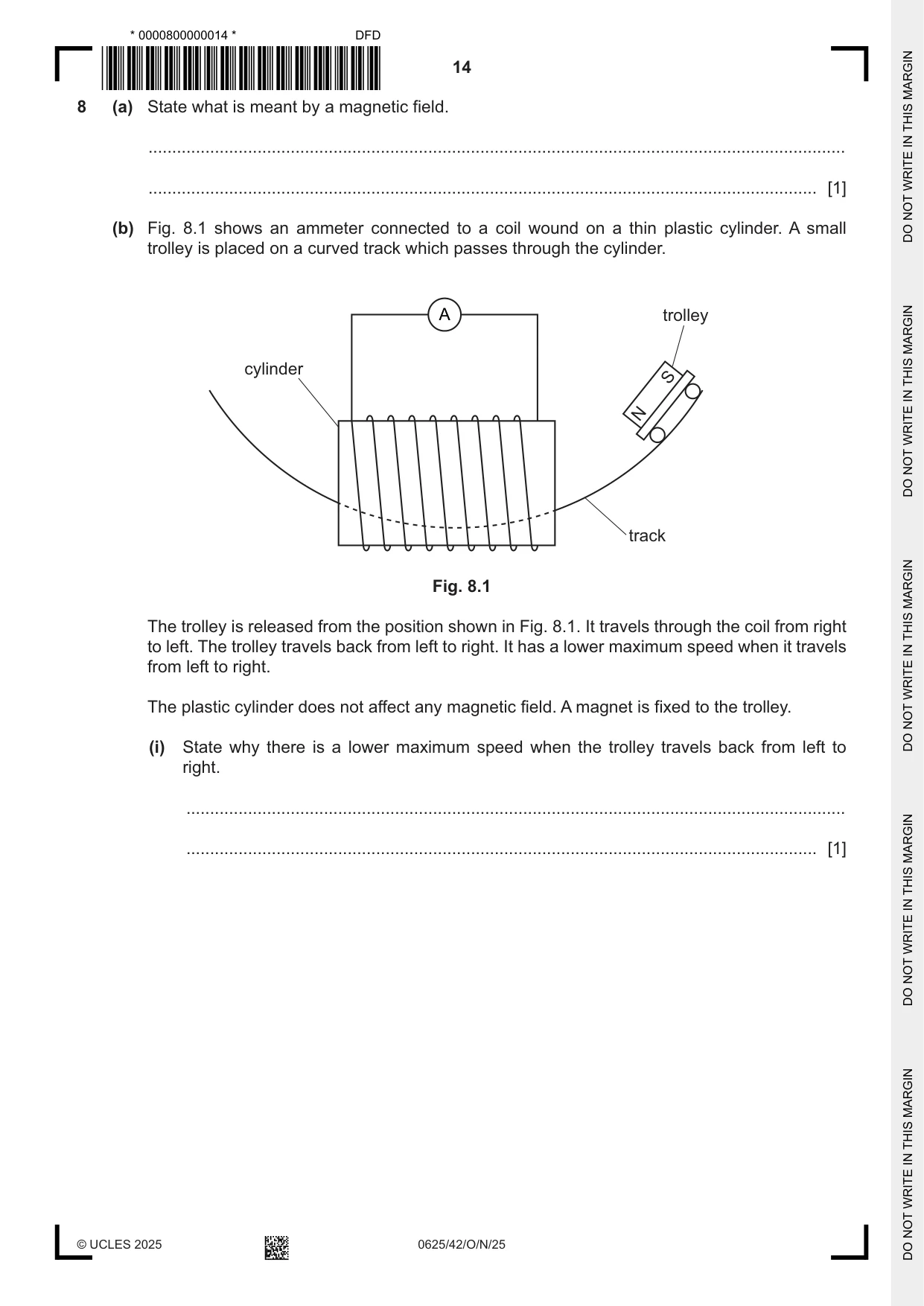
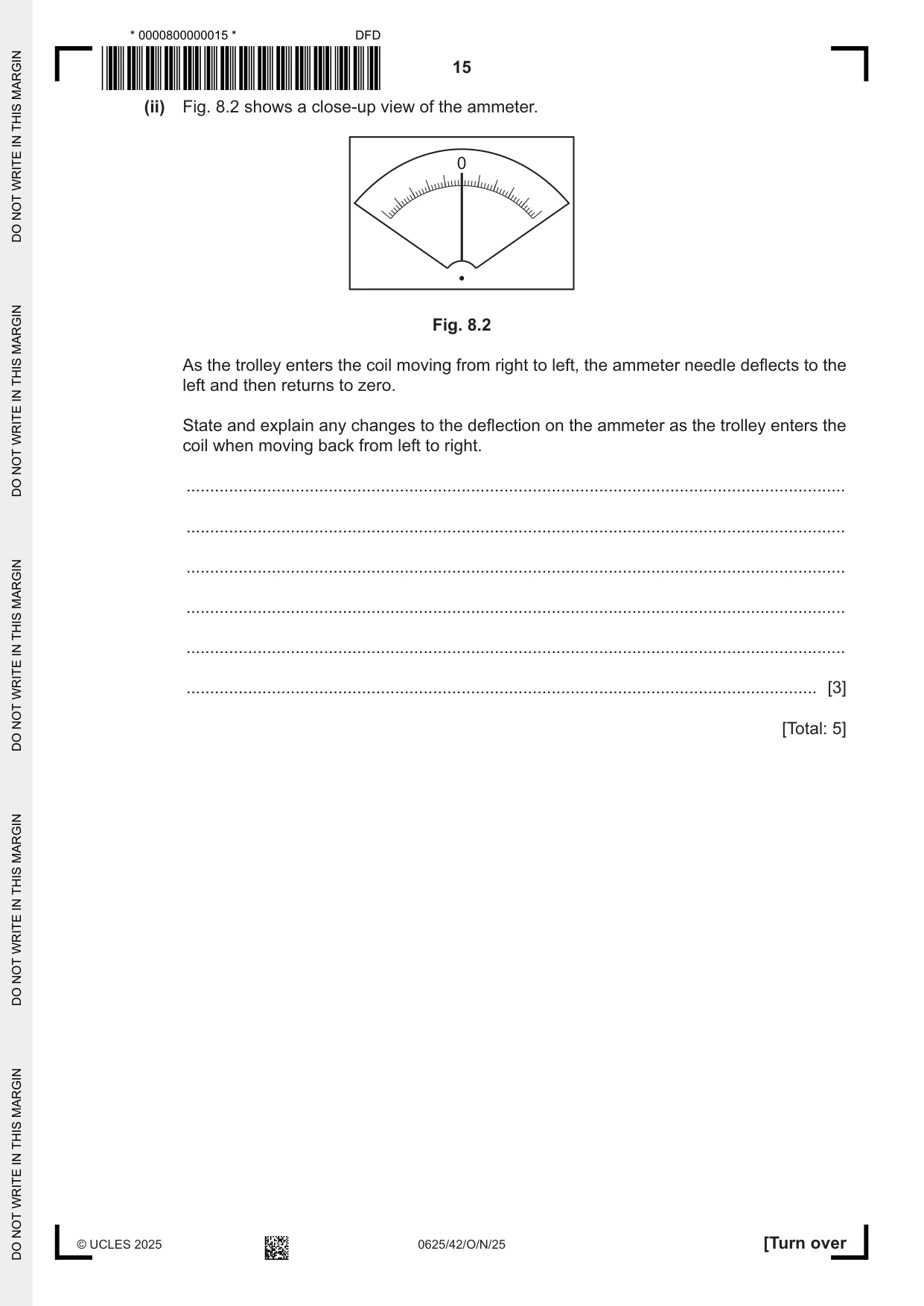
8 (a) State what is meant by a magnetic field. ................................................................................................................................................... ............................................................................................................................................. [1] (b) Fig. 8.1 shows an ammeter connected to a coil wound on a thin plastic cylinder. A small trolley is placed on a curved track which passes through the cylinder. A trolley cylinder S N track Fig. 8.1 The trolley is released from the position shown in Fig. 8.1. It travels through the coil from right to left. The trolley travels back from left to right. It has a lower maximum speed when it travels from left to right. The plastic cylinder does not affect any magnetic field. A magnet is fixed to the trolley. (i) State why there is a lower maximum speed when the trolley travels back from left to right. ........................................................................................................................................... ..................................................................................................................................... [1] (ii) Fig. 8.2 shows a close‑up view of the ammeter. 0 Fig. 8.2 As the trolley enters the coil moving from right to left, the ammeter needle deflects to the left and then returns to zero. State and explain any changes to the deflection on the ammeter as the trolley enters the coil when moving back from left to right. ........................................................................................................................................... ........................................................................................................................................... ........................................................................................................................................... ........................................................................................................................................... ........................................................................................................................................... ..................................................................................................................................... [3] [Total: 5]
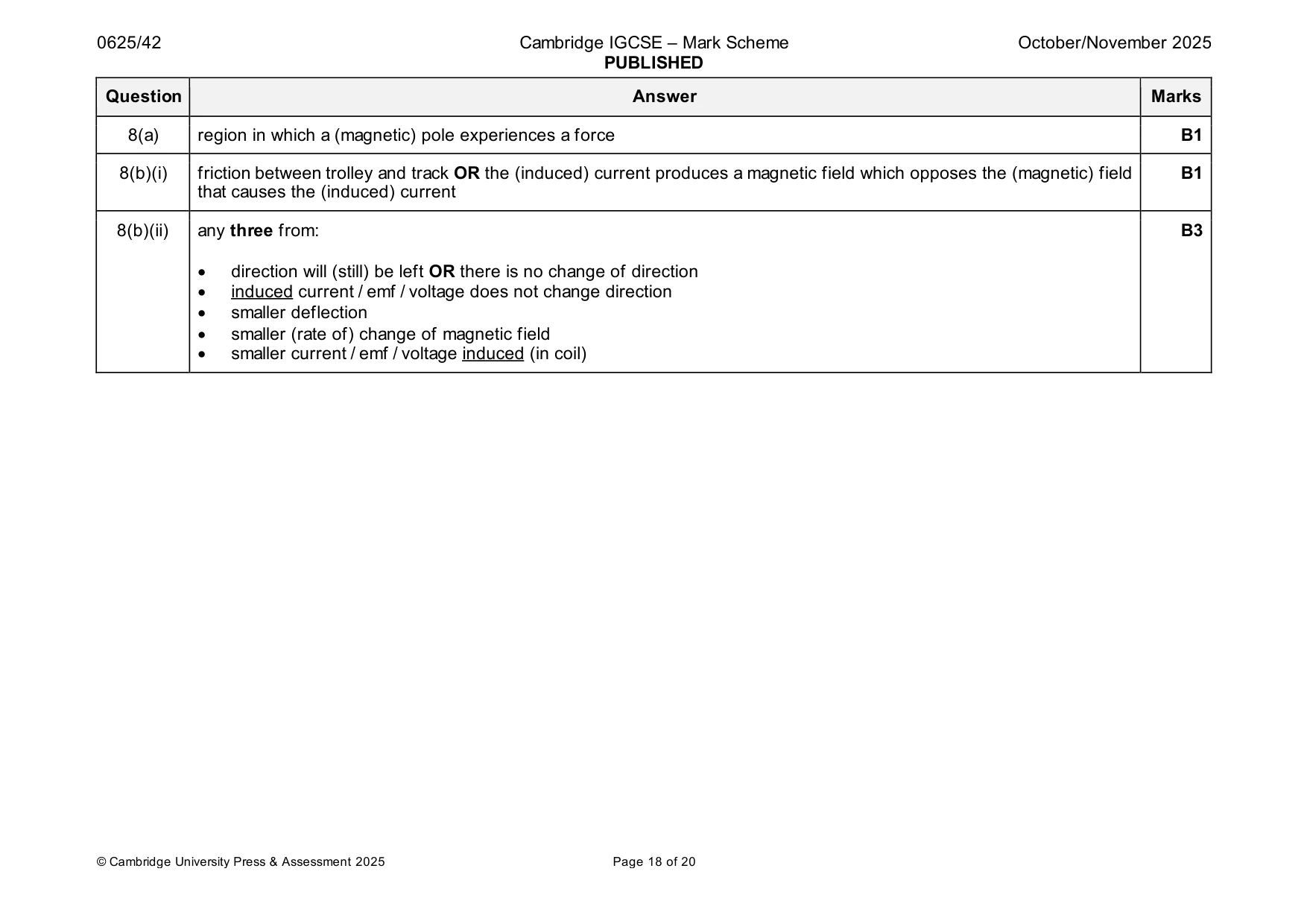
Mark scheme: 8(a) region in which a (magnetic) pole experiences a force B1 8(b)(i) friction between trolley and track OR the (induced) current produces a magnetic field which opposes the (magnetic) field B1 that causes the (induced) current 8(b)(ii) any three from: B3 • direction will (still) be left OR there is no change of direction • induced current / emf / voltage does not change direction • smaller deflection • smaller (rate of) change of magnetic field • smaller current / emf / voltage induced (in coil)
Q9 · A beam of radiation in a vacuum
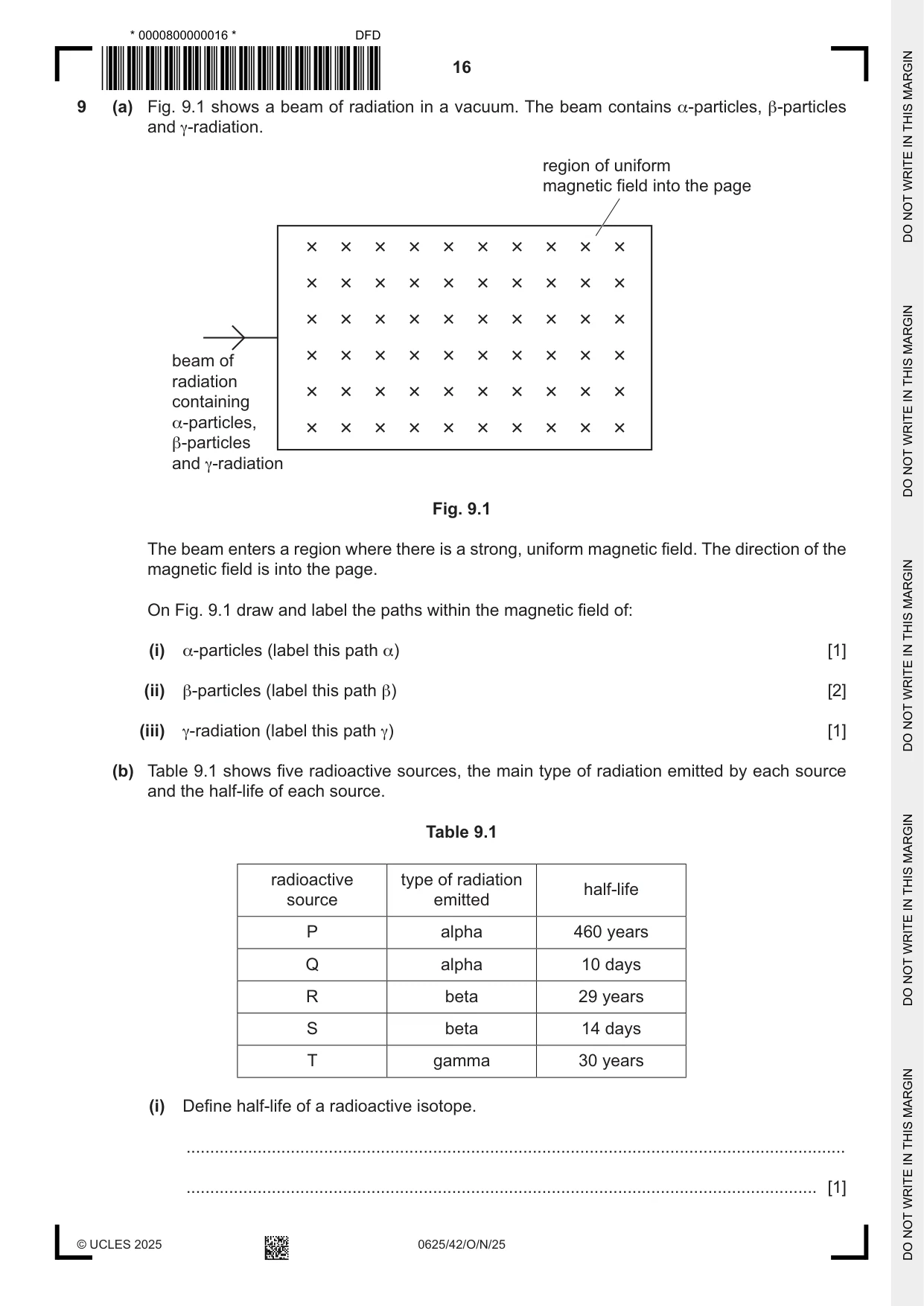
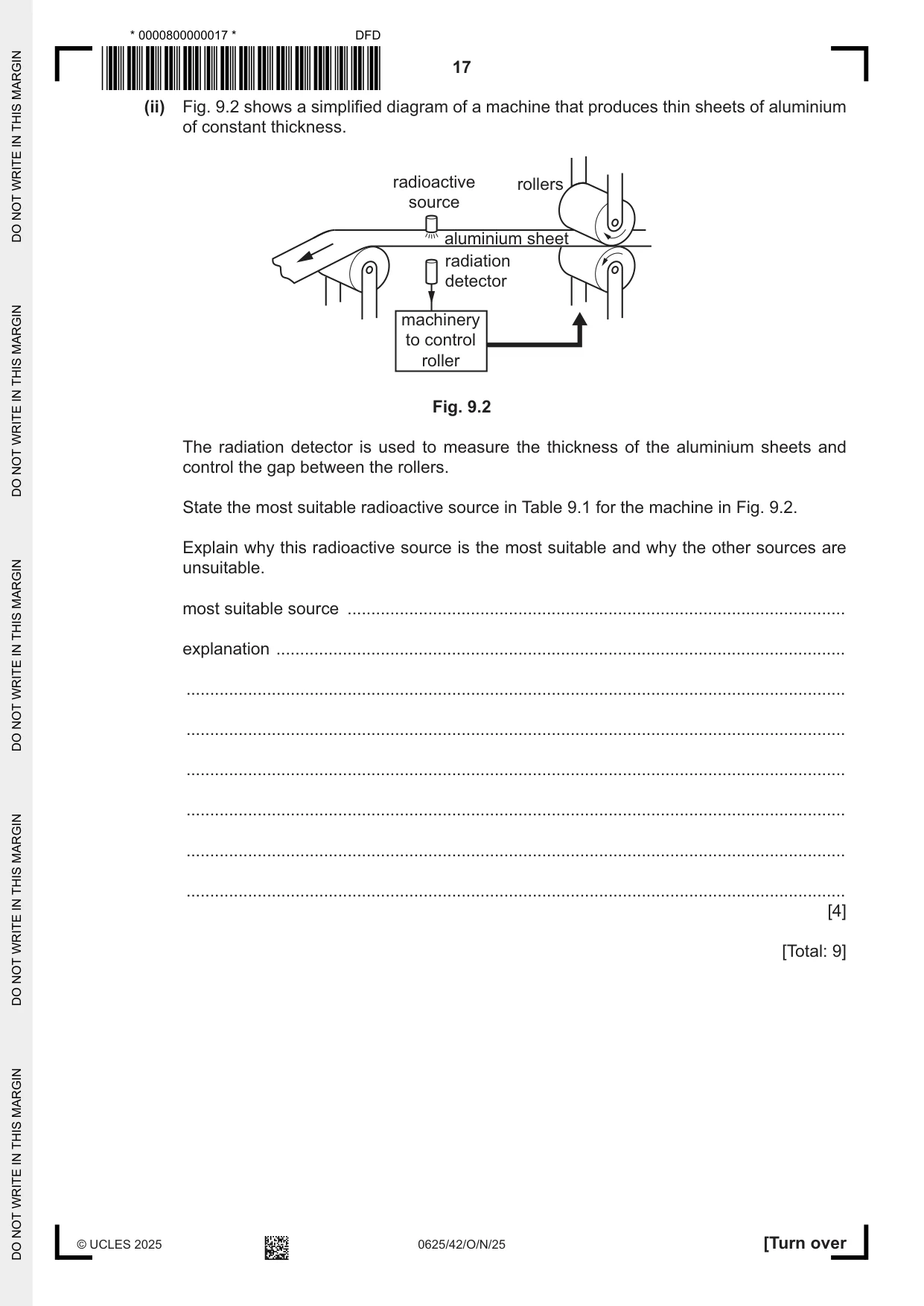
9 (a) Fig. 9.1 shows a beam of radiation in a vacuum. The beam contains α‑particles, β‑particles and γ‑radiation. region of uniform magnetic field into the page beam of radiation containing α-particles, β-particles and γ-radiation Fig. 9.1 The beam enters a region where there is a strong, uniform magnetic field. The direction of the magnetic field is into the page. On Fig. 9.1 draw and label the paths within the magnetic field of: (i) α‑particles (label this path α) [1] (ii) β‑particles (label this path β) [2] (iii) γ‑radiation (label this path γ) [1] (b) Table 9.1 shows five radioactive sources, the main type of radiation emitted by each source and the half‑life of each source. Table 9.1 radioactive type of radiation half‑life source emitted P alpha 460 years Q alpha 10 days R beta 29 years S beta 14 days T gamma 30 years (i) Define half‑life of a radioactive isotope. ........................................................................................................................................... ..................................................................................................................................... [1] (ii) Fig. 9.2 shows a simplified diagram of a machine that produces thin sheets of aluminium of constant thickness. radioactive rollers source aluminium sheet radiation detector machinery to control roller Fig. 9.2 The radiation detector is used to measure the thickness of the aluminium sheets and control the gap between the rollers. State the most suitable radioactive source in Table 9.1 for the machine in Fig. 9.2. Explain why this radioactive source is the most suitable and why the other sources are unsuitable. most suitable source ......................................................................................................... explanation ........................................................................................................................ ........................................................................................................................................... ........................................................................................................................................... ........................................................................................................................................... ........................................................................................................................................... ........................................................................................................................................... ........................................................................................................................................... [4] [Total: 9]
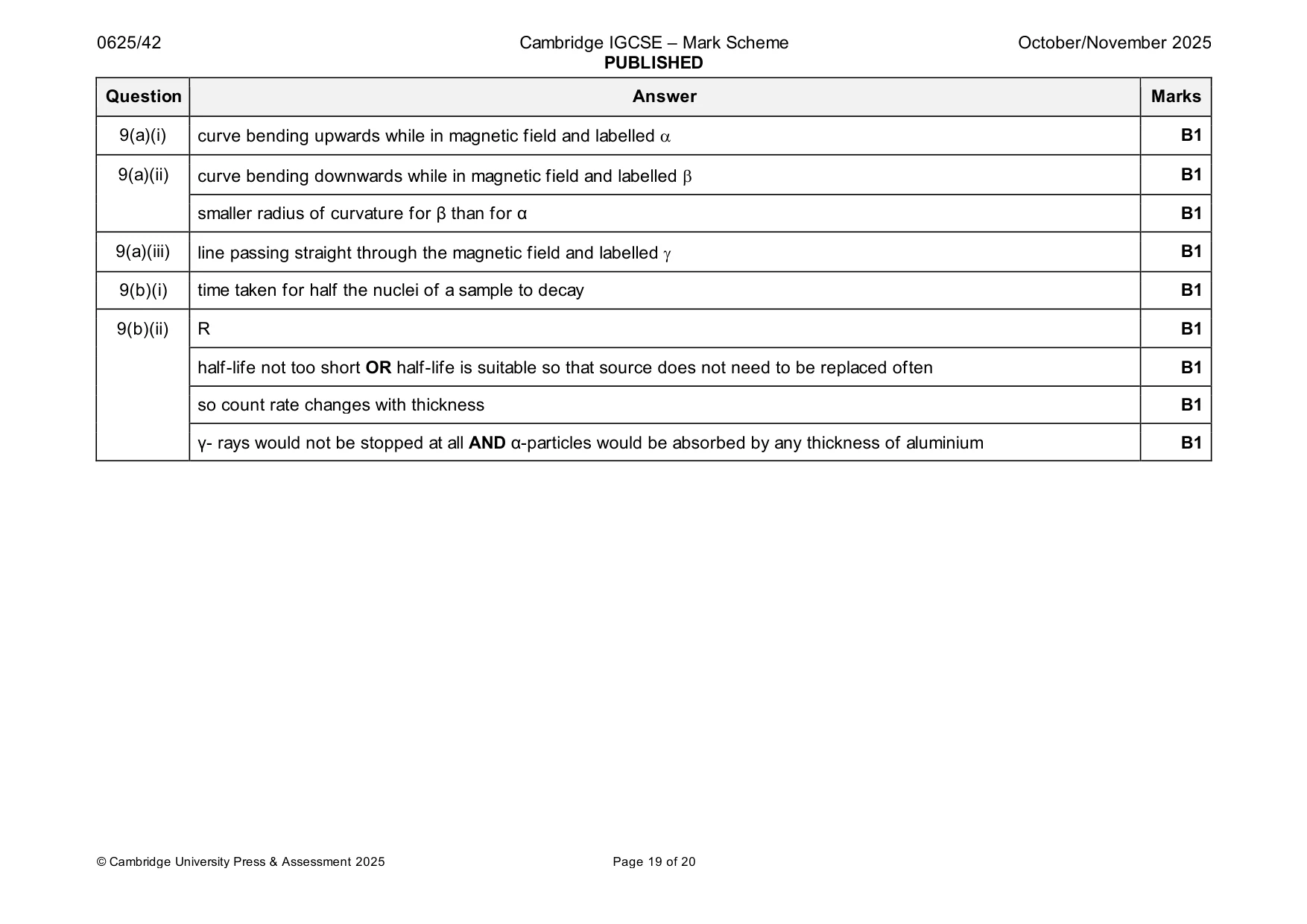
Mark scheme: 9(a)(i) curve bending upwards while in magnetic field and labelled B1 9(a)(ii) curve bending downwards while in magnetic field and labelled B1 smaller radius of curvature for β than for α B1 9(a)(iii) line passing straight through the magnetic field and labelled B1 9(b)(i) time taken for half the nuclei of a sample to decay B1 9(b)(ii) R B1 half-life not too short OR half-life is suitable so that source does not need to be replaced often B1 so count rate changes with thickness B1 γ- rays would not be stopped at all AND α-particles would be absorbed by any thickness of aluminium B1
Q10 · Fill in the gaps in the description of how an accretion model explains the formation of…
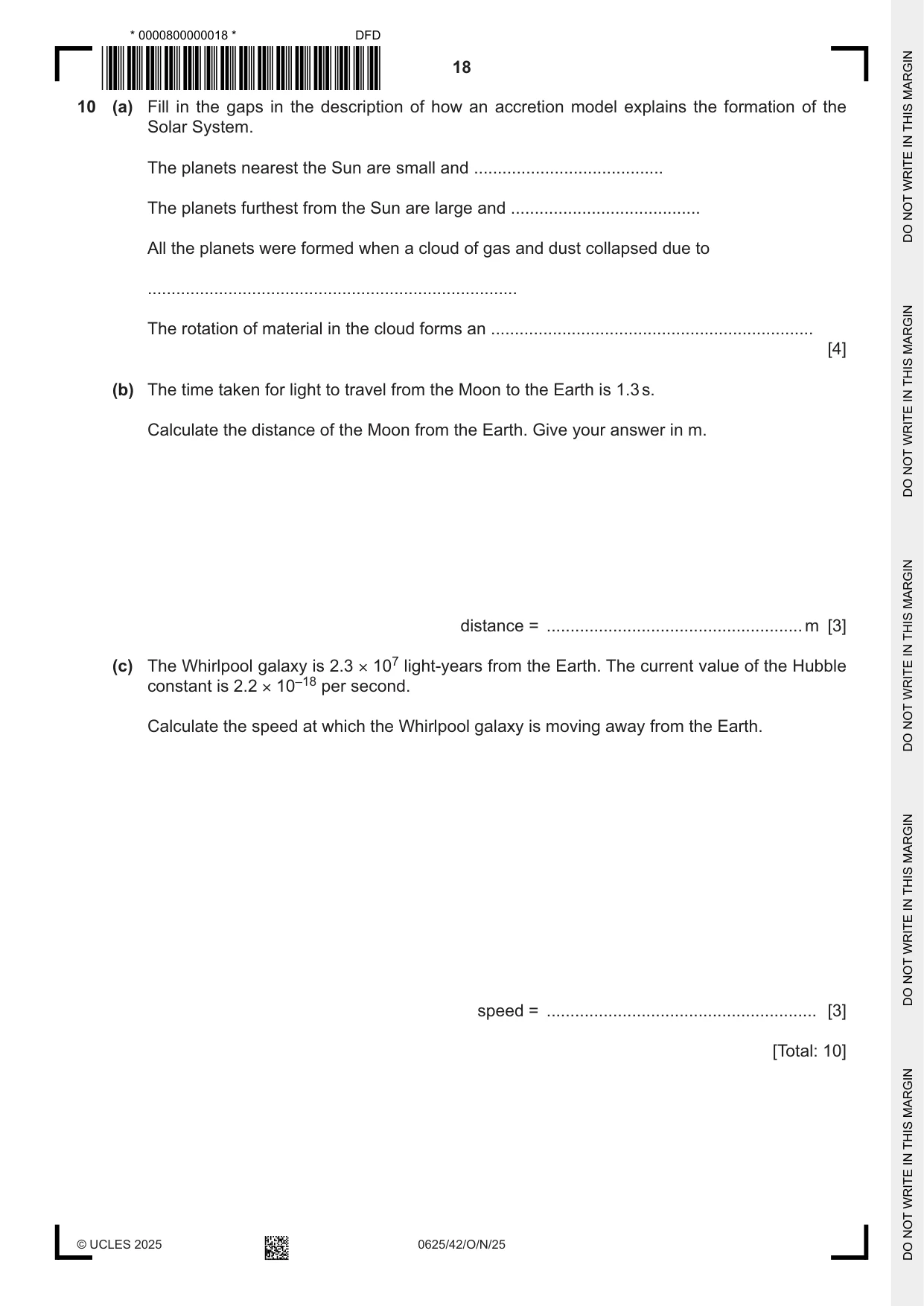
10 (a) Fill in the gaps in the description of how an accretion model explains the formation of the Solar System. The planets nearest the Sun are small and ........................................ The planets furthest from the Sun are large and ........................................ All the planets were formed when a cloud of gas and dust collapsed due to .............................................................................. The rotation of material in the cloud forms an .................................................................... [4] (b) The time taken for light to travel from the Moon to the Earth is 1.3 s. Calculate the distance of the Moon from the Earth. Give your answer in m. distance = ...................................................... m [3] (c) The Whirlpool galaxy is 2.3 × 10⁷ light‑years from the Earth. The current value of the Hubble constant is 2.2 × 10⁻¹⁸ per second. Calculate the speed at which the Whirlpool galaxy is moving away from the Earth. speed = ......................................................... [3] [Total: 10]
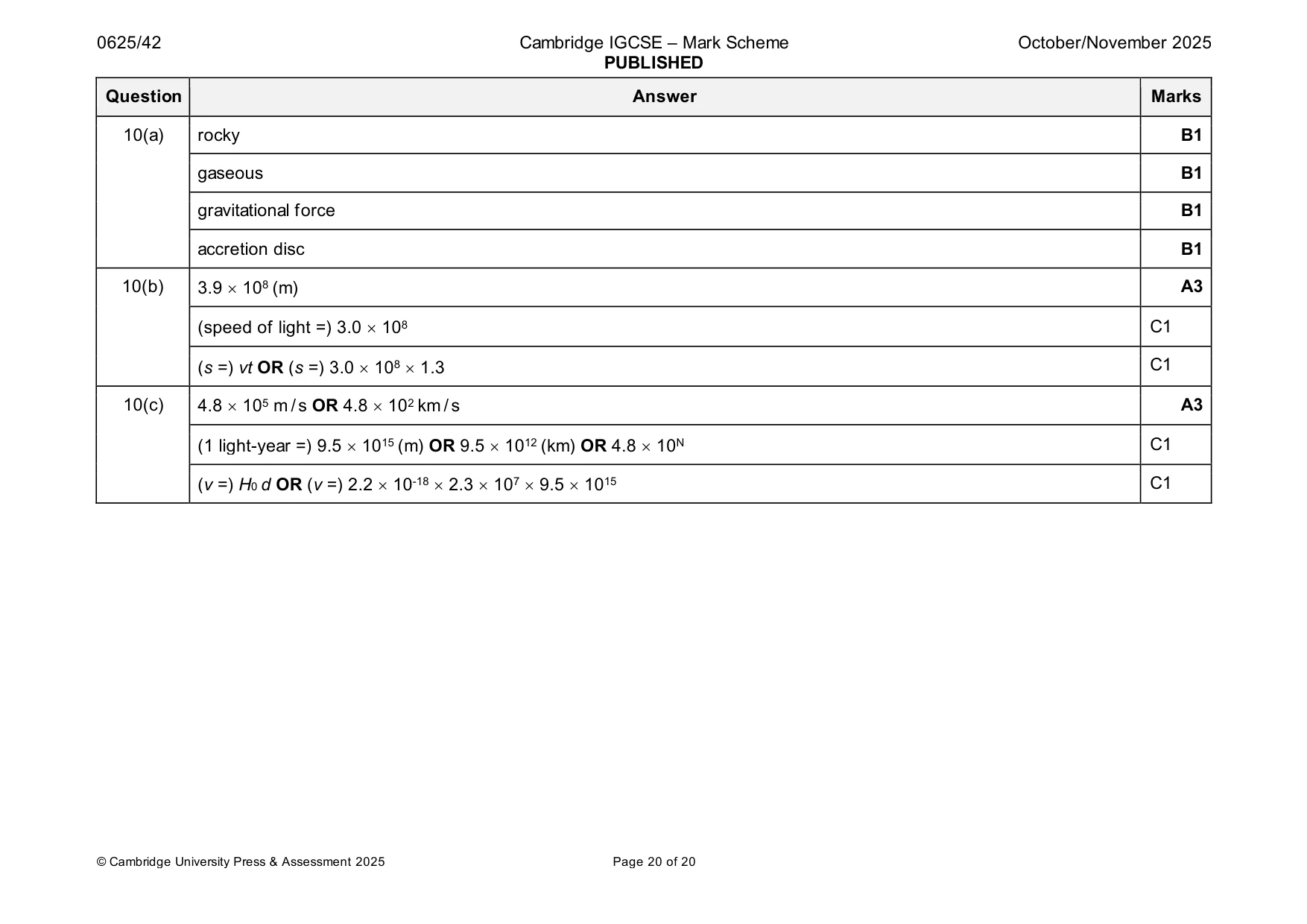
Mark scheme: 10(a) rocky B1 gaseous B1 gravitational force B1 accretion disc B1 10(b) 3.9 108 (m) A3 (speed of light =) 3.0 108 C1 (s =) vt OR (s =) 3.0 108 1.3 C1 10(c) 4.8 105 m / s OR 4.8 102 km / s A3 (1 light-year =) 9.5 1015 (m) OR 9.5 1012 (km) OR 4.8 10N C1 (v =) H0 d OR (v =) 2.2 10-18 2.3 107 9.5 1015 C1
What was in this paper
The subtopics covered by these 10 questions, and how many questions each got. Open one in a new tab to see every Cambridge question on it.
What you needed in this session
Cambridge’s own grade thresholds for 2025 Oct/Nov, Paper 4 · Variant 2. A higher threshold means an easier paper — the bar moves with how the cohort did.