Cambridge IGCSE Physics 0625 — 2019 Feb/March Paper 4 · Variant 2
0625/42/F/M/19 · 11 questions · 80 marks · ≈90 min
The question paper and its mark scheme, free to read here and free to download. This is Cambridge’s own paper, exactly as it was sat.
Question paper16 pages

Mark scheme11 pages
Answers below. Sit the paper first if you are practising.
Questions as text
Question 1
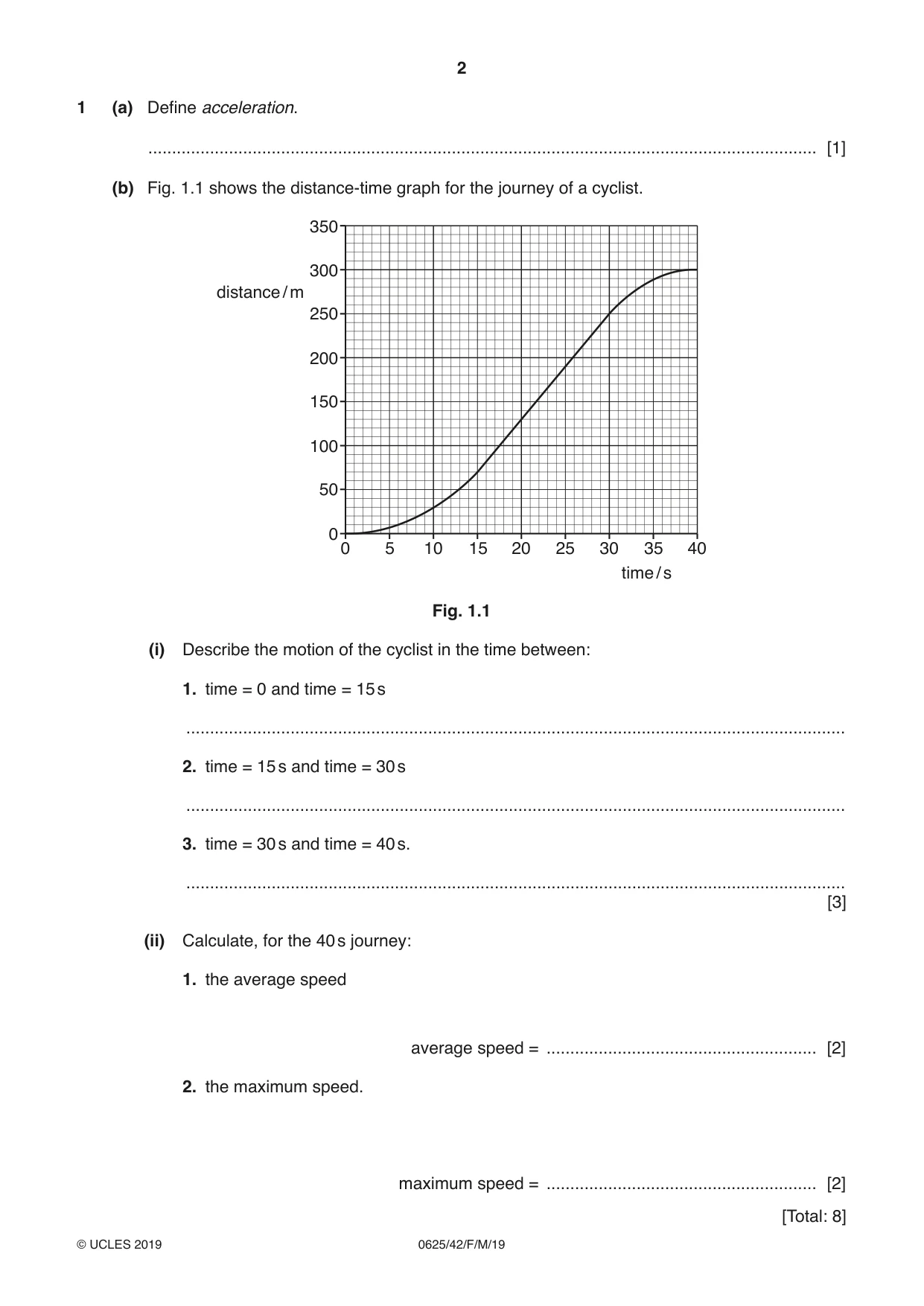
1 (a) Define acceleration. ............................................................................................................................................. [1] (b) Fig. 1.1 shows the distance-time graph for the journey of a cyclist. 350 300 distance / m 250 200 150 100 50 0 0 5 10 15 20 25 30 35 40 time / s Fig. 1.1 (i) Describe the motion of the cyclist in the time between: 1. time = 0 and time = 15 s ........................................................................................................................................... 2. time = 15 s and time = 30 s ........................................................................................................................................... 3. time = 30 s and time = 40 s. ........................................................................................................................................... [3] (ii) Calculate, for the 40 s journey: 1. the average speed average speed = ......................................................... [2] 2. the maximum speed. maximum speed = ......................................................... [2] [Total: 8]
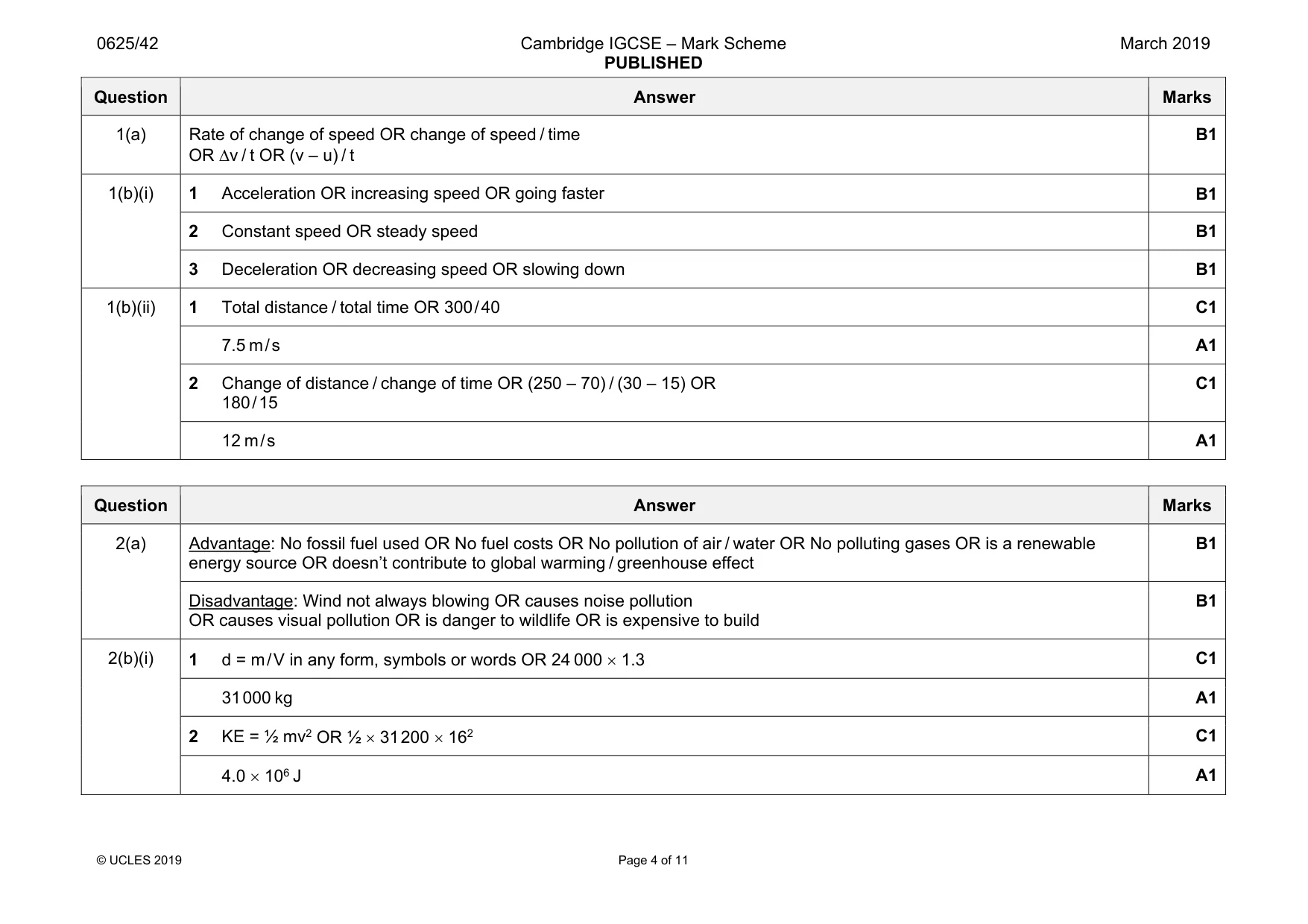
Mark scheme: 1(a) Rate of change of speed OR change of speed / time OR ∆v / t OR (v – u) / t B1 1(b)(i) 1 Acceleration OR increasing speed OR going faster B1 2 Constant speed OR steady speed B1 3 Deceleration OR decreasing speed OR slowing down B1 1(b)(ii) 1 Total distance / total time OR 300 / 40 C1 7.5 m / s A1 2 Change of distance / change of time OR (250 – 70) / (30 – 15) OR 180 / 15 C1 12 m / s A1
Q2 · State one advantage and one disadvantage of using a wind turbine as a source of…
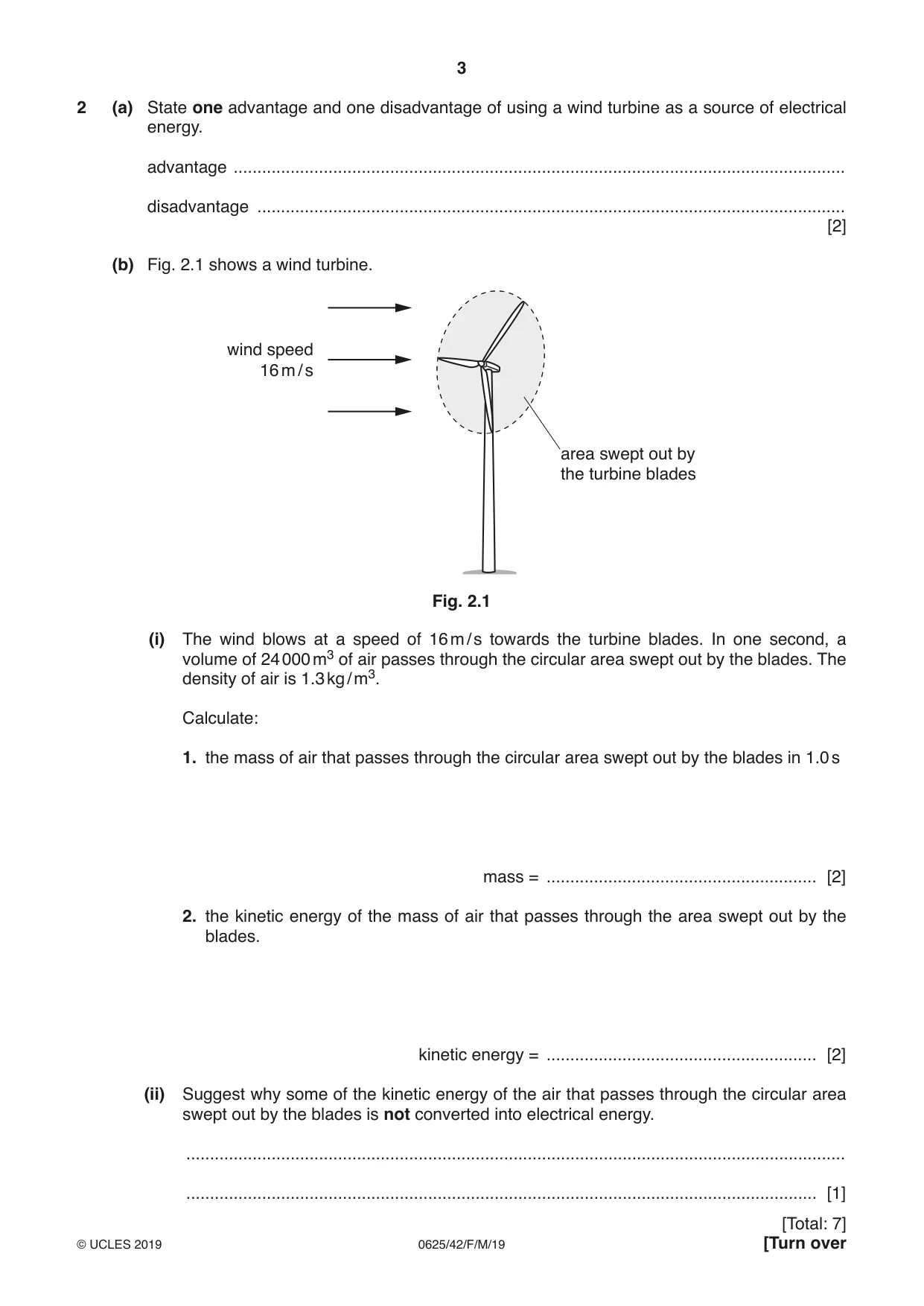
2 (a) State one advantage and one disadvantage of using a wind turbine as a source of electrical energy. advantage ................................................................................................................................. disadvantage ............................................................................................................................ [2] (b) Fig. 2.1 shows a wind turbine. wind speed 16 m / s area swept out by the turbine blades Fig. 2.1 (i) The wind blows at a speed of 16 m / s towards the turbine blades. In one second, a volume of 24 000 m3 of air passes through the circular area swept out by the blades. The density of air is 1.3 kg / m3. Calculate: 1. the mass of air that passes through the circular area swept out by the blades in 1.0 s mass = ......................................................... [2] 2. the kinetic energy of the mass of air that passes through the area swept out by the blades. kinetic energy = ......................................................... [2] (ii) Suggest why some of the kinetic energy of the air that passes through the circular area swept out by the blades is not converted into electrical energy. ........................................................................................................................................... ..................................................................................................................................... [1]
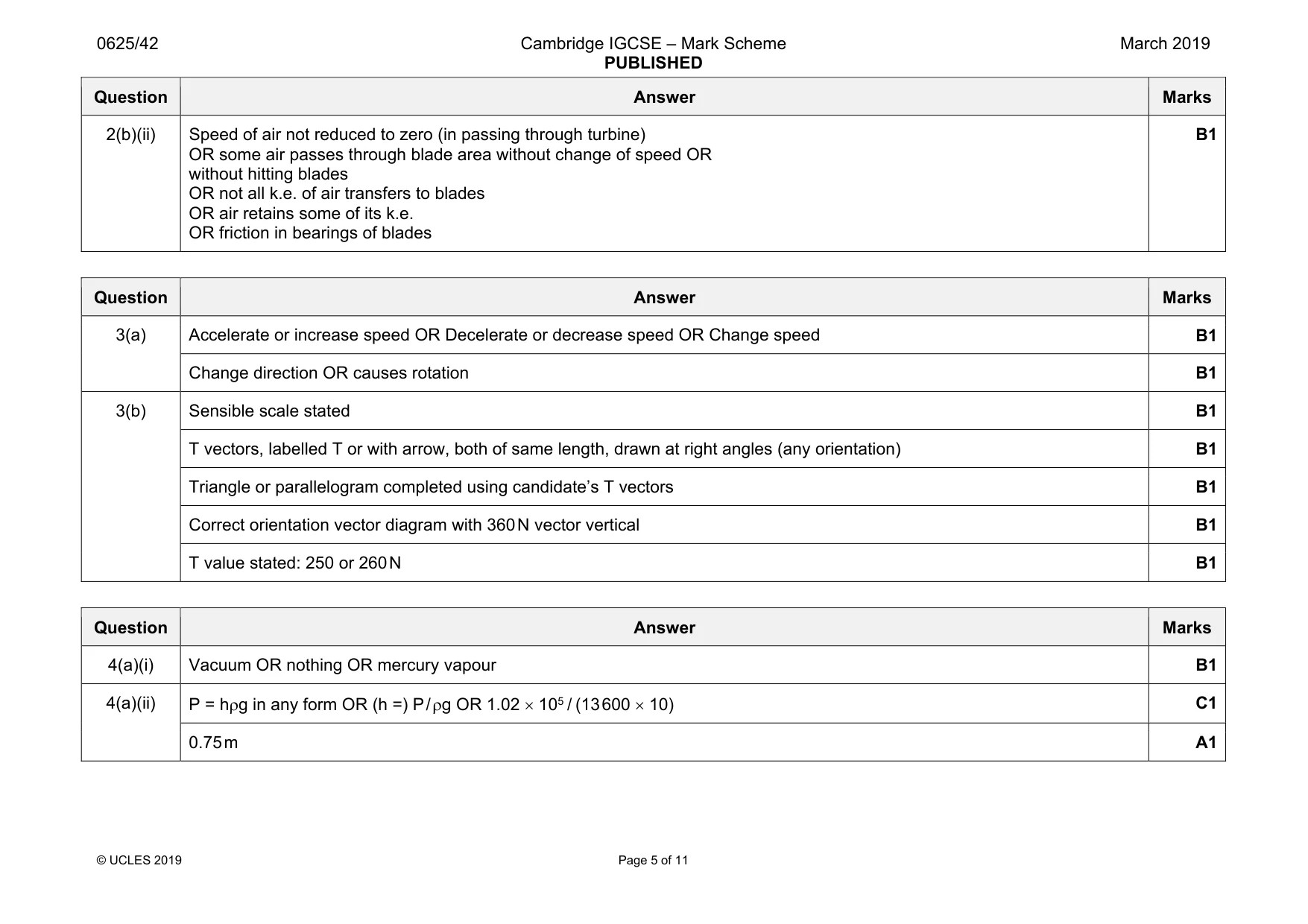
Mark scheme: 2(a) Advantage: No fossil fuel used OR No fuel costs OR No pollution of air / water OR No polluting gases OR is a renewable energy source OR doesn’t contribute to global warming / greenhouse effect B1 Disadvantage: Wind not always blowing OR causes noise pollution OR causes visual pollution OR is danger to wildlife OR is expensive to build B1 2(b)(i) 1 d = m / V in any form, symbols or words OR 24 000 × 1.3 C1 31 000 kg A1 2 KE = ½ mv2 OR ½ × 31 200 × 162 C1 4.0 × 10⁶ J A1 Question Answer Marks 2(b)(ii) Speed of air not reduced to zero (in passing through turbine) OR some air passes through blade area without change of speed OR without hitting blades OR not all k.e. of air transfers to blades OR air retains some of its k.e. OR friction in bearings of blades B1
Q3 · An object is moving in a straight line at constant speed
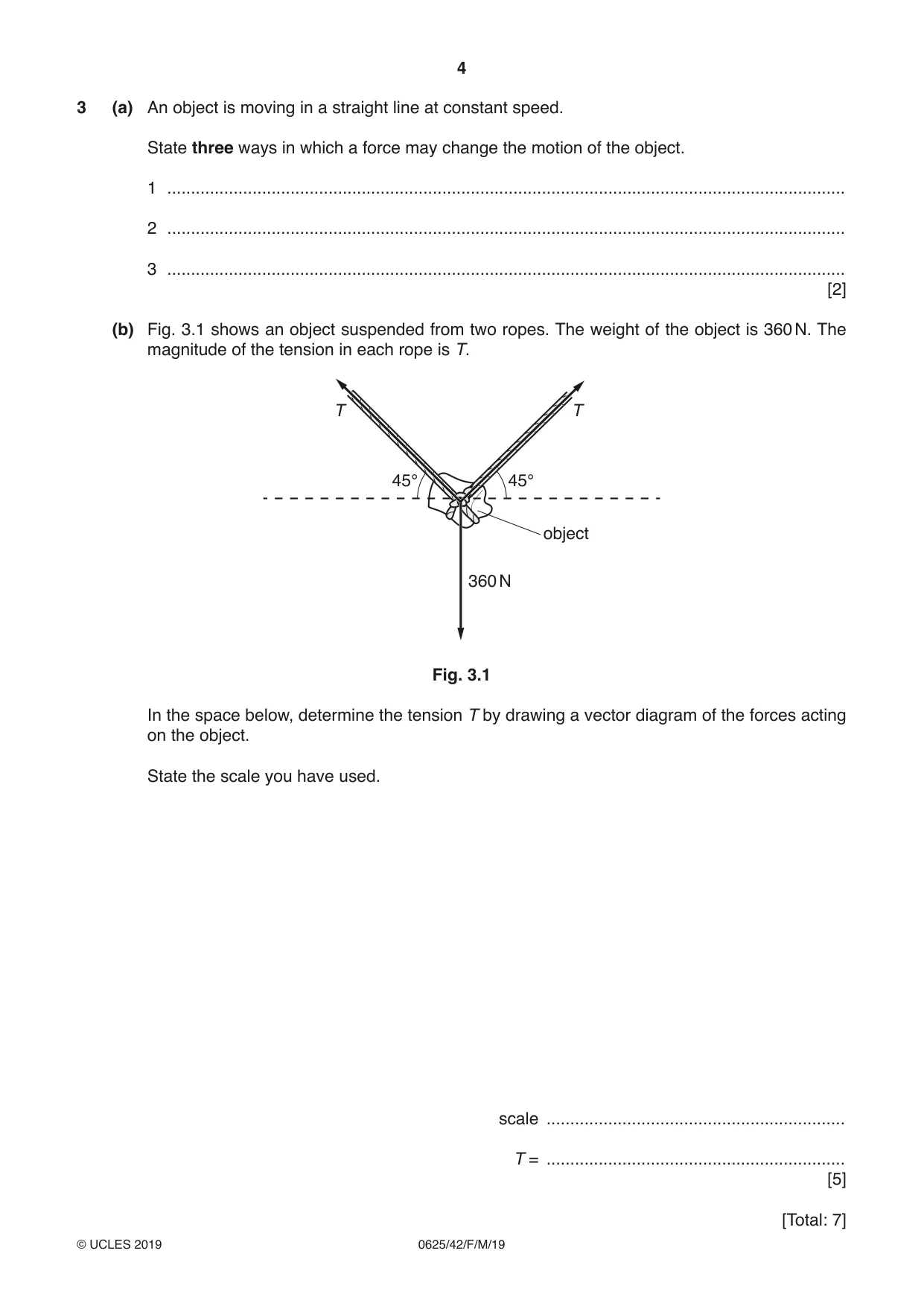
3 (a) An object is moving in a straight line at constant speed. State three ways in which a force may change the motion of the object. 1 ............................................................................................................................................... 2 ............................................................................................................................................... 3 ............................................................................................................................................... [2] (b) Fig. 3.1 shows an object suspended from two ropes. The weight of the object is 360 N. The magnitude of the tension in each rope is T. T T 45° 45° object 360 N Fig. 3.1 In the space below, determine the tension T by drawing a vector diagram of the forces acting on the object. State the scale you have used. scale ............................................................... T = ............................................................... [5] [Total: 7]
Mark scheme: 3(a) Accelerate or increase speed OR Decelerate or decrease speed OR Change speed B1 Change direction OR causes rotation B1 3(b) Sensible scale stated B1 T vectors, labelled T or with arrow, both of same length, drawn at right angles (any orientation) B1 Triangle or parallelogram completed using candidate’s T vectors B1 Correct orientation vector diagram with 360 N vector vertical B1 T value stated: 250 or 260 N B1
Question 4
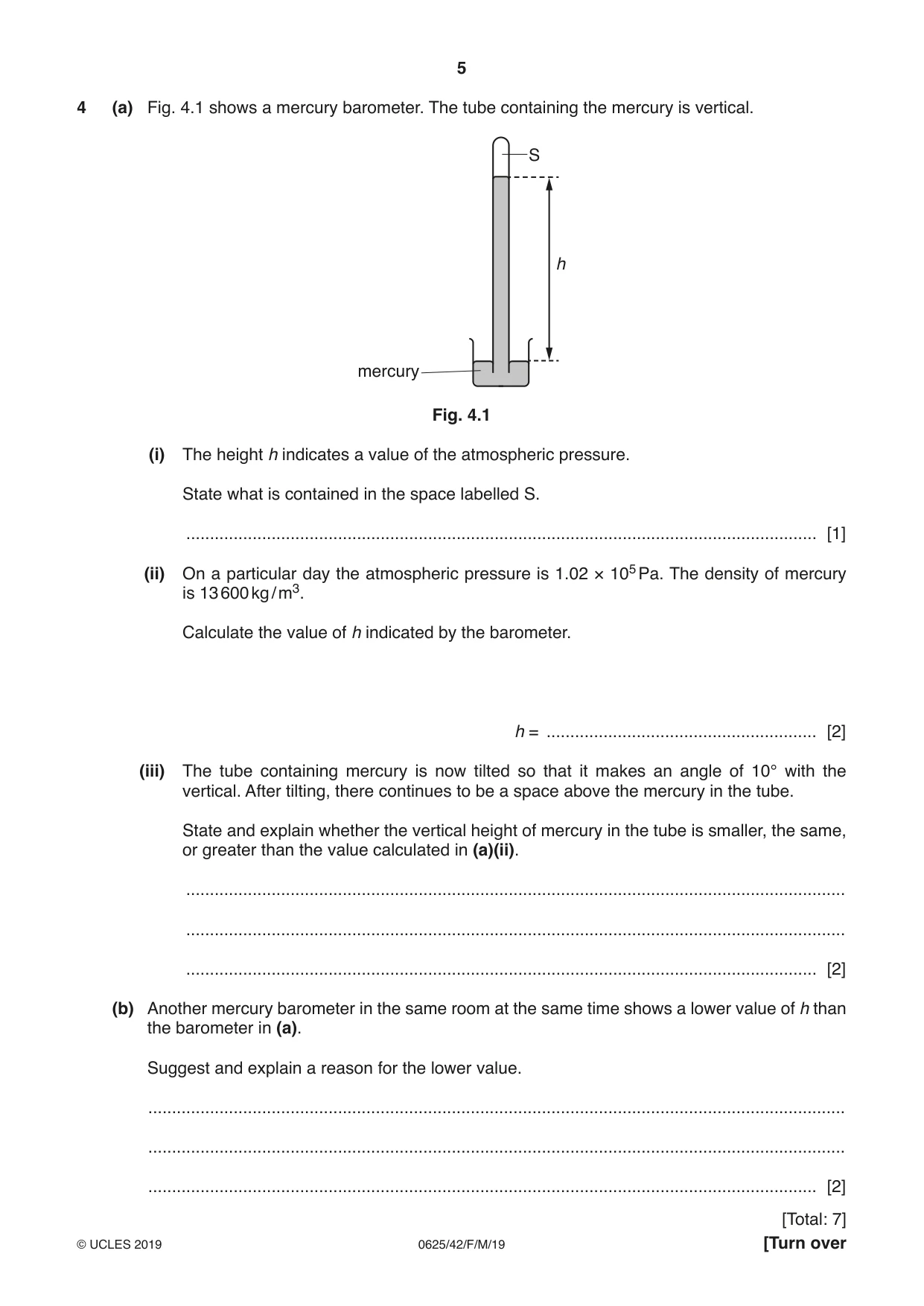
4 (a) Fig. 4.1 shows a mercury barometer. The tube containing the mercury is vertical. S h mercury Fig. 4.1 (i) The height h indicates a value of the atmospheric pressure. State what is contained in the space labelled S. ..................................................................................................................................... [1] (ii) On a particular day the atmospheric pressure is 1.02 × 10⁵ Pa. The density of mercury is 13 600 kg / m3. Calculate the value of h indicated by the barometer. h = ......................................................... [2] (iii) The tube containing mercury is now tilted so that it makes an angle of 10° with the vertical. After tilting, there continues to be a space above the mercury in the tube. State and explain whether the vertical height of mercury in the tube is smaller, the same, or greater than the value calculated in (a)(ii). ........................................................................................................................................... ........................................................................................................................................... ..................................................................................................................................... [2] (b) Another mercury barometer in the same room at the same time shows a lower value of h than the barometer in (a). Suggest and explain a reason for the lower value. ................................................................................................................................................... ................................................................................................................................................... ............................................................................................................................................. [2]
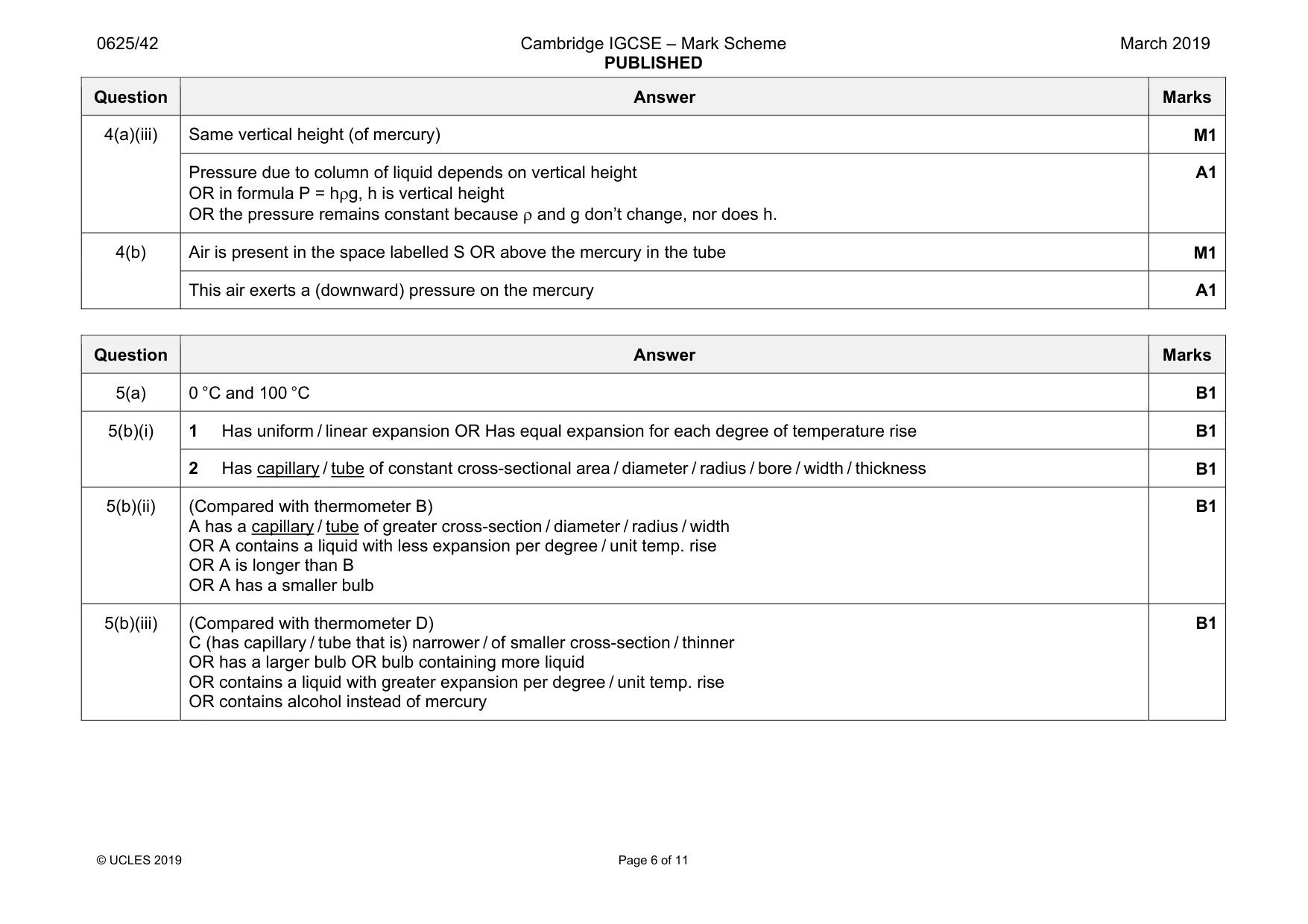
Mark scheme: 4(a)(i) Vacuum OR nothing OR mercury vapour B1 4(a)(ii) P = hρg in any form OR (h =) P / ρg OR 1.02 × 10⁵ / (13 600 × 10) C1 0.75 m A1 Question Answer Marks 4(a)(iii) Same vertical height (of mercury) M1 Pressure due to column of liquid depends on vertical height OR in formula P = hρg, h is vertical height OR the pressure remains constant because ρ and g don’t change, nor does h. A1 4(b) Air is present in the space labelled S OR above the mercury in the tube M1 This air exerts a (downward) pressure on the mercury A1
Q5 · State the values of the fixed points of a temperature scale
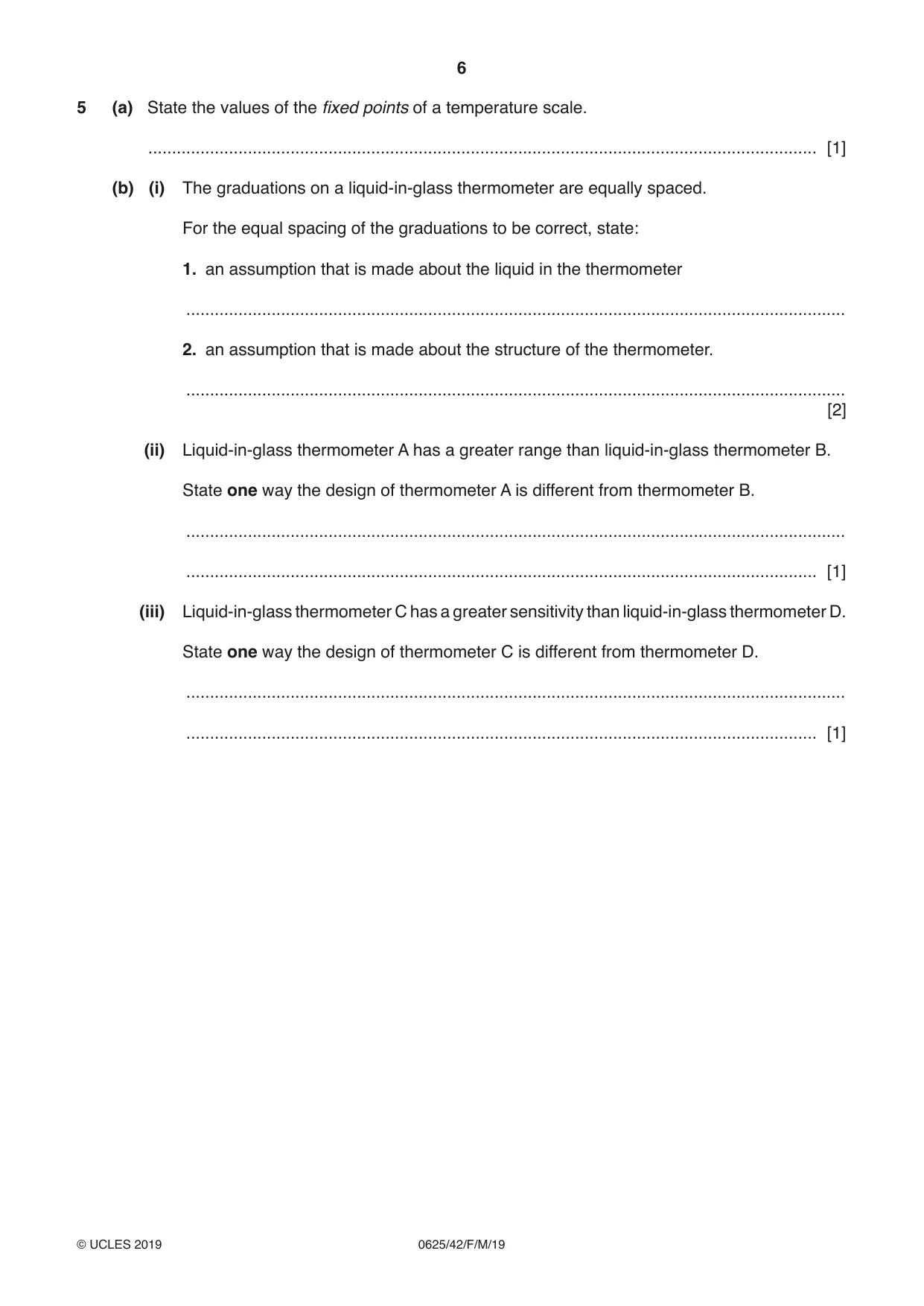
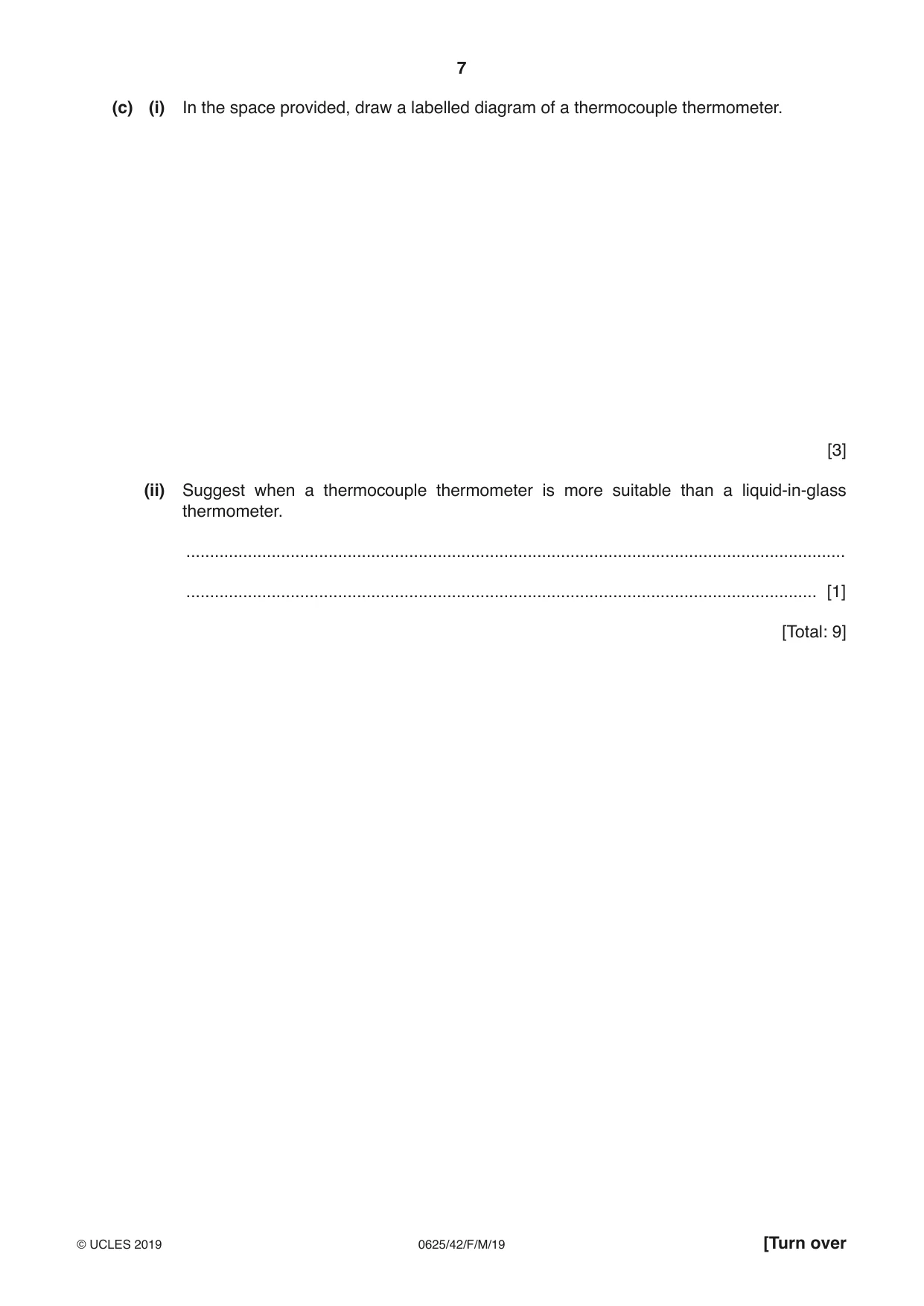
5 (a) State the values of the fixed points of a temperature scale. ............................................................................................................................................. [1] (b) (i) The graduations on a liquid-in-glass thermometer are equally spaced. For the equal spacing of the graduations to be correct, state: 1. an assumption that is made about the liquid in the thermometer ........................................................................................................................................... 2. an assumption that is made about the structure of the thermometer. ........................................................................................................................................... [2] (ii) Liquid-in-glass thermometer A has a greater range than liquid-in-glass thermometer B. State one way the design of thermometer A is different from thermometer B. ........................................................................................................................................... ..................................................................................................................................... [1] (iii) Liquid-in-glass thermometer C has a greater sensitivity than liquid-in-glass thermometer D. State one way the design of thermometer C is different from thermometer D. ........................................................................................................................................... ..................................................................................................................................... [1] (c) (i) In the space provided, draw a labelled diagram of a thermocouple thermometer. [3] (ii) Suggest when a thermocouple thermometer is more suitable than a liquid-in-glass thermometer. ........................................................................................................................................... ..................................................................................................................................... [1] [Total: 9]
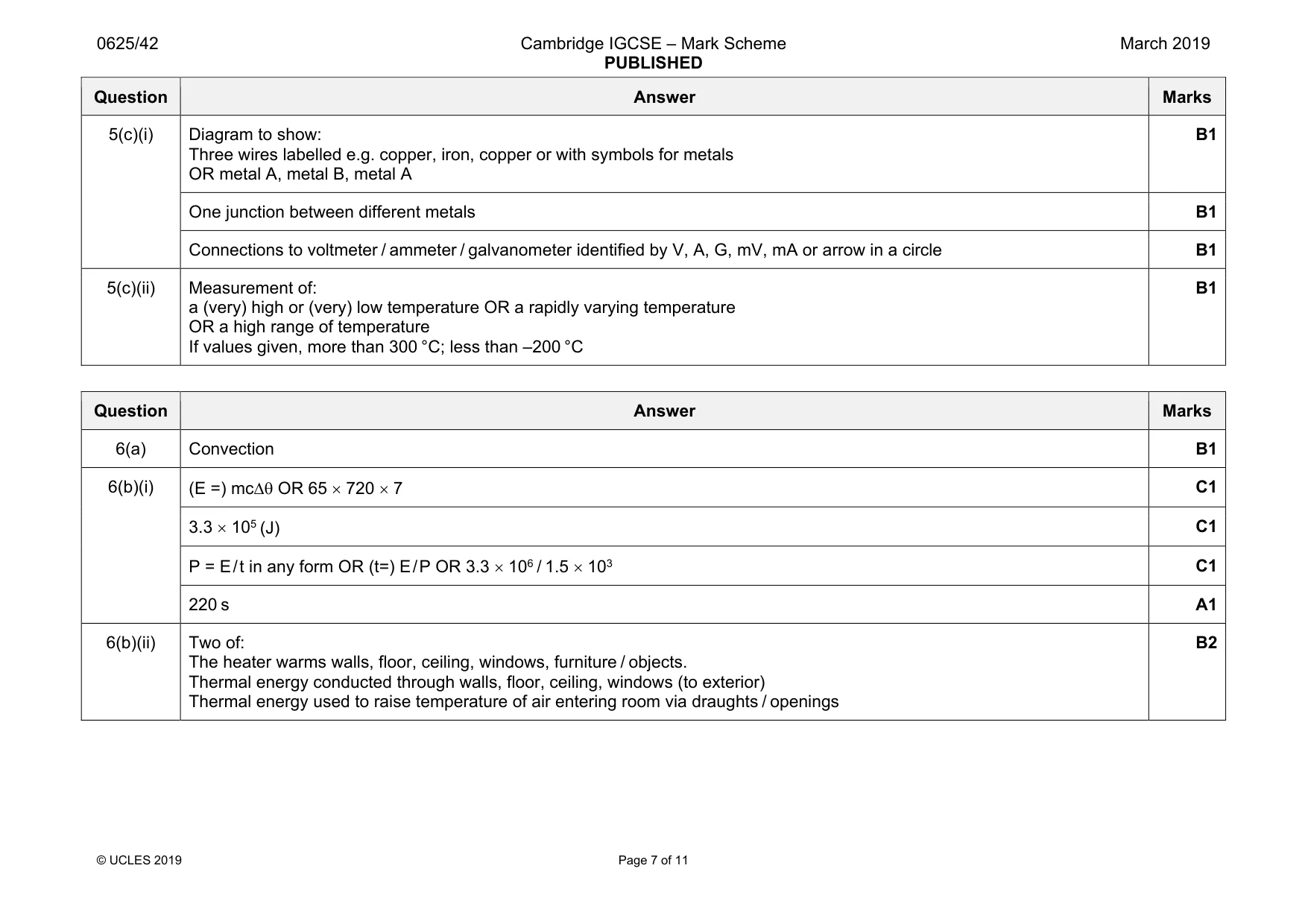
Mark scheme: 5(a) 0 °C and 100 °C B1 5(b)(i) 1 Has uniform / linear expansion OR Has equal expansion for each degree of temperature rise B1 2 Has capillary / tube of constant cross-sectional area / diameter / radius / bore / width / thickness B1 5(b)(ii) (Compared with thermometer B) A has a capillary / tube of greater cross-section / diameter / radius / width OR A contains a liquid with less expansion per degree / unit temp. rise OR A is longer than B OR A has a smaller bulb B1 5(b)(iii) (Compared with thermometer D) C (has capillary / tube that is) narrower / of smaller cross-section / thinner OR has a larger bulb OR bulb containing more liquid OR contains a liquid with greater expansion per degree / unit temp. rise OR contains alcohol instead of mercury B1 Question Answer Marks 5(c)(i) Diagram to show: Three wires labelled e.g. copper, iron, copper or with symbols for metals OR metal A, metal B, metal A B1 One junction between different metals B1 Connections to voltmeter / ammeter / galvanometer identified by V, A, G, mV, mA or arrow in a circle B1 5(c)(ii) Measurement of: a (very) high or (very) low temperature OR a rapidly varying temperature OR a high range of temperature If values given, more than 300 °C; less than –200 °C B1
Q6 · An electrical heater is placed on the floor of a room in a house
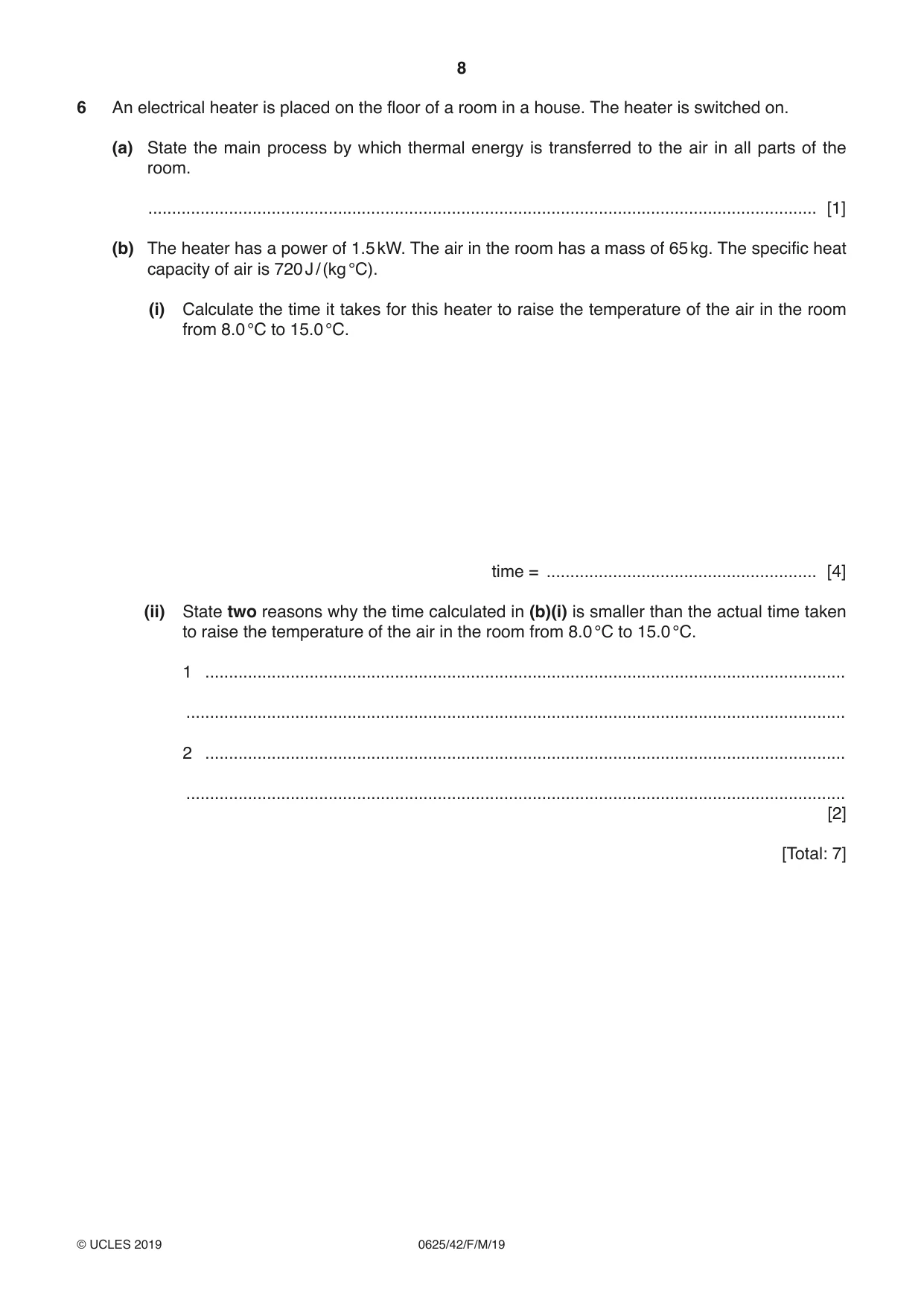
6 An electrical heater is placed on the floor of a room in a house. The heater is switched on. (a) State the main process by which thermal energy is transferred to the air in all parts of the room. ............................................................................................................................................. [1] (b) The heater has a power of 1.5 kW. The air in the room has a mass of 65 kg. The specific heat capacity of air is 720 J / (kg °C). (i) Calculate the time it takes for this heater to raise the temperature of the air in the room from 8.0 °C to 15.0 °C. time = ......................................................... [4] (ii) State two reasons why the time calculated in (b)(i) is smaller than the actual time taken to raise the temperature of the air in the room from 8.0 °C to 15.0 °C. 1 ....................................................................................................................................... ........................................................................................................................................... 2 ....................................................................................................................................... ........................................................................................................................................... [2] [Total: 7]
Mark scheme: 6(a) Convection B1 6(b)(i) (E =) mc∆θ OR 65 × 720 × 7 C1 3.3 × 10⁵ (J) C1 P = E / t in any form OR (t=) E / P OR 3.3 × 10⁶ / 1.5 × 10³ C1 220 s A1 6(b)(ii) Two of: The heater warms walls, floor, ceiling, windows, furniture / objects. Thermal energy conducted through walls, floor, ceiling, windows (to exterior) Thermal energy used to raise temperature of air entering room via draughts / openings B2
Question 7
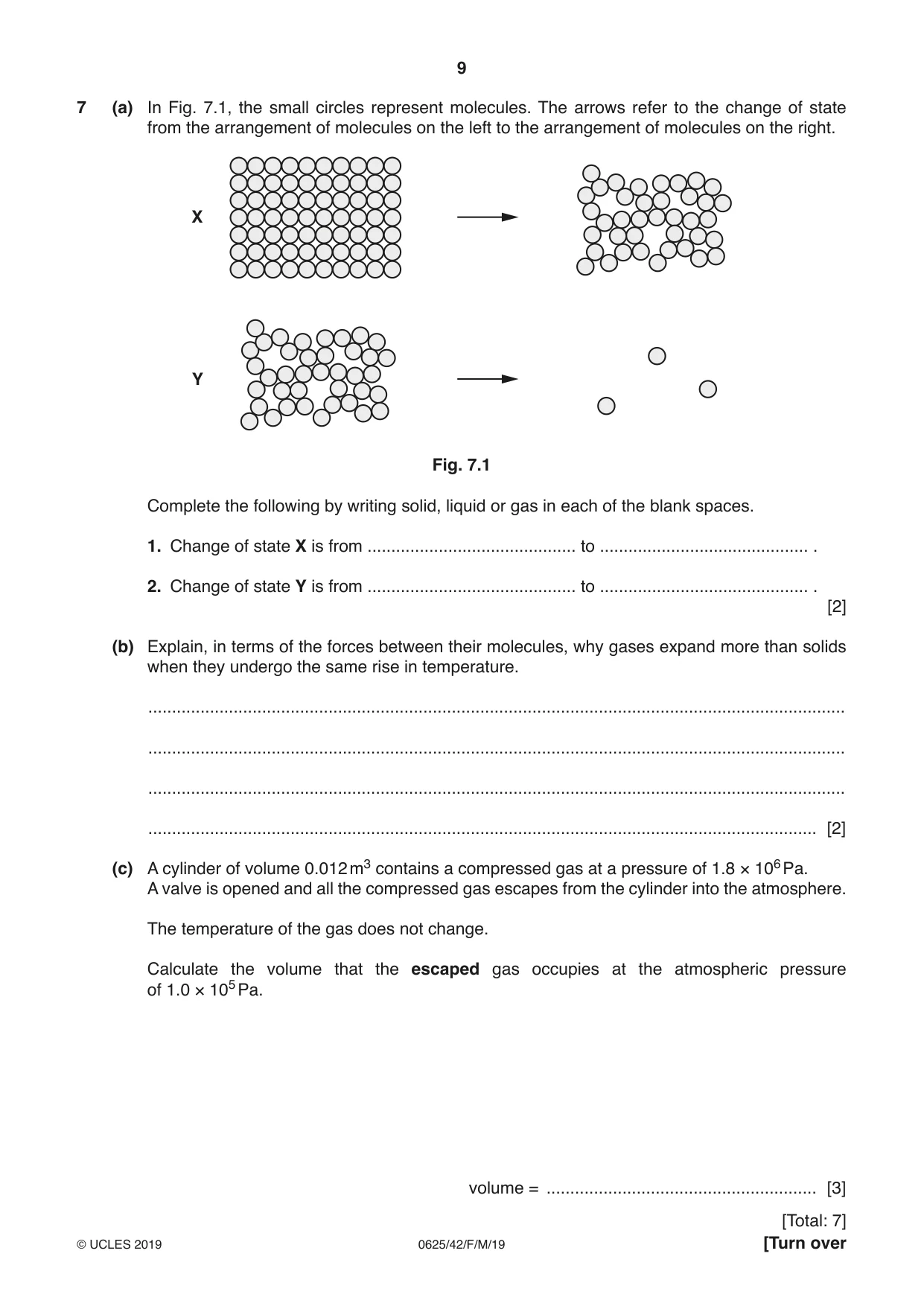
7 (a) In Fig. 7.1, the small circles represent molecules. The arrows refer to the change of state from the arrangement of molecules on the left to the arrangement of molecules on the right. X Y Fig. 7.1 Complete the following by writing solid, liquid or gas in each of the blank spaces. 1. Change of state X is from ............................................ to ............................................ . 2. Change of state Y is from ............................................ to ............................................ . [2] (b) Explain, in terms of the forces between their molecules, why gases expand more than solids when they undergo the same rise in temperature. ................................................................................................................................................... ................................................................................................................................................... ................................................................................................................................................... ............................................................................................................................................. [2] (c) A cylinder of volume 0.012 m3 contains a compressed gas at a pressure of 1.8 × 10⁶ Pa. A valve is opened and all the compressed gas escapes from the cylinder into the atmosphere. The temperature of the gas does not change. Calculate the volume that the escaped gas occupies at the atmospheric pressure of 1.0 × 10⁵ Pa. volume = ......................................................... [3]
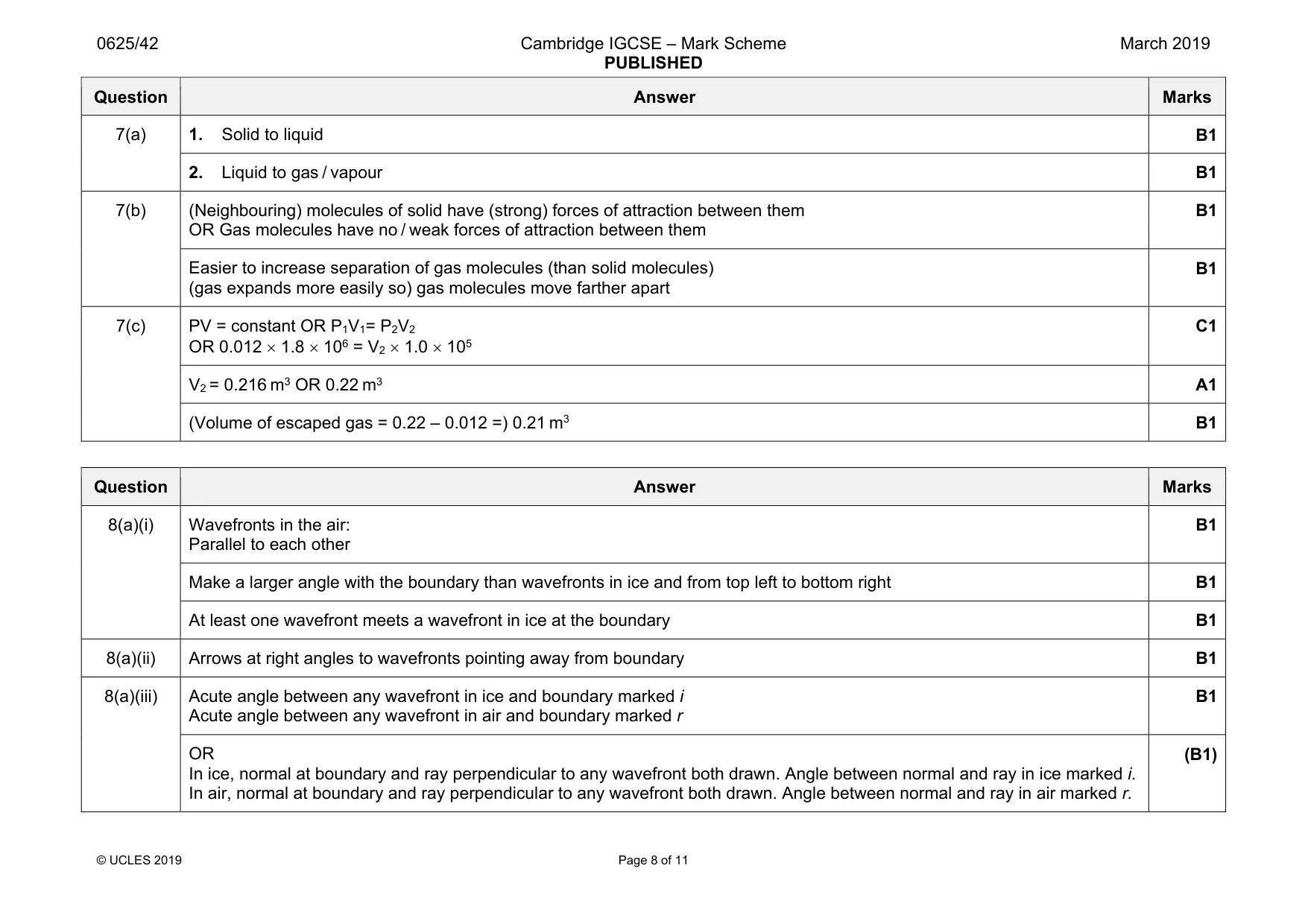
Mark scheme: 7(a) 1. Solid to liquid B1 2. Liquid to gas / vapour B1 7(b) (Neighbouring) molecules of solid have (strong) forces of attraction between them OR Gas molecules have no / weak forces of attraction between them B1 Easier to increase separation of gas molecules (than solid molecules) (gas expands more easily so) gas molecules move farther apart B1 7(c) PV = constant OR P1V1= P2V2 OR 0.012 × 1.8 × 106 = V2 × 1.0 × 105 C1 V2 = 0.216 m3 OR 0.22 m3 A1 (Volume of escaped gas = 0.22 – 0.012 =) 0.21 m3 B1
Q8 · Parallel wavefronts of a light wave in ice
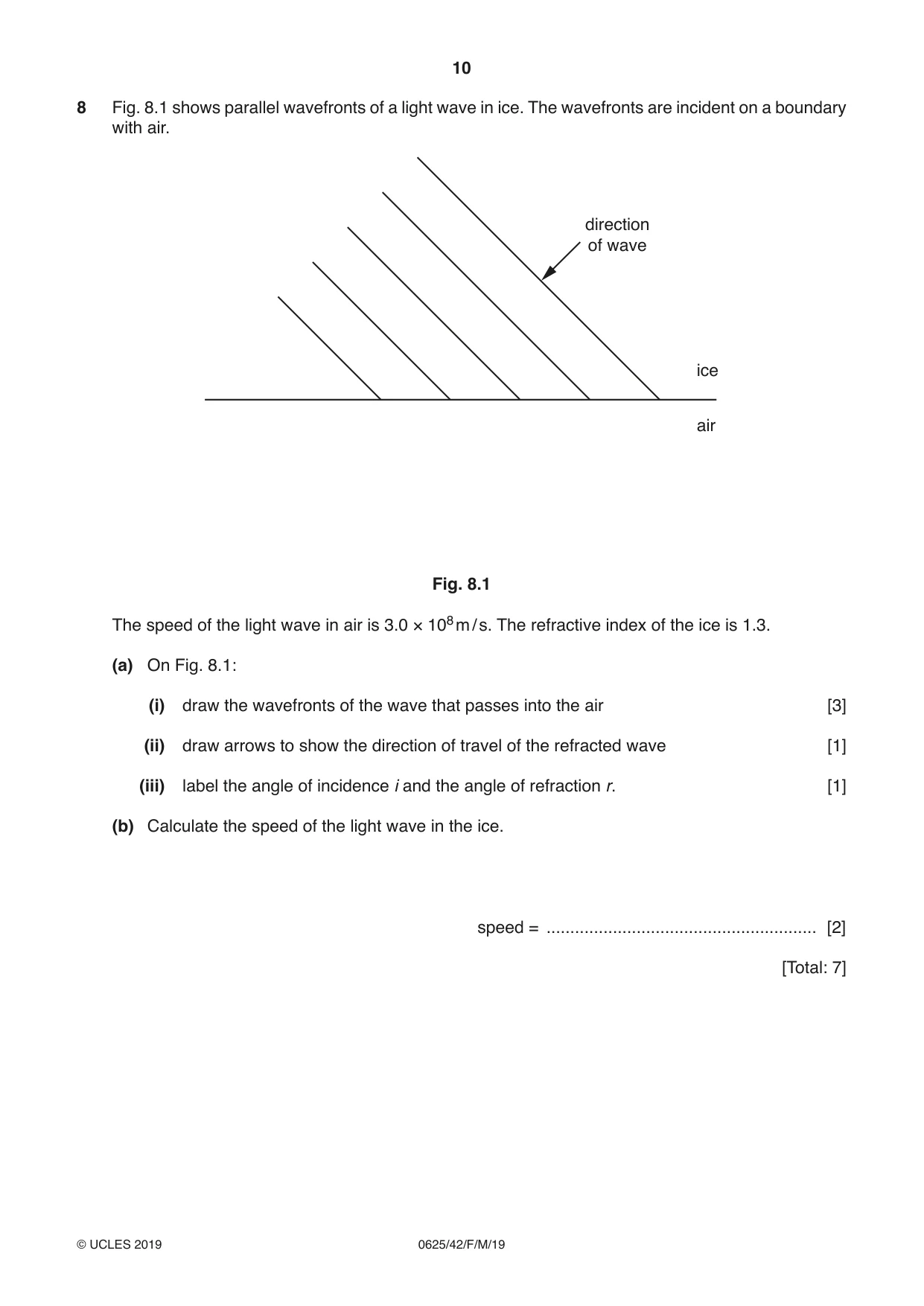
8 Fig. 8.1 shows parallel wavefronts of a light wave in ice. The wavefronts are incident on a boundary with air. direction of wave ice air Fig. 8.1 The speed of the light wave in air is 3.0 × 10⁸ m / s. The refractive index of the ice is 1.3. (a) On Fig. 8.1: (i) draw the wavefronts of the wave that passes into the air [3] (ii) draw arrows to show the direction of travel of the refracted wave [1] (iii) label the angle of incidence i and the angle of refraction r. [1] (b) Calculate the speed of the light wave in the ice. speed = ......................................................... [2] [Total: 7]
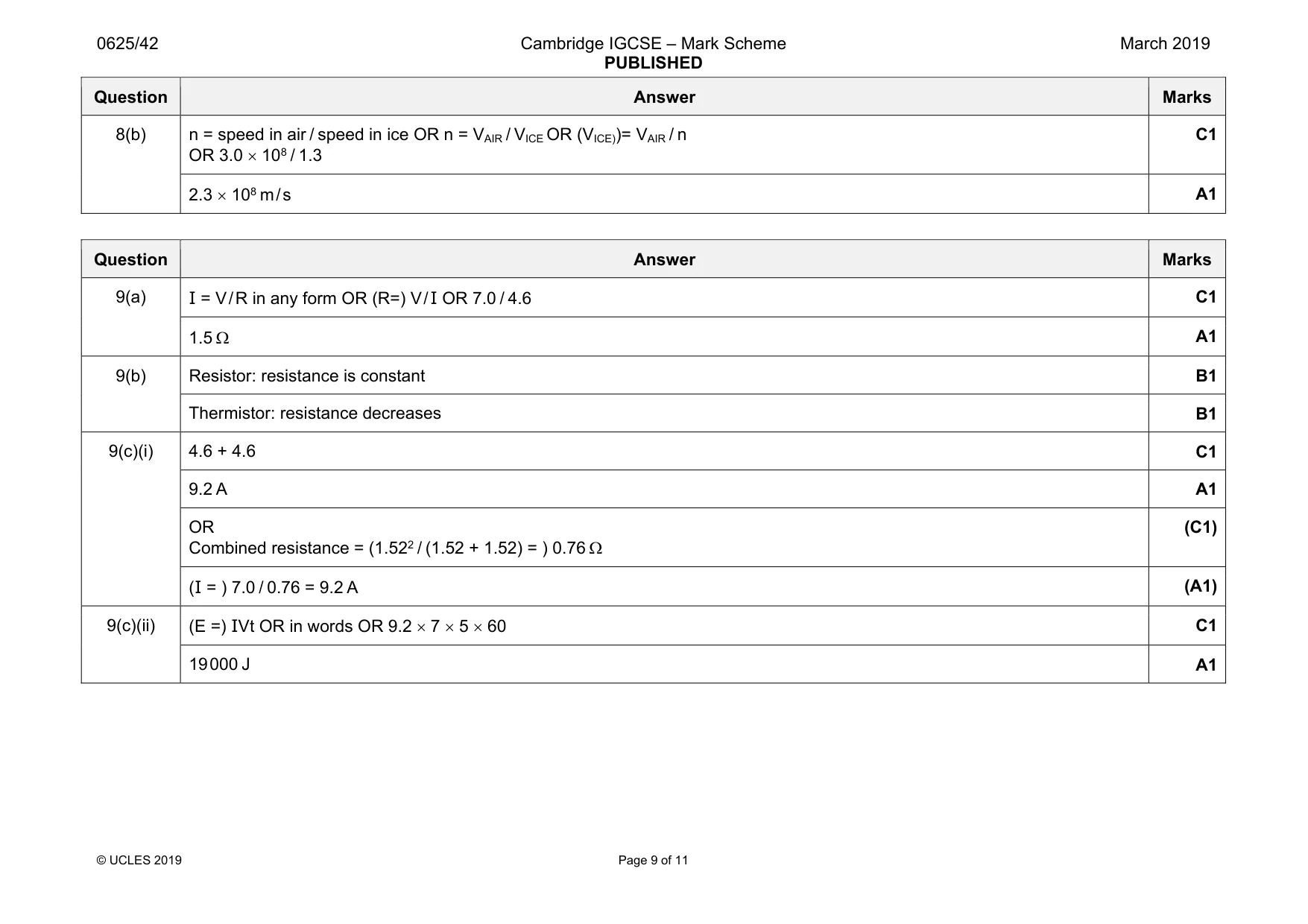
Mark scheme: 8(a)(i) Wavefronts in the air: Parallel to each other B1 Make a larger angle with the boundary than wavefronts in ice and from top left to bottom right B1 At least one wavefront meets a wavefront in ice at the boundary B1 8(a)(ii) Arrows at right angles to wavefronts pointing away from boundary B1 8(a)(iii) Acute angle between any wavefront in ice and boundary marked i Acute angle between any wavefront in air and boundary marked r B1 OR In ice, normal at boundary and ray perpendicular to any wavefront both drawn. Angle between normal and ray in ice marked i. In air, normal at boundary and ray perpendicular to any wavefront both drawn. Angle between normal and ray in air marked r. (B1) Question Answer Marks 8(b) n = speed in air / speed in ice OR n = VAIR / VICE OR (VICE))= VAIR / n OR 3.0 × 10⁸ / 1.3 C1 2.3 × 10⁸ m / s A1
Q9 · Current-potential difference (p.d.) graphs for a resistor and for a thermistor
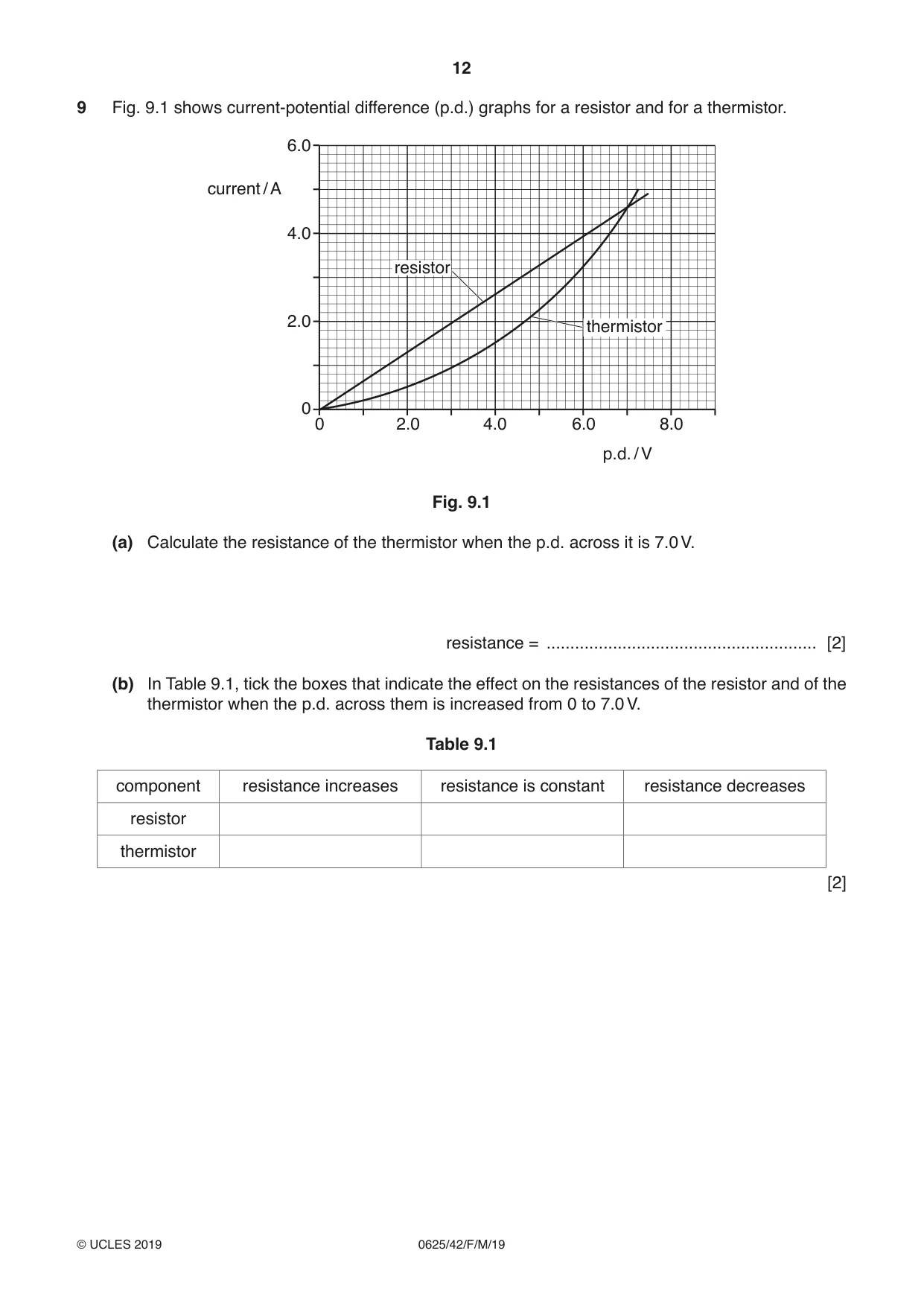
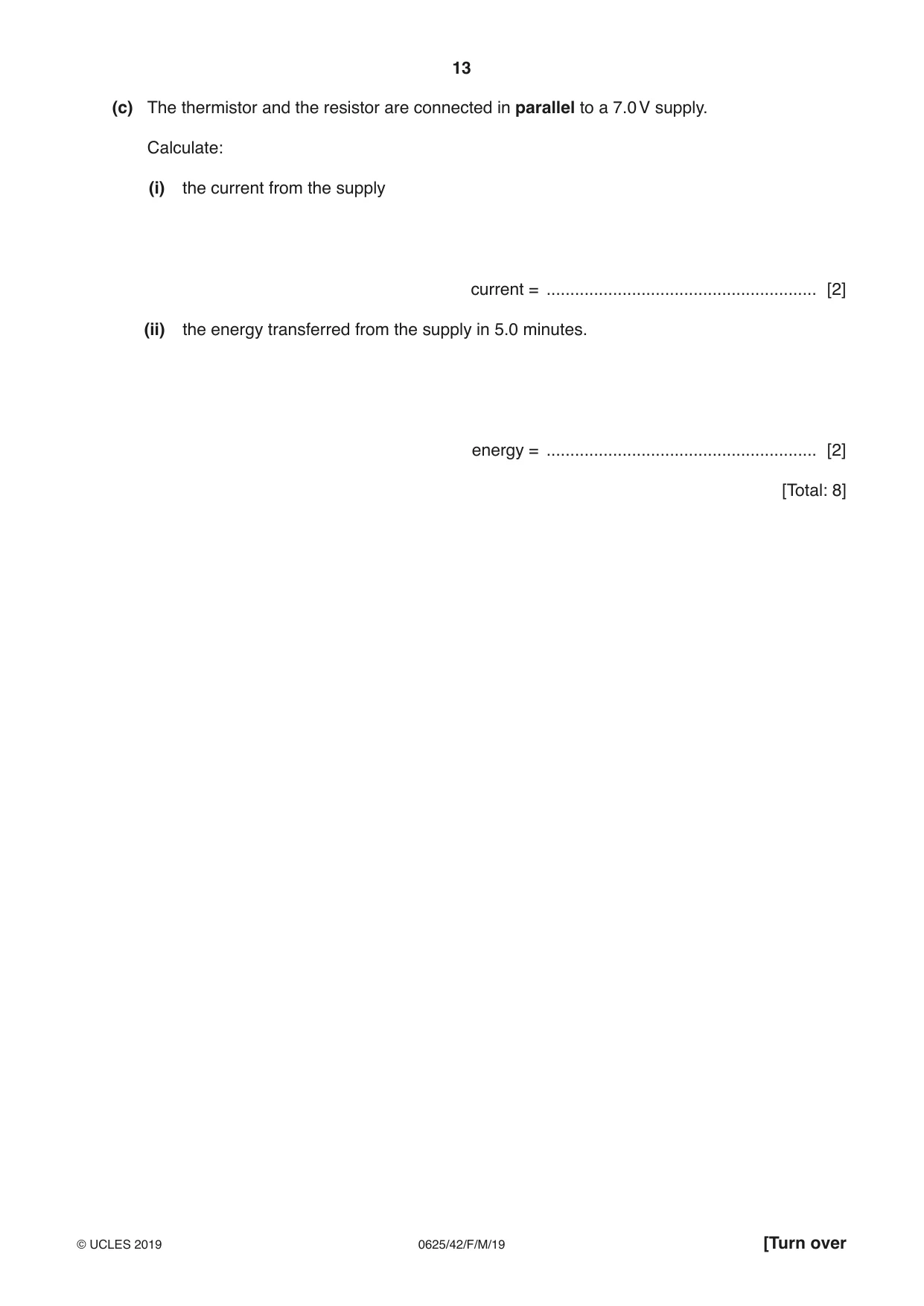
9 Fig. 9.1 shows current-potential difference (p.d.) graphs for a resistor and for a thermistor. 6.0 current / A 4.0 resistor 2.0 thermistor 0 0 2.0 4.0 6.0 8.0 p.d. / V Fig. 9.1 (a) Calculate the resistance of the thermistor when the p.d. across it is 7.0 V. resistance = ......................................................... [2] (b) In Table 9.1, tick the boxes that indicate the effect on the resistances of the resistor and of the thermistor when the p.d. across them is increased from 0 to 7.0 V. Table 9.1 component resistance increases resistance is constant resistance decreases resistor thermistor [2] (c) The thermistor and the resistor are connected in parallel to a 7.0 V supply. Calculate: (i) the current from the supply current = ......................................................... [2] (ii) the energy transferred from the supply in 5.0 minutes. energy = ......................................................... [2] [Total: 8]
Mark scheme: 9(a) C1 1.5 Ω A1 9(b) Resistor: resistance is constant B1 Thermistor: resistance decreases B1 9(c)(i) 4.6 + 4.6 C1 9.2 A A1 OR Combined resistance = (1.522 / (1.52 + 1.52) = ) 0.76 Ω (C1) (I = ) 7.0 / 0.76 = 9.2 A (A1) 9(c)(ii) (E =) IVt OR in words OR 9.2 × 7 × 5 × 60 C1 19 000 J A1
Q10 · The electrical energy produced by a power station is transmitted over long distances at a…
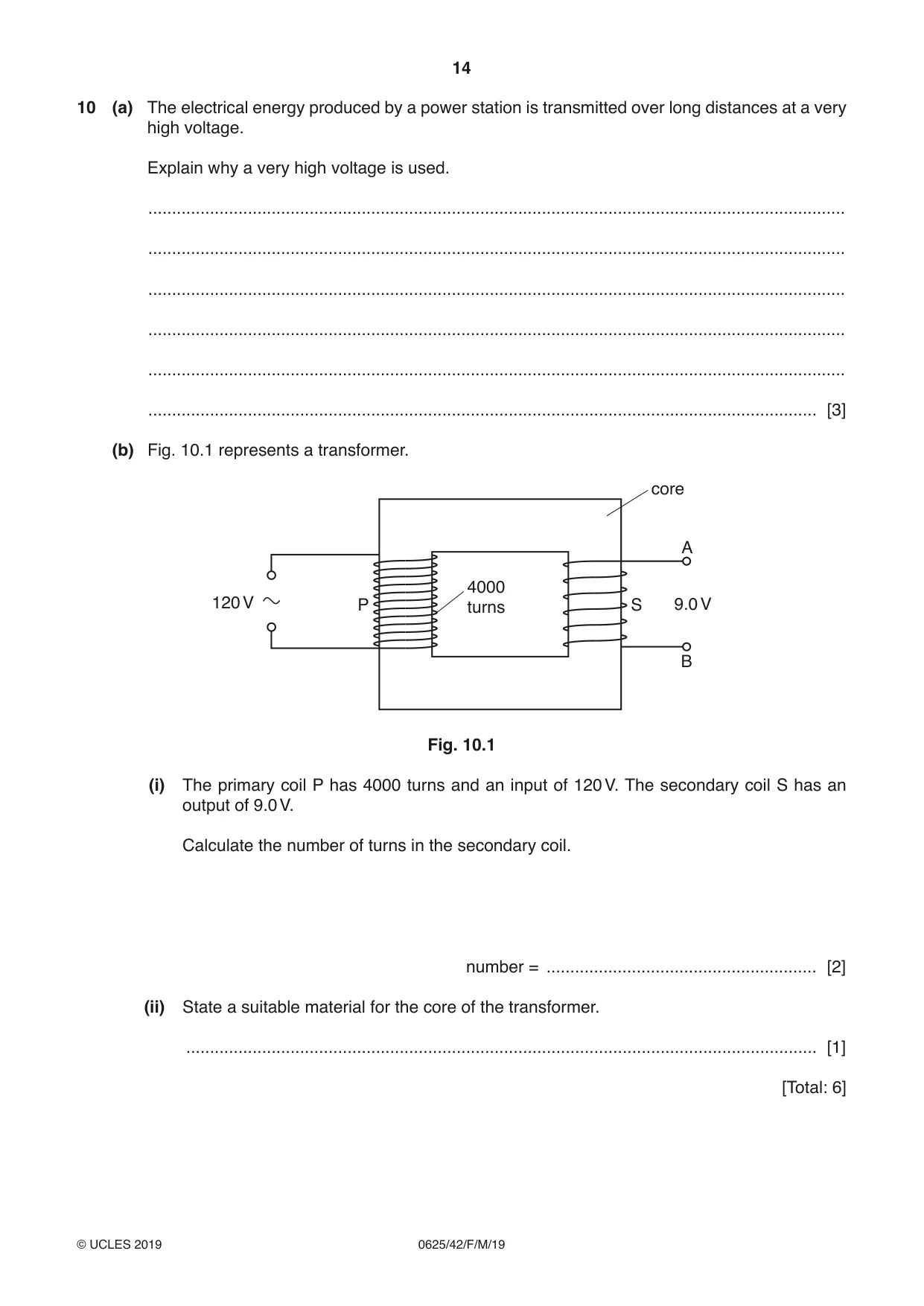
10 (a) The electrical energy produced by a power station is transmitted over long distances at a very high voltage. Explain why a very high voltage is used. ................................................................................................................................................... ................................................................................................................................................... ................................................................................................................................................... ................................................................................................................................................... ................................................................................................................................................... ............................................................................................................................................. [3] (b) Fig. 10.1 represents a transformer. core A 4000 120 V P turns S 9.0 V B Fig. 10.1 (i) The primary coil P has 4000 turns and an input of 120 V. The secondary coil S has an output of 9.0 V. Calculate the number of turns in the secondary coil. number = ......................................................... [2] (ii) State a suitable material for the core of the transformer. ..................................................................................................................................... [1] [Total: 6]
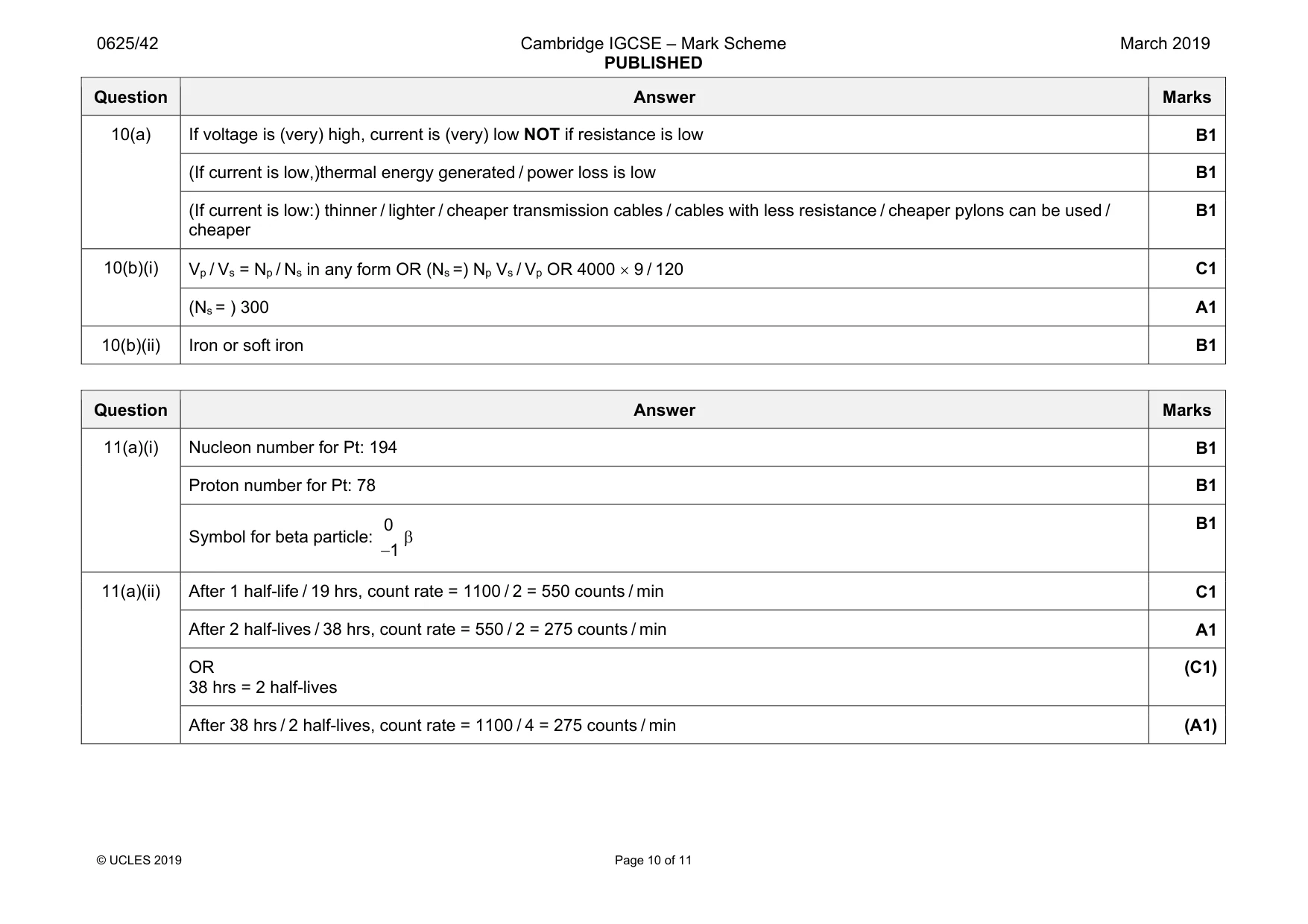
Mark scheme: 10(a) If voltage is (very) high, current is (very) low NOT if resistance is low B1 (If current is low,)thermal energy generated / power loss is low B1 (If current is low:) thinner / lighter / cheaper transmission cables / cables with less resistance / cheaper pylons can be used / cheaper B1 10(b)(i) Vp / Vs = Np / Ns in any form OR (Ns =) Np Vs / Vp OR 4000 × 9 / 120 C1 (Ns = ) 300 A1 10(b)(ii) Iron or soft iron B1
Q11 · One isotope of iridium-194 is represented by 194 Ir 77 This isotope decays by β-emission…
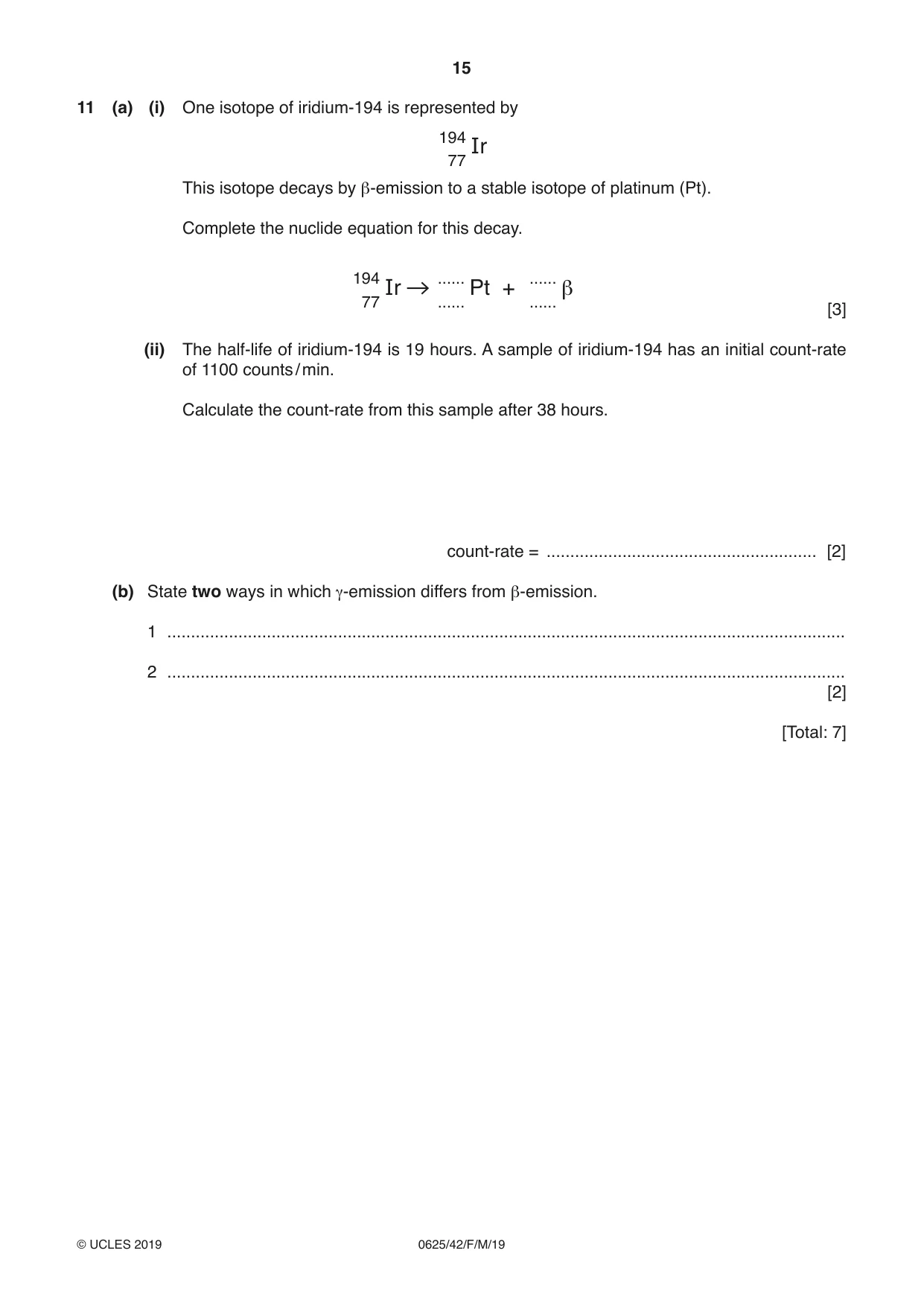
11 (a) (i) One isotope of iridium-194 is represented by 194 Ir 77 This isotope decays by β-emission to a stable isotope of platinum (Pt). Complete the nuclide equation for this decay. 194 Ir ...... Pt + ...... β 77 ...... ...... [3] (ii) The half-life of iridium-194 is 19 hours. A sample of iridium-194 has an initial count-rate of 1100 counts / min. Calculate the count-rate from this sample after 38 hours. count-rate = ......................................................... [2] (b) State two ways in which γ-emission differs from β-emission. 1 ............................................................................................................................................... 2 ............................................................................................................................................... [2] [Total: 7]
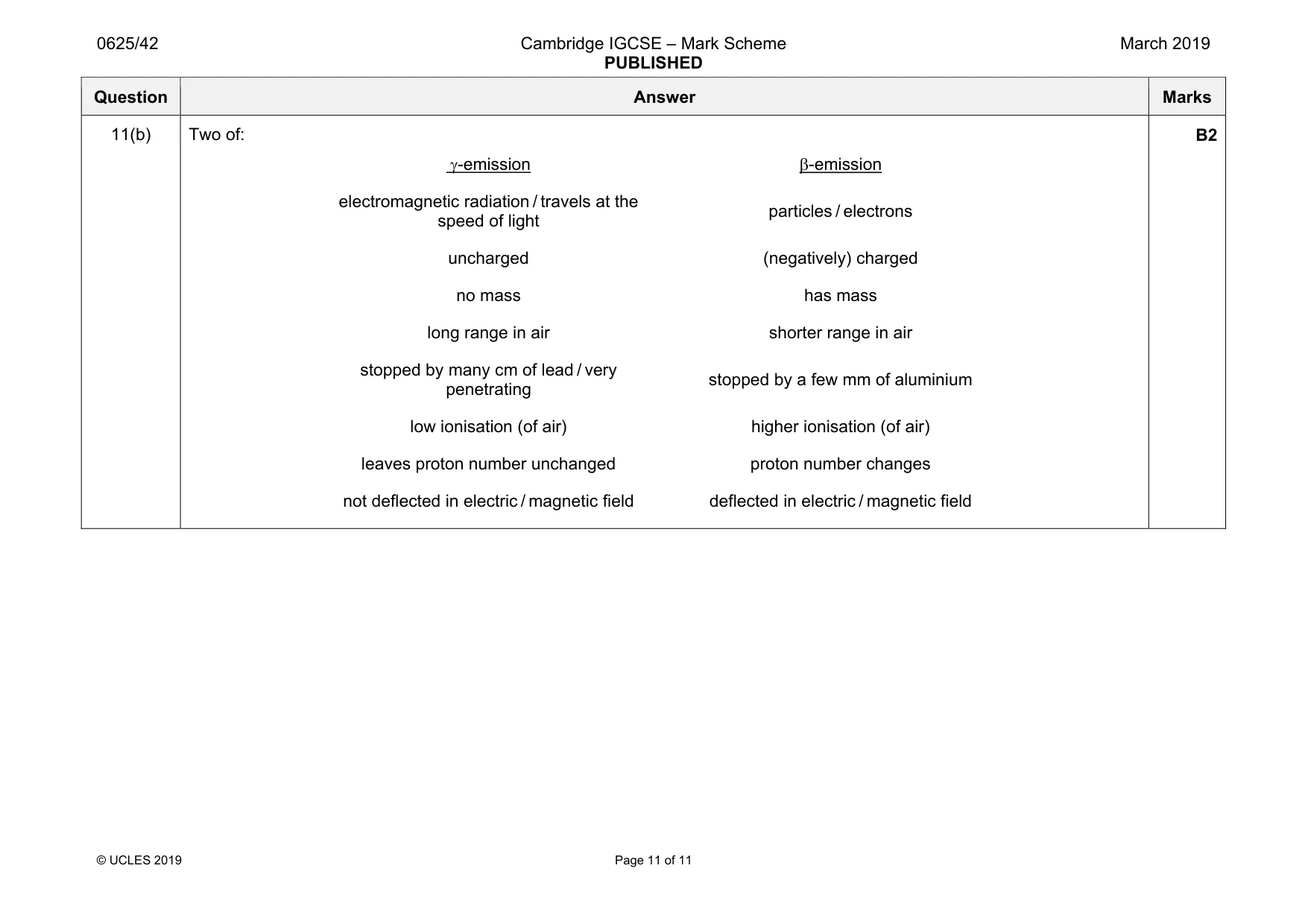
Mark scheme: 11(a)(i) Nucleon number for Pt: 194 B1 Proton number for Pt: 78 B1 Symbol for beta particle: 0 1 − β B1 11(a)(ii) After 1 half-life / 19 hrs, count rate = 1100 / 2 = 550 counts / min C1 After 2 half-lives / 38 hrs, count rate = 550 / 2 = 275 counts / min A1 OR 38 hrs = 2 half-lives (C1) After 38 hrs / 2 half-lives, count rate = 1100 / 4 = 275 counts / min (A1) Question Answer Marks 11(b) Two of: γ-emission β-emission electromagnetic radiation / travels at the speed of light particles / electrons uncharged (negatively) charged no mass has mass long range in air shorter range in air stopped by many cm of lead / very penetrating stopped by a few mm of aluminium low ionisation (of air) higher ionisation (of air) leaves proton number unchanged proton number changes not deflected in electric / magnetic field deflected in electric / magnetic field B2
What was in this paper
The subtopics covered by these 11 questions, and how many questions each got. Open one in a new tab to see every Cambridge question on it.
What you needed in this session
Cambridge’s own grade thresholds for 2019 Feb/March, Paper 4 · Variant 2. A higher threshold means an easier paper — the bar moves with how the cohort did.