Cambridge IGCSE Physics 0625 — 2016 Feb/March Paper 4 · Variant 2
0625/42/F/M/16 · 11 questions · 80 marks · ≈90 min
The question paper and its mark scheme, free to read here and free to download. This is Cambridge’s own paper, exactly as it was sat.
Question paper16 pages
Mark scheme7 pages
Answers below. Sit the paper first if you are practising.
Questions as text
Q1 · A driving instructor gives a student a sudden order to stop the car in the shortest…
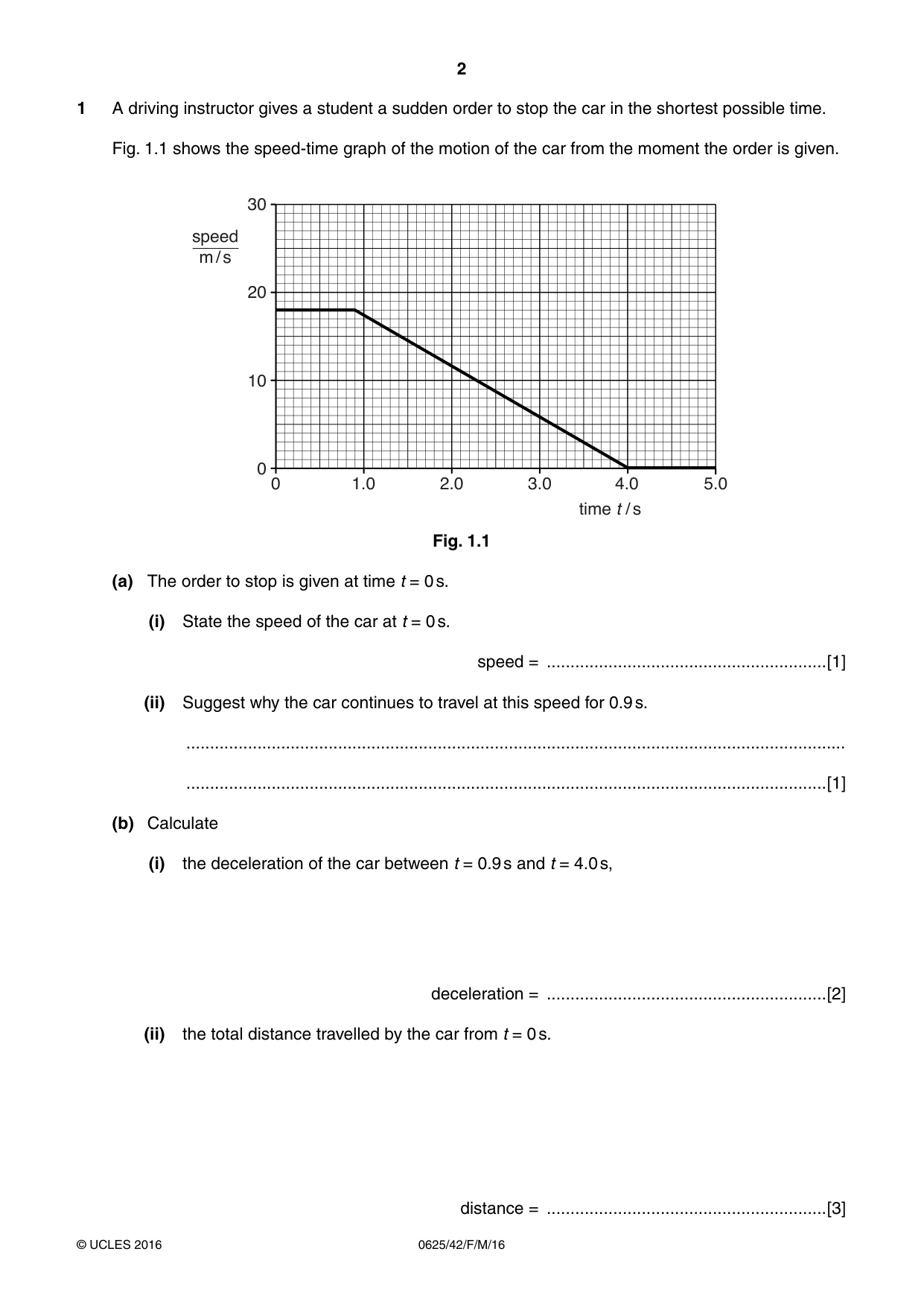
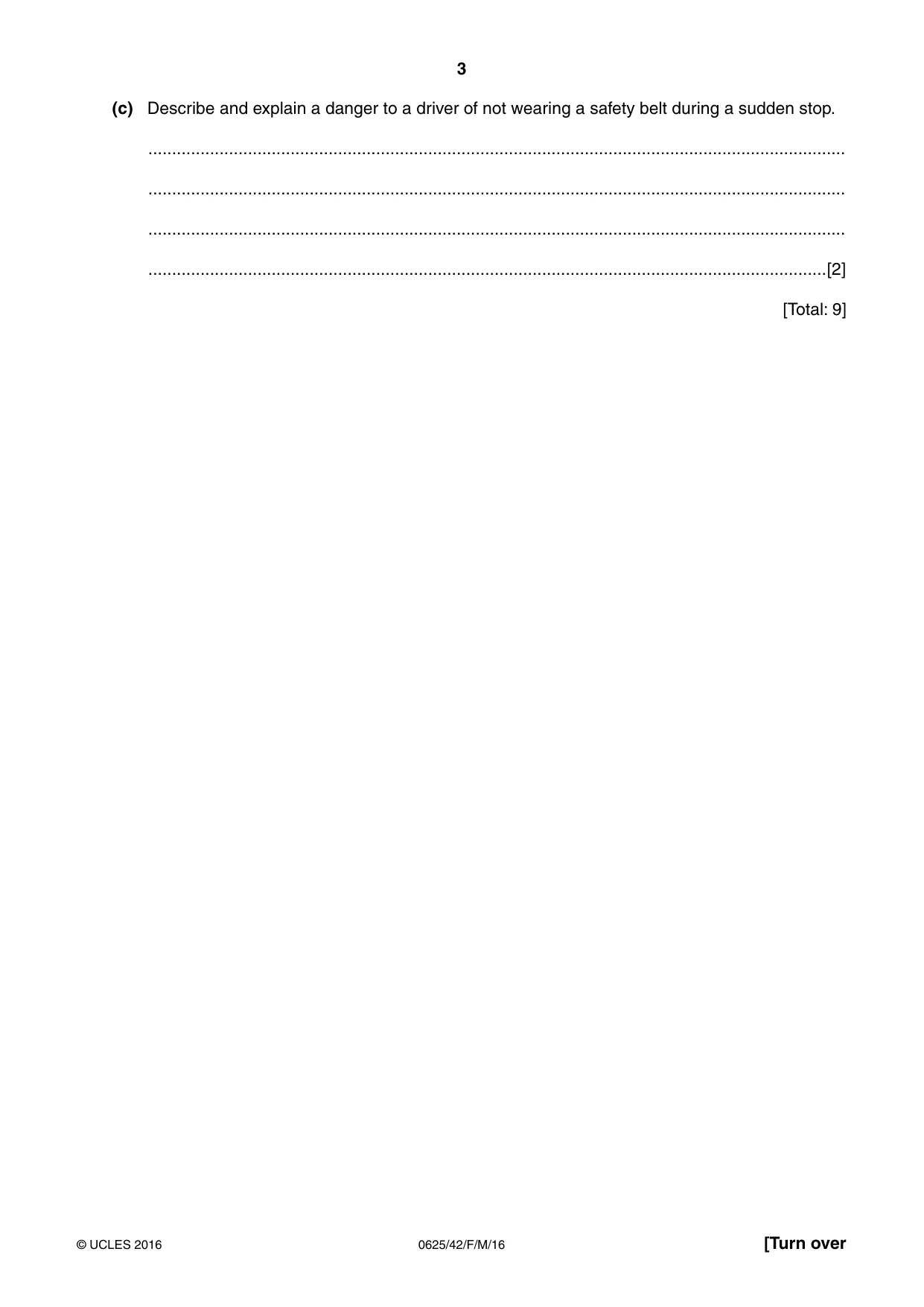
1 A driving instructor gives a student a sudden order to stop the car in the shortest possible time. Fig. 1.1 shows the speed-time graph of the motion of the car from the moment the order is given. 30 speed m / s 20 10 0 0 1.0 2.0 3.0 4.0 5.0 time t / s Fig. 1.1 (a) The order to stop is given at time t = 0 s. (i) State the speed of the car at t = 0 s. speed = ...........................................................[1] (ii) Suggest why the car continues to travel at this speed for 0.9 s. ........................................................................................................................................... .......................................................................................................................................[1] (b) Calculate (i) the deceleration of the car between t = 0.9 s and t = 4.0 s, deceleration = ...........................................................[2] (ii) the total distance travelled by the car from t = 0 s. distance = ...........................................................[3] (c) Describe and explain a danger to a driver of not wearing a safety belt during a sudden stop. ................................................................................................................................................... ................................................................................................................................................... ................................................................................................................................................... ...............................................................................................................................................[2] [Total: 9]
Mark scheme: 1 (a) (i) 18 m / s B1 (ii) (0.90 s is) driver’s time to react B1 (b) (i) (a =) (v – u) / t OR ∆v / t OR either in words OR (18 – 0) / 3.1 OR 18 / 3.1 C1 5.8 m / s2 A1 OR Values from any correct points on graph (C1) Answer dependent on accuracy of chosen points (A1) (ii) Evidence of use of: (distance =) area under graph e.g. 1 / 2bh C1 (18 × 0.9) + (0.5 × 3.1 × 18) C1 44 m A1 (c) (Without seat belt, driver:) e.g. keeps moving (forwards) / does not stop / has inertia / has momentum B1 (Driver) hits steering wheel / windscreen / dashboard B1 [Total: 9]
Q2 · A hammer being used to drive a nail into a piece of wood
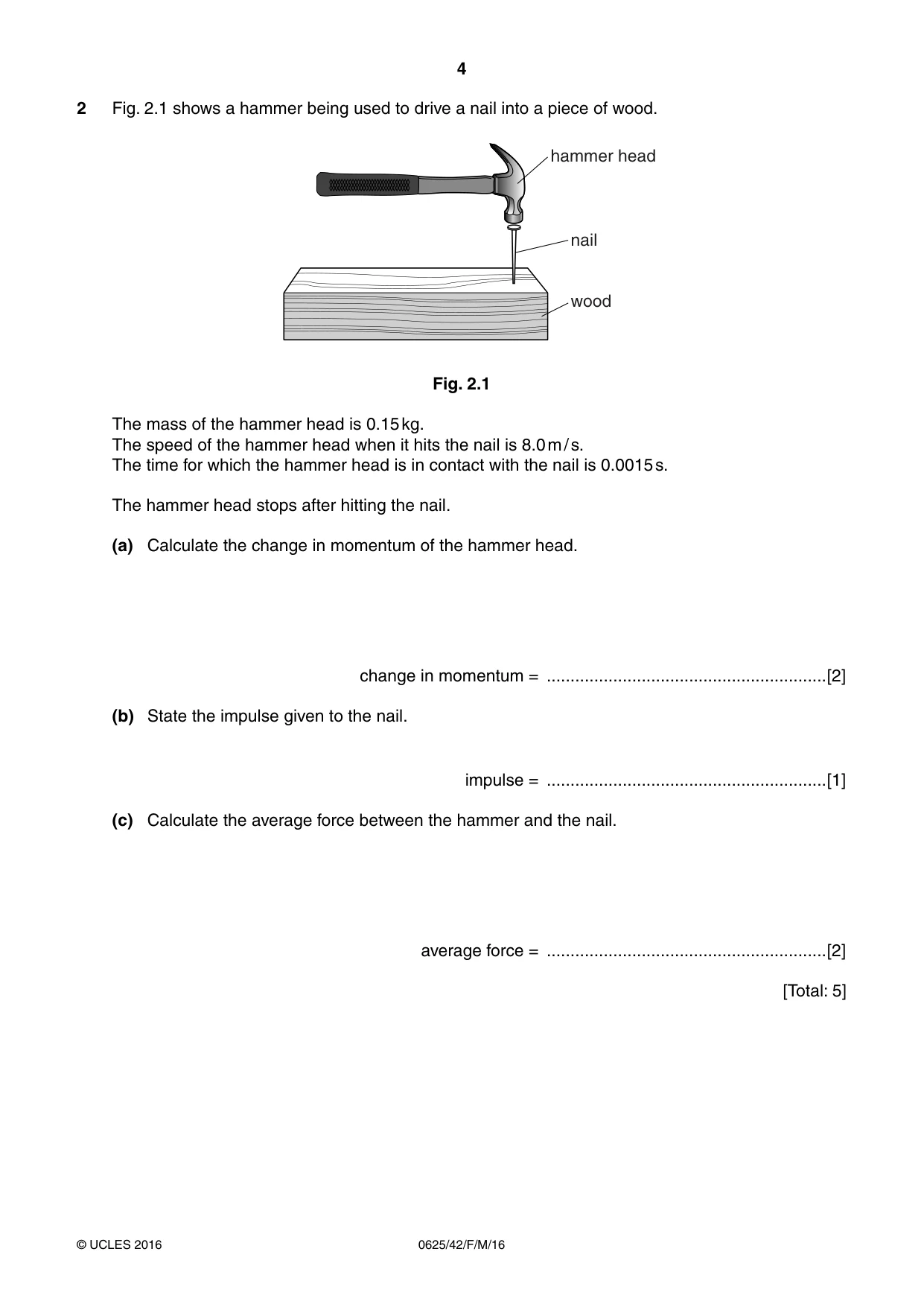
2 Fig. 2.1 shows a hammer being used to drive a nail into a piece of wood. hammer head nail wood Fig. 2.1 The mass of the hammer head is 0.15 kg. The speed of the hammer head when it hits the nail is 8.0 m / s. The time for which the hammer head is in contact with the nail is 0.0015 s. The hammer head stops after hitting the nail. (a) Calculate the change in momentum of the hammer head. change in momentum = ...........................................................[2] (b) State the impulse given to the nail. impulse = ...........................................................[1] (c) Calculate the average force between the hammer and the nail. average force = ...........................................................[2] [Total: 5]
Mark scheme: 2 (a) mv – mu OR m(v – u) OR mv OR 0.15 × 8.0 C1 1.2 N s or kg m / s A1 (b) 1.2 N s or kg m / s B1 (c) F = (mv – mu) / t OR F = mv / t OR impulse / t OR 1.2 / 0.0015 C1 800 N A1 OR (F =) ma OR m[(v – u) / t] OR 0.15 × 8 / 0.0015 (C1) 800 N (A1) [Total: 5]
Question 3
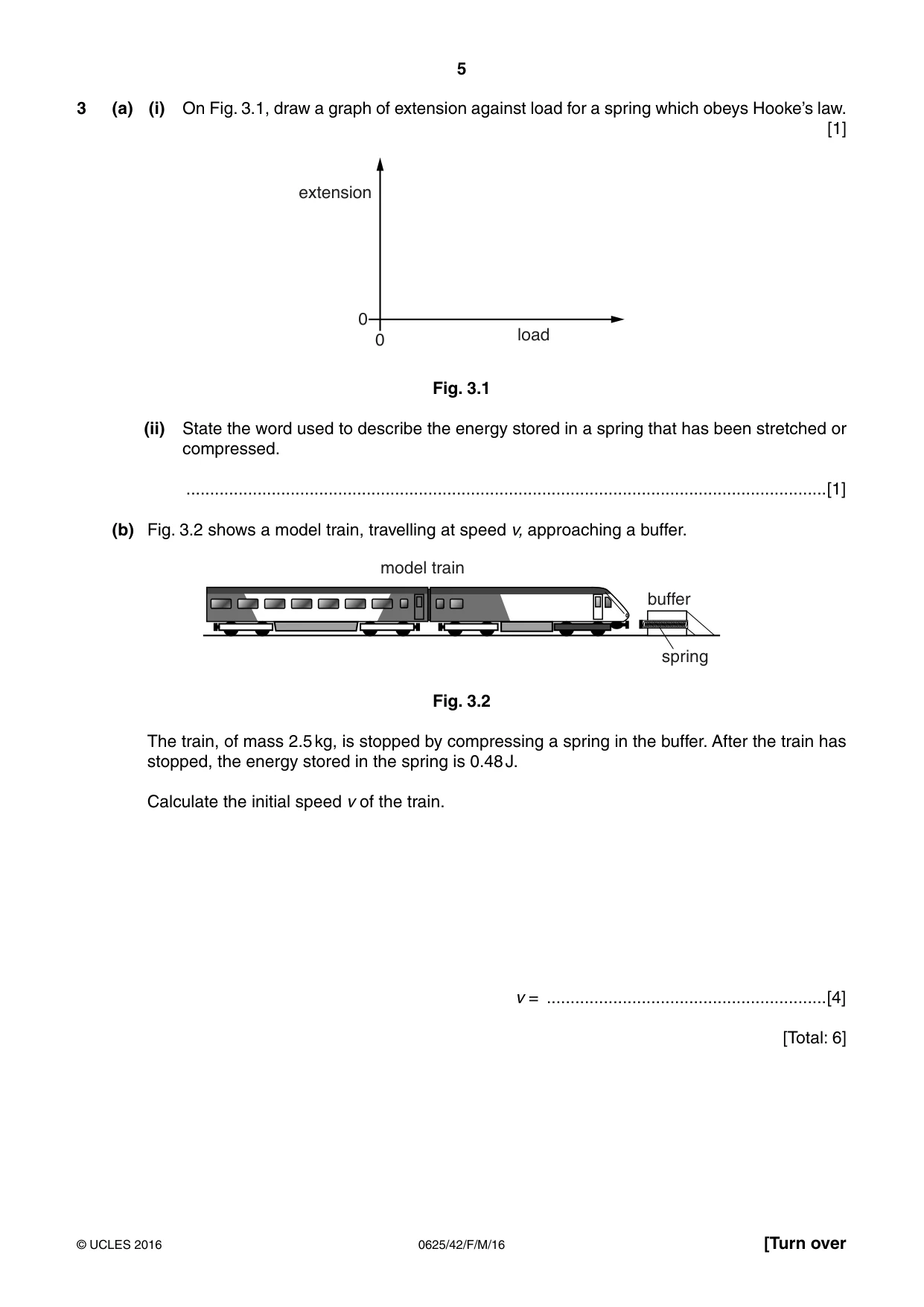
3 (a) (i) On Fig. 3.1, draw a graph of extension against load for a spring which obeys Hooke’s law. [1] extension 0 load 0 Fig. 3.1 (ii) State the word used to describe the energy stored in a spring that has been stretched or compressed. .......................................................................................................................................[1] (b) Fig. 3.2 shows a model train, travelling at speed v, approaching a buffer. model train buffer spring Fig. 3.2 The train, of mass 2.5 kg, is stopped by compressing a spring in the buffer. After the train has stopped, the energy stored in the spring is 0.48 J. Calculate the initial speed v of the train. v = ...........................................................[4] [Total: 6]
Mark scheme: 3 (a) (i) Straight line through origin B1 (ii) Strain (energy) OR elastic (energy) B1 (b) Use of 1 / 2mv2 C1 0.5 × 2.5 × v2 = 0.48 C1 v2 = 0.48 / (0.5 × 2.5) OR v2 = 0.384 C1 v = 0.62 m / s A1 [Total: 6]
Q4 · The source of solar energy is the Sun
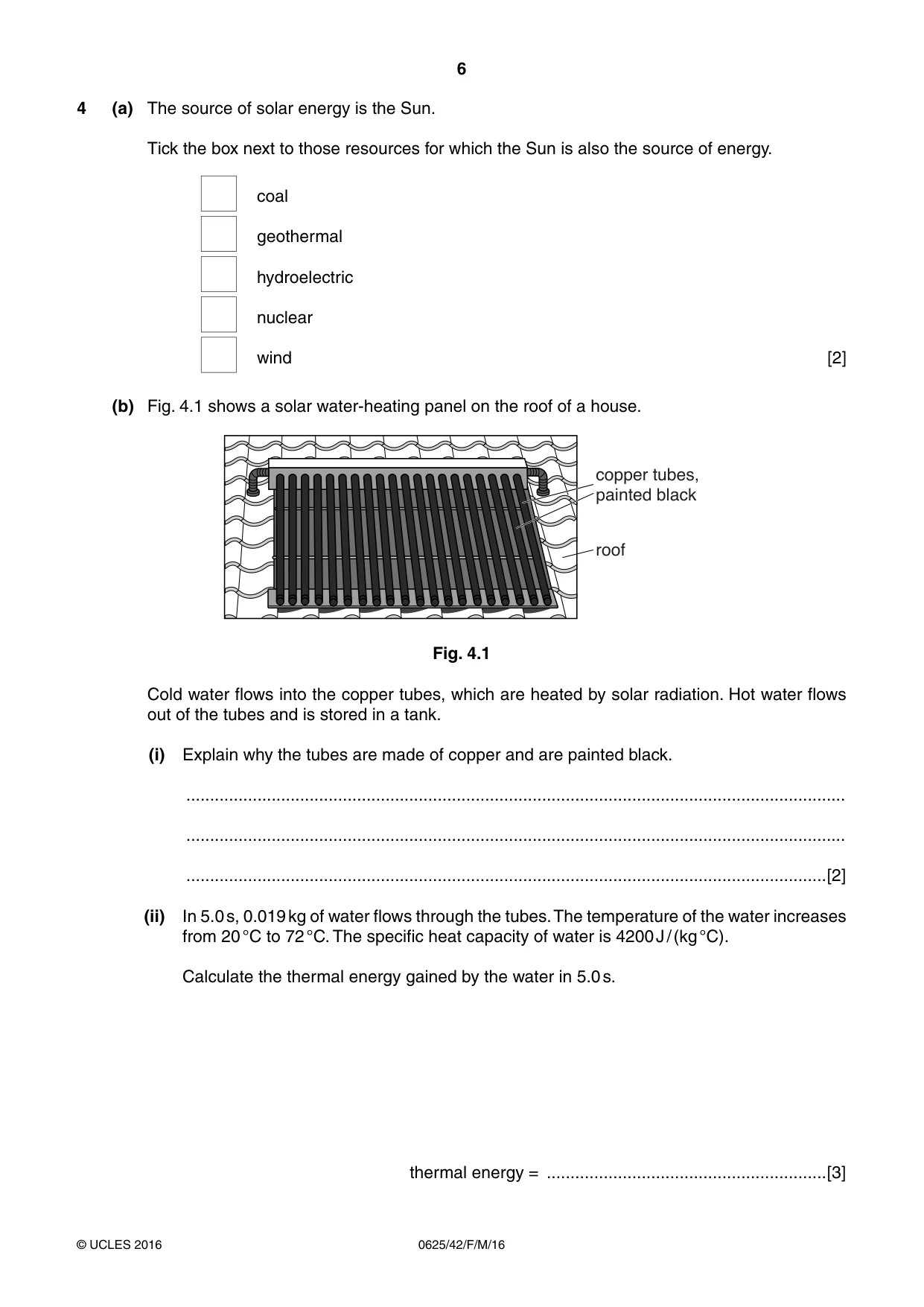
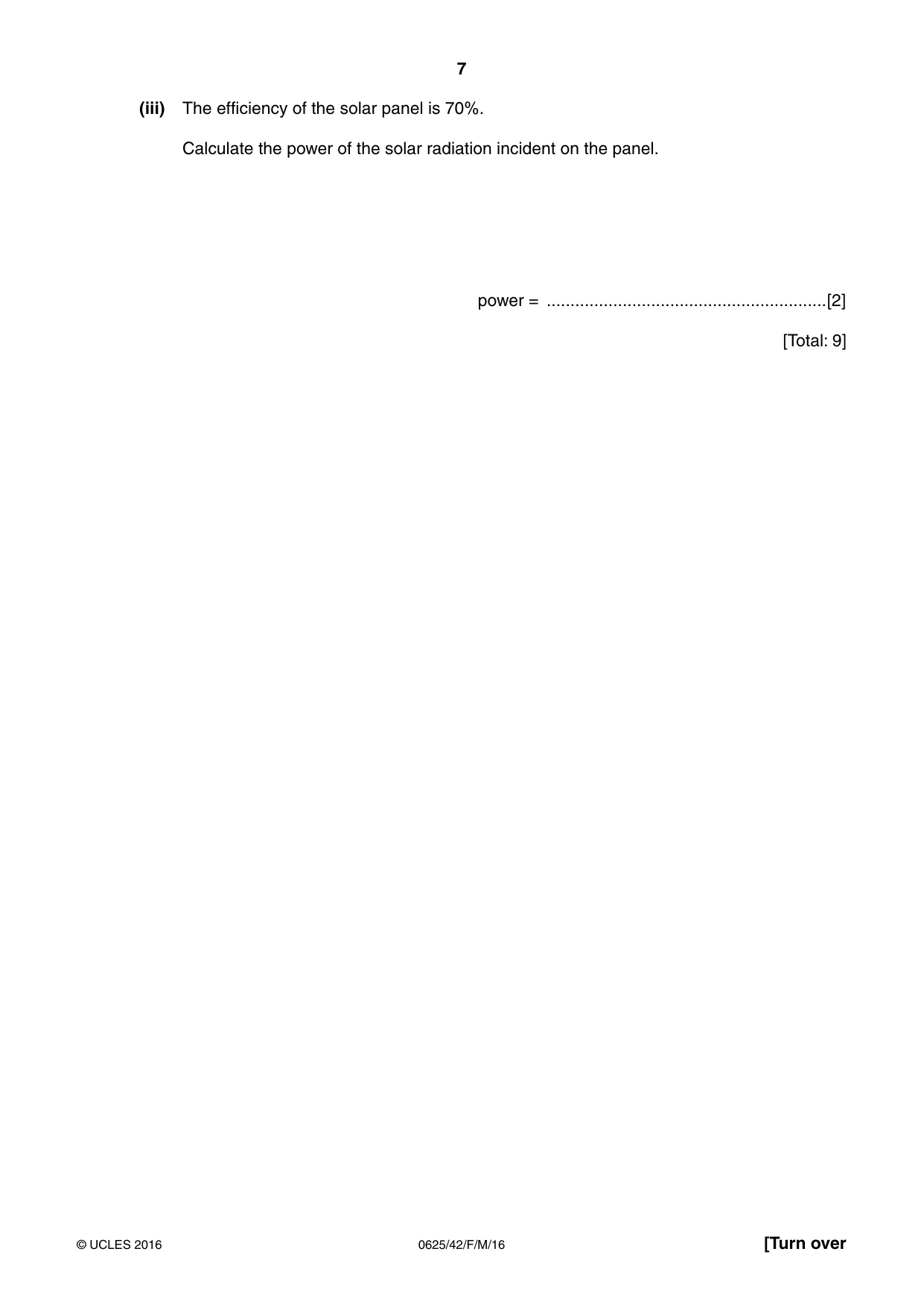
4 (a) The source of solar energy is the Sun. Tick the box next to those resources for which the Sun is also the source of energy. coal geothermal hydroelectric nuclear wind [2] (b) Fig. 4.1 shows a solar water-heating panel on the roof of a house. copper tubes, painted black roof Fig. 4.1 Cold water flows into the copper tubes, which are heated by solar radiation. Hot water flows out of the tubes and is stored in a tank. (i) Explain why the tubes are made of copper and are painted black. ........................................................................................................................................... ........................................................................................................................................... .......................................................................................................................................[2] (ii) In 5.0 s, 0.019 kg of water flows through the tubes. The temperature of the water increases from 20 °C to 72 °C. The specific heat capacity of water is 4200 J / (kg °C). Calculate the thermal energy gained by the water in 5.0 s. thermal energy = ...........................................................[3] (iii) The efficiency of the solar panel is 70%. Calculate the power of the solar radiation incident on the panel. power = ...........................................................[2] [Total: 9]
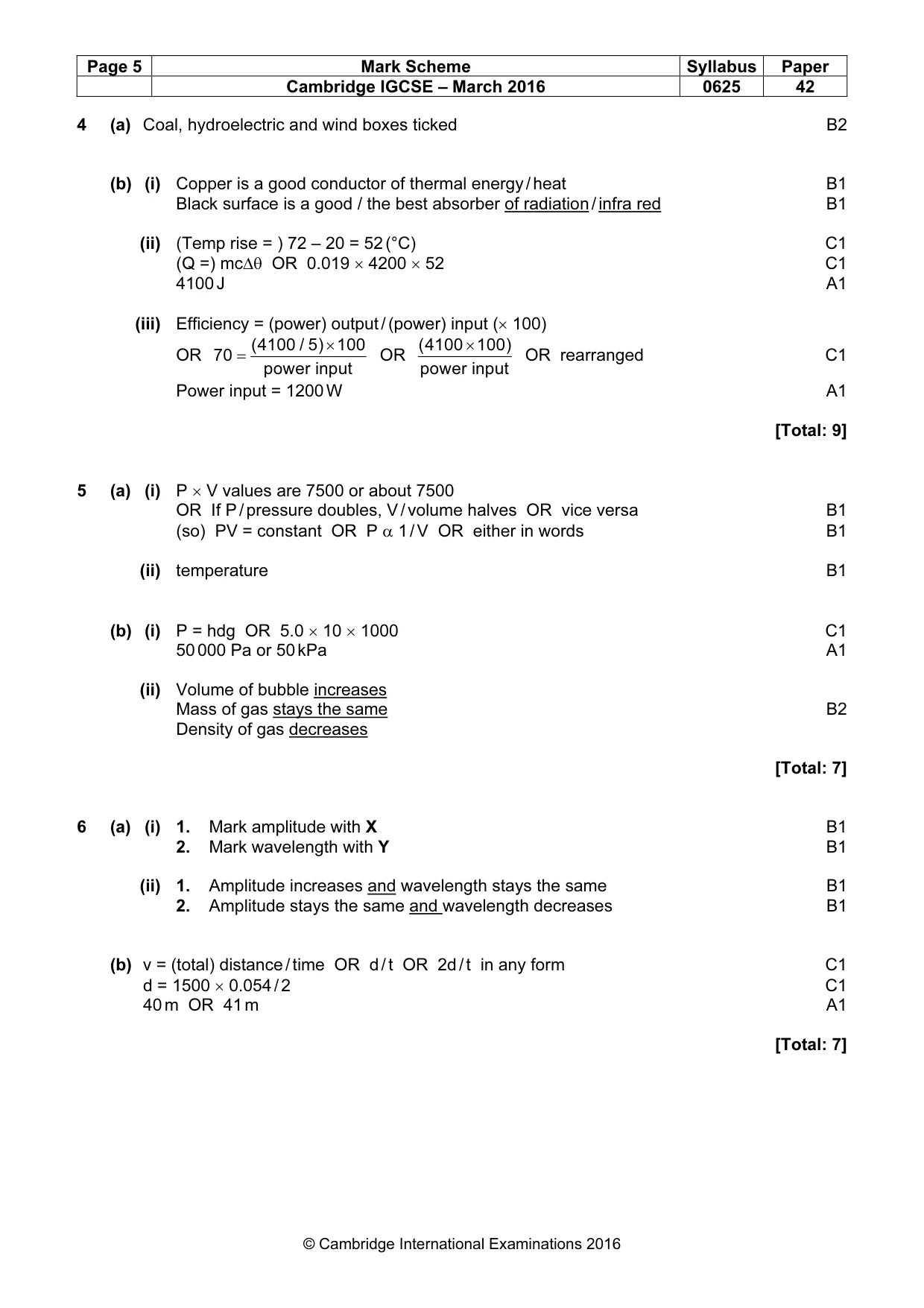
Mark scheme: 4 (a) Coal, hydroelectric and wind boxes ticked B2 (b) (i) Copper is a good conductor of thermal energy / heat B1 Black surface is a good / the best absorber of radiation / infra red B1 (ii) (Temp rise = ) 72 – 20 = 52 (°C) C1 (Q =) mc∆θ OR 0.019 × 4200 × 52 C1 4100 J A1 (iii) Efficiency = (power) output / (power) input (× 100) (4100 / 5) × 100 (4100 × 100) OR 70 = OR OR rearranged C1 power input power input Power input = 1200 W A1 [Total: 9]
Q5 · A student carries out an experiment to find the relationship between the pressure p and…
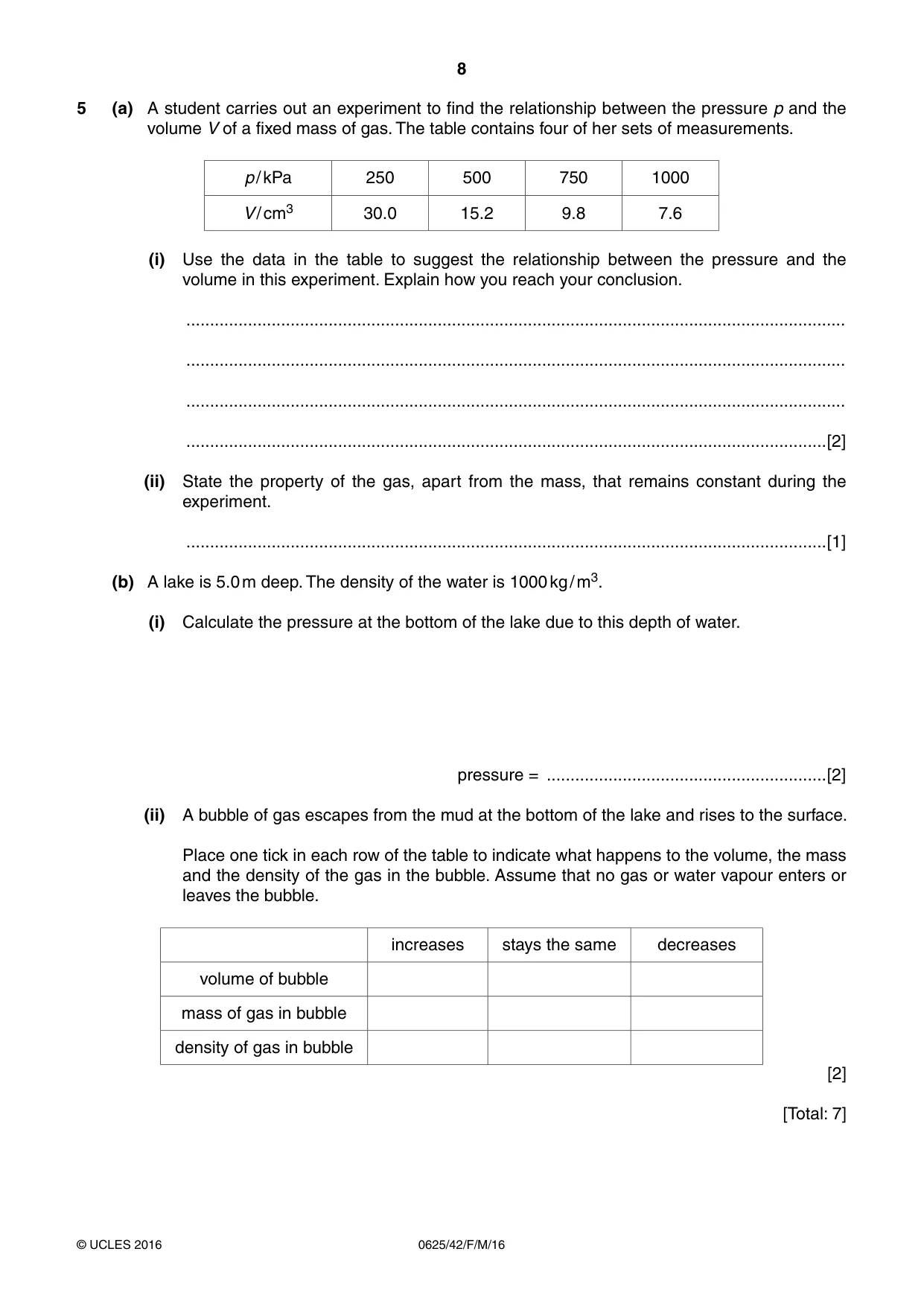
5 (a) A student carries out an experiment to find the relationship between the pressure p and the volume V of a fixed mass of gas. The table contains four of her sets of measurements. p / kPa 250 500 750 1000 V / cm3 30.0 15.2 9.8 7.6 (i) Use the data in the table to suggest the relationship between the pressure and the volume in this experiment. Explain how you reach your conclusion. ........................................................................................................................................... ........................................................................................................................................... ........................................................................................................................................... .......................................................................................................................................[2] (ii) State the property of the gas, apart from the mass, that remains constant during the experiment. .......................................................................................................................................[1] (b) A lake is 5.0 m deep. The density of the water is 1000 kg / m3. (i) Calculate the pressure at the bottom of the lake due to this depth of water. pressure = ...........................................................[2] (ii) A bubble of gas escapes from the mud at the bottom of the lake and rises to the surface. Place one tick in each row of the table to indicate what happens to the volume, the mass and the density of the gas in the bubble. Assume that no gas or water vapour enters or leaves the bubble. increases stays the same decreases volume of bubble mass of gas in bubble density of gas in bubble [2] [Total: 7]
Mark scheme: 5 (a) (i) P × V values are 7500 or about 7500 OR If P / pressure doubles, V / volume halves OR vice versa B1 (so) PV = constant OR P α 1 / V OR either in words B1 (ii) temperature B1 (b) (i) P = hdg OR 5.0 × 10 × 1000 C1 50 000 Pa or 50 kPa A1 (ii) Volume of bubble increases Mass of gas stays the same B2 Density of gas decreases [Total: 7]
Q6 · The waveform of a sound wave
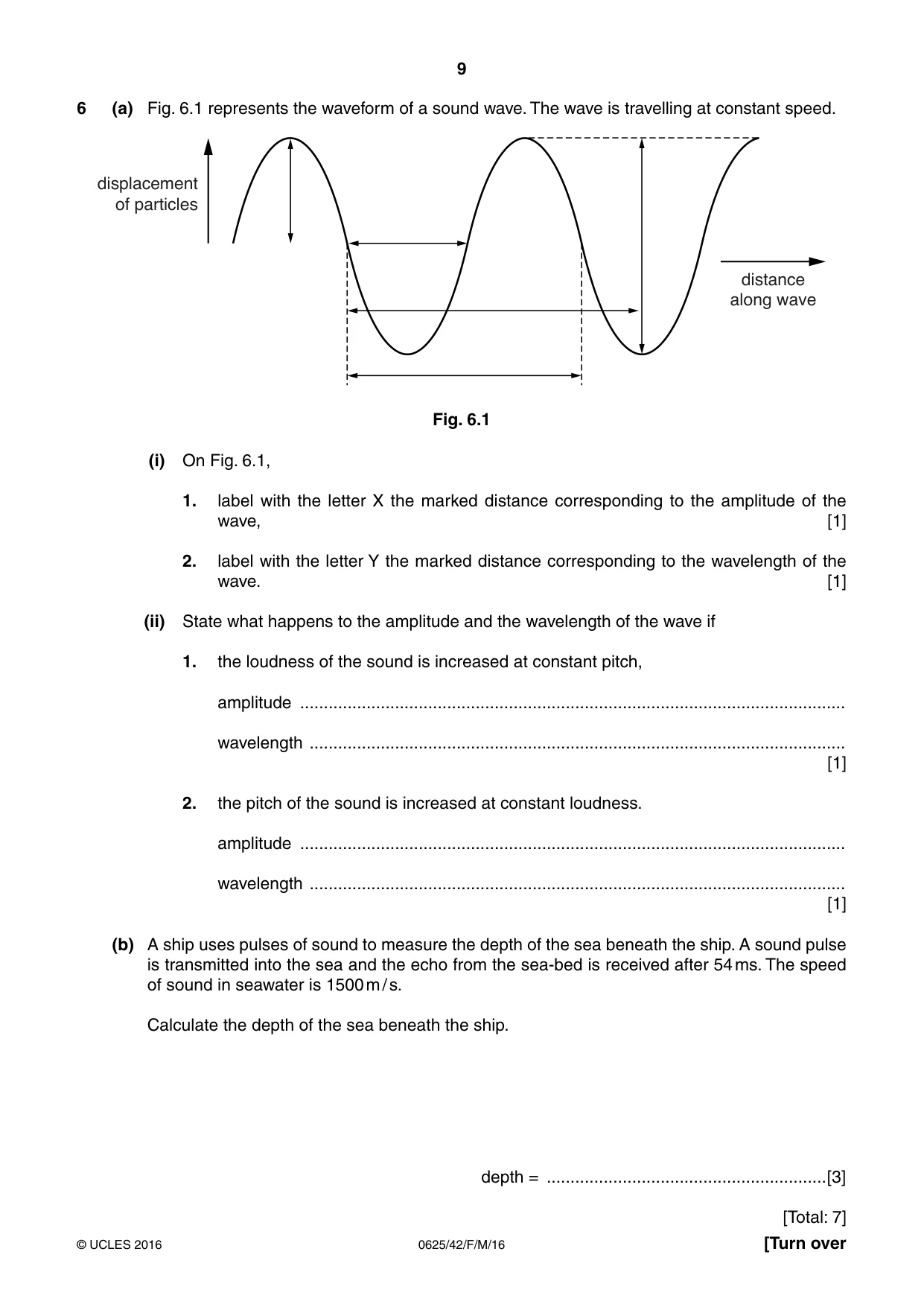
6 (a) Fig. 6.1 represents the waveform of a sound wave. The wave is travelling at constant speed. displacement of particles distance along wave Fig. 6.1 (i) On Fig. 6.1, 1. label with the letter X the marked distance corresponding to the amplitude of the wave, [1] 2. label with the letter Y the marked distance corresponding to the wavelength of the wave. [1] (ii) State what happens to the amplitude and the wavelength of the wave if 1. the loudness of the sound is increased at constant pitch, amplitude ................................................................................................................... wavelength ................................................................................................................. [1] 2. the pitch of the sound is increased at constant loudness. amplitude ................................................................................................................... wavelength ................................................................................................................. [1] (b) A ship uses pulses of sound to measure the depth of the sea beneath the ship. A sound pulse is transmitted into the sea and the echo from the sea-bed is received after 54 ms. The speed of sound in seawater is 1500 m / s. Calculate the depth of the sea beneath the ship. depth = ...........................................................[3] [Total: 7]
Mark scheme: 6 (a) (i) 1. Mark amplitude with X B1 2. Mark wavelength with Y B1 (ii) 1. Amplitude increases and wavelength stays the same B1 2. Amplitude stays the same and wavelength decreases B1 (b) v = (total) distance / time OR d / t OR 2d / t in any form C1 d = 1500 × 0.054 / 2 C1 40 m OR 41 m A1 [Total: 7]
Q7 · Explain what is meant by (i) total internal reflection…
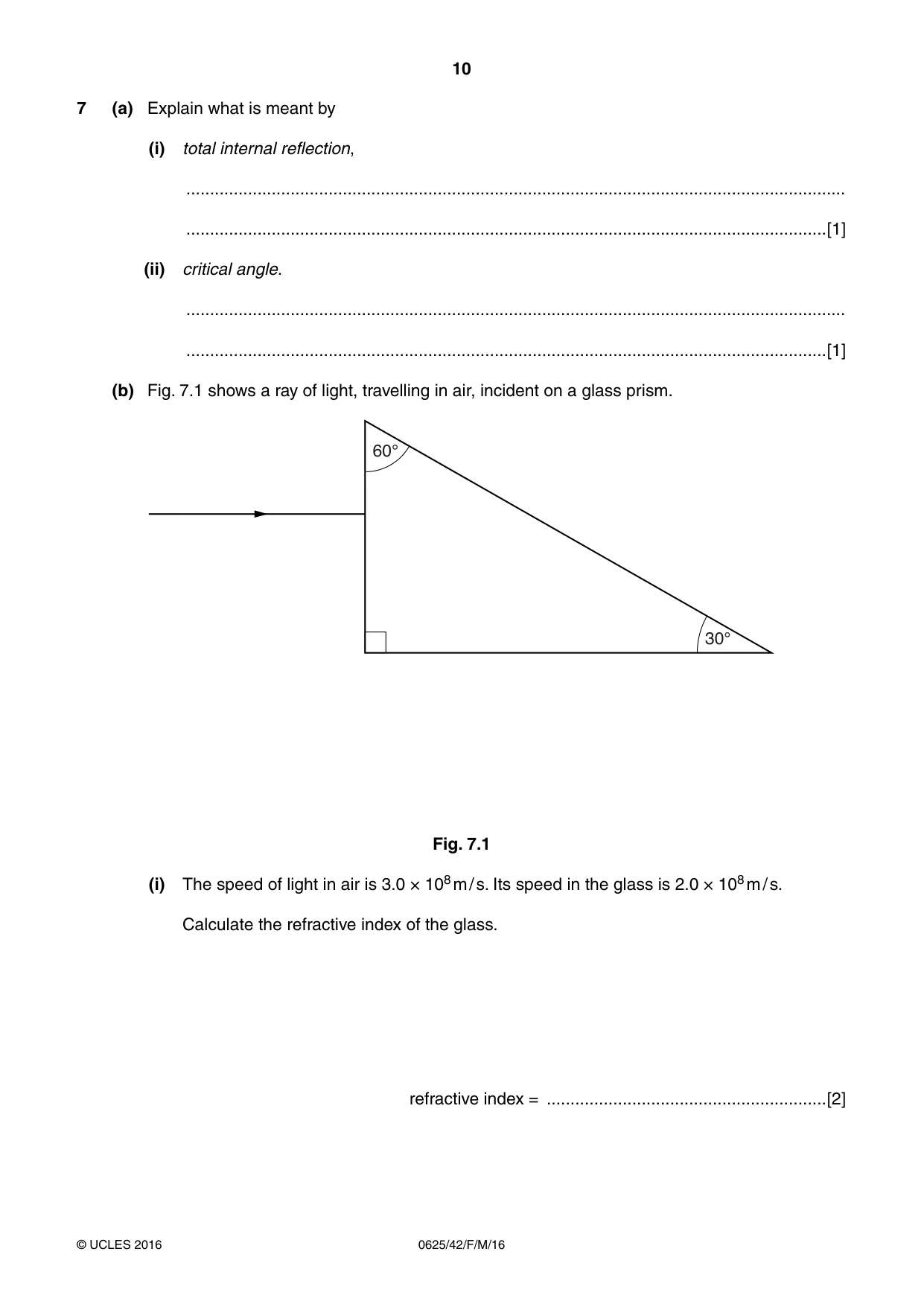
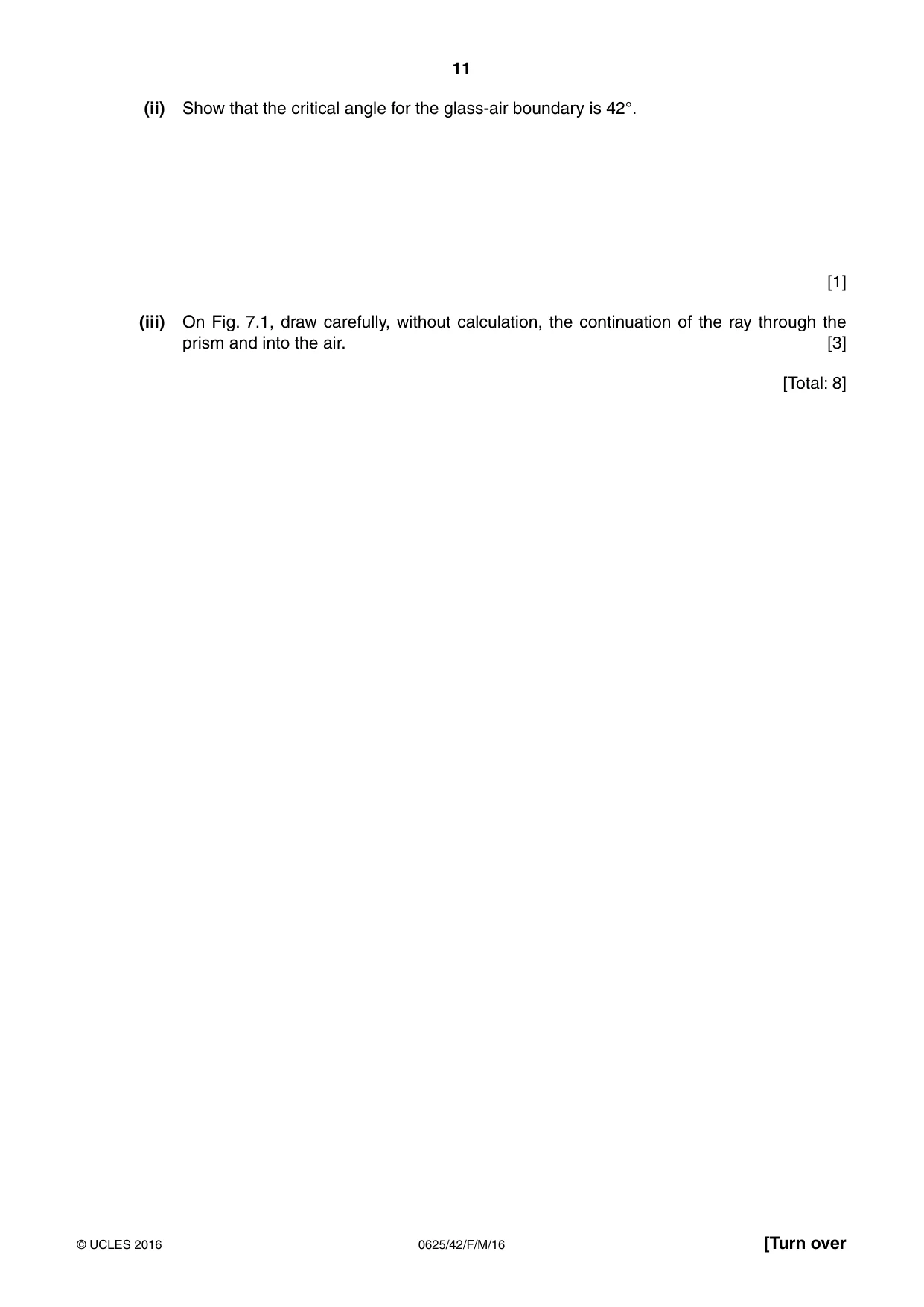
7 (a) Explain what is meant by (i) total internal reflection, ........................................................................................................................................... .......................................................................................................................................[1] (ii) critical angle. ........................................................................................................................................... .......................................................................................................................................[1] (b) Fig. 7.1 shows a ray of light, travelling in air, incident on a glass prism. 60° 30° Fig. 7.1 (i) The speed of light in air is 3.0 × 10⁸ m / s. Its speed in the glass is 2.0 × 10⁸ m / s. Calculate the refractive index of the glass. refractive index = ...........................................................[2] (ii) Show that the critical angle for the glass-air boundary is 42°. [1] (iii) On Fig. 7.1, draw carefully, without calculation, the continuation of the ray through the prism and into the air. [3] [Total: 8]
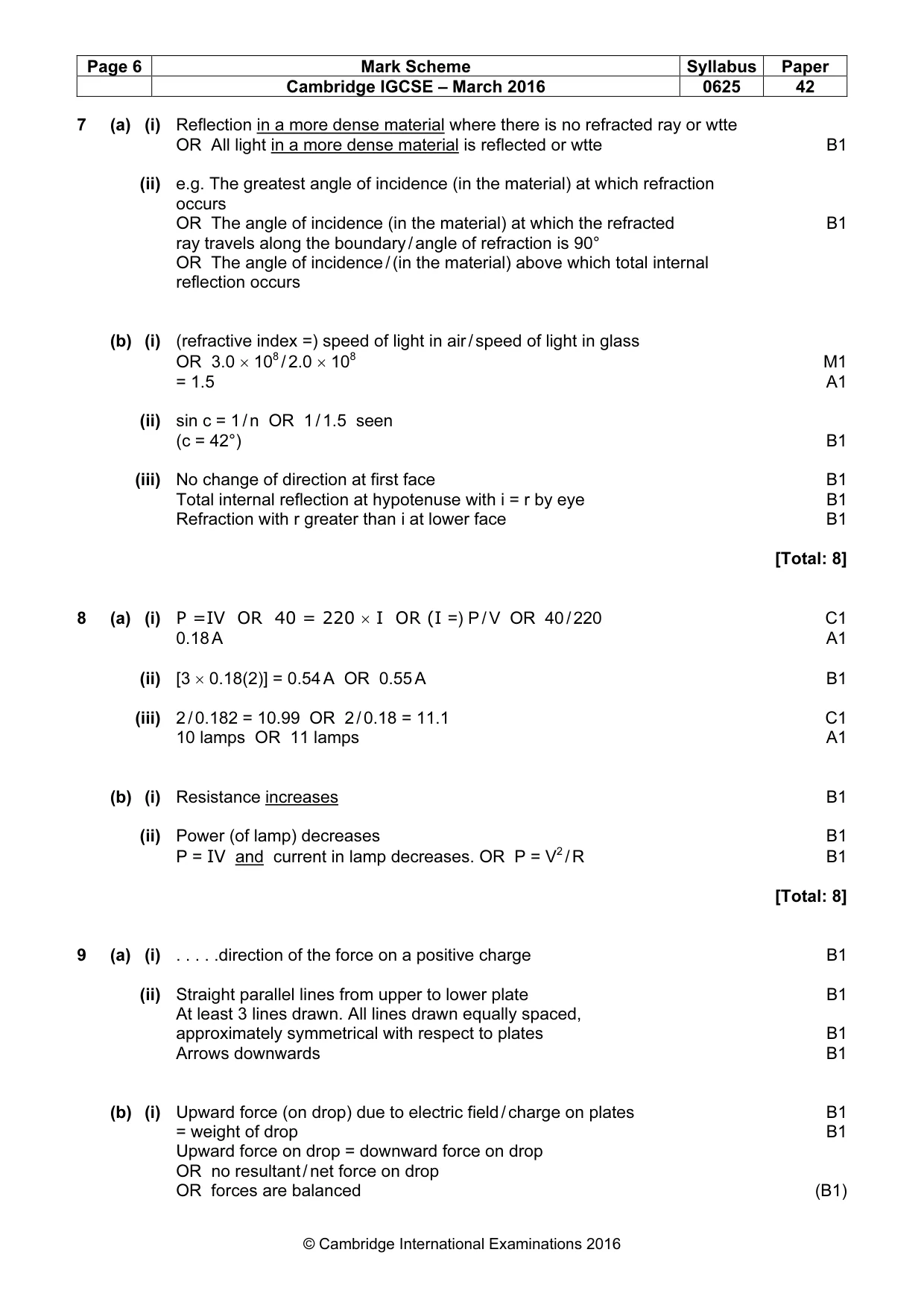
Mark scheme: 7 (a) (i) Reflection in a more dense material where there is no refracted ray or wtte OR All light in a more dense material is reflected or wtte B1 (ii) e.g. The greatest angle of incidence (in the material) at which refraction occurs OR The angle of incidence (in the material) at which the refracted B1 ray travels along the boundary / angle of refraction is 90° OR The angle of incidence / (in the material) above which total internal reflection occurs (b) (i) (refractive index =) speed of light in air / speed of light in glass OR 3.0 × 10⁸ / 2.0 × 10⁸ M1 = 1.5 A1 (ii) sin c = 1 / n OR 1 / 1.5 seen (c = 42°) B1 (iii) No change of direction at first face B1 Total internal reflection at hypotenuse with i = r by eye B1 Refraction with r greater than i at lower face B1 [Total: 8]
Q8 · 3 lamps and a fuse connected to a power supply
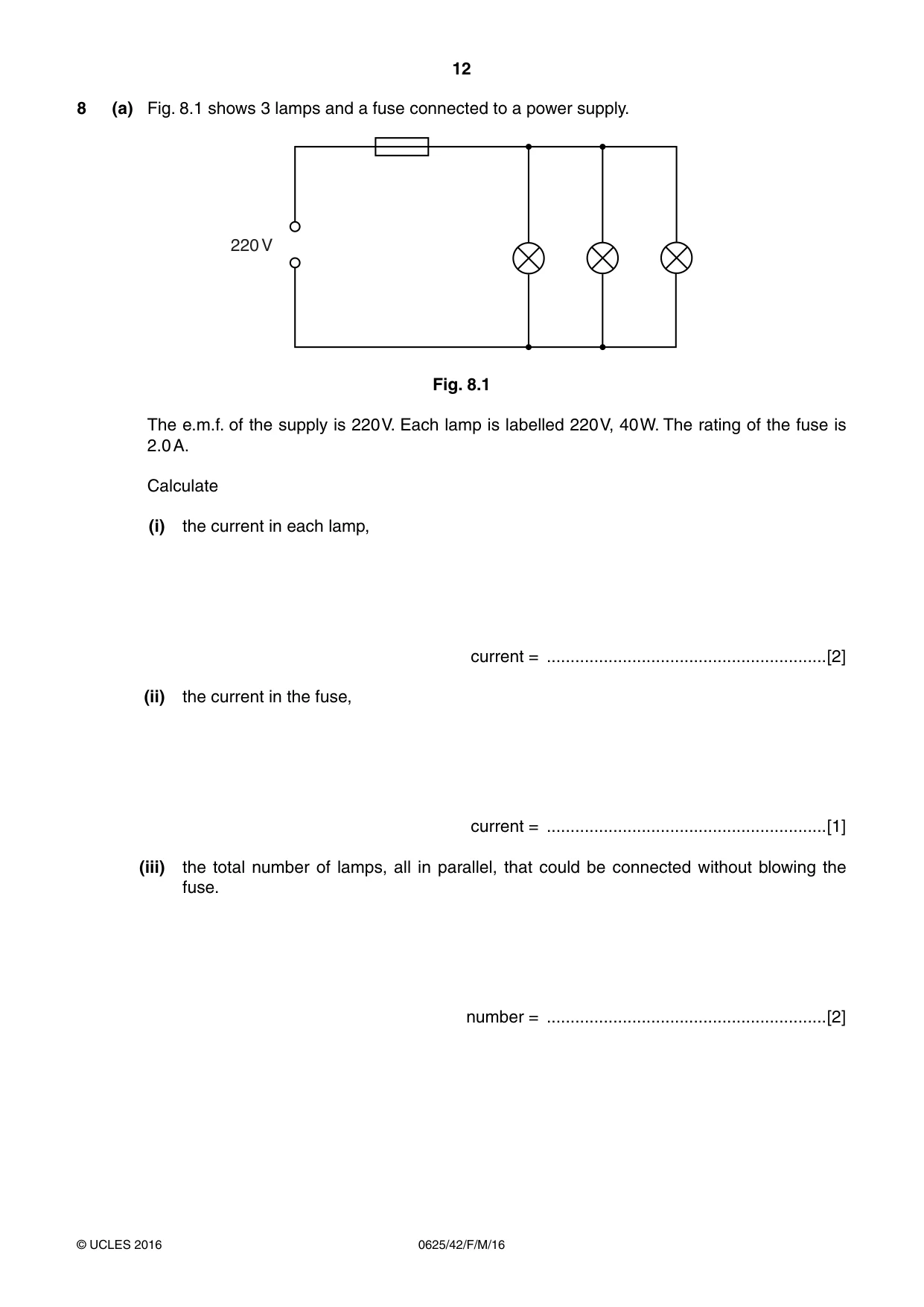
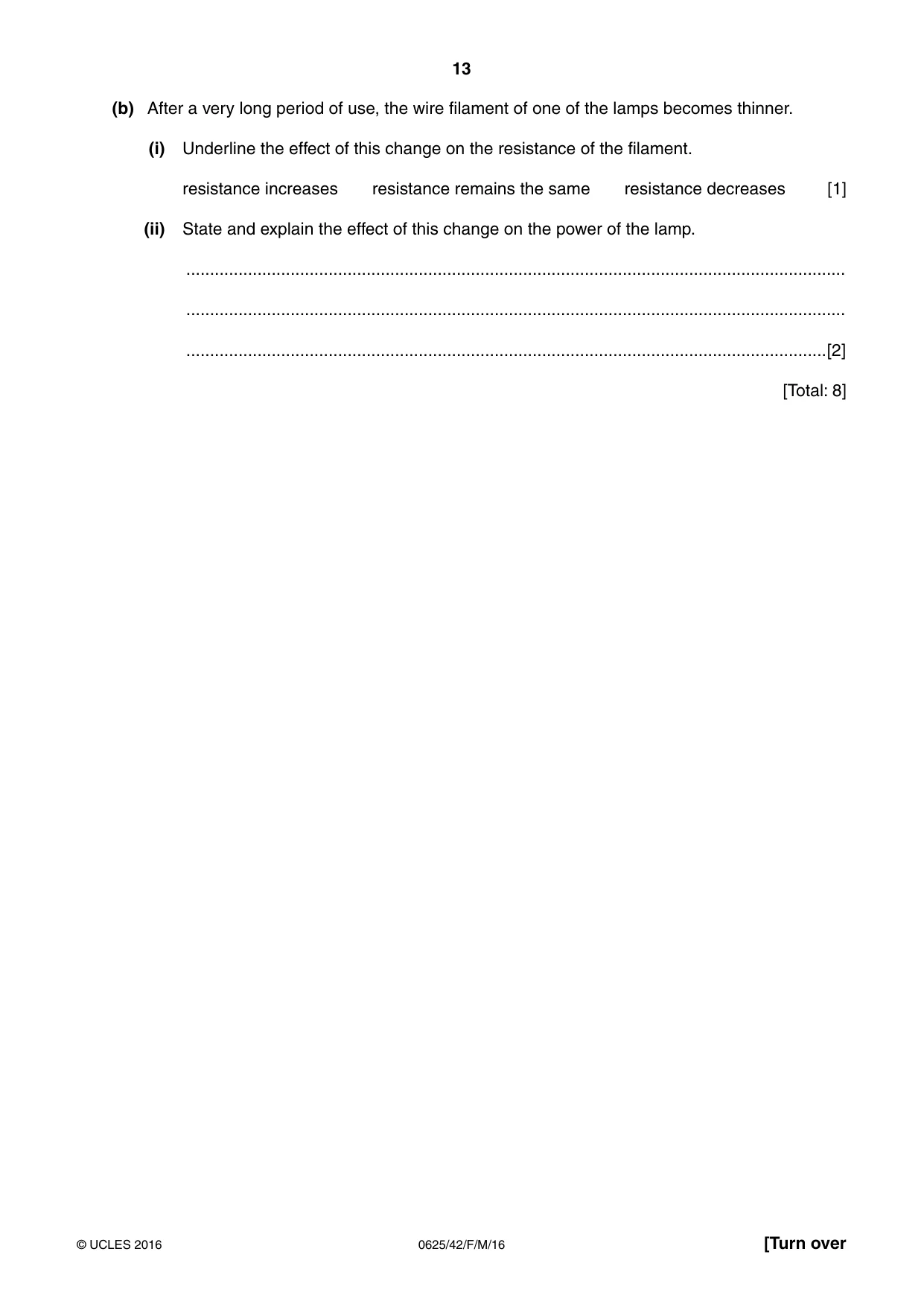
8 (a) Fig. 8.1 shows 3 lamps and a fuse connected to a power supply. 220 V Fig. 8.1 The e.m.f. of the supply is 220 V. Each lamp is labelled 220 V, 40 W. The rating of the fuse is 2.0 A. Calculate (i) the current in each lamp, current = ...........................................................[2] (ii) the current in the fuse, current = ...........................................................[1] (iii) the total number of lamps, all in parallel, that could be connected without blowing the fuse. number = ...........................................................[2] (b) After a very long period of use, the wire filament of one of the lamps becomes thinner. (i) Underline the effect of this change on the resistance of the filament. resistance increases resistance remains the same resistance decreases [1] (ii) State and explain the effect of this change on the power of the lamp. ........................................................................................................................................... ........................................................................................................................................... .......................................................................................................................................[2] [Total: 8]
Mark scheme: 8 (a) (i) P =IV OR 40 = 220 × I OR (I =) P / V OR 40 / 220 C1 0.18 A A1 (ii) [3 × 0.18(2)] = 0.54 A OR 0.55 A B1 (iii) 2 / 0.182 = 10.99 OR 2 / 0.18 = 11.1 C1 10 lamps OR 11 lamps A1 (b) (i) Resistance increases B1 (ii) Power (of lamp) decreases B1 P = IV and current in lamp decreases. OR P = V2 / R B1 [Total: 8]
Q9 · State what is meant by the direction of an electric field
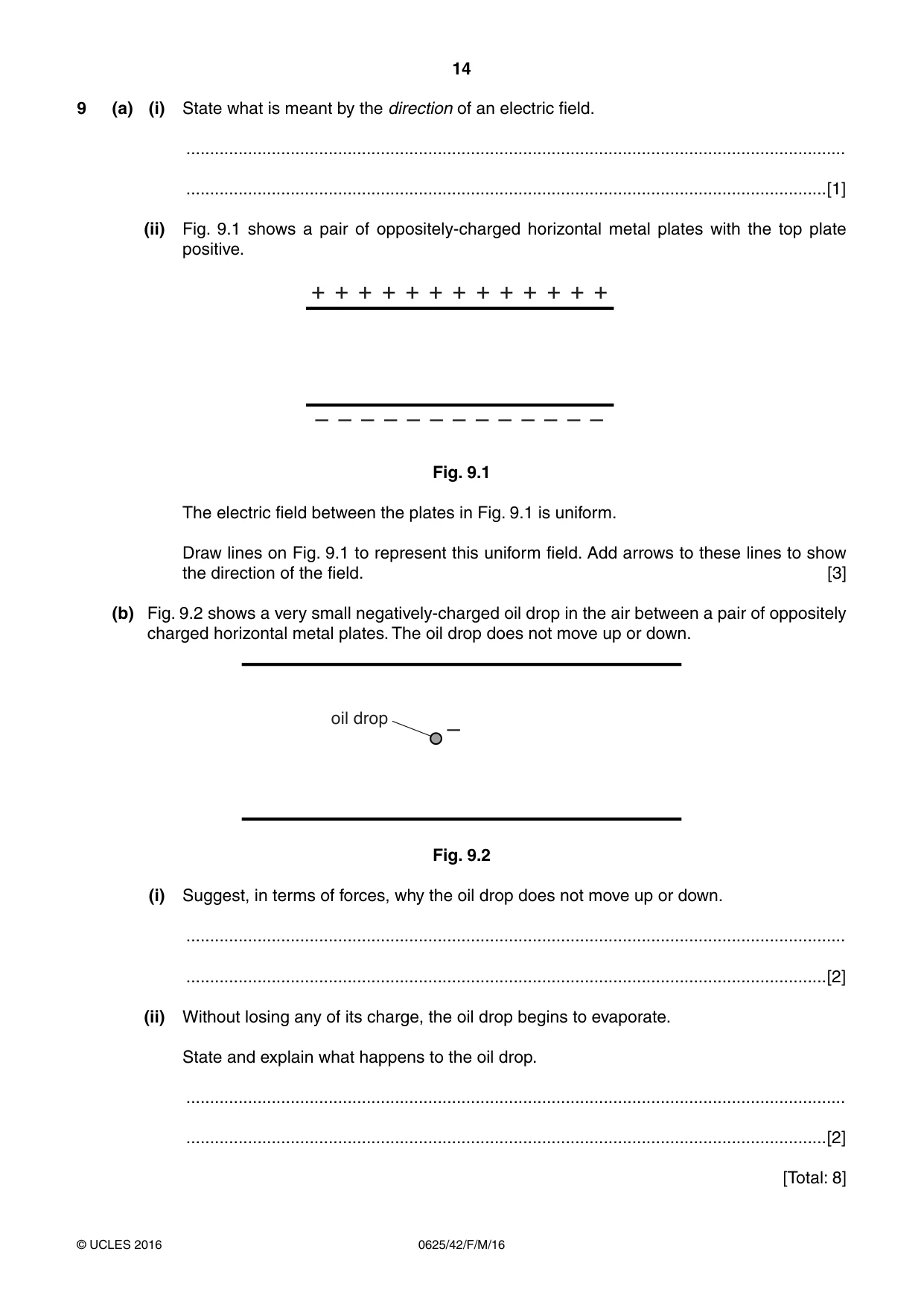
9 (a) (i) State what is meant by the direction of an electric field. ........................................................................................................................................... .......................................................................................................................................[1] (ii) Fig. 9.1 shows a pair of oppositely-charged horizontal metal plates with the top plate positive. + + + + + + + + + + + + + – – – – – – – – – – – – – Fig. 9.1 The electric field between the plates in Fig. 9.1 is uniform. Draw lines on Fig. 9.1 to represent this uniform field. Add arrows to these lines to show the direction of the field. [3] (b) Fig. 9.2 shows a very small negatively-charged oil drop in the air between a pair of oppositely charged horizontal metal plates. The oil drop does not move up or down. oil drop – Fig. 9.2 (i) Suggest, in terms of forces, why the oil drop does not move up or down. ........................................................................................................................................... .......................................................................................................................................[2] (ii) Without losing any of its charge, the oil drop begins to evaporate. State and explain what happens to the oil drop. ........................................................................................................................................... .......................................................................................................................................[2] [Total: 8]
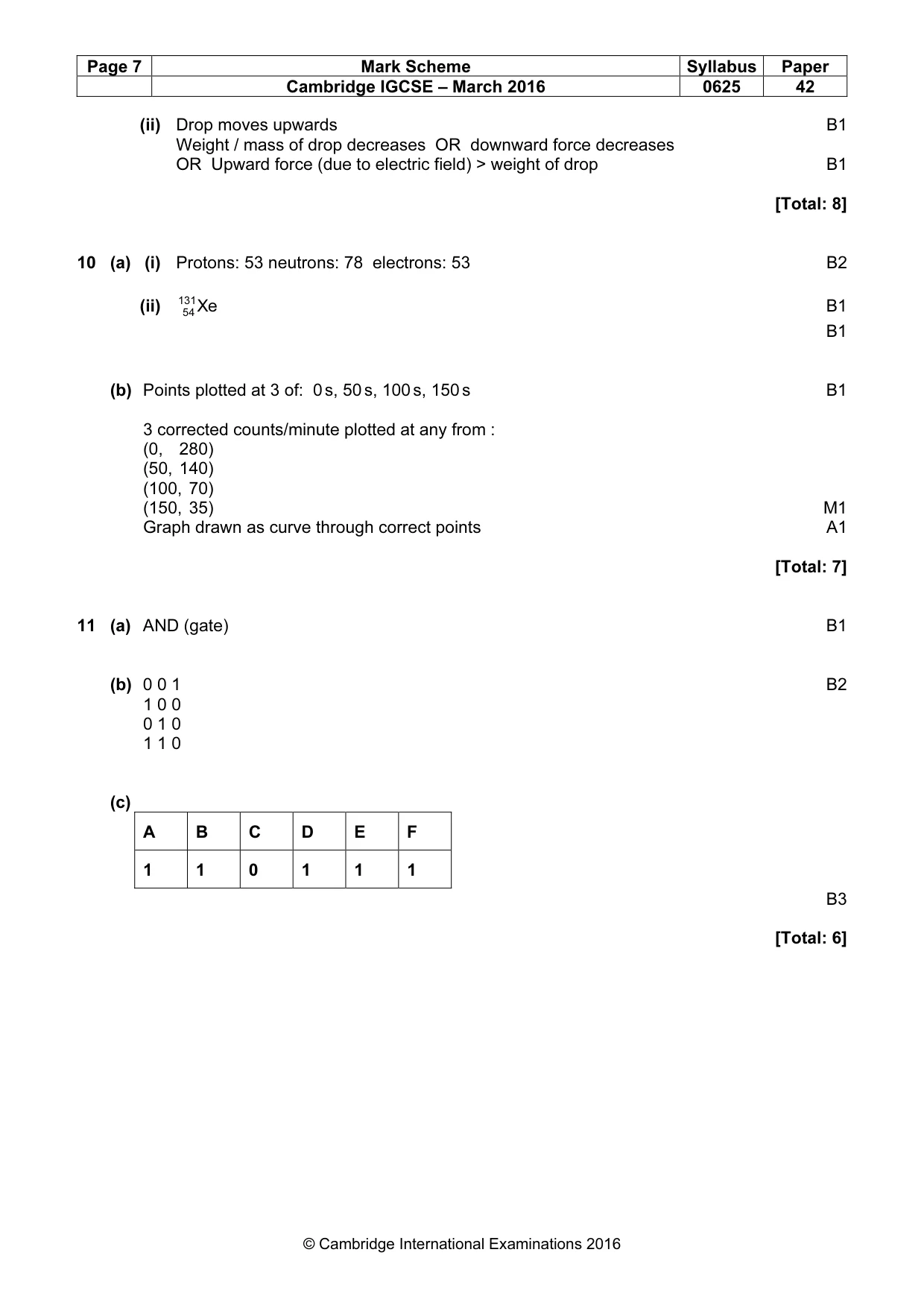
Mark scheme: 9 (a) (i) . . . . .direction of the force on a positive charge B1 (ii) Straight parallel lines from upper to lower plate B1 At least 3 lines drawn. All lines drawn equally spaced, approximately symmetrical with respect to plates B1 Arrows downwards B1 (b) (i) Upward force (on drop) due to electric field / charge on plates B1 = weight of drop B1 Upward force on drop = downward force on drop OR no resultant / net force on drop OR forces are balanced (B1) (ii) Drop moves upwards B1 Weight / mass of drop decreases OR downward force decreases OR Upward force (due to electric field) > weight of drop B1 [Total: 8]
Q10 · 1 10 (a) An iodine isotope 53 I decays by β-emission to an isotope of xenon (Xe)
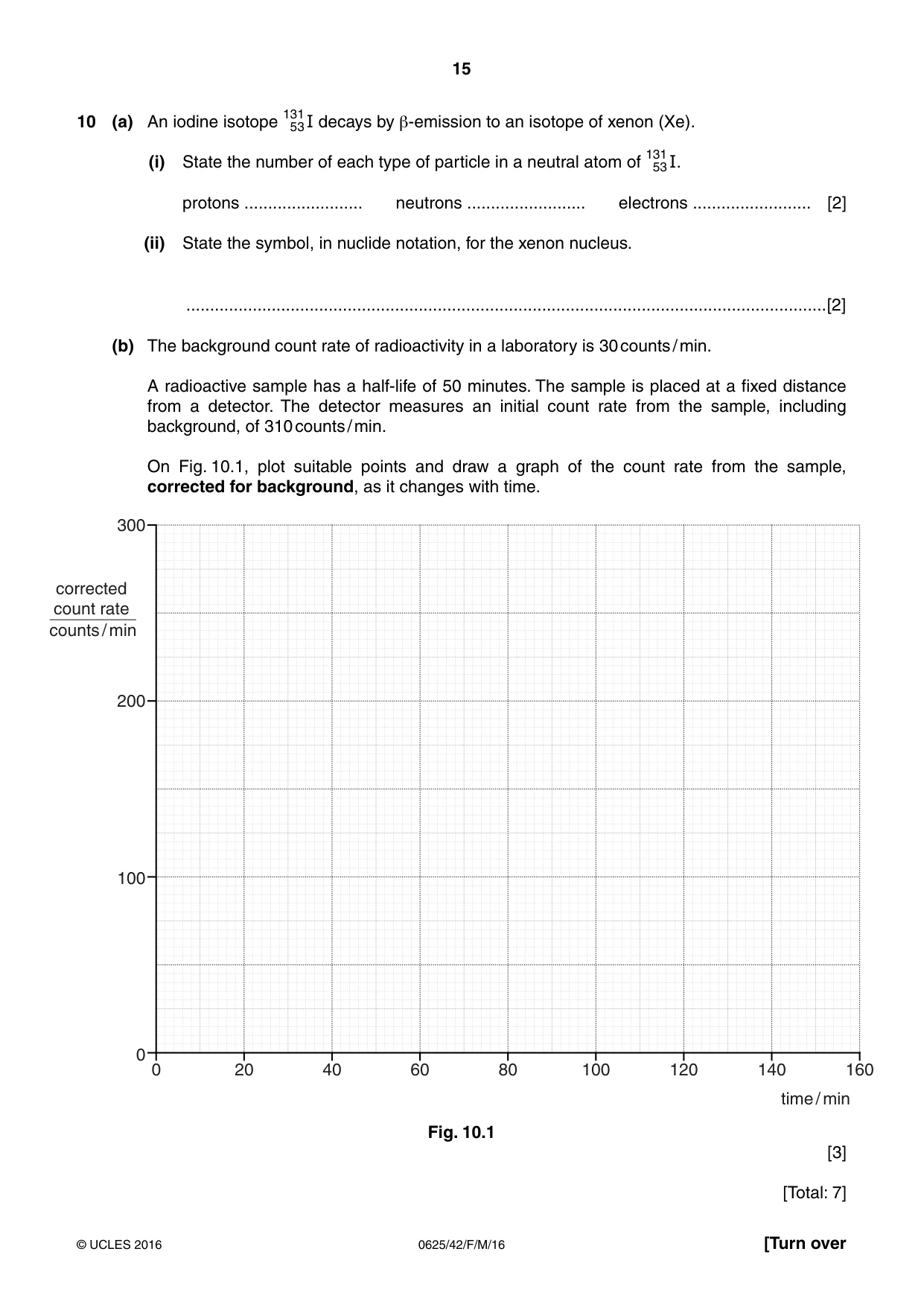
131 10 (a) An iodine isotope 53 I decays by β-emission to an isotope of xenon (Xe). 131 (i) State the number of each type of particle in a neutral atom of 53 I. protons ......................... neutrons ......................... electrons ......................... [2] (ii) State the symbol, in nuclide notation, for the xenon nucleus. .......................................................................................................................................[2] (b) The background count rate of radioactivity in a laboratory is 30 counts / min. A radioactive sample has a half-life of 50 minutes. The sample is placed at a fixed distance from a detector. The detector measures an initial count rate from the sample, including background, of 310 counts / min. On Fig. 10.1, plot suitable points and draw a graph of the count rate from the sample, corrected for background, as it changes with time. 300 corrected count rate counts / min 200 100 0 0 20 40 60 80 100 120 140 160 time / min Fig. 10.1 [3] [Total: 7]
Mark scheme: 10 (a) (i) Protons: 53 neutrons: 78 electrons: 53 B2 (ii) 13154Xe B1 B1 (b) Points plotted at 3 of: 0 s, 50 s, 100 s, 150 s B1 3 corrected counts/minute plotted at any from : (0, 280) (50, 140) (100, 70) (150, 35) M1 Graph drawn as curve through correct points A1 [Total: 7]
Q11 · The symbol for a logic gate and its truth table
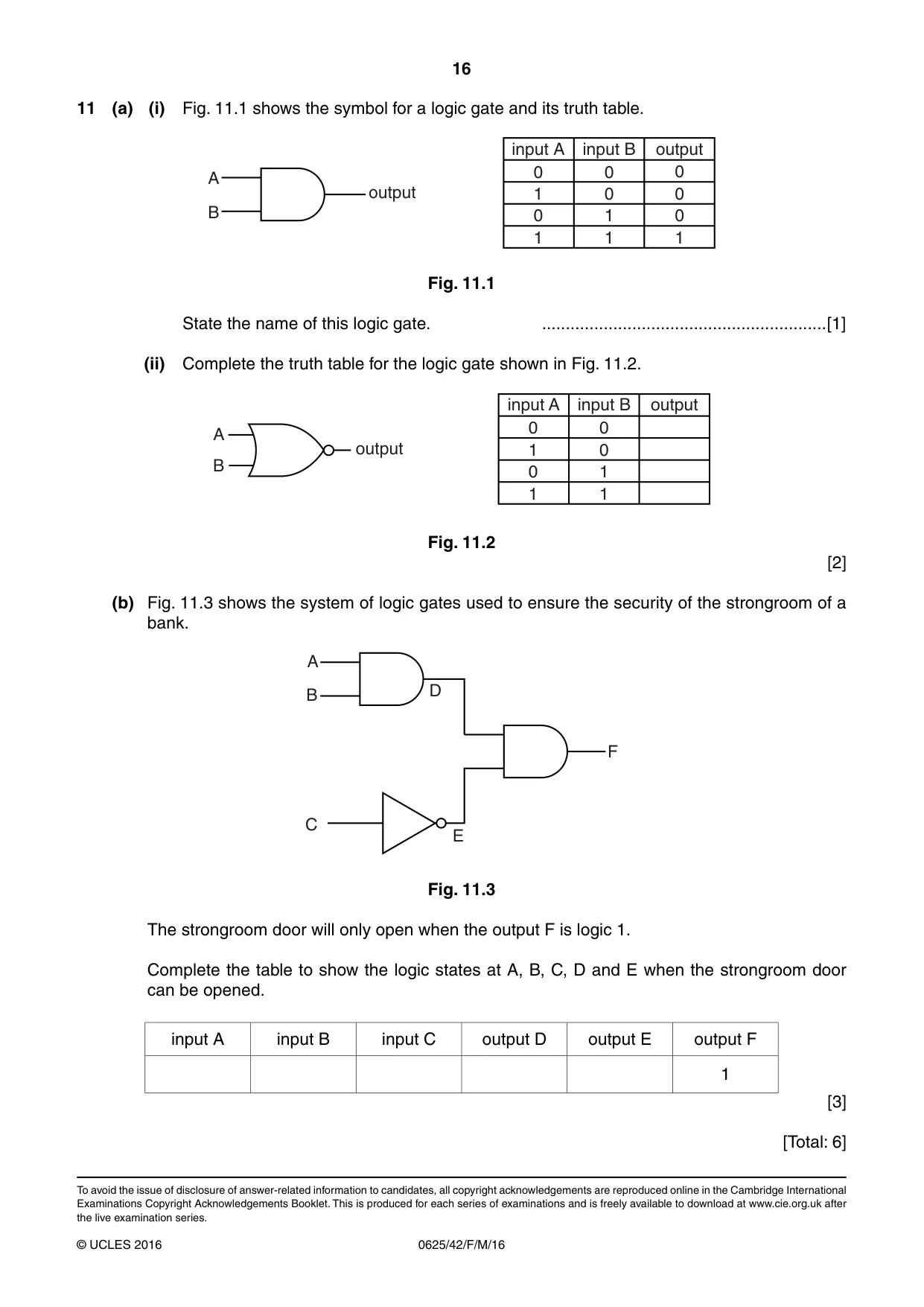
11 (a) (i) Fig. 11.1 shows the symbol for a logic gate and its truth table. input A input B output 0 0 0 A output 1 0 0 B 0 1 0 1 1 1 Fig. 11.1 State the name of this logic gate. ............................................................[1] (ii) Complete the truth table for the logic gate shown in Fig. 11.2. input A input B output 0 0 A output 1 0 B 0 1 1 1 Fig. 11.2 [2] (b) Fig. 11.3 shows the system of logic gates used to ensure the security of the strongroom of a bank. A B D F C E Fig. 11.3 The strongroom door will only open when the output F is logic 1. Complete the table to show the logic states at A, B, C, D and E when the strongroom door can be opened. input A input B input C output D output E output F 1 [3] [Total: 6]
Mark scheme: 11 (a) AND (gate) B1 (b) 0 0 1 B2 1 0 0 0 1 0 1 1 0 (c) A B C D E F 1 1 0 1 1 1 B3 [Total: 6]
What was in this paper
The subtopics covered by these 11 questions, and how many questions each got. Open one in a new tab to see every Cambridge question on it.
What you needed in this session
Cambridge’s own grade thresholds for 2016 Feb/March, Paper 4 · Variant 2. A higher threshold means an easier paper — the bar moves with how the cohort did.