Cambridge IGCSE Physics 0625 — 2022 Feb/March Paper 4 · Variant 2
0625/42/F/M/22 · 10 questions · 80 marks · ≈90 min
The question paper and its mark scheme, free to read here and free to download. This is Cambridge’s own paper, exactly as it was sat.
Question paper16 pages
Mark scheme17 pages
Answers below. Sit the paper first if you are practising.
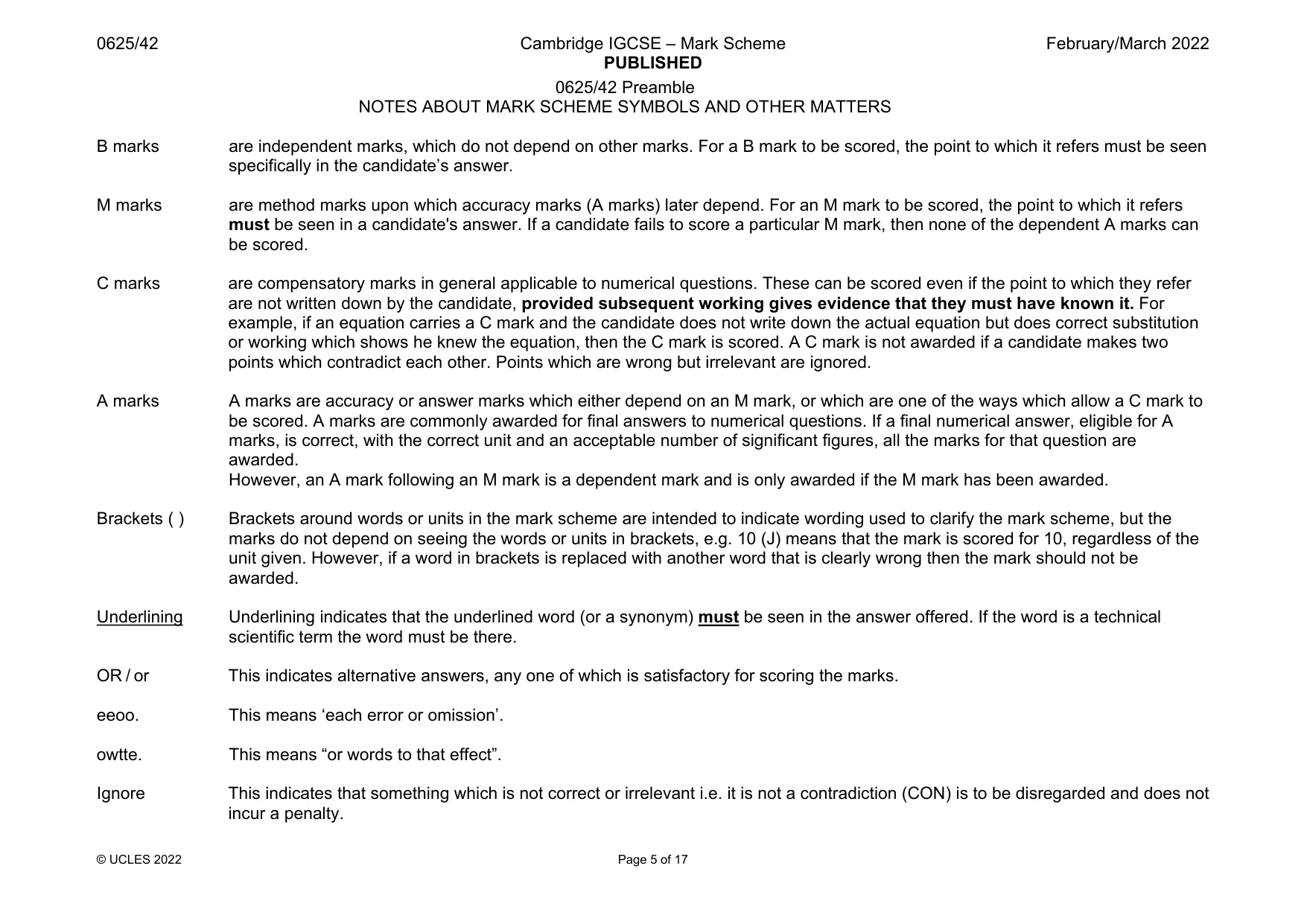
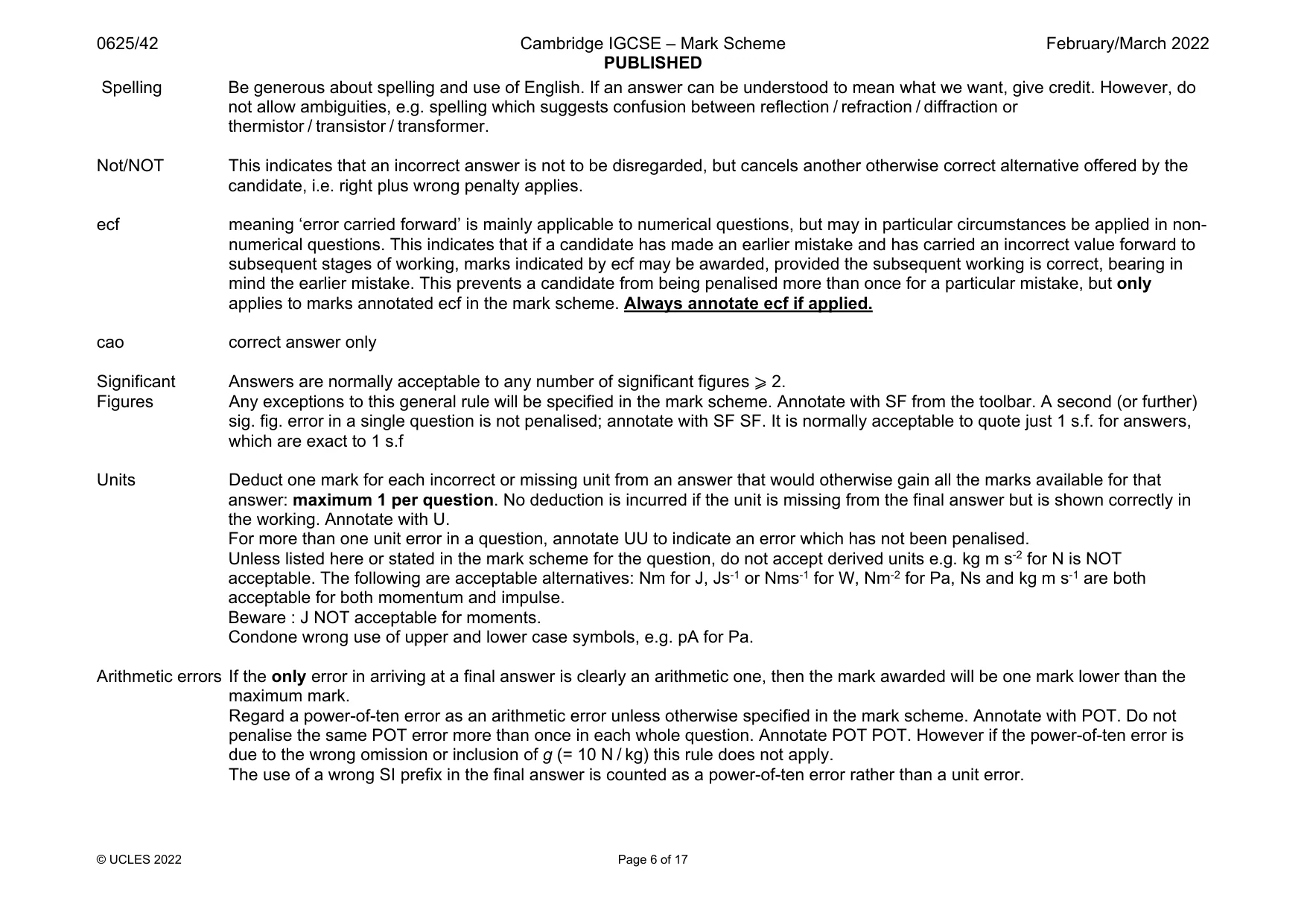
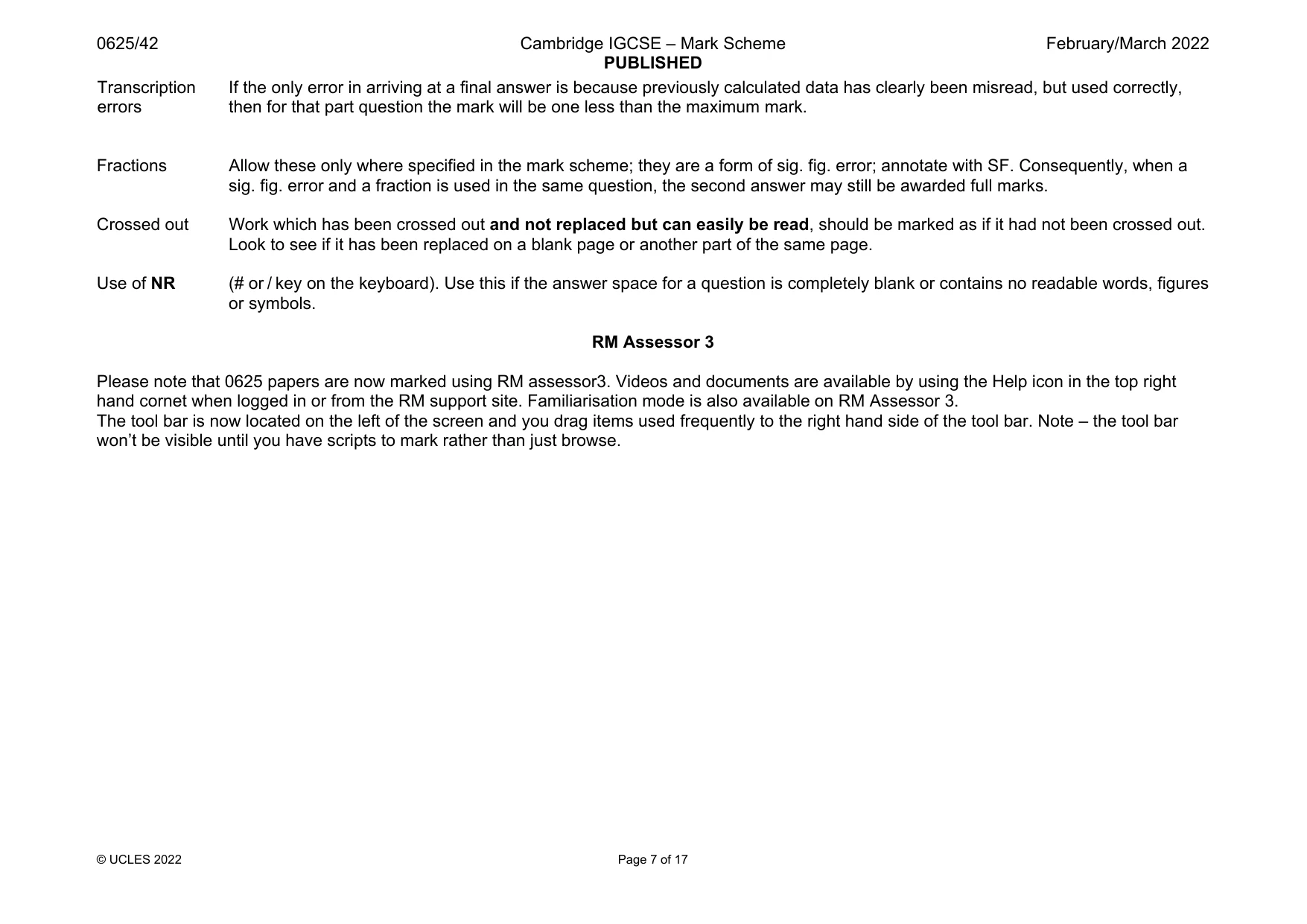
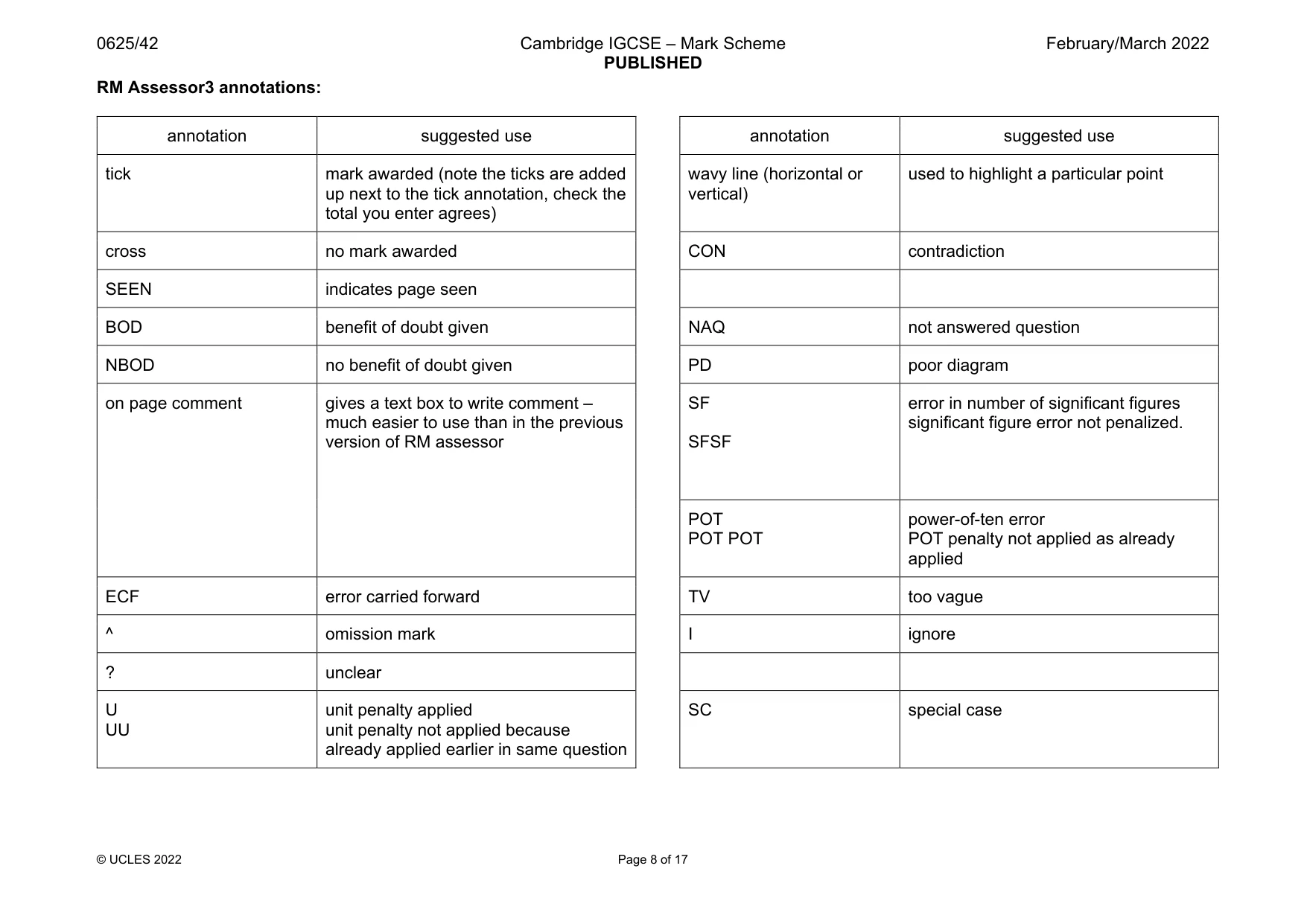
Questions as text
Q1 · A ball rolls down a ramp and onto a horizontal surface
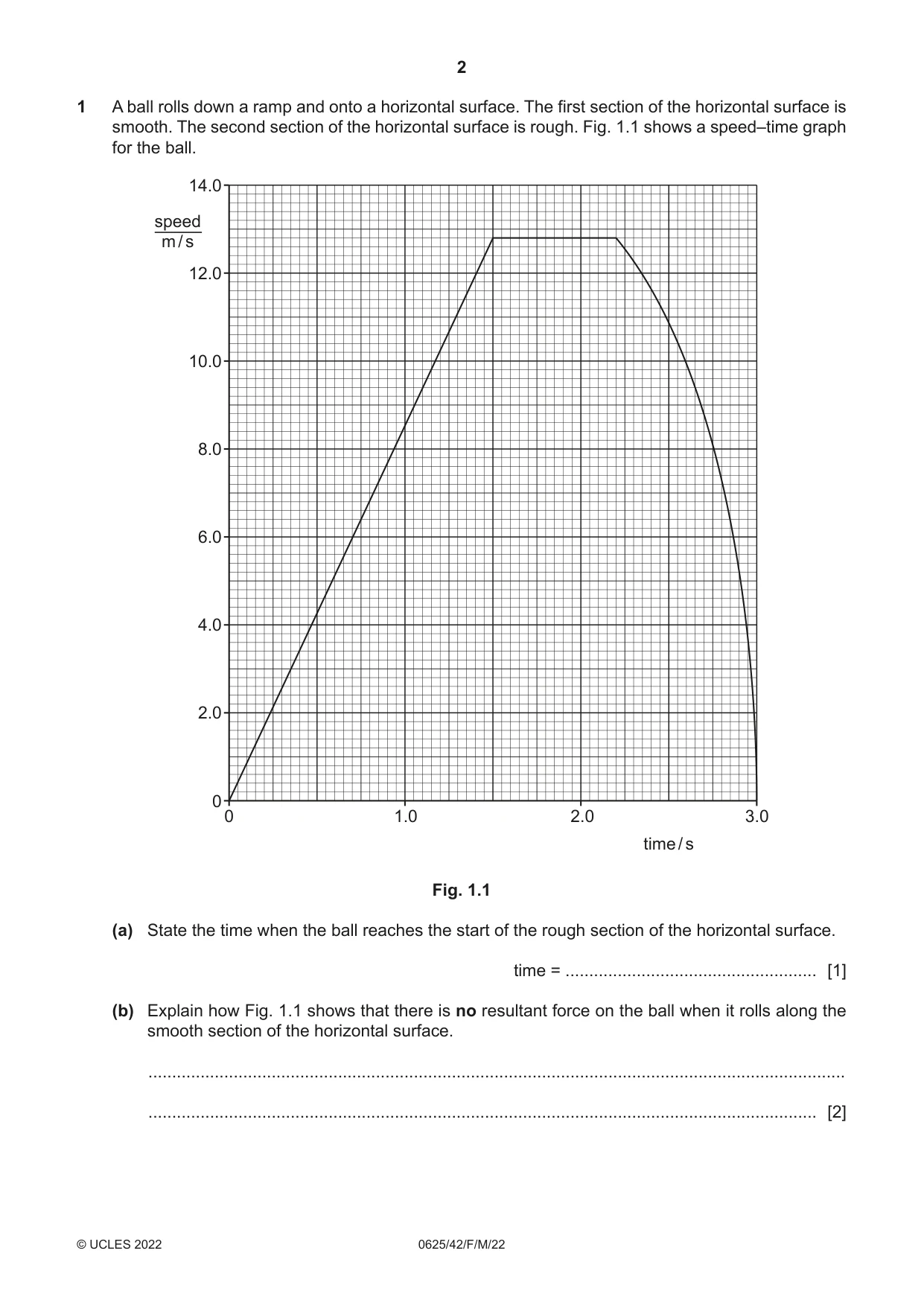
1 A ball rolls down a ramp and onto a horizontal surface. The first section of the horizontal surface is smooth. The second section of the horizontal surface is rough. Fig. 1.1 shows a speed–time graph for the ball. 14.0 speed m / s 12.0 10.0 8.0 6.0 4.0 2.0 0 0 1.0 2.0 3.0 time / s Fig. 1.1 (a) State the time when the ball reaches the start of the rough section of the horizontal surface. time = ..................................................... [1] (b) Explain how Fig. 1.1 shows that there is no resultant force on the ball when it rolls along the smooth section of the horizontal surface. ................................................................................................................................................... ............................................................................................................................................. [2] (c) Using Fig. 1.1, determine the acceleration of the ball as it rolls down the ramp. acceleration = ..................................................... [3] (d) The ball starts from rest at the top of the ramp. Show that the length of the ramp is 9.6 m. [2] [Total: 8]
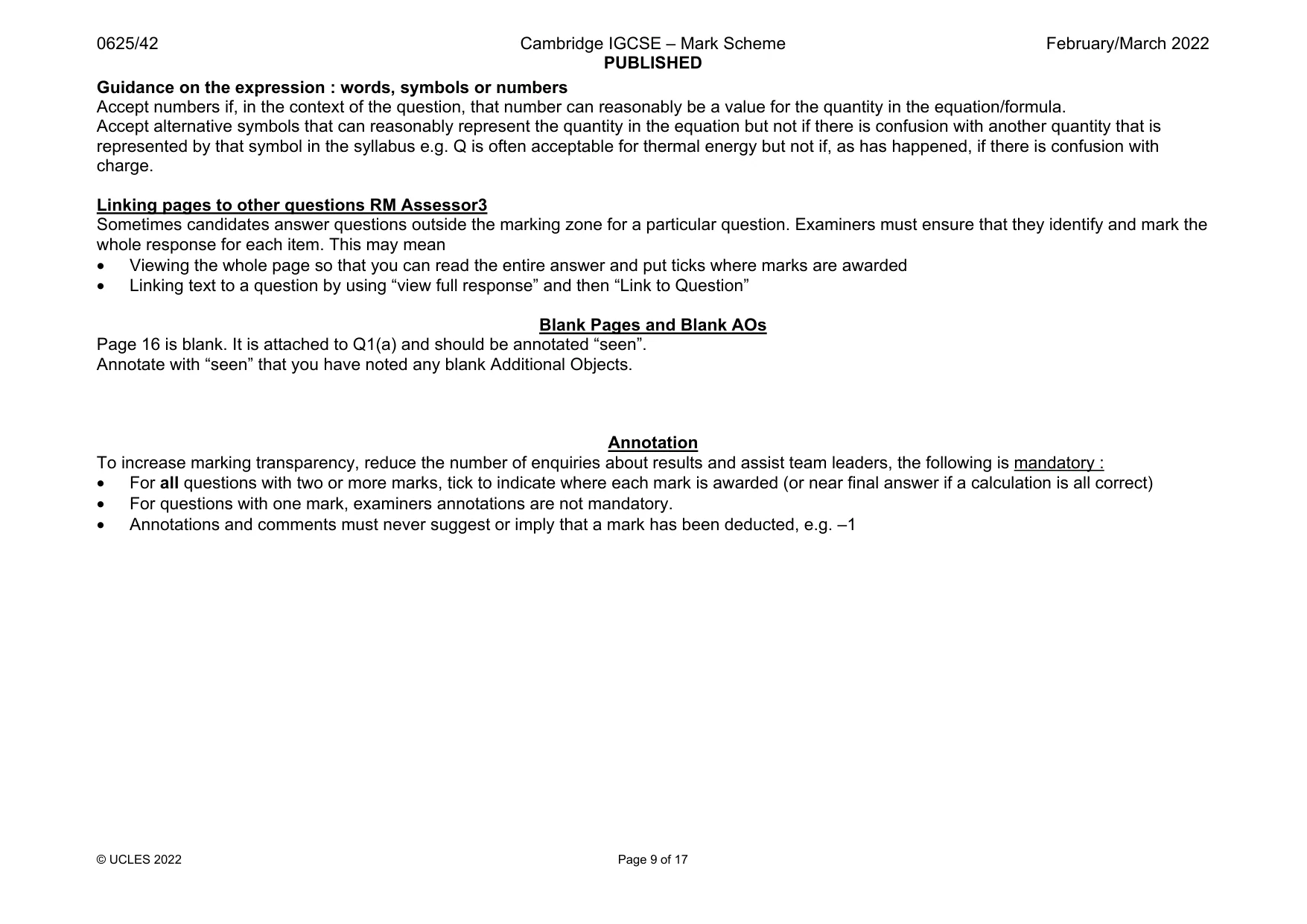
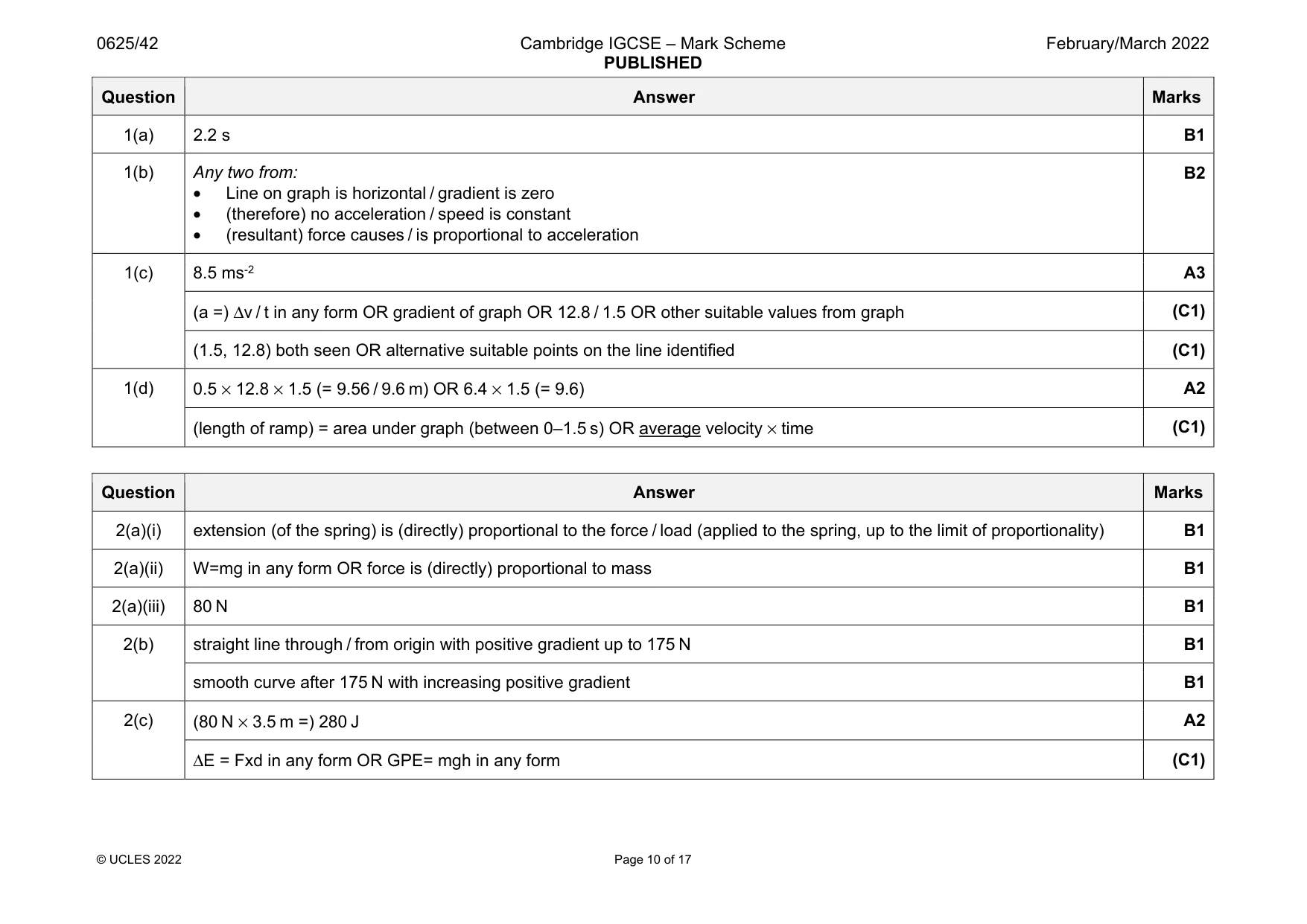
Mark scheme: 1(a) 2.2 s B1 1(b) Any two from: • Line on graph is horizontal / gradient is zero • (therefore) no acceleration / speed is constant • (resultant) force causes / is proportional to acceleration B2 1(c) 8.5 ms-2 A3 (a =) Δv / t in any form OR gradient of graph OR 12.8 / 1.5 OR other suitable values from graph (C1) (1.5, 12.8) both seen OR alternative suitable points on the line identified (C1) 1(d) 0.5 × 12.8 × 1.5 (= 9.56 / 9.6 m) OR 6.4 × 1.5 (= 9.6) A2 (length of ramp) = area under graph (between 0–1.5 s) OR average velocity × time (C1)
Q2 · A spring balance used to measure the weight of a baby
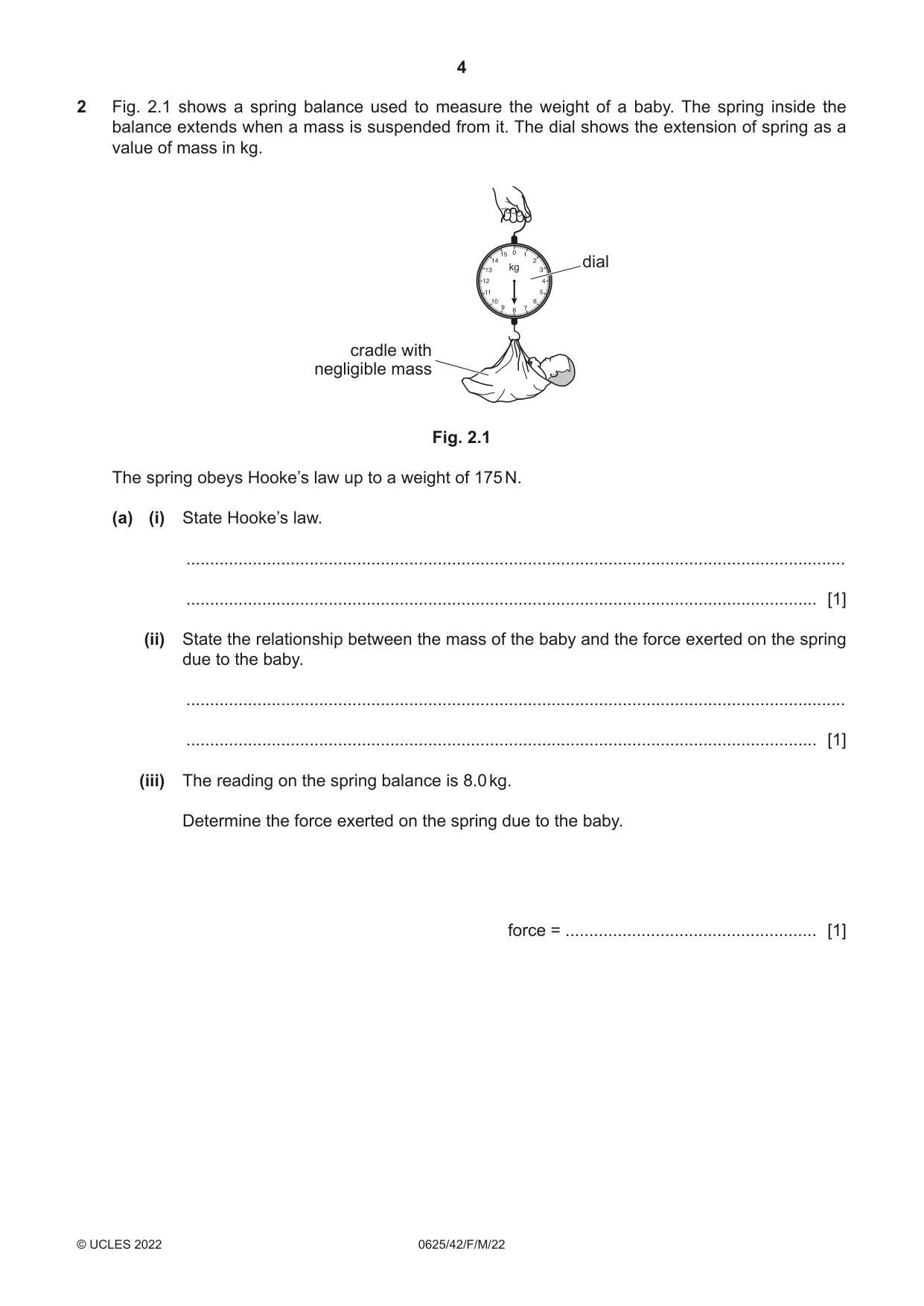
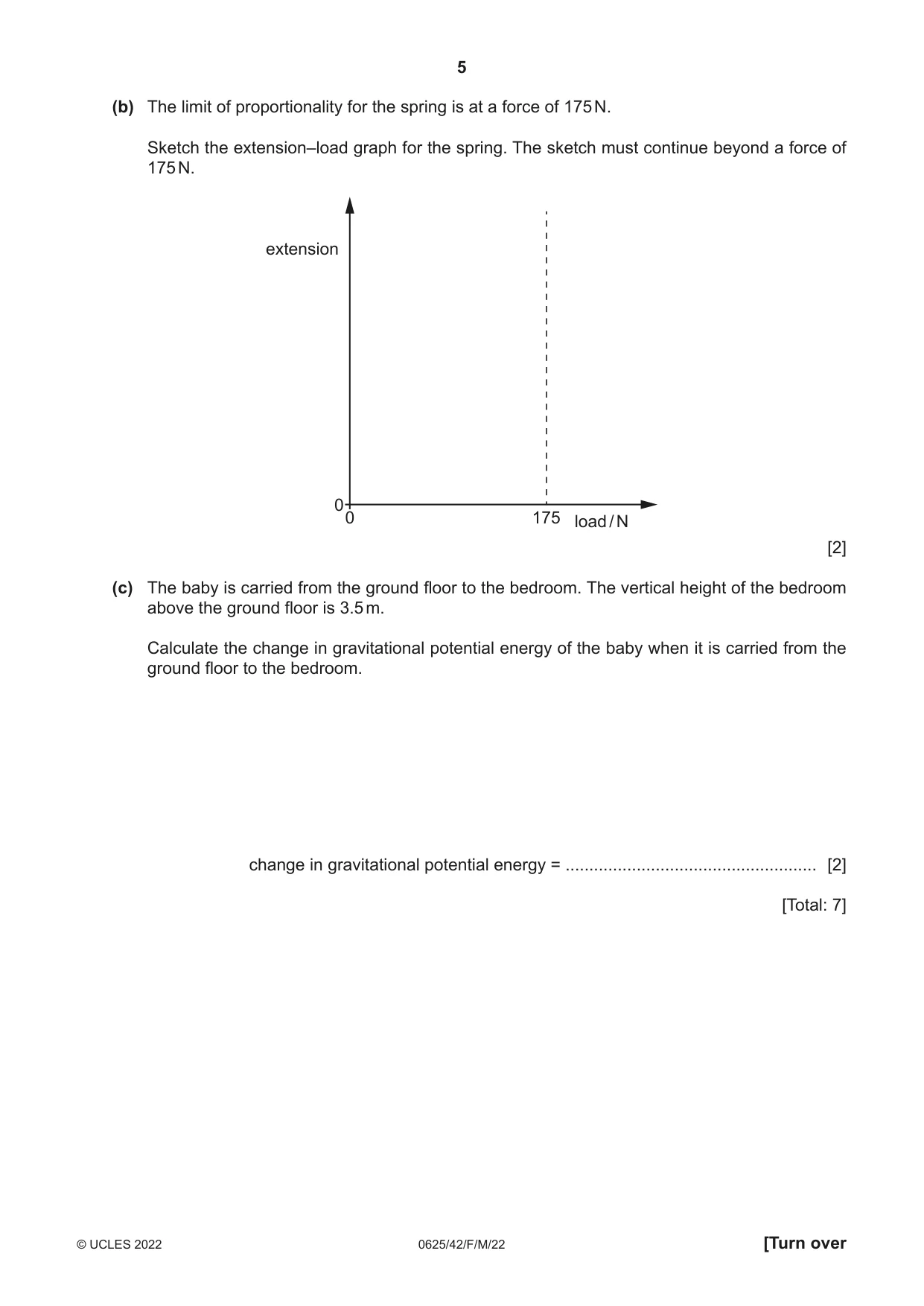
2 Fig. 2.1 shows a spring balance used to measure the weight of a baby. The spring inside the balance extends when a mass is suspended from it. The dial shows the extension of spring as a value of mass in kg. dial cradle with negligible mass Fig. 2.1 The spring obeys Hooke’s law up to a weight of 175 N. (a) (i) State Hooke’s law. ........................................................................................................................................... ..................................................................................................................................... [1] (ii) State the relationship between the mass of the baby and the force exerted on the spring due to the baby. ........................................................................................................................................... ..................................................................................................................................... [1] (iii) The reading on the spring balance is 8.0 kg. Determine the force exerted on the spring due to the baby. force = ..................................................... [1] (b) The limit of proportionality for the spring is at a force of 175 N. Sketch the extension–load graph for the spring. The sketch must continue beyond a force of 175 N. extension 0 0 175 load / N [2] (c) The baby is carried from the ground floor to the bedroom. The vertical height of the bedroom above the ground floor is 3.5 m. Calculate the change in gravitational potential energy of the baby when it is carried from the ground floor to the bedroom. change in gravitational potential energy = ..................................................... [2] [Total: 7]
Mark scheme: 2(a)(i) extension (of the spring) is (directly) proportional to the force / load (applied to the spring, up to the limit of proportionality) B1 2(a)(ii) W=mg in any form OR force is (directly) proportional to mass B1 2(a)(iii) 80 N B1 2(b) straight line through / from origin with positive gradient up to 175 N B1 smooth curve after 175 N with increasing positive gradient B1 2(c) (80 N × 3.5 m =) 280 J A2 ΔE = Fxd in any form OR GPE= mgh in any form (C1)
Question 3
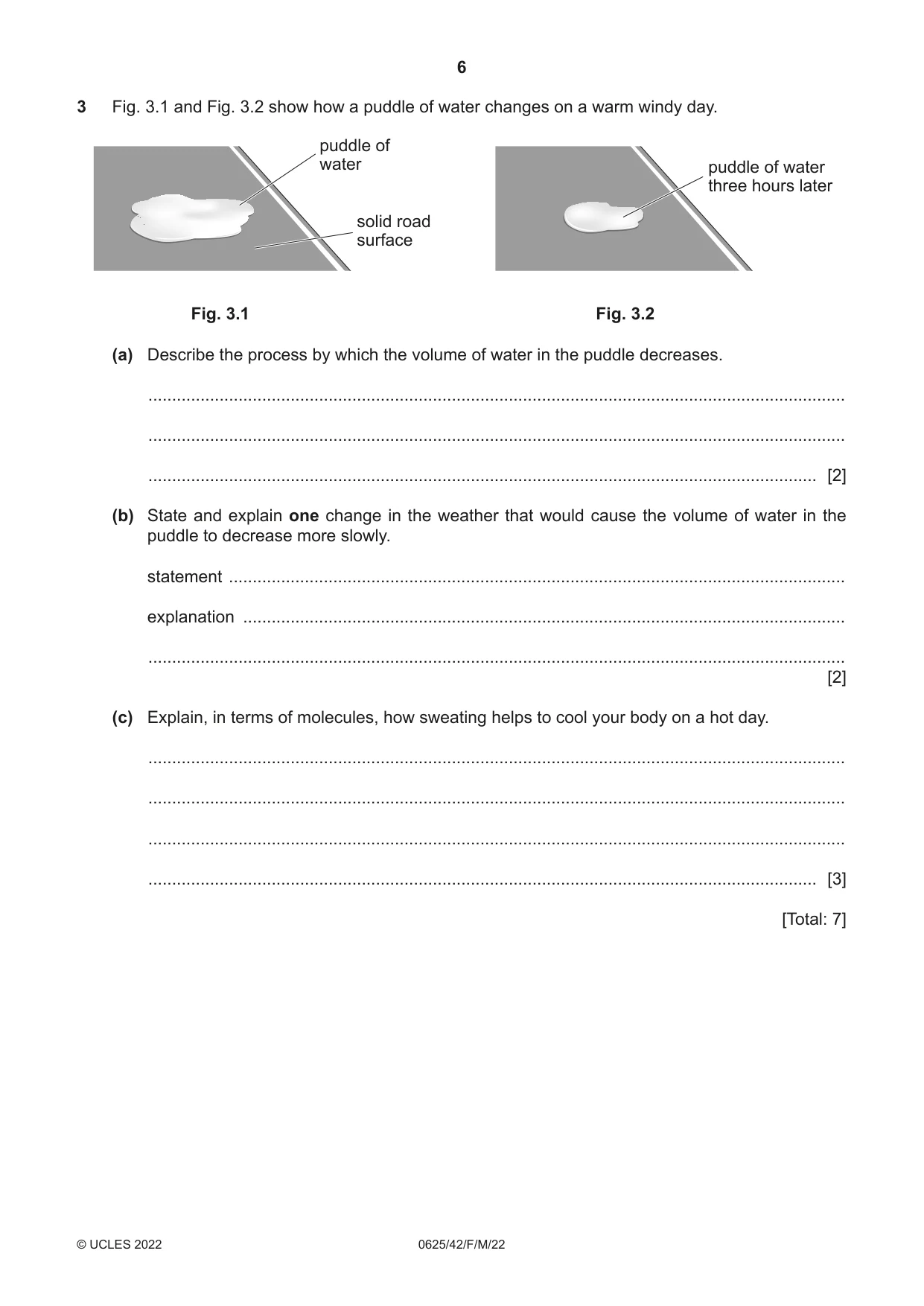
3 Fig. 3.1 and Fig. 3.2 show how a puddle of water changes on a warm windy day. puddle of water puddle of water three hours later solid road surface Fig. 3.1 Fig. 3.2 (a) Describe the process by which the volume of water in the puddle decreases. ................................................................................................................................................... ................................................................................................................................................... ............................................................................................................................................. [2] (b) State and explain one change in the weather that would cause the volume of water in the puddle to decrease more slowly. statement .................................................................................................................................. explanation ............................................................................................................................... ................................................................................................................................................... [2] (c) Explain, in terms of molecules, how sweating helps to cool your body on a hot day. ................................................................................................................................................... ................................................................................................................................................... ................................................................................................................................................... ............................................................................................................................................. [3] [Total: 7]
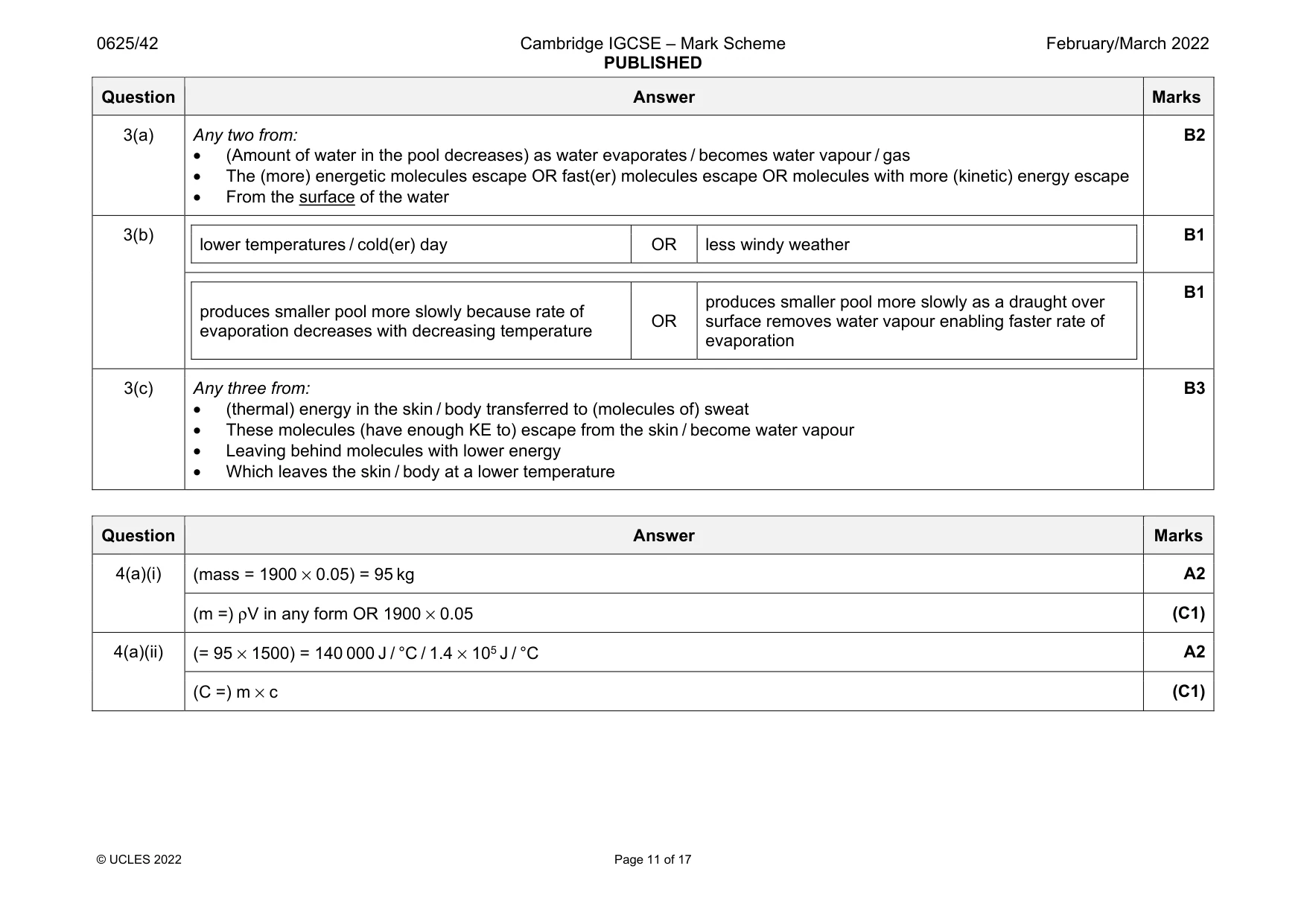
Mark scheme: 3(a) Any two from: • (Amount of water in the pool decreases) as water evaporates / becomes water vapour / gas • The (more) energetic molecules escape OR fast(er) molecules escape OR molecules with more (kinetic) energy escape • From the surface of the water B2 3(b) lower temperatures / cold(er) day OR less windy weather B1 produces smaller pool more slowly because rate of evaporation decreases with decreasing temperature OR produces smaller pool more slowly as a draught over surface removes water vapour enabling faster rate of evaporation B1 3(c) Any three from: • (thermal) energy in the skin / body transferred to (molecules of) sweat • These molecules (have enough KE to) escape from the skin / become water vapour • Leaving behind molecules with lower energy • Which leaves the skin / body at a lower temperature B3
Q4 · A sample of sand has a volume of 0.050 m3
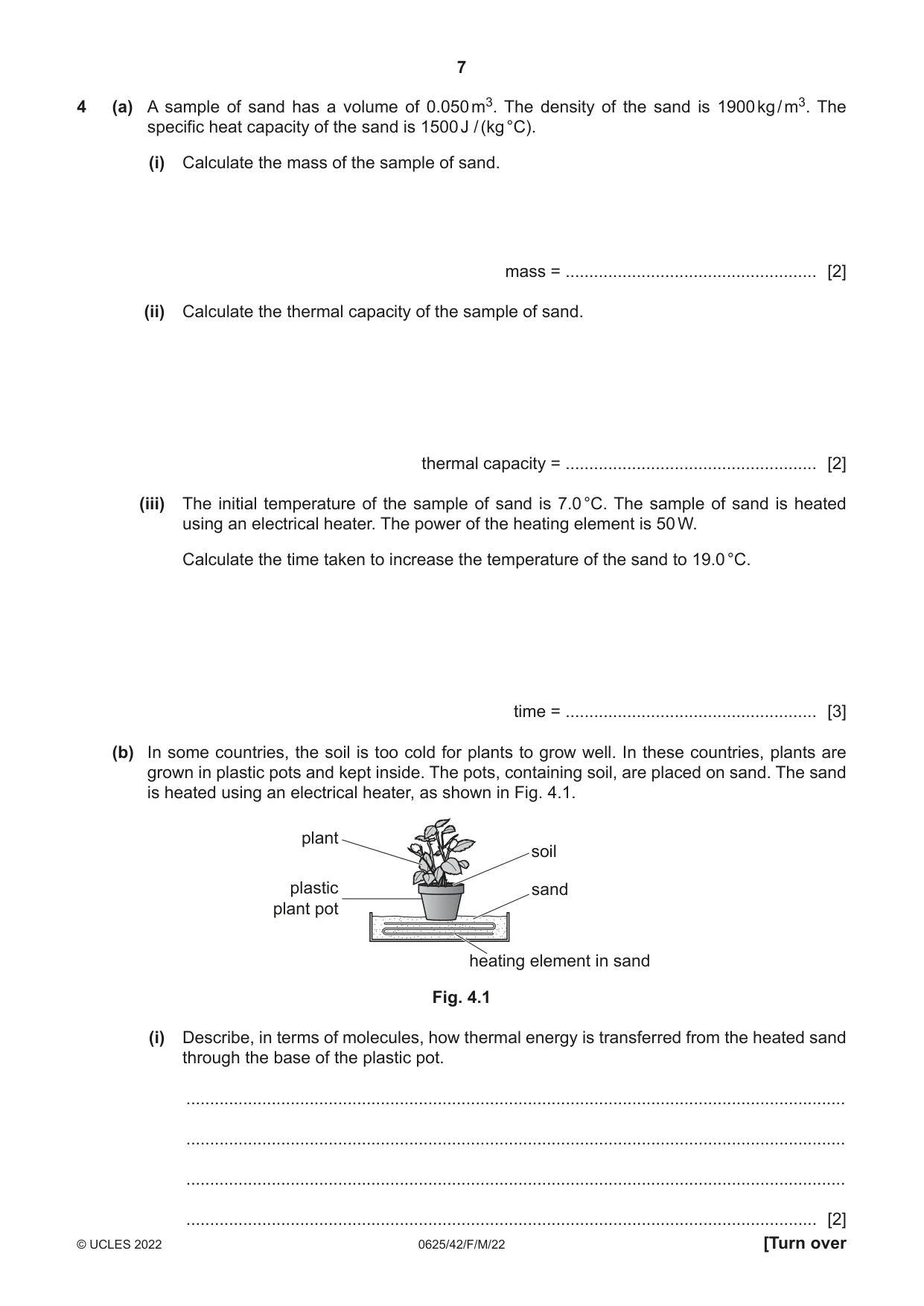
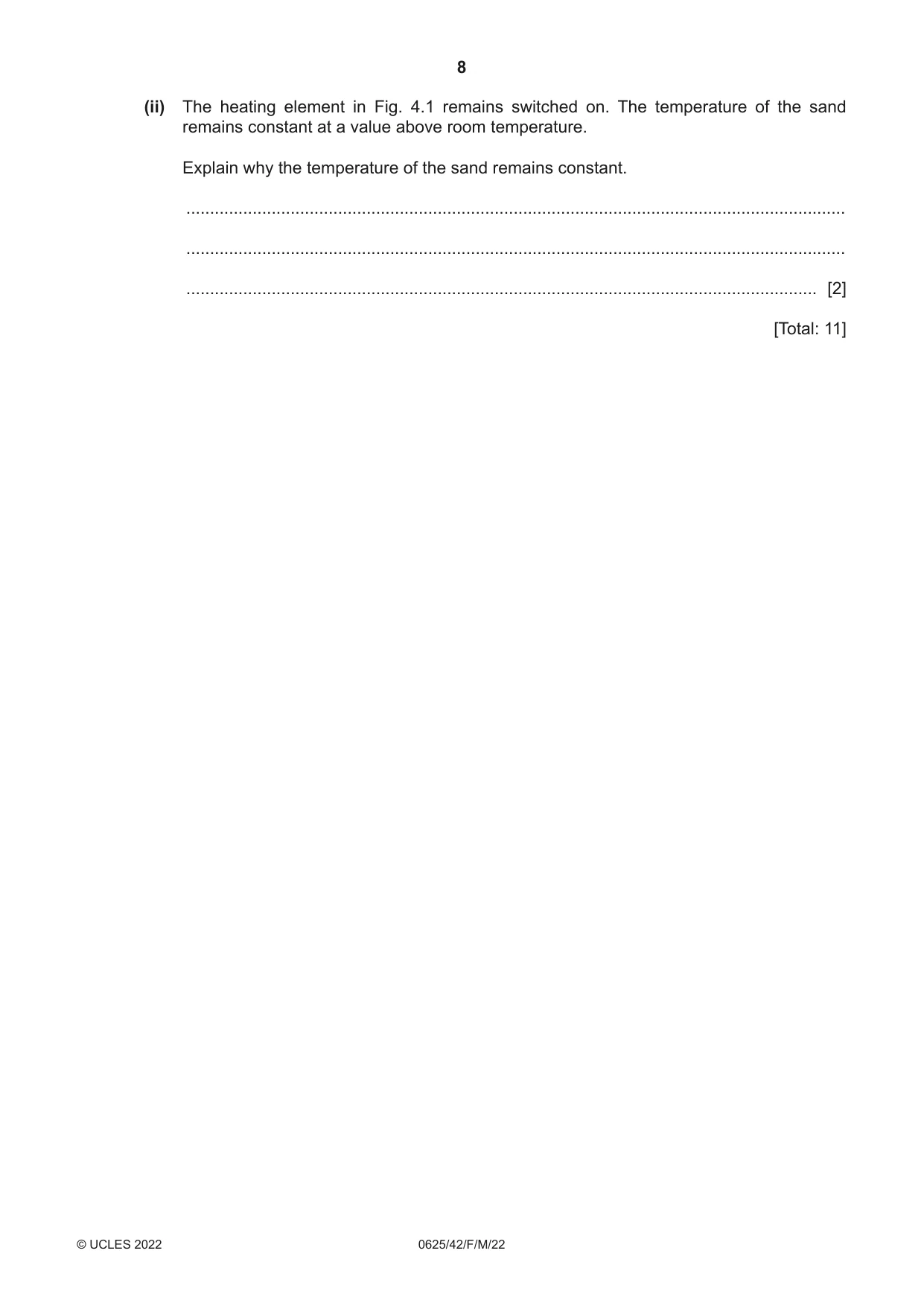
4 (a) A sample of sand has a volume of 0.050 m3. The density of the sand is 1900 kg / m3. The specific heat capacity of the sand is 1500 J / (kg °C). (i) Calculate the mass of the sample of sand. mass = ..................................................... [2] (ii) Calculate the thermal capacity of the sample of sand. thermal capacity = ..................................................... [2] (iii) The initial temperature of the sample of sand is 7.0 °C. The sample of sand is heated using an electrical heater. The power of the heating element is 50 W. Calculate the time taken to increase the temperature of the sand to 19.0 °C. time = ..................................................... [3] (b) In some countries, the soil is too cold for plants to grow well. In these countries, plants are grown in plastic pots and kept inside. The pots, containing soil, are placed on sand. The sand is heated using an electrical heater, as shown in Fig. 4.1. plant soil plastic sand plant pot heating element in sand Fig. 4.1 (i) Describe, in terms of molecules, how thermal energy is transferred from the heated sand through the base of the plastic pot. ........................................................................................................................................... ........................................................................................................................................... ........................................................................................................................................... ..................................................................................................................................... [2] (ii) The heating element in Fig. 4.1 remains switched on. The temperature of the sand remains constant at a value above room temperature. Explain why the temperature of the sand remains constant. ........................................................................................................................................... ........................................................................................................................................... ..................................................................................................................................... [2] [Total: 11]
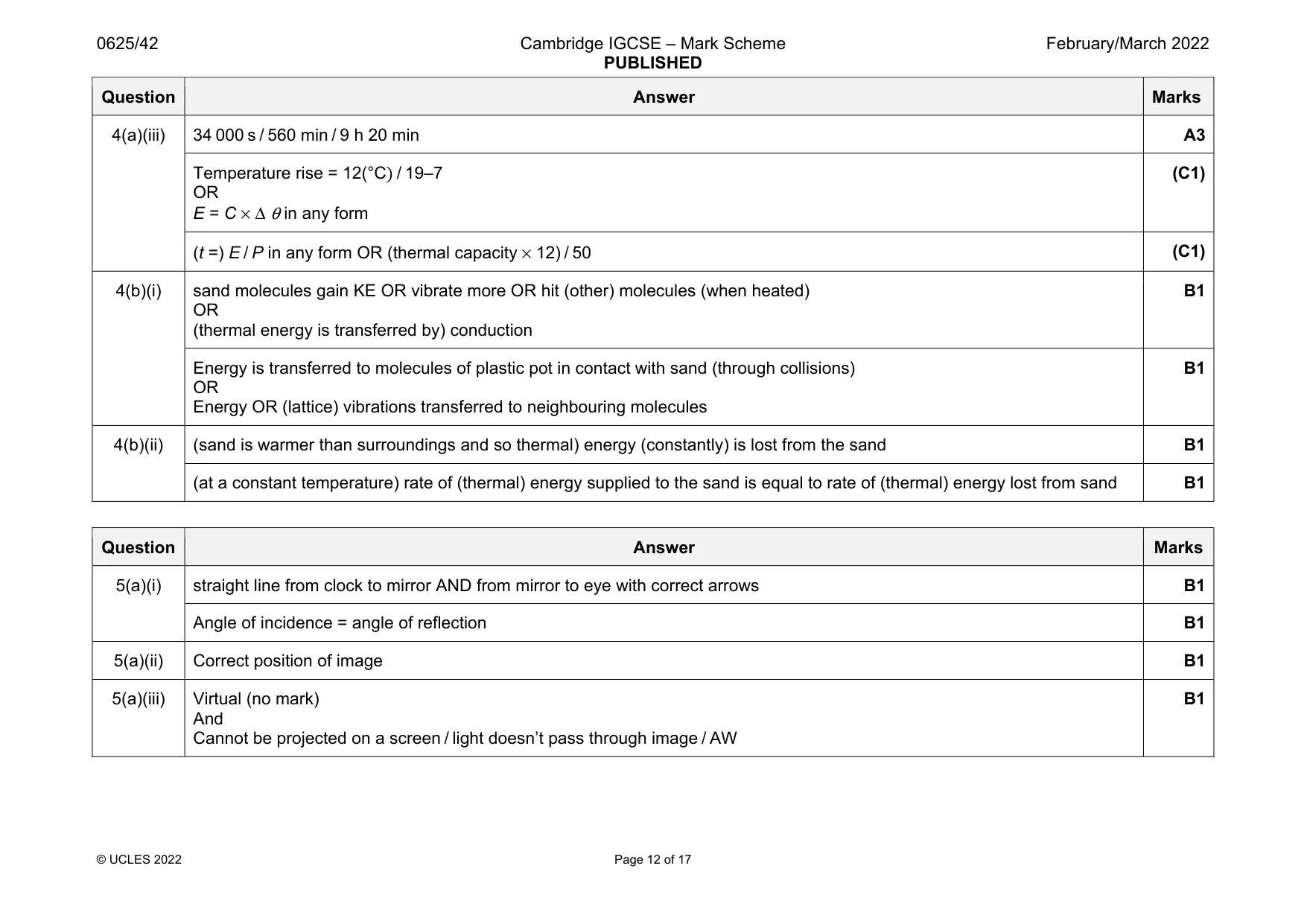
Mark scheme: 4(a)(i) (mass = 1900 × 0.05) = 95 kg A2 (m =) ρV in any form OR 1900 × 0.05 (C1) 4(a)(ii) (= 95 × 1500) = 140 000 J / °C / 1.4 × 10⁵ J / °C A2 (C =) m × c (C1) Question Answer Marks 4(a)(iii) 34 000 s / 560 min / 9 h 20 min A3 Temperature rise = 12(°C) / 19–7 OR E = C × Δ θ in any form (C1) (t =) E / P in any form OR (thermal capacity × 12) / 50 (C1) 4(b)(i) sand molecules gain KE OR vibrate more OR hit (other) molecules (when heated) OR (thermal energy is transferred by) conduction B1 Energy is transferred to molecules of plastic pot in contact with sand (through collisions) OR Energy OR (lattice) vibrations transferred to neighbouring molecules B1 4(b)(ii) (sand is warmer than surroundings and so thermal) energy (constantly) is lost from the sand B1 (at a constant temperature) rate of (thermal) energy supplied to the sand is equal to rate of (thermal) energy lost from sand B1
Q5 · A boy looks at the image of a clock in a plane mirror
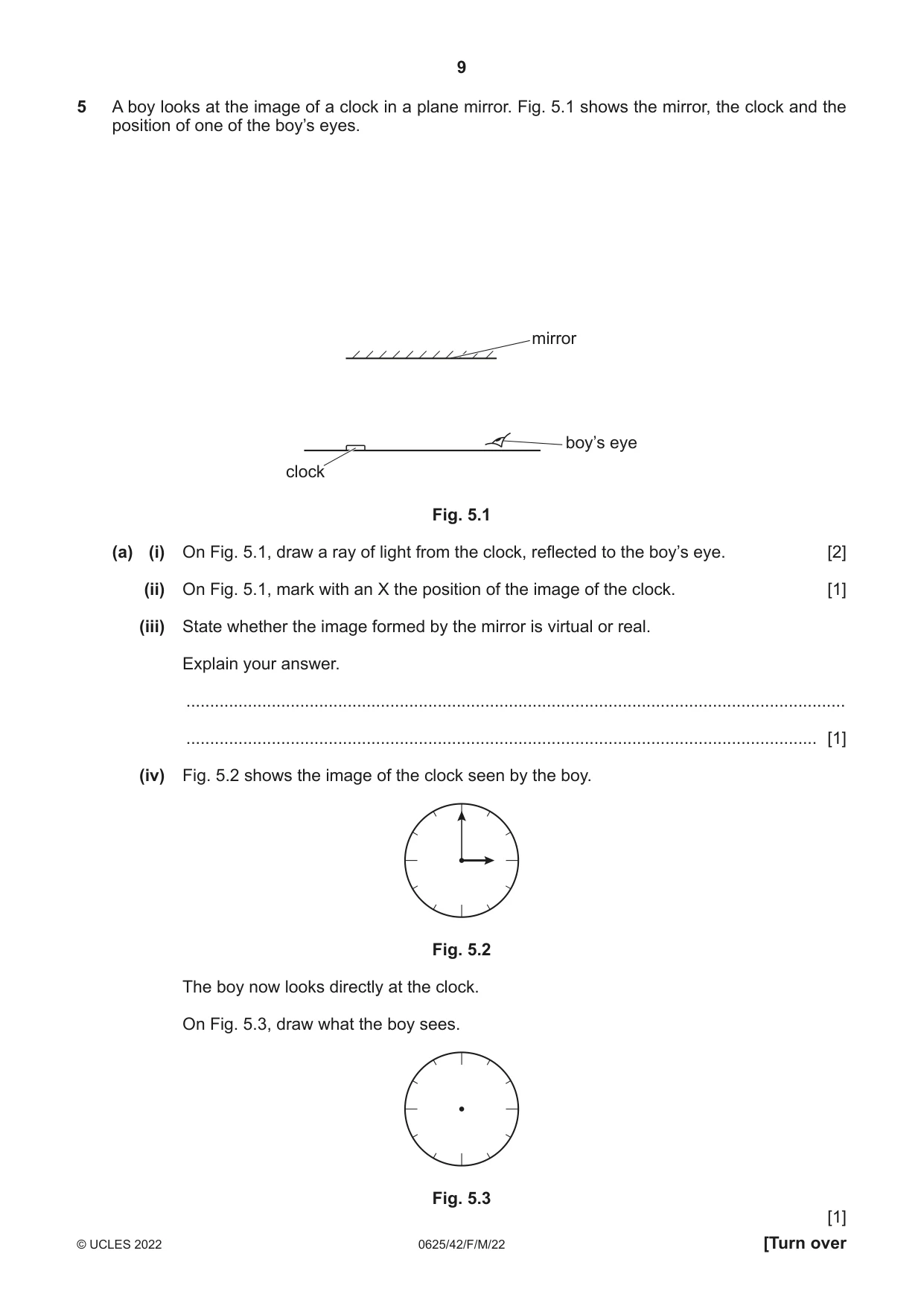
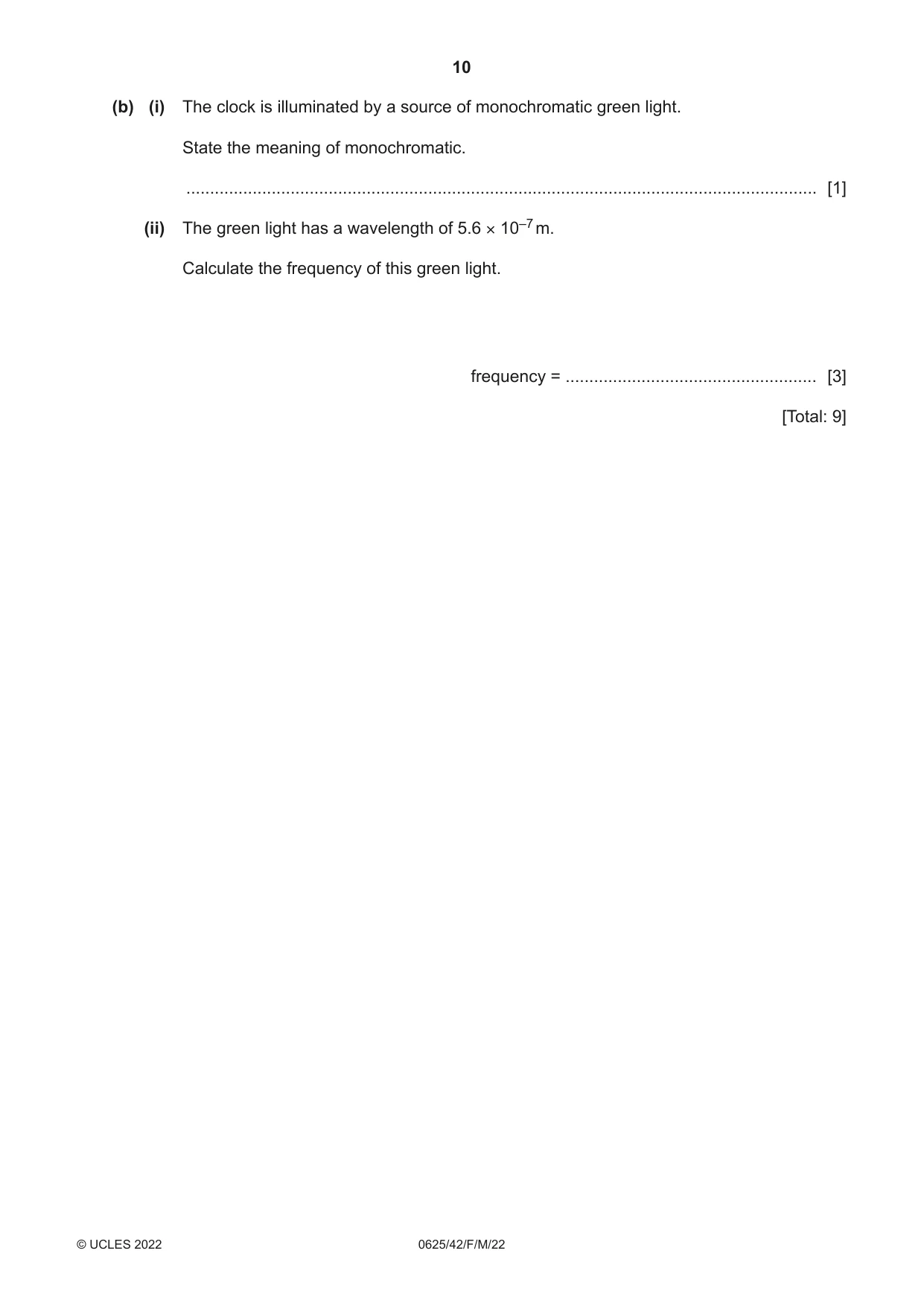
5 A boy looks at the image of a clock in a plane mirror. Fig. 5.1 shows the mirror, the clock and the position of one of the boy’s eyes. mirror boy’s eye clock Fig. 5.1 (a) (i) On Fig. 5.1, draw a ray of light from the clock, reflected to the boy’s eye. [2] (ii) On Fig. 5.1, mark with an X the position of the image of the clock. [1] (iii) State whether the image formed by the mirror is virtual or real. Explain your answer. ........................................................................................................................................... ..................................................................................................................................... [1] (iv) Fig. 5.2 shows the image of the clock seen by the boy. Fig. 5.2 The boy now looks directly at the clock. On Fig. 5.3, draw what the boy sees. Fig. 5.3 [1] (b) (i) The clock is illuminated by a source of monochromatic green light. State the meaning of monochromatic. ..................................................................................................................................... [1] (ii) The green light has a wavelength of 5.6 × 10⁻⁷ m. Calculate the frequency of this green light. frequency = ..................................................... [3] [Total: 9]
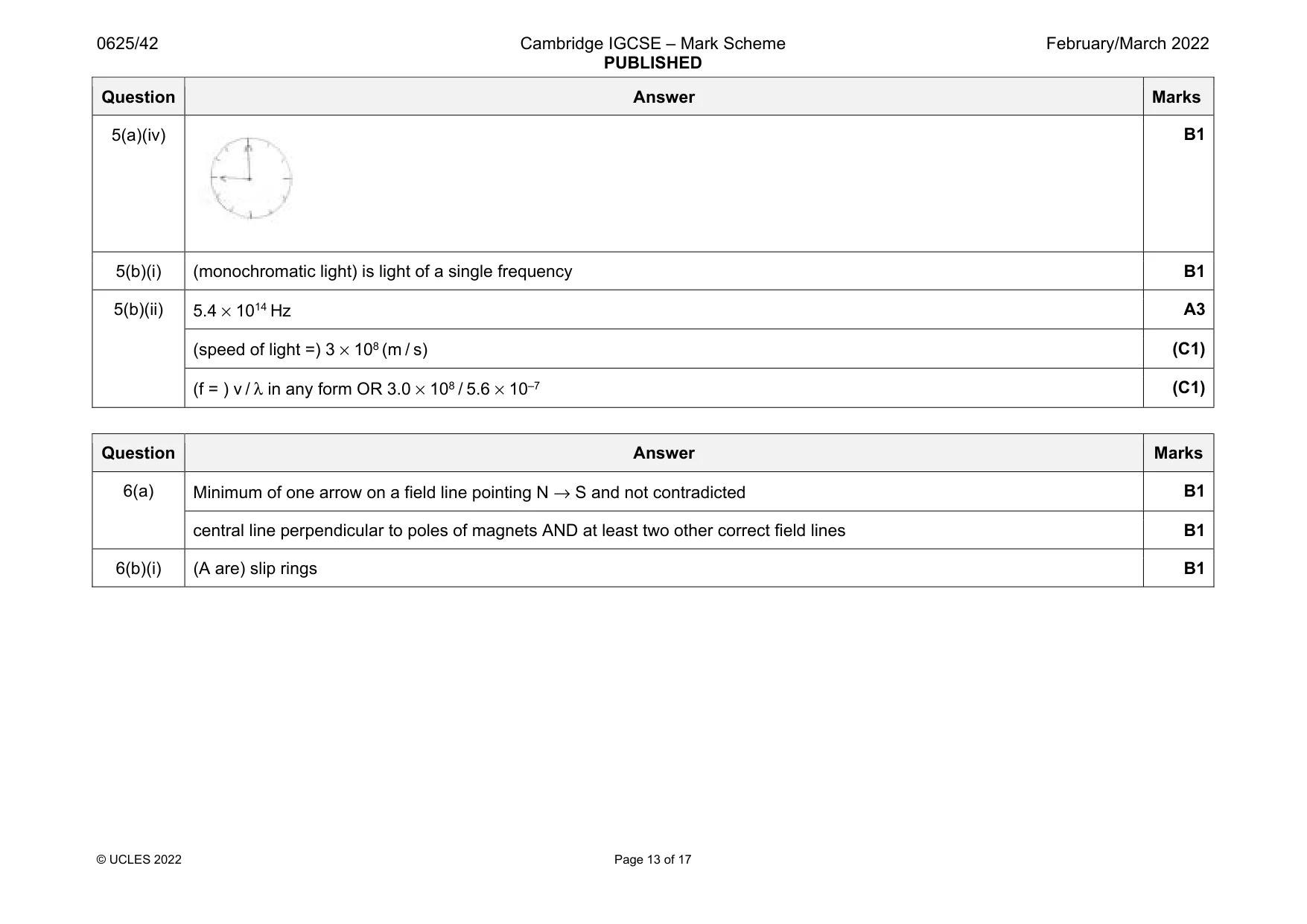
Mark scheme: 5(a)(i) straight line from clock to mirror AND from mirror to eye with correct arrows B1 Angle of incidence = angle of reflection B1 5(a)(ii) Correct position of image B1 5(a)(iii) Virtual (no mark) And Cannot be projected on a screen / light doesn’t pass through image / AW B1 Question Answer Marks 5(a)(iv) B1 5(b)(i) (monochromatic light) is light of a single frequency B1 5(b)(ii) 5.4 × 10¹⁴ Hz A3 (speed of light =) 3 × 10⁸ (m / s) (C1) (f = ) v / λ in any form OR 3.0 × 10⁸ / 5.6 × 10⁻⁷ (C1)
Question 6
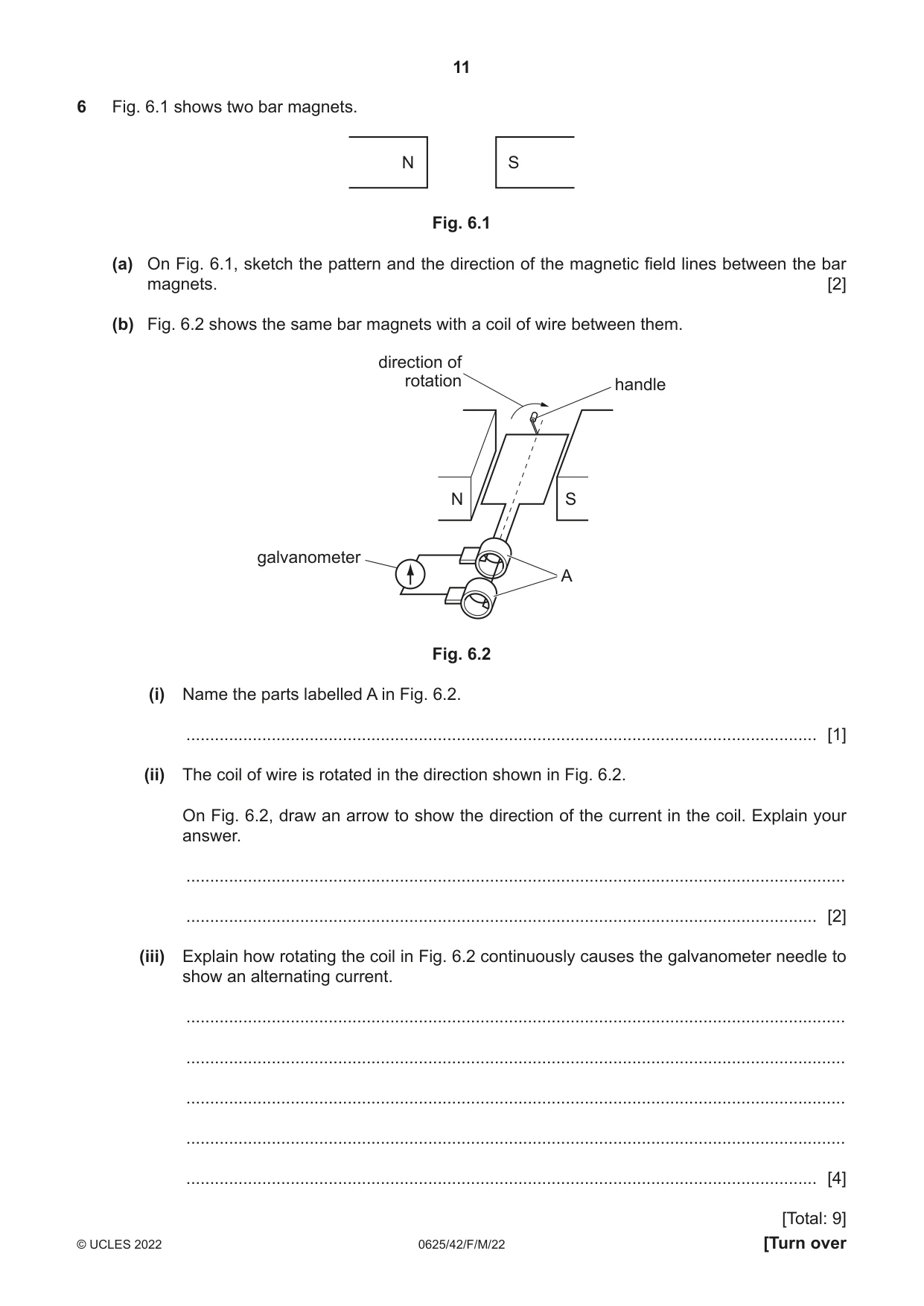
6 Fig. 6.1 shows two bar magnets. N S Fig. 6.1 (a) On Fig. 6.1, sketch the pattern and the direction of the magnetic field lines between the bar magnets. [2] (b) Fig. 6.2 shows the same bar magnets with a coil of wire between them. direction of rotation handle N S galvanometer A Fig. 6.2 (i) Name the parts labelled A in Fig. 6.2. ..................................................................................................................................... [1] (ii) The coil of wire is rotated in the direction shown in Fig. 6.2. On Fig. 6.2, draw an arrow to show the direction of the current in the coil. Explain your answer. ........................................................................................................................................... ..................................................................................................................................... [2] (iii) Explain how rotating the coil in Fig. 6.2 continuously causes the galvanometer needle to show an alternating current. ........................................................................................................................................... ........................................................................................................................................... ........................................................................................................................................... ........................................................................................................................................... ..................................................................................................................................... [4] [Total: 9]
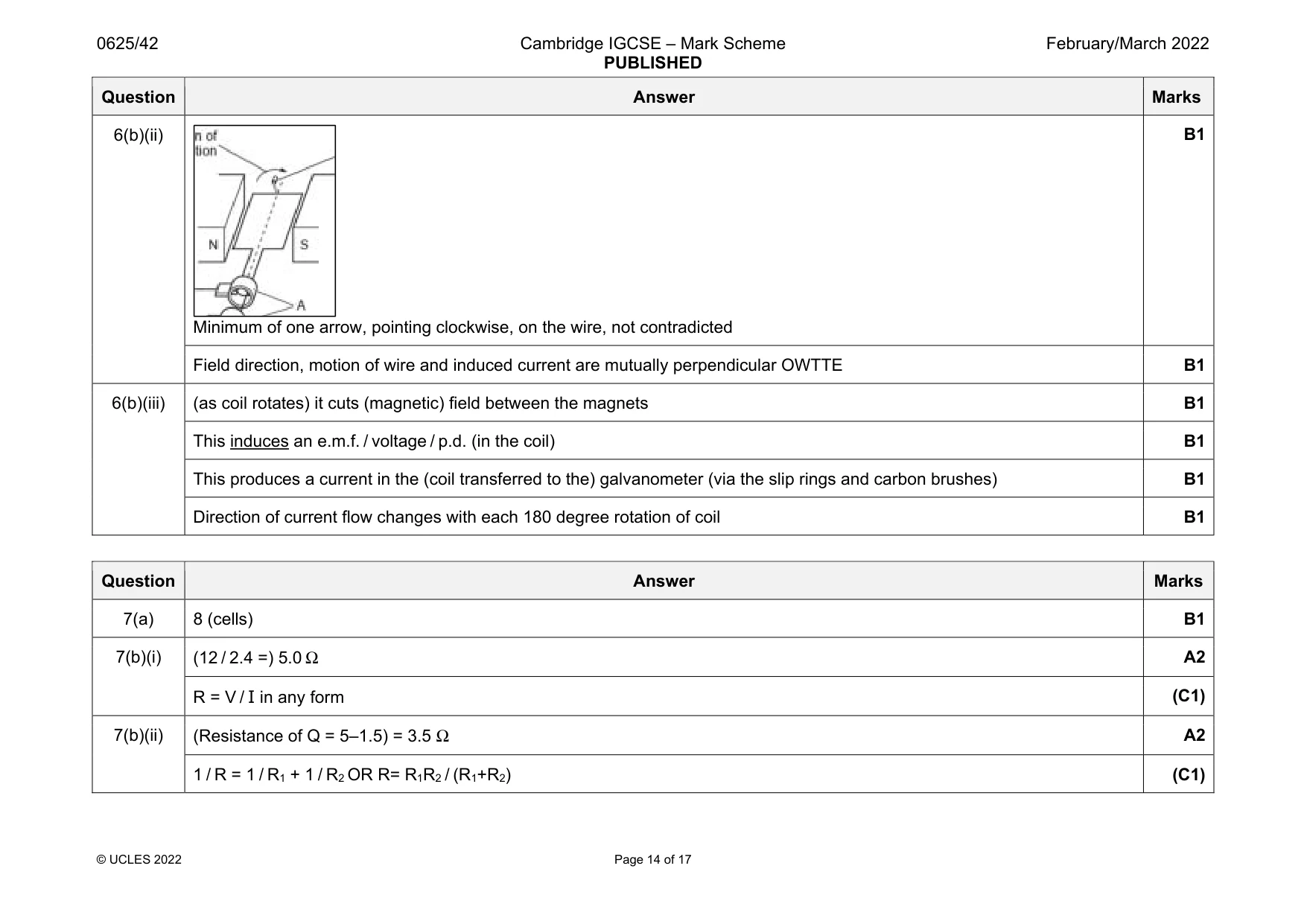
Mark scheme: 6(a) Minimum of one arrow on a field line pointing N → S and not contradicted B1 central line perpendicular to poles of magnets AND at least two other correct field lines B1 6(b)(i) (A are) slip rings B1 Question Answer Marks 6(b)(ii) Minimum of one arrow, pointing clockwise, on the wire, not contradicted B1 Field direction, motion of wire and induced current are mutually perpendicular OWTTE B1 6(b)(iii) (as coil rotates) it cuts (magnetic) field between the magnets B1 This induces an e.m.f. / voltage / p.d. (in the coil) B1 This produces a current in the (coil transferred to the) galvanometer (via the slip rings and carbon brushes) B1 Direction of current flow changes with each 180 degree rotation of coil B1
Q7 · A circuit including a 12 V battery and two identical lamps
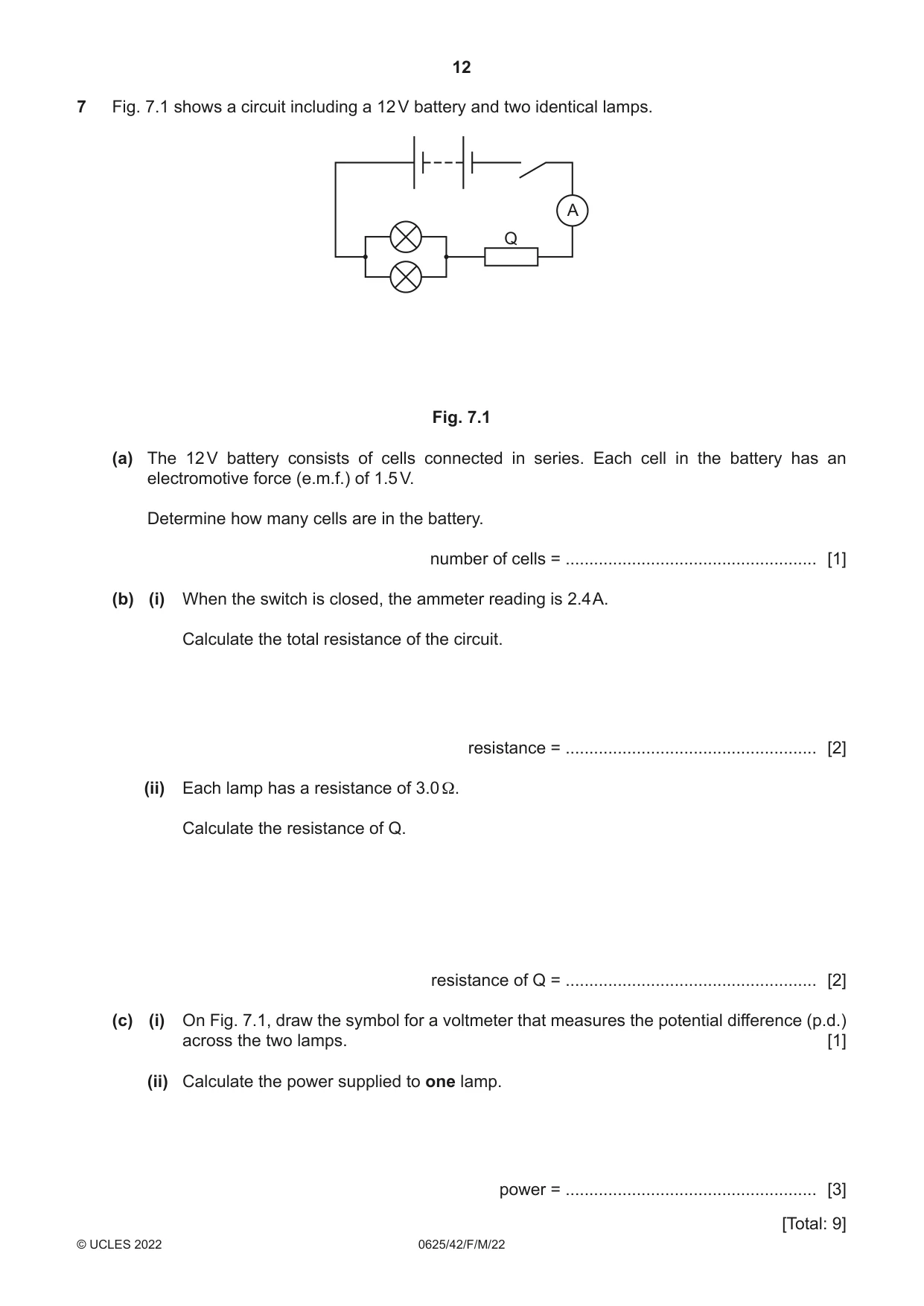
7 Fig. 7.1 shows a circuit including a 12 V battery and two identical lamps. A Q Fig. 7.1 (a) The 12 V battery consists of cells connected in series. Each cell in the battery has an electromotive force (e.m.f.) of 1.5 V. Determine how many cells are in the battery. number of cells = ..................................................... [1] (b) (i) When the switch is closed, the ammeter reading is 2.4 A. Calculate the total resistance of the circuit. resistance = ..................................................... [2] (ii) Each lamp has a resistance of 3.0 Ω. Calculate the resistance of Q. resistance of Q = ..................................................... [2] (c) (i) On Fig. 7.1, draw the symbol for a voltmeter that measures the potential difference (p.d.) across the two lamps. [1] (ii) Calculate the power supplied to one lamp. power = ..................................................... [3] [Total: 9]
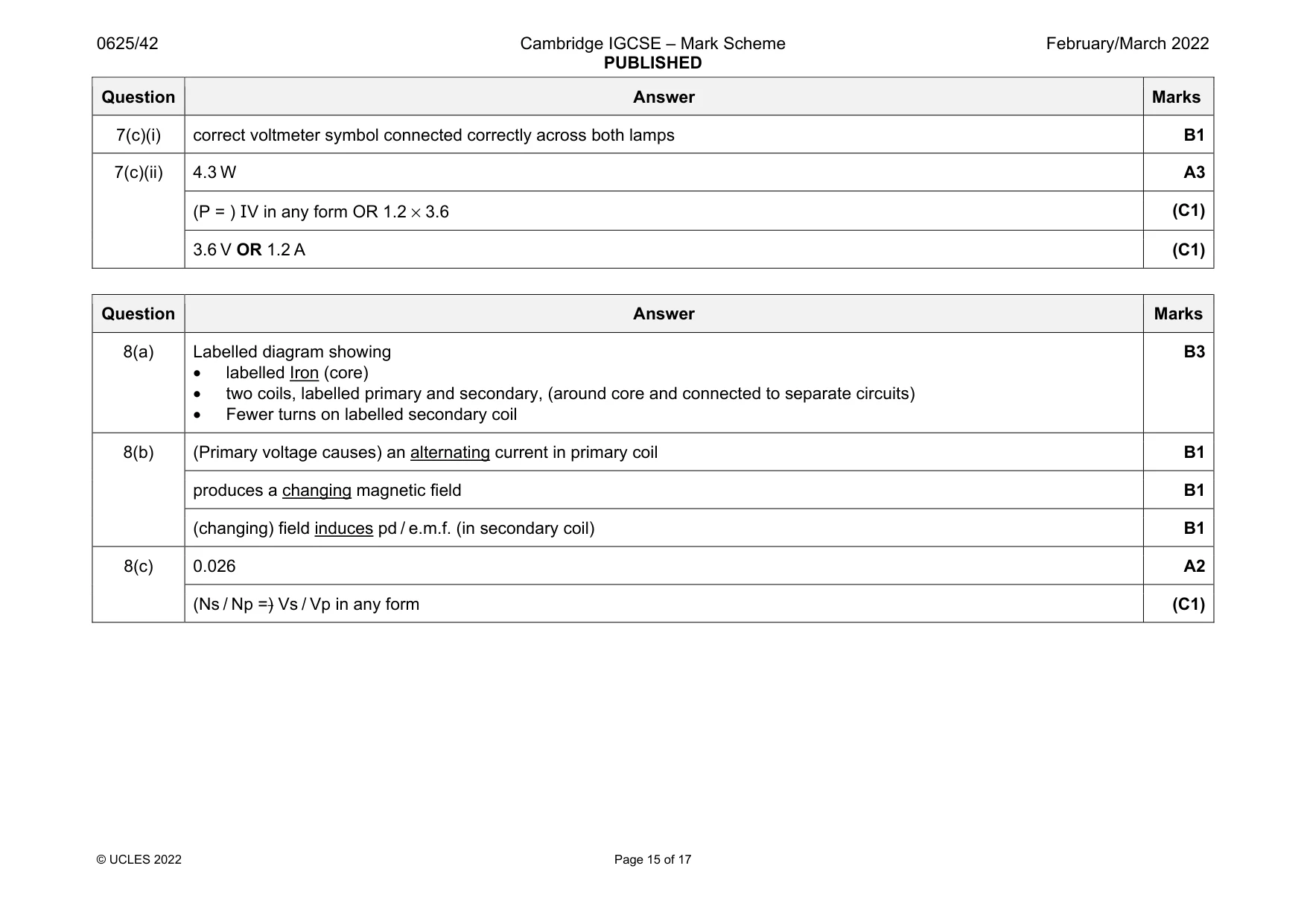
Mark scheme: 7(a) 8 (cells) B1 7(b)(i) (12 / 2.4 =) 5.0 Ω A2 R = V / I in any form (C1) 7(b)(ii) (Resistance of Q = 5–1.5) = 3.5 Ω A2 1 / R = 1 / R1 + 1 / R2 OR R= R1R2 / (R1+R2) (C1) Question Answer Marks 7(c)(i) correct voltmeter symbol connected correctly across both lamps B1 7(c)(ii) 4.3 W A3 (P = ) IV in any form OR 1.2 × 3.6 (C1) 3.6 V OR 1.2 A (C1)
Q8 · A radio is connected to the mains supply using a step-down transformer
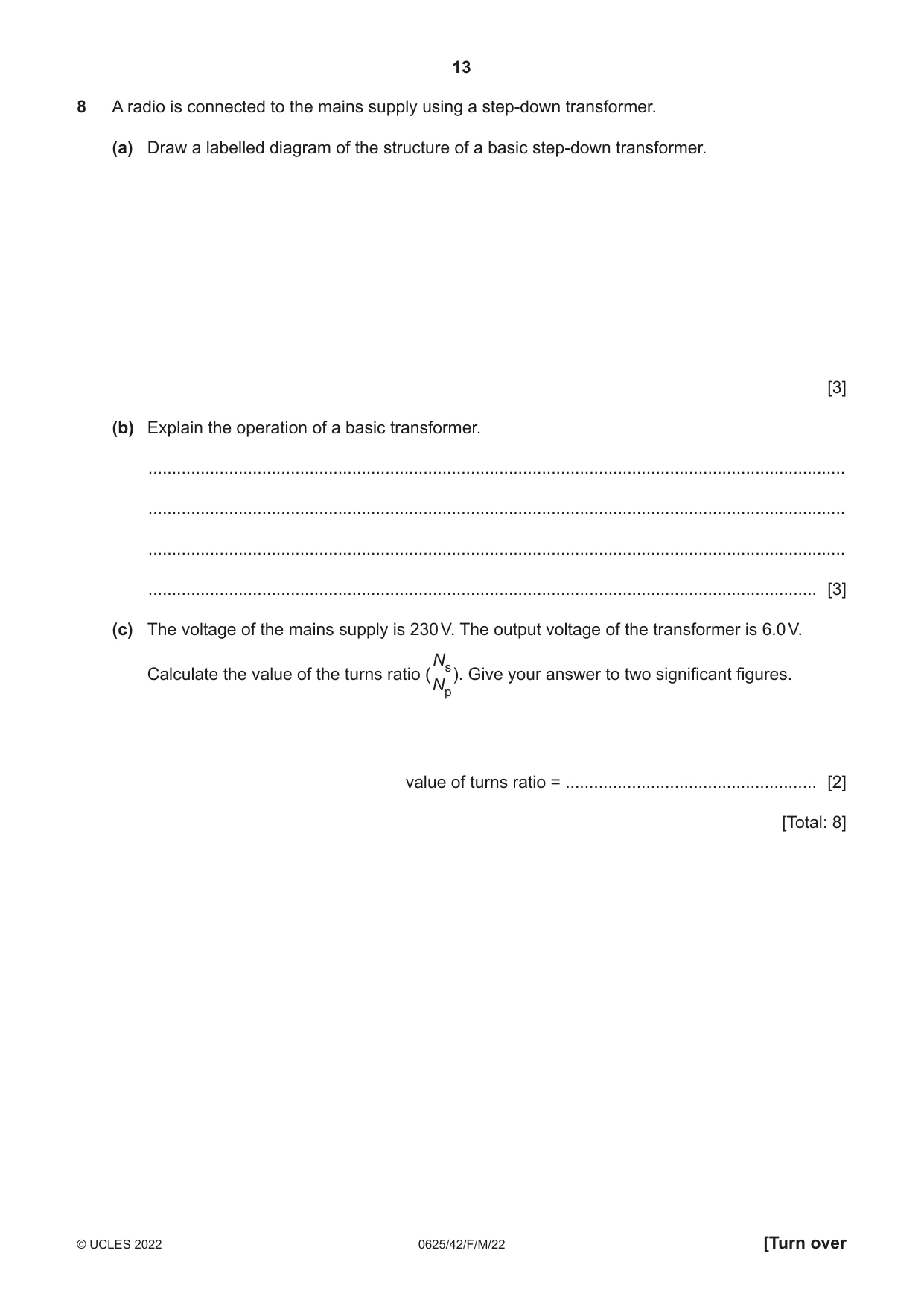
8 A radio is connected to the mains supply using a step-down transformer. (a) Draw a labelled diagram of the structure of a basic step-down transformer. [3] (b) Explain the operation of a basic transformer. ................................................................................................................................................... ................................................................................................................................................... ................................................................................................................................................... ............................................................................................................................................. [3] (c) The voltage of the mains supply is 230 V. The output voltage of the transformer is 6.0 V. Ns Calculate the value of the turns ratio ( ). Give your answer to two significant figures. Np value of turns ratio = ..................................................... [2] [Total: 8]
Mark scheme: 8(a) Labelled diagram showing • labelled Iron (core) • two coils, labelled primary and secondary, (around core and connected to separate circuits) • Fewer turns on labelled secondary coil B3 8(b) (Primary voltage causes) an alternating current in primary coil B1 produces a changing magnetic field B1 (changing) field induces pd / e.m.f. (in secondary coil) B1 8(c) 0.026 A2 (Ns / Np =) Vs / Vp in any form (C1)
Question 9
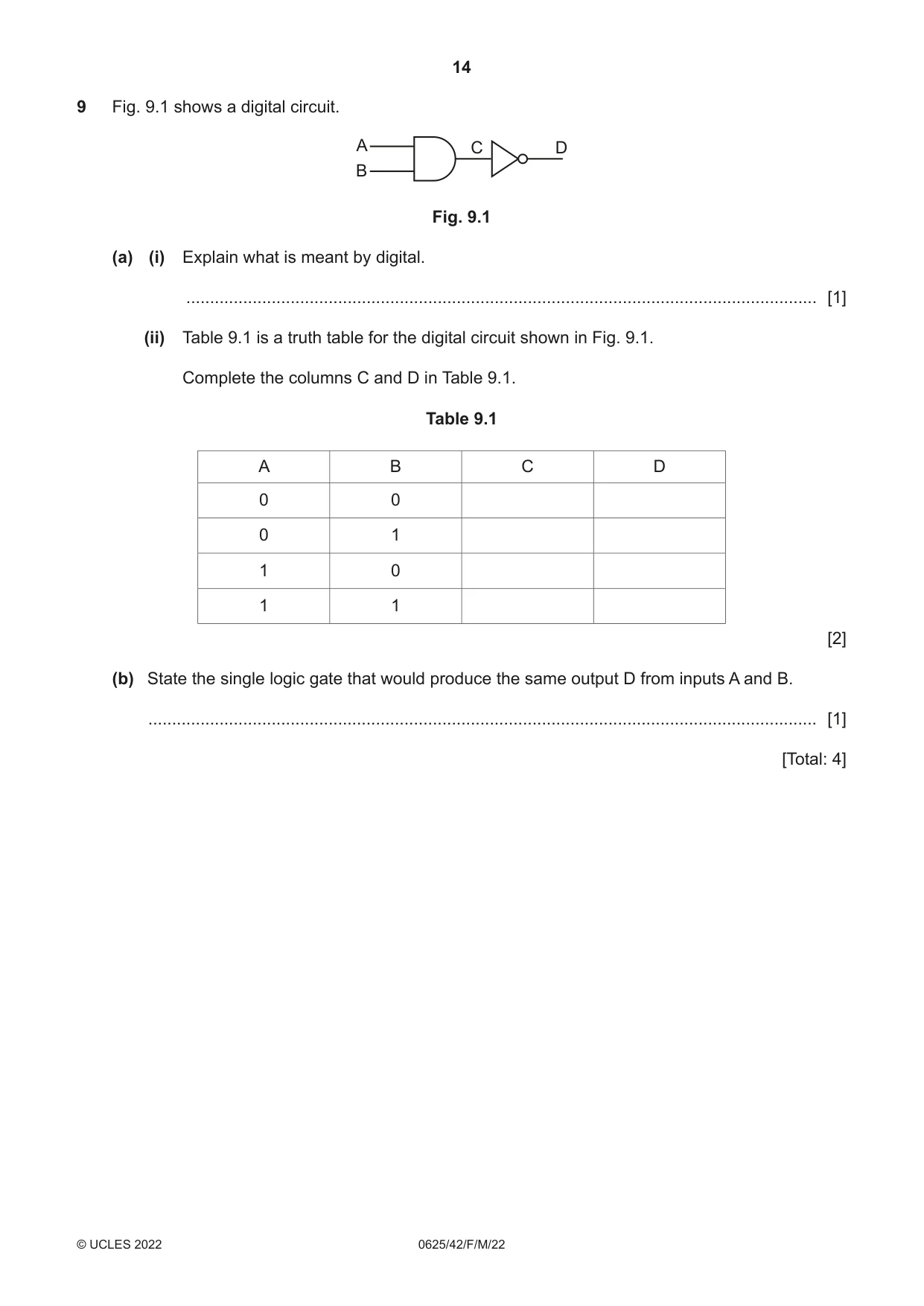
9 Fig. 9.1 shows a digital circuit. A C D B Fig. 9.1 (a) (i) Explain what is meant by digital. ..................................................................................................................................... [1] (ii) Table 9.1 is a truth table for the digital circuit shown in Fig. 9.1. Complete the columns C and D in Table 9.1. Table 9.1 A B C D 0 0 0 1 1 0 1 1 [2] (b) State the single logic gate that would produce the same output D from inputs A and B. ............................................................................................................................................. [1] [Total: 4]
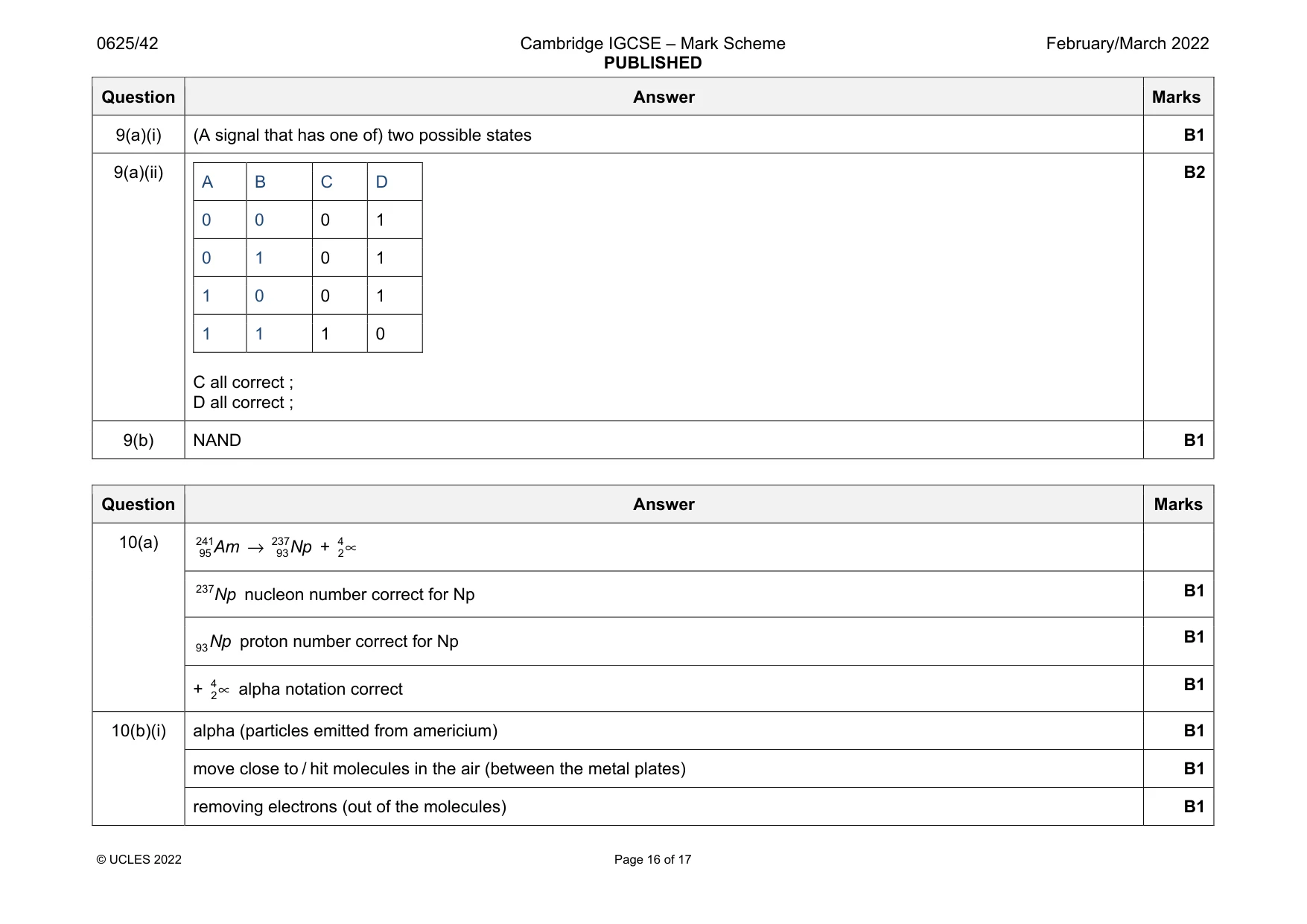
Mark scheme: 9(a)(i) (A signal that has one of) two possible states B1 9(a)(ii) A B C D 0 0 0 1 0 1 0 1 1 0 0 1 1 1 1 0 C all correct ; D all correct ; B2 9(b) NAND B1
Q10 · The isotope americium-241 is represented by 24195Am
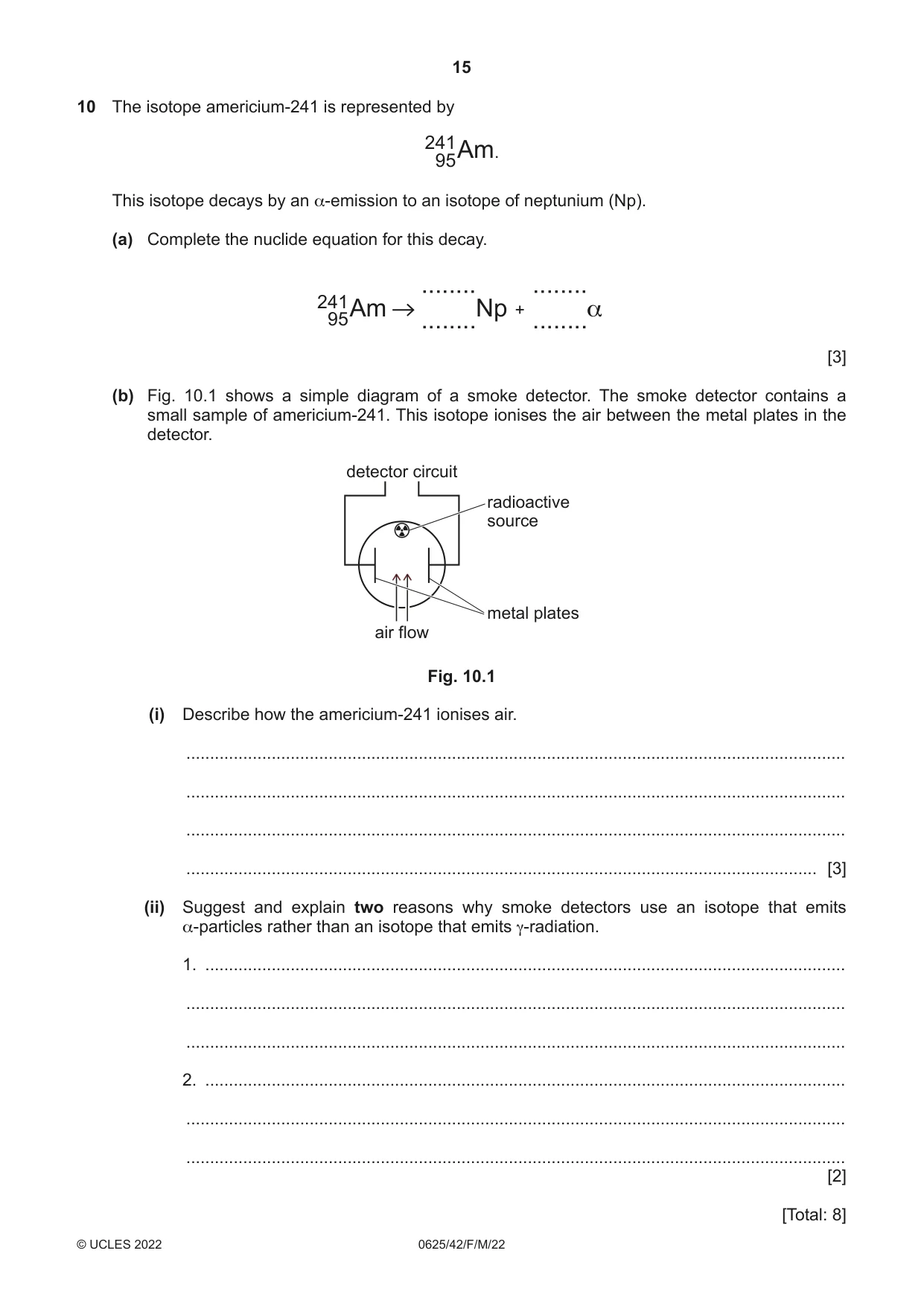
10 The isotope americium-241 is represented by 24195Am. This isotope decays by an α-emission to an isotope of neptunium (Np). (a) Complete the nuclide equation for this decay. 241 ........ ........ + α 95Am Np ........ ........ [3] (b) Fig. 10.1 shows a simple diagram of a smoke detector. The smoke detector contains a small sample of americium-241. This isotope ionises the air between the metal plates in the detector. detector circuit radioactive source metal plates air flow Fig. 10.1 (i) Describe how the americium-241 ionises air. ........................................................................................................................................... ........................................................................................................................................... ........................................................................................................................................... ..................................................................................................................................... [3] (ii) Suggest and explain two reasons why smoke detectors use an isotope that emits α-particles rather than an isotope that emits γ-radiation. 1. ....................................................................................................................................... ........................................................................................................................................... ........................................................................................................................................... 2. ....................................................................................................................................... ........................................................................................................................................... ........................................................................................................................................... [2]
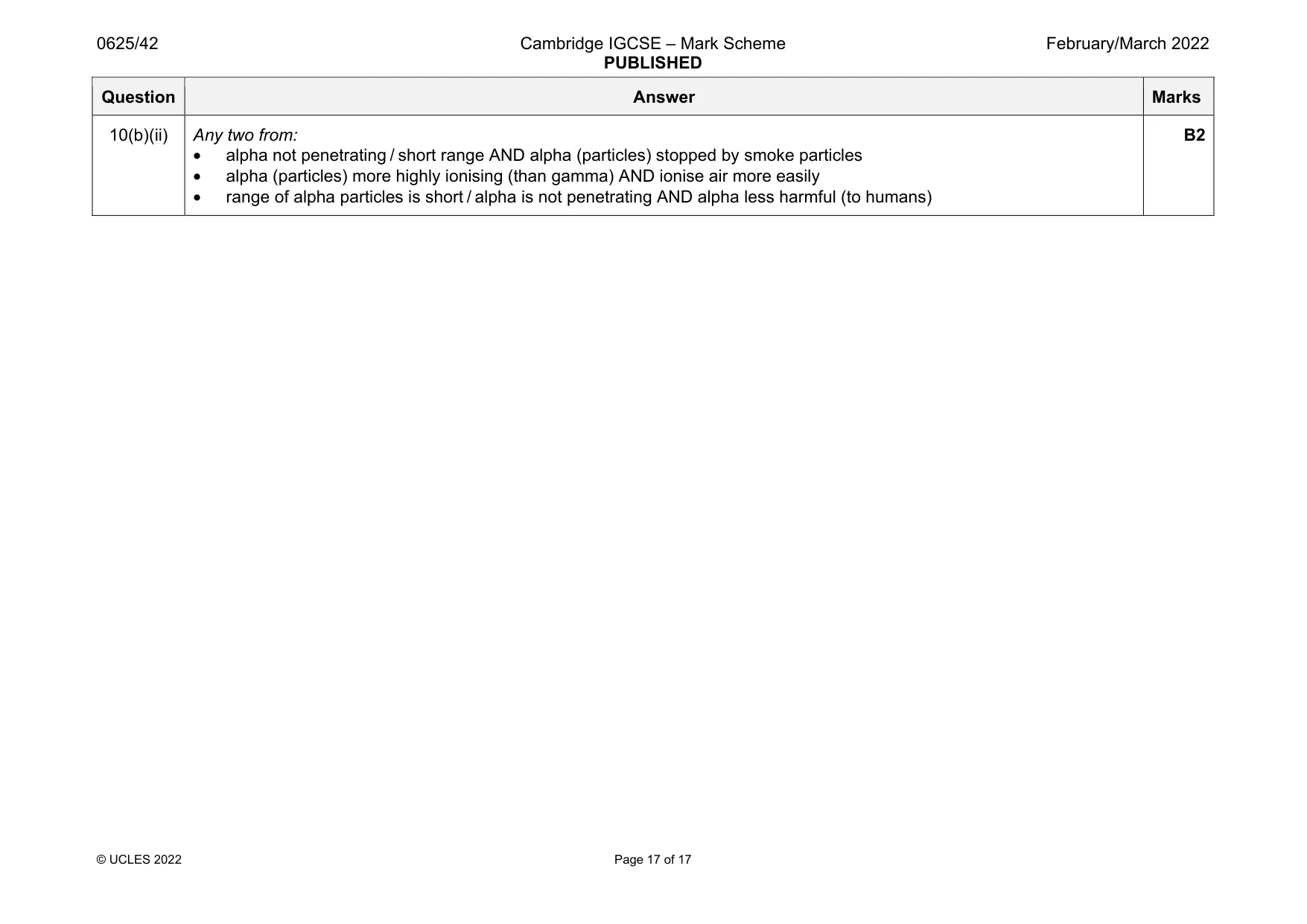
Mark scheme: 10(a) 241 95Am → 237 93Np + 4 2∝ 237Np nucleon number correct for Np B1 93Np proton number correct for Np B1 + 4 2∝ alpha notation correct B1 10(b)(i) alpha (particles emitted from americium) B1 move close to / hit molecules in the air (between the metal plates) B1 removing electrons (out of the molecules) B1 Question Answer Marks 10(b)(ii) Any two from: • alpha not penetrating / short range AND alpha (particles) stopped by smoke particles • alpha (particles) more highly ionising (than gamma) AND ionise air more easily • range of alpha particles is short / alpha is not penetrating AND alpha less harmful (to humans) B2
What was in this paper
The subtopics covered by these 10 questions, and how many questions each got. Open one in a new tab to see every Cambridge question on it.
What you needed in this session
Cambridge’s own grade thresholds for 2022 Feb/March, Paper 4 · Variant 2. A higher threshold means an easier paper — the bar moves with how the cohort did.