Cambridge IGCSE Physics 0625 — 2022 May/June Paper 4 · Variant 2
0625/42/M/J/22 · 11 questions · 80 marks · ≈90 min
The question paper and its mark scheme, free to read here and free to download. This is Cambridge’s own paper, exactly as it was sat.
Question paper16 pages

Mark scheme12 pages
Answers below. Sit the paper first if you are practising.
Questions as text
Q1 · An electrically powered bicycle
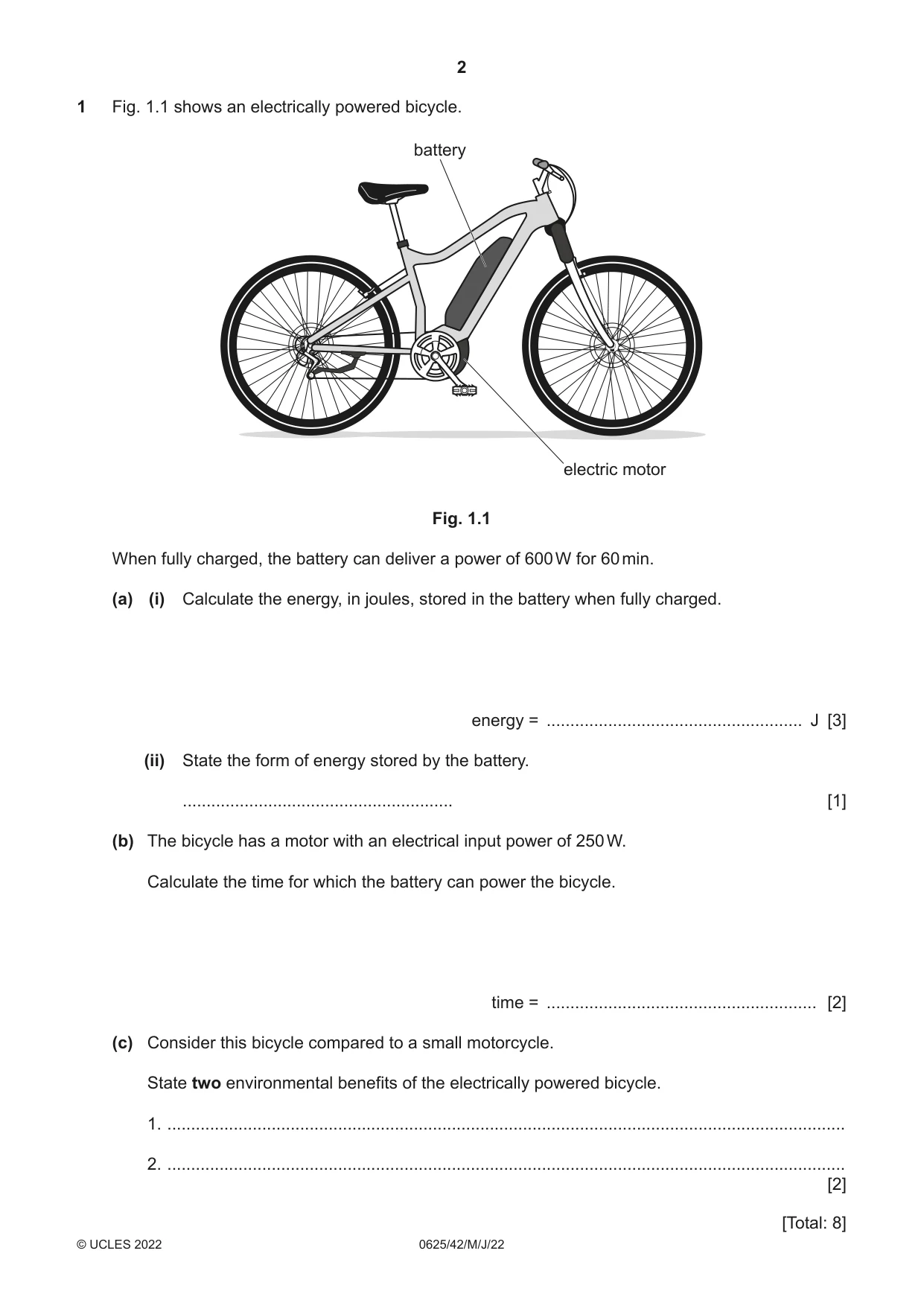
1 Fig. 1.1 shows an electrically powered bicycle. battery electric motor Fig. 1.1 When fully charged, the battery can deliver a power of 600 W for 60 min. (a) (i) Calculate the energy, in joules, stored in the battery when fully charged. energy = ...................................................... J [3] (ii) State the form of energy stored by the battery. ......................................................... [1] (b) The bicycle has a motor with an electrical input power of 250 W. Calculate the time for which the battery can power the bicycle. time = ......................................................... [2] (c) Consider this bicycle compared to a small motorcycle. State two environmental benefits of the electrically powered bicycle. 1. ............................................................................................................................................... 2. ............................................................................................................................................... [2] [Total: 8]
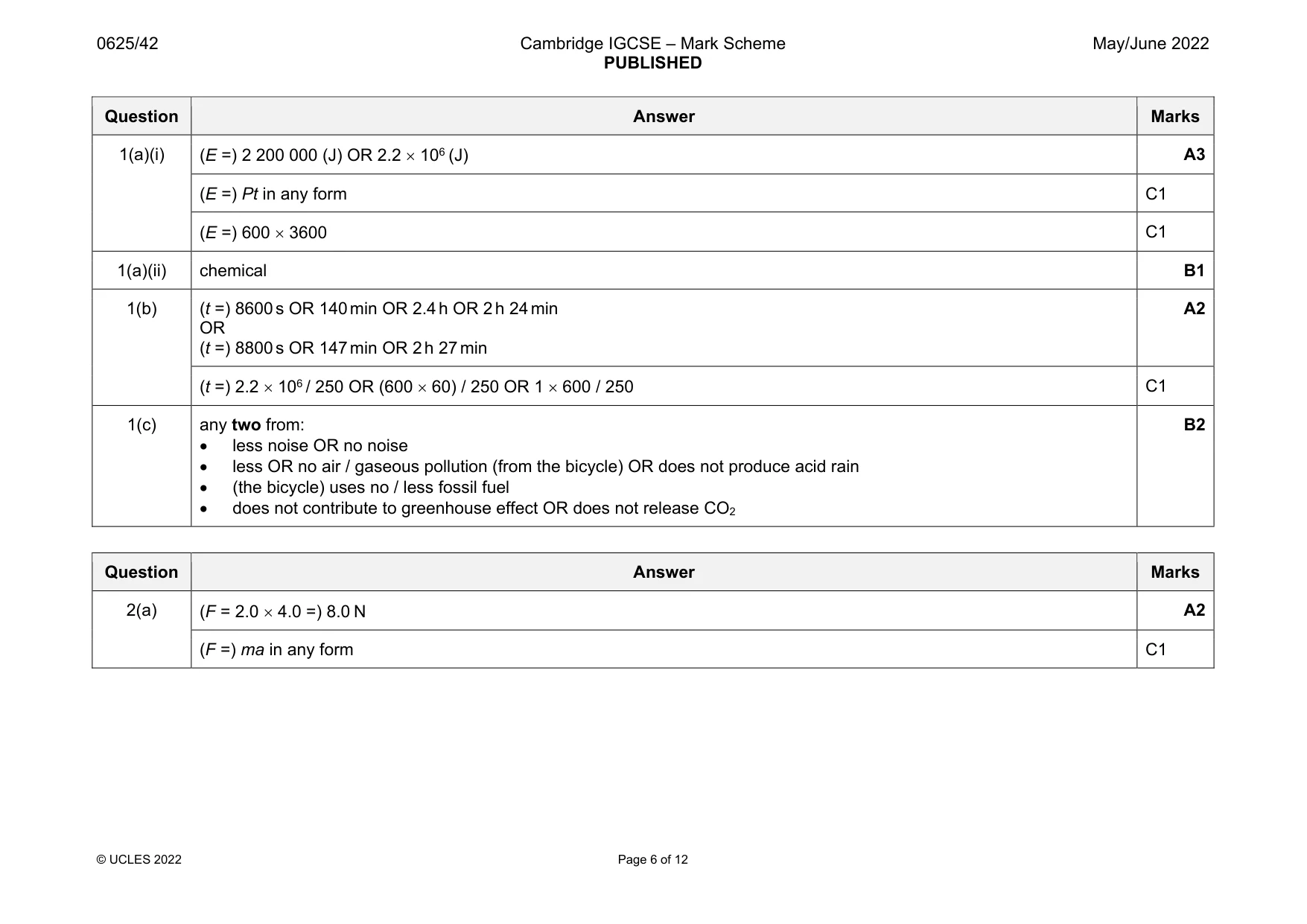
Mark scheme: 1(a)(i) A3 (E =) Pt in any form C1 (E =) 600 3600 C1 1(a)(ii) chemical B1 1(b) (t =) 8600 s OR 140 min OR 2.4 h OR 2 h 24 min OR (t =) 8800 s OR 147 min OR 2 h 27 min A2 (t =) 2.2 106 / 250 OR (600 60) / 250 OR 1 600 / 250 C1 1(c) any two from: less noise OR no noise less OR no air / gaseous pollution (from the bicycle) OR does not produce acid rain (the bicycle) uses no / less fossil fuel does not contribute to greenhouse effect OR does not release CO2 B2
Q2 · An object of mass 2.0 kg on a bench
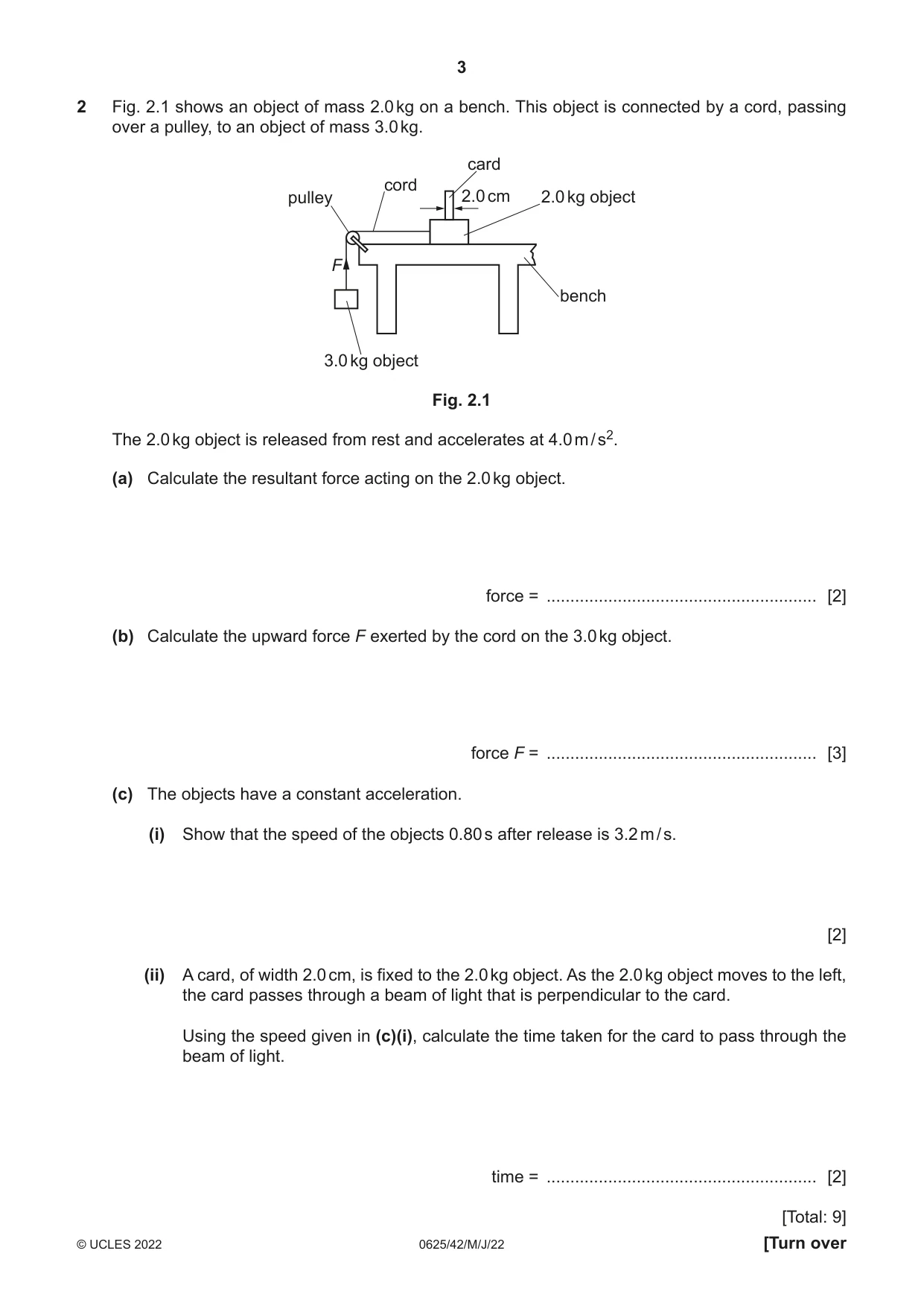
2 Fig. 2.1 shows an object of mass 2.0 kg on a bench. This object is connected by a cord, passing over a pulley, to an object of mass 3.0 kg. card cord pulley 2.0 cm 2.0 kg object F bench 3.0 kg object Fig. 2.1 The 2.0 kg object is released from rest and accelerates at 4.0 m / s2. (a) Calculate the resultant force acting on the 2.0 kg object. force = ......................................................... [2] (b) Calculate the upward force F exerted by the cord on the 3.0 kg object. force F = ......................................................... [3] (c) The objects have a constant acceleration. (i) Show that the speed of the objects 0.80 s after release is 3.2 m / s. [2] (ii) A card, of width 2.0 cm, is fixed to the 2.0 kg object. As the 2.0 kg object moves to the left, the card passes through a beam of light that is perpendicular to the card. Using the speed given in (c)(i), calculate the time taken for the card to pass through the beam of light. time = ......................................................... [2] [Total: 9]
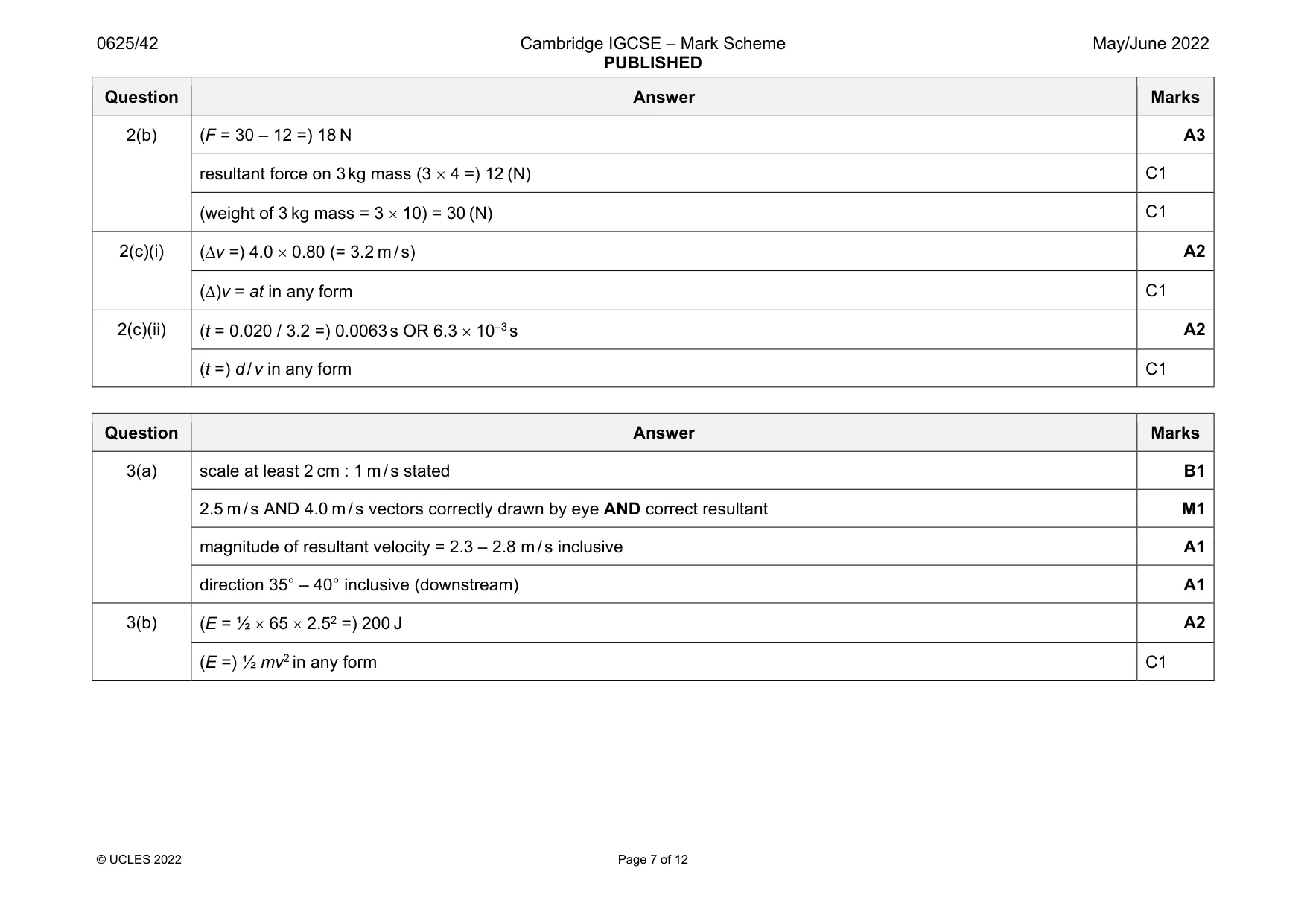
Mark scheme: 2(a) A2 (F =) ma in any form C1 Question Answer Marks 2(b) (F = 30 – 12 =) 18 N A3 resultant force on 3 kg mass (3 4 =) 12 (N) C1 (weight of 3 kg mass = 3 10) = 30 (N) C1 2(c)(i) (v =) 4.0 0.80 (= 3.2 m / s) A2 ()v = at in any form C1 2(c)(ii) (t = 0.020 / 3.2 =) 0.0063 s OR 6.3 10–3 s A2 (t =) d / v in any form C1
Q3 · Water in a river moving parallel to the river bank at 4.0 m / s and a canoe travelling in…
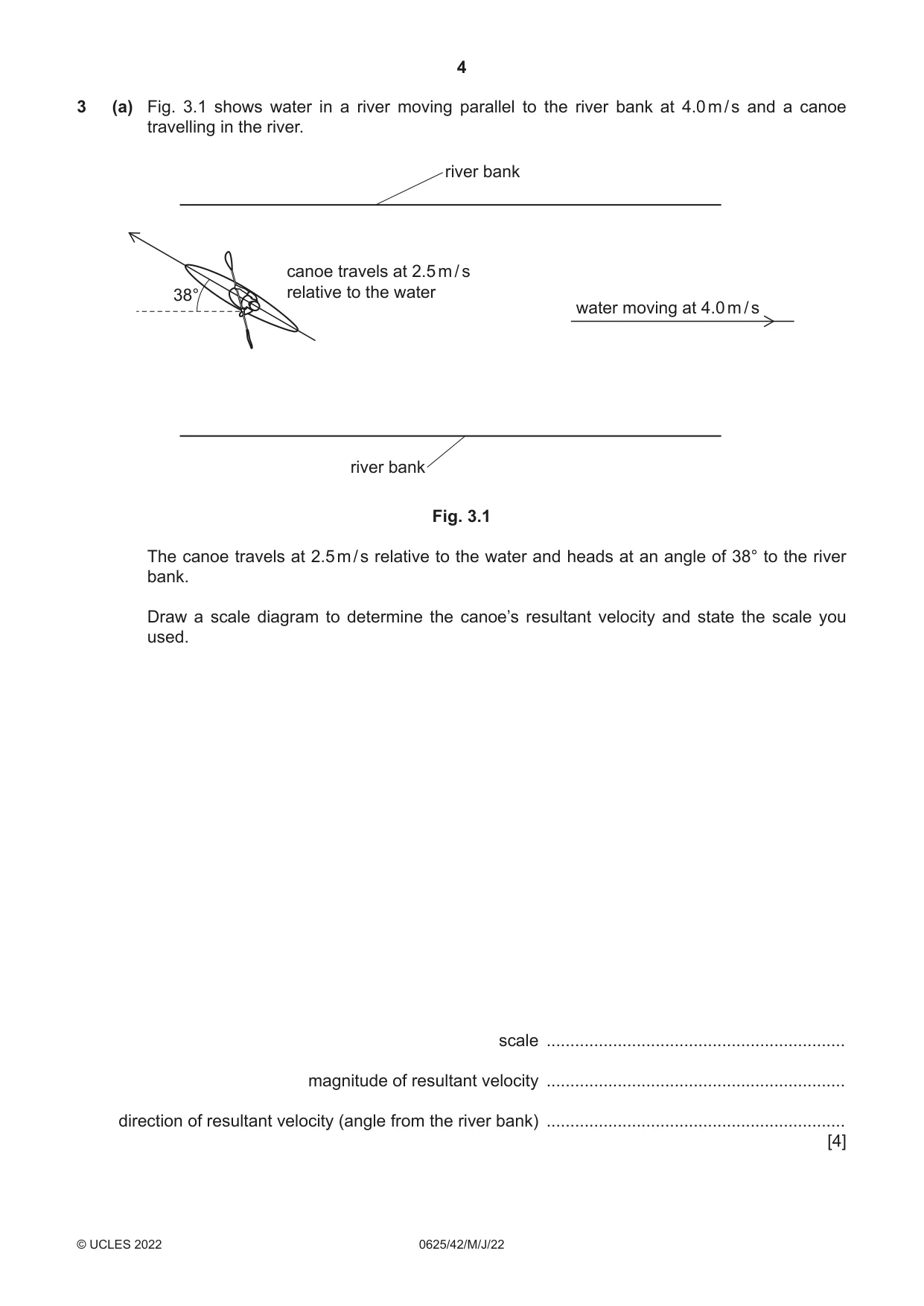
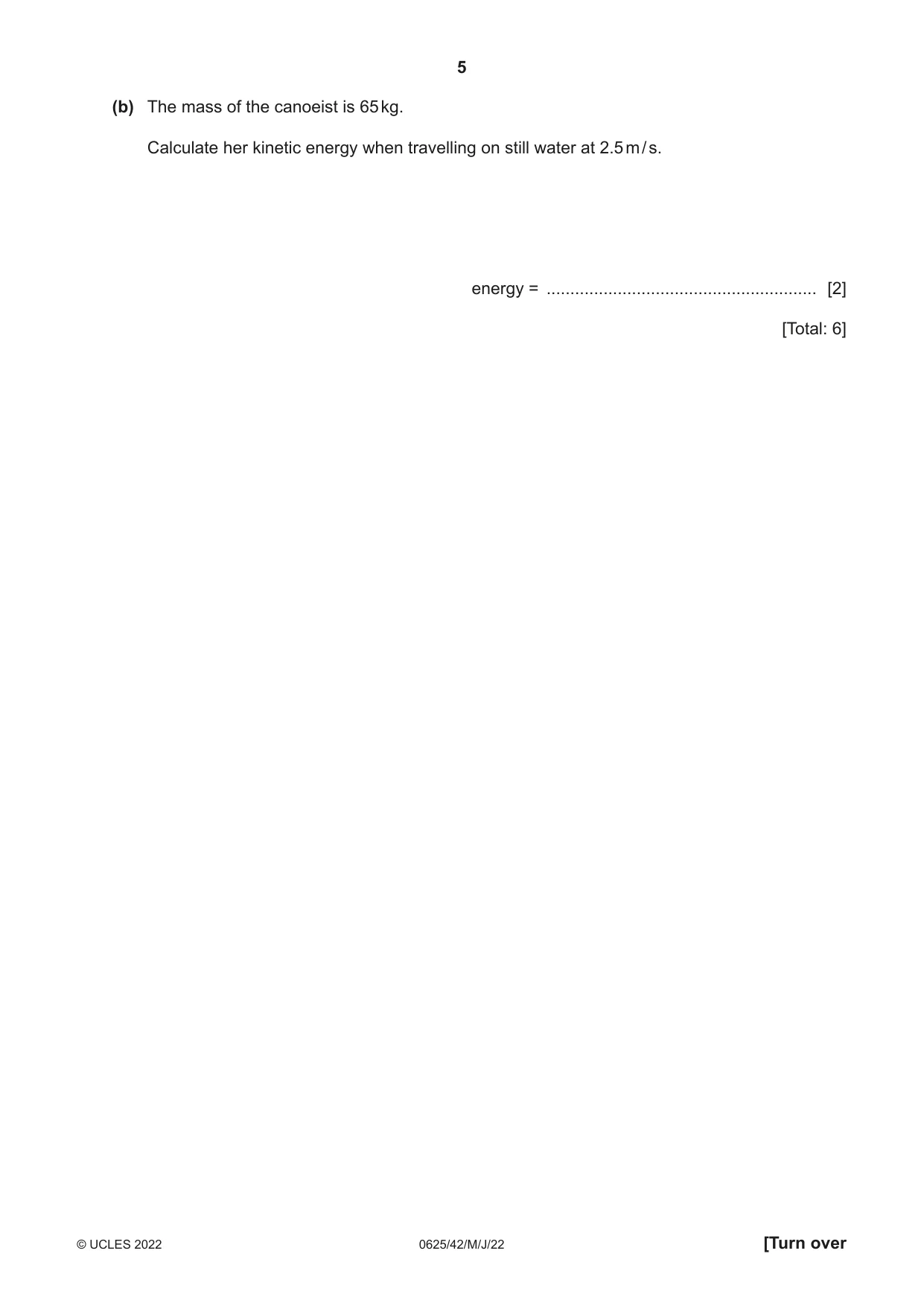
3 (a) Fig. 3.1 shows water in a river moving parallel to the river bank at 4.0 m / s and a canoe travelling in the river. river bank canoe travels at 2.5 m / s 38° relative to the water water moving at 4.0 m / s river bank Fig. 3.1 The canoe travels at 2.5 m / s relative to the water and heads at an angle of 38° to the river bank. Draw a scale diagram to determine the canoe’s resultant velocity and state the scale you used. scale ............................................................... magnitude of resultant velocity ............................................................... direction of resultant velocity (angle from the river bank) ............................................................... [4] (b) The mass of the canoeist is 65 kg. Calculate her kinetic energy when travelling on still water at 2.5 m / s. energy = ......................................................... [2] [Total: 6]
Mark scheme: 3(a) scale at least 2 cm : 1 m / s stated B1 2.5 m / s AND 4.0 m / s vectors correctly drawn by eye AND correct resultant M1 magnitude of resultant velocity = 2.3 – 2.8 m / s inclusive A1 direction 35° – 40° inclusive (downstream) A1 3(b) (E = ½ 65 2.52 =) 200 J A2 (E =) ½ mv2 in any form C1
Q4 · State and explain the two features of a liquid-in-glass thermometer that are necessary…
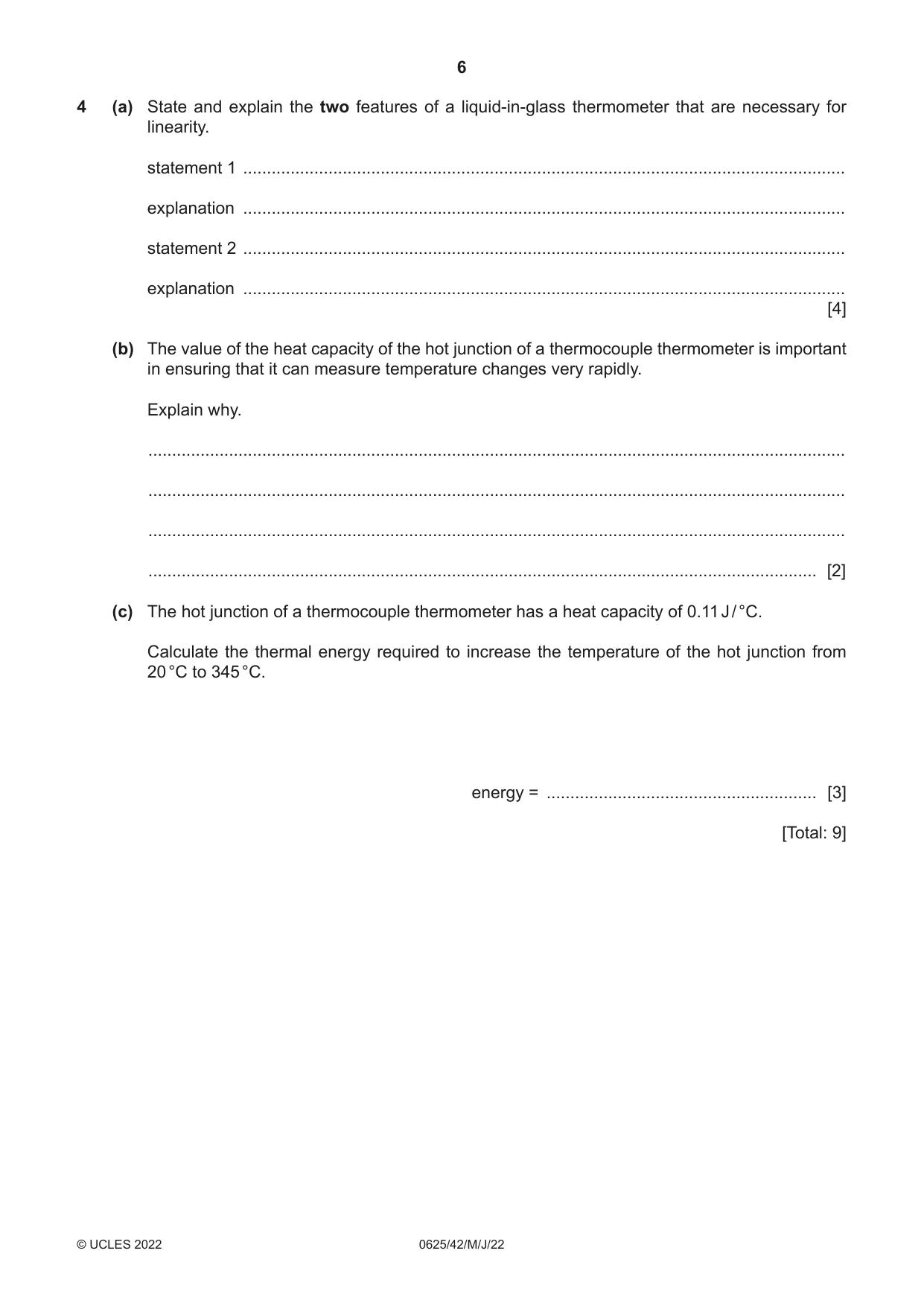
4 (a) State and explain the two features of a liquid-in-glass thermometer that are necessary for linearity. statement 1 ............................................................................................................................... explanation ............................................................................................................................... statement 2 ............................................................................................................................... explanation ............................................................................................................................... [4] (b) The value of the heat capacity of the hot junction of a thermocouple thermometer is important in ensuring that it can measure temperature changes very rapidly. Explain why. ................................................................................................................................................... ................................................................................................................................................... ................................................................................................................................................... ............................................................................................................................................. [2] (c) The hot junction of a thermocouple thermometer has a heat capacity of 0.11 J / °C. Calculate the thermal energy required to increase the temperature of the hot junction from 20 °C to 345 °C. energy = ......................................................... [3] [Total: 9]
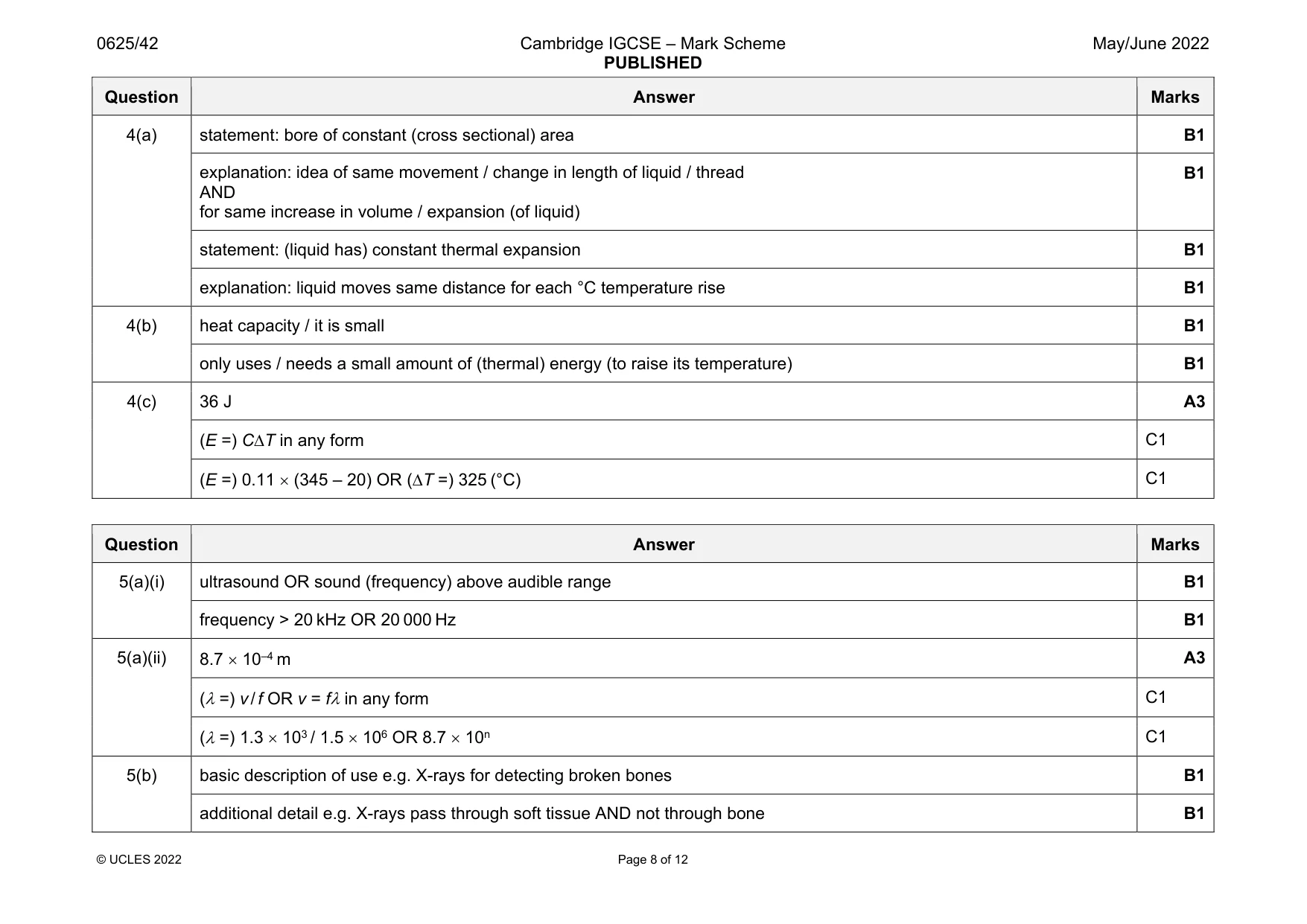
Mark scheme: 4(a) statement: bore of constant (cross sectional) area B1 explanation: idea of same movement / change in length of liquid / thread AND for same increase in volume / expansion (of liquid) B1 statement: (liquid has) constant thermal expansion B1 explanation: liquid moves same distance for each °C temperature rise B1 4(b) heat capacity / it is small B1 only uses / needs a small amount of (thermal) energy (to raise its temperature) B1 4(c) 36 J A3 (E =) CT in any form C1 (E =) 0.11 (345 – 20) OR (T =) 325 (°C) C1
Q5 · Sound waves are longitudinal and electromagnetic waves are transverse
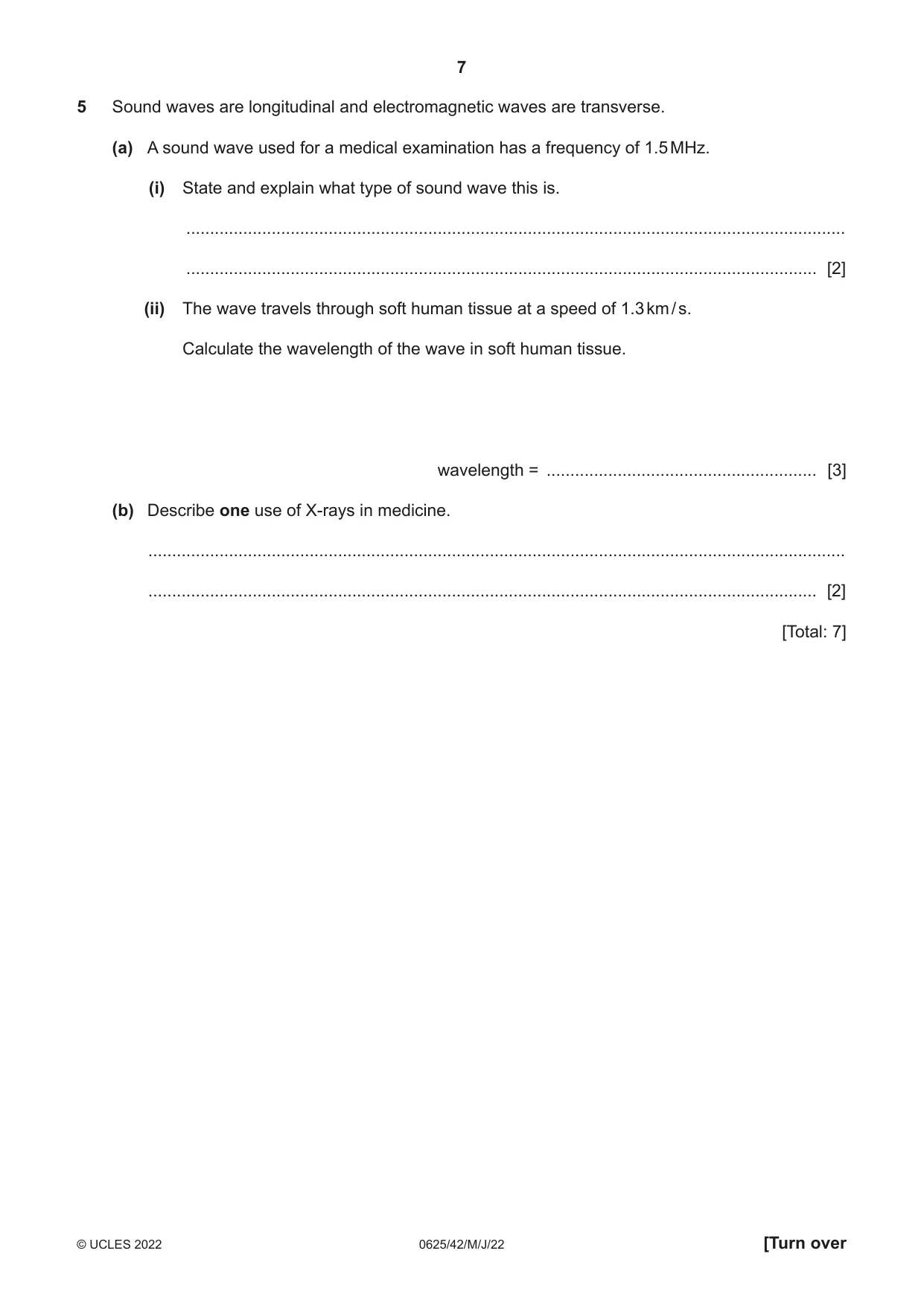
5 Sound waves are longitudinal and electromagnetic waves are transverse. (a) A sound wave used for a medical examination has a frequency of 1.5 MHz. (i) State and explain what type of sound wave this is. ........................................................................................................................................... ..................................................................................................................................... [2] (ii) The wave travels through soft human tissue at a speed of 1.3 km / s. Calculate the wavelength of the wave in soft human tissue. wavelength = ......................................................... [3] (b) Describe one use of X-rays in medicine. ................................................................................................................................................... ............................................................................................................................................. [2] [Total: 7]
Mark scheme: 5(a)(i) ultrasound OR sound (frequency) above audible range B1 frequency > 20 kHz OR 20 000 Hz B1 5(a)(ii) 8.7 10–4 m A3 ( =) v / f OR v = f in any form C1 ( =) 1.3 103 / 1.5 106 OR 8.7 10n C1 5(b) basic description of use e.g. X-rays for detecting broken bones B1 additional detail e.g. X-rays pass through soft tissue AND not through bone B1
Q6 · A full-size ray diagram showing the formation of an image by a thin glass lens
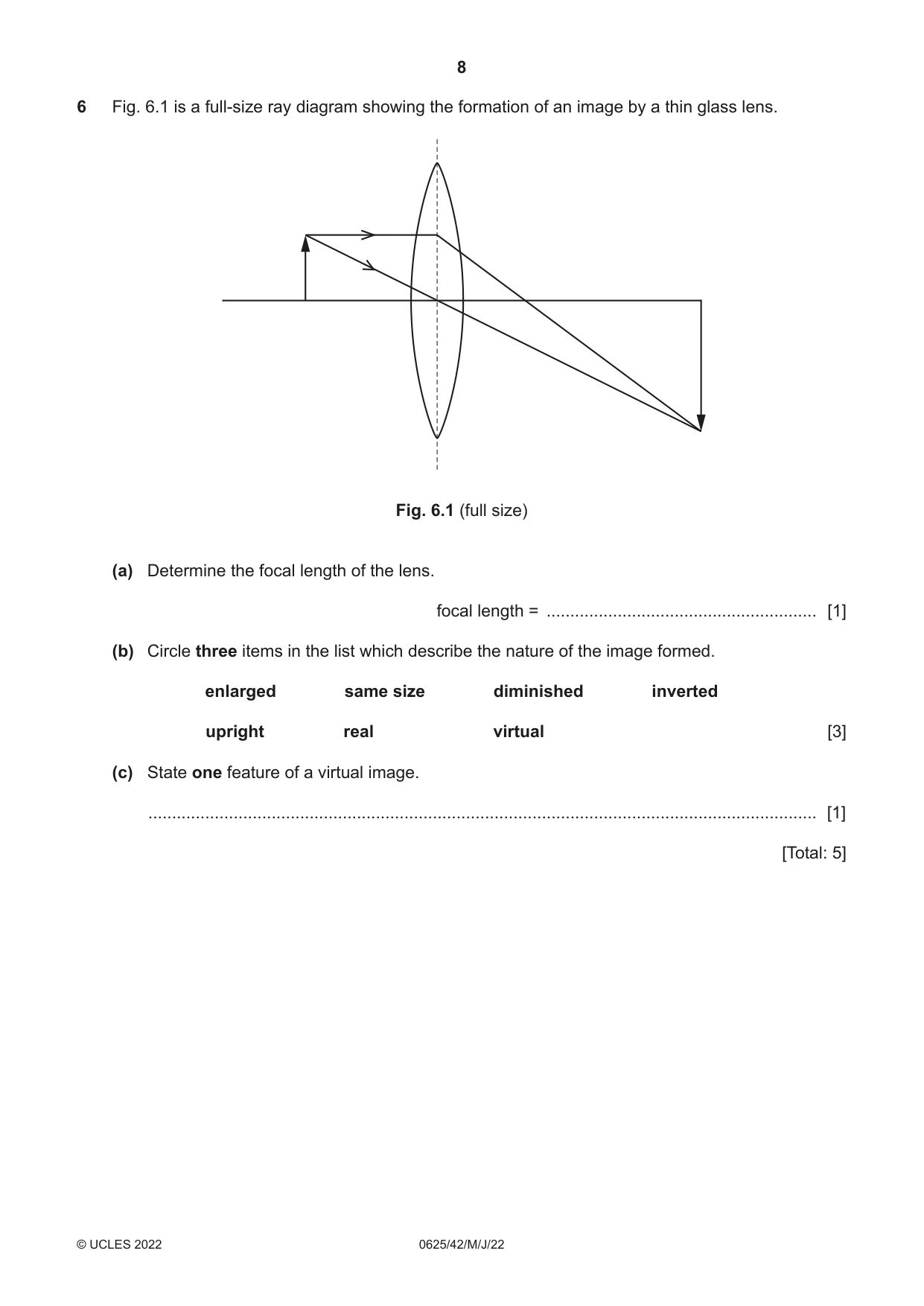
6 Fig. 6.1 is a full-size ray diagram showing the formation of an image by a thin glass lens. Fig. 6.1 (full size) (a) Determine the focal length of the lens. focal length = ......................................................... [1] (b) Circle three items in the list which describe the nature of the image formed. enlarged same size diminished inverted upright real virtual [3] (c) State one feature of a virtual image. ............................................................................................................................................. [1] [Total: 5]
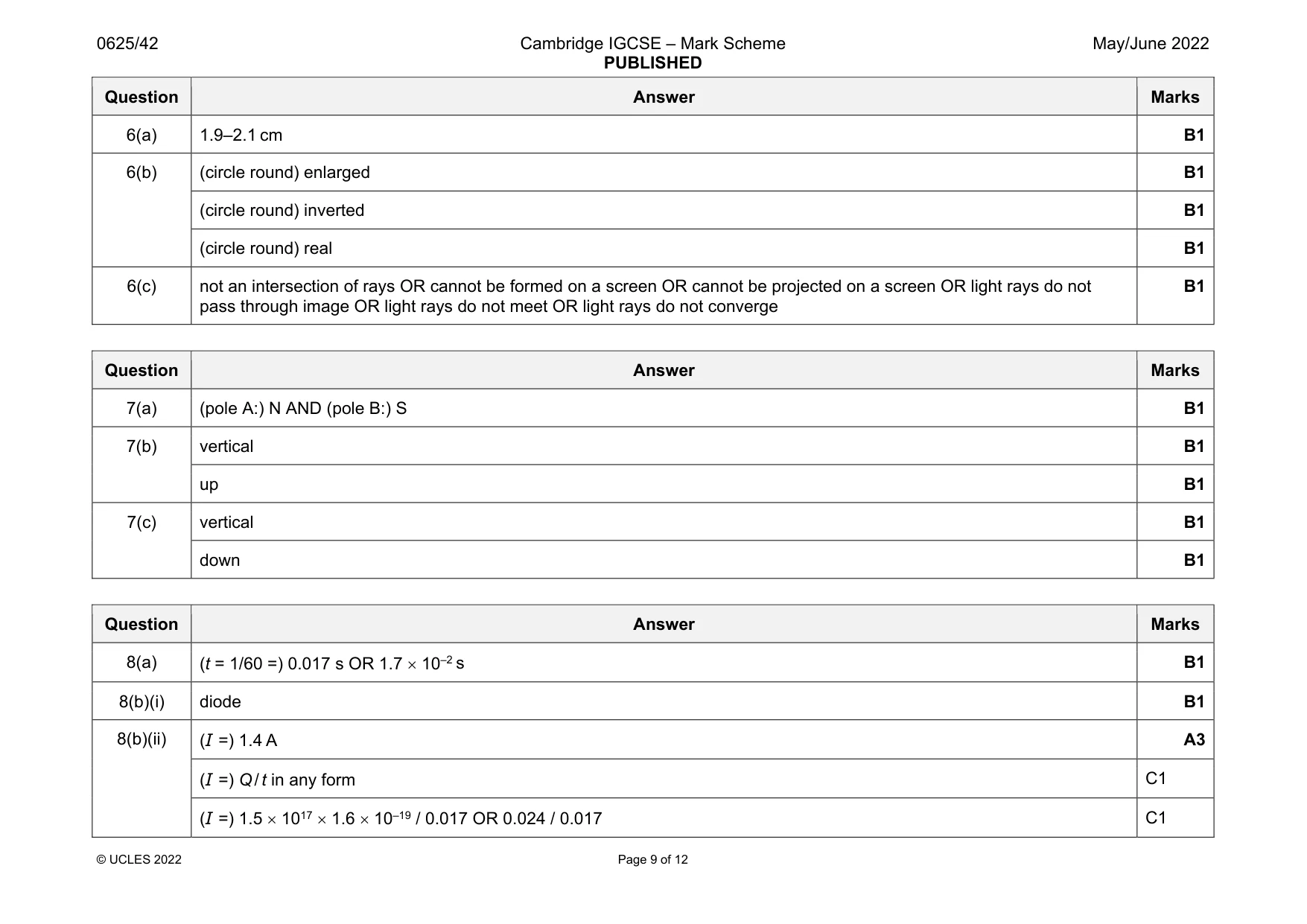
Mark scheme: 6(a) 1.9–2.1 cm B1 6(b) (circle round) enlarged B1 (circle round) inverted B1 (circle round) real B1 6(c) not an intersection of rays OR cannot be formed on a screen OR cannot be projected on a screen OR light rays do not pass through image OR light rays do not meet OR light rays do not converge B1
Q7 · A small plotting compass which is aligned with the magnetic field between magnetic poles…
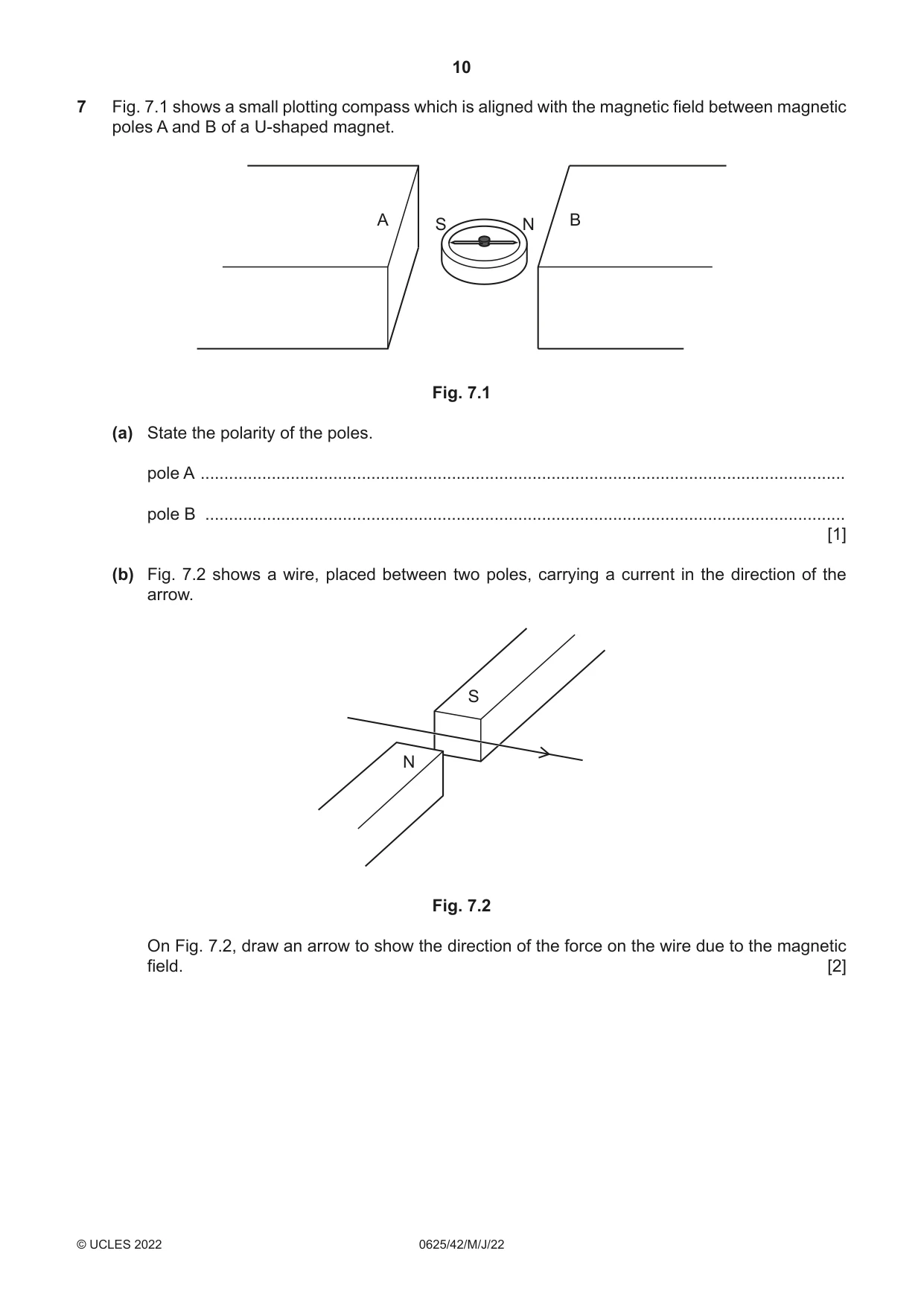
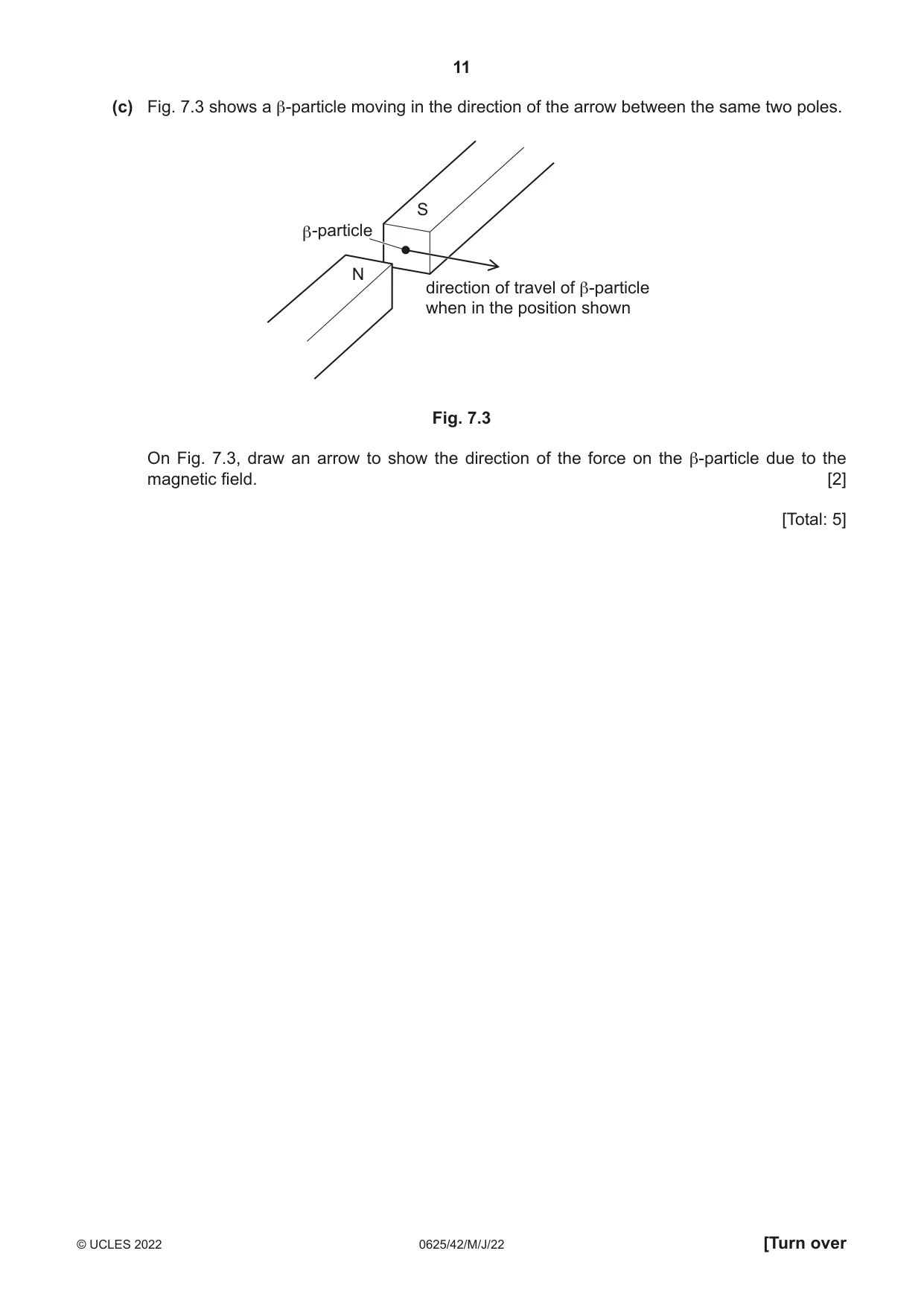
7 Fig. 7.1 shows a small plotting compass which is aligned with the magnetic field between magnetic poles A and B of a U-shaped magnet. A B S N Fig. 7.1 (a) State the polarity of the poles. pole A ........................................................................................................................................ pole B ....................................................................................................................................... [1] (b) Fig. 7.2 shows a wire, placed between two poles, carrying a current in the direction of the arrow. S N Fig. 7.2 On Fig. 7.2, draw an arrow to show the direction of the force on the wire due to the magnetic field. [2] (c) Fig. 7.3 shows a β-particle moving in the direction of the arrow between the same two poles. S β -particle N direction of travel of β-particle when in the position shown Fig. 7.3 On Fig. 7.3, draw an arrow to show the direction of the force on the β-particle due to the magnetic field. [2] [Total: 5]
Mark scheme: 7(a) (pole A:) N AND (pole B:) S B1 7(b) vertical B1 up B1 7(c) vertical B1 down B1
Q8 · How the electromotive force (e.m.f.) of a 60 Hz alternating current (a.c.) power supply…
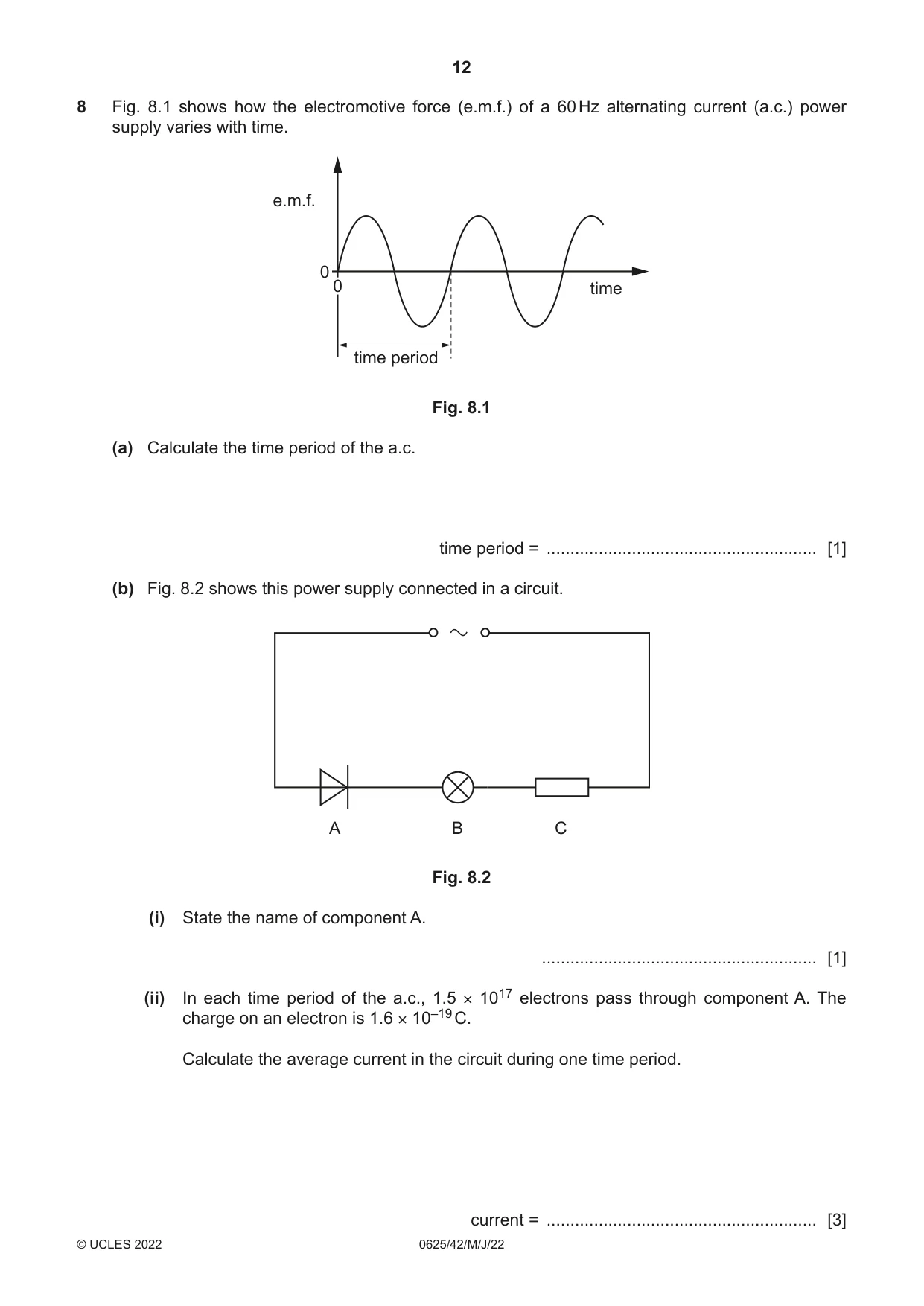
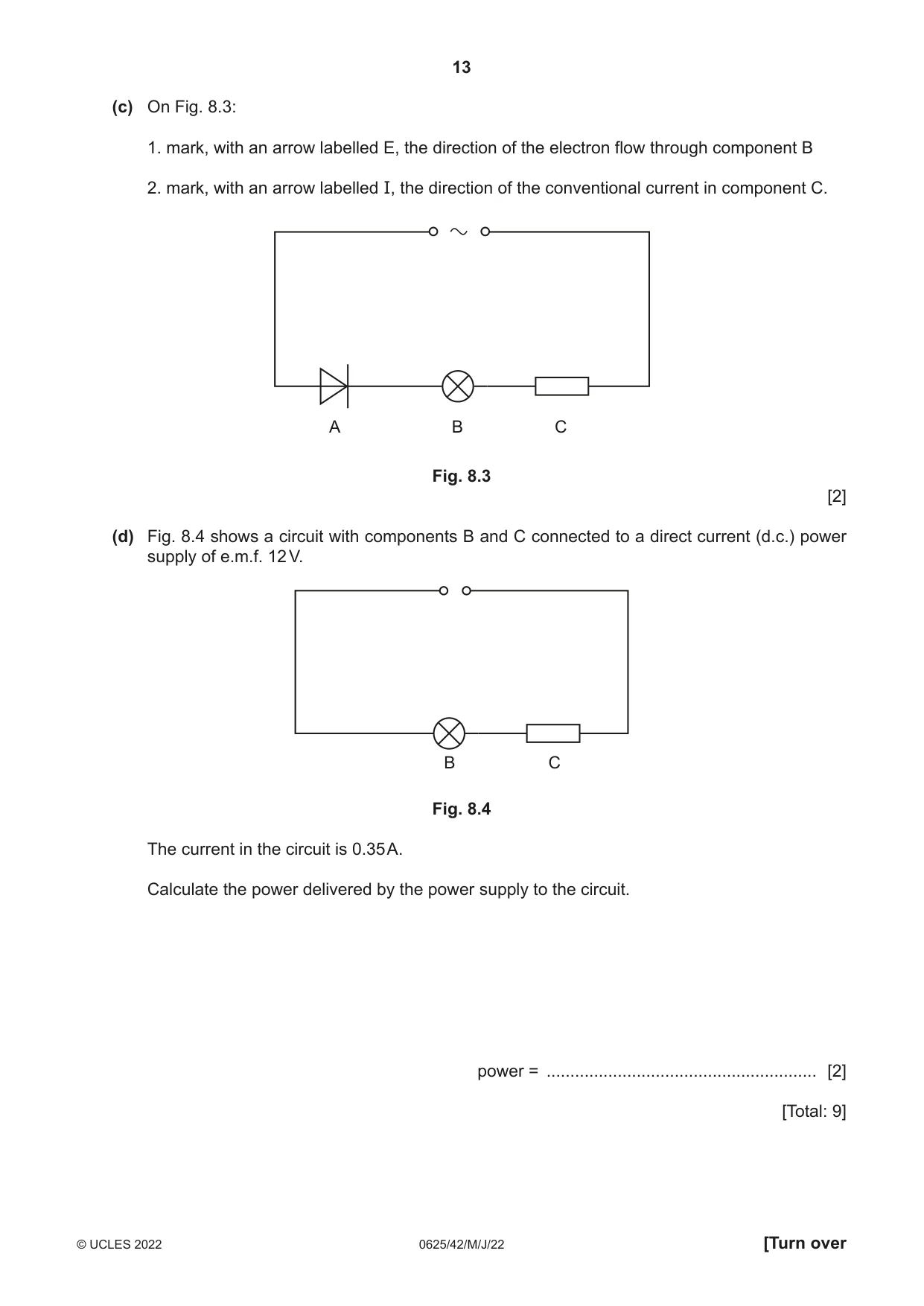
8 Fig. 8.1 shows how the electromotive force (e.m.f.) of a 60 Hz alternating current (a.c.) power supply varies with time. e.m.f. 0 0 time time period Fig. 8.1 (a) Calculate the time period of the a.c. time period = ......................................................... [1] (b) Fig. 8.2 shows this power supply connected in a circuit. A B C Fig. 8.2 (i) State the name of component A. .......................................................... [1] (ii) In each time period of the a.c., 1.5 × 10¹⁷ electrons pass through component A. The charge on an electron is 1.6 × 10⁻¹⁹ C. Calculate the average current in the circuit during one time period. current = ......................................................... [3] (c) On Fig. 8.3: 1. mark, with an arrow labelled E, the direction of the electron flow through component B 2. mark, with an arrow labelled I, the direction of the conventional current in component C. A B C Fig. 8.3 [2] (d) Fig. 8.4 shows a circuit with components B and C connected to a direct current (d.c.) power supply of e.m.f. 12 V. B C Fig. 8.4 The current in the circuit is 0.35 A. Calculate the power delivered by the power supply to the circuit. power = ......................................................... [2] [Total: 9]
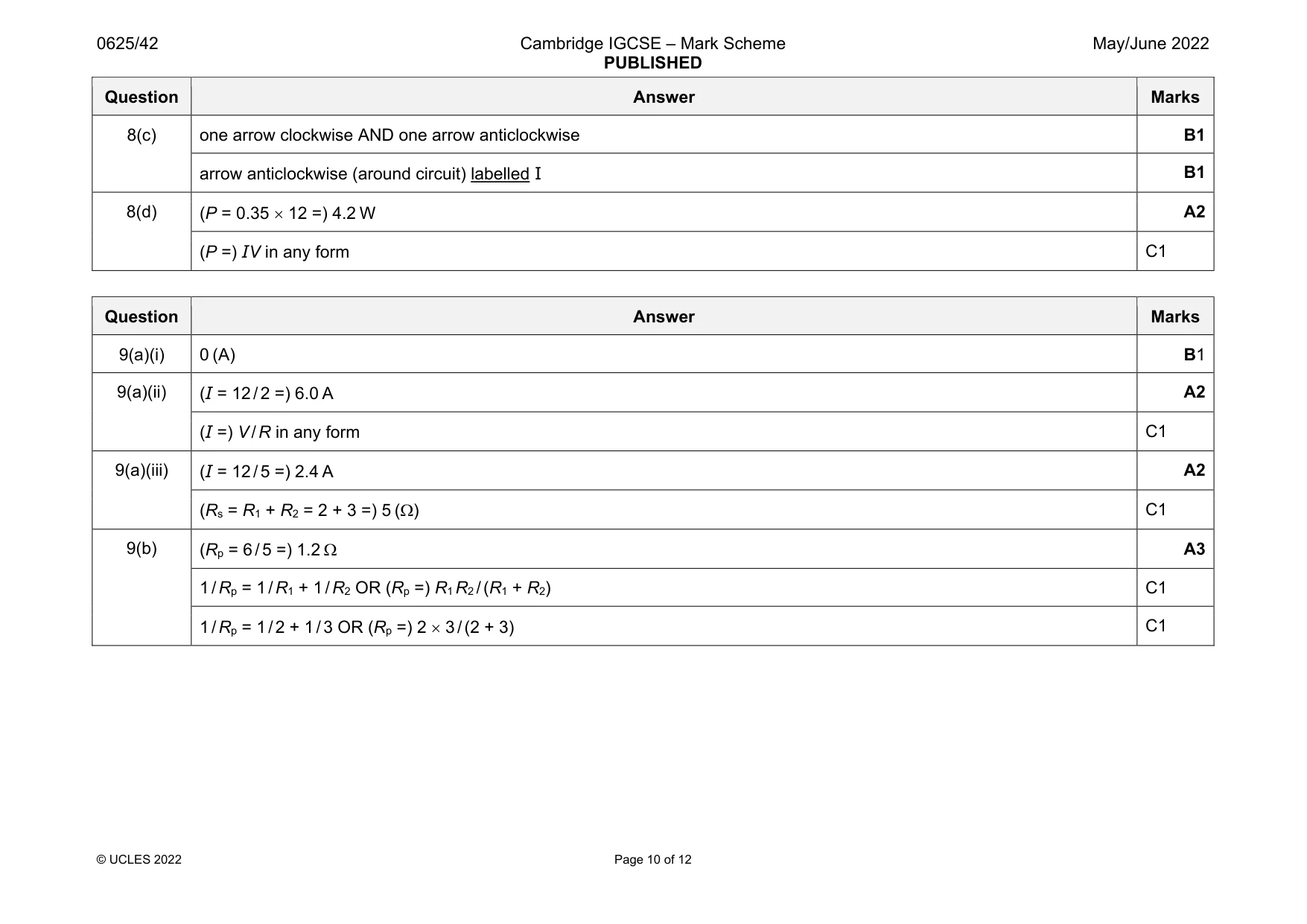
Mark scheme: 8(a) 8(b)(i) diode B1 8(b)(ii) (I =) 1.4 A A3 (I =) Q / t in any form C1 (I =) 1.5 1017 1.6 10–19 / 0.017 OR 0.024 / 0.017 C1 Question Answer Marks 8(c) one arrow clockwise AND one arrow anticlockwise B1 arrow anticlockwise (around circuit) labelled I B1 8(d) (P = 0.35 12 =) 4.2 W A2 (P =) IV in any form C1
Q9 · A circuit with a 3-position switch
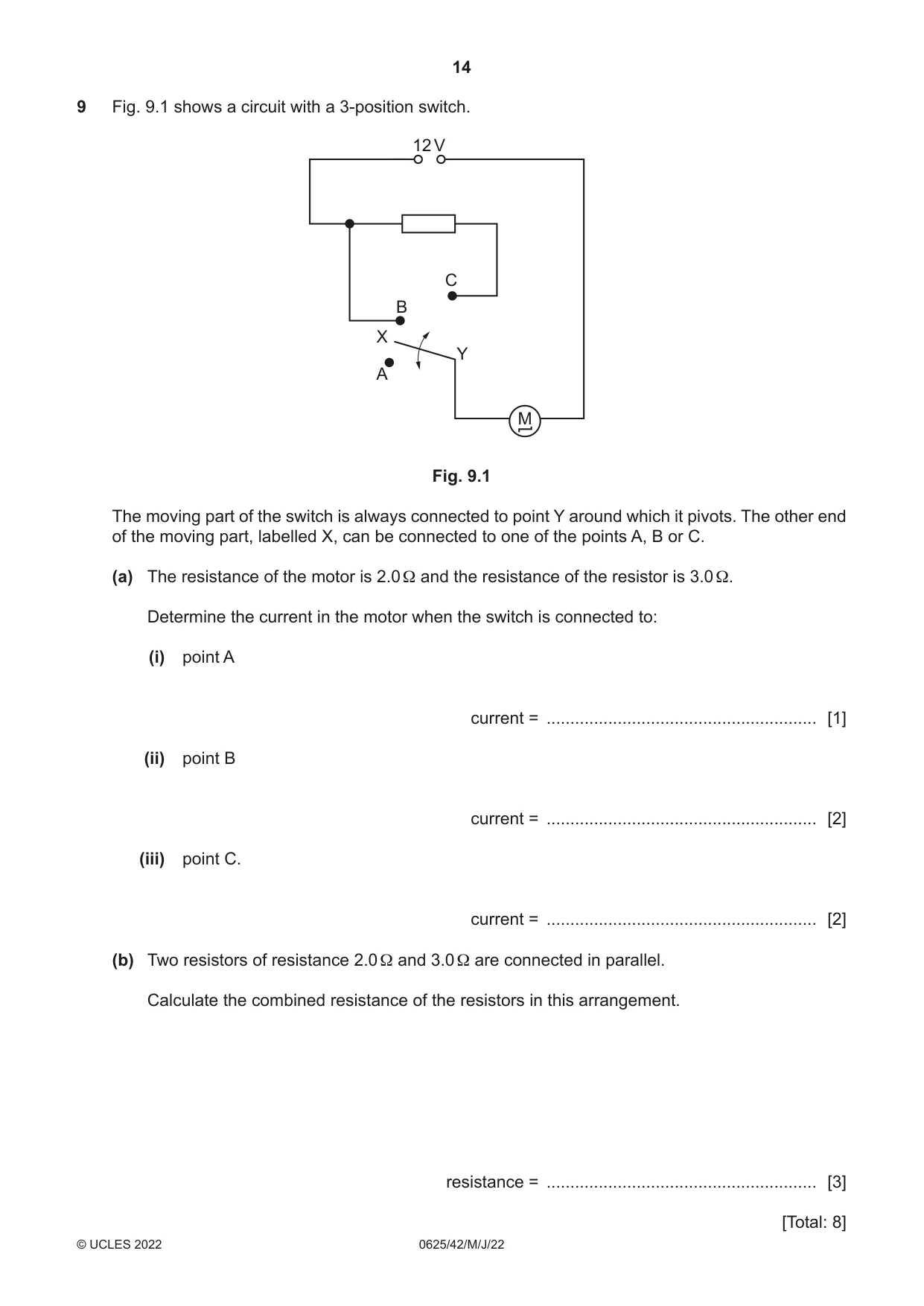
9 Fig. 9.1 shows a circuit with a 3-position switch. 12 V C B X Y A M Fig. 9.1 The moving part of the switch is always connected to point Y around which it pivots. The other end of the moving part, labelled X, can be connected to one of the points A, B or C. (a) The resistance of the motor is 2.0 Ω and the resistance of the resistor is 3.0 Ω. Determine the current in the motor when the switch is connected to: (i) point A current = ......................................................... [1] (ii) point B current = ......................................................... [2] (iii) point C. current = ......................................................... [2] (b) Two resistors of resistance 2.0 Ω and 3.0 Ω are connected in parallel. Calculate the combined resistance of the resistors in this arrangement. resistance = ......................................................... [3] [Total: 8]
Mark scheme: 9(a)(i) 0 (A) B1 9(a)(ii) (I = 12 / 2 =) 6.0 A A2 (I =) V / R in any form C1 9(a)(iii) (I = 12 / 5 =) 2.4 A A2 (Rs = R1 + R2 = 2 + 3 =) 5 () C1 9(b) (Rp = 6 / 5 =) 1.2 A3 1 / Rp = 1 / R1 + 1 / R2 OR (Rp =) R1 R2 / (R1 + R2) C1 1 / Rp = 1 / 2 + 1 / 3 OR (Rp =) 2 3 / (2 + 3) C1
Q10 · A simplified diagram of a digital circuit
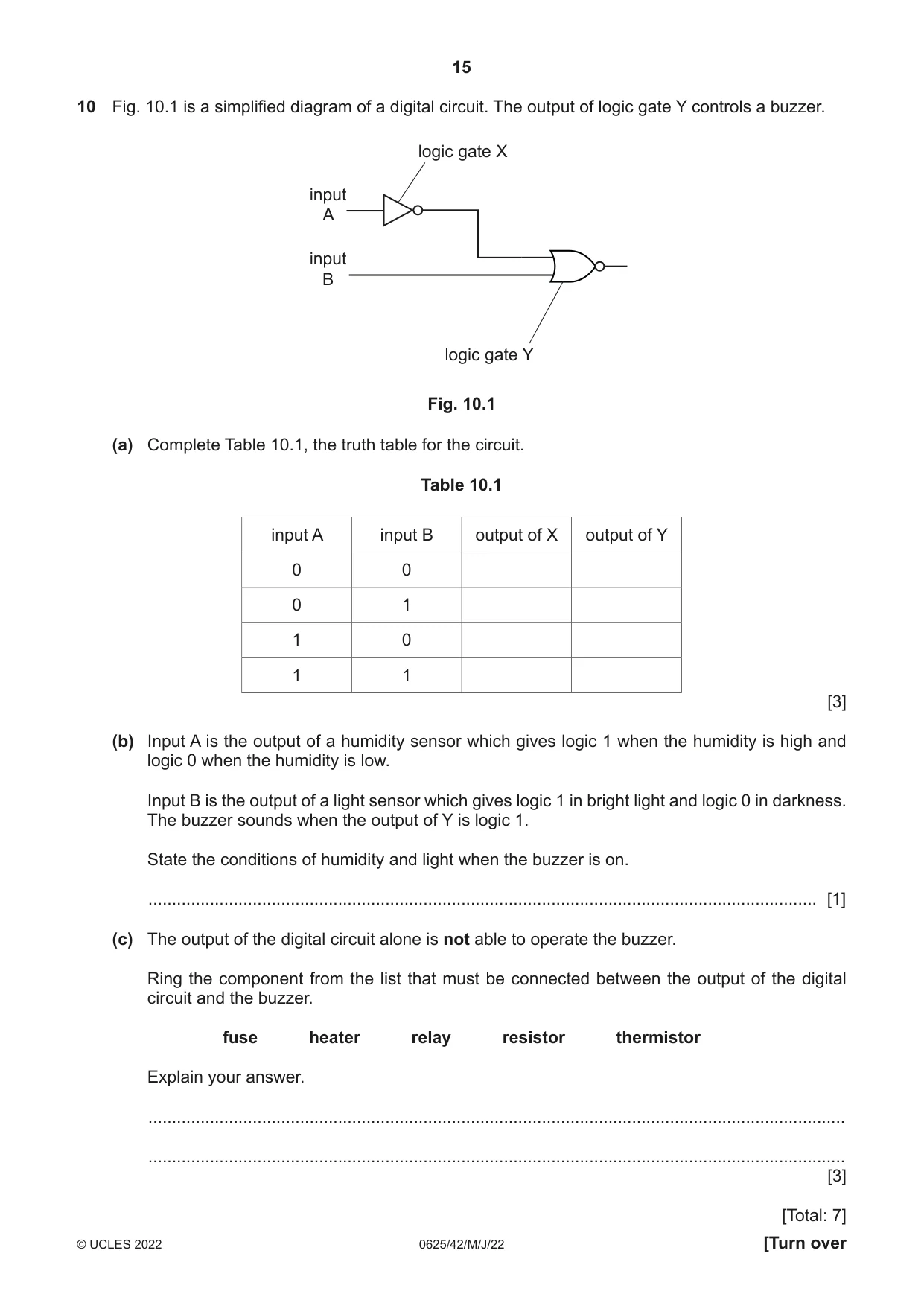
10 Fig. 10.1 is a simplified diagram of a digital circuit. The output of logic gate Y controls a buzzer. logic gate X input A input B logic gate Y Fig. 10.1 (a) Complete Table 10.1, the truth table for the circuit. Table 10.1 input A input B output of X output of Y 0 0 0 1 1 0 1 1 [3] (b) Input A is the output of a humidity sensor which gives logic 1 when the humidity is high and logic 0 when the humidity is low. Input B is the output of a light sensor which gives logic 1 in bright light and logic 0 in darkness. The buzzer sounds when the output of Y is logic 1. State the conditions of humidity and light when the buzzer is on. ............................................................................................................................................. [1] (c) The output of the digital circuit alone is not able to operate the buzzer. Ring the component from the list that must be connected between the output of the digital circuit and the buzzer. fuse heater relay resistor thermistor Explain your answer. ................................................................................................................................................... ................................................................................................................................................... [3] [Total: 7]
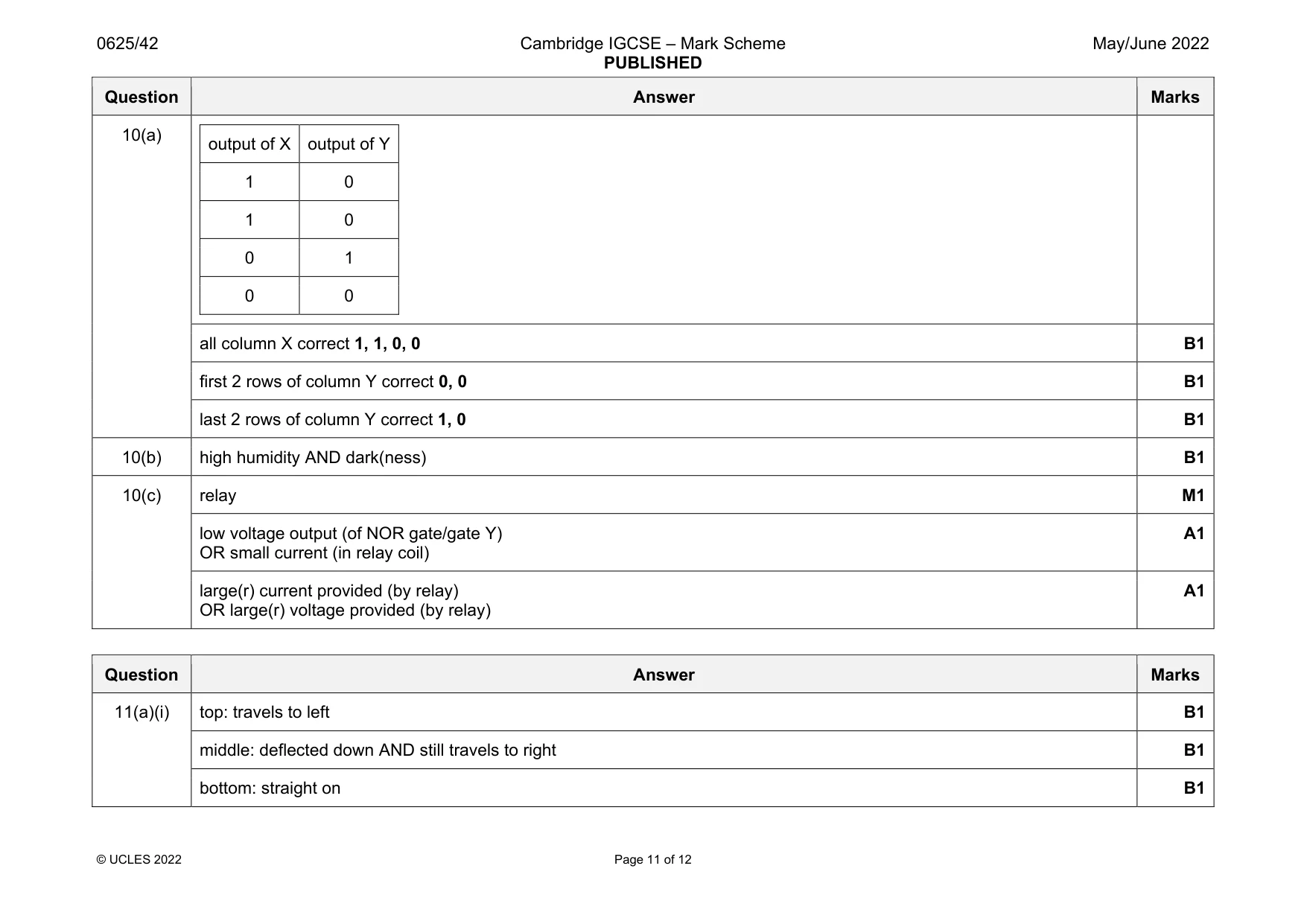
Mark scheme: 10(a) output of X output of Y 1 0 1 0 0 1 0 0 all column X correct 1, 1, 0, 0 B1 first 2 rows of column Y correct 0, 0 B1 last 2 rows of column Y correct 1, 0 B1 10(b) high humidity AND dark(ness) B1 10(c) relay M1 low voltage output (of NOR gate/gate Y) OR small current (in relay coil) A1 large(r) current provided (by relay) OR large(r) voltage provided (by relay) A1
Q11 · The paths of three α-particles moving towards a thin gold foil
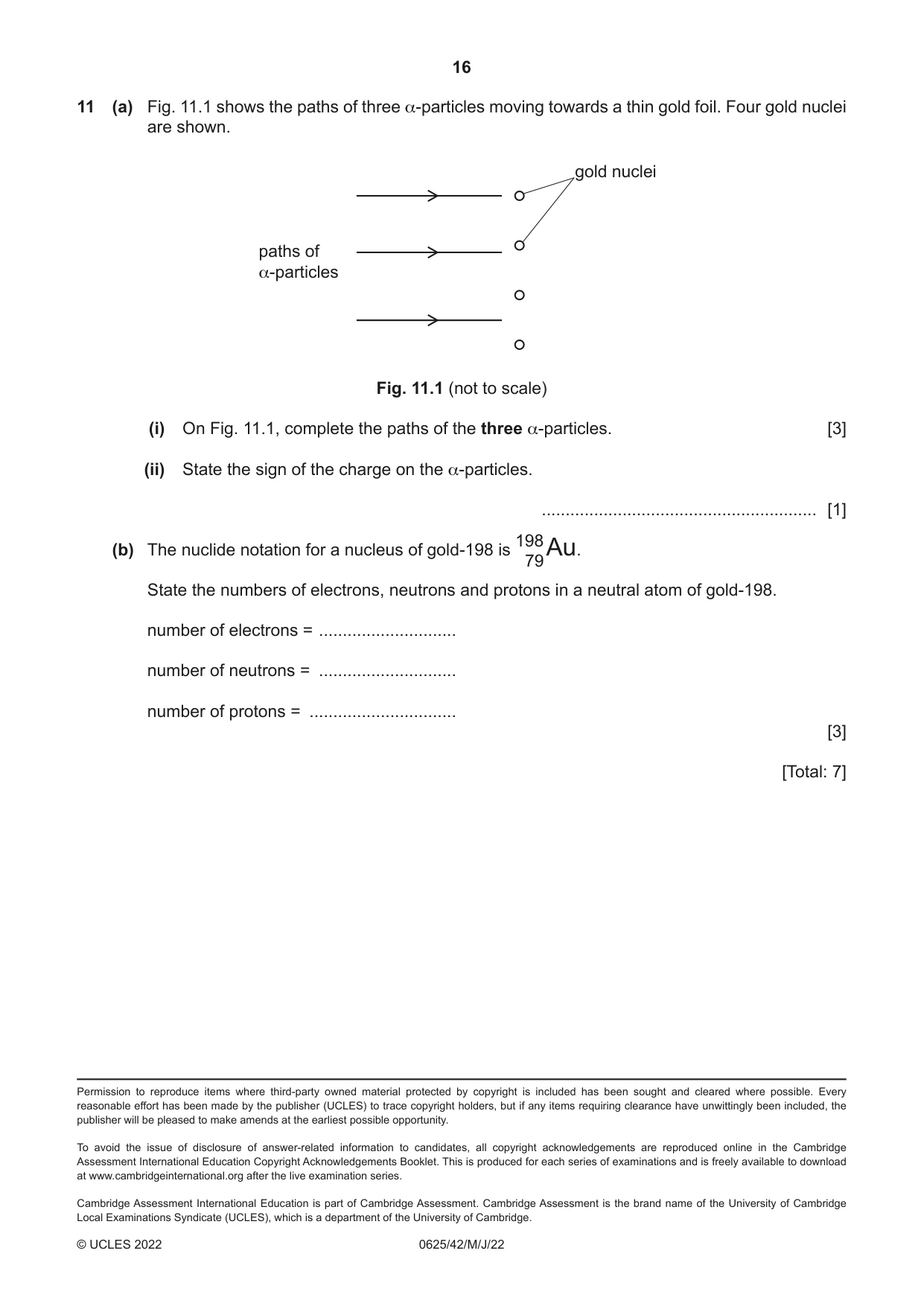
11 (a) Fig. 11.1 shows the paths of three α-particles moving towards a thin gold foil. Four gold nuclei are shown. gold nuclei paths of α-particles Fig. 11.1 (not to scale) (i) On Fig. 11.1, complete the paths of the three α-particles. [3] (ii) State the sign of the charge on the α-particles. .......................................................... [1] 198 (b) The nuclide notation for a nucleus of gold-198 is 79Au. State the numbers of electrons, neutrons and protons in a neutral atom of gold-198. number of electrons = ............................. number of neutrons = ............................. number of protons = ............................... [3] [Total: 7]
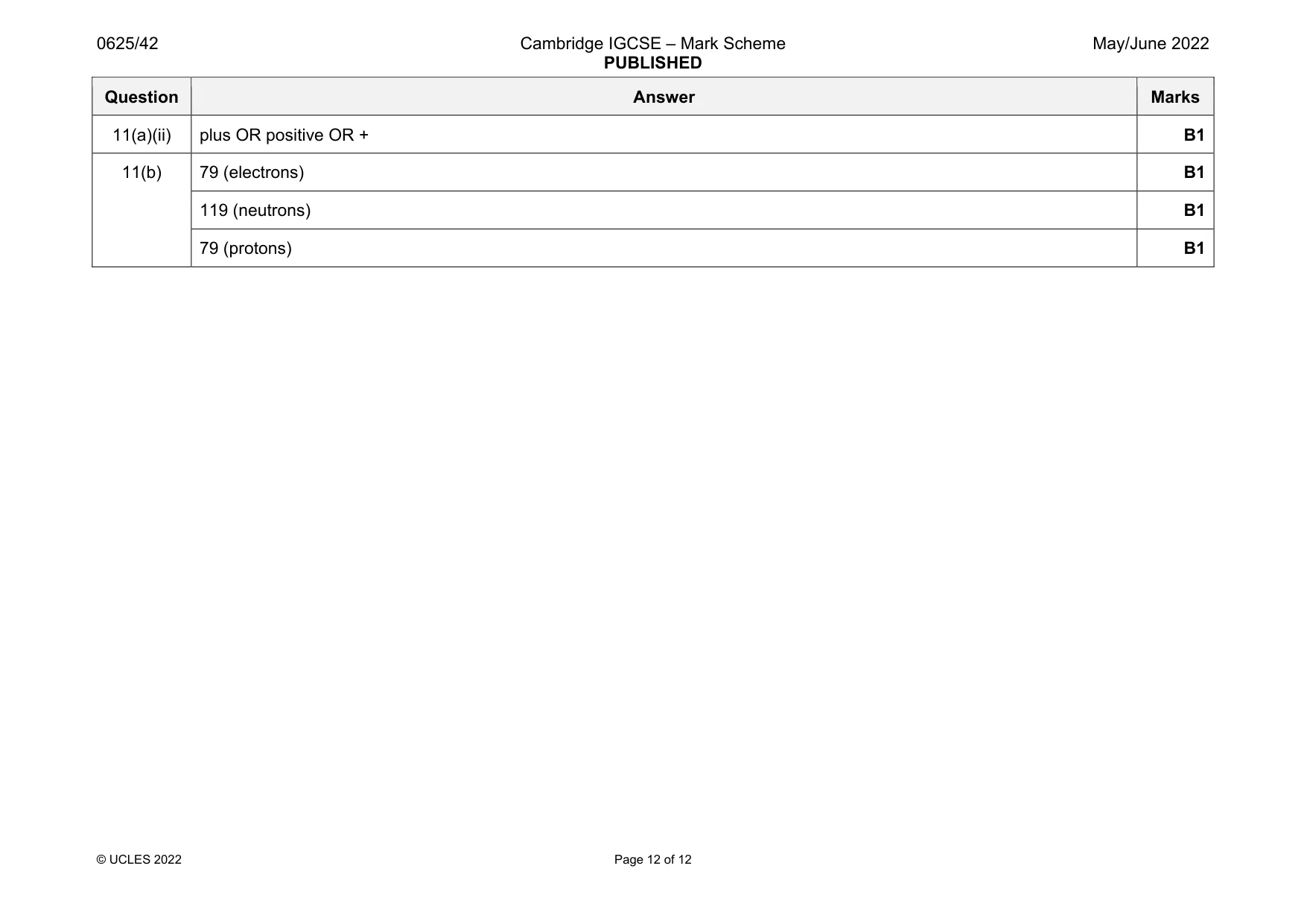
Mark scheme: 11(a)(i) top: travels to left B1 middle: deflected down AND still travels to right B1 bottom: straight on B1 Question Answer Marks 11(a)(ii) plus OR positive OR + B1 11(b) 79 (electrons) B1 119 (neutrons) B1 79 (protons) B1
What was in this paper
The subtopics covered by these 11 questions, and how many questions each got. Open one in a new tab to see every Cambridge question on it.
What you needed in this session
Cambridge’s own grade thresholds for 2022 May/June, Paper 4 · Variant 2. A higher threshold means an easier paper — the bar moves with how the cohort did.