Cambridge IGCSE Physics 0625 — 2020 Feb/March Paper 4 · Variant 2
0625/42/F/M/20 · 11 questions · 80 marks · ≈90 min
The question paper and its mark scheme, free to read here and free to download. This is Cambridge’s own paper, exactly as it was sat.
Question paper16 pages
Mark scheme15 pages
Answers below. Sit the paper first if you are practising.
Questions as text
Q1 · A rocket is launched vertically upwards from the ground
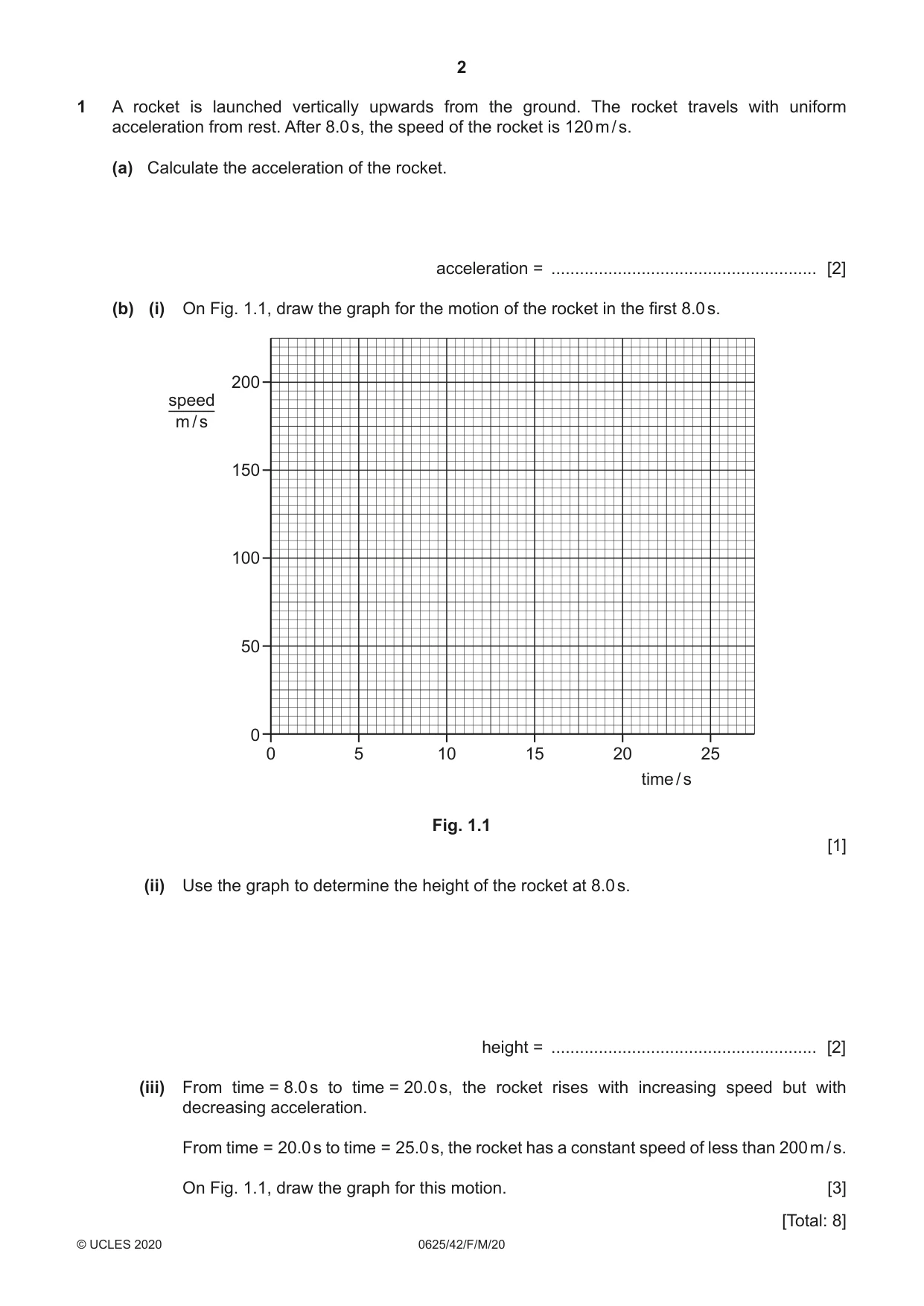
1 A rocket is launched vertically upwards from the ground. The rocket travels with uniform acceleration from rest. After 8.0 s, the speed of the rocket is 120 m / s. (a) Calculate the acceleration of the rocket. acceleration = ........................................................ [2] (b) (i) On Fig. 1.1, draw the graph for the motion of the rocket in the first 8.0 s. 200 speed m / s 150 100 50 0 0 5 10 15 20 25 time / s Fig. 1.1 [1] (ii) Use the graph to determine the height of the rocket at 8.0 s. height = ........................................................ [2] (iii) From time = 8.0 s to time = 20.0 s, the rocket rises with increasing speed but with decreasing acceleration. From time = 20.0 s to time = 25.0 s, the rocket has a constant speed of less than 200 m / s. On Fig. 1.1, draw the graph for this motion. [3] [Total: 8]
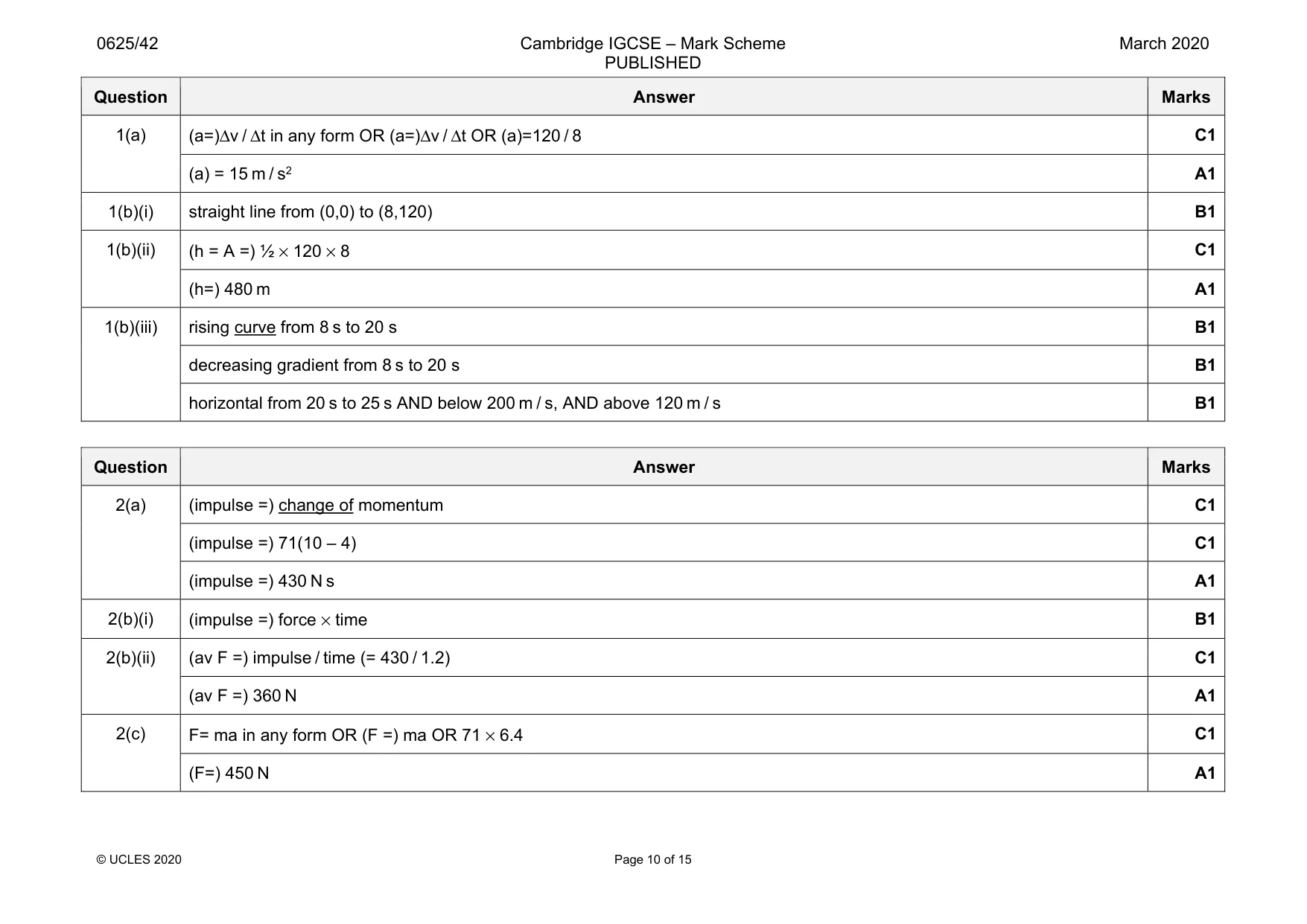
Mark scheme: 1(a) (a=)Δv / Δt in any form OR (a=)Δv / Δt OR (a)=120 / 8 C1 (a) = 15 m / s2 A1 1(b)(i) straight line from (0,0) to (8,120) B1 1(b)(ii) (h = A =) ½ × 120 × 8 C1 (h=) 480 m A1 1(b)(iii) rising curve from 8 s to 20 s B1 decreasing gradient from 8 s to 20 s B1 horizontal from 20 s to 25 s AND below 200 m / s, AND above 120 m / s B1
Q2 · An athlete crossing the finishing line in a race
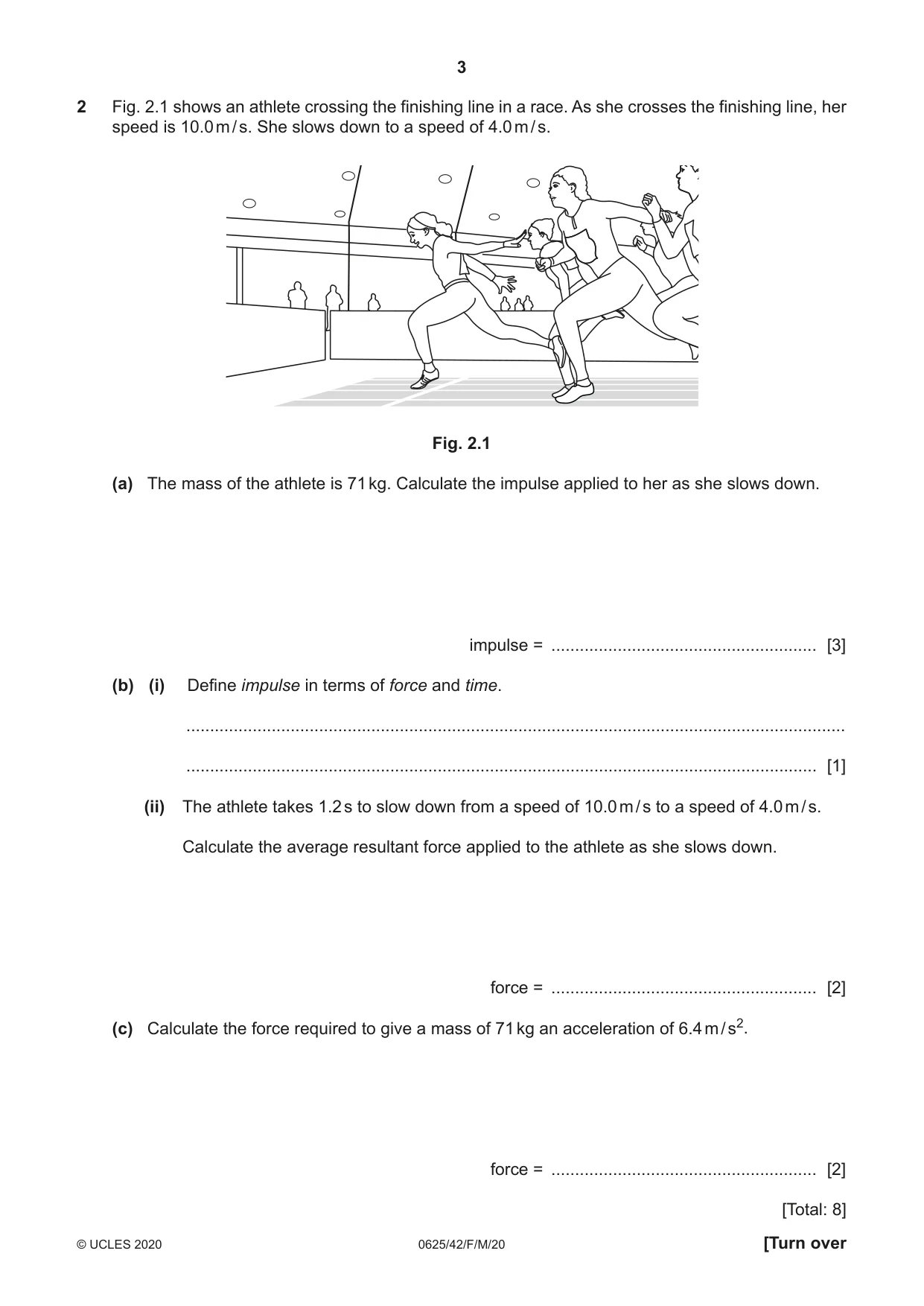
2 Fig. 2.1 shows an athlete crossing the finishing line in a race. As she crosses the finishing line, her speed is 10.0 m / s. She slows down to a speed of 4.0 m / s. Fig. 2.1 (a) The mass of the athlete is 71 kg. Calculate the impulse applied to her as she slows down. impulse = ........................................................ [3] (b) (i) Define impulse in terms of force and time. ........................................................................................................................................... ..................................................................................................................................... [1] (ii) The athlete takes 1.2 s to slow down from a speed of 10.0 m / s to a speed of 4.0 m / s. Calculate the average resultant force applied to the athlete as she slows down. force = ........................................................ [2] (c) Calculate the force required to give a mass of 71 kg an acceleration of 6.4 m / s2. force = ........................................................ [2] [Total: 8]
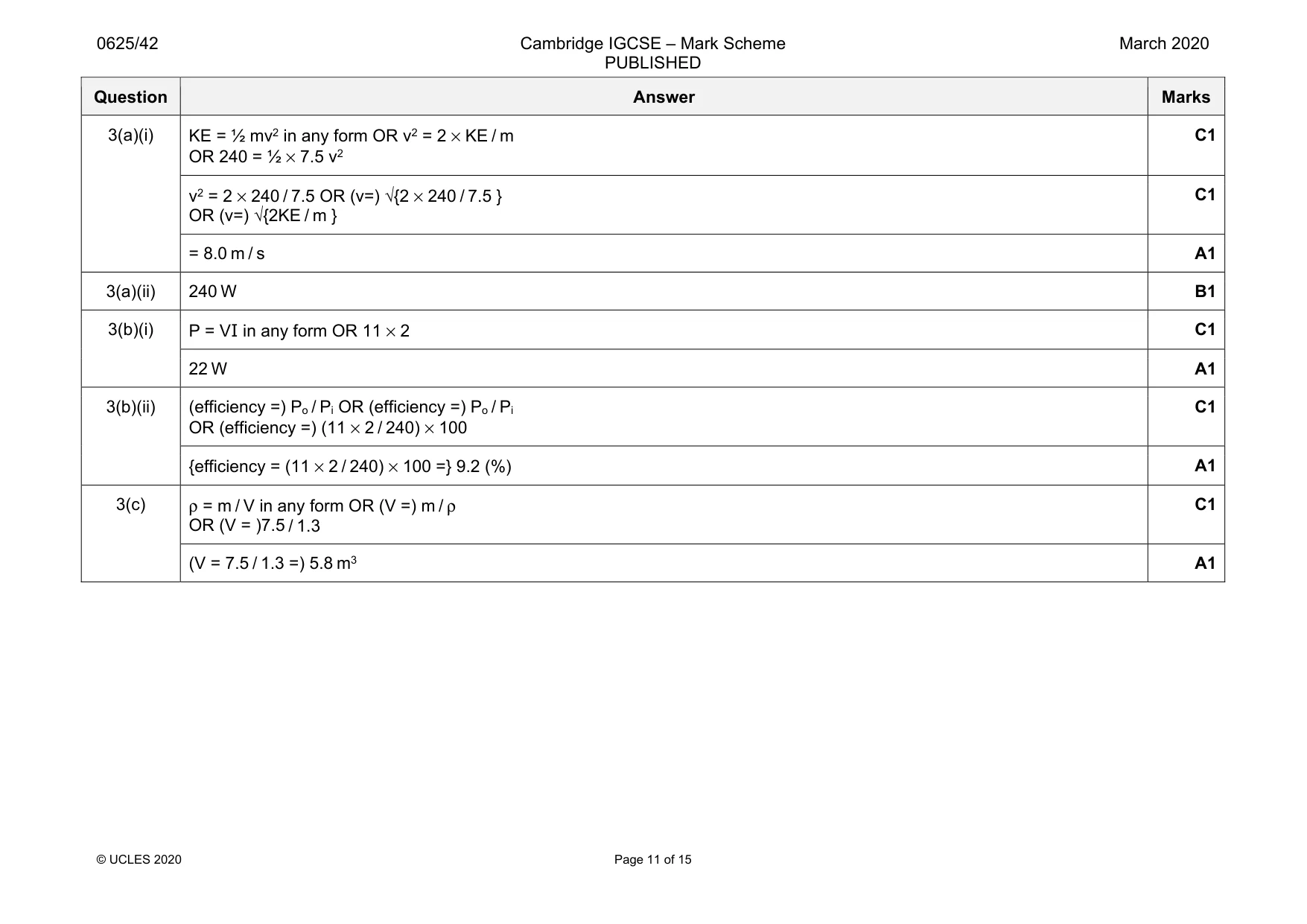
Mark scheme: 2(a) (impulse =) change of momentum C1 (impulse =) 71(10 – 4) C1 (impulse =) 430 N s A1 2(b)(i) (impulse =) force × time B1 2(b)(ii) (av F =) impulse / time (= 430 / 1.2) C1 (av F =) 360 N A1 2(c) F= ma in any form OR (F =) ma OR 71 × 6.4 C1 (F=) 450 N A1
Q3 · A model of a wind turbine used to demonstrate the use of wind energy to generate…
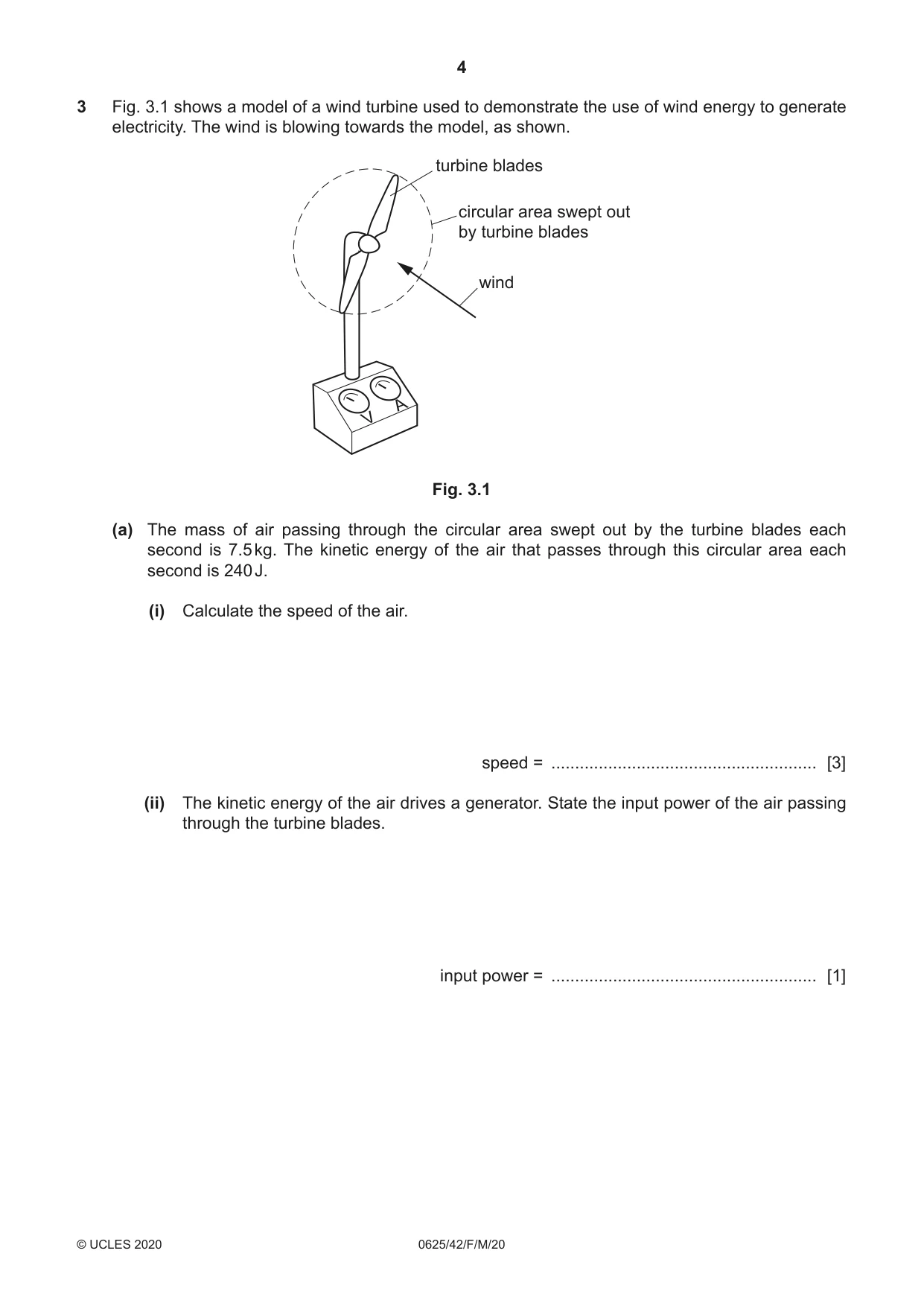
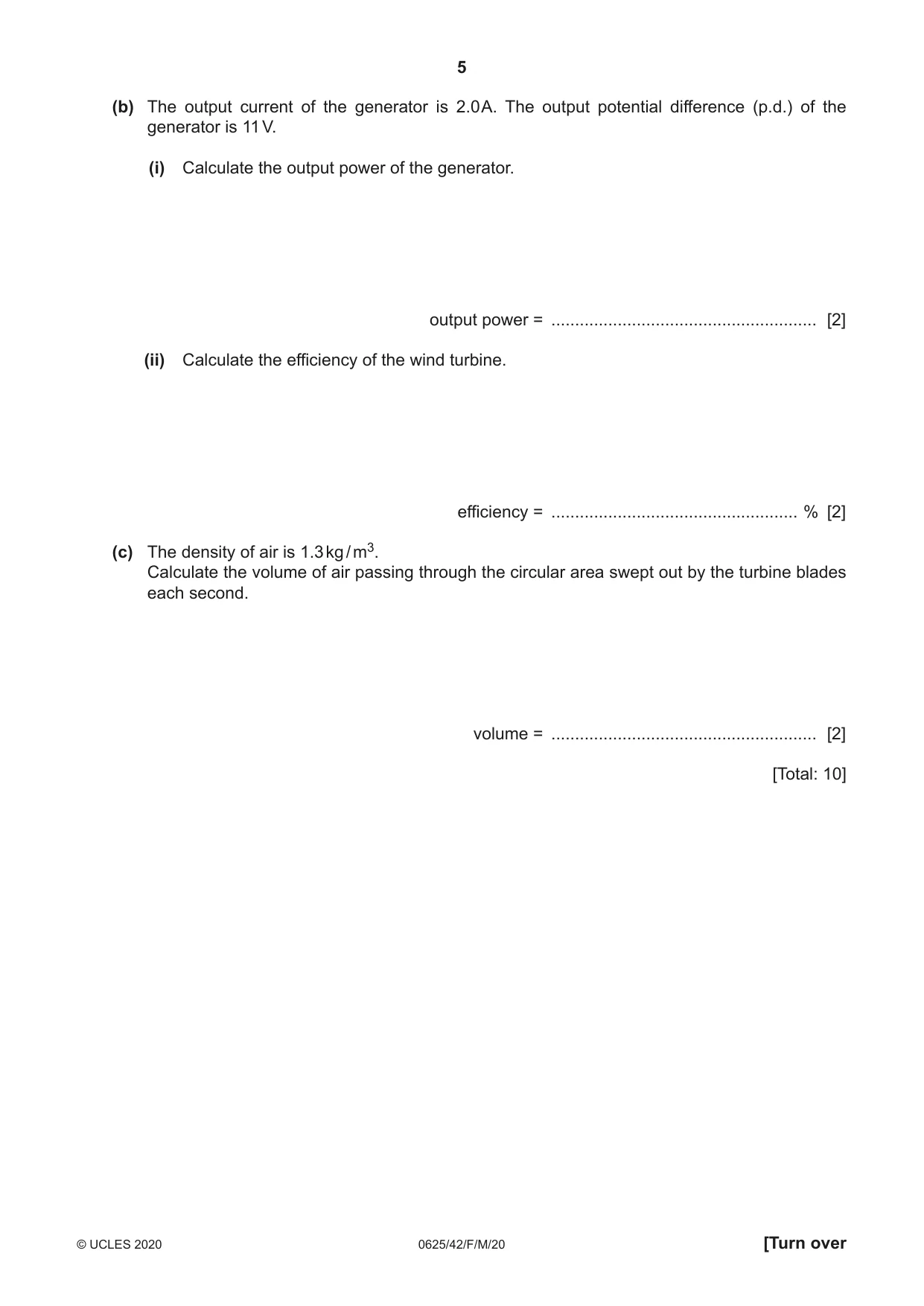
3 Fig. 3.1 shows a model of a wind turbine used to demonstrate the use of wind energy to generate electricity. The wind is blowing towards the model, as shown. turbine blades circular area swept out by turbine blades wind A V Fig. 3.1 (a) The mass of air passing through the circular area swept out by the turbine blades each second is 7.5 kg. The kinetic energy of the air that passes through this circular area each second is 240 J. (i) Calculate the speed of the air. speed = ........................................................ [3] (ii) The kinetic energy of the air drives a generator. State the input power of the air passing through the turbine blades. input power = ........................................................ [1] (b) The output current of the generator is 2.0 A. The output potential difference (p.d.) of the generator is 11 V. (i) Calculate the output power of the generator. output power = ........................................................ [2] (ii) Calculate the efficiency of the wind turbine. efficiency = .................................................... % [2] (c) The density of air is 1.3 kg / m3. Calculate the volume of air passing through the circular area swept out by the turbine blades each second. volume = ........................................................ [2] [Total: 10]
Mark scheme: 3(a)(i) KE = ½ mv2 in any form OR v2 = 2 × KE / m OR 240 = ½ × 7.5 v2 C1 v2 = 2 × 240 / 7.5 OR (v=) √{2 × 240 / 7.5 } OR (v=) √{2KE / m } C1 = 8.0 m / s A1 3(a)(ii) 240 W B1 3(b)(i) P = VI in any form OR 11 × 2 C1 22 W A1 3(b)(ii) (efficiency =) Po / Pi OR (efficiency =) Po / Pi OR (efficiency =) (11 × 2 / 240) × 100 C1 {efficiency = (11 × 2 / 240) × 100 =} 9.2 (%) A1 3(c) ρ = m / V in any form OR (V =) m / ρ OR (V = )7.5 / 1.3 C1 (V = 7.5 / 1.3 =) 5.8 m3 A1
Q4 · Define the specific latent heat of fusion of a substance
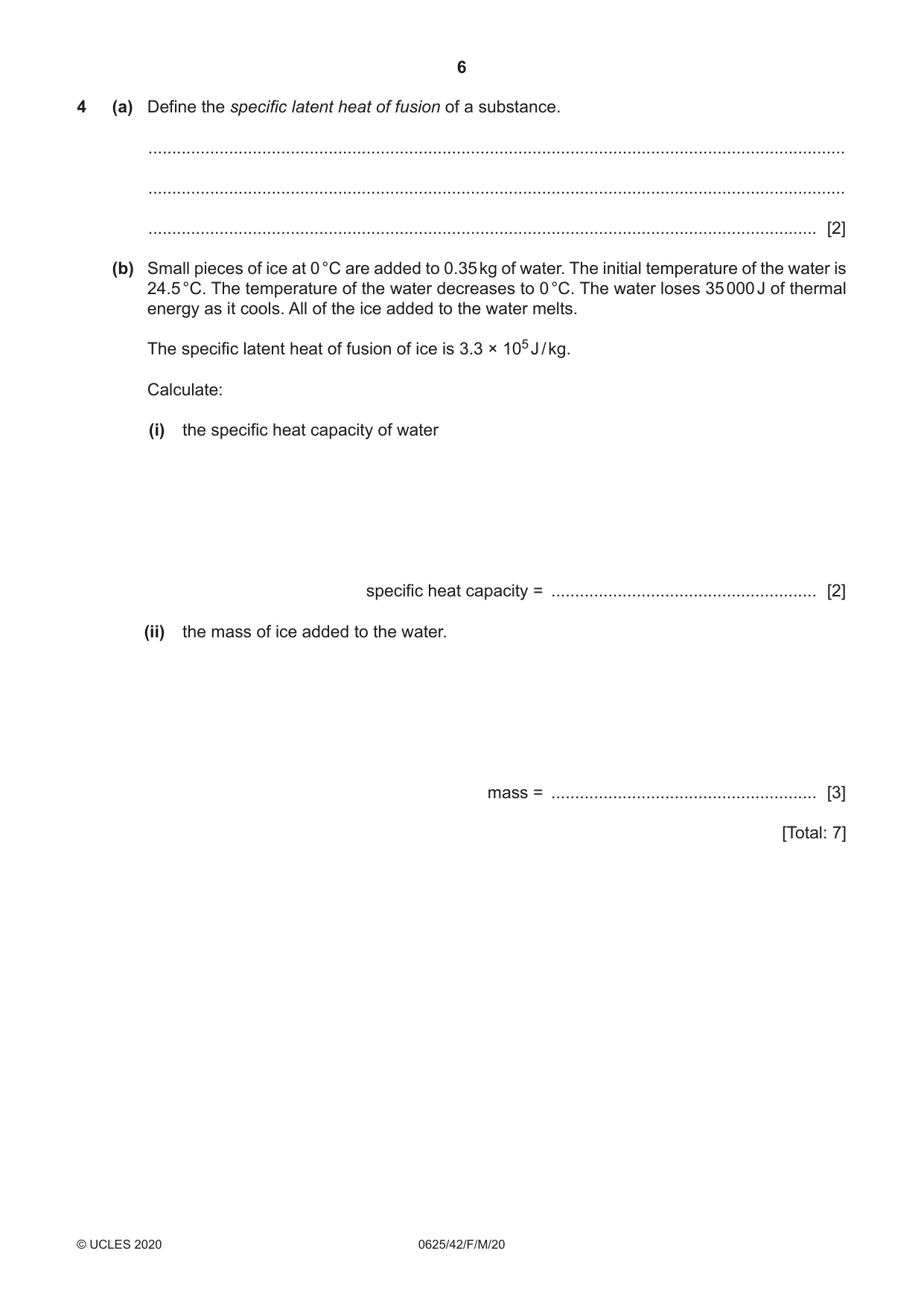
4 (a) Define the specific latent heat of fusion of a substance. ................................................................................................................................................... ................................................................................................................................................... ............................................................................................................................................. [2] (b) Small pieces of ice at 0 °C are added to 0.35 kg of water. The initial temperature of the water is 24.5 °C. The temperature of the water decreases to 0 °C. The water loses 35 000 J of thermal energy as it cools. All of the ice added to the water melts. The specific latent heat of fusion of ice is 3.3 × 10⁵ J / kg. Calculate: (i) the specific heat capacity of water specific heat capacity = ........................................................ [2] (ii) the mass of ice added to the water. mass = ........................................................ [3] [Total: 7]
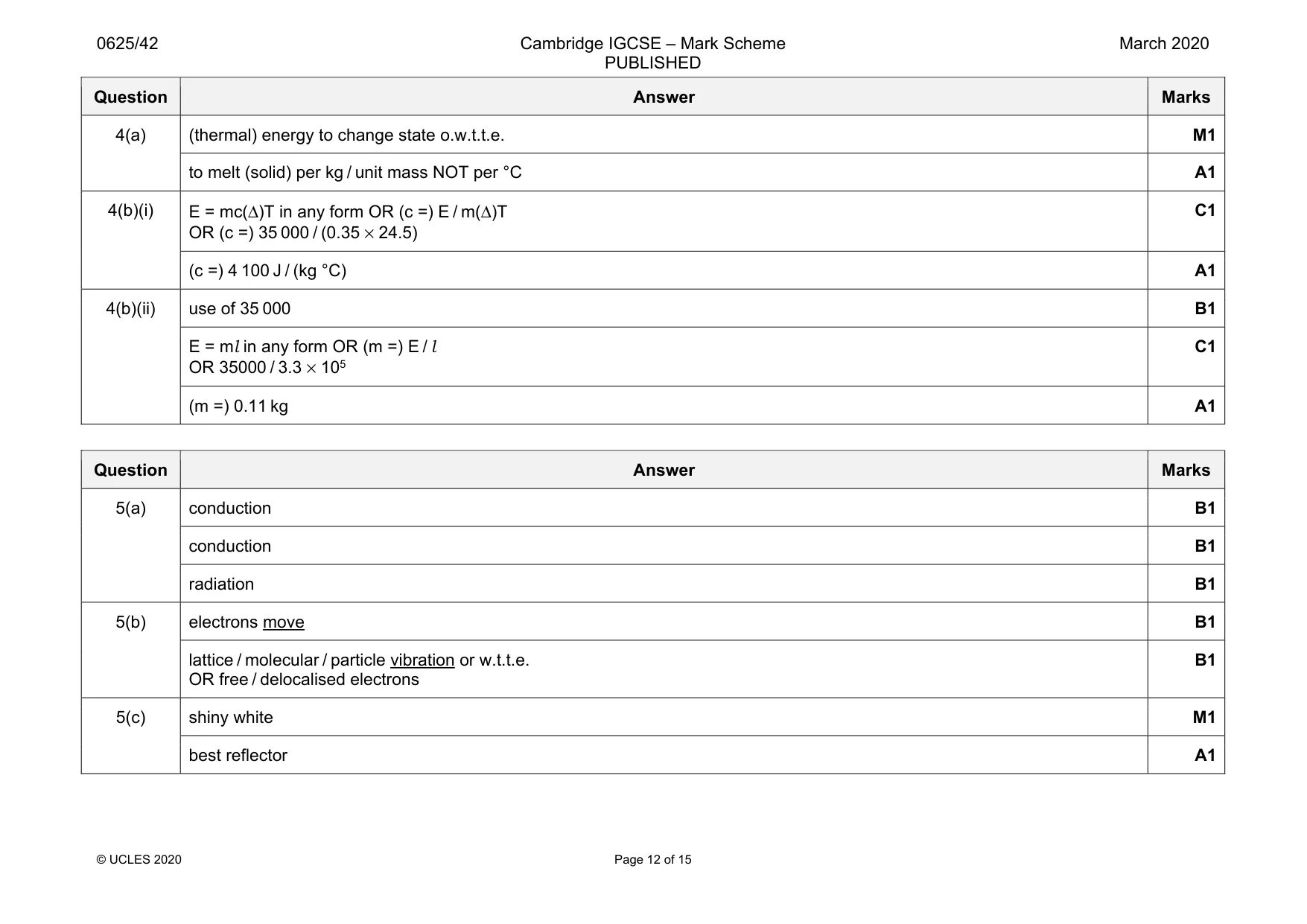
Mark scheme: 4(a) (thermal) energy to change state o.w.t.t.e. M1 to melt (solid) per kg / unit mass NOT per °C A1 4(b)(i) E = mc(Δ)T in any form OR (c =) E / m(Δ)T OR (c =) 35 000 / (0.35 × 24.5) C1 (c =) 4 100 J / (kg °C) A1 4(b)(ii) use of 35 000 B1 E = ml in any form OR (m =) E / l OR 35000 / 3.3 × 10⁵ C1 (m =) 0.11 kg A1
Q5 · Complete the sentences with words that describe the main process of thermal energy…
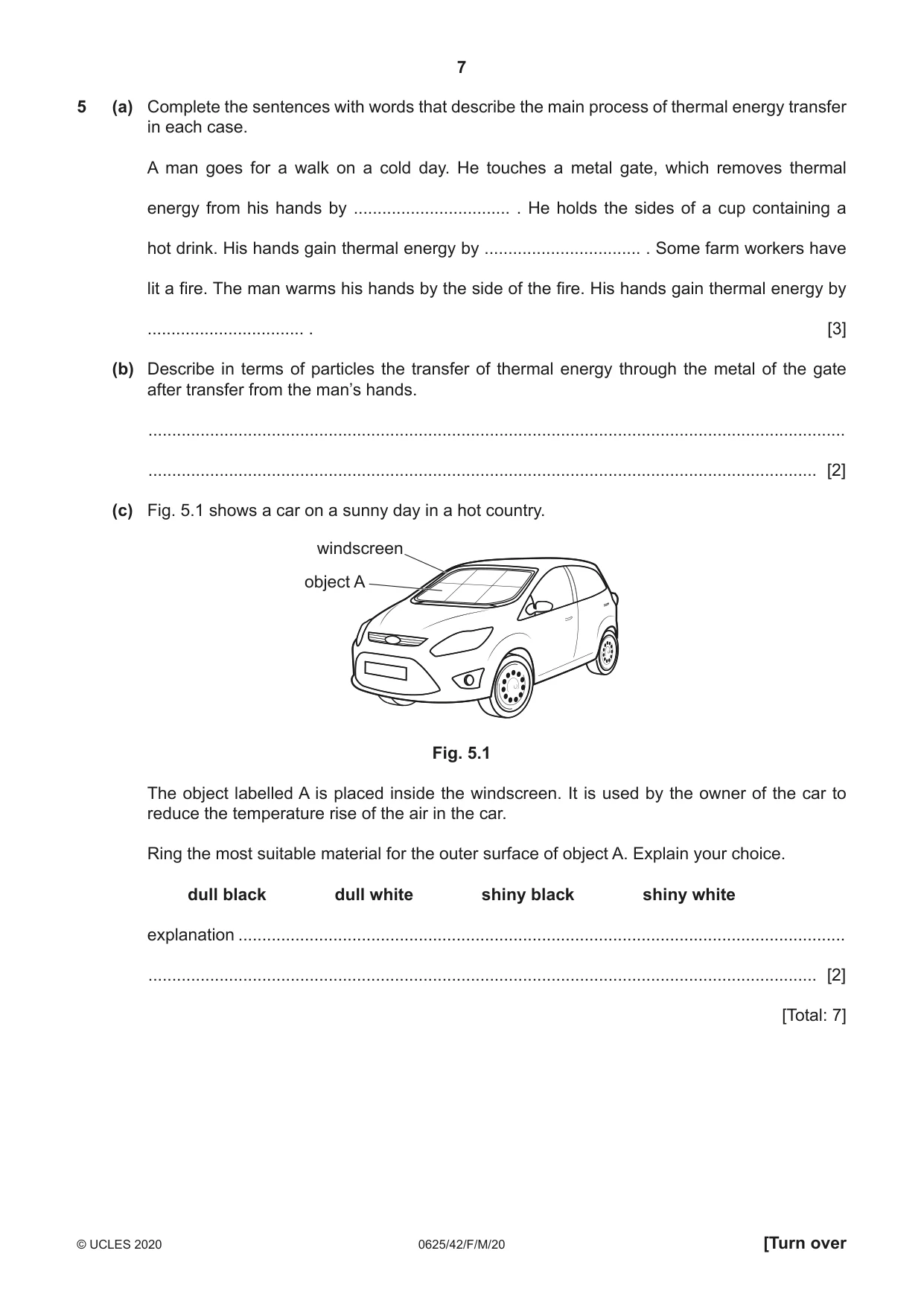
5 (a) Complete the sentences with words that describe the main process of thermal energy transfer in each case. A man goes for a walk on a cold day. He touches a metal gate, which removes thermal energy from his hands by ................................. . He holds the sides of a cup containing a hot drink. His hands gain thermal energy by ................................. . Some farm workers have lit a fire. The man warms his hands by the side of the fire. His hands gain thermal energy by ................................. . [3] (b) Describe in terms of particles the transfer of thermal energy through the metal of the gate after transfer from the man’s hands. ................................................................................................................................................... ............................................................................................................................................. [2] (c) Fig. 5.1 shows a car on a sunny day in a hot country. windscreen object A Fig. 5.1 The object labelled A is placed inside the windscreen. It is used by the owner of the car to reduce the temperature rise of the air in the car. Ring the most suitable material for the outer surface of object A. Explain your choice. dull black dull white shiny black shiny white explanation ................................................................................................................................ ............................................................................................................................................. [2] [Total: 7]
Mark scheme: 5(a) conduction B1 conduction B1 radiation B1 5(b) electrons move B1 lattice / molecular / particle vibration or w.t.t.e. OR free / delocalised electrons B1 5(c) shiny white M1 best reflector A1
Q6 · Crests of a water wave moving from left to right in a harbour
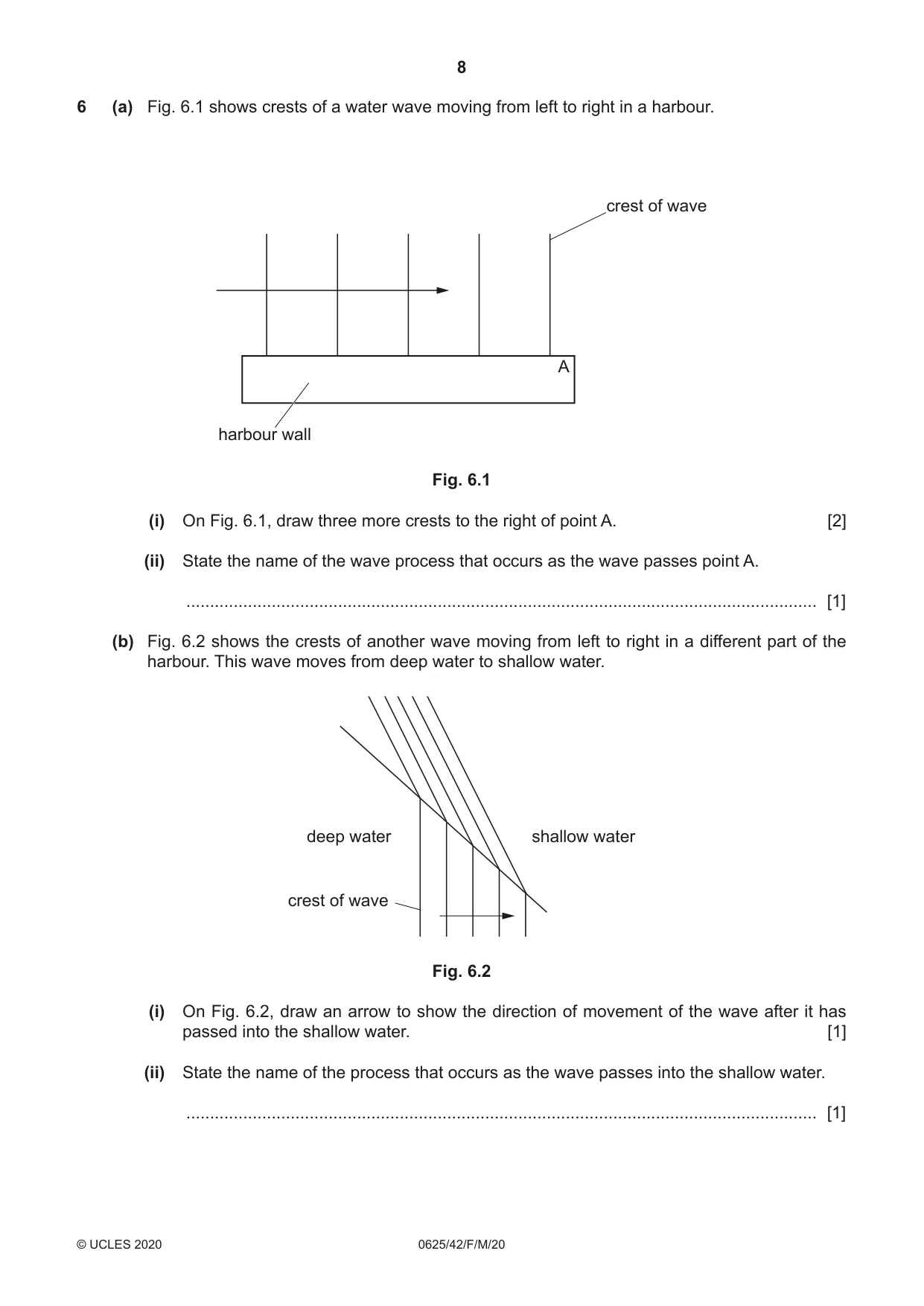
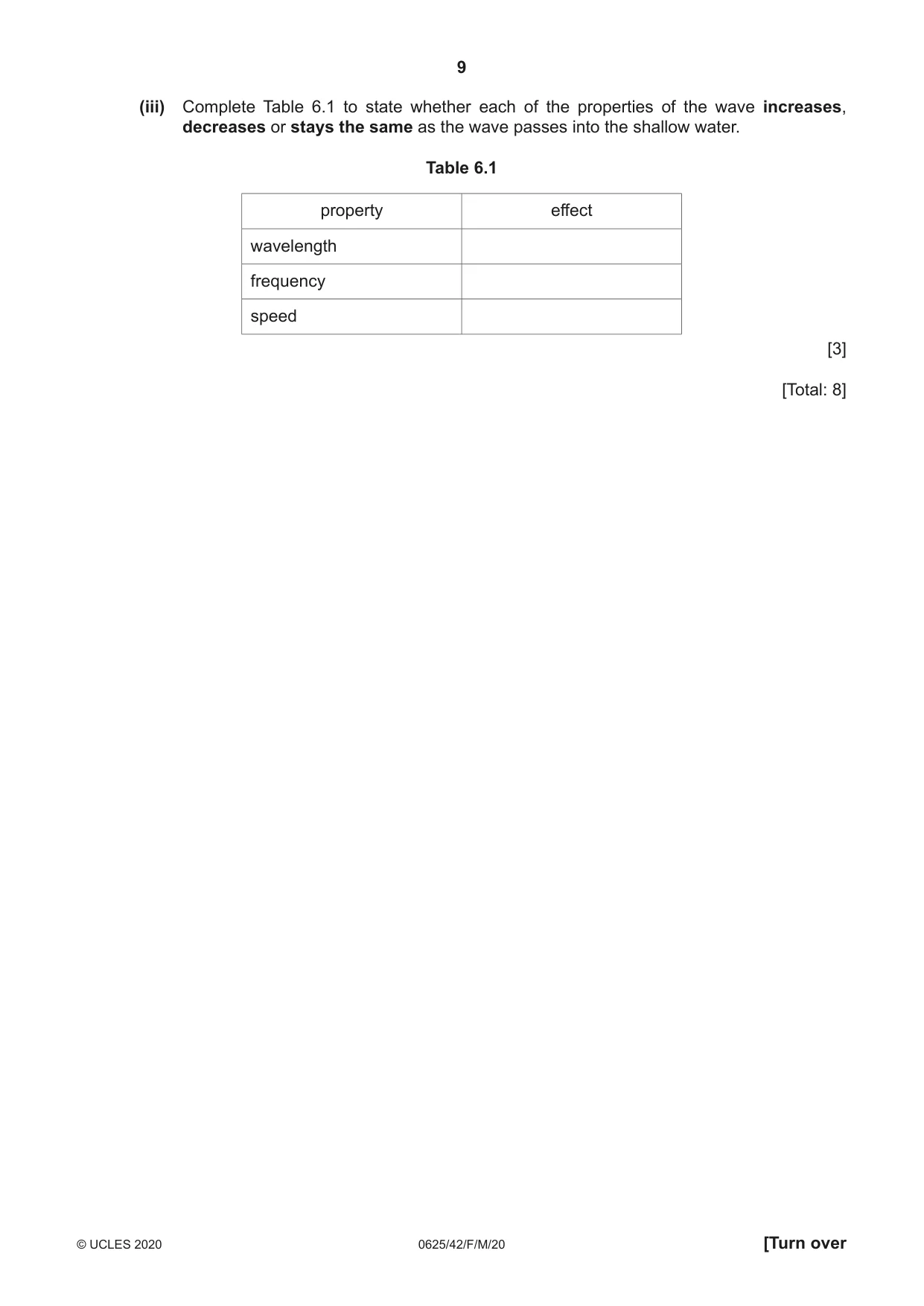
6 (a) Fig. 6.1 shows crests of a water wave moving from left to right in a harbour. crest of wave A harbour wall Fig. 6.1 (i) On Fig. 6.1, draw three more crests to the right of point A. [2] (ii) State the name of the wave process that occurs as the wave passes point A. ..................................................................................................................................... [1] (b) Fig. 6.2 shows the crests of another wave moving from left to right in a different part of the harbour. This wave moves from deep water to shallow water. deep water shallow water crest of wave Fig. 6.2 (i) On Fig. 6.2, draw an arrow to show the direction of movement of the wave after it has passed into the shallow water. [1] (ii) State the name of the process that occurs as the wave passes into the shallow water. ..................................................................................................................................... [1] (iii) Complete Table 6.1 to state whether each of the properties of the wave increases, decreases or stays the same as the wave passes into the shallow water. Table 6.1 property effect wavelength frequency speed [3] [Total: 8]
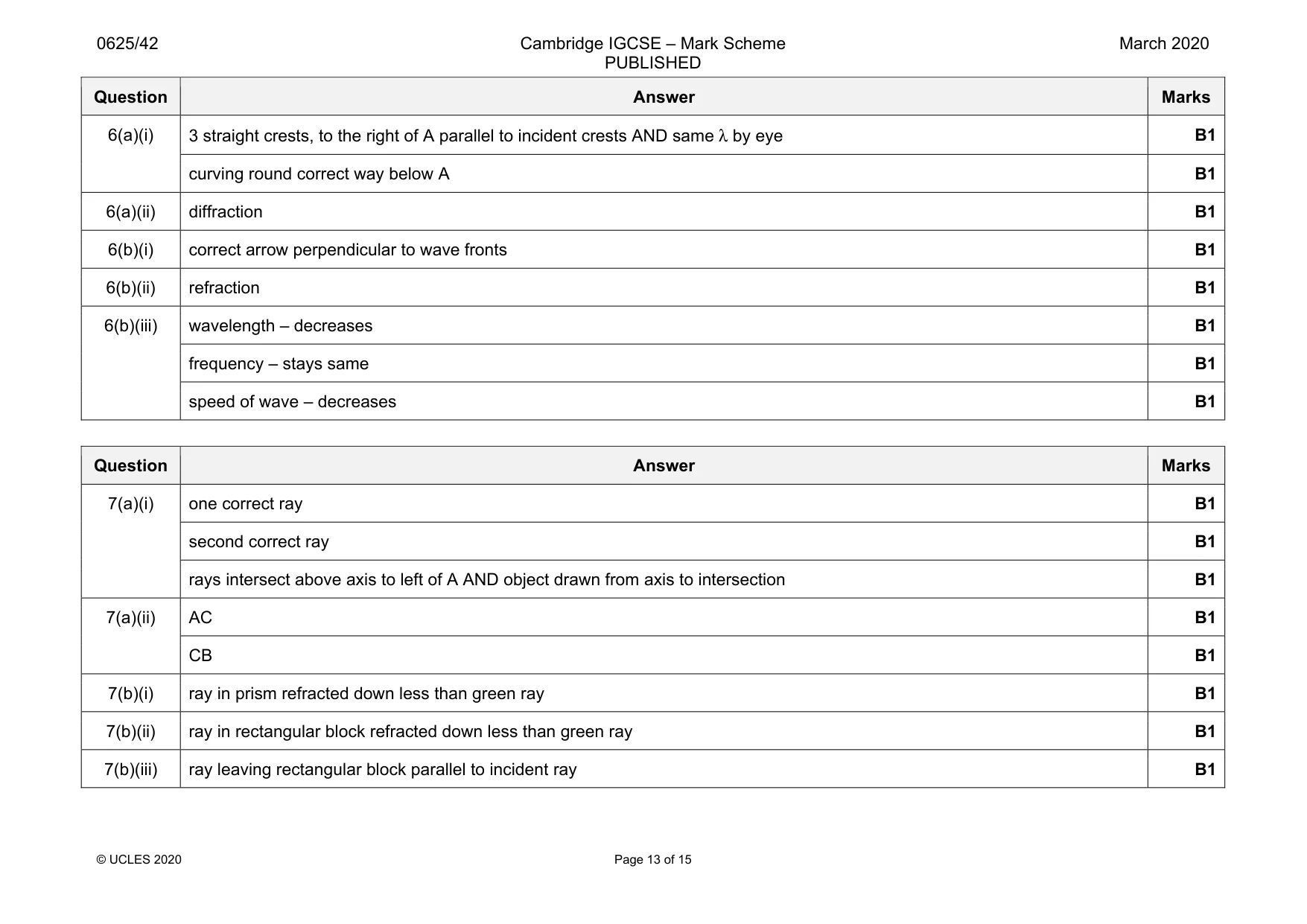
Mark scheme: 6(a)(i) 3 straight crests, to the right of A parallel to incident crests AND same λ by eye B1 curving round correct way below A B1 6(a)(ii) diffraction B1 6(b)(i) correct arrow perpendicular to wave fronts B1 6(b)(ii) refraction B1 6(b)(iii) wavelength – decreases B1 frequency – stays same B1 speed of wave – decreases B1
Q7 · A converging lens and the image I formed when an object is placed to the left of the lens
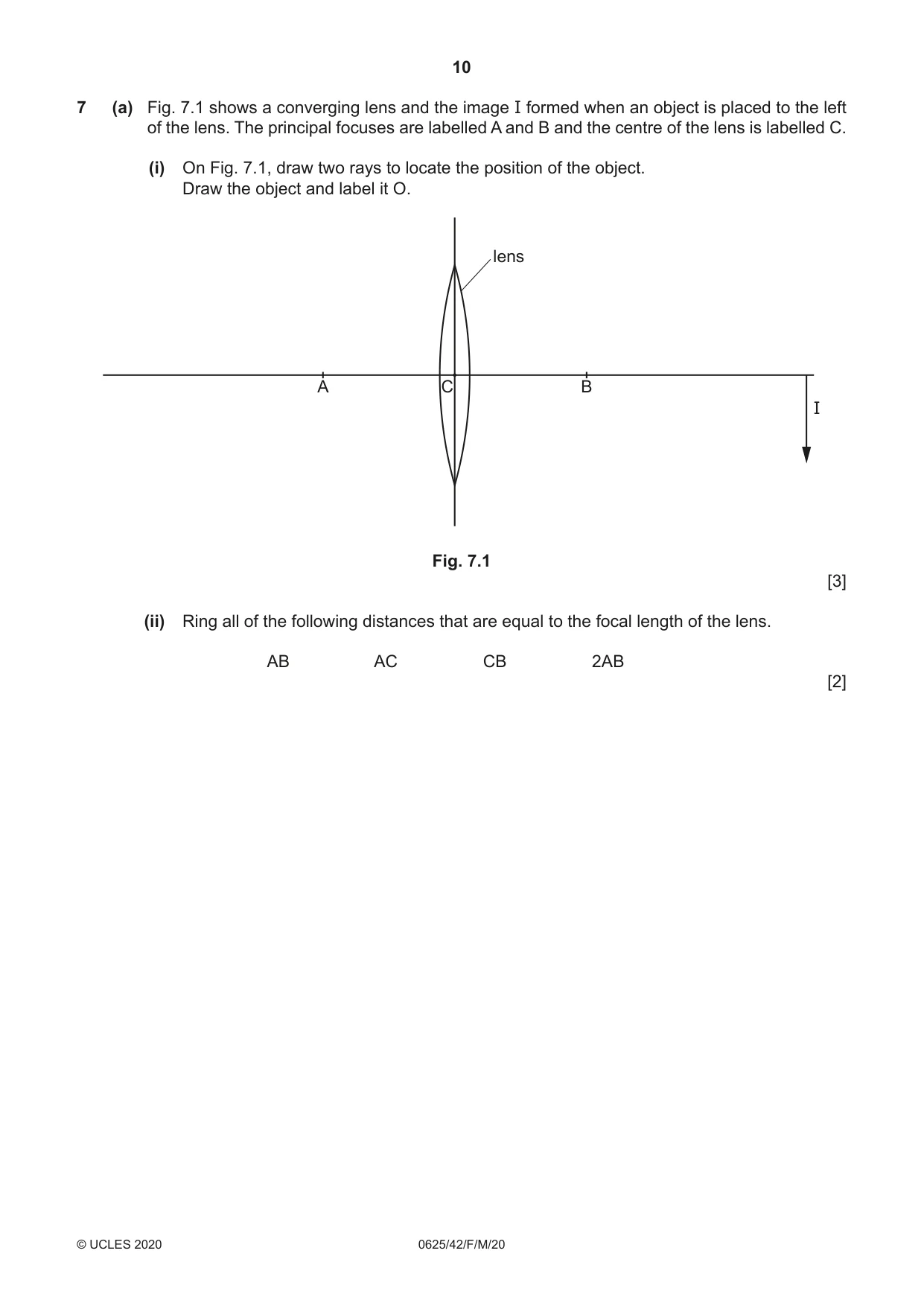
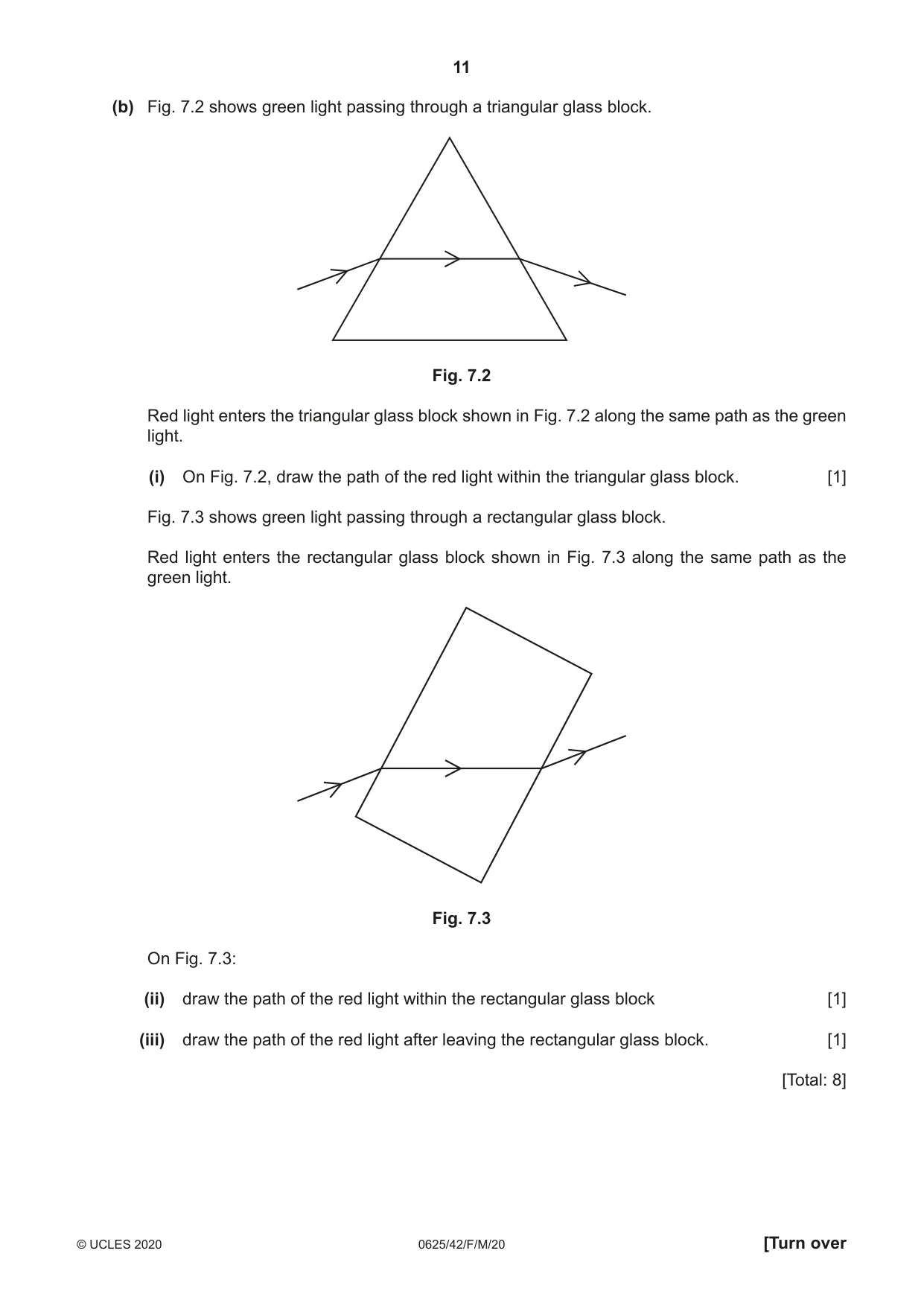
7 (a) Fig. 7.1 shows a converging lens and the image I formed when an object is placed to the left of the lens. The principal focuses are labelled A and B and the centre of the lens is labelled C. (i) On Fig. 7.1, draw two rays to locate the position of the object. Draw the object and label it O. lens A C B I Fig. 7.1 [3] (ii) Ring all of the following distances that are equal to the focal length of the lens. AB AC CB 2AB [2] (b) Fig. 7.2 shows green light passing through a triangular glass block. Fig. 7.2 Red light enters the triangular glass block shown in Fig. 7.2 along the same path as the green light. (i) On Fig. 7.2, draw the path of the red light within the triangular glass block. [1] Fig. 7.3 shows green light passing through a rectangular glass block. Red light enters the rectangular glass block shown in Fig. 7.3 along the same path as the green light. Fig. 7.3 On Fig. 7.3: (ii) draw the path of the red light within the rectangular glass block [1] (iii) draw the path of the red light after leaving the rectangular glass block. [1] [Total: 8]
Mark scheme: 7(a)(i) one correct ray B1 second correct ray B1 rays intersect above axis to left of A AND object drawn from axis to intersection B1 7(a)(ii) AC B1 CB B1 7(b)(i) ray in prism refracted down less than green ray B1 7(b)(ii) ray in rectangular block refracted down less than green ray B1 7(b)(iii) ray leaving rectangular block parallel to incident ray B1
Question 8
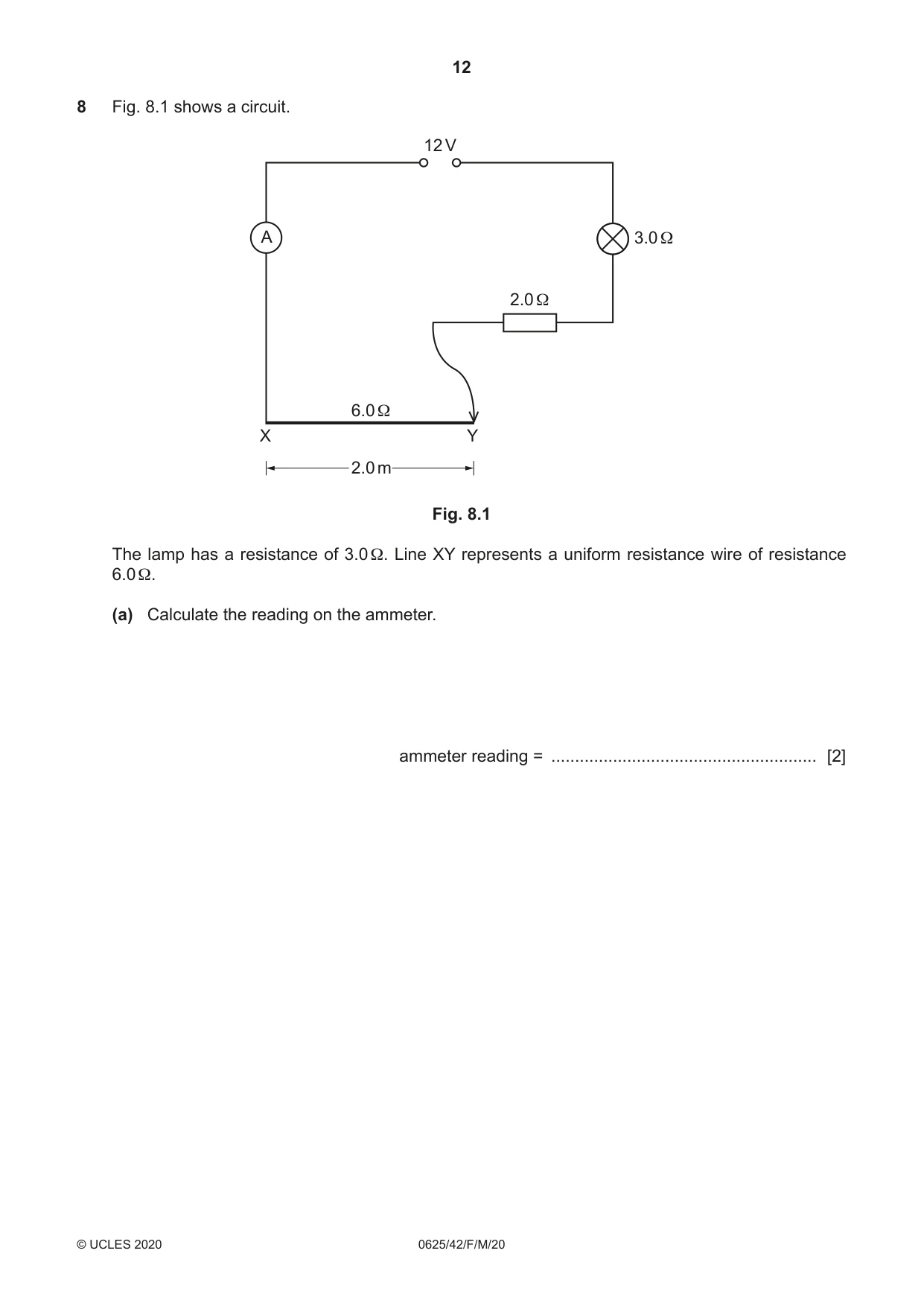
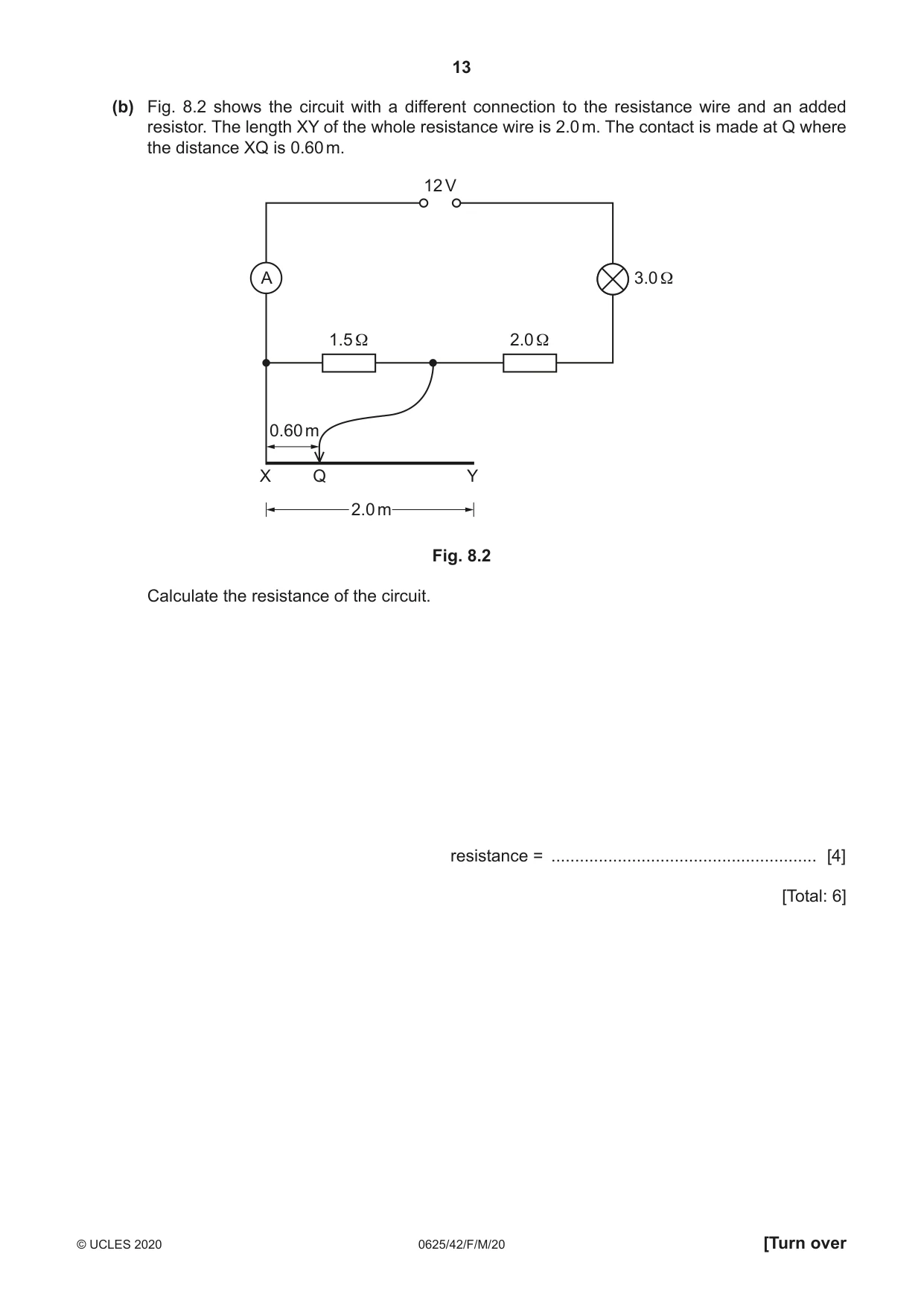
8 Fig. 8.1 shows a circuit. 12 V A 3.0 Ω 2.0 Ω 6.0 Ω X Y 2.0 m Fig. 8.1 The lamp has a resistance of 3.0 Ω. Line XY represents a uniform resistance wire of resistance 6.0 Ω. (a) Calculate the reading on the ammeter. ammeter reading = ........................................................ [2] (b) Fig. 8.2 shows the circuit with a different connection to the resistance wire and an added resistor. The length XY of the whole resistance wire is 2.0 m. The contact is made at Q where the distance XQ is 0.60 m. 12 V A 3.0 Ω 1.5 Ω 2.0 Ω 0.60 m X Q Y 2.0 m Fig. 8.2 Calculate the resistance of the circuit. resistance = ........................................................ [4] [Total: 6]
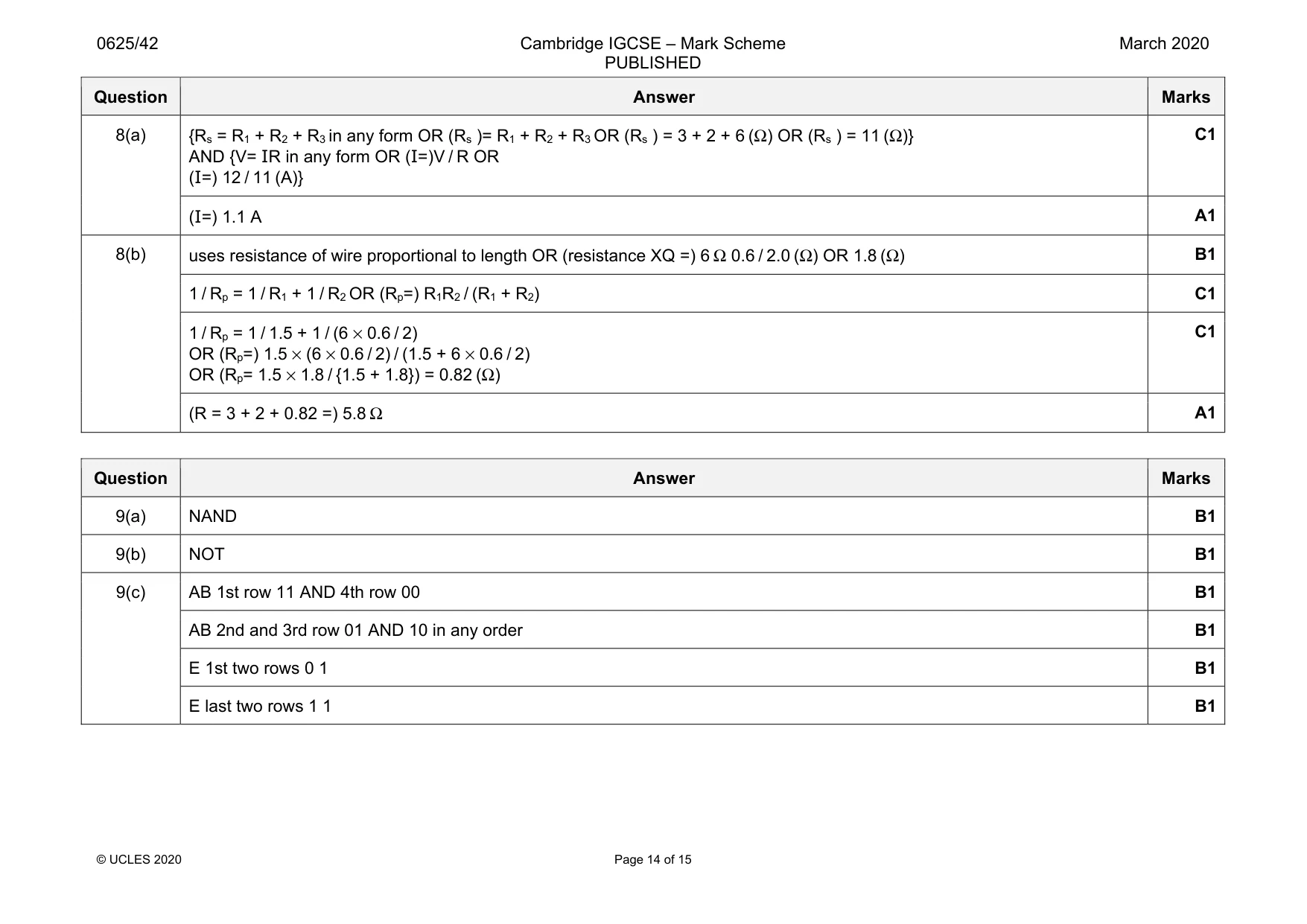
Mark scheme: 8(a) {Rs = R1 + R2 + R3 in any form OR (Rs )= R1 + R2 + R3 OR (Rs ) = 3 + 2 + 6 (Ω) OR (Rs ) = 11 (Ω)} AND {V= IR in any form OR (I=)V / R OR (I=) 12 / 11 (A)} (I=) 1.1 A A1 8(b) uses resistance of wire proportional to length OR (resistance XQ =) 6 Ω 0.6 / 2.0 (Ω) OR 1.8 (Ω) B1 1 / Rp = 1 / R1 + 1 / R2 OR (Rp=) R1R2 / (R1 + R2) C1 1 / Rp = 1 / 1.5 + 1 / (6 × 0.6 / 2) OR (Rp=) 1.5 × (6 × 0.6 / 2) / (1.5 + 6 × 0.6 / 2) OR (Rp= 1.5 × 1.8 / {1.5 + 1.8}) = 0.82 (Ω) C1 (R = 3 + 2 + 0.82 =) 5.8 Ω A1
Q9 · State the name of the logic gate with the symbol shown in Fig
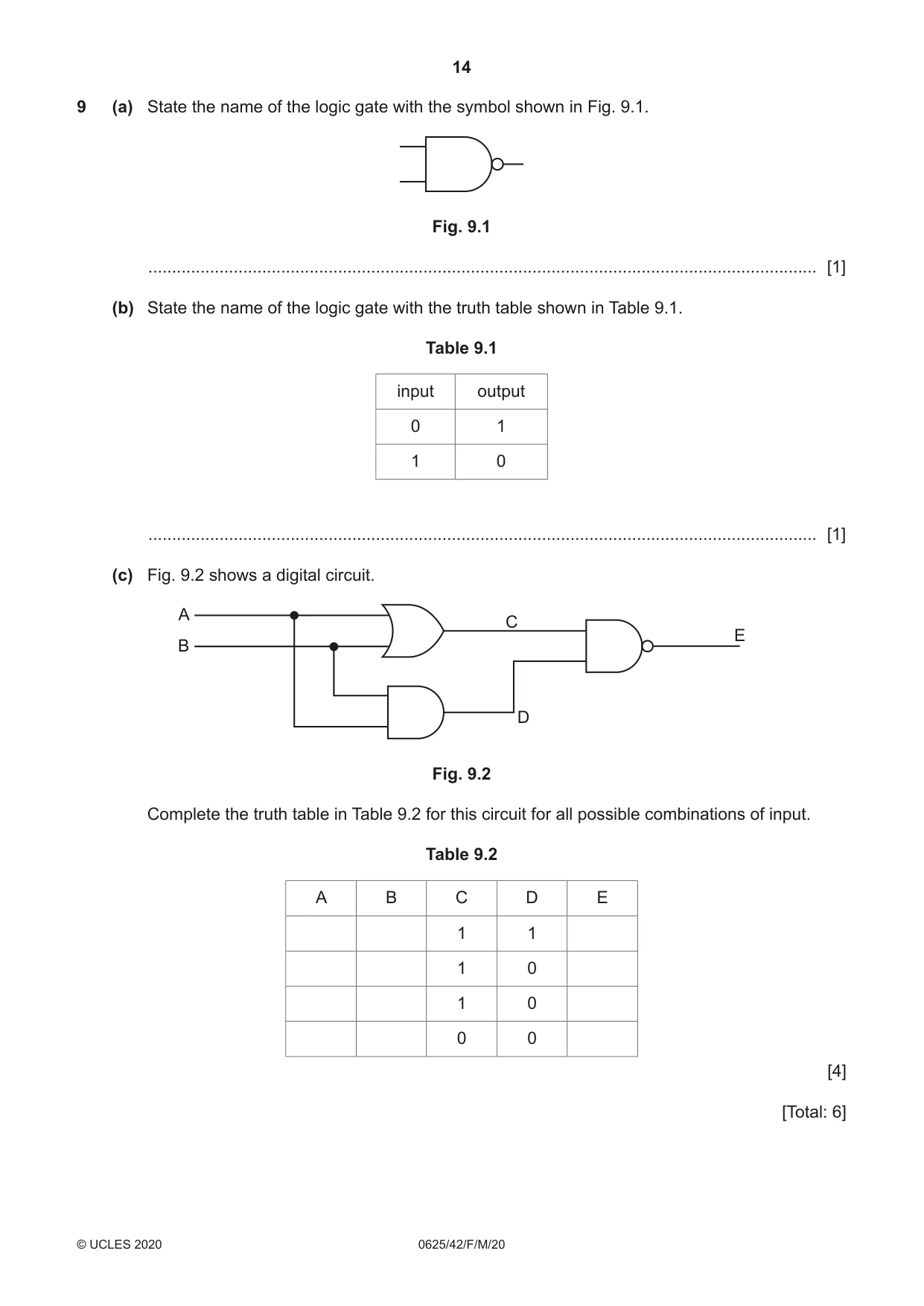
9 (a) State the name of the logic gate with the symbol shown in Fig. 9.1. Fig. 9.1 ............................................................................................................................................. [1] (b) State the name of the logic gate with the truth table shown in Table 9.1. Table 9.1 input output 0 1 1 0 ............................................................................................................................................. [1] (c) Fig. 9.2 shows a digital circuit. A C E B D Fig. 9.2 Complete the truth table in Table 9.2 for this circuit for all possible combinations of input. Table 9.2 A B C D E 1 1 1 0 1 0 0 0 [4] [Total: 6]
Mark scheme: 9(a) NAND B1 9(b) NOT B1 9(c) AB 1st row 11 AND 4th row 00 B1 AB 2nd and 3rd row 01 AND 10 in any order B1 E 1st two rows 0 1 B1 E last two rows 1 1 B1
Q10 · A simplified top view of a flat coil
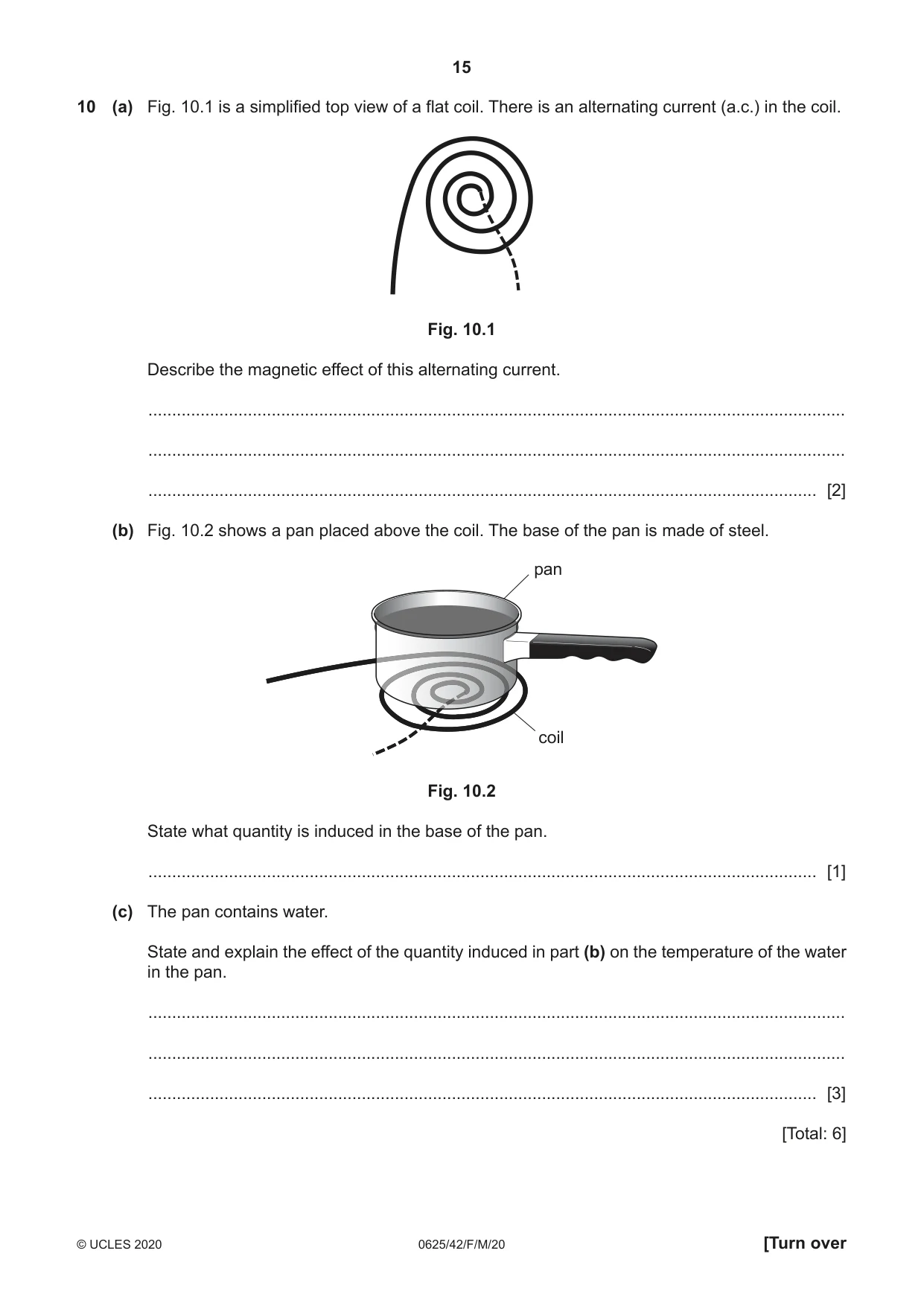
10 (a) Fig. 10.1 is a simplified top view of a flat coil. There is an alternating current (a.c.) in the coil. Fig. 10.1 Describe the magnetic effect of this alternating current. ................................................................................................................................................... ................................................................................................................................................... ............................................................................................................................................. [2] (b) Fig. 10.2 shows a pan placed above the coil. The base of the pan is made of steel. pan coil Fig. 10.2 State what quantity is induced in the base of the pan. ............................................................................................................................................. [1] (c) The pan contains water. State and explain the effect of the quantity induced in part (b) on the temperature of the water in the pan. ................................................................................................................................................... ................................................................................................................................................... ............................................................................................................................................. [3] [Total: 6]
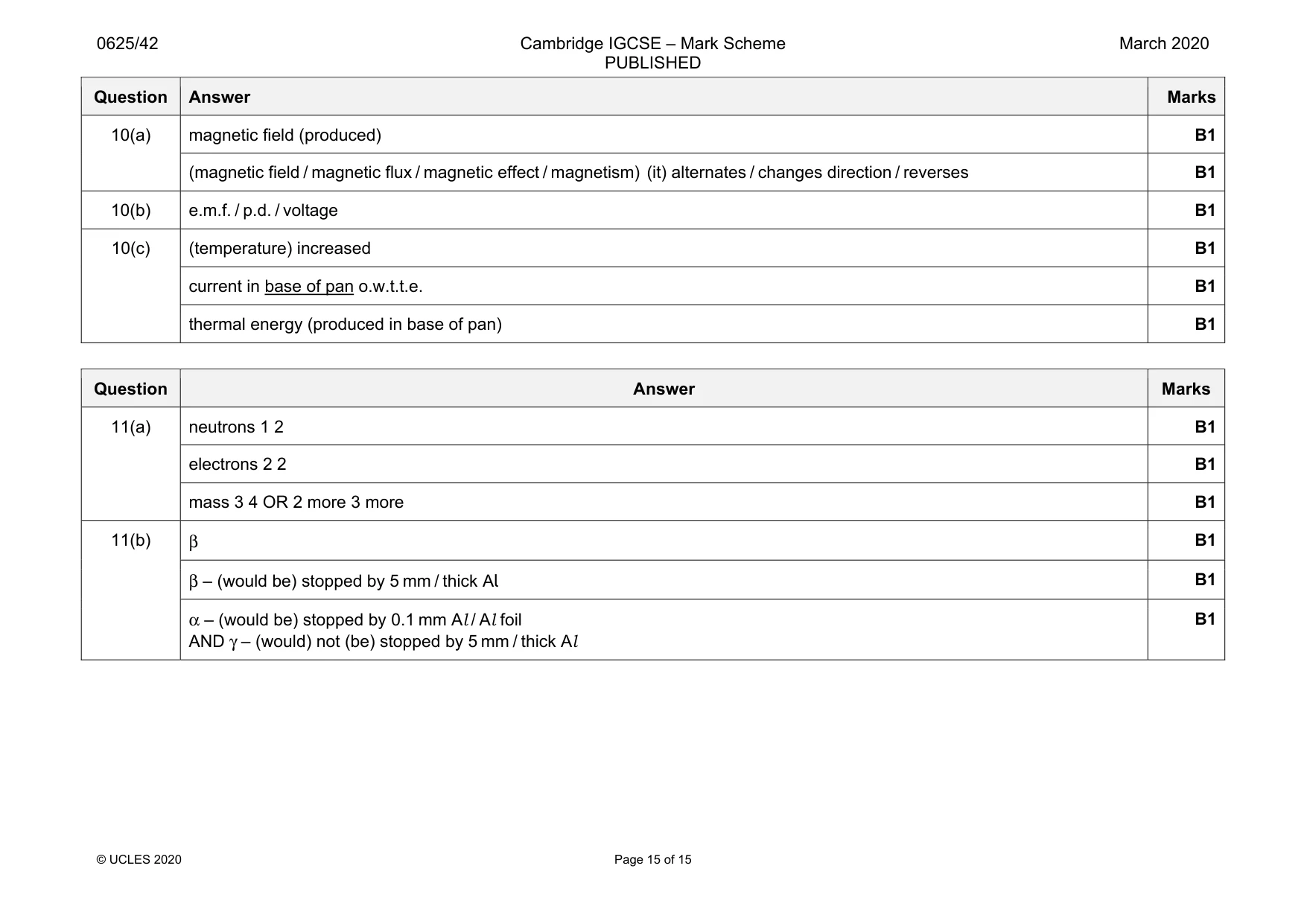
Mark scheme: 10(a) magnetic field (produced) B1 (magnetic field / magnetic flux / magnetic effect / magnetism) (it) alternates / changes direction / reverses B1 10(b) e.m.f. / p.d. / voltage B1 10(c) (temperature) increased B1 current in base of pan o.w.t.t.e. B1 thermal energy (produced in base of pan) B1
Q11 · The isotope hydrogen-1 has a proton number of 1 and a nucleon number of 1
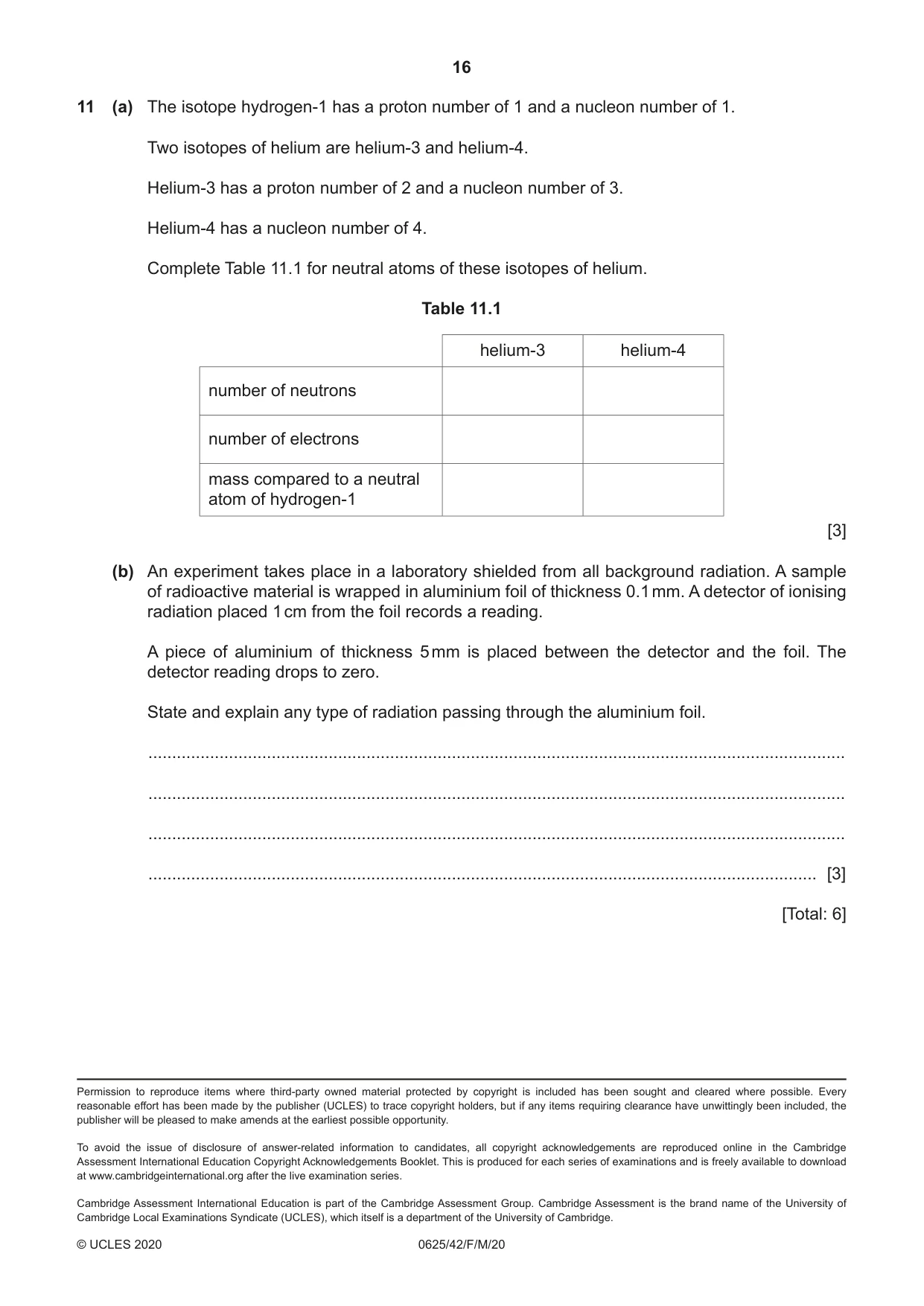
11 (a) The isotope hydrogen-1 has a proton number of 1 and a nucleon number of 1. Two isotopes of helium are helium-3 and helium-4. Helium-3 has a proton number of 2 and a nucleon number of 3. Helium-4 has a nucleon number of 4. Complete Table 11.1 for neutral atoms of these isotopes of helium. Table 11.1 helium-3 helium-4 number of neutrons number of electrons mass compared to a neutral atom of hydrogen-1 [3] (b) An experiment takes place in a laboratory shielded from all background radiation. A sample of radioactive material is wrapped in aluminium foil of thickness 0.1 mm. A detector of ionising radiation placed 1 cm from the foil records a reading. A piece of aluminium of thickness 5 mm is placed between the detector and the foil. The detector reading drops to zero. State and explain any type of radiation passing through the aluminium foil. ................................................................................................................................................... ................................................................................................................................................... ................................................................................................................................................... ............................................................................................................................................. [3] [Total: 6]
Mark scheme: 11(a) neutrons 1 2 B1 electrons 2 2 B1 mass 3 4 OR 2 more 3 more B1 11(b) β B1 β – (would be) stopped by 5 mm / thick Al B1 α – (would be) stopped by 0.1 mm Al / Al foil AND γ – (would) not (be) stopped by 5 mm / thick Al B1
What was in this paper
The subtopics covered by these 11 questions, and how many questions each got. Open one in a new tab to see every Cambridge question on it.
What you needed in this session
Cambridge’s own grade thresholds for 2020 Feb/March, Paper 4 · Variant 2. A higher threshold means an easier paper — the bar moves with how the cohort did.