Cambridge IGCSE Physics 0625 — 2018 Oct/Nov Paper 4 · Variant 2
0625/42/O/N/18 · 10 questions · 80 marks · ≈90 min
The question paper and its mark scheme, free to read here and free to download. This is Cambridge’s own paper, exactly as it was sat.
Question paper20 pages


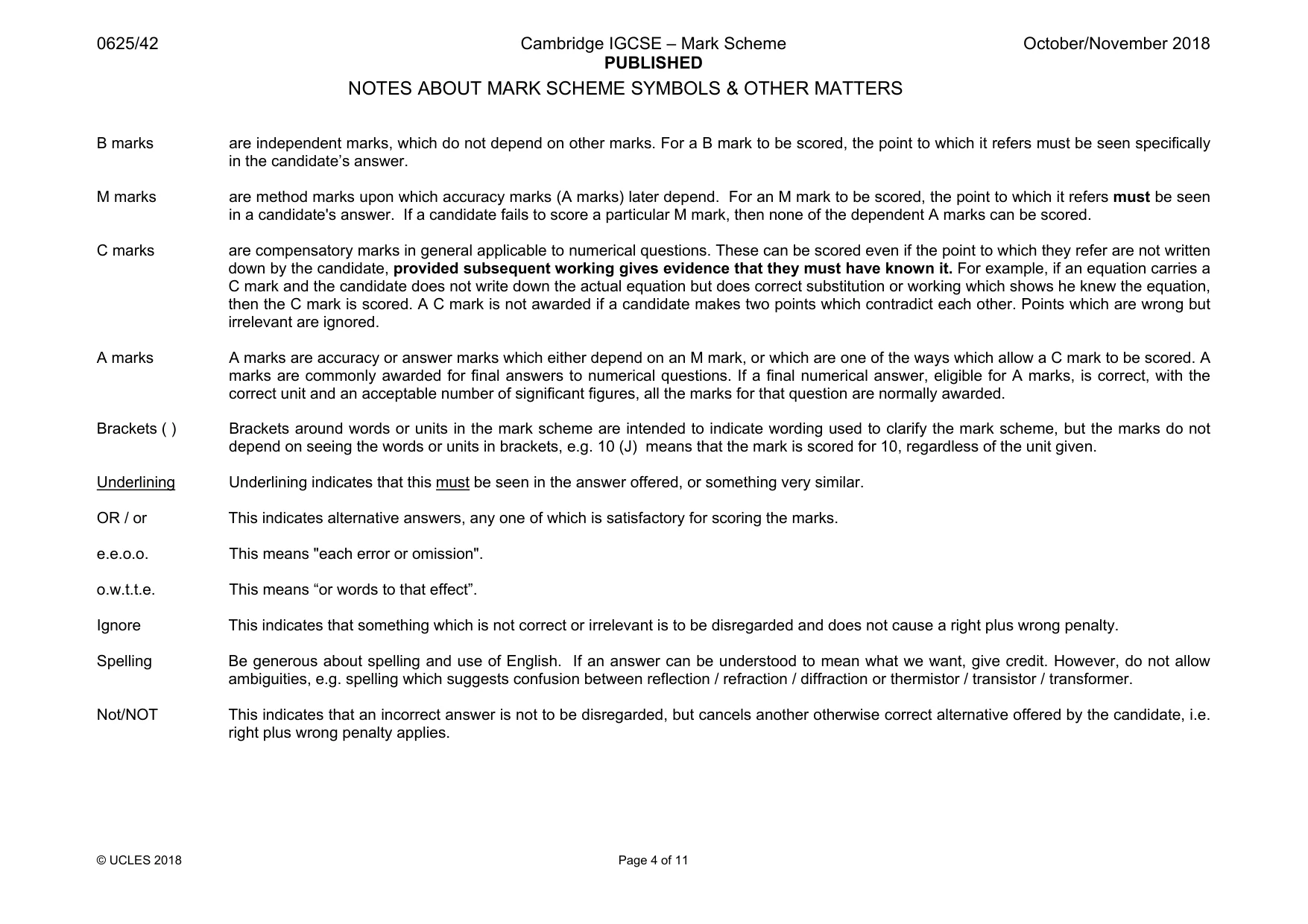
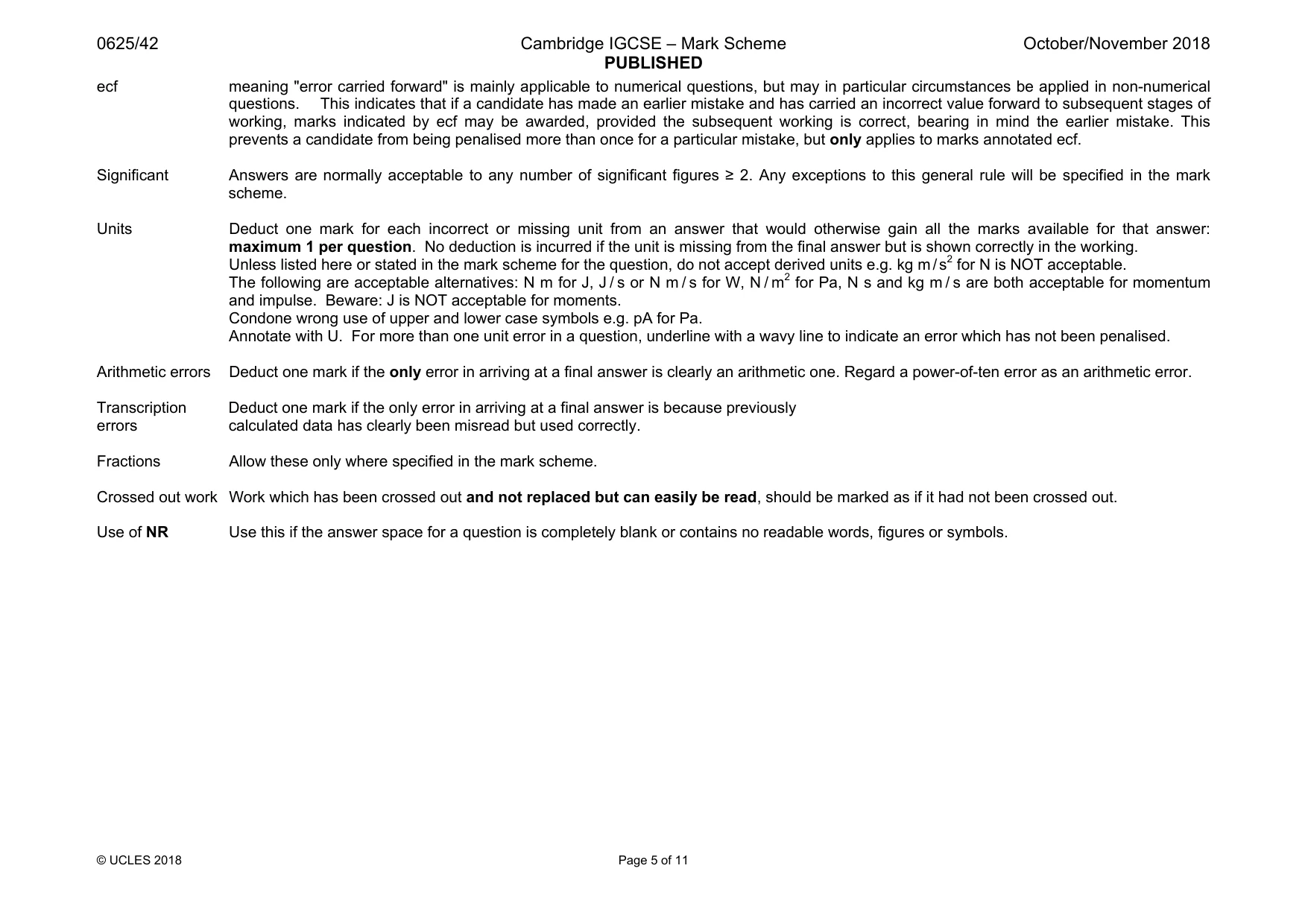
Mark scheme11 pages
Answers below. Sit the paper first if you are practising.
Questions as text
Q1 · A lorry is travelling along a straight, horizontal road
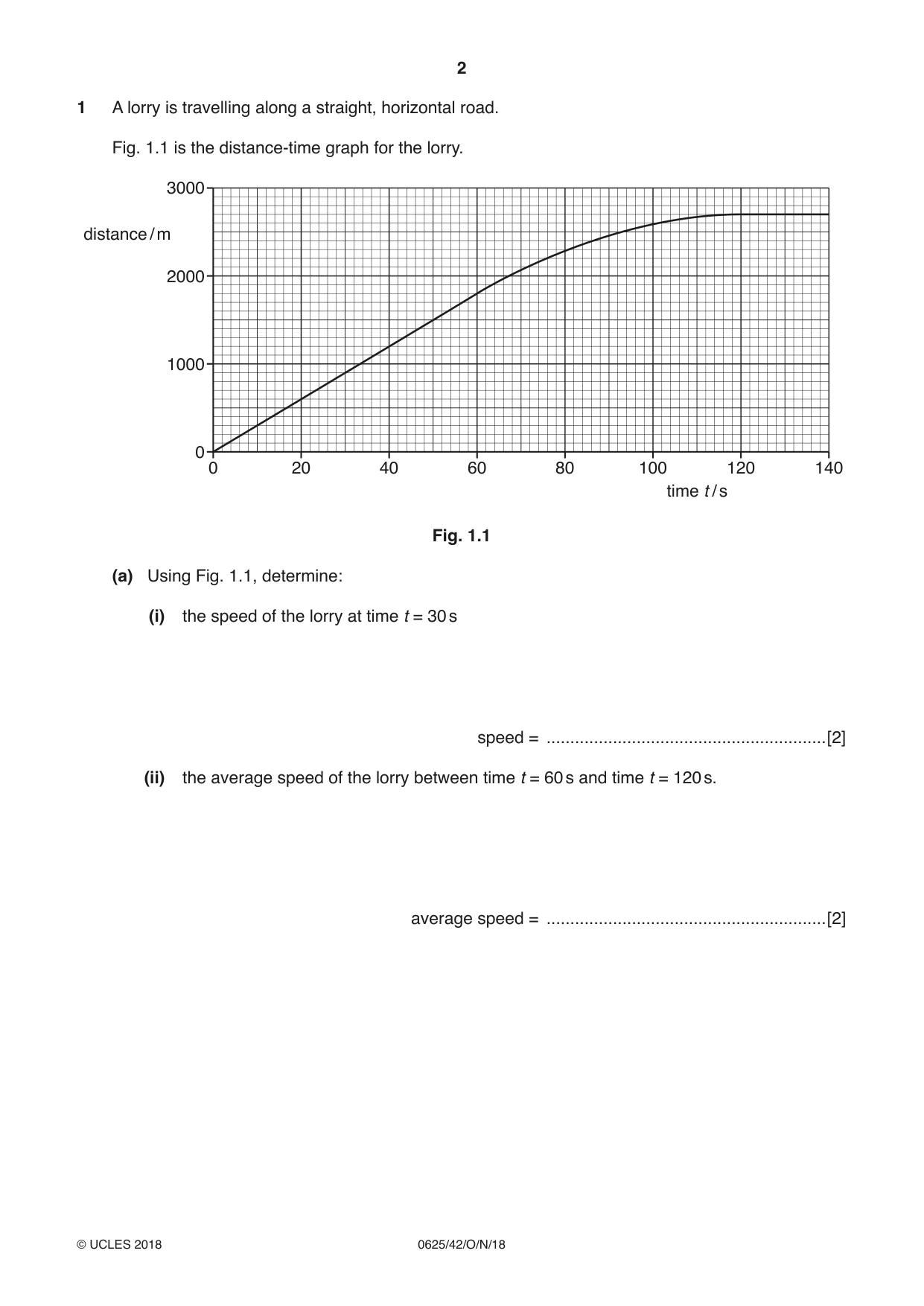
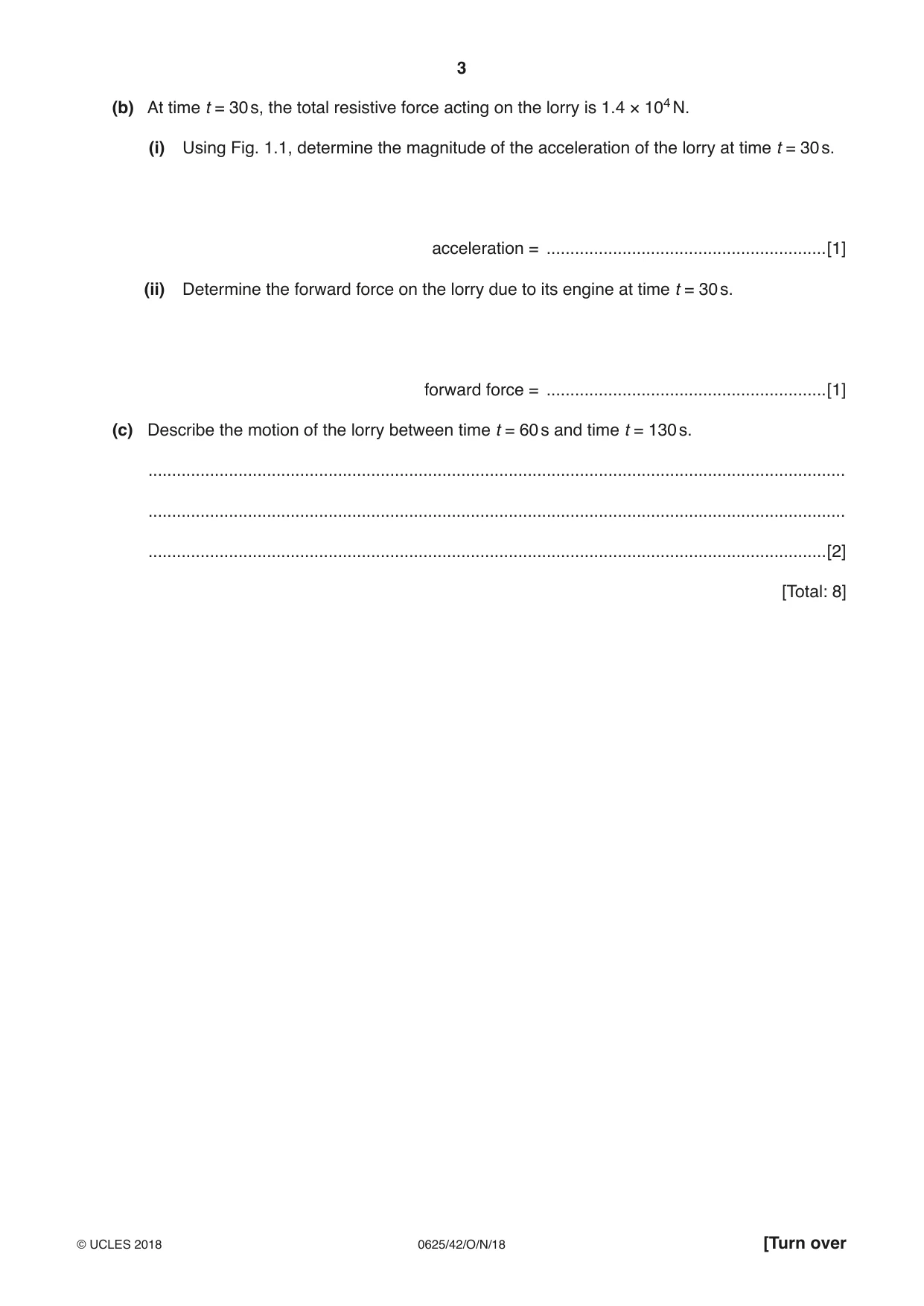
1 A lorry is travelling along a straight, horizontal road. Fig. 1.1 is the distance-time graph for the lorry. 3000 distance / m 2000 1000 0 0 20 40 60 80 100 120 140 time t / s Fig. 1.1 (a) Using Fig. 1.1, determine: (i) the speed of the lorry at time t = 30 s speed = ...........................................................[2] (ii) the average speed of the lorry between time t = 60 s and time t = 120 s. average speed = ...........................................................[2] (b) At time t = 30 s, the total resistive force acting on the lorry is 1.4 × 10⁴ N. (i) Using Fig. 1.1, determine the magnitude of the acceleration of the lorry at time t = 30 s. acceleration = ...........................................................[1] (ii) Determine the forward force on the lorry due to its engine at time t = 30 s. forward force = ...........................................................[1] (c) Describe the motion of the lorry between time t = 60 s and time t = 130 s. ................................................................................................................................................... ................................................................................................................................................... ...............................................................................................................................................[2] [Total: 8]
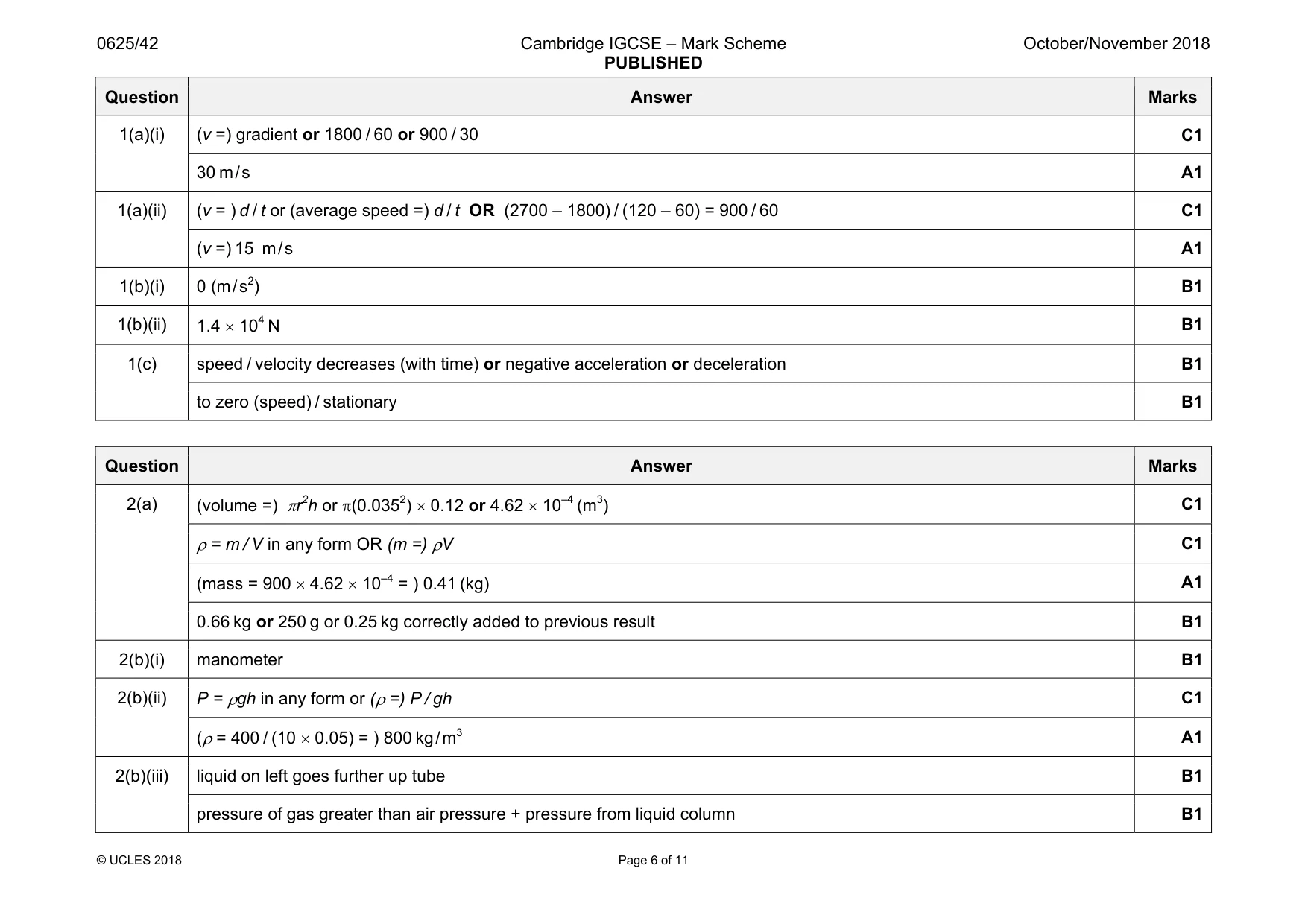
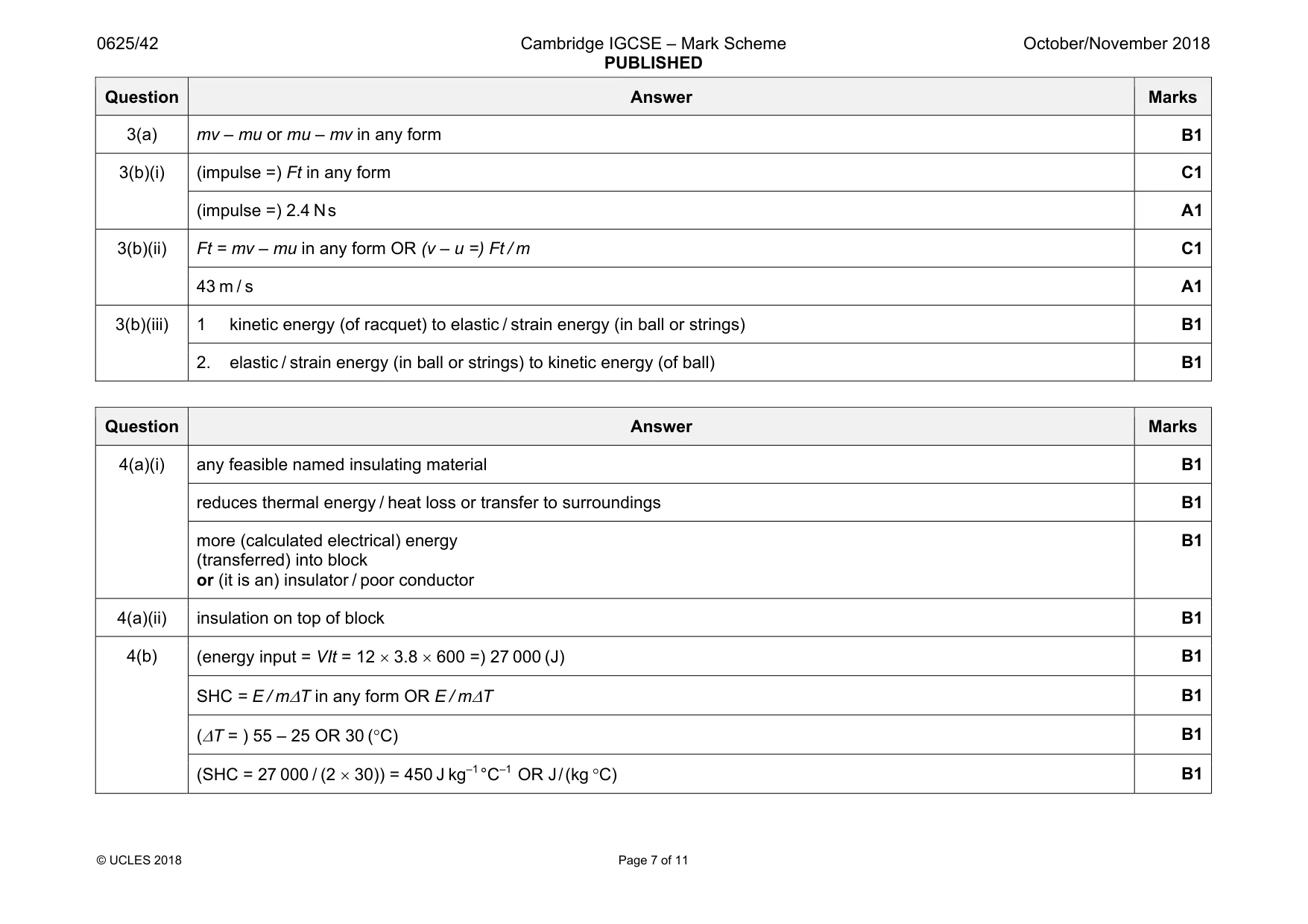
Mark scheme: 1(a)(i) (v =) gradient or 1800 / 60 or 900 / 30 C1 30 m / s A1 1(a)(ii) (v = ) d / t or (average speed =) d / t OR (2700 – 1800) / (120 – 60) = 900 / 60 C1 (v =) 15 m / s A1 1(b)(i) 0 (m / s2) B1 1(b)(ii) 1.4 × 10⁴ N B1 1(c) speed / velocity decreases (with time) or negative acceleration or deceleration B1 to zero (speed) / stationary B1
Q2 · Liquid in a cylinder
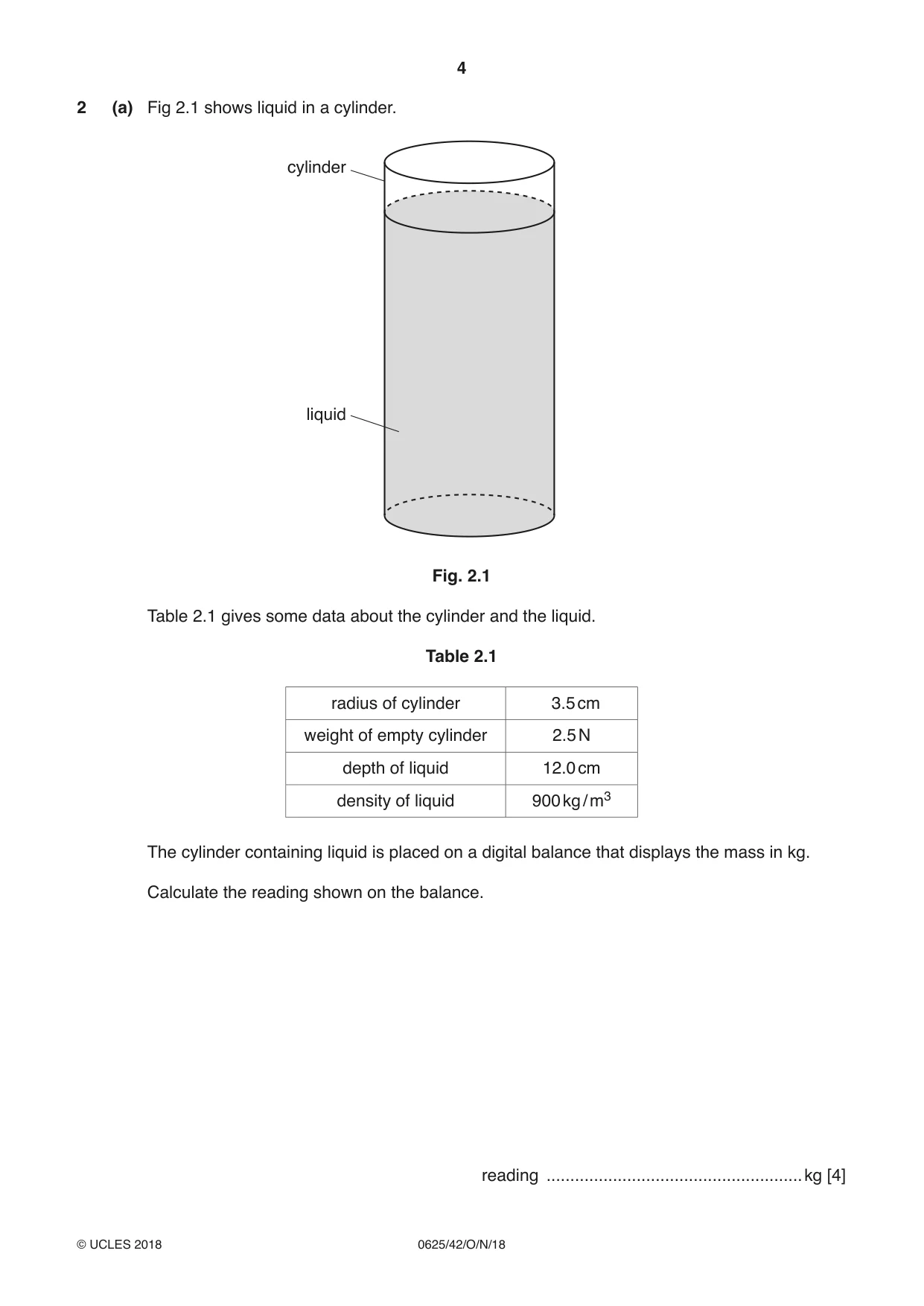
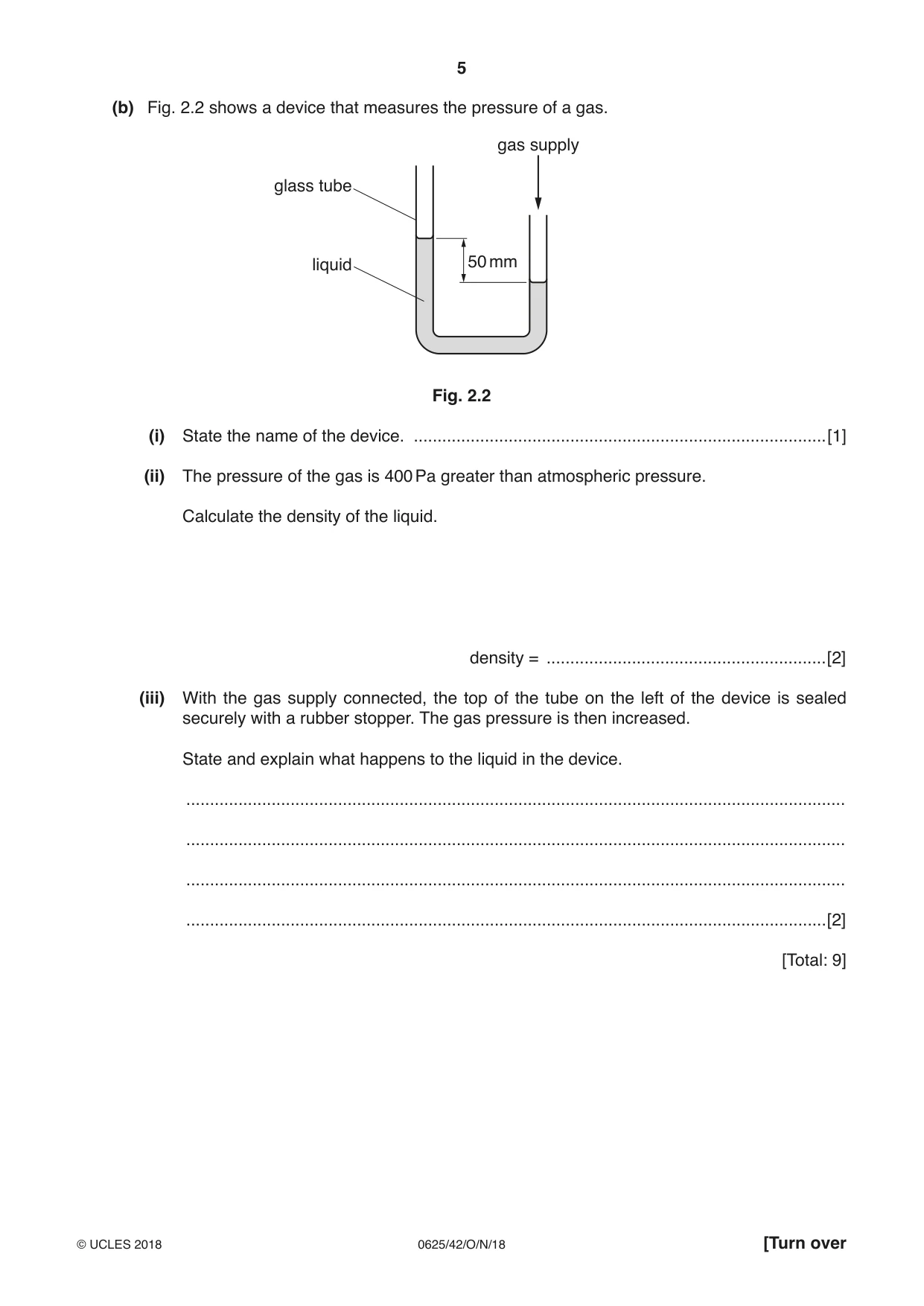
2 (a) Fig 2.1 shows liquid in a cylinder. cylinder liquid Fig. 2.1 Table 2.1 gives some data about the cylinder and the liquid. Table 2.1 radius of cylinder 3.5 cm weight of empty cylinder 2.5 N depth of liquid 12.0 cm density of liquid 900 kg / m3 The cylinder containing liquid is placed on a digital balance that displays the mass in kg. Calculate the reading shown on the balance. reading ......................................................kg [4] (b) Fig. 2.2 shows a device that measures the pressure of a gas. gas supply glass tube liquid 50 mm Fig. 2.2 (i) State the name of the device. .......................................................................................[1] (ii) The pressure of the gas is 400 Pa greater than atmospheric pressure. Calculate the density of the liquid. density = ...........................................................[2] (iii) With the gas supply connected, the top of the tube on the left of the device is sealed securely with a rubber stopper. The gas pressure is then increased. State and explain what happens to the liquid in the device. ........................................................................................................................................... ........................................................................................................................................... ........................................................................................................................................... .......................................................................................................................................[2] [Total: 9]
Mark scheme: 2(a) C1 ρ = m / V in any form OR (m =) ρV C1 (mass = 900 × 4.62 × 10–4 = ) 0.41 (kg) A1 0.66 kg or 250 g or 0.25 kg correctly added to previous result B1 2(b)(i) manometer B1 2(b)(ii) P = ρgh in any form or (ρ =) P / gh C1 (ρ = 400 / (10 × 0.05) = ) 800 kg / m3 A1 2(b)(iii) liquid on left goes further up tube B1 pressure of gas greater than air pressure + pressure from liquid column B1
Q3 · The velocity of an object of mass m increases from u to v
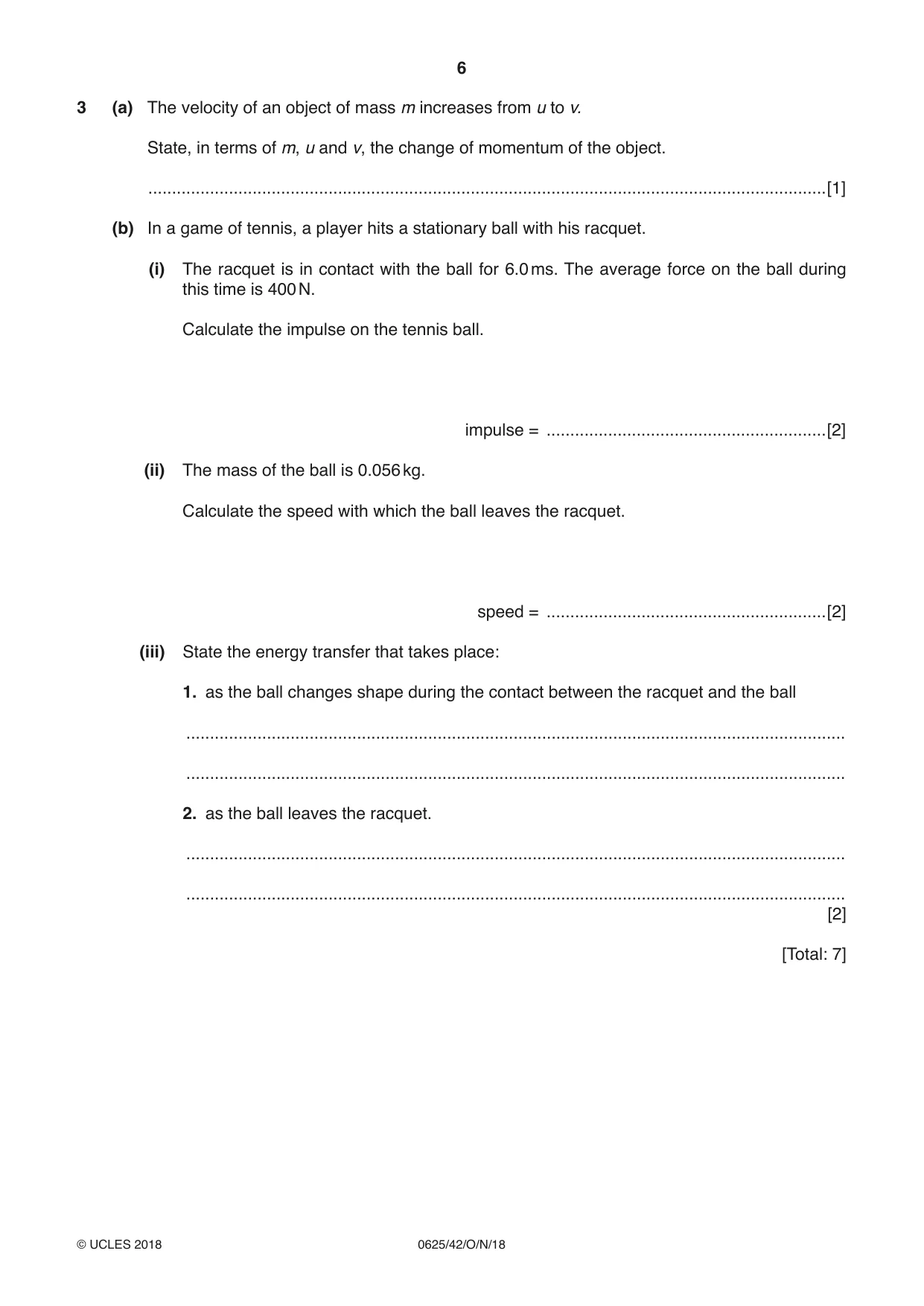
3 (a) The velocity of an object of mass m increases from u to v. State, in terms of m, u and v, the change of momentum of the object. ...............................................................................................................................................[1] (b) In a game of tennis, a player hits a stationary ball with his racquet. (i) The racquet is in contact with the ball for 6.0 ms. The average force on the ball during this time is 400 N. Calculate the impulse on the tennis ball. impulse = ...........................................................[2] (ii) The mass of the ball is 0.056 kg. Calculate the speed with which the ball leaves the racquet. speed = ...........................................................[2] (iii) State the energy transfer that takes place: 1. as the ball changes shape during the contact between the racquet and the ball ........................................................................................................................................... ........................................................................................................................................... 2. as the ball leaves the racquet. ........................................................................................................................................... ........................................................................................................................................... [2] [Total: 7]
Mark scheme: 3(a) mv – mu or mu – mv in any form B1 3(b)(i) (impulse =) Ft in any form C1 (impulse =) 2.4 N s A1 3(b)(ii) Ft = mv – mu in any form OR (v – u =) Ft / m C1 43 m / s A1 3(b)(iii) 1 kinetic energy (of racquet) to elastic / strain energy (in ball or strings) B1 2. elastic / strain energy (in ball or strings) to kinetic energy (of ball) B1
Q4 · Apparatus used by a student to measure the specific heat capacity of iron
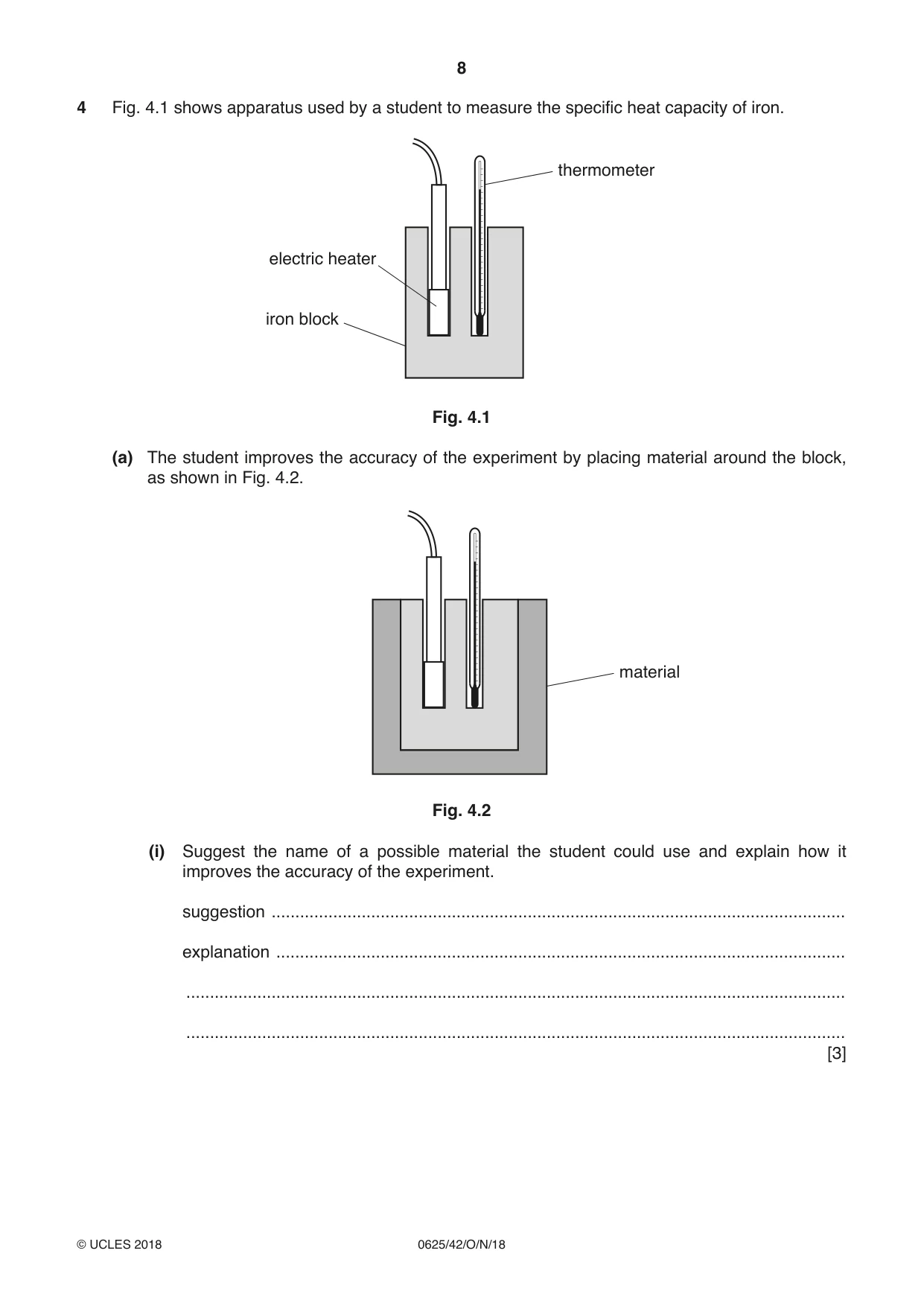
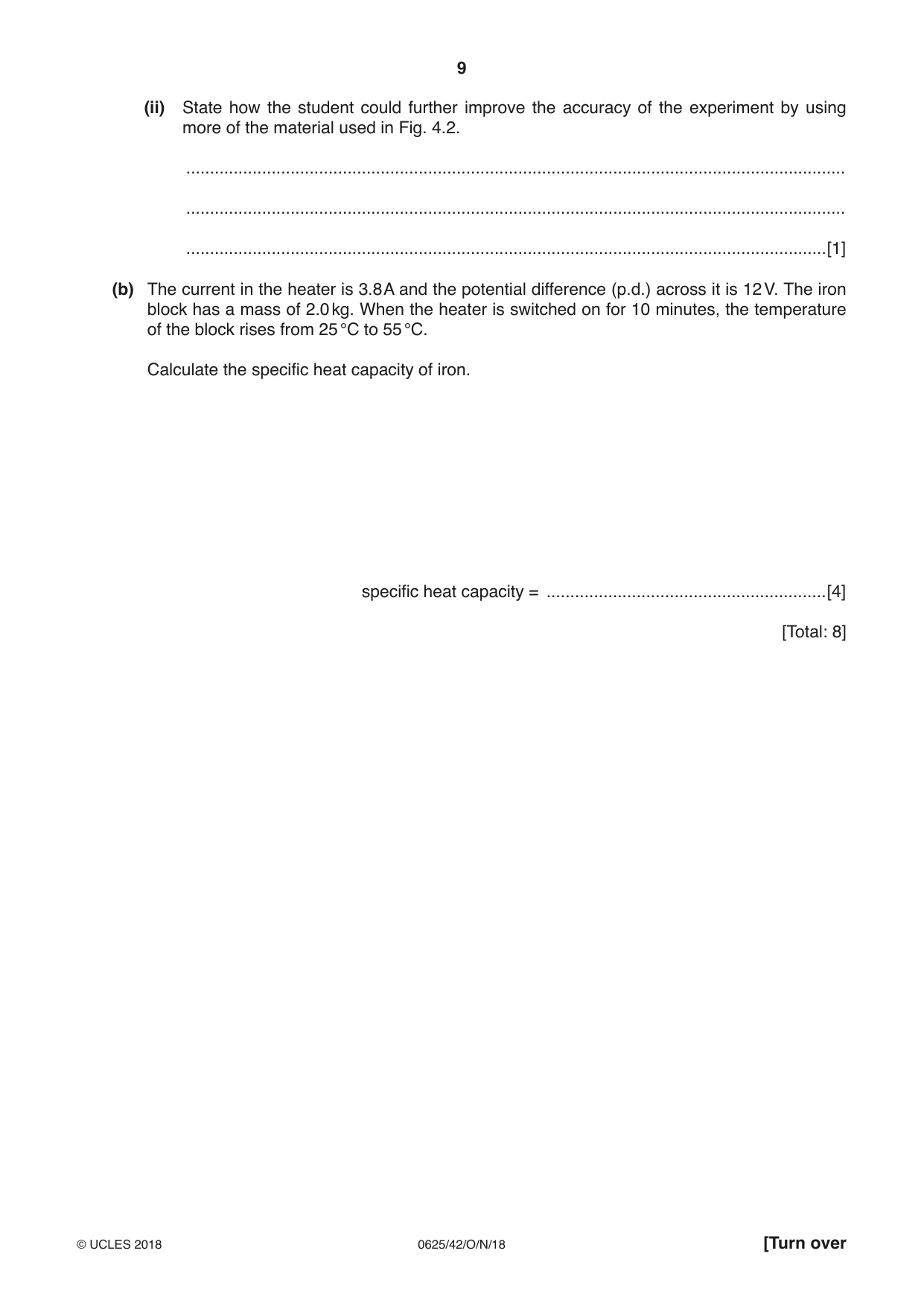
4 Fig. 4.1 shows apparatus used by a student to measure the specific heat capacity of iron. thermometer electric heater iron block Fig. 4.1 (a) The student improves the accuracy of the experiment by placing material around the block, as shown in Fig. 4.2. material Fig. 4.2 (i) Suggest the name of a possible material the student could use and explain how it improves the accuracy of the experiment. suggestion ......................................................................................................................... explanation ........................................................................................................................ ........................................................................................................................................... ........................................................................................................................................... [3] (ii) State how the student could further improve the accuracy of the experiment by using more of the material used in Fig. 4.2. ........................................................................................................................................... ........................................................................................................................................... .......................................................................................................................................[1] (b) The current in the heater is 3.8 A and the potential difference (p.d.) across it is 12 V. The iron block has a mass of 2.0 kg. When the heater is switched on for 10 minutes, the temperature of the block rises from 25 °C to 55 °C. Calculate the specific heat capacity of iron. specific heat capacity = ...........................................................[4] [Total: 8]
Mark scheme: 4(a)(i) any feasible named insulating material B1 reduces thermal energy / heat loss or transfer to surroundings B1 more (calculated electrical) energy (transferred) into block or (it is an) insulator / poor conductor B1 4(a)(ii) insulation on top of block B1 4(b) (energy input = VIt = 12 × 3.8 × 600 =) 27 000 (J) B1 SHC = E / m∆T in any form OR E / m∆T B1 (∆T = ) 55 – 25 OR 30 (°C) B1 (SHC = 27 000 / (2 × 30)) = 450 J kg–1°C–1 OR J / (kg °C) B1
Q5 · A visible spectrum focused on a screen by passing light from a source of white light…
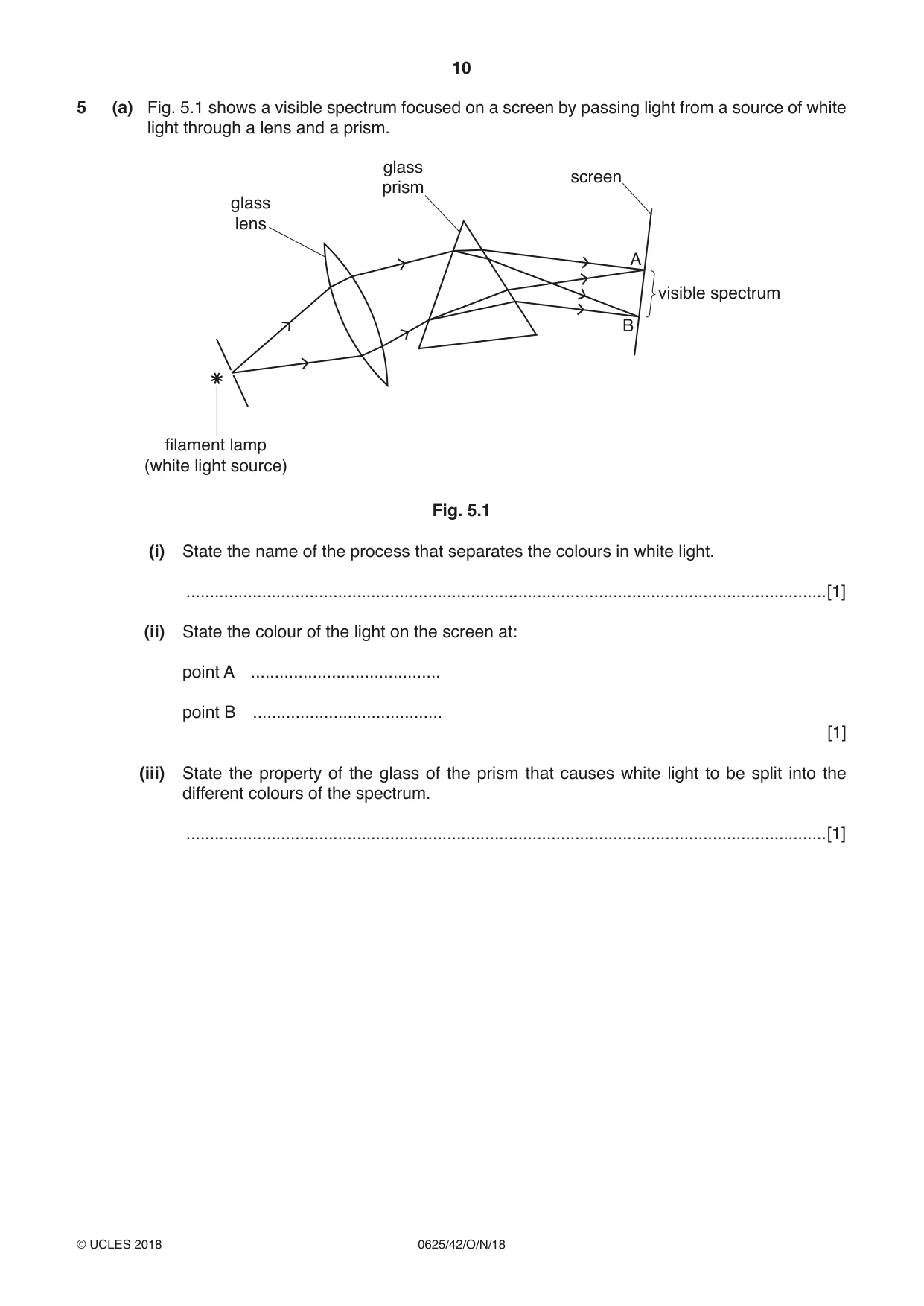
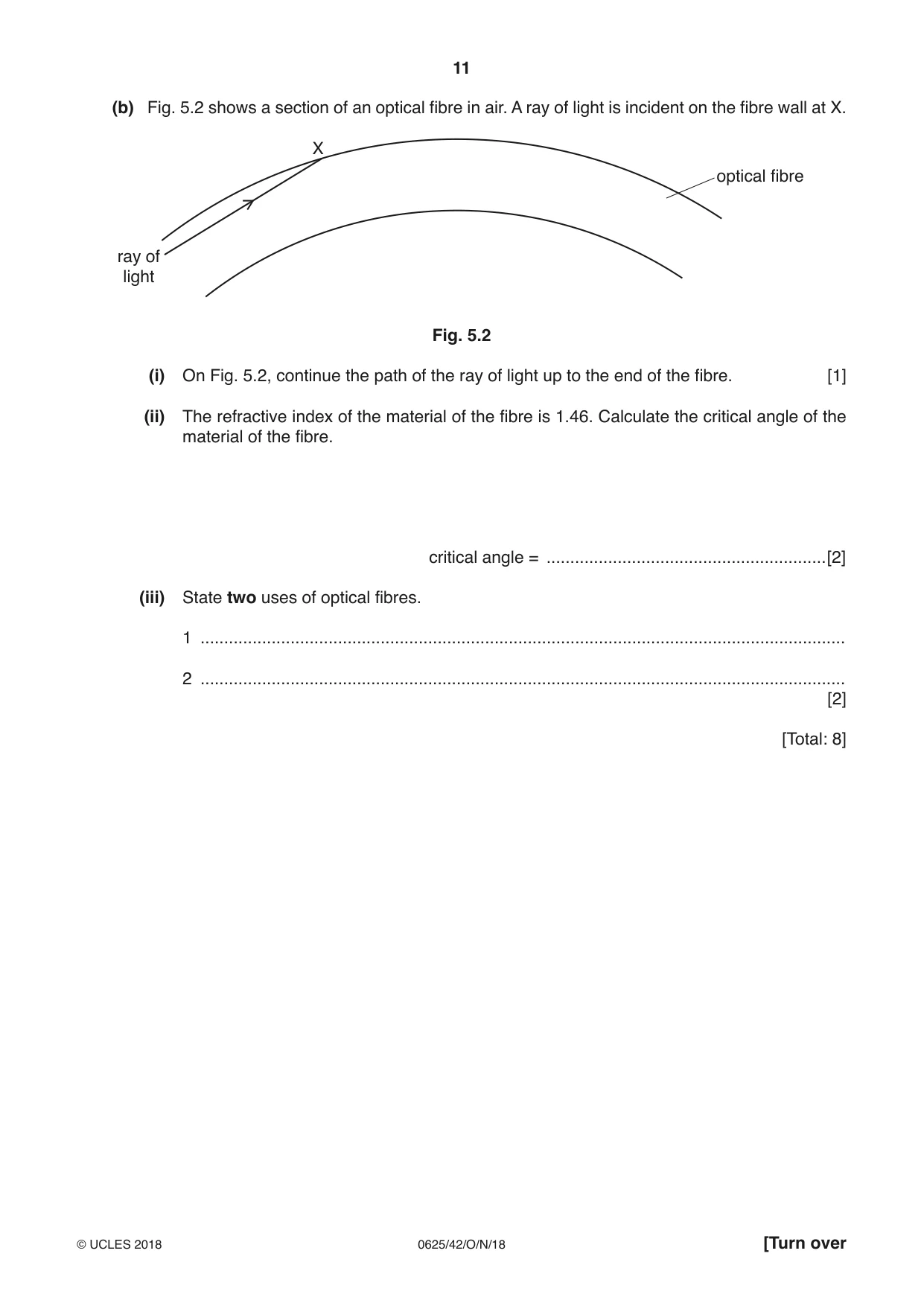
5 (a) Fig. 5.1 shows a visible spectrum focused on a screen by passing light from a source of white light through a lens and a prism. glass screen prism glass lens A visible spectrum B filament lamp (white light source) Fig. 5.1 (i) State the name of the process that separates the colours in white light. .......................................................................................................................................[1] (ii) State the colour of the light on the screen at: point A ........................................ point B ........................................ [1] (iii) State the property of the glass of the prism that causes white light to be split into the different colours of the spectrum. .......................................................................................................................................[1] (b) Fig. 5.2 shows a section of an optical fibre in air. A ray of light is incident on the fibre wall at X. X optical fibre ray of light Fig. 5.2 (i) On Fig. 5.2, continue the path of the ray of light up to the end of the fibre. [1] (ii) The refractive index of the material of the fibre is 1.46. Calculate the critical angle of the material of the fibre. critical angle = ...........................................................[2] (iii) State two uses of optical fibres. 1 ........................................................................................................................................ 2 ........................................................................................................................................ [2] [Total: 8]
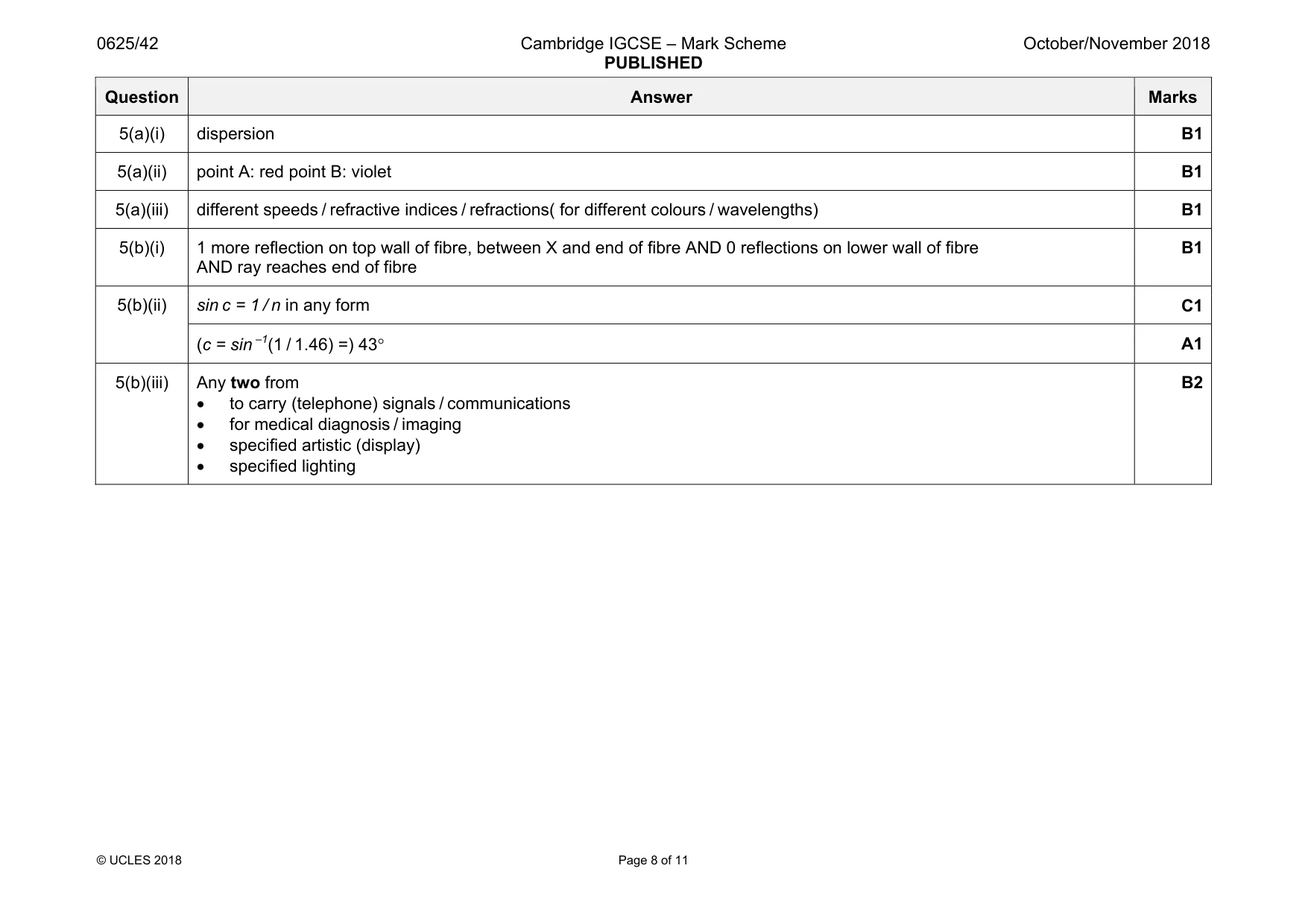
Mark scheme: 5(a)(i) B1 5(a)(ii) point A: red point B: violet B1 5(a)(iii) different speeds / refractive indices / refractions( for different colours / wavelengths) B1 5(b)(i) 1 more reflection on top wall of fibre, between X and end of fibre AND 0 reflections on lower wall of fibre AND ray reaches end of fibre B1 5(b)(ii) sin c = 1 / n in any form C1 (c = sin –1(1 / 1.46) =) 43° A1 5(b)(iii) Any two from • to carry (telephone) signals / communications • for medical diagnosis / imaging • specified artistic (display) • specified lighting B2
Q6 · A sound wave of wavelength 0.45 m travelling from left to right
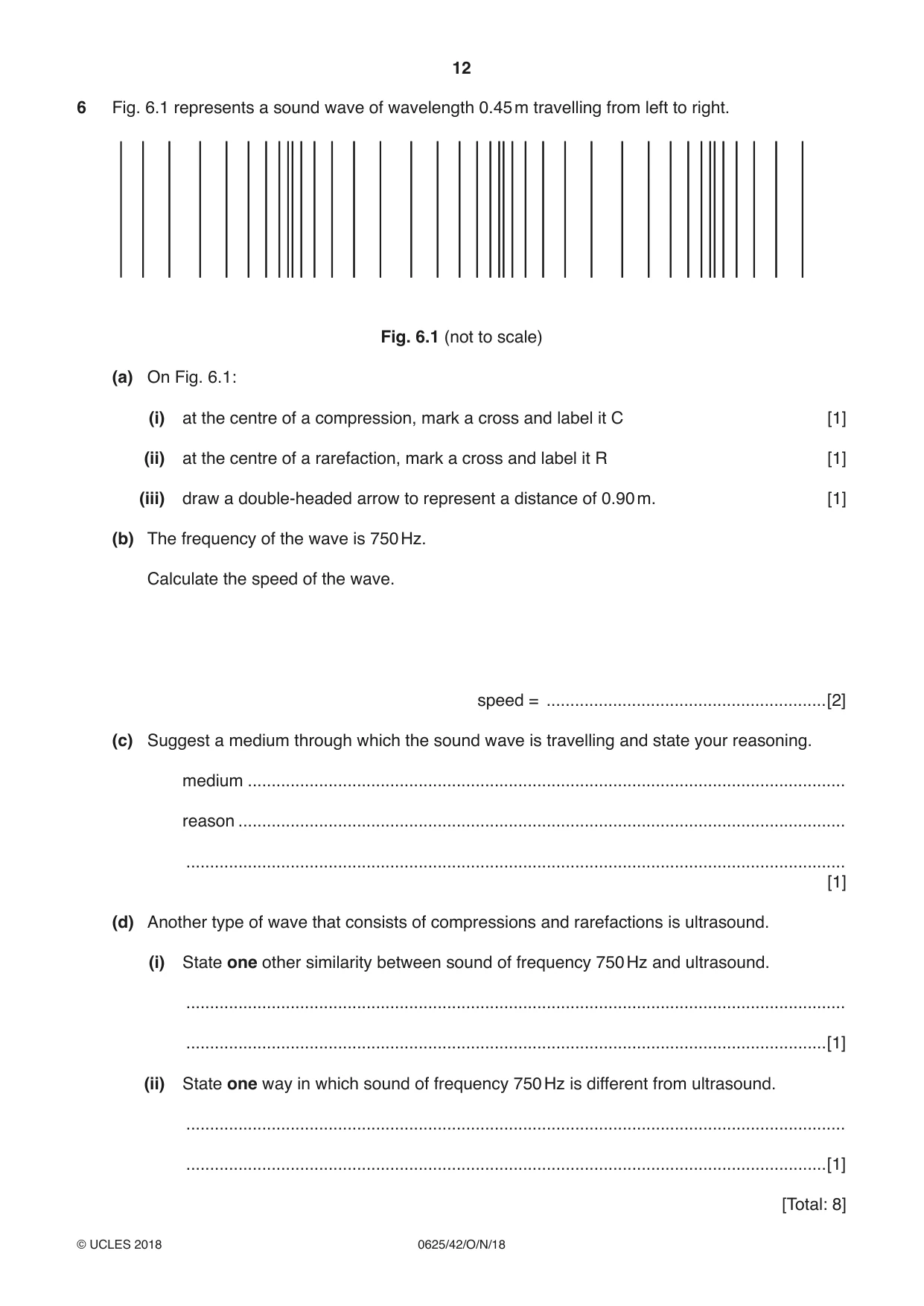
6 Fig. 6.1 represents a sound wave of wavelength 0.45 m travelling from left to right. Fig. 6.1 (not to scale) (a) On Fig. 6.1: (i) at the centre of a compression, mark a cross and label it C [1] (ii) at the centre of a rarefaction, mark a cross and label it R [1] (iii) draw a double-headed arrow to represent a distance of 0.90 m. [1] (b) The frequency of the wave is 750 Hz. Calculate the speed of the wave. speed = ...........................................................[2] (c) Suggest a medium through which the sound wave is travelling and state your reasoning. medium .............................................................................................................................. reason ................................................................................................................................ ........................................................................................................................................... [1] (d) Another type of wave that consists of compressions and rarefactions is ultrasound. (i) State one other similarity between sound of frequency 750 Hz and ultrasound. ........................................................................................................................................... .......................................................................................................................................[1] (ii) State one way in which sound of frequency 750 Hz is different from ultrasound. ........................................................................................................................................... .......................................................................................................................................[1] [Total: 8]
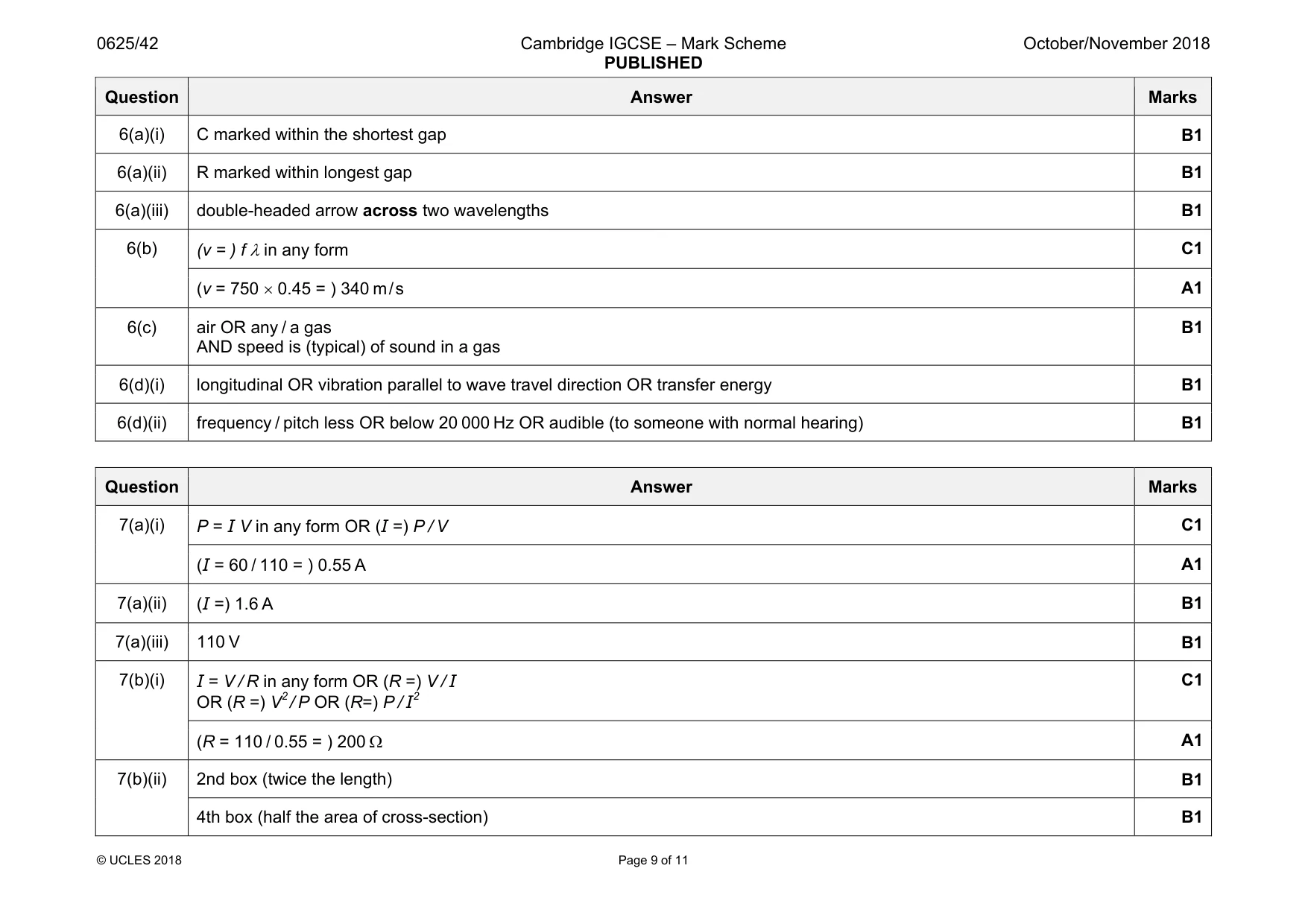
Mark scheme: 6(a)(i) C marked within the shortest gap B1 6(a)(ii) R marked within longest gap B1 6(a)(iii) double-headed arrow across two wavelengths B1 6(b) (v = ) f λ in any form C1 (v = 750 × 0.45 = ) 340 m / s A1 6(c) air OR any / a gas AND speed is (typical) of sound in a gas B1 6(d)(i) longitudinal OR vibration parallel to wave travel direction OR transfer energy B1 6(d)(ii) frequency / pitch less OR below 20 000 Hz OR audible (to someone with normal hearing) B1
Q7 · Three identical lamps and an ammeter connected to a power supply
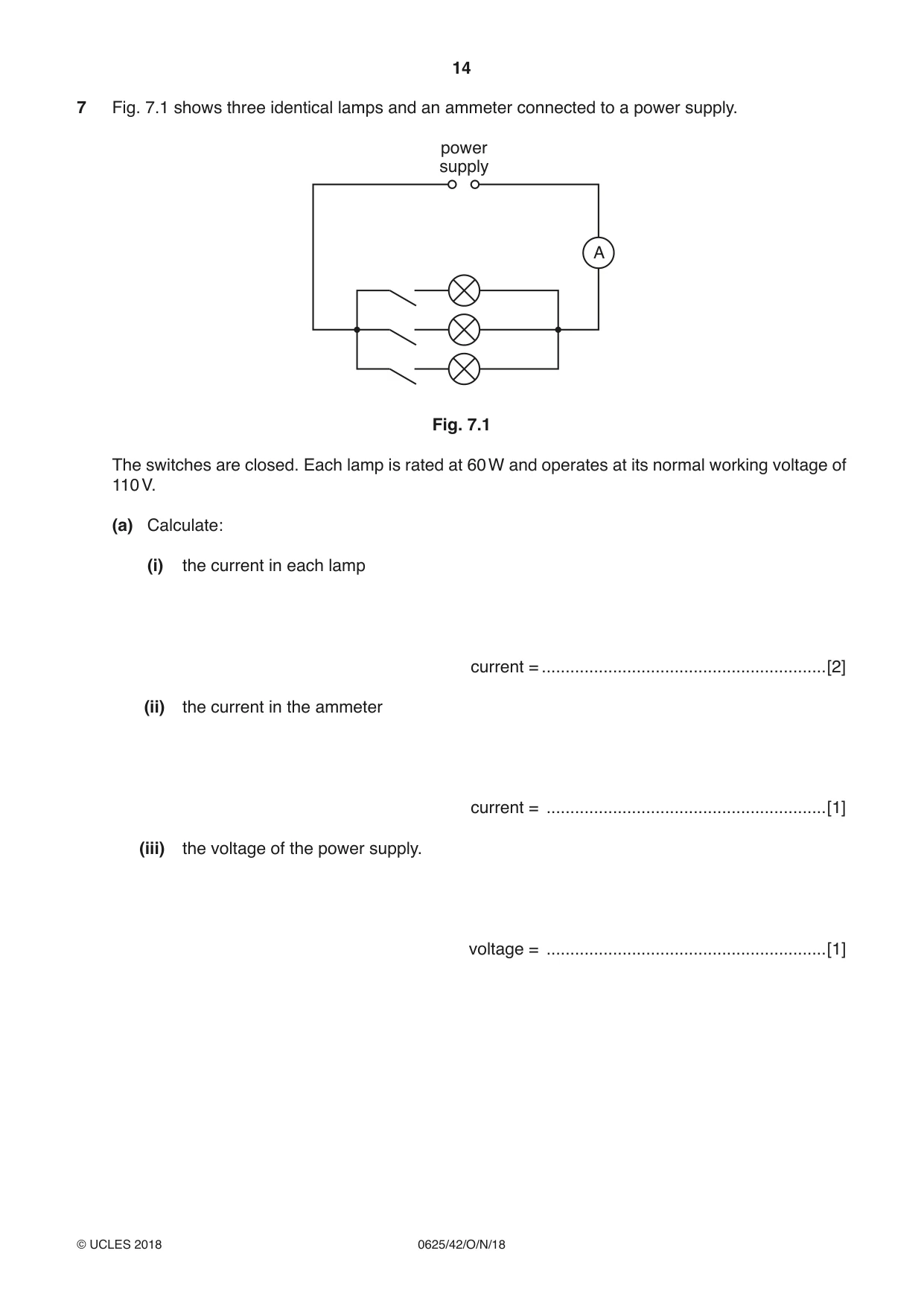
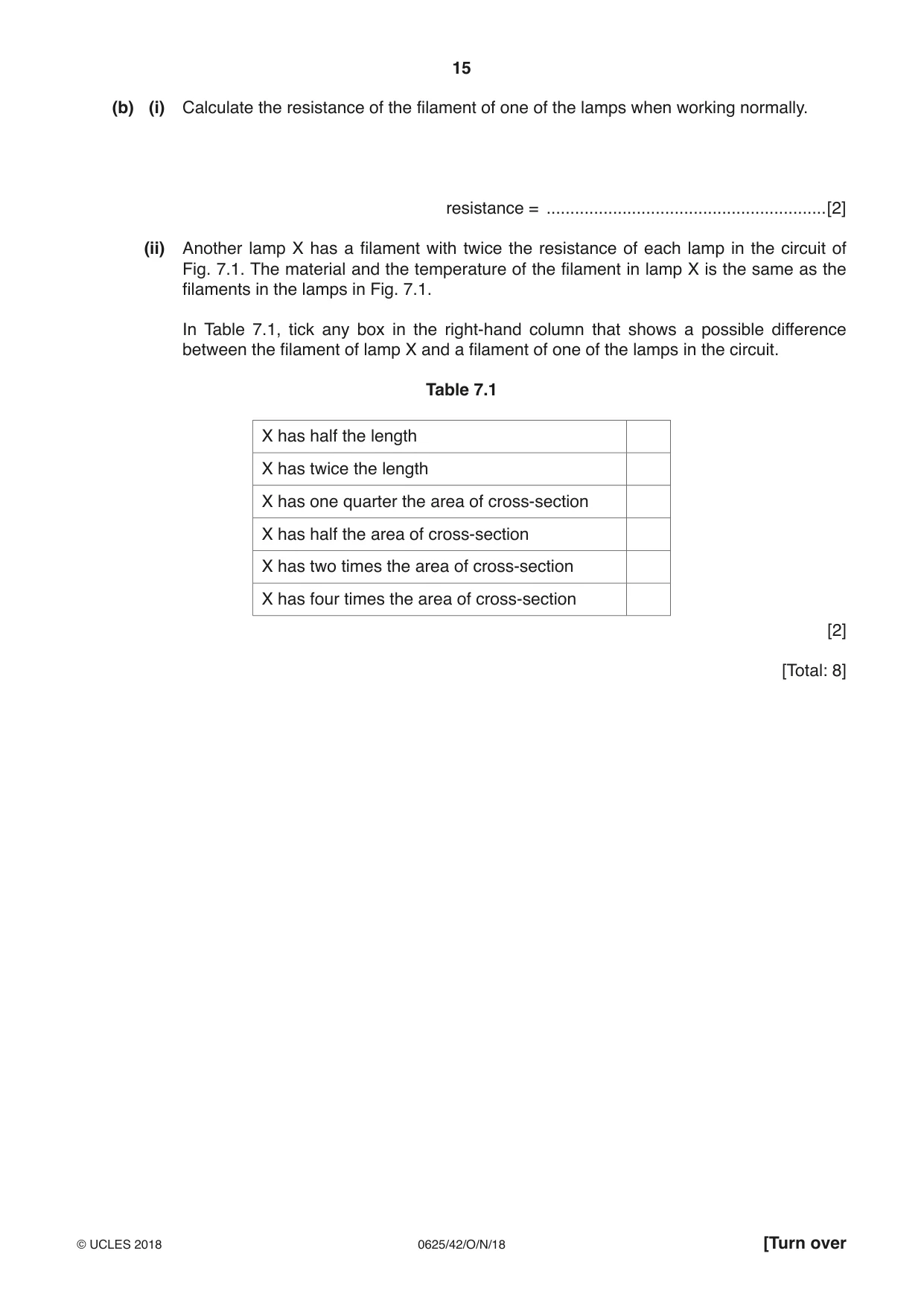
7 Fig. 7.1 shows three identical lamps and an ammeter connected to a power supply. power supply A Fig. 7.1 The switches are closed. Each lamp is rated at 60 W and operates at its normal working voltage of 110 V. (a) Calculate: (i) the current in each lamp current = ............................................................[2] (ii) the current in the ammeter current = ...........................................................[1] (iii) the voltage of the power supply. voltage = ...........................................................[1] (b) (i) Calculate the resistance of the filament of one of the lamps when working normally. resistance = ...........................................................[2] (ii) Another lamp X has a filament with twice the resistance of each lamp in the circuit of Fig. 7.1. The material and the temperature of the filament in lamp X is the same as the filaments in the lamps in Fig. 7.1. In Table 7.1, tick any box in the right-hand column that shows a possible difference between the filament of lamp X and a filament of one of the lamps in the circuit. Table 7.1 X has half the length X has twice the length X has one quarter the area of cross-section X has half the area of cross-section X has two times the area of cross-section X has four times the area of cross-section [2] [Total: 8]
Mark scheme: 7(a)(i) C1 (I = 60 / 110 = ) 0.55 A A1 7(a)(ii) (I =) 1.6 A B1 7(a)(iii) 110 V B1 7(b)(i) I = V / R in any form OR (R =) V / I OR (R =) V2 / P OR (R=) P / I2 C1 (R = 110 / 0.55 = ) 200 Ω A1 7(b)(ii) 2nd box (twice the length) B1 4th box (half the area of cross-section) B1
Q8 · A positively charged cube of insulating material
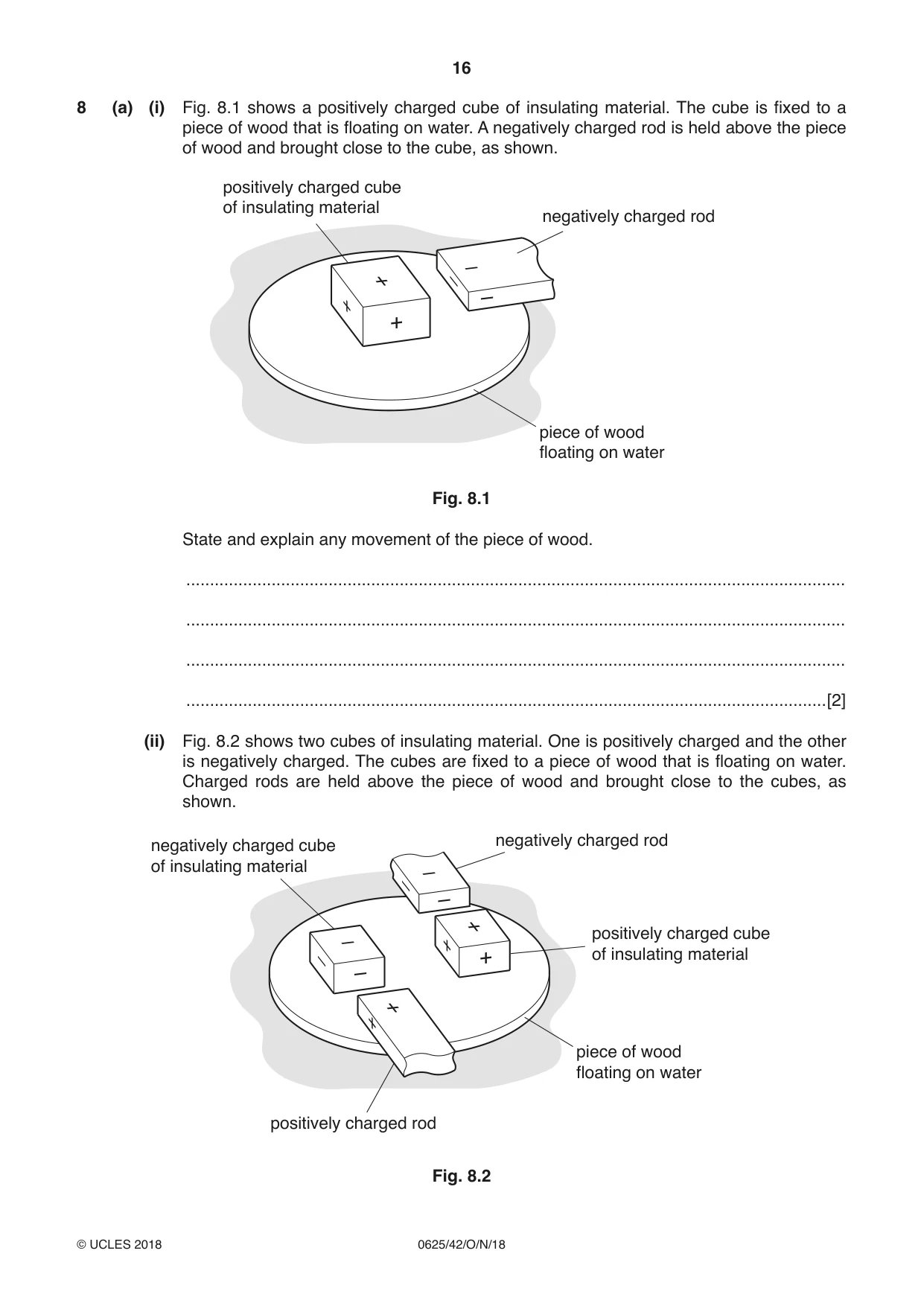
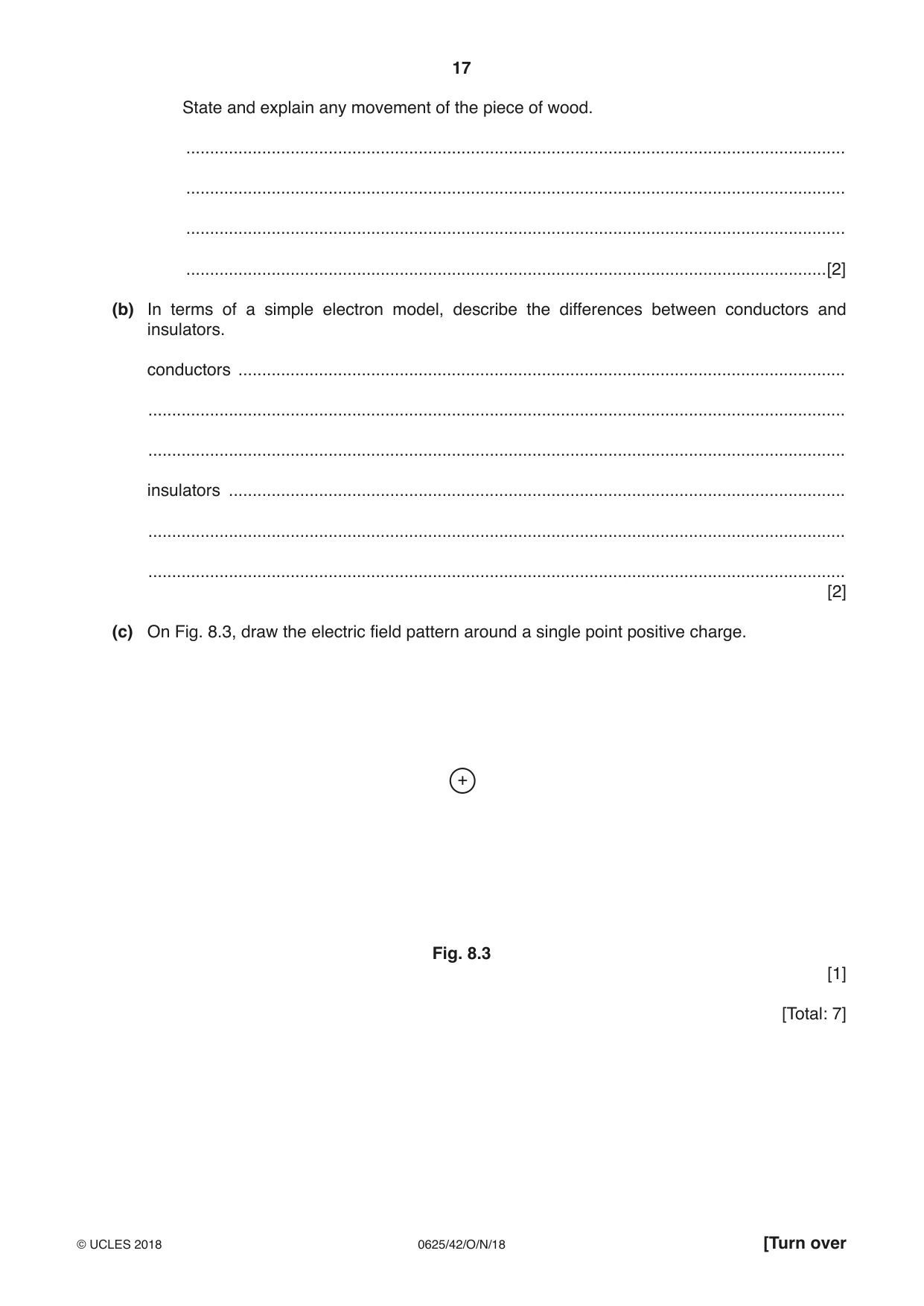
8 (a) (i) Fig. 8.1 shows a positively charged cube of insulating material. The cube is fixed to a piece of wood that is floating on water. A negatively charged rod is held above the piece of wood and brought close to the cube, as shown. positively charged cube of insulating material negatively charged rod – + – + – + piece of wood floating on water Fig. 8.1 State and explain any movement of the piece of wood. ........................................................................................................................................... ........................................................................................................................................... ........................................................................................................................................... .......................................................................................................................................[2] (ii) Fig. 8.2 shows two cubes of insulating material. One is positively charged and the other is negatively charged. The cubes are fixed to a piece of wood that is floating on water. Charged rods are held above the piece of wood and brought close to the cubes, as shown. negatively charged rod negatively charged cube of insulating material – – – + positively charged cube – + of insulating material – + – + + piece of wood floating on water positively charged rod Fig. 8.2 State and explain any movement of the piece of wood. ........................................................................................................................................... ........................................................................................................................................... ........................................................................................................................................... .......................................................................................................................................[2] (b) In terms of a simple electron model, describe the differences between conductors and insulators. conductors ................................................................................................................................ ................................................................................................................................................... ................................................................................................................................................... insulators .................................................................................................................................. ................................................................................................................................................... ................................................................................................................................................... [2] (c) On Fig. 8.3, draw the electric field pattern around a single point positive charge. + Fig. 8.3 [1] [Total: 7]
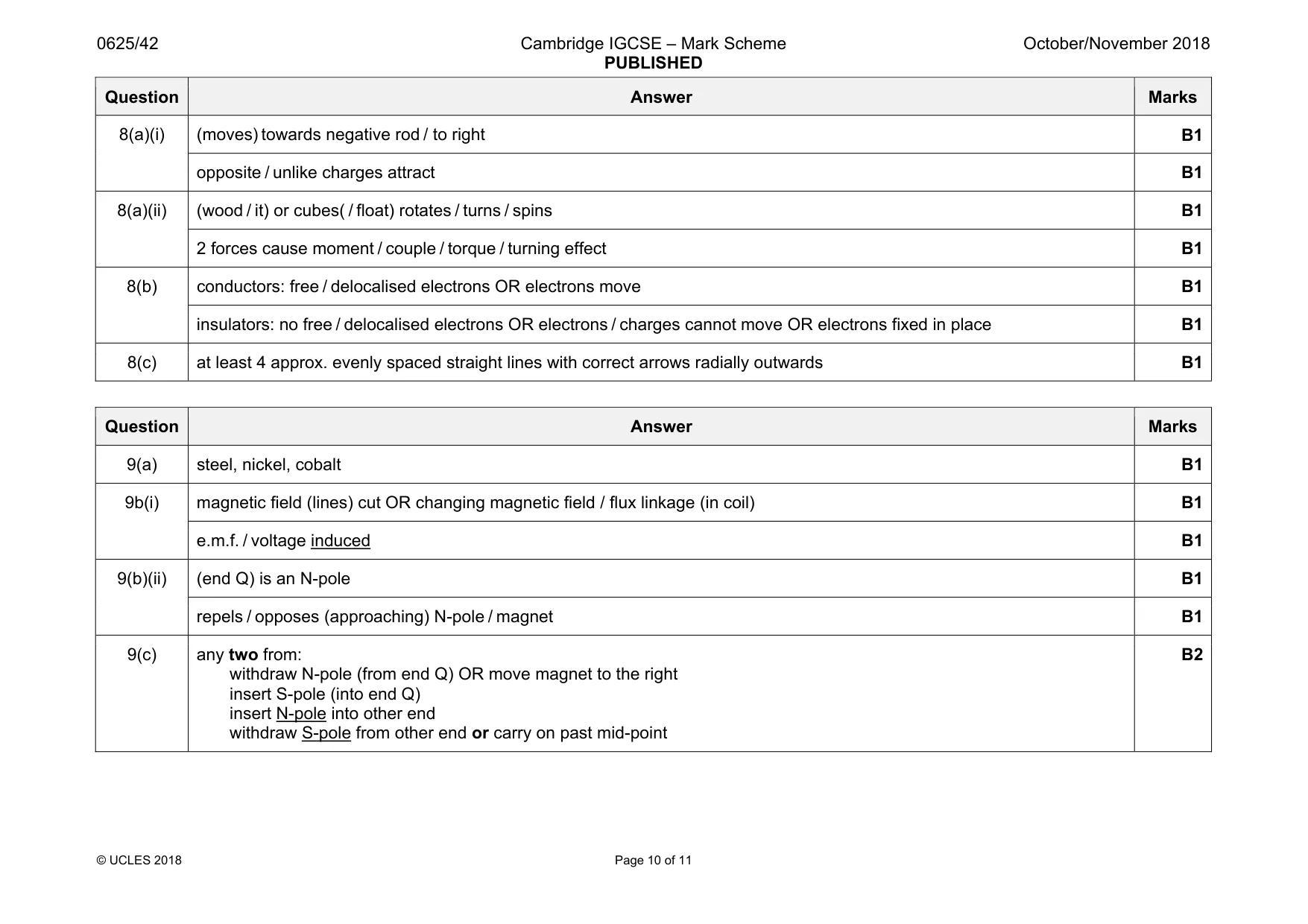
Mark scheme: 8(a)(i) (moves) towards negative rod / to right B1 opposite / unlike charges attract B1 8(a)(ii) (wood / it) or cubes( / float) rotates / turns / spins B1 2 forces cause moment / couple / torque / turning effect B1 8(b) conductors: free / delocalised electrons OR electrons move B1 insulators: no free / delocalised electrons OR electrons / charges cannot move OR electrons fixed in place B1 8(c) at least 4 approx. evenly spaced straight lines with correct arrows radially outwards B1
Q9 · A permanent bar magnet next to a circuit that contains a coil and a galvanometer
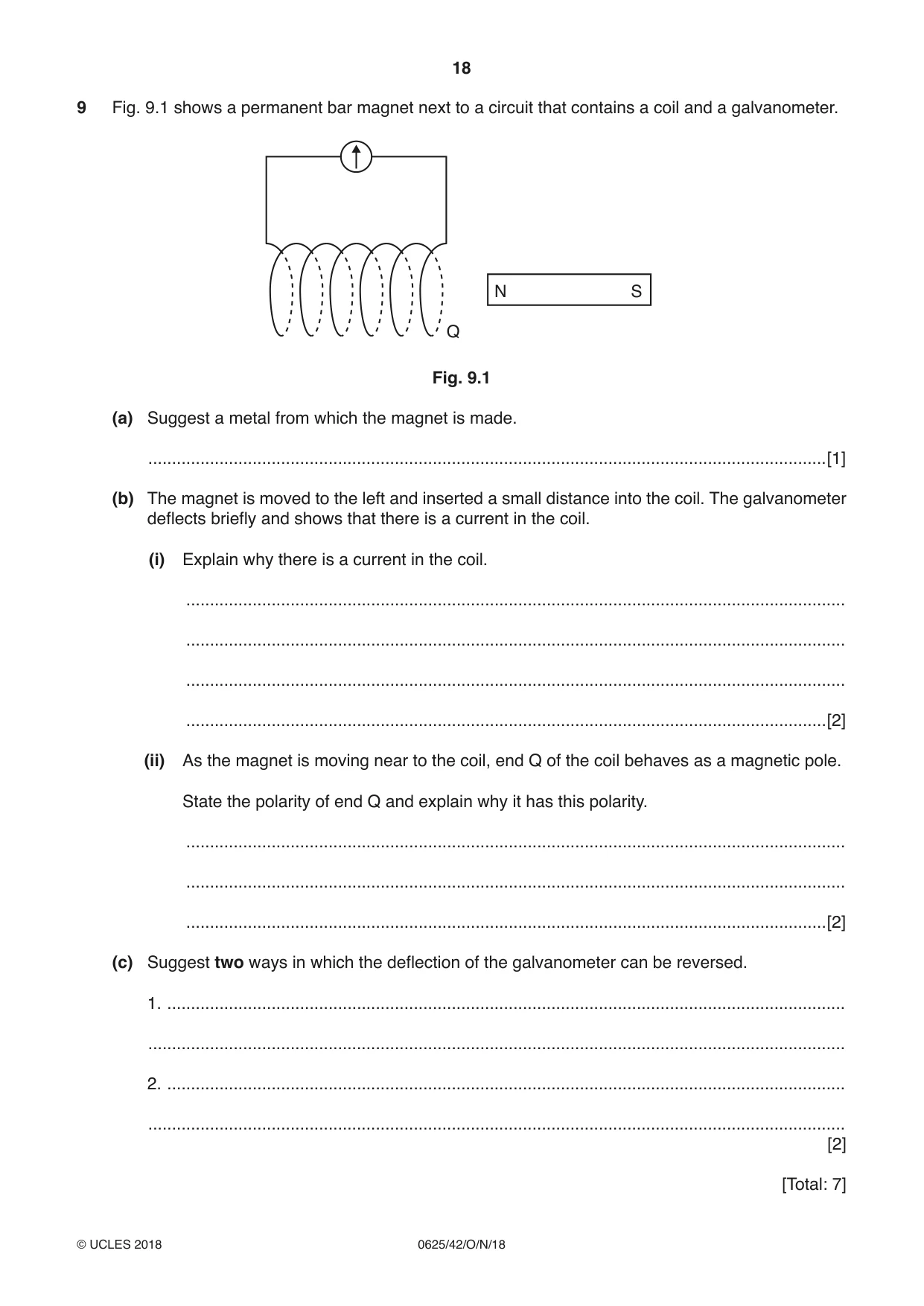
9 Fig. 9.1 shows a permanent bar magnet next to a circuit that contains a coil and a galvanometer. N S Q Fig. 9.1 (a) Suggest a metal from which the magnet is made. ...............................................................................................................................................[1] (b) The magnet is moved to the left and inserted a small distance into the coil. The galvanometer deflects briefly and shows that there is a current in the coil. (i) Explain why there is a current in the coil. ........................................................................................................................................... ........................................................................................................................................... ........................................................................................................................................... .......................................................................................................................................[2] (ii) As the magnet is moving near to the coil, end Q of the coil behaves as a magnetic pole. State the polarity of end Q and explain why it has this polarity. ........................................................................................................................................... ........................................................................................................................................... .......................................................................................................................................[2] (c) Suggest two ways in which the deflection of the galvanometer can be reversed. 1. ............................................................................................................................................... ................................................................................................................................................... 2. ............................................................................................................................................... ................................................................................................................................................... [2] [Total: 7]
Mark scheme: 9(a) B1 9b(i) magnetic field (lines) cut OR changing magnetic field / flux linkage (in coil) B1 e.m.f. / voltage induced B1 9(b)(ii) (end Q) is an N-pole B1 repels / opposes (approaching) N-pole / magnet B1 9(c) any two from: withdraw N-pole (from end Q) OR move magnet to the right insert S-pole (into end Q) insert N-pole into other end withdraw S-pole from other end or carry on past mid-point B2
Q10 · A detector of ionising radiation measures the background count rate in a classroom where…
10 (a) A detector of ionising radiation measures the background count rate in a classroom where there are no radioactive samples present. The readings, in counts/minute, taken over a period of time are shown in Table 10.1. Table 10.1 counts / minute 16 12 14 16 15 17 (i) State two possible sources of this background radiation. ........................................................................................................................................... .......................................................................................................................................[2] (ii) Explain why the readings are not the same. ........................................................................................................................................... .......................................................................................................................................[1] (b) With no radioactive sample present, a scientist records a background radiation count of 40 counts / minute. He brings a radioactive sample close to the detector. The count rate increases to 200 counts / minute. After 24 days the count rate is 50 counts / minute. Calculate the half-life of the radioactive sample. half-life = ...........................................................[4] (c) Draw a line between each type of ionising radiation and its property and another line between the property and its use. One has been done for you. Name of Property Use ionising radiation It is the most ionising radiation Remotely detecting and is most easily X-ray leaks in underground absorbed by very water pipes small amounts of substance Penetration is affected by small Detecting fractures in α-particle changes in the bones amount of solid it is passing through It is highly Detecting smoke in a β-particle penetrating and is fire alarm system poorly ionising Can pass easily Detecting a change in through soft living the thickness of γ-ray tissue. Calcium aluminium foil during absorbs more than its manufacture soft tissue [3] [Total: 10]
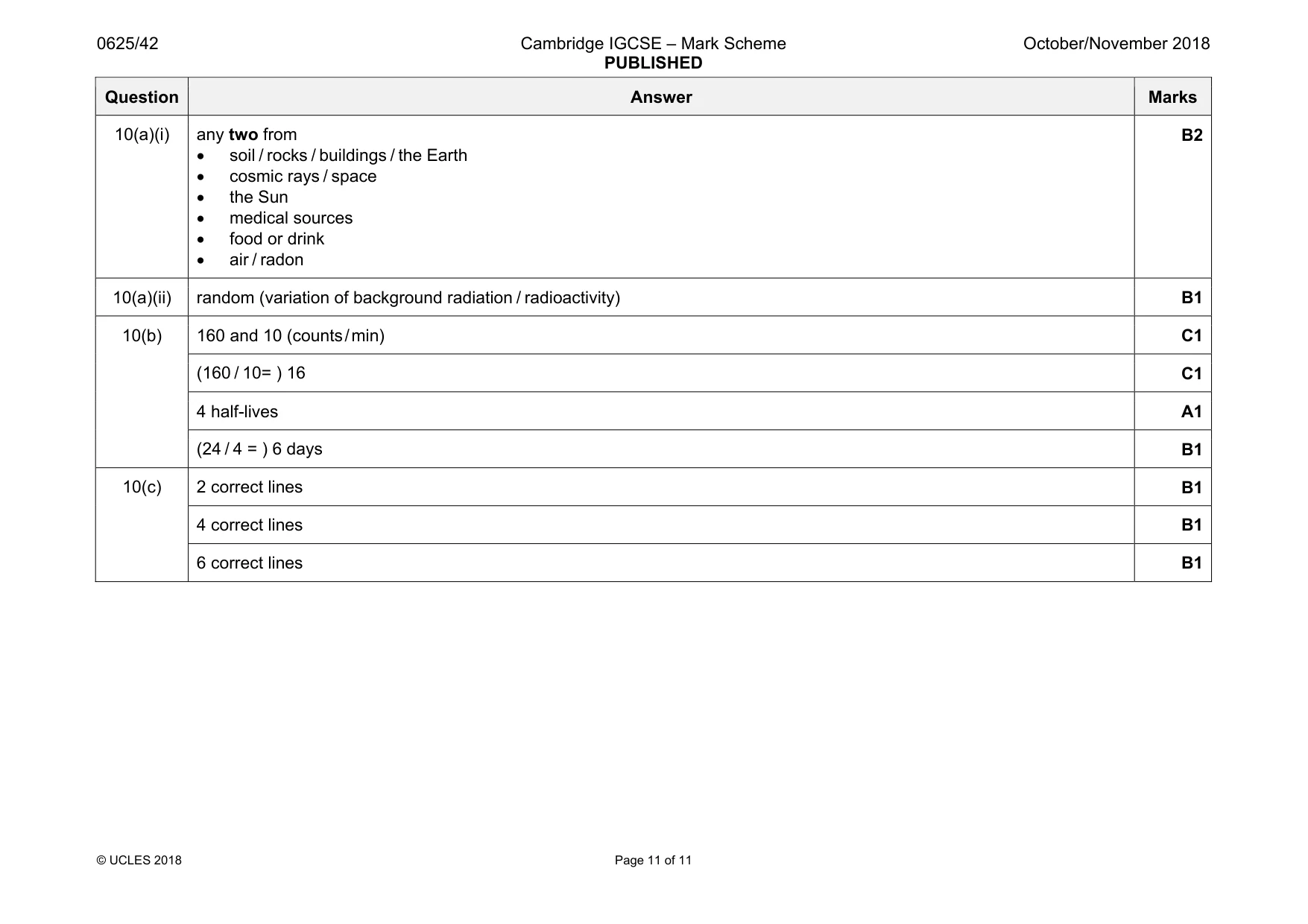
Mark scheme: 10(a)(i) any two from • soil / rocks / buildings / the Earth • cosmic rays / space • the Sun • medical sources • food or drink • air / radon B2 10(a)(ii) random (variation of background radiation / radioactivity) B1 10(b) 160 and 10 (counts / min) C1 (160 / 10= ) 16 C1 4 half-lives A1 (24 / 4 = ) 6 days B1 10(c) 2 correct lines B1 4 correct lines B1 6 correct lines B1
What was in this paper
The subtopics covered by these 10 questions, and how many questions each got. Open one in a new tab to see every Cambridge question on it.
What you needed in this session
Cambridge’s own grade thresholds for 2018 Oct/Nov, Paper 4 · Variant 2. A higher threshold means an easier paper — the bar moves with how the cohort did.