Cambridge IGCSE Physics 0625 — 2024 Feb/March Paper 4 · Variant 2
0625/42/F/M/24 · 11 questions · 80 marks · ≈90 min
The question paper and its mark scheme, free to read here and free to download. This is Cambridge’s own paper, exactly as it was sat.
Question paper20 pages


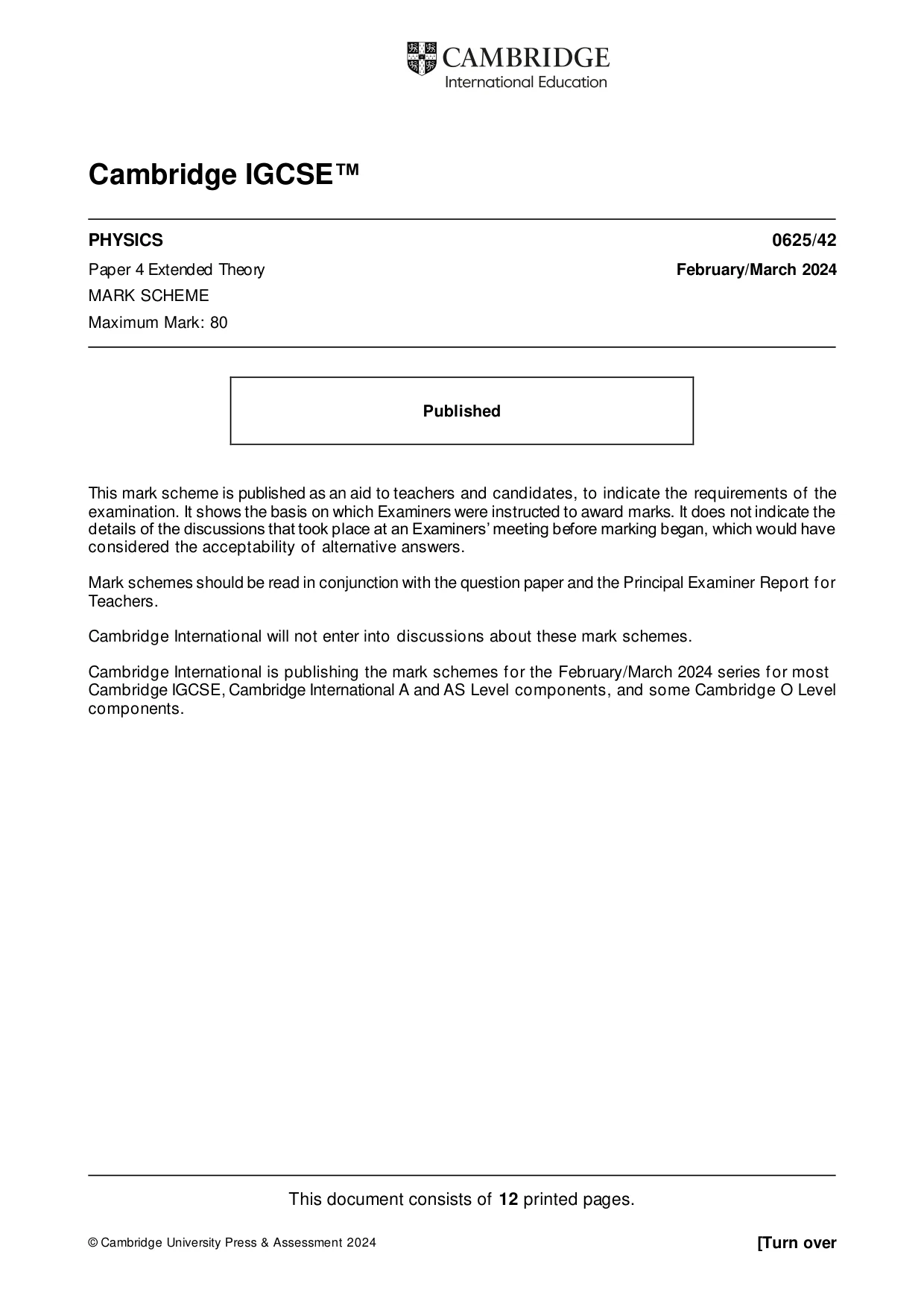
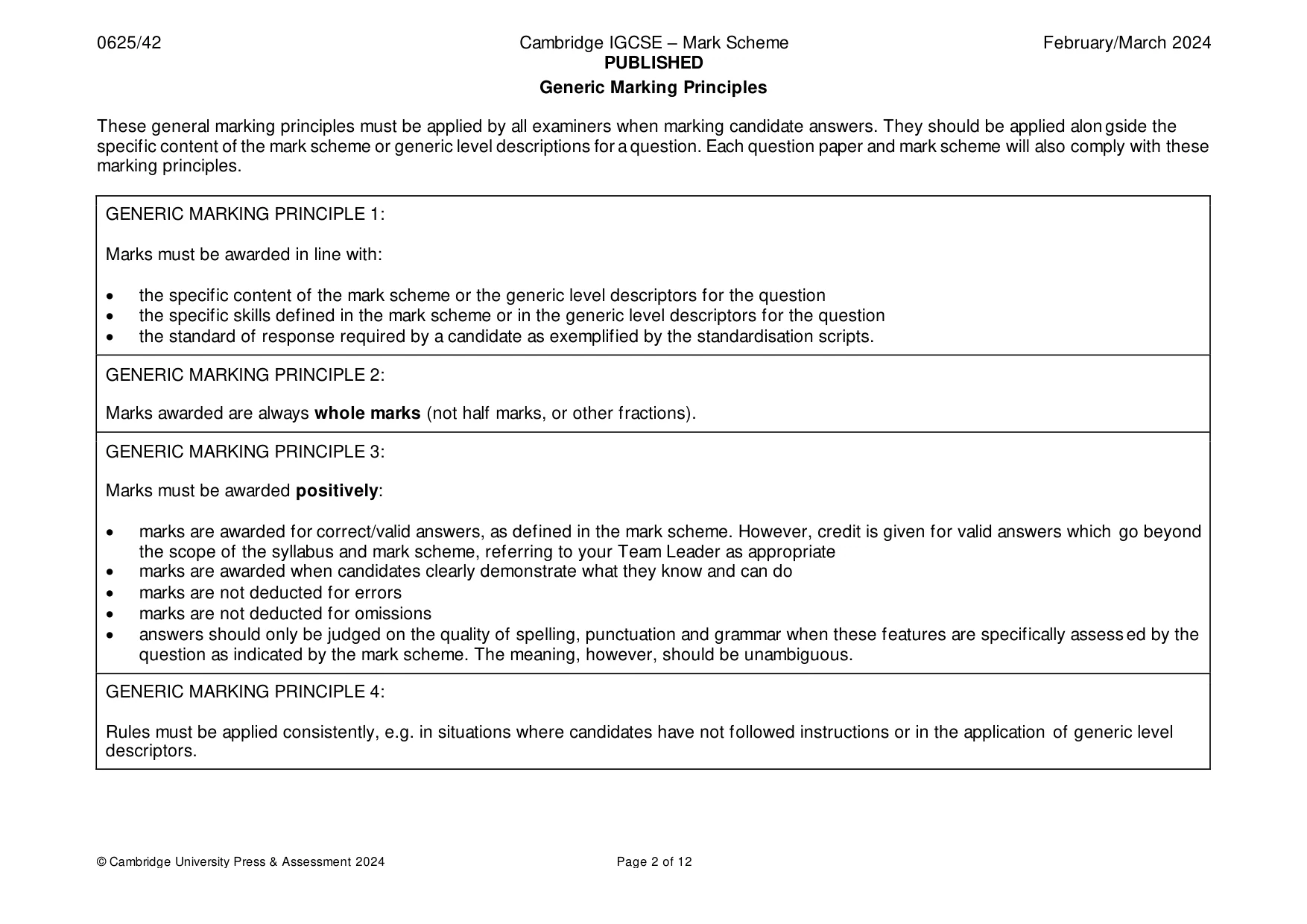
Mark scheme12 pages
Answers below. Sit the paper first if you are practising.
Questions as text
Q1 · A speed–time graph for the first 5 minutes of a bus journey
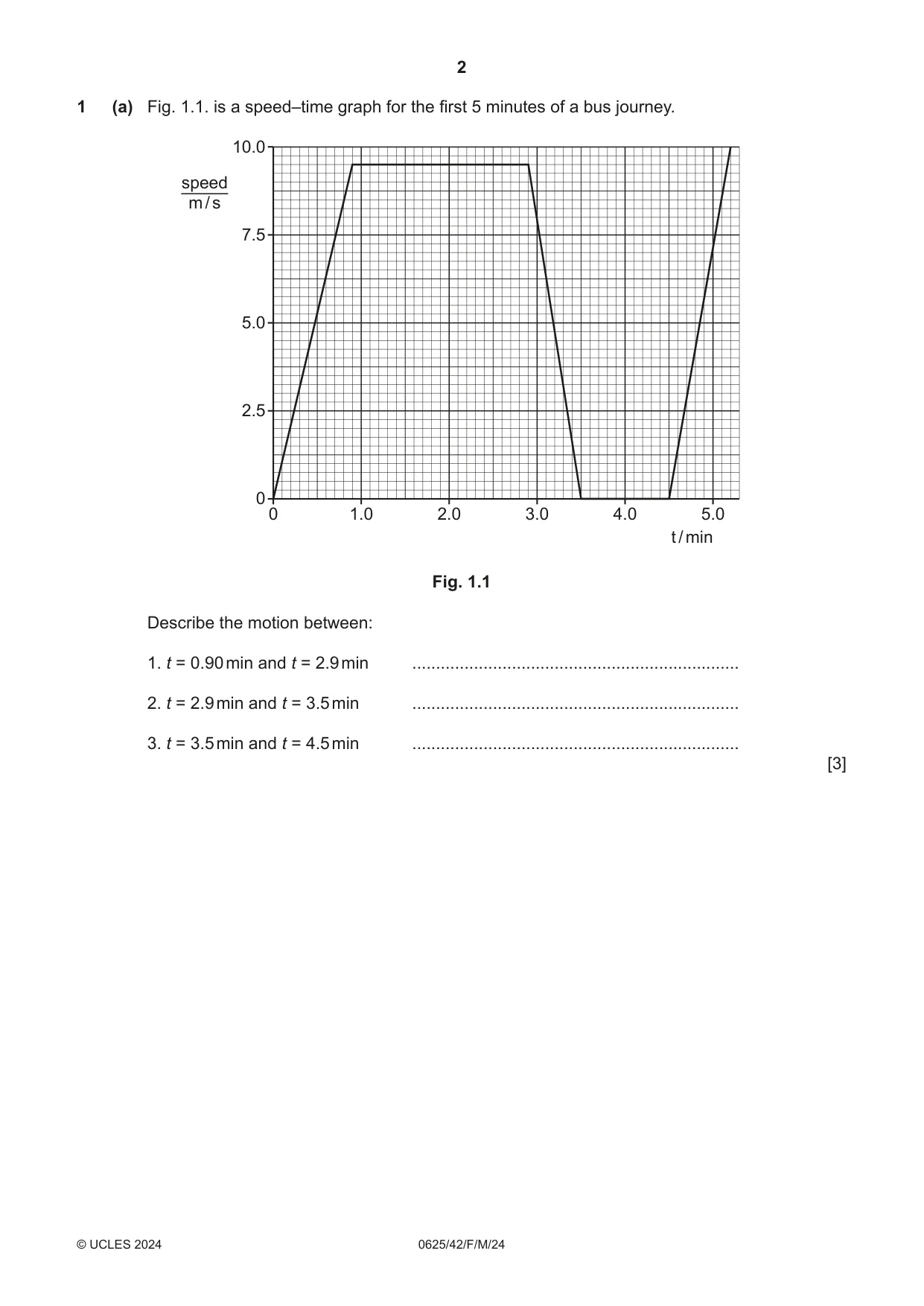
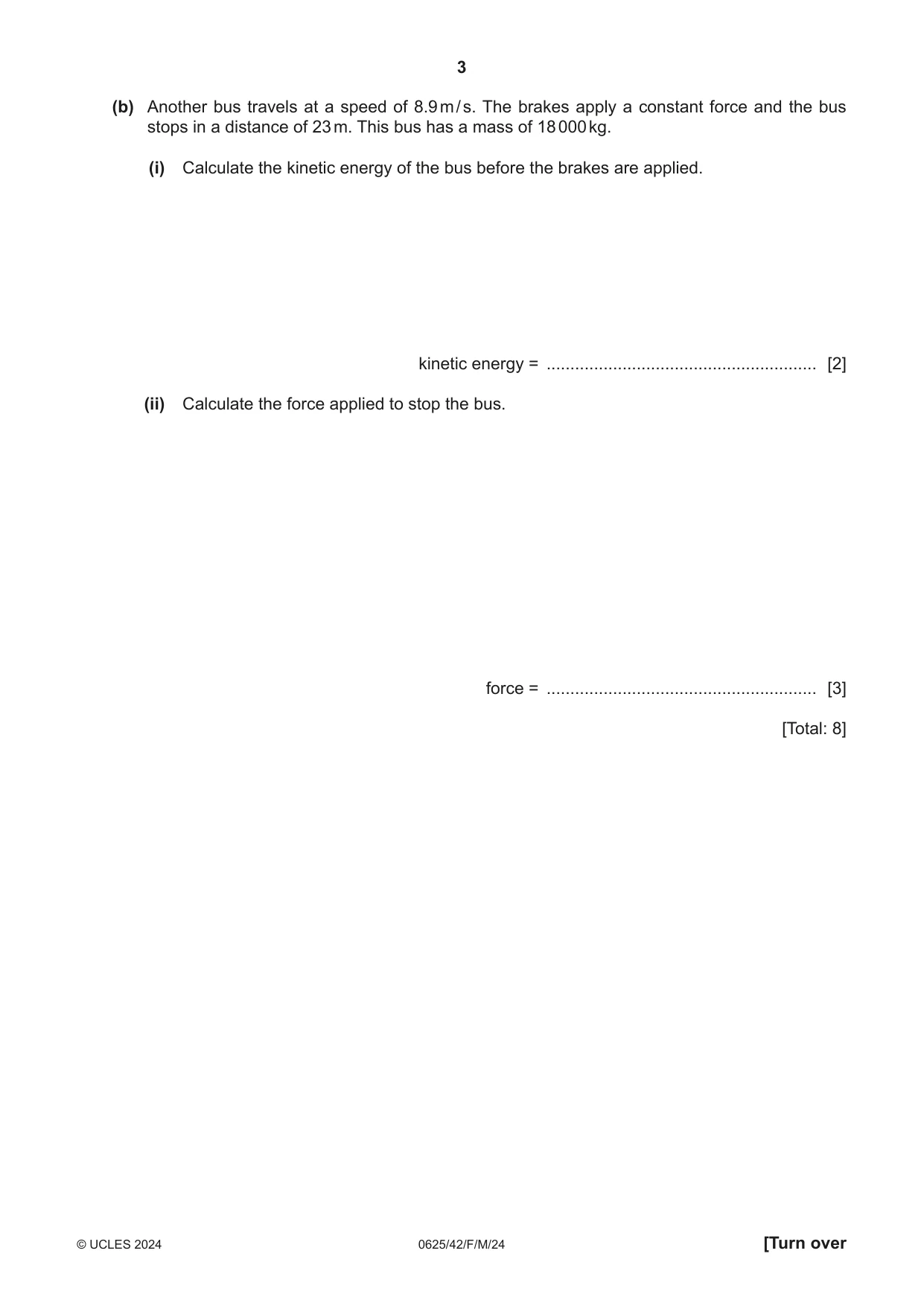
1 (a) Fig. 1.1. is a speed–time graph for the first 5 minutes of a bus journey. 10.0 speed m / s 7.5 5.0 2.5 0 0 1.0 2.0 3.0 4.0 5.0 t / min Fig. 1.1 Describe the motion between: 1. t = 0.90 min and t = 2.9 min ..................................................................... 2. t = 2.9 min and t = 3.5 min ..................................................................... 3. t = 3.5 min and t = 4.5 min ..................................................................... [3] (b) Another bus travels at a speed of 8.9 m / s. The brakes apply a constant force and the bus stops in a distance of 23 m. This bus has a mass of 18 000 kg. (i) Calculate the kinetic energy of the bus before the brakes are applied. kinetic energy = ......................................................... [2] (ii) Calculate the force applied to stop the bus. force = ......................................................... [3] [Total: 8]
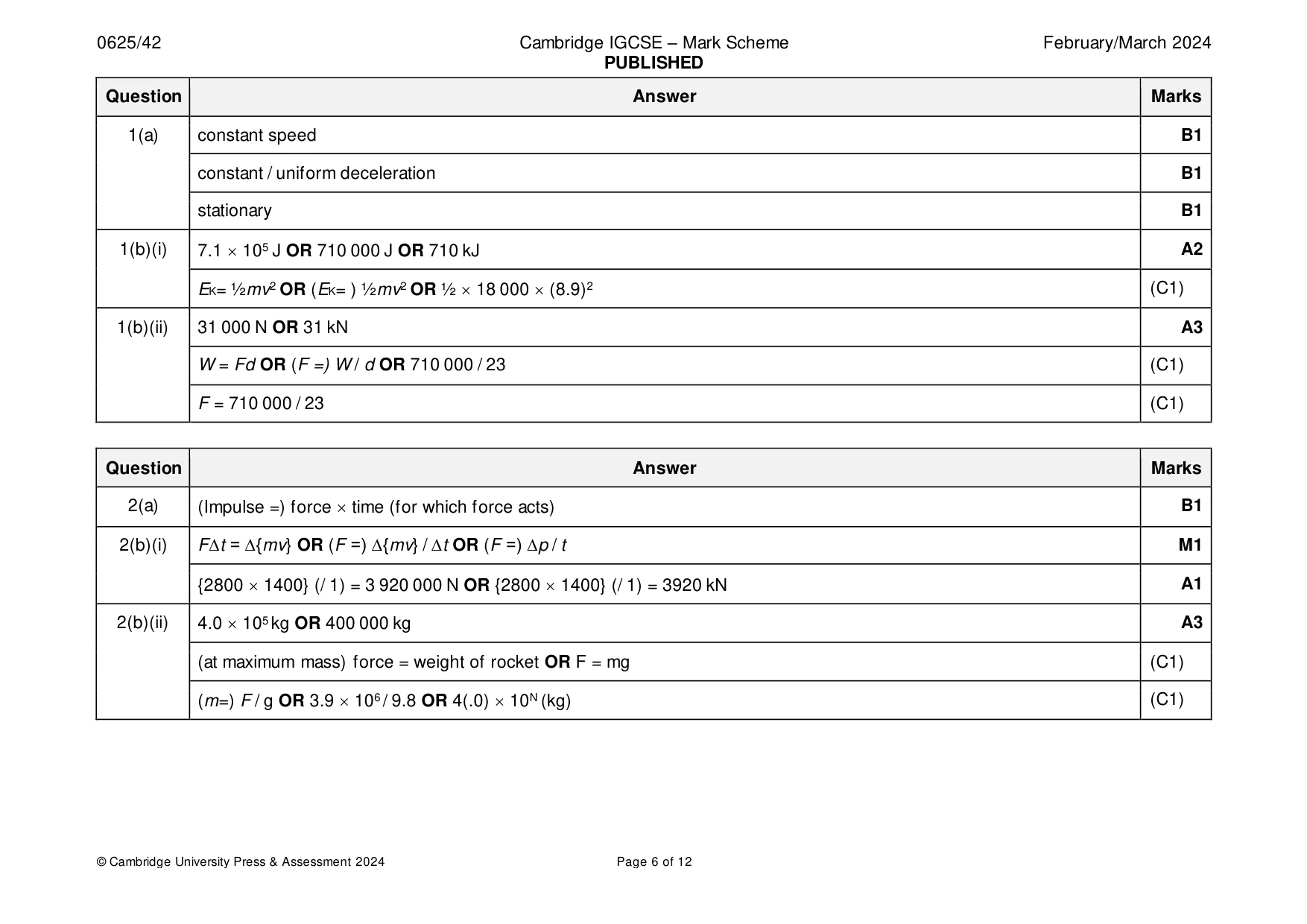
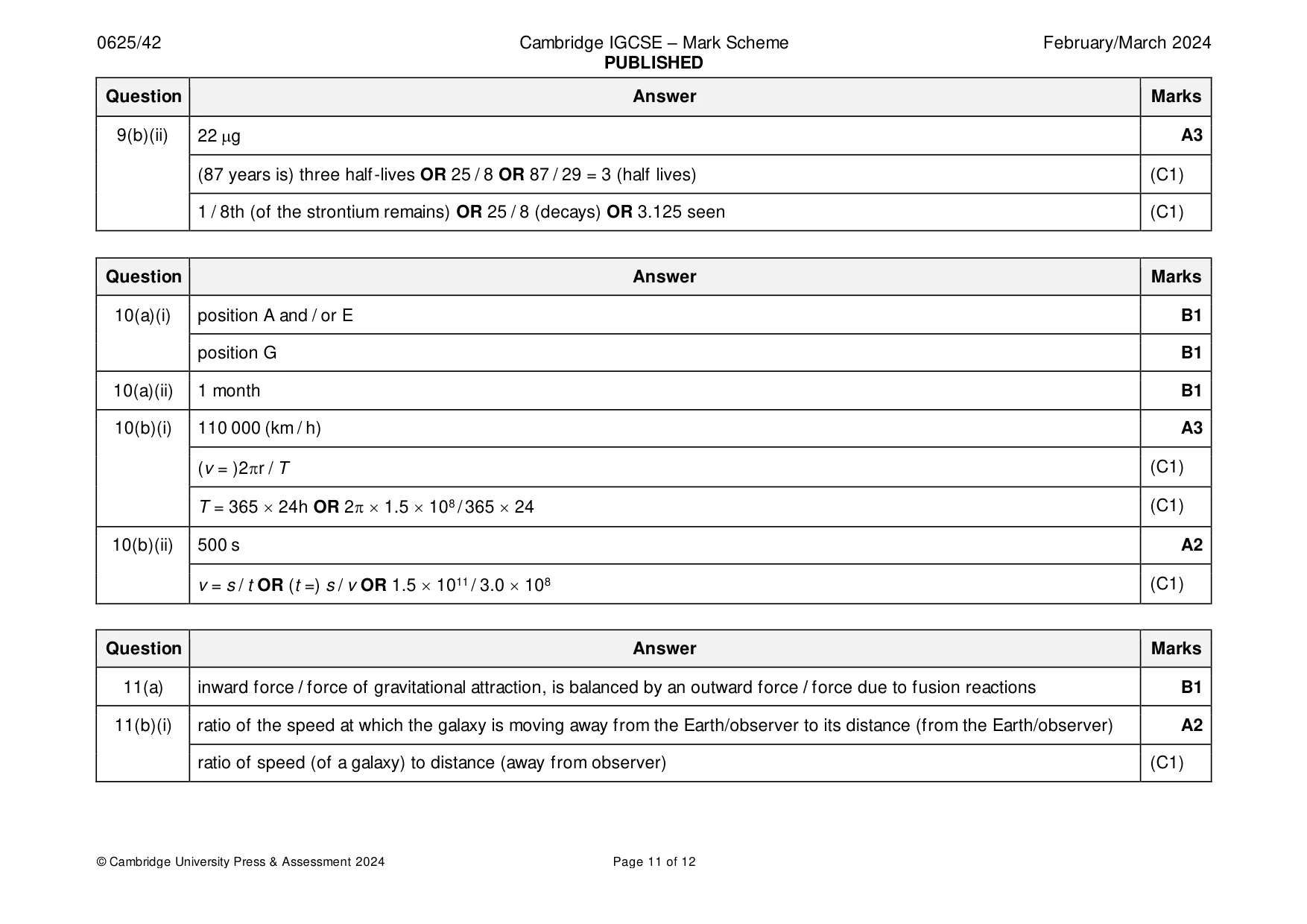
Mark scheme: Question Answer Marks 1(a) constant speed B1 constant / uniform deceleration B1 stationary B1 1(b)(i) 7.1 105 J OR 710 000 J OR 710 kJ A2 EK= ½mv2 OR (EK= ) ½mv2 OR ½ 18 000 (8.9)2 (C1) 1(b)(ii) 31 000 N OR 31 kN A3 W = Fd OR (F =) W / d OR 710 000 / 23 (C1) F = 710 000 / 23 (C1)
Question 2
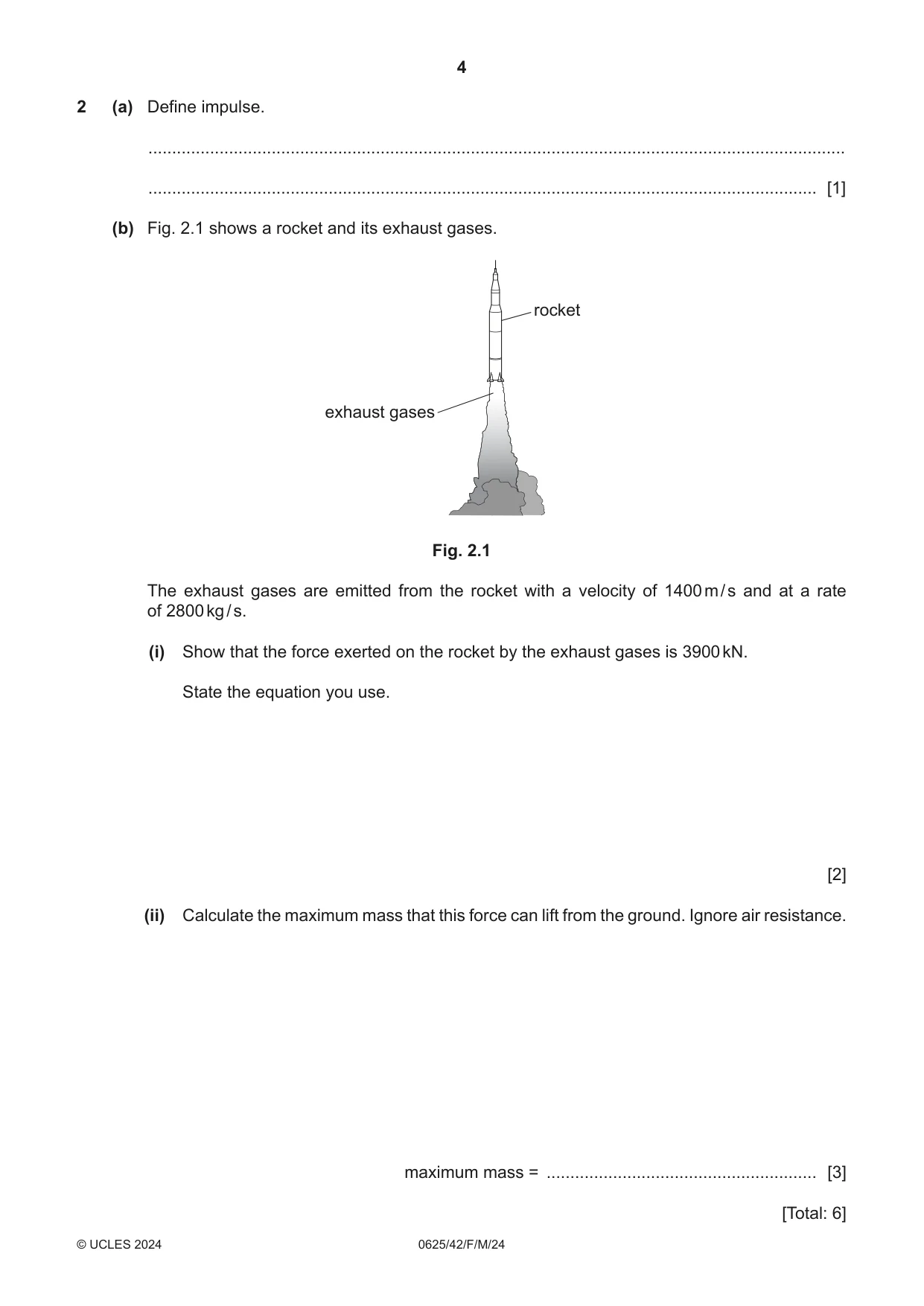
2 (a) Define impulse. ................................................................................................................................................... ............................................................................................................................................. [1] (b) Fig. 2.1 shows a rocket and its exhaust gases. rocket exhaust gases Fig. 2.1 The exhaust gases are emitted from the rocket with a velocity of 1400 m / s and at a rate of 2800 kg / s. (i) Show that the force exerted on the rocket by the exhaust gases is 3900 kN. State the equation you use. [2] (ii) Calculate the maximum mass that this force can lift from the ground. Ignore air resistance. maximum mass = ......................................................... [3] [Total: 6]
Mark scheme: 2(a) (Impulse =) force time (for which force acts) B1 2(b)(i) F∆t = ∆{mv} OR (F =) ∆{mv} / ∆t OR (F =) ∆p / t M1 {2800 1400} (/ 1) = 3 920 000 N OR {2800 1400} (/ 1) = 3920 kN A1 2(b)(ii) 4.0 105 kg OR 400 000 kg A3 (at maximum mass) force = weight of rocket OR F = mg (C1) (m=) F / g OR 3.9 106 / 9.8 OR 4(.0) 10N (kg) (C1)
Q3 · A car has a weight of 13 000 N
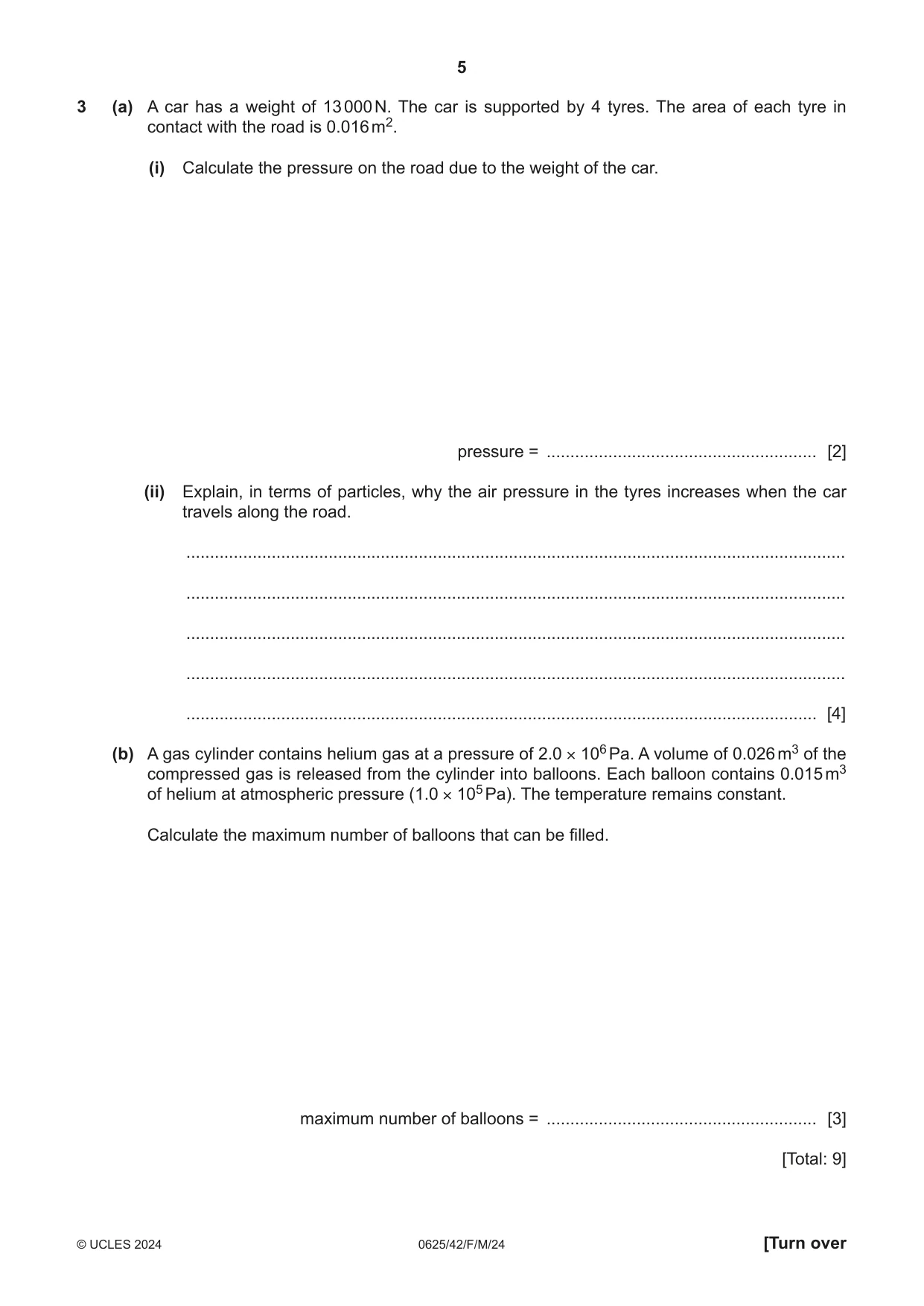
3 (a) A car has a weight of 13 000 N. The car is supported by 4 tyres. The area of each tyre in contact with the road is 0.016 m2. (i) Calculate the pressure on the road due to the weight of the car. pressure = ......................................................... [2] (ii) Explain, in terms of particles, why the air pressure in the tyres increases when the car travels along the road. ........................................................................................................................................... ........................................................................................................................................... ........................................................................................................................................... ........................................................................................................................................... ..................................................................................................................................... [4] (b) A gas cylinder contains helium gas at a pressure of 2.0 × 10⁶ Pa. A volume of 0.026 m3 of the compressed gas is released from the cylinder into balloons. Each balloon contains 0.015 m3 of helium at atmospheric pressure (1.0 × 10⁵ Pa). The temperature remains constant. Calculate the maximum number of balloons that can be filled. maximum number of balloons = ......................................................... [3] [Total: 9]
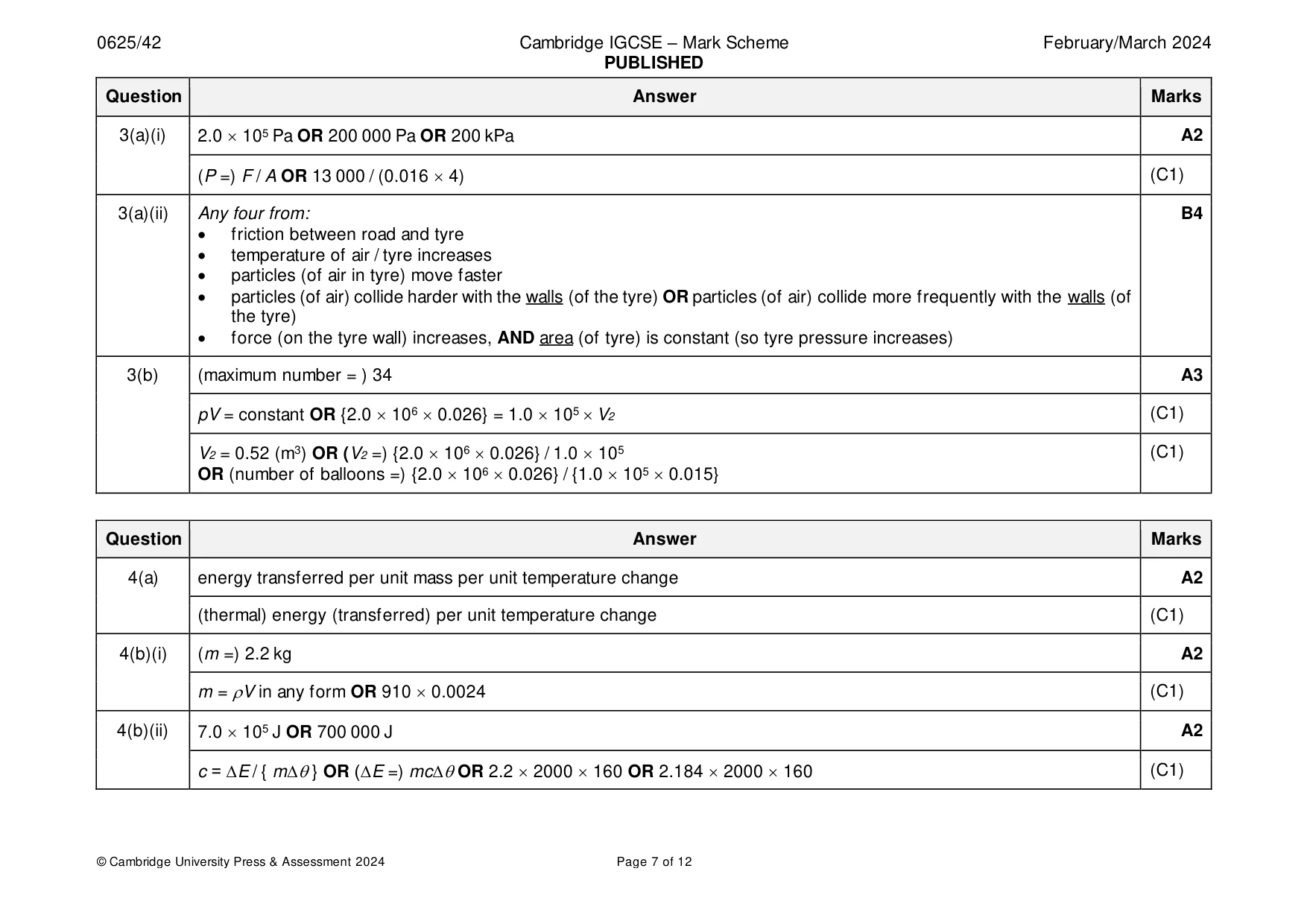
Mark scheme: 3(a)(i) 2.0 105 Pa OR 200 000 Pa OR 200 kPa A2 (P =) F / A OR 13 000 / (0.016 4) (C1) 3(a)(ii) Any four from: B4 • friction between road and tyre • temperature of air / tyre increases • particles (of air in tyre) move faster • particles (of air) collide harder with the walls (of the tyre) OR particles (of air) collide more frequently with the walls (of the tyre) • force (on the tyre wall) increases, AND area (of tyre) is constant (so tyre pressure increases) 3(b) (maximum number = ) 34 A3 pV = constant OR {2.0 106 0.026} = 1.0 105 V2 (C1) V2 = 0.52 (m3) OR (V2 =) {2.0 106 0.026} / 1.0 105 (C1) OR (number of balloons =) {2.0 106 0.026} / {1.0 105 0.015}
Q4 · Define specific heat capacity
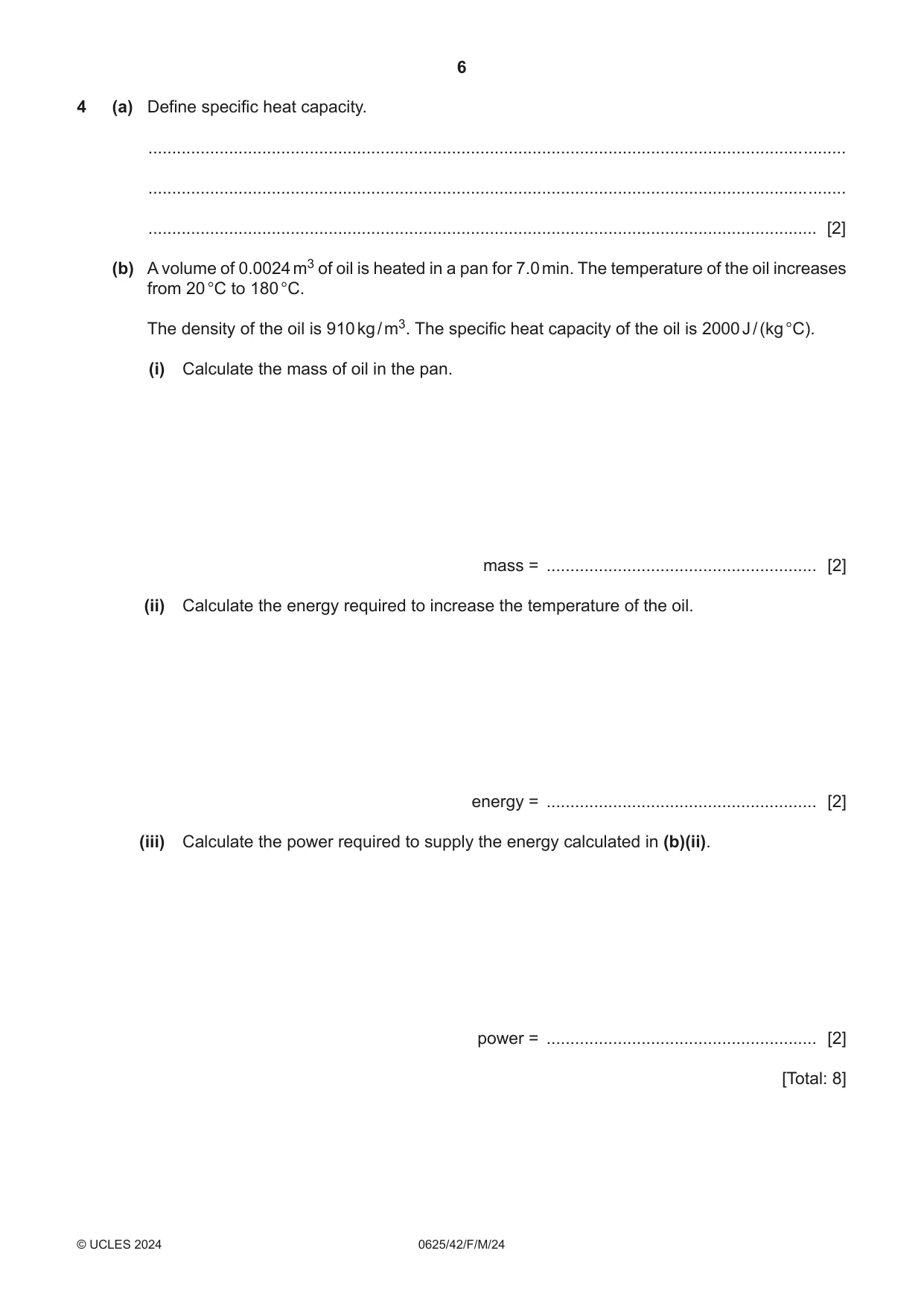
4 (a) Define specific heat capacity. ................................................................................................................................................... ................................................................................................................................................... ............................................................................................................................................. [2] (b) A volume of 0.0024 m3 of oil is heated in a pan for 7.0 min. The temperature of the oil increases from 20 °C to 180 °C. The density of the oil is 910 kg / m3. The specific heat capacity of the oil is 2000 J / (kg °C). (i) Calculate the mass of oil in the pan. mass = ......................................................... [2] (ii) Calculate the energy required to increase the temperature of the oil. energy = ......................................................... [2] (iii) Calculate the power required to supply the energy calculated in (b)(ii). power = ......................................................... [2] [Total: 8]
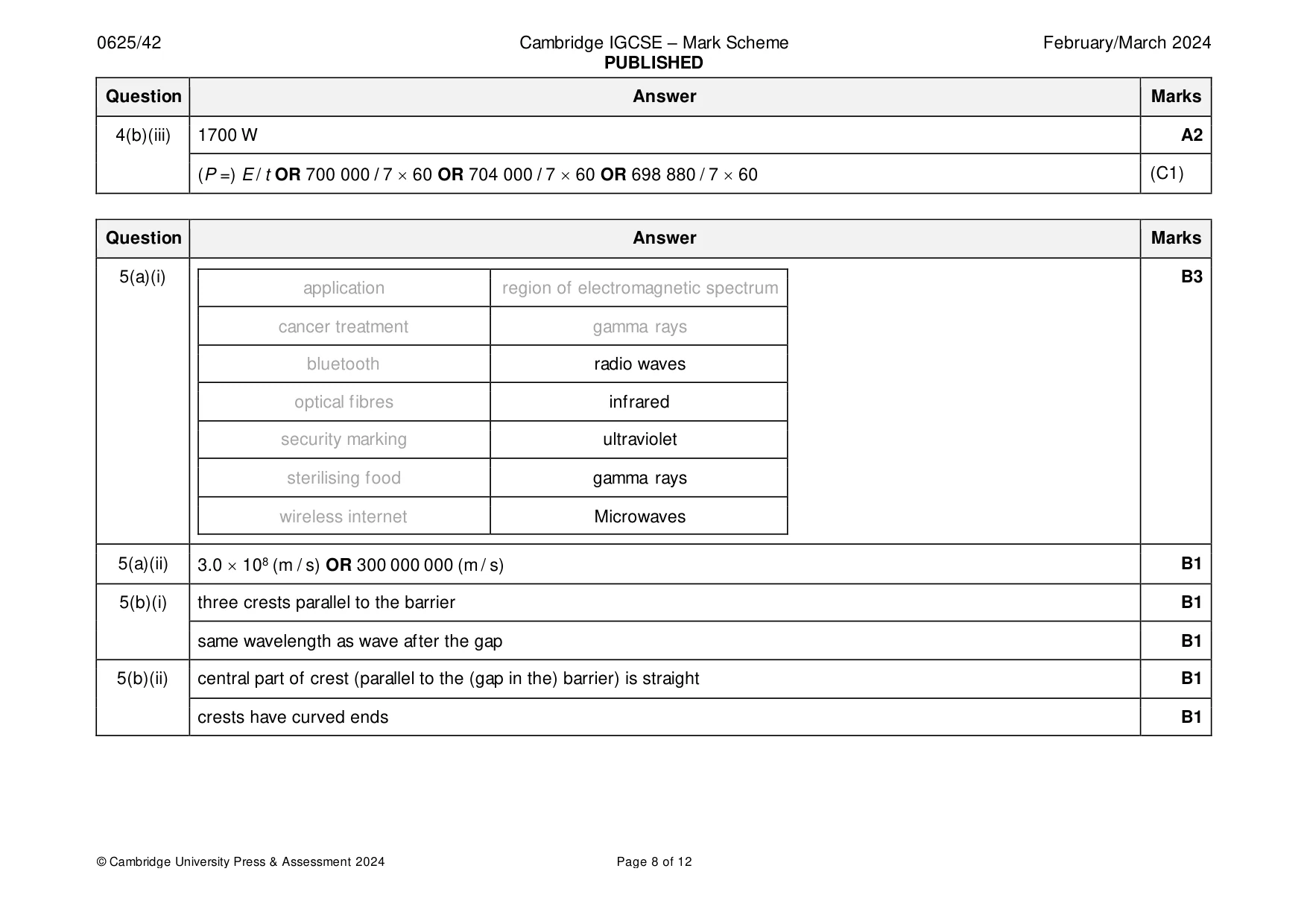
Mark scheme: 4(a) energy transferred per unit mass per unit temperature change A2 (thermal) energy (transferred) per unit temperature change (C1) 4(b)(i) (m =) 2.2 kg A2 m = V in any form OR 910 0.0024 (C1) 4(b)(ii) 7.0 105 J OR 700 000 J A2 c = ∆E / { m∆} OR (∆E =) mc∆OR 2.2 2000 160 OR 2.184 2000 160 (C1) 4(b)(iii) 1700 W A2 (P =) E / t OR 700 000 / 7 60 OR 704 000 / 7 60 OR 698 880 / 7 60 (C1)
Q5 · Applications of regions of the electromagnetic spectrum
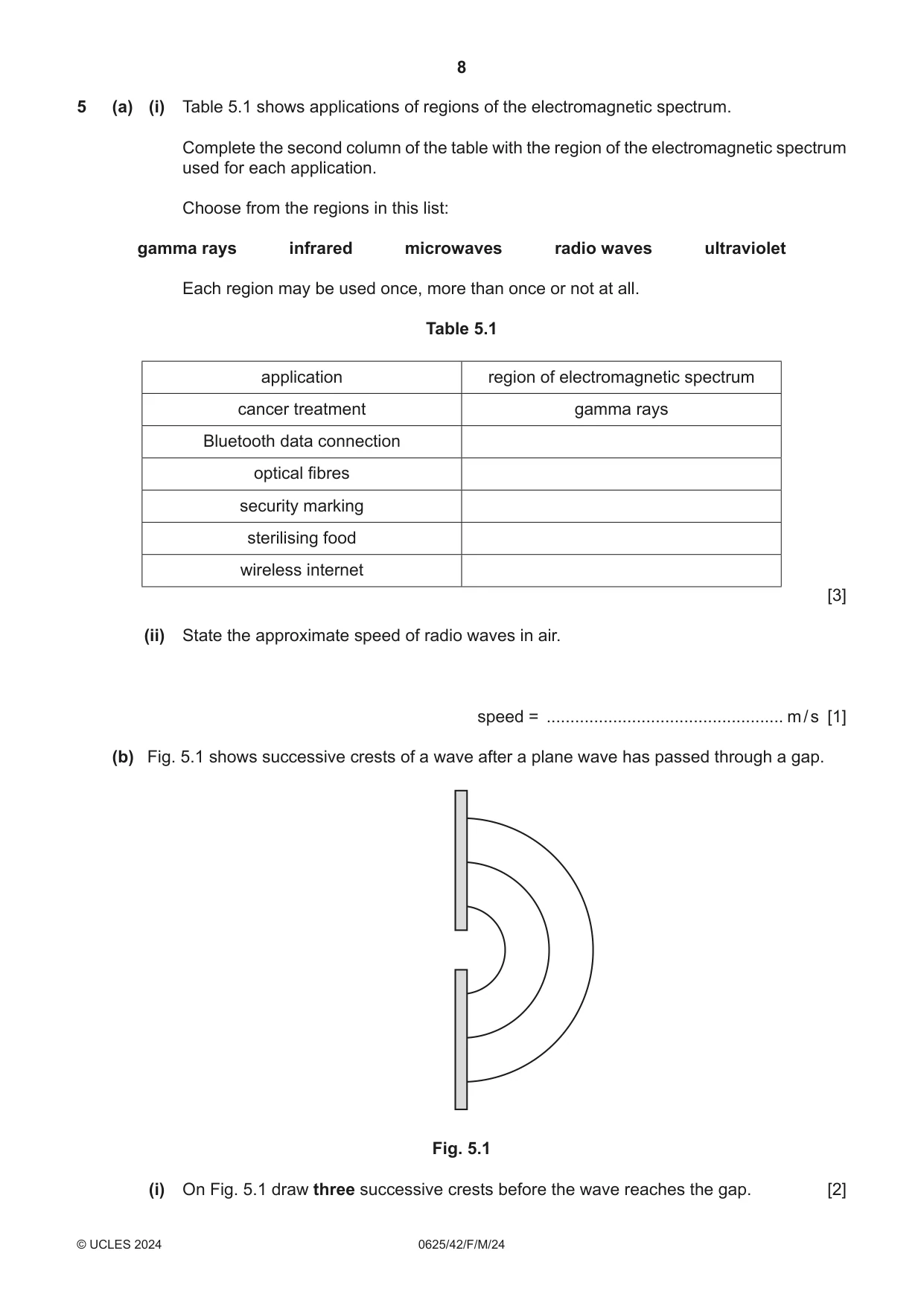
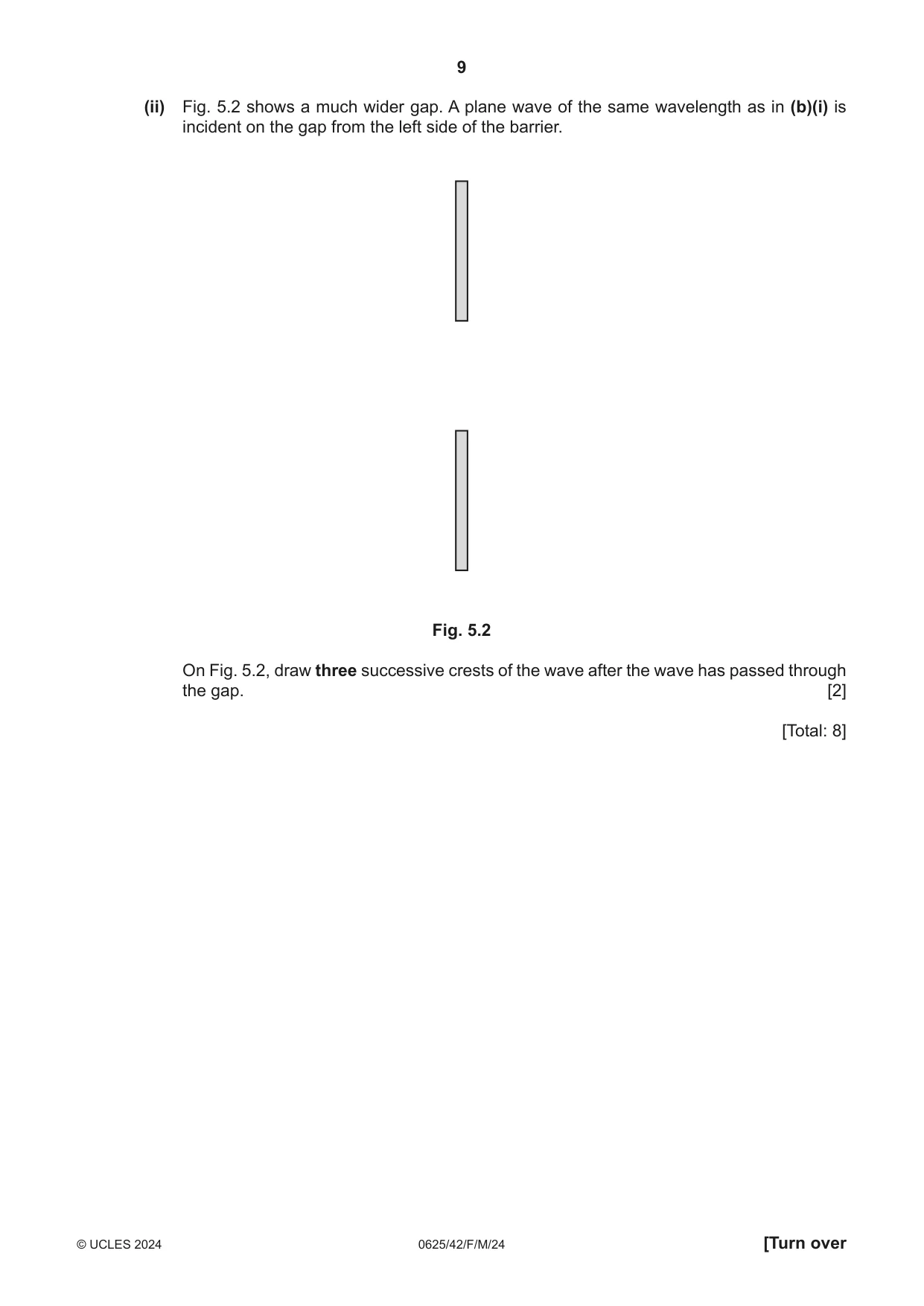
5 (a) (i) Table 5.1 shows applications of regions of the electromagnetic spectrum. Complete the second column of the table with the region of the electromagnetic spectrum used for each application. Choose from the regions in this list: gamma rays infrared microwaves radio waves ultraviolet Each region may be used once, more than once or not at all. Table 5.1 application region of electromagnetic spectrum cancer treatment gamma rays Bluetooth data connection optical fibres security marking sterilising food wireless internet [3] (ii) State the approximate speed of radio waves in air. speed = .................................................. m / s [1] (b) Fig. 5.1 shows successive crests of a wave after a plane wave has passed through a gap. Fig. 5.1 (i) On Fig. 5.1 draw three successive crests before the wave reaches the gap. [2] (ii) Fig. 5.2 shows a much wider gap. A plane wave of the same wavelength as in (b)(i) is incident on the gap from the left side of the barrier. Fig. 5.2 On Fig. 5.2, draw three successive crests of the wave after the wave has passed through the gap. [2] [Total: 8]
Mark scheme: 5(a)(i) B3 application region of electromagnetic spectrum cancer treatment gamma rays bluetooth radio waves optical fibres infrared security marking ultraviolet sterilising food gamma rays wireless internet Microwaves 5(a)(ii) 3.0 108 (m / s) OR 300 000 000 (m / s) B1 5(b)(i) three crests parallel to the barrier B1 same wavelength as wave after the gap B1 5(b)(ii) central part of crest (parallel to the (gap in the) barrier) is straight B1 crests have curved ends B1
Q6 · A full‑scale diagram of an object O and its image I produced by a converging lens
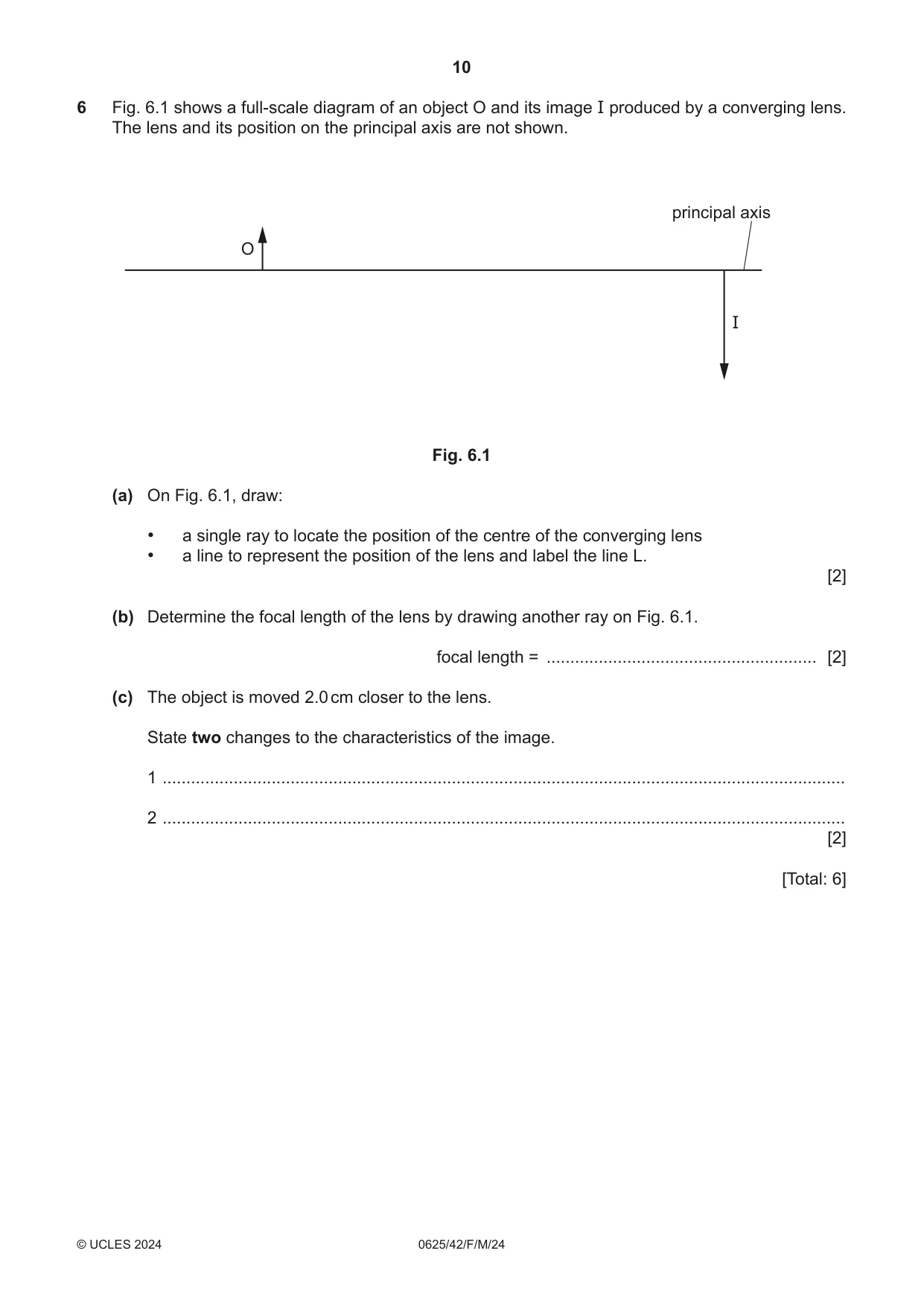
6 Fig. 6.1 shows a full‑scale diagram of an object O and its image I produced by a converging lens. The lens and its position on the principal axis are not shown. principal axis O I Fig. 6.1 (a) On Fig. 6.1, draw: • a single ray to locate the position of the centre of the converging lens • a line to represent the position of the lens and label the line L. [2] (b) Determine the focal length of the lens by drawing another ray on Fig. 6.1. focal length = ......................................................... [2] (c) The object is moved 2.0 cm closer to the lens. State two changes to the characteristics of the image. 1 ................................................................................................................................................ 2 ................................................................................................................................................ [2] [Total: 6]
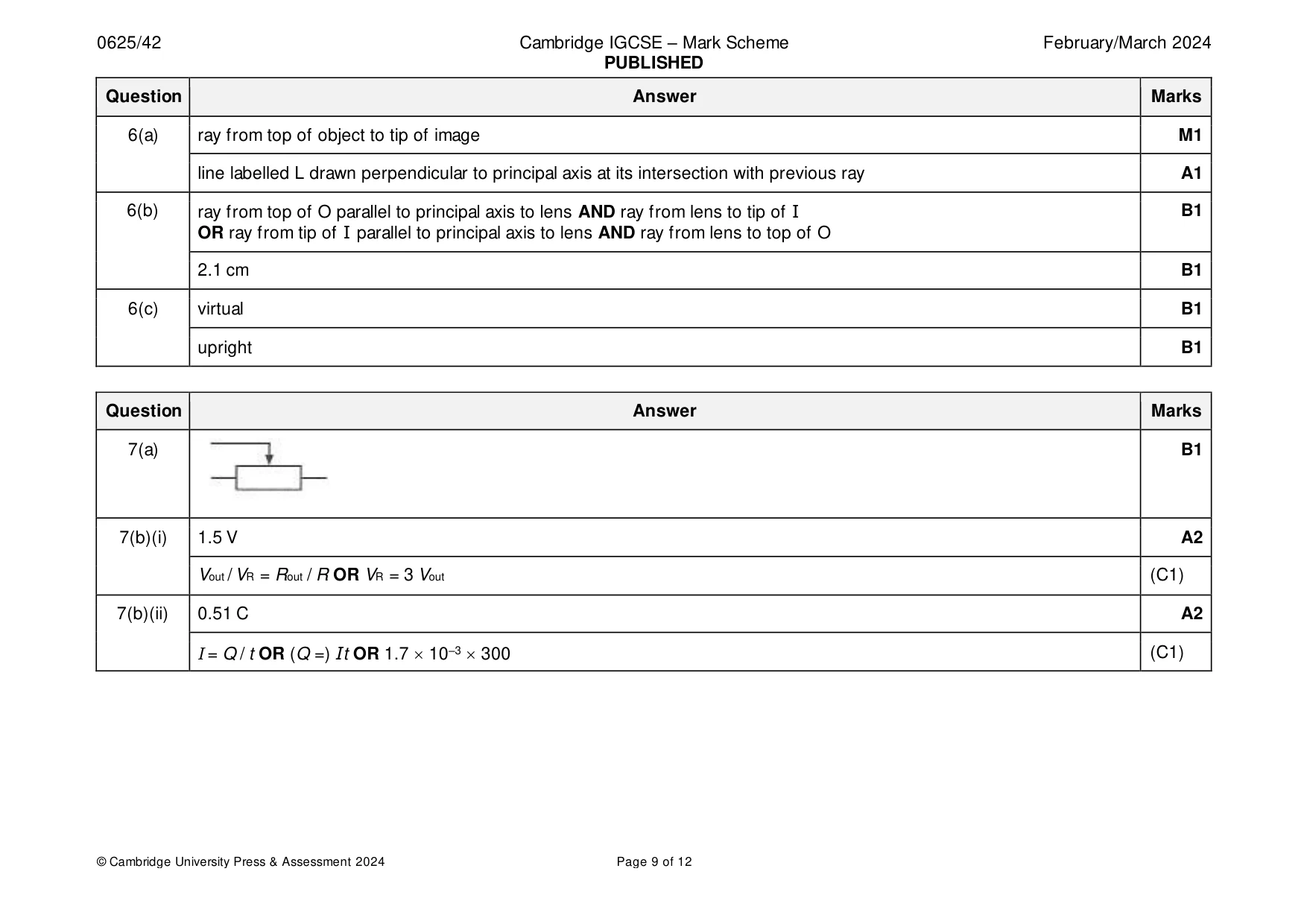
Mark scheme: 6(a) ray from top of object to tip of image M1 line labelled L drawn perpendicular to principal axis at its intersection with previous ray A1 6(b) ray from top of O parallel to principal axis to lens AND ray from lens to tip of I B1 OR ray from tip of I parallel to principal axis to lens AND ray from lens to top of O 2.1 cm B1 6(c) virtual B1 upright B1
Q7 · Draw the circuit symbol for a potential divider
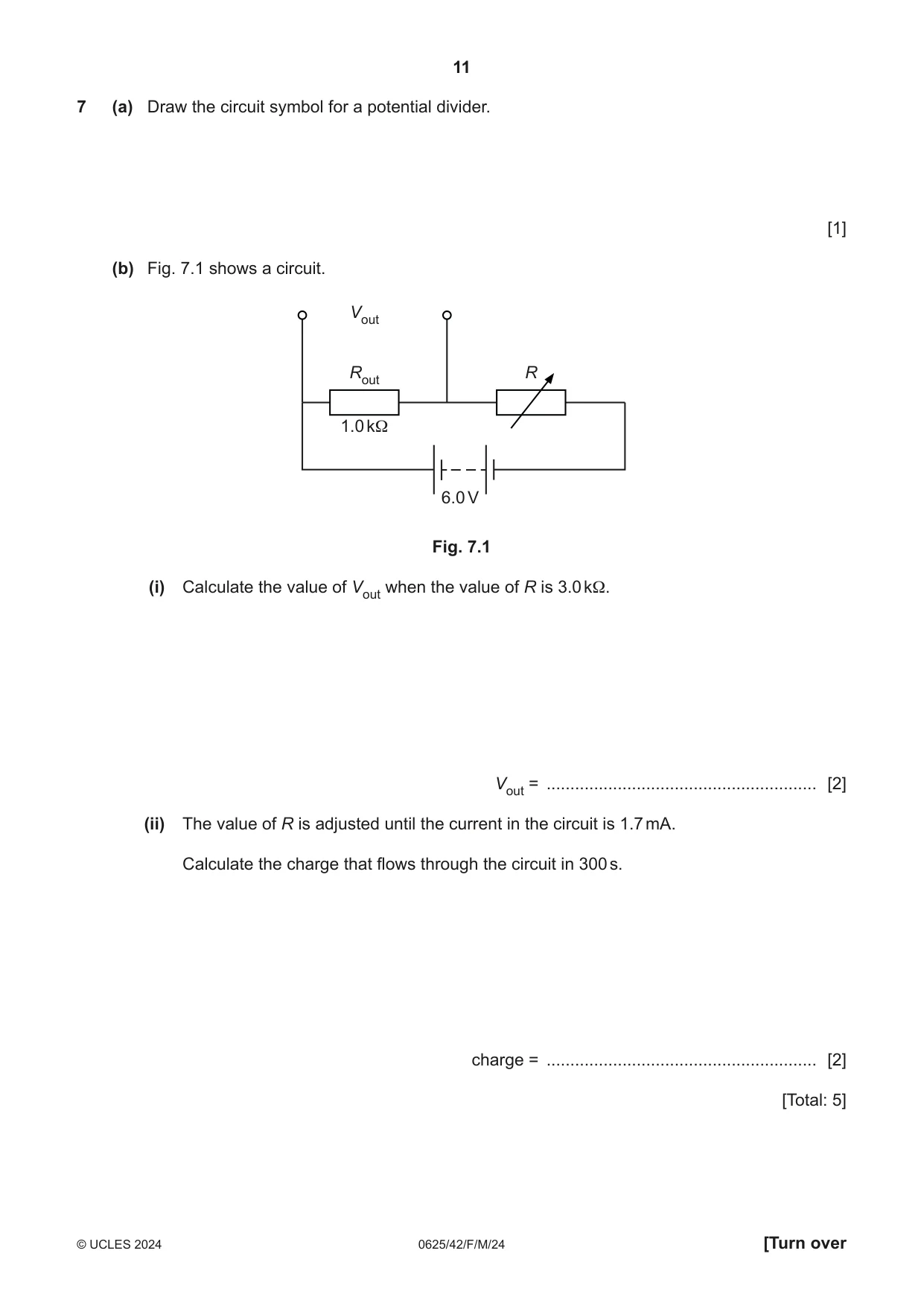
7 (a) Draw the circuit symbol for a potential divider. [1] (b) Fig. 7.1 shows a circuit. Vout Rout R 1.0 kΩ 6.0 V Fig. 7.1 (i) Calculate the value of Vout when the value of R is 3.0 kΩ. Vout = ......................................................... [2] (ii) The value of R is adjusted until the current in the circuit is 1.7 mA. Calculate the charge that flows through the circuit in 300 s. charge = ......................................................... [2] [Total: 5]
Mark scheme: 7(a) B1 7(b)(i) 1.5 V A2 Vout / VR = Rout / R OR VR = 3 Vout (C1) 7(b)(ii) 0.51 C A2 I = Q / t OR (Q =) It OR 1.7 10–3 300 (C1)
Q8 · A wire carrying a large current
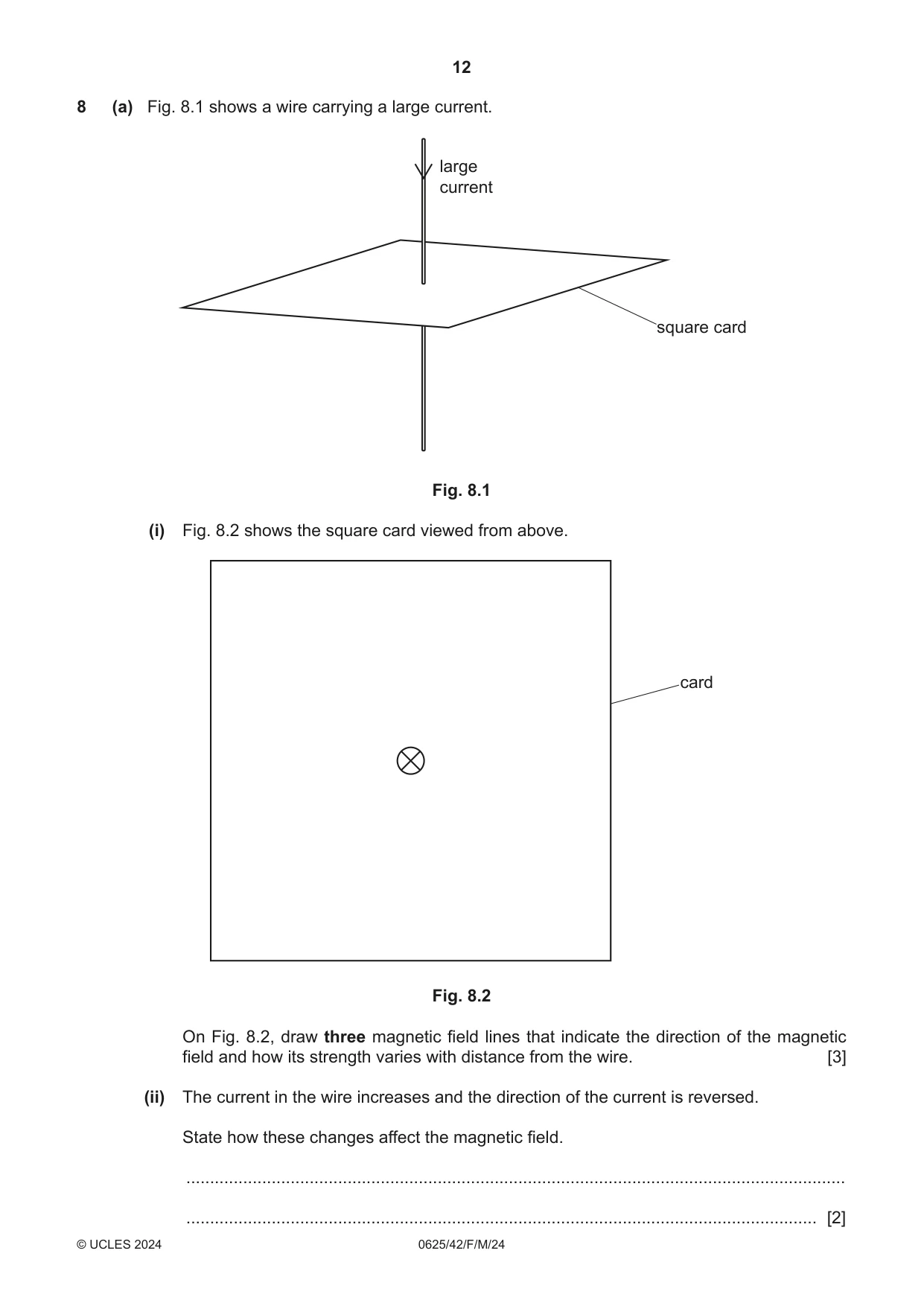
8 (a) Fig. 8.1 shows a wire carrying a large current. large current square card Fig. 8.1 (i) Fig. 8.2 shows the square card viewed from above. card Fig. 8.2 On Fig. 8.2, draw three magnetic field lines that indicate the direction of the magnetic field and how its strength varies with distance from the wire. [3] (ii) The current in the wire increases and the direction of the current is reversed. State how these changes affect the magnetic field. ........................................................................................................................................... ..................................................................................................................................... [2] (b) Electricity is transmitted at high voltage. Explain why a high voltage increases the efficiency of transmission even with thinner wires. ................................................................................................................................................... ................................................................................................................................................... ................................................................................................................................................... ............................................................................................................................................. [3] [Total: 8]
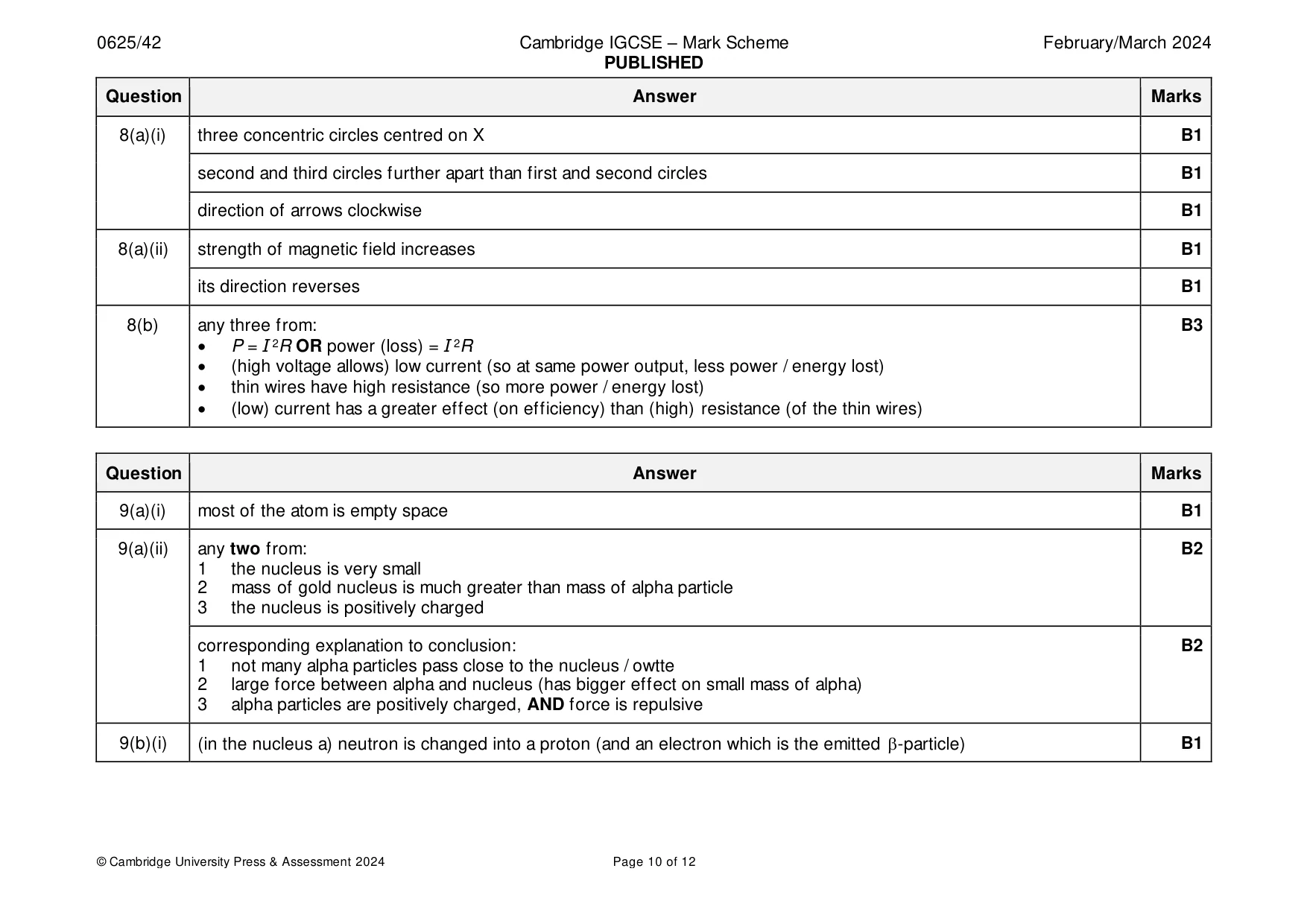
Mark scheme: 8(a)(i) three concentric circles centred on X B1 second and third circles further apart than first and second circles B1 direction of arrows clockwise B1 8(a)(ii) strength of magnetic field increases B1 its direction reverses B1 8(b) any three from: B3 • P = I 2R OR power (loss) = I 2R • (high voltage allows) low current (so at same power output, less power / energy lost) • thin wires have high resistance (so more power / energy lost) • (low) current has a greater effect (on efficiency) than (high) resistance (of the thin wires)
Q9 · An experiment directs alpha particles at a very thin sheet of gold foil
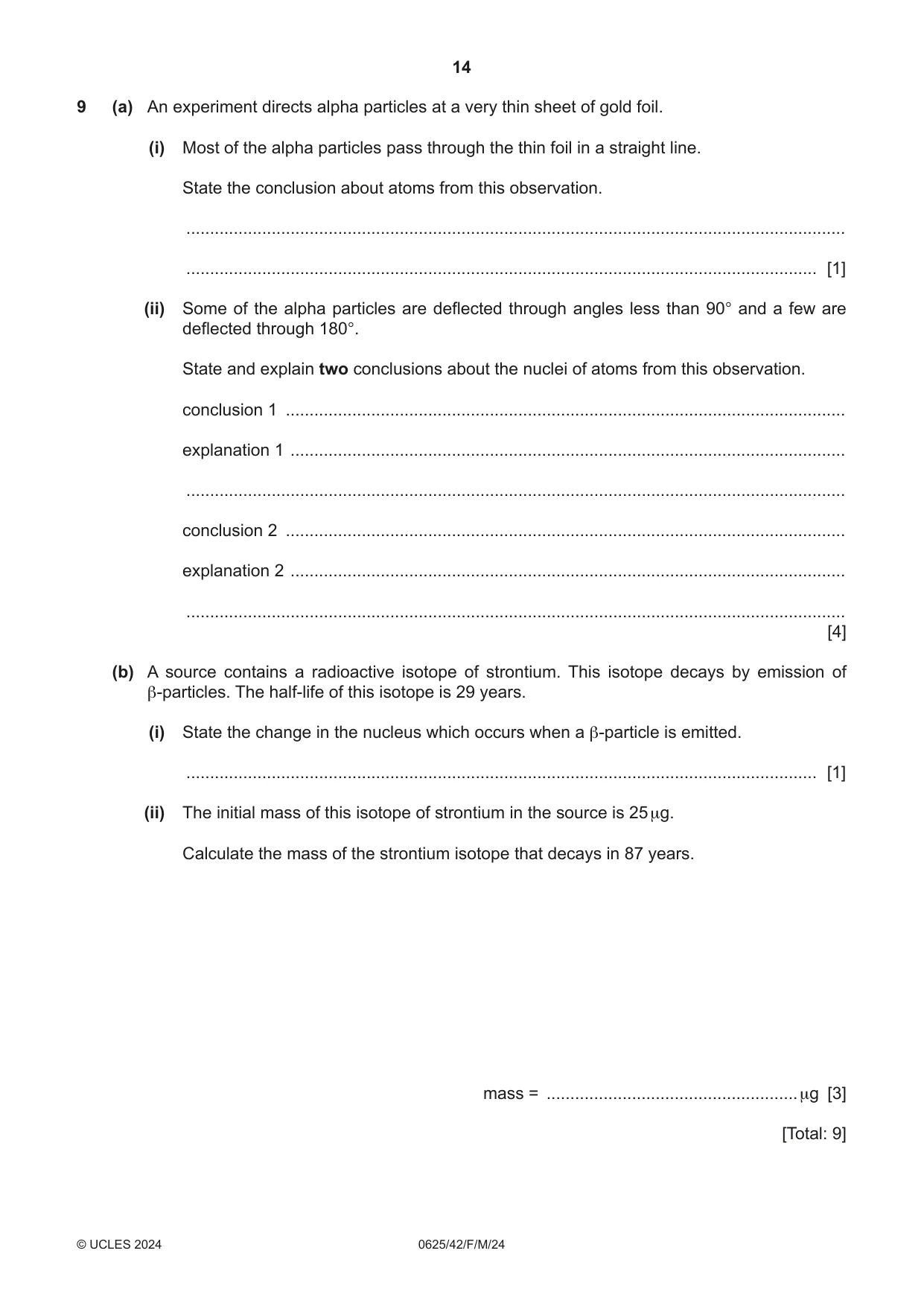
9 (a) An experiment directs alpha particles at a very thin sheet of gold foil. (i) Most of the alpha particles pass through the thin foil in a straight line. State the conclusion about atoms from this observation. ........................................................................................................................................... ..................................................................................................................................... [1] (ii) Some of the alpha particles are deflected through angles less than 90° and a few are deflected through 180°. State and explain two conclusions about the nuclei of atoms from this observation. conclusion 1 ...................................................................................................................... explanation 1 ..................................................................................................................... ........................................................................................................................................... conclusion 2 ...................................................................................................................... explanation 2 ..................................................................................................................... ........................................................................................................................................... [4] (b) A source contains a radioactive isotope of strontium. This isotope decays by emission of β‑particles. The half‑life of this isotope is 29 years. (i) State the change in the nucleus which occurs when a β‑particle is emitted. ..................................................................................................................................... [1] (ii) The initial mass of this isotope of strontium in the source is 25 µg. Calculate the mass of the strontium isotope that decays in 87 years. mass = ..................................................... µg [3] [Total: 9]
Mark scheme: 9(a)(i) most of the atom is empty space B1 9(a)(ii) any two from: B2 1 the nucleus is very small 2 mass of gold nucleus is much greater than mass of alpha particle 3 the nucleus is positively charged corresponding explanation to conclusion: B2 1 not many alpha particles pass close to the nucleus / owtte 2 large force between alpha and nucleus (has bigger effect on small mass of alpha) 3 alpha particles are positively charged, AND force is repulsive 9(b)(i) (in the nucleus a) neutron is changed into a proton (and an electron which is the emitted -particle) B1 9(b)(ii) 22 g A3 (87 years is) three half-lives OR 25 / 8 OR 87 / 29 = 3 (half lives) (C1) 1 / 8th (of the strontium remains) OR 25 / 8 (decays) OR 3.125 seen (C1)
Q10 · Different positions A–H of the Moon as it rotates around the Earth
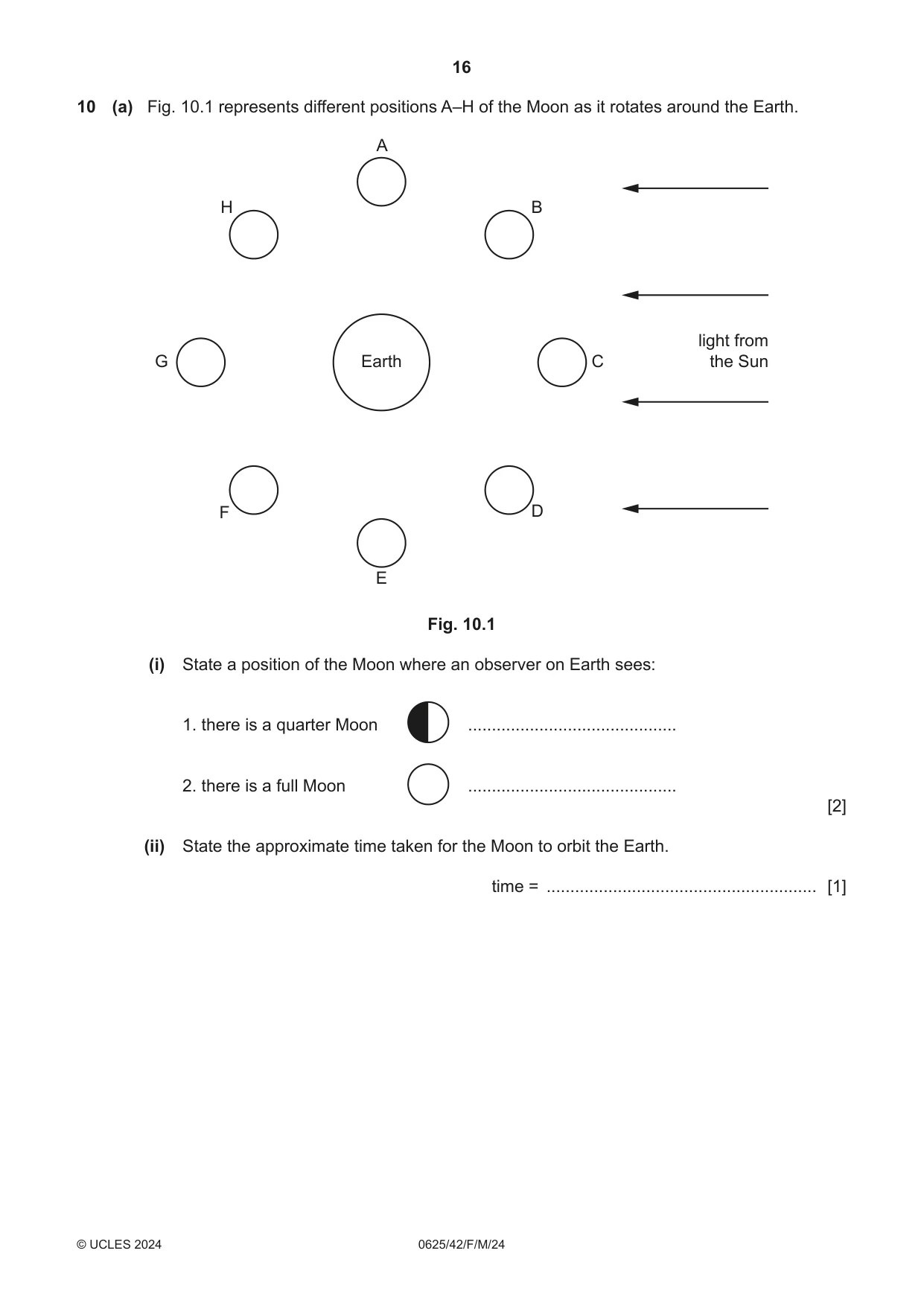
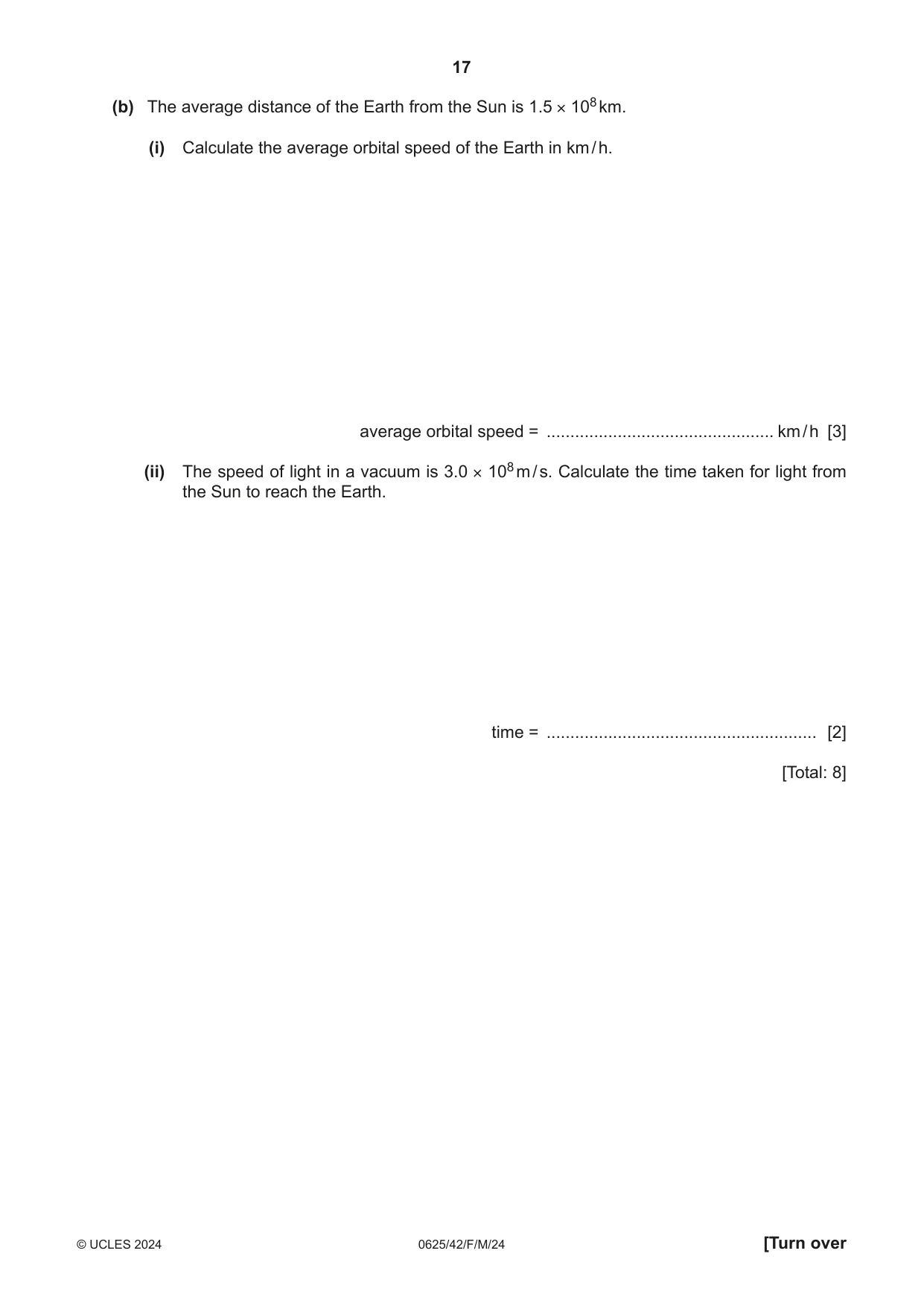
10 (a) Fig. 10.1 represents different positions A–H of the Moon as it rotates around the Earth. A H B light from G Earth C the Sun F D E Fig. 10.1 (i) State a position of the Moon where an observer on Earth sees: 1. there is a quarter Moon ............................................ 2. there is a full Moon ............................................ [2] (ii) State the approximate time taken for the Moon to orbit the Earth. time = ......................................................... [1] (b) The average distance of the Earth from the Sun is 1.5 × 10⁸ km. (i) Calculate the average orbital speed of the Earth in km / h. average orbital speed = ................................................ km / h [3] (ii) The speed of light in a vacuum is 3.0 × 10⁸ m / s. Calculate the time taken for light from the Sun to reach the Earth. time = ......................................................... [2] [Total: 8]
Mark scheme: 10(a)(i) position A and / or E B1 position G B1 10(a)(ii) 1 month B1 10(b)(i) 110 000 (km / h) A3 (v = )2r / T (C1) T = 365 24h OR 2 1.5 108 / 365 24 (C1) 10(b)(ii) 500 s A2 v = s / t OR (t =) s / v OR 1.5 1011 / 3.0 108 (C1)
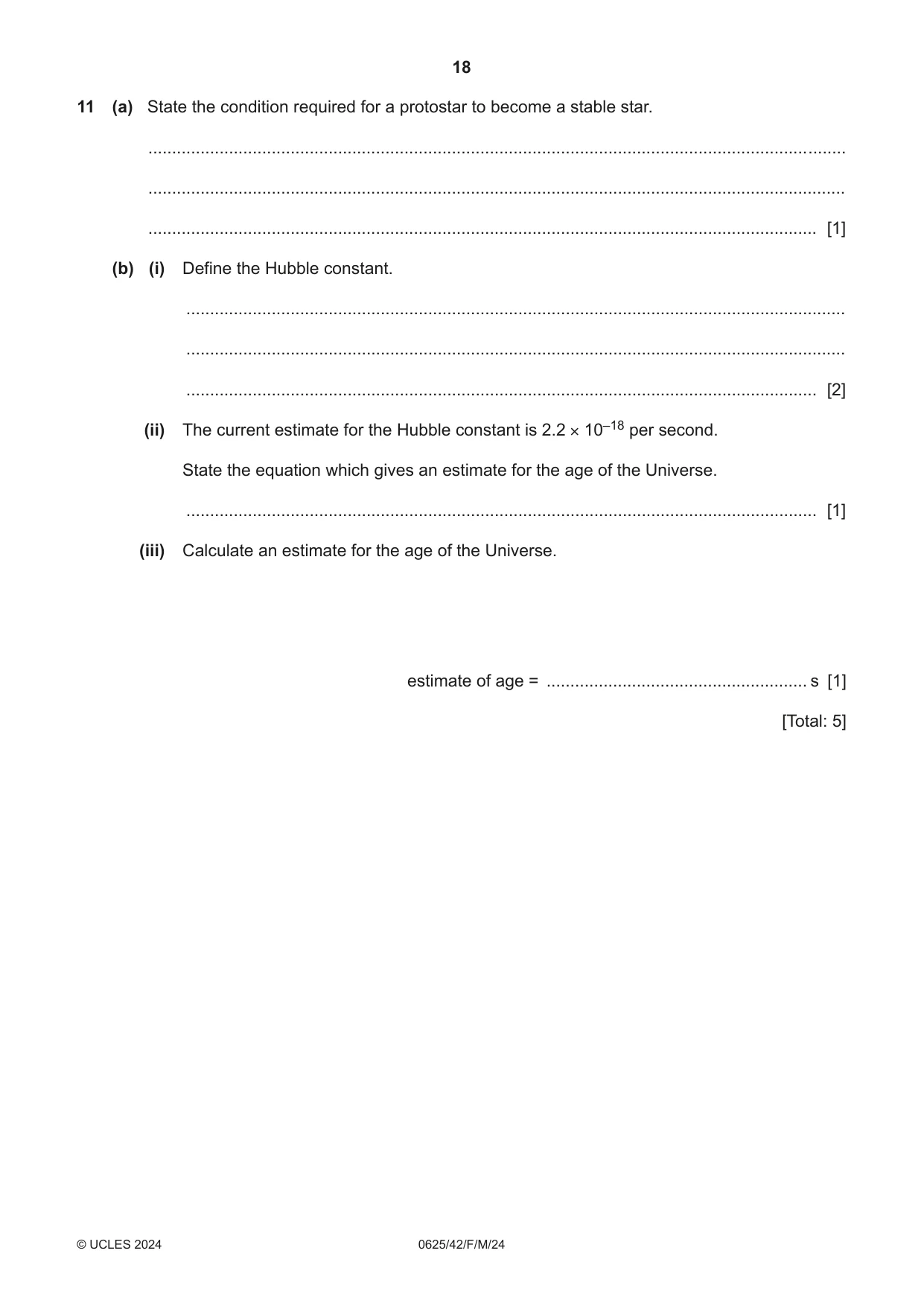
Q11 · State the condition required for a protostar to become a stable star
11 (a) State the condition required for a protostar to become a stable star. ................................................................................................................................................... ................................................................................................................................................... ............................................................................................................................................. [1] (b) (i) Define the Hubble constant. ........................................................................................................................................... ........................................................................................................................................... ..................................................................................................................................... [2] (ii) The current estimate for the Hubble constant is 2.2 × 10⁻¹⁸ per second. State the equation which gives an estimate for the age of the Universe. ..................................................................................................................................... [1] (iii) Calculate an estimate for the age of the Universe. estimate of age = ....................................................... s [1] [Total: 5]
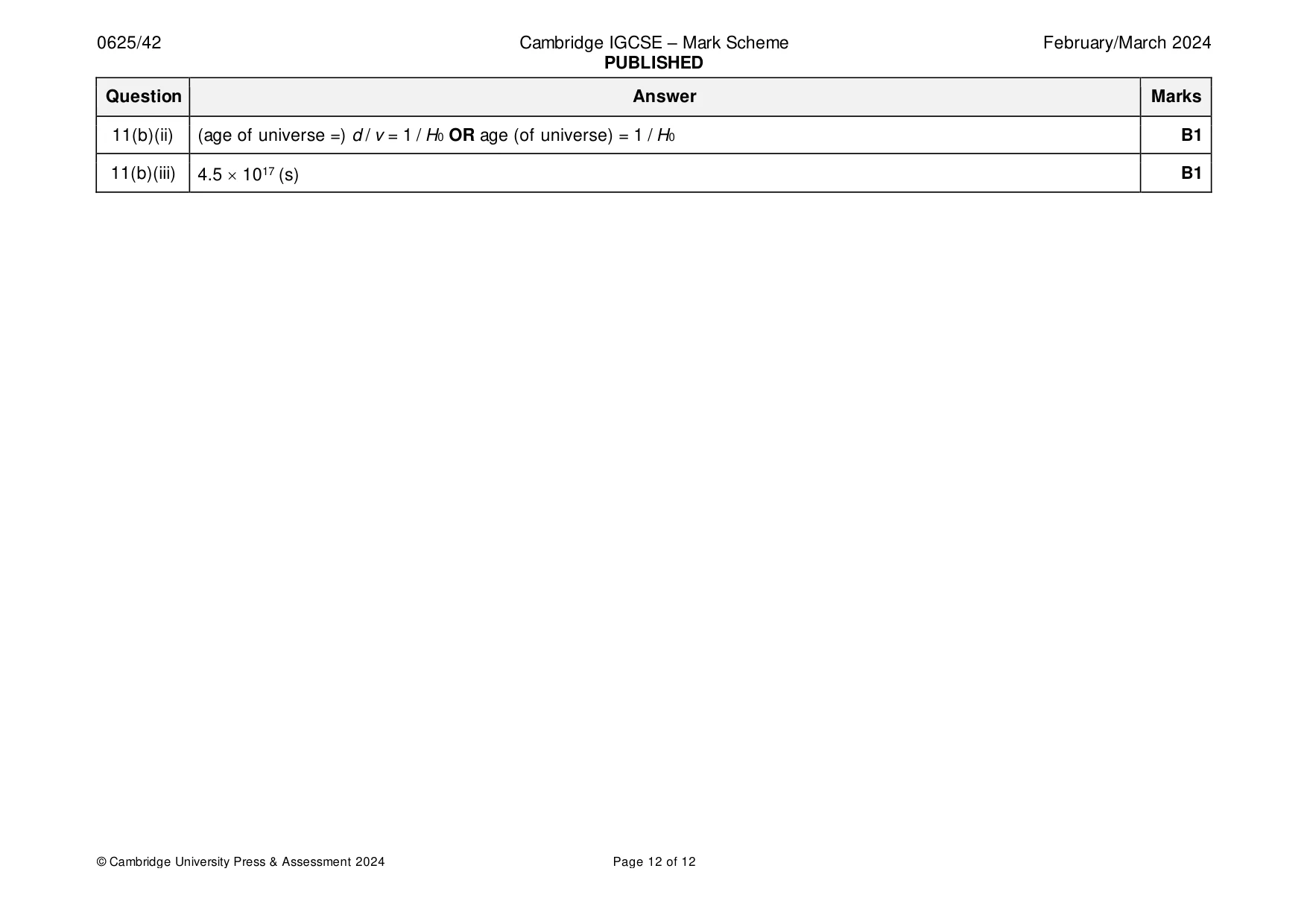
Mark scheme: 11(a) inward force / force of gravitational attraction, is balanced by an outward force / force due to fusion reactions B1 11(b)(i) ratio of the speed at which the galaxy is moving away from the Earth/observer to its distance (from the Earth/observer) A2 ratio of speed (of a galaxy) to distance (away from observer) (C1) 11(b)(ii) (age of universe =) d / v = 1 / H0 OR age (of universe) = 1 / H0 B1 11(b)(iii) 4.5 1017 (s) B1
What was in this paper
The subtopics covered by these 11 questions, and how many questions each got. Open one in a new tab to see every Cambridge question on it.
What you needed in this session
Cambridge’s own grade thresholds for 2024 Feb/March, Paper 4 · Variant 2. A higher threshold means an easier paper — the bar moves with how the cohort did.