Questions as text
Q1 · Which diagram correctly shows a ray of light reflected by a plane mirror? 0625/22 Feb/March 2016
22 Which diagram correctly shows a ray of light reflected by a plane mirror? A B ray of 40° 50° ray of 50° light light 50° C D ray of 40° ray of 40° light light 40° 50°
1 marks
Answer: D
This question in 0625/22 Feb/March 2016
Q2 · Which diagram shows how a converging lens is used as a magnifying glass? 0625/22 Feb/March 2016
23 Which diagram shows how a converging lens is used as a magnifying glass? image F A object F lens image F F B object lens image F C F object lens object F F D image lens
1 marks
Answer: B
This question in 0625/22 Feb/March 2016
Q3 · The diagram shows light travelling from air into glass 0625/21 May/June 2016
22 The diagram shows light travelling from air into glass. Four angles v, w, x and y are shown. normal light w air v glass y x Which formula is used to calculate the refractive index n of the glass? sin v sin v sin w sin w A n = B n = C n = D n = sin y sin x sin y sin x
1 marks
Answer: D
This question in 0625/21 May/June 2016
Q4 · The diagram shows a converging lens forming an image of an object 0625/21 May/June 2016
23 The diagram shows a converging lens forming an image of an object. X image object Y Which statement about the image is correct? A It is real and can be seen by an eye at X. B It is real and can be seen by an eye at Y. C It is virtual and can be seen by an eye at X. D It is virtual and can be seen by an eye at Y.
1 marks
Answer: D
This question in 0625/21 May/June 2016
Q5 · The diagram shows light passing from air into glass 0625/22 May/June 2016
23 The diagram shows light passing from air into glass. air glass NOT TO SCALE 60° 30° normal The glass has a refractive index of 1.5. What is the angle of refraction in the glass? A 19° B 22° C 35° D 49°
1 marks
Answer: A
This question in 0625/22 May/June 2016
Q6 · The diagram shows a converging lens forming an image of an object 0625/22 May/June 2016
25 The diagram shows a converging lens forming an image of an object. X image object Y Which statement about the image is correct? A It is real and can be seen by an eye at X. B It is real and can be seen by an eye at Y. C It is virtual and can be seen by an eye at X. D It is virtual and can be seen by an eye at Y.
1 marks
Answer: D
This question in 0625/22 May/June 2016
Q7 · The diagram shows an object in front of a plane mirror 0625/23 May/June 2016
22 The diagram shows an object in front of a plane mirror. The mirror forms an image of the object. M N object At which labelled point is the image formed, and which type of image is formed? where the image type of image is formed A at M real B at M virtual C at N real D at N virtual
1 marks
Answer: D
This question in 0625/23 May/June 2016
Q8 · Light enters a glass block at an angle of incidence of 46° 0625/23 May/June 2016
23 Light enters a glass block at an angle of incidence of 46°. The light refracts at an angle of refraction of 26°. What is the refractive index of the glass? A 0.57 B 0.61 C 1.64 D 1.77
1 marks
Answer: C
This question in 0625/23 May/June 2016
Q9 · The diagram shows a converging lens forming an image of an object 0625/23 May/June 2016
24 The diagram shows a converging lens forming an image of an object. X image object Y Which statement about the image is correct? A It is real and can be seen by an eye at X. B It is real and can be seen by an eye at Y. C It is virtual and can be seen by an eye at X. D It is virtual and can be seen by an eye at Y.
1 marks
Answer: D
This question in 0625/23 May/June 2016
Q10 · An image is formed by a plane mirror 0625/21 Oct/Nov 2016
22 An image is formed by a plane mirror. A second image is formed by a lens used as a magnifying glass. Which row states the nature of each of these images? plane mirror magnifying glass A real real B real virtual C virtual real D virtual virtual
1 marks
Answer: D
This question in 0625/21 Oct/Nov 2016
Q11 · Light travelling at a speed of 3.0 × 10⁸ m / s strikes the surface of a glass block and… 0625/21 Oct/Nov 2016
23 Light travelling at a speed of 3.0 × 10⁸ m / s strikes the surface of a glass block and undergoes refraction as it enters the block. The diagram shows a ray of this light before and after it enters the block. 55° glass block 33° What is the speed of light in the glass? A 1.8 × 10⁸ m / s B 2.0 × 10⁸ m / s C 4.5 × 10⁸ m / s D 5.0 × 10⁸ m / s
1 marks
Answer: B
This question in 0625/21 Oct/Nov 2016
Q12 · An image is formed by a plane mirror 0625/22 Oct/Nov 2016
22 An image is formed by a plane mirror. A second image is formed by a lens used as a magnifying glass. Which row states the nature of each of these images? plane mirror magnifying glass A real real B real virtual C virtual real D virtual virtual
1 marks
Answer: D
This question in 0625/22 Oct/Nov 2016
Q13 · The diagram shows light passing from air into glass 0625/22 Oct/Nov 2016
23 The diagram shows light passing from air into glass. Two angles p and q are marked. normal p air glass q Which pair of equations can both be used to calculate the refractive index n of the glass? speed of light in air sin p A n = , n = speed of light in glass sin q speed of light in glass sin p B n = , n = speed of light in air sin q speed of light in air sin q C n = , n = speed of light in glass sin p speed of light in glass sin q D n = , n = speed of light in air sin p
1 marks
Answer: A
This question in 0625/22 Oct/Nov 2016
Q14 · An image is formed by a plane mirror 0625/23 Oct/Nov 2016
21 An image is formed by a plane mirror. A second image is formed by a lens used as a magnifying glass. Which row states the nature of each of these images? plane mirror magnifying glass A real real B real virtual C virtual real D virtual virtual
1 marks
Answer: D
This question in 0625/23 Oct/Nov 2016
Q15 · The speed of light in air is 3.0 × 10⁸ m / s 0625/23 Oct/Nov 2016
22 The speed of light in air is 3.0 × 10⁸ m / s. The critical angle for light in a transparent plastic material placed in air is 37°. What is the speed of light in the plastic material? A 1.8 × 10⁸ m / s B 2.4 × 10⁸ m / s C 3.8 × 10⁸ m / s D 5.0 × 10⁸ m / s
1 marks
Answer: A
This question in 0625/23 Oct/Nov 2016
Q16 · Light passes along an optical fibre 0625/22 Feb/March 2017
21 Light passes along an optical fibre. What happens to the light within the fibre? A diffraction B dispersion C refraction D total internal reflection
1 marks
Answer: D
This question in 0625/22 Feb/March 2017
Q17 · The points labelled F are the principal foci of a lens 0625/22 Feb/March 2017
22 The points labelled F are the principal foci of a lens. A beam of parallel light is incident on the lens. Which diagram shows the path of the light after it passes through the lens? A F F B F F C F F D F F
1 marks
Answer: B
This question in 0625/22 Feb/March 2017
Q18 · A converging lens is used as a magnifying glass to view an object 0625/21 May/June 2017
20 A converging lens is used as a magnifying glass to view an object. Which statement is correct? A The image is inverted. B The image is nearer the lens than the object. C The image is the same size. D The image is virtual.
1 marks
Answer: D
This question in 0625/21 May/June 2017
Q19 · Which diagram shows what happens when a ray of white light passes through a prism? 0625/21 May/June 2017
21 Which diagram shows what happens when a ray of white light passes through a prism? A B spectrum white white light light spectrum C D spectrum white white light light spectrum
1 marks
Answer: D
This question in 0625/21 May/June 2017
Q20 · Light travels in a vacuum and then enters a glass block 0625/21 May/June 2017
22 Light travels in a vacuum and then enters a glass block. The speed of the light in the glass block is 2.0 × 10⁸ m / s. Which statement about the speed of light is correct? A The speed in a vacuum is 1.5 times the speed in the glass. B The speed in the glass is the same as the speed in a vacuum. C The speed in the glass is 1.5 times the speed in a vacuum. D The speed in the glass is 1.0 × 10⁸ times the speed in a vacuum.
1 marks
Answer: A
This question in 0625/21 May/June 2017
Q21 · The incomplete ray diagram shows two rays of light that have passed from one point on an… 0625/22 May/June 2017
20 The incomplete ray diagram shows two rays of light that have passed from one point on an object through a thin converging lens. left lens right object rays of light Which type of image is formed, and on which side of the lens is it formed? type of image which side of lens A real on the left B real on the right C virtual on the left D virtual on the right
1 marks
Answer: C
This question in 0625/22 May/June 2017
Q22 · Which diagram shows what happens when a ray of white light passes through a prism? 0625/22 May/June 2017
21 Which diagram shows what happens when a ray of white light passes through a prism? A B spectrum white white light light spectrum C D spectrum white white light light spectrum
1 marks
Answer: D
This question in 0625/22 May/June 2017
Q23 · Light travels in a vacuum and then enters a glass block 0625/22 May/June 2017
22 Light travels in a vacuum and then enters a glass block. The speed of the light in the glass block is 2.0 × 10⁸ m / s. Which statement about the speed of light is correct? A The speed in a vacuum is 1.5 times the speed in the glass. B The speed in the glass is the same as the speed in a vacuum. C The speed in the glass is 1.5 times the speed in a vacuum. D The speed in the glass is 1.0 × 10⁸ times the speed in a vacuum.
1 marks
Answer: A
This question in 0625/22 May/June 2017
Q24 · A converging lens is used to make an image on a screen 0625/23 May/June 2017
20 A converging lens is used to make an image on a screen. screen converging lens image formed candle here What type of image is formed on the screen? A real and inverted B real and upright C virtual and inverted D virtual and upright
1 marks
Answer: A
This question in 0625/23 May/June 2017
Q25 · Which diagram shows what happens when a ray of white light passes through a prism? 0625/23 May/June 2017
21 Which diagram shows what happens when a ray of white light passes through a prism? A B spectrum white white light light spectrum C D spectrum white white light light spectrum
1 marks
Answer: D
This question in 0625/23 May/June 2017
Q26 · Light travels in a vacuum and then enters a glass block 0625/23 May/June 2017
22 Light travels in a vacuum and then enters a glass block. The speed of the light in the glass block is 2.0 × 10⁸ m / s. Which statement about the speed of light is correct? A The speed in a vacuum is 1.5 times the speed in the glass. B The speed in the glass is the same as the speed in a vacuum. C The speed in the glass is 1.5 times the speed in a vacuum. D The speed in the glass is 1.0 × 10⁸ times the speed in a vacuum.
1 marks
Answer: A
This question in 0625/23 May/June 2017
Q27 · The diagram shows an object in front of a plane mirror 0625/21 Oct/Nov 2017
21 The diagram shows an object in front of a plane mirror. A ray of light from the object is incident on the mirror. object R Q S P plane mirror Through which point does the reflected ray pass, and at which point is the image of the object formed? point through which point at which reflected ray passes image is formed A P R B P S C Q R D Q S
1 marks
Answer: A
This question in 0625/21 Oct/Nov 2017
Q28 · A laser is a source of light with a single frequency 0625/21 Oct/Nov 2017
22 A laser is a source of light with a single frequency. Which description of this type of light is correct? A dispersed B focused C monochromatic D refracted
1 marks
Answer: C
This question in 0625/21 Oct/Nov 2017
Q29 · The Moon is 380 000 km from the Earth 0625/21 Oct/Nov 2017
24 The Moon is 380 000 km from the Earth. A laser light beam is directed from the Earth to the Moon. The beam is reflected back to the Earth. How long does it take for the light to travel to the Moon and back to the Earth? A 1.27 ms B 2.53 ms C 1.27 s D 2.53 s
1 marks
Answer: D
This question in 0625/21 Oct/Nov 2017
Q30 · The diagram shows an object O in front of a thin converging lens of focal length f 0625/22 Oct/Nov 2017
21 The diagram shows an object O in front of a thin converging lens of focal length f. At which point will the lens form a sharp image of the object? A O B f f C D
1 marks
Answer: D
This question in 0625/22 Oct/Nov 2017
Q31 · The diagram shows a ray of light incident on the surface of a rectangular glass block at… 0625/22 Oct/Nov 2017
22 The diagram shows a ray of light incident on the surface of a rectangular glass block at 90° to the surface. ray of light glass block Which quantities remain unchanged as the light enters the glass block? A direction and frequency B direction and speed C frequency and speed D speed and wavelength
1 marks
Answer: A
This question in 0625/22 Oct/Nov 2017
Q32 · The Moon is 380 000 km from the Earth 0625/22 Oct/Nov 2017
24 The Moon is 380 000 km from the Earth. A laser light beam is directed from the Earth to the Moon. The beam is reflected back to the Earth. How long does it take for the light to travel to the Moon and back to the Earth? A 1.27 ms B 2.53 ms C 1.27 s D 2.53 s
1 marks
Answer: D
This question in 0625/22 Oct/Nov 2017
Q33 · The diagram shows a ray of light in glass 0625/23 Oct/Nov 2017
21 The diagram shows a ray of light in glass. The ray reaches a boundary with air. One weak ray of light is missing from the diagram. air glass 50° Which statement is correct? A At the boundary, the speed of the light will become less. B The critical angle for light at this boundary is 50°. C The diagram shows an example of diffraction of light. D The missing ray is a weak reflected ray.
1 marks
Answer: D
This question in 0625/23 Oct/Nov 2017
Q34 · Light travelling in air enters a plastic block at an angle of incidence of 62° 0625/23 Oct/Nov 2017
22 Light travelling in air enters a plastic block at an angle of incidence of 62°. The plastic has a refractive index of 1.48. plastic block 62° ray of light What is the angle of refraction? A 18° B 28° C 37° D 42°
1 marks
Answer: C
This question in 0625/23 Oct/Nov 2017
Q35 · The Moon is 380 000 km from the Earth 0625/23 Oct/Nov 2017
24 The Moon is 380 000 km from the Earth. A laser light beam is directed from the Earth to the Moon. The beam is reflected back to the Earth. How long does it take for the light to travel to the Moon and back to the Earth? A 1.27 ms B 2.53 ms C 1.27 s D 2.53 s
1 marks
Answer: D
This question in 0625/23 Oct/Nov 2017
Q36 · Light travels at a speed of 2.0 × 10⁸ m / s in a glass block 0625/21 May/June 2018
19 Light travels at a speed of 2.0 × 10⁸ m / s in a glass block. In the glass, the wavelength of the light is 4.0 × 10⁻⁷ m. What is the frequency of the light? A 2.0 × 10⁻¹⁵ Hz B 1.3 × 10⁻² Hz C 80 Hz D 5.0 × 10¹⁴ Hz
1 marks
Answer: D
This question in 0625/21 May/June 2018
Q37 · Scout P signals to scout Q on the other side of a valley by using a mirror to reflect the… 0625/21 May/June 2018
21 Scout P signals to scout Q on the other side of a valley by using a mirror to reflect the Sun’s light. Sun’s scout P light mirror scout Q Which mirror position allows the Sun’s light to be reflected to scout Q? A B C D mirror Sun’s Sun’s Sun’s Sun’s light light light light
1 marks
Answer: A
This question in 0625/21 May/June 2018
Q38 · A prism is made from transparent plastic 0625/21 May/June 2018
22 A prism is made from transparent plastic. In this plastic, light travels at 0.80 c, where c is its speed in air. Light enters one face of the prism at right-angles as shown. NOT TO SCALE θ The light just escapes from the sloping face of the prism. What is angle θ ? A 37° B 39° C 51° D 53°
1 marks
Answer: D
This question in 0625/21 May/June 2018
Q39 · The Sun emits infra-red radiation and light 0625/21 May/June 2018
23 The Sun emits infra-red radiation and light. Light from the Sun reaches the Earth in 8 minutes. Which row gives correct information about the infra-red radiation? wavelength of time taken for infra-red infra-red radiation radiation to reach Earth A longer than wavelength of light 8 minutes B longer than wavelength of light much less than 8 minutes C shorter than wavelength of light 8 minutes D shorter than wavelength of light much more than 8 minutes
1 marks
Answer: A
This question in 0625/21 May/June 2018
Q40 · Light travels at a speed of 2.0 × 10⁸ m / s in a glass block 0625/22 May/June 2018
20 Light travels at a speed of 2.0 × 10⁸ m / s in a glass block. In the glass, the wavelength of the light is 4.0 × 10⁻⁷ m. What is the frequency of the light? A 2.0 × 10⁻¹⁵ Hz B 1.3 × 10⁻² Hz C 80 Hz D 5.0 × 10¹⁴ Hz
1 marks
Answer: D
This question in 0625/22 May/June 2018
Q41 · Scout P signals to scout Q on the other side of a valley by using a mirror to reflect the… 0625/22 May/June 2018
21 Scout P signals to scout Q on the other side of a valley by using a mirror to reflect the Sun’s light. Sun’s scout P light mirror scout Q Which mirror position allows the Sun’s light to be reflected to scout Q? A B C D mirror Sun’s Sun’s Sun’s Sun’s light light light light
1 marks
Answer: A
This question in 0625/22 May/June 2018
Q42 · A scientist describes light as being monochromatic 0625/22 May/June 2018
22 A scientist describes light as being monochromatic. What does this tell you about the light? A It has a single frequency. B It has more than one wavelength. C It travels at a single speed in a single direction. D It travels at different speeds in different directions.
1 marks
Answer: A
This question in 0625/22 May/June 2018
Q43 · Scout P signals to scout Q on the other side of a valley by using a mirror to reflect the… 0625/23 May/June 2018
21 Scout P signals to scout Q on the other side of a valley by using a mirror to reflect the Sun’s light. Sun’s scout P light mirror scout Q Which mirror position allows the Sun’s light to be reflected to scout Q? A B C D mirror Sun’s Sun’s Sun’s Sun’s light light light light
1 marks
Answer: A
This question in 0625/23 May/June 2018
Q44 · Images formed by lenses and mirrors can either be described as real or as virtual 0625/23 May/June 2018
22 Images formed by lenses and mirrors can either be described as real or as virtual. Which row describes real and virtual images of a point object? real images virtual images A formed where light rays an image in a plane mirror is an meet example of a virtual image B formed where light rays can be projected onto a screen meet C formed from where light rays an image in a plane mirror is an appear to diverge example of a virtual image D formed from where light rays can be projected onto a screen appear to diverge
1 marks
Answer: A
This question in 0625/23 May/June 2018
Q45 · Which statement about the image formed by a plane mirror is correct? 0625/21 Oct/Nov 2018
22 Which statement about the image formed by a plane mirror is correct? A The image is larger than the object. B The image is smaller than the object. C The image is twice as far from the mirror as the object. D The image is virtual.
1 marks
Answer: D
This question in 0625/21 Oct/Nov 2018
Q46 · A ray of light is incident on a glass-air surface 0625/21 Oct/Nov 2018
23 A ray of light is incident on a glass-air surface. The diagrams show the ray of light at different angles of incidence in the glass. air air air glass glass glass 40° 44° 48° What is the refractive index of the glass? A 1.35 B 1.44 C 1.50 D 1.55
1 marks
Answer: B
This question in 0625/21 Oct/Nov 2018
Q47 · Plane water waves travel from a shallow region into a deeper region 0625/22 Oct/Nov 2018
21 Plane water waves travel from a shallow region into a deeper region. They travel more quickly in the deeper water. shallow water boundary wave direction deep water Which diagram shows the wave pattern in the deeper water? A B C D
1 marks
Answer: C
This question in 0625/22 Oct/Nov 2018
Q48 · A thin converging lens has a focal length of 6.0 cm 0625/22 Oct/Nov 2018
22 A thin converging lens has a focal length of 6.0 cm. An observer looks through the lens at an object which is placed 4.0 cm from the lens. 4.0 cm eye object Which description of the image that is observed is correct? A diminished and inverted B diminished and virtual C enlarged and inverted D enlarged and virtual
1 marks
Answer: D
This question in 0625/22 Oct/Nov 2018
Q49 · An object is placed 8.0 cm from a thin converging lens of focal length 5.0 cm 0625/23 Oct/Nov 2018
22 An object is placed 8.0 cm from a thin converging lens of focal length 5.0 cm. converging lens object F 5.0 cm 8.0 cm Which statement about the image formed by the lens is correct? A The image is real and inverted. B The image is real and upright. C The image is virtual and inverted. D The image is virtual and upright.
1 marks
Answer: A
This question in 0625/23 Oct/Nov 2018
Q50 · Light travels through air and then enters and travels through a parallel-sided glass block 0625/23 Oct/Nov 2018
23 Light travels through air and then enters and travels through a parallel-sided glass block. Which statement is correct? A The angle of incidence is greater than the angle of refraction as the light leaves the block. B The light emerging from the block is parallel to the light entering the block. C The speed of the light decreases as it leaves the block. D The wavelength of the light does not change as it enters the block.
1 marks
Answer: B
This question in 0625/23 Oct/Nov 2018
Q51 · A narrow beam of light is travelling through a transparent liquid 0625/22 Feb/March 2019
23 A narrow beam of light is travelling through a transparent liquid. It meets the surface as shown, at an angle of incidence of 40°. The refractive index of the liquid is 1.5. air liquid 40° What is the angle of refraction as the light enters the air? A 25° B 27° C 60° D 75°
1 marks
Answer: D
This question in 0625/22 Feb/March 2019
Q52 · Which diagram correctly represents rays of light passing through a converging lens in a… 0625/22 Feb/March 2019
24 Which diagram correctly represents rays of light passing through a converging lens in a camera? A B camera camera object object image image lens lens C D camera camera object object image image lens lens
1 marks
Answer: A
This question in 0625/22 Feb/March 2019
Q53 · An object is placed 30 cm in front of a plane mirror 0625/21 May/June 2019
21 An object is placed 30 cm in front of a plane mirror. Which statement describes the image of the object? A The image is the same size and 30 cm from the object. B The image is the same size and 60 cm from the object. C The image is smaller and 30 cm from the object. D The image is smaller and 60 cm from the object.
1 marks
Answer: B
This question in 0625/21 May/June 2019
Q54 · A small object O is placed near a converging lens, as shown 0625/21 May/June 2019
22 A small object O is placed near a converging lens, as shown. The lens forms an image I. I O Which statement is correct? A The image I is diminished. B The image I is inverted. C The image I is real. D The object O is closer to the lens than its principal focus.
1 marks
Answer: D
This question in 0625/21 May/June 2019
Q55 · An eclipse of the Sun happens when the Moon comes between the Earth and the Sun 0625/21 May/June 2019
23 An eclipse of the Sun happens when the Moon comes between the Earth and the Sun. Which statement is correct? A Infra-red radiation from the Sun disappears before visible light and ultra-violet radiation. B Ultra-violet radiation from the Sun disappears before visible light and infra-red radiation. C Visible light from the Sun disappears before ultra-violet radiation and infra-red radiation. D Infra-red radiation, ultra-violet radiation and visible light from the Sun all disappear at the same moment.
1 marks
Answer: D
This question in 0625/21 May/June 2019
Q56 · Which conditions are necessary for light to be totally internally reflected? 0625/22 May/June 2019
21 Which conditions are necessary for light to be totally internally reflected? the incident light is in angle of incidence A the less dense medium less than the critical angle B the less dense medium greater than the critical angle C the more dense medium less than the critical angle D the more dense medium greater than the critical angle
1 marks
Answer: D
This question in 0625/22 May/June 2019
Q57 · Light is travelling through air 0625/22 May/June 2019
22 Light is travelling through air. The light strikes a glass block at an angle of incidence of 45°. The glass has a refractive index of 1.4. What is the angle of refraction of the light as it enters the glass? A 29° B 30° C 32° D 82°
1 marks
Answer: B
This question in 0625/22 May/June 2019
Q58 · An eclipse of the Sun happens when the Moon comes between the Earth and the Sun 0625/22 May/June 2019
23 An eclipse of the Sun happens when the Moon comes between the Earth and the Sun. Which statement is correct? A Infra-red radiation from the Sun disappears before visible light and ultra-violet radiation. B Ultra-violet radiation from the Sun disappears before visible light and infra-red radiation. C Visible light from the Sun disappears before ultra-violet radiation and infra-red radiation. D Infra-red radiation, ultra-violet radiation and visible light from the Sun all disappear at the same moment.
1 marks
Answer: D
This question in 0625/22 May/June 2019
Q59 · An observer stands at the finish line of a 100 m race 0625/22 May/June 2019
25 An observer stands at the finish line of a 100 m race. He wants to time the winner’s run. He starts his stop-watch as soon as he sees the smoke from the starting gun instead of when he hears the bang. What is the reason for doing this? A Light travels much faster than sound. B There is a risk he might respond to an echo from a wall. C Humans react slower to sound than to light. D Humans react more quickly to sound than to light.
1 marks
Answer: A
This question in 0625/22 May/June 2019
Q60 · Which conditions are necessary for light to be totally internally reflected? 0625/23 May/June 2019
21 Which conditions are necessary for light to be totally internally reflected? the incident light is in angle of incidence A the less dense medium less than the critical angle B the less dense medium greater than the critical angle C the more dense medium less than the critical angle D the more dense medium greater than the critical angle
1 marks
Answer: D
This question in 0625/23 May/June 2019
Q61 · A beam of light passes through a vacuum and then enters a liquid 0625/23 May/June 2019
22 A beam of light passes through a vacuum and then enters a liquid. The diagram shows the path it takes. 40° vacuum liquid 25° The light travels through the vacuum at a speed of 3.0 × 10⁸ m / s. What is the speed of light in the liquid? A 1.9 × 10⁸ m / s B 2.0 × 10⁸ m / s C 4.6 × 10⁸ m / s D 4.8 × 10⁸ m / s
1 marks
Answer: B
This question in 0625/23 May/June 2019
Q62 · An eclipse of the Sun happens when the Moon comes between the Earth and the Sun 0625/23 May/June 2019
23 An eclipse of the Sun happens when the Moon comes between the Earth and the Sun. Which statement is correct? A Infra-red radiation from the Sun disappears before visible light and ultra-violet radiation. B Ultra-violet radiation from the Sun disappears before visible light and infra-red radiation. C Visible light from the Sun disappears before ultra-violet radiation and infra-red radiation. D Infra-red radiation, ultra-violet radiation and visible light from the Sun all disappear at the same moment.
1 marks
Answer: D
This question in 0625/23 May/June 2019
Q63 · The diagram shows the image of a clock in a plane mirror 0625/21 Oct/Nov 2019
22 The diagram shows the image of a clock in a plane mirror. Which is the actual time? A 04:15 B 04:45 C 07:15 D 07:45
1 marks
Answer: C
This question in 0625/21 Oct/Nov 2019
Q64 · A converging lens produces an image of an object O 0625/21 Oct/Nov 2019
23 A converging lens produces an image of an object O. The focal length of the lens is f. Which position of the object produces a virtual image? A B O O f f 2f 2f C D O O f f 2f 2f
1 marks
Answer: A
This question in 0625/21 Oct/Nov 2019
Q65 · A ray of light is incident on a plane mirror 0625/22 Oct/Nov 2019
23 A ray of light is incident on a plane mirror. A student measures the angle of incidence i and the angle of reflection r. incident i r reflected ray ray The student varies the angle of incidence and then plots a graph of r against i. What does the graph look like? A B C D r r r r 0 0 0 0 0 i 0 i 0 i 0 i
1 marks
Answer: C
This question in 0625/22 Oct/Nov 2019
Q66 · What is monochromatic light? 0625/22 Oct/Nov 2019
24 What is monochromatic light? A light of a single amplitude B light of a single frequency C light of more than one colour D light which travels with constant velocity
1 marks
Answer: B
This question in 0625/22 Oct/Nov 2019
Q67 · A person stands 1.0 m in front of a plane mirror 0625/23 Oct/Nov 2019
22 A person stands 1.0 m in front of a plane mirror. The mirror is moved away from the person at a speed of 1.0 m / s. Which statement is correct? A The image moves away from the person at a speed of 1.0 m / s. B The image moves away from the person at a speed of 2.0 m / s. C The image moves towards the person at a speed of 1.0 m / s. D The image moves towards the person at a speed of 2.0 m / s.
1 marks
Answer: B
This question in 0625/23 Oct/Nov 2019
Q68 · White light is refracted and dispersed when it enters a glass prism from air 0625/23 Oct/Nov 2019
23 White light is refracted and dispersed when it enters a glass prism from air. Which colour has the lowest speed as it moves through the glass prism? A blue light B orange light C red light D violet light
1 marks
Answer: D
This question in 0625/23 Oct/Nov 2019
Q69 · Which diagram shows how the light from a candle is reflected by a mirror, and shows the… 0625/22 Feb/March 2020
25 Which diagram shows how the light from a candle is reflected by a mirror, and shows the position of the image formed? A B image of image of candle candle candle candle eye eye mirror mirror C D candle candle image of candle eye image of eye candle mirror mirror
1 marks
Answer: A
This question in 0625/22 Feb/March 2020
Q70 · A converging lens can be used as a magnifying glass 0625/22 Feb/March 2020
26 A converging lens can be used as a magnifying glass. What will be the nature of the image? A real, inverted, diminished B real, upright, enlarged C virtual, inverted, enlarged D virtual, upright, enlarged
1 marks
Answer: D
This question in 0625/22 Feb/March 2020
Q71 · The wavelength of blue light changes from 4.7 × 10⁻⁷ m to 3.5 × 10⁻⁷ m as it passes from… 0625/22 Feb/March 2020
27 The wavelength of blue light changes from 4.7 × 10⁻⁷ m to 3.5 × 10⁻⁷ m as it passes from air to water. What is the speed of this light in water? A 7.4 × 10⁷ m / s B 1.3 × 10⁸ m / s C 2.2 × 10⁸ m / s D 3.0 × 10⁸ m / s
1 marks
Answer: C
This question in 0625/22 Feb/March 2020
Q72 · Which statement is correct? 0625/21 May/June 2020
22 Which statement is correct? A The speed of light in glass is equal to the speed of light in a vacuum multiplied by the refractive index of glass. B The incident angle of a light ray at an air-glass surface is the angle between the ray and the glass surface. C The sine of the critical angle at an air-glass surface is equal to 1 . refractive index of glass D The angle of refraction for light passing through an air-glass surface is proportional to the angle of incidence at that surface.
1 marks
Answer: C
This question in 0625/21 May/June 2020
Q73 · A narrow beam of white light passes through a prism and is dispersed into a spectrum 0625/21 May/June 2020
23 A narrow beam of white light passes through a prism and is dispersed into a spectrum. 1 white 2 light 3 Which row is correct? colour 1 colour 2 colour 3 A blue yellow red B red blue yellow C red yellow blue D yellow blue red
1 marks
Answer: C
This question in 0625/21 May/June 2020
Q74 · An object O is placed in front of a plane mirror as shown 0625/22 May/June 2020
22 An object O is placed in front of a plane mirror as shown. O plane mirror 1 2 Which row is correct? position of nature of the image the image A 1 real B 1 virtual C 2 real D 2 virtual
1 marks
Answer: B
This question in 0625/22 May/June 2020
Q75 · Which statement is correct? 0625/22 May/June 2020
23 Which statement is correct? A The speed of light in glass is equal to the speed of light in a vacuum multiplied by the refractive index of glass. B The incident angle of a light ray at an air-glass surface is the angle between the ray and the glass surface. C The sine of the critical angle at an air-glass surface is equal to 1 . refractive index of glass D The angle of refraction for light passing through an air-glass surface is proportional to the angle of incidence at that surface.
1 marks
Answer: C
This question in 0625/22 May/June 2020
Q76 · Which statement is correct? 0625/23 May/June 2020
22 Which statement is correct? A The speed of light in glass is equal to the speed of light in a vacuum multiplied by the refractive index of glass. B The incident angle of a light ray at an air-glass surface is the angle between the ray and the glass surface. C The sine of the critical angle at an air-glass surface is equal to 1 . refractive index of glass D The angle of refraction for light passing through an air-glass surface is proportional to the angle of incidence at that surface.
1 marks
Answer: C
This question in 0625/23 May/June 2020
Q77 · Which statement about converging lenses is correct? 0625/23 May/June 2020
23 Which statement about converging lenses is correct? A A real image of an object projected onto a screen by a converging lens is always inverted. B The image formed by a converging lens is always upright. C The image formed by a converging lens when used as a magnifying glass is a real image. D Parallel rays entering a converging lens are focused at a distance greater than the focal length from the lens.
1 marks
Answer: A
This question in 0625/23 May/June 2020
Q78 · Which statement about a thin converging lens is correct? 0625/21 Oct/Nov 2020
23 Which statement about a thin converging lens is correct? A All rays of light refracted by the lens pass through the principal focus. B All rays initially parallel to the principal axis of the lens are refracted through the principal focus. C The focal length of the lens is the distance between the image and the principal focus. D The focal length of the lens is the distance between the object and the image.
1 marks
Answer: B
This question in 0625/21 Oct/Nov 2020
Q79 · The diagram shows white light passing through a prism 0625/21 Oct/Nov 2020
24 The diagram shows white light passing through a prism. red violet white light Which description of what happens as the light passes into the prism is correct? A The speed of the red light is less than the speed of the violet light and the red light is the least refracted. B The speed of the red light is greater than the speed of the violet light and the red light is the least refracted. C The speed of the violet light is less than the speed of the red light and the violet light is the least refracted. D The speed of the violet light is greater than the speed of the red light and the violet light is the least refracted.
1 marks
Answer: B
This question in 0625/21 Oct/Nov 2020
Q80 · An optical lever is a very sensitive device for detecting small rotations 0625/22 Oct/Nov 2020
23 An optical lever is a very sensitive device for detecting small rotations. A lamp sends a narrow
beam of light on to a small plane mirror attached to a shaft whose rotation is to be measured. The
operation of the device is shown in plan view.
scale just scale just
above lamp above lamp
lamp shaft lamp
small
mirror mirror
The beam from the lamp reflects from the mirror to give a small spot of light on a scale placed
just above the lamp. The shaft and mirror rotate through 1°. The spot of light moves along the
scale.
The table shows the angle @ through which the reflected beam rotates and the conditions
required for high sensitivity.
Which row is correct?
to achieve high sensitivity
the lamp and scale need to be
as close to the mirror as possible
the lamp and scale need to be
as far from the mirror as possible
the lamp and scale need to be
as close to the mirror as possible
the lamp and scale need to be
as far from the mirror as possible
1 marks
Answer: D
This question in 0625/22 Oct/Nov 2020
Q81 · The diagram shows white light passing through a prism 0625/22 Oct/Nov 2020
25 The diagram shows white light passing through a prism. red violet white light Which description of what happens as the light passes into the prism is correct? A The speed of the red light is less than the speed of the violet light and the red light is the least refracted. B The speed of the red light is greater than the speed of the violet light and the red light is the least refracted. C The speed of the violet light is less than the speed of the red light and the violet light is the least refracted. D The speed of the violet light is greater than the speed of the red light and the violet light is the least refracted.
1 marks
Answer: B
This question in 0625/22 Oct/Nov 2020
Q82 · A driver sits in a car 0625/23 Oct/Nov 2020
23 A driver sits in a car. She has a rear-view plane mirror 0.5 m in front of her. A bus is 7.5 m behind the driver. bus car driver mirror The driver looks at the image of the bus in her mirror. How far is the image away from her? A 1.0 m B 7.5 m C 8.0 m D 8.5 m
1 marks
Answer: D
This question in 0625/23 Oct/Nov 2020
Q83 · The diagram shows white light passing through a prism 0625/23 Oct/Nov 2020
24 The diagram shows white light passing through a prism. red violet white light Which description of what happens as the light passes into the prism is correct? A The speed of the red light is less than the speed of the violet light and the red light is the least refracted. B The speed of the red light is greater than the speed of the violet light and the red light is the least refracted. C The speed of the violet light is less than the speed of the red light and the violet light is the least refracted. D The speed of the violet light is greater than the speed of the red light and the violet light is the least refracted.
1 marks
Answer: B
This question in 0625/23 Oct/Nov 2020
Q84 · What causes the change in direction when light travels from air into glass? 0625/22 Feb/March 2021
21 What causes the change in direction when light travels from air into glass? A The amplitude of the light changes. B The colour of the light changes. C The frequency of the light changes. D The speed of the light changes.
1 marks
Answer: D
This question in 0625/22 Feb/March 2021
Q85 · Light from a torch is incident on a plane mirror 0625/22 Feb/March 2021
22 Light from a torch is incident on a plane mirror. The angle of incidence is 38. What is the angle of reflection? A 38 B 52 C 76 D 142
1 marks
Answer: A
This question in 0625/22 Feb/March 2021
Q86 · Two rays with an angle of incidence of 60° pass into dilute and concentrated sugar-water… 0625/22 Feb/March 2021
23 Two rays with an angle of incidence of 60° pass into dilute and concentrated sugar-water
solutions. The refractions are shown.
; 1
i} I
i} I
60°! 60°:
. i} . I
air air
dilute concentrated |
sugar A> sugar
solution solution 135°
i} I
i} I
i} I
Which row is correct?
refractive index speed through solution
as concentration increases as concentration increases
A decreases decreases
B decreases increases
Cc increases decreases
D increases increases
1 marks
Answer: C
This question in 0625/22 Feb/March 2021
Q87 · A thin converging lens is used to produce a sharp image of a candle 0625/22 Feb/March 2021
24 A thin converging lens is used to produce a sharp image of a candle. screen image lens candle Various sharp images are produced on the screen by moving the lens and the screen backwards and forwards. Which statement is always correct? A The image is at the principal focus (focal point) of the lens. B The image is bigger than the object. C The image is closer to the lens than the object. D The image is inverted.
1 marks
Answer: D
This question in 0625/22 Feb/March 2021
Q88 · Light travelling at a speed of 3.0 x 10°m/s strikes the surface of a glass block and… 0625/22 May/June 2021
22 Light travelling at a speed of 3.0 x 10°m/s strikes the surface of a glass block and undergoes
refraction as it enters the block.
The diagram shows a ray of this light before and after it enters the block.
55°
glass block
What is the speed of light in the glass?
A 1.8x10®m/s
B 2.0x10°m/s
C 45x 10°m/s
D 5.0x10°m/s
1 marks
Answer: B
This question in 0625/22 May/June 2021
Q89 · Which statement about the image of an object formed in a plane mirror is correct? 0625/22 May/June 2021
23 Which statement about the image of an object formed in a plane mirror is correct? A It is smaller than the object. B It is the same size as the object. C It is larger than the object. D It is inverted.
1 marks
Answer: B
This question in 0625/22 May/June 2021
Q90 · An object is placed in front of a thin converging lens 0625/22 May/June 2021
24 An object is placed in front of a thin converging lens. The diagram shows the paths of two rays from the top of the object. converging lens object An image of the object is formed on a screen to the right of the lens. How does this image compare with the object? A It is larger and inverted. B It is larger and the same way up. C It is smaller and inverted. D It is smaller and the same way up.
1 marks
Answer: A
This question in 0625/22 May/June 2021
Q91 · Two beams of light are both the same colour of red 0625/21 Oct/Nov 2021
19 Two beams of light are both the same colour of red. One beam is travelling through air. The other beam is travelling through water. Each beam has a different brightness. Which quantity is the same for both sets of waves? A amplitude B frequency C speed D wavelength
1 marks
Answer: B
This question in 0625/21 Oct/Nov 2021
Q92 · The diagram shows a ray of light in air incident on a glass block 0625/21 Oct/Nov 2021
20 The diagram shows a ray of light in air incident on a glass block. Some of the light is refracted and some of the light is reflected. Two angles, p and q, are marked on the diagram. ray of light q air p glass Which row gives the angle of incidence and states whether total internal reflection occurs? angle of total internal incidence reflection A p no B p yes C q no D q yes
1 marks
Answer: C
This question in 0625/21 Oct/Nov 2021
Q93 · The diagram shows a ray of light in glass incident on the surface between the glass and… 0625/21 Oct/Nov 2021
21 The diagram shows a ray of light in glass incident on the surface between the glass and air. air glass What happens if the angle of incidence is made larger than the critical angle for the glass? A The angle of refraction becomes equal to 90. B There is a refracted ray and a ray reflected inside the glass. C There is a refracted ray only. D There is only a ray reflected inside the glass.
1 marks
Answer: D
This question in 0625/21 Oct/Nov 2021
Q94 · The Sun emits infrared radiation and light 0625/21 Oct/Nov 2021
22 The Sun emits infrared radiation and light. Light from the Sun reaches the Earth in 8 minutes. Which row gives correct information about the infrared radiation? wavelength of time taken for infrared infrared radiation radiation to reach the Earth A longer than wavelength of light 8 minutes B longer than wavelength of light much less than 8 minutes C shorter than wavelength of light 8 minutes D shorter than wavelength of light much more than 8 minutes
1 marks
Answer: A
This question in 0625/21 Oct/Nov 2021
Q95 · The diagram shows how a ray of light refracts when going from air to Perspex 0625/22 Oct/Nov 2021
19 The diagram shows how a ray of light refracts when going from air to Perspex. x air w Perspex y z The critical angle of Perspex is c. Which expression is correct? sin x A = sin c sin z sin z B = sin c sin x sin w C = sin c sin y sin y D = sin c sin w
1 marks
Answer: B
This question in 0625/22 Oct/Nov 2021
Q96 · The diagram shows a ray of light in air incident on a glass block 0625/22 Oct/Nov 2021
20 The diagram shows a ray of light in air incident on a glass block. Some of the light is refracted and some of the light is reflected. Two angles, p and q, are marked on the diagram. ray of light q air p glass Which row gives the angle of incidence and states whether total internal reflection occurs? angle of total internal incidence reflection A p no B p yes C q no D q yes
1 marks
Answer: C
This question in 0625/22 Oct/Nov 2021
Q97 · The letter F is reflected in a mirror 0625/22 Oct/Nov 2021
21 The letter F is reflected in a mirror. mirror What does the optical image look like? A B C D
1 marks
Answer: B
This question in 0625/22 Oct/Nov 2021
Q98 · The Sun emits infrared radiation and light 0625/22 Oct/Nov 2021
22 The Sun emits infrared radiation and light. Light from the Sun reaches the Earth in 8 minutes. Which row gives correct information about the infrared radiation? wavelength of time taken for infrared infrared radiation radiation to reach the Earth A longer than wavelength of light 8 minutes B longer than wavelength of light much less than 8 minutes C shorter than wavelength of light 8 minutes D shorter than wavelength of light much more than 8 minutes
1 marks
Answer: A
This question in 0625/22 Oct/Nov 2021
Q99 · A ray of light travels from air into a glass block 0625/23 Oct/Nov 2021
19 A ray of light travels from air into a glass block. in air in glass speed of ray va vg wavelength of ray a g frequency of ray fa fg Three suggestions as to how the refractive index of glass n may be calculated are listed. v 1 n = v a g 2 n = a g f 3 n = a f g Which suggestions are correct? A 1, 2 and 3 B 1 and 2 only C 1 and 3 only D 2 and 3 only
1 marks
Answer: B
This question in 0625/23 Oct/Nov 2021
Q100 · The diagram shows a ray of light in air incident on a glass block 0625/23 Oct/Nov 2021
20 The diagram shows a ray of light in air incident on a glass block. Some of the light is refracted and some of the light is reflected. Two angles, p and q, are marked on the diagram. ray of light q air p glass Which row gives the angle of incidence and states whether total internal reflection occurs? angle of total internal incidence reflection A p no B p yes C q no D q yes
1 marks
Answer: C
This question in 0625/23 Oct/Nov 2021
Q101 · A photographer sees his image as shown 0625/23 Oct/Nov 2021
21 A photographer sees his image as shown. X photographer image What could X be? A B C D mirror translucent transparent transparent glass block glass prism semicircular glass block
1 marks
Answer: A
This question in 0625/23 Oct/Nov 2021
Q102 · The Sun emits infrared radiation and light 0625/23 Oct/Nov 2021
22 The Sun emits infrared radiation and light. Light from the Sun reaches the Earth in 8 minutes. Which row gives correct information about the infrared radiation? wavelength of time taken for infrared infrared radiation radiation to reach the Earth A longer than wavelength of light 8 minutes B longer than wavelength of light much less than 8 minutes C shorter than wavelength of light 8 minutes D shorter than wavelength of light much more than 8 minutes
1 marks
Answer: A
This question in 0625/23 Oct/Nov 2021
Q103 · The diagrams each show a ray of light from an object O passing through a thin converging… 0625/22 Feb/March 2022
23 The diagrams each show a ray of light from an object O passing through a thin converging lens. The principal focuses in each diagram are labelled F. 1 2 O O F F F F 3 O F F Which diagrams are correct? A 1 and 2 B 2 only C 1 and 3 D 3 only
1 marks
Answer: C
This question in 0625/22 Feb/March 2022
Q104 · The diagram shows a ray of light inside an optical fibre approaching point X 0625/22 Feb/March 2022
24 The diagram shows a ray of light inside an optical fibre approaching point X. normal to the surface at X tangent to the surface at X X P Q The light is totally reflected within the fibre. The refractive index of the material of the optical fibre is 1.39. Which condition ensures that total internal reflection occurs? A Q < 45 B Q > 47 C P > 47 D P = Q
1 marks
Answer: B
This question in 0625/22 Feb/March 2022
Q105 · An eclipse of the Sun happens when the Moon comes between the Earth and the Sun 0625/22 Feb/March 2022
25 An eclipse of the Sun happens when the Moon comes between the Earth and the Sun. Which statement is correct? A Infrared radiation from the Sun disappears before visible light and ultraviolet radiation. B Ultraviolet radiation from the Sun disappears before visible light and infrared radiation. C Visible light from the Sun disappears before ultraviolet radiation and infrared radiation. D Infrared radiation, ultraviolet radiation and visible light from the Sun all disappear at the same moment.
1 marks
Answer: D
This question in 0625/22 Feb/March 2022
Q106 · A card is placed in front of a plane mirror so that its label is facing the mirror, as… 0625/21 May/June 2022
23 A card is placed in front of a plane mirror so that its label is facing the mirror, as shown. plane mirror label card observer The label is shown. How does the image of the label formed by the mirror appear to the observer? A B C D
1 marks
Answer: C
This question in 0625/21 May/June 2022
Q107 · A thin converging lens can produce both real and virtual images 0625/21 May/June 2022
24 A thin converging lens can produce both real and virtual images. Which row describes a real and a virtual image? real image virtual image A rays converge to form the image image can be projected onto a screen B rays converge to form the image image cannot be projected onto a screen C rays diverge to form the image image can be projected onto a screen D rays diverge to form the image image cannot be projected onto a screen
1 marks
Answer: B
This question in 0625/21 May/June 2022
Q108 · The speed of light in air is 3.0 108 m / s 0625/21 May/June 2022
25 The speed of light in air is 3.0 108 m / s. The critical angle for light in a transparent plastic material placed in air is 37. What is the speed of light in the plastic material? A 1.8 108 m / s B 2.4 108 m / s C 3.8 108 m / s D 5.0 108 m / s
1 marks
Answer: A
This question in 0625/21 May/June 2022
Q109 · A student uses one eye to look at images in a plane mirror 0625/22 May/June 2022
23 A student uses one eye to look at images in a plane mirror. plane mirror P Q R E S T U X Y Objects are placed on the line XY. Which objects give rise to images that can be seen by the eye at E? A P, Q, R, S, T and U B Q, R, S and T only C P and U only D R and S only
1 marks
Answer: B
This question in 0625/22 May/June 2022
Q110 · An object is placed in front of a converging lens of focal length 15 cm 0625/22 May/June 2022
24 An object is placed in front of a converging lens of focal length 15 cm. Which row describes the image of the object? distance of object nature of the image from lens / cm A 40 real, upright, diminished B 30 virtual, inverted, enlarged C 20 real, inverted, diminished D 10 virtual, upright, enlarged
1 marks
Answer: D
This question in 0625/22 May/June 2022
Q111 · The speed of light in air is 3.0 × 10⁸ m / s 0625/22 May/June 2022
25 The speed of light in air is 3.0 × 10⁸ m / s. The critical angle for light in a transparent plastic material placed in air is 37°. What is the speed of light in the plastic material? A 1.8 × 10⁸ m / s B 2.4 × 10⁸ m / s C 3.8 × 10⁸ m / s D 5.0 × 10⁸ m / s
1 marks
Answer: A
This question in 0625/22 May/June 2022
Q112 · A ray of light passes from air through a sheet of glass and out the other side, as shown 0625/23 May/June 2022
23 A ray of light passes from air through a sheet of glass and out the other side, as shown. air boundary 1 glass boundary 2 air Which two angles are equal to each other? A angle of incidence at boundary 1 and angle of incidence at boundary 2 B angle of incidence at boundary 1 and angle of refraction at boundary 1 C angle of incidence at boundary 1 and angle of refraction at boundary 2 D angle of refraction at boundary 1 and angle of refraction at boundary 2
1 marks
Answer: C
This question in 0625/23 May/June 2022
Q113 · A plane mirror is fixed to a vertical wall 0625/23 May/June 2022
24 A plane mirror is fixed to a vertical wall. A boy looks at the image of himself in the mirror. Which statement describes the image formed? A real and upright B real and upside down C virtual and upright D virtual and upside down
1 marks
Answer: C
This question in 0625/23 May/June 2022
Q114 · The speed of light in air is 3.0 × 10⁸ m / s 0625/23 May/June 2022
25 The speed of light in air is 3.0 × 10⁸ m / s. The critical angle for light in a transparent plastic material placed in air is 37°. What is the speed of light in the plastic material? A 1.8 × 10⁸ m / s B 2.4 × 10⁸ m / s C 3.8 × 10⁸ m / s D 5.0 × 10⁸ m / s
1 marks
Answer: A
This question in 0625/23 May/June 2022
Q115 · A composite block is made by joining together three transparent materials 0625/21 Oct/Nov 2022
19 A composite block is made by joining together three transparent materials. The diagram shows a ray of light passing through the composite block. material 1 material 2 material 3 Which list gives the three materials in order of the speeds of light in the materials, from slowest to fastest? A 1 2 3 B 1 3 2 C 2 1 3 D 2 3 1
1 marks
Answer: C
This question in 0625/21 Oct/Nov 2022
Q116 · An object is placed 30 cm in front of a plane mirror 0625/21 Oct/Nov 2022
20 An object is placed 30 cm in front of a plane mirror. Which statement describes the image of the object? A The image is the same size and 30 cm from the object. B The image is the same size and 60 cm from the object. C The image is smaller and 30 cm from the object. D The image is smaller and 60 cm from the object.
1 marks
Answer: B
This question in 0625/21 Oct/Nov 2022
Q117 · A ray of light is shone onto the surface of a mirror 0625/21 Oct/Nov 2022
21 A ray of light is shone onto the surface of a mirror. 2 3 1 4 Which two angles represent the angle of incidence and the angle of reflection? A 1 and 2 B 1 and 4 C 2 and 3 D 3 and 4
1 marks
Answer: C
This question in 0625/21 Oct/Nov 2022
Q118 · An observer stands at the finish line of a 100 m race 0625/21 Oct/Nov 2022
24 An observer stands at the finish line of a 100 m race. He wants to time the winner’s run. He starts his stop-watch as soon as he sees the smoke from the starting gun instead of when he hears the bang. What is the reason for doing this? A Light travels much faster than sound. B There is a risk he might respond to an echo from a wall. C Humans react slower to sound than to light. D Humans react more quickly to sound than to light.
1 marks
Answer: A
This question in 0625/21 Oct/Nov 2022
Q119 · A ray of light travels from air into a material, as shown 0625/22 Oct/Nov 2022
19 A ray of light travels from air into a material, as shown.
40°
What is the refractive index of the material?
A 1.4 B 1.5 C 1.7
air
material
1.9
1 marks
Answer: C
This question in 0625/22 Oct/Nov 2022
Q120 · The diagram shows an object in front of a plane mirror 0625/22 Oct/Nov 2022
20 The diagram shows an object in front of a plane mirror. At which labelled position is the image of the object formed? B C A D plane mirror eye object
1 marks
Answer: B
This question in 0625/22 Oct/Nov 2022
Q121 · The angle between an incident ray and the surface of a plane mirror reflecting the ray is… 0625/22 Oct/Nov 2022
21 The angle between an incident ray and the surface of a plane mirror reflecting the ray is 70°. What is the angle of incidence? A 20° B 40° C 70° D 140°
1 marks
Answer: A
This question in 0625/22 Oct/Nov 2022
Q122 · An object is reflected in a plane mirror 0625/22 Oct/Nov 2022
23 An object is reflected in a plane mirror. Which description of the image is correct? A diminished and real B enlarged and virtual C same size and real D same size and virtual
1 marks
Answer: D
This question in 0625/22 Oct/Nov 2022
Q123 · A person uses a magnifying glass to look at a stamp 0625/23 Oct/Nov 2022
19 A person uses a magnifying glass to look at a stamp. Which ray diagram shows a thin converging lens being used to do this? A B lens lens stamp stamp C D lens lens stamp stamp
1 marks
Answer: A
This question in 0625/23 Oct/Nov 2022
Q124 · The diagram shows an object in front of a plane mirror 0625/23 Oct/Nov 2022
20 The diagram shows an object in front of a plane mirror. At which labelled position is the image of the object formed? B C A D plane mirror eye object
1 marks
Answer: B
This question in 0625/23 Oct/Nov 2022
Q125 · The diagram shows the action of a thin converging lens on two rays of light 0625/23 Oct/Nov 2022
21 The diagram shows the action of a thin converging lens on two rays of light. The rays are from the top of an object O. An inverted image I is formed. lens I O R S Which name is given to the distance RS? A principal axis B principal focus C focal length D real length
1 marks
Answer: C
This question in 0625/23 Oct/Nov 2022
Q126 · The speed of light in a vacuum is 3.0 108 m / s 0625/23 Oct/Nov 2022
23 The speed of light in a vacuum is 3.0 108 m / s. Which value is closest to the speed of light in air? A 3.0 102 m / s B 3.0 104 m / s C 3.0 106 m / s D 3.0 108 m / s
1 marks
Answer: D
This question in 0625/23 Oct/Nov 2022
Q127 · A 100 m race is started by firing a gun 0625/23 Oct/Nov 2022
24 A 100 m race is started by firing a gun. The gun makes a bang and a puff of smoke at the same time. starter finishing judge 100 m When does the finishing judge see the smoke and when does he hear the bang? sees the smoke hears the bang A almost immediately almost immediately B almost immediately after about 0.3 s C after about 0.3 s almost immediately D after about 0.3 s after about 0.3 s
1 marks
Answer: B
This question in 0625/23 Oct/Nov 2022
Q128 · Light in transparent plastic meets a boundary with air 0625/22 Feb/March 2023
19 Light in transparent plastic meets a boundary with air. Light is transmitted into the air only if the
angle marked @in the diagram is greater than 36°.
air
0 plastic
What is the refractive index of the plastic?
A 0.59 B 0.81 C 1.2 D 1.7
1 marks
Answer: C
This question in 0625/22 Feb/March 2023
Q129 · A thin converging lens has a focal length f 0625/22 Feb/March 2023
20 A thin converging lens has a focal length f. An object O is placed to the left of the lens, as shown. O f f Where is the image formed and how does its size compare to the object? image position image size A on the opposite side of the lens to the object larger than the object B on the opposite side of the lens to the object smaller than the object C on the same side of the lens as the object larger than the object D on the same side of the lens as the object smaller than the object
1 marks
Answer: C
This question in 0625/22 Feb/March 2023
Q130 · Which diagram shows what happens when a ray of white light passes through a prism? 0625/22 Feb/March 2023
21 Which diagram shows what happens when a ray of white light passes through a prism? A B spectrum white white light light spectrum C D spectrum white white light light spectrum
1 marks
Answer: D
This question in 0625/22 Feb/March 2023
Q131 · The diagram shows a ray of light entering a glass block 0625/21 May/June 2023
18 The diagram shows a ray of light entering a glass block.
air
50°
Which calculation gives the refractive index of the glass?
sin 40° B sin 40° Cc sin 50° D sin 50°
sin 25° sin 65° sin 25° sin 65°
1 marks
Answer: A
This question in 0625/21 May/June 2023
Q132 · An object O is placed at point P near to a thin converging lens 0625/21 May/June 2023
19 An object O is placed at point P near to a thin converging lens. The diagram shows three rays from the top of O passing through the lens. Each point F is one focal length from the centre of the lens. Each point 2F is two focal lengths from the centre of the lens. O P 2F Q F F 2F image The object O is moved to point Q on the diagram. Which type of image is produced when the object O is at point Q? A inverted and the same size as the object B inverted and enlarged C upright and the same size as the object D upright and enlarged
1 marks
Answer: B
This question in 0625/21 May/June 2023
Q133 · Which diagram shows the dispersion of white light by a glass prism? 0625/21 May/June 2023
20 Which diagram shows the dispersion of white light by a glass prism? A B red red red white white violet violet violet C D red red red red white violet violet white violet violet
1 marks
Answer: B
This question in 0625/21 May/June 2023
Q134 · Optical fibres are used to transmit digital signals using infrared radiation 0625/22 May/June 2023
18 Optical fibres are used to transmit digital signals using infrared radiation. The average refractive index of the fibres is 1.50. Which row describes a digital signal and gives the speed of infrared radiation in the fibres? speed of infrared radiation in the fibres digital signal m / s A a signal that consists 2.0 × 10⁸ of only two values B a signal that consists 4.5 × 10⁸ of only two values C a signal that consists of 2.0 × 10⁸ a continuous range of values D a signal that consists of 4.5 × 10⁸ a continuous range of values
1 marks
Answer: A
This question in 0625/22 May/June 2023
Q135 · Which statement describes monochromatic light? 0625/22 May/June 2023
19 Which statement describes monochromatic light? A light of a single frequency B light transmitted by a transparent prism C visible light D white light
1 marks
Answer: A
This question in 0625/22 May/June 2023
Q136 · A beam of light consists of yellow and blue light 0625/22 May/June 2023
20 A beam of light consists of yellow and blue light. The beam of light is incident on a glass prism. Which diagram is correct? A B yellow blue blue yellow glass prism glass prism C D glass prism glass prism blue yellow yellow blue
1 marks
Answer: D
This question in 0625/22 May/June 2023
Q137 · Each point F is one focal length from the centre of the lens 0625/23 May/June 2023
18 Each point F is one focal length from the centre of the lens. Each point 2F is two focal lengths from the centre of the lens. Which diagram shows a converging lens being used as a magnifying glass? A B object F 2F object F 2F 2F F image 2F F image C D image at infinity image object F 2F object F 2F 2F F 2F F parallel rays
1 marks
Answer: D
This question in 0625/23 May/June 2023
Q138 · A monochromatic ray of green light in air enters a block of glass 0625/23 May/June 2023
19 A monochromatic ray of green light in air enters a block of glass. Which property of the ray of light always remains the same as it moves from air to glass? A wavelength B speed C frequency D direction
1 marks
Answer: C
This question in 0625/23 May/June 2023
Q139 · A narrow beam of white light passes through a prism and is dispersed into a spectrum 0625/23 May/June 2023
20 A narrow beam of white light passes through a prism and is dispersed into a spectrum. 1 white 2 light 3 Which row is correct? colour 1 colour 2 colour 3 A blue yellow red B red blue yellow C red yellow blue D yellow blue red
1 marks
Answer: C
This question in 0625/23 May/June 2023
Q140 · Two men, P and Q, stand close to a gap in a wall, as shown 0625/21 Oct/Nov 2023
17 Two men, P and Q, stand close to a gap in a wall, as shown. Man P cannot see man Q but man P can hear man Q speaking. P Q gap Which statement explains this? A Light waves do not diffract at all because they are electromagnetic waves. B Light waves have a range of frequencies but sound has just one frequency. C Sound waves are of a higher frequency than light waves. D Sound waves diffract a lot because their wavelength is a similar size to the width of the gap.
1 marks
Answer: D
This question in 0625/21 Oct/Nov 2023
Q141 · The diagram shows part of a ray diagram that demonstrates the formation of a virtual… 0625/21 Oct/Nov 2023
19 The diagram shows part of a ray diagram that demonstrates the formation of a virtual image Y of object X by a converging lens. Y lens ray X One ray of light from X is shown approaching the lens. Which arrow shows the direction of this ray as it leaves the lens? A B C D
1 marks
Answer: A
This question in 0625/21 Oct/Nov 2023
Q142 · A ray of light is reflected by a plane mirror 0625/21 Oct/Nov 2023
20 A ray of light is reflected by a plane mirror. Q R P S Which row shows the angle of incidence and the angle of reflection? angle of angle of incidence reflection A P Q B P S C Q R D R S
1 marks
Answer: C
This question in 0625/21 Oct/Nov 2023
Q143 · A thin converging lens is used to produce a real image of an object 0625/21 Oct/Nov 2023
21 A thin converging lens is used to produce a real image of an object. Which statement about the real image is always correct? A It is nearer to the lens than the object. B It is on the opposite side of the lens to the object. C It is the same size as the object. D It is upright.
1 marks
Answer: B
This question in 0625/21 Oct/Nov 2023
Q144 · Light travels from air into glass 0625/22 Oct/Nov 2023
19 Light travels from air into glass. What is the relationship between the refractive index n of the glass, the angle of incidence i and the angle of refraction r ? i r sin i sin r A n = r B n = i C n = D n = sin r sin i
1 marks
Answer: C
This question in 0625/22 Oct/Nov 2023
Q145 · Which diagram shows the image correctly formed by reflection? 0625/22 Oct/Nov 2023
20 Which diagram shows the image correctly formed by reflection? A B object image object image mirror mirror C D object image object image mirror mirror
1 marks
Answer: D
This question in 0625/22 Oct/Nov 2023
Q146 · A student passes parallel rays of light through four different converging lenses 0625/22 Oct/Nov 2023
21 A student passes parallel rays of light through four different converging lenses. He measures the distance x and the distance y for each experiment. x y Which lens has the longest focal length? x / cm y / cm A 4.6 2.0 B 5.1 3.1 C 5.9 2.3 D 6.1 2.4
1 marks
Answer: B
This question in 0625/22 Oct/Nov 2023
Q147 · Light diffracts when it enters a telescope 0625/23 Oct/Nov 2023
17 Light diffracts when it enters a telescope. This causes the image to blur slightly. The amount of diffraction depends on the diameter of the hole through which the light enters the telescope and the wavelength of the light. Which combination for diameter and wavelength will result in the sharpest image (least blurring)? diameter wavelength A large long B large short C small long D small short
1 marks
Answer: B
This question in 0625/23 Oct/Nov 2023
Q148 · The diagram shows the effect of a prism on white light 0625/23 Oct/Nov 2023
19 The diagram shows the effect of a prism on white light. Some light is reflected on striking the prism and some is refracted and dispersed to form a spectrum. reflected light white spectrum light What happens if monochromatic light is used instead of white light? A The light changes colour as it passes through the prism. B The light forms a brighter spectrum. C There is no reflected light. D There is no dispersion of the emerging light.
1 marks
Answer: D
This question in 0625/23 Oct/Nov 2023
Q149 · The diagram shows a ray of light incident on a plane mirror 0625/23 Oct/Nov 2023
20 The diagram shows a ray of light incident on a plane mirror.
mirror
35°
The angle between the ray and the mirror is 35°.
The ray is reflected by the mirror.
What is the angle of reflection?
A 35° B 55° C 70° D 110°
1 marks
Answer: B
This question in 0625/23 Oct/Nov 2023
Q150 · A thin converging lens in a camera produces a real image on a photo-sensitive surface, as… 0625/23 Oct/Nov 2023
21 A thin converging lens in a camera produces a real image on a photo-sensitive surface, as shown. At which position is the image of the top of the object formed? thin converging lens top A B object D C photo-sensitive surface
1 marks
Answer: C
This question in 0625/23 Oct/Nov 2023
Q151 · Light is travelling through air 0625/23 Oct/Nov 2023
22 Light is travelling through air. It strikes a glass block at an angle of incidence of 45°. The glass has a refractive index of 1.4. What is the angle of refraction of the light as it enters the glass? A 29° B 30° C 32° D 82°
1 marks
Answer: B
This question in 0625/23 Oct/Nov 2023
Q152 · Which row describes some characteristics of an image formed in a plane mirror? 0625/22 Feb/March 2024
17 Which row describes some characteristics of an image formed in a plane mirror? image type image size A real diminished B real same size as the object C virtual diminished D virtual same size as the object
1 marks
Answer: D
This question in 0625/22 Feb/March 2024
Q153 · An object is placed in front of a plane mirror 0625/22 Feb/March 2024
19 An object is placed in front of a plane mirror. The ray diagram shows the reflection of one ray of light from the object by the mirror. plane mirror object Where does the mirror form an image of the object? A B image image C D image image
1 marks
Answer: A
This question in 0625/22 Feb/March 2024
Q154 · Light refracts as it enters glass from air, as shown 0625/22 Feb/March 2024
20 Light refracts as it enters glass from air, as shown.
air
glass
Which expression is equal to the refractive index of glass?
sind, B sin 0, Cc sin(90° — 6,) D sin(90° — 6,)
sin, sin(90° — 6.) sin 02 sin(90° — 6.)
1 marks
Answer: C
This question in 0625/22 Feb/March 2024
Q155 · Light travelling at a speed of 3.0 x 10°m/s strikes the surface of a glass block and… 0625/22 Feb/March 2024
21 Light travelling at a speed of 3.0 x 10°m/s strikes the surface of a glass block and undergoes
refraction as it enters the block.
The diagram shows a ray of this light before and after it enters the block.
55°
glass block
What is the speed of light in the glass?
A 1.8x10°m/s
B 2.0x10°m/s
C 45x 10°m/s
D 5.0x10°m/s
1 marks
Answer: B
This question in 0625/22 Feb/March 2024
Q156 · Which row about converging lenses and diverging lenses is correct? 0625/22 Feb/March 2024
22 Which row about converging lenses and diverging lenses is correct? converging lenses diverging lenses A always produce inverted images can focus a parallel beam of light B can be used as magnifying glasses do not have a principal focus C can be used to correct short-sightedness are usually thinner than converging lenses D can produce real and virtual images can be used to correct short-sightedness
1 marks
Answer: D
This question in 0625/22 Feb/March 2024
Q157 · The angle of incidence of a ray of light incident on a plane mirror is gradually increased 0625/21 May/June 2024
17 The angle of incidence of a ray of light incident on a plane mirror is gradually increased. To the nearest degree, what is the maximum possible angle between the incident and reflected rays? A 0 B 45 C 90 D 180
1 marks
Answer: D
This question in 0625/21 May/June 2024
Q158 · Which conditions are necessary for light to be totally internally reflected? 0625/21 May/June 2024
18 Which conditions are necessary for light to be totally internally reflected? incident light angle of incidence A is in the less dense medium less than the critical angle B is in the less dense medium greater than the critical angle C is in the more dense medium less than the critical angle D is in the more dense medium greater than the critical angle
1 marks
Answer: D
This question in 0625/21 May/June 2024
Q159 · The diagram shows a ray of light passing from air into a transparent substance 0625/21 May/June 2024
19 The diagram shows a ray of light passing from air into a transparent substance.
transparent
substance
What is the refractive index of the transparent substance?
A 1.33 B 1.29 C 0.778 D 0.750
1 marks
Answer: B
This question in 0625/21 May/June 2024
Q160 · The diagram shows a ray of light in an optical fibre 0625/21 May/June 2024
20 The diagram shows a ray of light in an optical fibre. Which statement correctly explains the condition for the maximum transmission of light by the optical fibre? A The glass must slow the light as little as possible to make the critical angle for the fibre as large as possible. B The glass must slow the light as little as possible to make the critical angle for the fibre as small as possible. C The glass must slow the light as much as possible to make the critical angle for the fibre as large as possible. D The glass must slow the light as much as possible to make the critical angle for the fibre as small as possible.
1 marks
Answer: D
This question in 0625/21 May/June 2024
Q161 · The page of a book in front of a plane mirror 0625/22 May/June 2024
19 Diagram 1 shows the page of a book in front of a plane mirror. An eye is looking at the image of the page. Diagram 2 shows a large letter G on the page facing the mirror. diagram 1 diagram 2 plane mirror eye page of book What is the appearance of the image of G seen by the eye? A B C D
1 marks
Answer: D
This question in 0625/22 May/June 2024
Q162 · The diagram shows a ray of light passing from air into diamond 0625/22 May/June 2024
20 The diagram shows a ray of light passing from air into diamond.
60°
air
diamond
18°
What is the refractive index of the diamond?
A 0.89 B 1.1 C 24 D 2.5
1 marks
Answer: C
This question in 0625/22 May/June 2024
Q163 · The ray diagrams show the formation of an image by two different converging lenses 0625/22 May/June 2024
21 The ray diagrams show the formation of an image by two different converging lenses. diagram 1 diagram 2 Which row describes the images produced? diagram 1 diagram 2 A real real B real virtual C virtual real D virtual virtual
1 marks
Answer: C
This question in 0625/22 May/June 2024
Q164 · White light enters a glass prism 0625/22 May/June 2024
22 White light enters a glass prism. The light leaving the other side of the prism is separated into colours. glass glass prism prism white white light colour 1 light colour 1 colour 2 colour 2 diagram 1 diagram 2 Which row correctly describes what happens? path taken colour 1 colour 2 by the light A diagram 1 red violet B diagram 1 violet red C diagram 2 red violet D diagram 2 violet red
1 marks
Answer: C
This question in 0625/22 May/June 2024
Q165 · A boy is having his eyes tested 0625/23 May/June 2024
19 A boy is having his eyes tested. A letter is printed on a card placed over his head. He sees the card in a plane mirror placed in front of him. He sees the letter ‘R’ in the mirror. How is it printed on the card? A B C D
1 marks
Answer: B
This question in 0625/23 May/June 2024
Q166 · A ray of light is refracted as it enters air from glass, as shown 0625/23 May/June 2024
20 A ray of light is refracted as it enters air from glass, as shown.
50°!
air
glass
60°
What is the speed of light in the glass?
A 2.0x10®m/s
B 2.2x10°m/s
C 2.3x10°m/s
D 2.7x10°m/s
1 marks
Answer: A
This question in 0625/23 May/June 2024
Q167 · A converging lens is being used as a magnifying glass 0625/23 May/June 2024
21 A converging lens is being used as a magnifying glass. Which statement is correct? A The image is further away from the lens than the object is. B The image is inverted. C The image is real. D The object must be placed at the principal focus of the lens.
1 marks
Answer: A
This question in 0625/23 May/June 2024
Q168 · A light ray is passed through air, glass and water 0625/21 Oct/Nov 2024
18 A light ray is passed through air, glass and water.
air
At which points does the light speed decrease?
A Wand xX B WandyY C XandZ D YandZ
1 marks
Answer: B
This question in 0625/21 Oct/Nov 2024
Q169 · A ray of light enters a transparent plastic wedge from air and is incident on the lower… 0625/21 Oct/Nov 2024
20 A ray of light enters a transparent plastic wedge from air and is incident on the lower surface at the critical angle, as shown. air transparent plastic wedge The angle of incidence is i, the angle of refraction is r, and the critical angle is c. In which ray diagram are the angles labelled correctly? A B i i air air r c r c C D air air i i r c r c
1 marks
Answer: B
This question in 0625/21 Oct/Nov 2024
Q170 · An object is placed 20 cm in front of a thin converging lens 0625/21 Oct/Nov 2024
21 An object is placed 20 cm in front of a thin converging lens. The scale diagram shows how the lens forms a real, inverted image. object image scale 5.0 cm Which row gives the focal length of the lens and the distance of the image from the lens? focal length distance of image of lens / cm from lens / cm A 4.0 5.0 B 5.0 4.0 C 8.0 10.0 D 10.0 8.0
1 marks
Answer: A
This question in 0625/21 Oct/Nov 2024
Q171 · Aray of light passes from air into glass 0625/22 Oct/Nov 2024
20 Aray of light passes from air into glass.
normal
50°
air
glass
What are the angles of incidence and refraction of the ray?
0 0O WwW D>
angle of incidence/°
40
40
50
50
angle of refraction /°
25
65
25
65
1 marks
Answer: A
This question in 0625/22 Oct/Nov 2024
Q172 · An object is placed in front of a converging lens 0625/22 Oct/Nov 2024
21 An object is placed in front of a converging lens. The lens has a focal length f. The lens produces a real, enlarged image of the object. In which labelled position is the object placed? lens A B C D f 2f
1 marks
Answer: B
This question in 0625/22 Oct/Nov 2024
Q173 · A single ray of light is reflected by two mirrors 0625/23 Oct/Nov 2024
20 A single ray of light is reflected by two mirrors. The diagram shows the ray of light incident on mirror 1. mirror 2 ray of light 50° 60° mirror 1 What is the angle of reflection in mirror 2? A 50 B 60 C 70 D 80
1 marks
Answer: C
This question in 0625/23 Oct/Nov 2024
Q174 · Which diagram shows the effect of a converging lens on a parallel beam of light? 0625/23 Oct/Nov 2024
21 Which diagram shows the effect of a converging lens on a parallel beam of light? A B C D
1 marks
Answer: B
This question in 0625/23 Oct/Nov 2024
Q175 · Which statement about the image produced by a plane mirror is not correct? 0625/22 Feb/March 2025
21 Which statement about the image produced by a plane mirror is not correct? A The image is real. B The image is upright. C The image is the same size as the object. D The distance from the image to the mirror is the same as the distance from the object to the mirror.
1 marks
Answer: A
This question in 0625/22 Feb/March 2025
Q176 · A ray of light is incident on a boundary between air and water 0625/22 Feb/March 2025
22 A ray of light is incident on a boundary between air and water. Under which conditions is the ray of light totally internally reflected? A The ray, initially in the air, is incident on the air–water boundary at any angle of incidence. B The ray, initially in the air, is incident on the air–water boundary at an angle of incidence greater than the critical angle. C The ray, initially in the water, is incident on the water–air boundary at any angle of incidence. D The ray, initially in the water, is incident on the water–air boundary at an angle of incidence greater than the critical angle.
1 marks
Answer: D
This question in 0625/22 Feb/March 2025
Q177 · A converging lens is used to make an image on a screen 0625/22 Feb/March 2025
23 A converging lens is used to make an image on a screen. screen converging lens image formed candle here Which type of image is formed on the screen? A real and inverted B real and upright C virtual and inverted D virtual and upright
1 marks
Answer: A
This question in 0625/22 Feb/March 2025
Q178 · A thin converging lens is used as a magnifying glass 0625/21 May/June 2025
18 A thin converging lens is used as a magnifying glass. How does the image compare with the object? A real and inverted B real and upright C virtual and inverted D virtual and upright
1 marks
Answer: D
This question in 0625/21 May/June 2025
Q179 · The diagram shows two plane mirrors at 90° to each other 0625/21 May/June 2025
19 The diagram shows two plane mirrors at 90° to each other. A ray of light is incident on one of the mirrors. The ray reflects off both mirrors before reaching a screen. At which labelled point does the ray reach the screen? screen A B C D ray of light
1 marks
Answer: B
This question in 0625/21 May/June 2025
Q180 · The speed of light in a material is 50% of the speed of light in air 0625/21 May/June 2025
20 The speed of light in a material is 50% of the speed of light in air. What is the refractive index of the material? A 0.5 B 2.0 C 6.0 108 D 1.5 108
1 marks
Answer: B
This question in 0625/21 May/June 2025
Q181 · A beam of white light is split into a spectrum of seven colours 0625/21 May/June 2025
21 A beam of white light is split into a spectrum of seven colours. Which name is given to this process? A diffraction B dispersion C reflection D refraction
1 marks
Answer: B
This question in 0625/21 May/June 2025
Q182 · The image of an object is formed by a plane mirror 0625/22 May/June 2025
20 The image of an object is formed by a plane mirror. Which row gives the correct properties of the image? real or virtual distance of the image from the mirror A real closer to the mirror than the object B real the same distance from the mirror as the object C virtual closer to the mirror than the object D virtual the same distance from the mirror as the object
1 marks
Answer: D
This question in 0625/22 May/June 2025
Q183 · A ray of light, travelling in air, is incident on an air–glass boundary 0625/22 May/June 2025
21 A ray of light, travelling in air, is incident on an air–glass boundary. The angles between the incident ray, the refracted ray and the boundary are shown. incident ray air 50° glass 64° refracted ray Which equation is used to calculate the refractive index n of the glass? sin 40 ° sin 40 ° sin 50 ° sin 50 ° A n = B n = C n = D n = sin 26 ° sin 64 ° sin 26 ° sin 64 °
1 marks
Answer: A
This question in 0625/22 May/June 2025
Q184 · A small object O is placed near a converging lens, as shown 0625/22 May/June 2025
22 A small object O is placed near a converging lens, as shown. The lens forms an image I. I O Which statement is correct? A The image I is diminished. B The image I is inverted. C The image I is real. D The object O is closer to the lens than its principal focus.
1 marks
Answer: D
This question in 0625/22 May/June 2025
Q185 · A narrow beam of light consists of two waves of different wavelengths 0625/23 May/June 2025
18 A narrow beam of light consists of two waves of different wavelengths. The beam of light hits a sharp edge. Which effect will be seen beyond the sharp edge? A Both waves continue along the same straight line as before. B Both waves bend sharply and continue along a new straight line. C The wave of longer wavelength bends round the sharp edge more than the wave of shorter wavelength. D The wave of shorter wavelength bends round the sharp edge more than the wave of longer wavelength.
1 marks
Answer: C
This question in 0625/23 May/June 2025
Q186 · An object is placed 30 cm in front of a plane mirror 0625/23 May/June 2025
19 An object is placed 30 cm in front of a plane mirror. Which statement describes the image of the object? A The image is the same size as the object and 30 cm from the object. B The image is the same size as the object and 60 cm from the object. C The image is smaller than the object and 30 cm from the object. D The image is smaller than the object and 60 cm from the object.
1 marks
Answer: B
This question in 0625/23 May/June 2025
Q187 · Which statement about total internal reflection at a glass–air boundary is correct? 0625/23 May/June 2025
20 Which statement about total internal reflection at a glass–air boundary is correct? A The angle of incidence inside the glass must be equal to the critical angle. B The angle of incidence inside the glass must be less than the critical angle. C The critical angle is proportional to the refractive index of the glass. D The speed of light in glass must be less than the speed of light in air.
1 marks
Answer: D
This question in 0625/23 May/June 2025
Q188 · A ray of light reflects from a plane mirror 0625/21 Oct/Nov 2025
17 A ray of light reflects from a plane mirror. The angle between the incident ray and the surface of the mirror is 35°. Which statement is correct? A The angle of incidence is 35°. B The angle of incidence is 55°. C The angle of reflection is 70°. D The angle of reflection is 110°.
1 marks
Answer: B
This question in 0625/21 Oct/Nov 2025
Q189 · A beam of light passes through a vacuum and then enters a transparent liquid 0625/21 Oct/Nov 2025
19 A beam of light passes through a vacuum and then enters a transparent liquid. The diagram shows the path it takes. 40° vacuum liquid 25° The light travels through the vacuum at a speed of 3.0 108 m / s. What is the speed of light in the liquid? A 1.9 108 m / s B 2.0 108 m / s C 4.6 108 m / s D 4.8 108 m / s
1 marks
Answer: B
This question in 0625/21 Oct/Nov 2025
Q190 · Which statement about a thin converging lens is correct? 0625/21 Oct/Nov 2025
20 Which statement about a thin converging lens is correct? A All rays of light refracted by the lens pass through the principal focus. B All rays initially parallel to the principal axis of the lens are refracted through the principal focus. C The focal length of the lens is the distance between the image and the principal focus. D The focal length of the lens is the distance between the object and the image.
1 marks
Answer: B
This question in 0625/21 Oct/Nov 2025
Q191 · The diagram shows two narrow beams of light, P and then Q, passing through the same prism 0625/21 Oct/Nov 2025
21 The diagram shows two narrow beams of light, P and then Q, passing through the same prism. Beams P and Q are both incident on the same point on the prism and at the same angle. P Q Which row correctly compares beams P and Q? dispersion nature of light A only Q is dispersed P is monochromatic and Q is white light B only Q is dispersed P is white light and Q is monochromatic C only P is dispersed P is monochromatic and Q is white light D only P is dispersed P is white light and Q is monochromatic
1 marks
Answer: D
This question in 0625/21 Oct/Nov 2025
Q192 · A water droplet is falling towards a horizontal plane mirror 0625/22 Oct/Nov 2025
19 A water droplet is falling towards a horizontal plane mirror. At one moment, the droplet is a distance of 1.5 m above the mirror and falling at a speed of 2.0 m / s. What is the distance between the droplet and its image and what is the speed of the image at this moment? distance between speed of image water droplet and its image / m m / s A 1.5 2.0 B 1.5 4.0 C 3.0 2.0 D 3.0 4.0
1 marks
Answer: C
This question in 0625/22 Oct/Nov 2025
Q193 · Total internal reflection may occur when light reaches an air–glass boundary 0625/22 Oct/Nov 2025
20 Total internal reflection may occur when light reaches an air–glass boundary. Under which conditions is light totally internally reflected? medium in which light travels towards angle of incidence the boundary A air greater than the critical angle B air less than the critical angle C glass greater than the critical angle D glass less than the critical angle
1 marks
Answer: C
This question in 0625/22 Oct/Nov 2025
Q194 · A long-sighted person cannot see objects clearly that are a short distance away because… 0625/22 Oct/Nov 2025
21 A long-sighted person cannot see objects clearly that are a short distance away because the image is blurred. Where is the image formed relative to the retina and which type of lens is used to correct long-sightedness? lens used position of image for correction A behind retina converging B behind retina diverging C in front of retina converging D in front of retina diverging
1 marks
Answer: A
This question in 0625/22 Oct/Nov 2025
Q195 · The diagram shows a scale drawing of the formation of an image by the reflection of light… 0625/23 Oct/Nov 2025
19 The diagram shows a scale drawing of the formation of an image by the reflection of light from a plane mirror. object image mirror 1 2 3 4 What are the relationships between the labelled angles? A angle 1 = angle 2, and angle 3 = angle 4 B angle 1 = angle 3, and angle 2 = angle 4 C angle 1 = angle 4, and angle 3 = angle 2 D angle 1 = angle 2 = angle 3 = angle 4
1 marks
Answer: A
This question in 0625/23 Oct/Nov 2025
Q196 · The speed of light in a vacuum is 3.0 108 m / s 0625/23 Oct/Nov 2025
20 The speed of light in a vacuum is 3.0 108 m / s. The speed of light in glass is 2.2 108 m / s. A light ray in a vacuum enters glass with an angle of incidence of 40°. What is the angle of refraction within the glass? A 28° B 29° C 55° D 61°
1 marks
Answer: A
This question in 0625/23 Oct/Nov 2025
Q197 · The diagram shows a human eye that correctly focuses the light on the retina 0625/23 Oct/Nov 2025
21 The diagram shows a human eye that correctly focuses the light on the retina. lens of eye retina Which row shows a short-sighted eye and use of the correct lens to focus the image? ray diagram for corrected vision short-sighted eye lens A lens B lens C lens D
1 marks
Answer: C
This question in 0625/23 Oct/Nov 2025
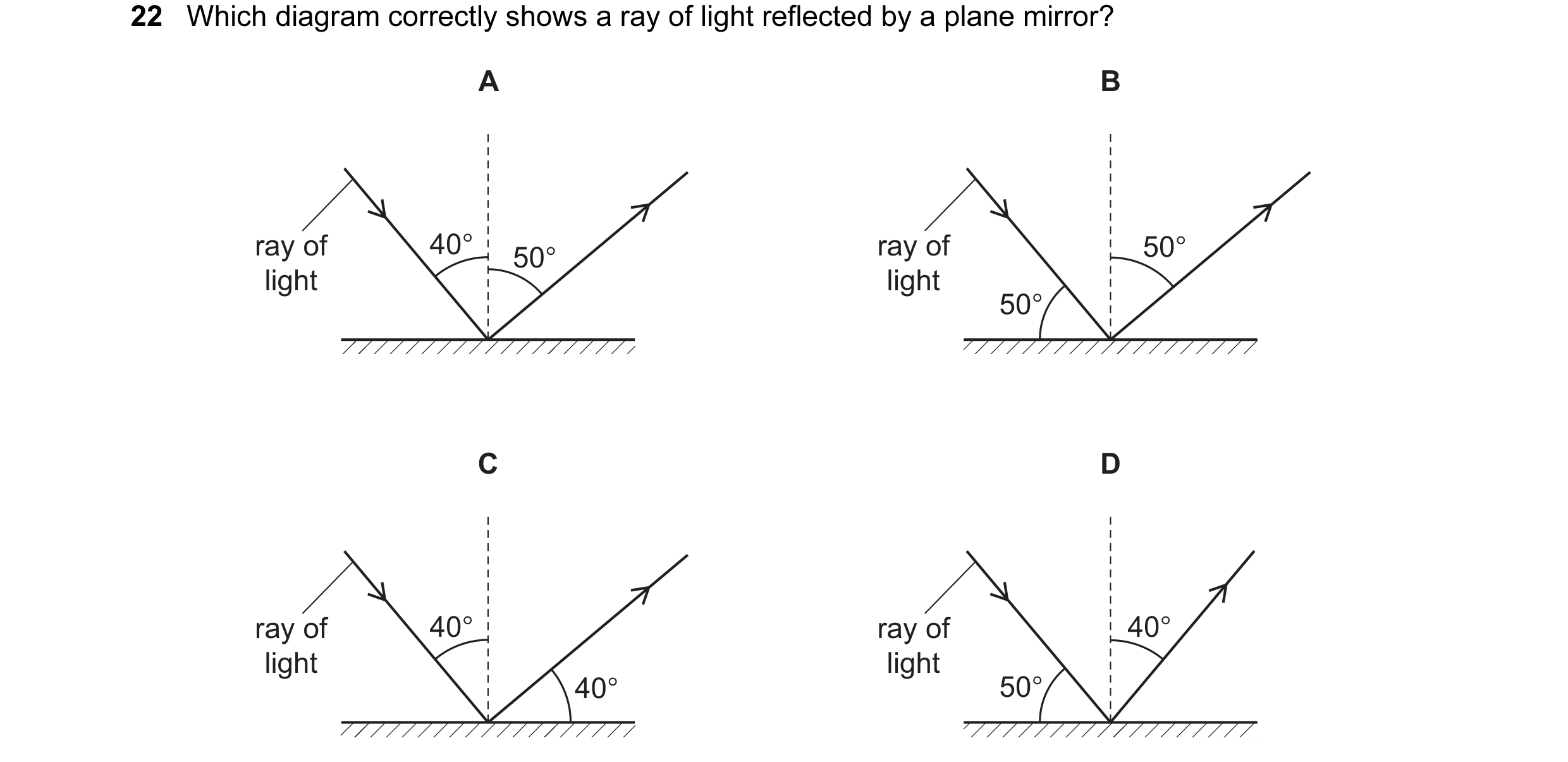 1 / 65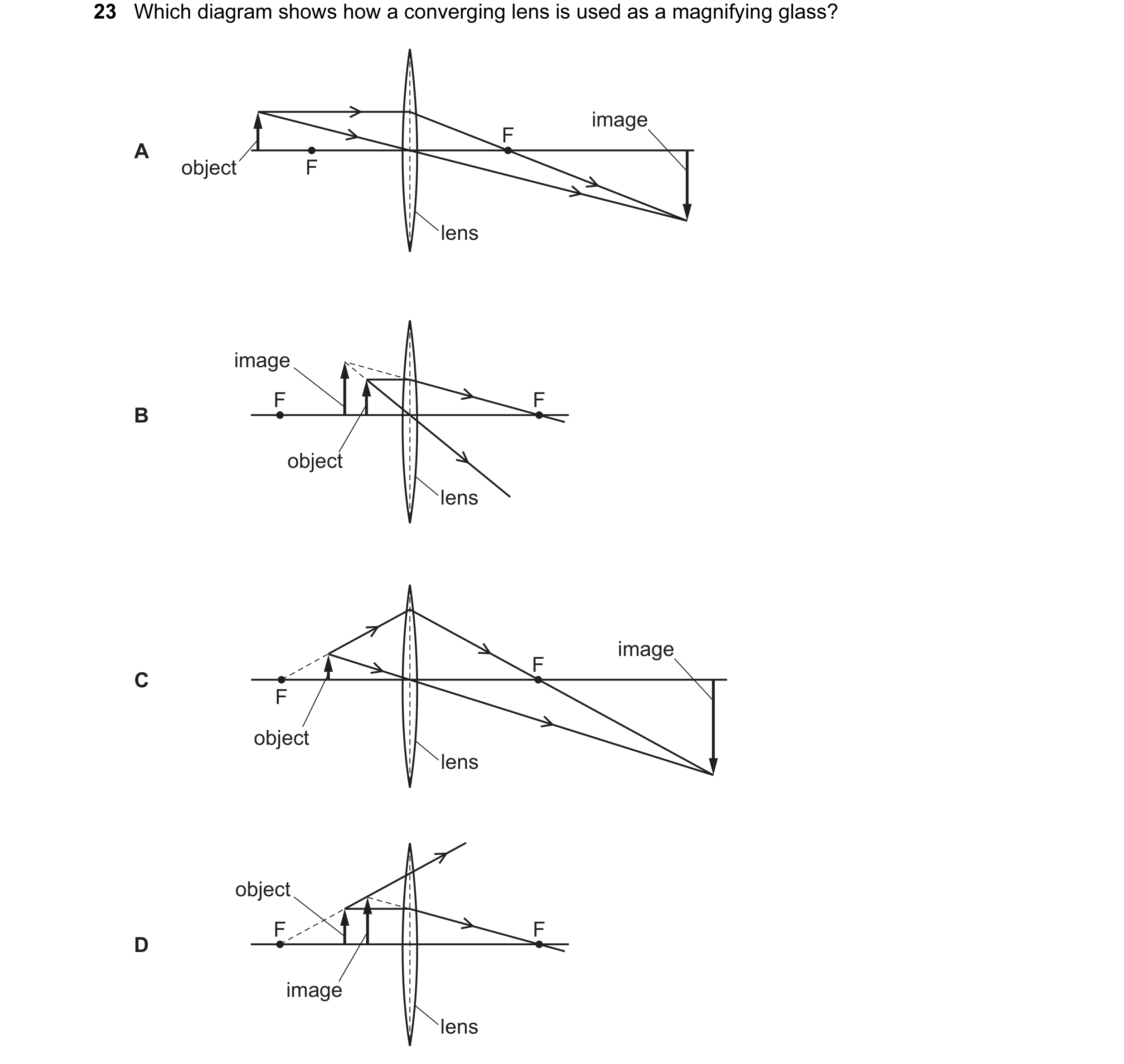
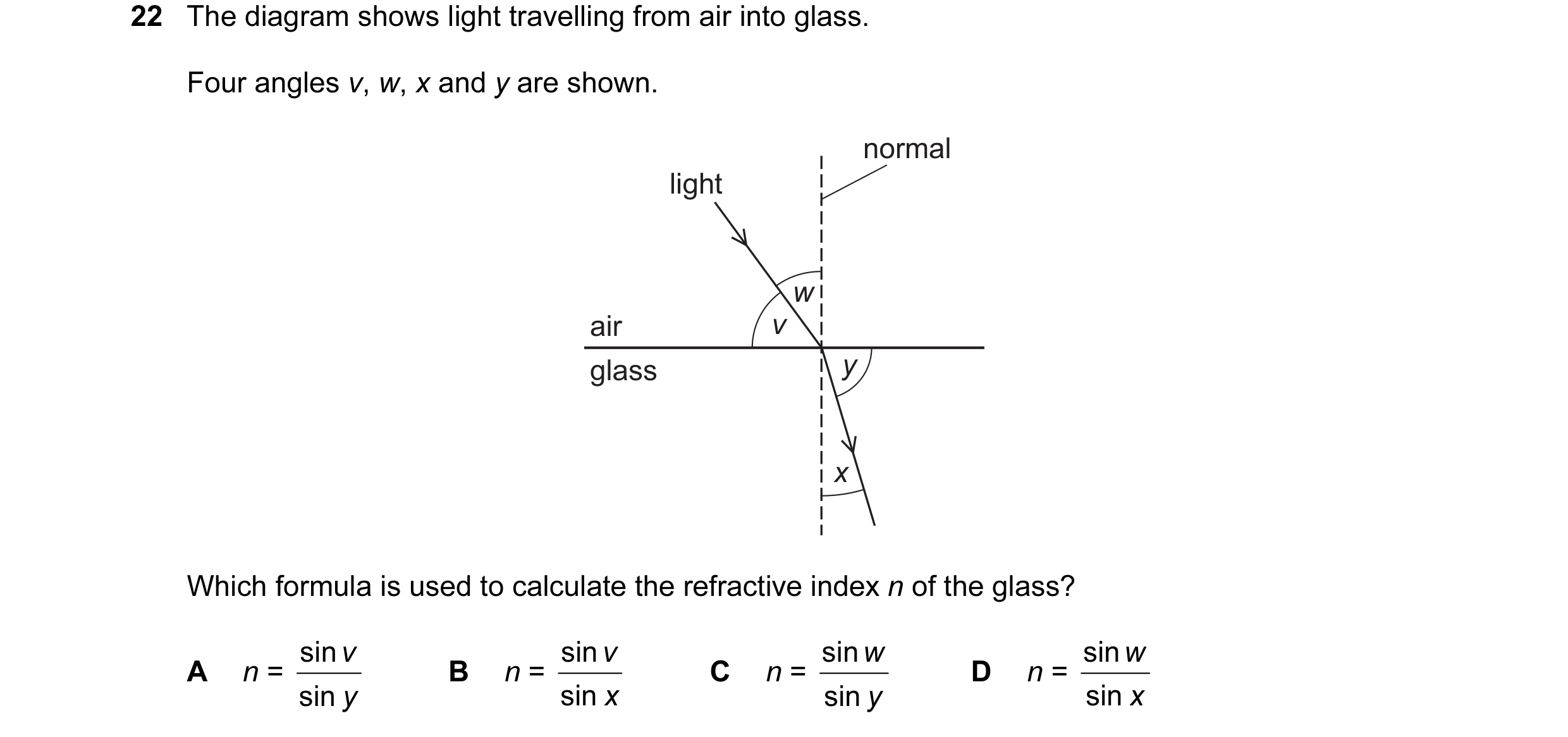 2 / 65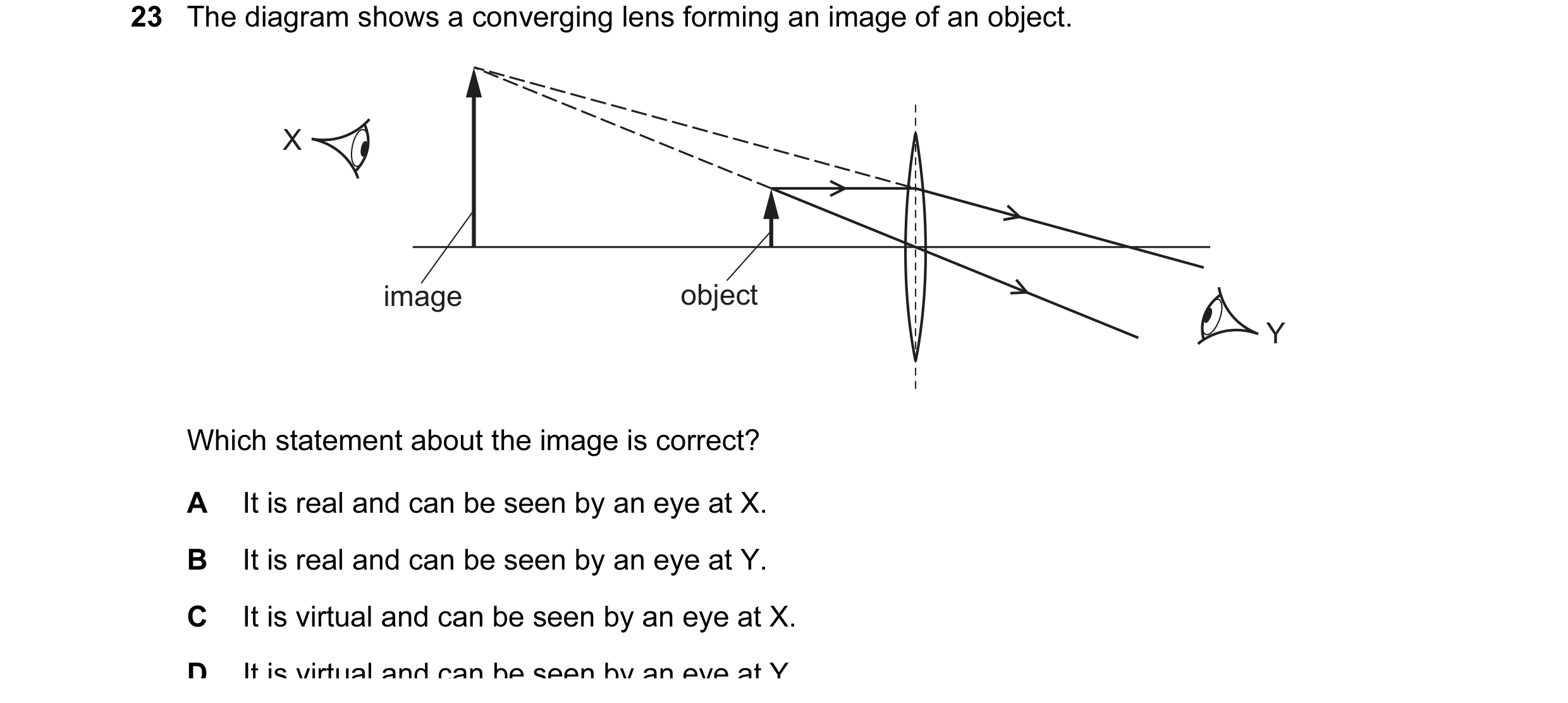
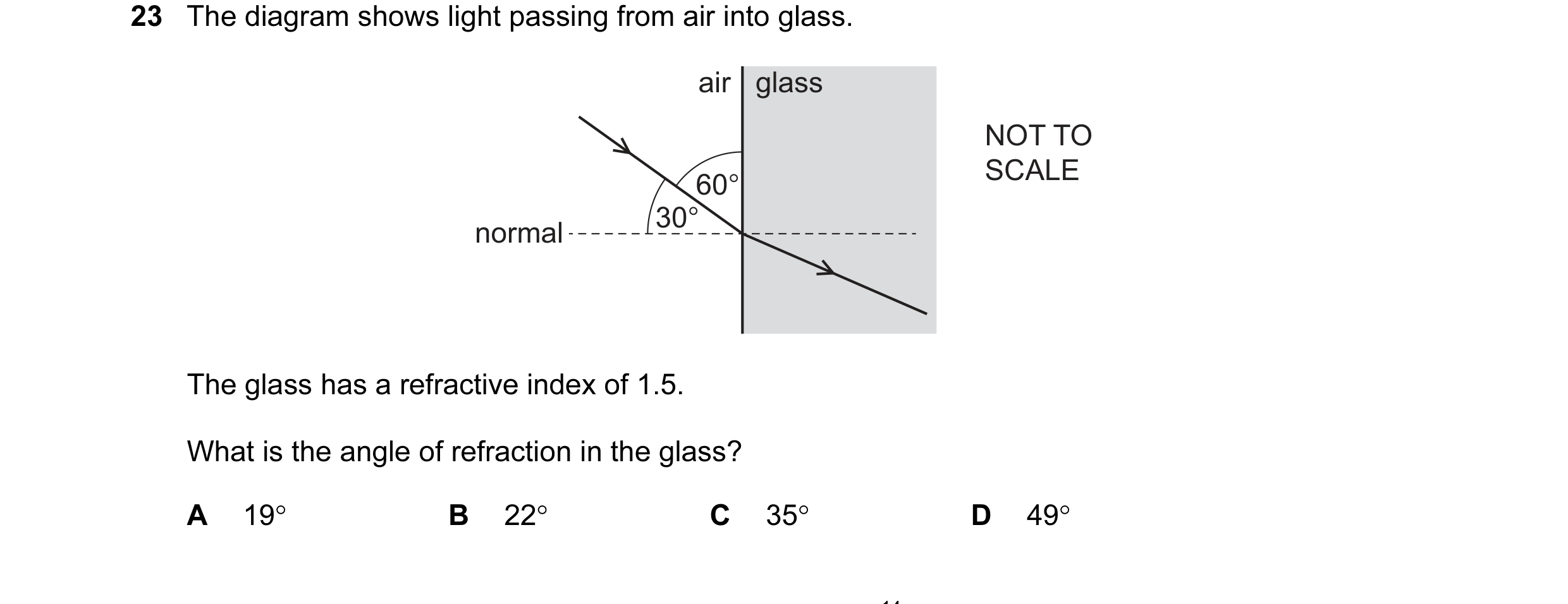
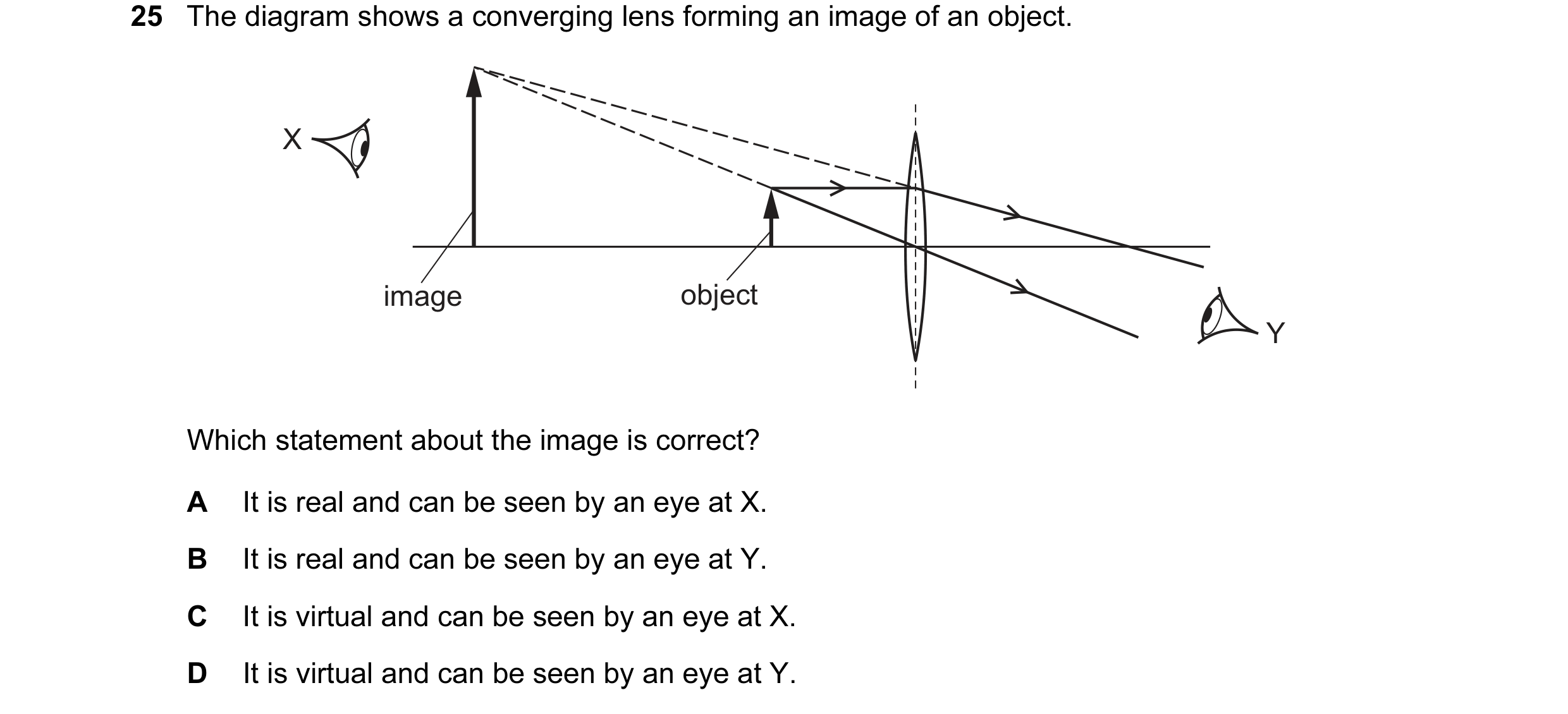 3 / 65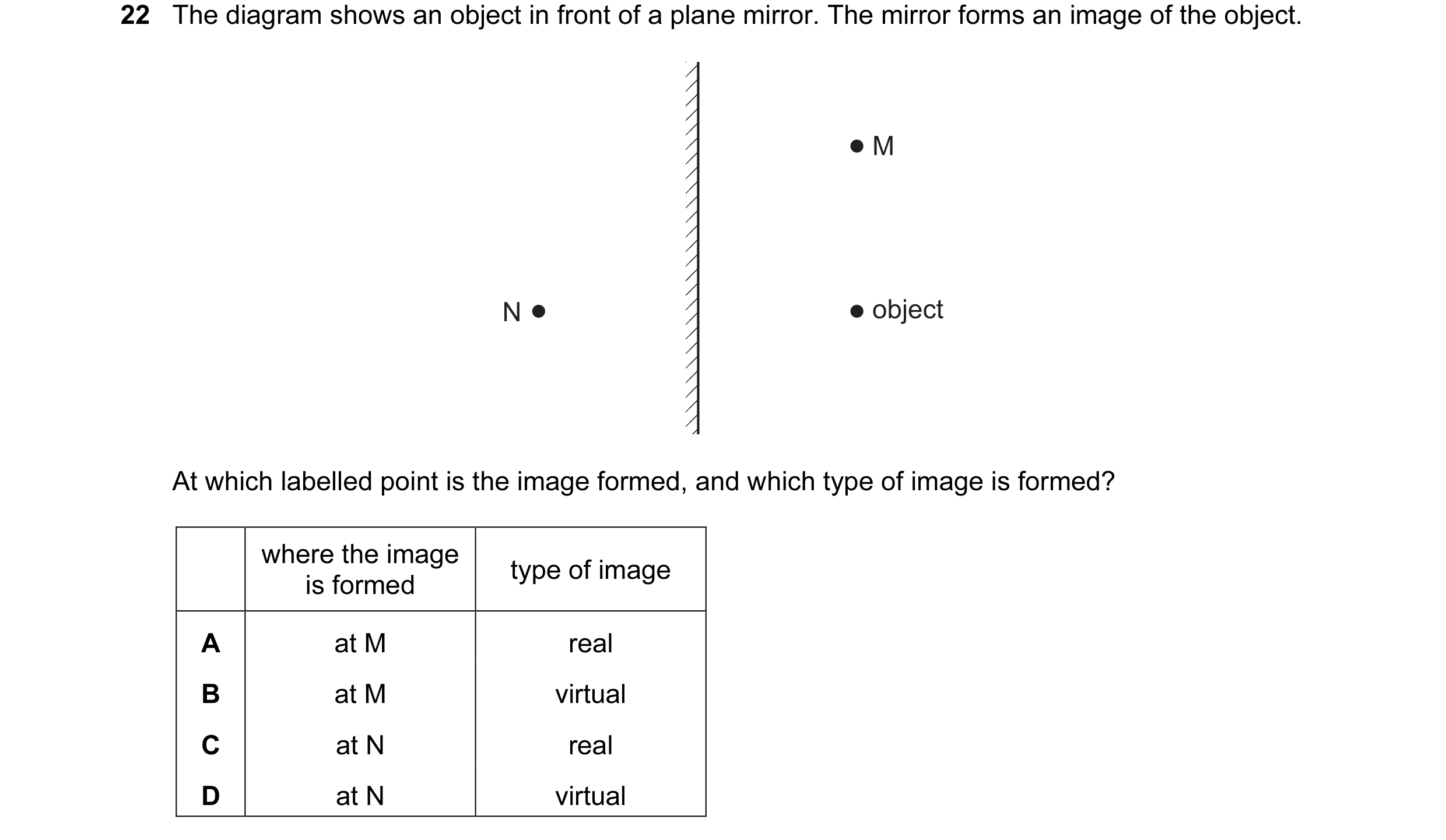

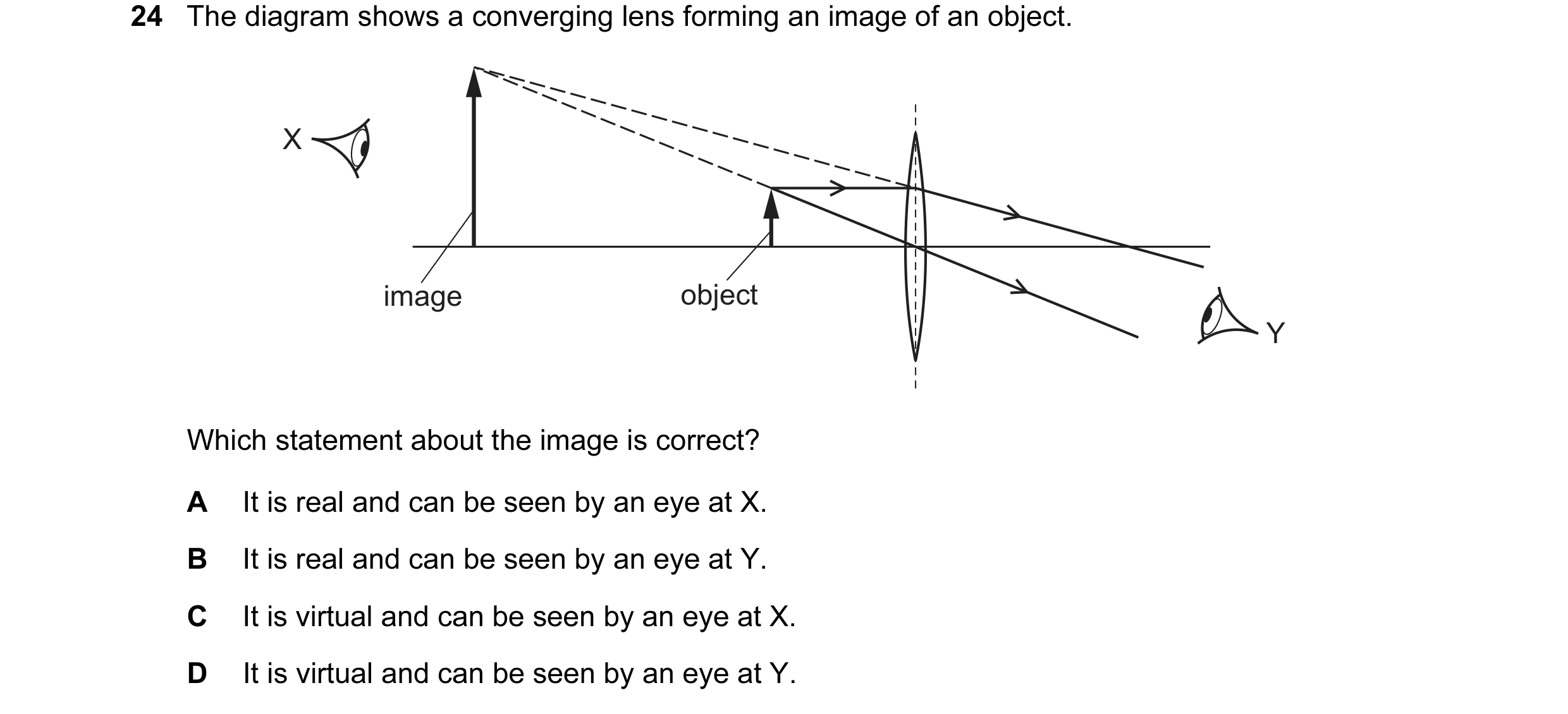 4 / 65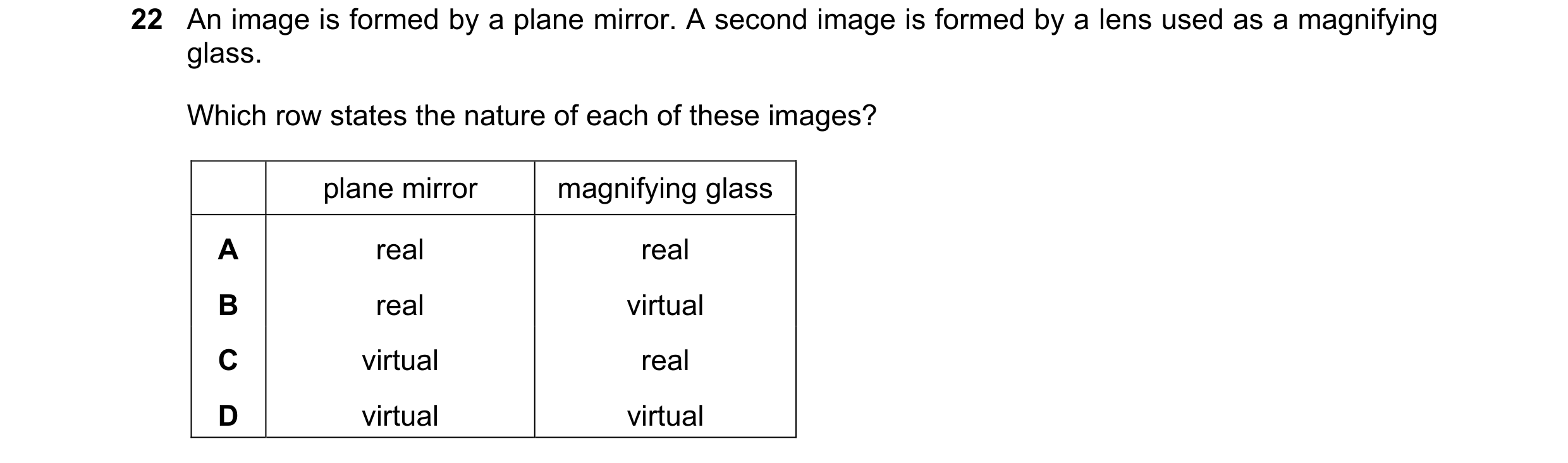
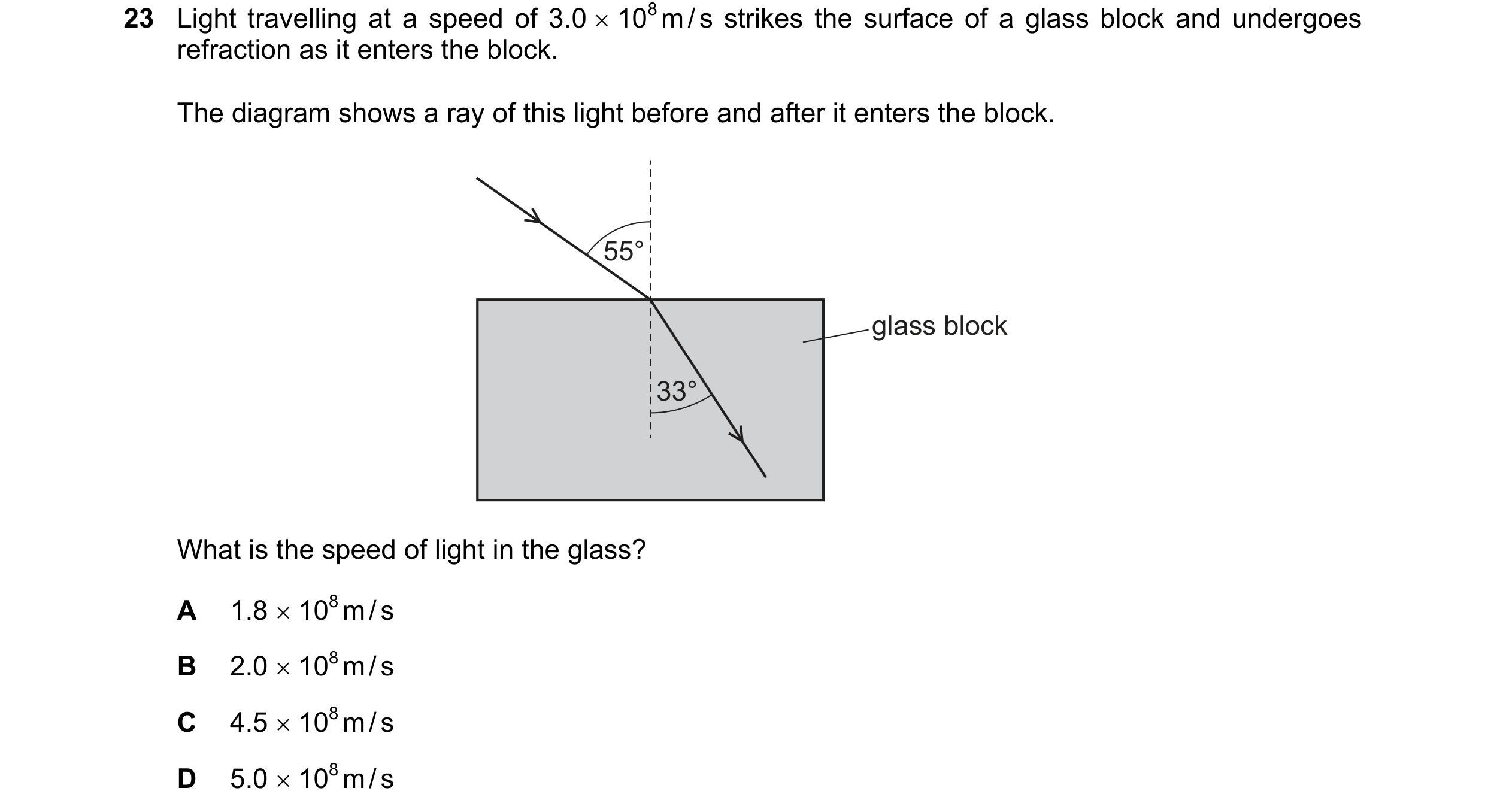
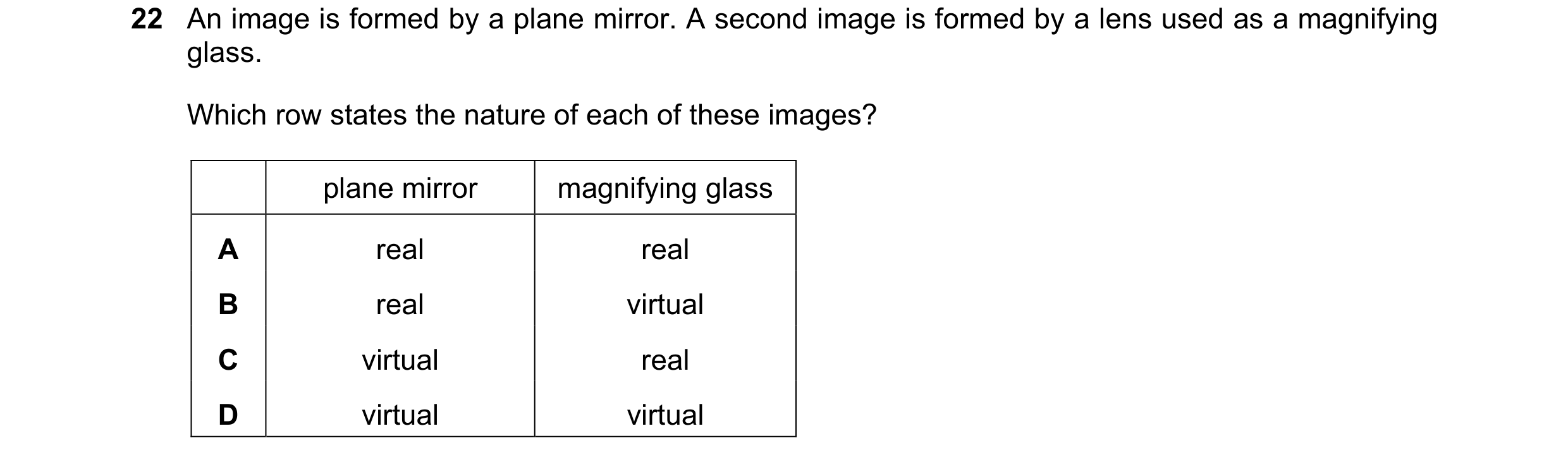 5 / 65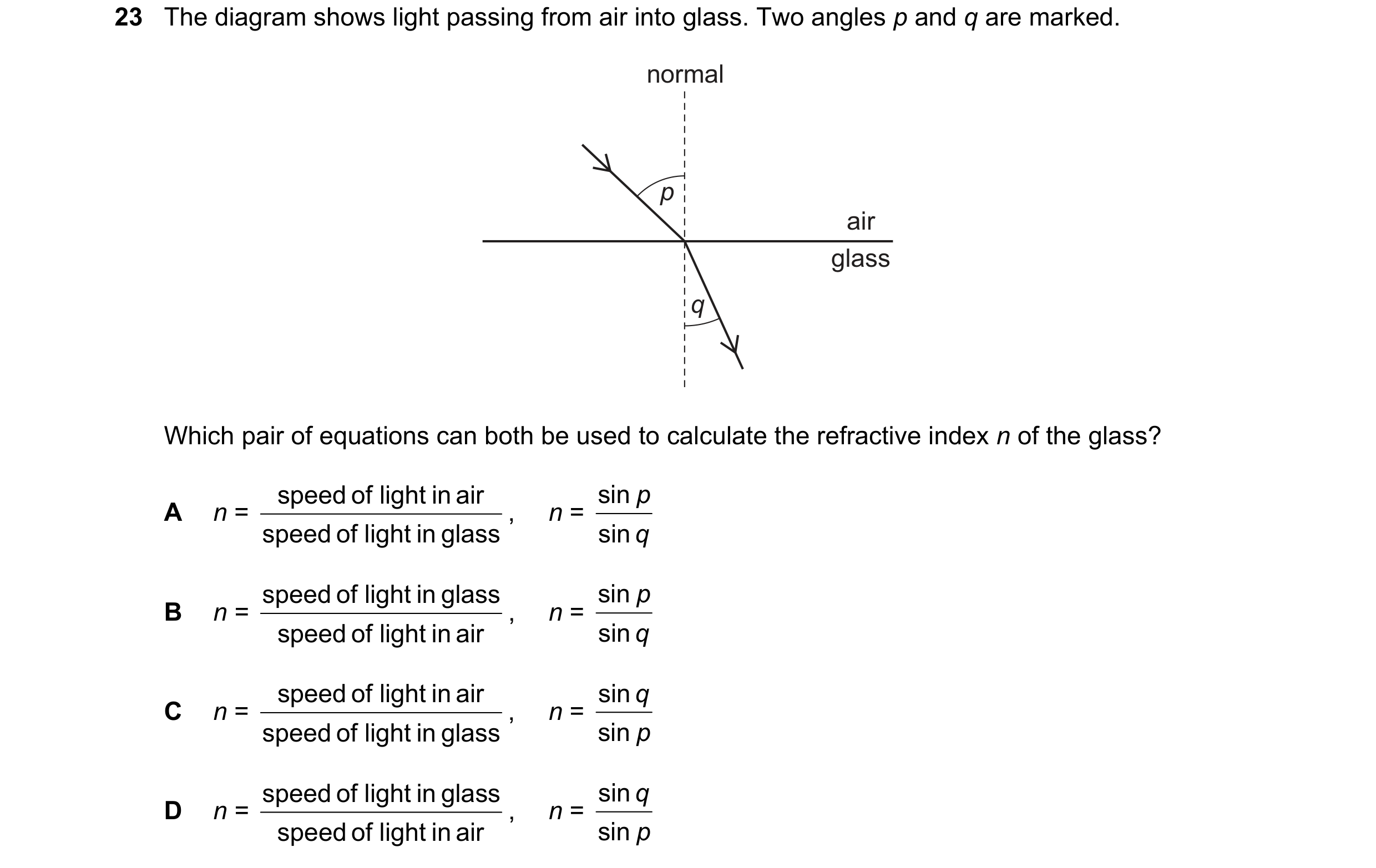
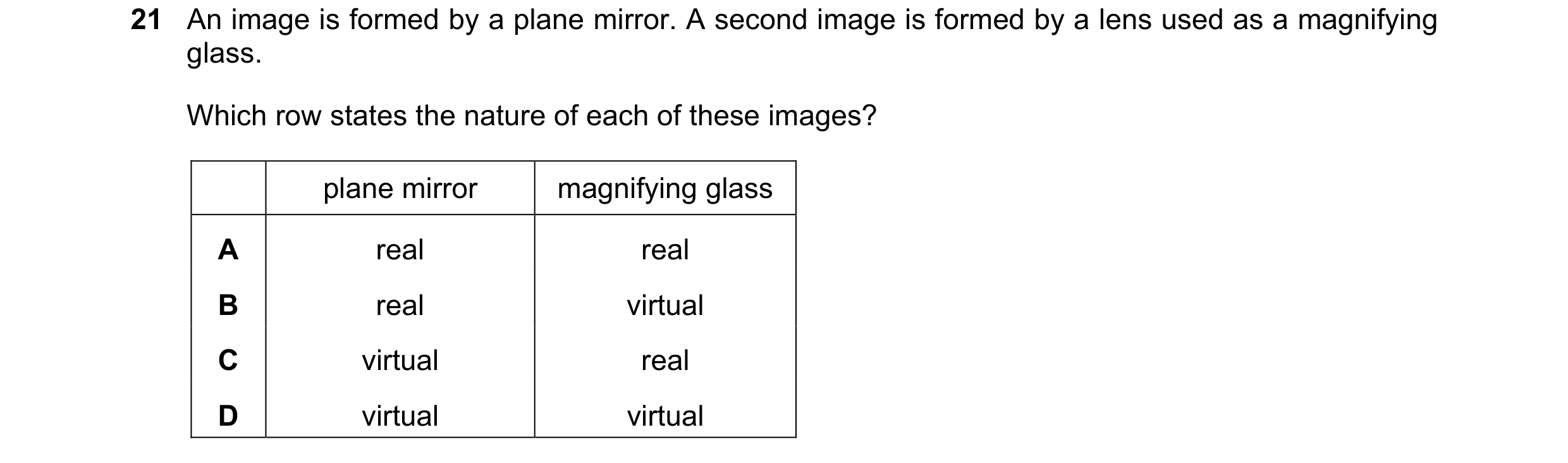
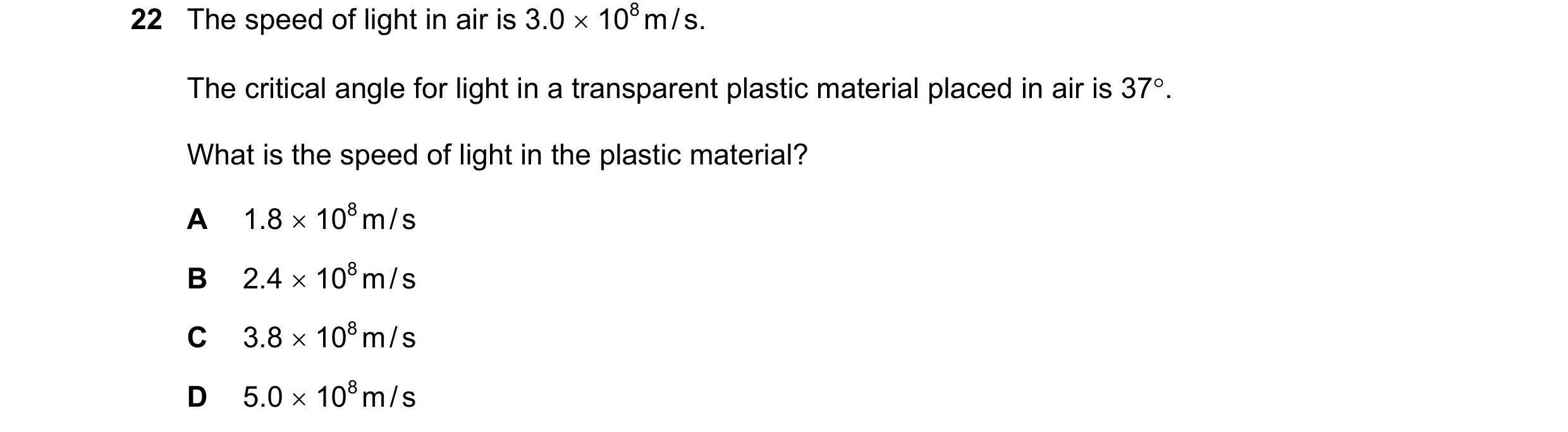 6 / 65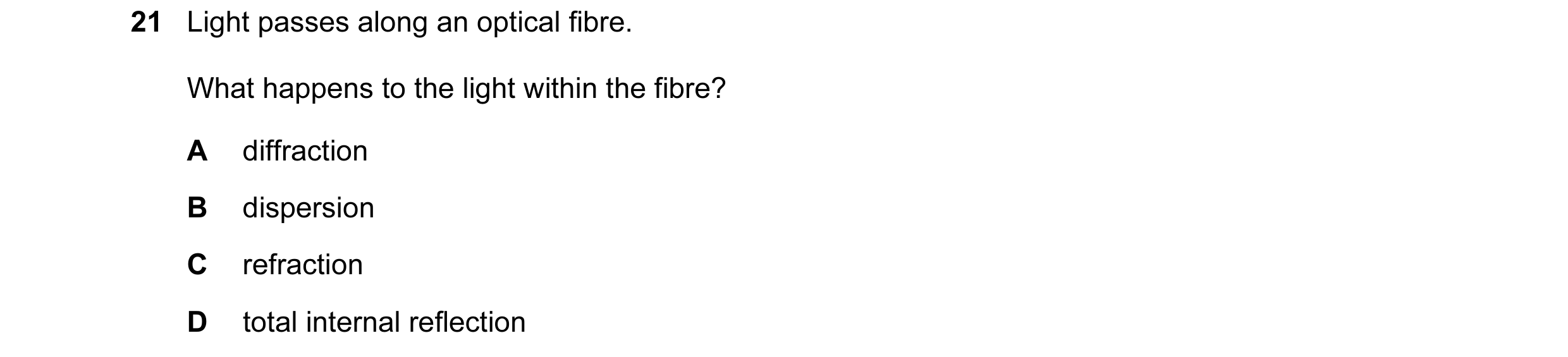
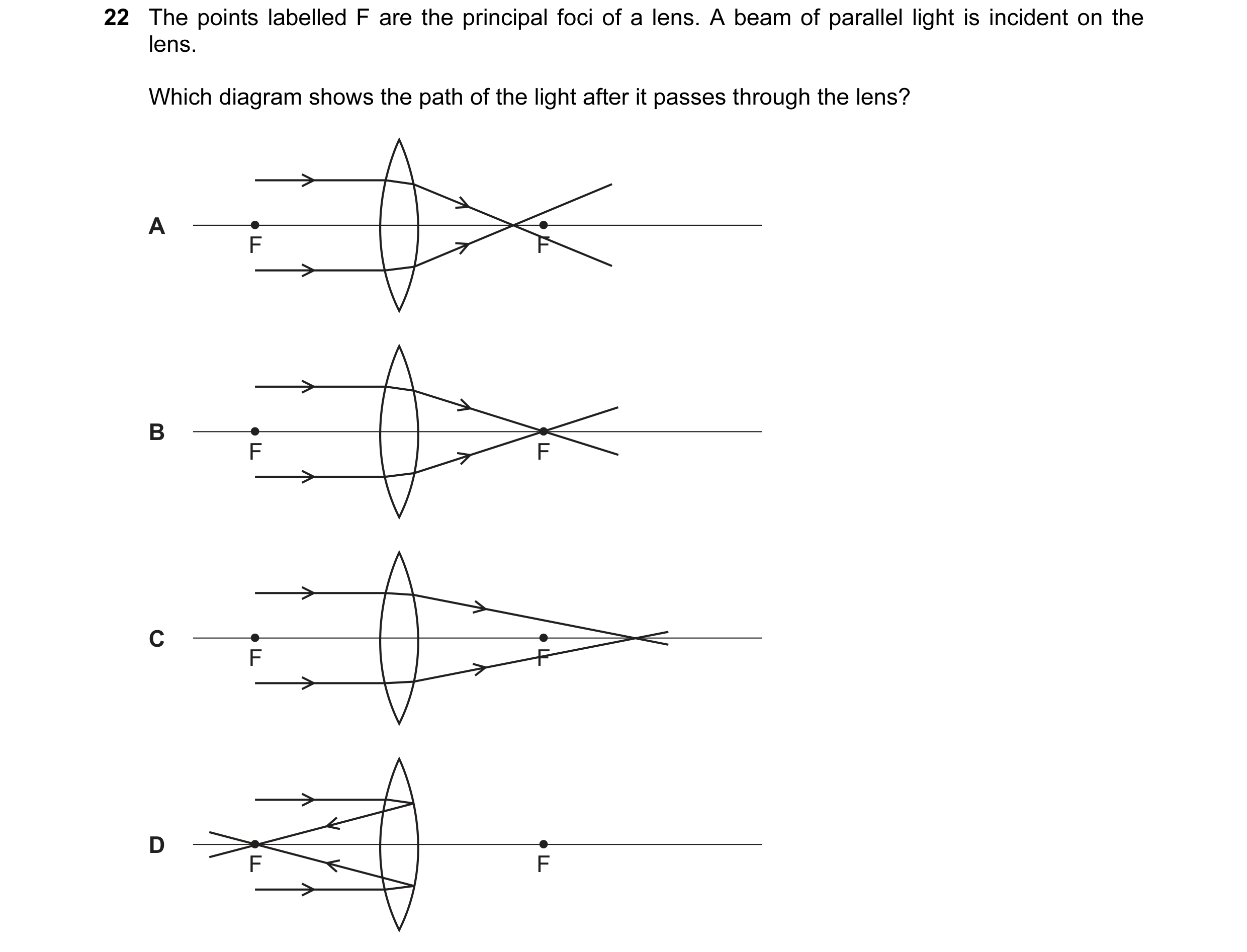
 7 / 65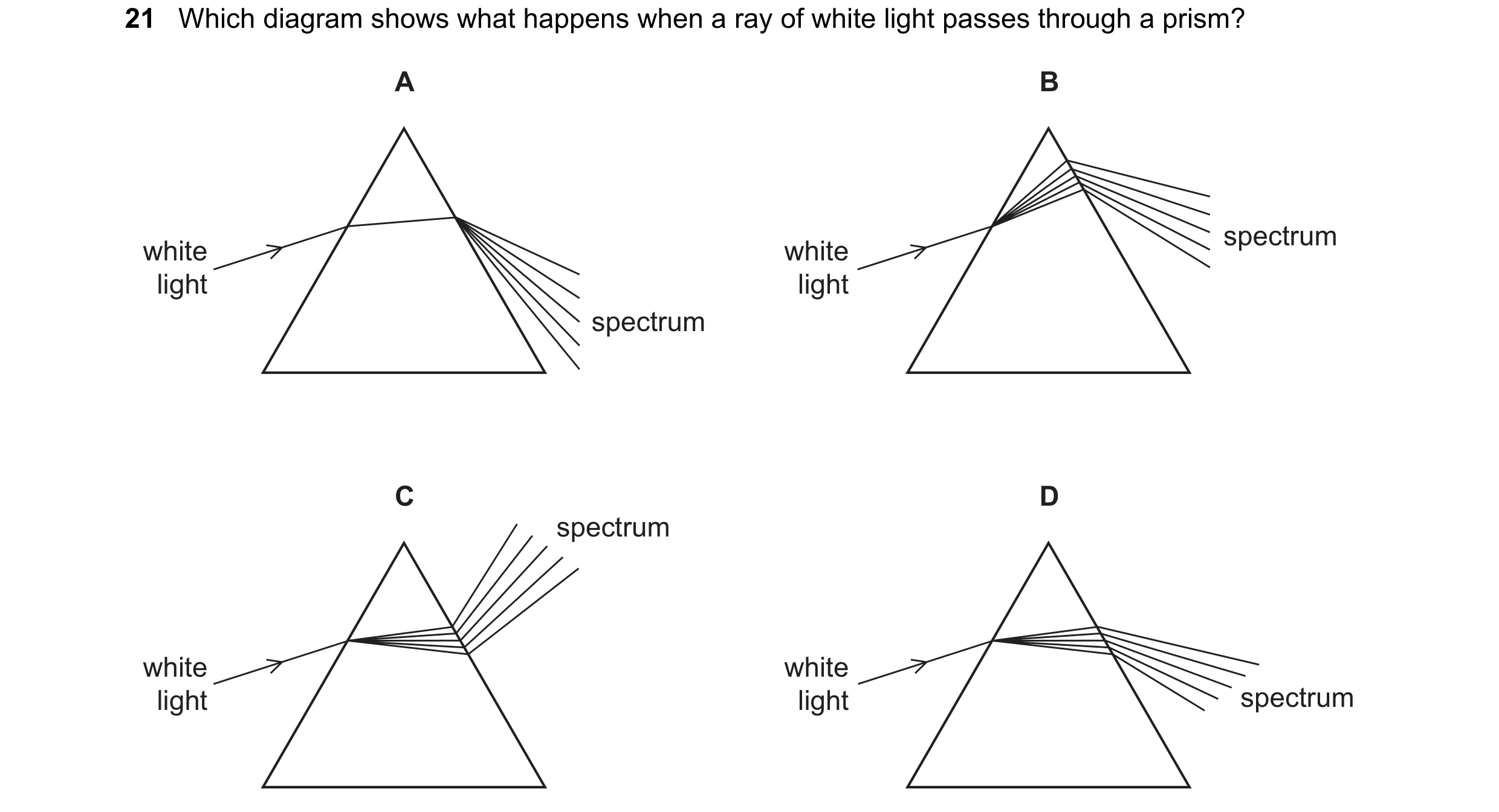
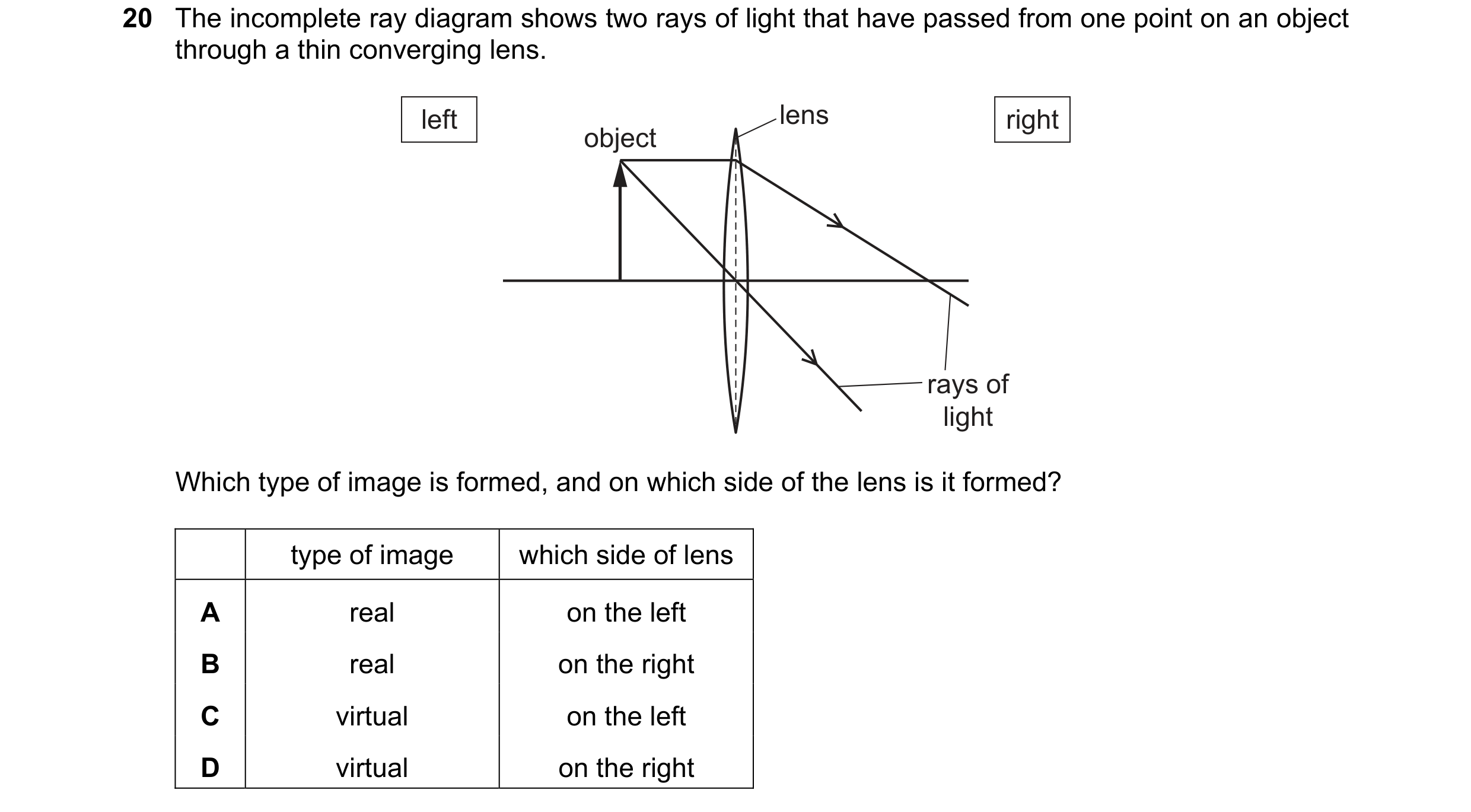 8 / 65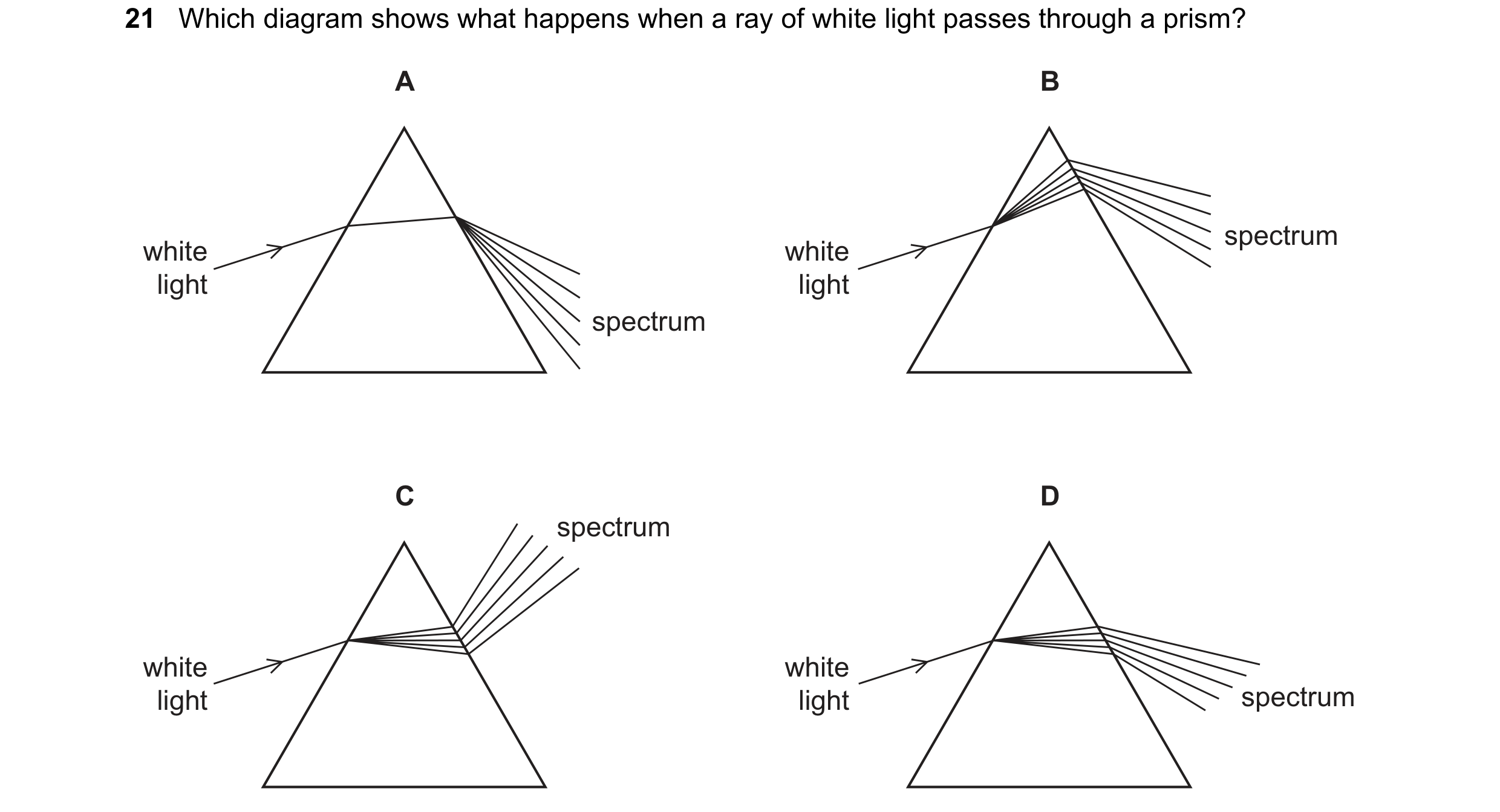
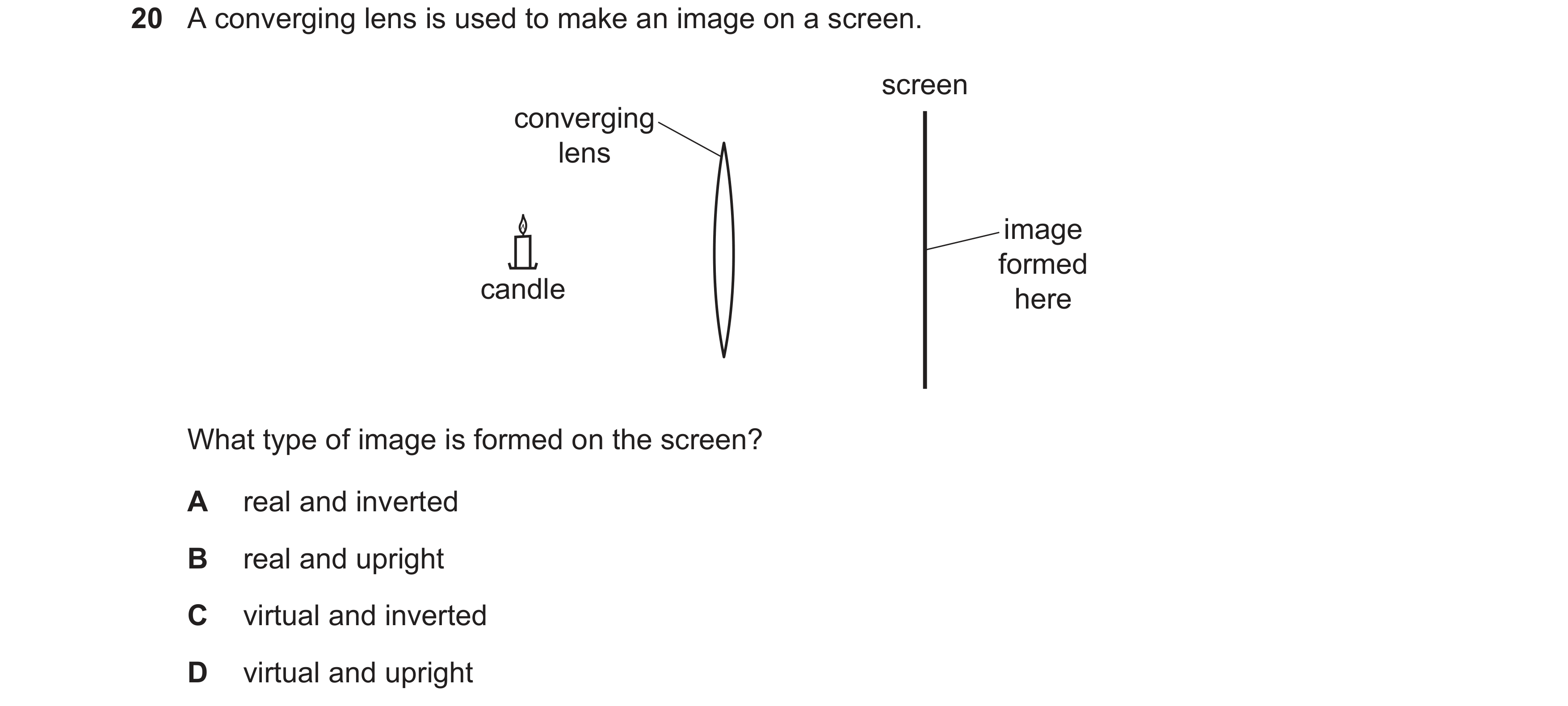 9 / 65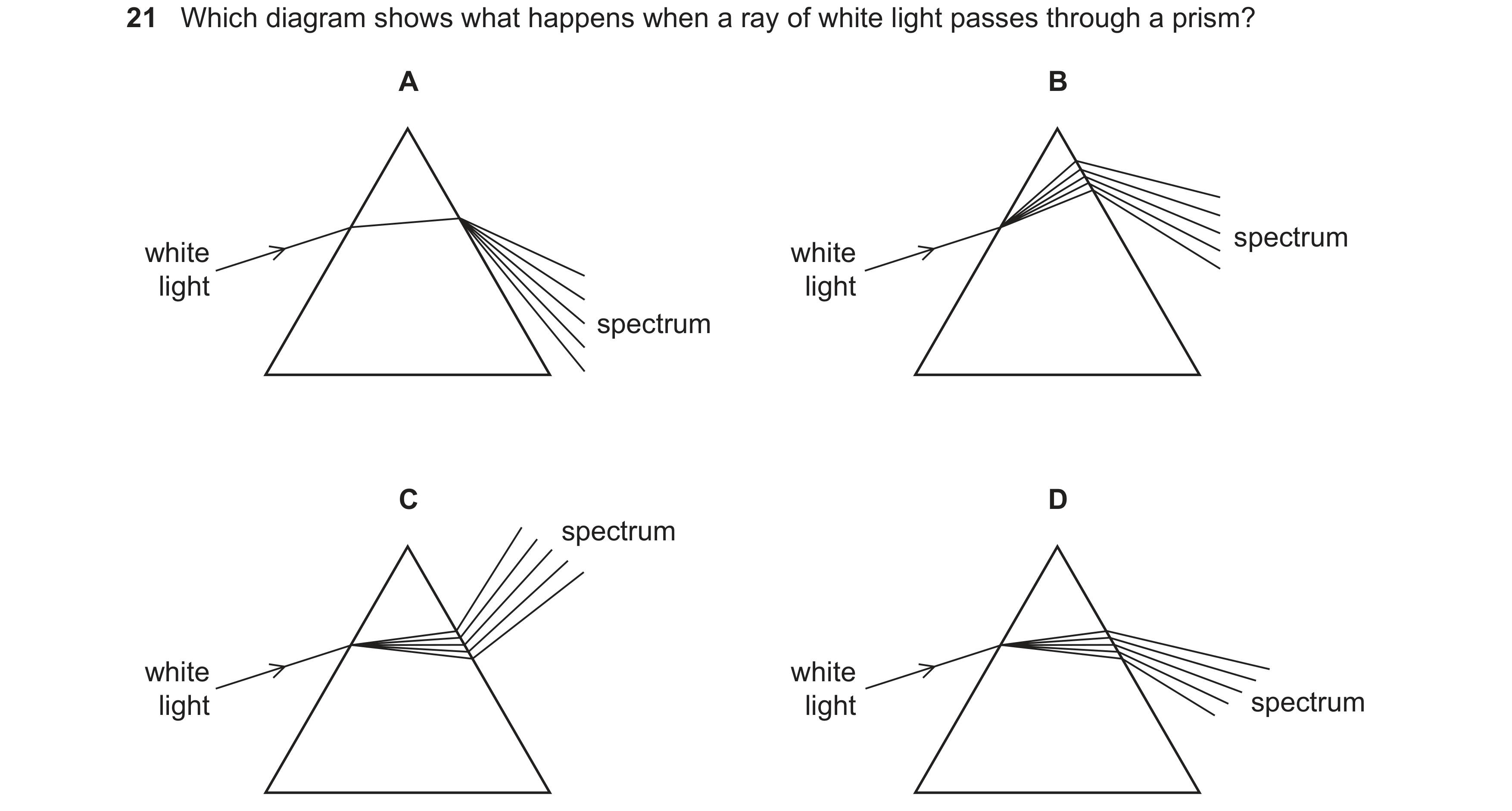
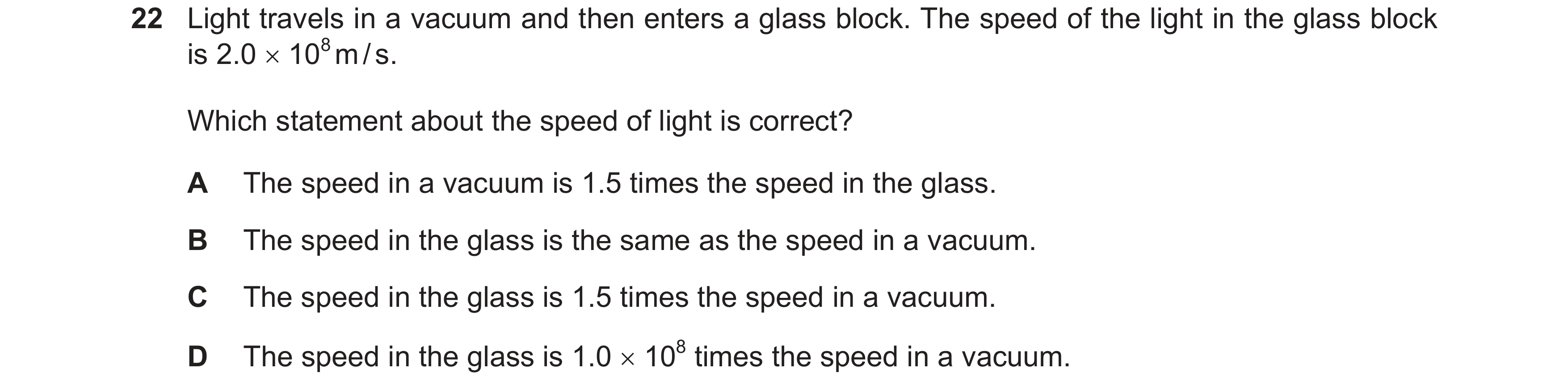
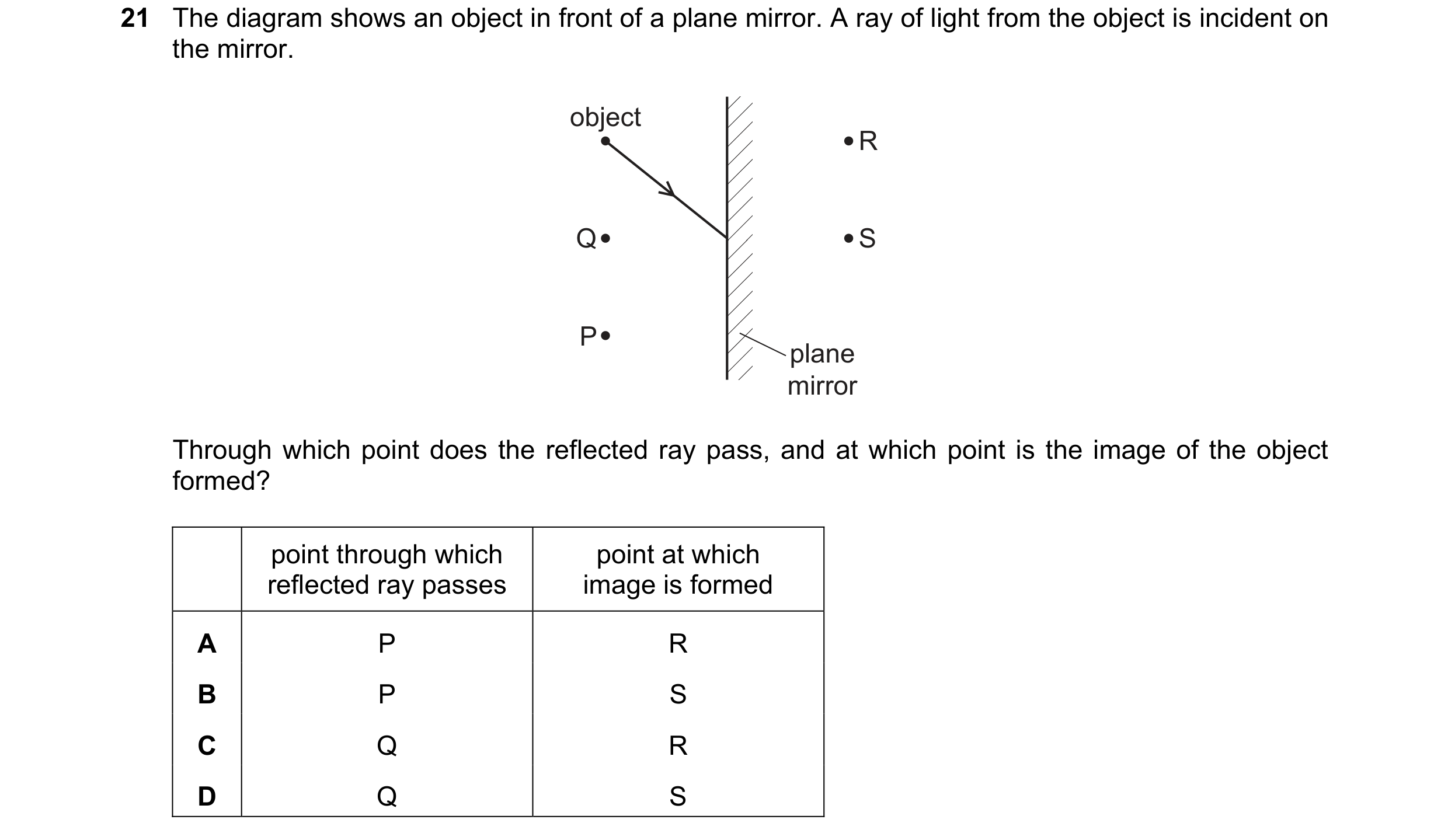 10 / 65

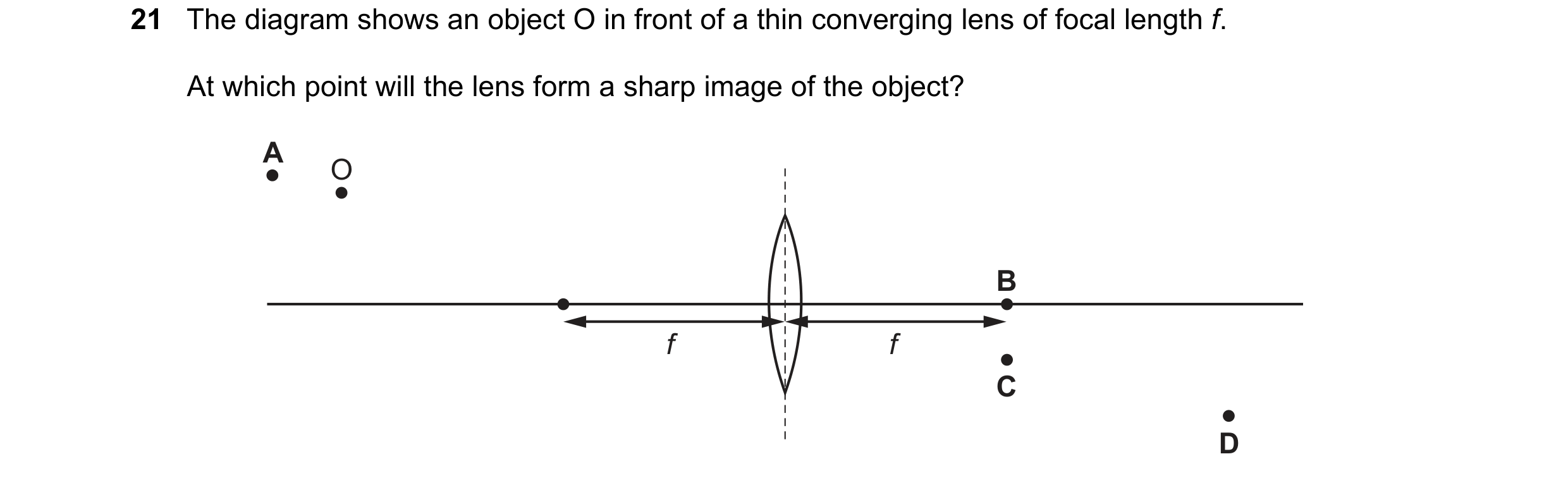
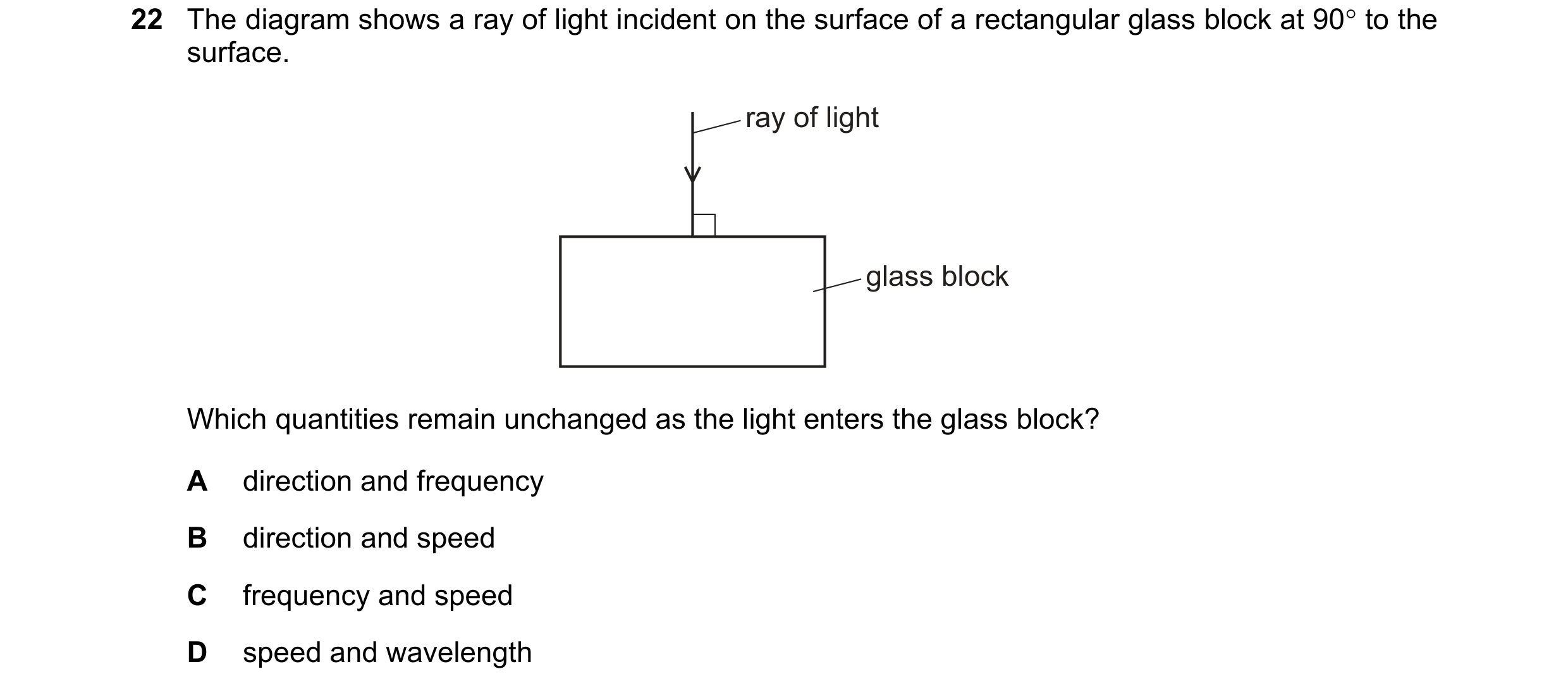
 11 / 65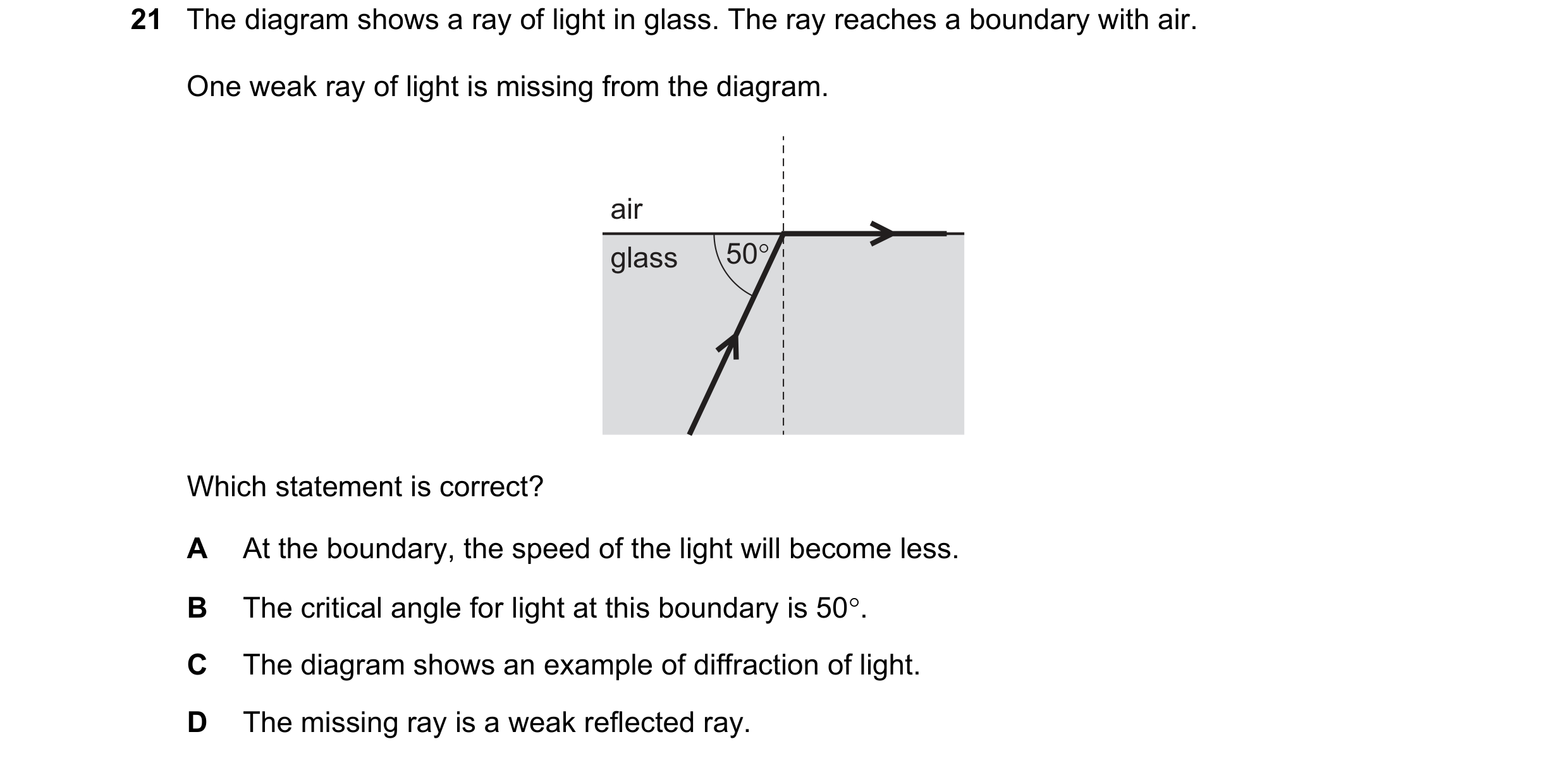
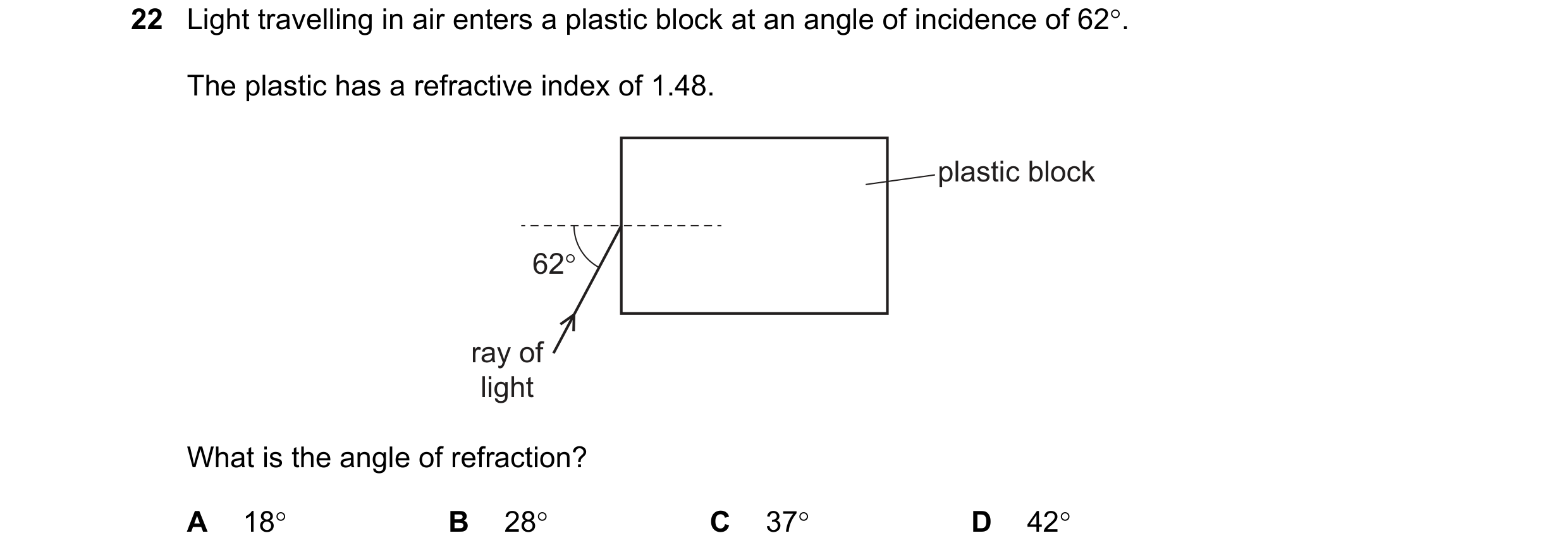

 12 / 65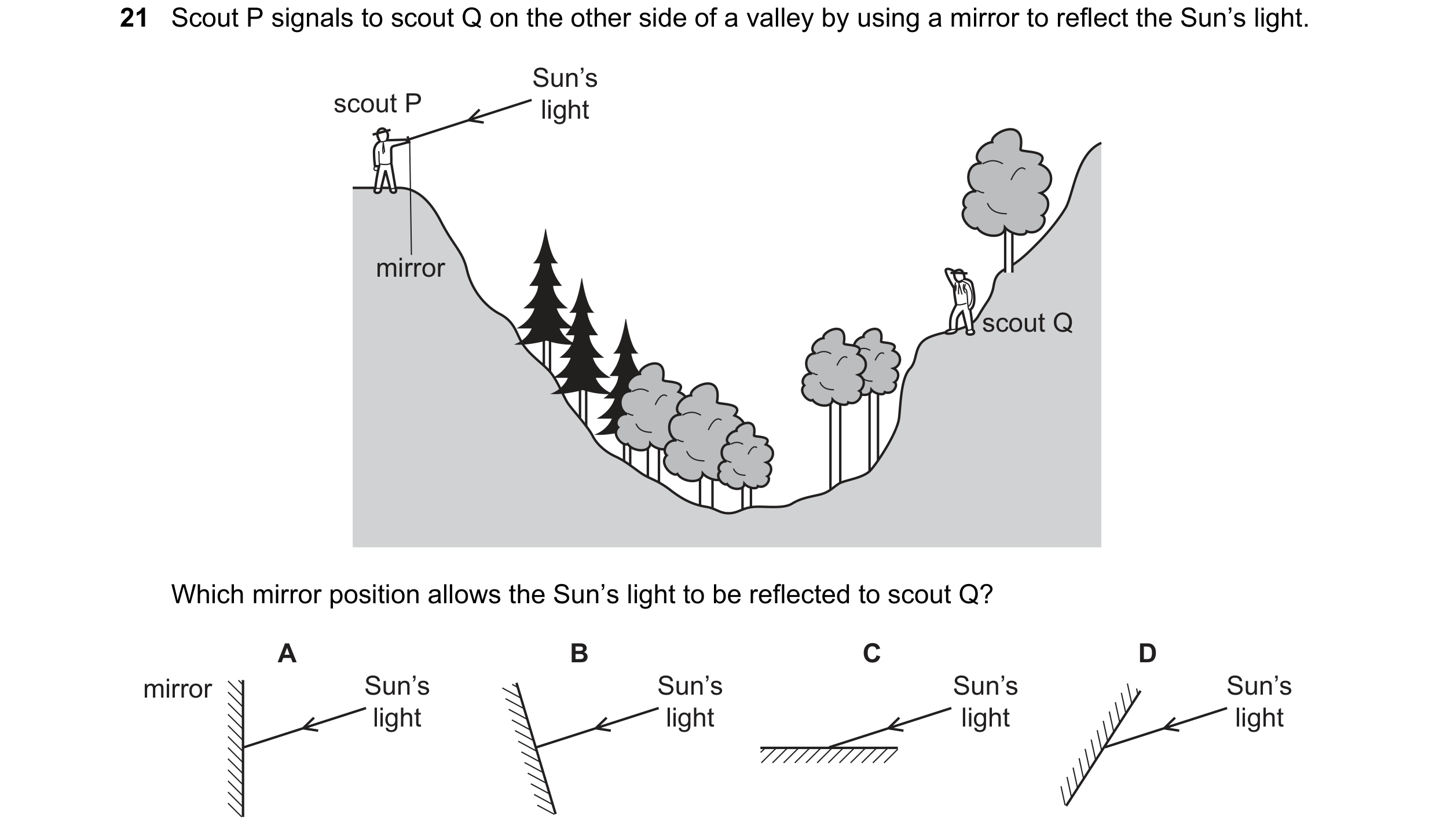
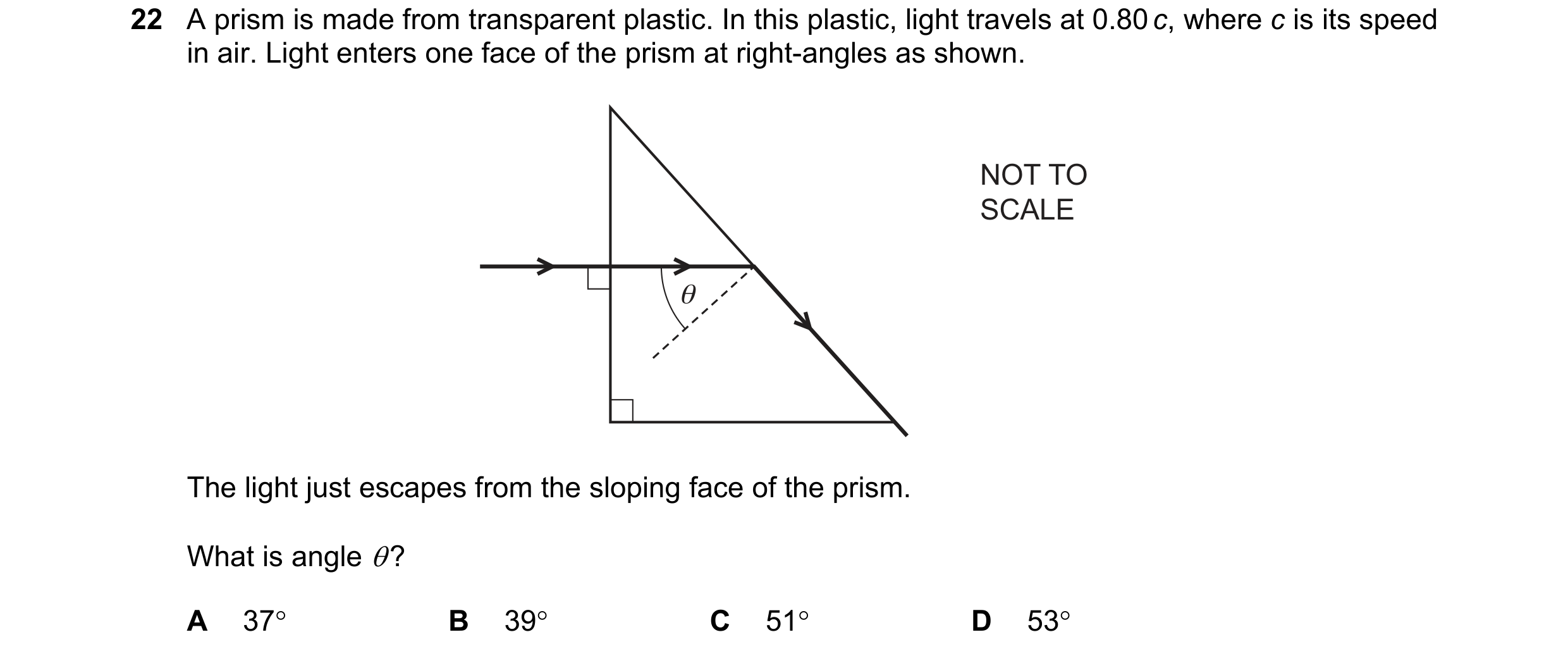
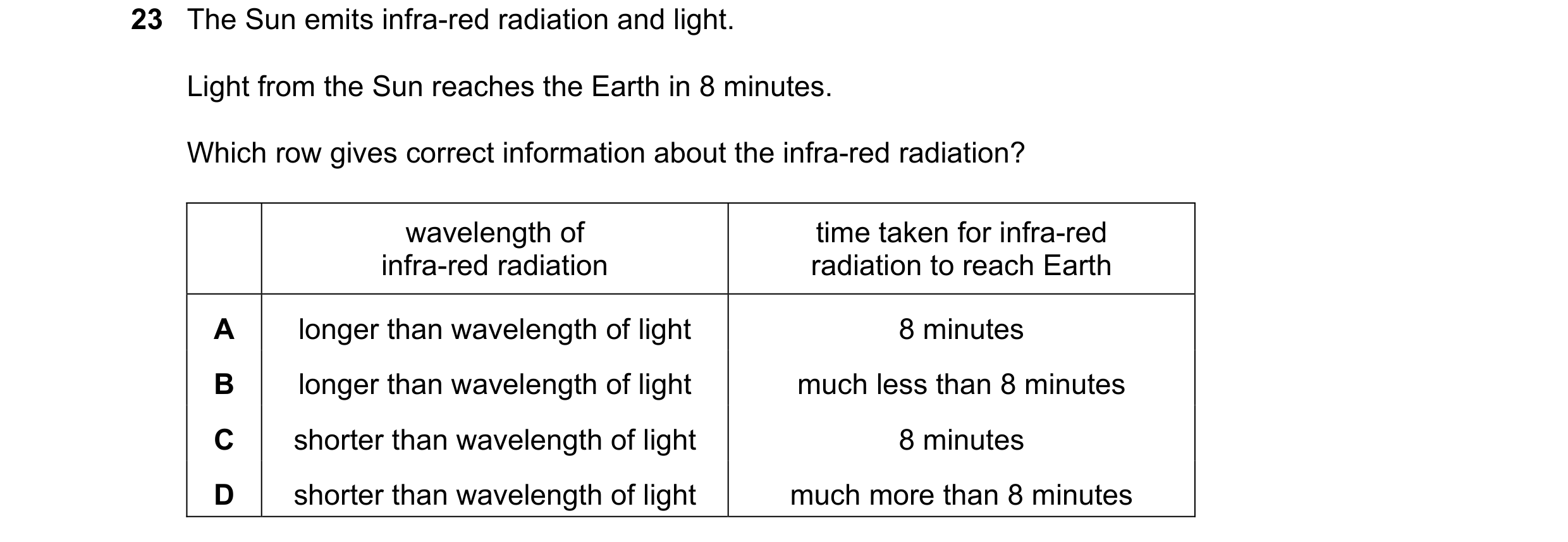 13 / 65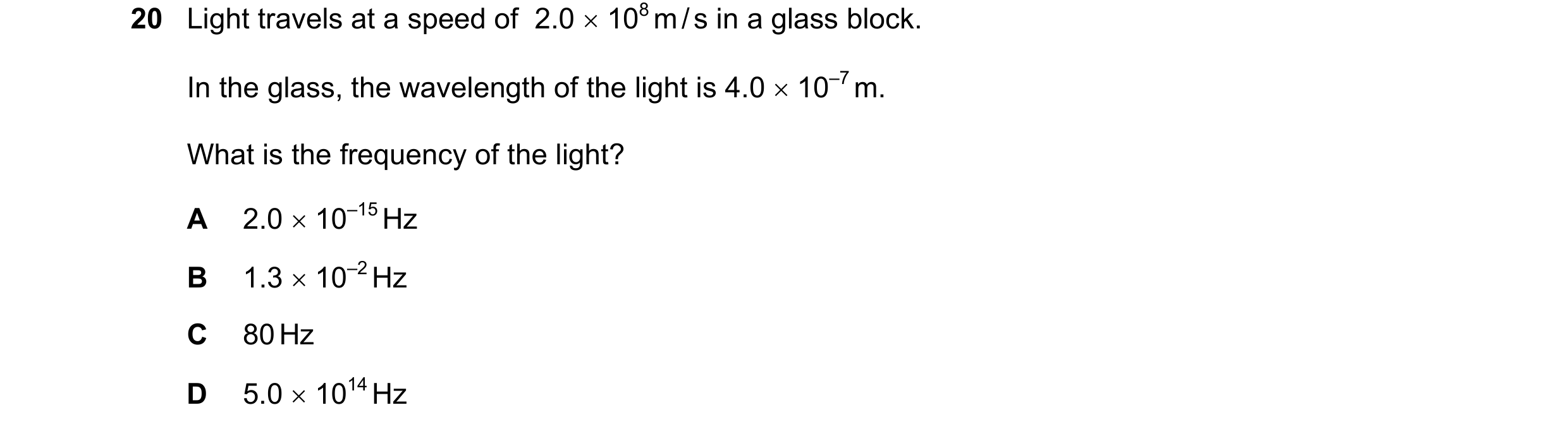
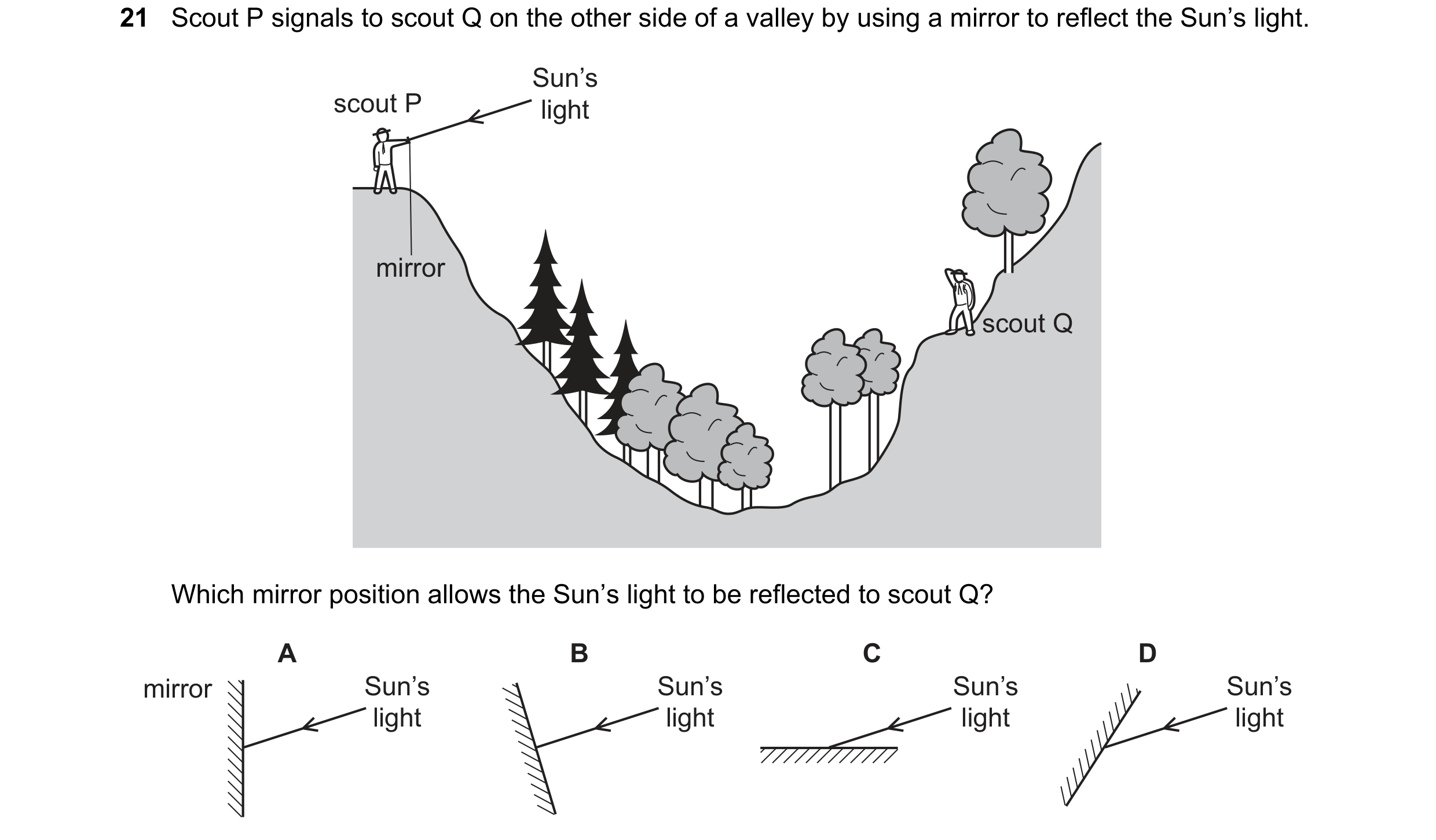
 14 / 65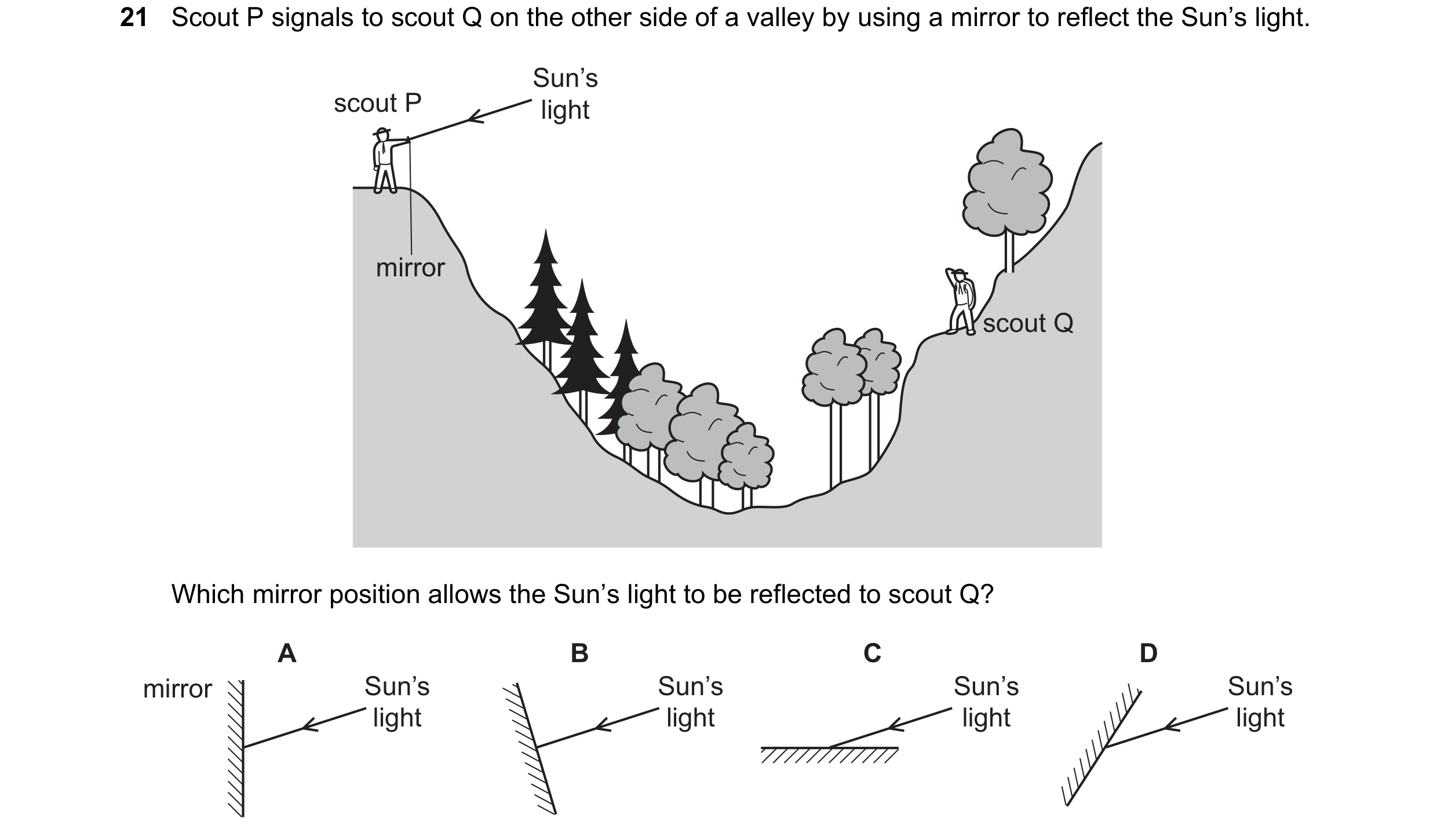
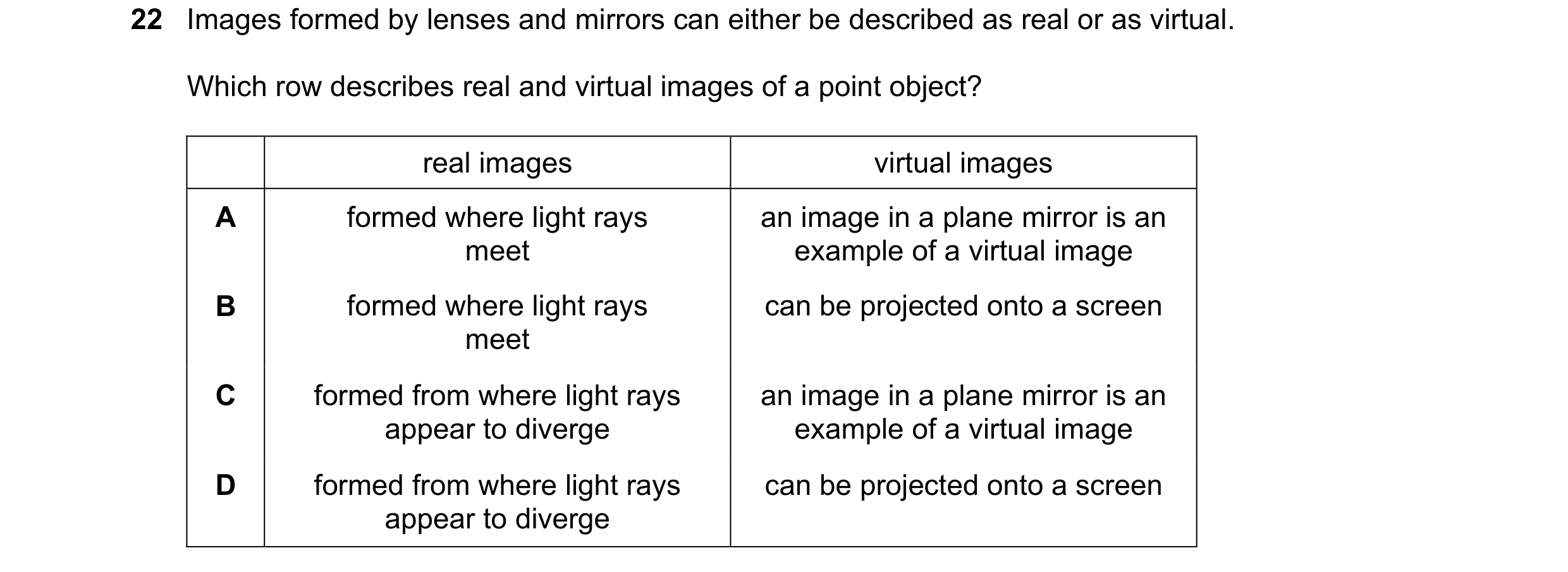
 15 / 65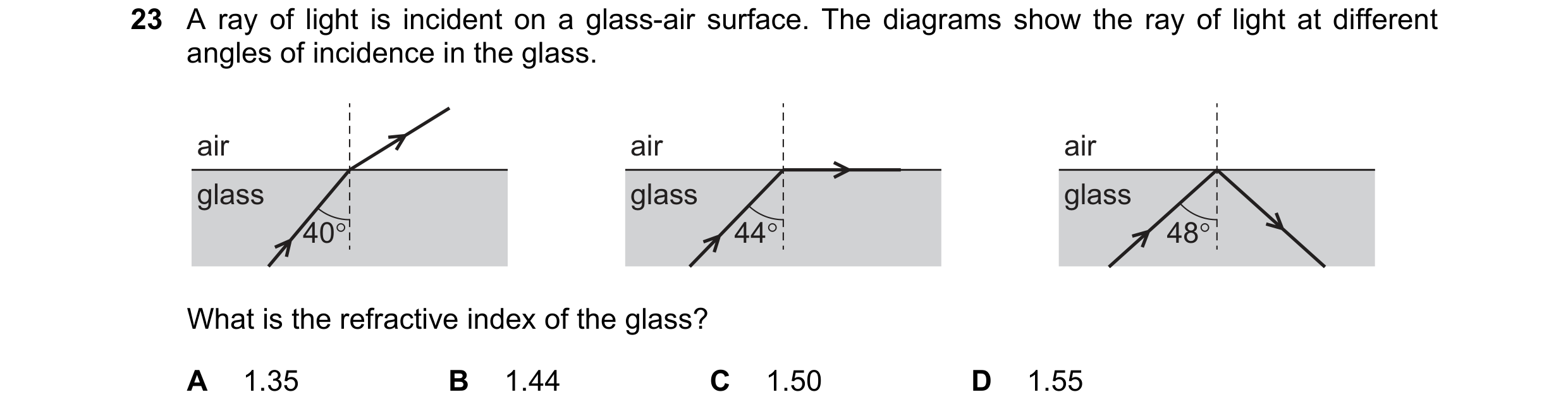
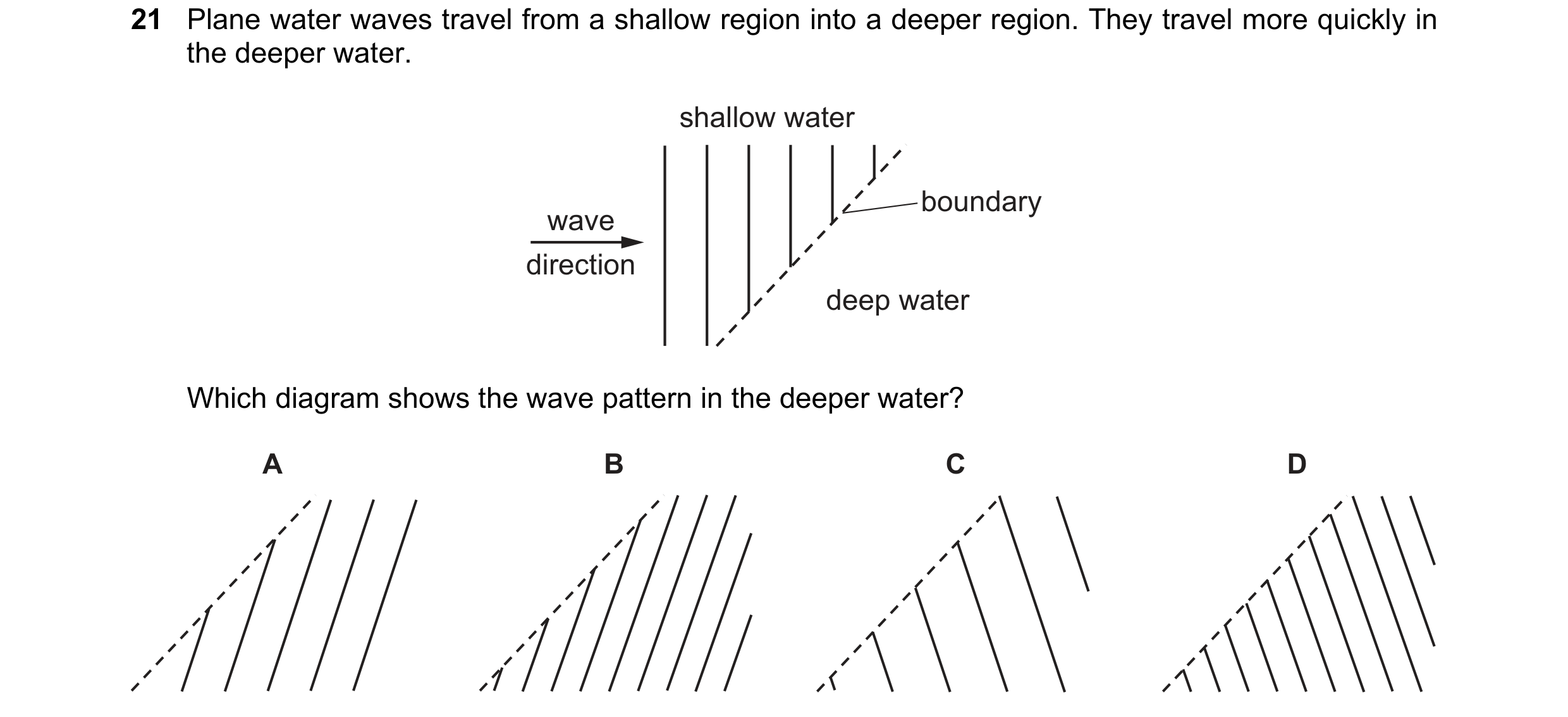
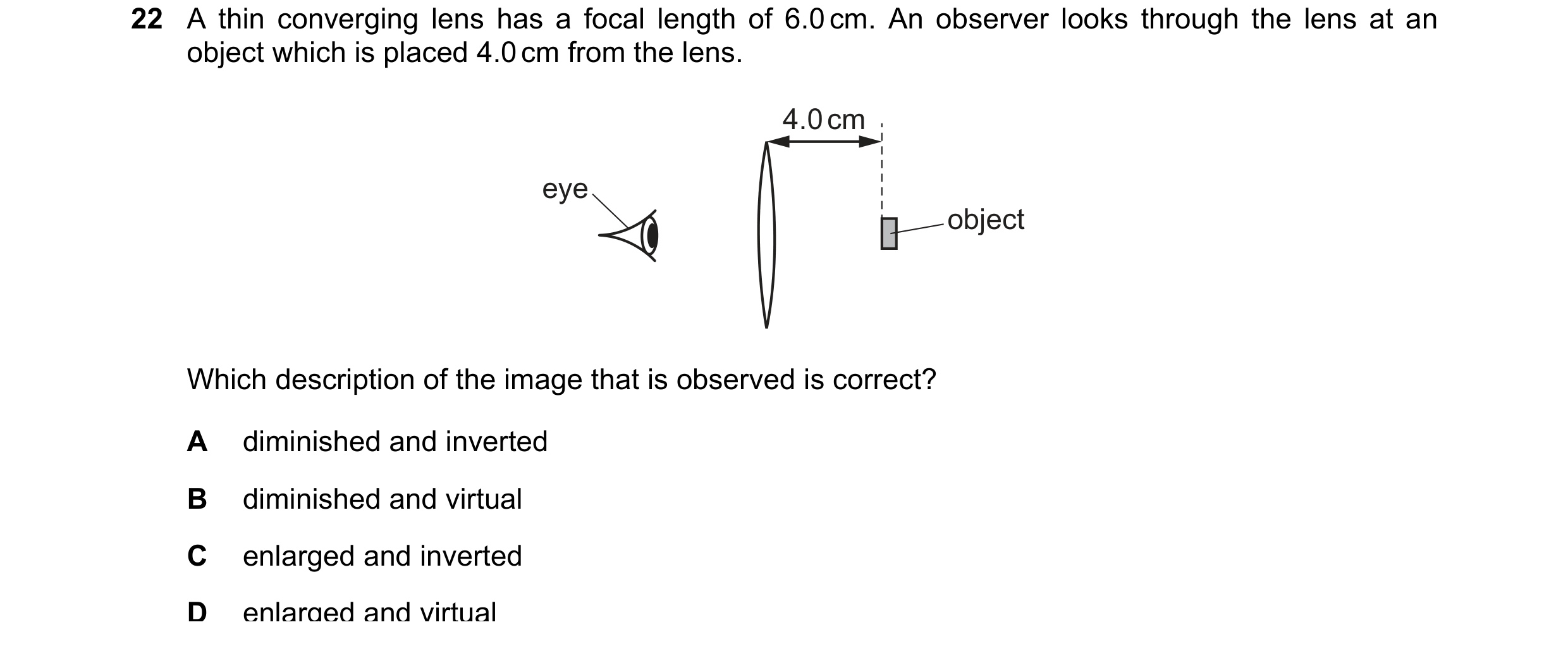 16 / 65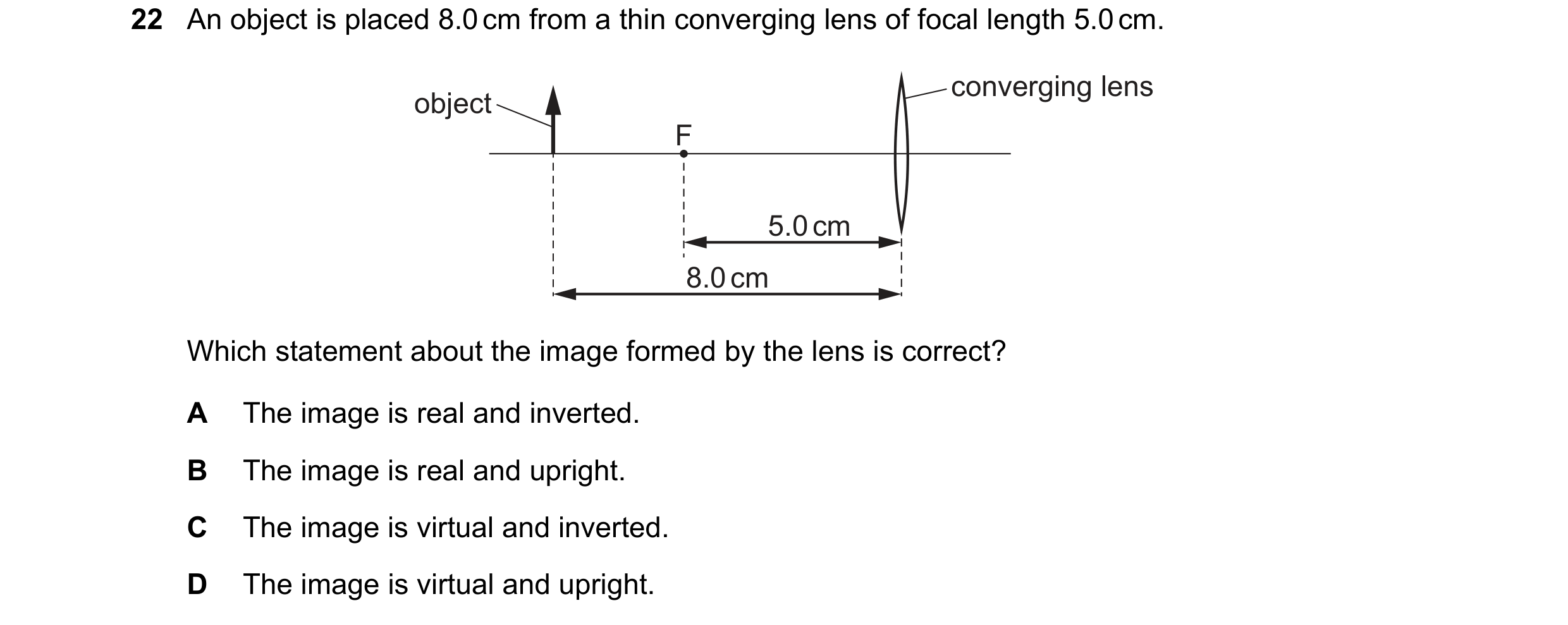
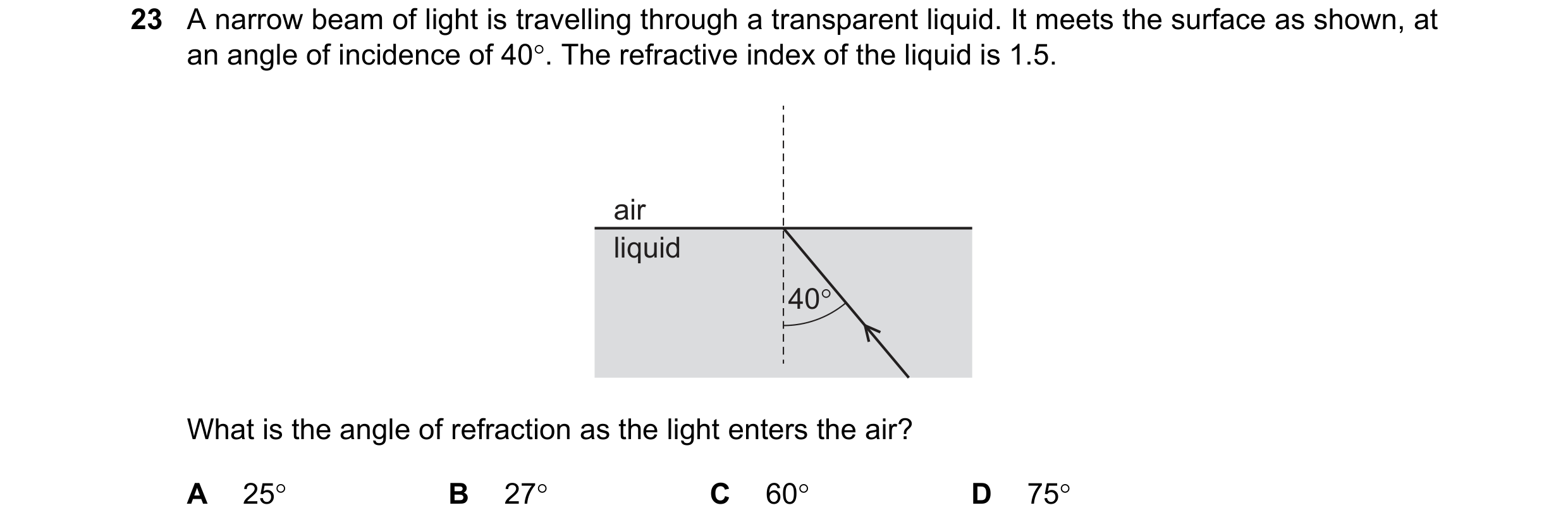 17 / 65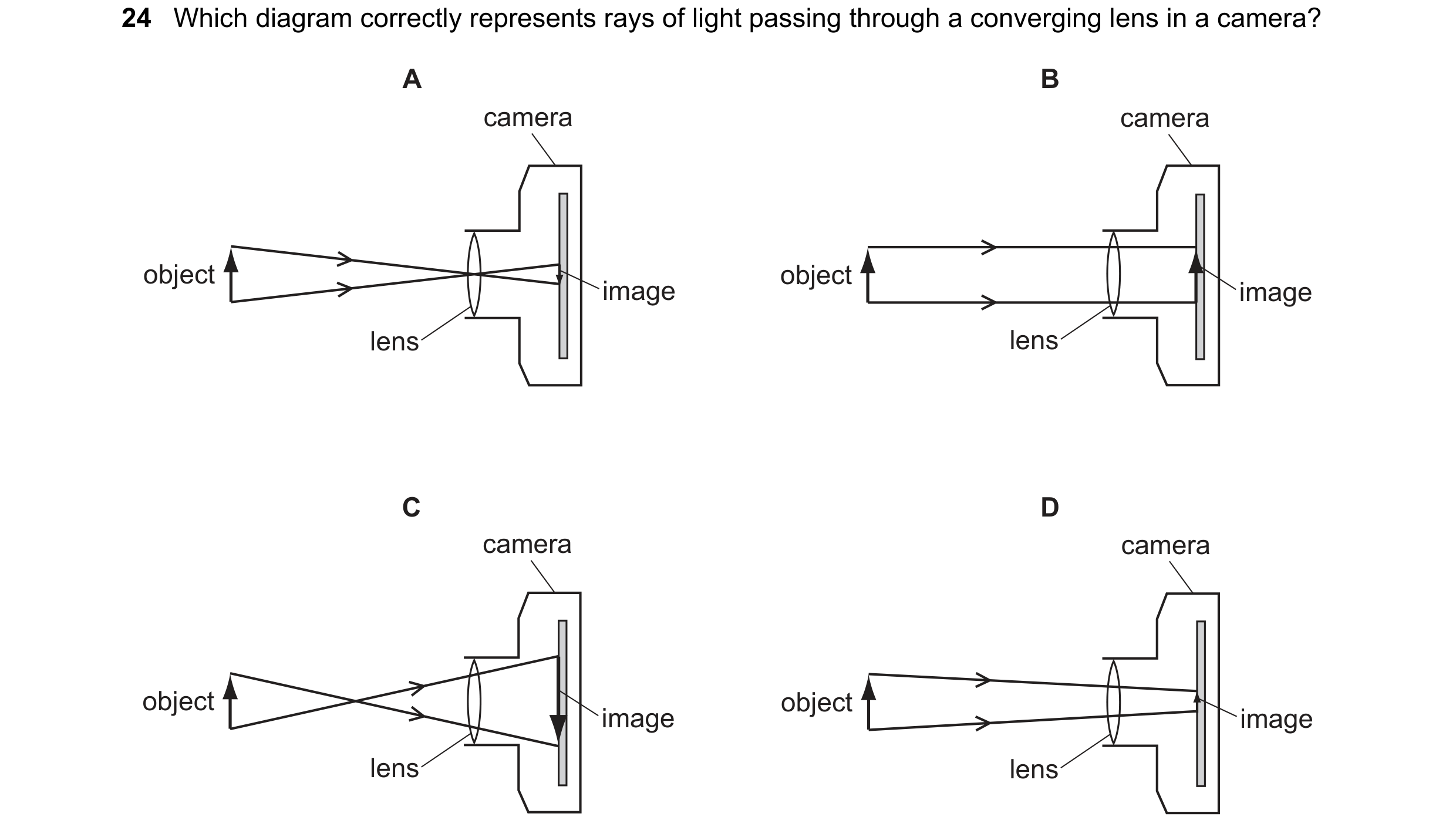
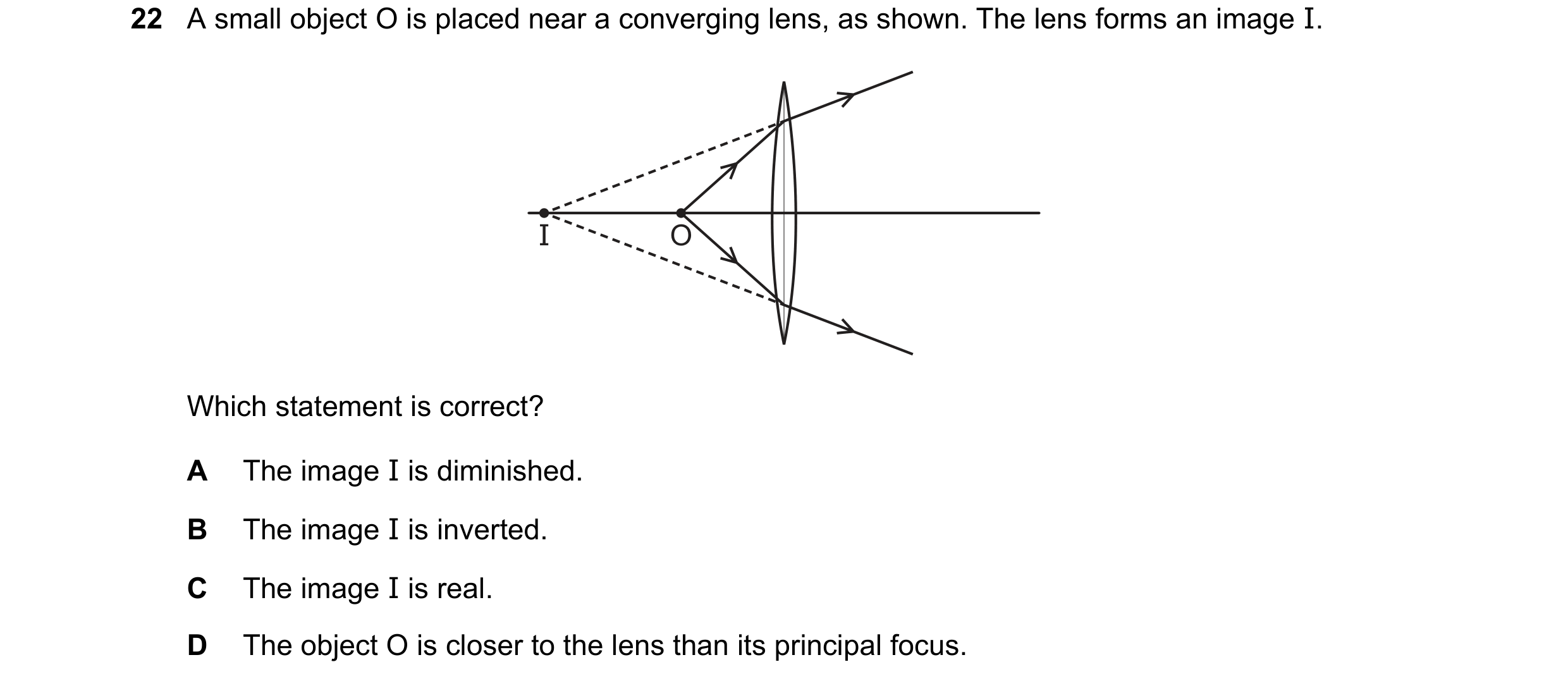 18 / 65
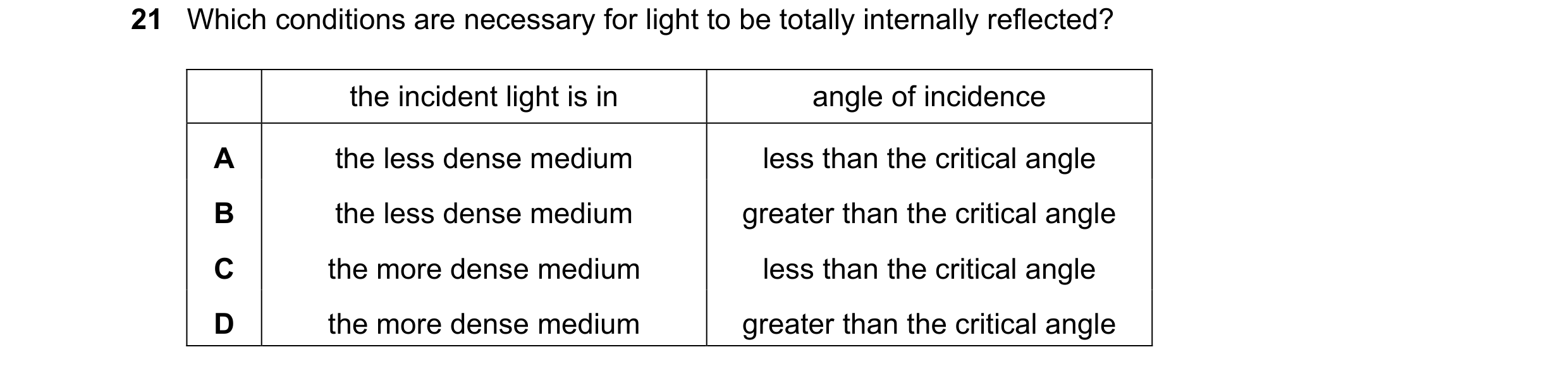

 19 / 65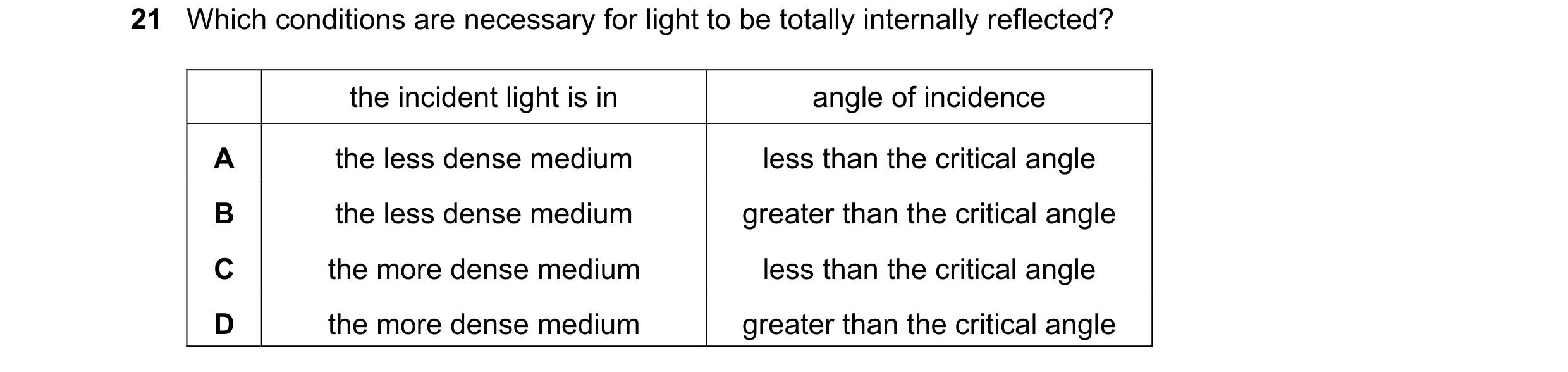
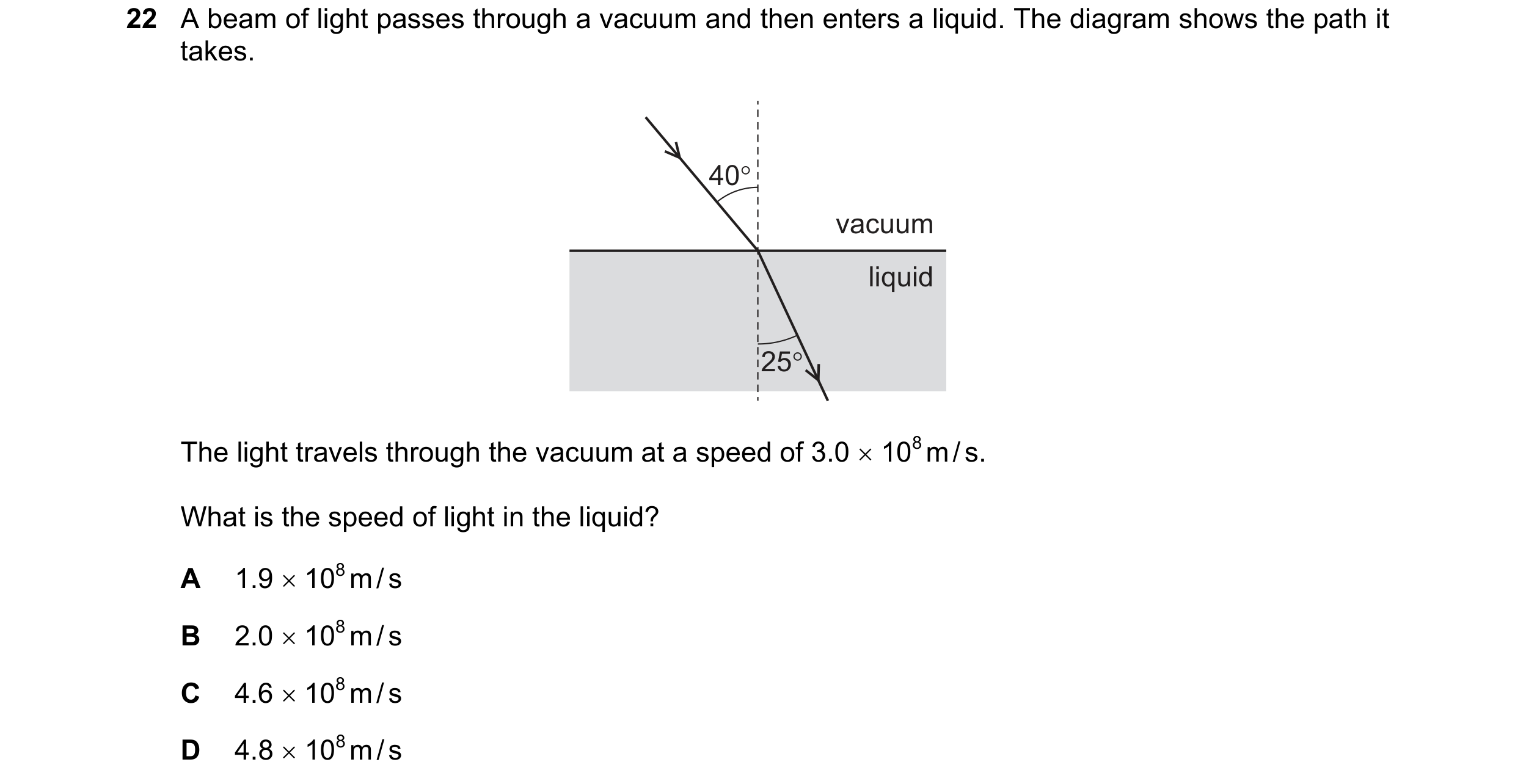
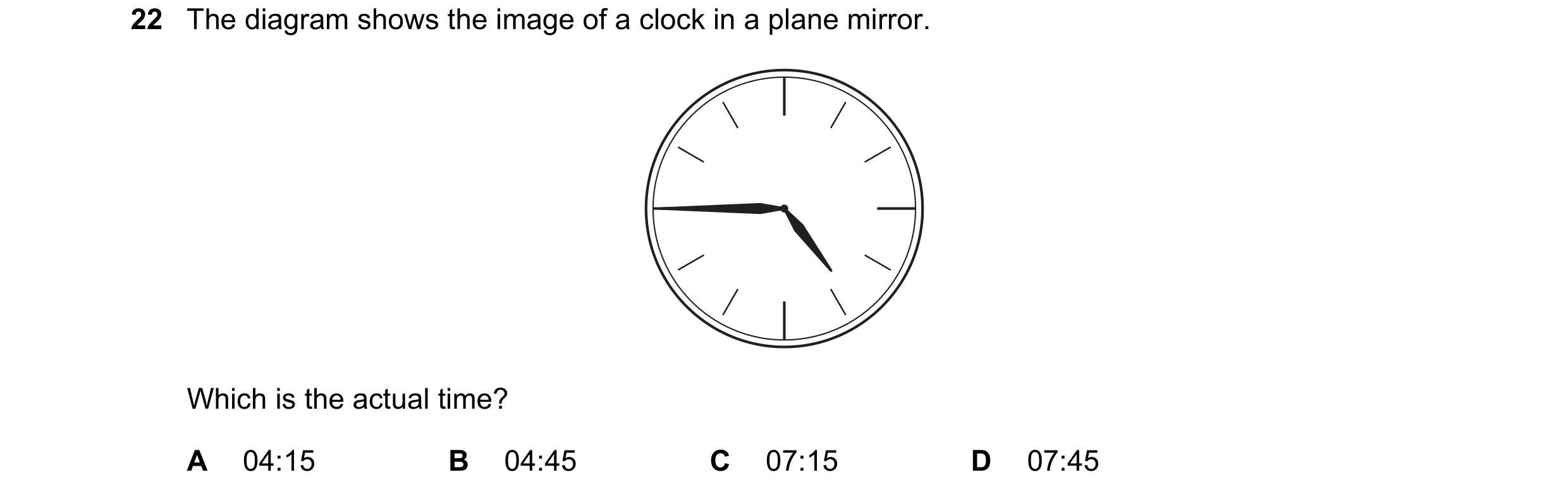 20 / 65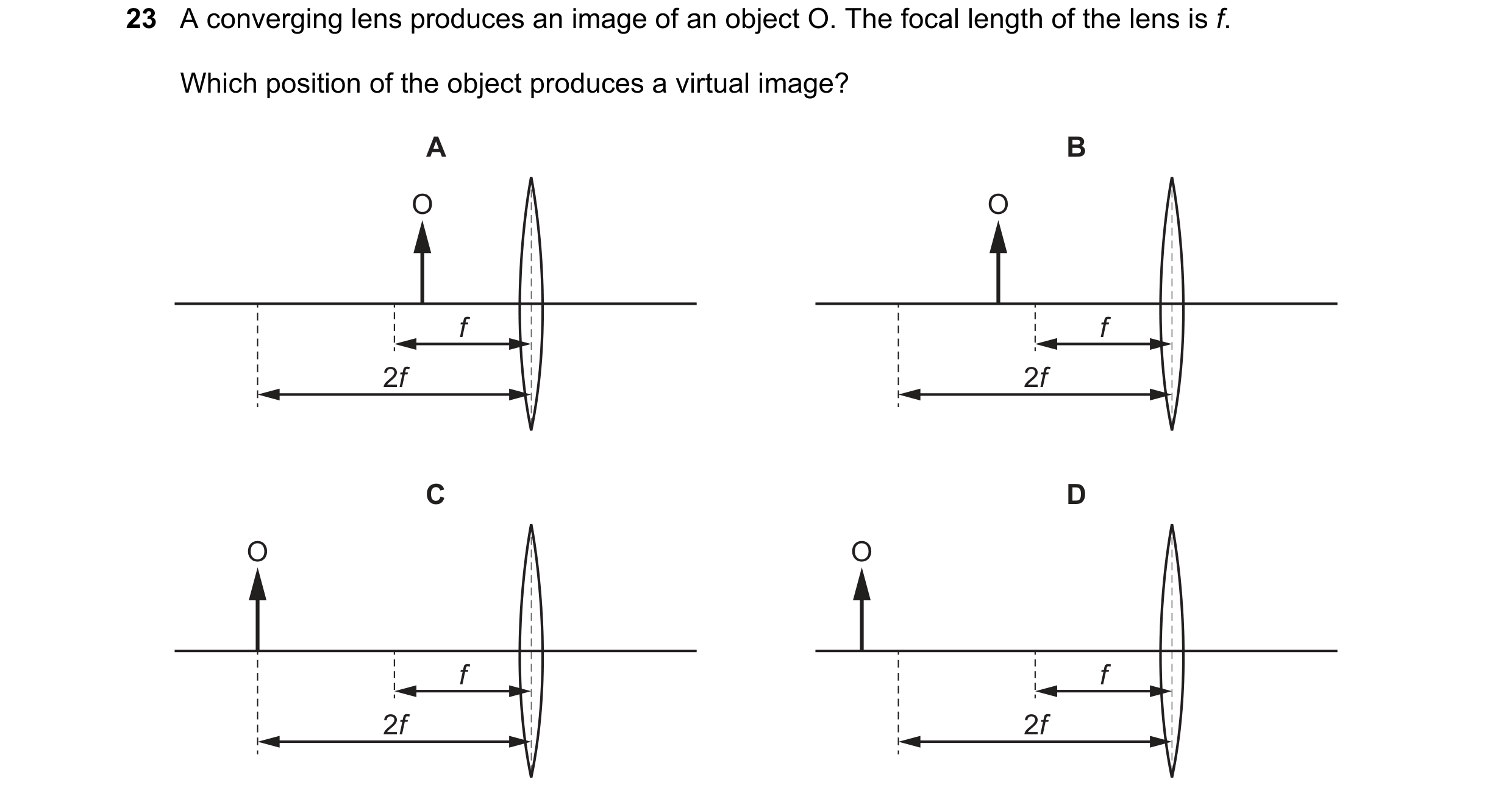
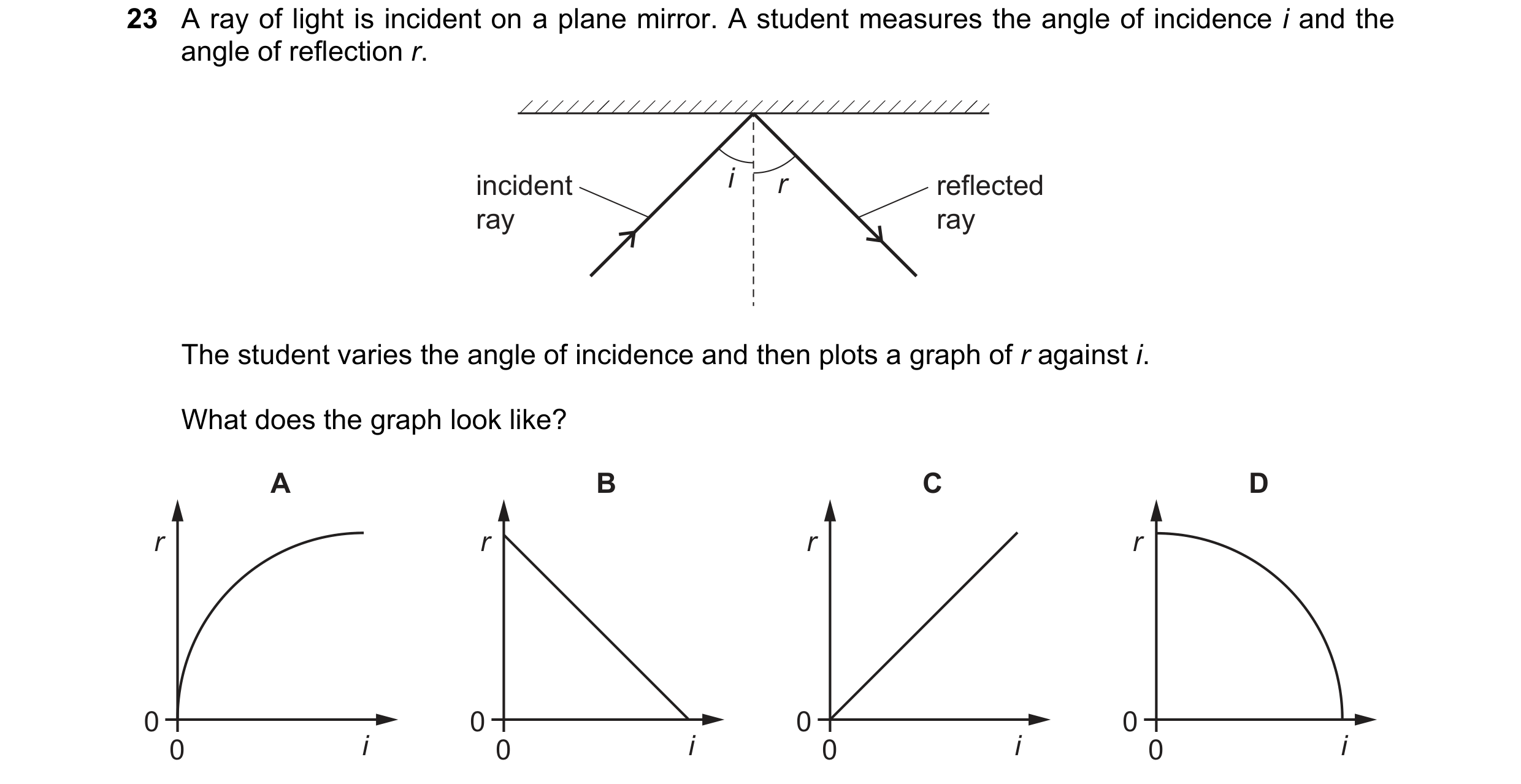
 21 / 65
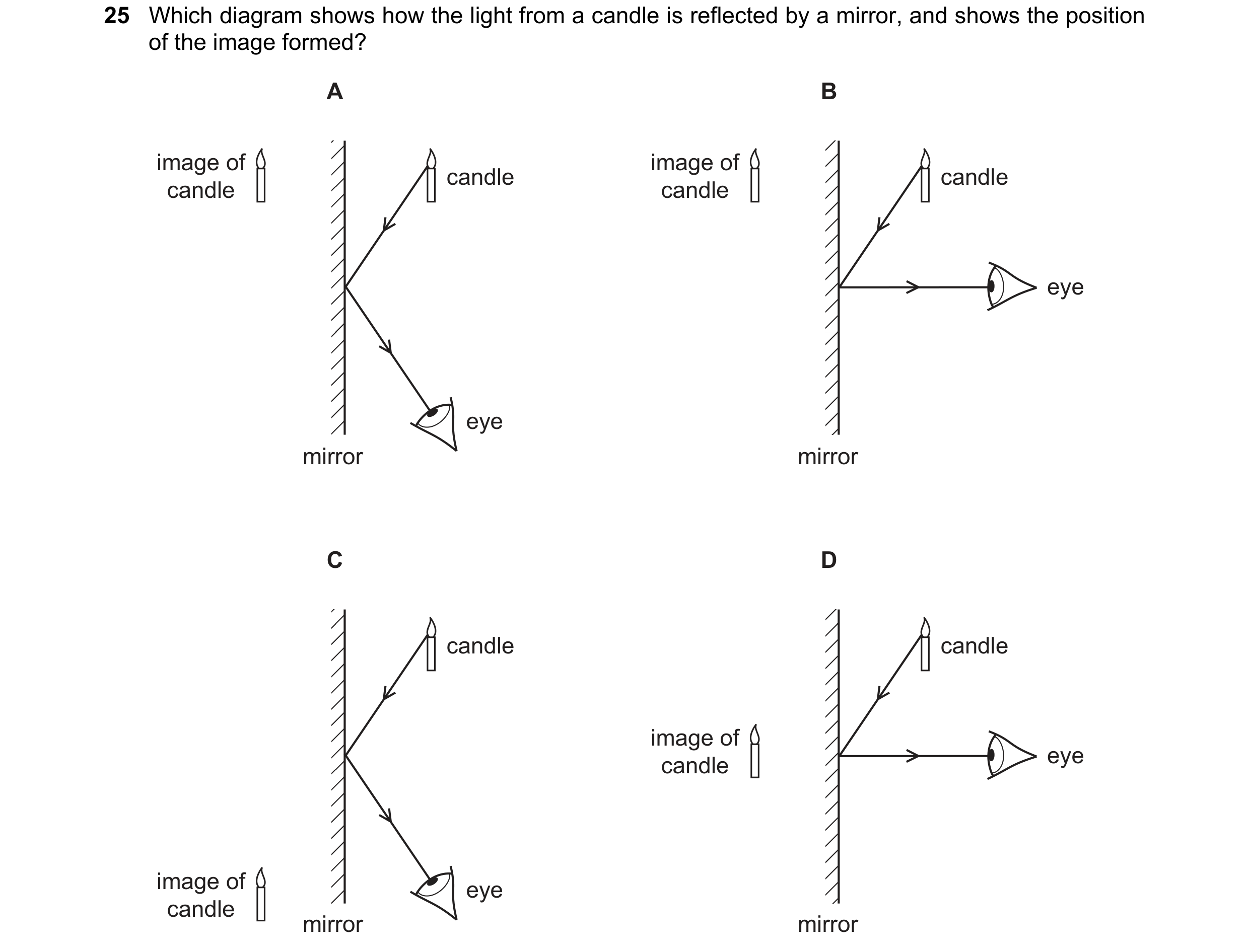 22 / 65
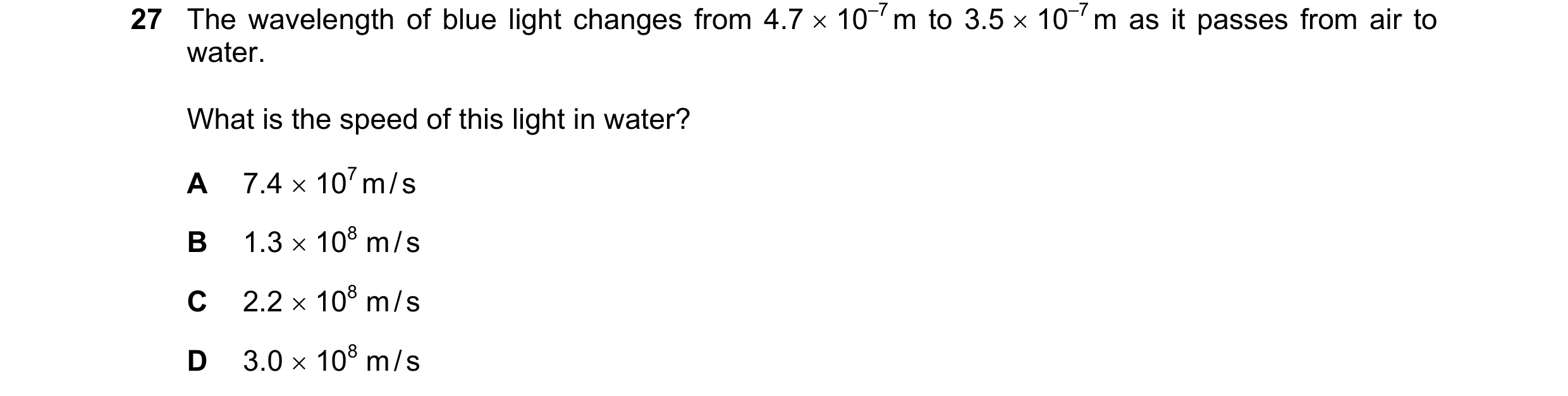
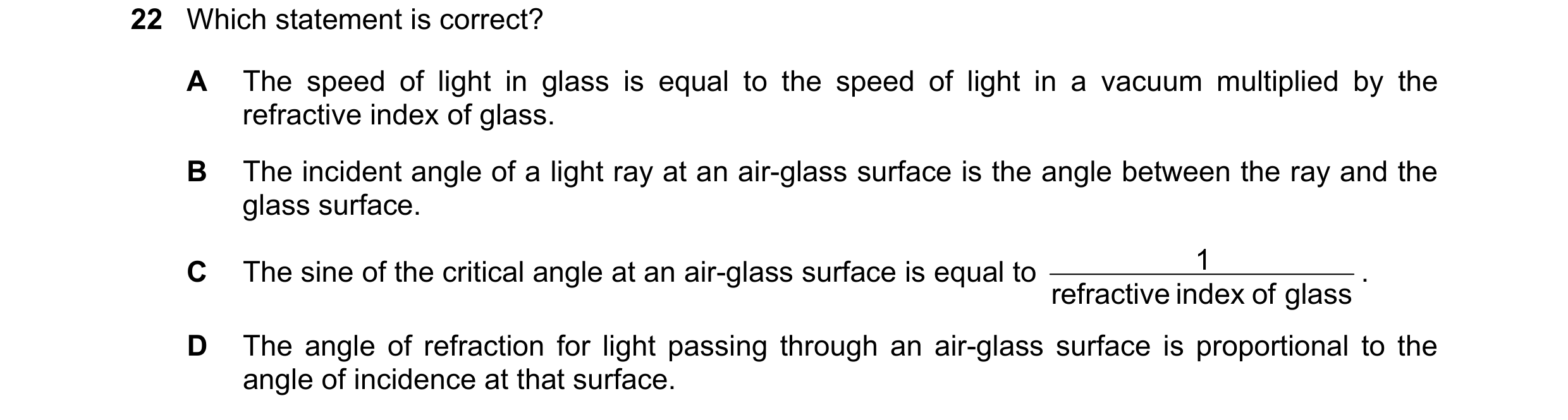
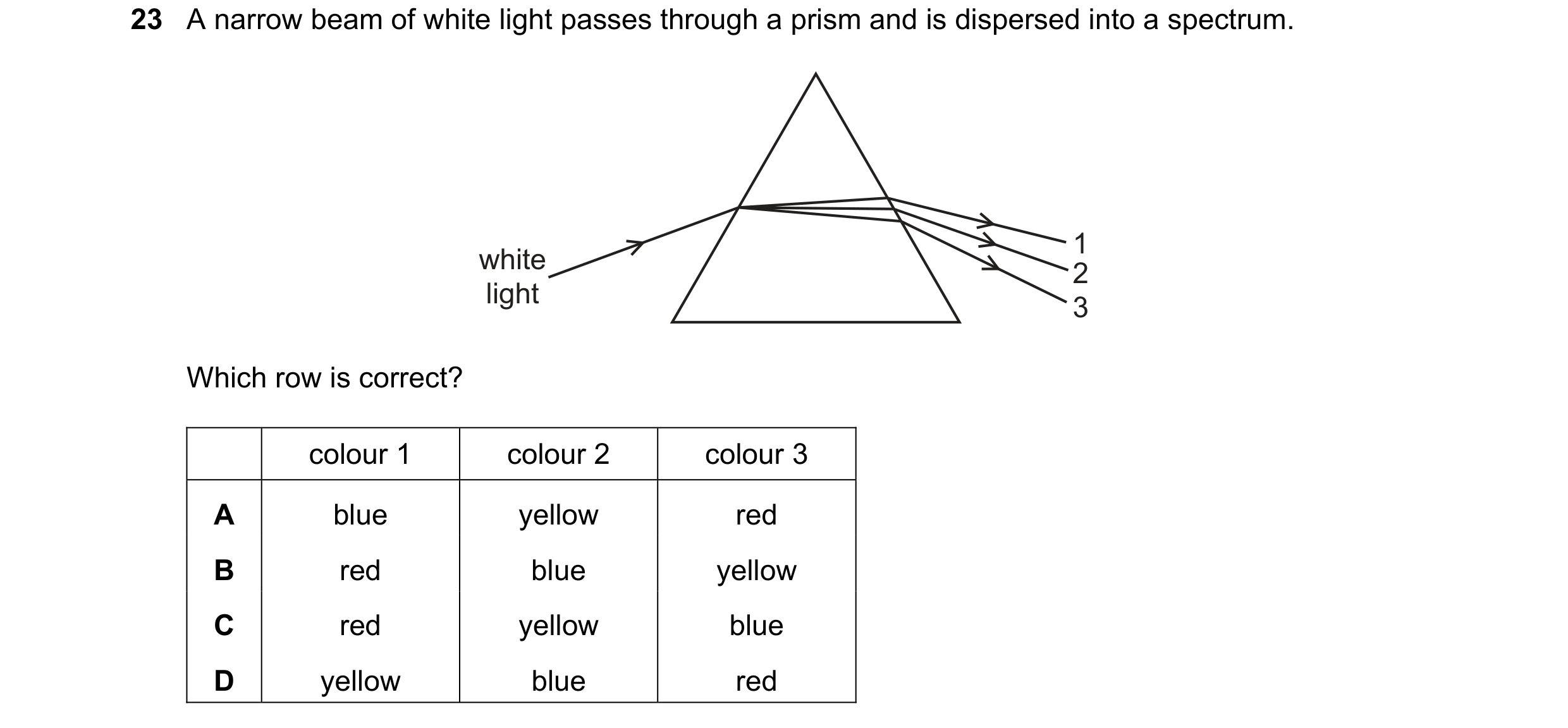 23 / 65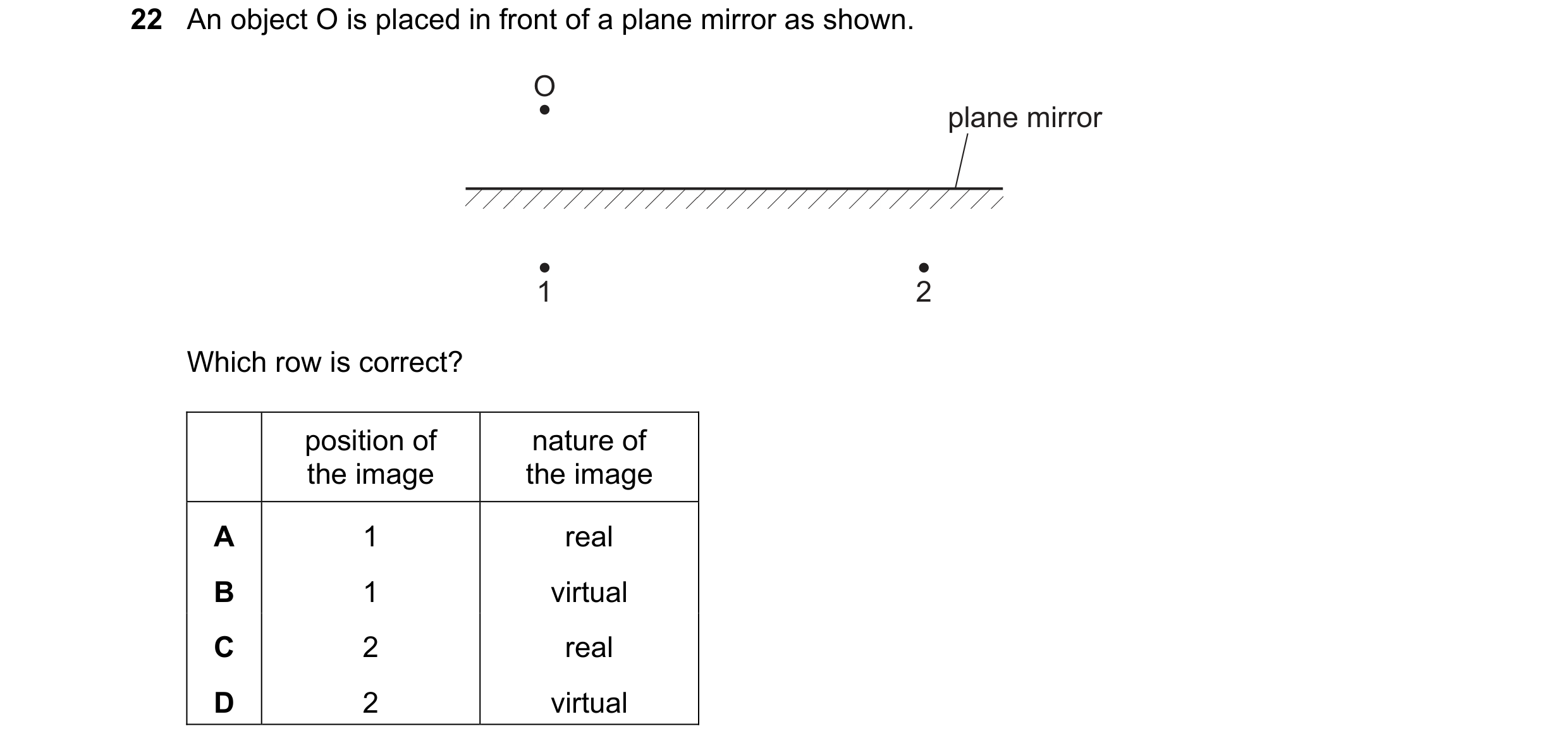
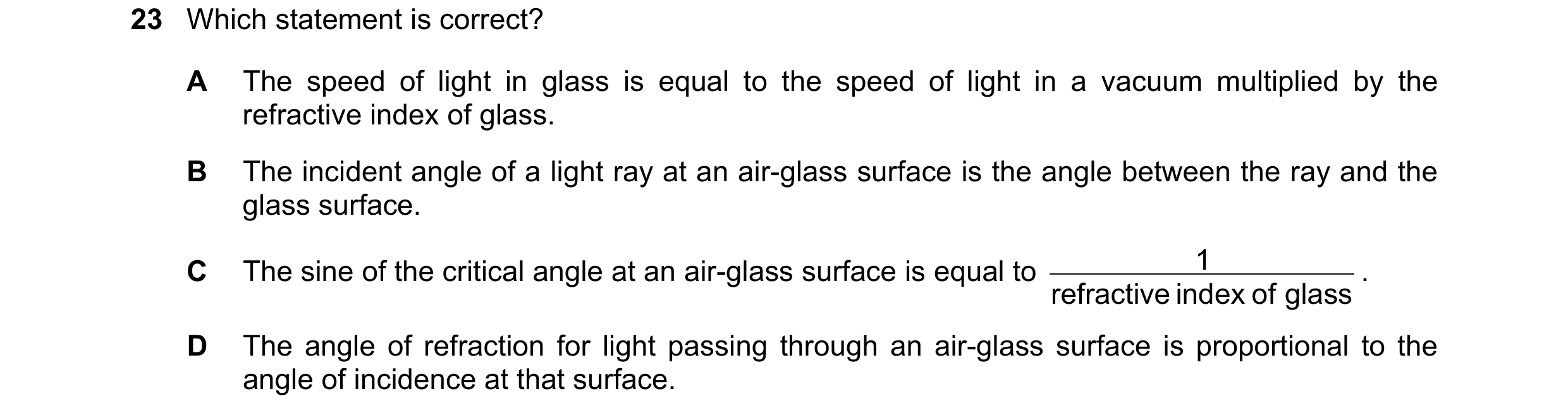
 24 / 65
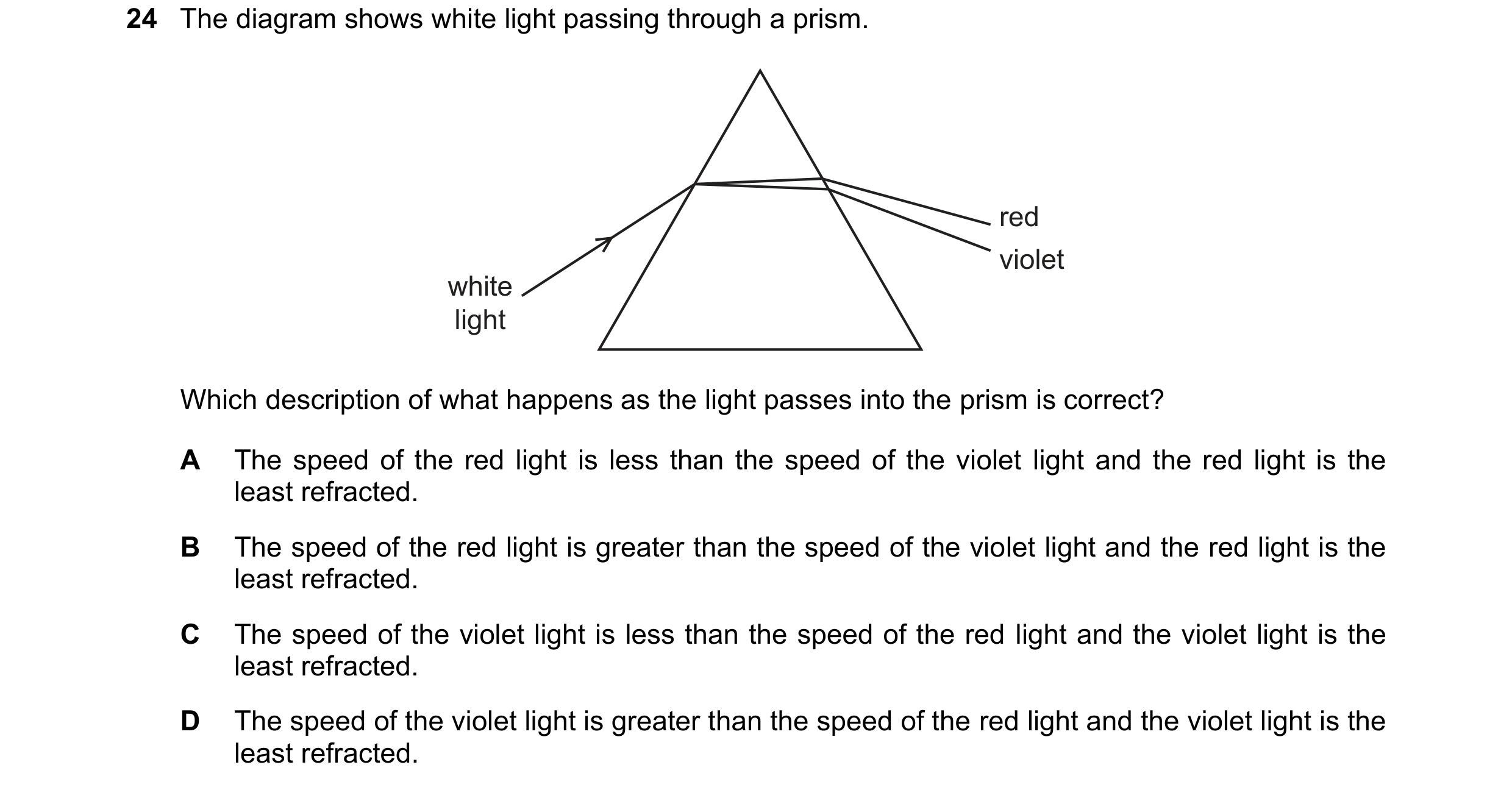 25 / 65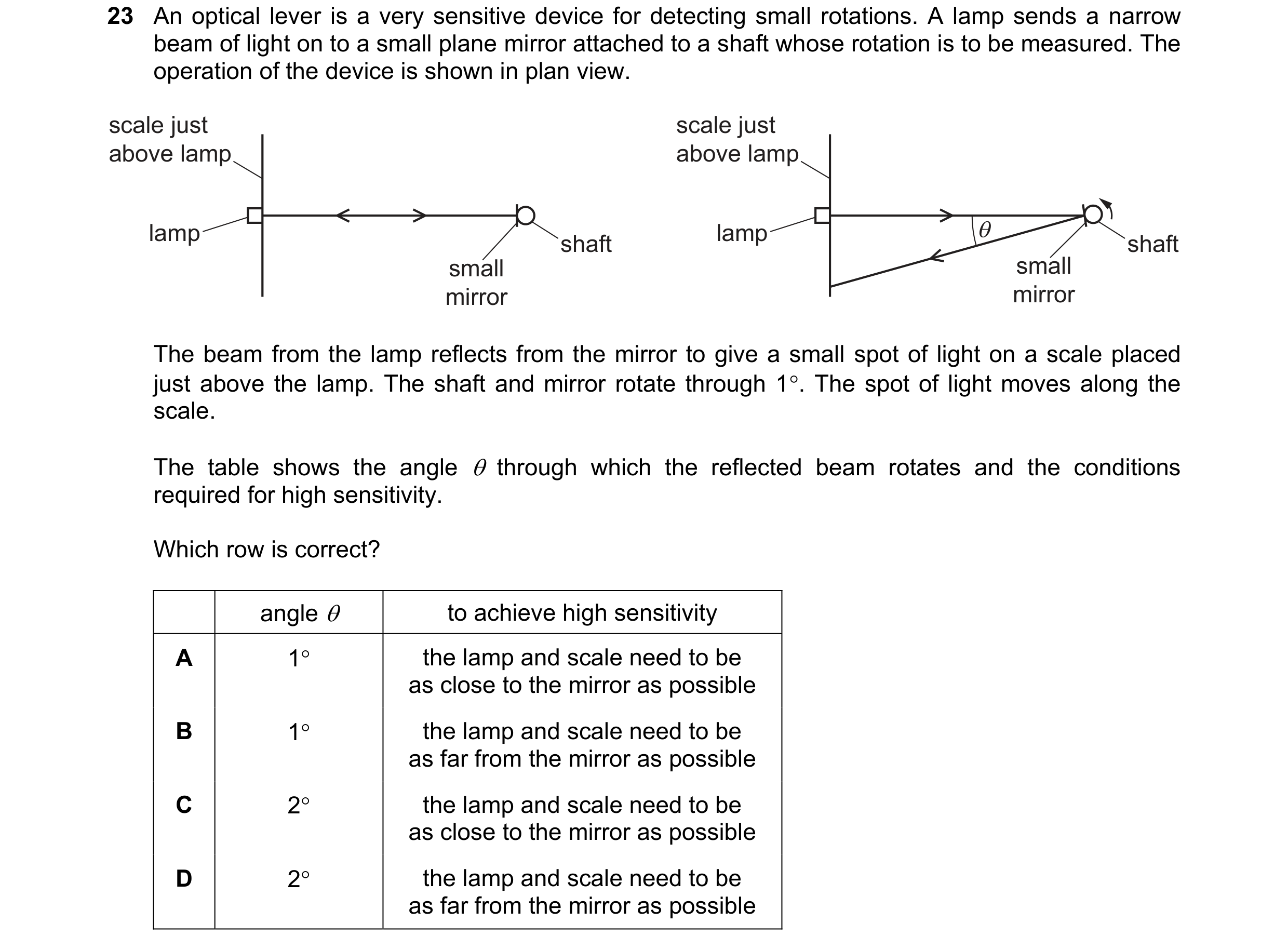
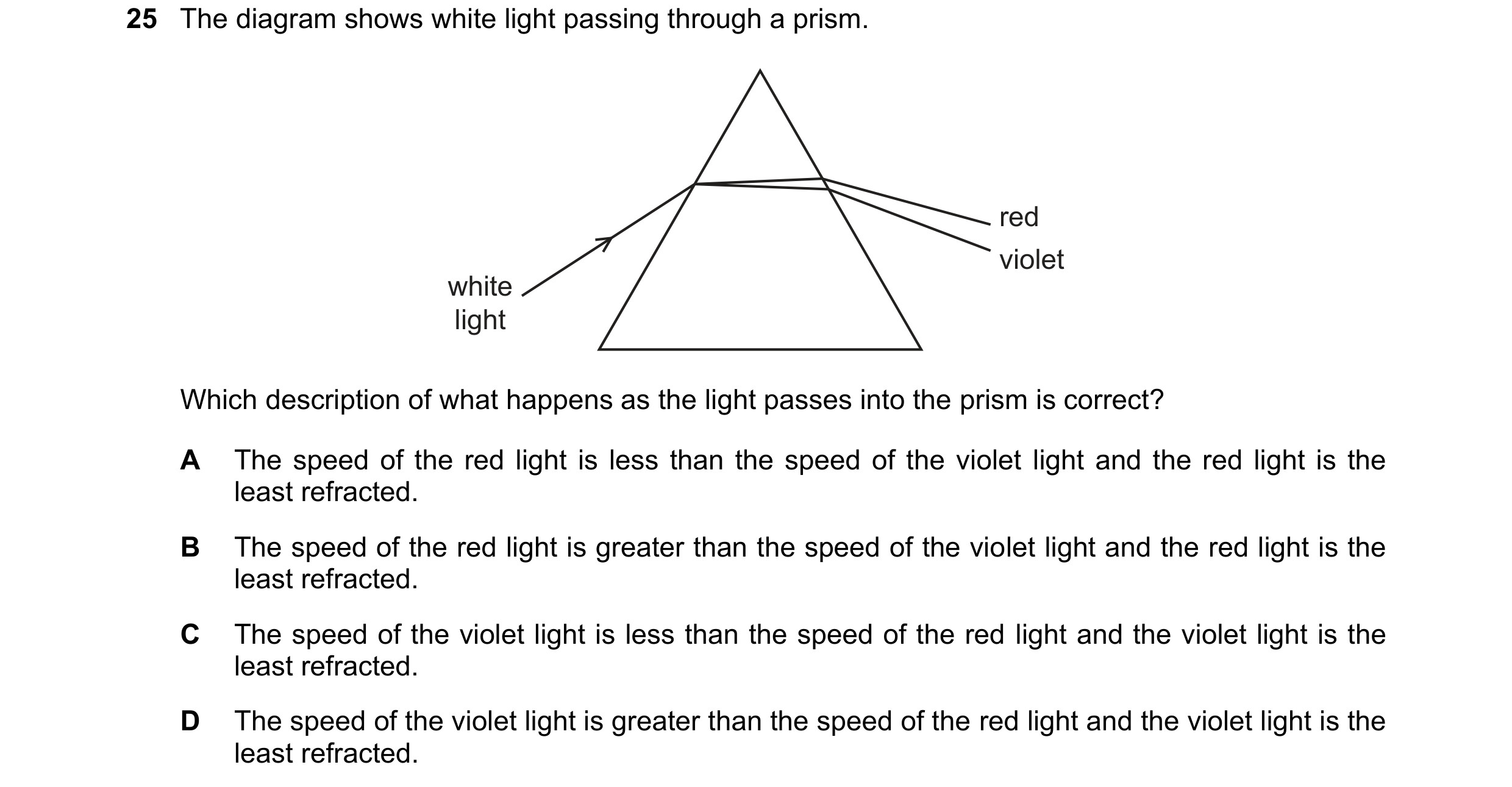 26 / 65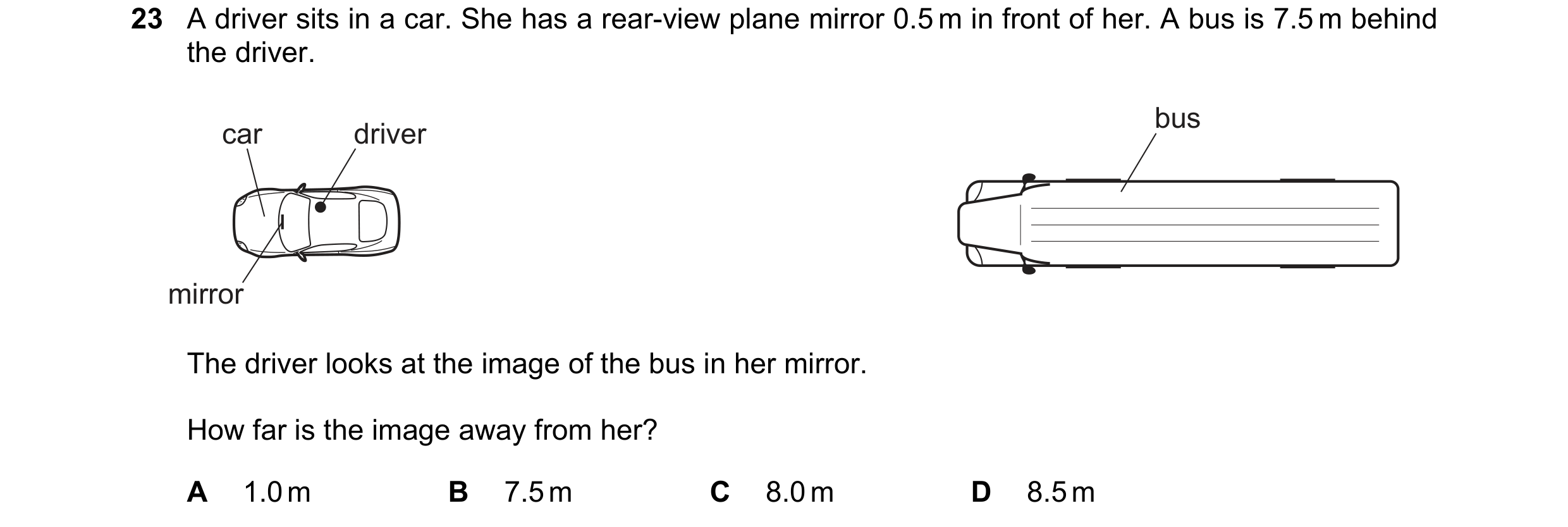
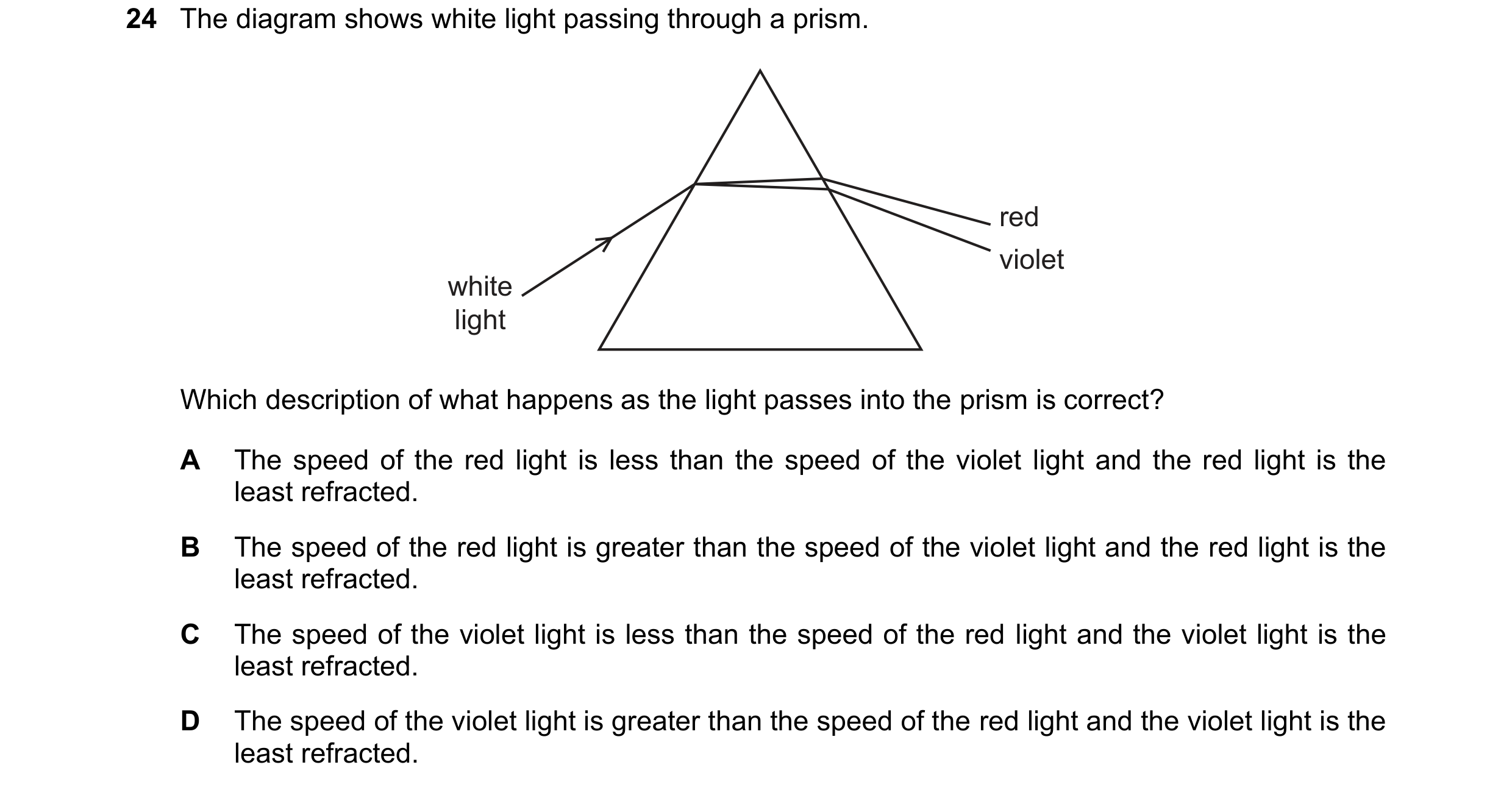

 27 / 65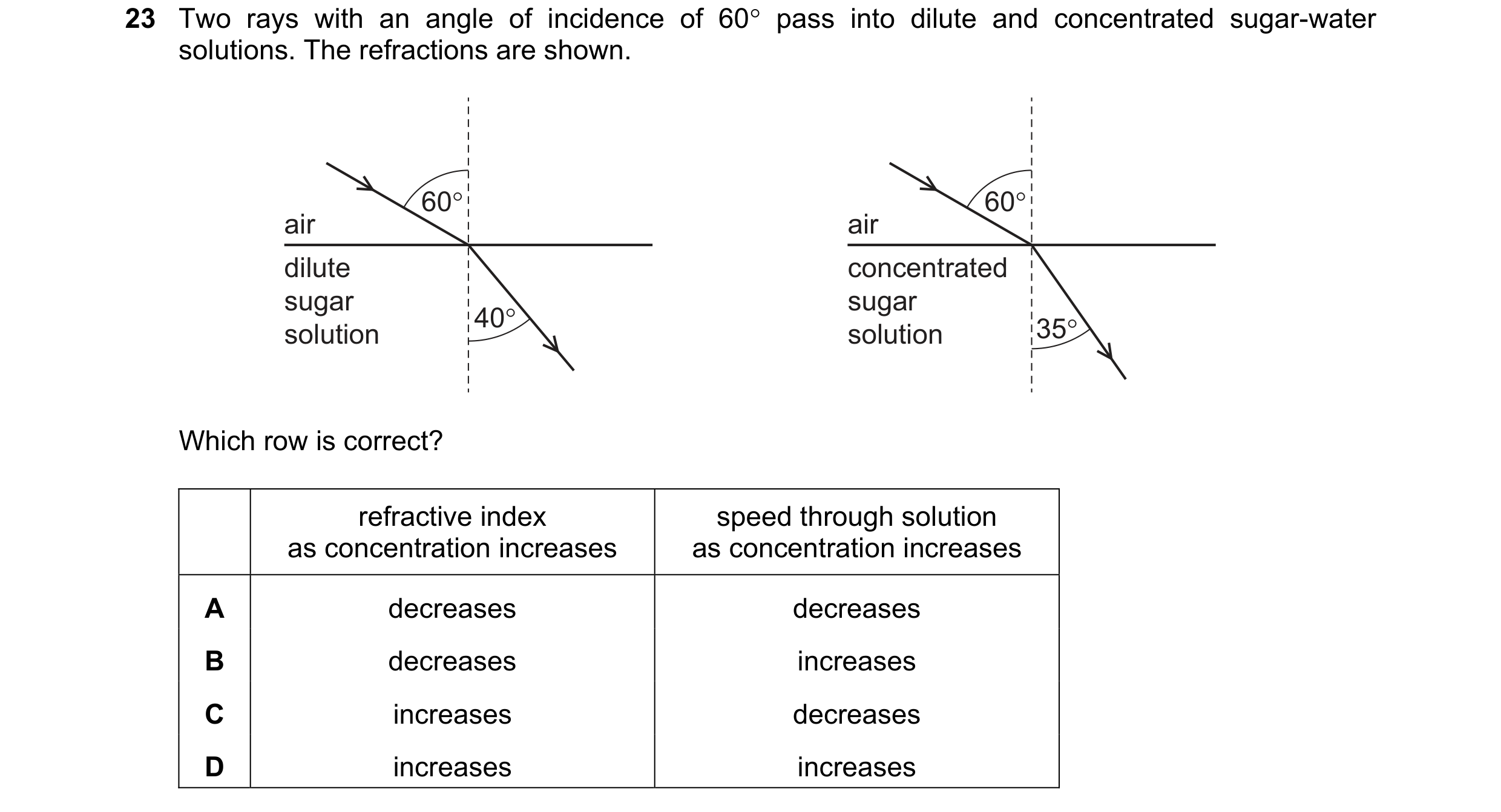
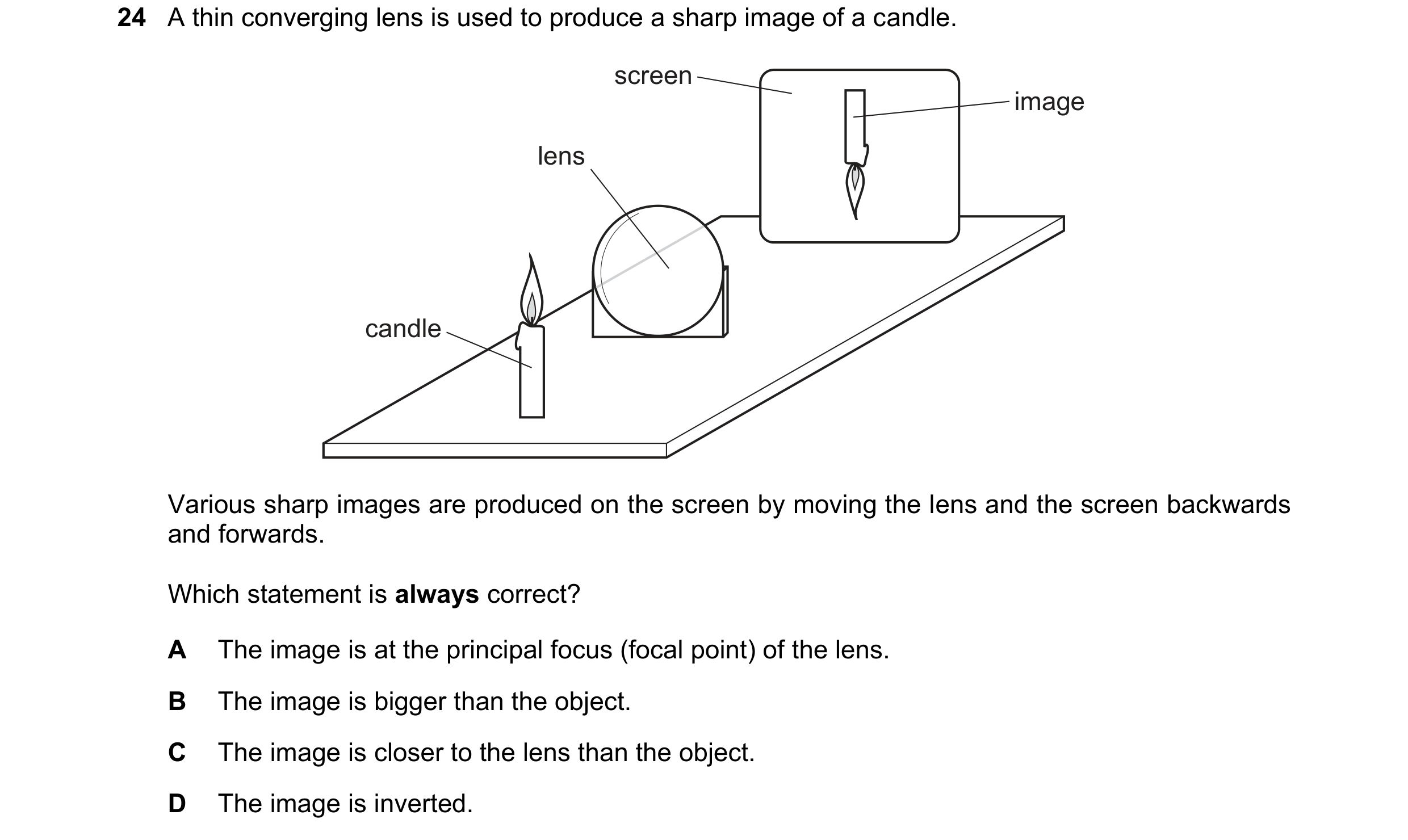 28 / 65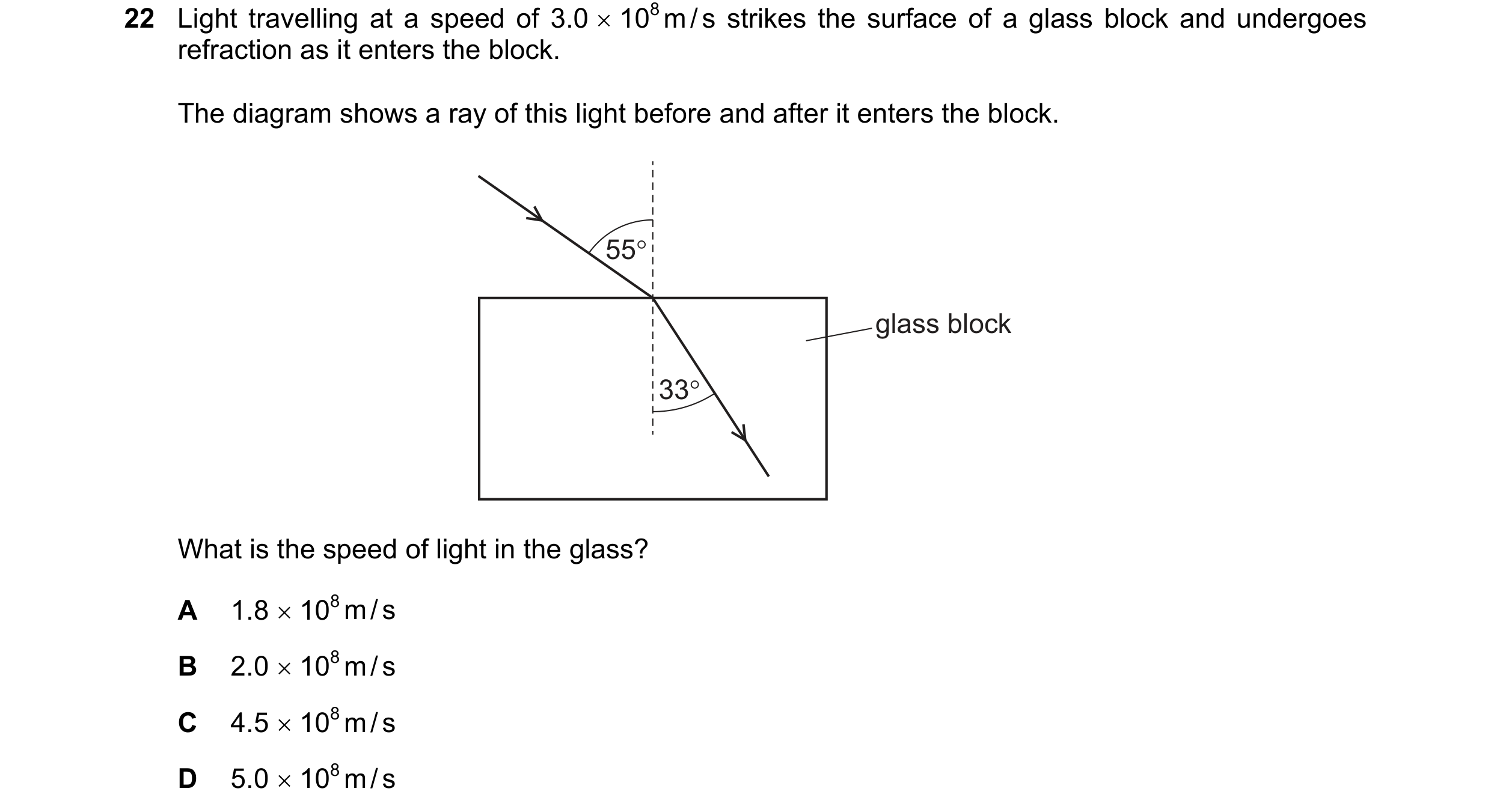

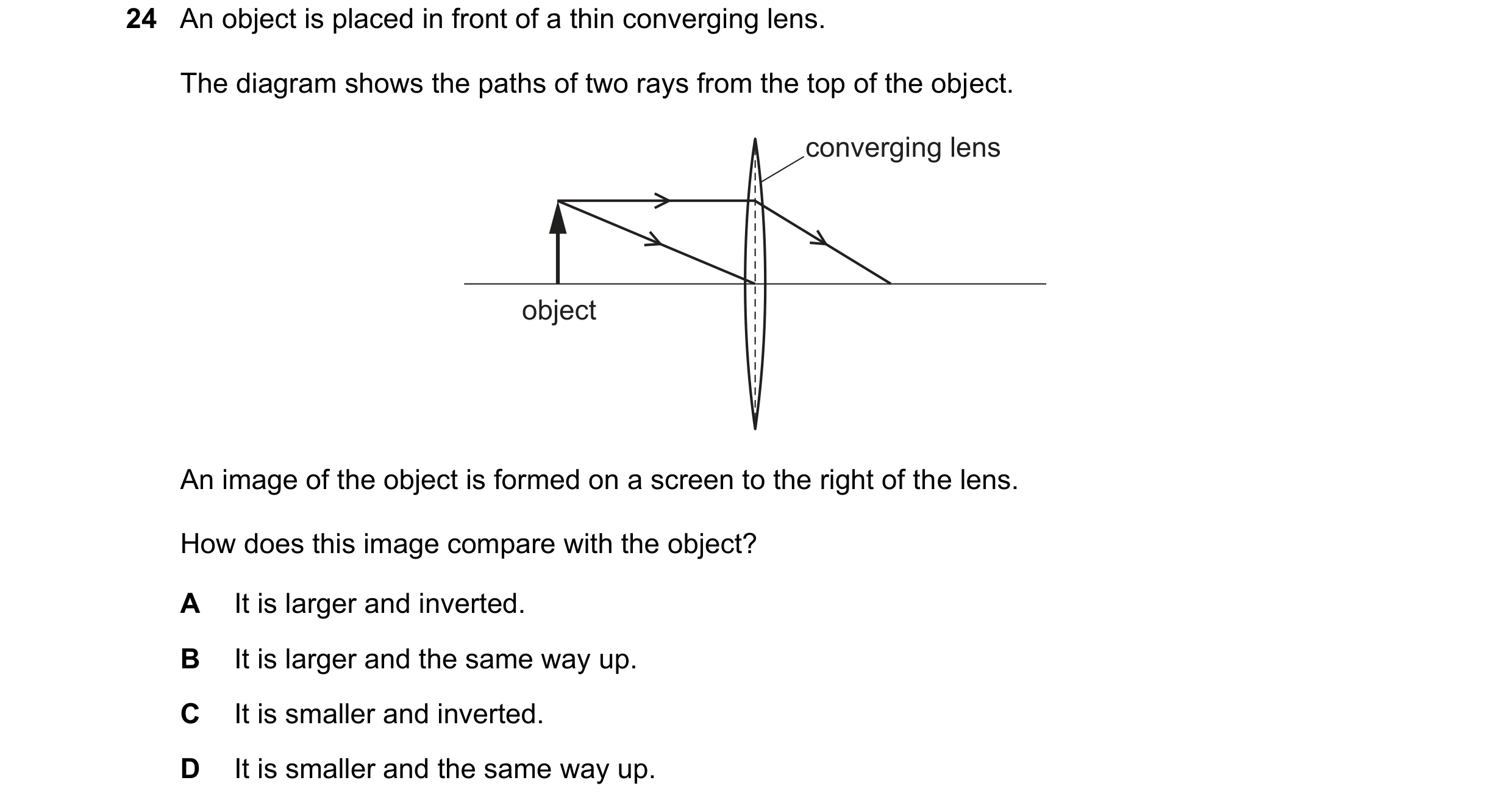 29 / 65
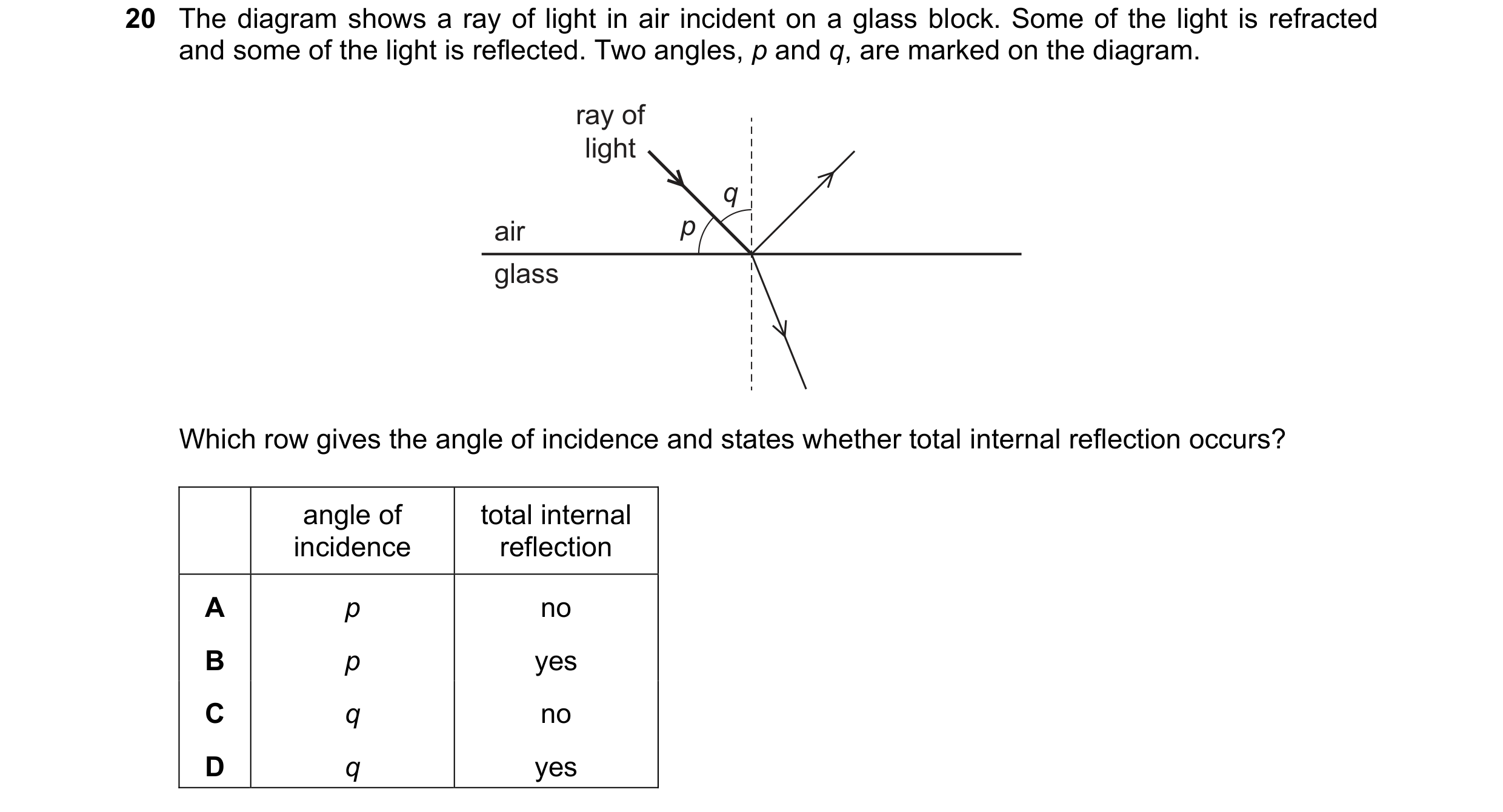
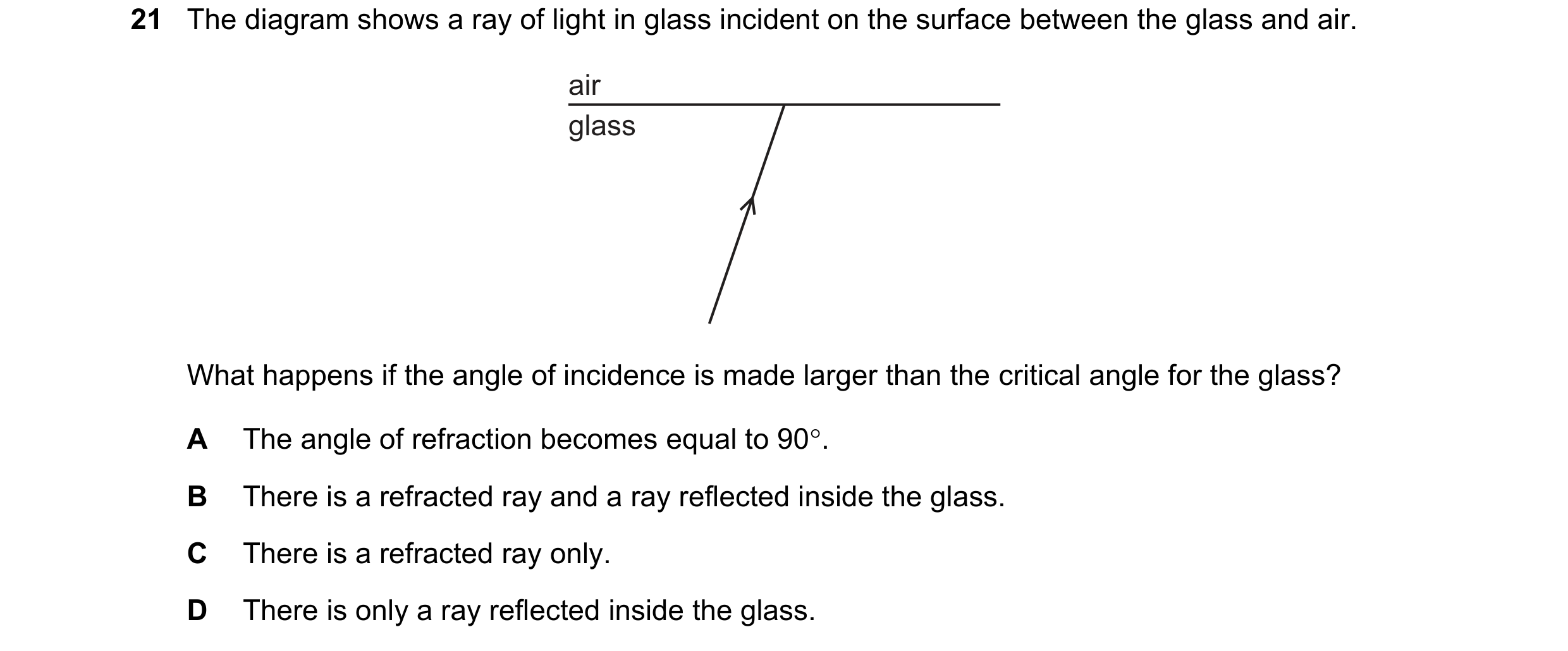 30 / 65
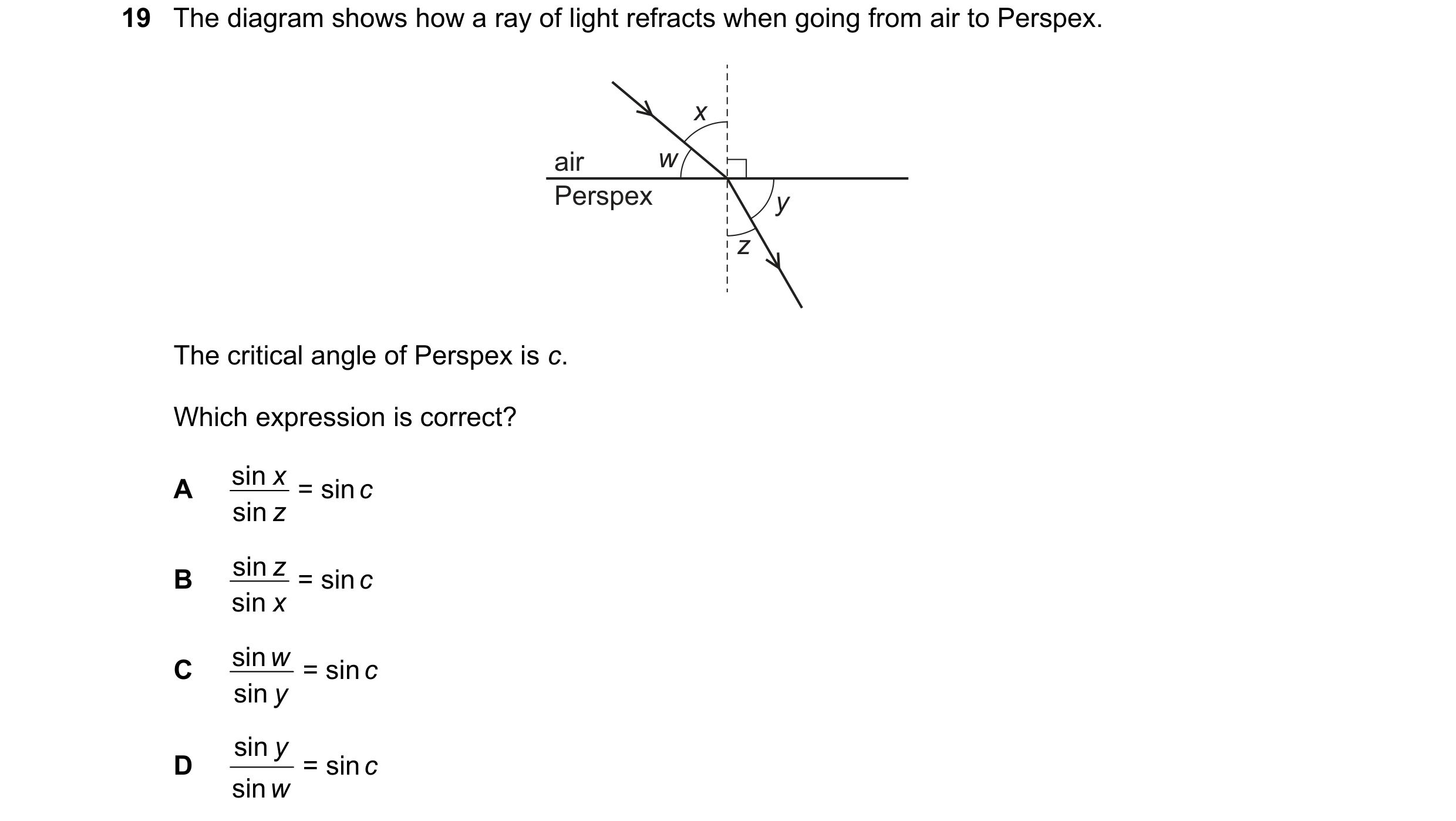 31 / 65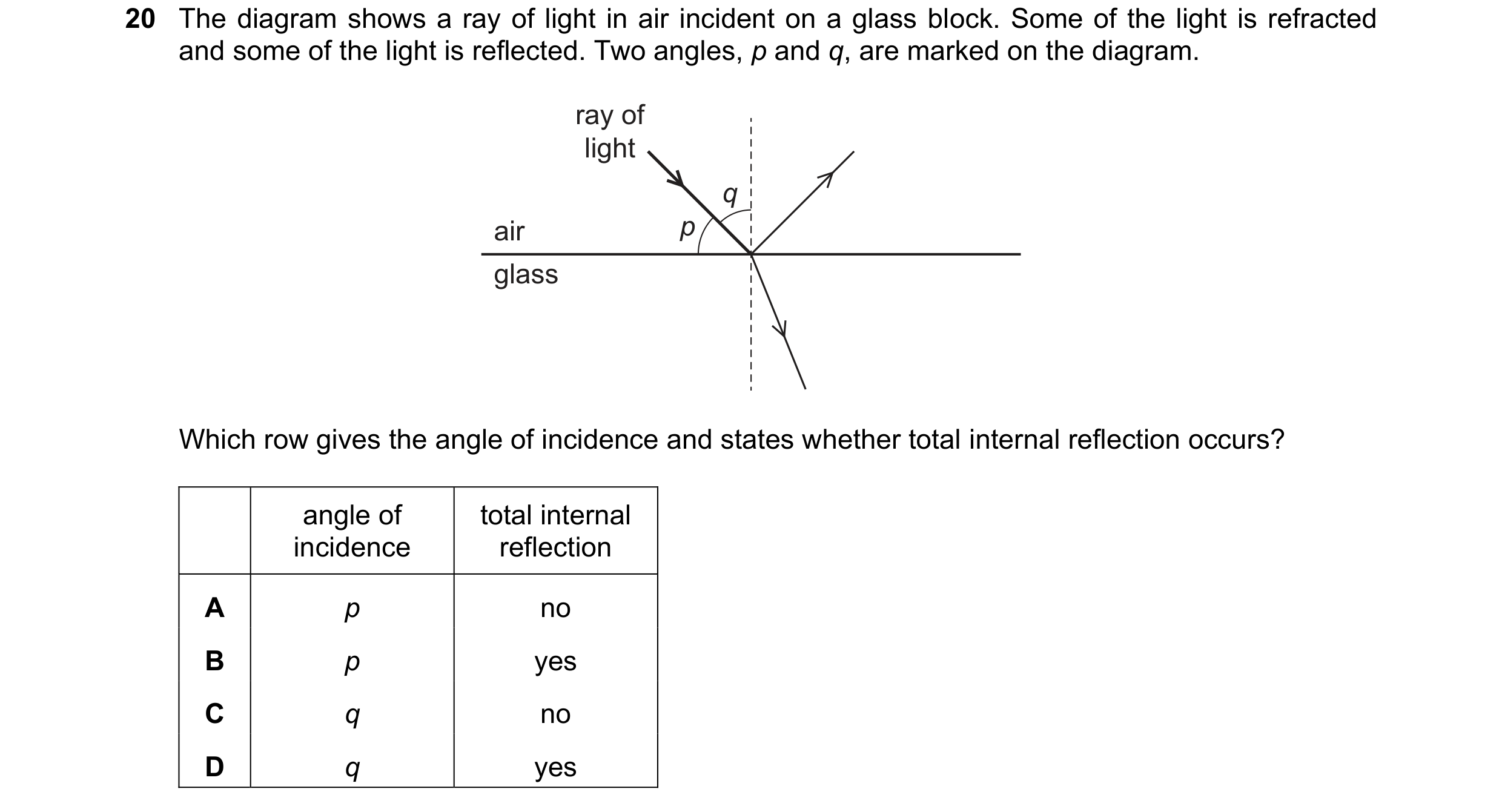
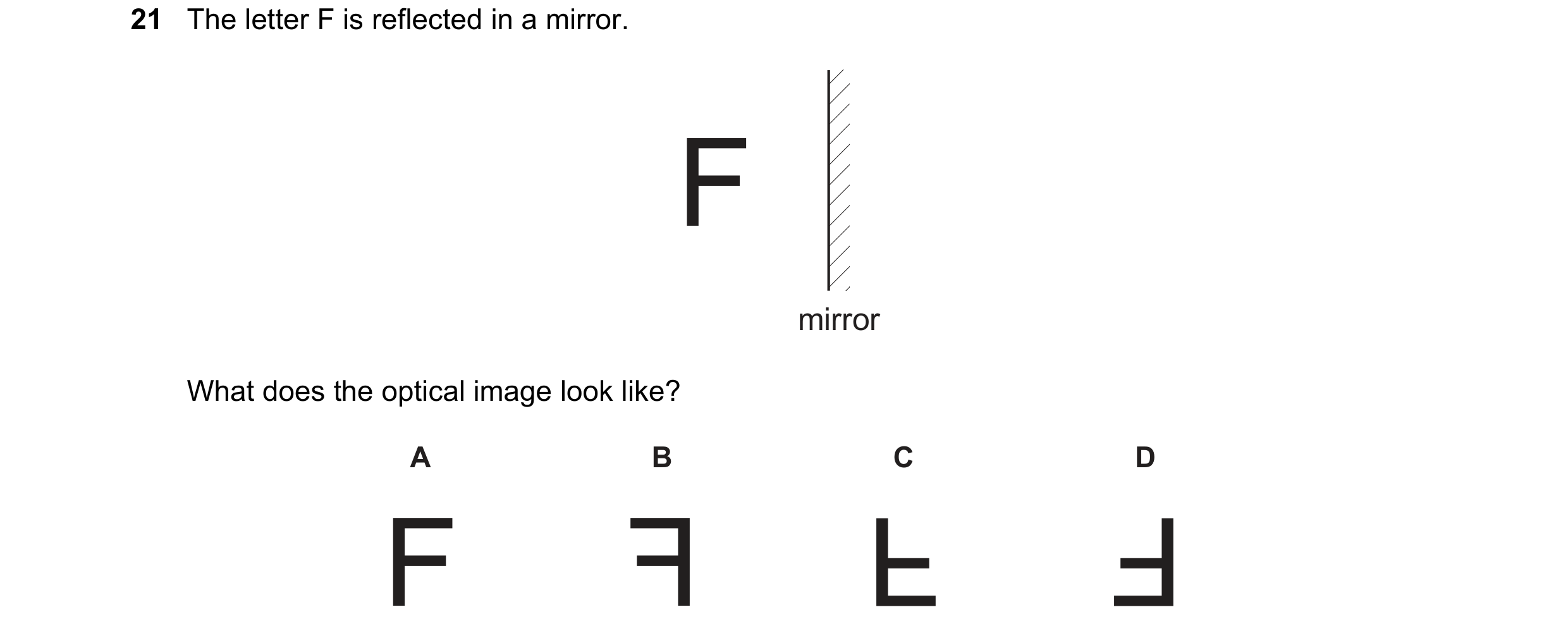
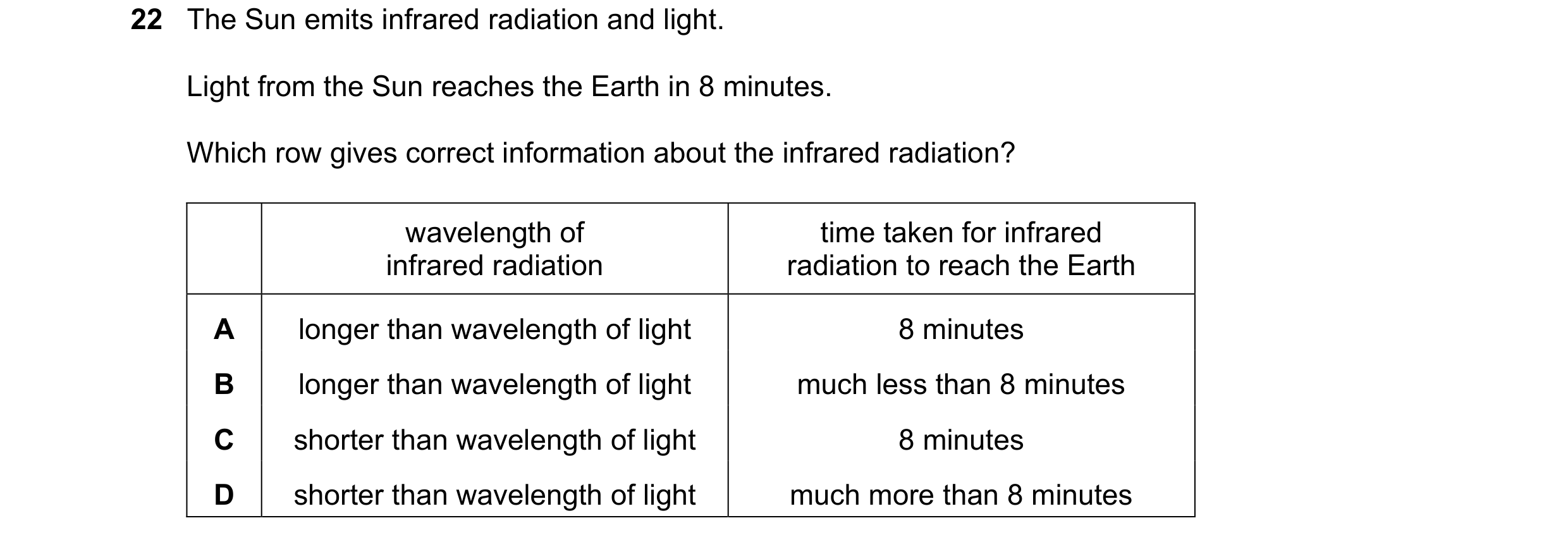 32 / 65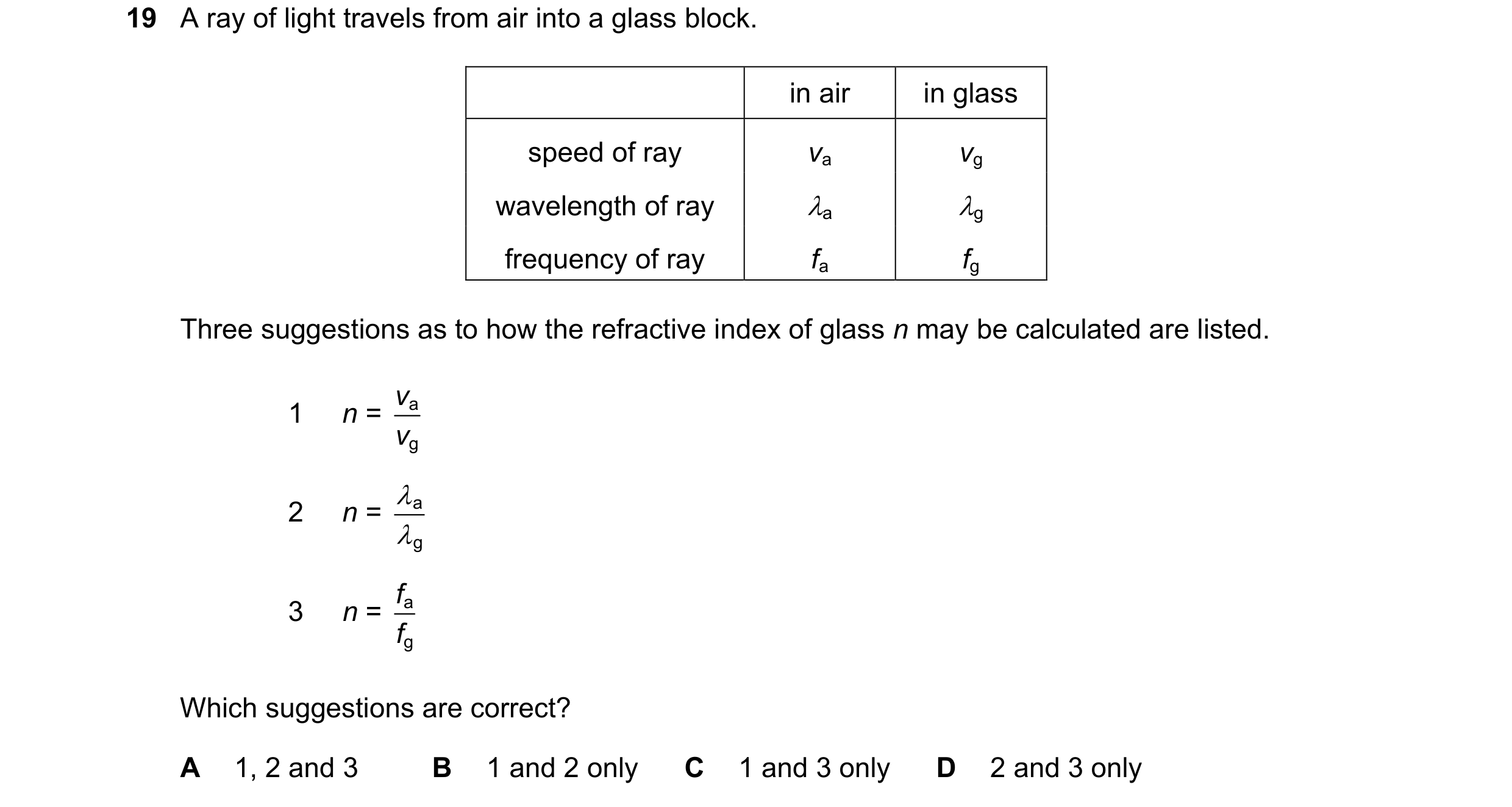
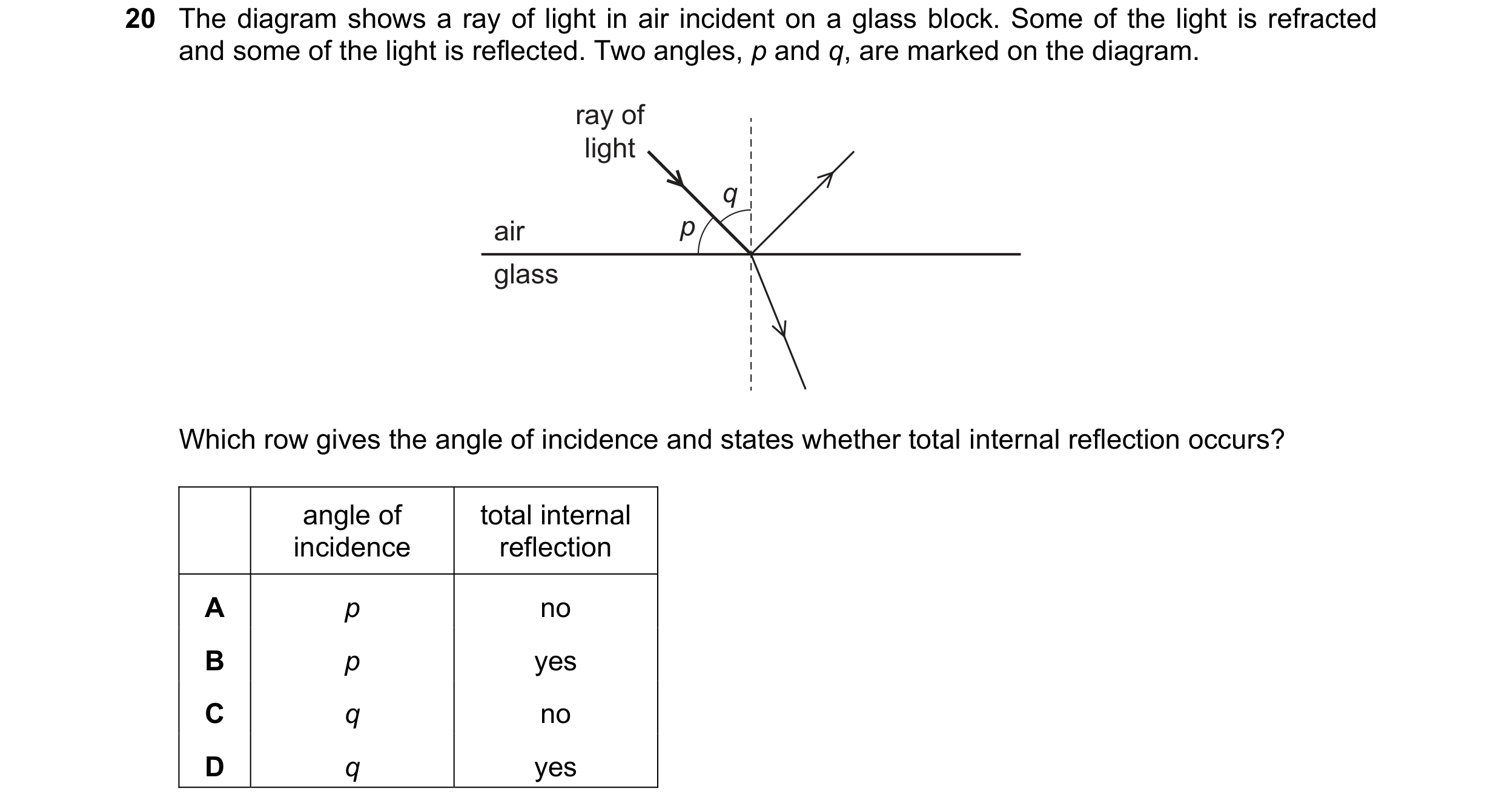 33 / 65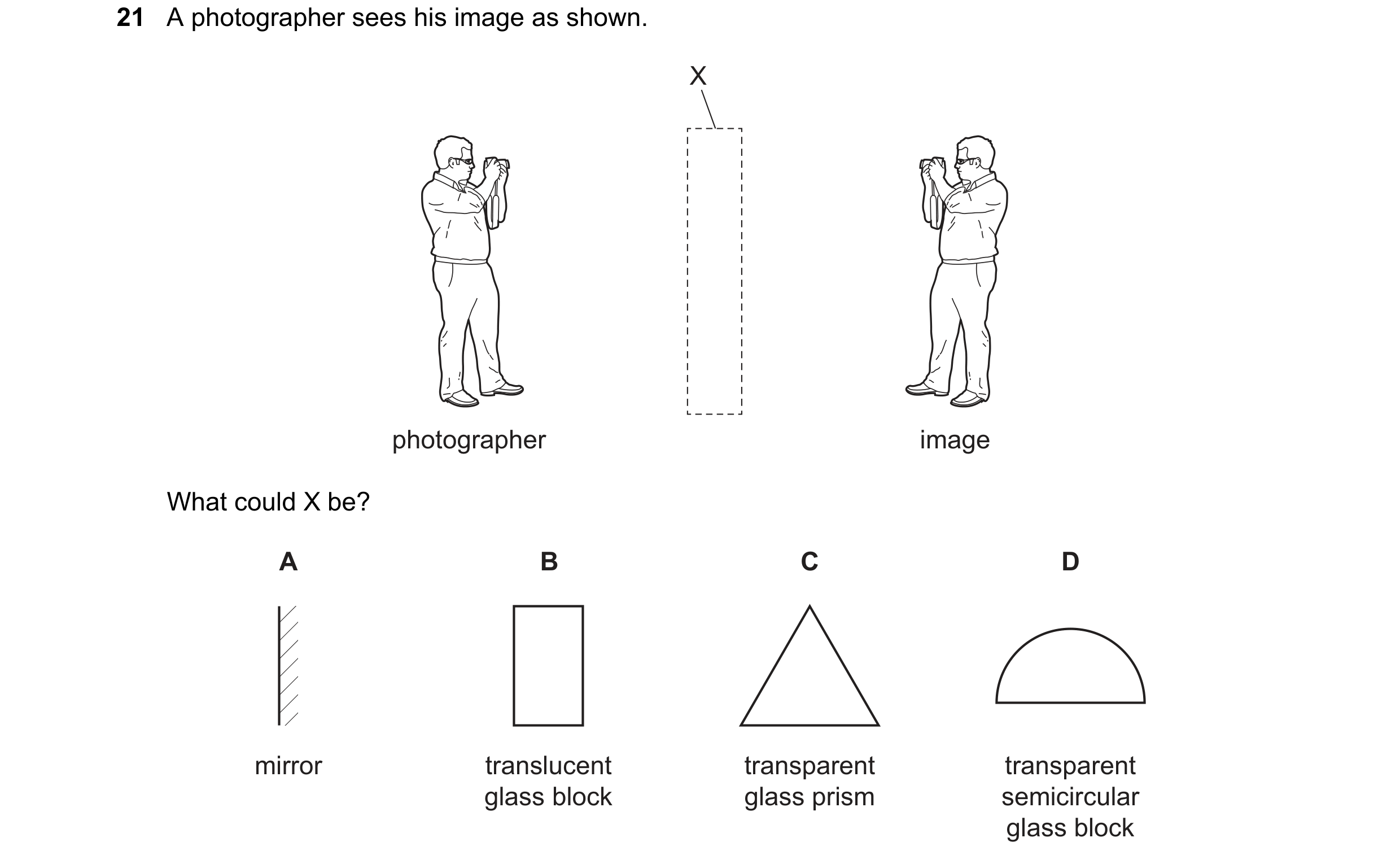
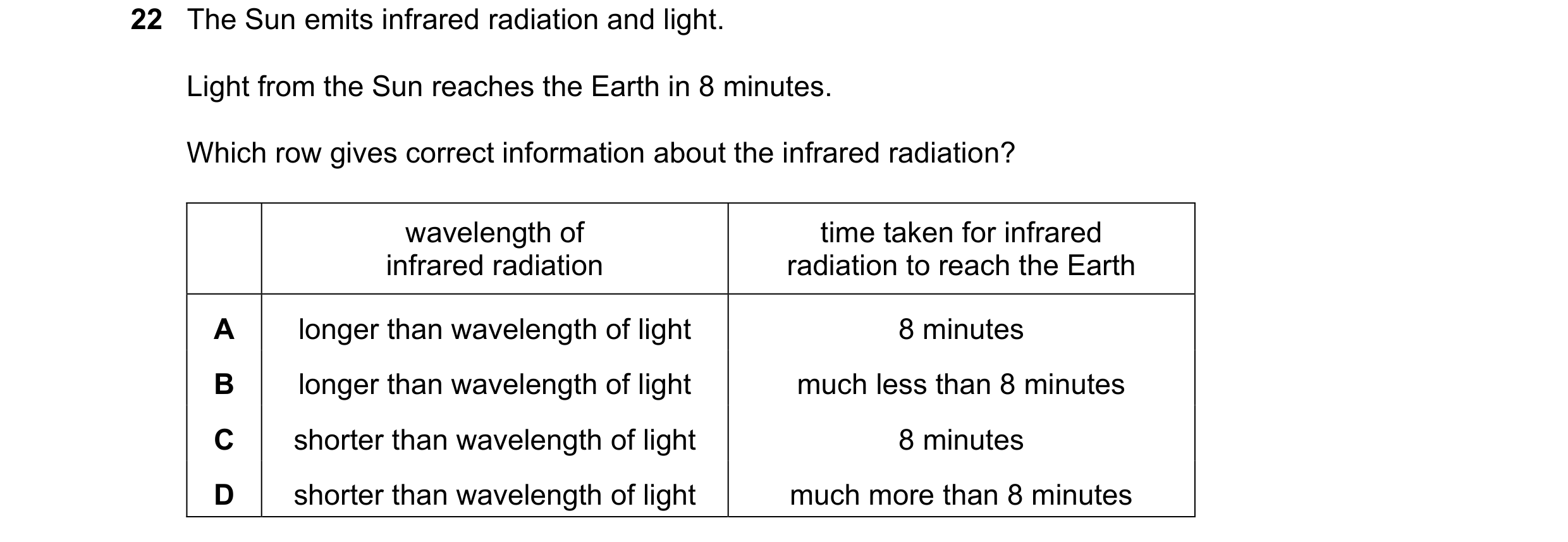 34 / 65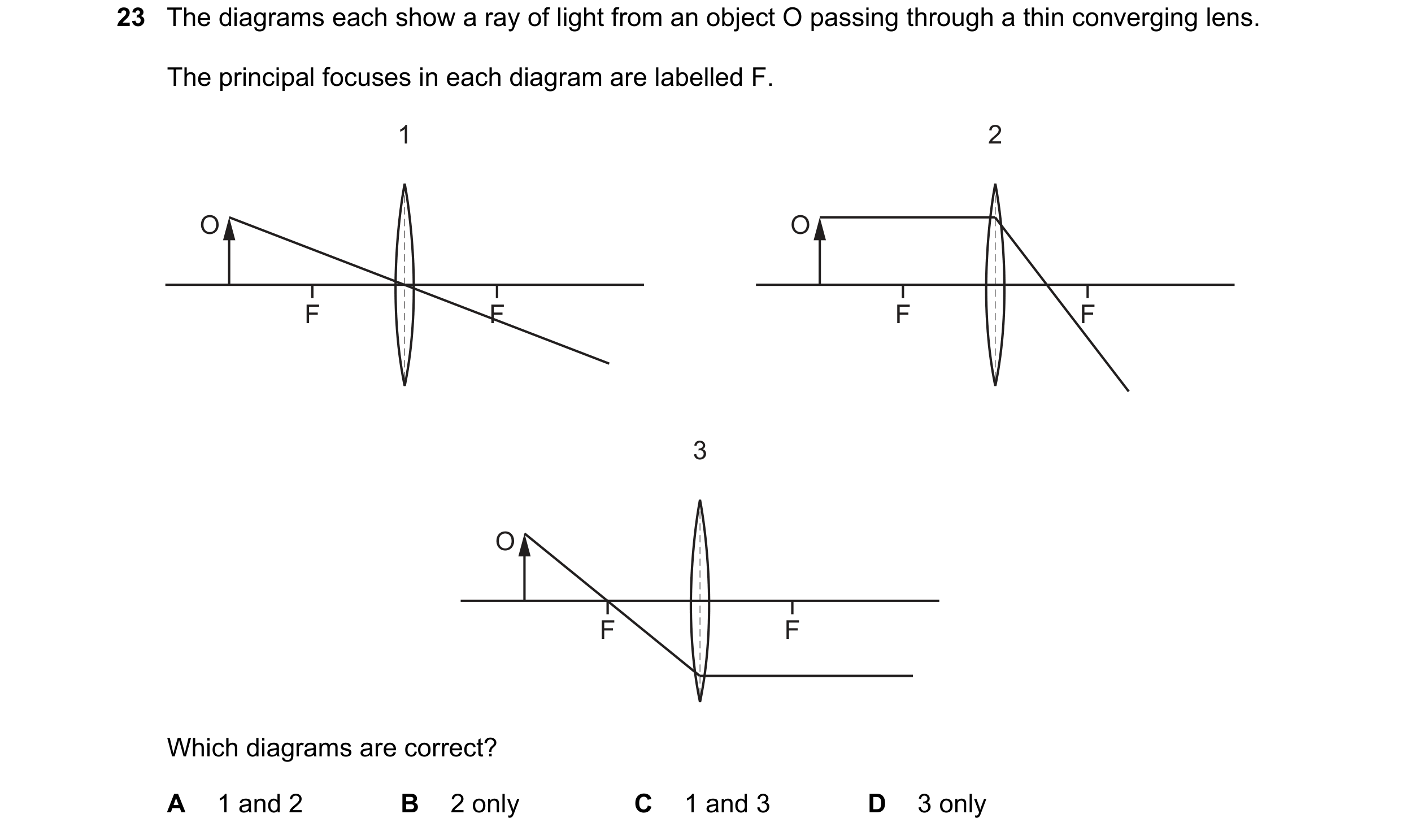
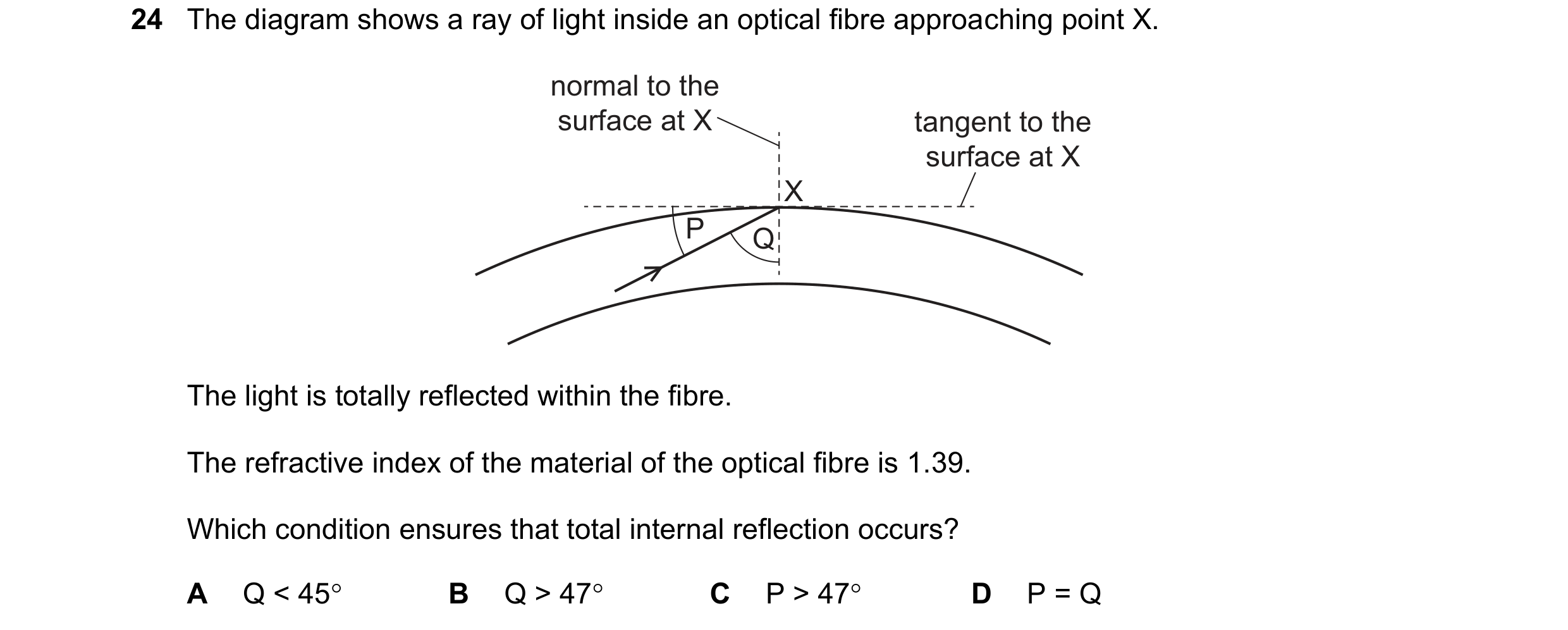
 35 / 65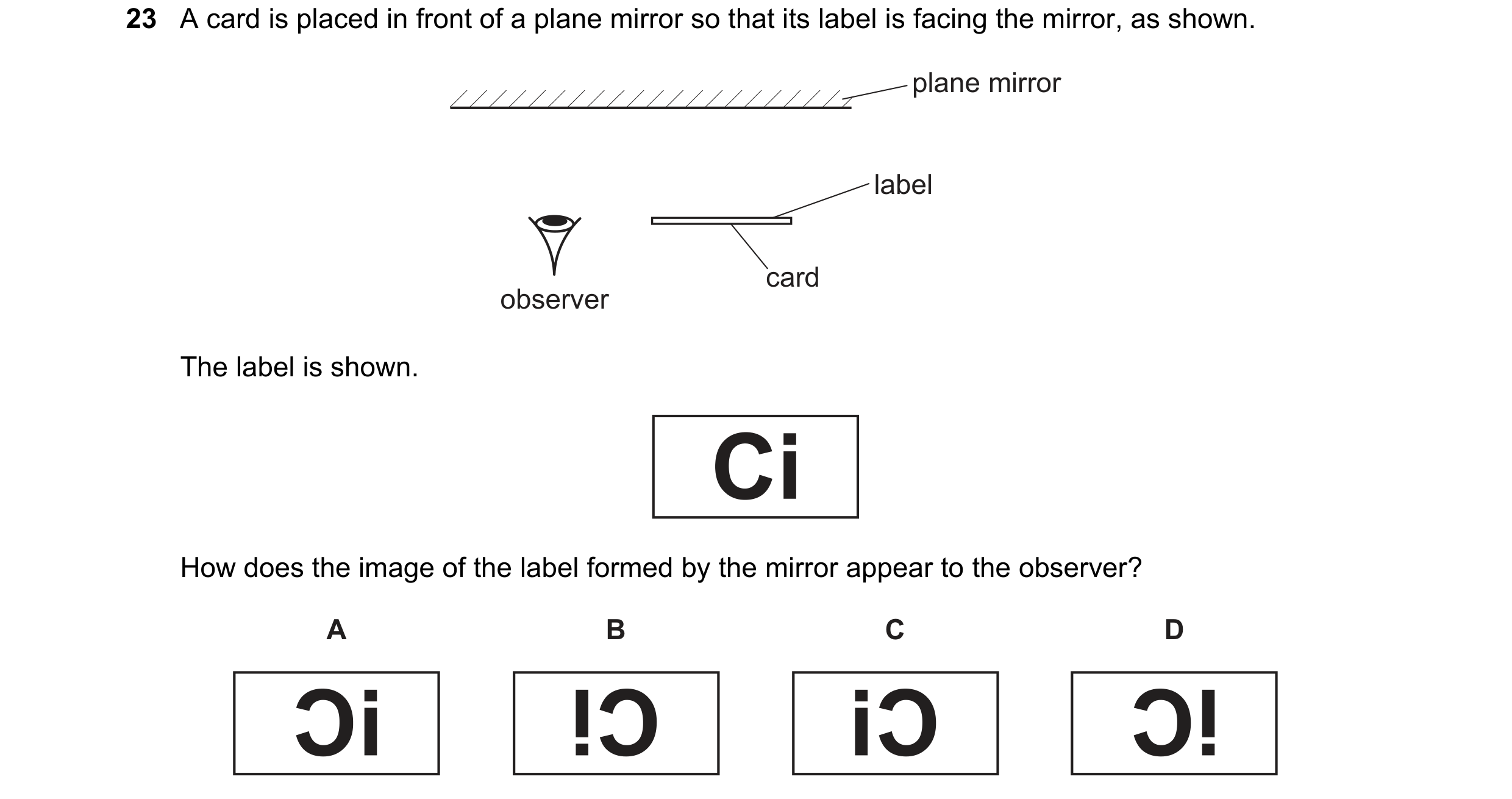
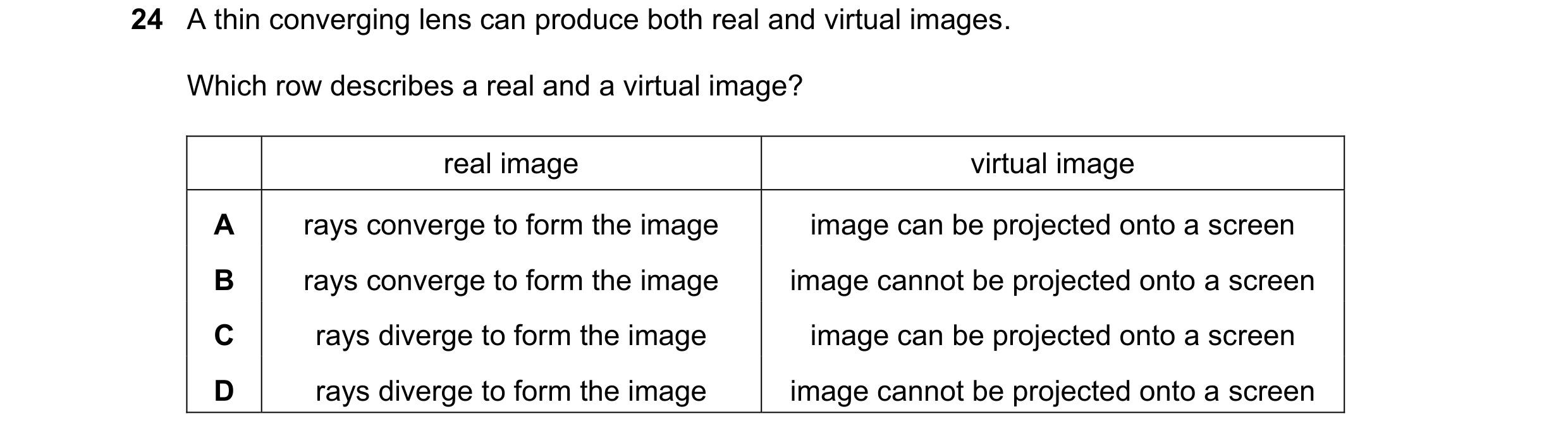
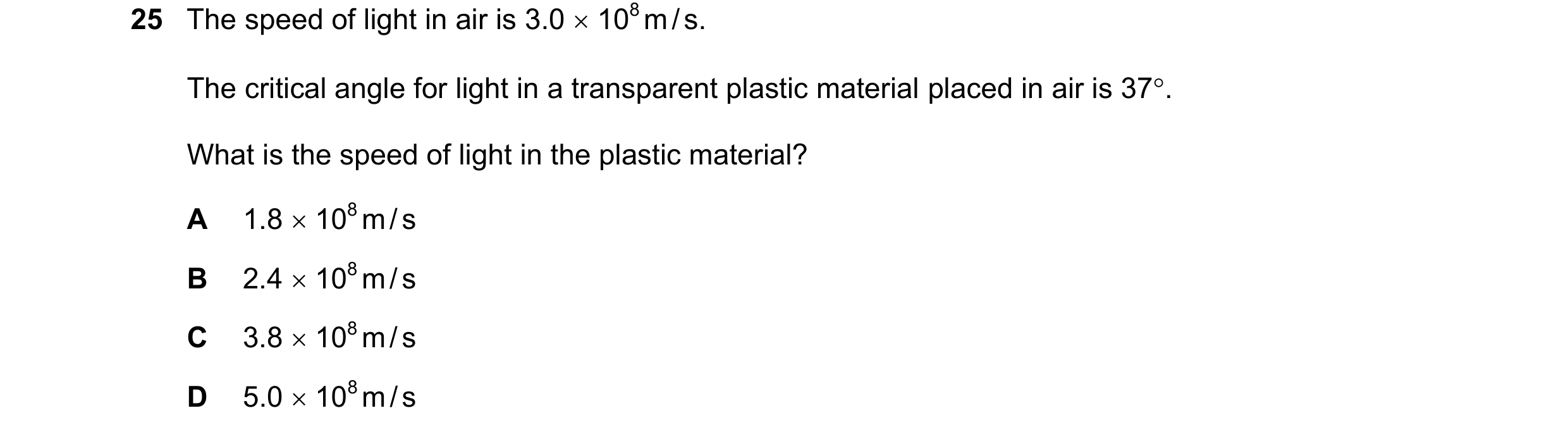 36 / 65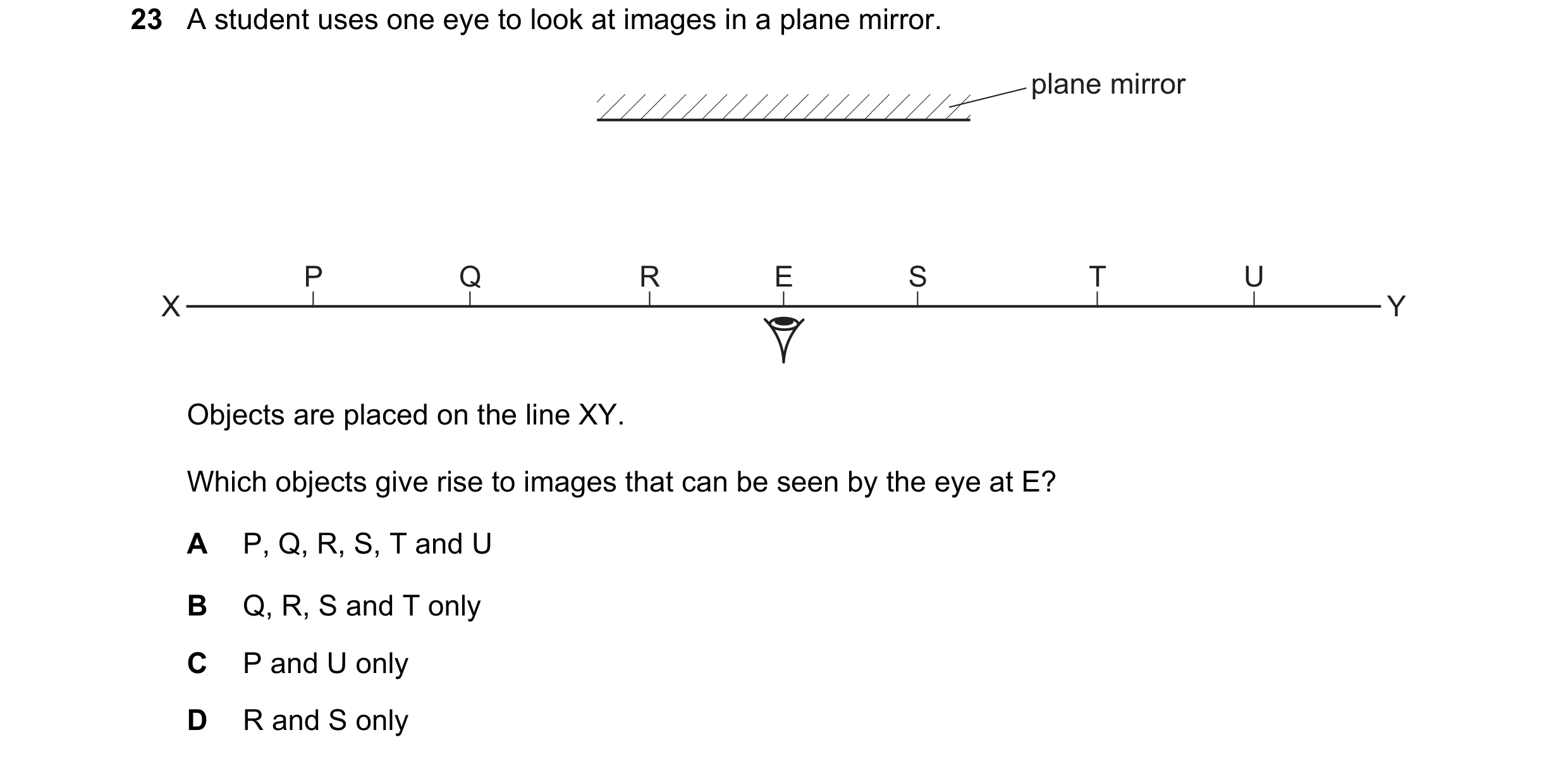
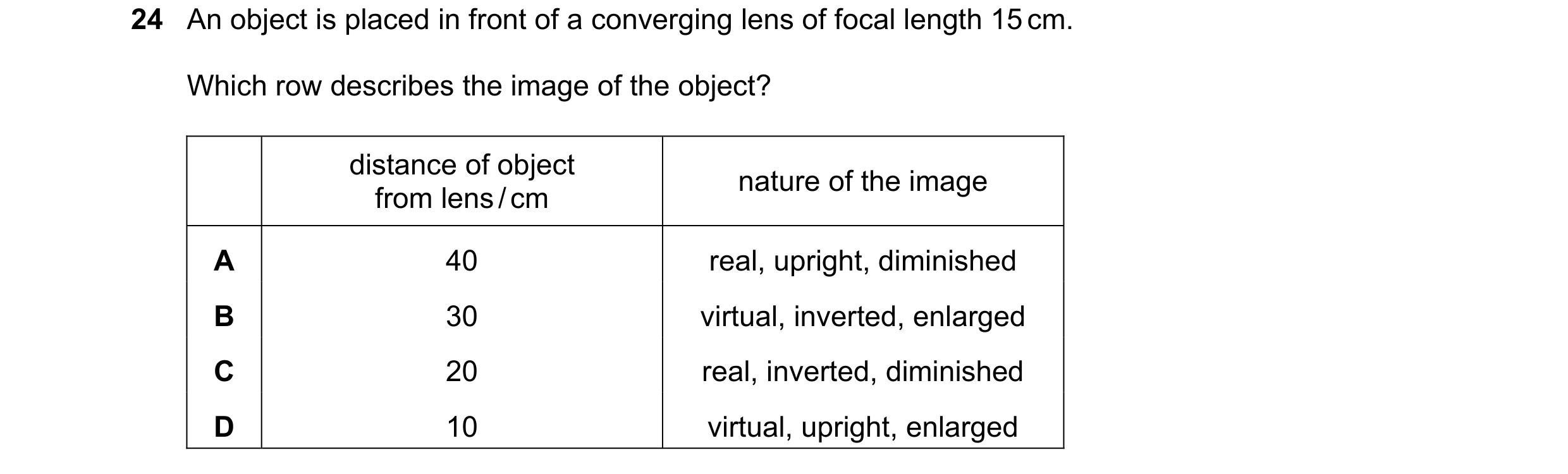
 37 / 65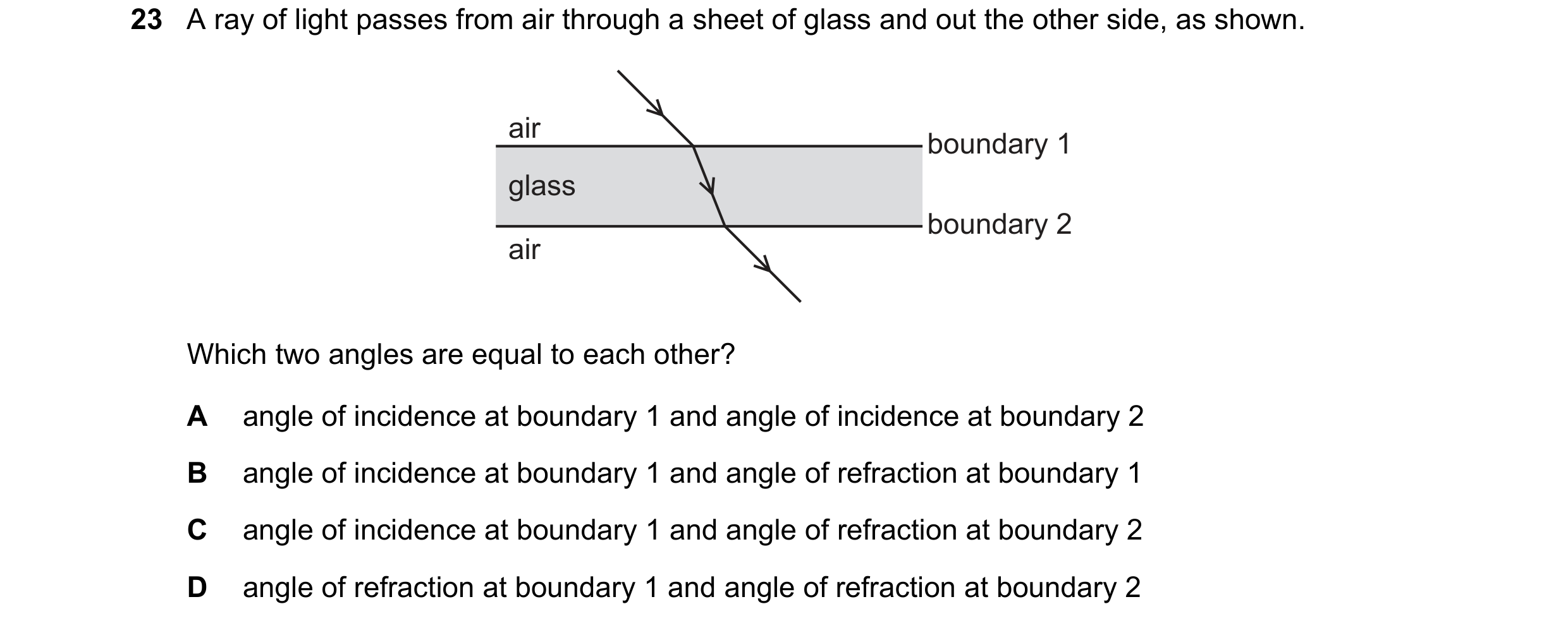
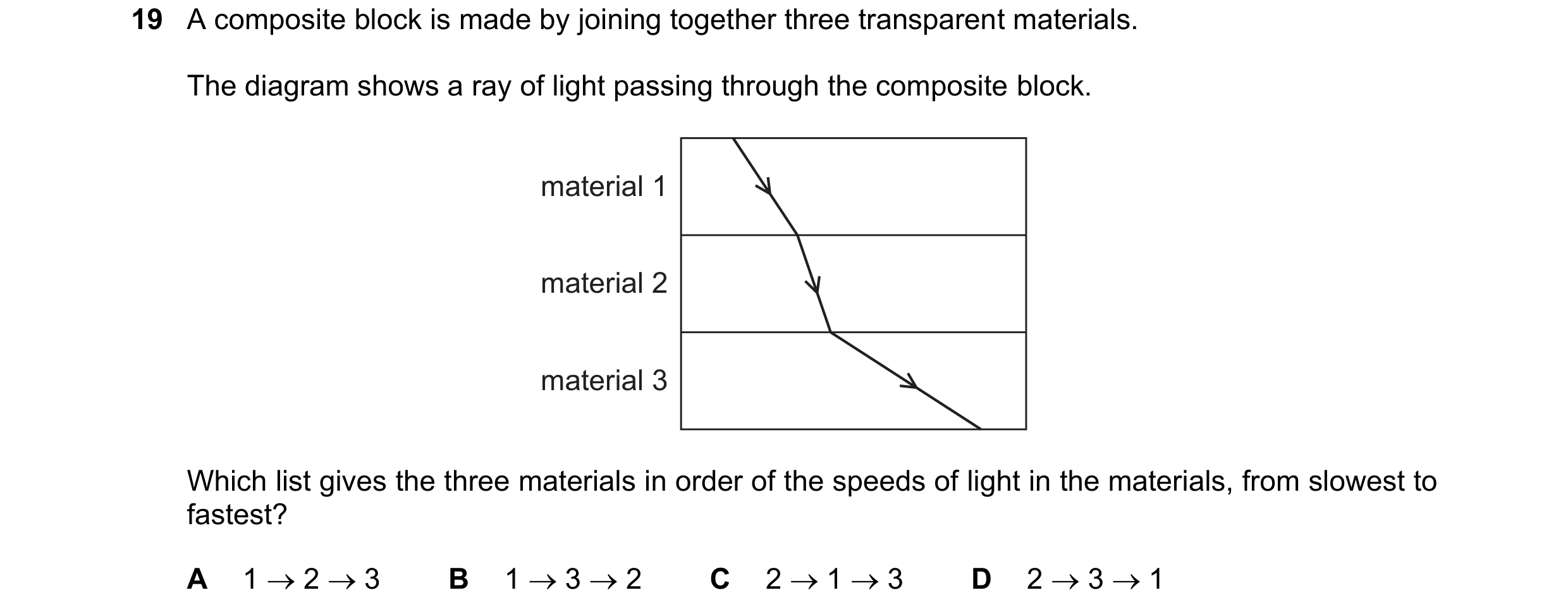 38 / 65
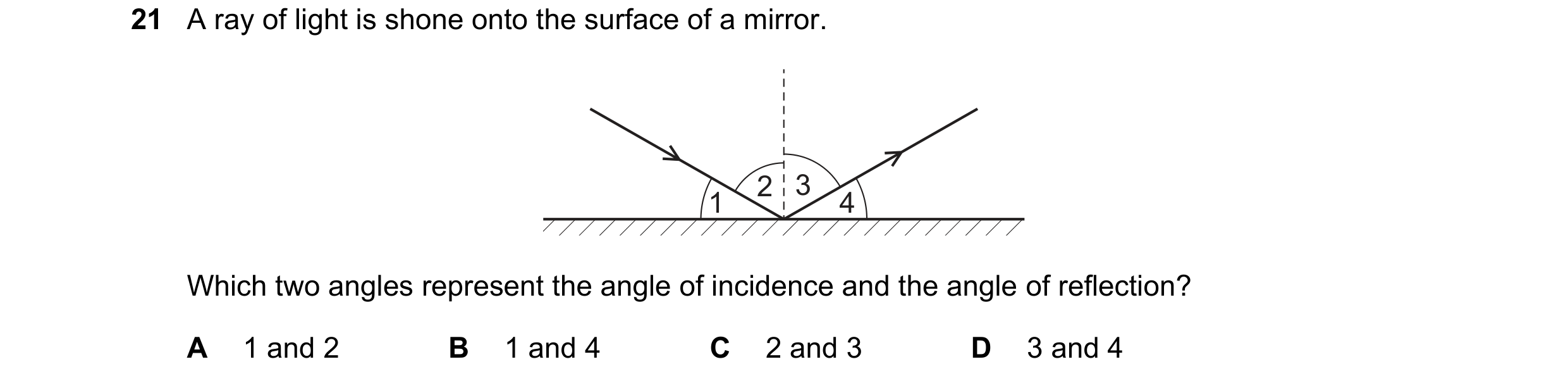
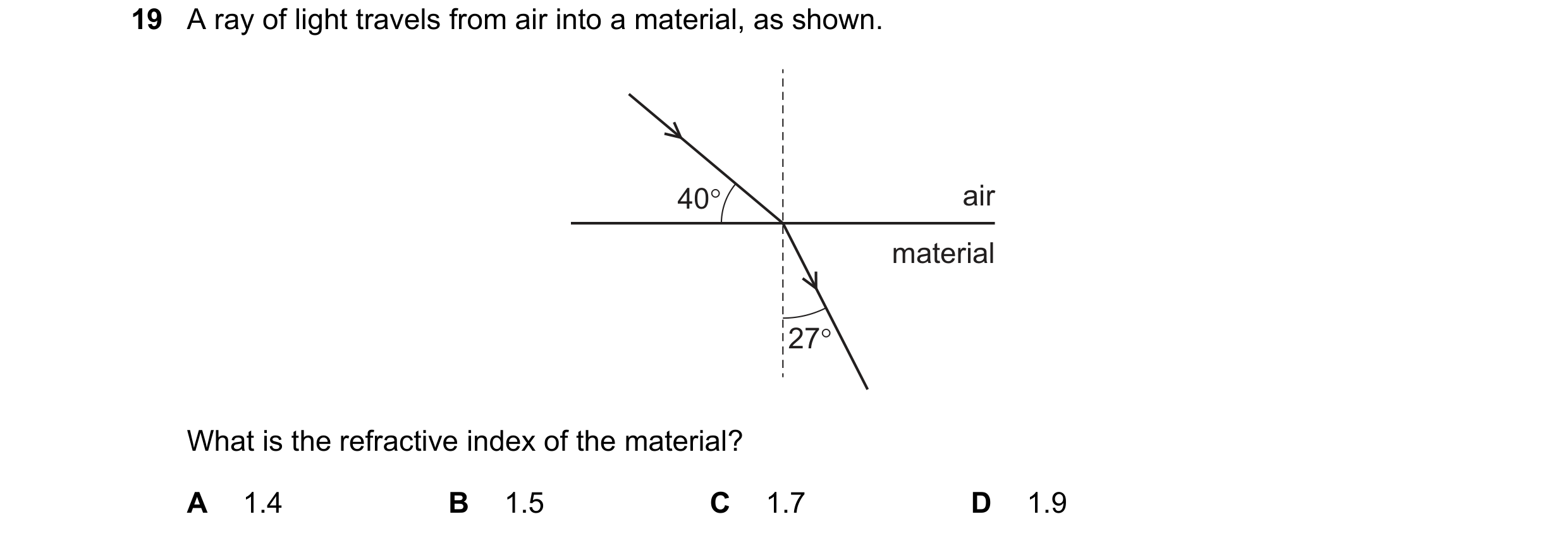 39 / 65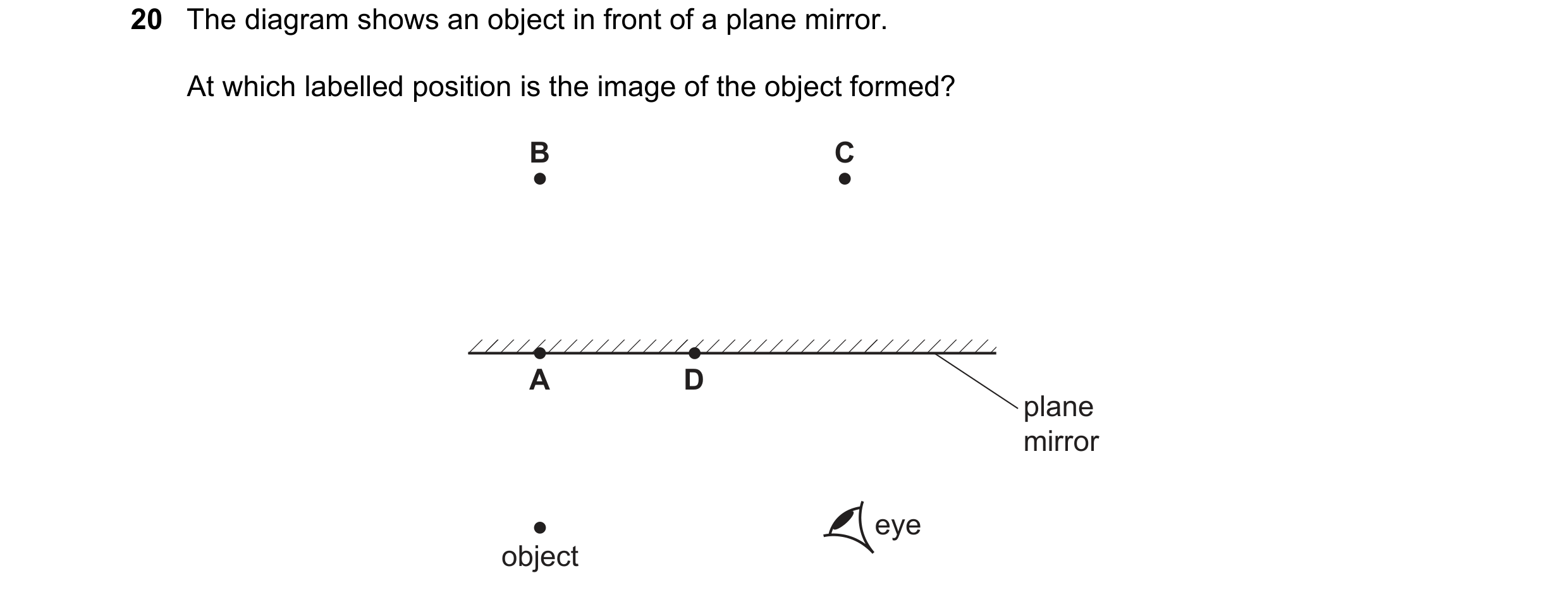

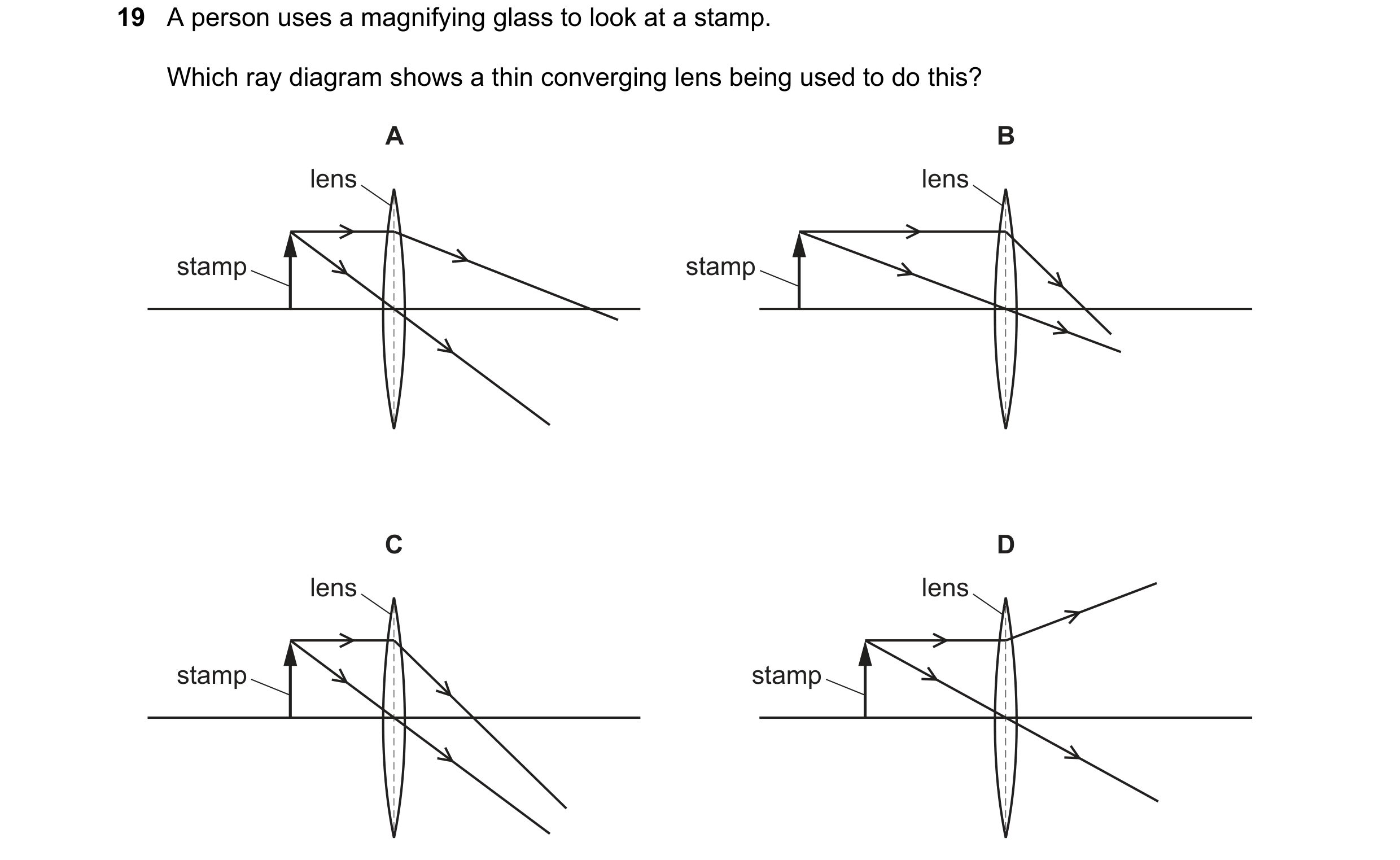 40 / 65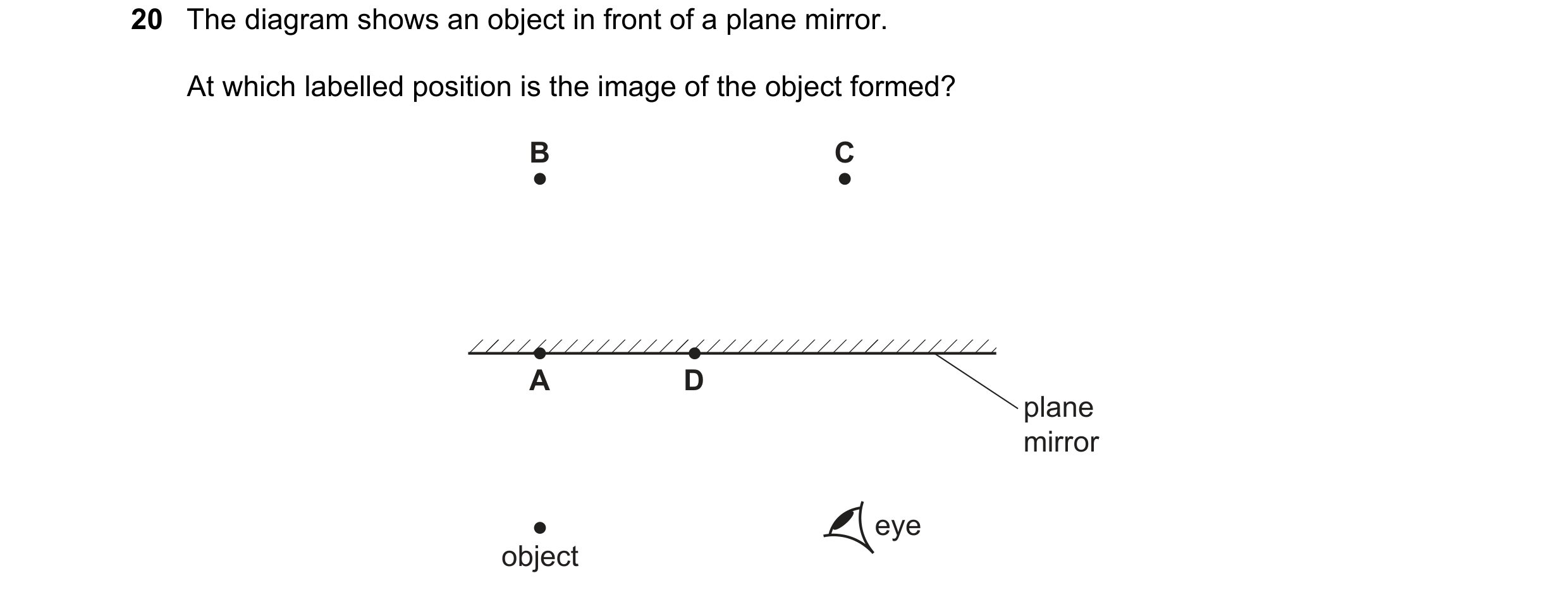
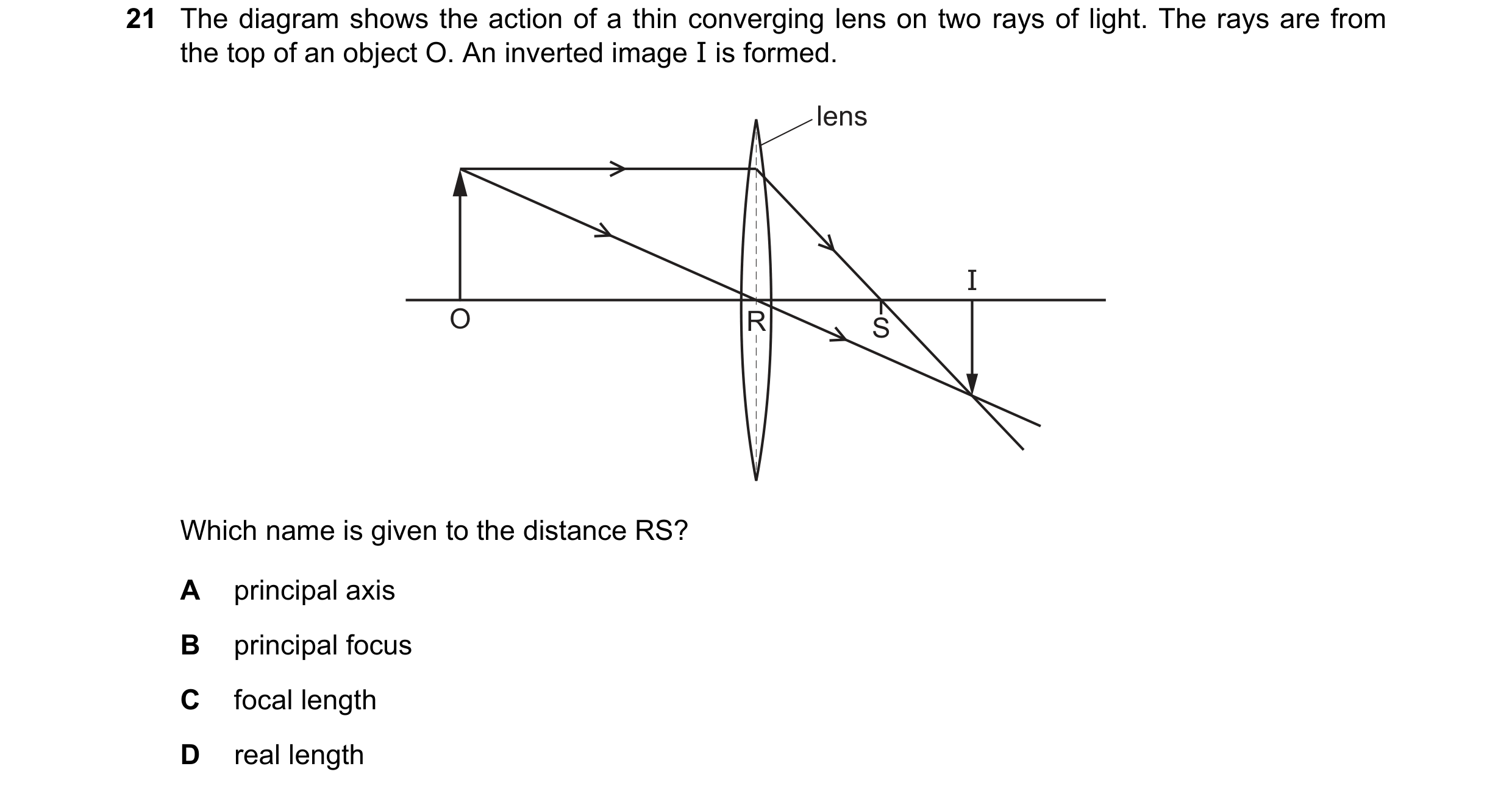
 41 / 65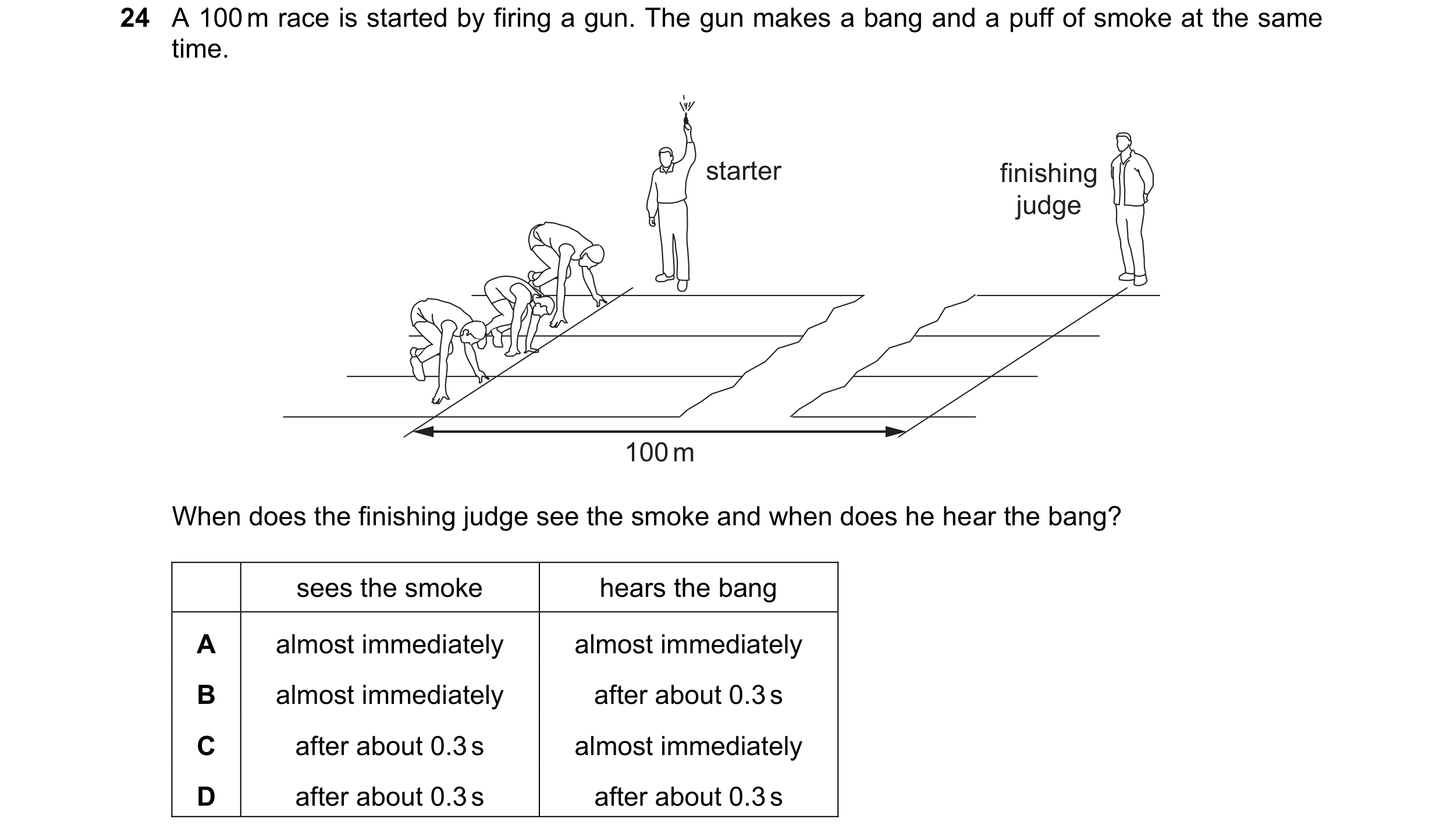
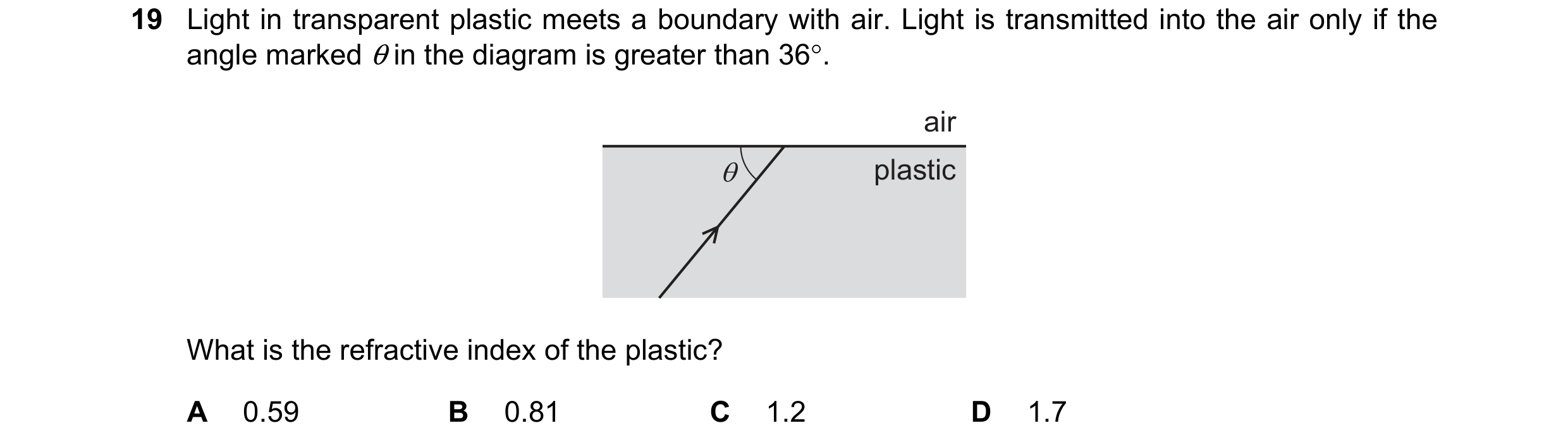
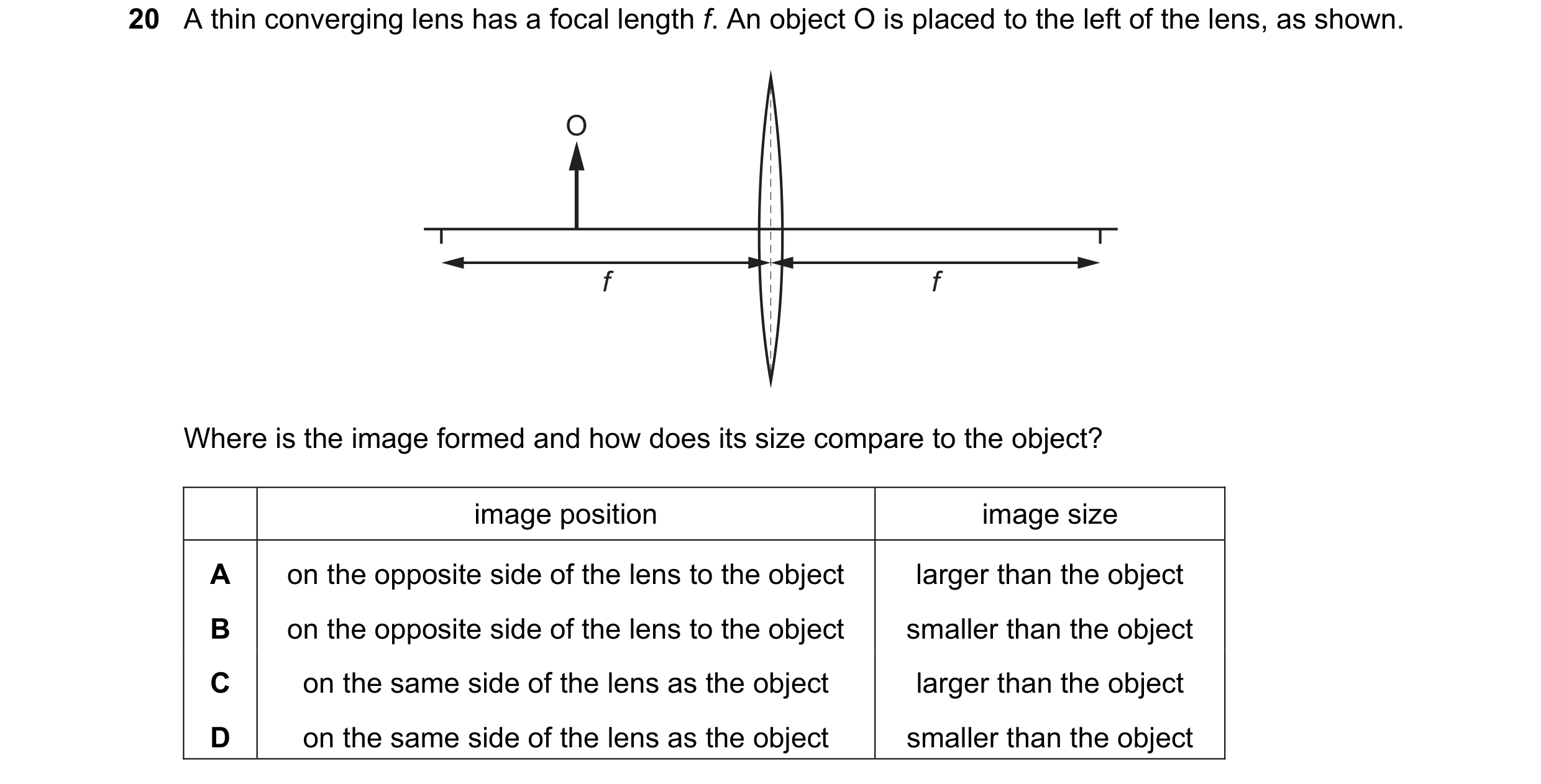 42 / 65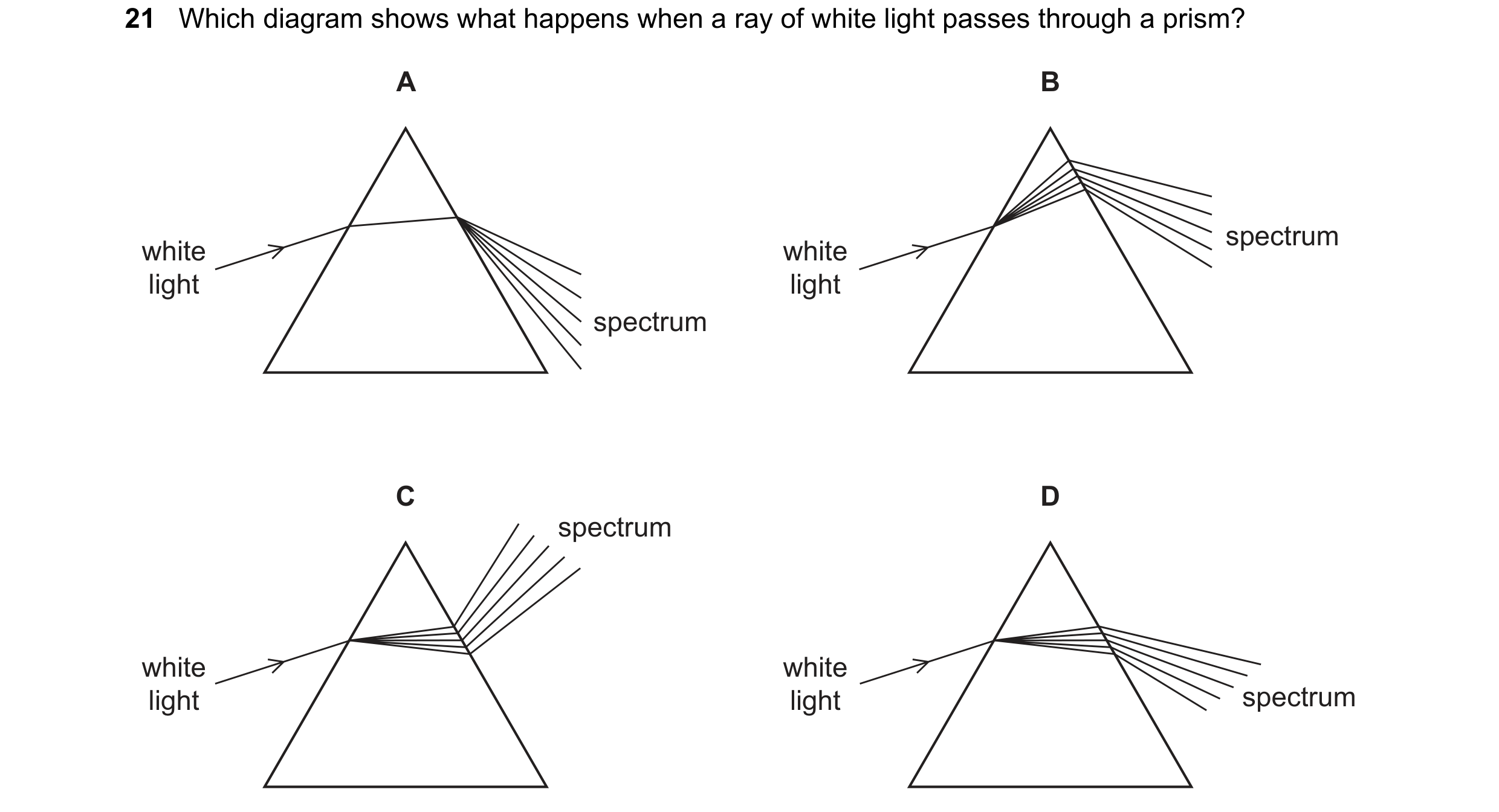
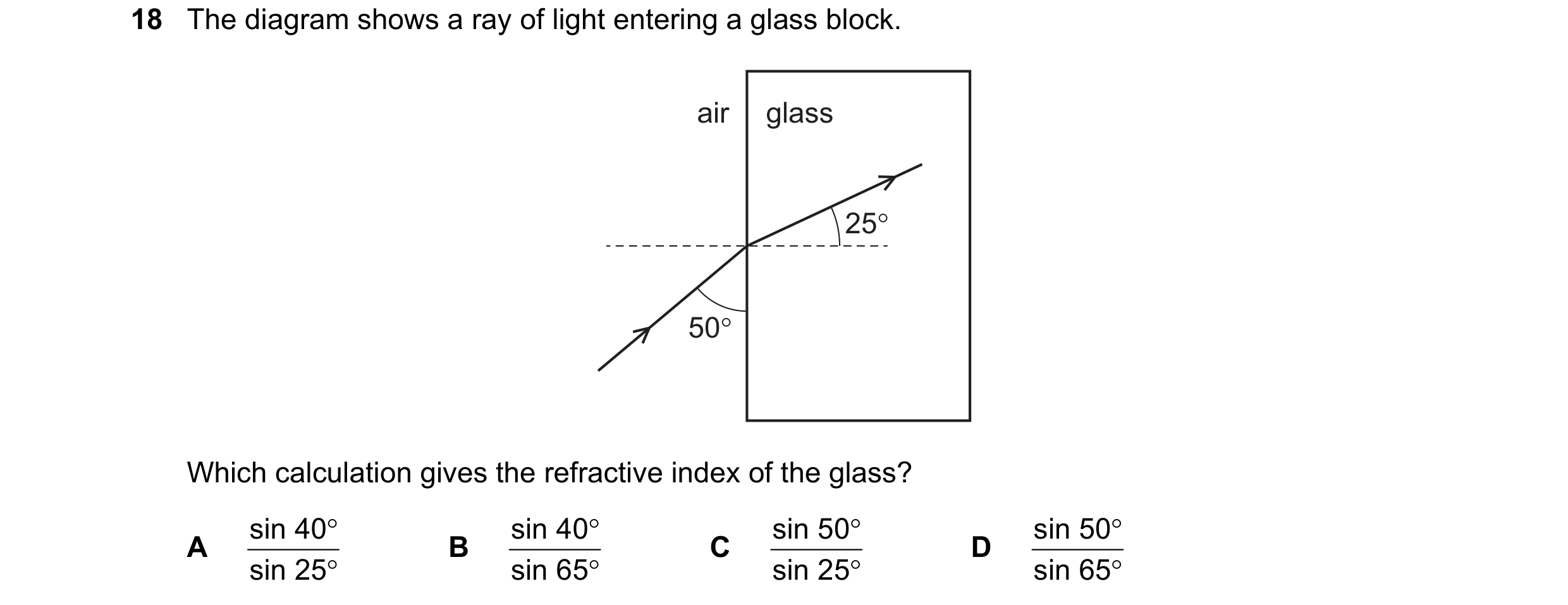 43 / 65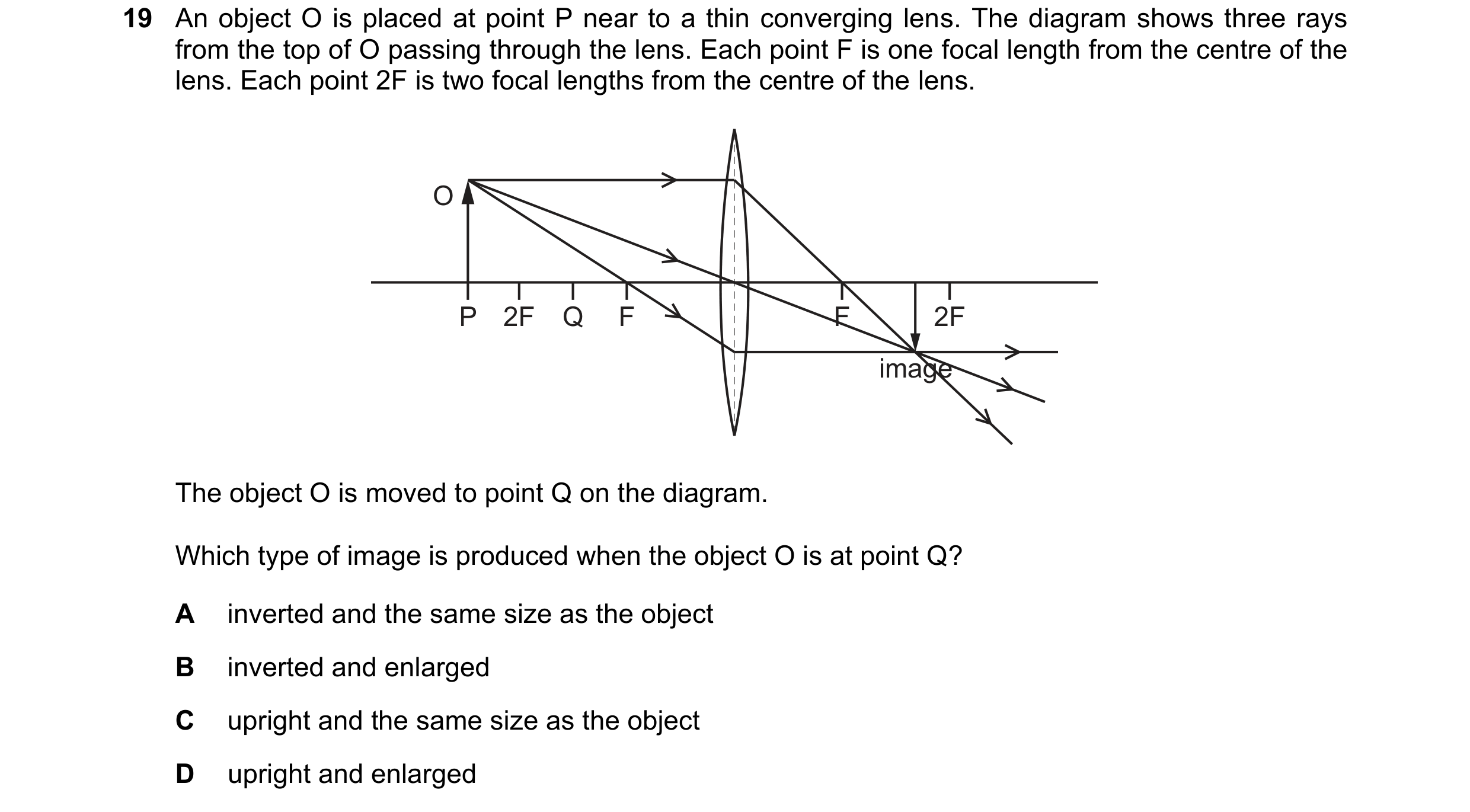
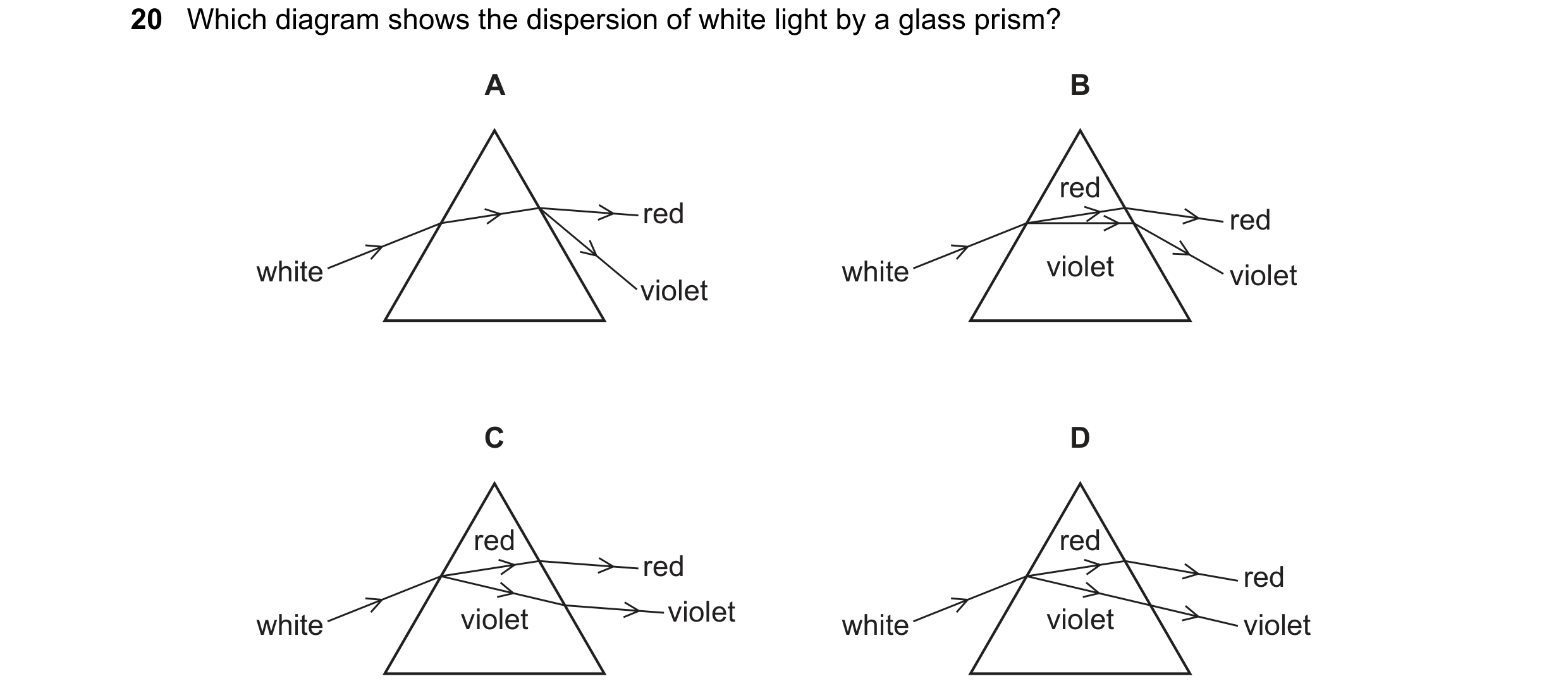 44 / 65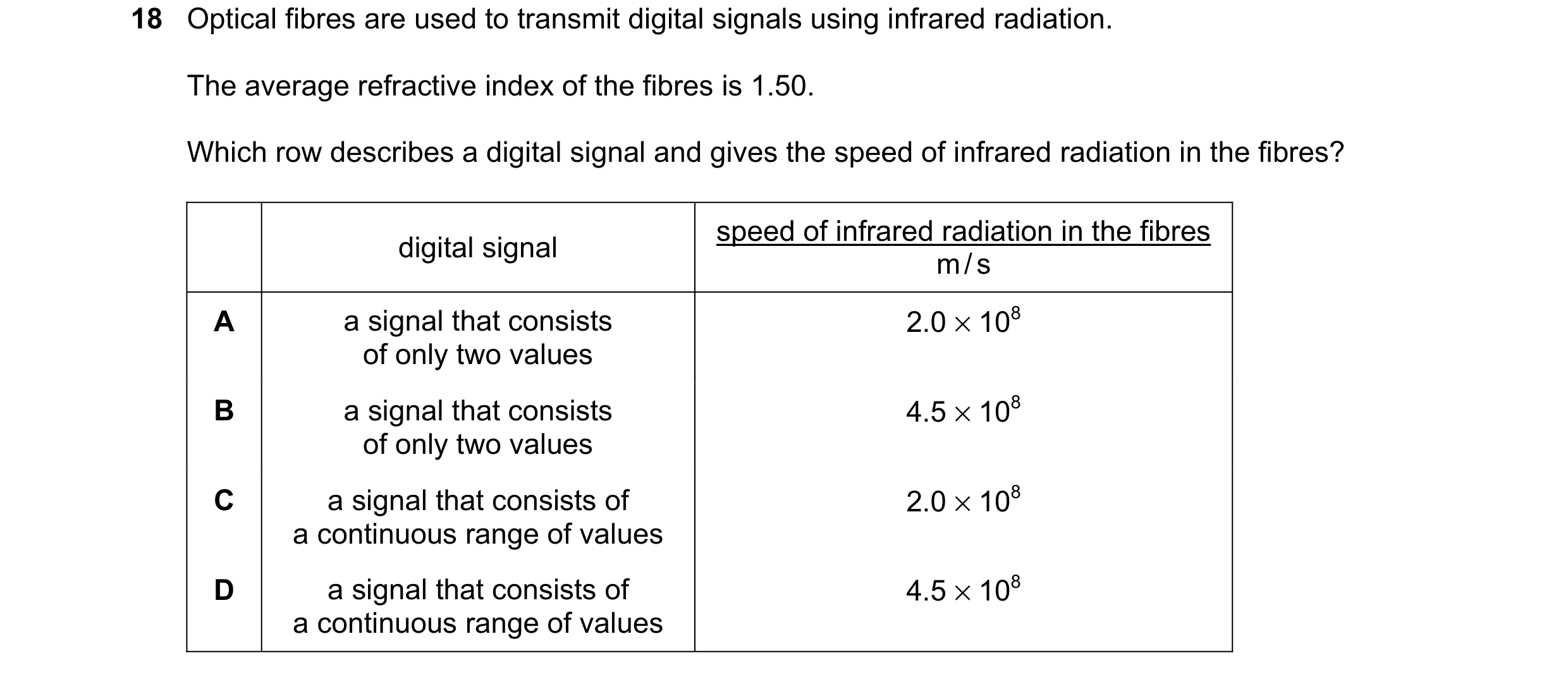

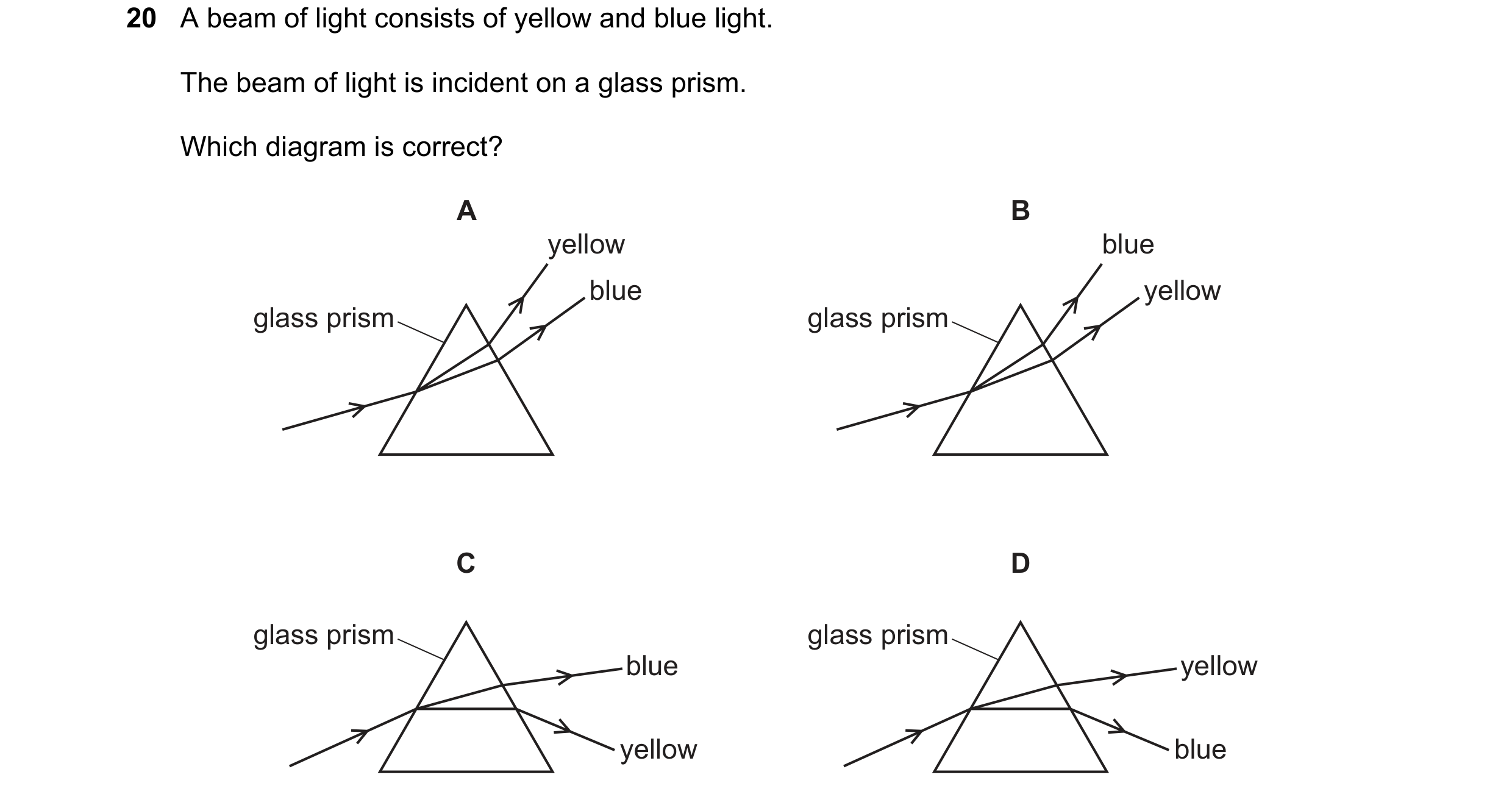 45 / 65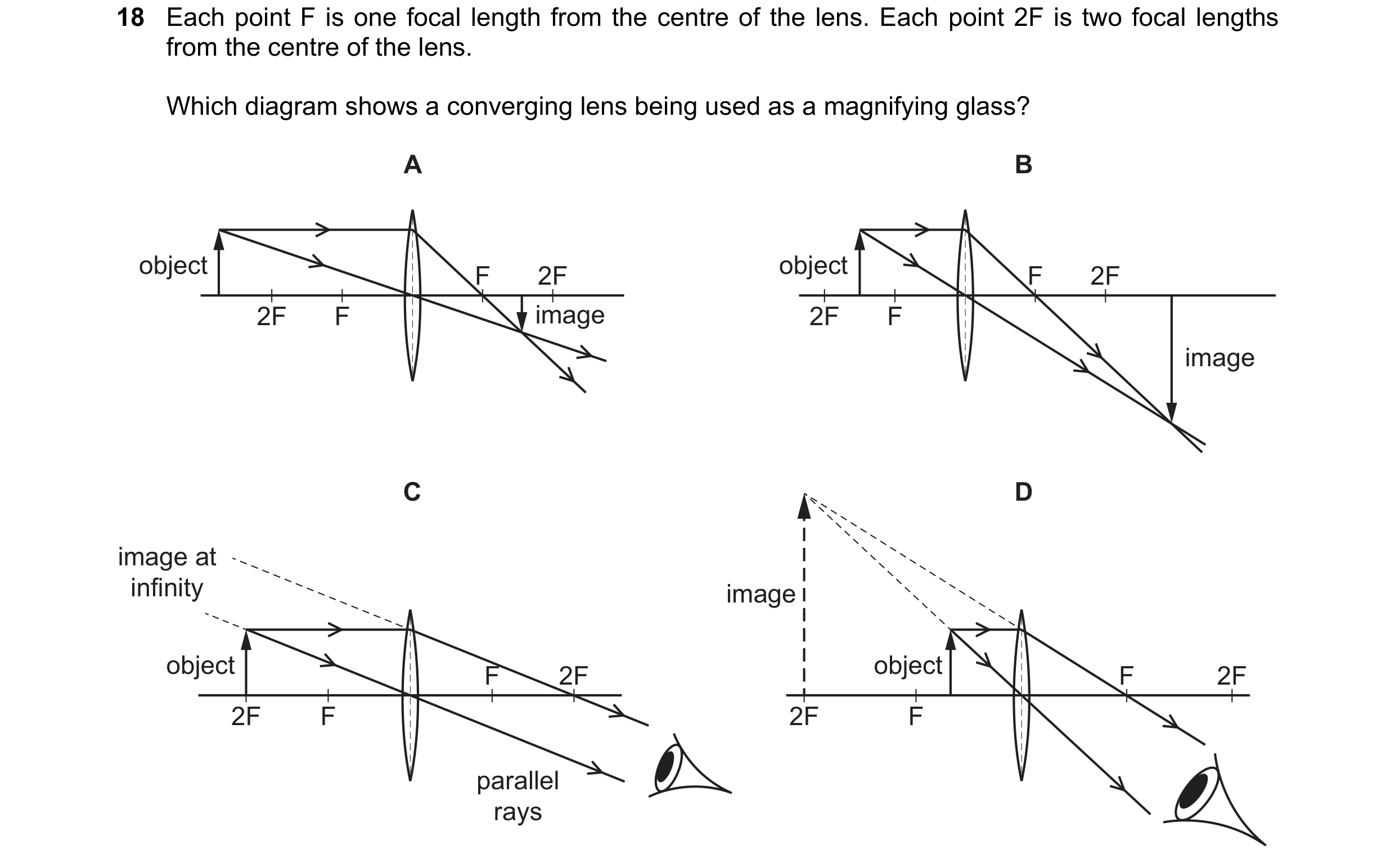
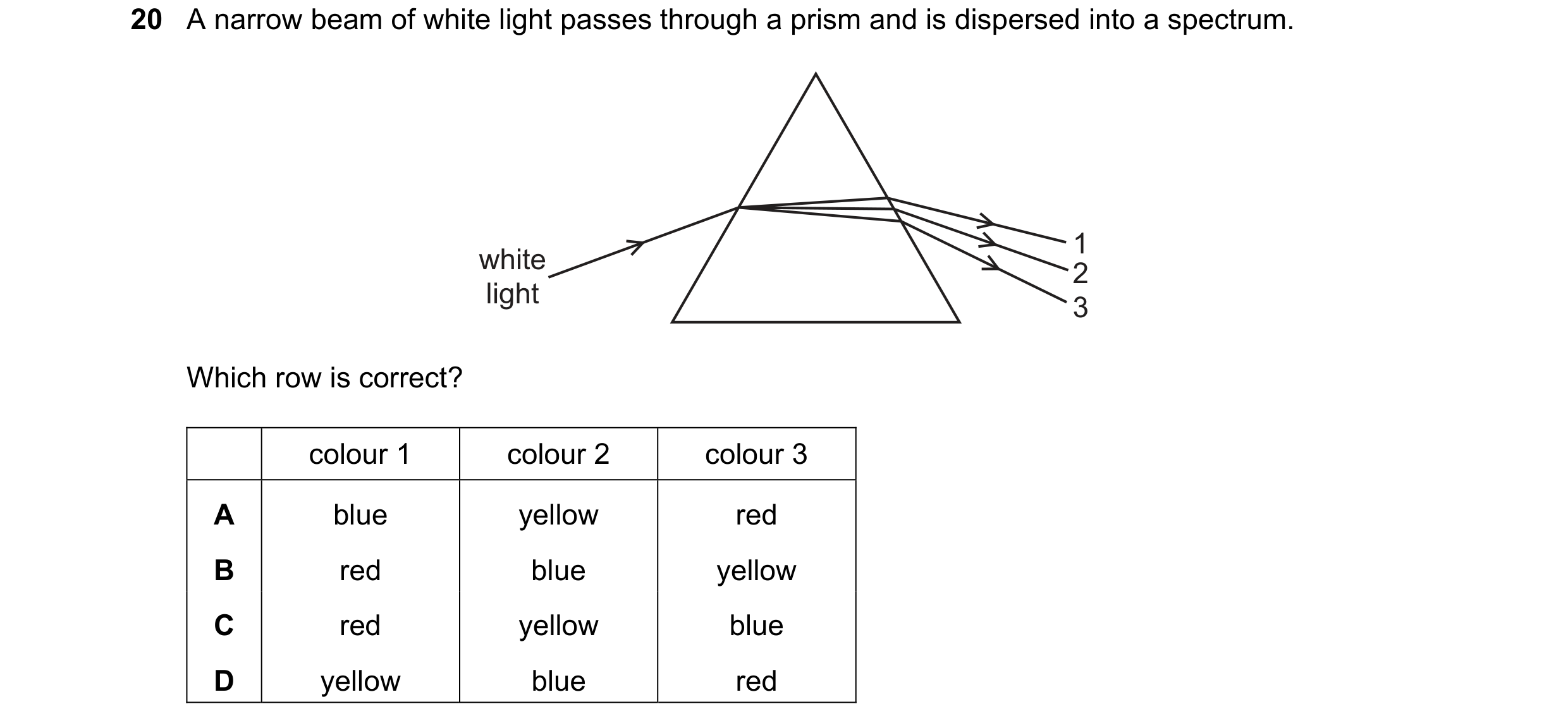 46 / 65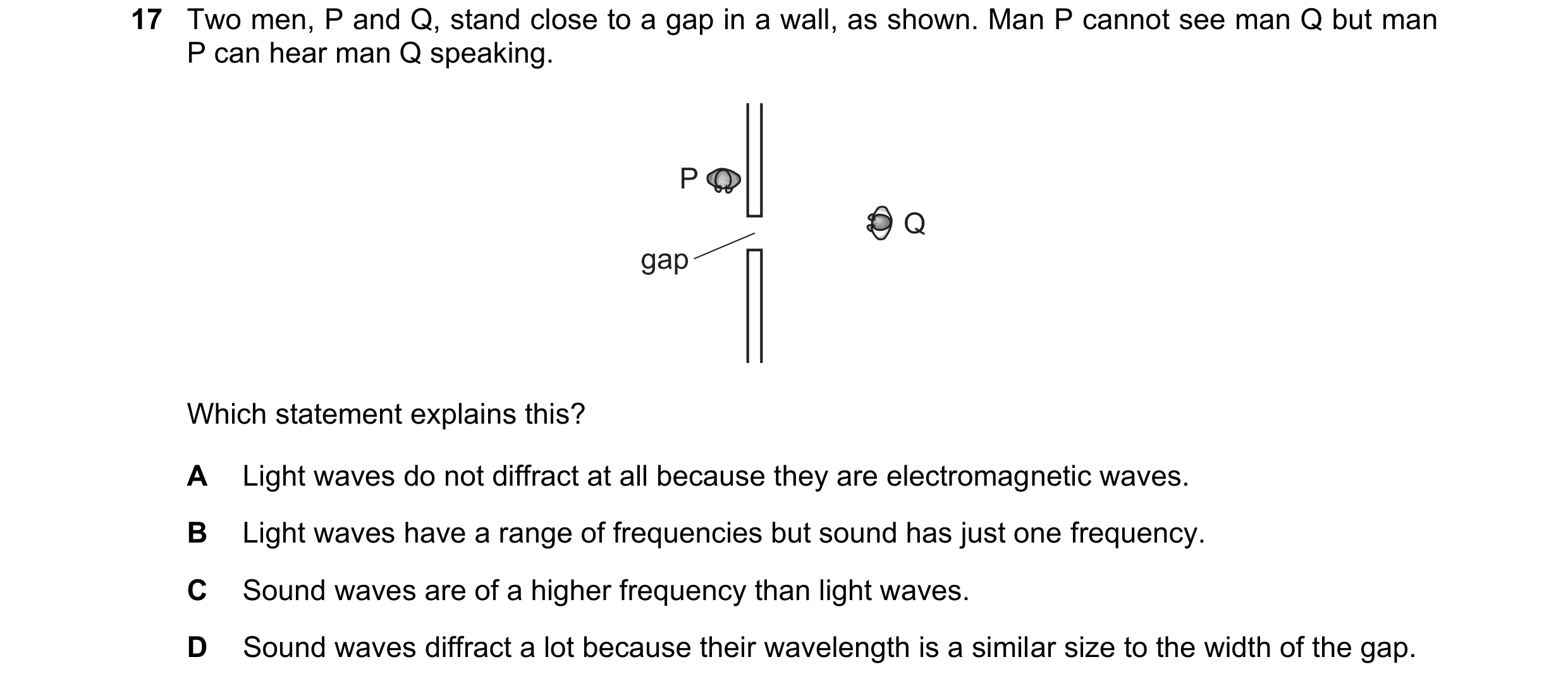
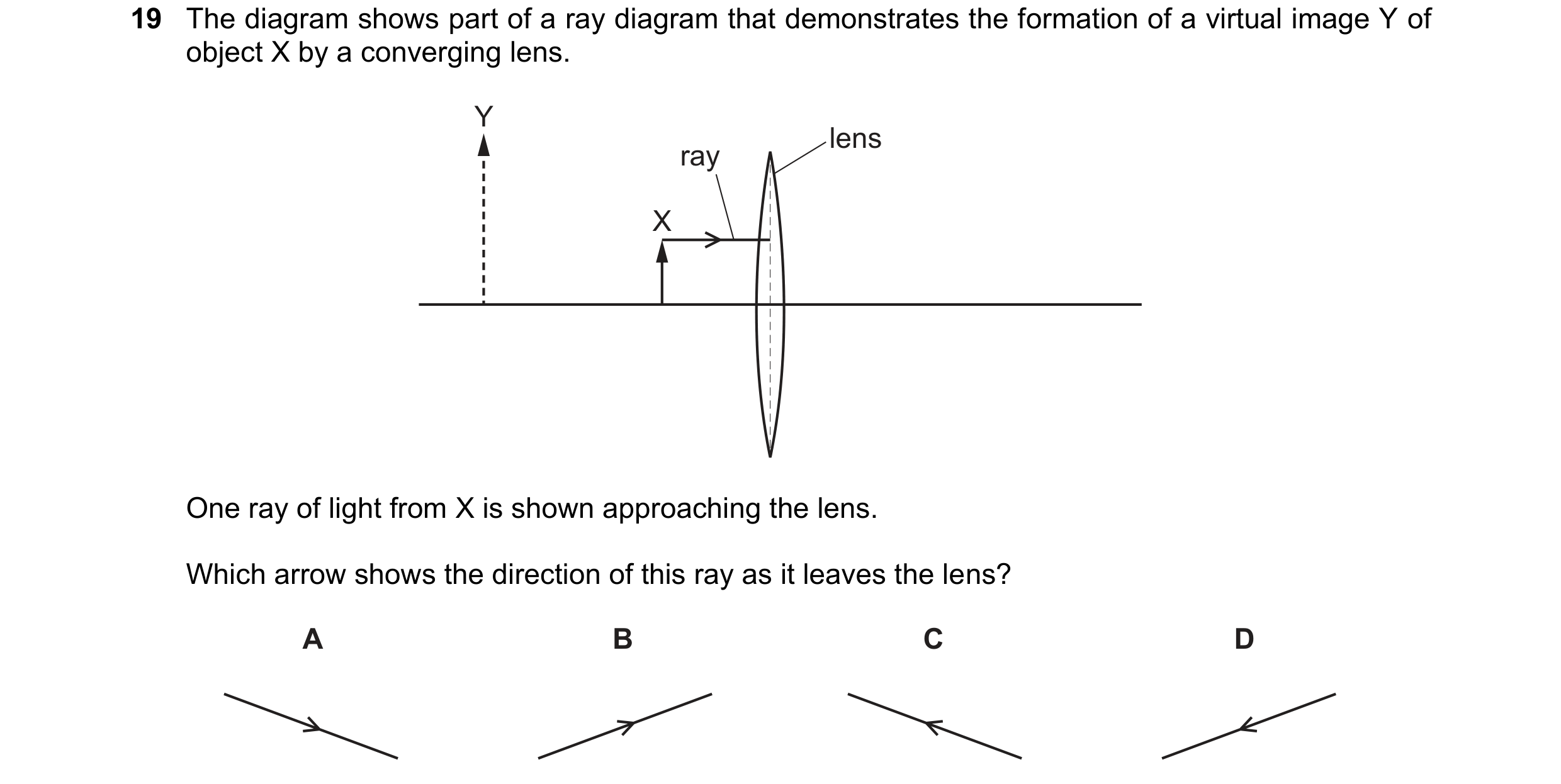 47 / 65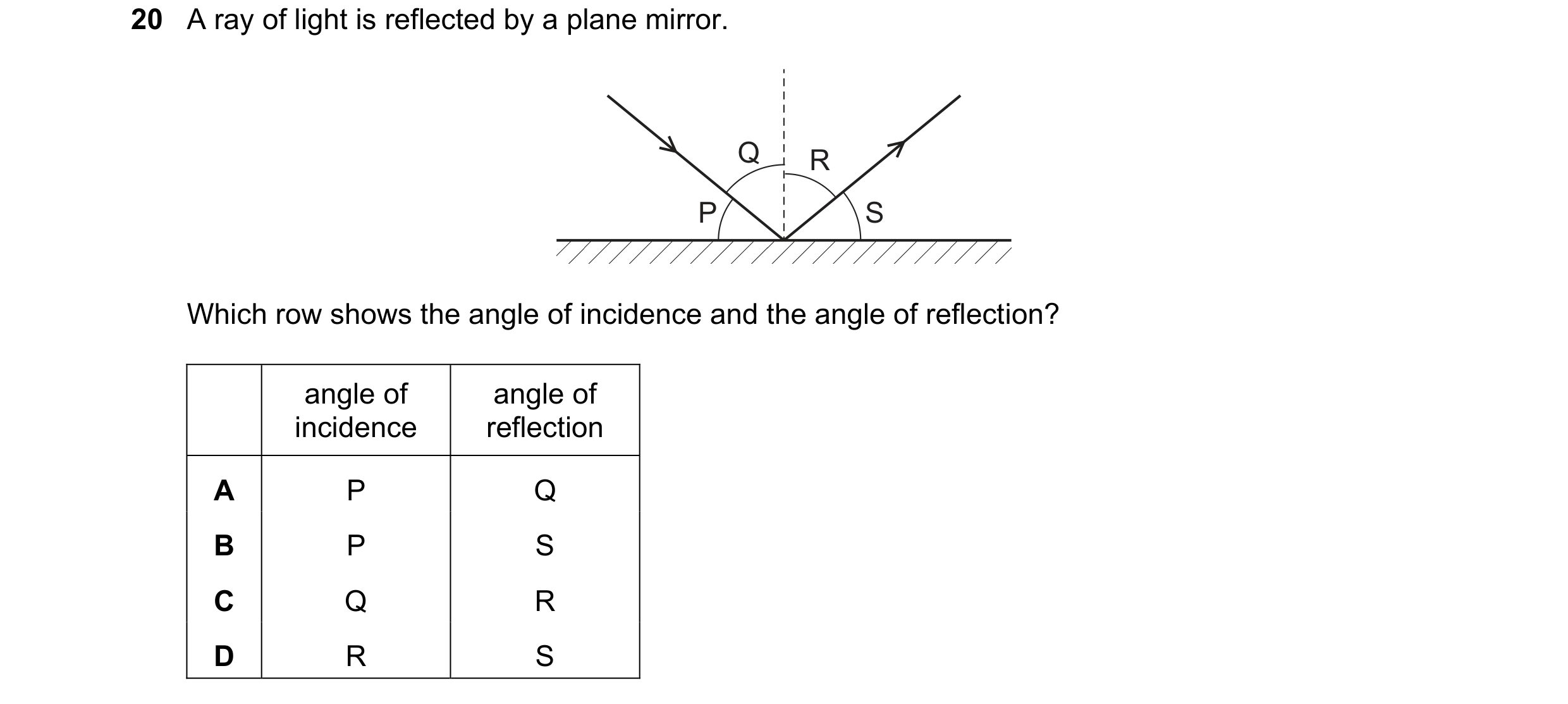

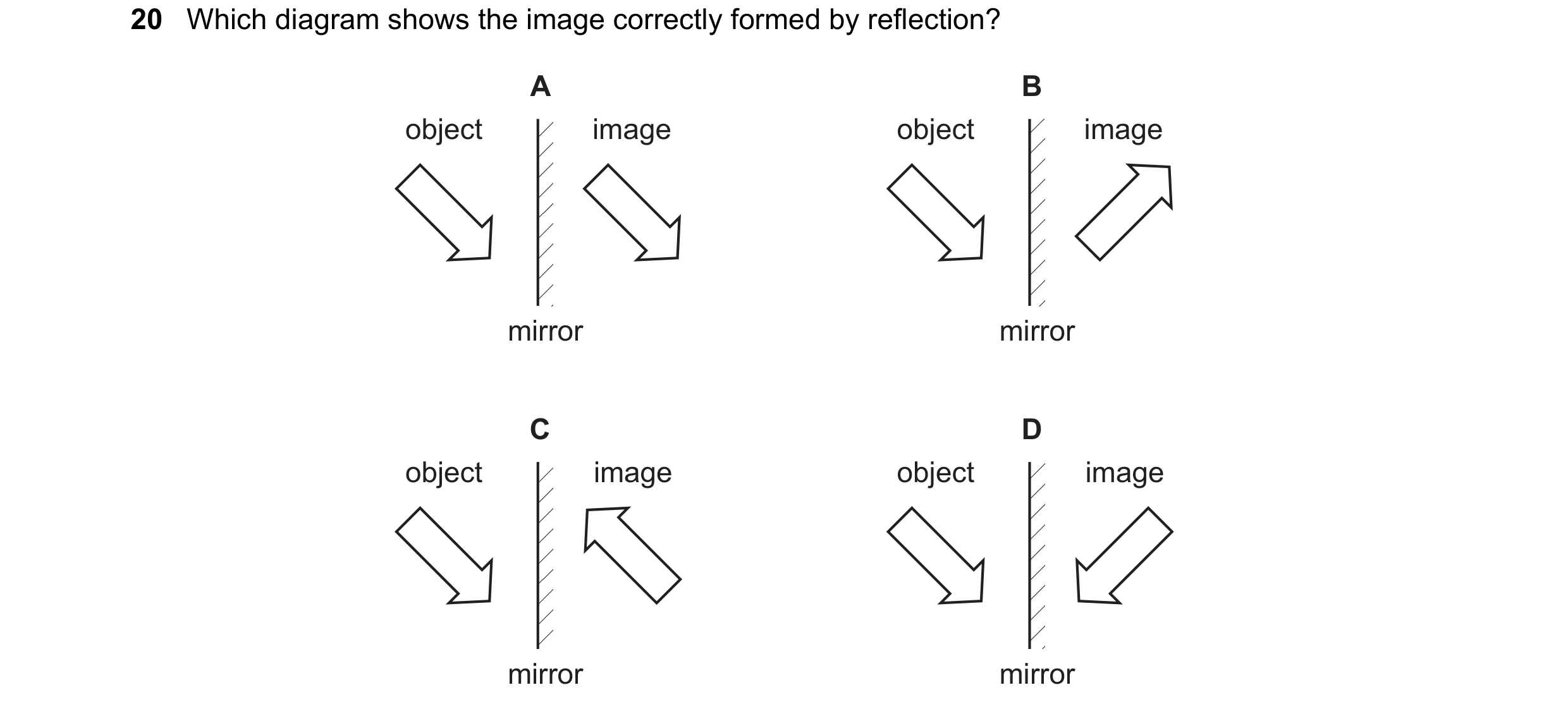 48 / 65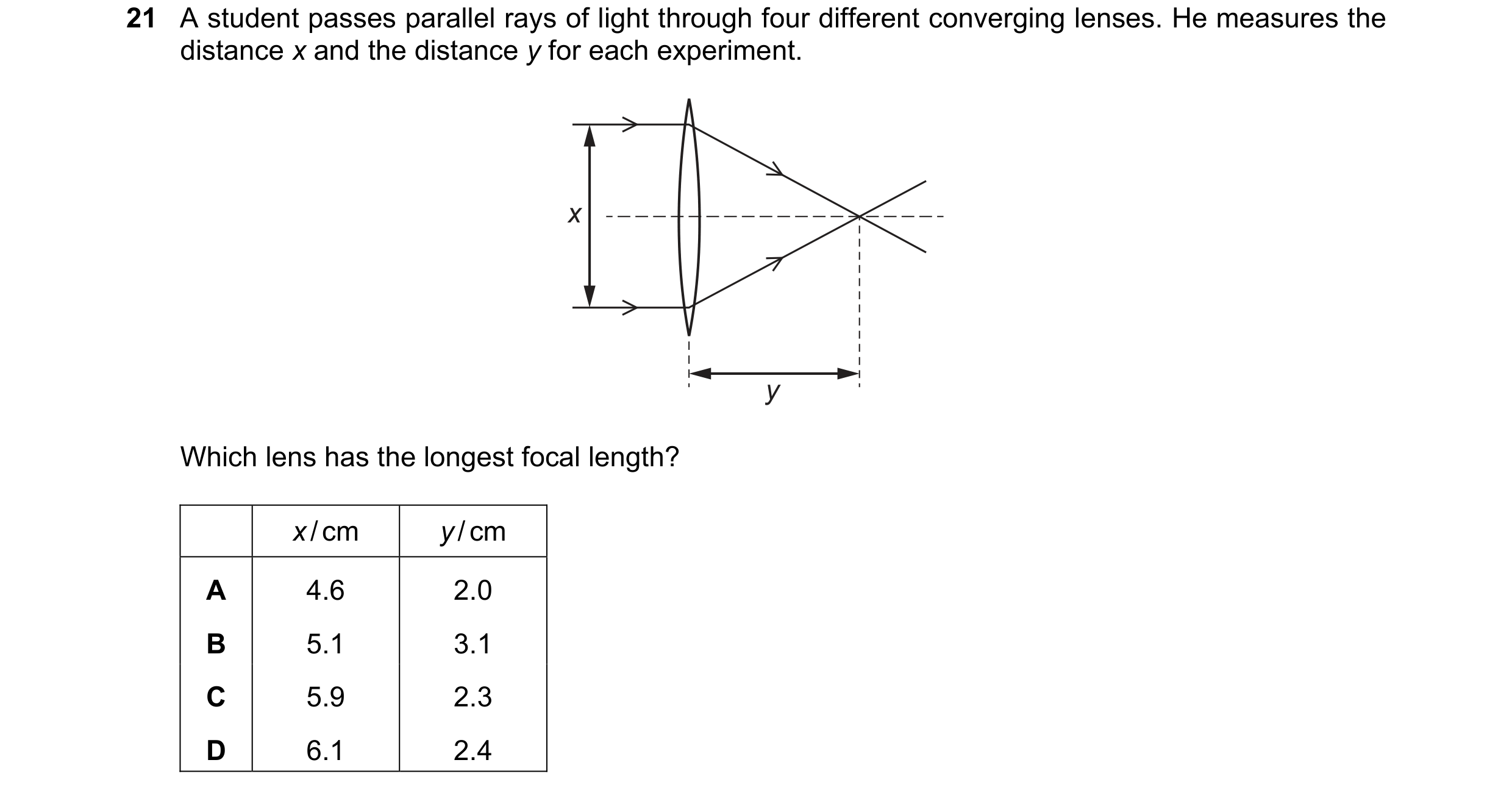
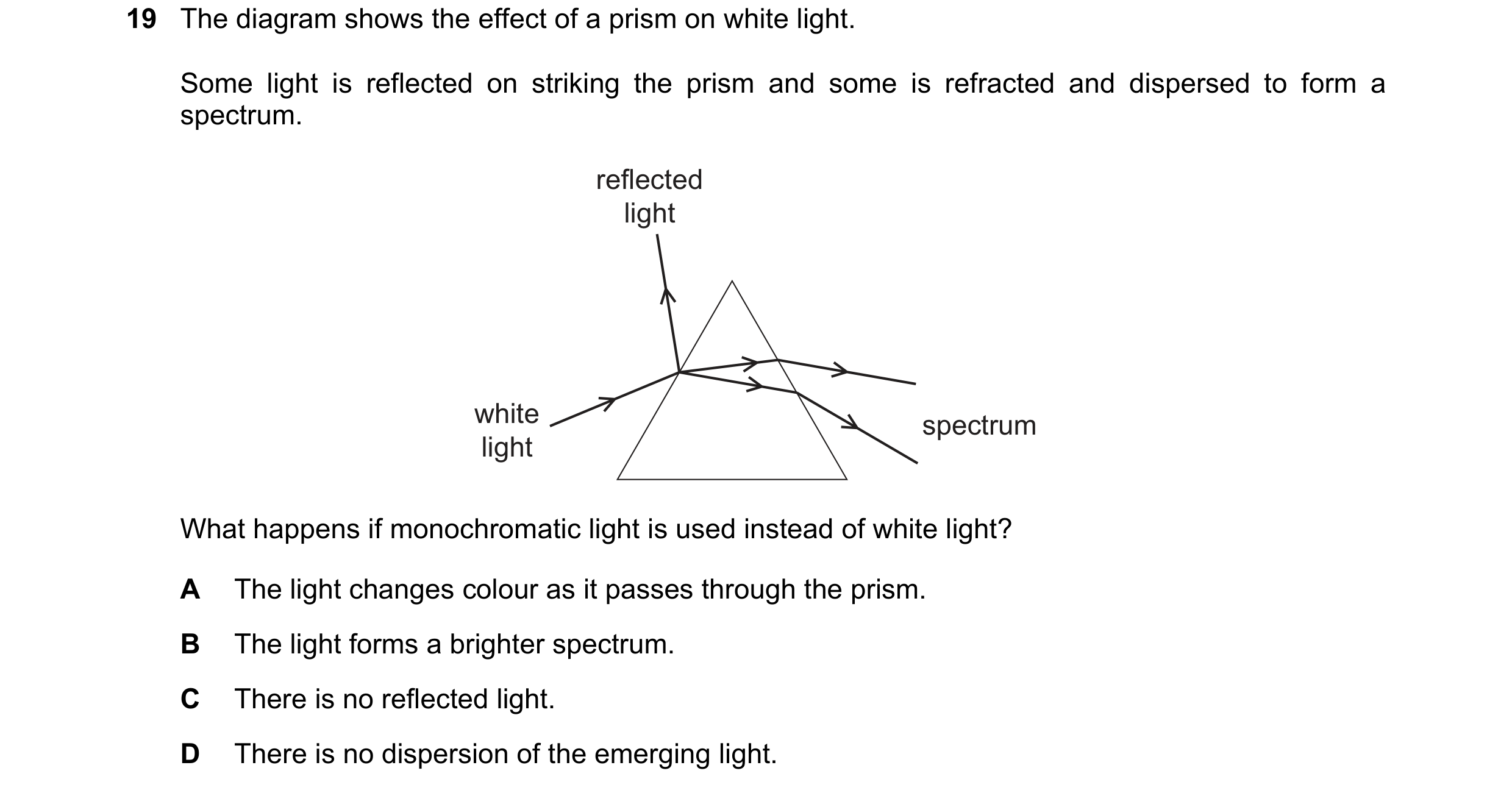 49 / 65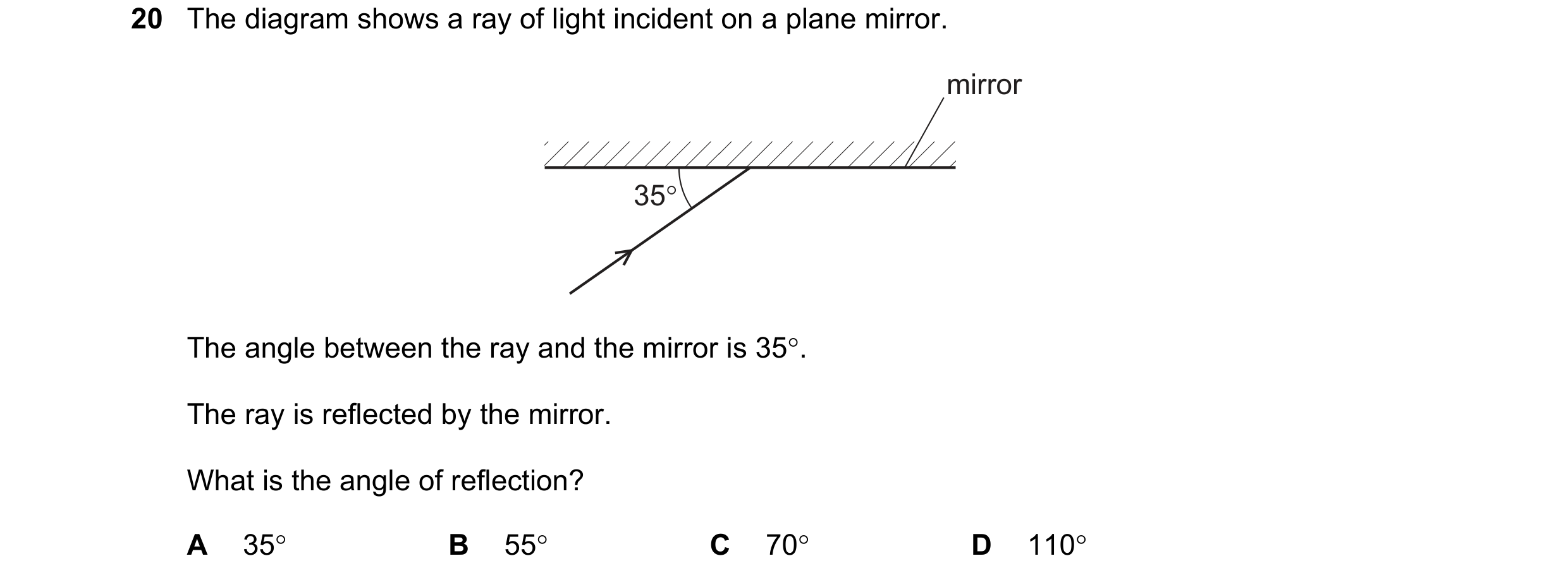
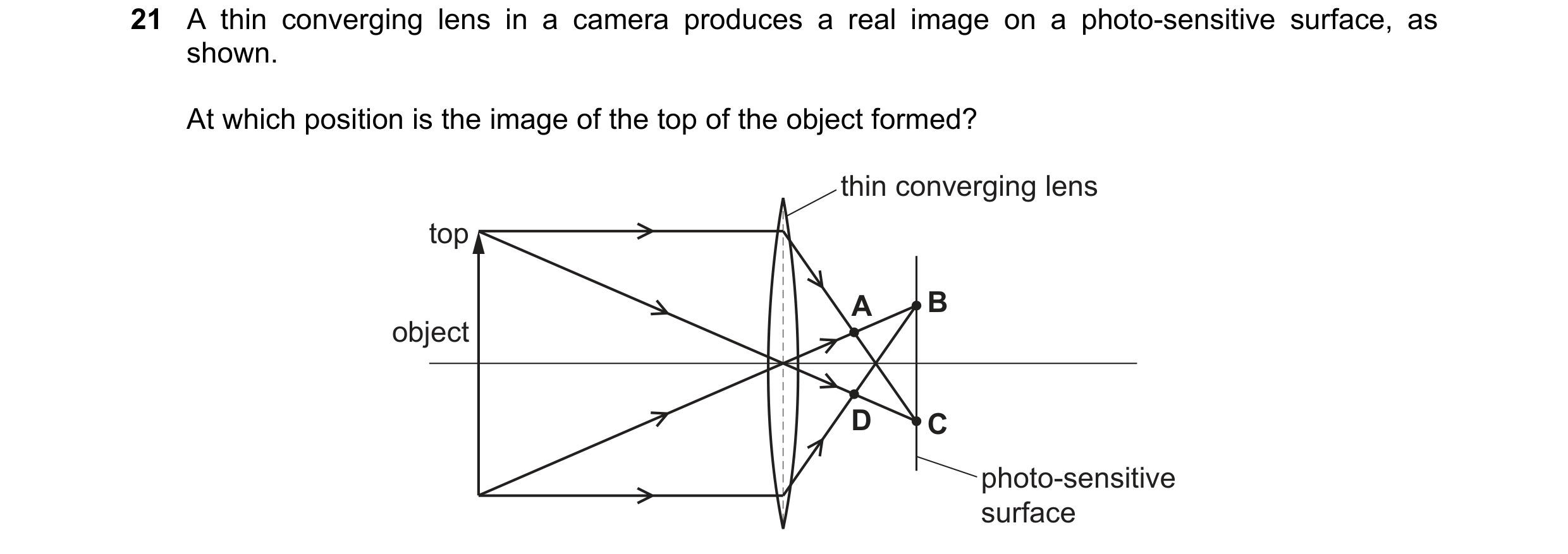

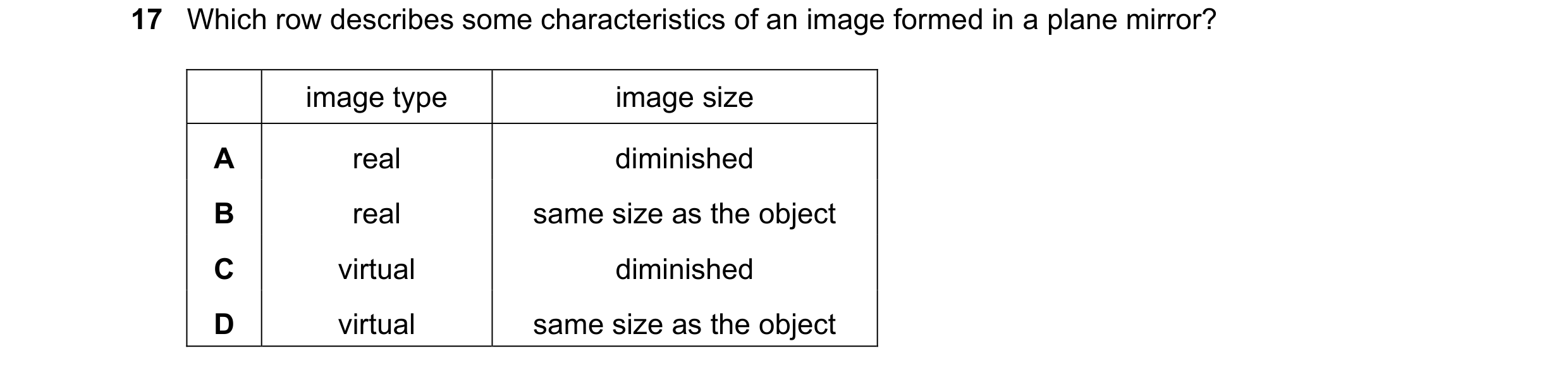 50 / 65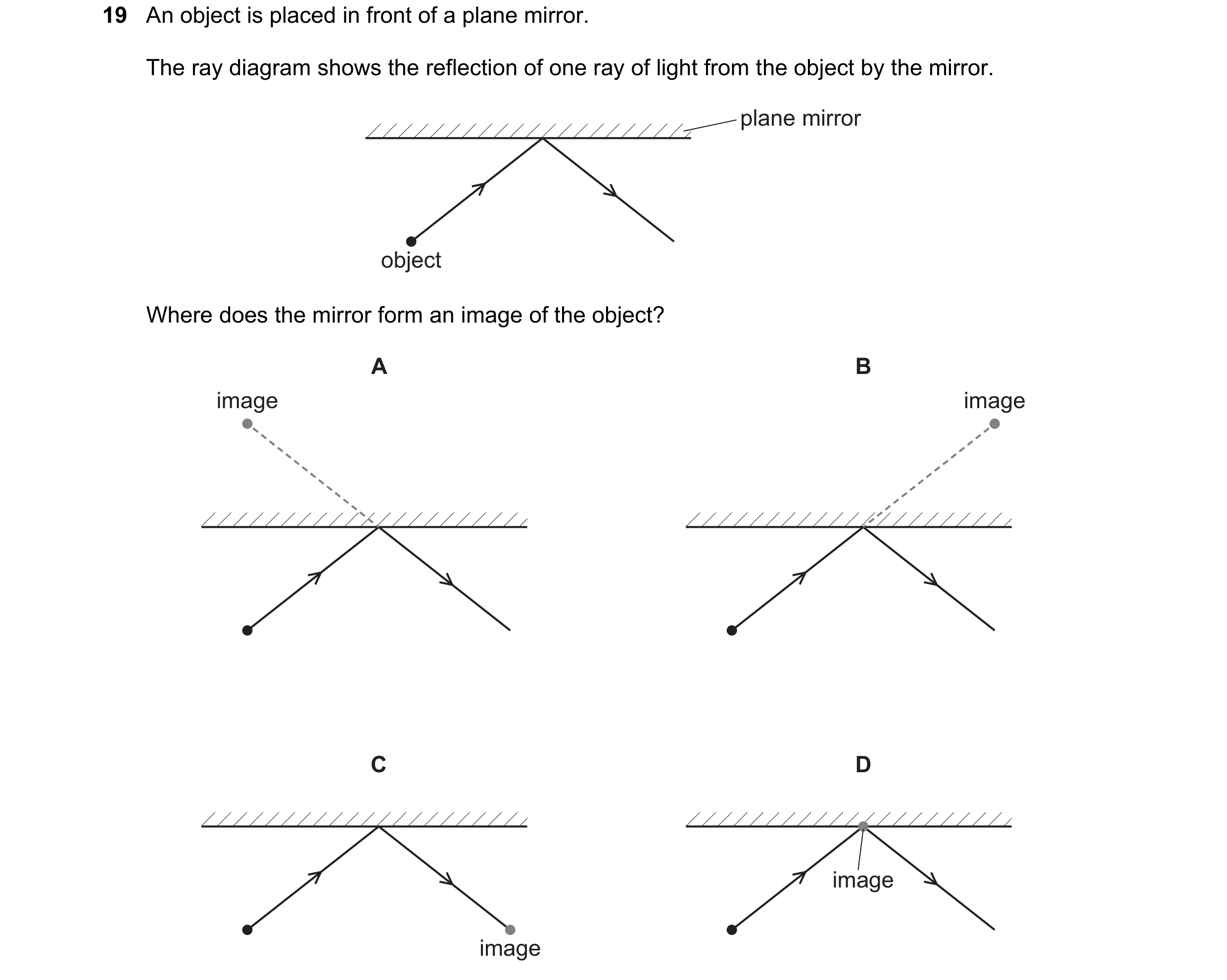
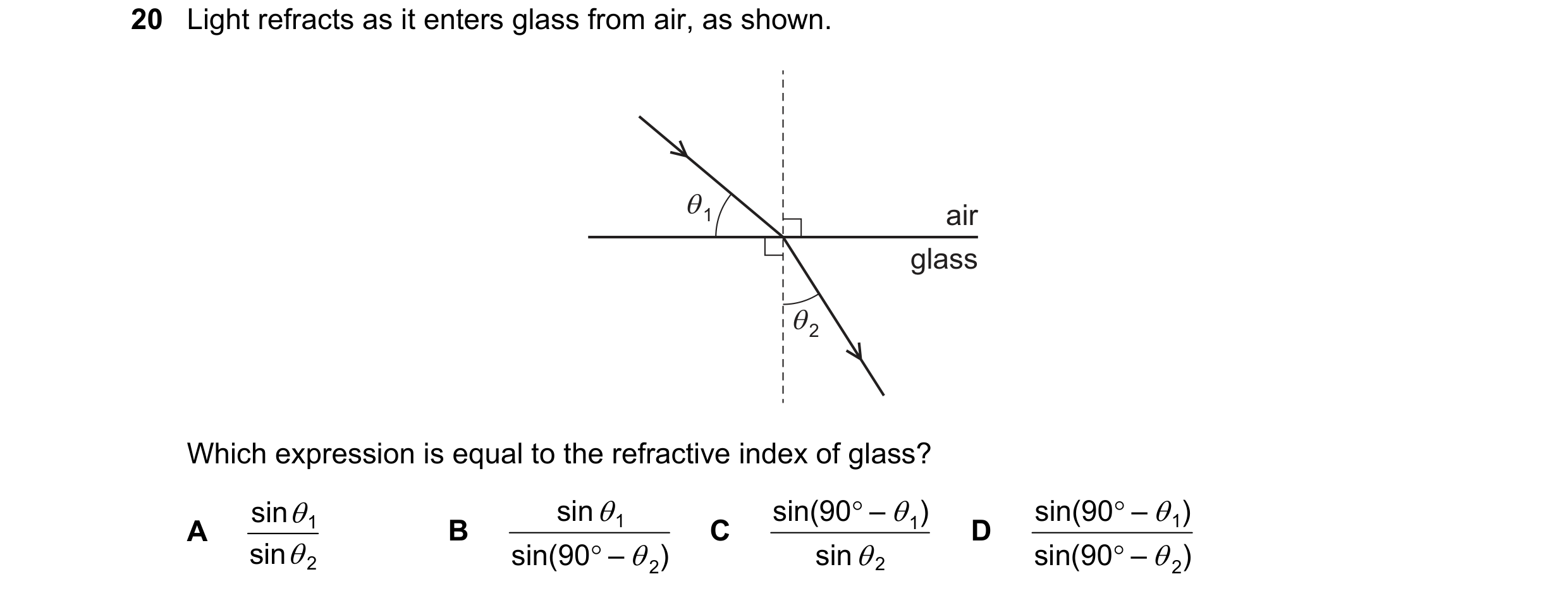 51 / 65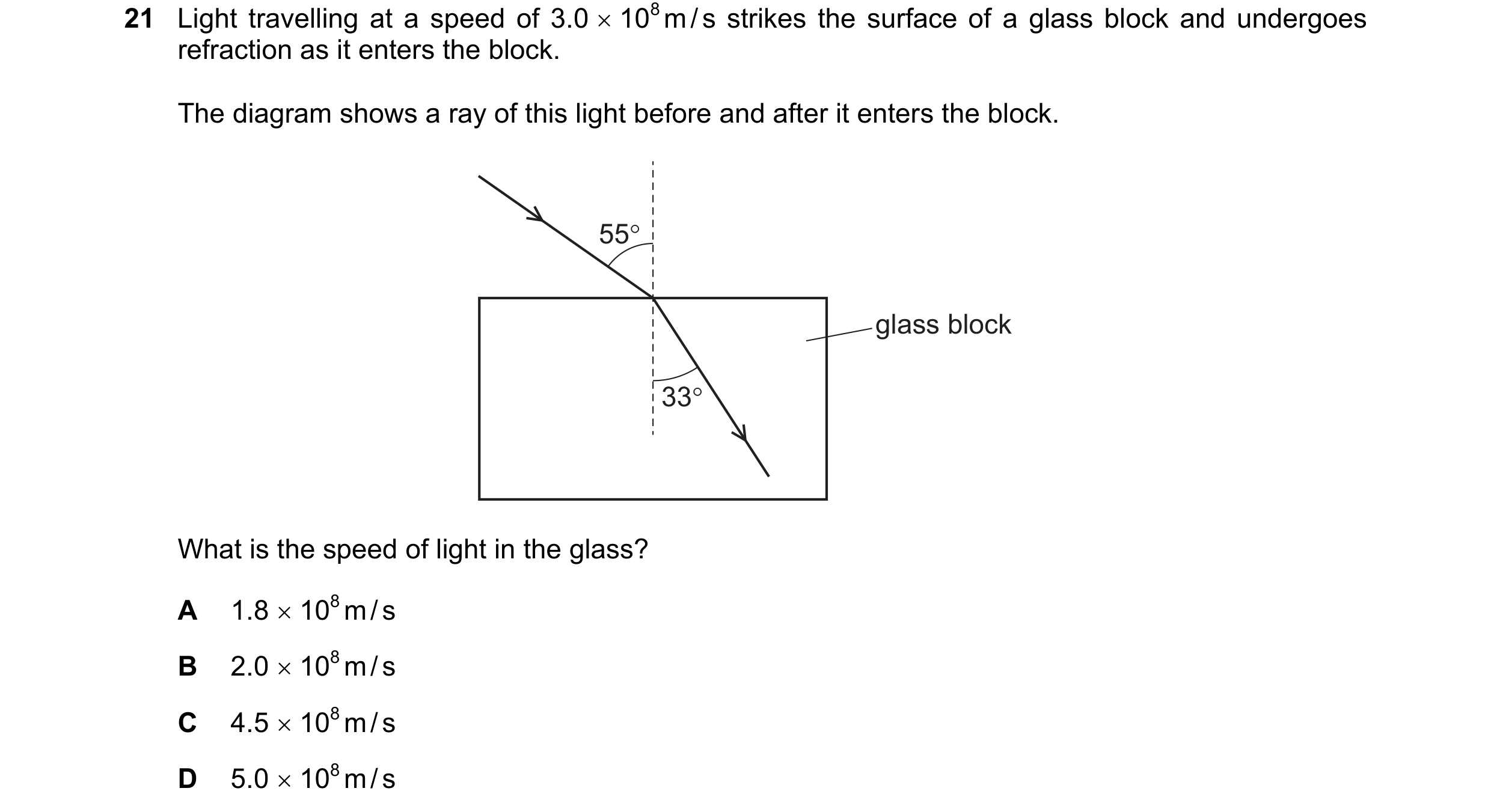
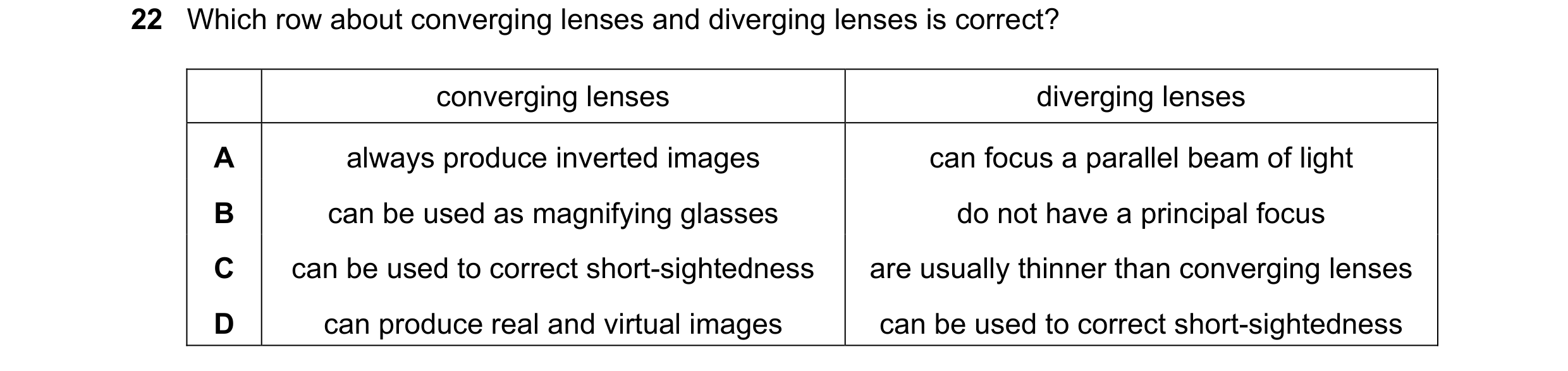

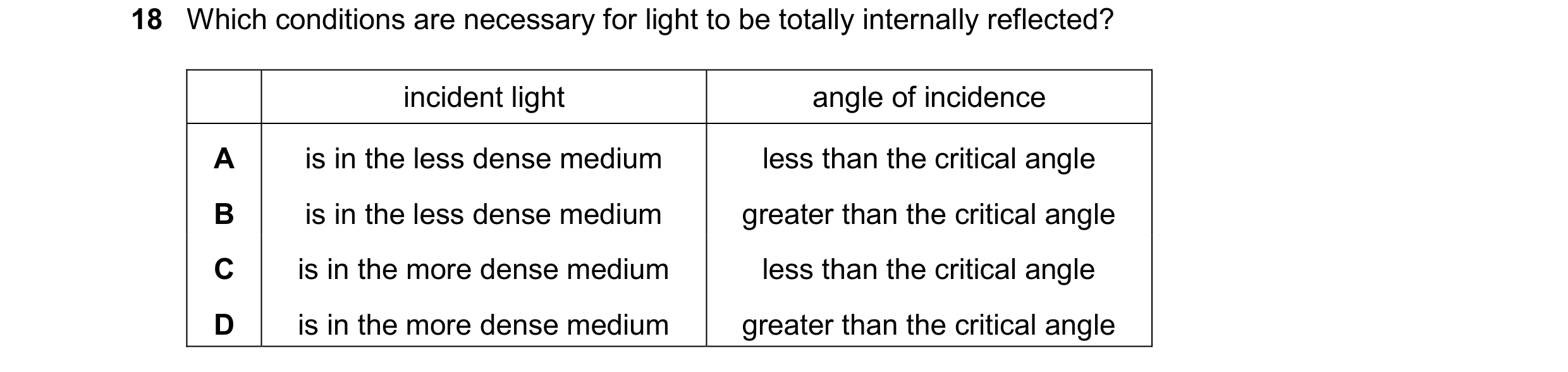 52 / 65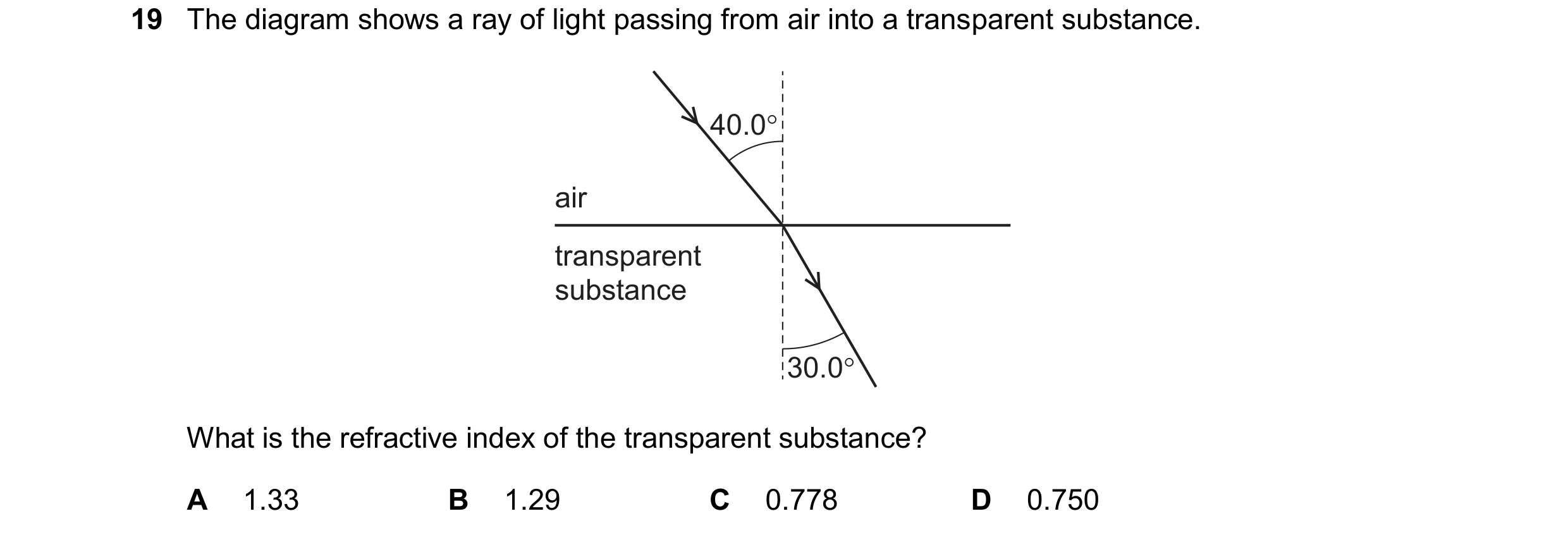
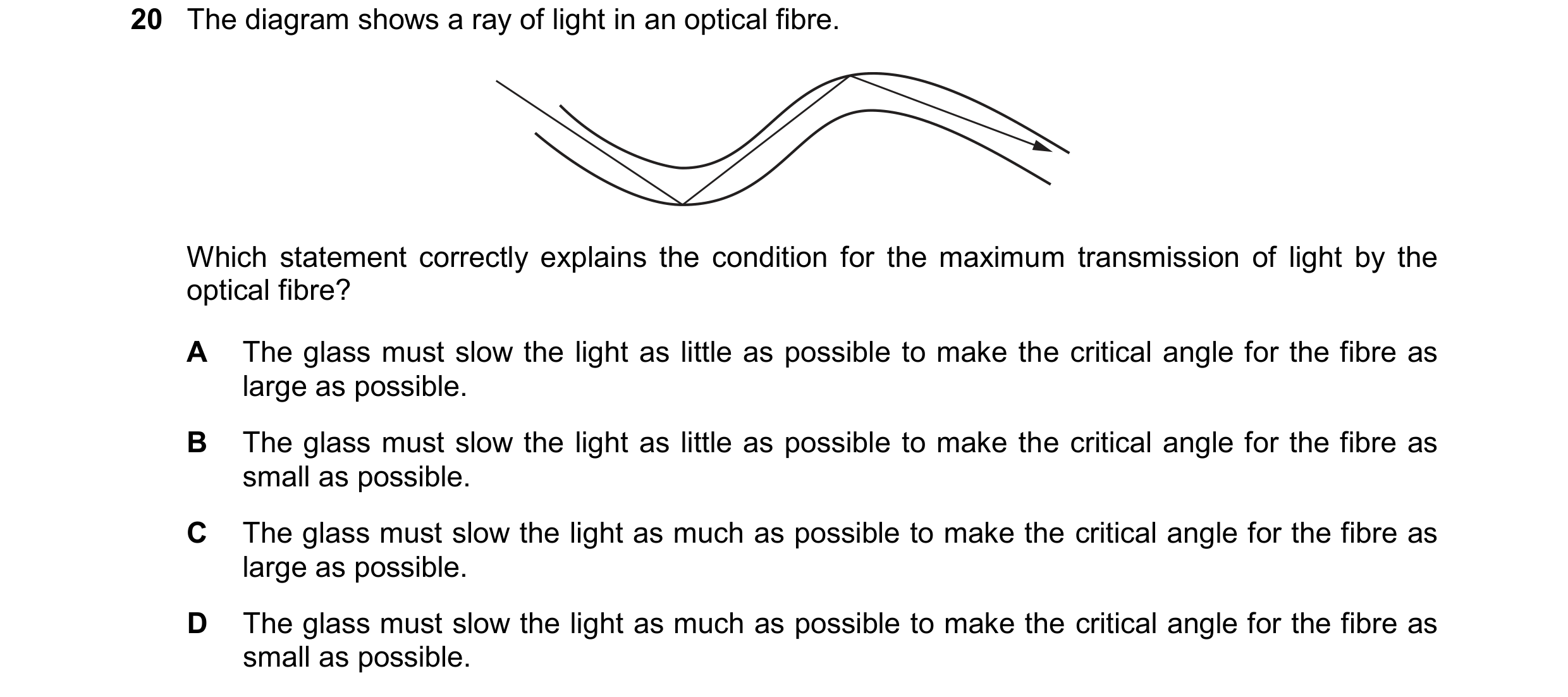
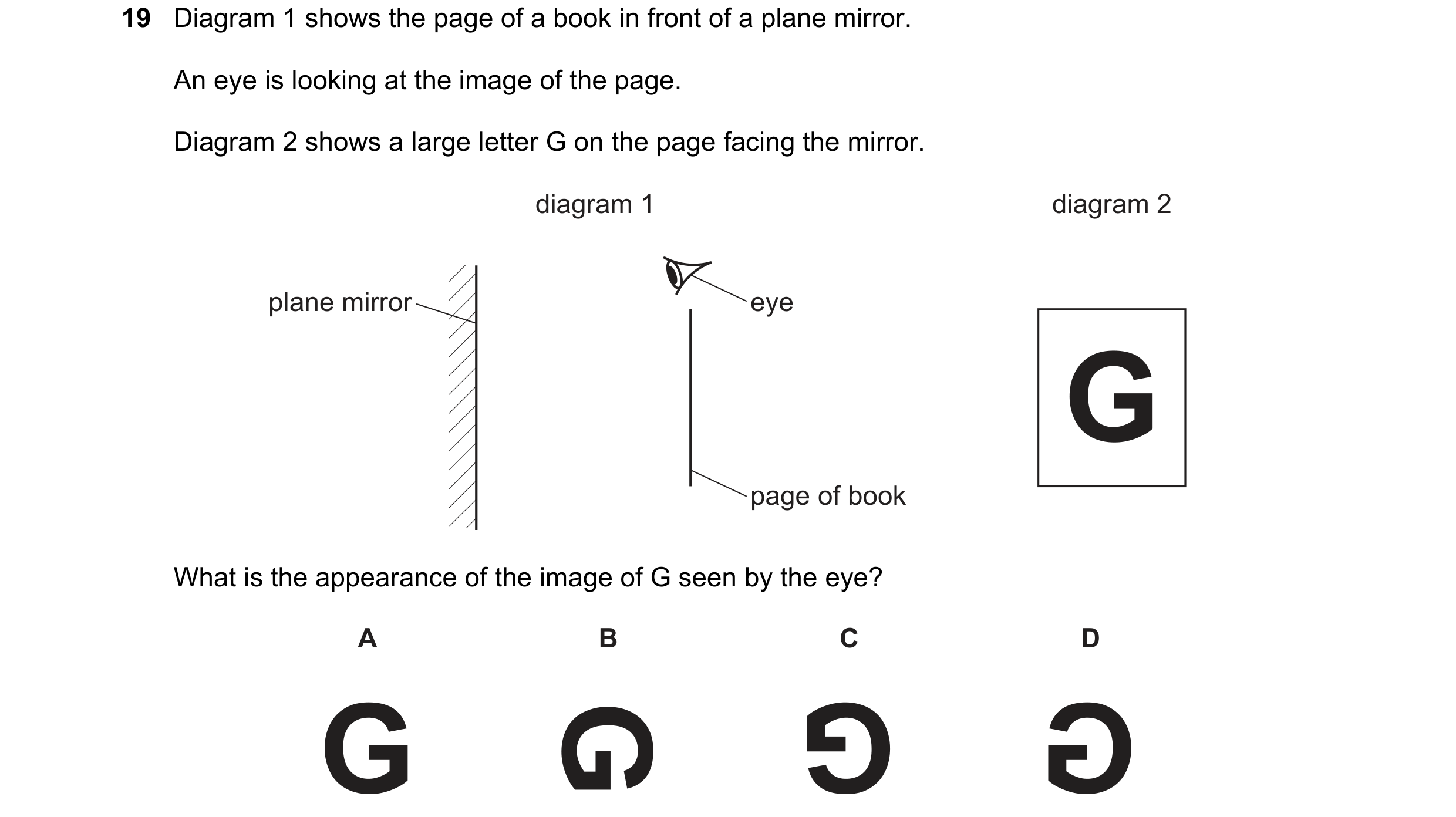 53 / 65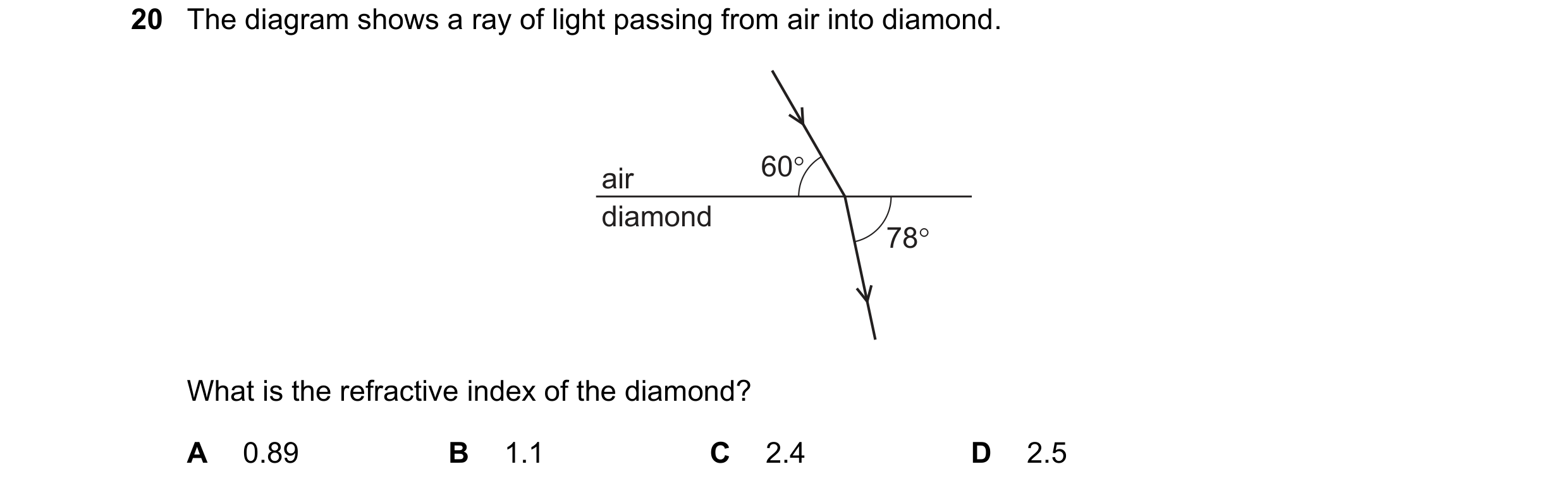
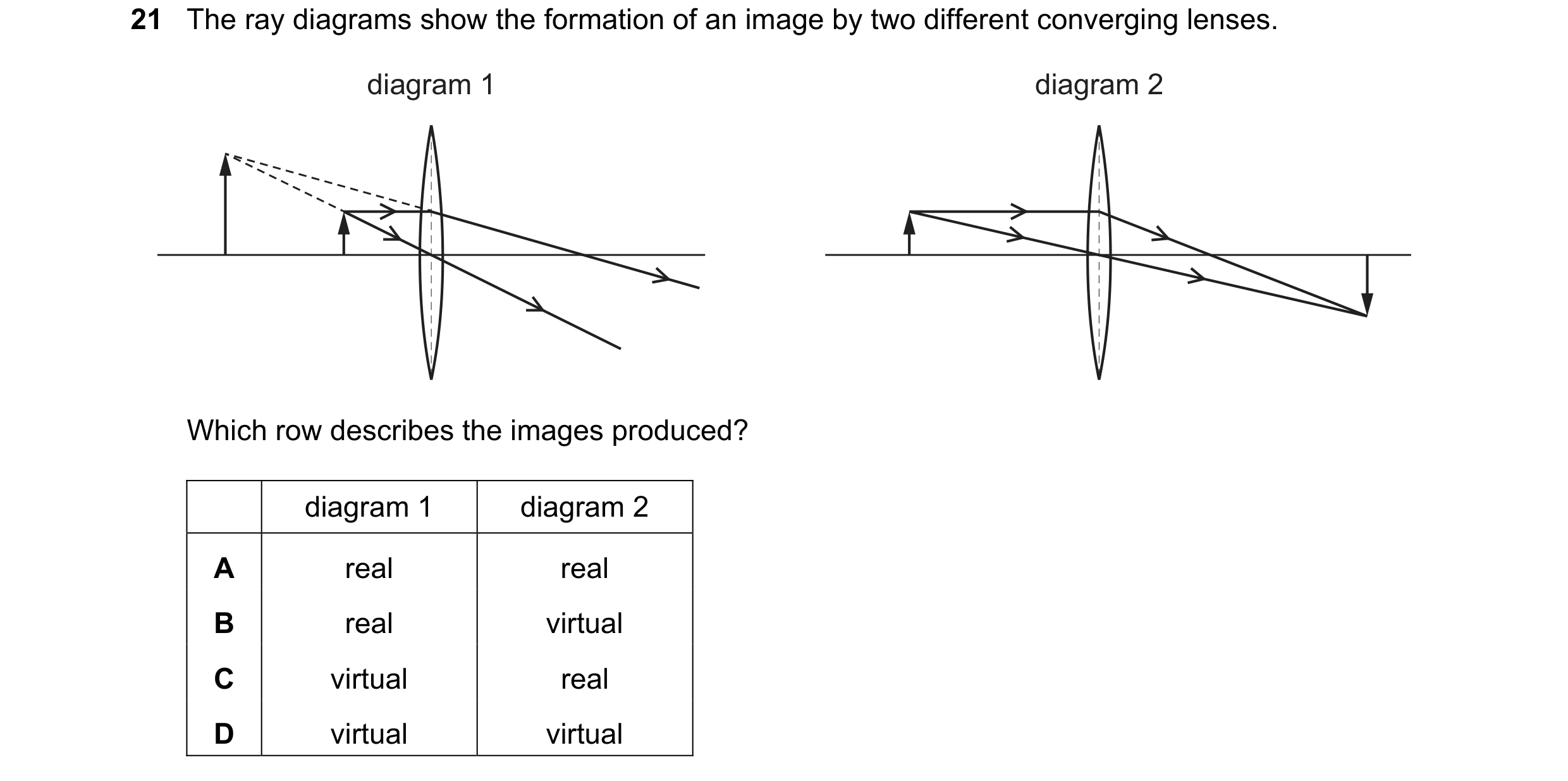
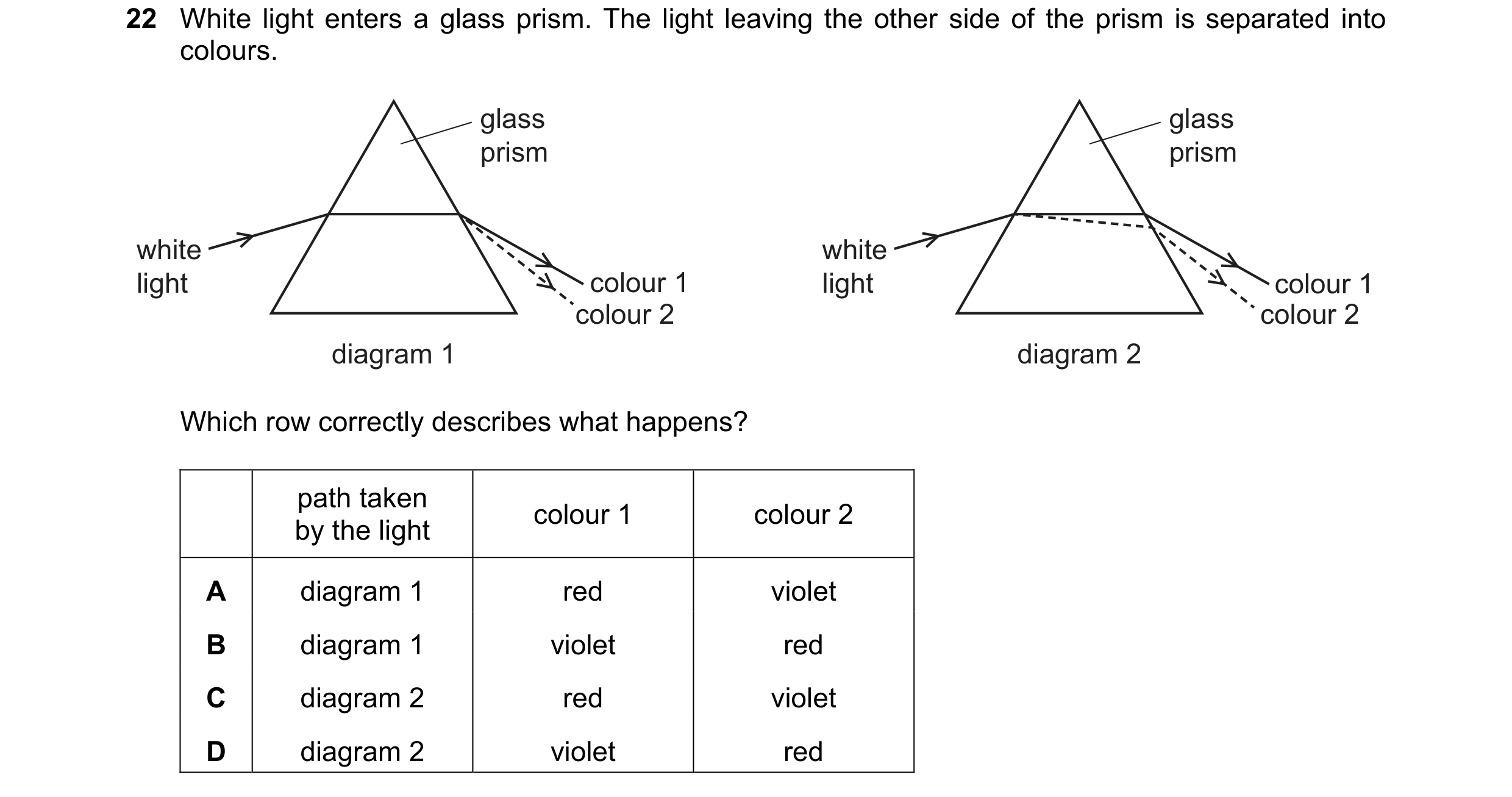 54 / 65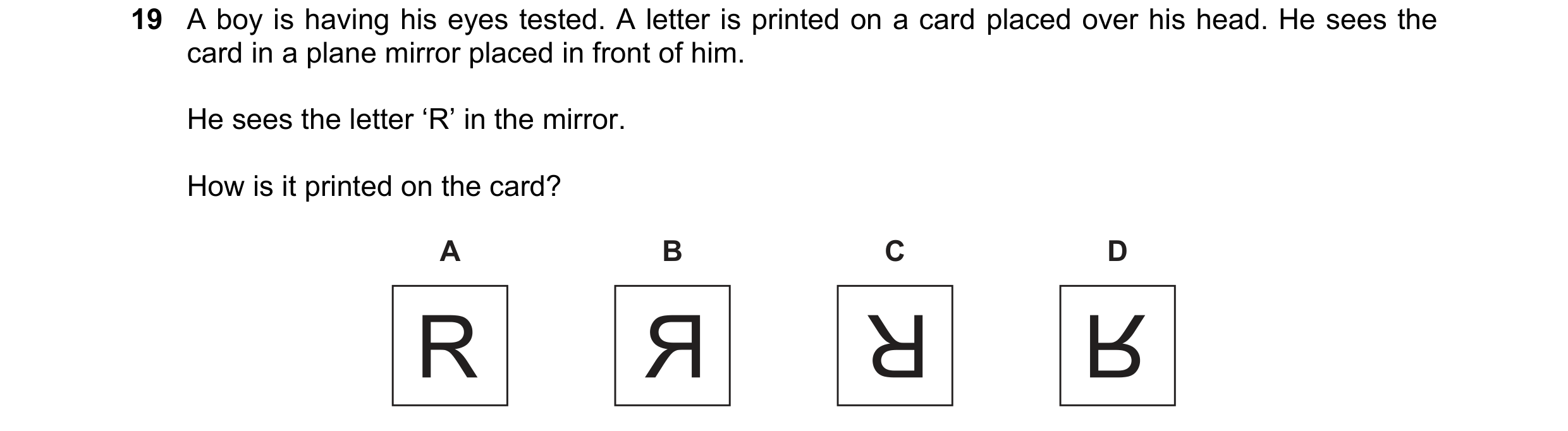
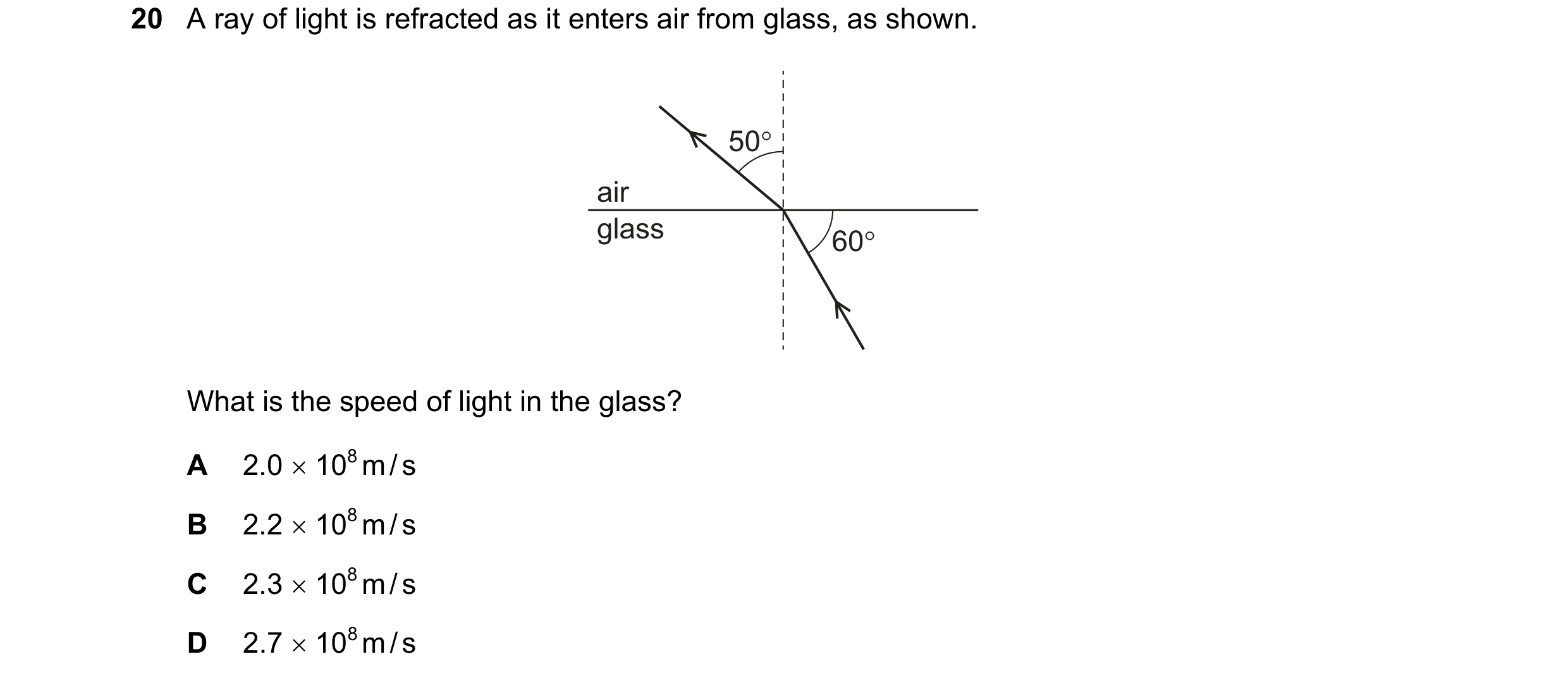
 55 / 65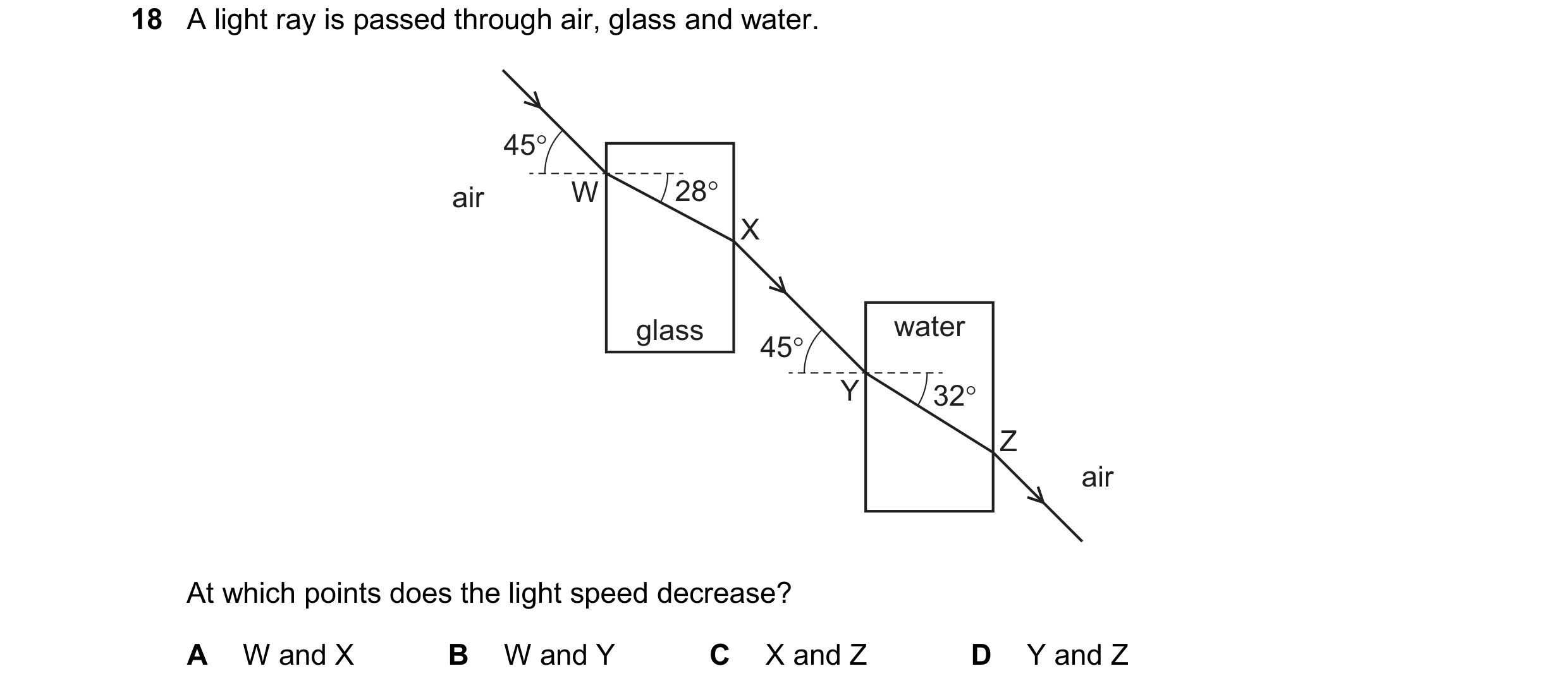
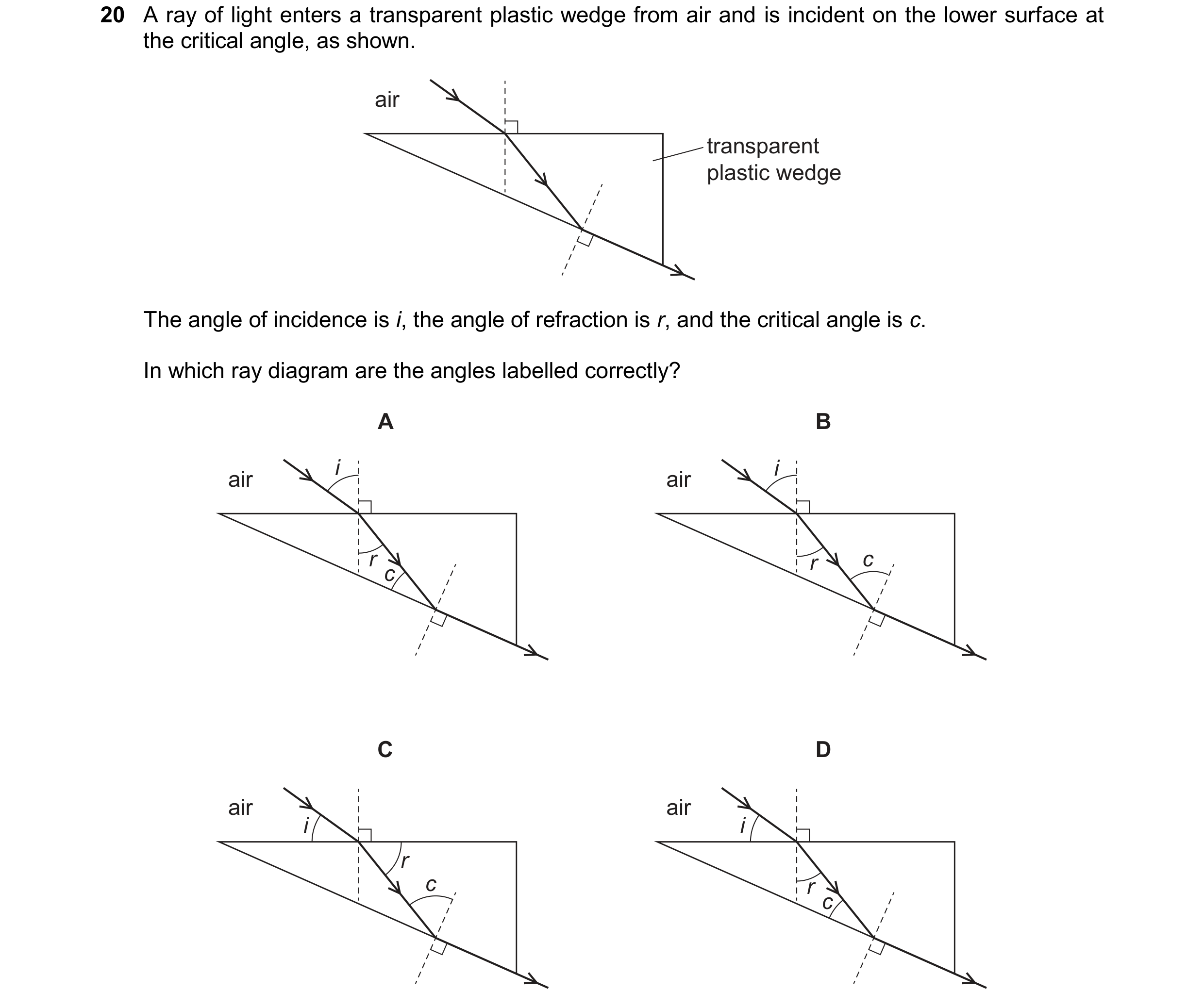 56 / 65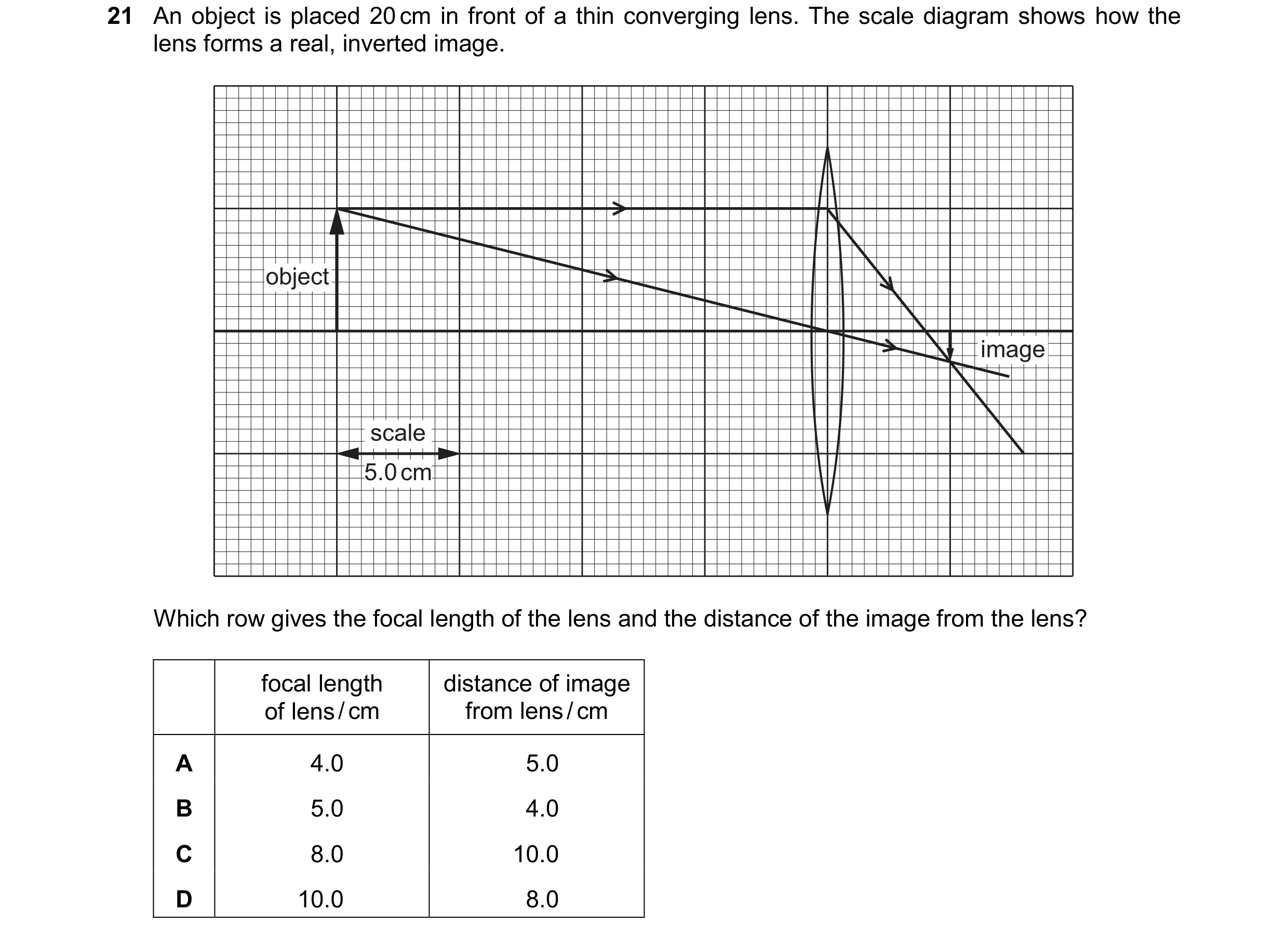
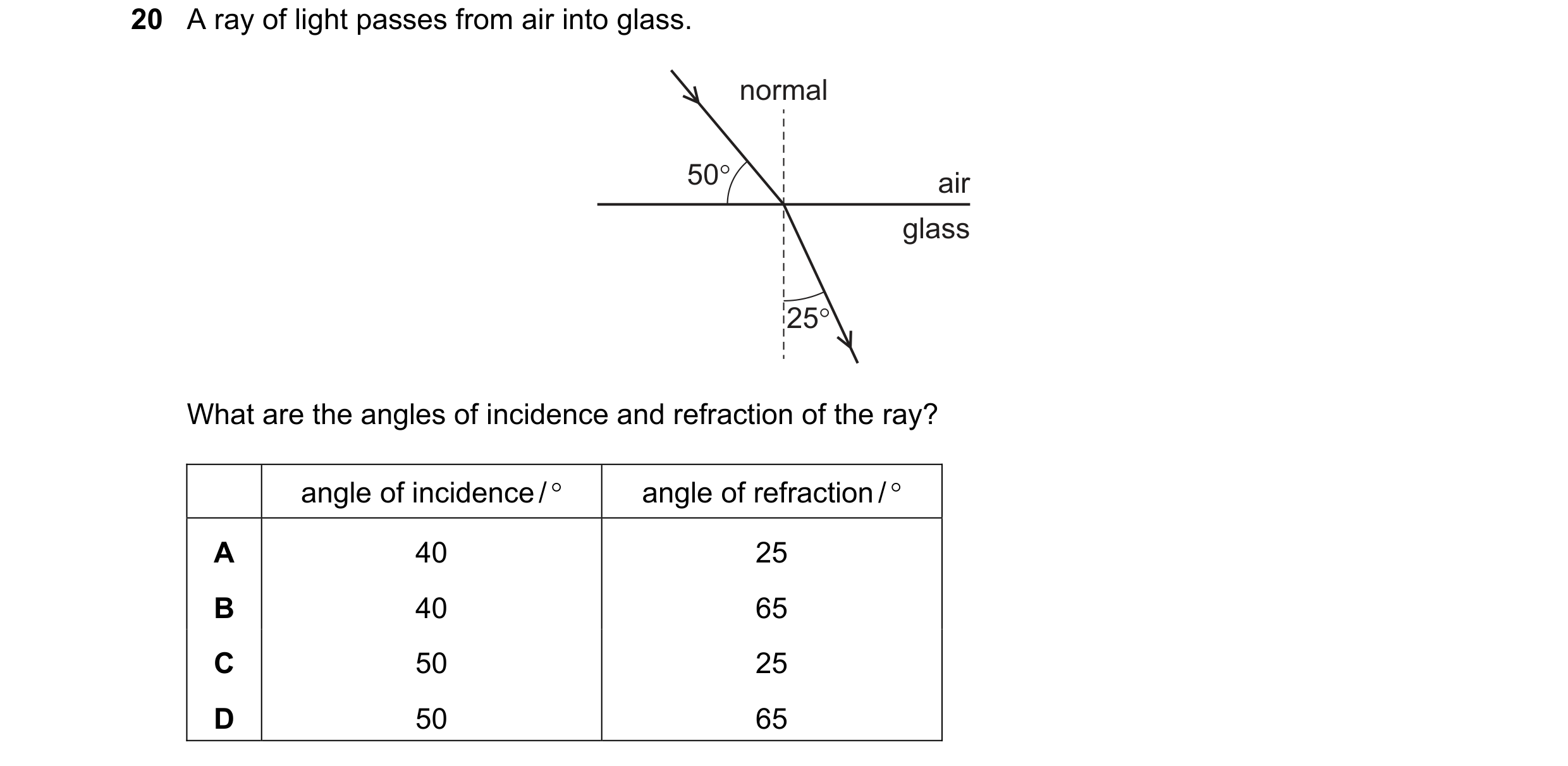 57 / 65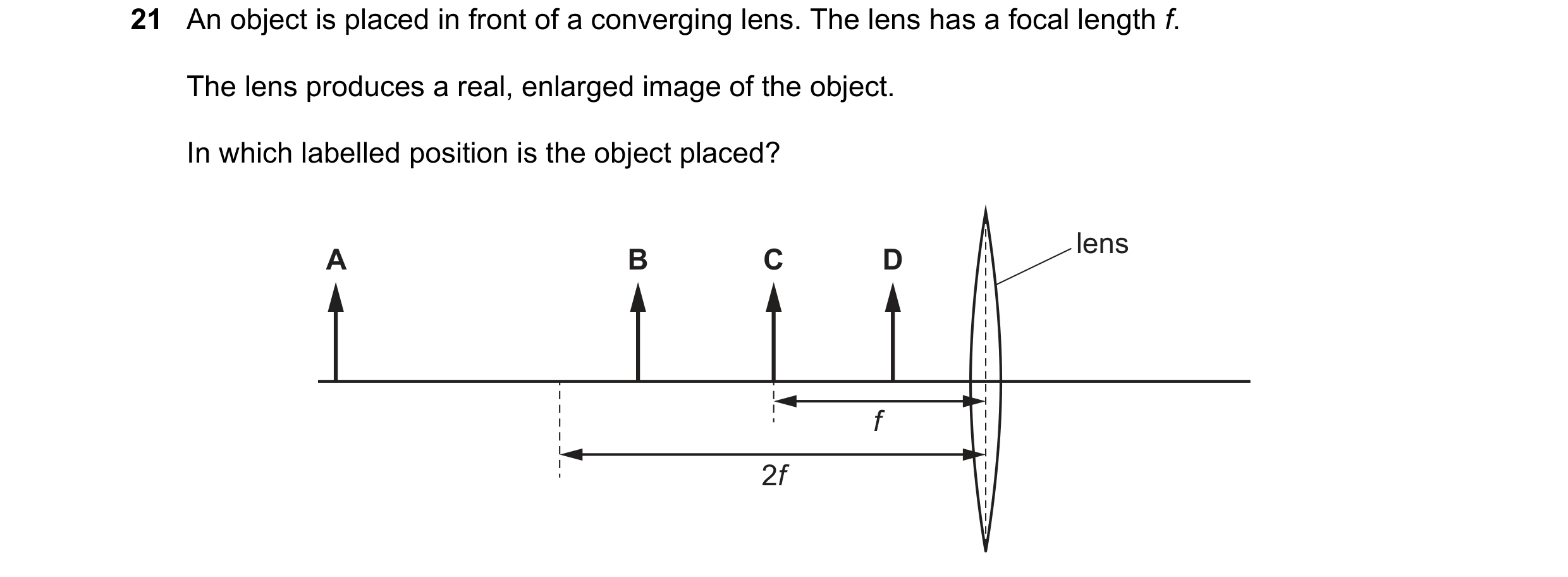
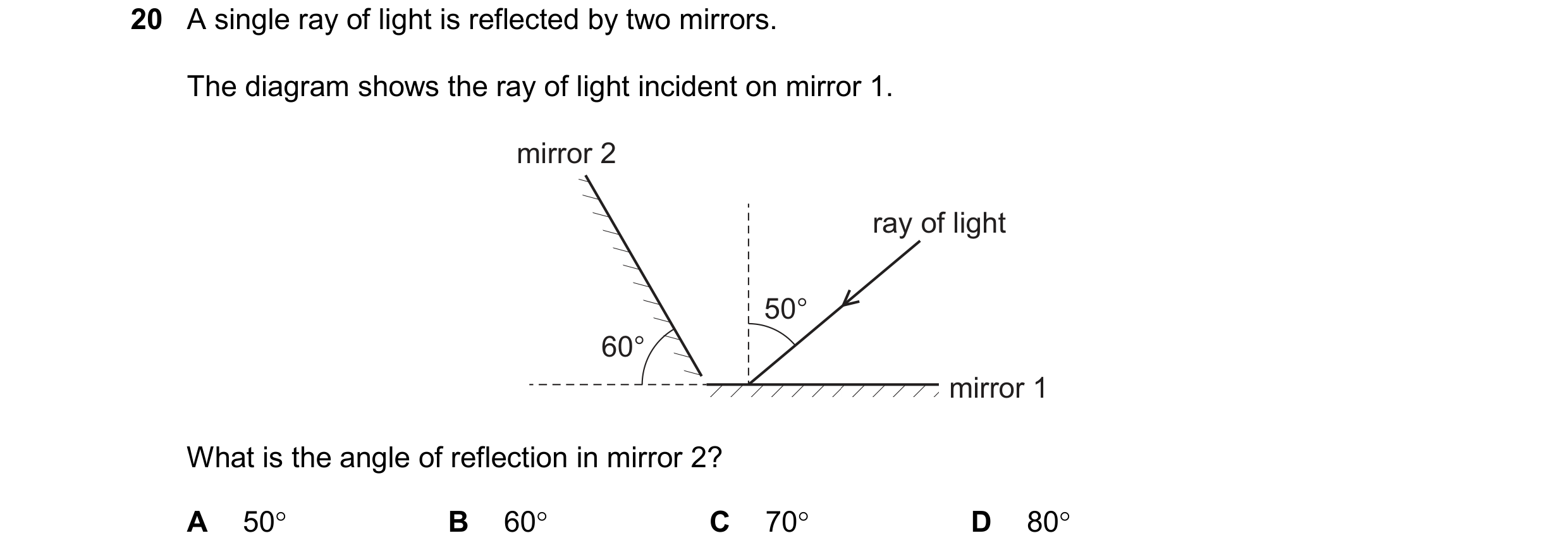
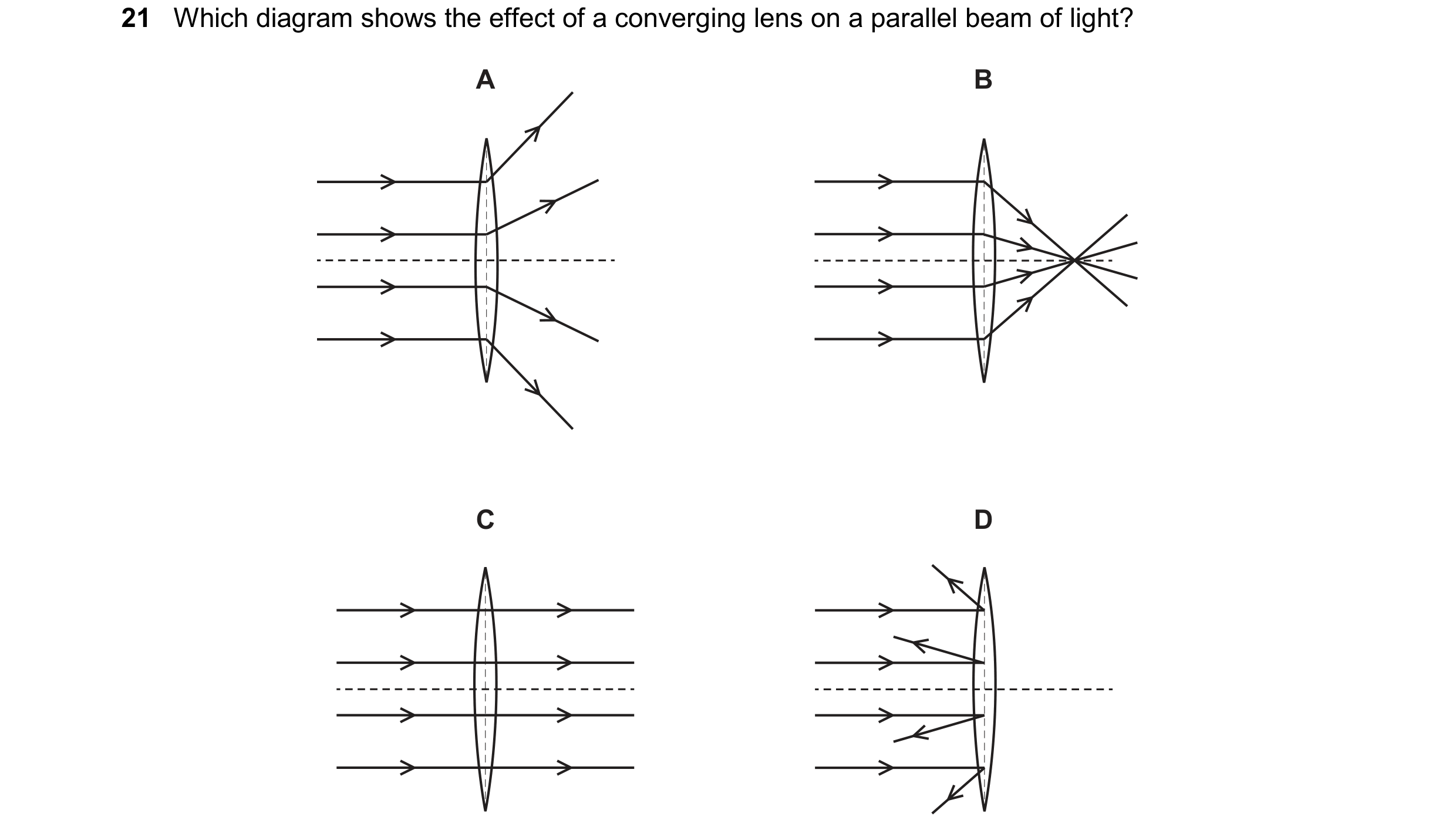 58 / 65
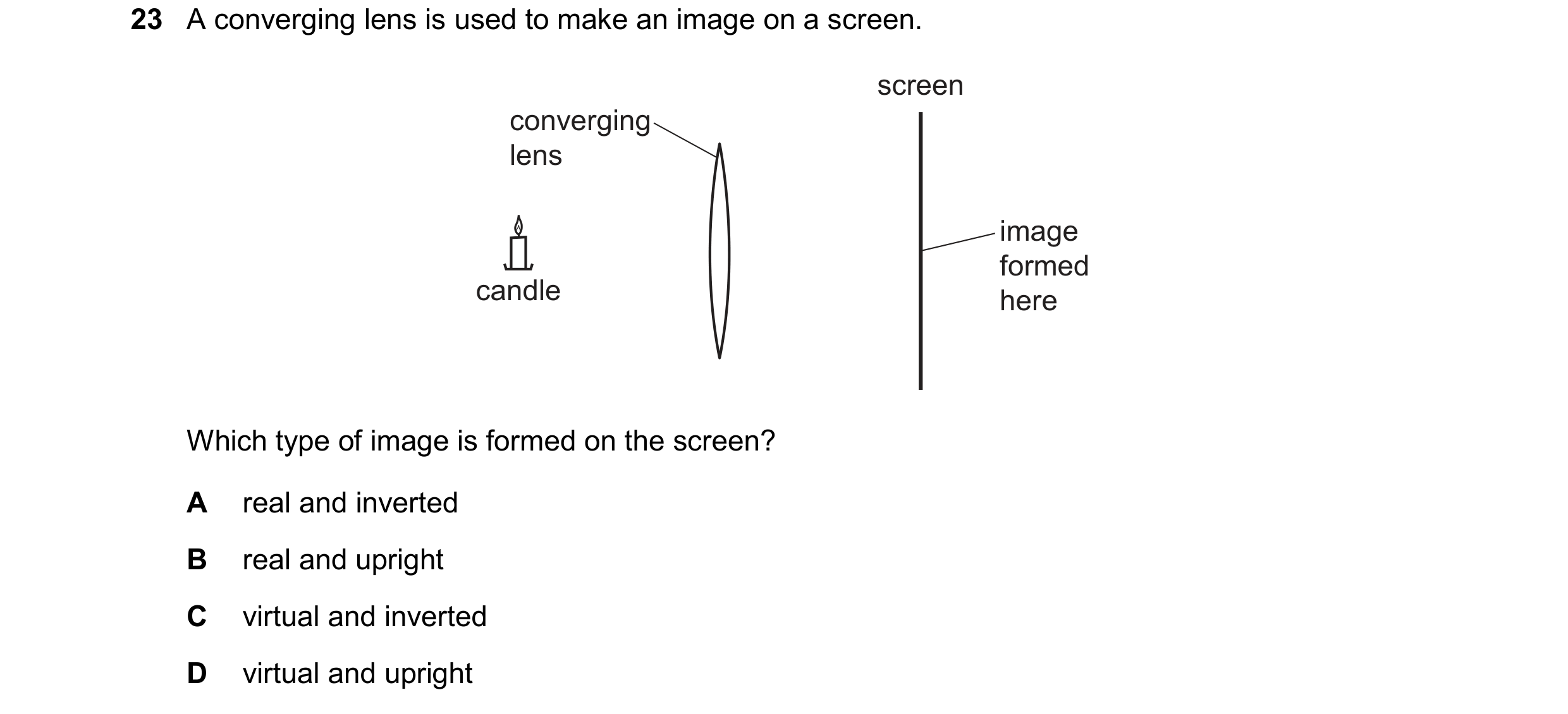
 59 / 65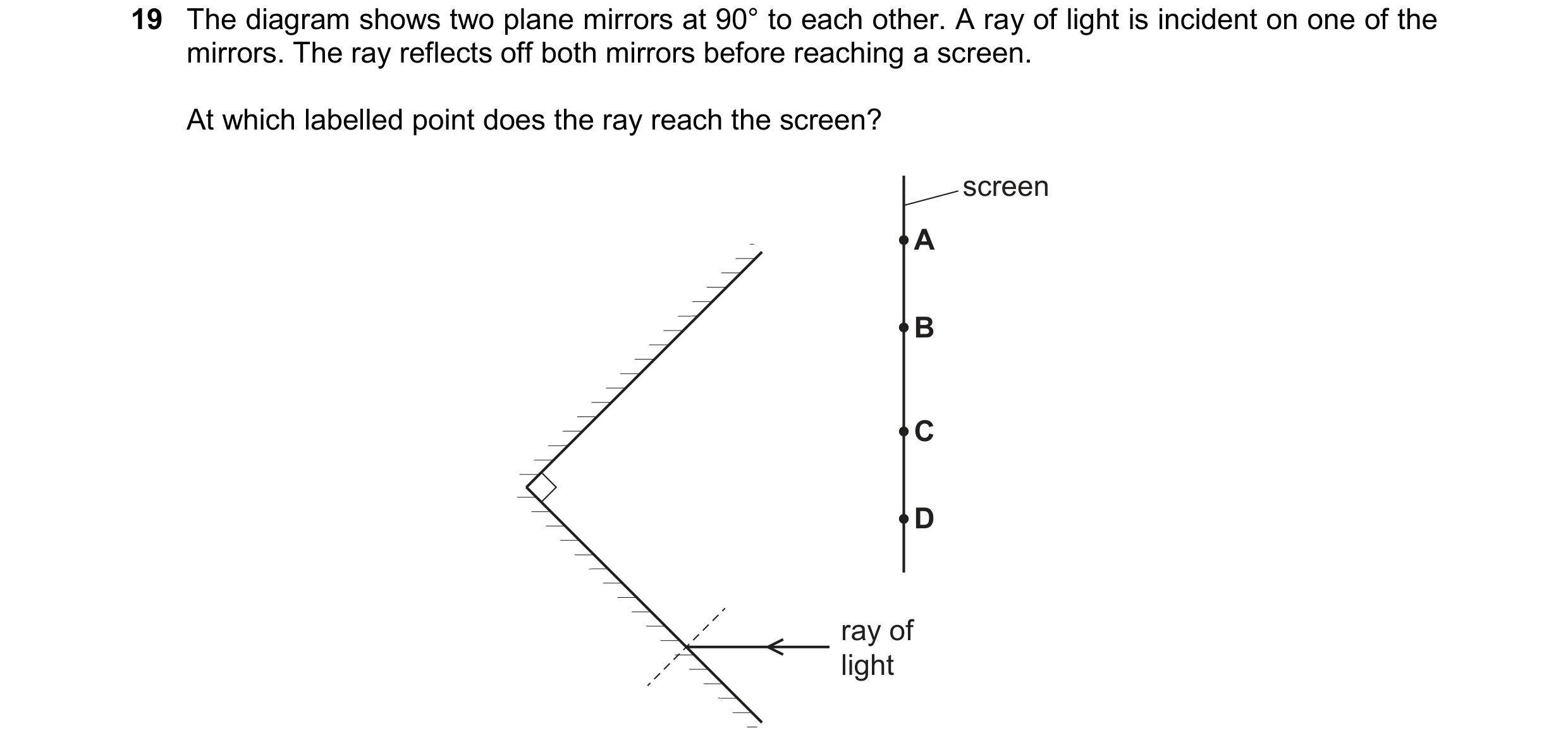

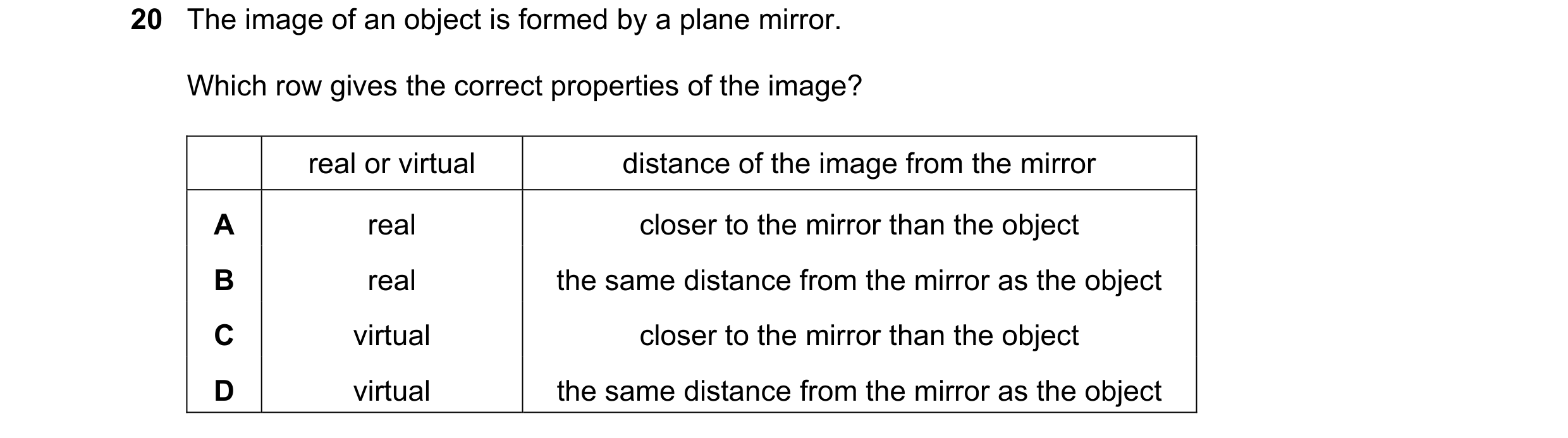 60 / 65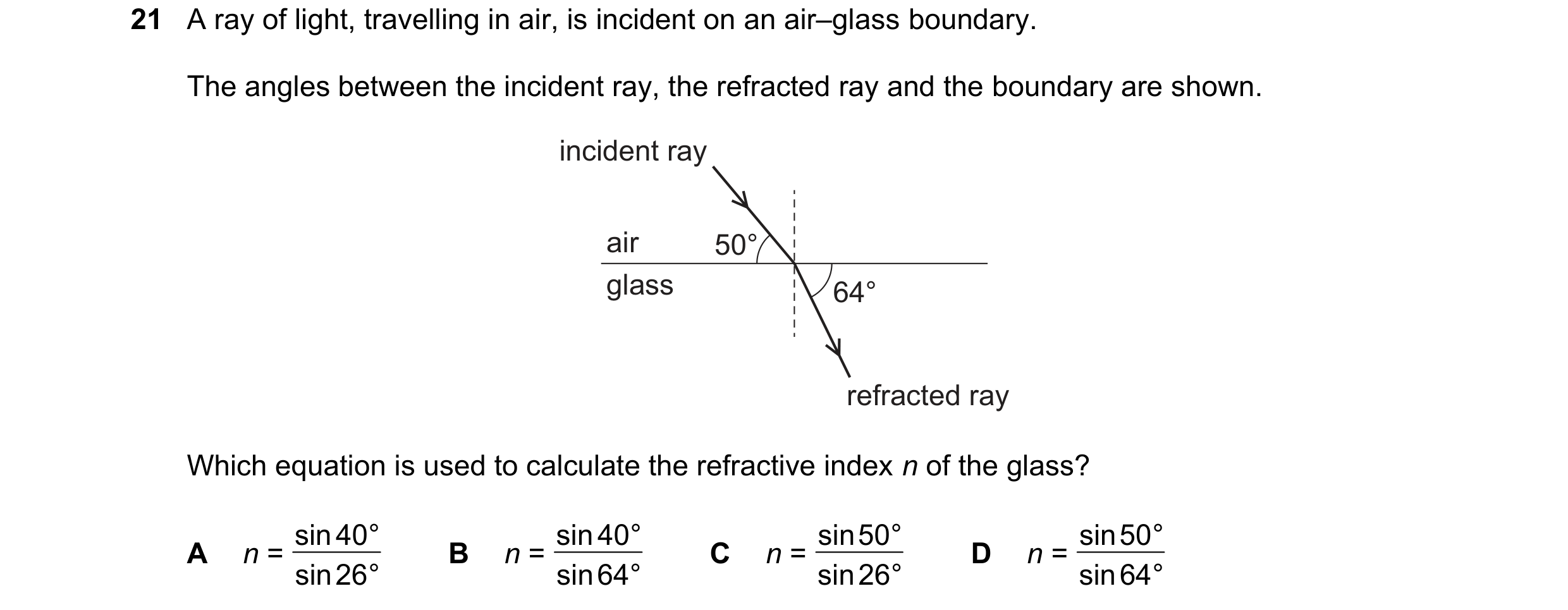
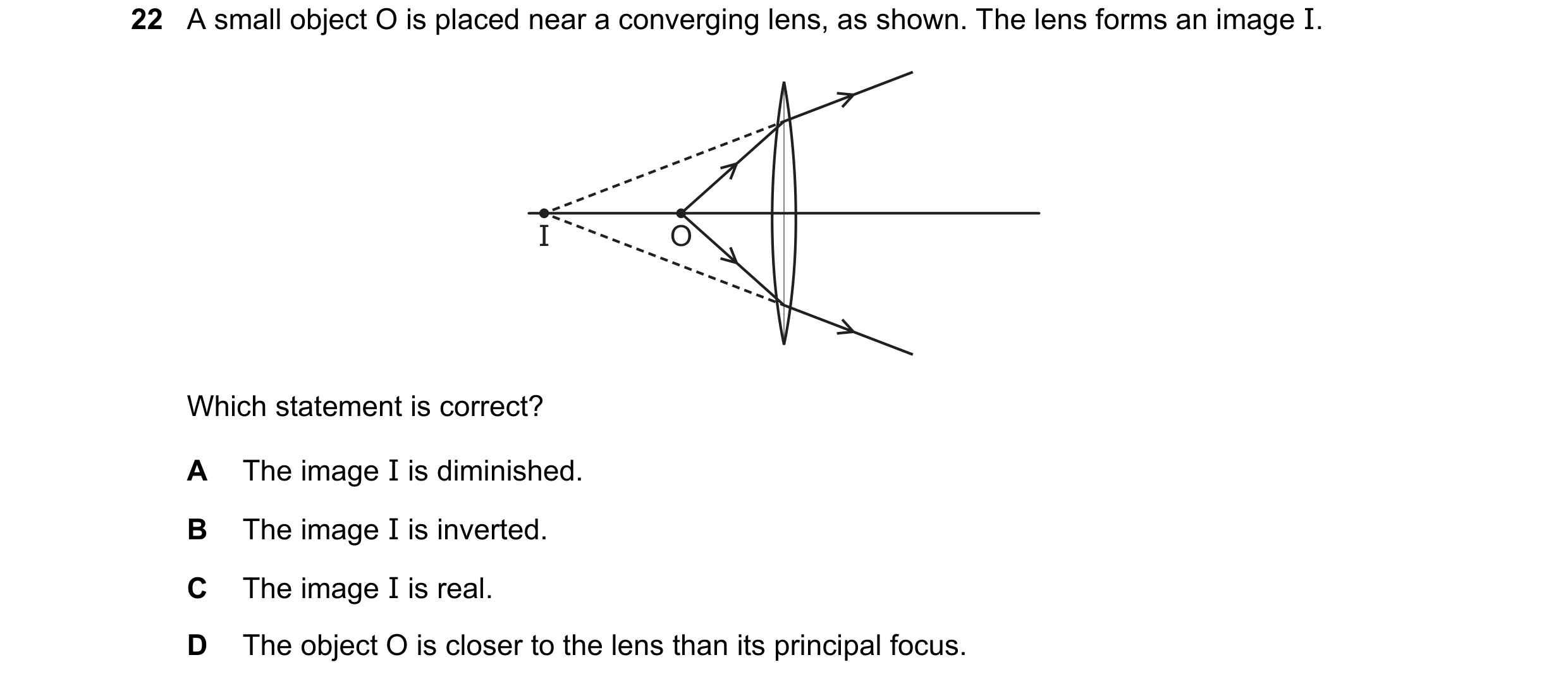
 61 / 65

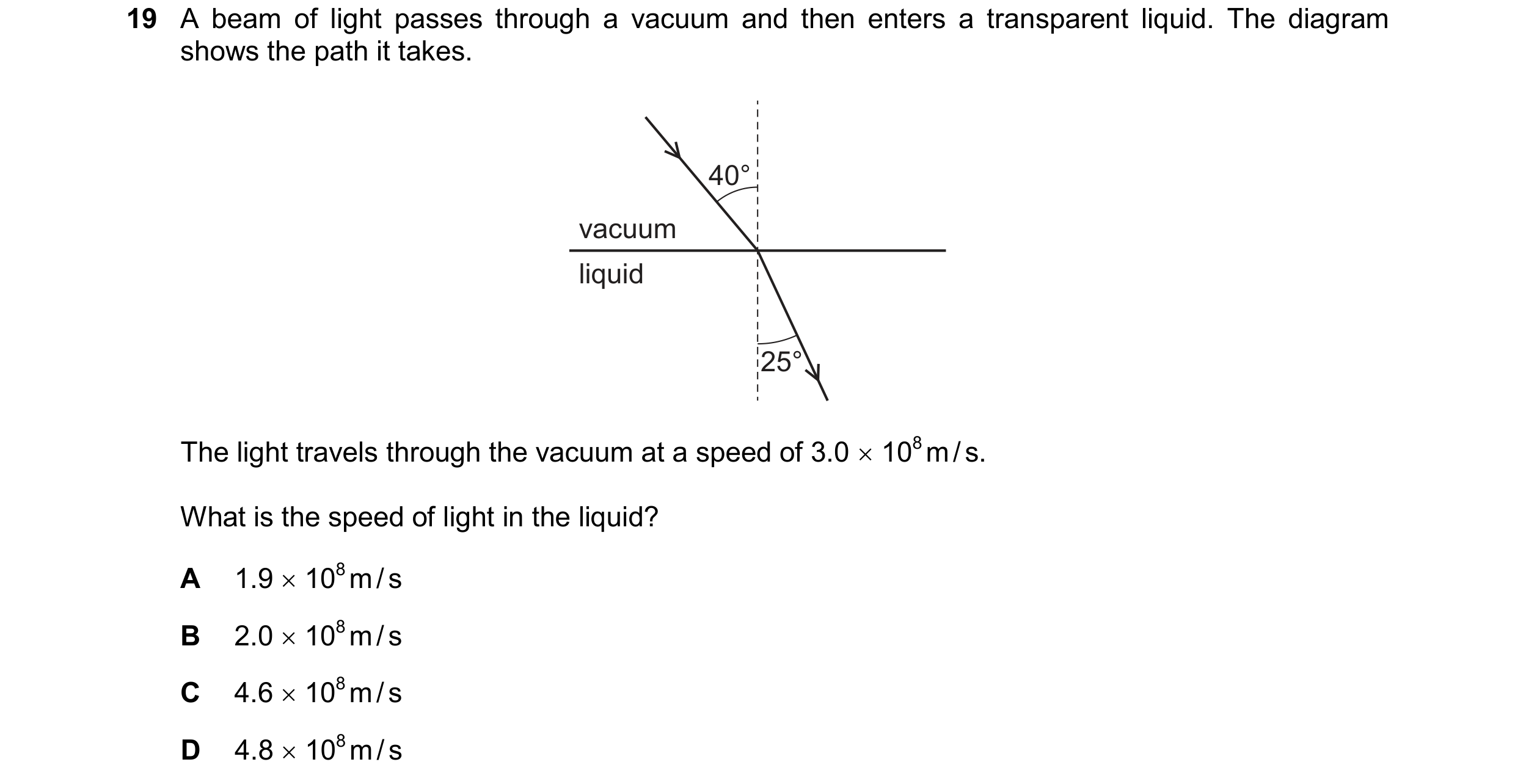 62 / 65
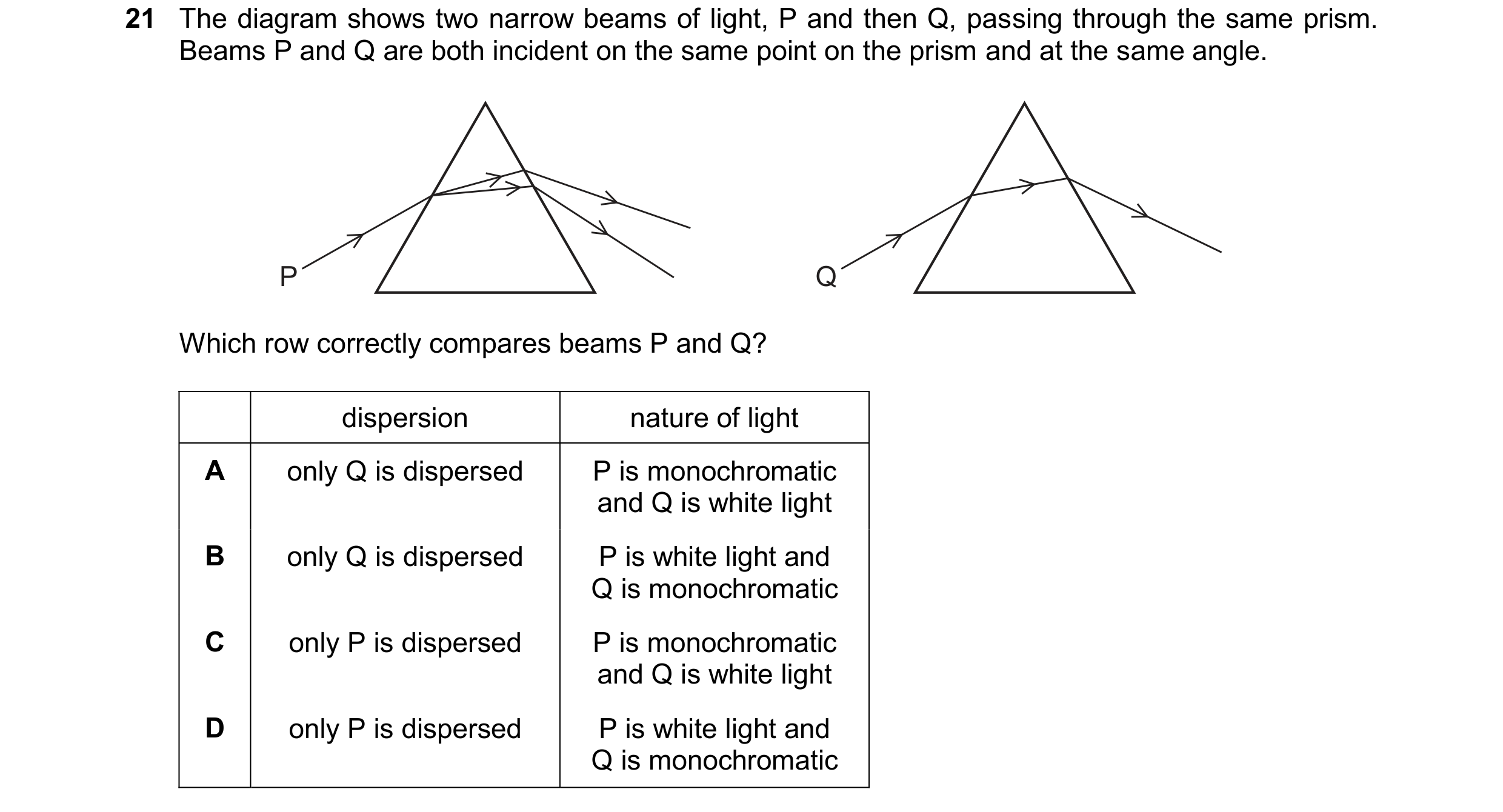
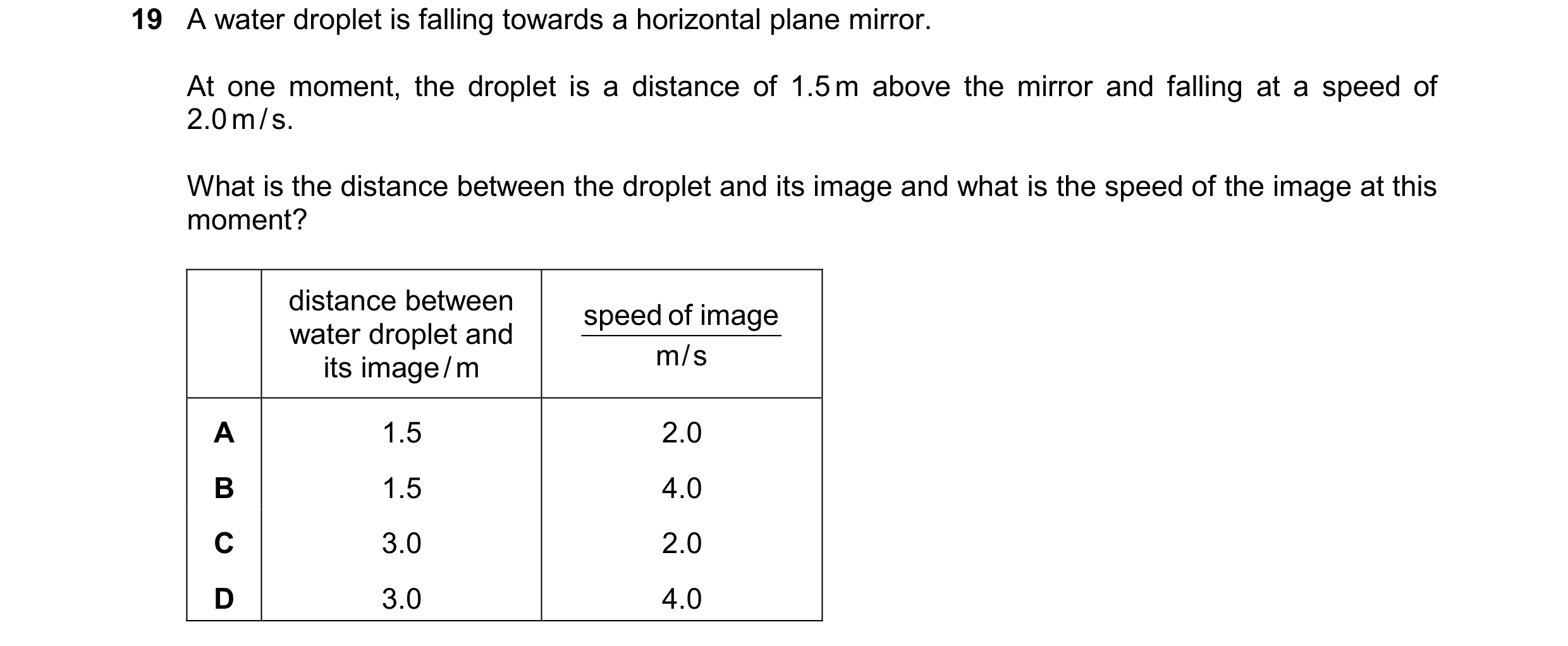 63 / 65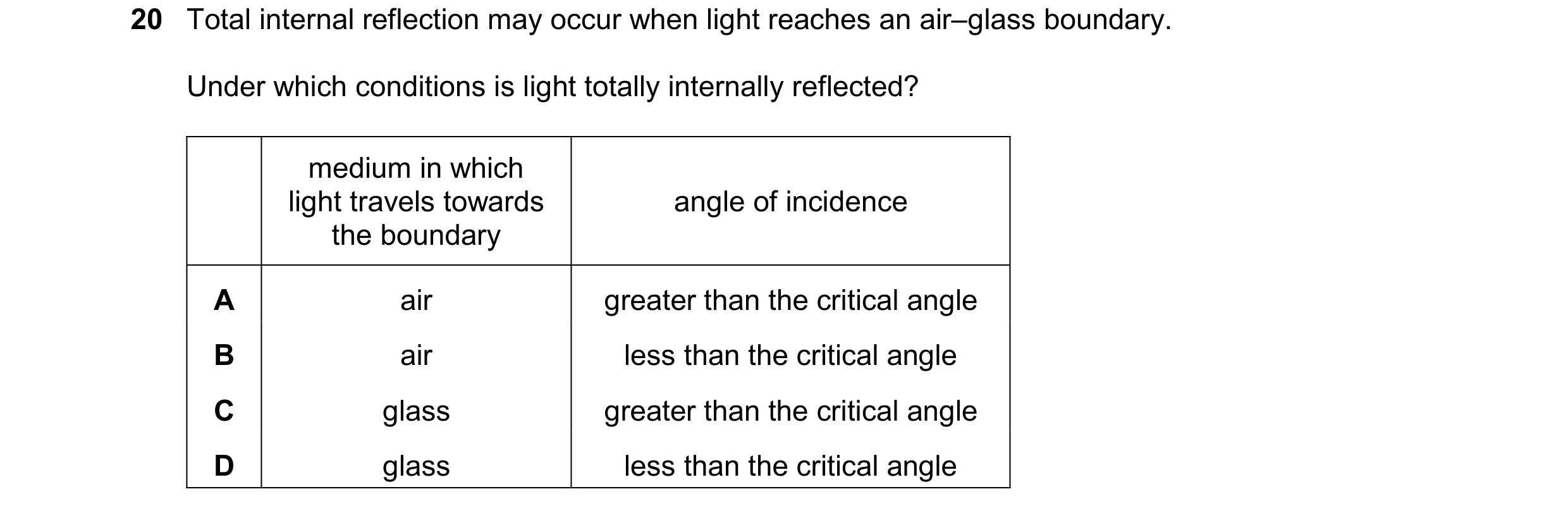
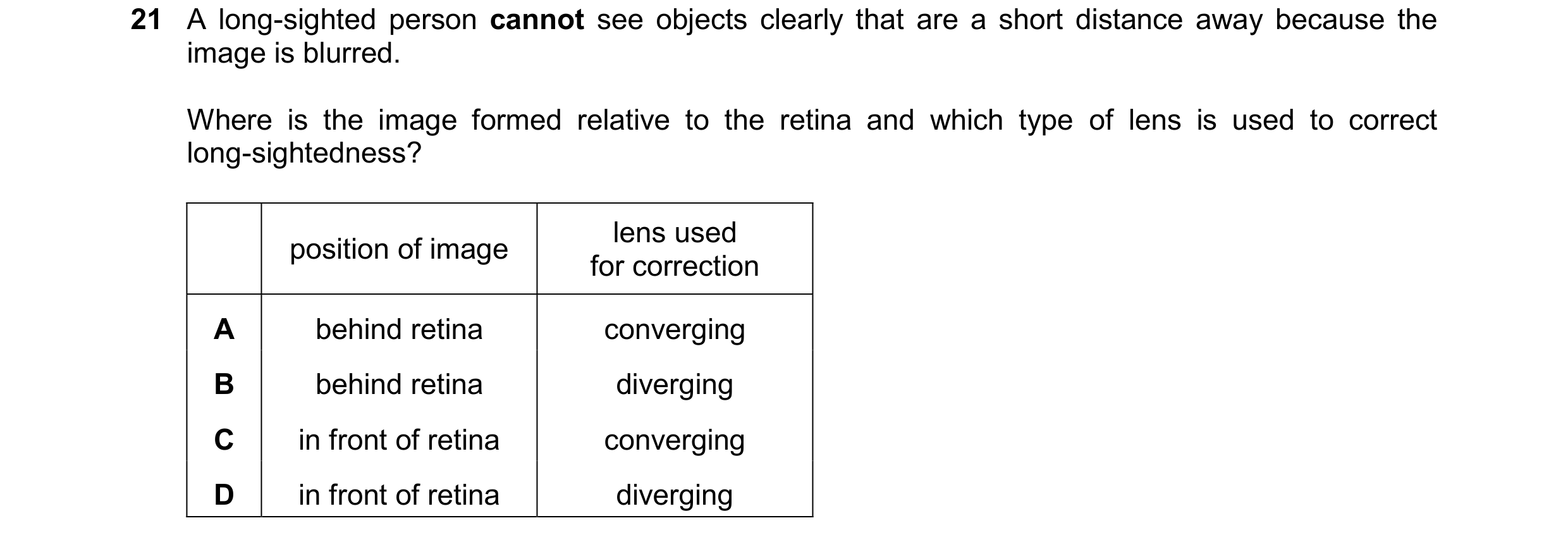
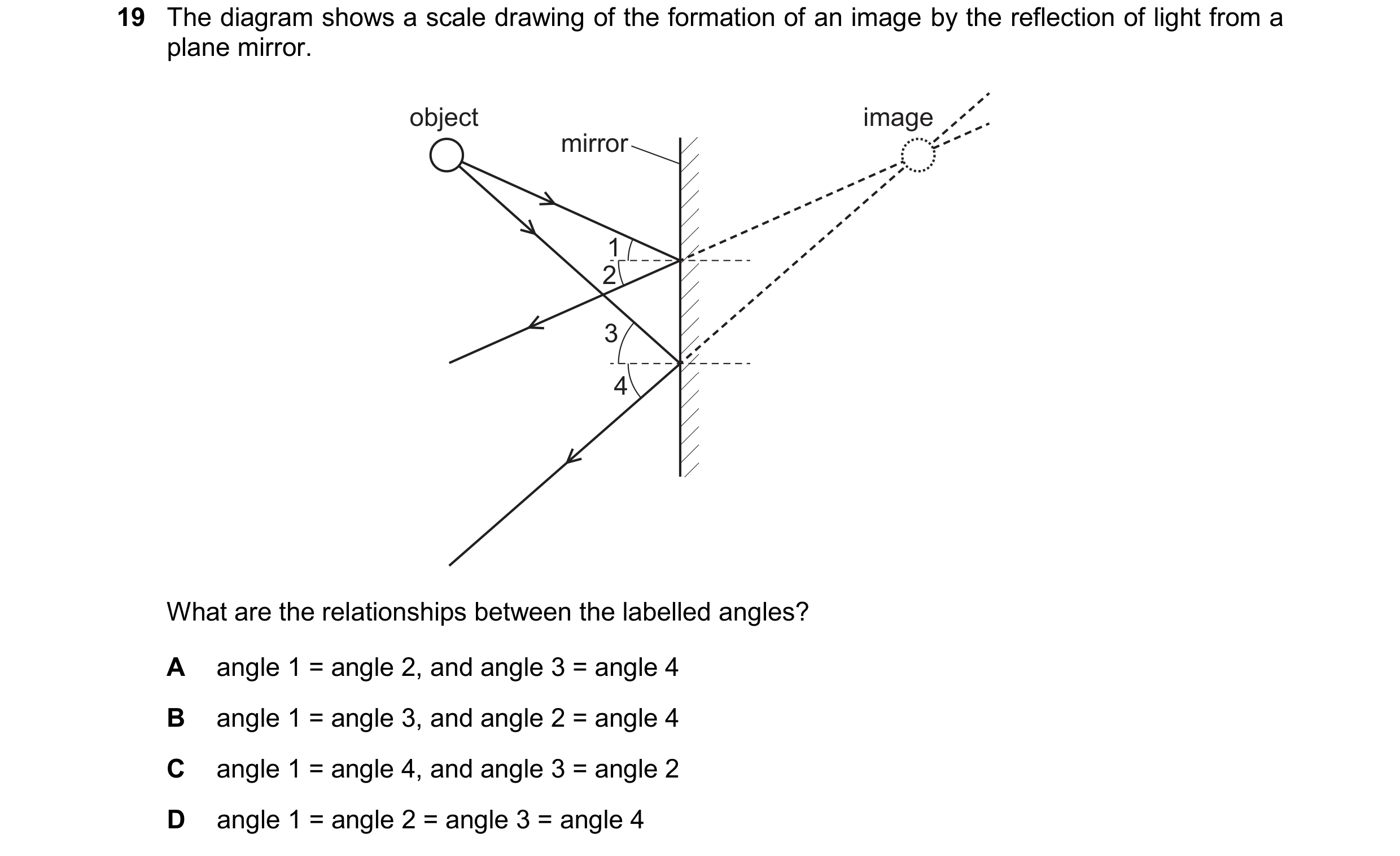 64 / 65
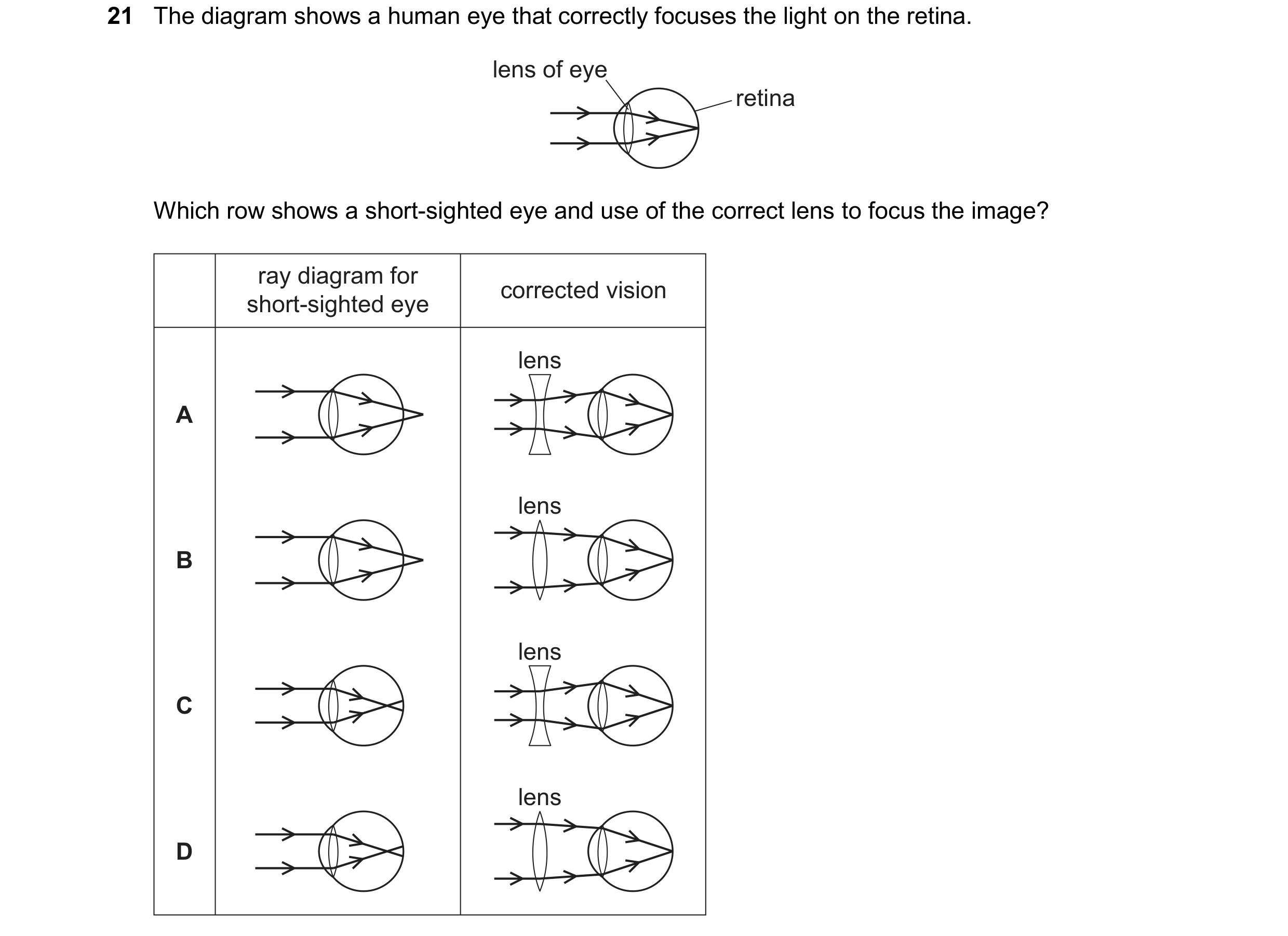 65 / 65