Cambridge IGCSE Physics 0625 — 2021 Oct/Nov Paper 4 · Variant 1
0625/41/O/N/21 · 9 questions · 80 marks · ≈90 min
The question paper and its mark scheme, free to read here and free to download. This is Cambridge’s own paper, exactly as it was sat.
Question paper20 pages


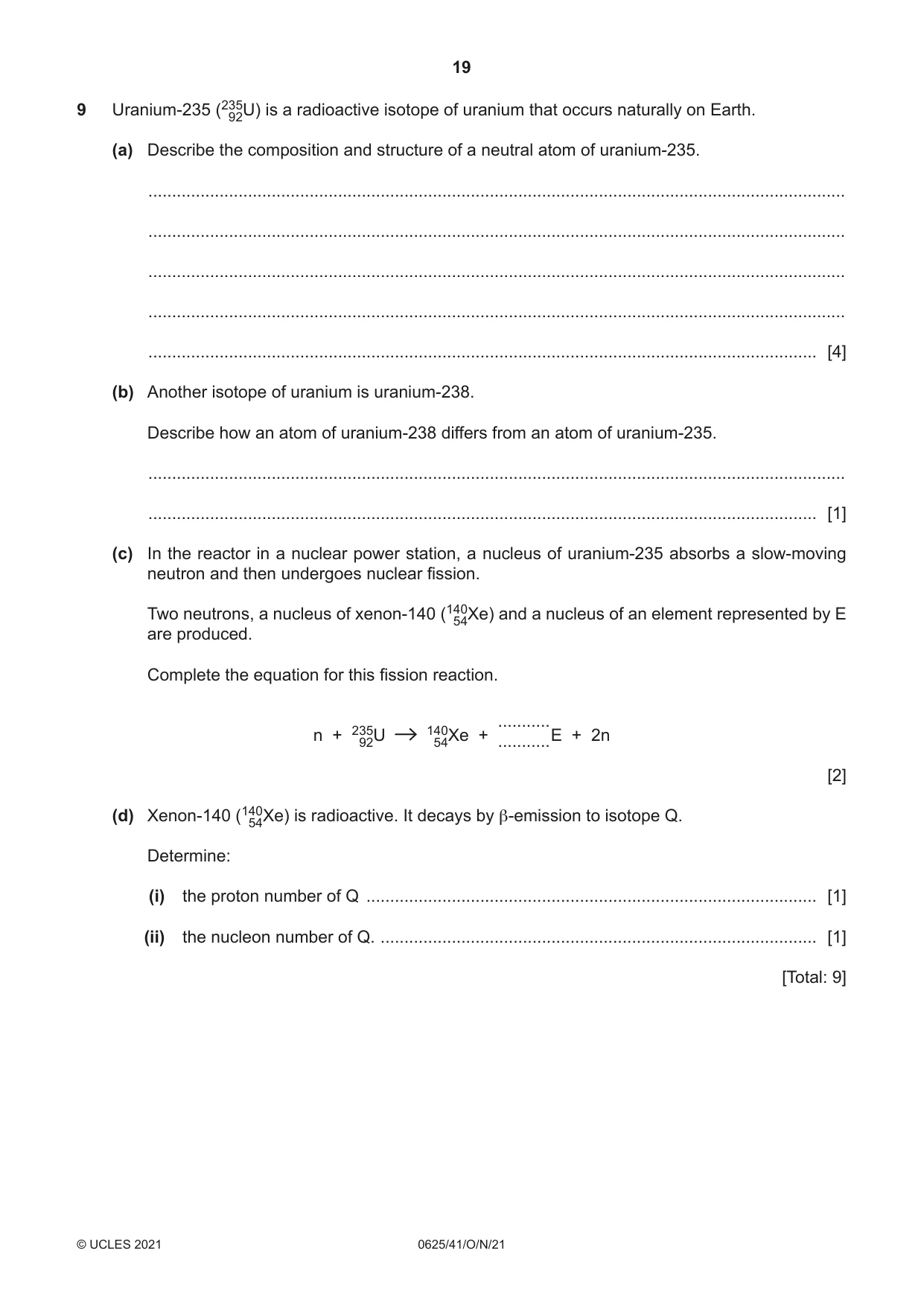
Mark scheme18 pages
Answers below. Sit the paper first if you are practising.
Questions as text
Q1 · Some physical quantities are scalars and other physical quantities are vectors
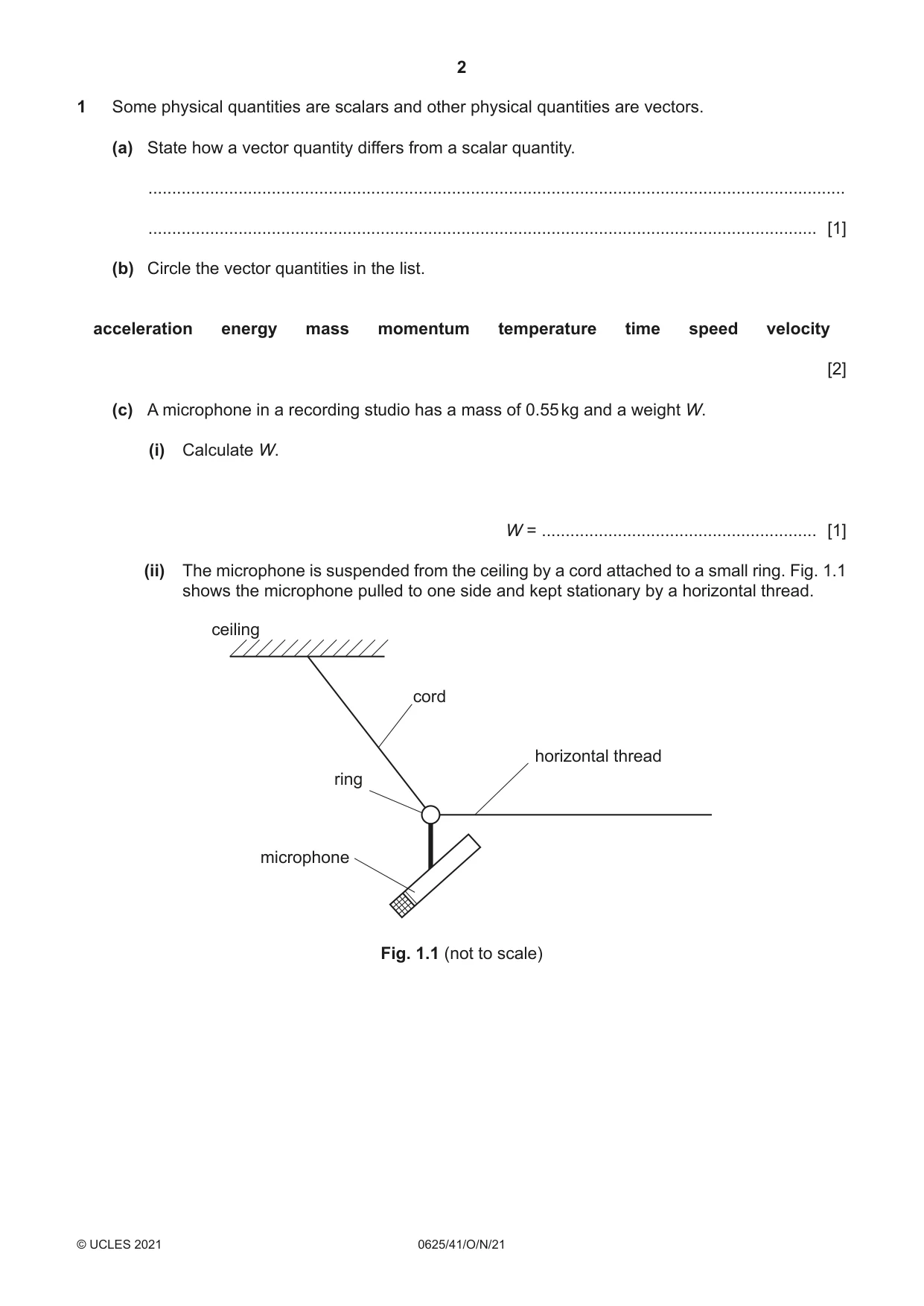
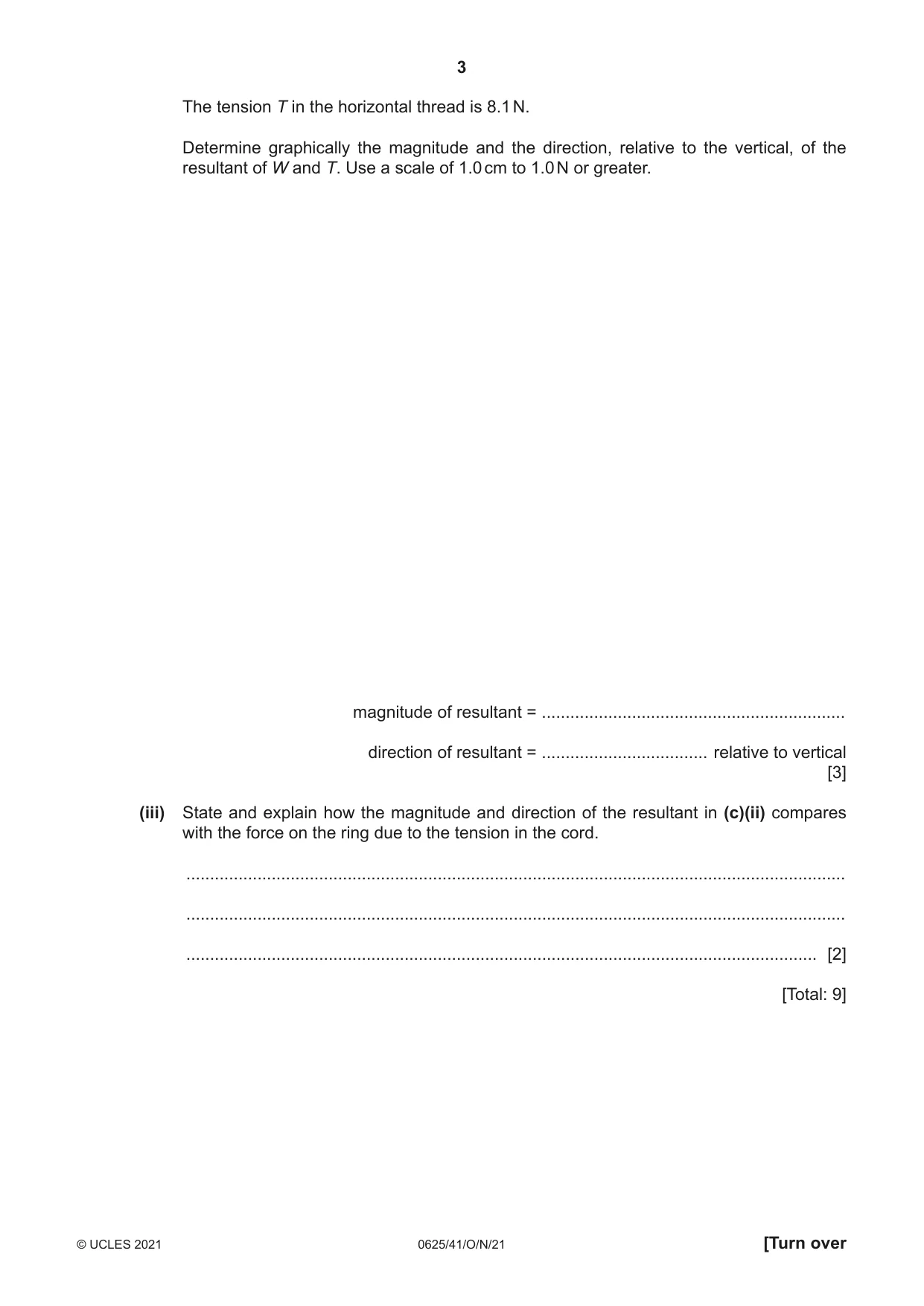
1 Some physical quantities are scalars and other physical quantities are vectors. (a) State how a vector quantity differs from a scalar quantity. ................................................................................................................................................... ............................................................................................................................................. [1] (b) Circle the vector quantities in the list. acceleration energy mass momentum temperature time speed velocity [2] (c) A microphone in a recording studio has a mass of 0.55 kg and a weight W. (i) Calculate W. W = .......................................................... [1] (ii) The microphone is suspended from the ceiling by a cord attached to a small ring. Fig. 1.1 shows the microphone pulled to one side and kept stationary by a horizontal thread. ceiling cord horizontal thread ring microphone Fig. 1.1 (not to scale) The tension T in the horizontal thread is 8.1 N. Determine graphically the magnitude and the direction, relative to the vertical, of the resultant of W and T. Use a scale of 1.0 cm to 1.0 N or greater. magnitude of resultant = ................................................................ direction of resultant = ................................... relative to vertical [3] (iii) State and explain how the magnitude and direction of the resultant in (c)(ii) compares with the force on the ring due to the tension in the cord. ........................................................................................................................................... ........................................................................................................................................... ..................................................................................................................................... [2] [Total: 9]
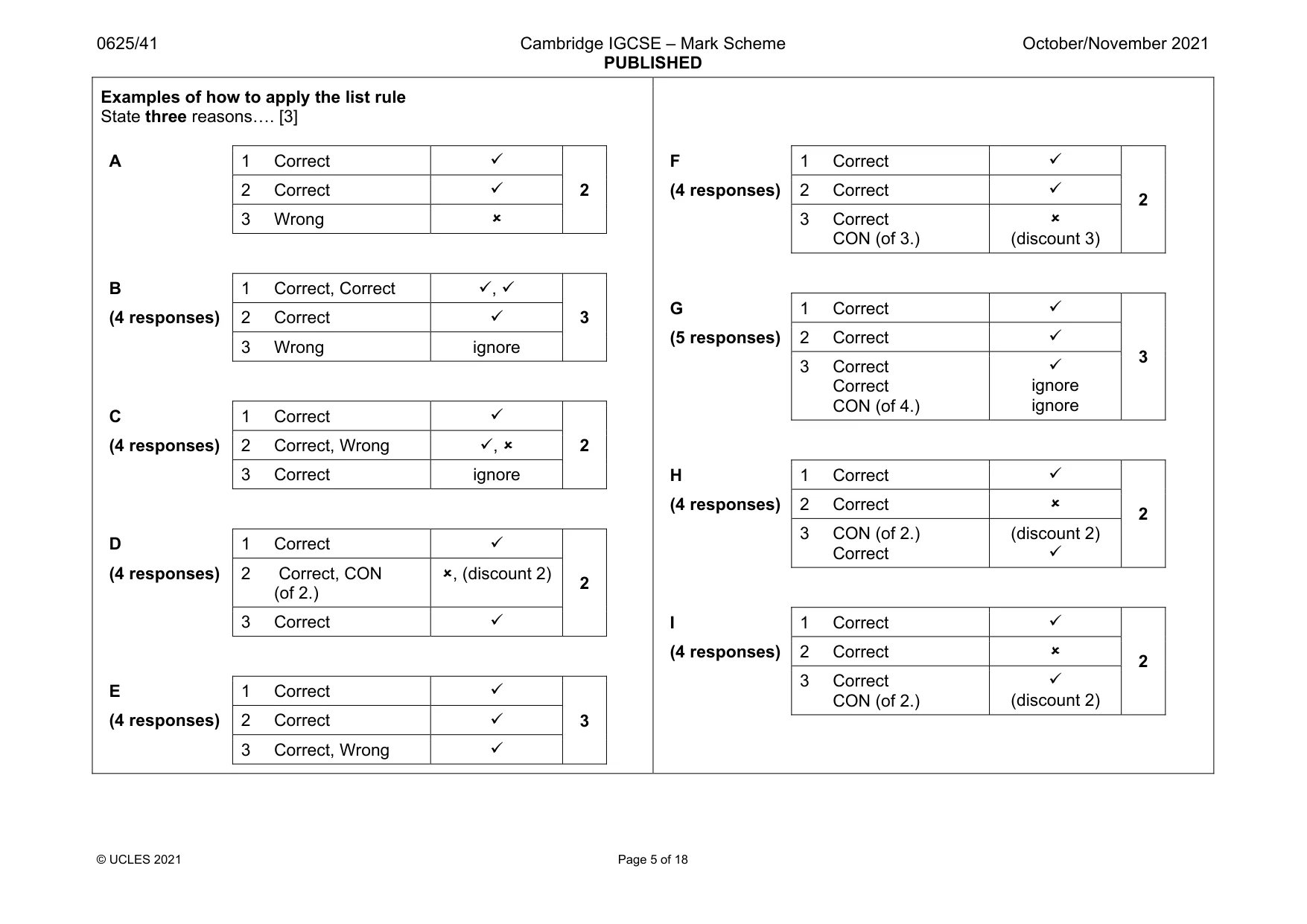
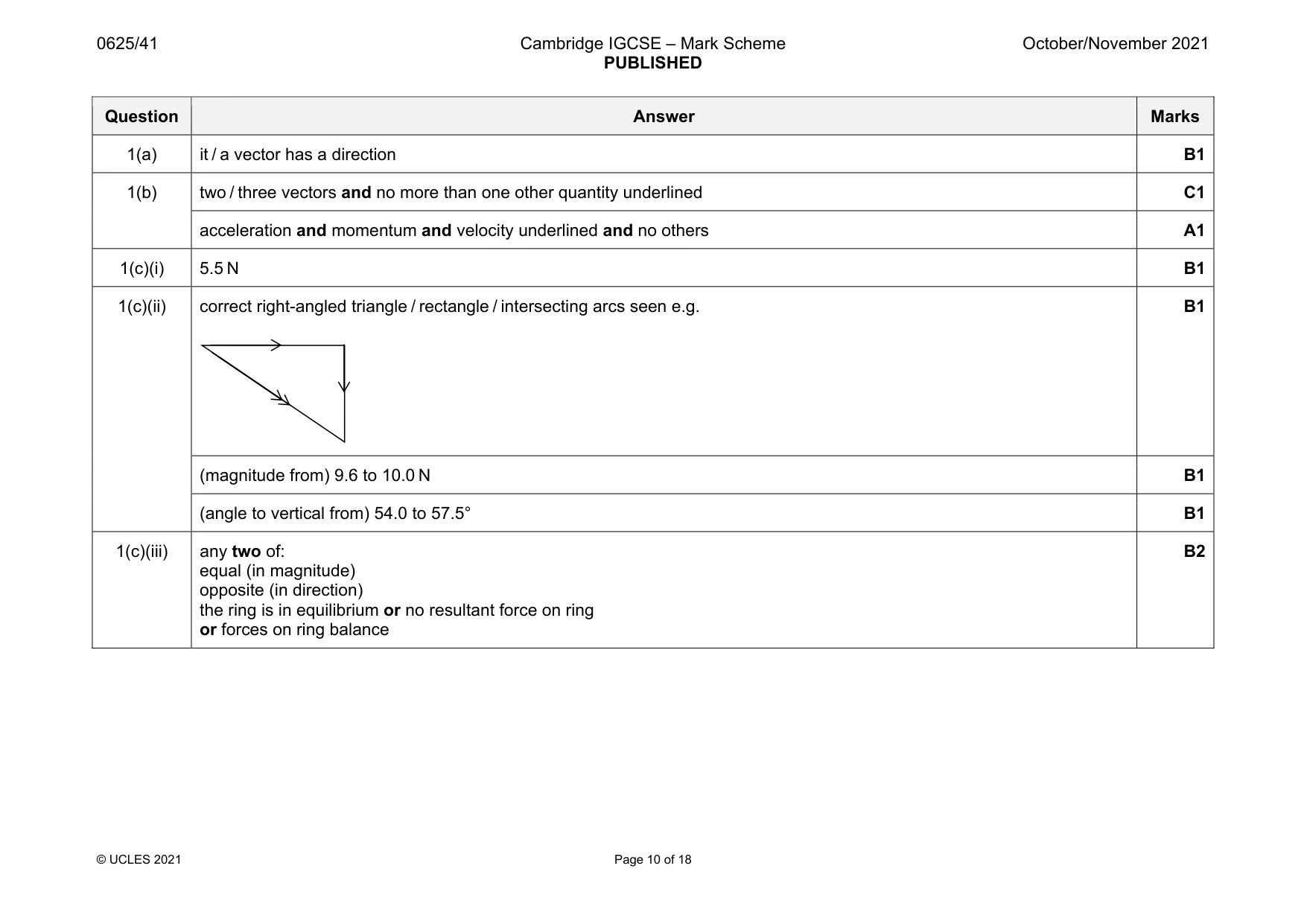
Mark scheme: 1(a) it / a vector has a direction B1 1(b) two / three vectors and no more than one other quantity underlined C1 acceleration and momentum and velocity underlined and no others A1 1(c)(i) 5.5 N B1 1(c)(ii) correct right-angled triangle / rectangle / intersecting arcs seen e.g. B1 (magnitude from) 9.6 to 10.0 N B1 (angle to vertical from) 54.0 to 57.5° B1 1(c)(iii) any two of: equal (in magnitude) opposite (in direction) the ring is in equilibrium or no resultant force on ring or forces on ring balance B2
Q2 · A student carries out an experiment using a plastic beaker that contains 0.24 kg of water…
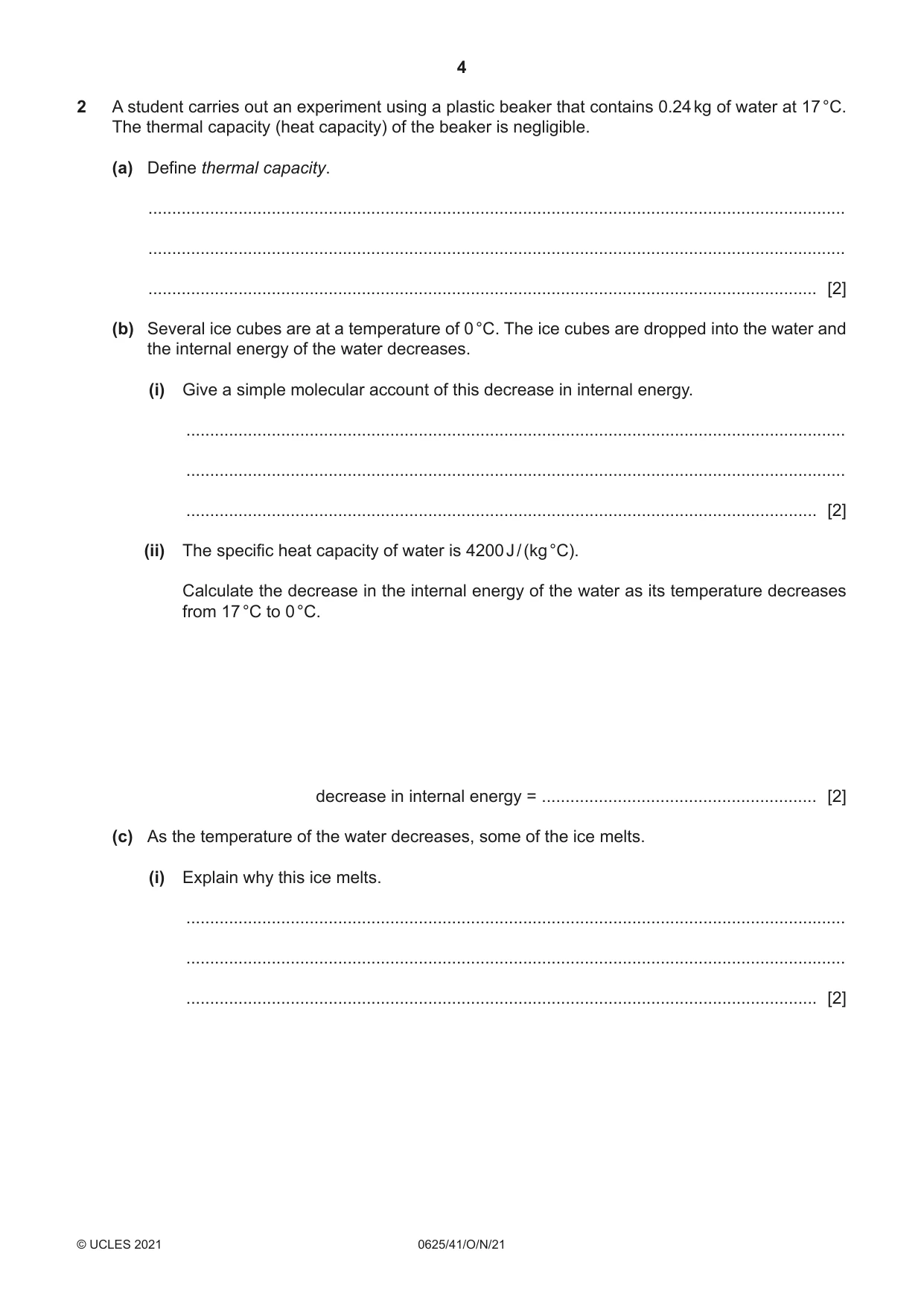
2 A student carries out an experiment using a plastic beaker that contains 0.24 kg of water at 17 °C. The thermal capacity (heat capacity) of the beaker is negligible. (a) Define thermal capacity. ................................................................................................................................................... ................................................................................................................................................... ............................................................................................................................................. [2] (b) Several ice cubes are at a temperature of 0 °C. The ice cubes are dropped into the water and the internal energy of the water decreases. (i) Give a simple molecular account of this decrease in internal energy. ........................................................................................................................................... ........................................................................................................................................... ..................................................................................................................................... [2] (ii) The specific heat capacity of water is 4200 J / (kg °C). Calculate the decrease in the internal energy of the water as its temperature decreases from 17 °C to 0 °C. decrease in internal energy = .......................................................... [2] (c) As the temperature of the water decreases, some of the ice melts. (i) Explain why this ice melts. ........................................................................................................................................... ........................................................................................................................................... ..................................................................................................................................... [2] (ii) Describe how to determine the specific latent heat of fusion of ice using this experiment. State any other measurements that the student needs to make. ........................................................................................................................................... ........................................................................................................................................... ........................................................................................................................................... ........................................................................................................................................... ..................................................................................................................................... [3] [Total: 11]
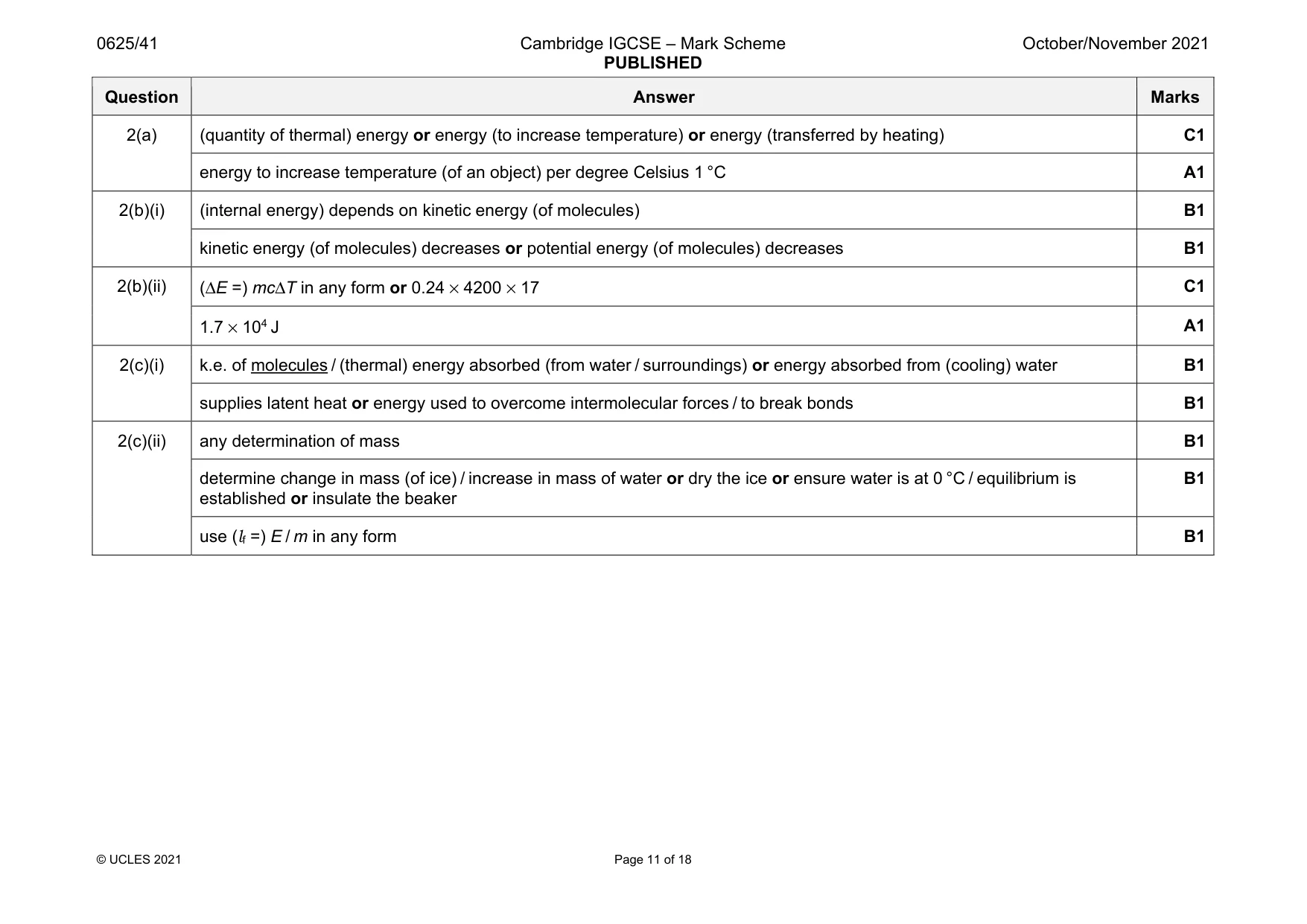
Mark scheme: 2(a) (quantity of thermal) energy or energy (to increase temperature) or energy (transferred by heating) C1 energy to increase temperature (of an object) per degree Celsius 1 °C A1 2(b)(i) (internal energy) depends on kinetic energy (of molecules) B1 kinetic energy (of molecules) decreases or potential energy (of molecules) decreases B1 2(b)(ii) (ΔE =) mcΔT in any form or 0.24 × 4200 × 17 C1 1.7 × 10⁴ J A1 2(c)(i) k.e. of molecules / (thermal) energy absorbed (from water / surroundings) or energy absorbed from (cooling) water B1 supplies latent heat or energy used to overcome intermolecular forces / to break bonds B1 2(c)(ii) any determination of mass B1 determine change in mass (of ice) / increase in mass of water or dry the ice or ensure water is at 0 °C / equilibrium is established or insulate the beaker B1 use (lf =) E / m in any form B1
Q3 · A balloon inflated with air
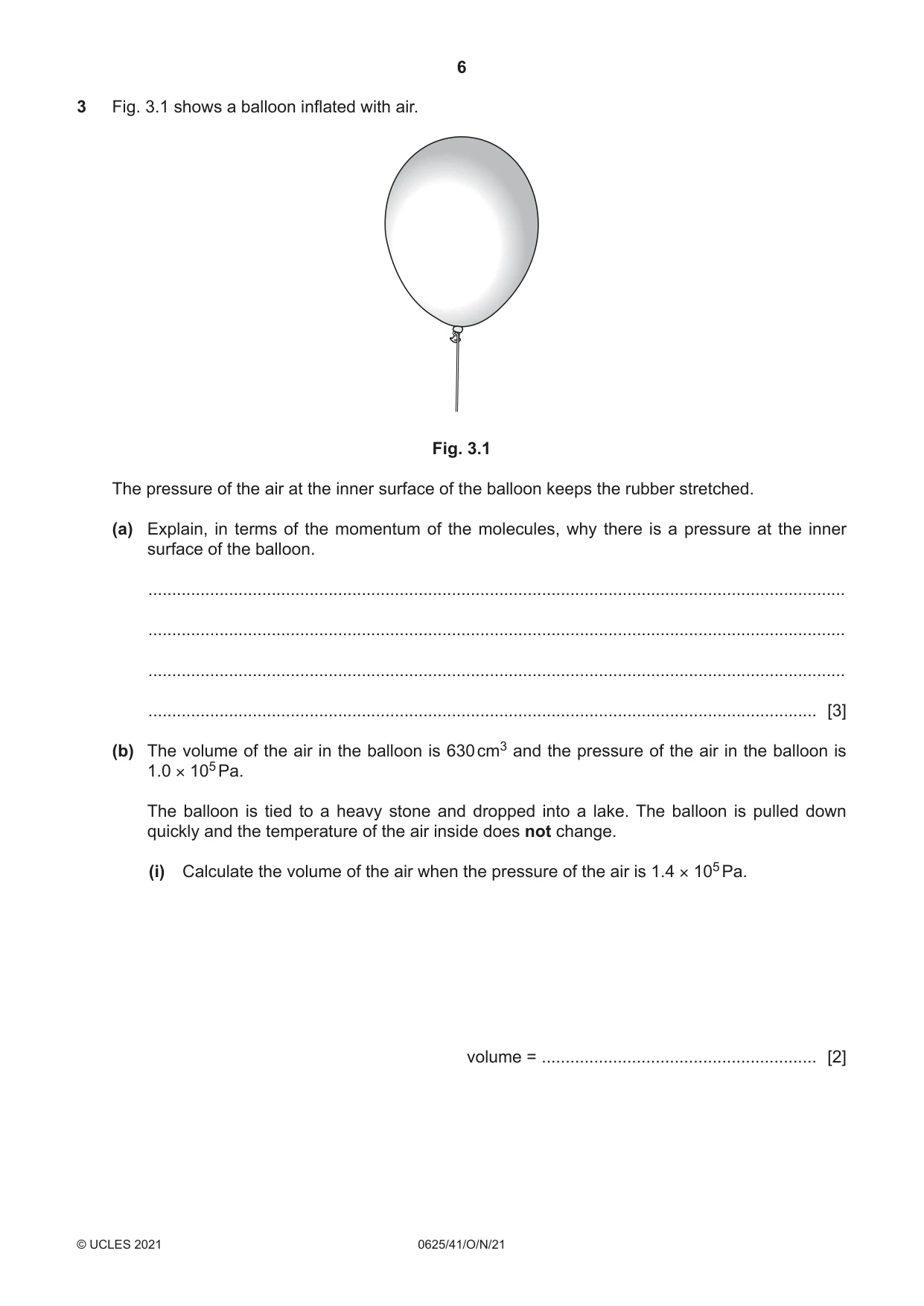
3 Fig. 3.1 shows a balloon inflated with air. Fig. 3.1 The pressure of the air at the inner surface of the balloon keeps the rubber stretched. (a) Explain, in terms of the momentum of the molecules, why there is a pressure at the inner surface of the balloon. ................................................................................................................................................... ................................................................................................................................................... ................................................................................................................................................... ............................................................................................................................................. [3] (b) The volume of the air in the balloon is 630 cm3 and the pressure of the air in the balloon is 1.0 × 10⁵ Pa. The balloon is tied to a heavy stone and dropped into a lake. The balloon is pulled down quickly and the temperature of the air inside does not change. (i) Calculate the volume of the air when the pressure of the air is 1.4 × 10⁵ Pa. volume = .......................................................... [2] (ii) The balloon and stone stop moving when the stone hits the bottom of the lake. The temperature of the air now begins to decrease. Explain why the volume of the air in the balloon decreases as the temperature decreases. ........................................................................................................................................... ........................................................................................................................................... ........................................................................................................................................... ..................................................................................................................................... [2] [Total: 7]
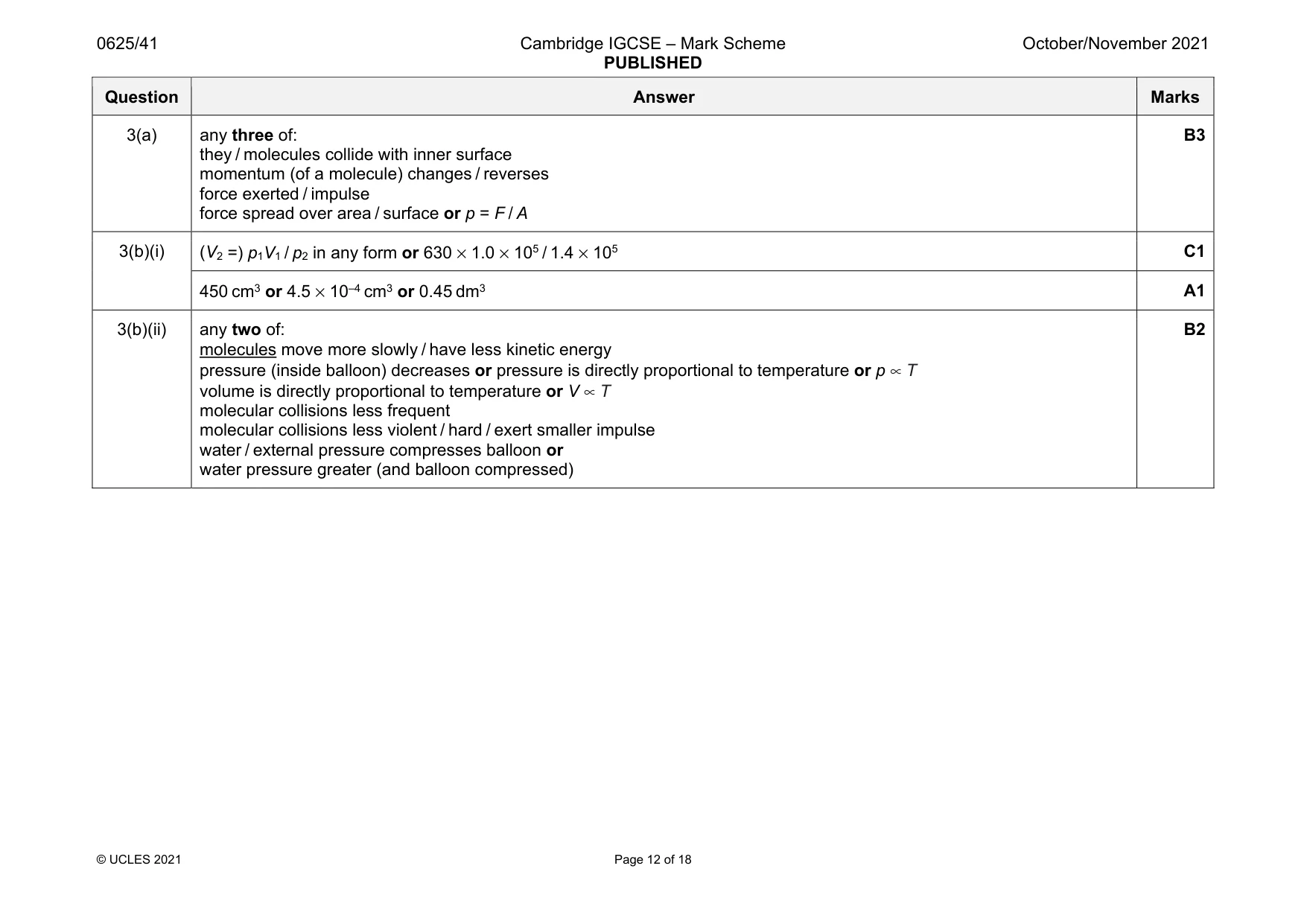
Mark scheme: 3(a) any three of: they / molecules collide with inner surface momentum (of a molecule) changes / reverses force exerted / impulse force spread over area / surface or p = F / A B3 3(b)(i) (V2 =) p1V1 / p2 in any form or 630 × 1.0 × 105 / 1.4 × 10⁵ C1 450 cm3 or 4.5 × 10⁻⁴ cm3 or 0.45 dm3 A1 3(b)(ii) any two of: molecules move more slowly / have less kinetic energy pressure (inside balloon) decreases or pressure is directly proportional to temperature or p ∝ T volume is directly proportional to temperature or V ∝ T molecular collisions less frequent molecular collisions less violent / hard / exert smaller impulse water / external pressure compresses balloon or water pressure greater (and balloon compressed) B2
Q4 · A train of mass 1.8 × 10⁵ kg is at rest in a station
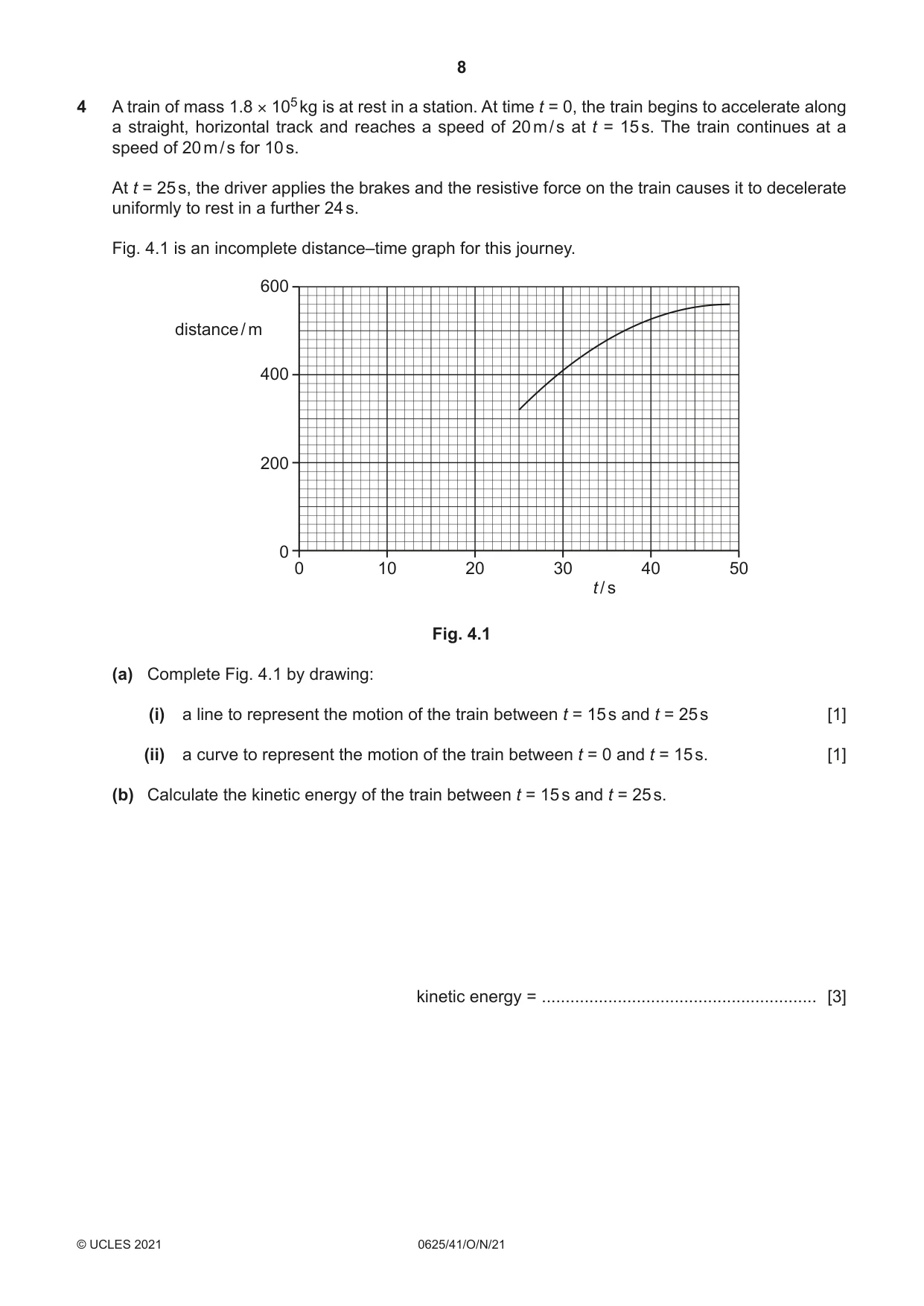
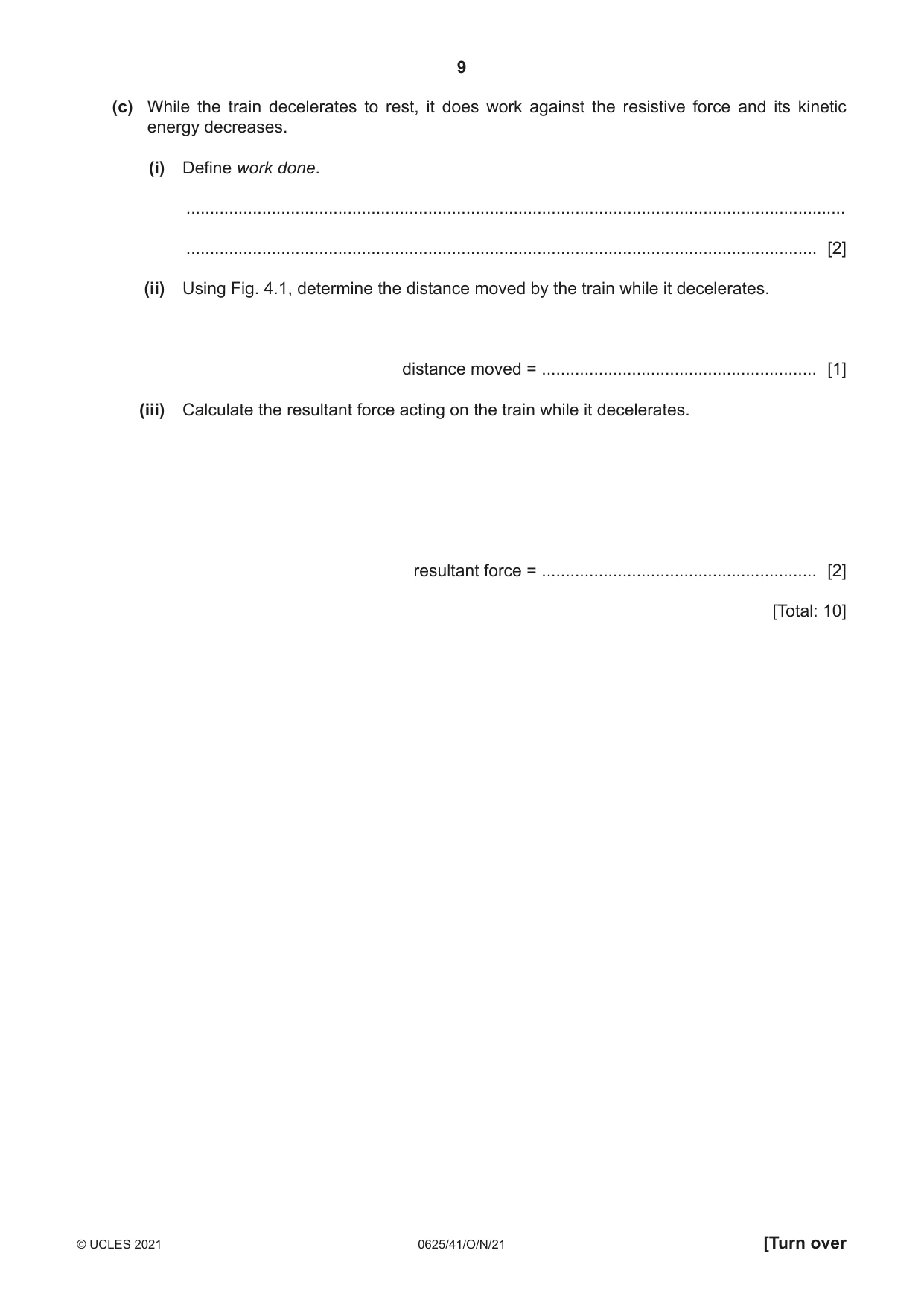
4 A train of mass 1.8 × 10⁵ kg is at rest in a station. At time t = 0, the train begins to accelerate along a straight, horizontal track and reaches a speed of 20 m / s at t = 15 s. The train continues at a speed of 20 m / s for 10 s. At t = 25 s, the driver applies the brakes and the resistive force on the train causes it to decelerate uniformly to rest in a further 24 s. Fig. 4.1 is an incomplete distance–time graph for this journey. 600 distance / m 400 200 0 0 10 20 30 40 50 t / s Fig. 4.1 (a) Complete Fig. 4.1 by drawing: (i) a line to represent the motion of the train between t = 15 s and t = 25 s [1] (ii) a curve to represent the motion of the train between t = 0 and t = 15 s. [1] (b) Calculate the kinetic energy of the train between t = 15 s and t = 25 s. kinetic energy = .......................................................... [3] (c) While the train decelerates to rest, it does work against the resistive force and its kinetic energy decreases. (i) Define work done. ........................................................................................................................................... ..................................................................................................................................... [2] (ii) Using Fig. 4.1, determine the distance moved by the train while it decelerates. distance moved = .......................................................... [1] (iii) Calculate the resultant force acting on the train while it decelerates. resultant force = .......................................................... [2] [Total: 10]
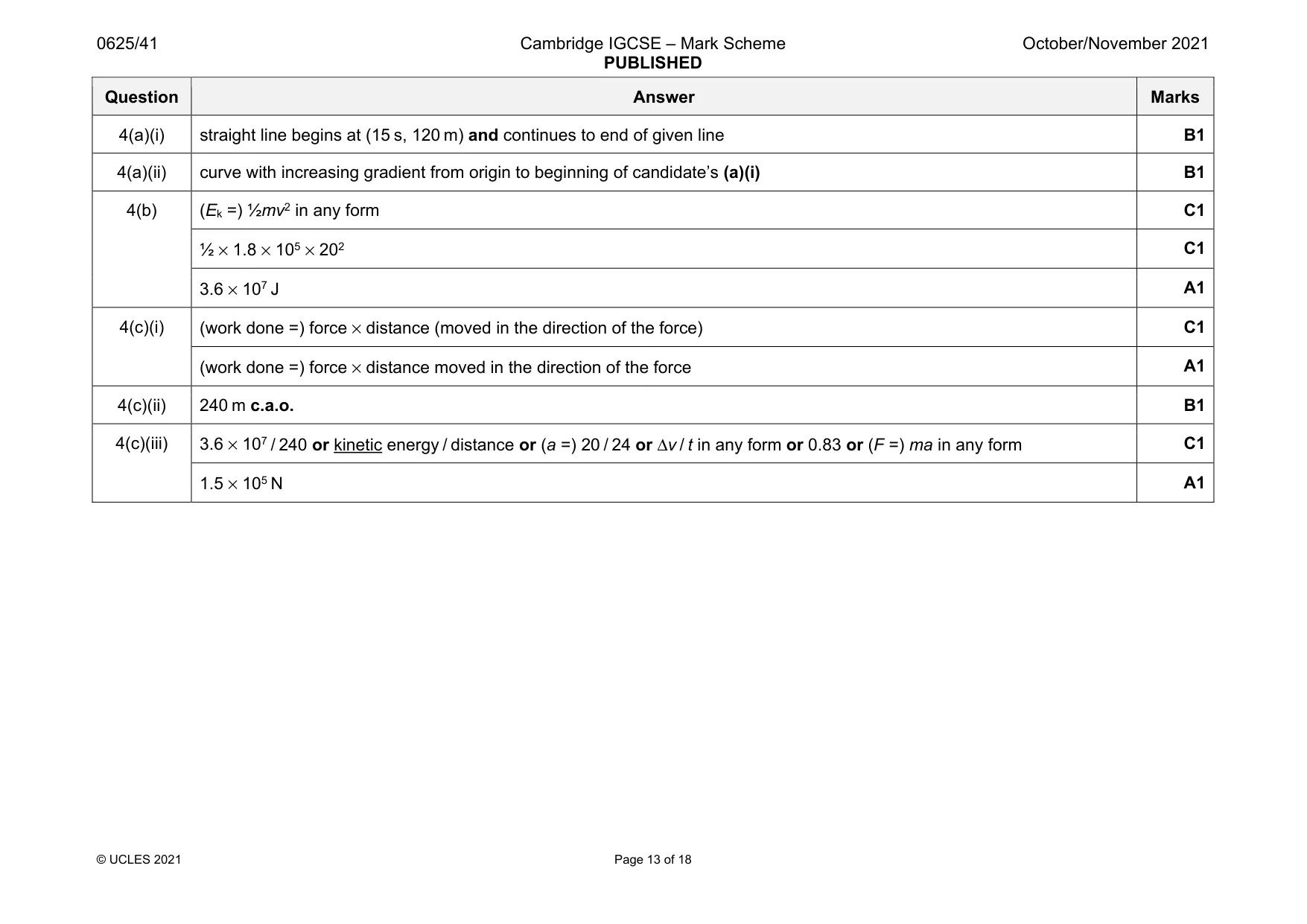
Mark scheme: 4(a)(i) straight line begins at (15 s, 120 m) and continues to end of given line B1 4(a)(ii) curve with increasing gradient from origin to beginning of candidate’s (a)(i) B1 4(b) (Ek =) ½mv2 in any form C1 ½ × 1.8 × 105 × 202 C1 3.6 × 10⁷ J A1 4(c)(i) (work done =) force × distance (moved in the direction of the force) C1 (work done =) force × distance moved in the direction of the force A1 4(c)(ii) 240 m c.a.o. B1 4(c)(iii) 3.6 × 10⁷ / 240 or kinetic energy / distance or (a =) 20 / 24 or Δv / t in any form or 0.83 or (F =) ma in any form C1 1.5 × 10⁵ N A1
Q5 · Explain, in terms of the behaviour of light rays, what is meant by principal focus for a…
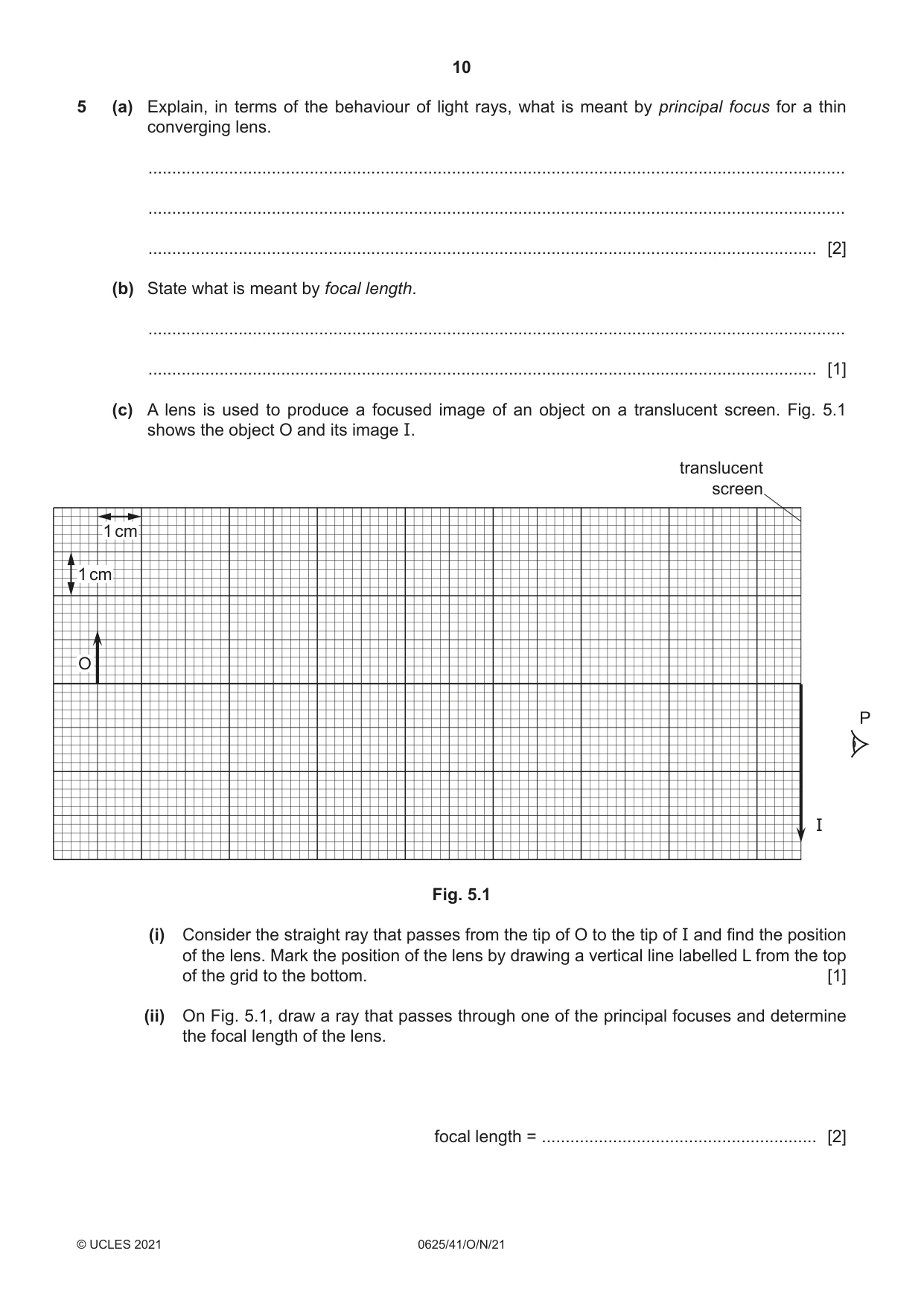
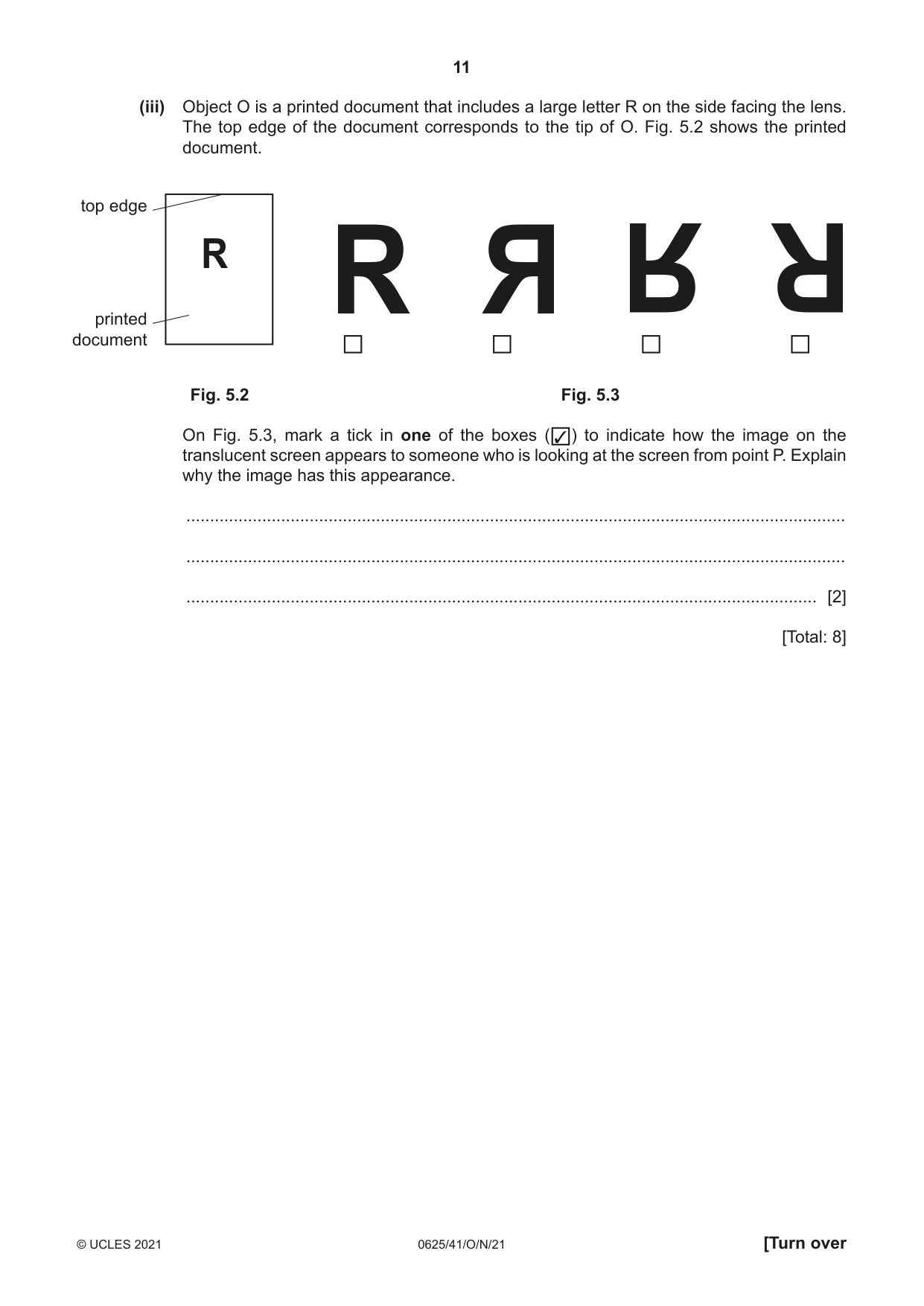
5 (a) Explain, in terms of the behaviour of light rays, what is meant by principal focus for a thin converging lens. ................................................................................................................................................... ................................................................................................................................................... ............................................................................................................................................. [2] (b) State what is meant by focal length. ................................................................................................................................................... ............................................................................................................................................. [1] (c) A lens is used to produce a focused image of an object on a translucent screen. Fig. 5.1 shows the object O and its image I. translucent screen 1 cm 1 cm O P I Fig. 5.1 (i) Consider the straight ray that passes from the tip of O to the tip of I and find the position of the lens. Mark the position of the lens by drawing a vertical line labelled L from the top of the grid to the bottom. [1] (ii) On Fig. 5.1, draw a ray that passes through one of the principal focuses and determine the focal length of the lens. focal length = .......................................................... [2] (iii) Object O is a printed document that includes a large letter R on the side facing the lens. The top edge of the document corresponds to the tip of O. Fig. 5.2 shows the printed document. top edge R printeddocument R R R R Fig. 5.2 Fig. 5.3 On Fig. 5.3, mark a tick in one of the boxes ( ✓ ) to indicate how the image on the translucent screen appears to someone who is looking at the screen from point P. Explain why the image has this appearance. ........................................................................................................................................... ........................................................................................................................................... ..................................................................................................................................... [2] [Total: 8]
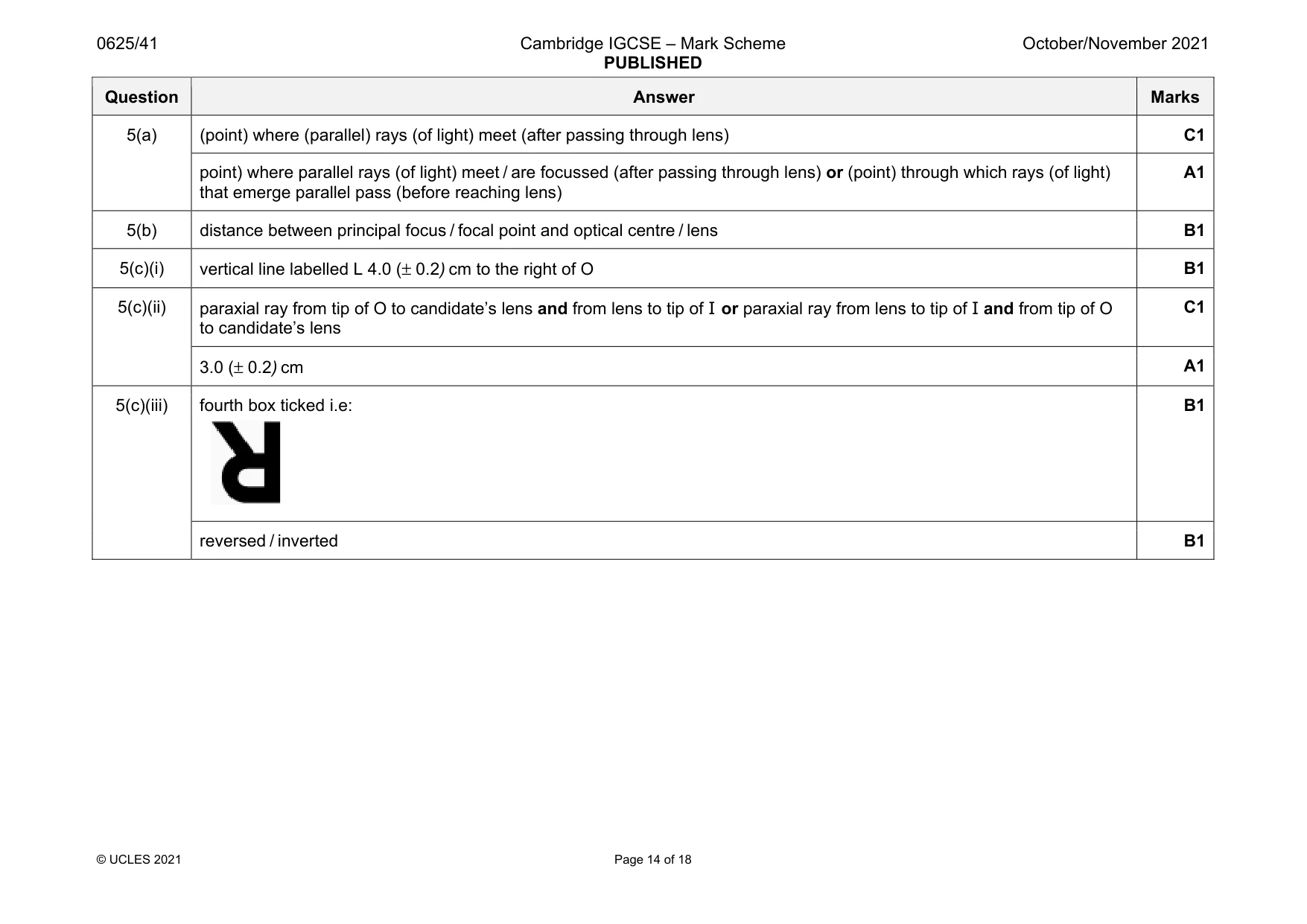
Mark scheme: 5(a) (point) where (parallel) rays (of light) meet (after passing through lens) C1 point) where parallel rays (of light) meet / are focussed (after passing through lens) or (point) through which rays (of light) that emerge parallel pass (before reaching lens) A1 5(b) distance between principal focus / focal point and optical centre / lens B1 5(c)(i) vertical line labelled L 4.0 (± 0.2) cm to the right of O B1 5(c)(ii) paraxial ray from tip of O to candidate’s lens and from lens to tip of I or paraxial ray from lens to tip of I and from tip of O to candidate’s lens C1 3.0 (± 0.2) cm A1 5(c)(iii) fourth box ticked i.e: B1 reversed / inverted B1
Q6 · X‑rays are electromagnetic waves
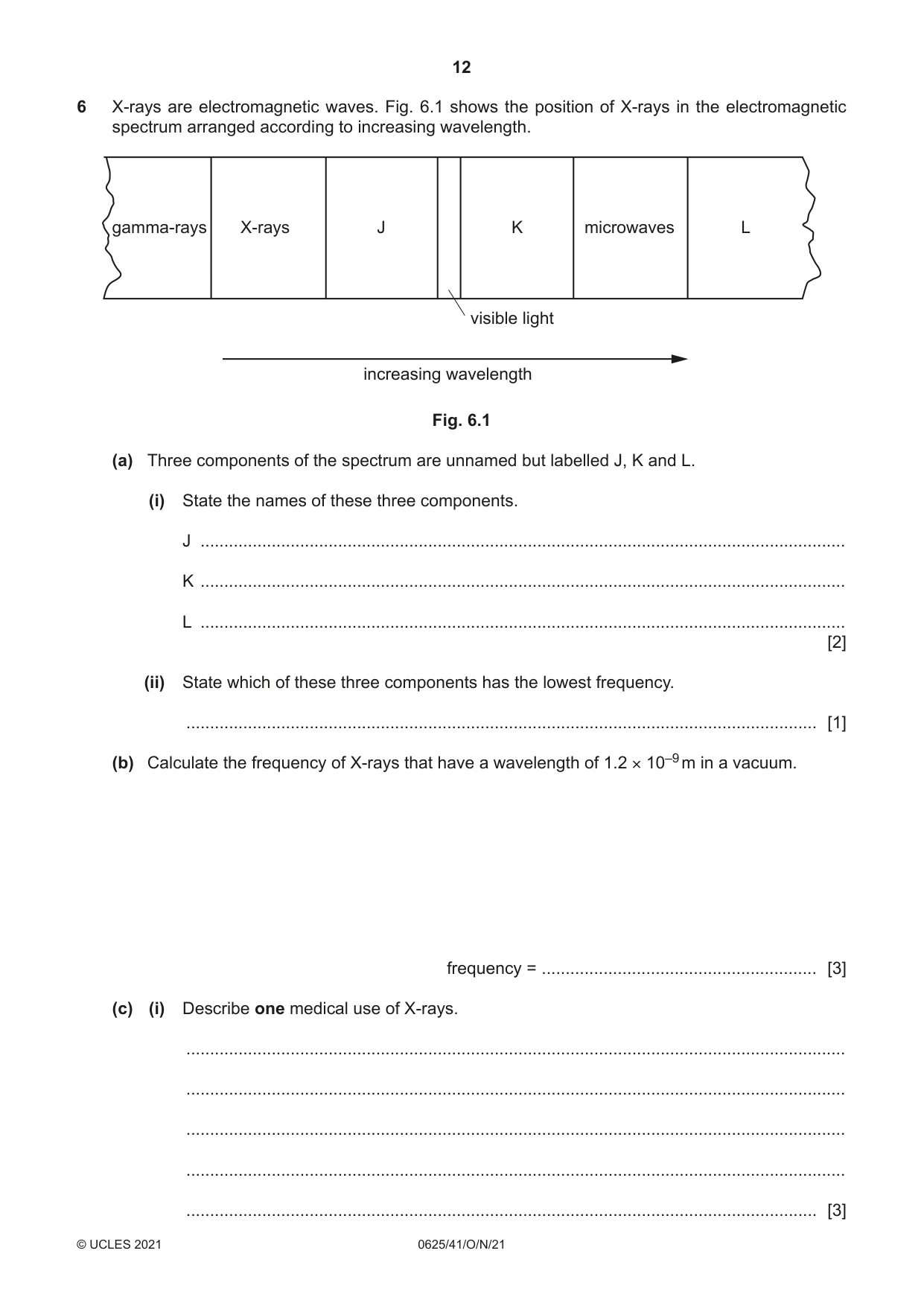
6 X‑rays are electromagnetic waves. Fig. 6.1 shows the position of X‑rays in the electromagnetic spectrum arranged according to increasing wavelength. gamma-rays X-rays J K microwaves L visible light increasing wavelength Fig. 6.1 (a) Three components of the spectrum are unnamed but labelled J, K and L. (i) State the names of these three components. J ........................................................................................................................................ K ........................................................................................................................................ L ........................................................................................................................................ [2] (ii) State which of these three components has the lowest frequency. ..................................................................................................................................... [1] (b) Calculate the frequency of X‑rays that have a wavelength of 1.2 × 10⁻⁹ m in a vacuum. frequency = .......................................................... [3] (c) (i) Describe one medical use of X‑rays. ........................................................................................................................................... ........................................................................................................................................... ........................................................................................................................................... ........................................................................................................................................... ..................................................................................................................................... [3] (ii) State one reason why it is necessary to take safety precautions when X‑rays are used. ........................................................................................................................................... ..................................................................................................................................... [1] [Total: 10]
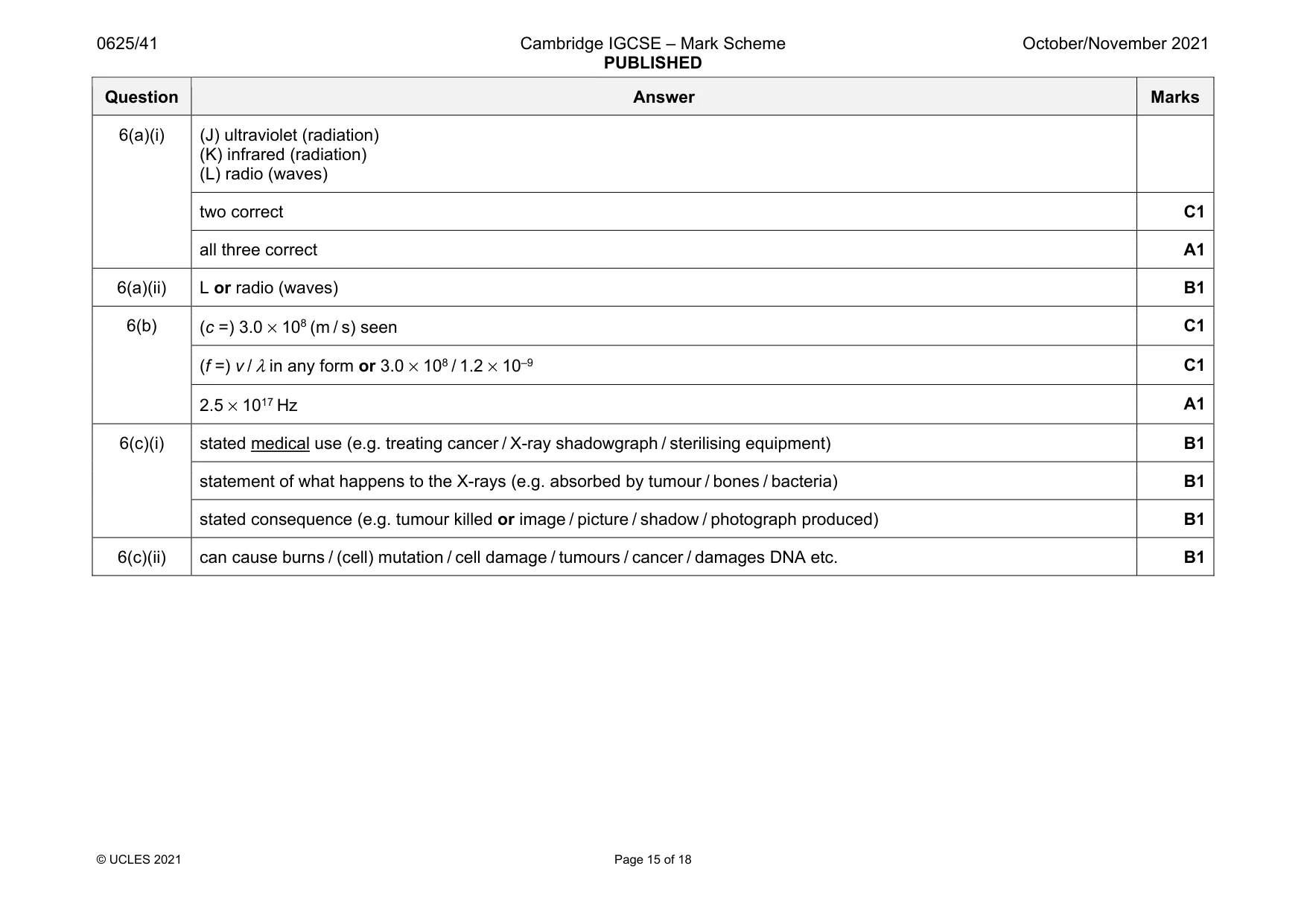
Mark scheme: 6(a)(i) (J) ultraviolet (radiation) (K) infrared (radiation) (L) radio (waves) two correct C1 all three correct A1 6(a)(ii) L or radio (waves) B1 6(b) (c =) 3.0 × 10⁸ (m / s) seen C1 (f =) v / λ in any form or 3.0 × 10⁸ / 1.2 × 10⁻⁹ C1 2.5 × 10¹⁷ Hz A1 6(c)(i) stated medical use (e.g. treating cancer / X-ray shadowgraph / sterilising equipment) B1 statement of what happens to the X-rays (e.g. absorbed by tumour / bones / bacteria) B1 stated consequence (e.g. tumour killed or image / picture / shadow / photograph produced) B1 6(c)(ii) can cause burns / (cell) mutation / cell damage / tumours / cancer / damages DNA etc. B1
Q7 · A plastic rod becomes negatively charged when it is rubbed with a woollen cloth
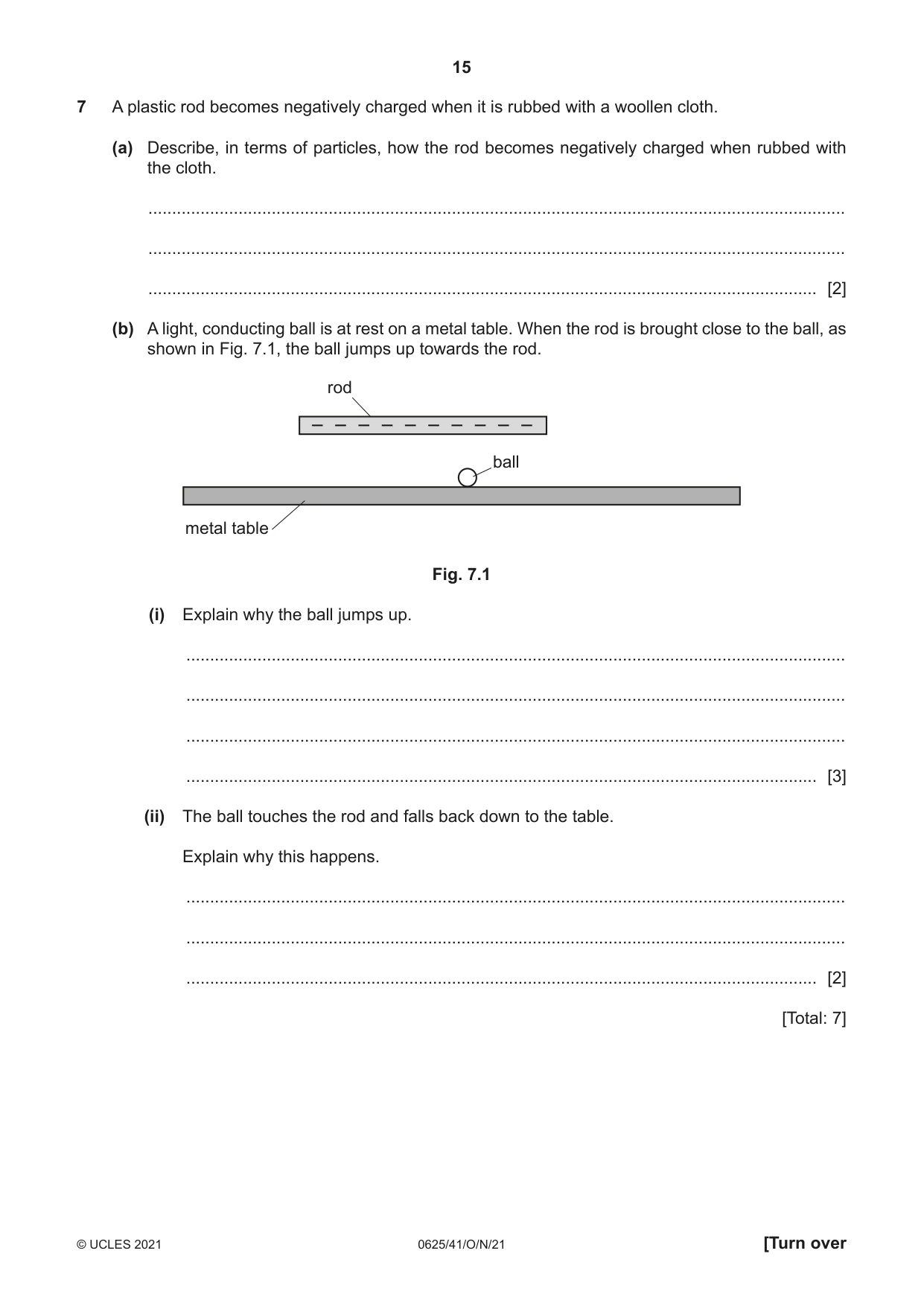
7 A plastic rod becomes negatively charged when it is rubbed with a woollen cloth. (a) Describe, in terms of particles, how the rod becomes negatively charged when rubbed with the cloth. ................................................................................................................................................... ................................................................................................................................................... ............................................................................................................................................. [2] (b) A light, conducting ball is at rest on a metal table. When the rod is brought close to the ball, as shown in Fig. 7.1, the ball jumps up towards the rod. rod ball metal table Fig. 7.1 (i) Explain why the ball jumps up. ........................................................................................................................................... ........................................................................................................................................... ........................................................................................................................................... ..................................................................................................................................... [3] (ii) The ball touches the rod and falls back down to the table. Explain why this happens. ........................................................................................................................................... ........................................................................................................................................... ..................................................................................................................................... [2] [Total: 7]
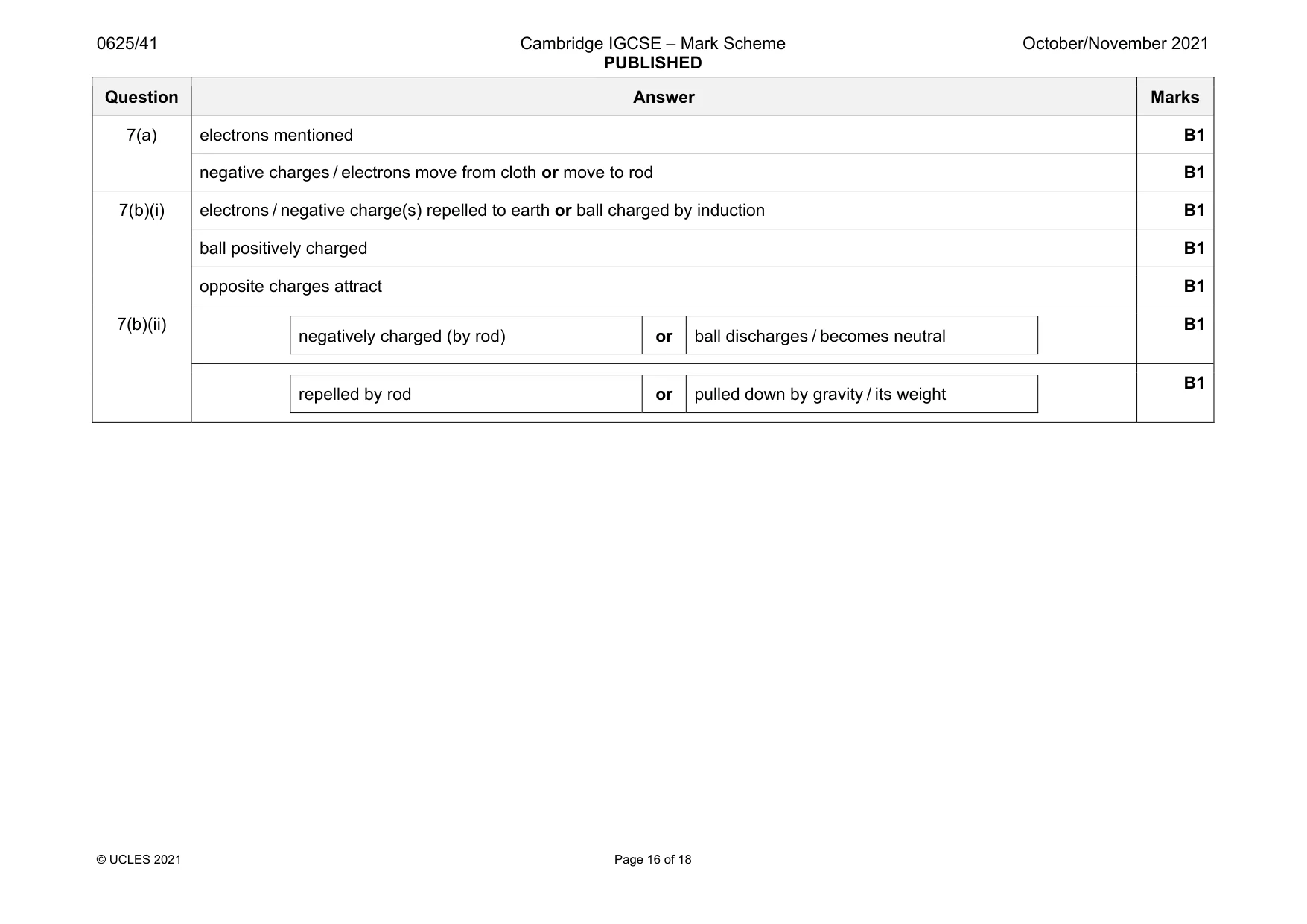
Mark scheme: 7(a) electrons mentioned B1 negative charges / electrons move from cloth or move to rod B1 7(b)(i) electrons / negative charge(s) repelled to earth or ball charged by induction B1 ball positively charged B1 opposite charges attract B1 7(b)(ii) negatively charged (by rod) or ball discharges / becomes neutral B1 repelled by rod or pulled down by gravity / its weight B1
Q8 · A circuit contains two fixed resistors and a light‑dependent resistor (LDR)
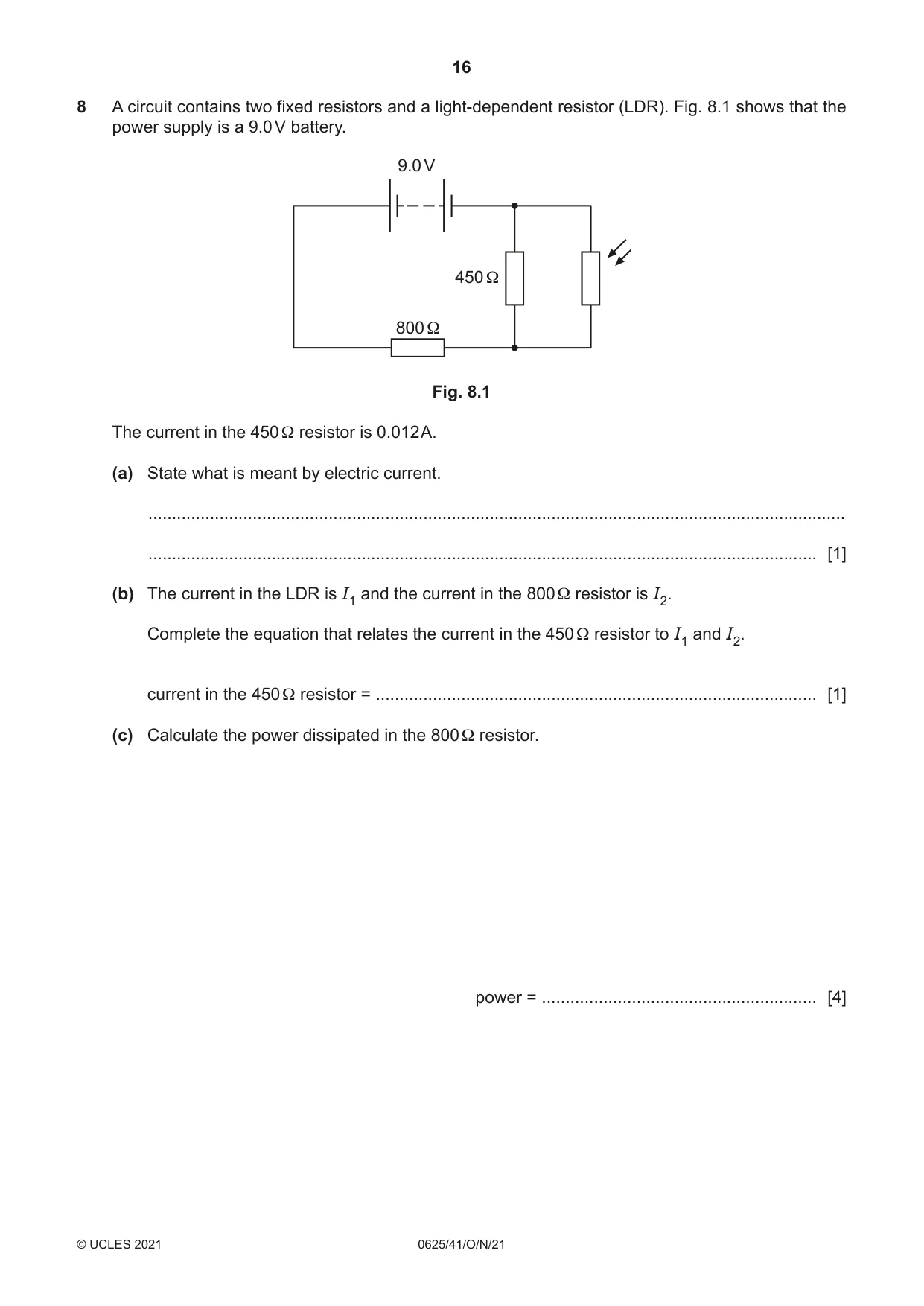
8 A circuit contains two fixed resistors and a light‑dependent resistor (LDR). Fig. 8.1 shows that the power supply is a 9.0 V battery. 9.0 V 450 Ω 800 Ω Fig. 8.1 The current in the 450 Ω resistor is 0.012 A. (a) State what is meant by electric current. ................................................................................................................................................... ............................................................................................................................................. [1] (b) The current in the LDR is I1 and the current in the 800 Ω resistor is I2. Complete the equation that relates the current in the 450 Ω resistor to I1 and I2. current in the 450 Ω resistor = ............................................................................................. [1] (c) Calculate the power dissipated in the 800 Ω resistor. power = .......................................................... [4] (d) The brightness of the light that is incident on the LDR increases. Explain what happens to the potential difference (p.d.) across the 450 Ω resistor. ................................................................................................................................................... ................................................................................................................................................... ................................................................................................................................................... ............................................................................................................................................. [3] [Total: 9]
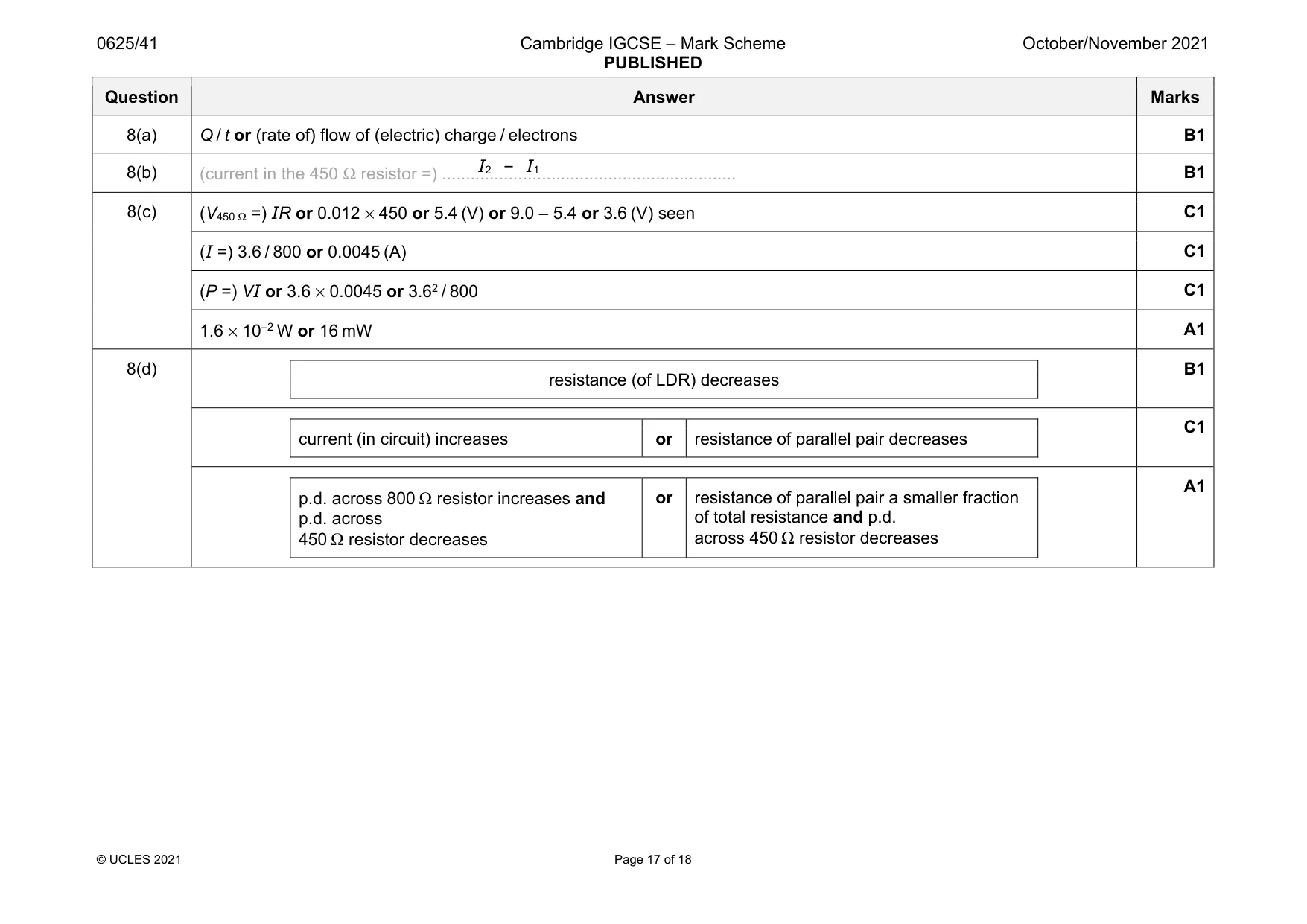
Mark scheme: 8(a) Q / t or (rate of) flow of (electric) charge / electrons B1 8(b) (current in the 450 Ω resistor =) .............................................................. B1 8(c) (V450 Ω =) IR or 0.012 × 450 or 5.4 (V) or 9.0 – 5.4 or 3.6 (V) seen C1 (I =) 3.6 / 800 or 0.0045 (A) C1 (P =) VI or 3.6 × 0.0045 or 3.62 / 800 C1 1.6 × 10⁻² W or 16 mW A1 8(d) resistance (of LDR) decreases B1 current (in circuit) increases or resistance of parallel pair decreases C1 p.d. across 800 Ω resistor increases and p.d. across 450 Ω resistor decreases or resistance of parallel pair a smaller fraction of total resistance and p.d. across 450 Ω resistor decreases A1 I2 – I1
Q9 · Uranium‑235 (23592U) is a radioactive isotope of uranium that occurs naturally on Earth
9 Uranium‑235 (23592U) is a radioactive isotope of uranium that occurs naturally on Earth. (a) Describe the composition and structure of a neutral atom of uranium‑235. ................................................................................................................................................... ................................................................................................................................................... ................................................................................................................................................... ................................................................................................................................................... ............................................................................................................................................. [4] (b) Another isotope of uranium is uranium‑238. Describe how an atom of uranium‑238 differs from an atom of uranium‑235. ................................................................................................................................................... ............................................................................................................................................. [1] (c) In the reactor in a nuclear power station, a nucleus of uranium‑235 absorbs a slow‑moving neutron and then undergoes nuclear fission. Two neutrons, a nucleus of xenon‑140 (14054Xe) and a nucleus of an element represented by E are produced. Complete the equation for this fission reaction. ........... n + 23592U 14054Xe + ...........E + 2n [2] (d) Xenon‑140 (14054Xe) is radioactive. It decays by β‑emission to isotope Q. Determine: (i) the proton number of Q ............................................................................................... [1] (ii) the nucleon number of Q. ............................................................................................ [1] [Total: 9]
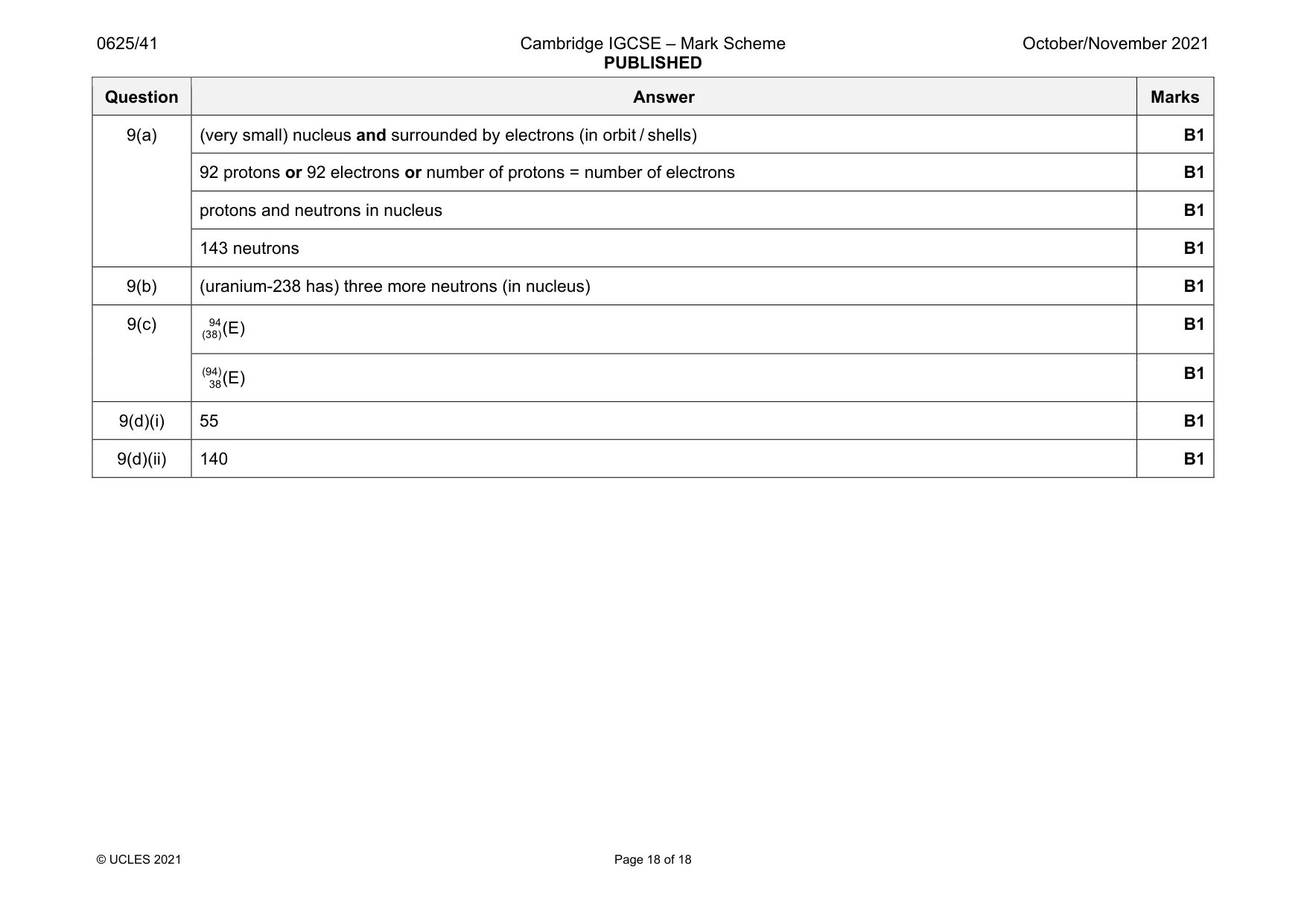
Mark scheme: 9(a) (very small) nucleus and surrounded by electrons (in orbit / shells) B1 92 protons or 92 electrons or number of protons = number of electrons B1 protons and neutrons in nucleus B1 143 neutrons B1 9(b) (uranium-238 has) three more neutrons (in nucleus) B1 9(c) 94 (38)(E) B1 (94) 38(E) B1 9(d)(i) 55 B1 9(d)(ii) 140 B1
What was in this paper
The subtopics covered by these 9 questions, and how many questions each got. Open one in a new tab to see every Cambridge question on it.
What you needed in this session
Cambridge’s own grade thresholds for 2021 Oct/Nov, Paper 4 · Variant 1. A higher threshold means an easier paper — the bar moves with how the cohort did.