Cambridge IGCSE Physics 0625 — 2022 Oct/Nov Paper 4 · Variant 3
0625/43/O/N/22 · 11 questions · 80 marks · ≈90 min
The question paper and its mark scheme, free to read here and free to download. This is Cambridge’s own paper, exactly as it was sat.
Question paper16 pages
Mark scheme16 pages
Answers below. Sit the paper first if you are practising.
Questions as text
Q1 · An aeroplane accelerates along a horizontal runway before take-off
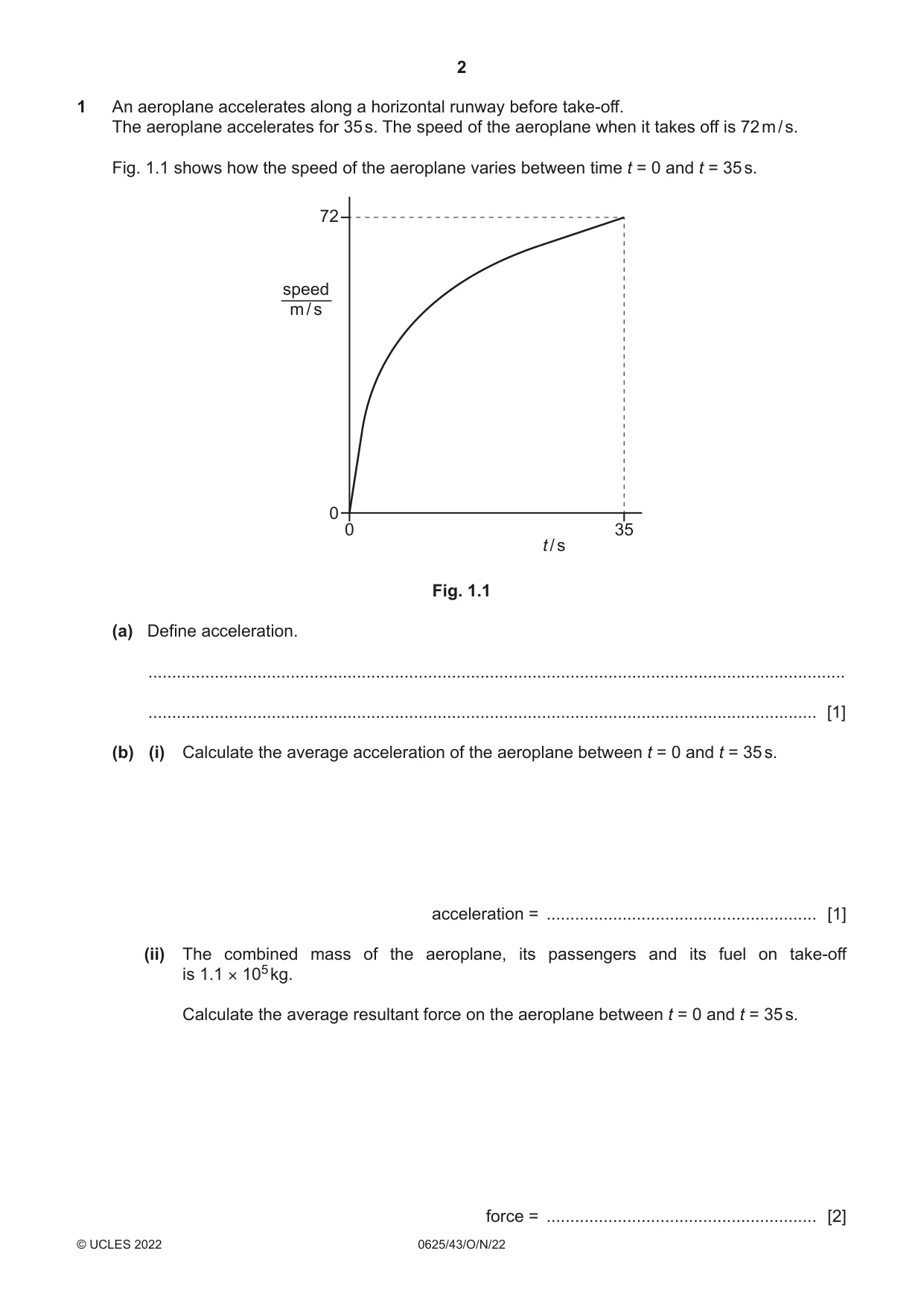
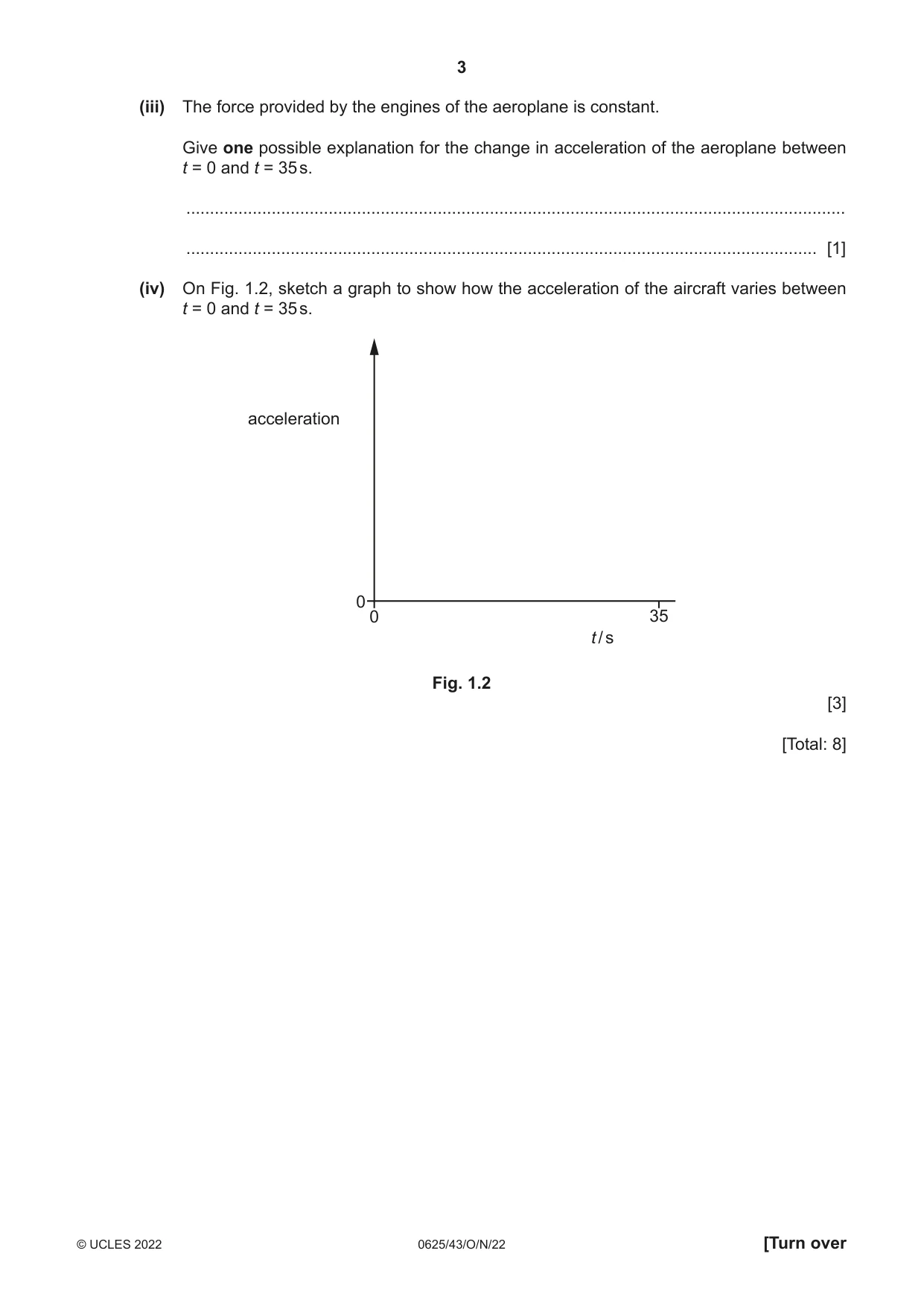
1 An aeroplane accelerates along a horizontal runway before take-off. The aeroplane accelerates for 35 s. The speed of the aeroplane when it takes off is 72 m / s. Fig. 1.1 shows how the speed of the aeroplane varies between time t = 0 and t = 35 s. 72 speed m / s 0 0 35 t / s Fig. 1.1 (a) Define acceleration. ................................................................................................................................................... ............................................................................................................................................. [1] (b) (i) Calculate the average acceleration of the aeroplane between t = 0 and t = 35 s. acceleration = ......................................................... [1] (ii) The combined mass of the aeroplane, its passengers and its fuel on take-off is 1.1 × 10⁵ kg. Calculate the average resultant force on the aeroplane between t = 0 and t = 35 s. force = ......................................................... [2] (iii) The force provided by the engines of the aeroplane is constant. Give one possible explanation for the change in acceleration of the aeroplane between t = 0 and t = 35 s. ........................................................................................................................................... ..................................................................................................................................... [1] (iv) On Fig. 1.2, sketch a graph to show how the acceleration of the aircraft varies between t = 0 and t = 35 s. acceleration 0 0 35 t / s Fig. 1.2 [3] [Total: 8]
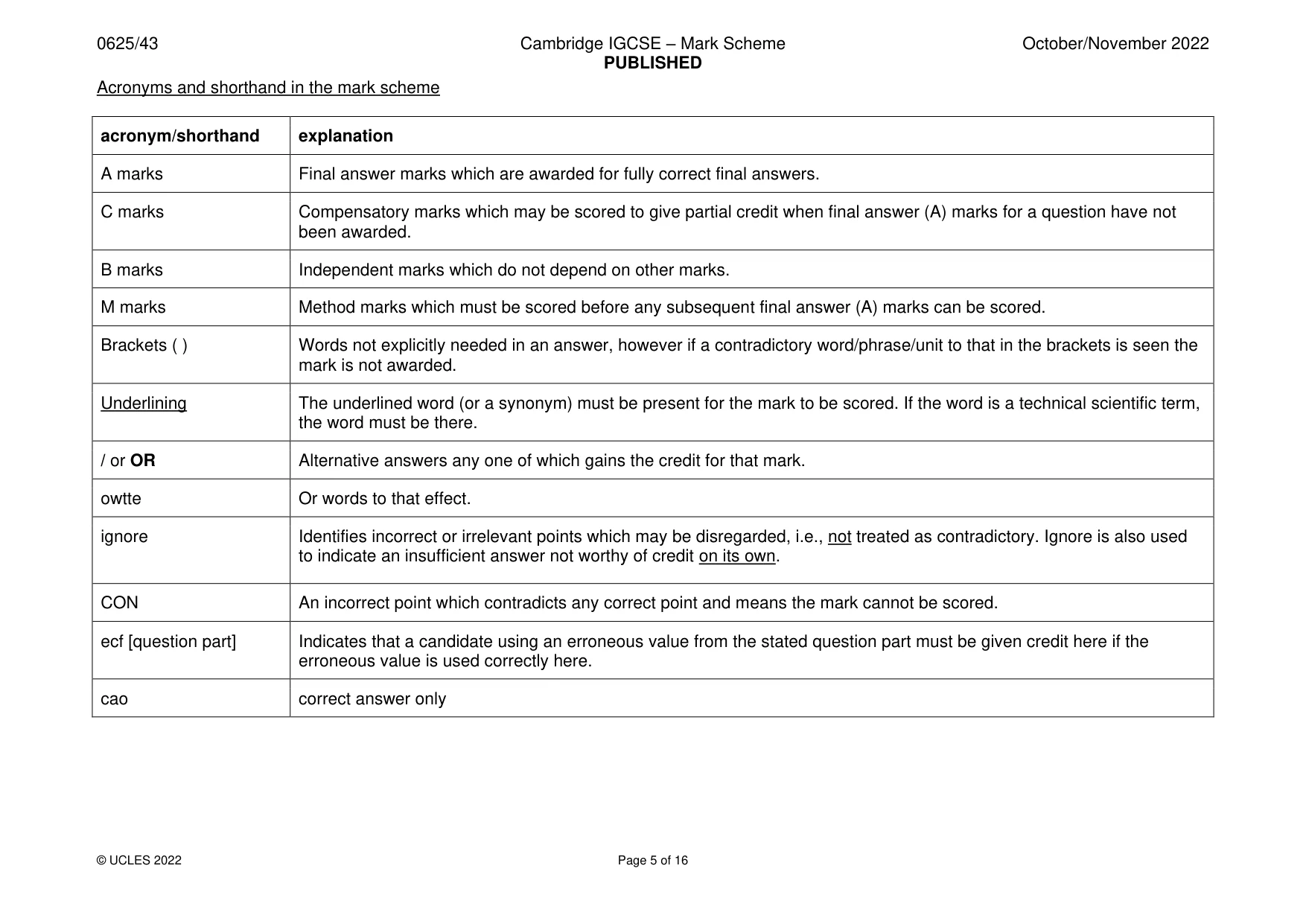
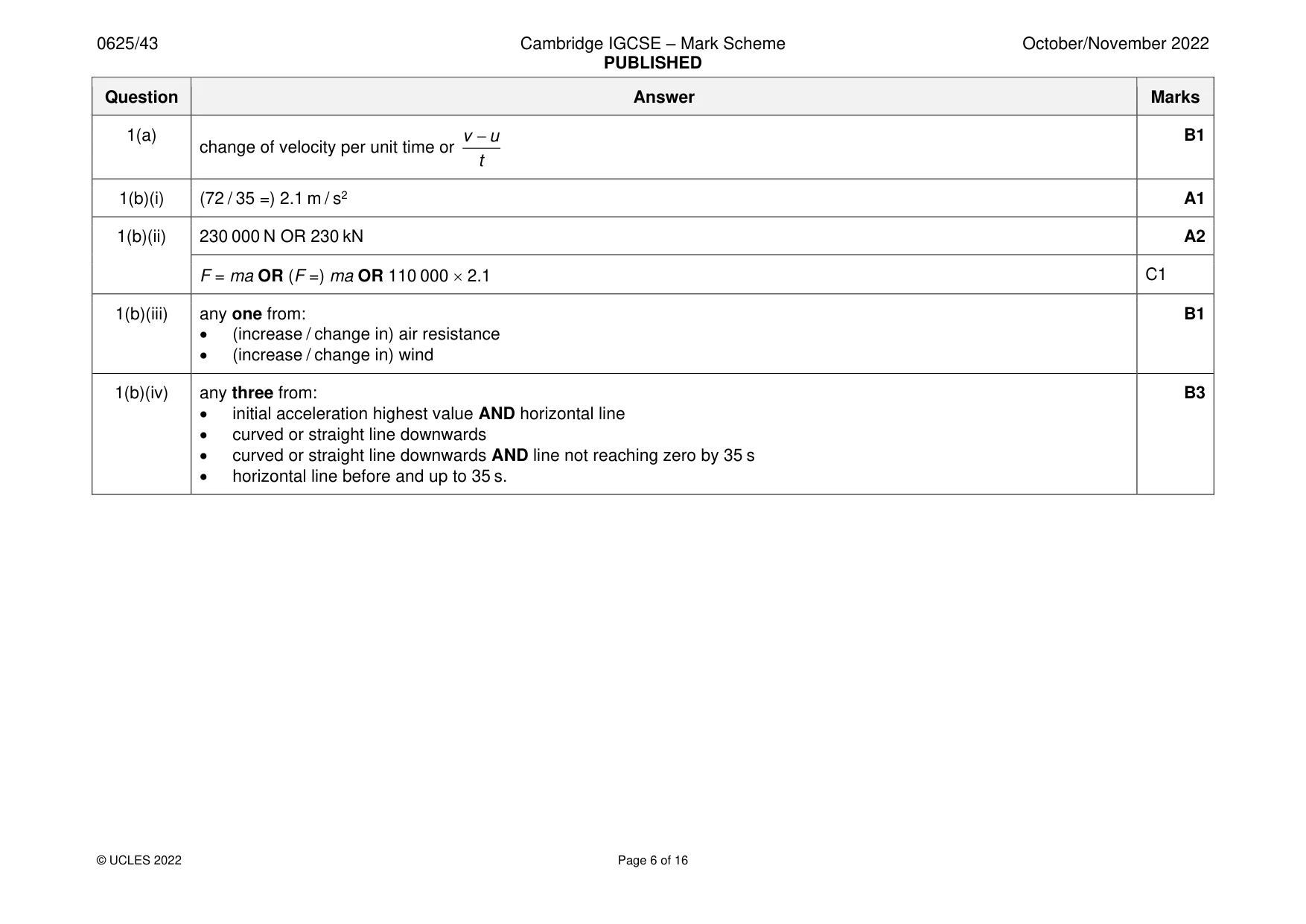
Mark scheme: Question Answer Marks 1(a) v − u B1 change of velocity per unit time or t 1(b)(i) (72 / 35 =) 2.1 m / s2 A1 1(b)(ii) 230 000 N OR 230 kN A2 F = ma OR (F =) ma OR 110 000 2.1 C1 1(b)(iii) any one from: B1 • (increase / change in) air resistance • (increase / change in) wind 1(b)(iv) any three from: B3 • initial acceleration highest value AND horizontal line • curved or straight line downwards • curved or straight line downwards AND line not reaching zero by 35 s • horizontal line before and up to 35 s.
Q2 · A tennis ball approaching a tennis racket
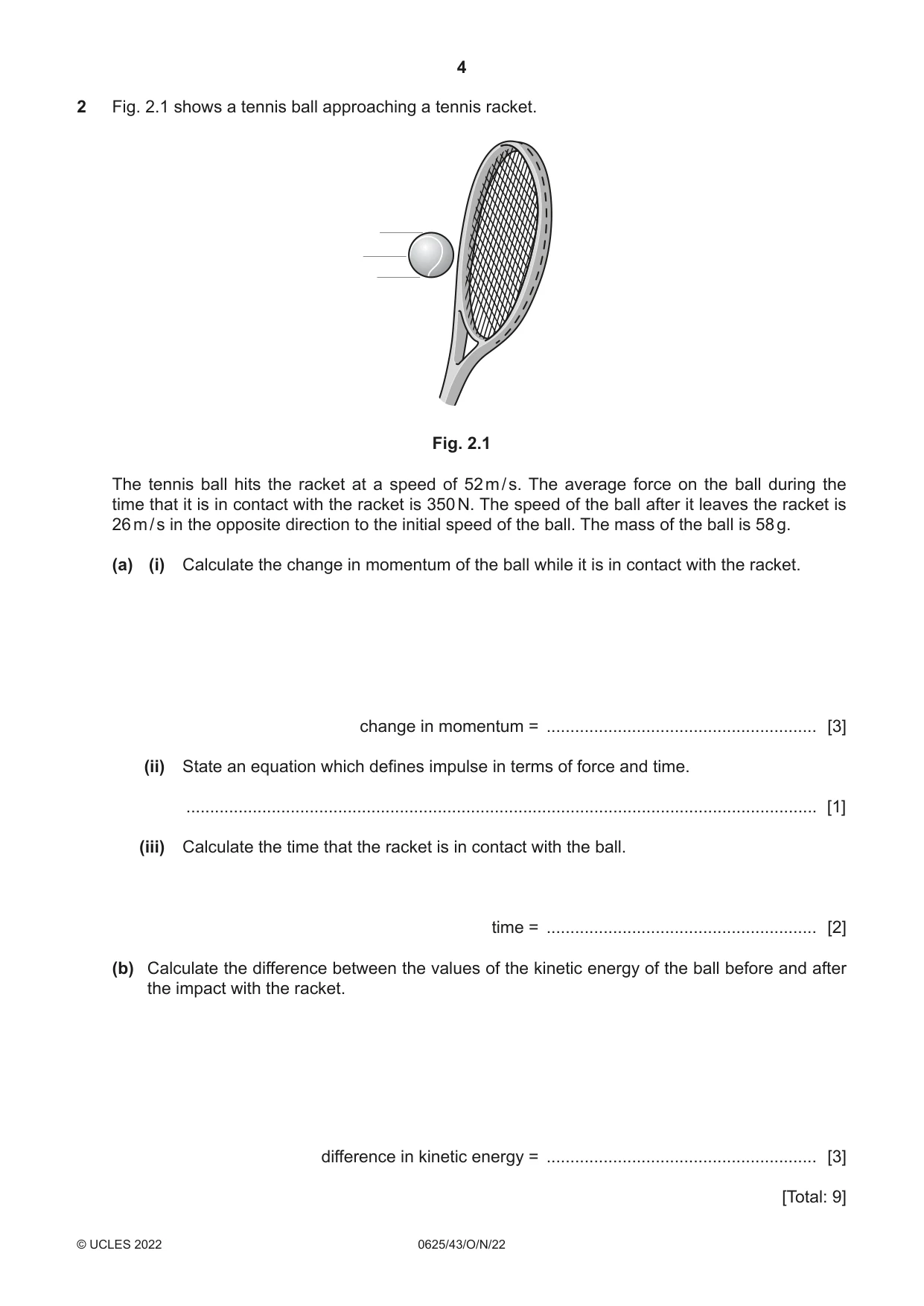
2 Fig. 2.1 shows a tennis ball approaching a tennis racket. Fig. 2.1 The tennis ball hits the racket at a speed of 52 m / s. The average force on the ball during the time that it is in contact with the racket is 350 N. The speed of the ball after it leaves the racket is 26 m / s in the opposite direction to the initial speed of the ball. The mass of the ball is 58 g. (a) (i) Calculate the change in momentum of the ball while it is in contact with the racket. change in momentum = ......................................................... [3] (ii) State an equation which defines impulse in terms of force and time. ..................................................................................................................................... [1] (iii) Calculate the time that the racket is in contact with the ball. time = ......................................................... [2] (b) Calculate the difference between the values of the kinetic energy of the ball before and after the impact with the racket. difference in kinetic energy = ......................................................... [3] [Total: 9]
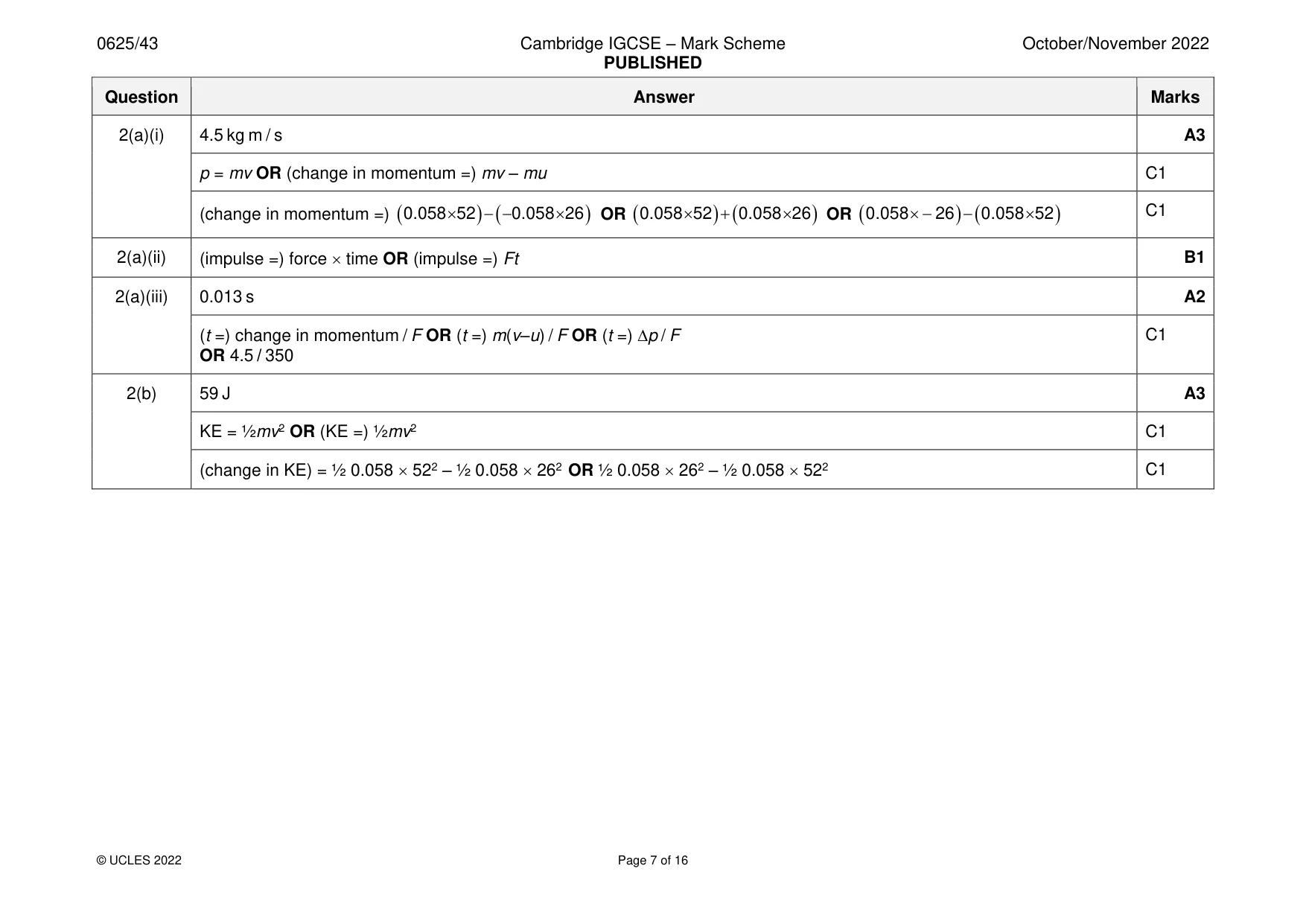
Mark scheme: 2(a)(i) 4.5 kg m / s A3 p = mv OR (change in momentum =) mv – mu C1 (change in momentum =) ( 0.058 52 ) −−( 0.058 26 ) OR ( 0.058 52 ) + ( 0.058 26 ) OR ( 0.058 − 26 ) − ( 0.058 52 ) C1 2(a)(ii) (impulse =) force time OR (impulse =) Ft B1 2(a)(iii) 0.013 s A2 (t =) change in momentum / F OR (t =) m(v–u) / F OR (t =) p / F C1 OR 4.5 / 350 2(b) 59 J A3 KE = ½mv2 OR (KE =) ½mv2 C1 (change in KE) = ½ 0.058 522 – ½ 0.058 262 OR ½ 0.058 262 – ½ 0.058 522 C1
Q3 · The cross-section of a barrage built across a tidal bay
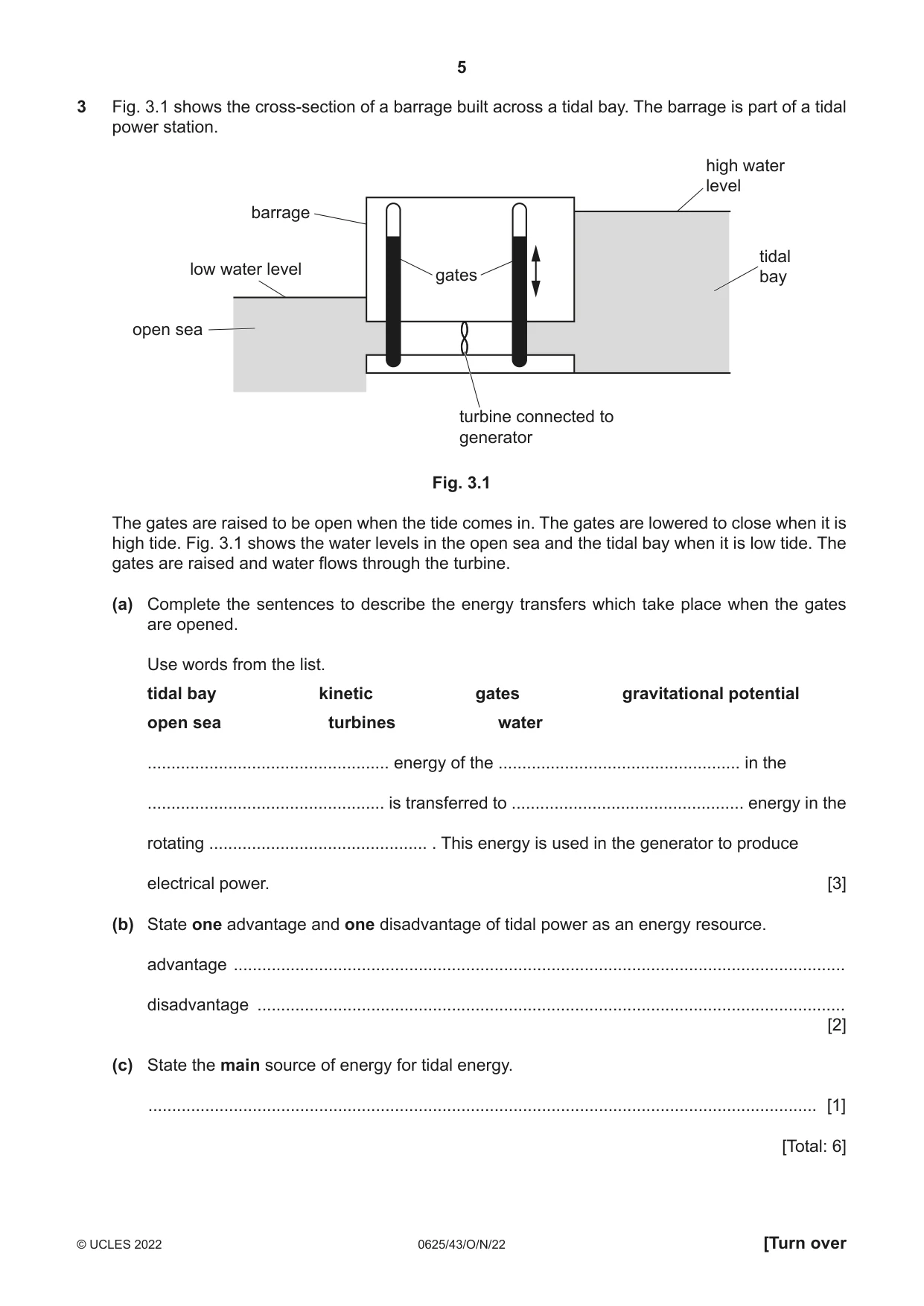
3 Fig. 3.1 shows the cross-section of a barrage built across a tidal bay. The barrage is part of a tidal power station. high water level barrage tidal low water level gates bay open sea turbine connected to generator Fig. 3.1 The gates are raised to be open when the tide comes in. The gates are lowered to close when it is high tide. Fig. 3.1 shows the water levels in the open sea and the tidal bay when it is low tide. The gates are raised and water flows through the turbine. (a) Complete the sentences to describe the energy transfers which take place when the gates are opened. Use words from the list. tidal bay kinetic gates gravitational potential open sea turbines water ................................................... energy of the ................................................... in the .................................................. is transferred to ................................................. energy in the rotating .............................................. . This energy is used in the generator to produce electrical power. [3] (b) State one advantage and one disadvantage of tidal power as an energy resource. advantage ................................................................................................................................. disadvantage ............................................................................................................................ [2] (c) State the main source of energy for tidal energy. ............................................................................................................................................. [1] [Total: 6]
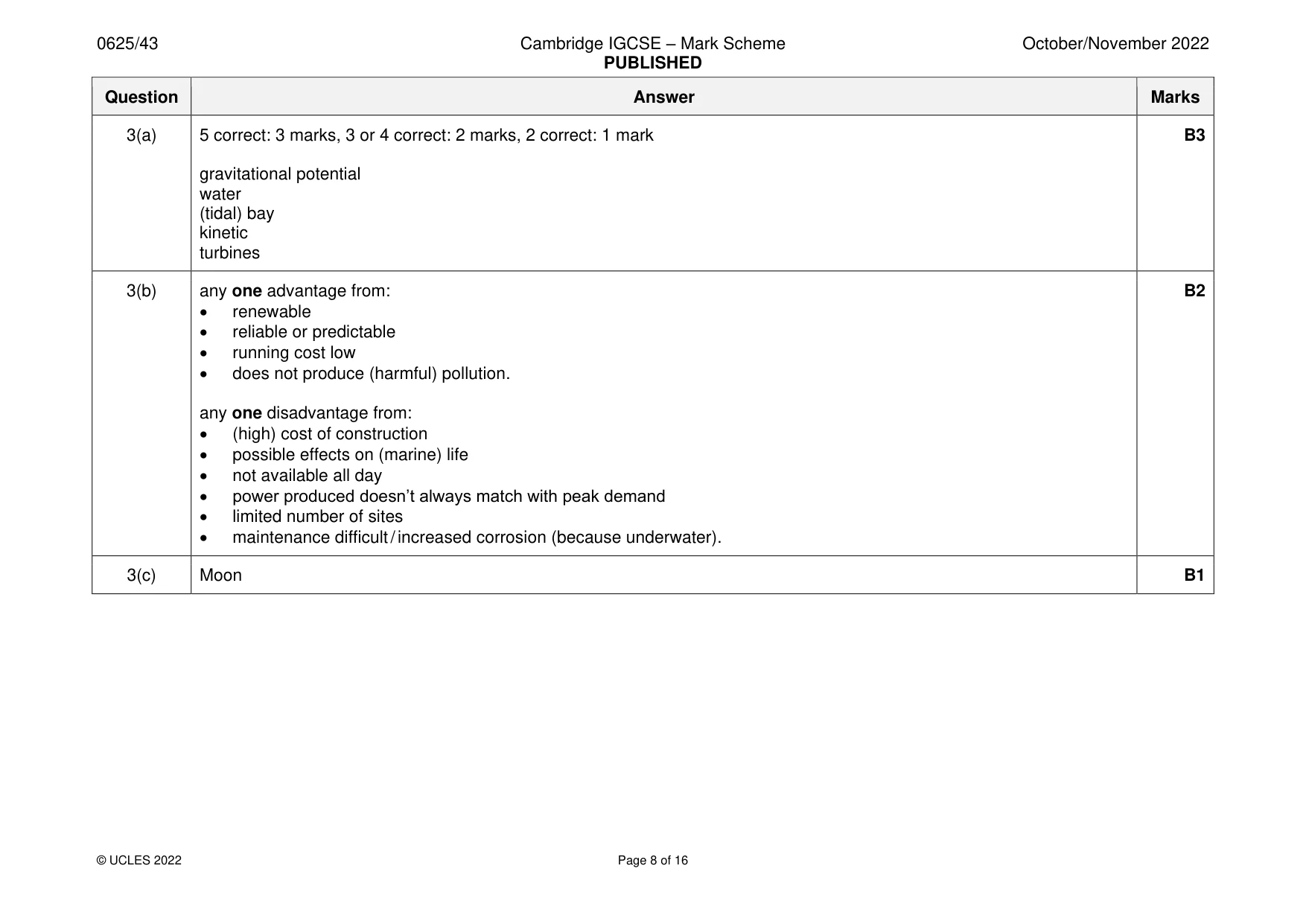
Mark scheme: 3(a) 5 correct: 3 marks, 3 or 4 correct: 2 marks, 2 correct: 1 mark B3 gravitational potential water (tidal) bay kinetic turbines 3(b) any one advantage from: B2 • renewable • reliable or predictable • running cost low • does not produce (harmful) pollution. any one disadvantage from: • (high) cost of construction • possible effects on (marine) life • not available all day • power produced doesn’t always match with peak demand • limited number of sites • maintenance difficult / increased corrosion (because underwater). 3(c) Moon B1
Q4 · A liquid-in-glass thermometer labelled thermometer X
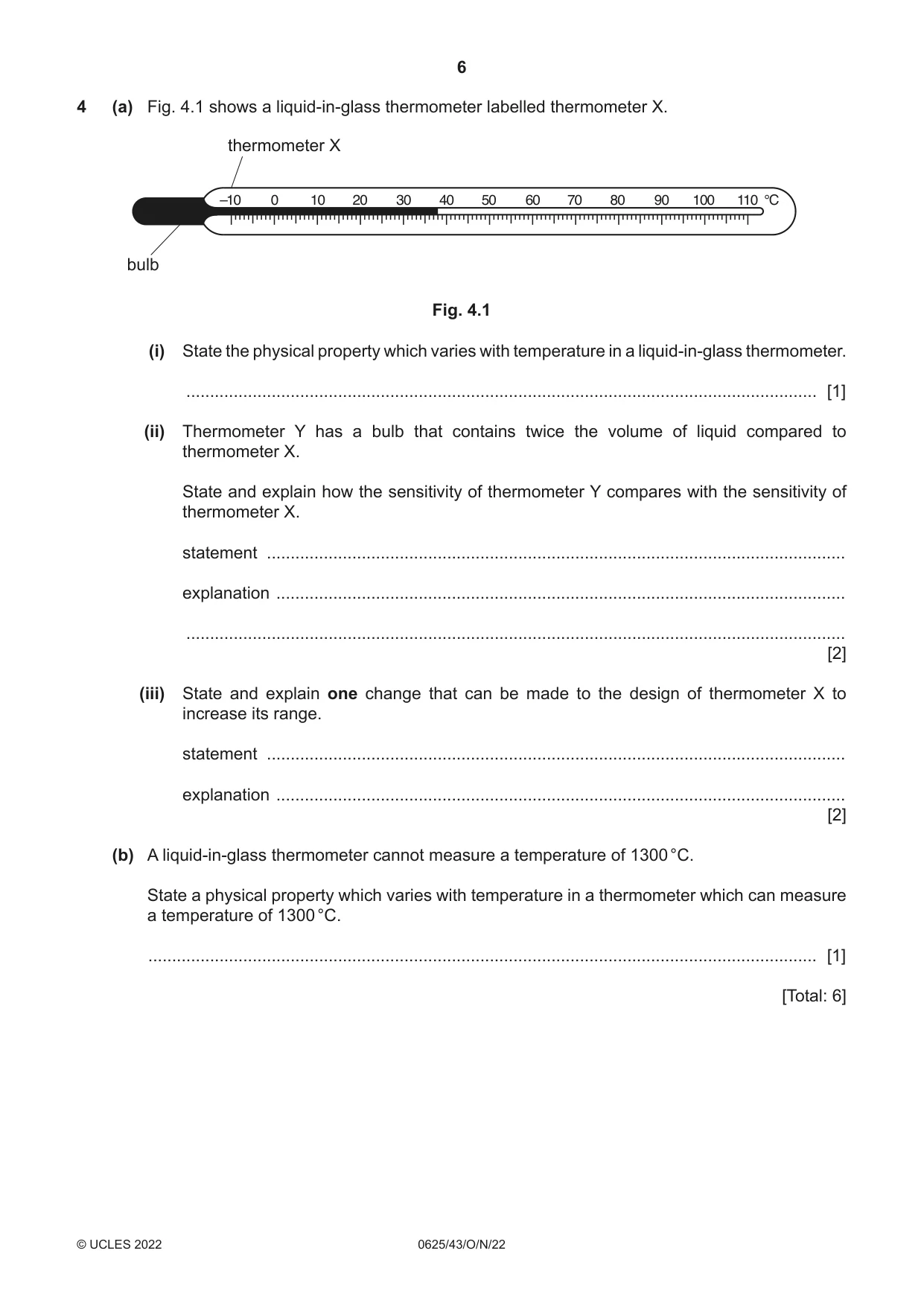
4 (a) Fig. 4.1 shows a liquid-in-glass thermometer labelled thermometer X. thermometer X –10 0 10 20 30 40 50 60 70 80 90 100 110 °C bulb Fig. 4.1 (i) State the physical property which varies with temperature in a liquid-in-glass thermometer. ..................................................................................................................................... [1] (ii) Thermometer Y has a bulb that contains twice the volume of liquid compared to thermometer X. State and explain how the sensitivity of thermometer Y compares with the sensitivity of thermometer X. statement .......................................................................................................................... explanation ........................................................................................................................ ........................................................................................................................................... [2] (iii) State and explain one change that can be made to the design of thermometer X to increase its range. statement .......................................................................................................................... explanation ........................................................................................................................ [2] (b) A liquid-in-glass thermometer cannot measure a temperature of 1300 °C. State a physical property which varies with temperature in a thermometer which can measure a temperature of 1300 °C. ............................................................................................................................................. [1] [Total: 6]
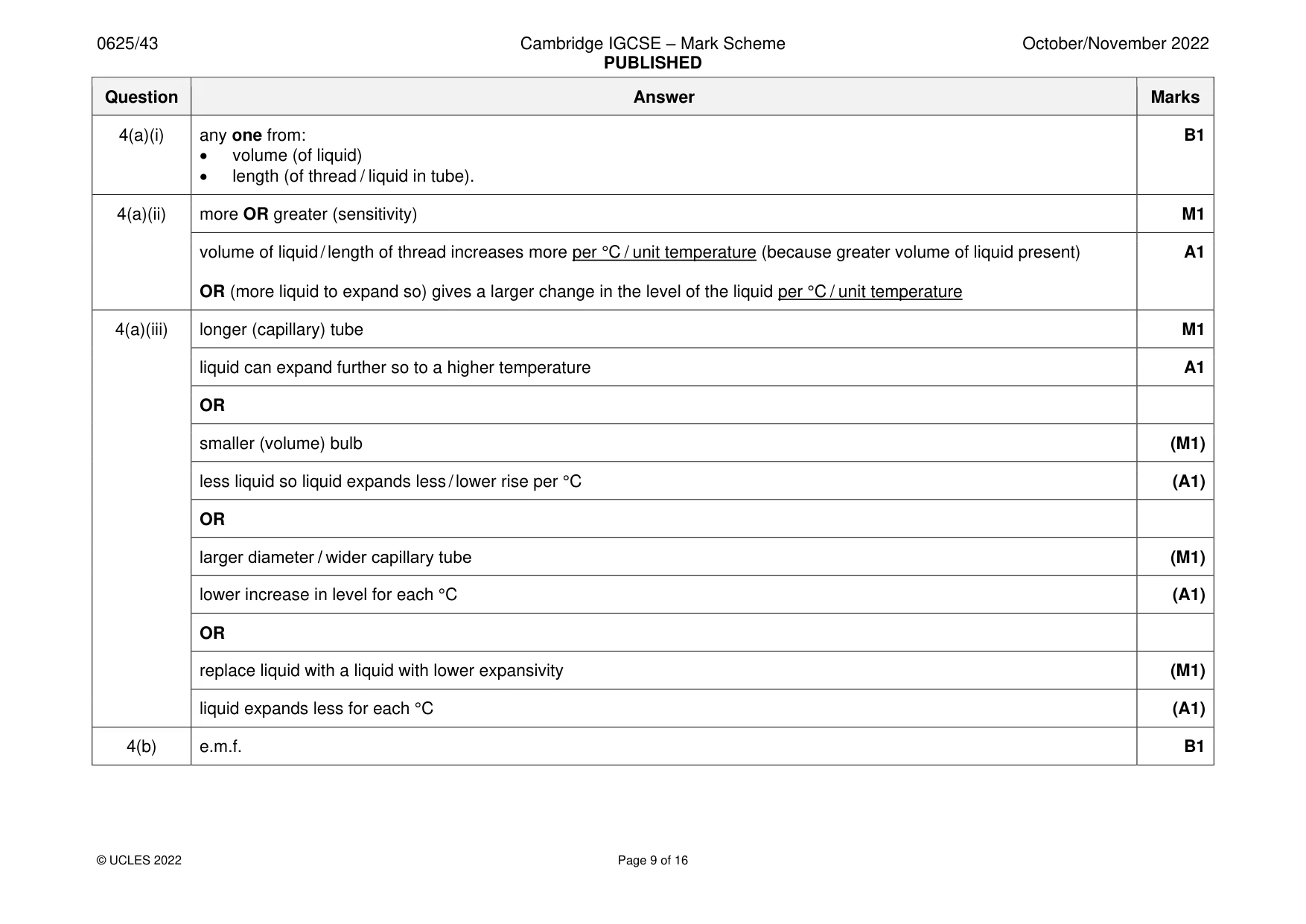
Mark scheme: 4(a)(i) any one from: B1 • volume (of liquid) • length (of thread / liquid in tube). 4(a)(ii) more OR greater (sensitivity) M1 volume of liquid / length of thread increases more per °C / unit temperature (because greater volume of liquid present) A1 OR (more liquid to expand so) gives a larger change in the level of the liquid per °C / unit temperature 4(a)(iii) longer (capillary) tube M1 liquid can expand further so to a higher temperature A1 OR smaller (volume) bulb (M1) less liquid so liquid expands less / lower rise per °C (A1) OR larger diameter / wider capillary tube (M1) lower increase in level for each °C (A1) OR replace liquid with a liquid with lower expansivity (M1) liquid expands less for each °C (A1) 4(b) e.m.f. B1
Q5 · Three identical dishes, A, B and C, contain an equal volume of water
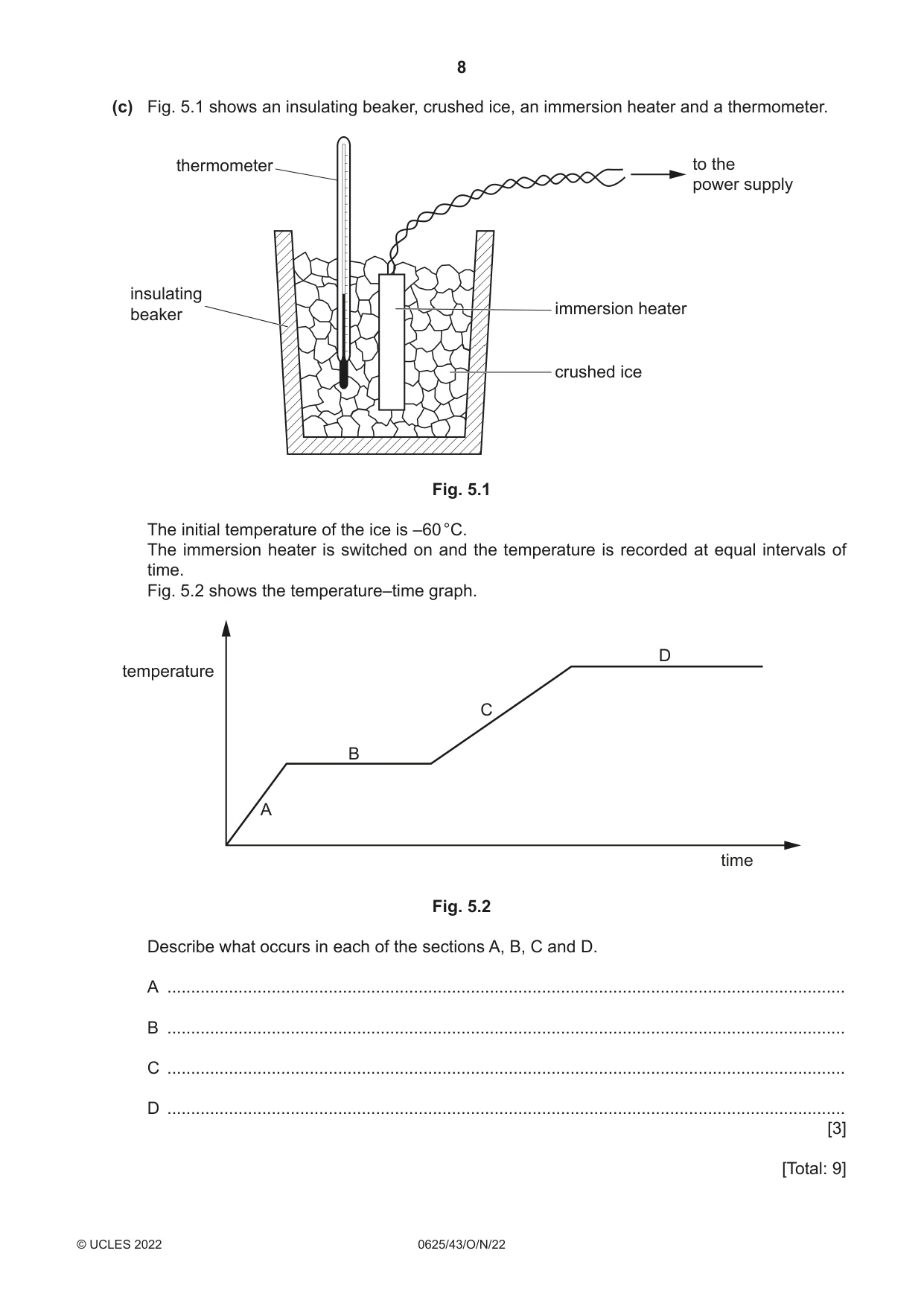
5 (a) Three identical dishes, A, B and C, contain an equal volume of water. Dish A is outside in sunlight and experiences no wind during the day. Dish B is outside in sunlight and experiences a strong wind during the day. Dish C is in a dark room. Water evaporates from each dish. After 12 hours, a student measures the volume of water in each dish. Dish C contains the largest volume of water and dish B contains the smallest volume of water. Explain, in terms of particles, why the three dishes have different volumes of water. ................................................................................................................................................... ................................................................................................................................................... ................................................................................................................................................... ................................................................................................................................................... ................................................................................................................................................... ................................................................................................................................................... ............................................................................................................................................. [4] (b) Define specific latent heat of vaporisation. ................................................................................................................................................... ................................................................................................................................................... ............................................................................................................................................. [2] (c) Fig. 5.1 shows an insulating beaker, crushed ice, an immersion heater and a thermometer. thermometer to the power supply insulating immersion heater beaker crushed ice Fig. 5.1 The initial temperature of the ice is –60 °C. The immersion heater is switched on and the temperature is recorded at equal intervals of time. Fig. 5.2 shows the temperature–time graph. D temperature C B A time Fig. 5.2 Describe what occurs in each of the sections A, B, C and D. A ............................................................................................................................................... B ............................................................................................................................................... C ............................................................................................................................................... D ............................................................................................................................................... [3] [Total: 9]
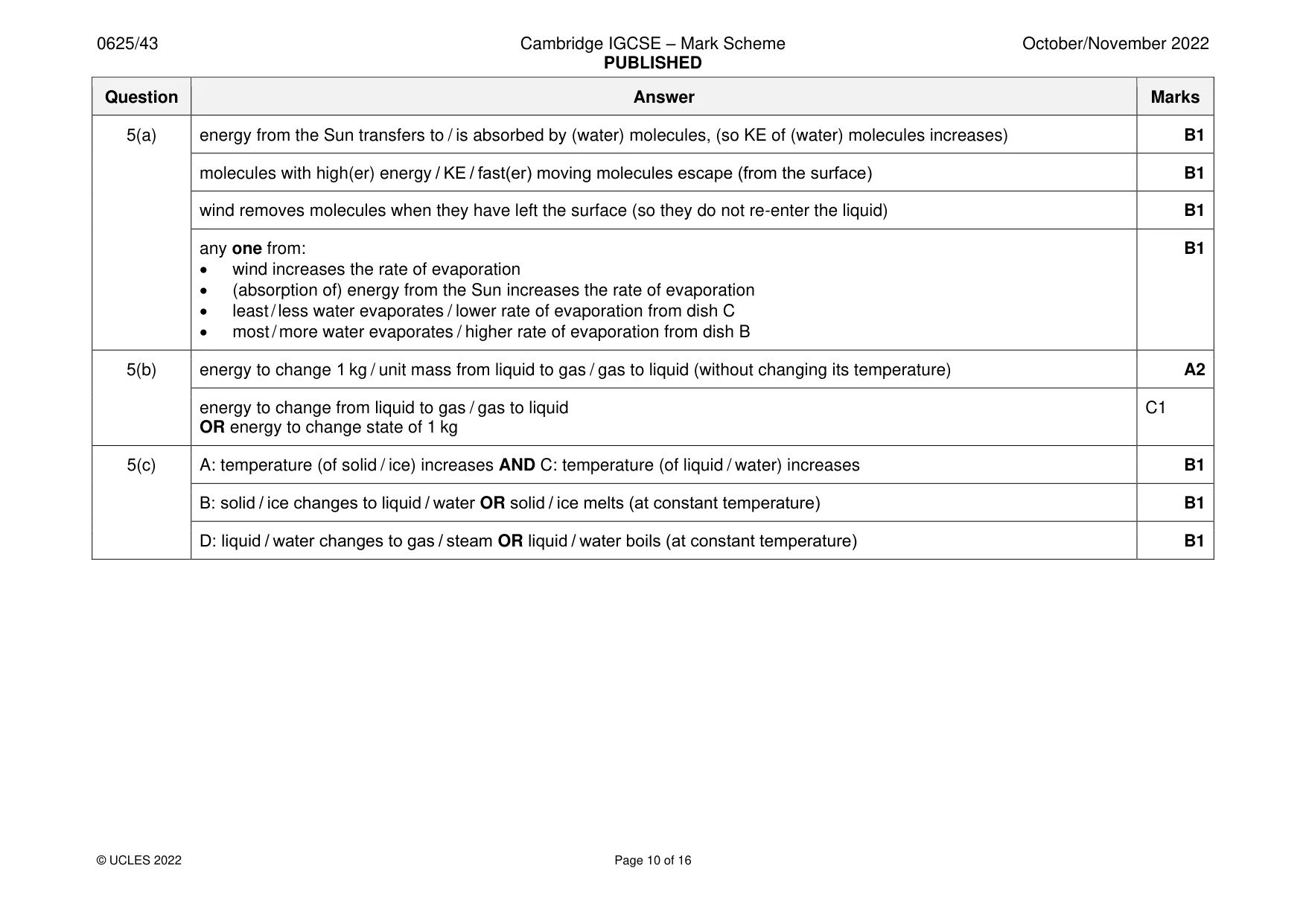
Mark scheme: 5(a) energy from the Sun transfers to / is absorbed by (water) molecules, (so KE of (water) molecules increases) B1 molecules with high(er) energy / KE / fast(er) moving molecules escape (from the surface) B1 wind removes molecules when they have left the surface (so they do not re-enter the liquid) B1 any one from: B1 • wind increases the rate of evaporation • (absorption of) energy from the Sun increases the rate of evaporation • least / less water evaporates / lower rate of evaporation from dish C • most / more water evaporates / higher rate of evaporation from dish B 5(b) energy to change 1 kg / unit mass from liquid to gas / gas to liquid (without changing its temperature) A2 energy to change from liquid to gas / gas to liquid C1 OR energy to change state of 1 kg 5(c) A: temperature (of solid / ice) increases AND C: temperature (of liquid / water) increases B1 B: solid / ice changes to liquid / water OR solid / ice melts (at constant temperature) B1 D: liquid / water changes to gas / steam OR liquid / water boils (at constant temperature) B1
Q6 · Wave crests and the direction of travel for a water wave approaching a barrier in a large…
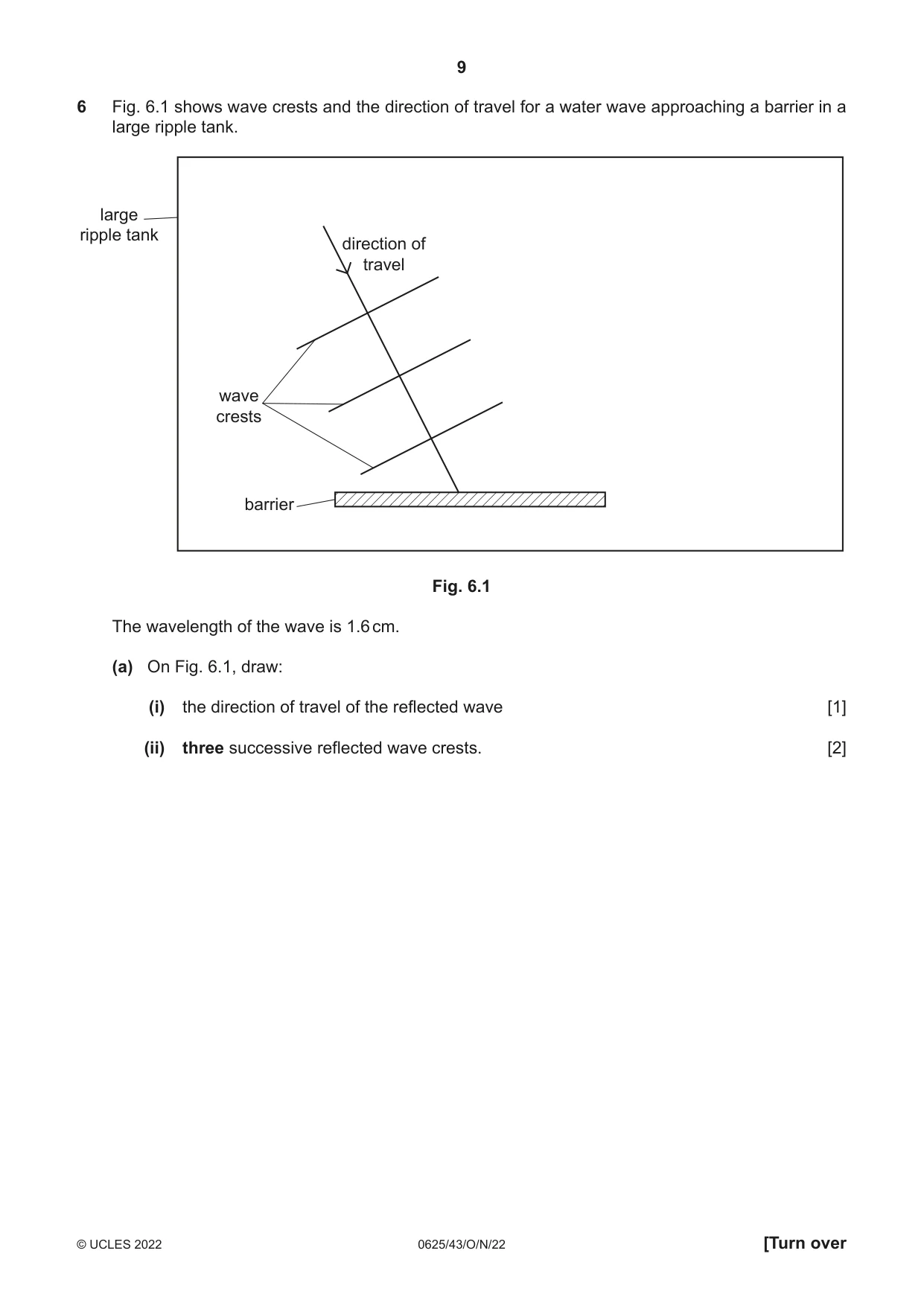
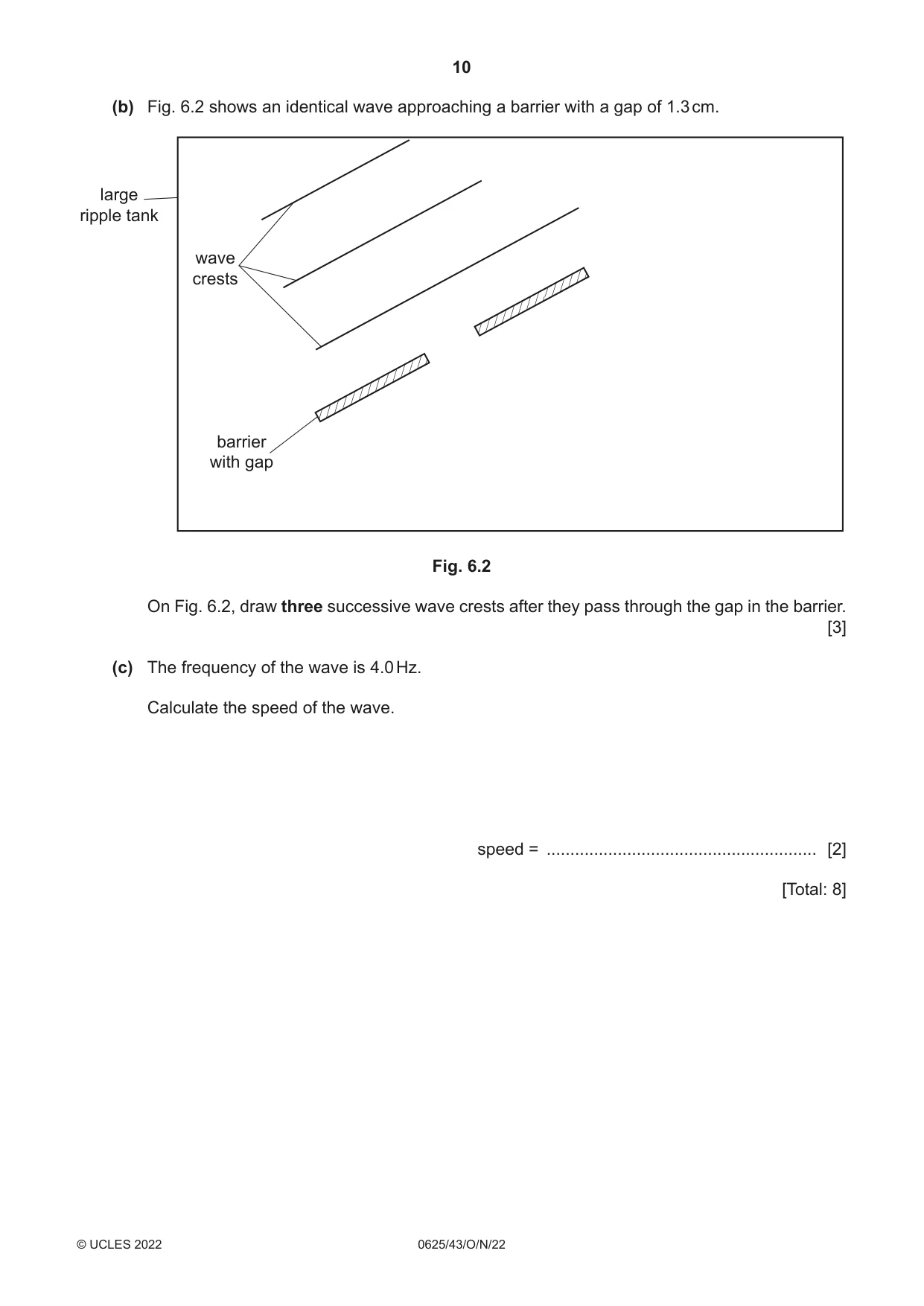
6 Fig. 6.1 shows wave crests and the direction of travel for a water wave approaching a barrier in a large ripple tank. large ripple tank direction of travel wave crests barrier Fig. 6.1 The wavelength of the wave is 1.6 cm. (a) On Fig. 6.1, draw: (i) the direction of travel of the reflected wave [1] (ii) three successive reflected wave crests. [2] (b) Fig. 6.2 shows an identical wave approaching a barrier with a gap of 1.3 cm. large ripple tank wave crests barrier with gap Fig. 6.2 On Fig. 6.2, draw three successive wave crests after they pass through the gap in the barrier. [3] (c) The frequency of the wave is 4.0 Hz. Calculate the speed of the wave. speed = ......................................................... [2] [Total: 8]
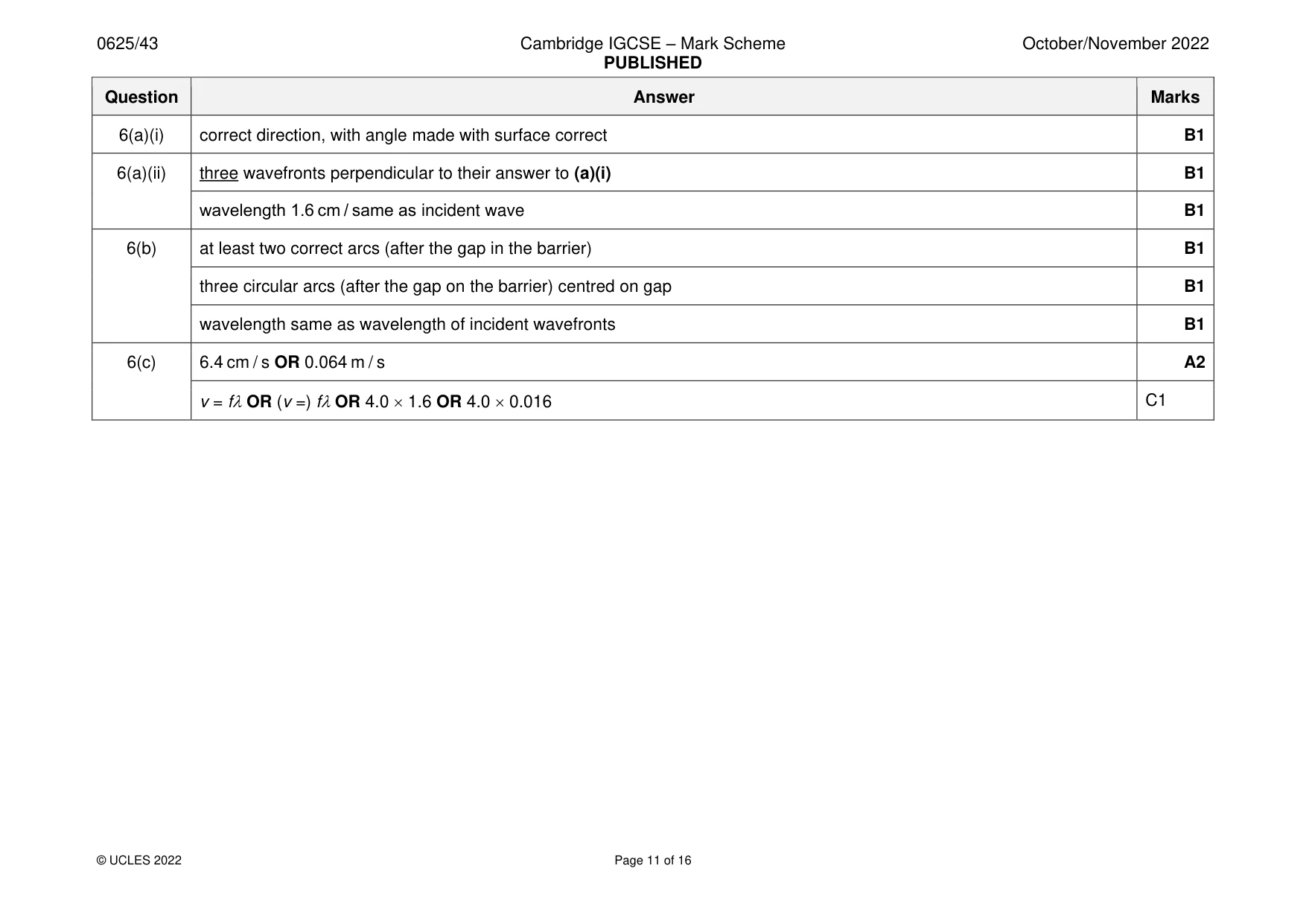
Mark scheme: 6(a)(i) correct direction, with angle made with surface correct B1 6(a)(ii) three wavefronts perpendicular to their answer to (a)(i) B1 wavelength 1.6 cm / same as incident wave B1 6(b) at least two correct arcs (after the gap in the barrier) B1 three circular arcs (after the gap on the barrier) centred on gap B1 wavelength same as wavelength of incident wavefronts B1 6(c) 6.4 cm / s OR 0.064 m / s A2 v = fOR (v =) fOR 4.0 1.6 OR 4.0 0.016 C1
Q7 · State what is meant by total internal reflection
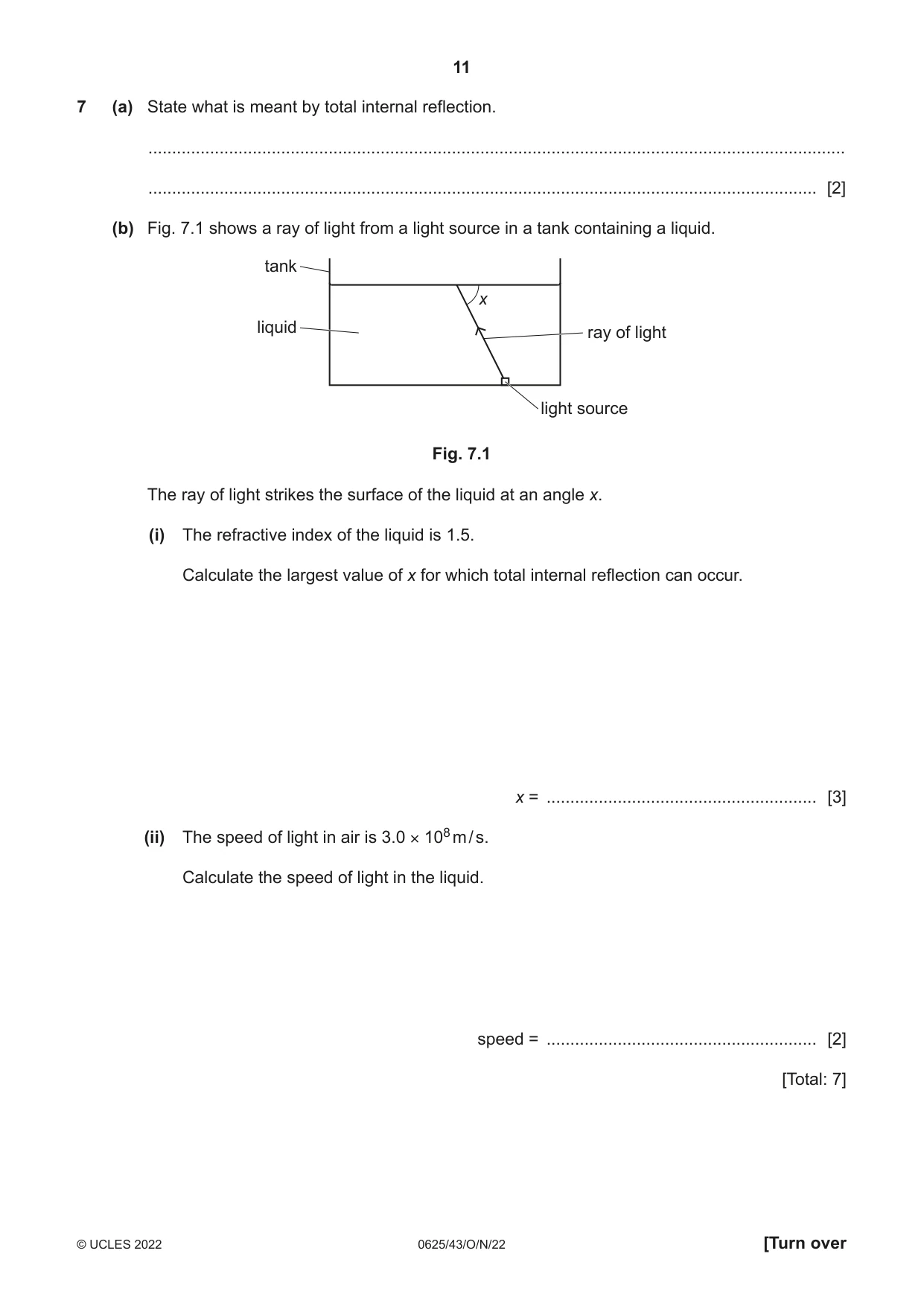
7 (a) State what is meant by total internal reflection. ................................................................................................................................................... ............................................................................................................................................. [2] (b) Fig. 7.1 shows a ray of light from a light source in a tank containing a liquid. tank x liquid ray of light light source Fig. 7.1 The ray of light strikes the surface of the liquid at an angle x. (i) The refractive index of the liquid is 1.5. Calculate the largest value of x for which total internal reflection can occur. x = ......................................................... [3] (ii) The speed of light in air is 3.0 × 10⁸ m / s. Calculate the speed of light in the liquid. speed = ......................................................... [2] [Total: 7]
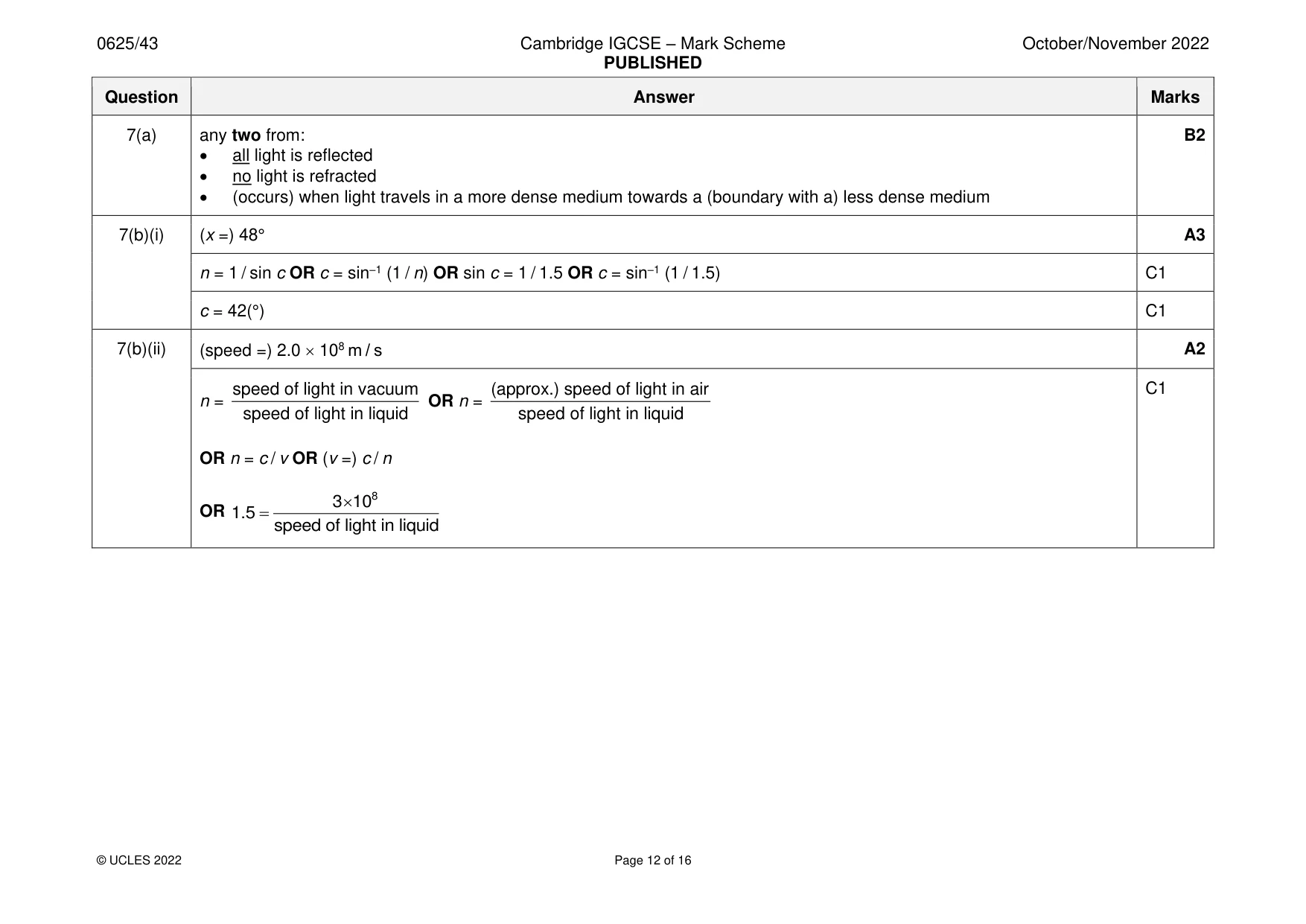
Mark scheme: 7(a) any two from: B2 • all light is reflected • no light is refracted • (occurs) when light travels in a more dense medium towards a (boundary with a) less dense medium 7(b)(i) (x =) 48° A3 n = 1 / sin c OR c = sin–1 (1 / n) OR sin c = 1 / 1.5 OR c = sin–1 (1 / 1.5) C1 c = 42(°) C1 7(b)(ii) (speed =) 2.0 108 m / s A2 speed of light in vacuum (approx.) speed of light in air C1 n = OR n = speed of light in liquid speed of light in liquid OR n = c / v OR (v =) c / n 3 108 OR 1.5 = speed of light in liquid
Q8 · Apparatus used to charge a metal plate by induction
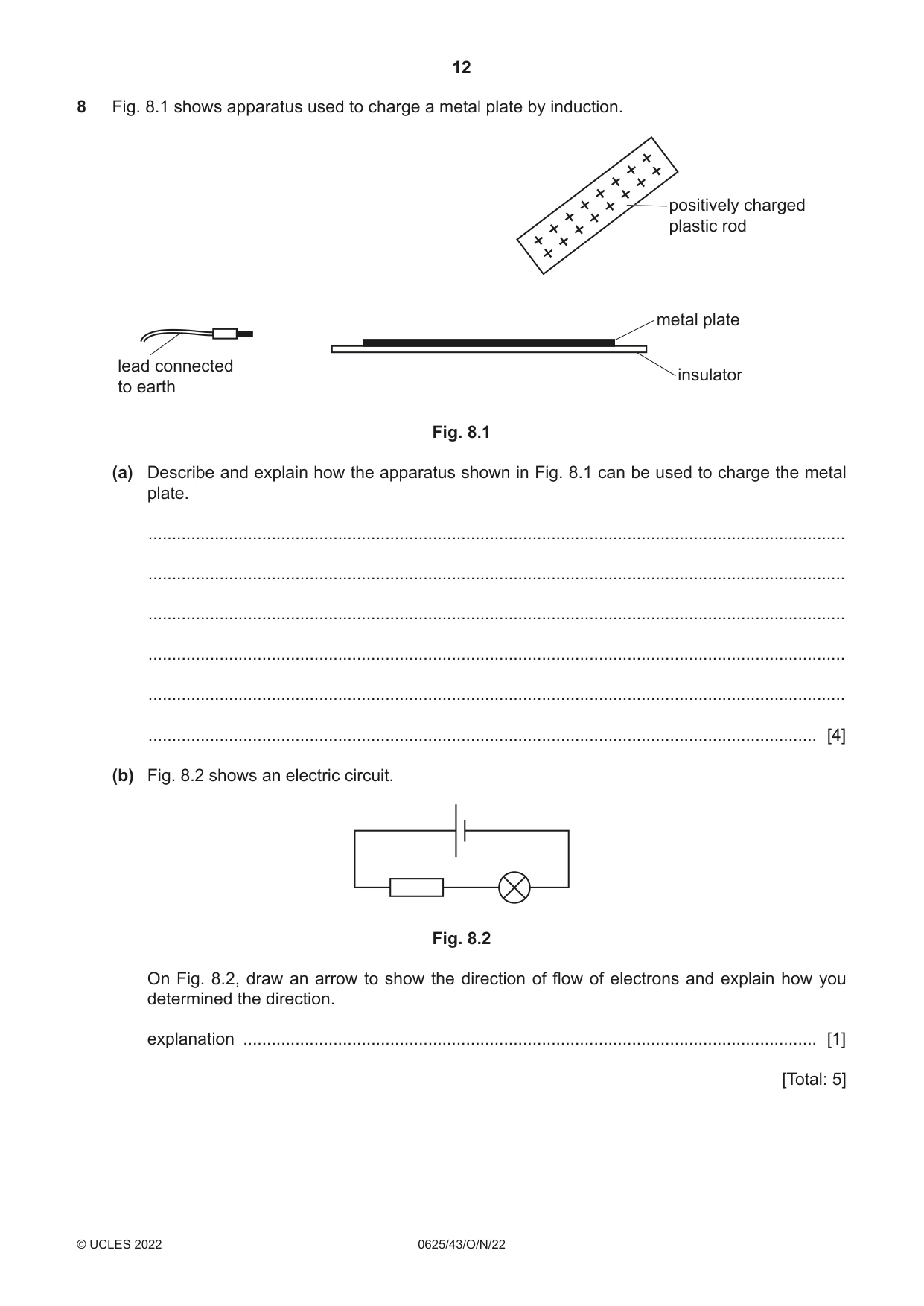
8 Fig. 8.1 shows apparatus used to charge a metal plate by induction. positively charged plastic rod metal plate lead connected insulator to earth Fig. 8.1 (a) Describe and explain how the apparatus shown in Fig. 8.1 can be used to charge the metal plate. ................................................................................................................................................... ................................................................................................................................................... ................................................................................................................................................... ................................................................................................................................................... ................................................................................................................................................... ............................................................................................................................................. [4] (b) Fig. 8.2 shows an electric circuit. Fig. 8.2 On Fig. 8.2, draw an arrow to show the direction of flow of electrons and explain how you determined the direction. explanation ......................................................................................................................... [1] [Total: 5]
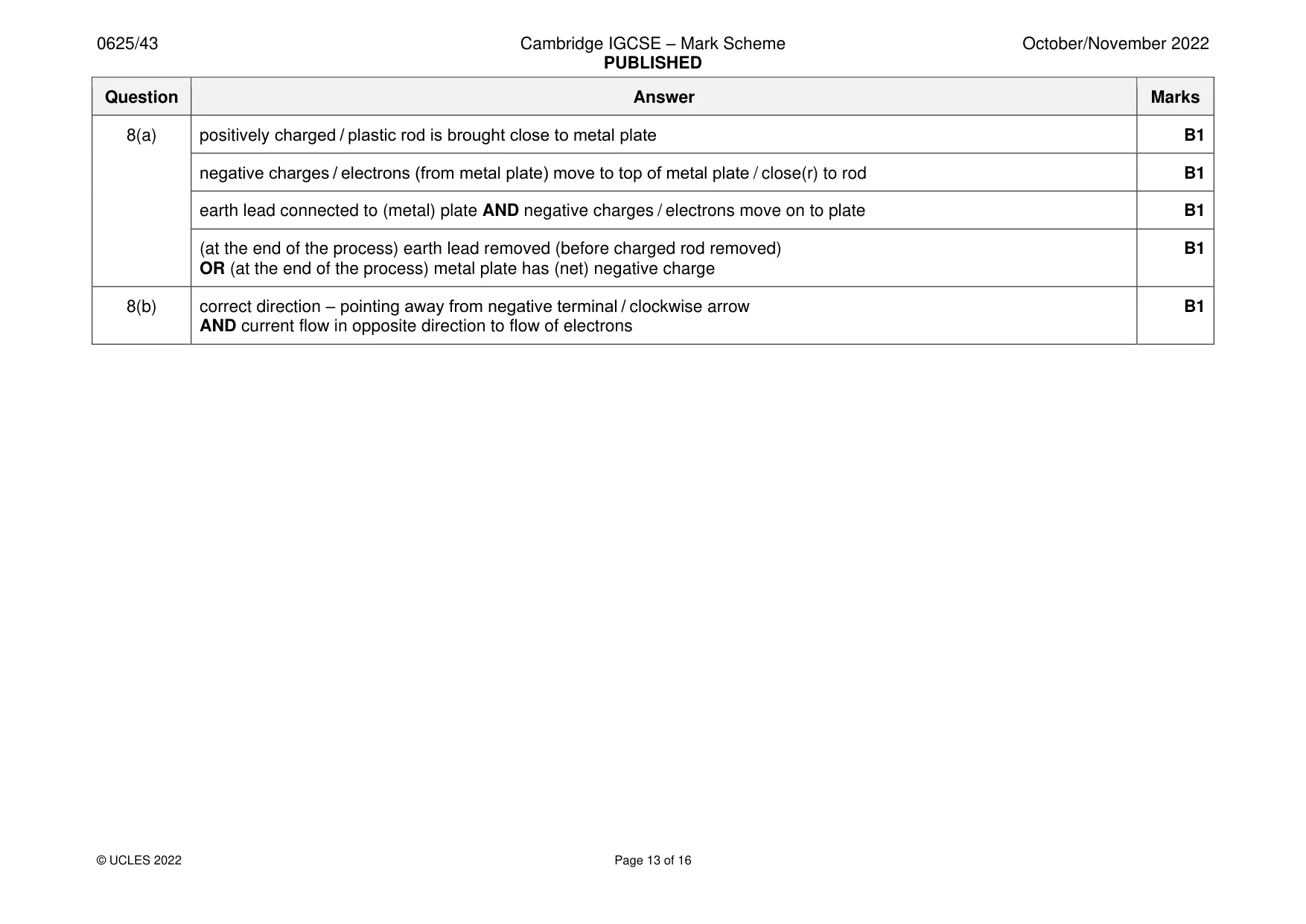
Mark scheme: 8(a) positively charged / plastic rod is brought close to metal plate B1 negative charges / electrons (from metal plate) move to top of metal plate / close(r) to rod B1 earth lead connected to (metal) plate AND negative charges / electrons move on to plate B1 (at the end of the process) earth lead removed (before charged rod removed) B1 OR (at the end of the process) metal plate has (net) negative charge 8(b) correct direction – pointing away from negative terminal / clockwise arrow B1 AND current flow in opposite direction to flow of electrons
Q9 · A circuit with an alternating current (a.c.) supply, a resistor and a diode
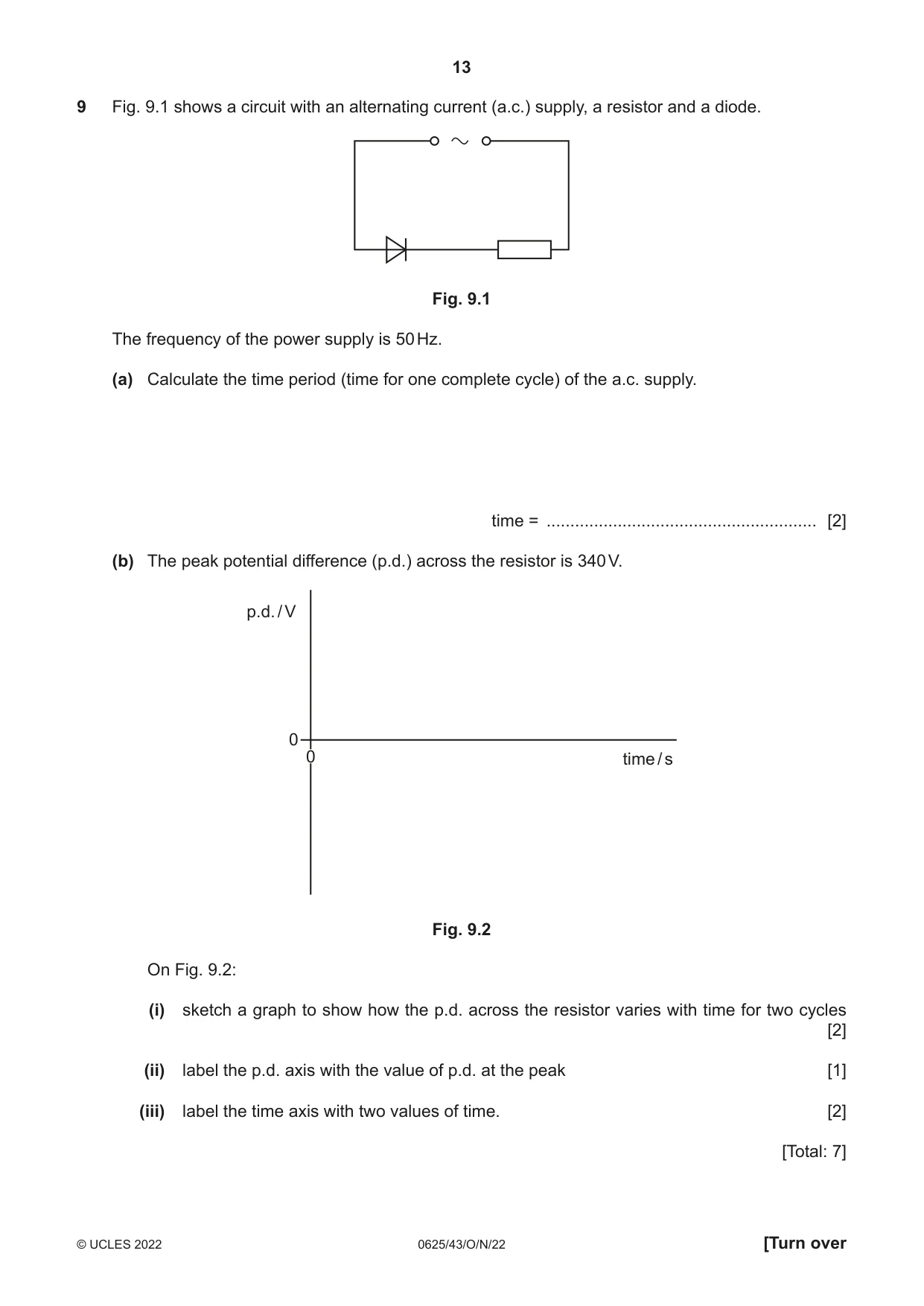
9 Fig. 9.1 shows a circuit with an alternating current (a.c.) supply, a resistor and a diode. Fig. 9.1 The frequency of the power supply is 50 Hz. (a) Calculate the time period (time for one complete cycle) of the a.c. supply. time = ......................................................... [2] (b) The peak potential difference (p.d.) across the resistor is 340 V. p.d. / V 0 0 time / s Fig. 9.2 On Fig. 9.2: (i) sketch a graph to show how the p.d. across the resistor varies with time for two cycles [2] (ii) label the p.d. axis with the value of p.d. at the peak [1] (iii) label the time axis with two values of time. [2] [Total: 7]
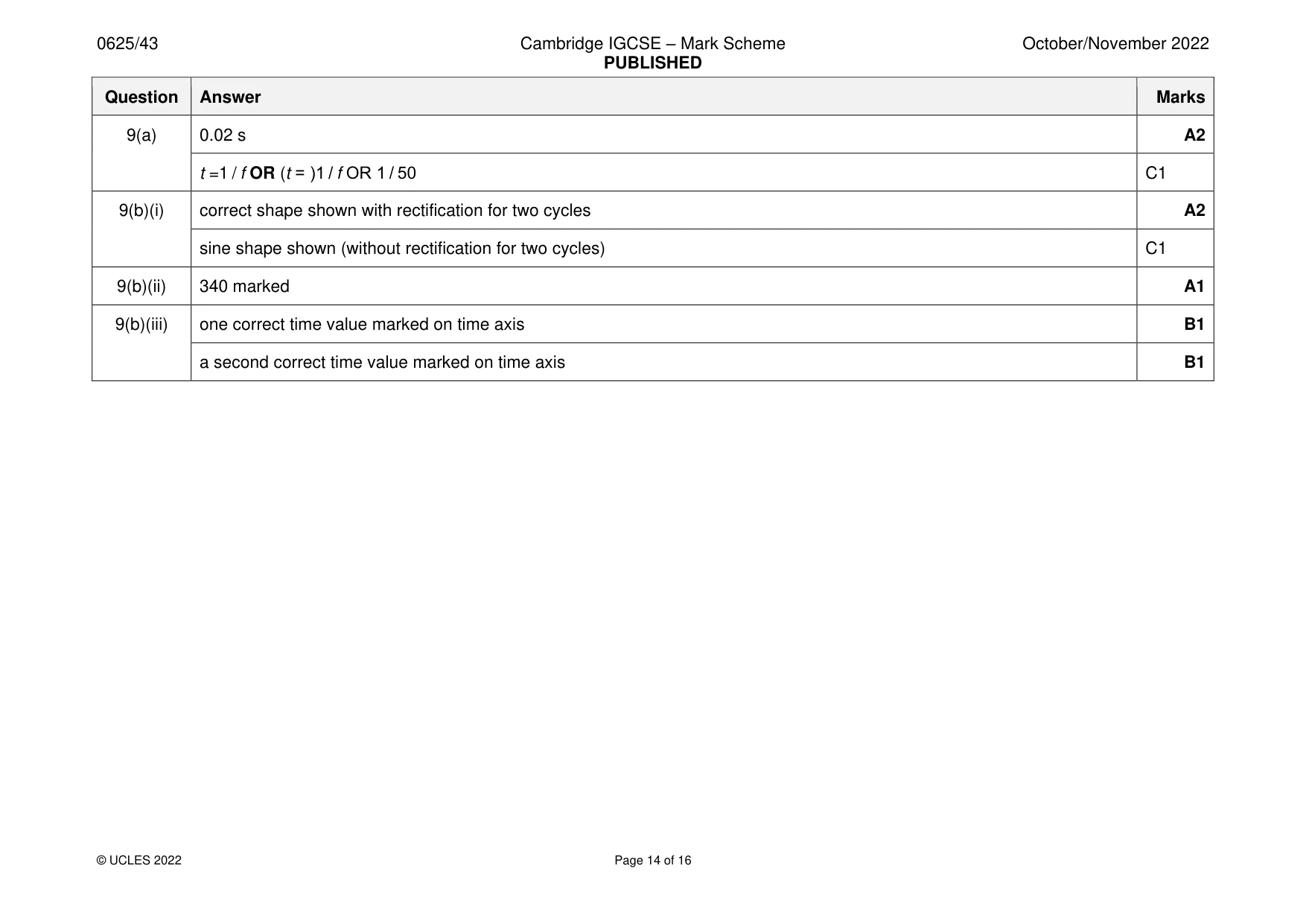
Mark scheme: 9(a) 0.02 s A2 t =1 / f OR (t = )1 / f OR 1 / 50 C1 9(b)(i) correct shape shown with rectification for two cycles A2 sine shape shown (without rectification for two cycles) C1 9(b)(ii) 340 marked A1 9(b)(iii) one correct time value marked on time axis B1 a second correct time value marked on time axis B1
Q10 · A cloud chamber can be used to detect α (alpha)-particles and β (beta)-particles
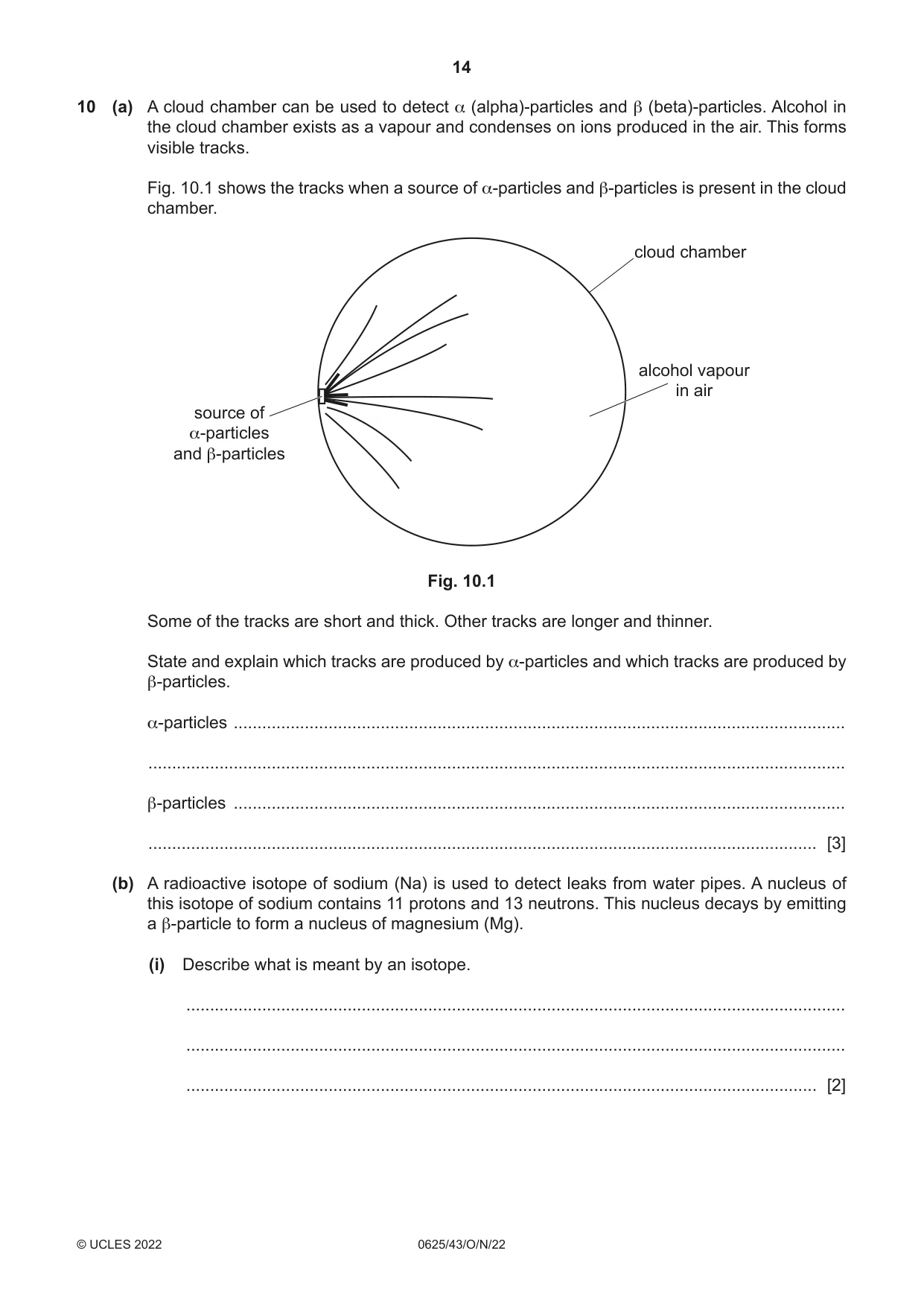
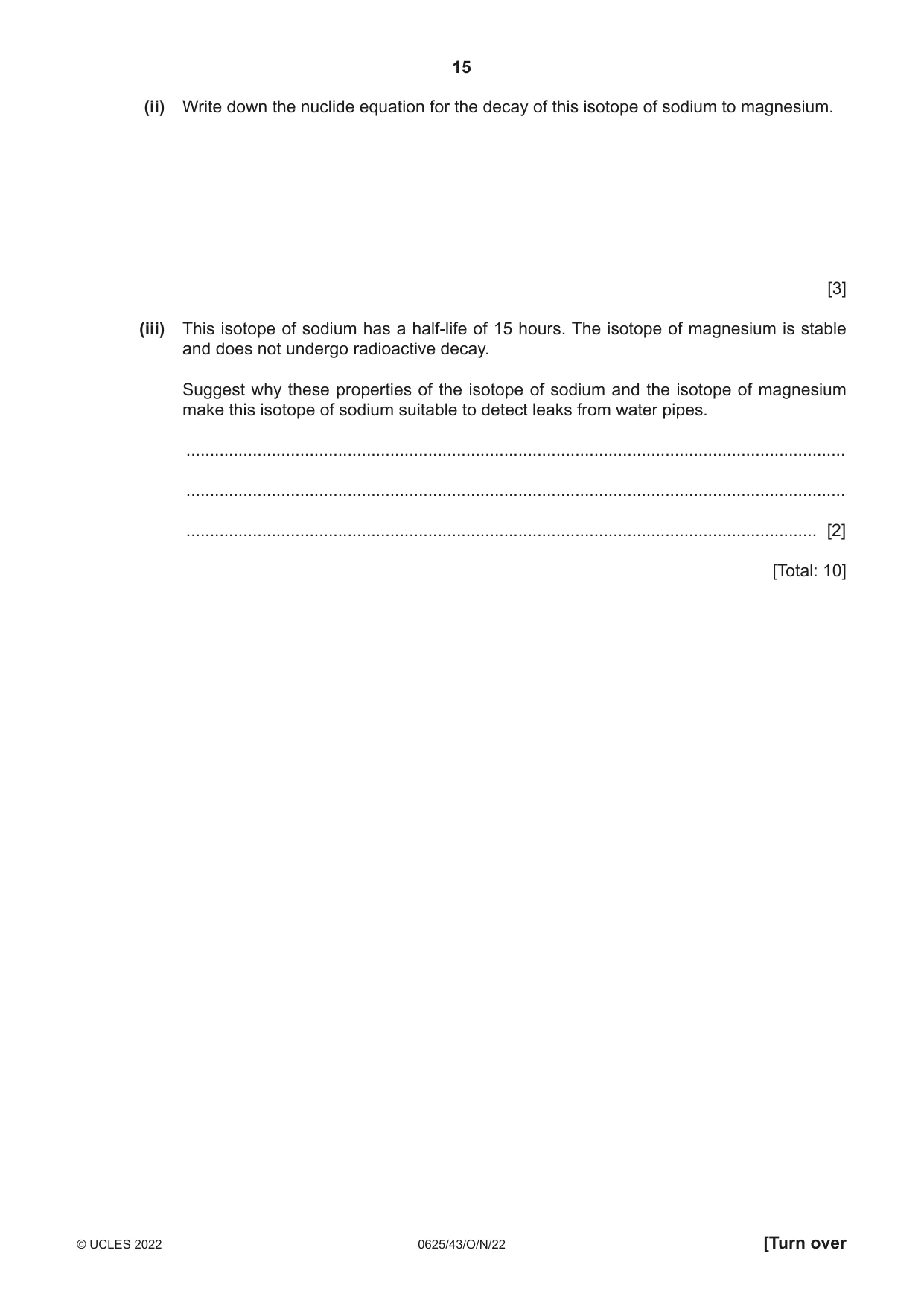
10 (a) A cloud chamber can be used to detect α (alpha)-particles and β (beta)-particles. Alcohol in the cloud chamber exists as a vapour and condenses on ions produced in the air. This forms visible tracks. Fig. 10.1 shows the tracks when a source of α-particles and β-particles is present in the cloud chamber. cloud chamber alcohol vapour in air source of α-particles and β-particles Fig. 10.1 Some of the tracks are short and thick. Other tracks are longer and thinner. State and explain which tracks are produced by α-particles and which tracks are produced by β-particles. α-particles ................................................................................................................................. ................................................................................................................................................... β-particles ................................................................................................................................. ............................................................................................................................................. [3] (b) A radioactive isotope of sodium (Na) is used to detect leaks from water pipes. A nucleus of this isotope of sodium contains 11 protons and 13 neutrons. This nucleus decays by emitting a β-particle to form a nucleus of magnesium (Mg). (i) Describe what is meant by an isotope. ........................................................................................................................................... ........................................................................................................................................... ..................................................................................................................................... [2] (ii) Write down the nuclide equation for the decay of this isotope of sodium to magnesium. [3] (iii) This isotope of sodium has a half-life of 15 hours. The isotope of magnesium is stable and does not undergo radioactive decay. Suggest why these properties of the isotope of sodium and the isotope of magnesium make this isotope of sodium suitable to detect leaks from water pipes. ........................................................................................................................................... ........................................................................................................................................... ..................................................................................................................................... [2] [Total: 10]
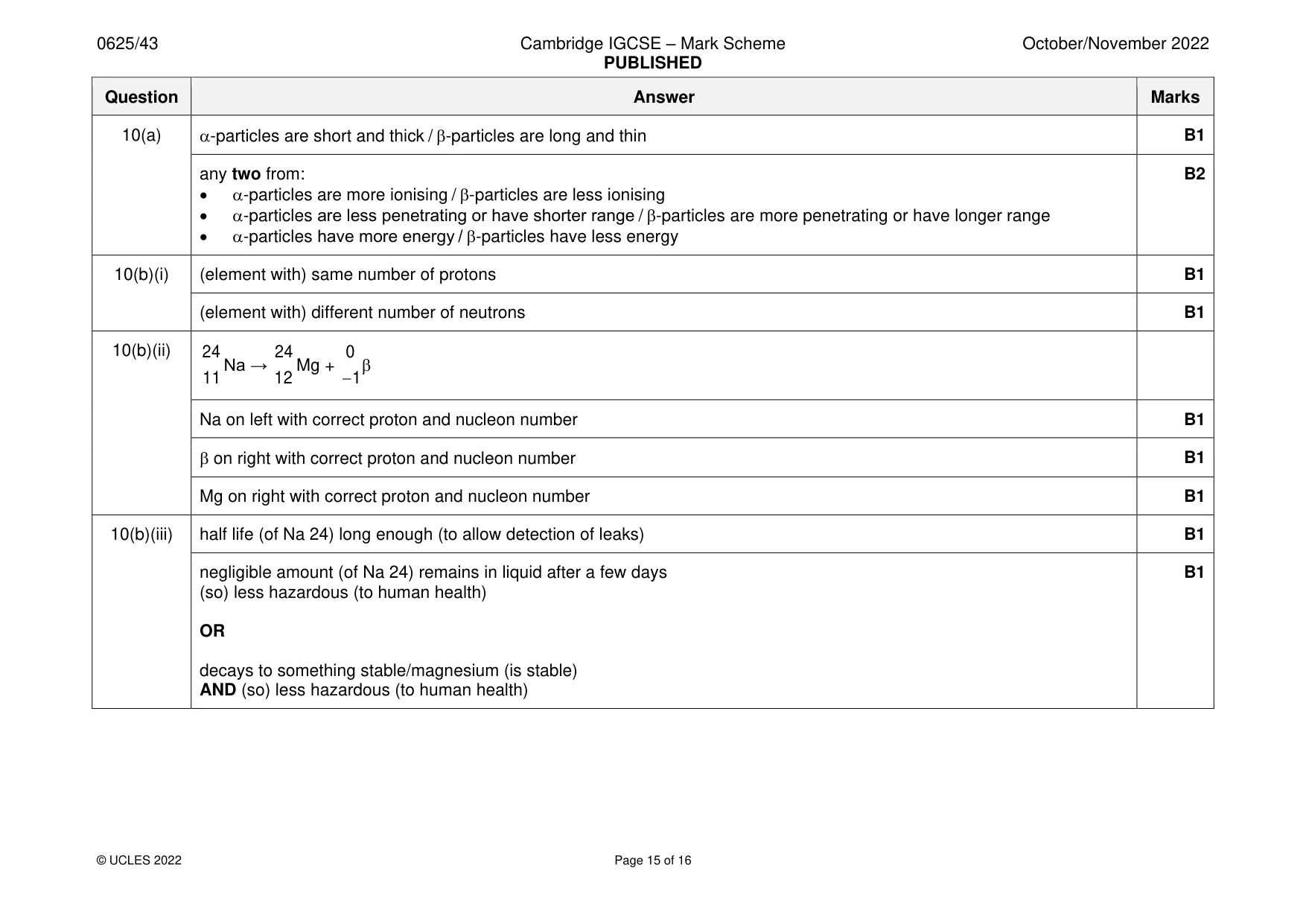
Mark scheme: 10(a) -particles are short and thick / -particles are long and thin B1 any two from: B2 • -particles are more ionising / -particles are less ionising • -particles are less penetrating or have shorter range / -particles are more penetrating or have longer range • -particles have more energy / -particles have less energy 10(b)(i) (element with) same number of protons B1 (element with) different number of neutrons B1 10(b)(ii) 24 24 0 Na → Mg + 11 12 −1 Na on left with correct proton and nucleon number B1 on right with correct proton and nucleon number B1 Mg on right with correct proton and nucleon number B1 10(b)(iii) half life (of Na 24) long enough (to allow detection of leaks) B1 negligible amount (of Na 24) remains in liquid after a few days B1 (so) less hazardous (to human health) OR decays to something stable/magnesium (is stable) AND (so) less hazardous (to human health)
Q11 · A solenoid connected to a battery
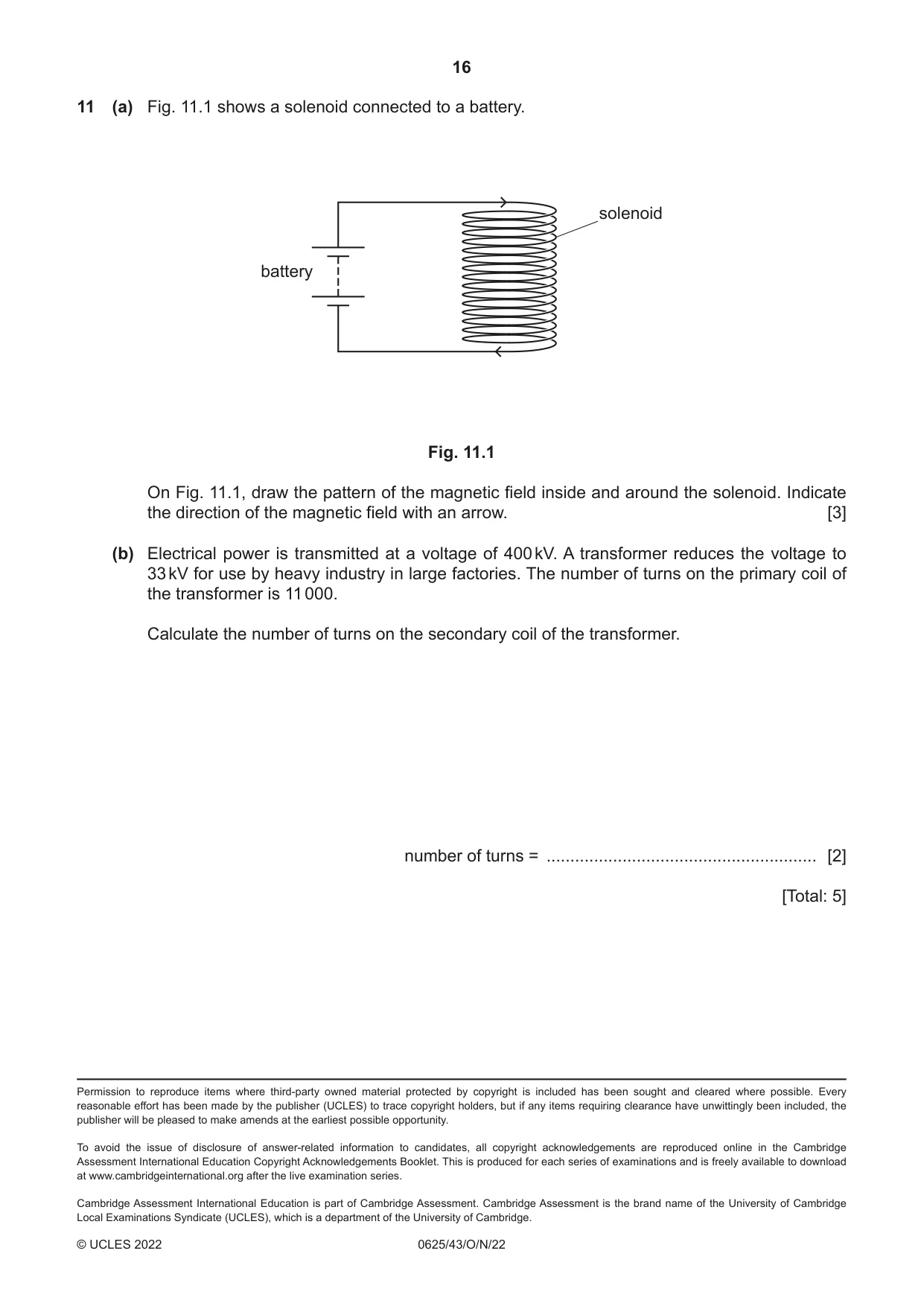
11 (a) Fig. 11.1 shows a solenoid connected to a battery. solenoid battery Fig. 11.1 On Fig. 11.1, draw the pattern of the magnetic field inside and around the solenoid. Indicate the direction of the magnetic field with an arrow. [3] (b) Electrical power is transmitted at a voltage of 400 kV. A transformer reduces the voltage to 33 kV for use by heavy industry in large factories. The number of turns on the primary coil of the transformer is 11 000. Calculate the number of turns on the secondary coil of the transformer. number of turns = ......................................................... [2] [Total: 5]
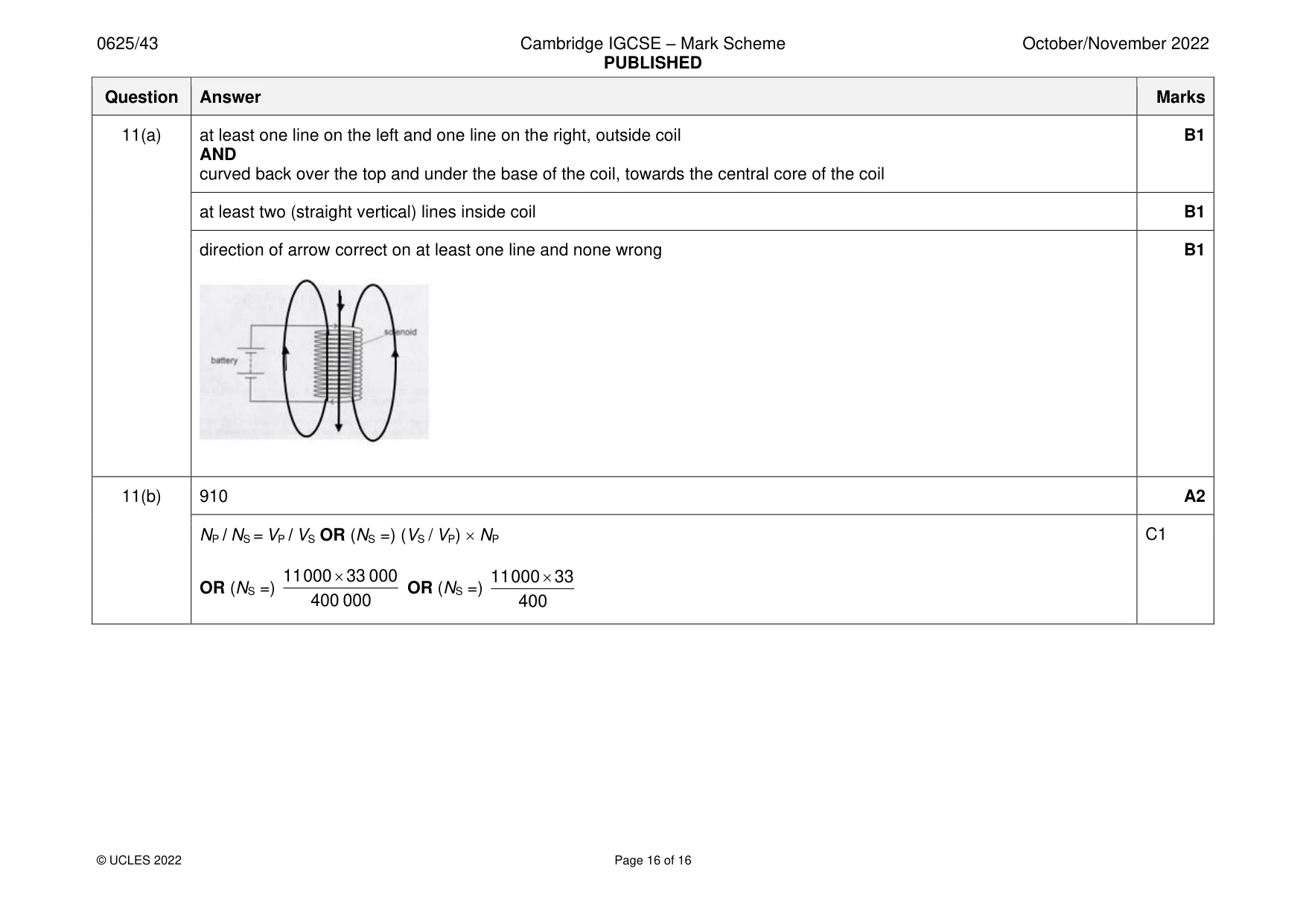
Mark scheme: 11(a) at least one line on the left and one line on the right, outside coil B1 AND curved back over the top and under the base of the coil, towards the central core of the coil at least two (straight vertical) lines inside coil B1 direction of arrow correct on at least one line and none wrong B1 11(b) 910 A2 NP / NS = VP / VS OR (NS =) (VS / VP) NP C1 11000 33 000 11000 33 OR (NS =) OR (NS =) 400 000 400
What was in this paper
The subtopics covered by these 11 questions, and how many questions each got. Open one in a new tab to see every Cambridge question on it.
What you needed in this session
Cambridge’s own grade thresholds for 2022 Oct/Nov, Paper 4 · Variant 3. A higher threshold means an easier paper — the bar moves with how the cohort did.