Cambridge IGCSE Physics 0625 — 2024 May/June Paper 4 · Variant 3
0625/43/M/J/24 · 11 questions · 80 marks · ≈90 min
The question paper and its mark scheme, free to read here and free to download. This is Cambridge’s own paper, exactly as it was sat.
Question paper16 pages
Mark scheme12 pages
Answers below. Sit the paper first if you are practising.
Questions as text
Q1 · A ball of mass 130 g is launched from the ground at an initial velocity of 14 m / s…
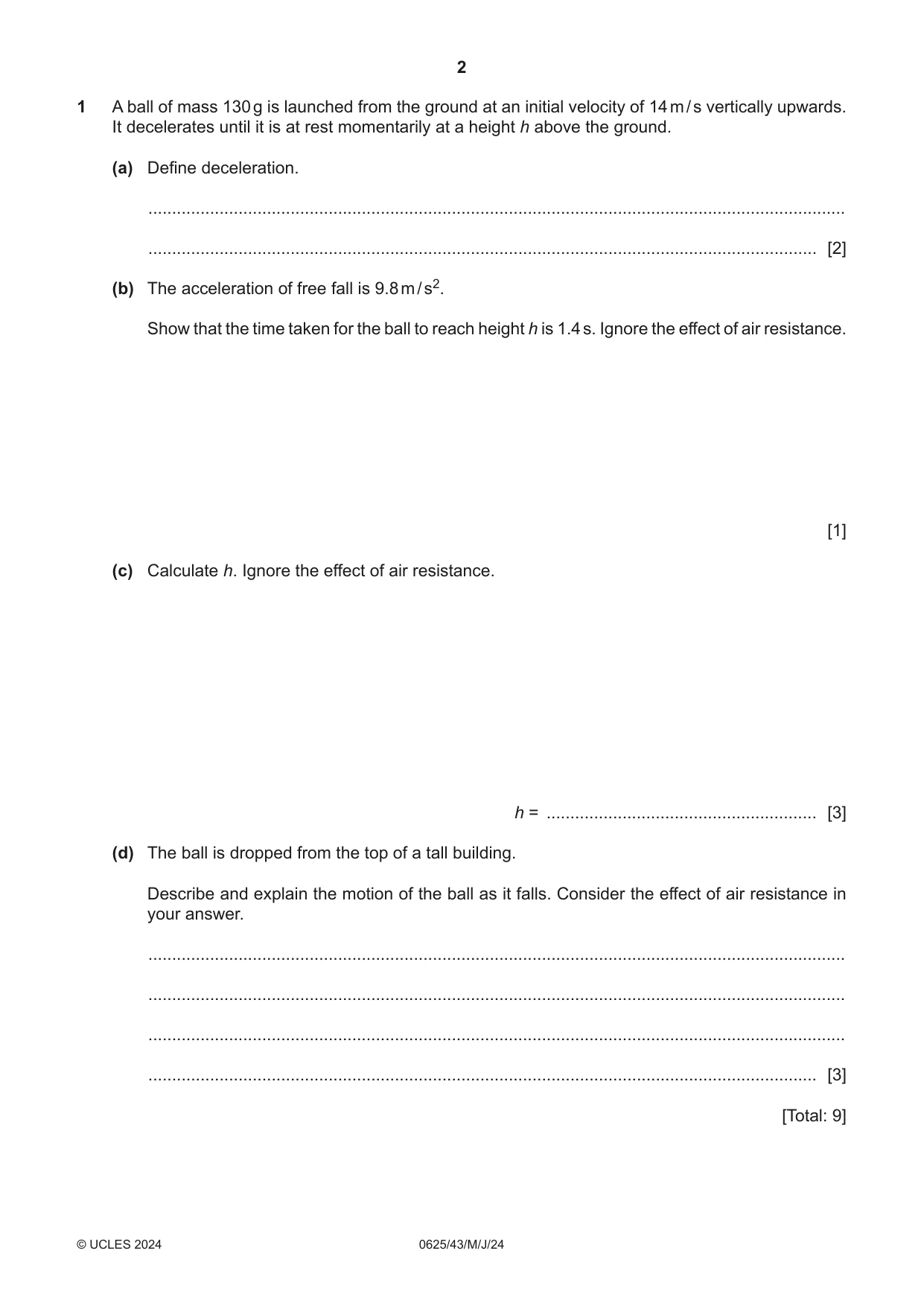
1 A ball of mass 130 g is launched from the ground at an initial velocity of 14 m / s vertically upwards. It decelerates until it is at rest momentarily at a height h above the ground. (a) Define deceleration. ................................................................................................................................................... ............................................................................................................................................. [2] (b) The acceleration of free fall is 9.8 m / s2. Show that the time taken for the ball to reach height h is 1.4 s. Ignore the effect of air resistance. [1] (c) Calculate h. Ignore the effect of air resistance. h = ......................................................... [3] (d) The ball is dropped from the top of a tall building. Describe and explain the motion of the ball as it falls. Consider the effect of air resistance in your answer. ................................................................................................................................................... ................................................................................................................................................... ................................................................................................................................................... ............................................................................................................................................. [3] [Total: 9]
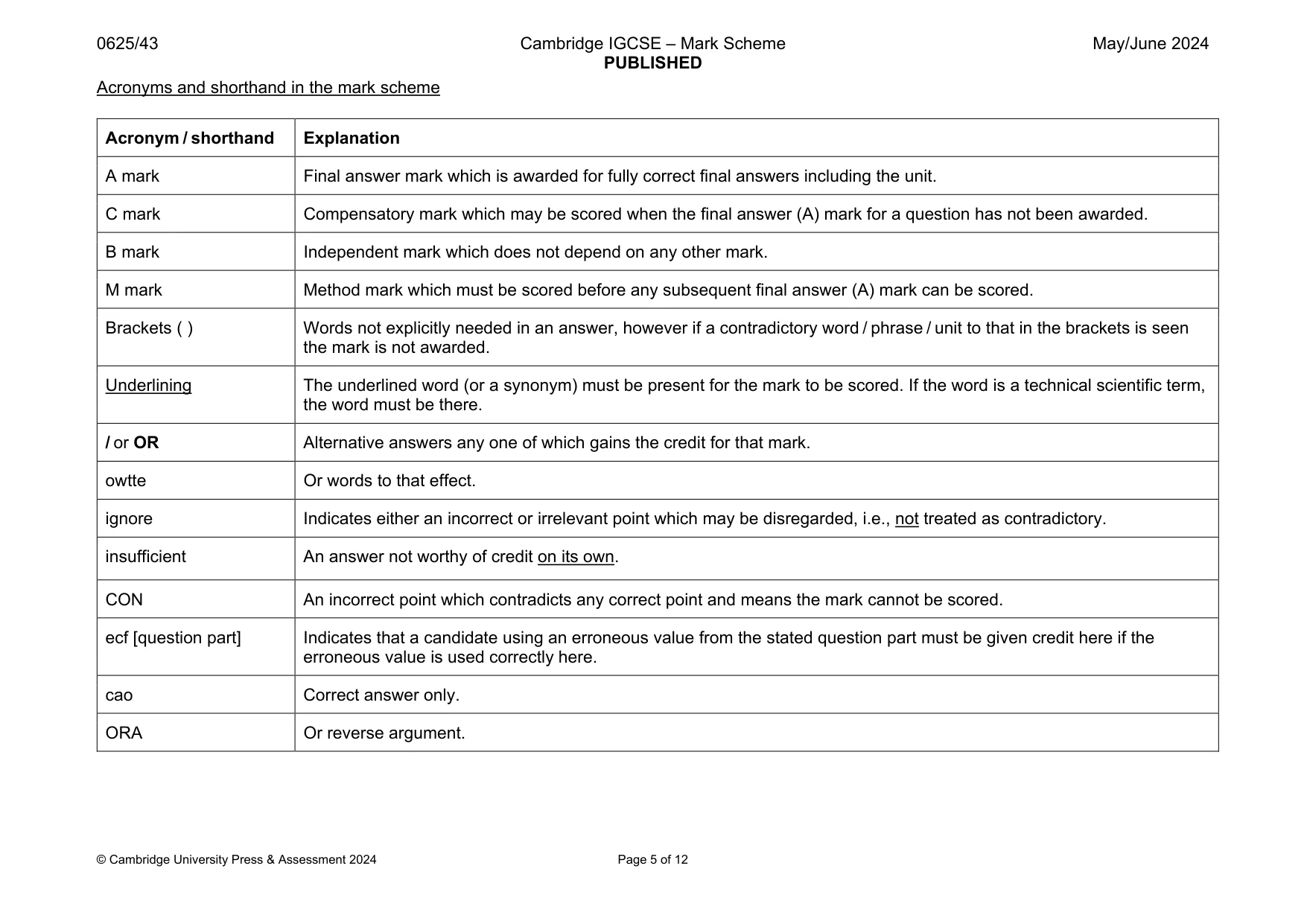
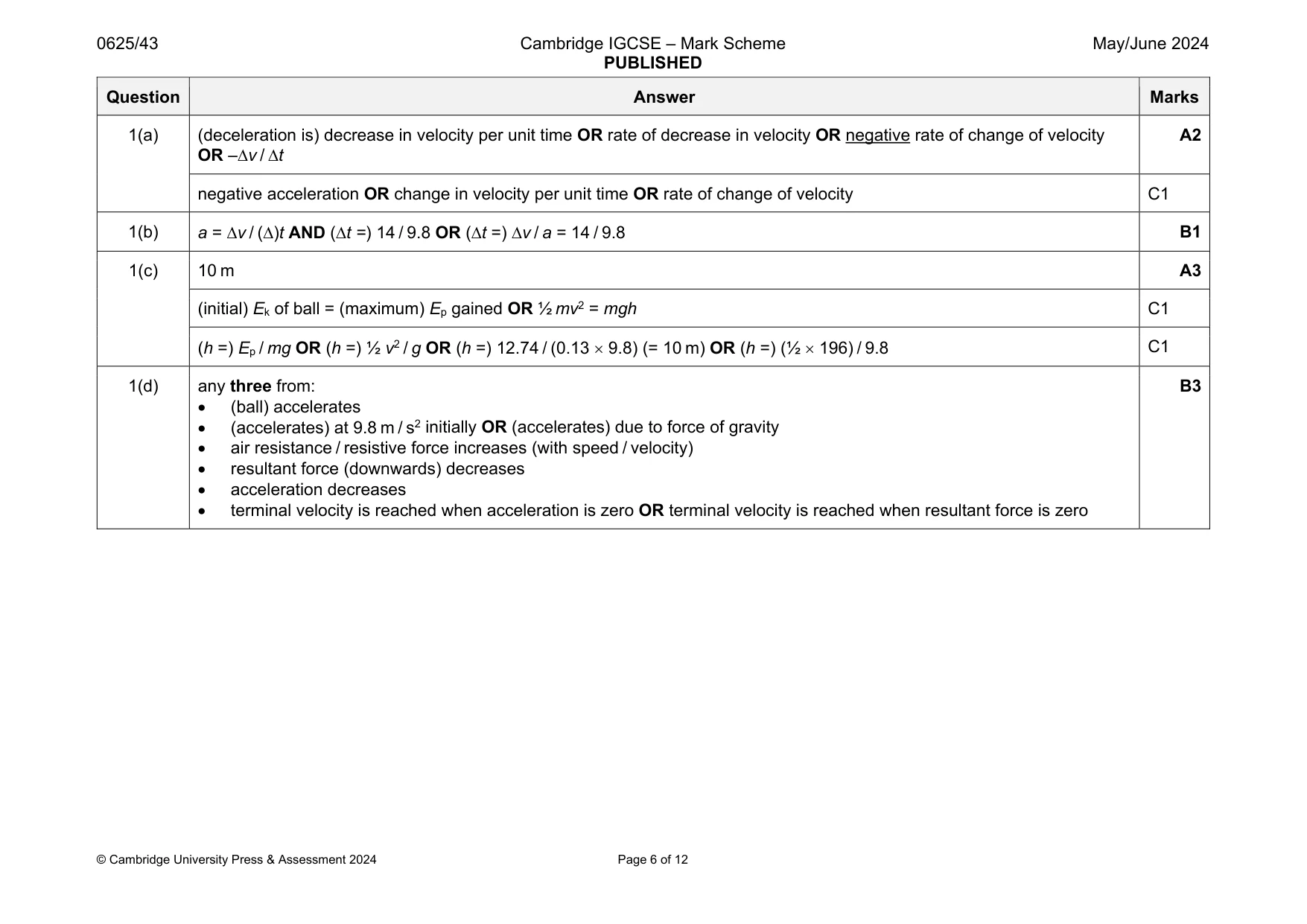
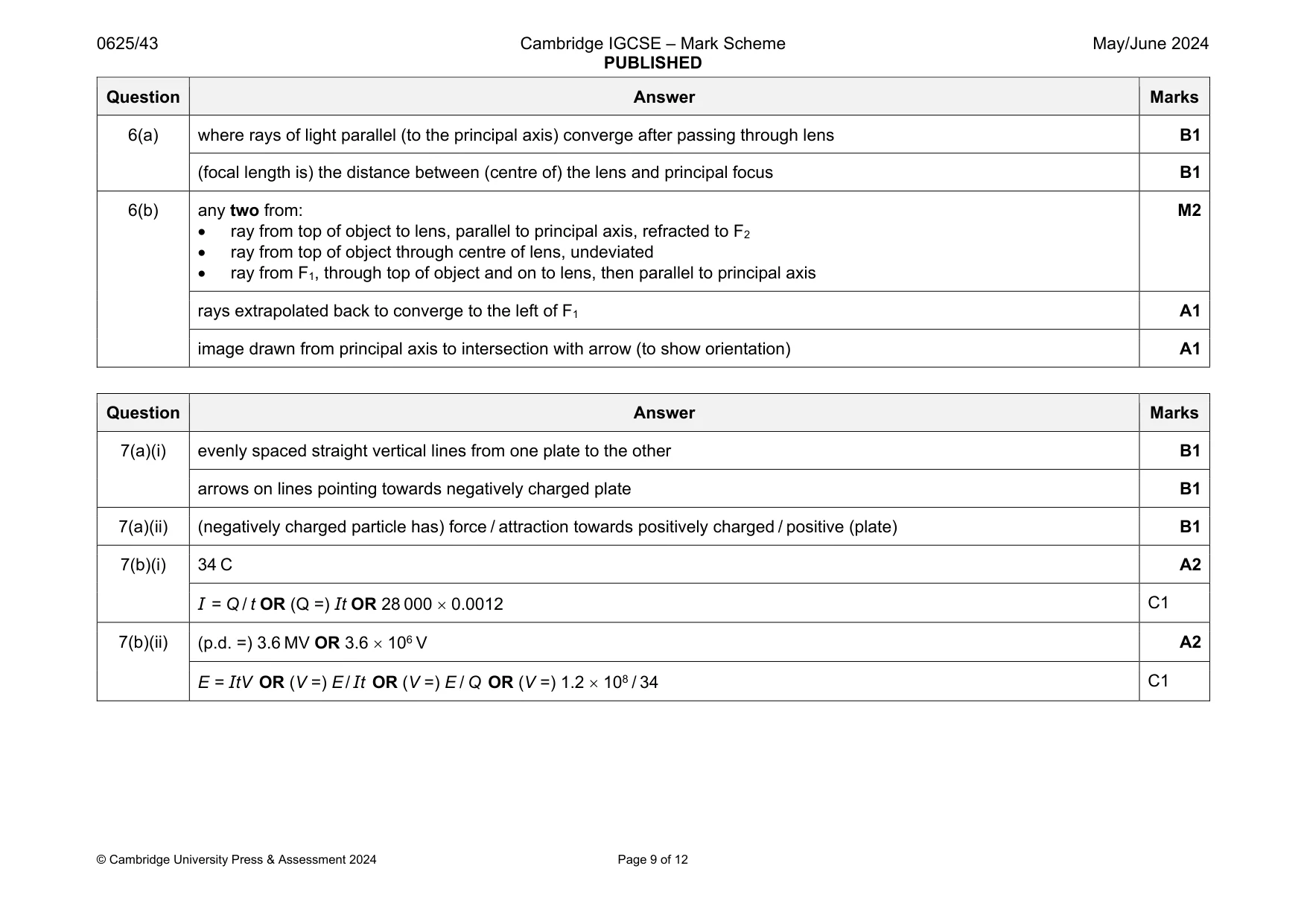
Mark scheme: 1(a) (deceleration is) decrease in velocity per unit time OR rate of decrease in velocity OR negative rate of change of velocity OR –v / t A2 negative acceleration OR change in velocity per unit time OR rate of change of velocity C1 1(b) a = v / ()t AND (t =) 14 / 9.8 OR (t =) ∆v / a = 14 / 9.8 B1 1(c) 10 m A3 (initial) Ek of ball = (maximum) Ep gained OR ½ mv2 = mgh C1 (h =) Ep / mg OR (h =) ½ v2 / g OR (h =) 12.74 / (0.13 9.8) (= 10 m) OR (h =) (½ 196) / 9.8 C1 1(d) any three from: (ball) accelerates (accelerates) at 9.8 m / s2 initially OR (accelerates) due to force of gravity air resistance / resistive force increases (with speed / velocity) resultant force (downwards) decreases acceleration decreases terminal velocity is reached when acceleration is zero OR terminal velocity is reached when resultant force is zero B3
Q2 · Solar-powered traffic warning lights
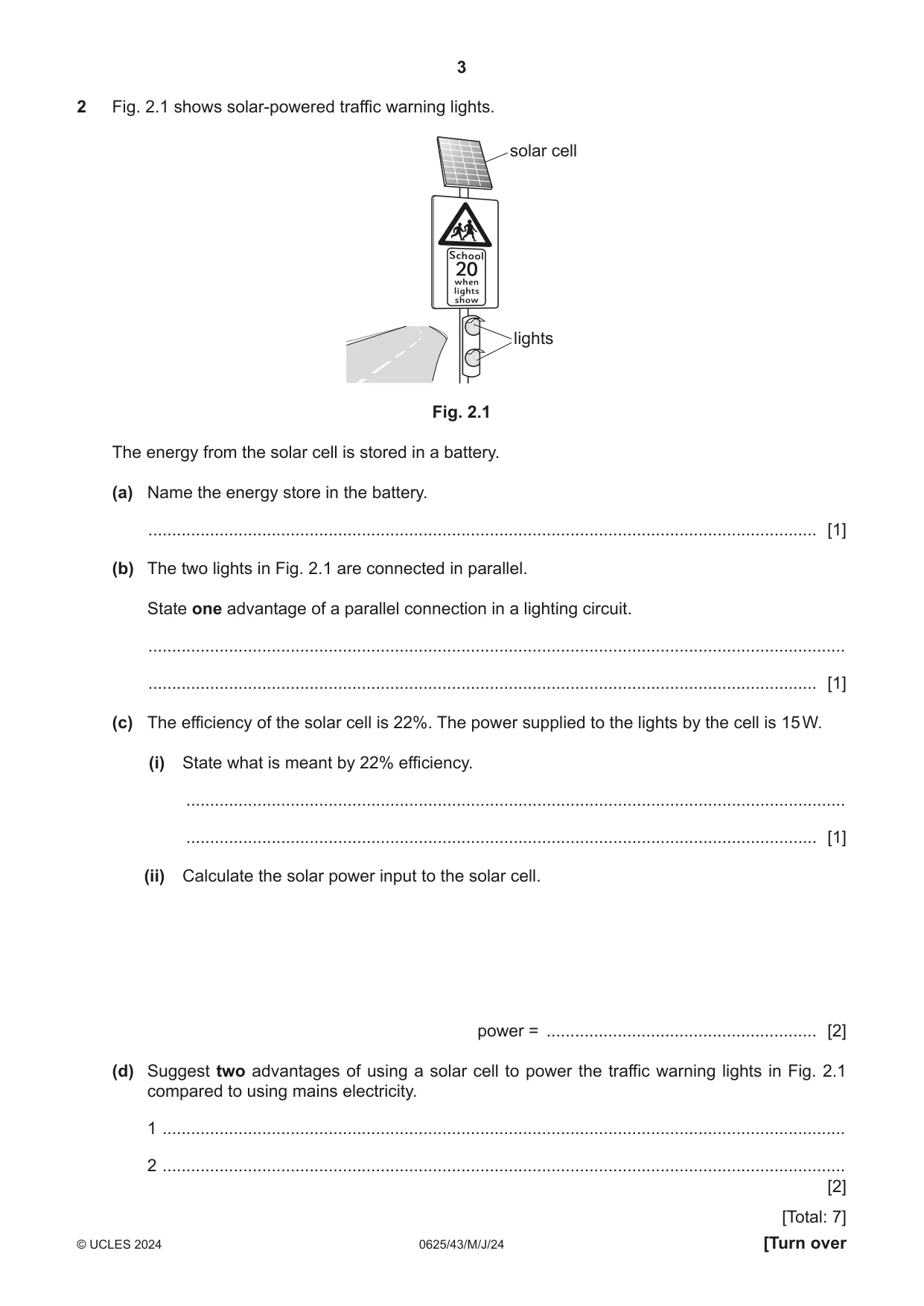
2 Fig. 2.1 shows solar-powered traffic warning lights. solar cell lights Fig. 2.1 The energy from the solar cell is stored in a battery. (a) Name the energy store in the battery. ............................................................................................................................................. [1] (b) The two lights in Fig. 2.1 are connected in parallel. State one advantage of a parallel connection in a lighting circuit. ................................................................................................................................................... ............................................................................................................................................. [1] (c) The efficiency of the solar cell is 22%. The power supplied to the lights by the cell is 15 W. (i) State what is meant by 22% efficiency. ........................................................................................................................................... ..................................................................................................................................... [1] (ii) Calculate the solar power input to the solar cell. power = ......................................................... [2] (d) Suggest two advantages of using a solar cell to power the traffic warning lights in Fig. 2.1 compared to using mains electricity. 1 ................................................................................................................................................ 2 ................................................................................................................................................ [2] [Total: 7]
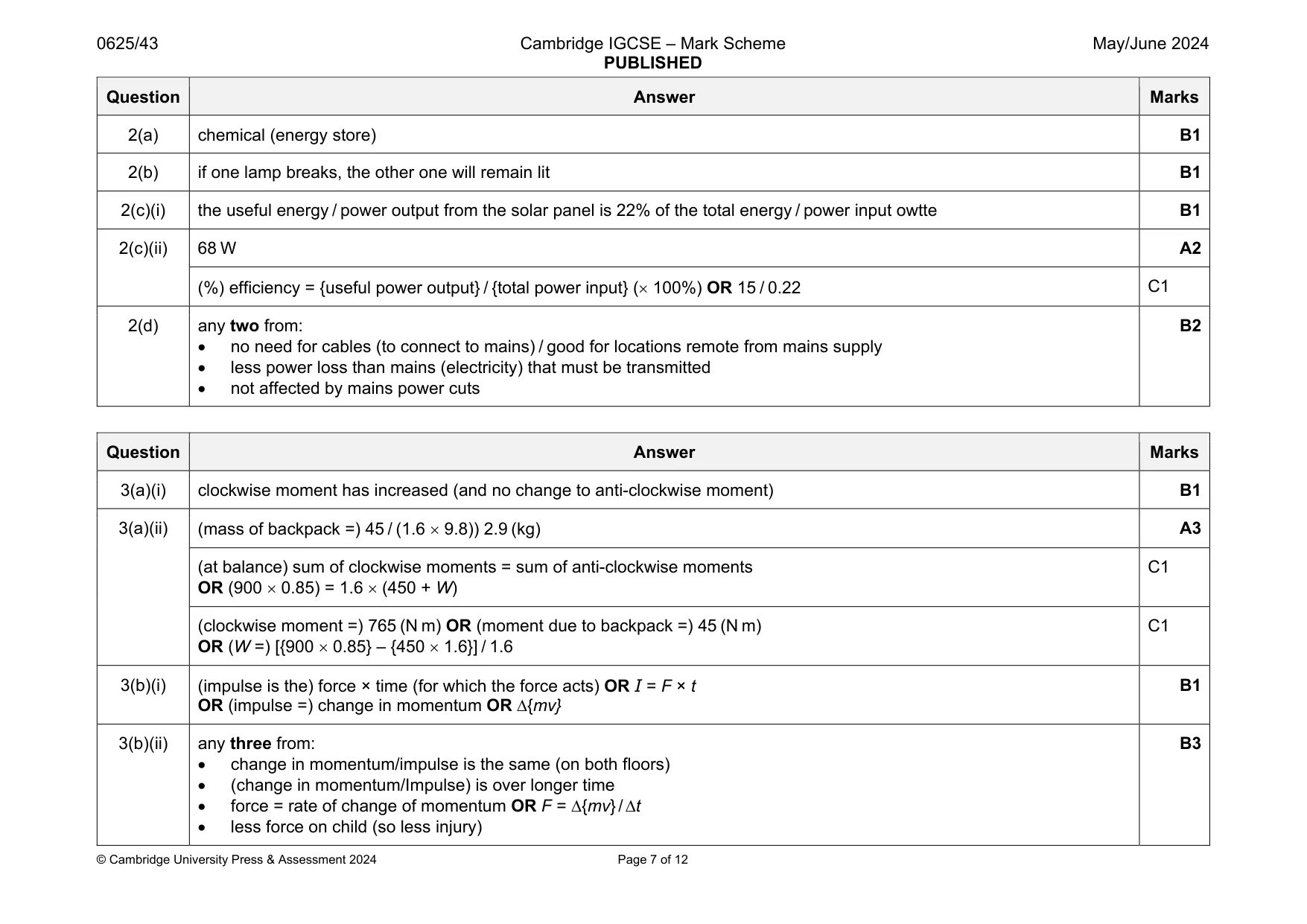
Mark scheme: 2(a) chemical (energy store) B1 2(b) if one lamp breaks, the other one will remain lit B1 2(c)(i) the useful energy / power output from the solar panel is 22% of the total energy / power input owtte B1 2(c)(ii) 68 W A2 (%) efficiency = {useful power output} / {total power input} ( 100%) OR 15 / 0.22 C1 2(d) any two from: no need for cables (to connect to mains) / good for locations remote from mains supply less power loss than mains (electricity) that must be transmitted not affected by mains power cuts B2
Q3 · Two children balanced on a seesaw
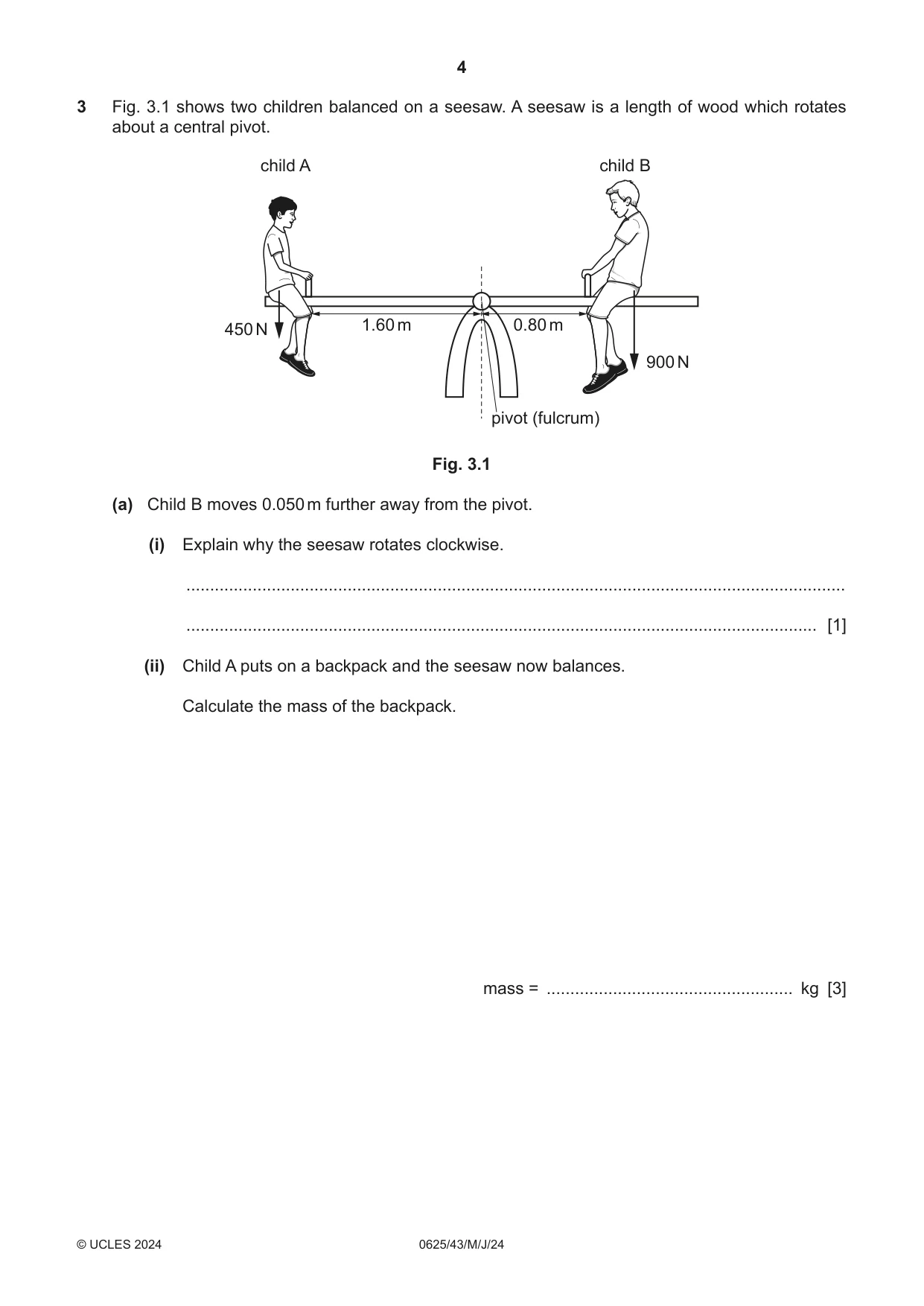
3 Fig. 3.1 shows two children balanced on a seesaw. A seesaw is a length of wood which rotates about a central pivot. child A child B 1.60 m 0.80 m 450 N 900 N pivot (fulcrum) Fig. 3.1 (a) Child B moves 0.050 m further away from the pivot. (i) Explain why the seesaw rotates clockwise. ........................................................................................................................................... ..................................................................................................................................... [1] (ii) Child A puts on a backpack and the seesaw now balances. Calculate the mass of the backpack. mass = .................................................... kg [3] (b) The concrete floor under the seesaw is replaced with a rubber floor. A child falls from the seesaw and experiences an impulse when they hit the floor. (i) Define impulse. ........................................................................................................................................... ..................................................................................................................................... [1] (ii) Explain how the rubber floor reduces injury to the child. Use ideas about impulse, force, momentum and time in your answer. ........................................................................................................................................... ........................................................................................................................................... ........................................................................................................................................... ..................................................................................................................................... [3] [Total: 8]
Mark scheme: 3(a)(i) clockwise moment has increased (and no change to anti-clockwise moment) B1 3(a)(ii) (mass of backpack =) 45 / (1.6 9.8)) 2.9 (kg) A3 (at balance) sum of clockwise moments = sum of anti-clockwise moments OR (900 0.85) = 1.6 (450 + W) C1 (clockwise moment =) 765 (N m) OR (moment due to backpack =) 45 (N m) OR (W =) [{900 0.85} – {450 1.6}] / 1.6 C1 3(b)(i) (impulse is the) force × time (for which the force acts) OR I = F × t OR (impulse =) change in momentum OR ∆{mv} B1 3(b)(ii) any three from: change in momentum/impulse is the same (on both floors) (change in momentum/Impulse) is over longer time force = rate of change of momentum OR F = {mv} / t less force on child (so less injury) B3
Q4 · A stainless-steel saucepan being heated on an electric cooker
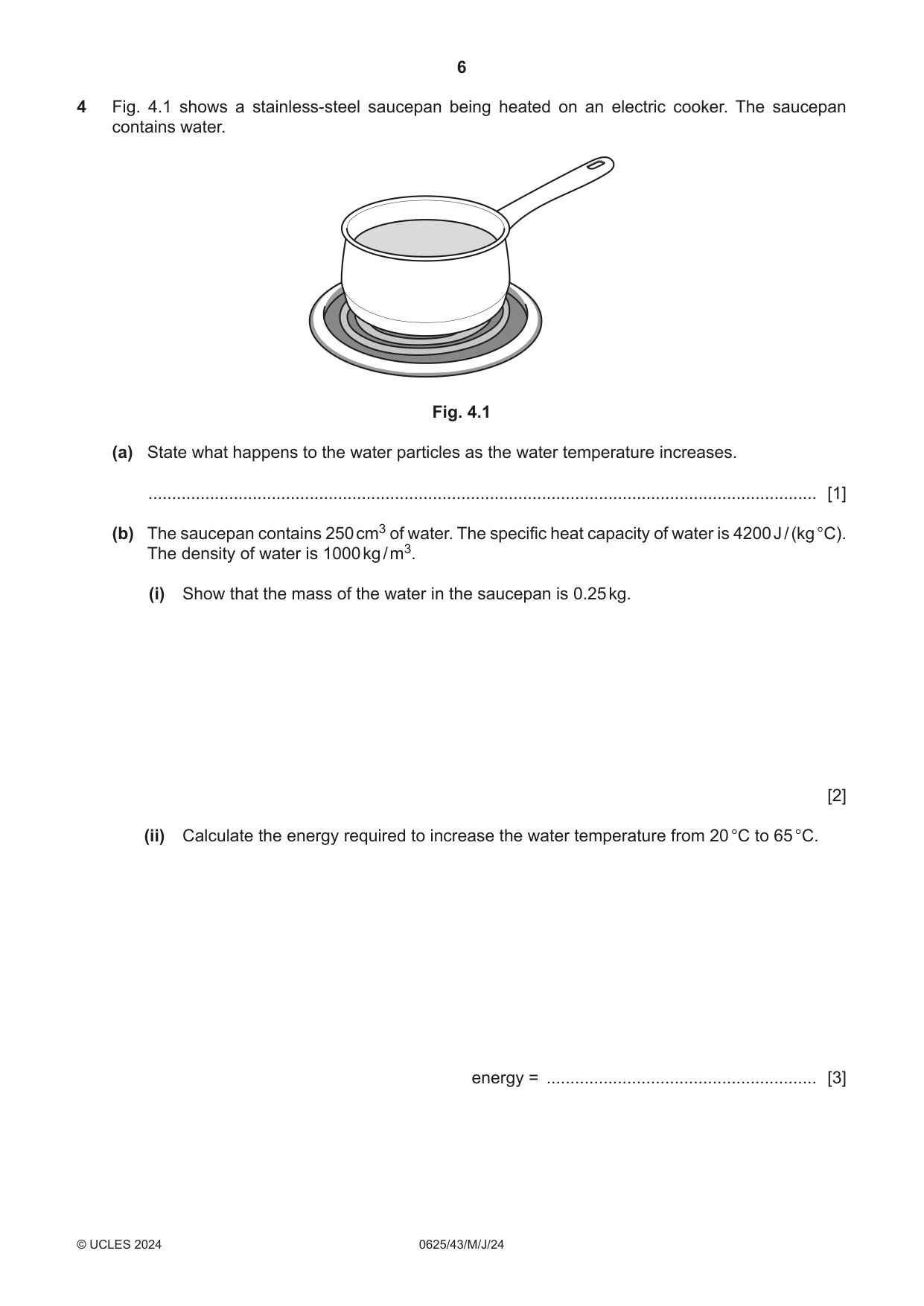
4 Fig. 4.1 shows a stainless-steel saucepan being heated on an electric cooker. The saucepan contains water. Fig. 4.1 (a) State what happens to the water particles as the water temperature increases. ............................................................................................................................................. [1] (b) The saucepan contains 250 cm3 of water. The specific heat capacity of water is 4200 J / (kg °C). The density of water is 1000 kg / m3. (i) Show that the mass of the water in the saucepan is 0.25 kg. [2] (ii) Calculate the energy required to increase the water temperature from 20 °C to 65 °C. energy = ......................................................... [3] (iii) The heater supplies enough power to heat the water in 39 s. A student measures the time taken to heat the water as 115 s. Suggest why the actual time taken to heat the water is longer. Assume that the student takes accurate measurements. ........................................................................................................................................... ..................................................................................................................................... [1] (c) The stainless-steel saucepan is replaced with an aluminium saucepan of the same mass. It contains the same volume of water. The specific heat capacity of stainless steel is 500 J / (kg °C). The specific heat capacity of aluminium is 890 J / (kg °C). Explain how using an aluminium saucepan will affect the time taken to heat the water. ................................................................................................................................................... ................................................................................................................................................... ............................................................................................................................................. [2] [Total: 9]
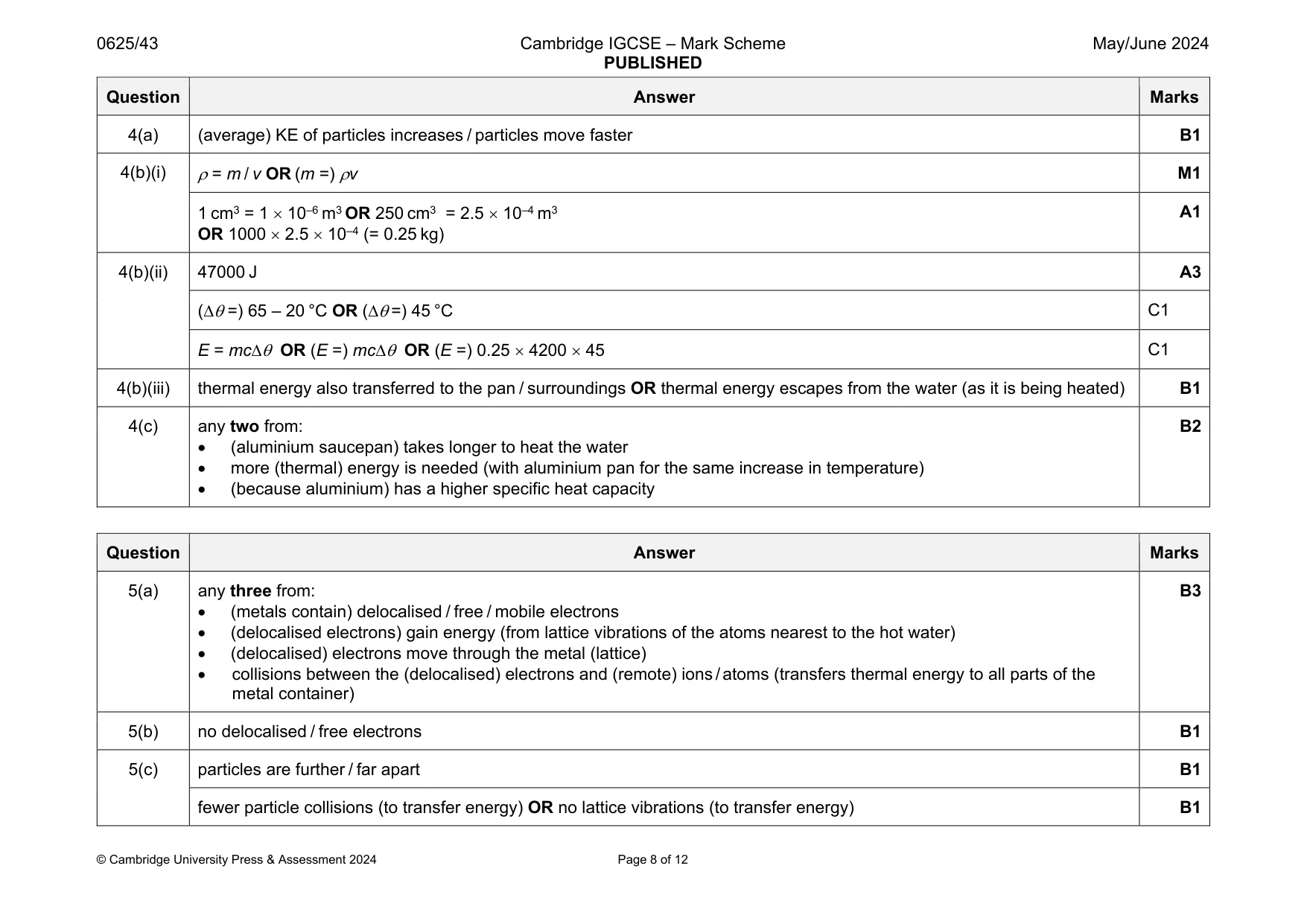
Mark scheme: 4(a) (average) KE of particles increases / particles move faster B1 4(b)(i) = m / v OR (m =) v M1 1 cm3 = 1 10–6 m3 OR 250 cm3 = 2.5 10–4 m3 OR 1000 2.5 10–4 (= 0.25 kg) A1 4(b)(ii) 47000 J A3 ( =) 65 – 20 °C OR ( =) 45 °C C1 E = mc OR (E =) mc OR (E =) 0.25 4200 45 C1 4(b)(iii) thermal energy also transferred to the pan / surroundings OR thermal energy escapes from the water (as it is being heated) B1 4(c) any two from: (aluminium saucepan) takes longer to heat the water more (thermal) energy is needed (with aluminium pan for the same increase in temperature) (because aluminium) has a higher specific heat capacity B2
Q5 · Two containers, each filled with hot water
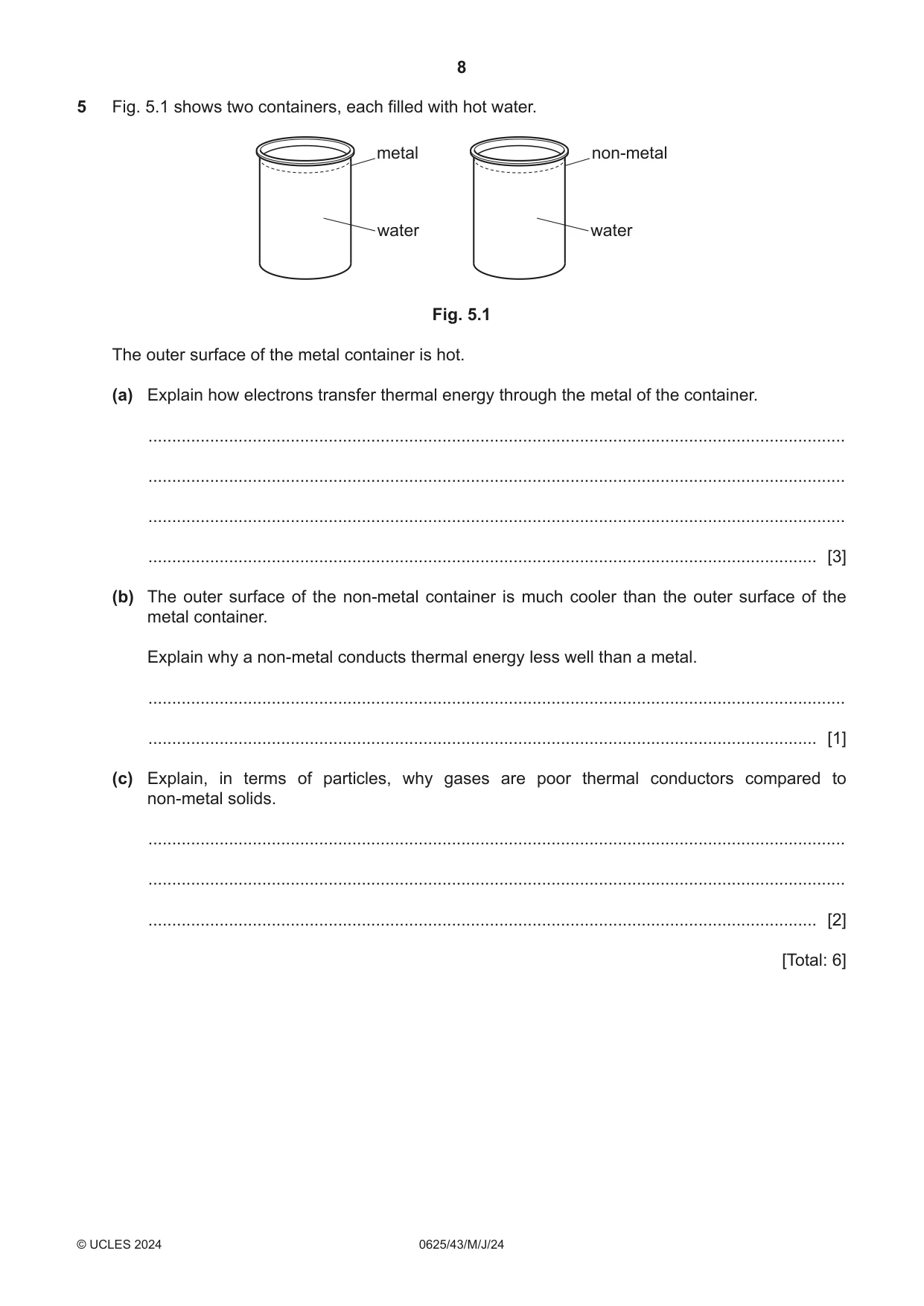
5 Fig. 5.1 shows two containers, each filled with hot water. metal non-metal water water Fig. 5.1 The outer surface of the metal container is hot. (a) Explain how electrons transfer thermal energy through the metal of the container. ................................................................................................................................................... ................................................................................................................................................... ................................................................................................................................................... ............................................................................................................................................. [3] (b) The outer surface of the non-metal container is much cooler than the outer surface of the metal container. Explain why a non-metal conducts thermal energy less well than a metal. ................................................................................................................................................... ............................................................................................................................................. [1] (c) Explain, in terms of particles, why gases are poor thermal conductors compared to non-metal solids. ................................................................................................................................................... ................................................................................................................................................... ............................................................................................................................................. [2] [Total: 6]
Mark scheme: 5(a) any three from: (metals contain) delocalised / free / mobile electrons (delocalised electrons) gain energy (from lattice vibrations of the atoms nearest to the hot water) (delocalised) electrons move through the metal (lattice) collisions between the (delocalised) electrons and (remote) ions / atoms (transfers thermal energy to all parts of the metal container) 5(b) no delocalised / free electrons B1 5(c) particles are further / far apart B1 fewer particle collisions (to transfer energy) OR no lattice vibrations (to transfer energy) B1
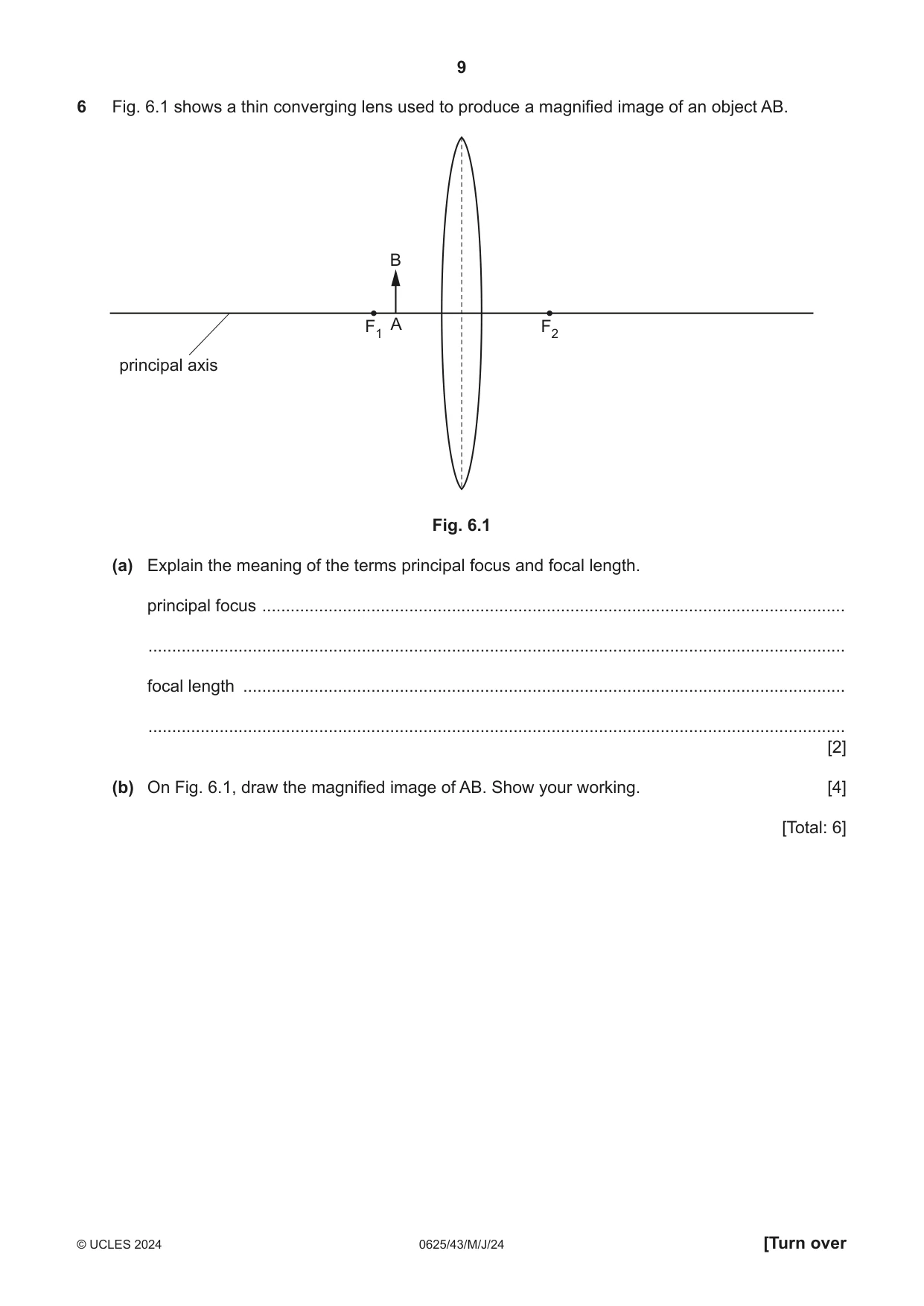
Q6 · A thin converging lens used to produce a magnified image of an object AB
6 Fig. 6.1 shows a thin converging lens used to produce a magnified image of an object AB. B F1 A F2 principal axis Fig. 6.1 (a) Explain the meaning of the terms principal focus and focal length. principal focus ........................................................................................................................... ................................................................................................................................................... focal length ............................................................................................................................... ................................................................................................................................................... [2] (b) On Fig. 6.1, draw the magnified image of AB. Show your working. [4] [Total: 6]
Mark scheme: 6(a) where rays of light parallel (to the principal axis) converge after passing through lens B1 (focal length is) the distance between (centre of) the lens and principal focus B1 6(b) any two from: ray from top of object to lens, parallel to principal axis, refracted to F2 ray from top of object through centre of lens, undeviated ray from F1, through top of object and on to lens, then parallel to principal axis M2 rays extrapolated back to converge to the left of F1 A1 image drawn from principal axis to intersection with arrow (to show orientation) A1
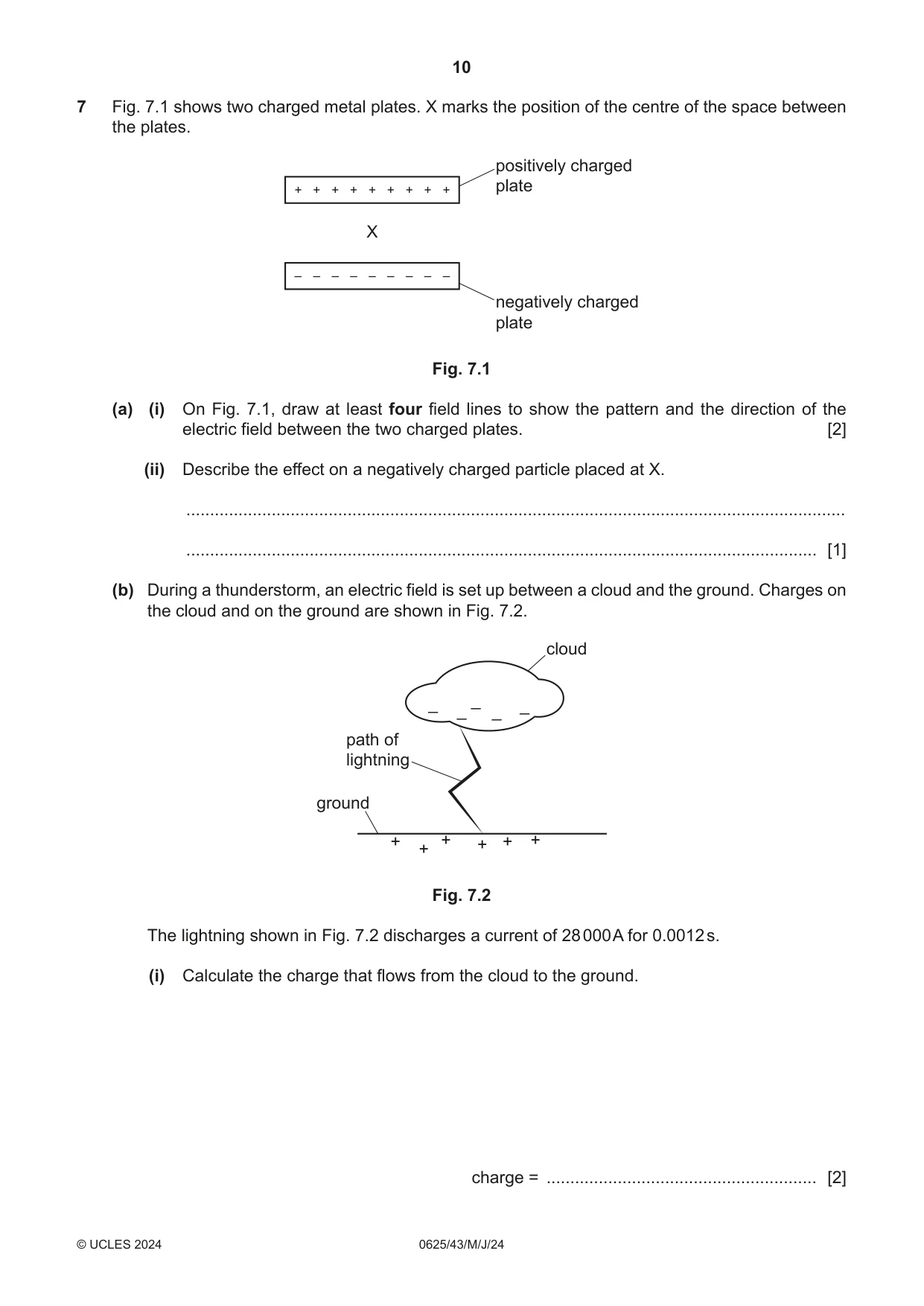
Q7 · Two charged metal plates
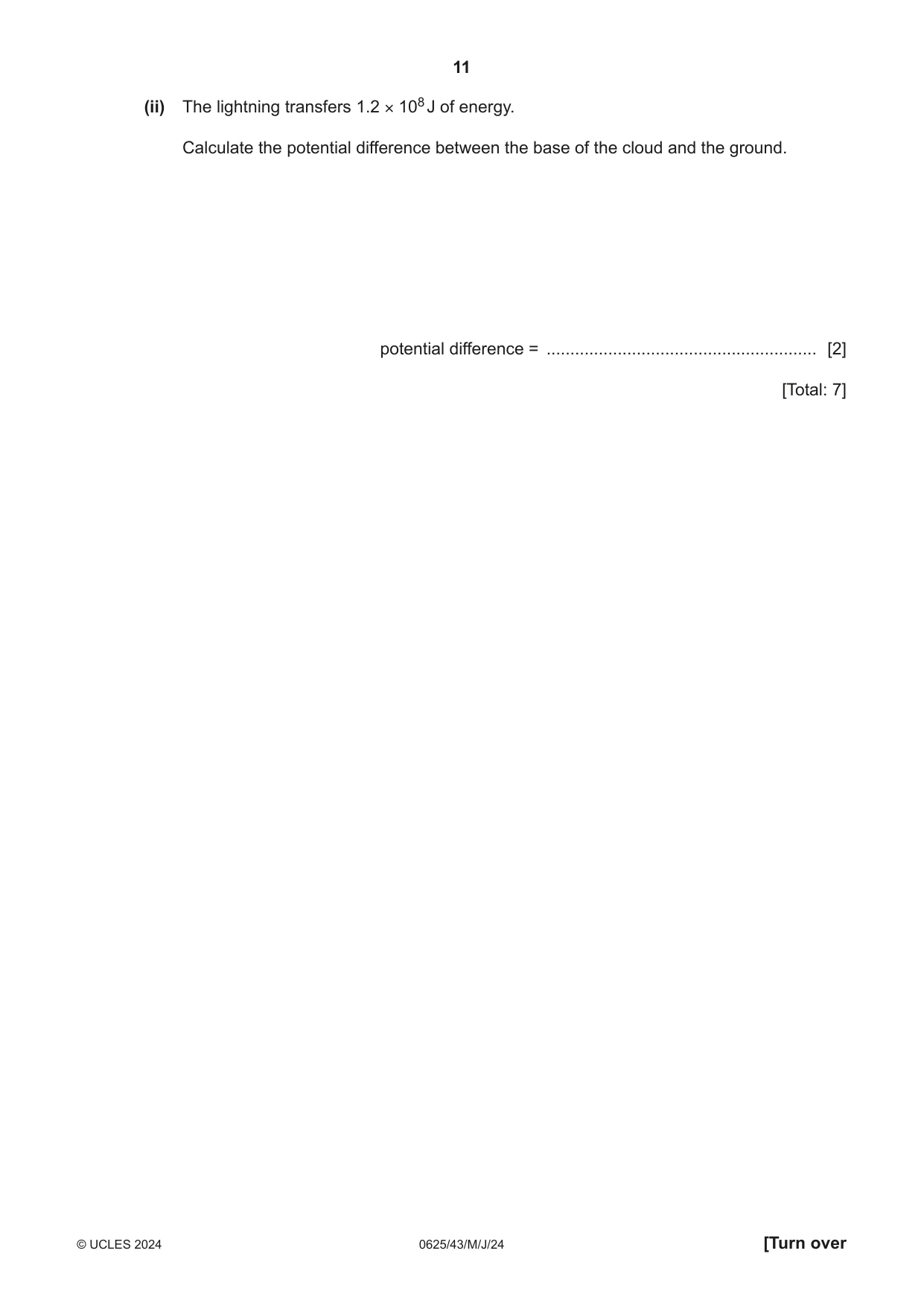
7 Fig. 7.1 shows two charged metal plates. X marks the position of the centre of the space between the plates. positively charged + + + + + + + + + plate X – – – – – – – – – negatively charged plate Fig. 7.1 (a) (i) On Fig. 7.1, draw at least four field lines to show the pattern and the direction of the electric field between the two charged plates. [2] (ii) Describe the effect on a negatively charged particle placed at X. ........................................................................................................................................... ..................................................................................................................................... [1] (b) During a thunderstorm, an electric field is set up between a cloud and the ground. Charges on the cloud and on the ground are shown in Fig. 7.2. cloud _ _ _ _ _ path of lightning ground + + + + + + Fig. 7.2 The lightning shown in Fig. 7.2 discharges a current of 28 000 A for 0.0012 s. (i) Calculate the charge that flows from the cloud to the ground. charge = ......................................................... [2] (ii) The lightning transfers 1.2 × 10⁸ J of energy. Calculate the potential difference between the base of the cloud and the ground. potential difference = ......................................................... [2] [Total: 7]
Mark scheme: 7(a)(i) evenly spaced straight vertical lines from one plate to the other B1 arrows on lines pointing towards negatively charged plate B1 7(a)(ii) (negatively charged particle has) force / attraction towards positively charged / positive (plate) B1 7(b)(i) 34 C A2 I = Q / t OR (Q =) It OR 28 000 0.0012 C1 7(b)(ii) (p.d. =) 3.6 MV OR 3.6 106 V A2 E = ItV OR (V =) E / It OR (V =) E / Q OR (V =) 1.2 108 / 34 C1
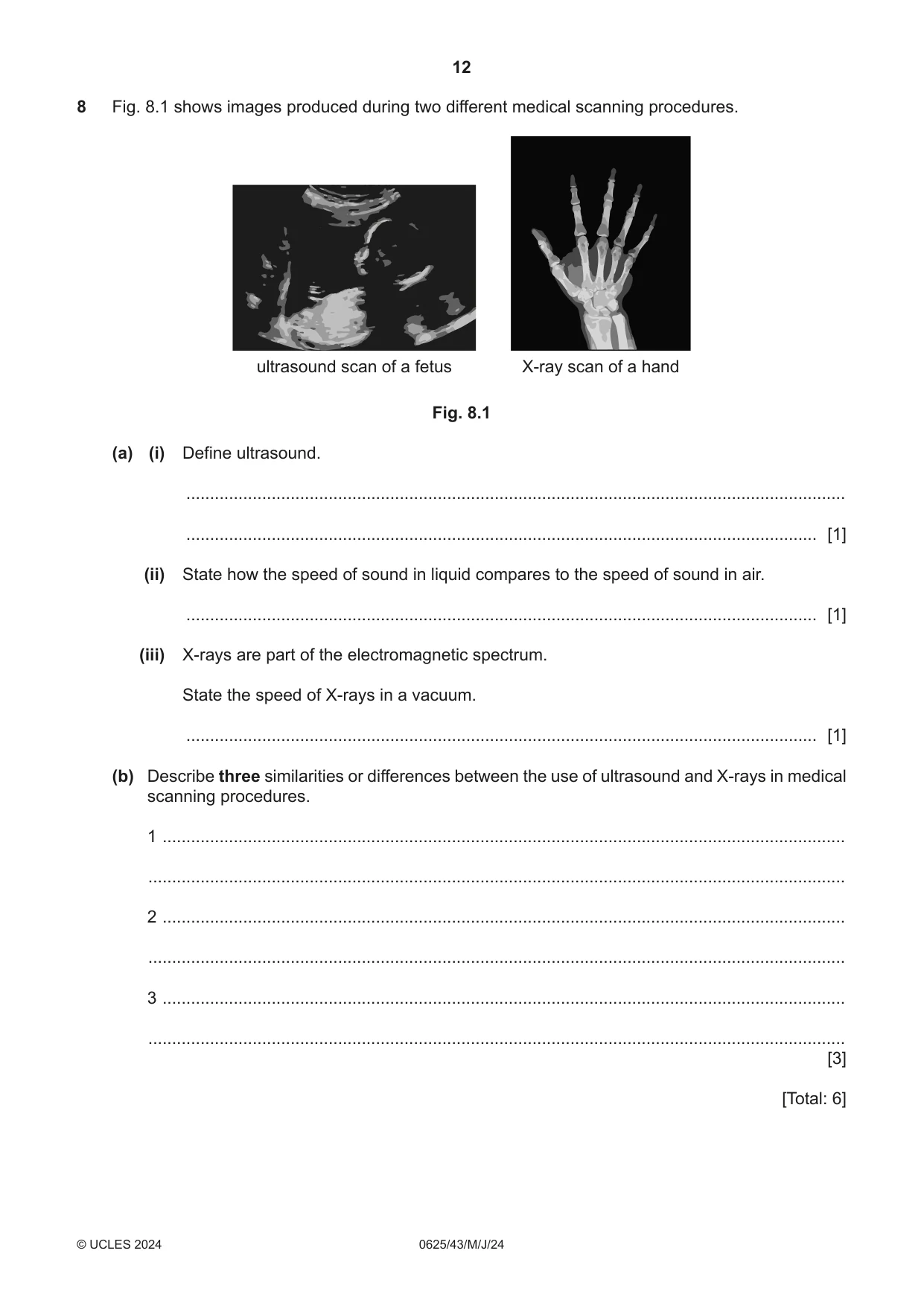
Q8 · Images produced during two different medical scanning procedures
8 Fig. 8.1 shows images produced during two different medical scanning procedures. ultrasound scan of a fetus X-ray scan of a hand Fig. 8.1 (a) (i) Define ultrasound. ........................................................................................................................................... ..................................................................................................................................... [1] (ii) State how the speed of sound in liquid compares to the speed of sound in air. ..................................................................................................................................... [1] (iii) X-rays are part of the electromagnetic spectrum. State the speed of X-rays in a vacuum. ..................................................................................................................................... [1] (b) Describe three similarities or differences between the use of ultrasound and X-rays in medical scanning procedures. 1 ................................................................................................................................................ ................................................................................................................................................... 2 ................................................................................................................................................ ................................................................................................................................................... 3 ................................................................................................................................................ ................................................................................................................................................... [3] [Total: 6]
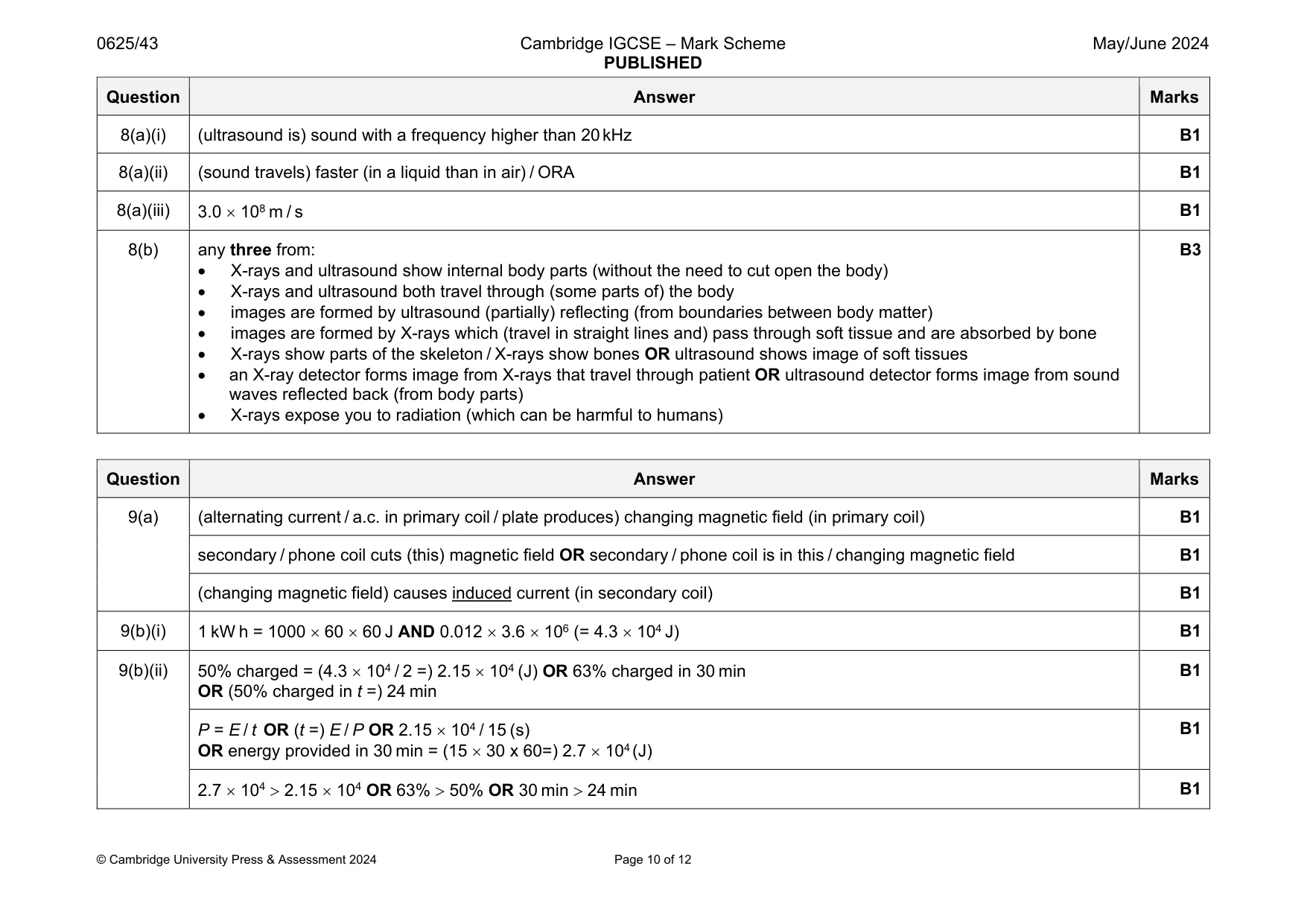
Mark scheme: 8(a)(i) (ultrasound is) sound with a frequency higher than 20 kHz B1 8(a)(ii) (sound travels) faster (in a liquid than in air) / ORA B1 8(a)(iii) 3.0 108 m / s B1 8(b) any three from: X-rays and ultrasound show internal body parts (without the need to cut open the body) X-rays and ultrasound both travel through (some parts of) the body images are formed by ultrasound (partially) reflecting (from boundaries between body matter) images are formed by X-rays which (travel in straight lines and) pass through soft tissue and are absorbed by bone X-rays show parts of the skeleton / X-rays show bones OR ultrasound shows image of soft tissues an X-ray detector forms image from X-rays that travel through patient OR ultrasound detector forms image from sound waves reflected back (from body parts) X-rays expose you to radiation (which can be harmful to humans) B3
Q9 · A mobile phone (cell phone) being charged on a wireless charging plate
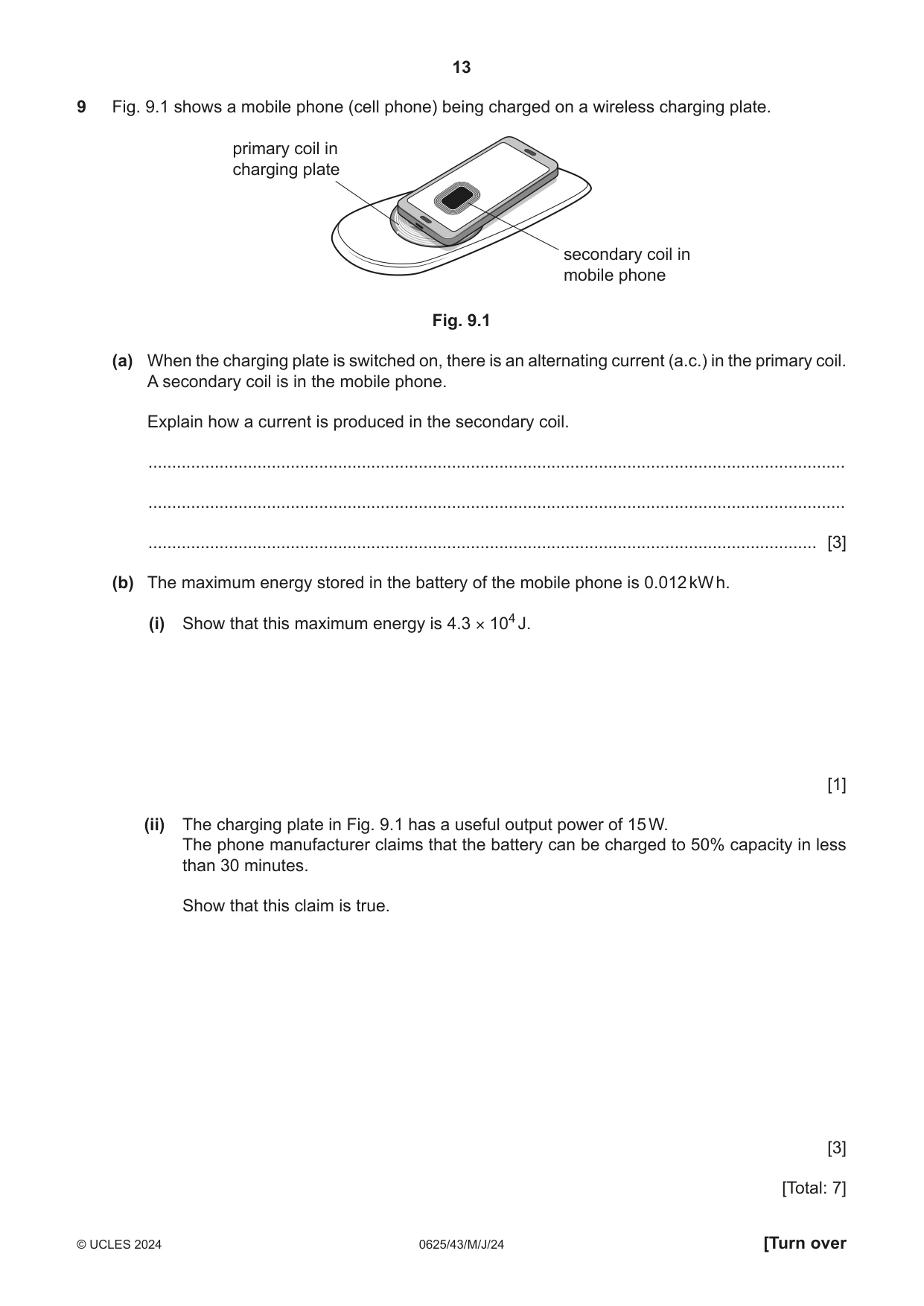
9 Fig. 9.1 shows a mobile phone (cell phone) being charged on a wireless charging plate. primary coil in charging plate secondary coil in mobile phone Fig. 9.1 (a) When the charging plate is switched on, there is an alternating current (a.c.) in the primary coil. A secondary coil is in the mobile phone. Explain how a current is produced in the secondary coil. ................................................................................................................................................... ................................................................................................................................................... ............................................................................................................................................. [3] (b) The maximum energy stored in the battery of the mobile phone is 0.012 kW h. (i) Show that this maximum energy is 4.3 × 10⁴ J. [1] (ii) The charging plate in Fig. 9.1 has a useful output power of 15 W. The phone manufacturer claims that the battery can be charged to 50% capacity in less than 30 minutes. Show that this claim is true. [3] [Total: 7]
Mark scheme: 9(a) (alternating current / a.c. in primary coil / plate produces) changing magnetic field (in primary coil) B1 secondary / phone coil cuts (this) magnetic field OR secondary / phone coil is in this / changing magnetic field B1 (changing magnetic field) causes induced current (in secondary coil) B1 9(b)(i) 1 kW h = 1000 60 60 J AND 0.012 3.6 106 (= 4.3 104 J) B1 9(b)(ii) 50% charged = (4.3 104 / 2 =) 2.15 104 (J) OR 63% charged in 30 min OR (50% charged in t =) 24 min B1 P = E / t OR (t =) E / P OR 2.15 104 / 15 (s) OR energy provided in 30 min = (15 30 x 60=) 2.7 104 (J) B1 2.7 104 2.15 104 OR 63% 50% OR 30 min 24 min B1
Q10 · Leaks in underground water pipes are detected using radioactive tracers
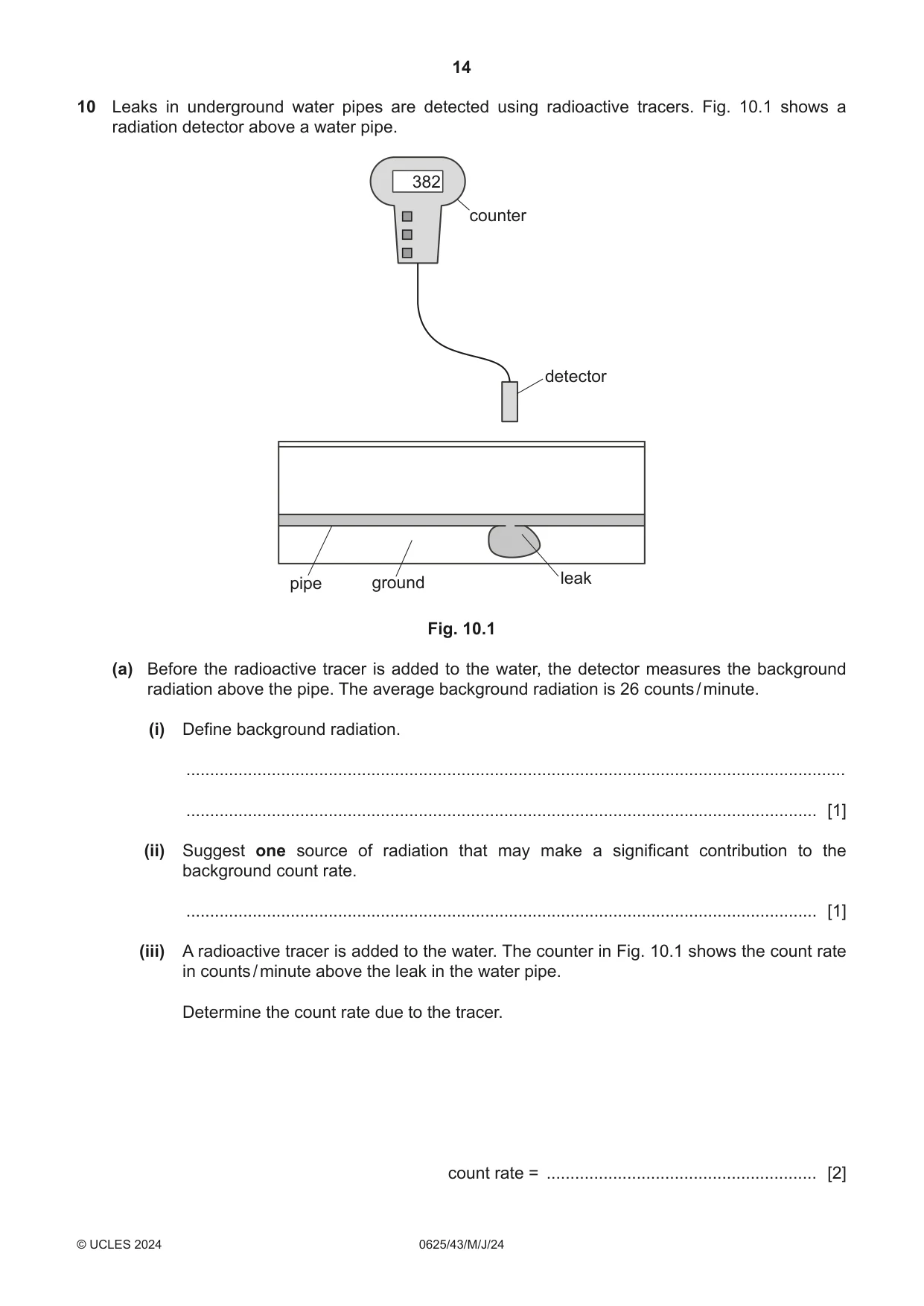
10 Leaks in underground water pipes are detected using radioactive tracers. Fig. 10.1 shows a radiation detector above a water pipe. 382 counter detector pipe ground leak Fig. 10.1 (a) Before the radioactive tracer is added to the water, the detector measures the background radiation above the pipe. The average background radiation is 26 counts / minute. (i) Define background radiation. ........................................................................................................................................... ..................................................................................................................................... [1] (ii) Suggest one source of radiation that may make a significant contribution to the background count rate. ..................................................................................................................................... [1] (iii) A radioactive tracer is added to the water. The counter in Fig. 10.1 shows the count rate in counts / minute above the leak in the water pipe. Determine the count rate due to the tracer. count rate = ......................................................... [2] (b) Suggest which radioactive emission, alpha, beta or gamma, is suitable for detecting the leak in the water pipe. Explain your answer. emission ................................................................................................................................... explanation ............................................................................................................................... ................................................................................................................................................... [3] (c) (i) Explain why the radioactive isotope must not have a very short half-life. ........................................................................................................................................... ..................................................................................................................................... [1] (ii) Explain why the radioactive isotope must not have a very long half-life. ........................................................................................................................................... ..................................................................................................................................... [1] [Total: 9]
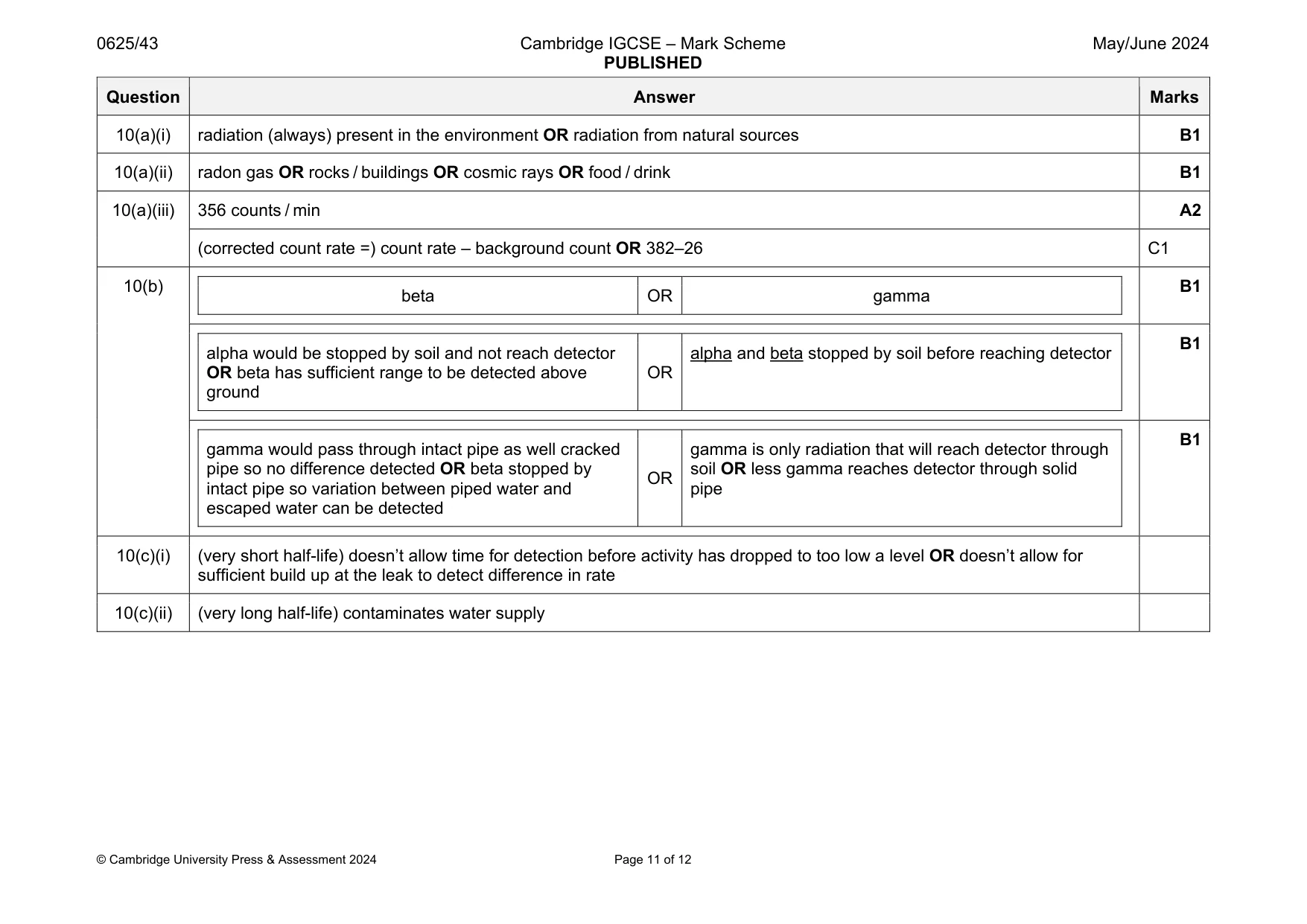
Mark scheme: 10(a)(i) radiation (always) present in the environment OR radiation from natural sources B1 10(a)(ii) radon gas OR rocks / buildings OR cosmic rays OR food / drink B1 10(a)(iii) 356 counts / min A2 (corrected count rate =) count rate – background count OR 382–26 C1 10(b) beta OR gamma B1 alpha would be stopped by soil and not reach detector OR beta has sufficient range to be detected above ground OR alpha and beta stopped by soil before reaching detector B1 gamma would pass through intact pipe as well cracked pipe so no difference detected OR beta stopped by intact pipe so variation between piped water and escaped water can be detected OR gamma is only radiation that will reach detector through soil OR less gamma reaches detector through solid pipe B1 10(c)(i) (very short half-life) doesn’t allow time for detection before activity has dropped to too low a level OR doesn’t allow for sufficient build up at the leak to detect difference in rate 10(c)(ii) (very long half-life) contaminates water supply
Q11 · A galaxy is approximately 1.2 × 1026 m from the Earth
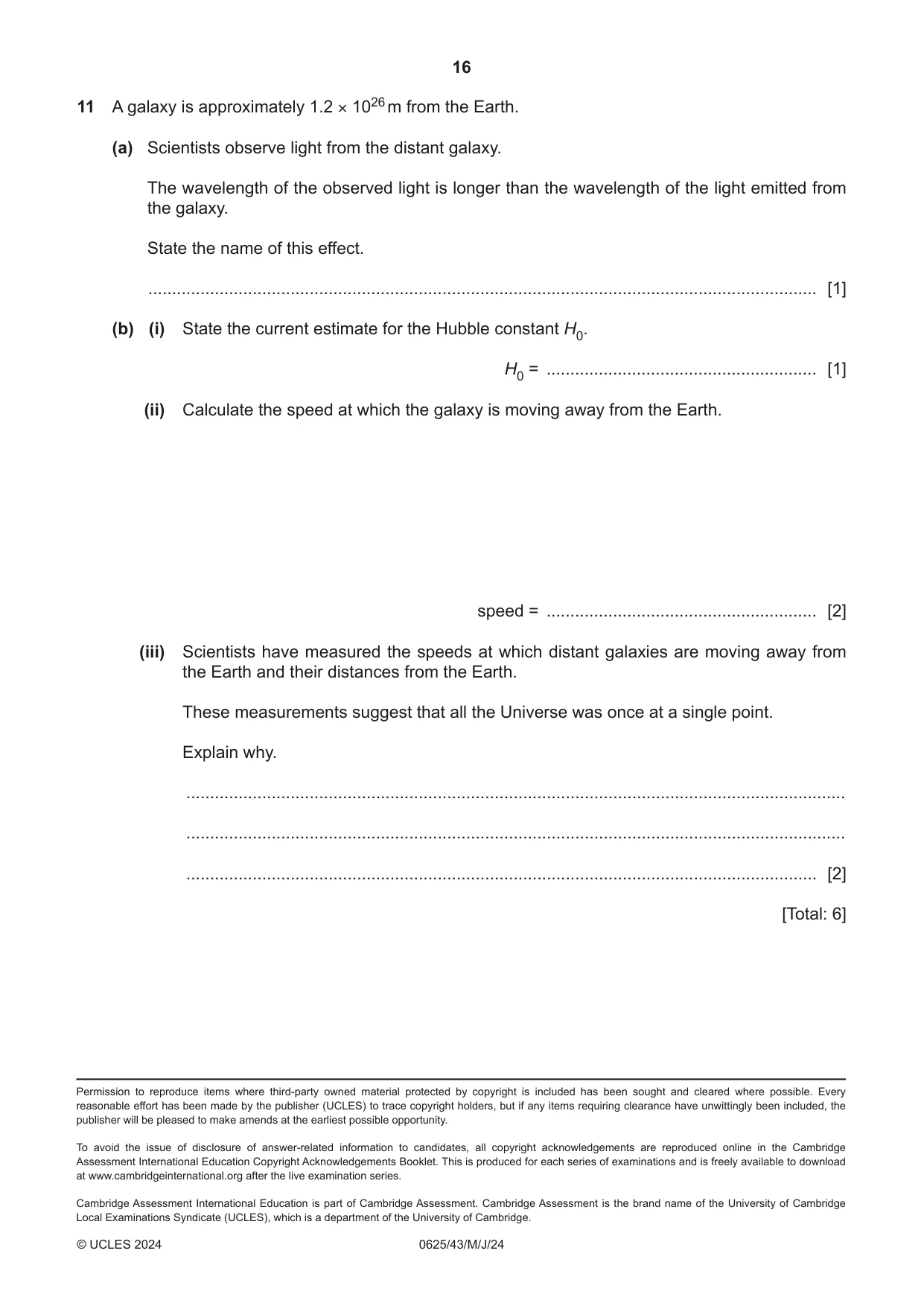
11 A galaxy is approximately 1.2 × 1026 m from the Earth. (a) Scientists observe light from the distant galaxy. The wavelength of the observed light is longer than the wavelength of the light emitted from the galaxy. State the name of this effect. ............................................................................................................................................. [1] (b) (i) State the current estimate for the Hubble constant H0. H0 = ......................................................... [1] (ii) Calculate the speed at which the galaxy is moving away from the Earth. speed = ......................................................... [2] (iii) Scientists have measured the speeds at which distant galaxies are moving away from the Earth and their distances from the Earth. These measurements suggest that all the Universe was once at a single point. Explain why. ........................................................................................................................................... ........................................................................................................................................... ..................................................................................................................................... [2] [Total: 6]
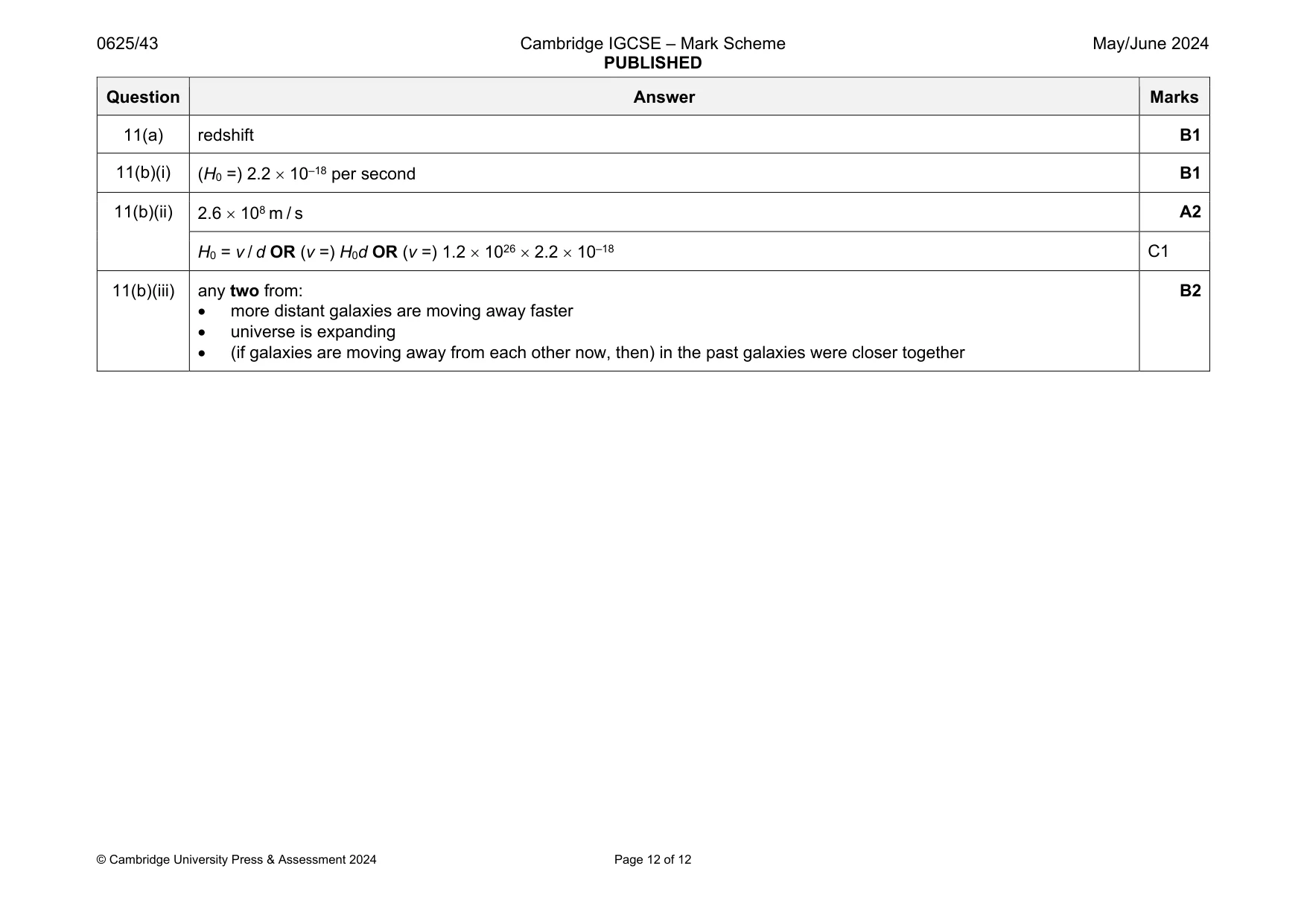
Mark scheme: 11(a) redshift B1 11(b)(i) (H0 =) 2.2 10–18 per second B1 11(b)(ii) 2.6 108 m / s A2 H0 = v / d OR (v =) H0d OR (v =) 1.2 1026 2.2 10–18 C1 11(b)(iii) any two from: more distant galaxies are moving away faster universe is expanding (if galaxies are moving away from each other now, then) in the past galaxies were closer together B2
What was in this paper
The subtopics covered by these 11 questions, and how many questions each got. Open one in a new tab to see every Cambridge question on it.
What you needed in this session
Cambridge’s own grade thresholds for 2024 May/June, Paper 4 · Variant 3. A higher threshold means an easier paper — the bar moves with how the cohort did.