Cambridge IGCSE Physics 0625 — 2020 Oct/Nov Paper 4 · Variant 2
0625/42/O/N/20 · 11 questions · 80 marks · ≈90 min
The question paper and its mark scheme, free to read here and free to download. This is Cambridge’s own paper, exactly as it was sat.
Question paper16 pages
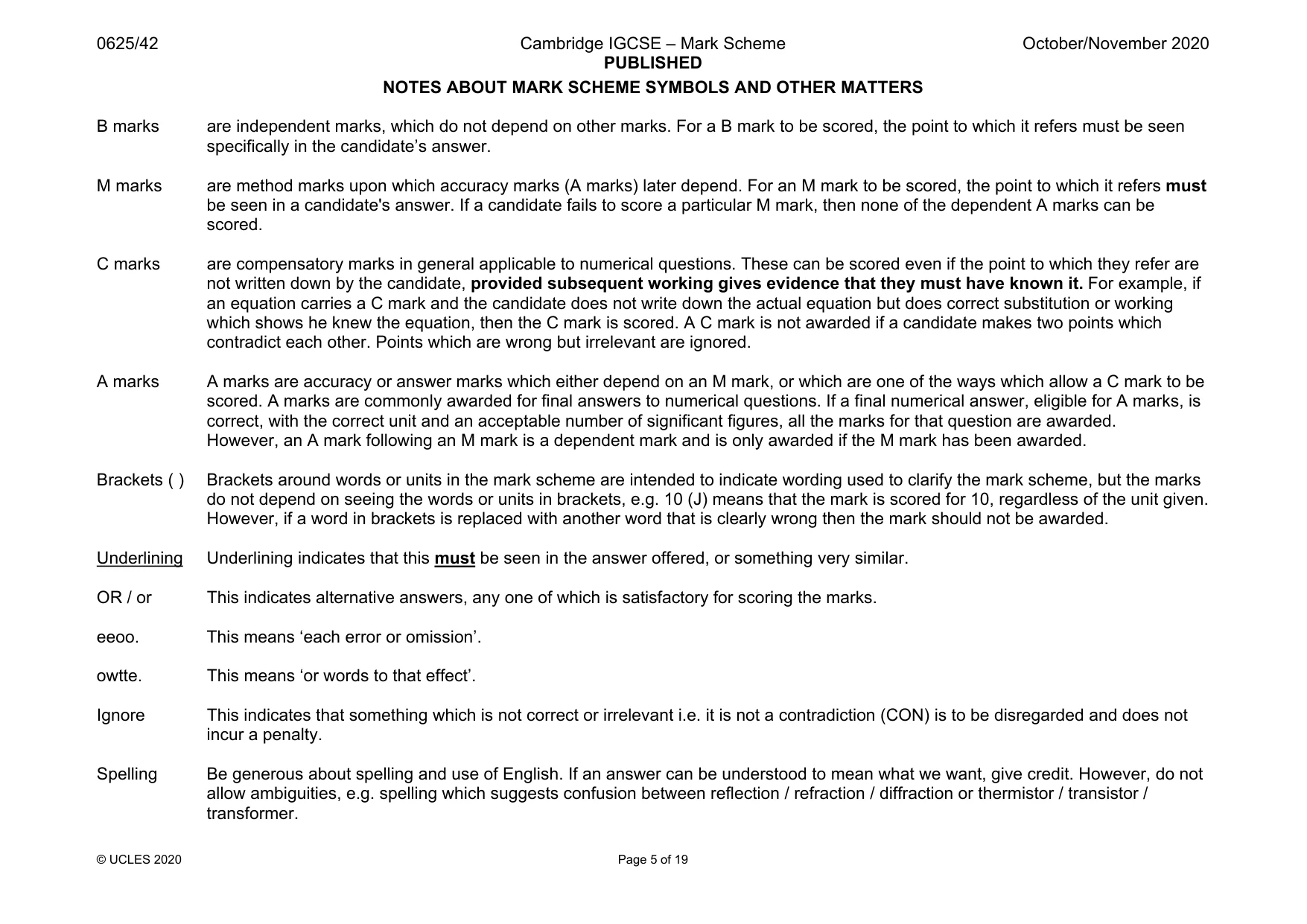
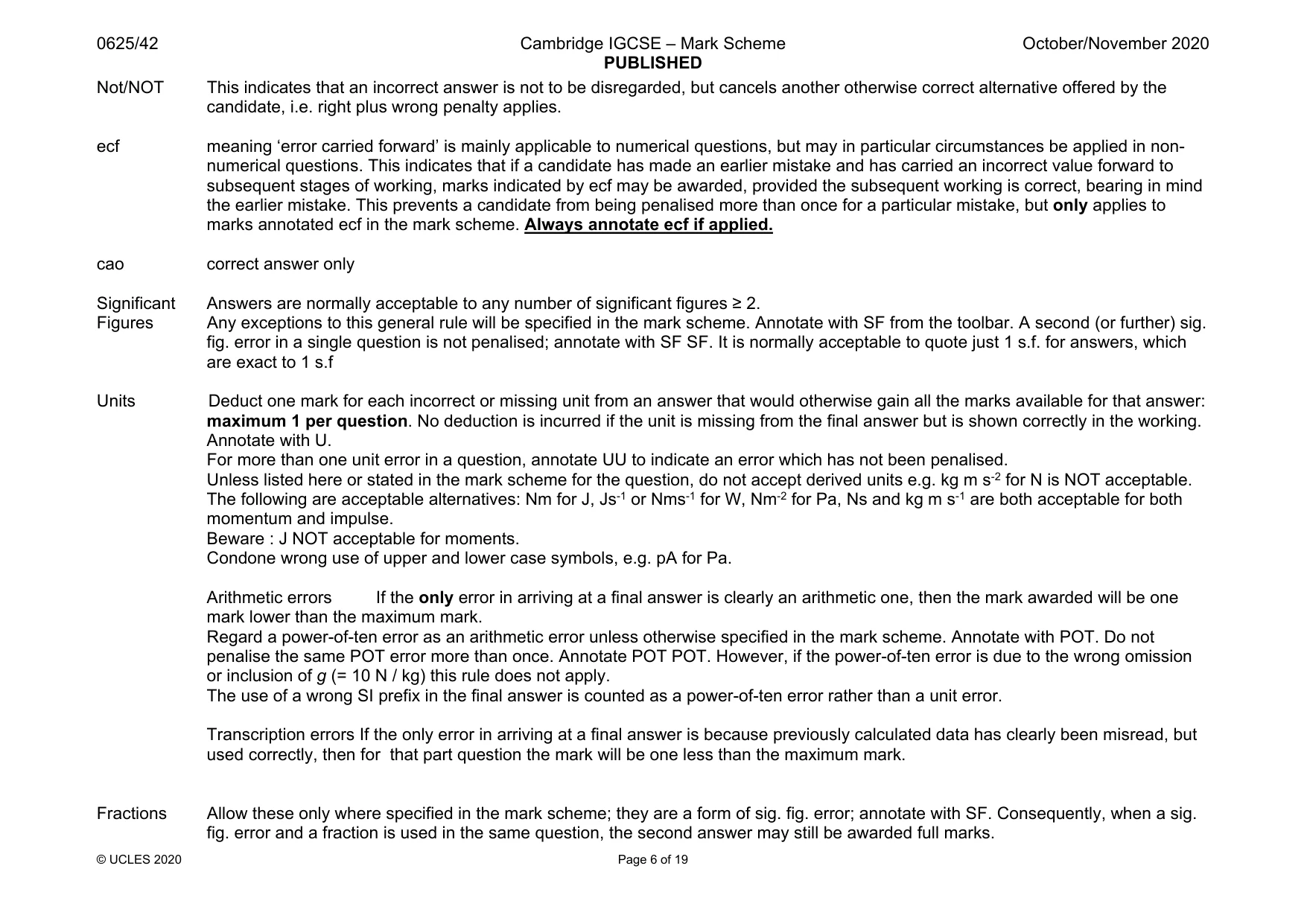
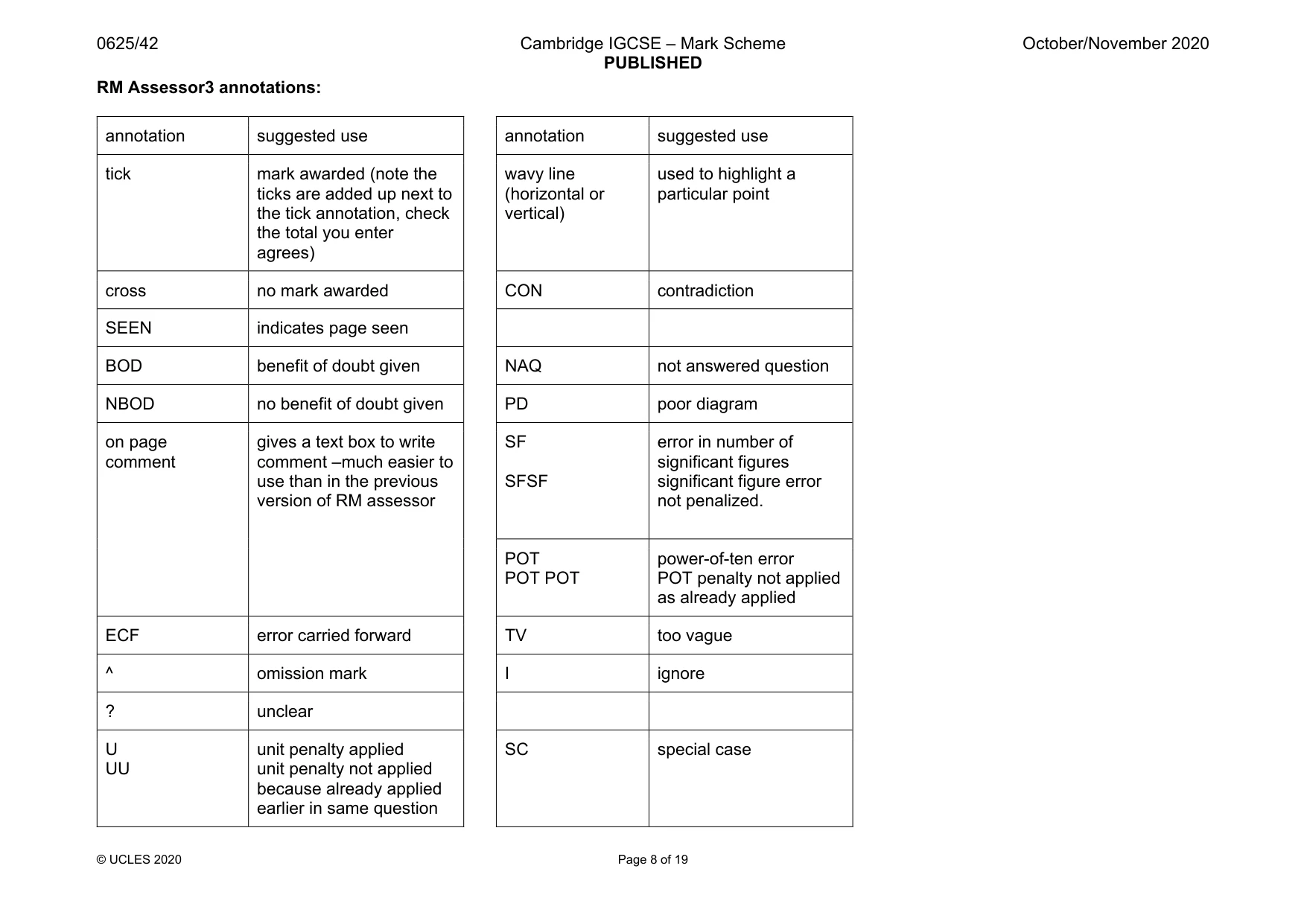
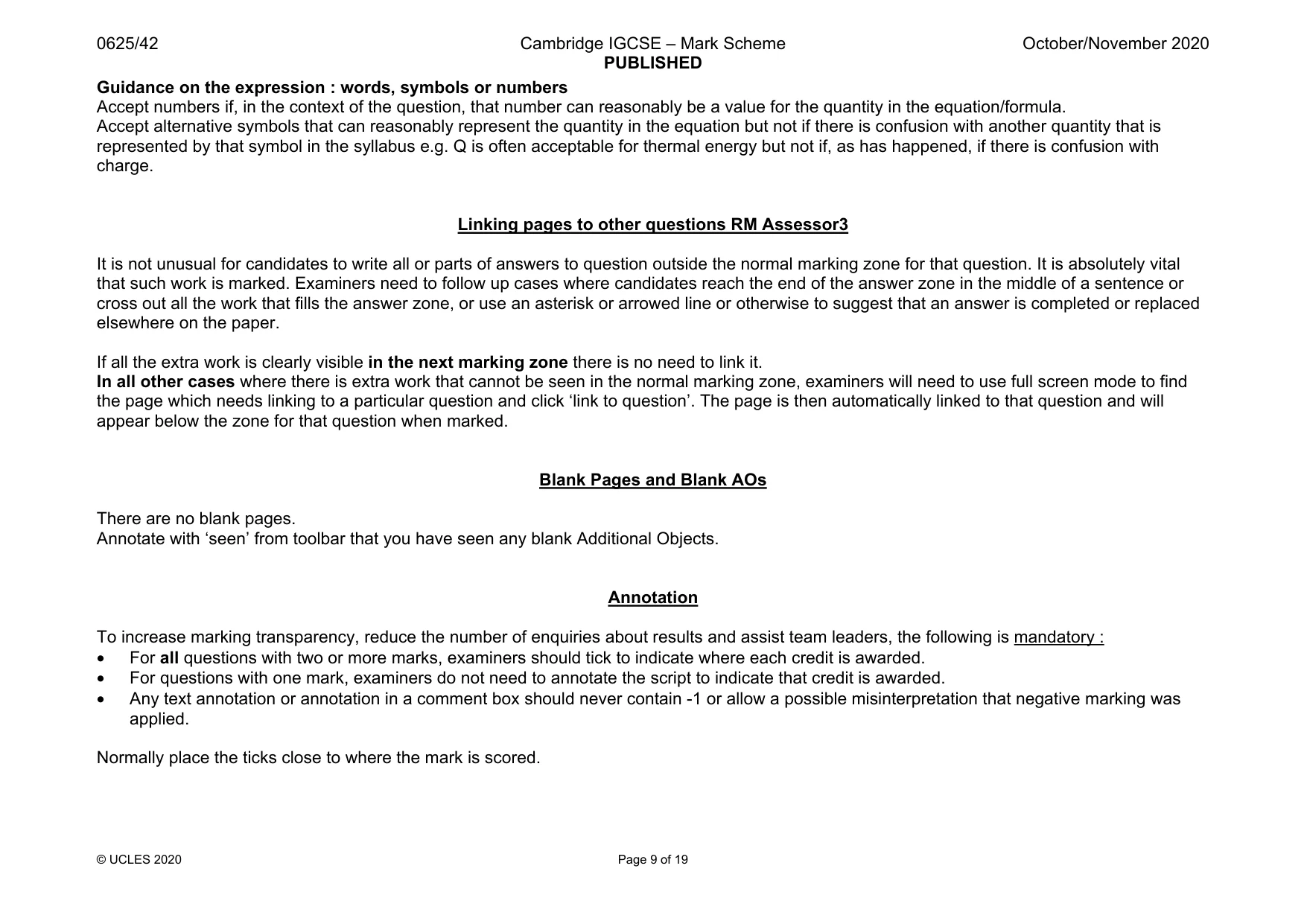
Mark scheme19 pages
Answers below. Sit the paper first if you are practising.
Questions as text
Q1 · A sky-diver jumps out of a hot-air balloon, which is 4000 m above the ground
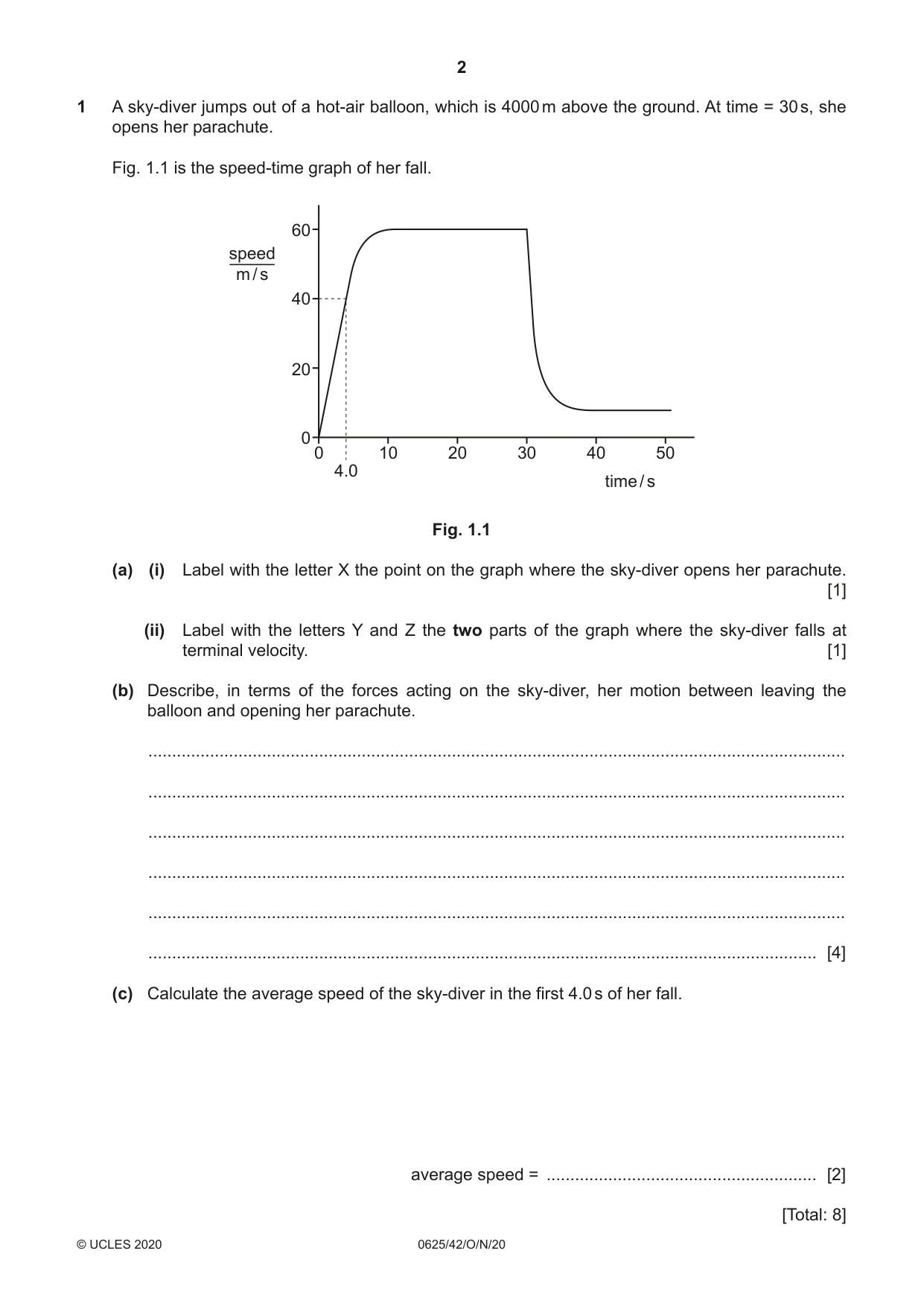
1 A sky-diver jumps out of a hot-air balloon, which is 4000 m above the ground. At time = 30 s, she opens her parachute. Fig. 1.1 is the speed-time graph of her fall. 60 speed m / s 40 20 0 0 10 20 30 40 50 4.0 time / s Fig. 1.1 (a) (i) Label with the letter X the point on the graph where the sky-diver opens her parachute. [1] (ii) Label with the letters Y and Z the two parts of the graph where the sky-diver falls at terminal velocity. [1] (b) Describe, in terms of the forces acting on the sky-diver, her motion between leaving the balloon and opening her parachute. ................................................................................................................................................... ................................................................................................................................................... ................................................................................................................................................... ................................................................................................................................................... ................................................................................................................................................... ............................................................................................................................................. [4] (c) Calculate the average speed of the sky-diver in the first 4.0 s of her fall. average speed = ......................................................... [2] [Total: 8]
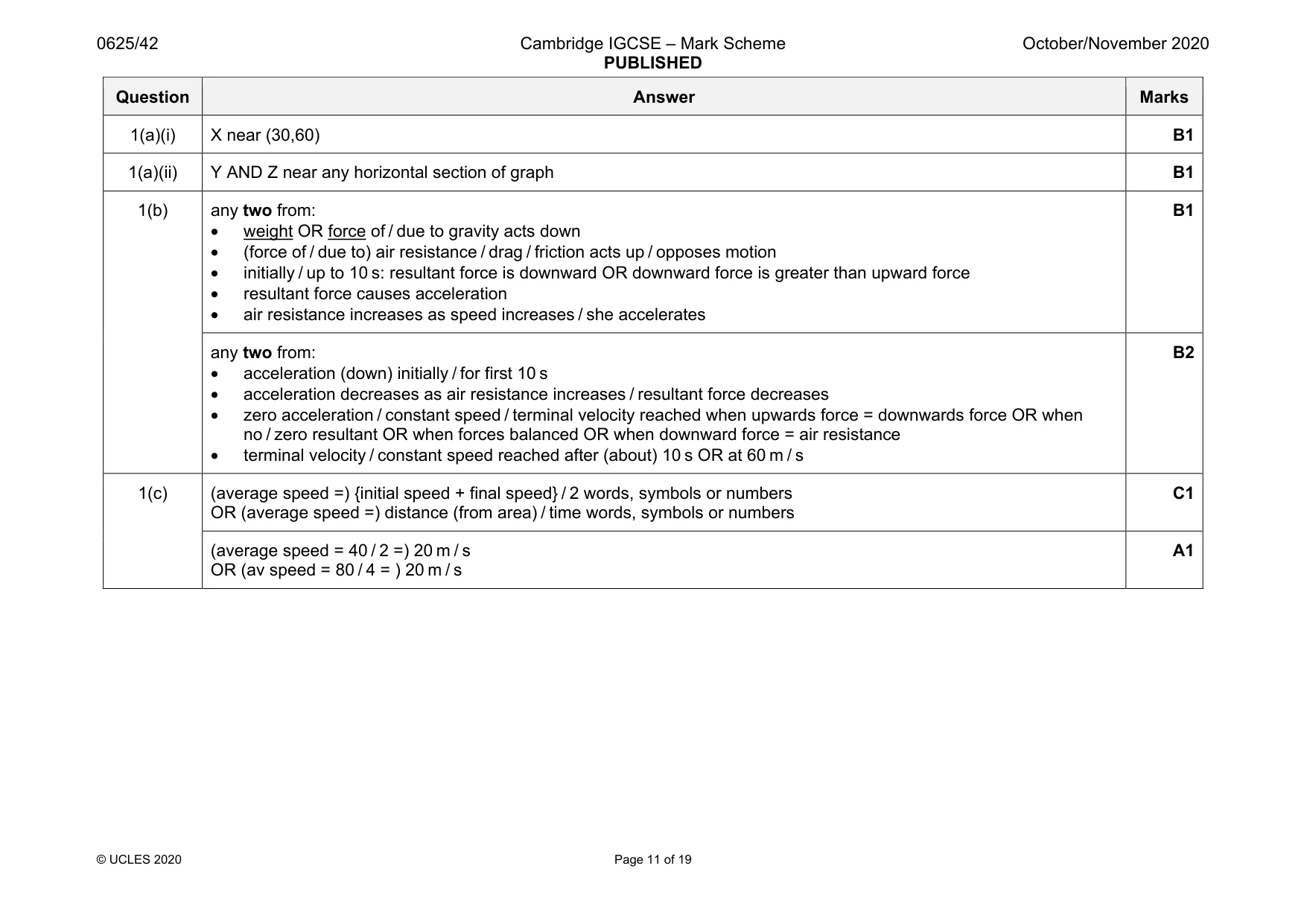
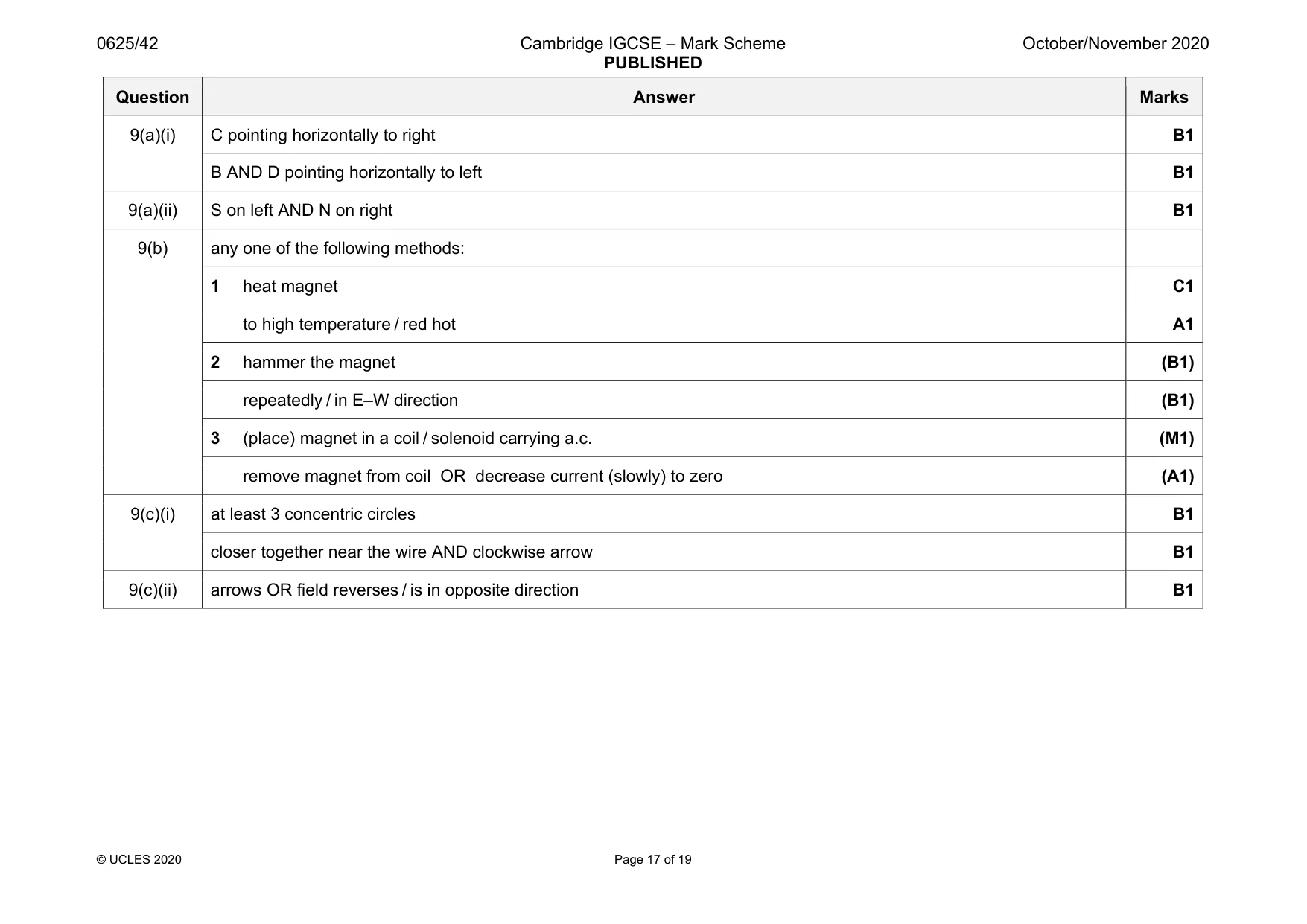
Mark scheme: 1(a)(i) X near (30,60) B1 1(a)(ii) Y AND Z near any horizontal section of graph B1 1(b) any two from: • weight OR force of / due to gravity acts down • (force of / due to) air resistance / drag / friction acts up / opposes motion • initially / up to 10 s: resultant force is downward OR downward force is greater than upward force • resultant force causes acceleration • air resistance increases as speed increases / she accelerates B1 any two from: • acceleration (down) initially / for first 10 s • acceleration decreases as air resistance increases / resultant force decreases • zero acceleration / constant speed / terminal velocity reached when upwards force = downwards force OR when no / zero resultant OR when forces balanced OR when downward force = air resistance • terminal velocity / constant speed reached after (about) 10 s OR at 60 m / s B2 1(c) (average speed =) {initial speed + final speed} / 2 words, symbols or numbers OR (average speed =) distance (from area) / time words, symbols or numbers C1 (average speed = 40 / 2 =) 20 m / s OR (av speed = 80 / 4 = ) 20 m / s A1
Q2 · Define the moment of a force about a point
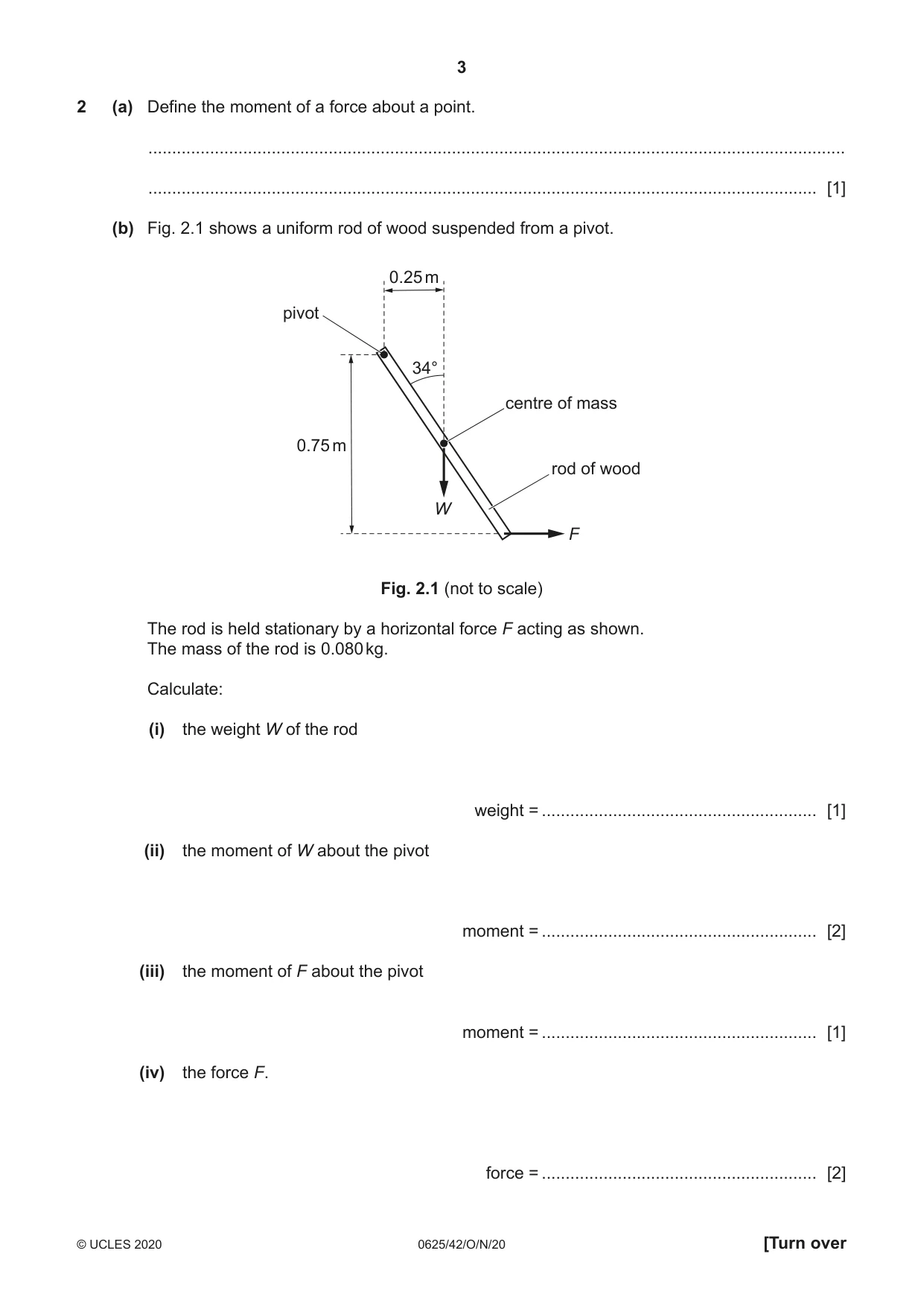
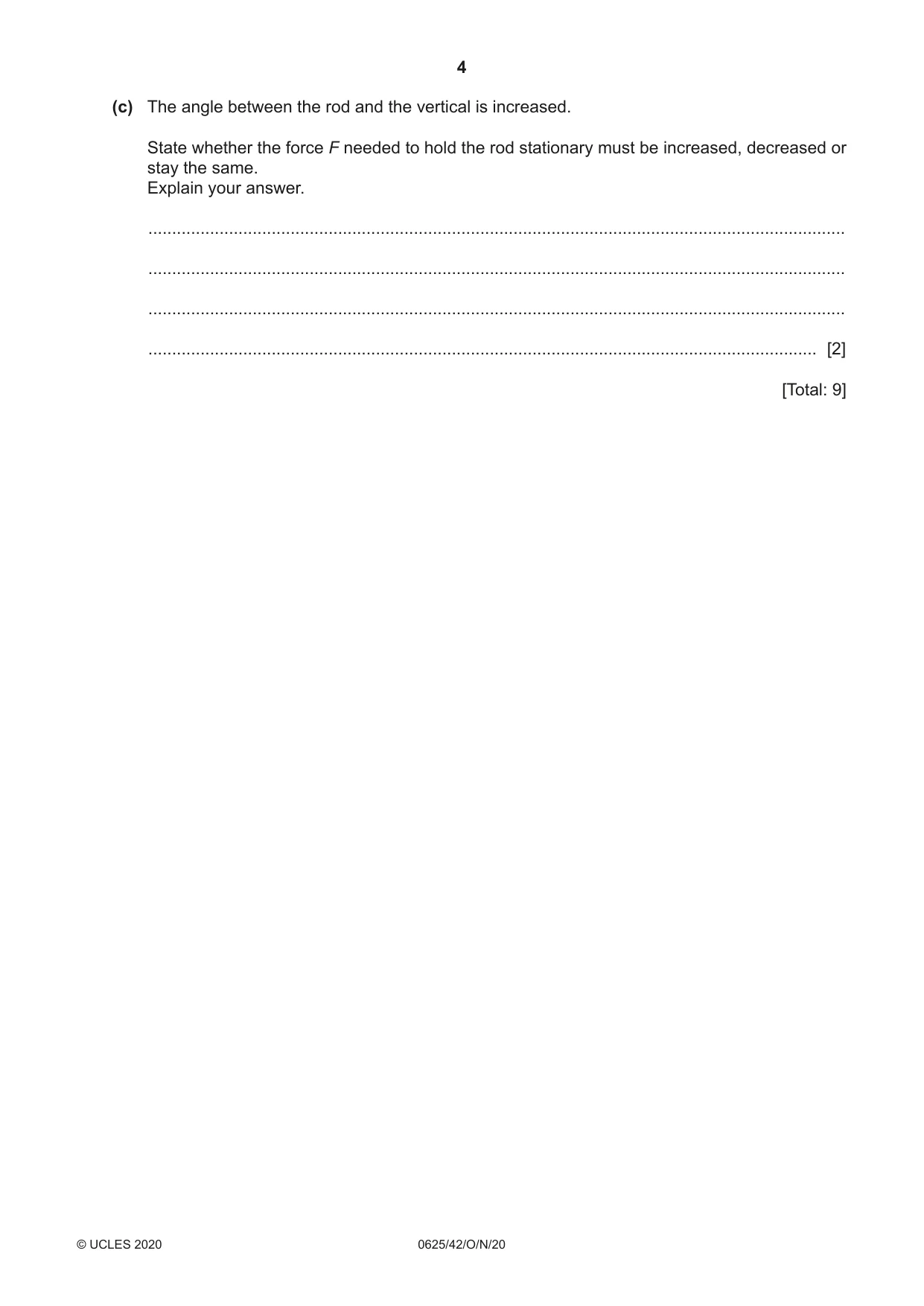
2 (a) Define the moment of a force about a point. ................................................................................................................................................... ............................................................................................................................................. [1] (b) Fig. 2.1 shows a uniform rod of wood suspended from a pivot. 0.25 m pivot 34° centre of mass 0.75 m rod of wood W F Fig. 2.1 (not to scale) The rod is held stationary by a horizontal force F acting as shown. The mass of the rod is 0.080 kg. Calculate: (i) the weight W of the rod weight = .......................................................... [1] (ii) the moment of W about the pivot moment = .......................................................... [2] (iii) the moment of F about the pivot moment = .......................................................... [1] (iv) the force F. force = .......................................................... [2] (c) The angle between the rod and the vertical is increased. State whether the force F needed to hold the rod stationary must be increased, decreased or stay the same. Explain your answer. ................................................................................................................................................... ................................................................................................................................................... ................................................................................................................................................... ............................................................................................................................................. [2] [Total: 9]
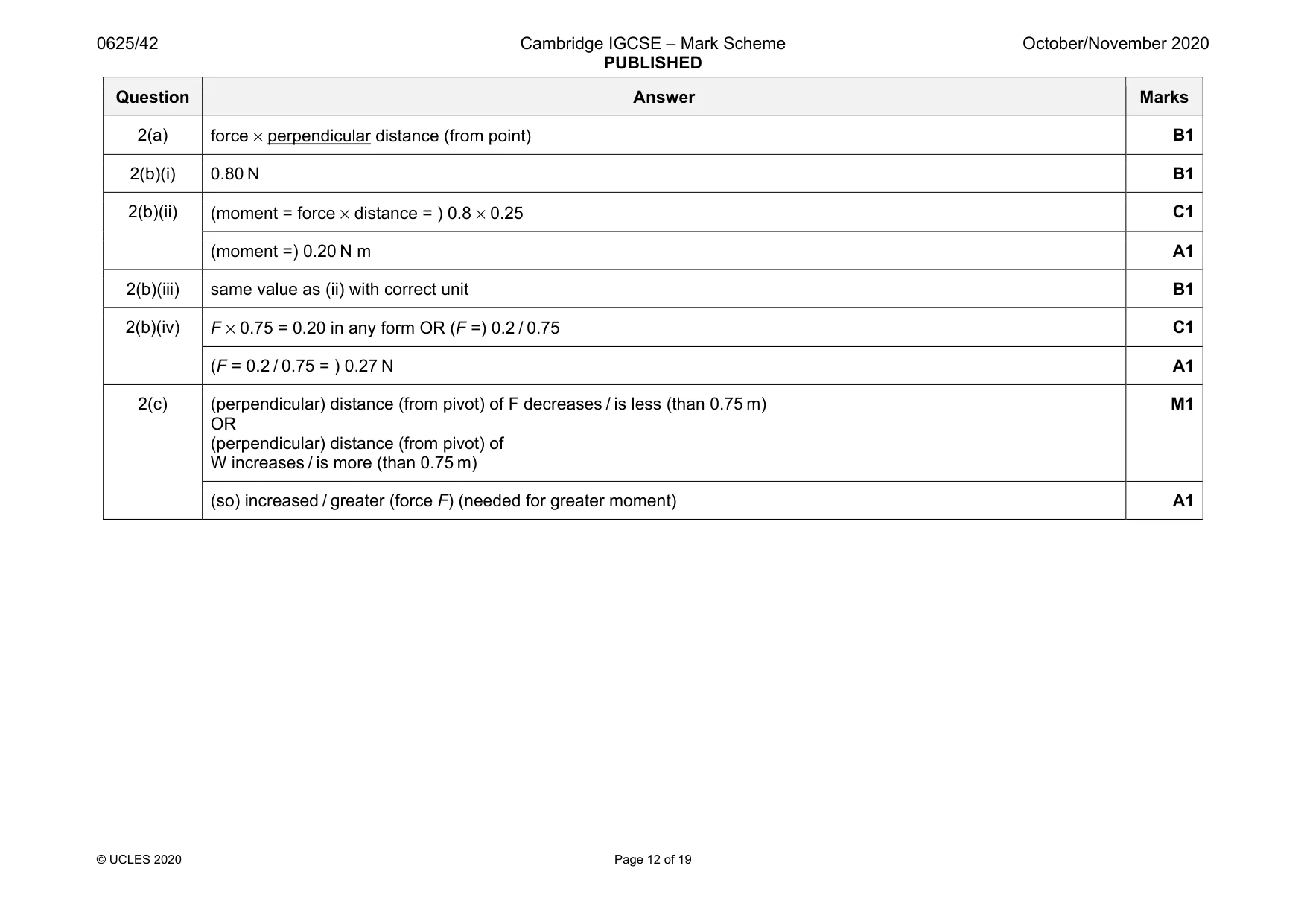
Mark scheme: 2(a) force × perpendicular distance (from point) B1 2(b)(i) 0.80 N B1 2(b)(ii) (moment = force × distance = ) 0.8 × 0.25 C1 (moment =) 0.20 N m A1 2(b)(iii) same value as (ii) with correct unit B1 2(b)(iv) F × 0.75 = 0.20 in any form OR (F =) 0.2 / 0.75 C1 (F = 0.2 / 0.75 = ) 0.27 N A1 2(c) (perpendicular) distance (from pivot) of F decreases / is less (than 0.75 m) OR (perpendicular) distance (from pivot) of W increases / is more (than 0.75 m) M1 (so) increased / greater (force F) (needed for greater moment) A1
Q3 · The kinetic energy of air passing through a wind turbine every minute is 720 000 J
3 The kinetic energy of air passing through a wind turbine every minute is 720 000 J. The electrical output of the turbine is 9.0 A at a potential difference (p.d.) of 240 V. Calculate the efficiency (%) of the wind turbine. efficiency = ...................................................... % [5]
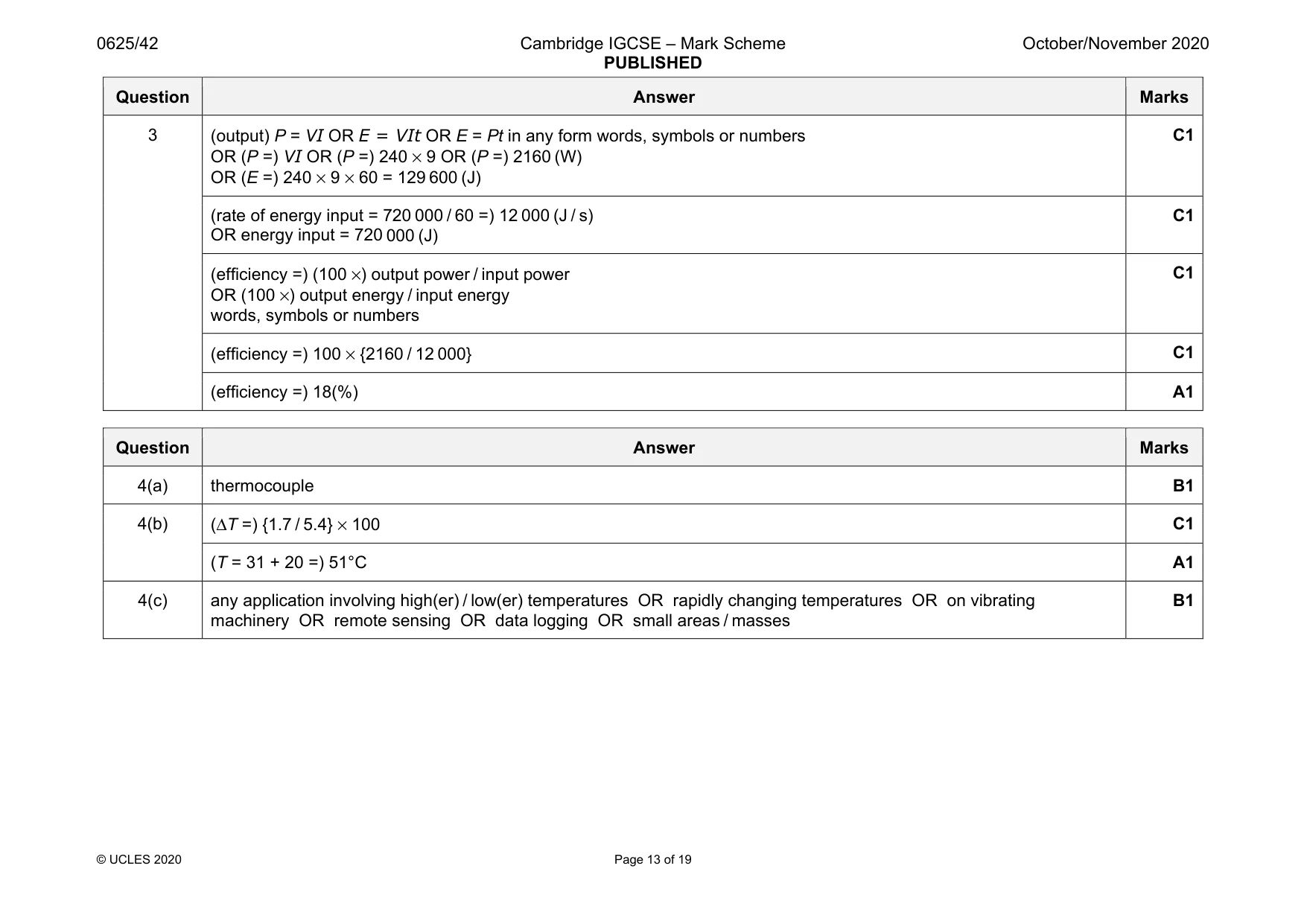
Mark scheme: 3 OR (P =) VI OR (P =) 240 × 9 OR (P =) 2160 (W) OR (E =) 240 × 9 × 60 = 129 600 (J) C1 (rate of energy input = 720 000 / 60 =) 12 000 (J / s) OR energy input = 720 000 (J) C1 (efficiency =) (100 ×) output power / input power OR (100 ×) output energy / input energy words, symbols or numbers C1 (efficiency =) 100 × {2160 / 12 000} C1 (efficiency =) 18(%) A1
Question 4
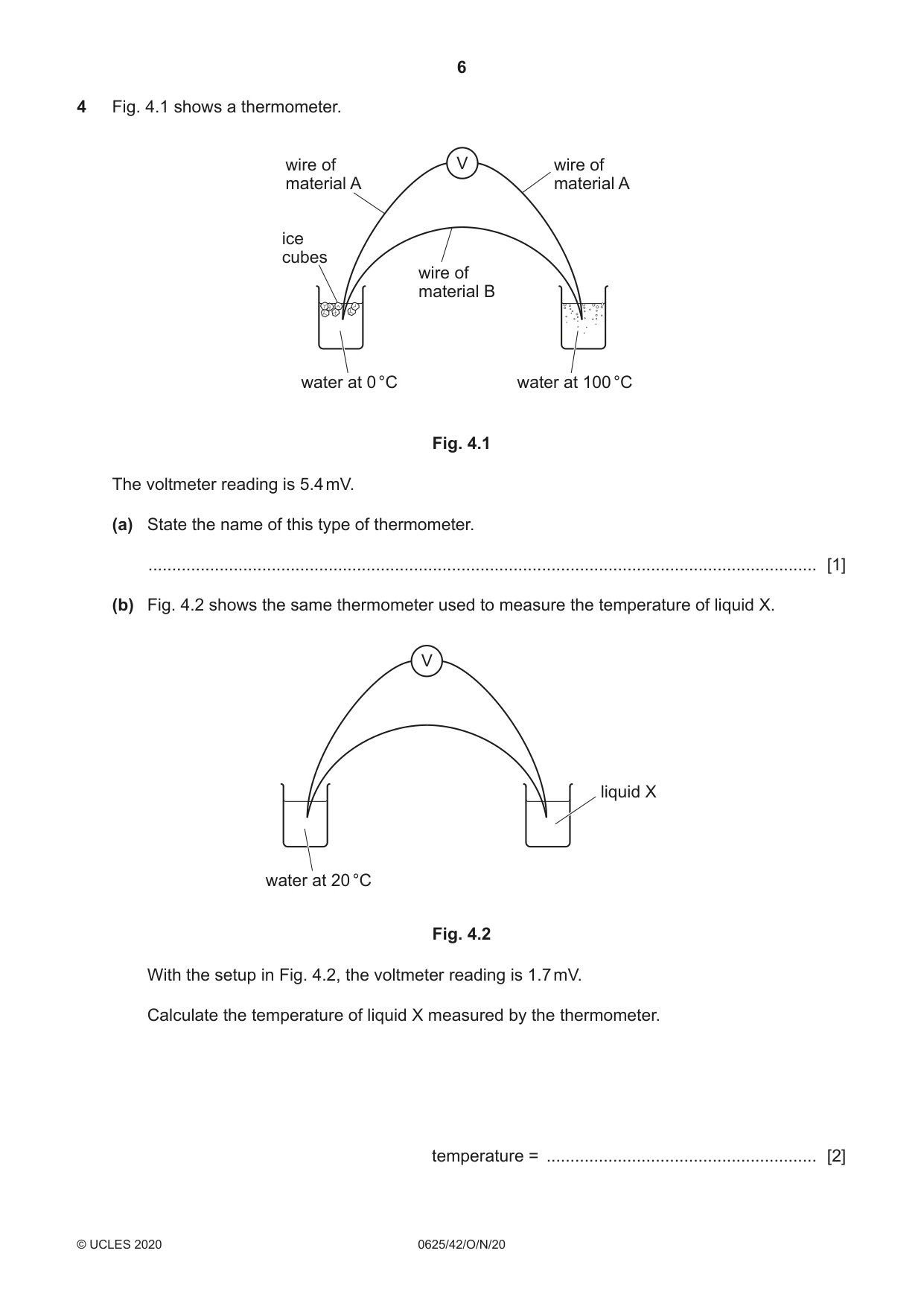
4 Fig. 4.1 shows a thermometer. wire of V wire of material A material A ice cubes wire of material B water at 0 °C water at 100 °C Fig. 4.1 The voltmeter reading is 5.4 mV. (a) State the name of this type of thermometer. ............................................................................................................................................. [1] (b) Fig. 4.2 shows the same thermometer used to measure the temperature of liquid X. V liquid X water at 20 °C Fig. 4.2 With the setup in Fig. 4.2, the voltmeter reading is 1.7 mV. Calculate the temperature of liquid X measured by the thermometer. temperature = ......................................................... [2] (c) Suggest an application for which this type of thermometer is more suitable than a liquid-in- glass thermometer. ............................................................................................................................................. [1] [Total: 4]
Mark scheme: 4(a) thermocouple B1 4(b) (ΔT =) {1.7 / 5.4} × 100 C1 (T = 31 + 20 =) 51°C A1 4(c) any application involving high(er) / low(er) temperatures OR rapidly changing temperatures OR on vibrating machinery OR remote sensing OR data logging OR small areas / masses B1
Q5 · Define specific latent heat
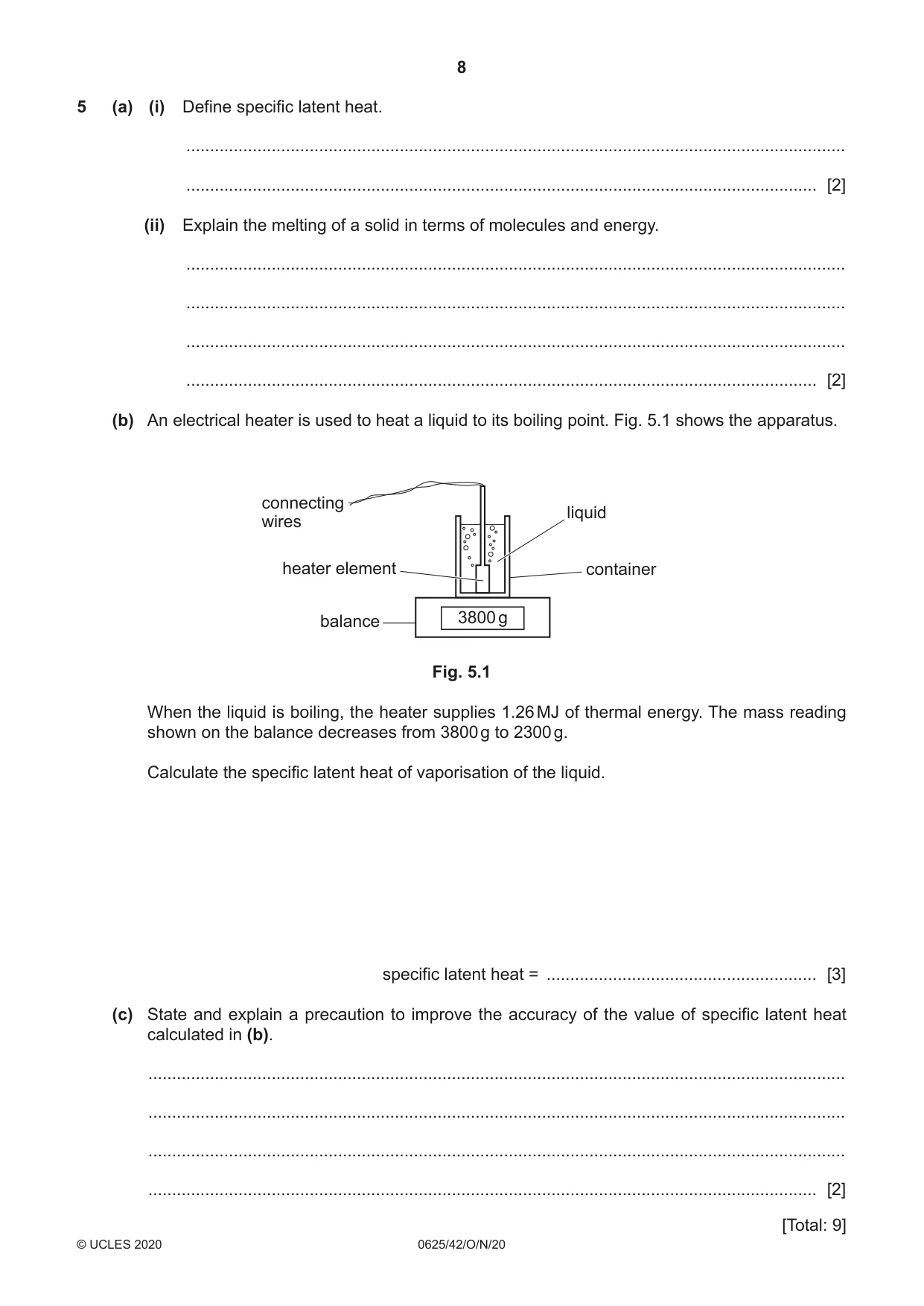
5 (a) (i) Define specific latent heat. ........................................................................................................................................... ..................................................................................................................................... [2] (ii) Explain the melting of a solid in terms of molecules and energy. ........................................................................................................................................... ........................................................................................................................................... ........................................................................................................................................... ..................................................................................................................................... [2] (b) An electrical heater is used to heat a liquid to its boiling point. Fig. 5.1 shows the apparatus. connecting liquid wires heater element container balance 3800 g Fig. 5.1 When the liquid is boiling, the heater supplies 1.26 MJ of thermal energy. The mass reading shown on the balance decreases from 3800 g to 2300 g. Calculate the specific latent heat of vaporisation of the liquid. specific latent heat = ......................................................... [3] (c) State and explain a precaution to improve the accuracy of the value of specific latent heat calculated in (b). ................................................................................................................................................... ................................................................................................................................................... ................................................................................................................................................... ............................................................................................................................................. [2] [Total: 9]
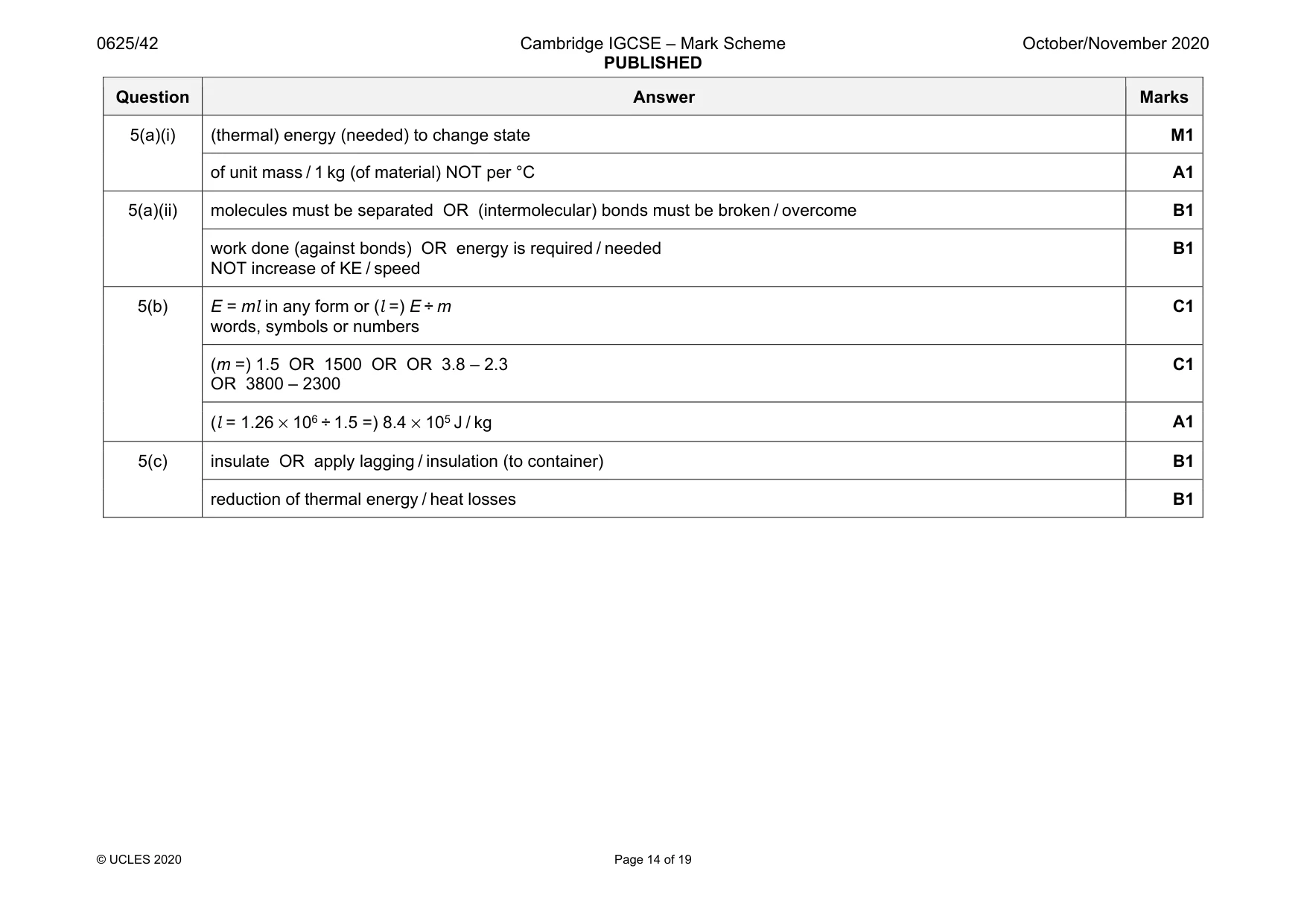
Mark scheme: 5(a)(i) (thermal) energy (needed) to change state M1 of unit mass / 1 kg (of material) NOT per °C A1 5(a)(ii) molecules must be separated OR (intermolecular) bonds must be broken / overcome B1 work done (against bonds) OR energy is required / needed NOT increase of KE / speed B1 5(b) E = ml in any form or (l =) E ÷ m words, symbols or numbers C1 (m =) 1.5 OR 1500 OR OR 3.8 – 2.3 OR 3800 – 2300 C1 (l = 1.26 × 10⁶ ÷ 1.5 =) 8.4 × 10⁵ J / kg A1 5(c) insulate OR apply lagging / insulation (to container) B1 reduction of thermal energy / heat losses B1
Q6 · A transverse wave produced in a string
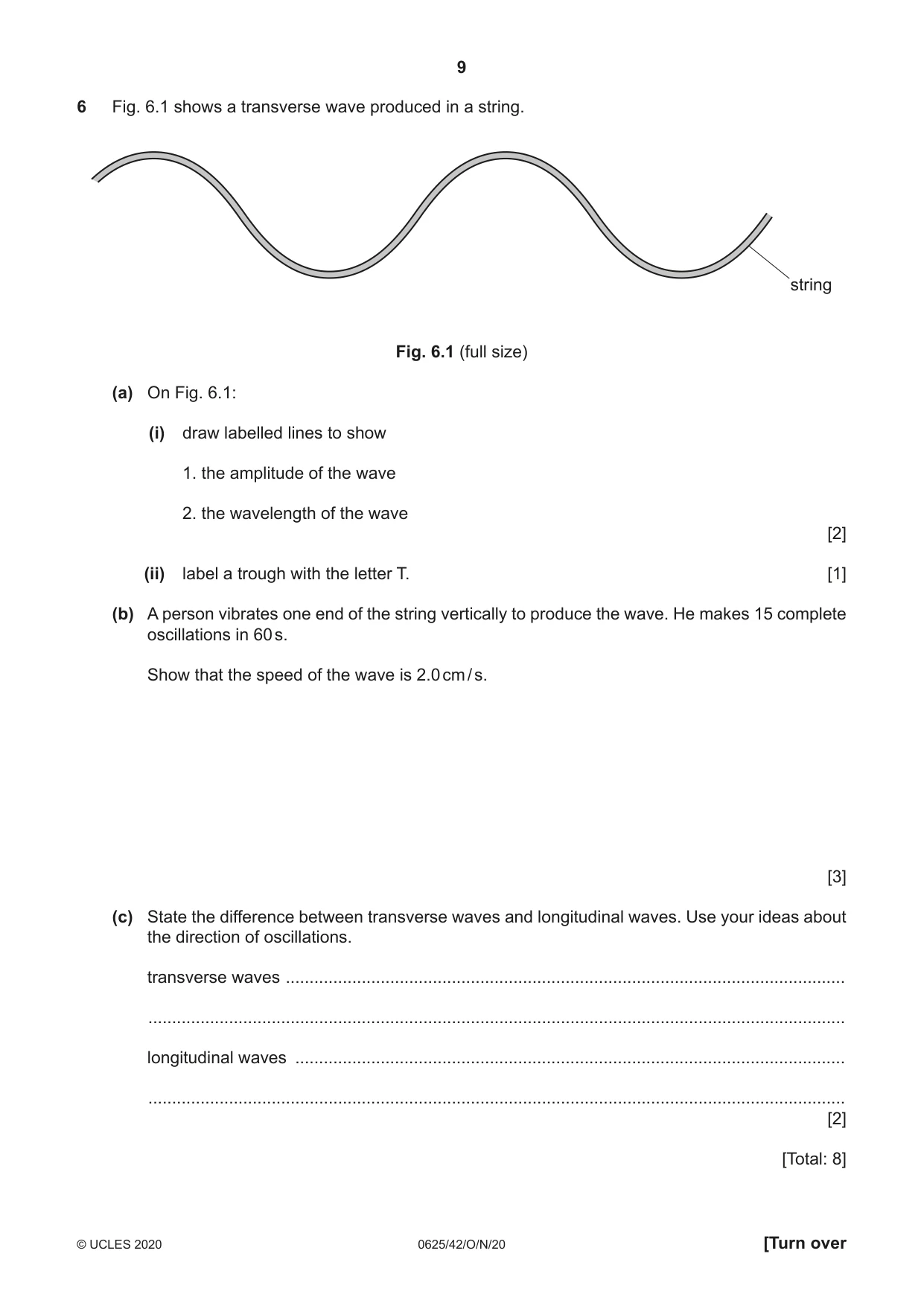
6 Fig. 6.1 shows a transverse wave produced in a string. string Fig. 6.1 (full size) (a) On Fig. 6.1: (i) draw labelled lines to show 1. the amplitude of the wave 2. the wavelength of the wave [2] (ii) label a trough with the letter T. [1] (b) A person vibrates one end of the string vertically to produce the wave. He makes 15 complete oscillations in 60 s. Show that the speed of the wave is 2.0 cm / s. [3] (c) State the difference between transverse waves and longitudinal waves. Use your ideas about the direction of oscillations. transverse waves ...................................................................................................................... ................................................................................................................................................... longitudinal waves .................................................................................................................... ................................................................................................................................................... [2] [Total: 8]
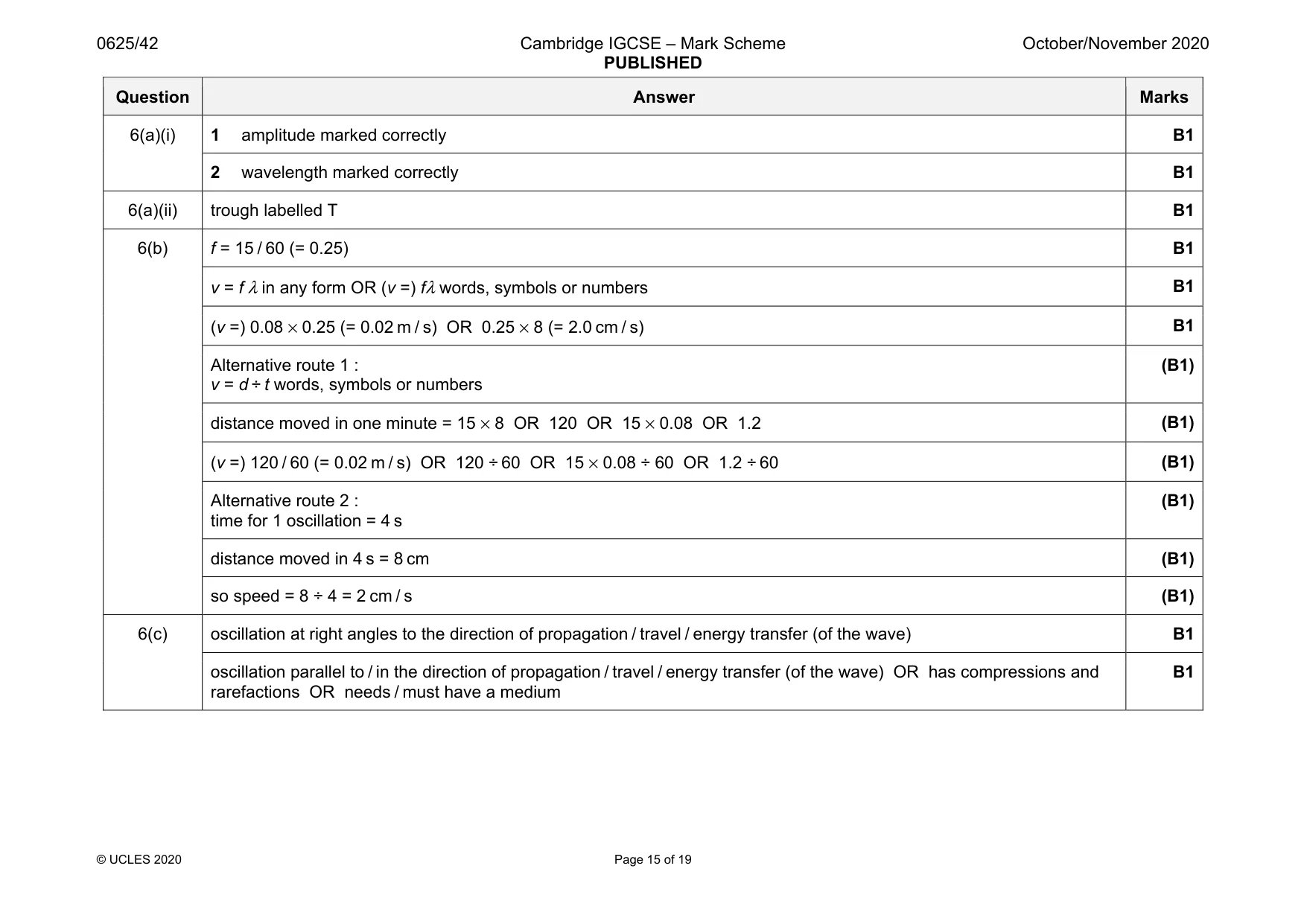
Mark scheme: 6(a)(i) 1 amplitude marked correctly B1 2 wavelength marked correctly B1 6(a)(ii) trough labelled T B1 6(b) f = 15 / 60 (= 0.25) B1 v = f λ in any form OR (v =) fλ words, symbols or numbers B1 (v =) 0.08 × 0.25 (= 0.02 m / s) OR 0.25 × 8 (= 2.0 cm / s) B1 Alternative route 1 : v = d ÷ t words, symbols or numbers (B1) distance moved in one minute = 15 × 8 OR 120 OR 15 × 0.08 OR 1.2 (B1) (v =) 120 / 60 (= 0.02 m / s) OR 120 ÷ 60 OR 15 × 0.08 ÷ 60 OR 1.2 ÷ 60 (B1) Alternative route 2 : time for 1 oscillation = 4 s (B1) distance moved in 4 s = 8 cm (B1) so speed = 8 ÷ 4 = 2 cm / s (B1) 6(c) oscillation at right angles to the direction of propagation / travel / energy transfer (of the wave) B1 oscillation parallel to / in the direction of propagation / travel / energy transfer (of the wave) OR has compressions and rarefactions OR needs / must have a medium B1
Q7 · A ray of light passing through an optical fibre
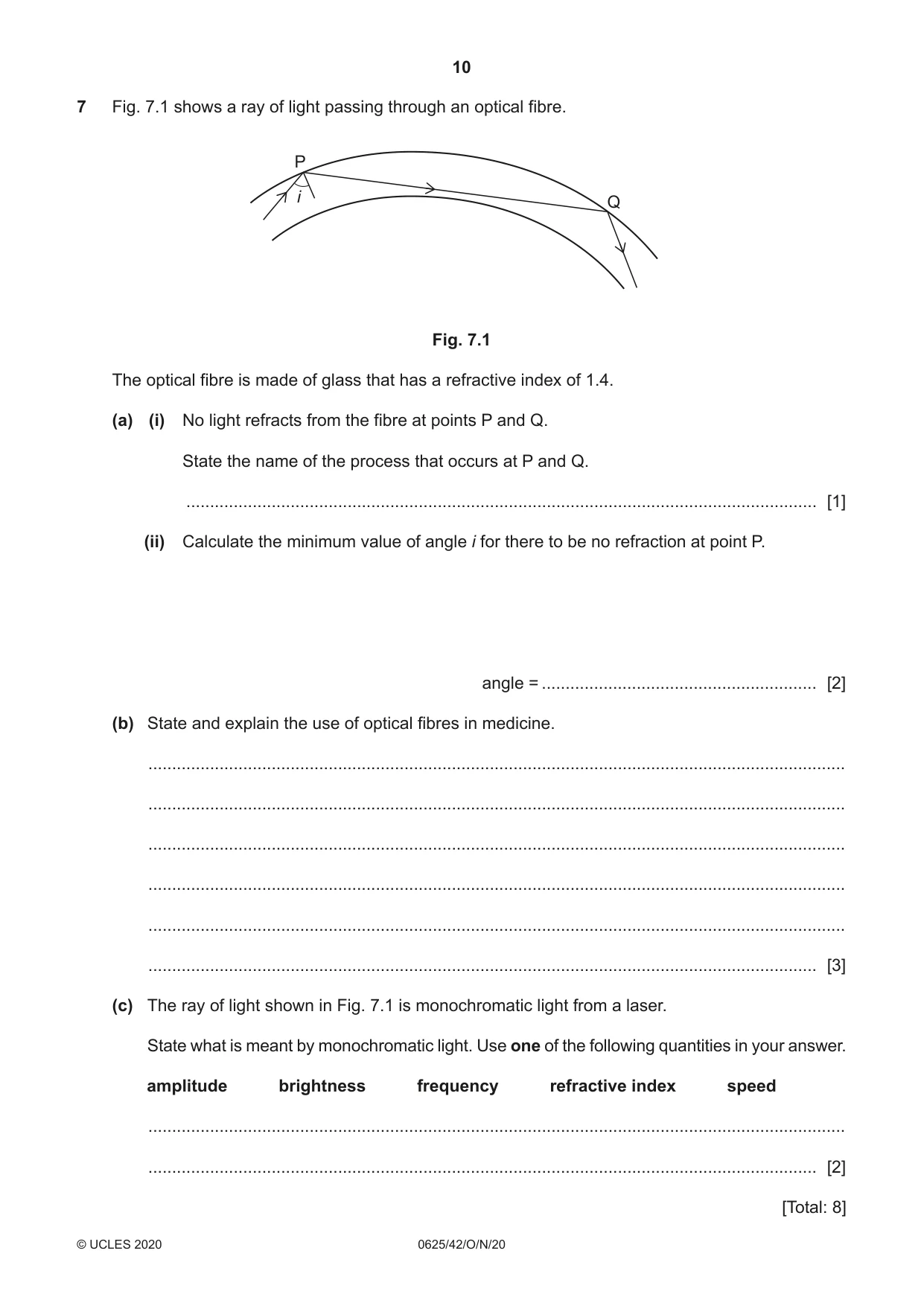
7 Fig. 7.1 shows a ray of light passing through an optical fibre. P i Q Fig. 7.1 The optical fibre is made of glass that has a refractive index of 1.4. (a) (i) No light refracts from the fibre at points P and Q. State the name of the process that occurs at P and Q. ..................................................................................................................................... [1] (ii) Calculate the minimum value of angle i for there to be no refraction at point P. angle = .......................................................... [2] (b) State and explain the use of optical fibres in medicine. ................................................................................................................................................... ................................................................................................................................................... ................................................................................................................................................... ................................................................................................................................................... ................................................................................................................................................... ............................................................................................................................................. [3] (c) The ray of light shown in Fig. 7.1 is monochromatic light from a laser. State what is meant by monochromatic light. Use one of the following quantities in your answer. amplitude brightness frequency refractive index speed ................................................................................................................................................... ............................................................................................................................................. [2] [Total: 8]
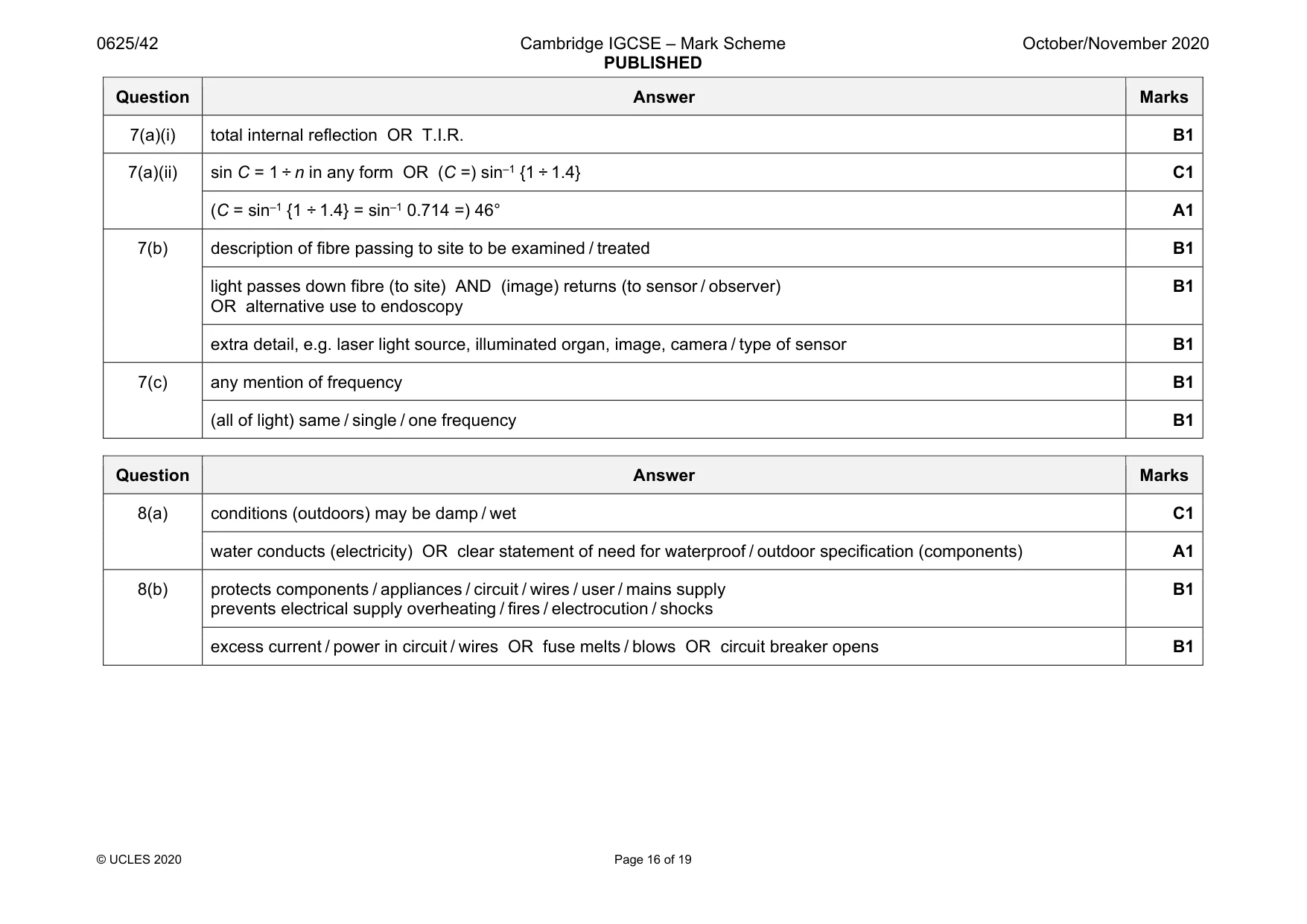
Mark scheme: 7(a)(i) total internal reflection OR T.I.R. B1 7(a)(ii) sin C = 1 ÷ n in any form OR (C =) sin–1 {1 ÷ 1.4} C1 (C = sin–1 {1 ÷ 1.4} = sin–1 0.714 =) 46° A1 7(b) description of fibre passing to site to be examined / treated B1 light passes down fibre (to site) AND (image) returns (to sensor / observer) OR alternative use to endoscopy B1 extra detail, e.g. laser light source, illuminated organ, image, camera / type of sensor B1 7(c) any mention of frequency B1 (all of light) same / single / one frequency B1
Q8 · State and explain why electrical sockets and plugs used outside in a garden need to be…
8 (a) State and explain why electrical sockets and plugs used outside in a garden need to be different from those that can be used safely in a room inside a house. ................................................................................................................................................... ................................................................................................................................................... ................................................................................................................................................... ............................................................................................................................................. [2] (b) State and explain why fuses and circuit breakers are installed in electrical circuits connected to the mains supply. ................................................................................................................................................... ................................................................................................................................................... ................................................................................................................................................... ............................................................................................................................................. [2] [Total: 4]
Mark scheme: 8(a) conditions (outdoors) may be damp / wet C1 water conducts (electricity) OR clear statement of need for waterproof / outdoor specification (components) A1 8(b) protects components / appliances / circuit / wires / user / mains supply prevents electrical supply overheating / fires / electrocution / shocks B1 excess current / power in circuit / wires OR fuse melts / blows OR circuit breaker opens B1
Q9 · A bar magnet and four plotting compasses A, B, C and D
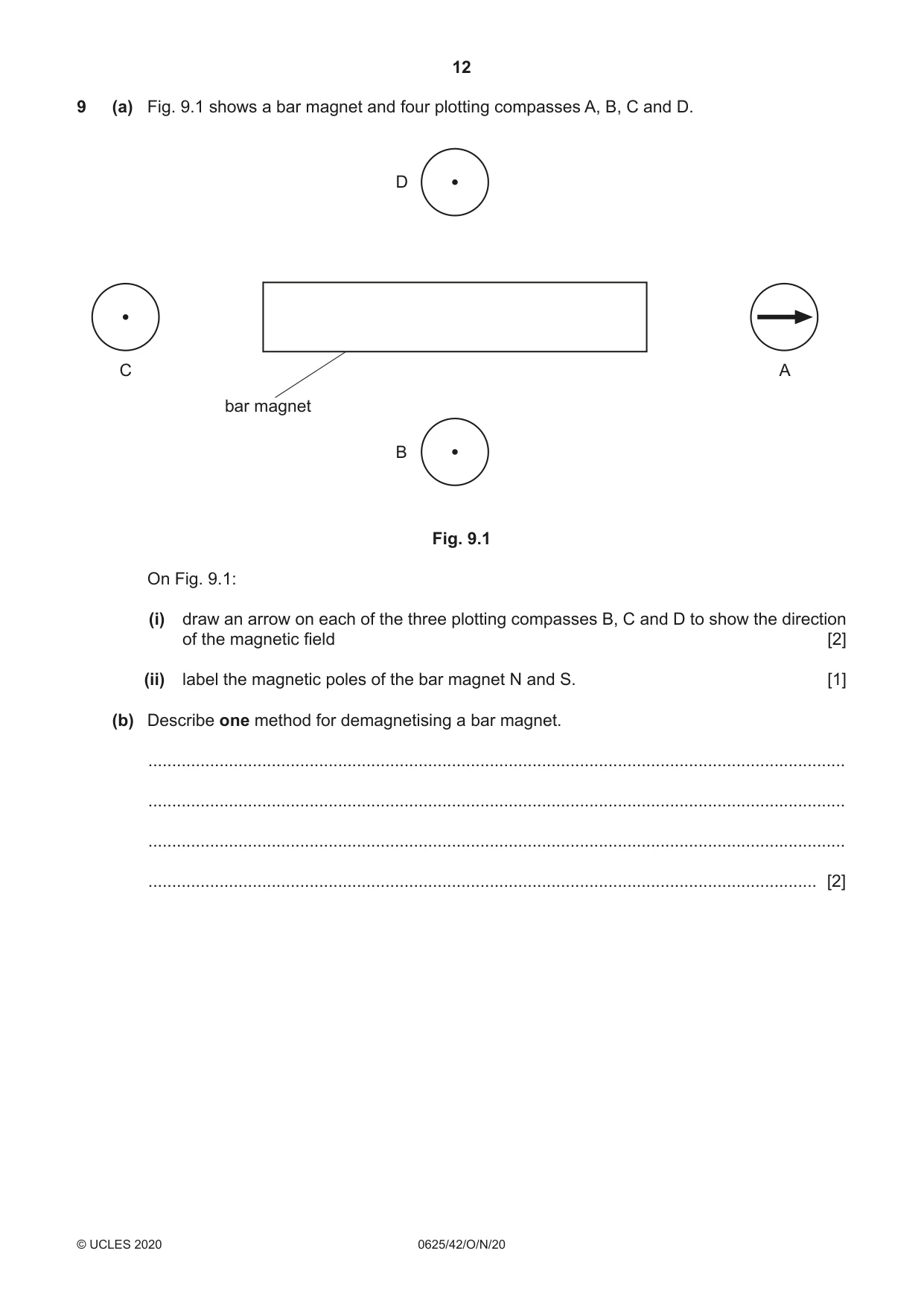
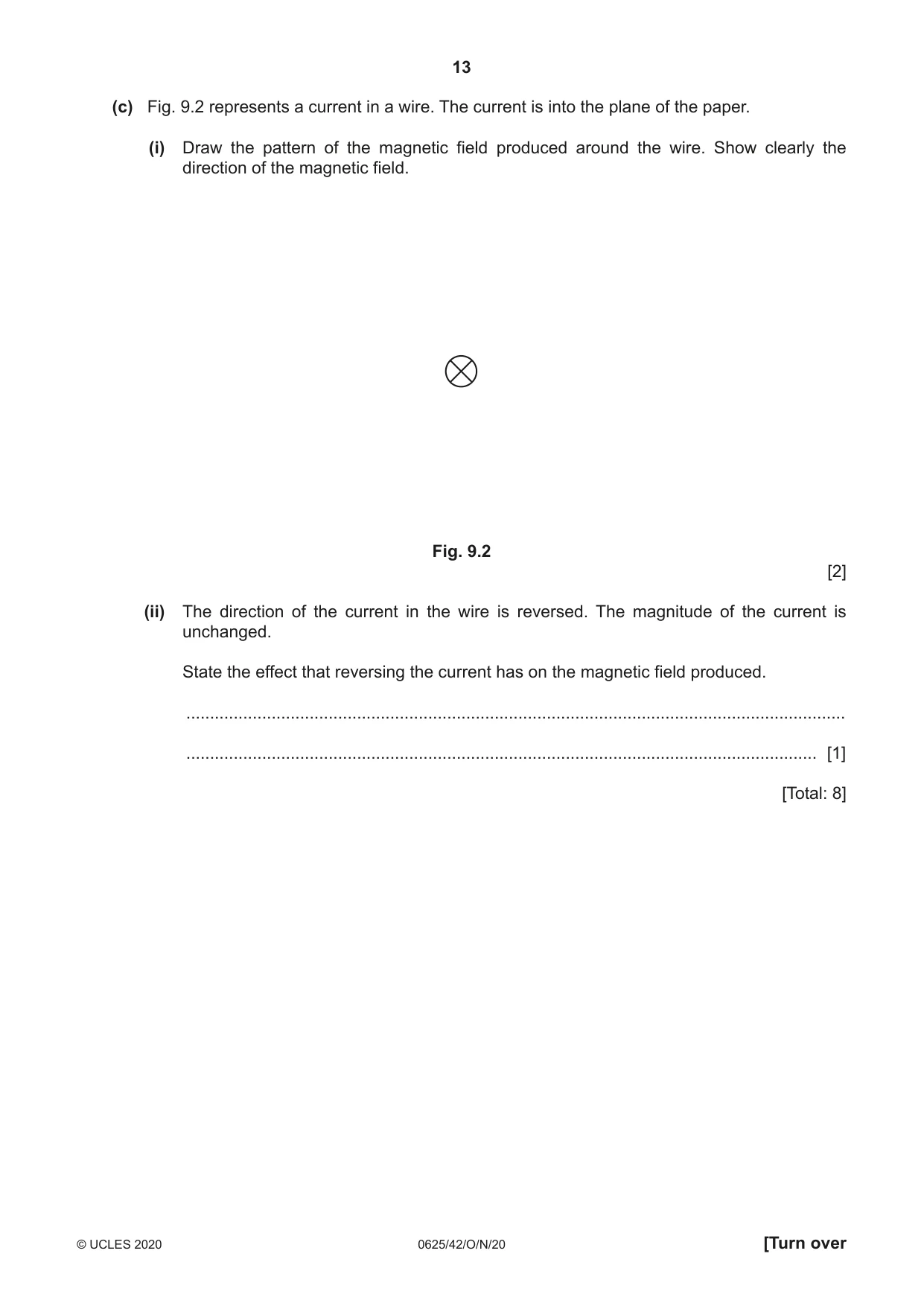
9 (a) Fig. 9.1 shows a bar magnet and four plotting compasses A, B, C and D. D C A bar magnet B Fig. 9.1 On Fig. 9.1: (i) draw an arrow on each of the three plotting compasses B, C and D to show the direction of the magnetic field [2] (ii) label the magnetic poles of the bar magnet N and S. [1] (b) Describe one method for demagnetising a bar magnet. ................................................................................................................................................... ................................................................................................................................................... ................................................................................................................................................... ............................................................................................................................................. [2] (c) Fig. 9.2 represents a current in a wire. The current is into the plane of the paper. (i) Draw the pattern of the magnetic field produced around the wire. Show clearly the direction of the magnetic field. Fig. 9.2 [2] (ii) The direction of the current in the wire is reversed. The magnitude of the current is unchanged. State the effect that reversing the current has on the magnetic field produced. ........................................................................................................................................... ..................................................................................................................................... [1] [Total: 8]
Mark scheme: 9(a)(i) C pointing horizontally to right B1 B AND D pointing horizontally to left B1 9(a)(ii) S on left AND N on right B1 9(b) any one of the following methods: 1 heat magnet C1 to high temperature / red hot A1 2 hammer the magnet (B1) repeatedly / in E–W direction (B1) 3 (place) magnet in a coil / solenoid carrying a.c. (M1) remove magnet from coil OR decrease current (slowly) to zero (A1) 9(c)(i) at least 3 concentric circles B1 closer together near the wire AND clockwise arrow B1 9(c)(ii) arrows OR field reverses / is in opposite direction B1
Q10 · An incomplete electrical circuit
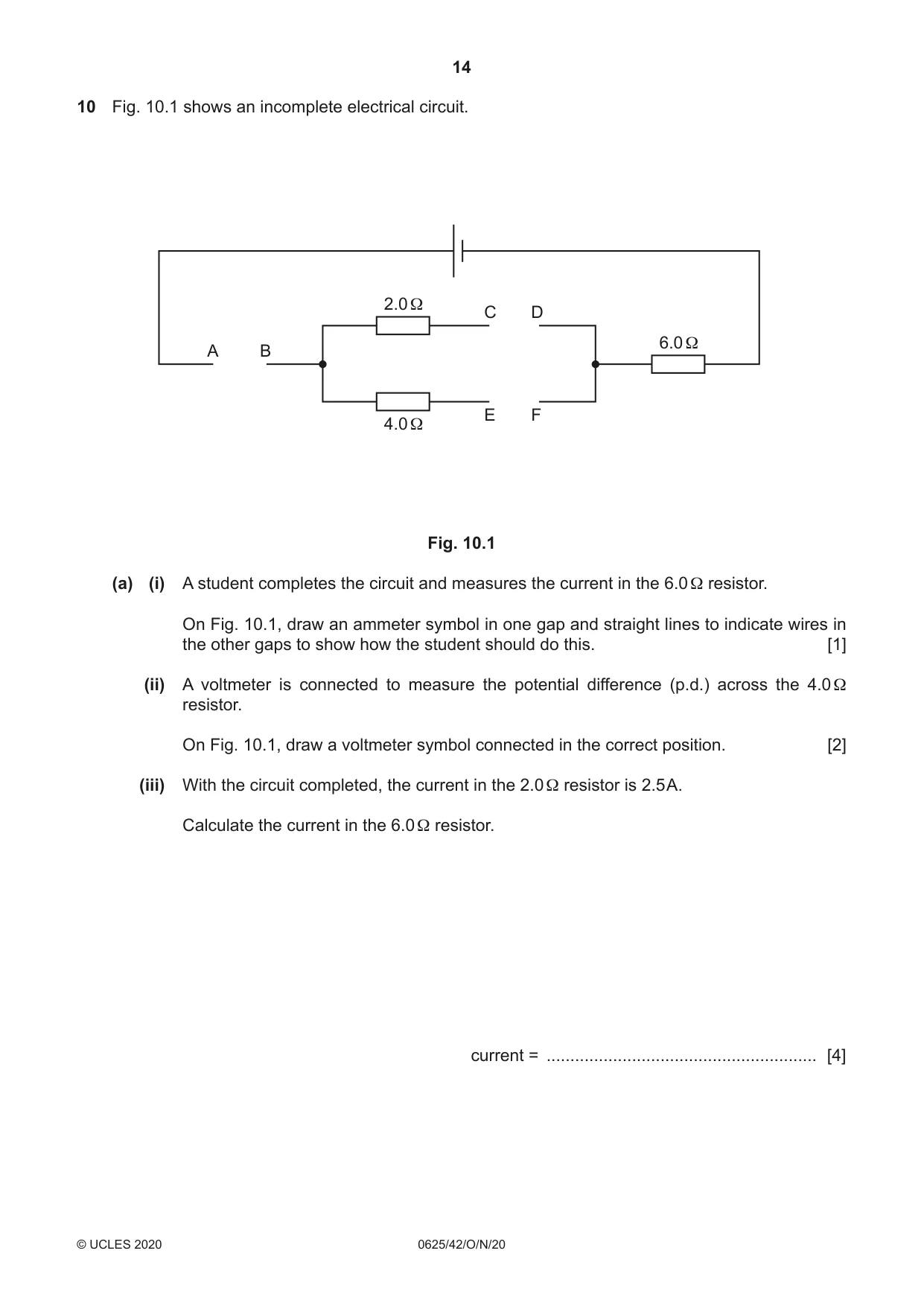
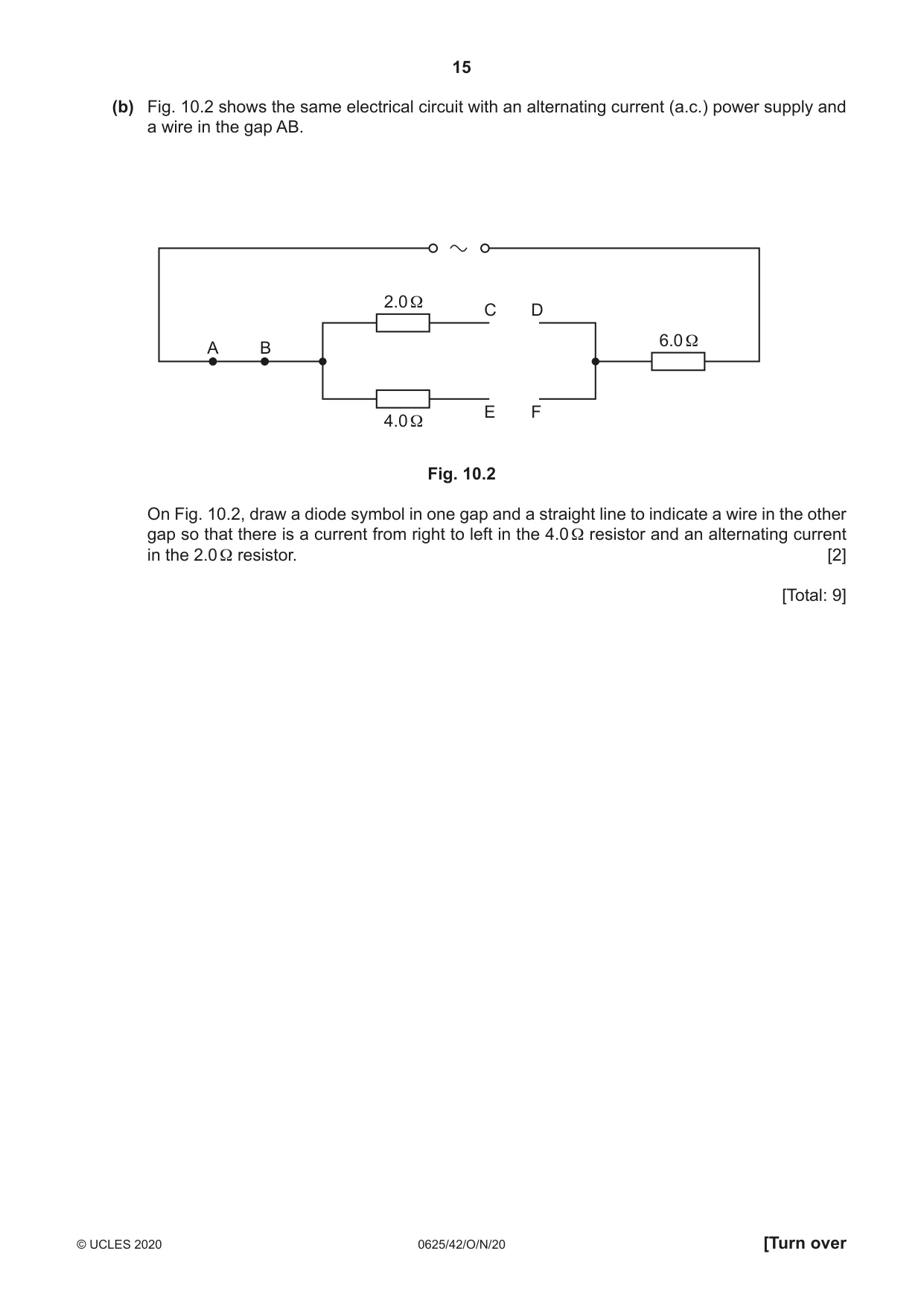
10 Fig. 10.1 shows an incomplete electrical circuit. 2.0 Ω C D 6.0 Ω A B E F 4.0 Ω Fig. 10.1 (a) (i) A student completes the circuit and measures the current in the 6.0 Ω resistor. On Fig. 10.1, draw an ammeter symbol in one gap and straight lines to indicate wires in the other gaps to show how the student should do this. [1] (ii) A voltmeter is connected to measure the potential difference (p.d.) across the 4.0 Ω resistor. On Fig. 10.1, draw a voltmeter symbol connected in the correct position. [2] (iii) With the circuit completed, the current in the 2.0 Ω resistor is 2.5 A. Calculate the current in the 6.0 Ω resistor. current = ......................................................... [4] (b) Fig. 10.2 shows the same electrical circuit with an alternating current (a.c.) power supply and a wire in the gap AB. 2.0 Ω C D 6.0 Ω A B E F 4.0 Ω Fig. 10.2 On Fig. 10.2, draw a diode symbol in one gap and a straight line to indicate a wire in the other gap so that there is a current from right to left in the 4.0 Ω resistor and an alternating current in the 2.0 Ω resistor. [2] [Total: 9]
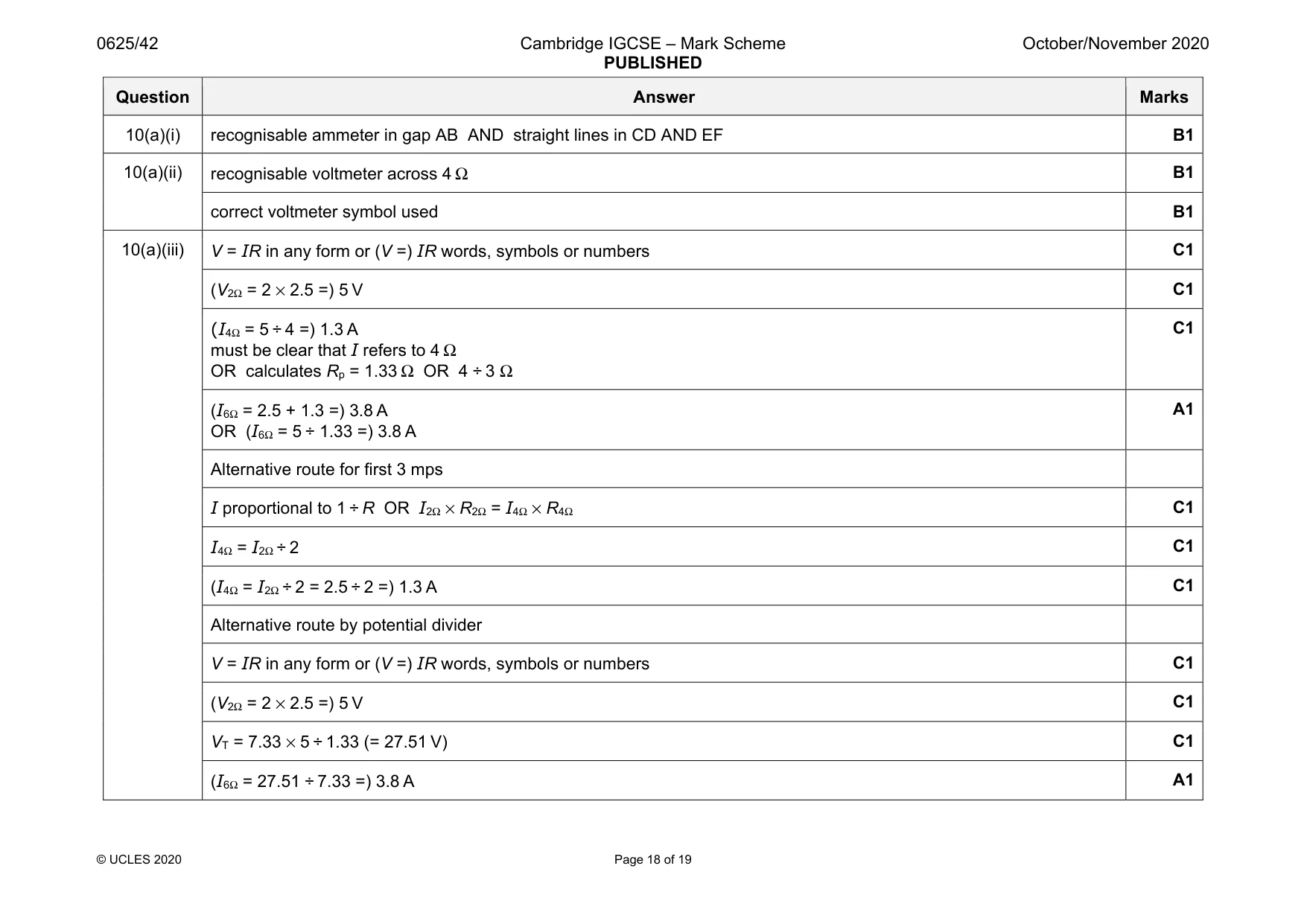
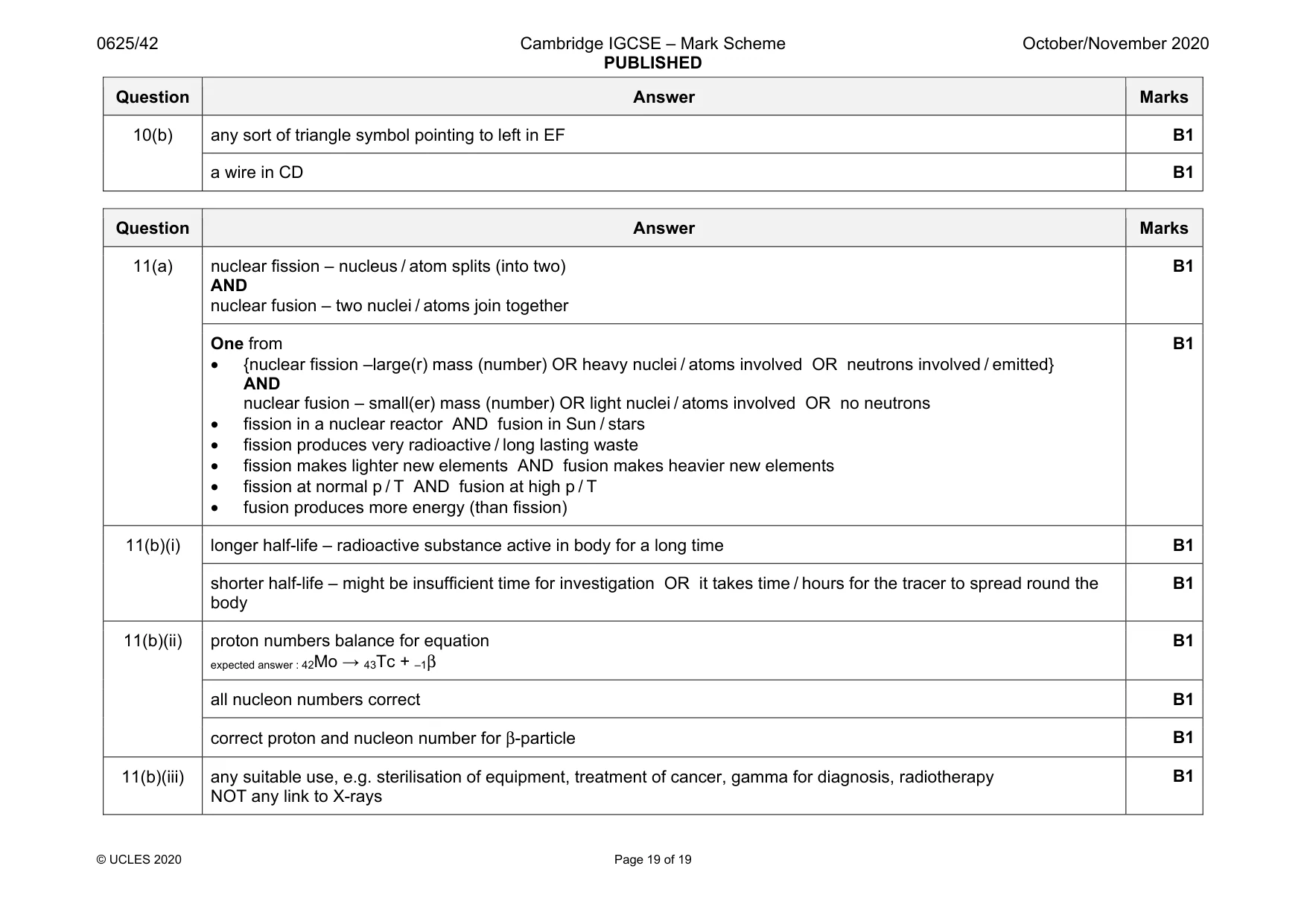
Mark scheme: 10(a)(i) recognisable ammeter in gap AB AND straight lines in CD AND EF B1 10(a)(ii) recognisable voltmeter across 4 Ω B1 correct voltmeter symbol used B1 10(a)(iii) V = IR in any form or (V =) IR words, symbols or numbers C1 (V2Ω = 2 × 2.5 =) 5 V C1 (I4Ω = 5 ÷ 4 =) 1.3 A must be clear that I refers to 4 Ω OR calculates Rp = 1.33 Ω OR 4 ÷ 3 Ω C1 (I6Ω = 2.5 + 1.3 =) 3.8 A OR (I6Ω = 5 ÷ 1.33 =) 3.8 A A1 Alternative route for first 3 mps I proportional to 1 ÷ R OR I2Ω × R2Ω = I4Ω × R4Ω C1 I4Ω = I2Ω ÷ 2 C1 (I4Ω = I2Ω ÷ 2 = 2.5 ÷ 2 =) 1.3 A C1 Alternative route by potential divider V = IR in any form or (V =) IR words, symbols or numbers C1 (V2Ω = 2 × 2.5 =) 5 V C1 VT = 7.33 × 5 ÷ 1.33 (= 27.51 V) C1 (I6Ω = 27.51 ÷ 7.33 =) 3.8 A A1 Question Answer Marks 10(b) any sort of triangle symbol pointing to left in EF B1 a wire in CD B1
Q11 · State two differences between nuclear fission and nuclear fusion
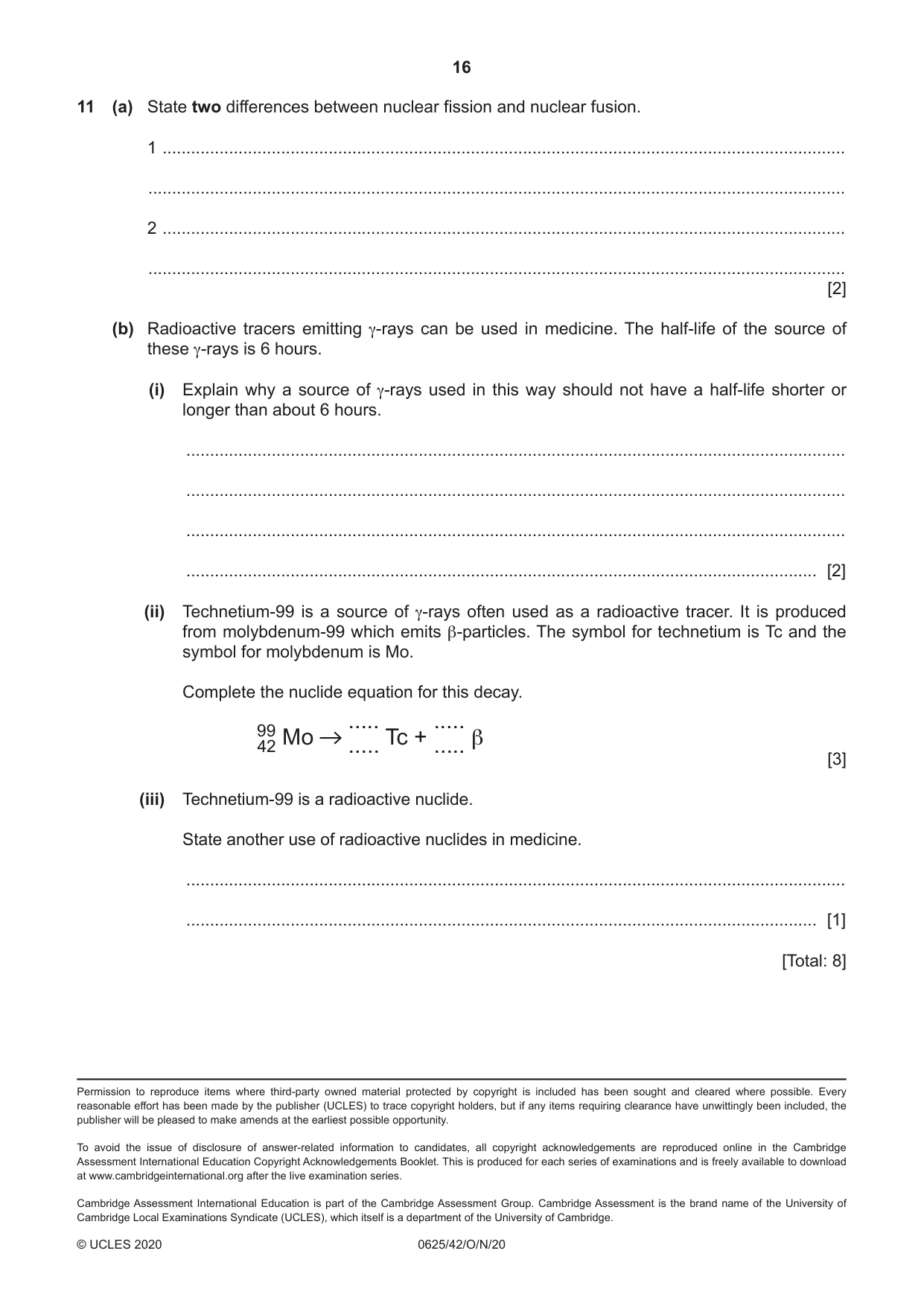
11 (a) State two differences between nuclear fission and nuclear fusion. 1 ................................................................................................................................................ ................................................................................................................................................... 2 ................................................................................................................................................ ................................................................................................................................................... [2] (b) Radioactive tracers emitting γ-rays can be used in medicine. The half-life of the source of these γ-rays is 6 hours. (i) Explain why a source of γ-rays used in this way should not have a half-life shorter or longer than about 6 hours. ........................................................................................................................................... ........................................................................................................................................... ........................................................................................................................................... ..................................................................................................................................... [2] (ii) Technetium-99 is a source of γ-rays often used as a radioactive tracer. It is produced from molybdenum-99 which emits β-particles. The symbol for technetium is Tc and the symbol for molybdenum is Mo. Complete the nuclide equation for this decay. ..... ..... 99 Mo Tc + β 42 ..... ..... [3] (iii) Technetium-99 is a radioactive nuclide. State another use of radioactive nuclides in medicine. ........................................................................................................................................... ..................................................................................................................................... [1] [Total: 8]
Mark scheme: 11(a) nuclear fission – nucleus / atom splits (into two) AND nuclear fusion – two nuclei / atoms join together B1 One from • {nuclear fission –large(r) mass (number) OR heavy nuclei / atoms involved OR neutrons involved / emitted} AND nuclear fusion – small(er) mass (number) OR light nuclei / atoms involved OR no neutrons • fission in a nuclear reactor AND fusion in Sun / stars • fission produces very radioactive / long lasting waste • fission makes lighter new elements AND fusion makes heavier new elements • fission at normal p / T AND fusion at high p / T • fusion produces more energy (than fission) B1 11(b)(i) longer half-life – radioactive substance active in body for a long time B1 shorter half-life – might be insufficient time for investigation OR it takes time / hours for the tracer to spread round the body B1 11(b)(ii) proton numbers balance for equation expected answer : 42Mo → 43Tc + –1β B1 all nucleon numbers correct B1 correct proton and nucleon number for β-particle B1 11(b)(iii) any suitable use, e.g. sterilisation of equipment, treatment of cancer, gamma for diagnosis, radiotherapy NOT any link to X-rays B1
What was in this paper
The subtopics covered by these 11 questions, and how many questions each got. Open one in a new tab to see every Cambridge question on it.
What you needed in this session
Cambridge’s own grade thresholds for 2020 Oct/Nov, Paper 4 · Variant 2. A higher threshold means an easier paper — the bar moves with how the cohort did.