Cambridge IGCSE Physics 0625 — 2018 May/June Paper 4 · Variant 3
0625/43/M/J/18 · 11 questions · 80 marks · ≈90 min
The question paper and its mark scheme, free to read here and free to download. This is Cambridge’s own paper, exactly as it was sat.
Question paper16 pages
Mark scheme9 pages
Answers below. Sit the paper first if you are practising.
Questions as text
Q1 · There is no atmosphere on the Moon
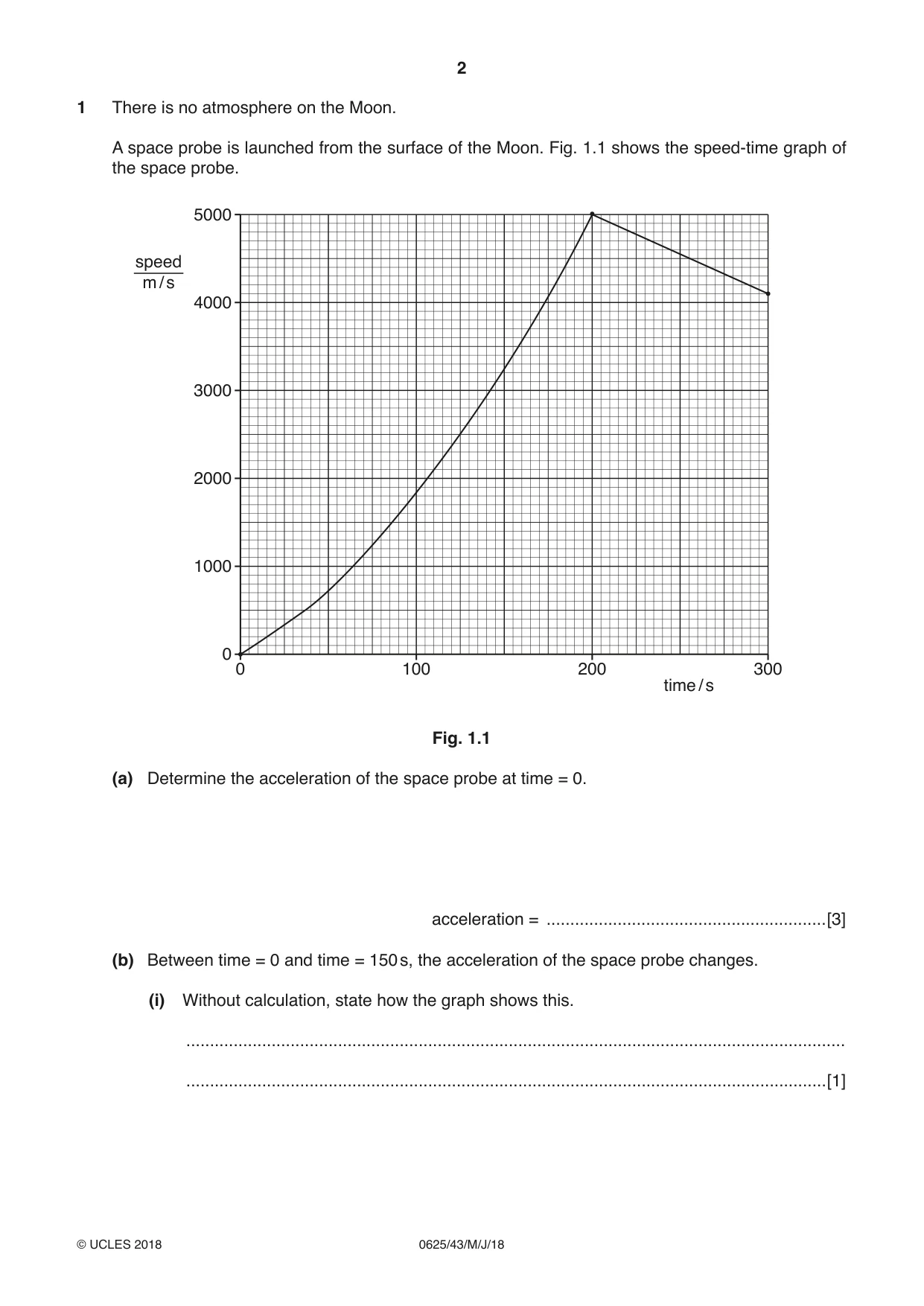
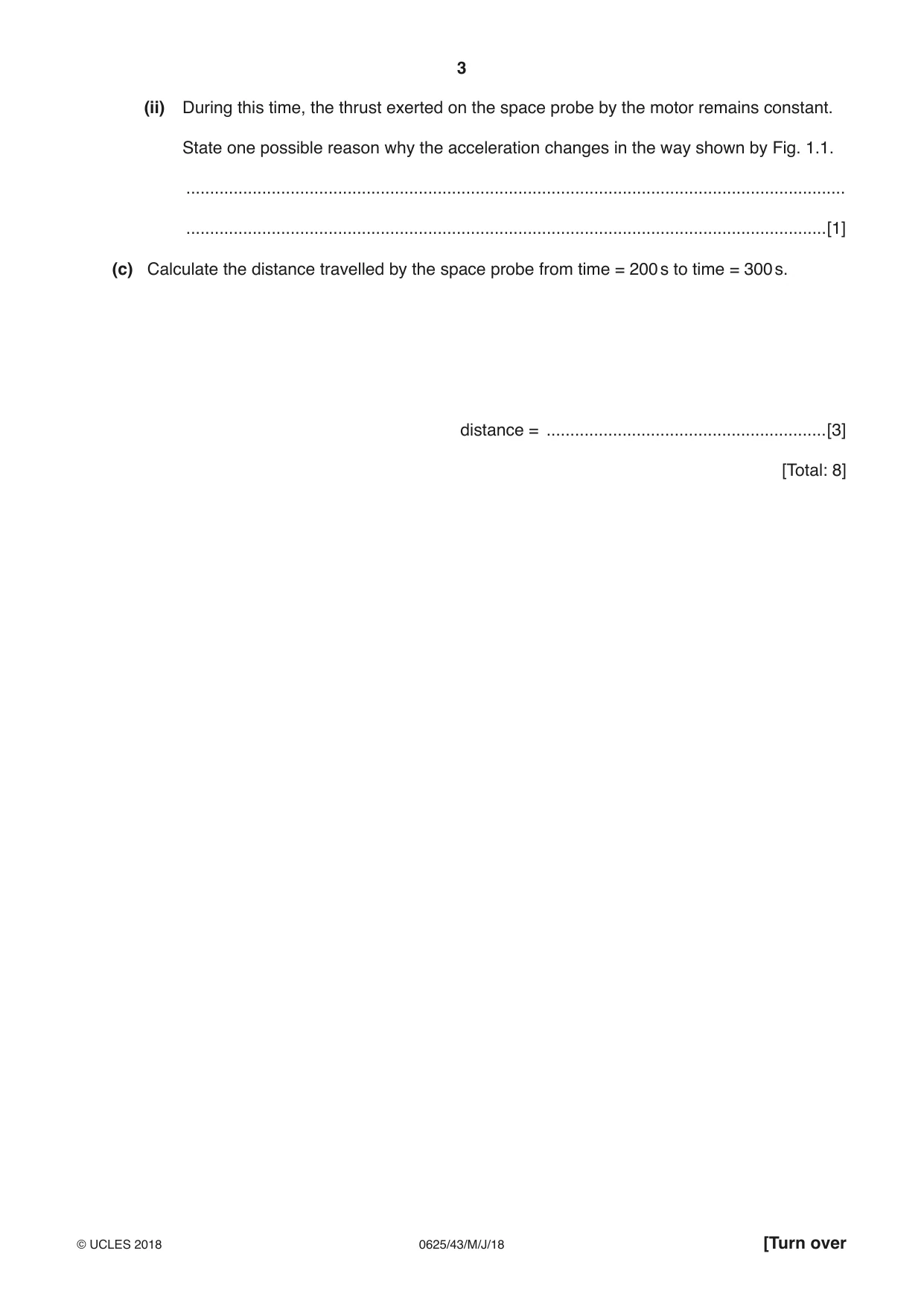
1 There is no atmosphere on the Moon. A space probe is launched from the surface of the Moon. Fig. 1.1 shows the speed-time graph of the space probe. 5000 speed m / s 4000 3000 2000 1000 0 0 100 200 300 time / s Fig. 1.1 (a) Determine the acceleration of the space probe at time = 0. acceleration = ...........................................................[3] (b) Between time = 0 and time = 150 s, the acceleration of the space probe changes. (i) Without calculation, state how the graph shows this. ........................................................................................................................................... .......................................................................................................................................[1] (ii) During this time, the thrust exerted on the space probe by the motor remains constant. State one possible reason why the acceleration changes in the way shown by Fig. 1.1. ........................................................................................................................................... .......................................................................................................................................[1] (c) Calculate the distance travelled by the space probe from time = 200 s to time = 300 s. distance = ...........................................................[3] [Total: 8]
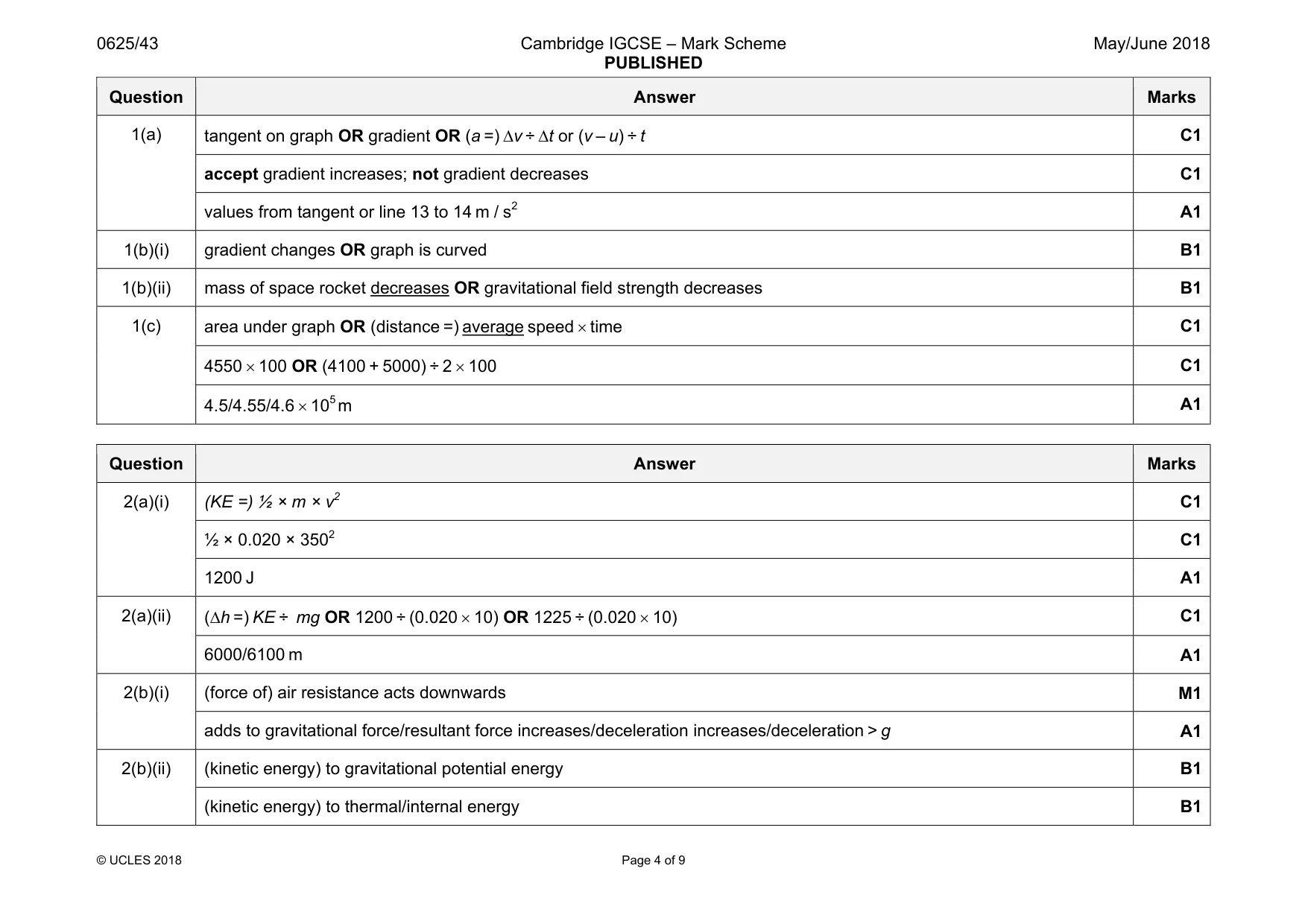
Mark scheme: 1(a) C1 accept gradient increases; not gradient decreases C1 values from tangent or line 13 to 14 m / s2 A1 1(b)(i) gradient changes OR graph is curved B1 1(b)(ii) mass of space rocket decreases OR gravitational field strength decreases B1 1(c) area under graph OR (distance =) average speed × time C1 4550 × 100 OR (4100 + 5000) ÷ 2 × 100 C1 4.5/4.55/4.6 × 105 m A1
Q2 · A rifle fires a bullet of mass 0.020 kg vertically upwards through the air
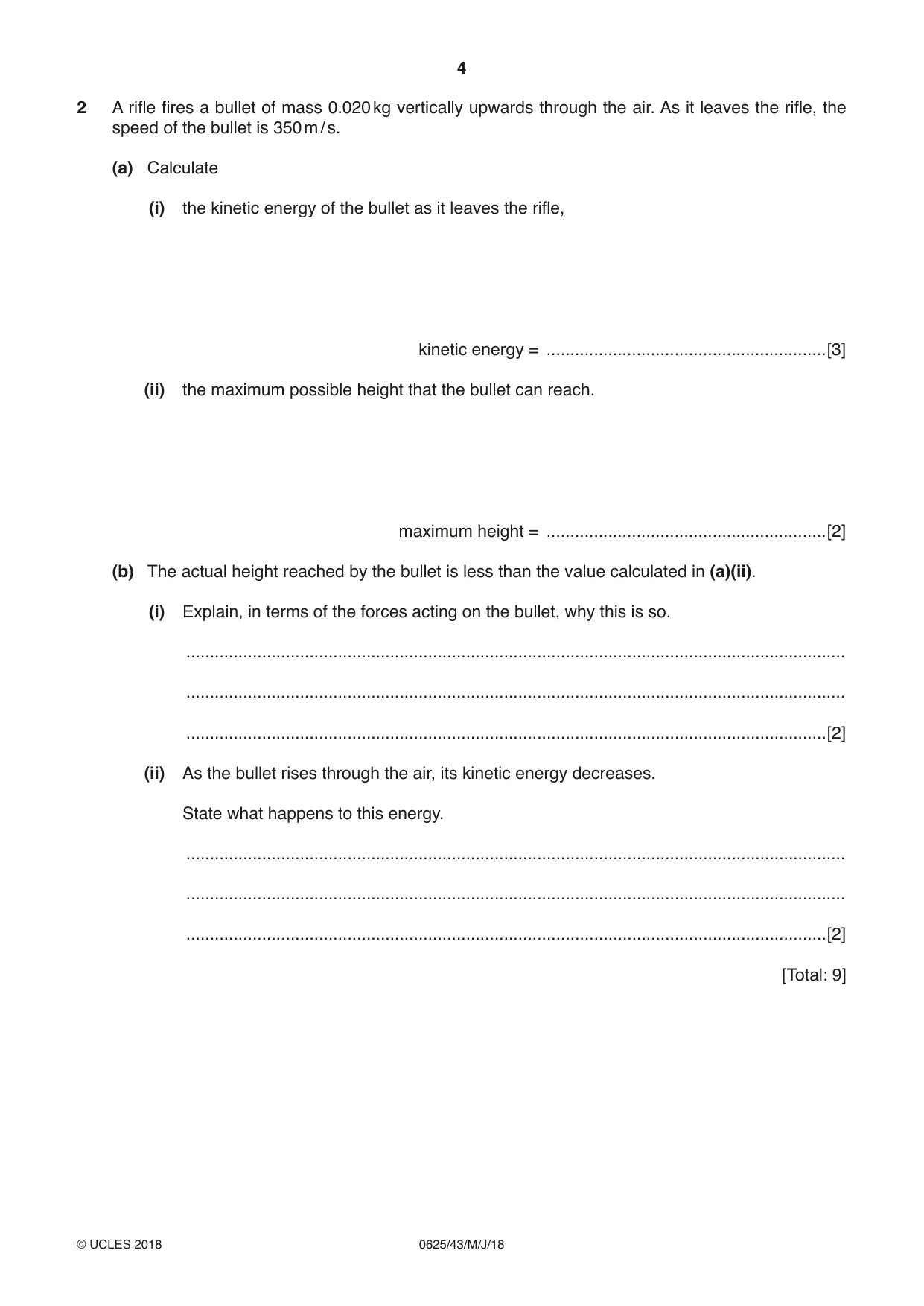
2 A rifle fires a bullet of mass 0.020 kg vertically upwards through the air. As it leaves the rifle, the speed of the bullet is 350 m / s. (a) Calculate (i) the kinetic energy of the bullet as it leaves the rifle, kinetic energy = ...........................................................[3] (ii) the maximum possible height that the bullet can reach. maximum height = ...........................................................[2] (b) The actual height reached by the bullet is less than the value calculated in (a)(ii). (i) Explain, in terms of the forces acting on the bullet, why this is so. ........................................................................................................................................... ........................................................................................................................................... .......................................................................................................................................[2] (ii) As the bullet rises through the air, its kinetic energy decreases. State what happens to this energy. ........................................................................................................................................... ........................................................................................................................................... .......................................................................................................................................[2] [Total: 9]
Mark scheme: 2(a)(i) C1 ½ × 0.020 × 3502 C1 1200 J A1 2(a)(ii) (∆h =) KE ÷ mg OR 1200 ÷ (0.020 × 10) OR 1225 ÷ (0.020 × 10) C1 6000/6100 m A1 2(b)(i) (force of) air resistance acts downwards M1 adds to gravitational force/resultant force increases/deceleration increases/deceleration > g A1 2(b)(ii) (kinetic energy) to gravitational potential energy B1 (kinetic energy) to thermal/internal energy B1
Q3 · On a particular day, the atmospheric pressure is 1.0 × 10⁵ Pa
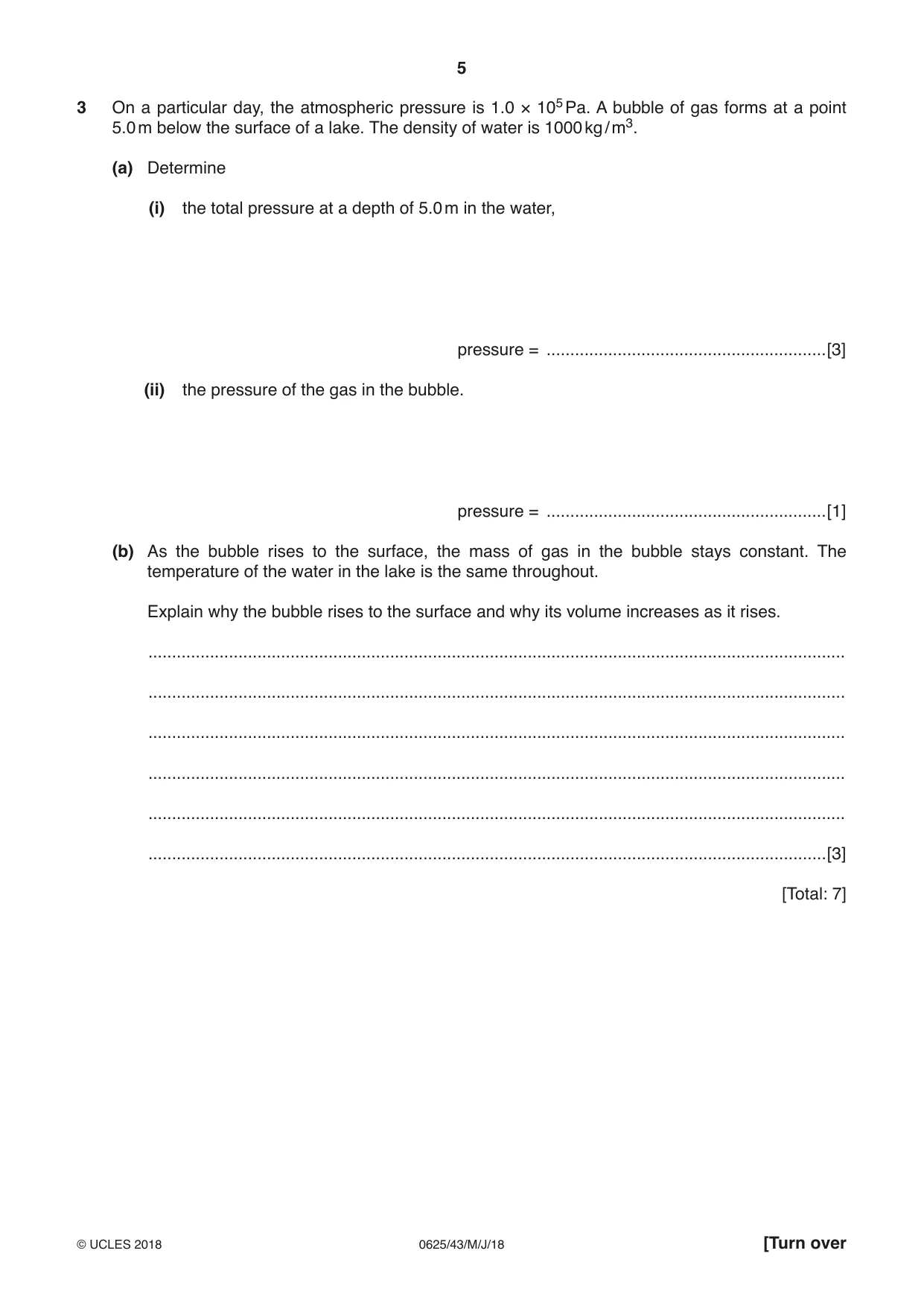
3 On a particular day, the atmospheric pressure is 1.0 × 10⁵ Pa. A bubble of gas forms at a point 5.0 m below the surface of a lake. The density of water is 1000 kg / m3. (a) Determine (i) the total pressure at a depth of 5.0 m in the water, pressure = ...........................................................[3] (ii) the pressure of the gas in the bubble. pressure = ...........................................................[1] (b) As the bubble rises to the surface, the mass of gas in the bubble stays constant. The temperature of the water in the lake is the same throughout. Explain why the bubble rises to the surface and why its volume increases as it rises. ................................................................................................................................................... ................................................................................................................................................... ................................................................................................................................................... ................................................................................................................................................... ................................................................................................................................................... ...............................................................................................................................................[3] [Total: 7]
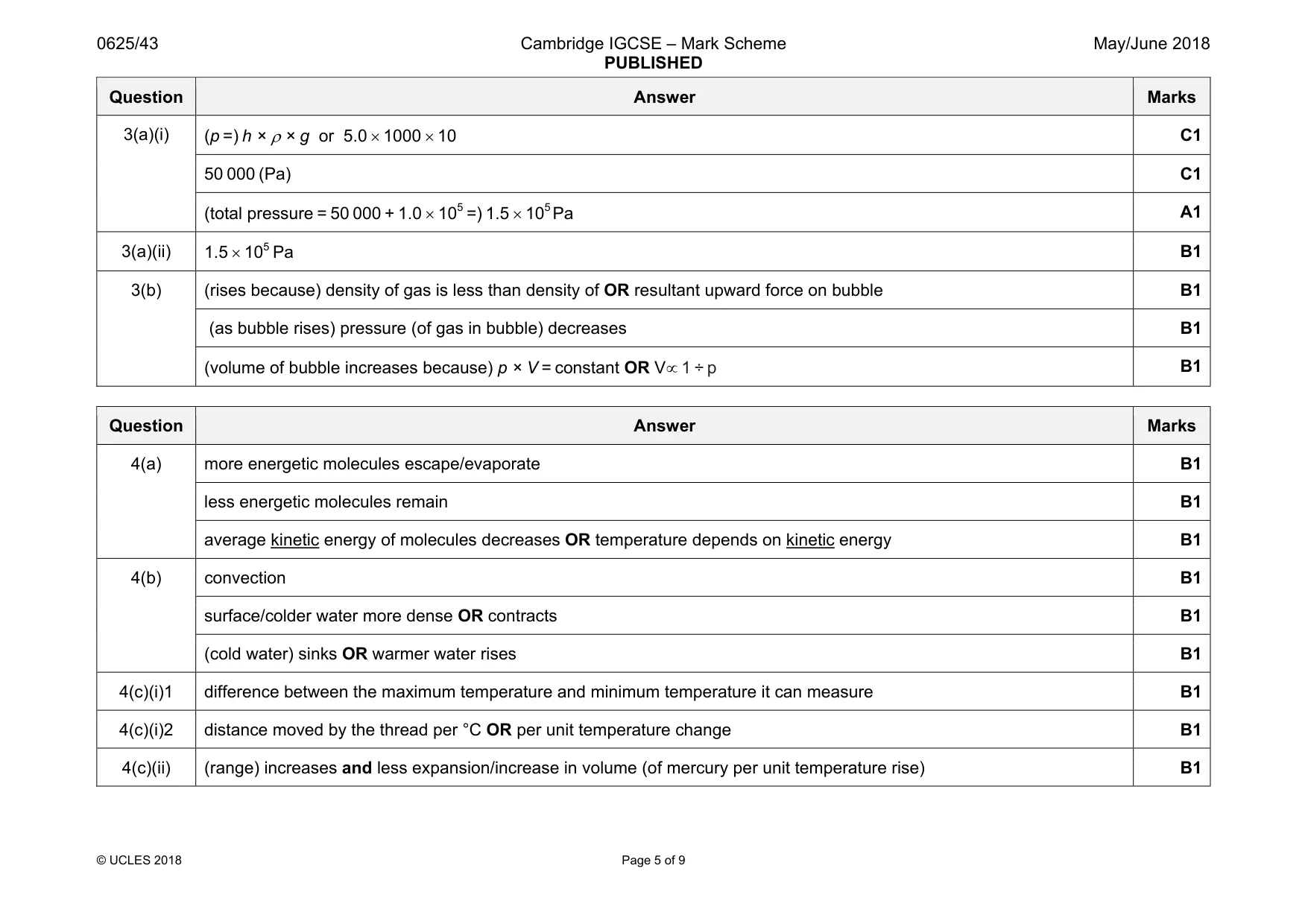
Mark scheme: 3(a)(i) C1 50 000 (Pa) C1 (total pressure = 50 000 + 1.0 × 105 =) 1.5 × 10⁵Pa A1 3(a)(ii) 1.5 × 10⁵ Pa B1 3(b) (rises because) density of gas is less than density of OR resultant upward force on bubble B1 (as bubble rises) pressure (of gas in bubble) decreases B1 (volume of bubble increases because) p × V = constant OR V∝ 1 ÷ p B1
Q4 · A beaker contains some water at room temperature
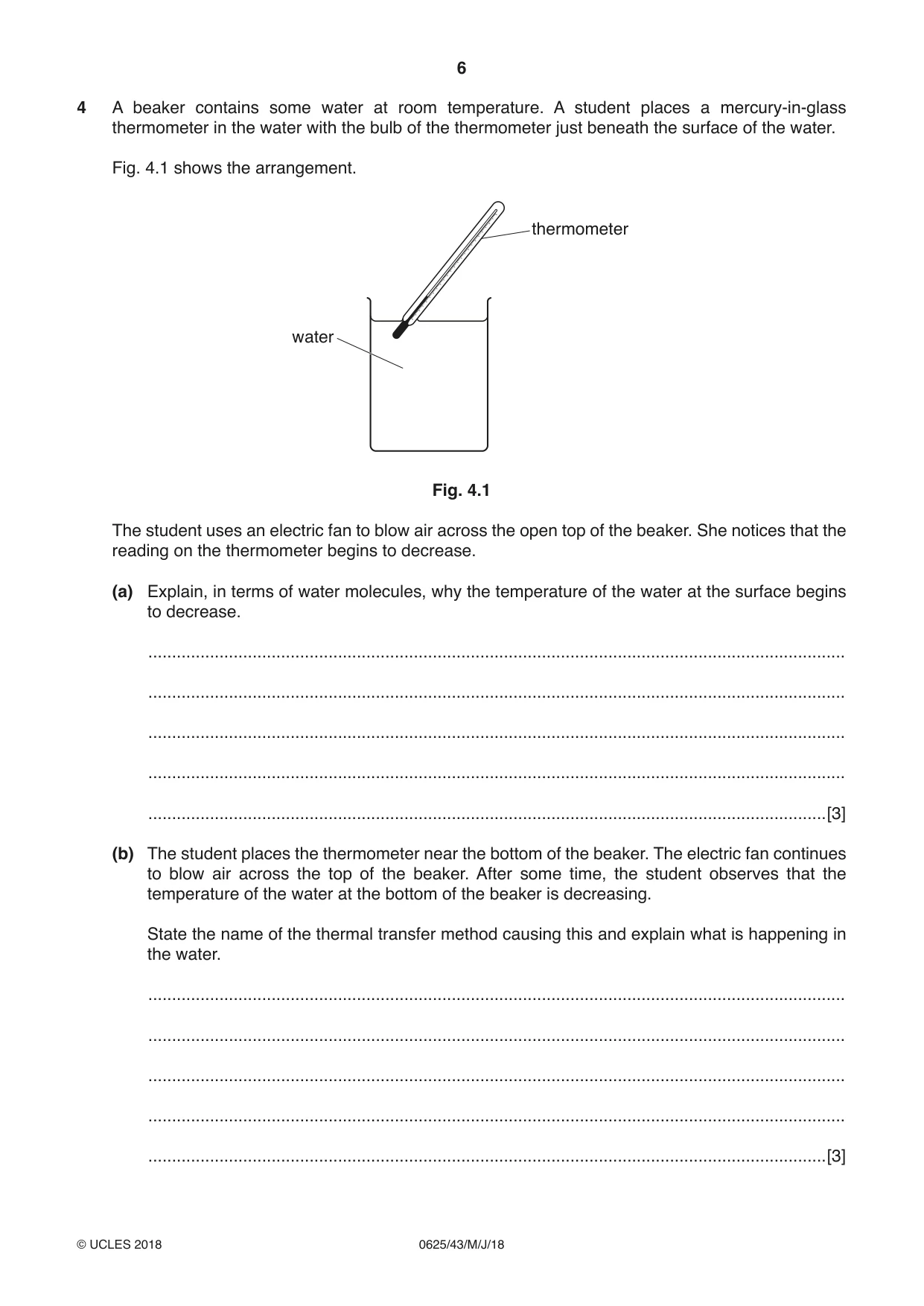
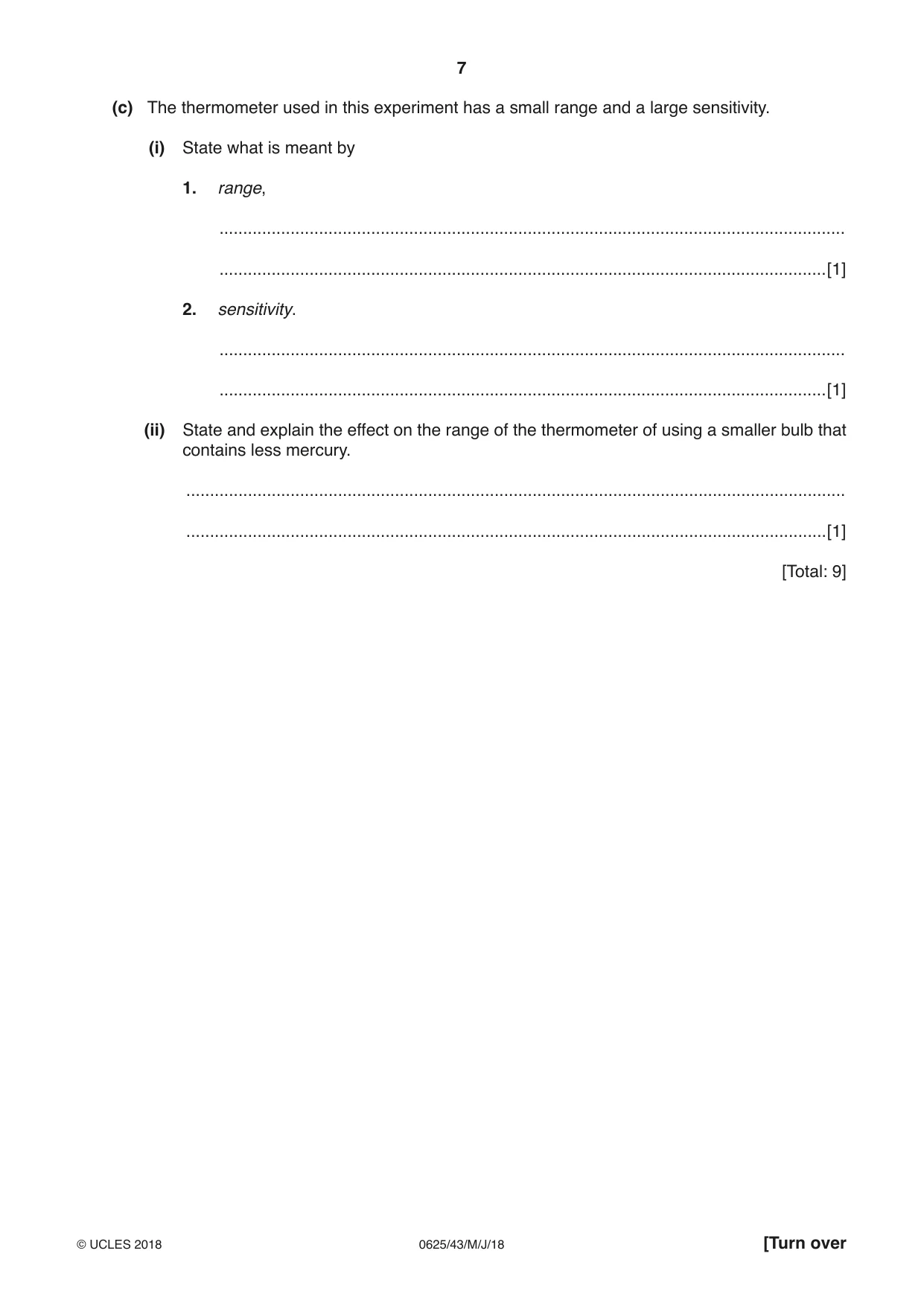
4 A beaker contains some water at room temperature. A student places a mercury-in-glass thermometer in the water with the bulb of the thermometer just beneath the surface of the water. Fig. 4.1 shows the arrangement. thermometer water Fig. 4.1 The student uses an electric fan to blow air across the open top of the beaker. She notices that the reading on the thermometer begins to decrease. (a) Explain, in terms of water molecules, why the temperature of the water at the surface begins to decrease. ................................................................................................................................................... ................................................................................................................................................... ................................................................................................................................................... ................................................................................................................................................... ...............................................................................................................................................[3] (b) The student places the thermometer near the bottom of the beaker. The electric fan continues to blow air across the top of the beaker. After some time, the student observes that the temperature of the water at the bottom of the beaker is decreasing. State the name of the thermal transfer method causing this and explain what is happening in the water. ................................................................................................................................................... ................................................................................................................................................... ................................................................................................................................................... ................................................................................................................................................... ...............................................................................................................................................[3] (c) The thermometer used in this experiment has a small range and a large sensitivity. (i) State what is meant by 1. range, .................................................................................................................................... ................................................................................................................................[1] 2. sensitivity. .................................................................................................................................... ................................................................................................................................[1] (ii) State and explain the effect on the range of the thermometer of using a smaller bulb that contains less mercury. ........................................................................................................................................... .......................................................................................................................................[1] [Total: 9]
Mark scheme: 4(a) more energetic molecules escape/evaporate B1 less energetic molecules remain B1 average kinetic energy of molecules decreases OR temperature depends on kinetic energy B1 4(b) convection B1 surface/colder water more dense OR contracts B1 (cold water) sinks OR warmer water rises B1 4(c)(i)1 difference between the maximum temperature and minimum temperature it can measure B1 4(c)(i)2 distance moved by the thread per °C OR per unit temperature change B1 4(c)(ii) (range) increases and less expansion/increase in volume (of mercury per unit temperature rise) B1
Q5 · A microscope that produces a very high magnification is used to observe the Brownian…
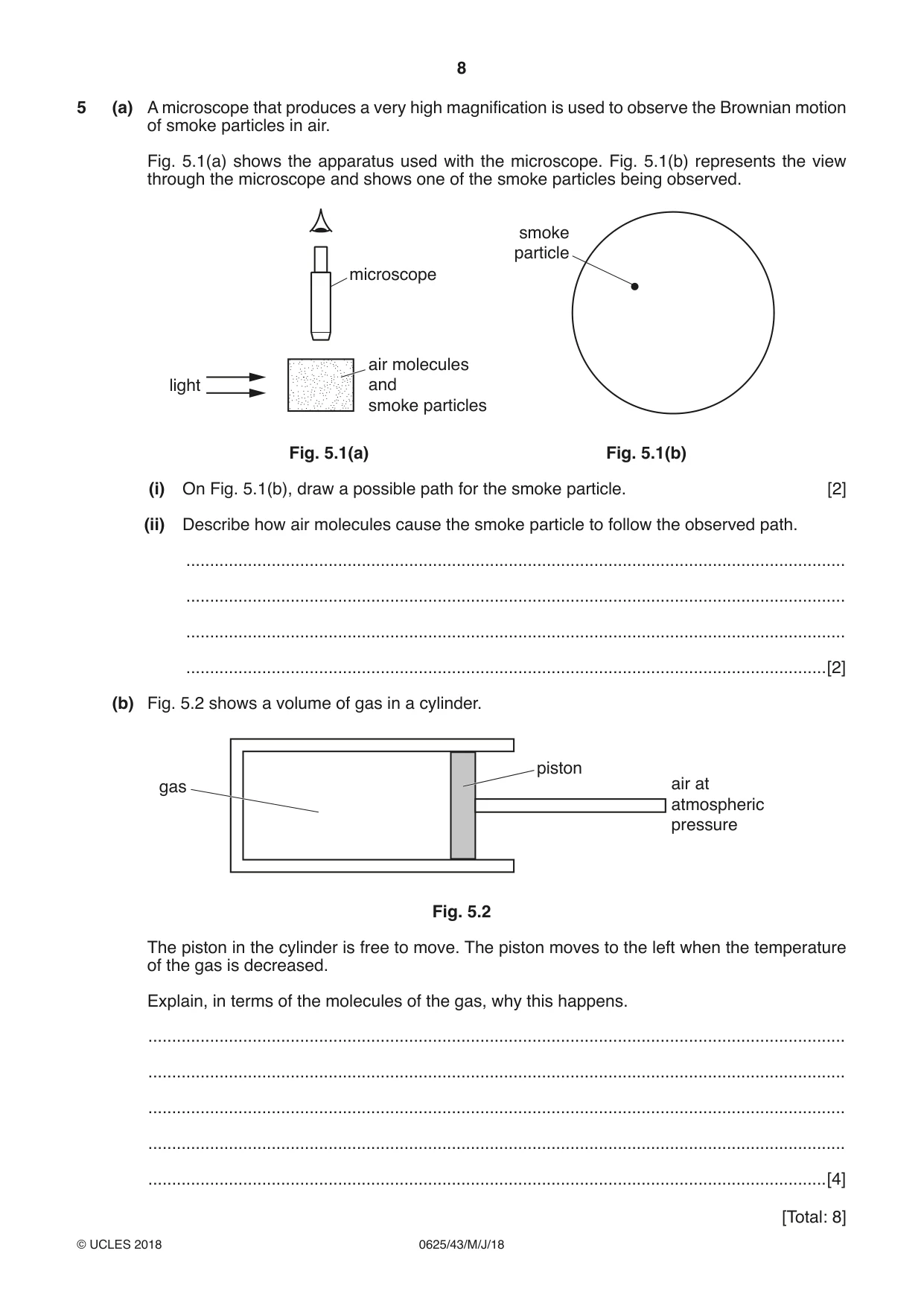
5 (a) A microscope that produces a very high magnification is used to observe the Brownian motion of smoke particles in air. Fig. 5.1(a) shows the apparatus used with the microscope. Fig. 5.1(b) represents the view through the microscope and shows one of the smoke particles being observed. smoke particle microscope air molecules light and smoke particles Fig. 5.1(a) Fig. 5.1(b) (i) On Fig. 5.1(b), draw a possible path for the smoke particle. [2] (ii) Describe how air molecules cause the smoke particle to follow the observed path. ........................................................................................................................................... ........................................................................................................................................... ........................................................................................................................................... .......................................................................................................................................[2] (b) Fig. 5.2 shows a volume of gas in a cylinder. piston gas air at atmospheric pressure Fig. 5.2 The piston in the cylinder is free to move. The piston moves to the left when the temperature of the gas is decreased. Explain, in terms of the molecules of the gas, why this happens. ................................................................................................................................................... ................................................................................................................................................... ................................................................................................................................................... ................................................................................................................................................... ...............................................................................................................................................[4] [Total: 8]
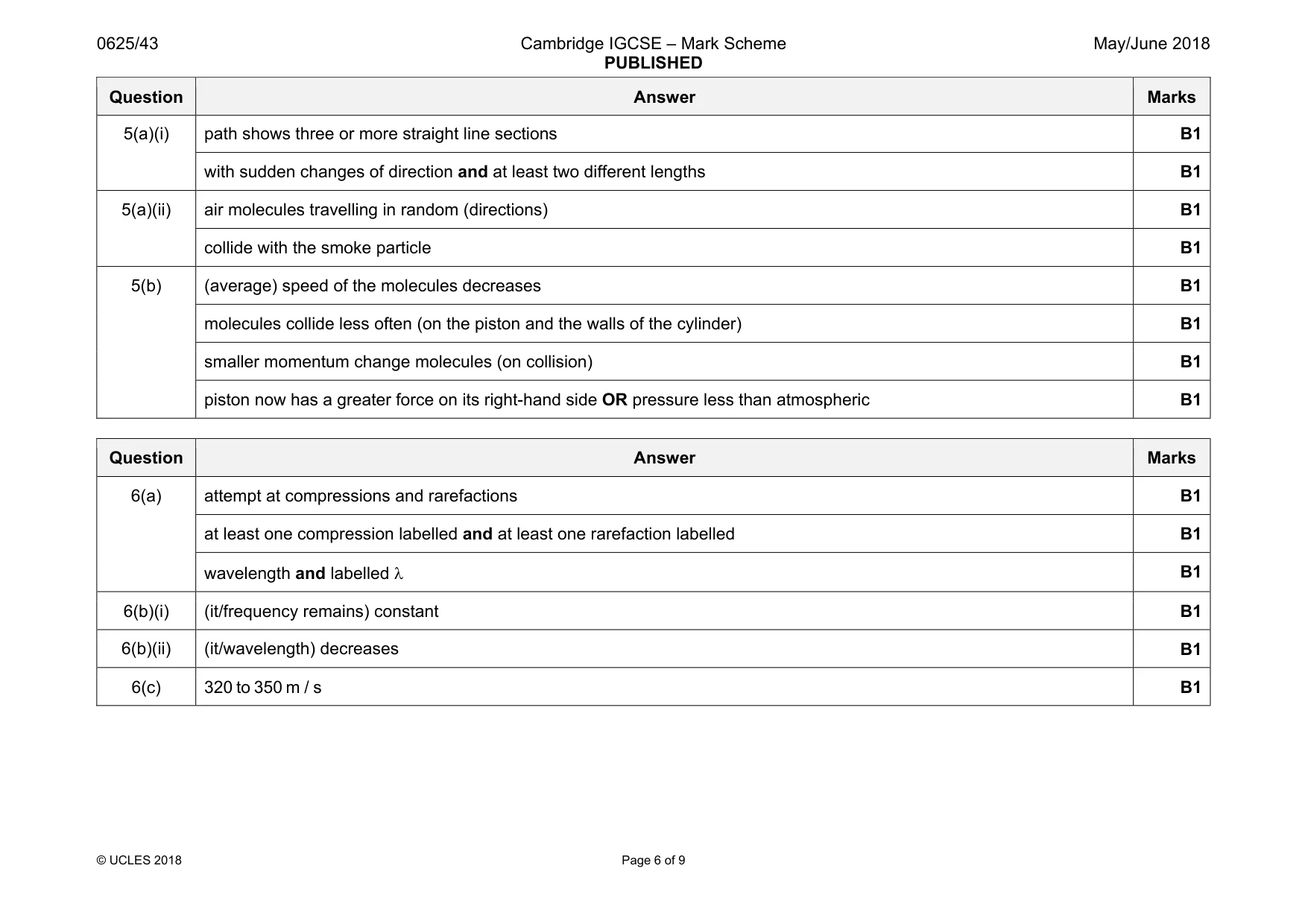
Mark scheme: 5(a)(i) path shows three or more straight line sections B1 with sudden changes of direction and at least two different lengths B1 5(a)(ii) air molecules travelling in random (directions) B1 collide with the smoke particle B1 5(b) (average) speed of the molecules decreases B1 molecules collide less often (on the piston and the walls of the cylinder) B1 smaller momentum change molecules (on collision) B1 piston now has a greater force on its right-hand side OR pressure less than atmospheric B1
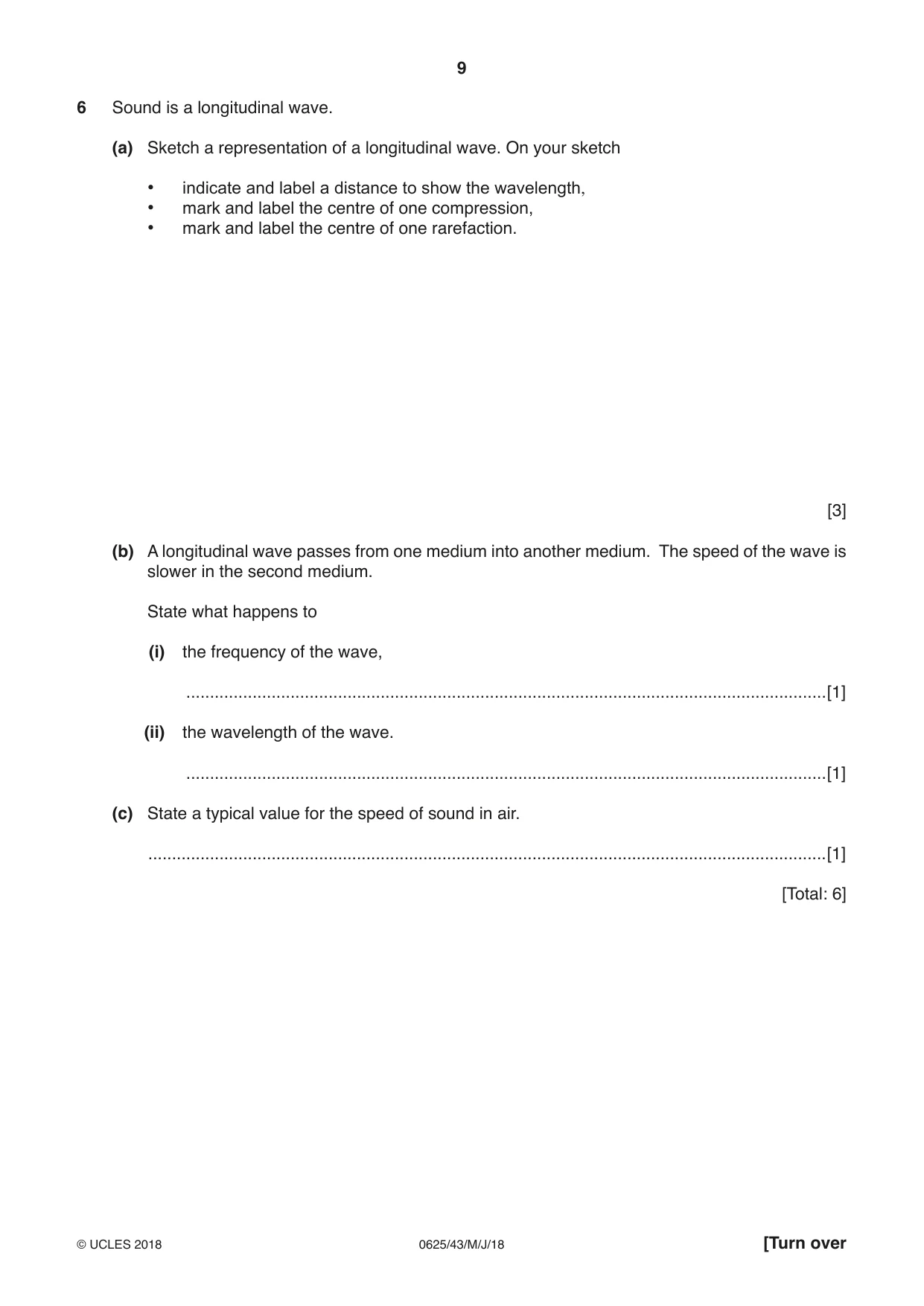
Q6 · Sound is a longitudinal wave
6 Sound is a longitudinal wave. (a) Sketch a representation of a longitudinal wave. On your sketch • indicate and label a distance to show the wavelength, • mark and label the centre of one compression, • mark and label the centre of one rarefaction. [3] (b) A longitudinal wave passes from one medium into another medium. The speed of the wave is slower in the second medium. State what happens to (i) the frequency of the wave, .......................................................................................................................................[1] (ii) the wavelength of the wave. .......................................................................................................................................[1] (c) State a typical value for the speed of sound in air. ...............................................................................................................................................[1] [Total: 6]
Mark scheme: 6(a) attempt at compressions and rarefactions B1 at least one compression labelled and at least one rarefaction labelled B1 wavelength and labelled λ B1 6(b)(i) (it/frequency remains) constant B1 6(b)(ii) (it/wavelength) decreases B1 6(c) 320 to 350 m / s B1
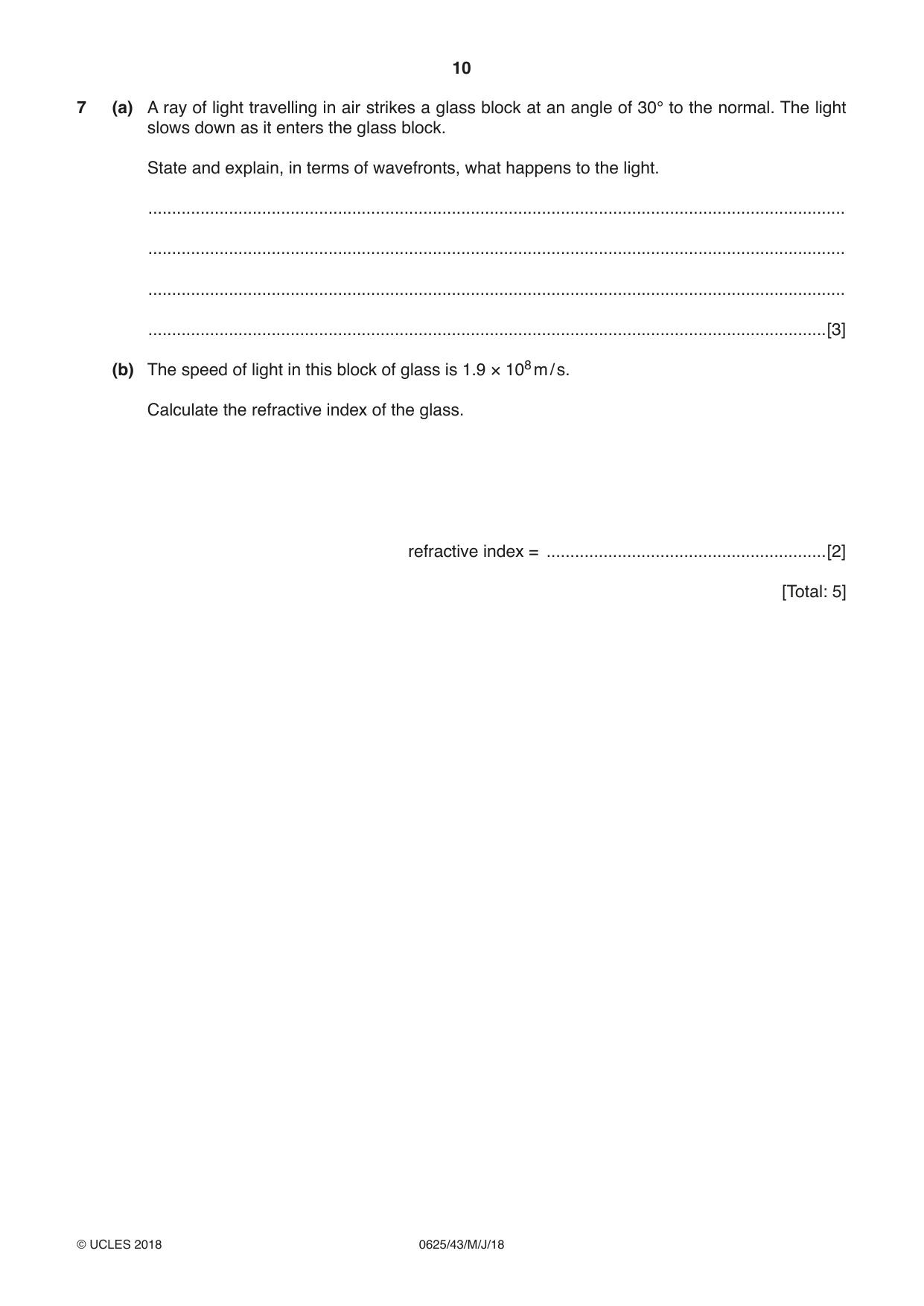
Q7 · A ray of light travelling in air strikes a glass block at an angle of 30° to the normal
7 (a) A ray of light travelling in air strikes a glass block at an angle of 30° to the normal. The light slows down as it enters the glass block. State and explain, in terms of wavefronts, what happens to the light. ................................................................................................................................................... ................................................................................................................................................... ................................................................................................................................................... ...............................................................................................................................................[3] (b) The speed of light in this block of glass is 1.9 × 10⁸ m / s. Calculate the refractive index of the glass. refractive index = ...........................................................[2] [Total: 5]
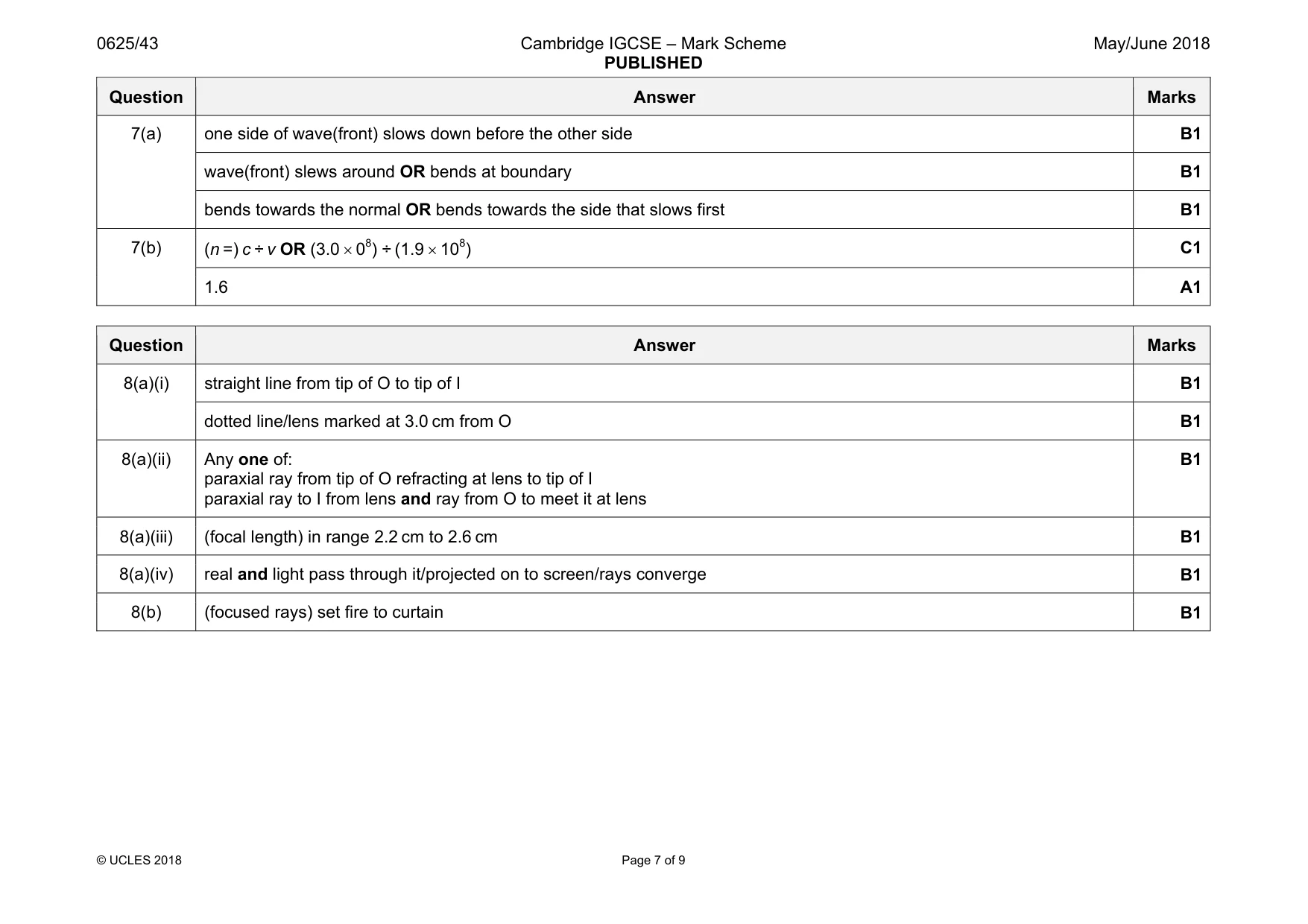
Mark scheme: 7(a) one side of wave(front) slows down before the other side B1 wave(front) slews around OR bends at boundary B1 bends towards the normal OR bends towards the side that slows first B1 7(b) (n =) c ÷ v OR (3.0 × 08) ÷ (1.9 × 10⁸) C1 1.6 A1
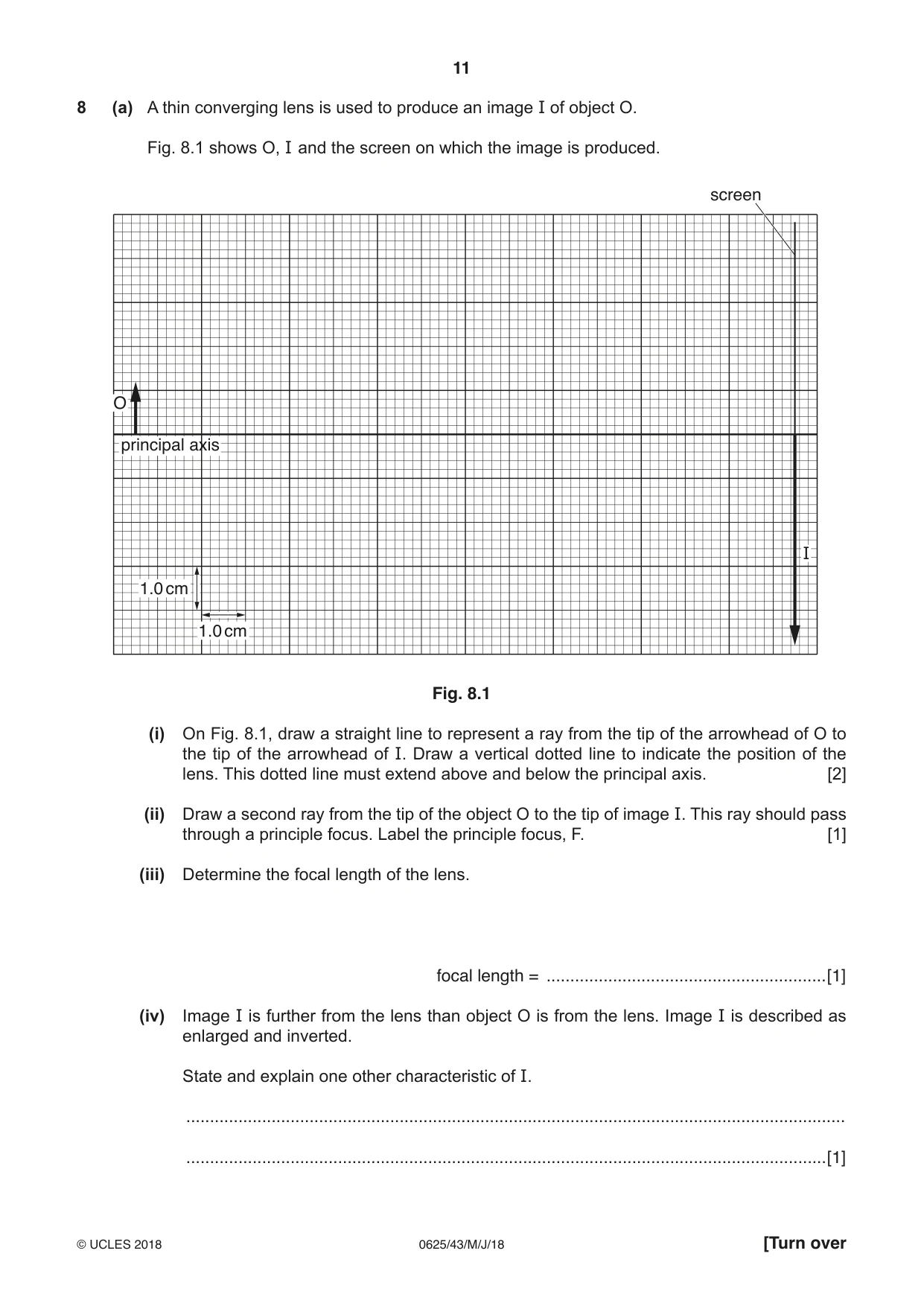
Q8 · A thin converging lens is used to produce an image I of object O
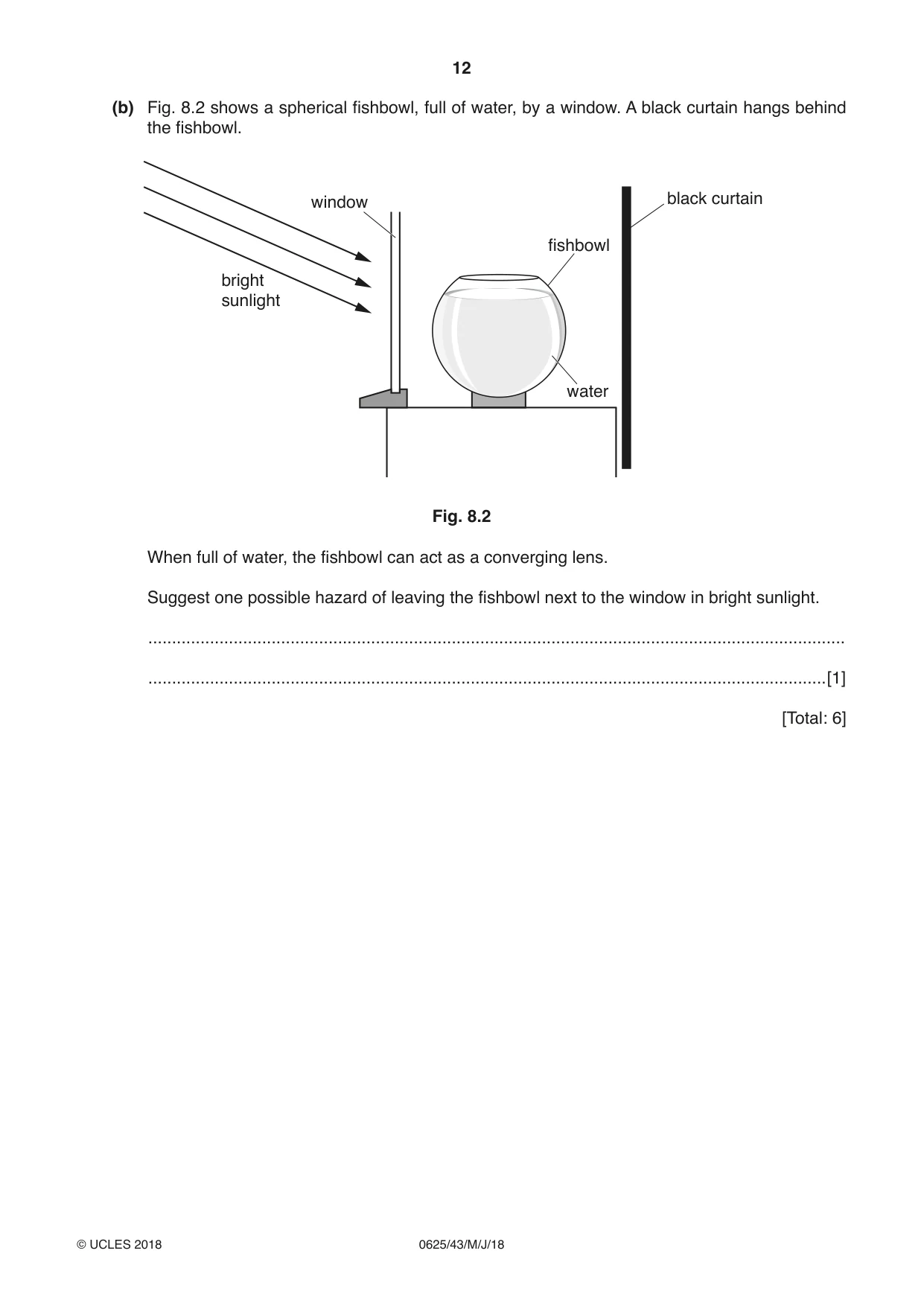
8 (a) A thin converging lens is used to produce an image I of object O. Fig. 8.1 shows O, I and the screen on which the image is produced. screen O principal axis I 1.0 cm 1.0 cm Fig. 8.1 (i) On Fig. 8.1, draw a straight line to represent a ray from the tip of the arrowhead of O to the tip of the arrowhead of I. Draw a vertical dotted line to indicate the position of the lens. This dotted line must extend above and below the principal axis. [2] (ii) Draw a second ray from the tip of the object O to the tip of image I. This ray should pass through a principle focus. Label the principle focus, F. [1] (iii) Determine the focal length of the lens. focal length = ...........................................................[1] (iv) Image I is further from the lens than object O is from the lens. Image I is described as enlarged and inverted. State and explain one other characteristic of I. ........................................................................................................................................... .......................................................................................................................................[1] (b) Fig. 8.2 shows a spherical fishbowl, full of water, by a window. A black curtain hangs behind the fishbowl. window black curtain fishbowl bright sunlight water Fig. 8.2 When full of water, the fishbowl can act as a converging lens. Suggest one possible hazard of leaving the fishbowl next to the window in bright sunlight. ................................................................................................................................................... ...............................................................................................................................................[1] [Total: 6]
Mark scheme: 8(a)(i) straight line from tip of O to tip of I B1 dotted line/lens marked at 3.0 cm from O B1 8(a)(ii) Any one of: paraxial ray from tip of O refracting at lens to tip of I paraxial ray to I from lens and ray from O to meet it at lens B1 8(a)(iii) (focal length) in range 2.2 cm to 2.6 cm B1 8(a)(iv) real and light pass through it/projected on to screen/rays converge B1 8(b) (focused rays) set fire to curtain B1
Q9 · A circuit that includes a battery of electromotive force (e.m.f.) 12 V
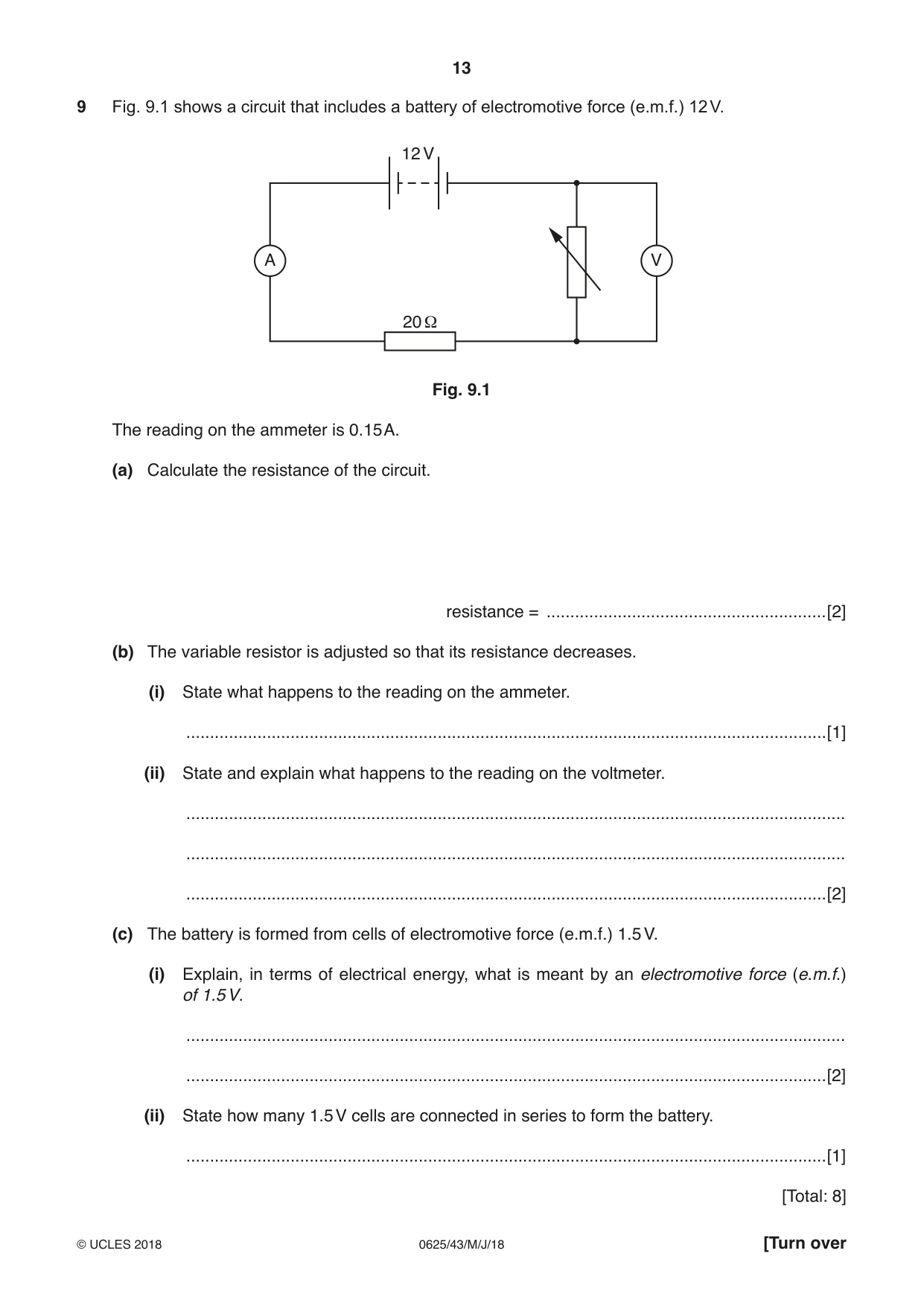
9 Fig. 9.1 shows a circuit that includes a battery of electromotive force (e.m.f.) 12 V. 12 V A V 20 Ω Fig. 9.1 The reading on the ammeter is 0.15 A. (a) Calculate the resistance of the circuit. resistance = ...........................................................[2] (b) The variable resistor is adjusted so that its resistance decreases. (i) State what happens to the reading on the ammeter. .......................................................................................................................................[1] (ii) State and explain what happens to the reading on the voltmeter. ........................................................................................................................................... ........................................................................................................................................... .......................................................................................................................................[2] (c) The battery is formed from cells of electromotive force (e.m.f.) 1.5 V. (i) Explain, in terms of electrical energy, what is meant by an electromotive force (e.m.f.) of 1.5 V. ........................................................................................................................................... .......................................................................................................................................[2] (ii) State how many 1.5 V cells are connected in series to form the battery. .......................................................................................................................................[1] [Total: 8]
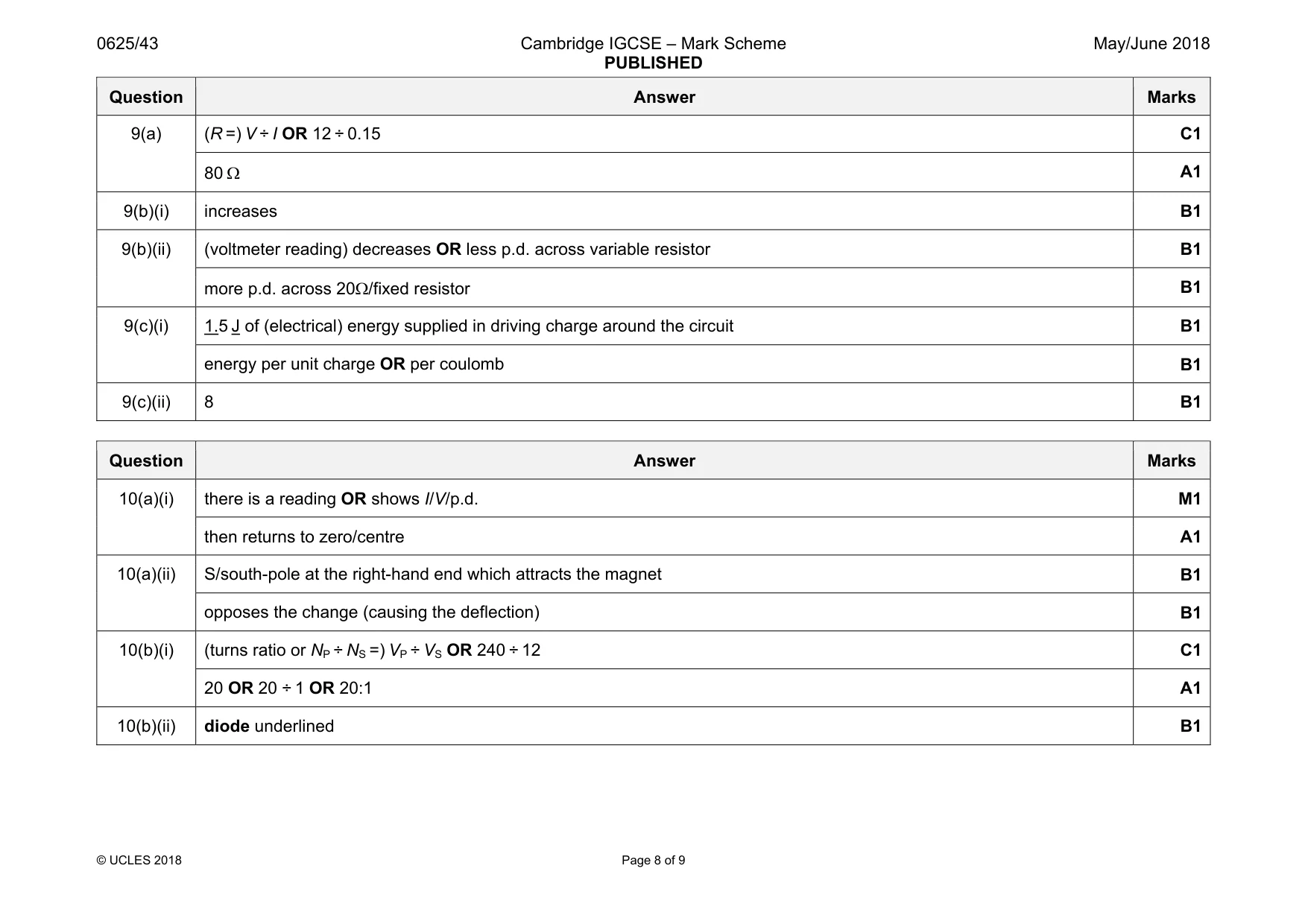
Mark scheme: 9(a) (R =) V ÷ I OR 12 ÷ 0.15 C1 80 Ω A1 9(b)(i) increases B1 9(b)(ii) (voltmeter reading) decreases OR less p.d. across variable resistor B1 more p.d. across 20Ω/fixed resistor B1 9(c)(i) 1.5 J of (electrical) energy supplied in driving charge around the circuit B1 energy per unit charge OR per coulomb B1 9(c)(ii) 8 B1
Q10 · A bar magnet is held with its N-pole just inside one end of a coil
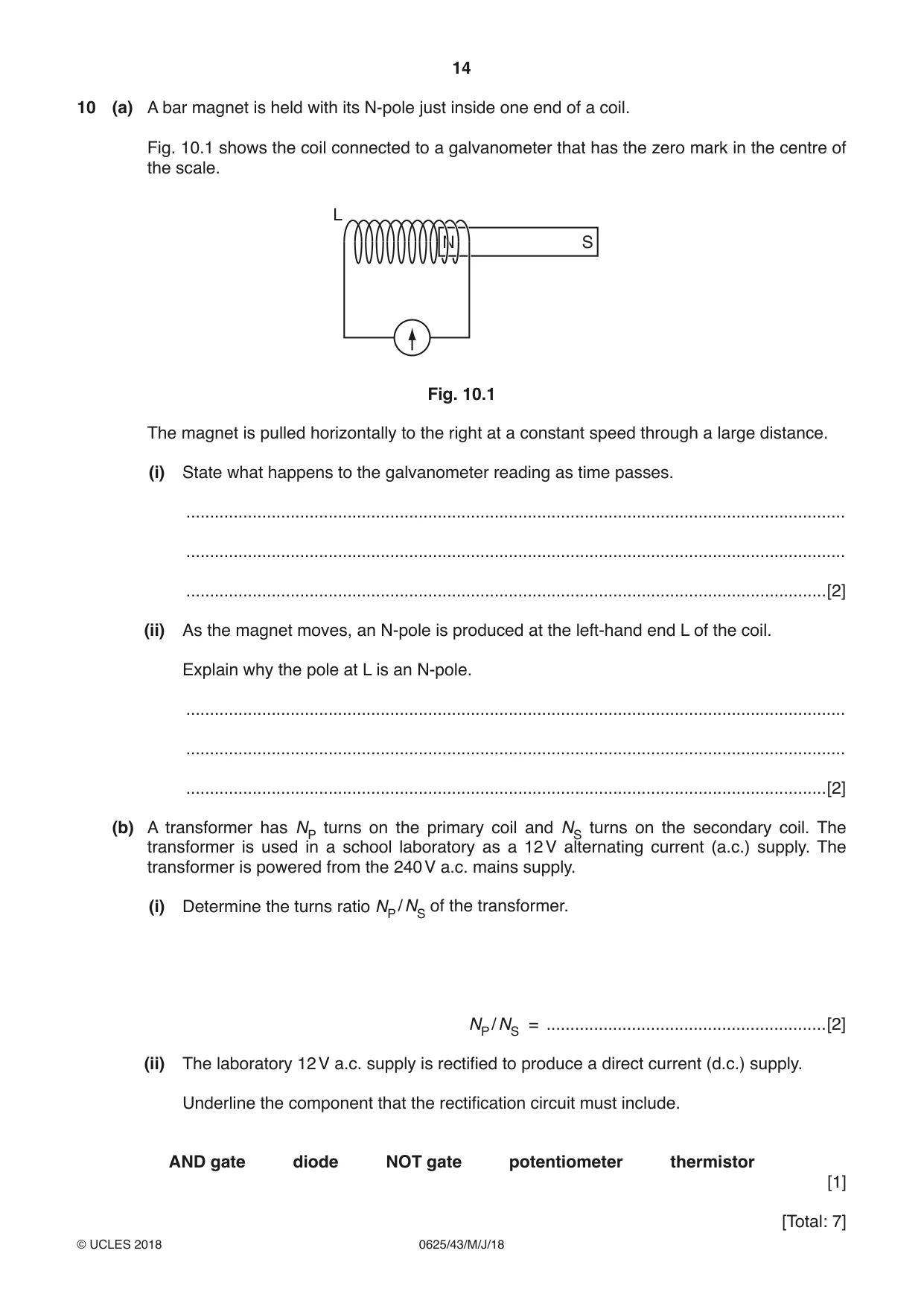
10 (a) A bar magnet is held with its N-pole just inside one end of a coil. Fig. 10.1 shows the coil connected to a galvanometer that has the zero mark in the centre of the scale. L N S Fig. 10.1 The magnet is pulled horizontally to the right at a constant speed through a large distance. (i) State what happens to the galvanometer reading as time passes. ........................................................................................................................................... ........................................................................................................................................... .......................................................................................................................................[2] (ii) As the magnet moves, an N-pole is produced at the left-hand end L of the coil. Explain why the pole at L is an N-pole. ........................................................................................................................................... ........................................................................................................................................... .......................................................................................................................................[2] (b) A transformer has NP turns on the primary coil and NS turns on the secondary coil. The transformer is used in a school laboratory as a 12 V alternating current (a.c.) supply. The transformer is powered from the 240 V a.c. mains supply. (i) Determine the turns ratio NP / NS of the transformer. NP / NS = ...........................................................[2] (ii) The laboratory 12 V a.c. supply is rectified to produce a direct current (d.c.) supply. Underline the component that the rectification circuit must include. AND gate diode NOT gate potentiometer thermistor [1] [Total: 7]
Mark scheme: 10(a)(i) there is a reading OR shows I/V/p.d. M1 then returns to zero/centre A1 10(a)(ii) S/south-pole at the right-hand end which attracts the magnet B1 opposes the change (causing the deflection) B1 10(b)(i) (turns ratio or NP ÷ NS =) VP ÷ VS OR 240 ÷ 12 C1 20 OR 20 ÷ 1 OR 20:1 A1 10(b)(ii) diode underlined B1
Q11 · State the type of radioactive emission that causes (i) the proton number of a nuclide to…
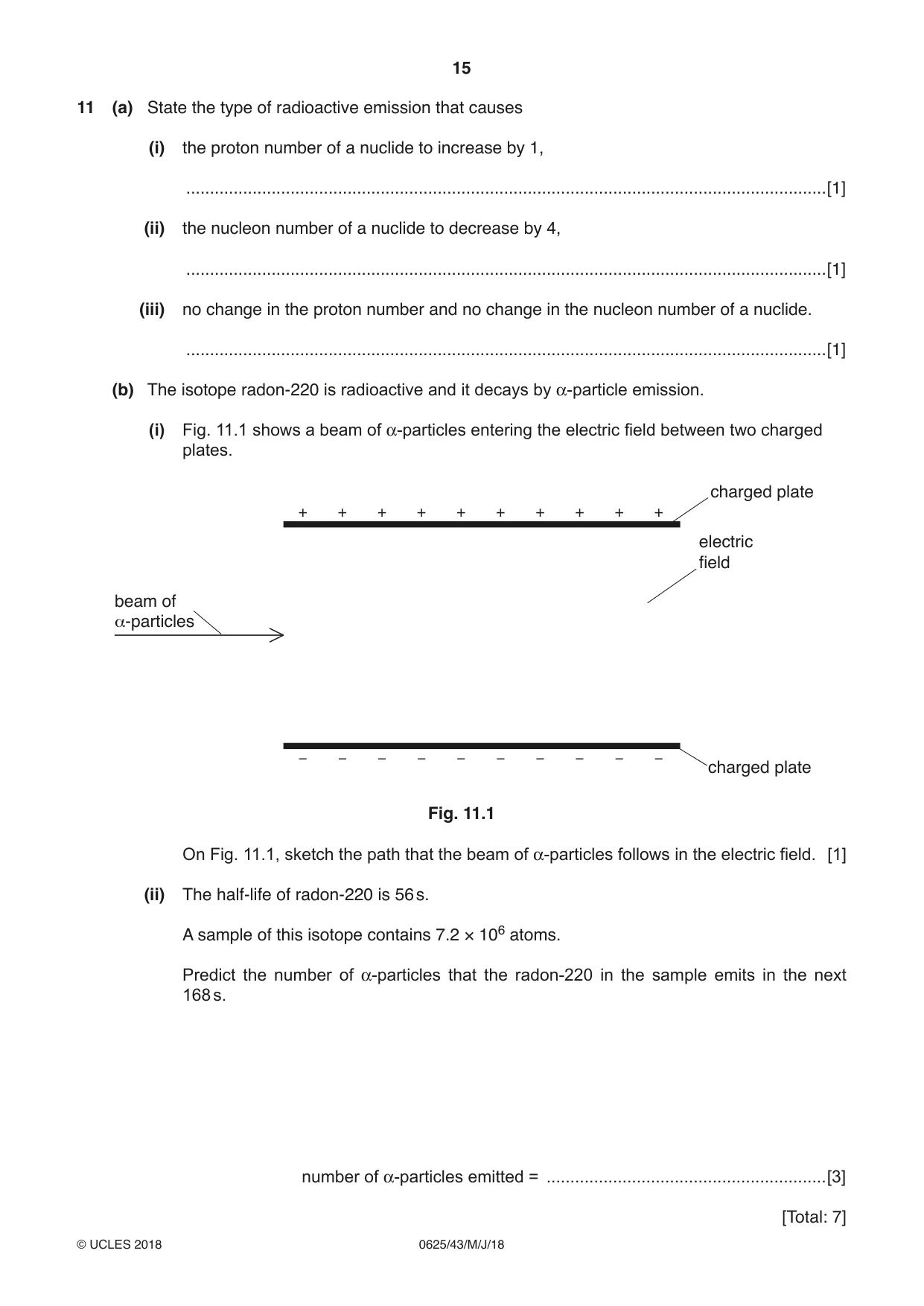
11 (a) State the type of radioactive emission that causes (i) the proton number of a nuclide to increase by 1, .......................................................................................................................................[1] (ii) the nucleon number of a nuclide to decrease by 4, .......................................................................................................................................[1] (iii) no change in the proton number and no change in the nucleon number of a nuclide. .......................................................................................................................................[1] (b) The isotope radon-220 is radioactive and it decays by α-particle emission. (i) Fig. 11.1 shows a beam of α-particles entering the electric field between two charged plates. charged plate + + + + + + + + + + electric field beam of α-particles – – – – – – – – – – charged plate Fig. 11.1 On Fig. 11.1, sketch the path that the beam of α-particles follows in the electric field. [1] (ii) The half-life of radon-220 is 56 s. A sample of this isotope contains 7.2 × 10⁶ atoms. Predict the number of α-particles that the radon-220 in the sample emits in the next 168 s. number of α-particles emitted = ...........................................................[3]
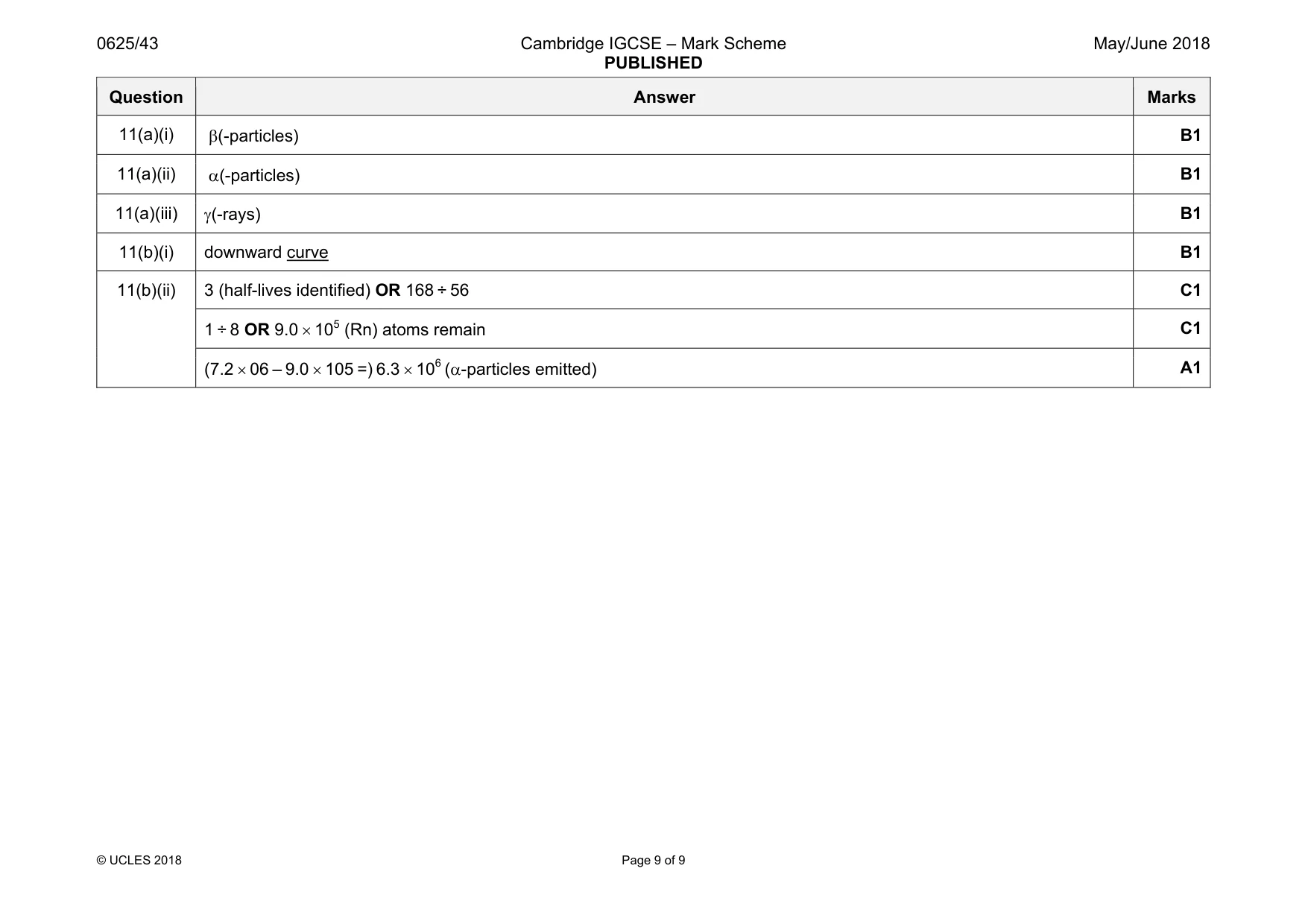
Mark scheme: 11(a)(i) B1 11(a)(ii) α(-particles) B1 11(a)(iii) γ(-rays) B1 11(b)(i) downward curve B1 11(b)(ii) 3 (half-lives identified) OR 168 ÷ 56 C1 1 ÷ 8 OR 9.0 × 10⁵ (Rn) atoms remain C1 (7.2 × 06 – 9.0 × 105 =) 6.3 × 10⁶ (α-particles emitted) A1
What was in this paper
The subtopics covered by these 11 questions, and how many questions each got. Open one in a new tab to see every Cambridge question on it.
What you needed in this session
Cambridge’s own grade thresholds for 2018 May/June, Paper 4 · Variant 3. A higher threshold means an easier paper — the bar moves with how the cohort did.