Cambridge IGCSE Physics 0625 — 2019 Oct/Nov Paper 4 · Variant 2
0625/42/O/N/19 · 10 questions · 80 marks · ≈90 min
The question paper and its mark scheme, free to read here and free to download. This is Cambridge’s own paper, exactly as it was sat.
Question paper16 pages

Mark scheme12 pages
Answers below. Sit the paper first if you are practising.
Questions as text
Q1 · The top view of a rectangular paddling pool of constant depth
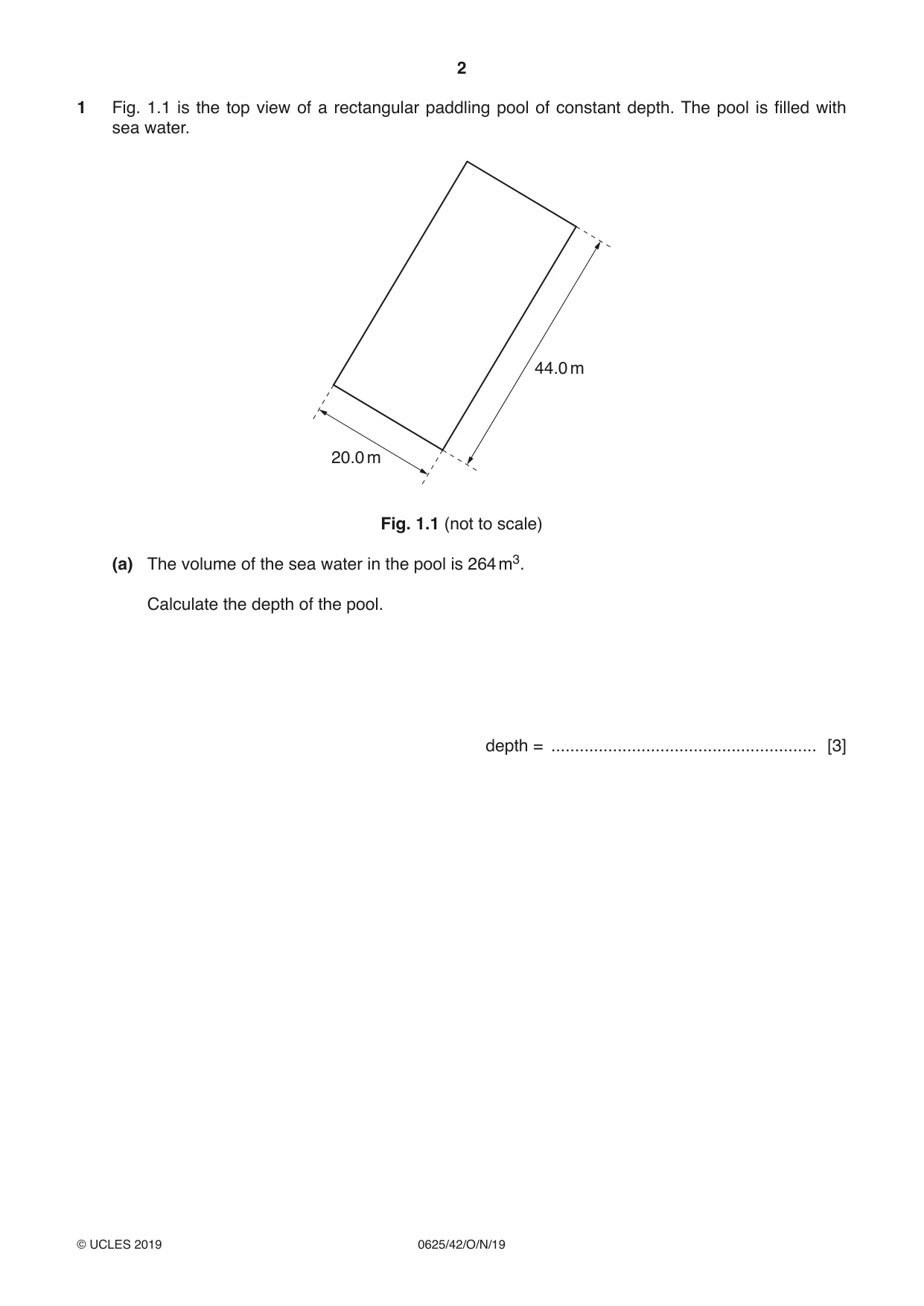
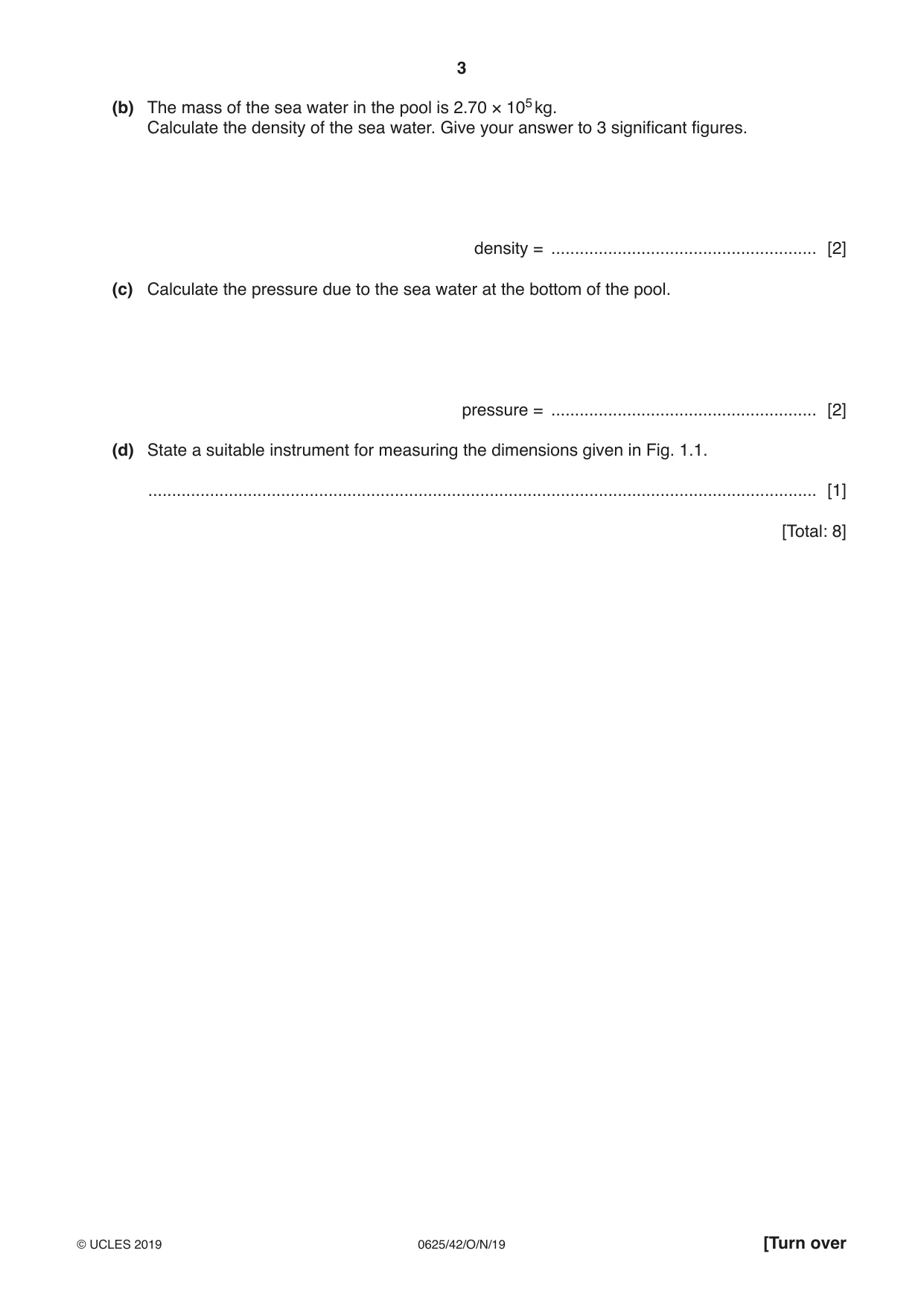
1 Fig. 1.1 is the top view of a rectangular paddling pool of constant depth. The pool is filled with sea water. 44.0 m 20.0 m Fig. 1.1 (not to scale) (a) The volume of the sea water in the pool is 264 m3. Calculate the depth of the pool. depth = ........................................................ [3] (b) The mass of the sea water in the pool is 2.70 × 10⁵ kg. Calculate the density of the sea water. Give your answer to 3 significant figures. density = ........................................................ [2] (c) Calculate the pressure due to the sea water at the bottom of the pool. pressure = ........................................................ [2] (d) State a suitable instrument for measuring the dimensions given in Fig. 1.1. ............................................................................................................................................. [1] [Total: 8]
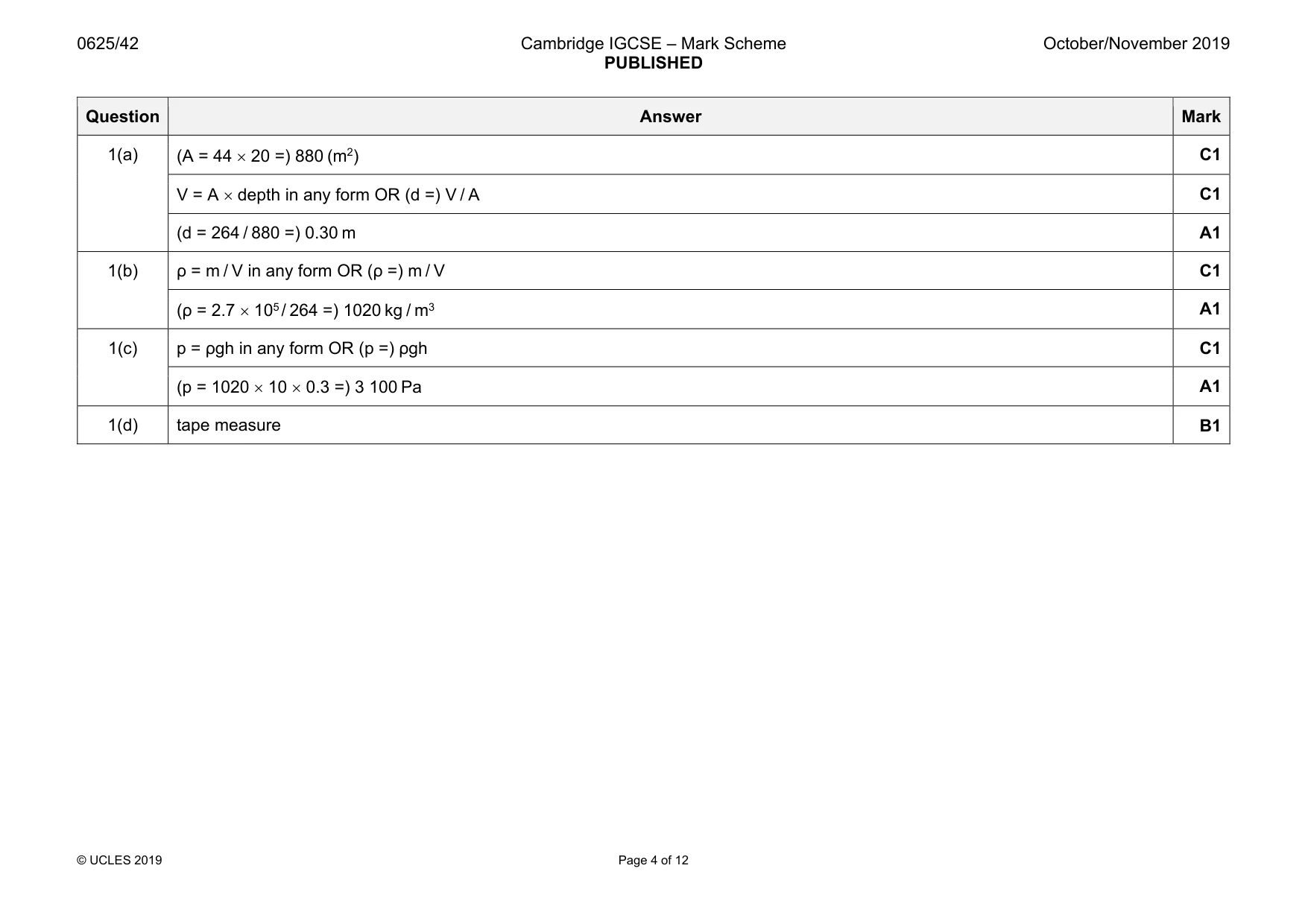
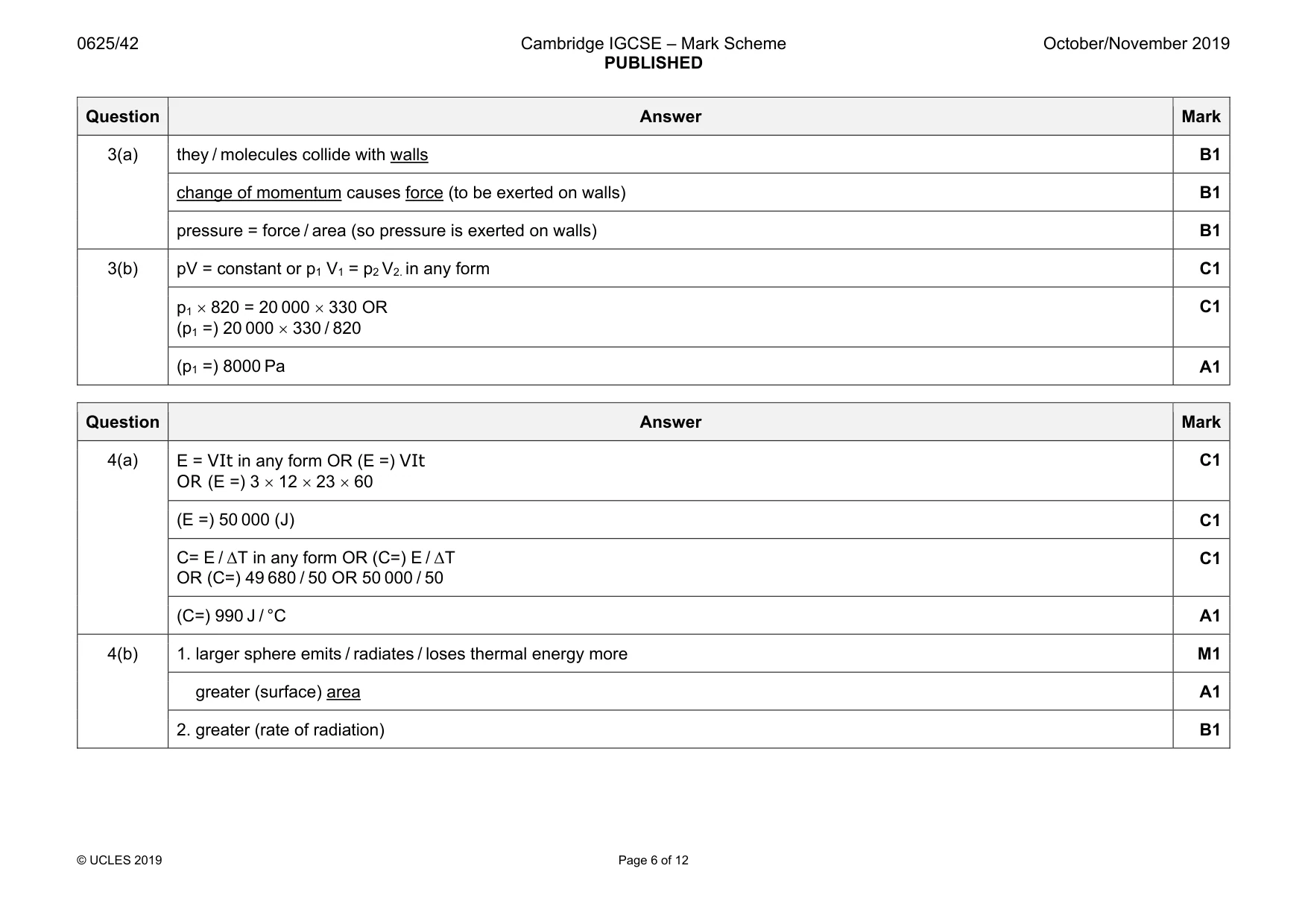
Mark scheme: 1(a) C1 V = A × depth in any form OR (d =) V / A C1 (d = 264 / 880 =) 0.30 m A1 1(b) ρ = m / V in any form OR (ρ =) m / V C1 (ρ = 2.7 × 10⁵ / 264 =) 1020 kg / m3 A1 1(c) p = ρgh in any form OR (p =) ρgh C1 (p = 1020 × 10 × 0.3 =) 3 100 Pa A1 1(d) tape measure B1
Q2 · State the two conditions which must be true for an object to be in equilibrium
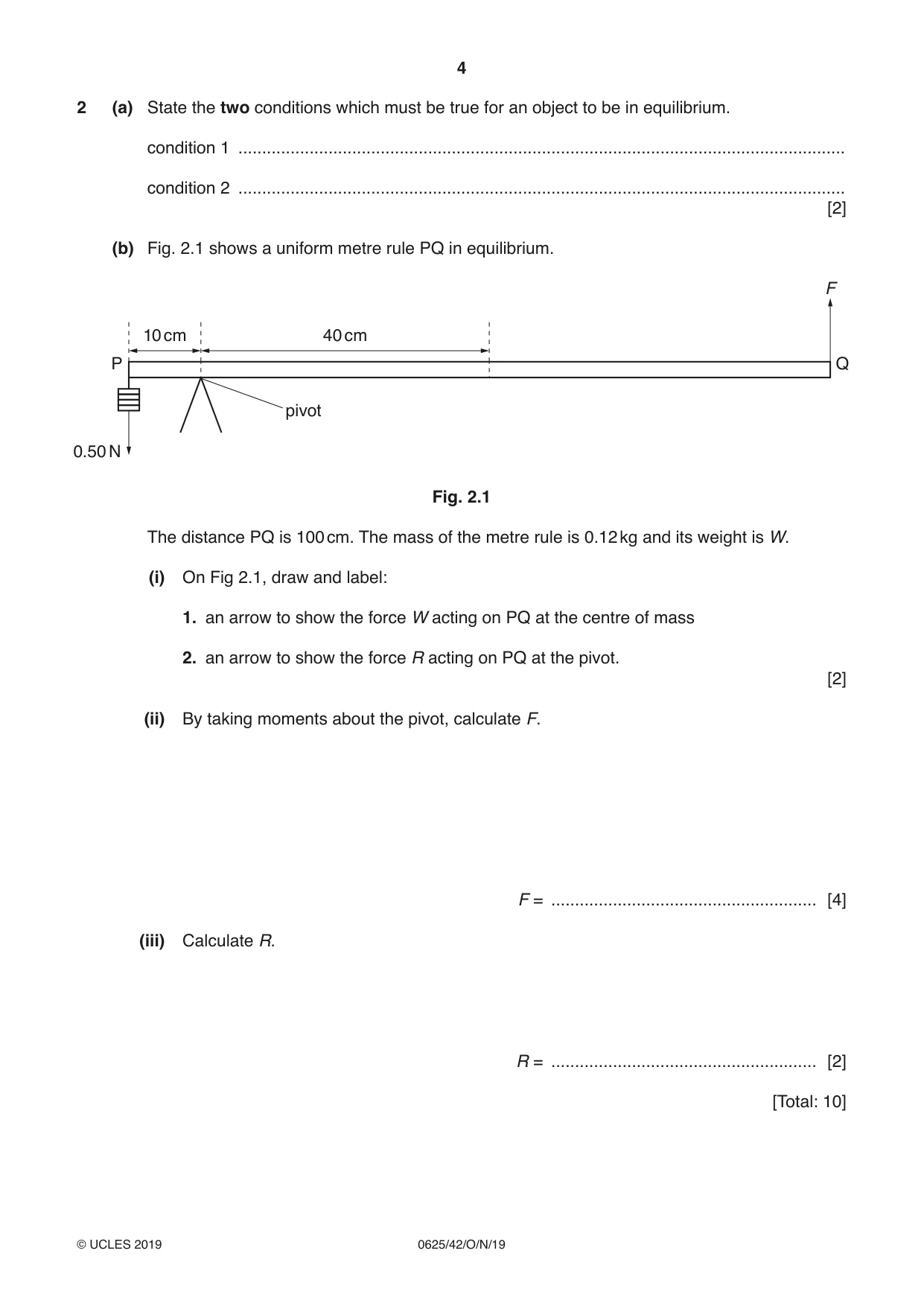
2 (a) State the two conditions which must be true for an object to be in equilibrium. condition 1 ................................................................................................................................ condition 2 ................................................................................................................................ [2] (b) Fig. 2.1 shows a uniform metre rule PQ in equilibrium. F 10 cm 40 cm P Q pivot 0.50 N Fig. 2.1 The distance PQ is 100 cm. The mass of the metre rule is 0.12 kg and its weight is W. (i) On Fig 2.1, draw and label: 1. an arrow to show the force W acting on PQ at the centre of mass 2. an arrow to show the force R acting on PQ at the pivot. [2] (ii) By taking moments about the pivot, calculate F. F = ........................................................ [4] (iii) Calculate R. R = ........................................................ [2] [Total: 10]
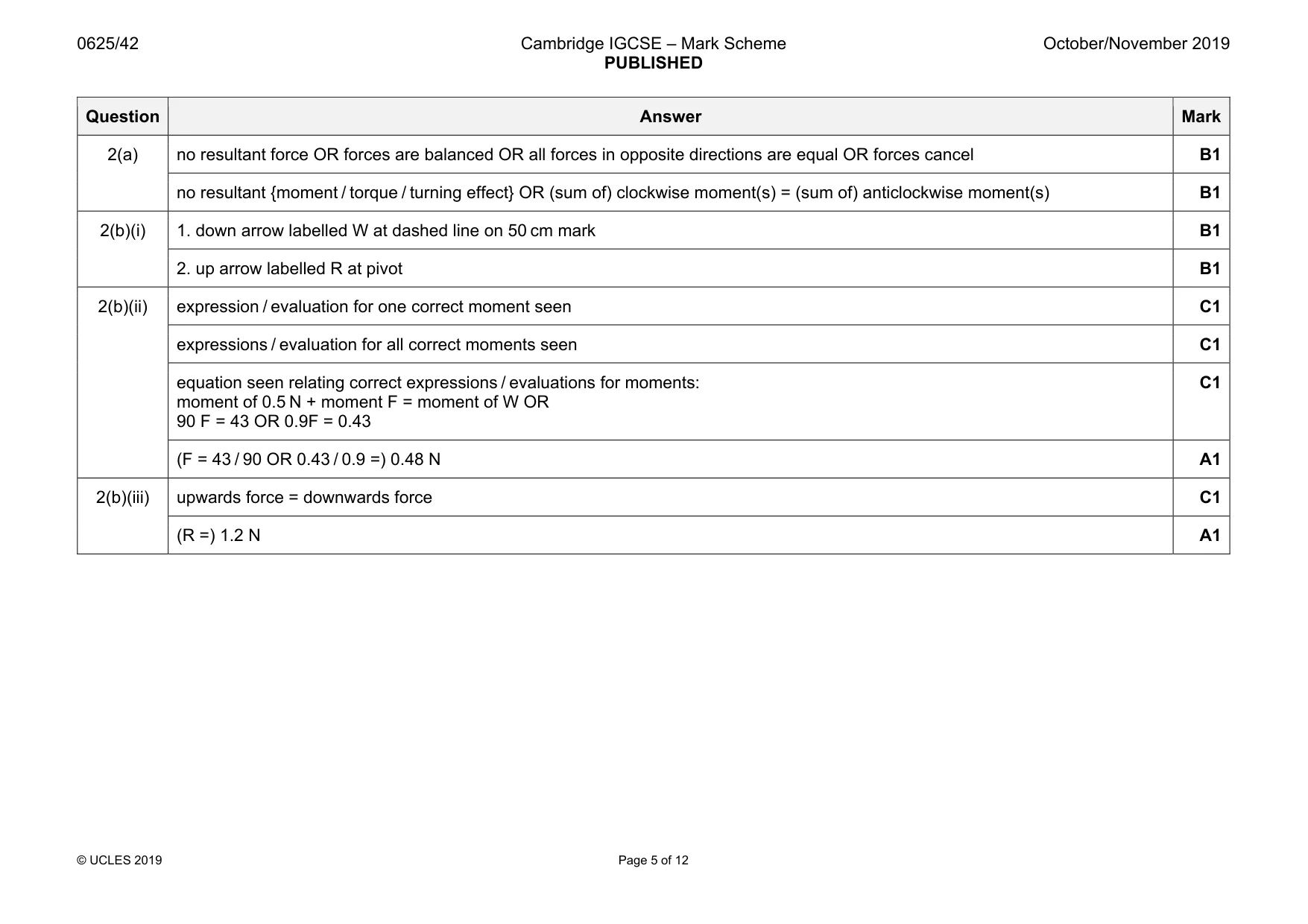
Mark scheme: 2(a) no resultant force OR forces are balanced OR all forces in opposite directions are equal OR forces cancel B1 no resultant {moment / torque / turning effect} OR (sum of) clockwise moment(s) = (sum of) anticlockwise moment(s) B1 2(b)(i) 1. down arrow labelled W at dashed line on 50 cm mark B1 2. up arrow labelled R at pivot B1 2(b)(ii) expression / evaluation for one correct moment seen C1 expressions / evaluation for all correct moments seen C1 equation seen relating correct expressions / evaluations for moments: moment of 0.5 N + moment F = moment of W OR 90 F = 43 OR 0.9F = 0.43 C1 (F = 43 / 90 OR 0.43 / 0.9 =) 0.48 N A1 2(b)(iii) upwards force = downwards force C1 (R =) 1.2 N A1
Q3 · A gas contained in a cylinder enclosed by a piston
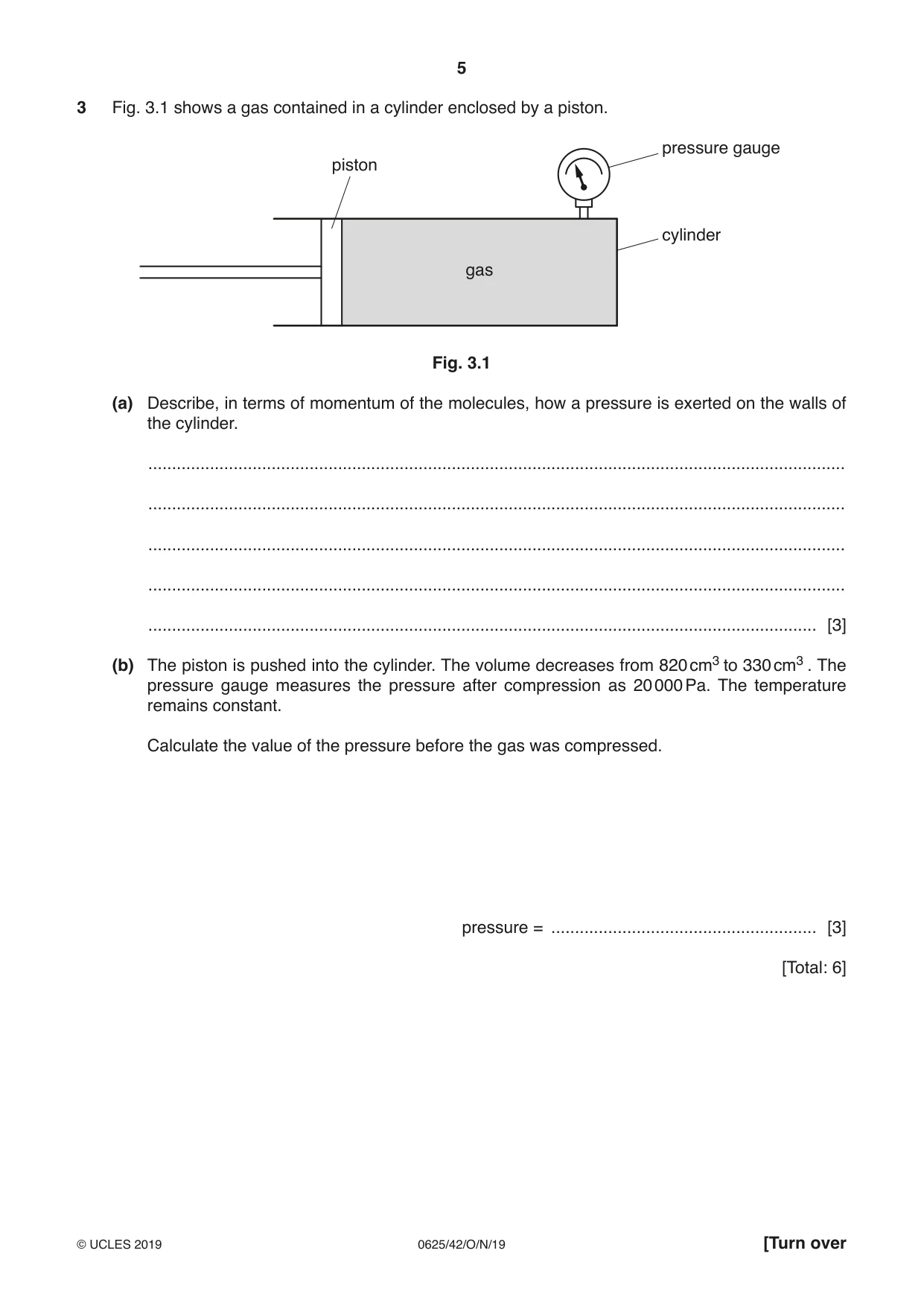
3 Fig. 3.1 shows a gas contained in a cylinder enclosed by a piston. pressure gauge piston cylinder gas Fig. 3.1 (a) Describe, in terms of momentum of the molecules, how a pressure is exerted on the walls of the cylinder. ................................................................................................................................................... ................................................................................................................................................... ................................................................................................................................................... ................................................................................................................................................... ............................................................................................................................................. [3] (b) The piston is pushed into the cylinder. The volume decreases from 820 cm3 to 330 cm3 . The pressure gauge measures the pressure after compression as 20 000 Pa. The temperature remains constant. Calculate the value of the pressure before the gas was compressed. pressure = ........................................................ [3] [Total: 6]
Mark scheme: 3(a) they / molecules collide with walls B1 change of momentum causes force (to be exerted on walls) B1 pressure = force / area (so pressure is exerted on walls) B1 3(b) pV = constant or p1 V1 = p2 V2. in any form C1 p1 × 820 = 20 000 × 330 OR (p1 =) 20 000 × 330 / 820 C1 (p1 =) 8000 Pa A1
Q4 · A student carries out an experiment to determine the thermal capacity of a metal block
4 (a) A student carries out an experiment to determine the thermal capacity of a metal block. The block is heated by an electric heater for 23 minutes. The current in the heater is 3.0 A at a potential difference (p.d.) of 12 V. The temperature of the block rises from 20 °C to 70 °C. Calculate the thermal capacity of the block. thermal capacity = ........................................................ [4] (b) 1. Two metal spheres of different diameters are heated to 900 °C in a hot oven. The two spheres are removed from the oven. State and explain any difference in the initial rates of emission of radiation of thermal energy between the two spheres. ................................................................................................................................................... ................................................................................................................................................... ................................................................................................................................................... 2. One hot sphere is now heated in a hotter oven. State and explain any effect on the rate of emission of radiation of thermal energy from that sphere when it is removed from the hotter oven. ................................................................................................................................................... ................................................................................................................................................... [3] [Total: 7]
Mark scheme: 4(a) OR (E =) 3 × 12 × 23 × 60 C1 (E =) 50 000 (J) C1 C= E / ∆T in any form OR (C=) E / ∆T OR (C=) 49 680 / 50 OR 50 000 / 50 C1 (C=) 990 J / °C A1 4(b) 1. larger sphere emits / radiates / loses thermal energy more M1 greater (surface) area A1 2. greater (rate of radiation) B1
Q5 · One difference between a longitudinal wave and a transverse wave is that a longitudinal…
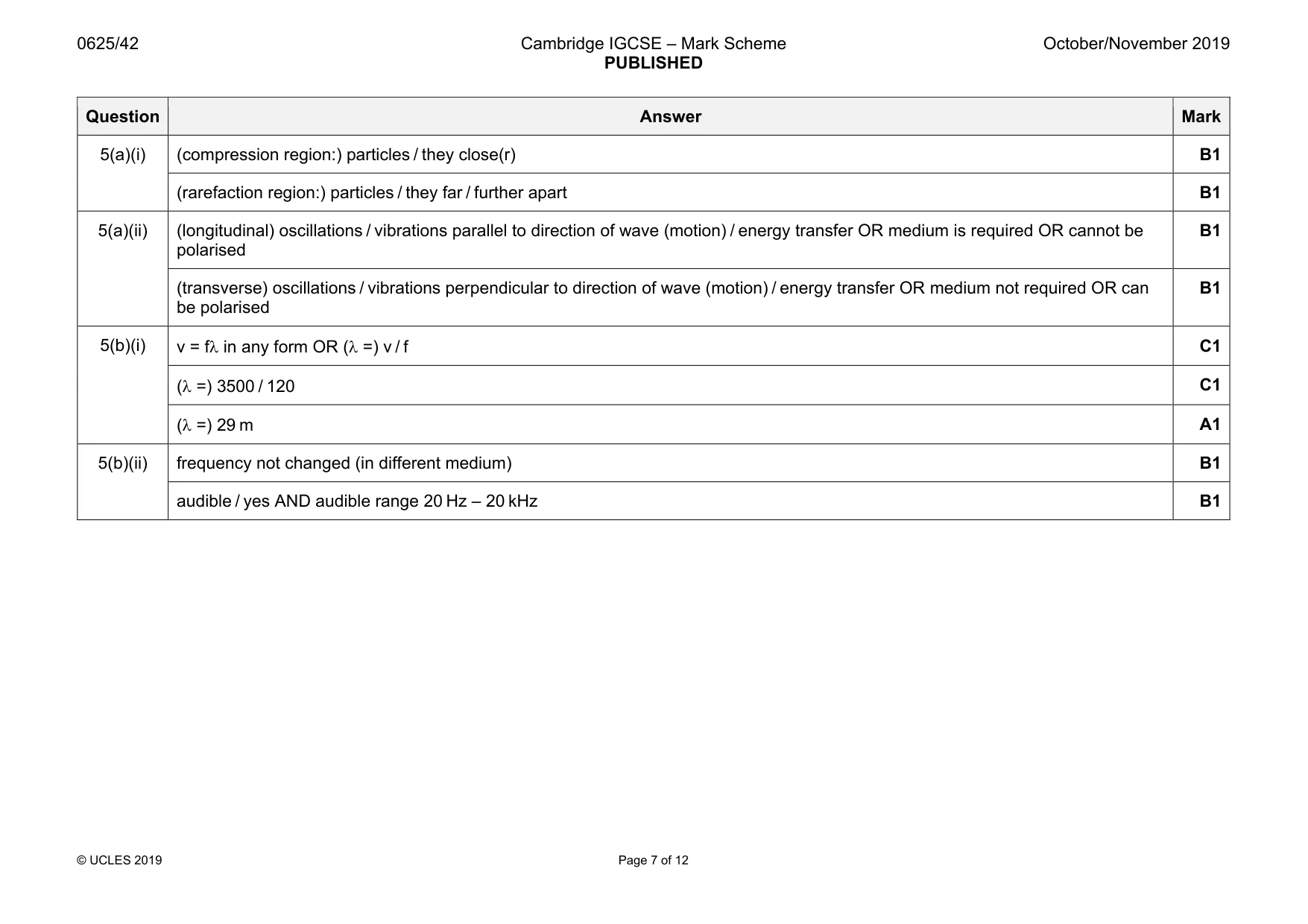
5 (a) One difference between a longitudinal wave and a transverse wave is that a longitudinal wave consists of compressions and rarefactions. (i) Explain the terms compression and rarefaction using ideas about particles. compression ...................................................................................................................... ........................................................................................................................................... ........................................................................................................................................... rarefaction ......................................................................................................................... ........................................................................................................................................... ........................................................................................................................................... [2] (ii) Describe one other way in which longitudinal wave motion differs from transverse wave motion. Longitudinal wave motion .................................................................................................. ........................................................................................................................................... ........................................................................................................................................... Transverse wave motion ................................................................................................... ........................................................................................................................................... ........................................................................................................................................... [2] (b) (i) A sound wave of frequency 0.120 kHz travels through a rock at a speed of 3500 m / s. Calculate the wavelength of the wave. wavelength = ........................................................ [3] (ii) The wave travels from the rock into the air. State and explain whether the wave will be audible to a healthy human ear. statement .......................................................................................................................... explanation ........................................................................................................................ ........................................................................................................................................... [2]
Mark scheme: 5(a)(i) (compression region:) particles / they close(r) B1 (rarefaction region:) particles / they far / further apart B1 5(a)(ii) (longitudinal) oscillations / vibrations parallel to direction of wave (motion) / energy transfer OR medium is required OR cannot be polarised B1 (transverse) oscillations / vibrations perpendicular to direction of wave (motion) / energy transfer OR medium not required OR can be polarised B1 5(b)(i) v = fλ in any form OR (λ =) v / f C1 (λ =) 3500 / 120 C1 (λ =) 29 m A1 5(b)(ii) frequency not changed (in different medium) B1 audible / yes AND audible range 20 Hz – 20 kHz B1
Q6 · An empty container and an observer’s eye
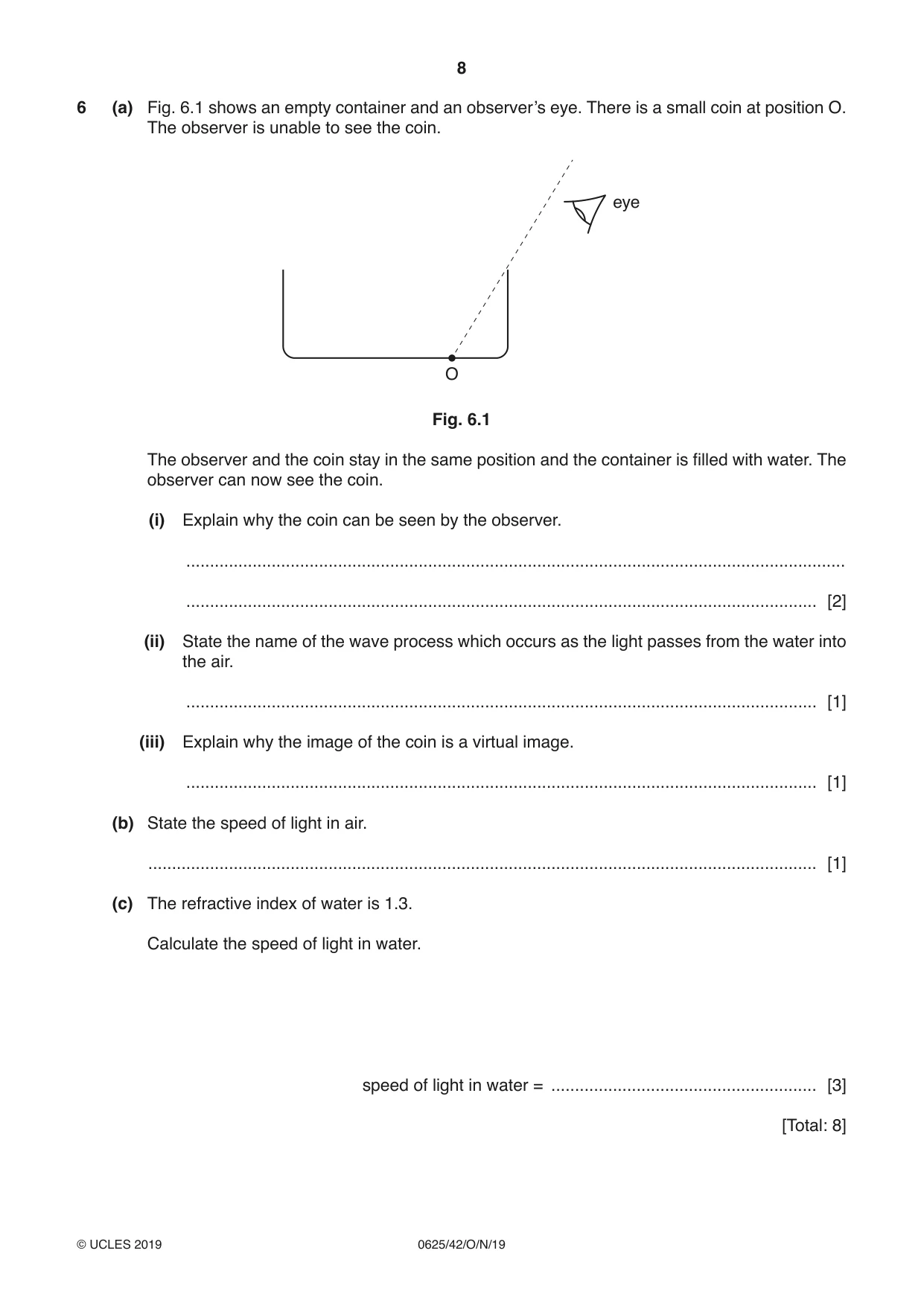
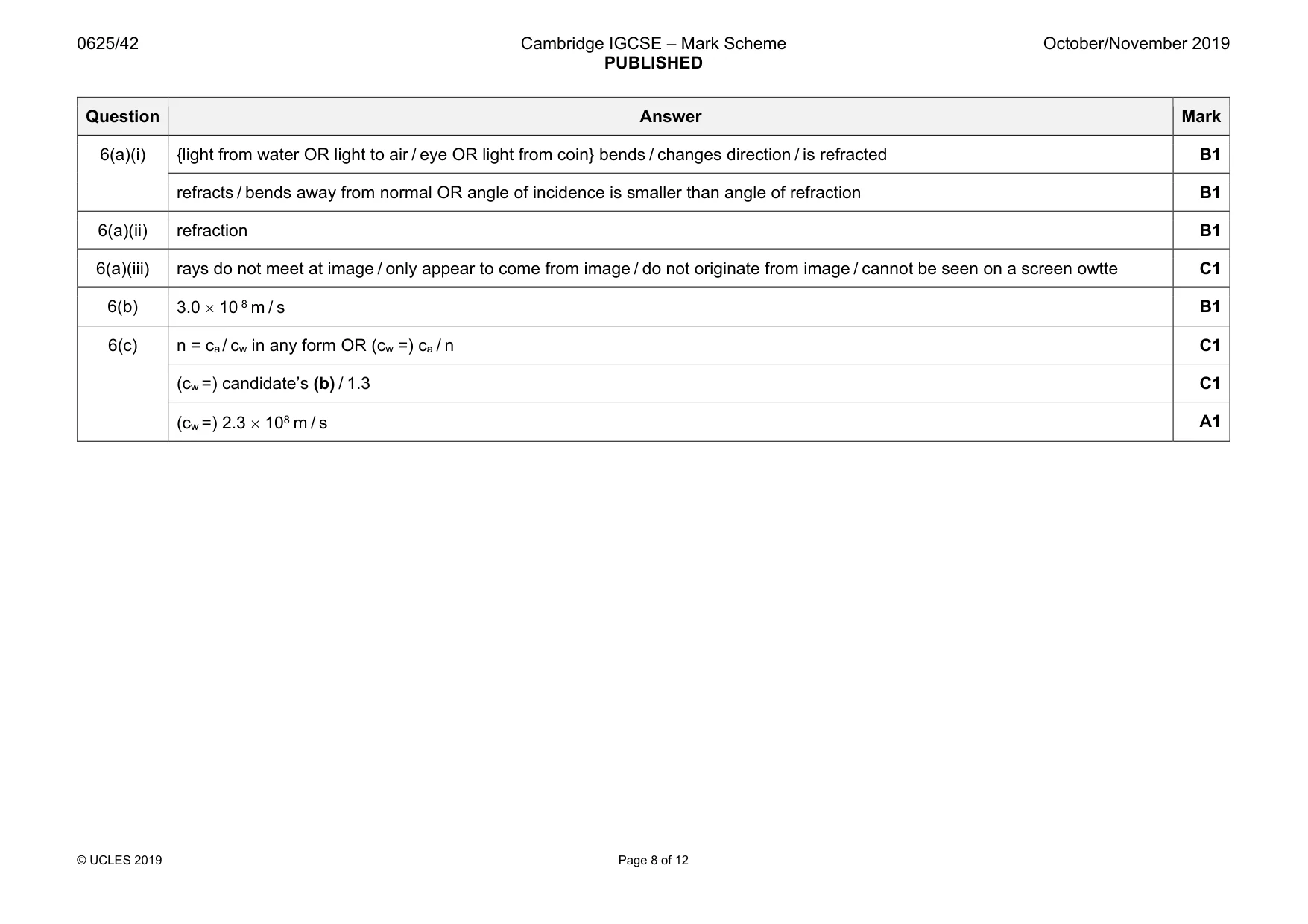
6 (a) Fig. 6.1 shows an empty container and an observer’s eye. There is a small coin at position O. The observer is unable to see the coin. eye O Fig. 6.1 The observer and the coin stay in the same position and the container is filled with water. The observer can now see the coin. (i) Explain why the coin can be seen by the observer. ........................................................................................................................................... ..................................................................................................................................... [2] (ii) State the name of the wave process which occurs as the light passes from the water into the air. ..................................................................................................................................... [1] (iii) Explain why the image of the coin is a virtual image. ..................................................................................................................................... [1] (b) State the speed of light in air. ............................................................................................................................................. [1] (c) The refractive index of water is 1.3. Calculate the speed of light in water. speed of light in water = ........................................................ [3] [Total: 8]
Mark scheme: 6(a)(i) {light from water OR light to air / eye OR light from coin} bends / changes direction / is refracted B1 refracts / bends away from normal OR angle of incidence is smaller than angle of refraction B1 6(a)(ii) refraction B1 6(a)(iii) rays do not meet at image / only appear to come from image / do not originate from image / cannot be seen on a screen owtte C1 6(b) 3.0 × 10 8 m / s B1 6(c) n = ca / cw in any form OR (cw =) ca / n C1 (cw =) candidate’s (b) / 1.3 C1 (cw =) 2.3 × 10⁸ m / s A1
Q7 · A coil of wire wound on a thin plastic cylinder
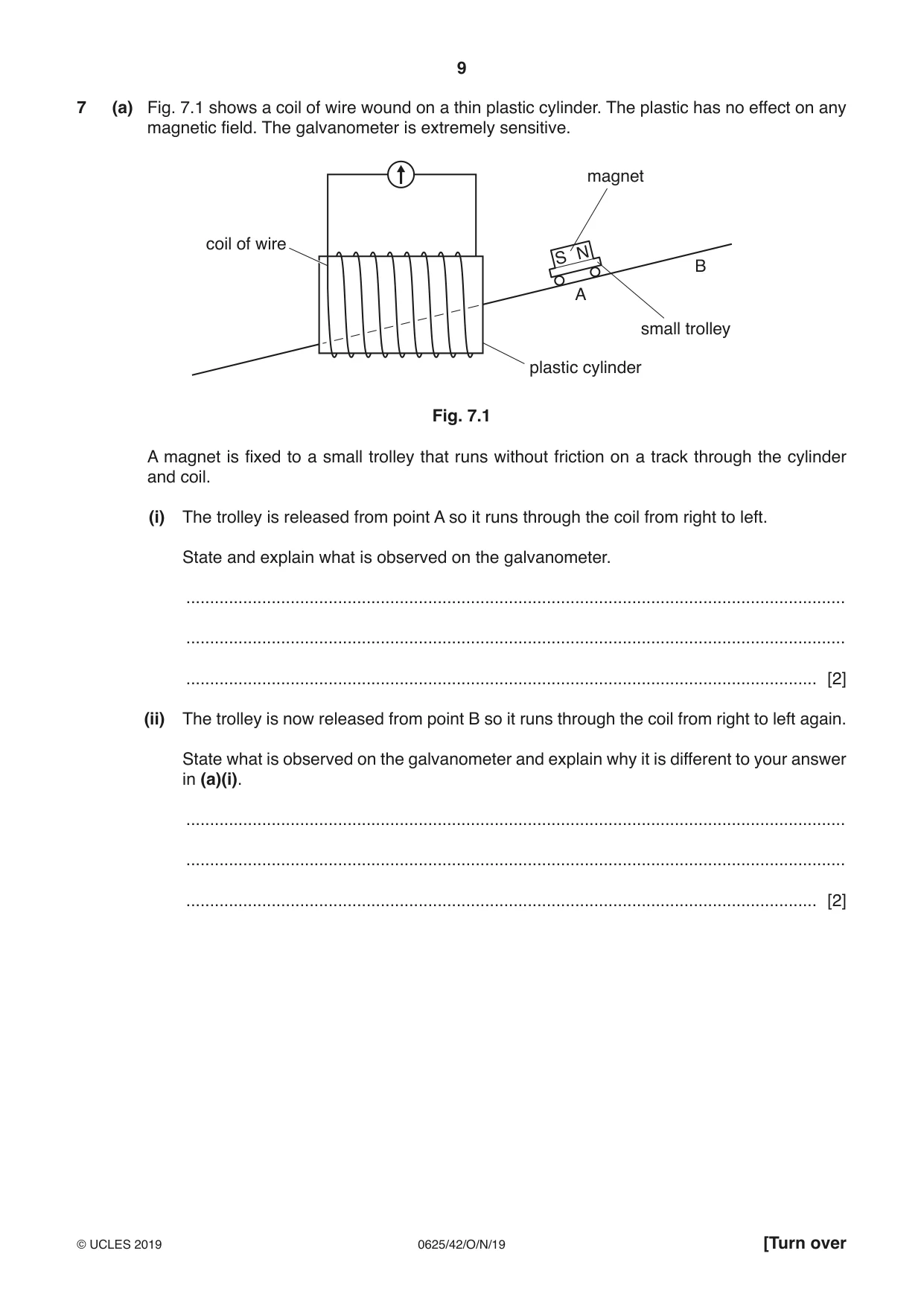
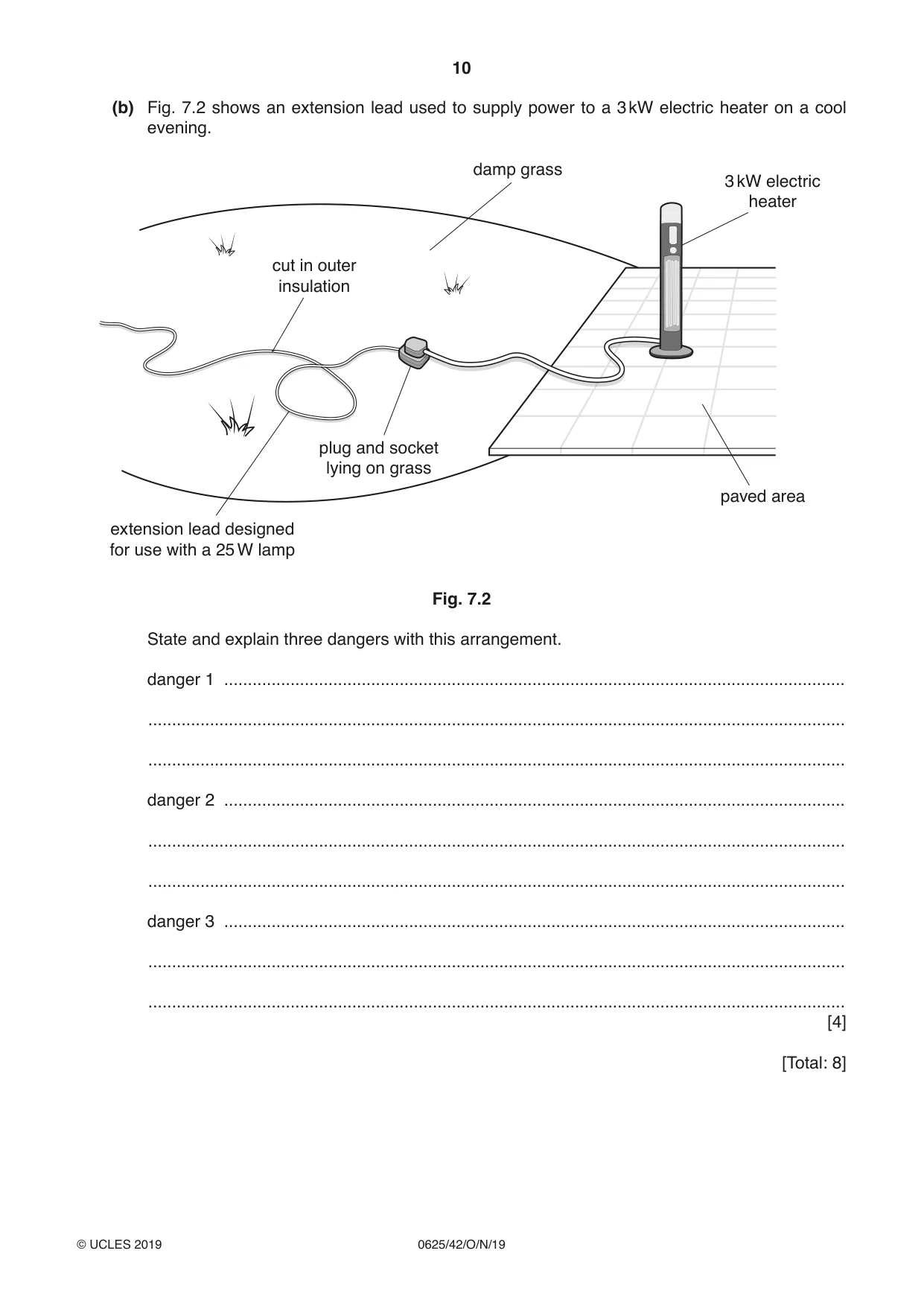
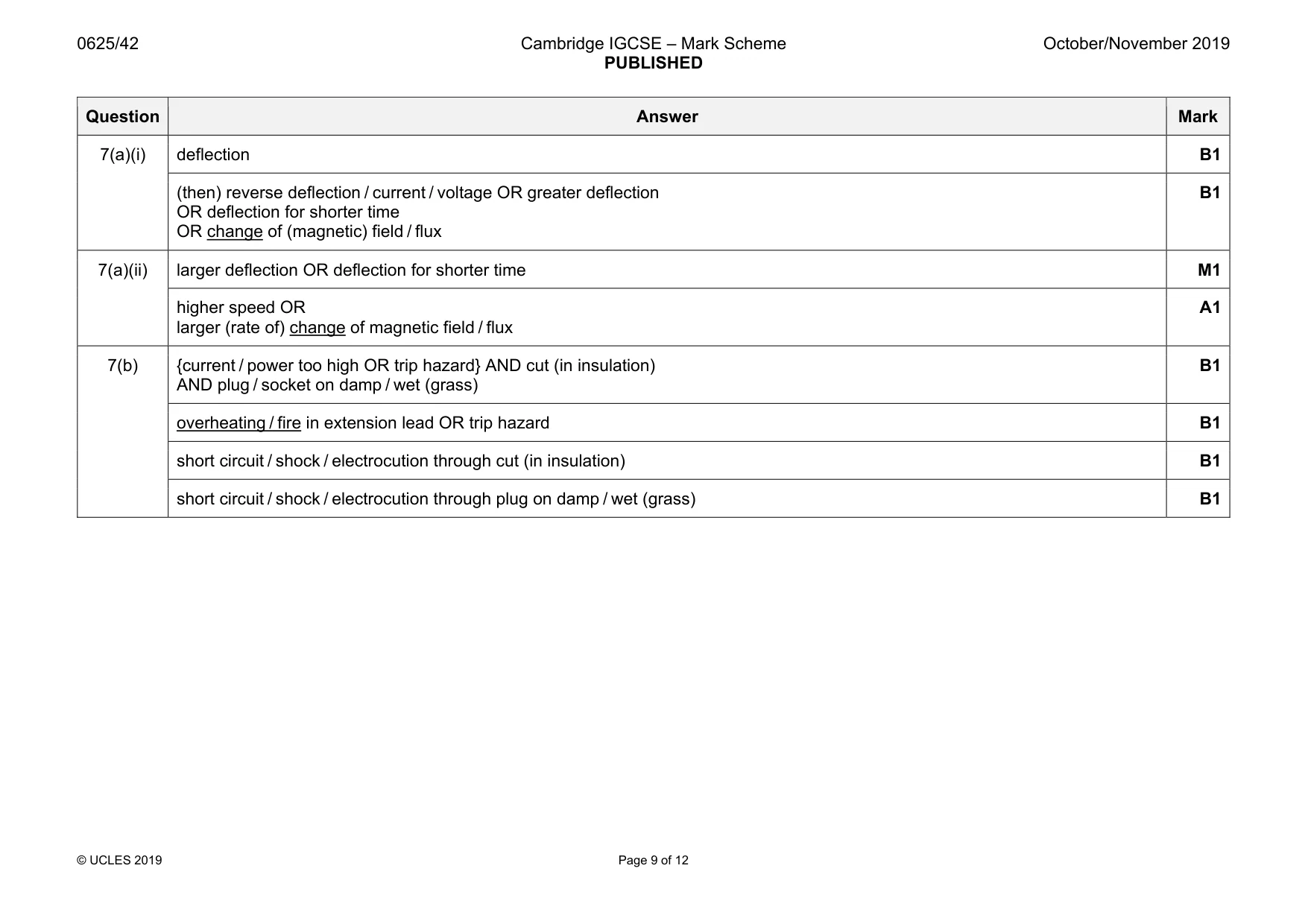
7 (a) Fig. 7.1 shows a coil of wire wound on a thin plastic cylinder. The plastic has no effect on any magnetic field. The galvanometer is extremely sensitive. magnet coil of wire N S B A small trolley plastic cylinder Fig. 7.1 A magnet is fixed to a small trolley that runs without friction on a track through the cylinder and coil. (i) The trolley is released from point A so it runs through the coil from right to left. State and explain what is observed on the galvanometer. ........................................................................................................................................... ........................................................................................................................................... ..................................................................................................................................... [2] (ii) The trolley is now released from point B so it runs through the coil from right to left again. State what is observed on the galvanometer and explain why it is different to your answer in (a)(i). ........................................................................................................................................... ........................................................................................................................................... ..................................................................................................................................... [2] (b) Fig. 7.2 shows an extension lead used to supply power to a 3 kW electric heater on a cool evening. damp grass 3 kW electric heater cut in outer insulation plug and socket lying on grass paved area extension lead designed for use with a 25 W lamp Fig. 7.2 State and explain three dangers with this arrangement. danger 1 ................................................................................................................................... ................................................................................................................................................... ................................................................................................................................................... danger 2 ................................................................................................................................... ................................................................................................................................................... ................................................................................................................................................... danger 3 ................................................................................................................................... ................................................................................................................................................... ................................................................................................................................................... [4] [Total: 8]
Mark scheme: 7(a)(i) deflection B1 (then) reverse deflection / current / voltage OR greater deflection OR deflection for shorter time OR change of (magnetic) field / flux B1 7(a)(ii) larger deflection OR deflection for shorter time M1 higher speed OR larger (rate of) change of magnetic field / flux A1 7(b) {current / power too high OR trip hazard} AND cut (in insulation) AND plug / socket on damp / wet (grass) B1 overheating / fire in extension lead OR trip hazard B1 short circuit / shock / electrocution through cut (in insulation) B1 short circuit / shock / electrocution through plug on damp / wet (grass) B1
Q8 · A wire of length 2.0 m and cross-sectional area 0.40 mm2 has a resistance of 0.14 Ω
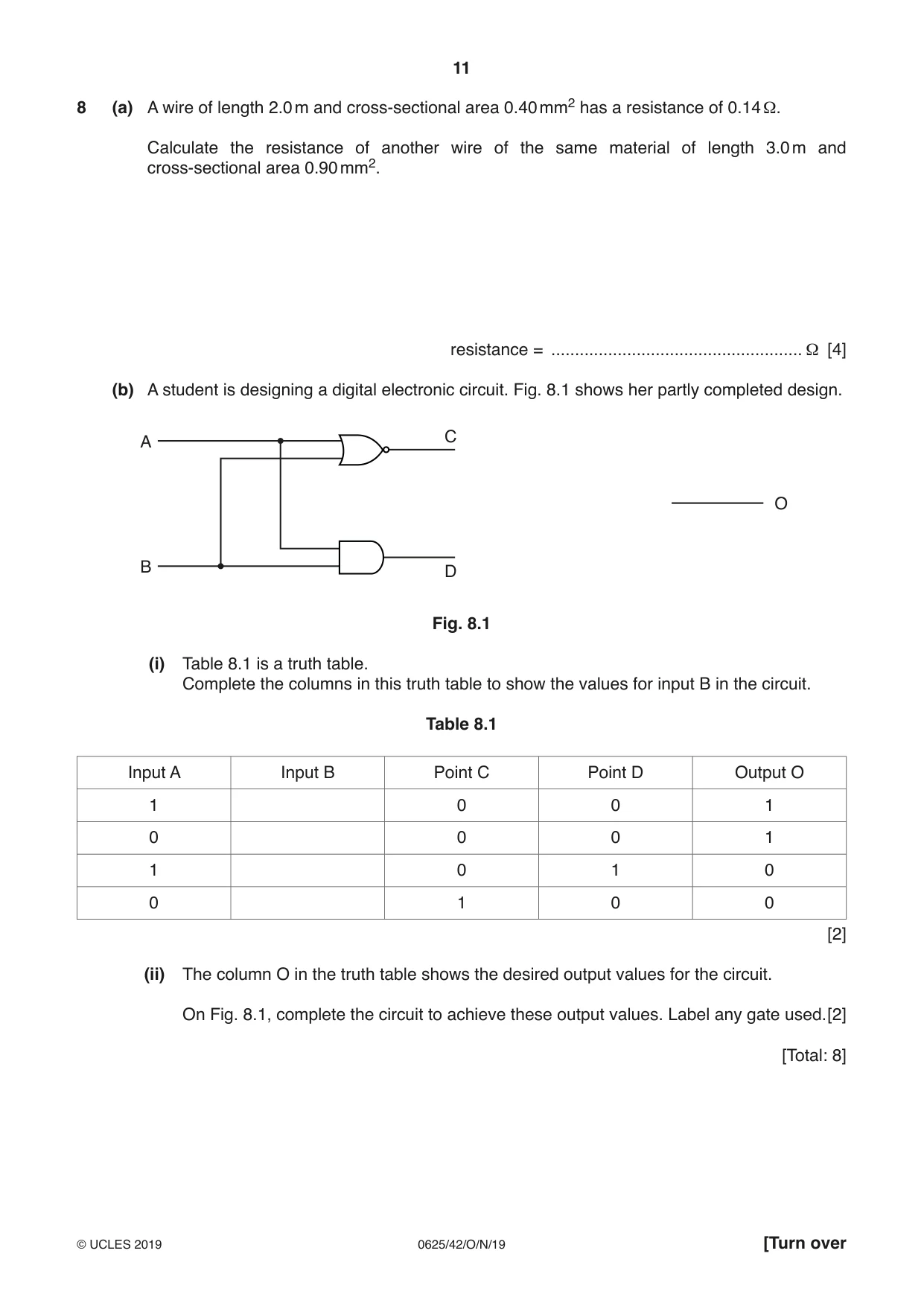
8 (a) A wire of length 2.0 m and cross-sectional area 0.40 mm2 has a resistance of 0.14 Ω. Calculate the resistance of another wire of the same material of length 3.0 m and cross-sectional area 0.90 mm2. resistance = ..................................................... Ω [4] (b) A student is designing a digital electronic circuit. Fig. 8.1 shows her partly completed design. C A O B D Fig. 8.1 (i) Table 8.1 is a truth table. Complete the columns in this truth table to show the values for input B in the circuit. Table 8.1 Input A Input B Point C Point D Output O 1 0 0 1 0 0 0 1 1 0 1 0 0 1 0 0 [2] (ii) The column O in the truth table shows the desired output values for the circuit. On Fig. 8.1, complete the circuit to achieve these output values. Label any gate used. [2] [Total: 8]
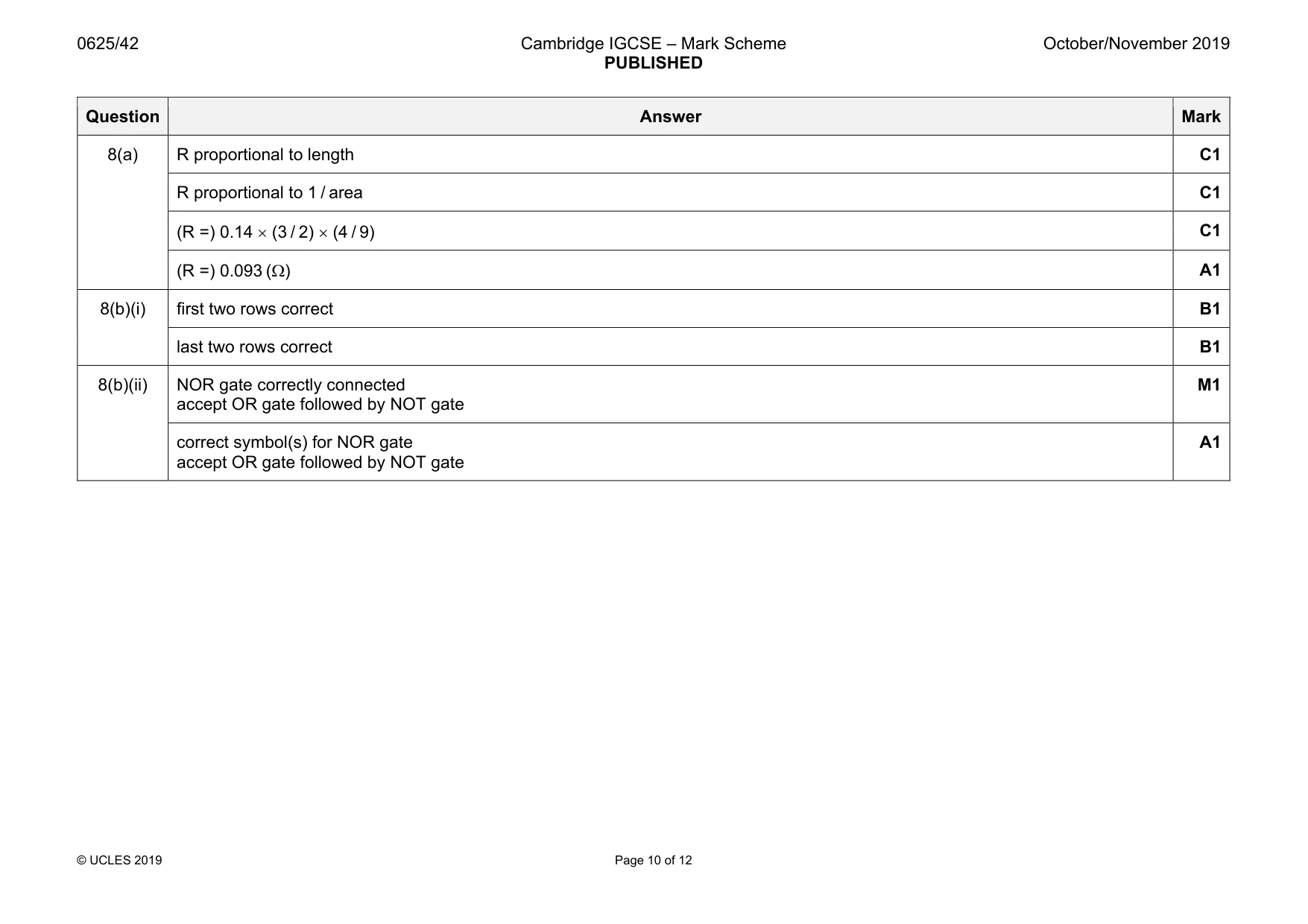
Mark scheme: 8(a) R proportional to length C1 R proportional to 1 / area C1 (R =) 0.14 × (3 / 2) × (4 / 9) C1 (R =) 0.093 (Ω) A1 8(b)(i) first two rows correct B1 last two rows correct B1 8(b)(ii) NOR gate correctly connected accept OR gate followed by NOT gate M1 correct symbol(s) for NOR gate accept OR gate followed by NOT gate A1
More questions on Physical quantities and measurement techniques
Q9 · Describe what is meant by the term electric field
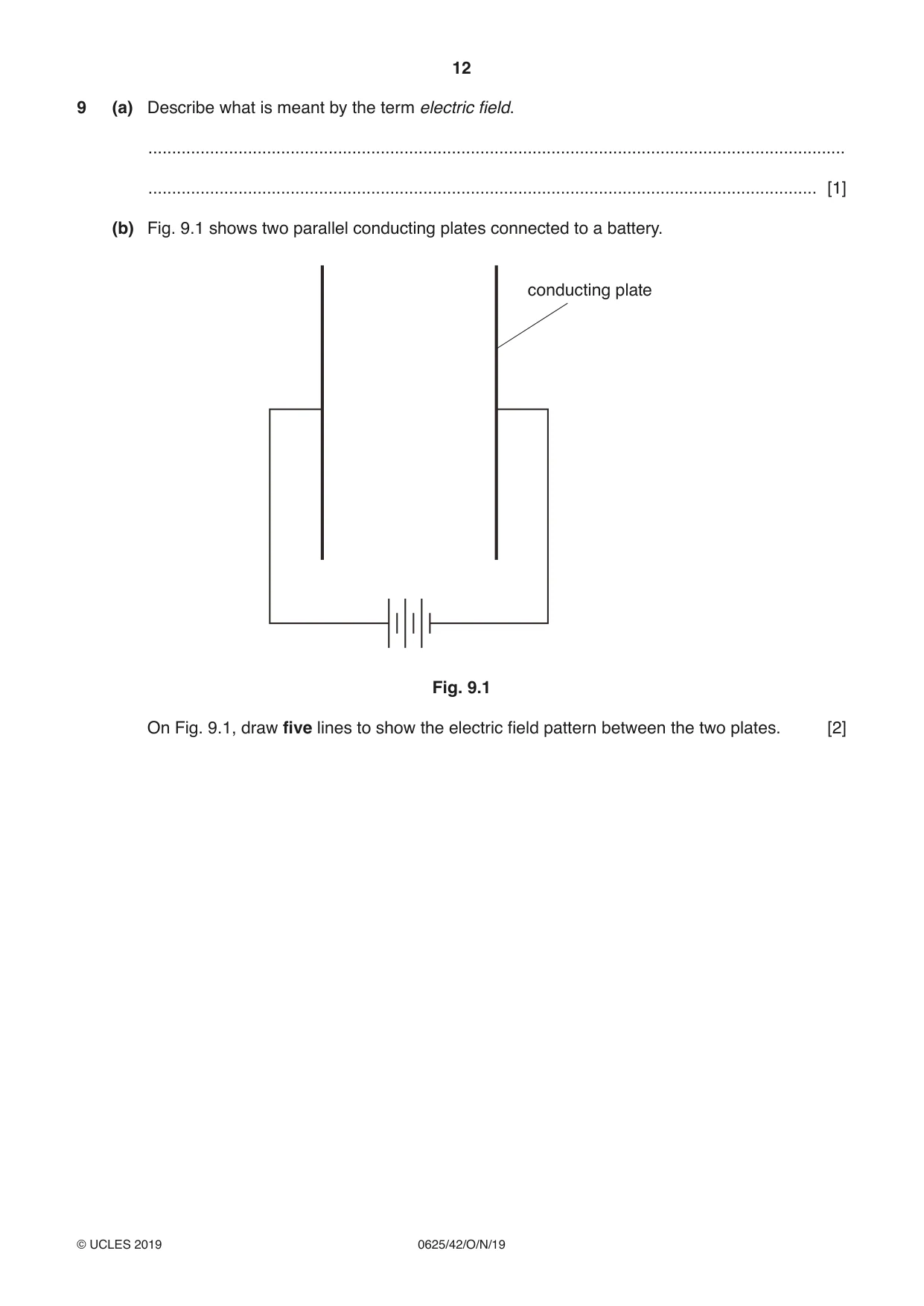
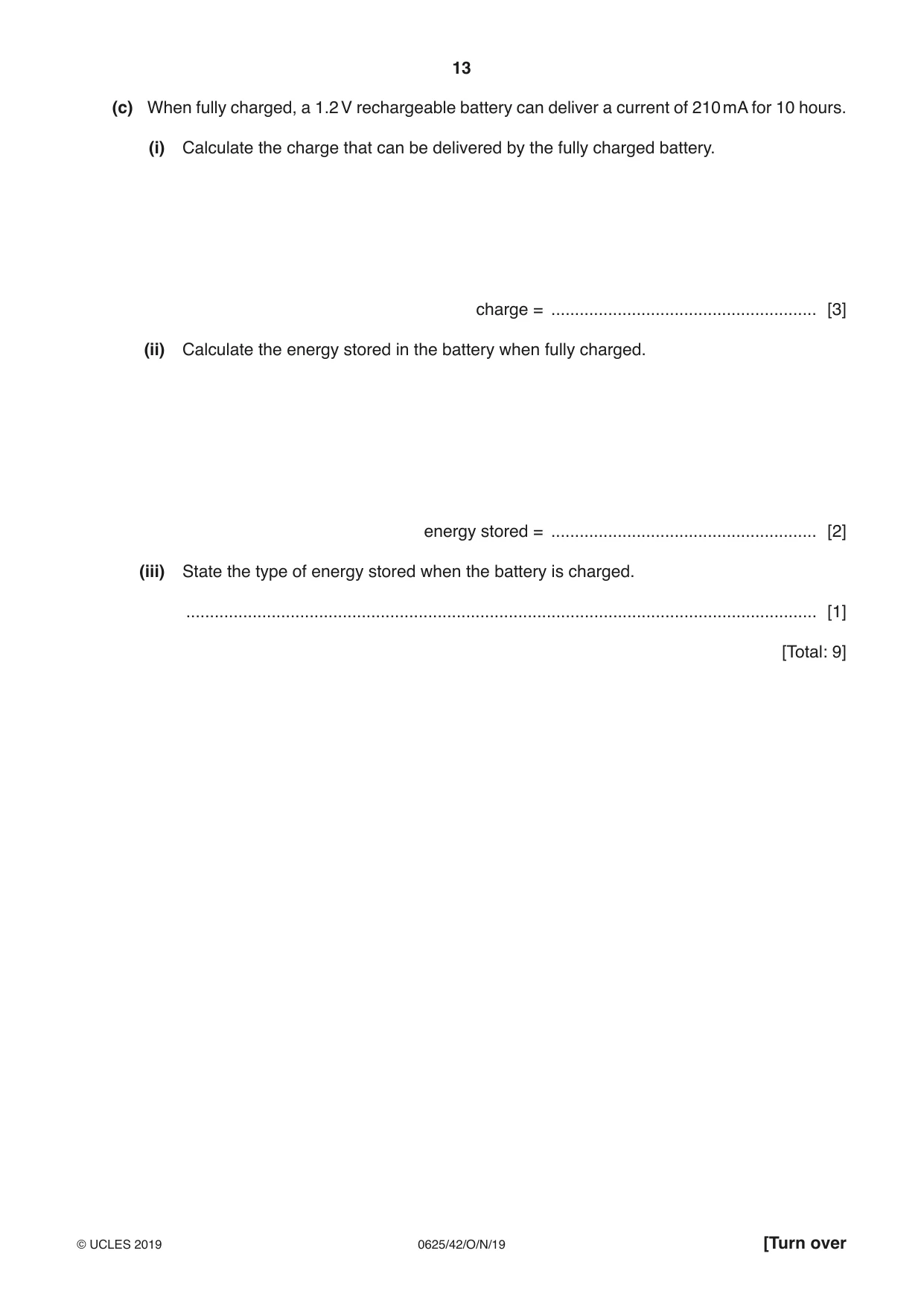
9 (a) Describe what is meant by the term electric field. ................................................................................................................................................... ............................................................................................................................................. [1] (b) Fig. 9.1 shows two parallel conducting plates connected to a battery. conducting plate Fig. 9.1 On Fig. 9.1, draw five lines to show the electric field pattern between the two plates. [2] (c) When fully charged, a 1.2 V rechargeable battery can deliver a current of 210 mA for 10 hours. (i) Calculate the charge that can be delivered by the fully charged battery. charge = ........................................................ [3] (ii) Calculate the energy stored in the battery when fully charged. energy stored = ........................................................ [2] (iii) State the type of energy stored when the battery is charged. ..................................................................................................................................... [1] [Total: 9]
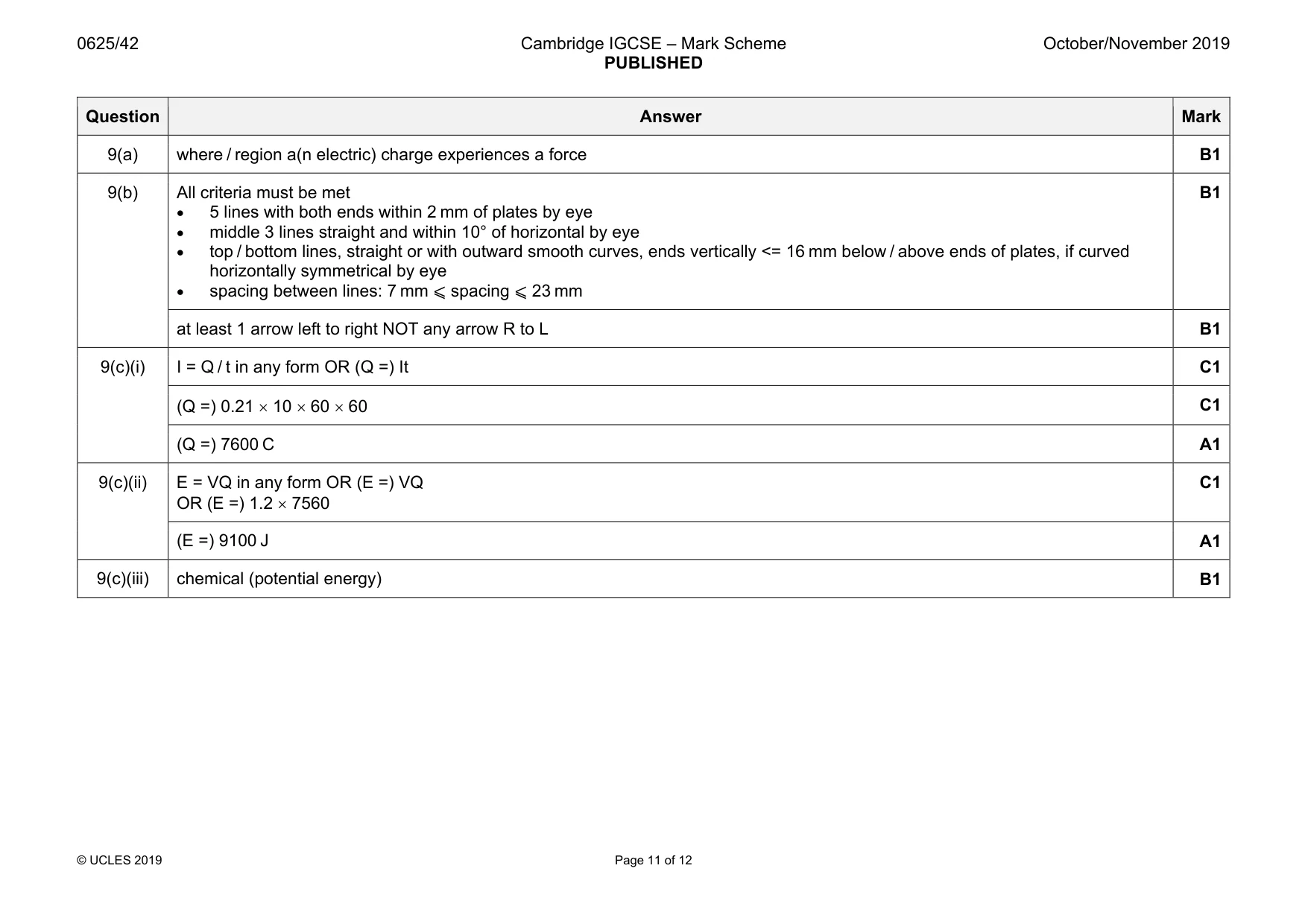
Mark scheme: 9(a) where / region a(n electric) charge experiences a force B1 9(b) All criteria must be met • 5 lines with both ends within 2 mm of plates by eye • middle 3 lines straight and within 10° of horizontal by eye • top / bottom lines, straight or with outward smooth curves, ends vertically <= 16 mm below / above ends of plates, if curved horizontally symmetrical by eye • spacing between lines: 7 mm ⩽ spacing ⩽ 23 mm B1 at least 1 arrow left to right NOT any arrow R to L B1 9(c)(i) I = Q / t in any form OR (Q =) It C1 (Q =) 0.21 × 10 × 60 × 60 C1 (Q =) 7600 C A1 9(c)(ii) E = VQ in any form OR (E =) VQ OR (E =) 1.2 × 7560 C1 (E =) 9100 J A1 9(c)(iii) chemical (potential energy) B1
Q10 · The nucleus of a hydrogen atom is a proton
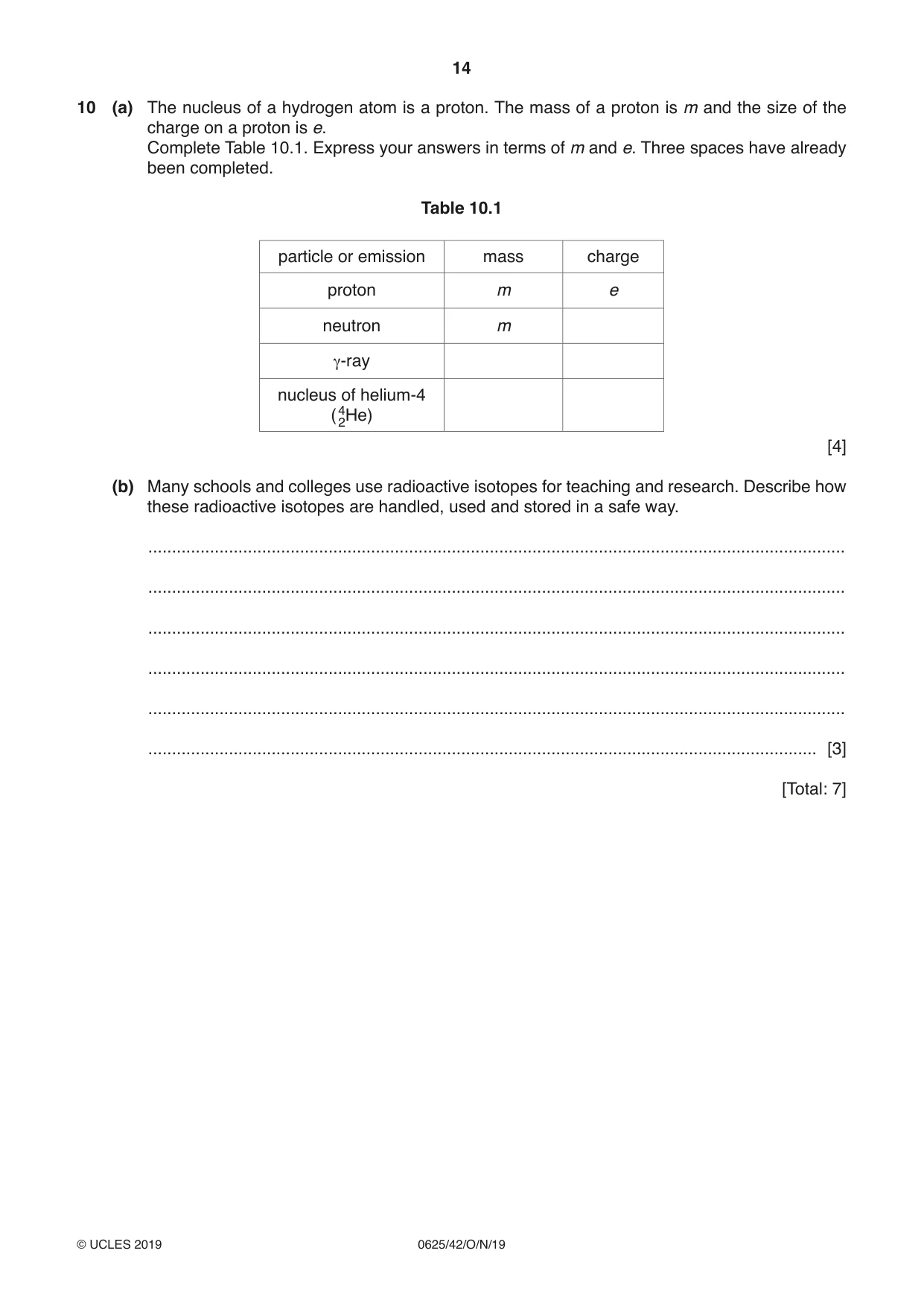
10 (a) The nucleus of a hydrogen atom is a proton. The mass of a proton is m and the size of the charge on a proton is e. Complete Table 10.1. Express your answers in terms of m and e. Three spaces have already been completed. Table 10.1 particle or emission mass charge proton m e neutron m γ-ray nucleus of helium-4 (42He) [4] (b) Many schools and colleges use radioactive isotopes for teaching and research. Describe how these radioactive isotopes are handled, used and stored in a safe way. ................................................................................................................................................... ................................................................................................................................................... ................................................................................................................................................... ................................................................................................................................................... ................................................................................................................................................... ............................................................................................................................................. [3] [Total: 7]
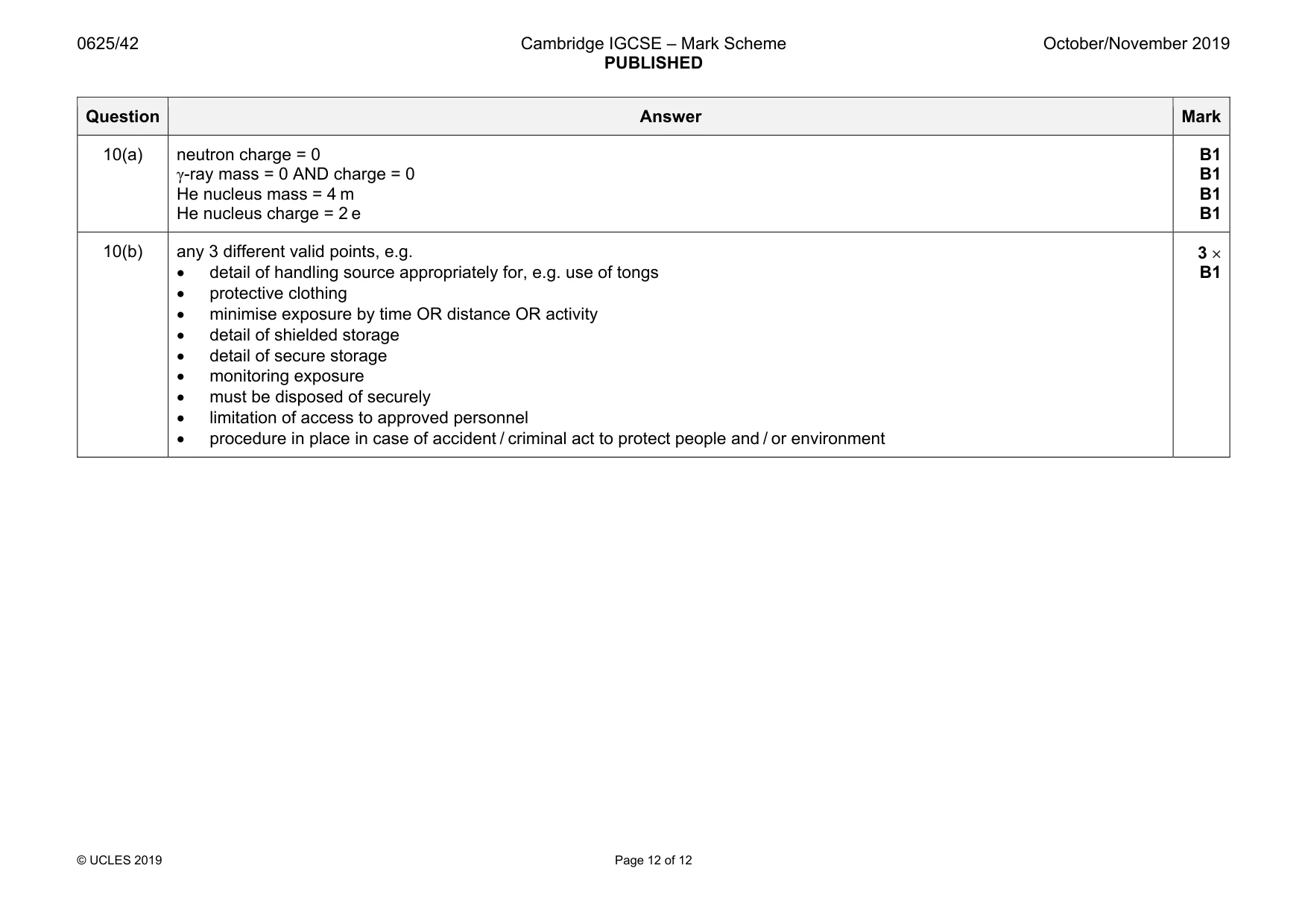
Mark scheme: 10(a) neutron charge = 0 γ-ray mass = 0 AND charge = 0 He nucleus mass = 4 m He nucleus charge = 2 e B1 B1 B1 B1 10(b) any 3 different valid points, e.g. • detail of handling source appropriately for, e.g. use of tongs • protective clothing • minimise exposure by time OR distance OR activity • detail of shielded storage • detail of secure storage • monitoring exposure • must be disposed of securely • limitation of access to approved personnel • procedure in place in case of accident / criminal act to protect people and / or environment 3 × B1
What was in this paper
The subtopics covered by these 10 questions, and how many questions each got. Open one in a new tab to see every Cambridge question on it.
What you needed in this session
Cambridge’s own grade thresholds for 2019 Oct/Nov, Paper 4 · Variant 2. A higher threshold means an easier paper — the bar moves with how the cohort did.