Cambridge IGCSE Physics 0625 — 2023 May/June Paper 4 · Variant 1
0625/41/M/J/23 · 10 questions · 80 marks · ≈90 min
The question paper and its mark scheme, free to read here and free to download. This is Cambridge’s own paper, exactly as it was sat.
Question paper20 pages
Mark scheme14 pages
Answers below. Sit the paper first if you are practising.
Questions as text
Q1 · A straight section of a river where the water is flowing from right to left at a speed of…
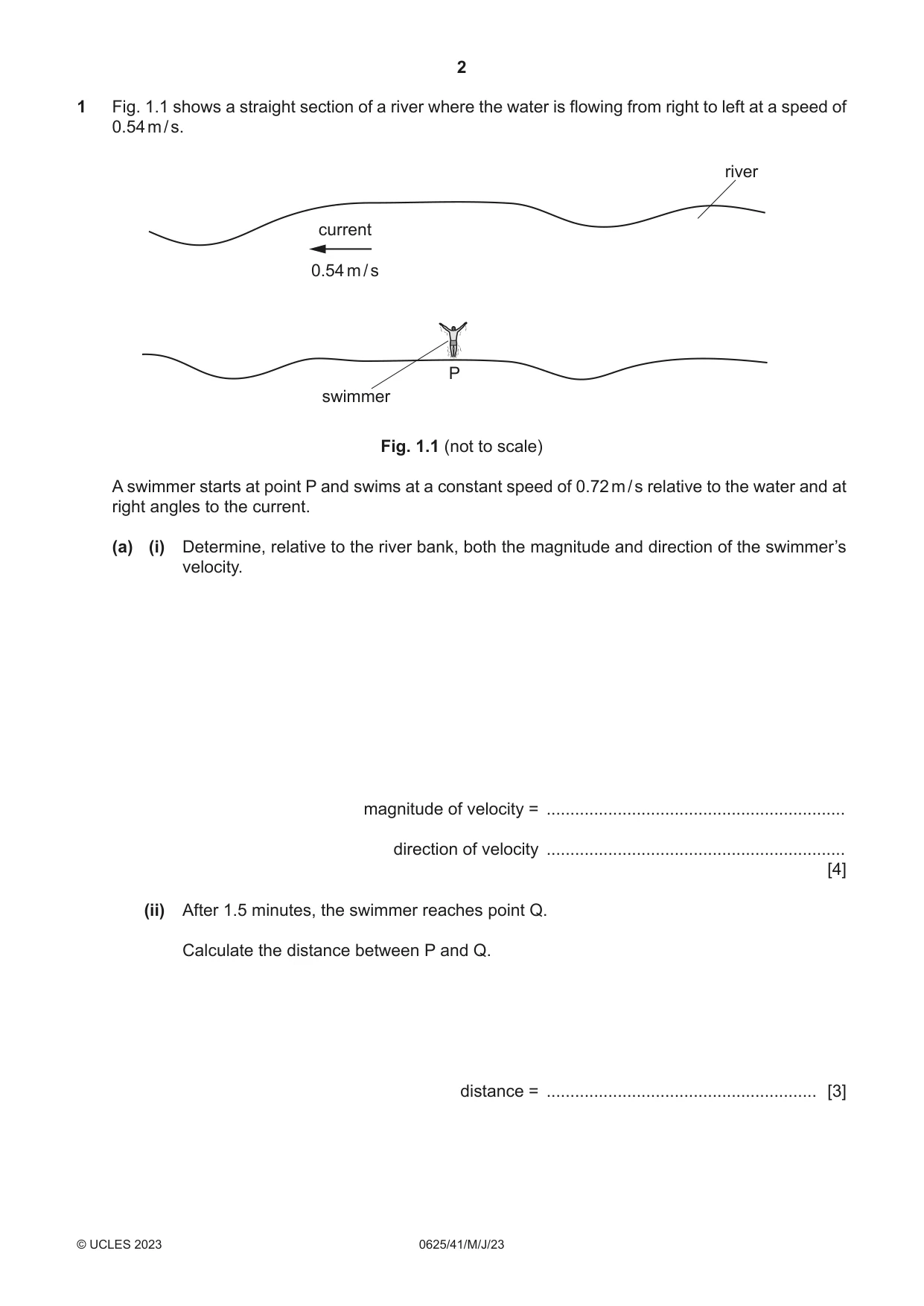
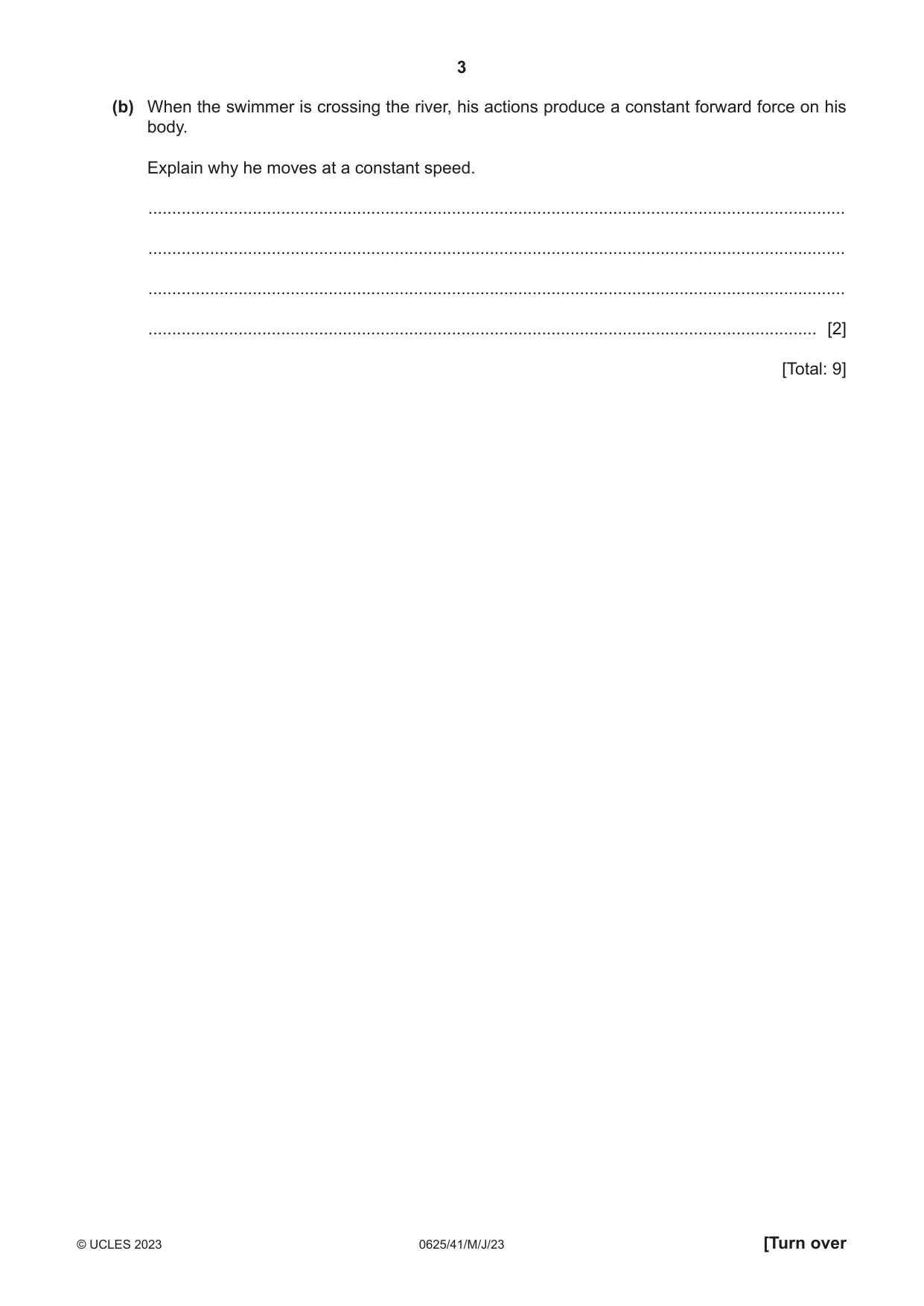
1 Fig. 1.1 shows a straight section of a river where the water is flowing from right to left at a speed of 0.54 m / s. river current 0.54 m / s P swimmer Fig. 1.1 (not to scale) A swimmer starts at point P and swims at a constant speed of 0.72 m / s relative to the water and at right angles to the current. (a) (i) Determine, relative to the river bank, both the magnitude and direction of the swimmer’s velocity. magnitude of velocity = ............................................................... direction of velocity ............................................................... [4] (ii) After 1.5 minutes, the swimmer reaches point Q. Calculate the distance between P and Q. distance = ......................................................... [3] (b) When the swimmer is crossing the river, his actions produce a constant forward force on his body. Explain why he moves at a constant speed. ................................................................................................................................................... ................................................................................................................................................... ................................................................................................................................................... ............................................................................................................................................. [2] [Total: 9]
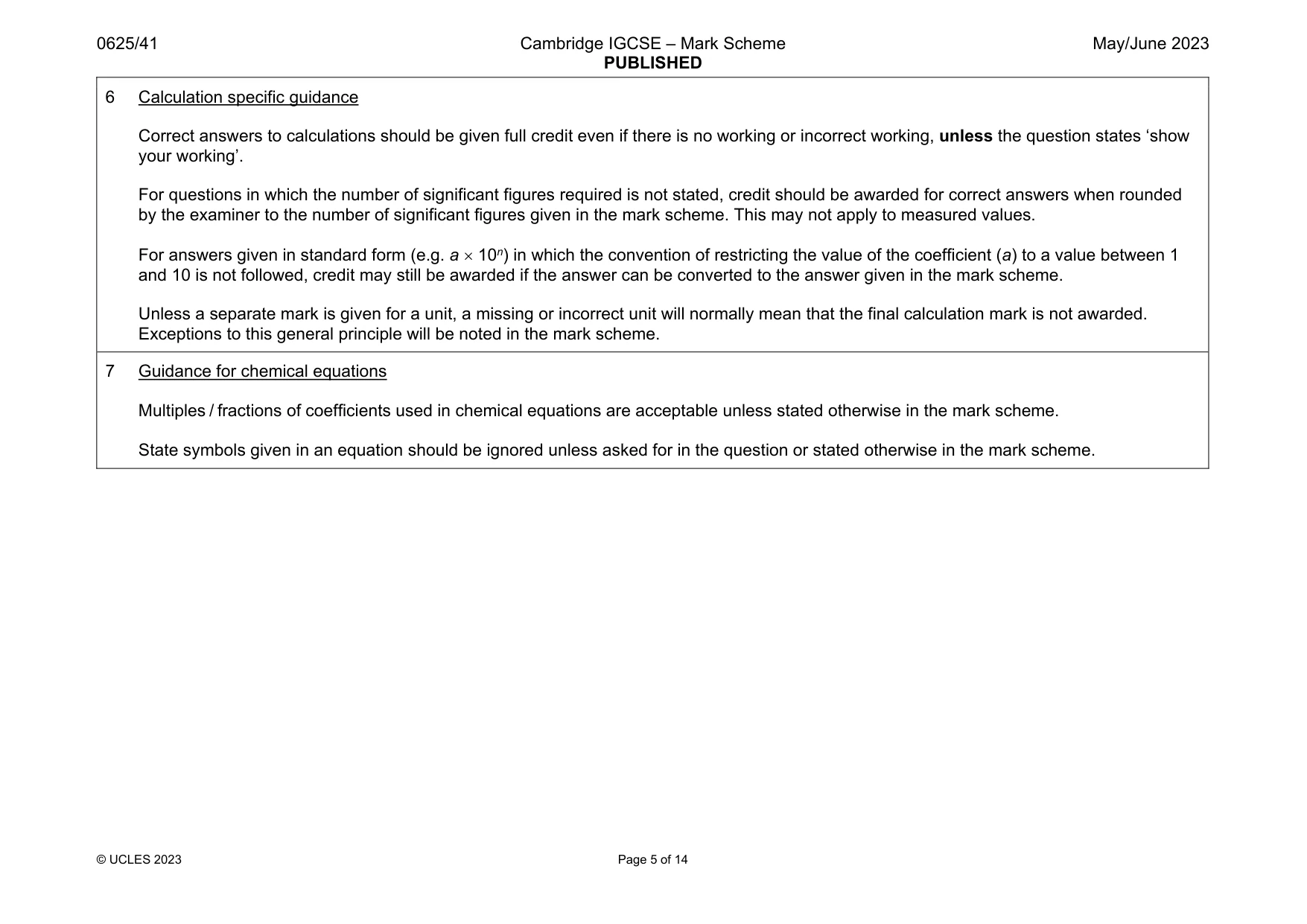
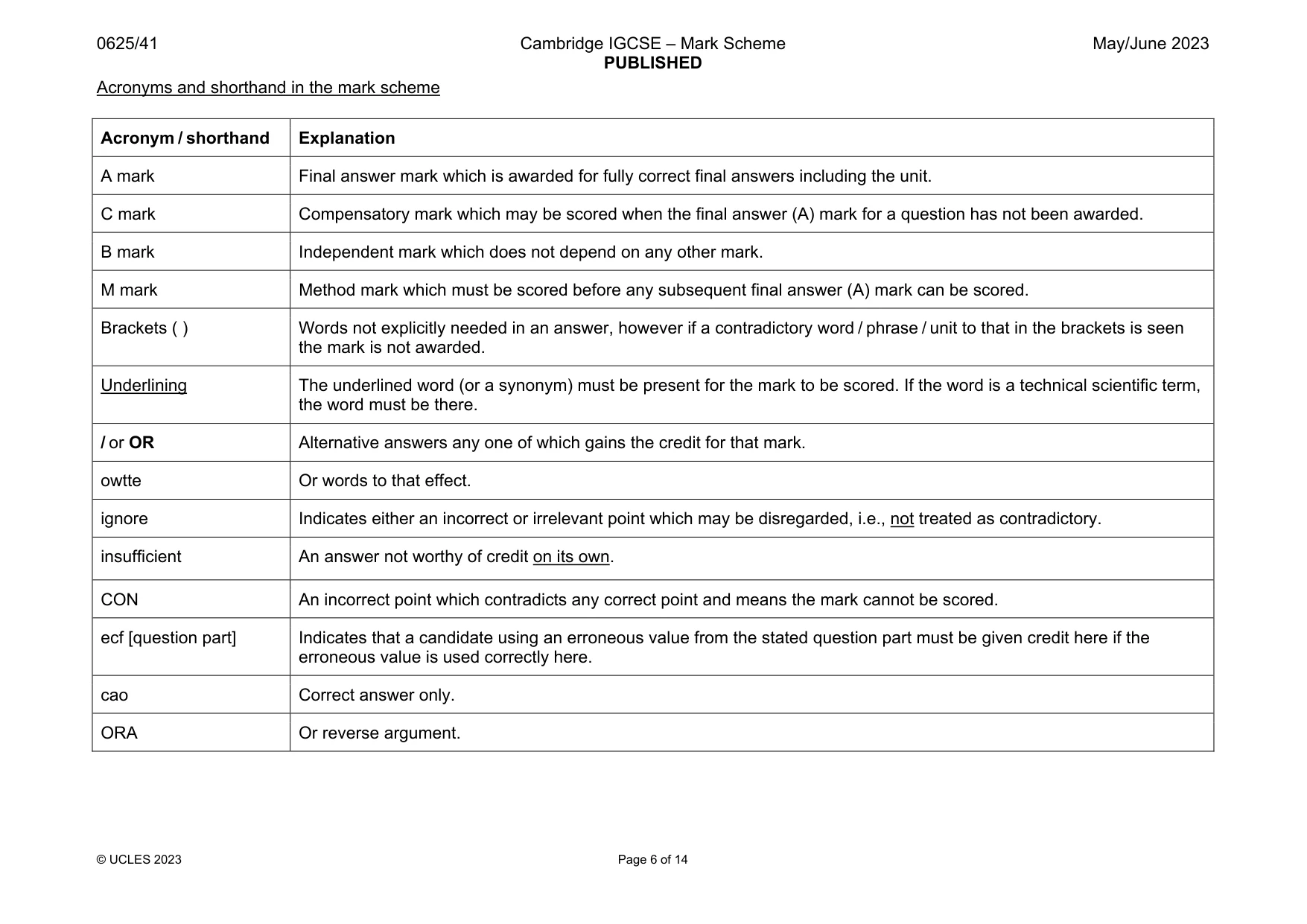
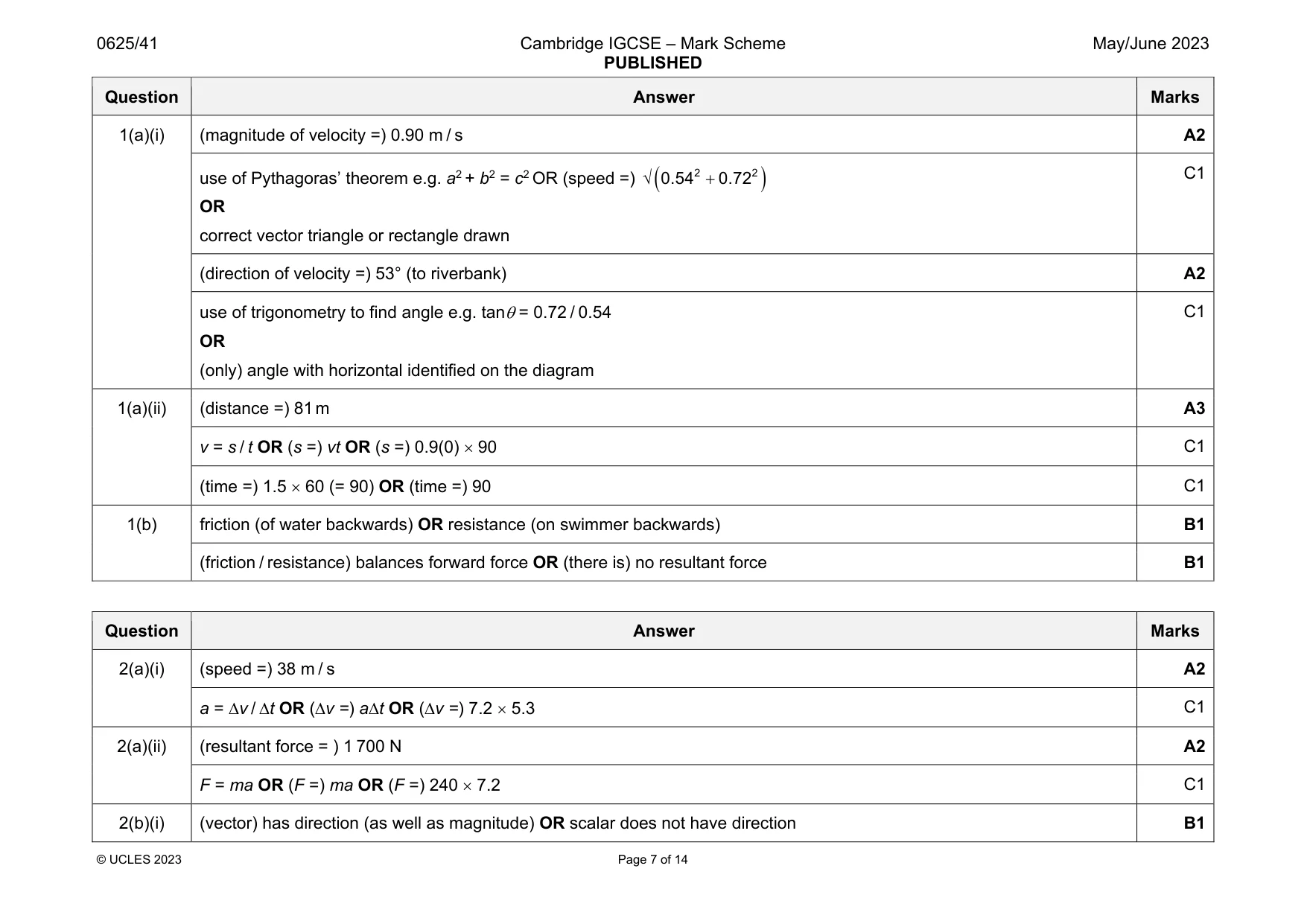
Mark scheme: 1(a)(i) (magnitude of velocity =) 0.90 m / s A2 use of Pythagoras’ theorem e.g. a2 + b2 = c2 OR (speed =) 2 2 0.54 0.72 OR correct vector triangle or rectangle drawn C1 (direction of velocity =) 53° (to riverbank) A2 use of trigonometry to find angle e.g. tan = 0.72 / 0.54 OR (only) angle with horizontal identified on the diagram C1 1(a)(ii) (distance =) 81 m A3 v = s / t OR (s =) vt OR (s =) 0.9(0) 90 C1 (time =) 1.5 60 (= 90) OR (time =) 90 C1 1(b) friction (of water backwards) OR resistance (on swimmer backwards) B1 (friction / resistance) balances forward force OR (there is) no resultant force B1
Q2 · A motorcyclist accelerating along a straight horizontal section of track
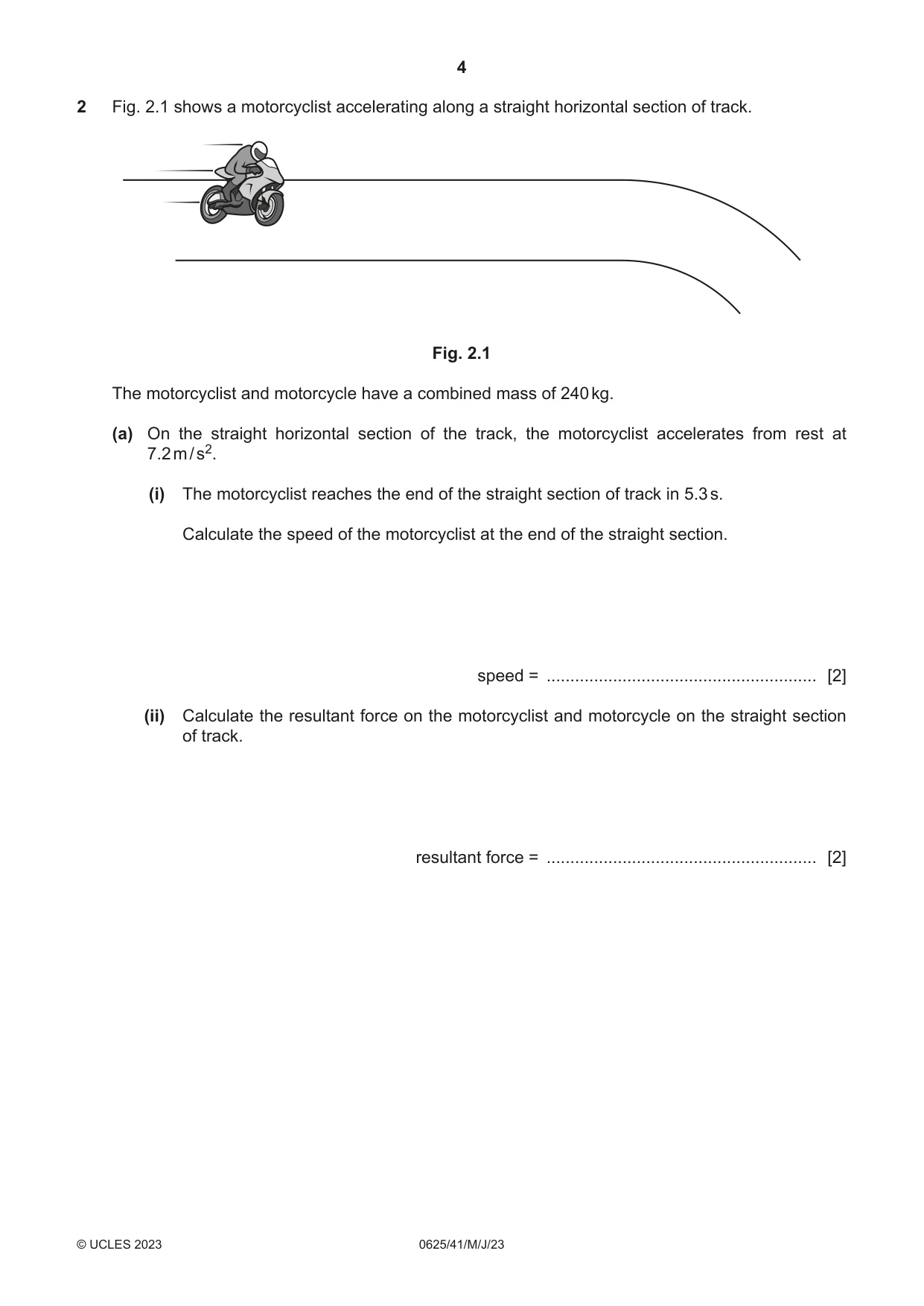
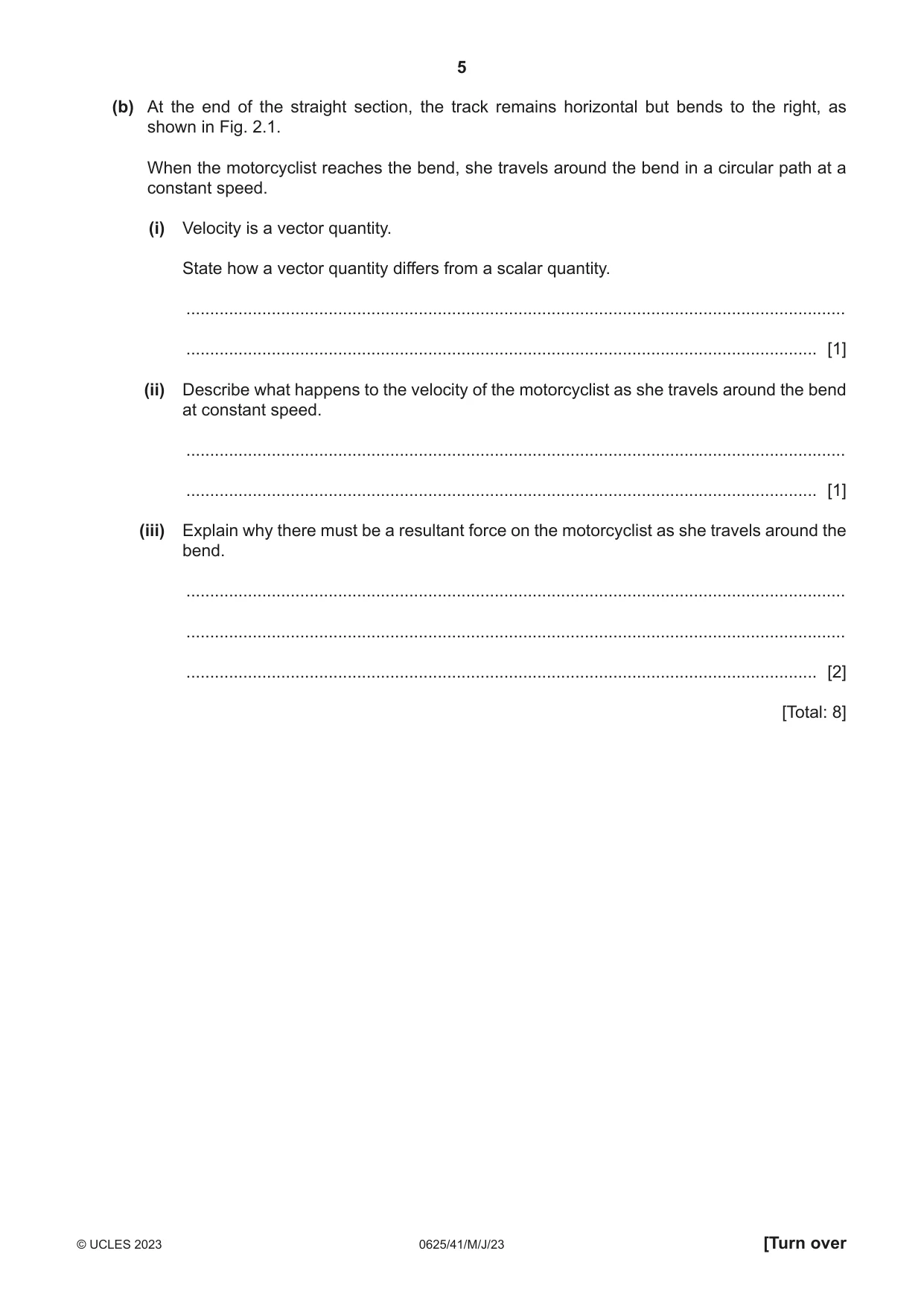
2 Fig. 2.1 shows a motorcyclist accelerating along a straight horizontal section of track. Fig. 2.1 The motorcyclist and motorcycle have a combined mass of 240 kg. (a) On the straight horizontal section of the track, the motorcyclist accelerates from rest at 7.2 m / s2. (i) The motorcyclist reaches the end of the straight section of track in 5.3 s. Calculate the speed of the motorcyclist at the end of the straight section. speed = ......................................................... [2] (ii) Calculate the resultant force on the motorcyclist and motorcycle on the straight section of track. resultant force = ......................................................... [2] (b) At the end of the straight section, the track remains horizontal but bends to the right, as shown in Fig. 2.1. When the motorcyclist reaches the bend, she travels around the bend in a circular path at a constant speed. (i) Velocity is a vector quantity. State how a vector quantity differs from a scalar quantity. ........................................................................................................................................... ..................................................................................................................................... [1] (ii) Describe what happens to the velocity of the motorcyclist as she travels around the bend at constant speed. ........................................................................................................................................... ..................................................................................................................................... [1] (iii) Explain why there must be a resultant force on the motorcyclist as she travels around the bend. ........................................................................................................................................... ........................................................................................................................................... ..................................................................................................................................... [2] [Total: 8]
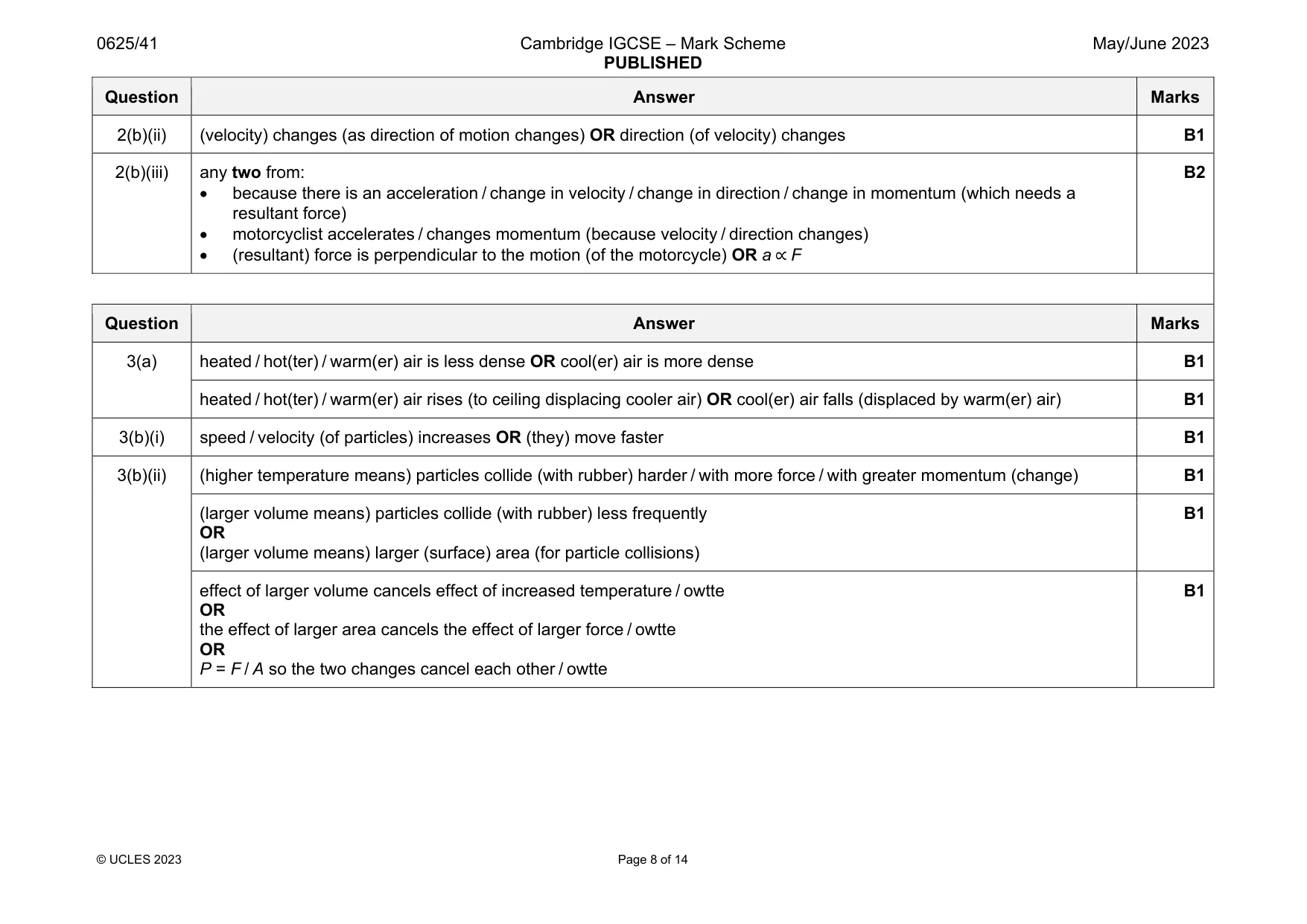
Mark scheme: 2(a)(i) (speed =) 38 m / s A2 a = ∆v / ∆t OR (∆v =) a∆t OR (∆v =) 7.2 5.3 C1 2(a)(ii) (resultant force = ) 1 700 N A2 F = ma OR (F =) ma OR (F =) 240 7.2 C1 2(b)(i) (vector) has direction (as well as magnitude) OR scalar does not have direction B1 Question Answer Marks 2(b)(ii) (velocity) changes (as direction of motion changes) OR direction (of velocity) changes B1 2(b)(iii) any two from: because there is an acceleration / change in velocity / change in direction / change in momentum (which needs a resultant force) motorcyclist accelerates / changes momentum (because velocity / direction changes) (resultant) force is perpendicular to the motion (of the motorcycle) OR a ∝ F B2
Q3 · A rubber balloon is inflated with helium and sealed so that no helium escapes
3 A rubber balloon is inflated with helium and sealed so that no helium escapes. The balloon is positioned immediately below the ceiling in a room. Heaters are switched on and the temperature of the air in the room increases. (a) When the heaters are first switched on, the temperature of the air immediately below the ceiling increases more quickly than the temperature of the air in the rest of the room. Explain why this happens. ................................................................................................................................................... ................................................................................................................................................... ............................................................................................................................................. [2] (b) The temperature of the helium in the balloon increases and as the rubber stretches, the volume occupied by the helium increases. (i) State what happens to the motion of the helium particles as the temperature increases. ........................................................................................................................................... ..................................................................................................................................... [1] (ii) As the rubber stretches and the volume of the helium increases, the pressure of the helium remains constant. Explain, in terms of the particles of helium, how the pressure of the helium remains constant. ........................................................................................................................................... ........................................................................................................................................... ........................................................................................................................................... ..................................................................................................................................... [3] [Total: 6]
Mark scheme: 3(a) heated / hot(ter) / warm(er) air is less dense OR cool(er) air is more dense B1 heated / hot(ter) / warm(er) air rises (to ceiling displacing cooler air) OR cool(er) air falls (displaced by warm(er) air) B1 3(b)(i) speed / velocity (of particles) increases OR (they) move faster B1 3(b)(ii) (higher temperature means) particles collide (with rubber) harder / with more force / with greater momentum (change) B1 (larger volume means) particles collide (with rubber) less frequently OR (larger volume means) larger (surface) area (for particle collisions) B1 effect of larger volume cancels effect of increased temperature / owtte OR the effect of larger area cancels the effect of larger force / owtte OR P = F / A so the two changes cancel each other / owtte B1
Q4 · A student investigates the efficiency of a filament lamp
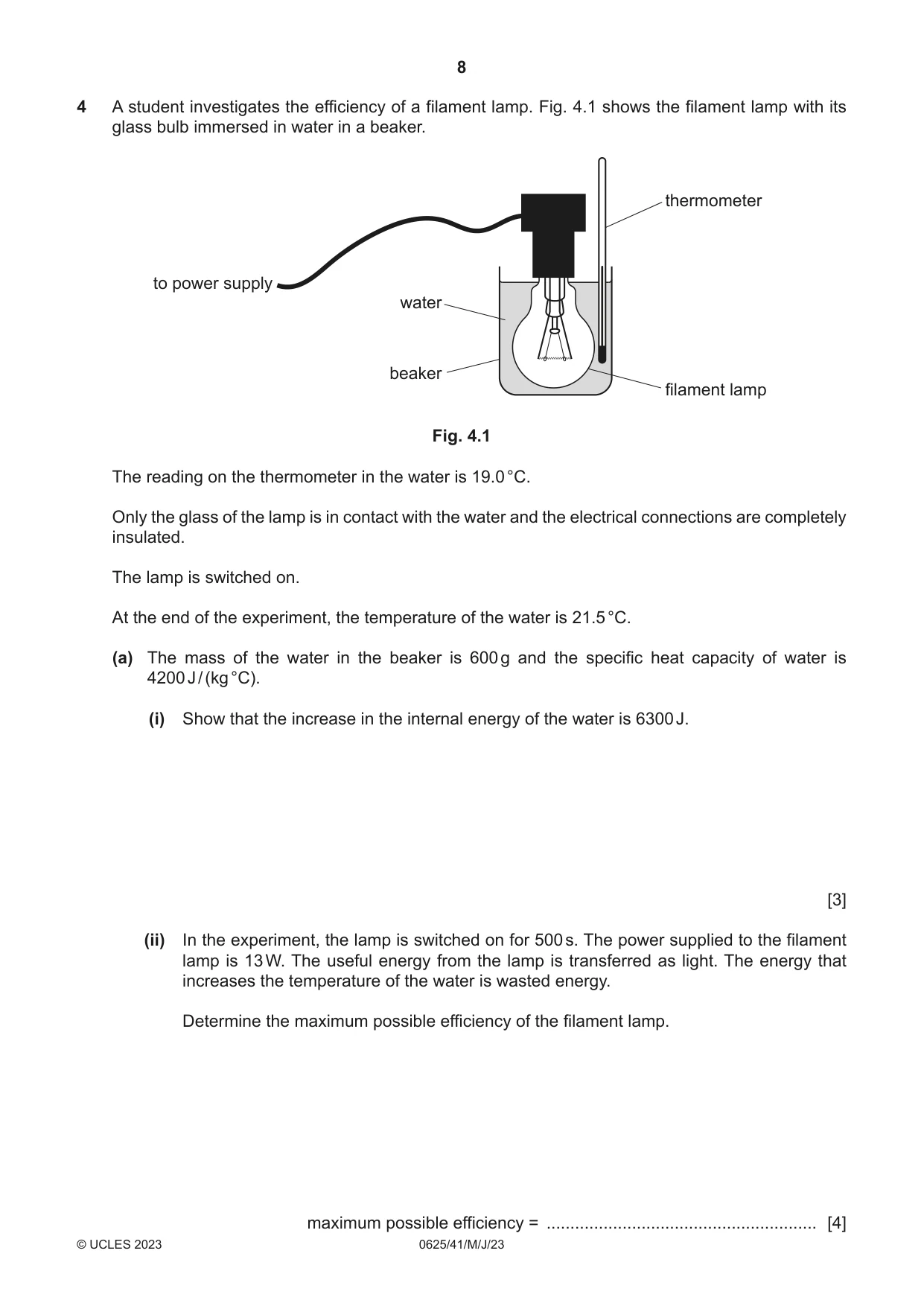
4 A student investigates the efficiency of a filament lamp. Fig. 4.1 shows the filament lamp with its glass bulb immersed in water in a beaker. thermometer to power supply water beaker filament lamp Fig. 4.1 The reading on the thermometer in the water is 19.0 °C. Only the glass of the lamp is in contact with the water and the electrical connections are completely insulated. The lamp is switched on. At the end of the experiment, the temperature of the water is 21.5 °C. (a) The mass of the water in the beaker is 600 g and the specific heat capacity of water is 4200 J / (kg °C). (i) Show that the increase in the internal energy of the water is 6300 J. [3] (ii) In the experiment, the lamp is switched on for 500 s. The power supplied to the filament lamp is 13 W. The useful energy from the lamp is transferred as light. The energy that increases the temperature of the water is wasted energy. Determine the maximum possible efficiency of the filament lamp. maximum possible efficiency = ......................................................... [4] (b) The efficiency of the lamp is less than the value determined in (a)(ii). Suggest one reason for this. ................................................................................................................................................... ................................................................................................................................................... ............................................................................................................................................. [1] [Total: 8]
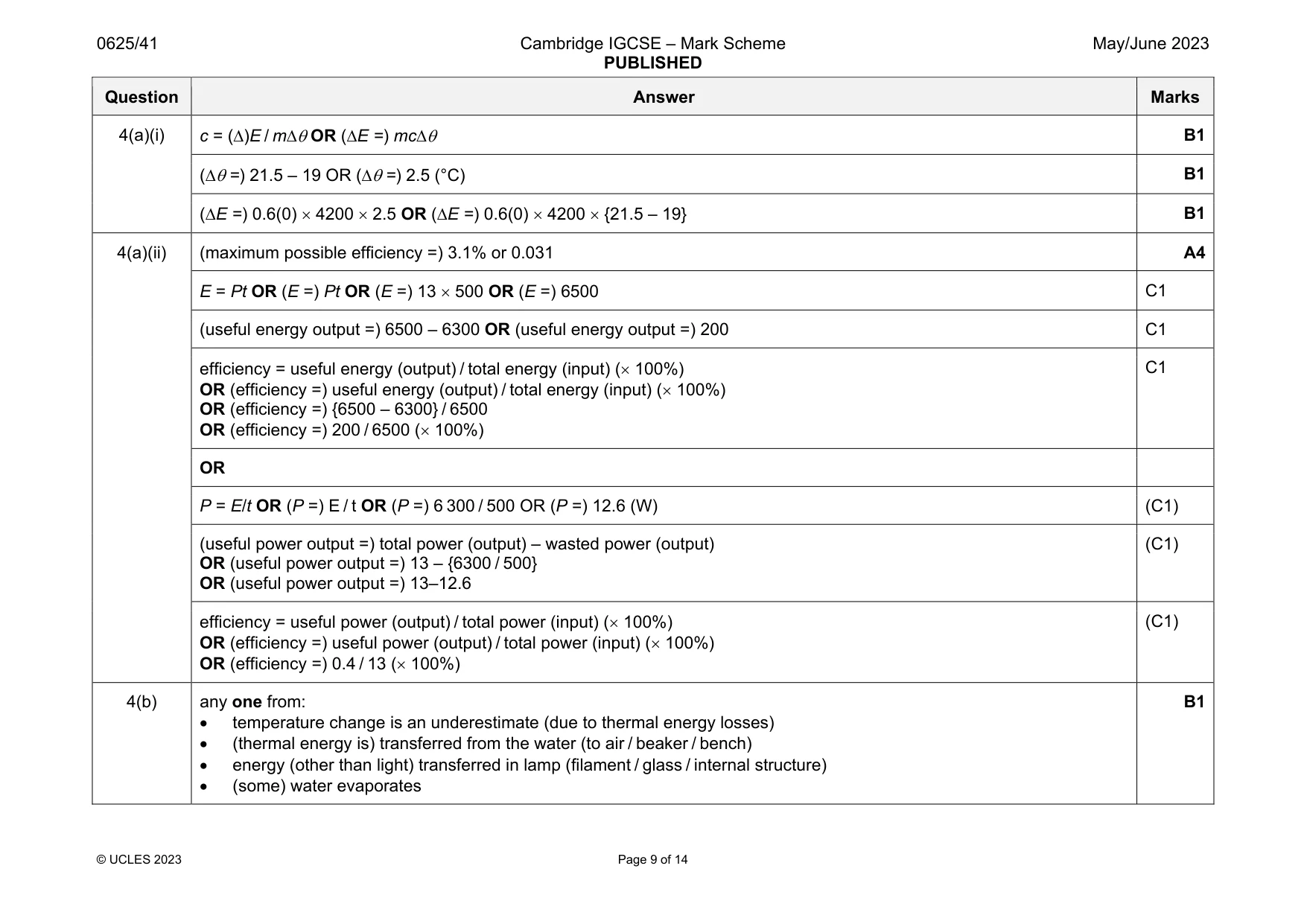
Mark scheme: 4(a)(i) B1 (∆ =) 21.5 – 19 OR (∆ =) 2.5 (°C) B1 (∆E =) 0.6(0) 4200 2.5 OR (∆E =) 0.6(0) 4200 {21.5 – 19} B1 4(a)(ii) (maximum possible efficiency =) 3.1% or 0.031 A4 E = Pt OR (E =) Pt OR (E =) 13 500 OR (E =) 6500 C1 (useful energy output =) 6500 – 6300 OR (useful energy output =) 200 C1 efficiency = useful energy (output) / total energy (input) ( 100%) OR (efficiency =) useful energy (output) / total energy (input) ( 100%) OR (efficiency =) {6500 – 6300} / 6500 OR (efficiency =) 200 / 6500 ( 100%) C1 OR P = E/t OR (P =) E / t OR (P =) 6 300 / 500 OR (P =) 12.6 (W) (C1) (useful power output =) total power (output) – wasted power (output) OR (useful power output =) 13 – {6300 / 500} OR (useful power output =) 13–12.6 (C1) efficiency = useful power (output) / total power (input) ( 100%) OR (efficiency =) useful power (output) / total power (input) ( 100%) OR (efficiency =) 0.4 / 13 ( 100%) (C1) 4(b) any one from: temperature change is an underestimate (due to thermal energy losses) (thermal energy is) transferred from the water (to air / beaker / bench) energy (other than light) transferred in lamp (filament / glass / internal structure) (some) water evaporates B1
Q5 · A block ABCD made of glass that has a refractive index of 1.5
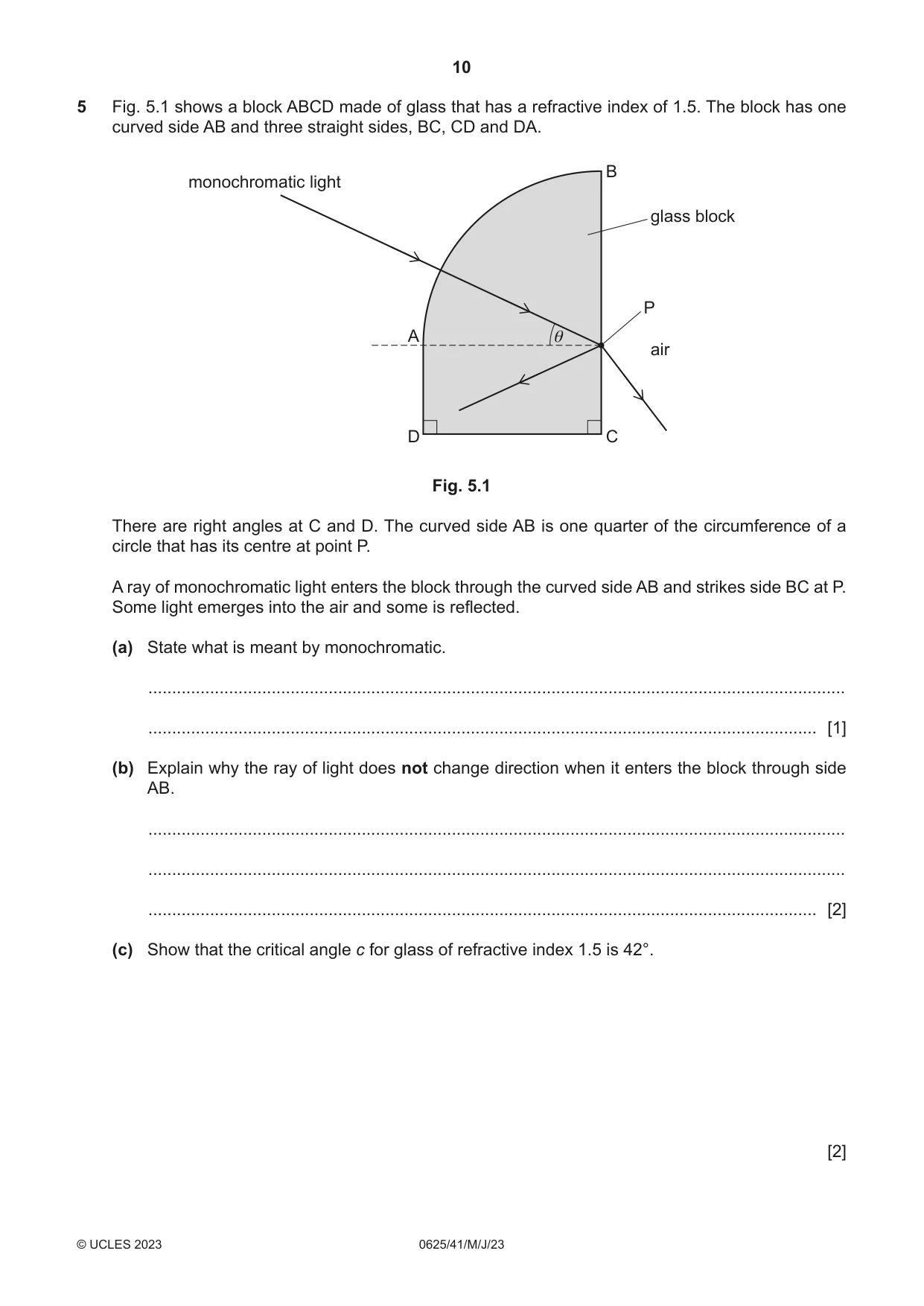
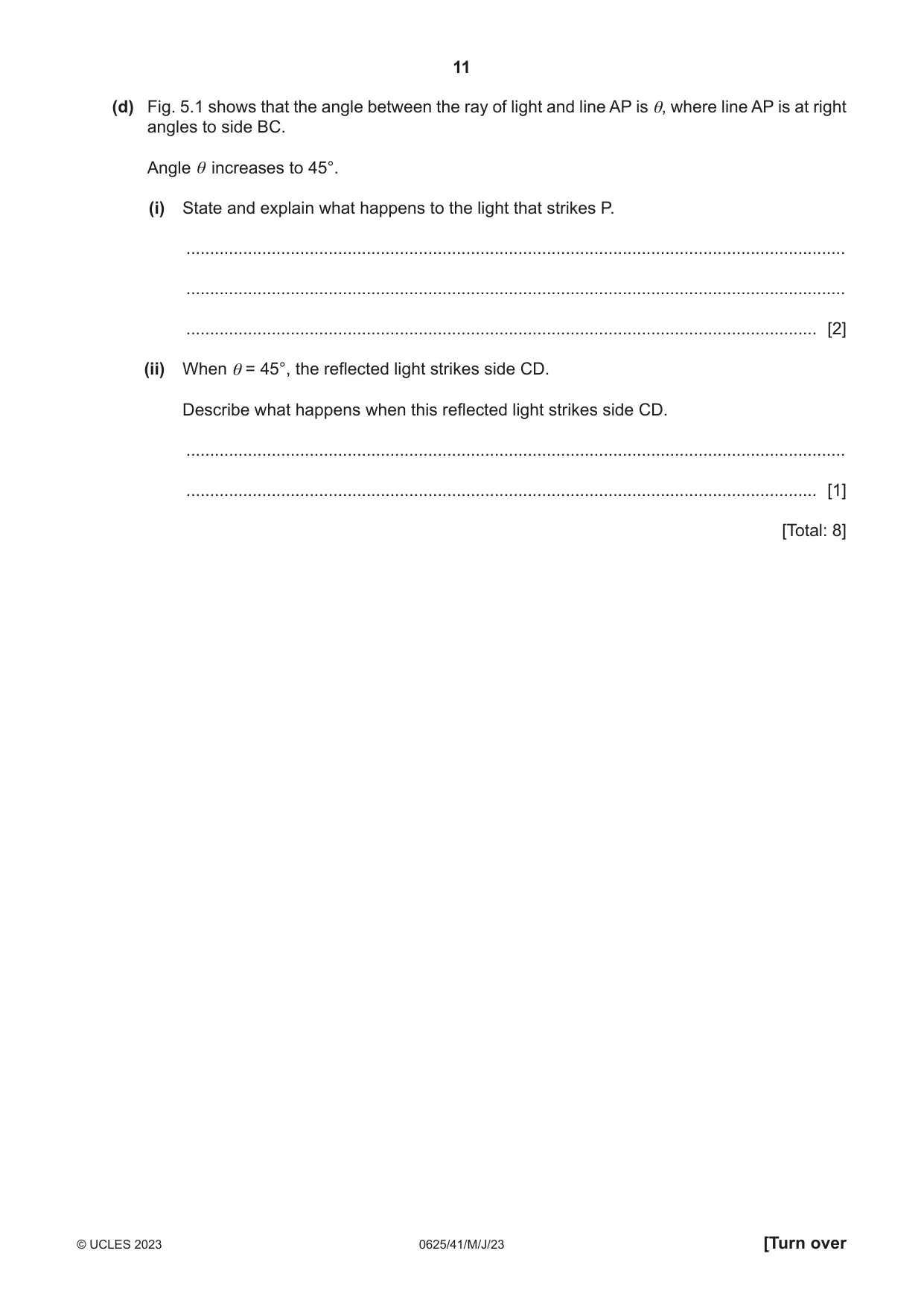
5 Fig. 5.1 shows a block ABCD made of glass that has a refractive index of 1.5. The block has one curved side AB and three straight sides, BC, CD and DA. B monochromatic light glass block P A θ air D C Fig. 5.1 There are right angles at C and D. The curved side AB is one quarter of the circumference of a circle that has its centre at point P. A ray of monochromatic light enters the block through the curved side AB and strikes side BC at P. Some light emerges into the air and some is reflected. (a) State what is meant by monochromatic. ................................................................................................................................................... ............................................................................................................................................. [1] (b) Explain why the ray of light does not change direction when it enters the block through side AB. ................................................................................................................................................... ................................................................................................................................................... ............................................................................................................................................. [2] (c) Show that the critical angle c for glass of refractive index 1.5 is 42°. [2] (d) Fig. 5.1 shows that the angle between the ray of light and line AP is θ, where line AP is at right angles to side BC. Angle θ increases to 45°. (i) State and explain what happens to the light that strikes P. ........................................................................................................................................... ........................................................................................................................................... ..................................................................................................................................... [2] (ii) When θ = 45°, the reflected light strikes side CD. Describe what happens when this reflected light strikes side CD. ........................................................................................................................................... ..................................................................................................................................... [1] [Total: 8]
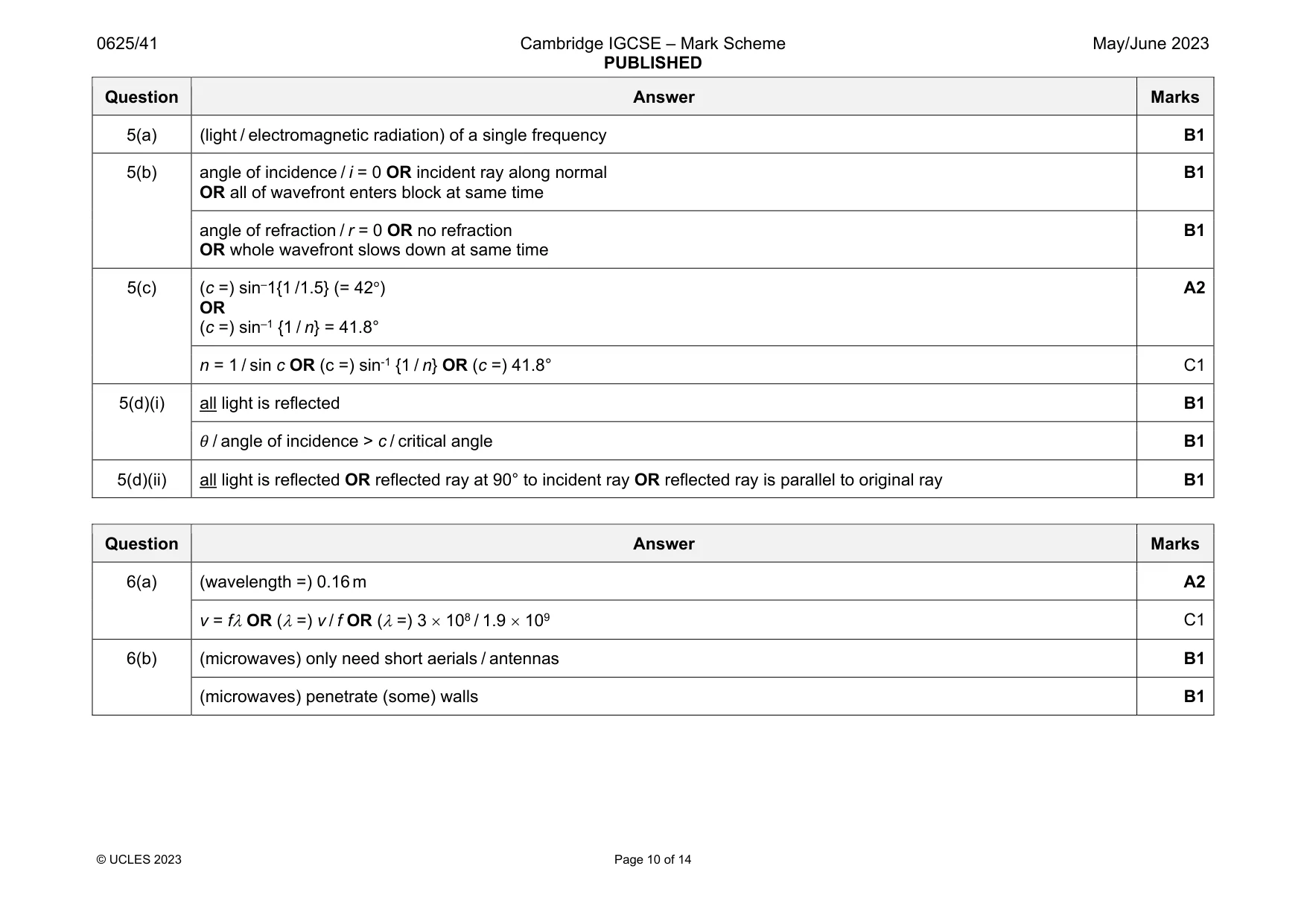
Mark scheme: 5(a) (light / electromagnetic radiation) of a single frequency B1 5(b) angle of incidence / i = 0 OR incident ray along normal OR all of wavefront enters block at same time B1 angle of refraction / r = 0 OR no refraction OR whole wavefront slows down at same time B1 5(c) (c =) sin–1{1 /1.5} (= 42°) OR (c =) sin–1 {1 / n} = 41.8° A2 n = 1 / sin c OR (c =) sin-1 {1 / n} OR (c =) 41.8° C1 5(d)(i) all light is reflected B1 𝜃 / angle of incidence > c / critical angle B1 5(d)(ii) all light is reflected OR reflected ray at 90° to incident ray OR reflected ray is parallel to original ray B1
Q6 · A mobile phone (cell phone) network uses microwaves of frequency 1.9 × 10⁹ Hz to transmit…
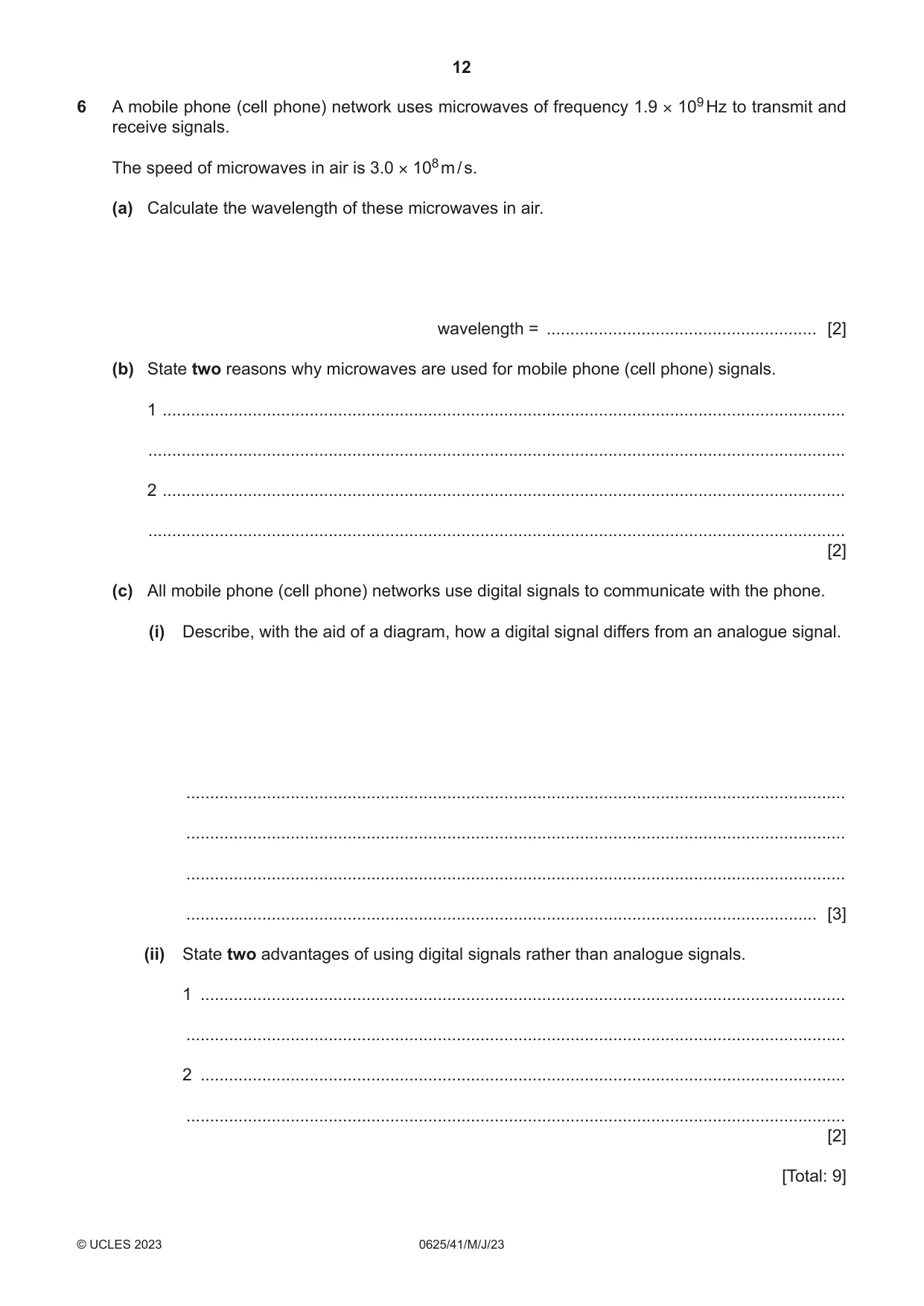
6 A mobile phone (cell phone) network uses microwaves of frequency 1.9 × 10⁹ Hz to transmit and receive signals. The speed of microwaves in air is 3.0 × 10⁸ m / s. (a) Calculate the wavelength of these microwaves in air. wavelength = ......................................................... [2] (b) State two reasons why microwaves are used for mobile phone (cell phone) signals. 1 ................................................................................................................................................ ................................................................................................................................................... 2 ................................................................................................................................................ ................................................................................................................................................... [2] (c) All mobile phone (cell phone) networks use digital signals to communicate with the phone. (i) Describe, with the aid of a diagram, how a digital signal differs from an analogue signal. ........................................................................................................................................... ........................................................................................................................................... ........................................................................................................................................... ..................................................................................................................................... [3] (ii) State two advantages of using digital signals rather than analogue signals. 1 ........................................................................................................................................ ........................................................................................................................................... 2 ........................................................................................................................................ ........................................................................................................................................... [2] [Total: 9]
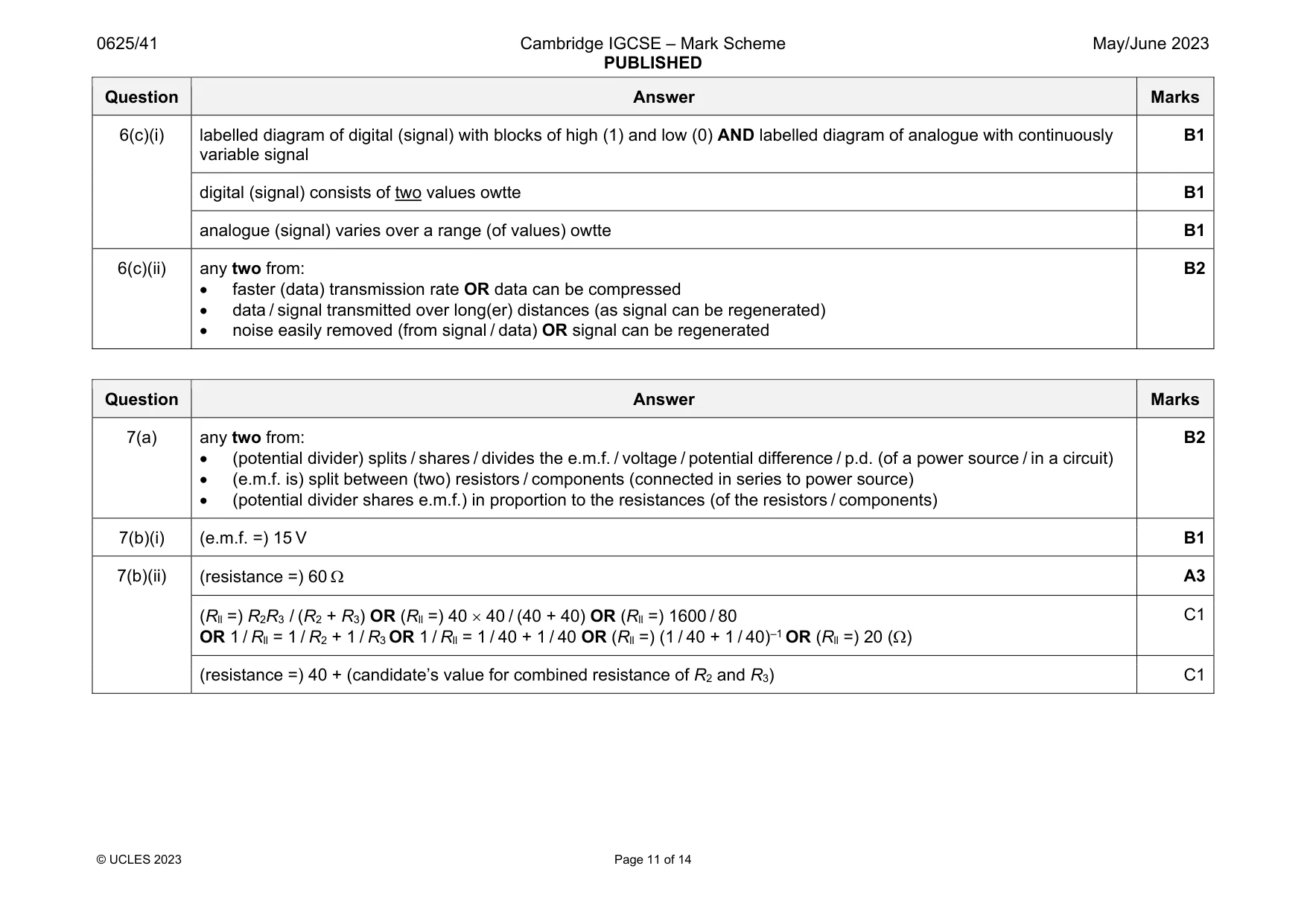
Mark scheme: 6(a) (wavelength =) 0.16 m A2 v = f OR ( =) v / f OR ( =) 3 108 / 1.9 109 C1 6(b) (microwaves) only need short aerials / antennas B1 (microwaves) penetrate (some) walls B1 Question Answer Marks 6(c)(i) labelled diagram of digital (signal) with blocks of high (1) and low (0) AND labelled diagram of analogue with continuously variable signal B1 digital (signal) consists of two values owtte B1 analogue (signal) varies over a range (of values) owtte B1 6(c)(ii) any two from: faster (data) transmission rate OR data can be compressed data / signal transmitted over long(er) distances (as signal can be regenerated) noise easily removed (from signal / data) OR signal can be regenerated B2
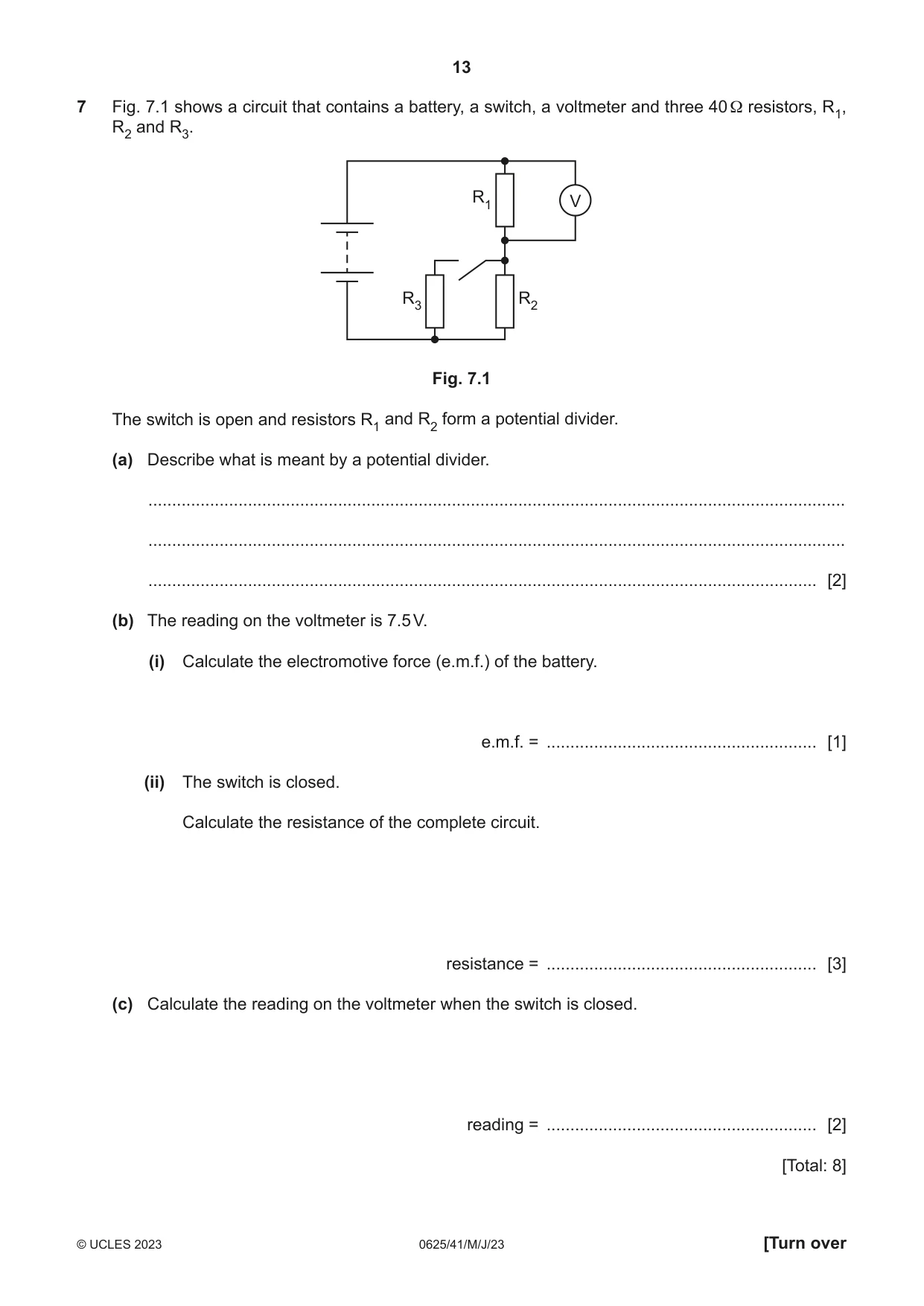
Q7 · A circuit that contains a battery, a switch, a voltmeter and three 40 Ω resistors, R1, R2…
7 Fig. 7.1 shows a circuit that contains a battery, a switch, a voltmeter and three 40 Ω resistors, R1, R2 and R3. R1 V R3 R2 Fig. 7.1 The switch is open and resistors R1 and R2 form a potential divider. (a) Describe what is meant by a potential divider. ................................................................................................................................................... ................................................................................................................................................... ............................................................................................................................................. [2] (b) The reading on the voltmeter is 7.5 V. (i) Calculate the electromotive force (e.m.f.) of the battery. e.m.f. = ......................................................... [1] (ii) The switch is closed. Calculate the resistance of the complete circuit. resistance = ......................................................... [3] (c) Calculate the reading on the voltmeter when the switch is closed. reading = ......................................................... [2] [Total: 8]
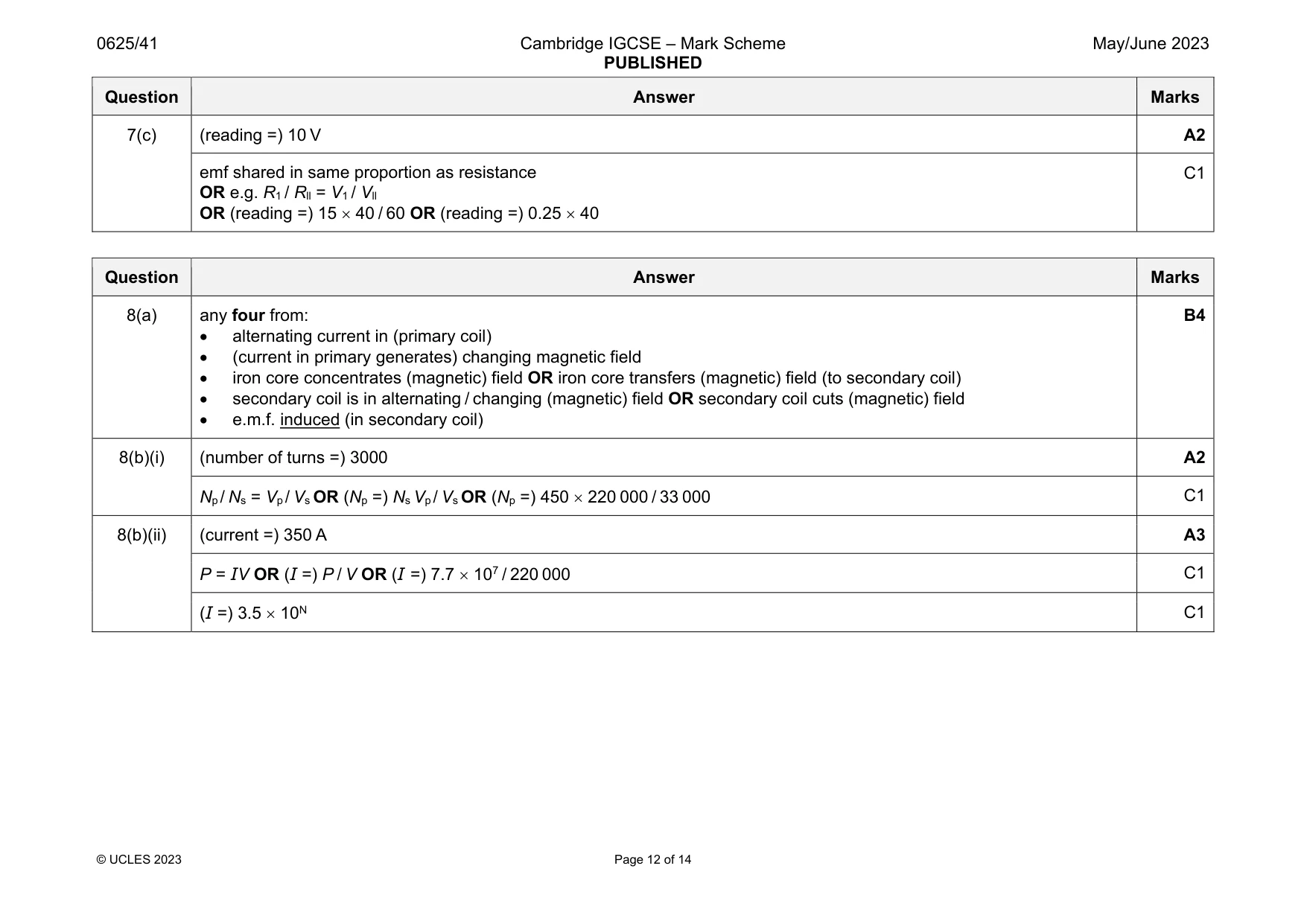
Mark scheme: 7(a) any two from: (potential divider) splits / shares / divides the e.m.f. / voltage / potential difference / p.d. (of a power source / in a circuit) (e.m.f. is) split between (two) resistors / components (connected in series to power source) (potential divider shares e.m.f.) in proportion to the resistances (of the resistors / components) 7(b)(i) (e.m.f. =) 15 V B1 7(b)(ii) (resistance =) 60 A3 (Rll =) R2R3 / (R2 + R3) OR (Rll =) 40 40 / (40 + 40) OR (Rll =) 1600 / 80 OR 1 / Rll = 1 / R2 + 1 / R3 OR 1 / Rll = 1 / 40 + 1 / 40 OR (Rll =) (1 / 40 + 1 / 40)–1 OR (Rll =) 20 () C1 (resistance =) 40 + (candidate’s value for combined resistance of R2 and R3) C1 Question Answer Marks 7(c) (reading =) 10 V A2 emf shared in same proportion as resistance OR e.g. R1 / Rll = V1 / Vll OR (reading =) 15 40 / 60 OR (reading =) 0.25 40 C1
Q8 · The electricity supplied to a town is transmitted using a high-voltage cable
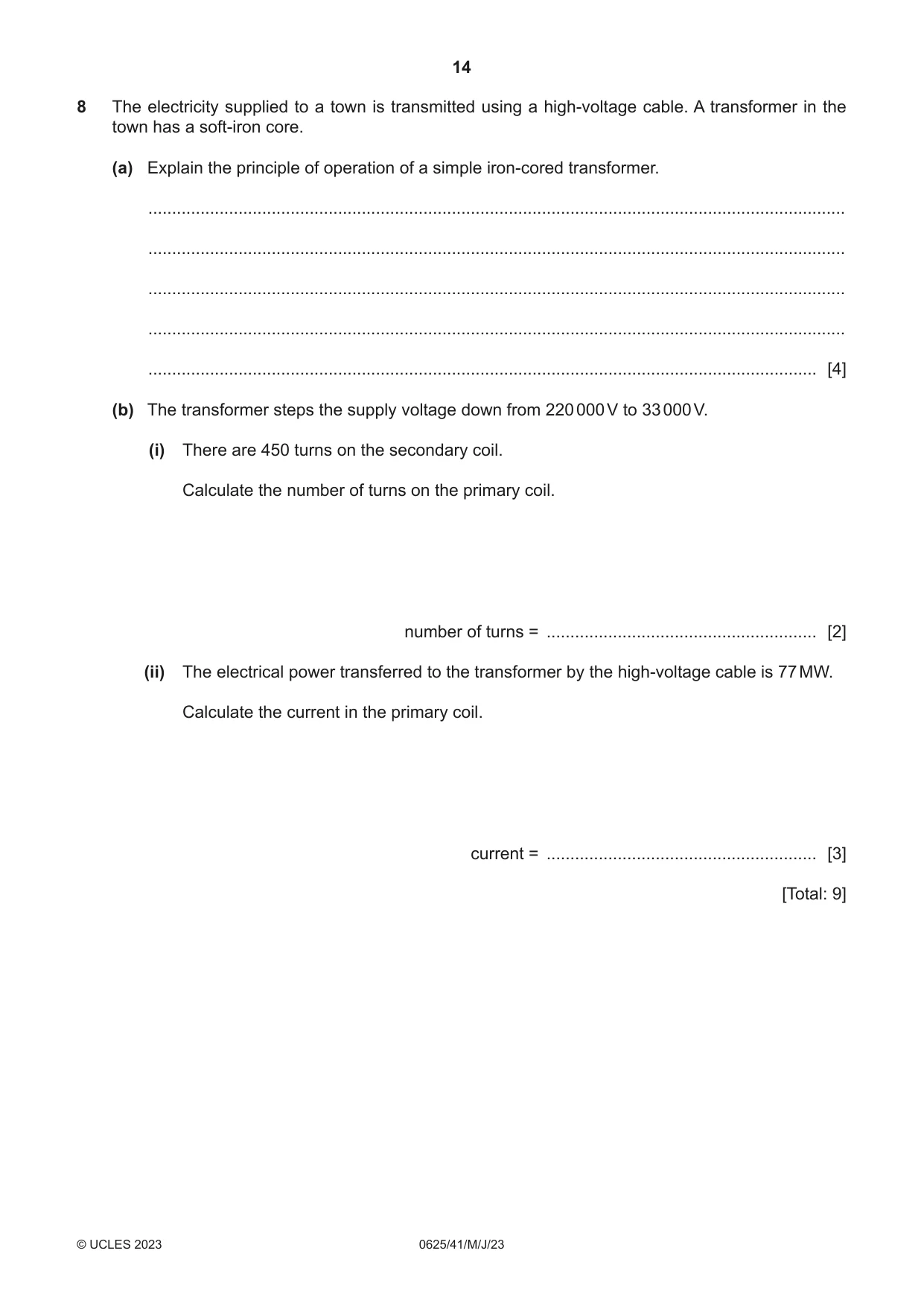
8 The electricity supplied to a town is transmitted using a high-voltage cable. A transformer in the town has a soft-iron core. (a) Explain the principle of operation of a simple iron-cored transformer. ................................................................................................................................................... ................................................................................................................................................... ................................................................................................................................................... ................................................................................................................................................... ............................................................................................................................................. [4] (b) The transformer steps the supply voltage down from 220 000 V to 33 000 V. (i) There are 450 turns on the secondary coil. Calculate the number of turns on the primary coil. number of turns = ......................................................... [2] (ii) The electrical power transferred to the transformer by the high-voltage cable is 77 MW. Calculate the current in the primary coil. current = ......................................................... [3] [Total: 9]
Mark scheme: 8(a) any four from: alternating current in (primary coil) (current in primary generates) changing magnetic field iron core concentrates (magnetic) field OR iron core transfers (magnetic) field (to secondary coil) secondary coil is in alternating / changing (magnetic) field OR secondary coil cuts (magnetic) field e.m.f. induced (in secondary coil) B4 8(b)(i) (number of turns =) 3000 A2 Np/ Ns = Vp/ Vs OR (Np =) Ns Vp/ Vs OR (Np =) 450 220 000 / 33 000 C1 8(b)(ii) (current =) 350 A A3 P = IV OR (I =) P / V OR (I =) 7.7 107 / 220 000 C1 (I =) 3.5 10N C1
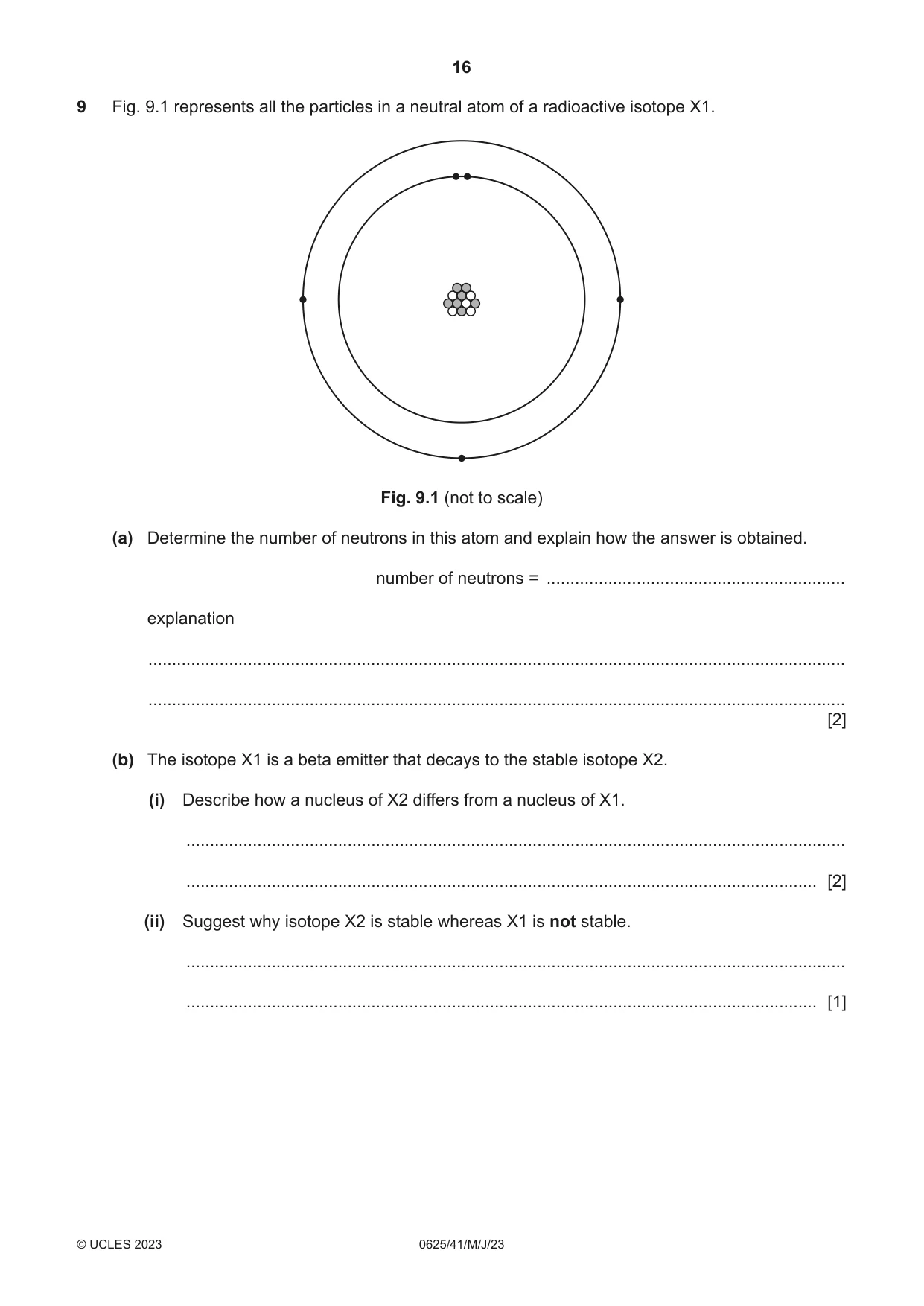
Q9 · All the particles in a neutral atom of a radioactive isotope X1
9 Fig. 9.1 represents all the particles in a neutral atom of a radioactive isotope X1. Fig. 9.1 (not to scale) (a) Determine the number of neutrons in this atom and explain how the answer is obtained. number of neutrons = ............................................................... explanation ................................................................................................................................................... ................................................................................................................................................... [2] (b) The isotope X1 is a beta emitter that decays to the stable isotope X2. (i) Describe how a nucleus of X2 differs from a nucleus of X1. ........................................................................................................................................... ..................................................................................................................................... [2] (ii) Suggest why isotope X2 is stable whereas X1 is not stable. ........................................................................................................................................... ..................................................................................................................................... [1] (c) The half-life of X1 is approximately 20 ms. (i) Define the term half-life. ........................................................................................................................................... ........................................................................................................................................... ..................................................................................................................................... [2] (ii) Suggest one reason why isotopes with very short half-lives are especially hazardous. ........................................................................................................................................... ..................................................................................................................................... [1] [Total: 8]
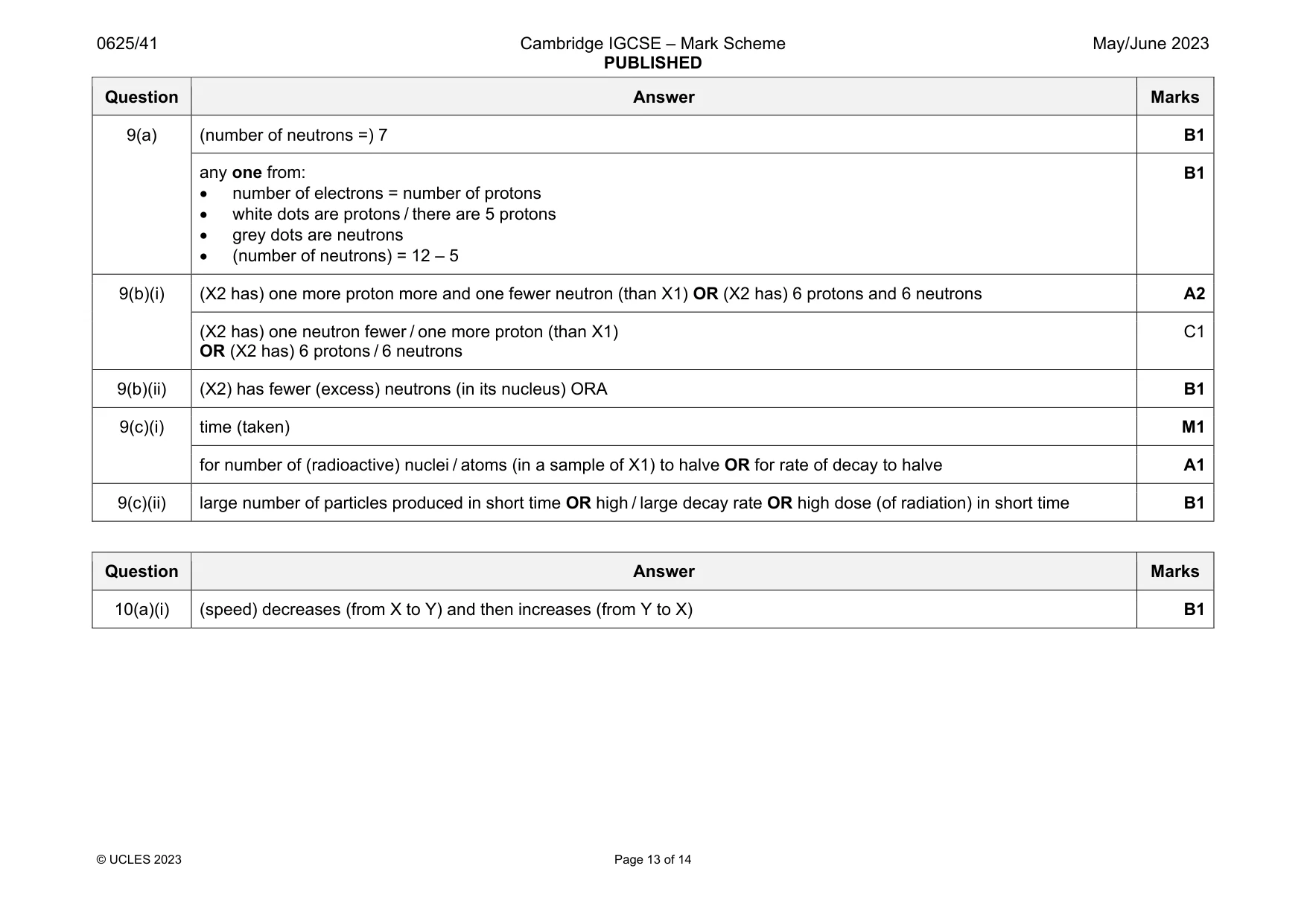
Mark scheme: 9(a) (number of neutrons =) 7 B1 any one from: number of electrons = number of protons white dots are protons / there are 5 protons grey dots are neutrons (number of neutrons) = 12 – 5 B1 9(b)(i) (X2 has) one more proton more and one fewer neutron (than X1) OR (X2 has) 6 protons and 6 neutrons A2 (X2 has) one neutron fewer / one more proton (than X1) OR (X2 has) 6 protons / 6 neutrons C1 9(b)(ii) (X2) has fewer (excess) neutrons (in its nucleus) ORA B1 9(c)(i) time (taken) M1 for number of (radioactive) nuclei / atoms (in a sample of X1) to halve OR for rate of decay to halve A1 9(c)(ii) large number of particles produced in short time OR high / large decay rate OR high dose (of radiation) in short time B1
Q10 · Pluto is a dwarf planet
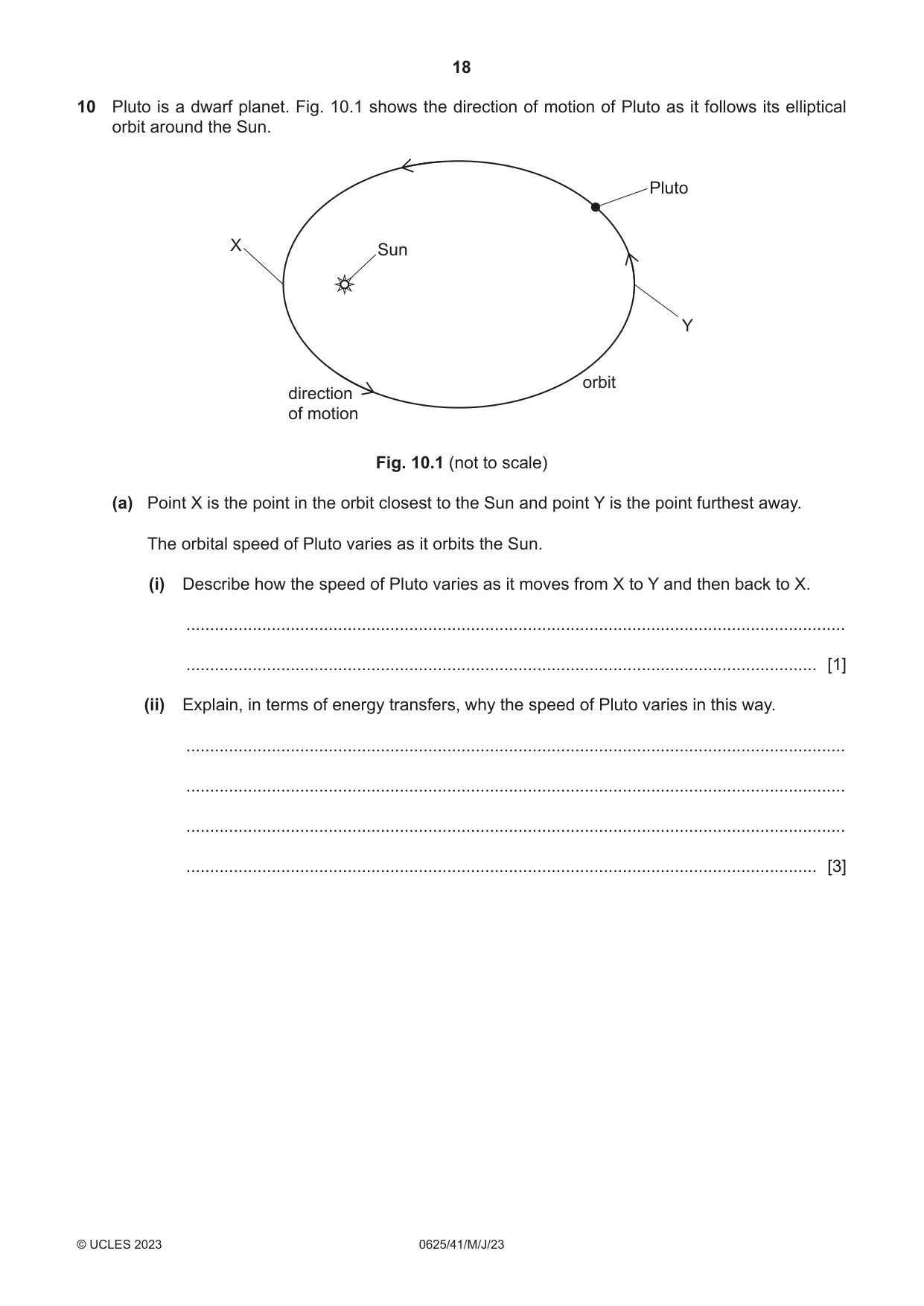
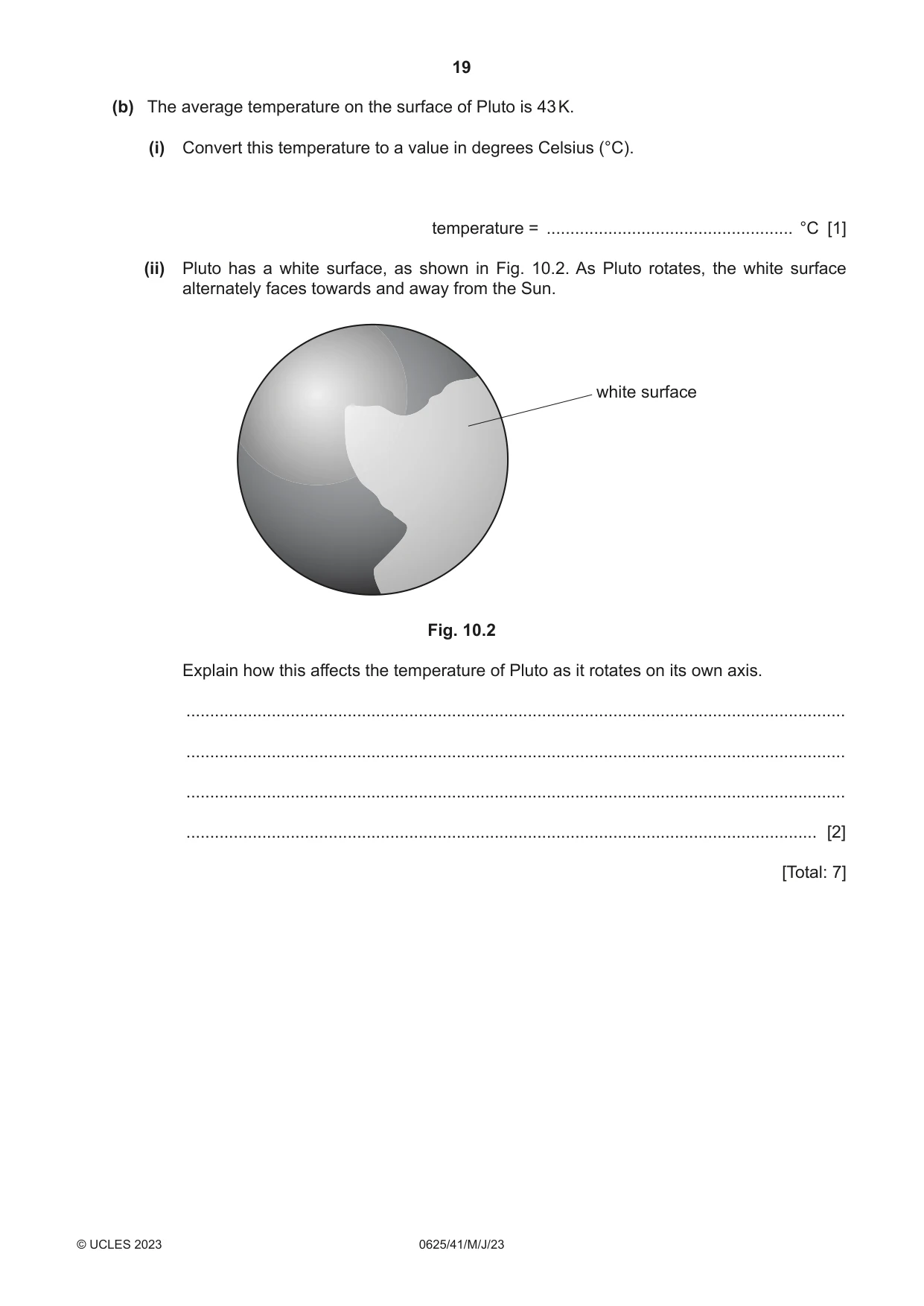
10 Pluto is a dwarf planet. Fig. 10.1 shows the direction of motion of Pluto as it follows its elliptical orbit around the Sun. Pluto X Sun Y orbit direction of motion Fig. 10.1 (not to scale) (a) Point X is the point in the orbit closest to the Sun and point Y is the point furthest away. The orbital speed of Pluto varies as it orbits the Sun. (i) Describe how the speed of Pluto varies as it moves from X to Y and then back to X. ........................................................................................................................................... ..................................................................................................................................... [1] (ii) Explain, in terms of energy transfers, why the speed of Pluto varies in this way. ........................................................................................................................................... ........................................................................................................................................... ........................................................................................................................................... ..................................................................................................................................... [3] (b) The average temperature on the surface of Pluto is 43 K. (i) Convert this temperature to a value in degrees Celsius (°C). temperature = .................................................... °C [1] (ii) Pluto has a white surface, as shown in Fig. 10.2. As Pluto rotates, the white surface alternately faces towards and away from the Sun. white surface Fig. 10.2 Explain how this affects the temperature of Pluto as it rotates on its own axis. ........................................................................................................................................... ........................................................................................................................................... ........................................................................................................................................... ..................................................................................................................................... [2] [Total: 7]
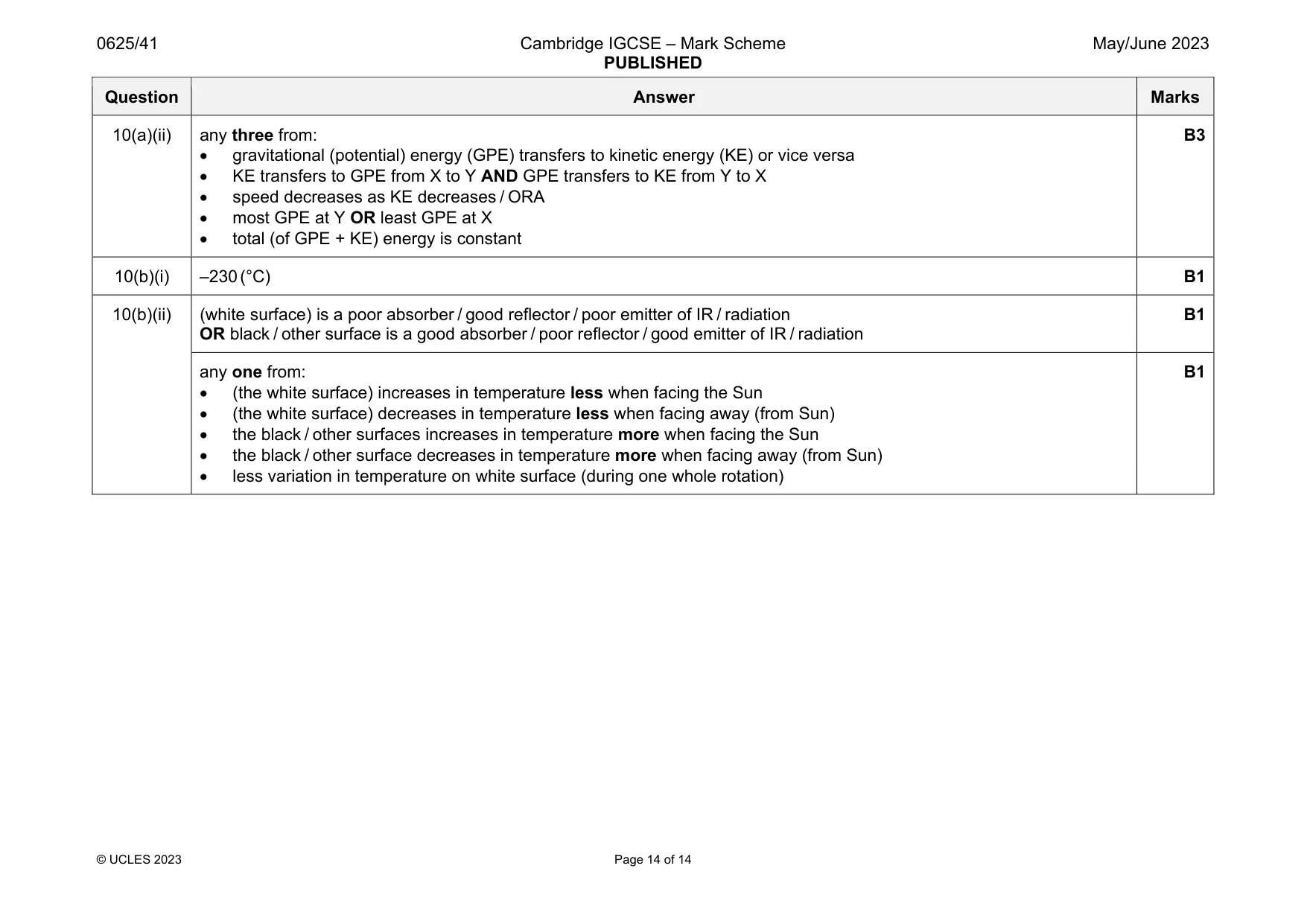
Mark scheme: 10(a)(i) (speed) decreases (from X to Y) and then increases (from Y to X) B1 Question Answer Marks 10(a)(ii) any three from: gravitational (potential) energy (GPE) transfers to kinetic energy (KE) or vice versa KE transfers to GPE from X to Y AND GPE transfers to KE from Y to X speed decreases as KE decreases / ORA most GPE at Y OR least GPE at X total (of GPE + KE) energy is constant B3 10(b)(i) –230 (°C) B1 10(b)(ii) (white surface) is a poor absorber / good reflector / poor emitter of IR / radiation OR black / other surface is a good absorber / poor reflector / good emitter of IR / radiation B1 any one from: (the white surface) increases in temperature less when facing the Sun (the white surface) decreases in temperature less when facing away (from Sun) the black / other surfaces increases in temperature more when facing the Sun the black / other surface decreases in temperature more when facing away (from Sun) less variation in temperature on white surface (during one whole rotation) B1
What was in this paper
The subtopics covered by these 10 questions, and how many questions each got. Open one in a new tab to see every Cambridge question on it.
What you needed in this session
Cambridge’s own grade thresholds for 2023 May/June, Paper 4 · Variant 1. A higher threshold means an easier paper — the bar moves with how the cohort did.