Cambridge IGCSE Physics 0625 — 2025 May/June Paper 4 · Variant 3
0625/43/M/J/25 · 11 questions · 80 marks · ≈90 min
The question paper and its mark scheme, free to read here and free to download. This is Cambridge’s own paper, exactly as it was sat.
Question paper16 pages
Mark scheme13 pages
Answers below. Sit the paper first if you are practising.
Questions as text
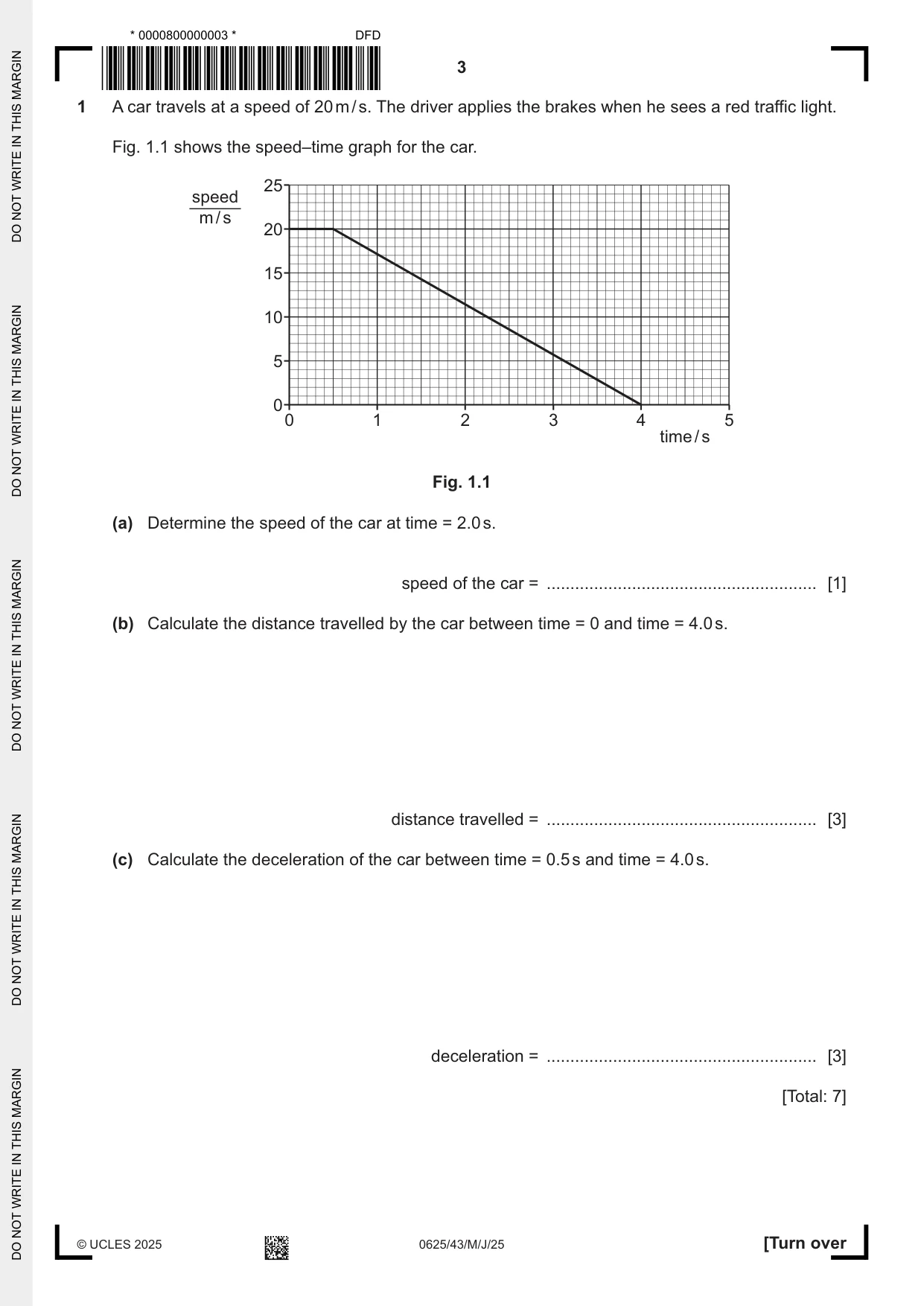
Q1 · A car travels at a speed of 20 m / s
1 A car travels at a speed of 20 m / s. The driver applies the brakes when he sees a red traffic light. Fig. 1.1 shows the speed–time graph for the car. 25 speed m / s 20 15 10 5 0 0 1 2 3 4 5 time / s Fig. 1.1 (a) Determine the speed of the car at time = 2.0 s. speed of the car = ......................................................... [1] (b) Calculate the distance travelled by the car between time = 0 and time = 4.0 s. distance travelled = ......................................................... [3] (c) Calculate the deceleration of the car between time = 0.5 s and time = 4.0 s. deceleration = ......................................................... [3] [Total: 7]
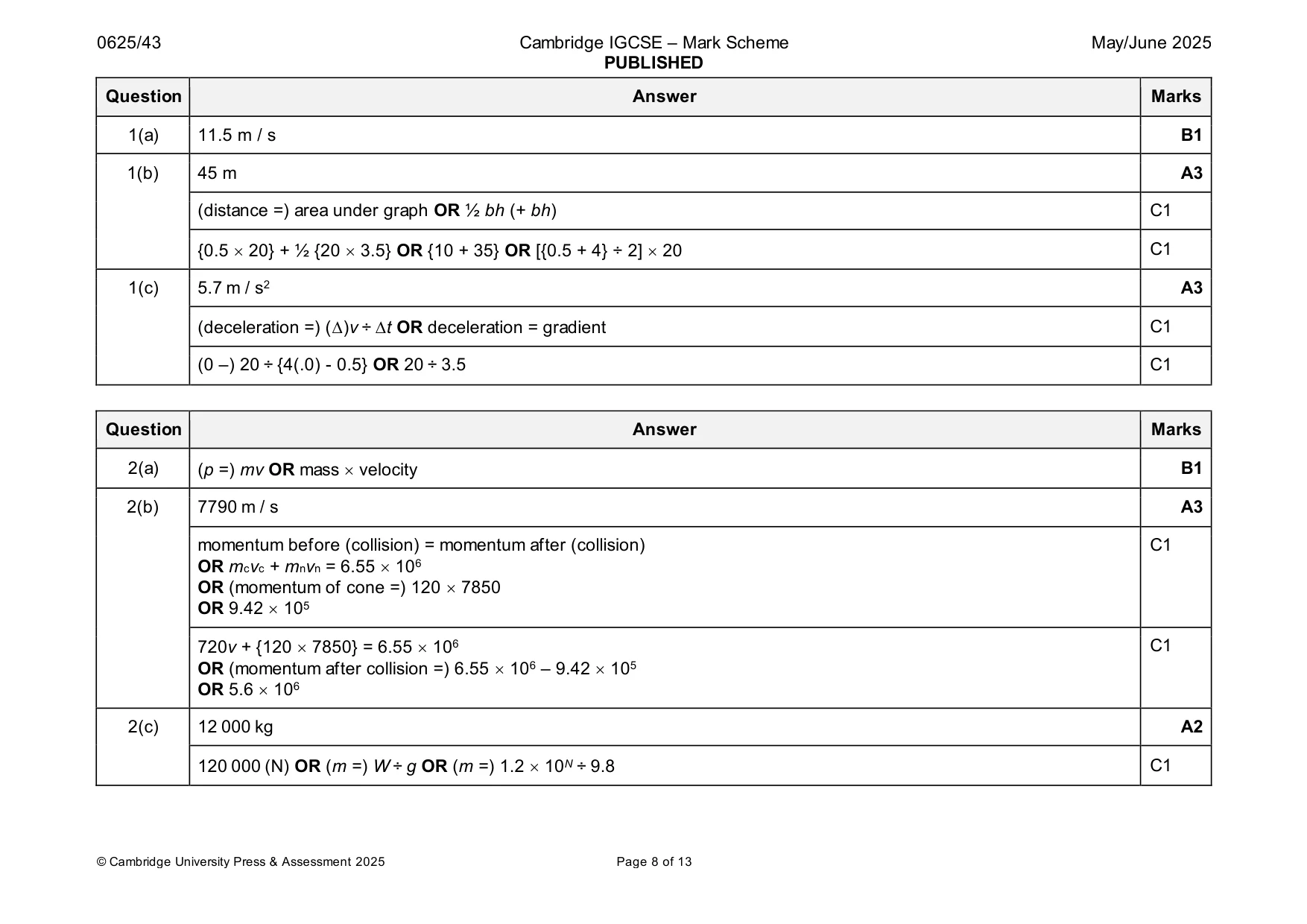
Mark scheme: Question Answer Marks 1(a) 11.5 m / s B1 1(b) 45 m A3 (distance =) area under graph OR ½ bh (+ bh) C1 {0.5 20} + ½ {20 3.5} OR {10 + 35} OR [{0.5 + 4} ÷ 2] 20 C1 1(c) 5.7 m / s2 A3 (deceleration =) ()v ÷ t OR deceleration = gradient C1 (0 –) 20 ÷ {4(.0) - 0.5} OR 20 ÷ 3.5 C1
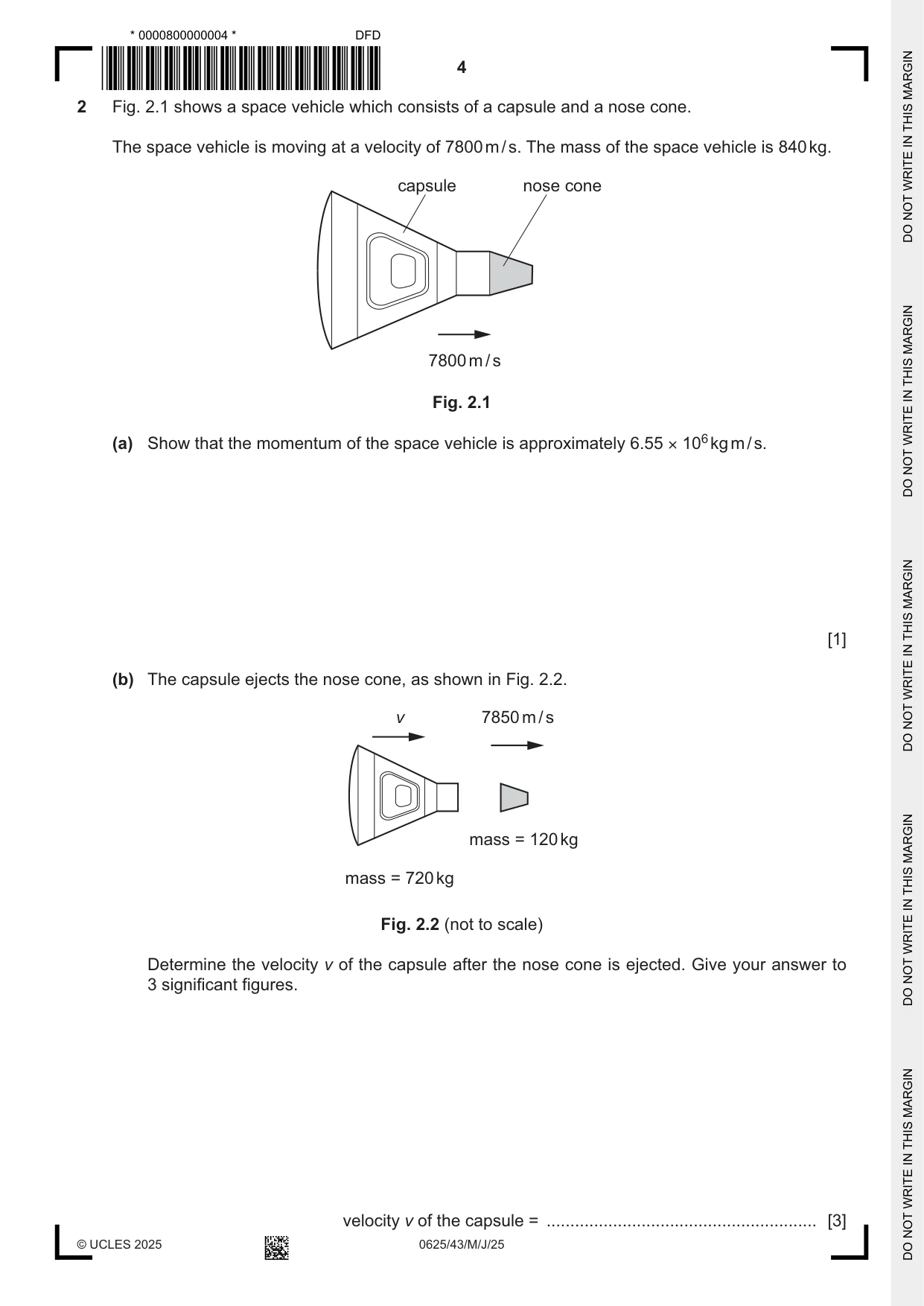
Q2 · A space vehicle which consists of a capsule and a nose cone
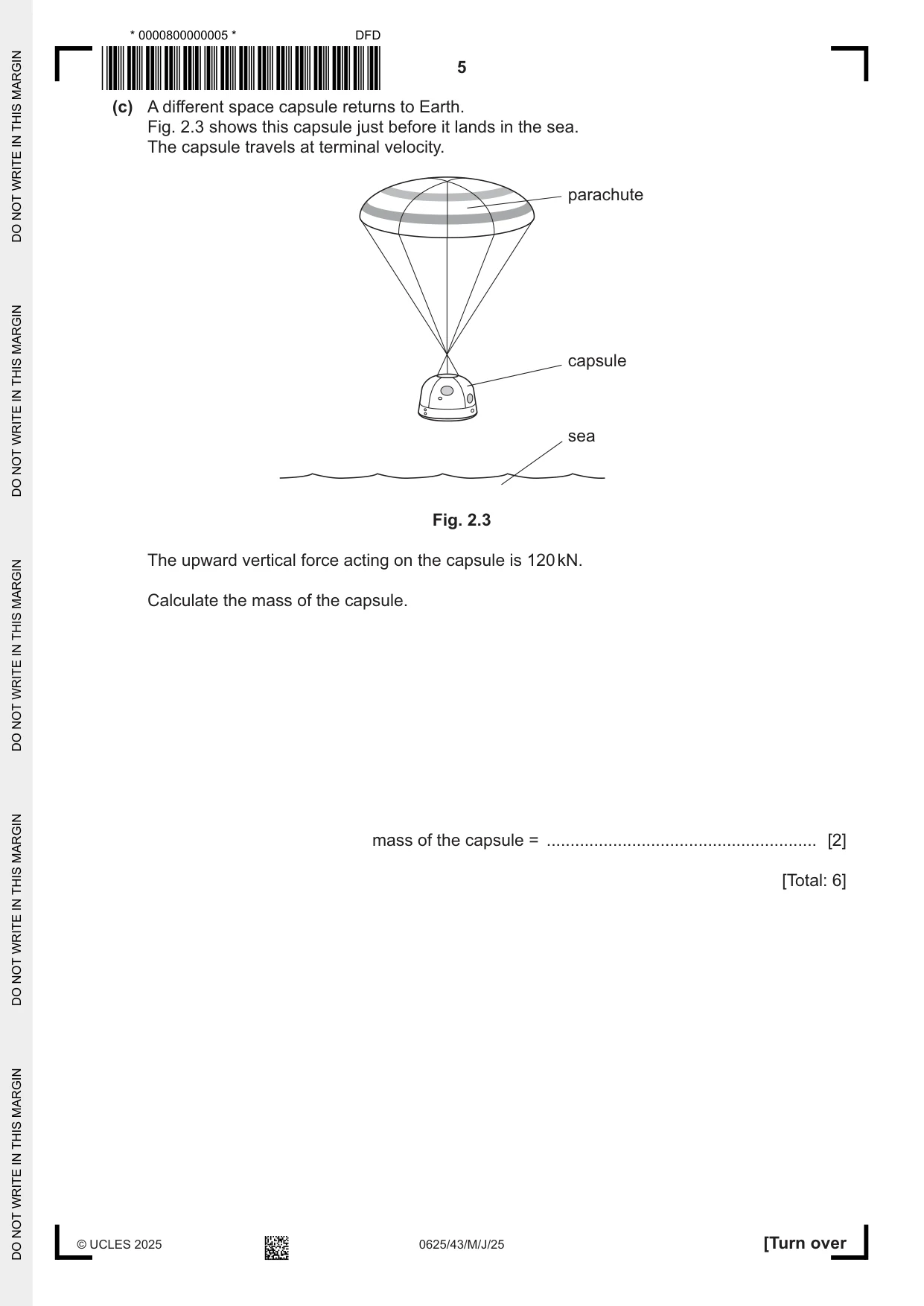
2 Fig. 2.1 shows a space vehicle which consists of a capsule and a nose cone. The space vehicle is moving at a velocity of 7800 m / s. The mass of the space vehicle is 840 kg. capsule nose cone 7800 m / s Fig. 2.1 (a) Show that the momentum of the space vehicle is approximately 6.55 × 10⁶ kg m / s. [1] (b) The capsule ejects the nose cone, as shown in Fig. 2.2. v 7850 m / s mass = 120 kg mass = 720 kg Fig. 2.2 (not to scale) Determine the velocity v of the capsule after the nose cone is ejected. Give your answer to 3 significant figures. velocity v of the capsule = ......................................................... [3] (c) A different space capsule returns to Earth. Fig. 2.3 shows this capsule just before it lands in the sea. The capsule travels at terminal velocity. parachute capsule sea Fig. 2.3 The upward vertical force acting on the capsule is 120 kN. Calculate the mass of the capsule. mass of the capsule = ......................................................... [2] [Total: 6]
Mark scheme: 2(a) (p =) mv OR mass velocity B1 2(b) 7790 m / s A3 momentum before (collision) = momentum after (collision) C1 OR mcvc + mnvn = 6.55 106 OR (momentum of cone =) 120 7850 OR 9.42 105 720v + {120 7850} = 6.55 106 C1 OR (momentum after collision =) 6.55 106 – 9.42 105 OR 5.6 106 2(c) 12 000 kg A2 120 000 (N) OR (m =) W ÷ g OR (m =) 1.2 10N ÷ 9.8 C1
Q3 · An archer aiming an arrow at a target
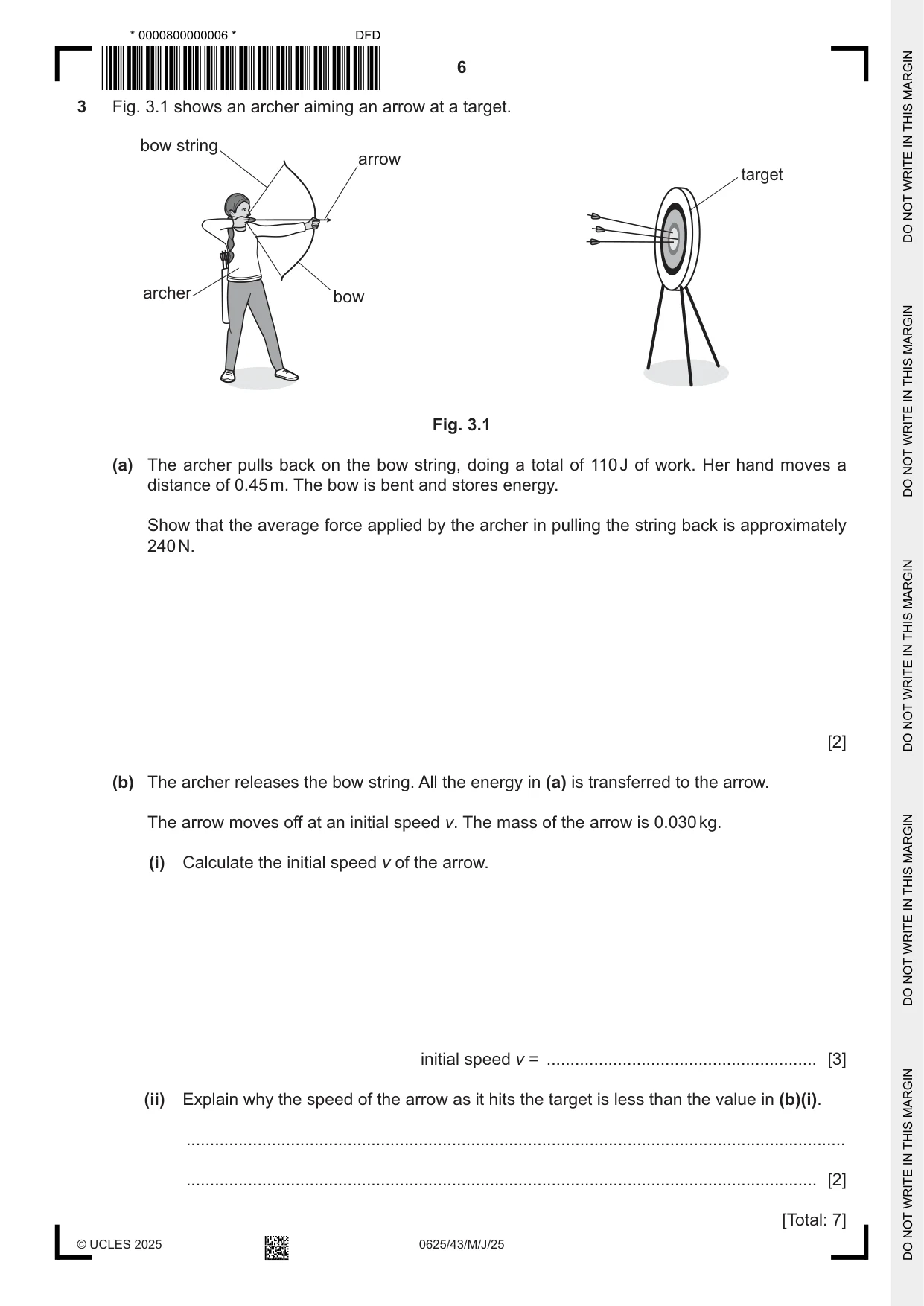
3 Fig. 3.1 shows an archer aiming an arrow at a target. bow string arrow target archer bow Fig. 3.1 (a) The archer pulls back on the bow string, doing a total of 110 J of work. Her hand moves a distance of 0.45 m. The bow is bent and stores energy. Show that the average force applied by the archer in pulling the string back is approximately 240 N. [2] (b) The archer releases the bow string. All the energy in (a) is transferred to the arrow. The arrow moves off at an initial speed v. The mass of the arrow is 0.030 kg. (i) Calculate the initial speed v of the arrow. initial speed v = ......................................................... [3] (ii) Explain why the speed of the arrow as it hits the target is less than the value in (b)(i). ........................................................................................................................................... ..................................................................................................................................... [2] [Total: 7]
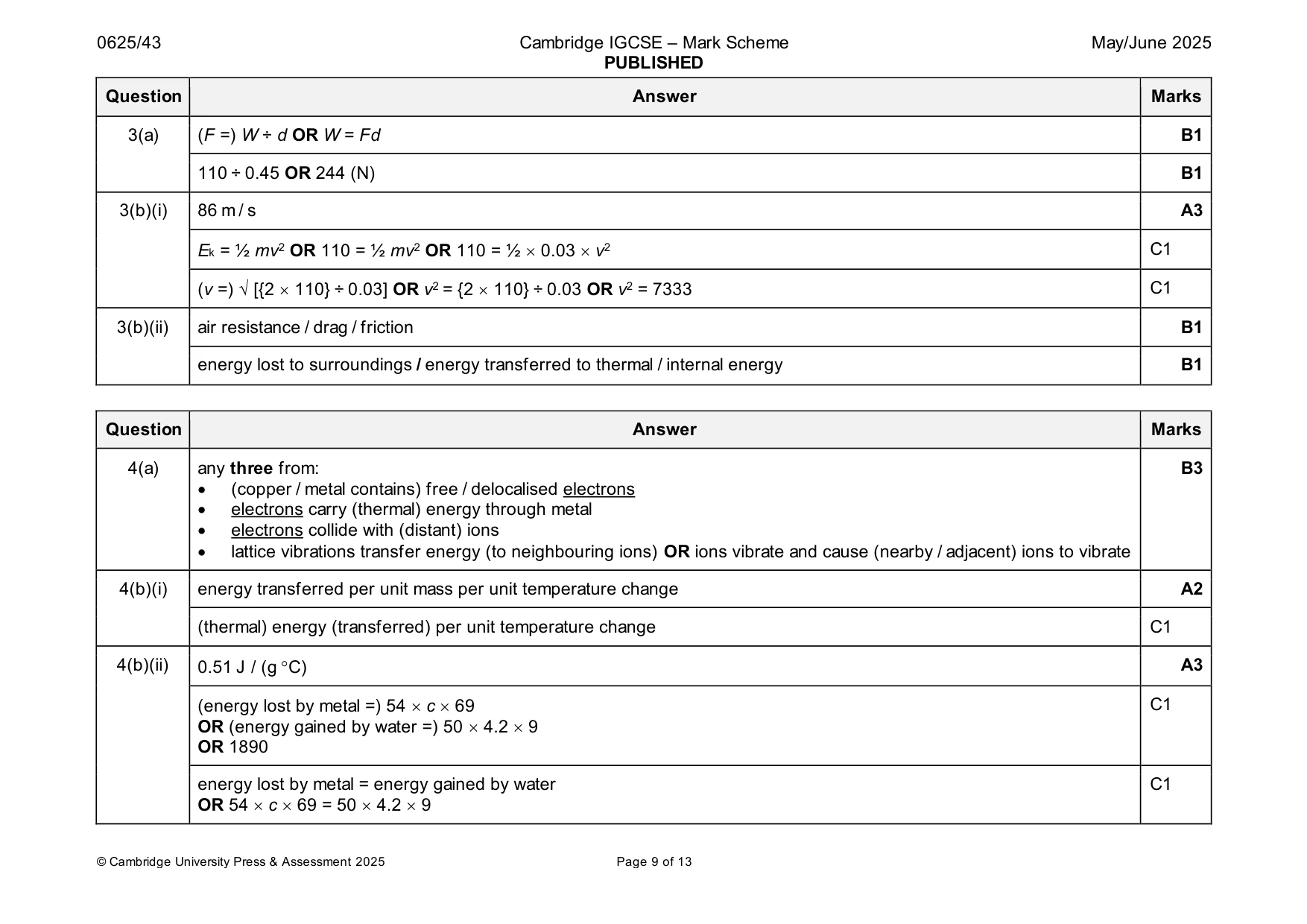
Mark scheme: 3(a) (F =) W ÷ d OR W = Fd B1 110 ÷ 0.45 OR 244 (N) B1 3(b)(i) 86 m / s A3 Ek = ½ mv2 OR 110 = ½ mv2 OR 110 = ½ 0.03 v2 C1 (v =) √ [{2 110} ÷ 0.03] OR v2 = {2 110} ÷ 0.03 OR v2 = 7333 C1 3(b)(ii) air resistance / drag / friction B1 energy lost to surroundings / energy transferred to thermal / internal energy B1
Q4 · A pan with a copper base on a hotplate
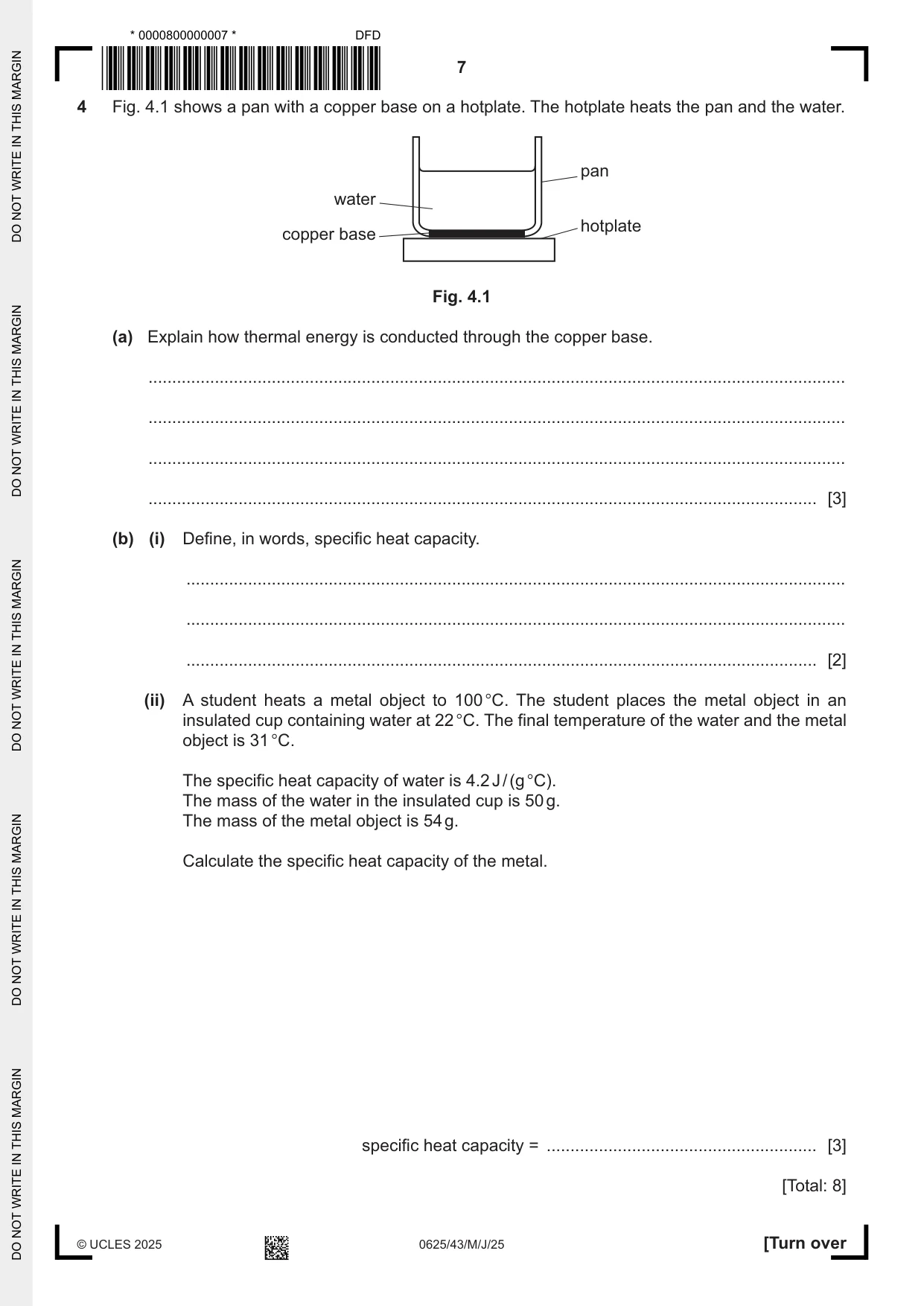
4 Fig. 4.1 shows a pan with a copper base on a hotplate. The hotplate heats the pan and the water. pan water hotplate copper base Fig. 4.1 (a) Explain how thermal energy is conducted through the copper base. ................................................................................................................................................... ................................................................................................................................................... ................................................................................................................................................... ............................................................................................................................................. [3] (b) (i) Define, in words, specific heat capacity. ........................................................................................................................................... ........................................................................................................................................... ..................................................................................................................................... [2] (ii) A student heats a metal object to 100 °C. The student places the metal object in an insulated cup containing water at 22 °C. The final temperature of the water and the metal object is 31 °C. The specific heat capacity of water is 4.2 J / (g °C). The mass of the water in the insulated cup is 50 g. The mass of the metal object is 54 g. Calculate the specific heat capacity of the metal. specific heat capacity = ......................................................... [3] [Total: 8]
Mark scheme: 4(a) any three from: B3 • (copper / metal contains) free / delocalised electrons • electrons carry (thermal) energy through metal • electrons collide with (distant) ions • lattice vibrations transfer energy (to neighbouring ions) OR ions vibrate and cause (nearby / adjacent) ions to vibrate 4(b)(i) energy transferred per unit mass per unit temperature change A2 (thermal) energy (transferred) per unit temperature change C1 4(b)(ii) 0.51 J / (g C) A3 (energy lost by metal =) 54 c 69 C1 OR (energy gained by water =) 50 4.2 9 OR 1890 energy lost by metal = energy gained by water C1 OR 54 c 69 = 50 4.2 9
Q5 · Four rays of red light, P, Q, R and S, coming from a spotlight in a swimming pool
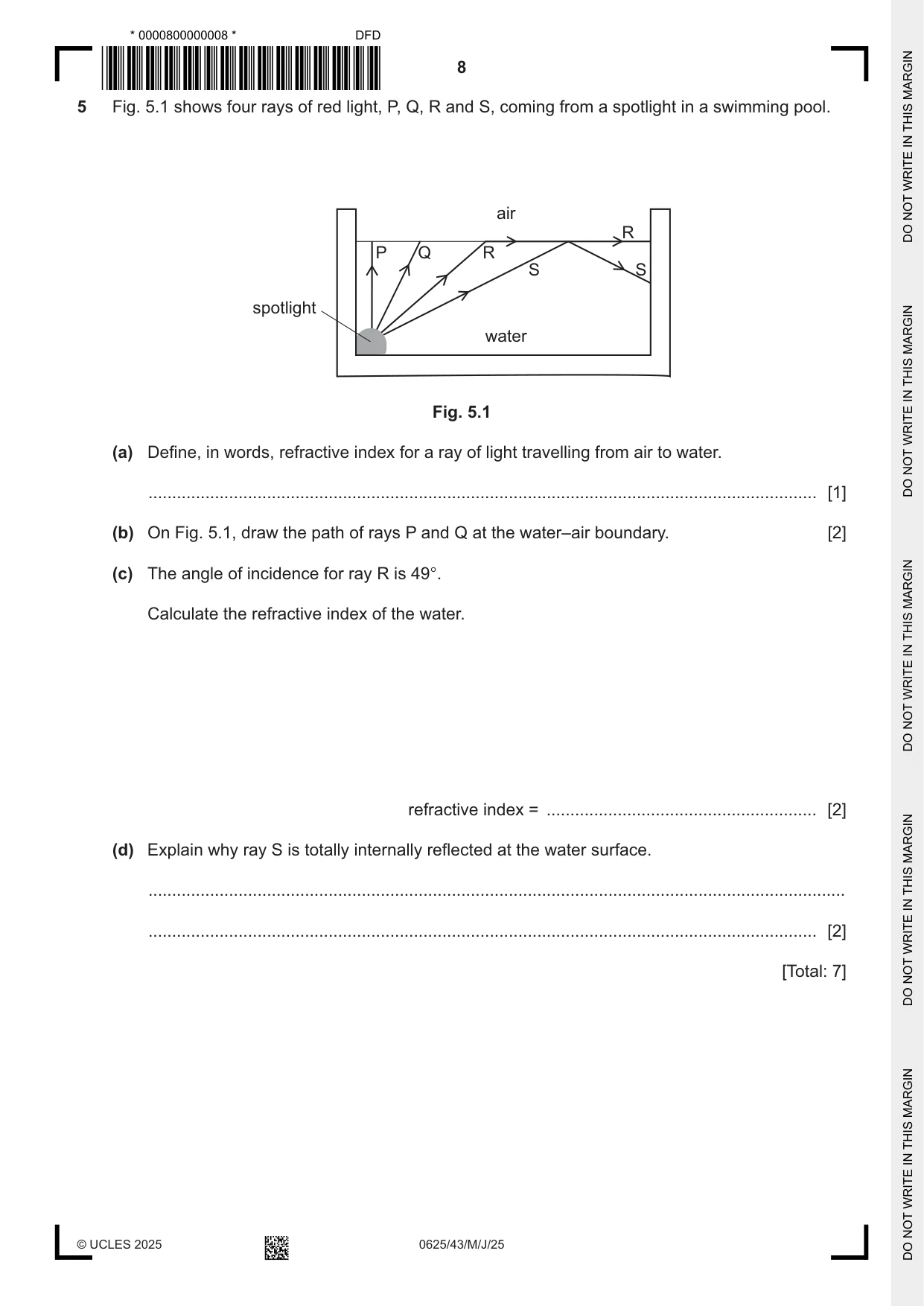
5 Fig. 5.1 shows four rays of red light, P, Q, R and S, coming from a spotlight in a swimming pool. air R P Q R S S spotlight water Fig. 5.1 (a) Define, in words, refractive index for a ray of light travelling from air to water. ............................................................................................................................................. [1] (b) On Fig. 5.1, draw the path of rays P and Q at the water–air boundary. [2] (c) The angle of incidence for ray R is 49°. Calculate the refractive index of the water. refractive index = ......................................................... [2] (d) Explain why ray S is totally internally reflected at the water surface. ................................................................................................................................................... ............................................................................................................................................. [2] [Total: 7]
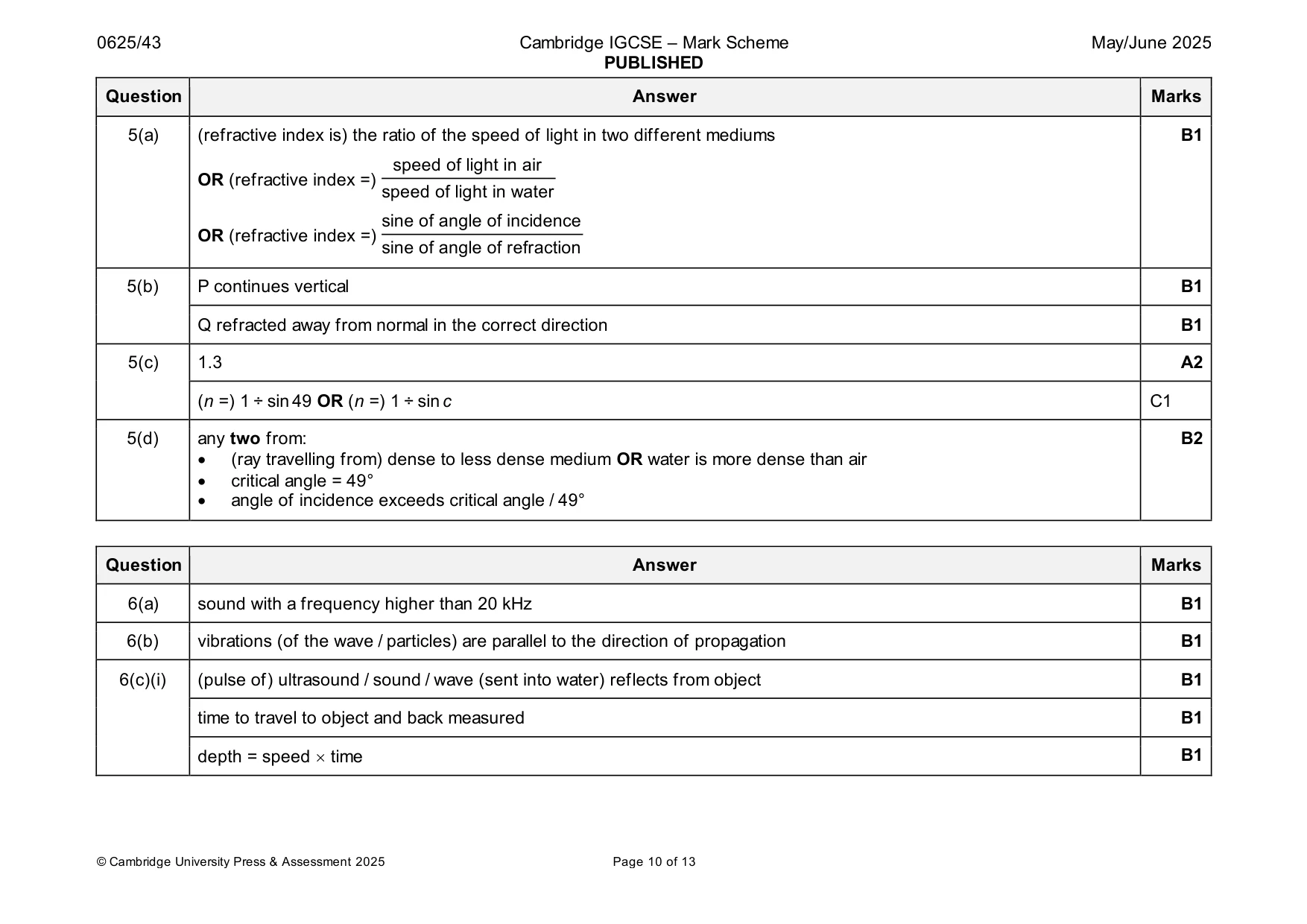
Mark scheme: 5(a) (refractive index is) the ratio of the speed of light in two different mediums B1 speed of light in air OR (refractive index =) speed of light in water sine of angle of incidence OR (refractive index =) sine of angle of refraction 5(b) P continues vertical B1 Q refracted away from normal in the correct direction B1 5(c) 1.3 A2 (n =) 1 ÷ sin 49 OR (n =) 1 ÷ sin c C1 5(d) any two from: B2 • (ray travelling from) dense to less dense medium OR water is more dense than air • critical angle = 49° • angle of incidence exceeds critical angle / 49°
Q6 · Ultrasound is an example of a longitudinal wave
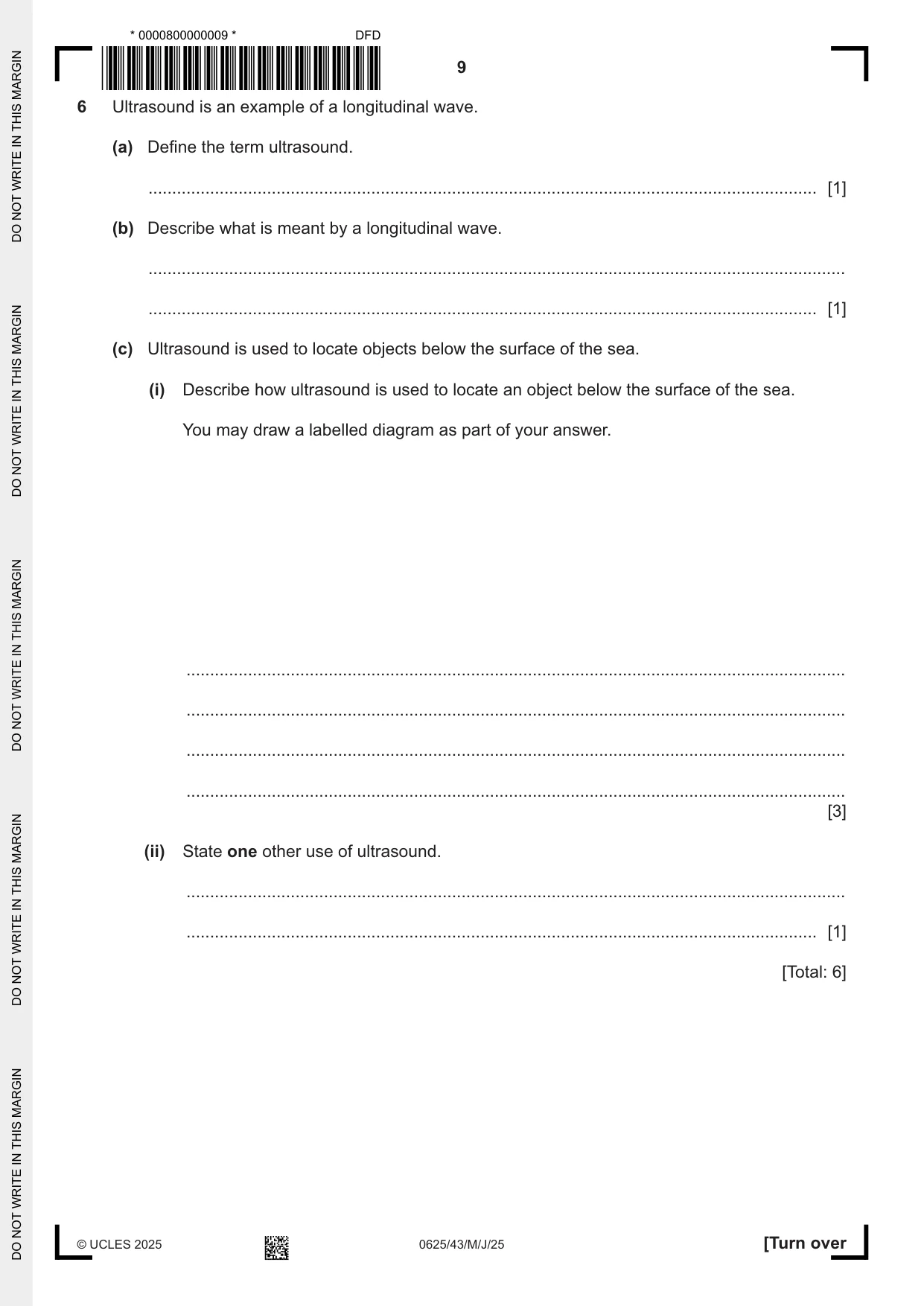
6 Ultrasound is an example of a longitudinal wave. (a) Define the term ultrasound. ............................................................................................................................................. [1] (b) Describe what is meant by a longitudinal wave. ................................................................................................................................................... ............................................................................................................................................. [1] (c) Ultrasound is used to locate objects below the surface of the sea. (i) Describe how ultrasound is used to locate an object below the surface of the sea. You may draw a labelled diagram as part of your answer. ........................................................................................................................................... ........................................................................................................................................... ........................................................................................................................................... ........................................................................................................................................... [3] (ii) State one other use of ultrasound. ........................................................................................................................................... ..................................................................................................................................... [1] [Total: 6]
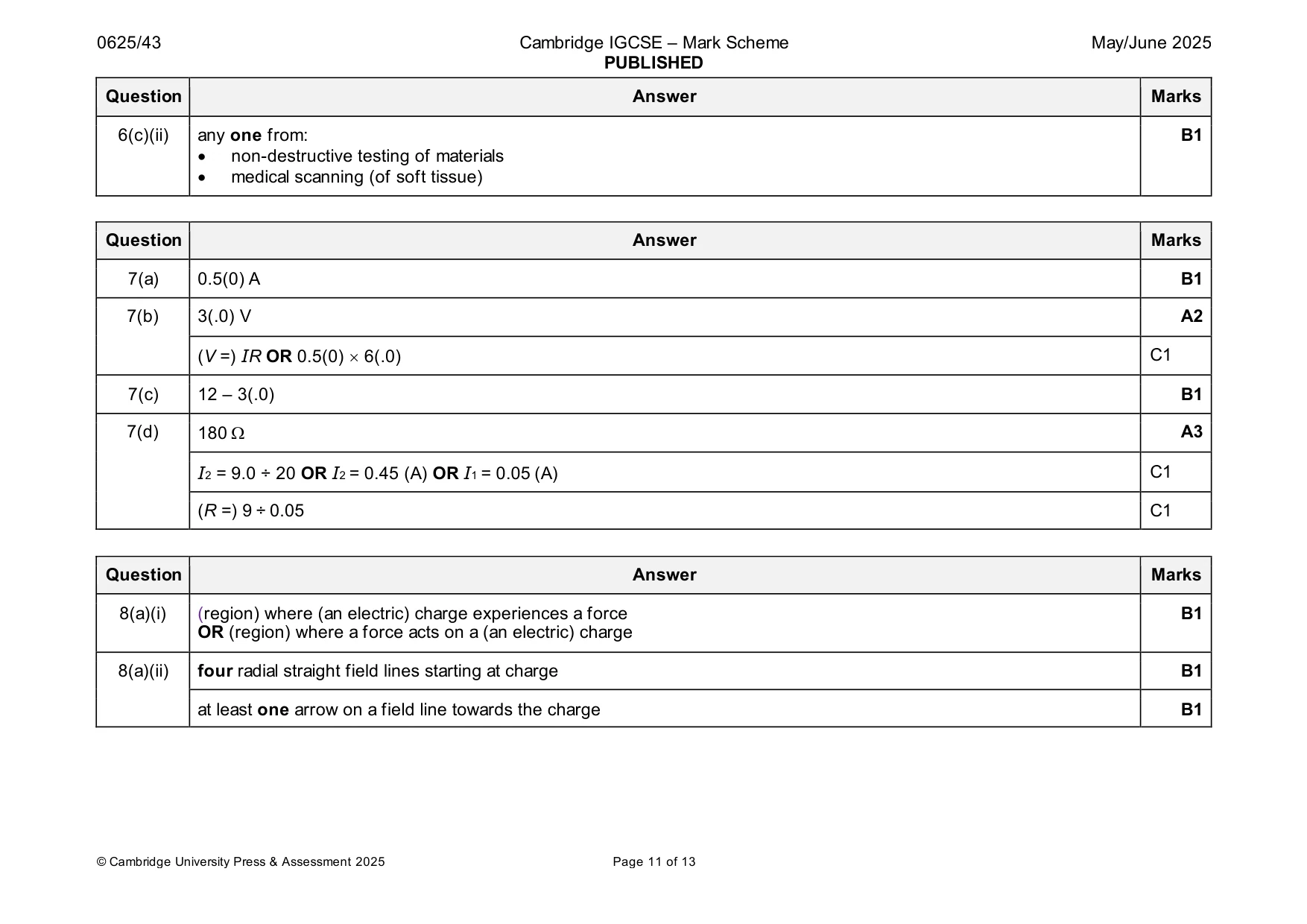
Mark scheme: 6(a) sound with a frequency higher than 20 kHz B1 6(b) vibrations (of the wave / particles) are parallel to the direction of propagation B1 6(c)(i) (pulse of) ultrasound / sound / wave (sent into water) reflects from object B1 time to travel to object and back measured B1 depth = speed time B1 6(c)(ii) any one from: B1 • non-destructive testing of materials • medical scanning (of soft tissue)
Q7 · A student sets up the circuit shown in Fig
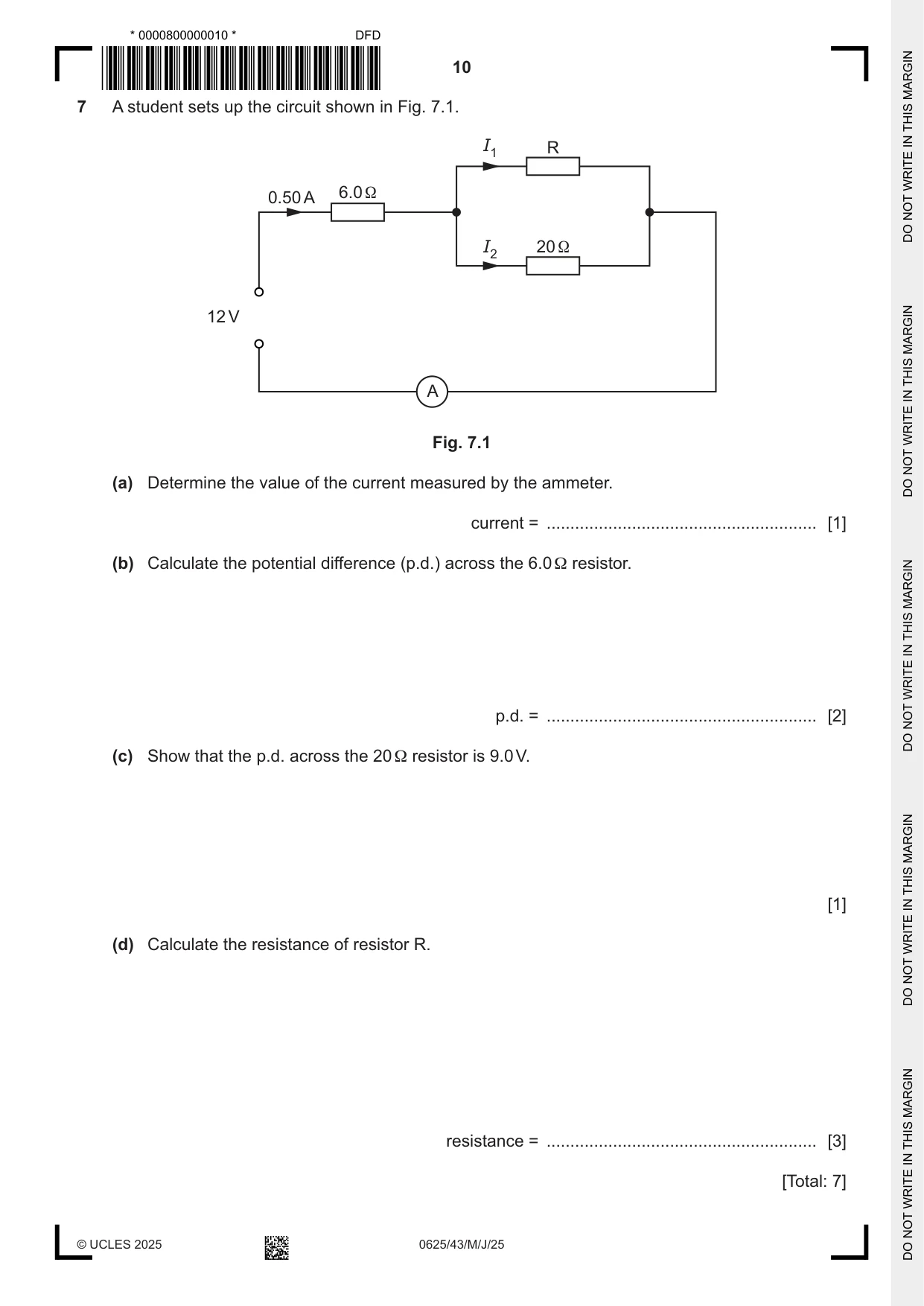
7 A student sets up the circuit shown in Fig. 7.1. I1 R 6.0 Ω 0.50 A I2 20 Ω 12 V A Fig. 7.1 (a) Determine the value of the current measured by the ammeter. current = ......................................................... [1] (b) Calculate the potential difference (p.d.) across the 6.0 Ω resistor. p.d. = ......................................................... [2] (c) Show that the p.d. across the 20 Ω resistor is 9.0 V. [1] (d) Calculate the resistance of resistor R. resistance = ......................................................... [3] [Total: 7]
Mark scheme: 7(a) 0.5(0) A B1 7(b) 3(.0) V A2 (V =) IR OR 0.5(0) 6(.0) C1 7(c) 12 – 3(.0) B1 7(d) 180 A3 I2 = 9.0 ÷ 20 OR I2 = 0.45 (A) OR I1 = 0.05 (A) C1 (R =) 9 ÷ 0.05 C1
Q8 · State what is meant by an electric field
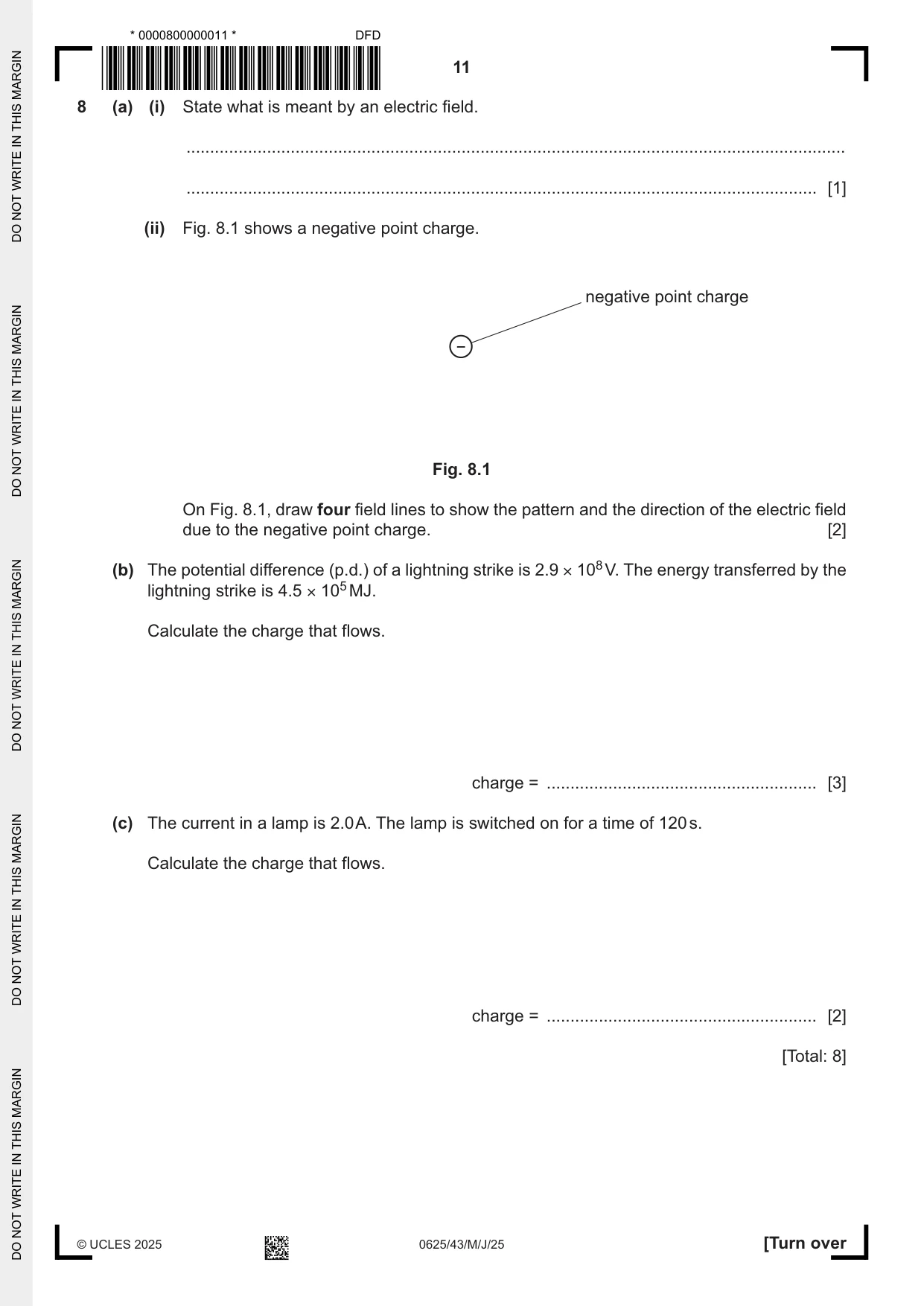
8 (a) (i) State what is meant by an electric field. ........................................................................................................................................... ..................................................................................................................................... [1] (ii) Fig. 8.1 shows a negative point charge. negative point charge − Fig. 8.1 On Fig. 8.1, draw four field lines to show the pattern and the direction of the electric field due to the negative point charge. [2] (b) The potential difference (p.d.) of a lightning strike is 2.9 × 10⁸ V. The energy transferred by the lightning strike is 4.5 × 10⁵ MJ. Calculate the charge that flows. charge = ......................................................... [3] (c) The current in a lamp is 2.0 A. The lamp is switched on for a time of 120 s. Calculate the charge that flows. charge = ......................................................... [2] [Total: 8]
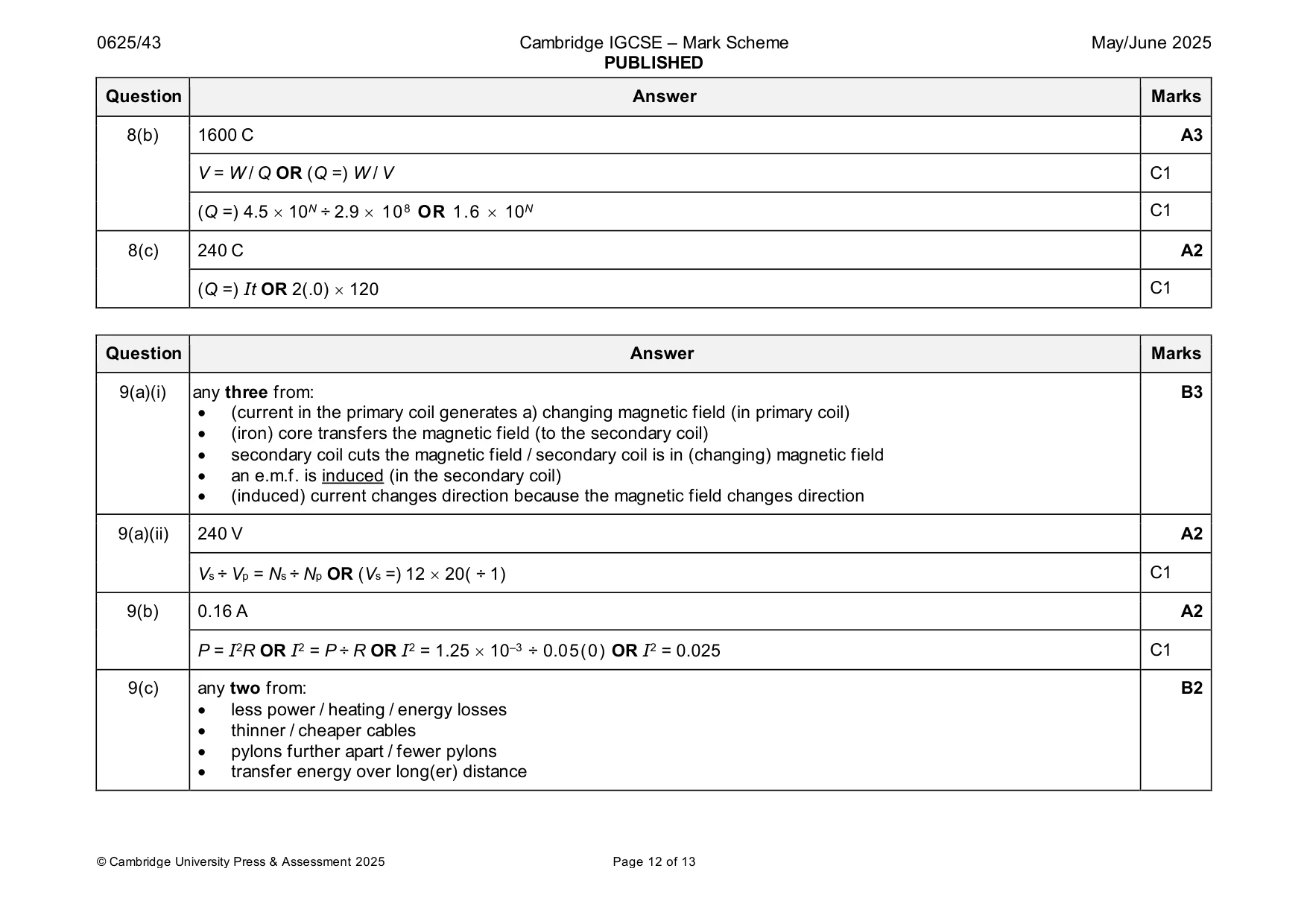
Mark scheme: 8(a)(i) (region) where (an electric) charge experiences a force B1 OR (region) where a force acts on a (an electric) charge 8(a)(ii) four radial straight field lines starting at charge B1 at least one arrow on a field line towards the charge B1 8(b) 1600 C A3 V = W / Q OR (Q =) W / V C1 (Q =) 4.5 10N ÷ 2.9 108 OR 1.6 10N C1 8(c) 240 C A2 (Q =) It OR 2(.0) 120 C1
Question 9
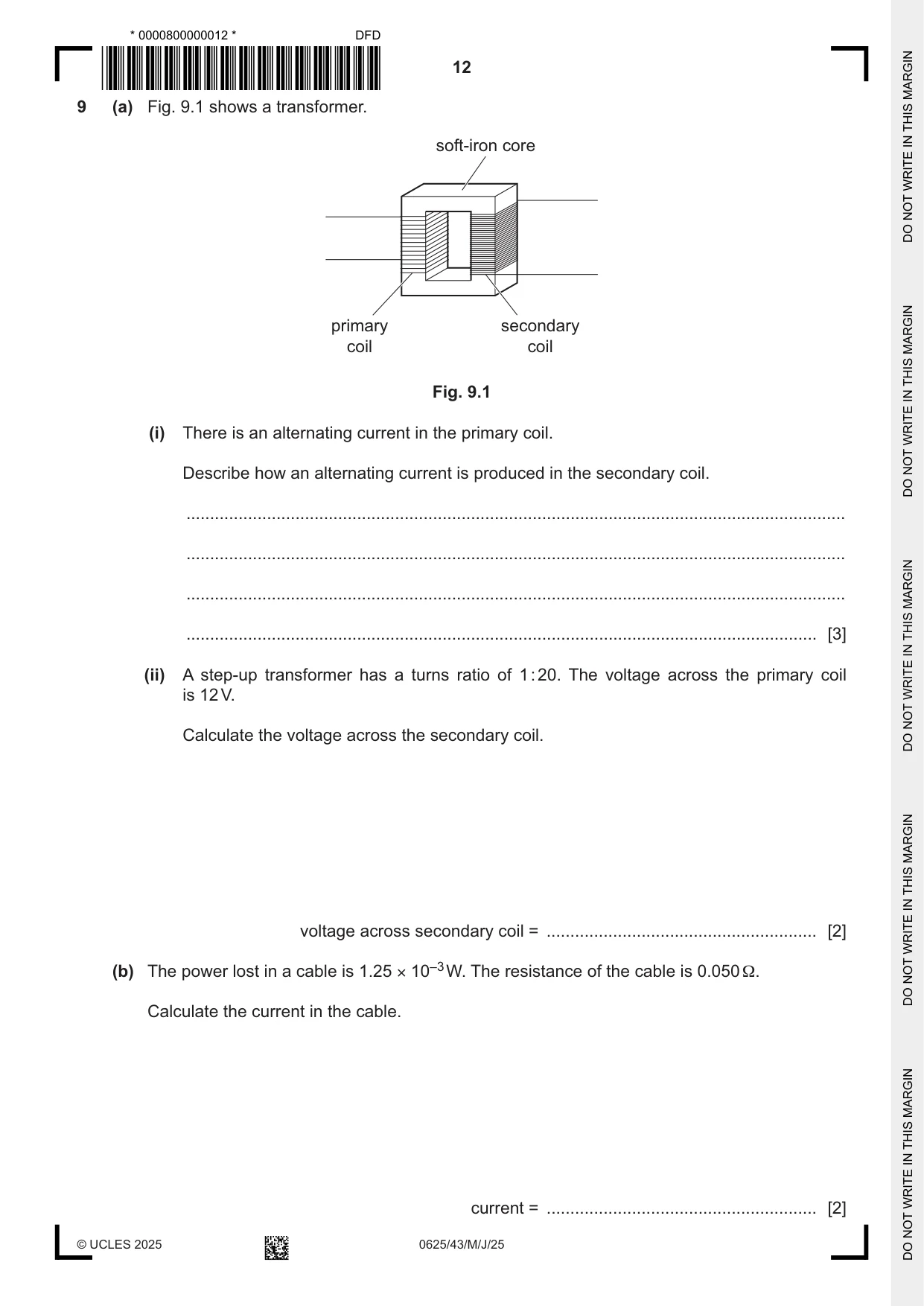
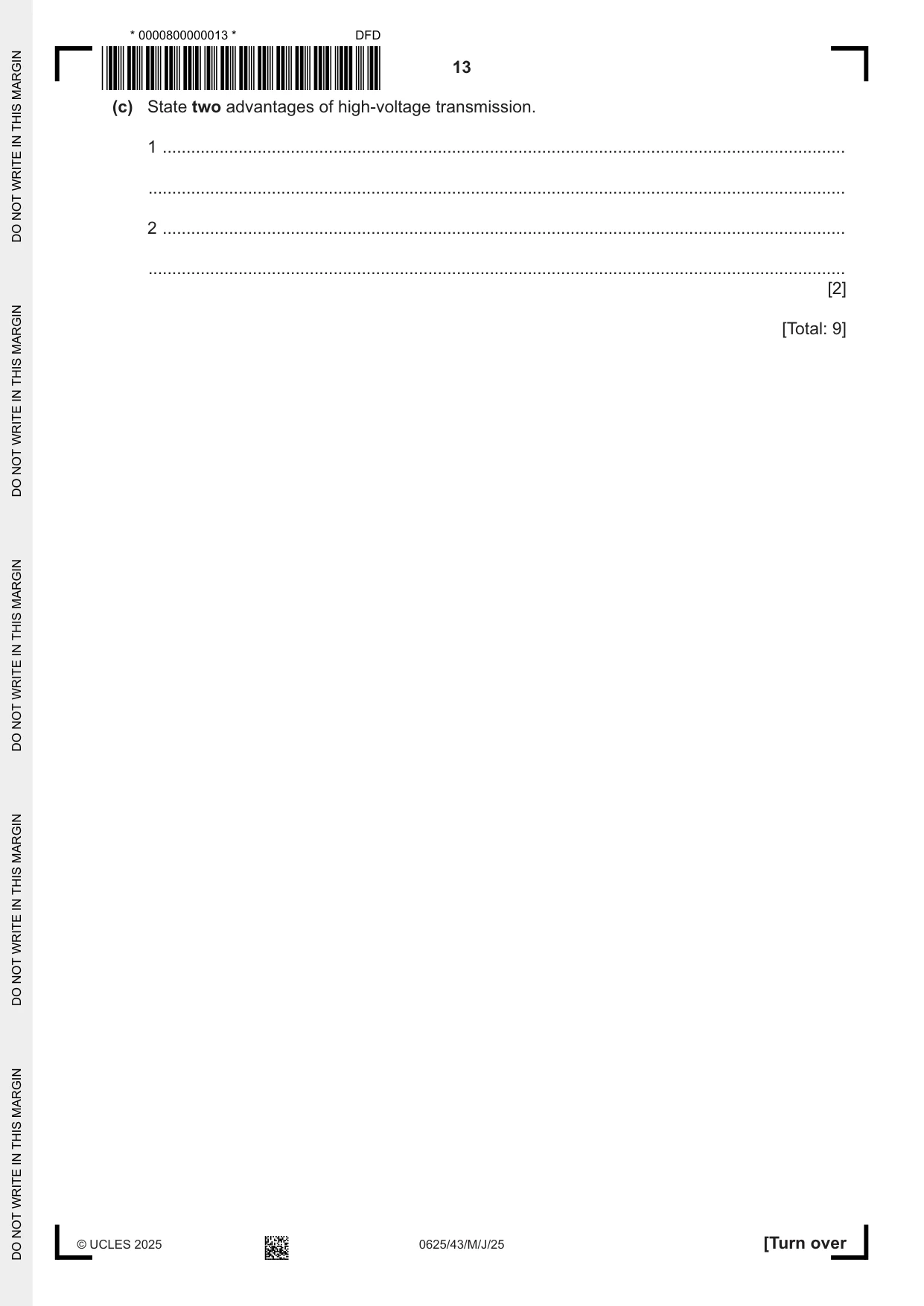
9 (a) Fig. 9.1 shows a transformer. soft-iron core primary secondary coil coil Fig. 9.1 (i) There is an alternating current in the primary coil. Describe how an alternating current is produced in the secondary coil. ........................................................................................................................................... ........................................................................................................................................... ........................................................................................................................................... ..................................................................................................................................... [3] (ii) A step-up transformer has a turns ratio of 1 : 20. The voltage across the primary coil is 12 V. Calculate the voltage across the secondary coil. voltage across secondary coil = ......................................................... [2] (b) The power lost in a cable is 1.25 × 10⁻³ W. The resistance of the cable is 0.050 Ω. Calculate the current in the cable. current = ......................................................... [2] (c) State two advantages of high-voltage transmission. 1 ................................................................................................................................................ ................................................................................................................................................... 2 ................................................................................................................................................ ................................................................................................................................................... [2] [Total: 9]
Mark scheme: 9(a)(i) any three from: B3 • (current in the primary coil generates a) changing magnetic field (in primary coil) • (iron) core transfers the magnetic field (to the secondary coil) • secondary coil cuts the magnetic field / secondary coil is in (changing) magnetic field • an e.m.f. is induced (in the secondary coil) • (induced) current changes direction because the magnetic field changes direction 9(a)(ii) 240 V A2 Vs ÷ Vp = Ns ÷ Np OR (Vs =) 12 20( ÷ 1) C1 9(b) 0.16 A A2 P = I2R OR I2 = P ÷ R OR I2 = 1.25 10–3 ÷ 0.05(0) OR I2 = 0.025 C1 9(c) any two from: B2 • less power / heating / energy losses • thinner / cheaper cables • pylons further apart / fewer pylons • transfer energy over long(er) distance
Q10 · Define a light-year in words
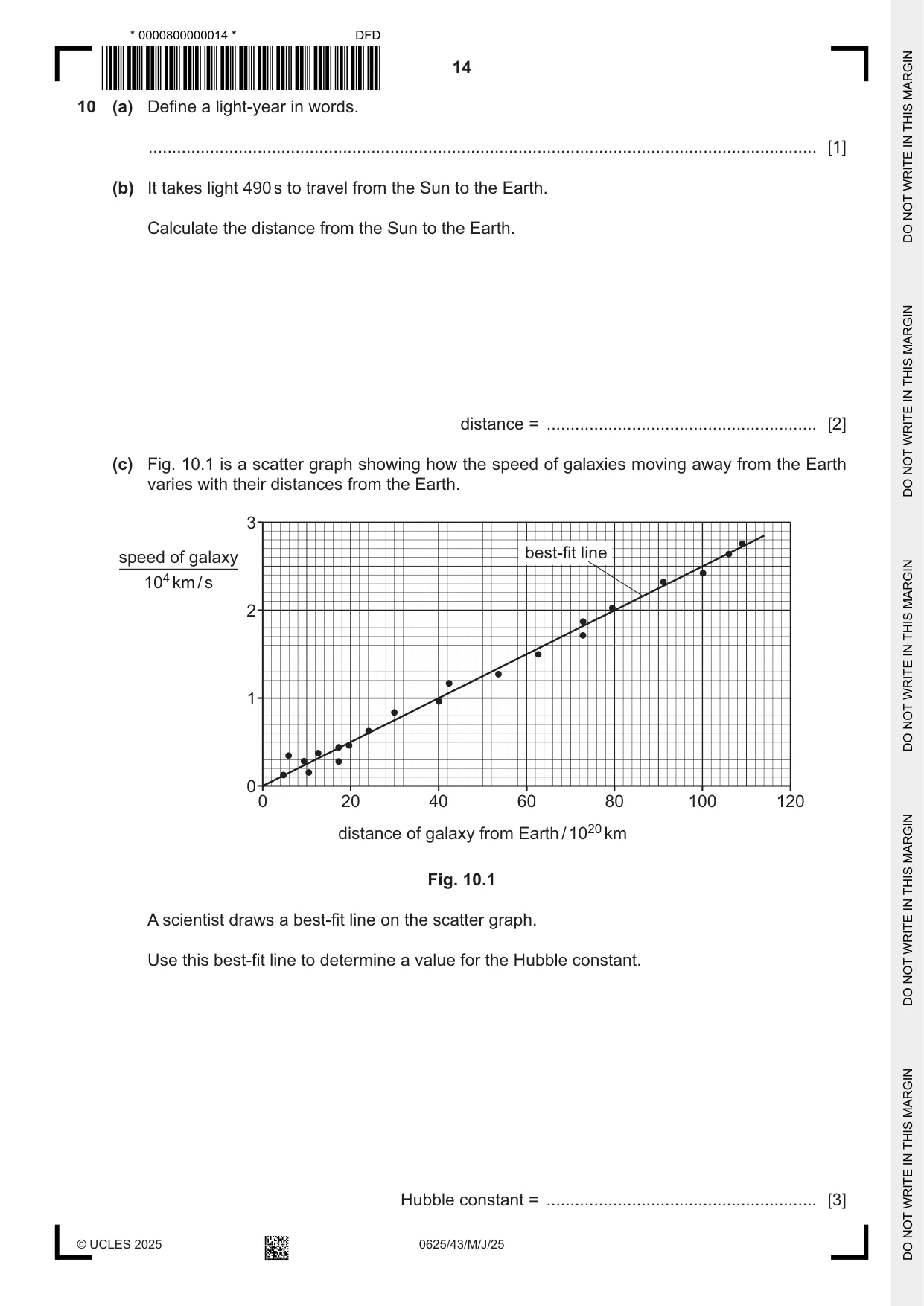
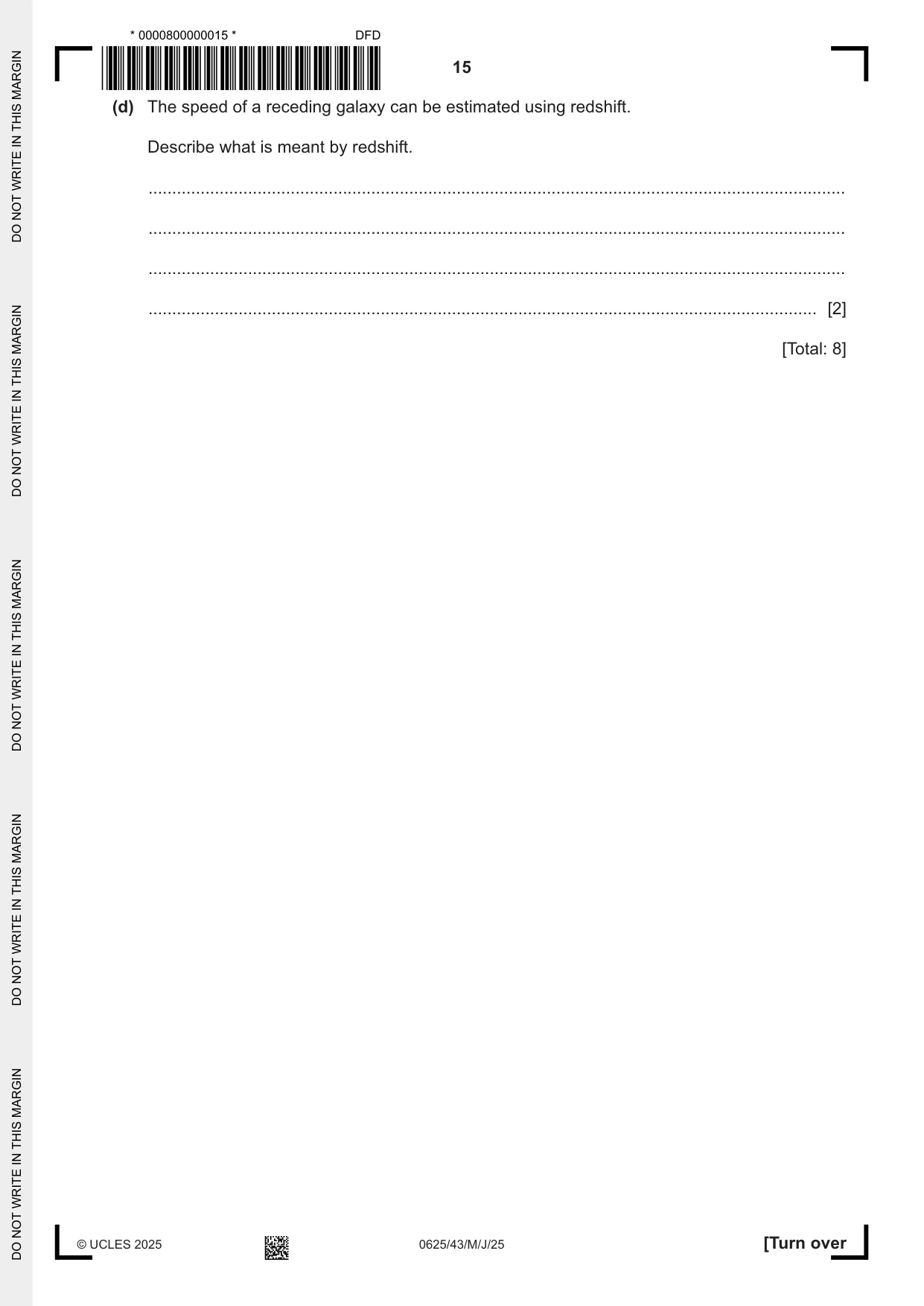
10 (a) Define a light-year in words. ............................................................................................................................................. [1] (b) It takes light 490 s to travel from the Sun to the Earth. Calculate the distance from the Sun to the Earth. distance = ......................................................... [2] (c) Fig. 10.1 is a scatter graph showing how the speed of galaxies moving away from the Earth varies with their distances from the Earth. 3 speed of galaxy best-fit line 104 km / s 2 1 0 0 20 40 60 80 100 120 distance of galaxy from Earth / 1020 km Fig. 10.1 A scientist draws a best-fit line on the scatter graph. Use this best-fit line to determine a value for the Hubble constant. Hubble constant = ......................................................... [3] (d) The speed of a receding galaxy can be estimated using redshift. Describe what is meant by redshift. ................................................................................................................................................... ................................................................................................................................................... ................................................................................................................................................... ............................................................................................................................................. [2] [Total: 8]
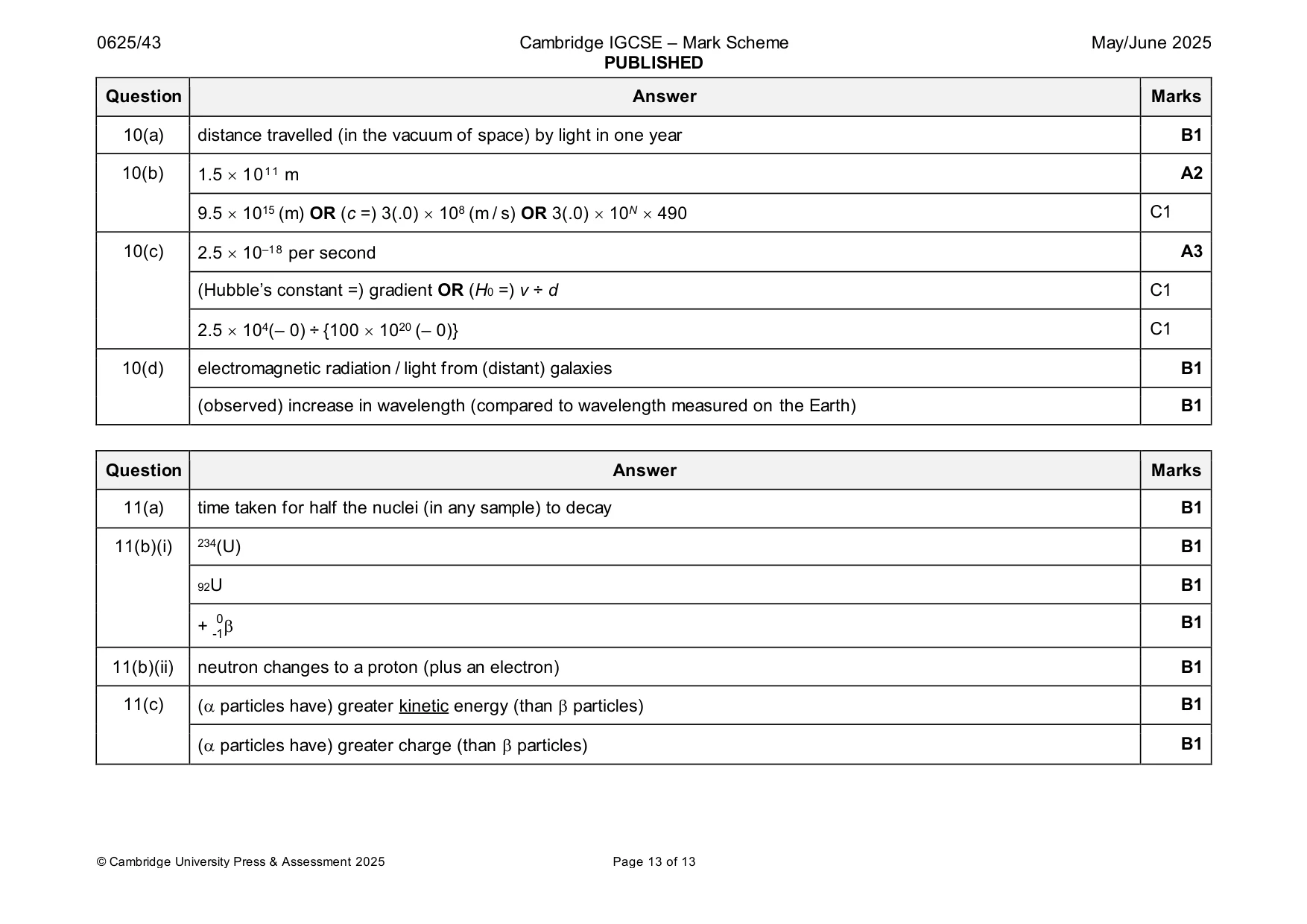
Mark scheme: 10(a) distance travelled (in the vacuum of space) by light in one year B1 10(b) 1.5 1011 m A2 9.5 1015 (m) OR (c =) 3(.0) 108 (m / s) OR 3(.0) 10N 490 C1 10(c) 2.5 10–18 per second A3 (Hubble’s constant =) gradient OR (H0 =) v ÷ d C1 2.5 104(– 0) ÷ {100 1020 (– 0)} C1 10(d) electromagnetic radiation / light from (distant) galaxies B1 (observed) increase in wavelength (compared to wavelength measured on the Earth) B1
Q11 · Define the half-life of a radioactive source
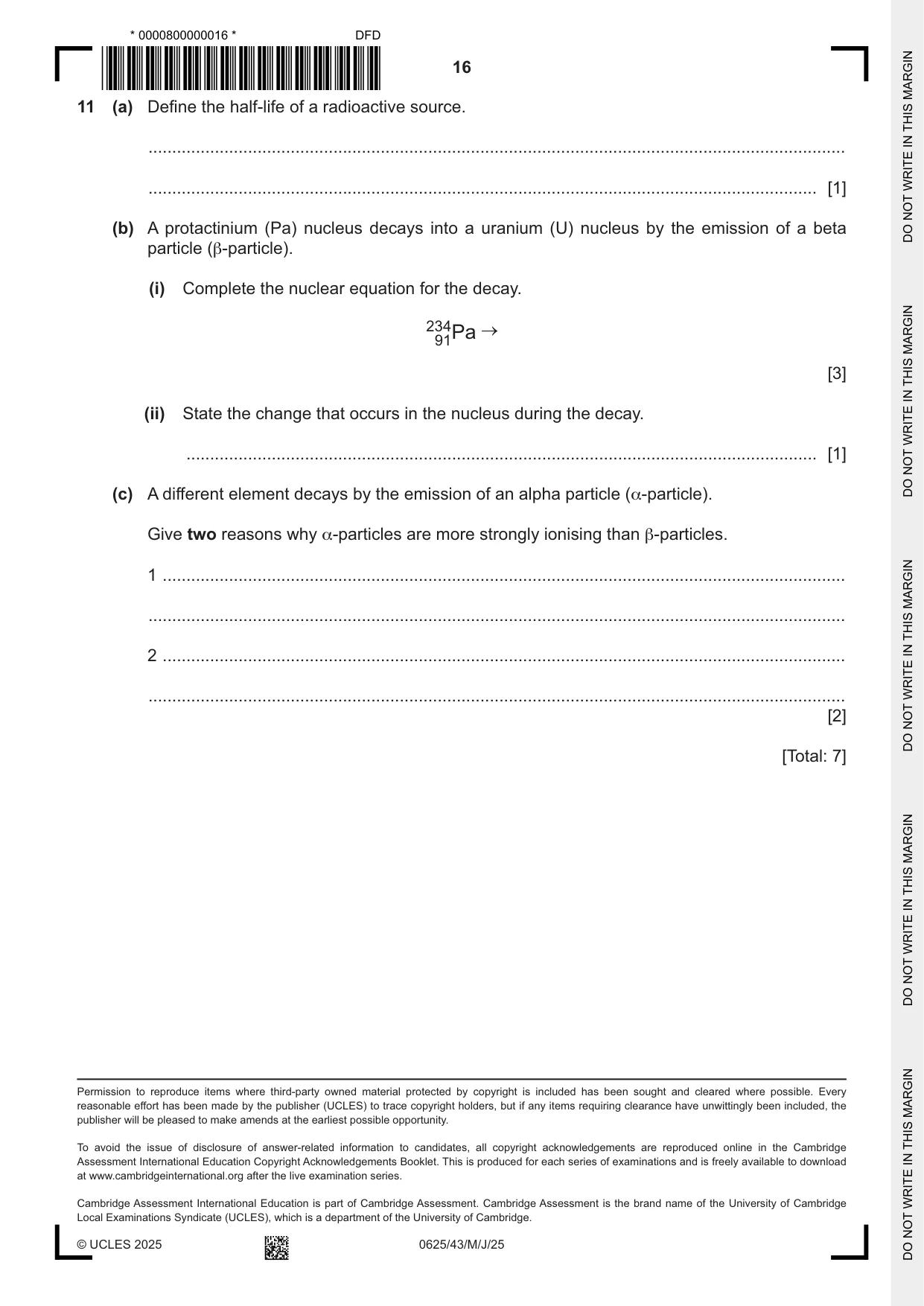
11 (a) Define the half-life of a radioactive source. ................................................................................................................................................... ............................................................................................................................................. [1] (b) A protactinium (Pa) nucleus decays into a uranium (U) nucleus by the emission of a beta particle (β-particle). (i) Complete the nuclear equation for the decay. 23 4 9 1Pa [3] (ii) State the change that occurs in the nucleus during the decay. ..................................................................................................................................... [1] (c) A different element decays by the emission of an alpha particle (α-particle). Give two reasons why α-particles are more strongly ionising than β-particles. 1 ................................................................................................................................................ ................................................................................................................................................... 2 ................................................................................................................................................ ................................................................................................................................................... [2] [Total: 7]
Mark scheme: 11(a) time taken for half the nuclei (in any sample) to decay B1 11(b)(i) 234(U) B1 92U B1 + 0 B1 -1 11(b)(ii) neutron changes to a proton (plus an electron) B1 11(c) ( particles have) greater kinetic energy (than particles) B1 ( particles have) greater charge (than particles) B1
What was in this paper
The subtopics covered by these 11 questions, and how many questions each got. Open one in a new tab to see every Cambridge question on it.
What you needed in this session
Cambridge’s own grade thresholds for 2025 May/June, Paper 4 · Variant 3. A higher threshold means an easier paper — the bar moves with how the cohort did.