Cambridge IGCSE Physics 0625 — 2023 Oct/Nov Paper 4 · Variant 3
0625/43/O/N/23 · 10 questions · 80 marks · ≈90 min
The question paper and its mark scheme, free to read here and free to download. This is Cambridge’s own paper, exactly as it was sat.
Question paper16 pages
Mark scheme16 pages
Answers below. Sit the paper first if you are practising.
Questions as text
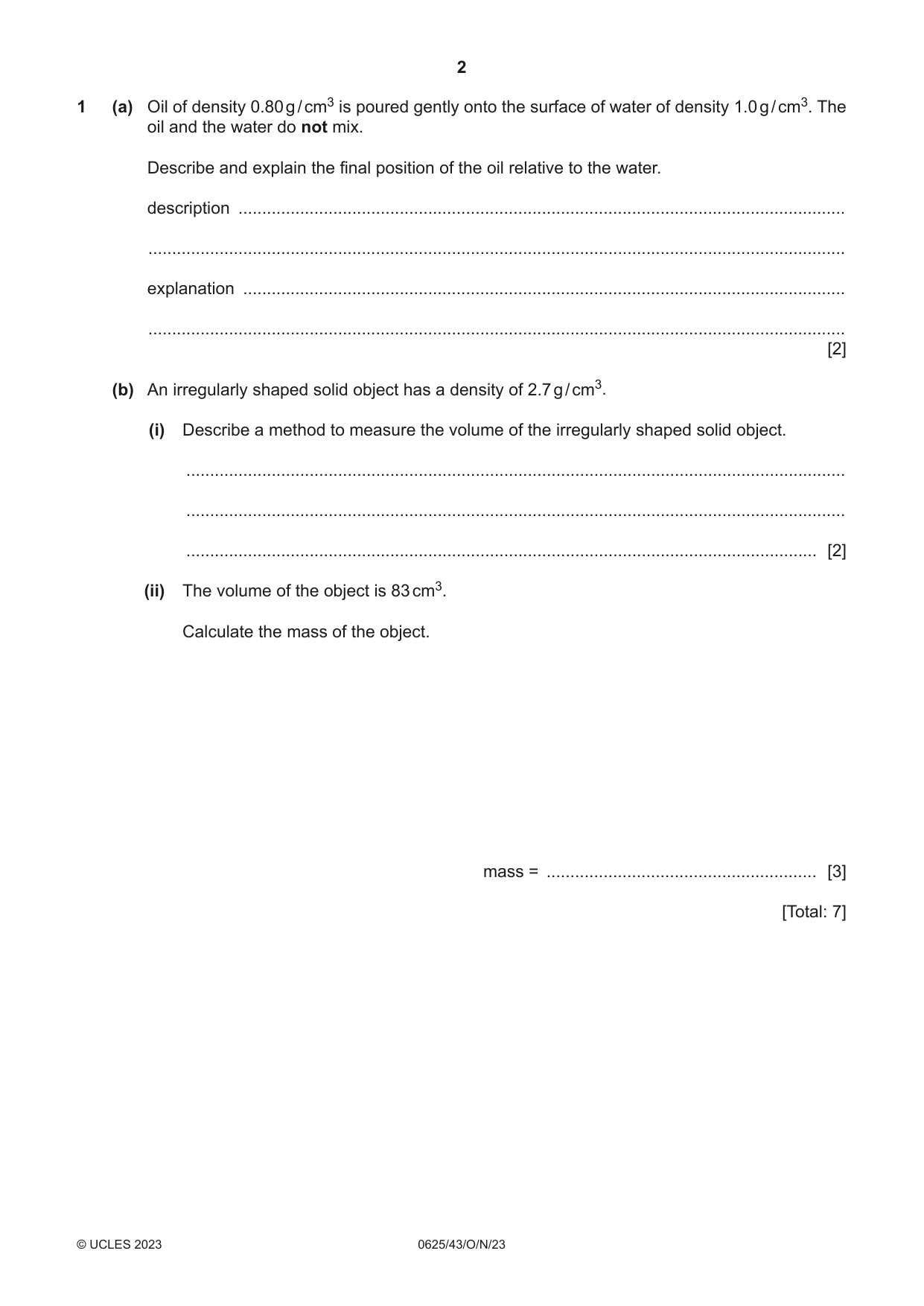
Q1 · Oil of density 0.80 g / cm3 is poured gently onto the surface of water of density 1.0 g /…
1 (a) Oil of density 0.80 g / cm3 is poured gently onto the surface of water of density 1.0 g / cm3. The oil and the water do not mix. Describe and explain the final position of the oil relative to the water. description ................................................................................................................................ ................................................................................................................................................... explanation ............................................................................................................................... ................................................................................................................................................... [2] (b) An irregularly shaped solid object has a density of 2.7 g / cm3. (i) Describe a method to measure the volume of the irregularly shaped solid object. ........................................................................................................................................... ........................................................................................................................................... ..................................................................................................................................... [2] (ii) The volume of the object is 83 cm3. Calculate the mass of the object. mass = ......................................................... [3] [Total: 7]
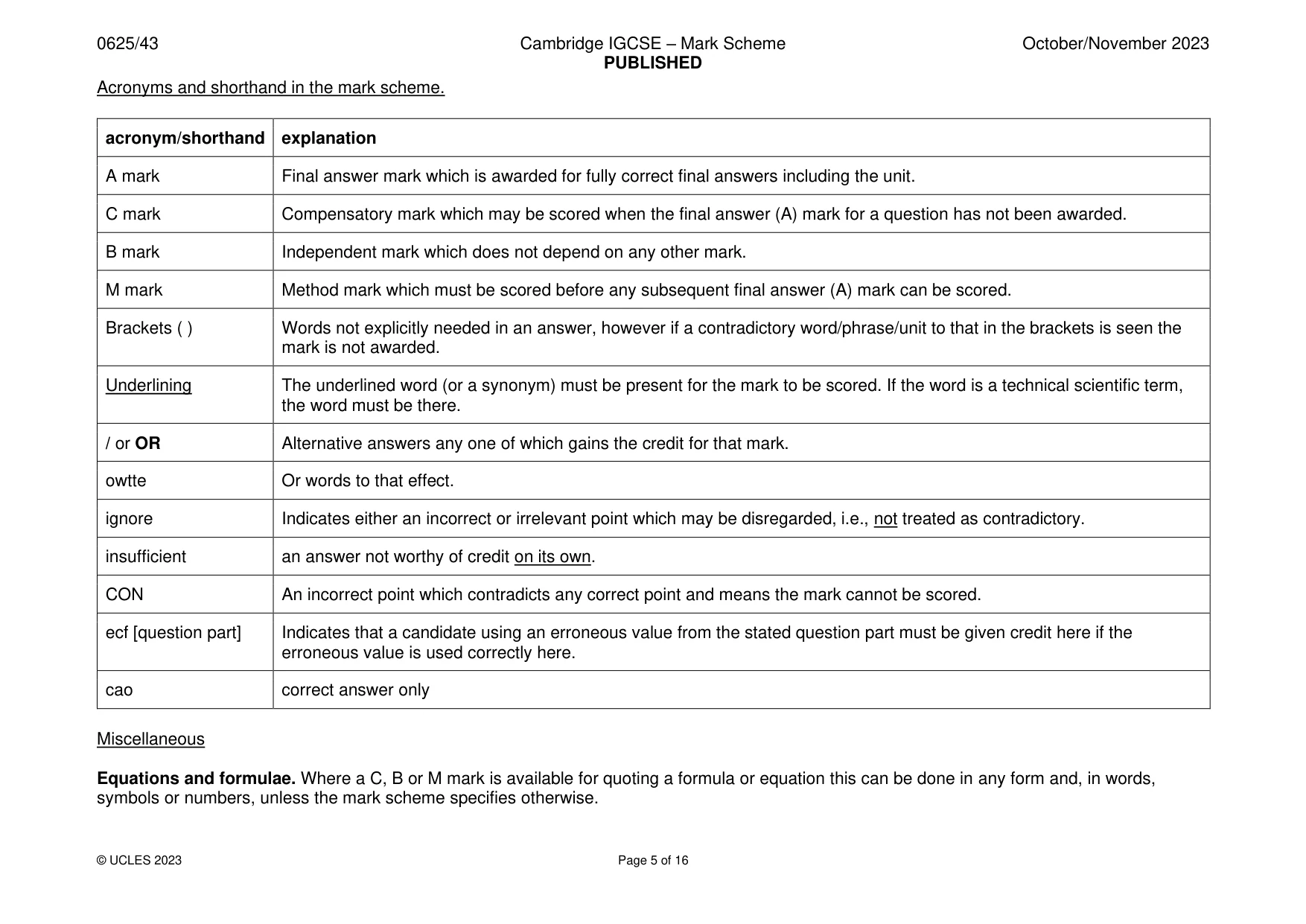
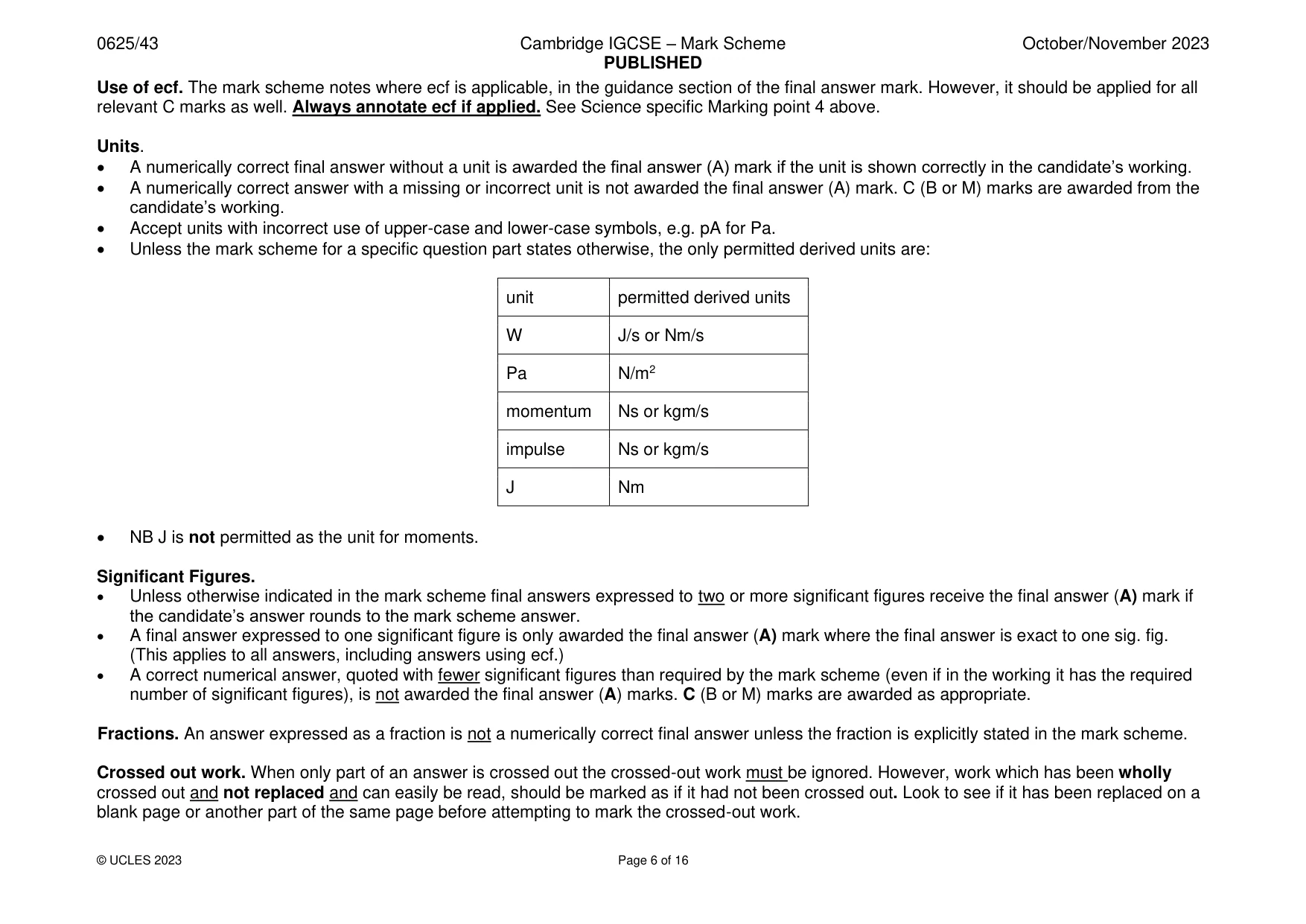
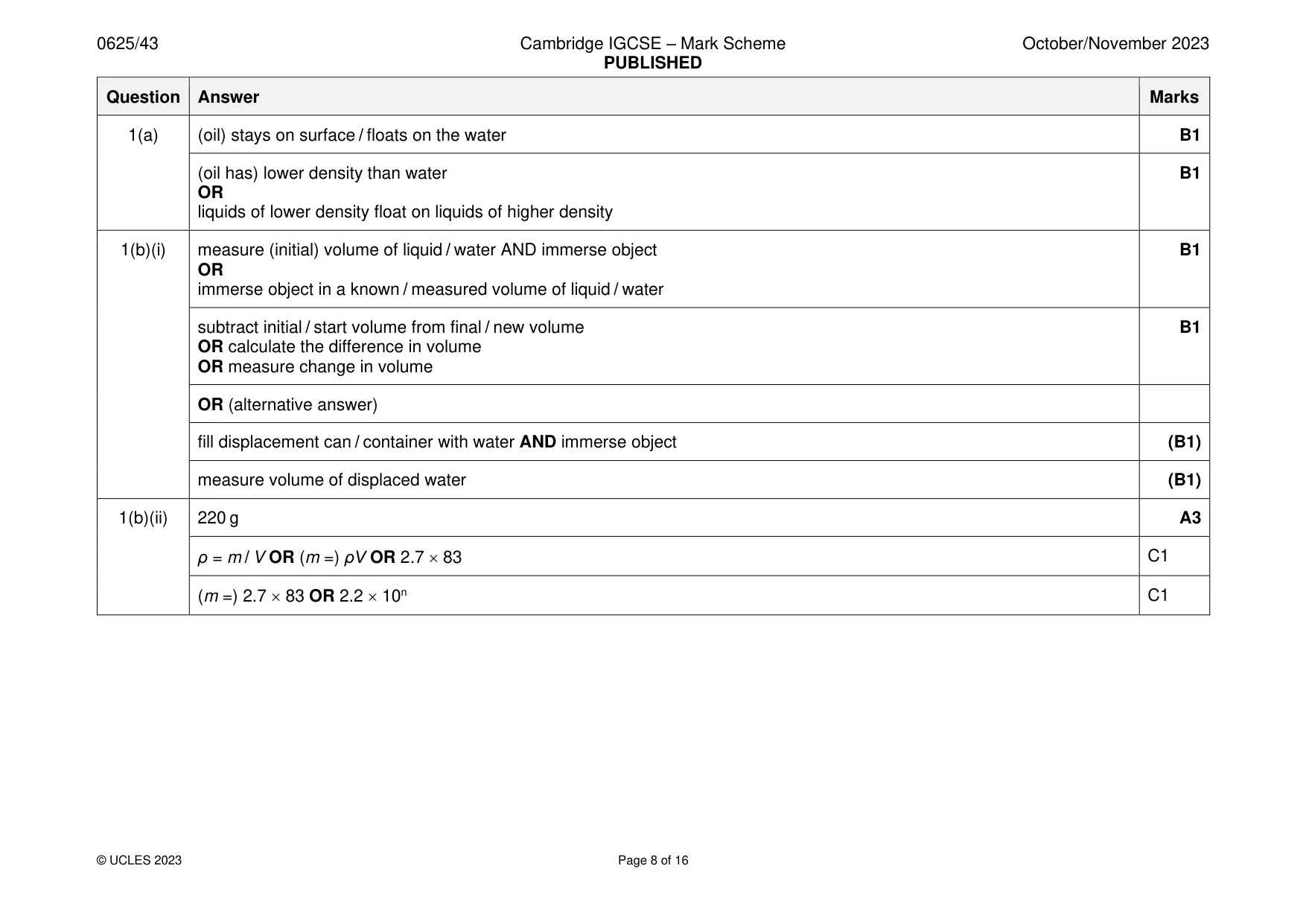
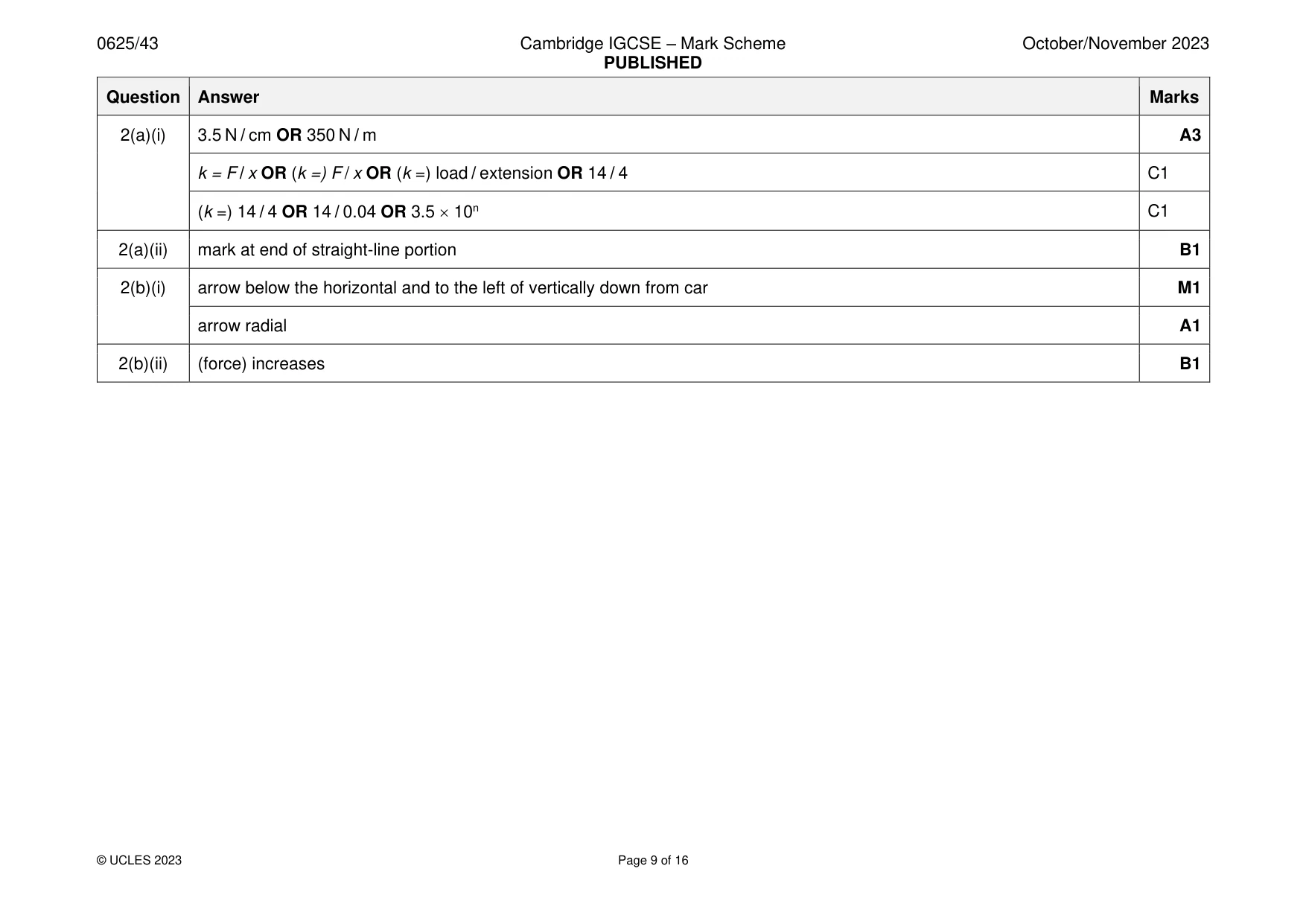
Mark scheme: 1(a) (oil) stays on surface / floats on the water B1 (oil has) lower density than water B1 OR liquids of lower density float on liquids of higher density 1(b)(i) measure (initial) volume of liquid / water AND immerse object B1 OR immerse object in a known / measured volume of liquid / water subtract initial / start volume from final / new volume B1 OR calculate the difference in volume OR measure change in volume OR (alternative answer) fill displacement can / container with water AND immerse object (B1) measure volume of displaced water (B1) 1(b)(ii) 220 g A3 ρ = m / V OR (m =) ρV OR 2.7 83 C1 (m =) 2.7 83 OR 2.2 10n C1 Question Answer Marks
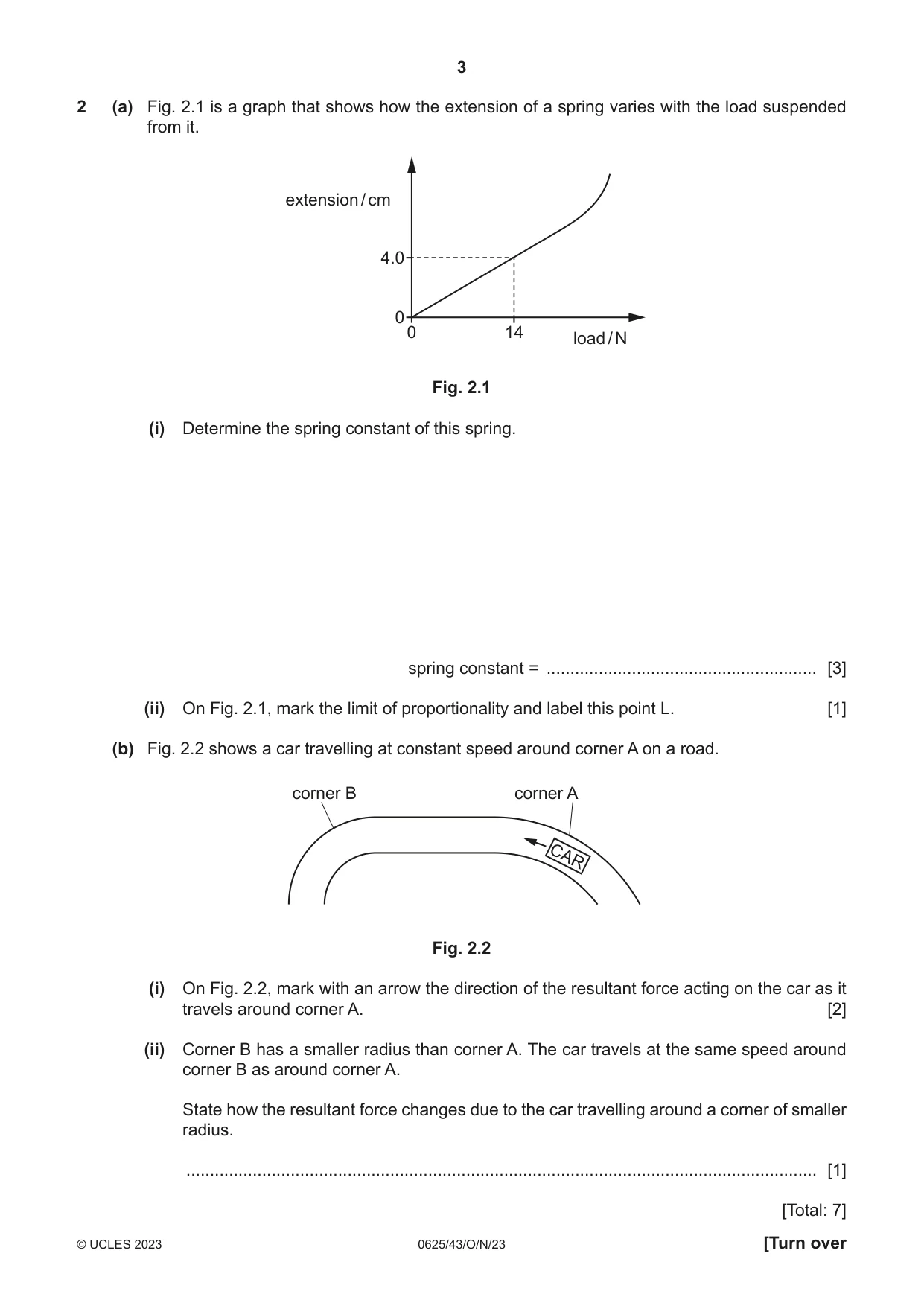
Q2 · A graph that shows how the extension of a spring varies with the load suspended from it
2 (a) Fig. 2.1 is a graph that shows how the extension of a spring varies with the load suspended from it. extension / cm 4.0 0 0 14 load / N Fig. 2.1 (i) Determine the spring constant of this spring. spring constant = ......................................................... [3] (ii) On Fig. 2.1, mark the limit of proportionality and label this point L. [1] (b) Fig. 2.2 shows a car travelling at constant speed around corner A on a road. corner B corner A CAR Fig. 2.2 (i) On Fig. 2.2, mark with an arrow the direction of the resultant force acting on the car as it travels around corner A. [2] (ii) Corner B has a smaller radius than corner A. The car travels at the same speed around corner B as around corner A. State how the resultant force changes due to the car travelling around a corner of smaller radius. ..................................................................................................................................... [1] [Total: 7]
Mark scheme: 2(a)(i) 3.5 N / cm OR 350 N / m A3 k = F / x OR (k =) F / x OR (k =) load / extension OR 14 / 4 C1 (k =) 14 / 4 OR 14 / 0.04 OR 3.5 10n C1 2(a)(ii) mark at end of straight-line portion B1 2(b)(i) arrow below the horizontal and to the left of vertically down from car M1 arrow radial A1 2(b)(ii) (force) increases B1 Question Answer Marks
More questions on Physical quantities and measurement techniques
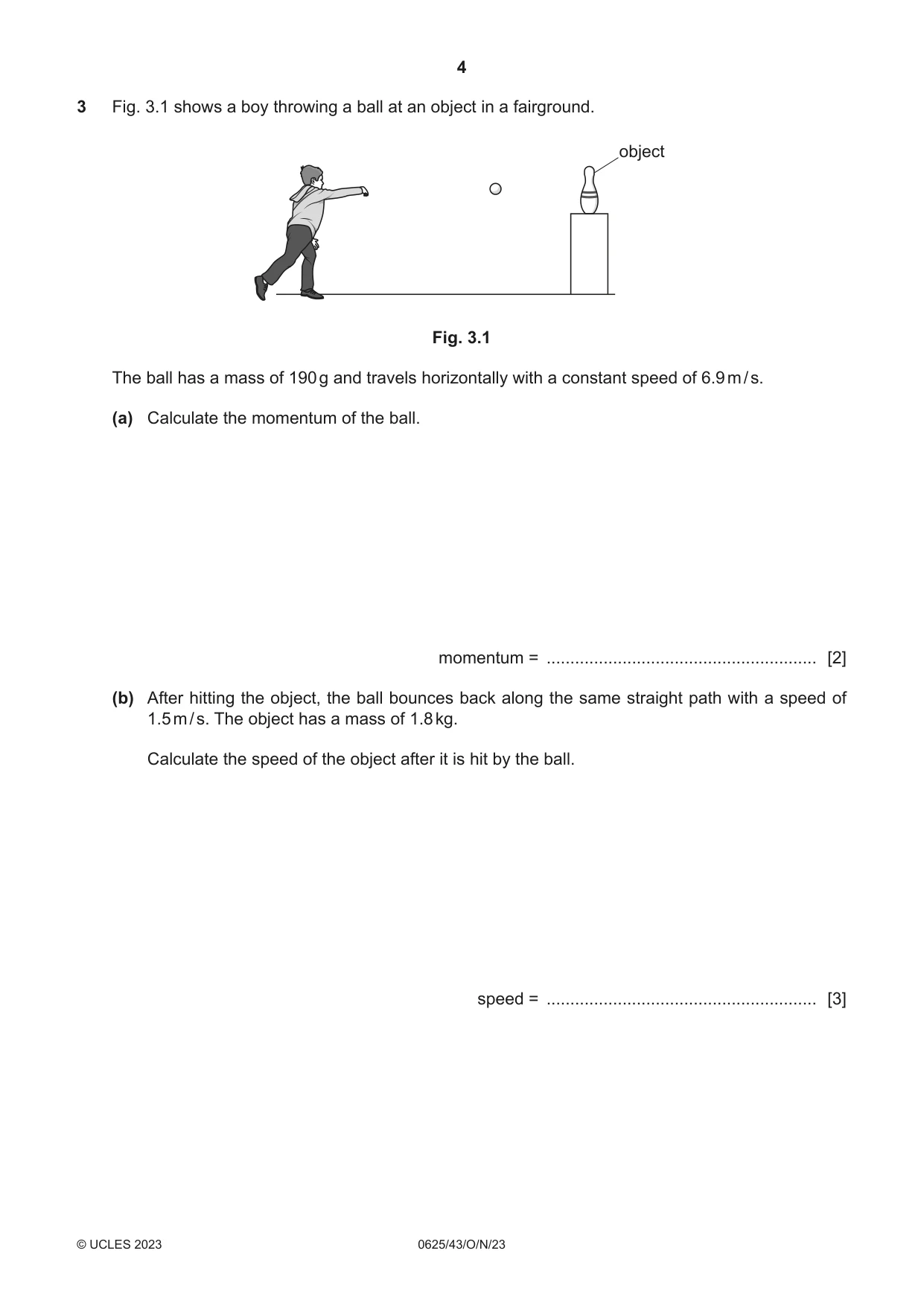
Q3 · A boy throwing a ball at an object in a fairground
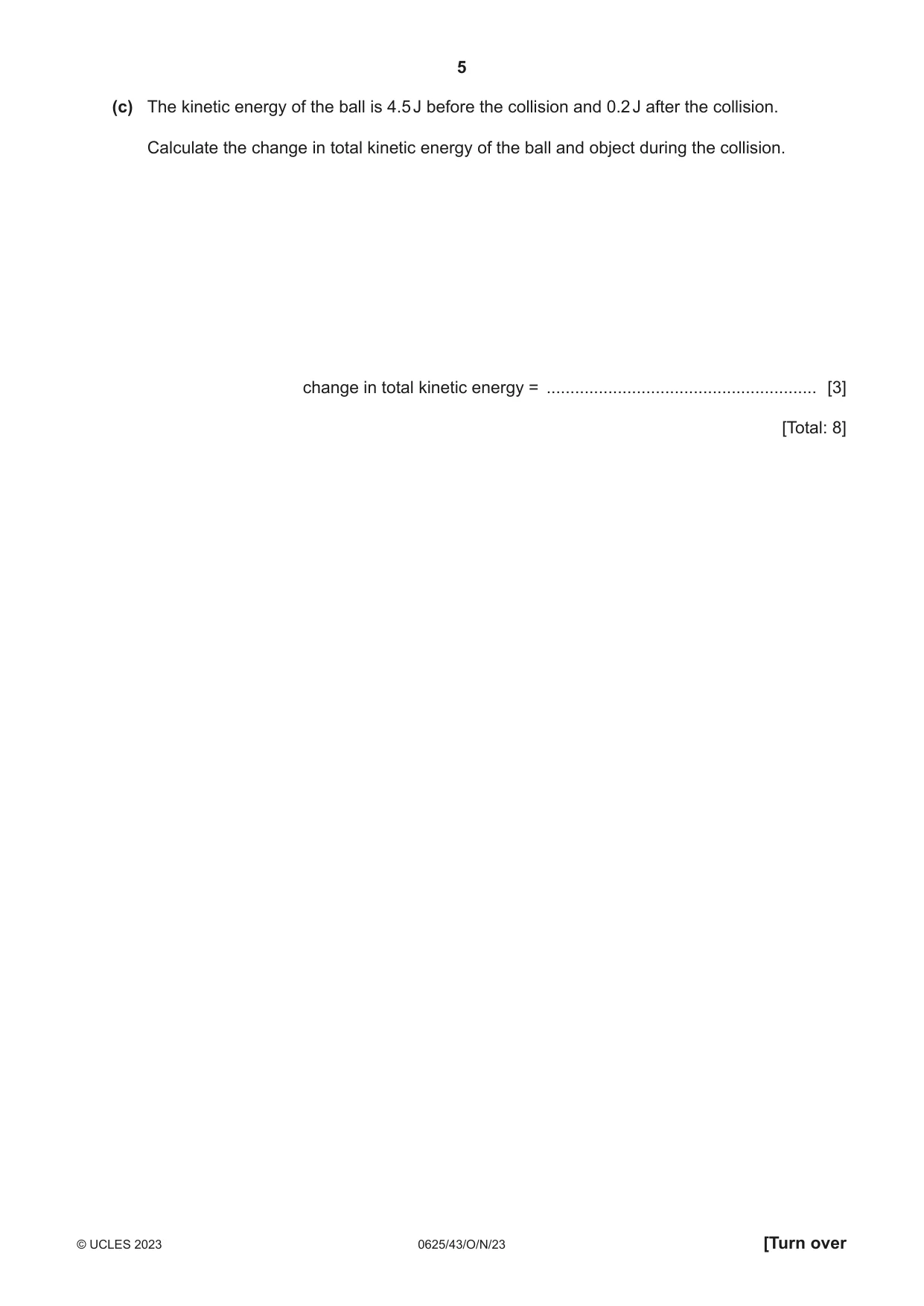
3 Fig. 3.1 shows a boy throwing a ball at an object in a fairground. object Fig. 3.1 The ball has a mass of 190 g and travels horizontally with a constant speed of 6.9 m / s. (a) Calculate the momentum of the ball. momentum = ......................................................... [2] (b) After hitting the object, the ball bounces back along the same straight path with a speed of 1.5 m / s. The object has a mass of 1.8 kg. Calculate the speed of the object after it is hit by the ball. speed = ......................................................... [3] (c) The kinetic energy of the ball is 4.5 J before the collision and 0.2 J after the collision. Calculate the change in total kinetic energy of the ball and object during the collision. change in total kinetic energy = ......................................................... [3] [Total: 8]
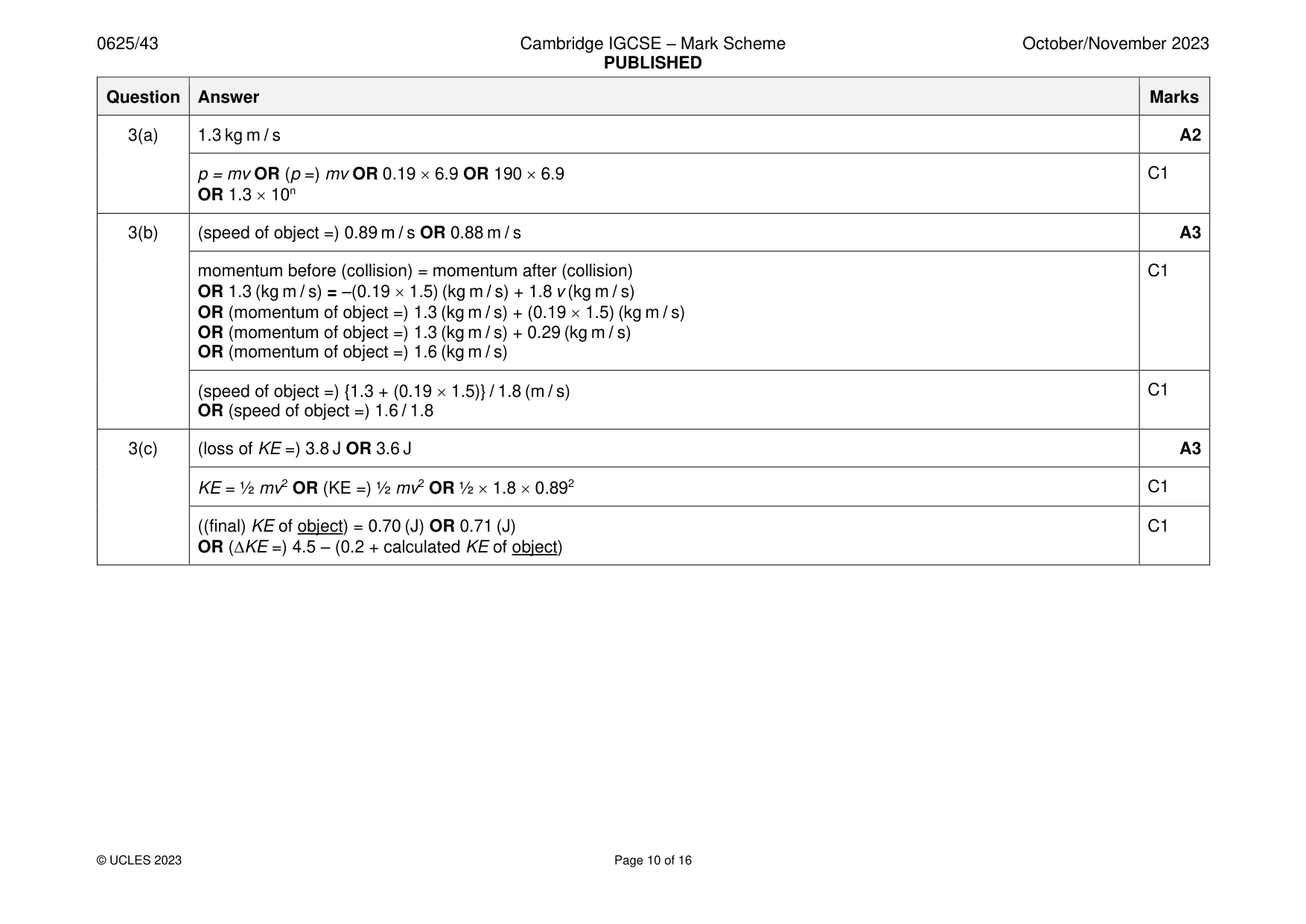
Mark scheme: 3(a) 1.3 kg m / s A2 p = mv OR (p =) mv OR 0.19 6.9 OR 190 6.9 C1 OR 1.3 10n 3(b) (speed of object =) 0.89 m / s OR 0.88 m / s A3 momentum before (collision) = momentum after (collision) C1 OR 1.3 (kg m / s) = –(0.19 1.5) (kg m / s) + 1.8 v (kg m / s) OR (momentum of object =) 1.3 (kg m / s) + (0.19 1.5) (kg m / s) OR (momentum of object =) 1.3 (kg m / s) + 0.29 (kg m / s) OR (momentum of object =) 1.6 (kg m / s) (speed of object =) {1.3 + (0.19 1.5)} / 1.8 (m / s) C1 OR (speed of object =) 1.6 / 1.8 3(c) (loss of KE =) 3.8 J OR 3.6 J A3 KE = ½ mv2 OR (KE =) ½ mv2 OR ½ 1.8 0.892 C1 ((final) KE of object) = 0.70 (J) OR 0.71 (J) C1 OR (KE =) 4.5 – (0.2 + calculated KE of object) Question Answer Marks
Q4 · The lowest possible temperature is zero kelvin (0 K)
4 (a) The lowest possible temperature is zero kelvin (0 K). (i) State the name of this lowest possible temperature. ..................................................................................................................................... [1] (ii) Nitrogen boils at 77 K. Calculate the boiling point of nitrogen on the Celsius scale. boiling point = .................................................... °C [2] (b) The temperature of a fixed mass of gas at constant volume changes from 300 K to 400 K. State and explain, in terms of particles, the effect on the pressure of the gas. statement .................................................................................................................................. explanation ............................................................................................................................... ................................................................................................................................................... ................................................................................................................................................... ................................................................................................................................................... [4] (c) A sample of gas is at a pressure of 120 kPa. The volume of the gas is doubled at constant temperature. Calculate the new pressure of the gas. pressure = ......................................................... [2] [Total: 9]
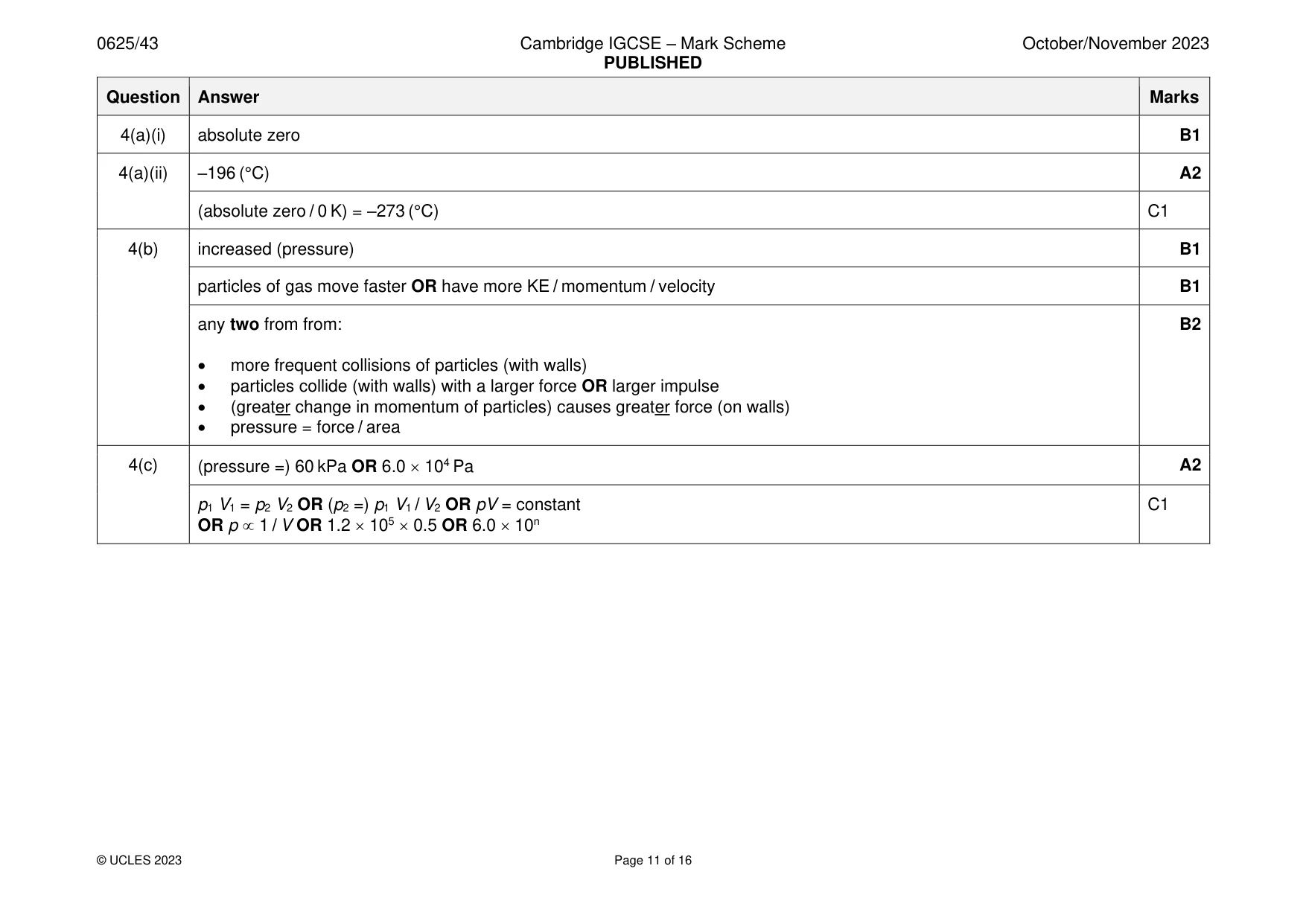
Mark scheme: 4(a)(i) absolute zero B1 4(a)(ii) –196 (°C) A2 (absolute zero / 0 K) = –273 (°C) C1 4(b) increased (pressure) B1 particles of gas move faster OR have more KE / momentum / velocity B1 any two from from: B2 • more frequent collisions of particles (with walls) • particles collide (with walls) with a larger force OR larger impulse • (greater change in momentum of particles) causes greater force (on walls) • pressure = force / area 4(c) (pressure =) 60 kPa OR 6.0 104 Pa A2 p1 V1 = p2 V2 OR (p2 =) p1 V1 / V2 OR pV = constant C1 OR p 1 / V OR 1.2 105 0.5 OR 6.0 10n Question Answer Marks
Q5 · A scale diagram of wavefronts of red light approaching a gap in a barrier
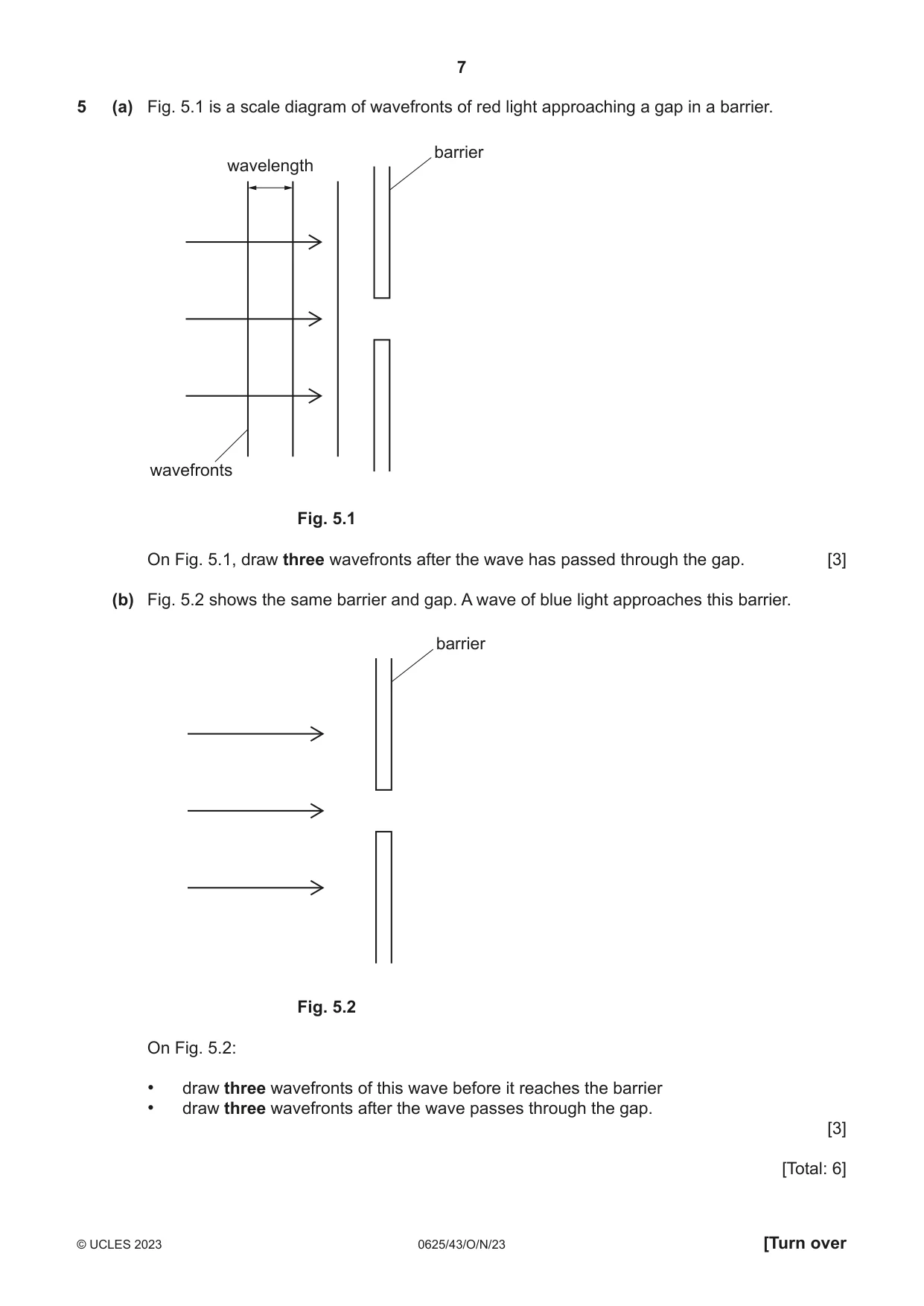
5 (a) Fig. 5.1 is a scale diagram of wavefronts of red light approaching a gap in a barrier. barrier wavelength wavefronts Fig. 5.1 On Fig. 5.1, draw three wavefronts after the wave has passed through the gap. [3] (b) Fig. 5.2 shows the same barrier and gap. A wave of blue light approaches this barrier. barrier Fig. 5.2 On Fig. 5.2: • draw three wavefronts of this wave before it reaches the barrier • draw three wavefronts after the wave passes through the gap. [3] [Total: 6]
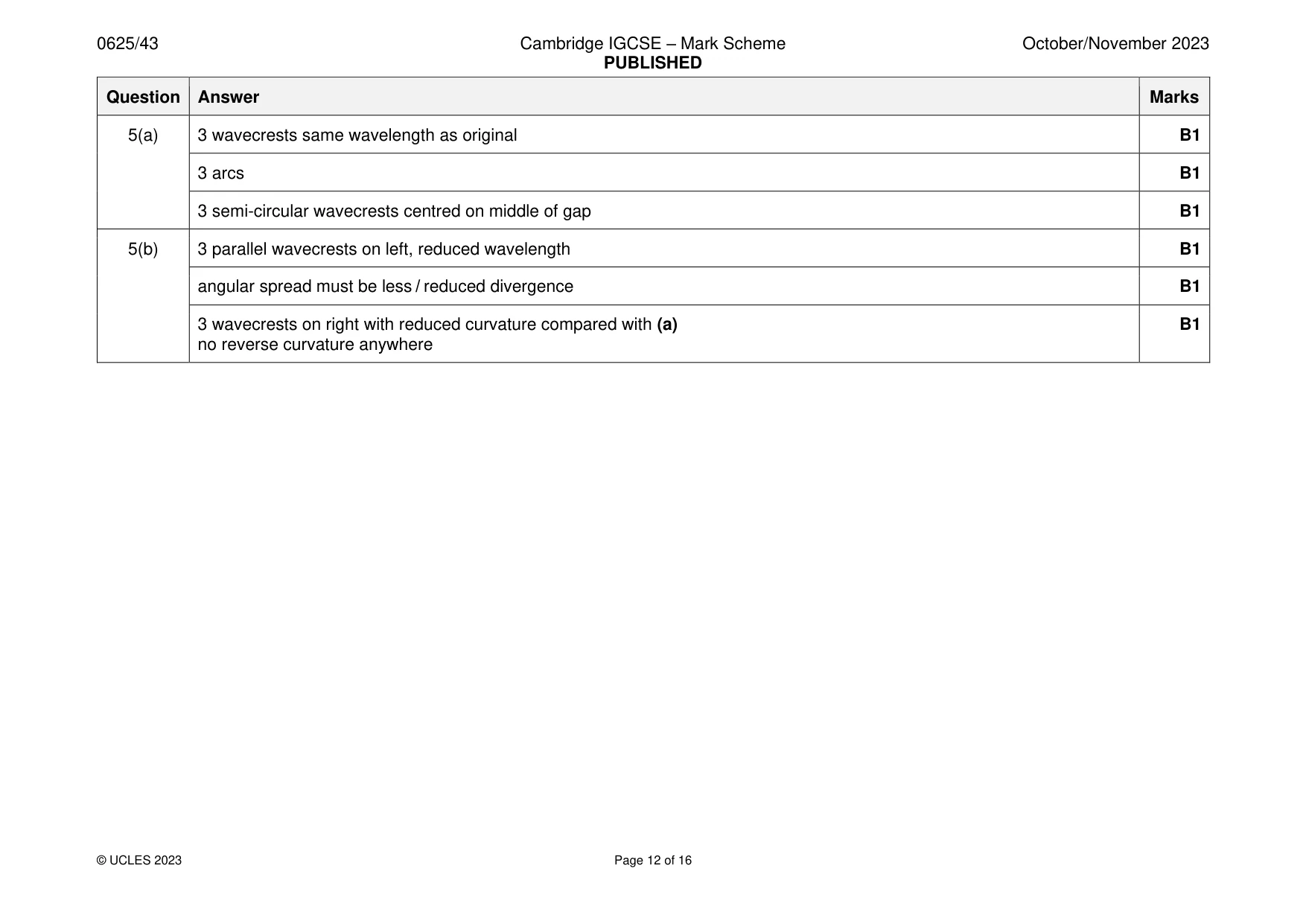
Mark scheme: 5(a) 3 wavecrests same wavelength as original B1 3 arcs B1 3 semi-circular wavecrests centred on middle of gap B1 5(b) 3 parallel wavecrests on left, reduced wavelength B1 angular spread must be less / reduced divergence B1 3 wavecrests on right with reduced curvature compared with (a) B1 no reverse curvature anywhere Question Answer Marks
Question 6
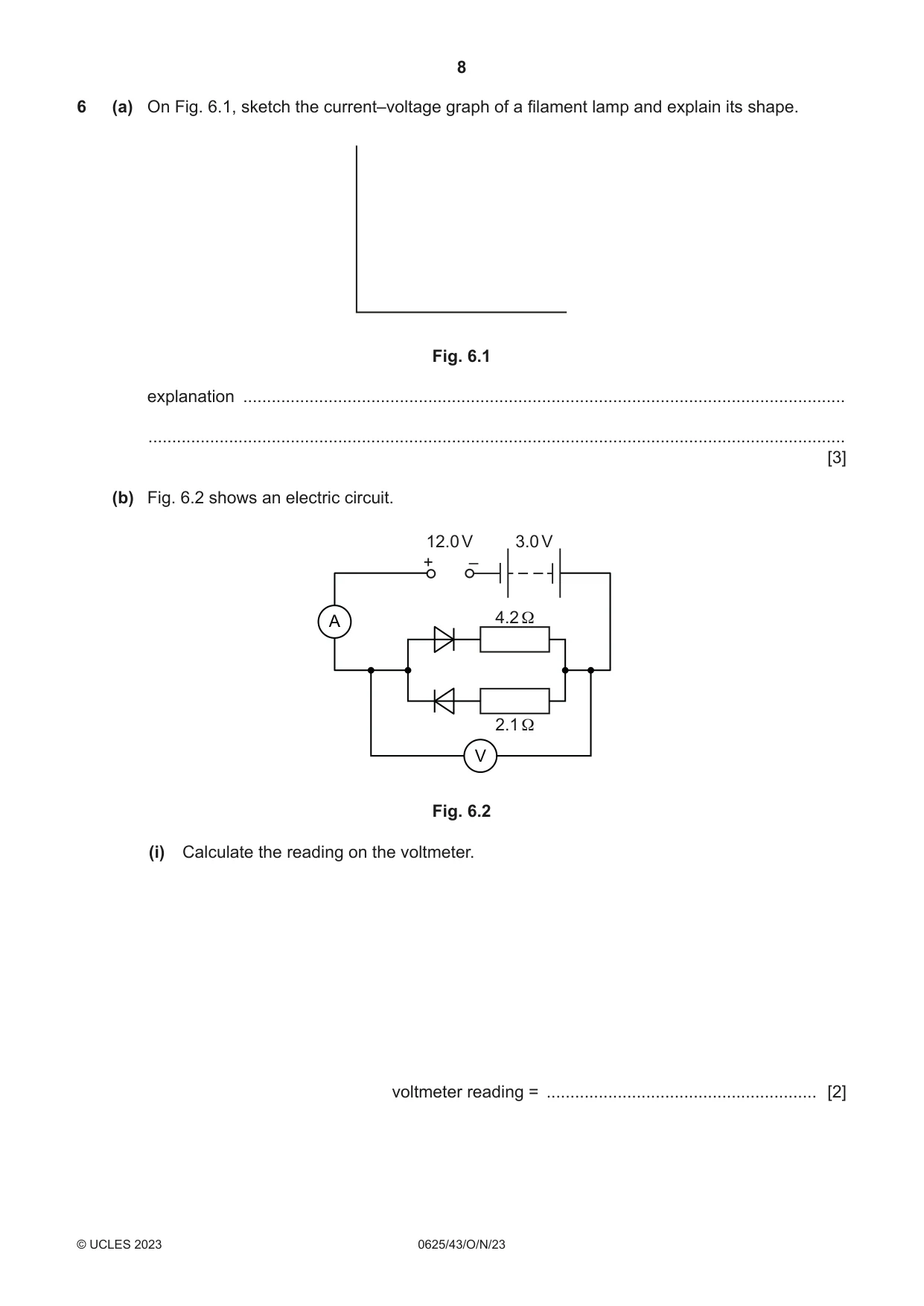
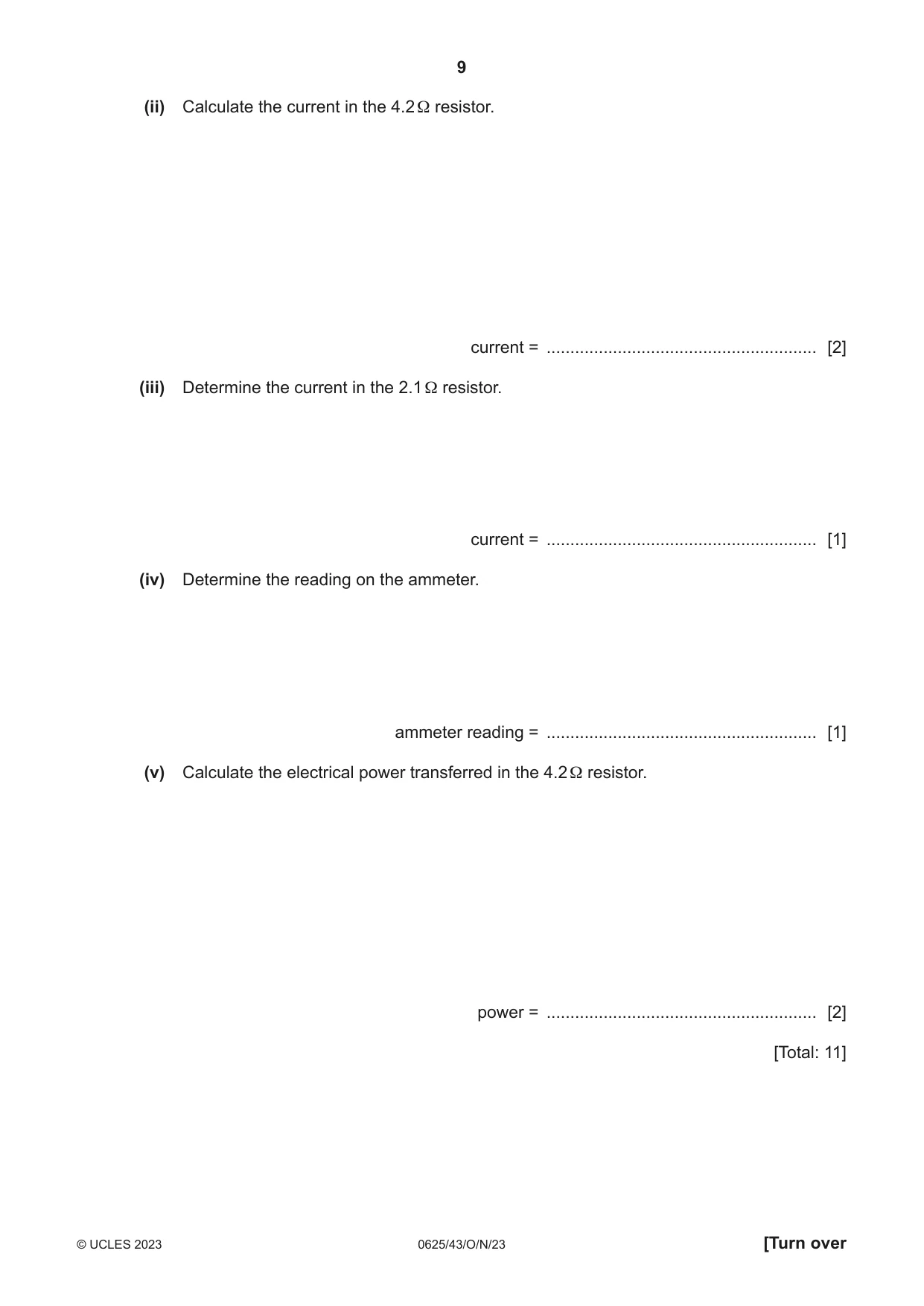
6 (a) On Fig. 6.1, sketch the current–voltage graph of a filament lamp and explain its shape. Fig. 6.1 explanation ............................................................................................................................... ................................................................................................................................................... [3] (b) Fig. 6.2 shows an electric circuit. 12.0 V 3.0 V + – A 4.2 Ω 2.1 Ω V Fig. 6.2 (i) Calculate the reading on the voltmeter. voltmeter reading = ......................................................... [2] (ii) Calculate the current in the 4.2 Ω resistor. current = ......................................................... [2] (iii) Determine the current in the 2.1 Ω resistor. current = ......................................................... [1] (iv) Determine the reading on the ammeter. ammeter reading = ......................................................... [1] (v) Calculate the electrical power transferred in the 4.2 Ω resistor. power = ......................................................... [2] [Total: 11]
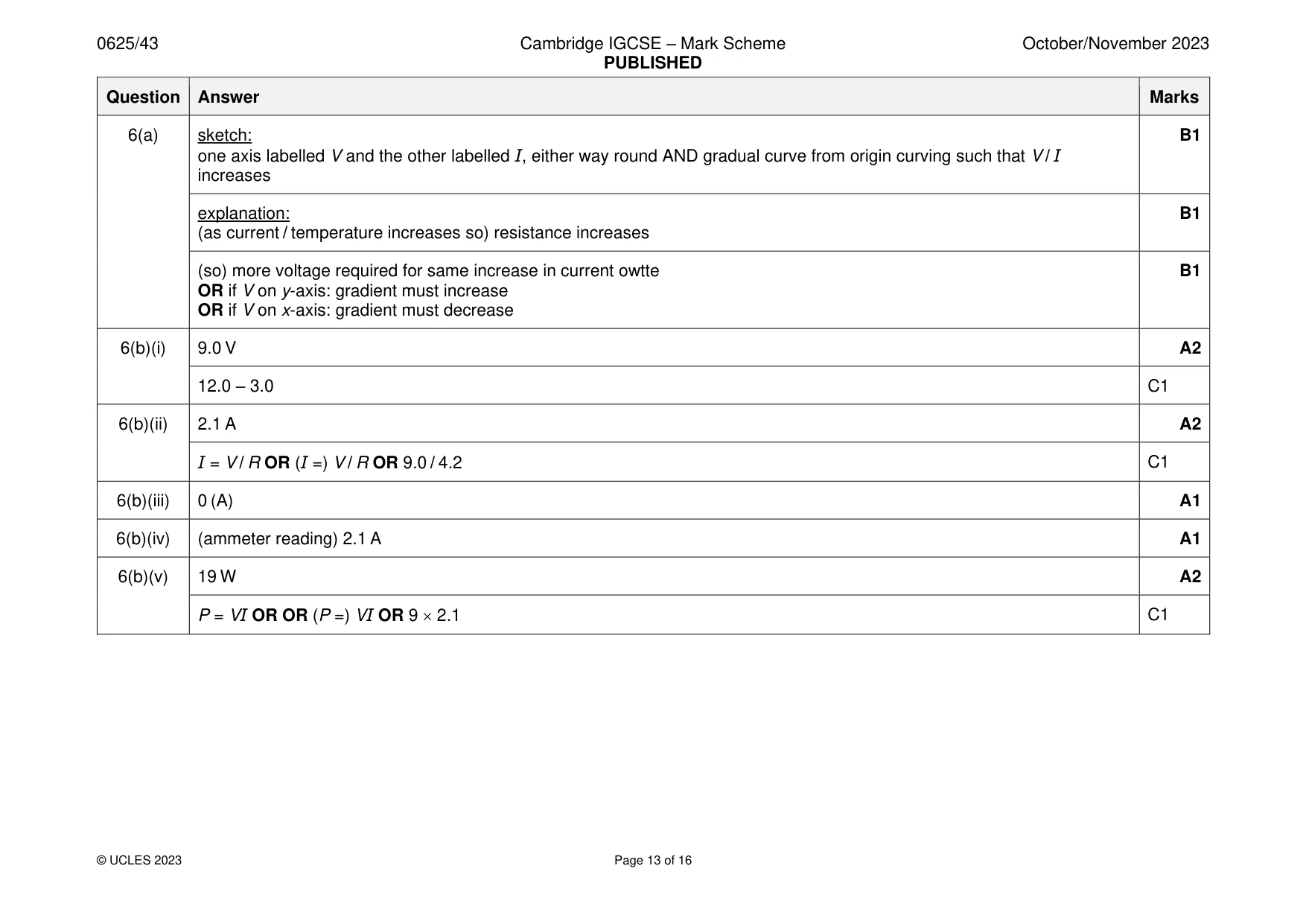
Mark scheme: 6(a) sketch: B1 one axis labelled V and the other labelled I, either way round AND gradual curve from origin curving such that V / I increases explanation: B1 (as current / temperature increases so) resistance increases (so) more voltage required for same increase in current owtte B1 OR if V on y-axis: gradient must increase OR if V on x-axis: gradient must decrease 6(b)(i) 9.0 V A2 12.0 – 3.0 C1 6(b)(ii) 2.1 A A2 I = V / R OR (I =) V / R OR 9.0 / 4.2 C1 6(b)(iii) 0 (A) A1 6(b)(iv) (ammeter reading) 2.1 A A1 6(b)(v) 19 W A2 P = VI OR OR (P =) VI OR 9 2.1 C1 Question Answer Marks
Q7 · The electric field pattern around point X
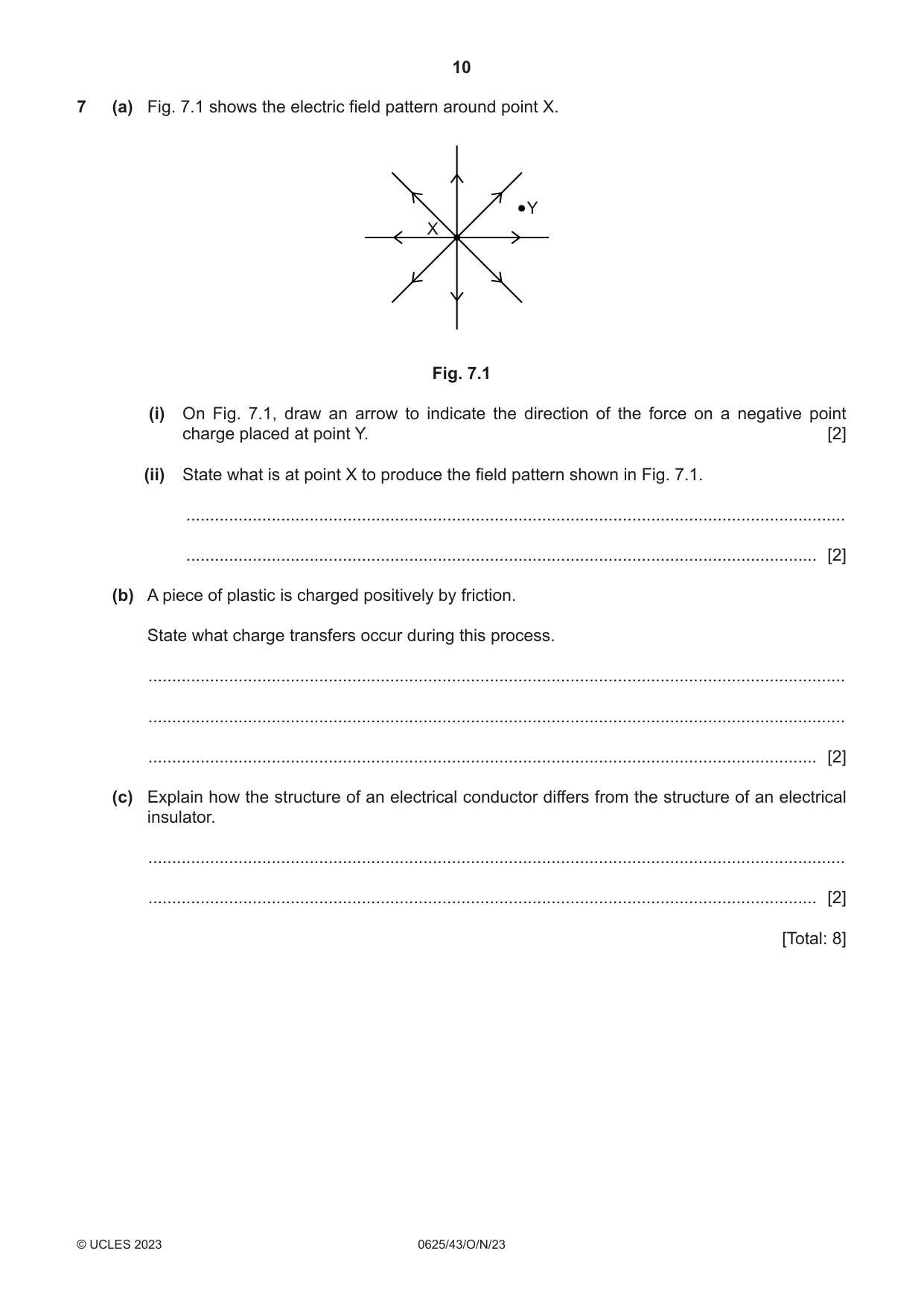
7 (a) Fig. 7.1 shows the electric field pattern around point X. Y X Fig. 7.1 (i) On Fig. 7.1, draw an arrow to indicate the direction of the force on a negative point charge placed at point Y. [2] (ii) State what is at point X to produce the field pattern shown in Fig. 7.1. ........................................................................................................................................... ..................................................................................................................................... [2] (b) A piece of plastic is charged positively by friction. State what charge transfers occur during this process. ................................................................................................................................................... ................................................................................................................................................... ............................................................................................................................................. [2] (c) Explain how the structure of an electrical conductor differs from the structure of an electrical insulator. ................................................................................................................................................... ............................................................................................................................................. [2] [Total: 8]
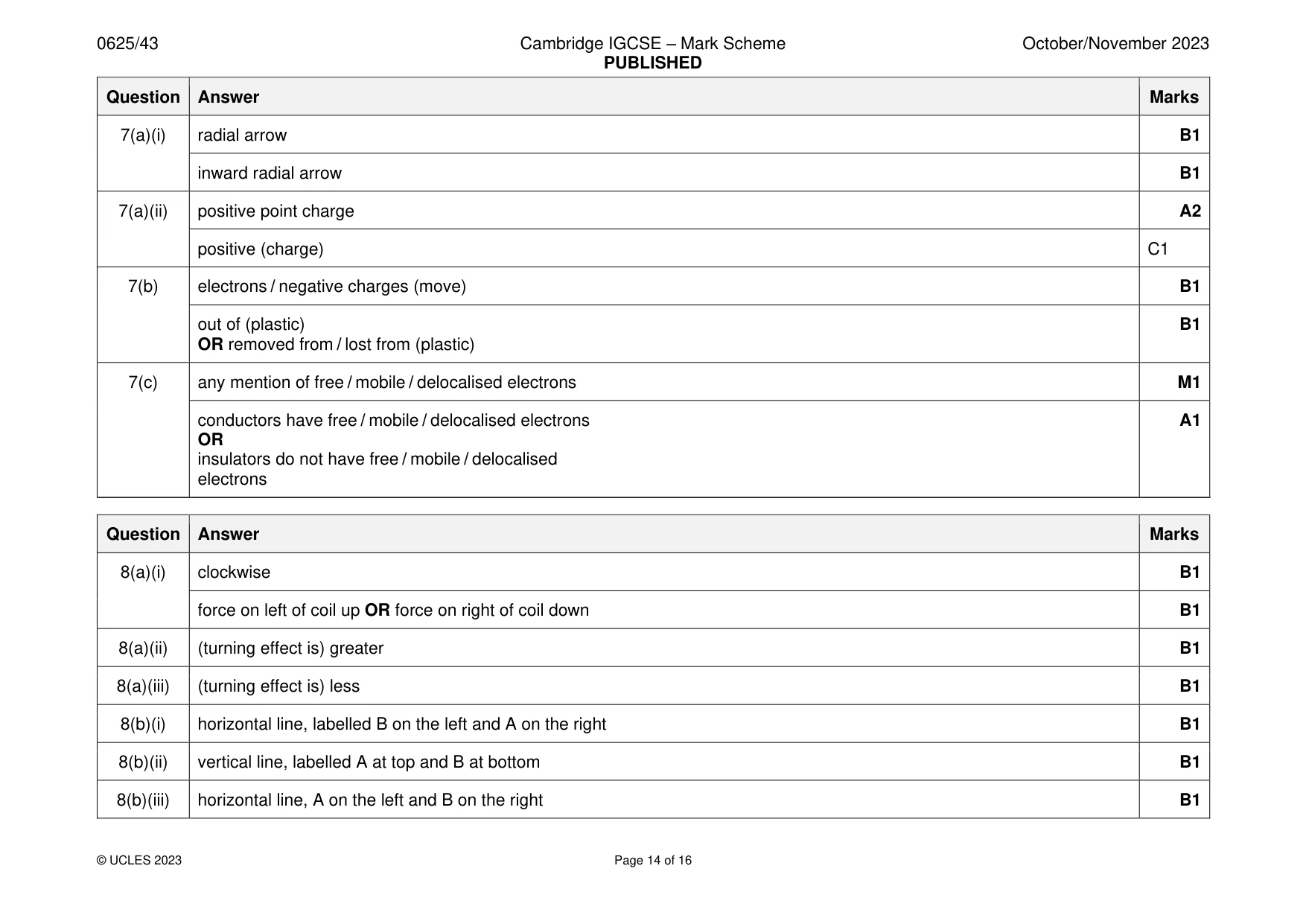
Mark scheme: 7(a)(i) radial arrow B1 inward radial arrow B1 7(a)(ii) positive point charge A2 positive (charge) C1 7(b) electrons / negative charges (move) B1 out of (plastic) B1 OR removed from / lost from (plastic) 7(c) any mention of free / mobile / delocalised electrons M1 conductors have free / mobile / delocalised electrons A1 OR insulators do not have free / mobile / delocalised electrons Question Answer Marks
Q8 · The single turn coil of a simple direct current (d.c.) motor
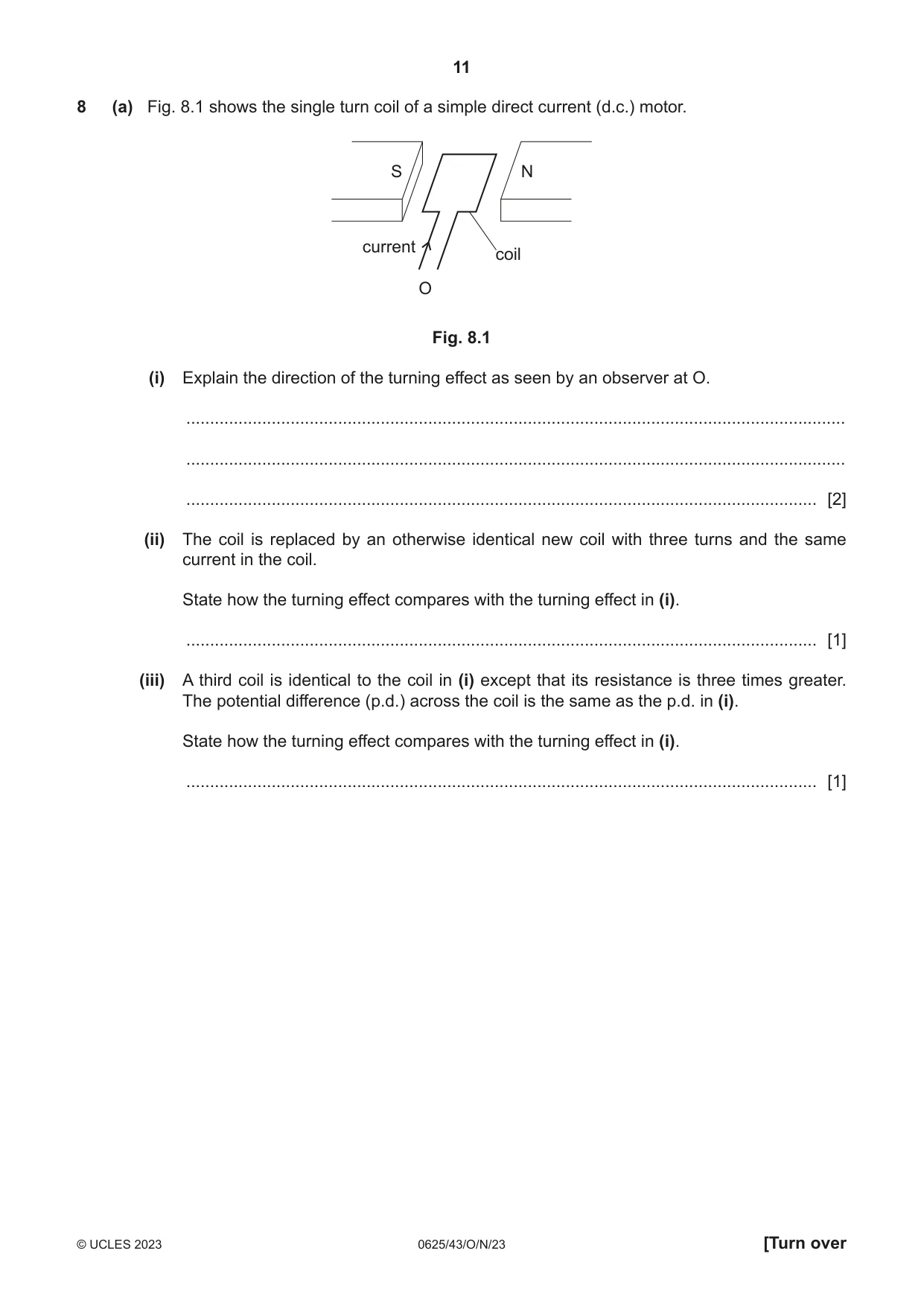
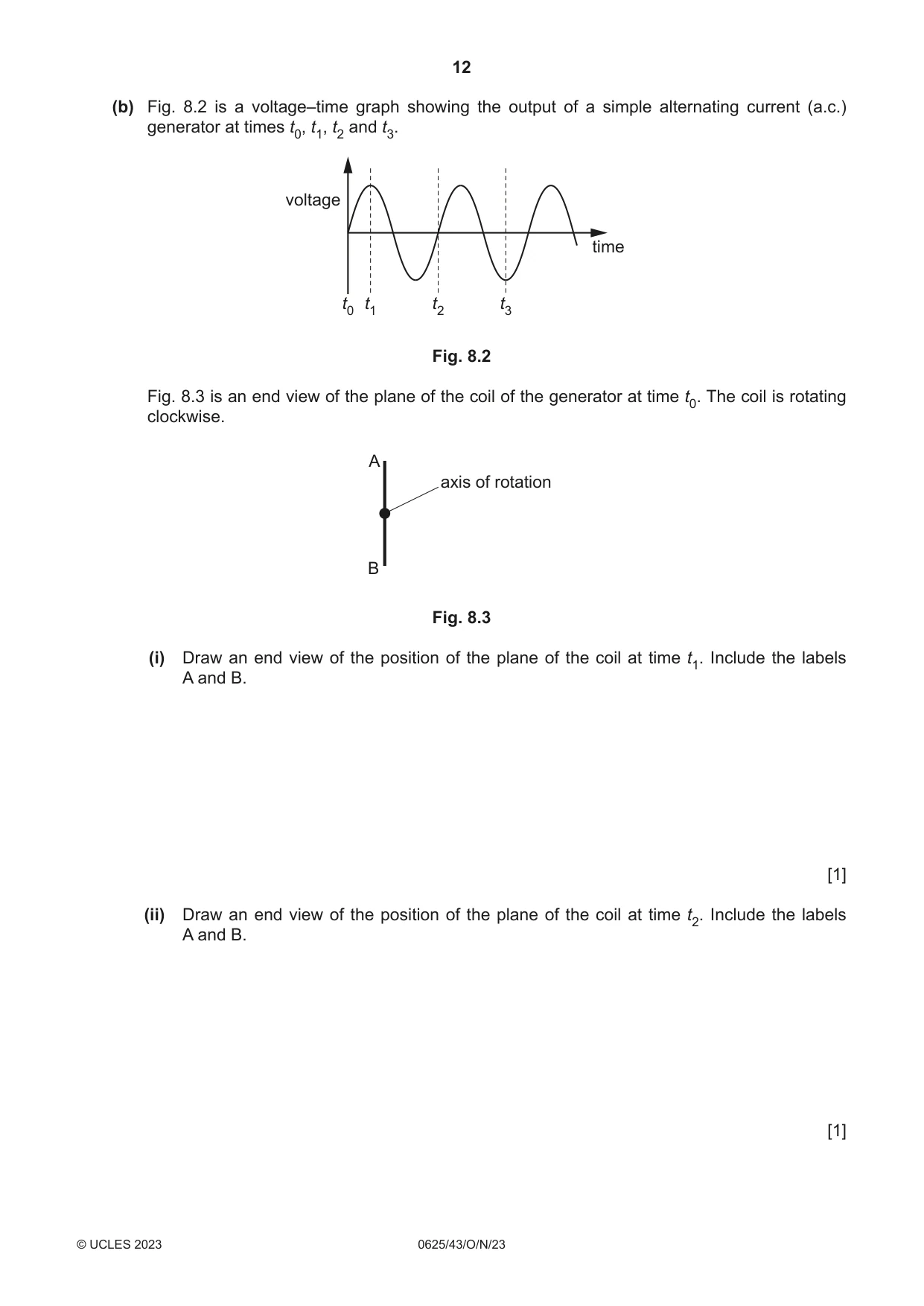
8 (a) Fig. 8.1 shows the single turn coil of a simple direct current (d.c.) motor. S N current coil O Fig. 8.1 (i) Explain the direction of the turning effect as seen by an observer at O. ........................................................................................................................................... ........................................................................................................................................... ..................................................................................................................................... [2] (ii) The coil is replaced by an otherwise identical new coil with three turns and the same current in the coil. State how the turning effect compares with the turning effect in (i). ..................................................................................................................................... [1] (iii) A third coil is identical to the coil in (i) except that its resistance is three times greater. The potential difference (p.d.) across the coil is the same as the p.d. in (i). State how the turning effect compares with the turning effect in (i). ..................................................................................................................................... [1] (b) Fig. 8.2 is a voltage–time graph showing the output of a simple alternating current (a.c.) generator at times t0, t1, t2 and t3. voltage time t0 t1 t2 t3 Fig. 8.2 Fig. 8.3 is an end view of the plane of the coil of the generator at time t0. The coil is rotating clockwise. A axis of rotation B Fig. 8.3 (i) Draw an end view of the position of the plane of the coil at time t1. Include the labels A and B. [1] (ii) Draw an end view of the position of the plane of the coil at time t2. Include the labels A and B. [1] (iii) Draw an end view of the position of the plane of the coil at time t3. Include the labels A and B. [1] [Total: 7]
Mark scheme: 8(a)(i) clockwise B1 force on left of coil up OR force on right of coil down B1 8(a)(ii) (turning effect is) greater B1 8(a)(iii) (turning effect is) less B1 8(b)(i) horizontal line, labelled B on the left and A on the right B1 8(b)(ii) vertical line, labelled A at top and B at bottom B1 8(b)(iii) horizontal line, A on the left and B on the right B1 Question Answer Marks
Q9 · For each application of radioactive isotopes, state and explain which type of radioactive…
9 (a) For each application of radioactive isotopes, state and explain which type of radioactive emission is suitable and suggest an appropriate half-life for the isotope. (i) household smoke alarm type of radioactive emission .............................................................................................. explanation ........................................................................................................................ ........................................................................................................................................... half-life ............................................................................................................................... [3] (ii) measuring the thickness of aluminium strips produced in a factory type of radioactive emission .............................................................................................. explanation ........................................................................................................................ ........................................................................................................................................... half-life ............................................................................................................................... [3] (b) Lead-208 (20882Pb) has the highest nucleon number of the stable isotopes of lead. Explain why lead-214 (21482Pb) is radioactive. ................................................................................................................................................... ................................................................................................................................................... ................................................................................................................................................... ............................................................................................................................................. [2] (c) State two different sources of background radiation. 1 ................................................................................................................................................ 2 ................................................................................................................................................ [2] [Total: 10]
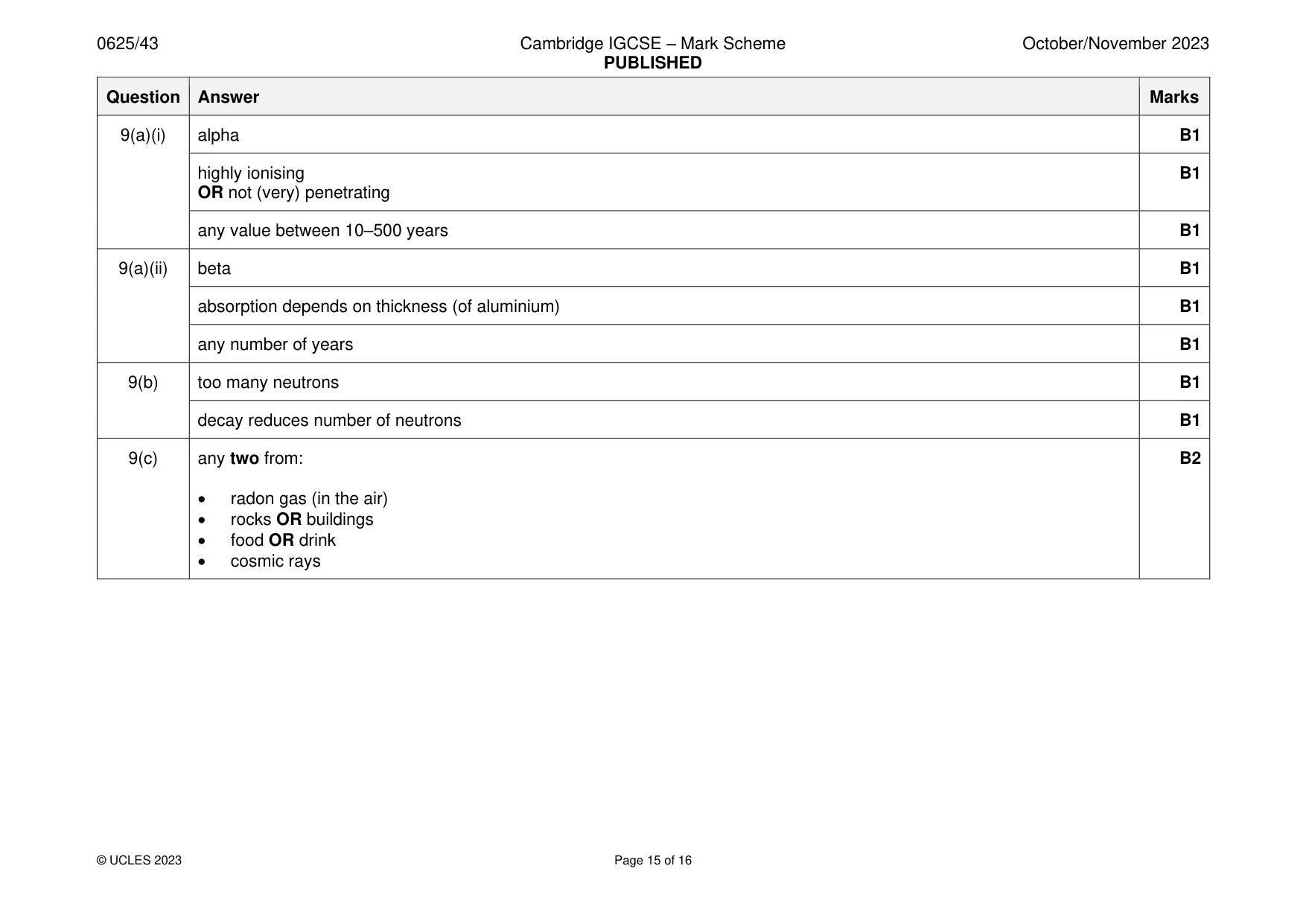
Mark scheme: 9(a)(i) alpha B1 highly ionising B1 OR not (very) penetrating any value between 10–500 years B1 9(a)(ii) beta B1 absorption depends on thickness (of aluminium) B1 any number of years B1 9(b) too many neutrons B1 decay reduces number of neutrons B1 9(c) any two from: B2 • radon gas (in the air) • rocks OR buildings • food OR drink • cosmic rays Question Answer Marks
Question 10
10 (a) (i) 1. State what is represented in space physics by the symbol H0. ............................................................................................................................... [1] 2. Write down the equation that defines H0 in terms of the speed that a far galaxy is moving away from the Earth and its distance from the Earth. ............................................................................................................................... [1] (ii) The numerical value of H0 is 2.2 × 10⁻¹⁸. State the unit of H0. ..................................................................................................................................... [1] (iii) Use this value of H0 to determine an estimate for the age of the Universe in seconds. age of the Universe = ...................................................... s [2] (b) State when cosmic microwave background radiation (CMBR) was formed and where we detect it coming from. ................................................................................................................................................... ................................................................................................................................................... ................................................................................................................................................... ............................................................................................................................................. [2] [Total: 7]
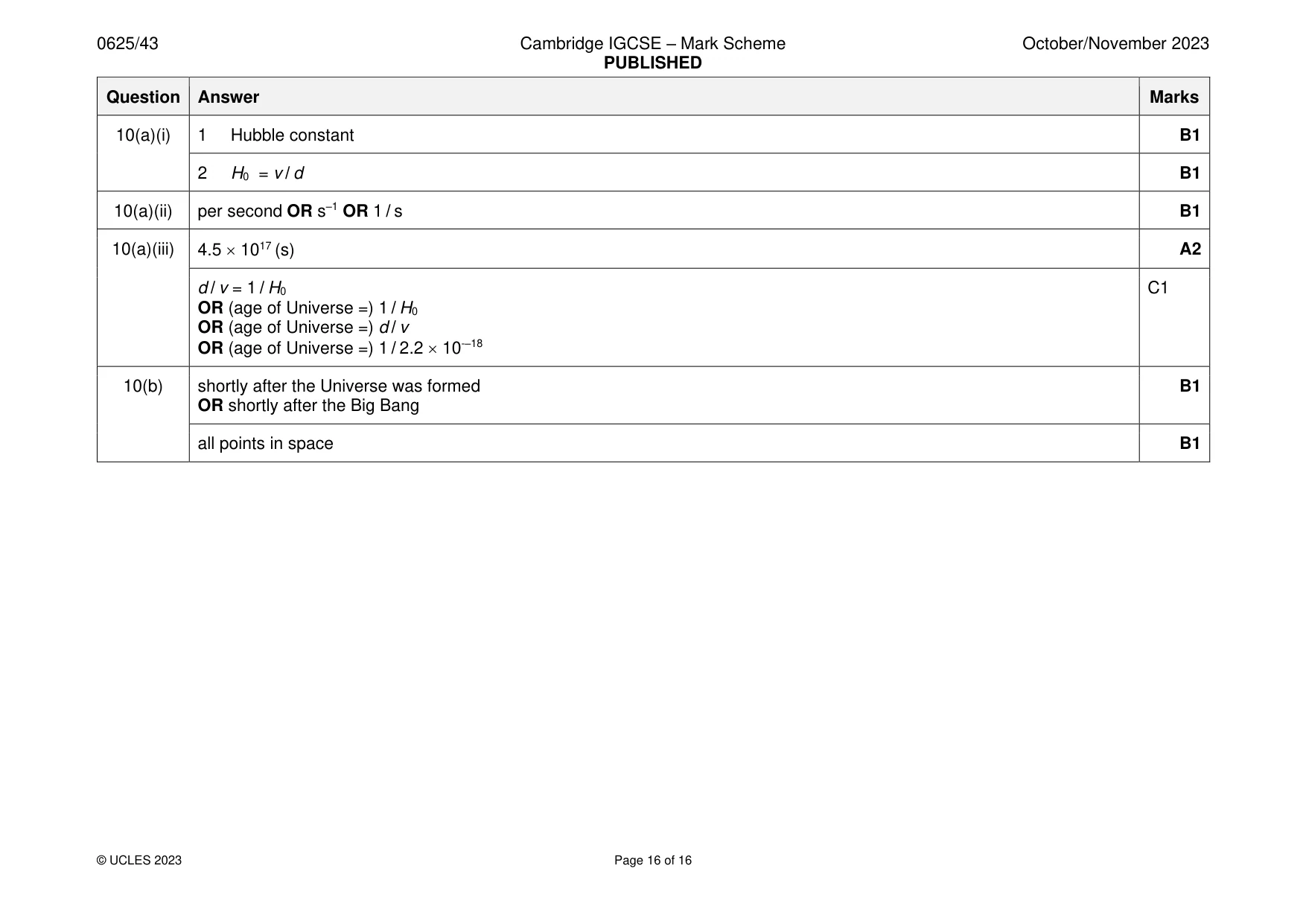
Mark scheme: 10(a)(i) 1 Hubble constant B1 2 H0 = v / d B1 10(a)(ii) per second OR s–1 OR 1 / s B1 10(a)(iii) 4.5 1017 (s) A2 d / v = 1 / H0 C1 OR (age of Universe =) 1 / H0 OR (age of Universe =) d / v OR (age of Universe =) 1 / 2.2 10-–18 10(b) shortly after the Universe was formed B1 OR shortly after the Big Bang all points in space B1
What was in this paper
The subtopics covered by these 10 questions, and how many questions each got. Open one in a new tab to see every Cambridge question on it.
What you needed in this session
Cambridge’s own grade thresholds for 2023 Oct/Nov, Paper 4 · Variant 3. A higher threshold means an easier paper — the bar moves with how the cohort did.