Cambridge IGCSE Physics 0625 — 2019 Oct/Nov Paper 4 · Variant 3
0625/43/O/N/19 · 11 questions · 80 marks · ≈90 min
The question paper and its mark scheme, free to read here and free to download. This is Cambridge’s own paper, exactly as it was sat.
Question paper16 pages
Mark scheme11 pages
Answers below. Sit the paper first if you are practising.
Questions as text
Q1 · The top view of a tank in an aquarium
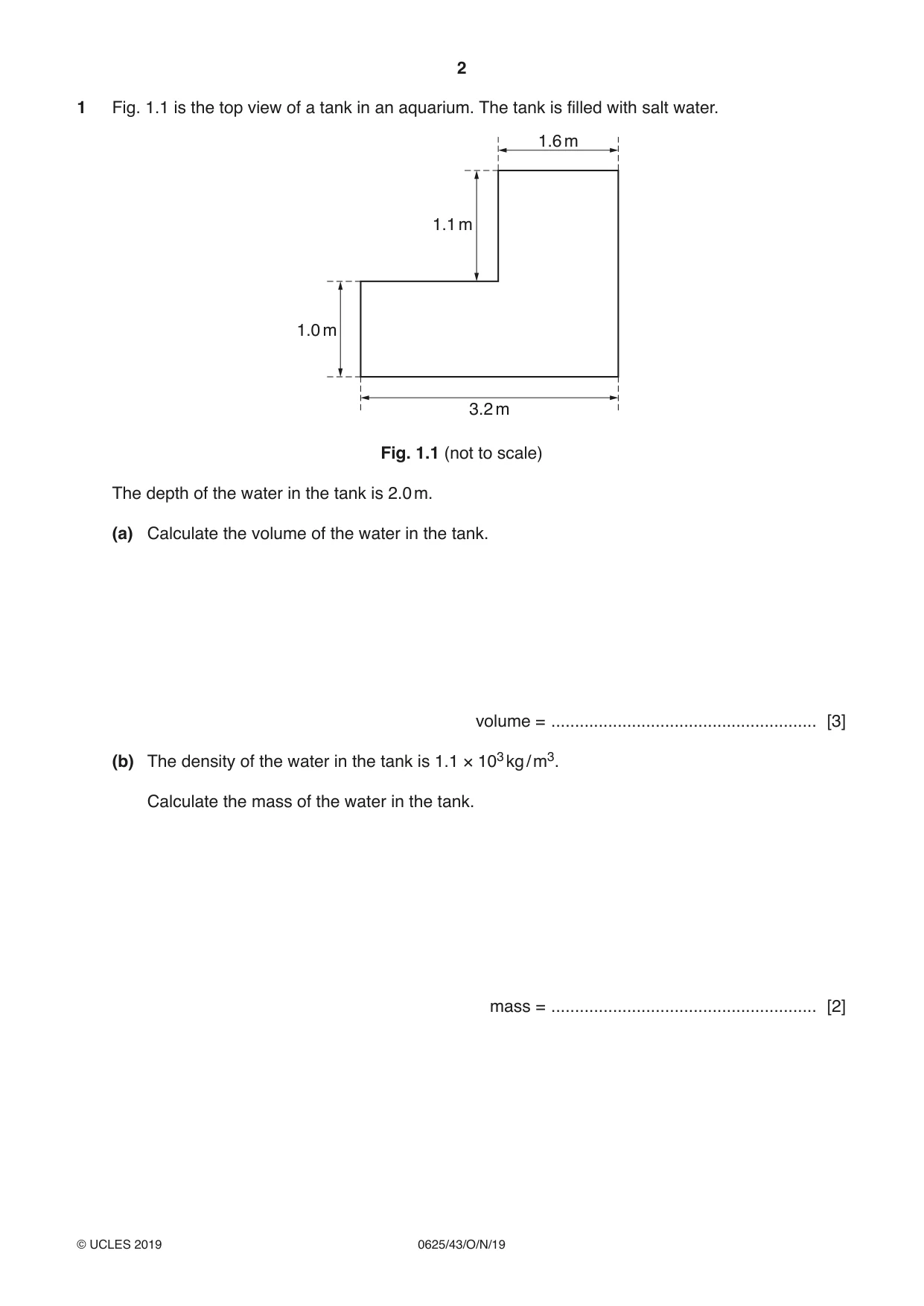
1 Fig. 1.1 is the top view of a tank in an aquarium. The tank is filled with salt water. 1.6 m 1.1 m 1.0 m 3.2 m Fig. 1.1 (not to scale) The depth of the water in the tank is 2.0 m. (a) Calculate the volume of the water in the tank. volume = ........................................................ [3] (b) The density of the water in the tank is 1.1 × 10³ kg / m3. Calculate the mass of the water in the tank. mass = ........................................................ [2] (c) Calculate the pressure due to the water at a level of 0.80 m above the base of the tank. pressure = ........................................................ [3] [Total: 8]
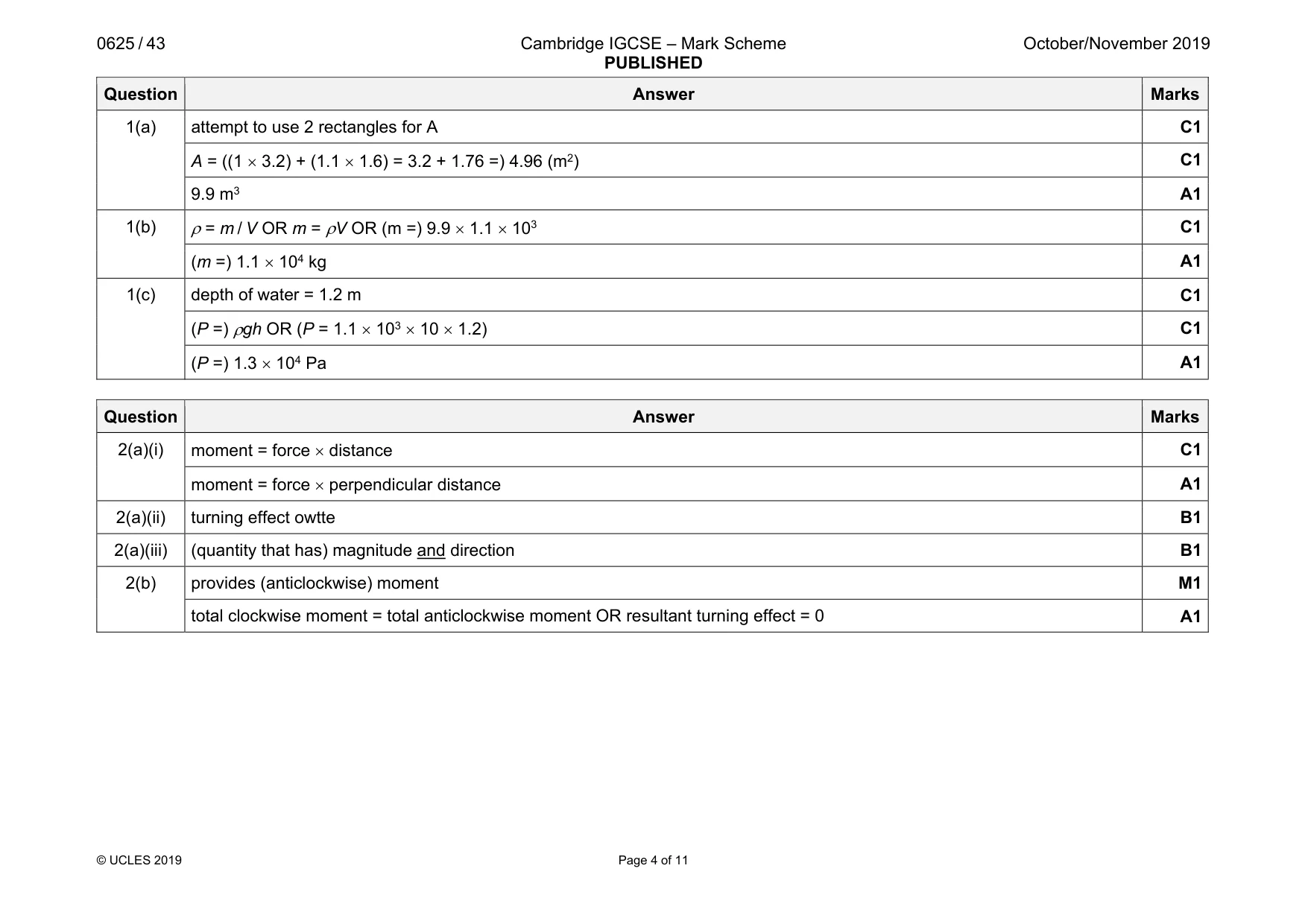
Mark scheme: 1(a) attempt to use 2 rectangles for A C1 A = ((1 × 3.2) + (1.1 × 1.6) = 3.2 + 1.76 =) 4.96 (m2) C1 9.9 m3 A1 1(b) ρ = m / V OR m = ρV OR (m =) 9.9 × 1.1 × 103 C1 (m =) 1.1 × 10⁴ kg A1 1(c) depth of water = 1.2 m C1 (P =) ρgh OR (P = 1.1 × 103 × 10 × 1.2) C1 (P =) 1.3 × 10⁴ Pa A1
Q2 · State, in words, the equation that defines the moment of a force
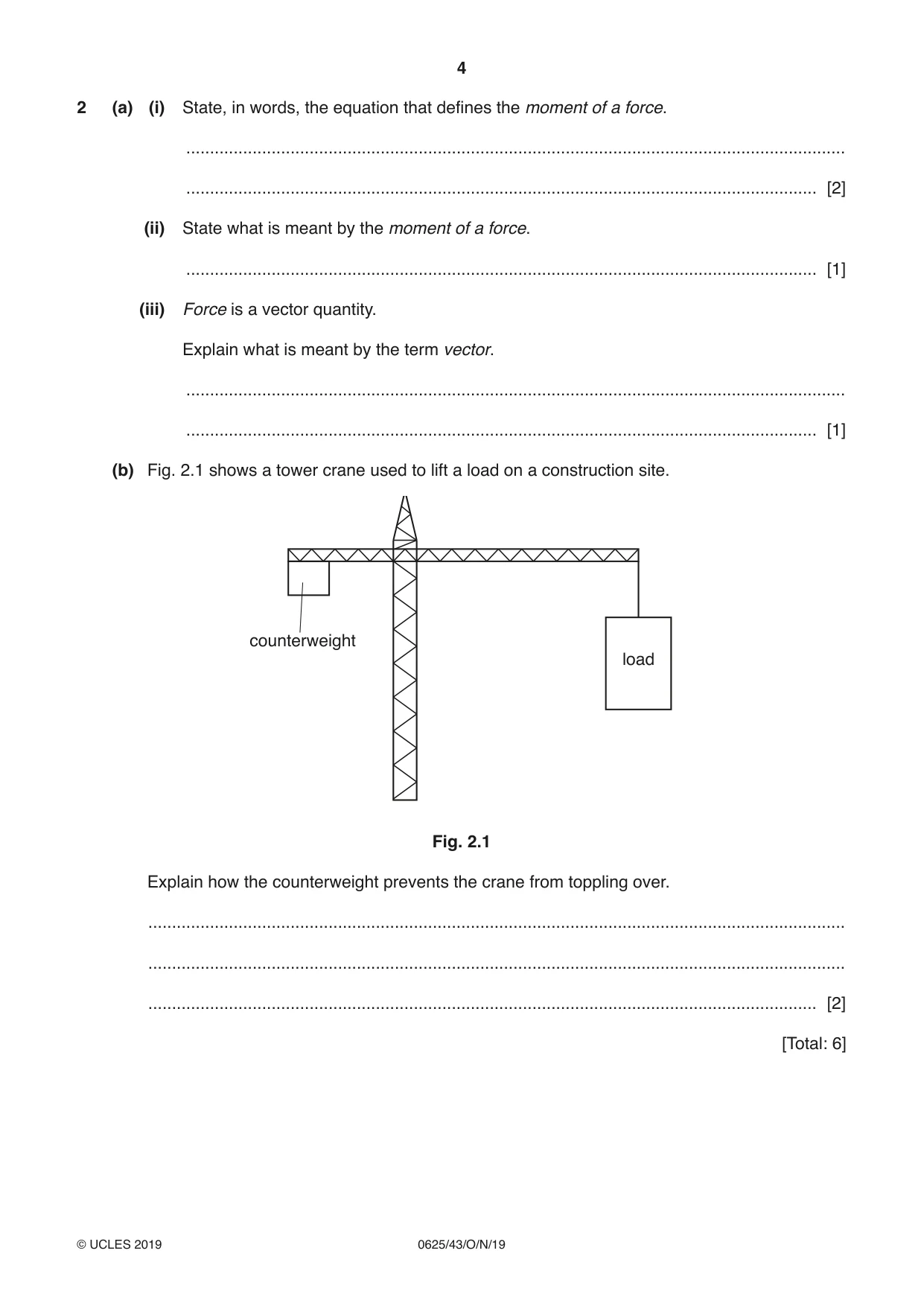
2 (a) (i) State, in words, the equation that defines the moment of a force. ........................................................................................................................................... ..................................................................................................................................... [2] (ii) State what is meant by the moment of a force. ..................................................................................................................................... [1] (iii) Force is a vector quantity. Explain what is meant by the term vector. ........................................................................................................................................... ..................................................................................................................................... [1] (b) Fig. 2.1 shows a tower crane used to lift a load on a construction site. counterweight load Fig. 2.1 Explain how the counterweight prevents the crane from toppling over. ................................................................................................................................................... ................................................................................................................................................... ............................................................................................................................................. [2] [Total: 6]
Mark scheme: 2(a)(i) C1 moment = force × perpendicular distance A1 2(a)(ii) turning effect owtte B1 2(a)(iii) (quantity that has) magnitude and direction B1 2(b) provides (anticlockwise) moment M1 total clockwise moment = total anticlockwise moment OR resultant turning effect = 0 A1
Question 3
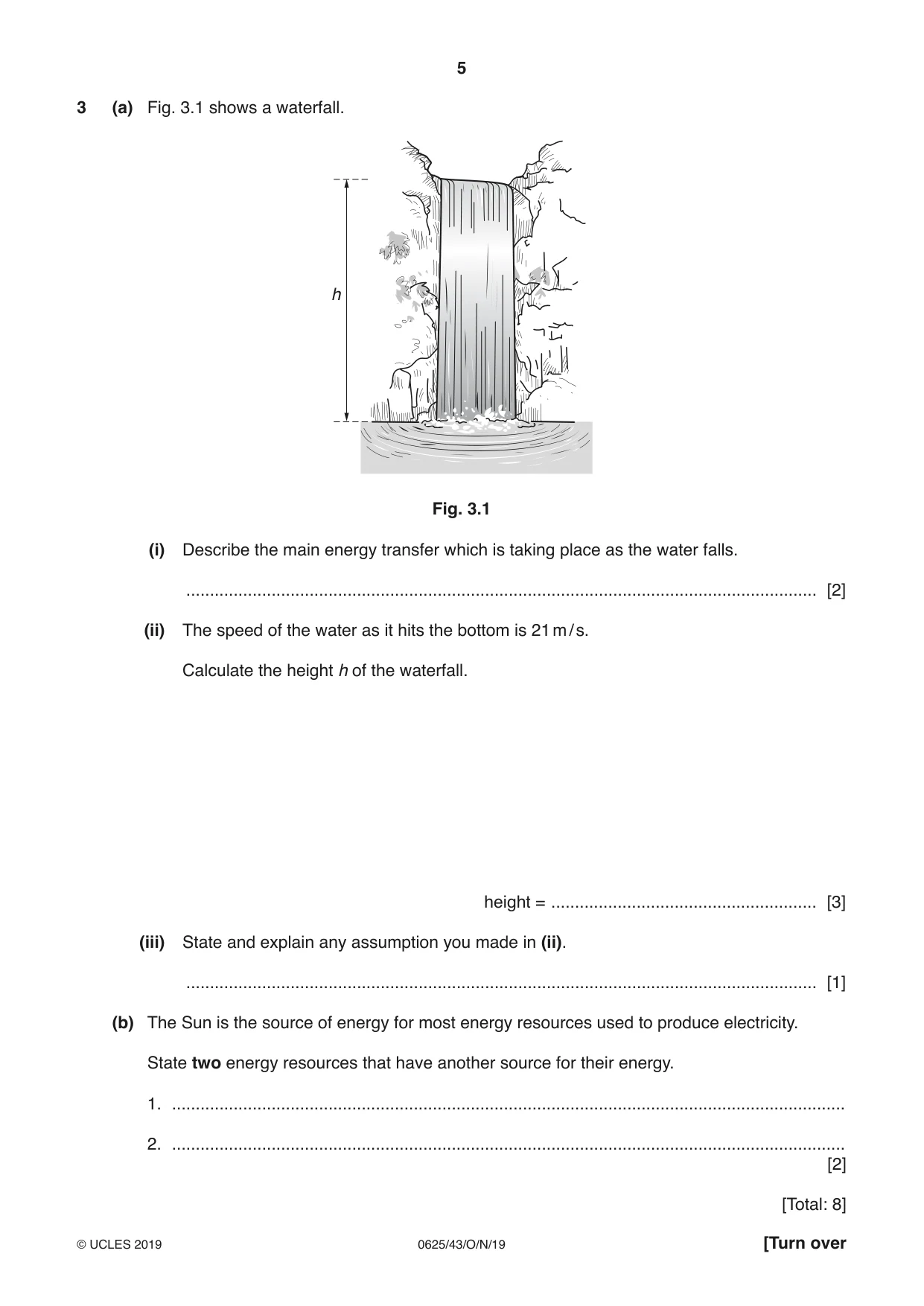
3 (a) Fig. 3.1 shows a waterfall. h Fig. 3.1 (i) Describe the main energy transfer which is taking place as the water falls. ..................................................................................................................................... [2] (ii) The speed of the water as it hits the bottom is 21 m / s. Calculate the height h of the waterfall. height = ........................................................ [3] (iii) State and explain any assumption you made in (ii). ..................................................................................................................................... [1] (b) The Sun is the source of energy for most energy resources used to produce electricity. State two energy resources that have another source for their energy. 1. .............................................................................................................................................. 2. .............................................................................................................................................. [2] [Total: 8]
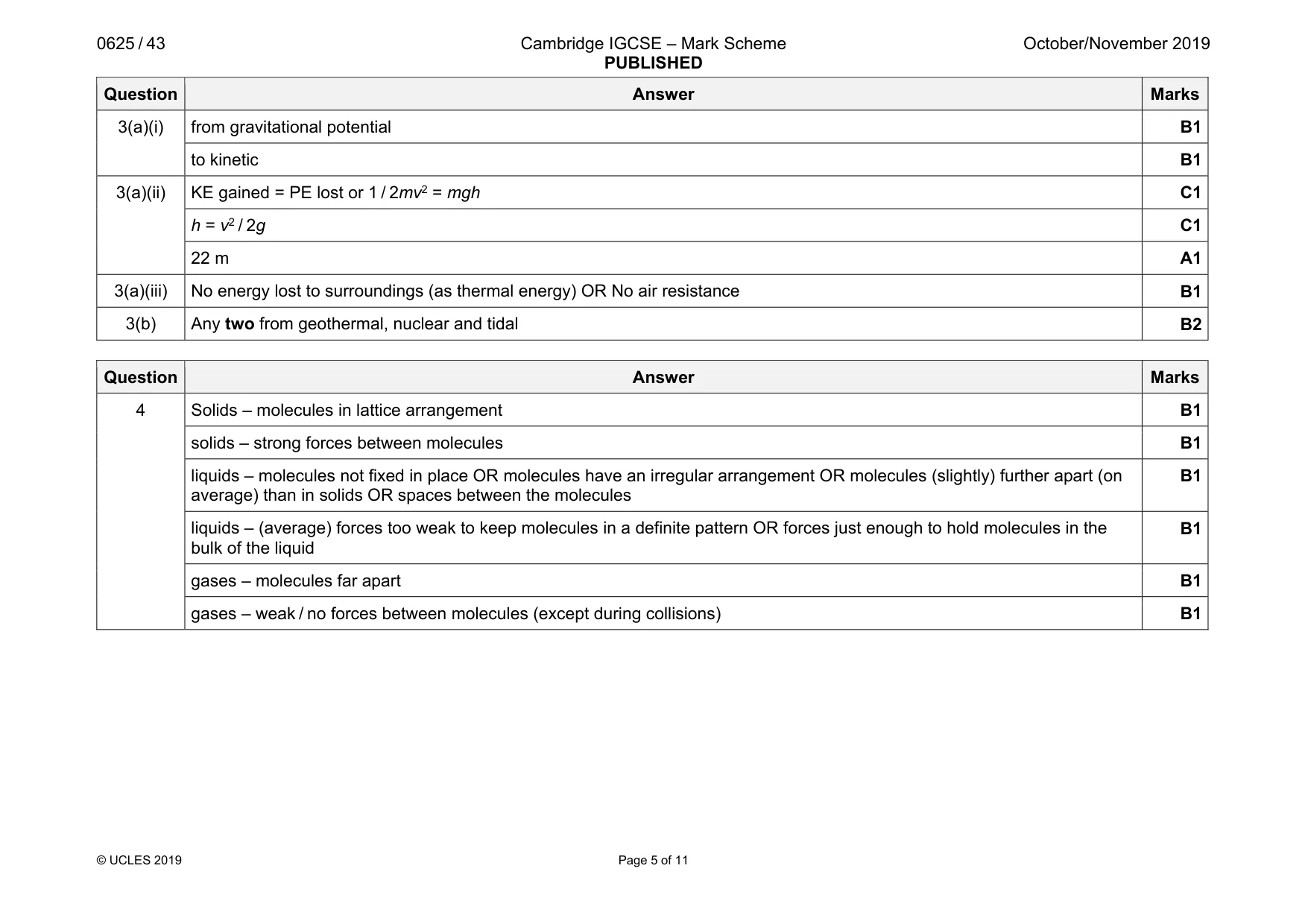
Mark scheme: 3(a)(i) from gravitational potential B1 to kinetic B1 3(a)(ii) KE gained = PE lost or 1 / 2mv2 = mgh C1 h = v2 / 2g C1 22 m A1 3(a)(iii) No energy lost to surroundings (as thermal energy) OR No air resistance B1 3(b) Any two from geothermal, nuclear and tidal B2
Q4 · Solids have a fixed shape
4 Solids have a fixed shape. Liquids adapt to the shape of their container. Gases fill their container. Explain in terms of forces between molecules and arrangement of molecules, why solids, liquids and gases have these properties. Solids ............................................................................................................................................... .......................................................................................................................................................... .......................................................................................................................................................... Liquids .............................................................................................................................................. .......................................................................................................................................................... .......................................................................................................................................................... Gases ............................................................................................................................................... .......................................................................................................................................................... .......................................................................................................................................................... [6] [Total: 6]
Mark scheme: 4 Solids – molecules in lattice arrangement B1 solids – strong forces between molecules B1 liquids – molecules not fixed in place OR molecules have an irregular arrangement OR molecules (slightly) further apart (on average) than in solids OR spaces between the molecules B1 liquids – (average) forces too weak to keep molecules in a definite pattern OR forces just enough to hold molecules in the bulk of the liquid B1 gases – molecules far apart B1 gases – weak / no forces between molecules (except during collisions) B1
Q5 · An electric kettle contains water at a temperature of 19 °C
5 An electric kettle contains water at a temperature of 19 °C. The kettle has a power rating of 3.0 kW and is switched on for 3.5 minutes. (a) Calculate the energy supplied to the kettle by the electricity supply. electrical energy = ........................................................ [3] (b) At 3.5 minutes, the temperature of the water reaches 100 °C. The volume of the water in the kettle is 1700 cm3 and its density is 1.0 g / cm3. The specific heat capacity of water is 4200 J / (kg °C). Calculate the thermal energy gained by the water. thermal energy = ........................................................ [5] (c) Calculate the efficiency of the kettle. efficiency = ........................................................ [2] [Total: 10]
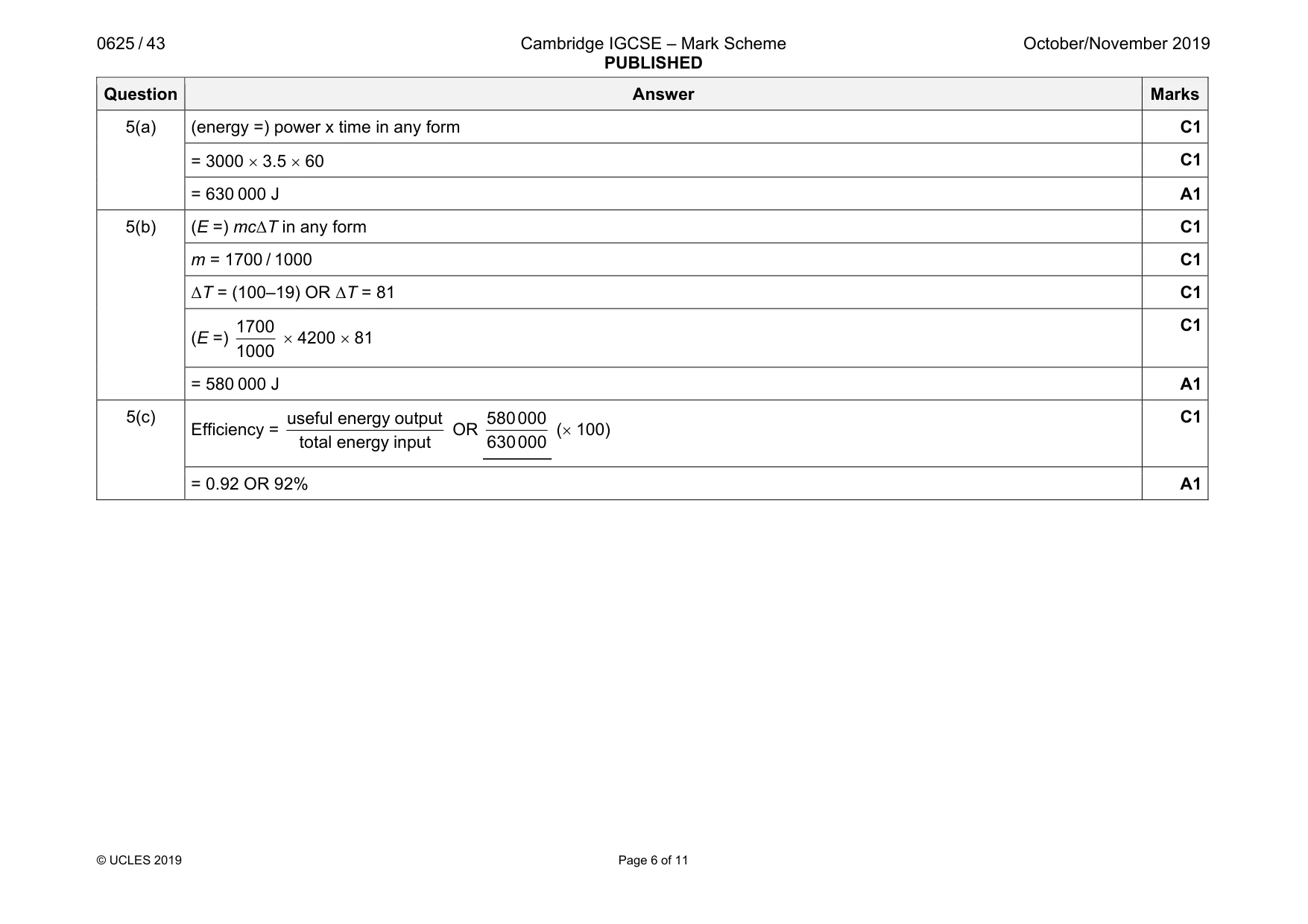
Mark scheme: 5(a) (energy =) power x time in any form C1 = 3000 × 3.5 × 60 C1 = 630 000 J A1 5(b) (E =) mc∆T in any form C1 m = 1700 / 1000 C1 ∆T = (100–19) OR ∆T = 81 C1 (E =) 1700 1000 × 4200 × 81 C1 = 580 000 J A1 5(c) Efficiency = useful energy output total energy input OR 580000 630000 (× 100) C1 = 0.92 OR 92% A1
Q6 · Wavefronts of a sound wave travelling in air from left to right
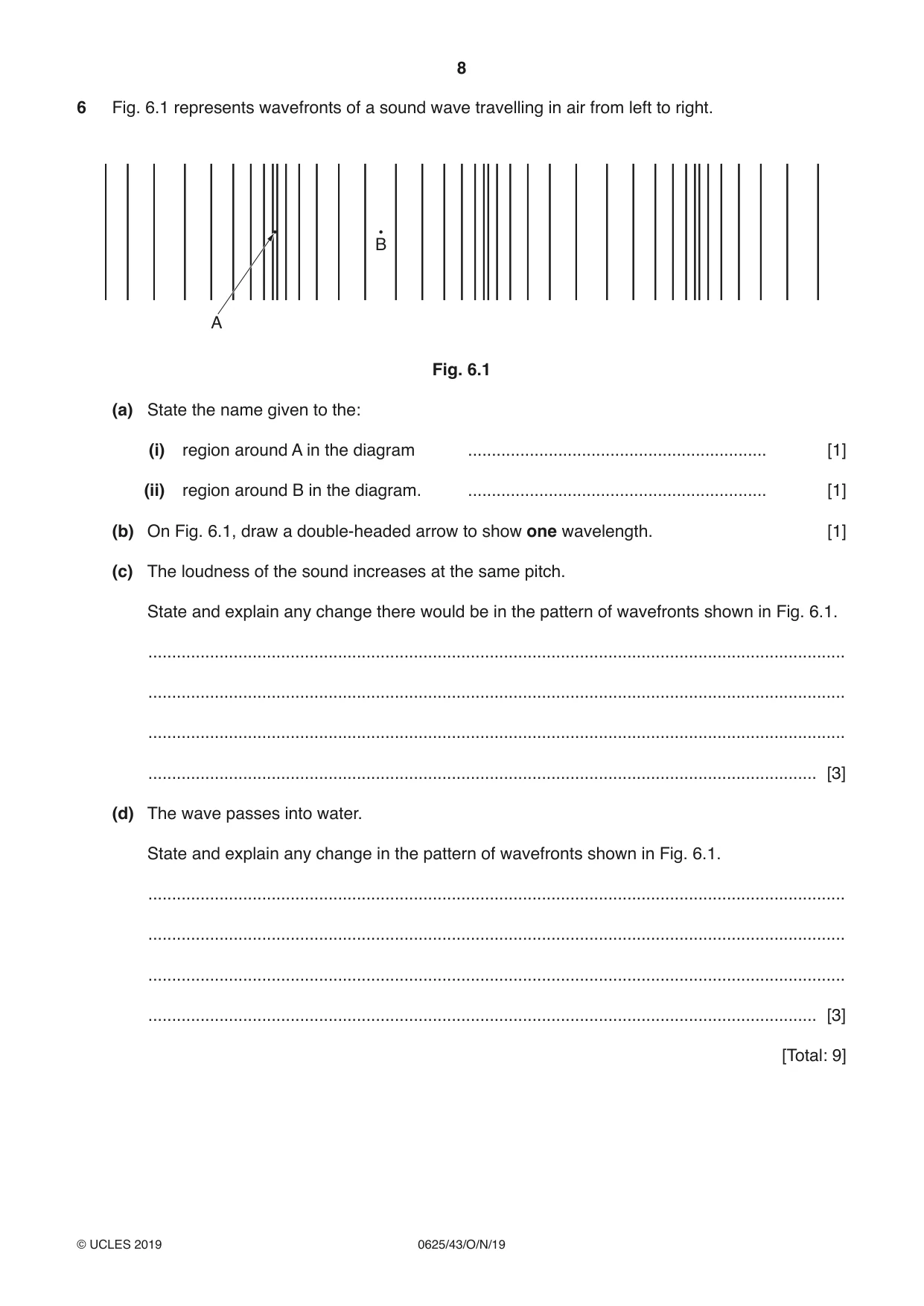
6 Fig. 6.1 represents wavefronts of a sound wave travelling in air from left to right. B A Fig. 6.1 (a) State the name given to the: (i) region around A in the diagram ............................................................... [1] (ii) region around B in the diagram. ............................................................... [1] (b) On Fig. 6.1, draw a double-headed arrow to show one wavelength. [1] (c) The loudness of the sound increases at the same pitch. State and explain any change there would be in the pattern of wavefronts shown in Fig. 6.1. ................................................................................................................................................... ................................................................................................................................................... ................................................................................................................................................... ............................................................................................................................................. [3] (d) The wave passes into water. State and explain any change in the pattern of wavefronts shown in Fig. 6.1. ................................................................................................................................................... ................................................................................................................................................... ................................................................................................................................................... ............................................................................................................................................. [3] [Total: 9]
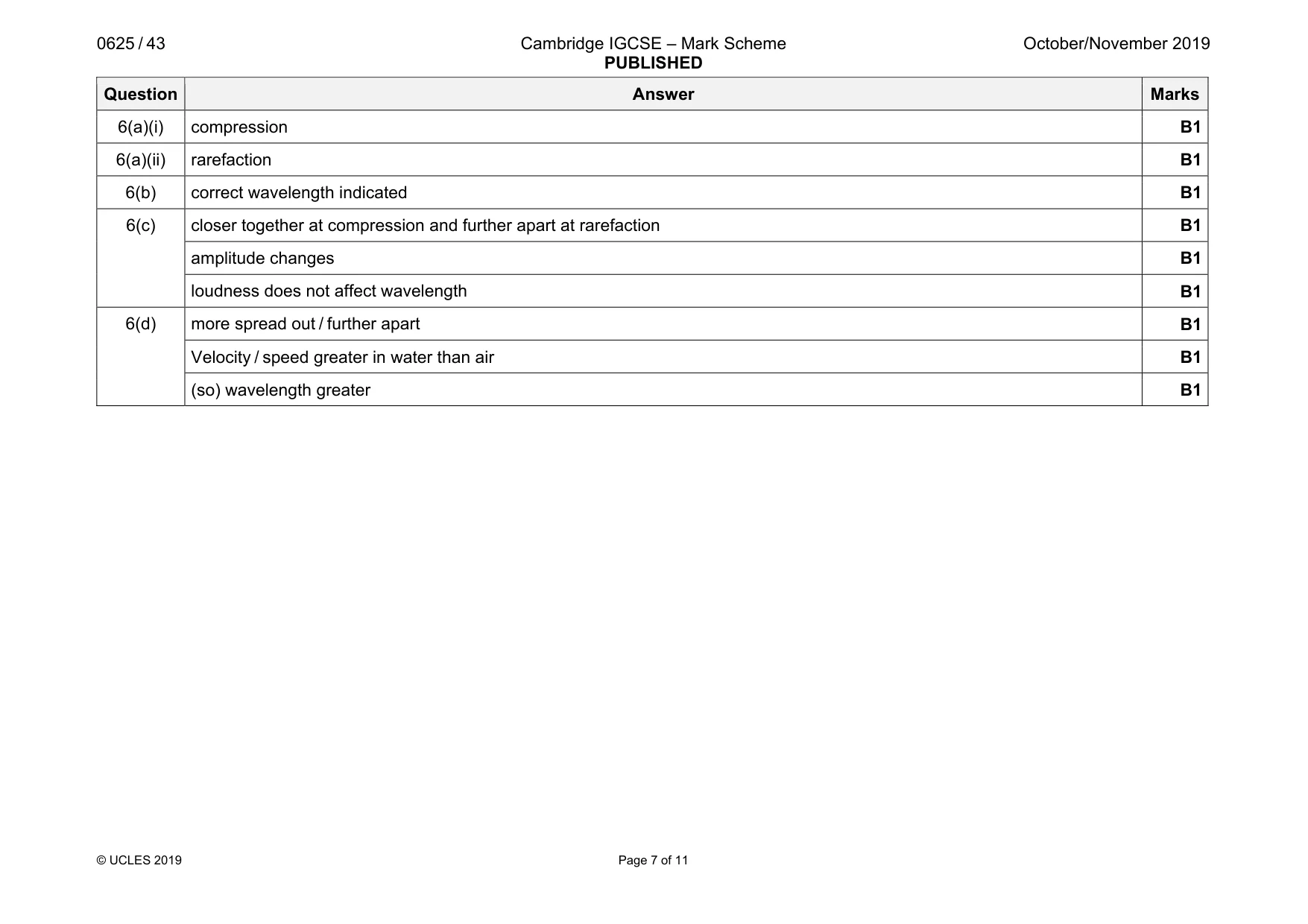
Mark scheme: 6(a)(i) compression B1 6(a)(ii) rarefaction B1 6(b) correct wavelength indicated B1 6(c) closer together at compression and further apart at rarefaction B1 amplitude changes B1 loudness does not affect wavelength B1 6(d) more spread out / further apart B1 Velocity / speed greater in water than air B1 (so) wavelength greater B1
Q7 · The position of a converging lens, its principal axis and an object O
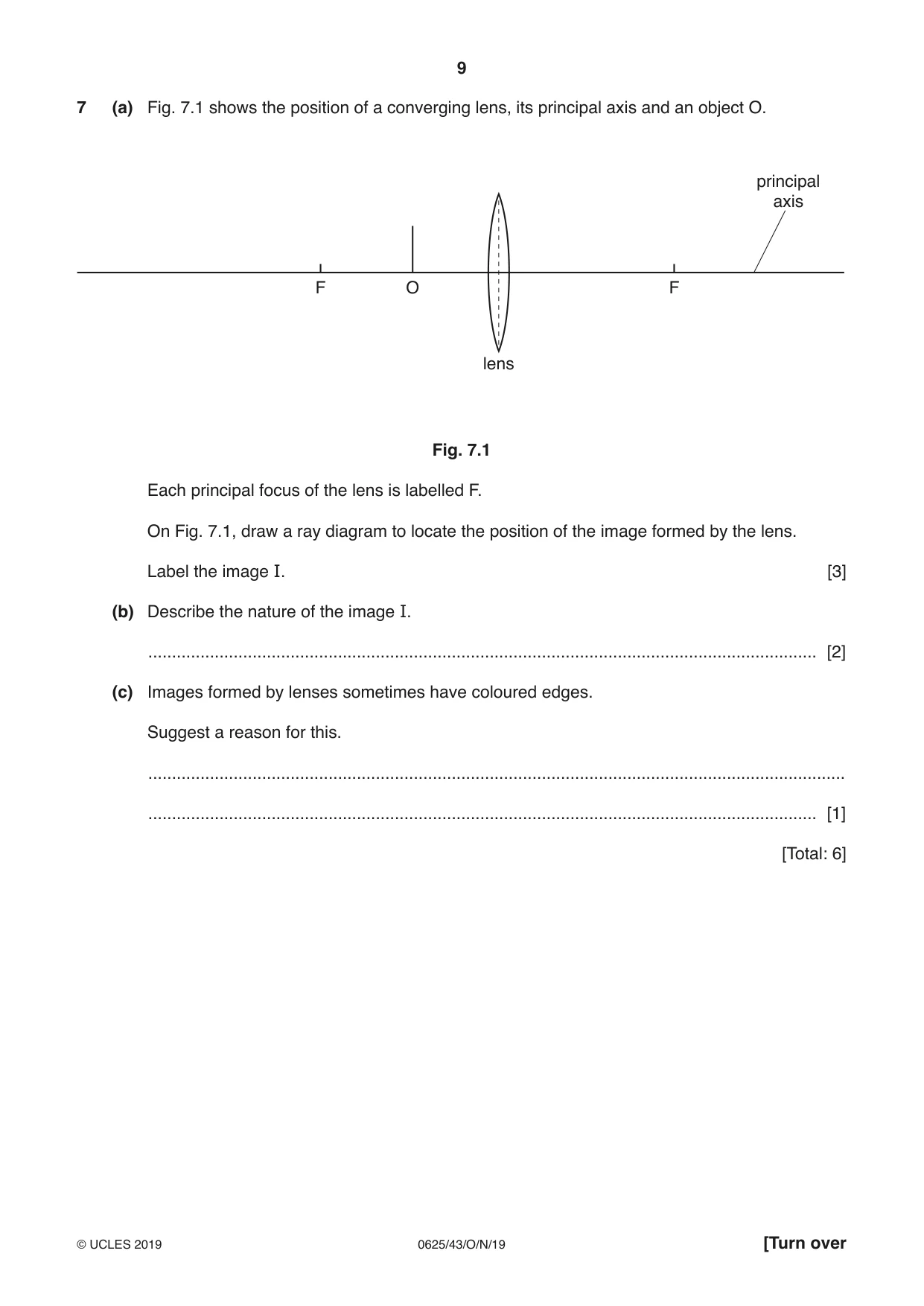
7 (a) Fig. 7.1 shows the position of a converging lens, its principal axis and an object O. principal axis F O F lens Fig. 7.1 Each principal focus of the lens is labelled F. On Fig. 7.1, draw a ray diagram to locate the position of the image formed by the lens. Label the image I. [3] (b) Describe the nature of the image I. ............................................................................................................................................. [2] (c) Images formed by lenses sometimes have coloured edges. Suggest a reason for this. ................................................................................................................................................... ............................................................................................................................................. [1] [Total: 6]
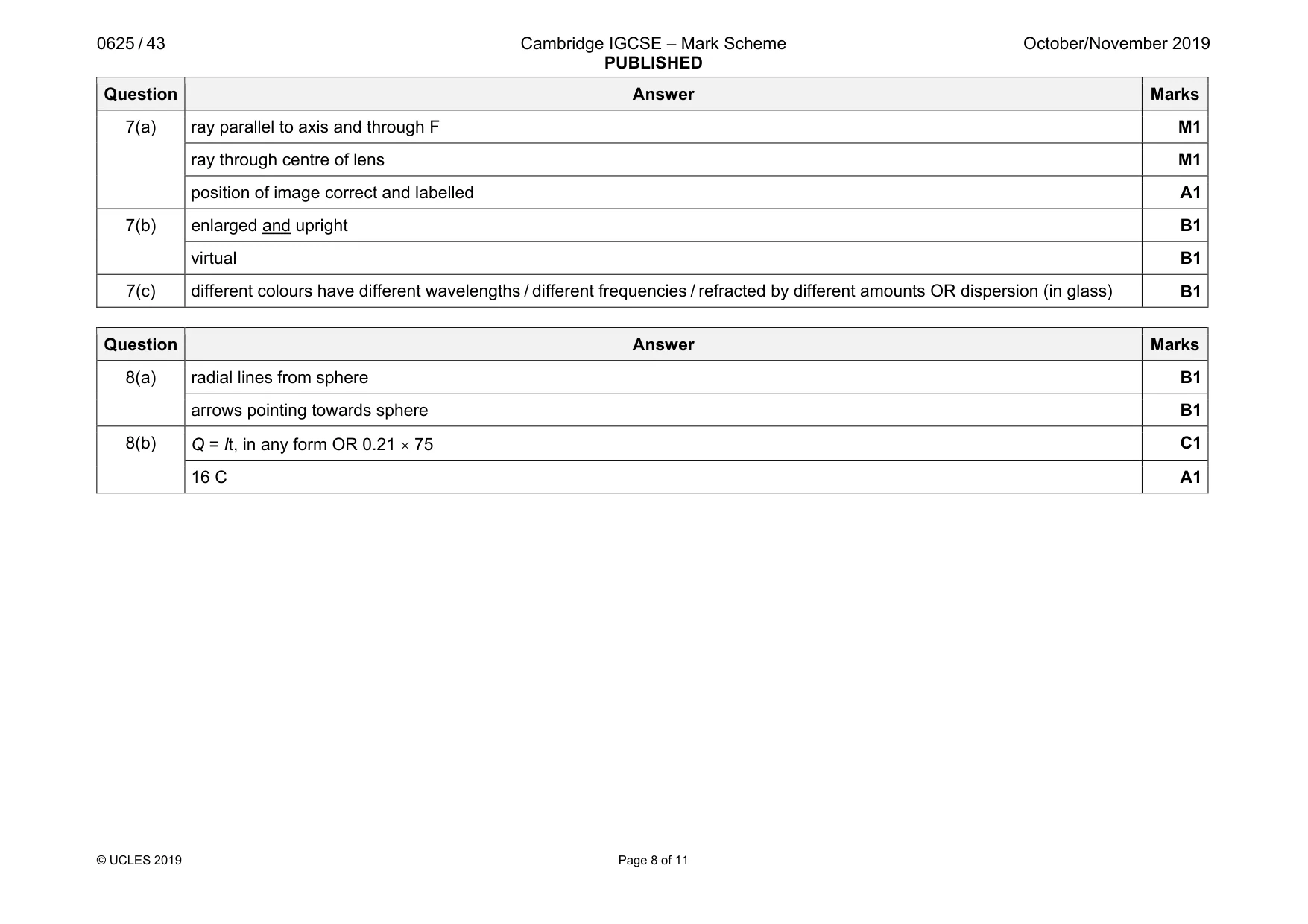
Mark scheme: 7(a) ray parallel to axis and through F M1 ray through centre of lens M1 position of image correct and labelled A1 7(b) enlarged and upright B1 virtual B1 7(c) different colours have different wavelengths / different frequencies / refracted by different amounts OR dispersion (in glass) B1
Q8 · A negatively charged conducting sphere
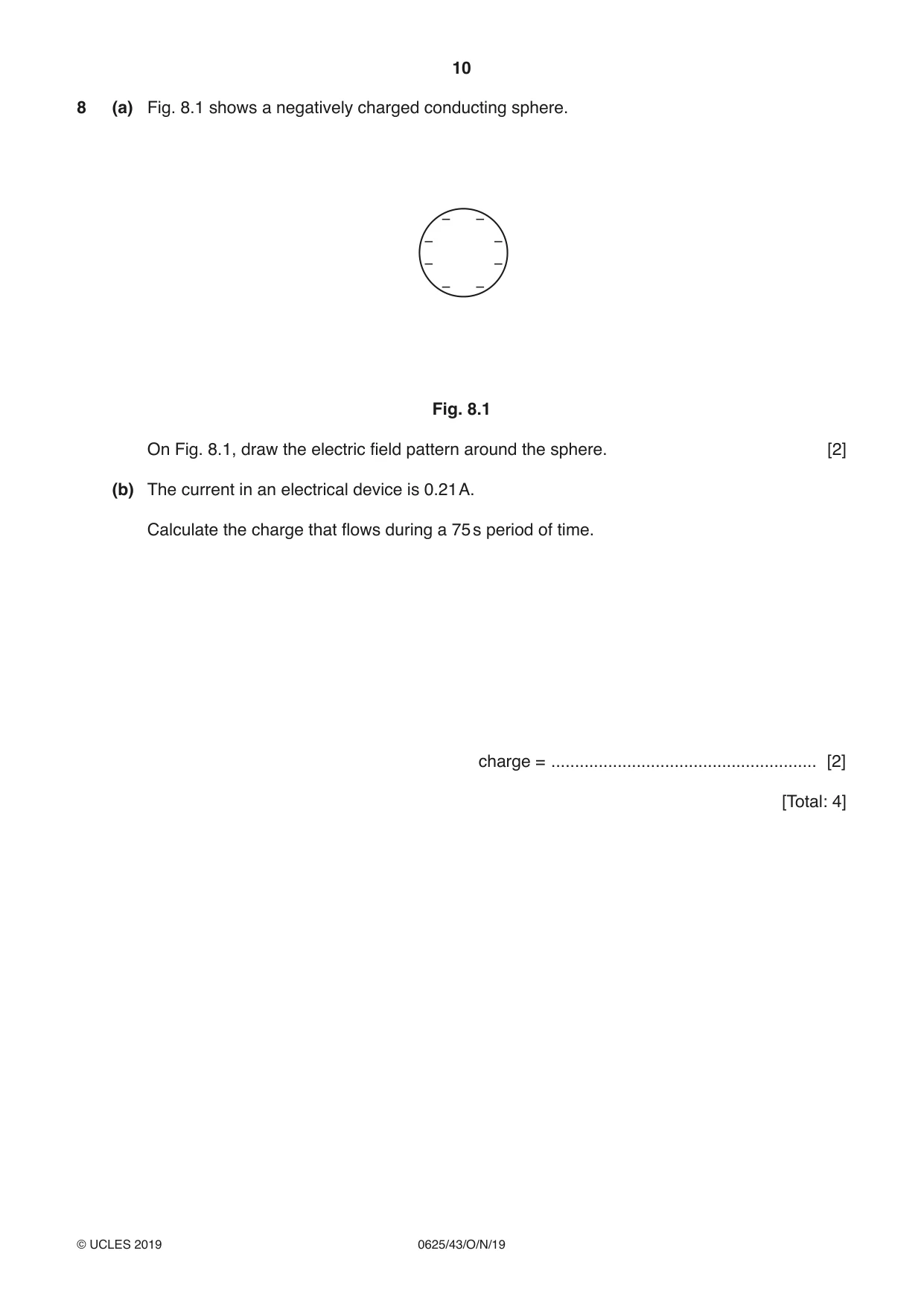
8 (a) Fig. 8.1 shows a negatively charged conducting sphere. − − − − − − − − Fig. 8.1 On Fig. 8.1, draw the electric field pattern around the sphere. [2] (b) The current in an electrical device is 0.21 A. Calculate the charge that flows during a 75 s period of time. charge = ........................................................ [2] [Total: 4]
Mark scheme: 8(a) radial lines from sphere B1 arrows pointing towards sphere B1 8(b) Q = It, in any form OR 0.21 × 75 C1 16 C A1
Q9 · A circuit containing an LED and two resistors in parallel, each of resistance R
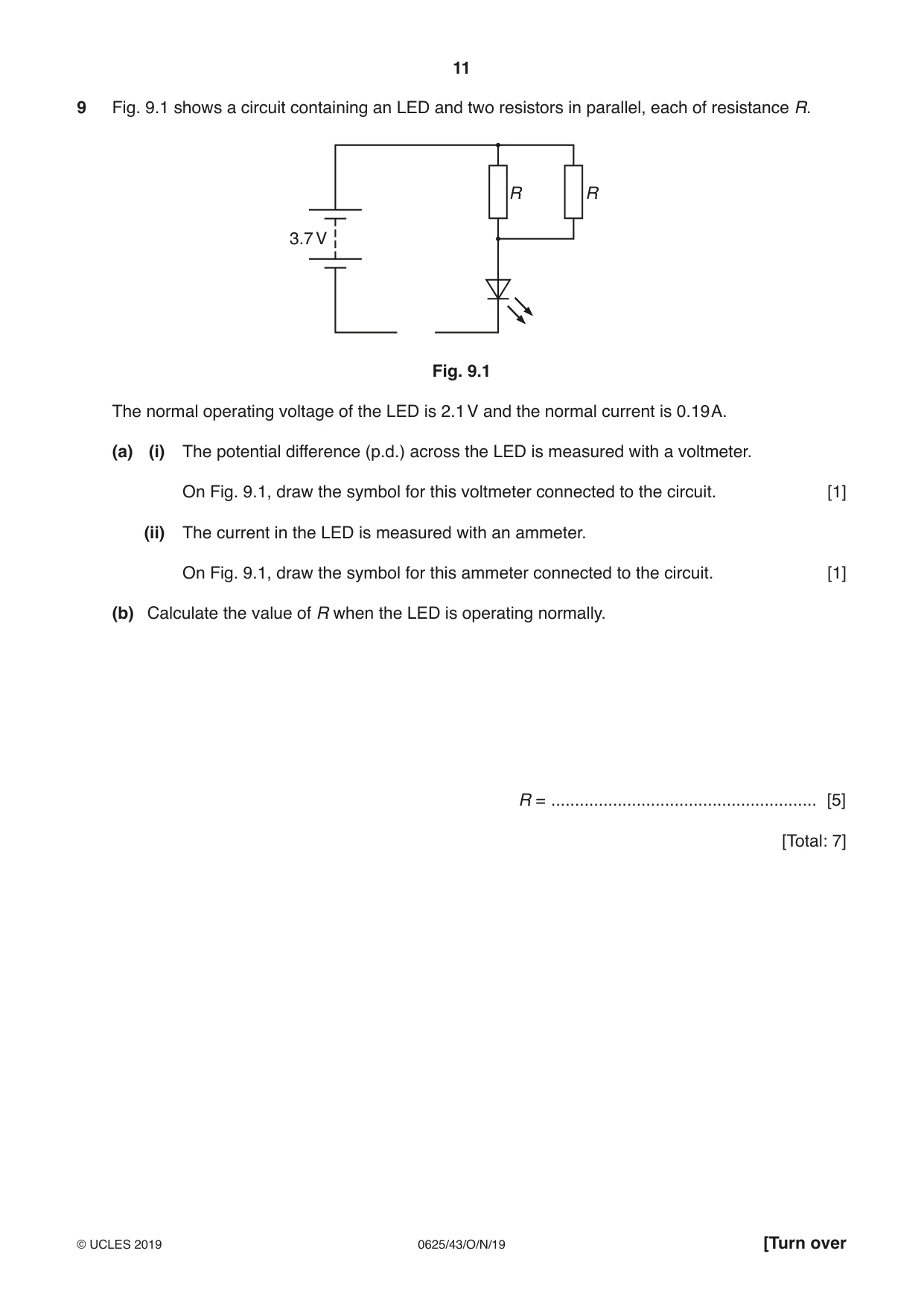
9 Fig. 9.1 shows a circuit containing an LED and two resistors in parallel, each of resistance R. R R 3.7 V Fig. 9.1 The normal operating voltage of the LED is 2.1 V and the normal current is 0.19 A. (a) (i) The potential difference (p.d.) across the LED is measured with a voltmeter. On Fig. 9.1, draw the symbol for this voltmeter connected to the circuit. [1] (ii) The current in the LED is measured with an ammeter. On Fig. 9.1, draw the symbol for this ammeter connected to the circuit. [1] (b) Calculate the value of R when the LED is operating normally. R = ........................................................ [5] [Total: 7]
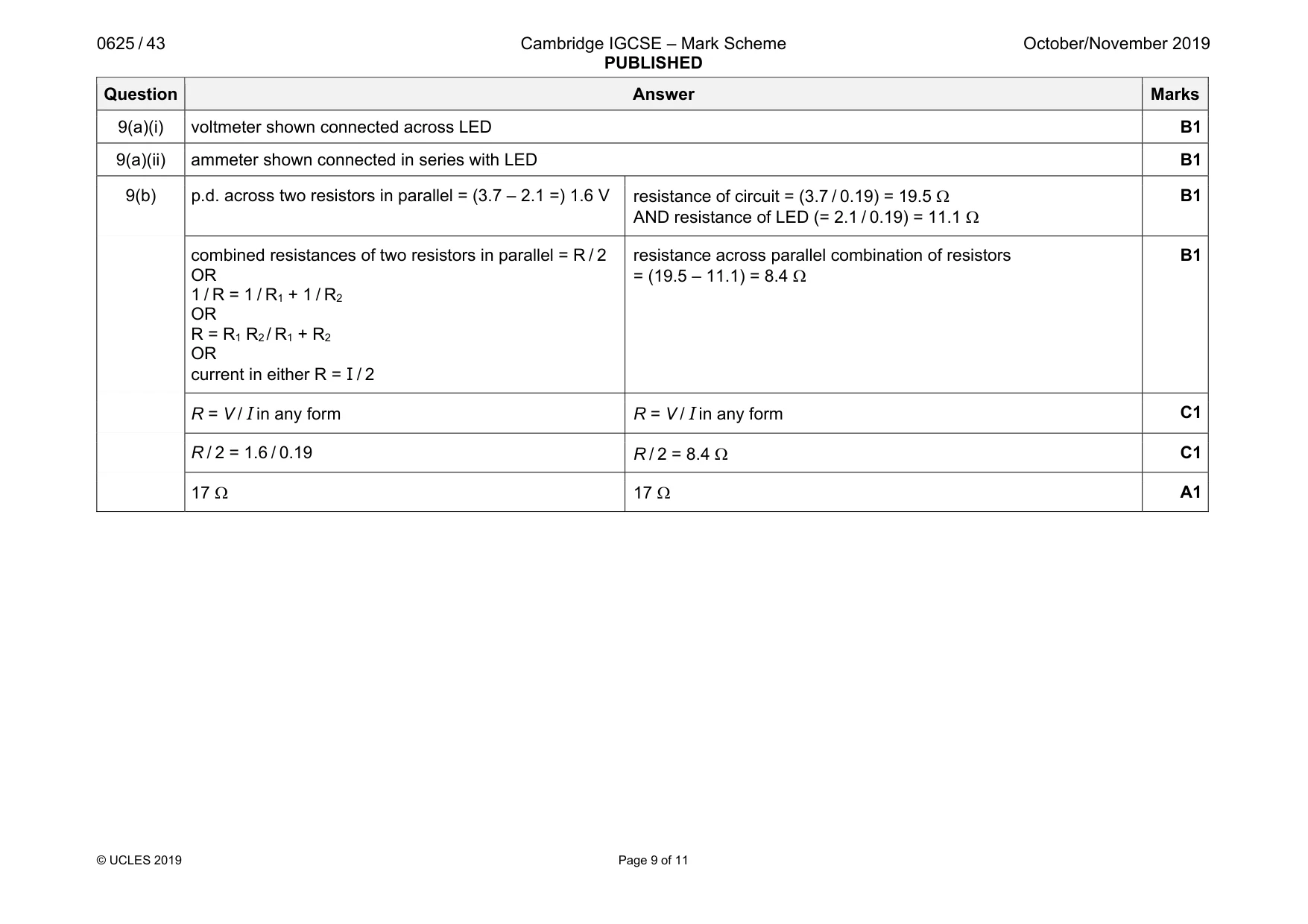
Mark scheme: 9(a)(i) voltmeter shown connected across LED B1 9(a)(ii) ammeter shown connected in series with LED B1 9(b) p.d. across two resistors in parallel = (3.7 – 2.1 =) 1.6 V resistance of circuit = (3.7 / 0.19) = 19.5 Ω AND resistance of LED (= 2.1 / 0.19) = 11.1 Ω B1 combined resistances of two resistors in parallel = R / 2 OR 1 / R = 1 / R1 + 1 / R2 OR R = R1 R2 / R1 + R2 OR current in either R = I / 2 resistance across parallel combination of resistors = (19.5 – 11.1) = 8.4 Ω B1 R = V / I in any form R = V / I in any form C1 R / 2 = 1.6 / 0.19 R / 2 = 8.4 Ω C1 17 Ω 17 Ω A1
Q10 · A magnet and a coil are attached separately to a door and a door frame as shown in Fig
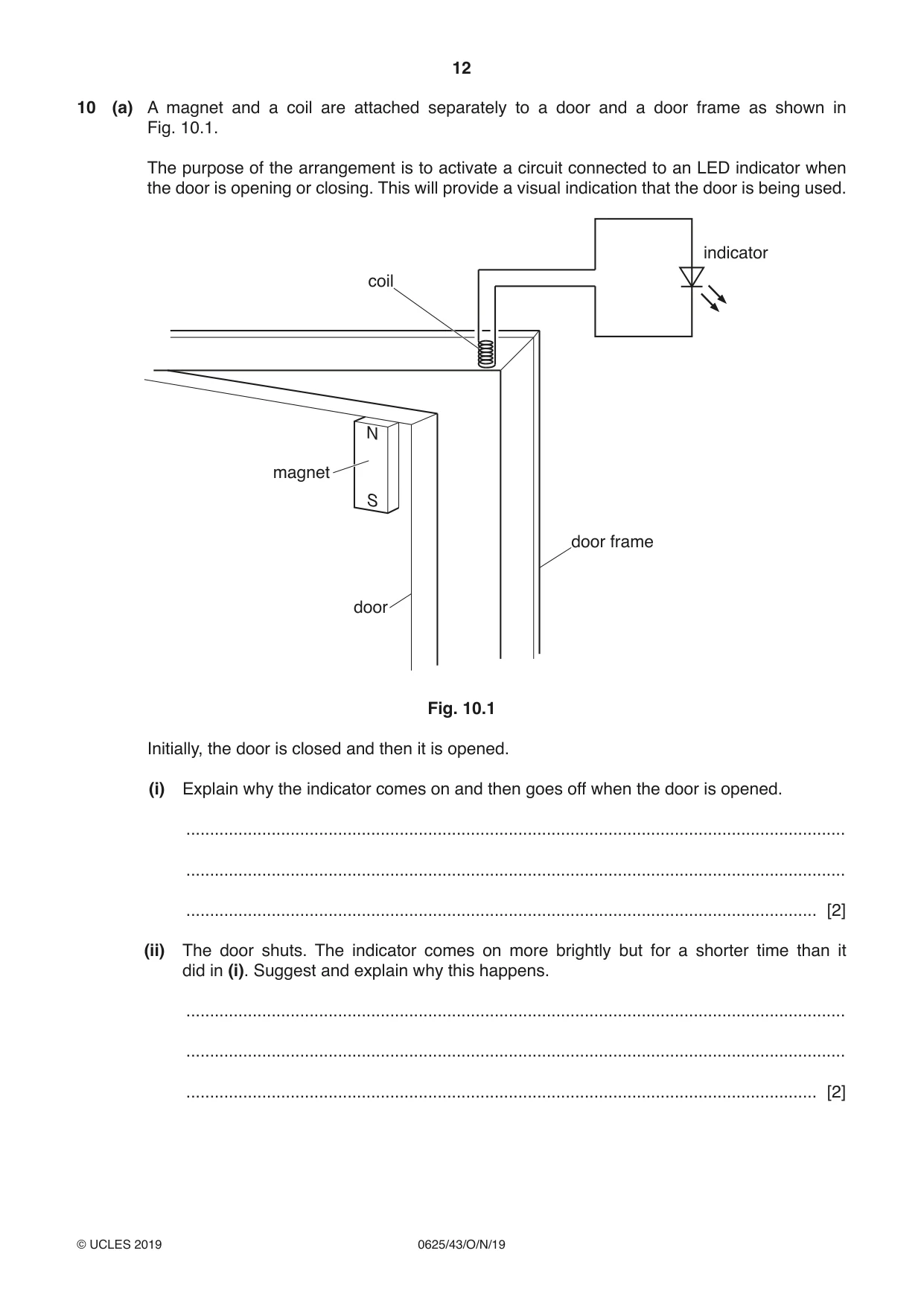
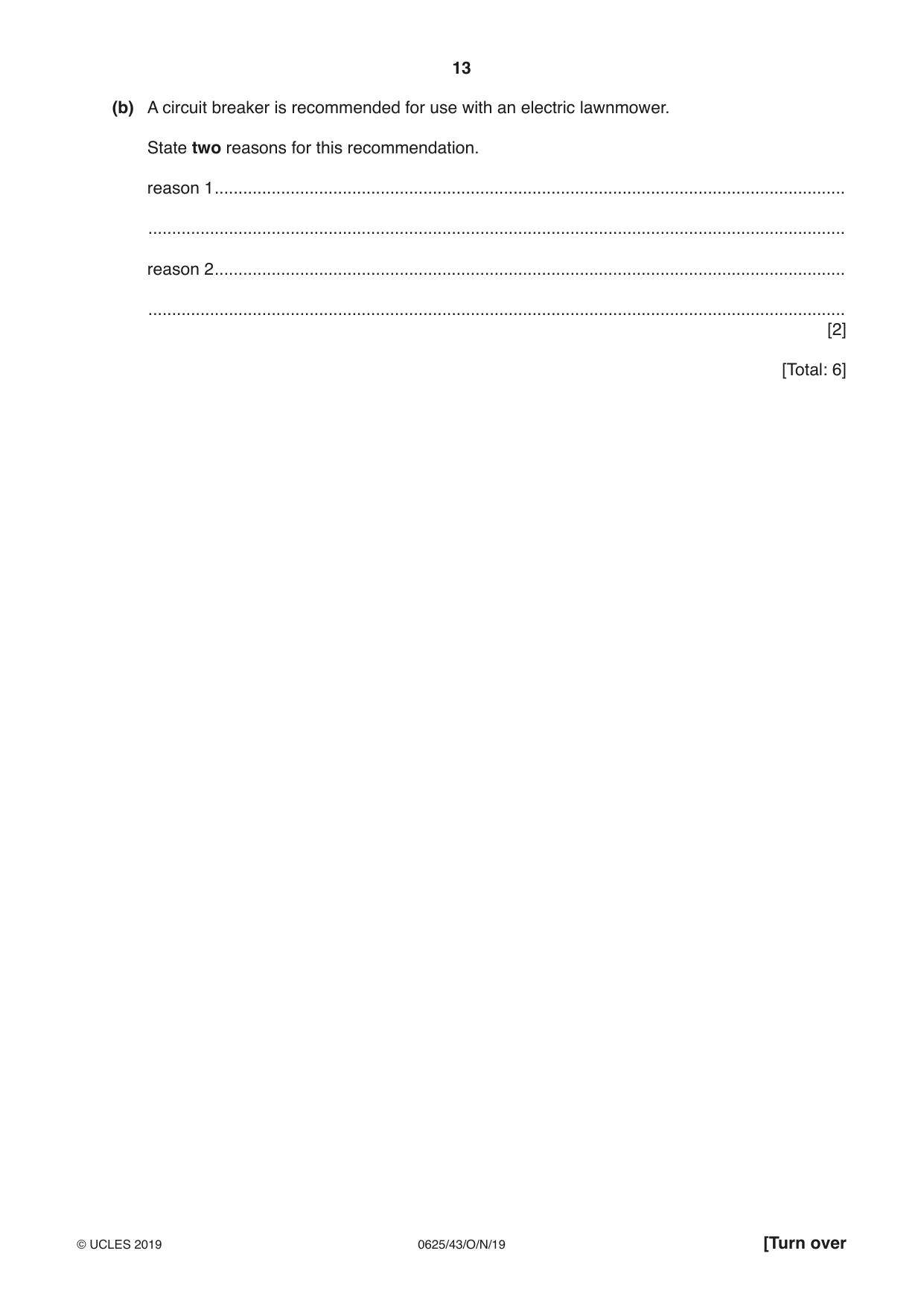
10 (a) A magnet and a coil are attached separately to a door and a door frame as shown in Fig. 10.1. The purpose of the arrangement is to activate a circuit connected to an LED indicator when the door is opening or closing. This will provide a visual indication that the door is being used. indicator coil N magnet S door frame door Fig. 10.1 Initially, the door is closed and then it is opened. (i) Explain why the indicator comes on and then goes off when the door is opened. ........................................................................................................................................... ........................................................................................................................................... ..................................................................................................................................... [2] (ii) The door shuts. The indicator comes on more brightly but for a shorter time than it did in (i). Suggest and explain why this happens. ........................................................................................................................................... ........................................................................................................................................... ..................................................................................................................................... [2] (b) A circuit breaker is recommended for use with an electric lawnmower. State two reasons for this recommendation. reason 1 ..................................................................................................................................... ................................................................................................................................................... reason 2 ..................................................................................................................................... ................................................................................................................................................... [2] [Total: 6]
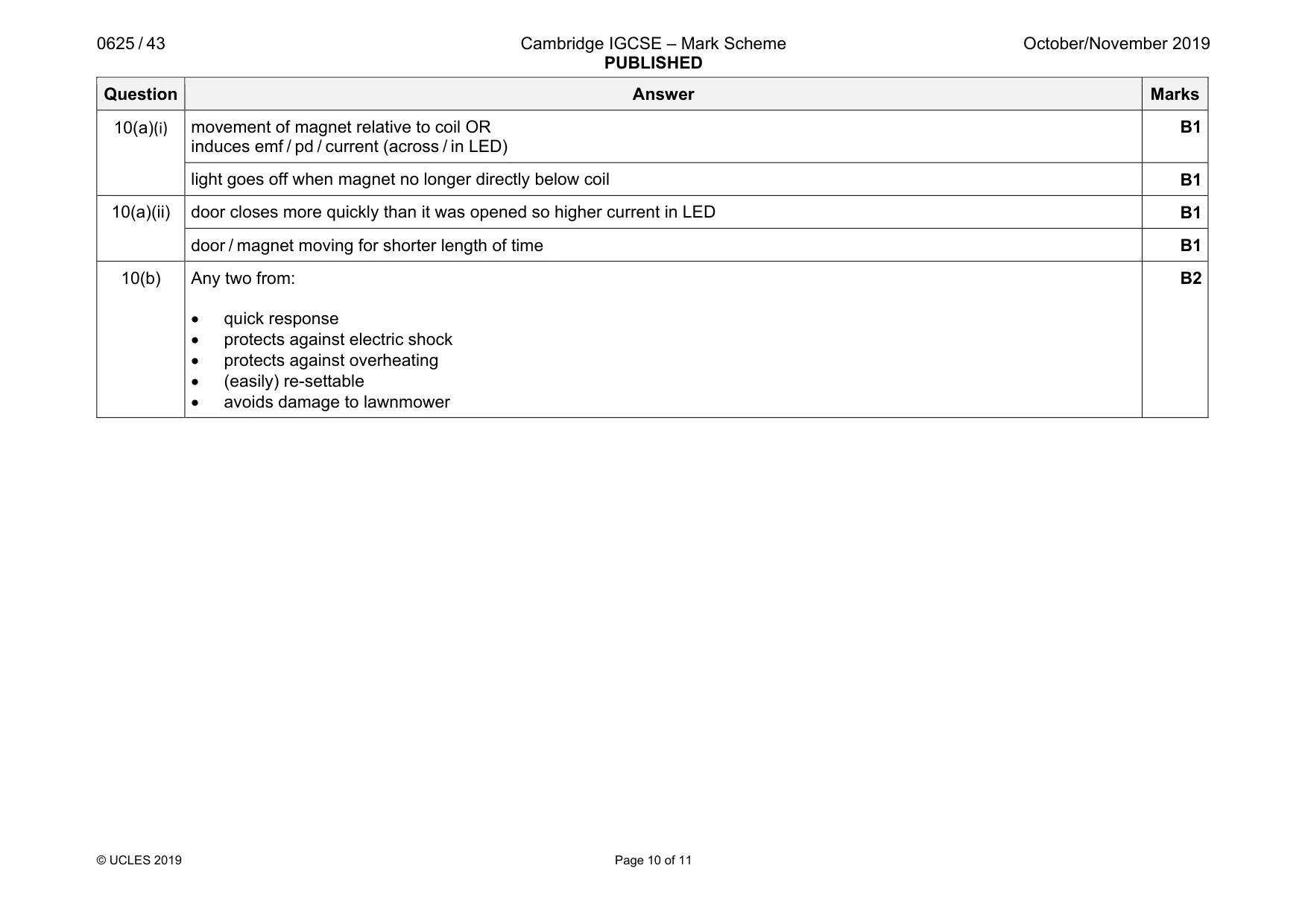
Mark scheme: 10(a)(i) induces emf / pd / current (across / in LED) light goes off when magnet no longer directly below coil B1 10(a)(ii) door closes more quickly than it was opened so higher current in LED B1 door / magnet moving for shorter length of time B1 10(b) Any two from: • quick response • protects against electric shock • protects against overheating • (easily) re-settable • avoids damage to lawnmower B2
Q11 · The circles shown in Fig
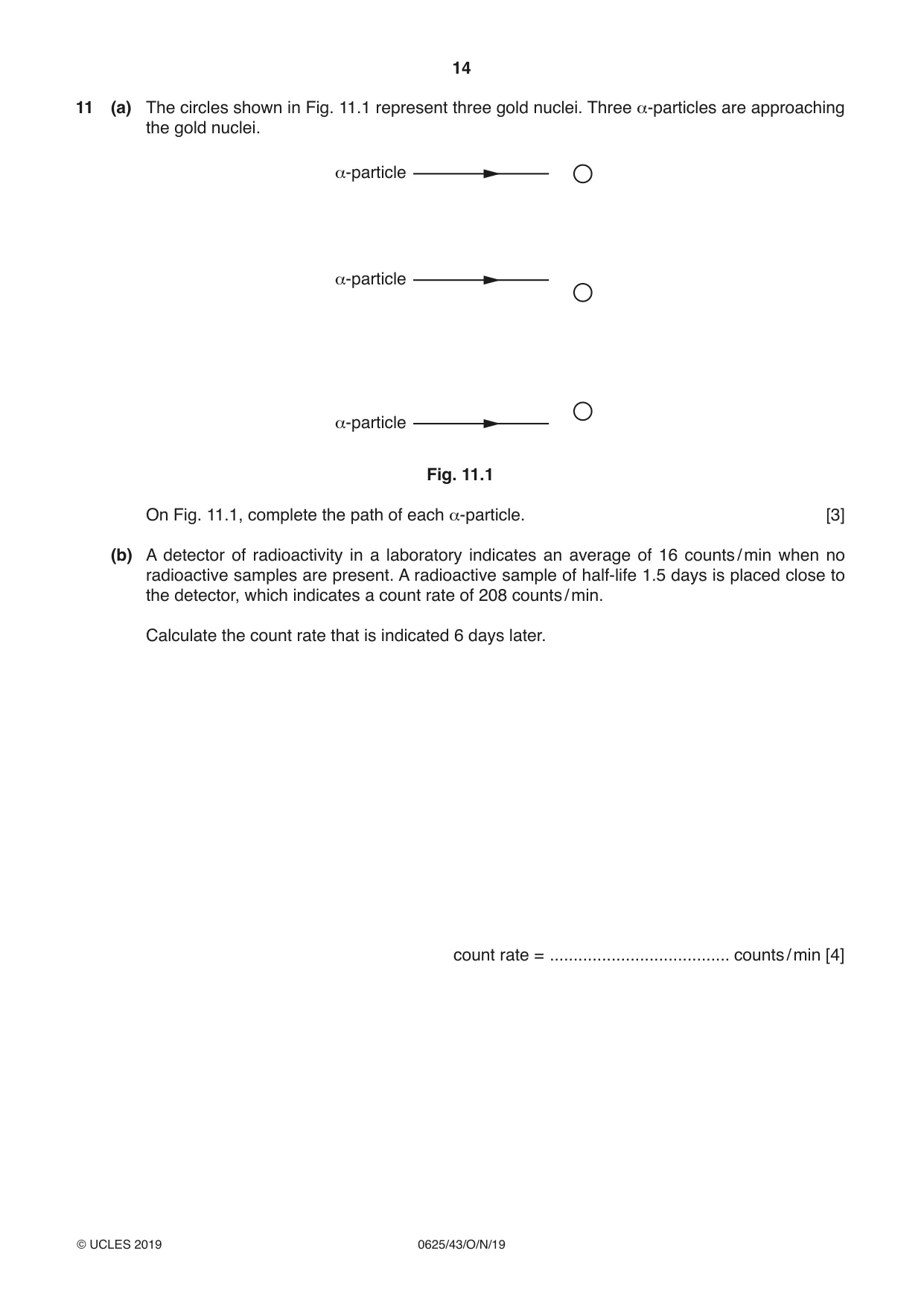
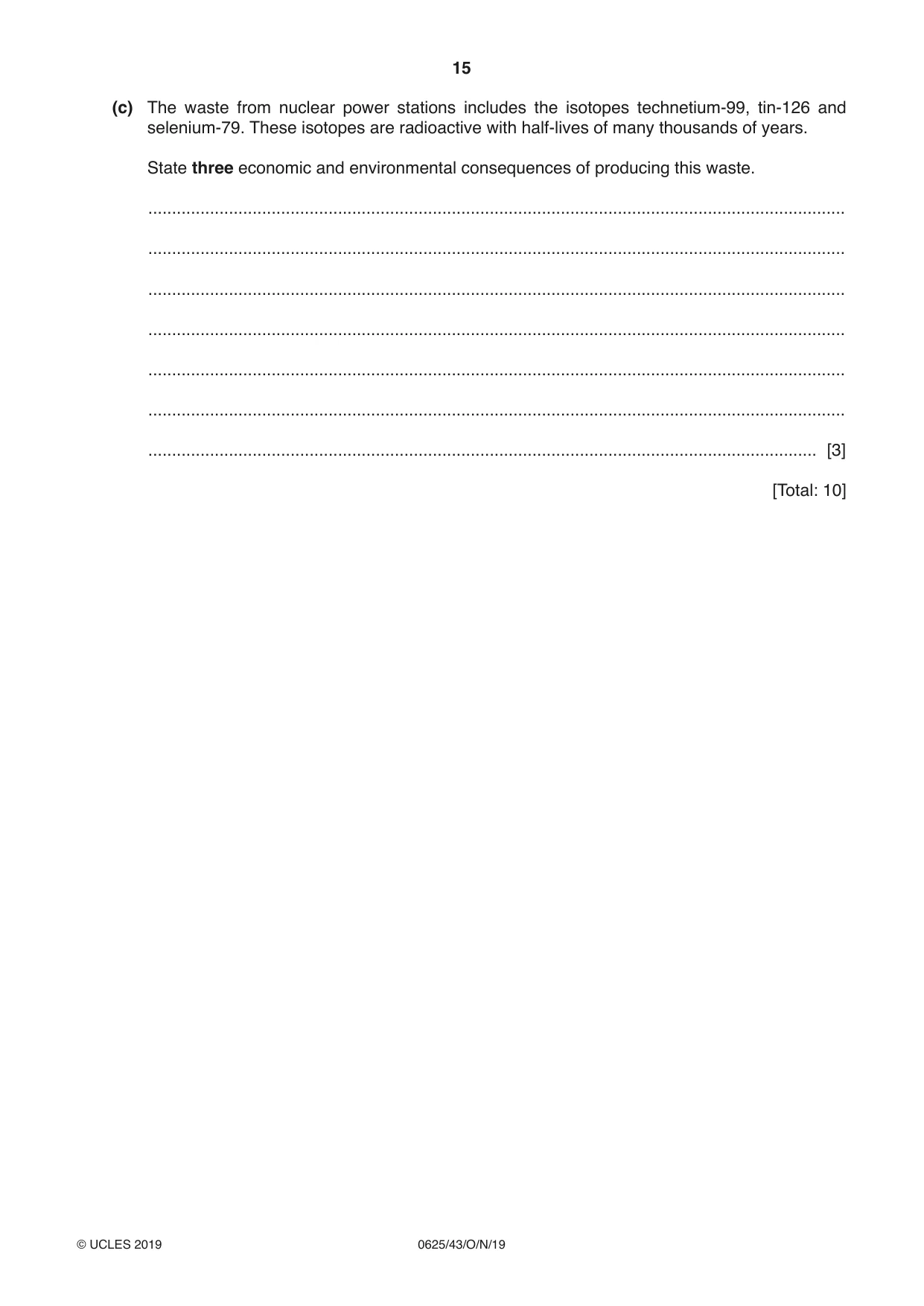
11 (a) The circles shown in Fig. 11.1 represent three gold nuclei. Three α-particles are approaching the gold nuclei. α-particle α-particle α-particle Fig. 11.1 On Fig. 11.1, complete the path of each α-particle. [3] (b) A detector of radioactivity in a laboratory indicates an average of 16 counts / min when no radioactive samples are present. A radioactive sample of half-life 1.5 days is placed close to the detector, which indicates a count rate of 208 counts / min. Calculate the count rate that is indicated 6 days later. count rate = ...................................... counts / min [4] (c) The waste from nuclear power stations includes the isotopes technetium-99, tin-126 and selenium-79. These isotopes are radioactive with half-lives of many thousands of years. State three economic and environmental consequences of producing this waste. ................................................................................................................................................... ................................................................................................................................................... ................................................................................................................................................... ................................................................................................................................................... ................................................................................................................................................... ................................................................................................................................................... ............................................................................................................................................. [3] [Total: 10]
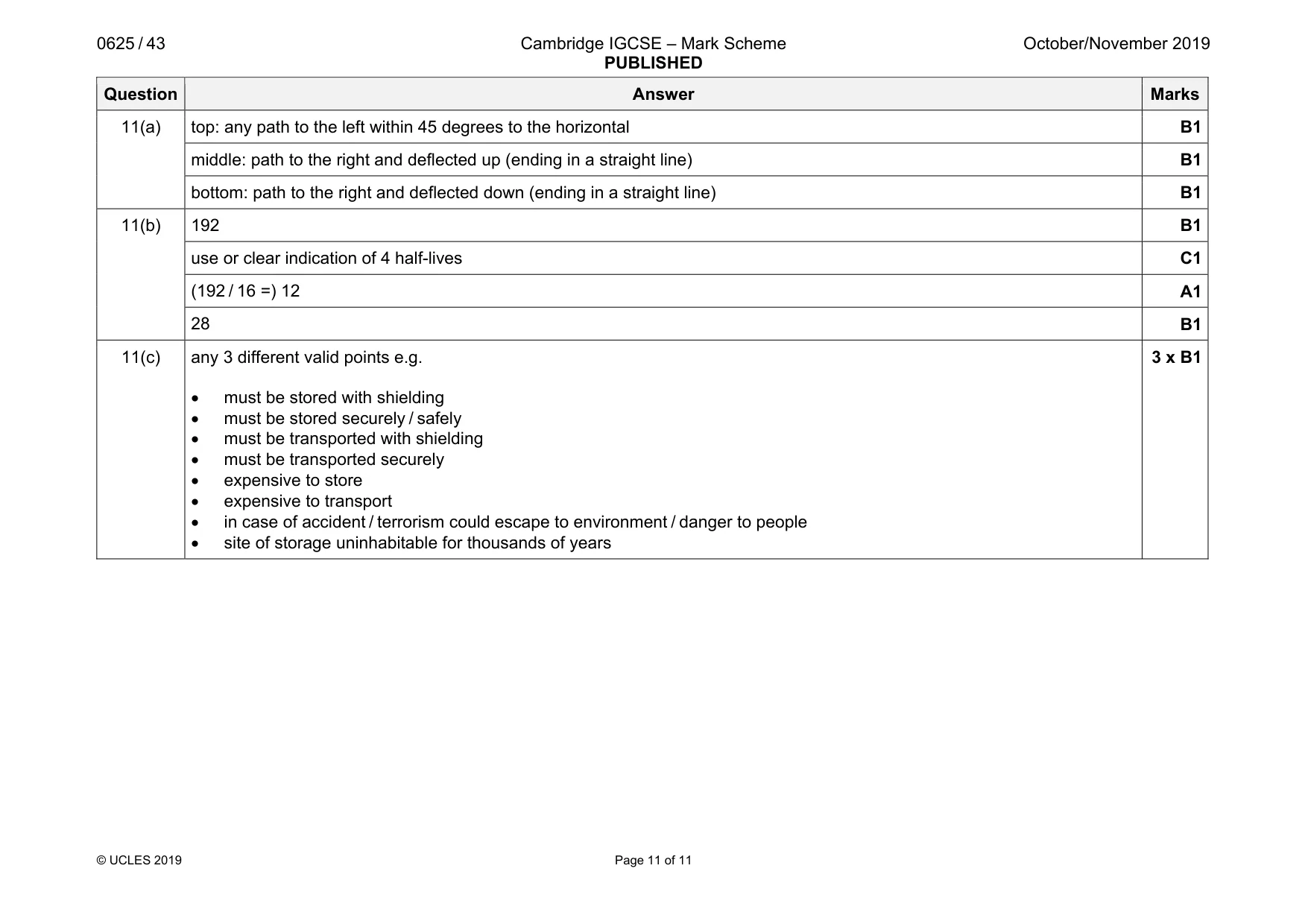
Mark scheme: 11(a) top: any path to the left within 45 degrees to the horizontal B1 middle: path to the right and deflected up (ending in a straight line) B1 bottom: path to the right and deflected down (ending in a straight line) B1 11(b) 192 B1 use or clear indication of 4 half-lives C1 (192 / 16 =) 12 A1 28 B1 11(c) any 3 different valid points e.g. • must be stored with shielding • must be stored securely / safely • must be transported with shielding • must be transported securely • expensive to store • expensive to transport • in case of accident / terrorism could escape to environment / danger to people • site of storage uninhabitable for thousands of years 3 x B1
What was in this paper
The subtopics covered by these 11 questions, and how many questions each got. Open one in a new tab to see every Cambridge question on it.
What you needed in this session
Cambridge’s own grade thresholds for 2019 Oct/Nov, Paper 4 · Variant 3. A higher threshold means an easier paper — the bar moves with how the cohort did.