Cambridge IGCSE Physics 0625 — 2023 Oct/Nov Paper 4 · Variant 1
0625/41/O/N/23 · 10 questions · 80 marks · ≈90 min
The question paper and its mark scheme, free to read here and free to download. This is Cambridge’s own paper, exactly as it was sat.
Question paper16 pages

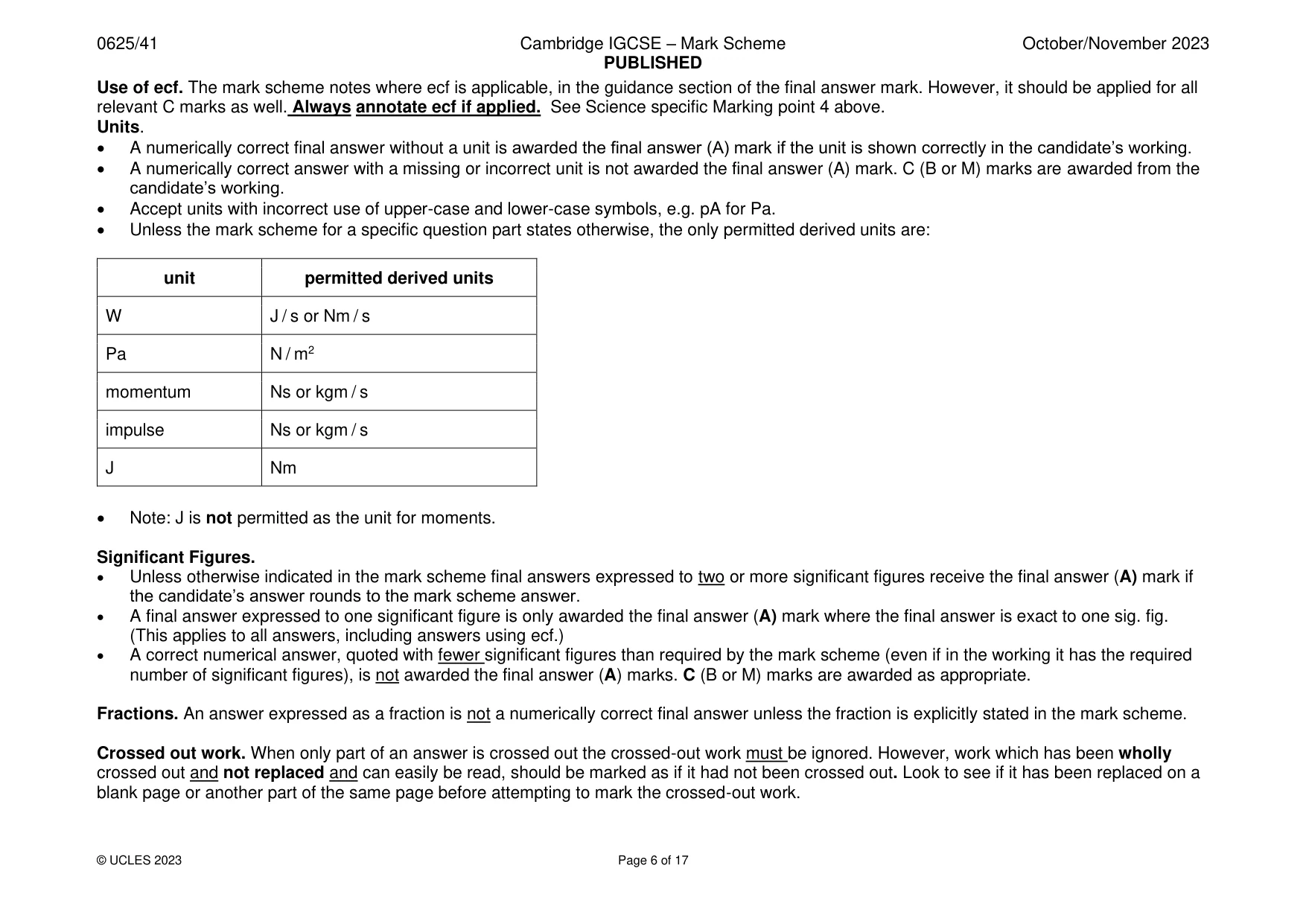
Mark scheme17 pages
Answers below. Sit the paper first if you are practising.
Questions as text
Q1 · A girl holds a rubber ball out of a window of a tall building
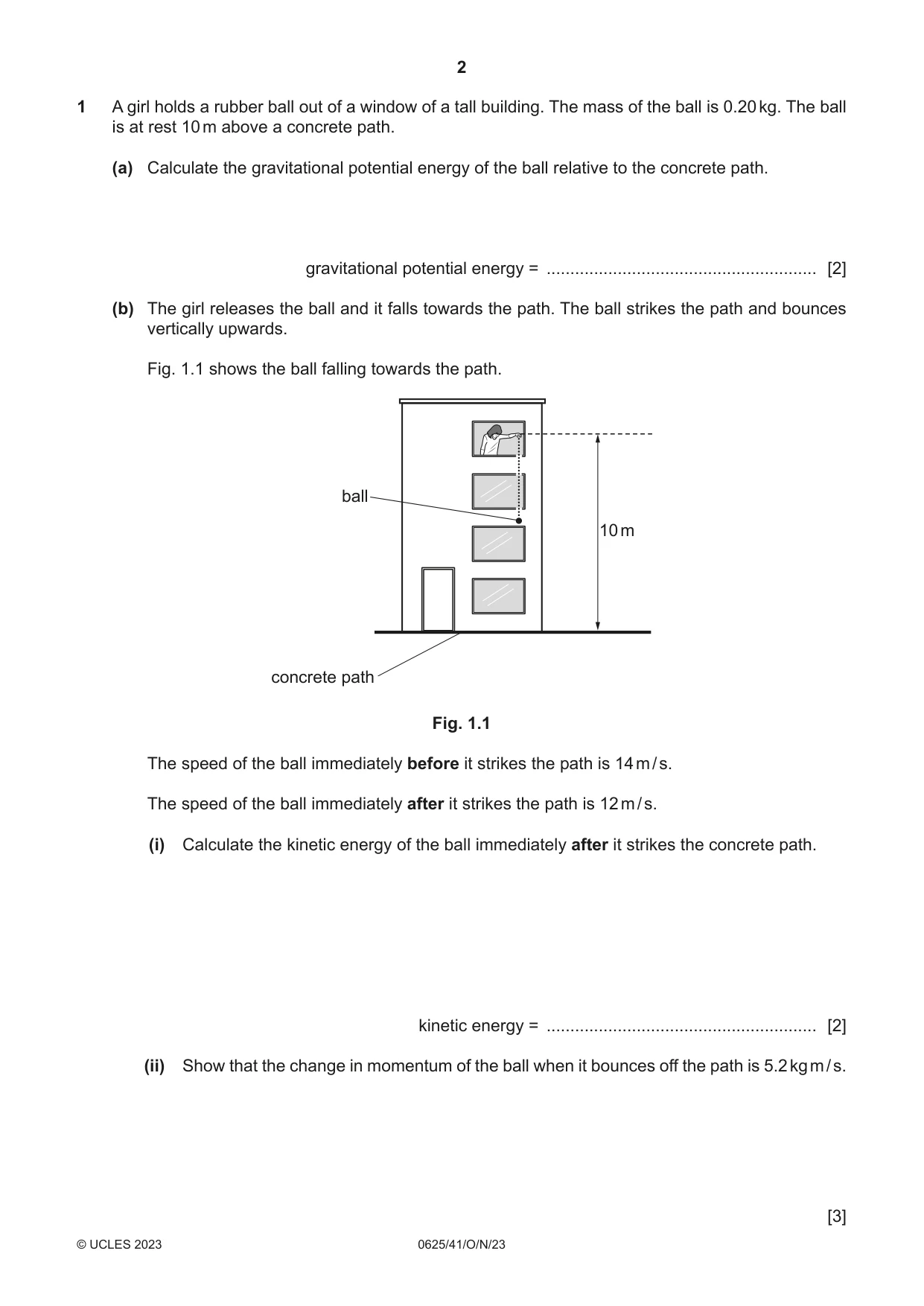
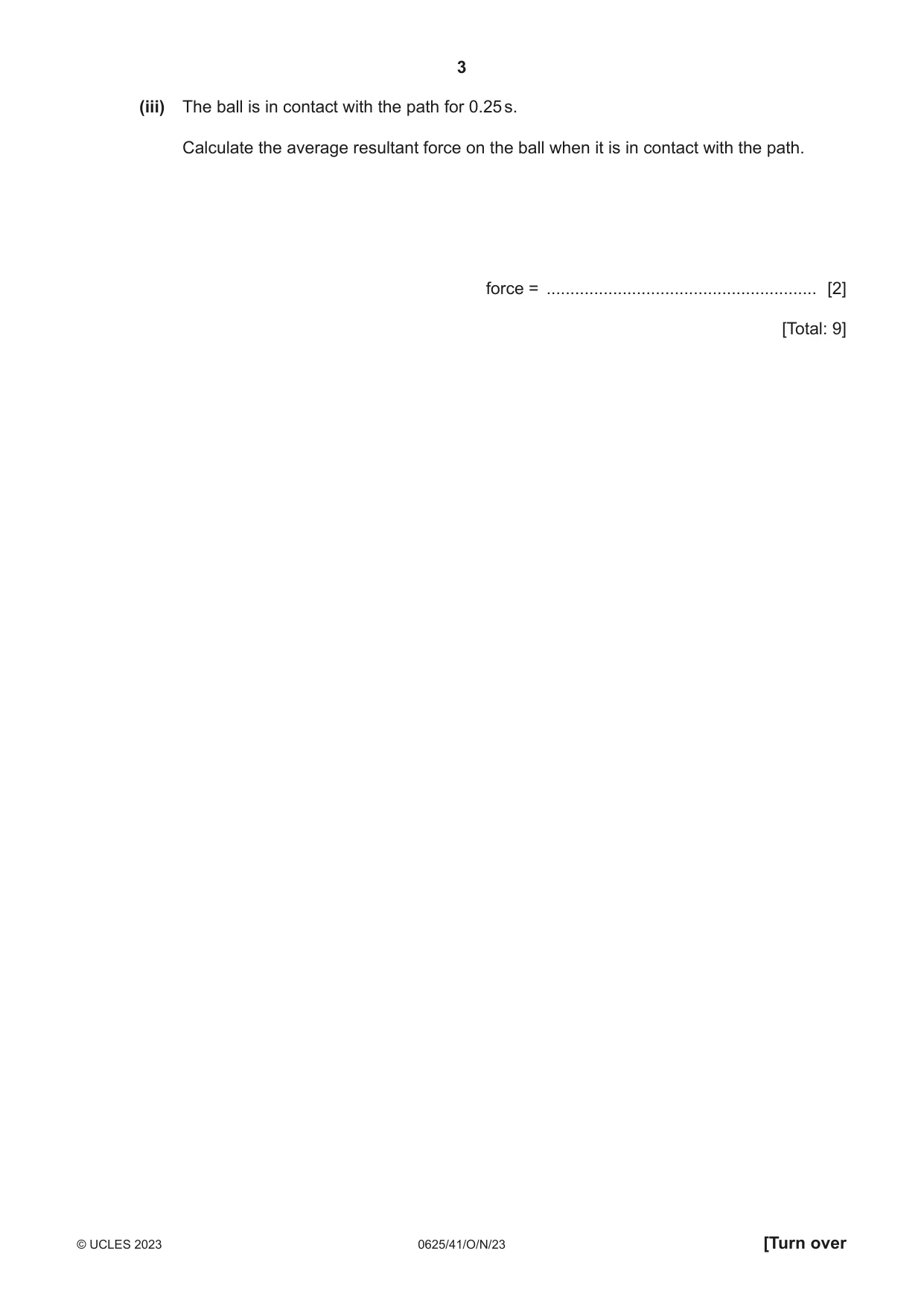
1 A girl holds a rubber ball out of a window of a tall building. The mass of the ball is 0.20 kg. The ball is at rest 10 m above a concrete path. (a) Calculate the gravitational potential energy of the ball relative to the concrete path. gravitational potential energy = ......................................................... [2] (b) The girl releases the ball and it falls towards the path. The ball strikes the path and bounces vertically upwards. Fig. 1.1 shows the ball falling towards the path. ball 10 m concrete path Fig. 1.1 The speed of the ball immediately before it strikes the path is 14 m / s. The speed of the ball immediately after it strikes the path is 12 m / s. (i) Calculate the kinetic energy of the ball immediately after it strikes the concrete path. kinetic energy = ......................................................... [2] (ii) Show that the change in momentum of the ball when it bounces off the path is 5.2 kg m / s. [3] (iii) The ball is in contact with the path for 0.25 s. Calculate the average resultant force on the ball when it is in contact with the path. force = ......................................................... [2] [Total: 9]
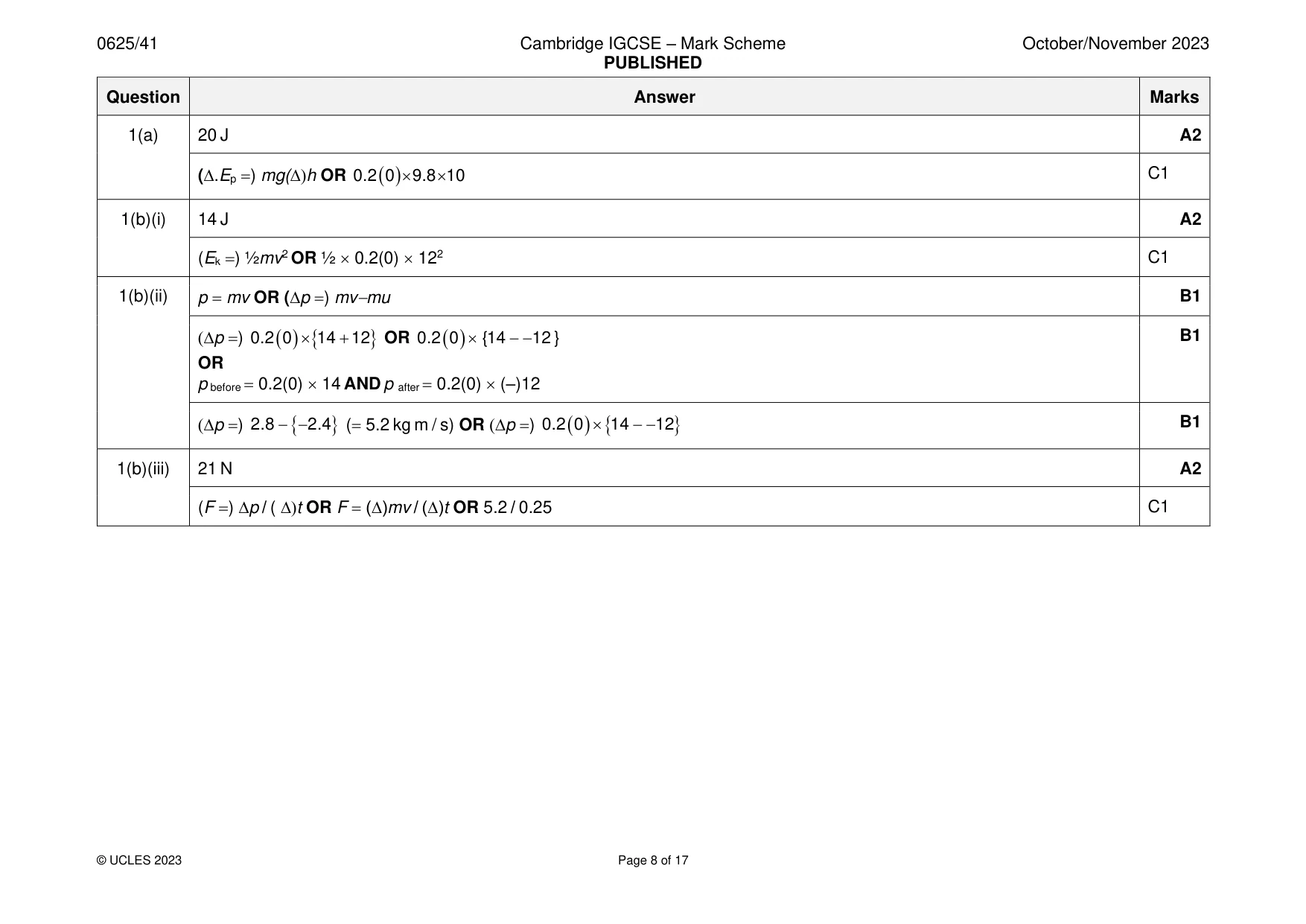
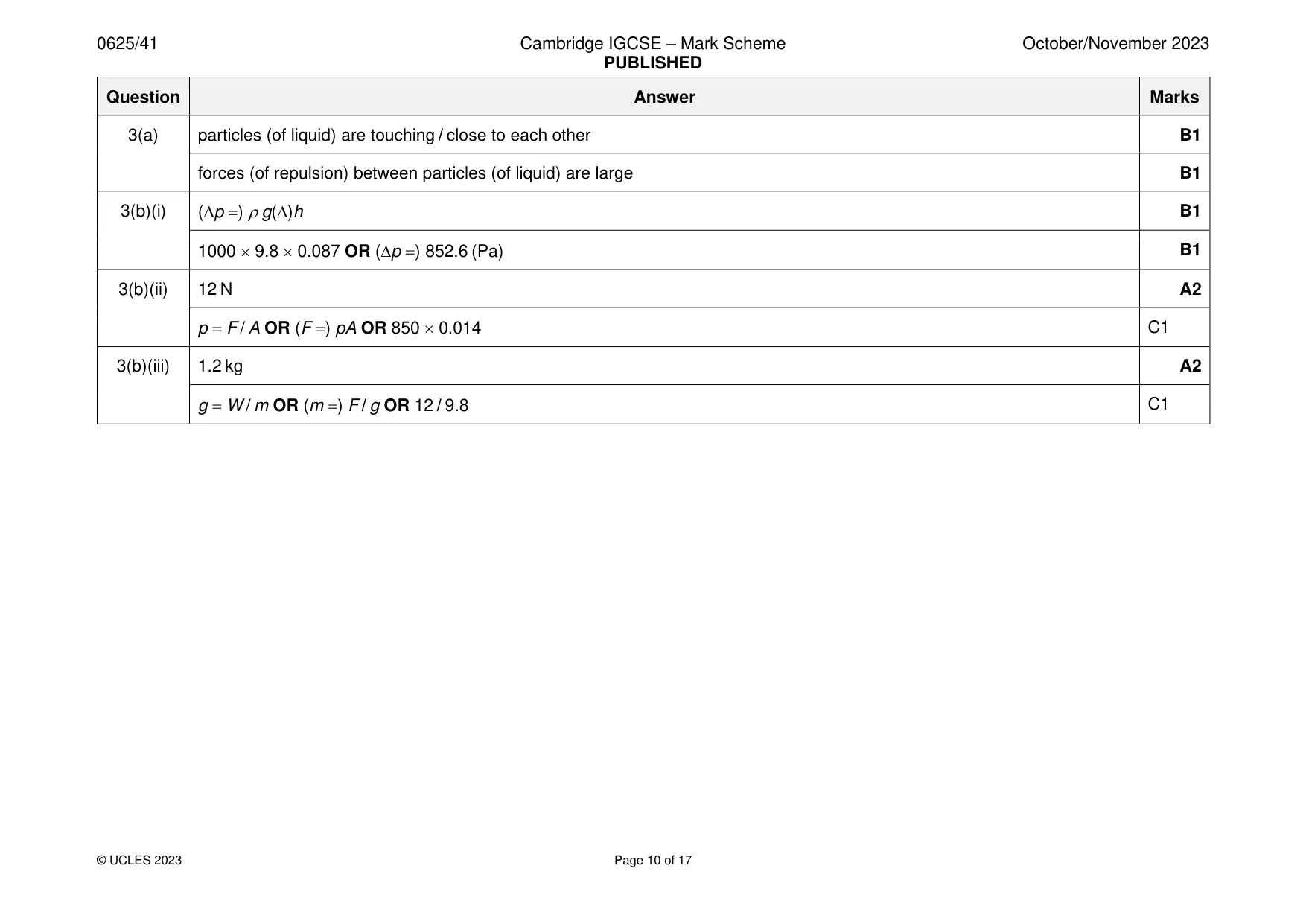
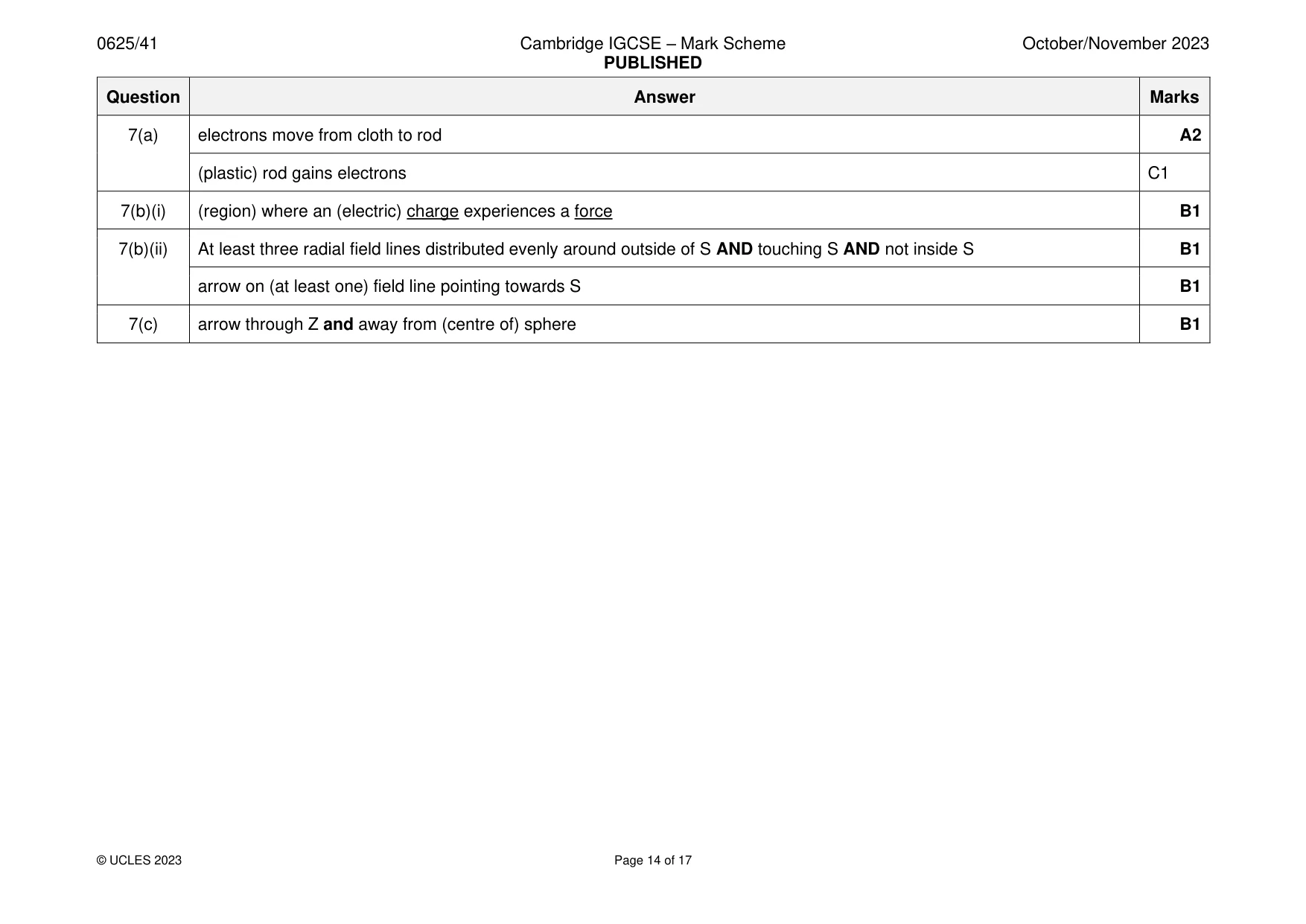
Mark scheme: Question Answer Marks 1(a) 20 J A2 (.Ep =) mg()h OR 0.2 ( 0 ) 9.8 1 0 C1 1(b)(i) 14 J A2 (Ek =) ½mv2 OR ½ 0.2(0) 122 C1 1(b)(ii) p = mv OR (p =) mv−mu B1 (p =) 0.2 ( 0 ) 14 + 12 OR 0.2 ( 0 ) {14 −−12 } B1 OR p before = 0.2(0) 14 AND p after = 0.2(0) (–)12 (p =) 2.8 −− 2.4 (= 5.2 kg m / s) OR (p =) 0.2 ( 0 ) 14 −−12 B1 1(b)(iii) 21 N A2 (F =) p / ( )t OR F = (∆)mv / (∆)t OR 5.2 / 0.25 C1
Q2 · A copper cooking pan contains water
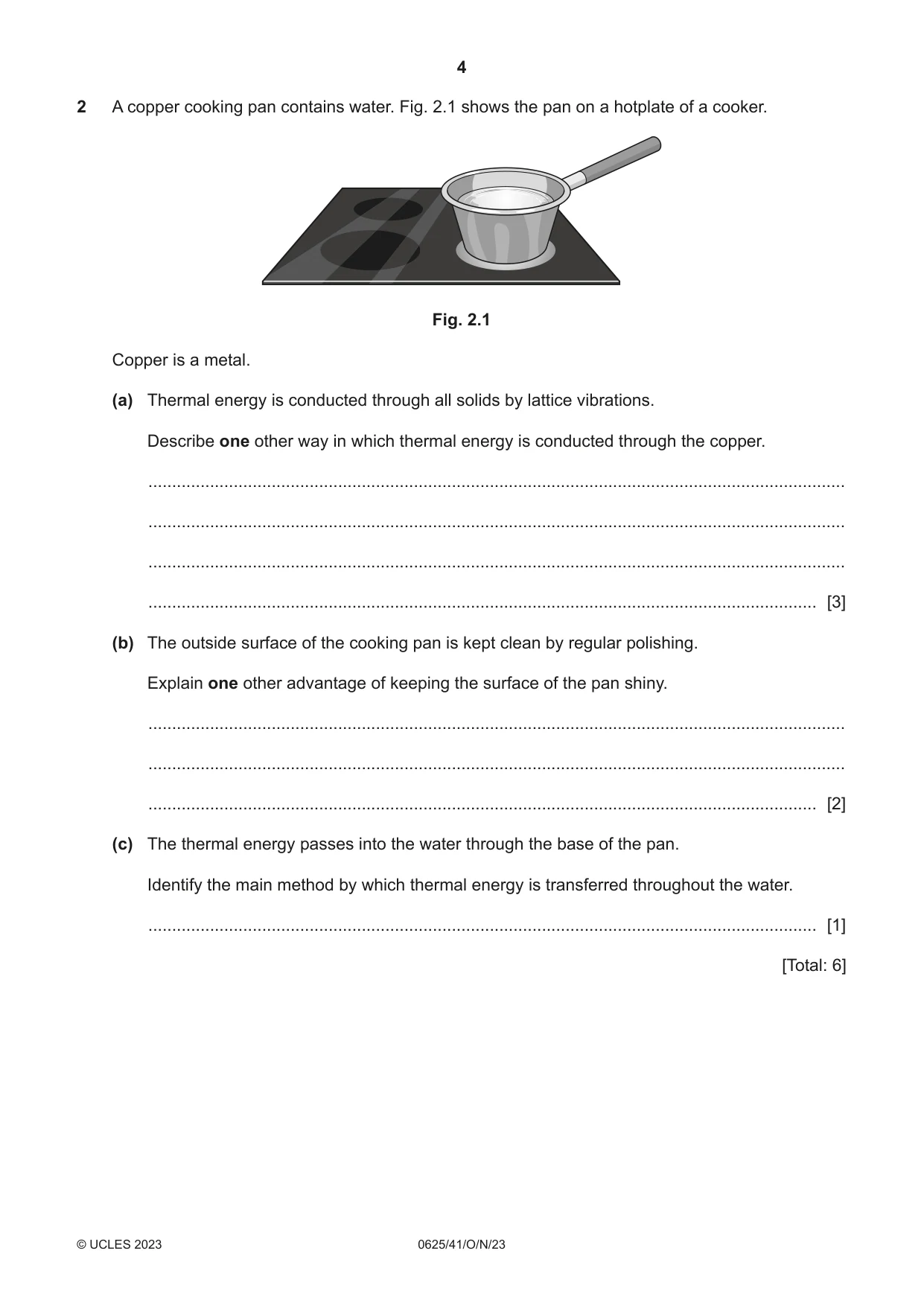
2 A copper cooking pan contains water. Fig. 2.1 shows the pan on a hotplate of a cooker. Fig. 2.1 Copper is a metal. (a) Thermal energy is conducted through all solids by lattice vibrations. Describe one other way in which thermal energy is conducted through the copper. ................................................................................................................................................... ................................................................................................................................................... ................................................................................................................................................... ............................................................................................................................................. [3] (b) The outside surface of the cooking pan is kept clean by regular polishing. Explain one other advantage of keeping the surface of the pan shiny. ................................................................................................................................................... ................................................................................................................................................... ............................................................................................................................................. [2] (c) The thermal energy passes into the water through the base of the pan. Identify the main method by which thermal energy is transferred throughout the water. ............................................................................................................................................. [1] [Total: 6]
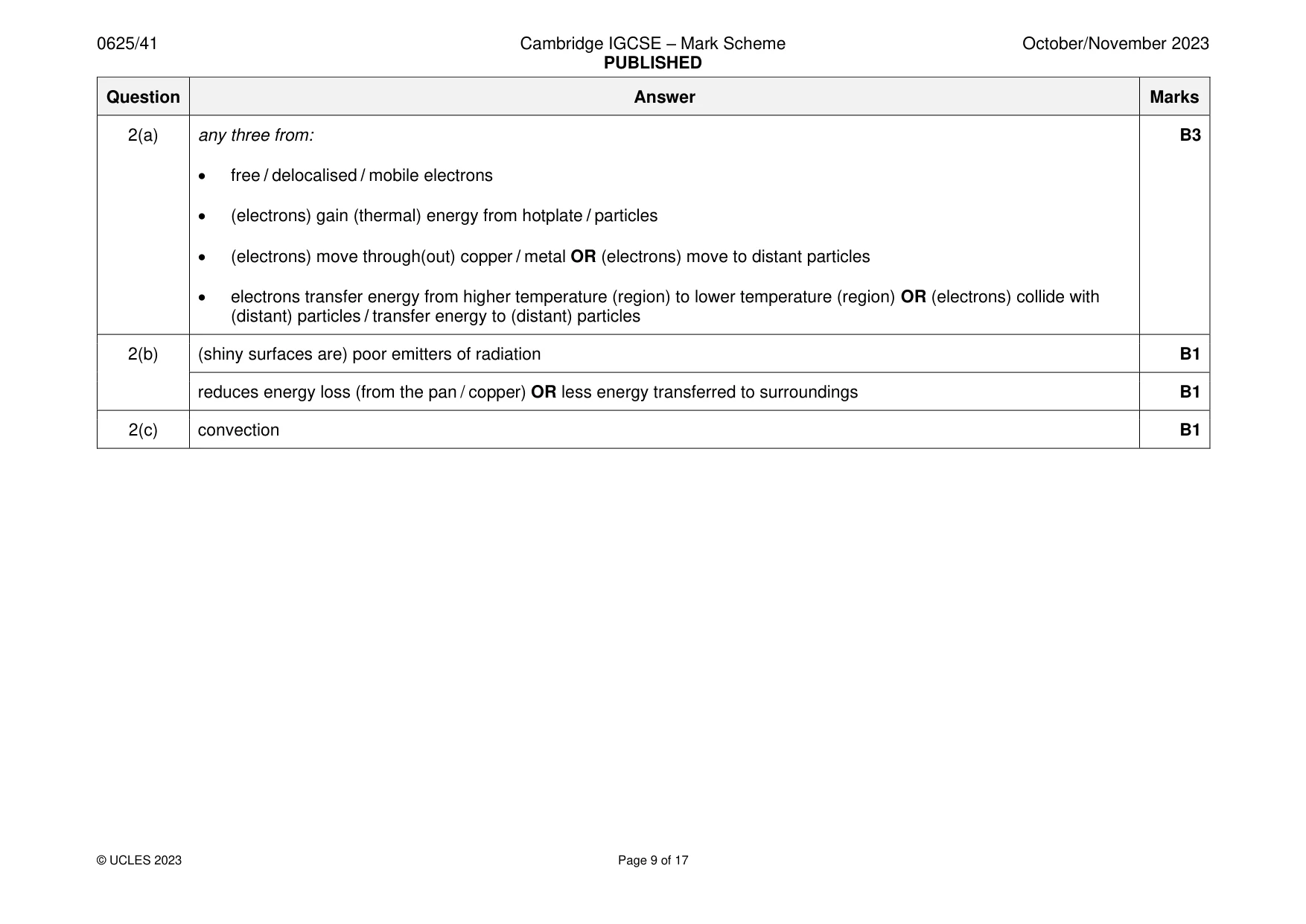
Mark scheme: 2(a) any three from: B3 • free / delocalised / mobile electrons • (electrons) gain (thermal) energy from hotplate / particles • (electrons) move through(out) copper / metal OR (electrons) move to distant particles • electrons transfer energy from higher temperature (region) to lower temperature (region) OR (electrons) collide with (distant) particles / transfer energy to (distant) particles 2(b) (shiny surfaces are) poor emitters of radiation B1 reduces energy loss (from the pan / copper) OR less energy transferred to surroundings B1 2(c) convection B1
Q3 · Liquids are difficult to compress whereas gases can be compressed easily
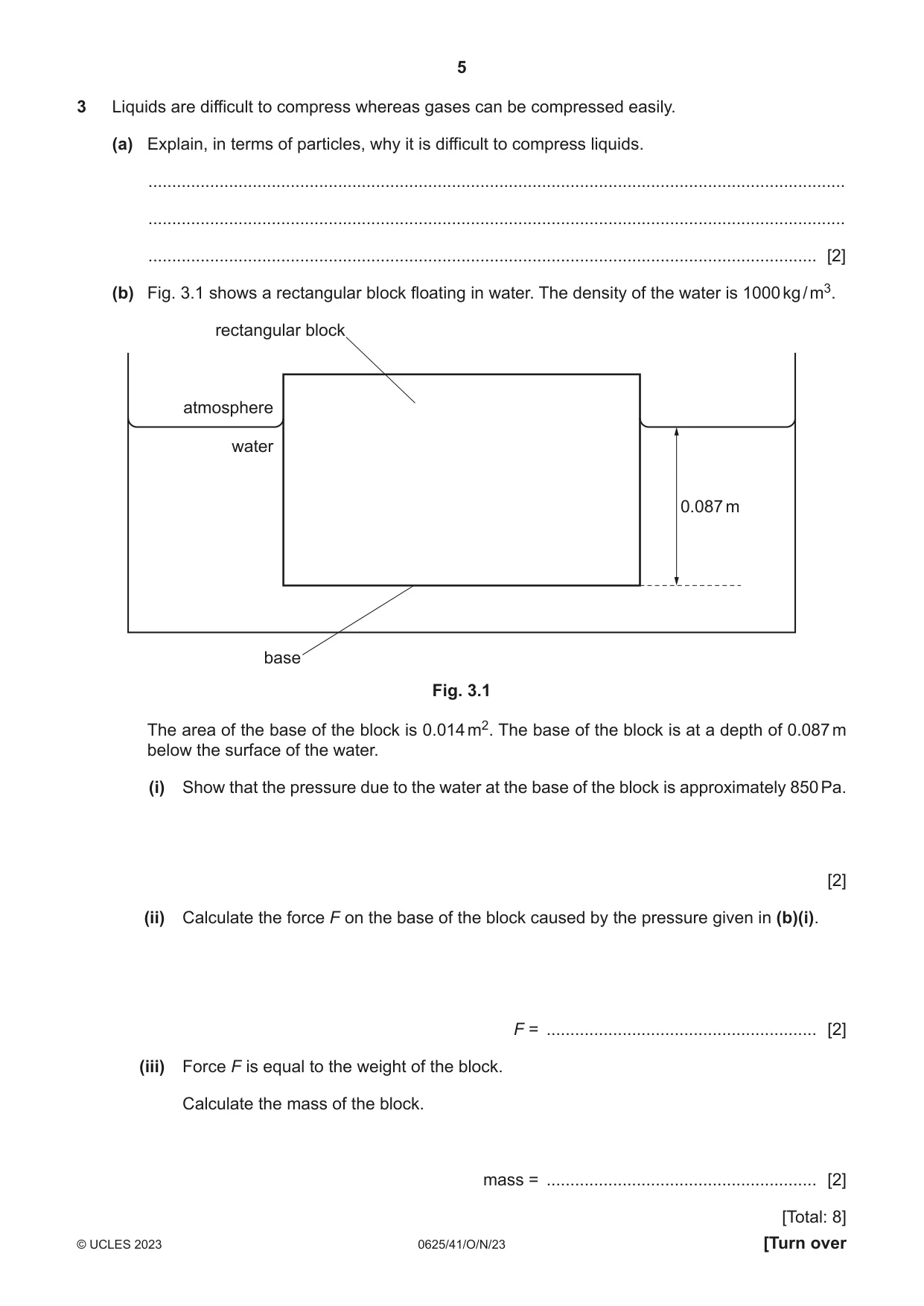
3 Liquids are difficult to compress whereas gases can be compressed easily. (a) Explain, in terms of particles, why it is difficult to compress liquids. ................................................................................................................................................... ................................................................................................................................................... ............................................................................................................................................. [2] (b) Fig. 3.1 shows a rectangular block floating in water. The density of the water is 1000 kg / m3. rectangular block atmosphere water 0.087 m base Fig. 3.1 The area of the base of the block is 0.014 m2. The base of the block is at a depth of 0.087 m below the surface of the water. (i) Show that the pressure due to the water at the base of the block is approximately 850 Pa. [2] (ii) Calculate the force F on the base of the block caused by the pressure given in (b)(i). F = ......................................................... [2] (iii) Force F is equal to the weight of the block. Calculate the mass of the block. mass = ......................................................... [2] [Total: 8]
Mark scheme: 3(a) particles (of liquid) are touching / close to each other B1 forces (of repulsion) between particles (of liquid) are large B1 3(b)(i) (p =) g()h B1 1000 9.8 0.087 OR (p =) 852.6 (Pa) B1 3(b)(ii) 12 N A2 p = F / A OR (F =) pA OR 850 0.014 C1 3(b)(iii) 1.2 kg A2 g = W / m OR (m =) F / g OR 12 / 9.8 C1
Q4 · A radio transmitter is a very tall, thin cylinder
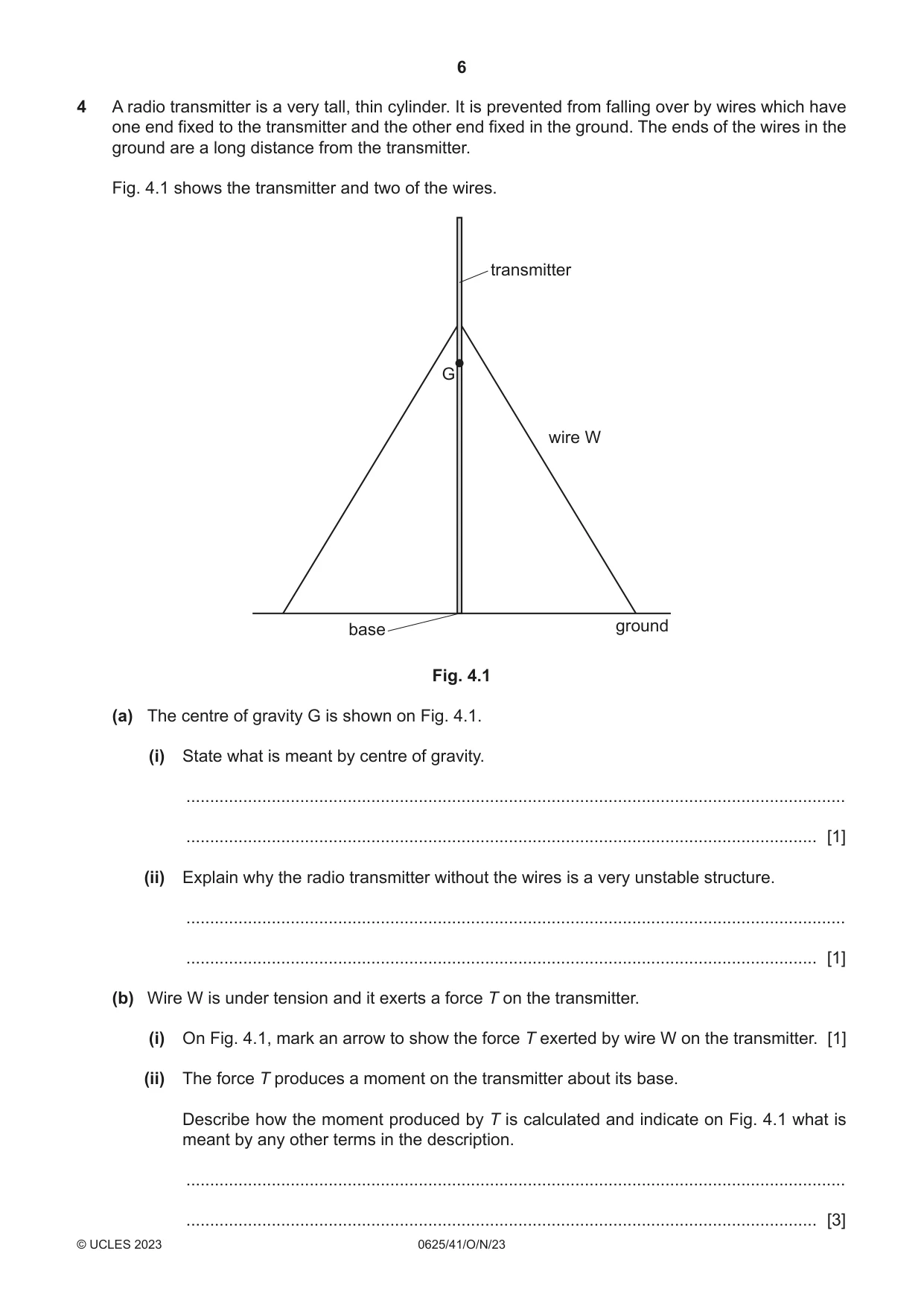
4 A radio transmitter is a very tall, thin cylinder. It is prevented from falling over by wires which have one end fixed to the transmitter and the other end fixed in the ground. The ends of the wires in the ground are a long distance from the transmitter. Fig. 4.1 shows the transmitter and two of the wires. transmitter G wire W base ground Fig. 4.1 (a) The centre of gravity G is shown on Fig. 4.1. (i) State what is meant by centre of gravity. ........................................................................................................................................... ..................................................................................................................................... [1] (ii) Explain why the radio transmitter without the wires is a very unstable structure. ........................................................................................................................................... ..................................................................................................................................... [1] (b) Wire W is under tension and it exerts a force T on the transmitter. (i) On Fig. 4.1, mark an arrow to show the force T exerted by wire W on the transmitter. [1] (ii) The force T produces a moment on the transmitter about its base. Describe how the moment produced by T is calculated and indicate on Fig. 4.1 what is meant by any other terms in the description. ........................................................................................................................................... ..................................................................................................................................... [3] (c) The radio transmitter uses radio waves to transmit radio and television programmes. State one other use of radio waves. ................................................................................................................................................... ............................................................................................................................................. [1] [Total: 7]
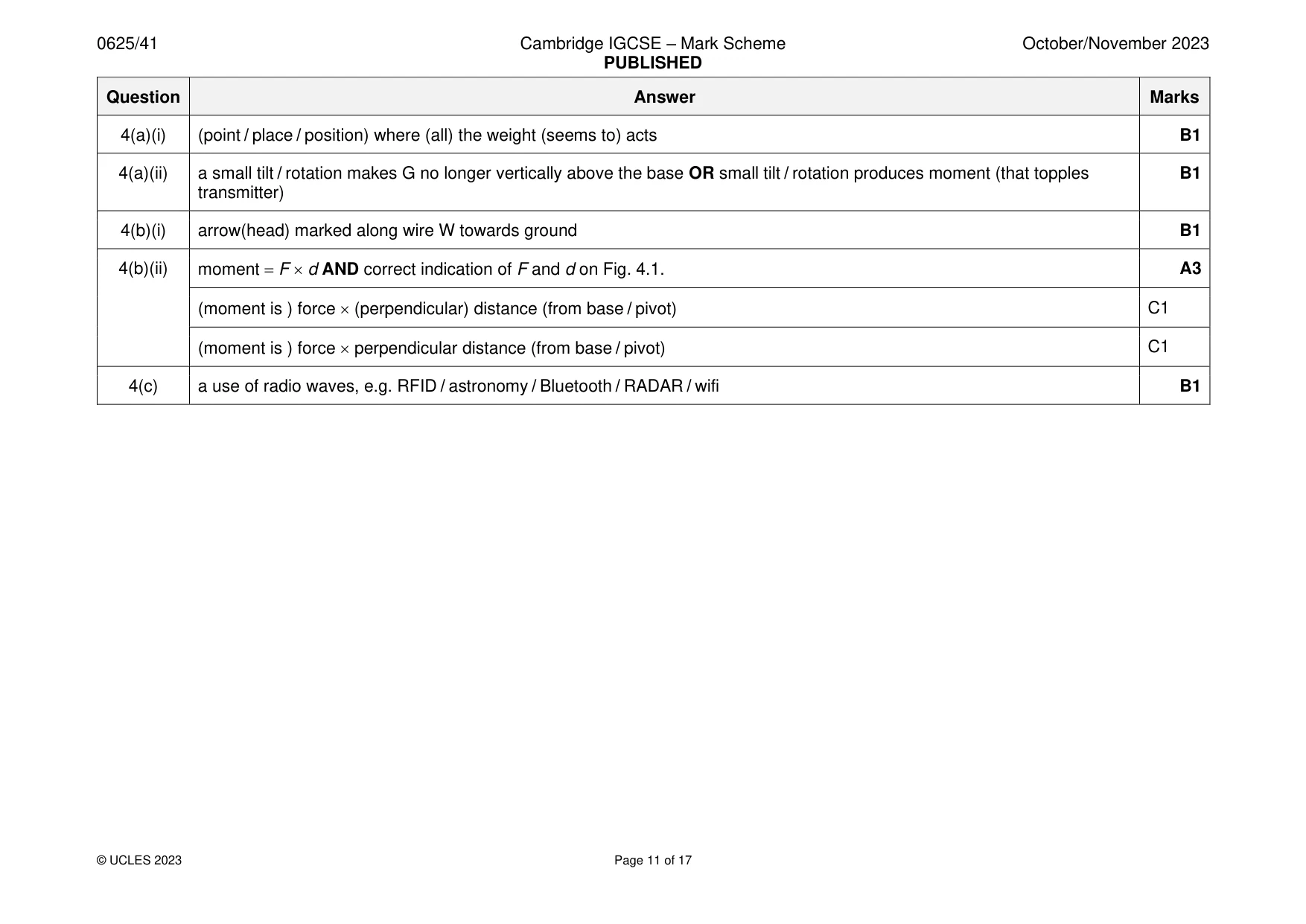
Mark scheme: 4(a)(i) (point / place / position) where (all) the weight (seems to) acts B1 4(a)(ii) a small tilt / rotation makes G no longer vertically above the base OR small tilt / rotation produces moment (that topples B1 transmitter) 4(b)(i) arrow(head) marked along wire W towards ground B1 4(b)(ii) moment = F d AND correct indication of F and d on Fig. 4.1. A3 (moment is ) force (perpendicular) distance (from base / pivot) C1 (moment is ) force perpendicular distance (from base / pivot) C1 4(c) a use of radio waves, e.g. RFID / astronomy / Bluetooth / RADAR / wifi B1
Q5 · Many methods of generating electrical power involve the use of water
5 Many methods of generating electrical power involve the use of water. (a) Describe one method of generating electrical power from energy stored in water. ................................................................................................................................................... ................................................................................................................................................... ................................................................................................................................................... ................................................................................................................................................... ............................................................................................................................................. [3] (b) For the method you chose in (a), state one advantage and one disadvantage of generating electricity this way. advantage ................................................................................................................................. ................................................................................................................................................... disadvantage ............................................................................................................................ ................................................................................................................................................... [2] (c) State two methods of generating electrical power for which the main source of energy is not the Sun. 1 ................................................................................................................................................ 2 ................................................................................................................................................ [2] [Total: 7]
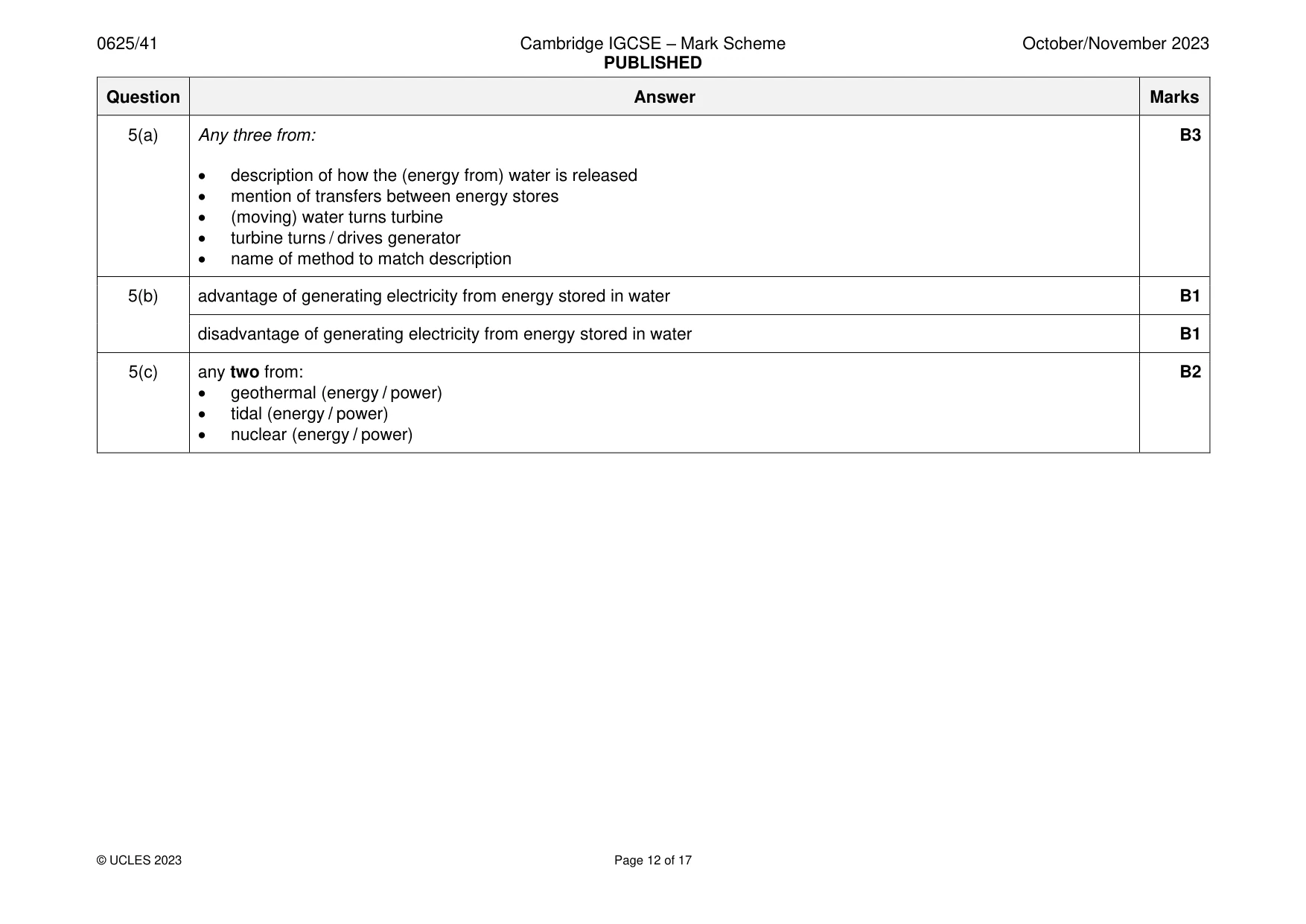
Mark scheme: 5(a) Any three from: B3 • description of how the (energy from) water is released • mention of transfers between energy stores • (moving) water turns turbine • turbine turns / drives generator • name of method to match description 5(b) advantage of generating electricity from energy stored in water B1 disadvantage of generating electricity from energy stored in water B1 5(c) any two from: B2 • geothermal (energy / power) • tidal (energy / power) • nuclear (energy / power)
Q6 · A page of printed text is placed 18 cm from a converging lens of focal length 35 cm
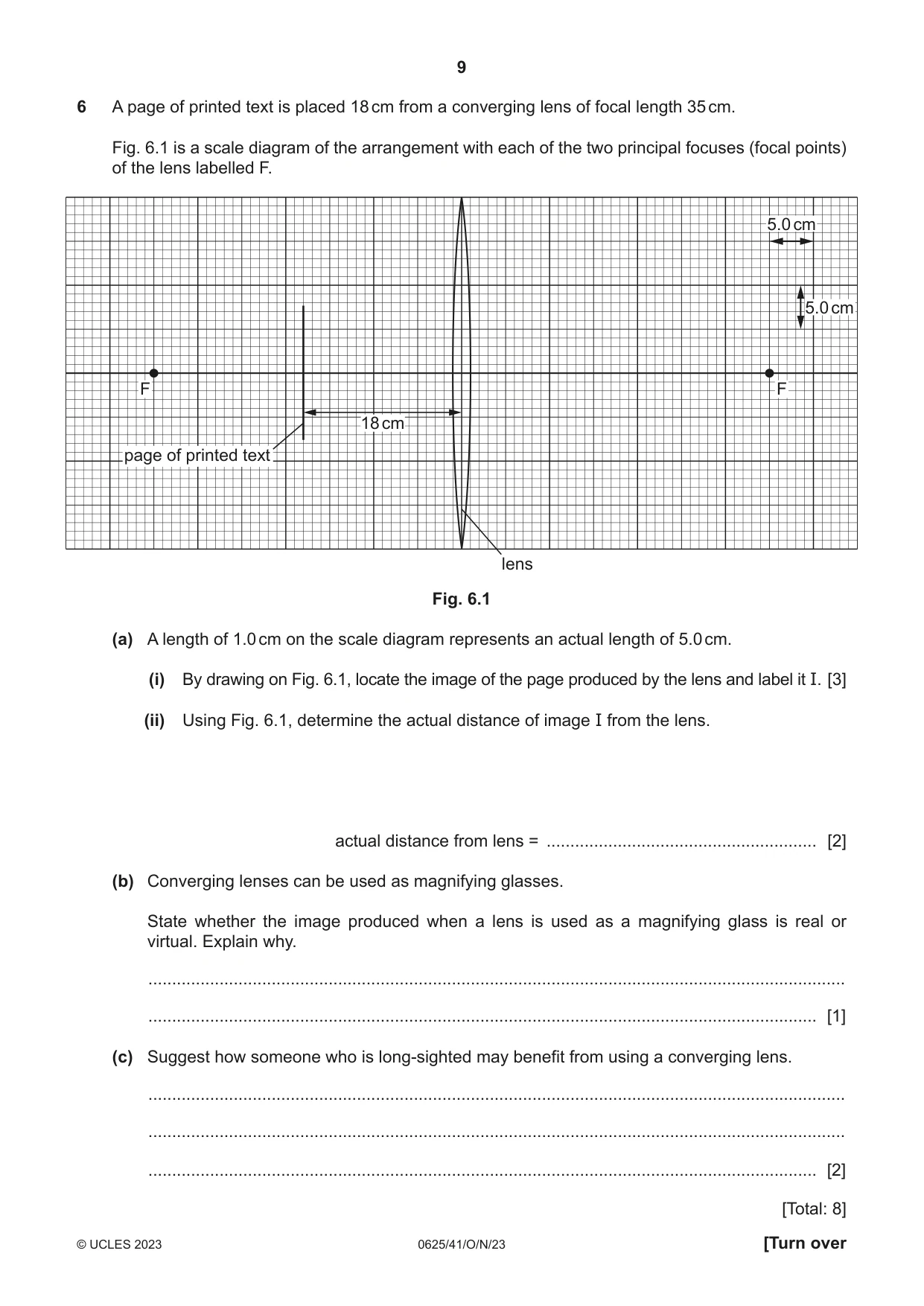
6 A page of printed text is placed 18 cm from a converging lens of focal length 35 cm. Fig. 6.1 is a scale diagram of the arrangement with each of the two principal focuses (focal points) of the lens labelled F. 5.0 cm 5.0 cm F F 18 cm page of printed text lens Fig. 6.1 (a) A length of 1.0 cm on the scale diagram represents an actual length of 5.0 cm. (i) By drawing on Fig. 6.1, locate the image of the page produced by the lens and label it I. [3] (ii) Using Fig. 6.1, determine the actual distance of image I from the lens. actual distance from lens = ......................................................... [2] (b) Converging lenses can be used as magnifying glasses. State whether the image produced when a lens is used as a magnifying glass is real or virtual. Explain why. ................................................................................................................................................... ............................................................................................................................................. [1] (c) Suggest how someone who is long-sighted may benefit from using a converging lens. ................................................................................................................................................... ................................................................................................................................................... ............................................................................................................................................. [2] [Total: 8]
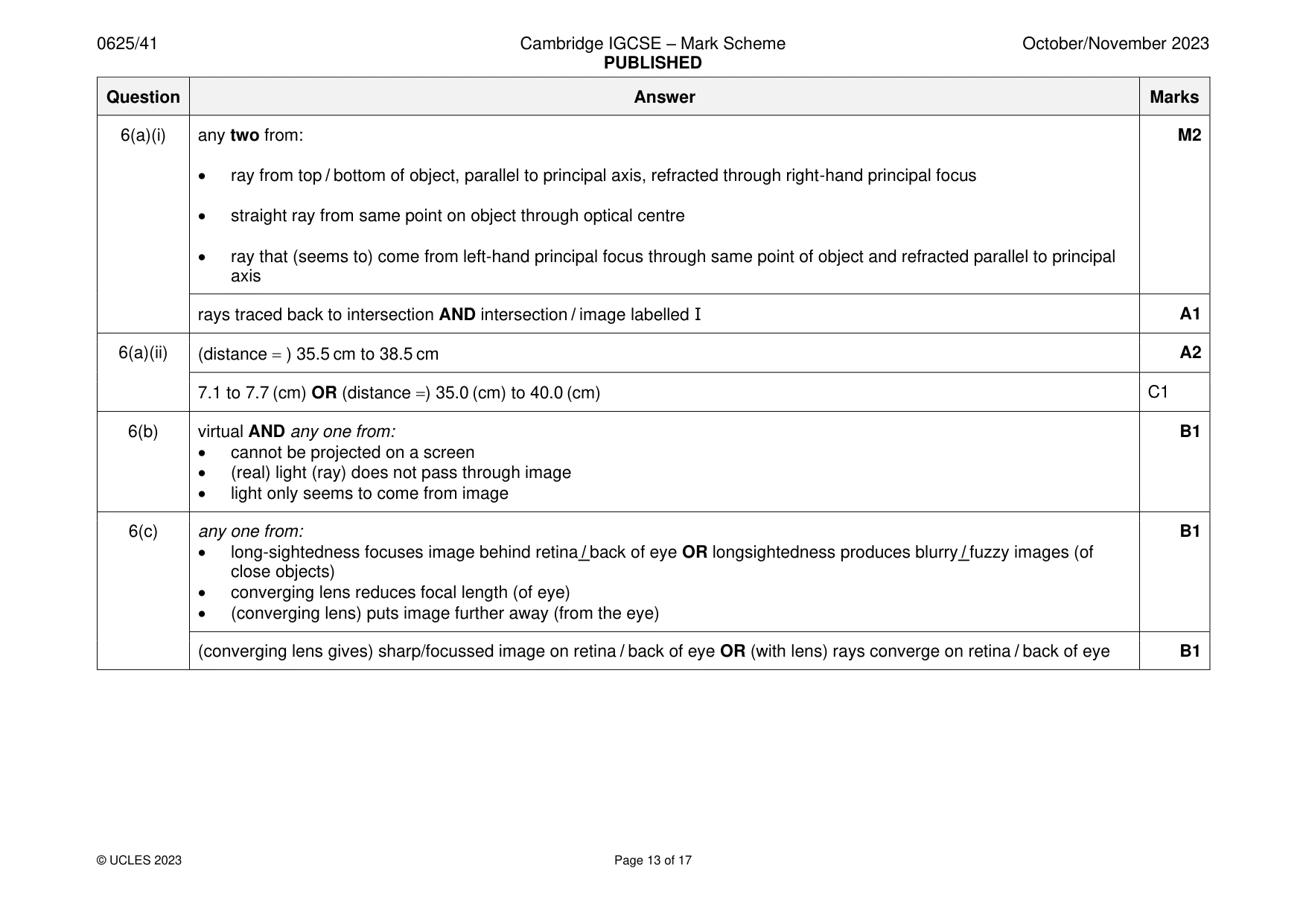
Mark scheme: 6(a)(i) any two from: M2 • ray from top / bottom of object, parallel to principal axis, refracted through right-hand principal focus • straight ray from same point on object through optical centre • ray that (seems to) come from left-hand principal focus through same point of object and refracted parallel to principal axis rays traced back to intersection AND intersection / image labelled I A1 6(a)(ii) (distance = ) 35.5 cm to 38.5 cm A2 7.1 to 7.7 (cm) OR (distance =) 35.0 (cm) to 40.0 (cm) C1 6(b) virtual AND any one from: B1 • cannot be projected on a screen • (real) light (ray) does not pass through image • light only seems to come from image 6(c) any one from: B1 • long-sightedness focuses image behind retina / back of eye OR longsightedness produces blurry / fuzzy images (of close objects) • converging lens reduces focal length (of eye) • (converging lens) puts image further away (from the eye) (converging lens gives) sharp/focussed image on retina / back of eye OR (with lens) rays converge on retina / back of eye B1
Q7 · A plastic rod is uncharged
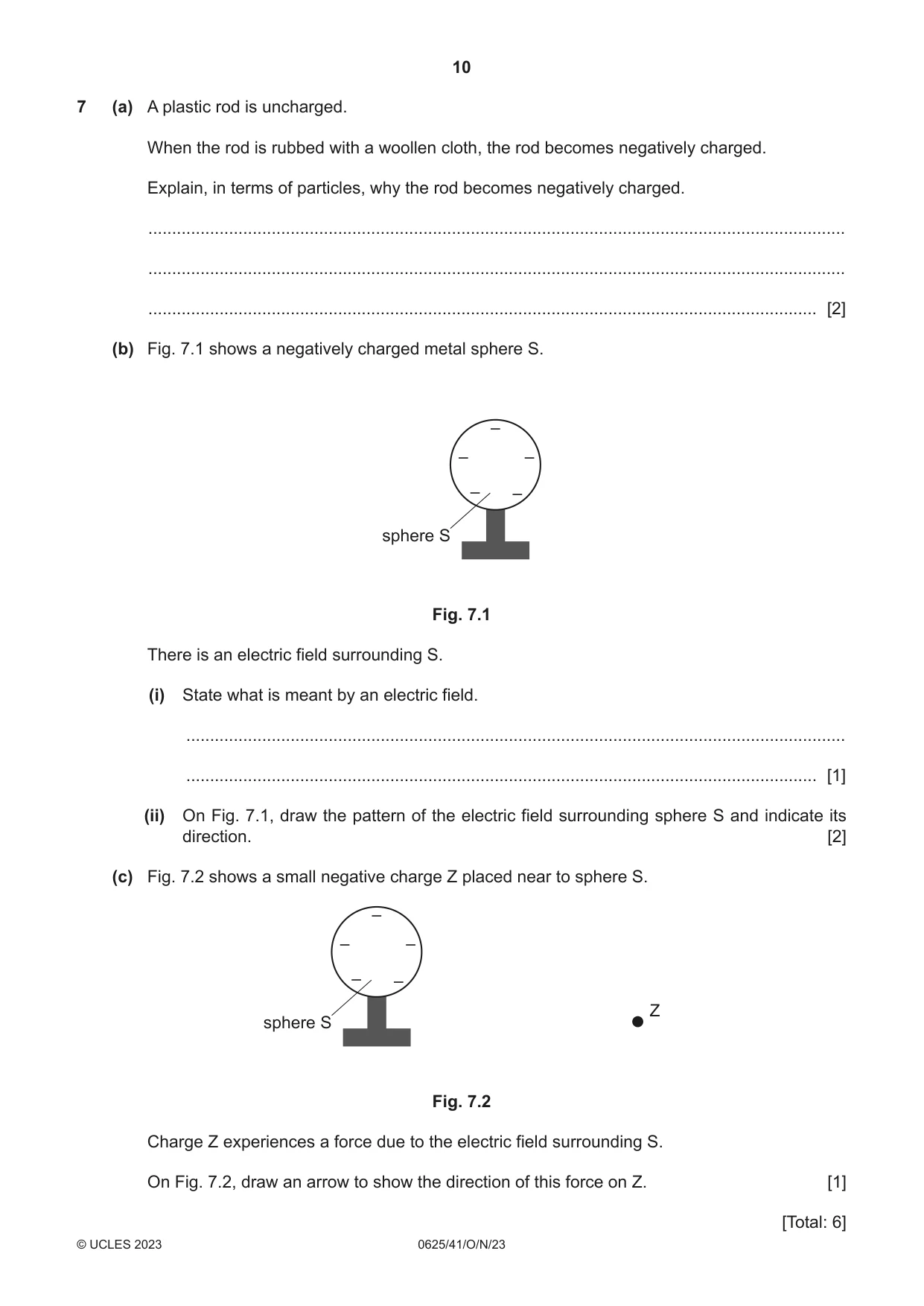
7 (a) A plastic rod is uncharged. When the rod is rubbed with a woollen cloth, the rod becomes negatively charged. Explain, in terms of particles, why the rod becomes negatively charged. ................................................................................................................................................... ................................................................................................................................................... ............................................................................................................................................. [2] (b) Fig. 7.1 shows a negatively charged metal sphere S. – – – – – sphere S Fig. 7.1 There is an electric field surrounding S. (i) State what is meant by an electric field. ........................................................................................................................................... ..................................................................................................................................... [1] (ii) On Fig. 7.1, draw the pattern of the electric field surrounding sphere S and indicate its direction. [2] (c) Fig. 7.2 shows a small negative charge Z placed near to sphere S. – – – – – Z sphere S Fig. 7.2 Charge Z experiences a force due to the electric field surrounding S. On Fig. 7.2, draw an arrow to show the direction of this force on Z. [1] [Total: 6]
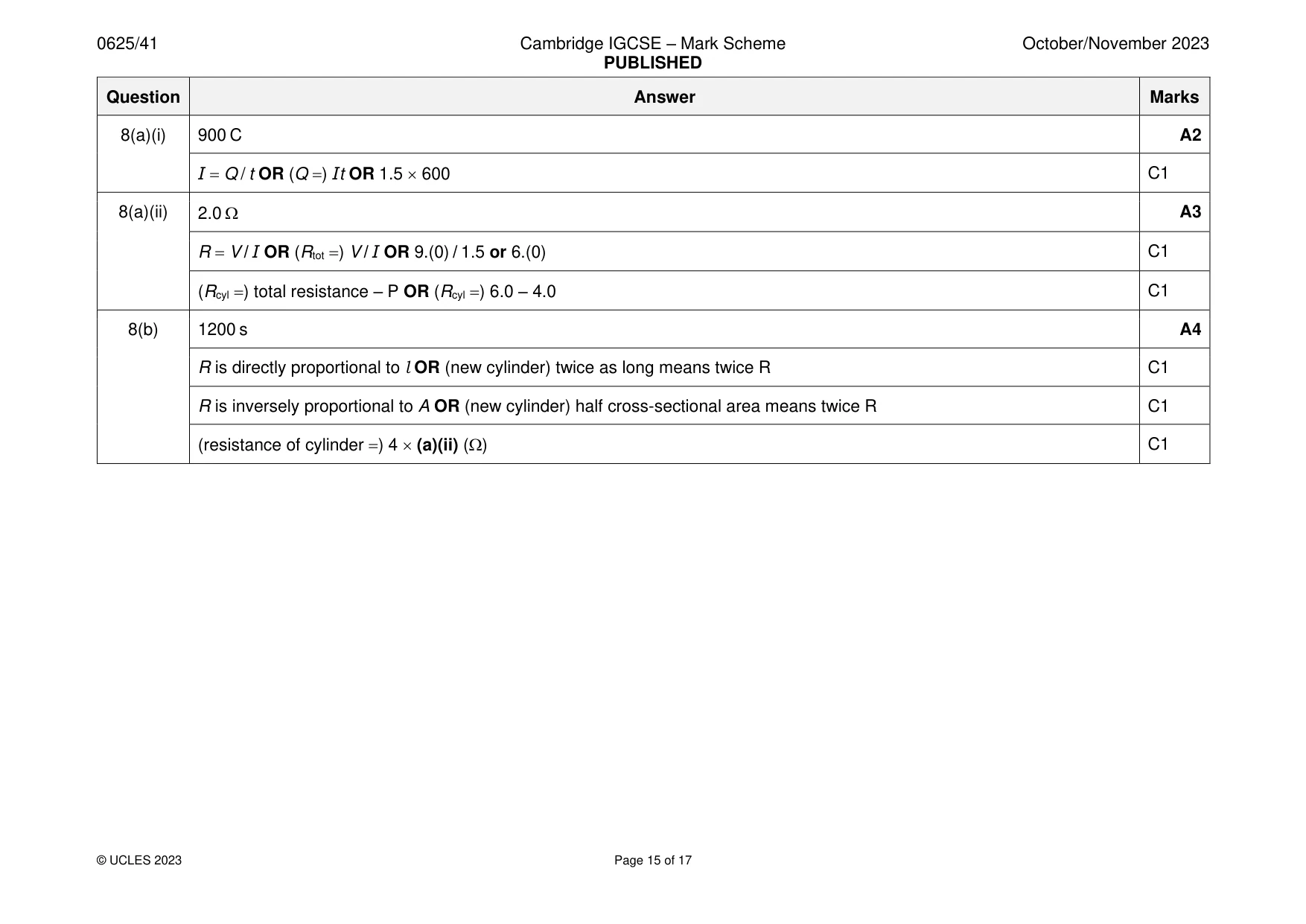
Mark scheme: 7(a) electrons move from cloth to rod A2 (plastic) rod gains electrons C1 7(b)(i) (region) where an (electric) charge experiences a force B1 7(b)(ii) At least three radial field lines distributed evenly around outside of S AND touching S AND not inside S B1 arrow on (at least one) field line pointing towards S B1 7(c) arrow through Z and away from (centre of) sphere B1
Q8 · A cylinder is made of modelling clay
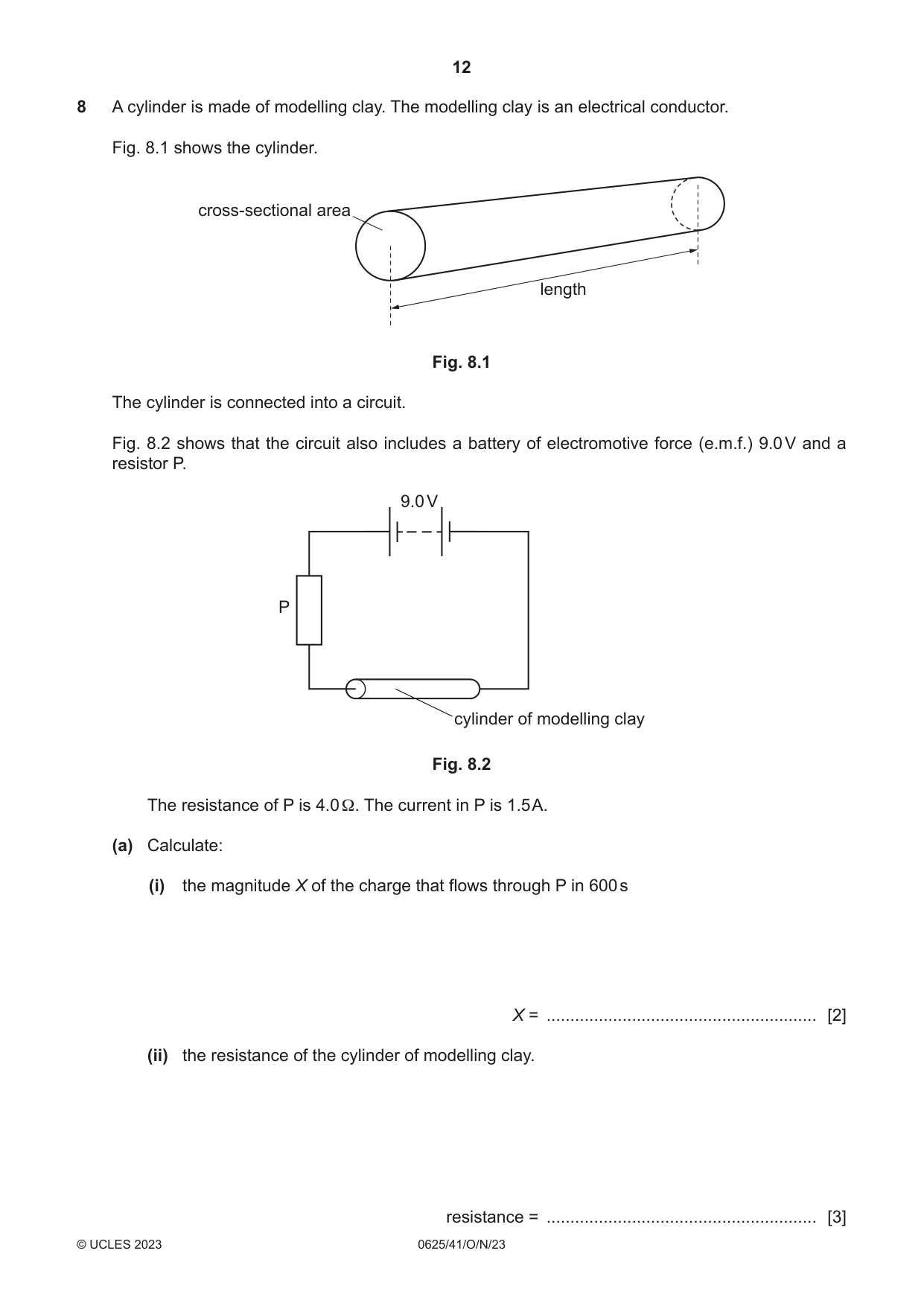
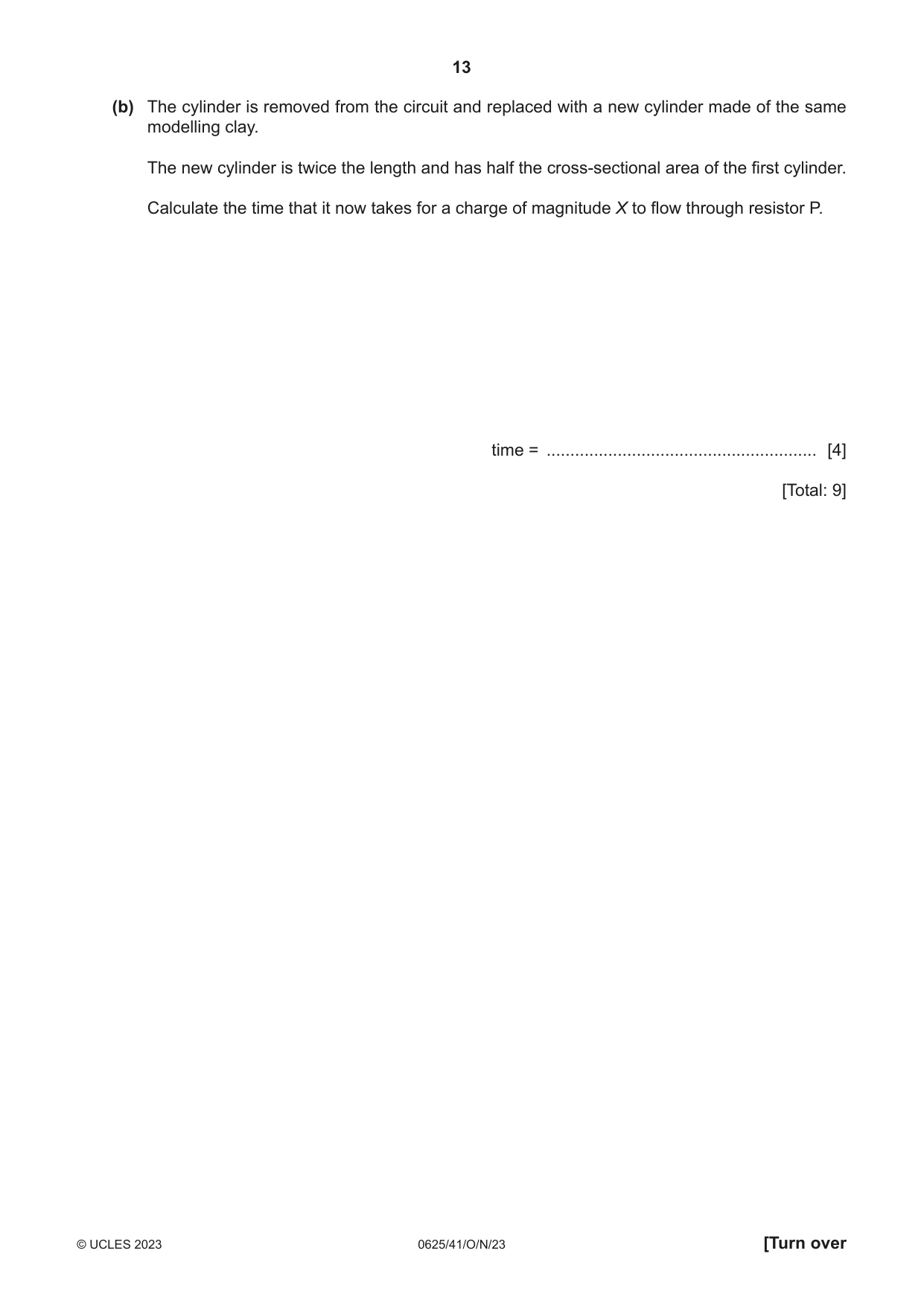
8 A cylinder is made of modelling clay. The modelling clay is an electrical conductor. Fig. 8.1 shows the cylinder. cross-sectional area length Fig. 8.1 The cylinder is connected into a circuit. Fig. 8.2 shows that the circuit also includes a battery of electromotive force (e.m.f.) 9.0 V and a resistor P. 9.0 V P cylinder of modelling clay Fig. 8.2 The resistance of P is 4.0 Ω. The current in P is 1.5 A. (a) Calculate: (i) the magnitude X of the charge that flows through P in 600 s X = ......................................................... [2] (ii) the resistance of the cylinder of modelling clay. resistance = ......................................................... [3] (b) The cylinder is removed from the circuit and replaced with a new cylinder made of the same modelling clay. The new cylinder is twice the length and has half the cross-sectional area of the first cylinder. Calculate the time that it now takes for a charge of magnitude X to flow through resistor P. time = ......................................................... [4] [Total: 9]
Mark scheme: 8(a)(i) 900 C A2 I = Q / t OR (Q =) It OR 1.5 600 C1 8(a)(ii) 2.0 A3 R = V / I OR (Rtot =) V / I OR 9.(0) / 1.5 or 6.(0) C1 (Rcyl =) total resistance – P OR (Rcyl =) 6.0 – 4.0 C1 8(b) 1200 s A4 R is directly proportional to l OR (new cylinder) twice as long means twice R C1 R is inversely proportional to A OR (new cylinder) half cross-sectional area means twice R C1 (resistance of cylinder =) 4 (a)(ii) () C1
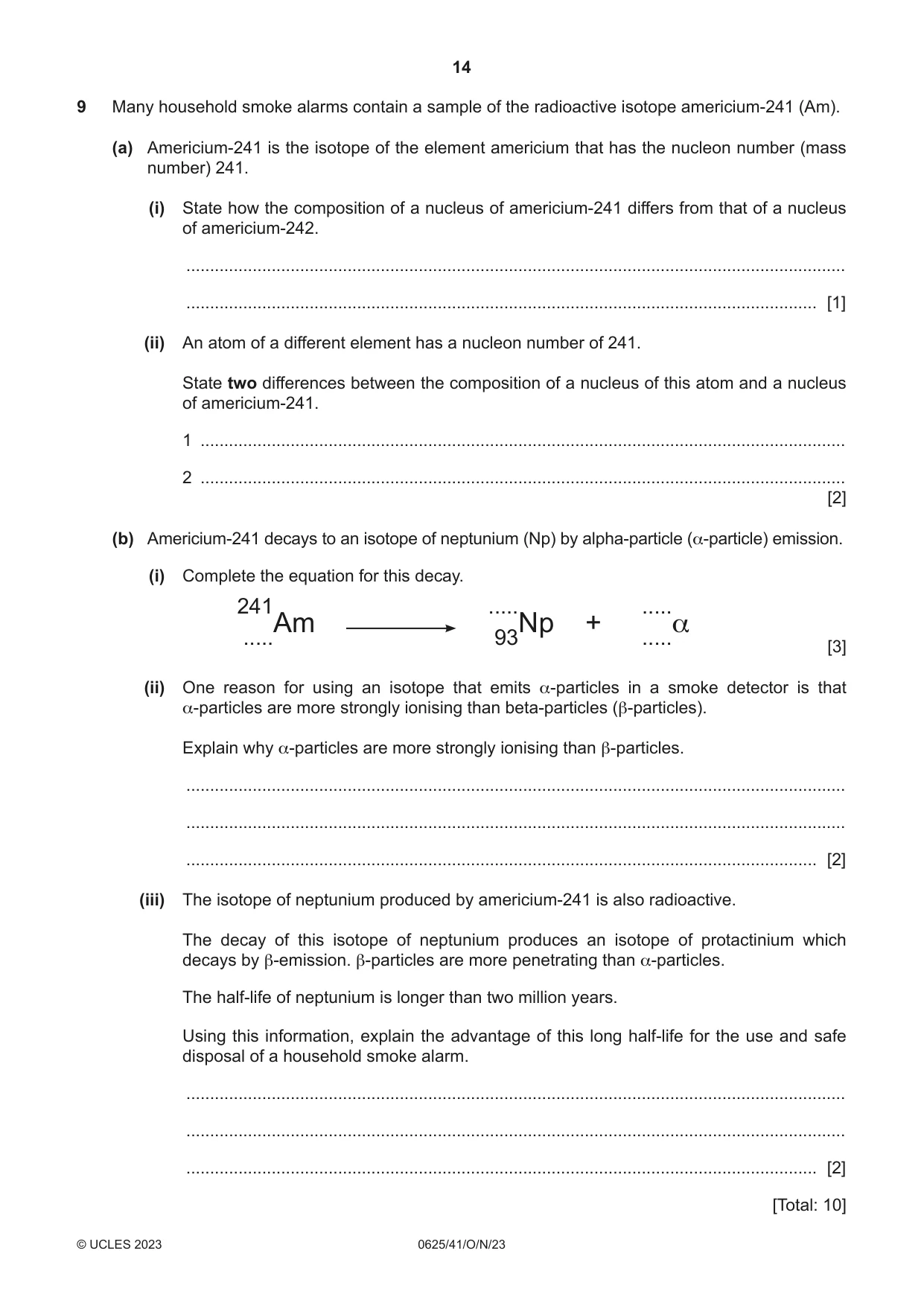
Q9 · Many household smoke alarms contain a sample of the radioactive isotope americium-241 (Am)
9 Many household smoke alarms contain a sample of the radioactive isotope americium-241 (Am). (a) Americium-241 is the isotope of the element americium that has the nucleon number (mass number) 241. (i) State how the composition of a nucleus of americium-241 differs from that of a nucleus of americium-242. ........................................................................................................................................... ..................................................................................................................................... [1] (ii) An atom of a different element has a nucleon number of 241. State two differences between the composition of a nucleus of this atom and a nucleus of americium-241. 1 ........................................................................................................................................ 2 ........................................................................................................................................ [2] (b) Americium-241 decays to an isotope of neptunium (Np) by alpha-particle (α-particle) emission. (i) Complete the equation for this decay. 241 ..... ..... .....Am 93Np + .....α [3] (ii) One reason for using an isotope that emits α-particles in a smoke detector is that α-particles are more strongly ionising than beta-particles (β-particles). Explain why α-particles are more strongly ionising than β-particles. ........................................................................................................................................... ........................................................................................................................................... ..................................................................................................................................... [2] (iii) The isotope of neptunium produced by americium-241 is also radioactive. The decay of this isotope of neptunium produces an isotope of protactinium which decays by β-emission. β-particles are more penetrating than α-particles. The half-life of neptunium is longer than two million years. Using this information, explain the advantage of this long half-life for the use and safe disposal of a household smoke alarm. ........................................................................................................................................... ........................................................................................................................................... ..................................................................................................................................... [2] [Total: 10]
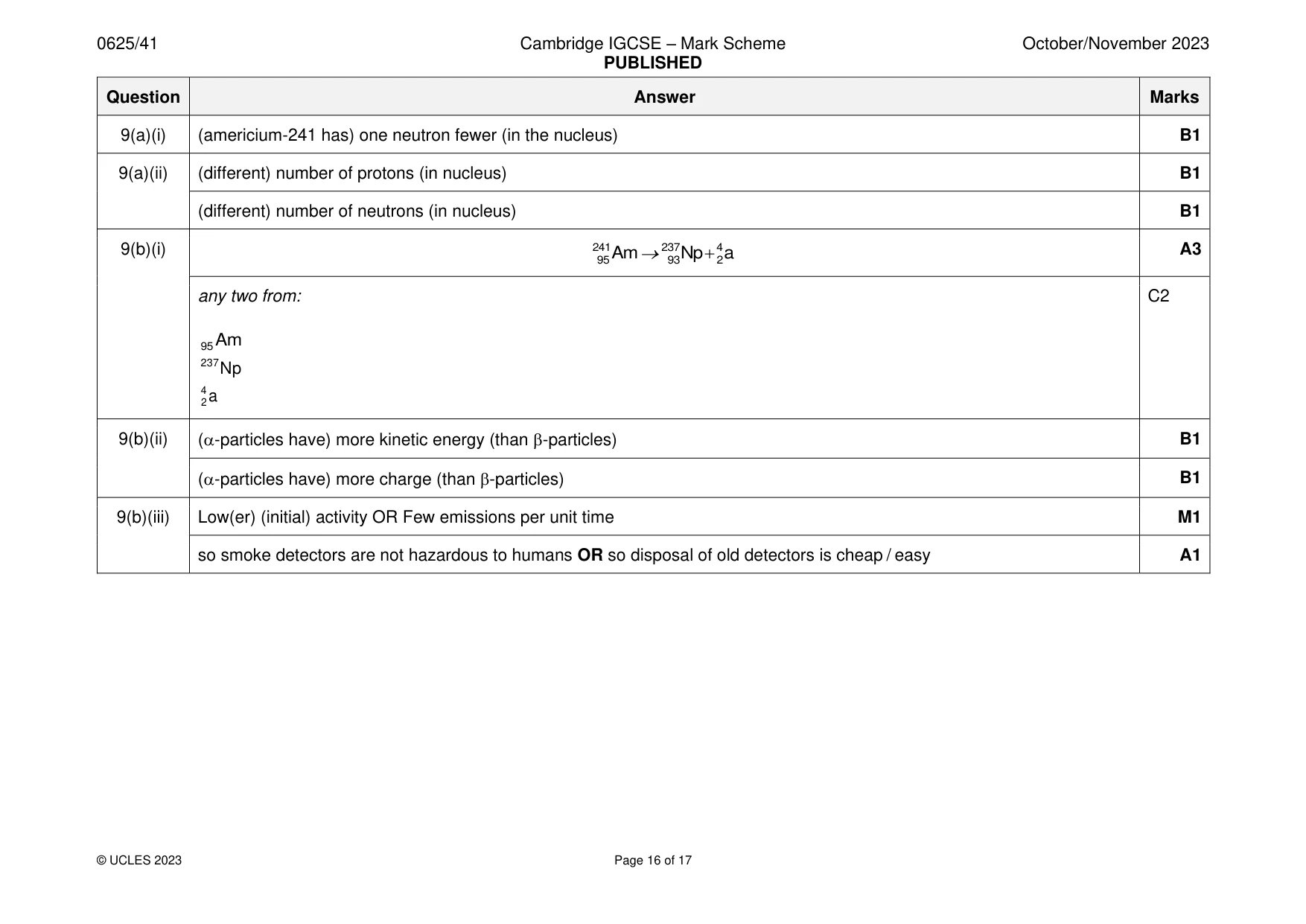
Mark scheme: 9(a)(i) (americium-241 has) one neutron fewer (in the nucleus) B1 9(a)(ii) (different) number of protons (in nucleus) B1 (different) number of neutrons (in nucleus) B1 9(b)(i) 241 95 Am →23793 Np + 42 a A3 any two from: C2 95Am 237Np 42a 9(b)(ii) (-particles have) more kinetic energy (than -particles) B1 (-particles have) more charge (than -particles) B1 9(b)(iii) Low(er) (initial) activity OR Few emissions per unit time M1 so smoke detectors are not hazardous to humans OR so disposal of old detectors is cheap / easy A1
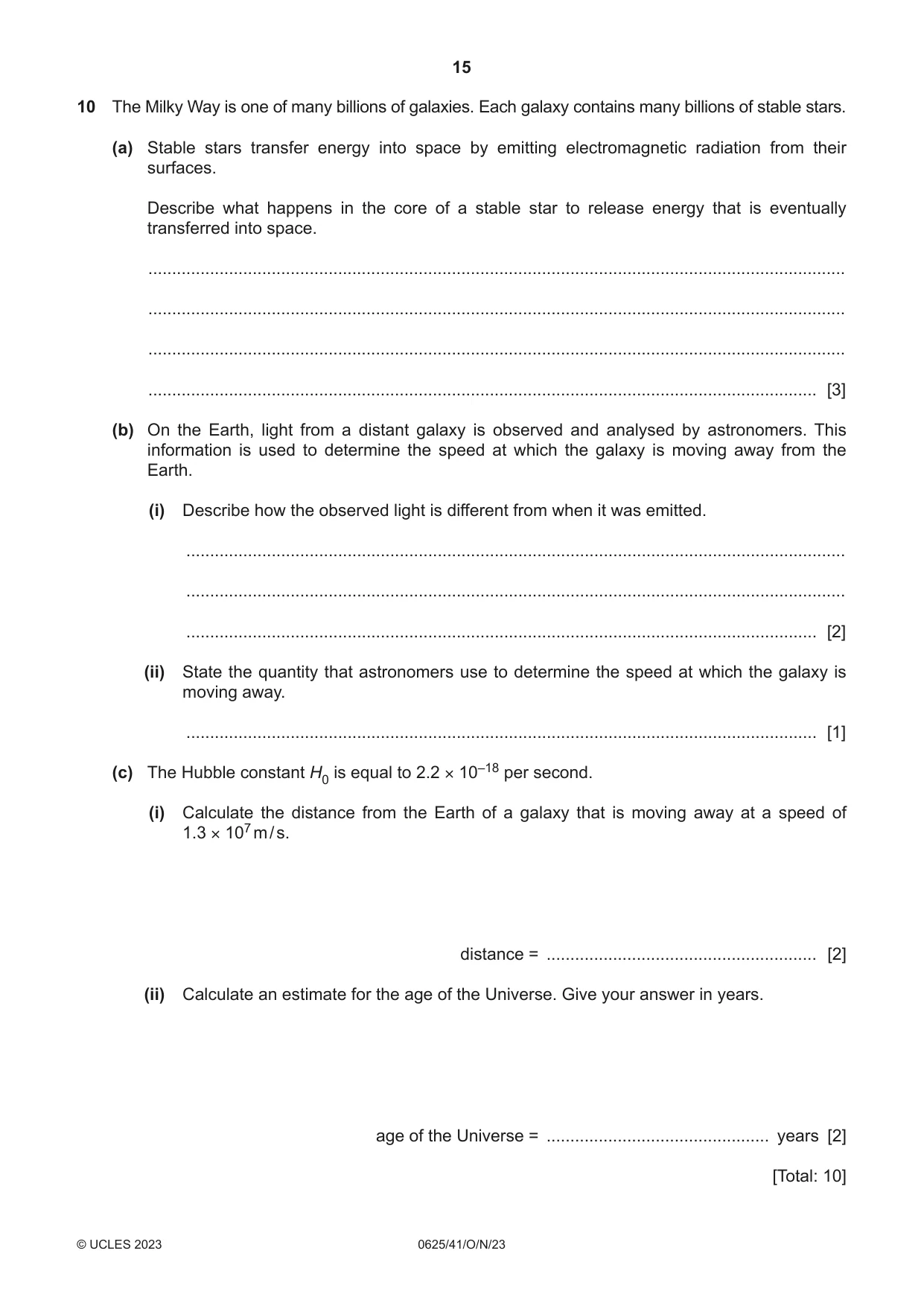
Q10 · The Milky Way is one of many billions of galaxies
10 The Milky Way is one of many billions of galaxies. Each galaxy contains many billions of stable stars. (a) Stable stars transfer energy into space by emitting electromagnetic radiation from their surfaces. Describe what happens in the core of a stable star to release energy that is eventually transferred into space. ................................................................................................................................................... ................................................................................................................................................... ................................................................................................................................................... ............................................................................................................................................. [3] (b) On the Earth, light from a distant galaxy is observed and analysed by astronomers. This information is used to determine the speed at which the galaxy is moving away from the Earth. (i) Describe how the observed light is different from when it was emitted. ........................................................................................................................................... ........................................................................................................................................... ..................................................................................................................................... [2] (ii) State the quantity that astronomers use to determine the speed at which the galaxy is moving away. ..................................................................................................................................... [1] (c) The Hubble constant H0 is equal to 2.2 × 10⁻¹⁸ per second. (i) Calculate the distance from the Earth of a galaxy that is moving away at a speed of 1.3 × 10⁷ m / s. distance = ......................................................... [2] (ii) Calculate an estimate for the age of the Universe. Give your answer in years. age of the Universe = ............................................... years [2] [Total: 10]
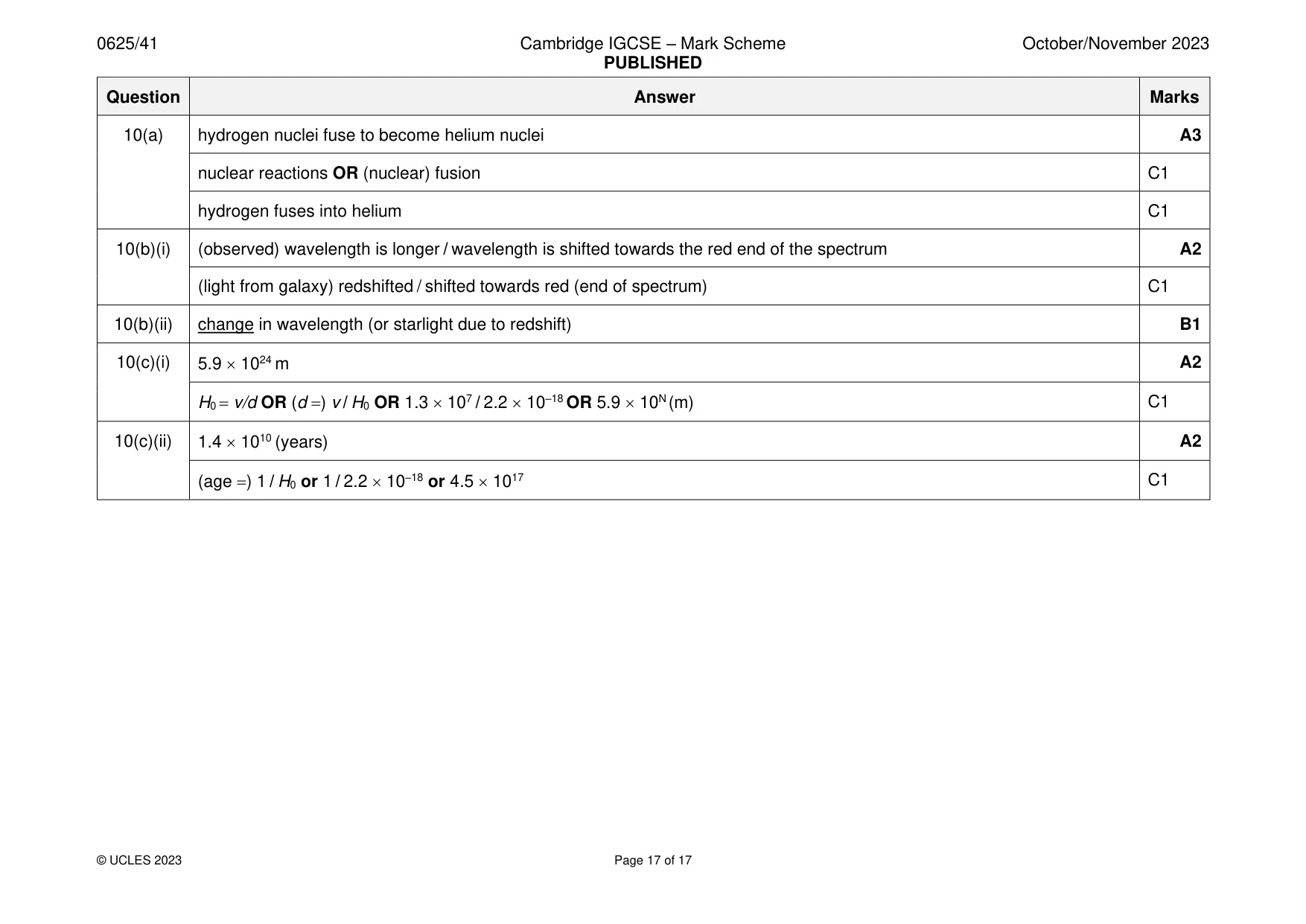
Mark scheme: 10(a) hydrogen nuclei fuse to become helium nuclei A3 nuclear reactions OR (nuclear) fusion C1 hydrogen fuses into helium C1 10(b)(i) (observed) wavelength is longer / wavelength is shifted towards the red end of the spectrum A2 (light from galaxy) redshifted / shifted towards red (end of spectrum) C1 10(b)(ii) change in wavelength (or starlight due to redshift) B1 10(c)(i) 5.9 1024 m A2 H0 = v/d OR (d =) v / H0 OR 1.3 107 / 2.2 10–18 OR 5.9 10N (m) C1 10(c)(ii) 1.4 1010 (years) A2 (age =) 1 / H0 or 1 / 2.2 10–18 or 4.5 1017 C1
What was in this paper
The subtopics covered by these 10 questions, and how many questions each got. Open one in a new tab to see every Cambridge question on it.
What you needed in this session
Cambridge’s own grade thresholds for 2023 Oct/Nov, Paper 4 · Variant 1. A higher threshold means an easier paper — the bar moves with how the cohort did.