Cambridge IGCSE Physics 0625 — 2023 Oct/Nov Paper 4 · Variant 2
0625/42/O/N/23 · 10 questions · 80 marks · ≈90 min
The question paper and its mark scheme, free to read here and free to download. This is Cambridge’s own paper, exactly as it was sat.
Question paper16 pages
Mark scheme15 pages
Answers below. Sit the paper first if you are practising.
Questions as text
Q1 · A car accelerates uniformly in a straight line from rest at time t = 0
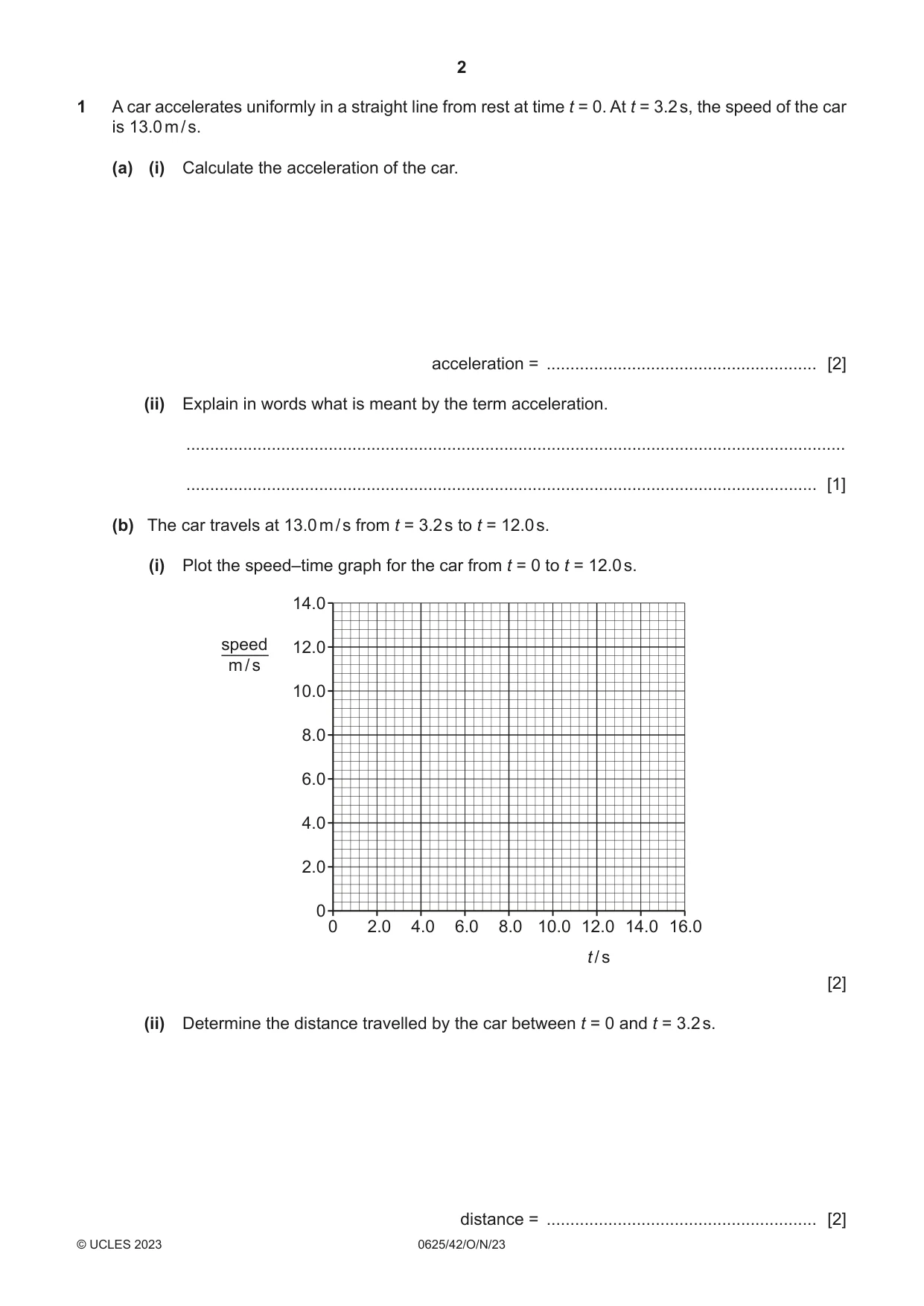
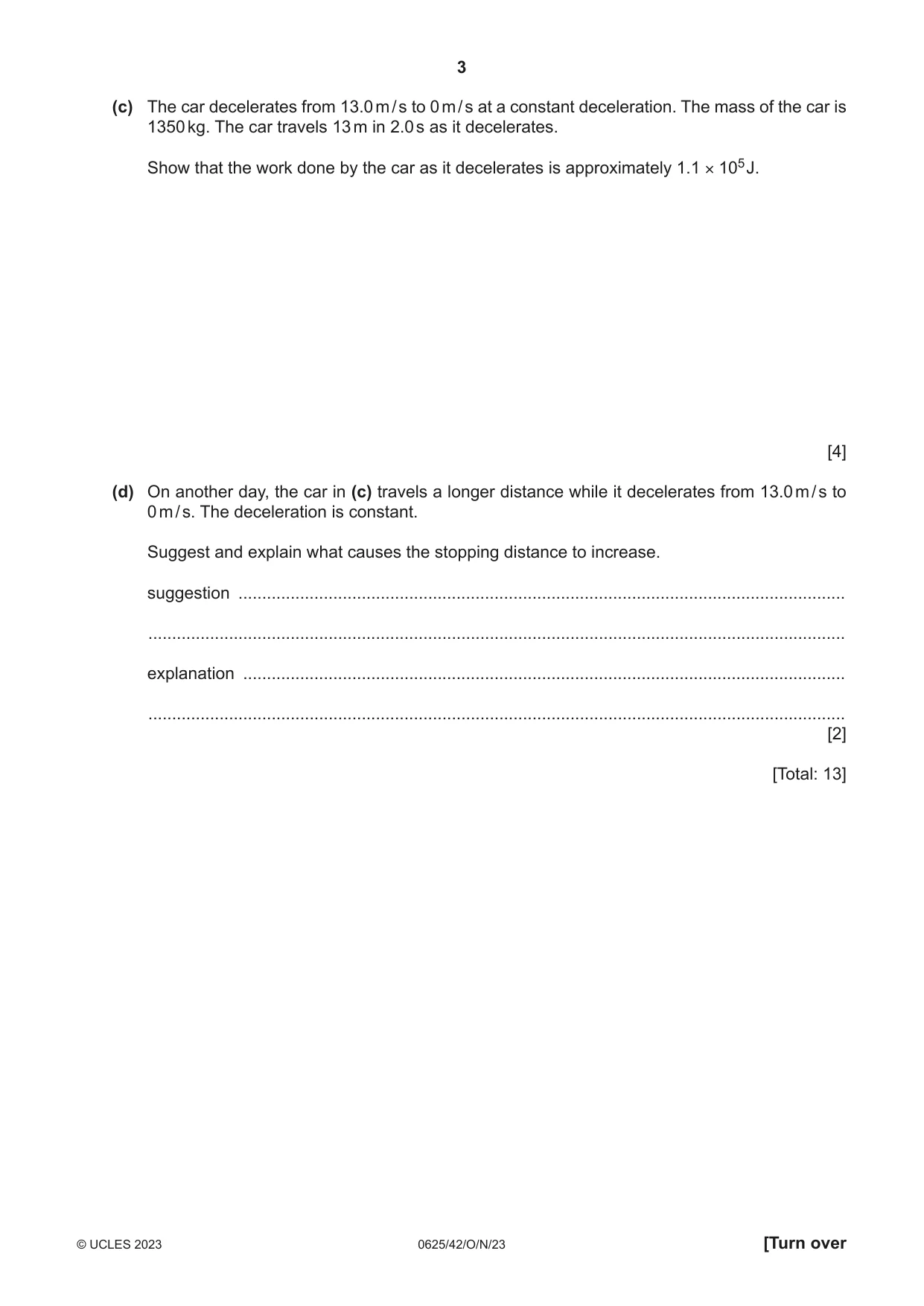
1 A car accelerates uniformly in a straight line from rest at time t = 0. At t = 3.2 s, the speed of the car is 13.0 m / s. (a) (i) Calculate the acceleration of the car. acceleration = ......................................................... [2] (ii) Explain in words what is meant by the term acceleration. ........................................................................................................................................... ..................................................................................................................................... [1] (b) The car travels at 13.0 m / s from t = 3.2 s to t = 12.0 s. (i) Plot the speed–time graph for the car from t = 0 to t = 12.0 s. 14.0 speed 12.0 m / s 10.0 8.0 6.0 4.0 2.0 0 0 2.0 4.0 6.0 8.0 10.0 12.0 14.0 16.0 t / s [2] (ii) Determine the distance travelled by the car between t = 0 and t = 3.2 s. distance = ......................................................... [2] (c) The car decelerates from 13.0 m / s to 0 m / s at a constant deceleration. The mass of the car is 1350 kg. The car travels 13 m in 2.0 s as it decelerates. Show that the work done by the car as it decelerates is approximately 1.1 × 10⁵ J. [4] (d) On another day, the car in (c) travels a longer distance while it decelerates from 13.0 m / s to 0 m / s. The deceleration is constant. Suggest and explain what causes the stopping distance to increase. suggestion ................................................................................................................................ ................................................................................................................................................... explanation ............................................................................................................................... ................................................................................................................................................... [2] [Total: 13]
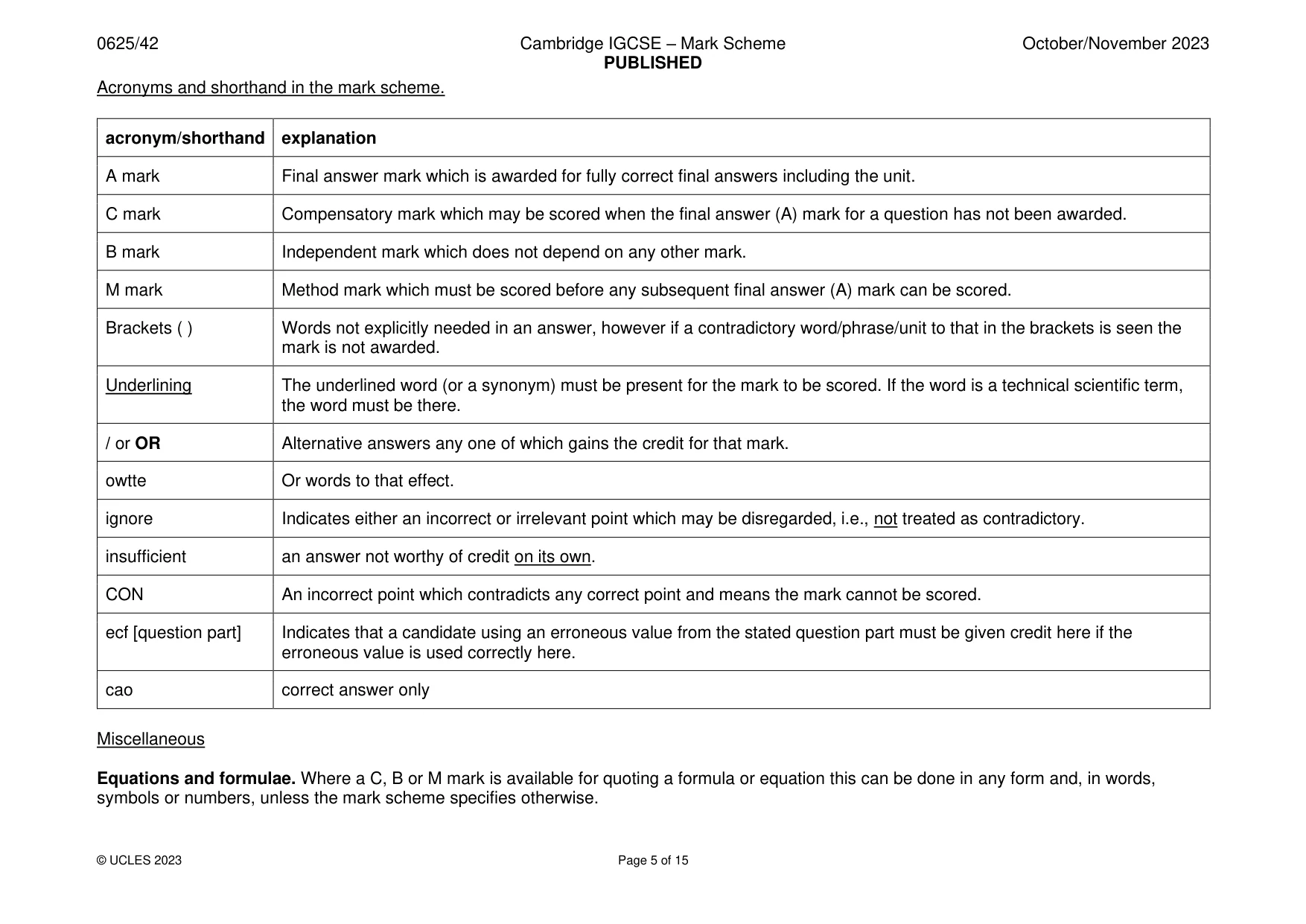
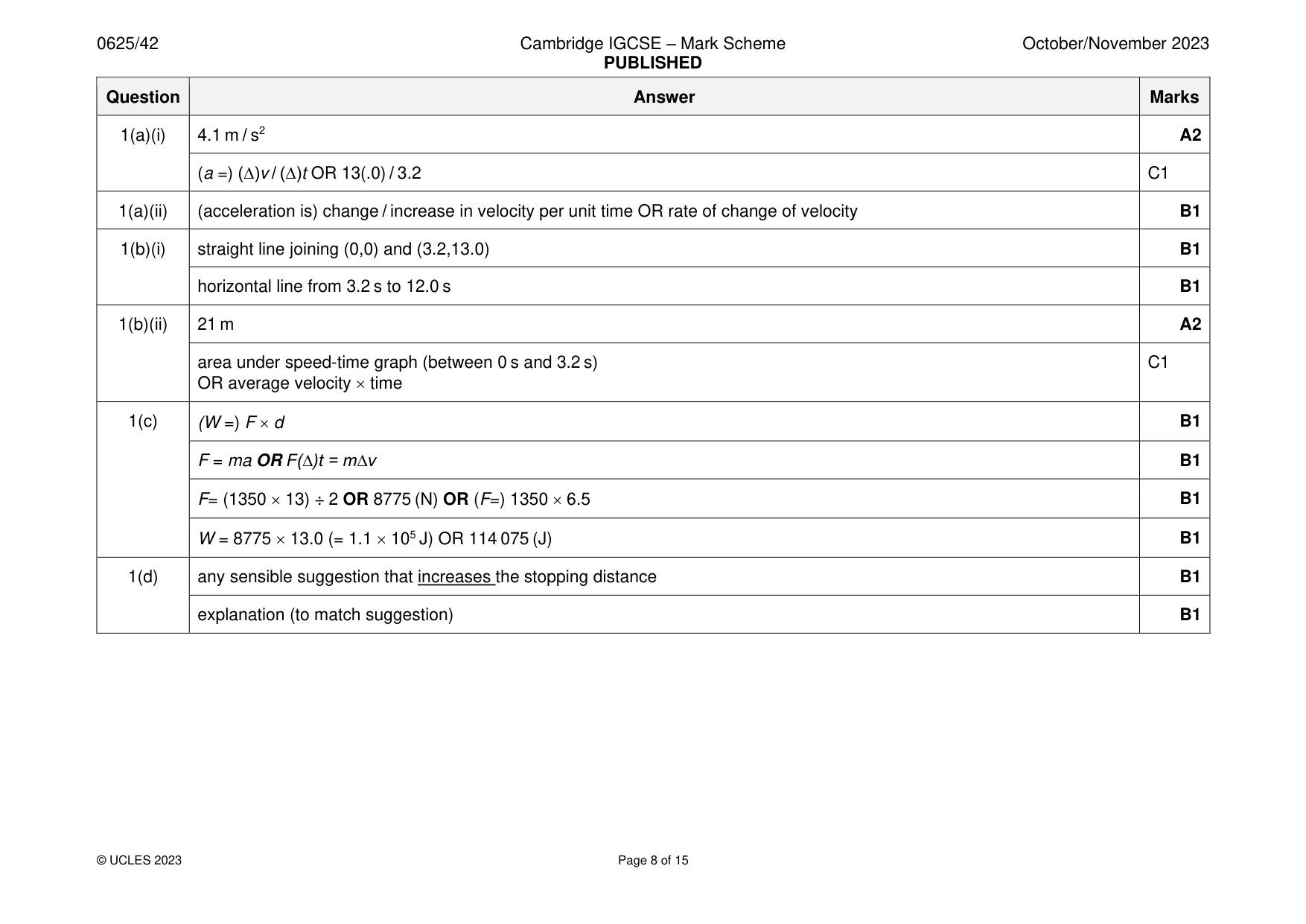
Mark scheme: Question Answer Marks 1(a)(i) 4.1 m / s2 A2 (a =) (∆)v / (∆)t OR 13(.0) / 3.2 C1 1(a)(ii) (acceleration is) change / increase in velocity per unit time OR rate of change of velocity B1 1(b)(i) straight line joining (0,0) and (3.2,13.0) B1 horizontal line from 3.2 s to 12.0 s B1 1(b)(ii) 21 m A2 area under speed-time graph (between 0 s and 3.2 s) C1 OR average velocity time 1(c) (W =) F d B1 F = ma OR F(∆)t = m∆v B1 F= (1350 13) ÷ 2 OR 8775 (N) OR (F=) 1350 6.5 B1 W = 8775 13.0 (= 1.1 105 J) OR 114 075 (J) B1 1(d) any sensible suggestion that increases the stopping distance B1 explanation (to match suggestion) B1
Q2 · An electric tumble dryer used to dry wet clothes
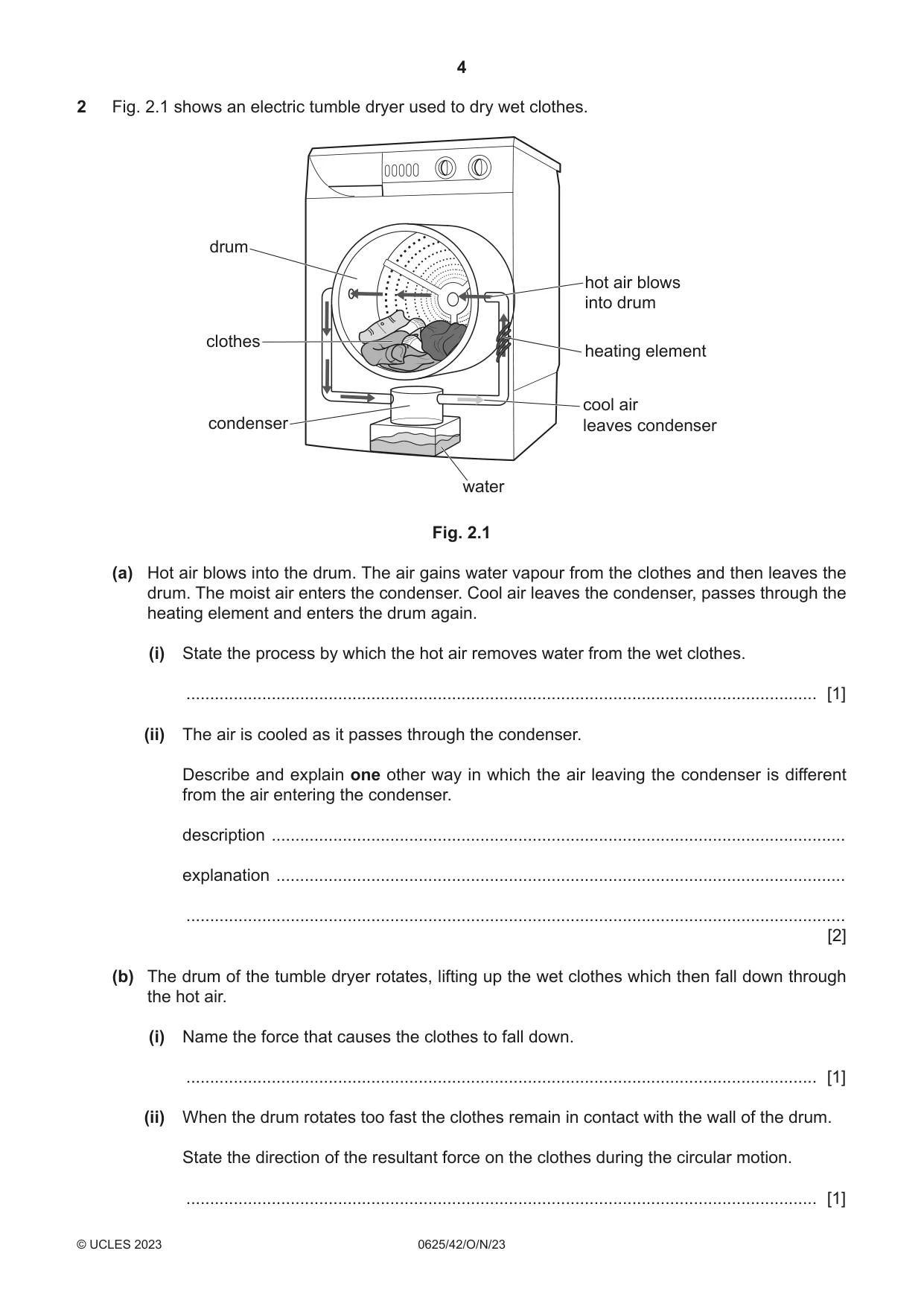
2 Fig. 2.1 shows an electric tumble dryer used to dry wet clothes. drum hot air blows into drum clothes heating element cool air condenser leaves condenser water Fig. 2.1 (a) Hot air blows into the drum. The air gains water vapour from the clothes and then leaves the drum. The moist air enters the condenser. Cool air leaves the condenser, passes through the heating element and enters the drum again. (i) State the process by which the hot air removes water from the wet clothes. ..................................................................................................................................... [1] (ii) The air is cooled as it passes through the condenser. Describe and explain one other way in which the air leaving the condenser is different from the air entering the condenser. description ......................................................................................................................... explanation ........................................................................................................................ ........................................................................................................................................... [2] (b) The drum of the tumble dryer rotates, lifting up the wet clothes which then fall down through the hot air. (i) Name the force that causes the clothes to fall down. ..................................................................................................................................... [1] (ii) When the drum rotates too fast the clothes remain in contact with the wall of the drum. State the direction of the resultant force on the clothes during the circular motion. ..................................................................................................................................... [1] (c) Suggest why using a clothesline to dry clothes in the open air is better for the environment than using an electric tumble dryer. ................................................................................................................................................... ............................................................................................................................................. [1] [Total: 6]
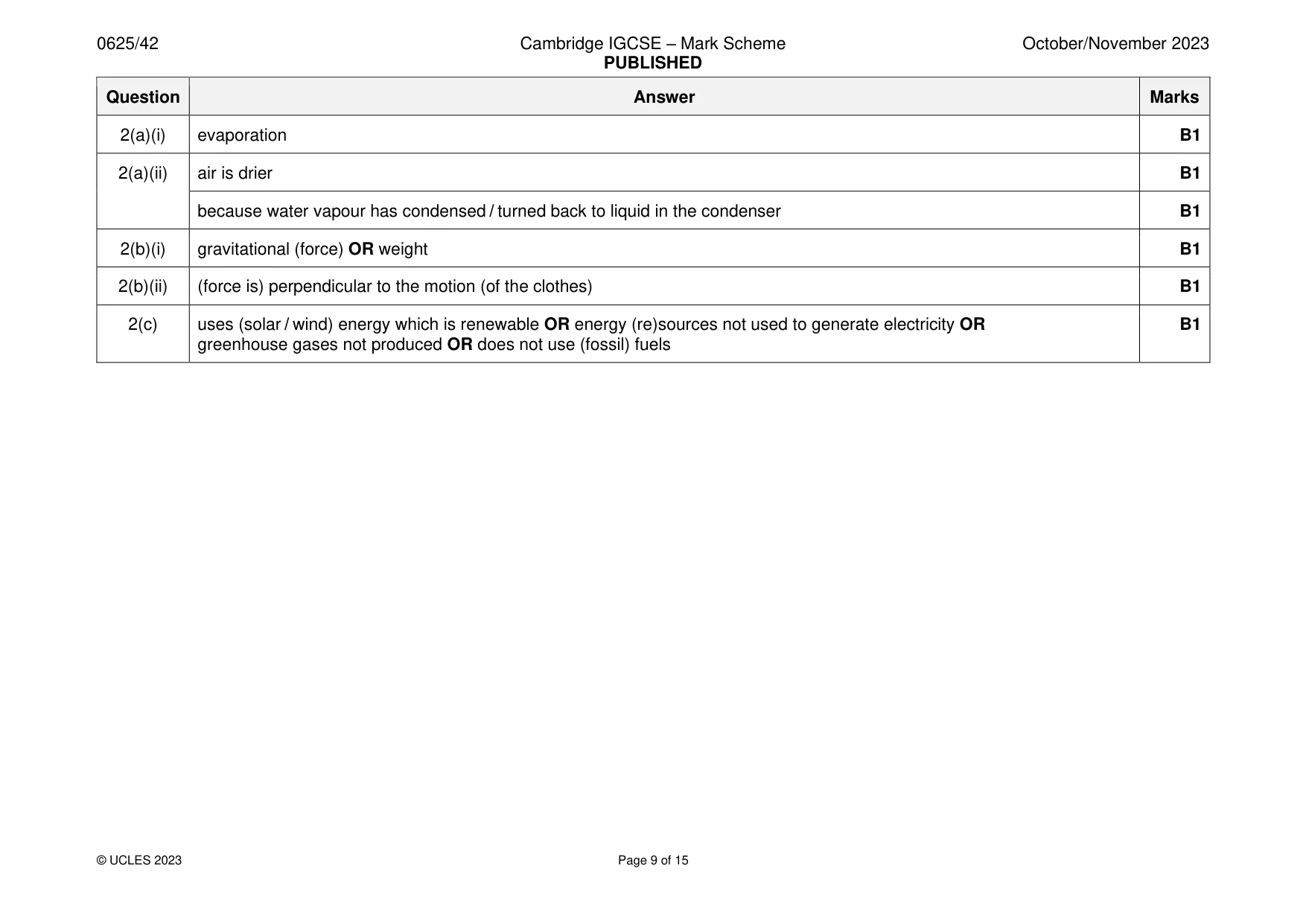
Mark scheme: 2(a)(i) evaporation B1 2(a)(ii) air is drier B1 because water vapour has condensed / turned back to liquid in the condenser B1 2(b)(i) gravitational (force) OR weight B1 2(b)(ii) (force is) perpendicular to the motion (of the clothes) B1 2(c) uses (solar / wind) energy which is renewable OR energy (re)sources not used to generate electricity OR B1 greenhouse gases not produced OR does not use (fossil) fuels
Q3 · A balloon of mass 15 g is glued to a straw
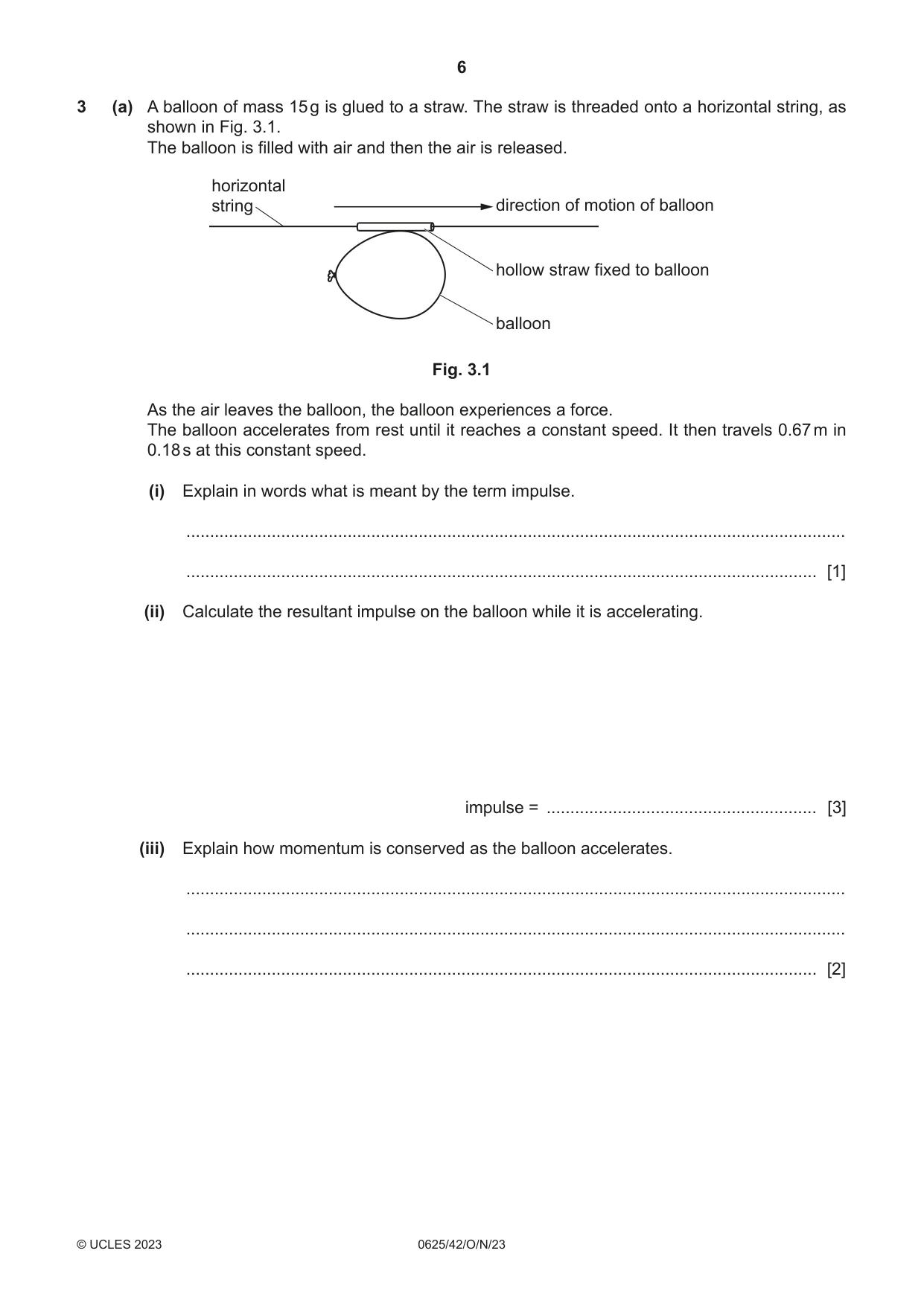
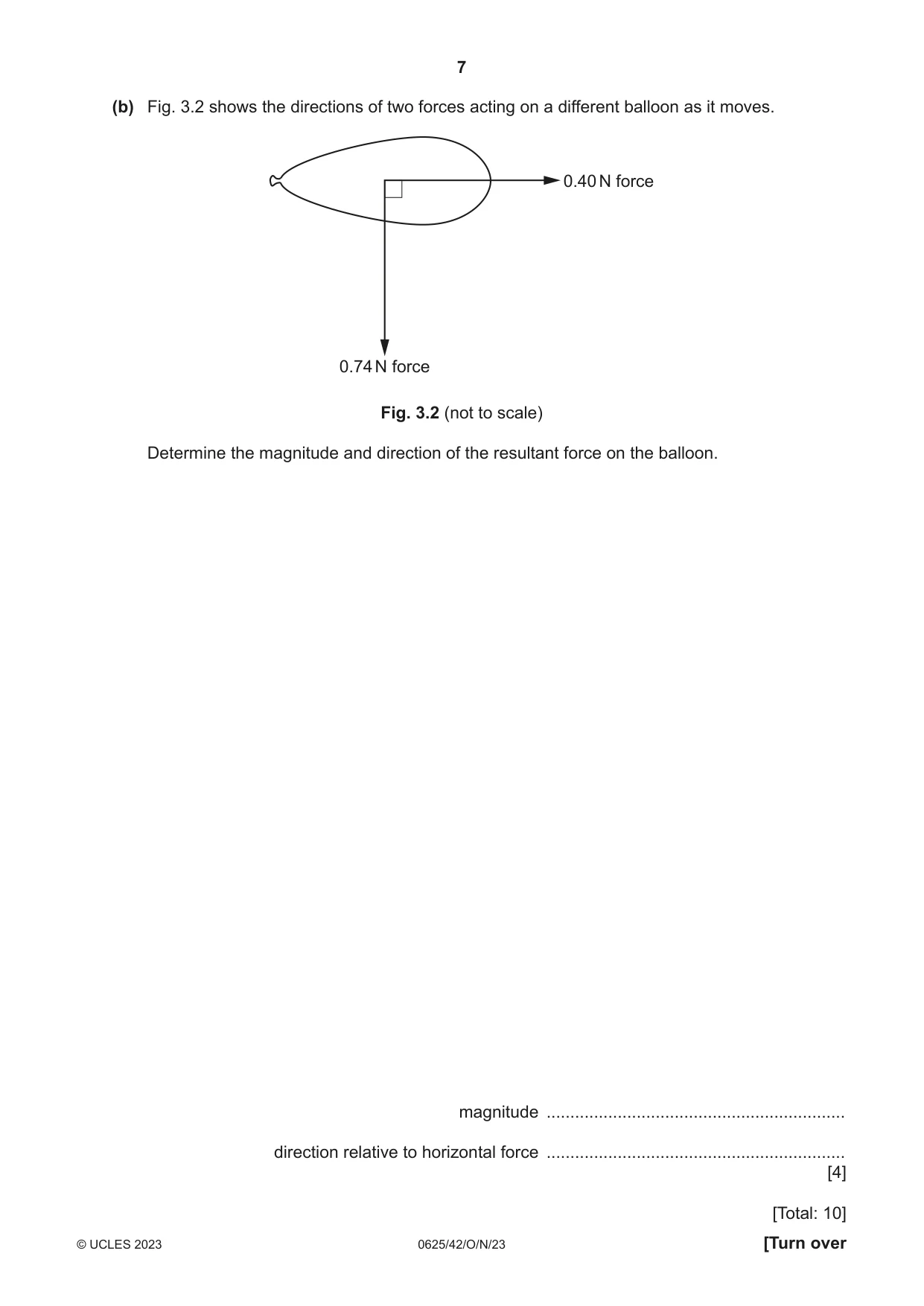
3 (a) A balloon of mass 15 g is glued to a straw. The straw is threaded onto a horizontal string, as shown in Fig. 3.1. The balloon is filled with air and then the air is released. horizontal string direction of motion of balloon hollow straw fixed to balloon balloon Fig. 3.1 As the air leaves the balloon, the balloon experiences a force. The balloon accelerates from rest until it reaches a constant speed. It then travels 0.67 m in 0.18 s at this constant speed. (i) Explain in words what is meant by the term impulse. ........................................................................................................................................... ..................................................................................................................................... [1] (ii) Calculate the resultant impulse on the balloon while it is accelerating. impulse = ......................................................... [3] (iii) Explain how momentum is conserved as the balloon accelerates. ........................................................................................................................................... ........................................................................................................................................... ..................................................................................................................................... [2] (b) Fig. 3.2 shows the directions of two forces acting on a different balloon as it moves. 0.40 N force 0.74 N force Fig. 3.2 (not to scale) Determine the magnitude and direction of the resultant force on the balloon. magnitude ............................................................... direction relative to horizontal force ............................................................... [4] [Total: 10]
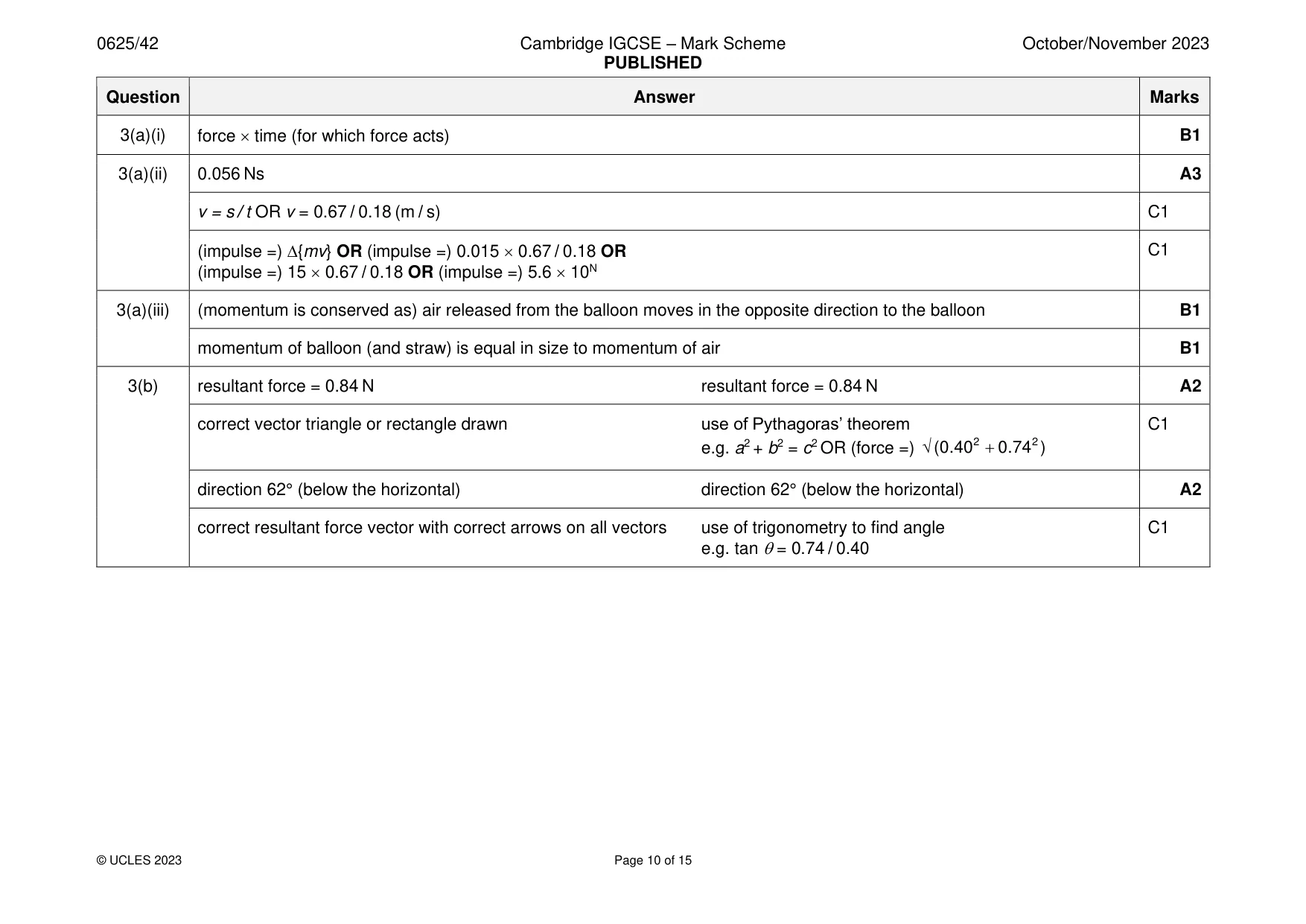
Mark scheme: 3(a)(i) force time (for which force acts) B1 3(a)(ii) 0.056 Ns A3 v = s / t OR v = 0.67 / 0.18 (m / s) C1 (impulse =) ∆{mv} OR (impulse =) 0.015 0.67 / 0.18 OR C1 (impulse =) 15 0.67 / 0.18 OR (impulse =) 5.6 10N 3(a)(iii) (momentum is conserved as) air released from the balloon moves in the opposite direction to the balloon B1 momentum of balloon (and straw) is equal in size to momentum of air B1 3(b) resultant force = 0.84 N resultant force = 0.84 N A2 correct vector triangle or rectangle drawn use of Pythagoras’ theorem C1 e.g. a2 + b2 = c2 OR (force =) (0.40 2 + 0.74 2 ) direction 62° (below the horizontal) direction 62° (below the horizontal) A2 correct resultant force vector with correct arrows on all vectors use of trigonometry to find angle C1 e.g. tan = 0.74 / 0.40
Q4 · A bottle part-filled with water
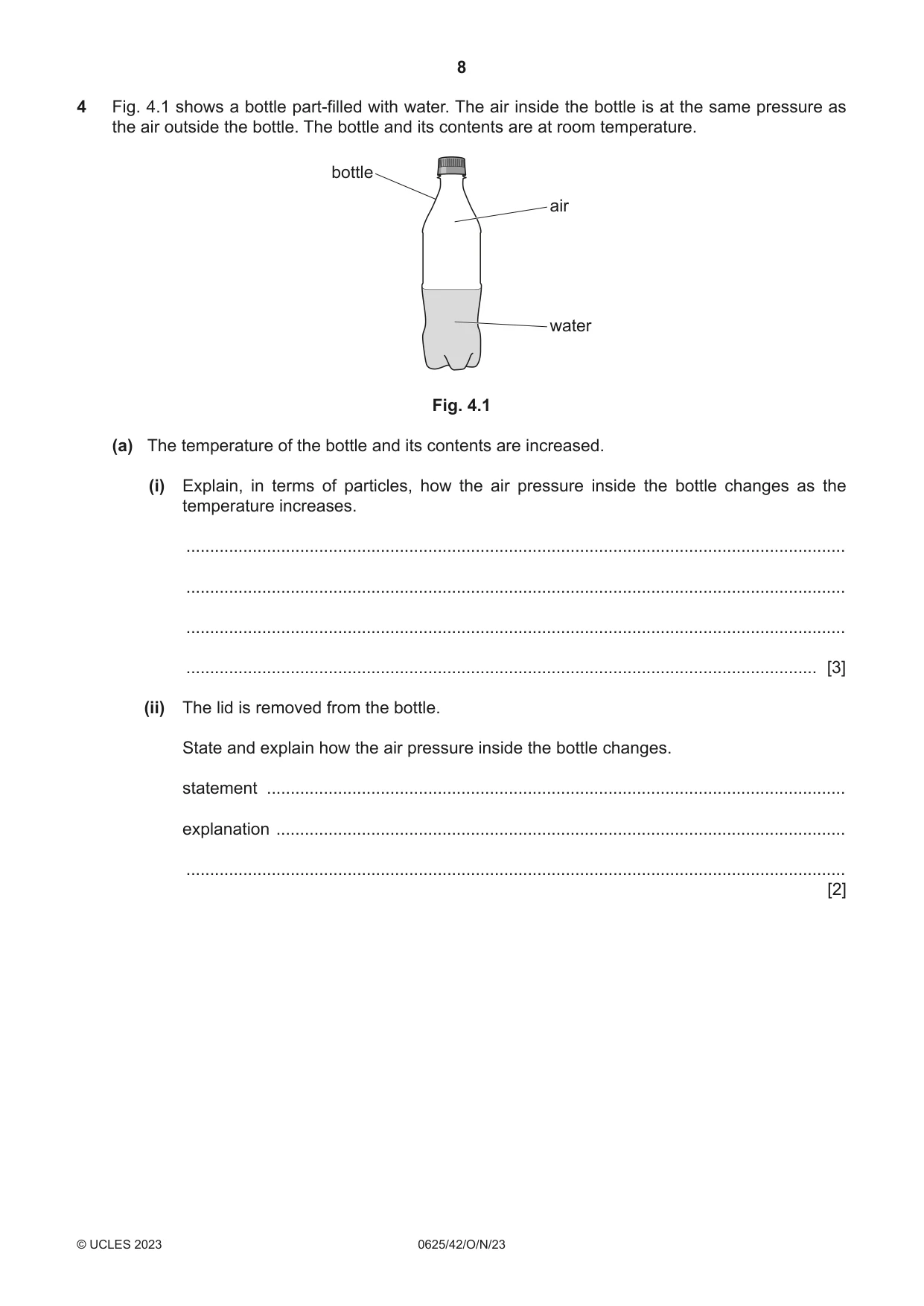
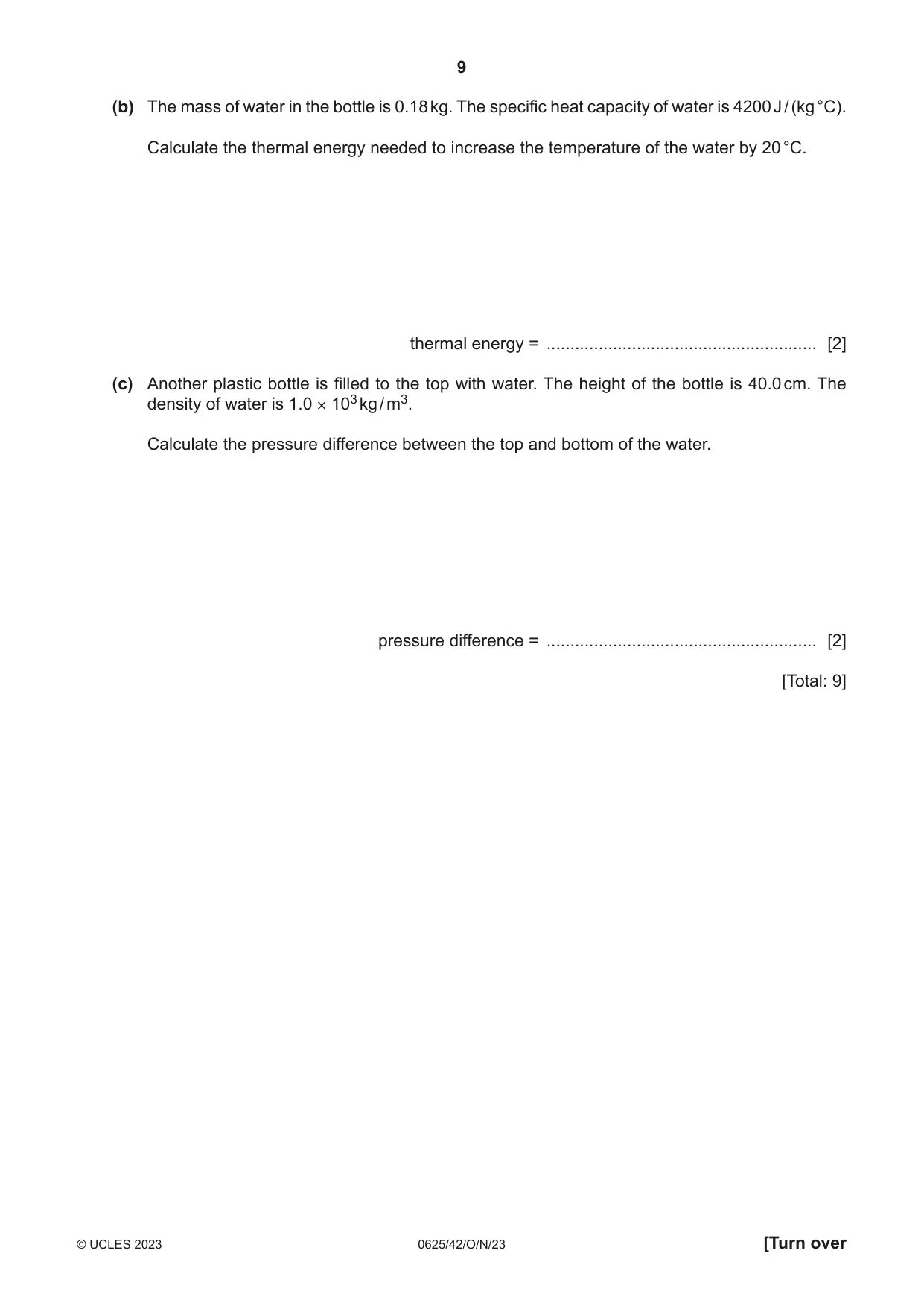
4 Fig. 4.1 shows a bottle part-filled with water. The air inside the bottle is at the same pressure as the air outside the bottle. The bottle and its contents are at room temperature. bottle air water Fig. 4.1 (a) The temperature of the bottle and its contents are increased. (i) Explain, in terms of particles, how the air pressure inside the bottle changes as the temperature increases. ........................................................................................................................................... ........................................................................................................................................... ........................................................................................................................................... ..................................................................................................................................... [3] (ii) The lid is removed from the bottle. State and explain how the air pressure inside the bottle changes. statement .......................................................................................................................... explanation ........................................................................................................................ ........................................................................................................................................... [2] (b) The mass of water in the bottle is 0.18 kg. The specific heat capacity of water is 4200 J / (kg °C). Calculate the thermal energy needed to increase the temperature of the water by 20 °C. thermal energy = ......................................................... [2] (c) Another plastic bottle is filled to the top with water. The height of the bottle is 40.0 cm. The density of water is 1.0 × 10³ kg / m3. Calculate the pressure difference between the top and bottom of the water. pressure difference = ......................................................... [2] [Total: 9]
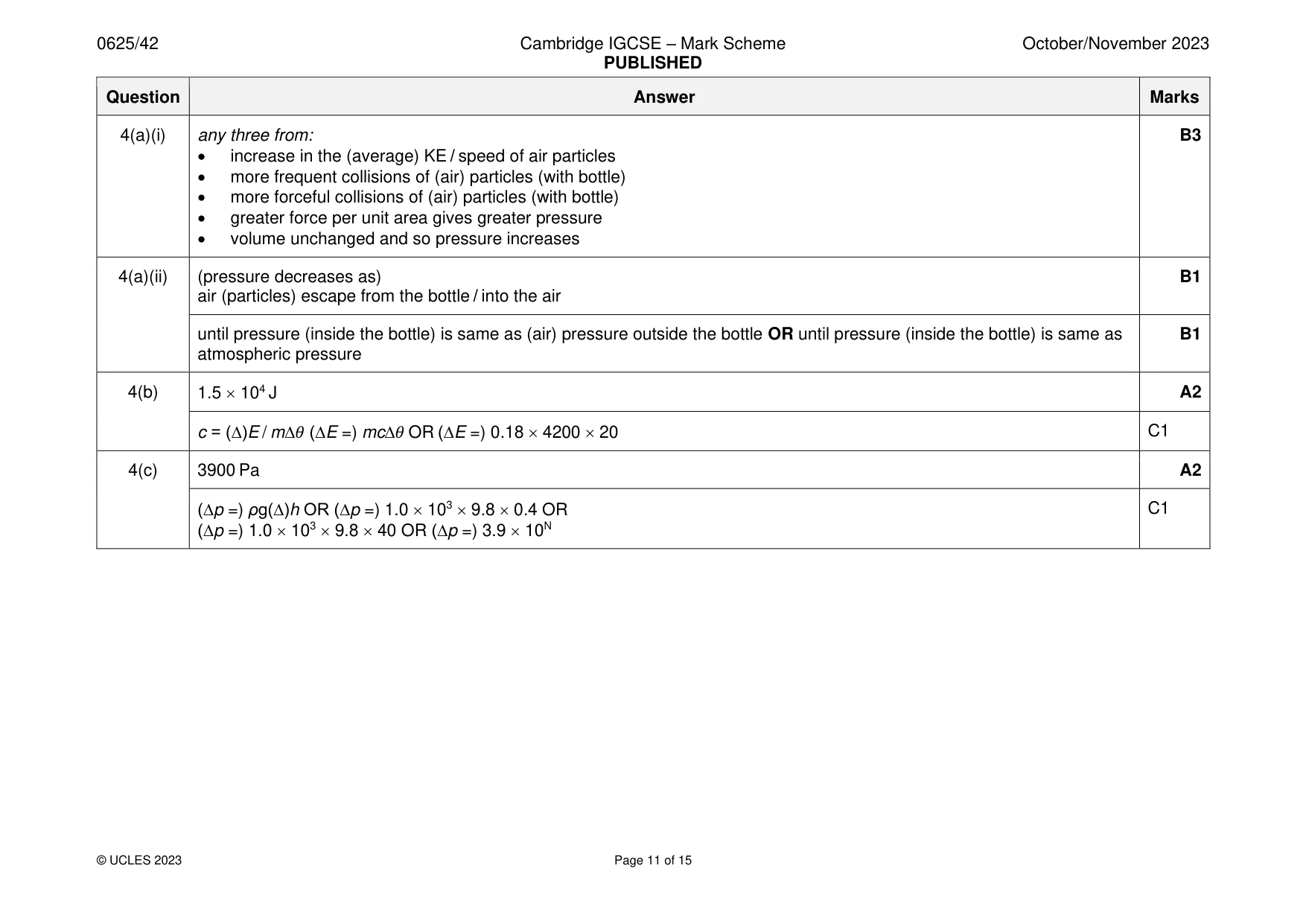
Mark scheme: 4(a)(i) any three from: B3 • increase in the (average) KE / speed of air particles • more frequent collisions of (air) particles (with bottle) • more forceful collisions of (air) particles (with bottle) • greater force per unit area gives greater pressure • volume unchanged and so pressure increases 4(a)(ii) (pressure decreases as) B1 air (particles) escape from the bottle / into the air until pressure (inside the bottle) is same as (air) pressure outside the bottle OR until pressure (inside the bottle) is same as B1 atmospheric pressure 4(b) 1.5 104 J A2 c = (∆)E / m∆𝜃 (∆E =) mc∆𝜃 OR (∆E =) 0.18 4200 20 C1 4(c) 3900 Pa A2 (∆p =) ρg(∆)h OR (∆p =) 1.0 103 9.8 0.4 OR C1 (∆p =) 1.0 103 9.8 40 OR (∆p =) 3.9 10N
Q5 · A road junction, a moving car and a stationary truck
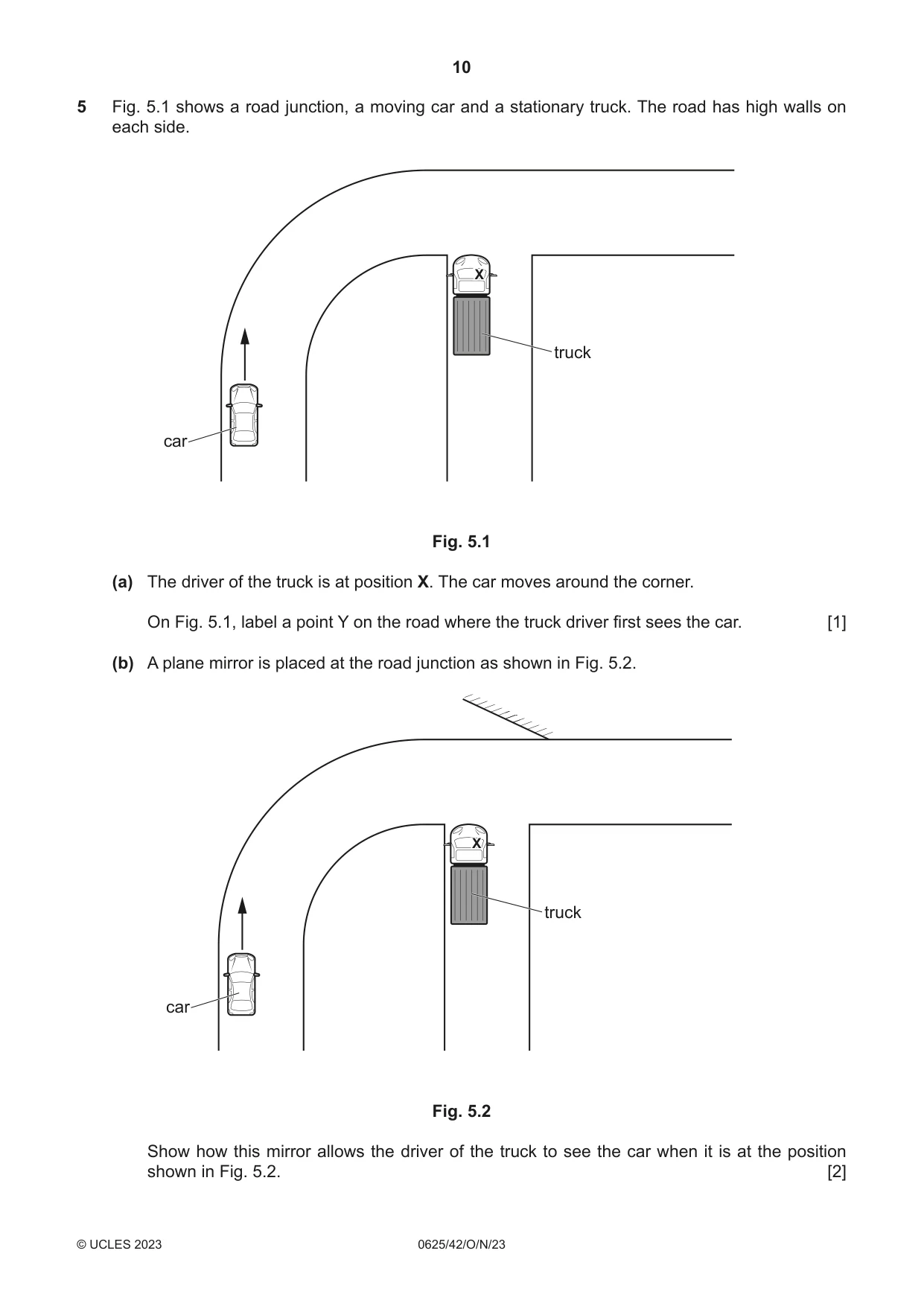
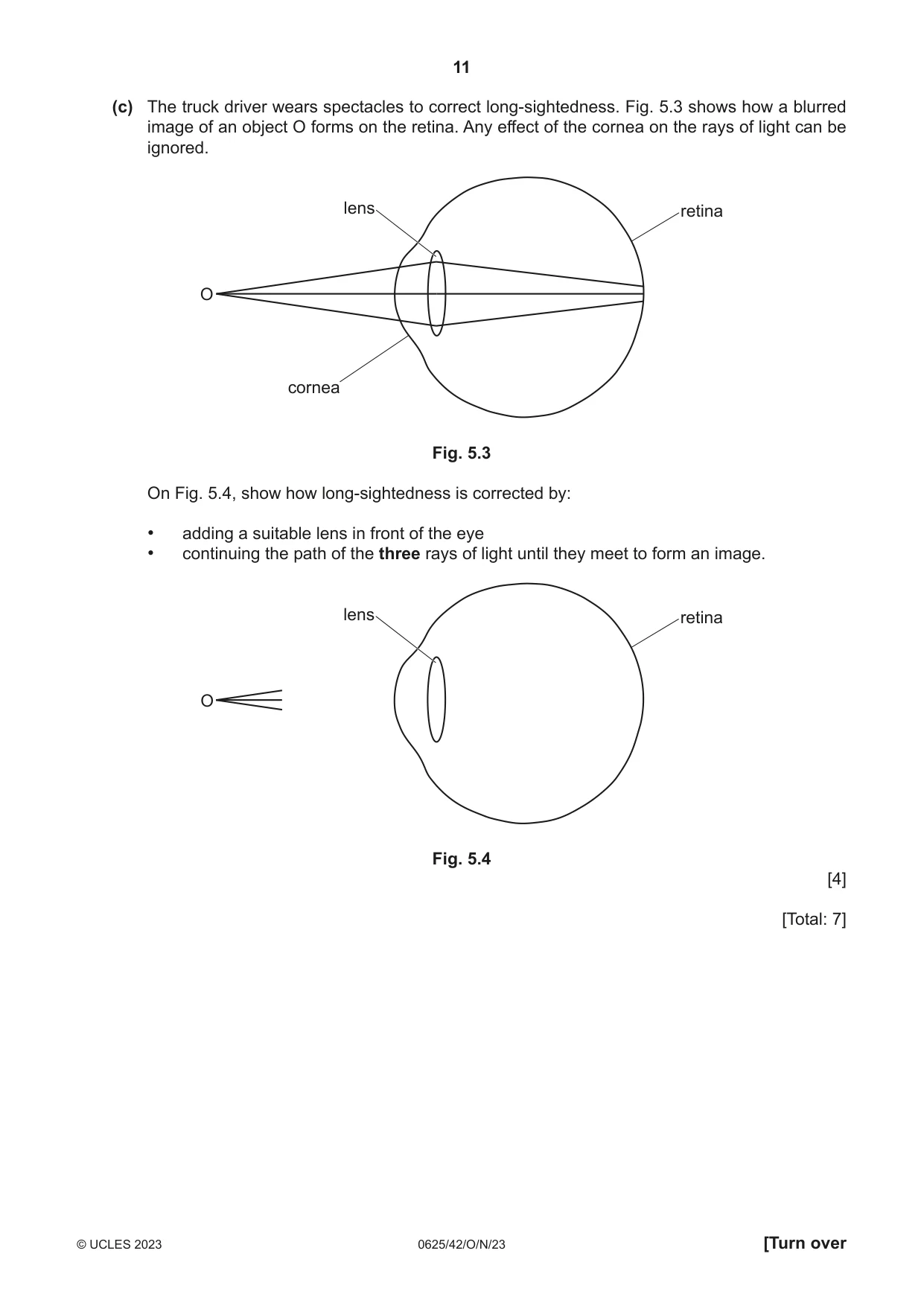
5 Fig. 5.1 shows a road junction, a moving car and a stationary truck. The road has high walls on each side. X truck car Fig. 5.1 (a) The driver of the truck is at position X. The car moves around the corner. On Fig. 5.1, label a point Y on the road where the truck driver first sees the car. [1] (b) A plane mirror is placed at the road junction as shown in Fig. 5.2. X truck car Fig. 5.2 Show how this mirror allows the driver of the truck to see the car when it is at the position shown in Fig. 5.2. [2] (c) The truck driver wears spectacles to correct long-sightedness. Fig. 5.3 shows how a blurred image of an object O forms on the retina. Any effect of the cornea on the rays of light can be ignored. lens retina O cornea Fig. 5.3 On Fig. 5.4, show how long-sightedness is corrected by: • adding a suitable lens in front of the eye • continuing the path of the three rays of light until they meet to form an image. lens retina O Fig. 5.4 [4] [Total: 7]
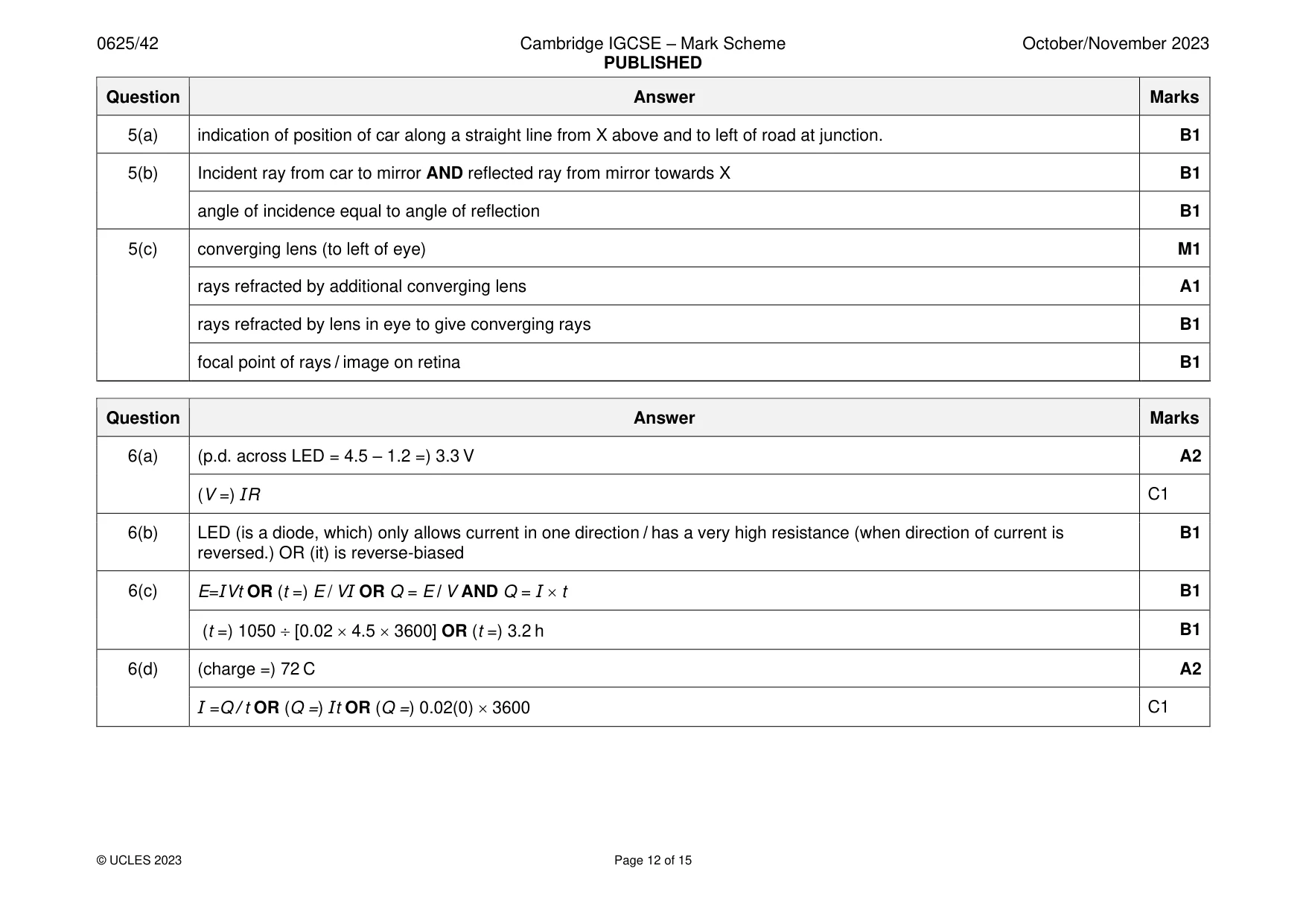
Mark scheme: 5(a) indication of position of car along a straight line from X above and to left of road at junction. B1 5(b) Incident ray from car to mirror AND reflected ray from mirror towards X B1 angle of incidence equal to angle of reflection B1 5(c) converging lens (to left of eye) M1 rays refracted by additional converging lens A1 rays refracted by lens in eye to give converging rays B1 focal point of rays / image on retina B1
Q6 · The circuit diagram for a flashlight (torch)
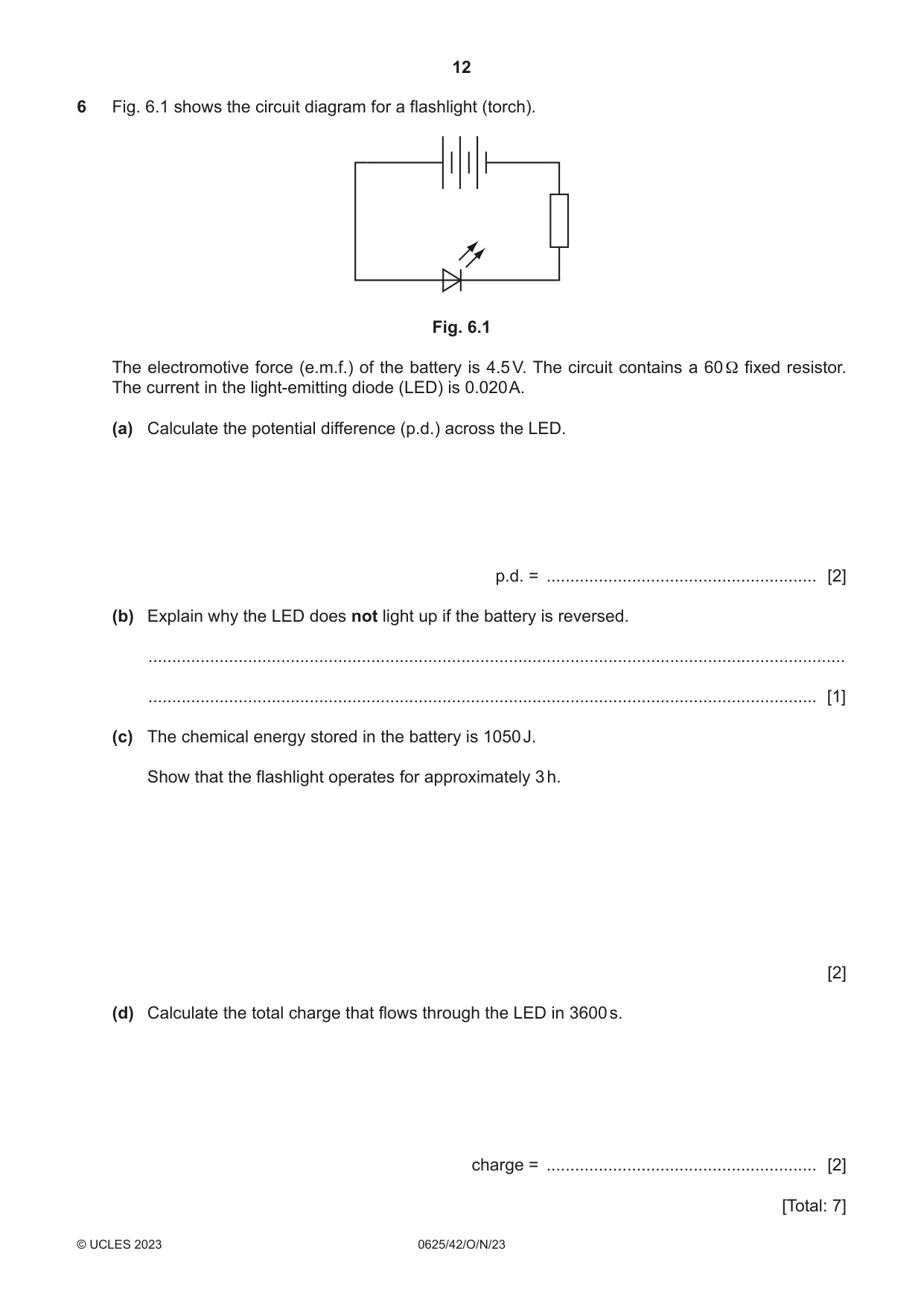
6 Fig. 6.1 shows the circuit diagram for a flashlight (torch). Fig. 6.1 The electromotive force (e.m.f.) of the battery is 4.5 V. The circuit contains a 60 Ω fixed resistor. The current in the light-emitting diode (LED) is 0.020 A. (a) Calculate the potential difference (p.d.) across the LED. p.d. = ......................................................... [2] (b) Explain why the LED does not light up if the battery is reversed. ................................................................................................................................................... ............................................................................................................................................. [1] (c) The chemical energy stored in the battery is 1050 J. Show that the flashlight operates for approximately 3 h. [2] (d) Calculate the total charge that flows through the LED in 3600 s. charge = ......................................................... [2] [Total: 7]
Mark scheme: 6(a) (p.d. across LED = 4.5 – 1.2 =) 3.3 V A2 (V =) IR C1 6(b) LED (is a diode, which) only allows current in one direction / has a very high resistance (when direction of current is B1 reversed.) OR (it) is reverse-biased 6(c) E=IVt OR (t =) E / VI OR Q = E / V AND Q = I t B1 (t =) 1050 [0.02 4.5 3600] OR (t =) 3.2 h B1 6(d) (charge =) 72 C A2 I =Q / t OR (Q =) It OR (Q =) 0.02(0) 3600 C1
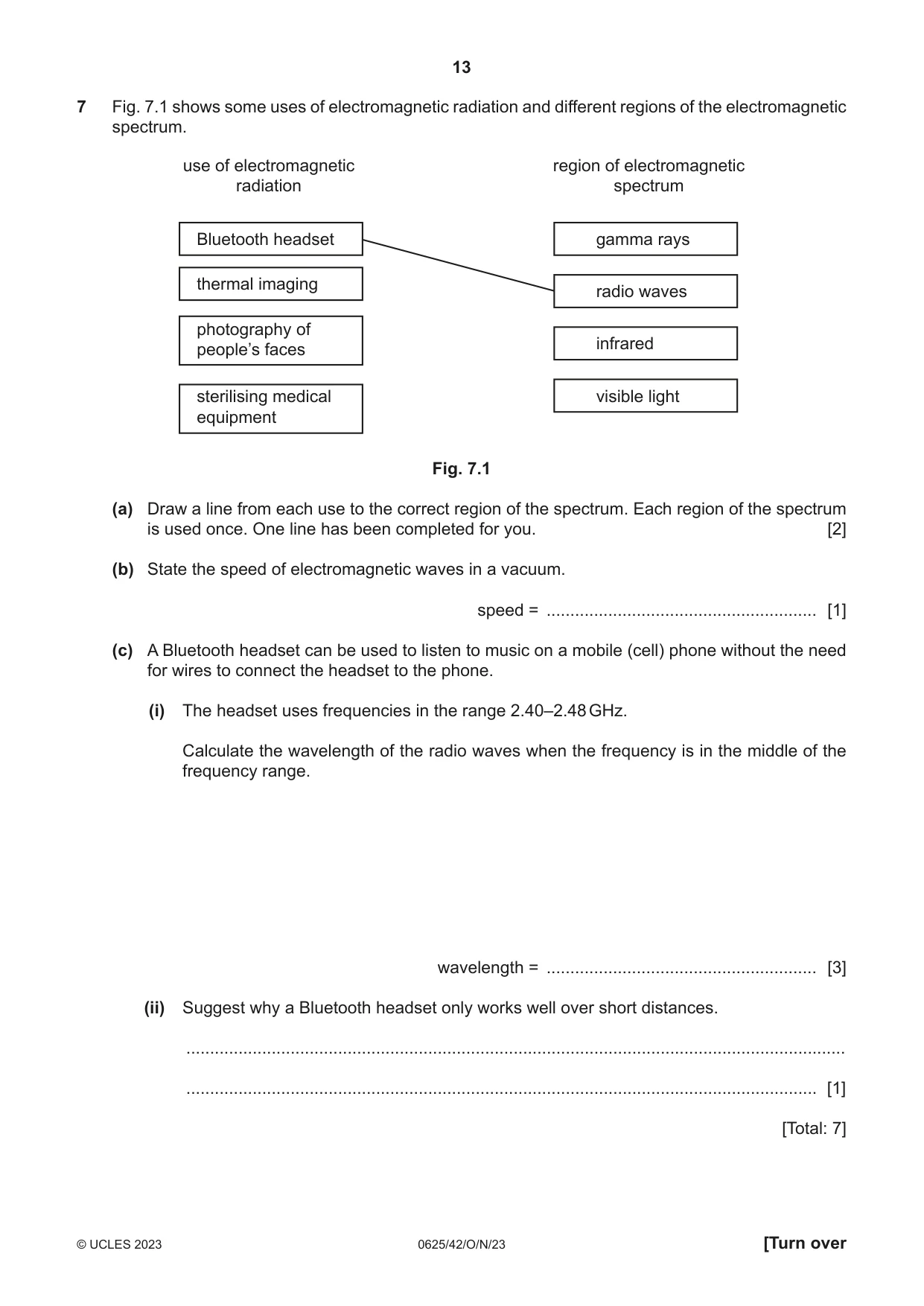
Q7 · Some uses of electromagnetic radiation and different regions of the electromagnetic…
7 Fig. 7.1 shows some uses of electromagnetic radiation and different regions of the electromagnetic spectrum. use of electromagnetic region of electromagnetic radiation spectrum Bluetooth headset gamma rays thermal imaging radio waves photography of infrared people’s faces sterilising medical visible light equipment Fig. 7.1 (a) Draw a line from each use to the correct region of the spectrum. Each region of the spectrum is used once. One line has been completed for you. [2] (b) State the speed of electromagnetic waves in a vacuum. speed = ......................................................... [1] (c) A Bluetooth headset can be used to listen to music on a mobile (cell) phone without the need for wires to connect the headset to the phone. (i) The headset uses frequencies in the range 2.40–2.48 GHz. Calculate the wavelength of the radio waves when the frequency is in the middle of the frequency range. wavelength = ......................................................... [3] (ii) Suggest why a Bluetooth headset only works well over short distances. ........................................................................................................................................... ..................................................................................................................................... [1] [Total: 7]
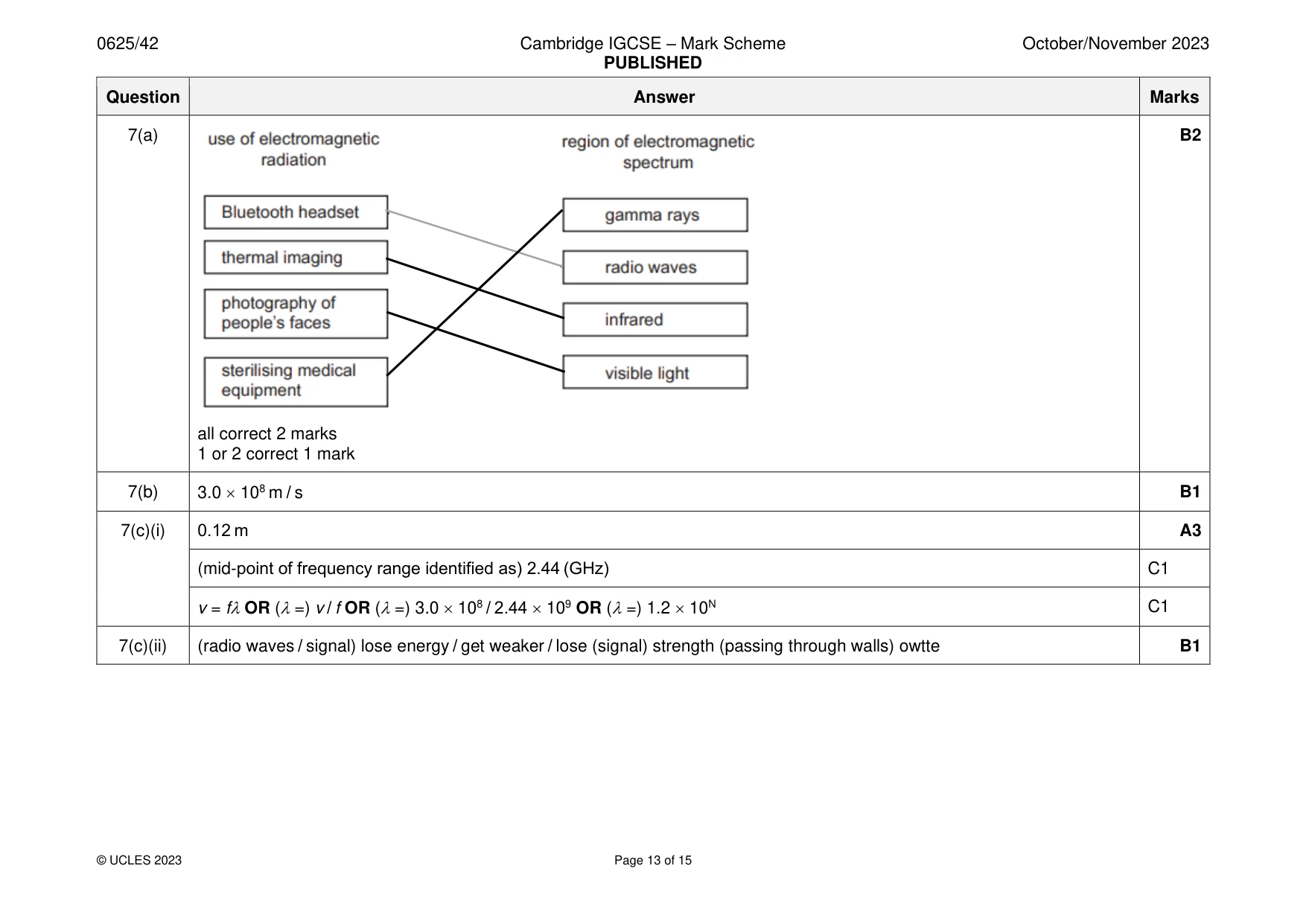
Mark scheme: 7(a) B2 all correct 2 marks 1 or 2 correct 1 mark 7(b) 3.0 108 m / s B1 7(c)(i) 0.12 m A3 (mid-point of frequency range identified as) 2.44 (GHz) C1 v = fOR (=) v / f OR (=) 3.0 108 / 2.44 109 OR (=) 1.2 10N C1 7(c)(ii) (radio waves / signal) lose energy / get weaker / lose (signal) strength (passing through walls) owtte B1
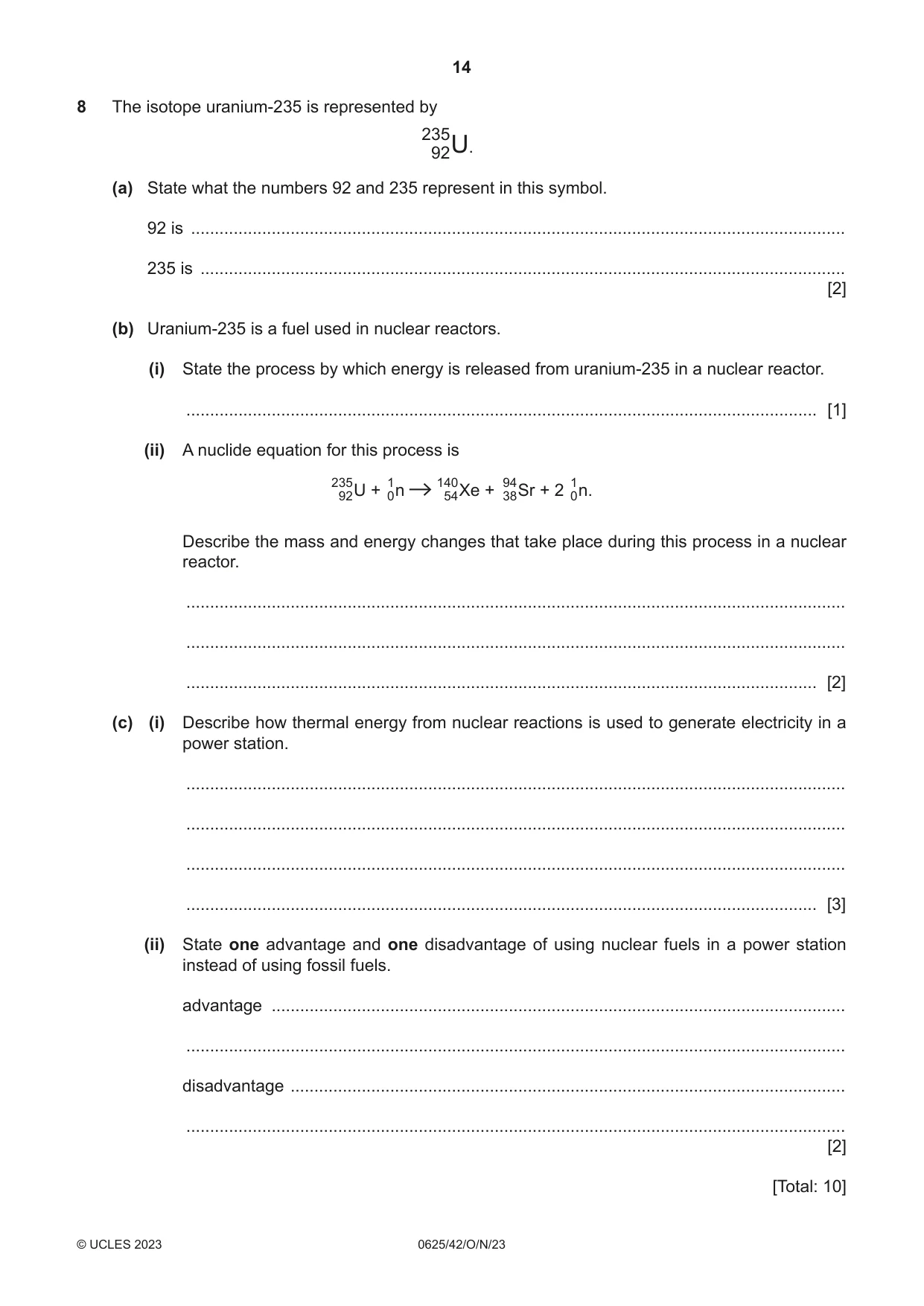
Q8 · The isotope uranium-235 is represented by 235 92 U
8 The isotope uranium-235 is represented by 235 92 U. (a) State what the numbers 92 and 235 represent in this symbol. 92 is .......................................................................................................................................... 235 is ........................................................................................................................................ [2] (b) Uranium-235 is a fuel used in nuclear reactors. (i) State the process by which energy is released from uranium-235 in a nuclear reactor. ..................................................................................................................................... [1] (ii) A nuclide equation for this process is 235 92 U + 10 n 14054 Xe + 9438 Sr + 2 10 n. Describe the mass and energy changes that take place during this process in a nuclear reactor. ........................................................................................................................................... ........................................................................................................................................... ..................................................................................................................................... [2] (c) (i) Describe how thermal energy from nuclear reactions is used to generate electricity in a power station. ........................................................................................................................................... ........................................................................................................................................... ........................................................................................................................................... ..................................................................................................................................... [3] (ii) State one advantage and one disadvantage of using nuclear fuels in a power station instead of using fossil fuels. advantage ......................................................................................................................... ........................................................................................................................................... disadvantage ..................................................................................................................... ........................................................................................................................................... [2] [Total: 10]
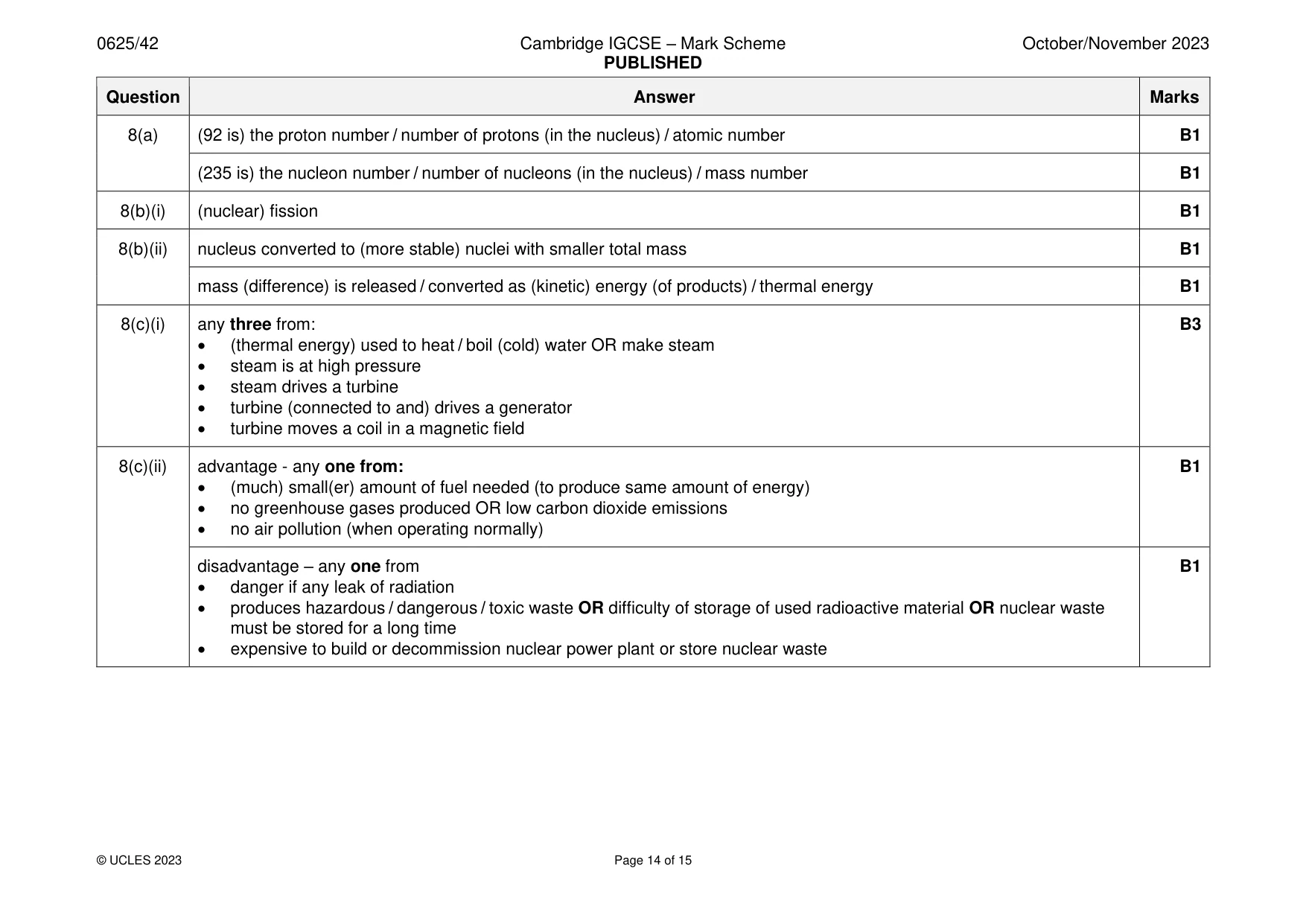
Mark scheme: 8(a) (92 is) the proton number / number of protons (in the nucleus) / atomic number B1 (235 is) the nucleon number / number of nucleons (in the nucleus) / mass number B1 8(b)(i) (nuclear) fission B1 8(b)(ii) nucleus converted to (more stable) nuclei with smaller total mass B1 mass (difference) is released / converted as (kinetic) energy (of products) / thermal energy B1 8(c)(i) any three from: B3 • (thermal energy) used to heat / boil (cold) water OR make steam • steam is at high pressure • steam drives a turbine • turbine (connected to and) drives a generator • turbine moves a coil in a magnetic field 8(c)(ii) advantage - any one from: B1 • (much) small(er) amount of fuel needed (to produce same amount of energy) • no greenhouse gases produced OR low carbon dioxide emissions • no air pollution (when operating normally) disadvantage – any one from B1 • danger if any leak of radiation • produces hazardous / dangerous / toxic waste OR difficulty of storage of used radioactive material OR nuclear waste must be stored for a long time • expensive to build or decommission nuclear power plant or store nuclear waste
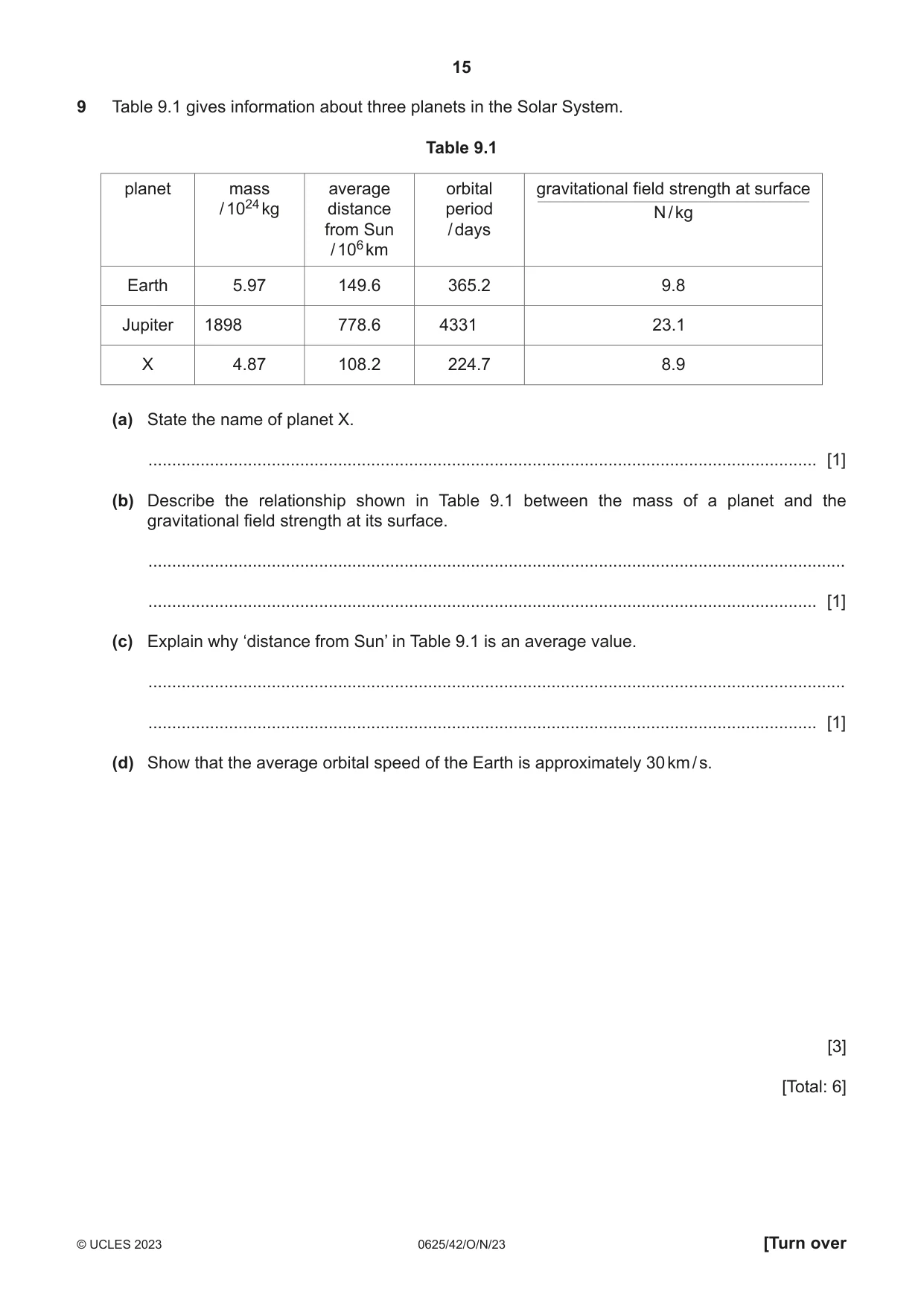
Q9 · Information about three planets in the Solar System
9 Table 9.1 gives information about three planets in the Solar System. Table 9.1 planet mass average orbital gravitational field strength at surface / 1024 kg distance period N / kg from Sun / days / 106 km Earth 5.97 149.6 365.2 9.8 Jupiter 1898 778.6 4331 23.1 X 4.87 108.2 224.7 8.9 (a) State the name of planet X. ............................................................................................................................................. [1] (b) Describe the relationship shown in Table 9.1 between the mass of a planet and the gravitational field strength at its surface. ................................................................................................................................................... ............................................................................................................................................. [1] (c) Explain why ‘distance from Sun’ in Table 9.1 is an average value. ................................................................................................................................................... ............................................................................................................................................. [1] (d) Show that the average orbital speed of the Earth is approximately 30 km / s. [3] [Total: 6]
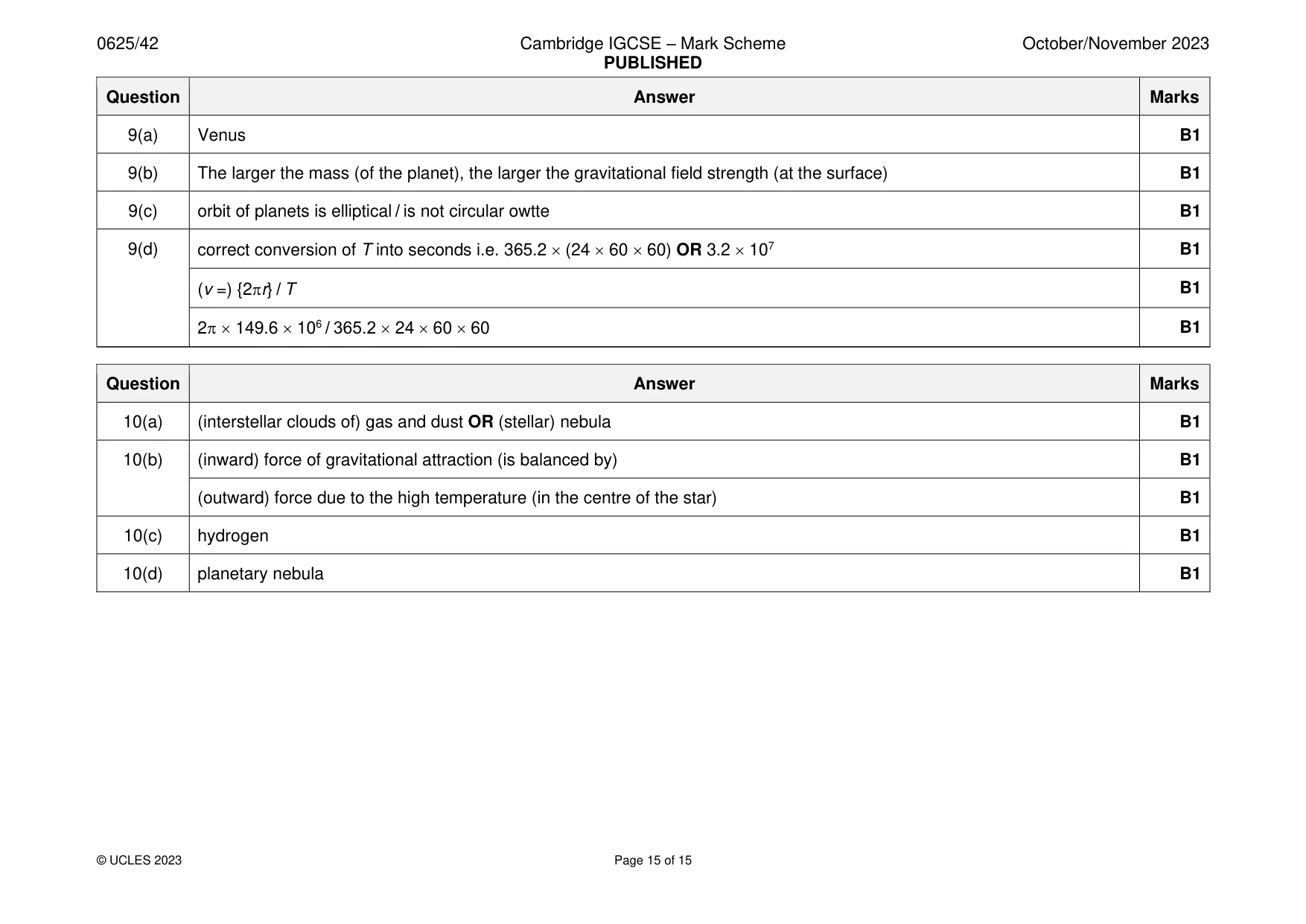
Mark scheme: 9(a) Venus B1 9(b) The larger the mass (of the planet), the larger the gravitational field strength (at the surface) B1 9(c) orbit of planets is elliptical / is not circular owtte B1 9(d) correct conversion of T into seconds i.e. 365.2 (24 60 60) OR 3.2 107 B1 (v =) {2r} / T B1 2 149.6 106 / 365.2 24 60 60 B1
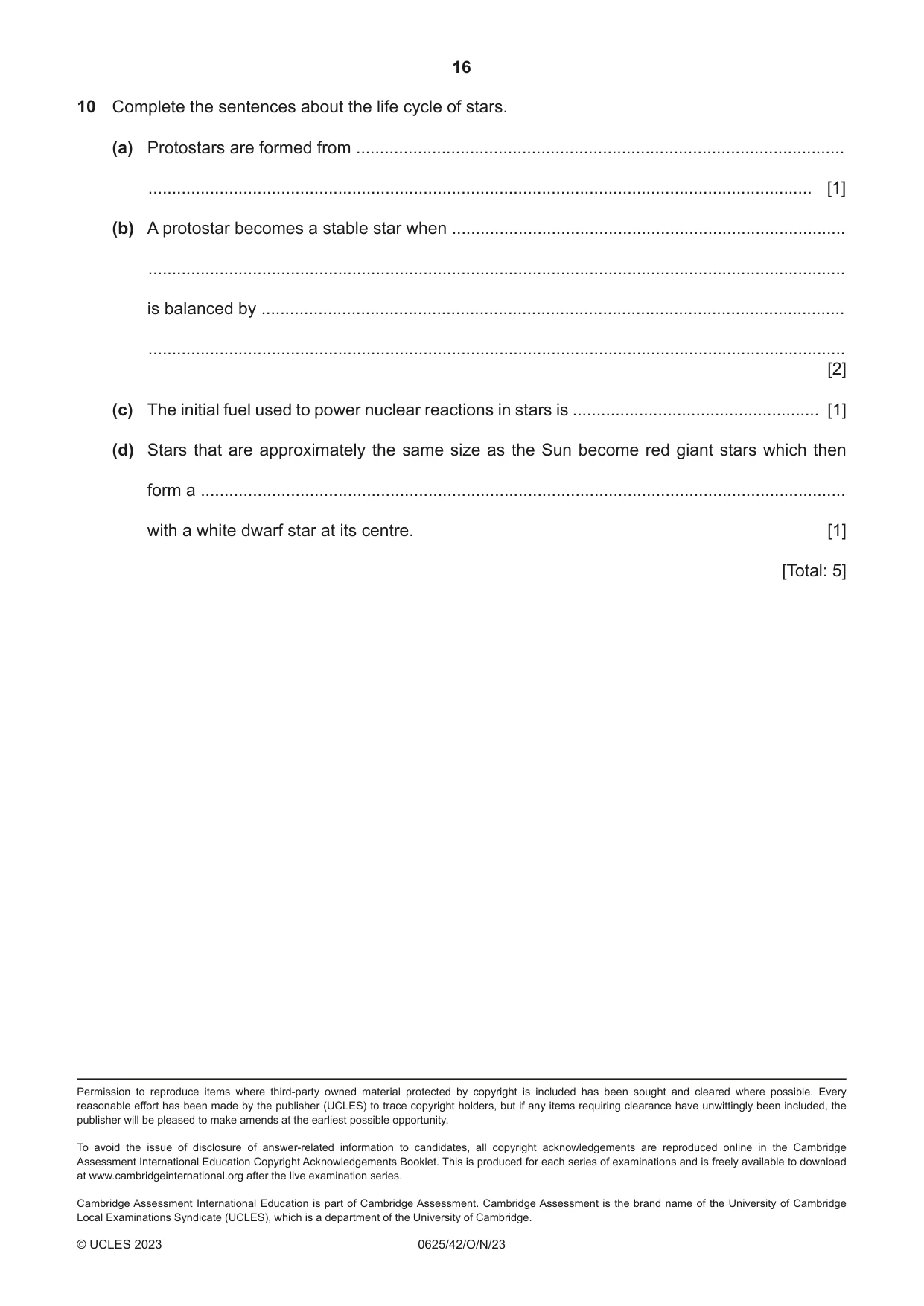
Q10 · Complete the sentences about the life cycle of stars
10 Complete the sentences about the life cycle of stars. (a) Protostars are formed from ....................................................................................................... ............................................................................................................................................ [1] (b) A protostar becomes a stable star when ................................................................................... ................................................................................................................................................... is balanced by ........................................................................................................................... ................................................................................................................................................... [2] (c) The initial fuel used to power nuclear reactions in stars is .................................................... [1] (d) Stars that are approximately the same size as the Sun become red giant stars which then form a ........................................................................................................................................ with a white dwarf star at its centre. [1] [Total: 5]
Mark scheme: 10(a) (interstellar clouds of) gas and dust OR (stellar) nebula B1 10(b) (inward) force of gravitational attraction (is balanced by) B1 (outward) force due to the high temperature (in the centre of the star) B1 10(c) hydrogen B1 10(d) planetary nebula B1
What was in this paper
The subtopics covered by these 10 questions, and how many questions each got. Open one in a new tab to see every Cambridge question on it.
What you needed in this session
Cambridge’s own grade thresholds for 2023 Oct/Nov, Paper 4 · Variant 2. A higher threshold means an easier paper — the bar moves with how the cohort did.