Cambridge IGCSE Physics 0625 — 2020 May/June Paper 4 · Variant 3
0625/43/M/J/20 · 10 questions · 80 marks · ≈90 min
The question paper and its mark scheme, free to read here and free to download. This is Cambridge’s own paper, exactly as it was sat.
Question paper16 pages

Mark scheme10 pages
Answers below. Sit the paper first if you are practising.
Questions as text
Question 1
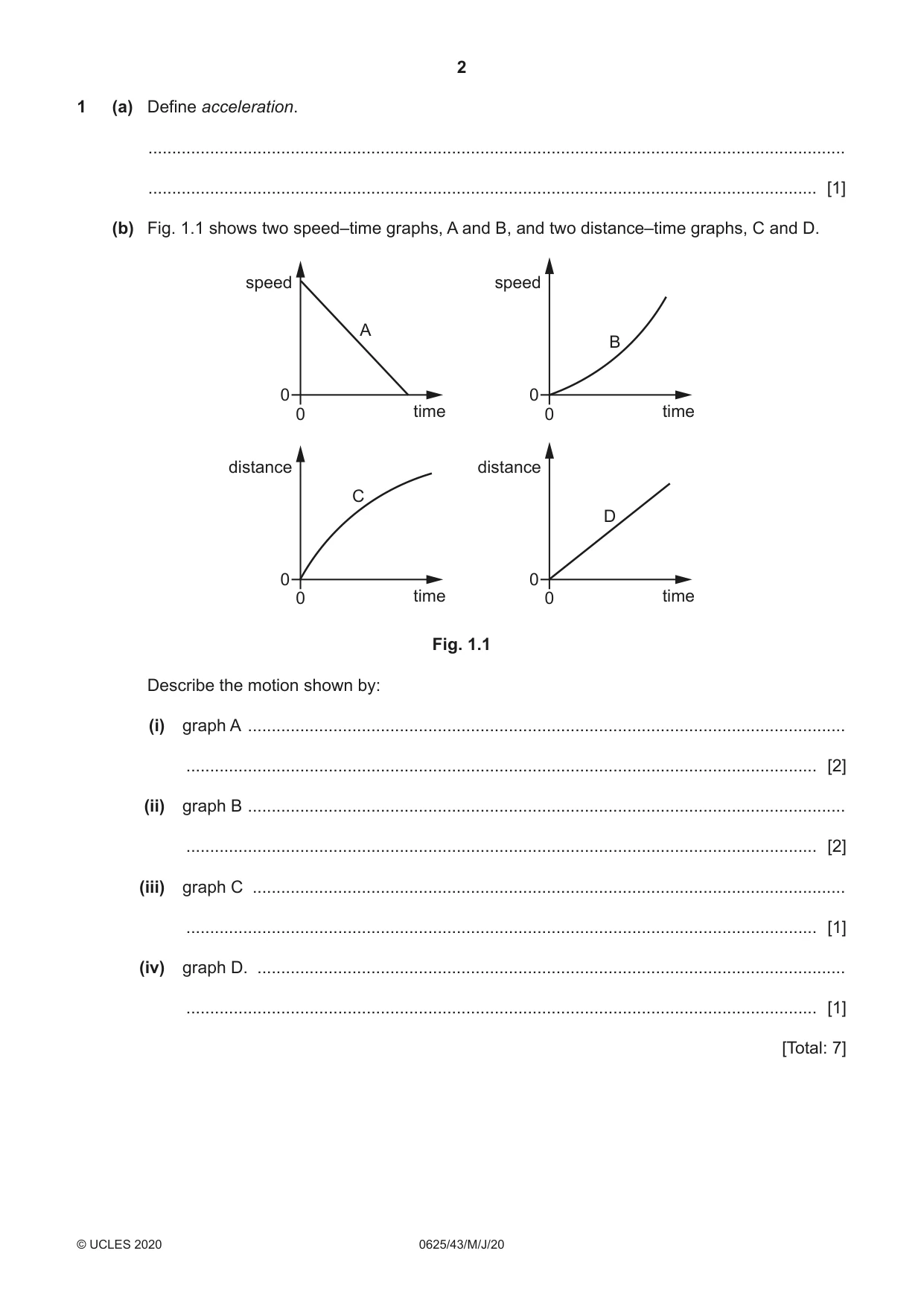
1 (a) Define acceleration. ................................................................................................................................................... ............................................................................................................................................. [1] (b) Fig. 1.1 shows two speed–time graphs, A and B, and two distance–time graphs, C and D. speed speed A B 0 0 0 time 0 time distance distance C D 0 0 0 time 0 time Fig. 1.1 Describe the motion shown by: (i) graph A .............................................................................................................................. ..................................................................................................................................... [2] (ii) graph B .............................................................................................................................. ..................................................................................................................................... [2] (iii) graph C ............................................................................................................................. ..................................................................................................................................... [1] (iv) graph D. ............................................................................................................................ ..................................................................................................................................... [1] [Total: 7]
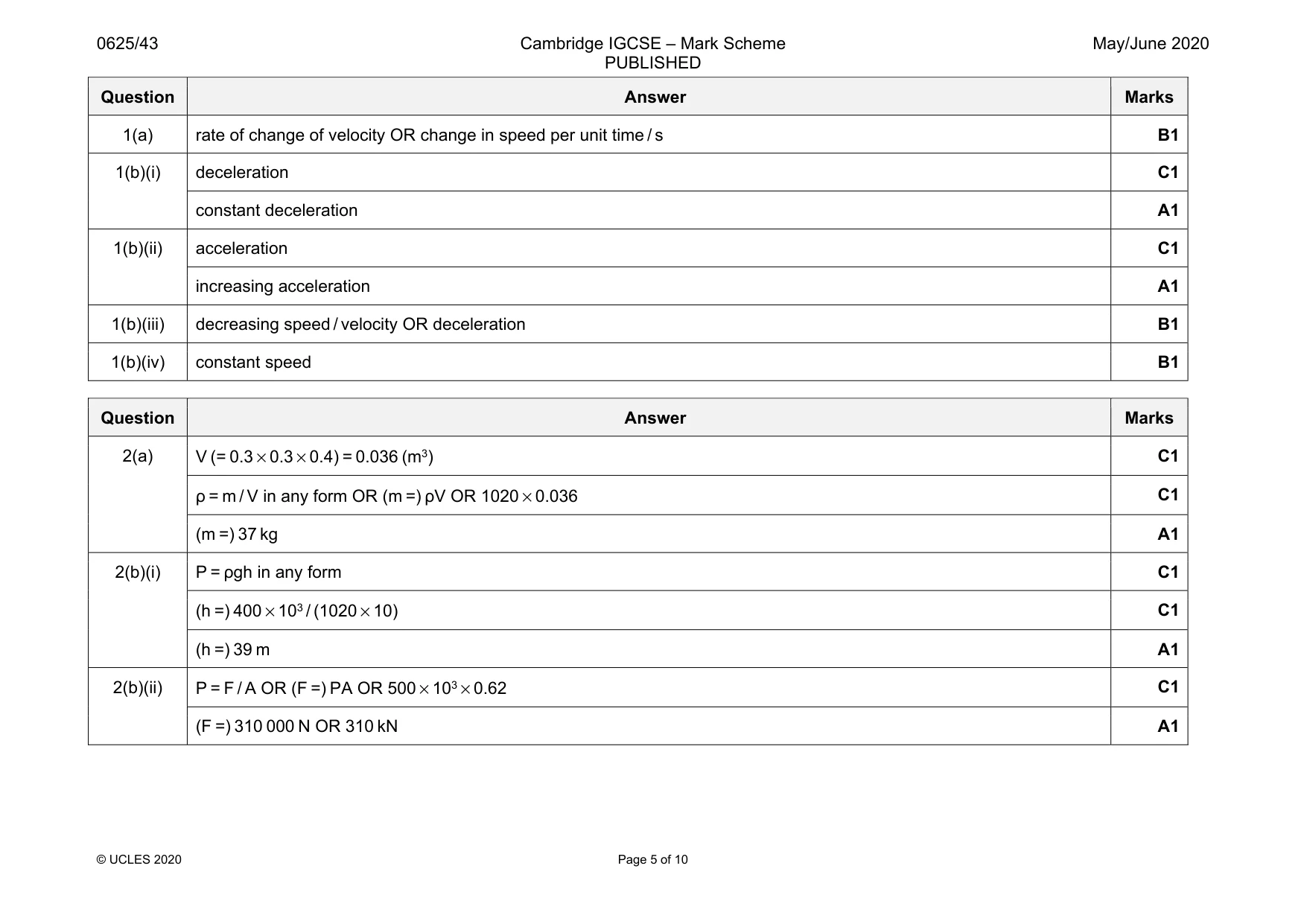
Mark scheme: 1(a) rate of change of velocity OR change in speed per unit time / s B1 1(b)(i) deceleration C1 constant deceleration A1 1(b)(ii) acceleration C1 increasing acceleration A1 1(b)(iii) decreasing speed / velocity OR deceleration B1 1(b)(iv) constant speed B1
Q2 · A scientist fills a container with sea water
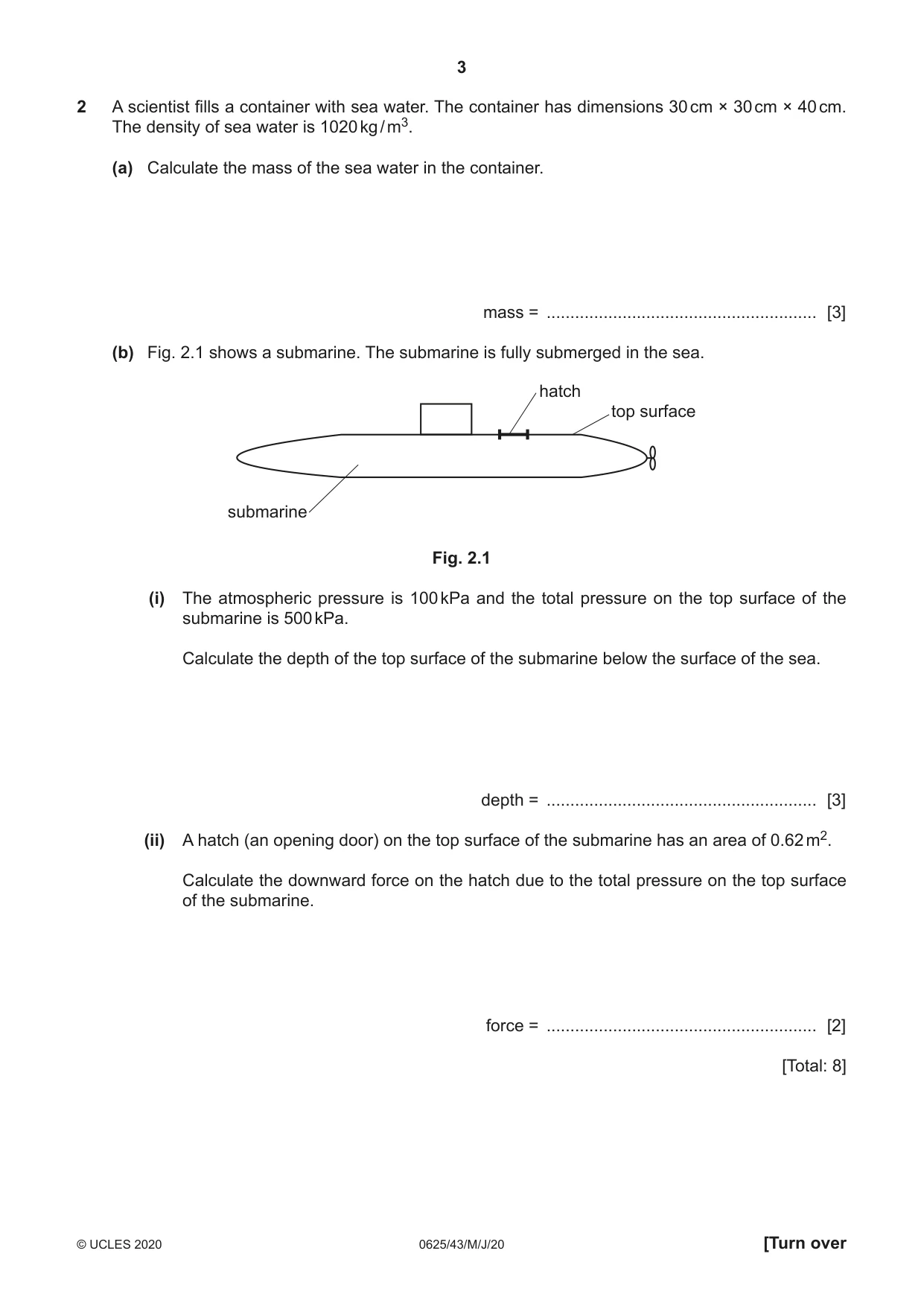
2 A scientist fills a container with sea water. The container has dimensions 30 cm × 30 cm × 40 cm. The density of sea water is 1020 kg / m3. (a) Calculate the mass of the sea water in the container. mass = ......................................................... [3] (b) Fig. 2.1 shows a submarine. The submarine is fully submerged in the sea. hatch top surface submarine Fig. 2.1 (i) The atmospheric pressure is 100 kPa and the total pressure on the top surface of the submarine is 500 kPa. Calculate the depth of the top surface of the submarine below the surface of the sea. depth = ......................................................... [3] (ii) A hatch (an opening door) on the top surface of the submarine has an area of 0.62 m2. Calculate the downward force on the hatch due to the total pressure on the top surface of the submarine. force = ......................................................... [2] [Total: 8]
Mark scheme: 2(a) V (= 0.3 × 0.3 × 0.4) = 0.036 (m3) C1 ρ = m / V in any form OR (m =) ρV OR 1020 × 0.036 C1 (m =) 37 kg A1 2(b)(i) P = ρgh in any form C1 (h =) 400 × 103 / (1020 × 10) C1 (h =) 39 m A1 2(b)(ii) P = F / A OR (F =) PA OR 500 × 103 × 0.62 C1 (F =) 310 000 N OR 310 kN A1
Q3 · In a double-decker bus there are two passenger compartments, one above the other
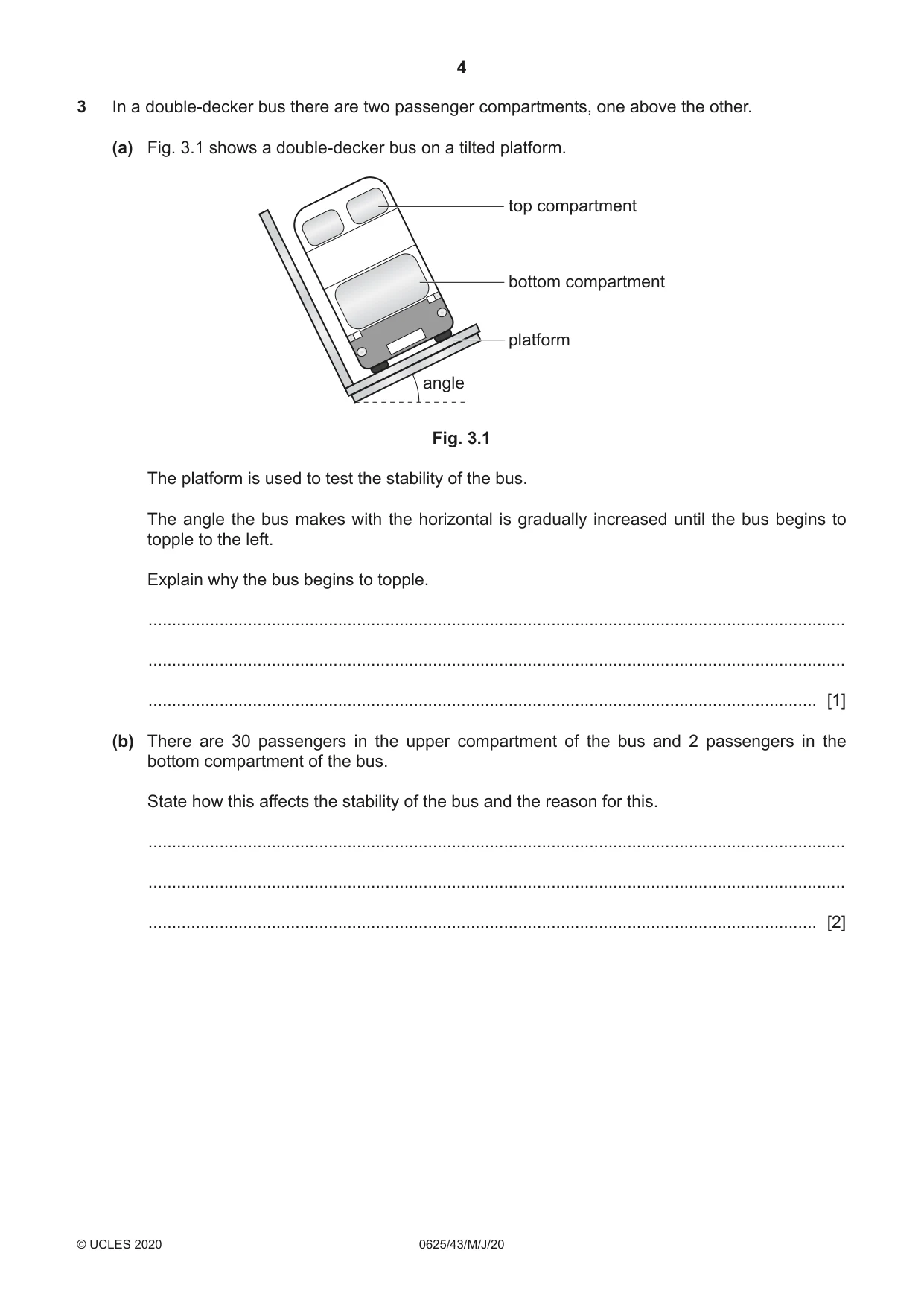
3 In a double-decker bus there are two passenger compartments, one above the other. (a) Fig. 3.1 shows a double-decker bus on a tilted platform. top compartment bottom compartment platform angle Fig. 3.1 The platform is used to test the stability of the bus. The angle the bus makes with the horizontal is gradually increased until the bus begins to topple to the left. Explain why the bus begins to topple. ................................................................................................................................................... ................................................................................................................................................... ............................................................................................................................................. [1] (b) There are 30 passengers in the upper compartment of the bus and 2 passengers in the bottom compartment of the bus. State how this affects the stability of the bus and the reason for this. ................................................................................................................................................... ................................................................................................................................................... ............................................................................................................................................. [2] (c) A bus is travelling along a straight road. The bus and the driver have a combined mass of 16 000 kg when there are no passengers in it. The bus has 73 passengers. The average mass of each of the passengers is 65 kg. (i) Calculate the total mass of the bus, the driver and the 73 passengers. mass = ......................................................... [2] (ii) The fully loaded bus accelerates uniformly from rest to a speed of 14 m / s. The time taken to reach a speed of 14 m / s is 20 s. Calculate the resultant force on the bus during the acceleration. force = ......................................................... [2] [Total: 7]
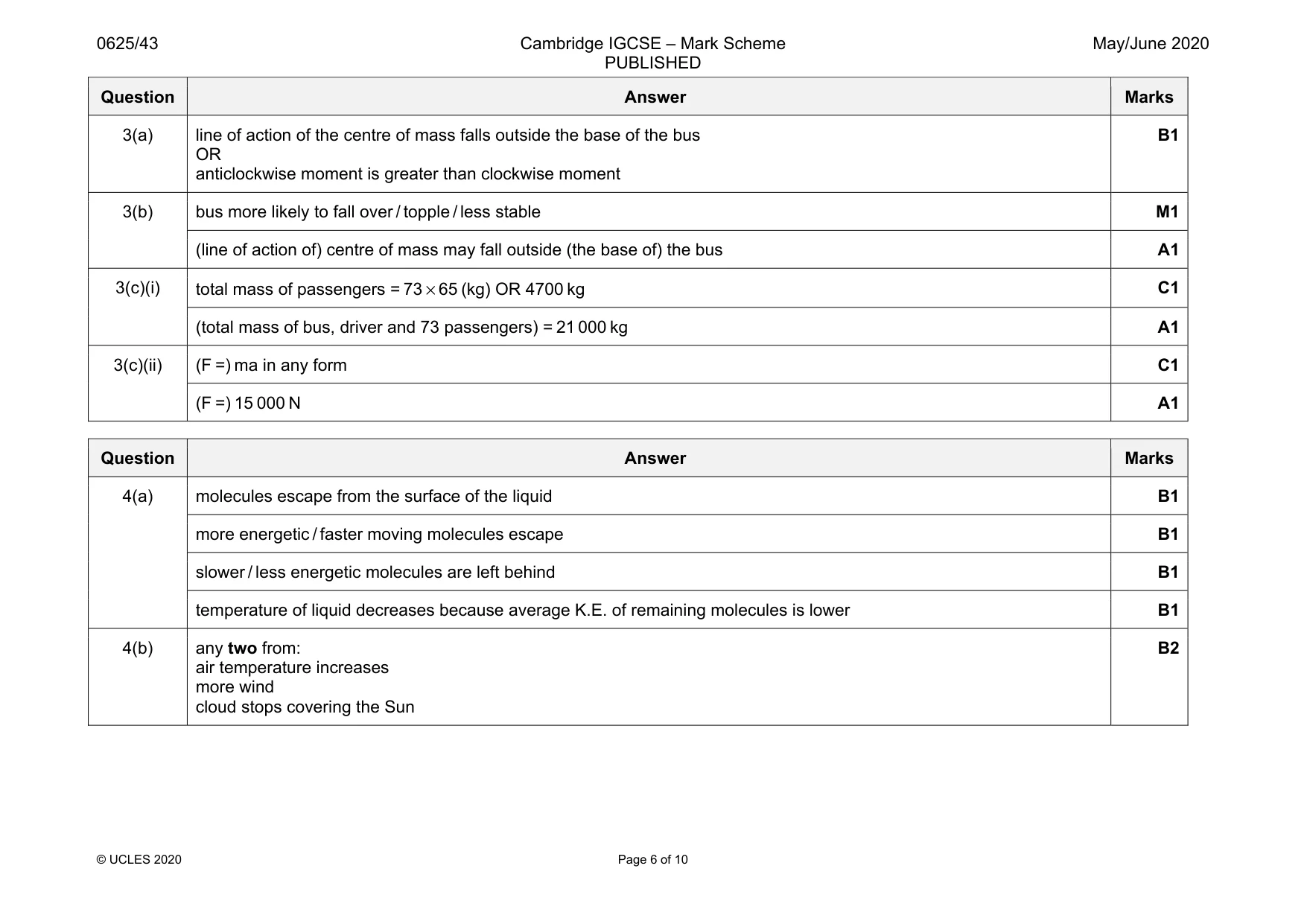
Mark scheme: 3(a) line of action of the centre of mass falls outside the base of the bus OR anticlockwise moment is greater than clockwise moment B1 3(b) bus more likely to fall over / topple / less stable M1 (line of action of) centre of mass may fall outside (the base of) the bus A1 3(c)(i) total mass of passengers = 73 × 65 (kg) OR 4700 kg C1 (total mass of bus, driver and 73 passengers) = 21 000 kg A1 3(c)(ii) (F =) ma in any form C1 (F =) 15 000 N A1
Q4 · Describe, in terms of molecules, what happens when a liquid evaporates
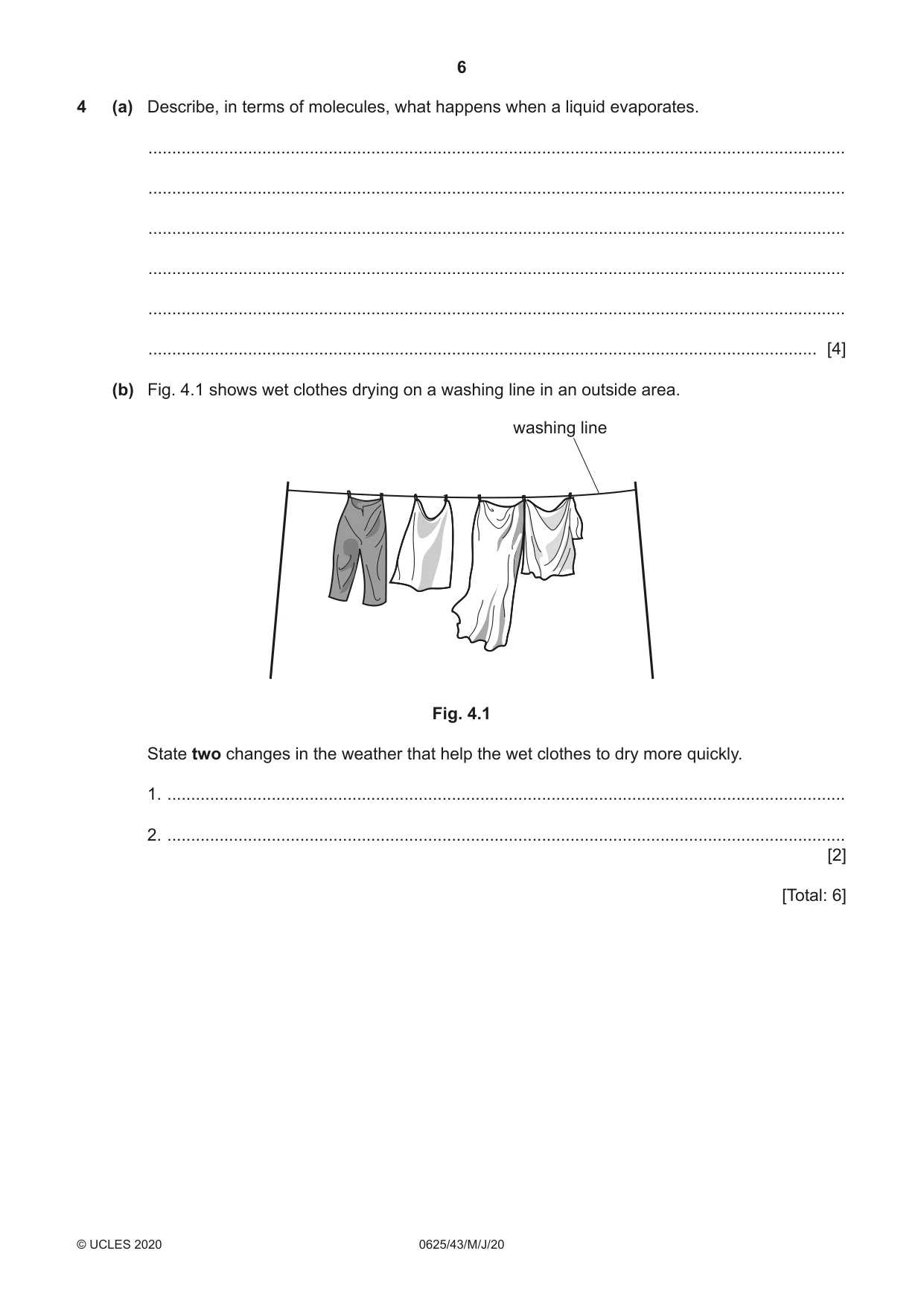
4 (a) Describe, in terms of molecules, what happens when a liquid evaporates. ................................................................................................................................................... ................................................................................................................................................... ................................................................................................................................................... ................................................................................................................................................... ................................................................................................................................................... ............................................................................................................................................. [4] (b) Fig. 4.1 shows wet clothes drying on a washing line in an outside area. washing line Fig. 4.1 State two changes in the weather that help the wet clothes to dry more quickly. 1. ............................................................................................................................................... 2. ............................................................................................................................................... [2] [Total: 6]
Mark scheme: 4(a) molecules escape from the surface of the liquid B1 more energetic / faster moving molecules escape B1 slower / less energetic molecules are left behind B1 temperature of liquid decreases because average K.E. of remaining molecules is lower B1 4(b) any two from: air temperature increases more wind cloud stops covering the Sun B2
Question 5
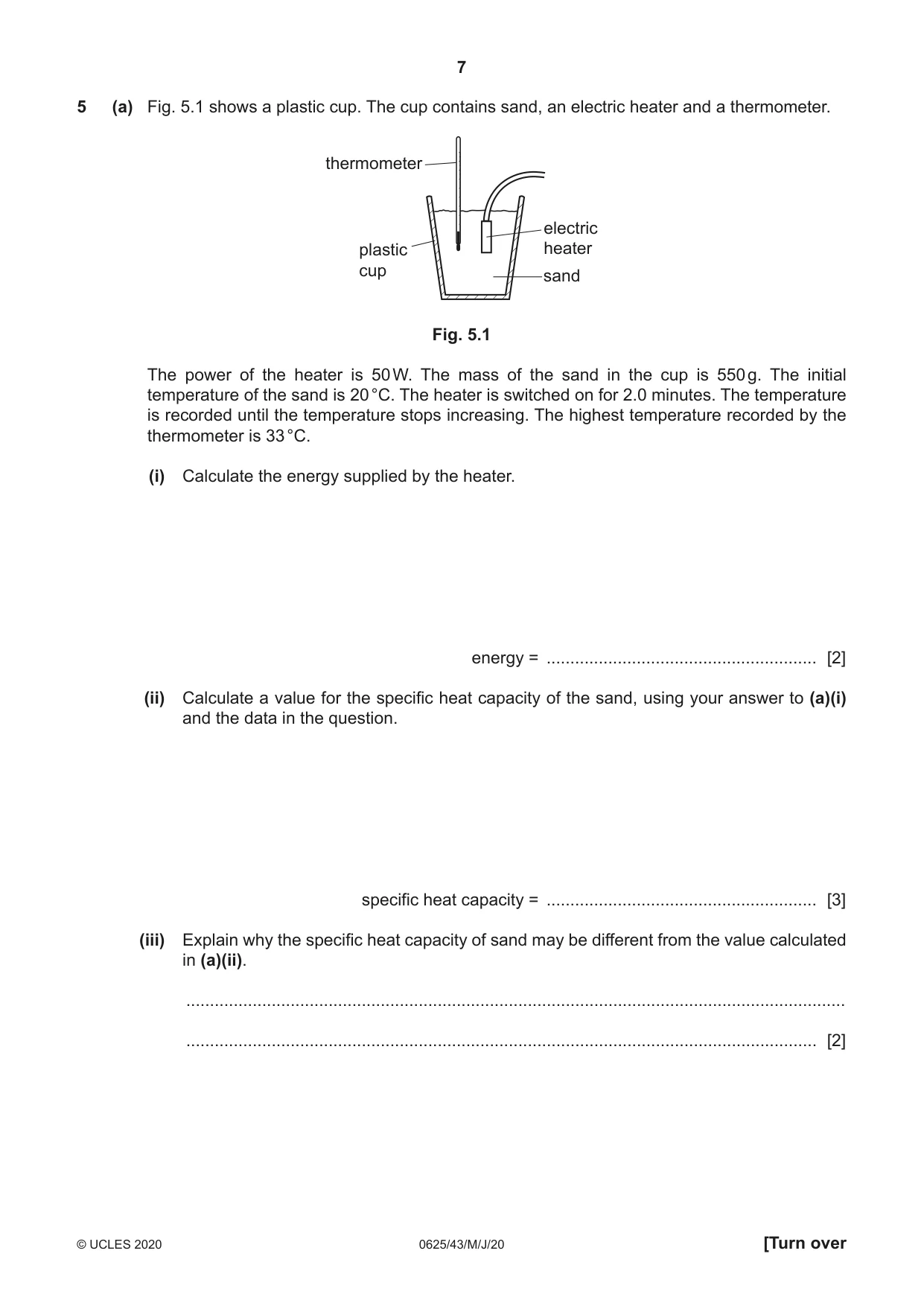
5 (a) Fig. 5.1 shows a plastic cup. The cup contains sand, an electric heater and a thermometer. thermometer electric plastic heater cup sand Fig. 5.1 The power of the heater is 50 W. The mass of the sand in the cup is 550 g. The initial temperature of the sand is 20 °C. The heater is switched on for 2.0 minutes. The temperature is recorded until the temperature stops increasing. The highest temperature recorded by the thermometer is 33 °C. (i) Calculate the energy supplied by the heater. energy = ......................................................... [2] (ii) Calculate a value for the specific heat capacity of the sand, using your answer to (a)(i) and the data in the question. specific heat capacity = ......................................................... [3] (iii) Explain why the specific heat capacity of sand may be different from the value calculated in (a)(ii). ........................................................................................................................................... ..................................................................................................................................... [2] (b) On a sunny day, the temperature of the sand on a beach is much higher than the temperature of the sea. Explain why. ................................................................................................................................................... ................................................................................................................................................... ............................................................................................................................................. [2] (c) Draw a labelled diagram to show the structure of a thermocouple thermometer. [3] [Total: 12]
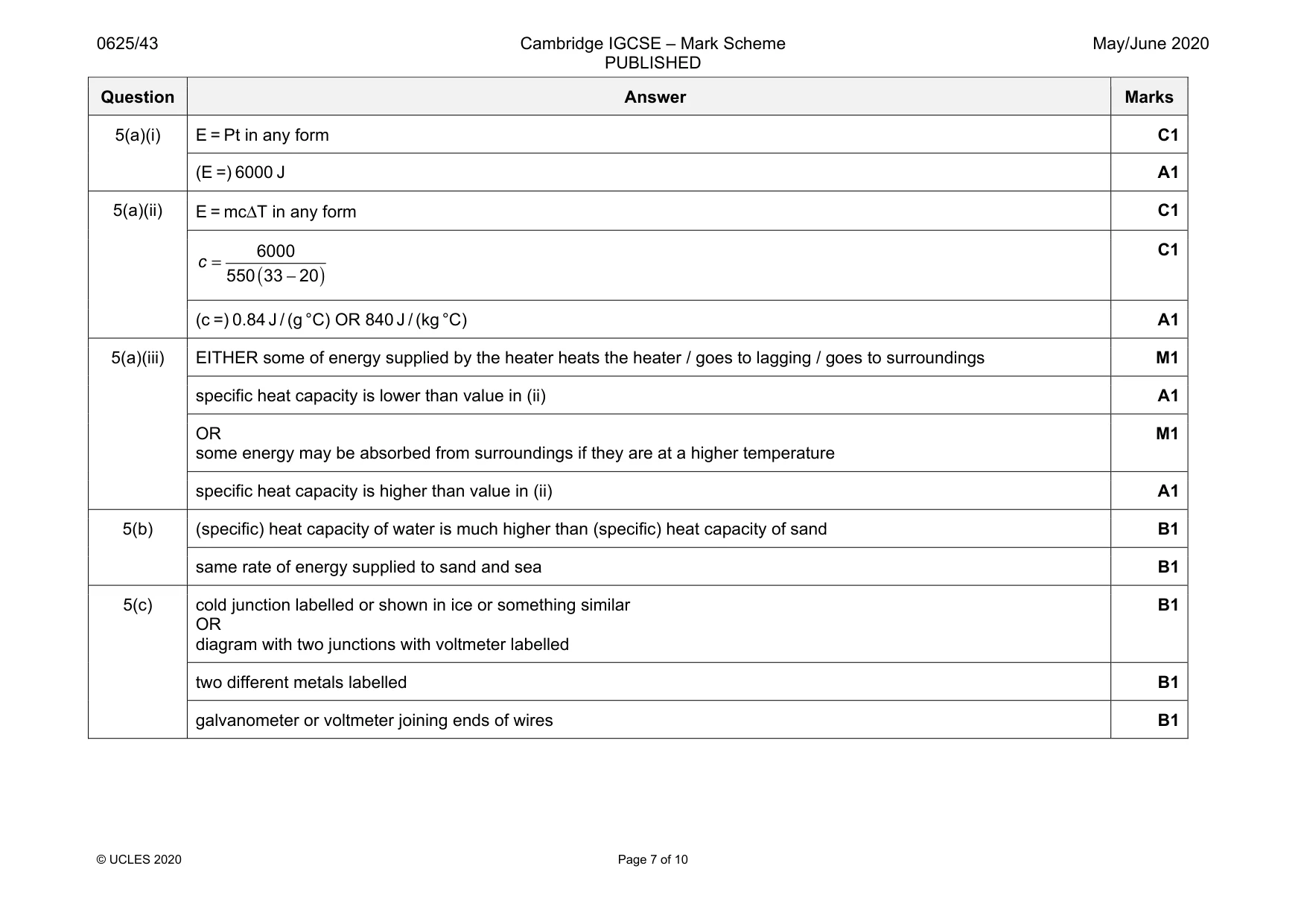
Mark scheme: 5(a)(i) E = Pt in any form C1 (E =) 6000 J A1 5(a)(ii) E = mcΔT in any form C1 ( ) 6000 550 33 20 c = − C1 (c =) 0.84 J / (g °C) OR 840 J / (kg °C) A1 5(a)(iii) EITHER some of energy supplied by the heater heats the heater / goes to lagging / goes to surroundings M1 specific heat capacity is lower than value in (ii) A1 OR some energy may be absorbed from surroundings if they are at a higher temperature M1 specific heat capacity is higher than value in (ii) A1 5(b) (specific) heat capacity of water is much higher than (specific) heat capacity of sand B1 same rate of energy supplied to sand and sea B1 5(c) cold junction labelled or shown in ice or something similar OR diagram with two junctions with voltmeter labelled B1 two different metals labelled B1 galvanometer or voltmeter joining ends of wires B1
Q6 · Crests of a sound wave after reflection from a solid surface
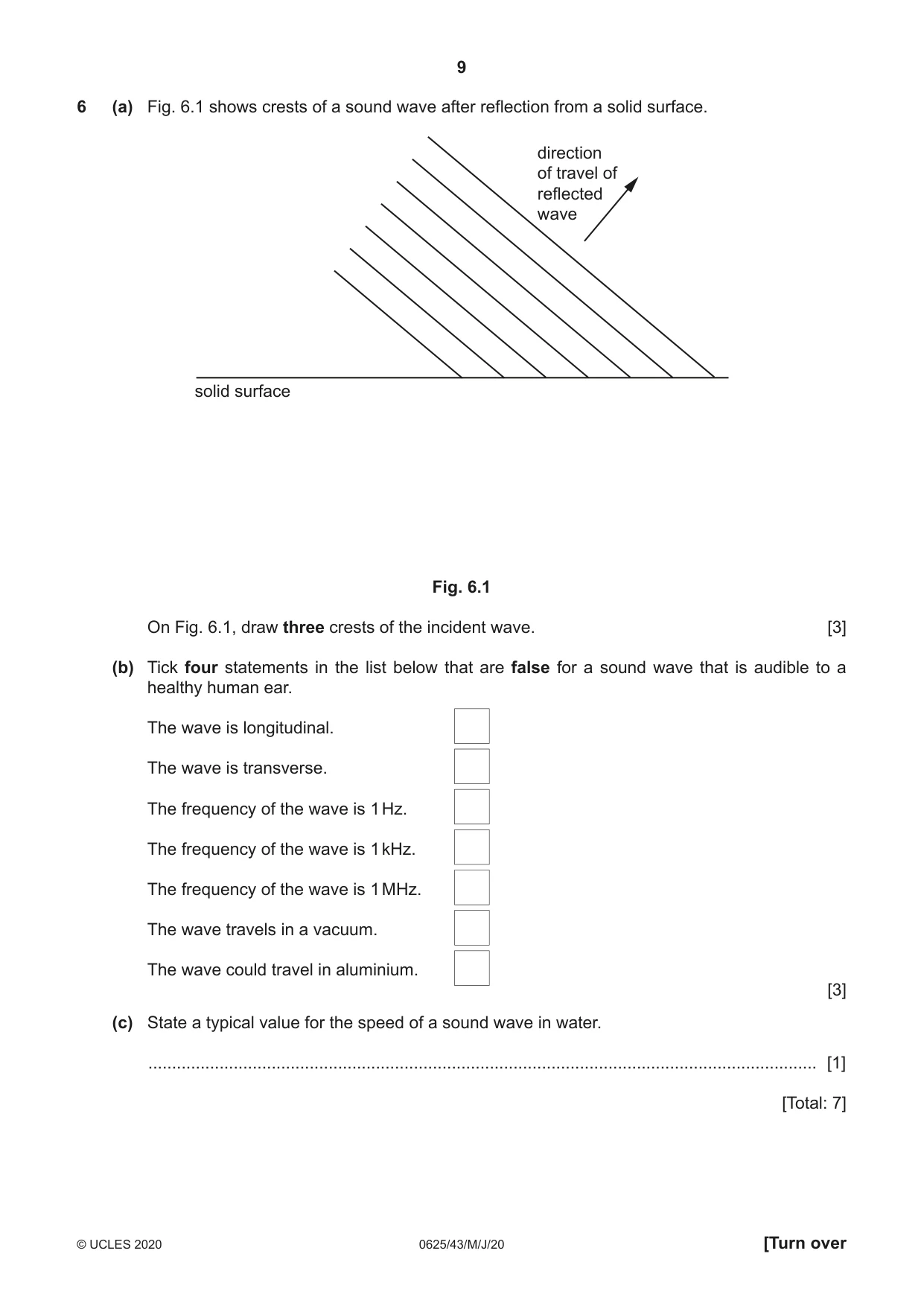
6 (a) Fig. 6.1 shows crests of a sound wave after reflection from a solid surface. direction of travel of reflected wave solid surface Fig. 6.1 On Fig. 6.1, draw three crests of the incident wave. [3] (b) Tick four statements in the list below that are false for a sound wave that is audible to a healthy human ear. The wave is longitudinal. The wave is transverse. The frequency of the wave is 1 Hz. The frequency of the wave is 1 kHz. The frequency of the wave is 1 MHz. The wave travels in a vacuum. The wave could travel in aluminium. [3] (c) State a typical value for the speed of a sound wave in water. ............................................................................................................................................. [1] [Total: 7]
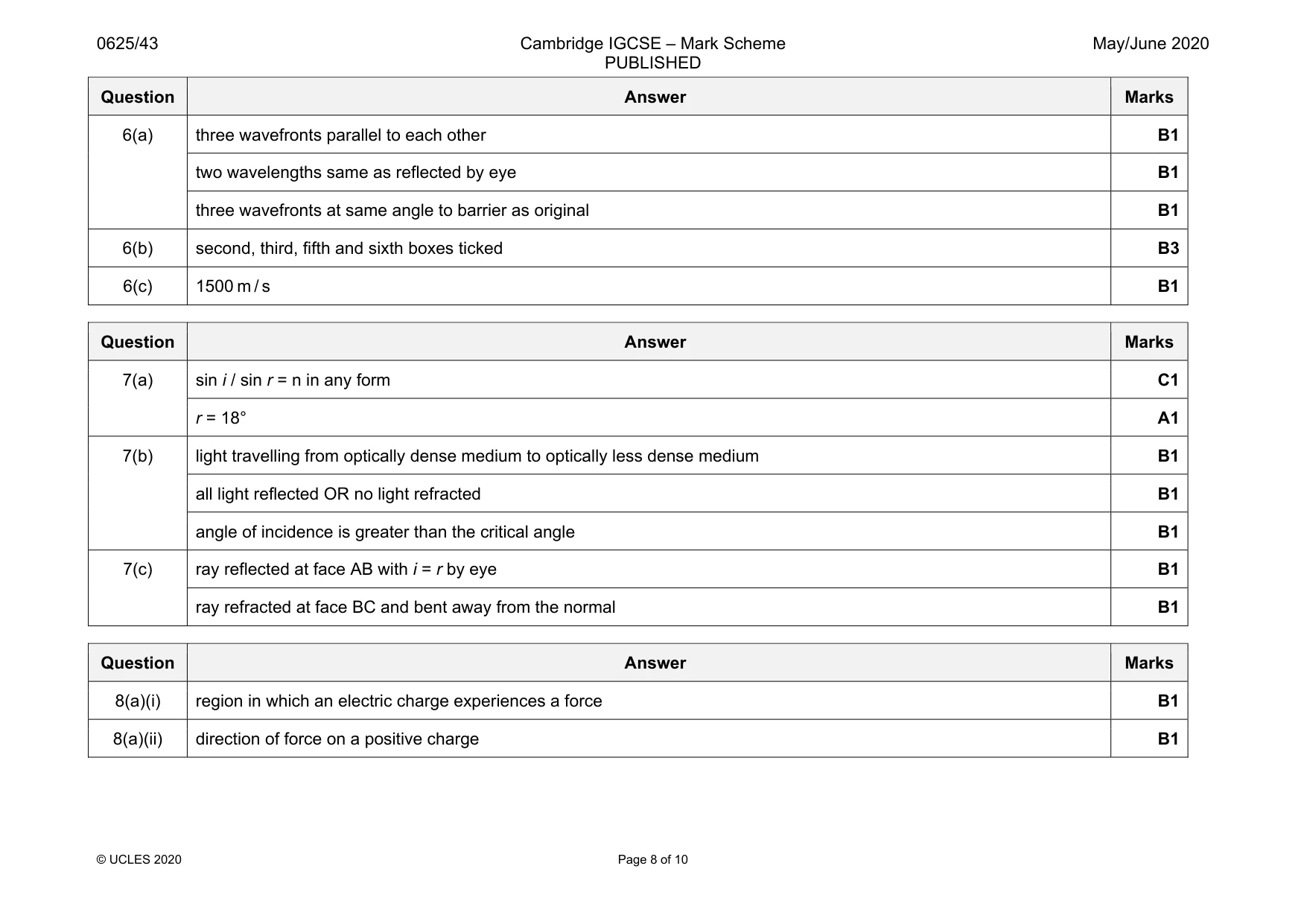
Mark scheme: 6(a) three wavefronts parallel to each other B1 two wavelengths same as reflected by eye B1 three wavefronts at same angle to barrier as original B1 6(b) second, third, fifth and sixth boxes ticked B3 6(c) 1500 m / s B1
Q7 · Red light travelling from air into a prism made of diamond
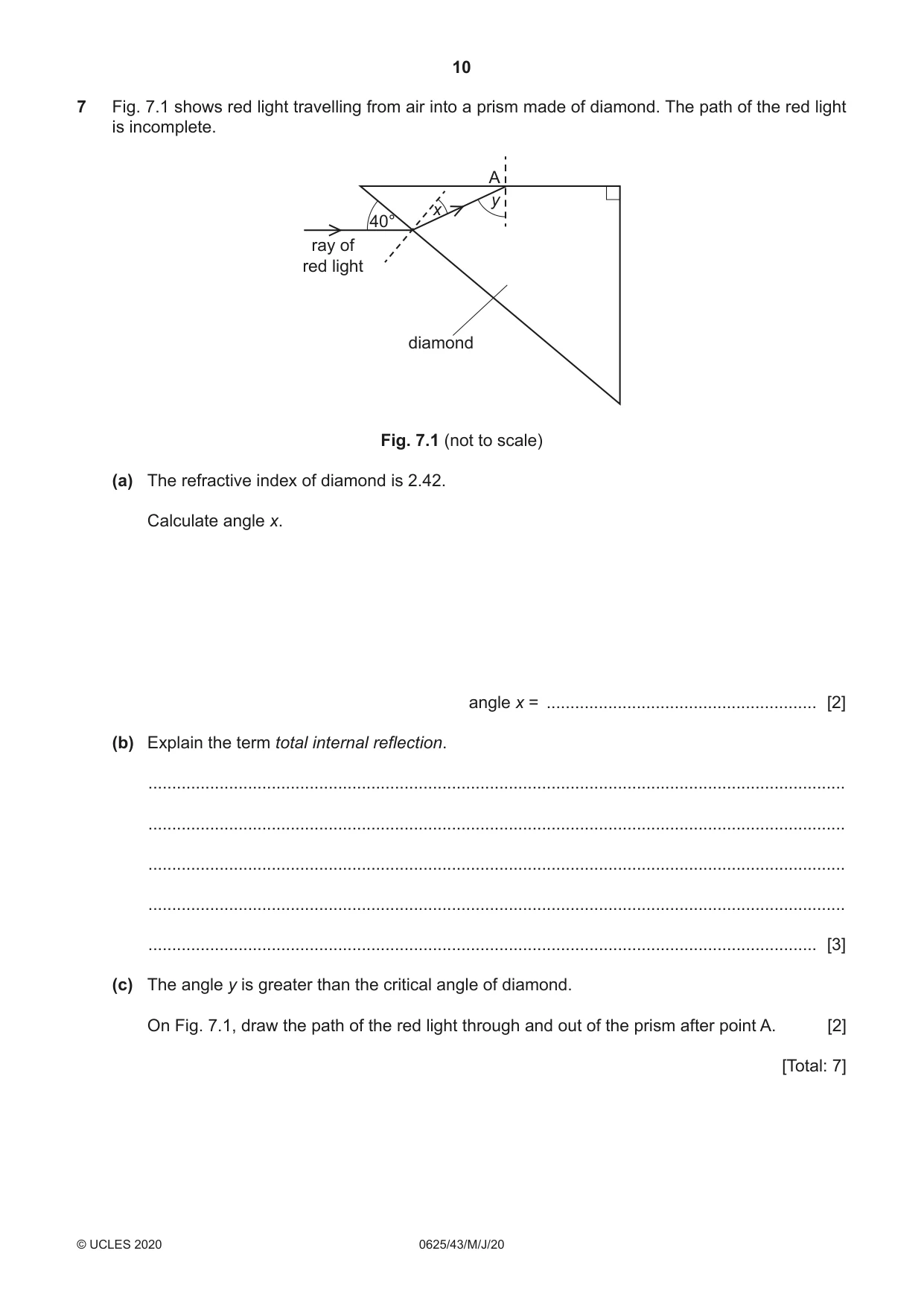
7 Fig. 7.1 shows red light travelling from air into a prism made of diamond. The path of the red light is incomplete. A y x 40° ray of red light diamond Fig. 7.1 (not to scale) (a) The refractive index of diamond is 2.42. Calculate angle x. angle x = ......................................................... [2] (b) Explain the term total internal reflection. ................................................................................................................................................... ................................................................................................................................................... ................................................................................................................................................... ................................................................................................................................................... ............................................................................................................................................. [3] (c) The angle y is greater than the critical angle of diamond. On Fig. 7.1, draw the path of the red light through and out of the prism after point A. [2] [Total: 7]
Mark scheme: 7(a) sin i / sin r = n in any form C1 r = 18° A1 7(b) light travelling from optically dense medium to optically less dense medium B1 all light reflected OR no light refracted B1 angle of incidence is greater than the critical angle B1 7(c) ray reflected at face AB with i = r by eye B1 ray refracted at face BC and bent away from the normal B1
Q8 · Describe what is meant by an electric field
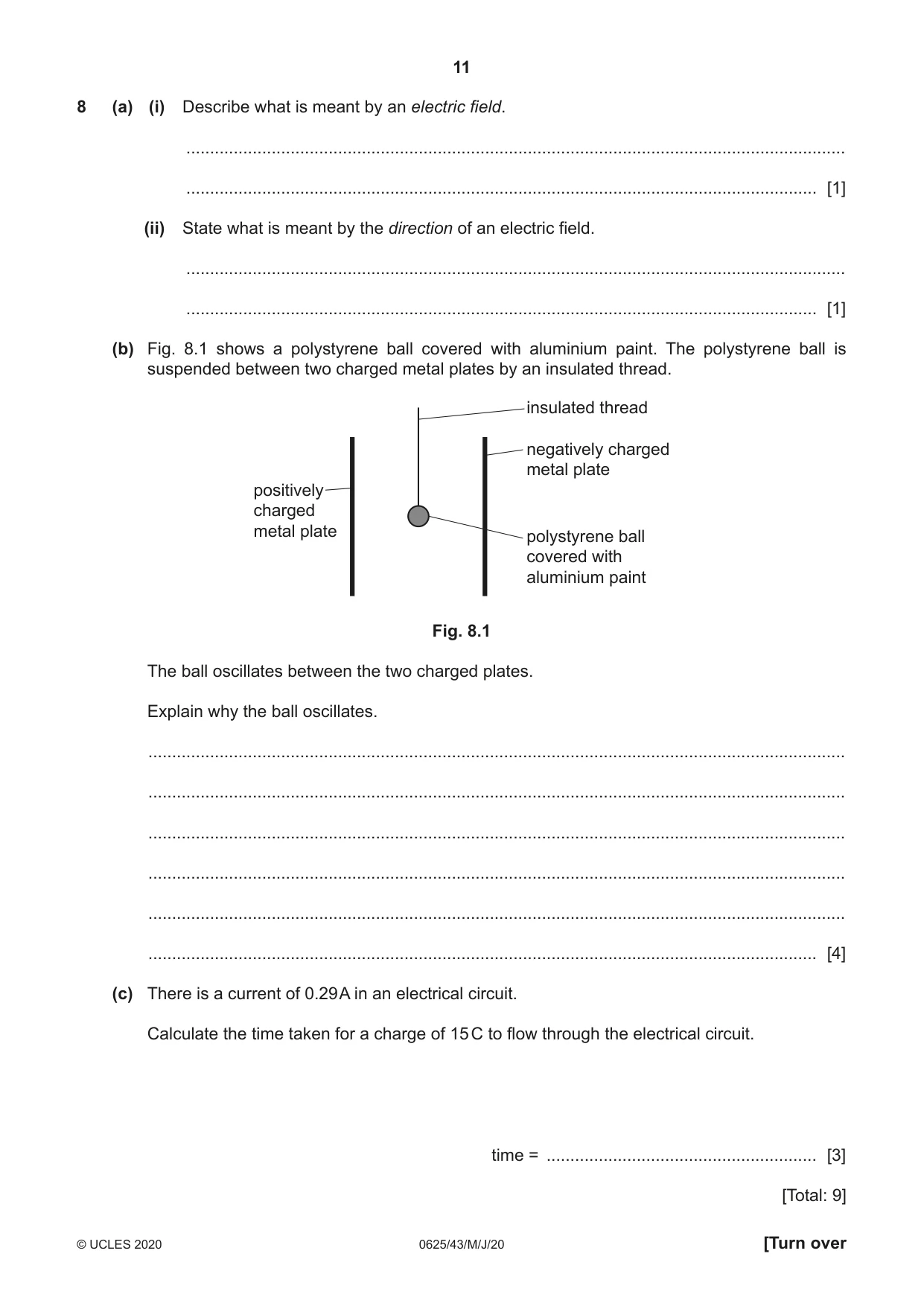
8 (a) (i) Describe what is meant by an electric field. ........................................................................................................................................... ..................................................................................................................................... [1] (ii) State what is meant by the direction of an electric field. ........................................................................................................................................... ..................................................................................................................................... [1] (b) Fig. 8.1 shows a polystyrene ball covered with aluminium paint. The polystyrene ball is suspended between two charged metal plates by an insulated thread. insulated thread negatively charged metal plate positively charged metal plate polystyrene ball covered with aluminium paint Fig. 8.1 The ball oscillates between the two charged plates. Explain why the ball oscillates. ................................................................................................................................................... ................................................................................................................................................... ................................................................................................................................................... ................................................................................................................................................... ................................................................................................................................................... ............................................................................................................................................. [4] (c) There is a current of 0.29 A in an electrical circuit. Calculate the time taken for a charge of 15 C to flow through the electrical circuit. time = ......................................................... [3] [Total: 9]
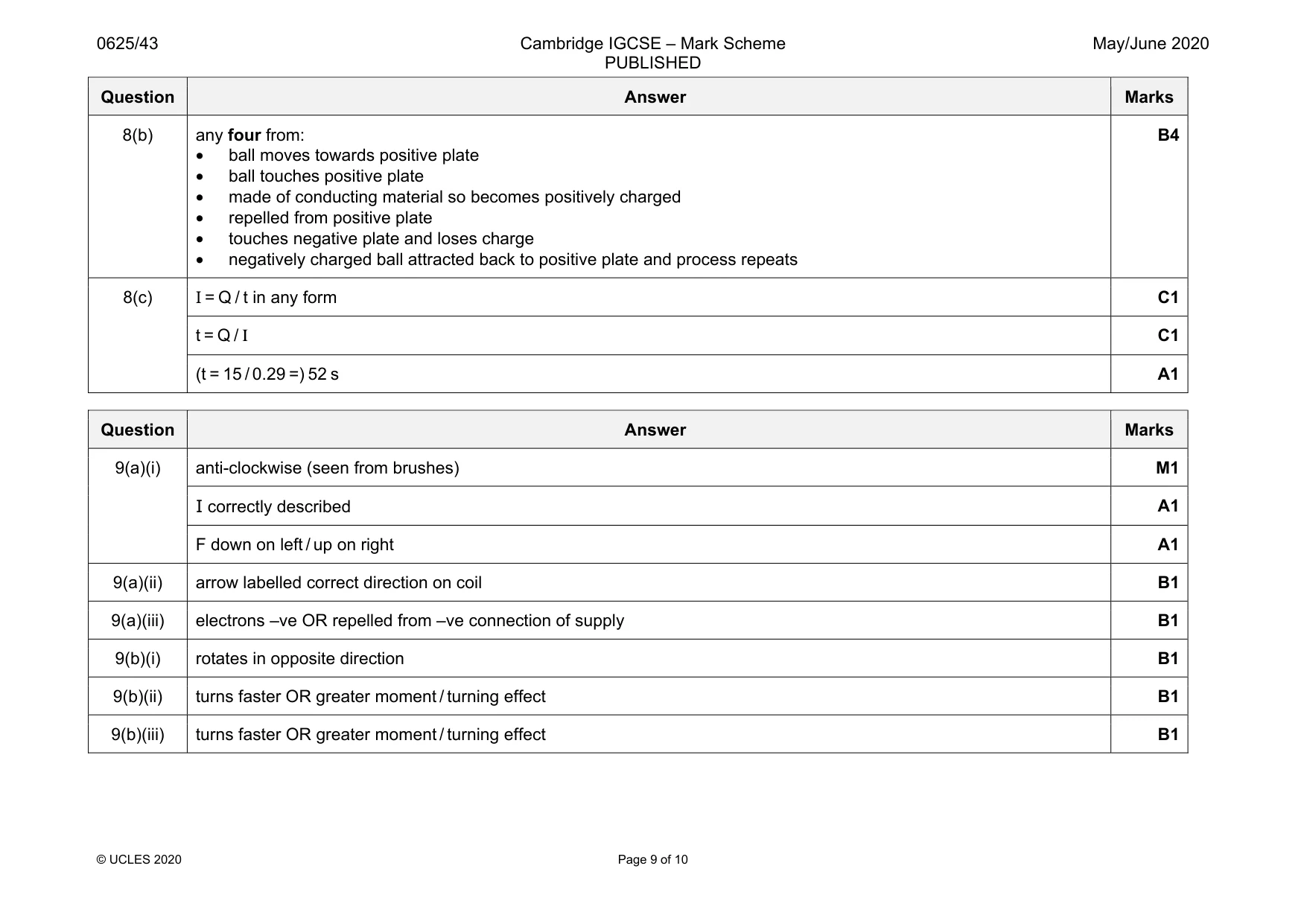
Mark scheme: 8(a)(i) region in which an electric charge experiences a force B1 8(a)(ii) direction of force on a positive charge B1 Question Answer Marks 8(b) any four from: • ball moves towards positive plate • ball touches positive plate • made of conducting material so becomes positively charged • repelled from positive plate • touches negative plate and loses charge • negatively charged ball attracted back to positive plate and process repeats B4 8(c) I = Q / t in any form C1 t = Q / I C1 (t = 15 / 0.29 =) 52 s A1
Q9 · A simple direct current (d.c.) electric motor
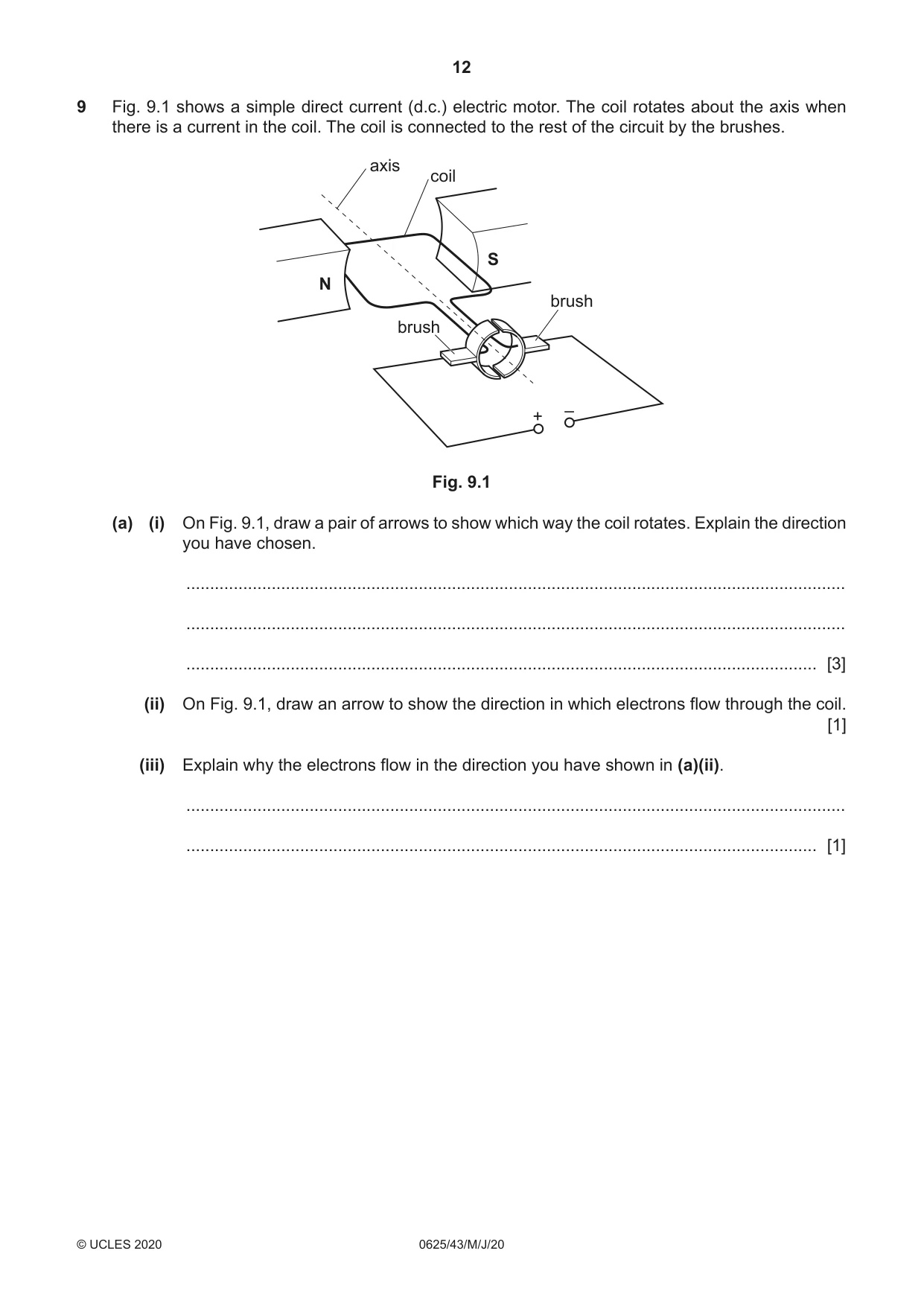
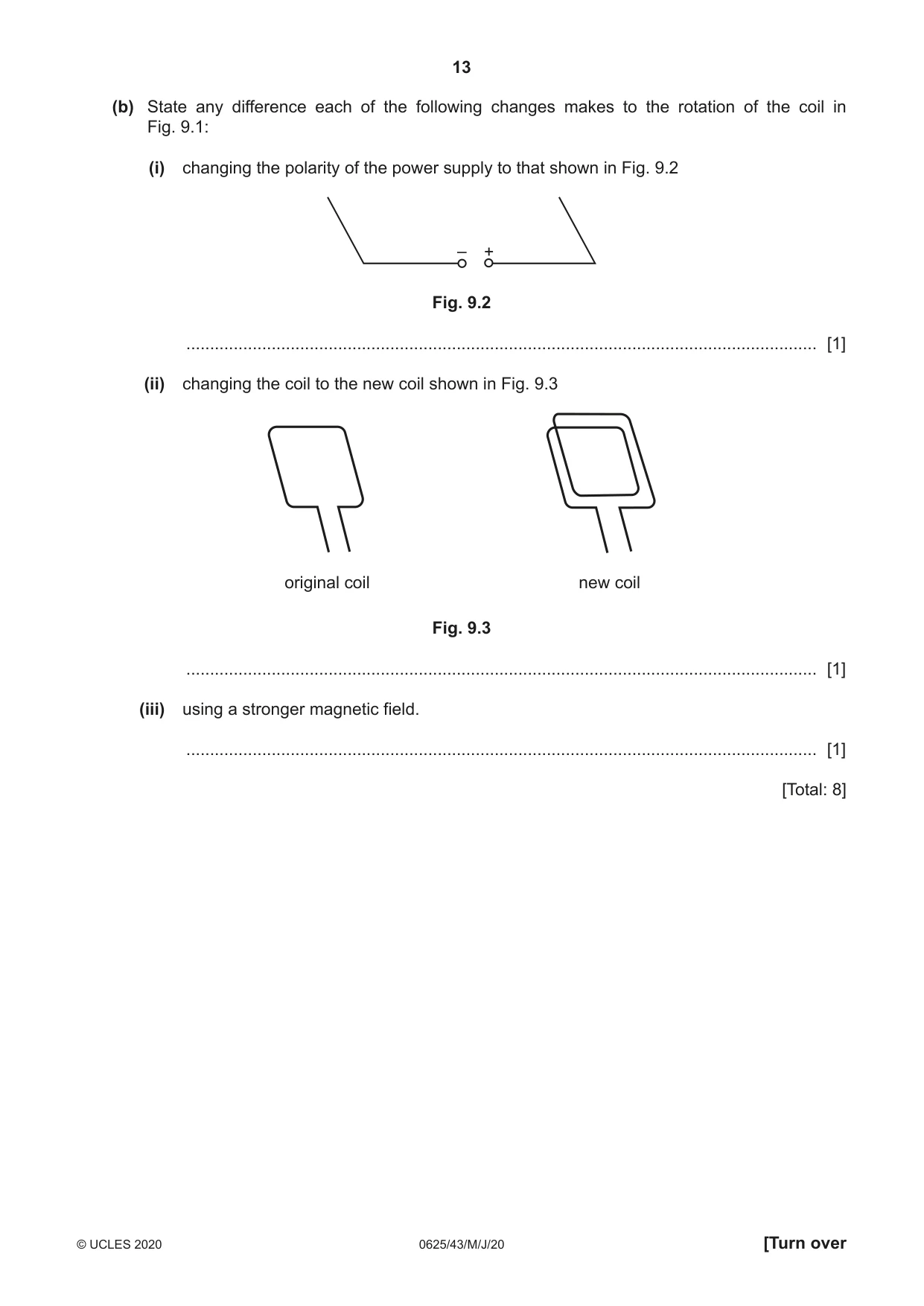
9 Fig. 9.1 shows a simple direct current (d.c.) electric motor. The coil rotates about the axis when there is a current in the coil. The coil is connected to the rest of the circuit by the brushes. axis coil S N brush brush – + Fig. 9.1 (a) (i) On Fig. 9.1, draw a pair of arrows to show which way the coil rotates. Explain the direction you have chosen. ........................................................................................................................................... ........................................................................................................................................... ..................................................................................................................................... [3] (ii) On Fig. 9.1, draw an arrow to show the direction in which electrons flow through the coil. [1] (iii) Explain why the electrons flow in the direction you have shown in (a)(ii). ........................................................................................................................................... ..................................................................................................................................... [1] (b) State any difference each of the following changes makes to the rotation of the coil in Fig. 9.1: (i) changing the polarity of the power supply to that shown in Fig. 9.2 – + Fig. 9.2 ..................................................................................................................................... [1] (ii) changing the coil to the new coil shown in Fig. 9.3 original coil new coil Fig. 9.3 ..................................................................................................................................... [1] (iii) using a stronger magnetic field. ..................................................................................................................................... [1] [Total: 8]
Mark scheme: 9(a)(i) anti-clockwise (seen from brushes) M1 I correctly described A1 F down on left / up on right A1 9(a)(ii) arrow labelled correct direction on coil B1 9(a)(iii) electrons –ve OR repelled from –ve connection of supply B1 9(b)(i) rotates in opposite direction B1 9(b)(ii) turns faster OR greater moment / turning effect B1 9(b)(iii) turns faster OR greater moment / turning effect B1
Q10 · A radioactive nucleus of carbon decays to a nucleus of nitrogen by emitting a particle
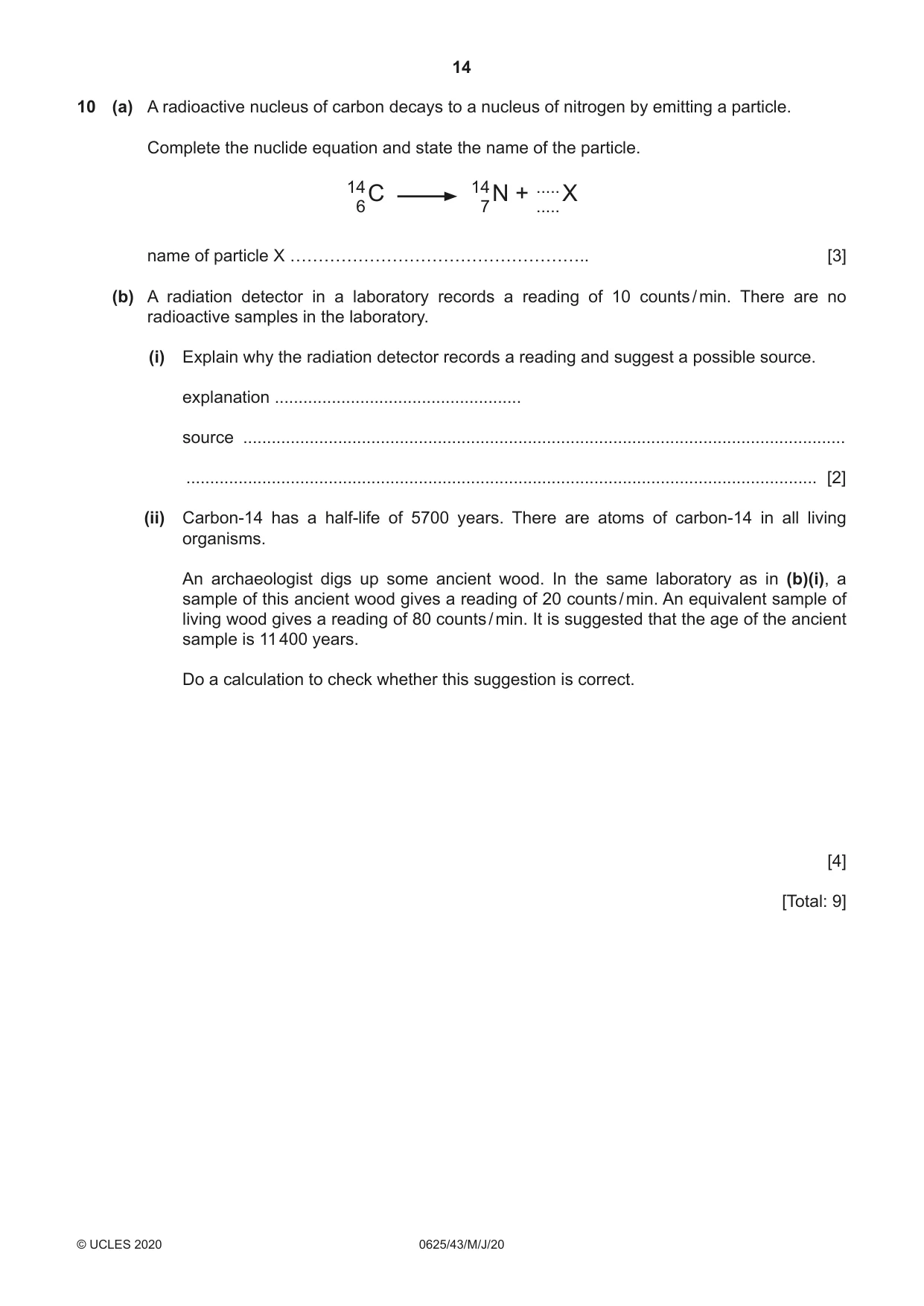
10 (a) A radioactive nucleus of carbon decays to a nucleus of nitrogen by emitting a particle. Complete the nuclide equation and state the name of the particle. 14 C 14 N + ..... X 6 7 ..... name of particle X …………………………………………….. [3] (b) A radiation detector in a laboratory records a reading of 10 counts / min. There are no radioactive samples in the laboratory. (i) Explain why the radiation detector records a reading and suggest a possible source. explanation .................................................... source ............................................................................................................................... ..................................................................................................................................... [2] (ii) Carbon-14 has a half-life of 5700 years. There are atoms of carbon-14 in all living organisms. An archaeologist digs up some ancient wood. In the same laboratory as in (b)(i), a sample of this ancient wood gives a reading of 20 counts / min. An equivalent sample of living wood gives a reading of 80 counts / min. It is suggested that the age of the ancient sample is 11 400 years. Do a calculation to check whether this suggestion is correct. [4] [Total: 9]
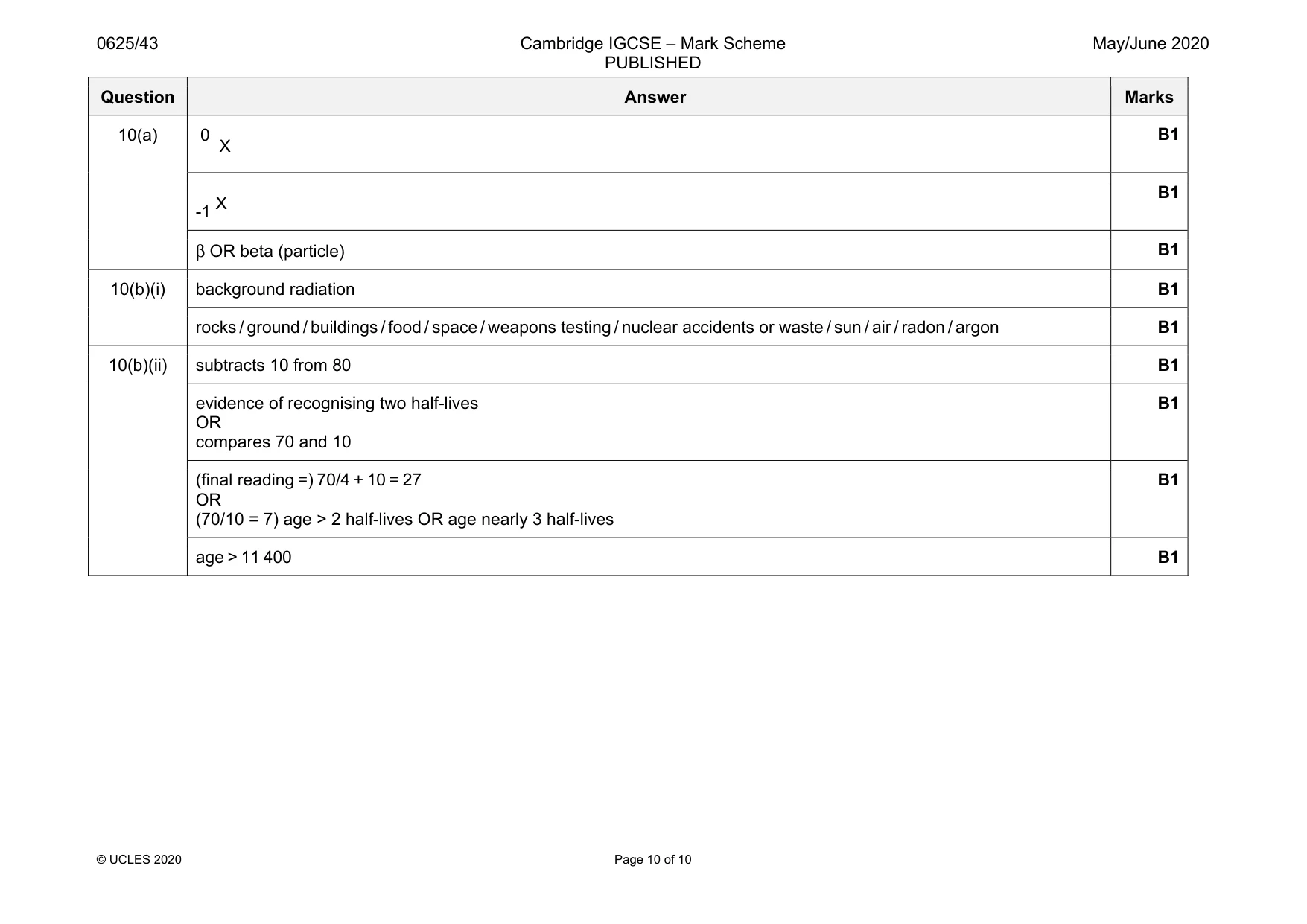
Mark scheme: 10(a) 0 X -1 X B1 β OR beta (particle) B1 10(b)(i) background radiation B1 rocks / ground / buildings / food / space / weapons testing / nuclear accidents or waste / sun / air / radon / argon B1 10(b)(ii) subtracts 10 from 80 B1 evidence of recognising two half-lives OR compares 70 and 10 B1 (final reading =) 70/4 + 10 = 27 OR (70/10 = 7) age > 2 half-lives OR age nearly 3 half-lives B1 age > 11 400 B1
What was in this paper
The subtopics covered by these 10 questions, and how many questions each got. Open one in a new tab to see every Cambridge question on it.