Cambridge IGCSE Physics 0625 — 2025 May/June Paper 4 · Variant 1
0625/41/M/J/25 · 10 questions · 80 marks · ≈90 min
The question paper and its mark scheme, free to read here and free to download. This is Cambridge’s own paper, exactly as it was sat.
Question paper16 pages
Mark scheme16 pages
Answers below. Sit the paper first if you are practising.
Questions as text
Q1 · Circle the vector quantities in the list
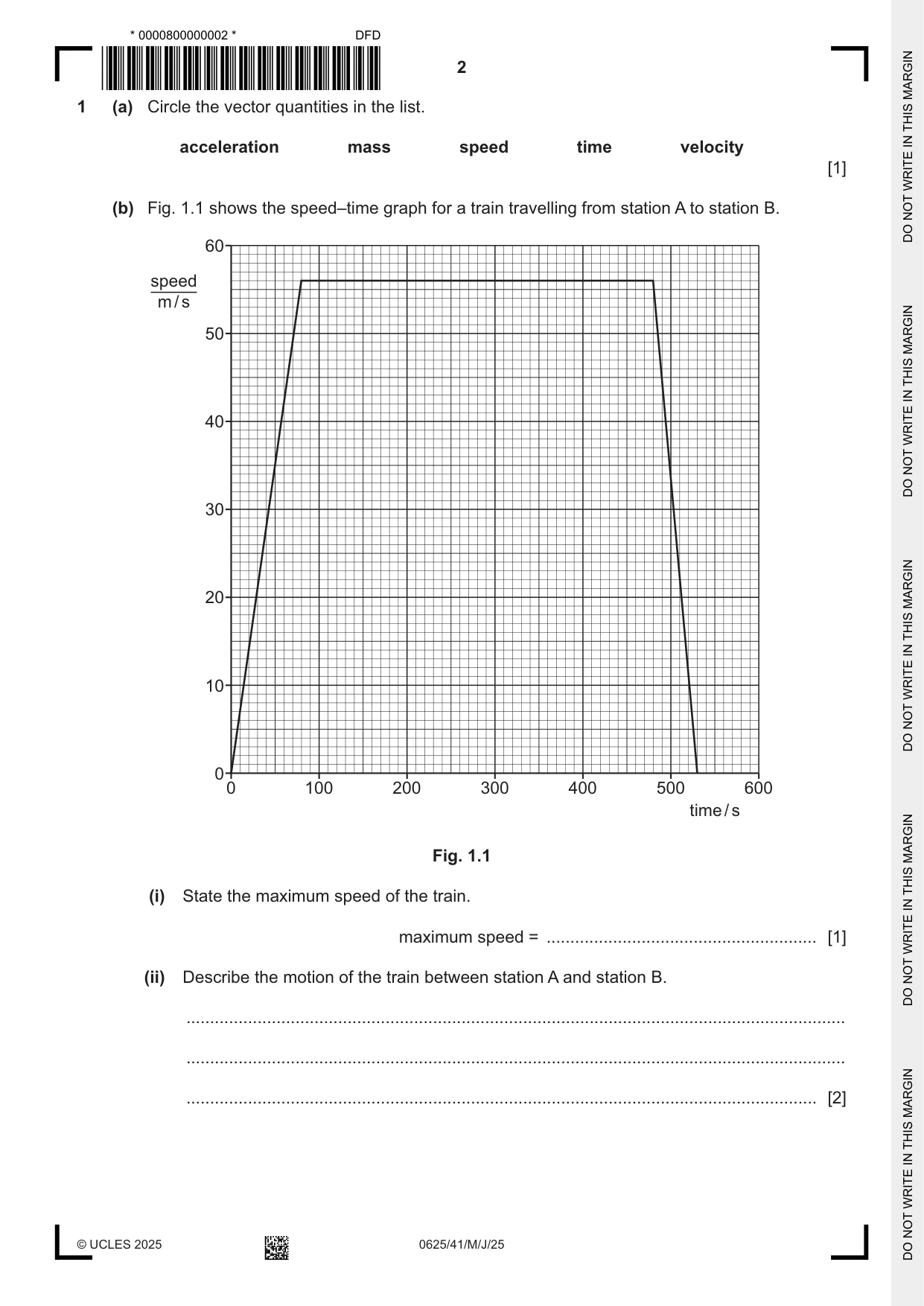
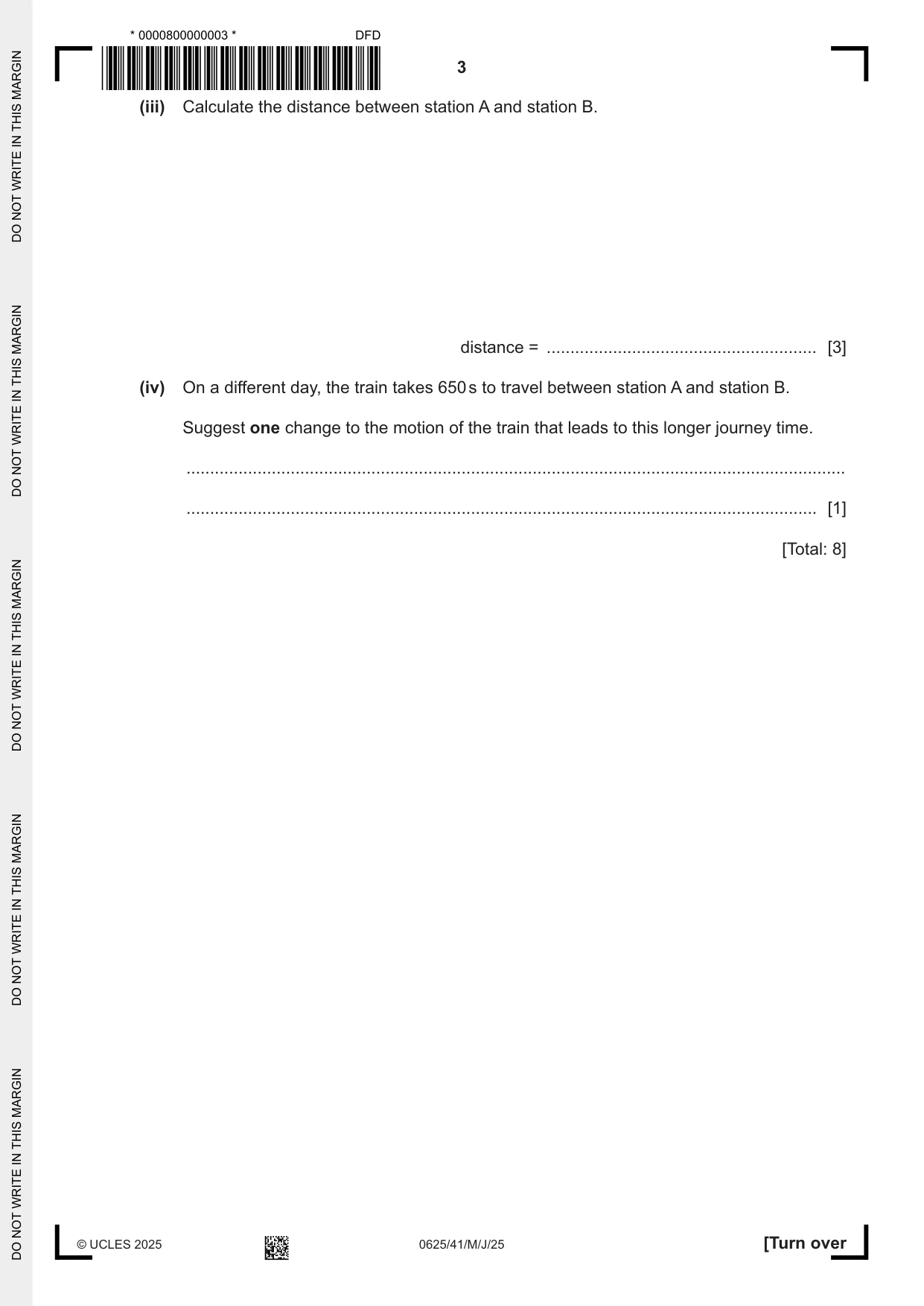
1 (a) Circle the vector quantities in the list. acceleration mass speed time velocity [1] (b) Fig. 1.1 shows the speed–time graph for a train travelling from station A to station B. 60 speed m / s 50 40 30 20 10 0 0 100 200 300 400 500 600 time / s Fig. 1.1 (i) State the maximum speed of the train. maximum speed = ......................................................... [1] (ii) Describe the motion of the train between station A and station B. ........................................................................................................................................... ........................................................................................................................................... ..................................................................................................................................... [2] (iii) Calculate the distance between station A and station B. distance = ......................................................... [3] (iv) On a different day, the train takes 650 s to travel between station A and station B. Suggest one change to the motion of the train that leads to this longer journey time. ........................................................................................................................................... ..................................................................................................................................... [1] [Total: 8]
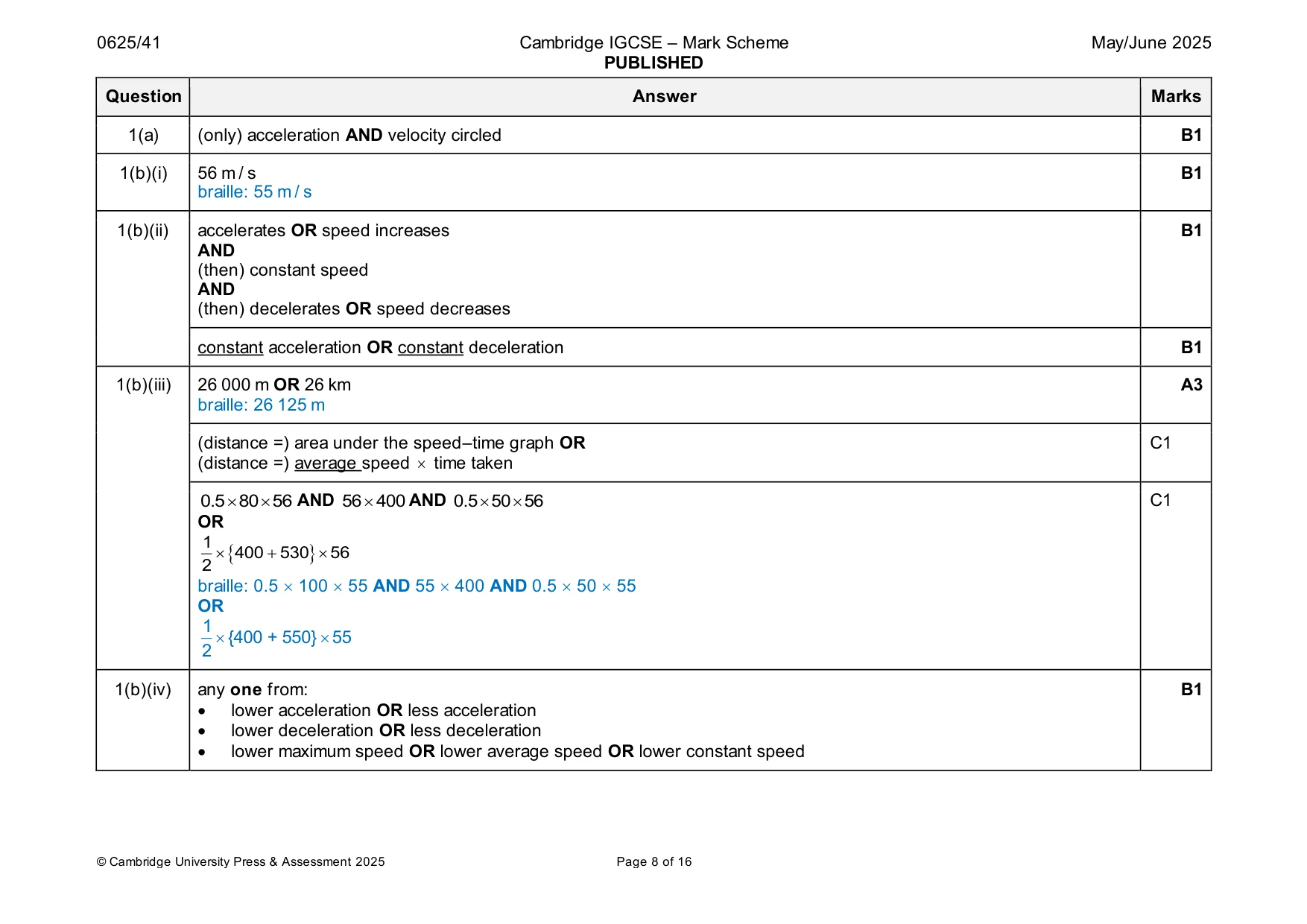
Mark scheme: Question Answer Marks 1(a) (only) acceleration AND velocity circled B1 1(b)(i) 56 m / s B1 braille: 55 m / s 1(b)(ii) accelerates OR speed increases B1 AND (then) constant speed AND (then) decelerates OR speed decreases constant acceleration OR constant deceleration B1 1(b)(iii) 26 000 m OR 26 km A3 braille: 26 125 m (distance =) area under the speed–time graph OR C1 (distance =) average speed time taken 0.5 80 56 AND 56 400 AND 0.5 50 56 C1 OR 1 400 + 530 56 2 braille: 0.5 100 55 AND 55 400 AND 0.5 50 55 OR 1 {400 + 550} 55 2 1(b)(iv) any one from: B1 • lower acceleration OR less acceleration • lower deceleration OR less deceleration • lower maximum speed OR lower average speed OR lower constant speed
Q2 · A resultant force is applied to an object moving with a velocity v in a straight line
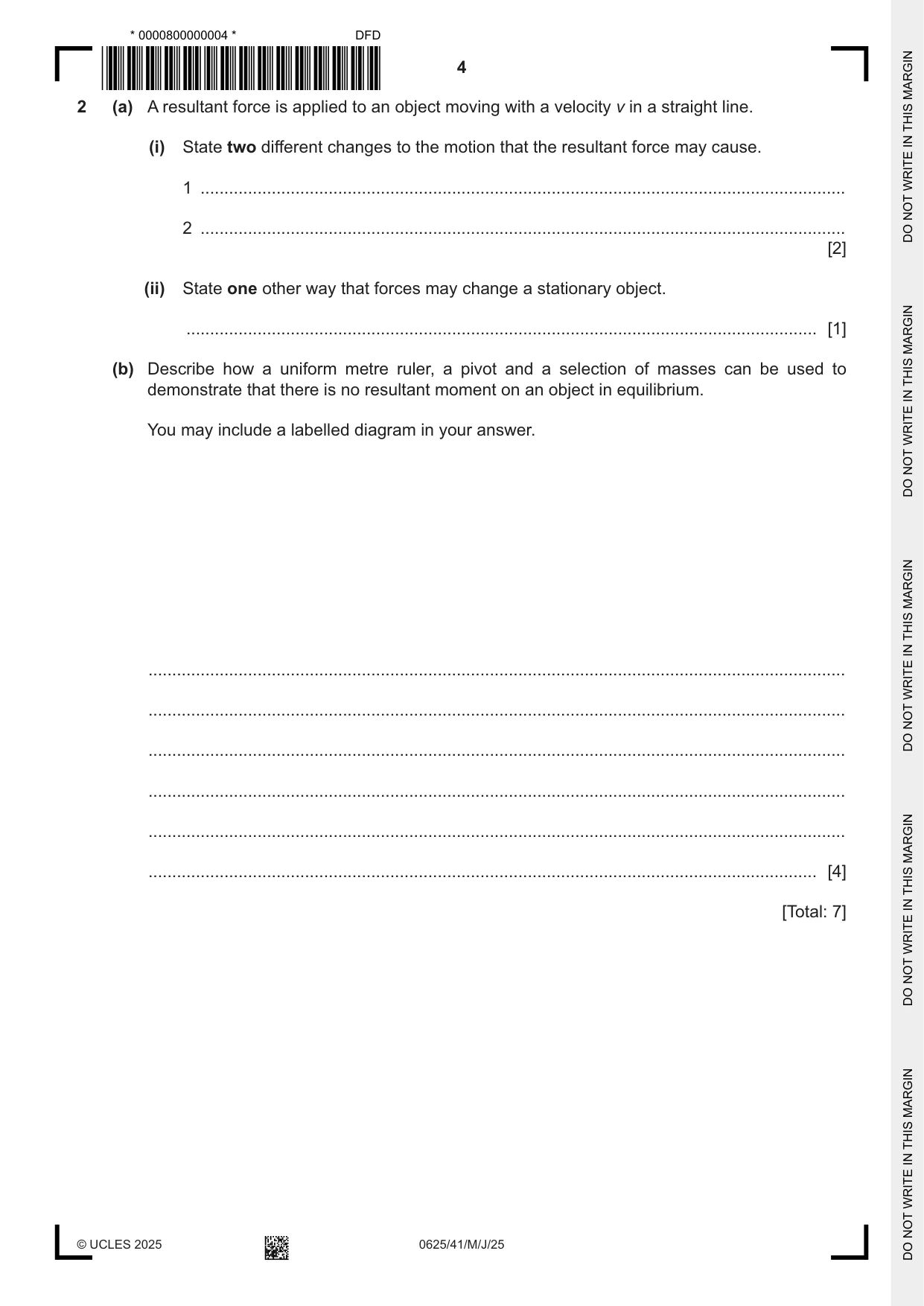
2 (a) A resultant force is applied to an object moving with a velocity v in a straight line. (i) State two different changes to the motion that the resultant force may cause. 1 ........................................................................................................................................ 2 ........................................................................................................................................ [2] (ii) State one other way that forces may change a stationary object. ..................................................................................................................................... [1] (b) Describe how a uniform metre ruler, a pivot and a selection of masses can be used to demonstrate that there is no resultant moment on an object in equilibrium. You may include a labelled diagram in your answer. ................................................................................................................................................... ................................................................................................................................................... ................................................................................................................................................... ................................................................................................................................................... ................................................................................................................................................... ............................................................................................................................................. [4] [Total: 7]
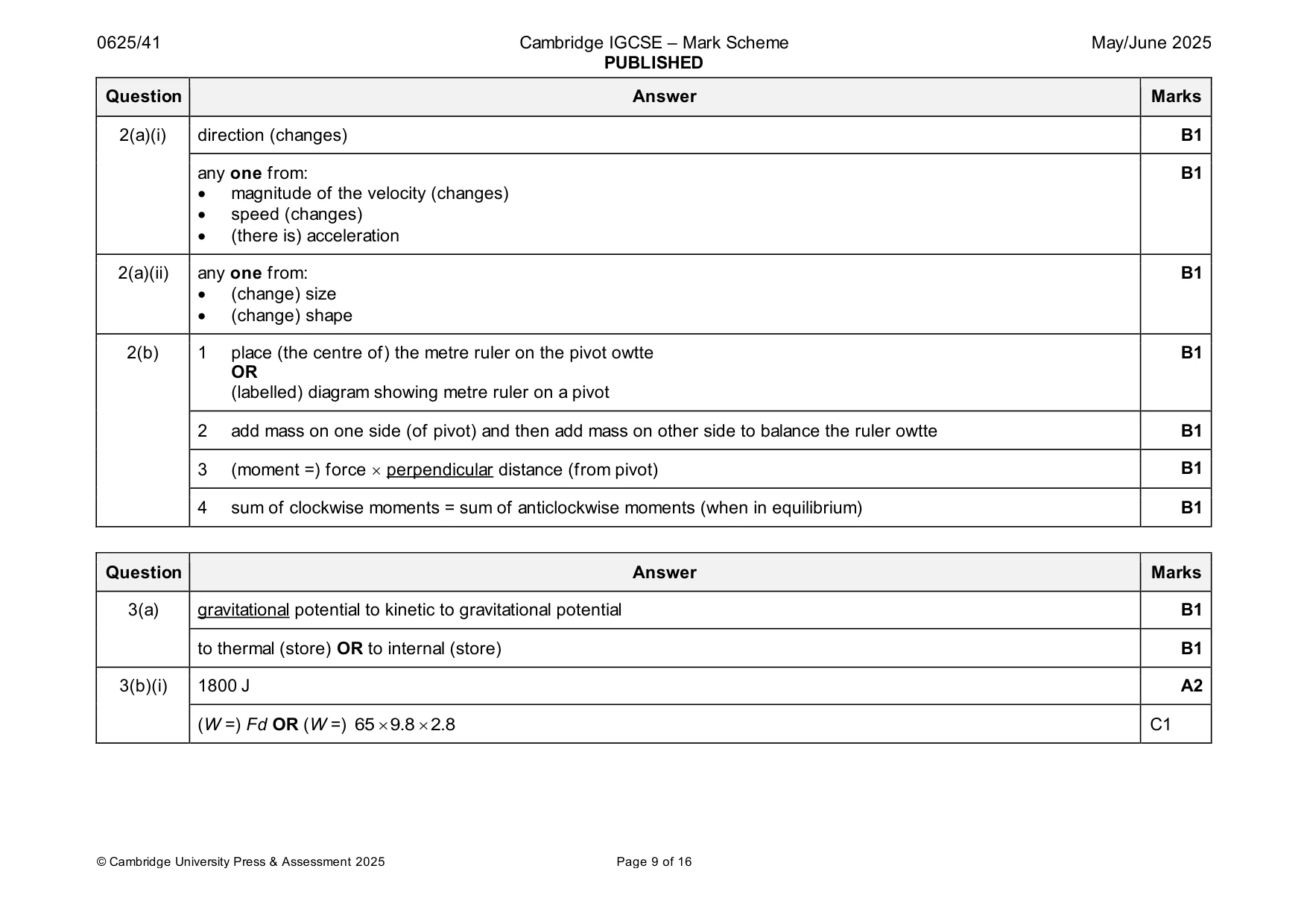
Mark scheme: 2(a)(i) direction (changes) B1 any one from: B1 • magnitude of the velocity (changes) • speed (changes) • (there is) acceleration 2(a)(ii) any one from: B1 • (change) size • (change) shape 2(b) 1 place (the centre of) the metre ruler on the pivot owtte B1 OR (labelled) diagram showing metre ruler on a pivot 2 add mass on one side (of pivot) and then add mass on other side to balance the ruler owtte B1 3 (moment =) force perpendicular distance (from pivot) B1 4 sum of clockwise moments = sum of anticlockwise moments (when in equilibrium) B1
Q3 · A side view of part of a concrete track at a skateboard park
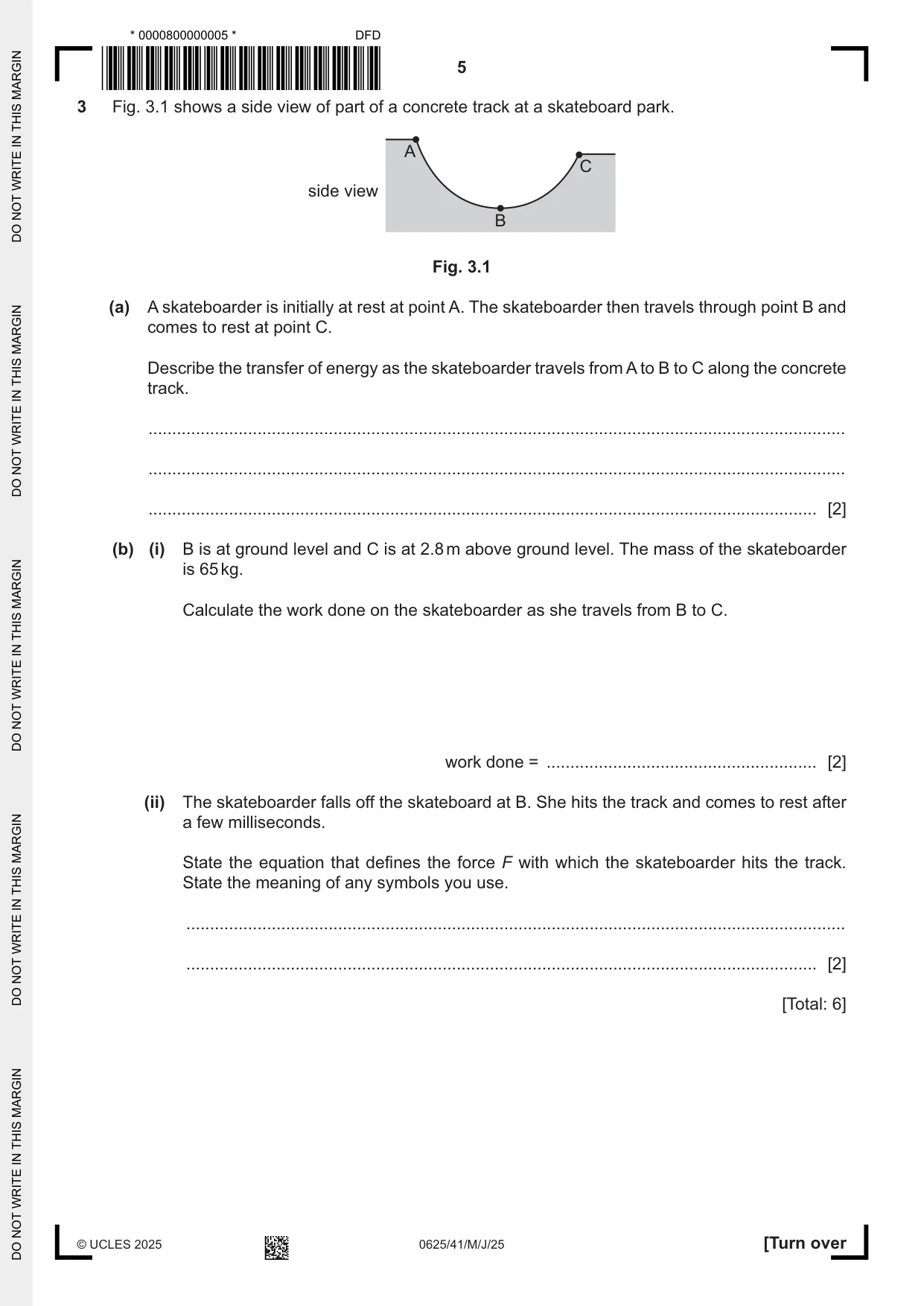
3 Fig. 3.1 shows a side view of part of a concrete track at a skateboard park. A C side view B Fig. 3.1 (a) A skateboarder is initially at rest at point A. The skateboarder then travels through point B and comes to rest at point C. Describe the transfer of energy as the skateboarder travels from A to B to C along the concrete track. ................................................................................................................................................... ................................................................................................................................................... ............................................................................................................................................. [2] (b) (i) B is at ground level and C is at 2.8 m above ground level. The mass of the skateboarder is 65 kg. Calculate the work done on the skateboarder as she travels from B to C. work done = ......................................................... [2] (ii) The skateboarder falls off the skateboard at B. She hits the track and comes to rest after a few milliseconds. State the equation that defines the force F with which the skateboarder hits the track. State the meaning of any symbols you use. ........................................................................................................................................... ..................................................................................................................................... [2] [Total: 6]
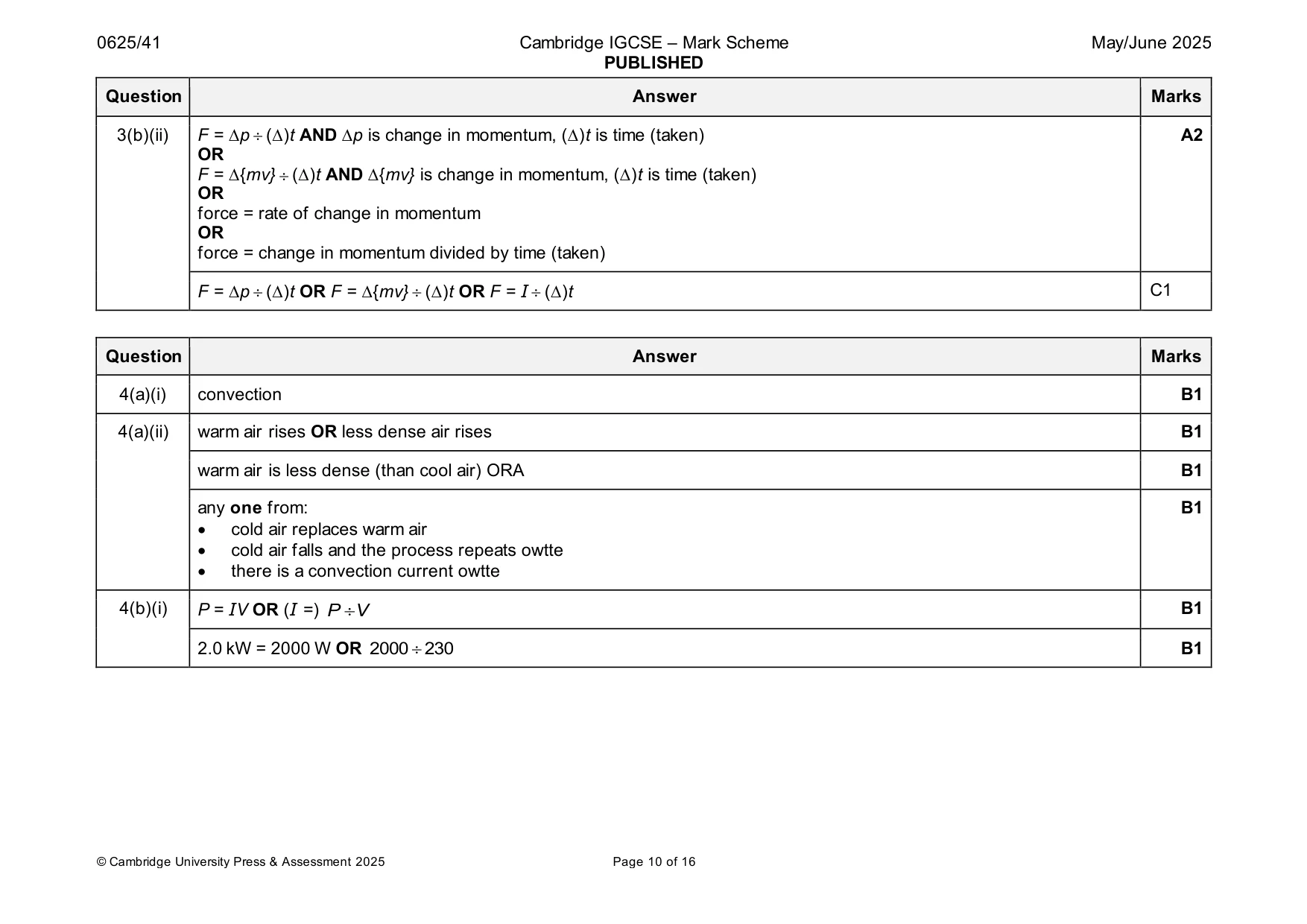
Mark scheme: 3(a) gravitational potential to kinetic to gravitational potential B1 to thermal (store) OR to internal (store) B1 3(b)(i) 1800 J A2 (W =) Fd OR (W =) 65 9.8 2.8 C1 3(b)(ii) F = ∆p (∆)t AND ∆p is change in momentum, (∆)t is time (taken) A2 OR F = ∆{mv} (∆)t AND ∆{mv} is change in momentum, (∆)t is time (taken) OR force = rate of change in momentum OR force = change in momentum divided by time (taken) F = ∆p (∆)t OR F = ∆{mv} (∆)t OR F = I (∆)t C1
Q4 · A heater used to warm the air in a room
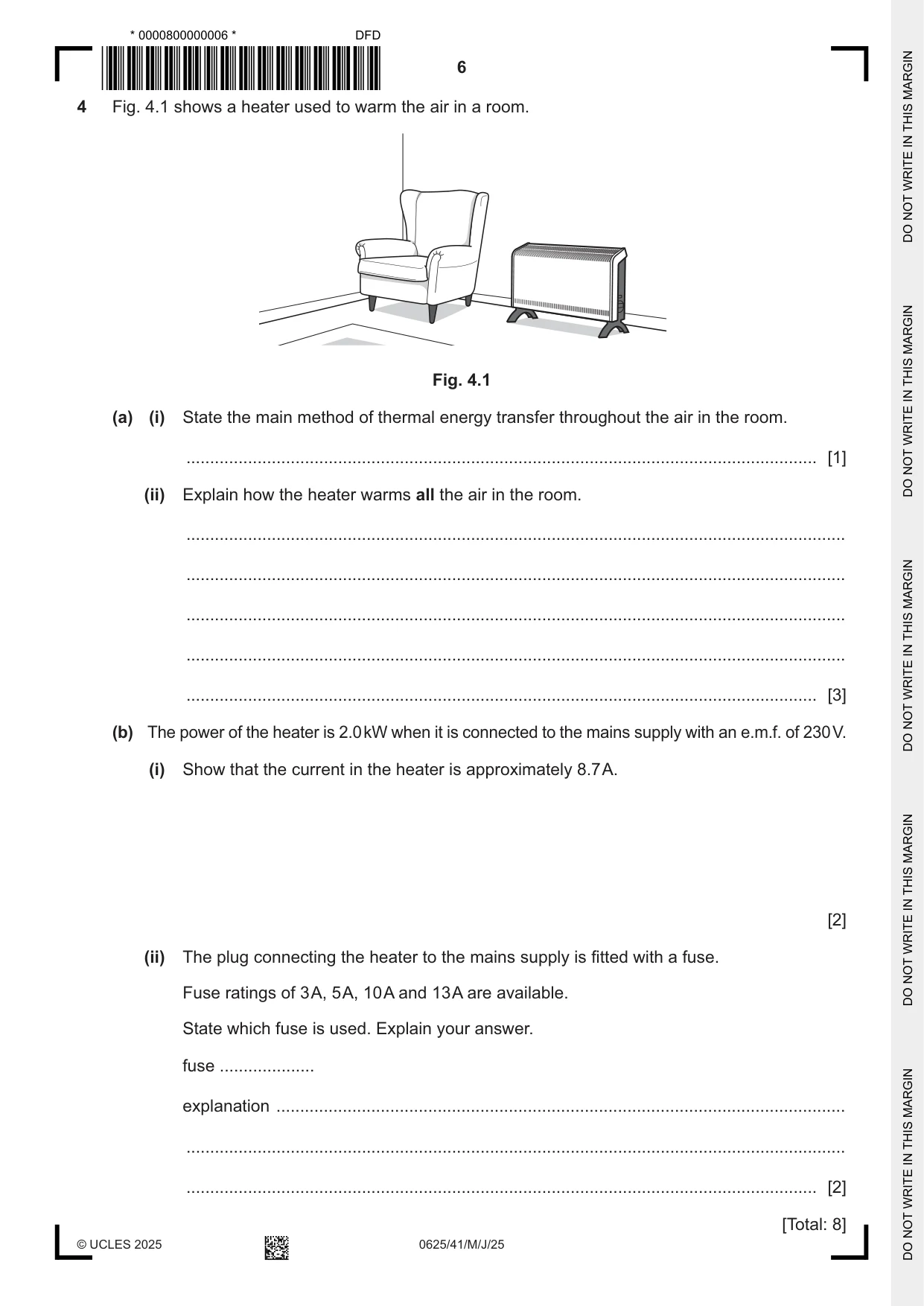
4 Fig. 4.1 shows a heater used to warm the air in a room. Fig. 4.1 (a) (i) State the main method of thermal energy transfer throughout the air in the room. ..................................................................................................................................... [1] (ii) Explain how the heater warms all the air in the room. ........................................................................................................................................... ........................................................................................................................................... ........................................................................................................................................... ........................................................................................................................................... ..................................................................................................................................... [3] (b) The power of the heater is 2.0 kW when it is connected to the mains supply with an e.m.f. of 230 V. (i) Show that the current in the heater is approximately 8.7 A. [2] (ii) The plug connecting the heater to the mains supply is fitted with a fuse. Fuse ratings of 3 A, 5 A, 10 A and 13 A are available. State which fuse is used. Explain your answer. fuse .................... explanation ........................................................................................................................ ........................................................................................................................................... ..................................................................................................................................... [2] [Total: 8]
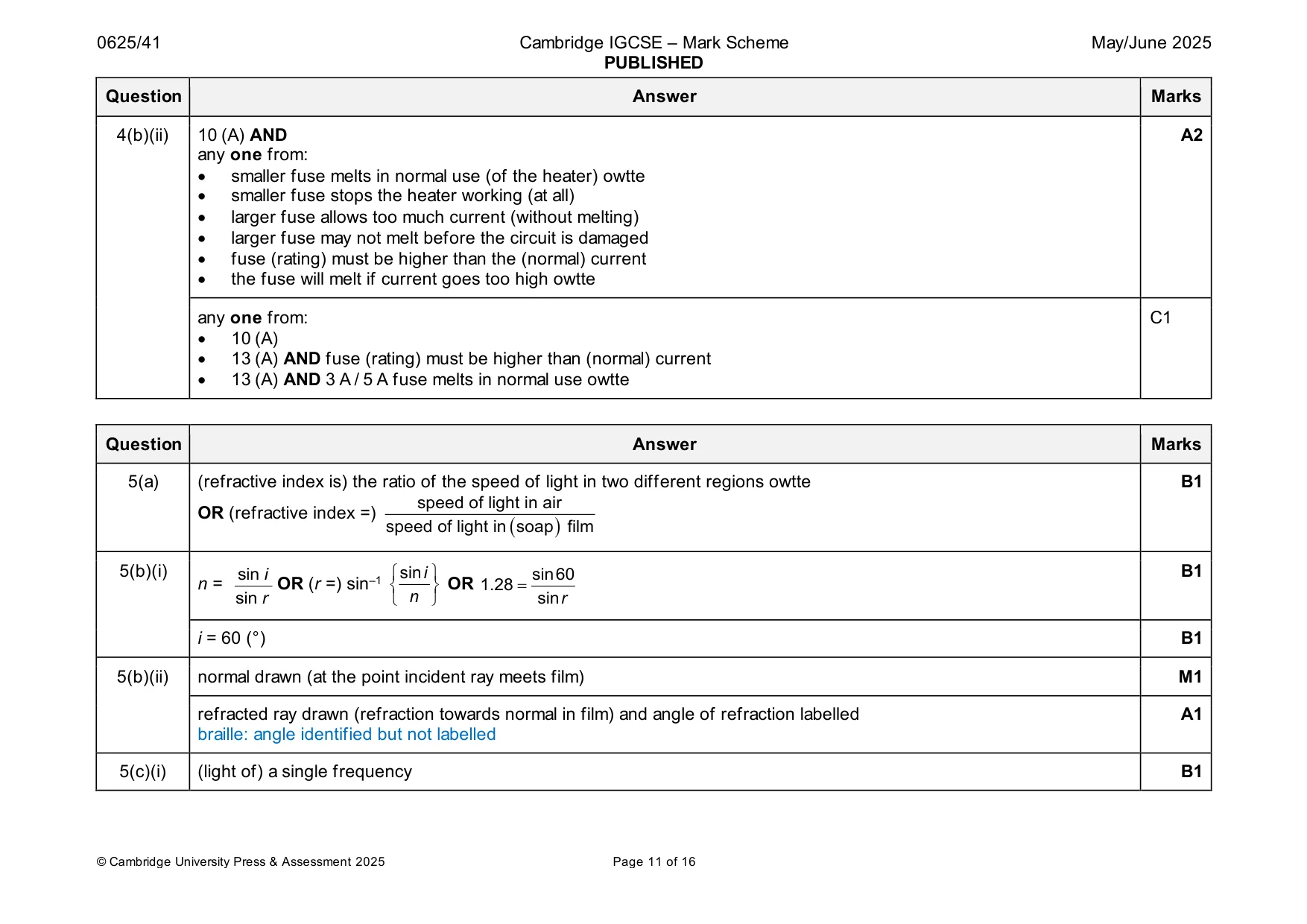
Mark scheme: 4(a)(i) convection B1 4(a)(ii) warm air rises OR less dense air rises B1 warm air is less dense (than cool air) ORA B1 any one from: B1 • cold air replaces warm air • cold air falls and the process repeats owtte • there is a convection current owtte 4(b)(i) P = IV OR (I =) P V B1 2.0 kW = 2000 W OR 2000 230 B1 4(b)(ii) 10 (A) AND A2 any one from: • smaller fuse melts in normal use (of the heater) owtte • smaller fuse stops the heater working (at all) • larger fuse allows too much current (without melting) • larger fuse may not melt before the circuit is damaged • fuse (rating) must be higher than the (normal) current • the fuse will melt if current goes too high owtte any one from: C1 • 10 (A) • 13 (A) AND fuse (rating) must be higher than (normal) current • 13 (A) AND 3 A / 5 A fuse melts in normal use owtte
Q5 · A ray of light is incident on a soap film
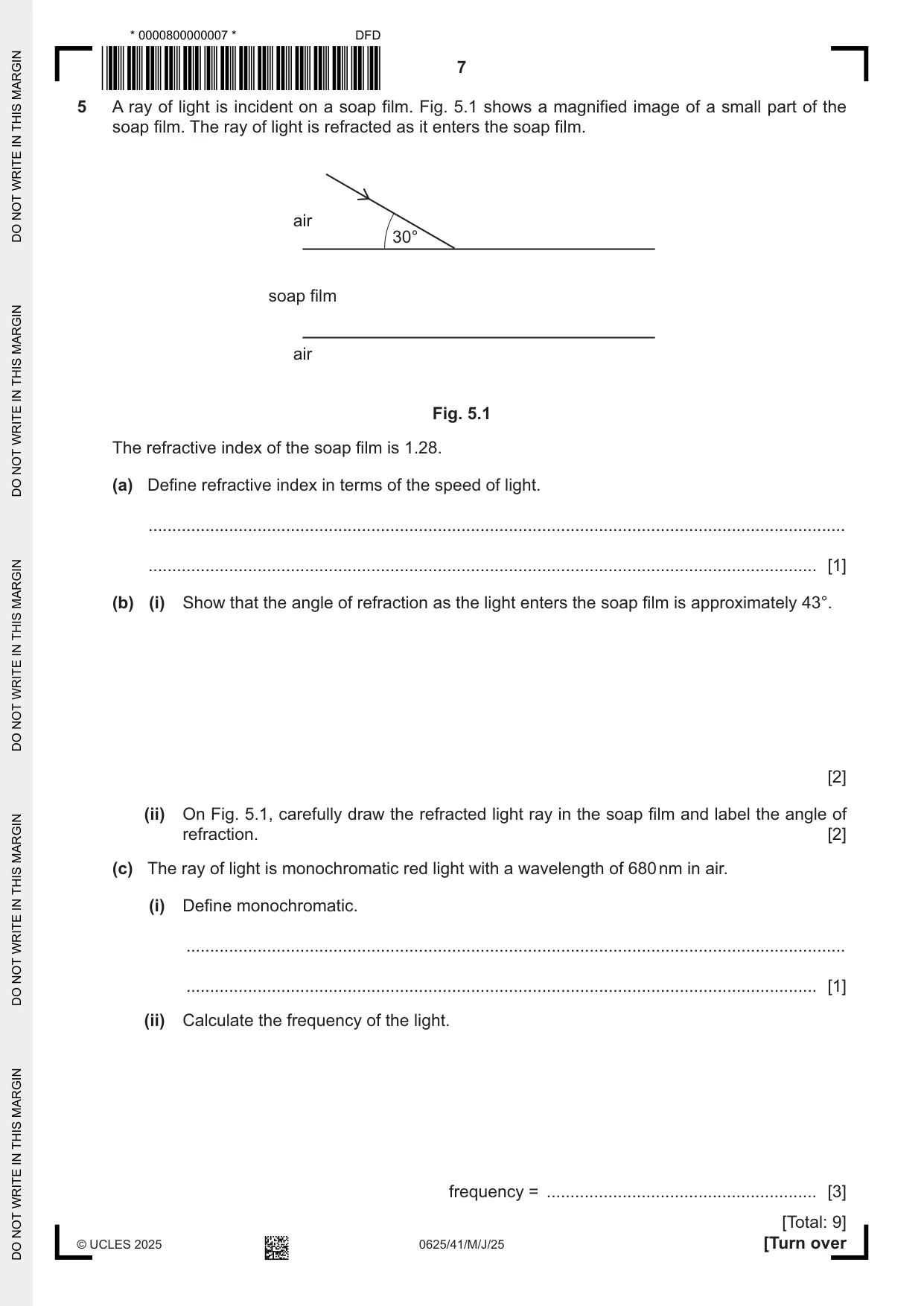
5 A ray of light is incident on a soap film. Fig. 5.1 shows a magnified image of a small part of the soap film. The ray of light is refracted as it enters the soap film. air 30° soap film air Fig. 5.1 The refractive index of the soap film is 1.28. (a) Define refractive index in terms of the speed of light. ................................................................................................................................................... ............................................................................................................................................. [1] (b) (i) Show that the angle of refraction as the light enters the soap film is approximately 43°. [2] (ii) On Fig. 5.1, carefully draw the refracted light ray in the soap film and label the angle of refraction. [2] (c) The ray of light is monochromatic red light with a wavelength of 680 nm in air. (i) Define monochromatic. ........................................................................................................................................... ..................................................................................................................................... [1] (ii) Calculate the frequency of the light. frequency = ......................................................... [3] [Total: 9]
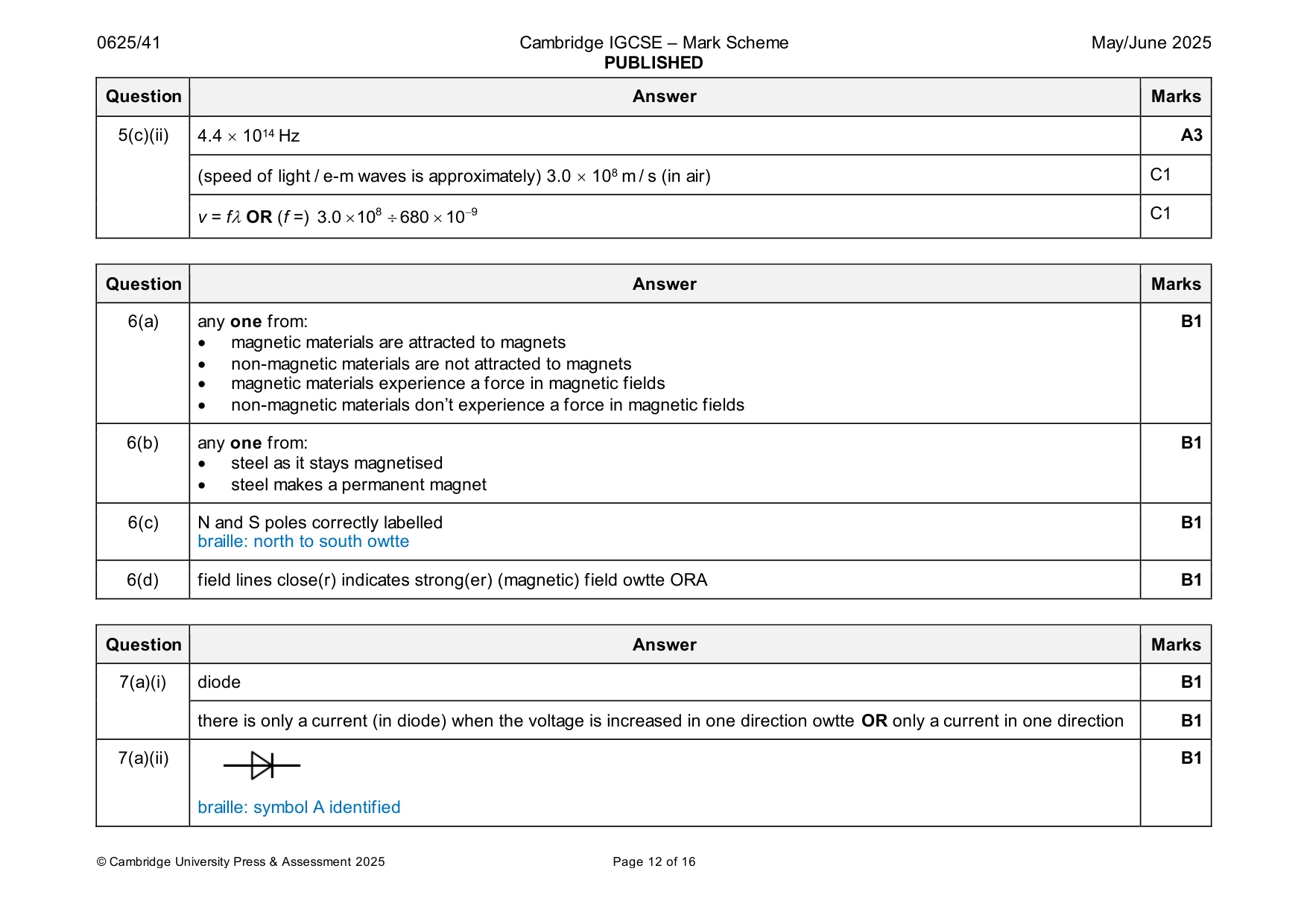
Mark scheme: 5(a) (refractive index is) the ratio of the speed of light in two different regions owtte B1 speed of light in air OR (refractive index =) speed of light in ( soap ) film 5(b)(i) sin i sini sin60 B1 n = OR (r =) sin–1 OR 1.28 = sin r n sinr i = 60 (°) B1 5(b)(ii) normal drawn (at the point incident ray meets film) M1 refracted ray drawn (refraction towards normal in film) and angle of refraction labelled A1 braille: angle identified but not labelled 5(c)(i) (light of) a single frequency B1 5(c)(ii) 4.4 1014 Hz A3 (speed of light / e-m waves is approximately) 3.0 108 m / s (in air) C1 v = fOR (f =) 3.0 108 680 10 −9 C1
Q6 · A person using a magnetic window cleaner
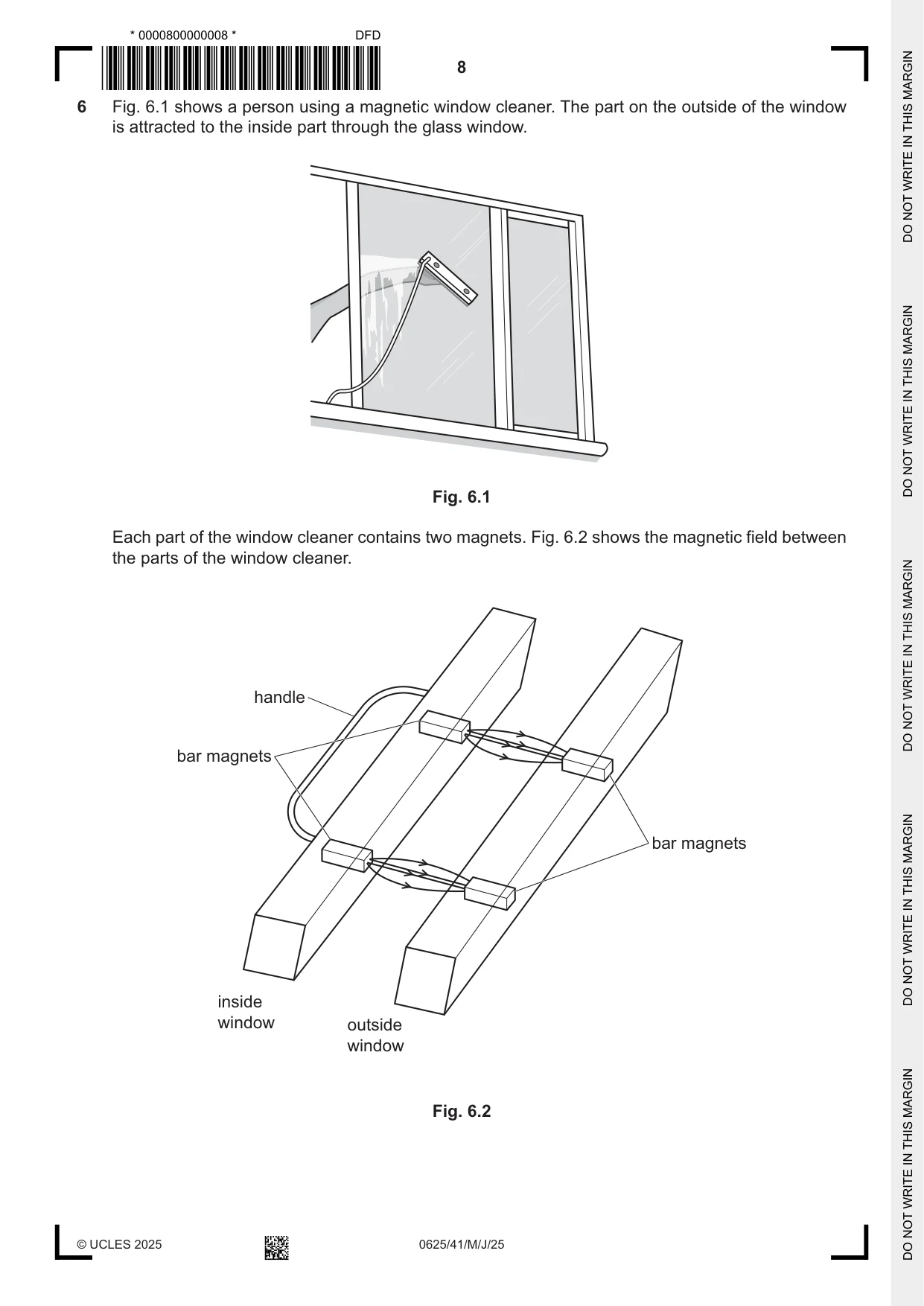
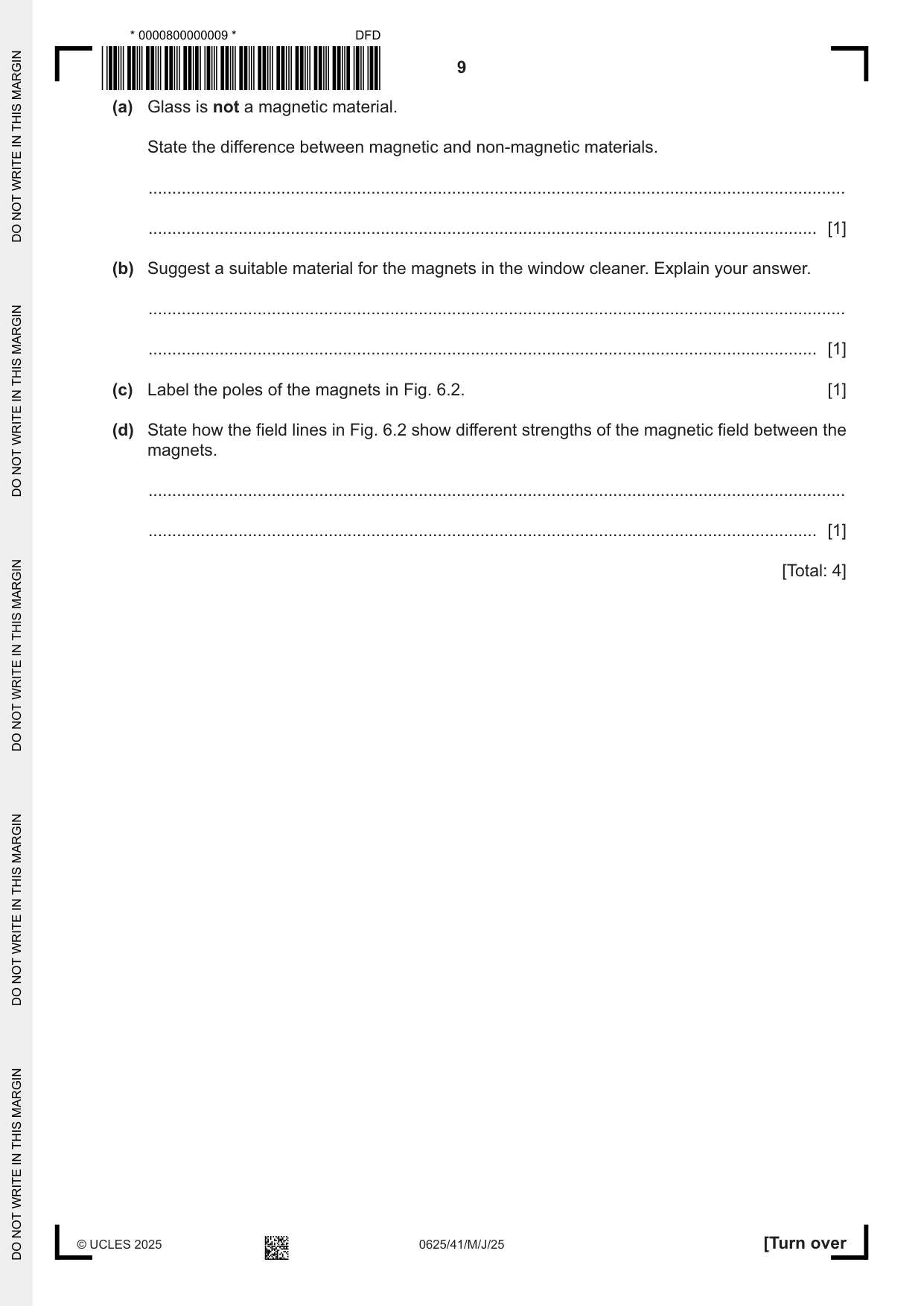
6 Fig. 6.1 shows a person using a magnetic window cleaner. The part on the outside of the window is attracted to the inside part through the glass window. Fig. 6.1 Each part of the window cleaner contains two magnets. Fig. 6.2 shows the magnetic field between the parts of the window cleaner. handle bar magnets bar magnets inside window outside window Fig. 6.2 (a) Glass is not a magnetic material. State the difference between magnetic and non-magnetic materials. ................................................................................................................................................... ............................................................................................................................................. [1] (b) Suggest a suitable material for the magnets in the window cleaner. Explain your answer. ................................................................................................................................................... ............................................................................................................................................. [1] (c) Label the poles of the magnets in Fig. 6.2. [1] (d) State how the field lines in Fig. 6.2 show different strengths of the magnetic field between the magnets. ................................................................................................................................................... ............................................................................................................................................. [1] [Total: 4]
Mark scheme: 6(a) any one from: B1 • magnetic materials are attracted to magnets • non-magnetic materials are not attracted to magnets • magnetic materials experience a force in magnetic fields • non-magnetic materials don’t experience a force in magnetic fields 6(b) any one from: B1 • steel as it stays magnetised • steel makes a permanent magnet 6(c) N and S poles correctly labelled B1 braille: north to south owtte 6(d) field lines close(r) indicates strong(er) (magnetic) field owtte ORA B1
Q7 · A sketch of the current–voltage graph for an electrical component
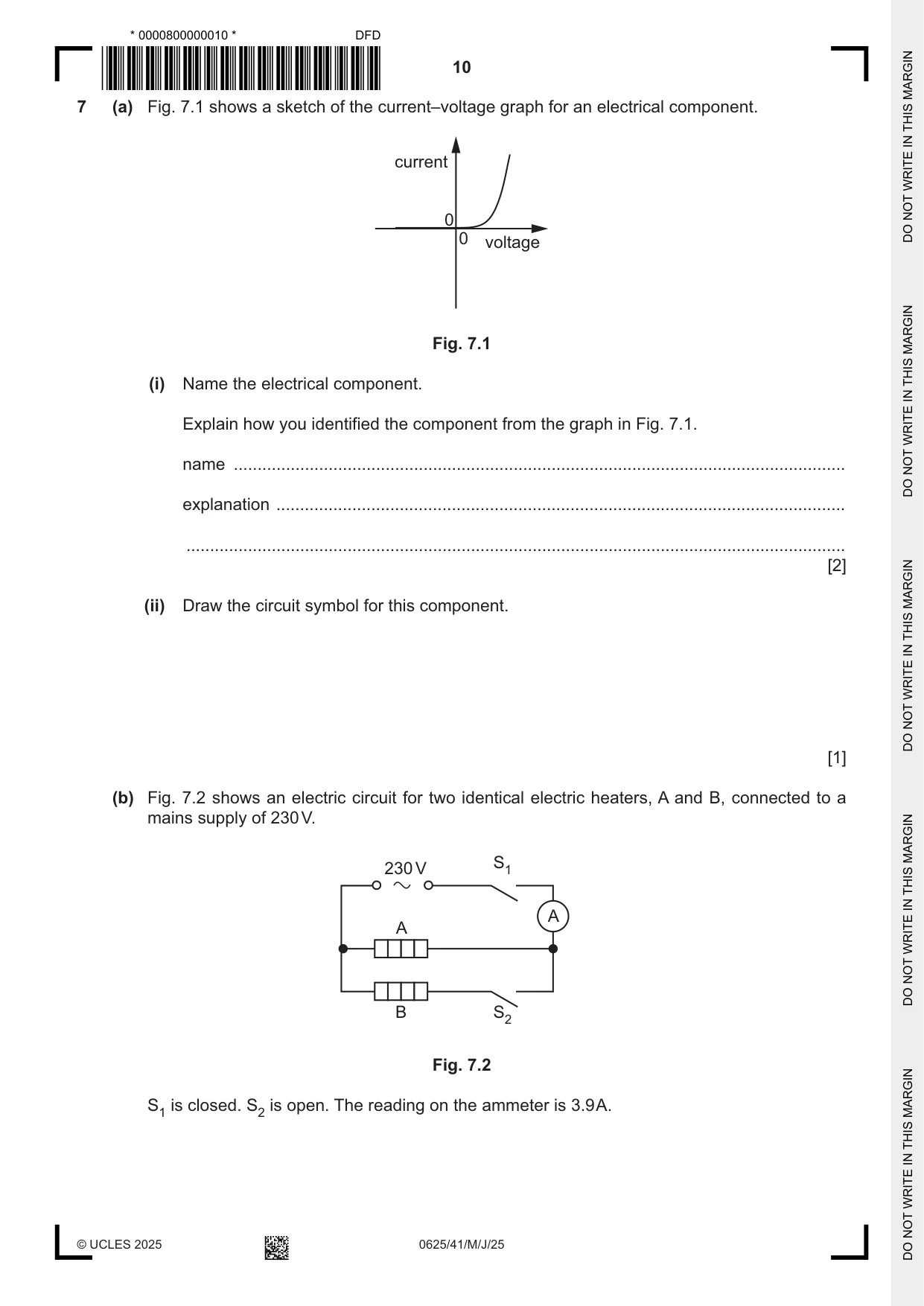
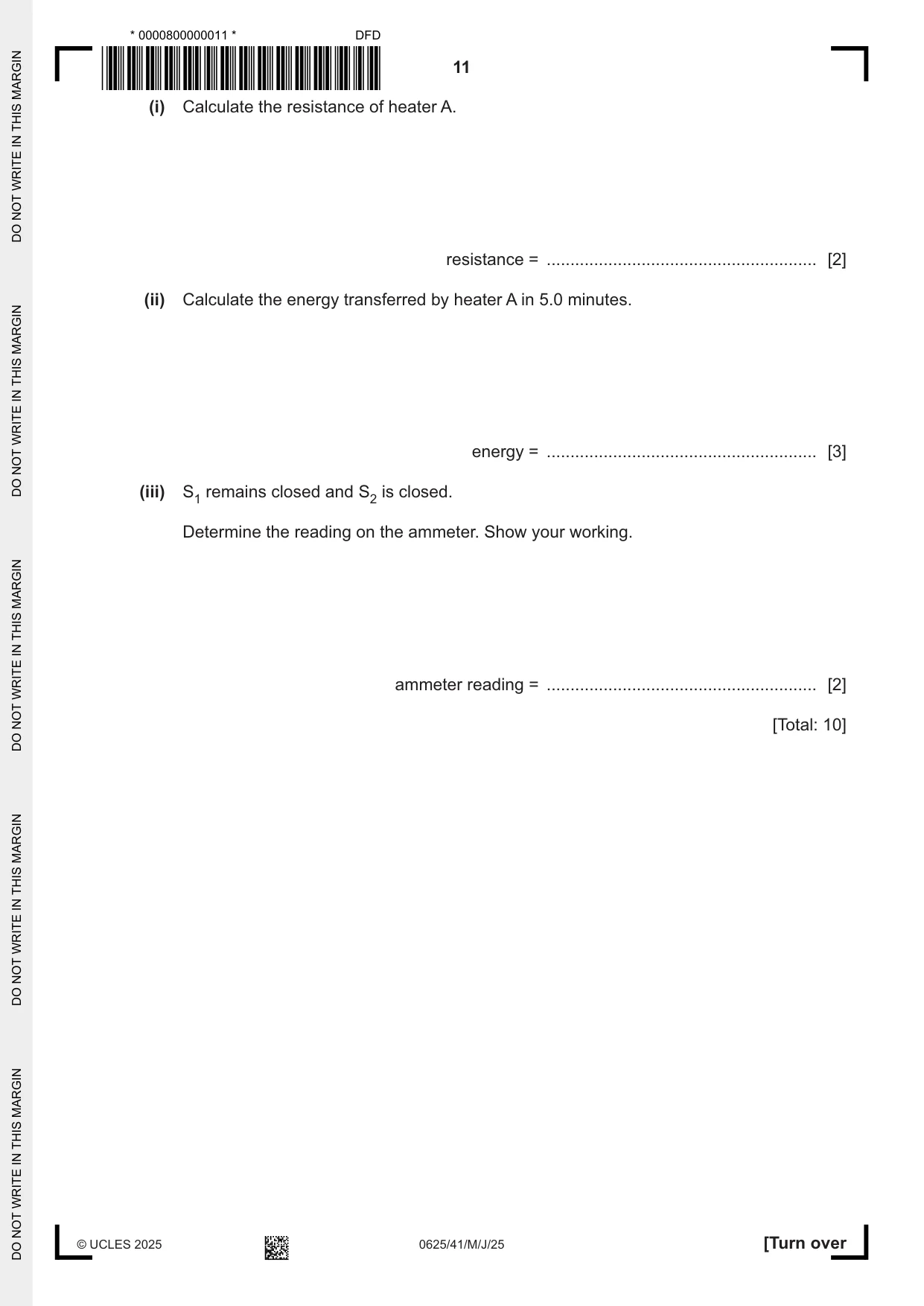
7 (a) Fig. 7.1 shows a sketch of the current–voltage graph for an electrical component. current 0 0 voltage Fig. 7.1 (i) Name the electrical component. Explain how you identified the component from the graph in Fig. 7.1. name ................................................................................................................................. explanation ........................................................................................................................ ........................................................................................................................................... [2] (ii) Draw the circuit symbol for this component. [1] (b) Fig. 7.2 shows an electric circuit for two identical electric heaters, A and B, connected to a mains supply of 230 V. 230 V S1 A A B S2 Fig. 7.2 S1 is closed. S2 is open. The reading on the ammeter is 3.9 A. (i) Calculate the resistance of heater A. resistance = ......................................................... [2] (ii) Calculate the energy transferred by heater A in 5.0 minutes. energy = ......................................................... [3] (iii) S1 remains closed and S2 is closed. Determine the reading on the ammeter. Show your working. ammeter reading = ......................................................... [2] [Total: 10]
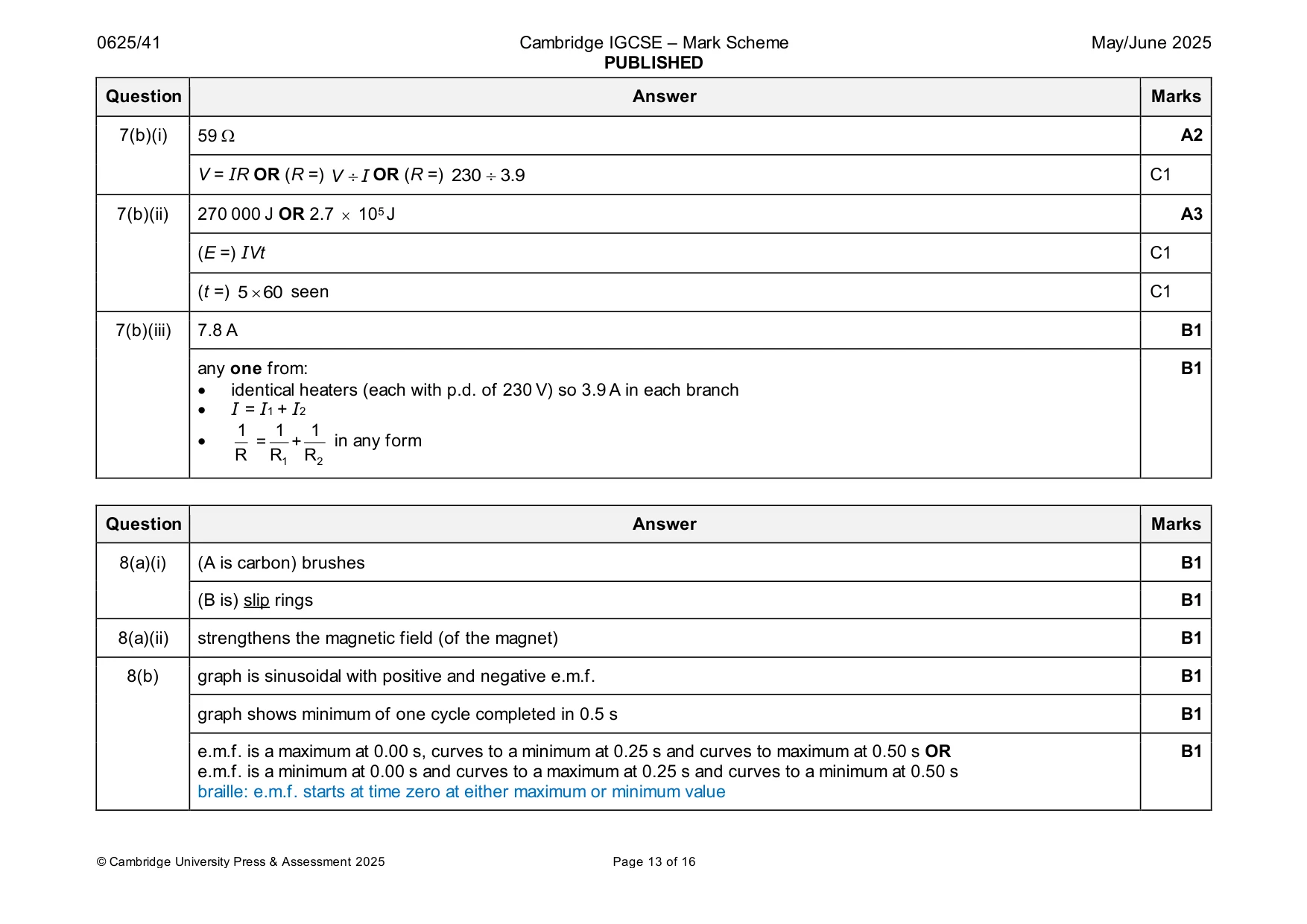
Mark scheme: 7(a)(i) diode B1 there is only a current (in diode) when the voltage is increased in one direction owtte OR only a current in one direction B1 7(a)(ii) B1 braille: symbol A identified 7(b)(i) 59 A2 V = IR OR (R =) V I OR (R =) 230 3.9 C1 7(b)(ii) 270 000 J OR 2.7 105 J A3 (E =) IVt C1 (t =) 5 60 seen C1 7(b)(iii) 7.8 A B1 any one from: B1 • identical heaters (each with p.d. of 230 V) so 3.9 A in each branch • I = I1 + I2 1 1 1 • = + in any form R R1 R 2
Q8 · A diagram of part of a simple a.c
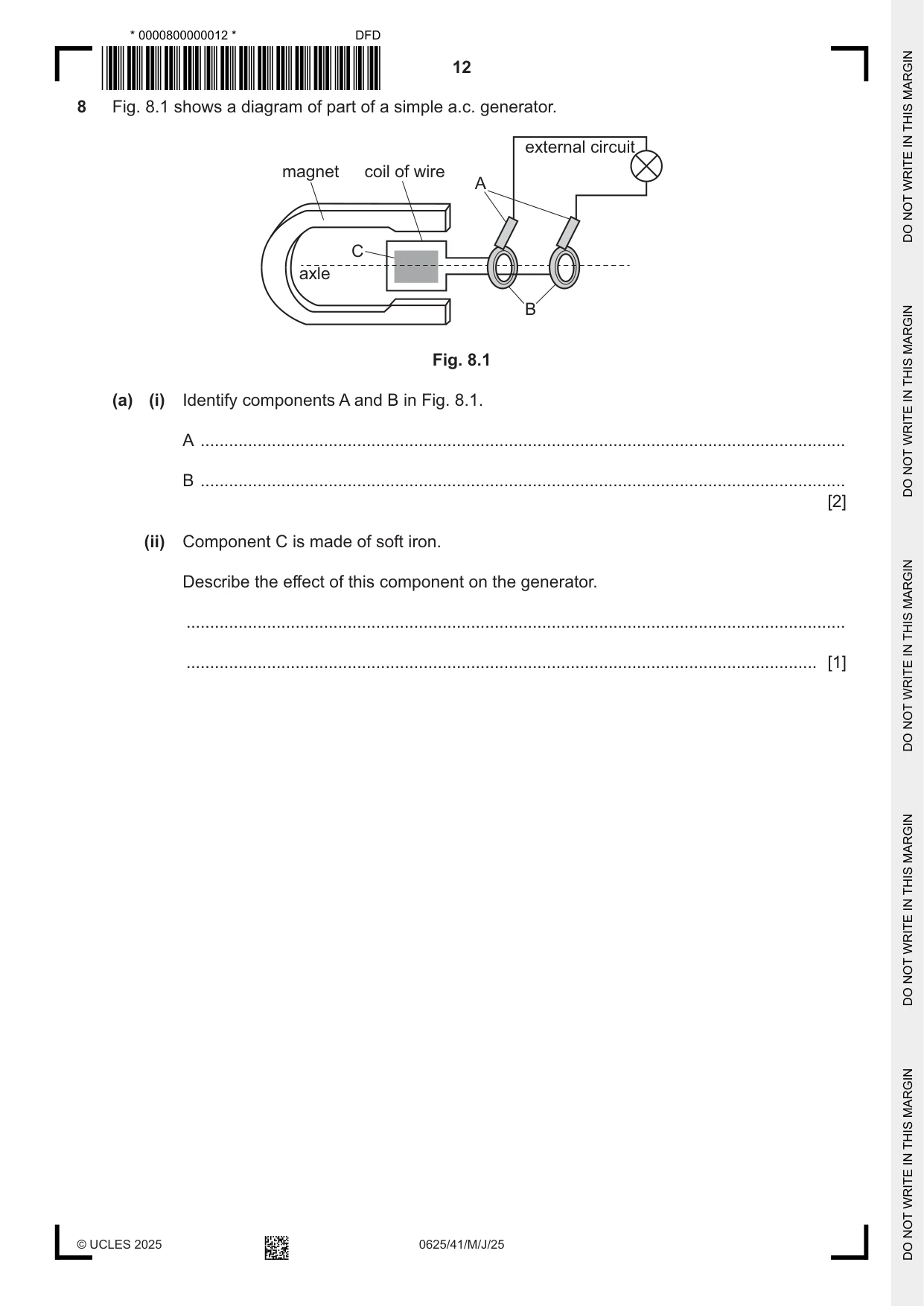
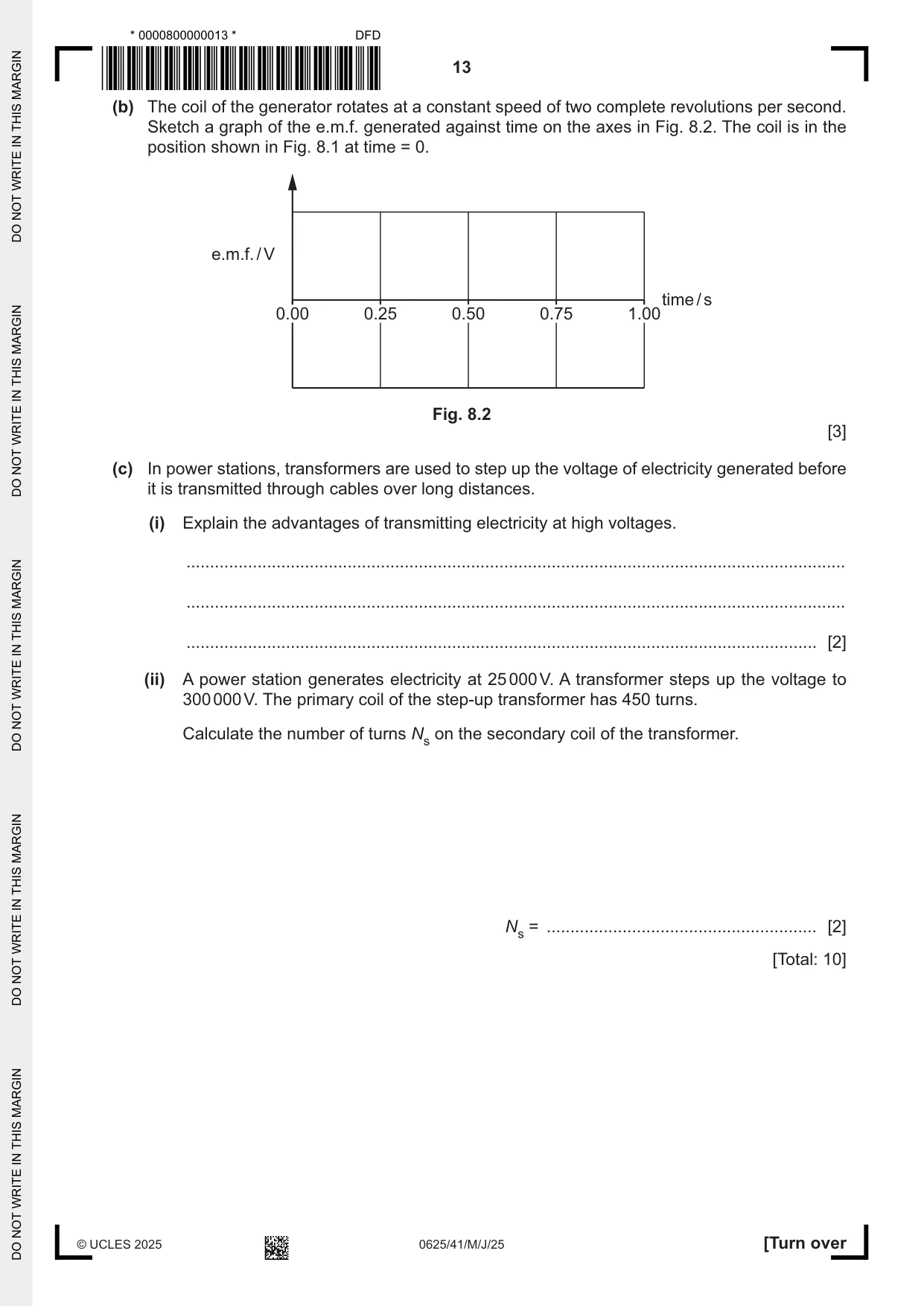
8 Fig. 8.1 shows a diagram of part of a simple a.c. generator. external circuit magnet coil of wire A C axle B Fig. 8.1 (a) (i) Identify components A and B in Fig. 8.1. A ........................................................................................................................................ B ........................................................................................................................................ [2] (ii) Component C is made of soft iron. Describe the effect of this component on the generator. ........................................................................................................................................... ..................................................................................................................................... [1] (b) The coil of the generator rotates at a constant speed of two complete revolutions per second. Sketch a graph of the e.m.f. generated against time on the axes in Fig. 8.2. The coil is in the position shown in Fig. 8.1 at time = 0. e.m.f. / V time / s 0.00 0.25 0.50 0.75 1.00 Fig. 8.2 [3] (c) In power stations, transformers are used to step up the voltage of electricity generated before it is transmitted through cables over long distances. (i) Explain the advantages of transmitting electricity at high voltages. ........................................................................................................................................... ........................................................................................................................................... ..................................................................................................................................... [2] (ii) A power station generates electricity at 25 000 V. A transformer steps up the voltage to 300 000 V. The primary coil of the step-up transformer has 450 turns. Calculate the number of turns Ns on the secondary coil of the transformer. Ns = ......................................................... [2] [Total: 10]
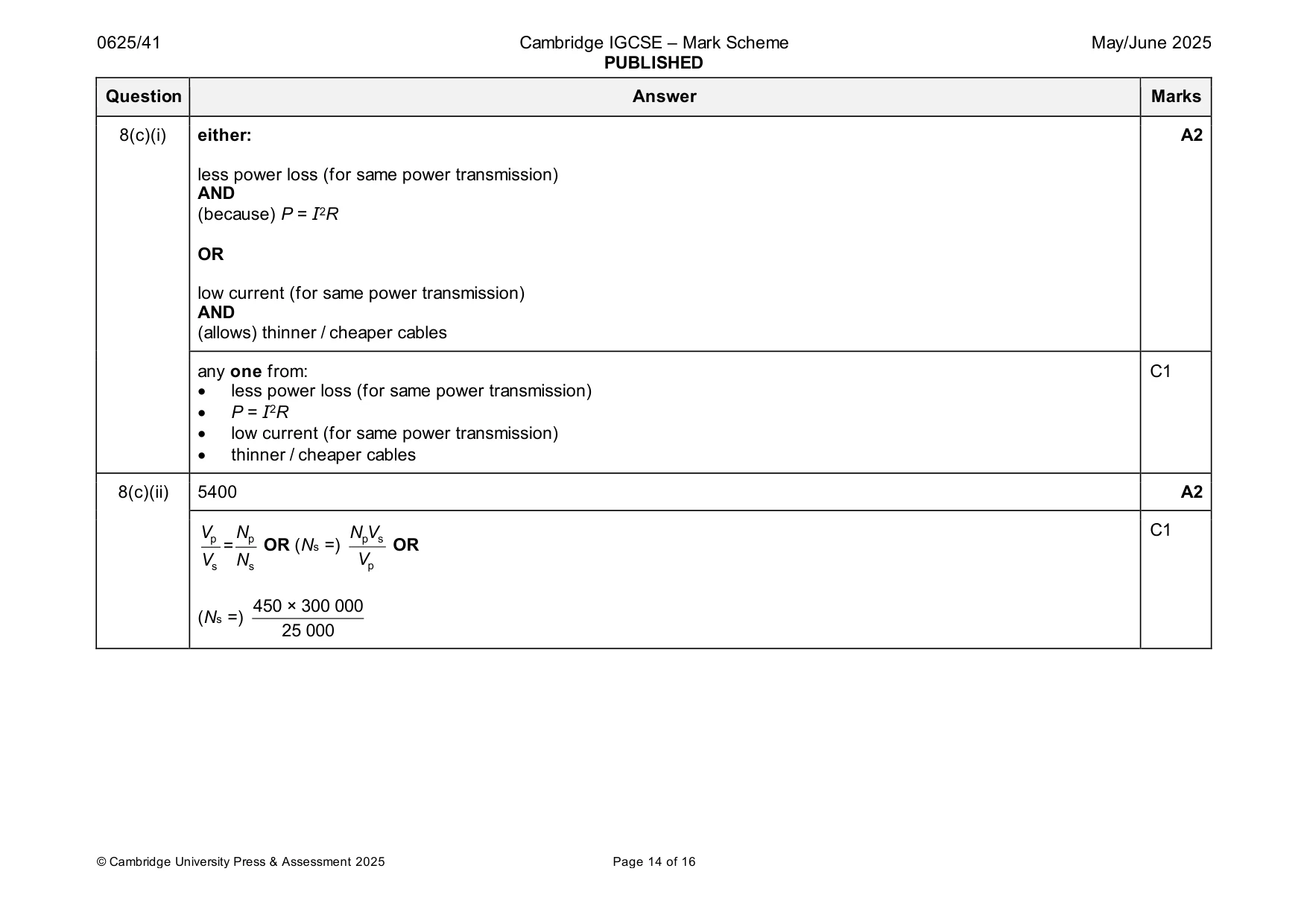
Mark scheme: 8(a)(i) (A is carbon) brushes B1 (B is) slip rings B1 8(a)(ii) strengthens the magnetic field (of the magnet) B1 8(b) graph is sinusoidal with positive and negative e.m.f. B1 graph shows minimum of one cycle completed in 0.5 s B1 e.m.f. is a maximum at 0.00 s, curves to a minimum at 0.25 s and curves to maximum at 0.50 s OR B1 e.m.f. is a minimum at 0.00 s and curves to a maximum at 0.25 s and curves to a minimum at 0.50 s braille: e.m.f. starts at time zero at either maximum or minimum value 8(c)(i) either: A2 less power loss (for same power transmission) AND (because) P = I2R OR low current (for same power transmission) AND (allows) thinner / cheaper cables any one from: C1 • less power loss (for same power transmission) • P = I2R • low current (for same power transmission) • thinner / cheaper cables 8(c)(ii) 5400 A2 Vp Np NpVs C1 = OR (Ns =) OR Vs Ns Vp 450 × 300 000 (Ns =) 25 000
Q9 · Strontium-90 (9038Sr) is a radioactive isotope that contains 38 protons and 52 neutrons
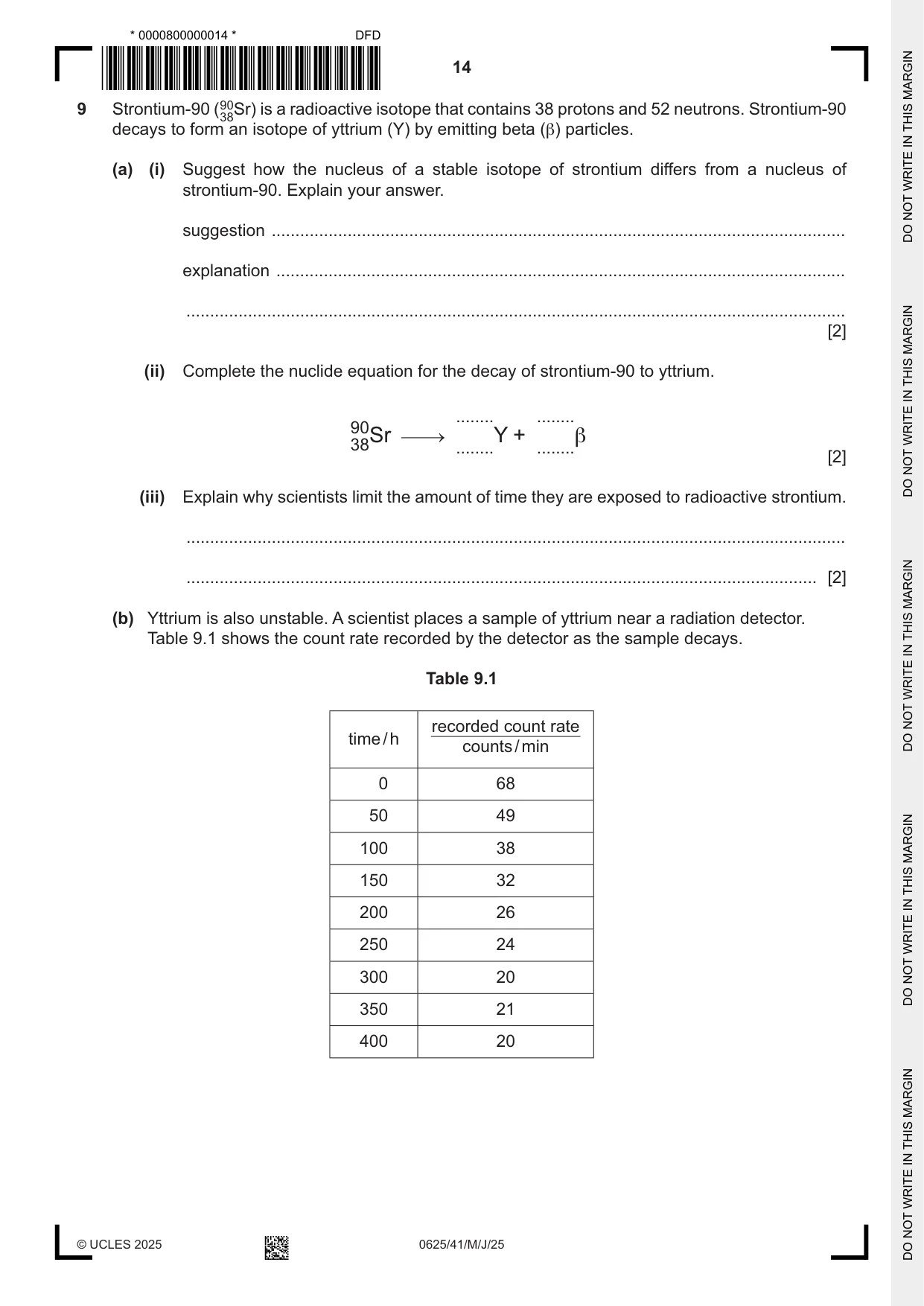
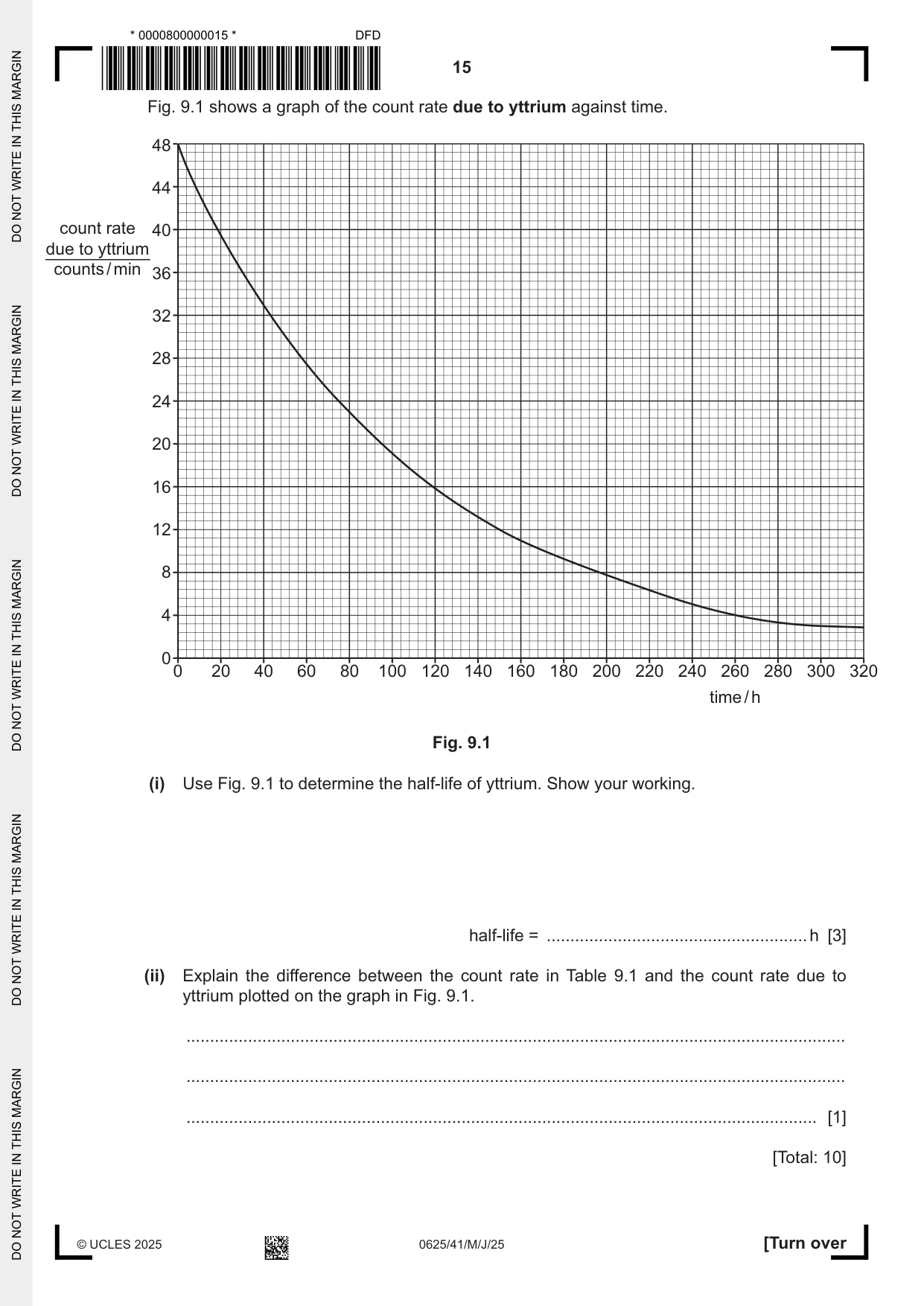
9 Strontium-90 (9038Sr) is a radioactive isotope that contains 38 protons and 52 neutrons. Strontium-90 decays to form an isotope of yttrium (Y) by emitting beta (β) particles. (a) (i) Suggest how the nucleus of a stable isotope of strontium differs from a nucleus of strontium-90. Explain your answer. suggestion ......................................................................................................................... explanation ........................................................................................................................ ........................................................................................................................................... [2] (ii) Complete the nuclide equation for the decay of strontium-90 to yttrium. ........ ........ 90 38Sr ........Y + ........β [2] (iii) Explain why scientists limit the amount of time they are exposed to radioactive strontium. ........................................................................................................................................... ..................................................................................................................................... [2] (b) Yttrium is also unstable. A scientist places a sample of yttrium near a radiation detector. Table 9.1 shows the count rate recorded by the detector as the sample decays. Table 9.1 recorded count rate time / h counts / min 0 68 50 49 100 38 150 32 200 26 250 24 300 20 350 21 400 20 Fig. 9.1 shows a graph of the count rate due to yttrium against time. 48 44 count rate 40 due to yttrium counts / min 36 32 28 24 20 16 12 8 4 0 0 20 40 60 80 100 120 140 160 180 200 220 240 260 280 300 320 time / h Fig. 9.1 (i) Use Fig. 9.1 to determine the half-life of yttrium. Show your working. half-life = ....................................................... h [3] (ii) Explain the difference between the count rate in Table 9.1 and the count rate due to yttrium plotted on the graph in Fig. 9.1. ........................................................................................................................................... ........................................................................................................................................... ..................................................................................................................................... [1] [Total: 10]
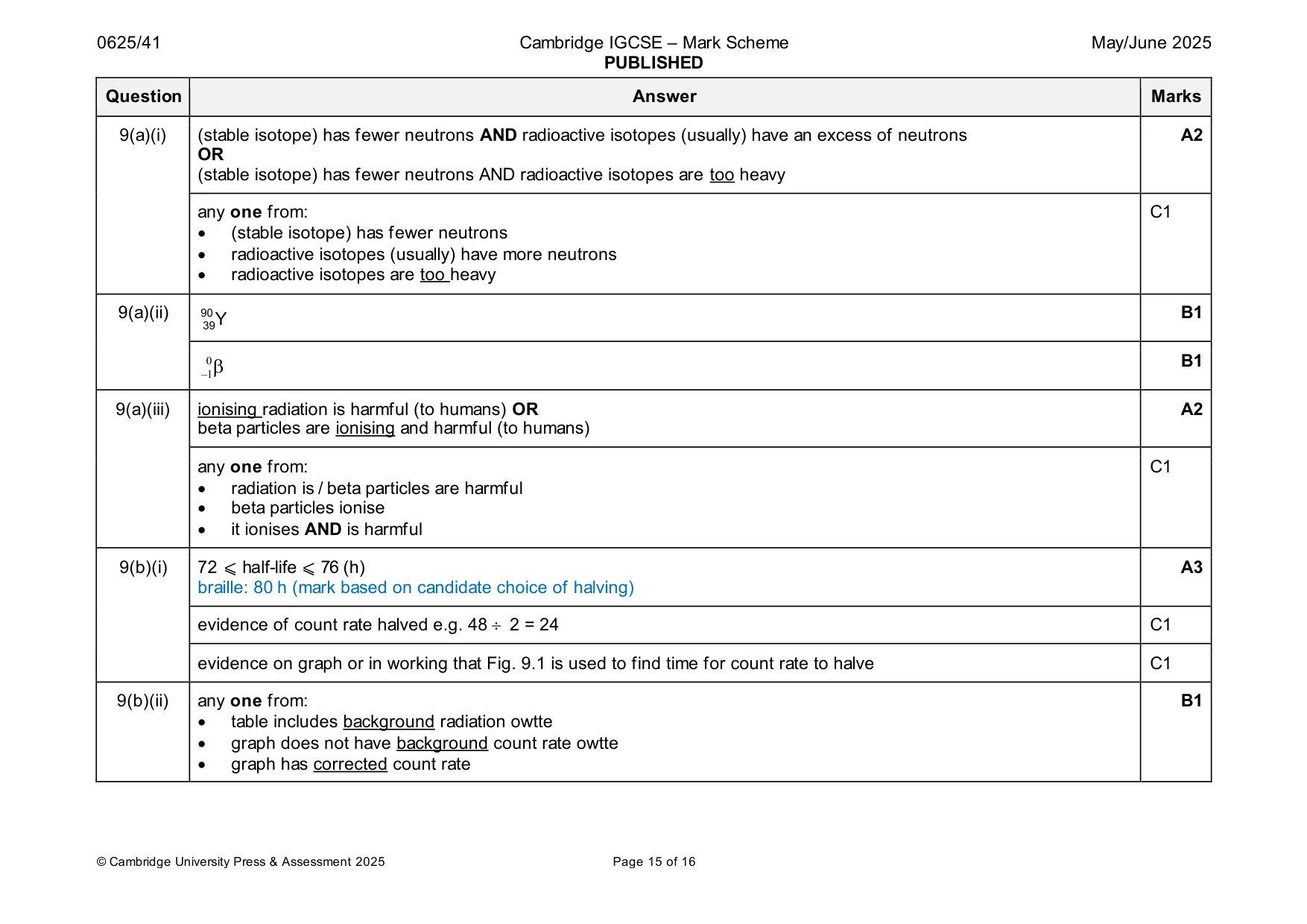
Mark scheme: 9(a)(i) (stable isotope) has fewer neutrons AND radioactive isotopes (usually) have an excess of neutrons A2 OR (stable isotope) has fewer neutrons AND radioactive isotopes are too heavy any one from: C1 • (stable isotope) has fewer neutrons • radioactive isotopes (usually) have more neutrons • radioactive isotopes are too heavy 9(a)(ii) 90 B1 39Y –10 B1 9(a)(iii) ionising radiation is harmful (to humans) OR A2 beta particles are ionising and harmful (to humans) any one from: C1 • radiation is / beta particles are harmful • beta particles ionise • it ionises AND is harmful 9(b)(i) 72 ⩽ half-life ⩽ 76 (h) A3 braille: 80 h (mark based on candidate choice of halving) evidence of count rate halved e.g. 48 2 = 24 C1 evidence on graph or in working that Fig. 9.1 is used to find time for count rate to halve C1 9(b)(ii) any one from: B1 • table includes background radiation owtte • graph does not have background count rate owtte • graph has corrected count rate
Q10 · Jupiter and the Earth are planets in our Solar System
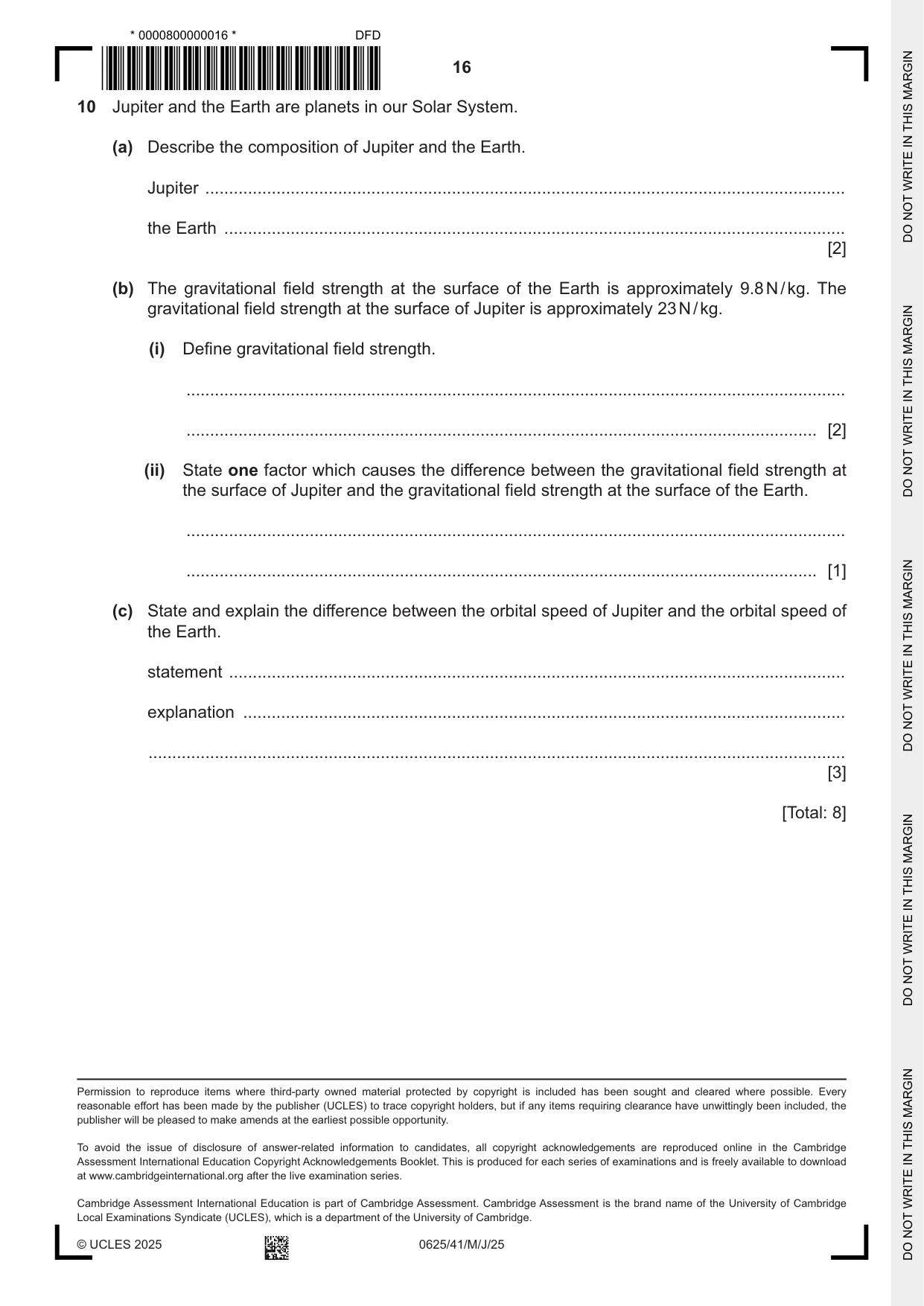
10 Jupiter and the Earth are planets in our Solar System. (a) Describe the composition of Jupiter and the Earth. Jupiter ....................................................................................................................................... the Earth ................................................................................................................................... [2] (b) The gravitational field strength at the surface of the Earth is approximately 9.8 N / kg. The gravitational field strength at the surface of Jupiter is approximately 23 N / kg. (i) Define gravitational field strength. ........................................................................................................................................... ..................................................................................................................................... [2] (ii) State one factor which causes the difference between the gravitational field strength at the surface of Jupiter and the gravitational field strength at the surface of the Earth. ........................................................................................................................................... ..................................................................................................................................... [1] (c) State and explain the difference between the orbital speed of Jupiter and the orbital speed of the Earth. statement .................................................................................................................................. explanation ............................................................................................................................... ................................................................................................................................................... [3] [Total: 8]
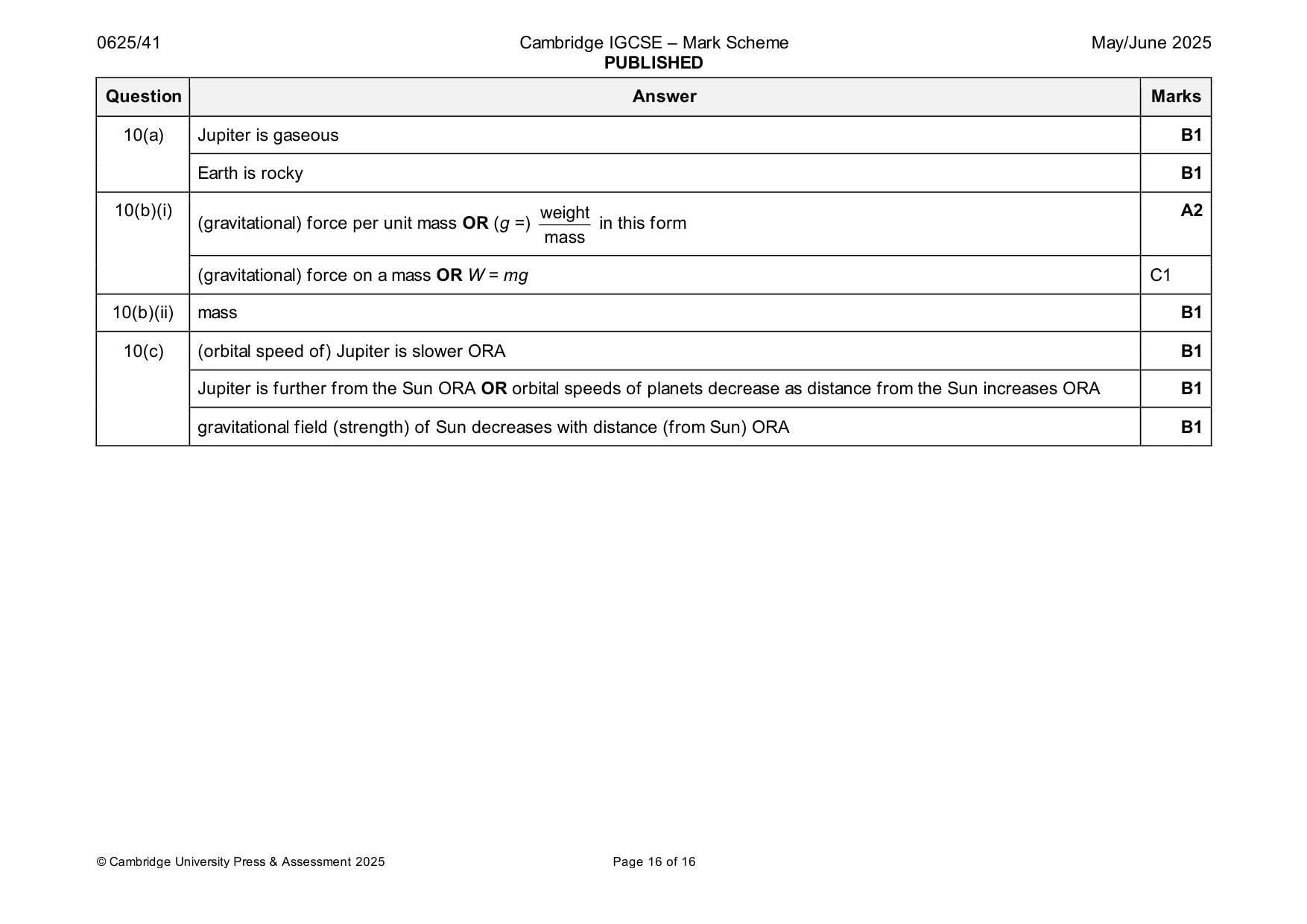
Mark scheme: 10(a) Jupiter is gaseous B1 Earth is rocky B1 10(b)(i) weight A2 (gravitational) force per unit mass OR (g =) in this form mass (gravitational) force on a mass OR W = mg C1 10(b)(ii) mass B1 10(c) (orbital speed of) Jupiter is slower ORA B1 Jupiter is further from the Sun ORA OR orbital speeds of planets decrease as distance from the Sun increases ORA B1 gravitational field (strength) of Sun decreases with distance (from Sun) ORA B1
What was in this paper
The subtopics covered by these 10 questions, and how many questions each got. Open one in a new tab to see every Cambridge question on it.
What you needed in this session
Cambridge’s own grade thresholds for 2025 May/June, Paper 4 · Variant 1. A higher threshold means an easier paper — the bar moves with how the cohort did.