Cambridge IGCSE Physics 0625 — 2019 May/June Paper 4 · Variant 2
0625/42/M/J/19 · 11 questions · 80 marks · ≈90 min
The question paper and its mark scheme, free to read here and free to download. This is Cambridge’s own paper, exactly as it was sat.
Question paper16 pages
Mark scheme10 pages
Answers below. Sit the paper first if you are practising.
Questions as text
Q1 · A bus is travelling between points A and D
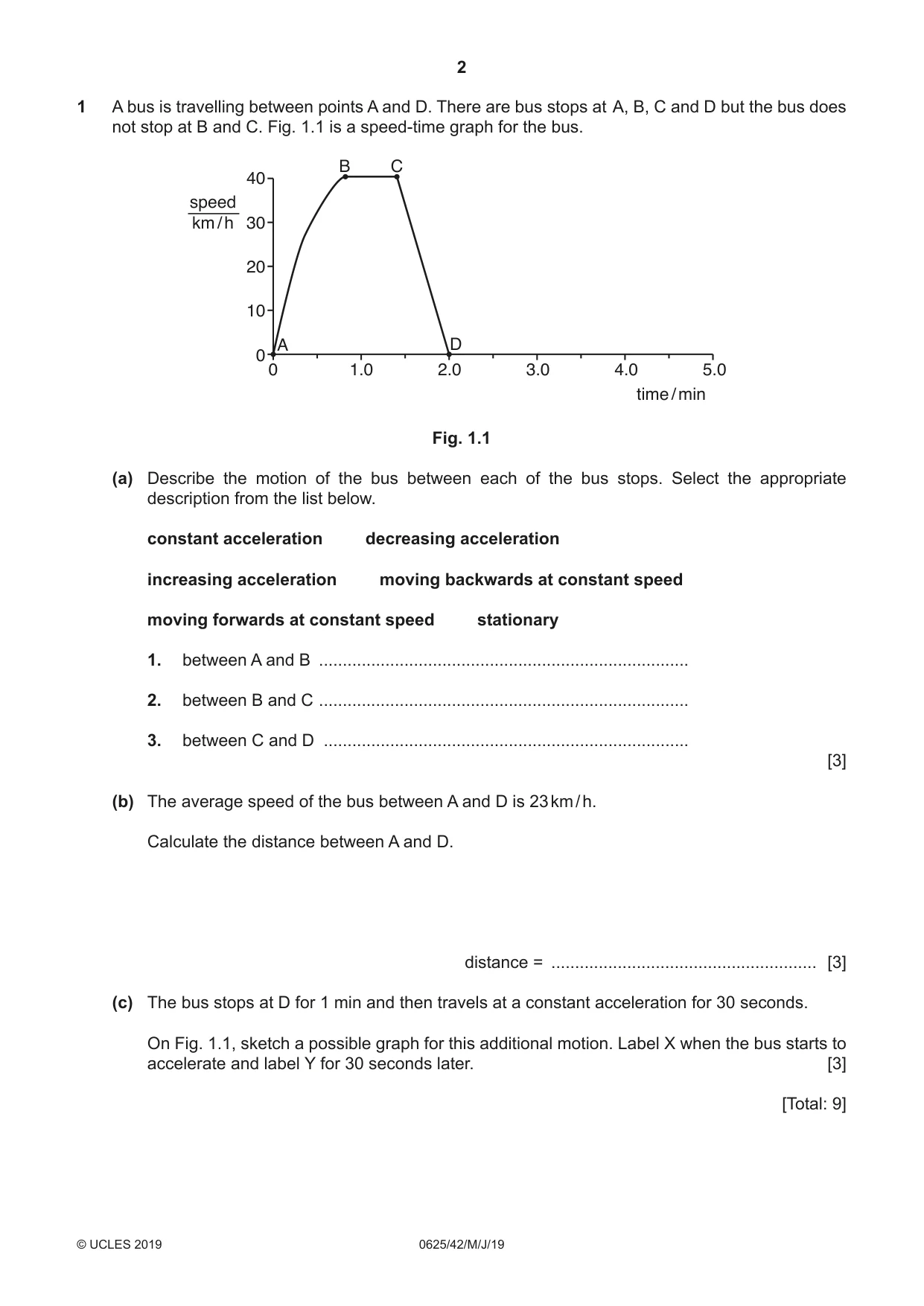
1 A bus is travelling between points A and D. There are bus stops at A, B, C and D but the bus does not stop at B and C. Fig. 1.1 is a speed-time graph for the bus. B C 40 speed km / h 30 20 10 A D 0 0 1.0 2.0 3.0 4.0 5.0 time / min Fig. 1.1 (a) Describe the motion of the bus between each of the bus stops. Select the appropriate description from the list below. constant acceleration decreasing acceleration increasing acceleration moving backwards at constant speed moving forwards at constant speed stationary 1. between A and B .............................................................................. 2. between B and C .............................................................................. 3. between C and D ............................................................................. [3] (b) The average speed of the bus between A and D is 23 km / h. Calculate the distance between A and D. distance = ........................................................ [3] (c) The bus stops at D for 1 min and then travels at a constant acceleration for 30 seconds. On Fig. 1.1, sketch a possible graph for this additional motion. Label X when the bus starts to accelerate and label Y for 30 seconds later. [3] [Total: 9]
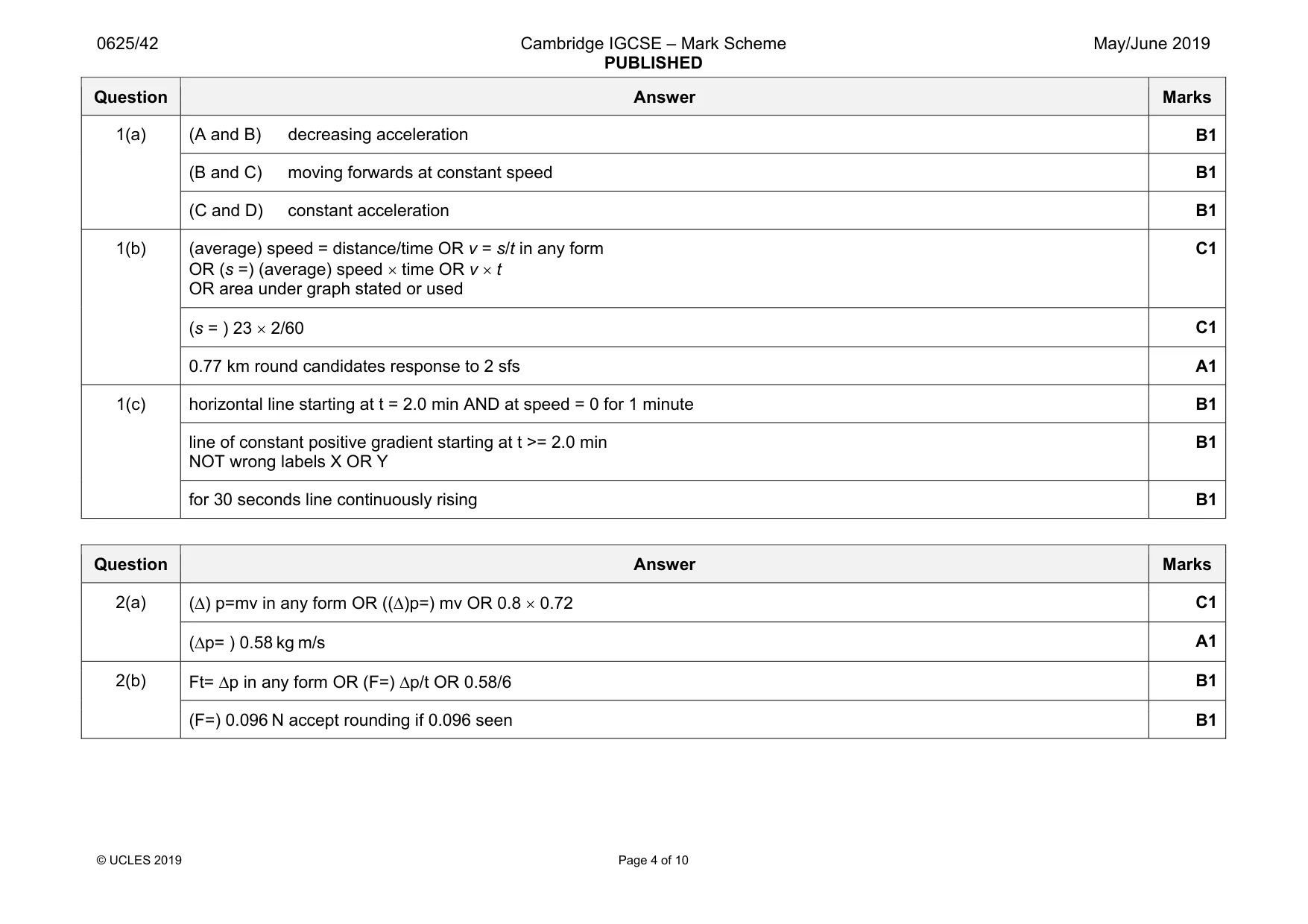
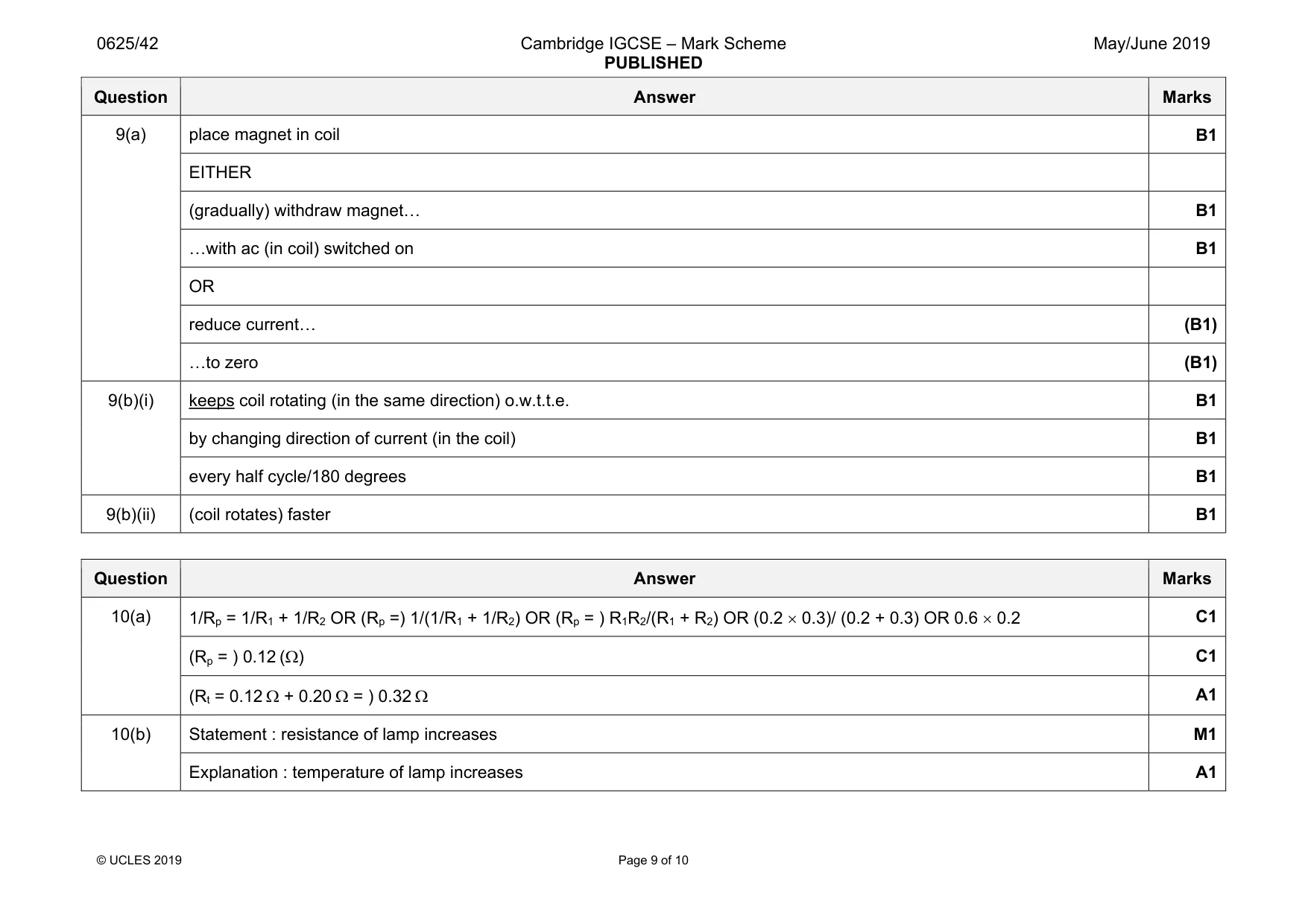
Mark scheme: 1(a) (A and B) decreasing acceleration B1 (B and C) moving forwards at constant speed B1 (C and D) constant acceleration B1 1(b) (average) speed = distance/time OR v = s/t in any form OR (s =) (average) speed × time OR v × t OR area under graph stated or used C1 (s = ) 23 × 2/60 C1 0.77 km round candidates response to 2 sfs A1 1(c) horizontal line starting at t = 2.0 min AND at speed = 0 for 1 minute B1 line of constant positive gradient starting at t >= 2.0 min NOT wrong labels X OR Y B1 for 30 seconds line continuously rising B1
Q2 · A model fire engine
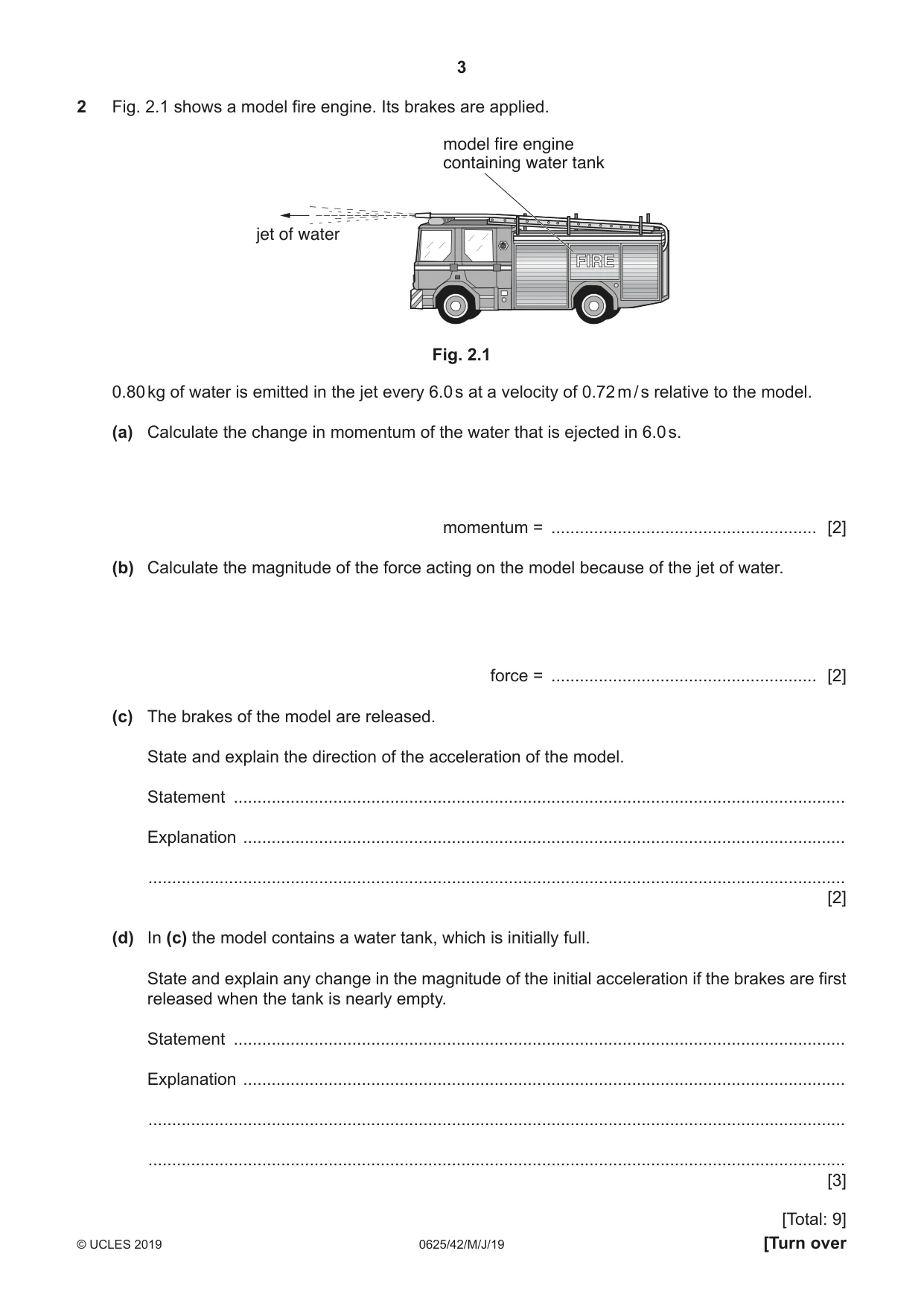
2 Fig. 2.1 shows a model fire engine. Its brakes are applied. model fire engine containing water tank jet of water FIRE Fig. 2.1 0.80 kg of water is emitted in the jet every 6.0 s at a velocity of 0.72 m / s relative to the model. (a) Calculate the change in momentum of the water that is ejected in 6.0 s. momentum = ........................................................ [2] (b) Calculate the magnitude of the force acting on the model because of the jet of water. force = ........................................................ [2] (c) The brakes of the model are released. State and explain the direction of the acceleration of the model. Statement ................................................................................................................................. Explanation ............................................................................................................................... ................................................................................................................................................... [2] (d) In (c) the model contains a water tank, which is initially full. State and explain any change in the magnitude of the initial acceleration if the brakes are first released when the tank is nearly empty. Statement ................................................................................................................................. Explanation ............................................................................................................................... ................................................................................................................................................... ................................................................................................................................................... [3] [Total: 9]
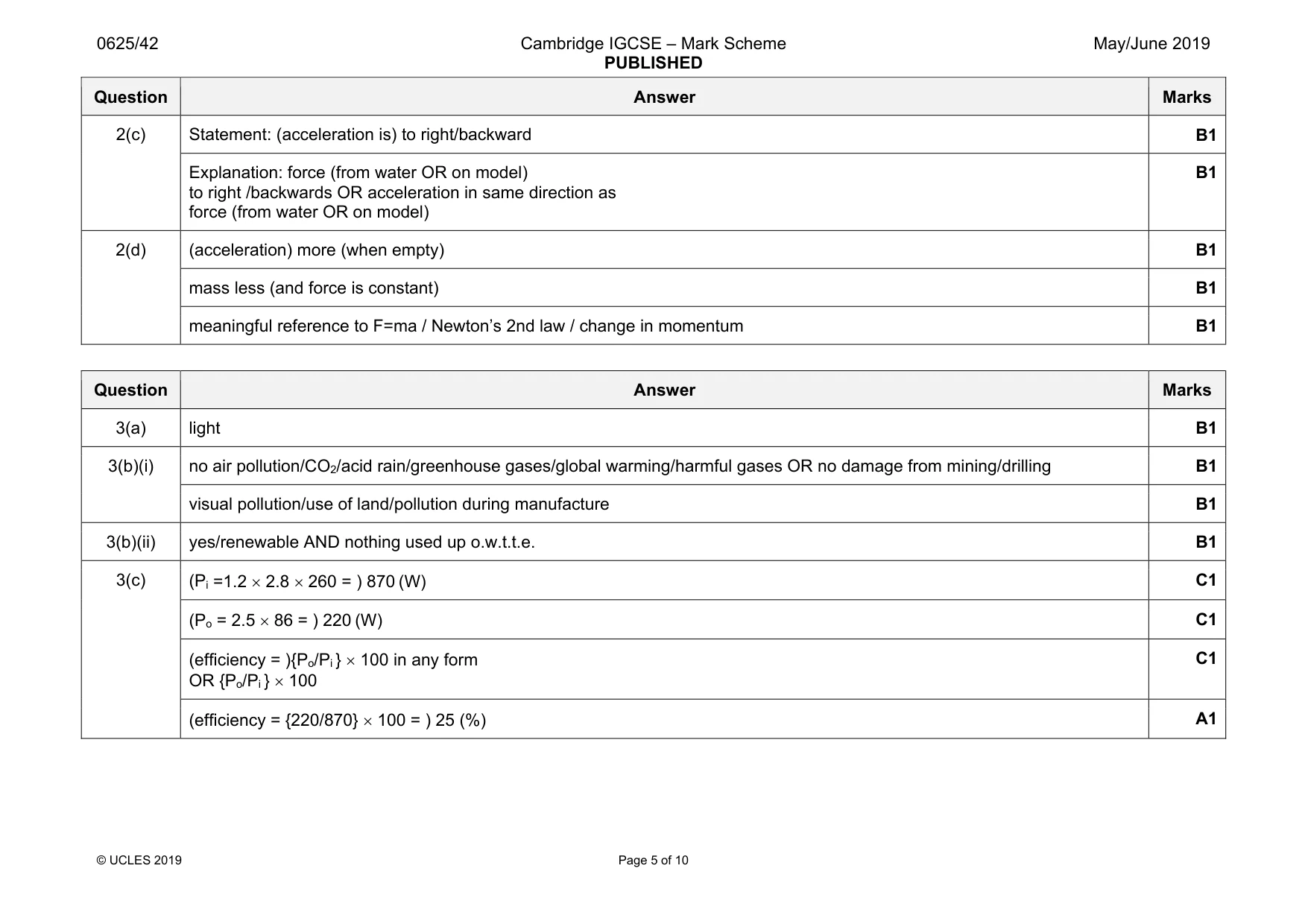
Mark scheme: 2(a) C1 (∆p= ) 0.58 kg m/s A1 2(b) Ft= ∆p in any form OR (F=) ∆p/t OR 0.58/6 B1 (F=) 0.096 N accept rounding if 0.096 seen B1 Question Answer Marks 2(c) Statement: (acceleration is) to right/backward B1 Explanation: force (from water OR on model) to right /backwards OR acceleration in same direction as force (from water OR on model) B1 2(d) (acceleration) more (when empty) B1 mass less (and force is constant) B1 meaningful reference to F=ma / Newton’s 2nd law / change in momentum B1
Q3 · Solar cells used to generate electrical energy
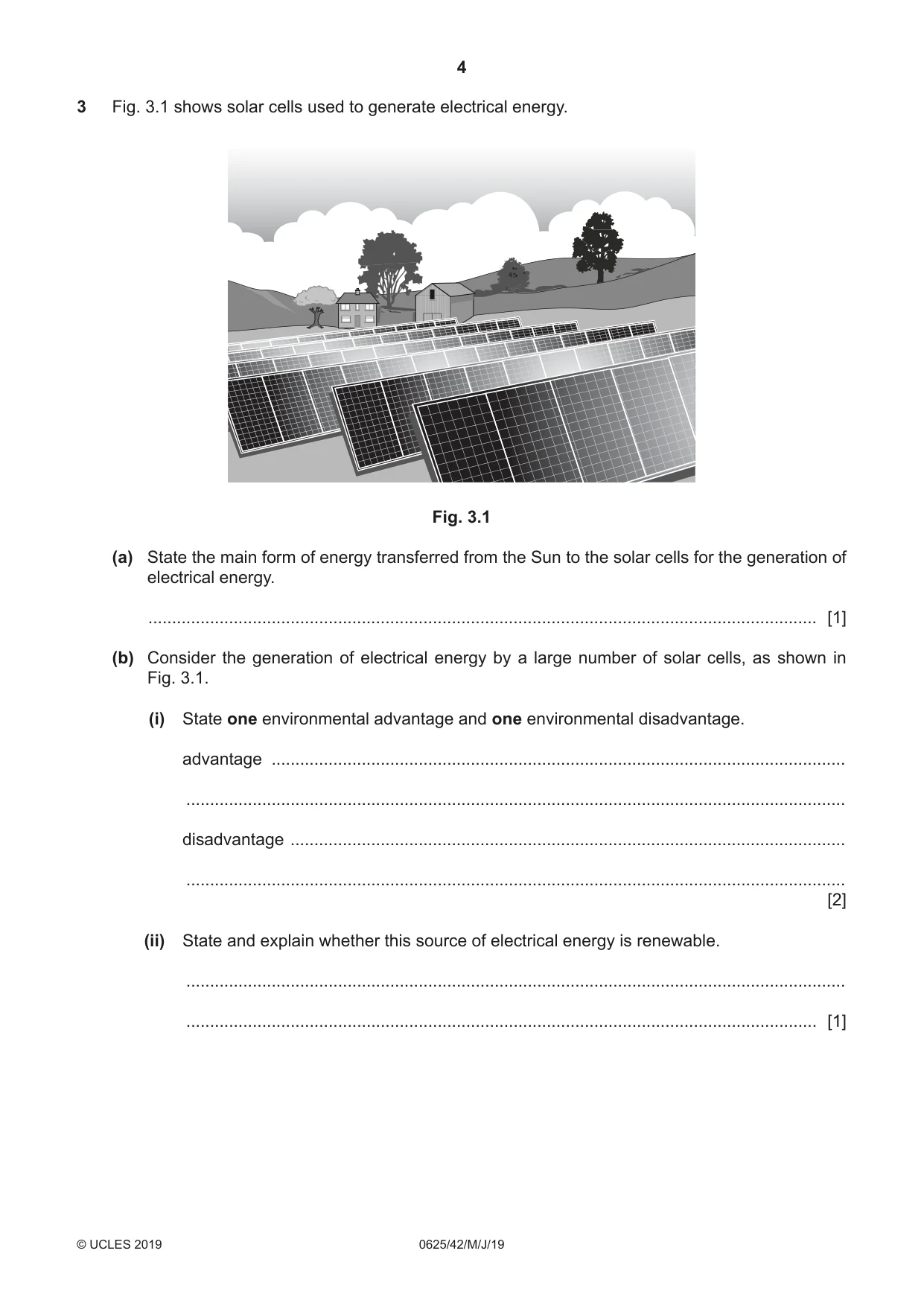
3 Fig. 3.1 shows solar cells used to generate electrical energy. Fig. 3.1 (a) State the main form of energy transferred from the Sun to the solar cells for the generation of electrical energy. ............................................................................................................................................. [1] (b) Consider the generation of electrical energy by a large number of solar cells, as shown in Fig. 3.1. (i) State one environmental advantage and one environmental disadvantage. advantage ......................................................................................................................... ........................................................................................................................................... disadvantage ..................................................................................................................... ........................................................................................................................................... [2] (ii) State and explain whether this source of electrical energy is renewable. ........................................................................................................................................... ..................................................................................................................................... [1] (c) Each group of solar cells is arranged in a rectangle 1.2 m × 2.8 m. The solar cells are situated in a region where 260 W of solar energy is received per square metre of the cells. The electrical output of each group of solar cells is a current of 2.5 A with a potential difference of 86 V. Calculate the efficiency of the solar cells. efficiency = .................................................... % [4] [Total: 8]
Mark scheme: 3(a) light B1 3(b)(i) no air pollution/CO2/acid rain/greenhouse gases/global warming/harmful gases OR no damage from mining/drilling B1 visual pollution/use of land/pollution during manufacture B1 3(b)(ii) yes/renewable AND nothing used up o.w.t.t.e. B1 3(c) (Pi =1.2 × 2.8 × 260 = ) 870 (W) C1 (Po = 2.5 × 86 = ) 220 (W) C1 (efficiency = ){Po/Pi } × 100 in any form OR {Po/Pi } × 100 C1 (efficiency = {220/870} × 100 = ) 25 (%) A1
Q4 · State and explain, in terms of molecules, any change in the pressure of a gas when the…
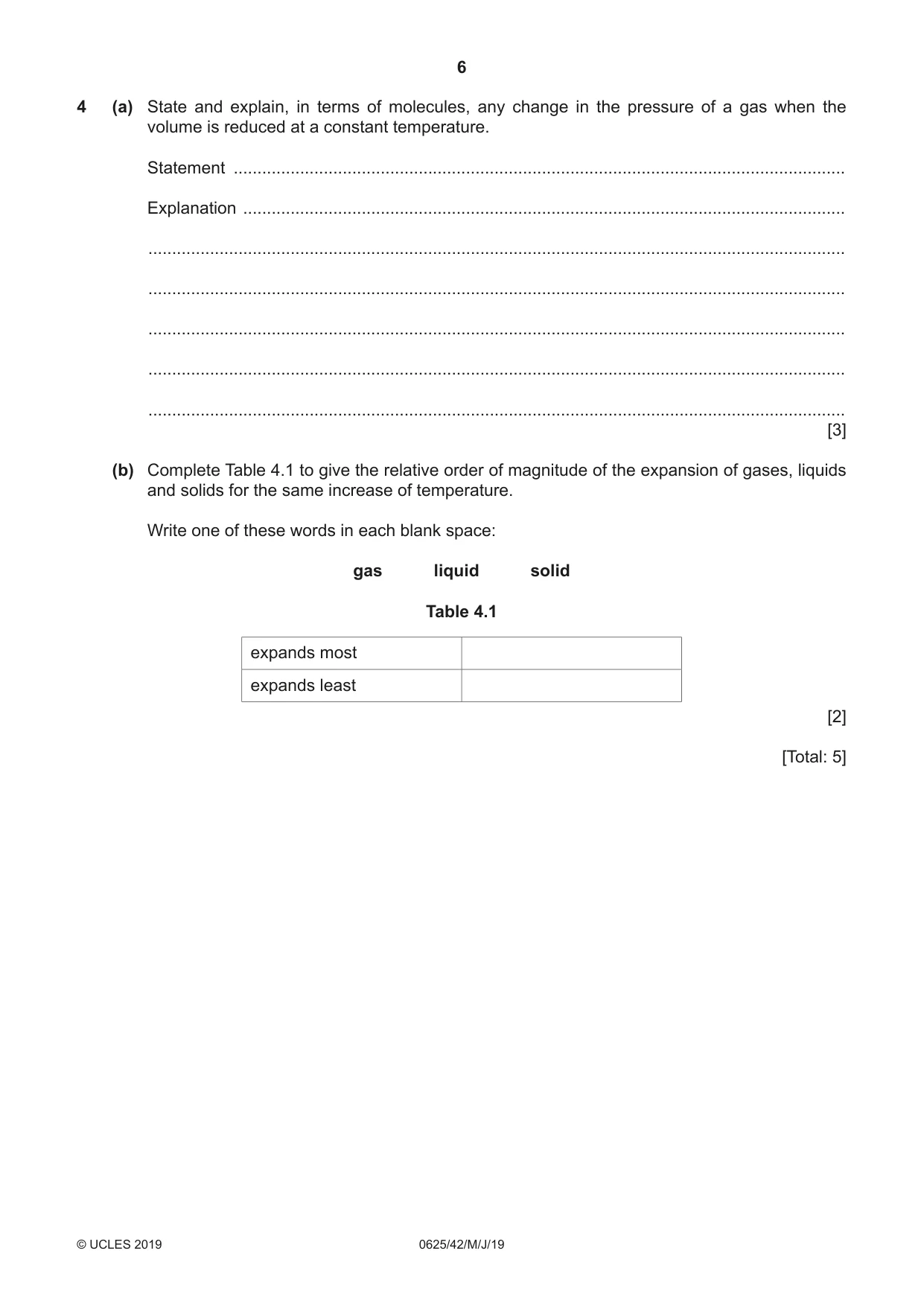
4 (a) State and explain, in terms of molecules, any change in the pressure of a gas when the volume is reduced at a constant temperature. Statement ................................................................................................................................. Explanation ............................................................................................................................... ................................................................................................................................................... ................................................................................................................................................... ................................................................................................................................................... ................................................................................................................................................... ................................................................................................................................................... [3] (b) Complete Table 4.1 to give the relative order of magnitude of the expansion of gases, liquids and solids for the same increase of temperature. Write one of these words in each blank space: gas liquid solid Table 4.1 expands most expands least [2] [Total: 5]
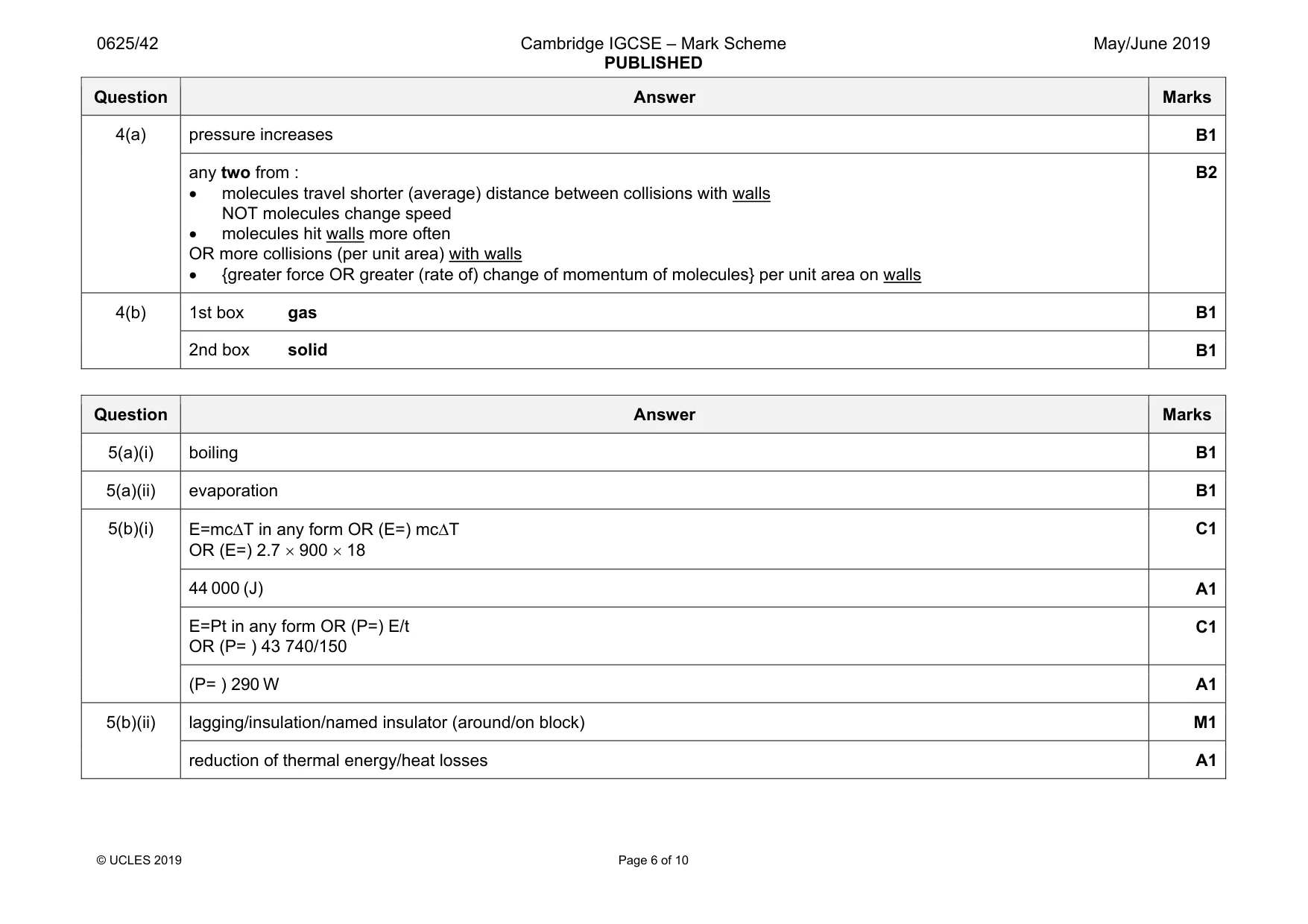
Mark scheme: 4(a) pressure increases B1 any two from : • molecules travel shorter (average) distance between collisions with walls NOT molecules change speed • molecules hit walls more often OR more collisions (per unit area) with walls • {greater force OR greater (rate of) change of momentum of molecules} per unit area on walls B2 4(b) 1st box gas B1 2nd box solid B1
Q5 · A liquid is heated so that bubbles of its vapour rise to the surface and molecules escape…
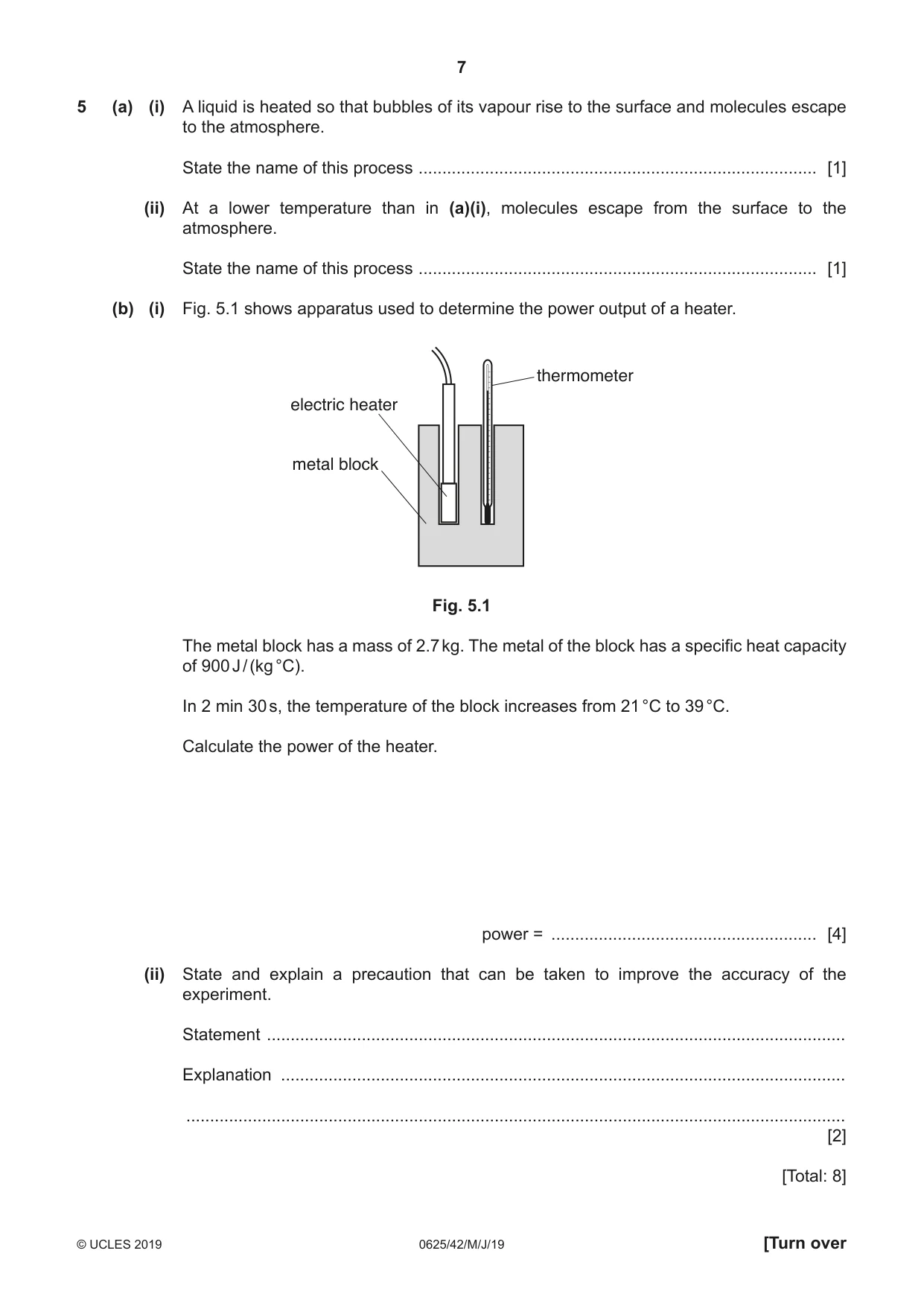
5 (a) (i) A liquid is heated so that bubbles of its vapour rise to the surface and molecules escape to the atmosphere. State the name of this process .................................................................................... [1] (ii) At a lower temperature than in (a)(i), molecules escape from the surface to the atmosphere. State the name of this process .................................................................................... [1] (b) (i) Fig. 5.1 shows apparatus used to determine the power output of a heater. thermometer electric heater metal block Fig. 5.1 The metal block has a mass of 2.7 kg. The metal of the block has a specific heat capacity of 900 J / (kg °C). In 2 min 30 s, the temperature of the block increases from 21 °C to 39 °C. Calculate the power of the heater. power = ........................................................ [4] (ii) State and explain a precaution that can be taken to improve the accuracy of the experiment. Statement .......................................................................................................................... Explanation ....................................................................................................................... ........................................................................................................................................... [2] [Total: 8]
Mark scheme: 5(a)(i) boiling B1 5(a)(ii) evaporation B1 5(b)(i) E=mc∆T in any form OR (E=) mc∆T OR (E=) 2.7 × 900 × 18 C1 44 000 (J) A1 E=Pt in any form OR (P=) E/t OR (P= ) 43 740/150 C1 (P= ) 290 W A1 5(b)(ii) lagging/insulation/named insulator (around/on block) M1 reduction of thermal energy/heat losses A1
Q6 · A water wave in a ripple tank
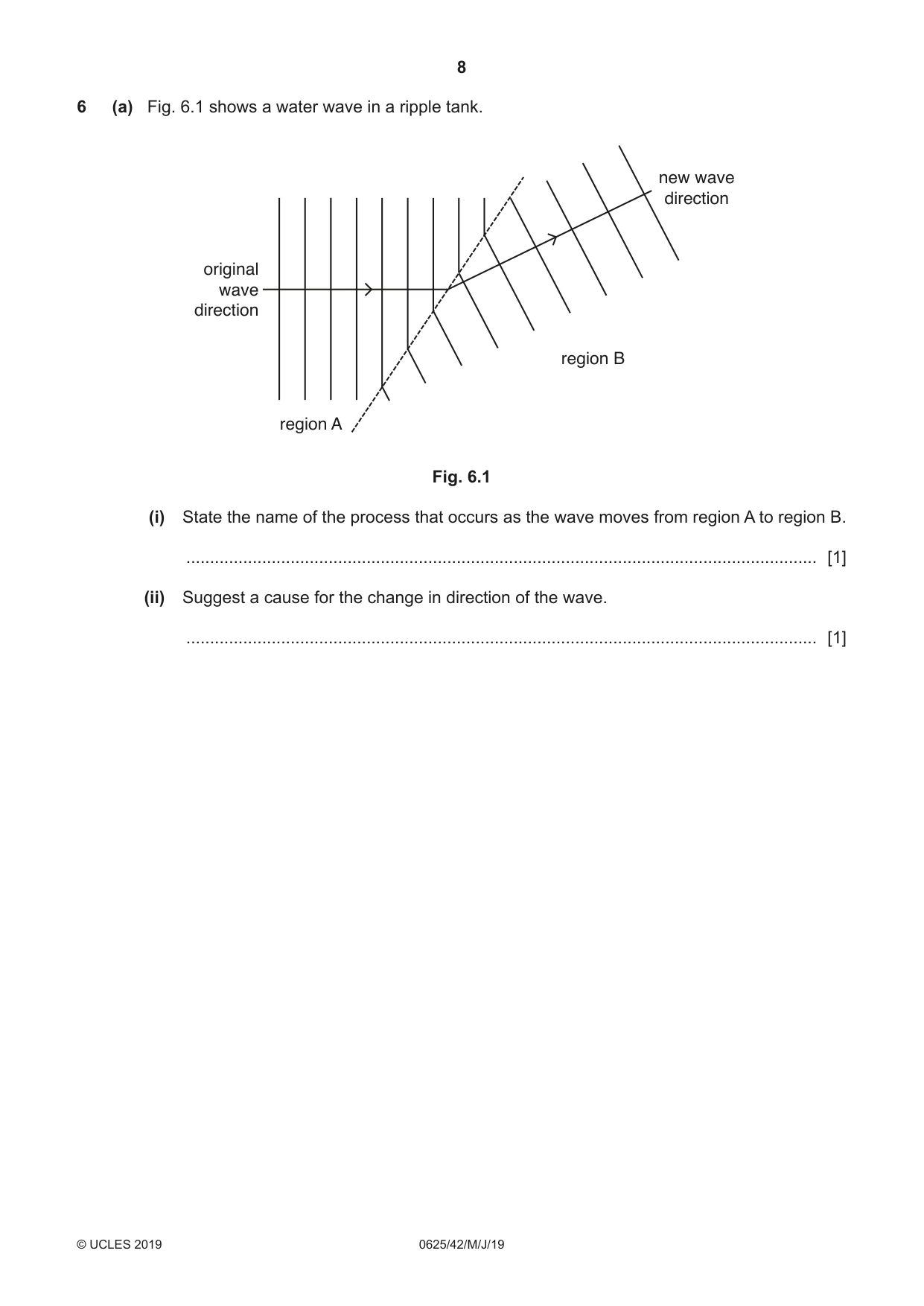
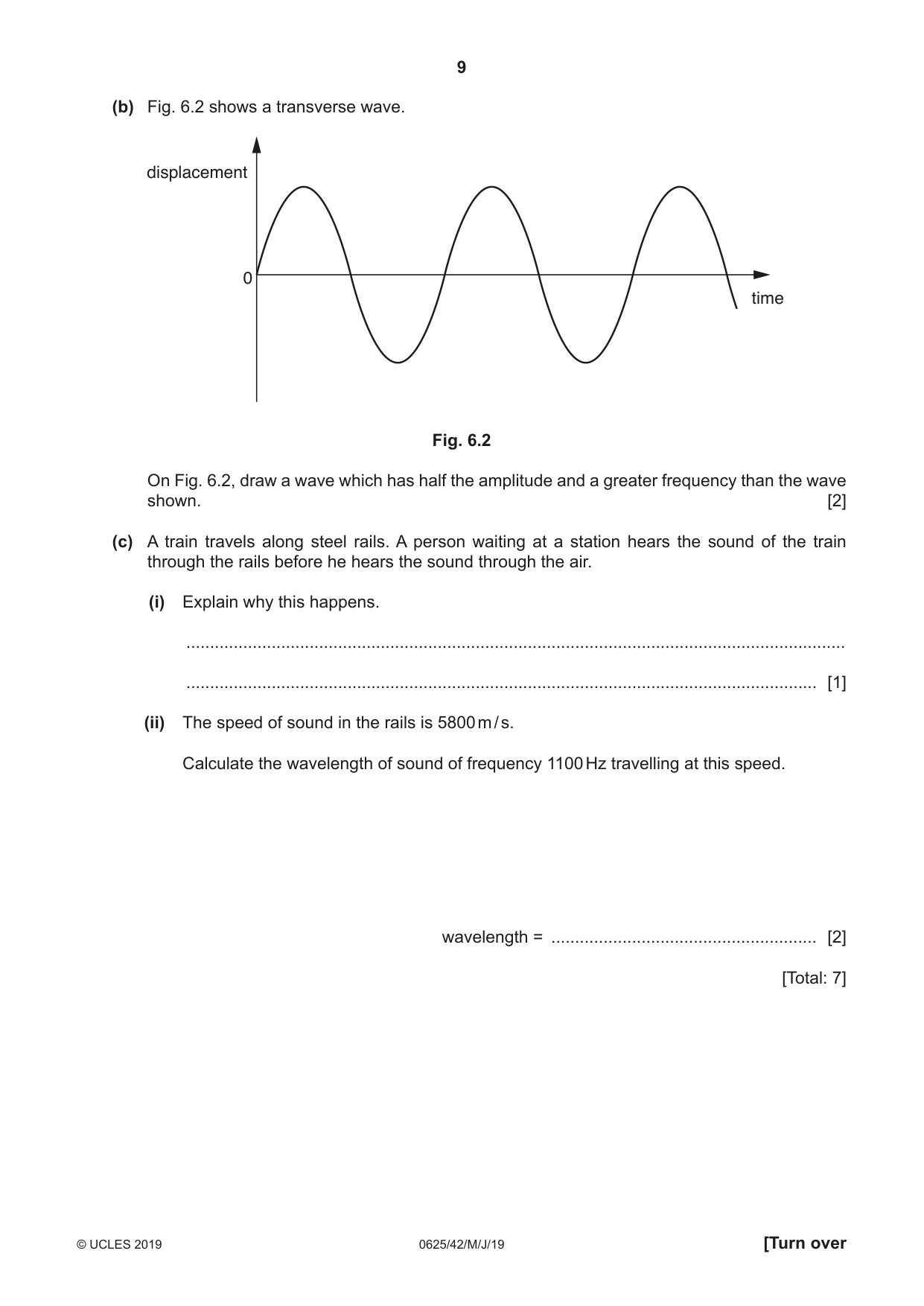
6 (a) Fig. 6.1 shows a water wave in a ripple tank. new wave direction original wave direction region B region A Fig. 6.1 (i) State the name of the process that occurs as the wave moves from region A to region B. ..................................................................................................................................... [1] (ii) Suggest a cause for the change in direction of the wave. ..................................................................................................................................... [1] (b) Fig. 6.2 shows a transverse wave. displacement 0 time Fig. 6.2 On Fig. 6.2, draw a wave which has half the amplitude and a greater frequency than the wave shown. [2] (c) A train travels along steel rails. A person waiting at a station hears the sound of the train through the rails before he hears the sound through the air. (i) Explain why this happens. ........................................................................................................................................... ..................................................................................................................................... [1] (ii) The speed of sound in the rails is 5800 m / s. Calculate the wavelength of sound of frequency 1100 Hz travelling at this speed. wavelength = ........................................................ [2] [Total: 7]
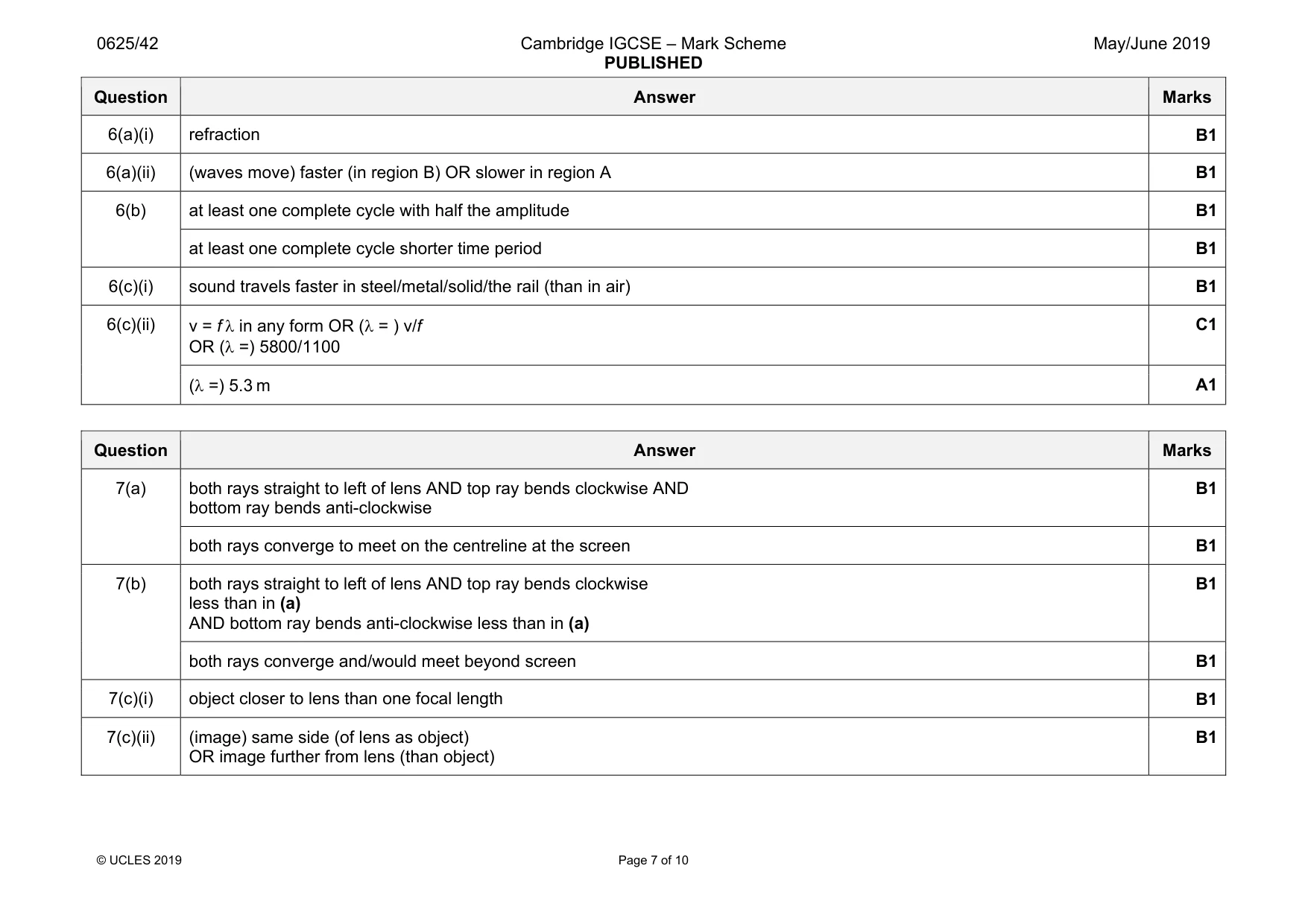
Mark scheme: 6(a)(i) refraction B1 6(a)(ii) (waves move) faster (in region B) OR slower in region A B1 6(b) at least one complete cycle with half the amplitude B1 at least one complete cycle shorter time period B1 6(c)(i) sound travels faster in steel/metal/solid/the rail (than in air) B1 6(c)(ii) v = f λ in any form OR (λ = ) v/f OR (λ =) 5800/1100 C1 (λ =) 5.3 m A1
Question 7
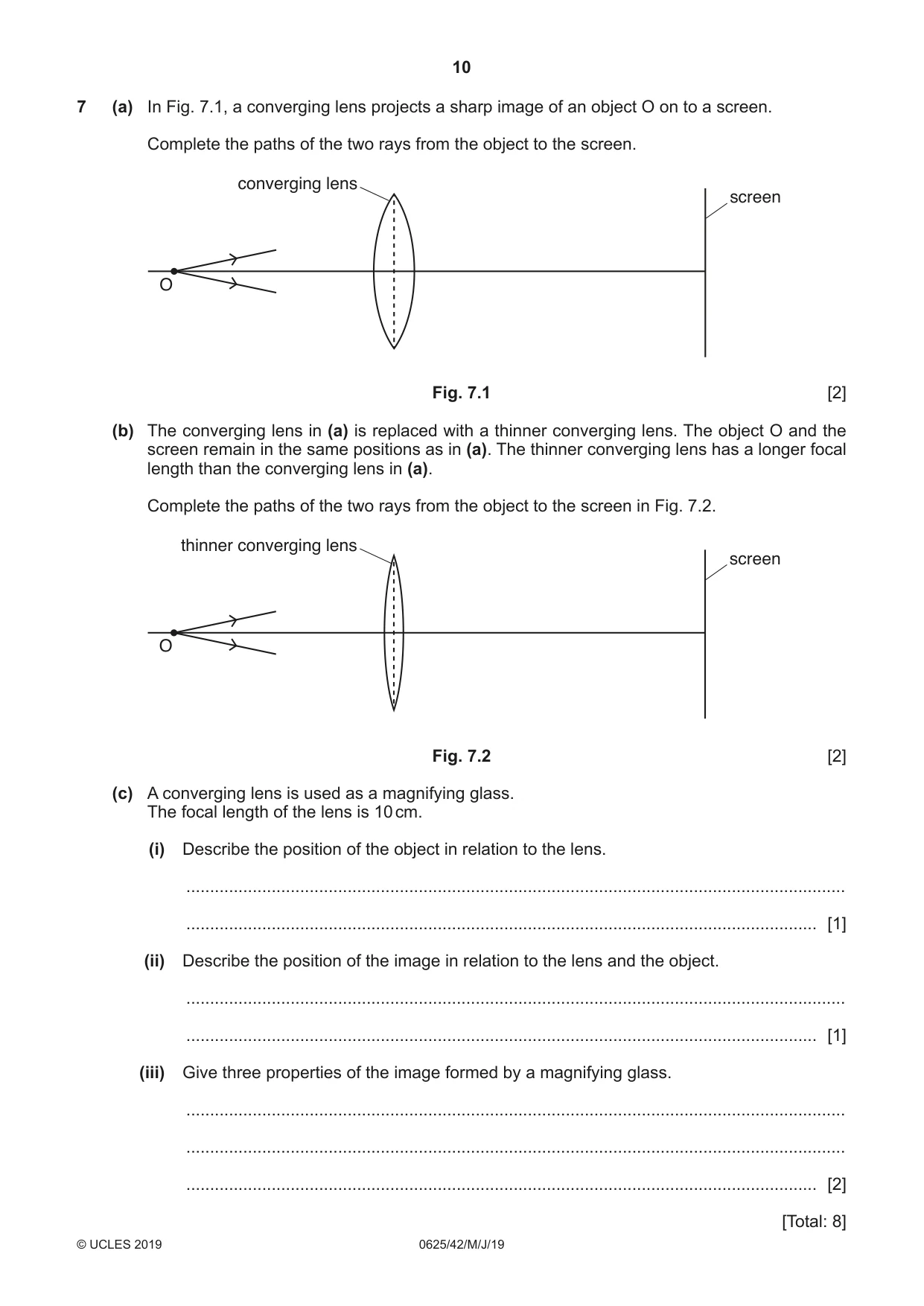
7 (a) In Fig. 7.1, a converging lens projects a sharp image of an object O on to a screen. Complete the paths of the two rays from the object to the screen. converging lens screen O Fig. 7.1 [2] (b) The converging lens in (a) is replaced with a thinner converging lens. The object O and the screen remain in the same positions as in (a). The thinner converging lens has a longer focal length than the converging lens in (a). Complete the paths of the two rays from the object to the screen in Fig. 7.2. thinner converging lens screen O Fig. 7.2 [2] (c) A converging lens is used as a magnifying glass. The focal length of the lens is 10 cm. (i) Describe the position of the object in relation to the lens. ........................................................................................................................................... ..................................................................................................................................... [1] (ii) Describe the position of the image in relation to the lens and the object. ........................................................................................................................................... ..................................................................................................................................... [1] (iii) Give three properties of the image formed by a magnifying glass. ........................................................................................................................................... ........................................................................................................................................... ..................................................................................................................................... [2] [Total: 8]
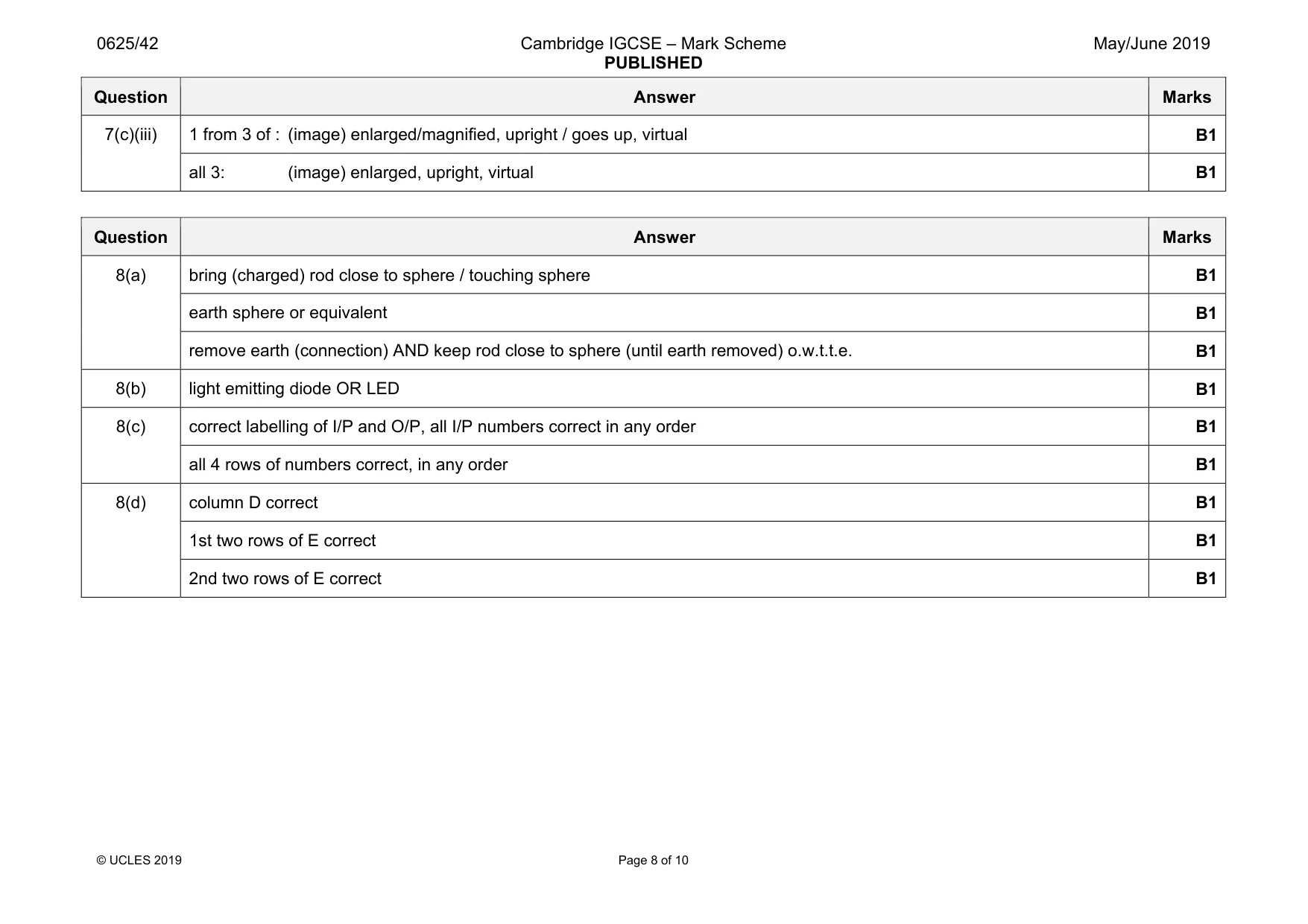
Mark scheme: 7(a) both rays straight to left of lens AND top ray bends clockwise AND bottom ray bends anti-clockwise B1 both rays converge to meet on the centreline at the screen B1 7(b) both rays straight to left of lens AND top ray bends clockwise less than in (a) AND bottom ray bends anti-clockwise less than in (a) B1 both rays converge and/would meet beyond screen B1 7(c)(i) object closer to lens than one focal length B1 7(c)(ii) (image) same side (of lens as object) OR image further from lens (than object) B1 Question Answer Marks 7(c)(iii) 1 from 3 of : (image) enlarged/magnified, upright / goes up, virtual B1 all 3: (image) enlarged, upright, virtual B1
Q8 · A conducting sphere is mounted on an insulating stand
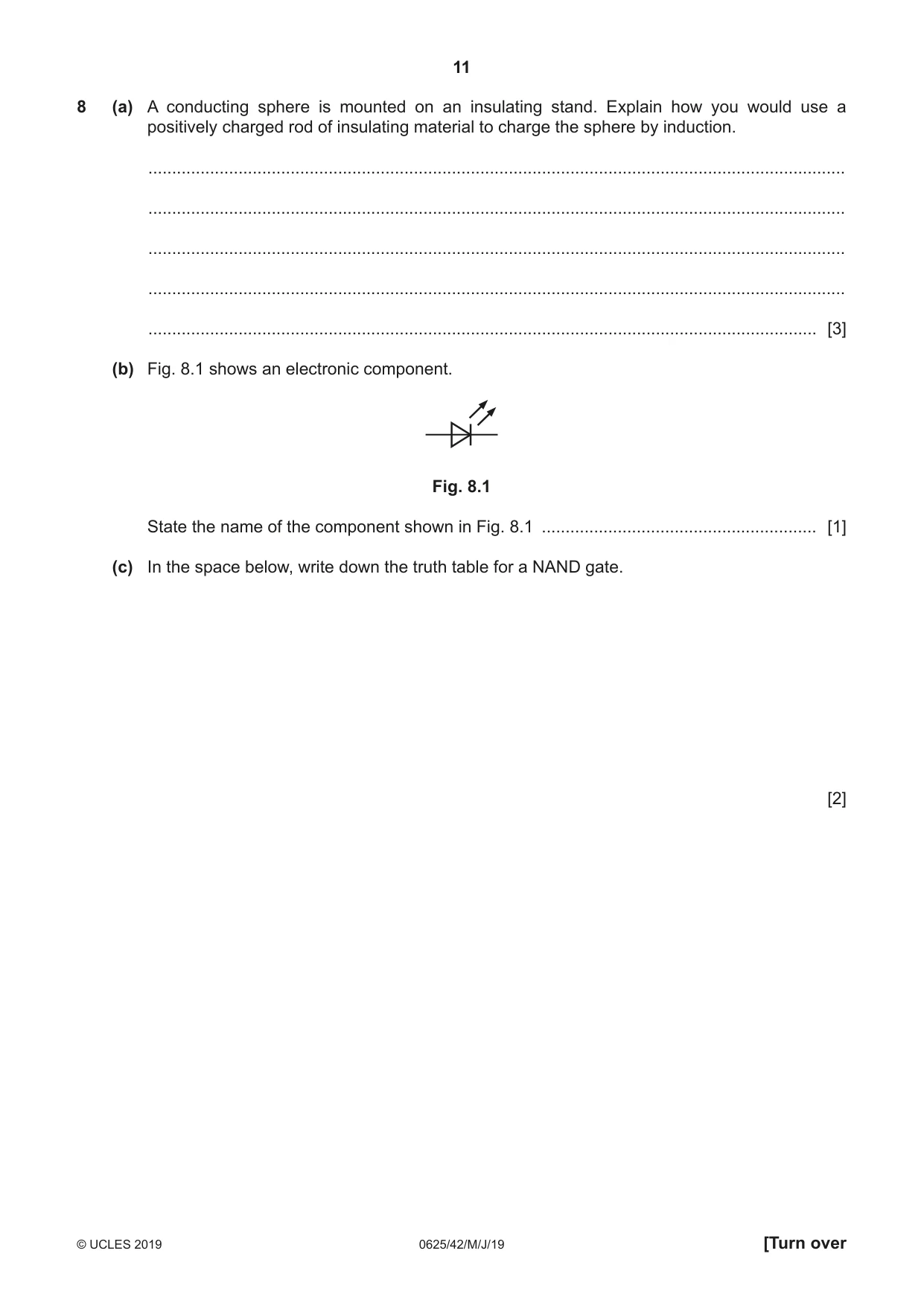
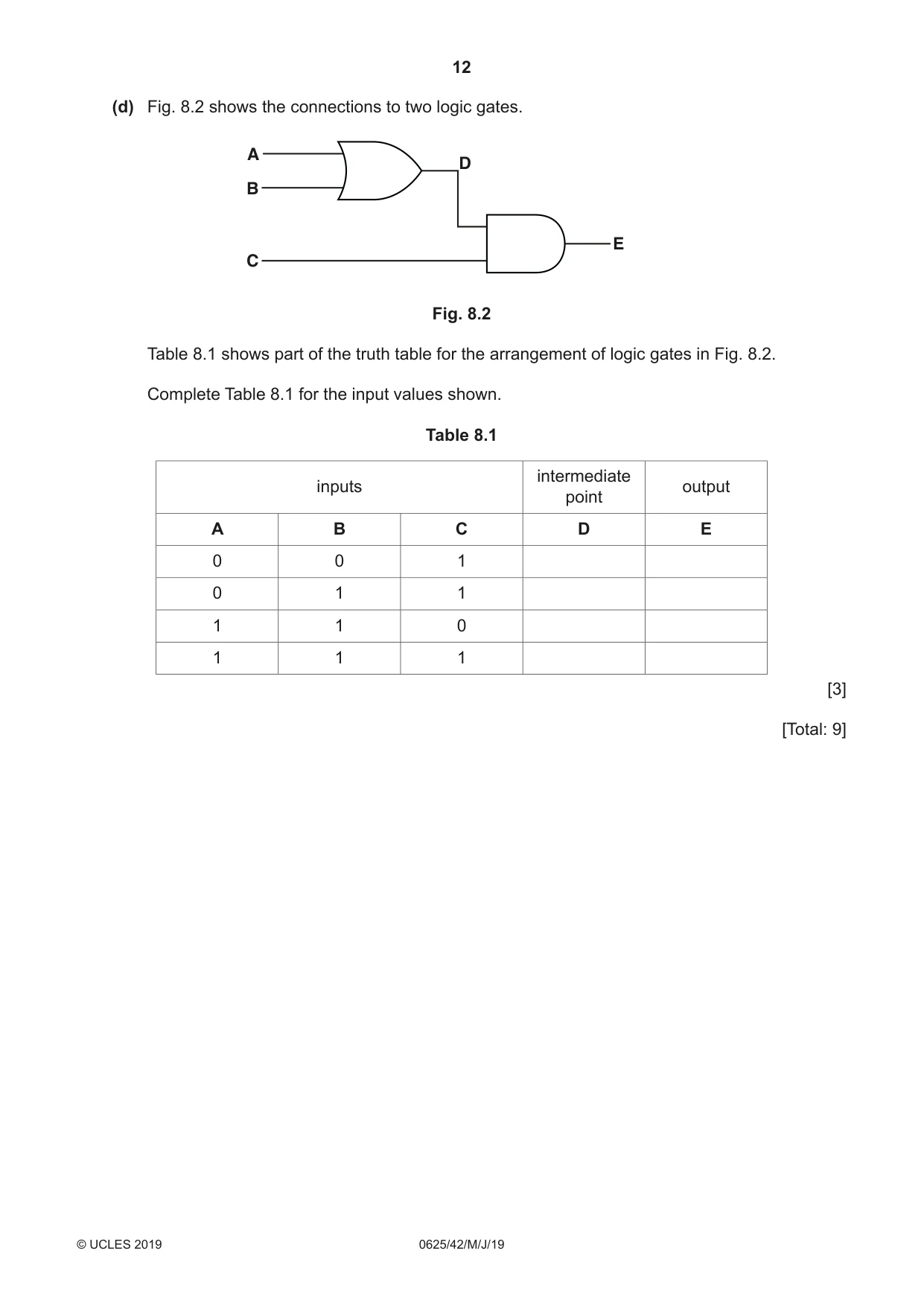
8 (a) A conducting sphere is mounted on an insulating stand. Explain how you would use a positively charged rod of insulating material to charge the sphere by induction. ................................................................................................................................................... ................................................................................................................................................... ................................................................................................................................................... ................................................................................................................................................... ............................................................................................................................................. [3] (b) Fig. 8.1 shows an electronic component. Fig. 8.1 State the name of the component shown in Fig. 8.1 .......................................................... [1] (c) In the space below, write down the truth table for a NAND gate. [2] (d) Fig. 8.2 shows the connections to two logic gates. A D B E C Fig. 8.2 Table 8.1 shows part of the truth table for the arrangement of logic gates in Fig. 8.2. Complete Table 8.1 for the input values shown. Table 8.1 intermediate inputs output point A B C D E 0 0 1 0 1 1 1 1 0 1 1 1 [3] [Total: 9]
Mark scheme: 8(a) bring (charged) rod close to sphere / touching sphere B1 earth sphere or equivalent B1 remove earth (connection) AND keep rod close to sphere (until earth removed) o.w.t.t.e. B1 8(b) light emitting diode OR LED B1 8(c) correct labelling of I/P and O/P, all I/P numbers correct in any order B1 all 4 rows of numbers correct, in any order B1 8(d) column D correct B1 1st two rows of E correct B1 2nd two rows of E correct B1
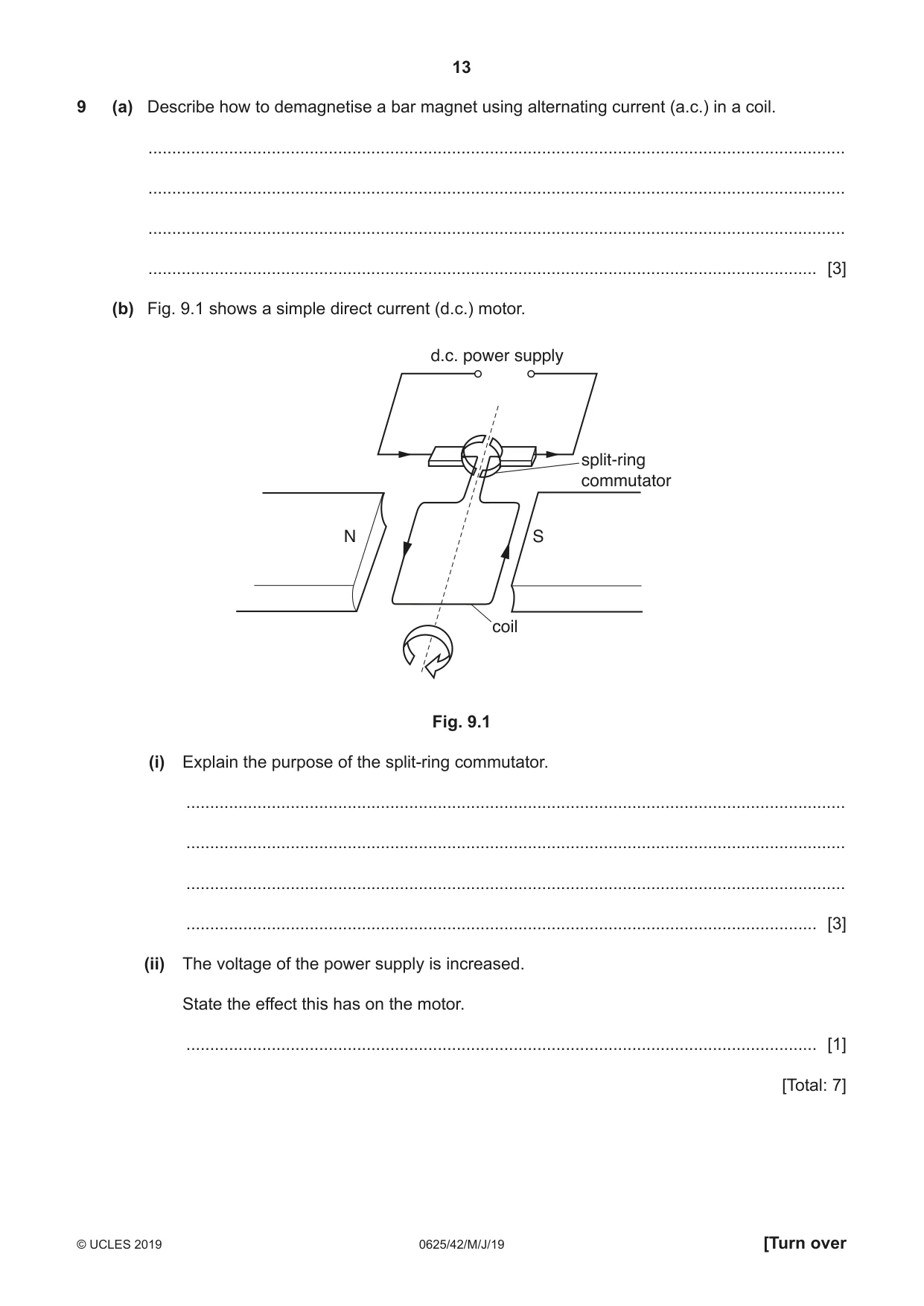
Q9 · Describe how to demagnetise a bar magnet using alternating current (a.c.) in a coil
9 (a) Describe how to demagnetise a bar magnet using alternating current (a.c.) in a coil. ................................................................................................................................................... ................................................................................................................................................... ................................................................................................................................................... ............................................................................................................................................. [3] (b) Fig. 9.1 shows a simple direct current (d.c.) motor. d.c. power supply split-ring commutator N S coil Fig. 9.1 (i) Explain the purpose of the split-ring commutator. ........................................................................................................................................... ........................................................................................................................................... ........................................................................................................................................... ..................................................................................................................................... [3] (ii) The voltage of the power supply is increased. State the effect this has on the motor. ..................................................................................................................................... [1] [Total: 7]
Mark scheme: 9(a) place magnet in coil B1 EITHER (gradually) withdraw magnet« B1 «with ac (in coil) switched on B1 OR reduce current« (B1) «to zero (B1) 9(b)(i) keeps coil rotating (in the same direction) o.w.t.t.e. B1 by changing direction of current (in the coil) B1 every half cycle/180 degrees B1 9(b)(ii) (coil rotates) faster B1
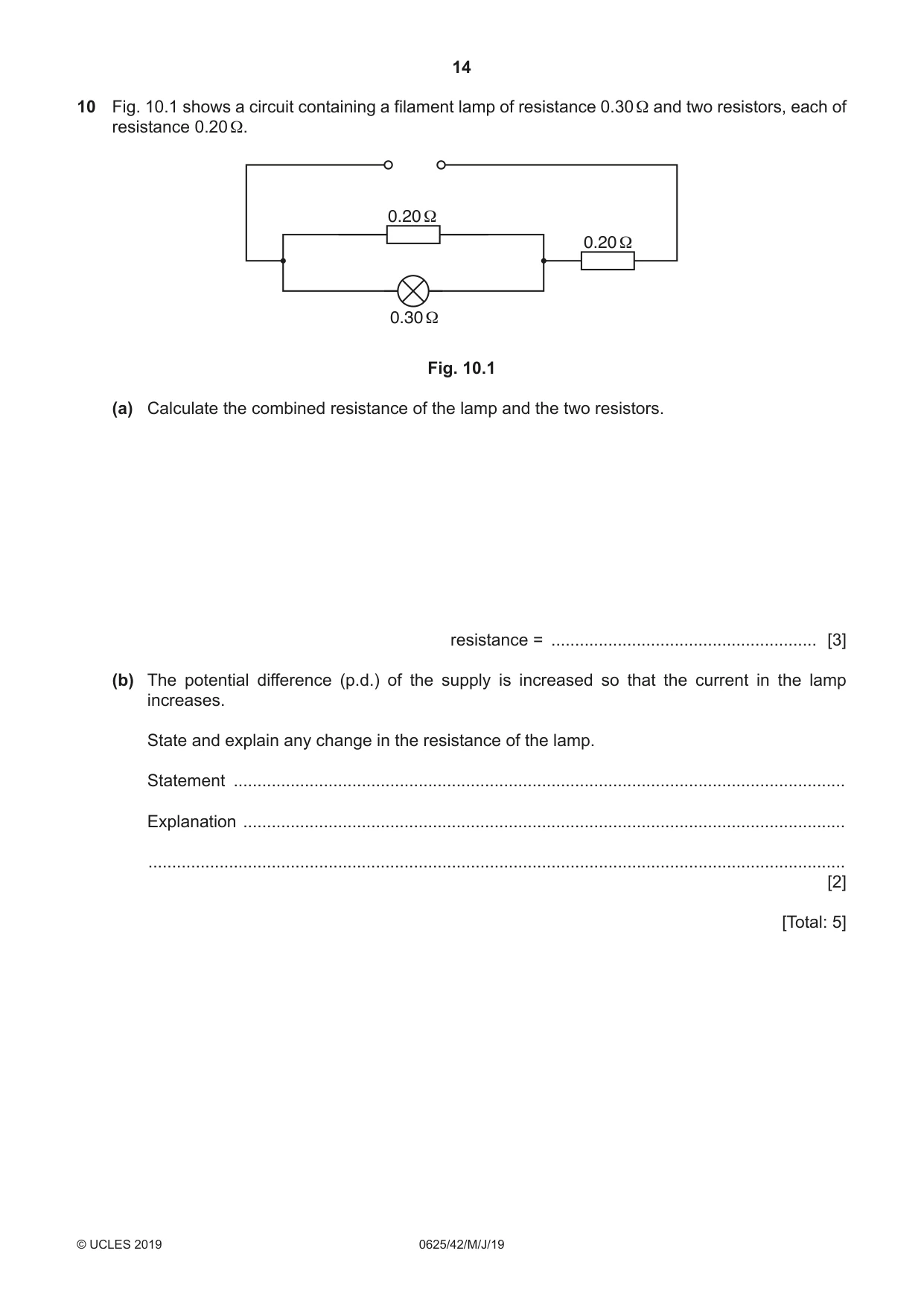
Q10 · A circuit containing a filament lamp of resistance 0.30 Ω and two resistors, each of…
10 Fig. 10.1 shows a circuit containing a filament lamp of resistance 0.30 Ω and two resistors, each of resistance 0.20 Ω. 0.20 Ω 0.20 Ω 0.30Ω Fig. 10.1 (a) Calculate the combined resistance of the lamp and the two resistors. resistance = ........................................................ [3] (b) The potential difference (p.d.) of the supply is increased so that the current in the lamp increases. State and explain any change in the resistance of the lamp. Statement ................................................................................................................................. Explanation ............................................................................................................................... ................................................................................................................................................... [2] [Total: 5]
Mark scheme: 10(a) C1 (Rp = ) 0.12 (Ω) C1 (Rt = 0.12 Ω + 0.20 Ω = ) 0.32 Ω A1 10(b) Statement : resistance of lamp increases M1 Explanation : temperature of lamp increases A1
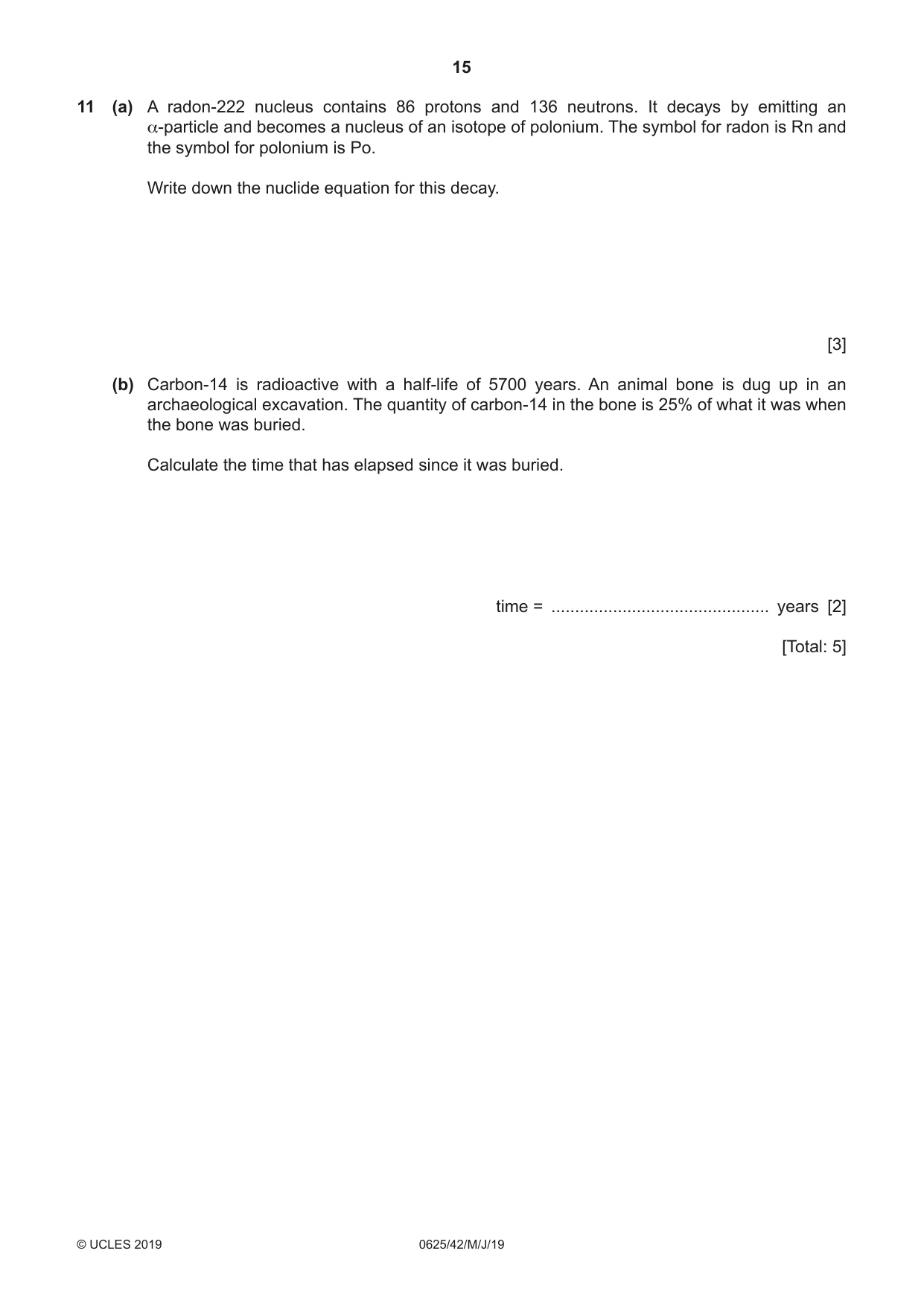
Q11 · A radon-222 nucleus contains 86 protons and 136 neutrons
11 (a) A radon-222 nucleus contains 86 protons and 136 neutrons. It decays by emitting an α-particle and becomes a nucleus of an isotope of polonium. The symbol for radon is Rn and the symbol for polonium is Po. Write down the nuclide equation for this decay. [3] (b) Carbon-14 is radioactive with a half-life of 5700 years. An animal bone is dug up in an archaeological excavation. The quantity of carbon-14 in the bone is 25% of what it was when the bone was buried. Calculate the time that has elapsed since it was buried. time = .............................................. years [2] [Total: 5]
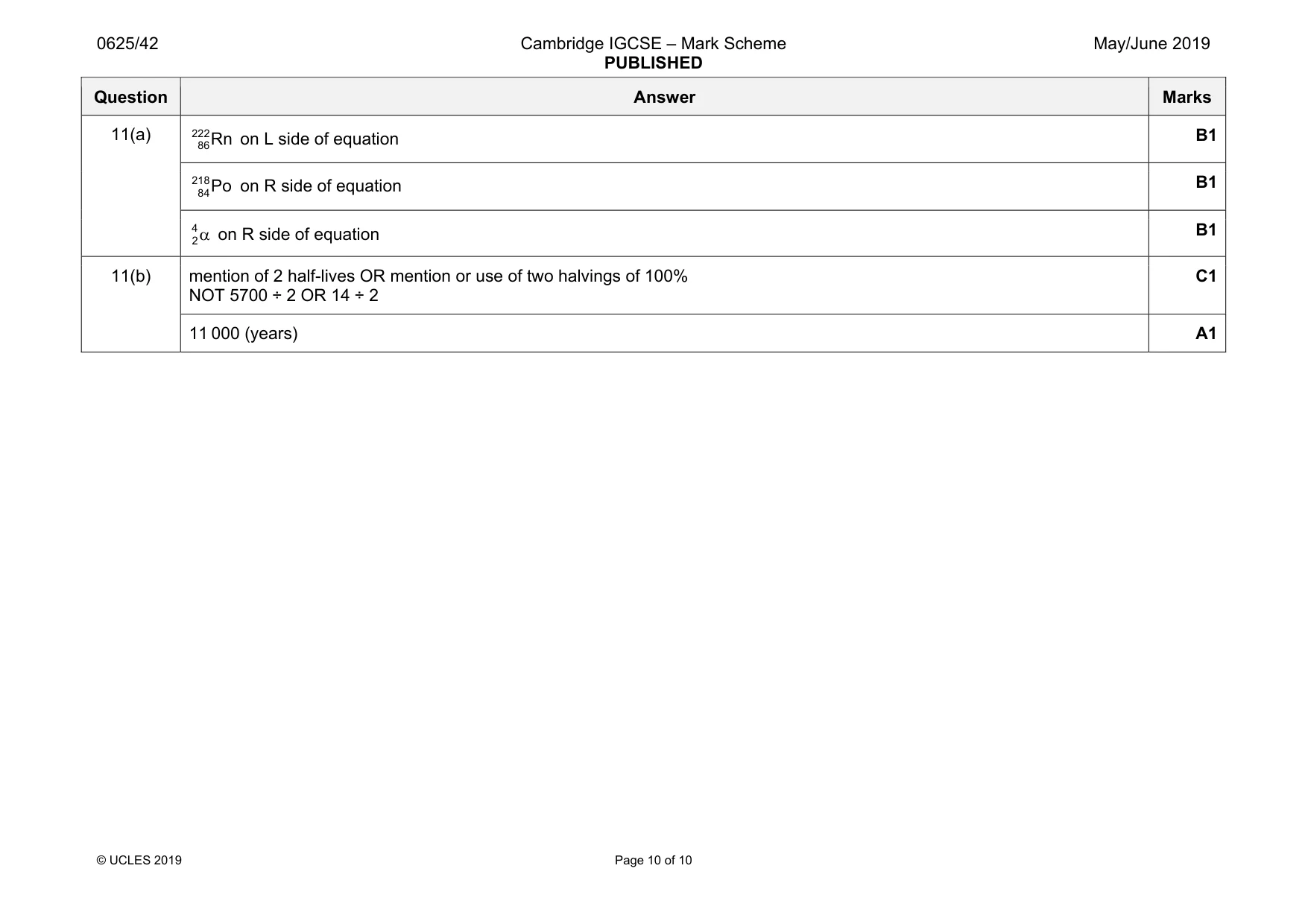
Mark scheme: 11(a) 222 86Rn on L side of equation B1 218 84Po on R side of equation B1 4 2α on R side of equation B1 11(b) mention of 2 half-lives OR mention or use of two halvings of 100% NOT 5700 ÷ 2 OR 14 ÷ 2 C1 11 000 (years) A1
What was in this paper
The subtopics covered by these 11 questions, and how many questions each got. Open one in a new tab to see every Cambridge question on it.
What you needed in this session
Cambridge’s own grade thresholds for 2019 May/June, Paper 4 · Variant 2. A higher threshold means an easier paper — the bar moves with how the cohort did.