Cambridge IGCSE Physics 0625 — 2017 Oct/Nov Paper 4 · Variant 2
0625/42/O/N/17 · 11 questions · 80 marks · ≈90 min
The question paper and its mark scheme, free to read here and free to download. This is Cambridge’s own paper, exactly as it was sat.
Question paper16 pages
Mark scheme10 pages
Answers below. Sit the paper first if you are practising.
Questions as text
Q1 · A cylinder made from copper of density 9000 kg / m3
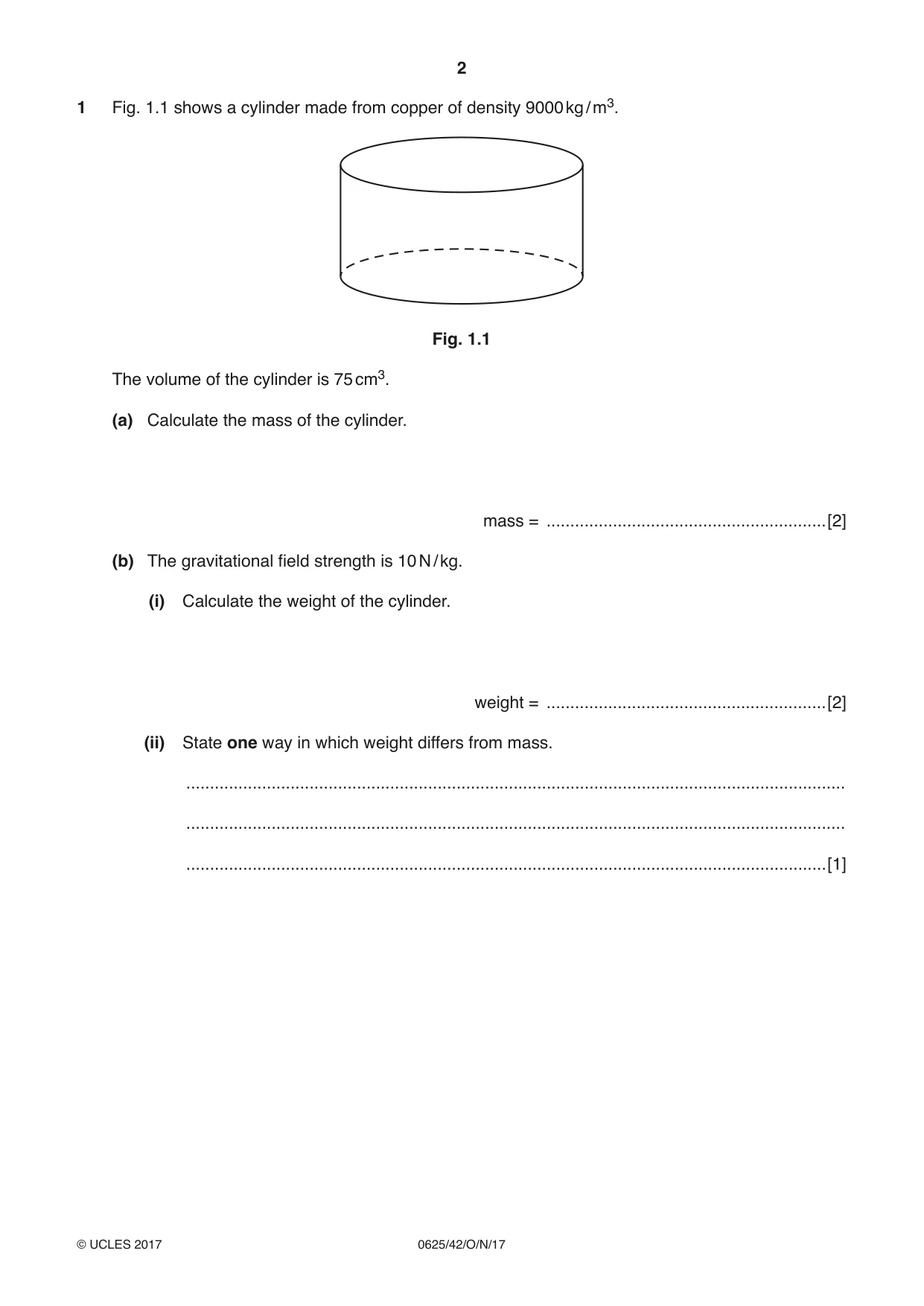
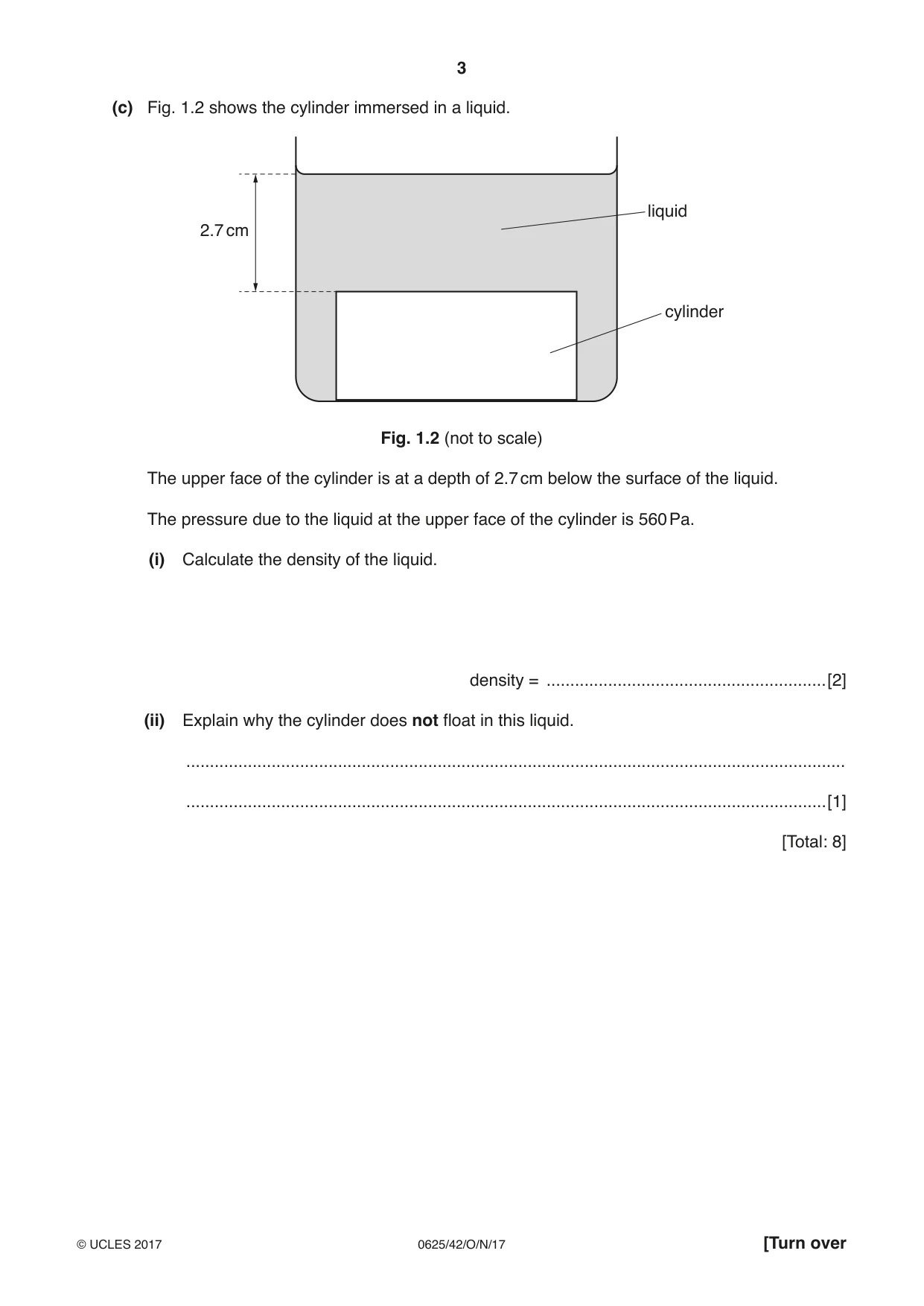
1 Fig. 1.1 shows a cylinder made from copper of density 9000 kg / m3. Fig. 1.1 The volume of the cylinder is 75 cm3. (a) Calculate the mass of the cylinder. mass = ...........................................................[2] (b) The gravitational field strength is 10 N / kg. (i) Calculate the weight of the cylinder. weight = ...........................................................[2] (ii) State one way in which weight differs from mass. ........................................................................................................................................... ........................................................................................................................................... .......................................................................................................................................[1] (c) Fig. 1.2 shows the cylinder immersed in a liquid. liquid 2.7 cm cylinder Fig. 1.2 (not to scale) The upper face of the cylinder is at a depth of 2.7 cm below the surface of the liquid. The pressure due to the liquid at the upper face of the cylinder is 560 Pa. (i) Calculate the density of the liquid. density = ...........................................................[2] (ii) Explain why the cylinder does not float in this liquid. ........................................................................................................................................... .......................................................................................................................................[1] [Total: 8]
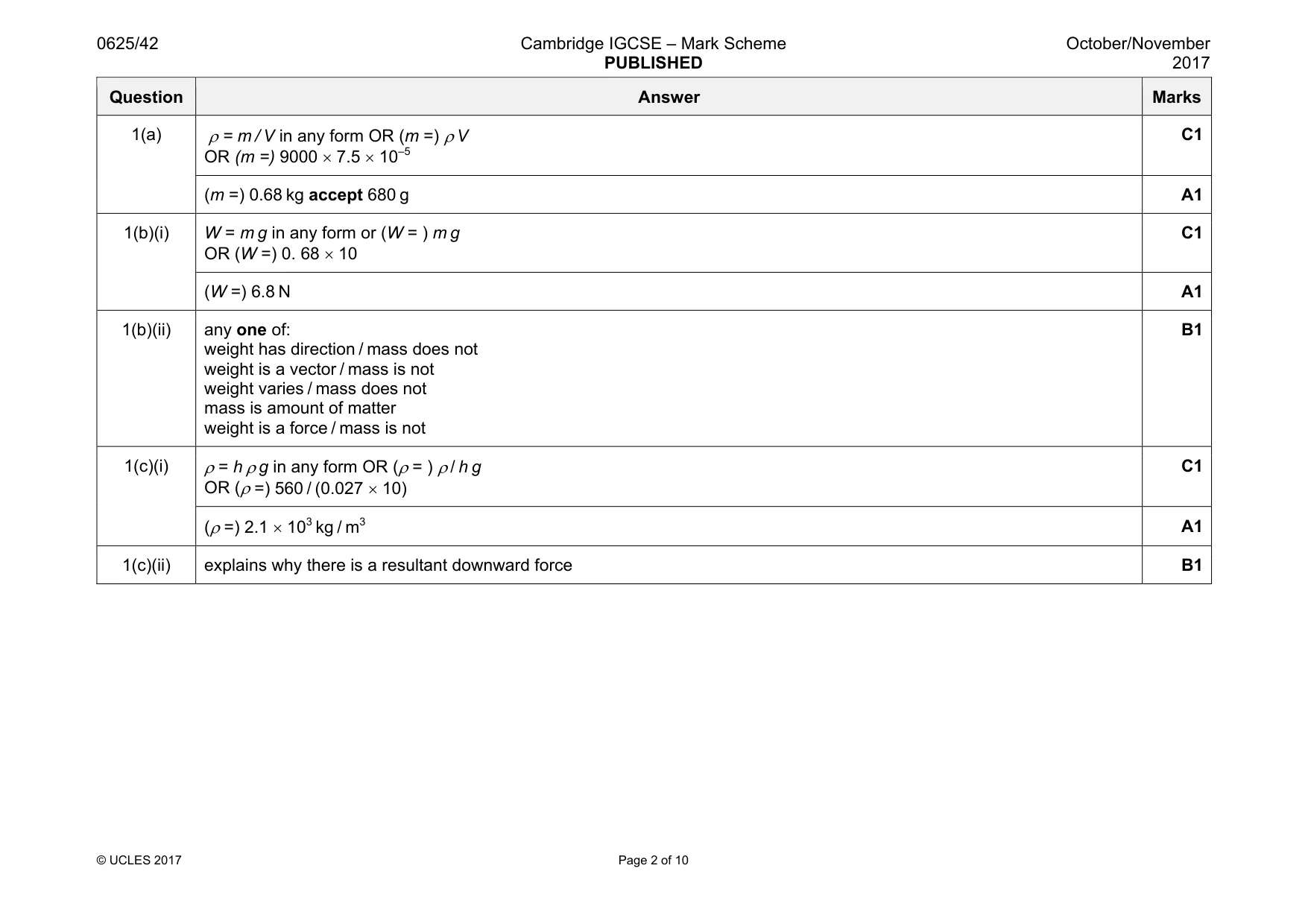
Mark scheme: 1(a) OR (m =) 9000 × 7.5 × 10–5 C1 (m =) 0.68 kg accept 680 g A1 1(b)(i) W = m g in any form or (W = ) m g OR (W =) 0. 68 × 10 C1 (W =) 6.8 N A1 1(b)(ii) any one of: weight has direction / mass does not weight is a vector / mass is not weight varies / mass does not mass is amount of matter weight is a force / mass is not B1 1(c)(i) ρ = h ρ g in any form OR (ρ = ) ρ / h g OR (ρ =) 560 / (0.027 × 10) C1 (ρ =) 2.1 × 10³ kg / m3 A1 1(c)(ii) explains why there is a resultant downward force B1
Q2 · An object is moving in a straight line at constant speed
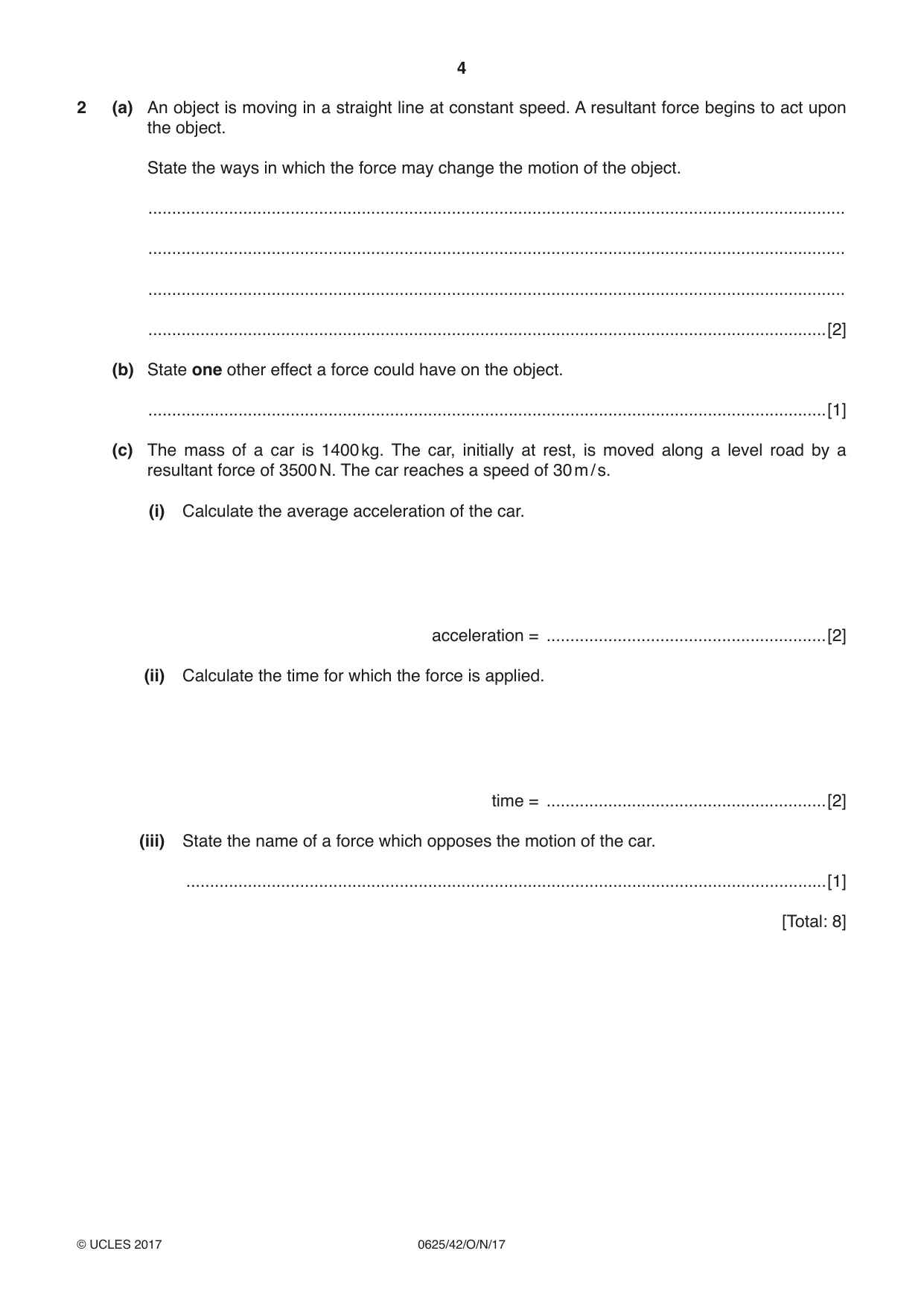
2 (a) An object is moving in a straight line at constant speed. A resultant force begins to act upon the object. State the ways in which the force may change the motion of the object. ................................................................................................................................................... ................................................................................................................................................... ................................................................................................................................................... ...............................................................................................................................................[2] (b) State one other effect a force could have on the object. ...............................................................................................................................................[1] (c) The mass of a car is 1400 kg. The car, initially at rest, is moved along a level road by a resultant force of 3500 N. The car reaches a speed of 30 m / s. (i) Calculate the average acceleration of the car. acceleration = ...........................................................[2] (ii) Calculate the time for which the force is applied. time = ...........................................................[2] (iii) State the name of a force which opposes the motion of the car. .......................................................................................................................................[1] [Total: 8]
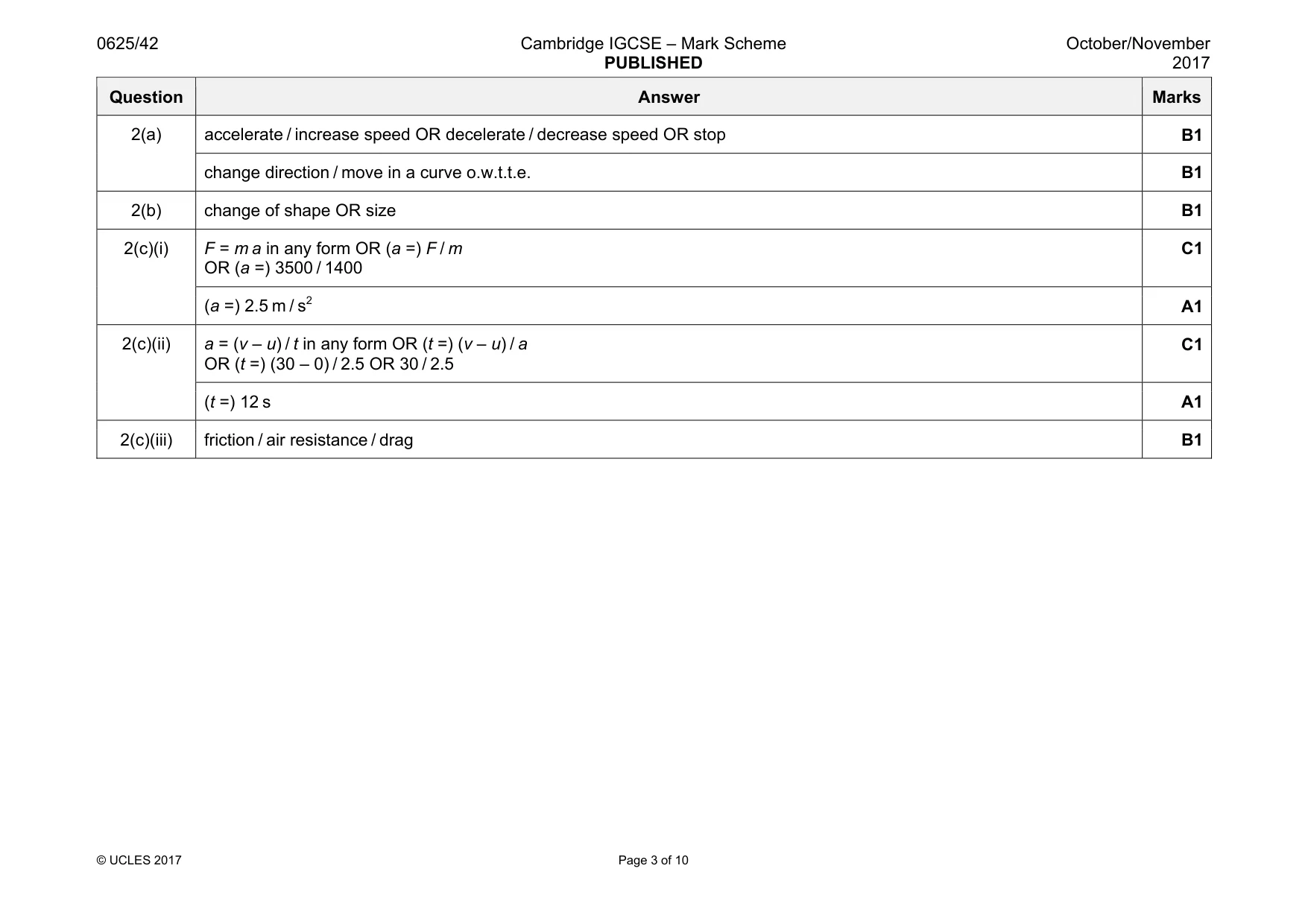
Mark scheme: 2(a) accelerate / increase speed OR decelerate / decrease speed OR stop B1 change direction / move in a curve o.w.t.t.e. B1 2(b) change of shape OR size B1 2(c)(i) F = m a in any form OR (a =) F / m OR (a =) 3500 / 1400 C1 (a =) 2.5 m / s2 A1 2(c)(ii) a = (v – u) / t in any form OR (t =) (v – u) / a OR (t =) (30 – 0) / 2.5 OR 30 / 2.5 C1 (t =) 12 s A1 2(c)(iii) friction / air resistance / drag B1
Q3 · State the name of a fuel that is burnt to produce large amounts of electrical energy
3 (a) State the name of a fuel that is burnt to produce large amounts of electrical energy. Describe a process by which electrical energy is obtained from the chemical energy stored in this fuel. Name of fuel: ............................................................................................................................ Description of process: ............................................................................................................. ................................................................................................................................................... ................................................................................................................................................... ................................................................................................................................................... ...............................................................................................................................................[4] (b) Explain why the Sun is the source of the energy stored in the fuel in (a). ................................................................................................................................................... ................................................................................................................................................... ................................................................................................................................................... ...............................................................................................................................................[2] (c) Explain whether the process in (a) is renewable. ................................................................................................................................................... ................................................................................................................................................... ................................................................................................................................................... ...............................................................................................................................................[2] [Total: 8]
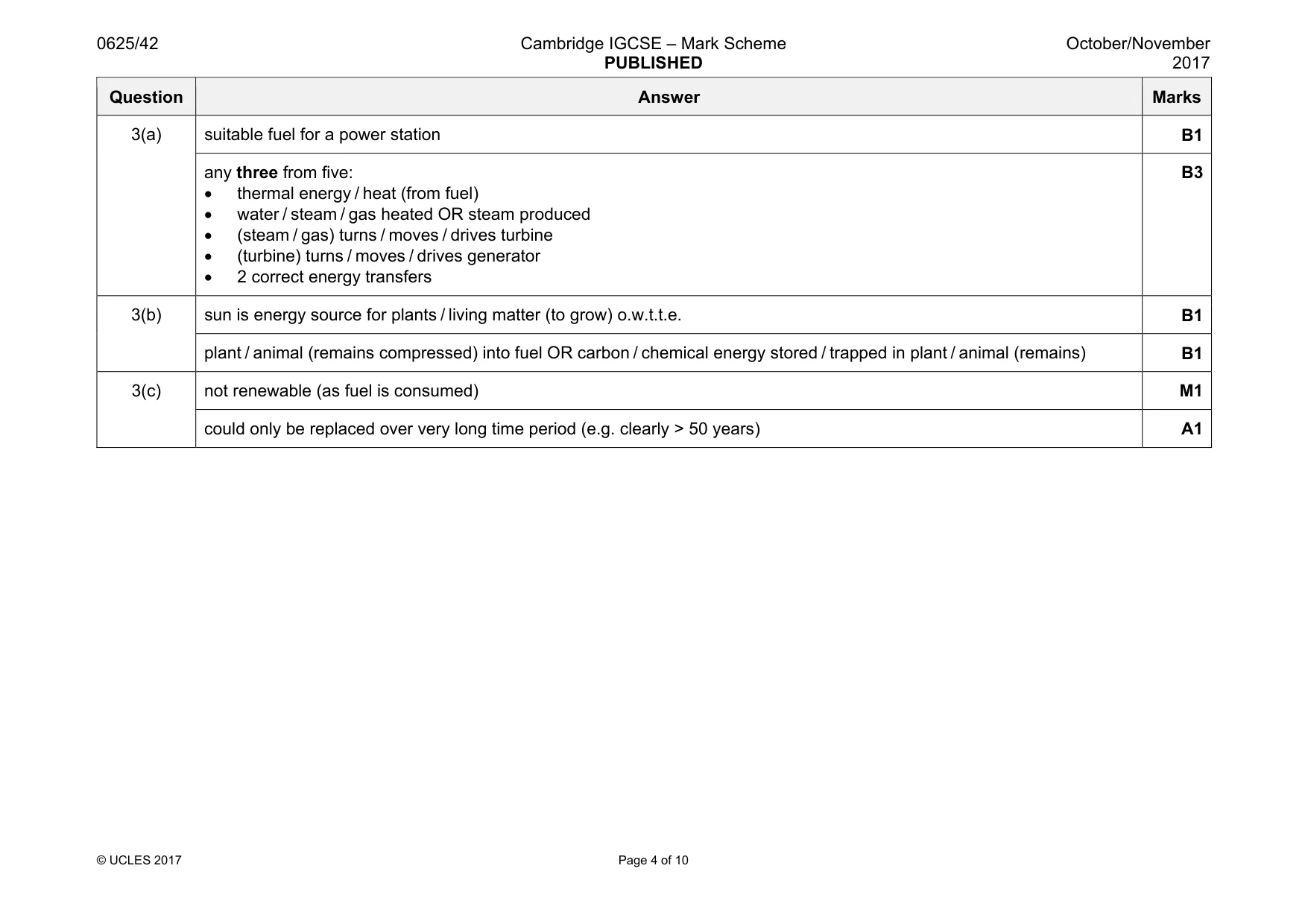
Mark scheme: 3(a) suitable fuel for a power station B1 any three from five: • thermal energy / heat (from fuel) • water / steam / gas heated OR steam produced • (steam / gas) turns / moves / drives turbine • (turbine) turns / moves / drives generator • 2 correct energy transfers B3 3(b) sun is energy source for plants / living matter (to grow) o.w.t.t.e. B1 plant / animal (remains compressed) into fuel OR carbon / chemical energy stored / trapped in plant / animal (remains) B1 3(c) not renewable (as fuel is consumed) M1 could only be replaced over very long time period (e.g. clearly > 50 years) A1
Q4 · A beaker contains water at room temperature
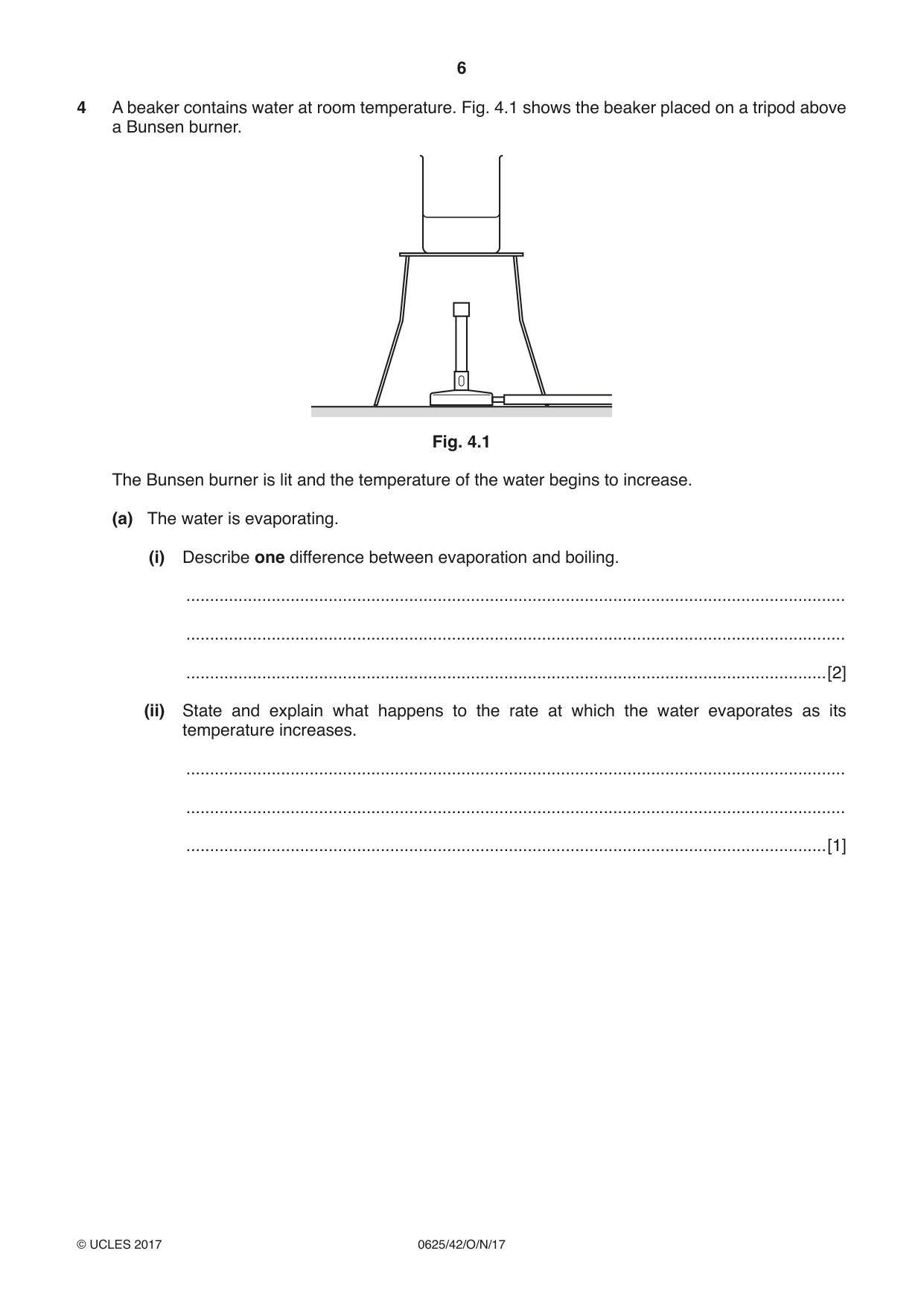
4 A beaker contains water at room temperature. Fig. 4.1 shows the beaker placed on a tripod above a Bunsen burner. Fig. 4.1 The Bunsen burner is lit and the temperature of the water begins to increase. (a) The water is evaporating. (i) Describe one difference between evaporation and boiling. ........................................................................................................................................... ........................................................................................................................................... .......................................................................................................................................[2] (ii) State and explain what happens to the rate at which the water evaporates as its temperature increases. ........................................................................................................................................... ........................................................................................................................................... .......................................................................................................................................[1] (b) After a few minutes, the water reaches its boiling point temperature. The water continues to gain energy from the Bunsen burner. (i) State what happens to the temperature of the water in the beaker. ........................................................................................................................................... .......................................................................................................................................[1] (ii) The specific latent heat of vaporisation of water is 2.3 × 10⁶ J / kg. After the water reaches its boiling point, it takes 12 minutes for 0.095 kg of water to boil away. Calculate the average rate at which energy is being supplied to the water by heating. rate of energy supplied = ...........................................................[3] [Total: 7]
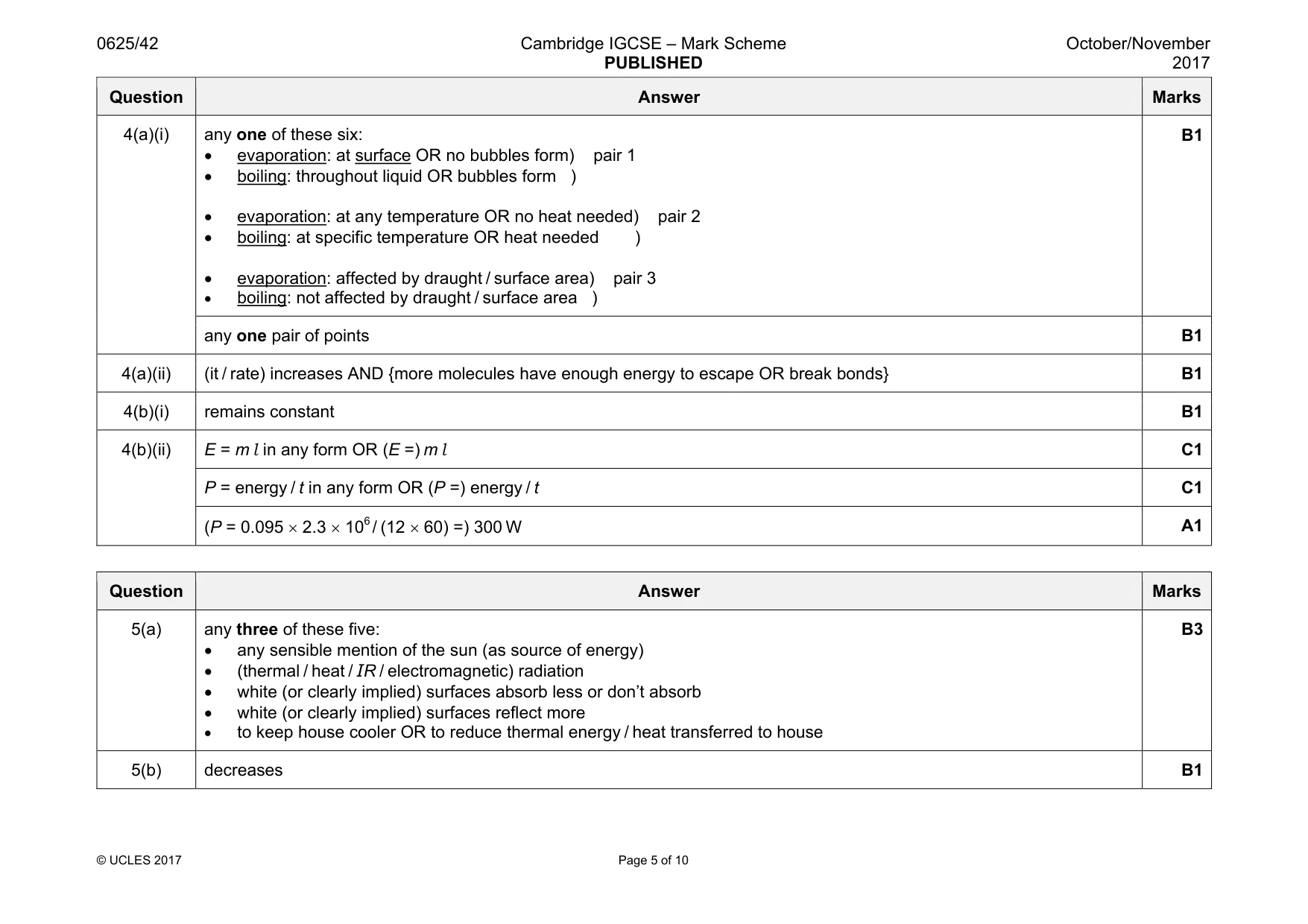
Mark scheme: 4(a)(i) any one of these six: • evaporation: at surface OR no bubbles form) pair 1 • boiling: throughout liquid OR bubbles form ) • evaporation: at any temperature OR no heat needed) pair 2 • boiling: at specific temperature OR heat needed ) • evaporation: affected by draught / surface area) pair 3 • boiling: not affected by draught / surface area ) B1 any one pair of points B1 4(a)(ii) (it / rate) increases AND {more molecules have enough energy to escape OR break bonds} B1 4(b)(i) remains constant B1 4(b)(ii) E = m l in any form OR (E =) m l C1 P = energy / t in any form OR (P =) energy / t C1 (P = 0.095 × 2.3 × 106 / (12 × 60) =) 300 W A1
Q5 · Explain why houses in hot countries are often painted white
5 (a) Explain why houses in hot countries are often painted white. Use ideas about the transfer of thermal energy in your answer. ................................................................................................................................................... ................................................................................................................................................... ................................................................................................................................................... ...............................................................................................................................................[3] (b) As a star approaches the end of its life, the amount of radiation emitted from it per second changes. The star cools down. State any effect on the rate of emission of radiation. ................................................................................................................................................... ...............................................................................................................................................[1] [Total: 4]
Mark scheme: 5(a) any three of these five: • any sensible mention of the sun (as source of energy) • (thermal / heat / IR / electromagnetic) radiation • white (or clearly implied) surfaces absorb less or don’t absorb • white (or clearly implied) surfaces reflect more • to keep house cooler OR to reduce thermal energy / heat transferred to house B3 5(b) decreases B1
Q6 · Wavefronts of a water wave on the surface of water approaching a gap in a barrier
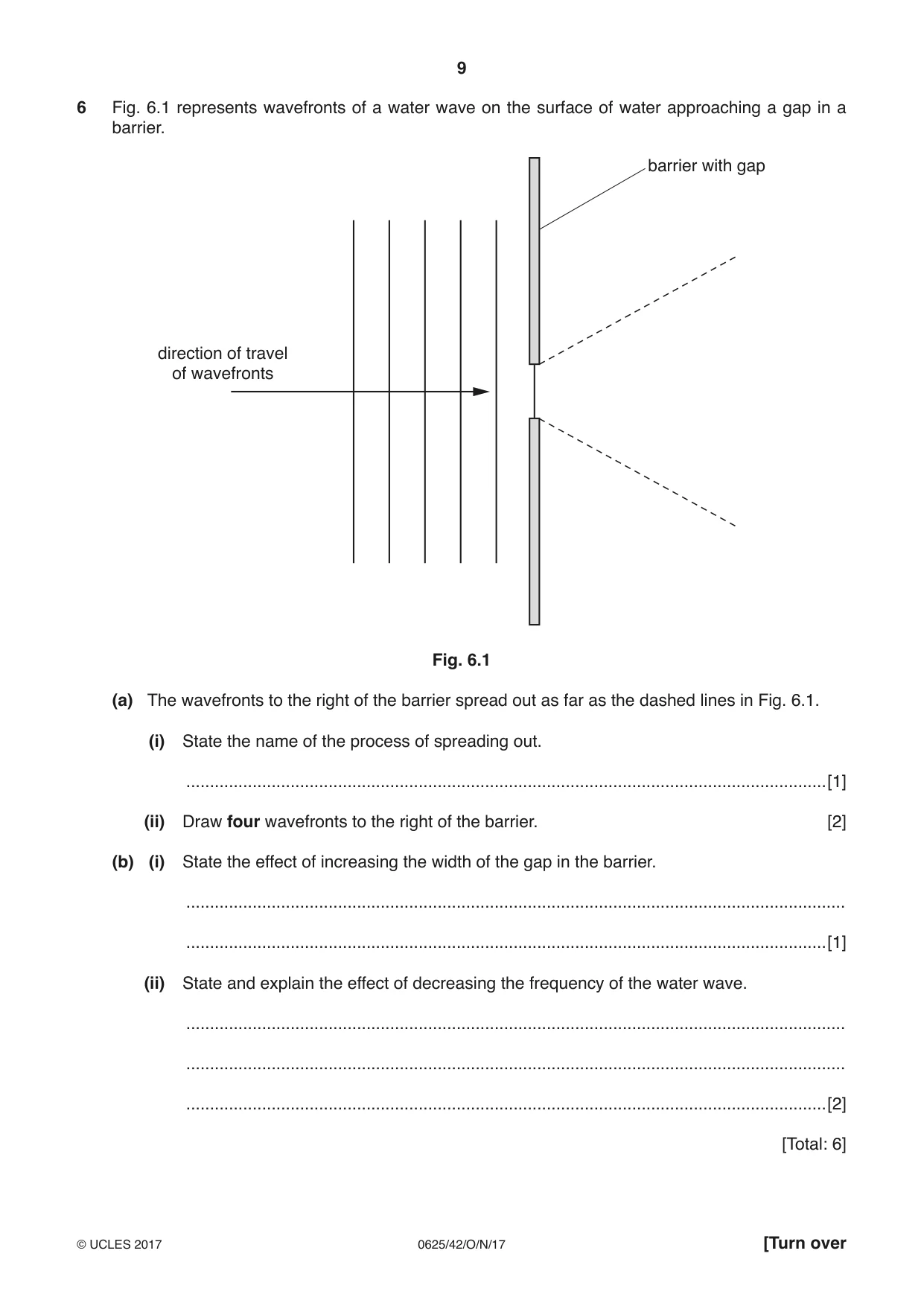
6 Fig. 6.1 represents wavefronts of a water wave on the surface of water approaching a gap in a barrier. barrier with gap direction of travel of wavefronts Fig. 6.1 (a) The wavefronts to the right of the barrier spread out as far as the dashed lines in Fig. 6.1. (i) State the name of the process of spreading out. .......................................................................................................................................[1] (ii) Draw four wavefronts to the right of the barrier. [2] (b) (i) State the effect of increasing the width of the gap in the barrier. ........................................................................................................................................... .......................................................................................................................................[1] (ii) State and explain the effect of decreasing the frequency of the water wave. ........................................................................................................................................... ........................................................................................................................................... .......................................................................................................................................[2] [Total: 6]
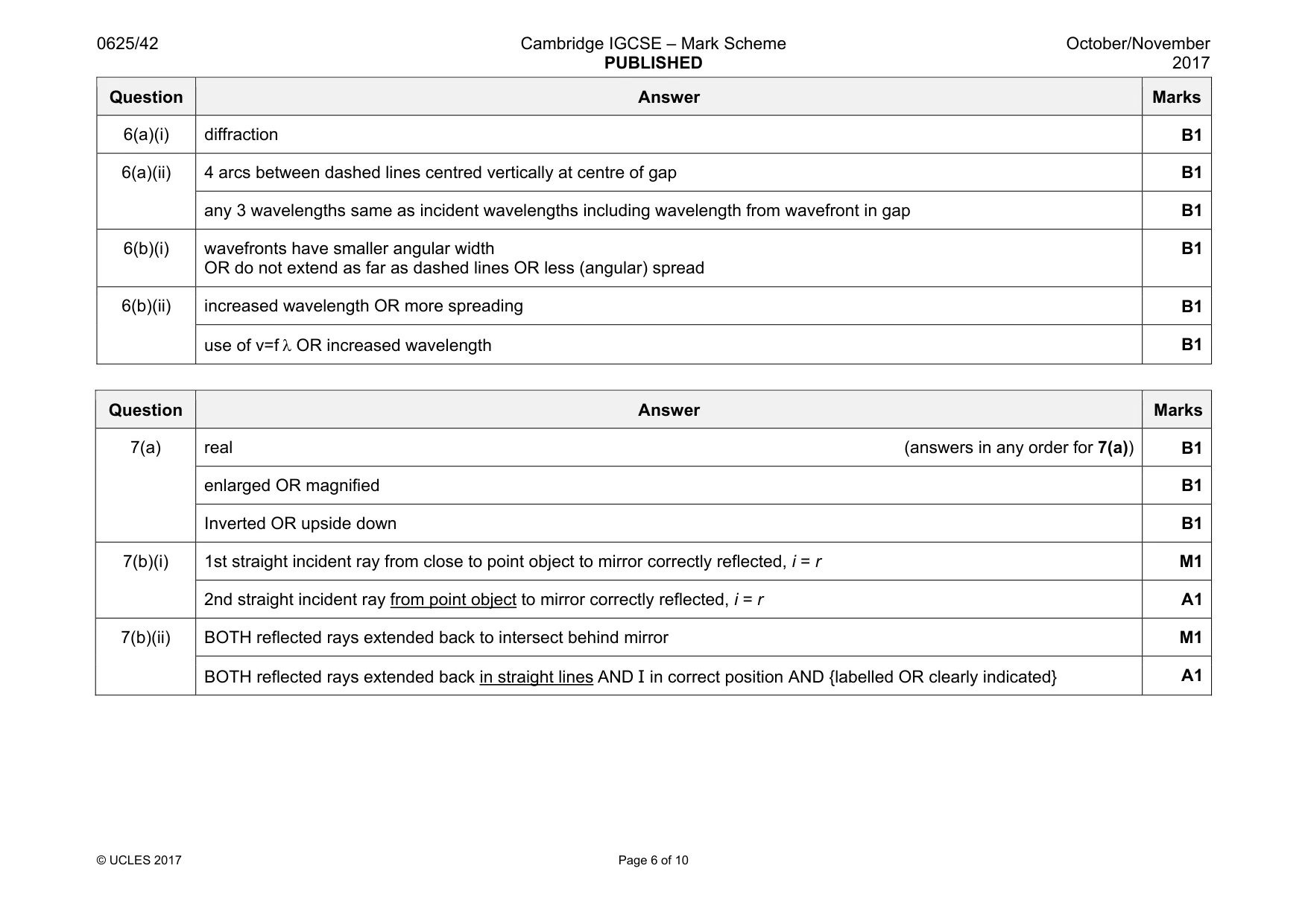
Mark scheme: 6(a)(i) diffraction B1 6(a)(ii) 4 arcs between dashed lines centred vertically at centre of gap B1 any 3 wavelengths same as incident wavelengths including wavelength from wavefront in gap B1 6(b)(i) wavefronts have smaller angular width OR do not extend as far as dashed lines OR less (angular) spread B1 6(b)(ii) increased wavelength OR more spreading B1 use of v=f λ OR increased wavelength B1
Q7 · A diagram of a converging lens used to produce an image of an object
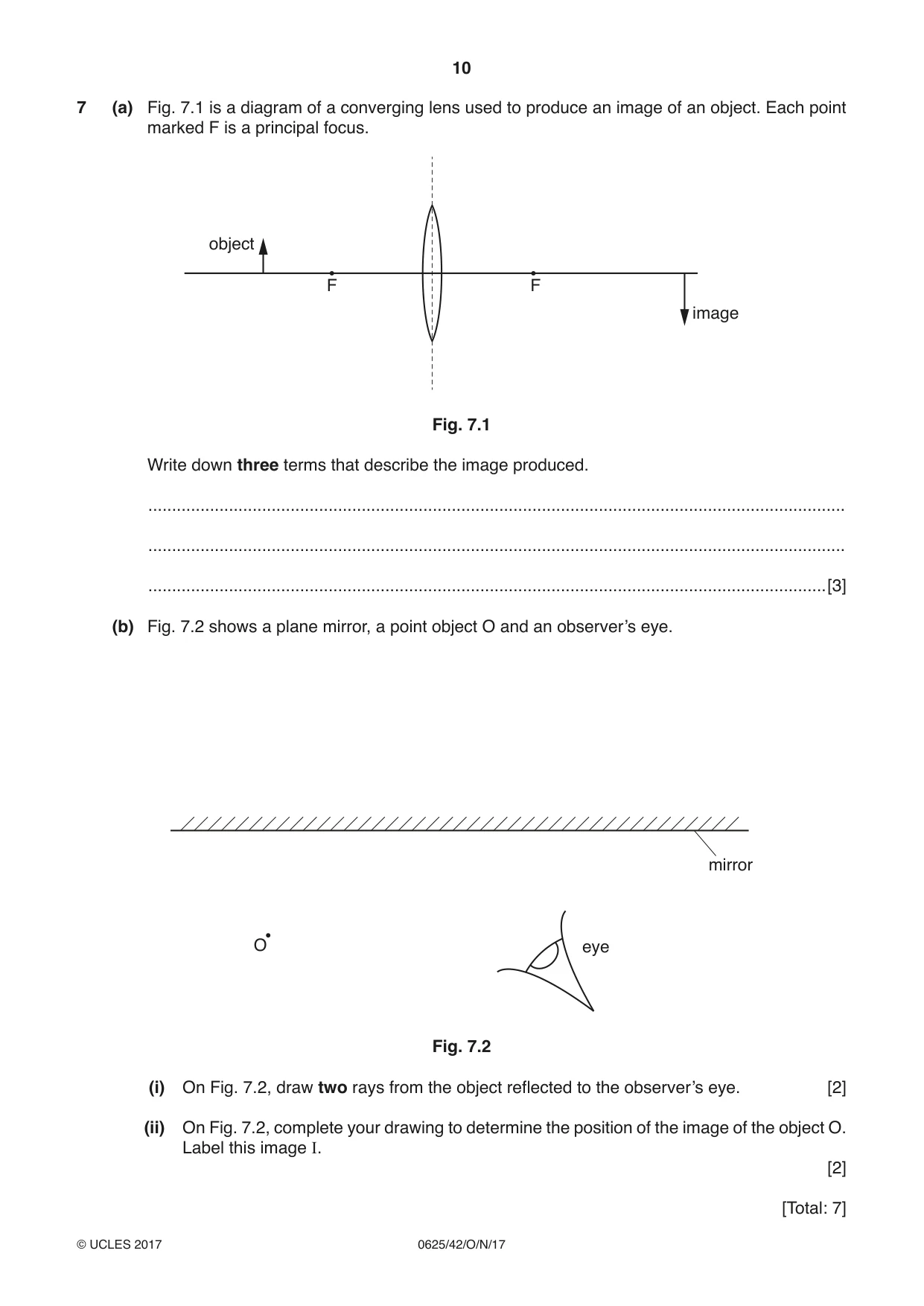
7 (a) Fig. 7.1 is a diagram of a converging lens used to produce an image of an object. Each point marked F is a principal focus. object F F image Fig. 7.1 Write down three terms that describe the image produced. ................................................................................................................................................... ................................................................................................................................................... ...............................................................................................................................................[3] (b) Fig. 7.2 shows a plane mirror, a point object O and an observer’s eye. mirror O eye Fig. 7.2 (i) On Fig. 7.2, draw two rays from the object reflected to the observer’s eye. [2] (ii) On Fig. 7.2, complete your drawing to determine the position of the image of the object O. Label this image I. [2] [Total: 7]
Mark scheme: 7(a) real (answers in any order for 7(a)) B1 enlarged OR magnified B1 Inverted OR upside down B1 7(b)(i) 1st straight incident ray from close to point object to mirror correctly reflected, i = r M1 2nd straight incident ray from point object to mirror correctly reflected, i = r A1 7(b)(ii) BOTH reflected rays extended back to intersect behind mirror M1 BOTH reflected rays extended back in straight lines AND I in correct position AND {labelled OR clearly indicated} A1
Question 8
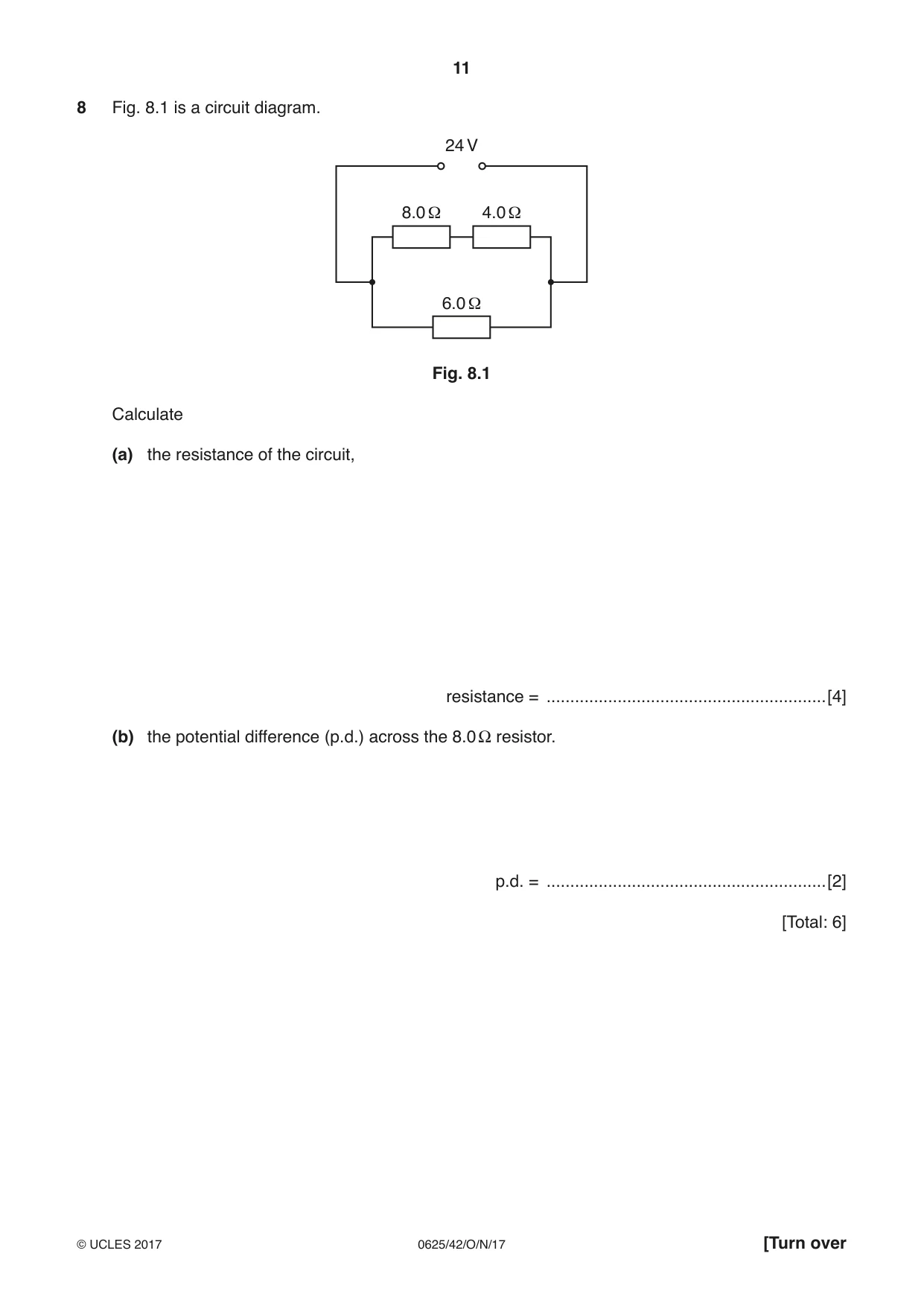
8 Fig. 8.1 is a circuit diagram. 24 V 8.0 Ω 4.0 Ω 6.0 Ω Fig. 8.1 Calculate (a) the resistance of the circuit, resistance = ...........................................................[4] (b) the potential difference (p.d.) across the 8.0 Ω resistor. p.d. = ...........................................................[2] [Total: 6]
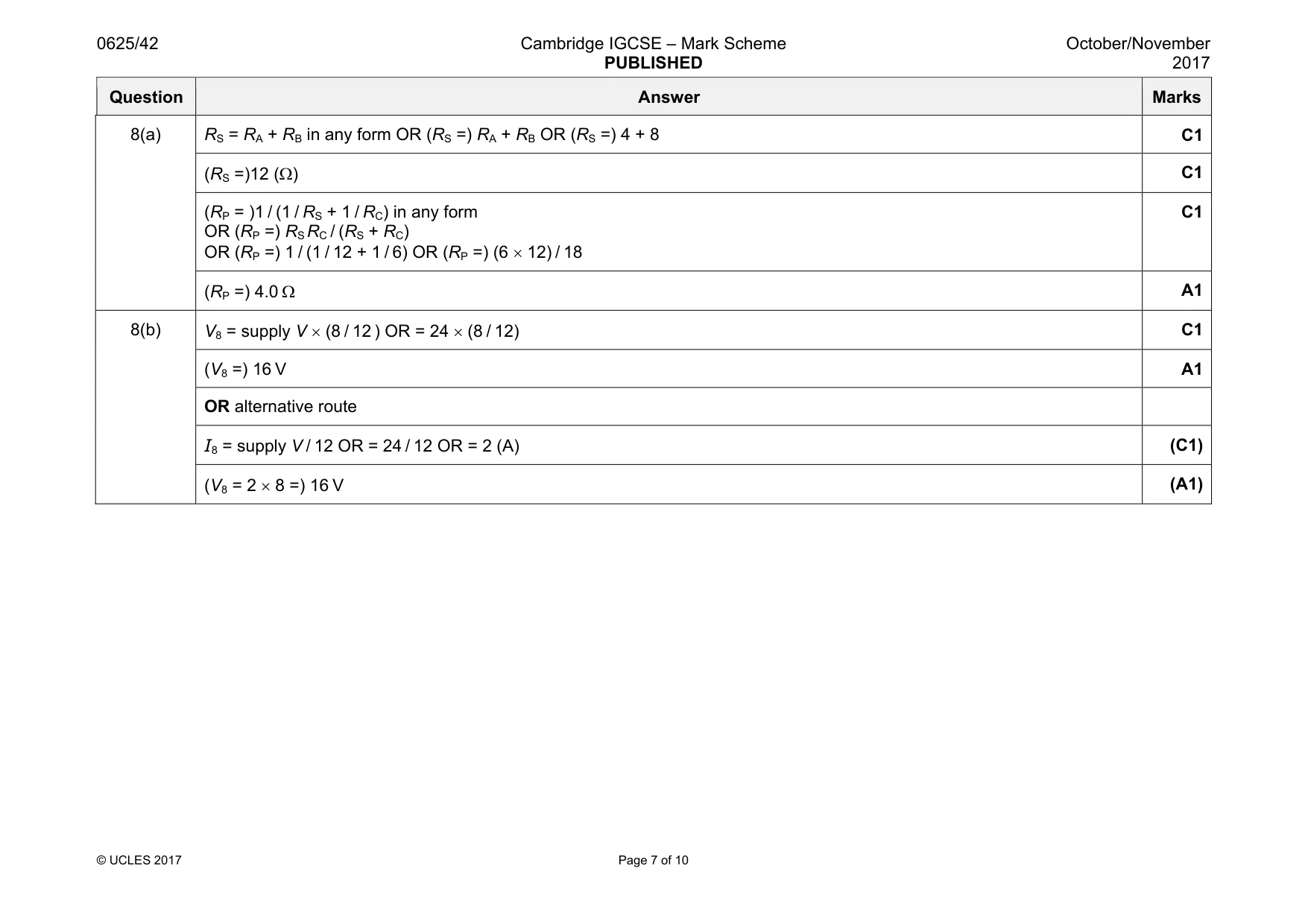
Mark scheme: 8(a) RS = RA + RB in any form OR (RS =) RA + RB OR (RS =) 4 + 8 C1 (RS =)12 (Ω) C1 (RP = )1 / (1 / RS + 1 / RC) in any form OR (RP =) RS RC / (RS + RC) OR (RP =) 1 / (1 / 12 + 1 / 6) OR (RP =) (6 × 12) / 18 C1 (RP =) 4.0 Ω A1 8(b) V8 = supply V × (8 / 12 ) OR = 24 × (8 / 12) C1 (V8 =) 16 V A1 OR alternative route I8 = supply V / 12 OR = 24 / 12 OR = 2 (A) (C1) (V8 = 2 × 8 =) 16 V (A1)
Question 9
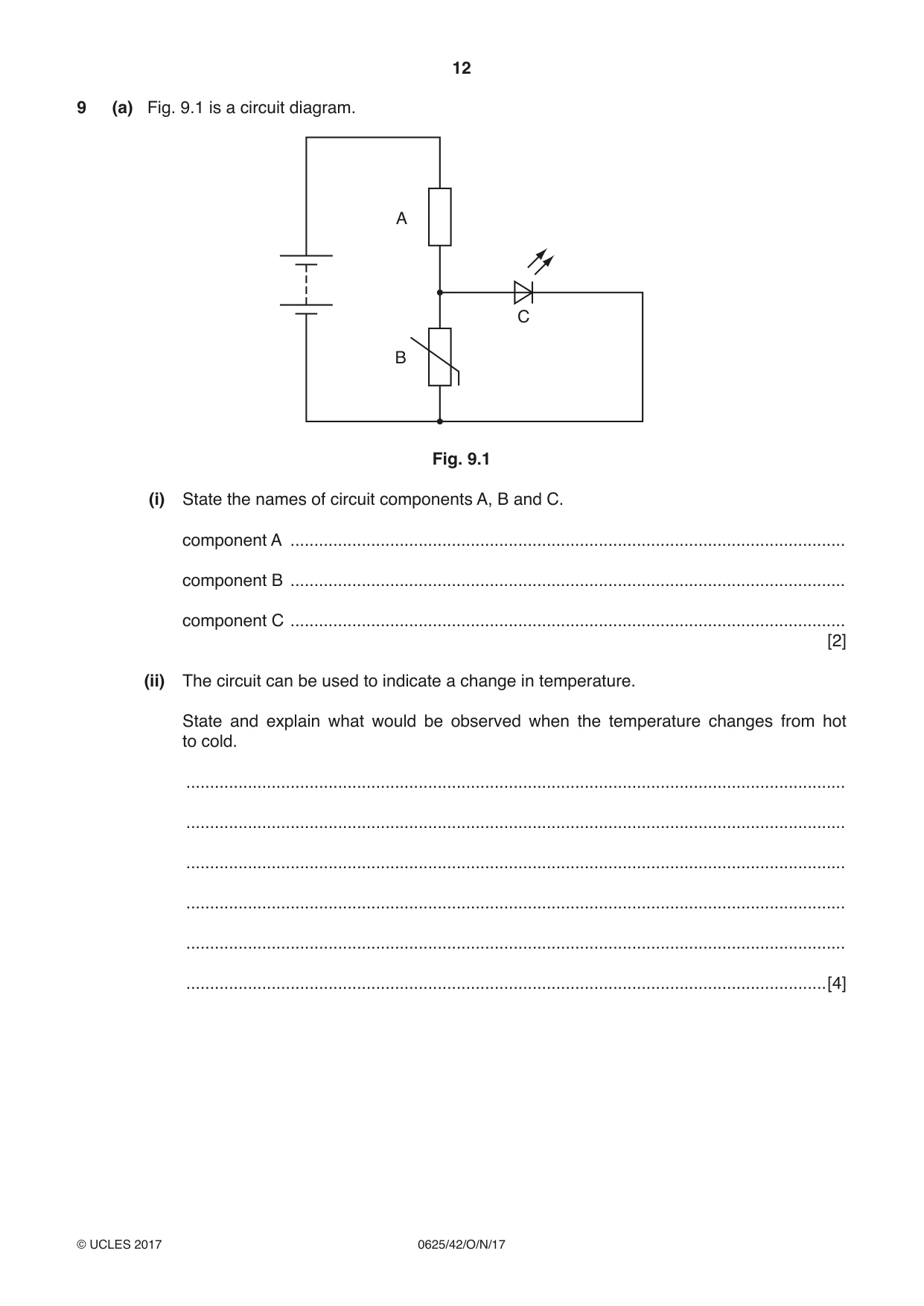
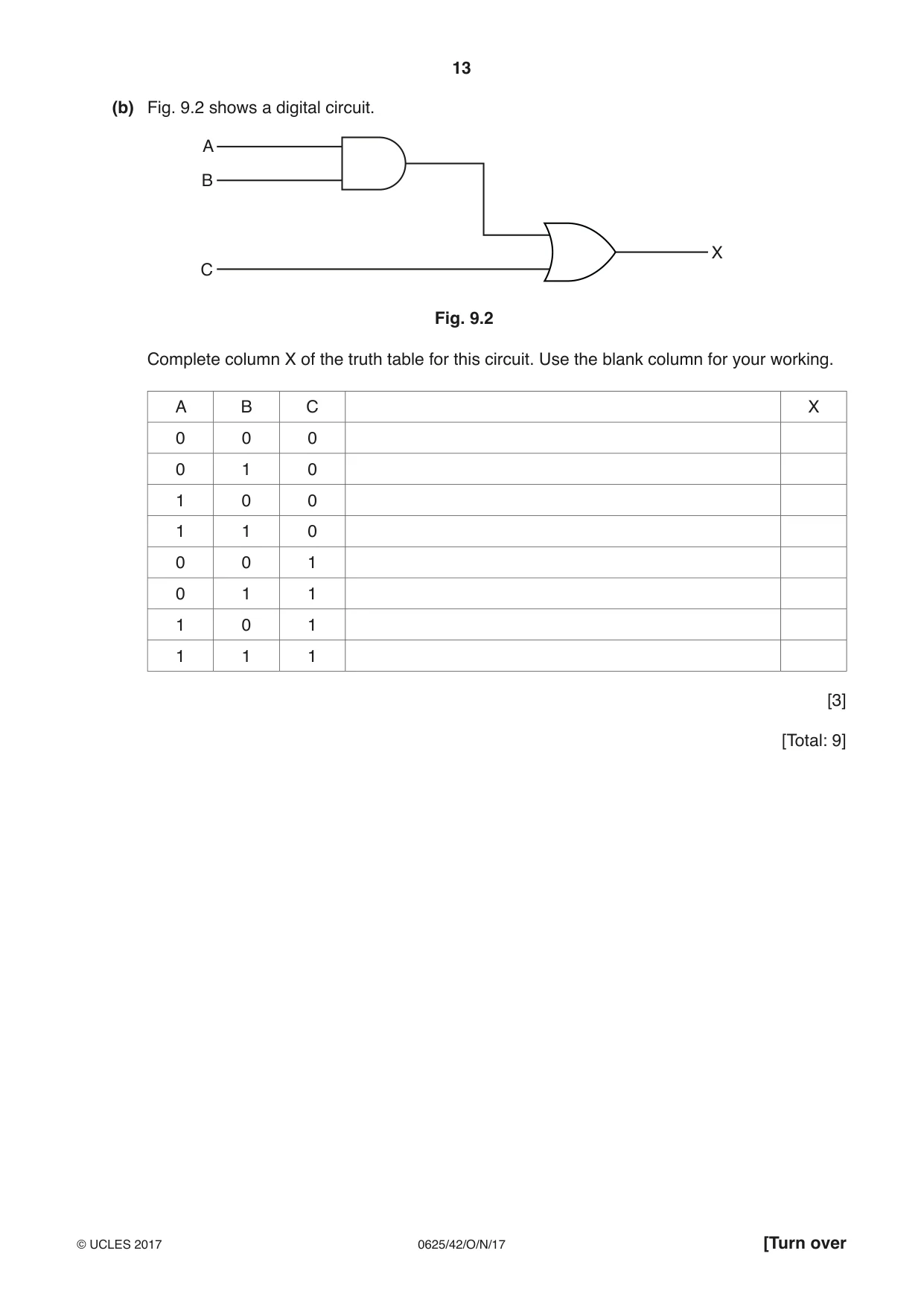
9 (a) Fig. 9.1 is a circuit diagram. A C B Fig. 9.1 (i) State the names of circuit components A, B and C. component A ..................................................................................................................... component B ..................................................................................................................... component C ..................................................................................................................... [2] (ii) The circuit can be used to indicate a change in temperature. State and explain what would be observed when the temperature changes from hot to cold. ........................................................................................................................................... ........................................................................................................................................... ........................................................................................................................................... ........................................................................................................................................... ........................................................................................................................................... .......................................................................................................................................[4] (b) Fig. 9.2 shows a digital circuit. A B X C Fig. 9.2 Complete column X of the truth table for this circuit. Use the blank column for your working. A B C X 0 0 0 0 1 0 1 0 0 1 1 0 0 0 1 0 1 1 1 0 1 1 1 1 [3] [Total: 9]
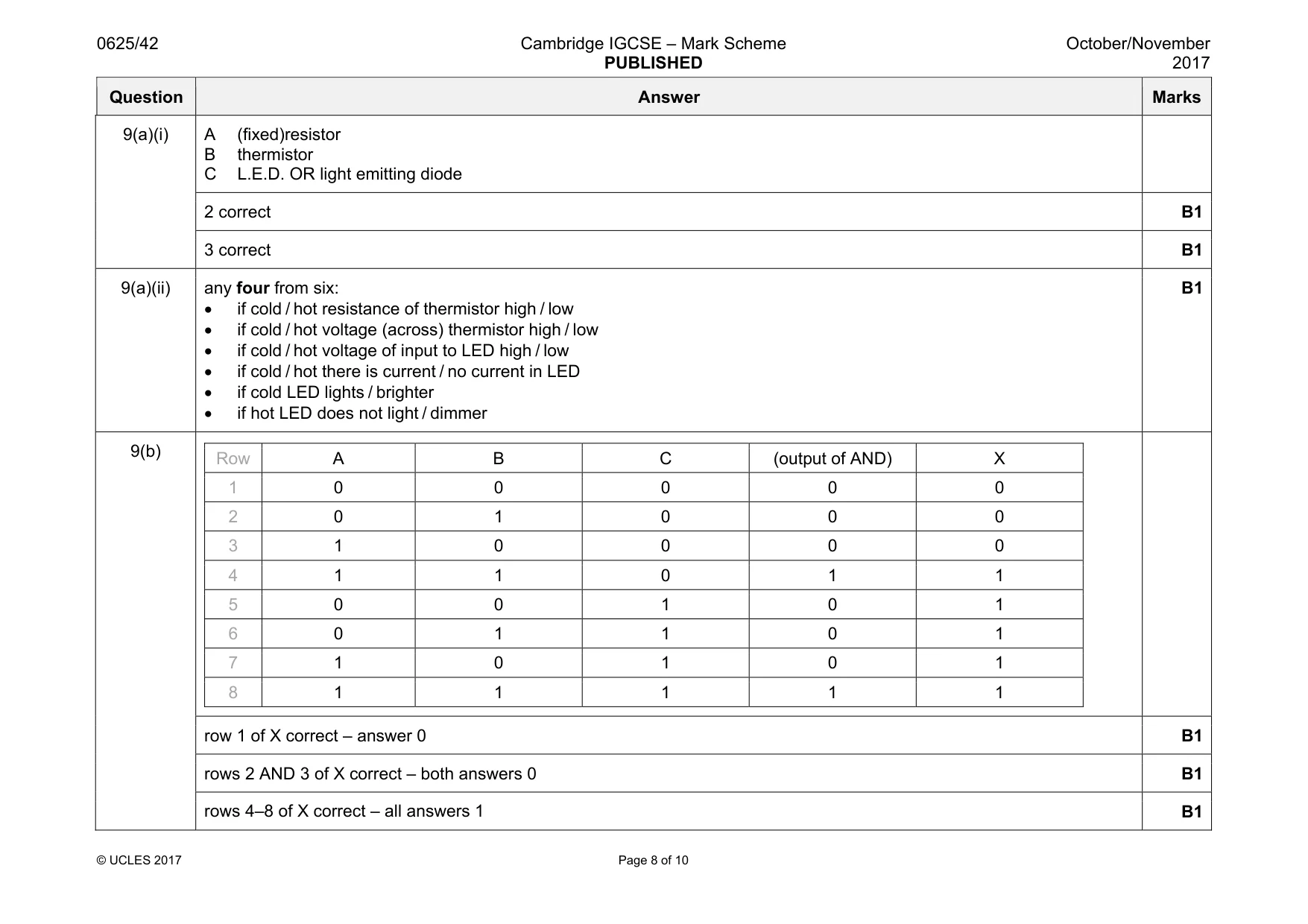
Mark scheme: 9(a)(i) A (fixed)resistor B thermistor C L.E.D. OR light emitting diode 2 correct B1 3 correct B1 9(a)(ii) any four from six: • if cold / hot resistance of thermistor high / low • if cold / hot voltage (across) thermistor high / low • if cold / hot voltage of input to LED high / low • if cold / hot there is current / no current in LED • if cold LED lights / brighter • if hot LED does not light / dimmer B1 9(b) Row A B C (output of AND) X 1 0 0 0 0 0 2 0 1 0 0 0 3 1 0 0 0 0 4 1 1 0 1 1 5 0 0 1 0 1 6 0 1 1 0 1 7 1 0 1 0 1 8 1 1 1 1 1 row 1 of X correct – answer 0 B1 rows 2 AND 3 of X correct – both answers 0 B1 rows 4–8 of X correct – all answers 1 B1
Q10 · A wire that carries a current into the page
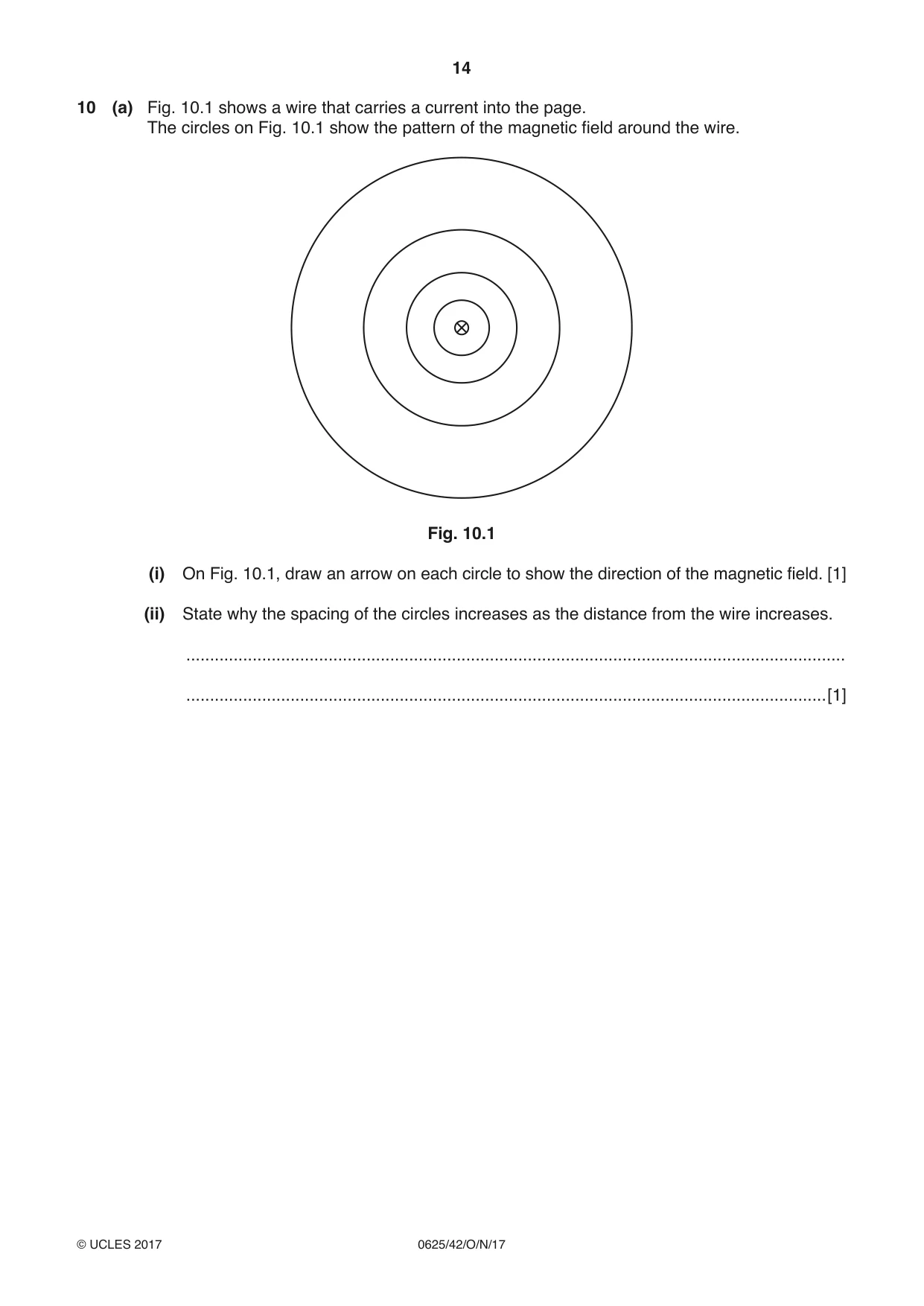
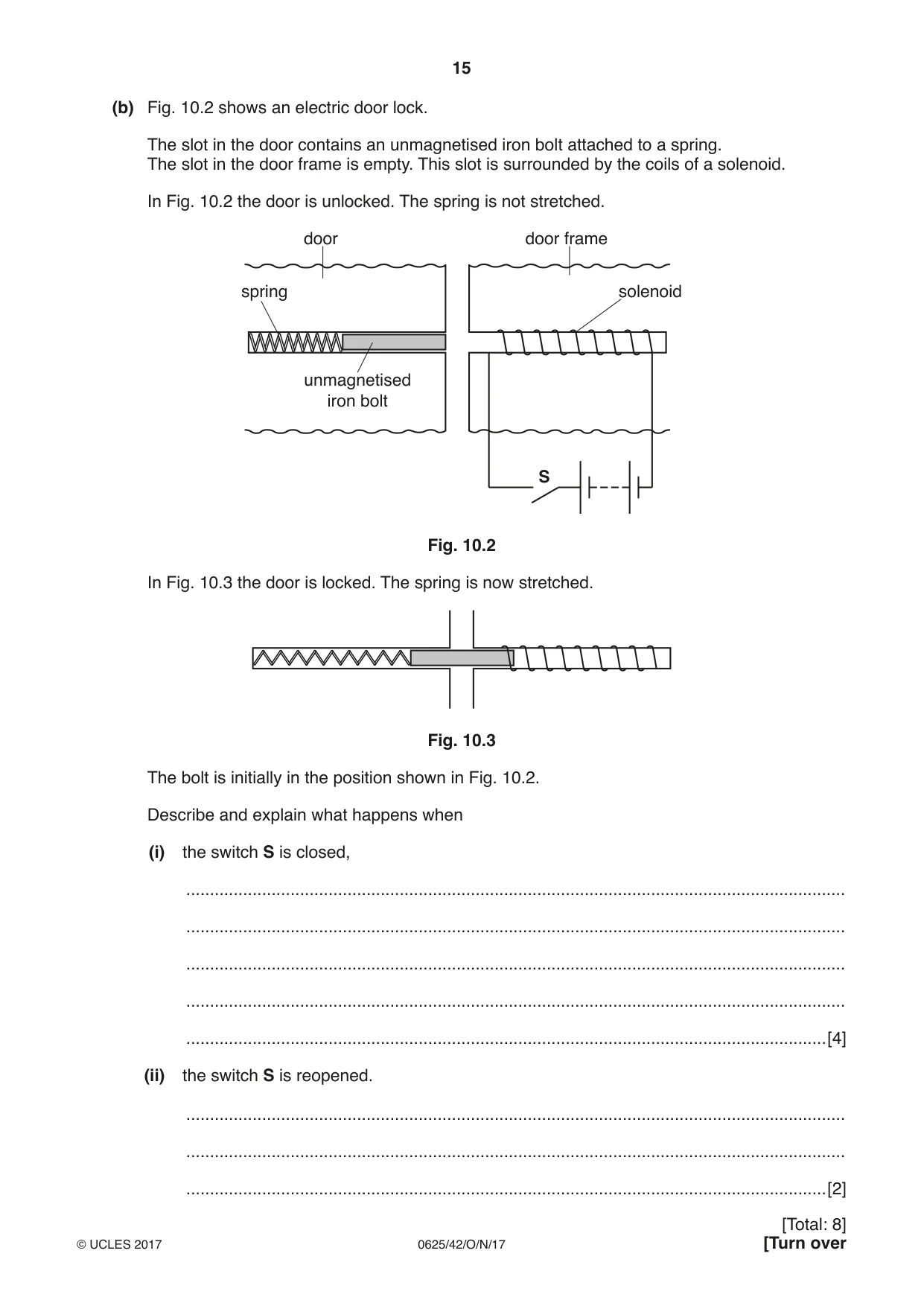
10 (a) Fig. 10.1 shows a wire that carries a current into the page. The circles on Fig. 10.1 show the pattern of the magnetic field around the wire. Fig. 10.1 (i) On Fig. 10.1, draw an arrow on each circle to show the direction of the magnetic field. [1] (ii) State why the spacing of the circles increases as the distance from the wire increases. ........................................................................................................................................... .......................................................................................................................................[1] (b) Fig. 10.2 shows an electric door lock. The slot in the door contains an unmagnetised iron bolt attached to a spring. The slot in the door frame is empty. This slot is surrounded by the coils of a solenoid. In Fig. 10.2 the door is unlocked. The spring is not stretched. door door frame spring solenoid unmagnetised iron bolt S Fig. 10.2 In Fig. 10.3 the door is locked. The spring is now stretched. Fig. 10.3 The bolt is initially in the position shown in Fig. 10.2. Describe and explain what happens when (i) the switch S is closed, ........................................................................................................................................... ........................................................................................................................................... ........................................................................................................................................... ........................................................................................................................................... .......................................................................................................................................[4] (ii) the switch S is reopened. ........................................................................................................................................... ........................................................................................................................................... .......................................................................................................................................[2]
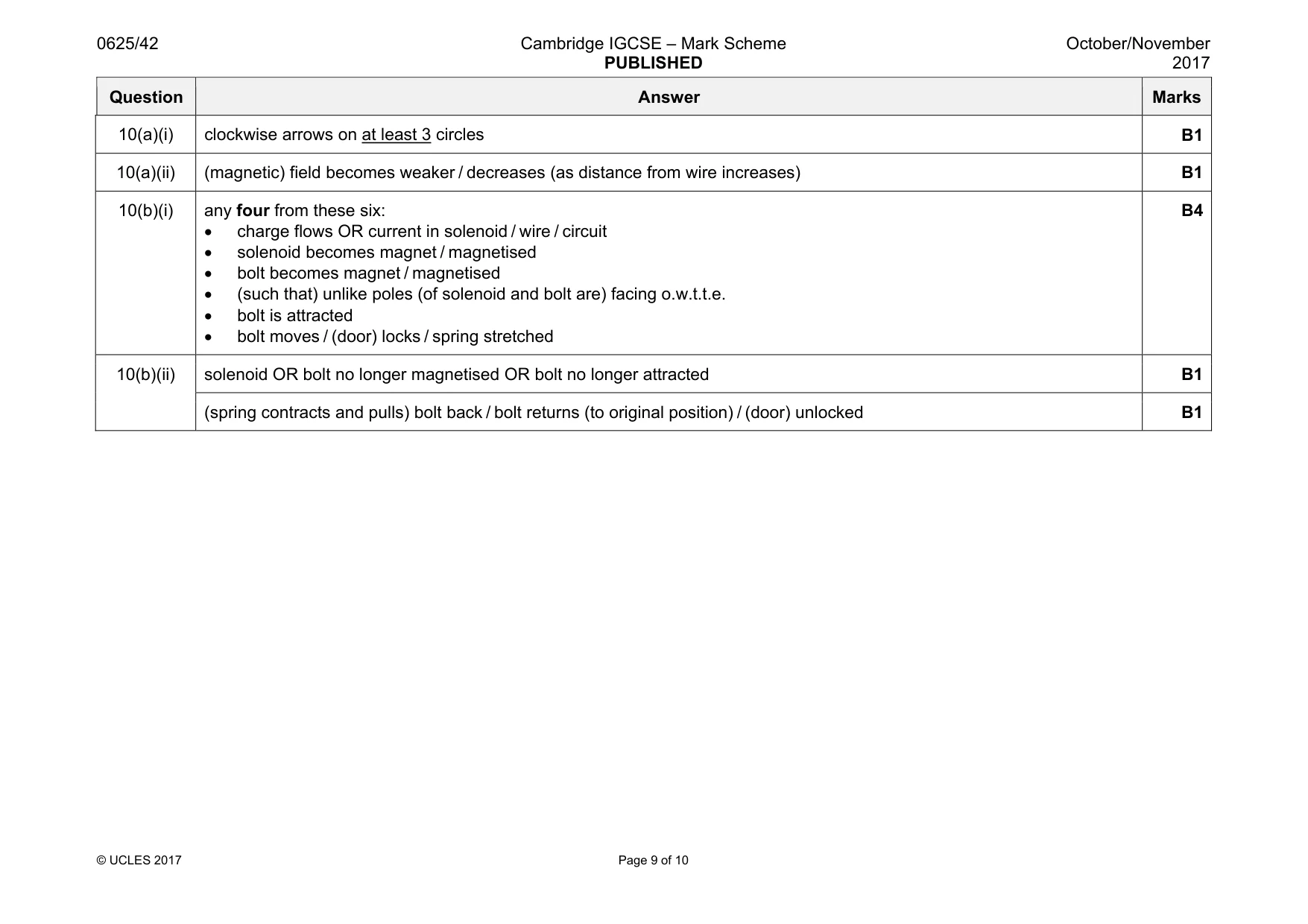
Mark scheme: 10(a)(i) clockwise arrows on at least 3 circles B1 10(a)(ii) (magnetic) field becomes weaker / decreases (as distance from wire increases) B1 10(b)(i) any four from these six: • charge flows OR current in solenoid / wire / circuit • solenoid becomes magnet / magnetised • bolt becomes magnet / magnetised • (such that) unlike poles (of solenoid and bolt are) facing o.w.t.t.e. • bolt is attracted • bolt moves / (door) locks / spring stretched B4 10(b)(ii) solenoid OR bolt no longer magnetised OR bolt no longer attracted B1 (spring contracts and pulls) bolt back / bolt returns (to original position) / (door) unlocked B1
Q11 · The radioactive isotope bismuth-210 (21083 Bi) decays by β-particle emission to an…
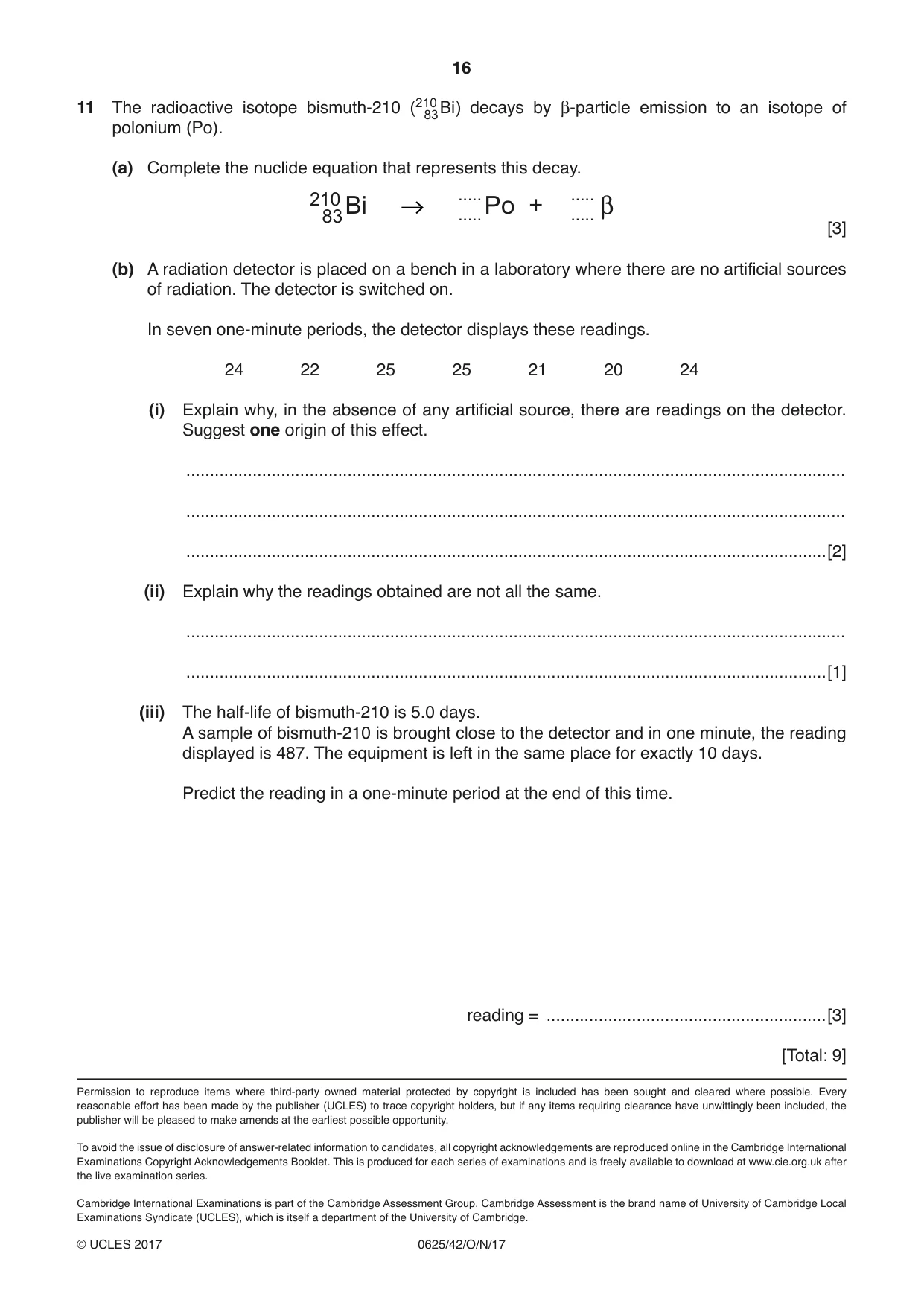
11 The radioactive isotope bismuth-210 (21083 Bi) decays by β-particle emission to an isotope of polonium (Po). (a) Complete the nuclide equation that represents this decay. 210 ..... ..... Bi + 83 .....Po ..... β [3] (b) A radiation detector is placed on a bench in a laboratory where there are no artificial sources of radiation. The detector is switched on. In seven one-minute periods, the detector displays these readings. 24 22 25 25 21 20 24 (i) Explain why, in the absence of any artificial source, there are readings on the detector. Suggest one origin of this effect. ........................................................................................................................................... ........................................................................................................................................... .......................................................................................................................................[2] (ii) Explain why the readings obtained are not all the same. ........................................................................................................................................... .......................................................................................................................................[1] (iii) The half-life of bismuth-210 is 5.0 days. A sample of bismuth-210 is brought close to the detector and in one minute, the reading displayed is 487. The equipment is left in the same place for exactly 10 days. Predict the reading in a one-minute period at the end of this time. reading = ...........................................................[3] [Total: 9]
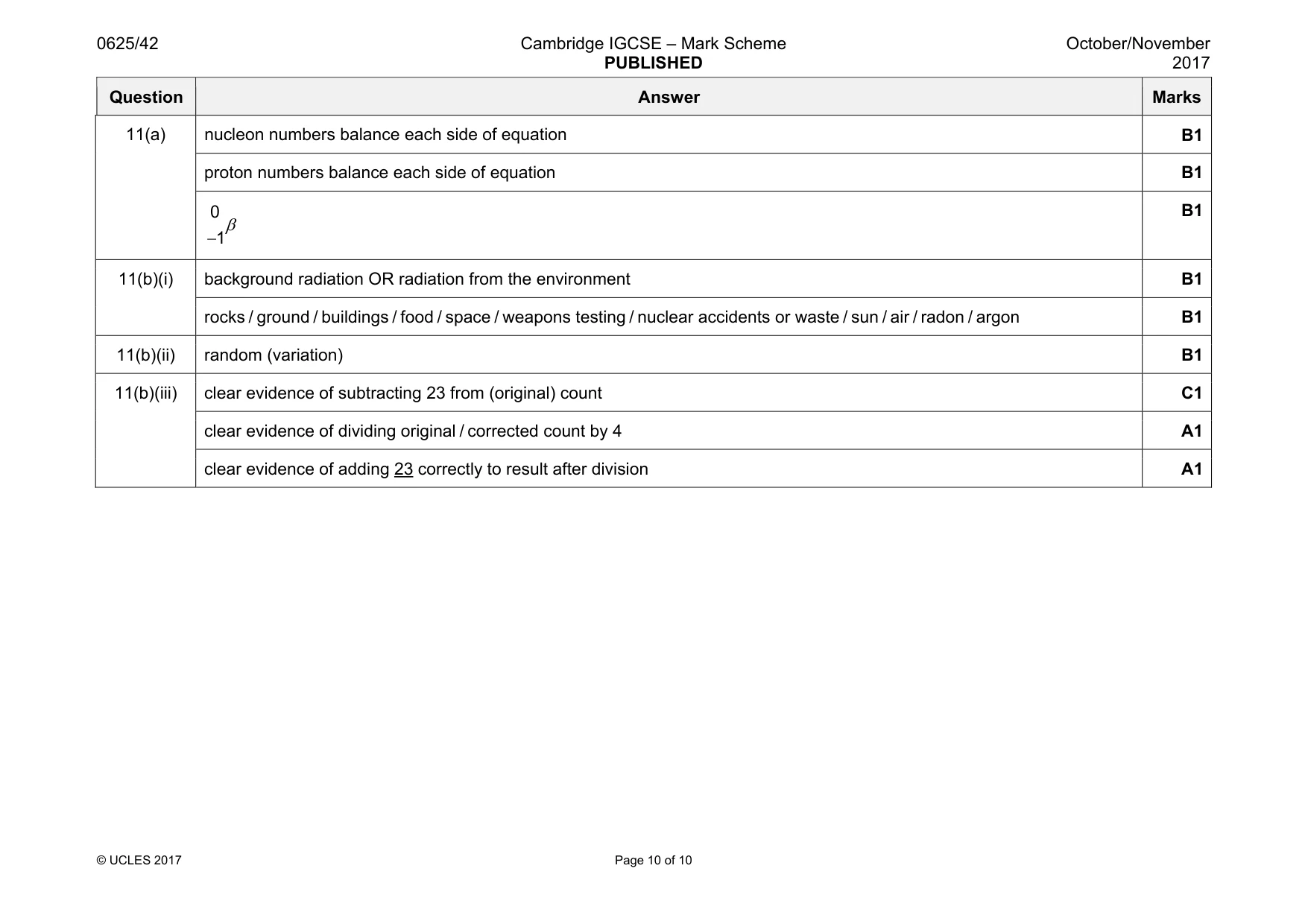
Mark scheme: 11(a) nucleon numbers balance each side of equation B1 proton numbers balance each side of equation B1 0 1 −β B1 11(b)(i) background radiation OR radiation from the environment B1 rocks / ground / buildings / food / space / weapons testing / nuclear accidents or waste / sun / air / radon / argon B1 11(b)(ii) random (variation) B1 11(b)(iii) clear evidence of subtracting 23 from (original) count C1 clear evidence of dividing original / corrected count by 4 A1 clear evidence of adding 23 correctly to result after division A1
What was in this paper
The subtopics covered by these 11 questions, and how many questions each got. Open one in a new tab to see every Cambridge question on it.
What you needed in this session
Cambridge’s own grade thresholds for 2017 Oct/Nov, Paper 4 · Variant 2. A higher threshold means an easier paper — the bar moves with how the cohort did.