Cambridge IGCSE Physics 0625 — 2019 May/June Paper 4 · Variant 3
0625/43/M/J/19 · 11 questions · 80 marks · ≈90 min
The question paper and its mark scheme, free to read here and free to download. This is Cambridge’s own paper, exactly as it was sat.
Question paper20 pages


Mark scheme10 pages
Answers below. Sit the paper first if you are practising.
Questions as text
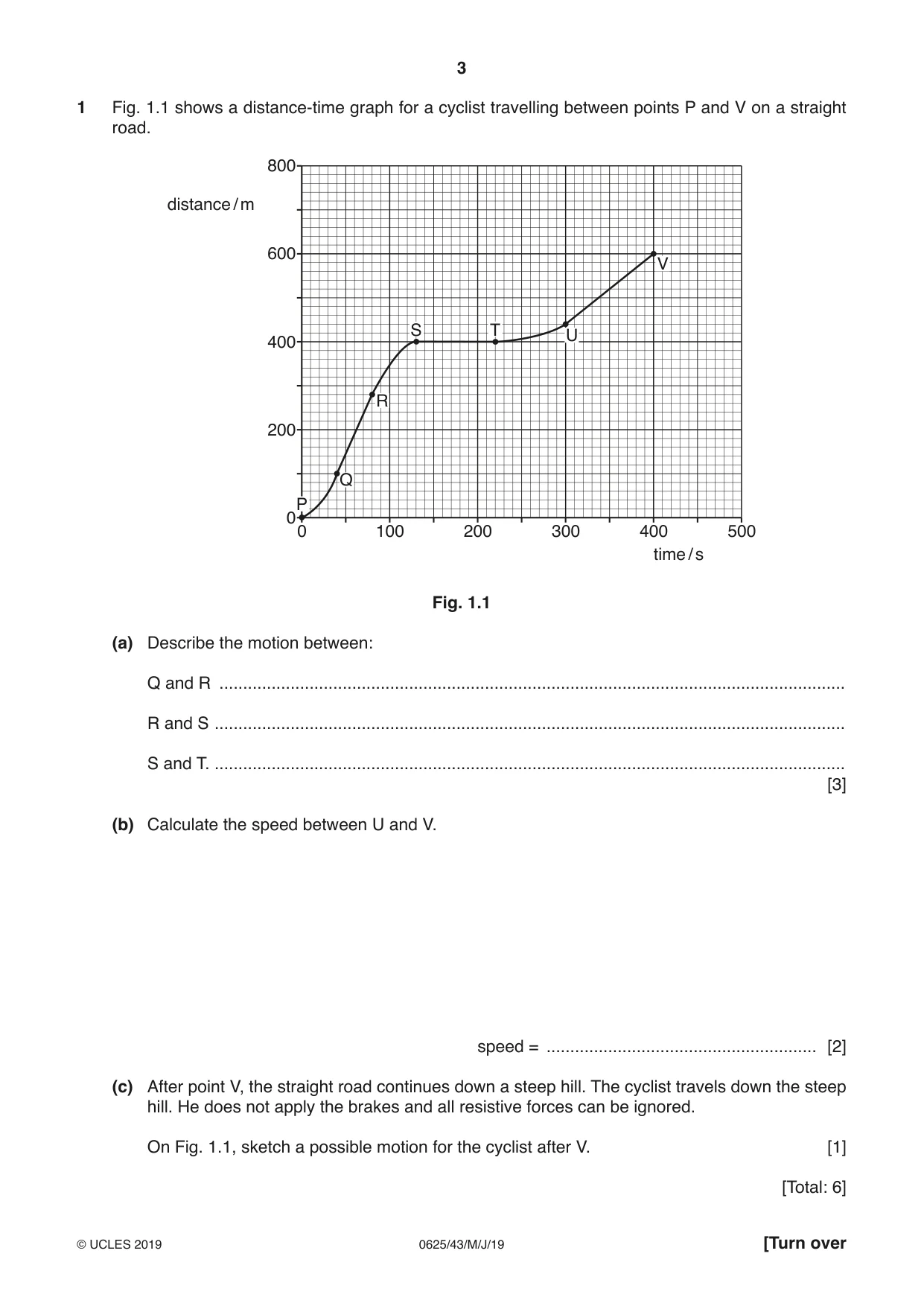
Q1 · A distance‑time graph for a cyclist travelling between points P and V on a straight road
1 Fig. 1.1 shows a distance‑time graph for a cyclist travelling between points P and V on a straight road. 800 distance / m 600 V S T U 400 R 200 Q P 0 0 100 200 300 400 500 time / s Fig. 1.1 (a) Describe the motion between: Q and R .................................................................................................................................... R and S ..................................................................................................................................... S and T. ..................................................................................................................................... [3] (b) Calculate the speed between U and V. speed = ......................................................... [2] (c) After point V, the straight road continues down a steep hill. The cyclist travels down the steep hill. He does not apply the brakes and all resistive forces can be ignored. On Fig. 1.1, sketch a possible motion for the cyclist after V. [1] [Total: 6]
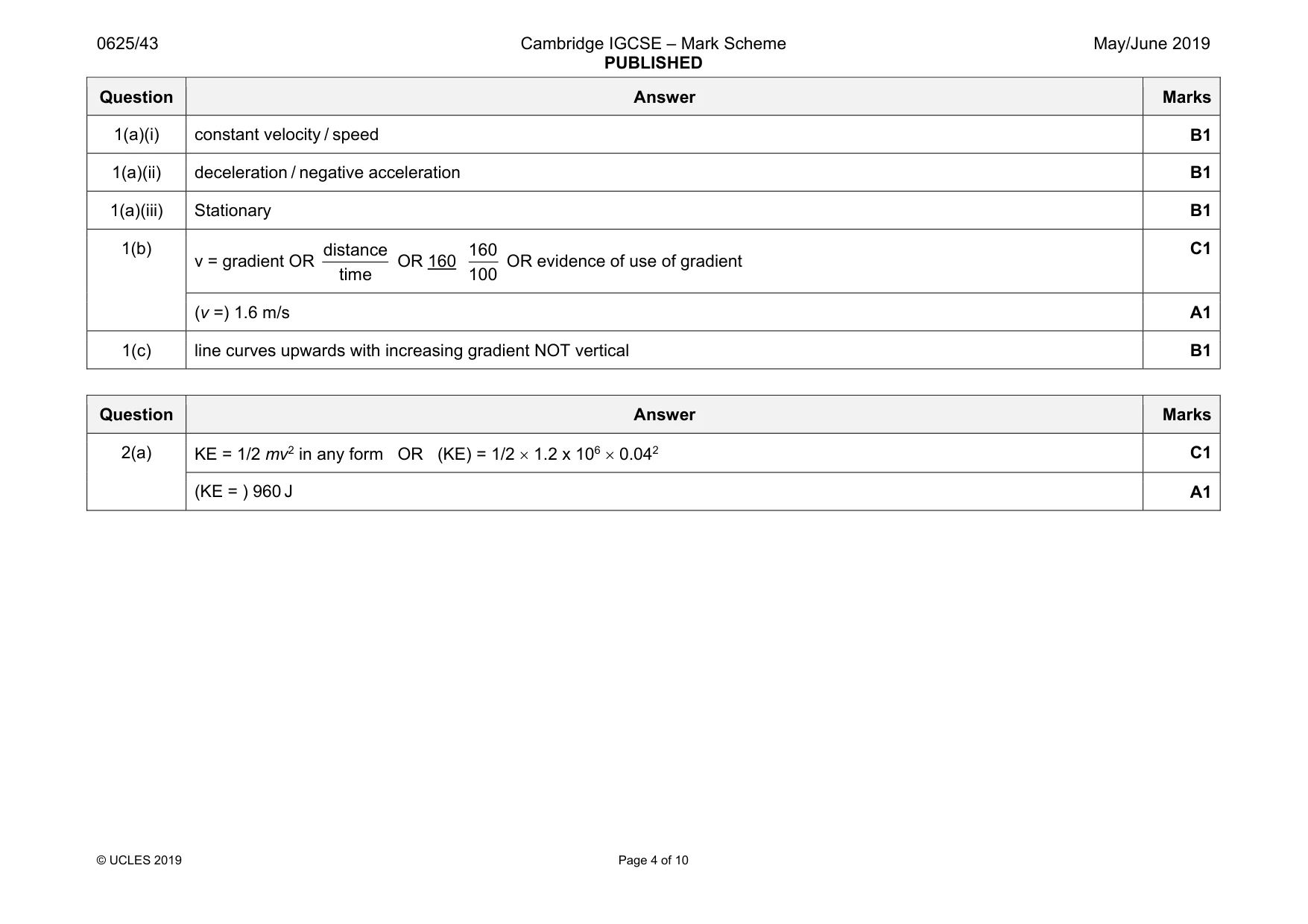
Mark scheme: 1(a)(i) constant velocity / speed B1 1(a)(ii) deceleration / negative acceleration B1 1(a)(iii) Stationary B1 1(b) v = gradient OR distance time OR 160 160 100 OR evidence of use of gradient C1 (v =) 1.6 m/s A1 1(c) line curves upwards with increasing gradient NOT vertical B1
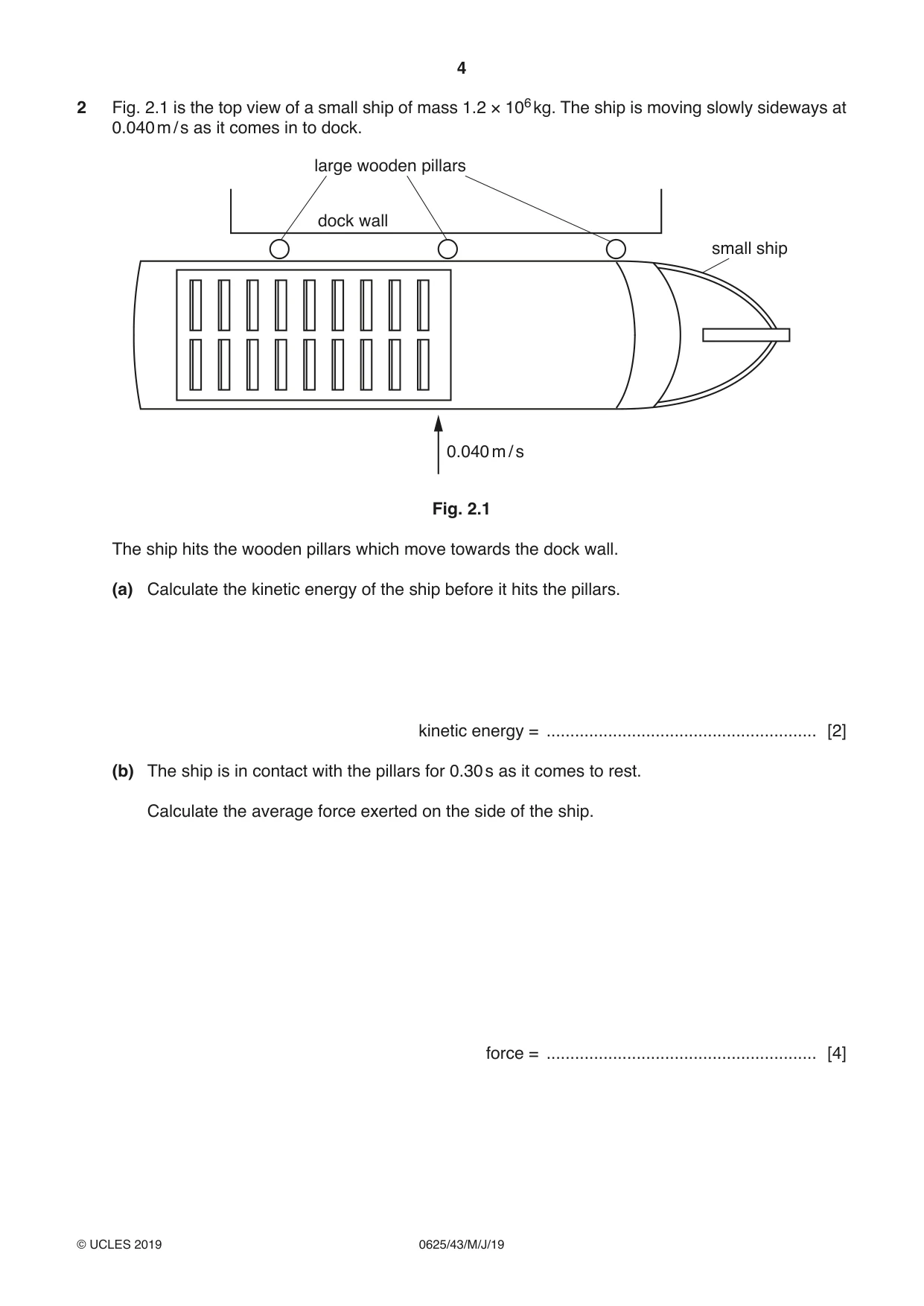
Q2 · The top view of a small ship of mass 1.2 × 10⁶ kg
2 Fig. 2.1 is the top view of a small ship of mass 1.2 × 10⁶ kg. The ship is moving slowly sideways at 0.040 m / s as it comes in to dock. large wooden pillars dock wall small ship 0.040 m / s Fig. 2.1 The ship hits the wooden pillars which move towards the dock wall. (a) Calculate the kinetic energy of the ship before it hits the pillars. kinetic energy = ......................................................... [2] (b) The ship is in contact with the pillars for 0.30 s as it comes to rest. Calculate the average force exerted on the side of the ship. force = ......................................................... [4] (c) Assume that the kinetic energy calculated in (a) is used to do work moving the pillars. Calculate the distance moved by the pillars. distance = ......................................................... [2] (d) Dock walls sometimes have the pillars replaced with rubber car tyres. Explain how this reduces the possibility of damage when a boat docks. ................................................................................................................................................... ................................................................................................................................................... ............................................................................................................................................. [1] [Total: 9]
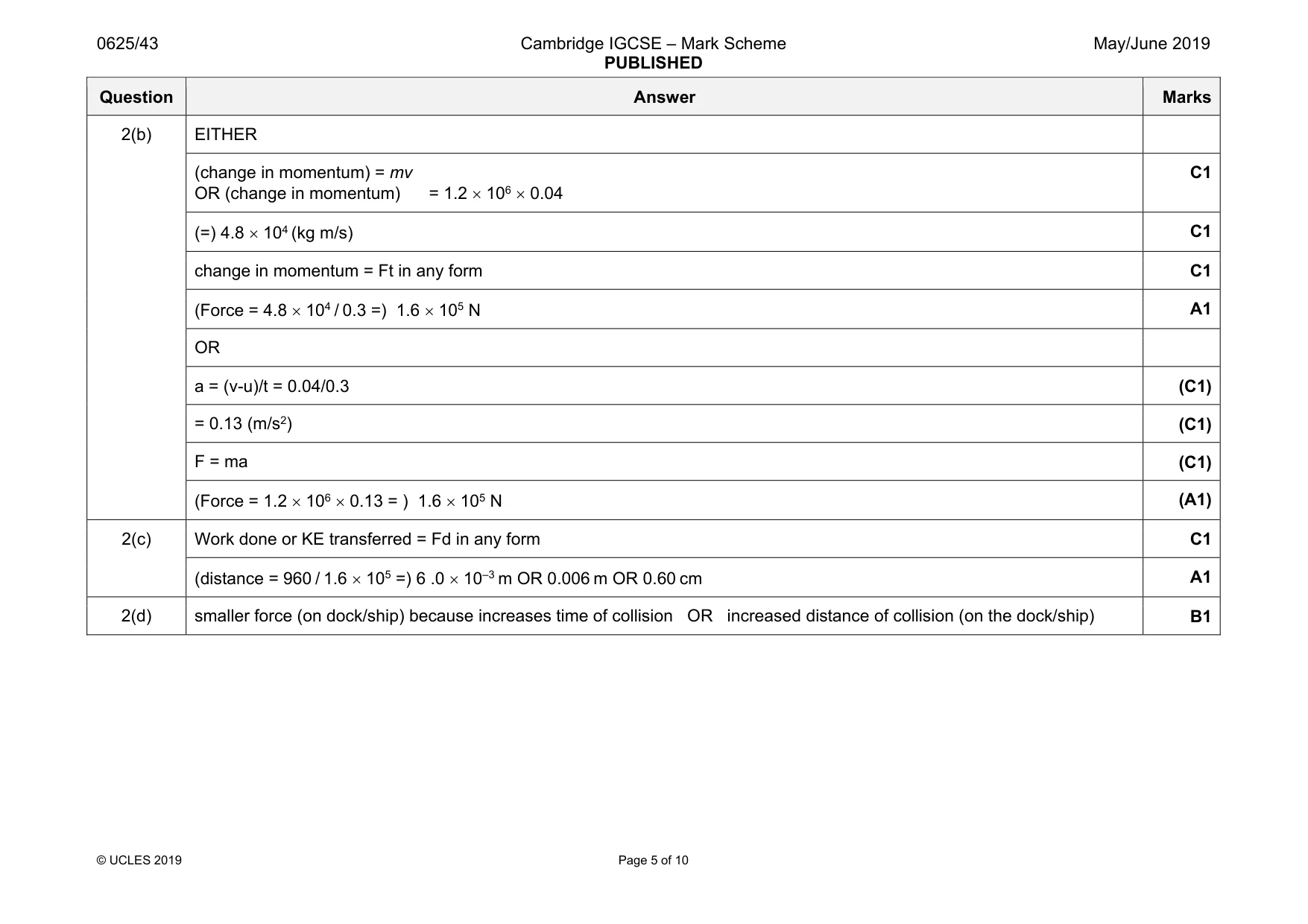
Mark scheme: 2(a) C1 (KE = ) 960 J A1 Question Answer Marks 2(b) EITHER (change in momentum) = mv OR (change in momentum) = 1.2 × 106 × 0.04 C1 (=) 4.8 × 10⁴ (kg m/s) C1 change in momentum = Ft in any form C1 (Force = 4.8 × 10⁴ / 0.3 =) 1.6 × 10⁵ N A1 OR a = (v-u)/t = 0.04/0.3 (C1) = 0.13 (m/s2) (C1) F = ma (C1) (Force = 1.2 × 106 × 0.13 = ) 1.6 × 10⁵ N (A1) 2(c) Work done or KE transferred = Fd in any form C1 (distance = 960 / 1.6 × 105 =) 6 .0 × 10–3 m OR 0.006 m OR 0.60 cm A1 2(d) smaller force (on dock/ship) because increases time of collision OR increased distance of collision (on the dock/ship) B1
Q3 · A small submarine submerged below the surface of the sea
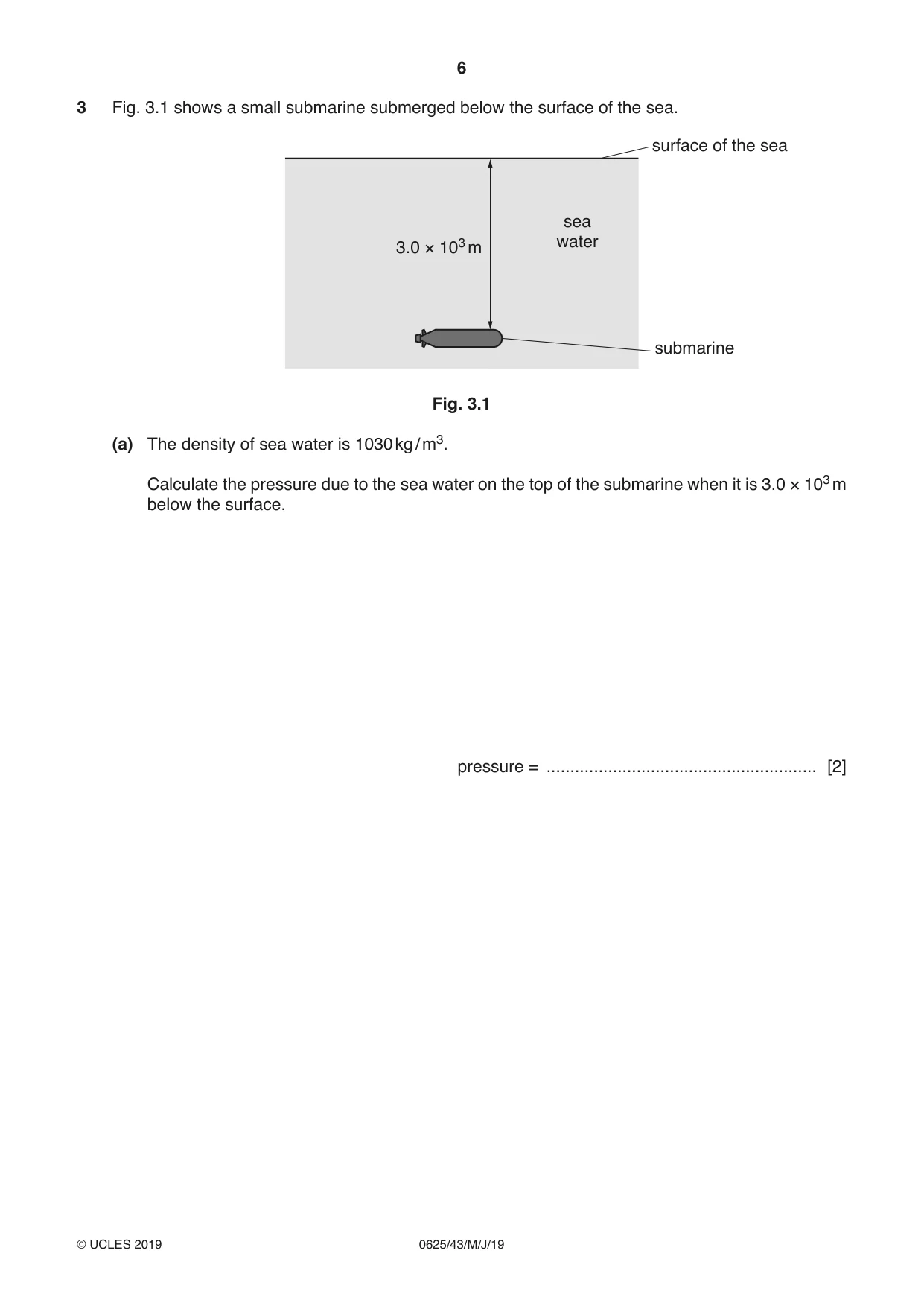
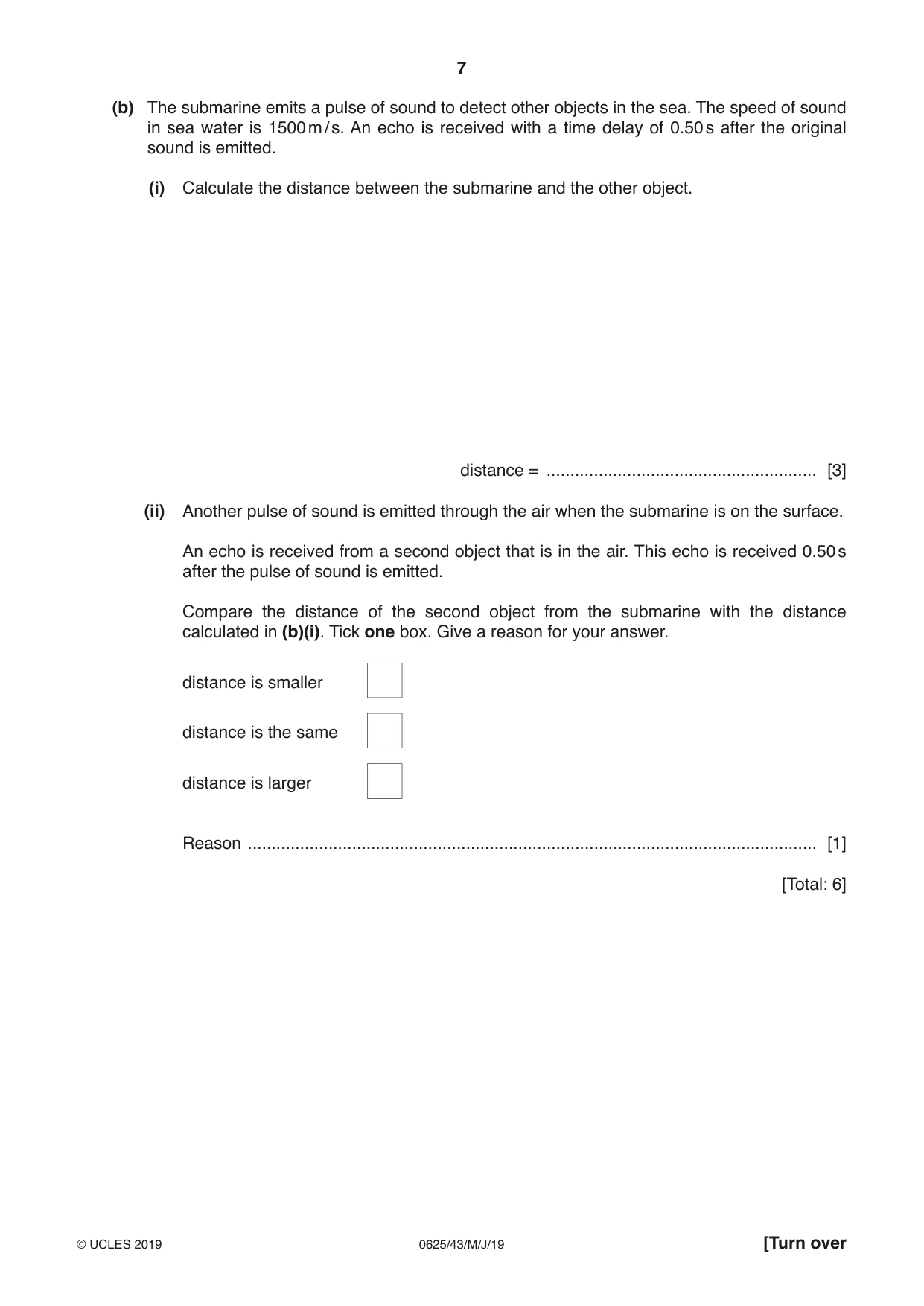
3 Fig. 3.1 shows a small submarine submerged below the surface of the sea. surface of the sea sea water 3.0 × 10³ m submarine Fig. 3.1 (a) The density of sea water is 1030 kg / m3. Calculate the pressure due to the sea water on the top of the submarine when it is 3.0 × 10³ m below the surface. pressure = ......................................................... [2] (b) The submarine emits a pulse of sound to detect other objects in the sea. The speed of sound in sea water is 1500 m / s. An echo is received with a time delay of 0.50 s after the original sound is emitted. (i) Calculate the distance between the submarine and the other object. distance = ......................................................... [3] (ii) Another pulse of sound is emitted through the air when the submarine is on the surface. An echo is received from a second object that is in the air. This echo is received 0.50 s after the pulse of sound is emitted. Compare the distance of the second object from the submarine with the distance calculated in (b)(i). Tick one box. Give a reason for your answer. distance is smaller distance is the same distance is larger Reason ........................................................................................................................ [1] [Total: 6]
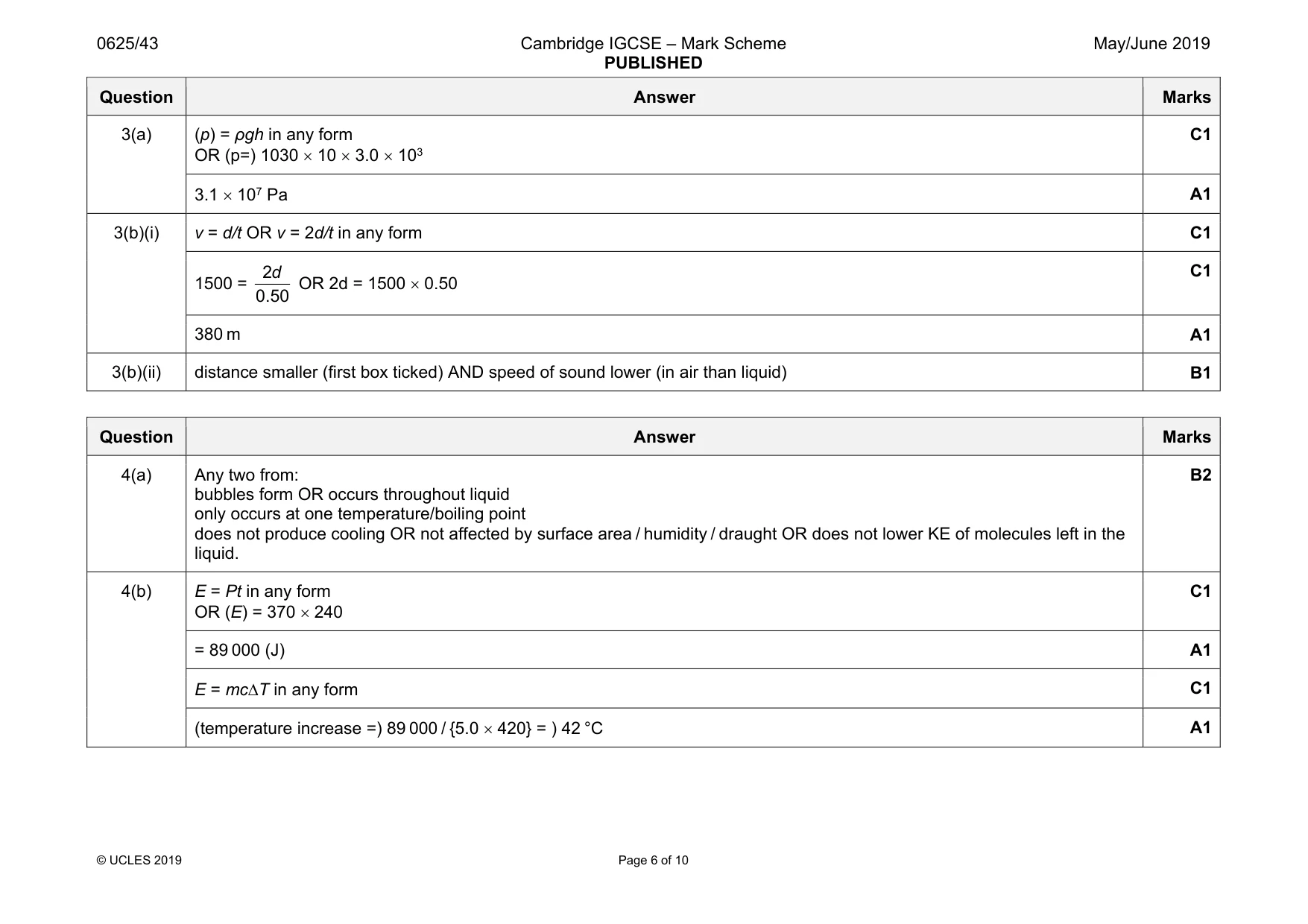
Mark scheme: 3(a) (p) = ρgh in any form OR (p=) 1030 × 10 × 3.0 × 103 C1 3.1 × 10⁷ Pa A1 3(b)(i) v = d/t OR v = 2d/t in any form C1 1500 = 2 0.50 d OR 2d = 1500 × 0.50 C1 380 m A1 3(b)(ii) distance smaller (first box ticked) AND speed of sound lower (in air than liquid) B1
Q4 · Water molecules escape to the atmosphere from water boiling in a pan
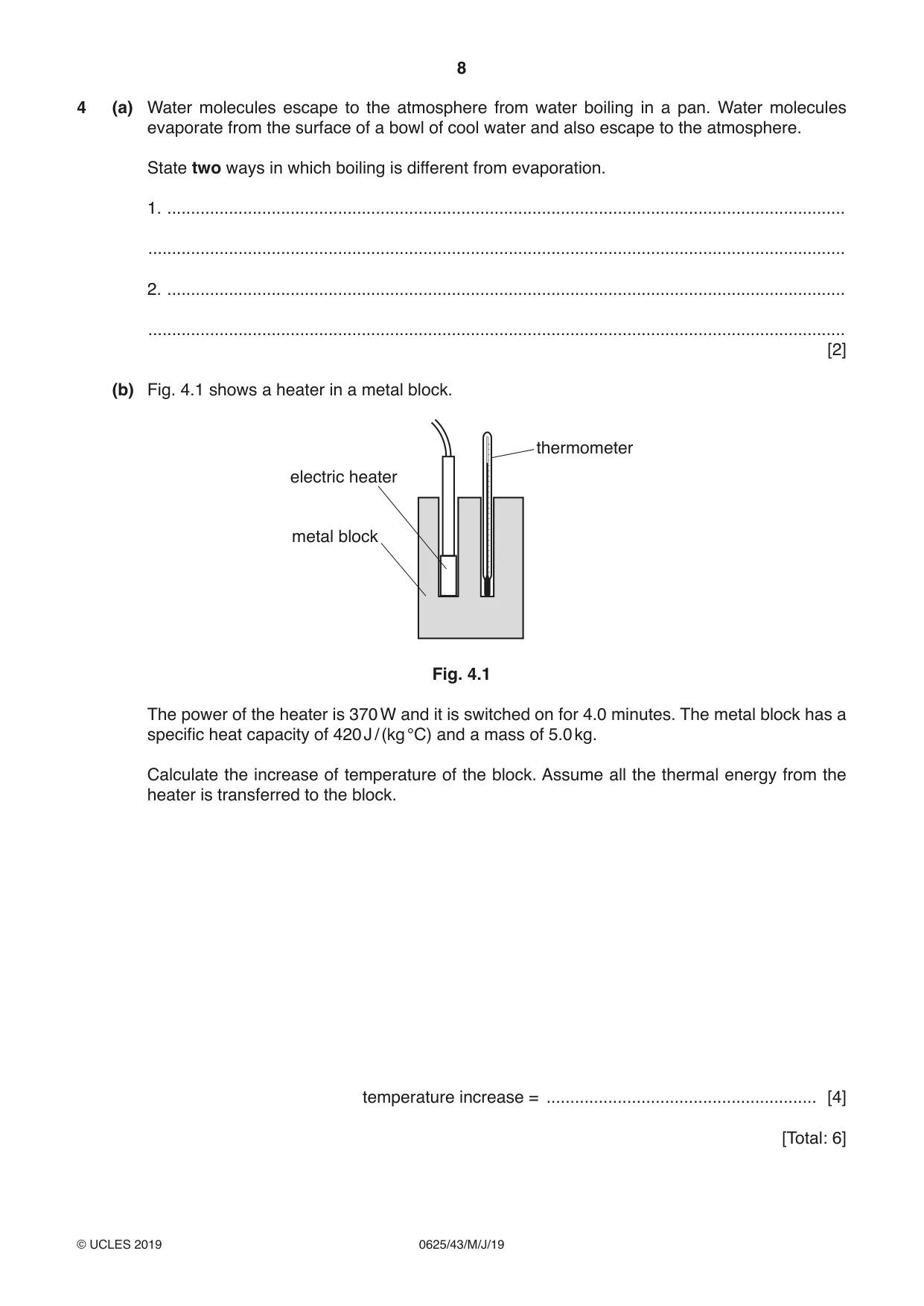
4 (a) Water molecules escape to the atmosphere from water boiling in a pan. Water molecules evaporate from the surface of a bowl of cool water and also escape to the atmosphere. State two ways in which boiling is different from evaporation. 1. ............................................................................................................................................... ................................................................................................................................................... 2. ............................................................................................................................................... ................................................................................................................................................... [2] (b) Fig. 4.1 shows a heater in a metal block. thermometer electric heater metal block Fig. 4.1 The power of the heater is 370 W and it is switched on for 4.0 minutes. The metal block has a specific heat capacity of 420 J / (kg °C) and a mass of 5.0 kg. Calculate the increase of temperature of the block. Assume all the thermal energy from the heater is transferred to the block. temperature increase = ......................................................... [4] [Total: 6]
Mark scheme: 4(a) Any two from: bubbles form OR occurs throughout liquid only occurs at one temperature/boiling point does not produce cooling OR not affected by surface area / humidity / draught OR does not lower KE of molecules left in the liquid. B2 4(b) E = Pt in any form OR (E) = 370 × 240 C1 = 89 000 (J) A1 E = mc∆T in any form C1 (temperature increase =) 89 000 / {5.0 × 420} = ) 42 °C A1
Q5 · A cross‑section of the inside of a vacuum flask containing a cold liquid
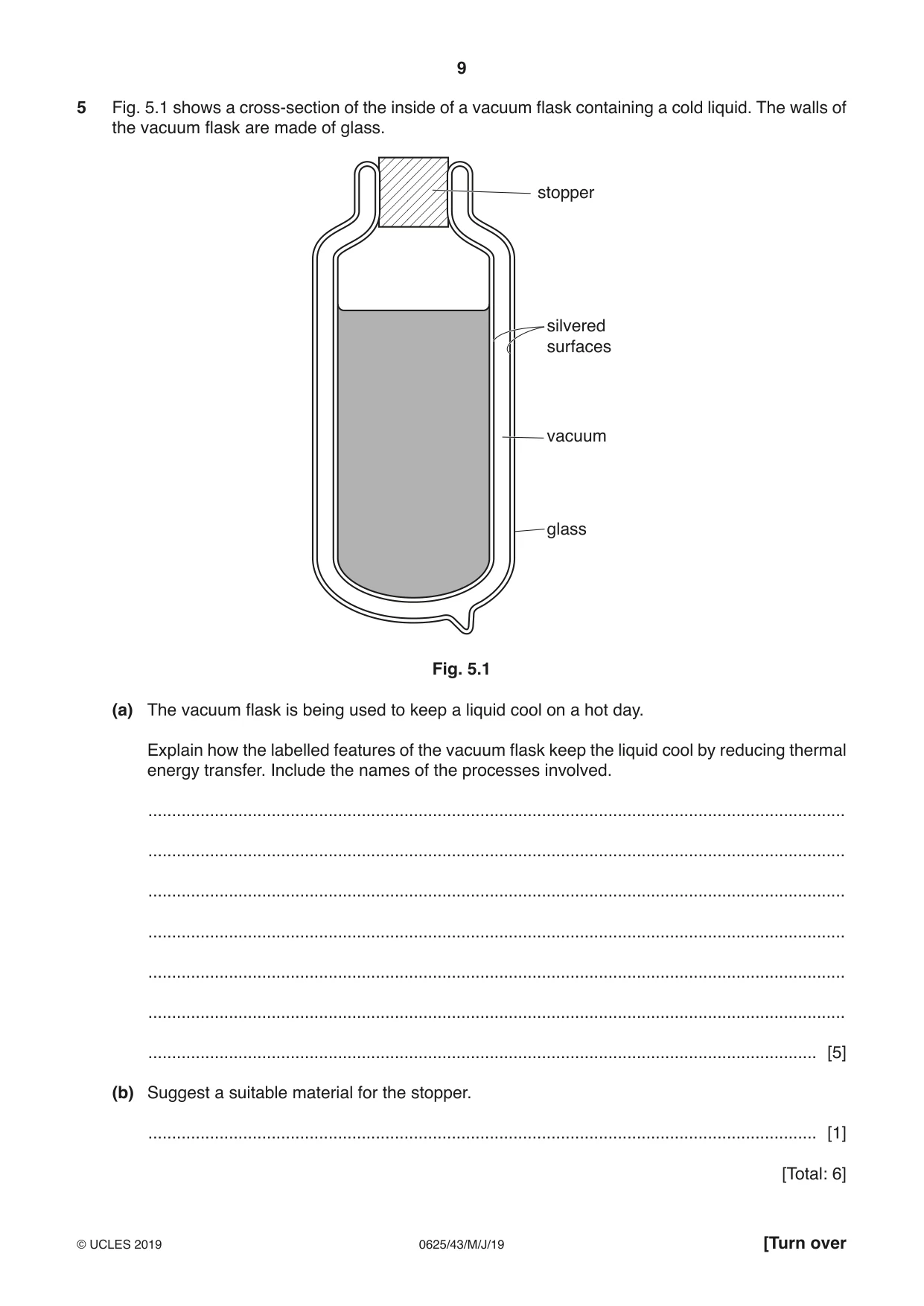
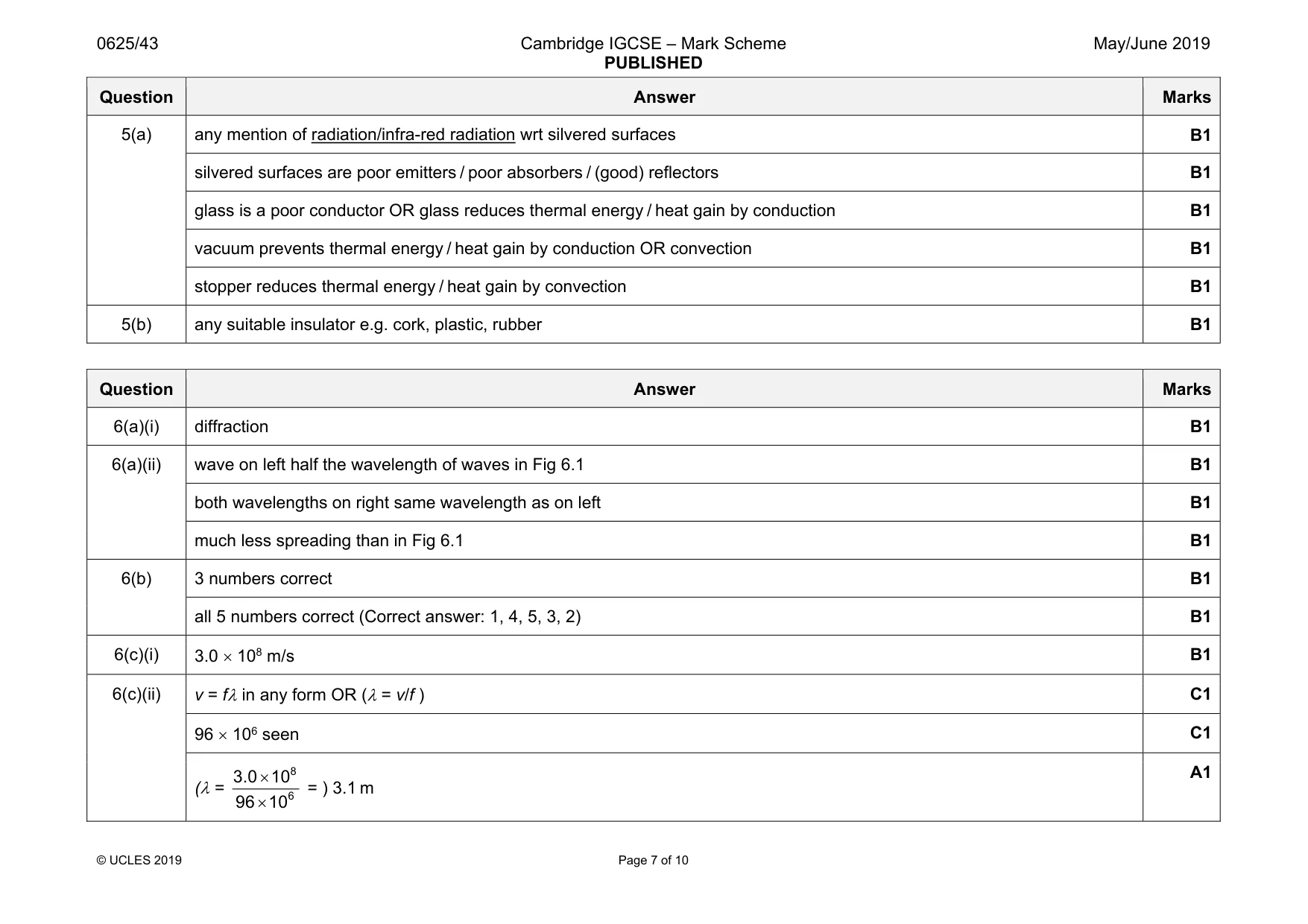
5 Fig. 5.1 shows a cross‑section of the inside of a vacuum flask containing a cold liquid. The walls of the vacuum flask are made of glass. stopper silvered surfaces vacuum glass Fig. 5.1 (a) The vacuum flask is being used to keep a liquid cool on a hot day. Explain how the labelled features of the vacuum flask keep the liquid cool by reducing thermal energy transfer. Include the names of the processes involved. ................................................................................................................................................... ................................................................................................................................................... ................................................................................................................................................... ................................................................................................................................................... ................................................................................................................................................... ................................................................................................................................................... ............................................................................................................................................. [5] (b) Suggest a suitable material for the stopper. ............................................................................................................................................. [1] [Total: 6]
Mark scheme: 5(a) any mention of radiation/infra-red radiation wrt silvered surfaces B1 silvered surfaces are poor emitters / poor absorbers / (good) reflectors B1 glass is a poor conductor OR glass reduces thermal energy / heat gain by conduction B1 vacuum prevents thermal energy / heat gain by conduction OR convection B1 stopper reduces thermal energy / heat gain by convection B1 5(b) any suitable insulator e.g. cork, plastic, rubber B1
Q6 · Wavefronts of a wave approaching a narrow gap and passing through the gap
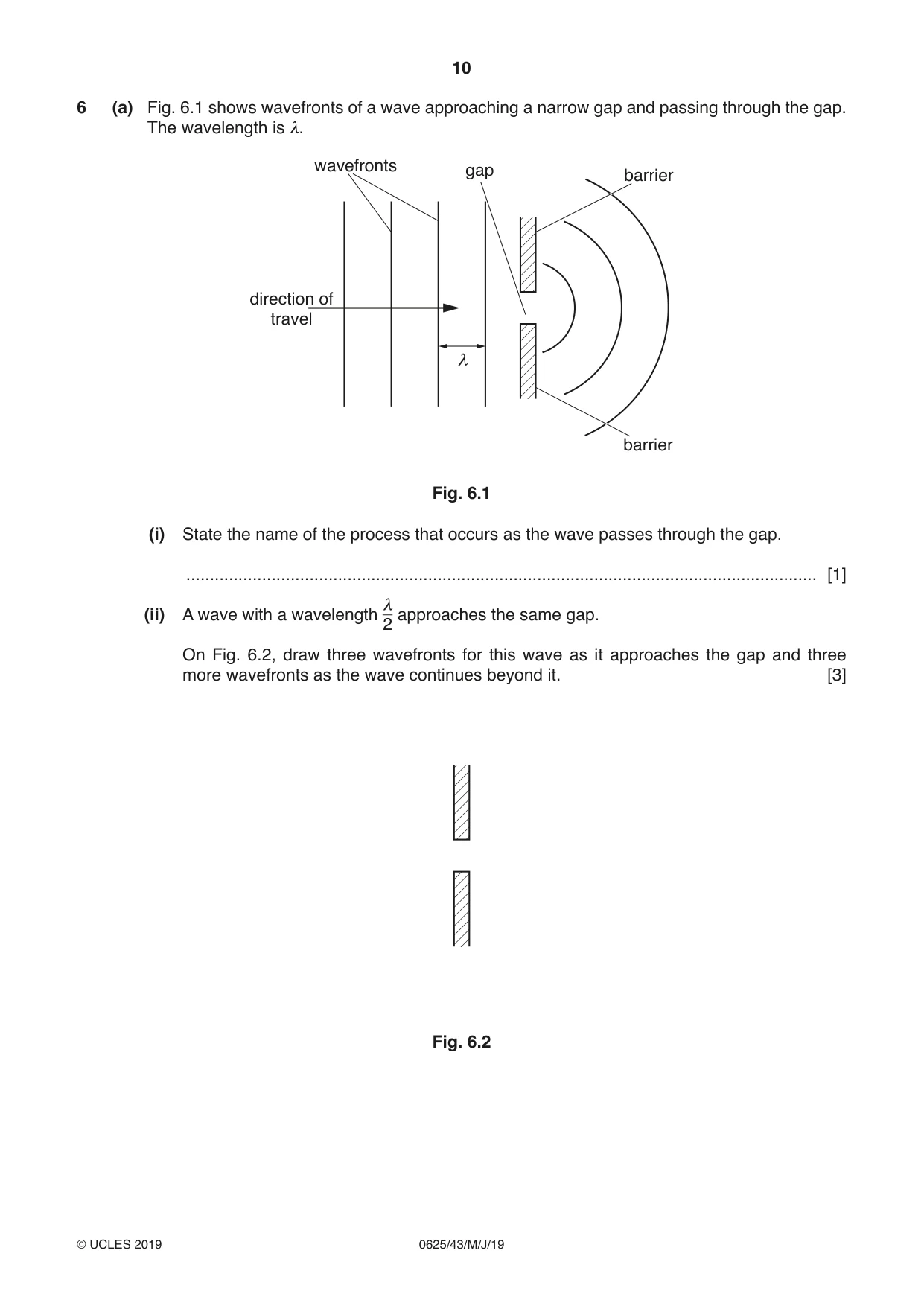
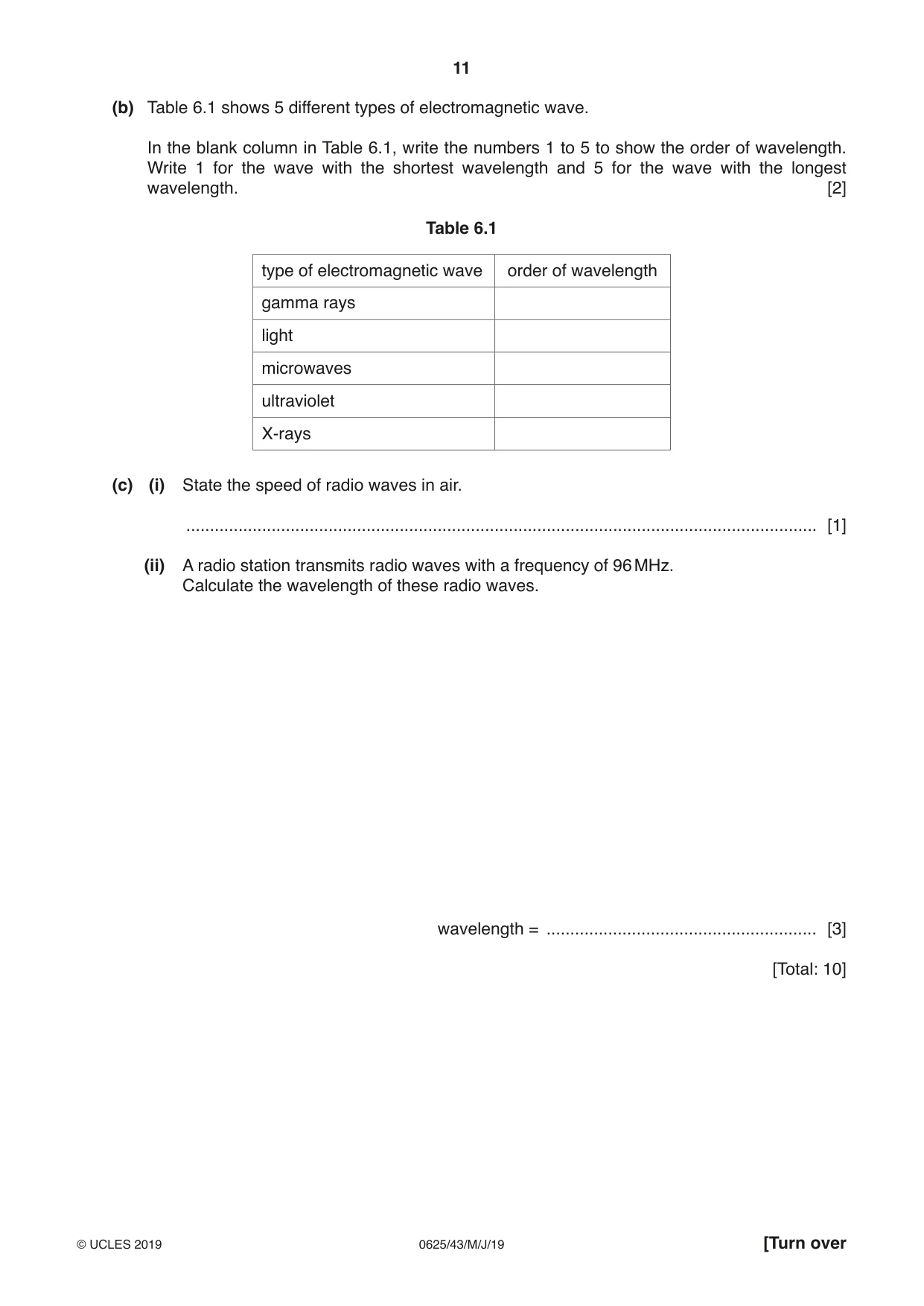
6 (a) Fig. 6.1 shows wavefronts of a wave approaching a narrow gap and passing through the gap. The wavelength is λ. wavefronts gap barrier direction of travel λ barrier Fig. 6.1 (i) State the name of the process that occurs as the wave passes through the gap. ..................................................................................................................................... [1] (ii) A wave with a wavelength λ approaches the same gap. 2 On Fig. 6.2, draw three wavefronts for this wave as it approaches the gap and three more wavefronts as the wave continues beyond it. [3] Fig. 6.2 (b) Table 6.1 shows 5 different types of electromagnetic wave. In the blank column in Table 6.1, write the numbers 1 to 5 to show the order of wavelength. Write 1 for the wave with the shortest wavelength and 5 for the wave with the longest wavelength. [2] Table 6.1 type of electromagnetic wave order of wavelength gamma rays light microwaves ultraviolet X‑rays (c) (i) State the speed of radio waves in air. ..................................................................................................................................... [1] (ii) A radio station transmits radio waves with a frequency of 96 MHz. Calculate the wavelength of these radio waves. wavelength = ......................................................... [3] [Total: 10]
Mark scheme: 6(a)(i) diffraction B1 6(a)(ii) wave on left half the wavelength of waves in Fig 6.1 B1 both wavelengths on right same wavelength as on left B1 much less spreading than in Fig 6.1 B1 6(b) 3 numbers correct B1 all 5 numbers correct (Correct answer: 1, 4, 5, 3, 2) B1 6(c)(i) 3.0 × 10⁸ m/s B1 6(c)(ii) v = fλ in any form OR (λ = v/f ) C1 96 × 106 seen C1 (λ = 8 6 3.0 10 96 10 × × = ) 3.1 m A1
Q7 · Light approaching a boundary between two materials at speed v
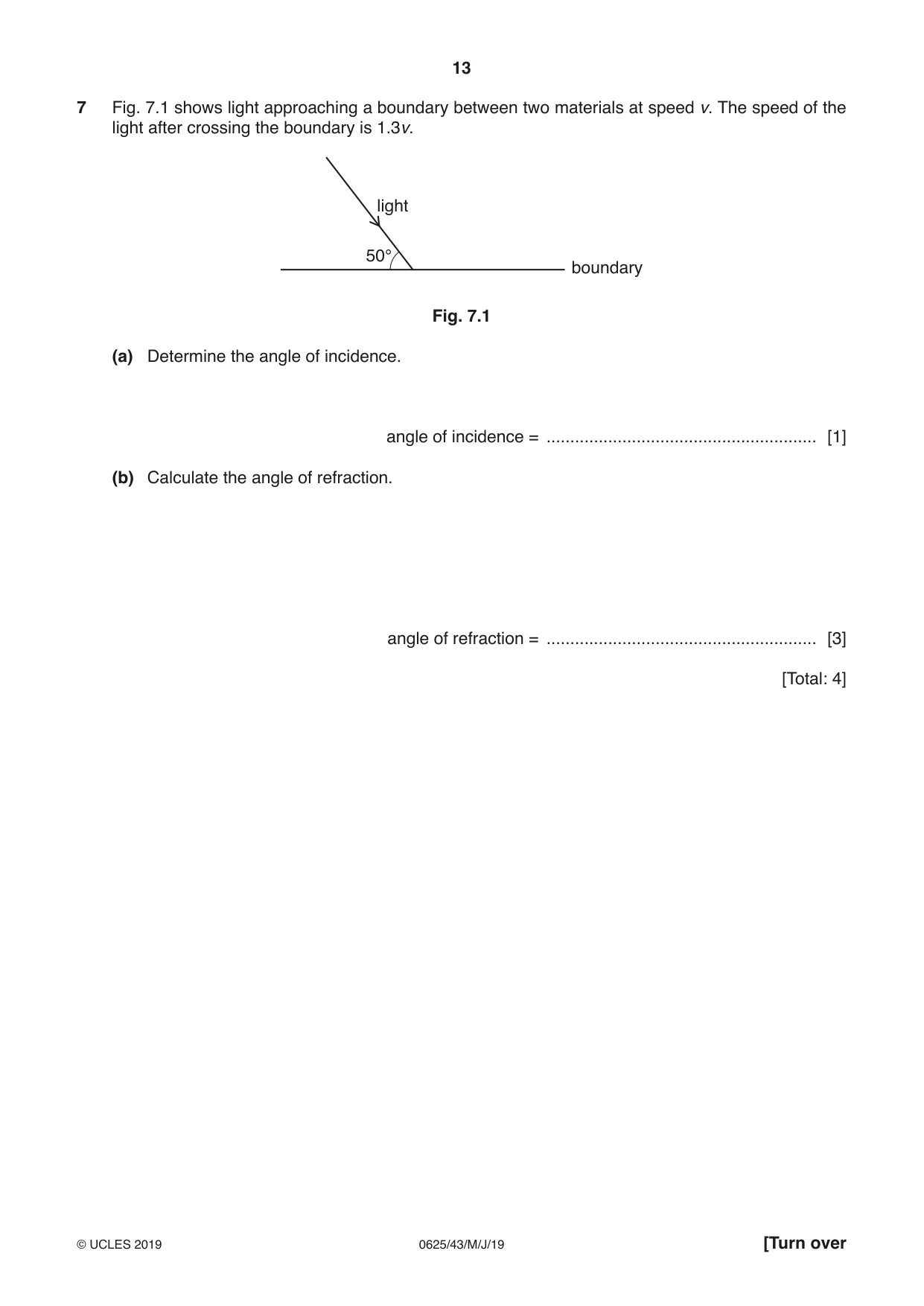
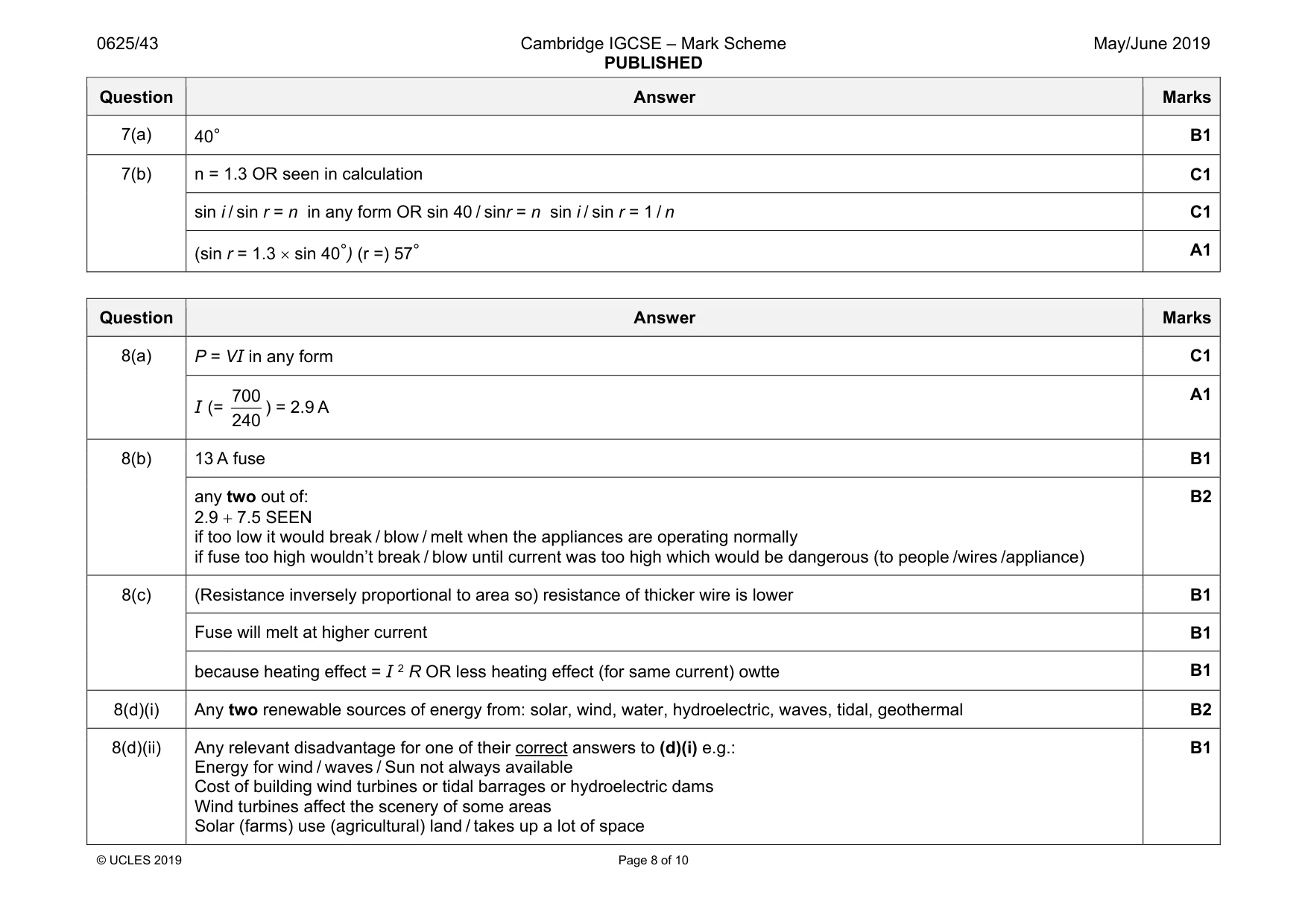
7 Fig. 7.1 shows light approaching a boundary between two materials at speed v. The speed of the light after crossing the boundary is 1.3v. light 50° boundary Fig. 7.1 (a) Determine the angle of incidence. angle of incidence = ......................................................... [1] (b) Calculate the angle of refraction. angle of refraction = ......................................................... [3] [Total: 4]
Mark scheme: 7(a) 40° B1 7(b) n = 1.3 OR seen in calculation C1 sin i / sin r = n in any form OR sin 40 / sinr = n sin i / sin r = 1 / n C1 (sin r = 1.3 × sin 40°) (r =) 57° A1
Q8 · A 240 V mains supply connected to an air‑conditioning unit and a freezer
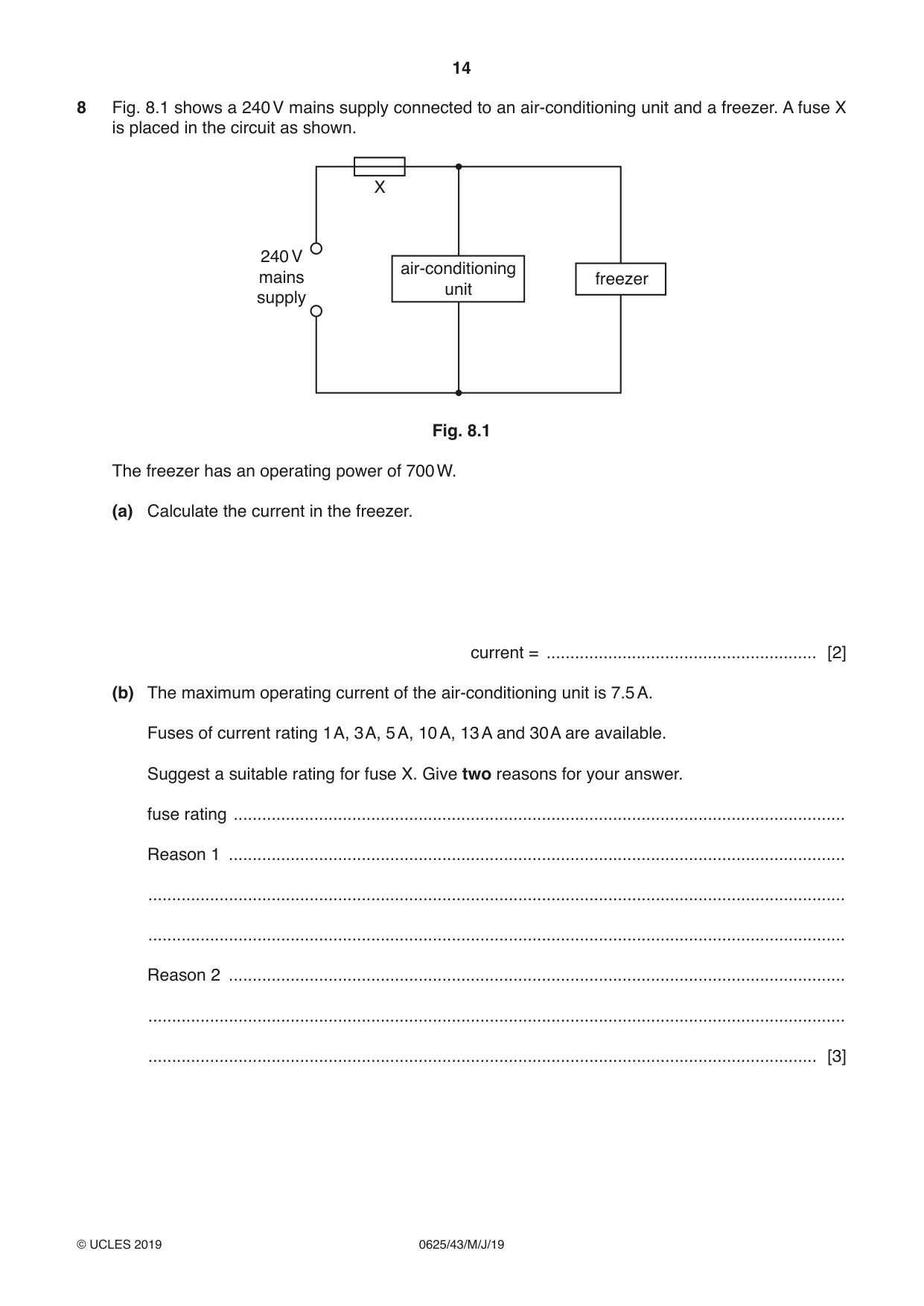
8 Fig. 8.1 shows a 240 V mains supply connected to an air‑conditioning unit and a freezer. A fuse X is placed in the circuit as shown. X 240 V air-conditioning mains freezer unit supply Fig. 8.1 The freezer has an operating power of 700 W. (a) Calculate the current in the freezer. current = ......................................................... [2] (b) The maximum operating current of the air‑conditioning unit is 7.5 A. Fuses of current rating 1 A, 3 A, 5 A, 10 A, 13 A and 30 A are available. Suggest a suitable rating for fuse X. Give two reasons for your answer. fuse rating ................................................................................................................................. Reason 1 .................................................................................................................................. ................................................................................................................................................... ................................................................................................................................................... Reason 2 .................................................................................................................................. ................................................................................................................................................... ............................................................................................................................................. [3] (c) A fuse is made out of a short length of wire. Explain why fuses of a higher rating are made of thicker wire. ................................................................................................................................................... ................................................................................................................................................... ................................................................................................................................................... ................................................................................................................................................... ............................................................................................................................................. [3] (d) Electrical energy can be obtained from renewable and non‑renewable sources of energy. (i) State two renewable sources of energy. Source 1 ........................................................ Source 2 ........................................................ [2] (ii) State one social, economic or environmental disadvantage of one of your answers to (d)(i). ........................................................................................................................................... ........................................................................................................................................... ..................................................................................................................................... [1] [Total: 11]
Mark scheme: 8(a) C1 I (= 700 240 ) = 2.9 A A1 8(b) 13 A fuse B1 any two out of: 2.9 + 7.5 SEEN if too low it would break / blow / melt when the appliances are operating normally if fuse too high wouldn’t break / blow until current was too high which would be dangerous (to people /wires /appliance) B2 8(c) (Resistance inversely proportional to area so) resistance of thicker wire is lower B1 Fuse will melt at higher current B1 because heating effect = I 2 R OR less heating effect (for same current) owtte B1 8(d)(i) Any two renewable sources of energy from: solar, wind, water, hydroelectric, waves, tidal, geothermal B2 8(d)(ii) Any relevant disadvantage for one of their correct answers to (d)(i) e.g.: Energy for wind / waves / Sun not always available Cost of building wind turbines or tidal barrages or hydroelectric dams Wind turbines affect the scenery of some areas Solar (farms) use (agricultural) land / takes up a lot of space B1
Question 9
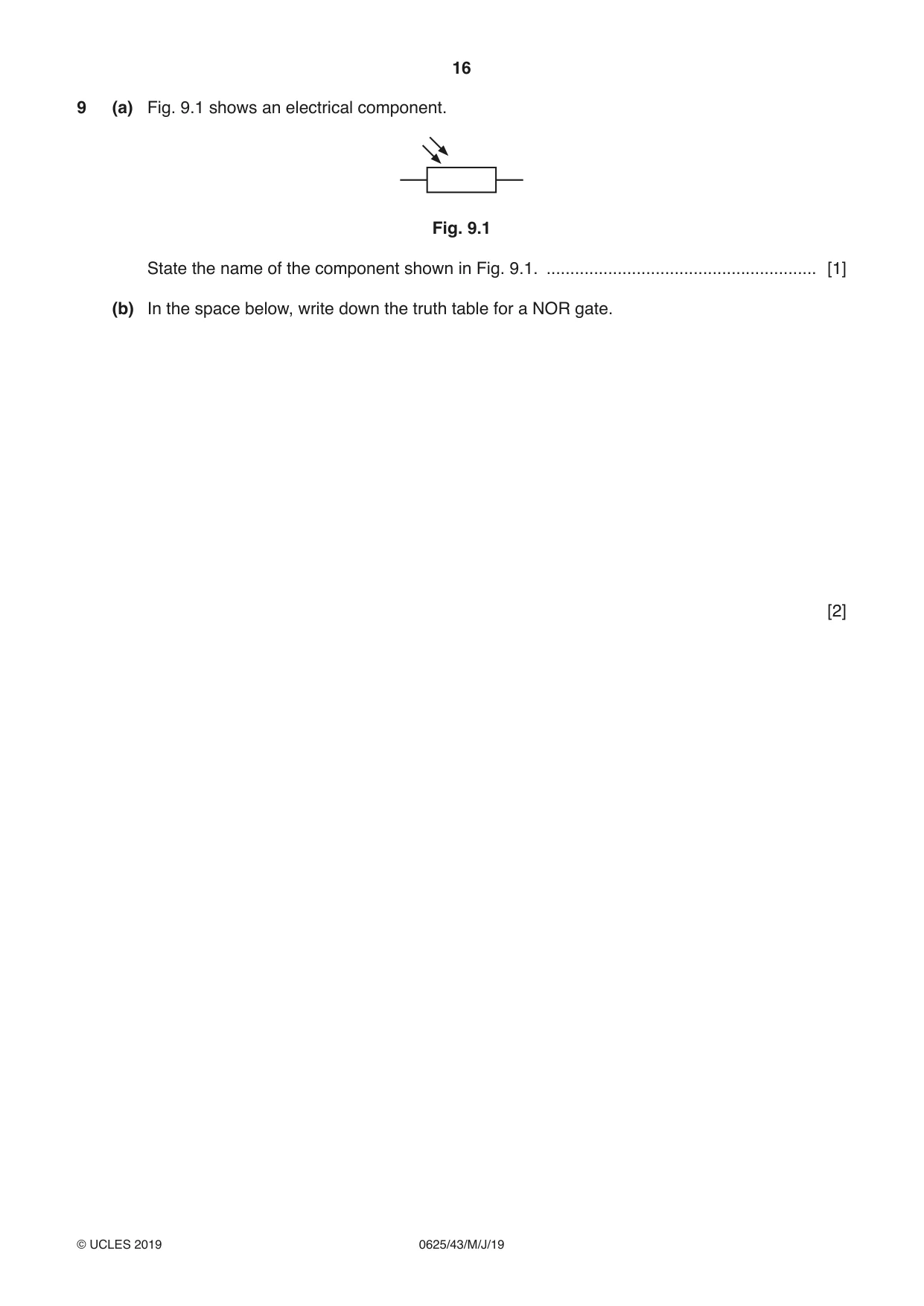
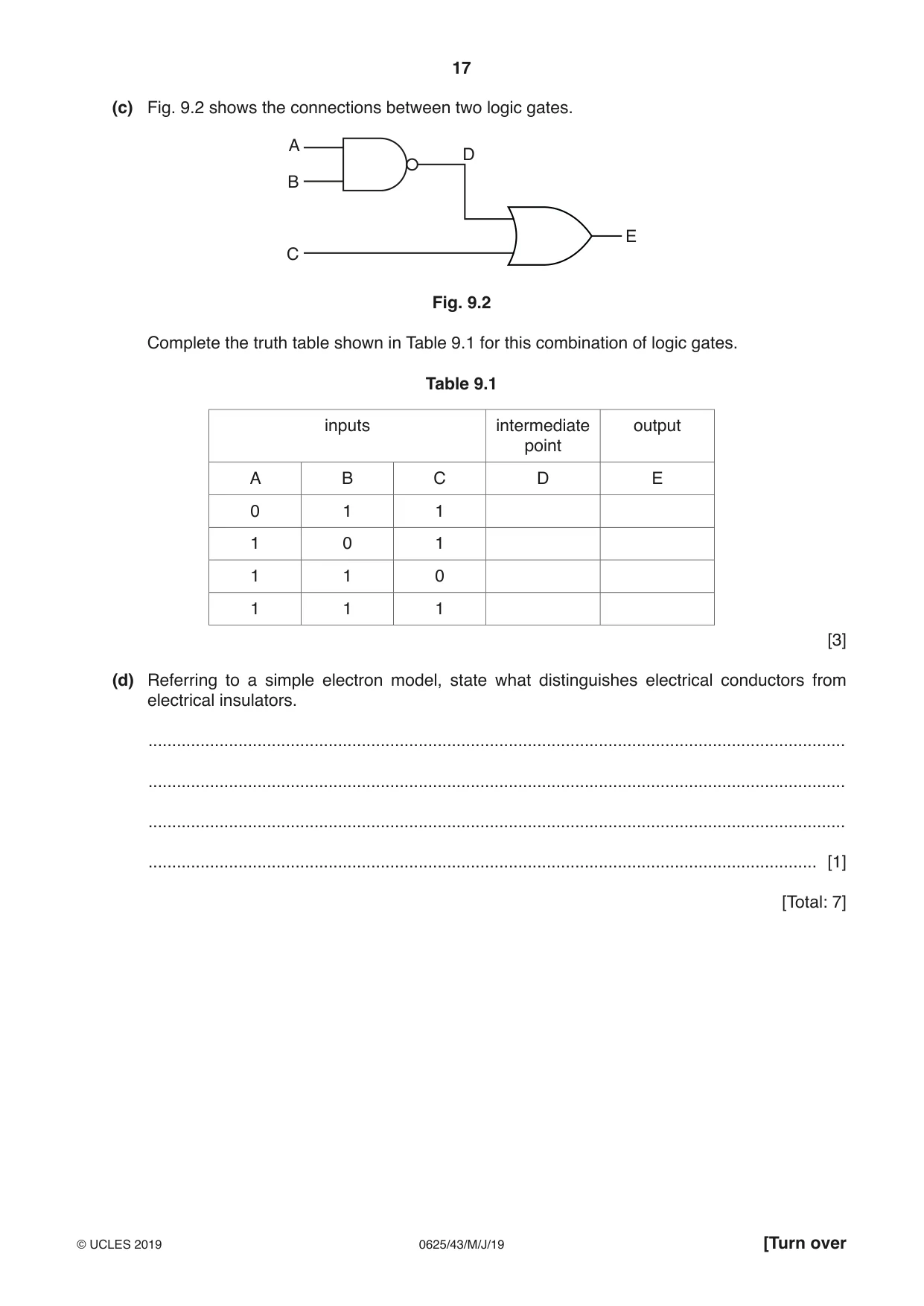
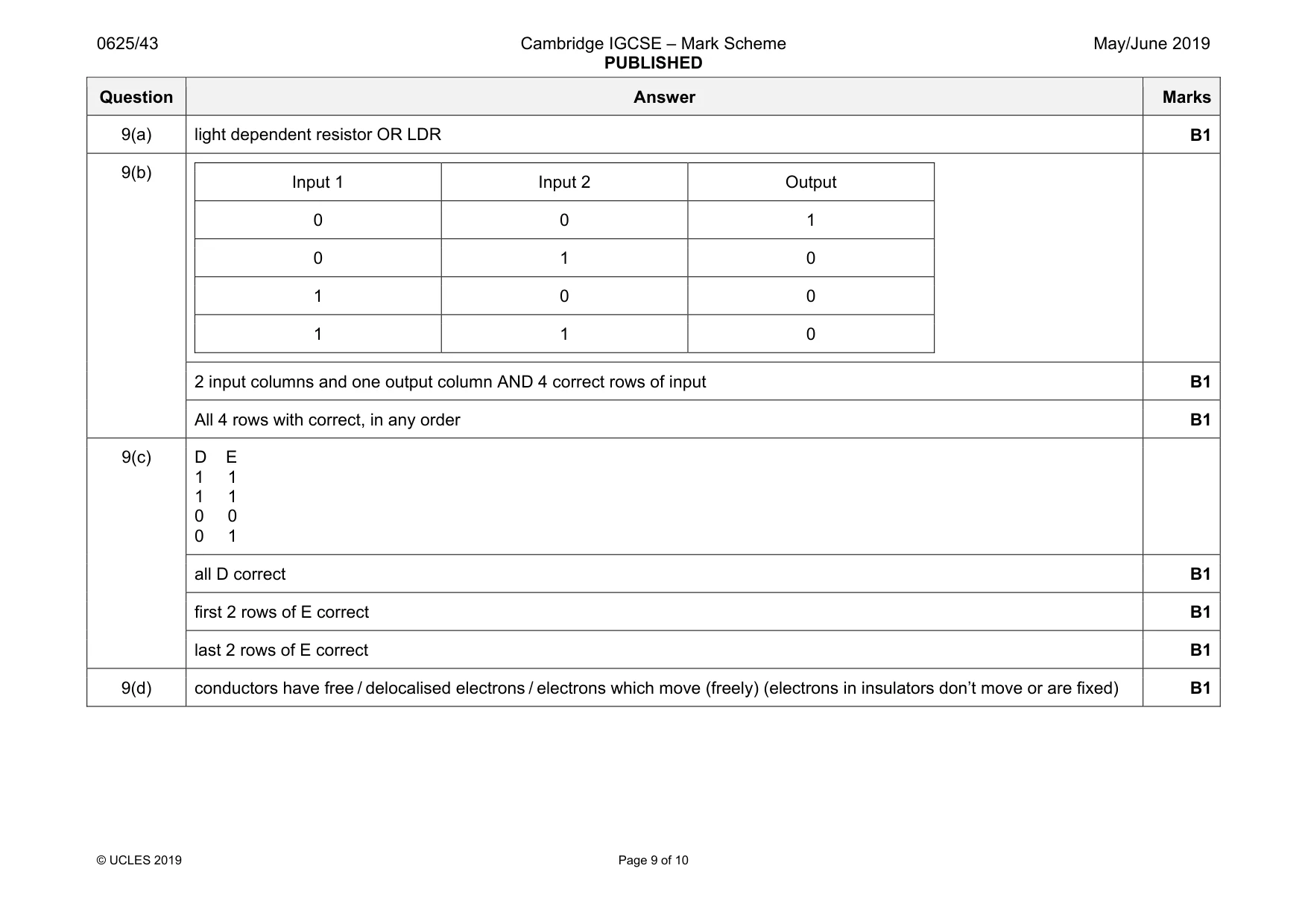
9 (a) Fig. 9.1 shows an electrical component. Fig. 9.1 State the name of the component shown in Fig. 9.1. ......................................................... [1] (b) In the space below, write down the truth table for a NOR gate. [2] (c) Fig. 9.2 shows the connections between two logic gates. A D B E C Fig. 9.2 Complete the truth table shown in Table 9.1 for this combination of logic gates. Table 9.1 inputs intermediate output point A B C D E 0 1 1 1 0 1 1 1 0 1 1 1 [3] (d) Referring to a simple electron model, state what distinguishes electrical conductors from electrical insulators. ................................................................................................................................................... ................................................................................................................................................... ................................................................................................................................................... ............................................................................................................................................. [1] [Total: 7]
Mark scheme: 9(a) light dependent resistor OR LDR B1 9(b) Input 1 Input 2 Output 0 0 1 0 1 0 1 0 0 1 1 0 2 input columns and one output column AND 4 correct rows of input B1 All 4 rows with correct, in any order B1 9(c) D E 1 1 1 1 0 0 0 1 all D correct B1 first 2 rows of E correct B1 last 2 rows of E correct B1 9(d) conductors have free / delocalised electrons / electrons which move (freely) (electrons in insulators don’t move or are fixed) B1
Q10 · A simple alternating current generator
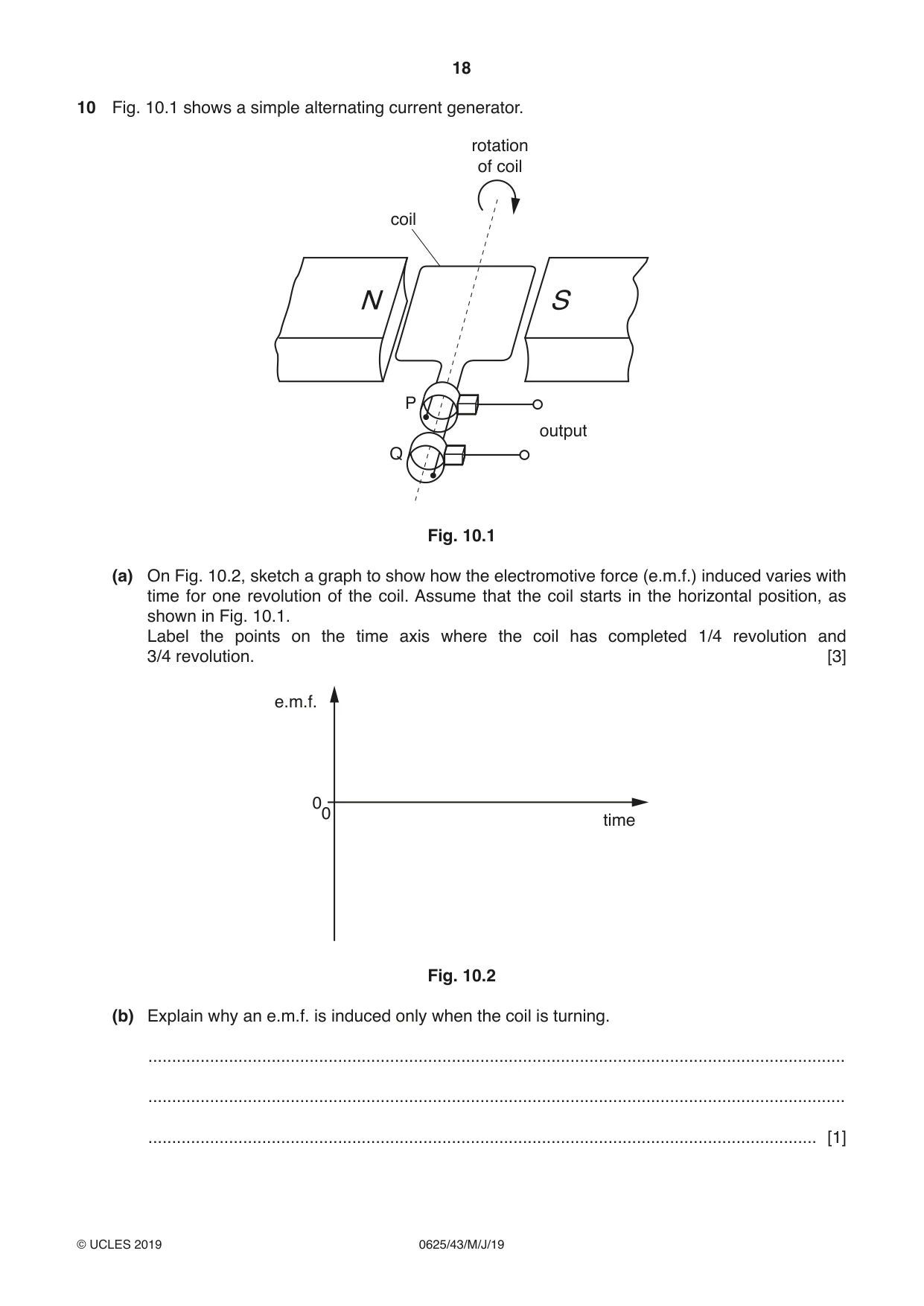
10 Fig. 10.1 shows a simple alternating current generator. rotation of coil coil N S P output Q Fig. 10.1 (a) On Fig. 10.2, sketch a graph to show how the electromotive force (e.m.f.) induced varies with time for one revolution of the coil. Assume that the coil starts in the horizontal position, as shown in Fig. 10.1. Label the points on the time axis where the coil has completed 1/4 revolution and 3/4 revolution. [3] e.m.f. 0 0 time Fig. 10.2 (b) Explain why an e.m.f. is induced only when the coil is turning. ................................................................................................................................................... ................................................................................................................................................... ............................................................................................................................................. [1] (c) State the name of the components labelled P and Q and state their purpose. Name: ....................................................................................................................................... Purpose: ................................................................................................................................... ............................................................................................................................................. [2] (d) State two possible changes that cause a larger e.m.f. to be induced. 1. ............................................................................................................................................... 2. ............................................................................................................................................... [2] [Total: 8]
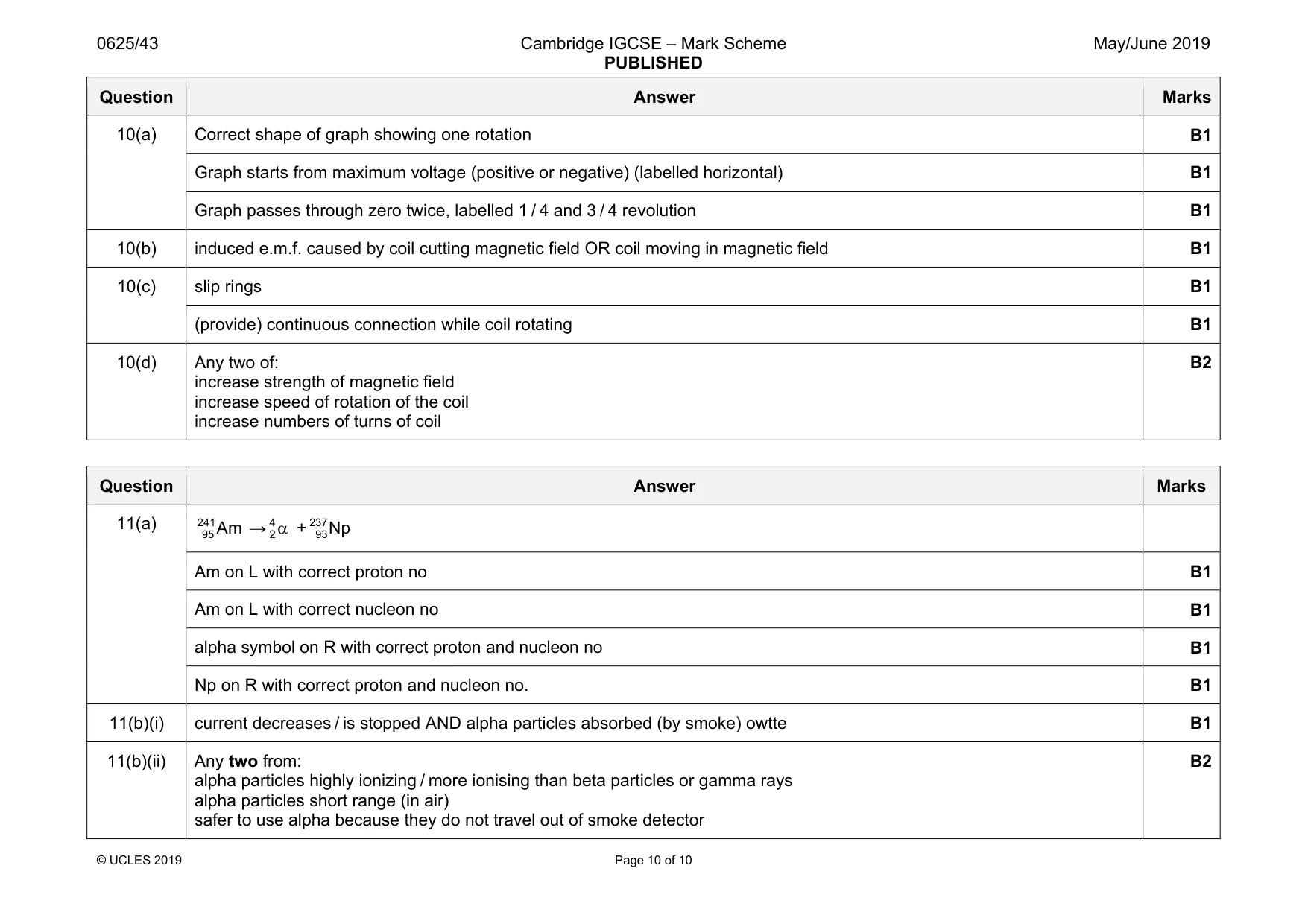
Mark scheme: 10(a) Correct shape of graph showing one rotation B1 Graph starts from maximum voltage (positive or negative) (labelled horizontal) B1 Graph passes through zero twice, labelled 1 / 4 and 3 / 4 revolution B1 10(b) induced e.m.f. caused by coil cutting magnetic field OR coil moving in magnetic field B1 10(c) slip rings B1 (provide) continuous connection while coil rotating B1 10(d) Any two of: increase strength of magnetic field increase speed of rotation of the coil increase numbers of turns of coil B2
Q11 · Americium (Am) is a radioactive isotope
11 (a) Americium (Am) is a radioactive isotope. A nucleus of americium contains 95 protons and 146 neutrons. It decays by emitting an α‑particle to form a nucleus of an isotope of neptunium (Np). Write down the nuclide equation for the decay of americium to neptunium. [4] (b) Ionisation smoke detectors contain americium and two small electrodes with a small voltage between them. The air between the electrodes is ionised by α‑particles so that there is a small electric current between the electrodes. (i) Suggest and explain the effect of smoke on the current between the electrodes in the smoke detector. Suggestion: ....................................................................................................................... ........................................................................................................................................... Explanation: ...................................................................................................................... ..................................................................................................................................... [1] (ii) Suggest two reasons for using an α‑particle emitter in a smoke detector. Reason 1 ........................................................................................................................... ........................................................................................................................................... Reason 2 ........................................................................................................................... ..................................................................................................................................... [2] [Total: 7]
Mark scheme: 11(a) 241 95Am →4 2α + 237 93Np Am on L with correct proton no B1 Am on L with correct nucleon no B1 alpha symbol on R with correct proton and nucleon no B1 Np on R with correct proton and nucleon no. B1 11(b)(i) current decreases / is stopped AND alpha particles absorbed (by smoke) owtte B1 11(b)(ii) Any two from: alpha particles highly ionizing / more ionising than beta particles or gamma rays alpha particles short range (in air) safer to use alpha because they do not travel out of smoke detector B2
What was in this paper
The subtopics covered by these 11 questions, and how many questions each got. Open one in a new tab to see every Cambridge question on it.
What you needed in this session
Cambridge’s own grade thresholds for 2019 May/June, Paper 4 · Variant 3. A higher threshold means an easier paper — the bar moves with how the cohort did.