Cambridge IGCSE Physics 0625 — 2016 May/June Paper 4 · Variant 2
0625/42/M/J/16 · 11 questions · 80 marks · ≈90 min
The question paper and its mark scheme, free to read here and free to download. This is Cambridge’s own paper, exactly as it was sat.
Question paper24 pages

Mark scheme10 pages
Answers below. Sit the paper first if you are practising.
Questions as text
Q1 · An object is moving in a straight line at constant speed
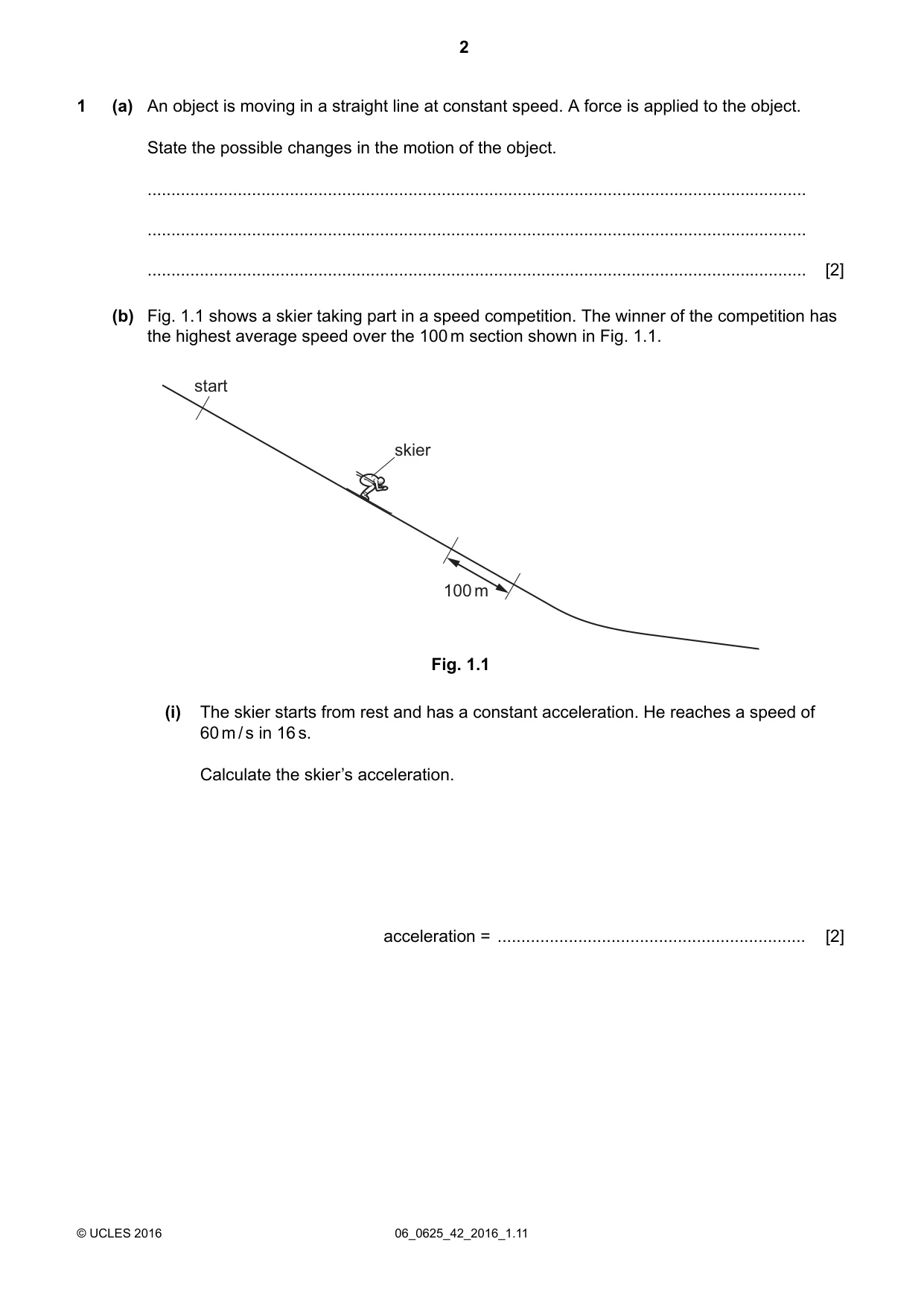
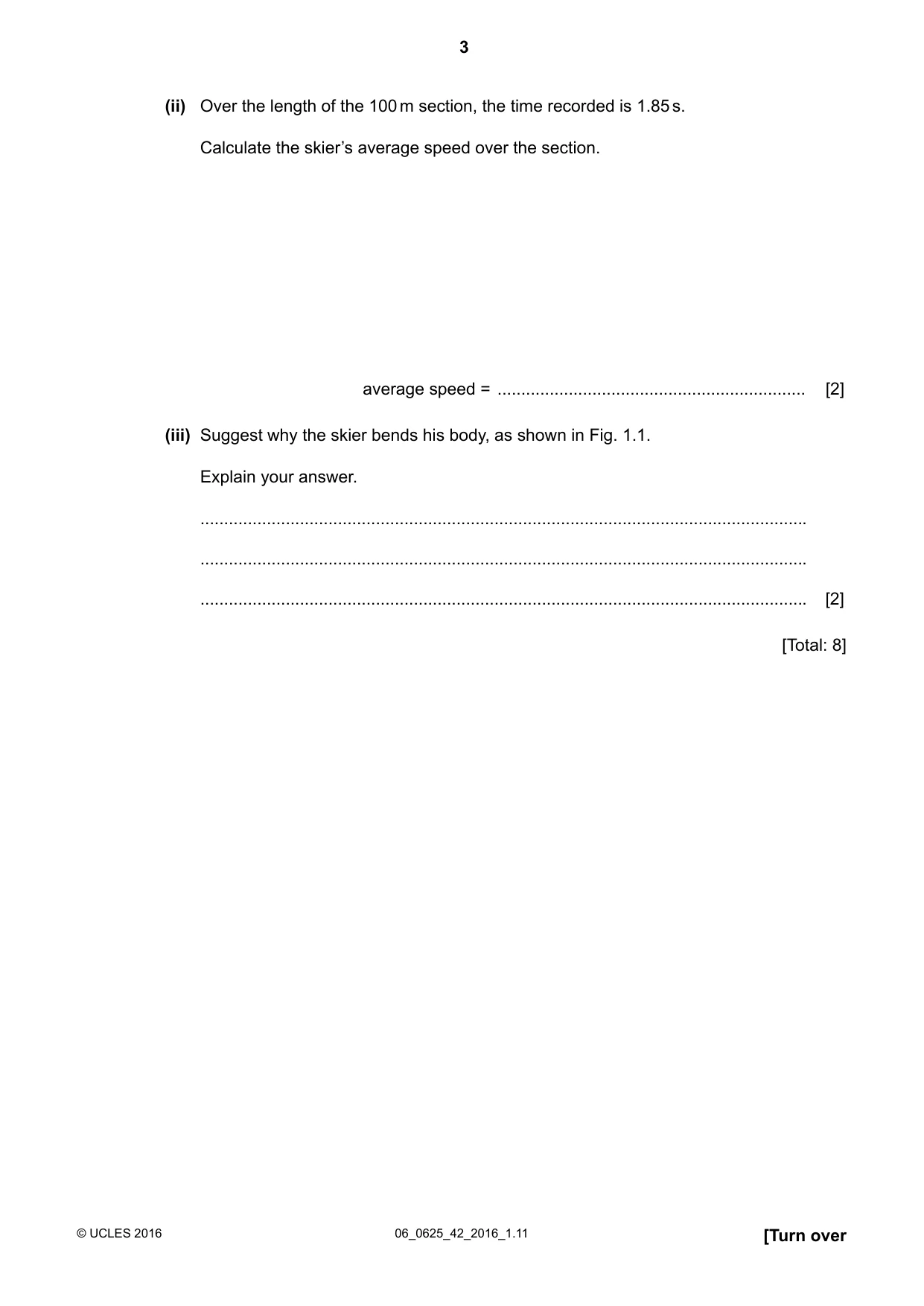
1 (a) An object is moving in a straight line at constant speed. A force is applied to the object. State the possible changes in the motion of the object. ........................................................................................................................................... ........................................................................................................................................... ........................................................................................................................................... [2] (b) Fig. 1.1 shows a skier taking part in a speed competition. The winner of the competition has the highest average speed over the 100m section shown in Fig. 1.1. start skier 100 m Fig. 1.1 (i) The skier starts from rest and has a constant acceleration. He reaches a speed of 60m/s in 16s. Calculate the skier’s acceleration. acceleration = ................................................................. [2] (ii) Over the length of the 100m section, the time recorded is 1.85s. Calculate the skier’s average speed over the section. average speed = ................................................................. [2] (iii) Suggest why the skier bends his body, as shown in Fig. 1.1. Explain your answer. ................................................................................................................................ ................................................................................................................................ ................................................................................................................................ [2] [Total: 8]
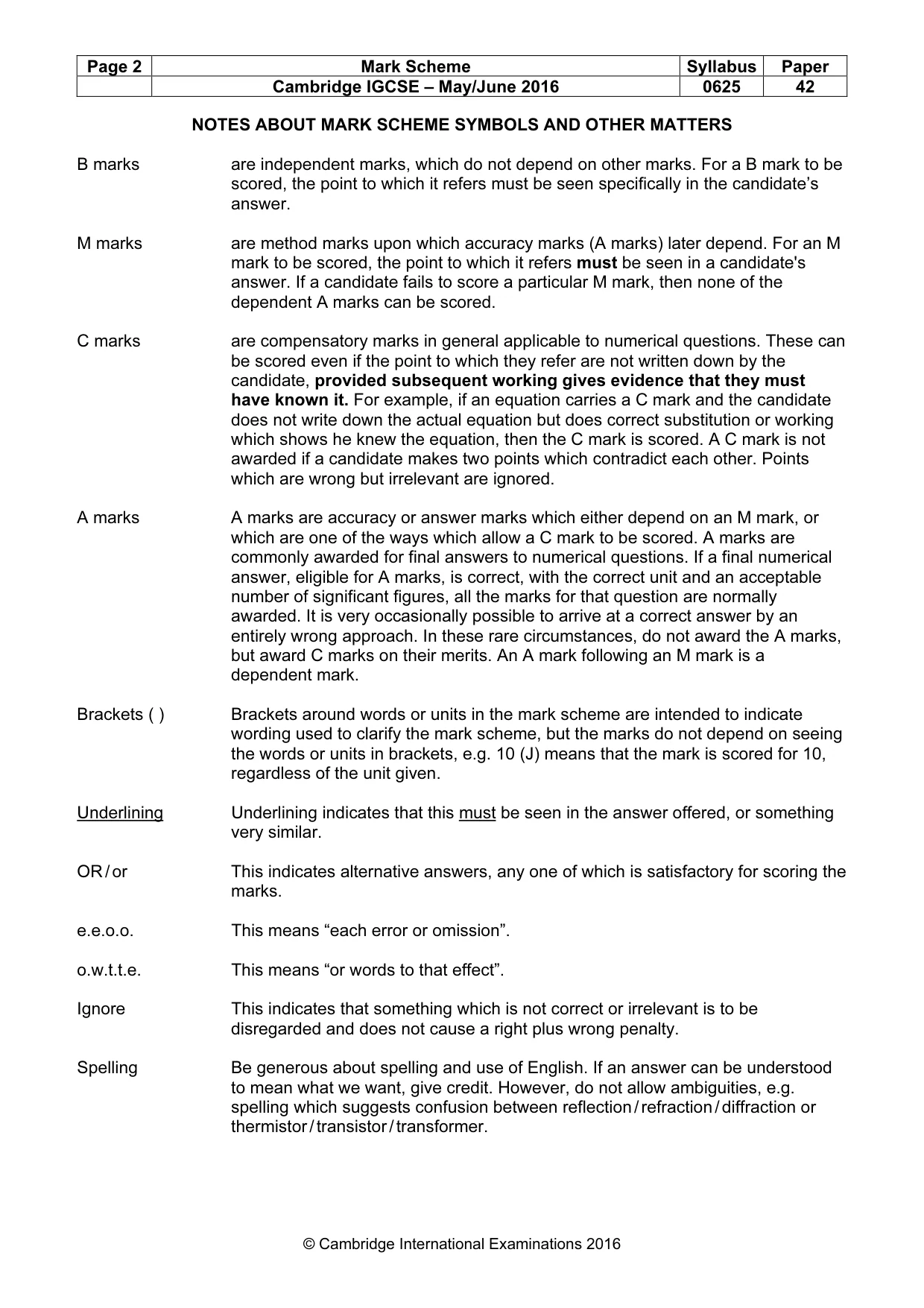
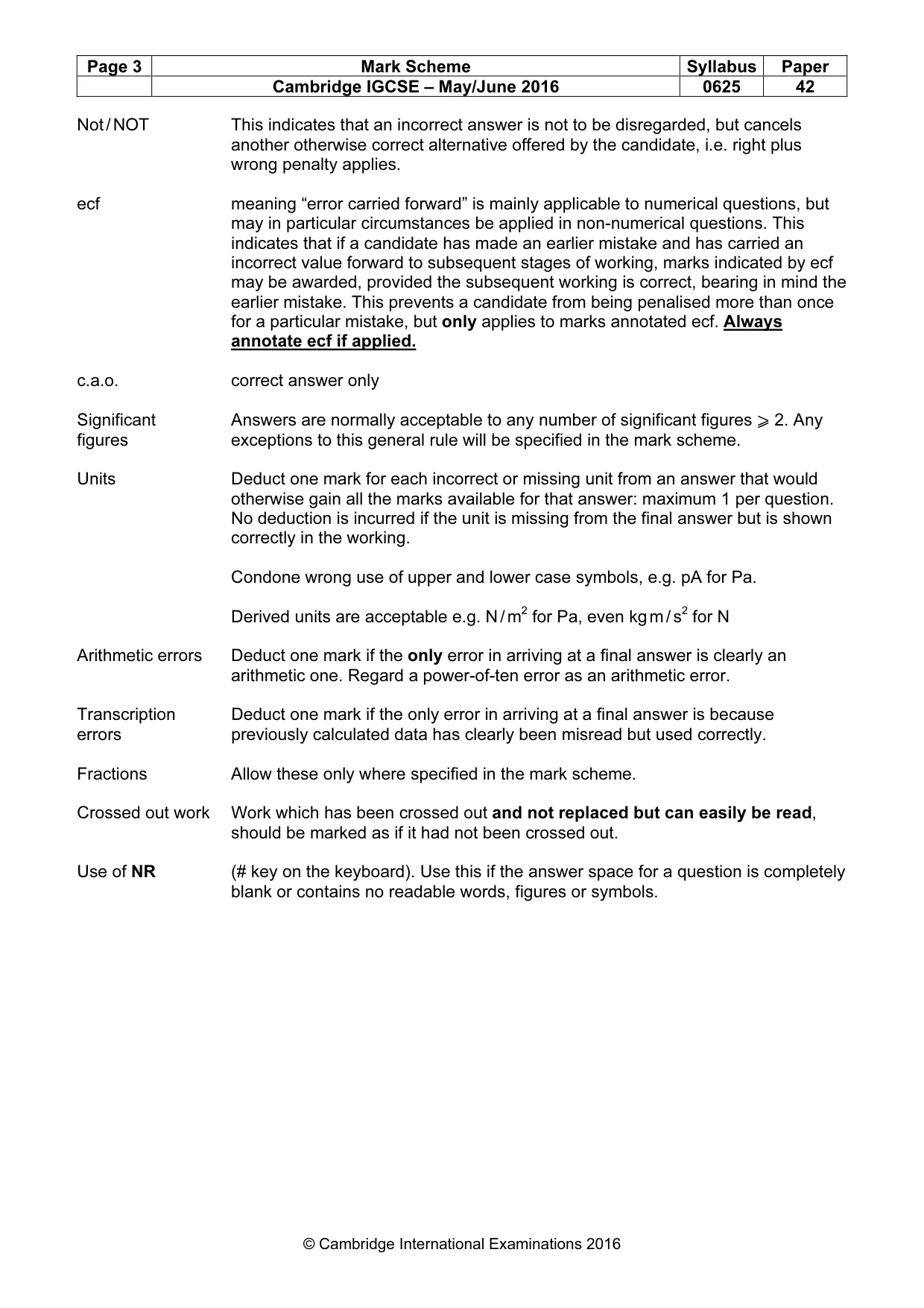
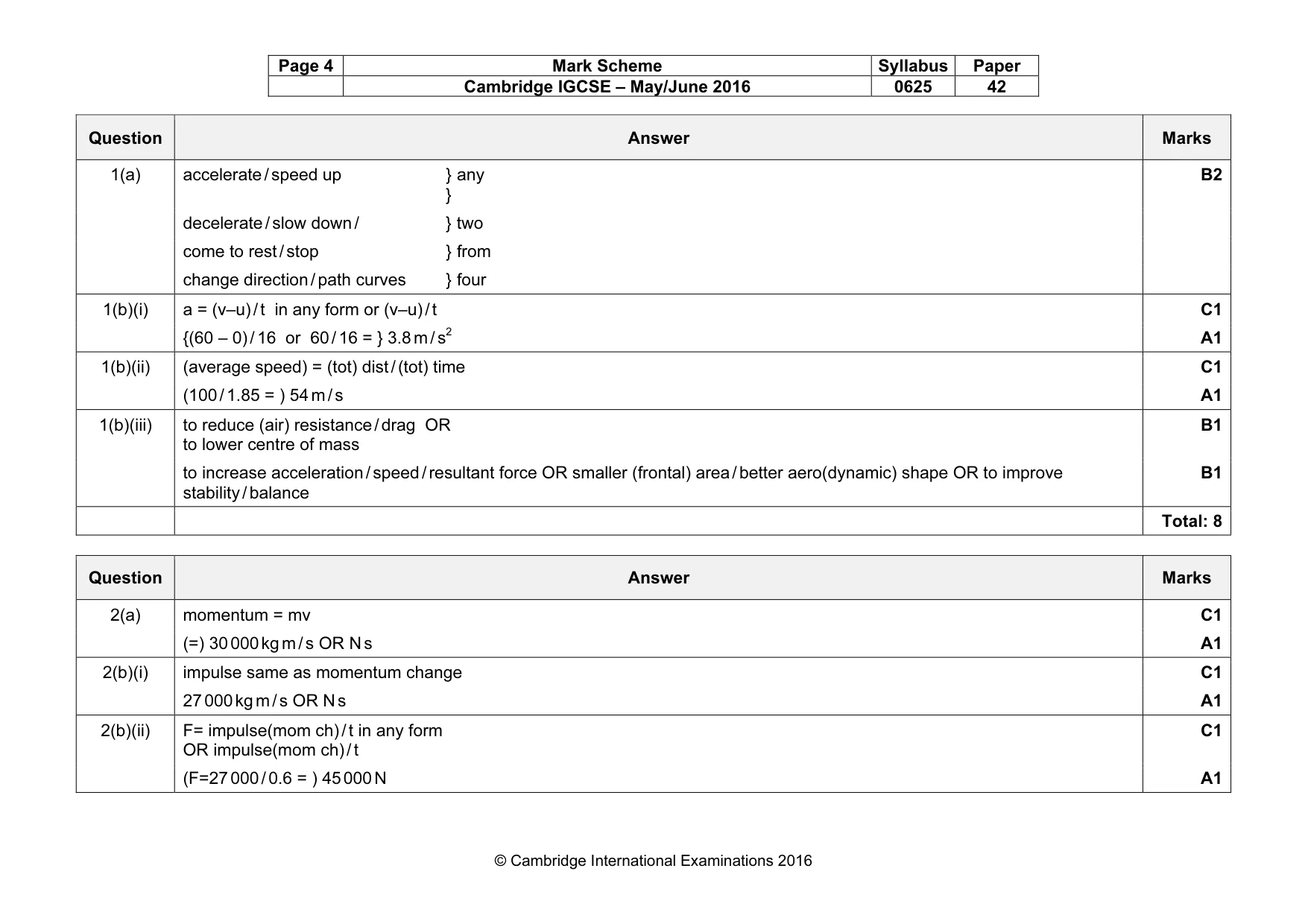
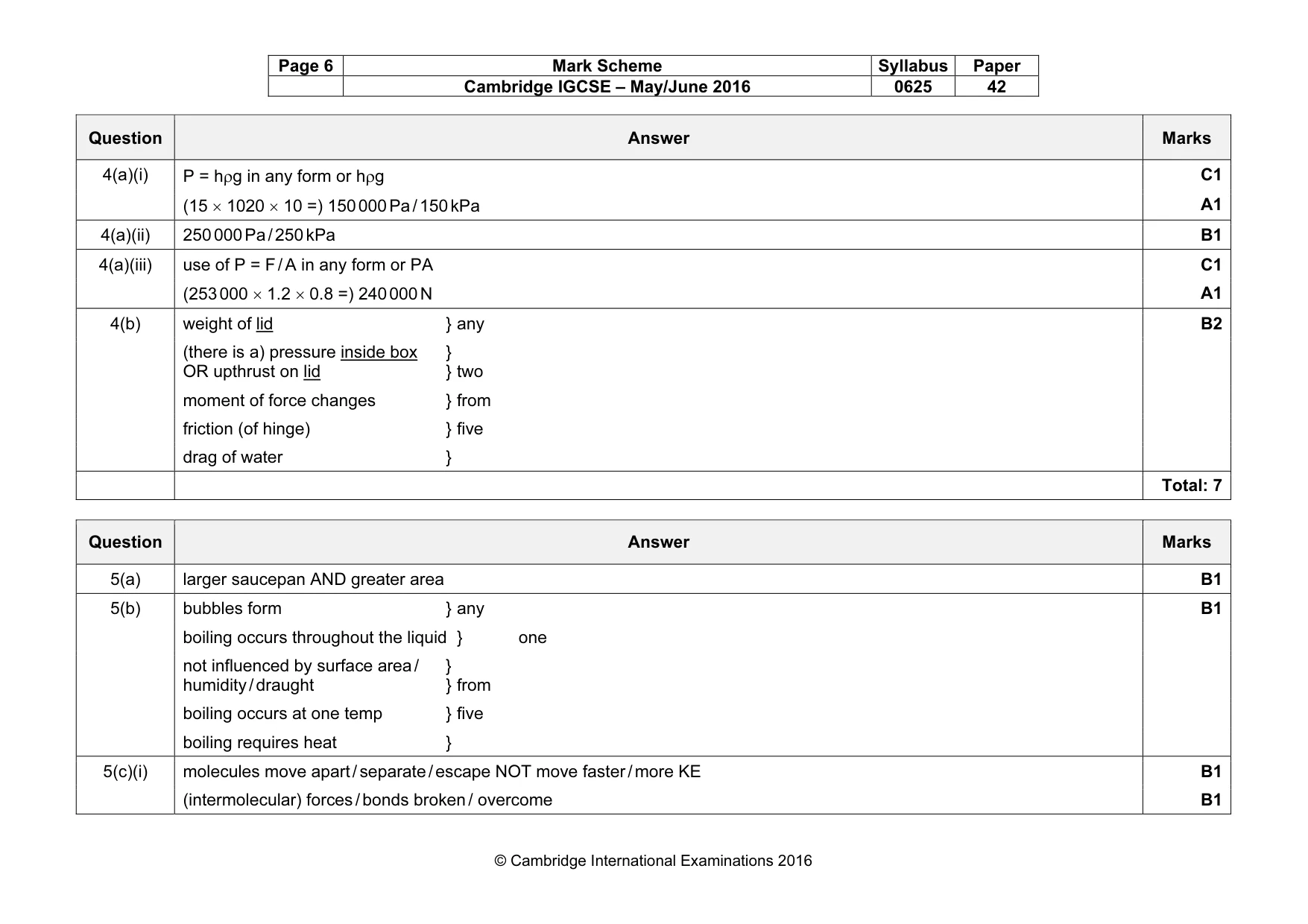
Mark scheme: 1(a) accelerate / speed up } any } B2 decelerate / slow down / } two come to rest / stop } from change direction / path curves } four 1(b)(i) a = (v–u) / t in any form or (v–u) / t C1 {(60 – 0) / 16 or 60 / 16 = } 3.8 m / s2 A1 1(b)(ii) (average speed) = (tot) dist / (tot) time C1 (100 / 1.85 = ) 54 m / s A1 1(b)(iii) to reduce (air) resistance / drag OR to lower centre of mass B1 to increase acceleration / speed / resultant force OR smaller (frontal) area / better aero(dynamic) shape OR to improve stability / balance B1 Total: 8
Q2 · Two railway trucks on a track
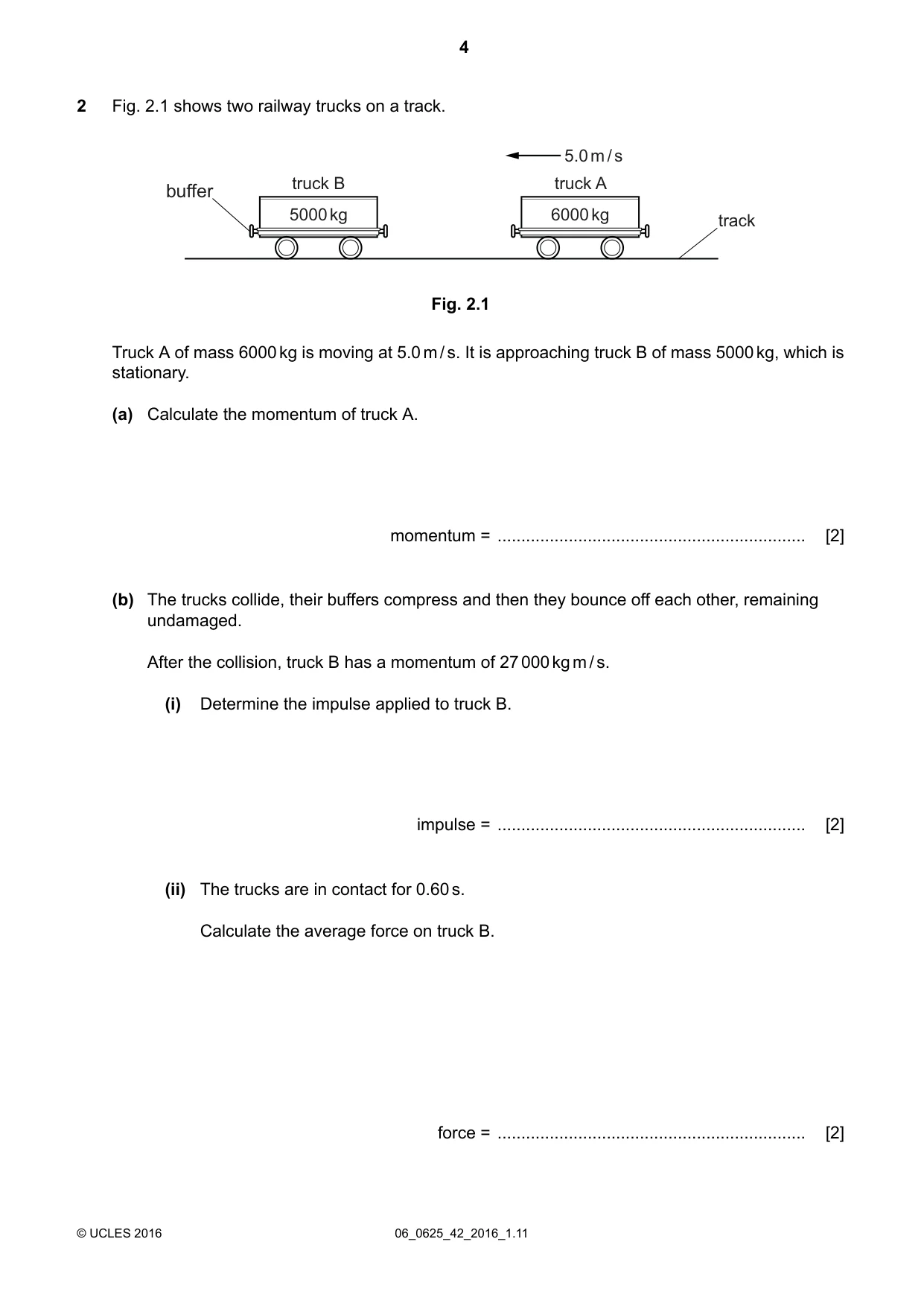
2 Fig. 2.1 shows two railway trucks on a track. 5.0 m / s truck B truck A buffer 5000 kg 6000 kg track Fig. 2.1 Truck A of mass 6000kg is moving at 5.0m/s. It is approaching truck B of mass 5000kg, which is stationary. (a) Calculate the momentum of truck A. momentum = ................................................................. [2] (b) The trucks collide, their buffers compress and then they bounce off each other, remaining undamaged. After the collision, truck B has a momentum of 27000kgm/s. (i) Determine the impulse applied to truck B. impulse = ................................................................. [2] (ii) The trucks are in contact for 0.60s. Calculate the average force on truck B. force = ................................................................. [2] (iii) Calculate the final speed of truck A. speed = ................................................................. [3] [Total: 9]
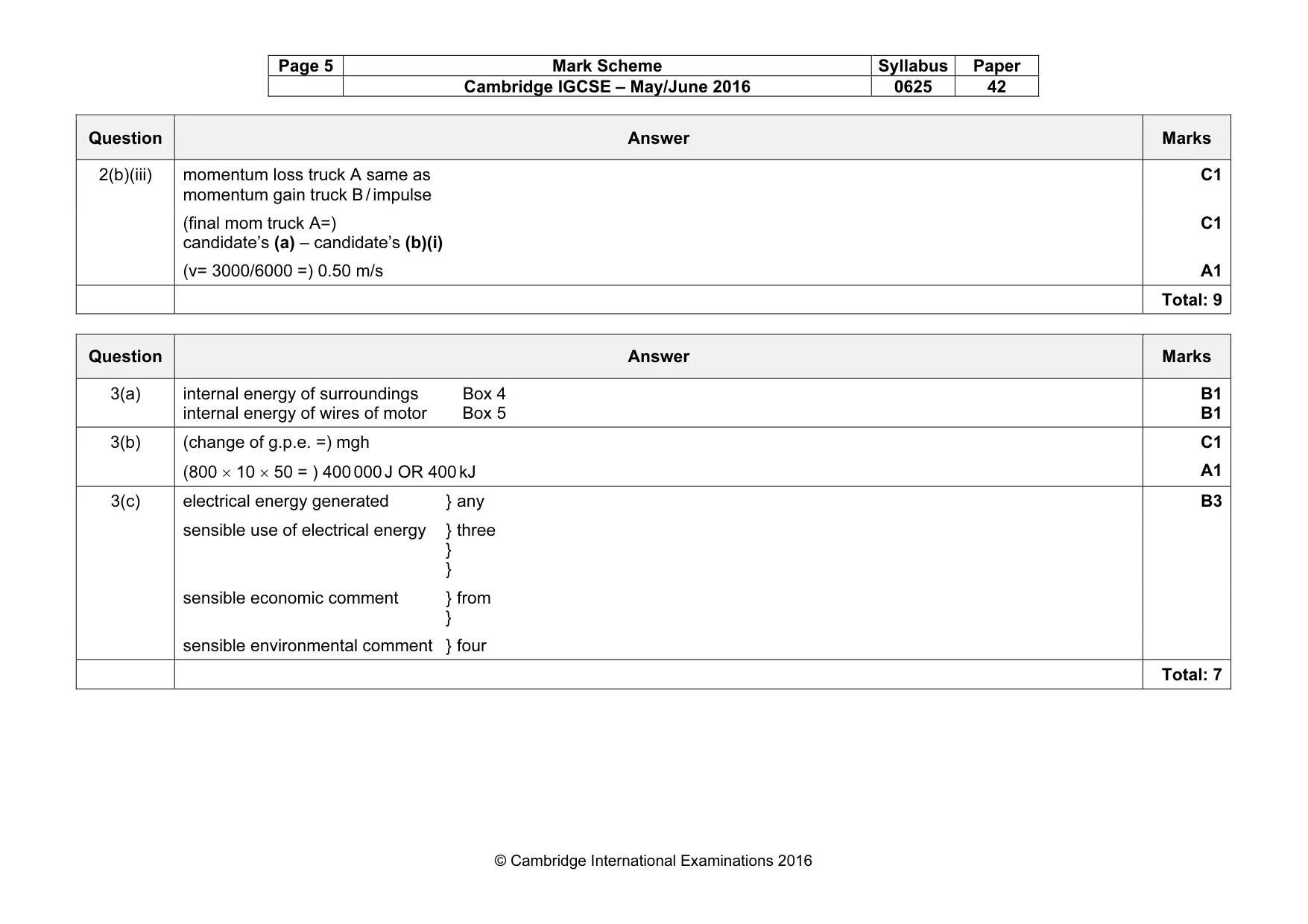
Mark scheme: 2(a) momentum = mv C1 (=) 30 000 kg m / s OR N s A1 2(b)(i) impulse same as momentum change C1 27 000 kg m / s OR N s A1 2(b)(ii) F= impulse(mom ch) / t in any form OR impulse(mom ch) / t C1 (F=27 000 / 0.6 = ) 45 000 N A1 Question Answer Marks 2(b)(iii) momentum loss truck A same as momentum gain truck B / impulse C1 (final mom truck A=) candidate’s (a) – candidate’s (b)(i) C1 (v= 3000/6000 =) 0.50 m/s A1 Total: 9
Q3 · A cabin used to transport passengers up a hillside
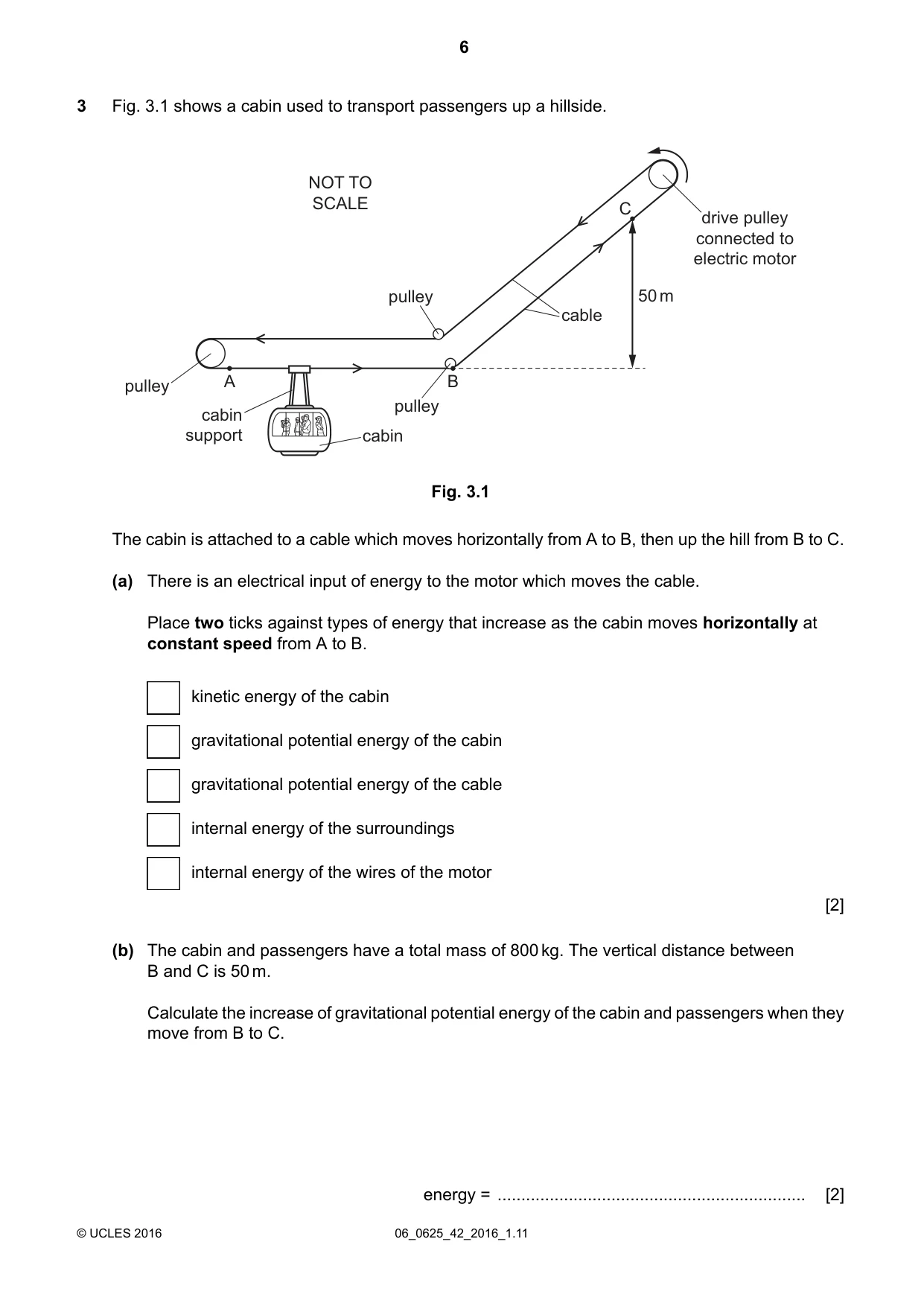
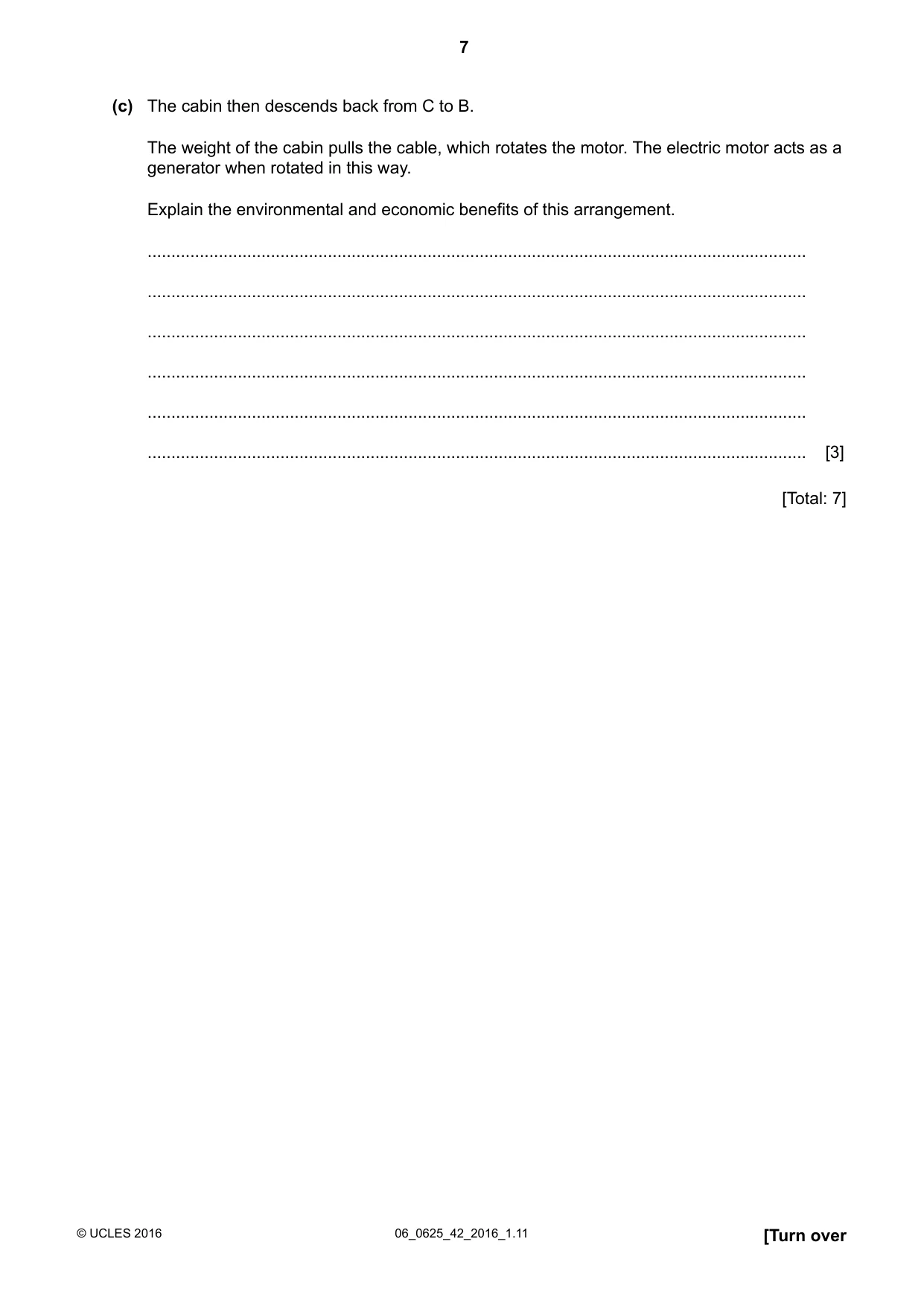
3 Fig. 3.1 shows a cabin used to transport passengers up a hillside. NOT TO SCALE C drive pulley connected to electric motor pulley 50 m cable A B pulley pulley cabin support cabin Fig. 3.1 The cabin is attached to a cable which moves horizontally from A to B, then up the hill from B to C. (a) There is an electrical input of energy to the motor which moves the cable. Place two ticks against types of energy that increase as the cabin moves horizontally at constant speed from A to B. kinetic energy of the cabin gravitational potential energy of the cabin gravitational potential energy of the cable internal energy of the surroundings internal energy of the wires of the motor [2] (b) The cabin and passengers have a total mass of 800kg. The vertical distance between B and C is 50m. Calculate the increase of gravitational potential energy of the cabin and passengers when they move from B to C. energy = ................................................................. [2] (c) The cabin then descends back from C to B. The weight of the cabin pulls the cable, which rotates the motor. The electric motor acts as a generator when rotated in this way. Explain the environmental and economic benefits of this arrangement. ........................................................................................................................................... ........................................................................................................................................... ........................................................................................................................................... ........................................................................................................................................... ........................................................................................................................................... ........................................................................................................................................... [3] [Total: 7]
Mark scheme: 3(a) internal energy of surroundings Box 4 internal energy of wires of motor Box 5 B1 B1 3(b) (change of g.p.e. =) mgh C1 (800 × 10 × 50 = ) 400 000 J OR 400 kJ A1 3(c) electrical energy generated } any B3 sensible use of electrical energy } three } } sensible economic comment } from } sensible environmental comment } four Total: 7
Q4 · An archaeologist is investigating a shipwreck and discovers a wooden box on the seabed
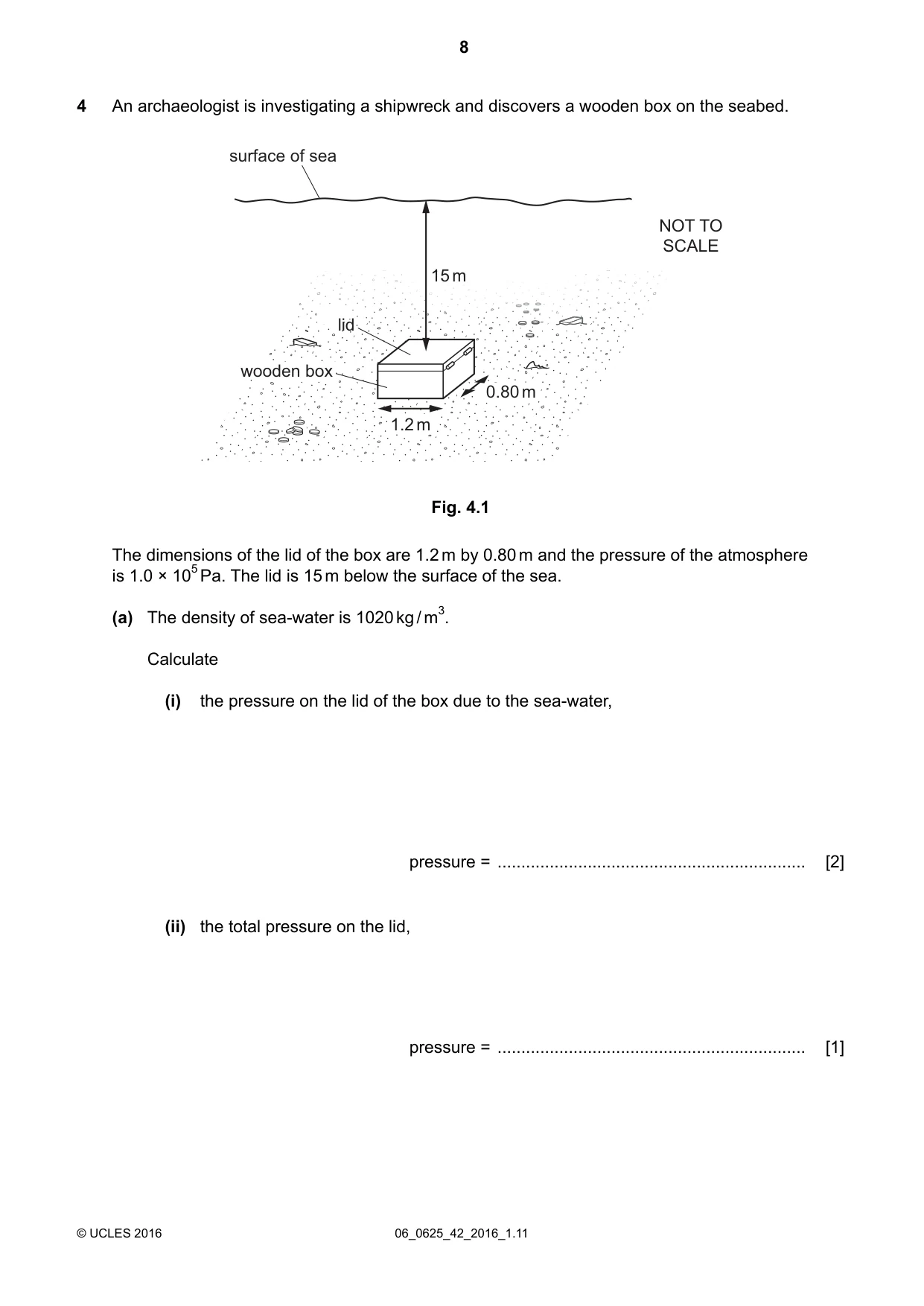
4 An archaeologist is investigating a shipwreck and discovers a wooden box on the seabed. surface of sea NOT TO SCALE 15 m lid wooden box 0.80 m 1.2 m Fig. 4.1 The dimensions of the lid of the box are 1.2m by 0.80m and the pressure of the atmosphere is 1.0 × 10⁵Pa. The lid is 15m below the surface of the sea. (a) The density of sea-water is 1020kg/m3. Calculate (i) the pressure on the lid of the box due to the sea-water, pressure = ................................................................. [2] (ii) the total pressure on the lid, pressure = ................................................................. [1] (iii) the downward force that the total pressure produces on the lid. force = ................................................................. [2] (b) The force needed to open the lid is not equal to the value calculated in (a)(iii). Suggest two reasons for this. 1. ....................................................................................................................................... ........................................................................................................................................... 2. ....................................................................................................................................... ........................................................................................................................................... [2] [Total: 7]
Mark scheme: 4(a)(i) P = hρg in any form or hρg C1 (15 × 1020 × 10 =) 150 000 Pa / 150 kPa A1 4(a)(ii) 250 000 Pa / 250 kPa B1 4(a)(iii) use of P = F / A in any form or PA C1 (253 000 × 1.2 × 0.8 =) 240 000 N A1 4(b) weight of lid } any B2 (there is a) pressure inside box } OR upthrust on lid } two moment of force changes } from friction (of hinge) } five drag of water } Total: 7
Q5 · Two pans containing water are placed on the hotplates of an electric cooker, as shown in…
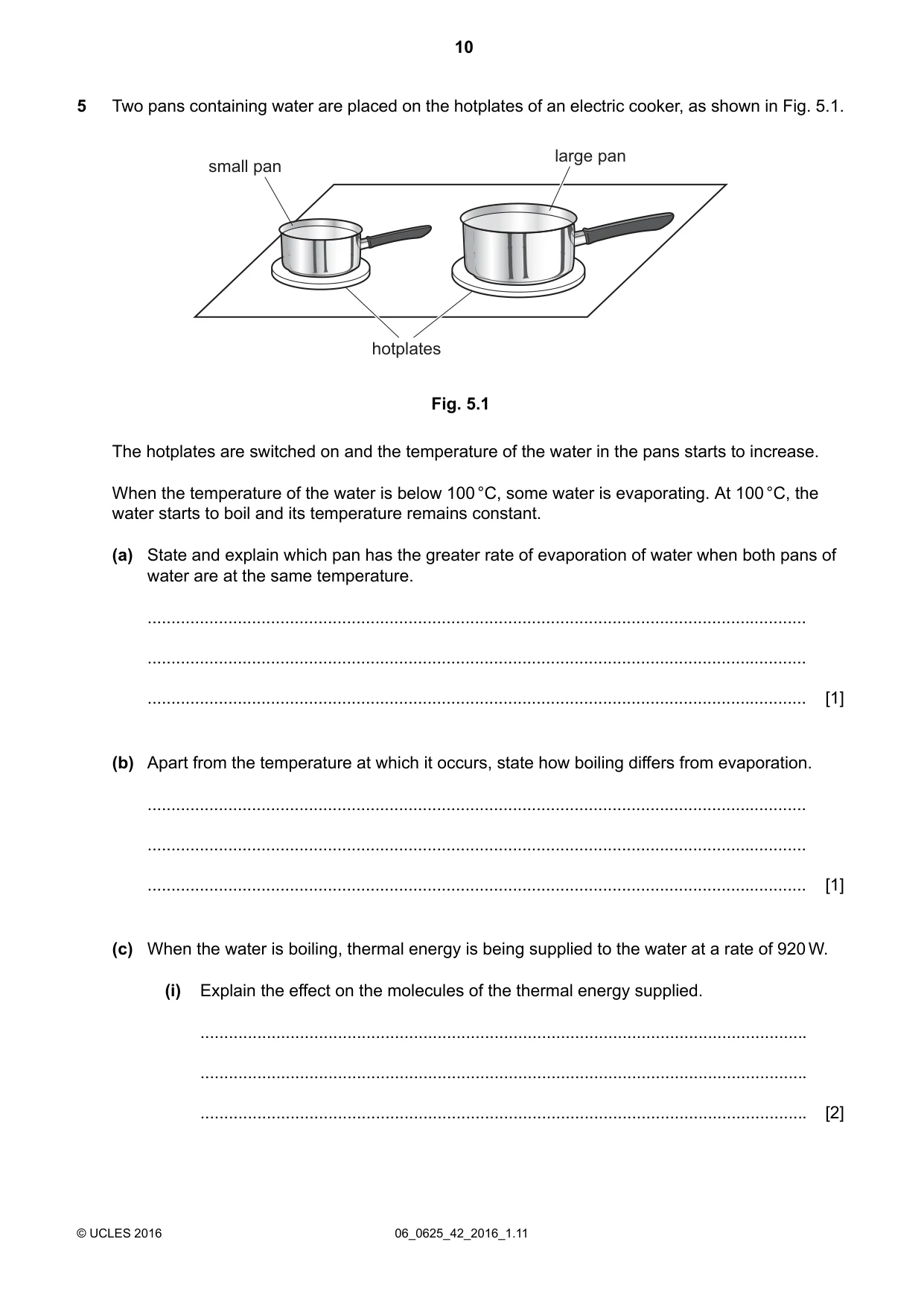
5 Two pans containing water are placed on the hotplates of an electric cooker, as shown in Fig. 5.1. large pan small pan hotplates Fig. 5.1 The hotplates are switched on and the temperature of the water in the pans starts to increase. When the temperature of the water is below 100°C, some water is evaporating. At 100°C, the water starts to boil and its temperature remains constant. (a) State and explain which pan has the greater rate of evaporation of water when both pans of water are at the same temperature. ........................................................................................................................................... ........................................................................................................................................... ........................................................................................................................................... [1] (b) Apart from the temperature at which it occurs, state how boiling differs from evaporation. ........................................................................................................................................... ........................................................................................................................................... ........................................................................................................................................... [1] (c) When the water is boiling, thermal energy is being supplied to the water at a rate of 920W. (i) Explain the effect on the molecules of the thermal energy supplied. ................................................................................................................................ ................................................................................................................................ ................................................................................................................................ [2] (ii) The specific latent heat of vaporisation of water is 2.3 × 10⁶J/kg. Calculate the mass of water that boils away in 5.0minutes. mass = ................................................................. [3] [Total: 7]
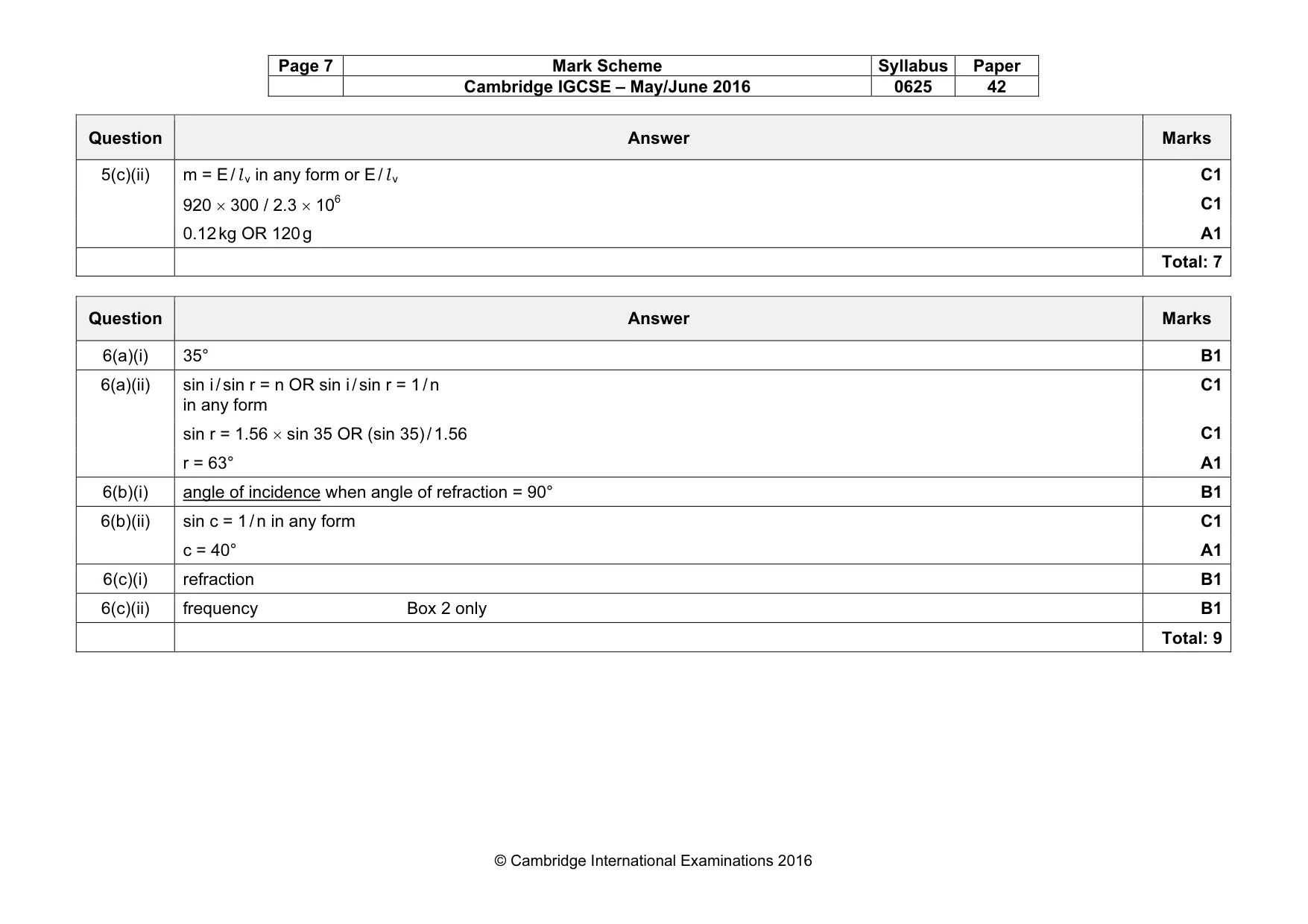
Mark scheme: 5(a) larger saucepan AND greater area B1 5(b) bubbles form } any B1 boiling occurs throughout the liquid } one not influenced by surface area / } humidity / draught } from boiling occurs at one temp } five boiling requires heat } 5(c)(i) molecules move apart / separate / escape NOT move faster / more KE B1 (intermolecular) forces / bonds broken / overcome B1 Question Answer Marks 5(c)(ii) m = E / l v in any form or E / l v C1 920 × 300 / 2.3 × 10⁶ C1 0.12 kg OR 120 g A1 Total: 7
Q6 · A protractor superimposed on the path of a ray of light
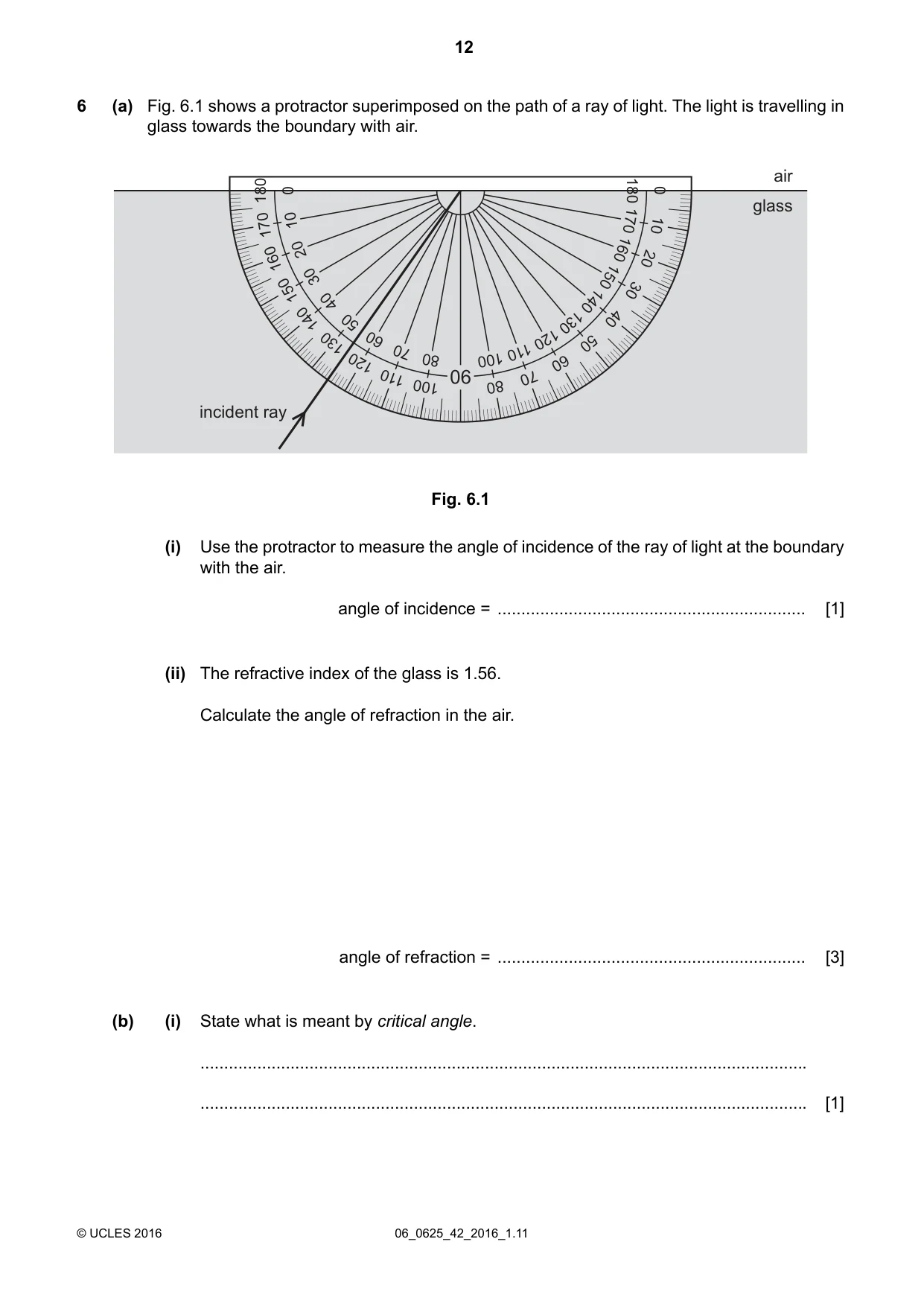
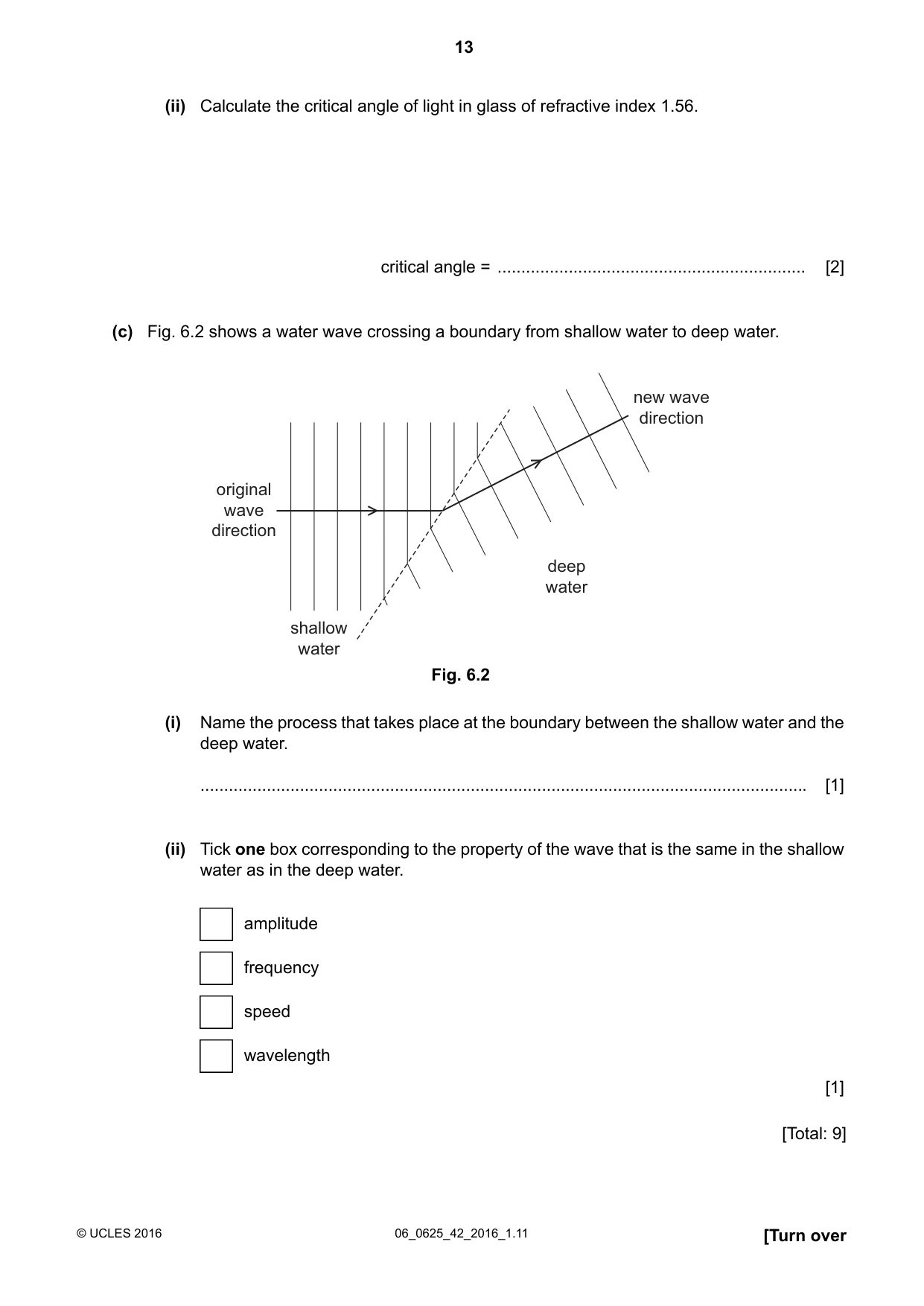
6 (a) Fig. 6.1 shows a protractor superimposed on the path of a ray of light. The light is travelling in glass towards the boundary with air. air 0 0 180 180 glass 170 10 170 10 20 160 160 20 30 150 150 30 40 140 140 50 130 40 130 60 120 50 70 110 120 80 90 100 60 110 70 100 80 incident ray Fig. 6.1 (i) Use the protractor to measure the angle of incidence of the ray of light at the boundary with the air. angle of incidence = ................................................................. [1] (ii) The refractive index of the glass is 1.56. Calculate the angle of refraction in the air. angle of refraction = ................................................................. [3] (b) (i) State what is meant by critical angle. ................................................................................................................................ ................................................................................................................................ [1] (ii) Calculate the critical angle of light in glass of refractive index 1.56. critical angle = ................................................................. [2] (c) Fig. 6.2 shows a water wave crossing a boundary from shallow water to deep water. new wave direction original wave direction deep water shallow water Fig. 6.2 (i) Name the process that takes place at the boundary between the shallow water and the deep water. ................................................................................................................................ [1] (ii) Tick one box corresponding to the property of the wave that is the same in the shallow water as in the deep water. amplitude frequency speed wavelength [1] [Total: 9]
Mark scheme: 6(a)(i) 35° B1 6(a)(ii) sin i / sin r = n OR sin i / sin r = 1 / n in any form C1 sin r = 1.56 × sin 35 OR (sin 35) / 1.56 C1 r = 63° A1 6(b)(i) angle of incidence when angle of refraction = 90° B1 6(b)(ii) sin c = 1 / n in any form C1 c = 40° A1 6(c)(i) refraction B1 6(c)(ii) frequency Box 2 only B1 Total: 9
Q7 · Describe the use of X-rays in a security application
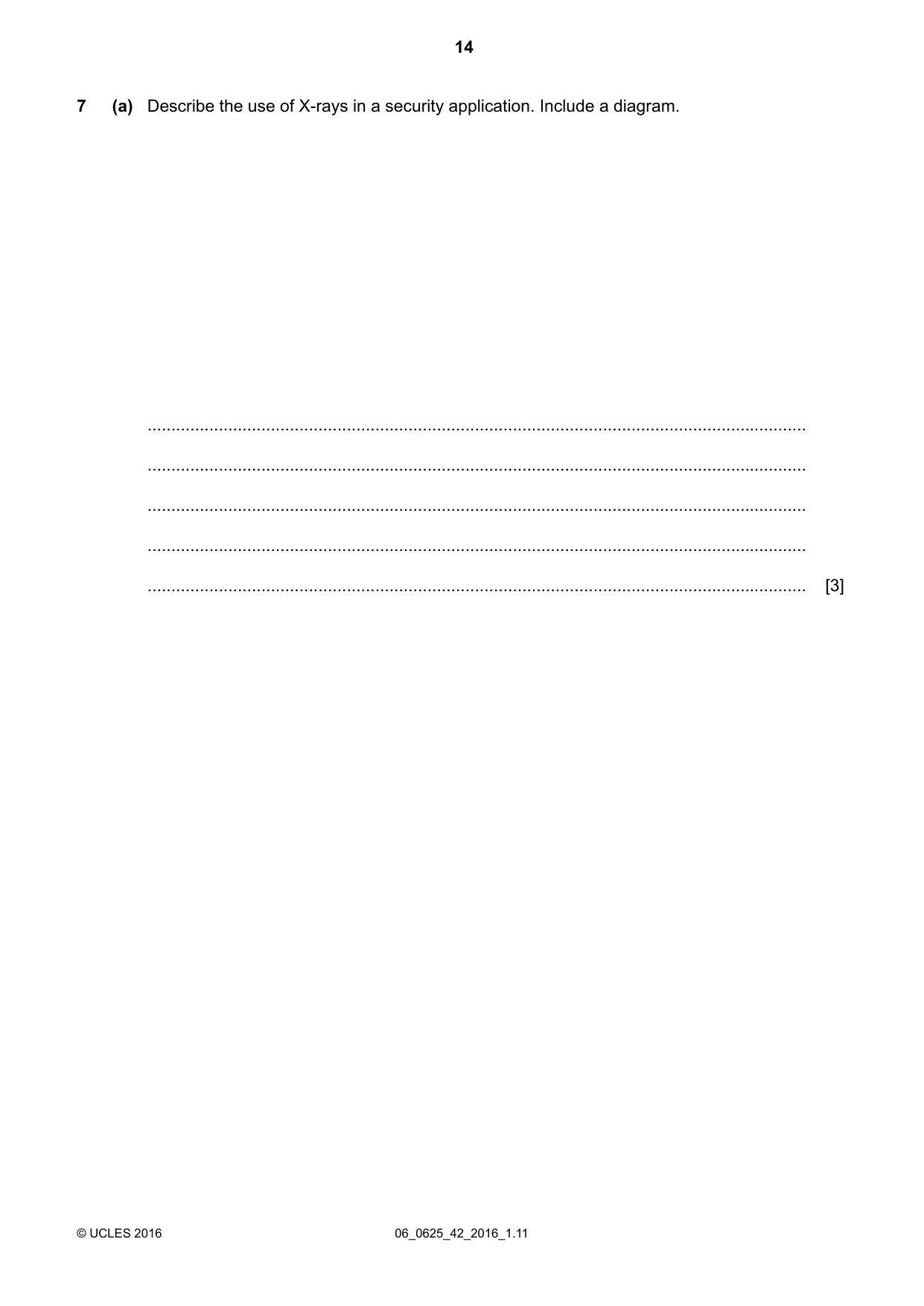
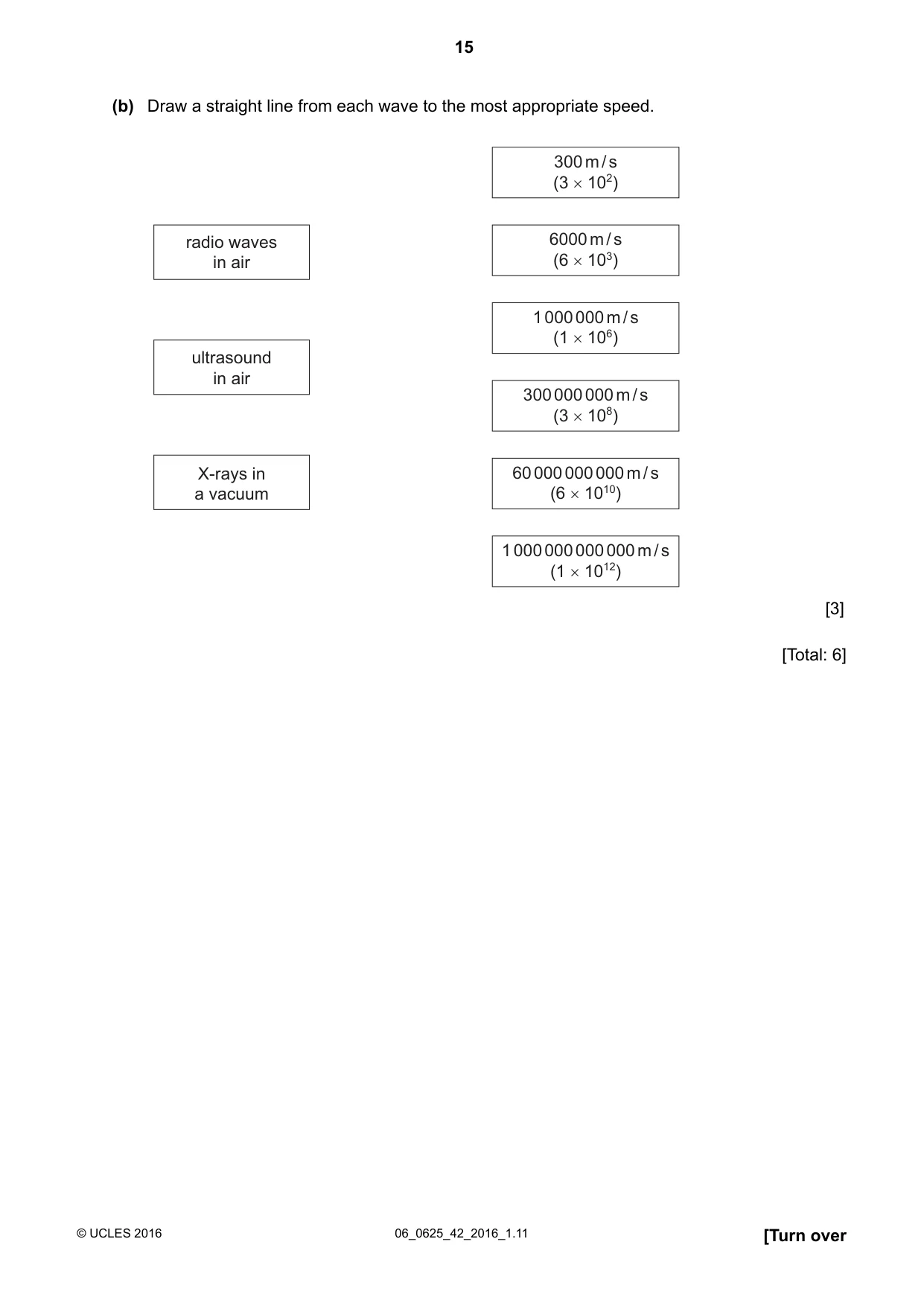
7 (a) Describe the use of X-rays in a security application. Include a diagram. ........................................................................................................................................... ........................................................................................................................................... ........................................................................................................................................... ........................................................................................................................................... ........................................................................................................................................... [3] (b) Draw a straight line from each wave to the most appropriate speed. 300 m / s (3 × 10²) radio waves 6000 m / s in air (6 × 10³) 1 000 000 m / s (1 × 10⁶) ultrasound in air 300 000 000 m / s (3 × 10⁸) X-rays in 60 000 000 000 m / s a vacuum (6 × 10¹⁰) 1 000 000 000 000 m / s (1 × 10¹²) [3] [Total: 6]
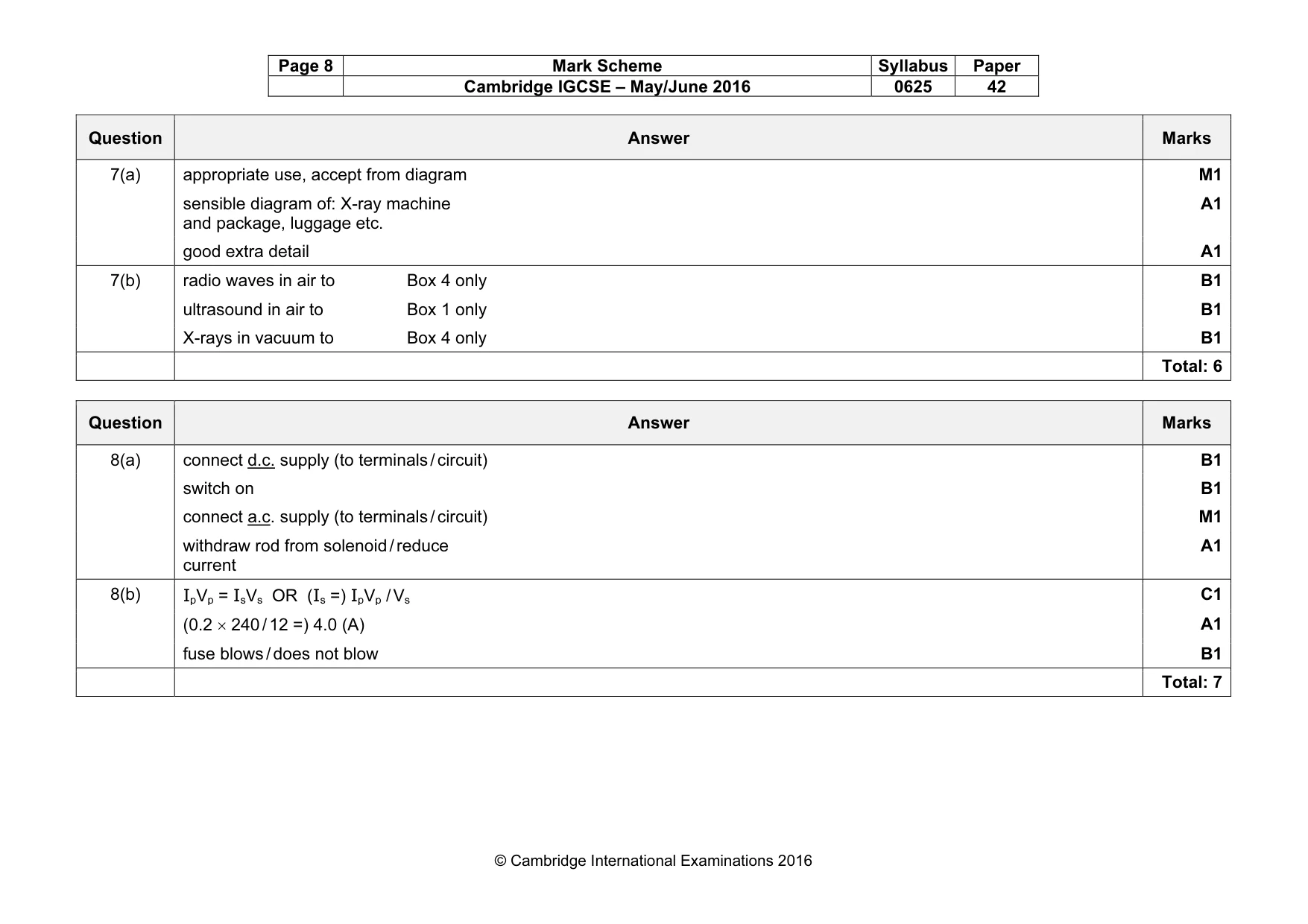
Mark scheme: 7(a) appropriate use, accept from diagram M1 sensible diagram of: X-ray machine and package, luggage etc. A1 good extra detail A1 7(b) radio waves in air to Box 4 only B1 ultrasound in air to Box 1 only B1 X-rays in vacuum to Box 4 only B1 Total: 6
Q8 · A coil wound around a steel bar that is initially unmagnetised
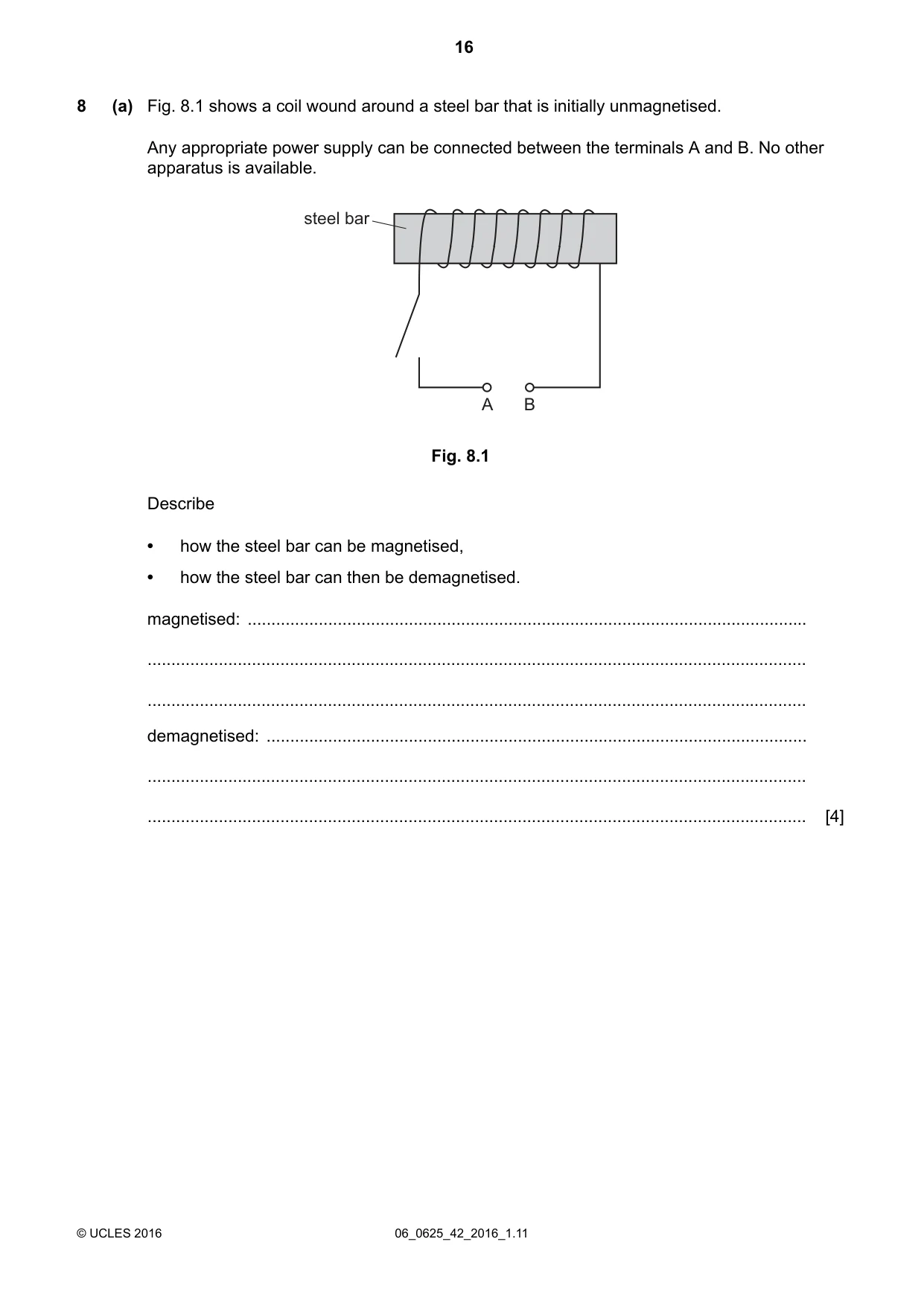
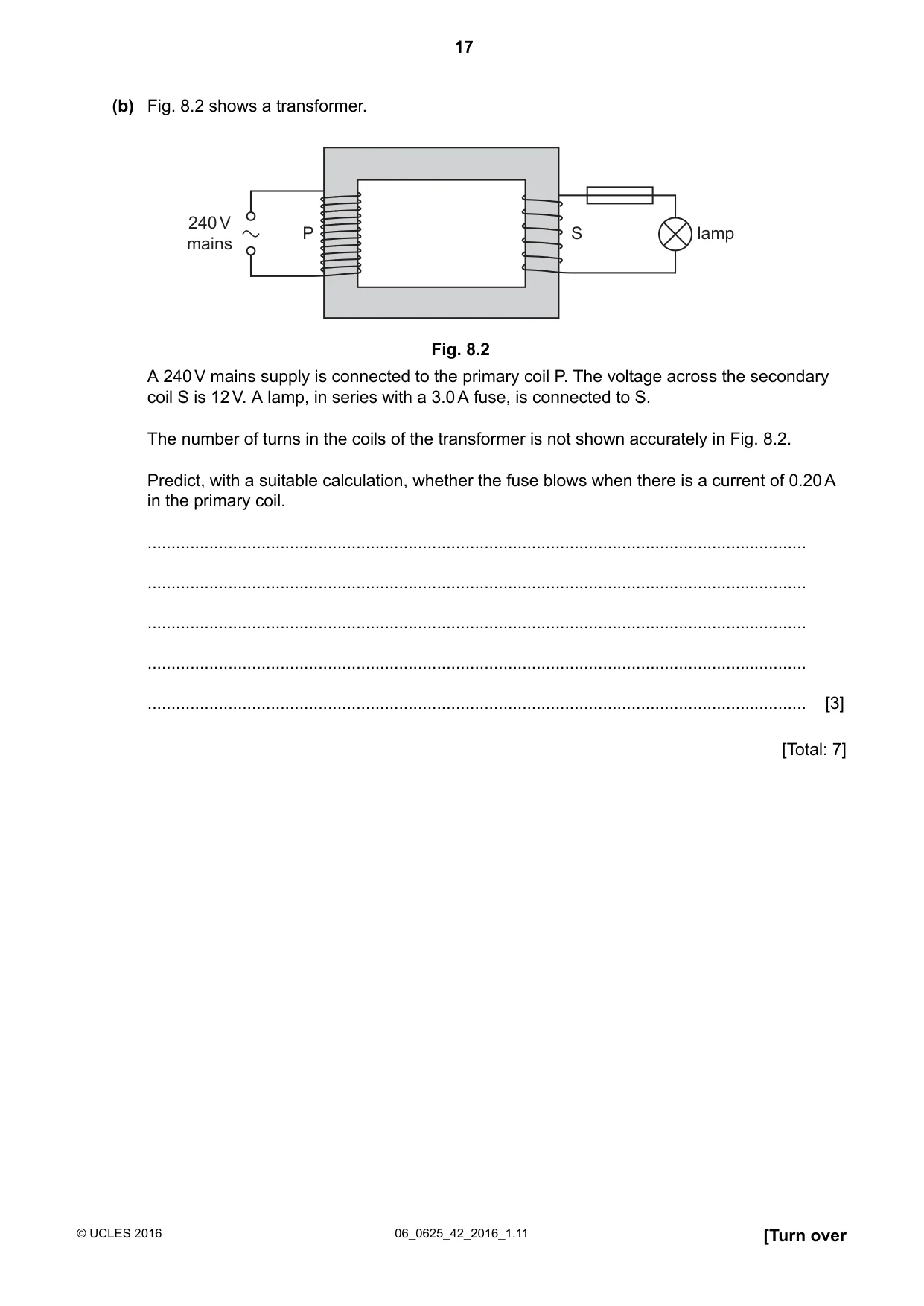
8 (a) Fig. 8.1 shows a coil wound around a steel bar that is initially unmagnetised. Any appropriate power supply can be connected between the terminals A and B. No other apparatus is available. steel bar A B Fig. 8.1 Describe • how the steel bar can be magnetised, • how the steel bar can then be demagnetised. magnetised: ...................................................................................................................... ........................................................................................................................................... ........................................................................................................................................... demagnetised: .................................................................................................................. ........................................................................................................................................... ........................................................................................................................................... [4] (b) Fig. 8.2 shows a transformer. 240 V P S lamp mains Fig. 8.2 A 240V mains supply is connected to the primary coil P. The voltage across the secondary coil S is 12V. A lamp, in series with a 3.0A fuse, is connected to S. The number of turns in the coils of the transformer is not shown accurately in Fig. 8.2. Predict, with a suitable calculation, whether the fuse blows when there is a current of 0.20A in the primary coil. ........................................................................................................................................... ........................................................................................................................................... ........................................................................................................................................... ........................................................................................................................................... ........................................................................................................................................... [3] [Total: 7]
Mark scheme: 8(a) connect d.c. supply (to terminals / circuit) B1 switch on B1 connect a.c. supply (to terminals / circuit) M1 withdraw rod from solenoid / reduce current A1 8(b) IpVp = IsVs OR (Is =) IpVp / Vs C1 (0.2 × 240 / 12 =) 4.0 (A) A1 fuse blows / does not blow B1 Total: 7
Q9 · A conducting ball that oscillates between two charged plates
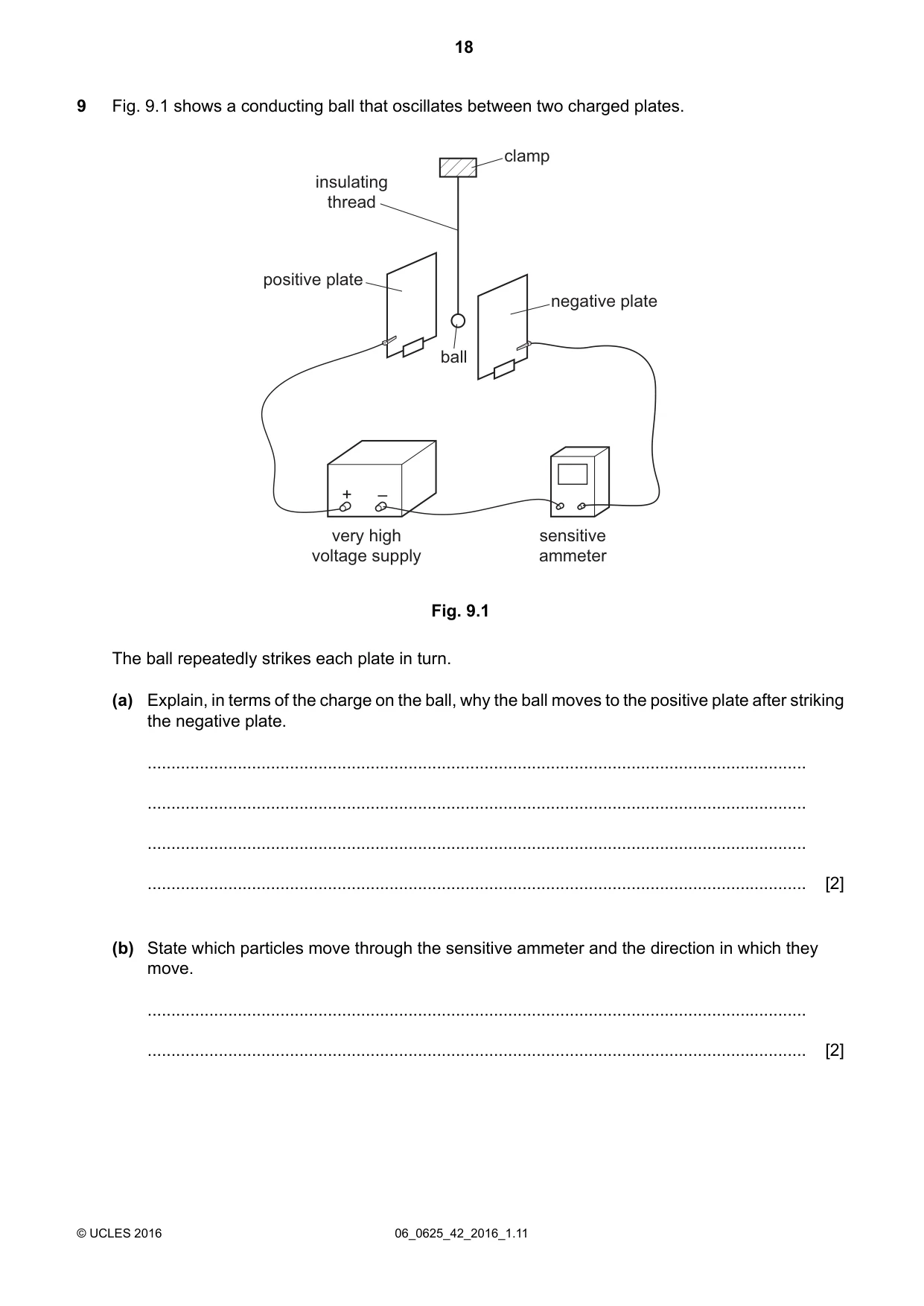
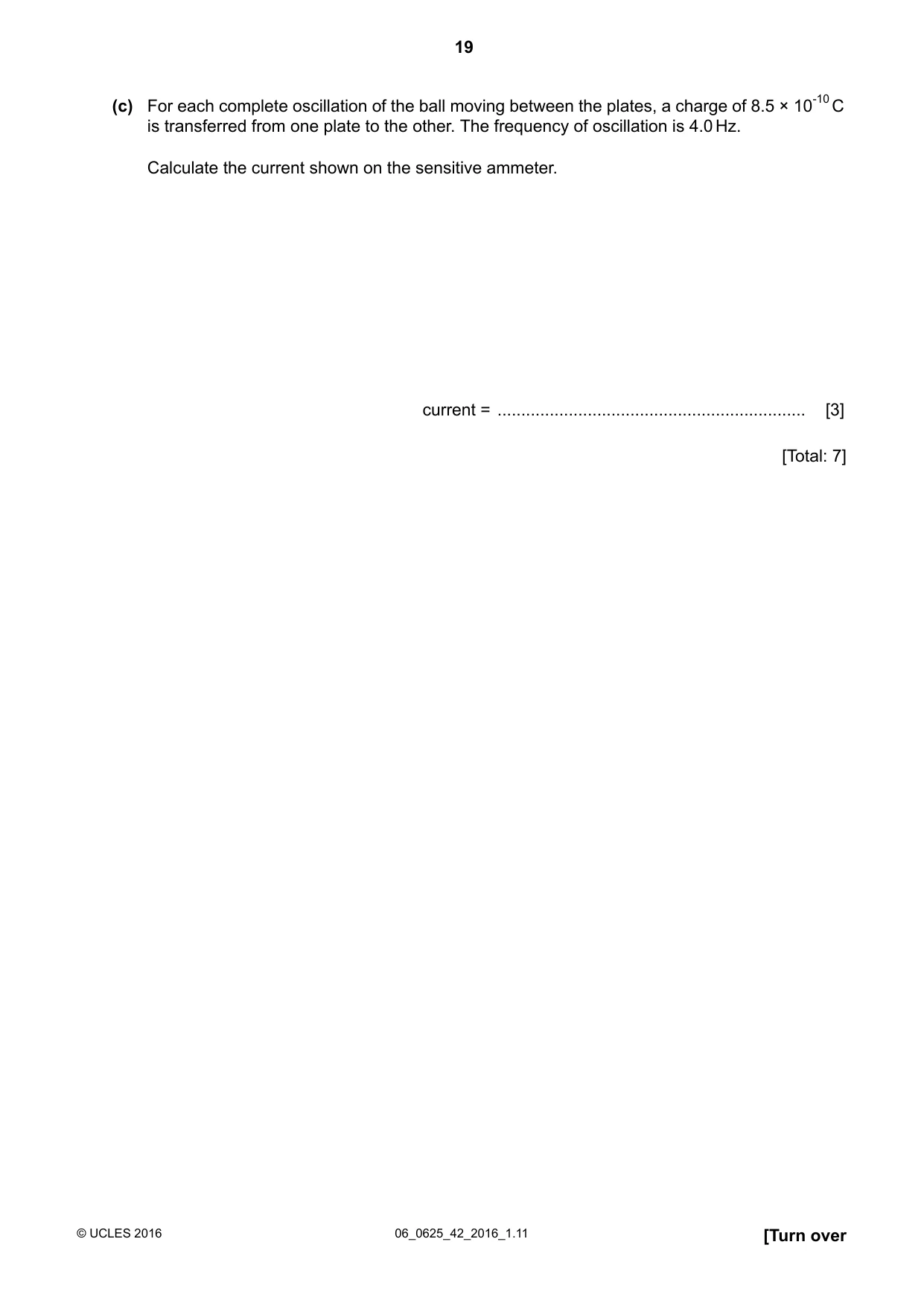
9 Fig. 9.1 shows a conducting ball that oscillates between two charged plates. clamp insulating thread positive plate negative plate ball + – very high sensitive voltage supply ammeter Fig. 9.1 The ball repeatedly strikes each plate in turn. (a) Explain, in terms of the charge on the ball, why the ball moves to the positive plate after striking the negative plate. ........................................................................................................................................... ........................................................................................................................................... ........................................................................................................................................... ........................................................................................................................................... [2] (b) State which particles move through the sensitive ammeter and the direction in which they move. ........................................................................................................................................... ........................................................................................................................................... [2] (c) For each complete oscillation of the ball moving between the plates, a charge of 8.5 × 10⁻¹⁰C is transferred from one plate to the other. The frequency of oscillation is 4.0Hz. Calculate the current shown on the sensitive ammeter. current = ................................................................. [3] [Total: 7]
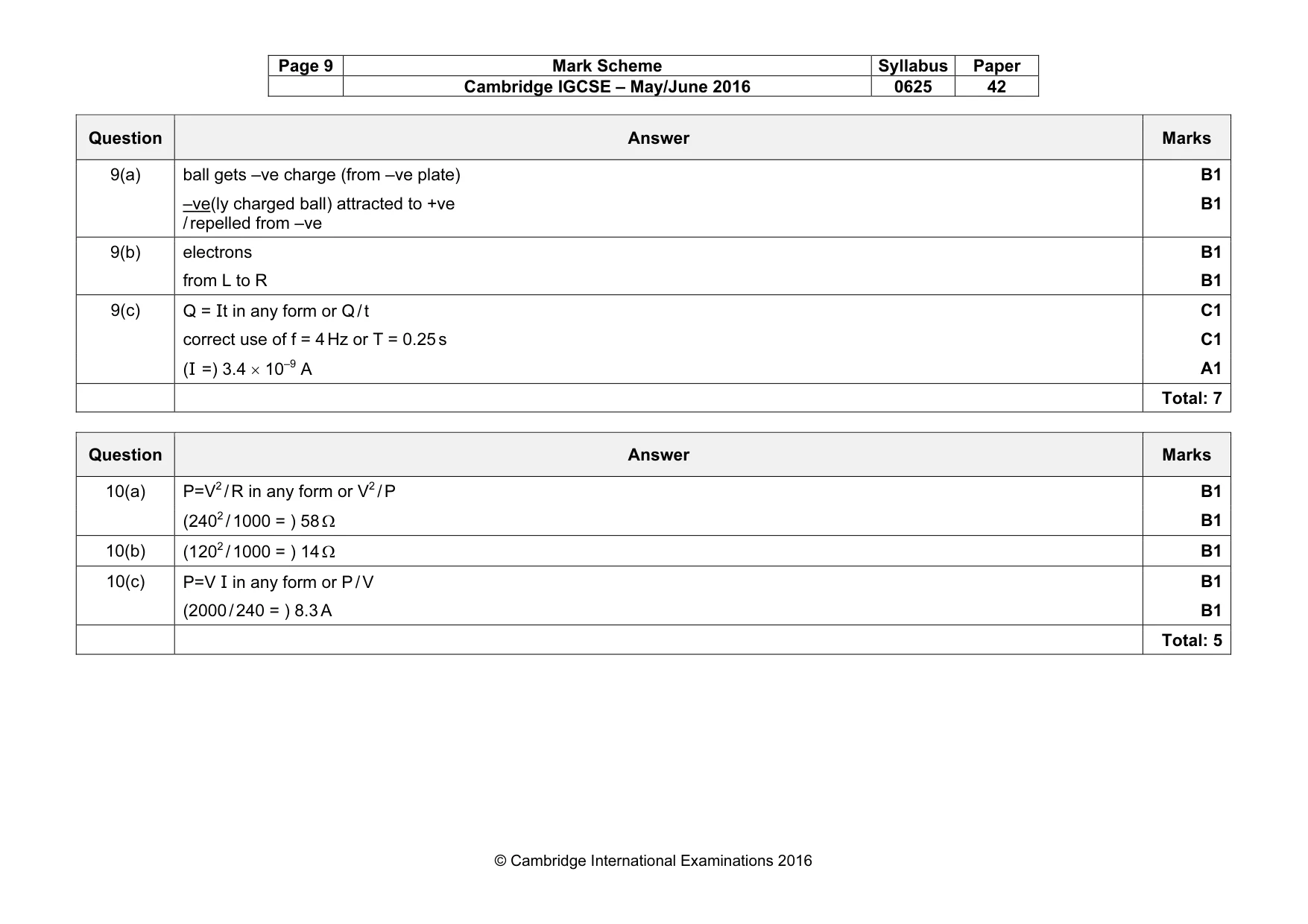
Mark scheme: 9(a) ball gets –ve charge (from –ve plate) B1 –ve(ly charged ball) attracted to +ve / repelled from –ve B1 9(b) electrons B1 from L to R B1 9(c) Q = It in any form or Q / t C1 correct use of f = 4 Hz or T = 0.25 s C1 (I =) 3.4 × 10⁻⁹ A A1 Total: 7
Q10 · Part of the circuit of a hair-dryer with a 240V a.c
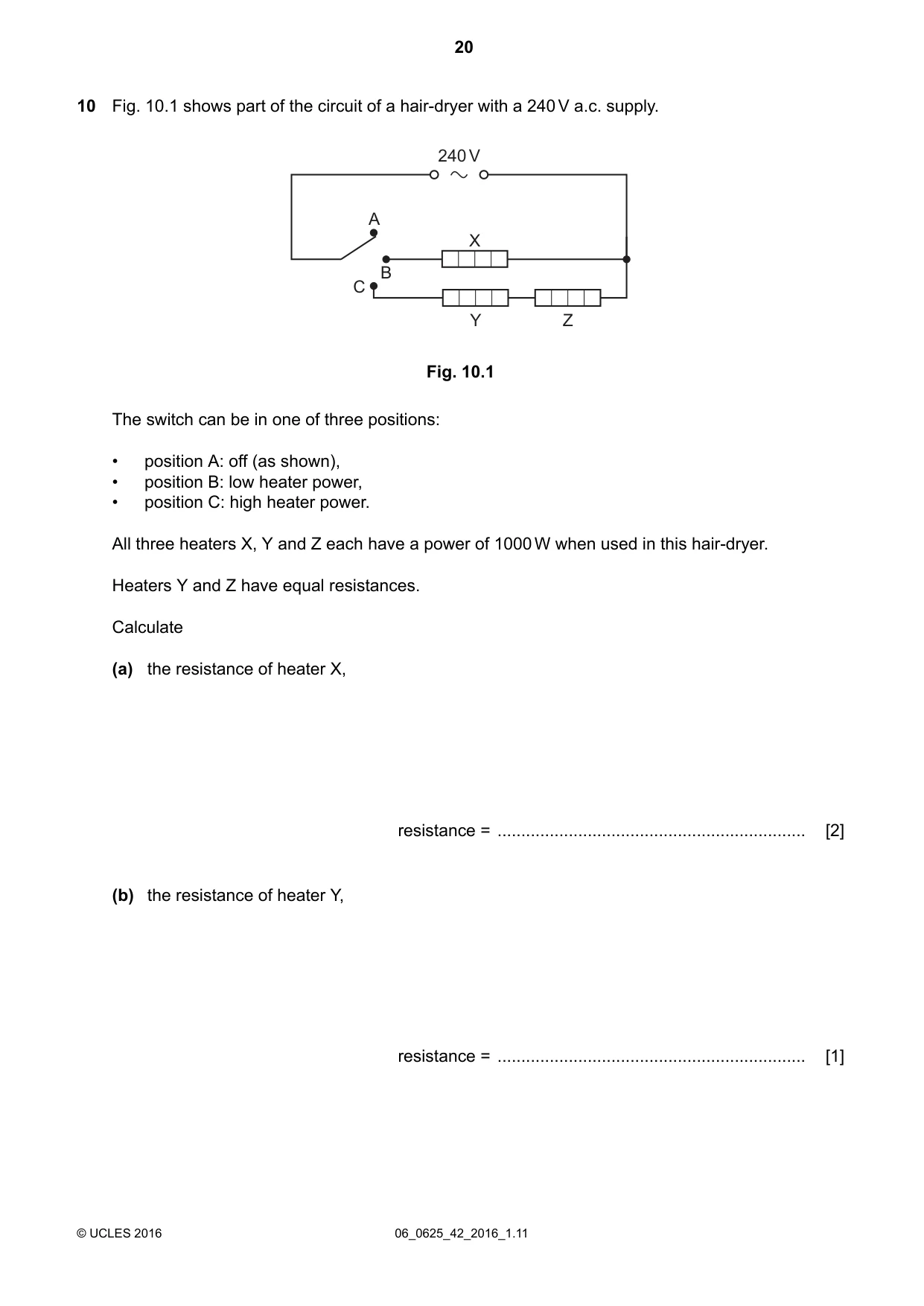
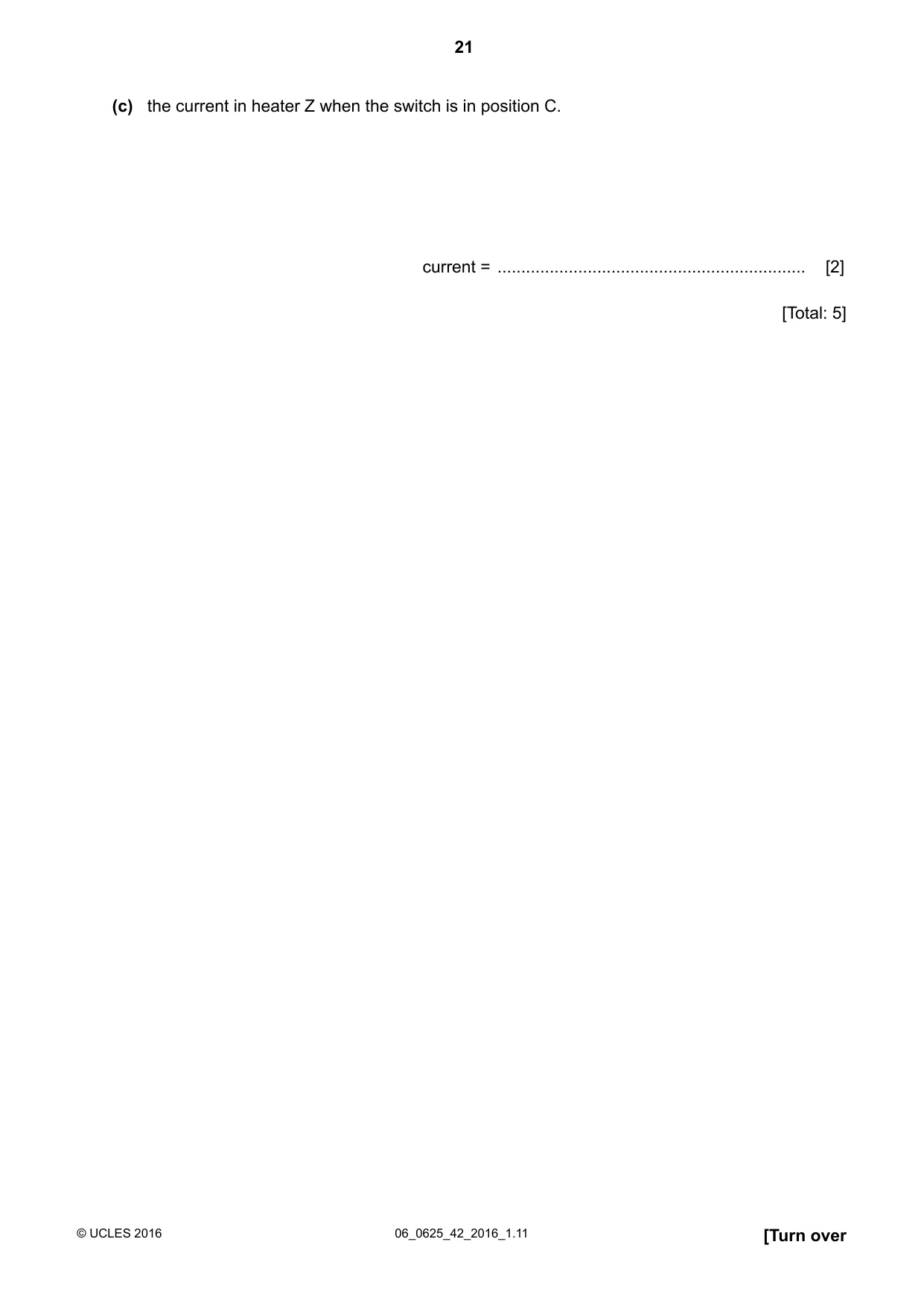
10 Fig. 10.1 shows part of the circuit of a hair-dryer with a 240V a.c. supply. 240 V A X B C Y Z Fig. 10.1 The switch can be in one of three positions: • position A: off (as shown), • position B: low heater power, • position C: high heater power. All three heaters X, Y and Z each have a power of 1000W when used in this hair-dryer. Heaters Y and Z have equal resistances. Calculate (a) the resistance of heater X, resistance = ................................................................. [2] (b) the resistance of heater Y, resistance = ................................................................. [1] (c) the current in heater Z when the switch is in position C. current = ................................................................. [2] [Total: 5]
Mark scheme: 10(a) / P B1 (2402 / 1000 = ) 58 Ω B1 10(b) (1202 / 1000 = ) 14 Ω B1 10(c) P=V I in any form or P / V B1 (2000 / 240 = ) 8.3 A B1 Total: 5
Q11 · Radon-220 is a radioactive isotope
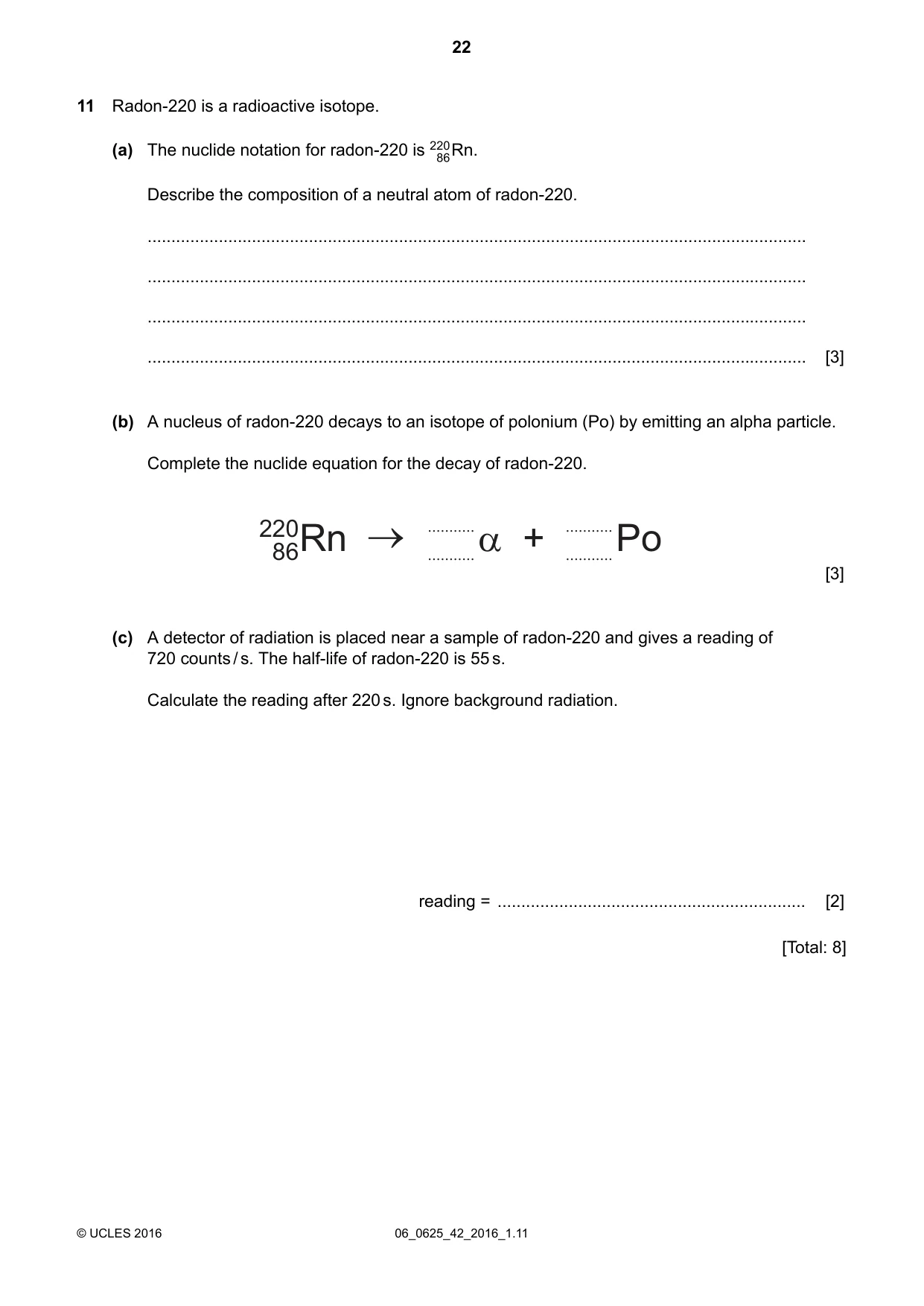
11 Radon-220 is a radioactive isotope. (a) The nuclide notation for radon-220 is Rn. Describe the composition of a neutral atom of radon-220. ........................................................................................................................................... ........................................................................................................................................... ........................................................................................................................................... ........................................................................................................................................... [3] (b) A nucleus of radon-220 decays to an isotope of polonium (Po) by emitting an alpha particle. Complete the nuclide equation for the decay of radon-220. → ........... 220Rn ........... α + ...................... Po 86 [3] (c) A detector of radiation is placed near a sample of radon-220 and gives a reading of 720 counts/s. The half-life of radon-220 is 55s. Calculate the reading after 220s. Ignore background radiation. reading = ................................................................. [2] [Total: 8]
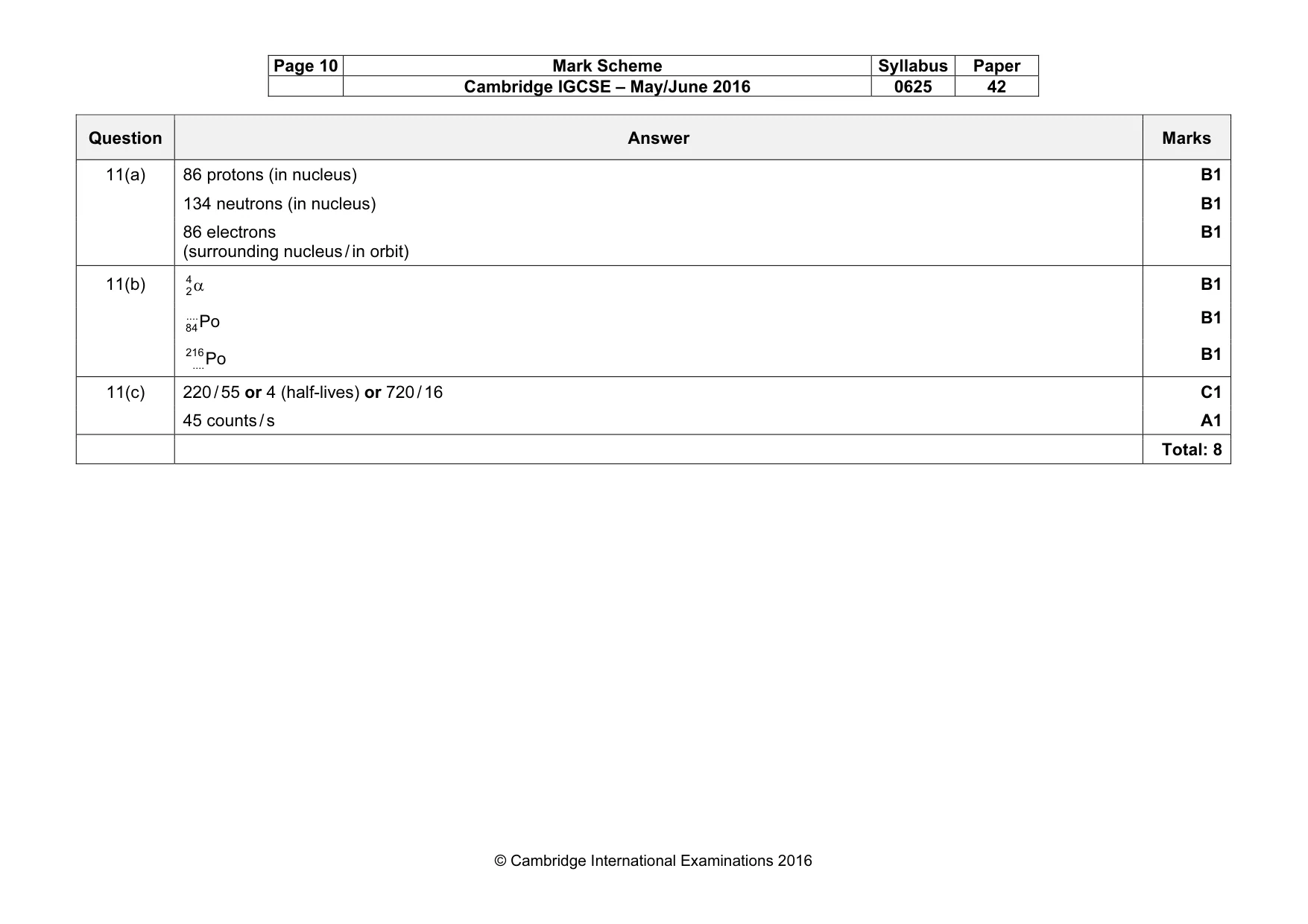
Mark scheme: 11(a) 86 protons (in nucleus) B1 134 neutrons (in nucleus) B1 86 electrons (surrounding nucleus / in orbit) B1 11(b) 4 2α B1 Po .... 84 B1 Po 216 .... B1 11(c) 220 / 55 or 4 (half-lives) or 720 / 16 C1 45 counts / s A1 Total: 8
What was in this paper
The subtopics covered by these 11 questions, and how many questions each got. Open one in a new tab to see every Cambridge question on it.
What you needed in this session
Cambridge’s own grade thresholds for 2016 May/June, Paper 4 · Variant 2. A higher threshold means an easier paper — the bar moves with how the cohort did.