Questions as text
Q1 · The diagram shows a piece of Visking tubing (partially permeable) containing starch… 0654/11 May/June 2009
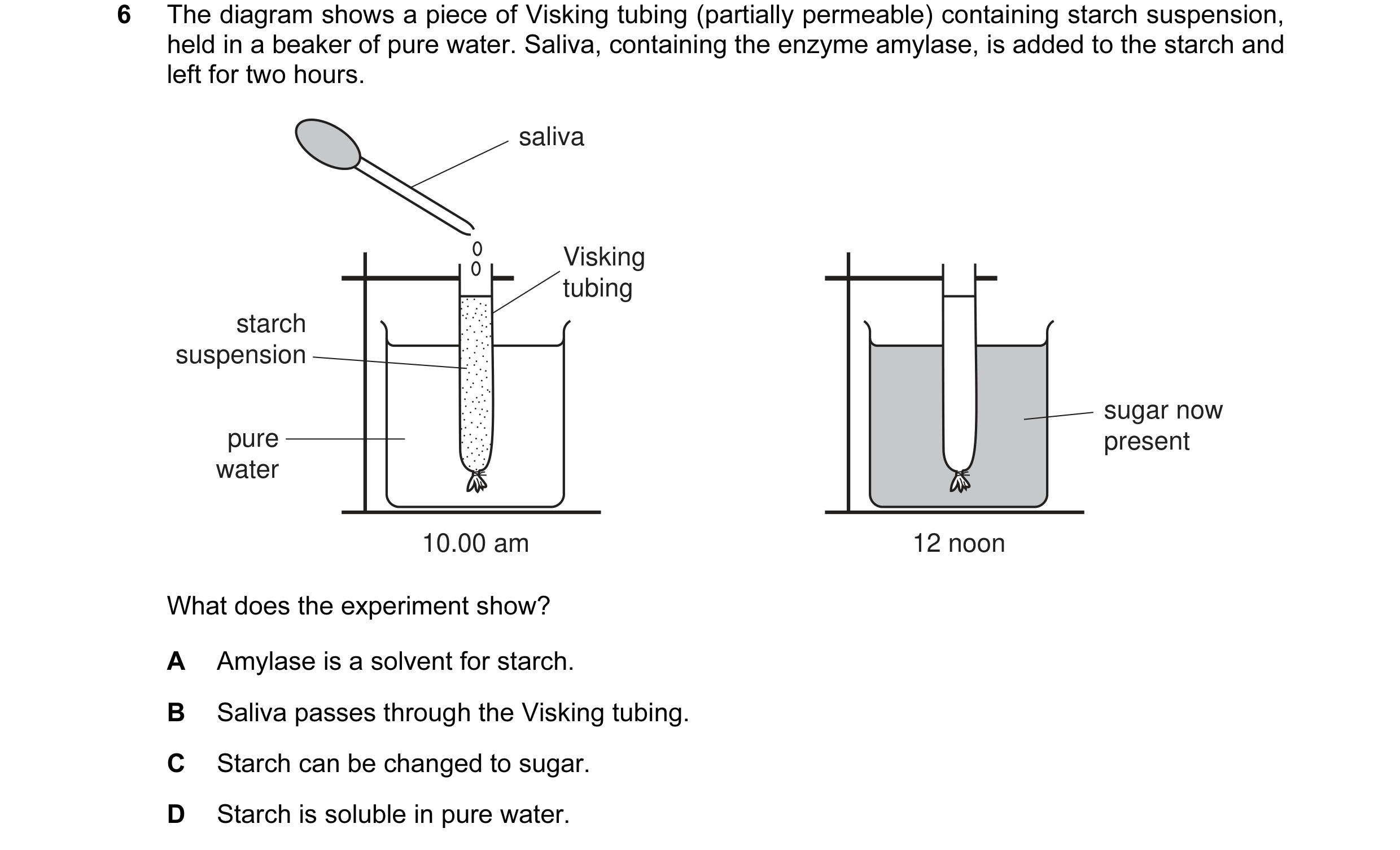
6 The diagram shows a piece of Visking tubing (partially permeable) containing starch suspension, held in a beaker of pure water. Saliva, containing the enzyme amylase, is added to the starch and left for two hours. saliva Visking tubing starch suspension sugar now pure present water 10.00 am 12 noon What does the experiment show? A Amylase is a solvent for starch. B Saliva passes through the Visking tubing. C Starch can be changed to sugar. D Starch is soluble in pure water.
1 marks
Answer: C
This question in 0654/11 May/June 2009
Q2 · The diagram shows some parts of the alimentary canal and its associated organs 0654/12 Oct/Nov 2011
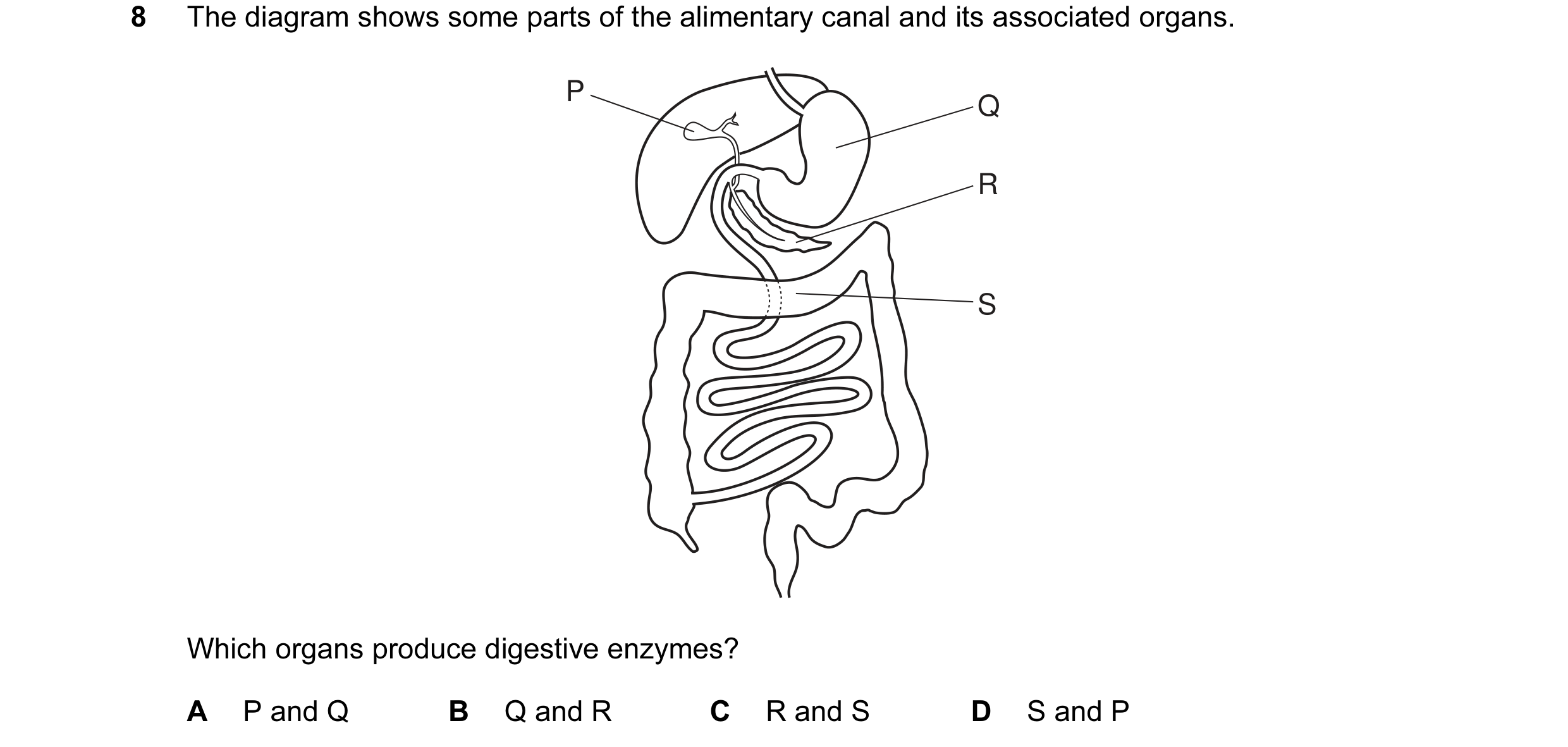
8 The diagram shows some parts of the alimentary canal and its associated organs. P Q R S Which organs produce digestive enzymes? A P and Q B Q and R C R and S D S and P
1 marks
Answer: B
This question in 0654/12 Oct/Nov 2011
Q3 · Substance X does not react with dilute acid 0654/13 Oct/Nov 2013
20 Substance X does not react with dilute acid. Substance Y reacts with dilute acid, forming a gas. The graph shows the results of two experiments. experiment 1 Y + dilute acid experiment 2 X + Y + dilute acid experiment 2 total volume of gaseous product experiment 1 0 time What do these results show? X is a catalyst X is quickly used up A ✓ ✓ key B ✓ ✗ ✓= true C ✗ ✓ ✗= false D ✗ ✗
1 marks
Answer: B
This question in 0654/13 Oct/Nov 2013
Q4 · A species of bacterium lives in acidic, hot springs at a temperature of 90 °C 0654/11 May/June 2014
4 A species of bacterium lives in acidic, hot springs at a temperature of 90 °C. Which conditions will best suit the enzymes of this bacterium? A 30 °C and pH 4 B 30 °C and pH 9 C 80 °C and pH 4 D 80 °C and pH 9
1 marks
Answer: C
This question in 0654/11 May/June 2014
Q5 · A test-tube containing a starch-amylase mixture is incubated at 35 °C 0654/12 May/June 2014
4 A test-tube containing a starch-amylase mixture is incubated at 35 °C. The graph shows how the amount of starch in the test-tube changes over the next five minutes. amount of starch at the start amount of starch remaining 0 1 2 3 4 5 time / minutes Which graph shows what happens if a similar starch-amylase mixture is incubated at 100 °C? A B amount amount of starch of starch remaining remaining 0 1 2 3 4 5 0 1 2 3 4 5 time / minutes time / minutes C D amount amount of starch of starch remaining remaining 0 1 2 3 4 5 0 1 2 3 4 5 time / minutes time / minutes
1 marks
Answer: B
This question in 0654/12 May/June 2014
Q6 · A species of bacterium lives in acidic, hot springs at a temperature of 90 °C 0654/13 May/June 2014
3 A species of bacterium lives in acidic, hot springs at a temperature of 90 °C. Which conditions will best suit the enzymes of this bacterium? A 30 °C and pH 4 B 30 °C and pH 9 C 80 °C and pH 4 D 80 °C and pH 9
1 marks
Answer: C
This question in 0654/13 May/June 2014
Q7 · The diagram shows part of the digestive system 0654/11 Oct/Nov 2014
3 The diagram shows part of the digestive system. Where is lipase produced? C D B A
1 marks
Answer: A
This question in 0654/11 Oct/Nov 2014
Q8 · Four statements about enzymes in the human body are listed 0654/13 Oct/Nov 2014
3 Four statements about enzymes in the human body are listed. 1 They are all proteins. 2 They catalyse reactions in the body. 3 They stop working at temperatures over 75 °C. 4 They work faster at 30 °C than at 10 °C. Which statements are correct? A 1, 2, 3 and 4 B 1 and 3 only C 2 and 3 only D 2 and 4 only
1 marks
Answer: A
This question in 0654/13 Oct/Nov 2014
Q9 · What is an enzyme? 0654/11 May/June 2015
4 What is an enzyme? A a carbohydrate that assists in the digestion of the contents of the stomach B a chemical that absorbs light for photosynthesis C a chemical that alters the activity of a target organ D a protein that alters the rate of a chemical reaction
1 marks
Answer: D
This question in 0654/11 May/June 2015
Q10 · Which graph shows the effect of temperature on the rate of enzyme activity for a human… 0654/12 May/June 2015
3 Which graph shows the effect of temperature on the rate of enzyme activity for a human enzyme? A B rate of rate of enzyme enzyme activity activity 0 10 20 30 40 50 60 0 10 20 30 40 50 60 temperature / °C temperature / °C C D rate of rate of enzyme enzyme activity activity 0 10 20 30 40 50 60 0 10 20 30 40 50 60 temperature / °C temperature / °C
1 marks
Answer: B
This question in 0654/12 May/June 2015
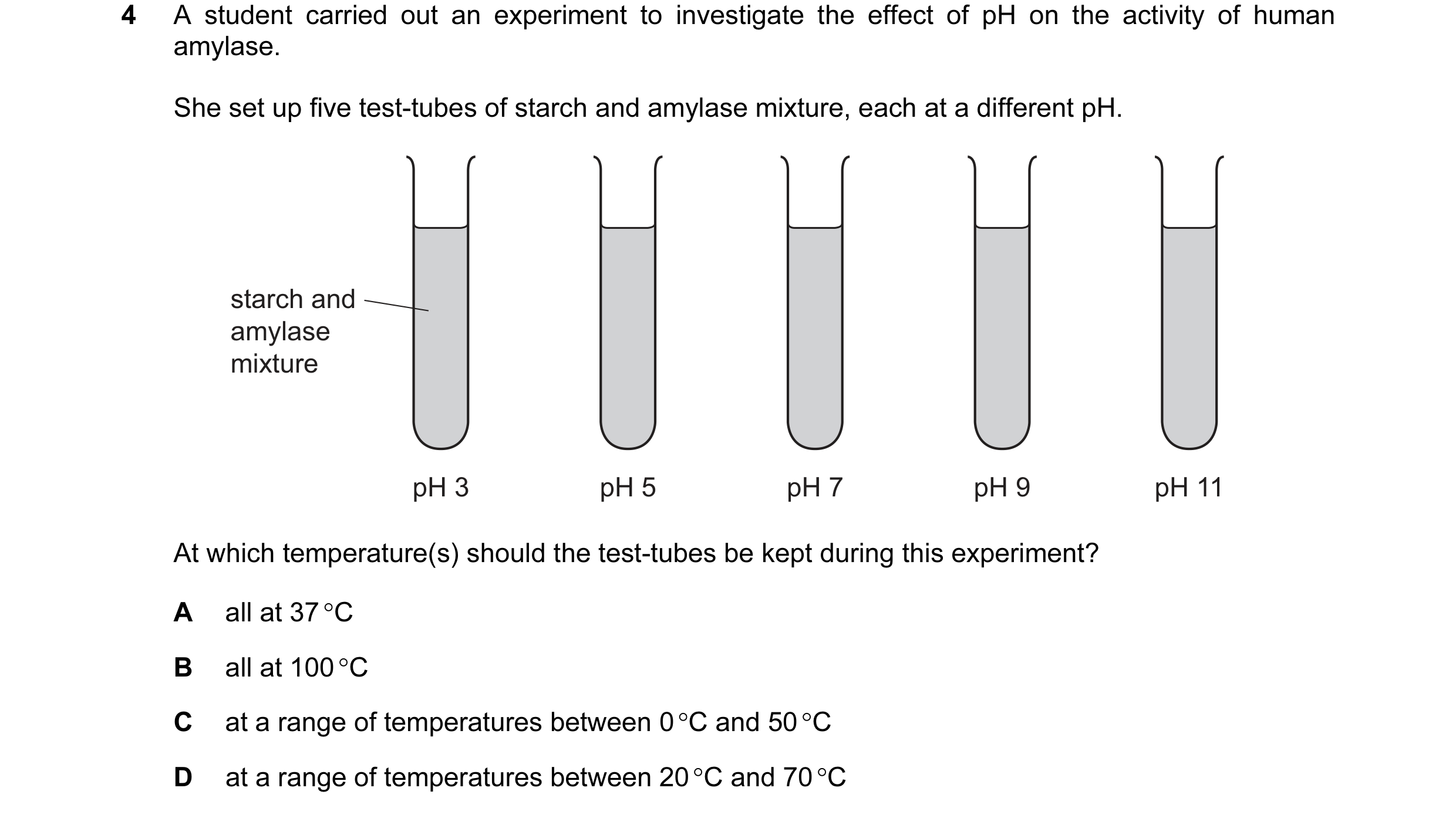
Q11 · A student carried out an experiment to investigate the effect of pH on the activity of… 0654/13 May/June 2015
4 A student carried out an experiment to investigate the effect of pH on the activity of human amylase. She set up five test-tubes of starch and amylase mixture, each at a different pH. starch and amylase mixture pH 3 pH 5 pH 7 pH 9 pH 11 At which temperature(s) should the test-tubes be kept during this experiment? A all at 37 °C B all at 100 °C C at a range of temperatures between 0 °C and 50 °C D at a range of temperatures between 20 °C and 70 °C
1 marks
Answer: A
This question in 0654/13 May/June 2015
Q12 · What would be capable of digesting an enzyme? 0654/11 Oct/Nov 2015
4 What would be capable of digesting an enzyme? A amylase B bile C lipase D protease
1 marks
Answer: D
This question in 0654/11 Oct/Nov 2015
Q13 · Eight test-tubes each containing a starch-saliva mixture are set up at four different… 0654/12 Oct/Nov 2015
4 Eight test-tubes each containing a starch-saliva mixture are set up at four different temperatures. 0 °C 15 °C 35 °C 95 °C For each temperature, one test-tube is tested with iodine solution after 15 minutes, and the other after 30 minutes. The results are shown in the table. temperature colour with iodine solution / °C 15 minutes 30 minutes 0 blue-black blue-black 15 blue-black brown 35 brown brown 95 blue-black blue-black What do the results suggest? A The enzyme in saliva is inactive at 95 °C. B The enzyme in saliva is slow to work at 35 °C. C The enzyme in saliva works equally well at 15 °C and 35 °C. D The enzyme in saliva works faster at higher temperatures.
1 marks
Answer: A
This question in 0654/12 Oct/Nov 2015
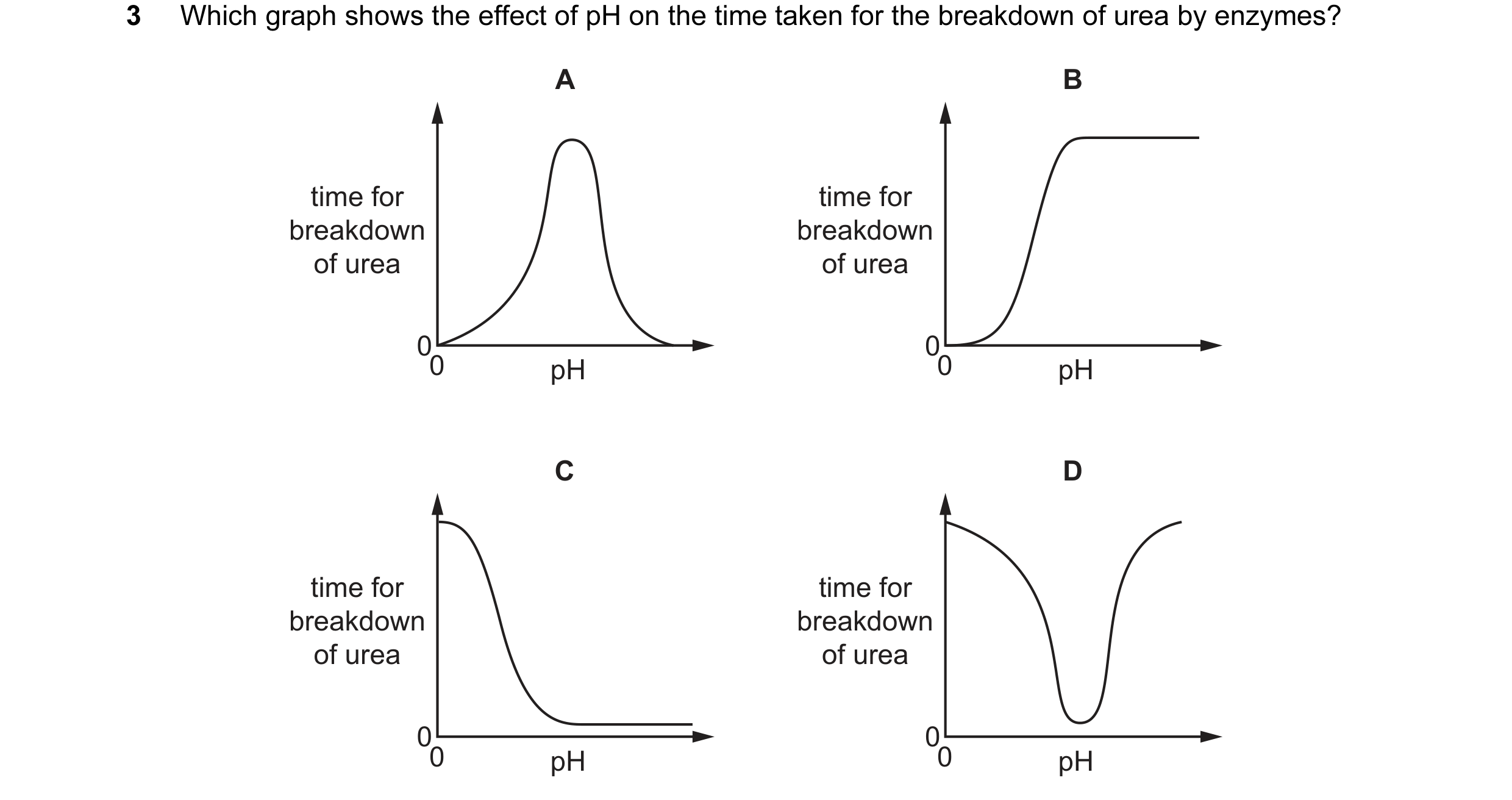
Q14 · Which graph shows the effect of pH on the time taken for the breakdown of urea by enzymes? 0654/13 Oct/Nov 2015
3 Which graph shows the effect of pH on the time taken for the breakdown of urea by enzymes? A B time for time for breakdown breakdown of urea of urea 00 00 pH pH C D time for time for breakdown breakdown of urea of urea 00 00 pH pH
1 marks
Answer: D
This question in 0654/13 Oct/Nov 2015
Q15 · Which is an enzyme involved in the digestion of proteins in the stomach? 0654/11 May/June 2016
2 Which is an enzyme involved in the digestion of proteins in the stomach? A amylase B bile C lipase D protease
1 marks
Answer: D
This question in 0654/11 May/June 2016
Q16 · One method of preventing food spoilage is to store it at 4 °C in a refrigerator 0654/12 May/June 2016
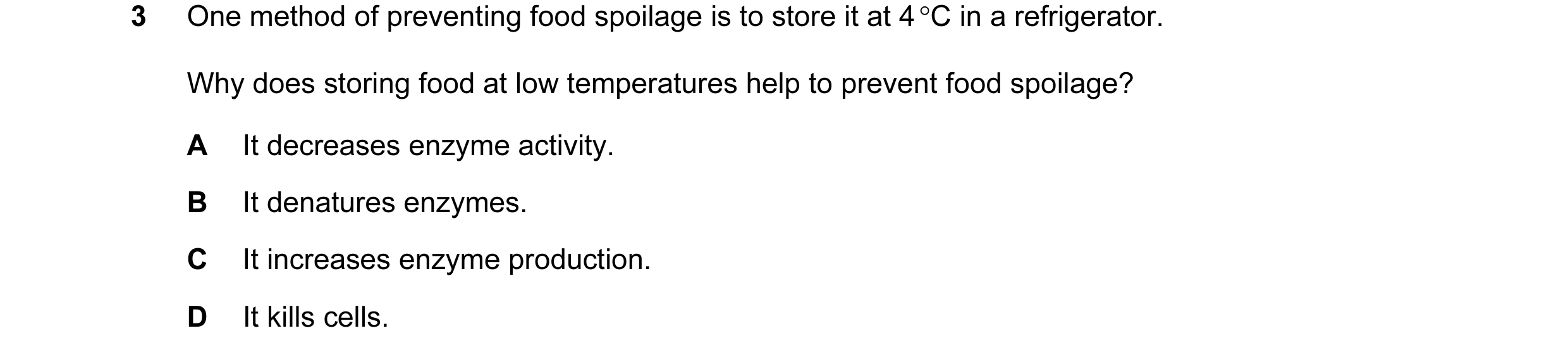
3 One method of preventing food spoilage is to store it at 4 °C in a refrigerator. Why does storing food at low temperatures help to prevent food spoilage? A It decreases enzyme activity. B It denatures enzymes. C It increases enzyme production. D It kills cells.
1 marks
Answer: A
This question in 0654/12 May/June 2016
Q17 · Which statement about all enzymes is correct? 0654/13 May/June 2016
3 Which statement about all enzymes is correct? A They are used up in the reaction they catalyse. B They speed up reactions. C They work best above 40 °C. D They work best at a pH of 7.0.
1 marks
Answer: B
This question in 0654/13 May/June 2016
Q18 · Which statement about enzymes is correct? 0654/11 Oct/Nov 2016
2 Which statement about enzymes is correct? A Amylase breaks down fats into fatty acids and glycerol. B Amylase breaks down proteins into amino acids. C Lipase breaks down fats into fatty acids and glycerol. D Lipase breaks down proteins into amino acids.
1 marks
Answer: C
This question in 0654/11 Oct/Nov 2016
Q19 · In some animals, their internal temperature varies with that of their surroundings 0654/12 Oct/Nov 2016
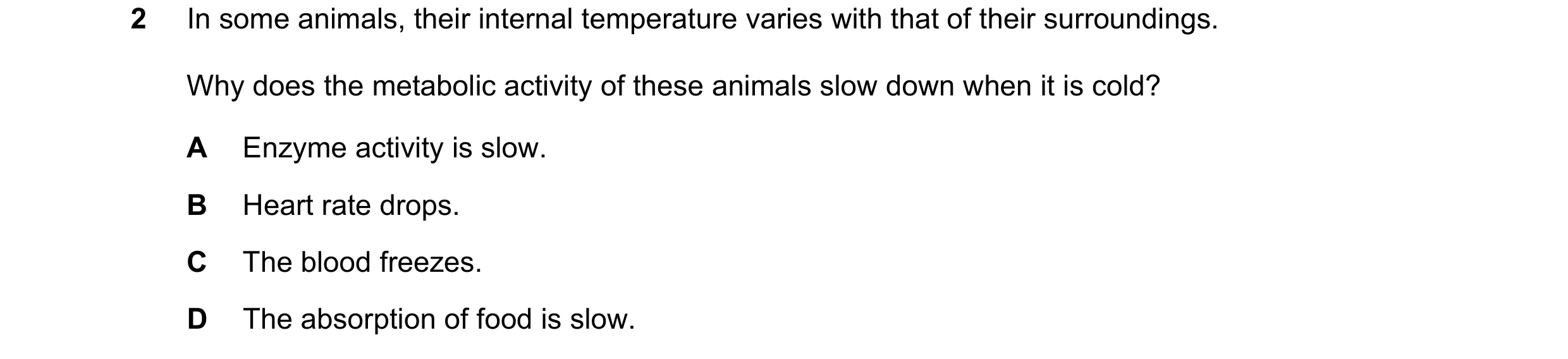
2 In some animals, their internal temperature varies with that of their surroundings. Why does the metabolic activity of these animals slow down when it is cold? A Enzyme activity is slow. B Heart rate drops. C The blood freezes. D The absorption of food is slow.
1 marks
Answer: A
This question in 0654/12 Oct/Nov 2016
Q20 · The diagram shows how the rate of an enzyme-controlled reaction is affected by pH 0654/13 Oct/Nov 2016
2 The diagram shows how the rate of an enzyme-controlled reaction is affected by pH. rate 6 7 8 9 pH What is the optimum pH for this enzyme-controlled reaction? A 6 B 6.5 C 7.5 D 9
1 marks
Answer: C
This question in 0654/13 Oct/Nov 2016
Q21 · Catalase is an enzyme that breaks down hydrogen peroxide to water and oxygen 0654/11 May/June 2017
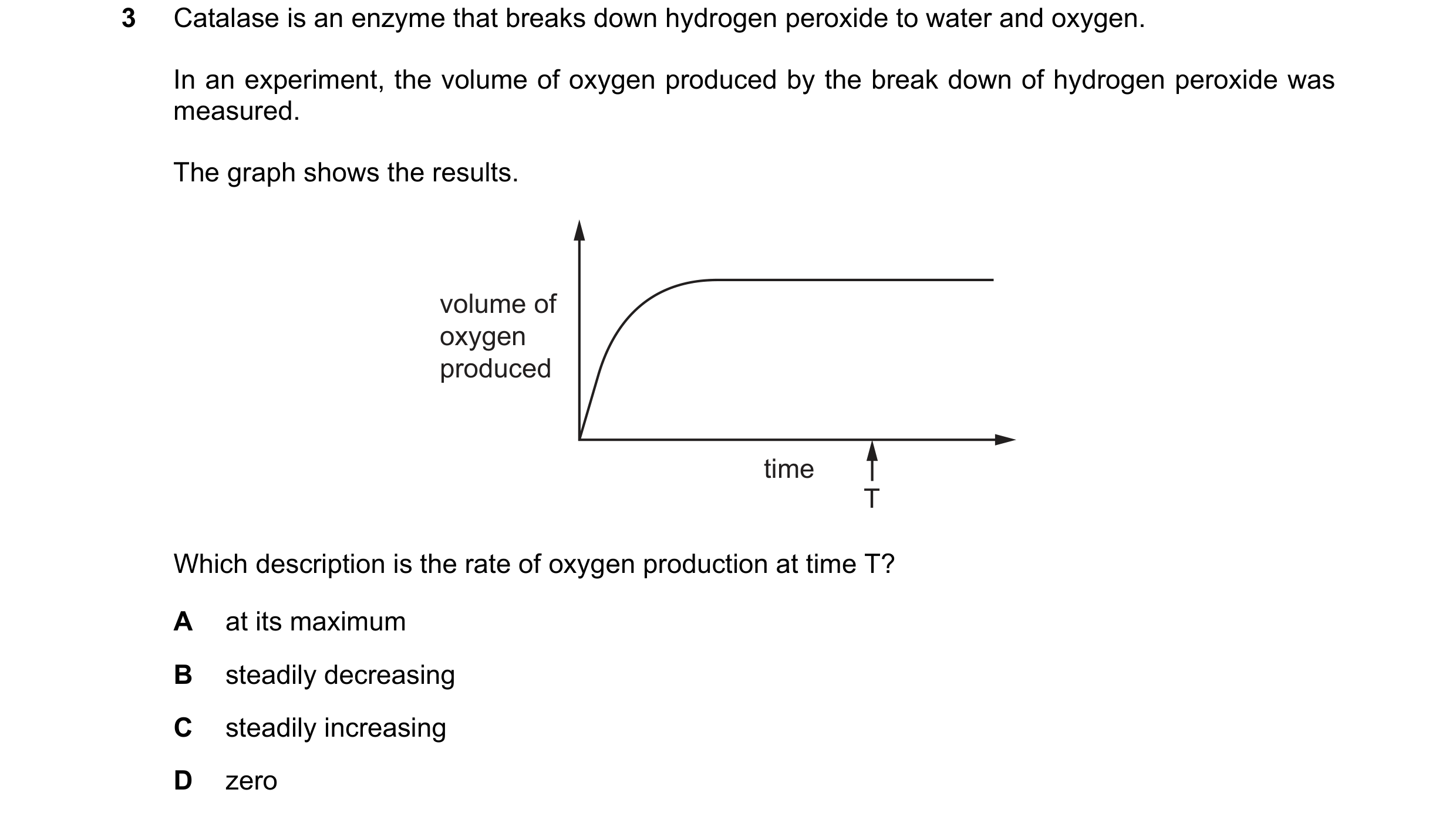
3 Catalase is an enzyme that breaks down hydrogen peroxide to water and oxygen. In an experiment, the volume of oxygen produced by the break down of hydrogen peroxide was measured. The graph shows the results. volume of oxygen produced time T Which description is the rate of oxygen production at time T? A at its maximum B steadily decreasing C steadily increasing D zero
1 marks
Answer: D
This question in 0654/11 May/June 2017
Q22 · Enzymes are biological catalysts 0654/12 May/June 2017
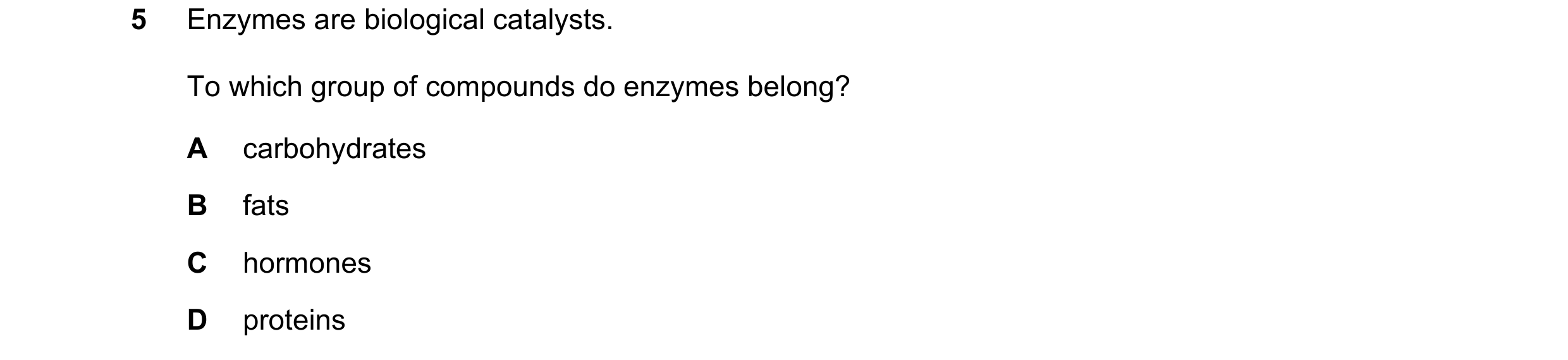
5 Enzymes are biological catalysts. To which group of compounds do enzymes belong? A carbohydrates B fats C hormones D proteins
1 marks
Answer: D
This question in 0654/12 May/June 2017
Q23 · An enzyme from the alimentary canal has an optimum activity at an acidic pH 0654/13 May/June 2017
3 An enzyme from the alimentary canal has an optimum activity at an acidic pH. Which statement is correct? A The enzyme is an amylase and is found in the mouth. B The enzyme is a protease and is found in the mouth. C The enzyme is an amylase and is found in the stomach. D The enzyme is a protease and is found in the stomach.
1 marks
Answer: D
This question in 0654/13 May/June 2017
Q24 · The graph shows the effect of temperature on the activity of a mammalian enzyme 0654/11 Oct/Nov 2017
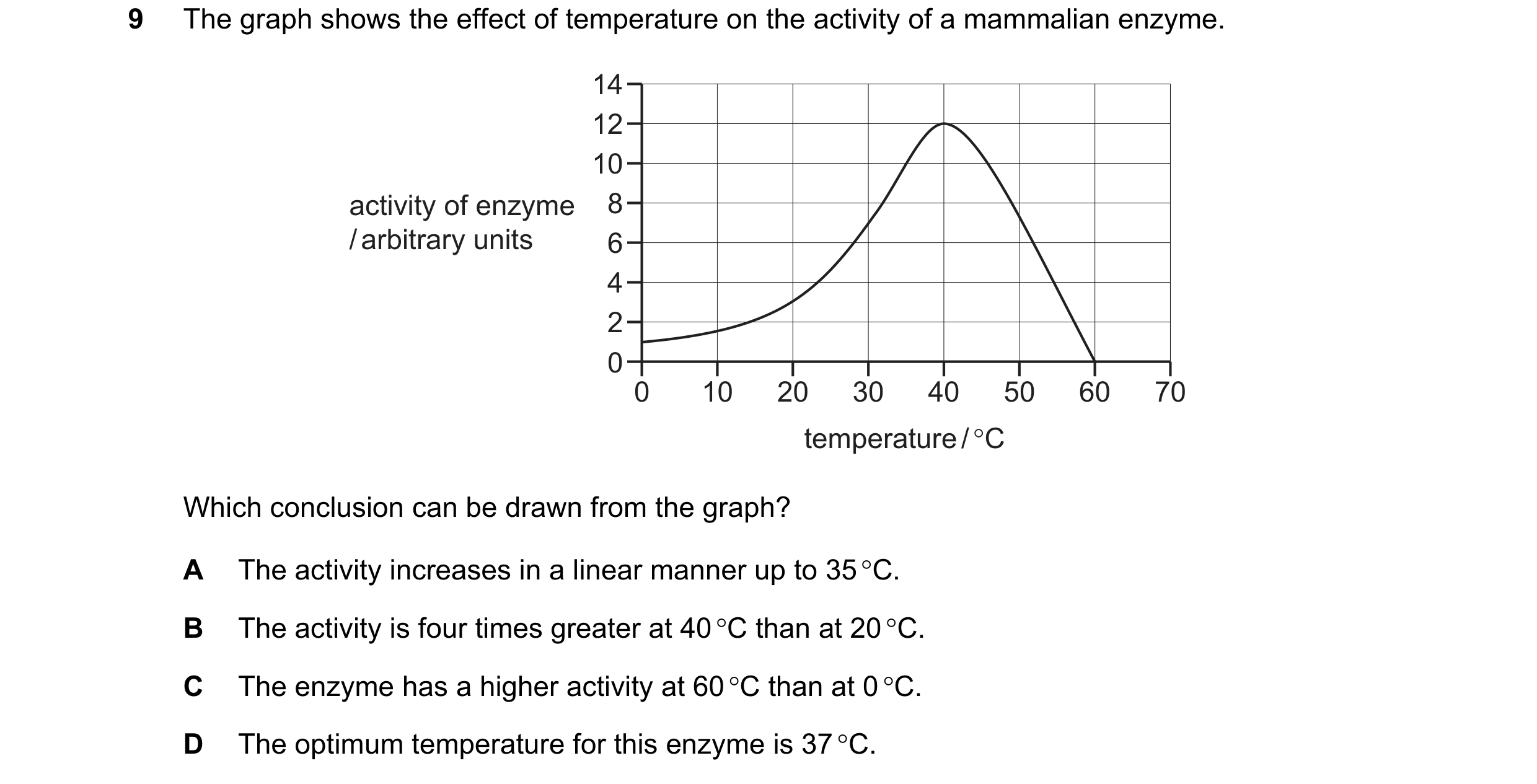
9 The graph shows the effect of temperature on the activity of a mammalian enzyme. 14 12 10 activity of enzyme 8 / arbitrary units 6 4 2 0 0 10 20 30 40 50 60 70 temperature / °C Which conclusion can be drawn from the graph? A The activity increases in a linear manner up to 35 °C. B The activity is four times greater at 40 °C than at 20 °C. C The enzyme has a higher activity at 60 °C than at 0 °C. D The optimum temperature for this enzyme is 37 °C.
1 marks
Answer: B
This question in 0654/11 Oct/Nov 2017
Q25 · Four test-tubes contain the same volume of starch suspension but each test-tube is kept… 0654/12 Oct/Nov 2017
2 Four test-tubes contain the same volume of starch suspension but each test-tube is kept at a different temperature, as shown. 2 °C 10 °C 30 °C 60 °C An equal quantity of enzyme is added to each test-tube and, after ten minutes, iodine solution is added to each test-tube. The results are shown below. 2 °C 10 °C 30 °C 60 °C What do the results show? A At 2 °C the enzyme works slowly. B At 10 °C the enzyme does not work. C At 30 °C the enzyme works well. D At 60 °C the enzyme works best.
1 marks
Answer: C
This question in 0654/12 Oct/Nov 2017
Q26 · What type of substances are enzymes? 0654/13 Oct/Nov 2017
1 What type of substances are enzymes? A carbohydrates B fats C lipids D proteins
1 marks
Answer: D
This question in 0654/13 Oct/Nov 2017
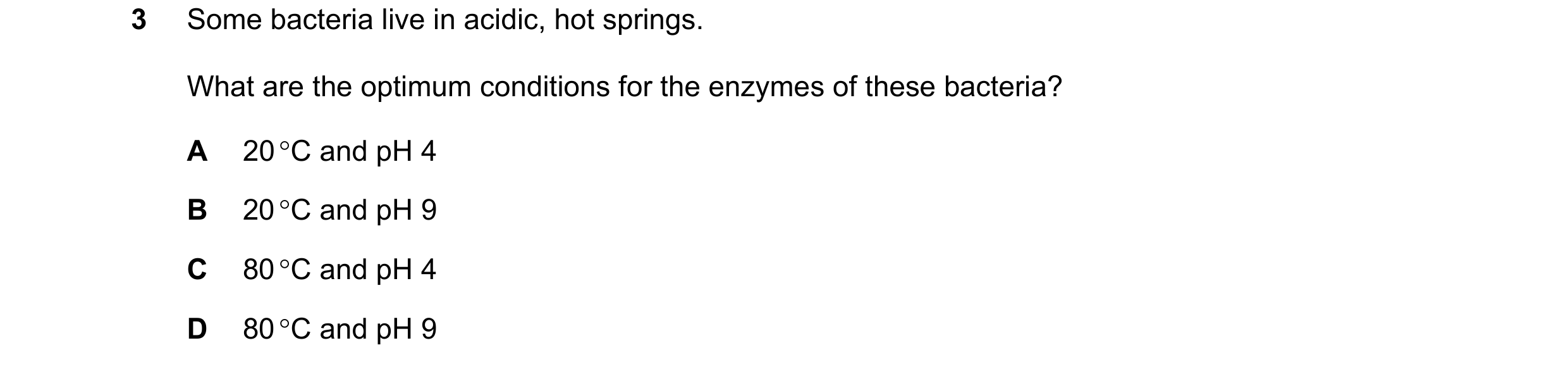
Q27 · Some bacteria live in acidic, hot springs 0654/11 Oct/Nov 2018
3 Some bacteria live in acidic, hot springs. What are the optimum conditions for the enzymes of these bacteria? A 20 °C and pH 4 B 20 °C and pH 9 C 80 °C and pH 4 D 80 °C and pH 9
1 marks
Answer: C
This question in 0654/11 Oct/Nov 2018
Q28 · Some bacteria live in acidic, hot springs 0654/12 Oct/Nov 2018
2 Some bacteria live in acidic, hot springs. What are the optimum conditions for the enzymes of these bacteria? A 20 °C and pH 4 B 20 °C and pH 9 C 80 °C and pH 4 D 80 °C and pH 9
1 marks
Answer: C
This question in 0654/12 Oct/Nov 2018
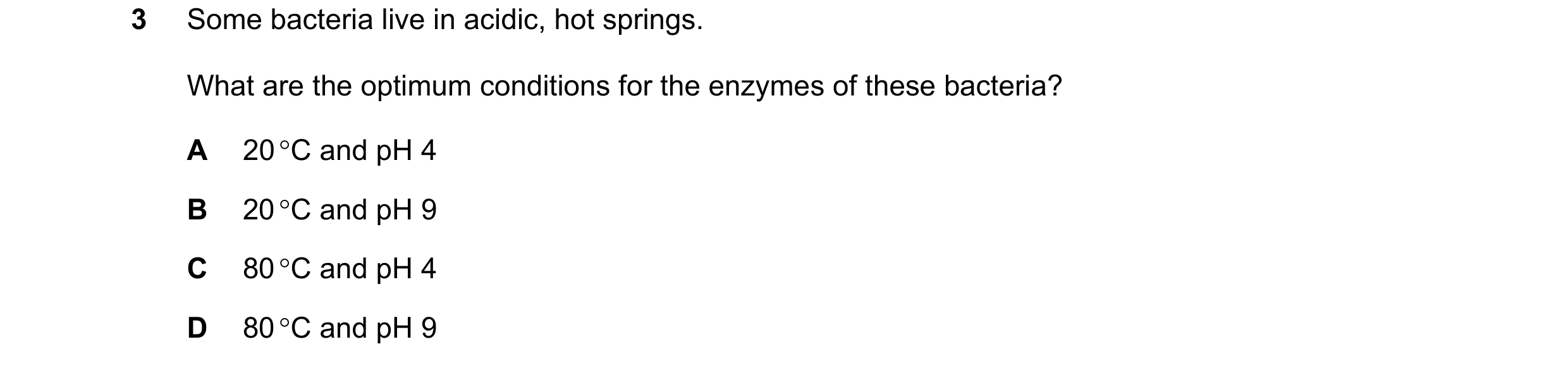
Q29 · Some bacteria live in acidic, hot springs 0654/13 Oct/Nov 2018
3 Some bacteria live in acidic, hot springs. What are the optimum conditions for the enzymes of these bacteria? A 20 °C and pH 4 B 20 °C and pH 9 C 80 °C and pH 4 D 80 °C and pH 9
1 marks
Answer: C
This question in 0654/13 Oct/Nov 2018
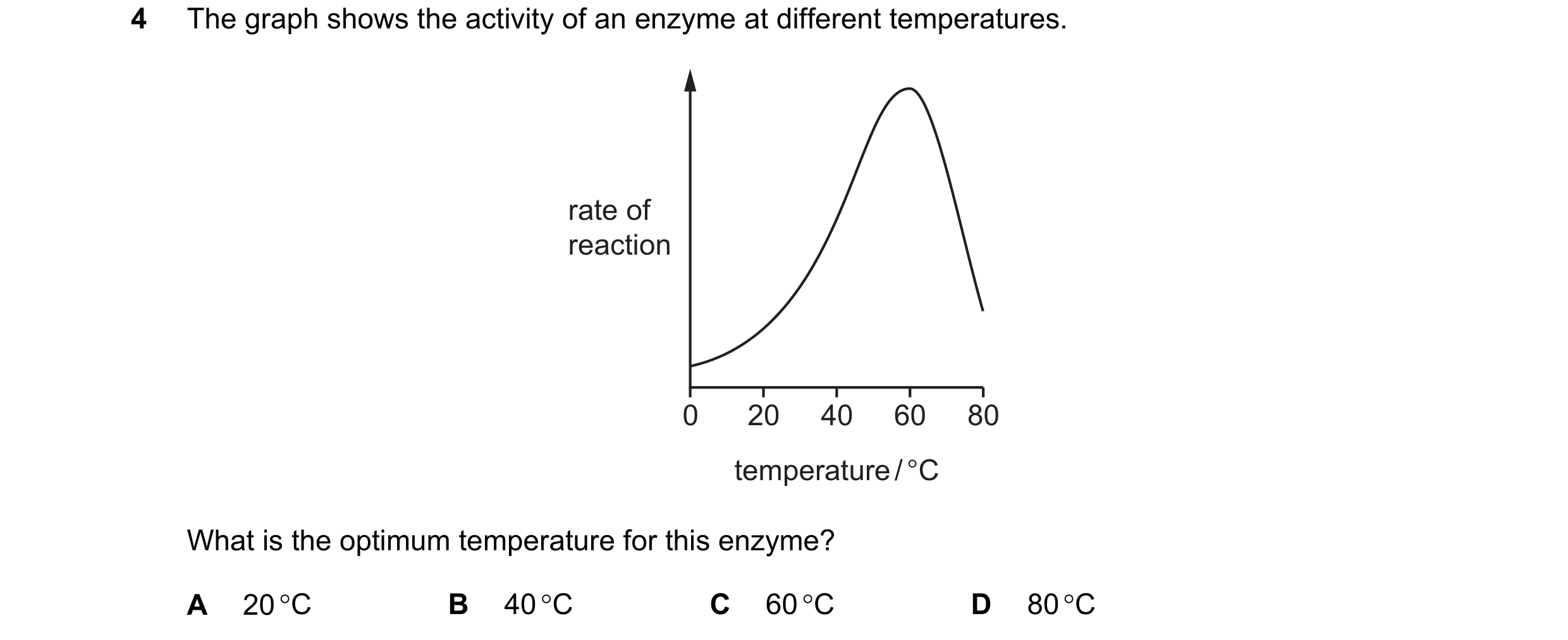
Q30 · The graph shows the activity of an enzyme at different temperatures 0654/11 May/June 2019
4 The graph shows the activity of an enzyme at different temperatures. rate of reaction 0 20 40 60 80 temperature / °C What is the optimum temperature for this enzyme? A 20 °C B 40 °C C 60 °C D 80 °C
1 marks
Answer: C
This question in 0654/11 May/June 2019
Q31 · The graphs show the possible effects of temperature on the rate of reaction of an enzyme 0654/12 May/June 2019
4 The graphs show the possible effects of temperature on the rate of reaction of an enzyme. Which graph is correct for a human enzyme? A B rate of rate of reaction reaction 0 30 60 0 30 60 temperature / °C temperature / °C C D rate of rate of reaction reaction 0 30 60 0 30 60 temperature / °C temperature / °C
1 marks
Answer: A
This question in 0654/12 May/June 2019
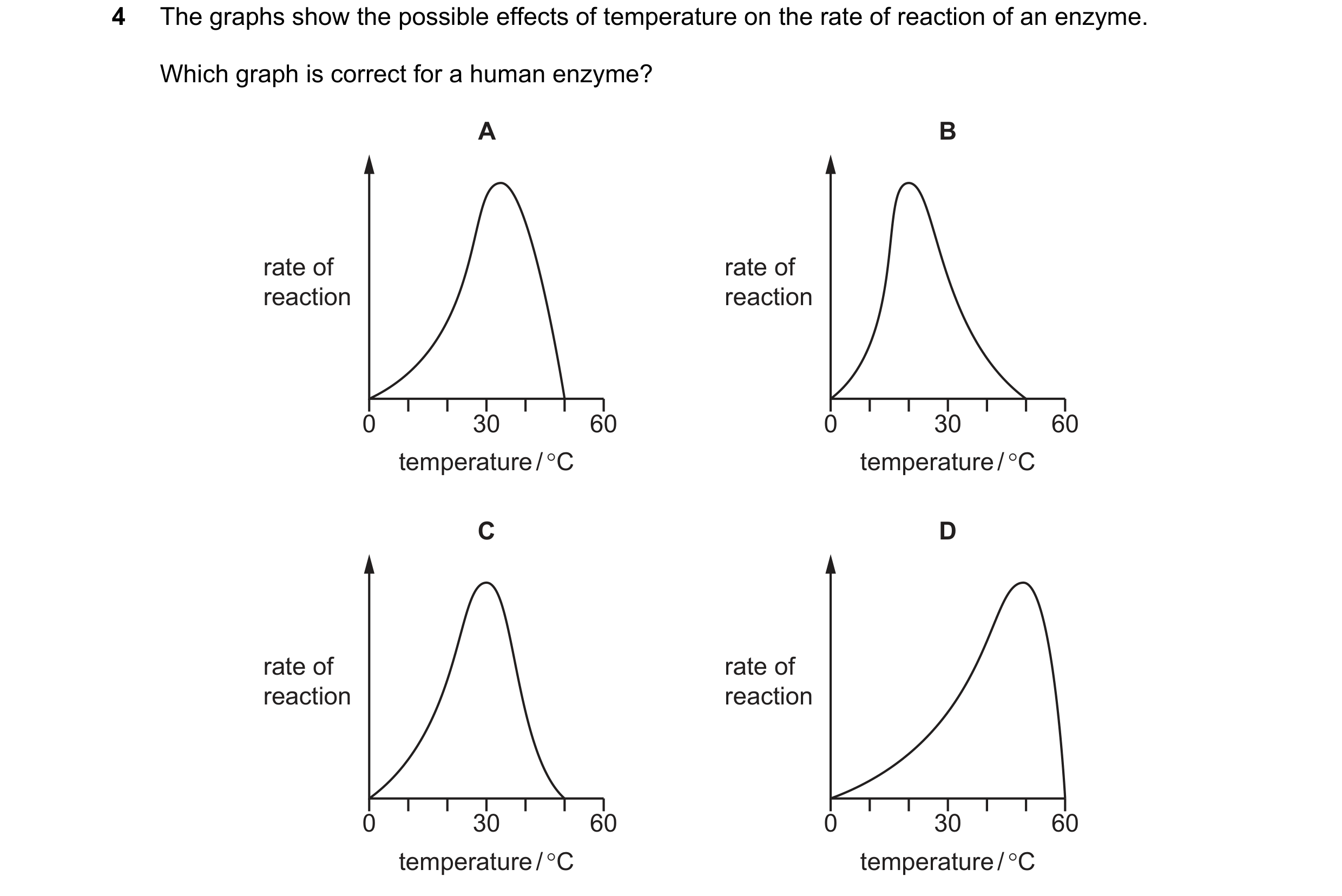
Q32 · The graphs show the possible effects of temperature on the rate of reaction of an enzyme 0654/13 May/June 2019
4 The graphs show the possible effects of temperature on the rate of reaction of an enzyme. Which graph is correct for a human enzyme? A B rate of rate of reaction reaction 0 30 60 0 30 60 temperature / °C temperature / °C C D rate of rate of reaction reaction 0 30 60 0 30 60 temperature / °C temperature / °C
1 marks
Answer: A
This question in 0654/13 May/June 2019
Q33 · Which statements are correct for all enzymes? 0654/11 Oct/Nov 2019
4 Which statements are correct for all enzymes? 1 They are proteins. 2 They are unaffected by temperature. 3 They speed up chemical reactions. 4 They work best at a high pH. A 1, 2 and 4 B 1, 3 and 4 C 1 and 3 only D 2 and 4 only
1 marks
Answer: C
This question in 0654/11 Oct/Nov 2019
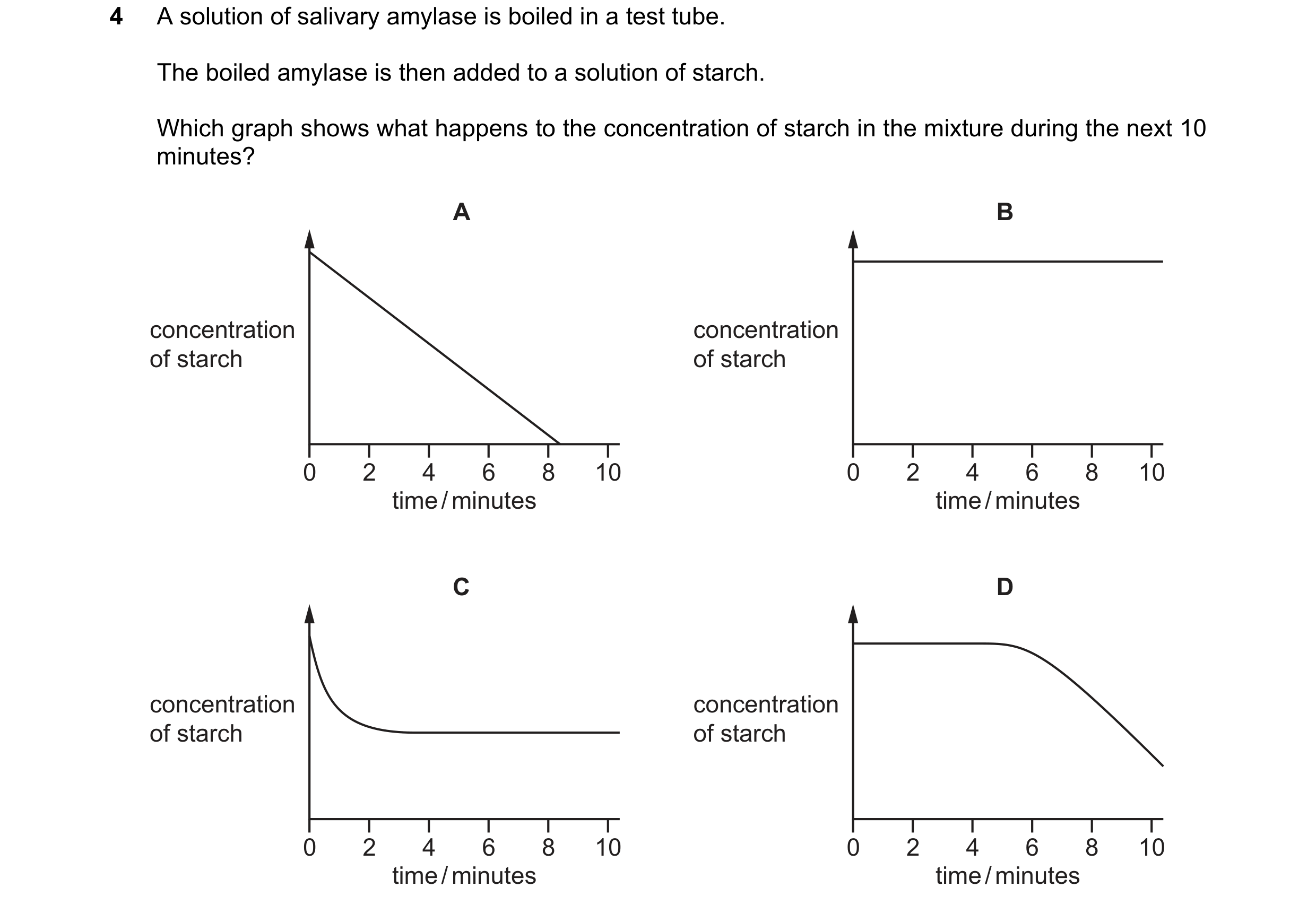
Q34 · A solution of salivary amylase is boiled in a test tube 0654/12 Oct/Nov 2019
4 A solution of salivary amylase is boiled in a test tube. The boiled amylase is then added to a solution of starch. Which graph shows what happens to the concentration of starch in the mixture during the next 10 minutes? A B concentration concentration of starch of starch 0 2 4 6 8 10 0 2 4 6 8 10 time / minutes time / minutes C D concentration concentration of starch of starch 0 2 4 6 8 10 0 2 4 6 8 10 time / minutes time / minutes
1 marks
Answer: B
This question in 0654/12 Oct/Nov 2019
Q35 · Which graph shows how enzyme activity is affected by temperature? 0654/13 Oct/Nov 2019
4 Which graph shows how enzyme activity is affected by temperature? A B enzyme enzyme activity activity temperature / °C temperature / °C C D enzyme enzyme activity activity temperature / °C temperature / °C
1 marks
Answer: D
This question in 0654/13 Oct/Nov 2019
Q36 · Which graph shows the effect of temperature on the activity of a mammalian enzyme? 0654/11 May/June 2020
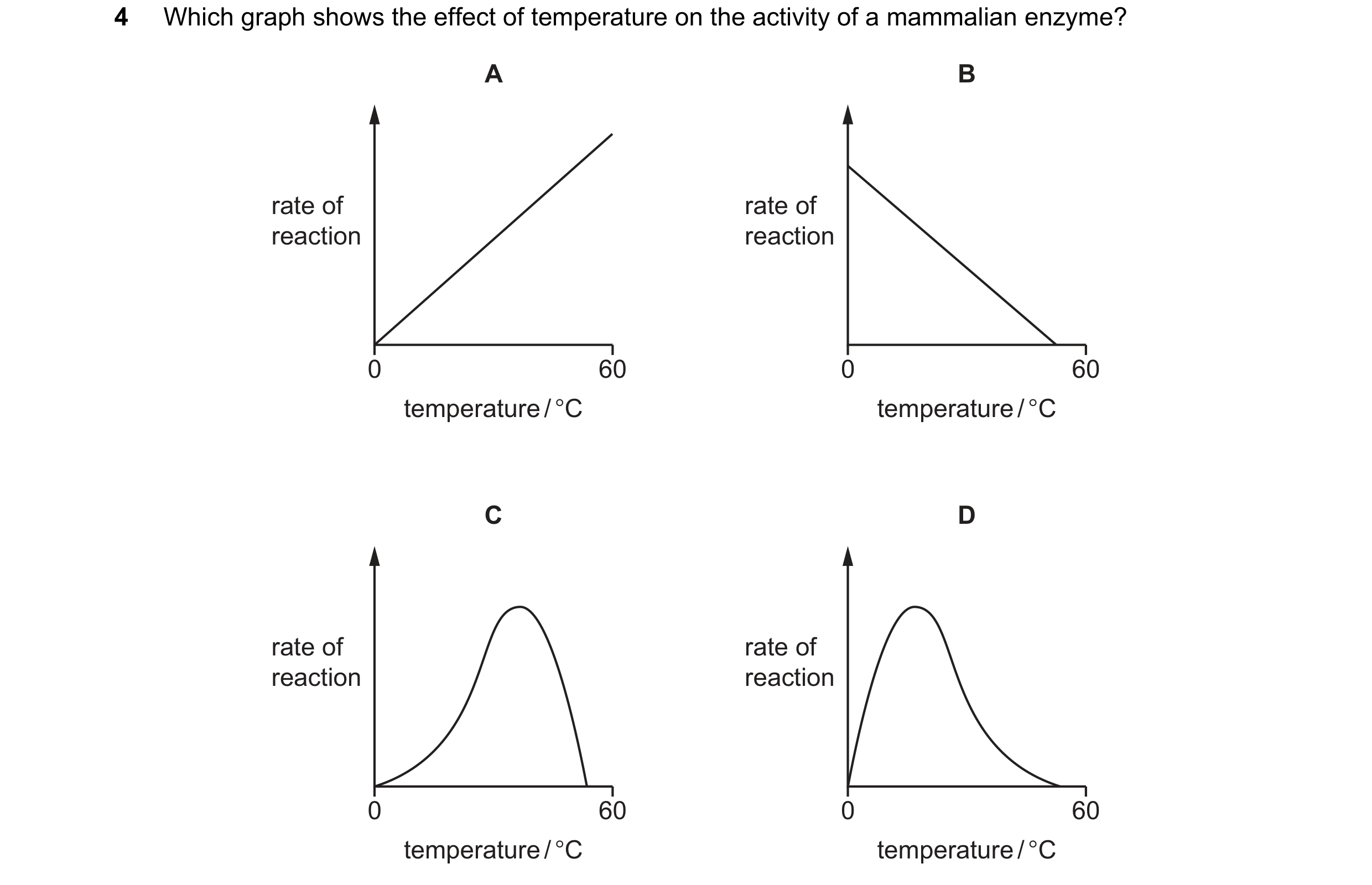
4 Which graph shows the effect of temperature on the activity of a mammalian enzyme? A B rate of rate of reaction reaction 0 60 0 60 temperature / °C temperature / °C C D rate of rate of reaction reaction 0 60 0 60 temperature / °C temperature / °C
1 marks
Answer: C
This question in 0654/11 May/June 2020
Q37 · Which smaller molecules make up enzymes? 0654/12 May/June 2020
4 Which smaller molecules make up enzymes? A amino acids B fatty acids C glucose D glycerol
1 marks
Answer: A
This question in 0654/12 May/June 2020
Q38 · Which type of molecule is an enzyme? 0654/13 May/June 2020
4 Which type of molecule is an enzyme? A carbohydrate B fat C protein D vitamin
1 marks
Answer: C
This question in 0654/13 May/June 2020
Q39 · A mixture of starch and saliva was set up at four different temperatures 0654/11 Oct/Nov 2020
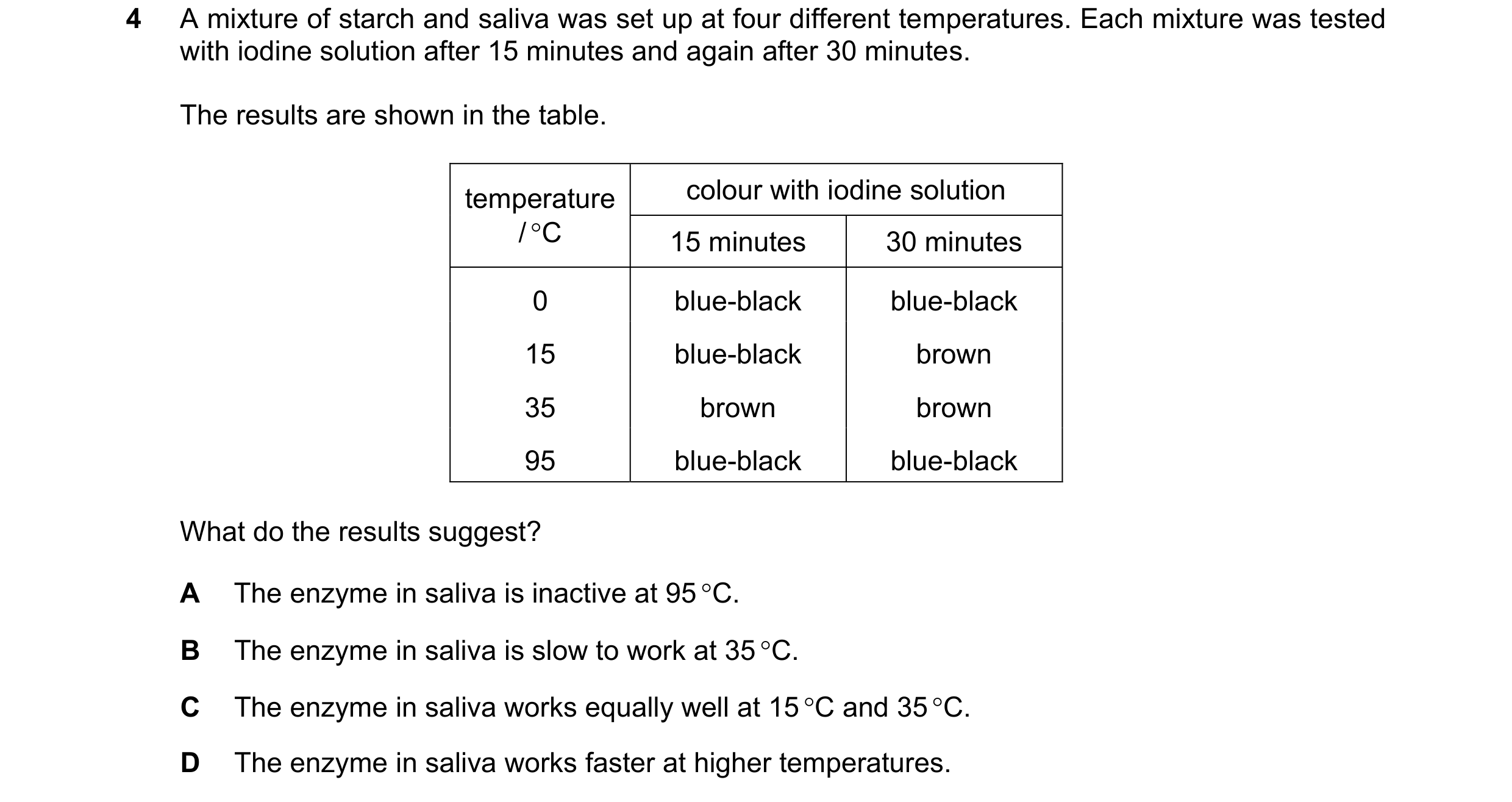
4 A mixture of starch and saliva was set up at four different temperatures. Each mixture was tested with iodine solution after 15 minutes and again after 30 minutes. The results are shown in the table. temperature colour with iodine solution / C 15 minutes 30 minutes 0 blue-black blue-black 15 blue-black brown 35 brown brown 95 blue-black blue-black What do the results suggest? A The enzyme in saliva is inactive at 95 C. B The enzyme in saliva is slow to work at 35 C. C The enzyme in saliva works equally well at 15 C and 35 C. D The enzyme in saliva works faster at higher temperatures.
1 marks
Answer: A
This question in 0654/11 Oct/Nov 2020
Q40 · A mixture of starch and saliva was set up at four different temperatures 0654/12 Oct/Nov 2020
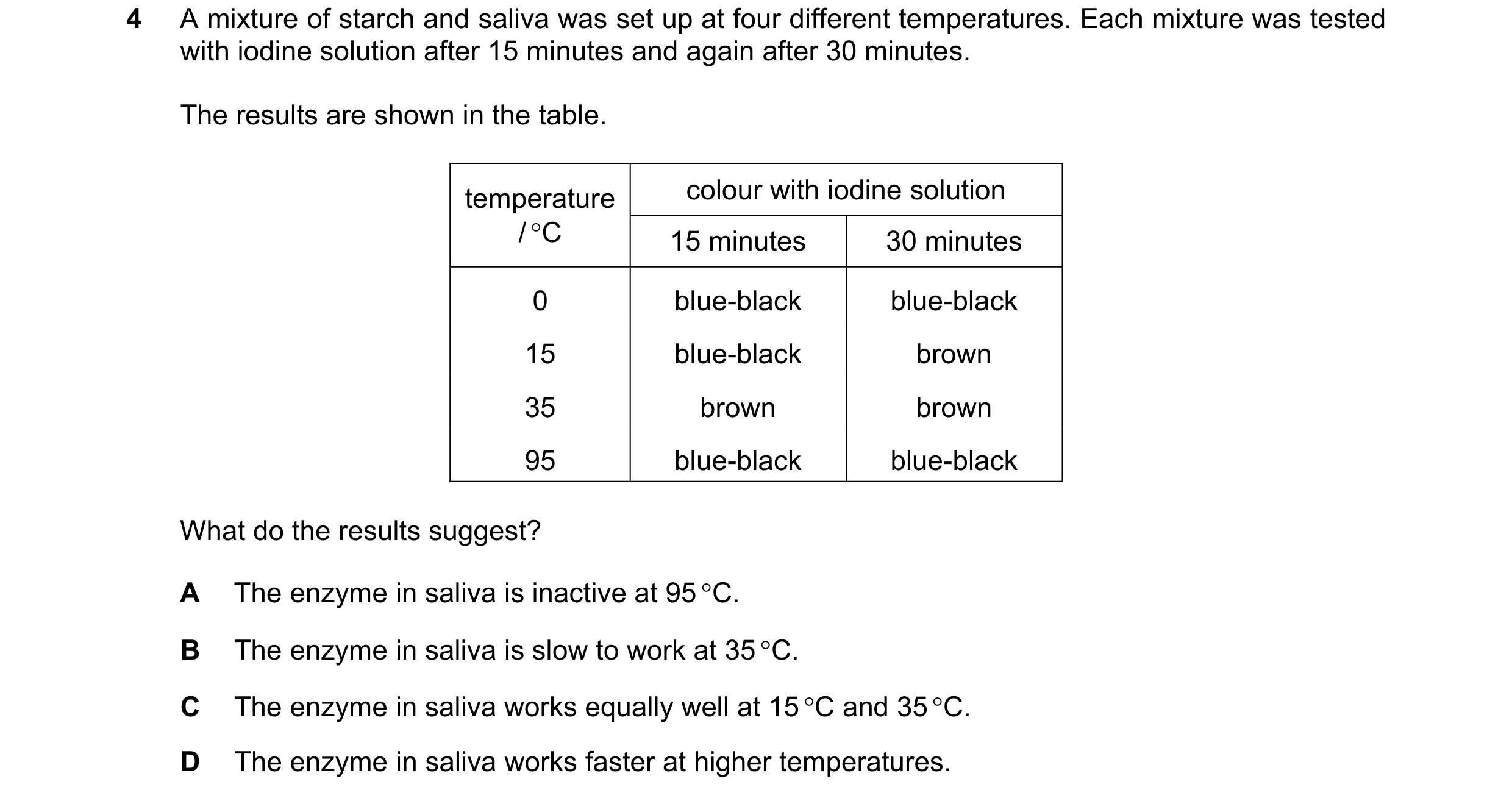
4 A mixture of starch and saliva was set up at four different temperatures. Each mixture was tested with iodine solution after 15 minutes and again after 30 minutes. The results are shown in the table. temperature colour with iodine solution / C 15 minutes 30 minutes 0 blue-black blue-black 15 blue-black brown 35 brown brown 95 blue-black blue-black What do the results suggest? A The enzyme in saliva is inactive at 95 C. B The enzyme in saliva is slow to work at 35 C. C The enzyme in saliva works equally well at 15 C and 35 C. D The enzyme in saliva works faster at higher temperatures.
1 marks
Answer: A
This question in 0654/12 Oct/Nov 2020
Q41 · A mixture of starch and saliva was set up at four different temperatures 0654/13 Oct/Nov 2020
4 A mixture of starch and saliva was set up at four different temperatures. Each mixture was tested with iodine solution after 15 minutes and again after 30 minutes. The results are shown in the table. temperature colour with iodine solution / C 15 minutes 30 minutes 0 blue-black blue-black 15 blue-black brown 35 brown brown 95 blue-black blue-black What do the results suggest? A The enzyme in saliva is inactive at 95 C. B The enzyme in saliva is slow to work at 35 C. C The enzyme in saliva works equally well at 15 C and 35 C. D The enzyme in saliva works faster at higher temperatures.
1 marks
Answer: A
This question in 0654/13 Oct/Nov 2020
Q42 · What are biological catalysts? 0654/12 Feb/March 2021
4 What are biological catalysts? A antibodies B enzymes C hormones D platelets
1 marks
Answer: B
This question in 0654/12 Feb/March 2021
Q43 · What is an enzyme? 0654/11 May/June 2021
4 What is an enzyme? A a carbohydrate that speeds up the rate of a reaction B a carbohydrate that alters the activity of a target organ C a protein that alters the activity of a target organ D a protein that speeds up the rate of a reaction
1 marks
Answer: D
This question in 0654/11 May/June 2021
Q44 · Which type of molecule are enzymes? 0654/12 May/June 2021
4 Which type of molecule are enzymes? A fat B carbohydrate C protein D DNA
1 marks
Answer: C
This question in 0654/12 May/June 2021
Q45 · Which type of molecule are enzymes? 0654/13 May/June 2021
4 Which type of molecule are enzymes? A fat B carbohydrate C protein D DNA
1 marks
Answer: C
This question in 0654/13 May/June 2021
Q46 · A student investigated the effect of pH on an enzyme that digests starch 0654/11 Oct/Nov 2021
4 A student investigated the effect of pH on an enzyme that digests starch. Which chemical will be needed to determine if any starch has been digested? A Benedict’s solution B biuret solution C iodine solution D ethanol
1 marks
Answer: A
This question in 0654/11 Oct/Nov 2021
Q47 · A student carried out an investigation on the effect of temperature on an… 0654/12 Oct/Nov 2021
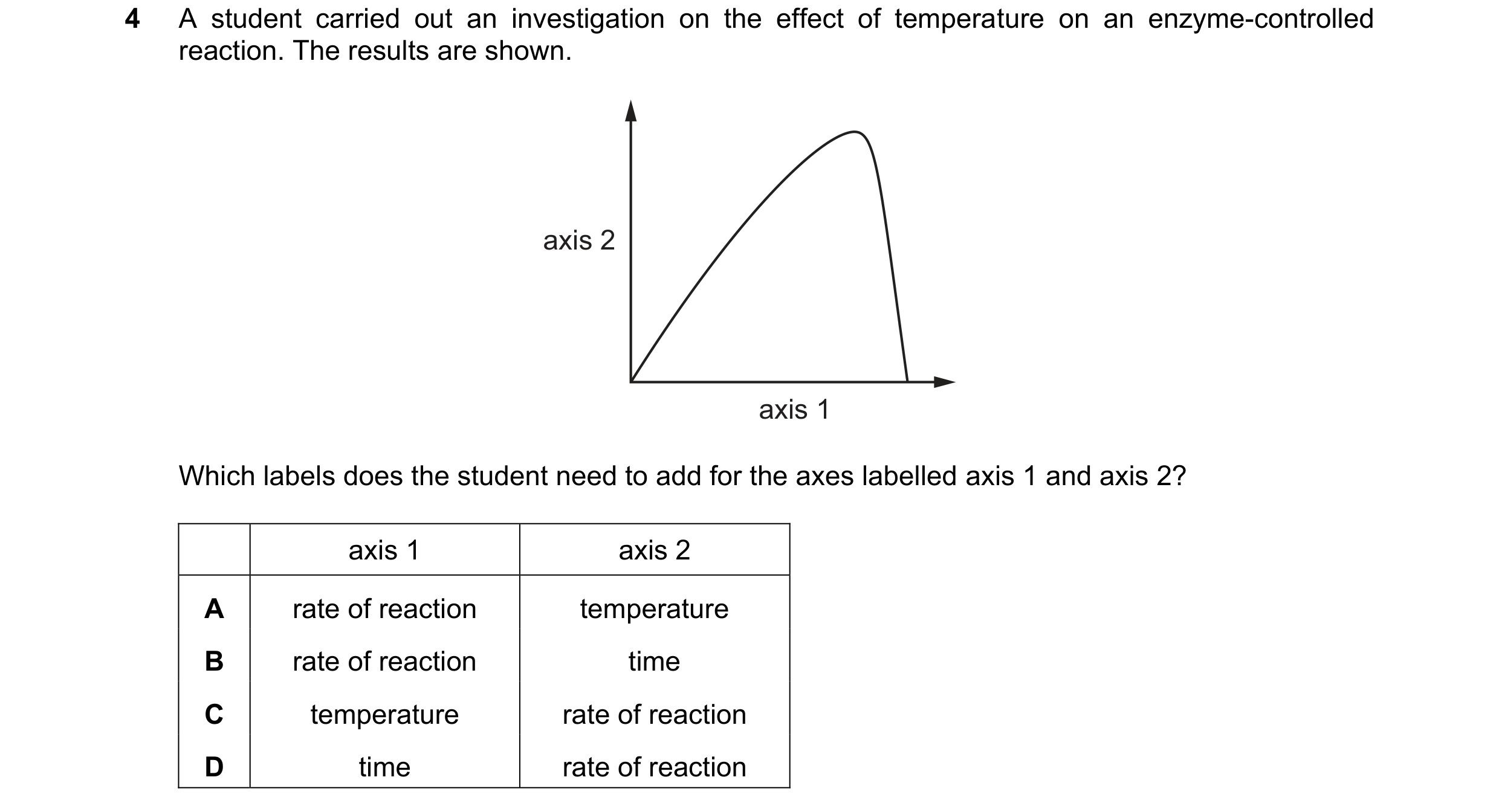
4 A student carried out an investigation on the effect of temperature on an enzyme-controlled reaction. The results are shown. axis 2 axis 1 Which labels does the student need to add for the axes labelled axis 1 and axis 2? axis 1 axis 2 A rate of reaction temperature B rate of reaction time C temperature rate of reaction D time rate of reaction
1 marks
Answer: C
This question in 0654/12 Oct/Nov 2021
Q48 · Which graph shows the effect of pH on the rate of activity of an enzyme? 0654/13 Oct/Nov 2021
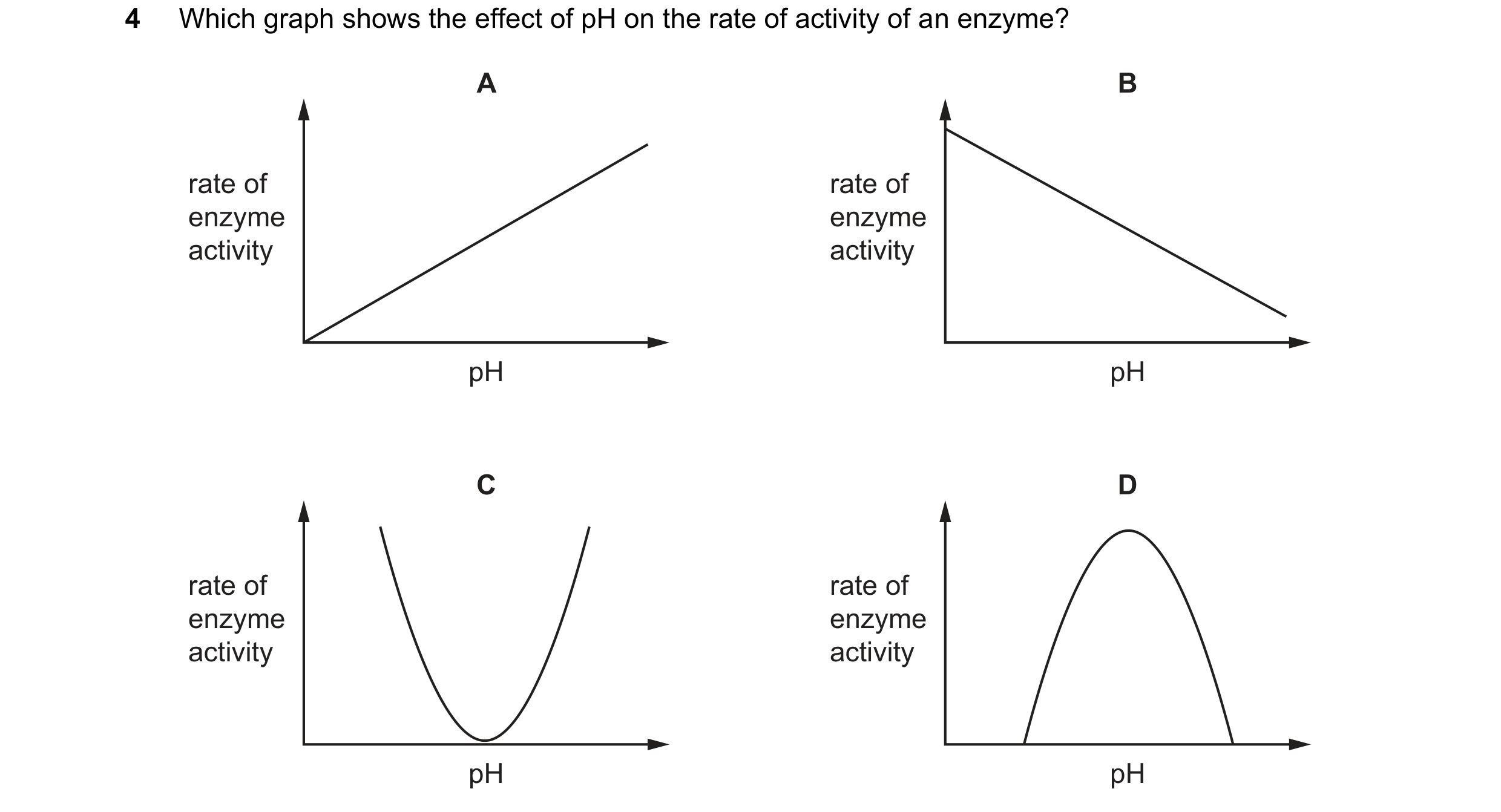
4 Which graph shows the effect of pH on the rate of activity of an enzyme? A B rate of rate of enzyme enzyme activity activity pH pH C D rate of rate of enzyme enzyme activity activity pH pH
1 marks
Answer: D
This question in 0654/13 Oct/Nov 2021
Q49 · The Pompeii worm lives in deep-sea hydrothermal vents where average temperatures are… 0654/12 Feb/March 2022
4 The Pompeii worm lives in deep-sea hydrothermal vents where average temperatures are often as high as 68 C. Which graph represents the activity of enzymes found in the Pompeii worm? A B rate of rate of reaction reaction 0 10 20 30 40 50 60 70 80 90 0 10 20 30 40 50 60 70 80 90 temperature / °C temperature / °C C D rate of rate of reaction reaction 0 10 20 30 40 50 60 70 80 90 0 10 20 30 40 50 60 70 80 90 temperature / °C temperature / °C
1 marks
Answer: B
This question in 0654/12 Feb/March 2022
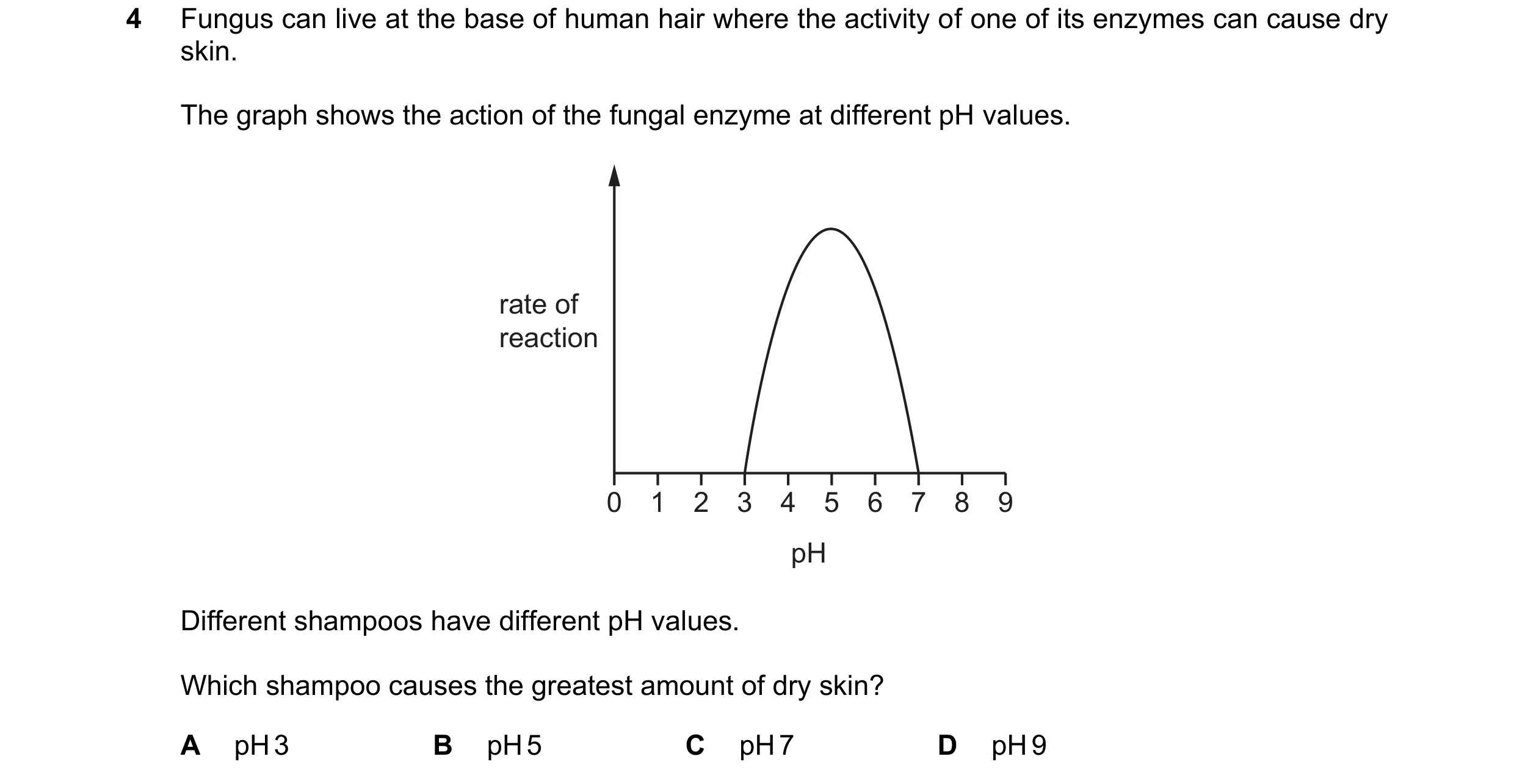
Q50 · Fungus can live at the base of human hair where the activity of one of its enzymes can… 0654/11 May/June 2022
4 Fungus can live at the base of human hair where the activity of one of its enzymes can cause dry skin. The graph shows the action of the fungal enzyme at different pH values. rate of reaction 0 1 2 3 4 5 6 7 8 9 pH Different shampoos have different pH values. Which shampoo causes the greatest amount of dry skin? A pH 3 B pH 5 C pH 7 D pH 9
1 marks
Answer: B
This question in 0654/11 May/June 2022
Q51 · Catalase is an enzyme that breaks down hydrogen peroxide to form a foam of water and… 0654/12 May/June 2022
4 Catalase is an enzyme that breaks down hydrogen peroxide to form a foam of water and oxygen. The maximum height of the foam produced at different temperatures in a given length of time is measured. The rate of the reaction is proportional to the height of foam. The table shows the results. temperature / C height of foam / mm 10 1.2 20 3.1 30 4.2 40 5.4 50 3.6 60 0.0 Which conclusion can be drawn from these results? A Increasing the temperature decreases the rate of the reaction up to 50 C. B Increasing the temperature decreases the rate of the reaction up to 60 C. C Increasing the temperature increases the rate of the reaction up to 40 C. D Increasing the temperature increases the rate of the reaction up to 50 C.
1 marks
Answer: C
This question in 0654/12 May/June 2022
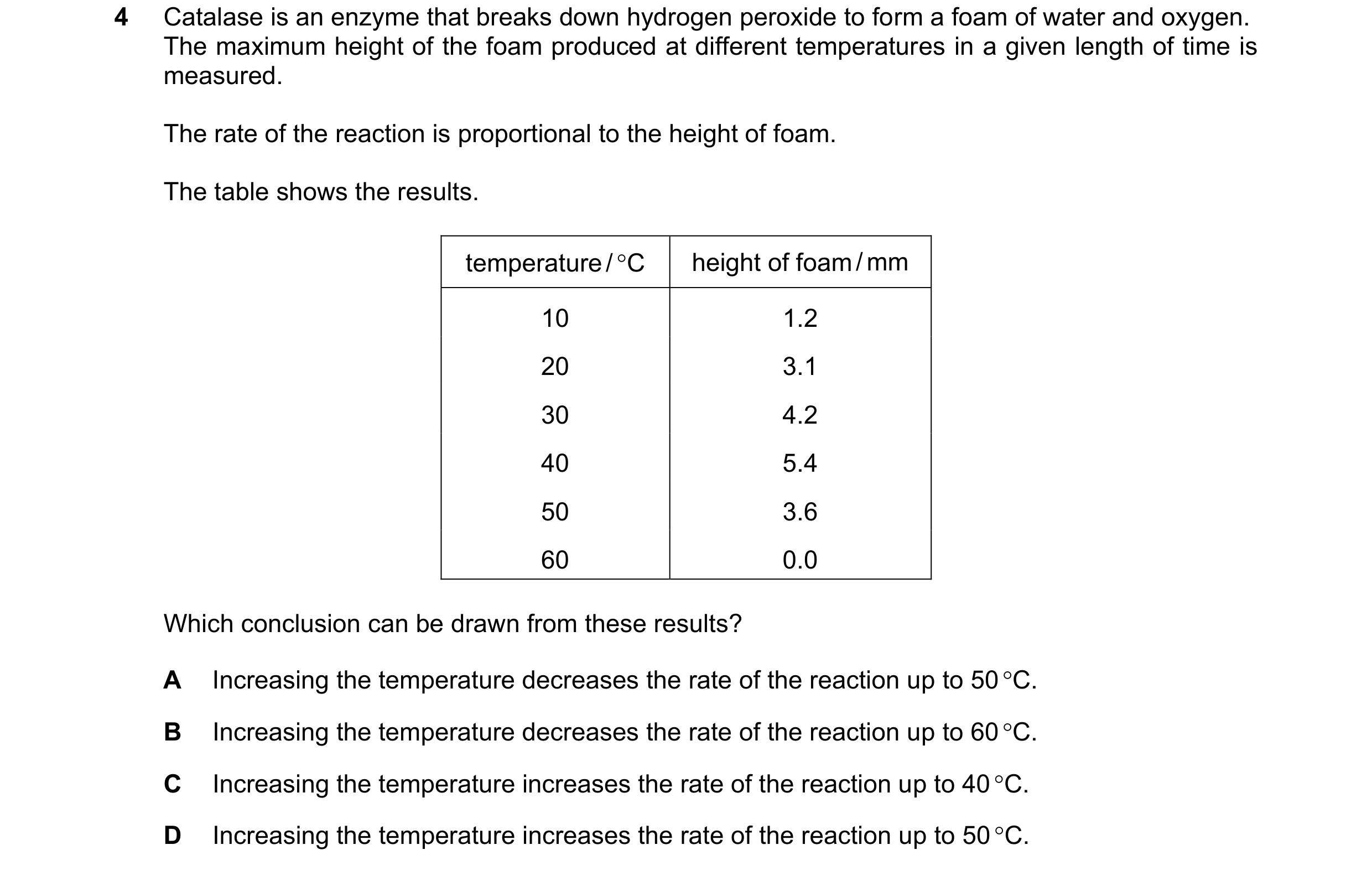
Q52 · Catalase is an enzyme that breaks down hydrogen peroxide to form a foam of water and… 0654/13 May/June 2022
4 Catalase is an enzyme that breaks down hydrogen peroxide to form a foam of water and oxygen. The maximum height of the foam produced at different temperatures in a given length of time is measured. The rate of the reaction is proportional to the height of foam. The table shows the results. temperature / C height of foam / mm 10 1.2 20 3.1 30 4.2 40 5.4 50 3.6 60 0.0 Which conclusion can be drawn from these results? A Increasing the temperature decreases the rate of the reaction up to 50 C. B Increasing the temperature decreases the rate of the reaction up to 60 C. C Increasing the temperature increases the rate of the reaction up to 40 C. D Increasing the temperature increases the rate of the reaction up to 50 C.
1 marks
Answer: C
This question in 0654/13 May/June 2022
Q53 · Which elements can be found in an enzyme molecule? 0654/11 Oct/Nov 2022
4 Which elements can be found in an enzyme molecule? 1 carbon 2 nitrogen 3 oxygen A 1, 2 and 3 B 1 and 3 only C 1 only D 2 only
1 marks
Answer: A
This question in 0654/11 Oct/Nov 2022
Q54 · The rate of a reaction between a powdered metal and a dilute acid is investigated by… 0654/11 Oct/Nov 2022
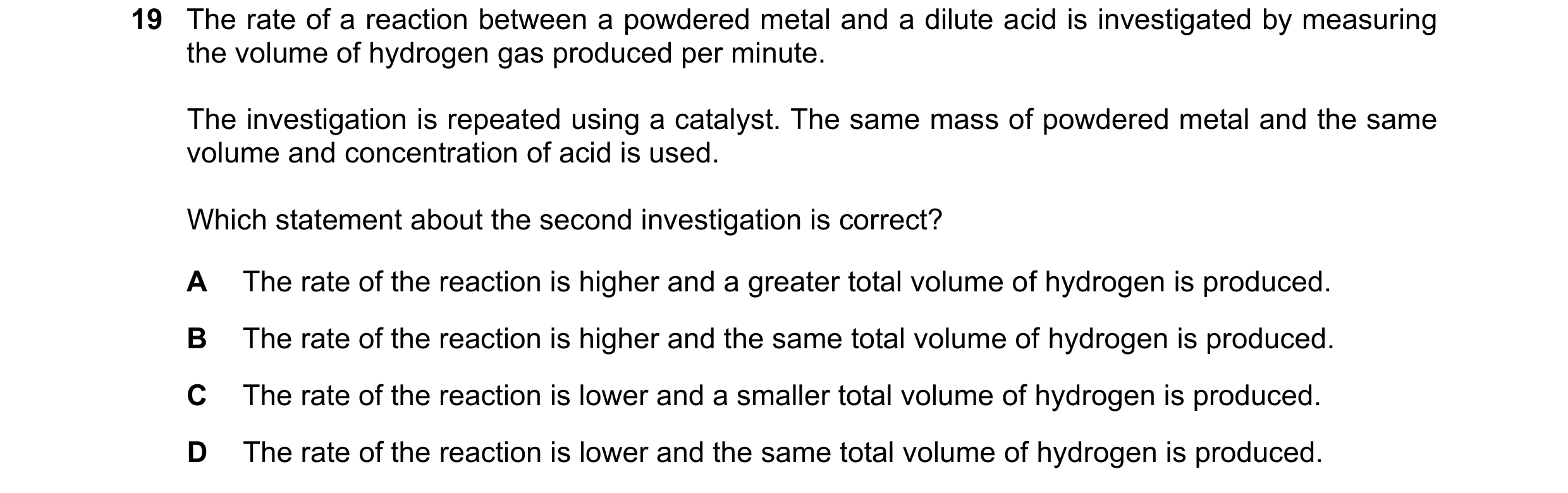
19 The rate of a reaction between a powdered metal and a dilute acid is investigated by measuring the volume of hydrogen gas produced per minute. The investigation is repeated using a catalyst. The same mass of powdered metal and the same volume and concentration of acid is used. Which statement about the second investigation is correct? A The rate of the reaction is higher and a greater total volume of hydrogen is produced. B The rate of the reaction is higher and the same total volume of hydrogen is produced. C The rate of the reaction is lower and a smaller total volume of hydrogen is produced. D The rate of the reaction is lower and the same total volume of hydrogen is produced.
1 marks
Answer: B
This question in 0654/11 Oct/Nov 2022
Q55 · Which statement about enzymes is correct? 0654/12 Oct/Nov 2022
4 Which statement about enzymes is correct? A They are made from fat molecules. B They are used up in a reaction. C They speed up reactions. D They are not affected by temperature.
1 marks
Answer: C
This question in 0654/12 Oct/Nov 2022
Q56 · Which process involves enzymes? 0654/13 Oct/Nov 2022
4 Which process involves enzymes? A absorption B digestion C egestion D ingestion
1 marks
Answer: B
This question in 0654/13 Oct/Nov 2022
Q57 · The graph shows the rate at which 10 g of starch is broken down by amylase at four… 0654/12 Feb/March 2023
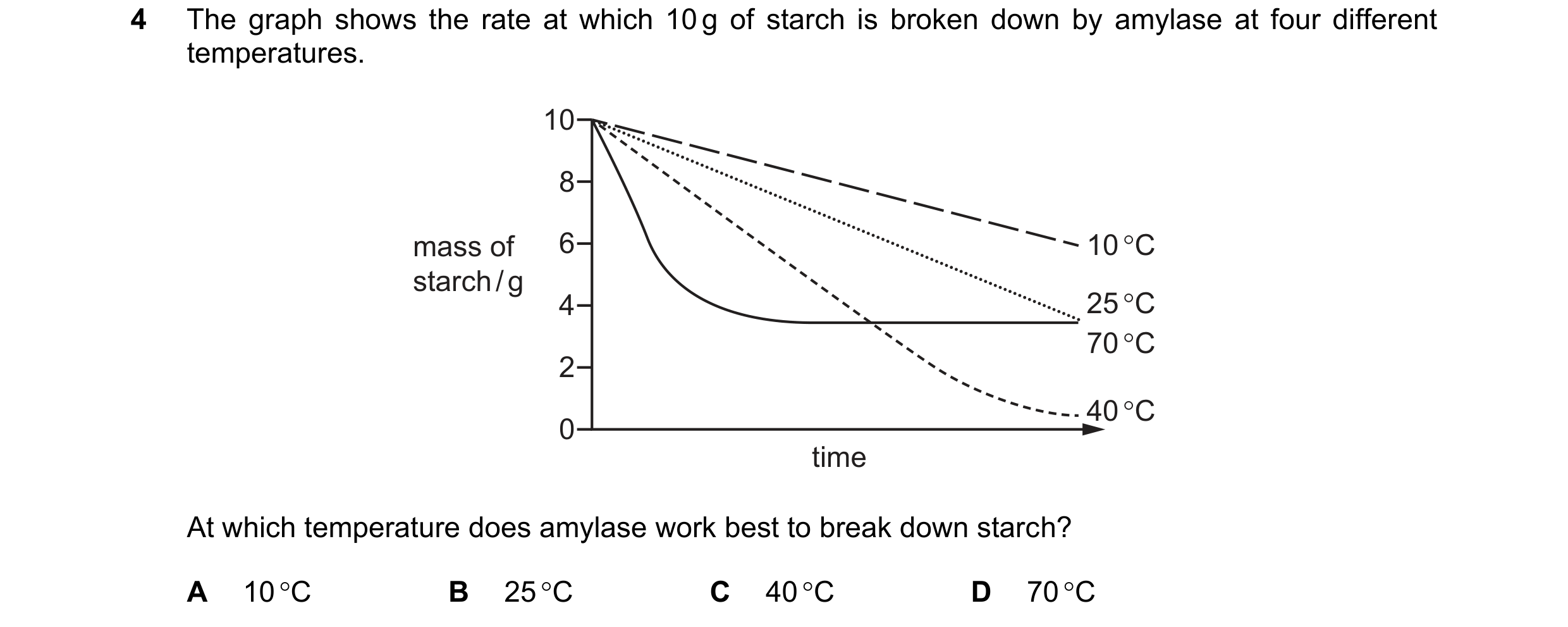
4 The graph shows the rate at which 10 g of starch is broken down by amylase at four different temperatures. 10 8 mass of 6 10 °C starch / g 4 25 °C 70 °C 2 40 °C 0 time At which temperature does amylase work best to break down starch? A 10 C B 25 C C 40 C D 70 C
1 marks
Answer: C
This question in 0654/12 Feb/March 2023
Q58 · Which type of molecule are enzymes? 0654/11 May/June 2023
4 Which type of molecule are enzymes? A amino acids B carbohydrates C fats D proteins
1 marks
Answer: D
This question in 0654/11 May/June 2023
Q59 · Which type of molecules speed up chemical digestion? 0654/12 May/June 2023
4 Which type of molecules speed up chemical digestion? A carbohydrates B enzymes C hormones D fatty acids
1 marks
Answer: B
This question in 0654/12 May/June 2023
Q60 · Which type of molecules speed up chemical digestion? 0654/13 May/June 2023
4 Which type of molecules speed up chemical digestion? A carbohydrates B enzymes C hormones D fatty acids
1 marks
Answer: B
This question in 0654/13 May/June 2023
Q61 · Which graph shows the effect of temperature on enzyme activity? 0654/11 Oct/Nov 2023
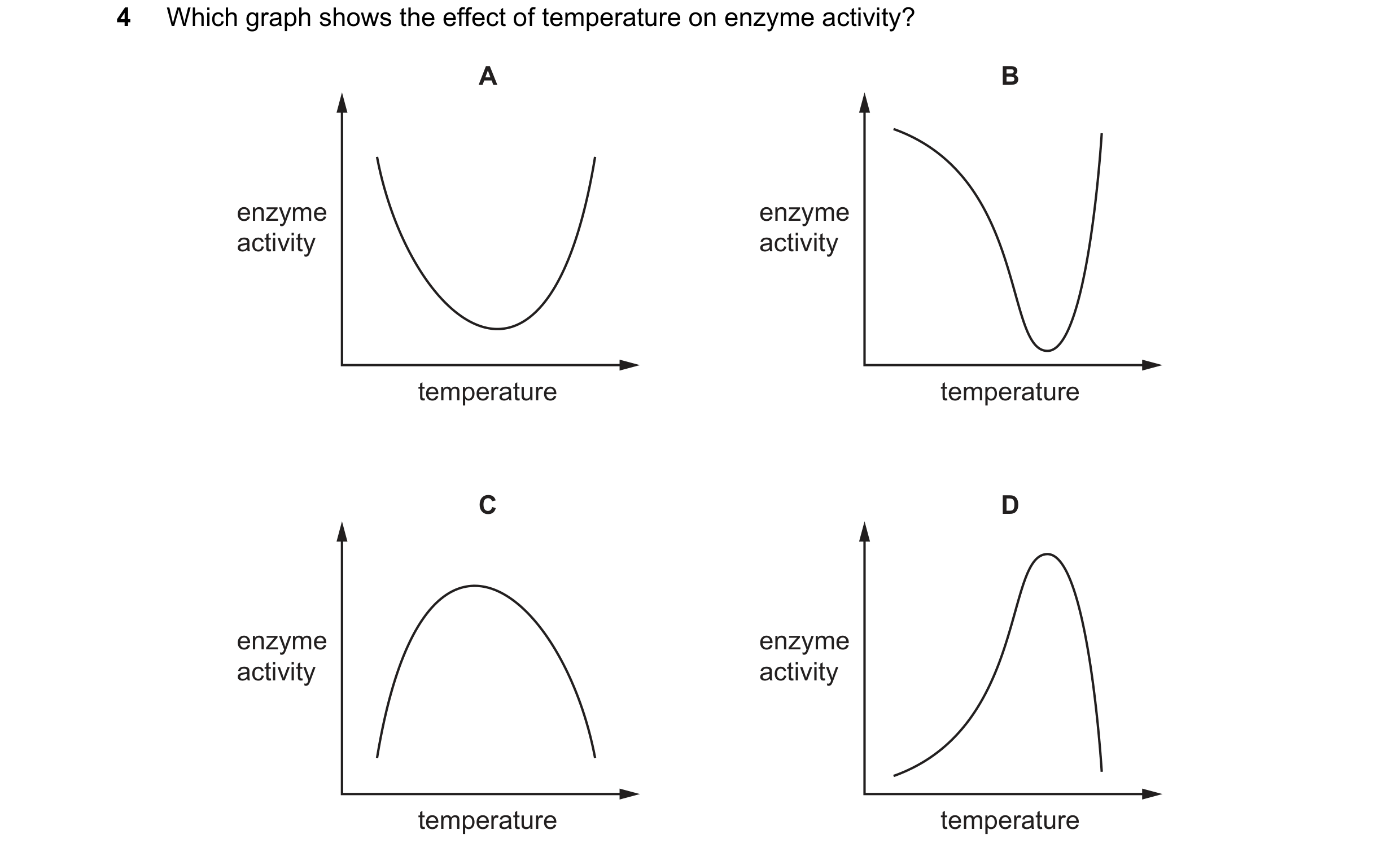
4 Which graph shows the effect of temperature on enzyme activity? A B enzyme enzyme activity activity temperature temperature C D enzyme enzyme activity activity temperature temperature
1 marks
Answer: D
This question in 0654/11 Oct/Nov 2023
Q62 · Which type of molecule are enzymes? 0654/12 Oct/Nov 2023
4 Which type of molecule are enzymes? A carbohydrate B fat C protein D starch
1 marks
Answer: C
This question in 0654/12 Oct/Nov 2023
Q63 · Which graph is correct? 0654/13 Oct/Nov 2023
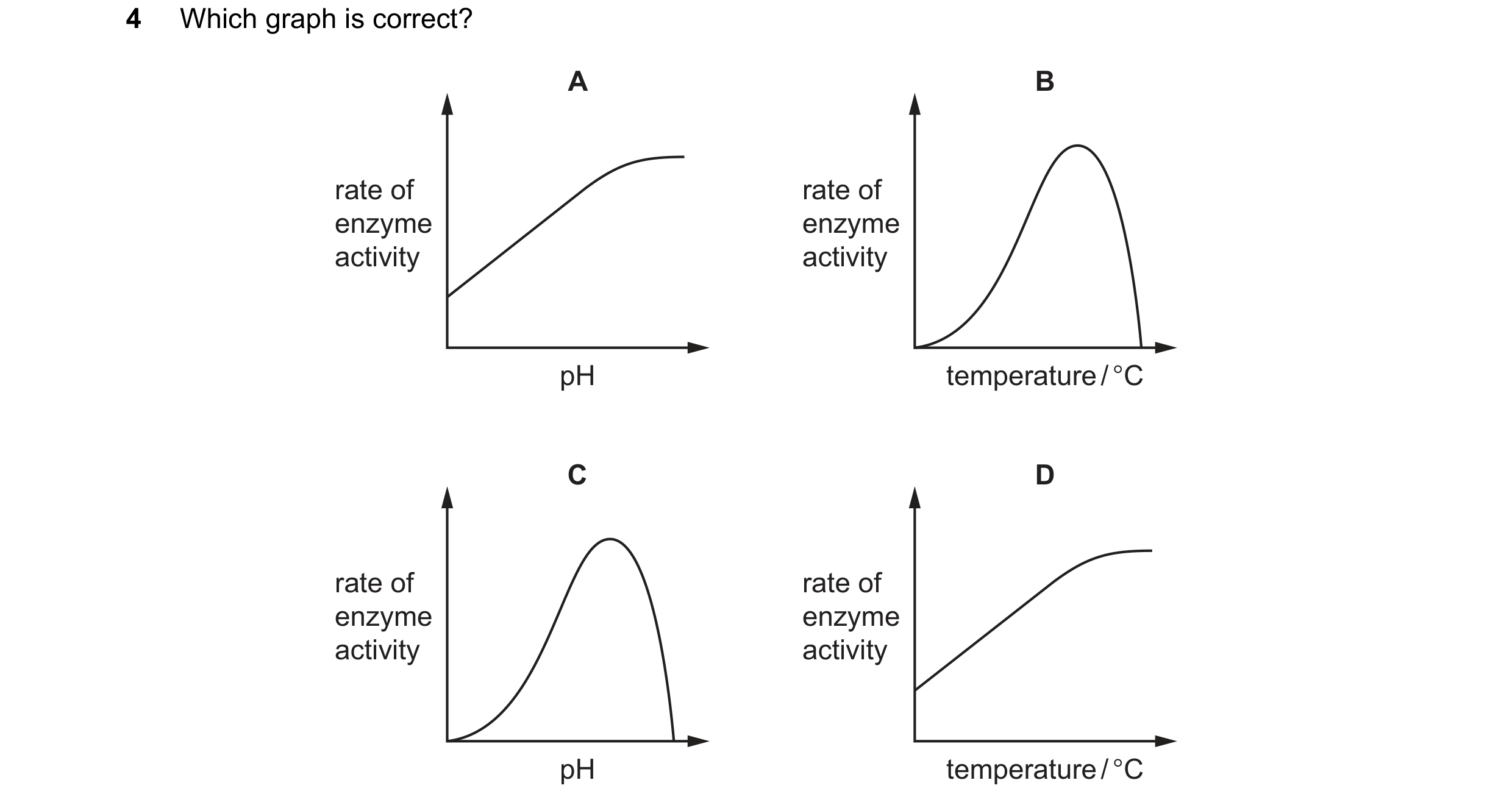
4 Which graph is correct? A B rate of rate of enzyme enzyme activity activity pH temperature / °C C D rate of rate of enzyme enzyme activity activity pH temperature / °C
1 marks
Answer: B
This question in 0654/13 Oct/Nov 2023
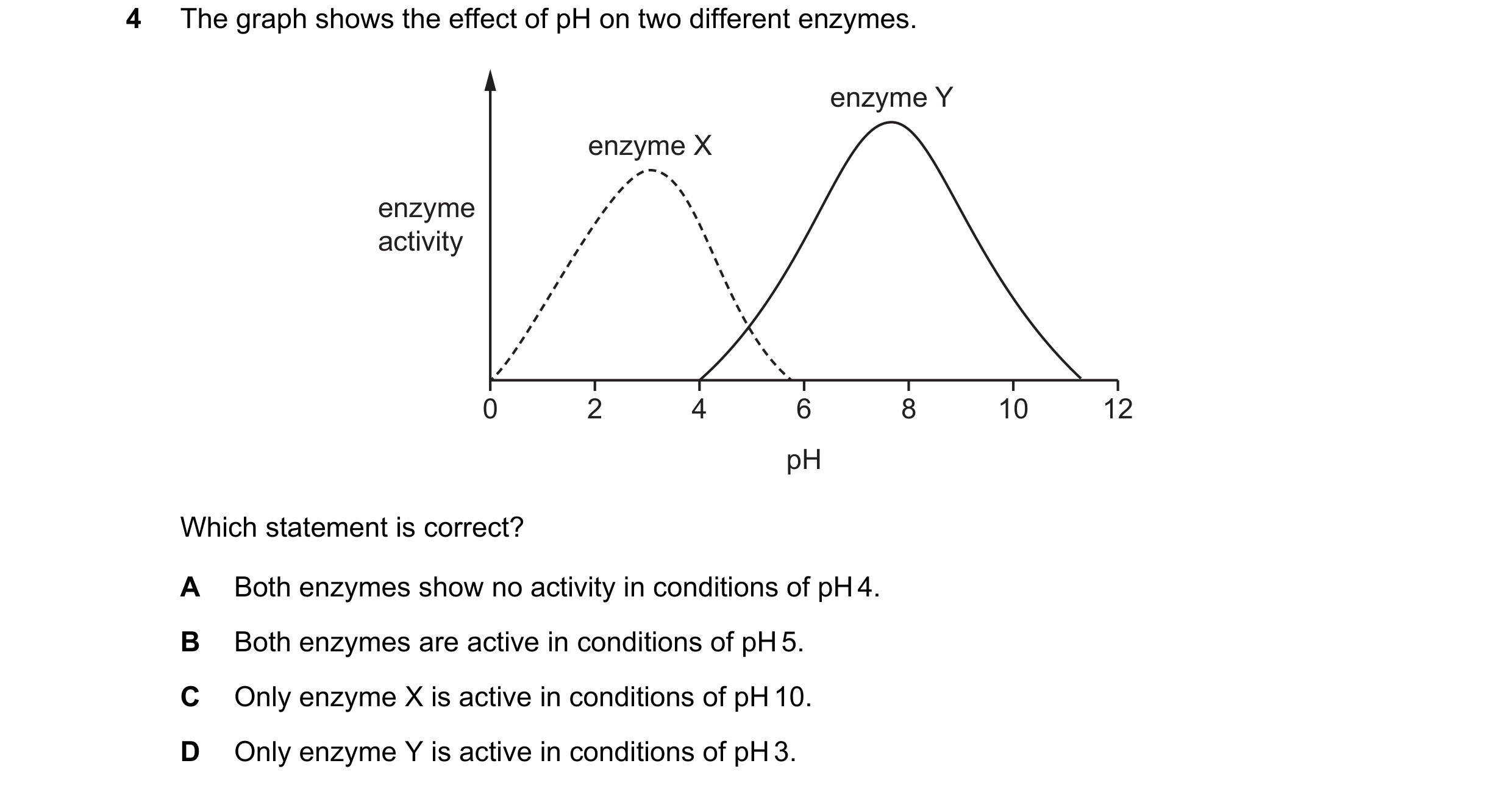
Q64 · The graph shows the effect of pH on two different enzymes 0654/12 Feb/March 2024
4 The graph shows the effect of pH on two different enzymes. enzyme Y enzyme X enzyme activity 0 2 4 6 8 10 12 pH Which statement is correct? A Both enzymes show no activity in conditions of pH 4. B Both enzymes are active in conditions of pH 5. C Only enzyme X is active in conditions of pH 10. D Only enzyme Y is active in conditions of pH 3.
1 marks
Answer: B
This question in 0654/12 Feb/March 2024
Q65 · Element X increases the rate of some reactions 0654/12 Feb/March 2024
23 Element X increases the rate of some reactions. Element X is unchanged at the end of these reactions. What is the position of element X in the Periodic Table? I II III IV V VI VII 0 B C A D
1 marks
Answer: D
This question in 0654/12 Feb/March 2024
Q66 · Which type of molecules are enzymes? 0654/11 May/June 2024
4 Which type of molecules are enzymes? A carbohydrates B fats C oils D proteins
1 marks
Answer: D
This question in 0654/11 May/June 2024
Q67 · A scientist places equal volumes of starch and saliva into a test-tube 0654/12 May/June 2024
6 A scientist places equal volumes of starch and saliva into a test-tube. After 30 minutes, the mixture in the test-tube is tested with iodine solution. The iodine solution remains brown. Which process does this experiment demonstrate? A absorption B assimilation C digestion D ingestion
1 marks
Answer: C
This question in 0654/12 May/June 2024
Q68 · A scientist places equal volumes of starch and saliva into a test-tube 0654/13 May/June 2024
6 A scientist places equal volumes of starch and saliva into a test-tube. After 30 minutes, the mixture in the test-tube is tested with iodine solution. The iodine solution remains brown. Which process does this experiment demonstrate? A absorption B assimilation C digestion D ingestion
1 marks
Answer: C
This question in 0654/13 May/June 2024
Q69 · One method of preventing food spoilage is to store it at 4 C in a refrigerator 0654/11 Oct/Nov 2024
4 One method of preventing food spoilage is to store it at 4 C in a refrigerator. Why does storing food at low temperatures help to prevent food spoilage? A It decreases enzyme activity. B It denatures enzymes. C It increases enzyme production. D It kills cells.
1 marks
Answer: A
This question in 0654/11 Oct/Nov 2024
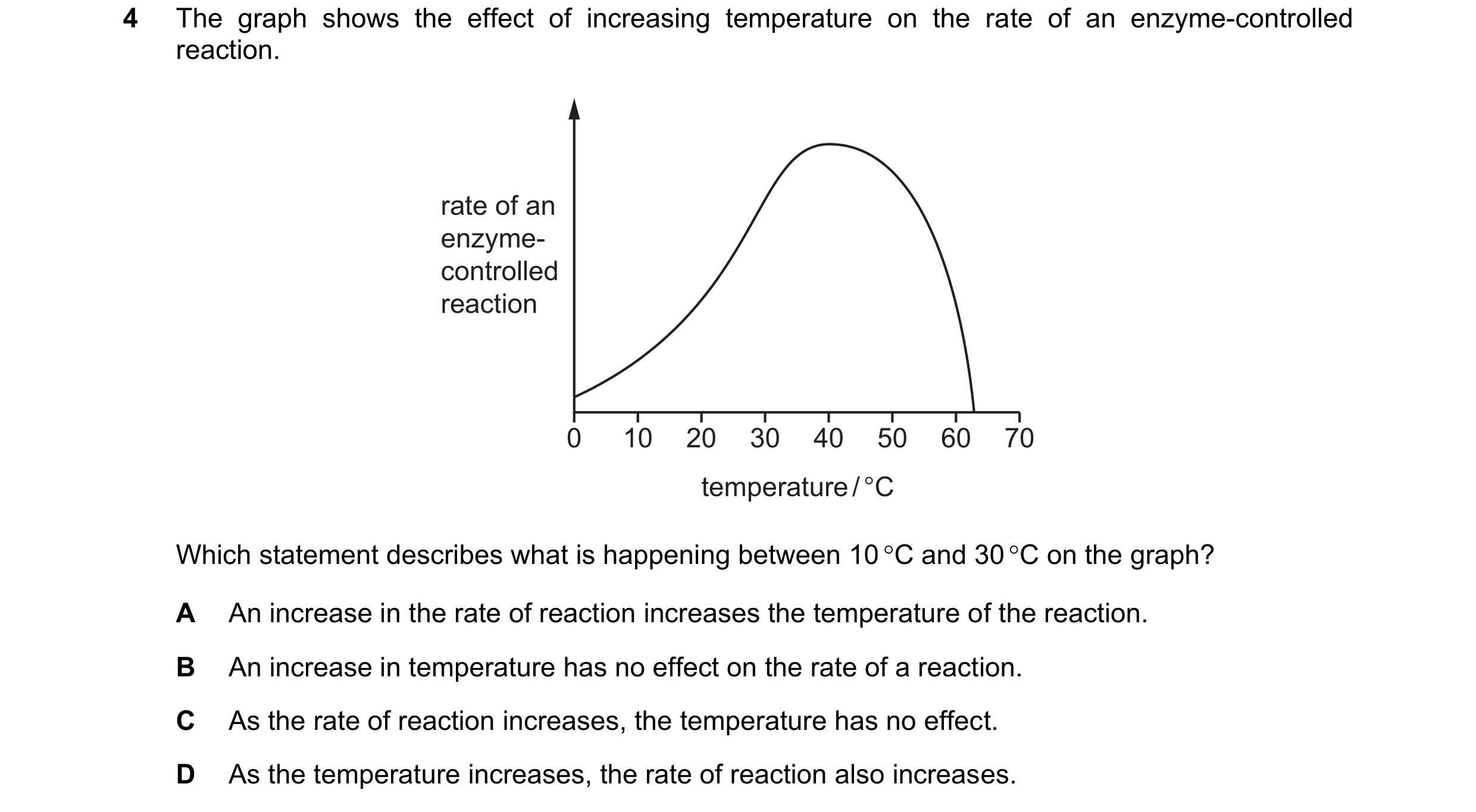
Q70 · The graph shows the effect of increasing temperature on the rate of an enzyme-controlled… 0654/12 Oct/Nov 2024
4 The graph shows the effect of increasing temperature on the rate of an enzyme-controlled reaction. rate of an enzyme- controlled reaction 0 10 20 30 40 50 60 70 temperature / °C Which statement describes what is happening between 10 C and 30 C on the graph? A An increase in the rate of reaction increases the temperature of the reaction. B An increase in temperature has no effect on the rate of a reaction. C As the rate of reaction increases, the temperature has no effect. D As the temperature increases, the rate of reaction also increases.
1 marks
Answer: D
This question in 0654/12 Oct/Nov 2024
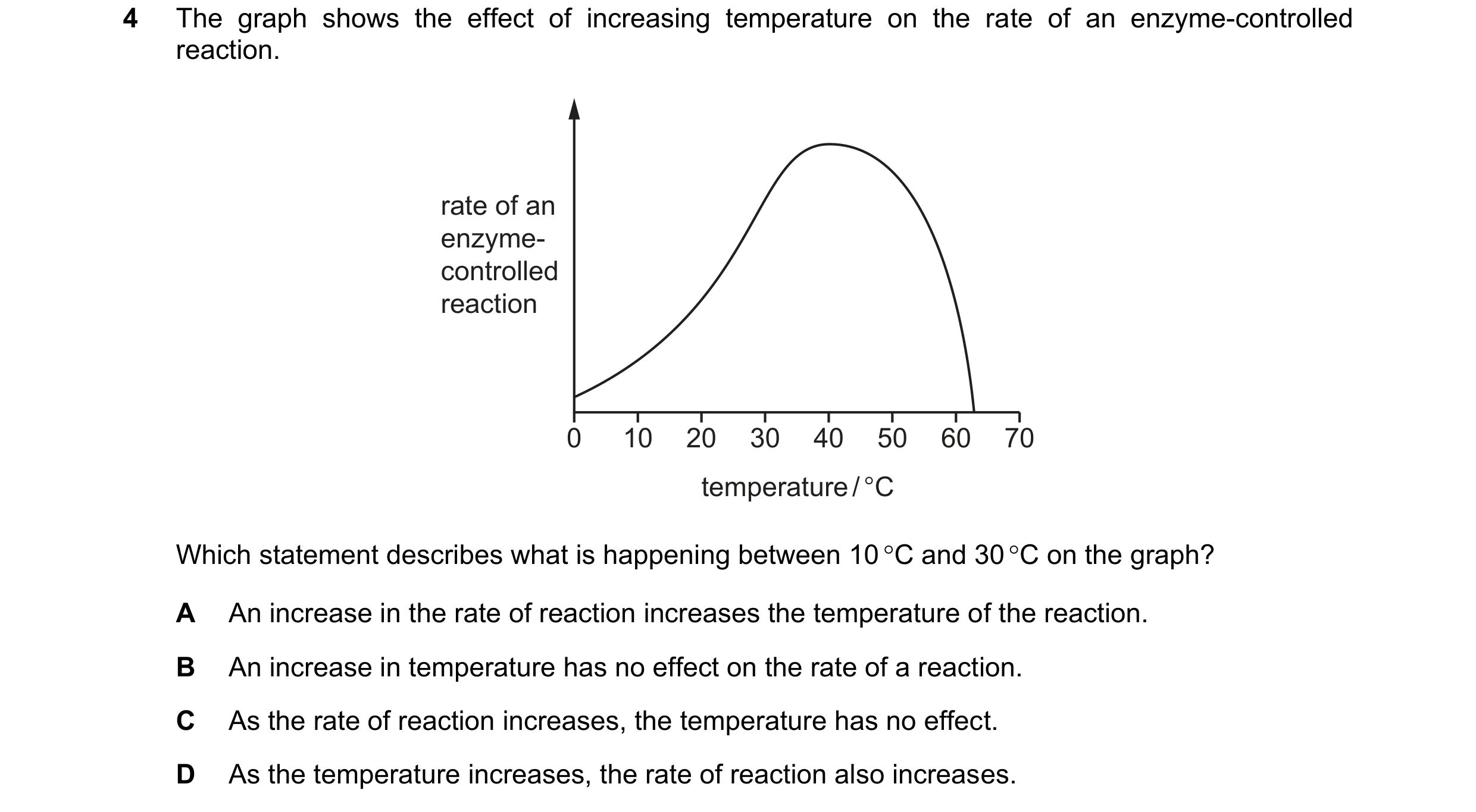
Q71 · The graph shows the effect of increasing temperature on the rate of an enzyme-controlled… 0654/13 Oct/Nov 2024
4 The graph shows the effect of increasing temperature on the rate of an enzyme-controlled reaction. rate of an enzyme- controlled reaction 0 10 20 30 40 50 60 70 temperature / °C Which statement describes what is happening between 10 C and 30 C on the graph? A An increase in the rate of reaction increases the temperature of the reaction. B An increase in temperature has no effect on the rate of a reaction. C As the rate of reaction increases, the temperature has no effect. D As the temperature increases, the rate of reaction also increases.
1 marks
Answer: D
This question in 0654/13 Oct/Nov 2024
Q72 · The graphs show the possible effects of temperature on enzyme activity 0654/12 Feb/March 2025
6 The graphs show the possible effects of temperature on enzyme activity. Which graph is correct for a human enzyme? A B enzyme enzyme activity activity 0 30 60 0 30 60 temperature / °C temperature / °C C D enzyme enzyme activity activity 0 30 60 0 30 60 temperature / °C temperature / °C
1 marks
Answer: A
This question in 0654/12 Feb/March 2025
Q73 · Which type of molecules are enzymes? 0654/11 May/June 2025
5 Which type of molecules are enzymes? A carbohydrates B fats C hormones D proteins
1 marks
Answer: D
This question in 0654/11 May/June 2025
Q74 · Which statements about enzymes are correct? 0654/12 May/June 2025
4 Which statements about enzymes are correct? 1 Enzymes are biological catalysts. 2 Enzymes are made of fat. 3 Enzymes are made of protein. A 1 and 2 B 1 and 3 C 1 only D 3 only
1 marks
Answer: B
This question in 0654/12 May/June 2025
Q75 · Which statements about enzymes are correct? 0654/13 May/June 2025
4 Which statements about enzymes are correct? 1 Enzymes are biological catalysts. 2 Enzymes are made of fat. 3 Enzymes are made of protein. A 1 and 2 B 1 and 3 C 1 only D 3 only
1 marks
Answer: B
This question in 0654/13 May/June 2025
Q76 · Which statements are correct for all enzymes? 0654/11 Oct/Nov 2025
5 Which statements are correct for all enzymes? 1 They are proteins. 2 They are not affected by temperature. 3 They increase the rate of chemical reactions. 4 They work best at a high pH. A 1, 2 and 4 B 1, 3 and 4 C 1 and 3 only D 2 and 4 only
1 marks
Answer: C
This question in 0654/11 Oct/Nov 2025
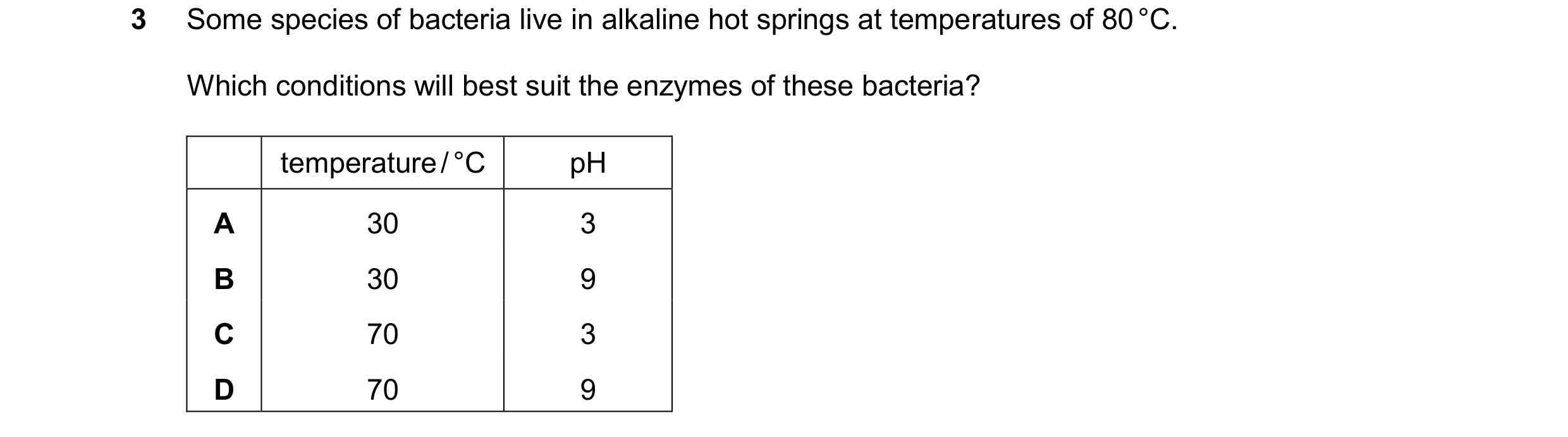
Q77 · Some species of bacteria live in alkaline hot springs at temperatures of 80 °C 0654/12 Oct/Nov 2025
3 Some species of bacteria live in alkaline hot springs at temperatures of 80 °C. Which conditions will best suit the enzymes of these bacteria? temperature / °C pH A 30 3 B 30 9 C 70 3 D 70 9
1 marks
Answer: D
This question in 0654/12 Oct/Nov 2025
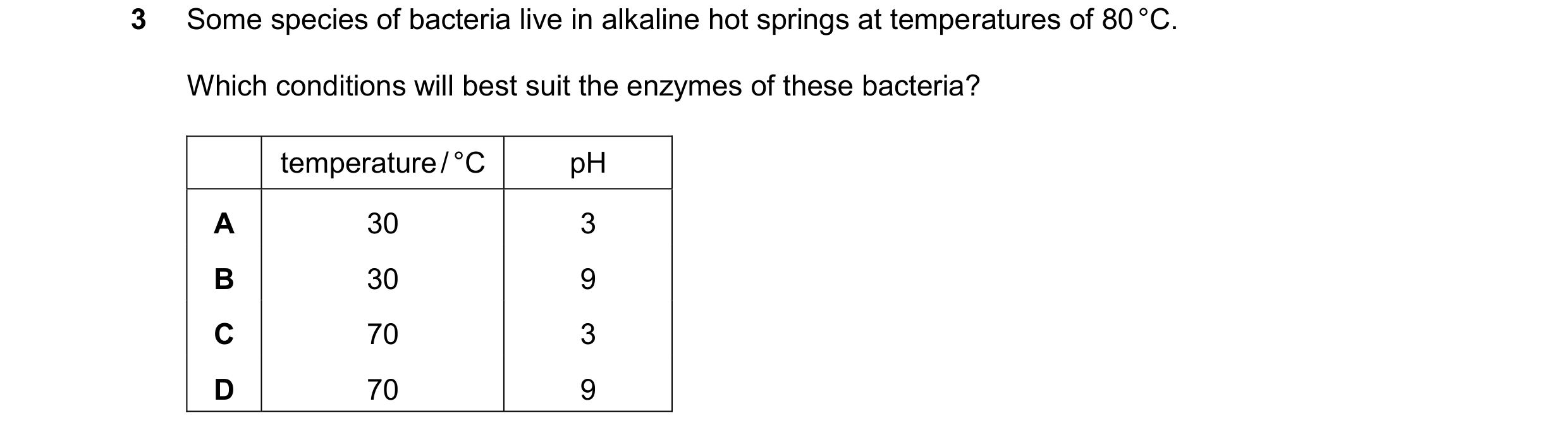
Q78 · Some species of bacteria live in alkaline hot springs at temperatures of 80 °C 0654/13 Oct/Nov 2025
3 Some species of bacteria live in alkaline hot springs at temperatures of 80 °C. Which conditions will best suit the enzymes of these bacteria? temperature / °C pH A 30 3 B 30 9 C 70 3 D 70 9
1 marks
Answer: D
This question in 0654/13 Oct/Nov 2025
 1 / 26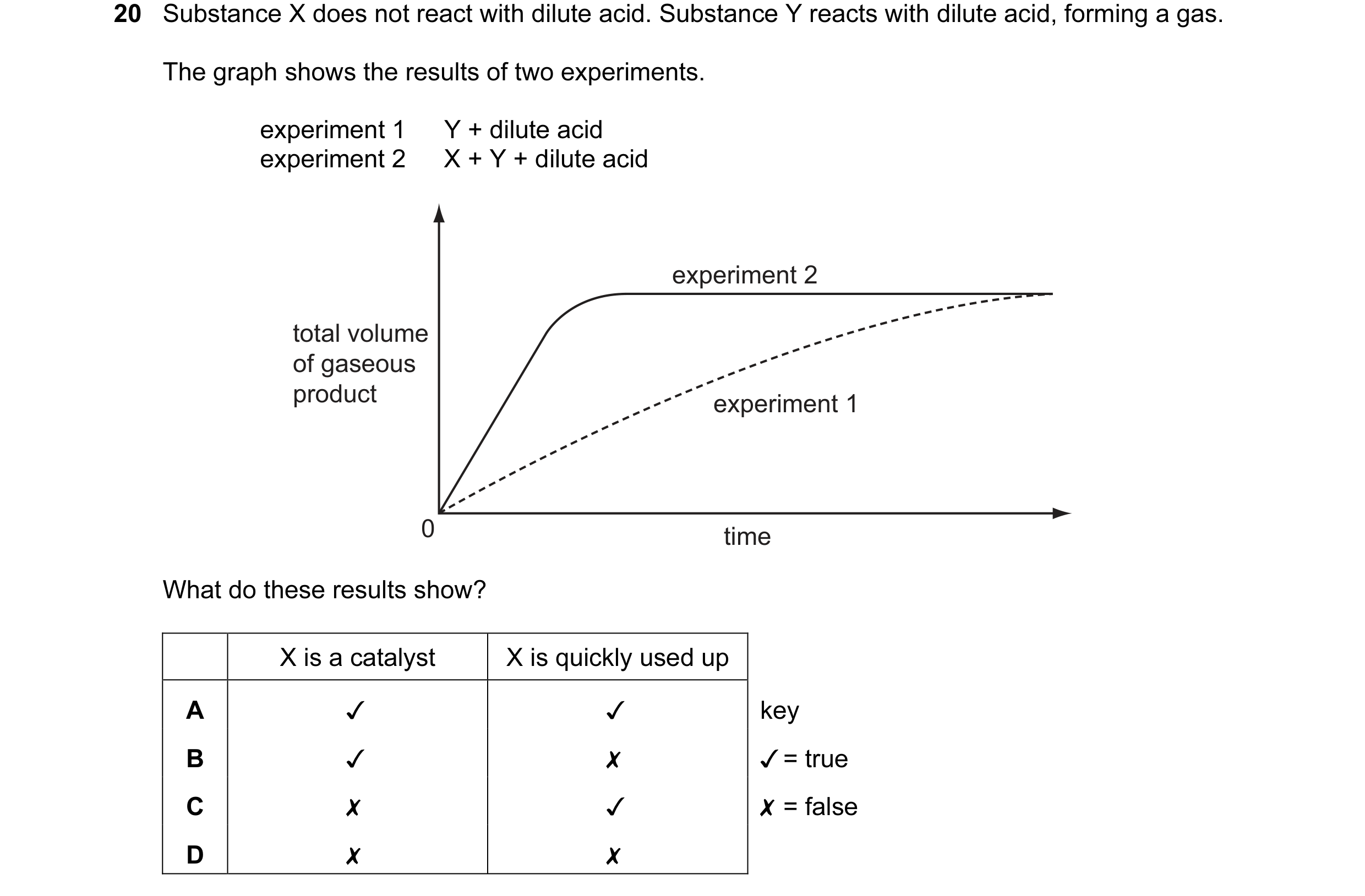
 2 / 26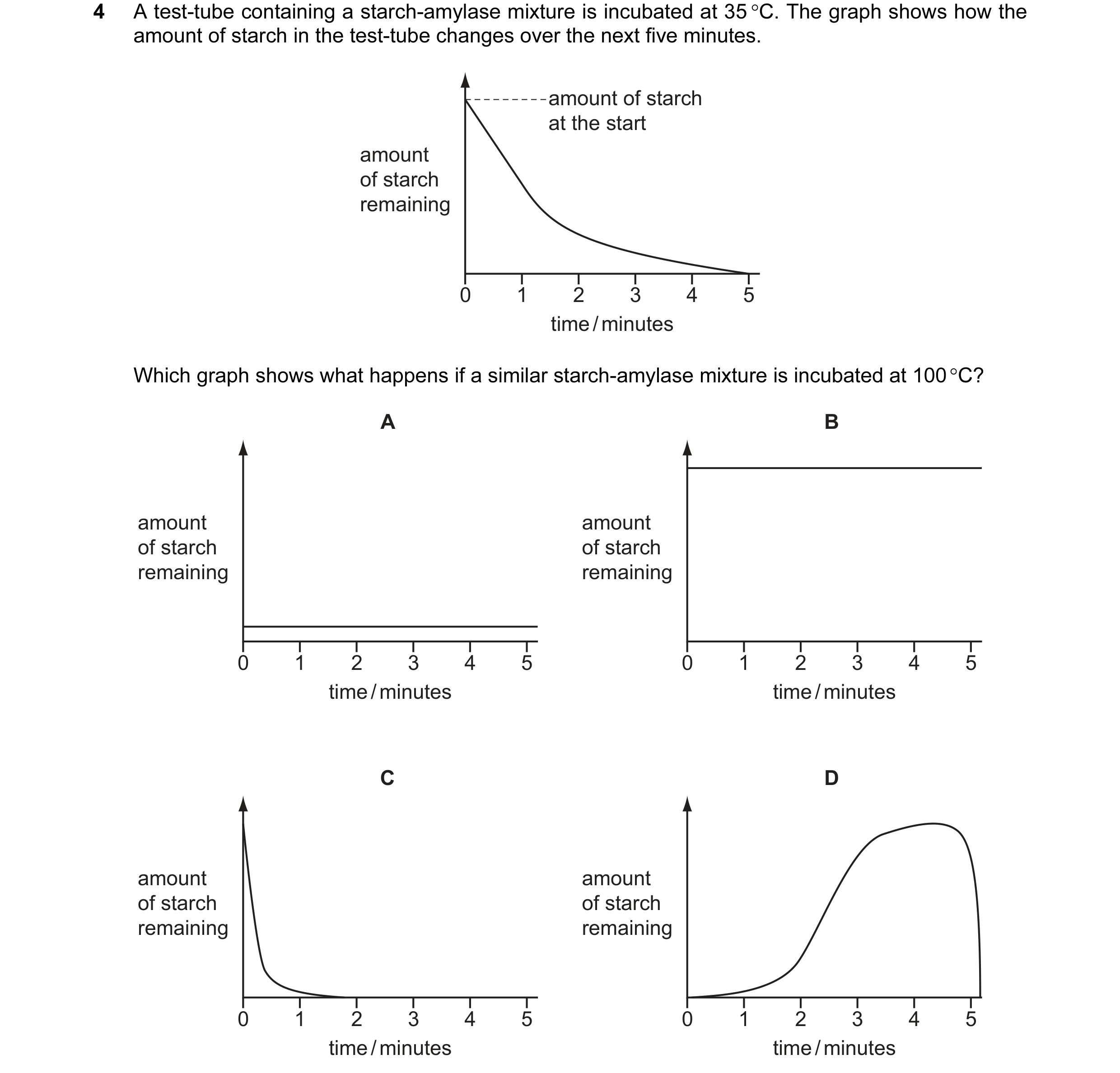
 3 / 26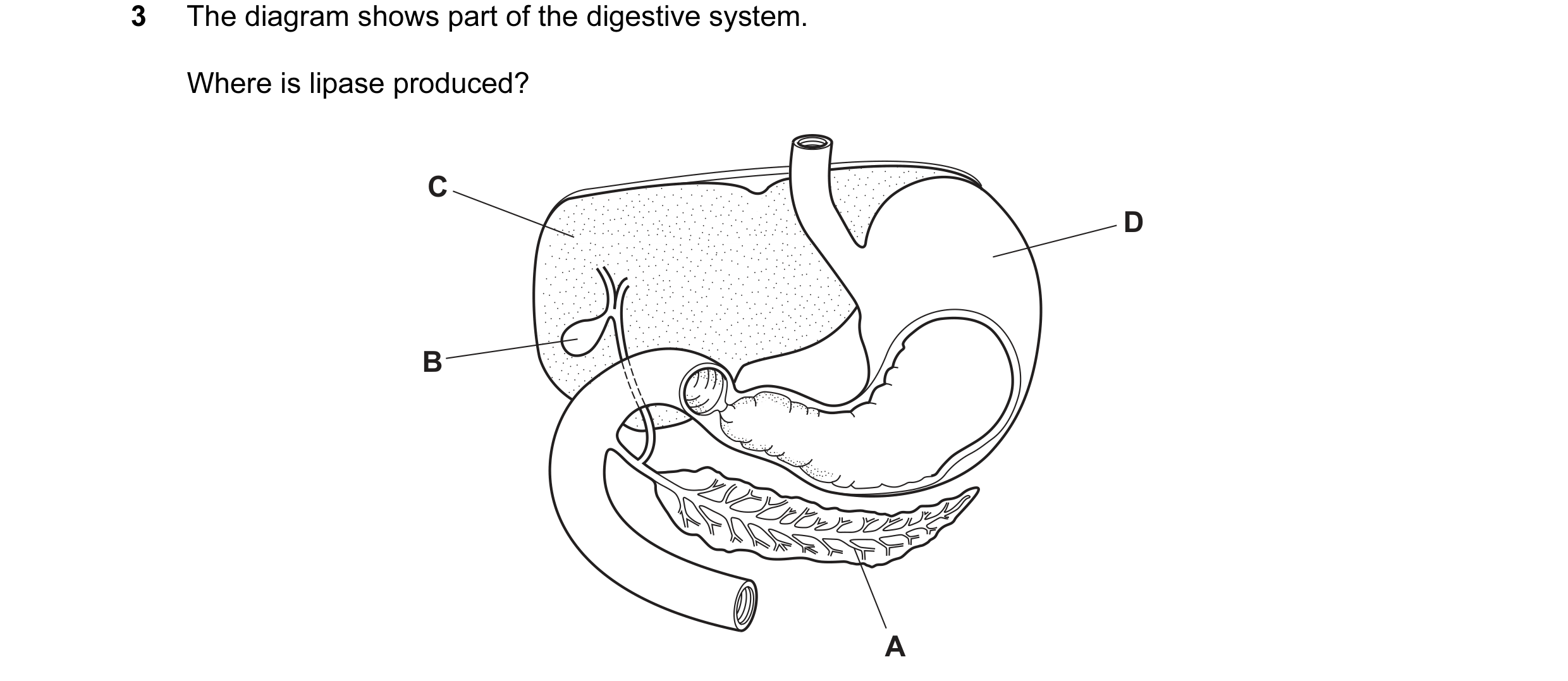
 4 / 26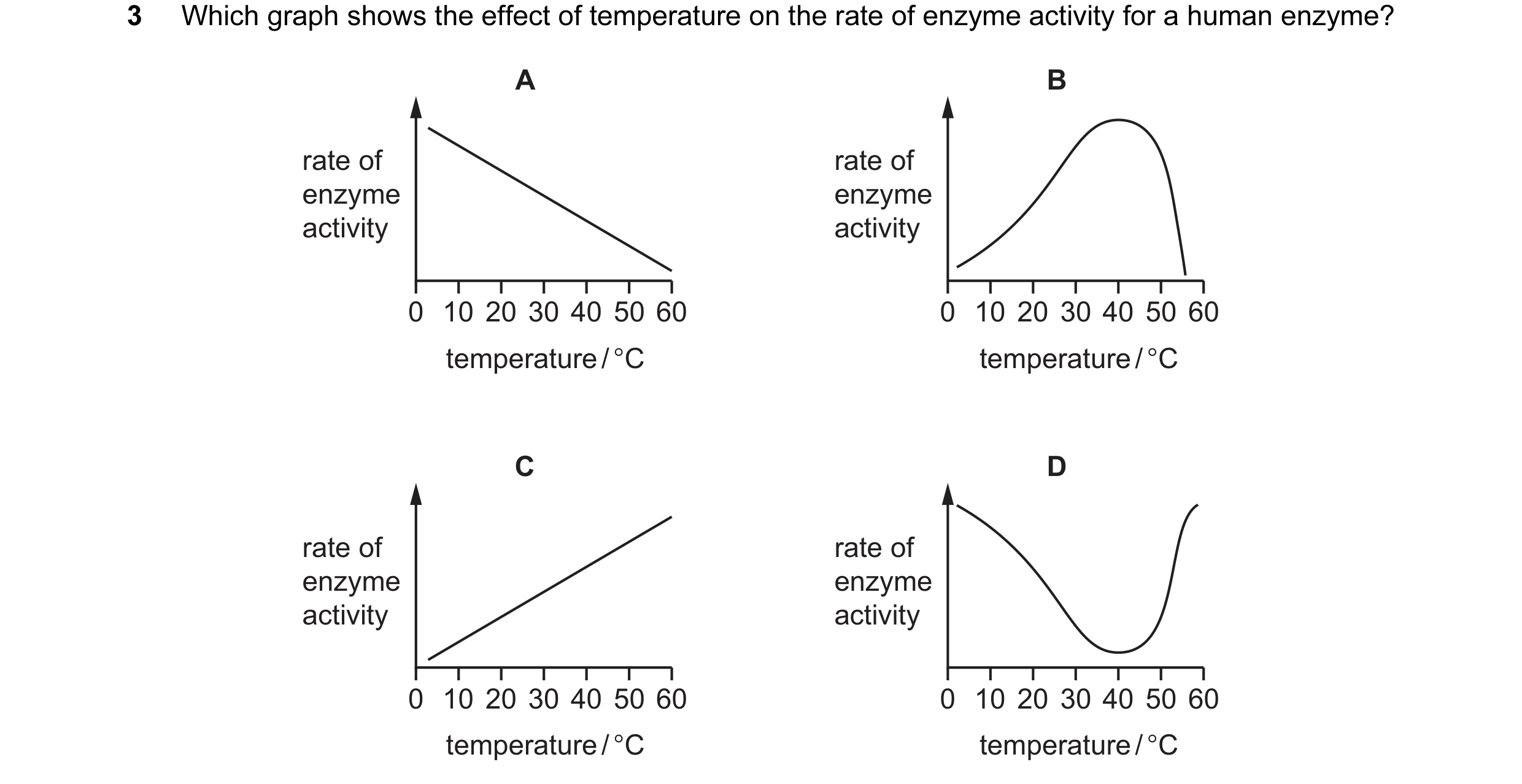
 5 / 26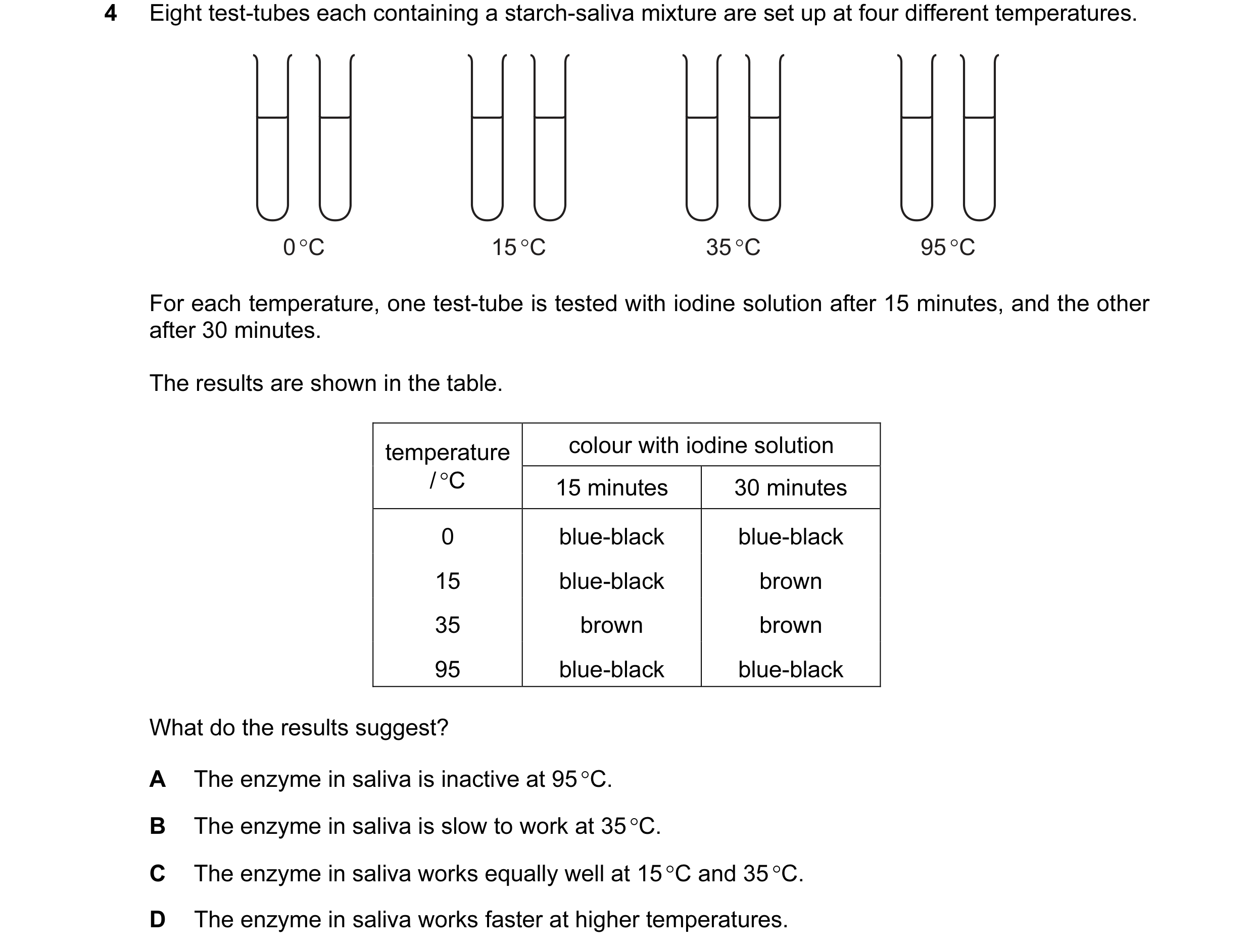
 6 / 26


 7 / 26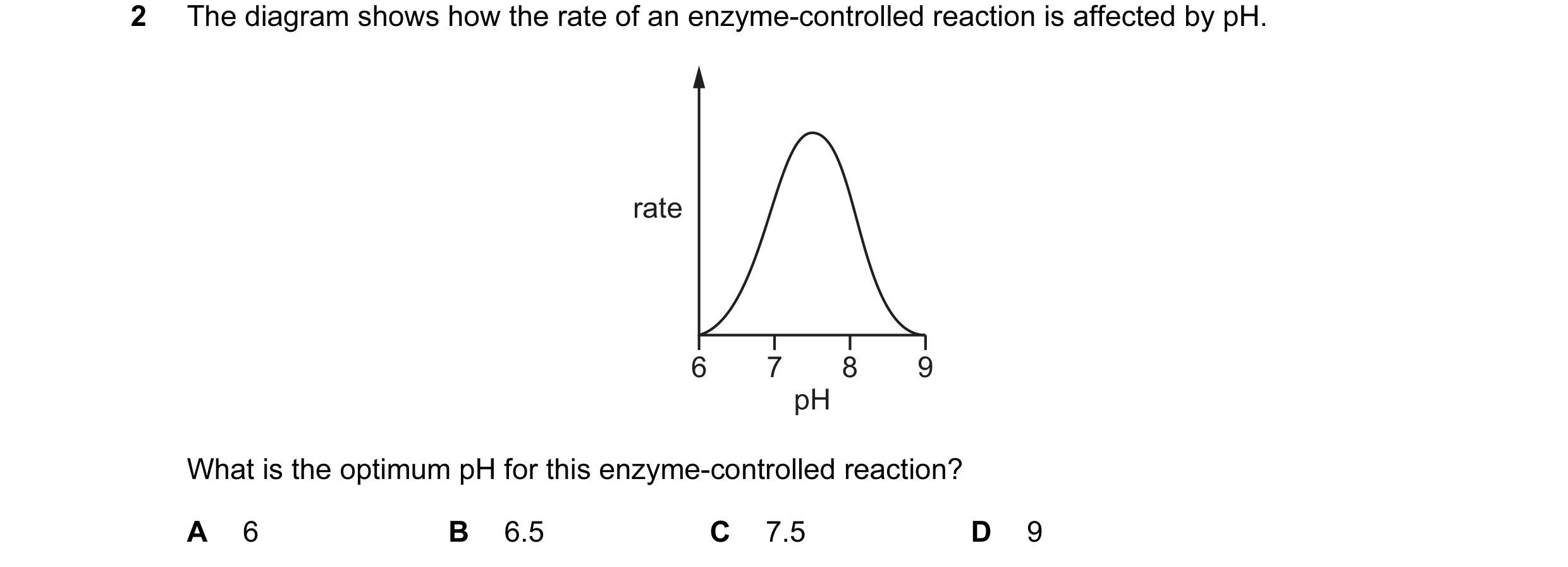
 8 / 26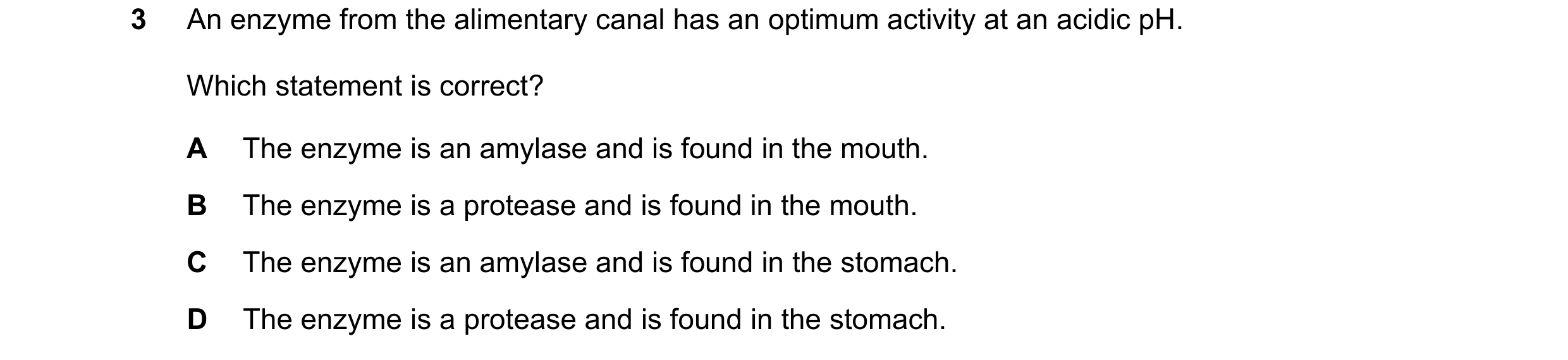
 9 / 26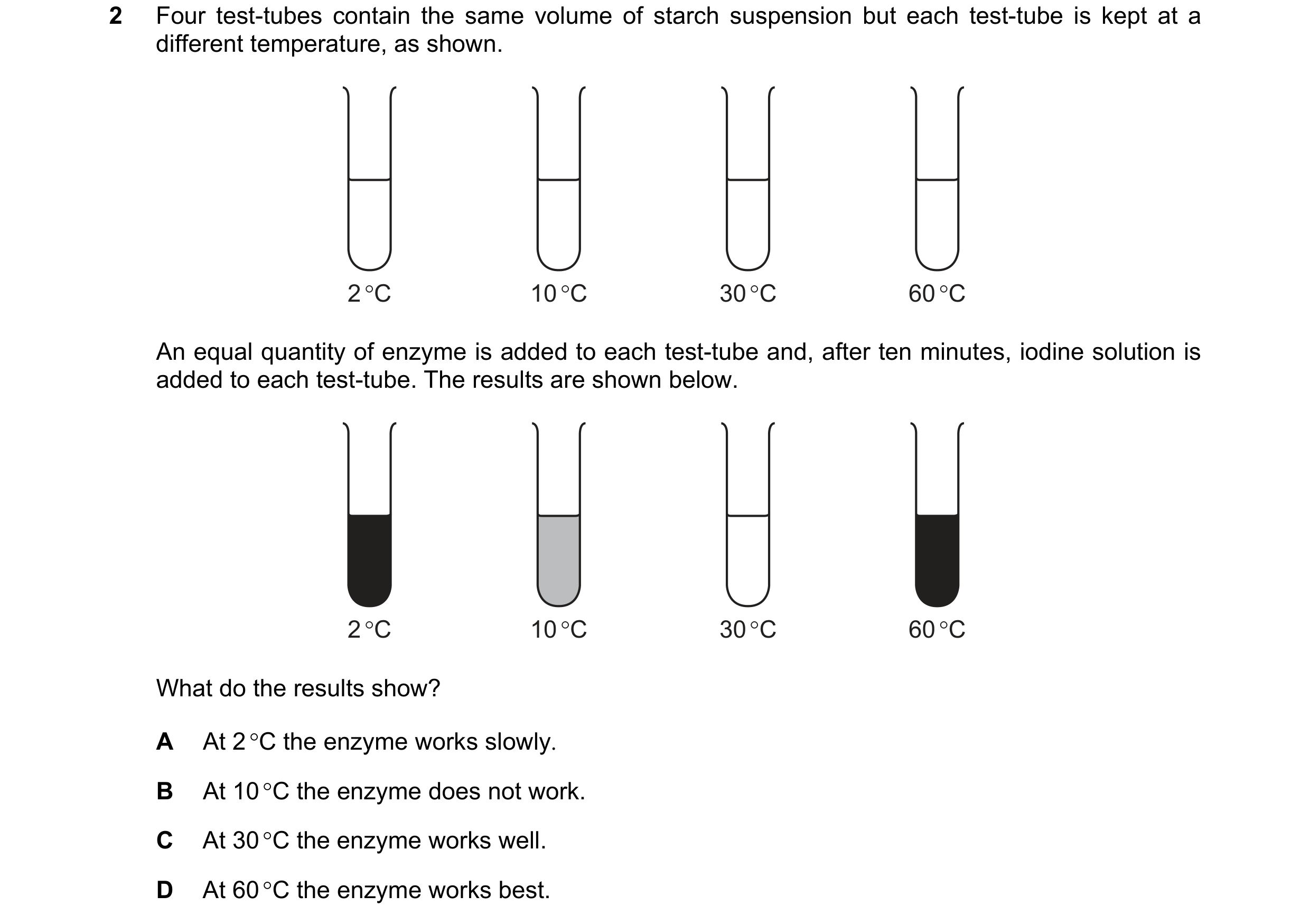

 10 / 26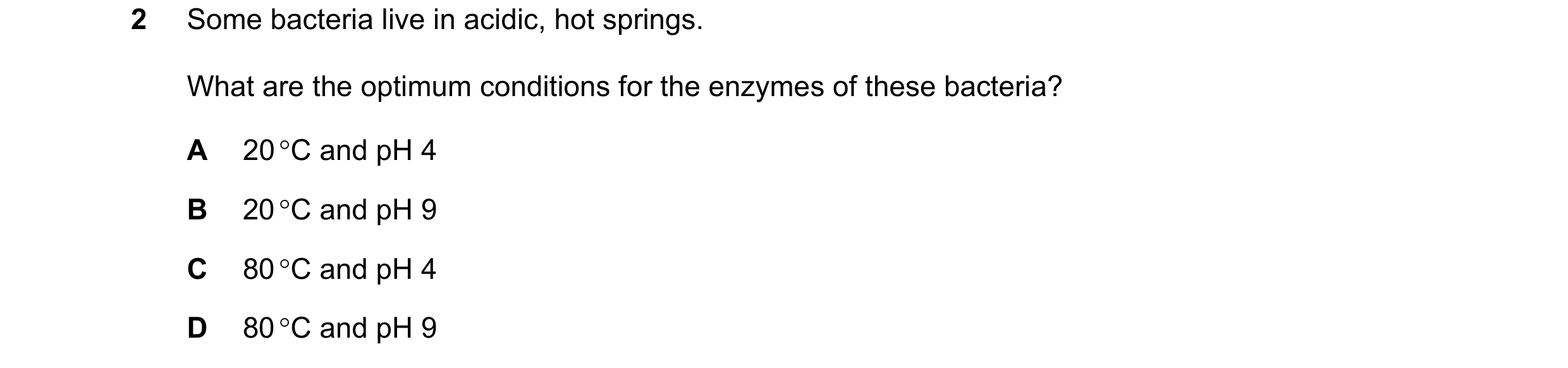
 11 / 26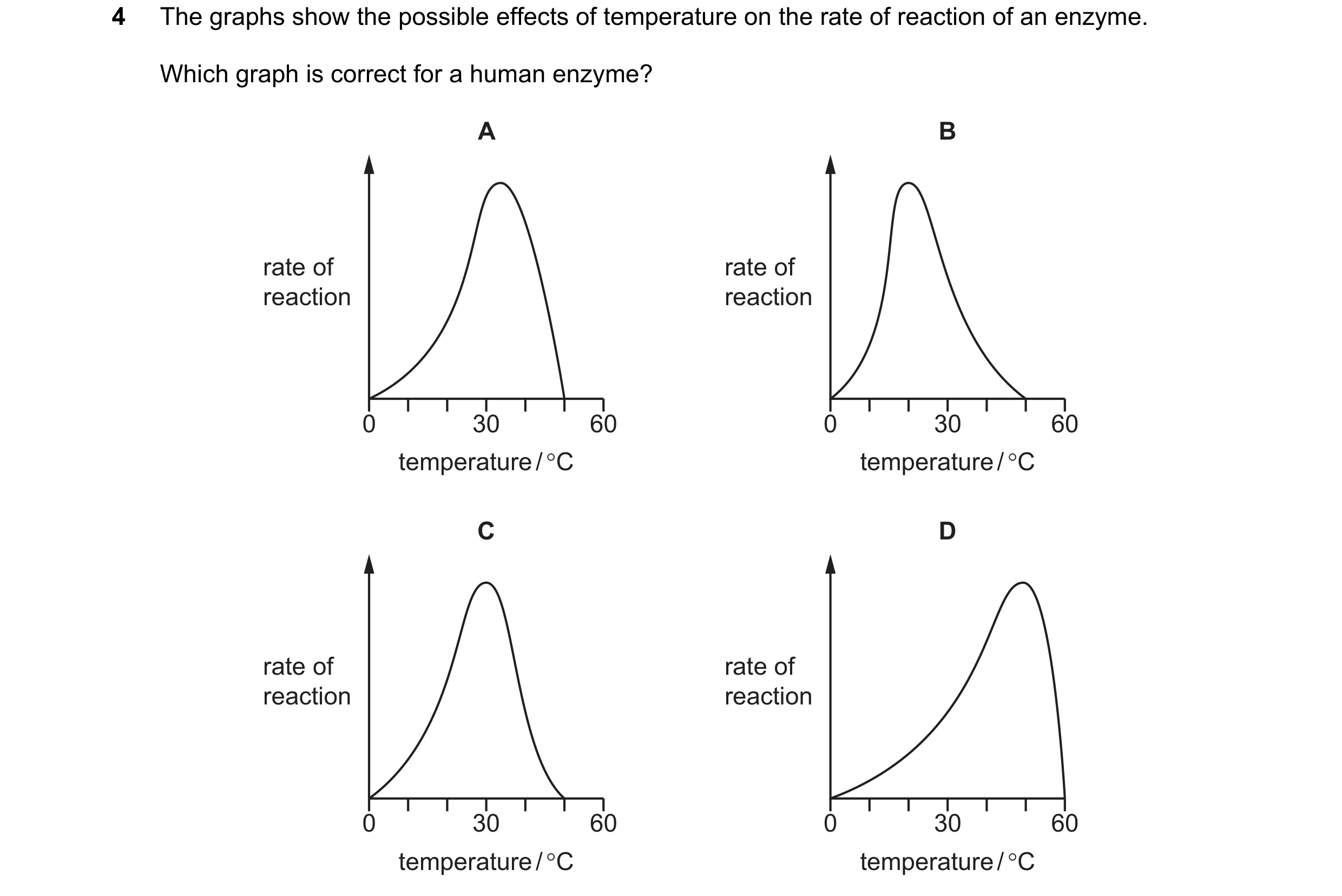
 12 / 26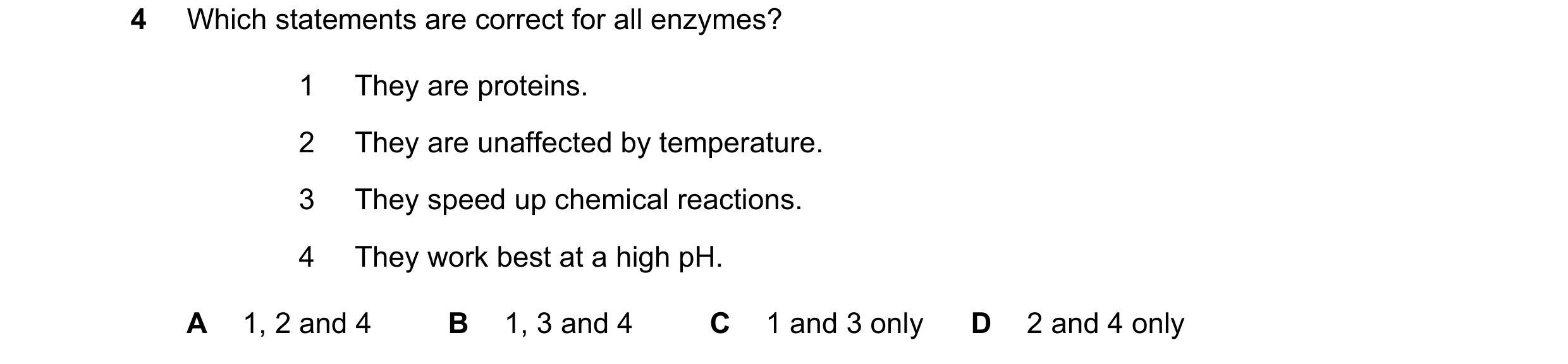
 13 / 26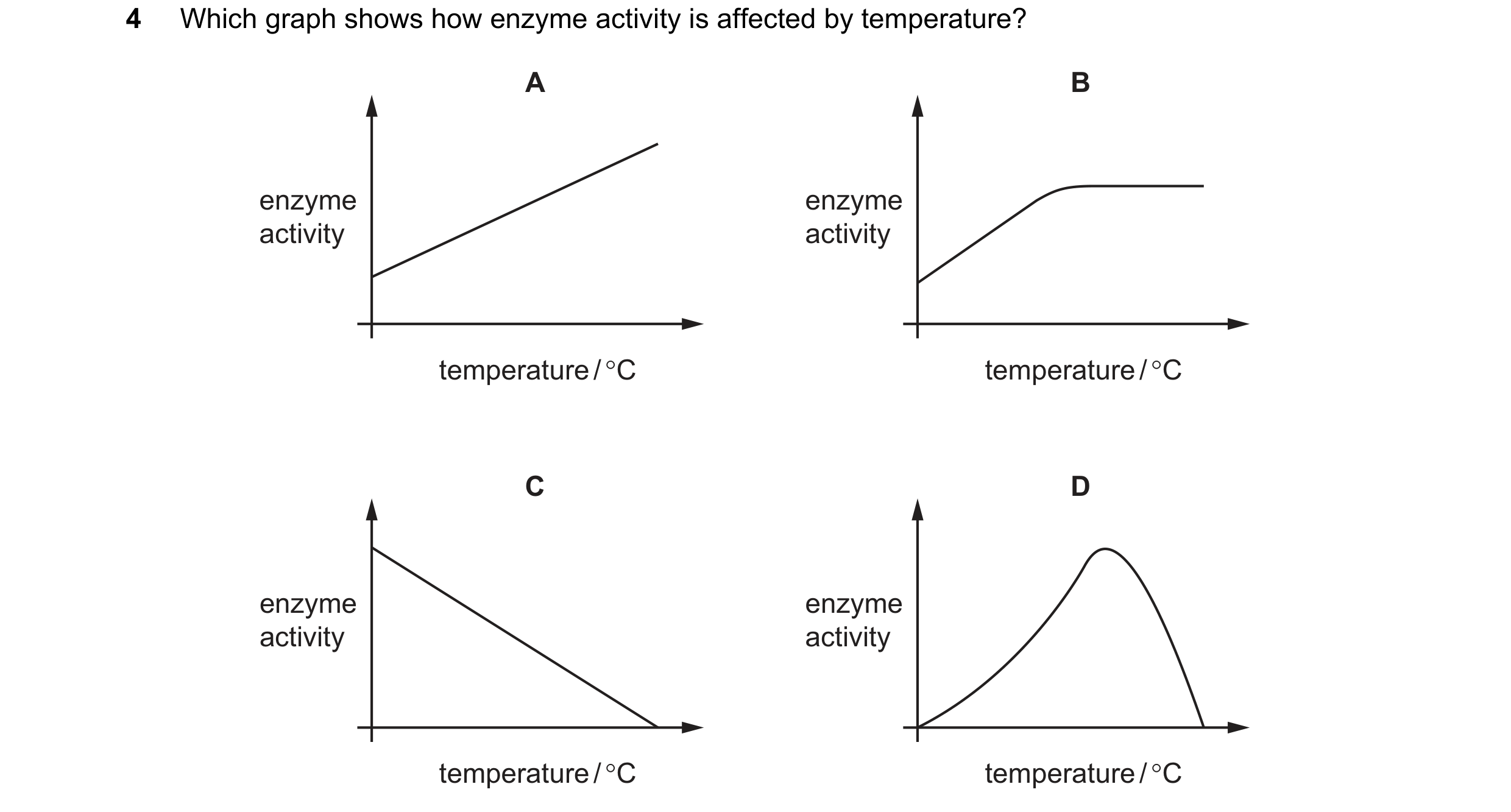
 14 / 26
 15 / 26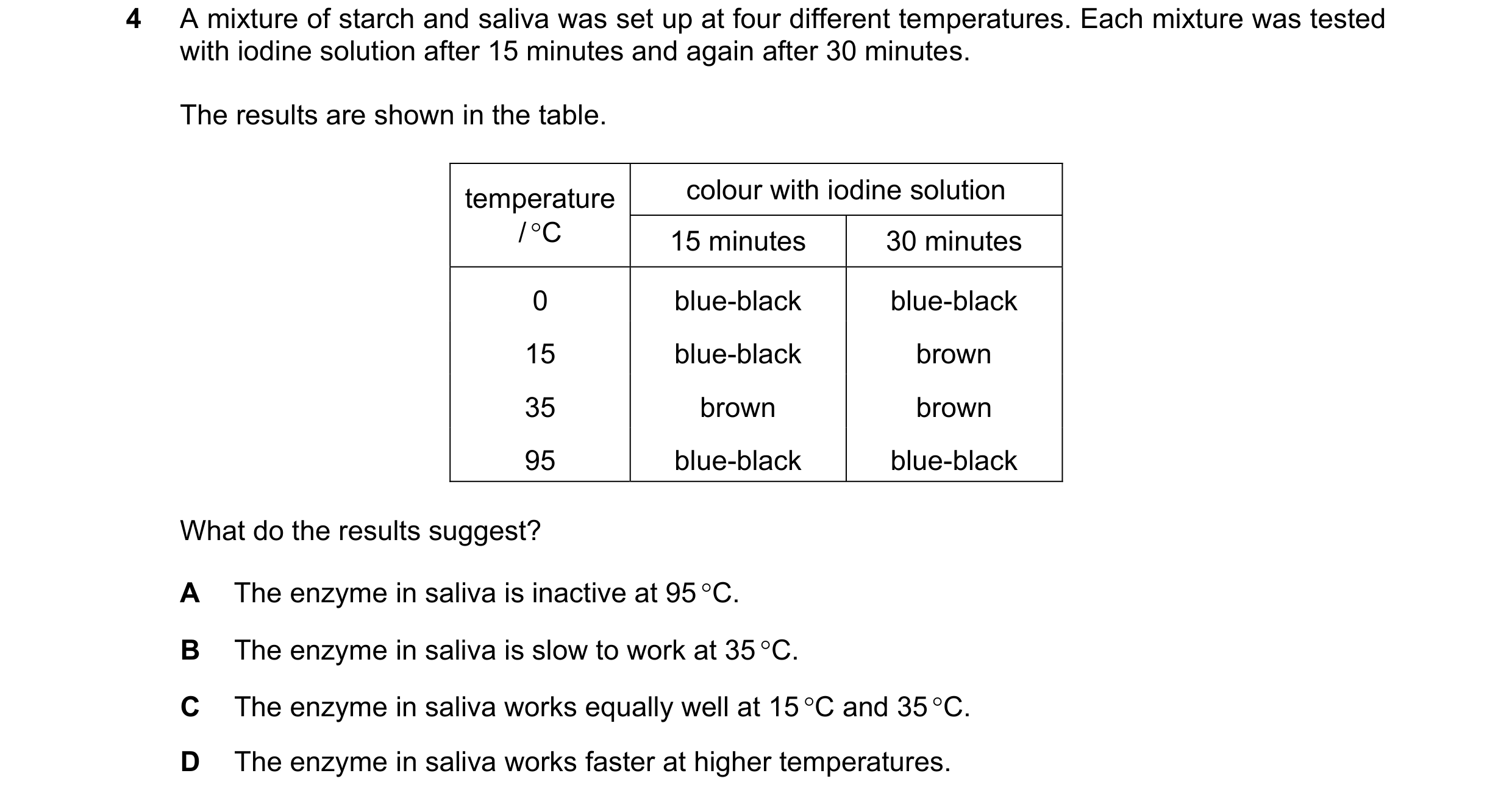



 16 / 26
 17 / 26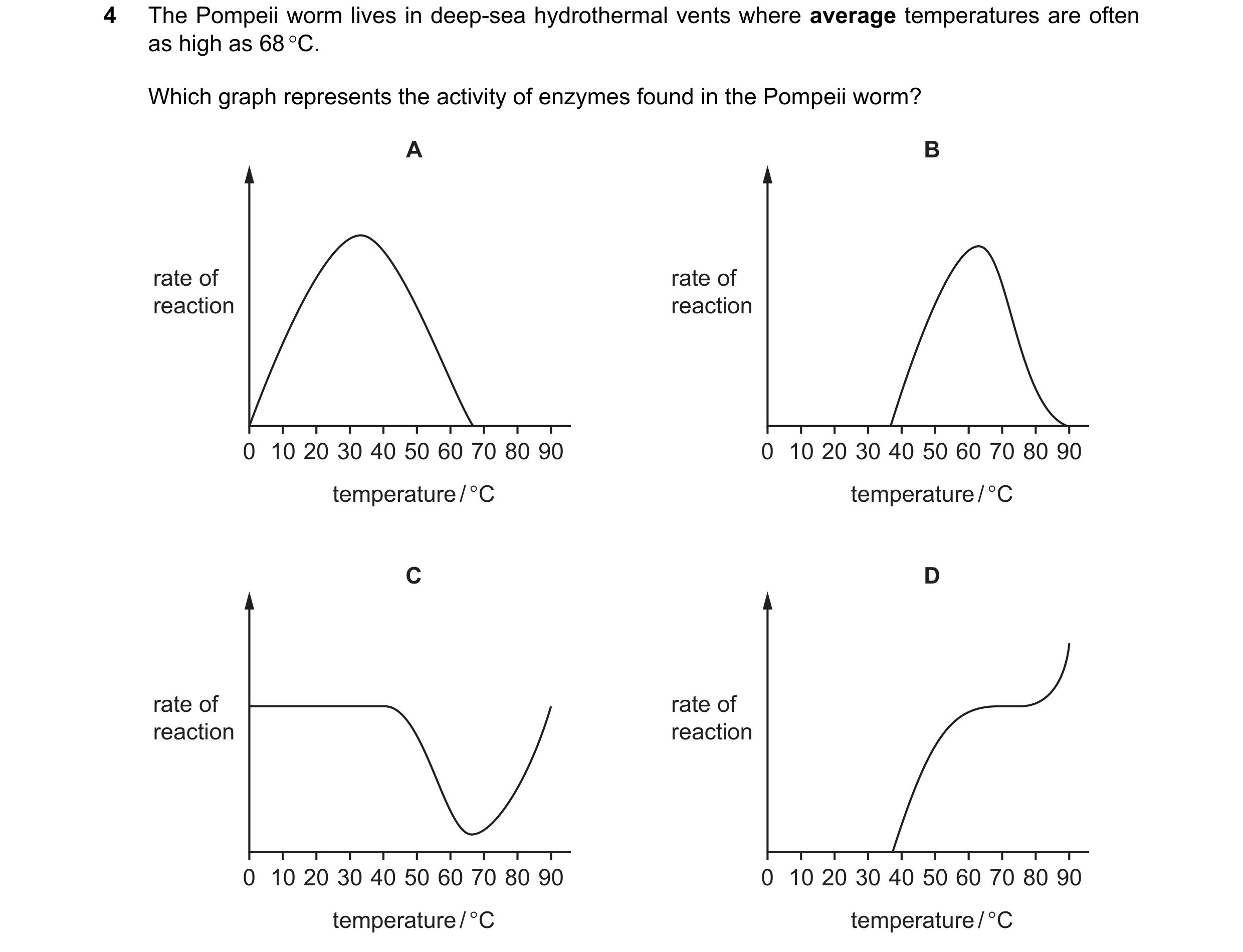
 18 / 26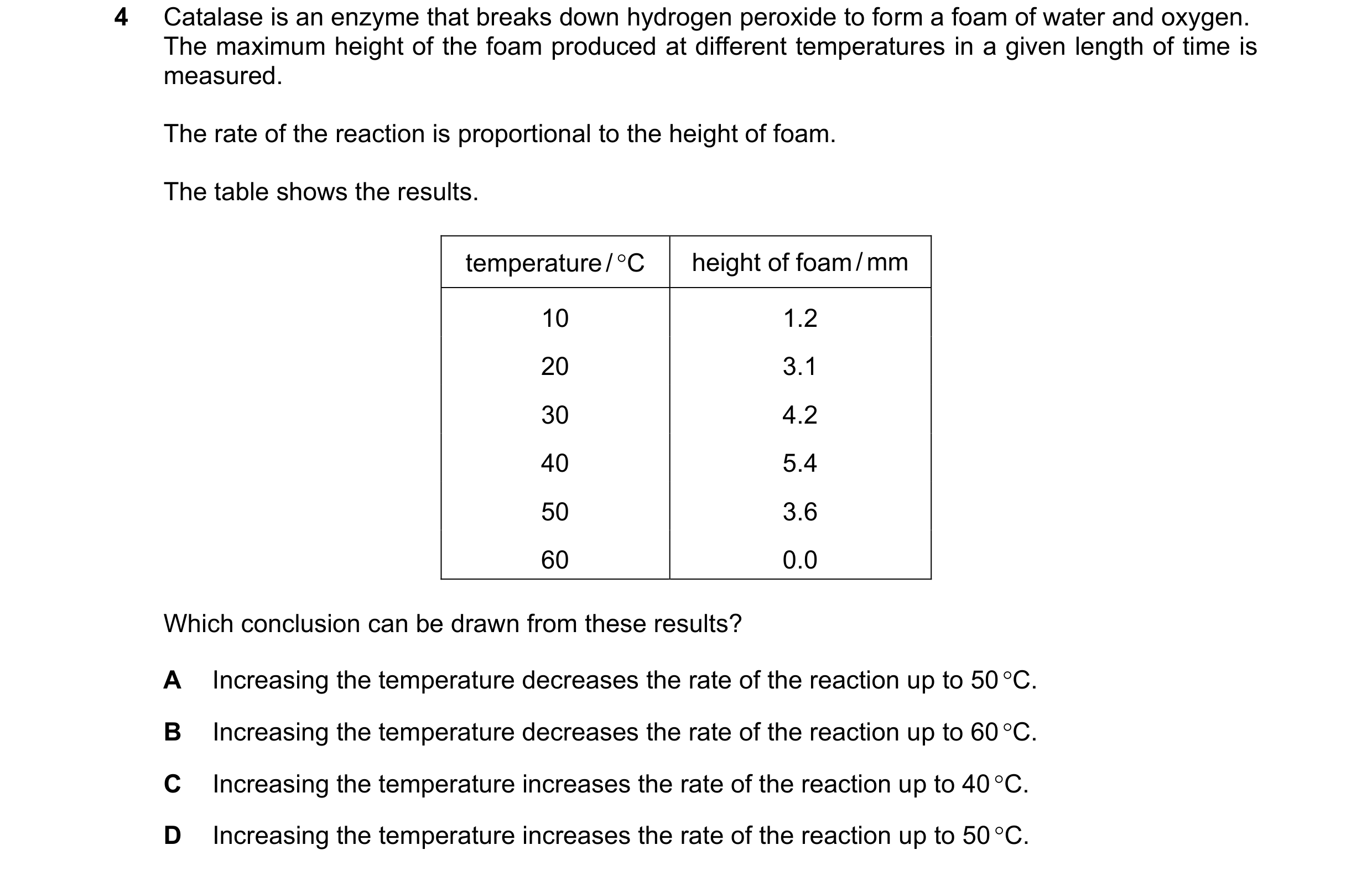
 19 / 26


 20 / 26


 21 / 26
 22 / 26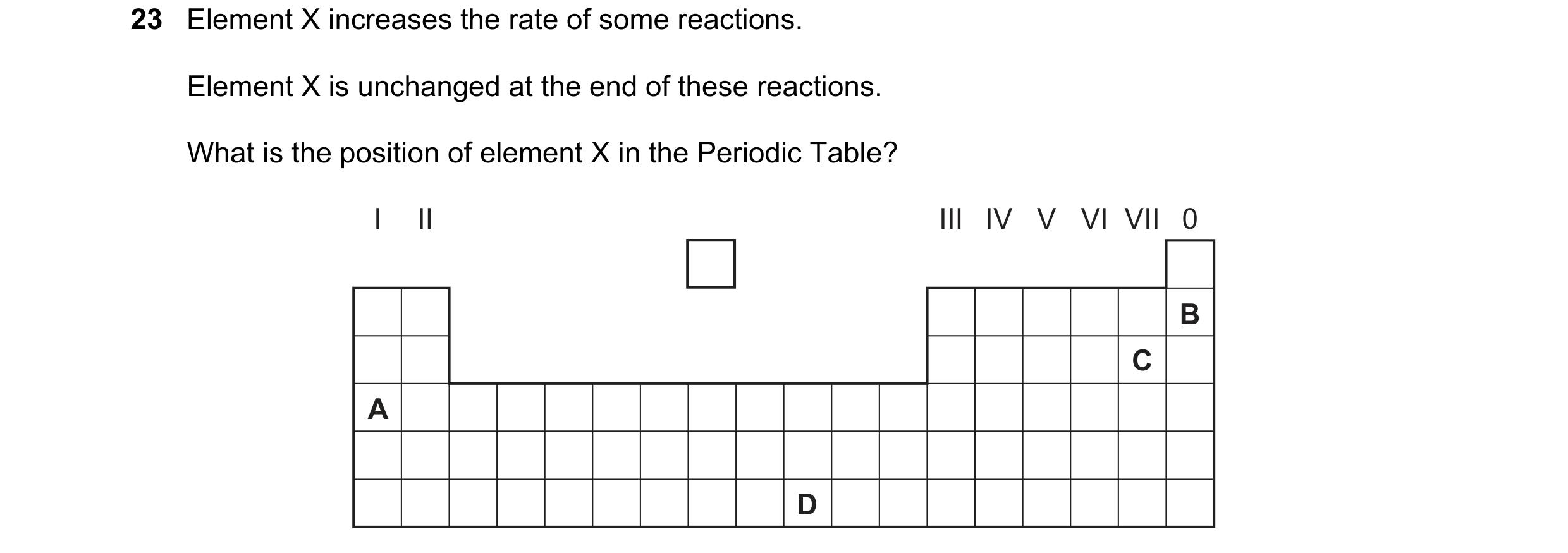

 23 / 26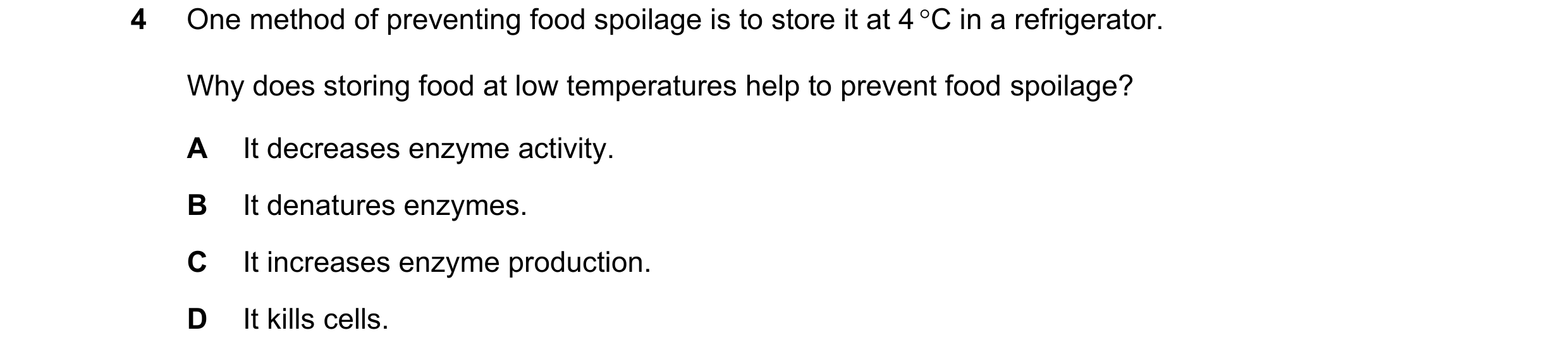
 24 / 26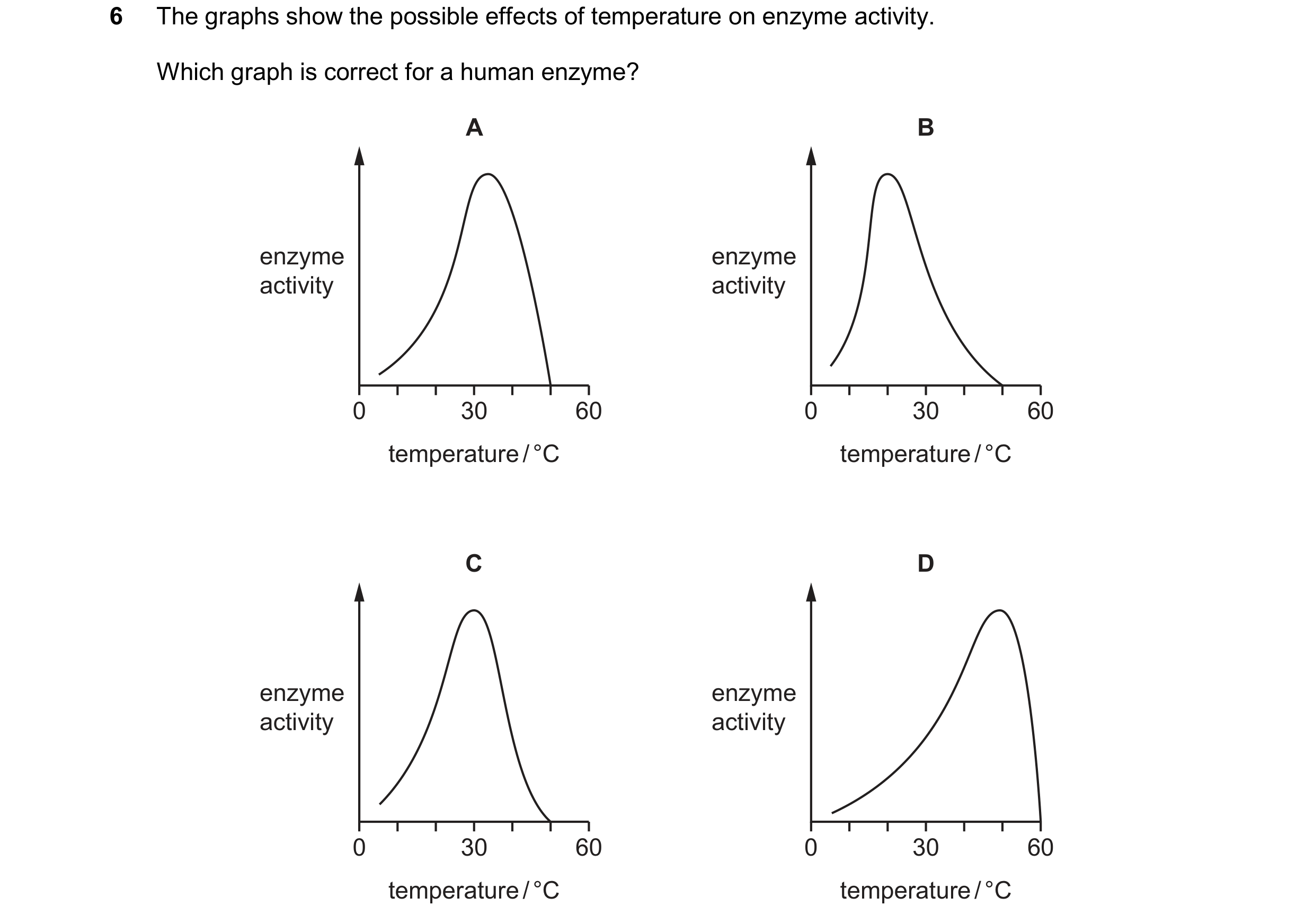


 25 / 26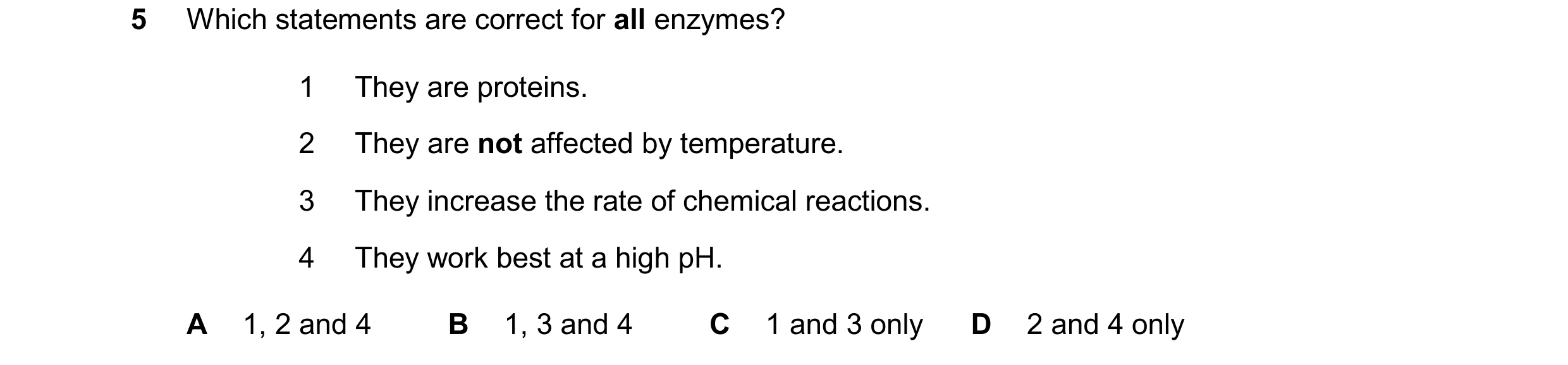
 26 / 26