Questions as text
Q1 · An enzyme from the alimentary canal has an optimum activity at an acidic pH 0654/23 May/June 2017
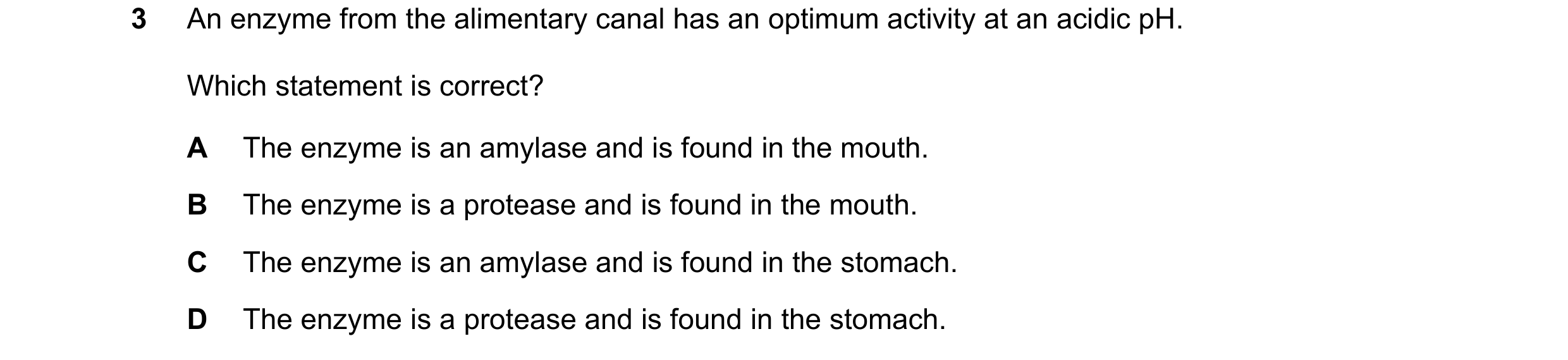
3 An enzyme from the alimentary canal has an optimum activity at an acidic pH. Which statement is correct? A The enzyme is an amylase and is found in the mouth. B The enzyme is a protease and is found in the mouth. C The enzyme is an amylase and is found in the stomach. D The enzyme is a protease and is found in the stomach.
1 marks
Answer: D
This question in 0654/23 May/June 2017
Q2 · When a suspension of powdered milk is completely digested by a protease enzyme it becomes… 0654/21 Oct/Nov 2017
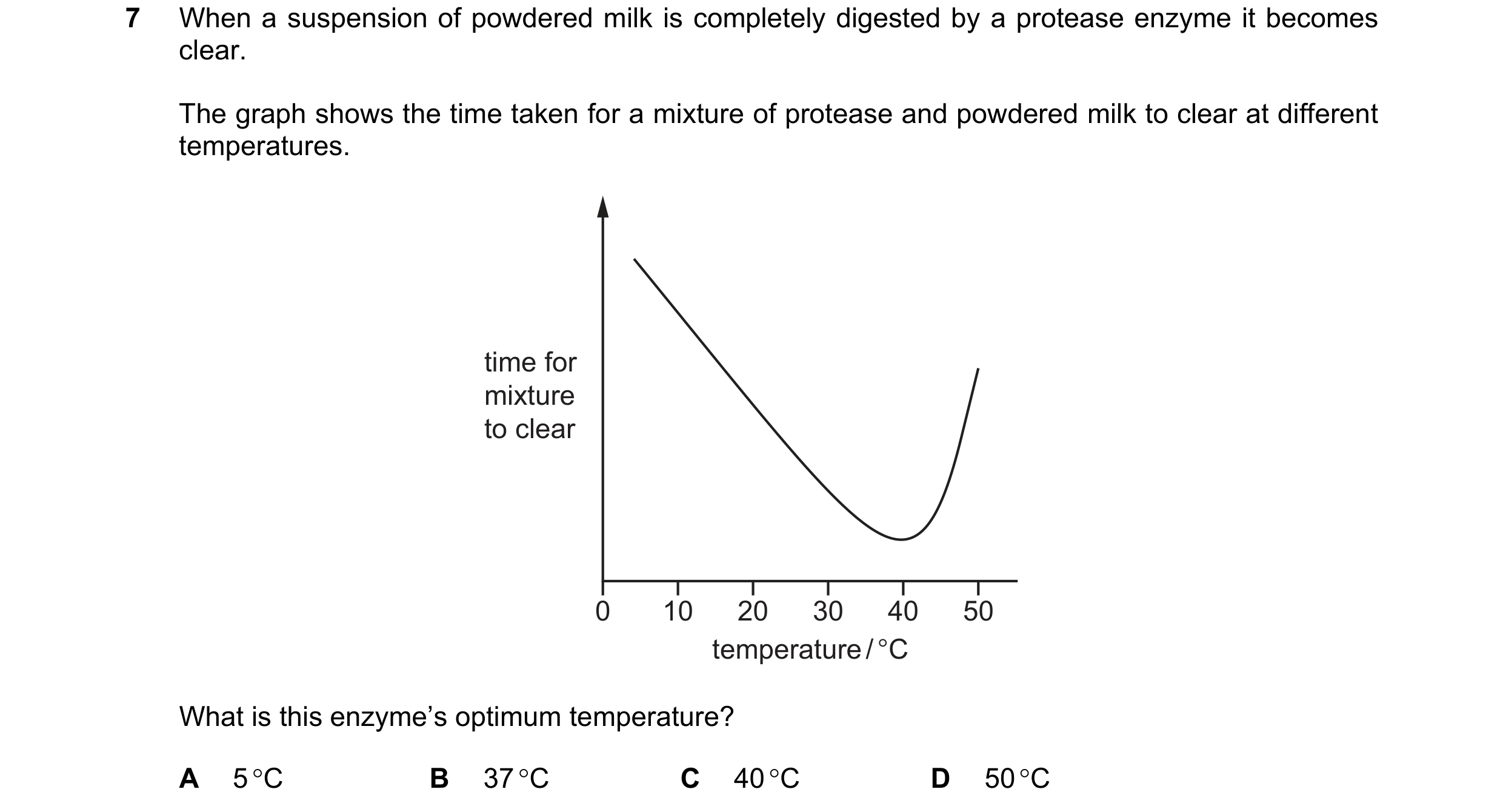
7 When a suspension of powdered milk is completely digested by a protease enzyme it becomes clear. The graph shows the time taken for a mixture of protease and powdered milk to clear at different temperatures. time for mixture to clear 0 10 20 30 40 50 temperature / °C What is this enzyme’s optimum temperature? A 5 °C B 37 °C C 40 °C D 50 °C
1 marks
Answer: C
This question in 0654/21 Oct/Nov 2017
Q3 · When a suspension of powdered milk is completely digested by a protease enzyme it becomes… 0654/22 Oct/Nov 2017
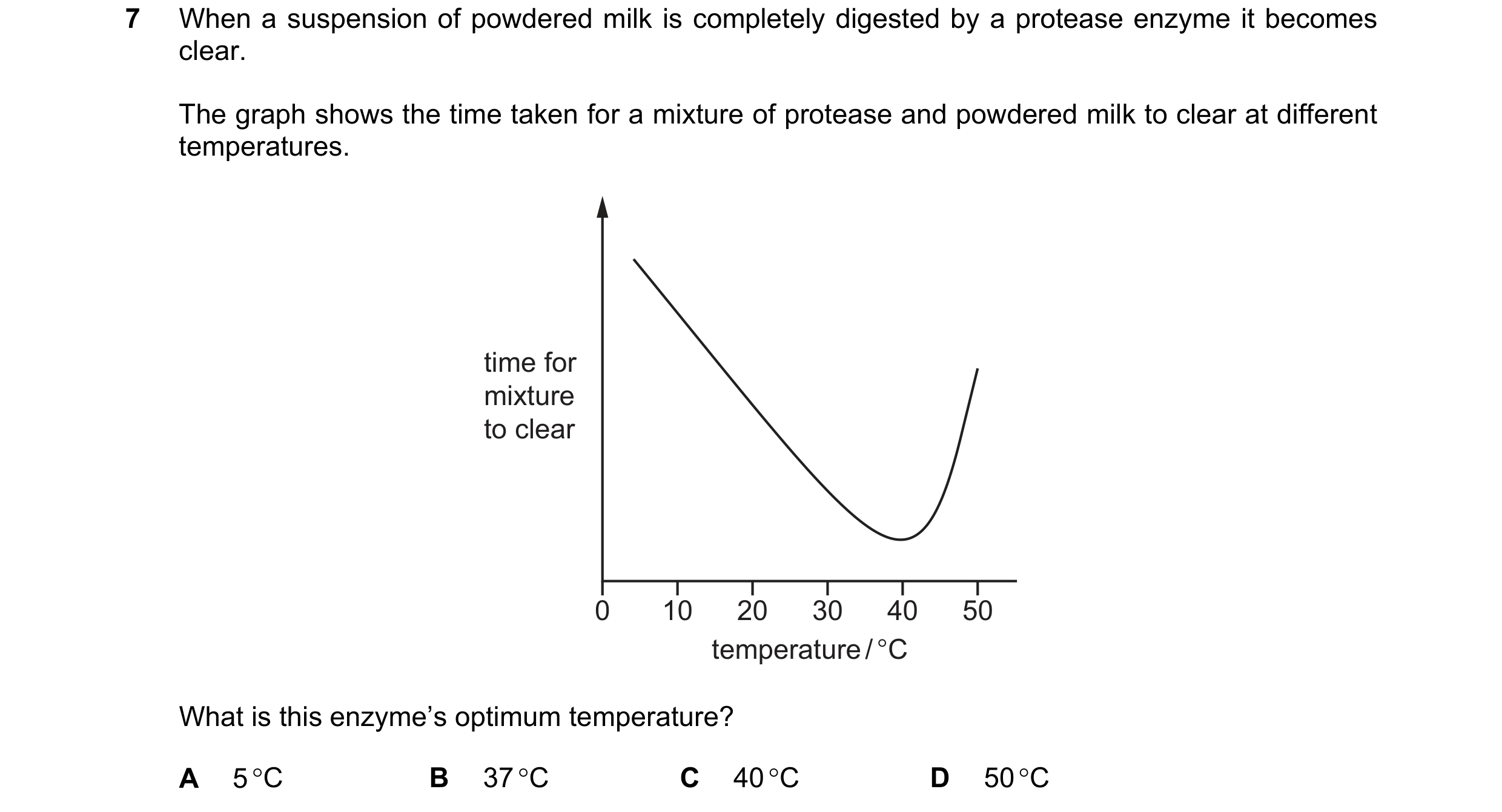
7 When a suspension of powdered milk is completely digested by a protease enzyme it becomes clear. The graph shows the time taken for a mixture of protease and powdered milk to clear at different temperatures. time for mixture to clear 0 10 20 30 40 50 temperature / °C What is this enzyme’s optimum temperature? A 5 °C B 37 °C C 40 °C D 50 °C
1 marks
Answer: C
This question in 0654/22 Oct/Nov 2017
Q4 · When a suspension of powdered milk is completely digested by a protease enzyme it becomes… 0654/23 Oct/Nov 2017
7 When a suspension of powdered milk is completely digested by a protease enzyme it becomes clear. The graph shows the time taken for a mixture of protease and powdered milk to clear at different temperatures. time for mixture to clear 0 10 20 30 40 50 temperature / °C What is this enzyme’s optimum temperature? A 5 °C B 37 °C C 40 °C D 50 °C
1 marks
Answer: C
This question in 0654/23 Oct/Nov 2017
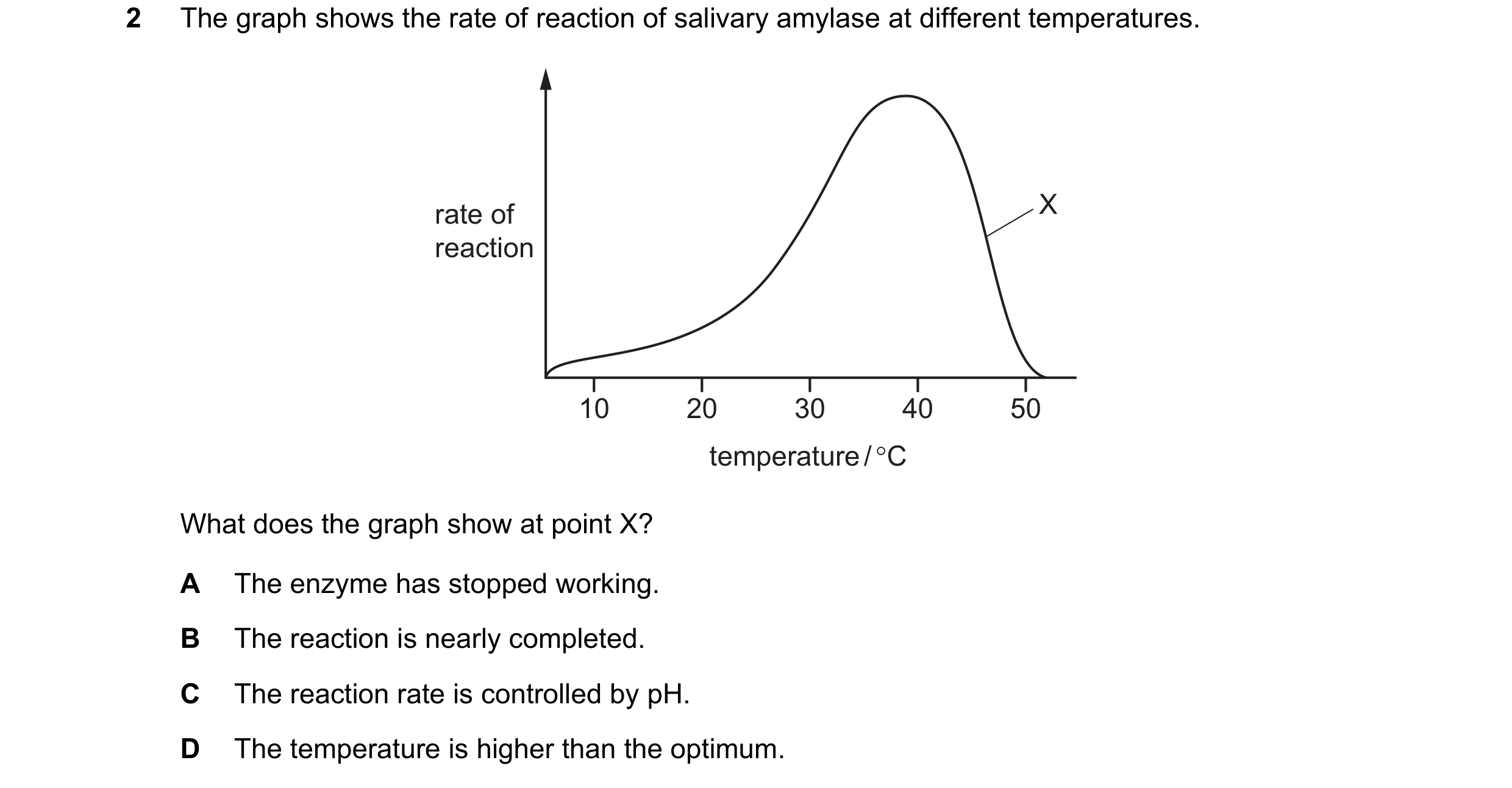
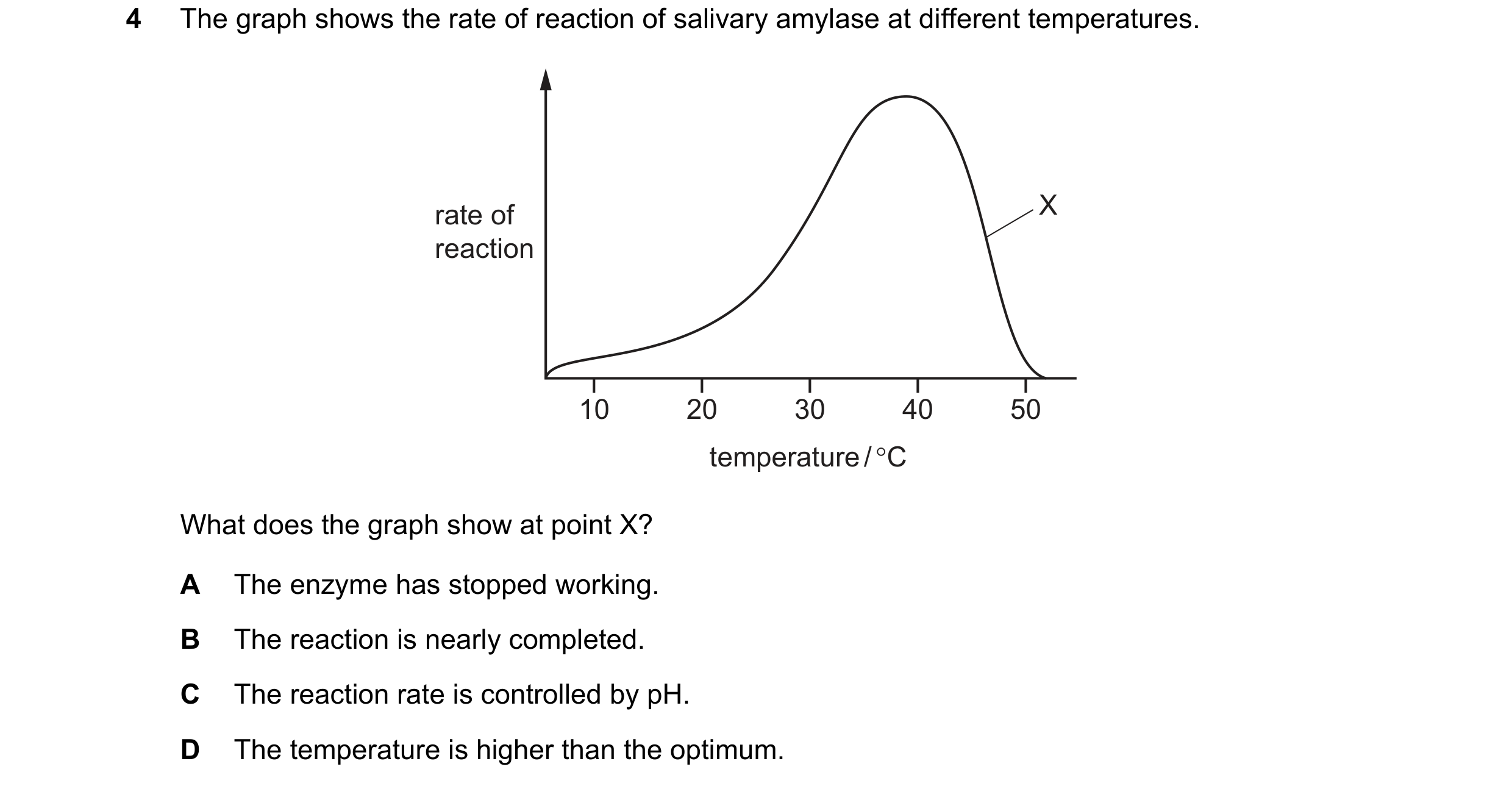
Q5 · The graph shows the rate of reaction of salivary amylase at different temperatures 0654/21 Oct/Nov 2018
2 The graph shows the rate of reaction of salivary amylase at different temperatures. rate of X reaction 10 20 30 40 50 temperature / °C What does the graph show at point X? A The enzyme has stopped working. B The reaction is nearly completed. C The reaction rate is controlled by pH. D The temperature is higher than the optimum.
1 marks
Answer: D
This question in 0654/21 Oct/Nov 2018
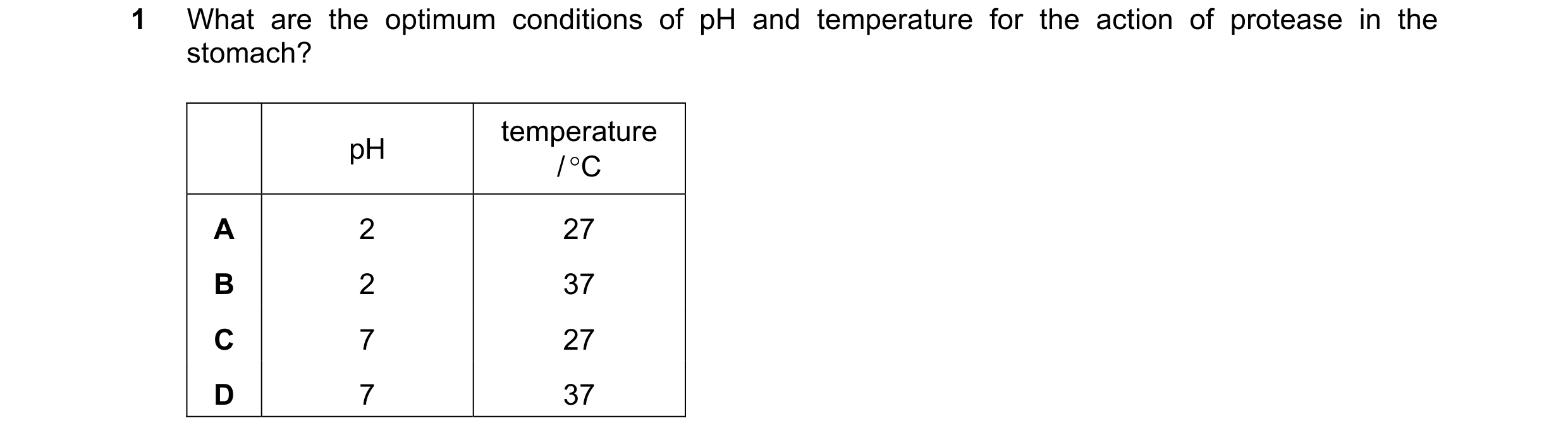
Q6 · What are the optimum conditions of pH and temperature for the action of protease in the… 0654/22 Oct/Nov 2018
1 What are the optimum conditions of pH and temperature for the action of protease in the stomach? temperature pH / °C A 2 27 B 2 37 C 7 27 D 7 37
1 marks
Answer: B
This question in 0654/22 Oct/Nov 2018
Q7 · The diagram shows four test-tubes in beakers at different temperatures 0654/23 Oct/Nov 2018
3 The diagram shows four test-tubes in beakers at different temperatures. Each test-tube contains the same amount of starch suspension. Equal amounts of salivary amylase are added to each test-tube. After 20 minutes, which test-tube will contain the most reducing sugar? A B C D ice 5 °C 30 °C 90 °C
1 marks
Answer: C
This question in 0654/23 Oct/Nov 2018
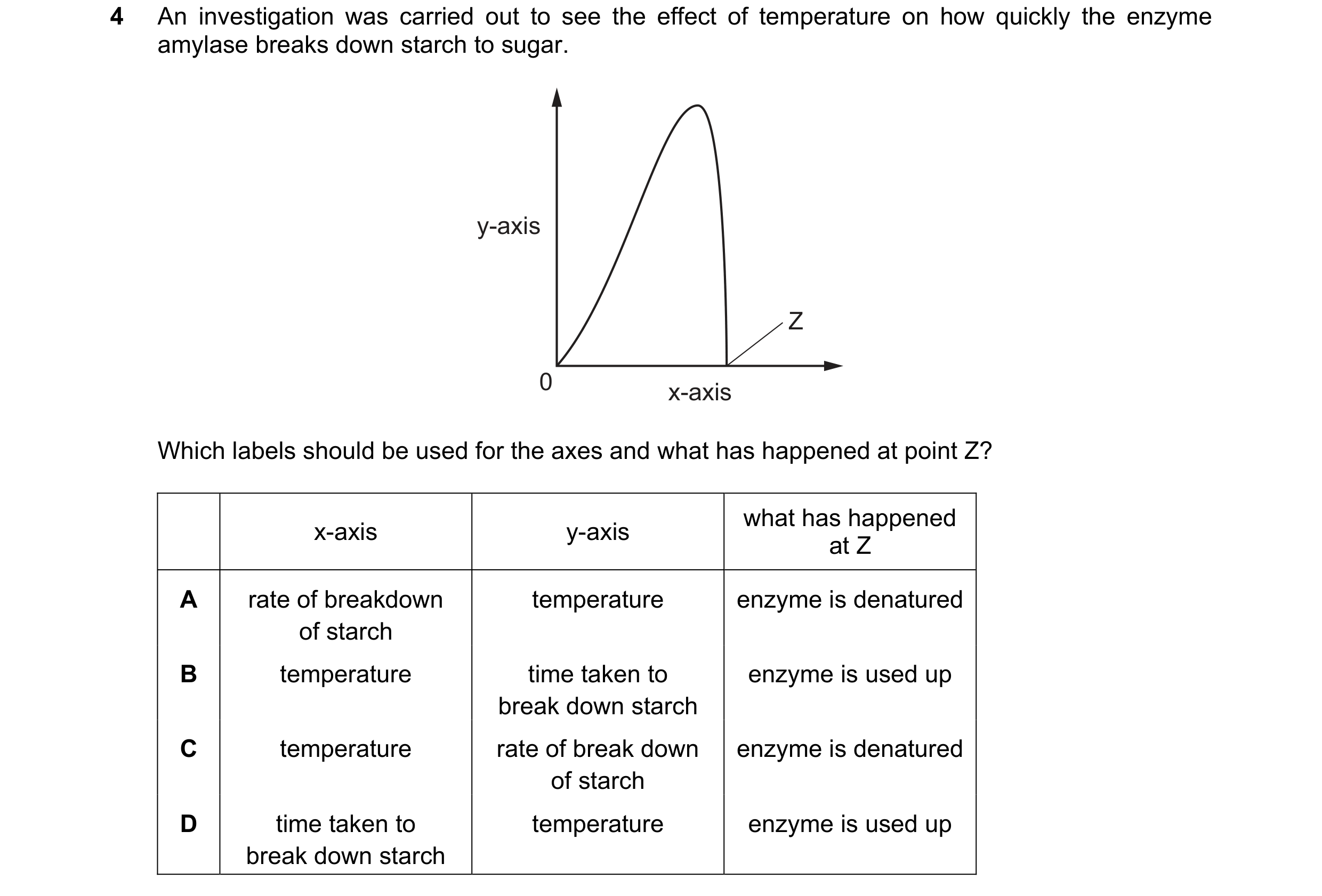
Q8 · An investigation was carried out to see the effect of temperature on how quickly the… 0654/21 May/June 2019
4 An investigation was carried out to see the effect of temperature on how quickly the enzyme amylase breaks down starch to sugar. y-axis Z 0 x-axis Which labels should be used for the axes and what has happened at point Z? what has happened x-axis y-axis at Z A rate of breakdown temperature enzyme is denatured of starch B temperature time taken to enzyme is used up break down starch C temperature rate of break down enzyme is denatured of starch D time taken to temperature enzyme is used up break down starch
1 marks
Answer: C
This question in 0654/21 May/June 2019
Q9 · The graphs show the possible effects of temperature on the rate of reaction of an enzyme 0654/22 May/June 2019
4 The graphs show the possible effects of temperature on the rate of reaction of an enzyme. Which graph is correct for a human enzyme? A B rate of rate of reaction reaction 0 30 60 0 30 60 temperature / °C temperature / °C C D rate of rate of reaction reaction 0 30 60 0 30 60 temperature / °C temperature / °C
1 marks
Answer: A
This question in 0654/22 May/June 2019
Q10 · Which statement about enzyme action is correct? 0654/23 May/June 2019
4 Which statement about enzyme action is correct? A The active site of the enzyme is complementary to the product and a substrate is formed. B The active site of the substrate is complementary to the enzyme and a product is formed. C The active site of the product is complementary to the enzyme and a substrate is formed. D The active site of the enzyme is complementary to the substrate and a product is formed.
1 marks
Answer: D
This question in 0654/23 May/June 2019
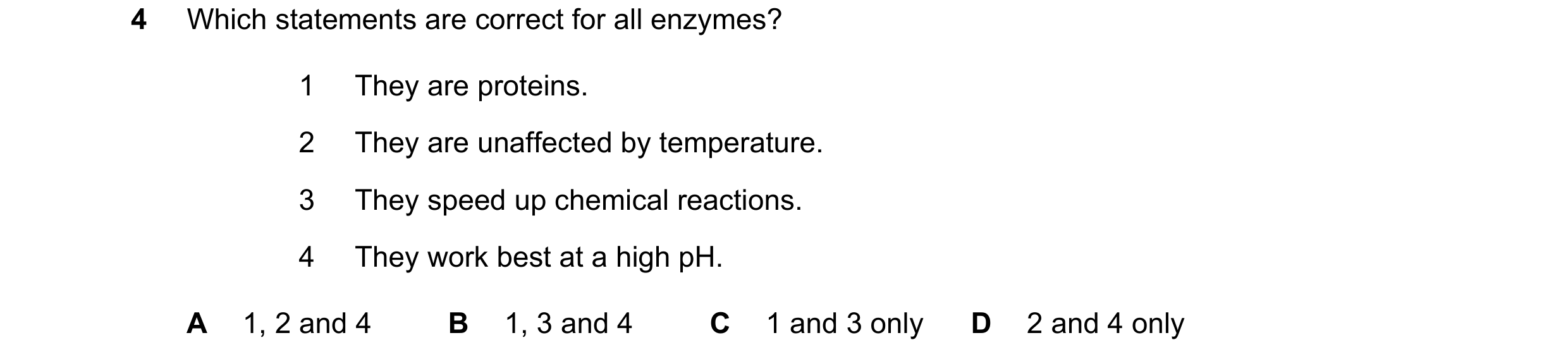
Q11 · Which statements are correct for all enzymes? 0654/21 Oct/Nov 2019
4 Which statements are correct for all enzymes? 1 They are proteins. 2 They are unaffected by temperature. 3 They speed up chemical reactions. 4 They work best at a high pH. A 1, 2 and 4 B 1, 3 and 4 C 1 and 3 only D 2 and 4 only
1 marks
Answer: C
This question in 0654/21 Oct/Nov 2019
Q12 · A test-tube containing a starch-amylase mixture is incubated at 35 °C 0654/22 Oct/Nov 2019
4 A test-tube containing a starch-amylase mixture is incubated at 35 °C. The graph shows how the amount of starch in the test-tube changes over the next five minutes. amount of starch remaining 0 1 2 3 4 5 time / minutes Which graph shows what happens if a similar starch-amylase mixture is incubated at 100 °C? A B amount amount of starch of starch remaining remaining 0 1 2 3 4 5 0 1 2 3 4 5 time / minutes time / minutes C D amount amount of starch of starch remaining remaining 0 1 2 3 4 5 0 1 2 3 4 5 time / minutes time / minutes
1 marks
Answer: B
This question in 0654/22 Oct/Nov 2019
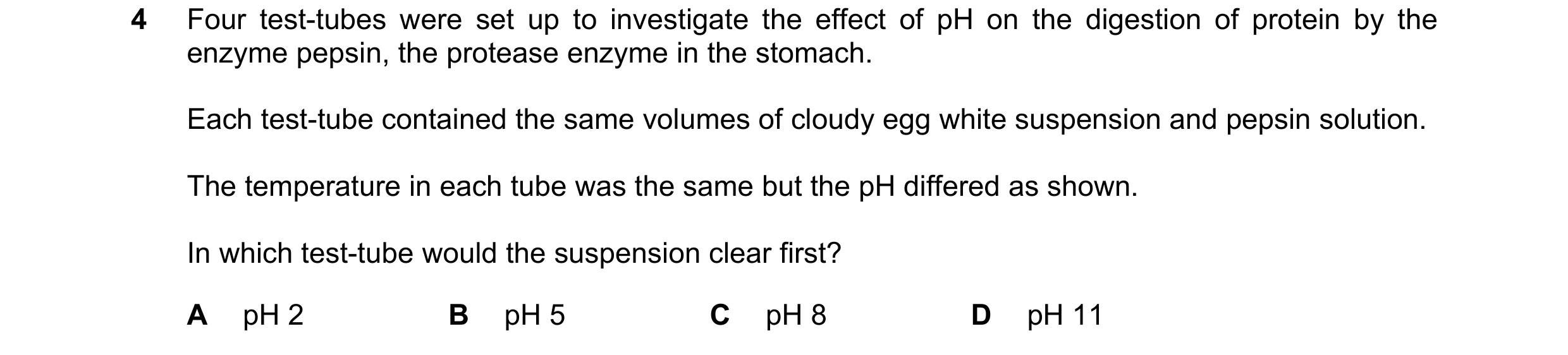
Q13 · Four test-tubes were set up to investigate the effect of pH on the digestion of protein… 0654/23 Oct/Nov 2019
4 Four test-tubes were set up to investigate the effect of pH on the digestion of protein by the enzyme pepsin, the protease enzyme in the stomach. Each test-tube contained the same volumes of cloudy egg white suspension and pepsin solution. The temperature in each tube was the same but the pH differed as shown. In which test-tube would the suspension clear first? A pH 2 B pH 5 C pH 8 D pH 11
1 marks
Answer: A
This question in 0654/23 Oct/Nov 2019
Q14 · Which statement correctly describes enzyme activity as the temperature increases up to an… 0654/21 May/June 2020
4 Which statement correctly describes enzyme activity as the temperature increases up to an optimum temperature? A The enzyme has less frequent effective collisions with the product. B The enzyme has less frequent effective collisions with the substrate. C The enzyme has more frequent effective collisions with the product. D The enzyme has more frequent effective collisions with the substrate.
1 marks
Answer: D
This question in 0654/21 May/June 2020
Q15 · Why do cells contain many different types of enzymes? 0654/22 May/June 2020
4 Why do cells contain many different types of enzymes? A Enzymes are affected by substrate concentration. B Enzymes are affected by temperature. C Enzymes have an active site complementary to a specific substrate. D Enzymes work at different pH values.
1 marks
Answer: C
This question in 0654/22 May/June 2020
Q16 · Which type of molecule is an enzyme? 0654/23 May/June 2020
4 Which type of molecule is an enzyme? A carbohydrate B fat C protein D vitamin
1 marks
Answer: C
This question in 0654/23 May/June 2020
Q17 · A mixture of starch and saliva was set up at four different temperatures 0654/21 Oct/Nov 2020
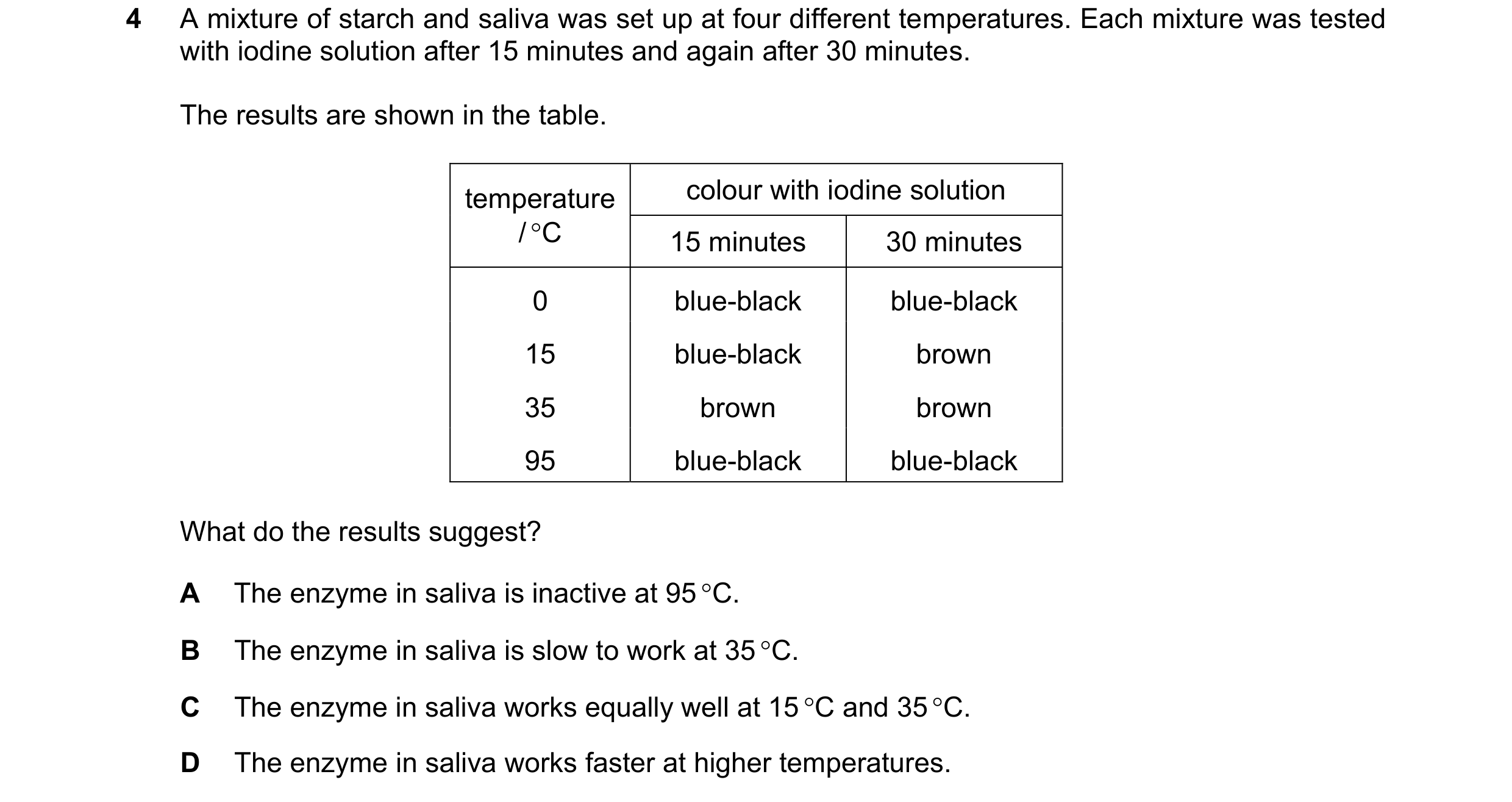
4 A mixture of starch and saliva was set up at four different temperatures. Each mixture was tested with iodine solution after 15 minutes and again after 30 minutes. The results are shown in the table. temperature colour with iodine solution / C 15 minutes 30 minutes 0 blue-black blue-black 15 blue-black brown 35 brown brown 95 blue-black blue-black What do the results suggest? A The enzyme in saliva is inactive at 95 C. B The enzyme in saliva is slow to work at 35 C. C The enzyme in saliva works equally well at 15 C and 35 C. D The enzyme in saliva works faster at higher temperatures.
1 marks
Answer: A
This question in 0654/21 Oct/Nov 2020
Q18 · A mixture of starch and saliva was set up at four different temperatures 0654/22 Oct/Nov 2020
4 A mixture of starch and saliva was set up at four different temperatures. Each mixture was tested with iodine solution after 15 minutes and again after 30 minutes. The results are shown in the table. temperature colour with iodine solution / C 15 minutes 30 minutes 0 blue-black blue-black 15 blue-black brown 35 brown brown 95 blue-black blue-black What do the results suggest? A The enzyme in saliva is inactive at 95 C. B The enzyme in saliva is slow to work at 35 C. C The enzyme in saliva works equally well at 15 C and 35 C. D The enzyme in saliva works faster at higher temperatures.
1 marks
Answer: A
This question in 0654/22 Oct/Nov 2020
Q19 · A mixture of starch and saliva was set up at four different temperatures 0654/23 Oct/Nov 2020
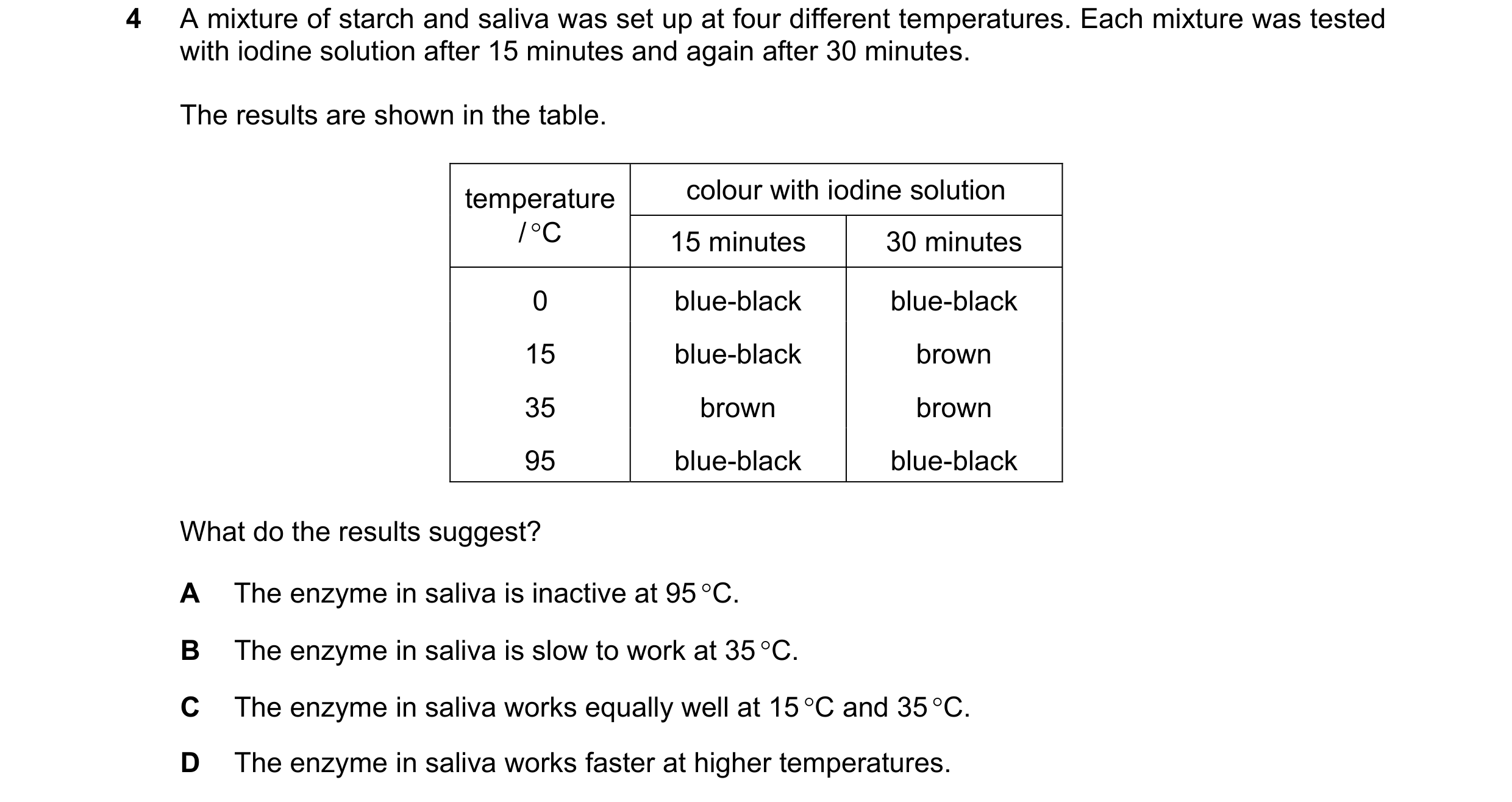
4 A mixture of starch and saliva was set up at four different temperatures. Each mixture was tested with iodine solution after 15 minutes and again after 30 minutes. The results are shown in the table. temperature colour with iodine solution / C 15 minutes 30 minutes 0 blue-black blue-black 15 blue-black brown 35 brown brown 95 blue-black blue-black What do the results suggest? A The enzyme in saliva is inactive at 95 C. B The enzyme in saliva is slow to work at 35 C. C The enzyme in saliva works equally well at 15 C and 35 C. D The enzyme in saliva works faster at higher temperatures.
1 marks
Answer: A
This question in 0654/23 Oct/Nov 2020
Q20 · What are biological catalysts? 0654/22 Feb/March 2021
4 What are biological catalysts? A antibodies B enzymes C hormones D platelets
1 marks
Answer: B
This question in 0654/22 Feb/March 2021
Q21 · What is an enzyme? 0654/21 May/June 2021
4 What is an enzyme? A a carbohydrate that speeds up the rate of a reaction B a carbohydrate that alters the activity of a target organ C a protein that alters the activity of a target organ D a protein that speeds up the rate of a reaction
1 marks
Answer: D
This question in 0654/21 May/June 2021
Q22 · Which type of molecule are enzymes? 0654/22 May/June 2021
4 Which type of molecule are enzymes? A fat B carbohydrate C protein D DNA
1 marks
Answer: C
This question in 0654/22 May/June 2021
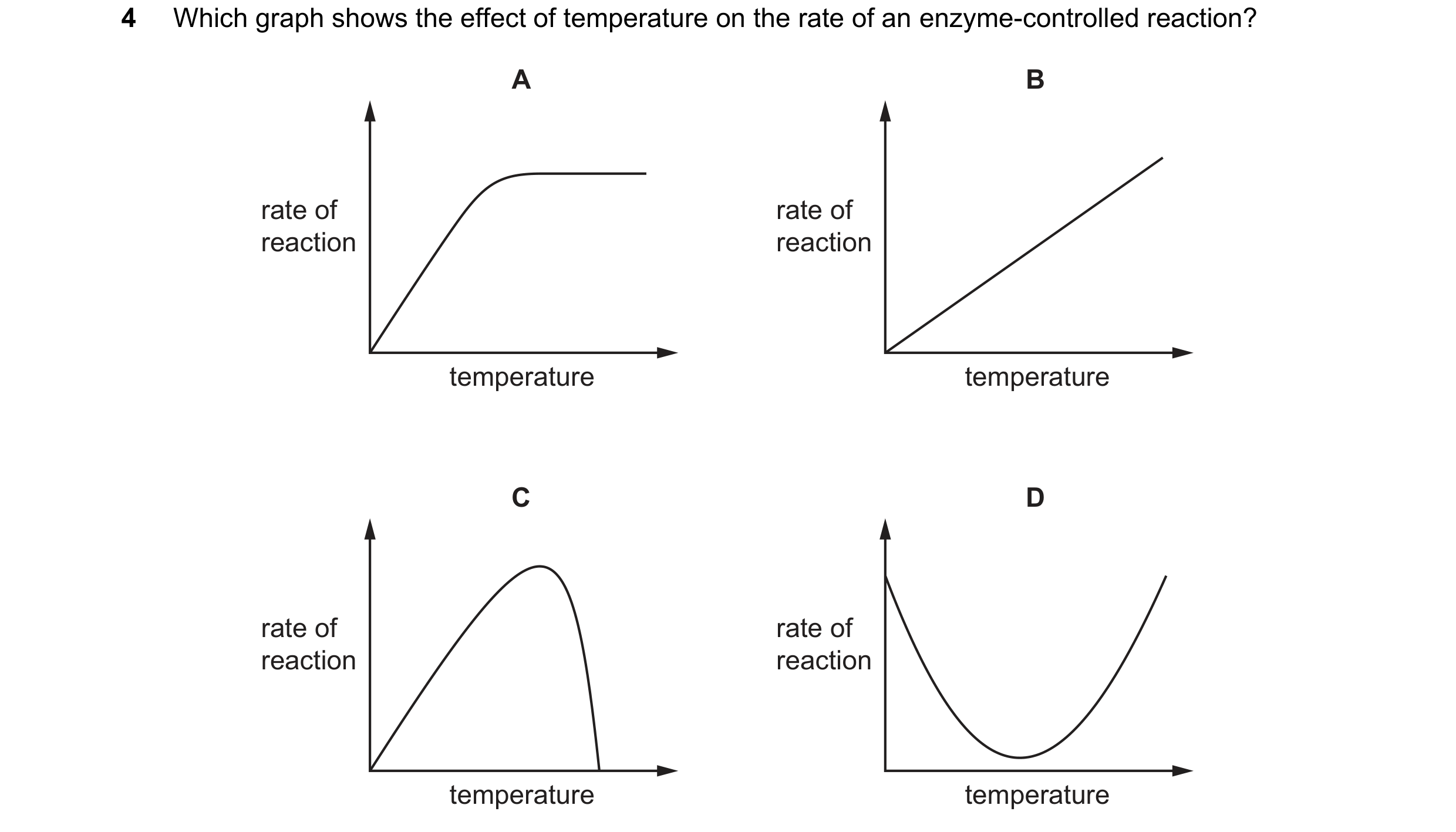
Q23 · Which graph shows the effect of temperature on the rate of an enzyme-controlled reaction? 0654/23 May/June 2021
4 Which graph shows the effect of temperature on the rate of an enzyme-controlled reaction? A B rate of rate of reaction reaction temperature temperature C D rate of rate of reaction reaction temperature temperature
1 marks
Answer: C
This question in 0654/23 May/June 2021
Q24 · An investigation was carried out to see the effect of pH on the activity of an enzyme… 0654/21 Oct/Nov 2021
4 An investigation was carried out to see the effect of pH on the activity of an enzyme found in the human alimentary canal. The graph shows the results obtained. activity of enzyme 1 2 3 pH What is the enzyme? A a protease found in the mouth B a protease found in the stomach C an amylase found in the mouth D an amylase found in the stomach
1 marks
Answer: B
This question in 0654/21 Oct/Nov 2021
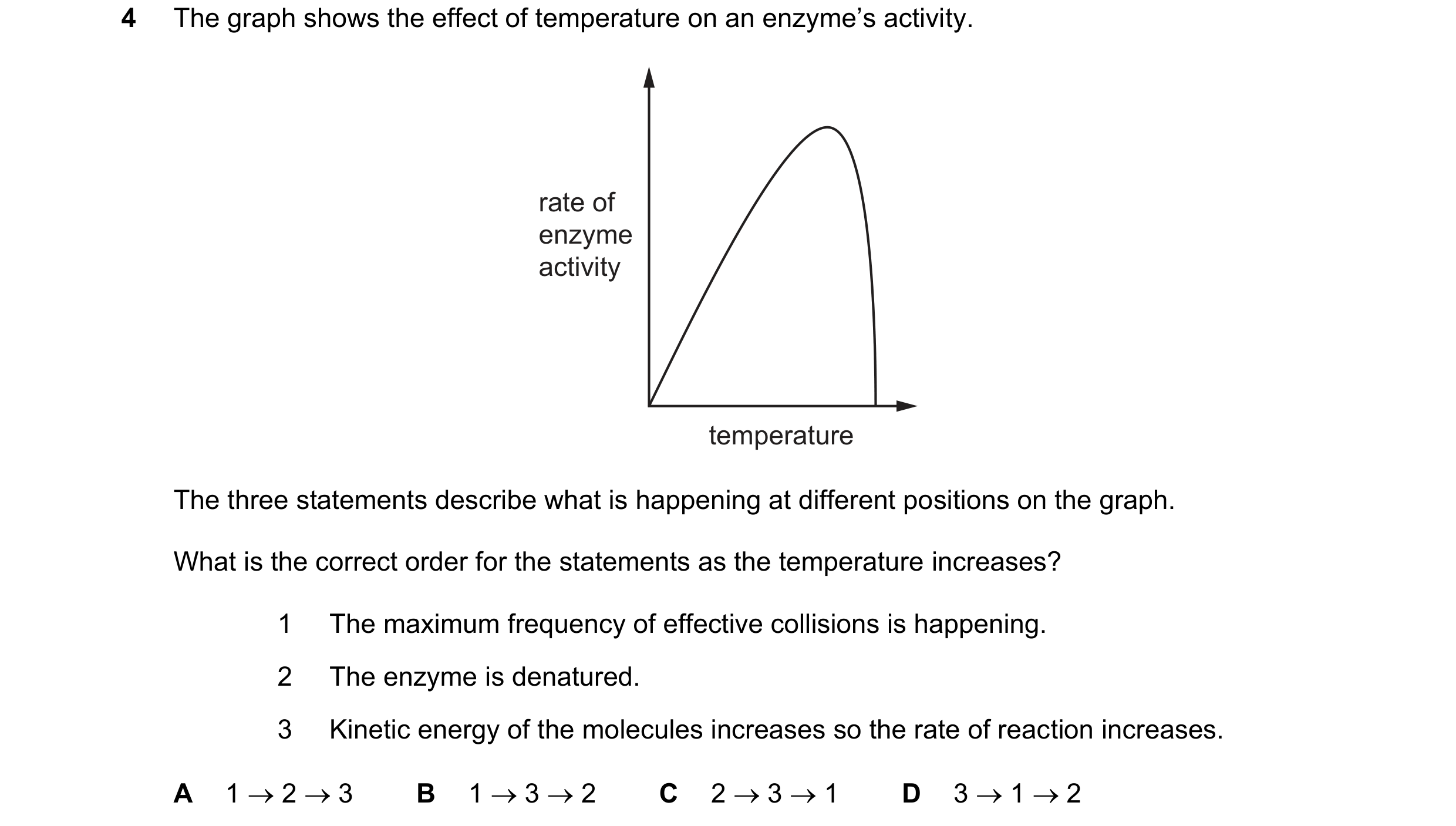
Q25 · The graph shows the effect of temperature on an enzyme’s activity 0654/22 Oct/Nov 2021
4 The graph shows the effect of temperature on an enzyme’s activity. rate of enzyme activity temperature The three statements describe what is happening at different positions on the graph. What is the correct order for the statements as the temperature increases? 1 The maximum frequency of effective collisions is happening. 2 The enzyme is denatured. 3 Kinetic energy of the molecules increases so the rate of reaction increases. A 1 2 3 B 1 3 2 C 2 3 1 D 3 1 2
1 marks
Answer: D
This question in 0654/22 Oct/Nov 2021
Q26 · The graph shows the effect of temperature on the rate of an enzyme-controlled reaction 0654/23 Oct/Nov 2021
4 The graph shows the effect of temperature on the rate of an enzyme-controlled reaction. rate of reaction 0 10 20 30 40 50 60 70 temperature / °C Which statements are correct? 1 Enzyme molecules denature above 60 C and below 20 C. 2 Increasing the temperature between 10 C and 40 C increases kinetic energy of enzyme molecules. 3 The shape of the active site changes between 40 C and 60 C. A 1 and 2 only B 1 and 3 only C 2 and 3 only D 1, 2 and 3
1 marks
Answer: C
This question in 0654/23 Oct/Nov 2021
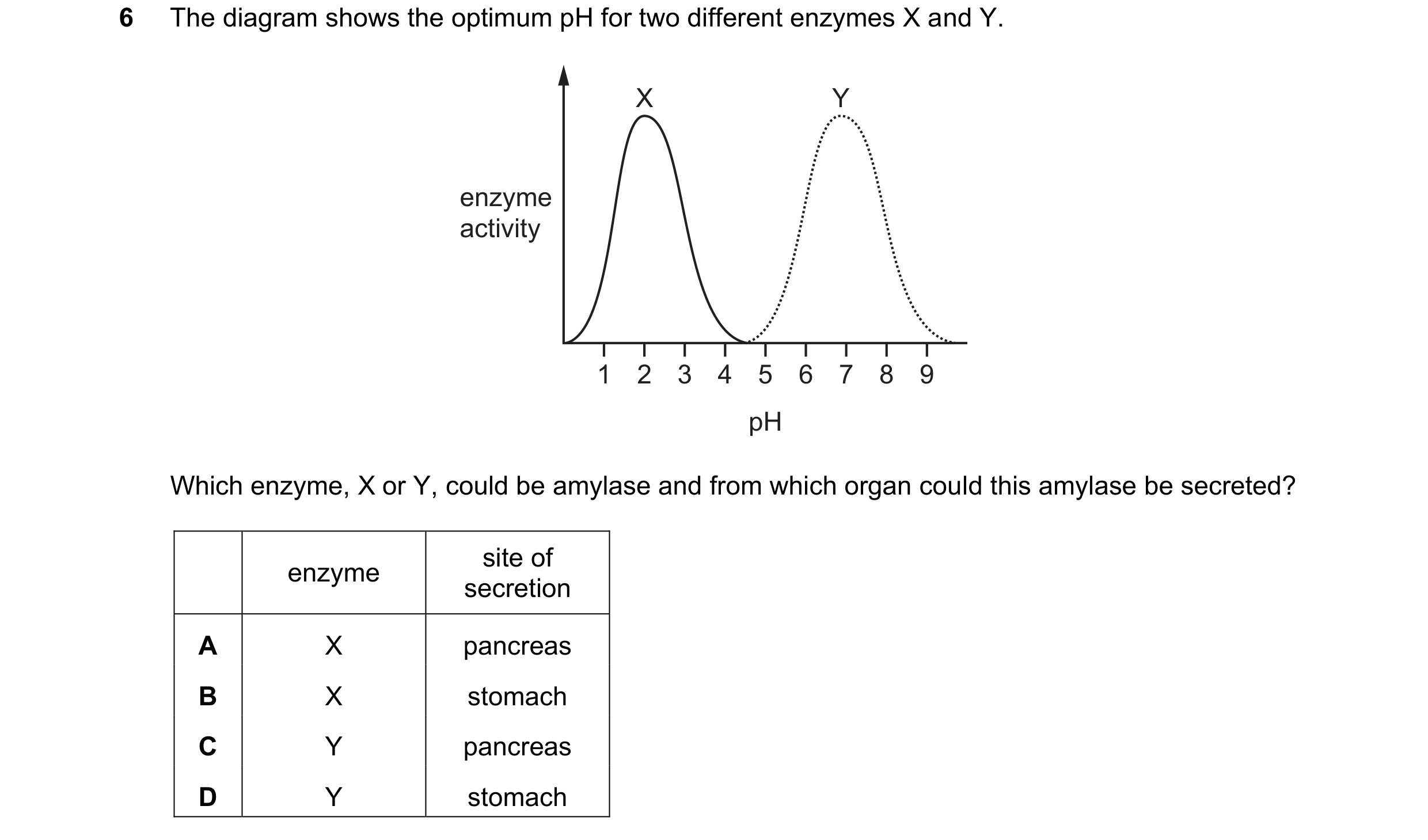
Q27 · The diagram shows the optimum pH for two different enzymes X and Y 0654/23 Oct/Nov 2021
6 The diagram shows the optimum pH for two different enzymes X and Y. X Y enzyme activity 1 2 3 4 5 6 7 8 9 pH Which enzyme, X or Y, could be amylase and from which organ could this amylase be secreted? site of enzyme secretion A X pancreas B X stomach C Y pancreas D Y stomach
1 marks
Answer: C
This question in 0654/23 Oct/Nov 2021
Q28 · The Pompeii worm lives in deep-sea hydrothermal vents where average temperatures are… 0654/22 Feb/March 2022
4 The Pompeii worm lives in deep-sea hydrothermal vents where average temperatures are often as high as 68 C. Which graph represents the activity of enzymes found in the Pompeii worm? A B rate of rate of reaction reaction 0 10 20 30 40 50 60 70 80 90 0 10 20 30 40 50 60 70 80 90 temperature / °C temperature / °C C D rate of rate of reaction reaction 0 10 20 30 40 50 60 70 80 90 0 10 20 30 40 50 60 70 80 90 temperature / °C temperature / °C
1 marks
Answer: B
This question in 0654/22 Feb/March 2022
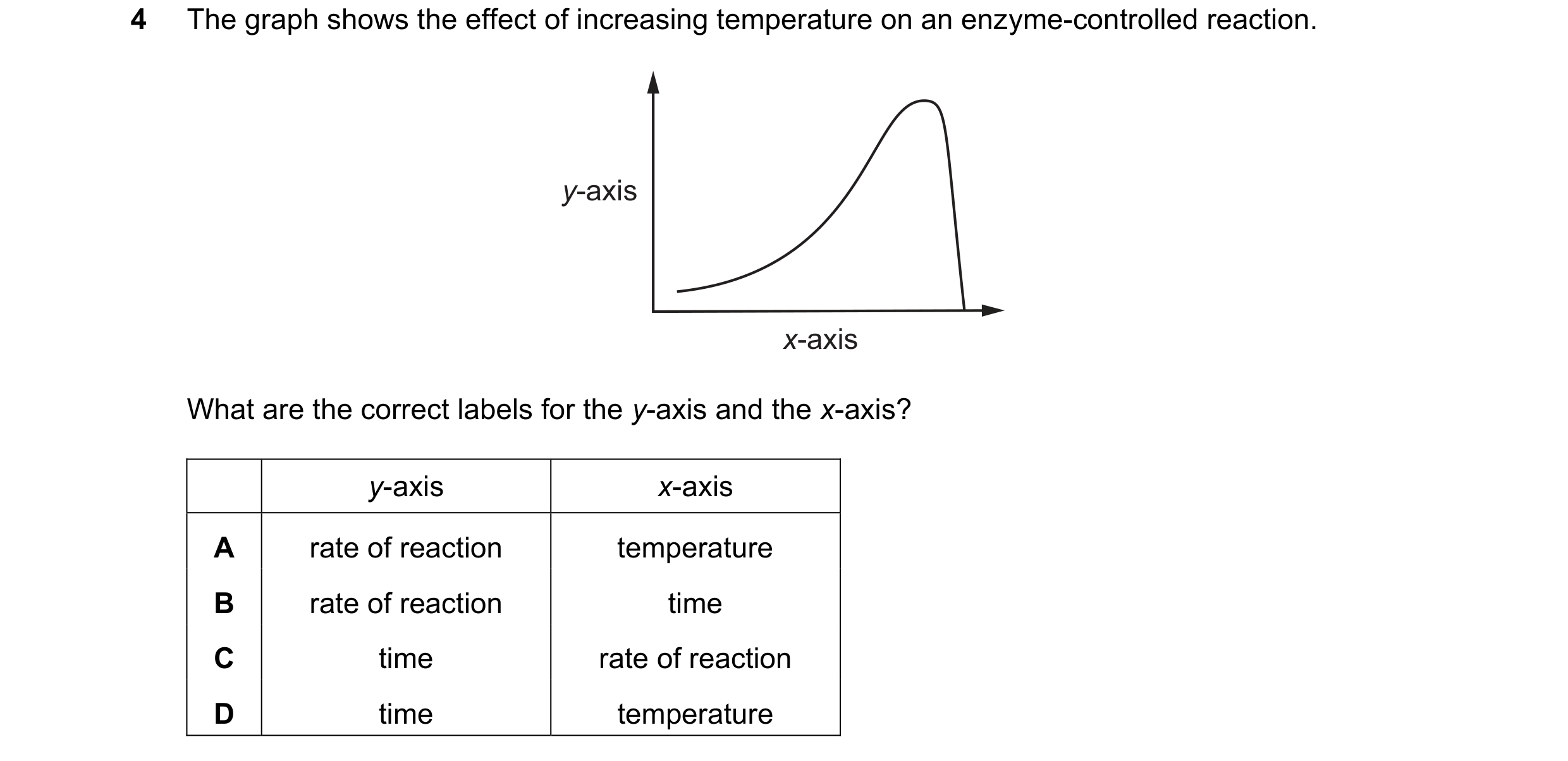
Q29 · The graph shows the effect of increasing temperature on an enzyme-controlled reaction 0654/21 May/June 2022
4 The graph shows the effect of increasing temperature on an enzyme-controlled reaction. y-axis x-axis What are the correct labels for the y-axis and the x-axis? y-axis x-axis A rate of reaction temperature B rate of reaction time C time rate of reaction D time temperature
1 marks
Answer: A
This question in 0654/21 May/June 2022
Q30 · Which effect will temperature change have on enzyme activity? 0654/22 May/June 2022
4 Which effect will temperature change have on enzyme activity? A High temperatures will denature them, making it difficult for substrate molecules to fit in the active site. B High temperatures will denature them, making it easy for substrate molecules to fit in the active site. C Low temperatures will denature them, making it difficult for substrate molecules to fit in the active site. D Low temperatures will denature them, making it easy for substrate molecules to fit in the active site.
1 marks
Answer: A
This question in 0654/22 May/June 2022
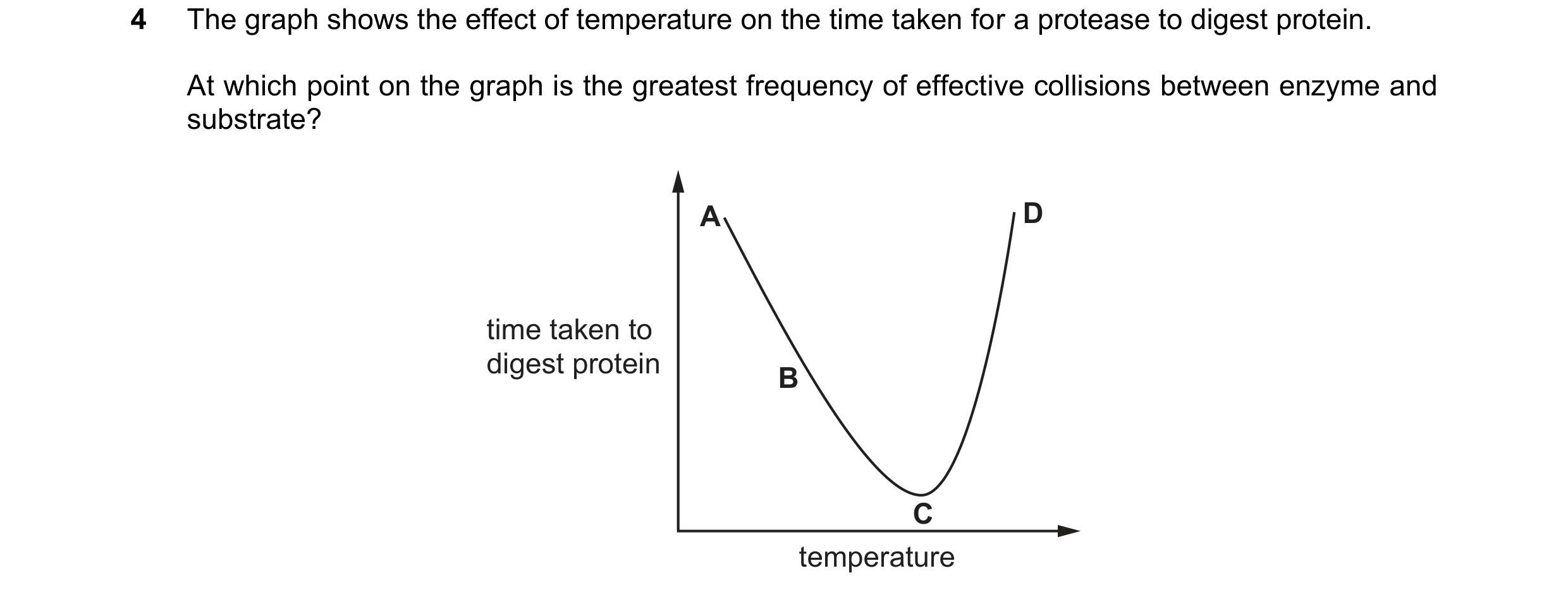
Q31 · The graph shows the effect of temperature on the time taken for a protease to digest… 0654/23 May/June 2022
4 The graph shows the effect of temperature on the time taken for a protease to digest protein. At which point on the graph is the greatest frequency of effective collisions between enzyme and substrate? A D time taken to digest protein B C temperature
1 marks
Answer: C
This question in 0654/23 May/June 2022
Q32 · The graph shows the rate of reaction of salivary amylase at different temperatures 0654/21 Oct/Nov 2022
4 The graph shows the rate of reaction of salivary amylase at different temperatures. rate of X reaction 10 20 30 40 50 temperature / °C What does the graph show at point X? A The enzyme has stopped working. B The reaction is nearly completed. C The reaction rate is controlled by pH. D The temperature is higher than the optimum.
1 marks
Answer: D
This question in 0654/21 Oct/Nov 2022
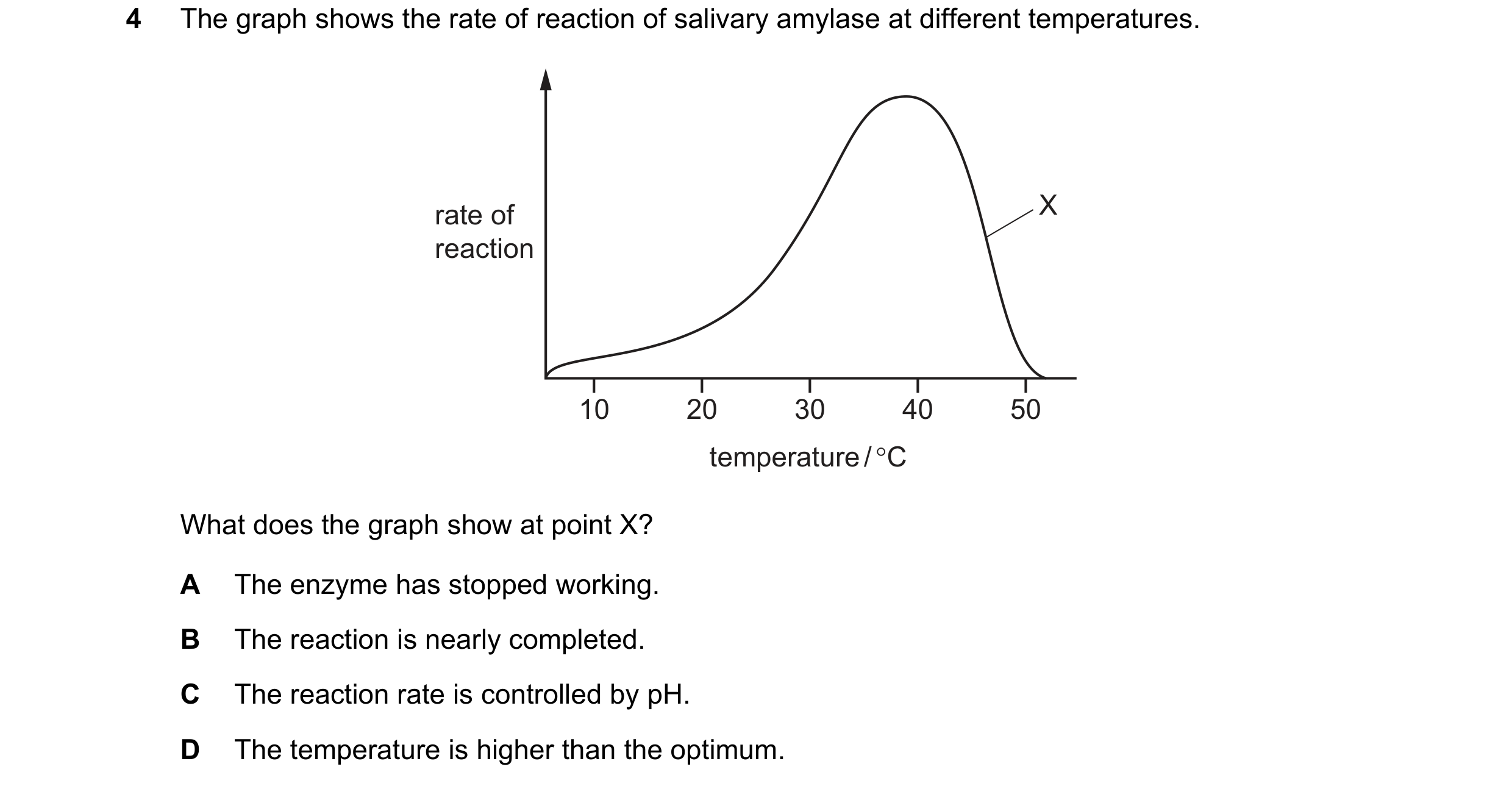
Q33 · The graph shows the rate of reaction of salivary amylase at different temperatures 0654/22 Oct/Nov 2022
4 The graph shows the rate of reaction of salivary amylase at different temperatures. rate of X reaction 10 20 30 40 50 temperature / °C What does the graph show at point X? A The enzyme has stopped working. B The reaction is nearly completed. C The reaction rate is controlled by pH. D The temperature is higher than the optimum.
1 marks
Answer: D
This question in 0654/22 Oct/Nov 2022
Q34 · The graph shows the rate of reaction of salivary amylase at different temperatures 0654/23 Oct/Nov 2022
4 The graph shows the rate of reaction of salivary amylase at different temperatures. rate of X reaction 10 20 30 40 50 temperature / °C What does the graph show at point X? A The enzyme has stopped working. B The reaction is nearly completed. C The reaction rate is controlled by pH. D The temperature is higher than the optimum.
1 marks
Answer: D
This question in 0654/23 Oct/Nov 2022
Q35 · The graph shows the rate at which 10 g of starch is broken down by amylase at four… 0654/22 Feb/March 2023
4 The graph shows the rate at which 10 g of starch is broken down by amylase at four different temperatures. 10 8 mass of 6 10 °C starch / g 4 25 °C 70 °C 2 40 °C 0 time At which temperature does amylase work best to break down starch? A 10 C B 25 C C 40 C D 70 C
1 marks
Answer: C
This question in 0654/22 Feb/March 2023
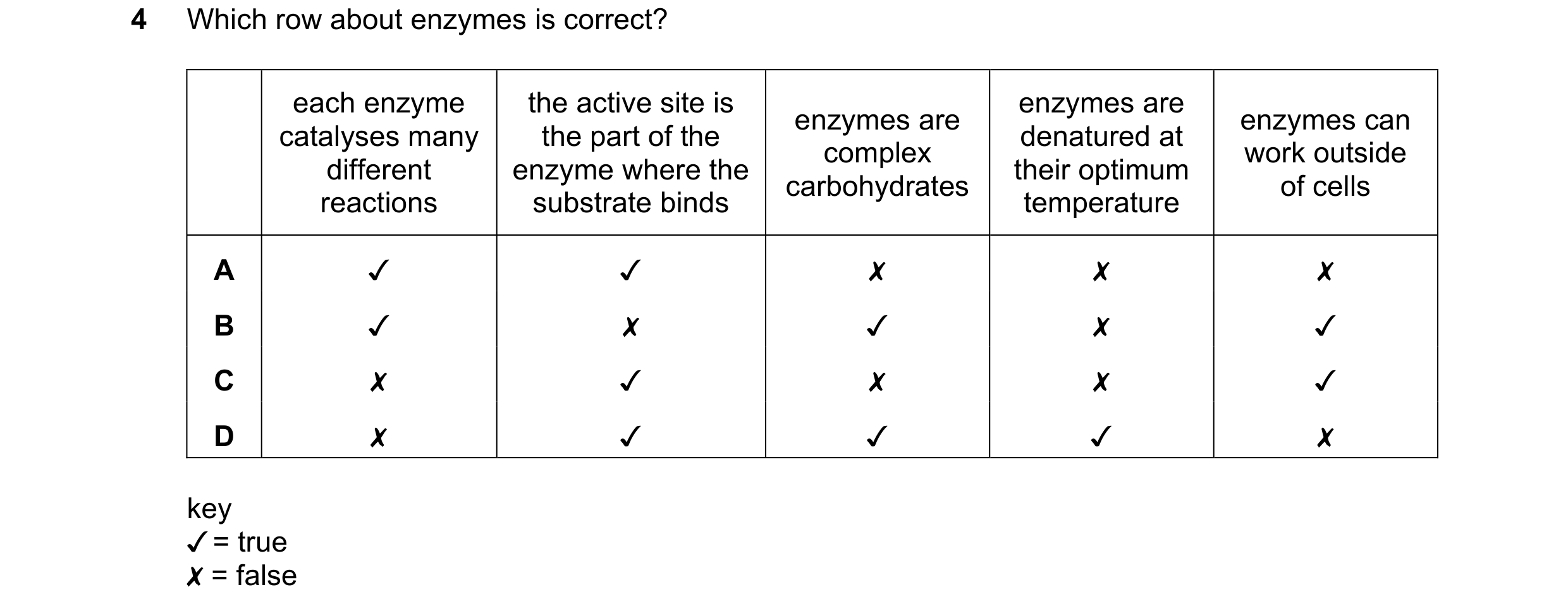
Q36 · Which row about enzymes is correct? 0654/21 May/June 2023
4 Which row about enzymes is correct?
each enzyme the active site is enzymes are
catalyses many the part of the comple . denatured at work outside
different enzyme where the their optimum
reactions substrate binds carbohydrates temperature of cells
A v v x x x
B v x v x v
Cc x J x x Jv
D x v v v x
key
J/ = true
X = false
1 marks
Answer: C
This question in 0654/21 May/June 2023
Q37 · Which type of molecules speed up chemical digestion? 0654/22 May/June 2023
4 Which type of molecules speed up chemical digestion? A carbohydrates B enzymes C hormones D fatty acids
1 marks
Answer: B
This question in 0654/22 May/June 2023
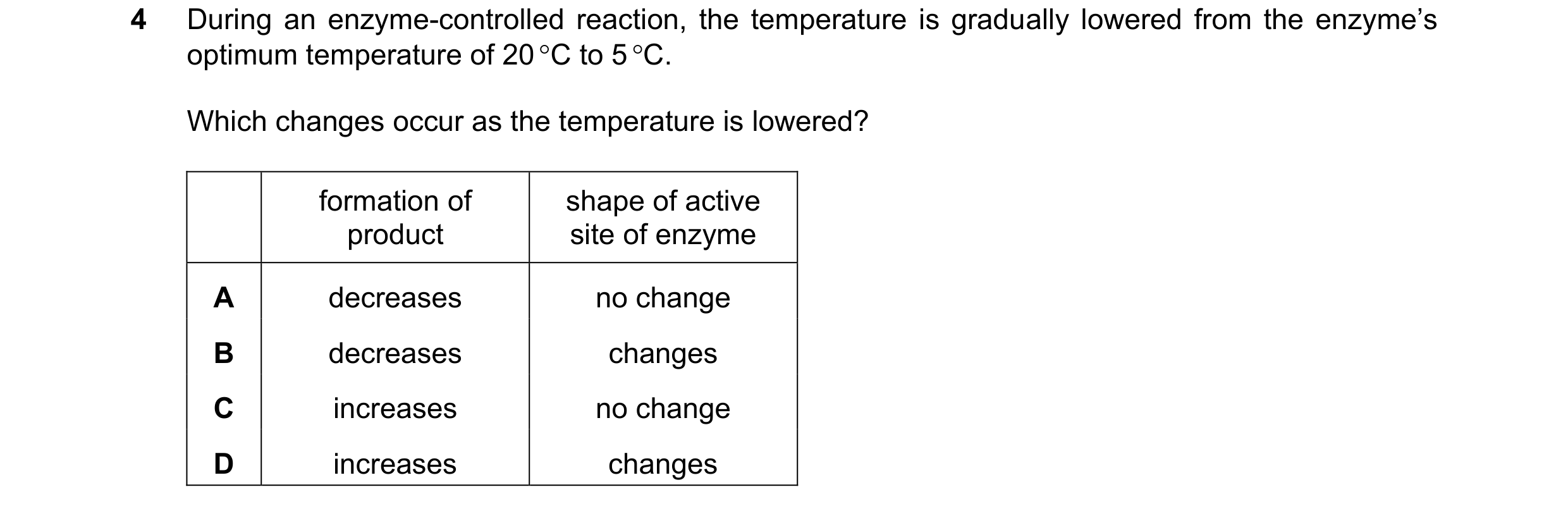
Q38 · During an enzyme-controlled reaction, the temperature is gradually lowered from the… 0654/23 May/June 2023
4 During an enzyme-controlled reaction, the temperature is gradually lowered from the enzyme’s optimum temperature of 20 C to 5 C. Which changes occur as the temperature is lowered? formation of shape of active product site of enzyme A decreases no change B decreases changes C increases no change D increases changes
1 marks
Answer: A
This question in 0654/23 May/June 2023
Q39 · The graph shows the effect of increasing temperature on the time taken for amylase to… 0654/21 Oct/Nov 2023
4 The graph shows the effect of increasing temperature on the time taken for amylase to fully digest a sample of starch. time taken to fully digest starch temperature Which statements are correct? 1 As the temperature increases, the kinetic energy of the amylase and starch molecules increases. 2 The time taken to fully digest the starch decreases as temperature increases because there are more frequent collisions between starch and amylase molecules. 3 The time taken to fully digest the starch decreases as temperature increases because the shape of the amylase changes as it denatures. A 1, 2 and 3 B 1 and 2 only C 1 and 3 only D 2 and 3 only
1 marks
Answer: B
This question in 0654/21 Oct/Nov 2023
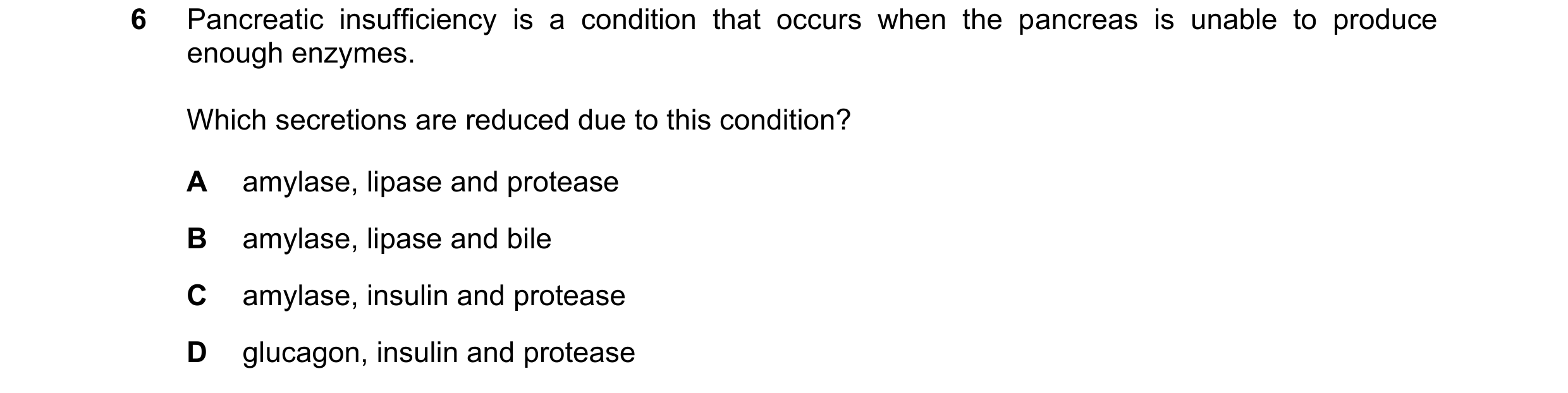
Q40 · Pancreatic insufficiency is a condition that occurs when the pancreas is unable to… 0654/21 Oct/Nov 2023
6 Pancreatic insufficiency is a condition that occurs when the pancreas is unable to produce enough enzymes. Which secretions are reduced due to this condition? A amylase, lipase and protease B amylase, lipase and bile C amylase, insulin and protease D glucagon, insulin and protease
1 marks
Answer: A
This question in 0654/21 Oct/Nov 2023
Q41 · Which type of molecule are enzymes? 0654/22 Oct/Nov 2023
4 Which type of molecule are enzymes? A carbohydrate B fat C protein D starch
1 marks
Answer: C
This question in 0654/22 Oct/Nov 2023
Q42 · The diagram shows the effect of temperature on enzyme activity 0654/23 Oct/Nov 2023
4 The diagram shows the effect of temperature on enzyme activity. enzyme Y activity X temperature What has increased the enzyme activity between points X and Y? A decreased denaturation B decreased kinetic energy C increased denaturation D increased kinetic energy
1 marks
Answer: D
This question in 0654/23 Oct/Nov 2023
Q43 · Which statements explain why an enzyme stops working when heated to high temperatures? 0654/22 Feb/March 2024
4 Which statements explain why an enzyme stops working when heated to high temperatures? 1 There is a low frequency of collisions between substrate and enzyme. 2 The active site no longer has a complementary shape to the substrate. 3 The enzyme is denatured. A 1, 2 and 3 B 1 and 2 only C 1 and 3 only D 2 and 3 only
1 marks
Answer: D
This question in 0654/22 Feb/March 2024
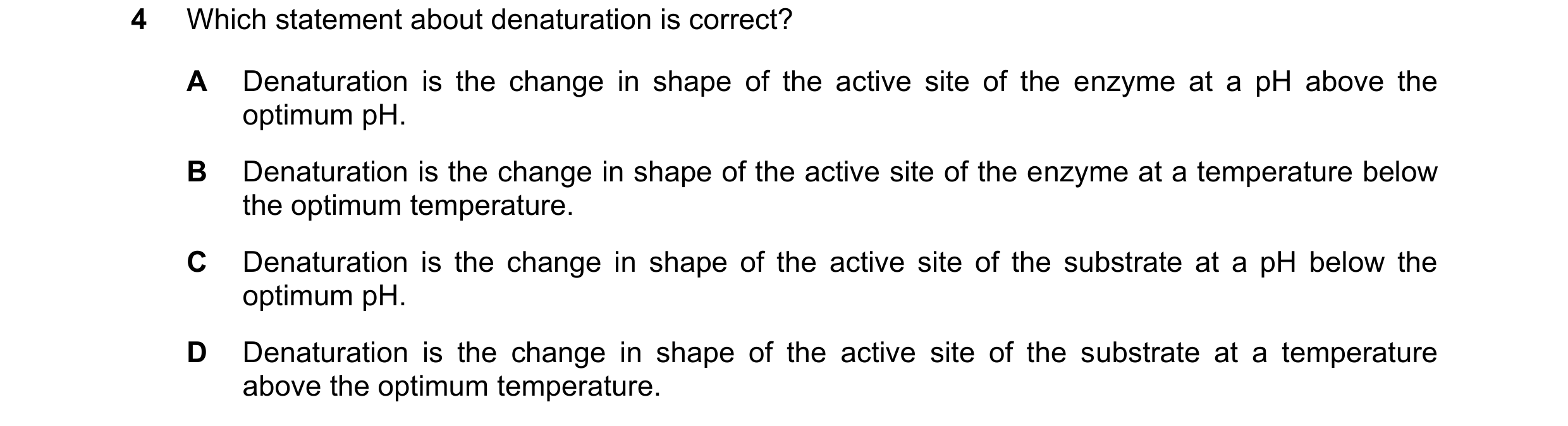
Q44 · Which statement about denaturation is correct? 0654/21 May/June 2024
4 Which statement about denaturation is correct? A Denaturation is the change in shape of the active site of the enzyme at a pH above the optimum pH. B Denaturation is the change in shape of the active site of the enzyme at a temperature below the optimum temperature. C Denaturation is the change in shape of the active site of the substrate at a pH below the optimum pH. D Denaturation is the change in shape of the active site of the substrate at a temperature above the optimum temperature.
1 marks
Answer: A
This question in 0654/21 May/June 2024
Q45 · The graph shows the mass of product produced by an enzyme-controlled reaction over time… 0654/22 May/June 2024
4 The graph shows the mass of product produced by an enzyme-controlled reaction over time when the reaction mixture is placed separately at 37 C and at 60 C. The starting concentration of the substrate and the concentration of the enzyme used are kept constant. Y 37 °C X mass of product 60 °C time What can be concluded from the graph? A At point X on the graph, the enzyme has run out of substrate. B The enzyme denatures at point Y on the graph. C The reaction mixture has a higher kinetic energy at 37 C. D The reaction mixture has a higher initial rate of reaction when placed at 60 C.
1 marks
Answer: D
This question in 0654/22 May/June 2024
Q46 · A student investigates the effect of size of gelatine cubes on the rate of digestion by… 0654/22 May/June 2024
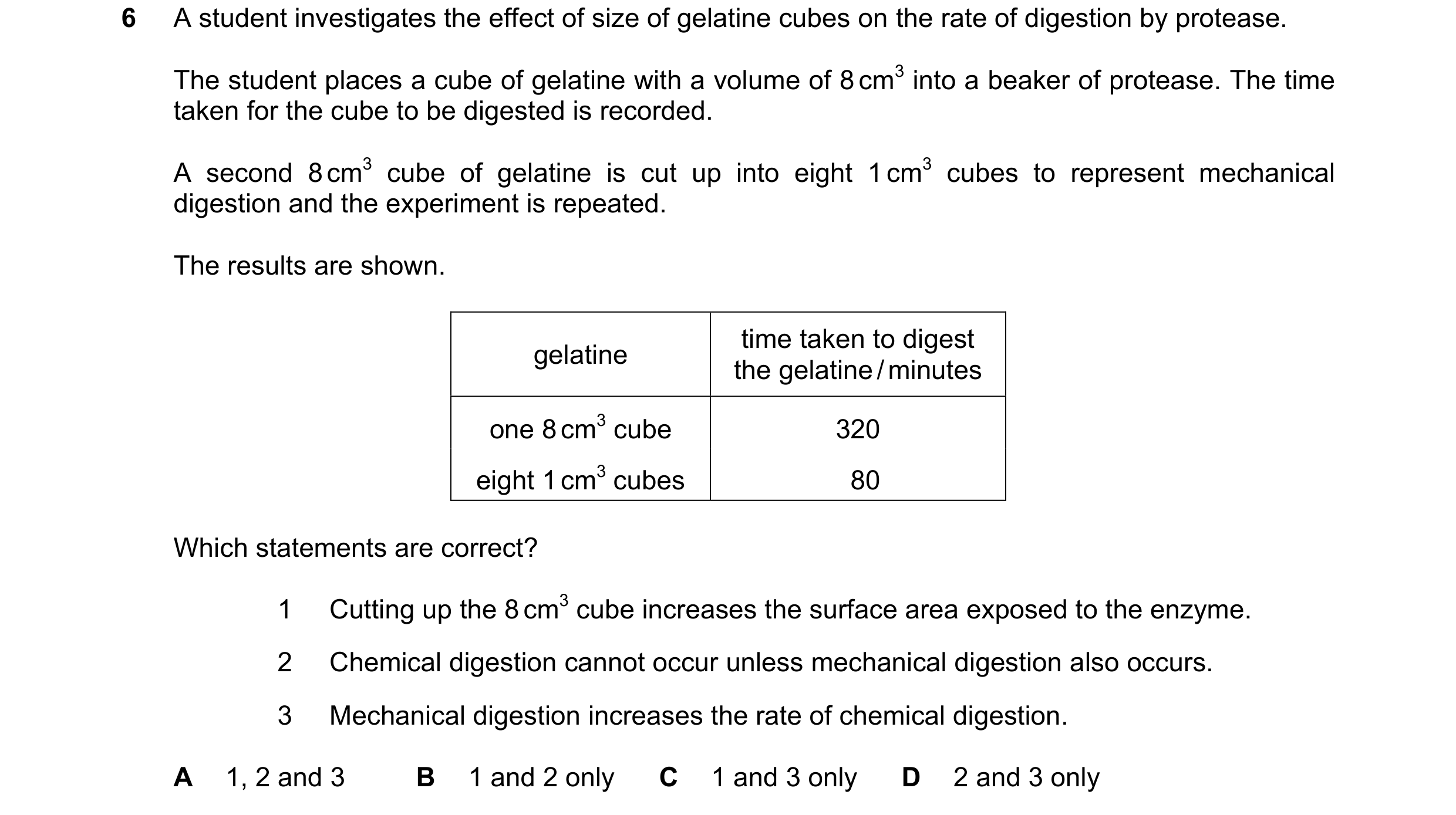
6 A student investigates the effect of size of gelatine cubes on the rate of digestion by protease. The student places a cube of gelatine with a volume of 8 cm3 into a beaker of protease. The time taken for the cube to be digested is recorded. A second 8 cm3 cube of gelatine is cut up into eight 1 cm3 cubes to represent mechanical digestion and the experiment is repeated. The results are shown. time taken to digest gelatine the gelatine / minutes one 8 cm3 cube 320 eight 1 cm3 cubes 80 Which statements are correct? 1 Cutting up the 8 cm3 cube increases the surface area exposed to the enzyme. 2 Chemical digestion cannot occur unless mechanical digestion also occurs. 3 Mechanical digestion increases the rate of chemical digestion. A 1, 2 and 3 B 1 and 2 only C 1 and 3 only D 2 and 3 only
1 marks
Answer: C
This question in 0654/22 May/June 2024
Q47 · The diagram shows a functional human enzyme at 37 C 0654/23 May/June 2024
4 The diagram shows a functional human enzyme at 37 C. Which row shows the likely shape of this enzyme at 5 C and 80 C? at 5 C at 80 C A B C D
1 marks
Answer: A
This question in 0654/23 May/June 2024
Q48 · The graph shows the effect of temperature on the rate of an enzyme-controlled reaction 0654/21 Oct/Nov 2024
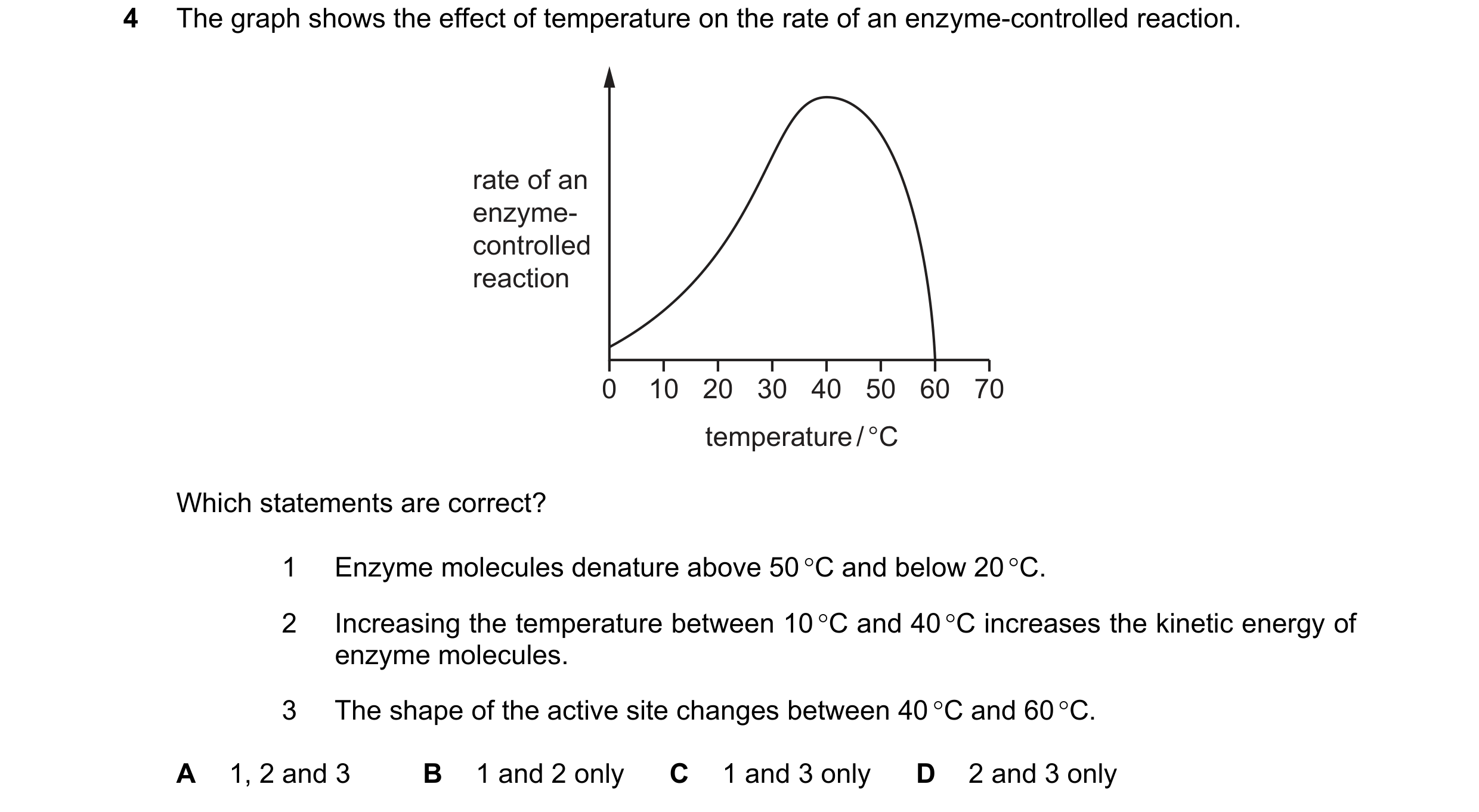
4 The graph shows the effect of temperature on the rate of an enzyme-controlled reaction. rate of an enzyme- controlled reaction 0 10 20 30 40 50 60 70 temperature / °C Which statements are correct? 1 Enzyme molecules denature above 50 C and below 20 C. 2 Increasing the temperature between 10 C and 40 C increases the kinetic energy of enzyme molecules. 3 The shape of the active site changes between 40 C and 60 C. A 1, 2 and 3 B 1 and 2 only C 1 and 3 only D 2 and 3 only
1 marks
Answer: D
This question in 0654/21 Oct/Nov 2024
Q49 · Some bacteria live in acidic, hot springs 0654/22 Oct/Nov 2024
4 Some bacteria live in acidic, hot springs. What are the optimum conditions for the enzymes of these bacteria? A 20 C and pH 4 B 20 C and pH 9 C 80 C and pH 4 D 80 C and pH 9
1 marks
Answer: C
This question in 0654/22 Oct/Nov 2024
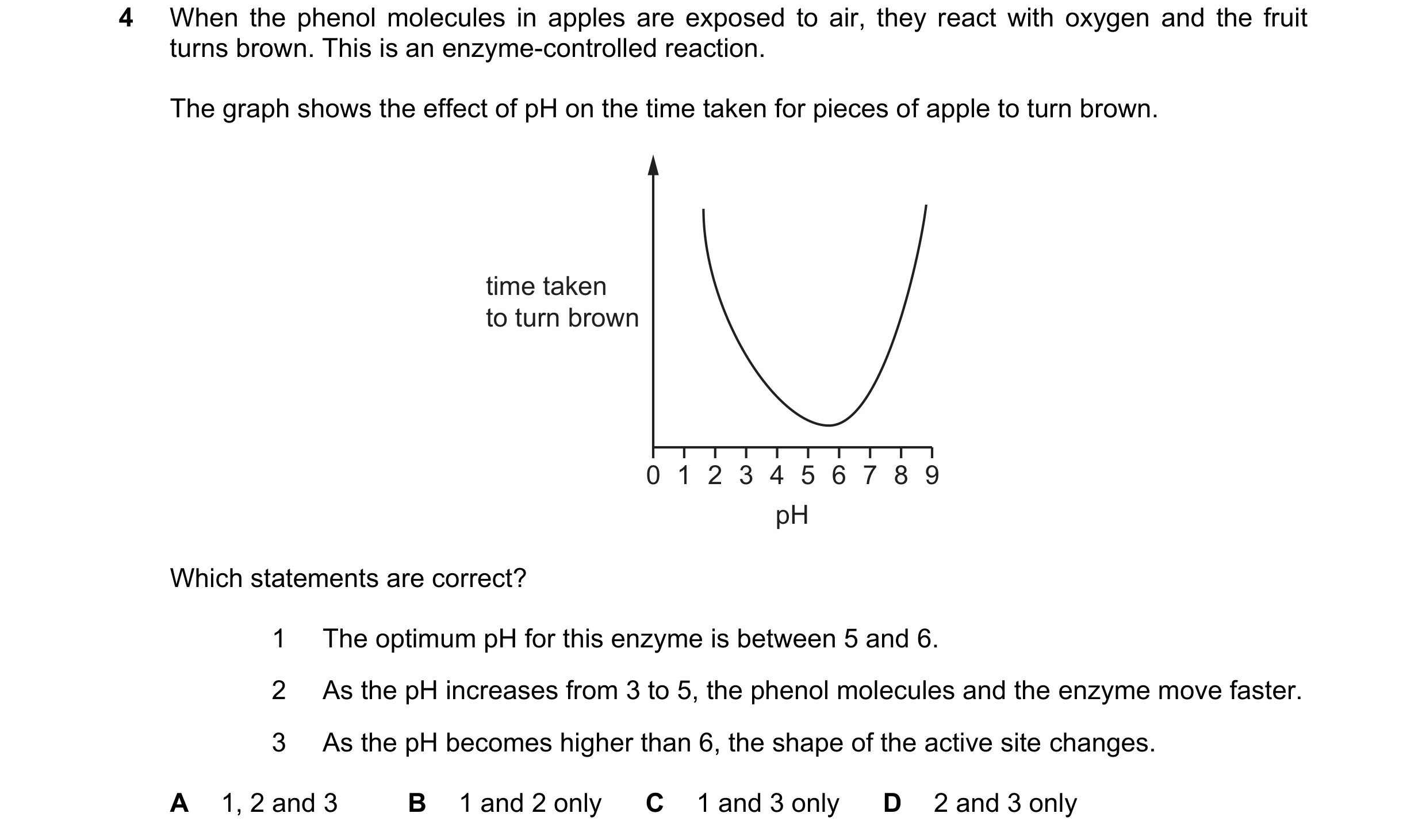
Q50 · When the phenol molecules in apples are exposed to air, they react with oxygen and the… 0654/23 Oct/Nov 2024
4 When the phenol molecules in apples are exposed to air, they react with oxygen and the fruit turns brown. This is an enzyme-controlled reaction. The graph shows the effect of pH on the time taken for pieces of apple to turn brown. time taken to turn brown 0 1 2 3 4 5 6 7 8 9 pH Which statements are correct? 1 The optimum pH for this enzyme is between 5 and 6. 2 As the pH increases from 3 to 5, the phenol molecules and the enzyme move faster. 3 As the pH becomes higher than 6, the shape of the active site changes. A 1, 2 and 3 B 1 and 2 only C 1 and 3 only D 2 and 3 only
1 marks
Answer: C
This question in 0654/23 Oct/Nov 2024
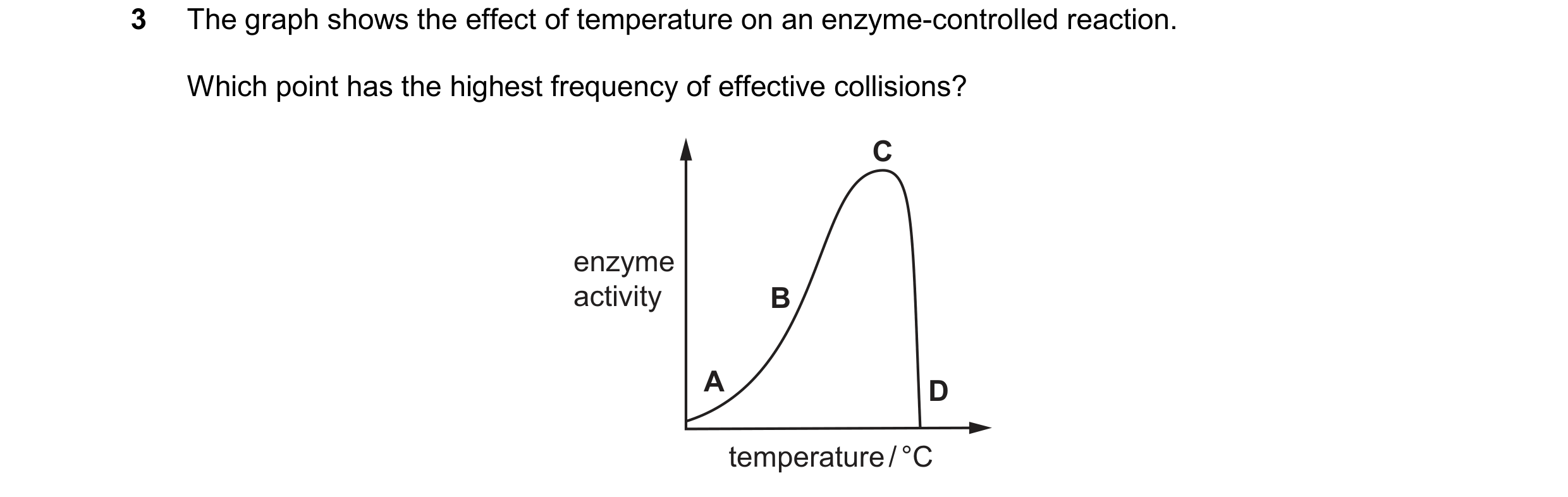
Q51 · The graph shows the effect of temperature on an enzyme-controlled reaction 0654/22 Feb/March 2025
3 The graph shows the effect of temperature on an enzyme-controlled reaction. Which point has the highest frequency of effective collisions? C enzyme activity B A D temperature / °C
1 marks
Answer: C
This question in 0654/22 Feb/March 2025
Q52 · Which type of molecule are enzymes? 0654/21 May/June 2025
3 Which type of molecule are enzymes? A carbohydrate B DNA C fat D protein
1 marks
Answer: D
This question in 0654/21 May/June 2025
Q53 · Six test-tubes contain amylase and starch solution 0654/22 May/June 2025
5 Six test-tubes contain amylase and starch solution. The temperatures of the test-tube contents are different. All other conditions are the same. The table shows the time taken for the amylase to break down the starch. temperature / °C 25 30 35 40 45 50 time / seconds 121 87 46 43 72 99 At which temperature is the activity of the amylase greatest? A 25 °C B 35 °C C 40 °C D 50 °C
1 marks
Answer: C
This question in 0654/22 May/June 2025
Q54 · What is a characteristic of enzymes? 0654/23 May/June 2025
3 What is a characteristic of enzymes? A act as catalysts B made from fatty acids C turn Benedict’s solution red when heated D physically digest food
1 marks
Answer: A
This question in 0654/23 May/June 2025
Q55 · Enzyme action stops due to denaturation 0654/21 Oct/Nov 2025
5 Enzyme action stops due to denaturation. What causes denaturation? A a change in shape of the active site of the enzyme that occurs at a temperature that is lower than the optimum temperature B a change in shape of the active site of the substrate that occurs at a temperature that is lower than the optimum temperature C a change in shape of the active site of the enzyme that occurs at a temperature that is higher than the optimum temperature D a change in shape of the active site of the substrate that occurs at a temperature that is higher than the optimum temperature
1 marks
Answer: C
This question in 0654/21 Oct/Nov 2025
Q56 · Which molecule in this reaction has an active site? 0654/22 Oct/Nov 2025
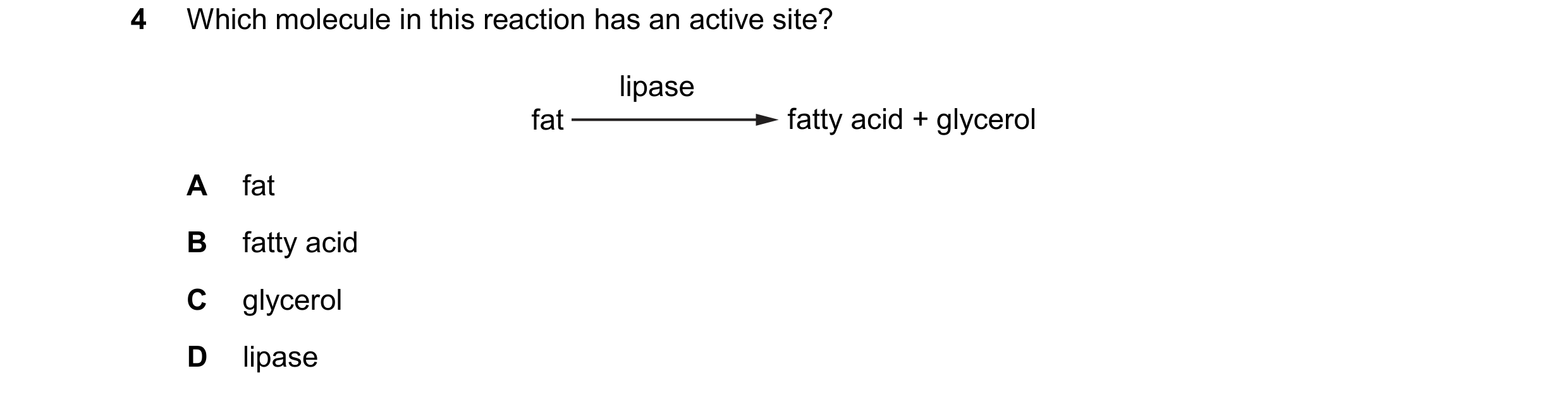
4 Which molecule in this reaction has an active site? lipase fat fatty acid + glycerol A fat B fatty acid C glycerol D lipase
1 marks
Answer: D
This question in 0654/22 Oct/Nov 2025
Q57 · Enzymes work best at an optimum pH 0654/23 Oct/Nov 2025
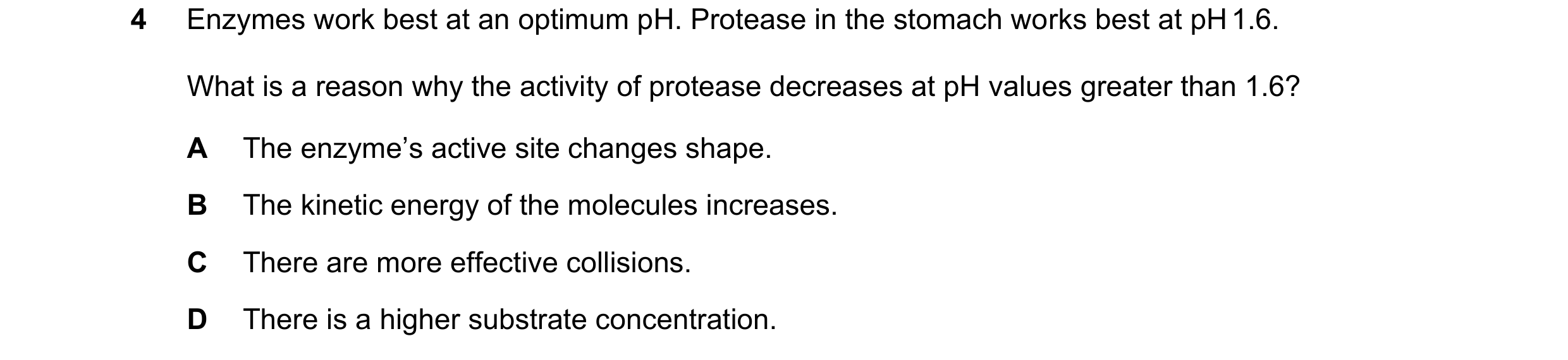
4 Enzymes work best at an optimum pH. Protease in the stomach works best at pH 1.6. What is a reason why the activity of protease decreases at pH values greater than 1.6? A The enzyme’s active site changes shape. B The kinetic energy of the molecules increases. C There are more effective collisions. D There is a higher substrate concentration.
1 marks
Answer: A
This question in 0654/23 Oct/Nov 2025
 1 / 20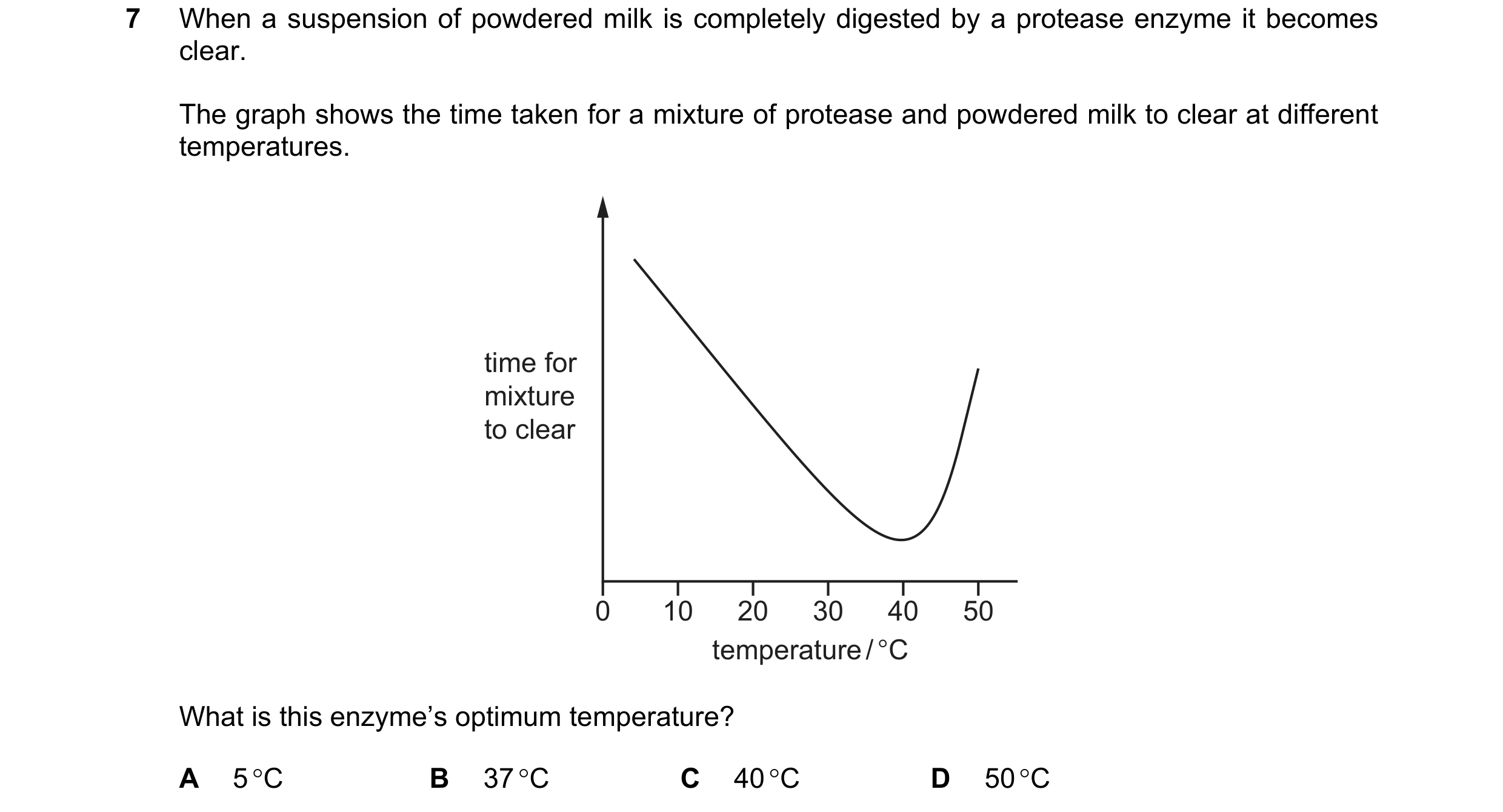
 2 / 20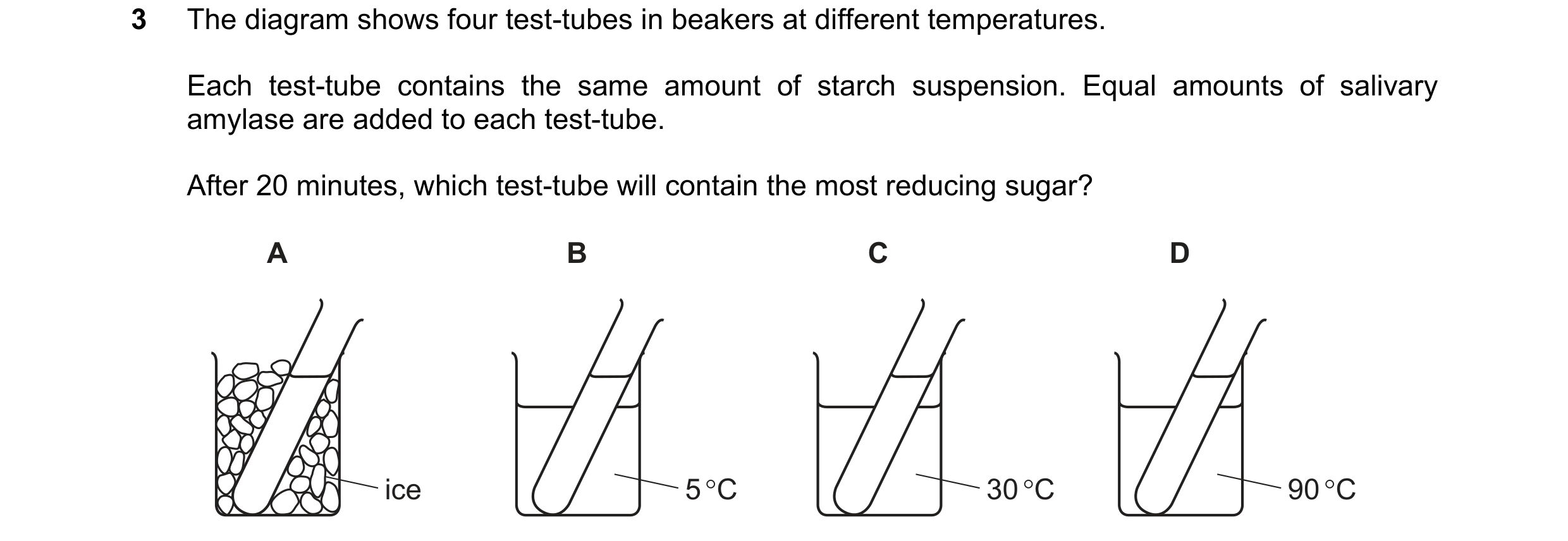
 3 / 20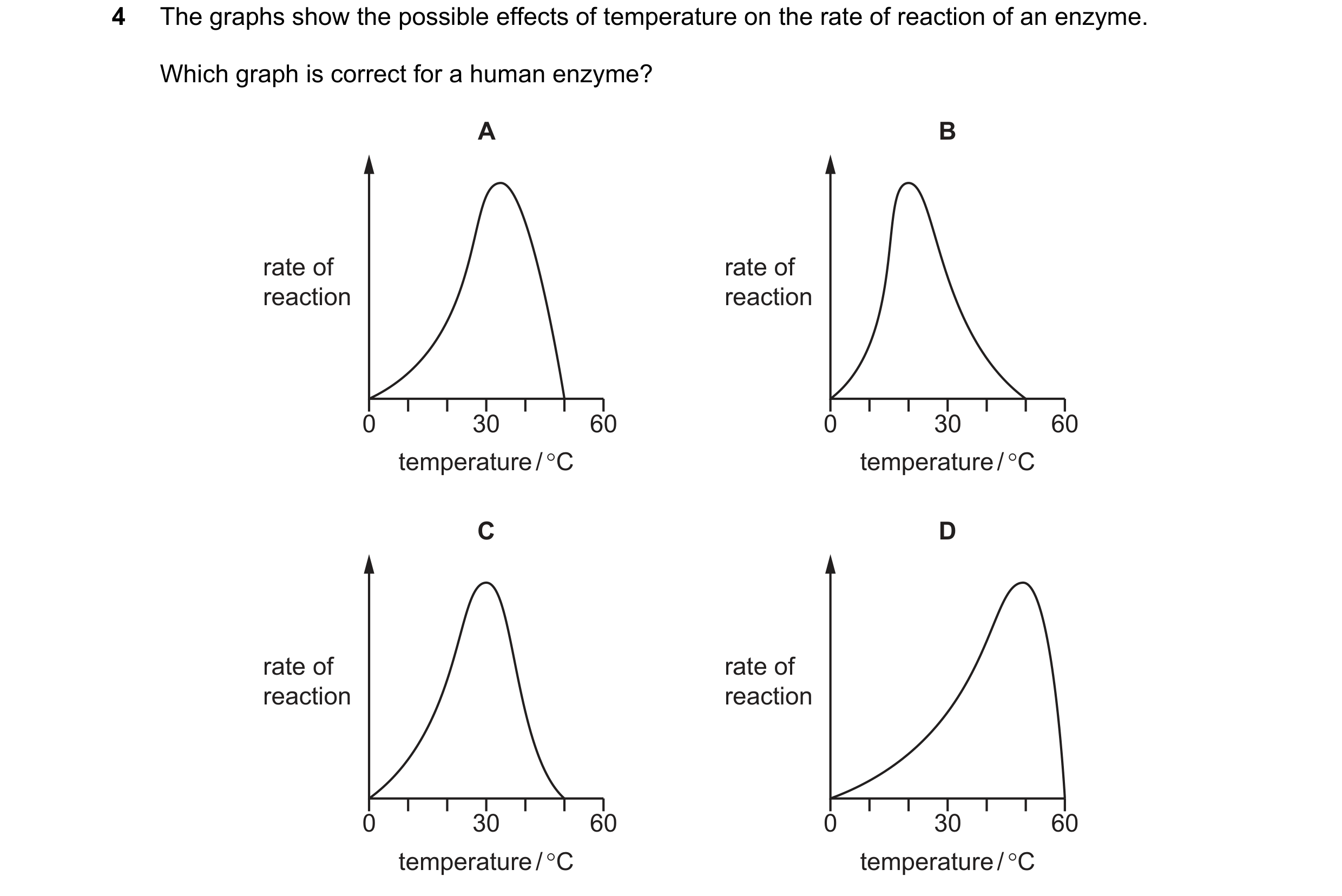

 4 / 20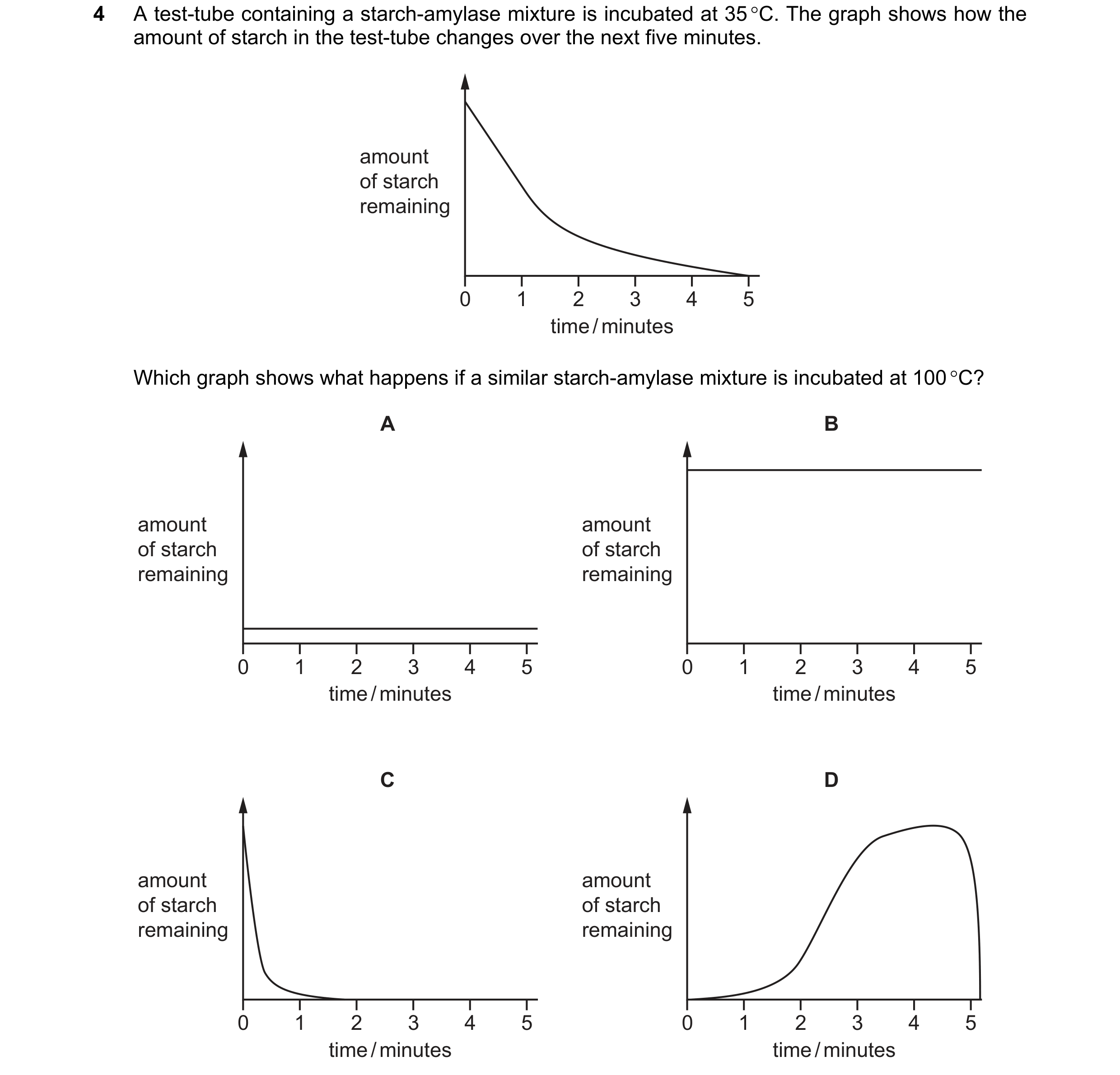
 5 / 20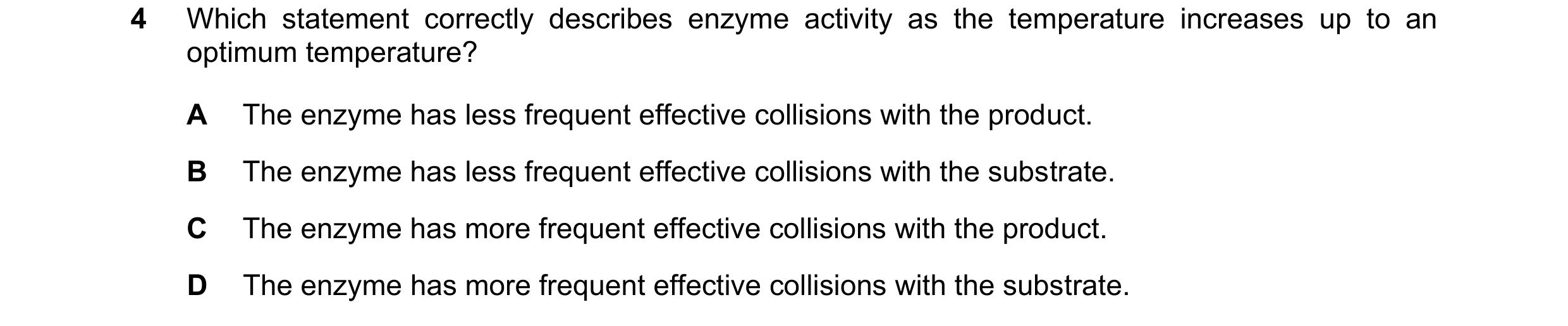


 6 / 20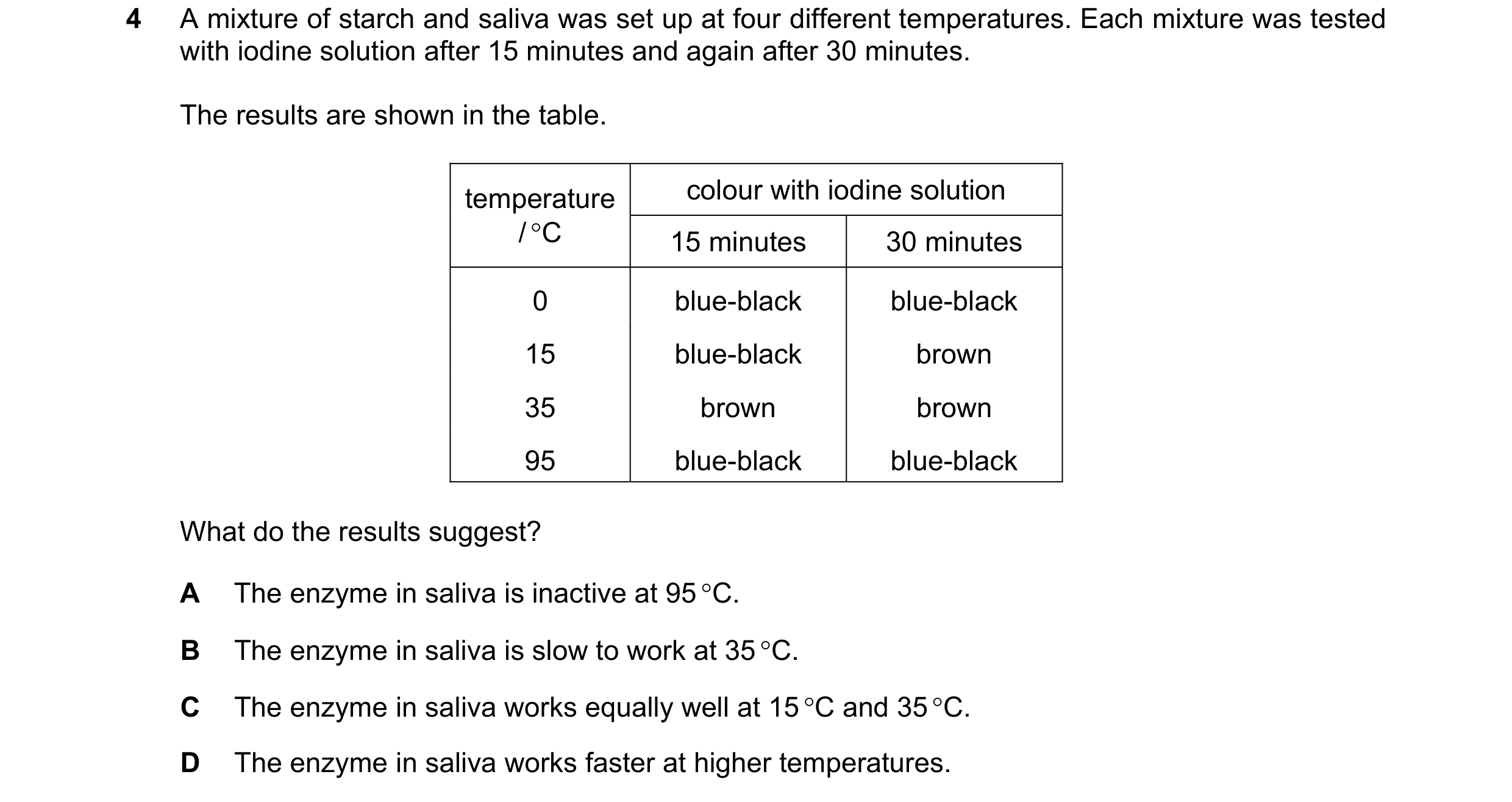
 7 / 20

 8 / 20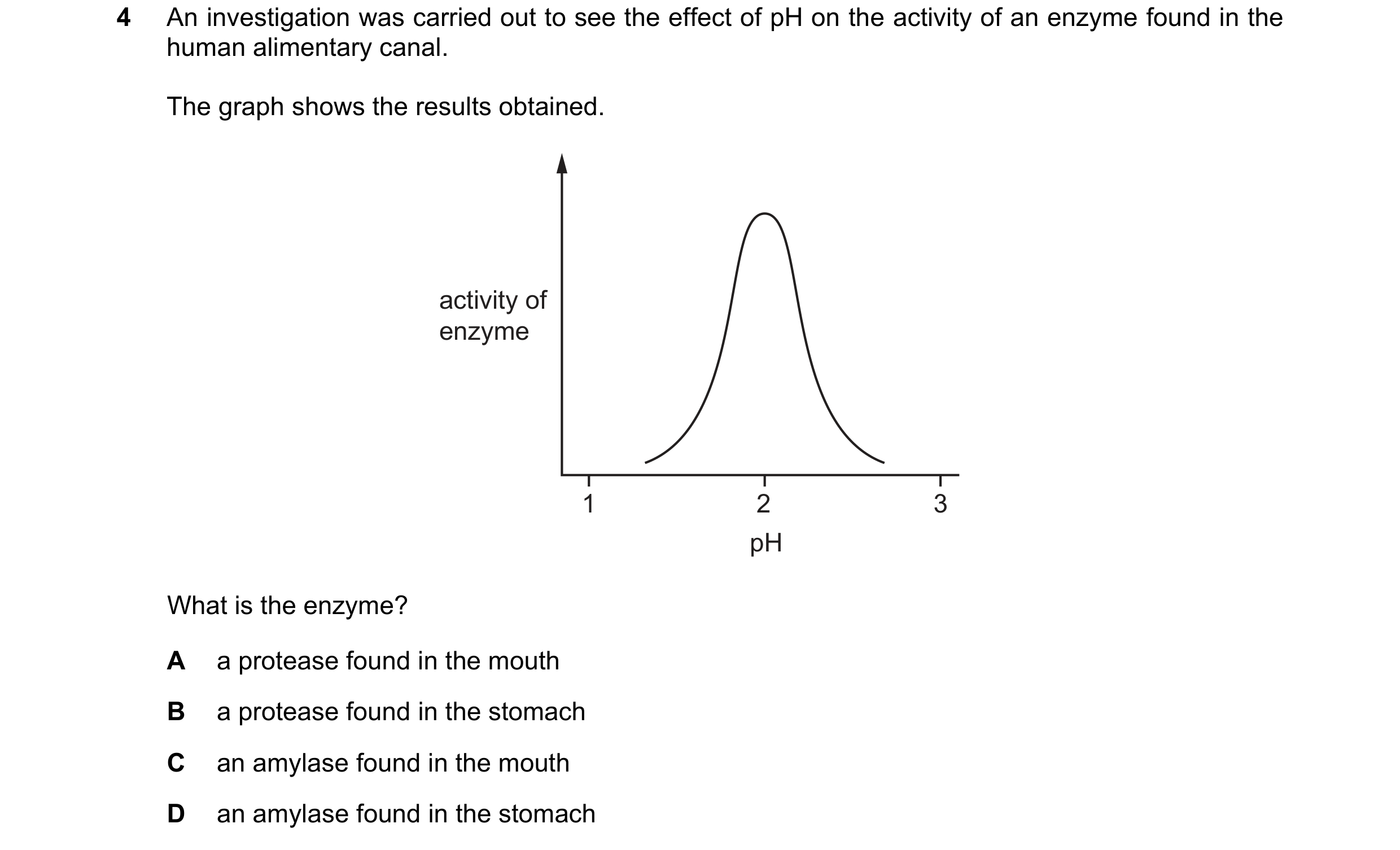
 9 / 20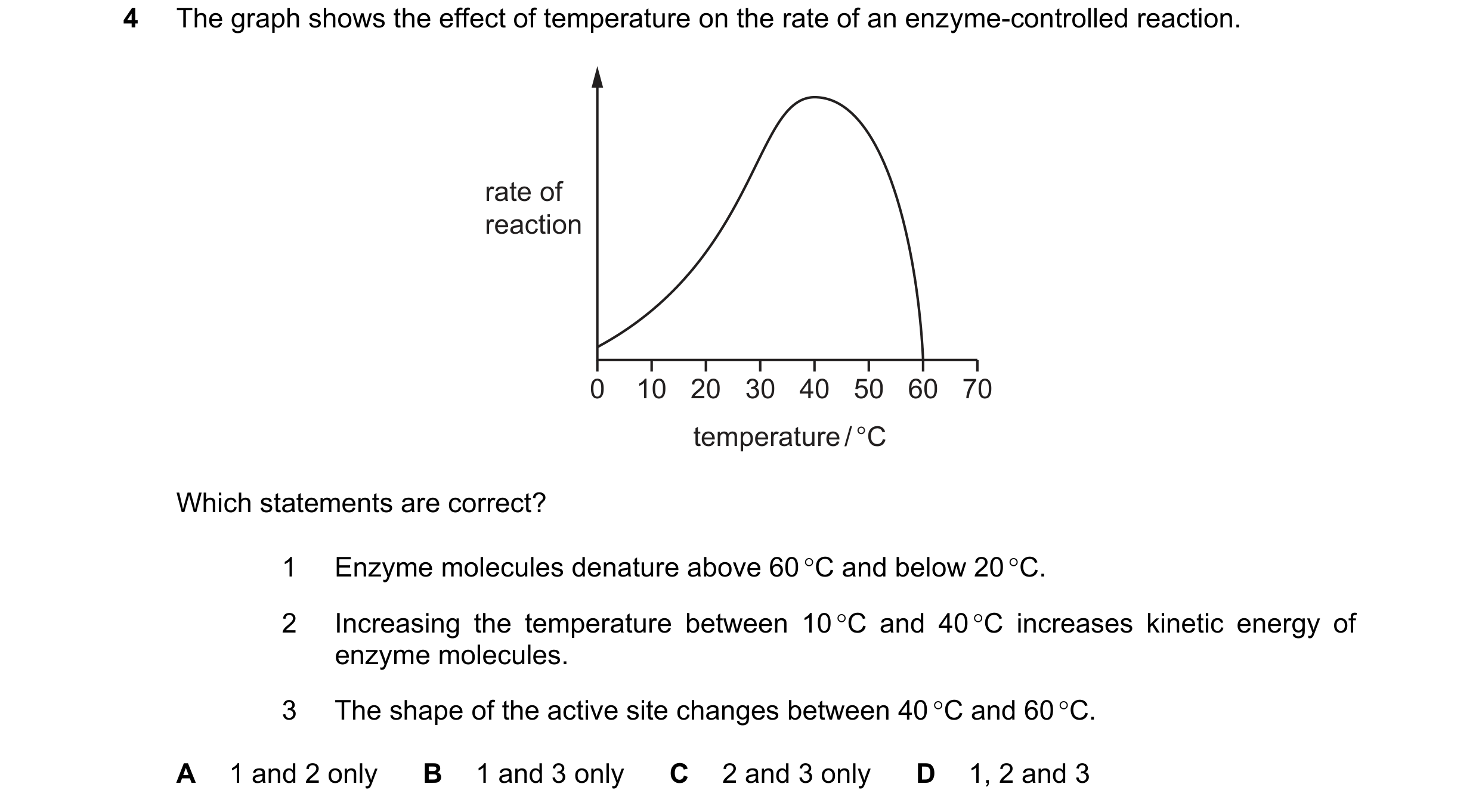
 10 / 20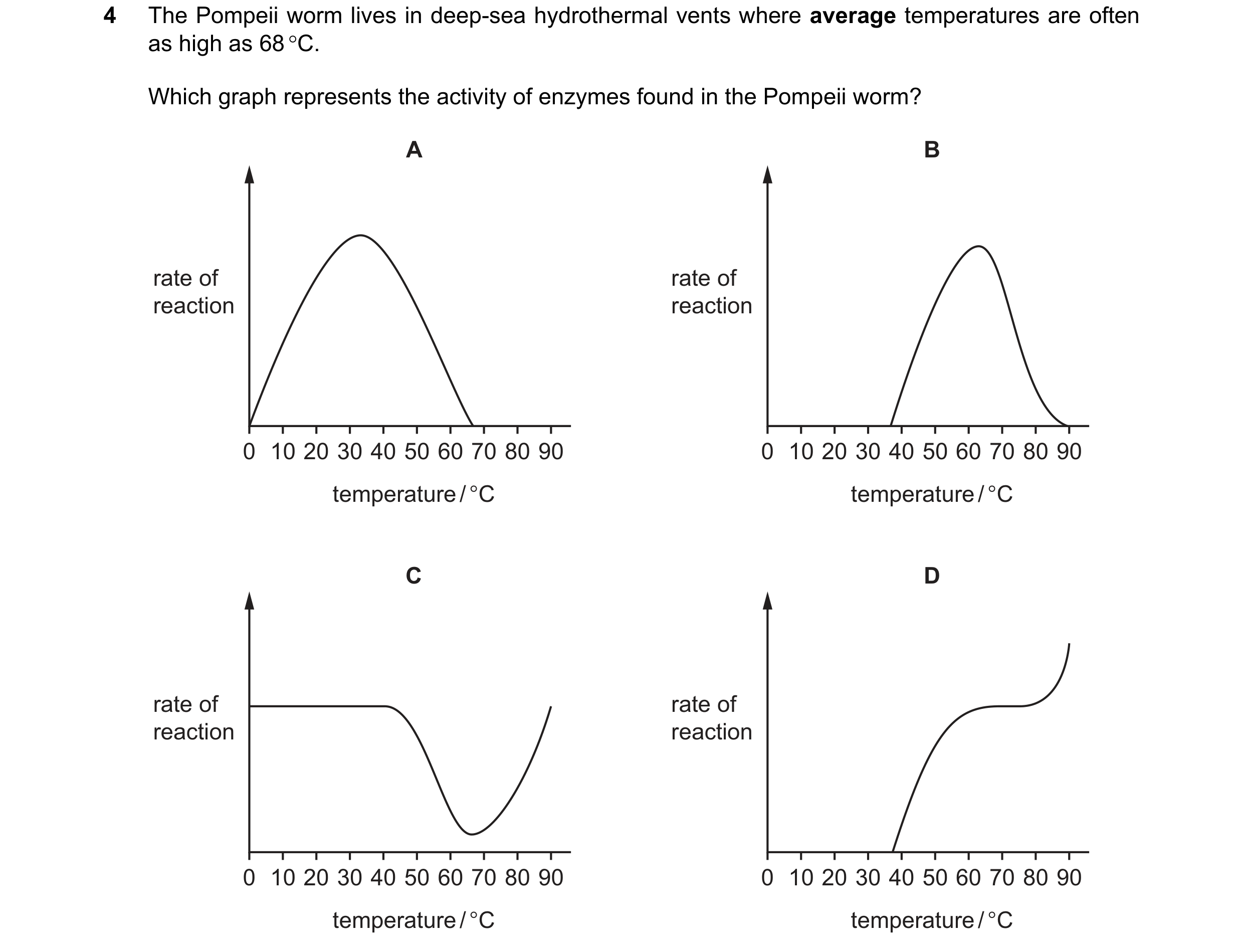
 11 / 20
 12 / 20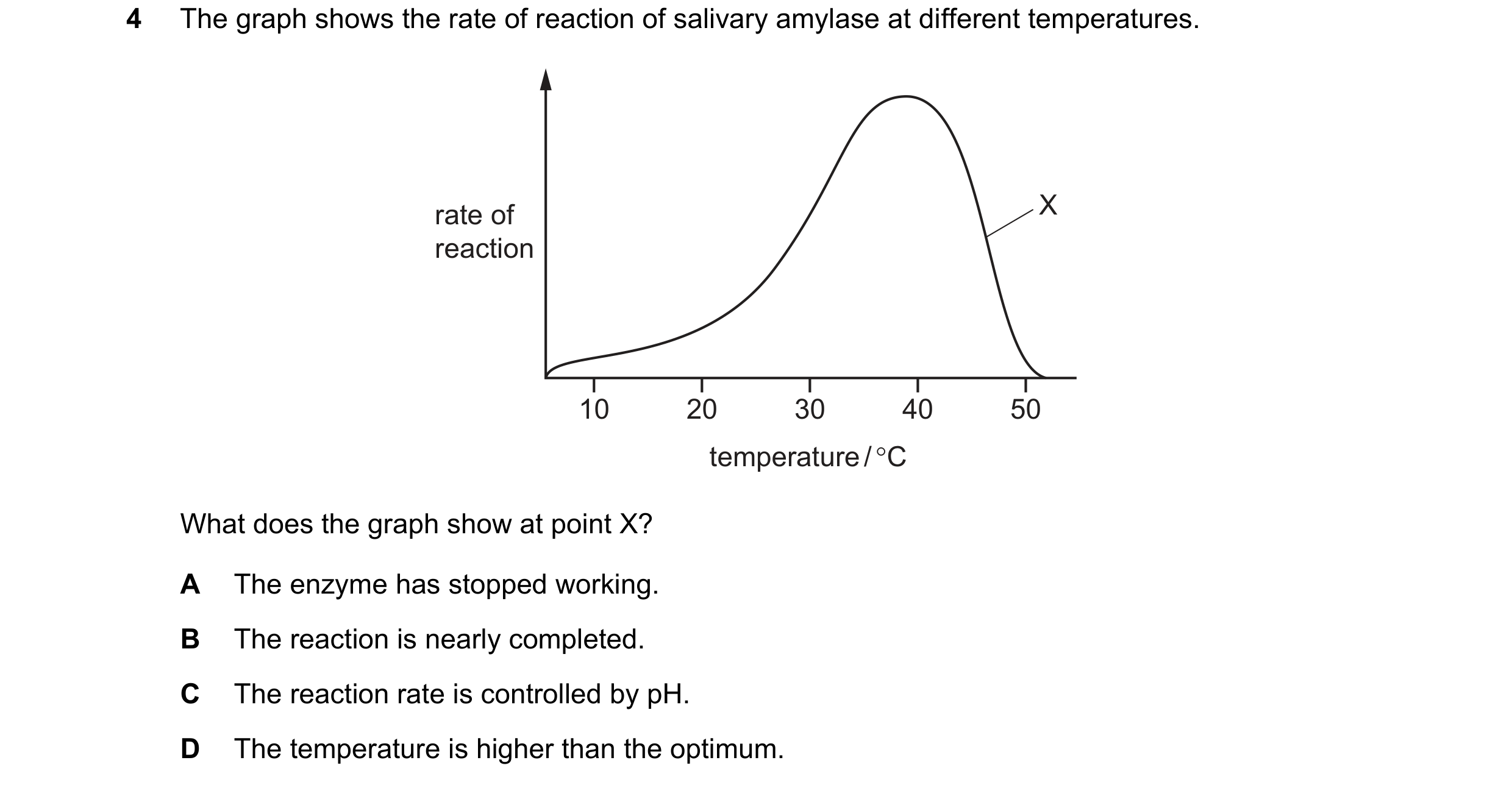
 13 / 20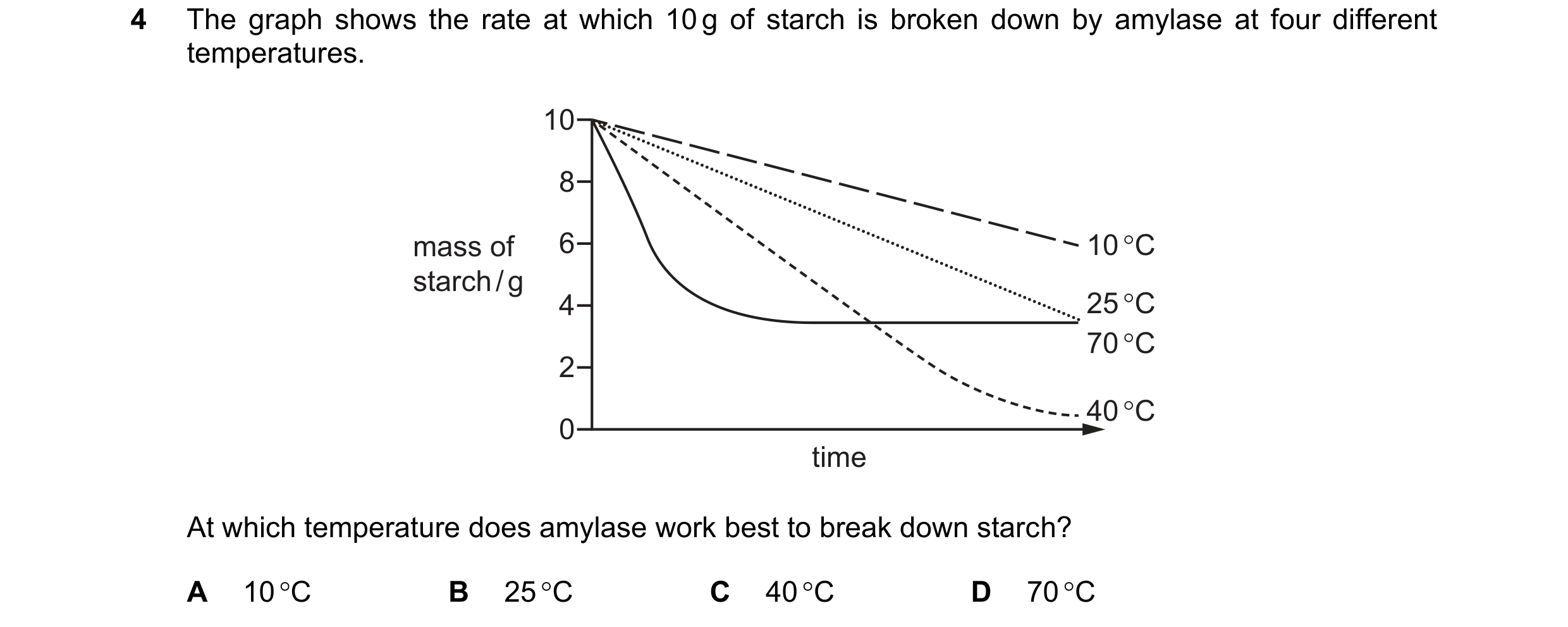

 14 / 20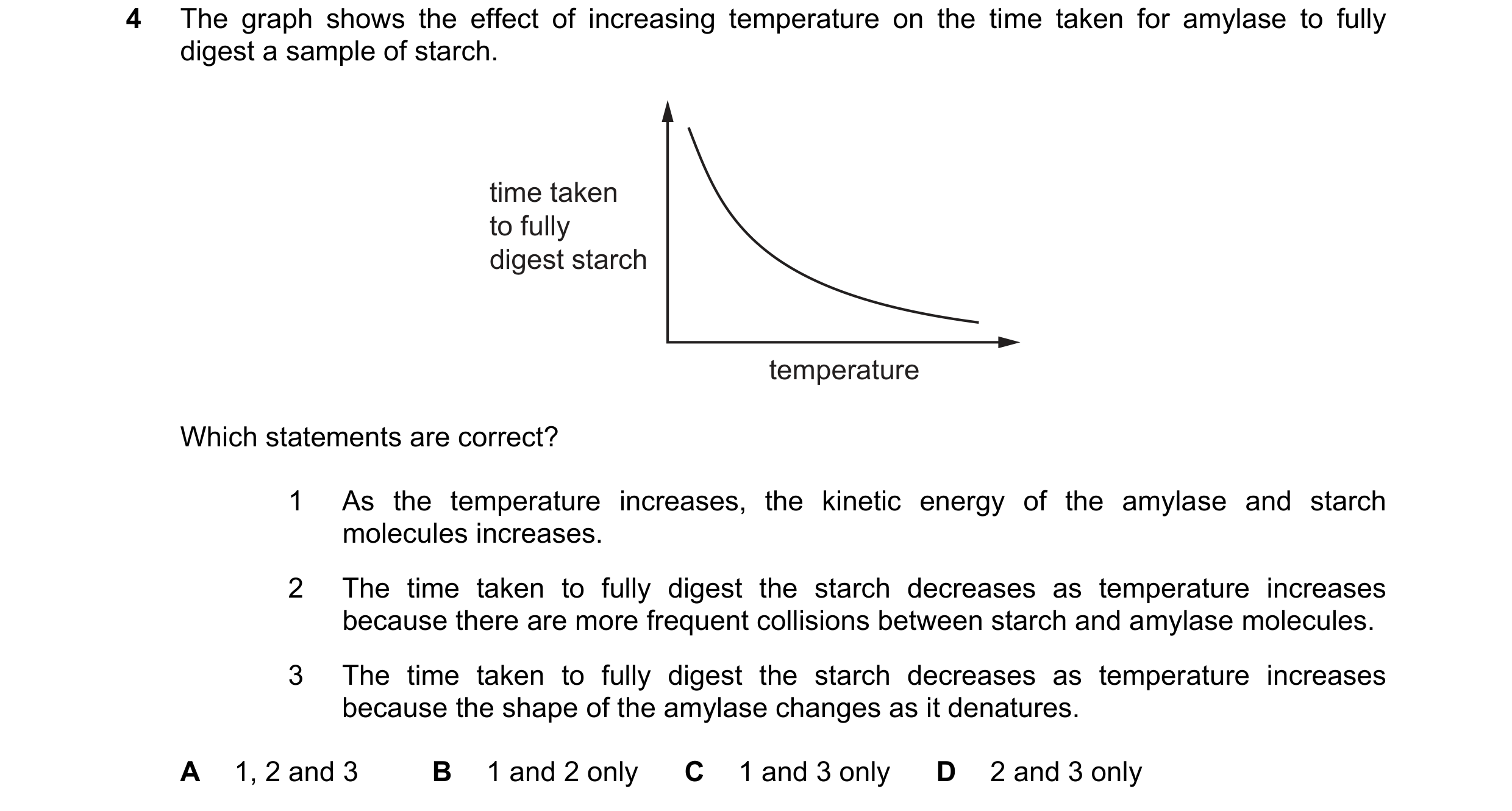
 15 / 20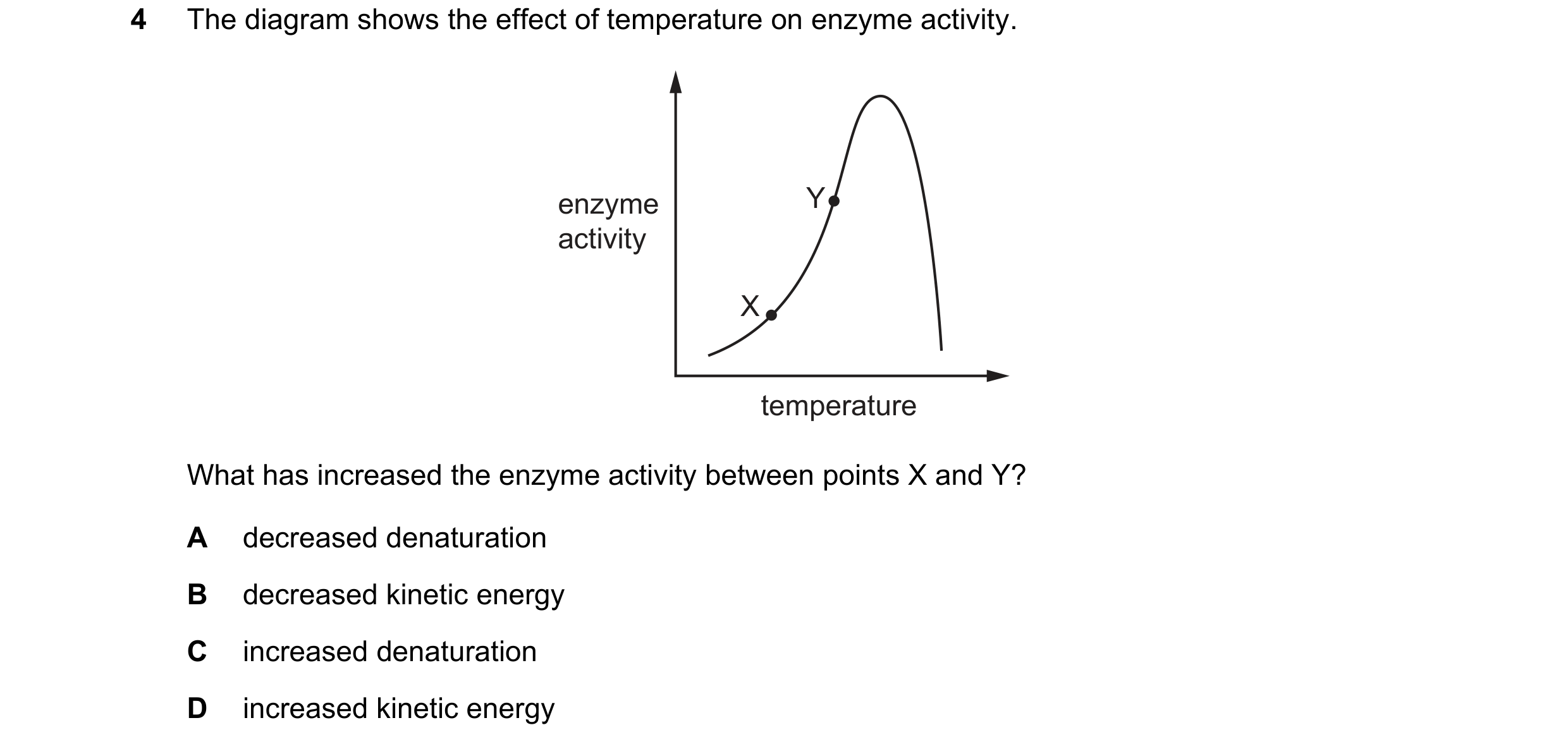

 16 / 20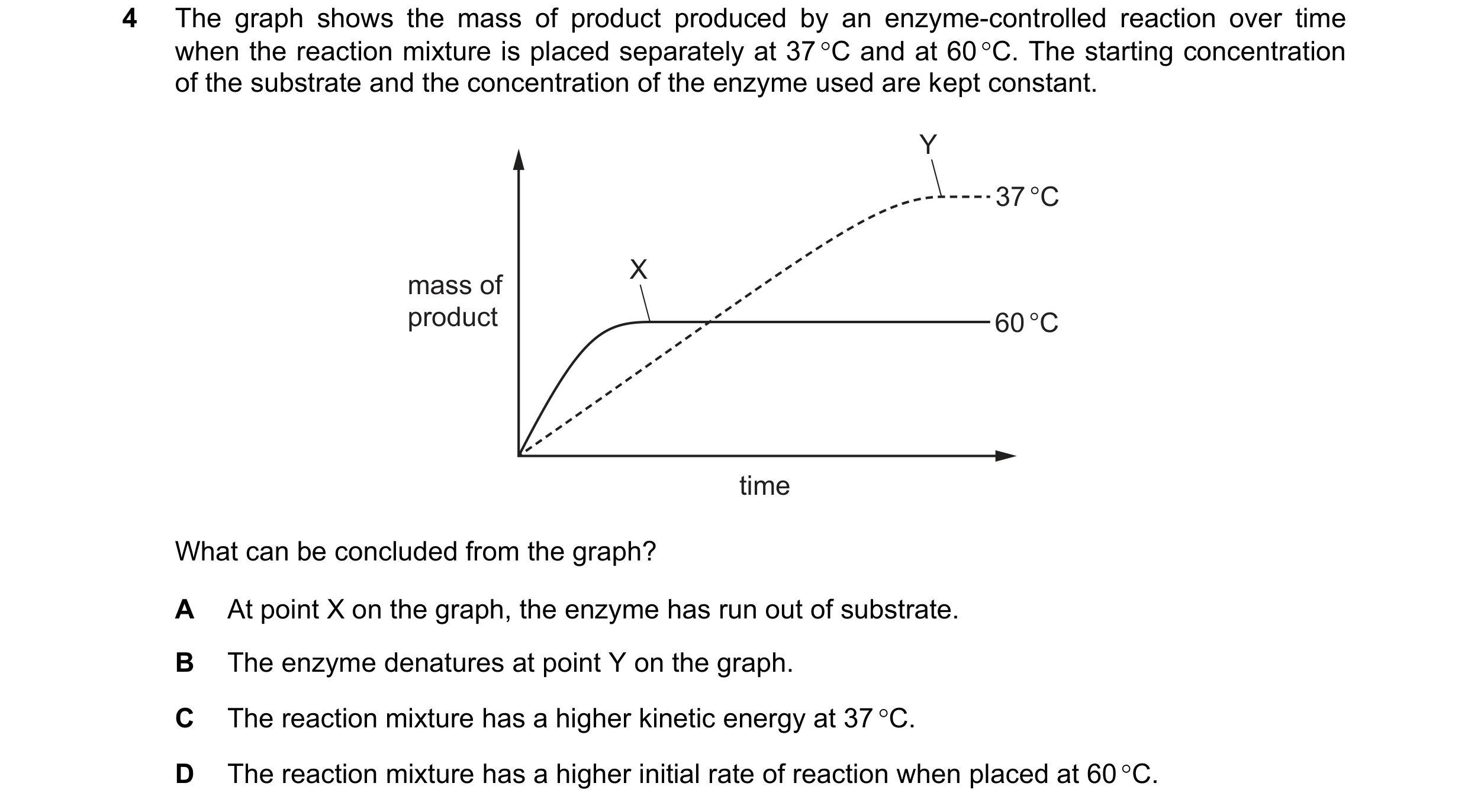
 17 / 20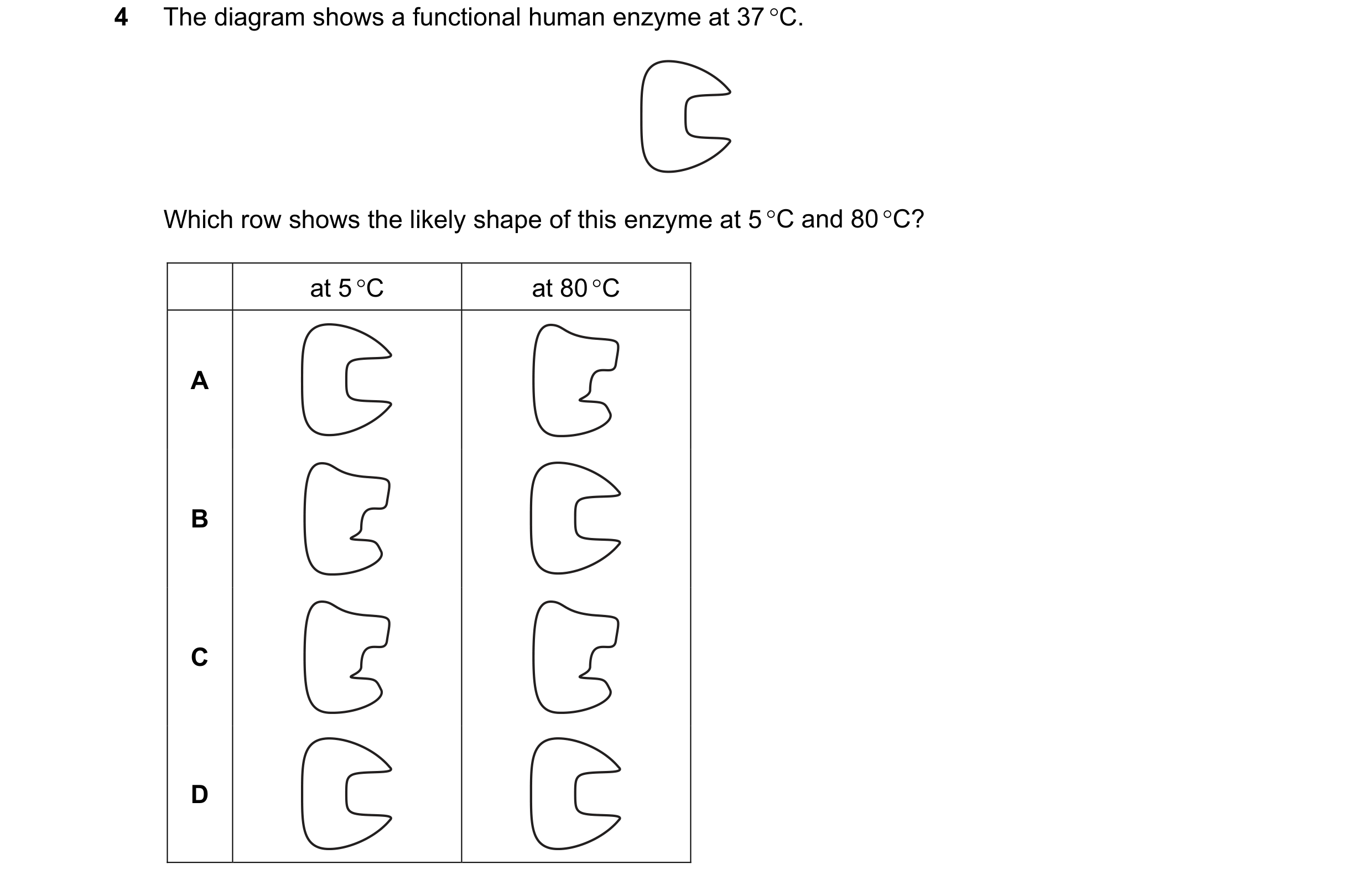
 18 / 20
 19 / 20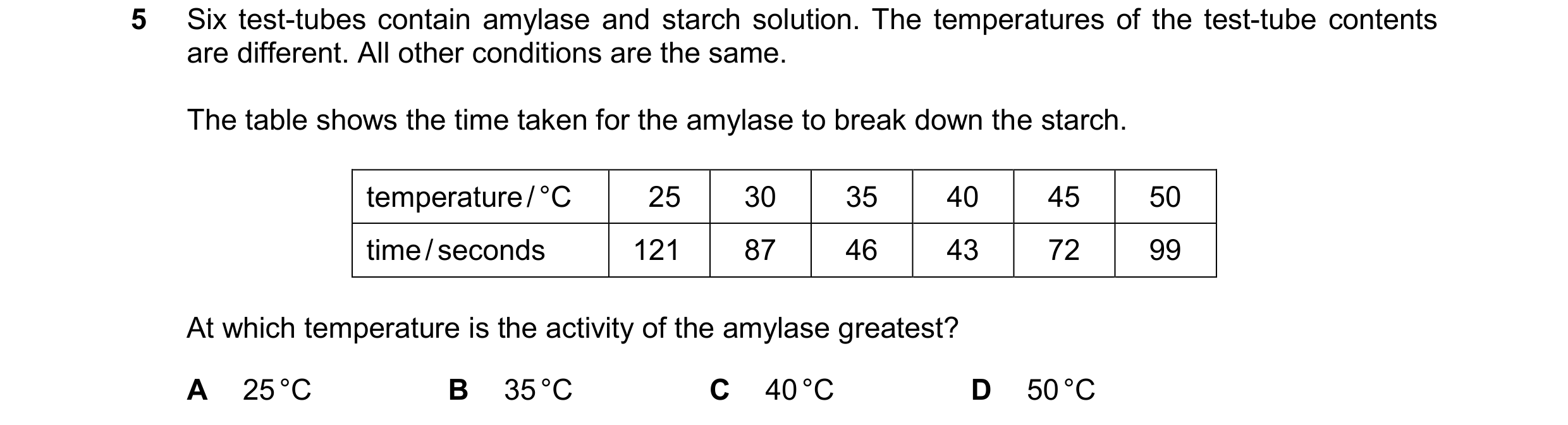

 20 / 20