Questions as text
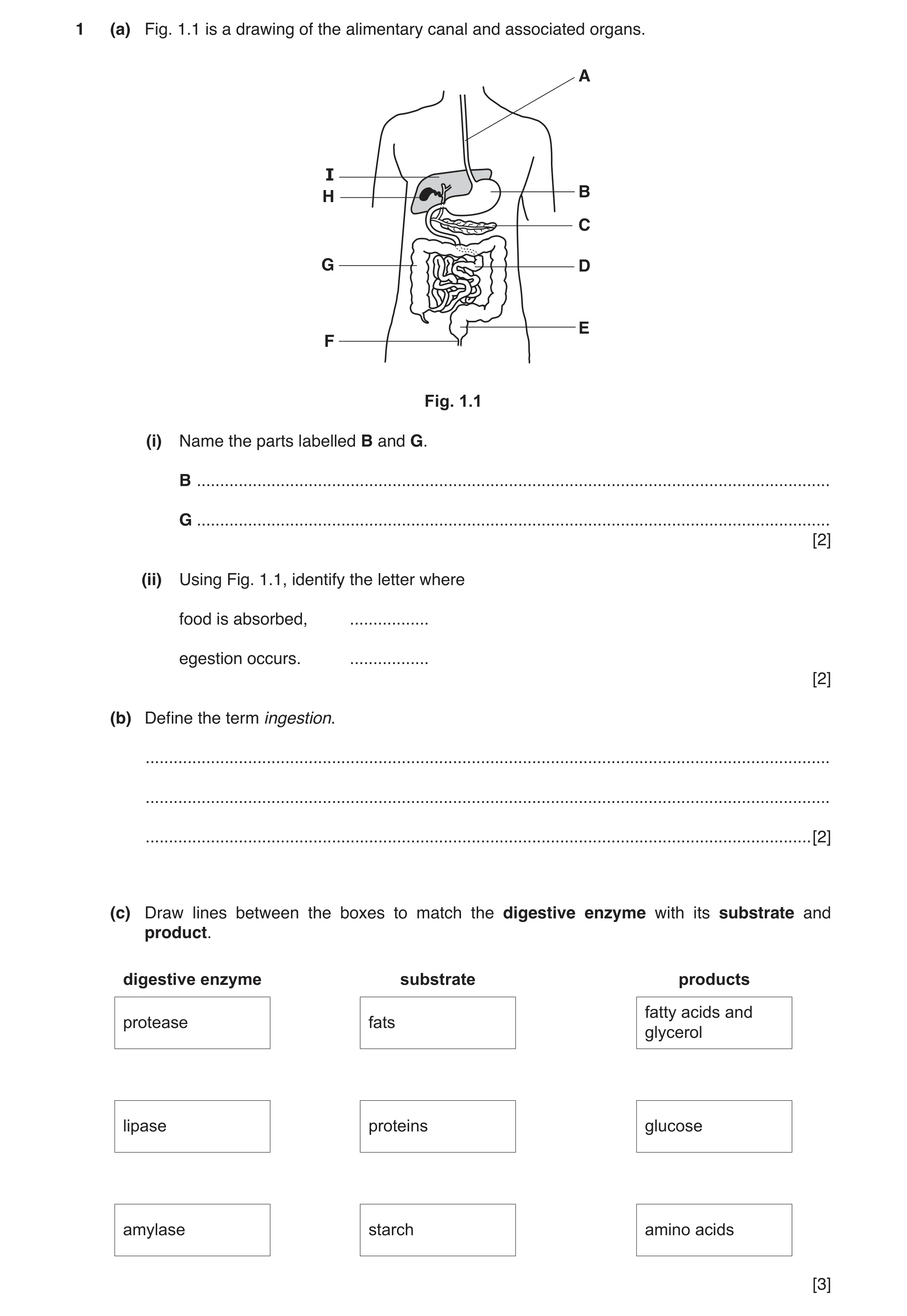
Q1 · A drawing of the alimentary canal and associated organs 0654/32 May/June 2017
1 (a) Fig. 1.1 is a drawing of the alimentary canal and associated organs. A I H B C G D E F Fig. 1.1 (i) Name the parts labelled B and G. B … G … [2] (ii) Using Fig. 1.1, identify the letter where food is absorbed, … egestion occurs. … [2] (b) Define the term ingestion. … … … [2] (c) Draw lines between the boxes to match the digestive enzyme with its substrate and product. digestive enzyme substrate products fatty acids and protease fats glycerol lipase proteins glucose amylase starch amino acids [3]
9 marks
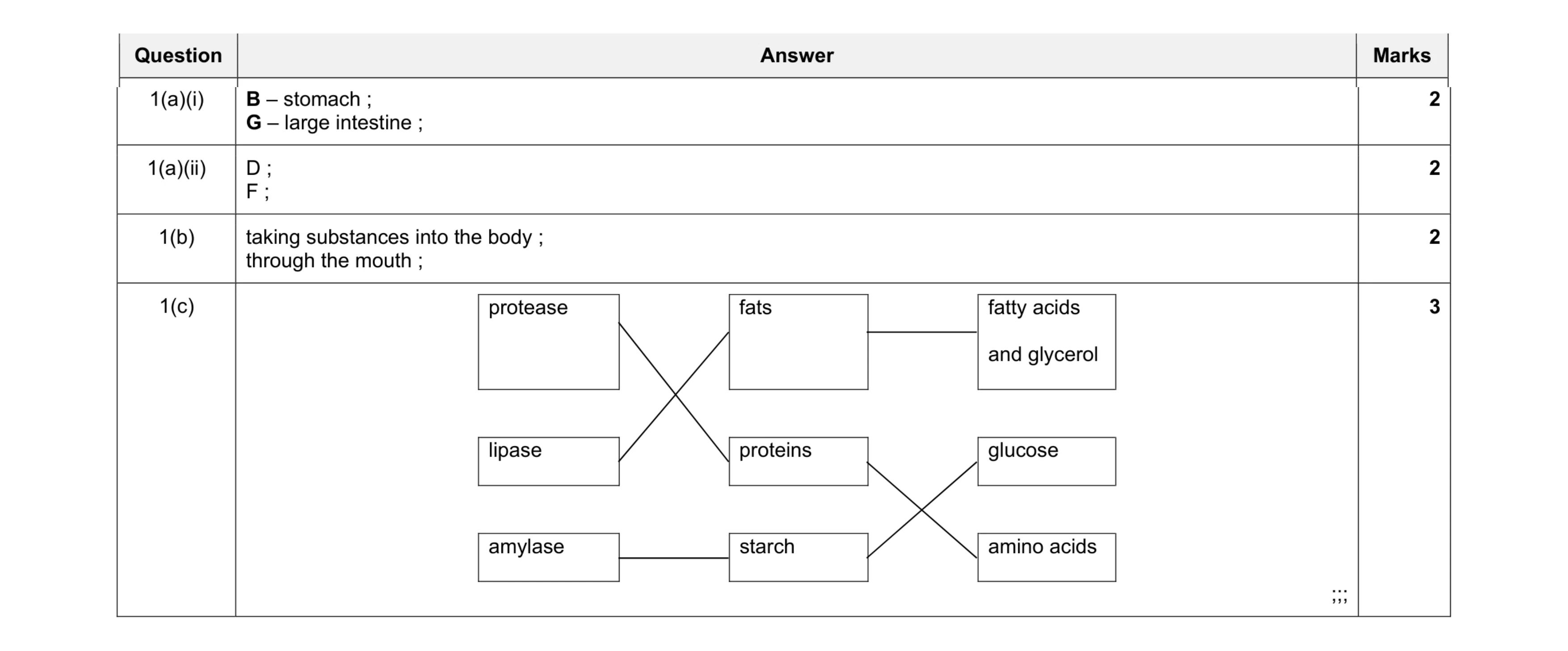
Mark scheme: 1(a)(i) B – stomach ; G – large intestine ; 2 1(a)(ii) D ; F ; 2 1(b) taking substances into the body ; through the mouth ; 2 1(c) protease fats fatty acids and glycerol lipase proteins glucose amylase starch amino acids ;;; 3
This question in 0654/32 May/June 2017
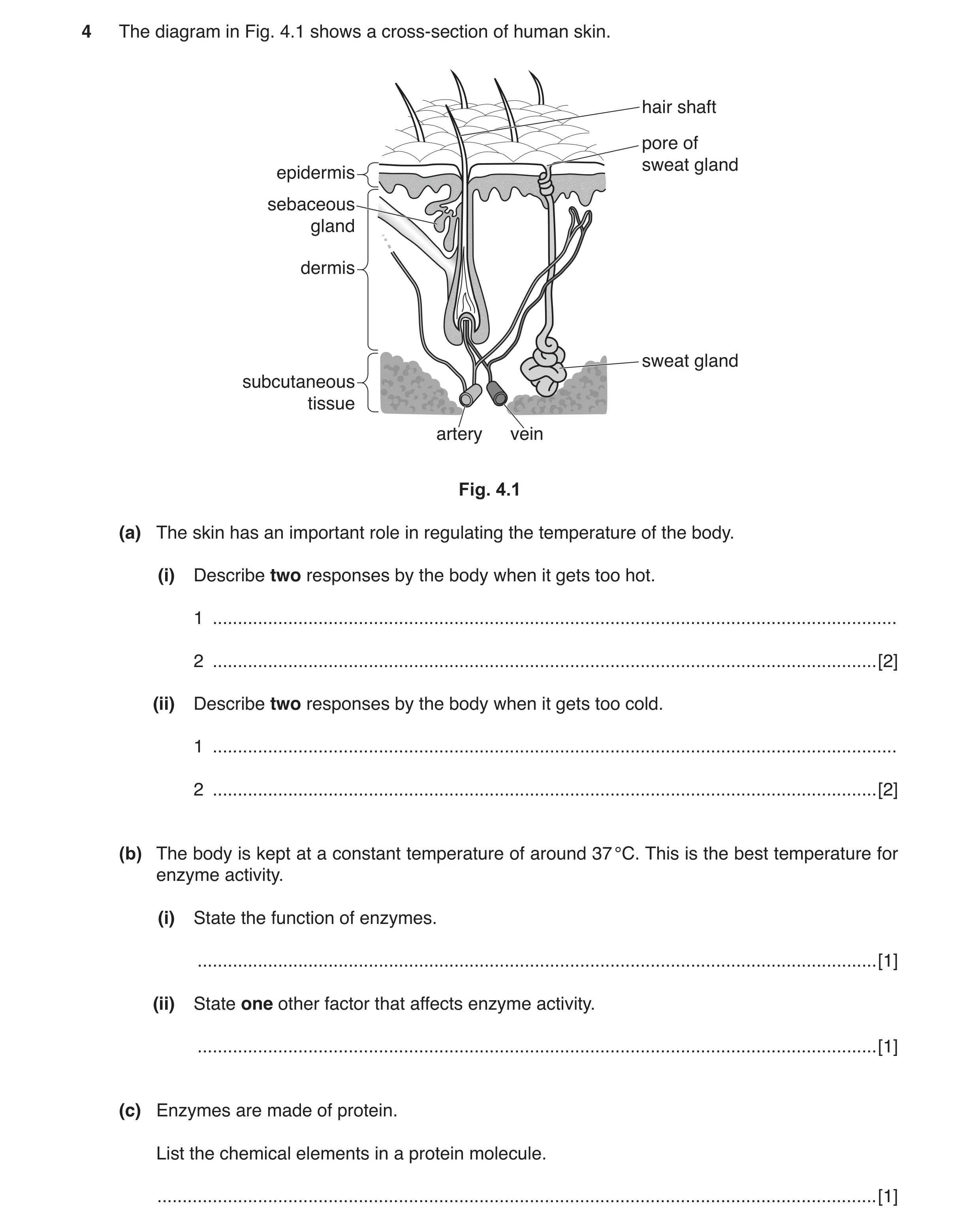
Q2 · The diagram in Fig 0654/32 May/June 2017
4 The diagram in Fig. 4.1 shows a cross-section of human skin. hair shaft pore of sweat gland epidermis sebaceous gland dermis sweat gland subcutaneous tissue artery vein Fig. 4.1 (a) The skin has an important role in regulating the temperature of the body. (i) Describe two responses by the body when it gets too hot. 1 … 2 … [2] (ii) Describe two responses by the body when it gets too cold. 1 … 2 … [2] (b) The body is kept at a constant temperature of around 37 °C. This is the best temperature for enzyme activity. (i) State the function of enzymes. … [1] (ii) State one other factor that affects enzyme activity. … [1] (c) Enzymes are made of protein. List the chemical elements in a protein molecule. … [1]
7 marks
Mark scheme: 4(a)(i) sweating ; vasodilation / more blood flows (close) to the surface of the skin ; hair lies flat ; max 2 4(a)(ii) vasoconstriction / more blood flows (close) to internal organs / away from skin ; hair stands on end ; reduction in sweating ; max 2 4(b)(i) speed up reactions ; 1 4(b)(ii) pH / substrate concentration ; 1 4(c) carbon, hydrogen, oxygen, nitrogen ; 1
This question in 0654/32 May/June 2017
Q3 · How the activity of three different enzymes, A, B and C, varies with temperature 0654/33 Oct/Nov 2017
5 Fig. 5.1 shows how the activity of three different enzymes, A, B and C, varies with temperature. enzymeenzyme AA enzymeenzyme BB enzymeenzyme CC enzyme activity 0 10 20 30 40 50 60 70 80 90 100 temperature / ºC Fig. 5.1 (a) (i) State the optimum temperature for enzyme A. optimum temperature … °C [1] (ii) State the range of temperatures at which enzyme C is active. range is from … to … °C [1] (b) Enzyme B is a protease, which is often added to biological washing powders. It is recommended to wash clothes at a specific temperature if using a biological washing powder. Using the information in Fig. 5.1, suggest a suitable temperature for washing clothes using a biological washing powder. Explain your answer. temperature … °C explanation … … [2] (c) Protease breaks down proteins such as egg stains. State the end-products of the action of protease on a protein. … [1] (d) (i) Enzymes are proteins that function as biological catalysts. State the chemical elements in an enzyme. … [1] (ii) Name the chemical you would use to test for the presence of enzymes in a solution of washing powder and state the colour of a positive test. chemical … colour of positive test … [2]
8 marks
Mark scheme: 5 5( 5 5 5 5( (a)(i) (a)(ii) 65– 95 5(b) any te this tem 5(c) amino (d)(i) carbon (d)(ii) biuret purple 5 (° C) ; mperature in ran mperature is wh acids ; n, hydrogen, oxy ; ; nge from 25–40 hen the enzyme ygen, nitrogen ; (° C) ; is (most) active / optimum tempe erature ; 1 1 2 1 1 2
This question in 0654/33 Oct/Nov 2017
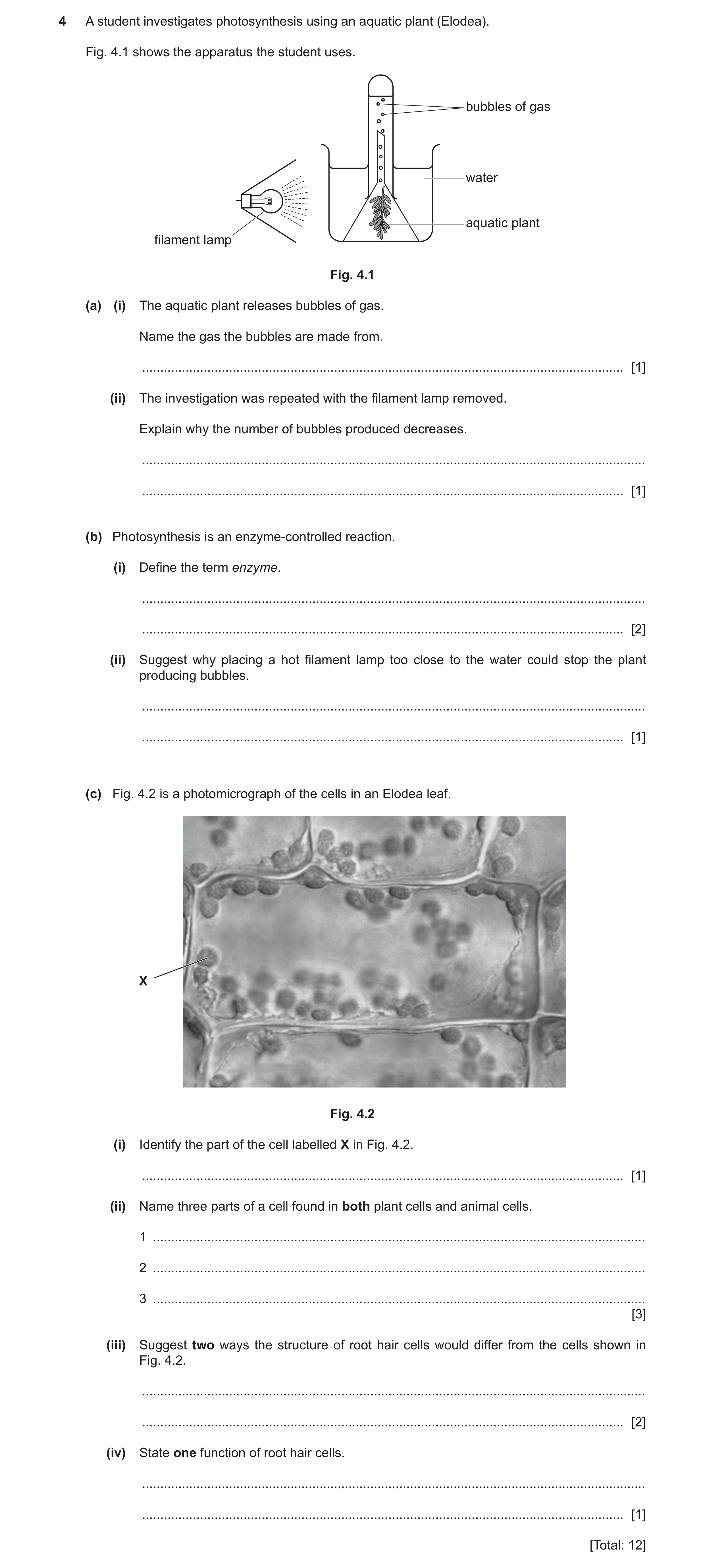
Q4 · A student investigates photosynthesis using an aquatic plant (Elodea) 0654/31 May/June 2020
4 A student investigates photosynthesis using an aquatic plant (Elodea). Fig. 4.1 shows the apparatus the student uses. bubbles of gas water aquatic plant filament lamp Fig. 4.1 (a) (i) The aquatic plant releases bubbles of gas. Name the gas the bubbles are made from. … [1] (ii) The investigation was repeated with the filament lamp removed. Explain why the number of bubbles produced decreases. … … [1] (b) Photosynthesis is an enzyme-controlled reaction. (i) Define the term enzyme. … … [2] (ii) Suggest why placing a hot filament lamp too close to the water could stop the plant producing bubbles. … … [1] (c) Fig. 4.2 is a photomicrograph of the cells in an Elodea leaf. X Fig. 4.2 (i) Identify the part of the cell labelled X in Fig. 4.2. … [1] (ii) Name three parts of a cell found in both plant cells and animal cells. 1 … 2 … 3 … [3] (iii) Suggest two ways the structure of root hair cells would differ from the cells shown in Fig. 4.2. … … [2] (iv) State one function of root hair cells. … … [1] [Total: 12]
12 marks
Mark scheme: 4(a)(i) oxygen ; 1 4(a)(ii) light is needed for photosynthesis ; 1 4(b)(i) protein ; (biological) catalyst ; 2 4(b)(ii) enzymes stop working / enzyme activity slows down ; 1 4(c)(i) chloroplast ; 1 4(c)(ii) cell membrane ; cytoplasm ; nucleus ; 3 4(c)(iii) elongated shape ; contains no chloroplasts ; 2 4(c)(iv) absorb, water / mineral ions ; 1
This question in 0654/31 May/June 2020
Q5 · Plants use different tissues to transport substances around the plant 0654/31 May/June 2021
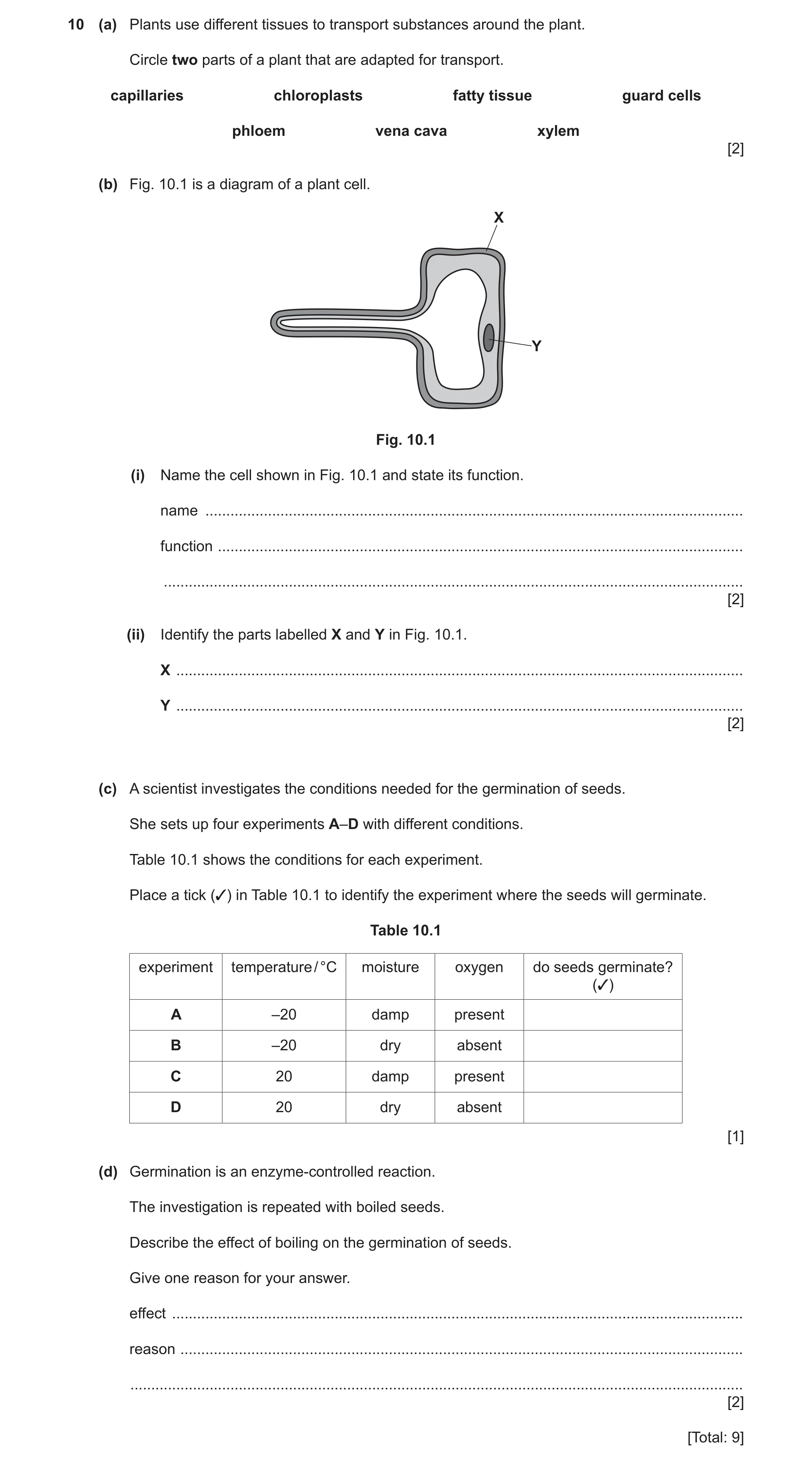
10 (a) Plants use different tissues to transport substances around the plant. Circle two parts of a plant that are adapted for transport. capillaries chloroplasts fatty tissue guard cells phloem vena cava xylem [2] (b) Fig. 10.1 is a diagram of a plant cell. X Y Fig. 10.1 (i) Name the cell shown in Fig. 10.1 and state its function. name … function … … [2] (ii) Identify the parts labelled X and Y in Fig. 10.1. X … Y … [2] (c) A scientist investigates the conditions needed for the germination of seeds. She sets up four experiments A–D with different conditions. Table 10.1 shows the conditions for each experiment. Place a tick (3) in Table 10.1 to identify the experiment where the seeds will germinate. Table 10.1 experiment temperature / °C moisture oxygen do seeds germinate? (3) A –20 damp present B –20 dry absent C 20 damp present D 20 dry absent [1] (d) Germination is an enzyme‑controlled reaction. The investigation is repeated with boiled seeds. Describe the effect of boiling on the germination of seeds. Give one reason for your answer. effect … reason … … [2] [Total: 9]
9 marks
Mark scheme: 10(a) phloem circled ; xylem circled ; 2 10(b)(i) name root hair (cell) ; function absorption of, water / mineral ions ; 2 10(b)(ii) X cell wall ; Y nucleus ; 2 Question Answer Marks 10(c) prediction of germination (/ X) X X X ; 1 10(d) effect no germination ; reason (high temperature) decreases enzyme / stops activity ; 2
This question in 0654/31 May/June 2021
Q6 · A student writes a definition of an enzyme 0654/32 Oct/Nov 2021
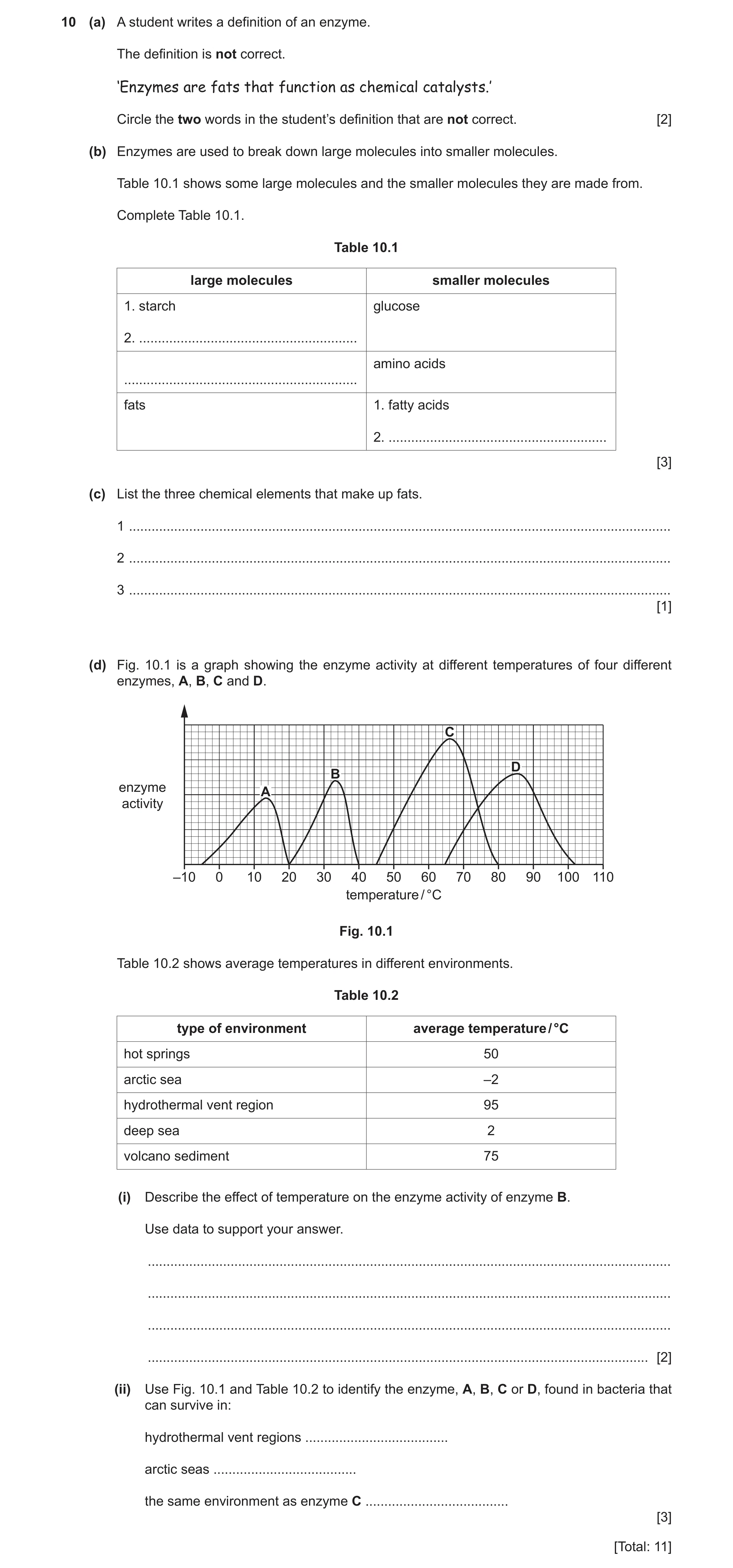
10 (a) A student writes a definition of an enzyme. The definition is not correct. ‘Enzymes are fats that function as chemical catalysts.’ Circle the two words in the student’s definition that are not correct. [2] (b) Enzymes are used to break down large molecules into smaller molecules. Table 10.1 shows some large molecules and the smaller molecules they are made from. Complete Table 10.1. Table 10.1 large molecules smaller molecules 1. starch glucose 2. … amino acids … fats 1. fatty acids 2. … [3] (c) List the three chemical elements that make up fats. 1 … 2 … 3 … [1] (d) Fig. 10.1 is a graph showing the enzyme activity at different temperatures of four different enzymes, A, B, C and D. C D B enzyme A activity –10 0 10 20 30 40 50 60 70 80 90 100 110 temperature / °C Fig. 10.1 Table 10.2 shows average temperatures in different environments. Table 10.2 type of environment average temperature / °C hot springs 50 arctic sea –2 hydrothermal vent region 95 deep sea 2 volcano sediment 75 (i) Describe the effect of temperature on the enzyme activity of enzyme B. Use data to support your answer. … … … … [2] (ii) Use Fig. 10.1 and Table 10.2 to identify the enzyme, A, B, C or D, found in bacteria that can survive in: hydrothermal vent regions … arctic seas … the same environment as enzyme C … [3] [Total: 11]
11 marks
Mark scheme: 10(a) fats ; chemical ; 2 10(b) glycogen ; protein ; glycerol ; 3 10(c) carbon hydrogen and oxygen ; 1 10(d)(i) as temperature increases enzyme activity increases then decreases ; peak / optimum at 33 °C ; 2 10(d)(ii) D ; A ; D ; 3
This question in 0654/32 Oct/Nov 2021
Q7 · Different digestive enzymes work best at different pH values 0654/32 May/June 2022
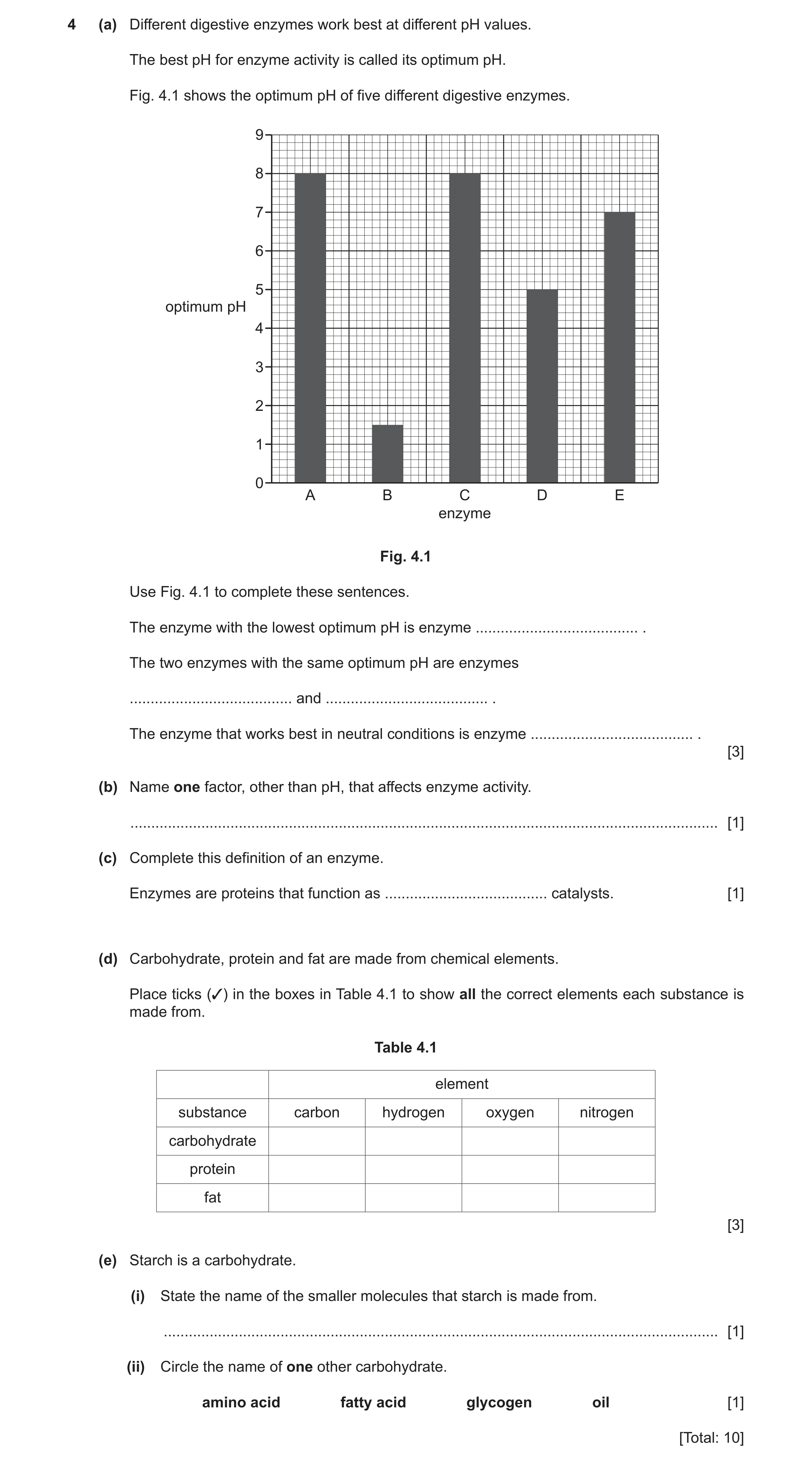
4 (a) Different digestive enzymes work best at different pH values. The best pH for enzyme activity is called its optimum pH. Fig. 4.1 shows the optimum pH of five different digestive enzymes. 9 8 7 6 5 optimum pH 4 3 2 1 0 A B C D E enzyme Fig. 4.1 Use Fig. 4.1 to complete these sentences. The enzyme with the lowest optimum pH is enzyme … . The two enzymes with the same optimum pH are enzymes … and … . The enzyme that works best in neutral conditions is enzyme … . [3] (b) Name one factor, other than pH, that affects enzyme activity. … [1] (c) Complete this definition of an enzyme. Enzymes are proteins that function as … catalysts. [1] (d) Carbohydrate, protein and fat are made from chemical elements. Place ticks (3) in the boxes in Table 4.1 to show all the correct elements each substance is made from. Table 4.1 element substance carbon hydrogen oxygen nitrogen carbohydrate protein fat [3] (e) Starch is a carbohydrate. (i) State the name of the smaller molecules that starch is made from. … [1] (ii) Circle the name of one other carbohydrate. amino acid fatty acid glycogen oil [1] [Total: 10]
10 marks
Mark scheme: 4(a) B ; A and C ; E ; 3 4(b) temperature ; 1 4(c) biological ; 1 Question Answer Marks 4(d) element substance carbon hydrogen oxygen nitrogen carbohydrate protein fat 3 4(e)(i) glucose ; 1 4(e)(ii) glycogen circled ; 1
This question in 0654/32 May/June 2022
Q8 · Different digestive enzymes work best at different pH values 0654/33 May/June 2022
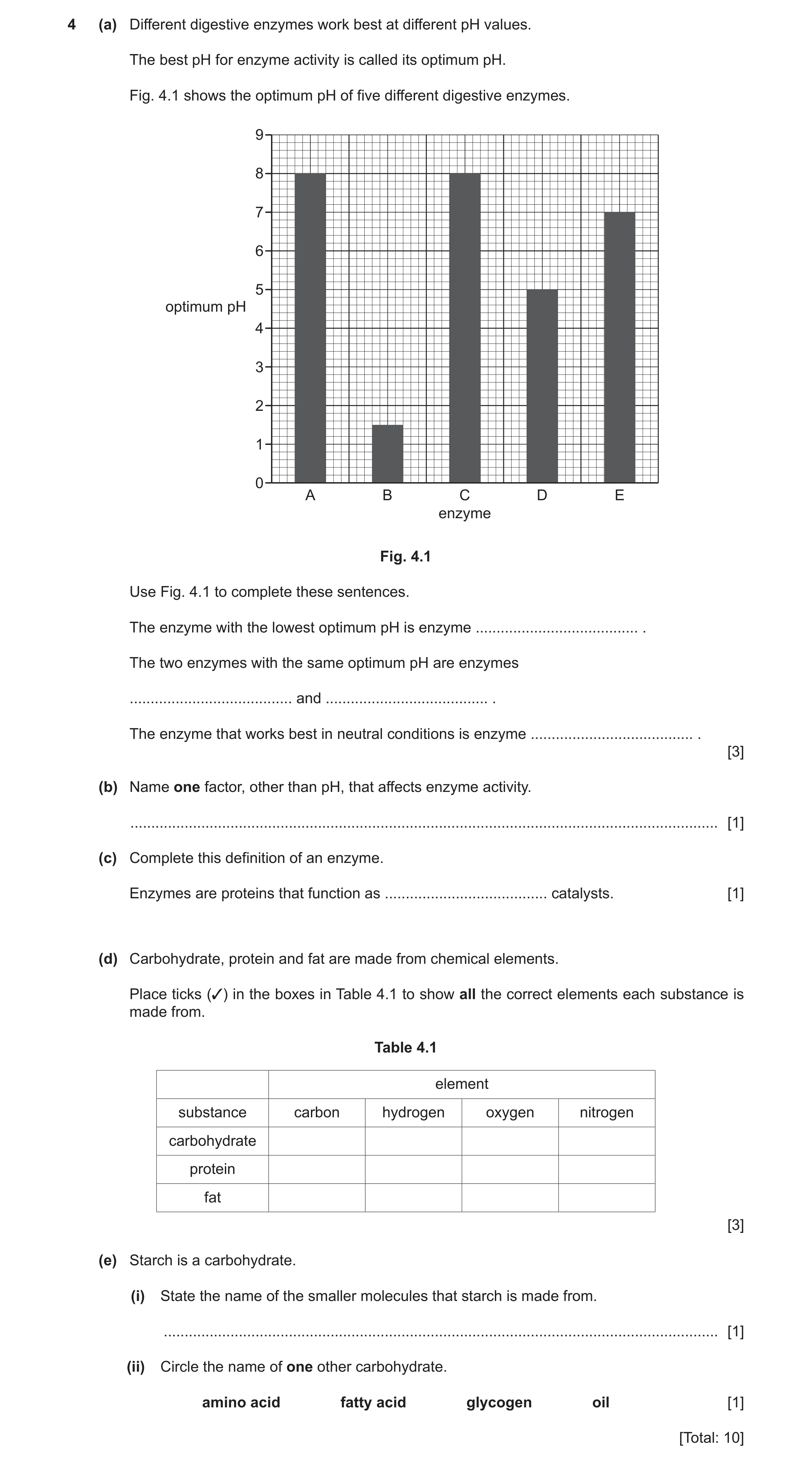
4 (a) Different digestive enzymes work best at different pH values. The best pH for enzyme activity is called its optimum pH. Fig. 4.1 shows the optimum pH of five different digestive enzymes. 9 8 7 6 5 optimum pH 4 3 2 1 0 A B C D E enzyme Fig. 4.1 Use Fig. 4.1 to complete these sentences. The enzyme with the lowest optimum pH is enzyme … . The two enzymes with the same optimum pH are enzymes … and … . The enzyme that works best in neutral conditions is enzyme … . [3] (b) Name one factor, other than pH, that affects enzyme activity. … [1] (c) Complete this definition of an enzyme. Enzymes are proteins that function as … catalysts. [1] (d) Carbohydrate, protein and fat are made from chemical elements. Place ticks (3) in the boxes in Table 4.1 to show all the correct elements each substance is made from. Table 4.1 element substance carbon hydrogen oxygen nitrogen carbohydrate protein fat [3] (e) Starch is a carbohydrate. (i) State the name of the smaller molecules that starch is made from. … [1] (ii) Circle the name of one other carbohydrate. amino acid fatty acid glycogen oil [1] [Total: 10]
10 marks
Mark scheme: 4(a) B ; A and C ; E ; 3 4(b) temperature ; 1 4(c) biological ; 1 Question Answer Marks 4(d) element substance carbon hydrogen oxygen nitrogen carbohydrate protein fat 3 4(e)(i) glucose ; 1 4(e)(ii) glycogen circled ; 1
This question in 0654/33 May/June 2022
Q9 · Define the term enzyme 0654/32 Feb/March 2023
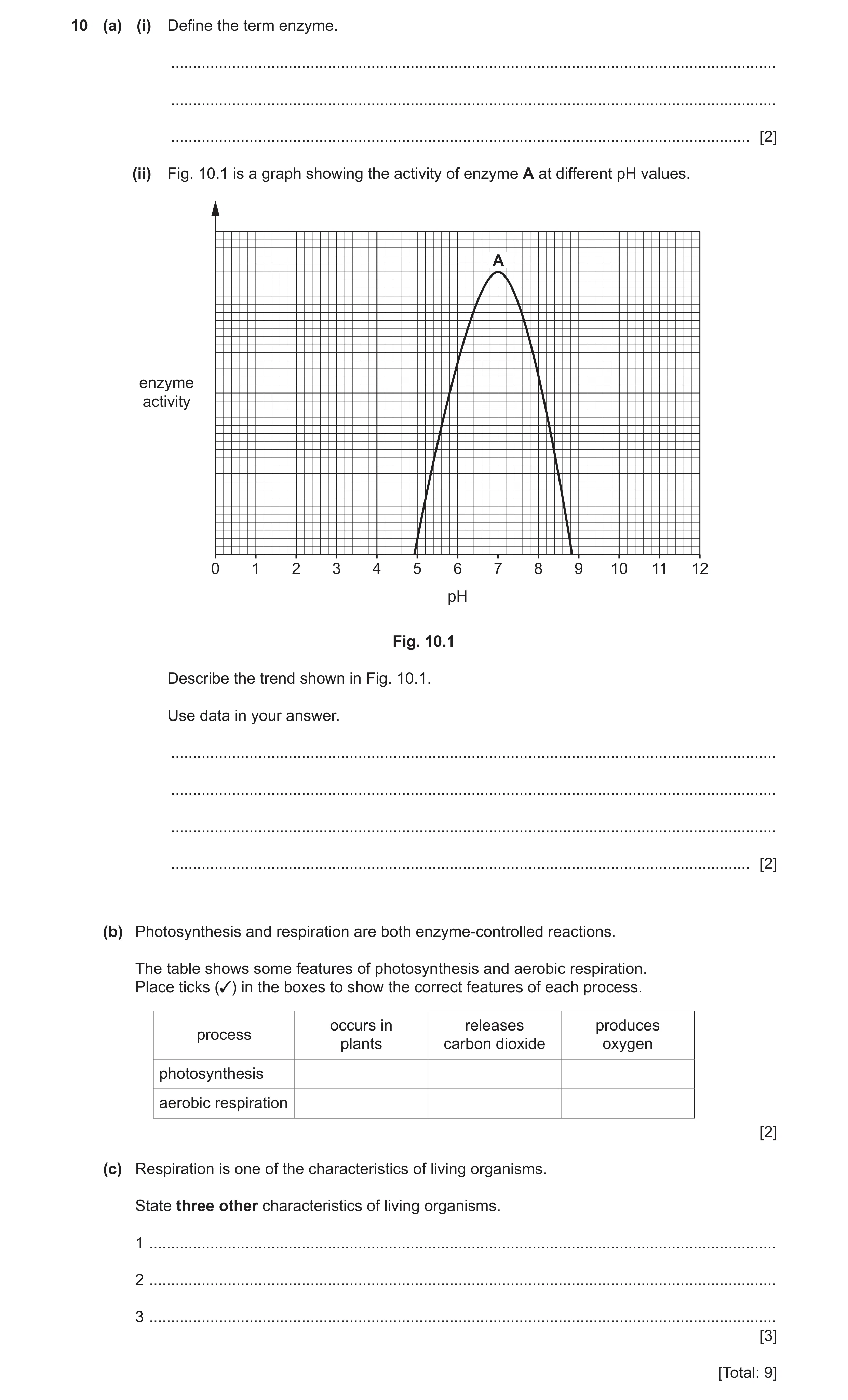
10 (a) (i) Define the term enzyme. … … … [2] (ii) Fig. 10.1 is a graph showing the activity of enzyme A at different pH values. A enzyme activity 0 1 2 3 4 5 6 7 8 9 10 11 12 pH Fig. 10.1 Describe the trend shown in Fig. 10.1. Use data in your answer. … … … … [2] (b) Photosynthesis and respiration are both enzyme-controlled reactions. The table shows some features of photosynthesis and aerobic respiration. Place ticks (3) in the boxes to show the correct features of each process. occurs in releases produces process plants carbon dioxide oxygen photosynthesis aerobic respiration [2] (c) Respiration is one of the characteristics of living organisms. State three other characteristics of living organisms. 1 … 2 … 3 … [3] [Total: 9]
9 marks
Mark scheme: 10(a)(i) a protein ; 2 (that functions as) a biological catalyst ; 10(a)(ii) enzyme activity increases then decreases (with increasing pH) ; 2 optimum / peak / maximum activity, at pH7 ; 10(b) 2 releases carbon process occurs in plants produces oxygen dioxide photosynthesis aerobic respiration ;; 10(c) any three from: 3 movement ; sensitivity ; reproduction ; growth ; excretion ; nutrition ;
This question in 0654/32 Feb/March 2023
Q10 · Enzymes are only active within a specific pH range 0654/33 Oct/Nov 2023
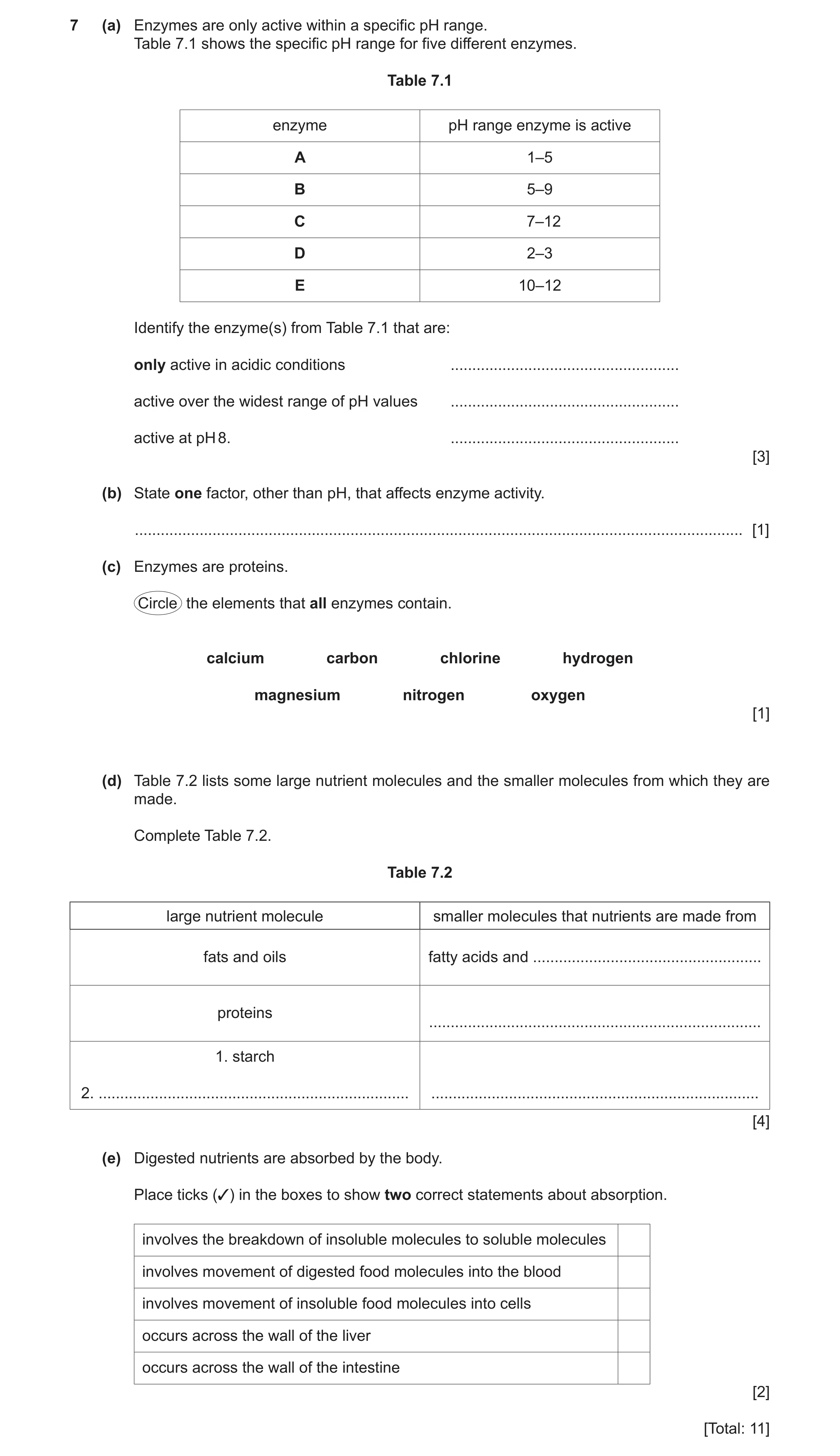
7 (a) Enzymes are only active within a specific pH range. Table 7.1 shows the specific pH range for five different enzymes. Table 7.1 enzyme pH range enzyme is active A 1–5 B 5–9 C 7–12 D 2–3 E 10–12 Identify the enzyme(s) from Table 7.1 that are: only active in acidic conditions … active over the widest range of pH values … active at pH 8. … [3] (b) State one factor, other than pH, that affects enzyme activity. … [1] (c) Enzymes are proteins. Circle the elements that all enzymes contain. calcium carbon chlorine hydrogen magnesium nitrogen oxygen [1] (d) Table 7.2 lists some large nutrient molecules and the smaller molecules from which they are made. Complete Table 7.2. Table 7.2 large nutrient molecule smaller molecules that nutrients are made from fats and oils fatty acids and … proteins … 1. starch 2. … … [4] (e) Digested nutrients are absorbed by the body. Place ticks (3) in the boxes to show two correct statements about absorption. involves the breakdown of insoluble molecules to soluble molecules involves movement of digested food molecules into the blood involves movement of insoluble food molecules into cells occurs across the wall of the liver occurs across the wall of the intestine [2] [Total: 11]
11 marks
Mark scheme: 7(a) A and D ; 3 C ; B and C ; 7(b) temperature / AVP ; 1 7(c) carbon, hydrogen, oxygen, nitrogen circled ; 1 7(d) 4 large nutrient molecule smaller molecules that nutrients are made from fats and oils fatty acids and glycerol ; proteins amino acids ; 1. starch glucose ; 2. glycogen ; 7(e) 2 involves the breakdown of insoluble molecules to soluble molecules involves movement of digested food molecules into the blood involves movement of insoluble food molecules into cells occurs across the wall of the liver occurs across the wall of the intestine ;; 3 ticks and 2 correct = 1 mark 3 ticks and 1 correct = 0 marks 4 or more ticks = 0 marks
This question in 0654/33 Oct/Nov 2023
Q11 · The activity of some bacterial enzymes at different temperatures 0654/31 May/June 2024
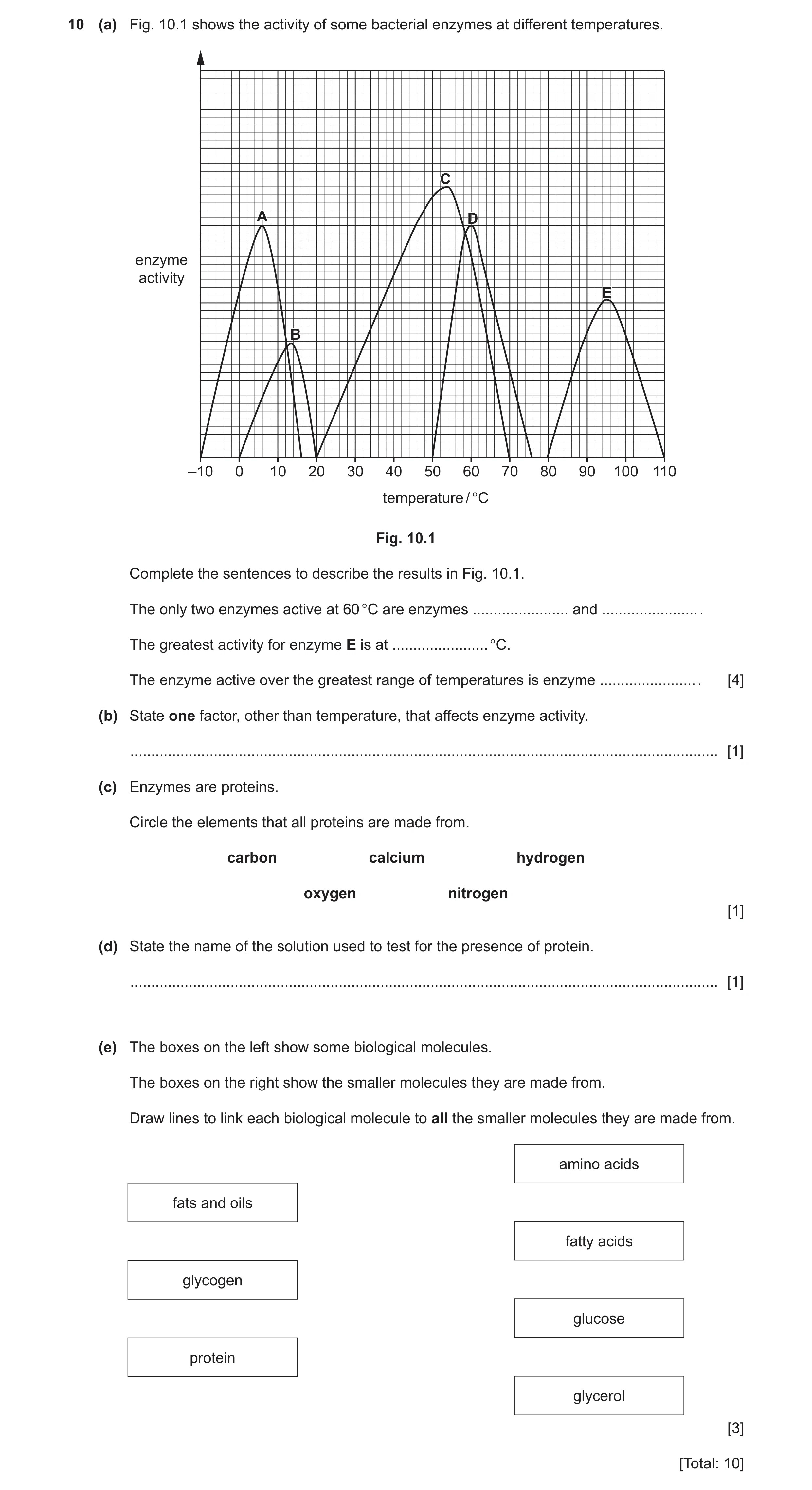
10 (a) Fig. 10.1 shows the activity of some bacterial enzymes at different temperatures. CC AA DD enzyme activity EE BB –10 0 10 20 30 40 50 60 70 80 90 100 110 temperature / °C Fig. 10.1 Complete the sentences to describe the results in Fig. 10.1. The only two enzymes active at 60 °C are enzymes … and … . The greatest activity for enzyme E is at … °C. The enzyme active over the greatest range of temperatures is enzyme … . [4] (b) State one factor, other than temperature, that affects enzyme activity. … [1] (c) Enzymes are proteins. Circle the elements that all proteins are made from. carbon calcium hydrogen oxygen nitrogen [1] (d) State the name of the solution used to test for the presence of protein. … [1] (e) The boxes on the left show some biological molecules. The boxes on the right show the smaller molecules they are made from. Draw lines to link each biological molecule to all the smaller molecules they are made from. amino acids fats and oils fatty acids glycogen glucose protein glycerol [3] [Total: 10]
10 marks
Mark scheme: 10(a) C ; D ; 95 (°C) ; C ; 4 10(b) pH / avp ; 1 10(c) carbon, hydrogen, oxygen and nitrogen all circled ; 1 Question Answer Marks 10(d) biuret ; 1 10(e) amino acids fats and oils fatty acids glycogen glucose protein glycerol ;;; 3
This question in 0654/31 May/June 2024
Q12 · Some information about five different enzymes 0654/32 Oct/Nov 2024
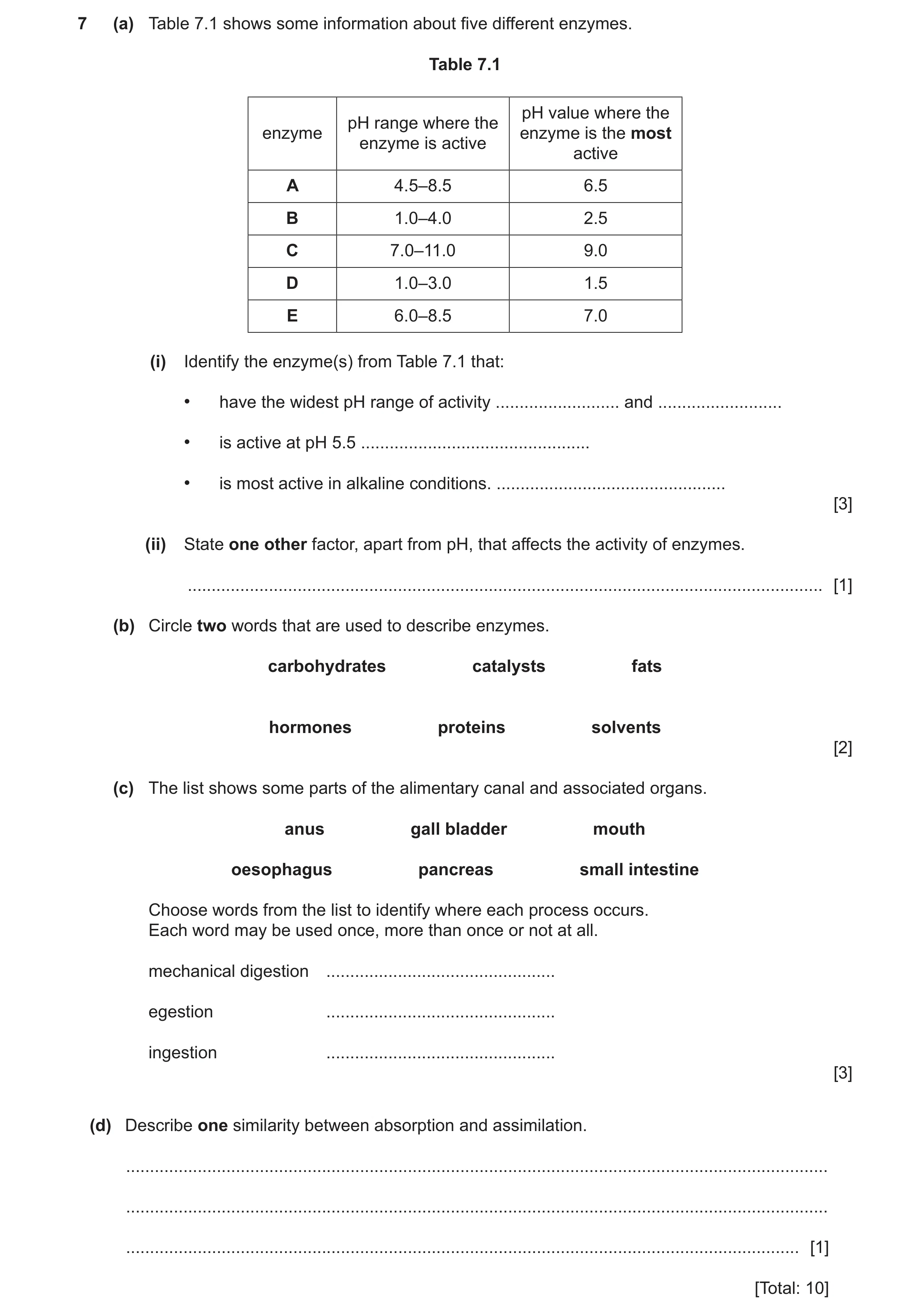
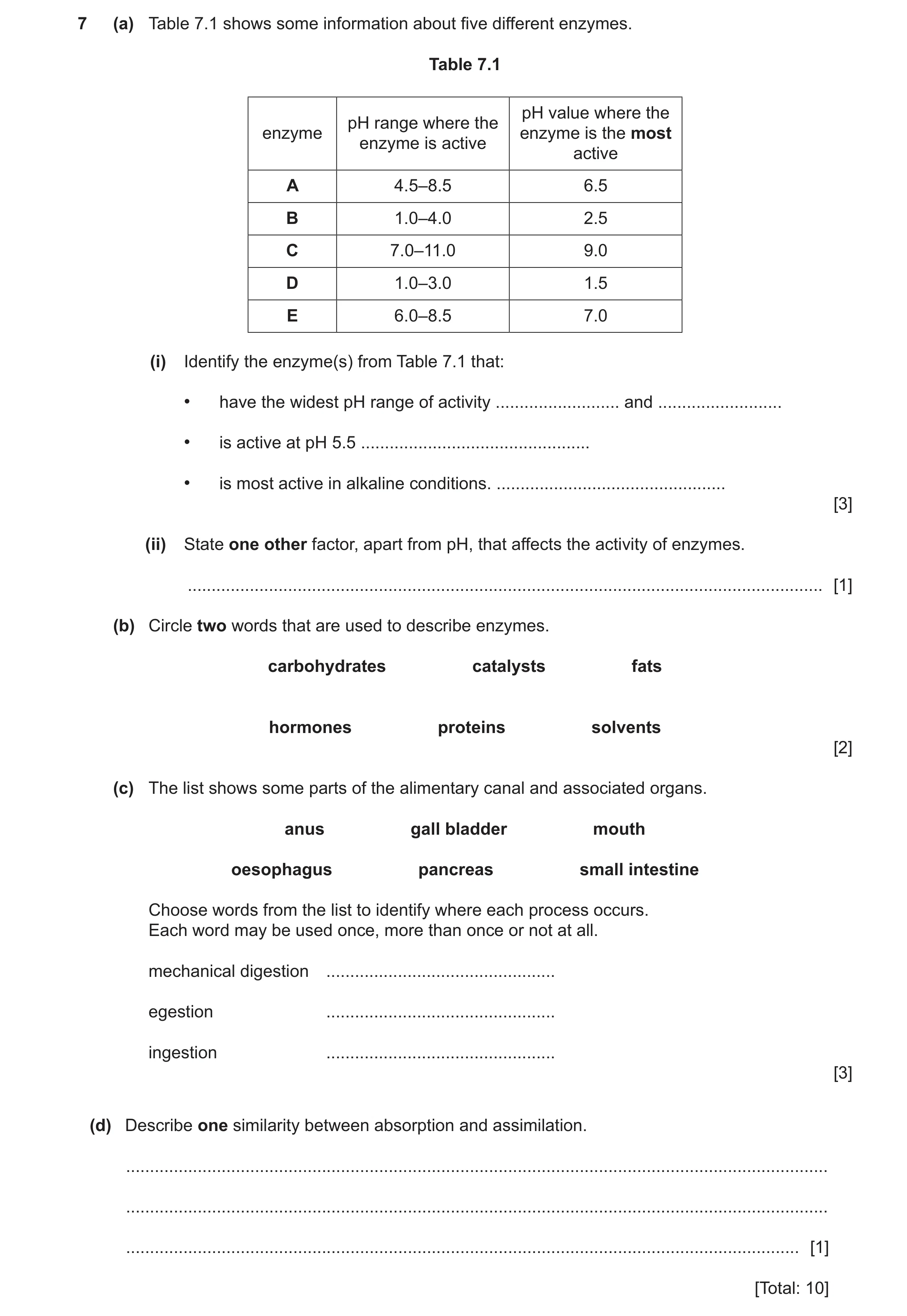
7 (a) Table 7.1 shows some information about five different enzymes. Table 7.1 pH value where the pH range where the enzyme enzyme is the most enzyme is active active A 4.5–8.5 6.5 B 1.0–4.0 2.5 C 7.0–11.0 9.0 D 1.0–3.0 1.5 E 6.0–8.5 7.0 (i) Identify the enzyme(s) from Table 7.1 that: • have the widest pH range of activity … and … • is active at pH 5.5 … • is most active in alkaline conditions. … [3] (ii) State one other factor, apart from pH, that affects the activity of enzymes. … [1] (b) Circle two words that are used to describe enzymes. carbohydrates catalysts fats hormones proteins solvents [2] (c) The list shows some parts of the alimentary canal and associated organs. anus gall bladder mouth oesophagus pancreas small intestine Choose words from the list to identify where each process occurs. Each word may be used once, more than once or not at all. mechanical digestion … egestion … ingestion … [3] (d) Describe one similarity between absorption and assimilation. … … … [1] [Total: 10]
10 marks
Mark scheme: 7(a)(i) A AND C ; 3 A ; C ; 7(a)(ii) temperature / AVP ; 1 7(b) proteins circled ; 2 catalysts circled ; 7(c) mouth ; 3 anus ; mouth ; 7(d) both involve the movement of, digested food / molecules / soluble nutrients ; 1
This question in 0654/32 Oct/Nov 2024
Q13 · Some information about five different enzymes 0654/33 Oct/Nov 2024
7 (a) Table 7.1 shows some information about five different enzymes. Table 7.1 pH value where the pH range where the enzyme enzyme is the most enzyme is active active A 4.5–8.5 6.5 B 1.0–4.0 2.5 C 7.0–11.0 9.0 D 1.0–3.0 1.5 E 6.0–8.5 7.0 (i) Identify the enzyme(s) from Table 7.1 that: • have the widest pH range of activity … and … • is active at pH 5.5 … • is most active in alkaline conditions. … [3] (ii) State one other factor, apart from pH, that affects the activity of enzymes. … [1] (b) Circle two words that are used to describe enzymes. carbohydrates catalysts fats hormones proteins solvents [2] (c) The list shows some parts of the alimentary canal and associated organs. anus gall bladder mouth oesophagus pancreas small intestine Choose words from the list to identify where each process occurs. Each word may be used once, more than once or not at all. mechanical digestion … egestion … ingestion … [3] (d) Describe one similarity between absorption and assimilation. … … … [1] [Total: 10]
10 marks
Mark scheme: 7(a)(i) A AND C ; 3 A ; C ; 7(a)(ii) temperature / AVP ; 1 7(b) proteins circled ; 2 catalysts circled ; 7(c) mouth ; 3 anus ; mouth ; 7(d) both involve the movement of, digested food / molecules / soluble nutrients ; 1
This question in 0654/33 Oct/Nov 2024
Q14 · State all the elements found in the molecules of: protein … … glycogen 0654/31 Oct/Nov 2025
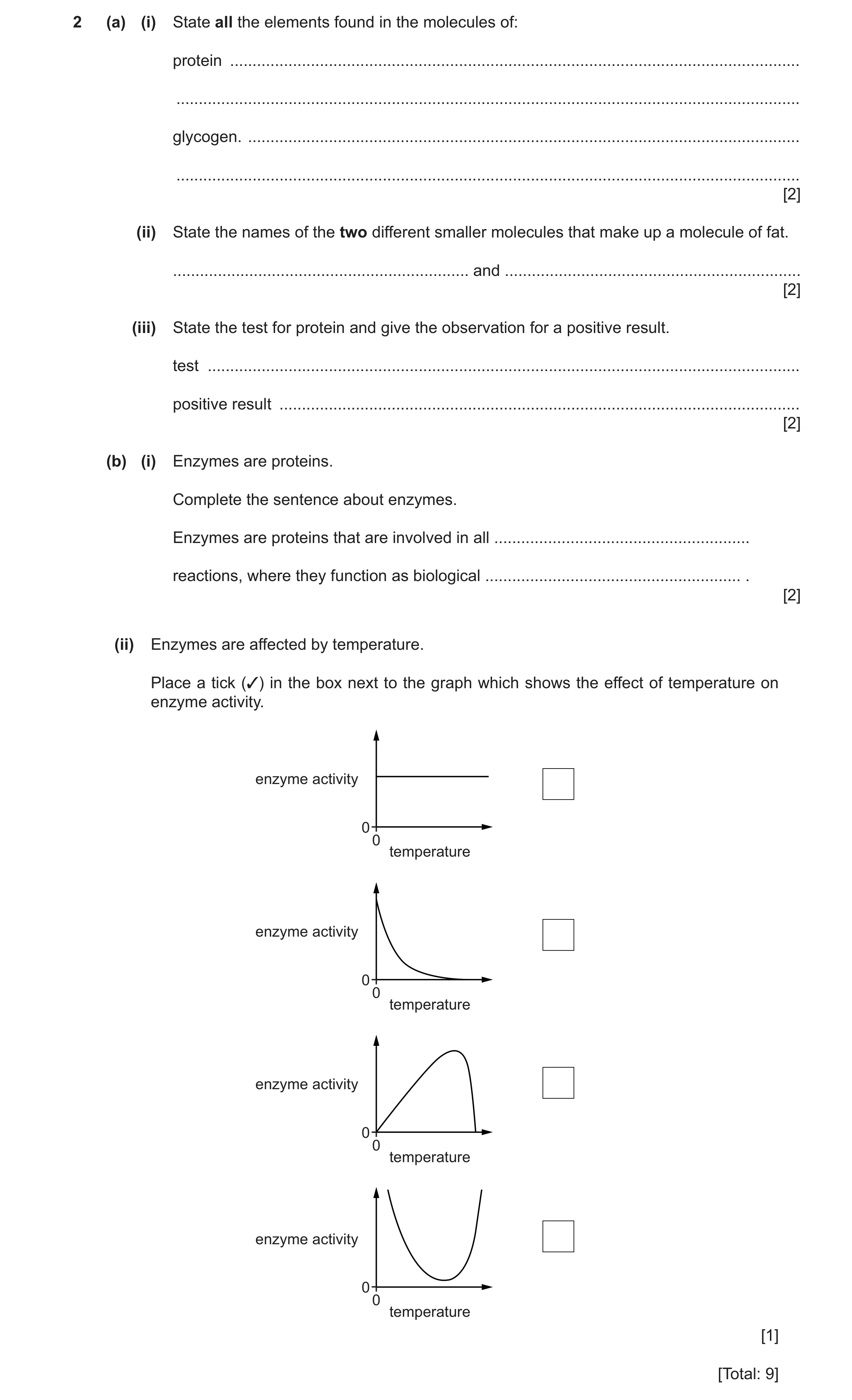
2 (a) (i) State all the elements found in the molecules of: protein … … glycogen. … … [2] (ii) State the names of the two different smaller molecules that make up a molecule of fat. … and … [2] (iii) State the test for protein and give the observation for a positive result. test … positive result … [2] (b) (i) Enzymes are proteins. Complete the sentence about enzymes. Enzymes are proteins that are involved in all … reactions, where they function as biological … . [2] (ii) Enzymes are affected by temperature. Place a tick (3) in the box next to the graph which shows the effect of temperature on enzyme activity. enzyme activity 0 0 temperature enzyme activity 0 0 temperature enzyme activity 0 0 temperature enzyme activity 0 0 temperature [1] [Total: 9]
9 marks
Mark scheme: 2(a)(i) (protein) = carbon, hydrogen, nitrogen, oxygen ; 2 (glycogen) = carbon, hydrogen, oxygen ; 2(a)(ii) glycerol ; 2 fatty acids ; 2(a)(iii) test – biuret ; 2 positive result – purple / violet ; 2(b)(i) metabolic ; 2 catalysts ; 2(b)(ii) 1
This question in 0654/31 Oct/Nov 2025
 3 / 19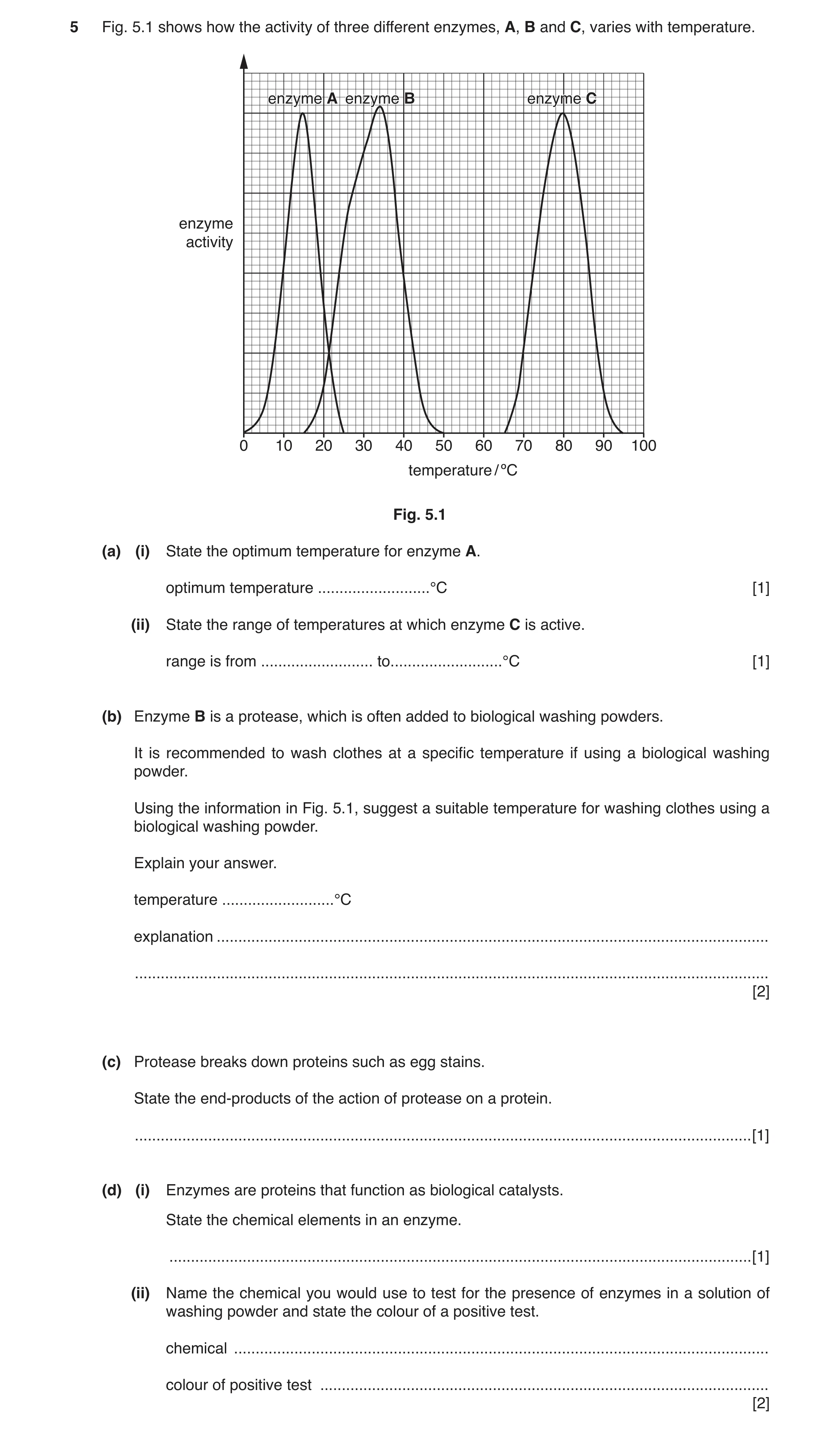
 9
9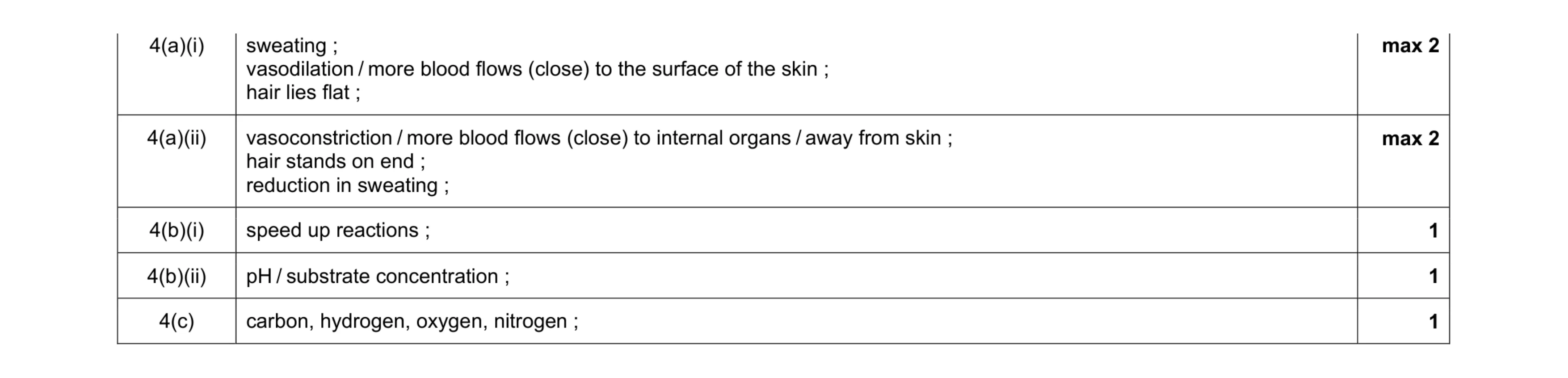 7
7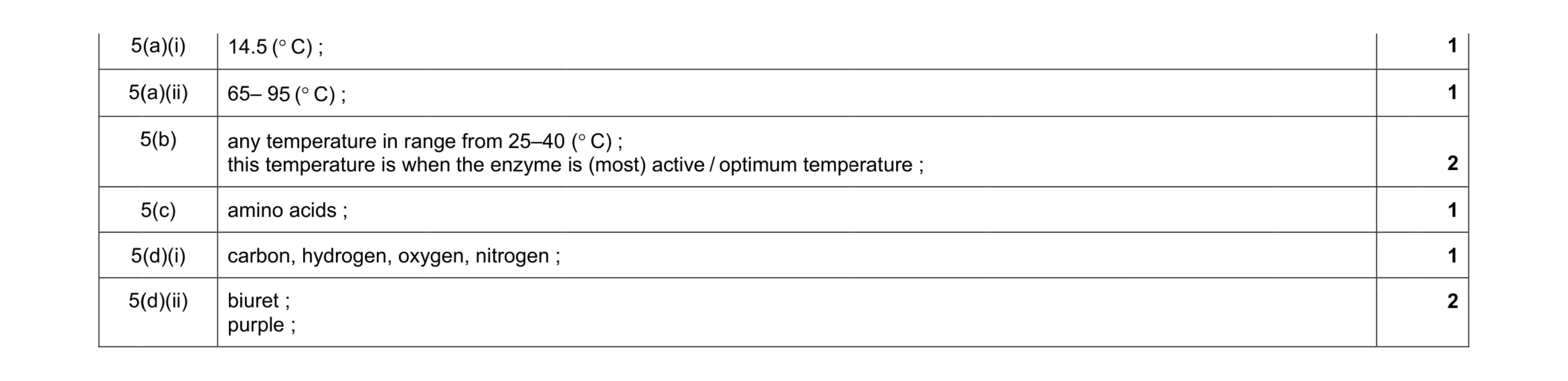 8
8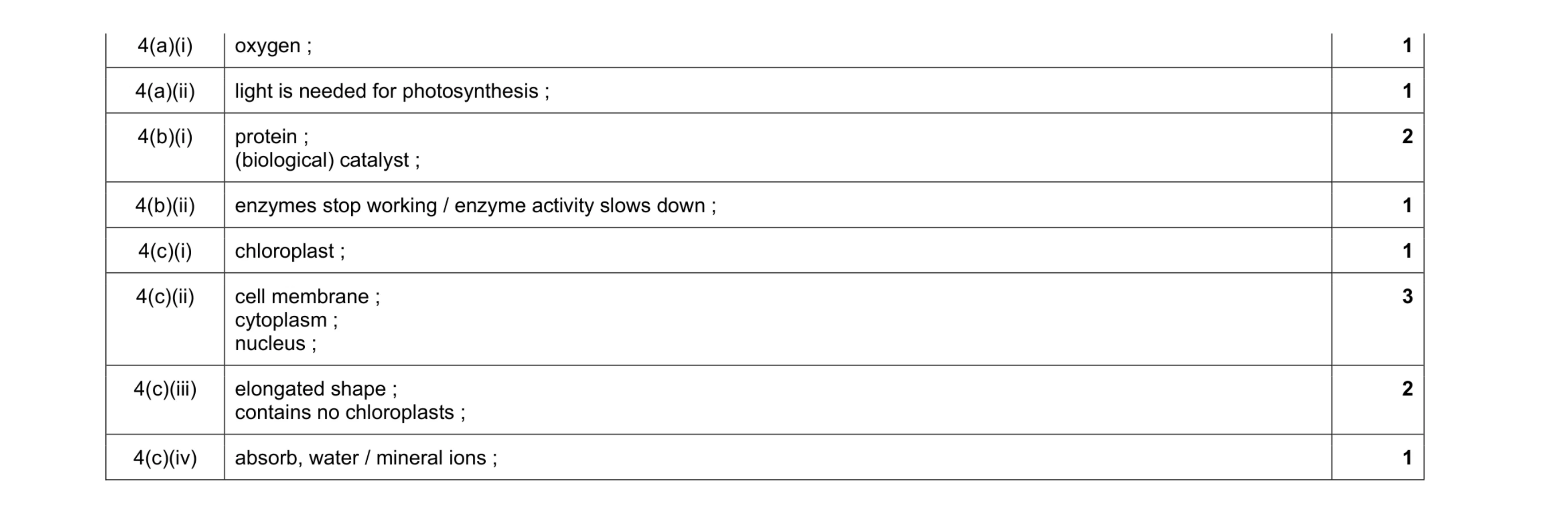 12
12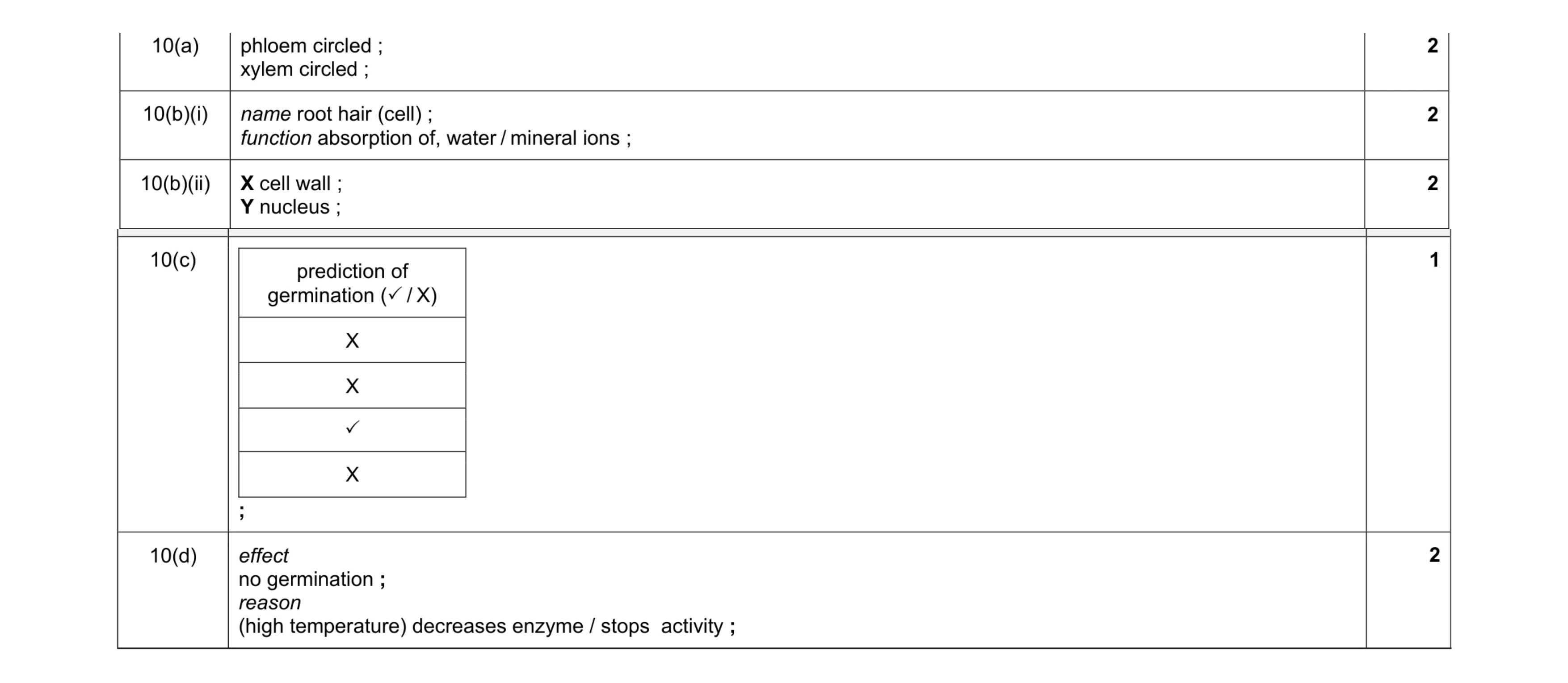 9
9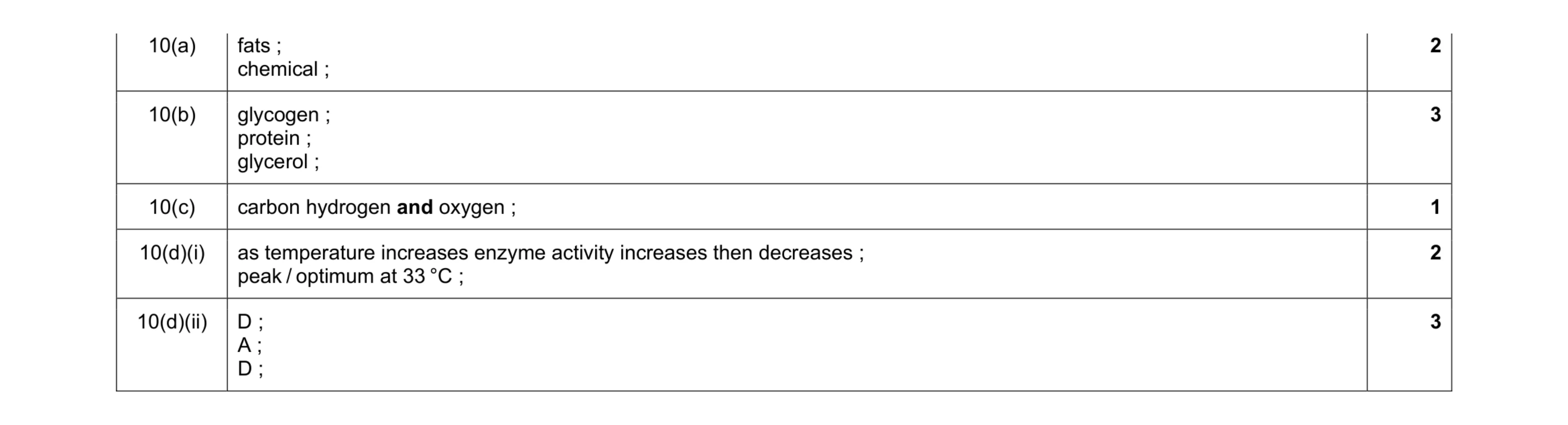 11
11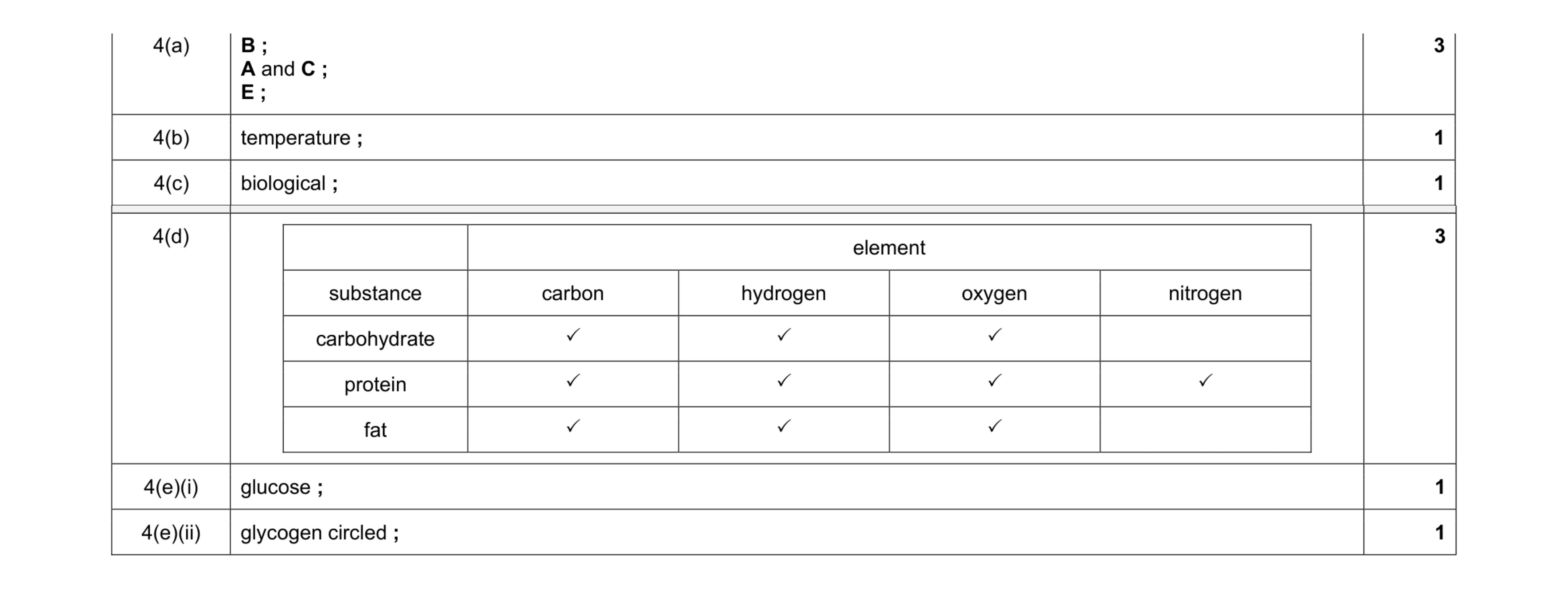 10
10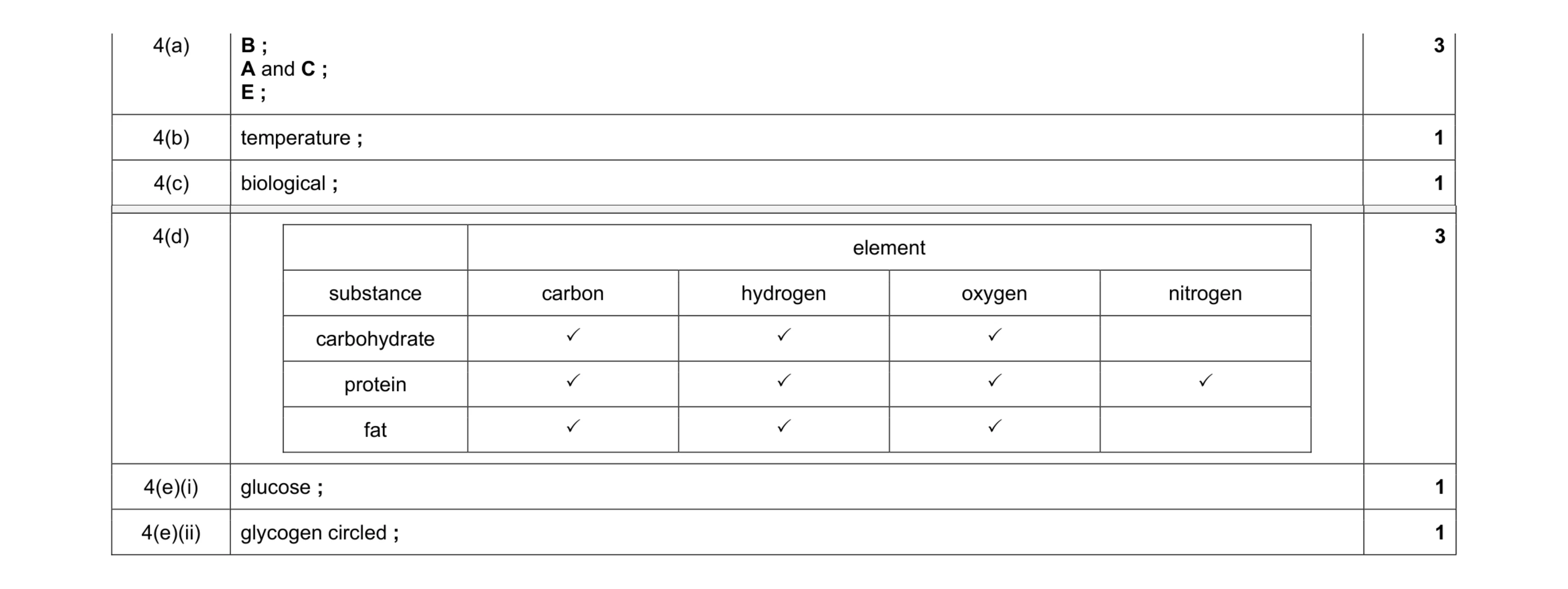 10
10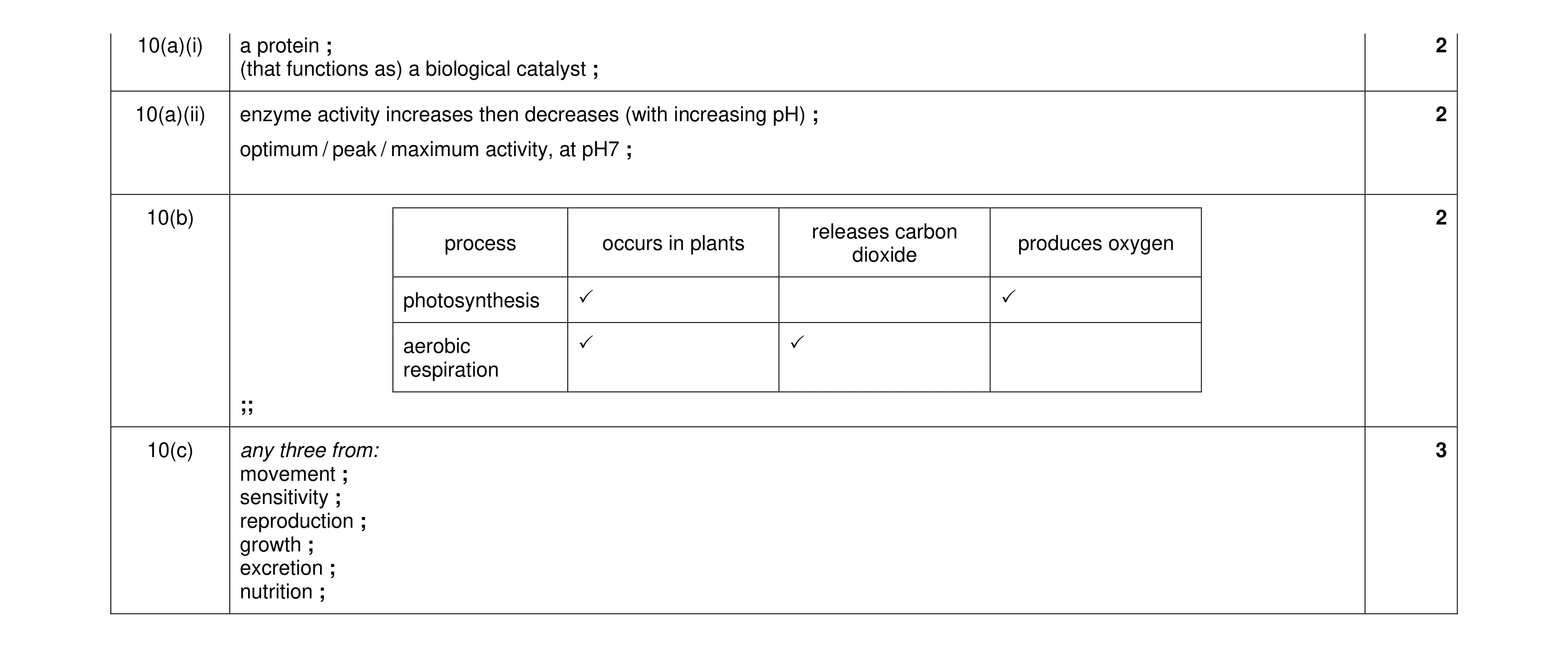 9
9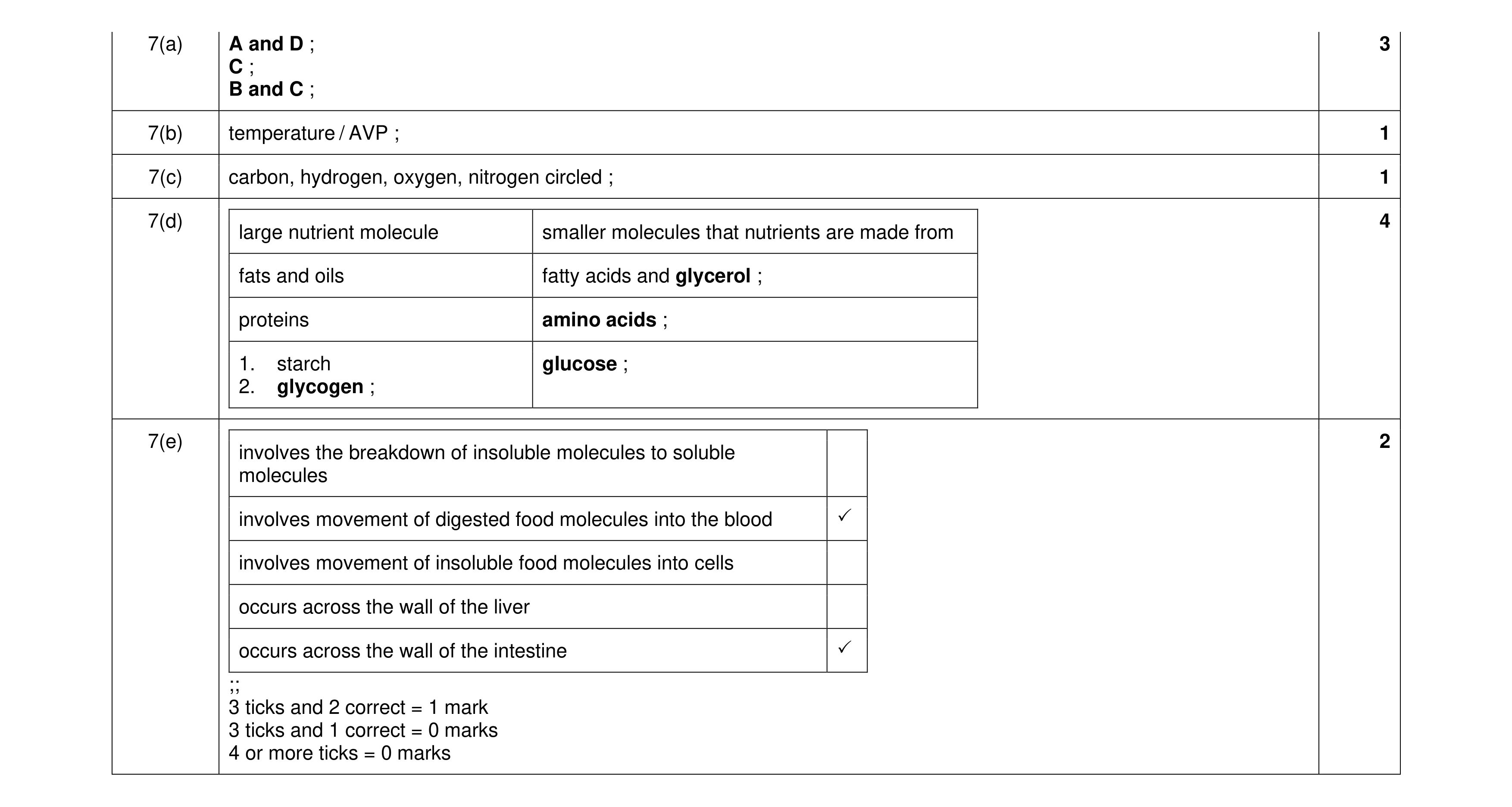 11
11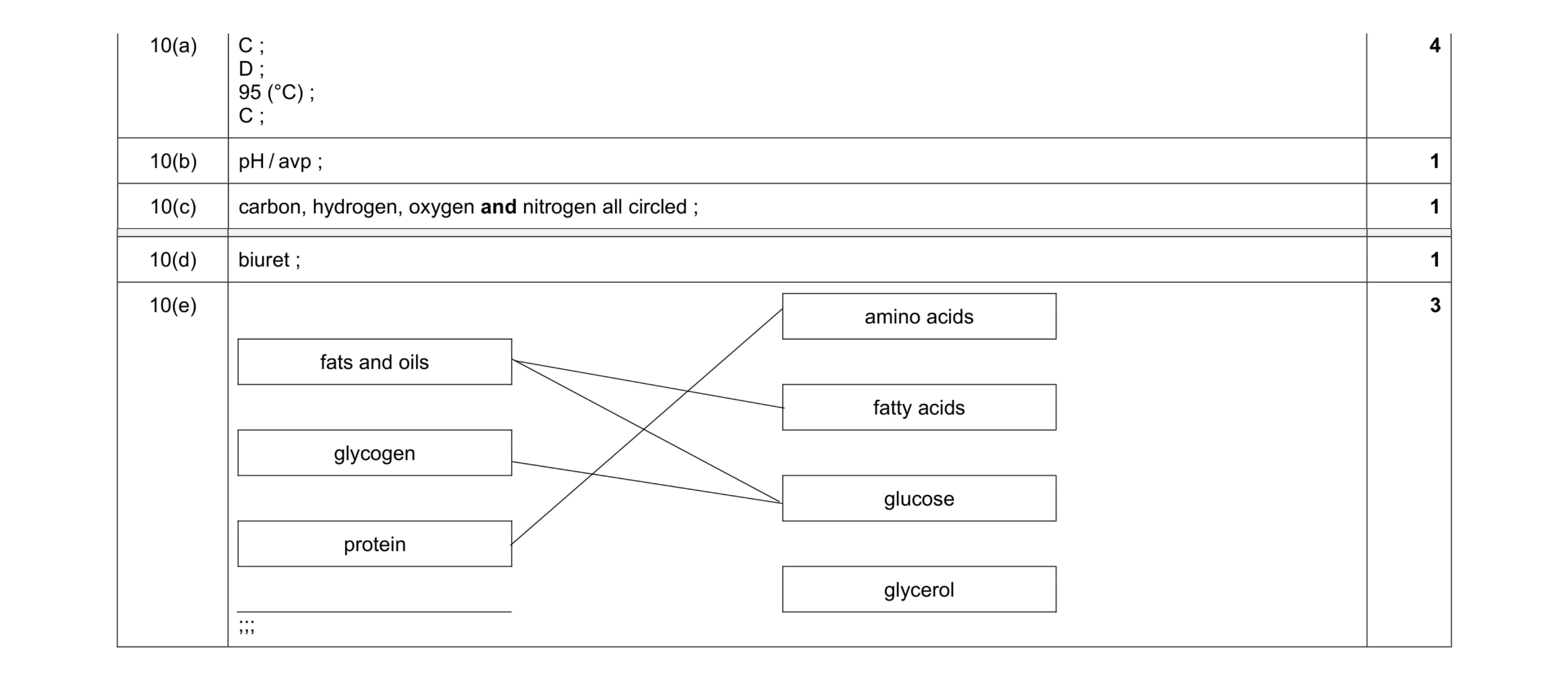 10
10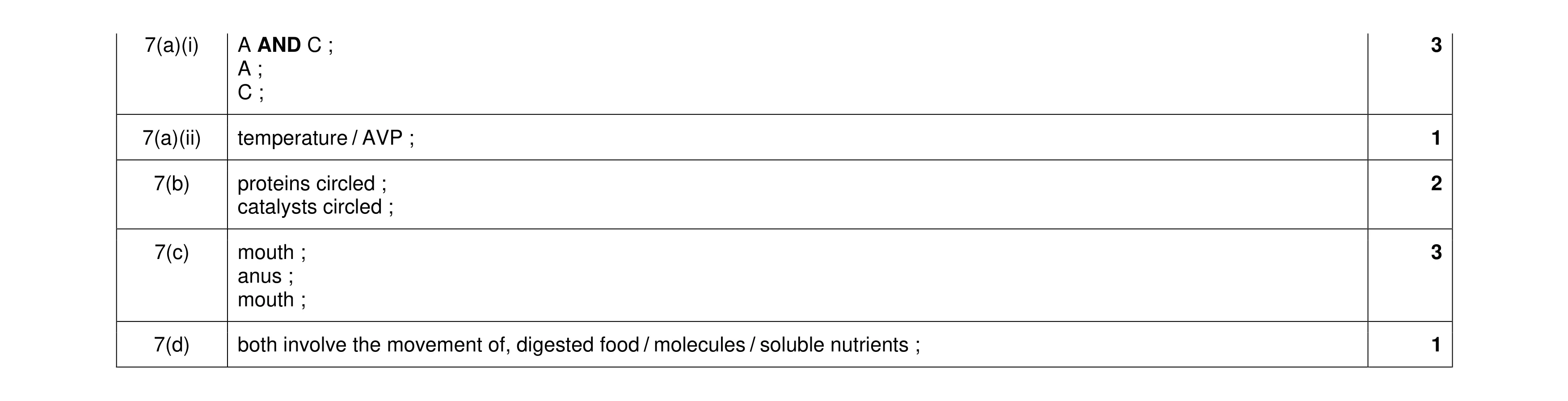 10
10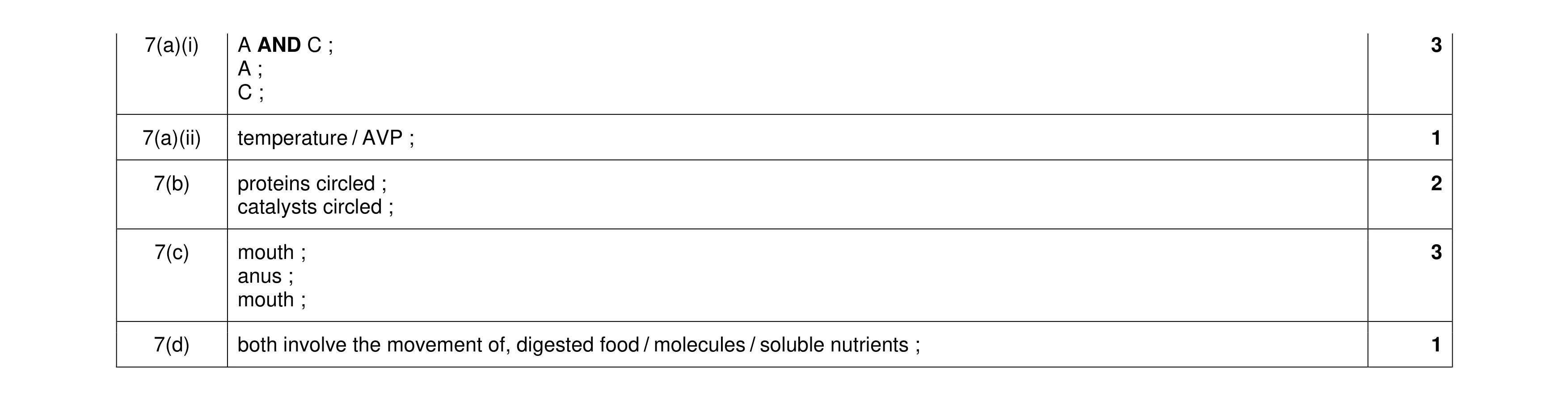 10
10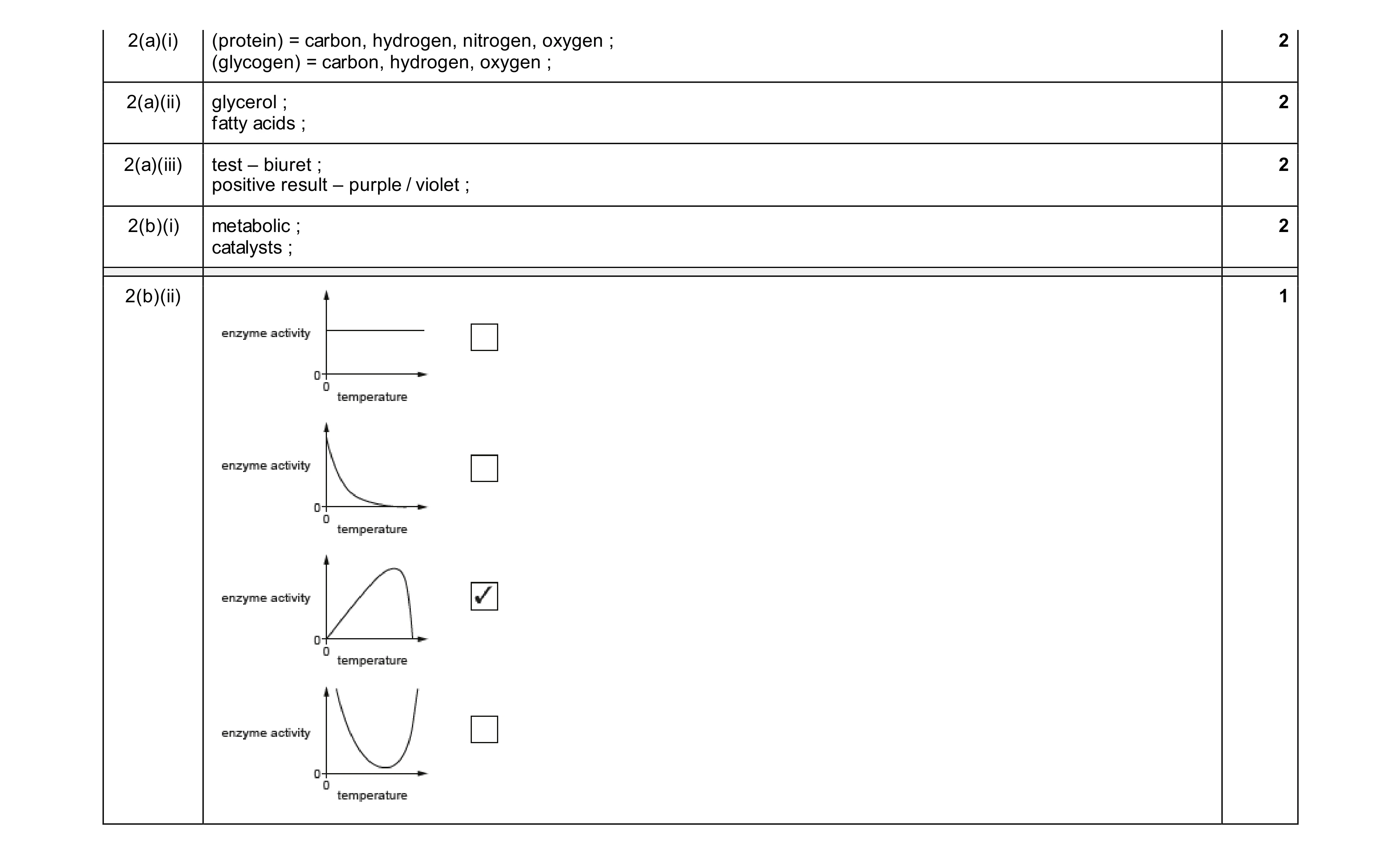 9
9