Questions as text
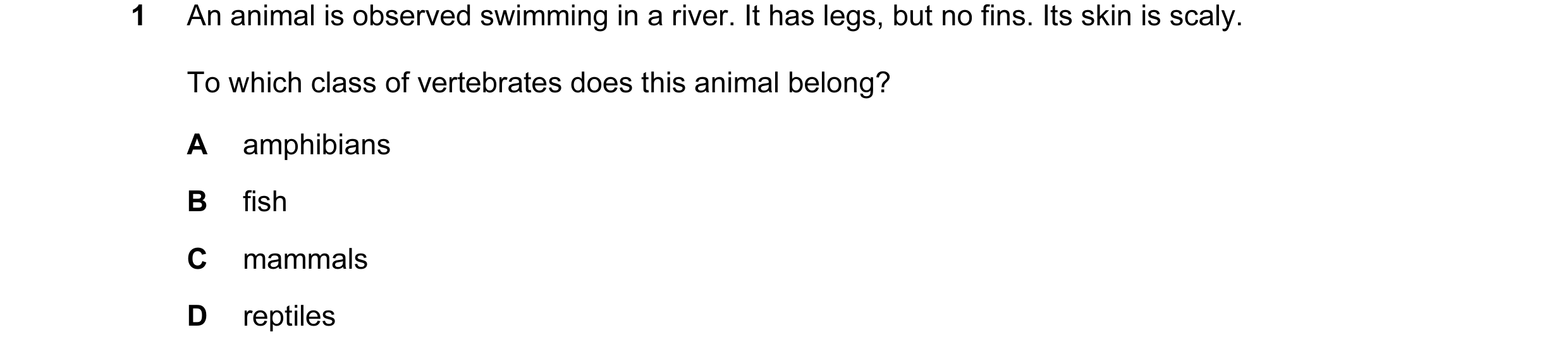
Q1 · An animal is observed swimming in a river 0654/11 May/June 2005
1 An animal is observed swimming in a river. It has legs, but no fins. Its skin is scaly. To which class of vertebrates does this animal belong? A amphibians B fish C mammals D reptiles
1 marks
Answer: D
This question in 0654/11 May/June 2005
Q2 · The diagram shows a bone from the human arm 0654/11 May/June 2006
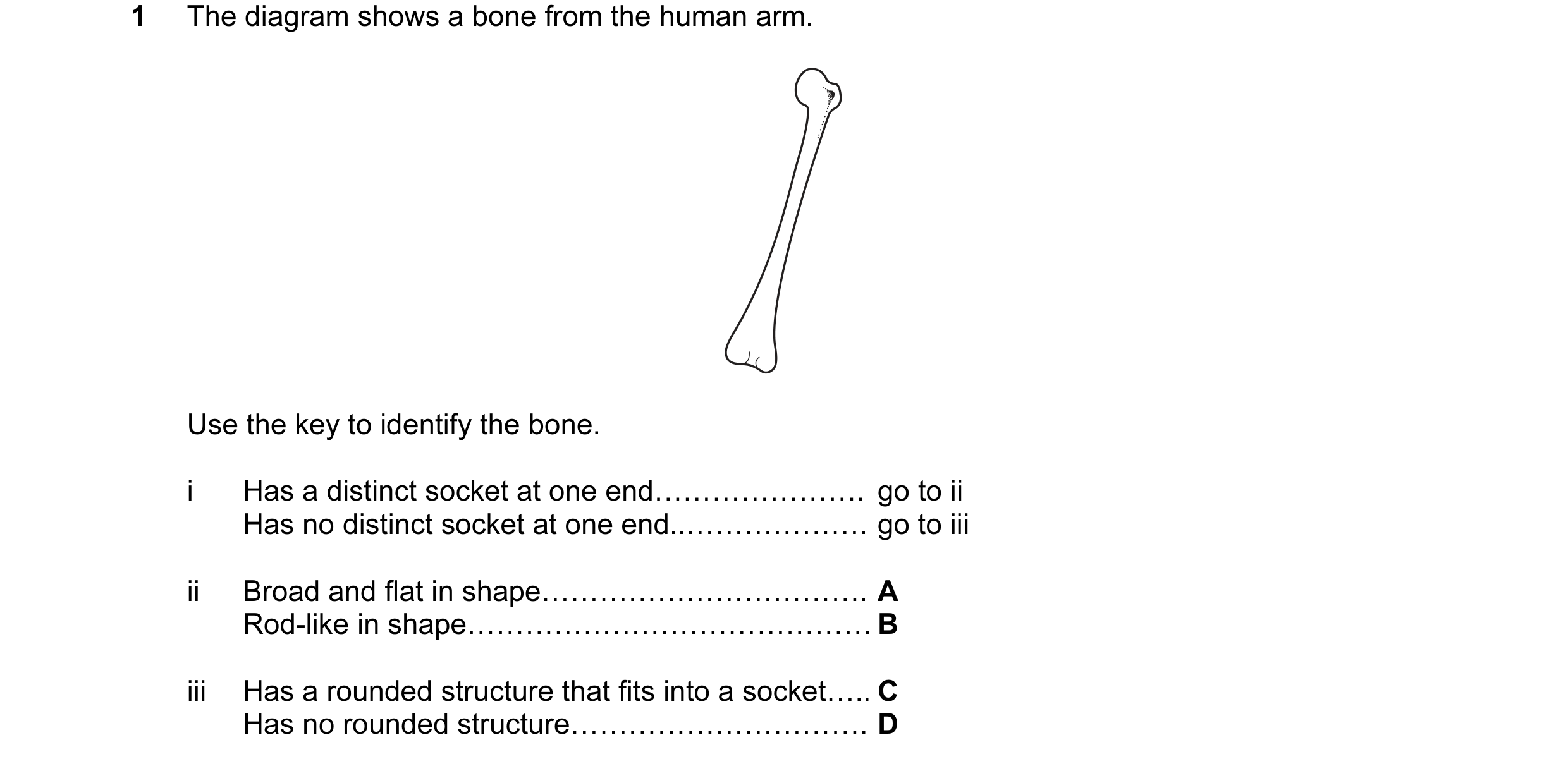
1 The diagram shows a bone from the human arm. Use the key to identify the bone. i Has a distinct socket at one end…………………. go to ii Has no distinct socket at one end..………………. go to iii ii Broad and flat in shape……………………………. A Rod-like in shape…………………………………… B iii Has a rounded structure that fits into a socket….. C Has no rounded structure…………………………. D
1 marks
Answer: C
This question in 0654/11 May/June 2006
Q3 · Which bones form a joint at the shoulder? 0654/11 May/June 2006
8 Which bones form a joint at the shoulder? A humerus and radius B humerus and scapula C ulna and radius D ulna and scapula
1 marks
Answer: B
This question in 0654/11 May/June 2006
Q4 · A fossil shows evidence of an organism with scaly skin, a tail and four legs 0654/11 Oct/Nov 2006
1 A fossil shows evidence of an organism with scaly skin, a tail and four legs. In which group would the organism be classified? A amphibians B fish C mammals D reptiles
1 marks
Answer: D
This question in 0654/11 Oct/Nov 2006
Q5 · Which system is used for naming and classifying living organisms? 0654/11 May/June 2007
1 Which system is used for naming and classifying living organisms? A binomial B biological C scientific D specific
1 marks
Answer: A
This question in 0654/11 May/June 2007
Q6 · Which feature is characteristic only of birds? 0654/11 Oct/Nov 2007
1 Which feature is characteristic only of birds? A feathers and scales B fins and hard-shelled eggs C hair and scales D skin and soft-shelled eggs
1 marks
Answer: A
This question in 0654/11 Oct/Nov 2007
Q7 · The diagram shows an animal whose scientific name is Falco tinniculus 0654/11 May/June 2008
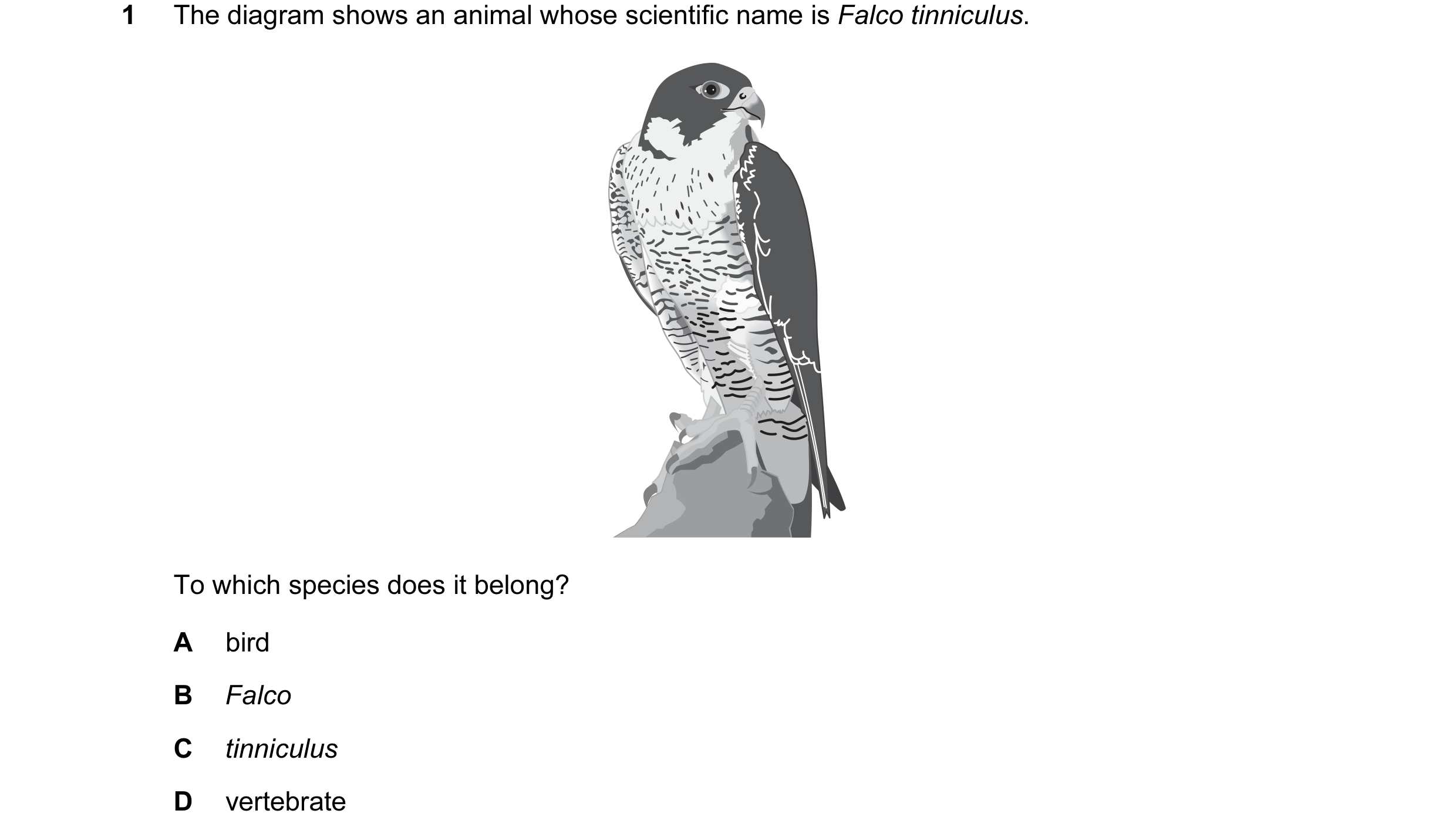
1 The diagram shows an animal whose scientific name is Falco tinniculus. To which species does it belong? A bird B Falco C tinniculus D vertebrate
1 marks
Answer: C
This question in 0654/11 May/June 2008
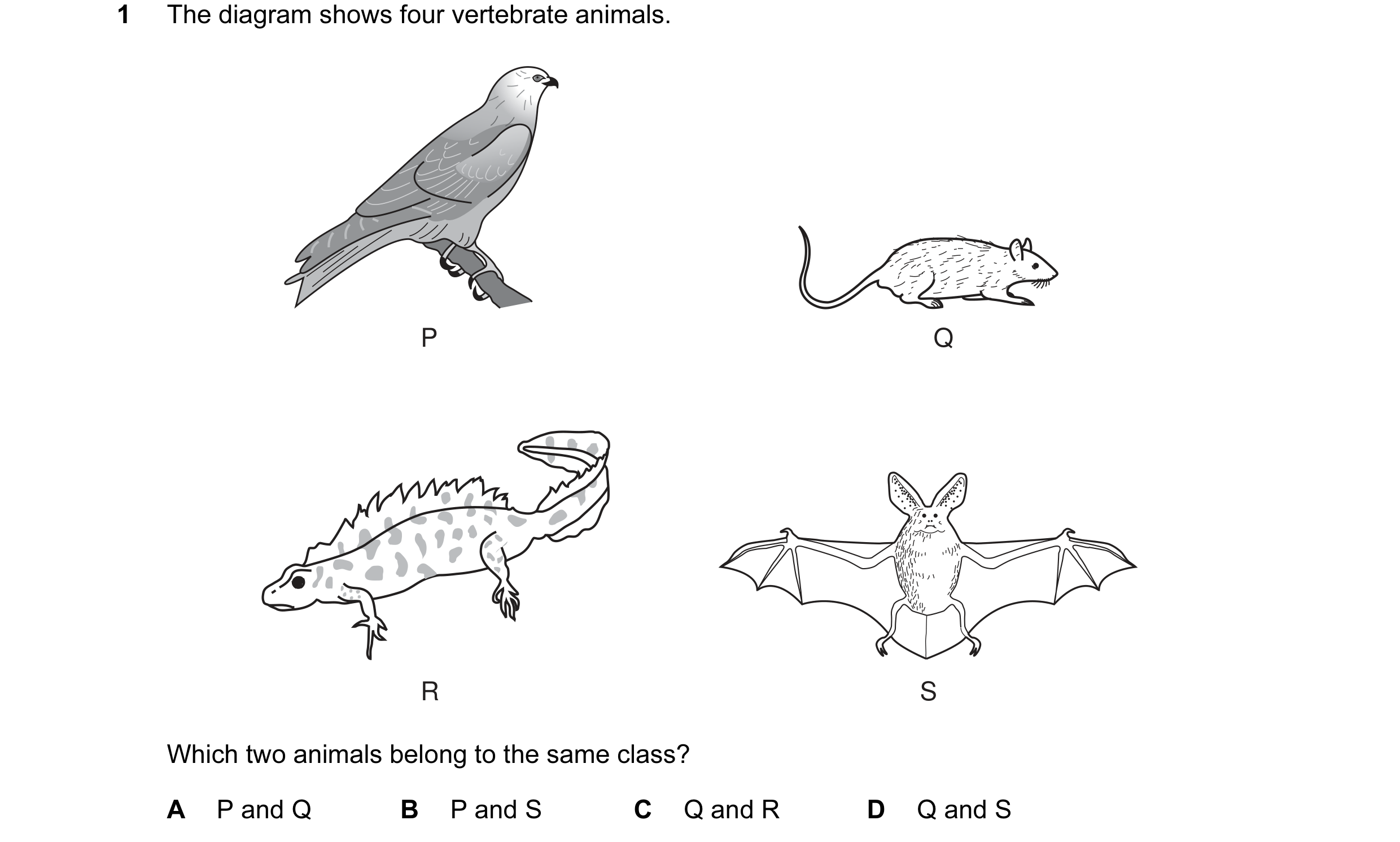
Q8 · The diagram shows four vertebrate animals 0654/11 Oct/Nov 2008
1 The diagram shows four vertebrate animals. P Q R S Which two animals belong to the same class? A P and Q B P and S C Q and R D Q and S
1 marks
Answer: D
This question in 0654/11 Oct/Nov 2008
Q9 · Which characteristic is shown by members of the same species? 0654/11 May/June 2009
1 Which characteristic is shown by members of the same species? A They all live in the same place. B They are all identical in appearance. C They breed with each other to produce fertile offspring. D They cannot form clones.
1 marks
Answer: C
This question in 0654/11 May/June 2009
Q10 · An animal is observed swimming in a river 0654/11 Oct/Nov 2009
1 An animal is observed swimming in a river. It has legs, but no fins. Its skin is scaly. To which class of vertebrates does this animal belong? A amphibians B fish C mammals D reptiles
1 marks
Answer: D
This question in 0654/11 Oct/Nov 2009
Q11 · Which features are found in mammals but not in other vertebrates? 0654/11 Oct/Nov 2010
1 Which features are found in mammals but not in other vertebrates? A claws and hair B claws and lungs C hair and milk D lungs and milk
1 marks
Answer: C
This question in 0654/11 Oct/Nov 2010
Q12 · Which features are found in mammals but not in other vertebrates? 0654/12 Oct/Nov 2010
6 Which features are found in mammals but not in other vertebrates? A claws and hair B claws and lungs C hair and milk D lungs and milk
1 marks
Answer: C
This question in 0654/12 Oct/Nov 2010
Q13 · Which features are found in mammals but not in other vertebrates? 0654/13 Oct/Nov 2010
6 Which features are found in mammals but not in other vertebrates? A claws and hair B claws and lungs C hair and milk D lungs and milk
1 marks
Answer: C
This question in 0654/13 Oct/Nov 2010
Q14 · The diagram shows four vertebrate animals 0654/11 May/June 2011
1 The diagram shows four vertebrate animals. P Q R S Which animals have lungs? A P, Q and R B Q, R and S C R, S and P D S, P and Q
1 marks
Answer: D
This question in 0654/11 May/June 2011
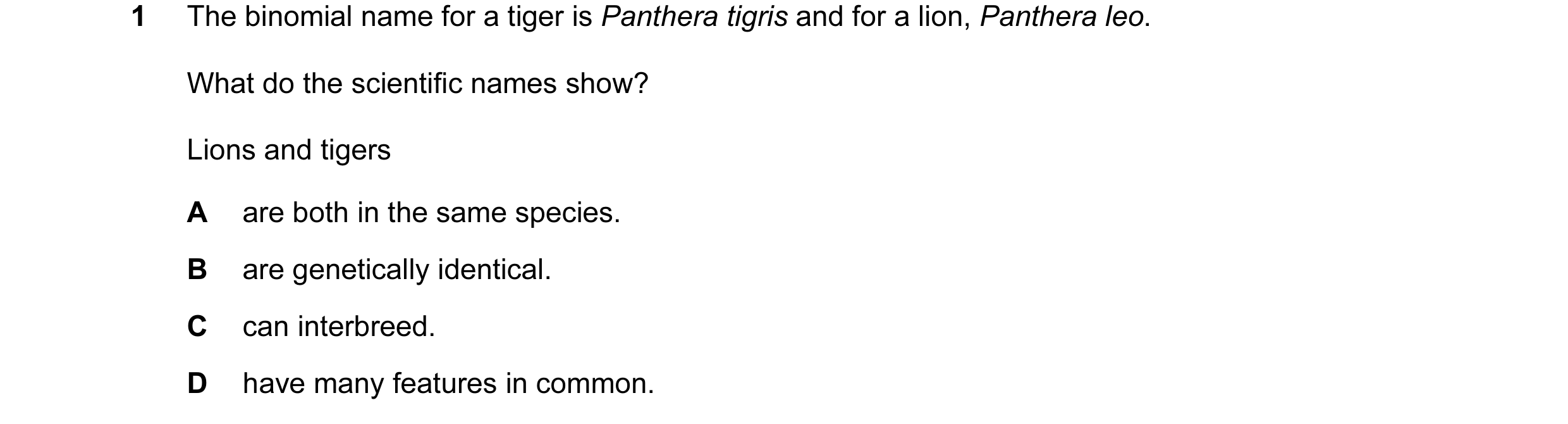
Q15 · The binomial name for a tiger is Panthera tigris and for a lion, Panthera leo 0654/11 Oct/Nov 2011
1 The binomial name for a tiger is Panthera tigris and for a lion, Panthera leo. What do the scientific names show? Lions and tigers A are both in the same species. B are genetically identical. C can interbreed. D have many features in common.
1 marks
Answer: D
This question in 0654/11 Oct/Nov 2011
Q16 · The binomial name for a tiger is Panthera tigris and for a lion, Panthera leo 0654/12 Oct/Nov 2011
2 The binomial name for a tiger is Panthera tigris and for a lion, Panthera leo. What do the scientific names show? Lions and tigers A are both in the same species. B are genetically identical. C can interbreed. D have many features in common.
1 marks
Answer: D
This question in 0654/12 Oct/Nov 2011
Q17 · The binomial name for a tiger is Panthera tigris and for a lion, Panthera leo 0654/13 Oct/Nov 2011
3 The binomial name for a tiger is Panthera tigris and for a lion, Panthera leo. What do the scientific names show? Lions and tigers A are both in the same species. B are genetically identical. C can interbreed. D have many features in common.
1 marks
Answer: D
This question in 0654/13 Oct/Nov 2011
Q18 · Which characteristic of living organisms is represented in plants by photosynthesis? 0654/12 May/June 2013
1 Which characteristic of living organisms is represented in plants by photosynthesis? A excretion B nutrition C respiration D sensitivity
1 marks
Answer: B
This question in 0654/12 May/June 2013
Q19 · A student was walking through some grass when he saw an object with a hole in its outer… 0654/13 Oct/Nov 2013
1 A student was walking through some grass when he saw an object with a hole in its outer covering. When touched, a jet of fluid came out of the hole and the object moved away. Which characteristics of living organisms has the object shown? A excretion, nutrition B movement, respiration C movement, sensitivity D nutrition, sensitivity
1 marks
Answer: C
This question in 0654/13 Oct/Nov 2013
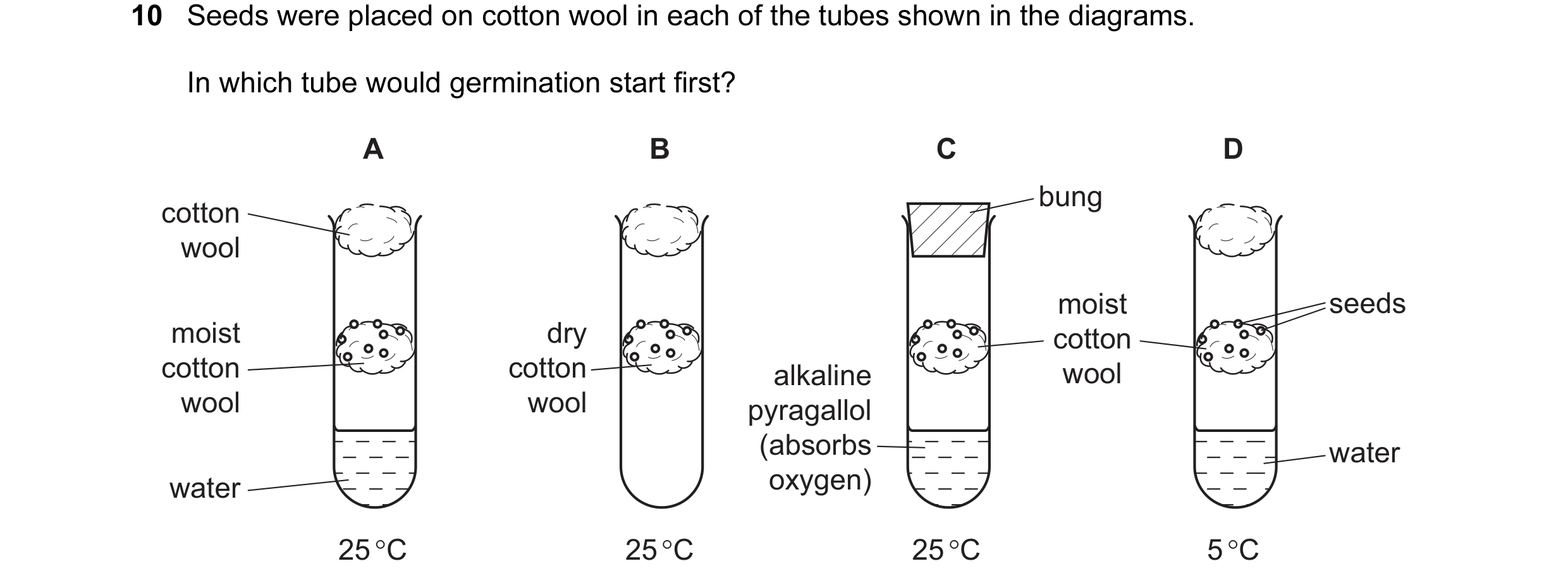
Q20 · Seeds were placed on cotton wool in each of the tubes shown in the diagrams 0654/13 Oct/Nov 2013
10 Seeds were placed on cotton wool in each of the tubes shown in the diagrams. In which tube would germination start first? A B C D bung cotton wool moist seeds moist dry cotton cotton cotton alkaline wool wool wool pyragallol (absorbs water water oxygen) 25 °C 25 °C 25 °C 5 °C
1 marks
Answer: A
This question in 0654/13 Oct/Nov 2013
Q21 · Which rows correctly match characteristics of living things with their descriptions? 0654/11 May/June 2014
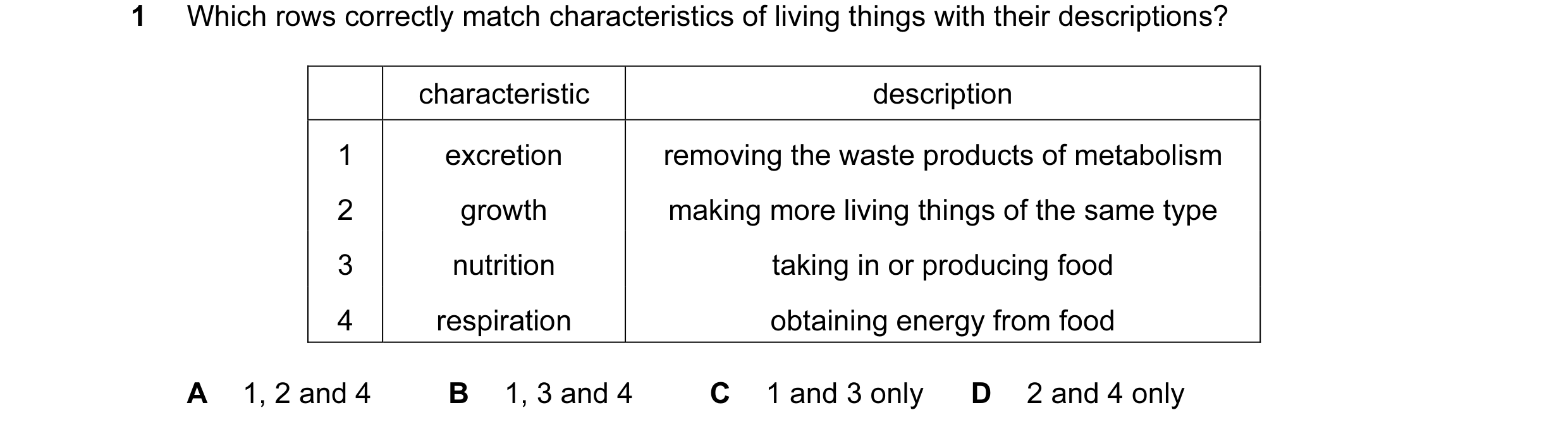
1 Which rows correctly match characteristics of living things with their descriptions? characteristic description 1 excretion removing the waste products of metabolism 2 growth making more living things of the same type 3 nutrition taking in or producing food 4 respiration obtaining energy from food A 1, 2 and 4 B 1, 3 and 4 C 1 and 3 only D 2 and 4 only
1 marks
Answer: B
This question in 0654/11 May/June 2014
Q22 · The Venus fly trap is a plant that catches insects 0654/12 May/June 2014
1 The Venus fly trap is a plant that catches insects. Which characteristic is shown in the diagram? A excretion B growth C reproduction D sensitivity
1 marks
Answer: D
This question in 0654/12 May/June 2014
Q23 · Which rows correctly match characteristics of living things with their descriptions? 0654/13 May/June 2014
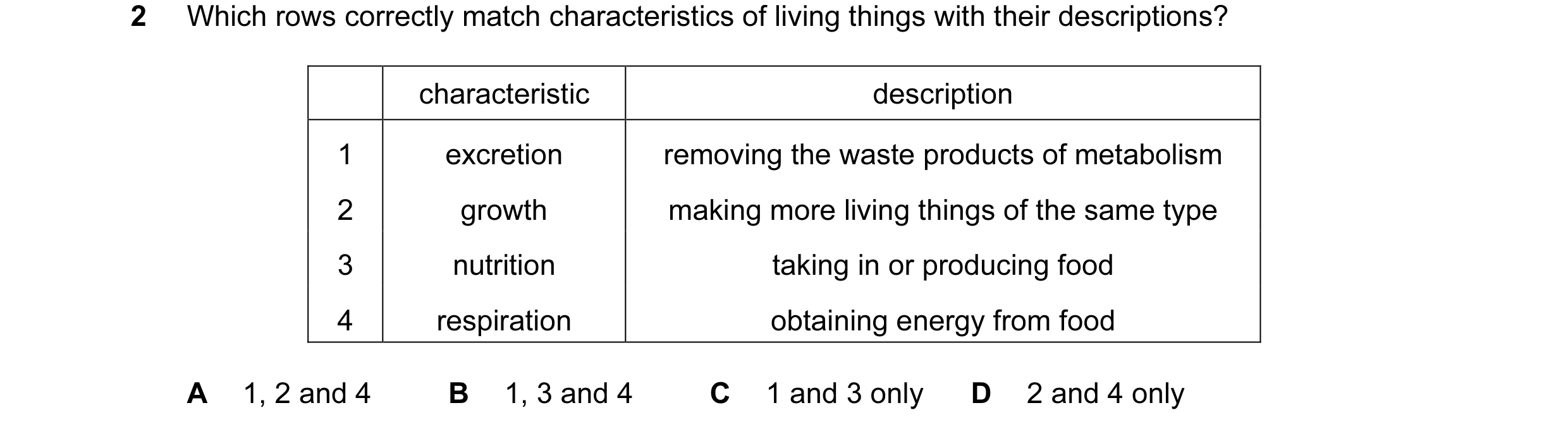
2 Which rows correctly match characteristics of living things with their descriptions? characteristic description 1 excretion removing the waste products of metabolism 2 growth making more living things of the same type 3 nutrition taking in or producing food 4 respiration obtaining energy from food A 1, 2 and 4 B 1, 3 and 4 C 1 and 3 only D 2 and 4 only
1 marks
Answer: B
This question in 0654/13 May/June 2014
Q24 · Which is a characteristic of all living things? 0654/11 May/June 2015
1 Which is a characteristic of all living things? A a heart B breathing C excretion D sexual reproduction
1 marks
Answer: C
This question in 0654/11 May/June 2015
Q25 · What are all living things capable of? 0654/13 May/June 2015
1 What are all living things capable of? A excretion B digestion C photosynthesis D sexual reproduction
1 marks
Answer: A
This question in 0654/13 May/June 2015
Q26 · What is correct for all living organisms? 0654/11 Oct/Nov 2015
2 What is correct for all living organisms? A They are sensitive to changes in their environment. B They excrete solid waste from their bodies. C They feed on other living organisms. D They grow larger by increasing their cell number.
1 marks
Answer: A
This question in 0654/11 Oct/Nov 2015
Q27 · Which statement about the characteristics of living organisms is correct? 0654/12 Oct/Nov 2015
1 Which statement about the characteristics of living organisms is correct? A Excretion is the breakdown of molecules to release energy. B Nutrition is the removal of excess substances, toxic materials and waste products. C Respiration is the taking in of organic substances and mineral ions. D Sensitivity is the ability to detect and respond to changes in the environment.
1 marks
Answer: D
This question in 0654/12 Oct/Nov 2015
Q28 · An organism has the ability to break down nutrient molecules to release energy 0654/11 May/June 2016
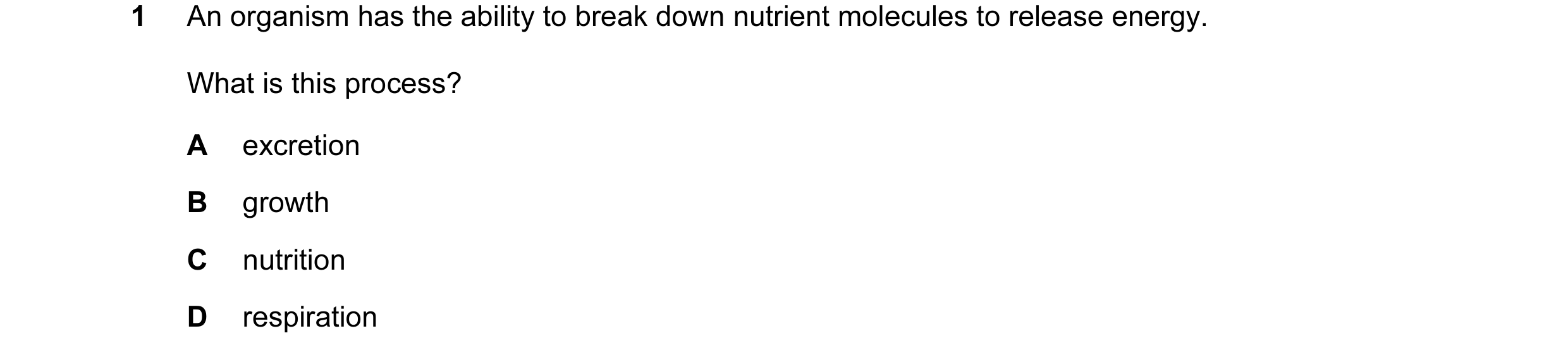
1 An organism has the ability to break down nutrient molecules to release energy. What is this process? A excretion B growth C nutrition D respiration
1 marks
Answer: D
This question in 0654/11 May/June 2016
Q29 · All living organisms are capable of A asexual reproduction 0654/12 May/June 2016
1 All living organisms are capable of A asexual reproduction. B excretion. C photosynthesis. D phototropism.
1 marks
Answer: B
This question in 0654/12 May/June 2016
Q30 · What is not a characteristic of all living organisms? 0654/13 May/June 2016
1 What is not a characteristic of all living organisms? A breathing B excretion C movement D reproduction
1 marks
Answer: A
This question in 0654/13 May/June 2016
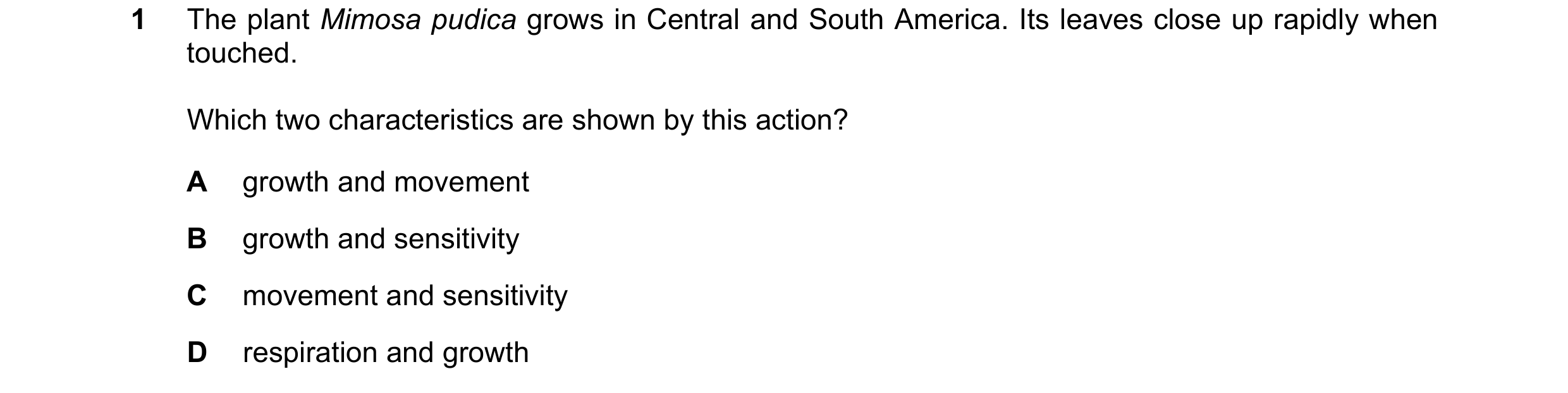
Q31 · The plant Mimosa pudica grows in Central and South America 0654/11 Oct/Nov 2016
1 The plant Mimosa pudica grows in Central and South America. Its leaves close up rapidly when touched. Which two characteristics are shown by this action? A growth and movement B growth and sensitivity C movement and sensitivity D respiration and growth
1 marks
Answer: C
This question in 0654/11 Oct/Nov 2016
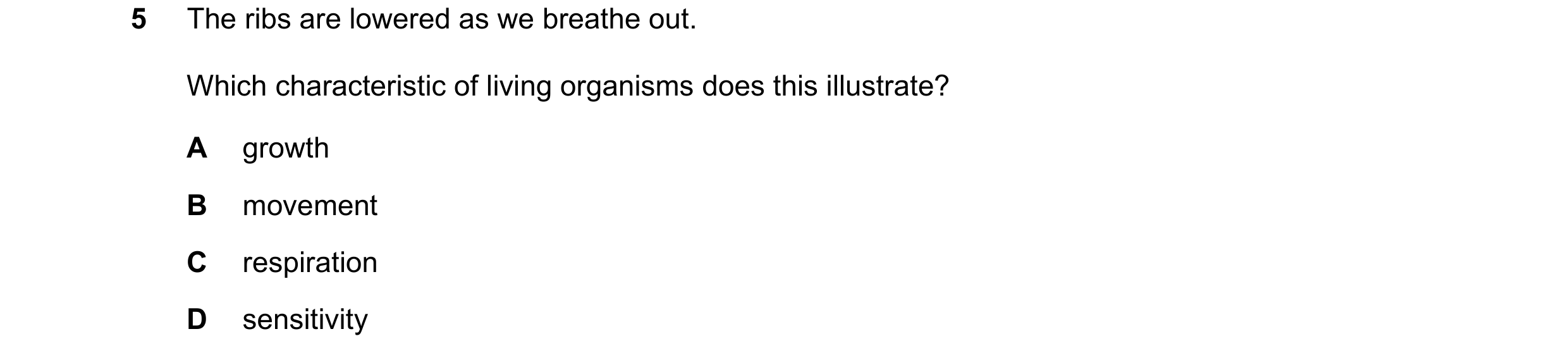
Q32 · The ribs are lowered as we breathe out 0654/11 May/June 2017
5 The ribs are lowered as we breathe out. Which characteristic of living organisms does this illustrate? A growth B movement C respiration D sensitivity
1 marks
Answer: B
This question in 0654/11 May/June 2017
Q33 · Which characteristic of living organisms involves chemical reactions that break down… 0654/12 May/June 2017
2 Which characteristic of living organisms involves chemical reactions that break down nutrient molecules to release energy? A excretion B nutrition C reproduction D respiration
1 marks
Answer: D
This question in 0654/12 May/June 2017
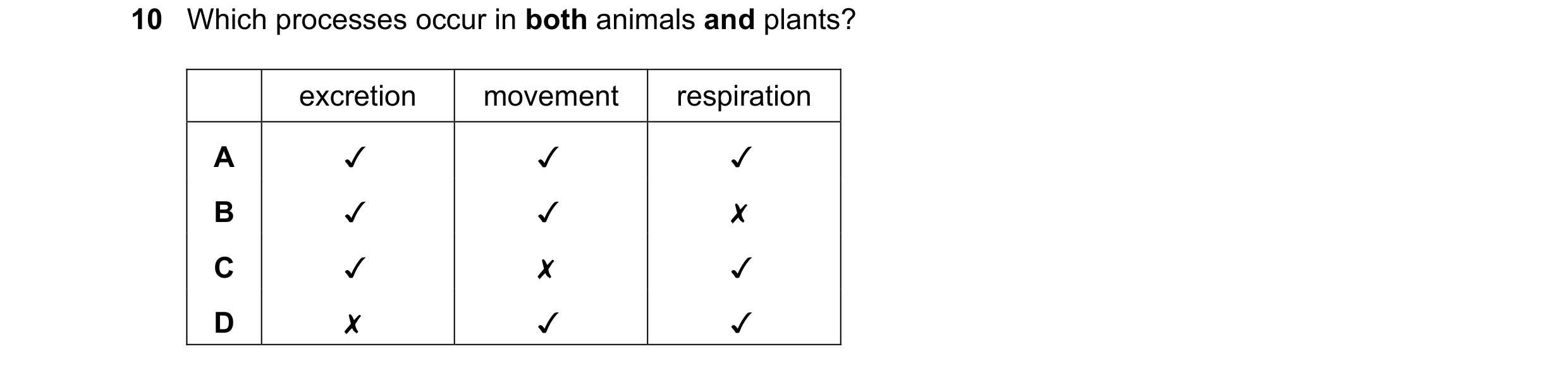
Q34 · Which processes occur in both animals and plants? 0654/13 May/June 2017
10 Which processes occur in both animals and plants?
excretion movement respiration
0 0O WwW >
~ KS
KK
\ << x
1 marks
Answer: A
This question in 0654/13 May/June 2017
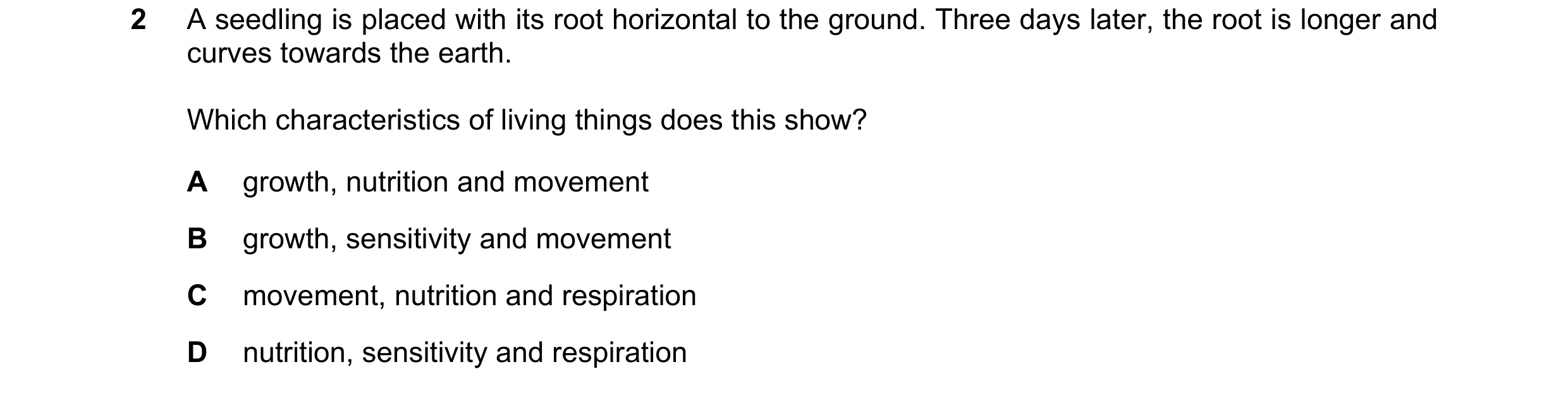
Q35 · A seedling is placed with its root horizontal to the ground 0654/11 Oct/Nov 2017
2 A seedling is placed with its root horizontal to the ground. Three days later, the root is longer and curves towards the earth. Which characteristics of living things does this show? A growth, nutrition and movement B growth, sensitivity and movement C movement, nutrition and respiration D nutrition, sensitivity and respiration
1 marks
Answer: B
This question in 0654/11 Oct/Nov 2017
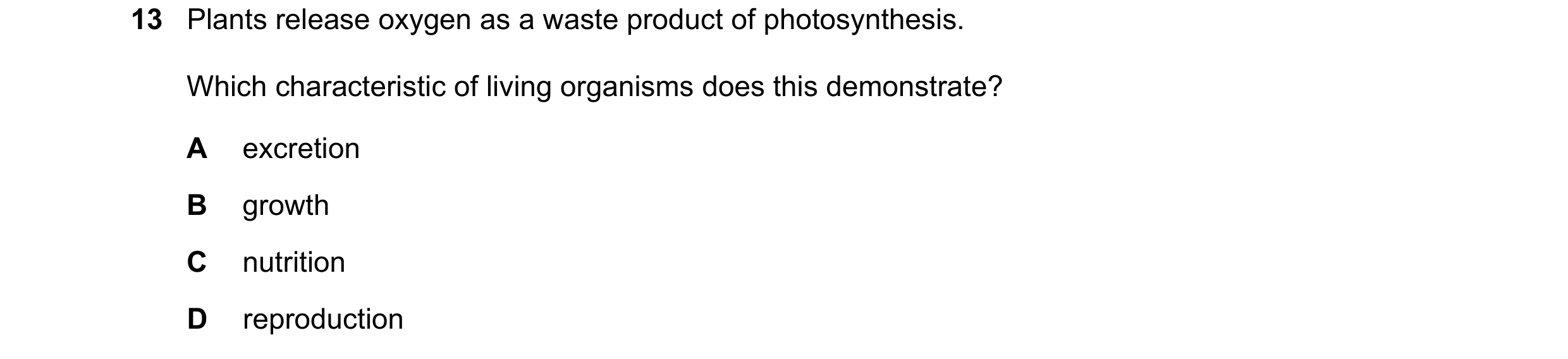
Q36 · Plants release oxygen as a waste product of photosynthesis 0654/12 Oct/Nov 2017
13 Plants release oxygen as a waste product of photosynthesis. Which characteristic of living organisms does this demonstrate? A excretion B growth C nutrition D reproduction
1 marks
Answer: A
This question in 0654/12 Oct/Nov 2017
Q37 · Which is a characteristic of all living things? 0654/11 Oct/Nov 2018
1 Which is a characteristic of all living things? A a heart B breathing C excretion D sexual reproduction
1 marks
Answer: C
This question in 0654/11 Oct/Nov 2018
Q38 · One way to test for microscopic life in soil is to see if carbon dioxide is released 0654/13 Oct/Nov 2018
1 One way to test for microscopic life in soil is to see if carbon dioxide is released. Which characteristic of living things is being tested? A growth B nutrition C reproduction D respiration
1 marks
Answer: D
This question in 0654/13 Oct/Nov 2018
Q39 · What is correct for all living organisms? 0654/11 May/June 2019
1 What is correct for all living organisms? A They are sensitive to changes in their environment. B They excrete solid waste from their bodies. C They feed on other living organisms. D They grow larger by increasing their cell number.
1 marks
Answer: A
This question in 0654/11 May/June 2019
Q40 · What is correct for all living organisms? 0654/12 May/June 2019
1 What is correct for all living organisms? A They are sensitive to changes in their environment. B They excrete solid waste from their bodies. C They feed on other living organisms. D They grow larger by increasing their cell number.
1 marks
Answer: A
This question in 0654/12 May/June 2019
Q41 · What is correct for all living organisms? 0654/13 May/June 2019
1 What is correct for all living organisms? A They are sensitive to changes in their environment. B They excrete solid waste from their bodies. C They feed on other living organisms. D They grow larger by increasing their cell number.
1 marks
Answer: A
This question in 0654/13 May/June 2019
Q42 · Which process do all living organisms carry out? 0654/11 Oct/Nov 2019
1 Which process do all living organisms carry out? A asexual reproduction B excretion C ingestion D photosynthesis
1 marks
Answer: B
This question in 0654/11 Oct/Nov 2019
Q43 · Which term is used to describe the removal of toxic materials from living organisms? 0654/12 Oct/Nov 2019
1 Which term is used to describe the removal of toxic materials from living organisms? A excretion B nutrition C respiration D secretion
1 marks
Answer: A
This question in 0654/12 Oct/Nov 2019
Q44 · The diagram shows a germinating seed in the soil 0654/13 Oct/Nov 2019
1 The diagram shows a germinating seed in the soil.
a
Which characteristics of living organisms is the seed demonstrating?
characteristic
growth sensitivity
v v
0 0O WwW >
v x
x v
x x
1 marks
Answer: A
This question in 0654/13 Oct/Nov 2019
Q45 · Which characteristic of living organisms is described as the chemical reactions in cells… 0654/11 May/June 2020
1 Which characteristic of living organisms is described as the chemical reactions in cells that break down nutrient molecules and release energy? A excretion B nutrition C photosynthesis D respiration
1 marks
Answer: D
This question in 0654/11 May/June 2020
Q46 · Which characteristic of living things is described as the removal of toxic materials and… 0654/12 May/June 2020
1 Which characteristic of living things is described as the removal of toxic materials and substances in excess of requirements? A excretion B homeostasis C nutrition D respiration
1 marks
Answer: A
This question in 0654/12 May/June 2020
Q47 · The diagram shows some apparatus that can be used to test for one of the characteristics… 0654/13 May/June 2020
1 The diagram shows some apparatus that can be used to test for one of the characteristics of life. limewater woodlice Which characteristic is being tested? A excretion B nutrition C reproduction D sensitivity
1 marks
Answer: A
This question in 0654/13 May/June 2020
Q48 · Lions are carnivores that chase, catch and eat zebra 0654/11 Oct/Nov 2020
1 Lions are carnivores that chase, catch and eat zebra. While still chasing zebra, which characteristic of living organisms is not exhibited by the lion? A movement B nutrition C respiration D sensitivity
1 marks
Answer: B
This question in 0654/11 Oct/Nov 2020
Q49 · Which would be considered movement by an organism? 0654/12 Oct/Nov 2020
1 Which would be considered movement by an organism? 1 a tree’s leaves being blown by the wind 2 migration of zebra in Africa 3 a student changing their seating position in a classroom A 1 and 2 only B 1 and 3 only C 2 and 3 only D 1, 2 and 3
1 marks
Answer: C
This question in 0654/12 Oct/Nov 2020
Q50 · What is not a characteristic of all living organisms? 0654/13 Oct/Nov 2020
1 What is not a characteristic of all living organisms? A excretion B growth C photosynthesis D sensitivity
1 marks
Answer: C
This question in 0654/13 Oct/Nov 2020
Q51 · Which row about characteristics of living things is correct? 0654/12 Feb/March 2021
1 Which row about characteristics of living things is correct? name of process definition of process A excretion the ability to detect and respond to changes in the environment B nutrition the removal of excess substances and toxic materials C respiration the breaking down of substances to release energy D reproduction the taking in of materials for energy, growth and development
1 marks
Answer: C
This question in 0654/12 Feb/March 2021
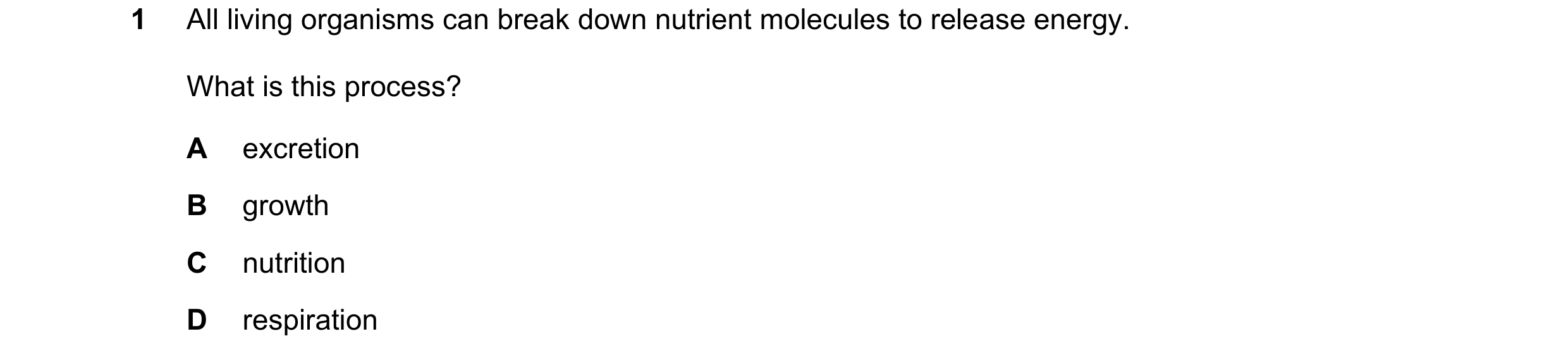
Q52 · All living organisms can break down nutrient molecules to release energy 0654/13 Oct/Nov 2021
1 All living organisms can break down nutrient molecules to release energy. What is this process? A excretion B growth C nutrition D respiration
1 marks
Answer: D
This question in 0654/13 Oct/Nov 2021
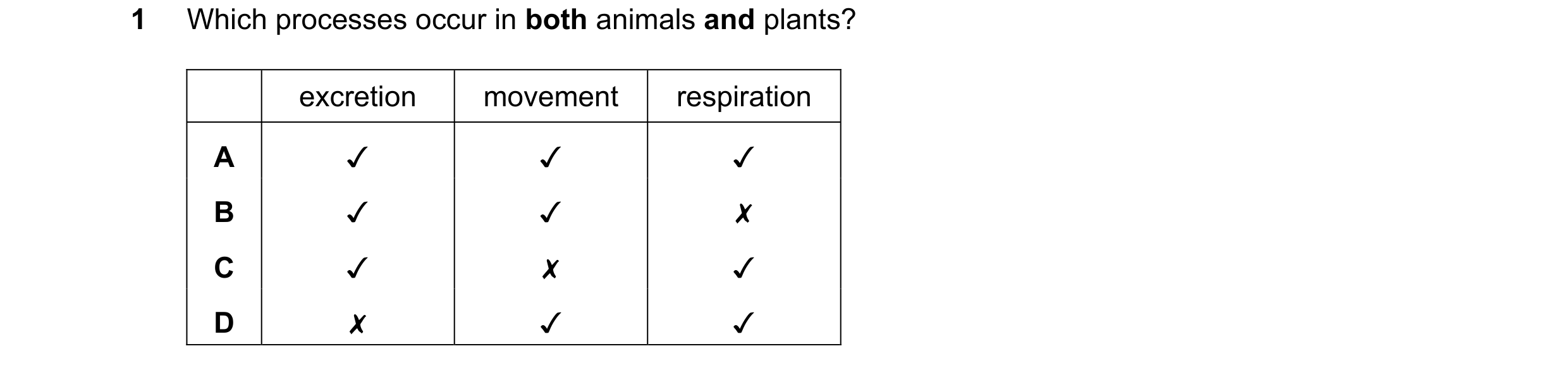
Q53 · Which processes occur in both animals and plants? 0654/12 Feb/March 2022
1. Which processes occur in both animals and plants?
excretion movement respiration
v v v
0 0O WwW >
v v x
v x v
x v v
1 marks
Answer: A
This question in 0654/12 Feb/March 2022
Q54 · Which statement about one of the characteristics of living organisms is correct? 0654/11 May/June 2022
1 Which statement about one of the characteristics of living organisms is correct? A Excretion is the removal of excess substances and toxic materials. B Movement is the ability to detect and respond to changes in the environment. C Nutrition is the maintenance of a constant internal environment. D Respiration is the manufacture of nutrients from raw materials.
1 marks
Answer: A
This question in 0654/11 May/June 2022
Q55 · Which statement about the characteristics of living organisms is correct? 0654/12 May/June 2022
1 Which statement about the characteristics of living organisms is correct? A Excretion is the chemical reactions in cells that release energy. B Nutrition is the taking in of materials for energy, growth and development. C Respiration is the process that makes more of the same kind. D Sensitivity is the removal of toxic materials and excess substances.
1 marks
Answer: B
This question in 0654/12 May/June 2022
Q56 · Which statement about the characteristics of living organisms is correct? 0654/13 May/June 2022
1 Which statement about the characteristics of living organisms is correct? A Excretion is the chemical reactions in cells that release energy. B Nutrition is the taking in of materials for energy, growth and development. C Respiration is the process that makes more of the same kind. D Sensitivity is the removal of toxic materials and excess substances.
1 marks
Answer: B
This question in 0654/13 May/June 2022
Q57 · Which characteristic of living organisms involves chemical reactions that break down… 0654/11 Oct/Nov 2022
1 Which characteristic of living organisms involves chemical reactions that break down nutrient molecules to release energy? A excretion B nutrition C reproduction D respiration
1 marks
Answer: D
This question in 0654/11 Oct/Nov 2022
Q58 · Which characteristic of living organisms involves chemical reactions that break down… 0654/12 Oct/Nov 2022
1 Which characteristic of living organisms involves chemical reactions that break down nutrient molecules to release energy? A excretion B nutrition C reproduction D respiration
1 marks
Answer: D
This question in 0654/12 Oct/Nov 2022
Q59 · Which characteristic of living organisms involves chemical reactions that break down… 0654/13 Oct/Nov 2022
1 Which characteristic of living organisms involves chemical reactions that break down nutrient molecules to release energy? A excretion B nutrition C reproduction D respiration
1 marks
Answer: D
This question in 0654/13 Oct/Nov 2022
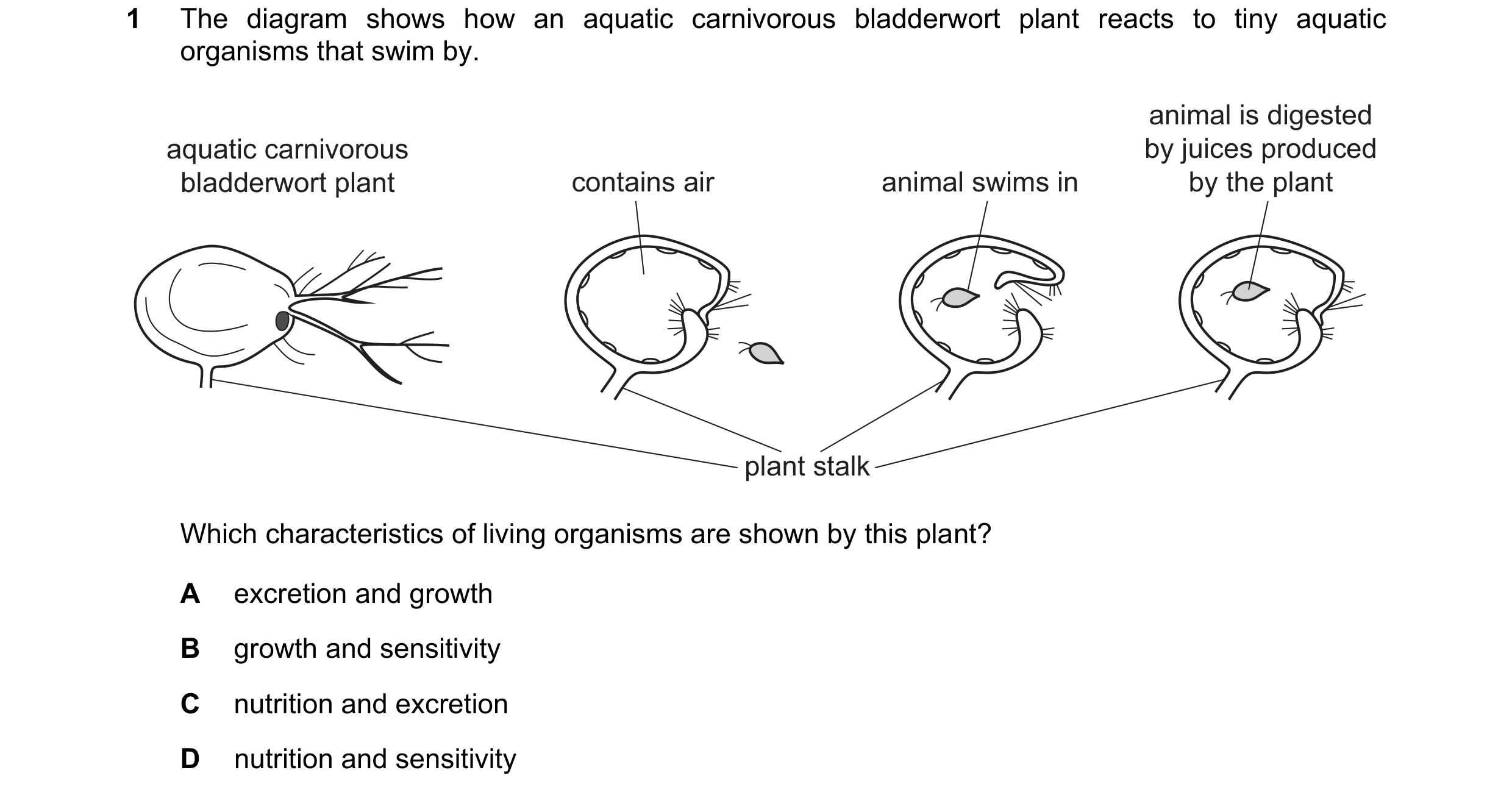
Q60 · The diagram shows how an aquatic carnivorous bladderwort plant reacts to tiny aquatic… 0654/12 Feb/March 2023
1 The diagram shows how an aquatic carnivorous bladderwort plant reacts to tiny aquatic organisms that swim by. animal is digested aquatic carnivorous by juices produced bladderwort plant contains air animal swims in by the plant plant stalk Which characteristics of living organisms are shown by this plant? A excretion and growth B growth and sensitivity C nutrition and excretion D nutrition and sensitivity
1 marks
Answer: D
This question in 0654/12 Feb/March 2023
Q61 · Which is not a characteristic of all living organisms? 0654/12 May/June 2023
1 Which is not a characteristic of all living organisms? A excretion B growth C photosynthesis D sensitivity
1 marks
Answer: C
This question in 0654/12 May/June 2023
Q62 · Which is not a characteristic of all living organisms? 0654/13 May/June 2023
1 Which is not a characteristic of all living organisms? A excretion B growth C photosynthesis D sensitivity
1 marks
Answer: C
This question in 0654/13 May/June 2023
Q63 · Which characteristic of a living organism releases energy for growth? 0654/11 Oct/Nov 2023
1 Which characteristic of a living organism releases energy for growth? A excretion B reproduction C respiration D sensitivity
1 marks
Answer: C
This question in 0654/11 Oct/Nov 2023
Q64 · Which statement about the characteristics of living organisms is correct? 0654/12 Oct/Nov 2023
1 Which statement about the characteristics of living organisms is correct? A Excretion is the removal of excess substances and toxic materials. B Movement is the ability to detect and respond to environmental changes. C Nutrition is the breaking down of molecules to release energy. D Respiration is the manufacture of carbohydrates from raw materials.
1 marks
Answer: A
This question in 0654/12 Oct/Nov 2023
Q65 · A person throws a ball which their dog runs after and brings back to them 0654/13 Oct/Nov 2023
1 A person throws a ball which their dog runs after and brings back to them. Which characteristics of living things is the dog showing by this action? A growth and nutrition B movement and nutrition C movement and sensitivity D sensitivity and growth
1 marks
Answer: C
This question in 0654/13 Oct/Nov 2023
Q66 · The diagram shows a germinating seed below the soil surface 0654/12 Feb/March 2024
1 The diagram shows a germinating seed below the soil surface. soil surface Which characteristic of living organisms ensures that the shoot grows upwards and the root grows downwards? A excretion B nutrition C reproduction D sensitivity
1 marks
Answer: D
This question in 0654/12 Feb/March 2024
Q67 · What is a characteristic of all living organisms? 0654/11 May/June 2024
1 What is a characteristic of all living organisms? A excretion B digestion C photosynthesis D sexual reproduction
1 marks
Answer: A
This question in 0654/11 May/June 2024
Q68 · Which two characteristics of living organisms are demonstrated by gravitropism? 0654/12 May/June 2024
1 Which two characteristics of living organisms are demonstrated by gravitropism? A growth and nutrition B growth and sensitivity C respiration and nutrition D respiration and sensitivity
1 marks
Answer: B
This question in 0654/12 May/June 2024
Q69 · Which two characteristics of living organisms are demonstrated by gravitropism? 0654/13 May/June 2024
1 Which two characteristics of living organisms are demonstrated by gravitropism? A growth and nutrition B growth and sensitivity C respiration and nutrition D respiration and sensitivity
1 marks
Answer: B
This question in 0654/13 May/June 2024
Q70 · Which characteristic of living things is described as the removal of toxic materials and… 0654/11 Oct/Nov 2024
1 Which characteristic of living things is described as the removal of toxic materials and substances in excess of requirements? A excretion B homeostasis C nutrition D respiration
1 marks
Answer: A
This question in 0654/11 Oct/Nov 2024
Q71 · What are two of the characteristics of all living organisms? 0654/12 Oct/Nov 2024
1 What are two of the characteristics of all living organisms? A breathing and respiration B egestion and excretion C movement and sensitivity D nutrition and photosynthesis
1 marks
Answer: C
This question in 0654/12 Oct/Nov 2024
Q72 · What are two of the characteristics of all living organisms? 0654/13 Oct/Nov 2024
1 What are two of the characteristics of all living organisms? A breathing and respiration B egestion and excretion C movement and sensitivity D nutrition and photosynthesis
1 marks
Answer: C
This question in 0654/13 Oct/Nov 2024
Q73 · A scientist studies a living organism 0654/12 Feb/March 2025
1 A scientist studies a living organism. The organism has the ability to remove the waste products of metabolism. Which characteristic of living organisms does this show? A excretion B nutrition C respiration D reproduction
1 marks
Answer: A
This question in 0654/12 Feb/March 2025
Q74 · Which characteristic of living organisms involves a permanent increase in size? 0654/11 May/June 2025
1 Which characteristic of living organisms involves a permanent increase in size? A excretion B growth C respiration D sensitivity
1 marks
Answer: B
This question in 0654/11 May/June 2025
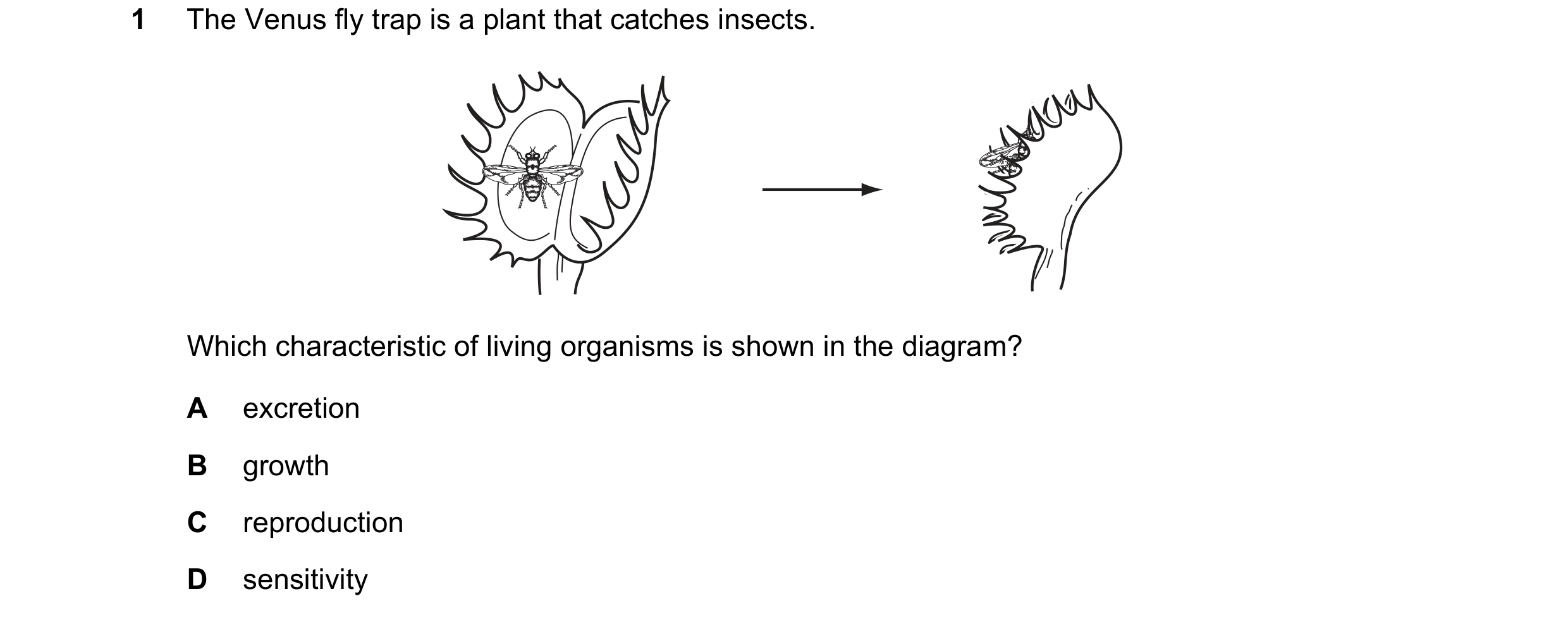
Q75 · The Venus fly trap is a plant that catches insects 0654/12 May/June 2025
1 The Venus fly trap is a plant that catches insects. Which characteristic of living organisms is shown in the diagram? A excretion B growth C reproduction D sensitivity
1 marks
Answer: D
This question in 0654/12 May/June 2025
Q76 · The Venus fly trap is a plant that catches insects 0654/13 May/June 2025
1 The Venus fly trap is a plant that catches insects. Which characteristic of living organisms is shown in the diagram? A excretion B growth C reproduction D sensitivity
1 marks
Answer: D
This question in 0654/13 May/June 2025
Q77 · Which characteristic of living organisms is described as the chemical reactions in cells… 0654/11 Oct/Nov 2025
1 Which characteristic of living organisms is described as the chemical reactions in cells that break down nutrient molecules and release energy? A excretion B nutrition C photosynthesis D respiration
1 marks
Answer: D
This question in 0654/11 Oct/Nov 2025

 1 / 17
 2 / 17


 3 / 17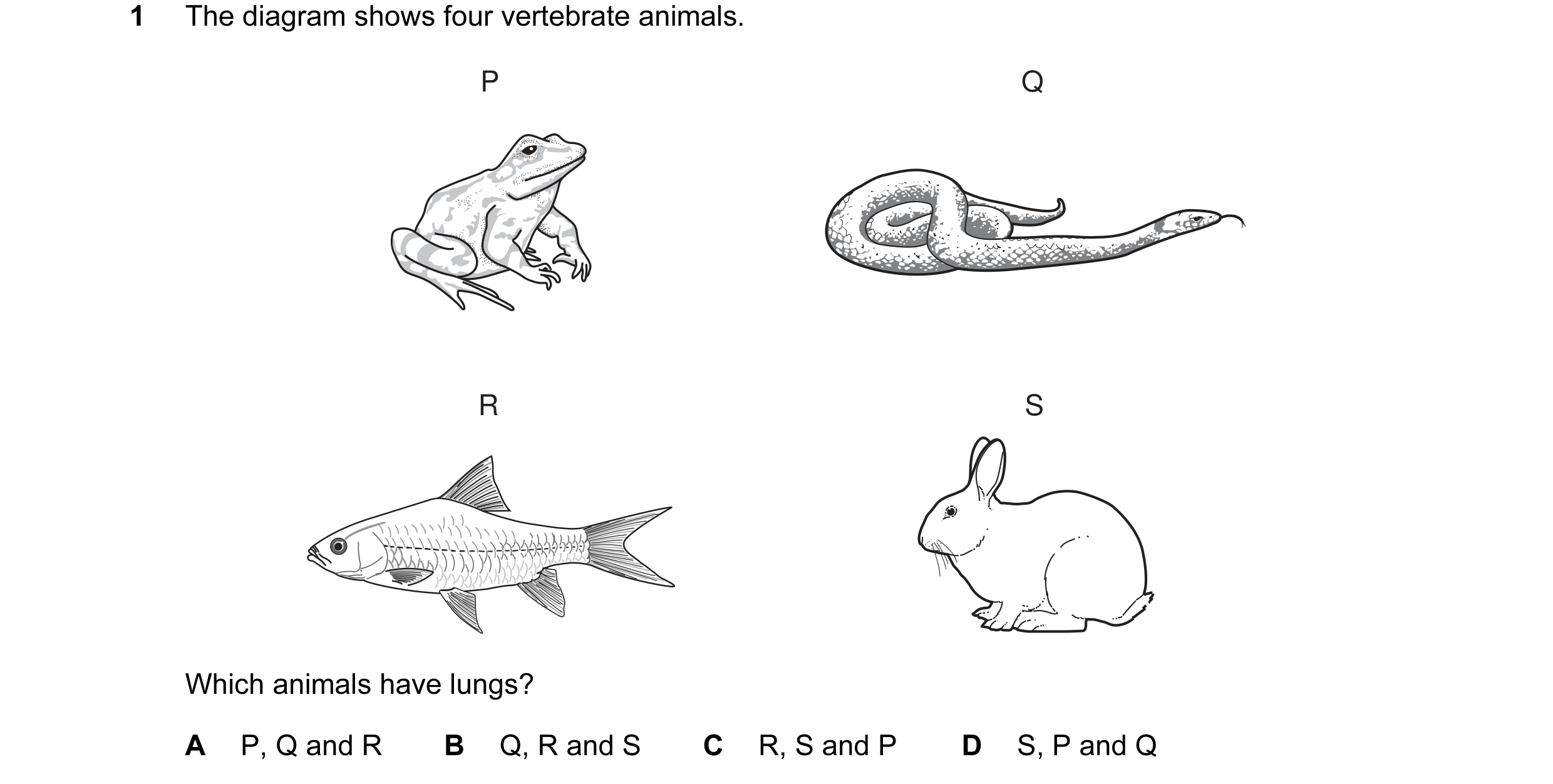
 4 / 17
 5 / 17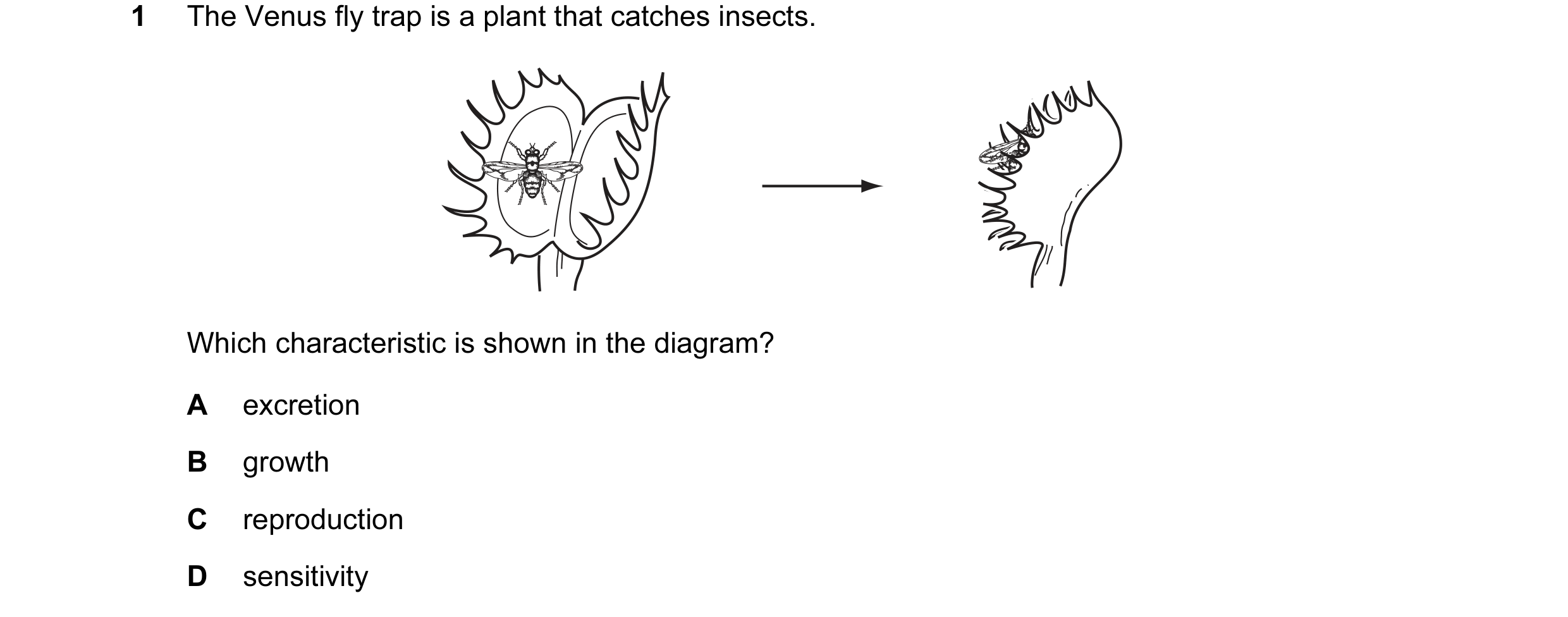


 6 / 17


 7 / 17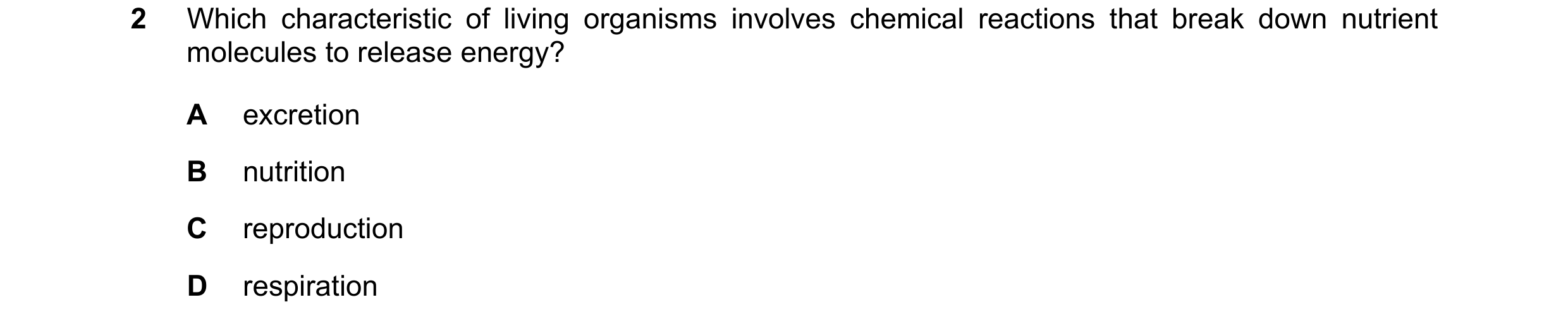
 8 / 17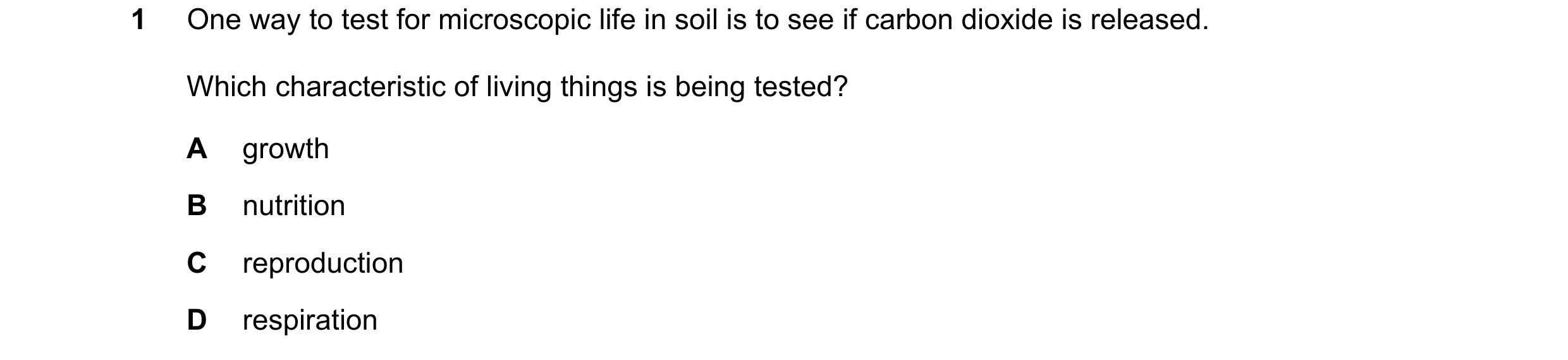




 9 / 17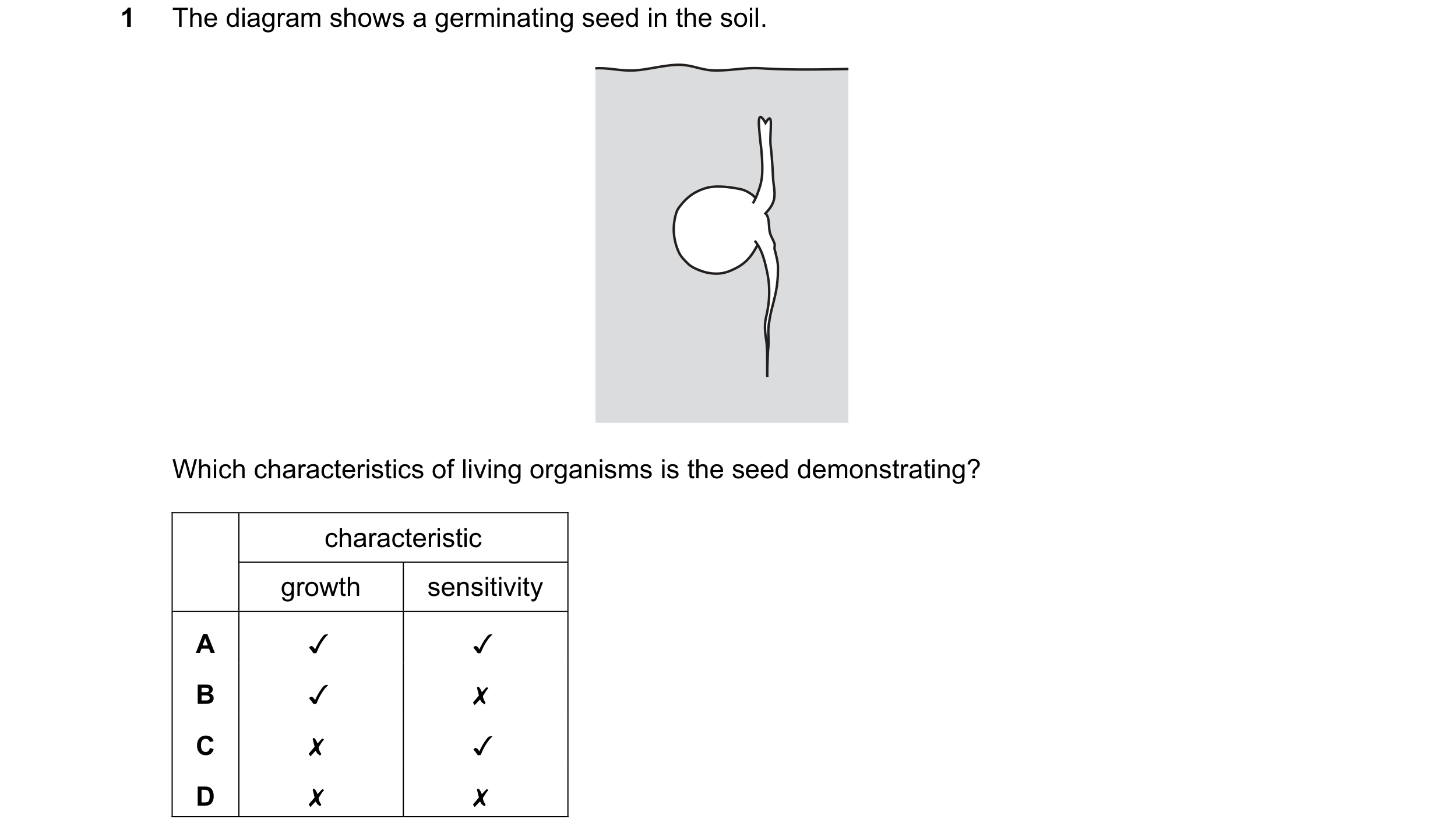
 10 / 17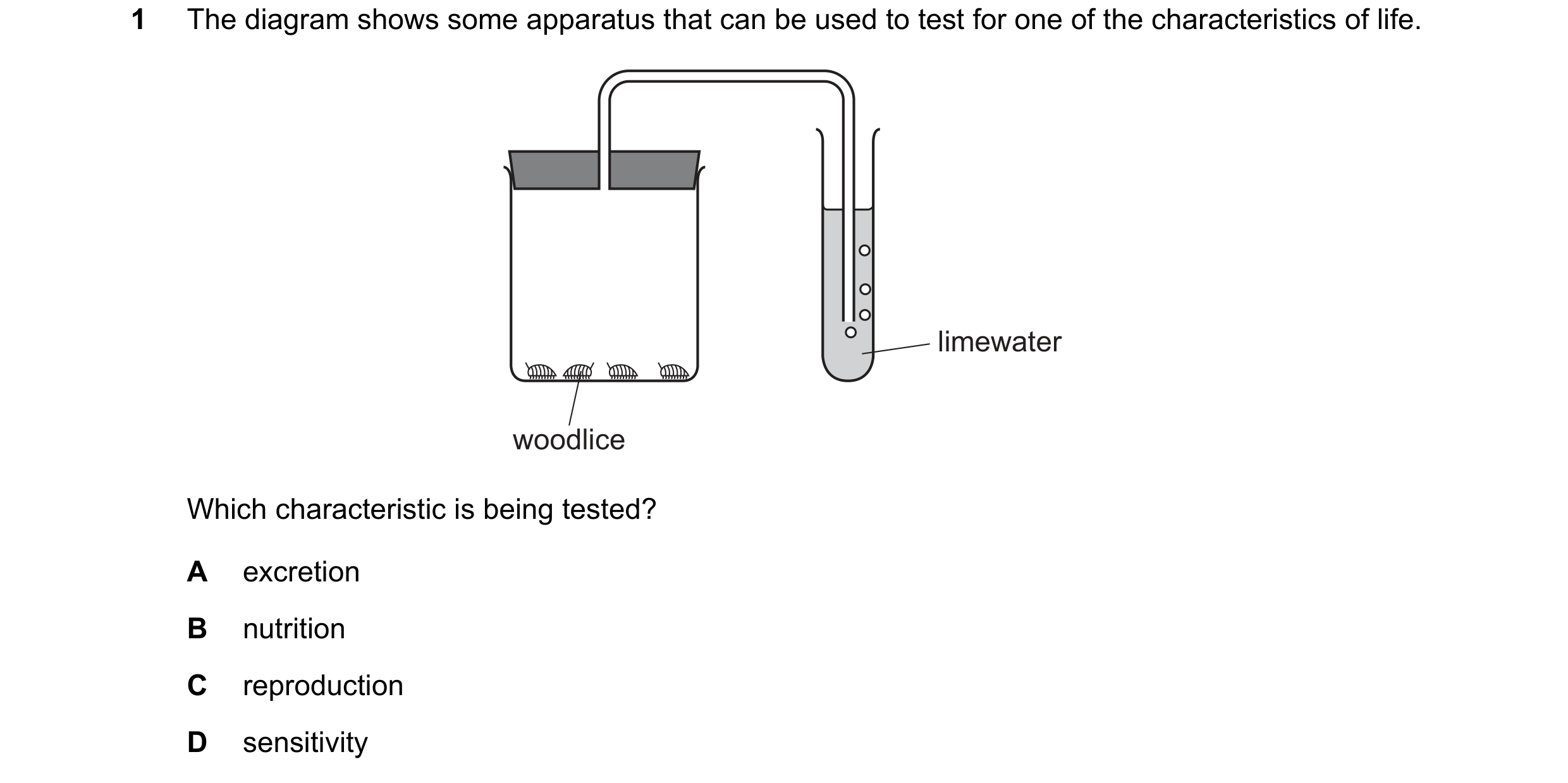

 11 / 17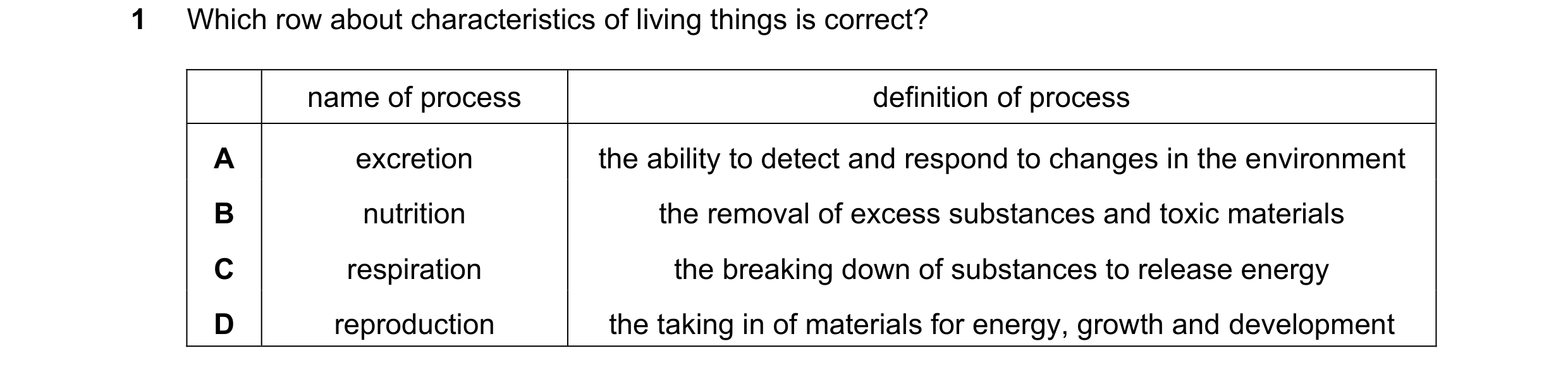


 12 / 17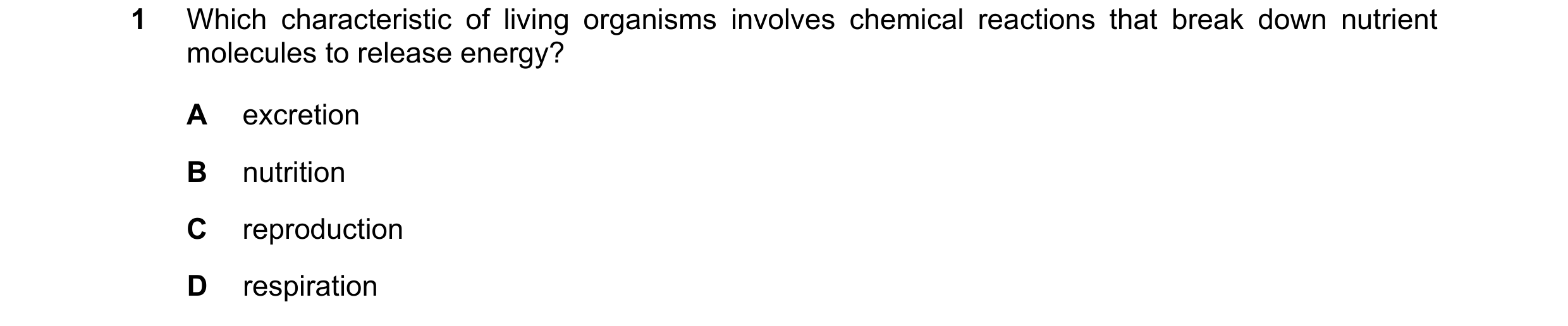
 13 / 17



 14 / 17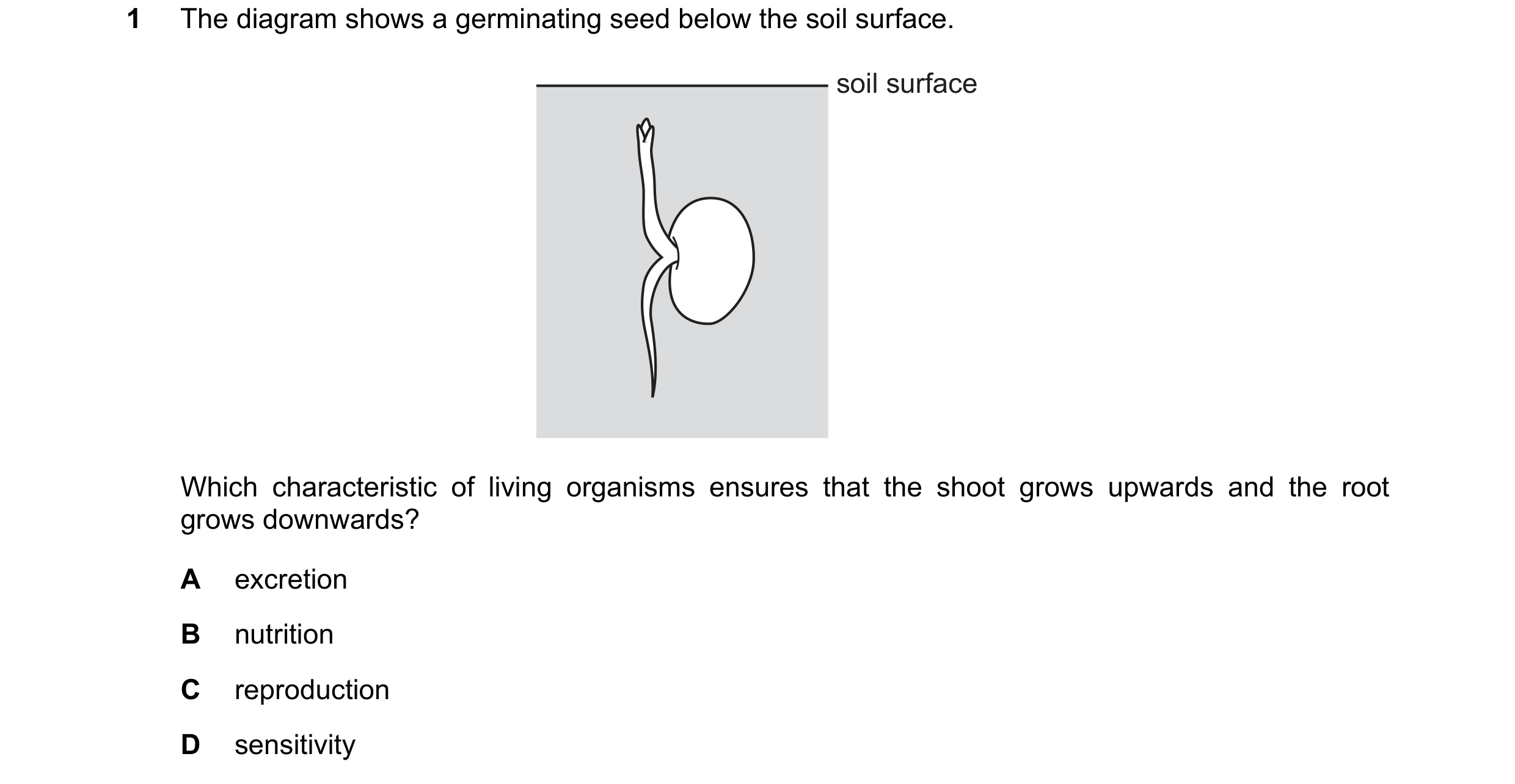



 15 / 17


 16 / 17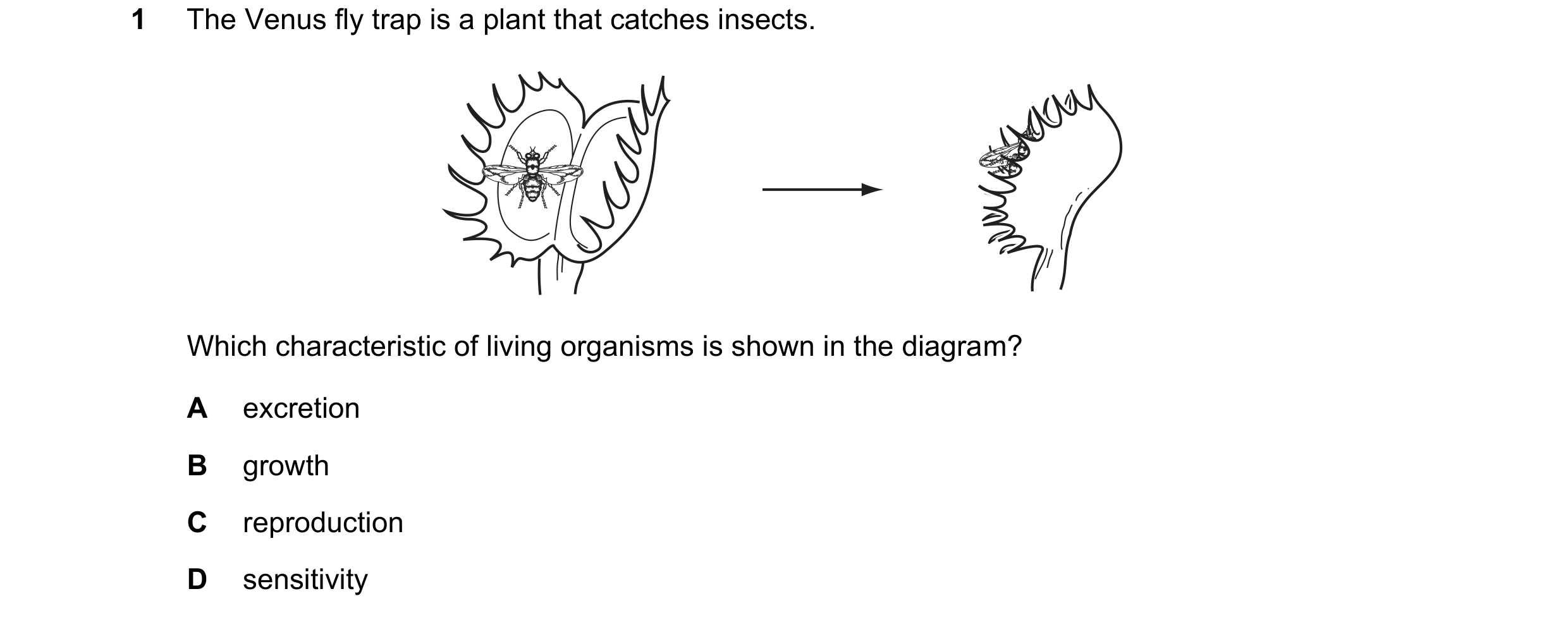
 17 / 17