Questions as text
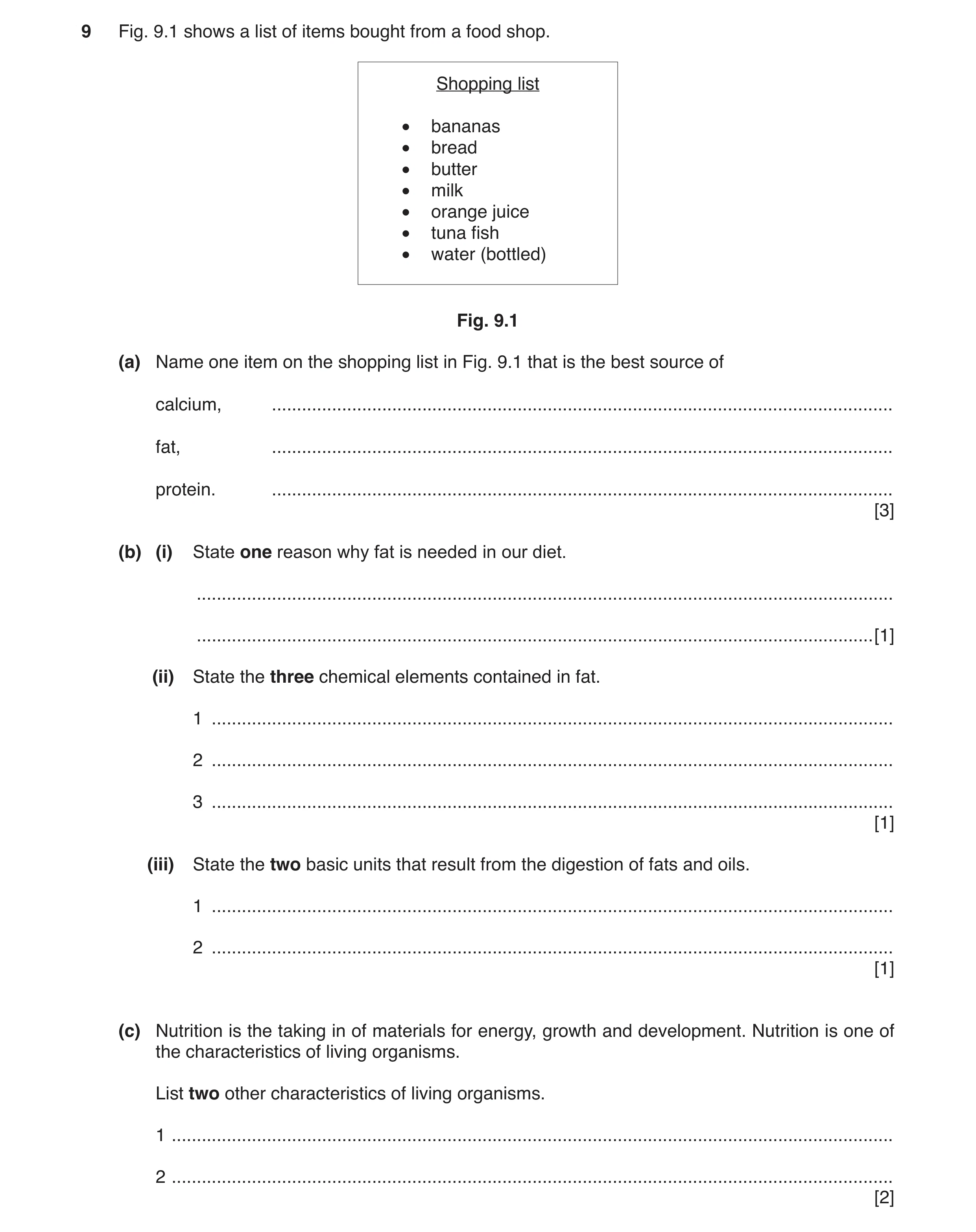
Q1 · A list of items bought from a food shop 0654/33 May/June 2017
9 Fig. 9.1 shows a list of items bought from a food shop. Shopping list • bananas • bread • butter • milk • orange juice • tuna fish • water (bottled) Fig. 9.1 (a) Name one item on the shopping list in Fig. 9.1 that is the best source of calcium, … fat, … protein. … [3] (b) (i) State one reason why fat is needed in our diet. … … [1] (ii) State the three chemical elements contained in fat. 1 … 2 … 3 … [1] (iii) State the two basic units that result from the digestion of fats and oils. 1 … 2 … [1] (c) Nutrition is the taking in of materials for energy, growth and development. Nutrition is one of the characteristics of living organisms. List two other characteristics of living organisms. 1 … 2 … [2]
8 marks
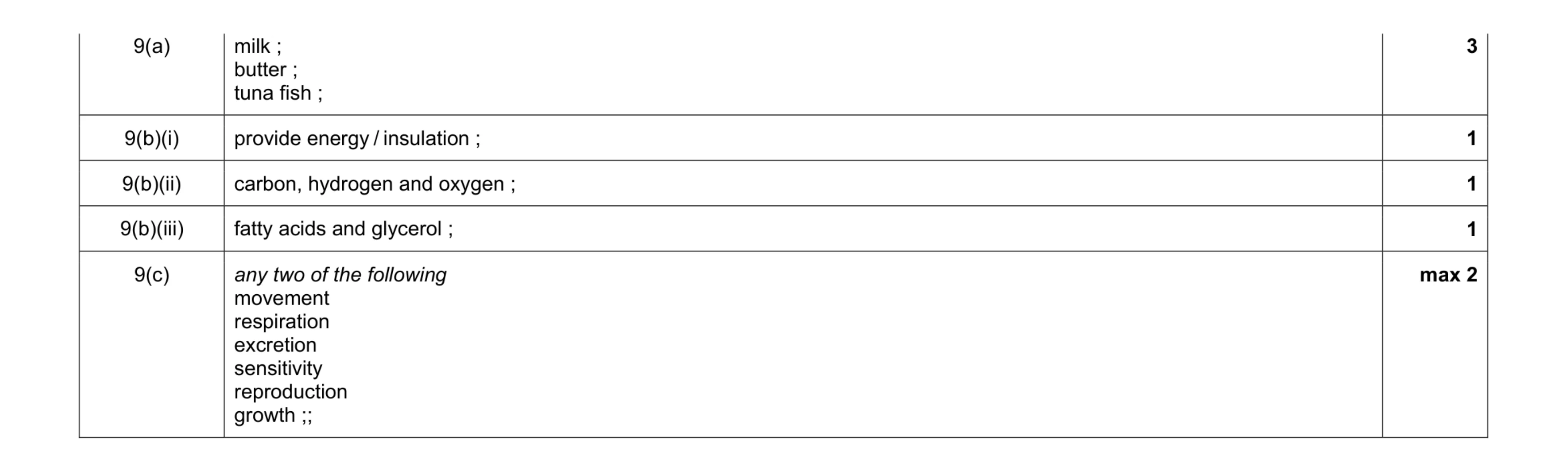
Mark scheme: 9(a) milk ; butter ; tuna fish ; 3 9(b)(i) provide energy / insulation ; 1 9(b)(ii) carbon, hydrogen and oxygen ; 1 9(b)(iii) fatty acids and glycerol ; 1 9(c) any two of the following movement respiration excretion sensitivity reproduction growth ;; max 2
This question in 0654/33 May/June 2017
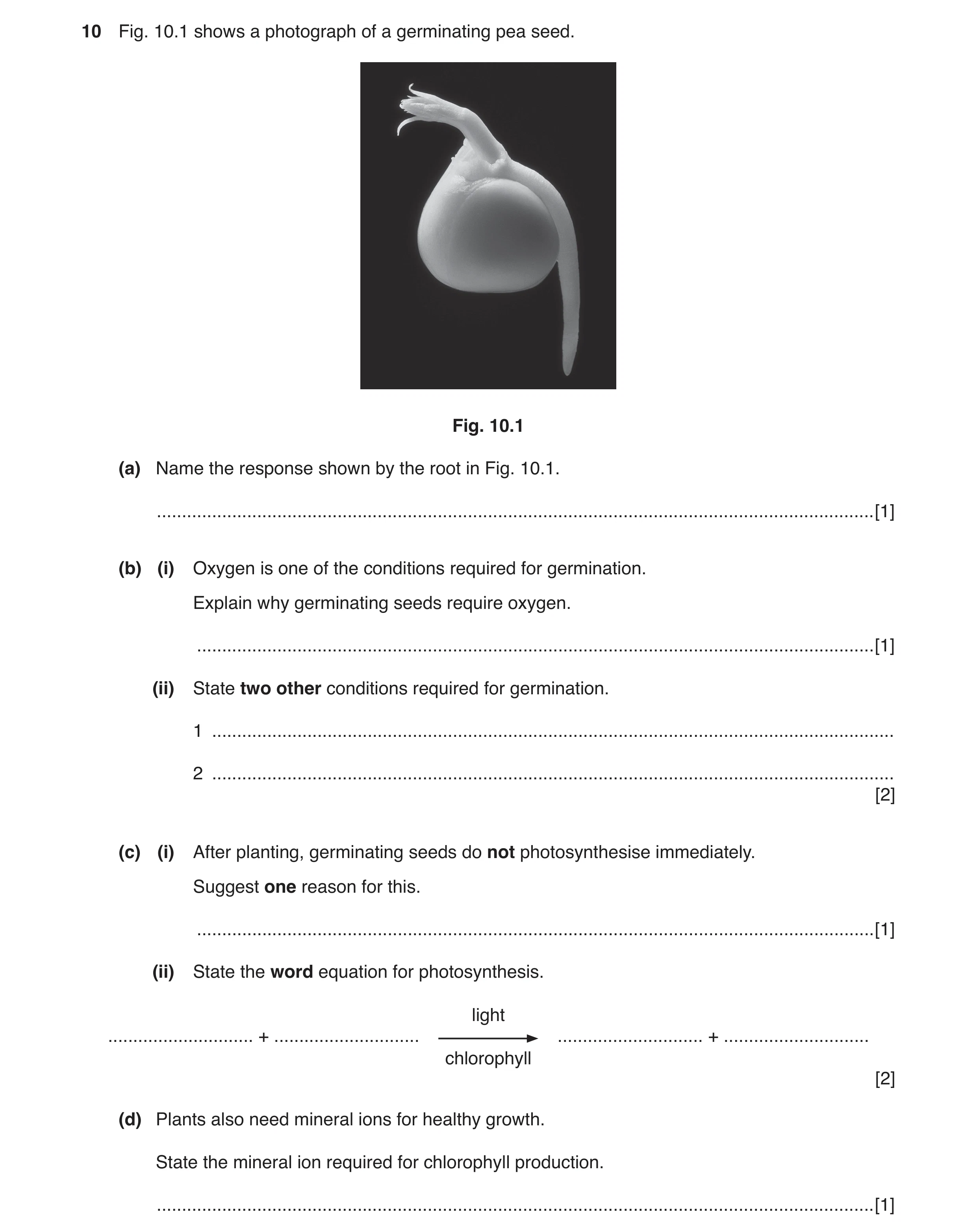
Q2 · A photograph of a germinating pea seed 0654/32 Oct/Nov 2017
10 Fig. 10.1 shows a photograph of a germinating pea seed. Fig. 10.1 (a) Name the response shown by the root in Fig. 10.1. … [1] (b) (i) Oxygen is one of the conditions required for germination. Explain why germinating seeds require oxygen. … [1] (ii) State two other conditions required for germination. 1 … 2 … [2] (c) (i) After planting, germinating seeds do not photosynthesise immediately. Suggest one reason for this. … [1] (ii) State the word equation for photosynthesis. light … + … … + … chlorophyll [2] (d) Plants also need mineral ions for healthy growth. State the mineral ion required for chlorophyll production. … [1]
8 marks
Mark scheme: 10(a) geotropism ; 1 10(b)(i) respiration ; 1 10(b)(ii) moisture / water ; warm (temperature) / suitable temperature ; 2 10(c)(i) (seedling is) underground / no light ; 1 10(c)(ii) LHS carbon dioxide + water ; RHS glucose + oxygen ; 2 10(d) magnesium ; 1
This question in 0654/32 Oct/Nov 2017
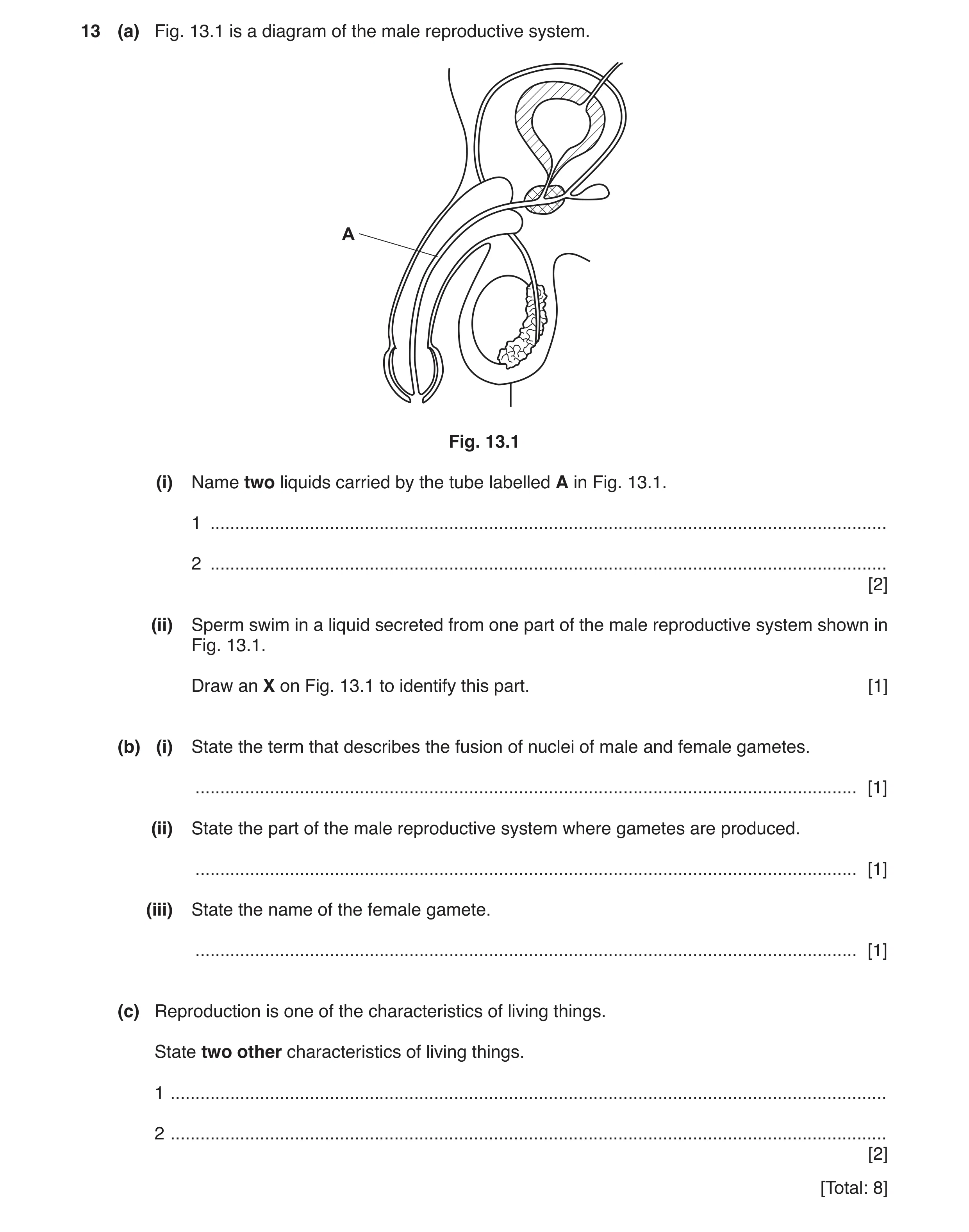
Q3 · A diagram of the male reproductive system 0654/32 May/June 2019
13 (a) Fig. 13.1 is a diagram of the male reproductive system. A Fig. 13.1 (i) Name two liquids carried by the tube labelled A in Fig. 13.1. 1 … 2 … [2] (ii) Sperm swim in a liquid secreted from one part of the male reproductive system shown in Fig. 13.1. Draw an X on Fig. 13.1 to identify this part. [1] (b) (i) State the term that describes the fusion of nuclei of male and female gametes. … [1] (ii) State the part of the male reproductive system where gametes are produced. … [1] (iii) State the name of the female gamete. … [1] (c) Reproduction is one of the characteristics of living things. State two other characteristics of living things. 1 … 2 … [2] [Total: 8]
8 marks
Mark scheme: 13(a)(i) semen ; urine ; 2 13(a)(ii) X marked on prostate gland ; 1 13(b)(i) fertilisation ; 1 13(b)(ii) testes ; 1 13(b)(iii) ovum ; 1 13(c) any two from movement ; respiration ; sensitivity ; growth ; excretion ; nutrition ; max 2
This question in 0654/32 May/June 2019
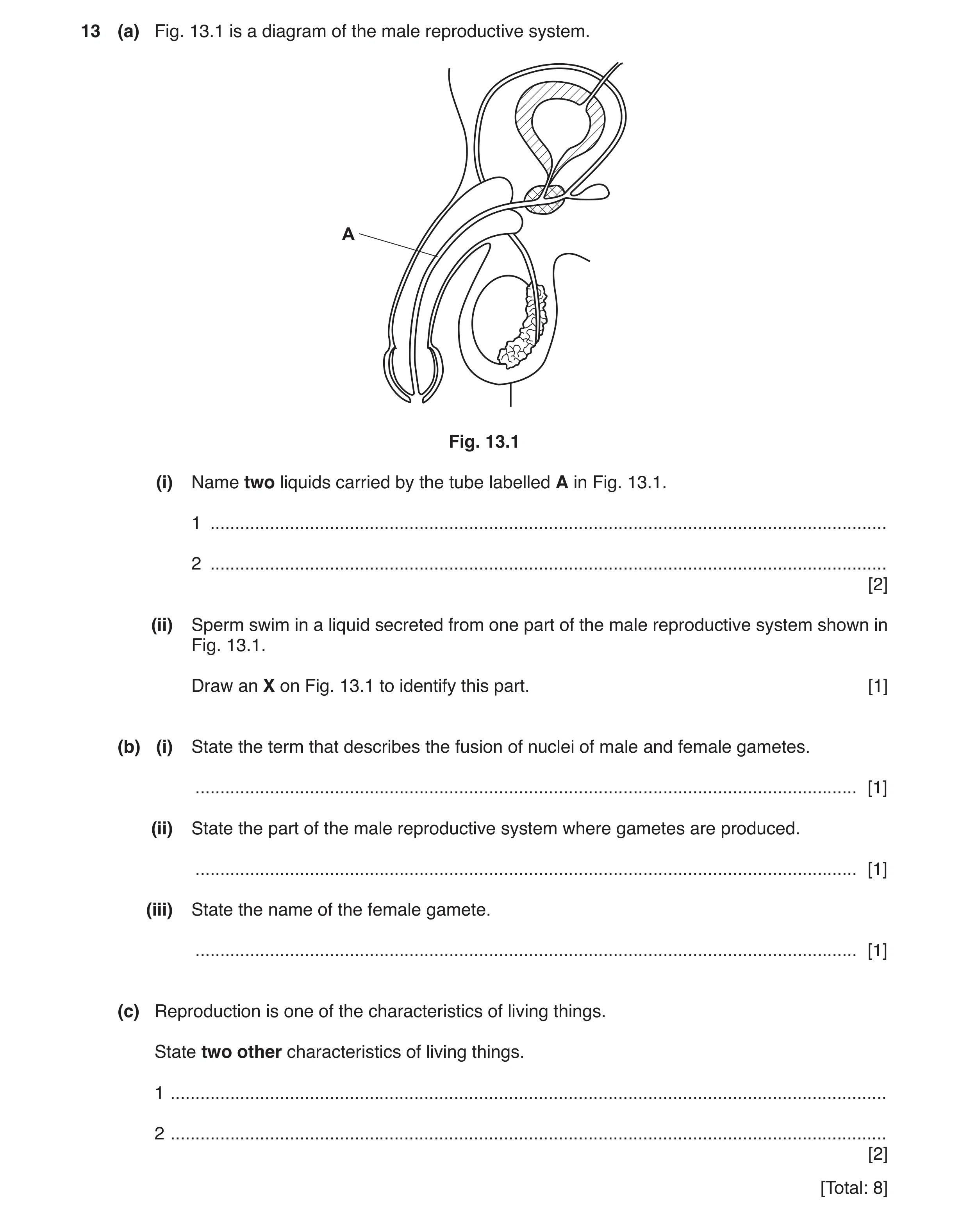
Q4 · A diagram of the male reproductive system 0654/33 May/June 2019
13 (a) Fig. 13.1 is a diagram of the male reproductive system. A Fig. 13.1 (i) Name two liquids carried by the tube labelled A in Fig. 13.1. 1 … 2 … [2] (ii) Sperm swim in a liquid secreted from one part of the male reproductive system shown in Fig. 13.1. Draw an X on Fig. 13.1 to identify this part. [1] (b) (i) State the term that describes the fusion of nuclei of male and female gametes. … [1] (ii) State the part of the male reproductive system where gametes are produced. … [1] (iii) State the name of the female gamete. … [1] (c) Reproduction is one of the characteristics of living things. State two other characteristics of living things. 1 … 2 … [2] [Total: 8]
8 marks
Mark scheme: 13(a)(i) semen ; urine ; 2 13(a)(ii) X marked on prostate gland ; 1 13(b)(i) fertilisation ; 1 13(b)(ii) testes ; 1 13(b)(iii) ovum ; 1 13(c) any two from movement ; respiration ; sensitivity ; growth ; excretion ; nutrition ; max 2
This question in 0654/33 May/June 2019
Q5 · A student investigates the conditions needed for germination of cress seeds 0654/33 Oct/Nov 2019
4 (a) A student investigates the conditions needed for germination of cress seeds. She puts the same number of cress seeds into four test-tubes, A, B, C and D. The test-tubes are left in different conditions for five days. Table 4.1 shows the conditions of each test-tube and the results after five days. Table 4.1 test-tube condition A B C D given water yes no yes yes temperature / °C 4 21 21 21 kept in light / dark light light light dark seeds germinated no no yes yes (i) Explain why the cress seeds in test-tubes A and B did not germinate. A … B … [2] (ii) State one conclusion from the results shown by test-tubes C and D. … … [1] (b) Germinating seeds need oxygen for respiration. State the word equation for respiration. … [2] (c) Energy released from respiration has many different uses. Put ticks (3) in the boxes to show all the uses of energy needed by germinating seeds. muscle contraction protein synthesis cell division growth maintenance of body temperature [2] (d) Respiration is one of the characteristics of living things. Name the characteristic of living things that is defined by: the ability to detect and respond to changes in the environment … an action by an organism causing a change of position or place. … [2] [Total: 9]
9 marks
Mark scheme: 4(a)(i) A – too cold / AW; B – not enough water / AW ; 2 4(a)(ii) light is not needed for germination ; 1 4(b) glucose + oxygen → carbon dioxide + water ;; 2 4(c) protein synthesis, cell division, growth ticked ;; 1 or 2 correct = 1 mark, 3 correct = 2 marks 2 4(d) sensitivity ; movement ; 2
This question in 0654/33 Oct/Nov 2019
Q6 · A drawing of a person doing a parachute jump 0654/31 May/June 2020
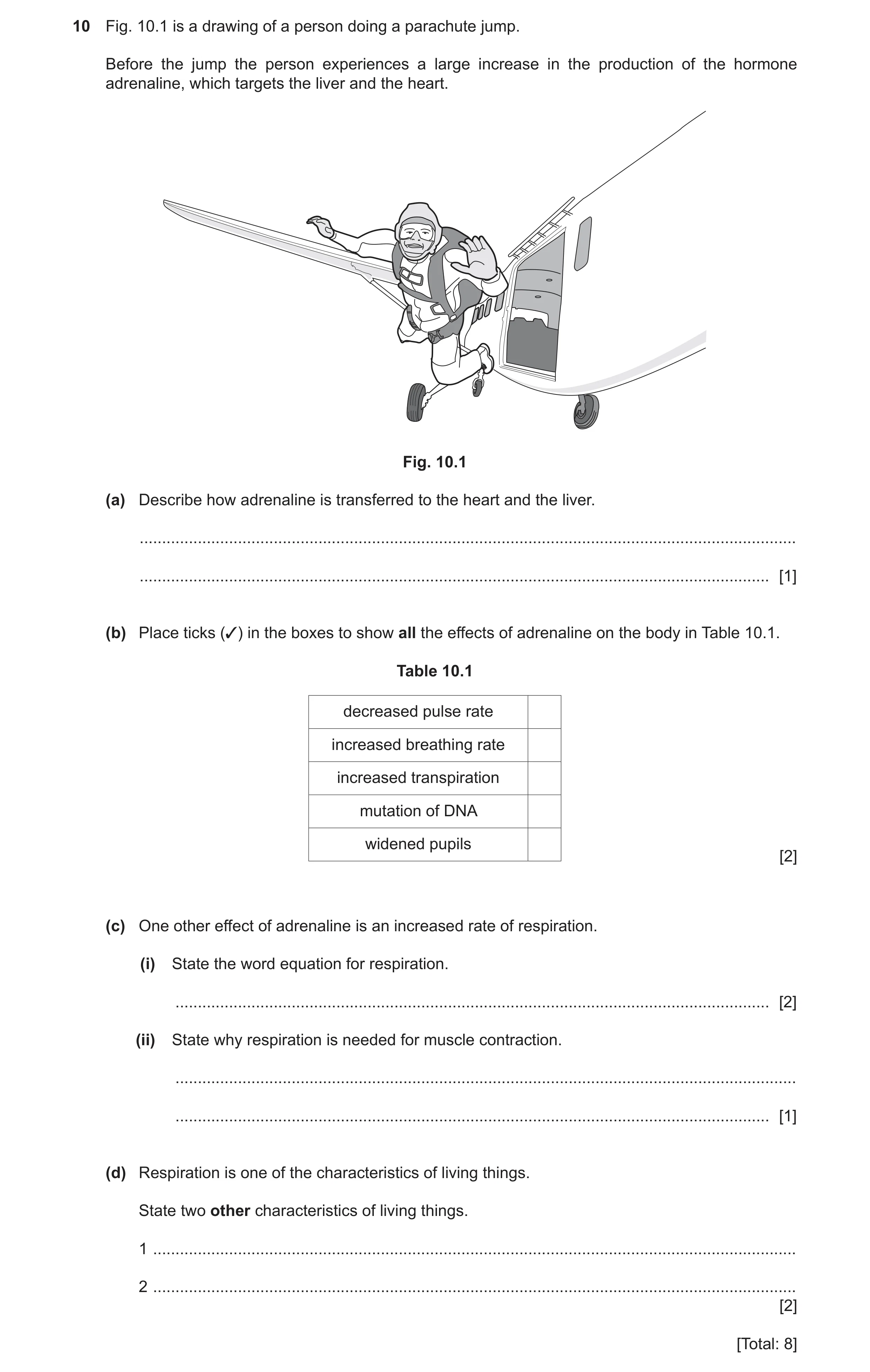
10 Fig. 10.1 is a drawing of a person doing a parachute jump. Before the jump the person experiences a large increase in the production of the hormone adrenaline, which targets the liver and the heart. Fig. 10.1 (a) Describe how adrenaline is transferred to the heart and the liver. … … [1] (b) Place ticks (3) in the boxes to show all the effects of adrenaline on the body in Table 10.1. Table 10.1 decreased pulse rate increased breathing rate increased transpiration mutation of DNA widened pupils [2] (c) One other effect of adrenaline is an increased rate of respiration. (i) State the word equation for respiration. … [2] (ii) State why respiration is needed for muscle contraction. … … [1] (d) Respiration is one of the characteristics of living things. State two other characteristics of living things. 1 … 2 … [2] [Total: 8]
8 marks
Mark scheme: 10(a) in the blood (plasma) ; 1 10(b) increased breathing rate ticked ; widened pupils ticked ; 2 10(c)(i) glucose + oxygen →carbon dioxide + water ;; 2 10(c)(ii) respiration releases energy (needed for muscle contraction) ; 1 Question Answer Marks 10(d) any two from: movement sensitivity growth reproduction excretion nutrition ;; 2
This question in 0654/31 May/June 2020
Question 7 0654/32 Oct/Nov 2020
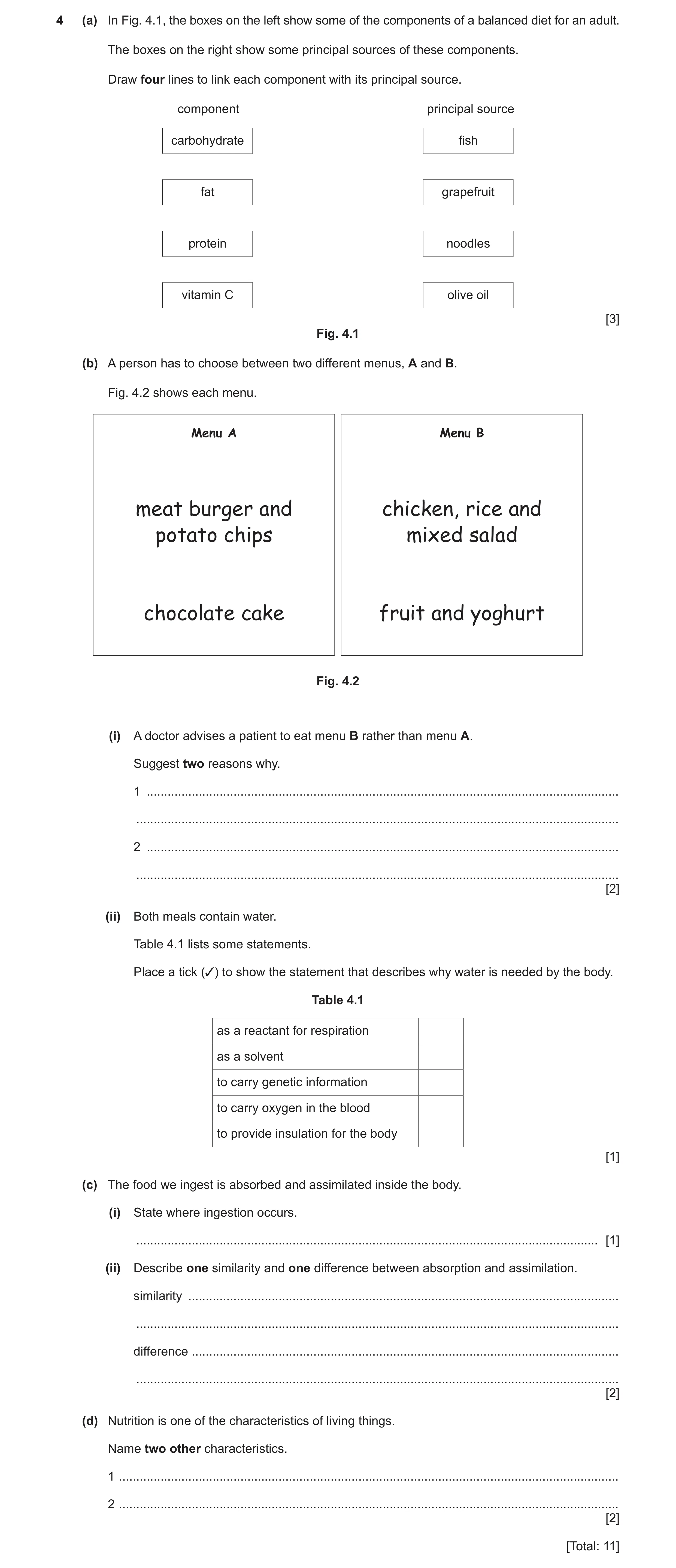
4 (a) In Fig. 4.1, the boxes on the left show some of the components of a balanced diet for an adult. The boxes on the right show some principal sources of these components. Draw four lines to link each component with its principal source. component principal source carbohydrate fish fat grapefruit protein noodles vitamin C olive oil [3] Fig. 4.1 (b) A person has to choose between two different menus, A and B. Fig. 4.2 shows each menu. Menu A Menu B meat burger and chicken, rice and potato chips mixed salad chocolate cake fruit and yoghurt Fig. 4.2 (i) A doctor advises a patient to eat menu B rather than menu A. Suggest two reasons why. 1 … … 2 … … [2] (ii) Both meals contain water. Table 4.1 lists some statements. Place a tick (3) to show the statement that describes why water is needed by the body. Table 4.1 as a reactant for respiration as a solvent to carry genetic information to carry oxygen in the blood to provide insulation for the body [1] (c) The food we ingest is absorbed and assimilated inside the body. (i) State where ingestion occurs. … [1] (ii) Describe one similarity and one difference between absorption and assimilation. similarity … … difference … … [2] (d) Nutrition is one of the characteristics of living things. Name two other characteristics. 1 … 2 … [2] [Total: 11]
11 marks
Mark scheme: 4(a) carbohydrate fish fats grapefruit protein noodles vitamin C olive oil ;;; 3 4(b)(i) any two from it has a greater variety of nutrients / food types ; also contains (more) fruit / vegetables ; contains less fats ; contains less sugar ; it contains more vitamins / minerals ; max 2 2 4(b)(ii) as a solvent ticked ; 1 4(c)(i) mouth ; 1 4(c)(ii) similarity – both involve movement of (digested) food; difference – absorption is into the blood / assimilation is into the cells ; 2 4(d) any two from movement ; respiration ; sensitivity ; growth ; excretion ; reproduction ; max 2 2
This question in 0654/32 Oct/Nov 2020
Q8 · Some of the functions of the main components of blood 0654/31 May/June 2021
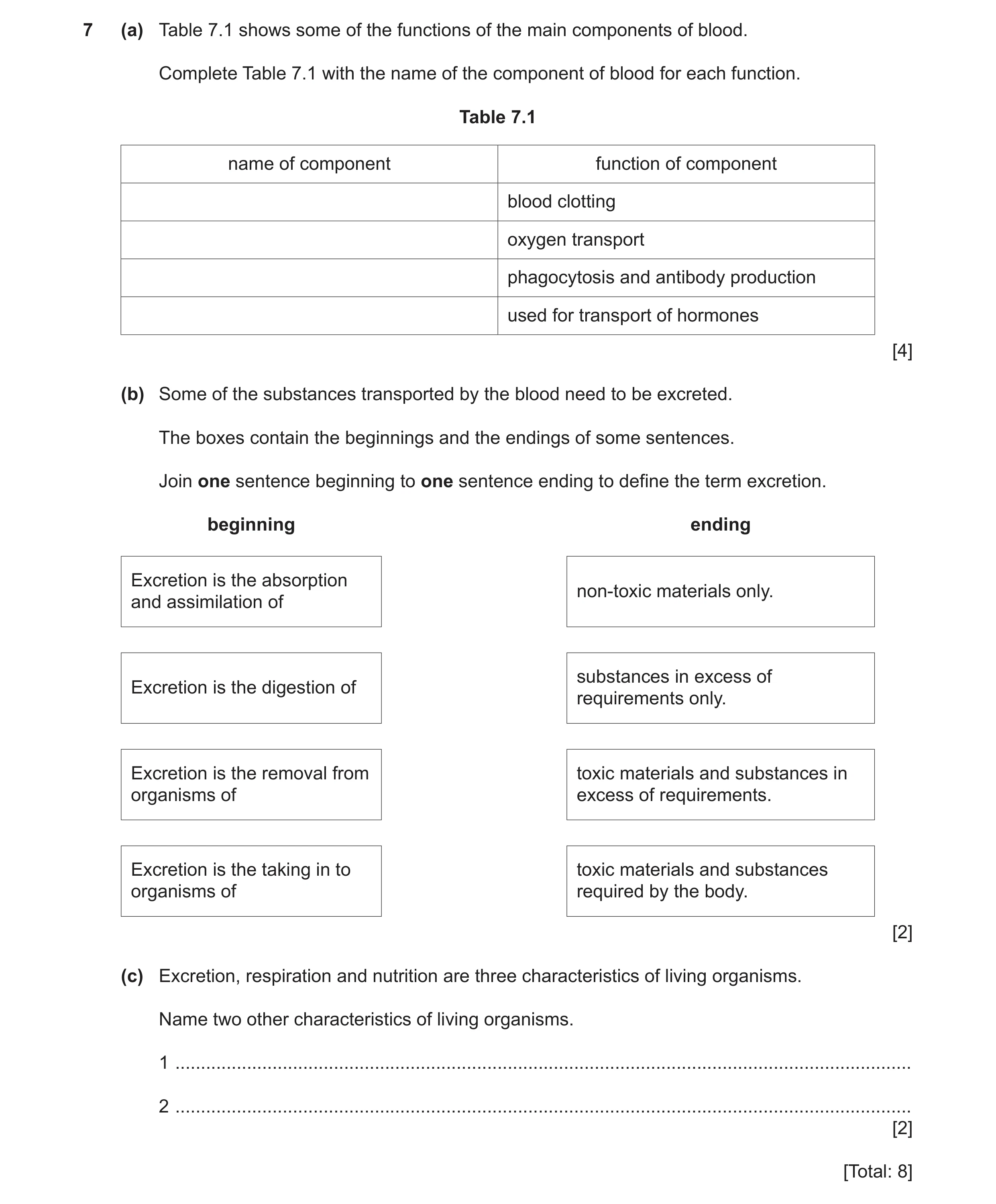
7 (a) Table 7.1 shows some of the functions of the main components of blood. Complete Table 7.1 with the name of the component of blood for each function. Table 7.1 name of component function of component blood clotting oxygen transport phagocytosis and antibody production used for transport of hormones [4] (b) Some of the substances transported by the blood need to be excreted. The boxes contain the beginnings and the endings of some sentences. Join one sentence beginning to one sentence ending to define the term excretion. beginning ending Excretion is the absorption non‑toxic materials only. and assimilation of substances in excess of Excretion is the digestion of requirements only. Excretion is the removal from toxic materials and substances in organisms of excess of requirements. Excretion is the taking in to toxic materials and substances organisms of required by the body. [2] (c) Excretion, respiration and nutrition are three characteristics of living organisms. Name two other characteristics of living organisms. 1 … 2 … [2] [Total: 8]
8 marks
Mark scheme: 7(a) platelets ; red blood cells ; white blood cells ; plasma ; 4 7(b) ;; 2 7(c) any two from: reproduction ; movement ; sensitivity ; growth ; 2
This question in 0654/31 May/June 2021
Q9 · A diagram of the male reproductive system in humans 0654/31 Oct/Nov 2021
4 (a) Fig. 4.1 is a diagram of the male reproductive system in humans. B C D A E F Fig. 4.1 Identify the letter from Fig. 4.1 that represents the: part where sperm is produced, … part which secretes the fluid that sperm swim in, … tube which carries both semen and urine. … [3] (b) State the name of the part of the female reproductive system that releases gametes. … [1] (c) The statements in Table 4.1 describe either asexual or sexual reproduction. Complete Table 4.1 to identify the type of reproduction each statement describes. Table 4.1 statement type of reproduction offspring are genetically identical to each other produces zygotes involves the fusion of nuclei [2] (d) Fig. 4.2 is a diagram representing the reproduction of a type of organism called a hydra. Fig. 4.2 Identify if this organism is reproducing asexually or sexually. Use evidence from Fig. 4.2 to give a reason for your answer. type of reproduction … reason … … [1] (e) Reproduction and respiration are characteristics of living things. State two other characteristics of living things. 1 … 2 … [2] [Total: 9]
9 marks
Mark scheme: 4(a) E ; C ; A ; 3 4(b) ovary ; 1 4(c) asexual sexual sexual ;; 2 4(d) asexual offspring produced by only one parent ; 1 Question Answer Marks 4(e) any two from: movement ; sensitivity ; growth ; excretion ; nutrition ; 2
This question in 0654/31 Oct/Nov 2021
Q10 · A photograph of a dissected flower 0654/32 Feb/March 2022
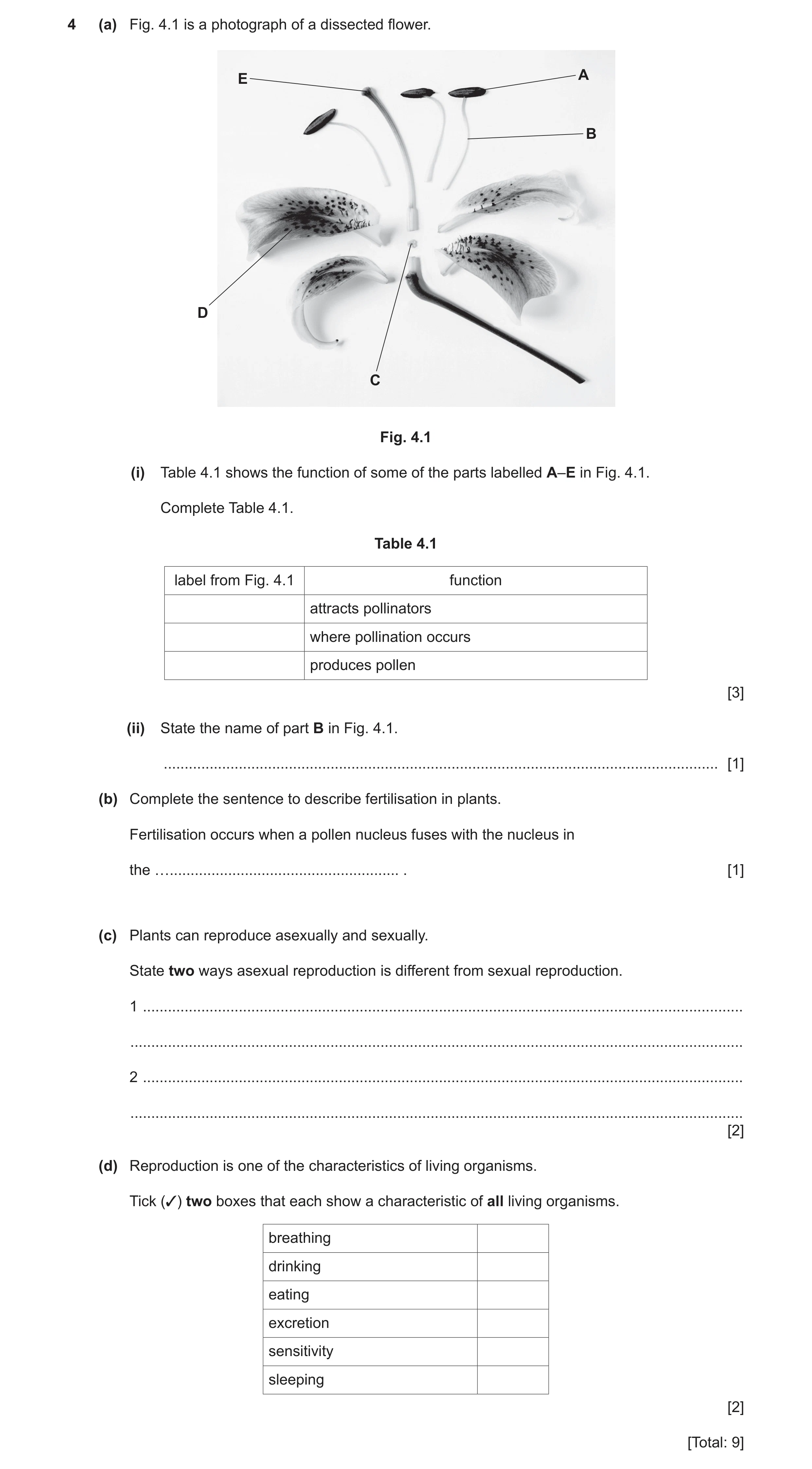
4 (a) Fig. 4.1 is a photograph of a dissected flower. E A B D C Fig. 4.1 (i) Table 4.1 shows the function of some of the parts labelled A–E in Fig. 4.1. Complete Table 4.1. Table 4.1 label from Fig. 4.1 function attracts pollinators where pollination occurs produces pollen [3] (ii) State the name of part B in Fig. 4.1. … [1] (b) Complete the sentence to describe fertilisation in plants. Fertilisation occurs when a pollen nucleus fuses with the nucleus in the … … . [1] (c) Plants can reproduce asexually and sexually. State two ways asexual reproduction is different from sexual reproduction. 1 … … 2 … … [2] (d) Reproduction is one of the characteristics of living organisms. Tick (3) two boxes that each show a characteristic of all living organisms. breathing drinking eating excretion sensitivity sleeping [2] [Total: 9]
9 marks
Mark scheme: 4(a)(i) D ; E ; A ; 3 4(a)(ii) filament ; 1 4(b) ovule ; 1 4(c) any two from: involves only one parent ; produces genetically identical offspring ; does not involve gametes ; does not involve the process of fertilisation ; 2 4(d) excretion ticked ; sensitivity ticked ; 2
This question in 0654/32 Feb/March 2022
Q11 · A researcher collects some information about organisms that live in a desert environment 0654/31 Oct/Nov 2022
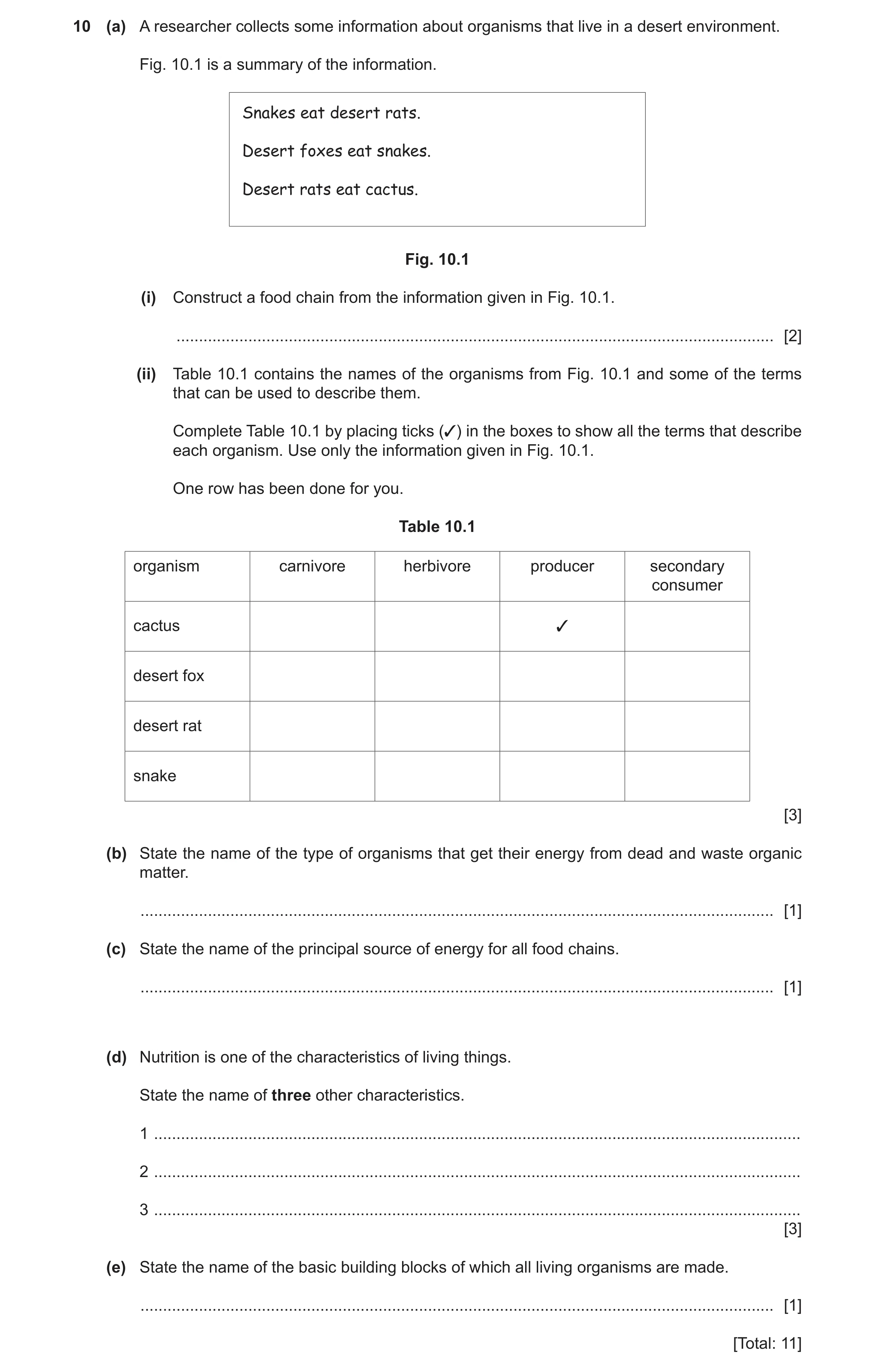
10 (a) A researcher collects some information about organisms that live in a desert environment. Fig. 10.1 is a summary of the information. Snakes eat desert rats. Desert foxes eat snakes. Desert rats eat cactus. Fig. 10.1 (i) Construct a food chain from the information given in Fig. 10.1. … [2] (ii) Table 10.1 contains the names of the organisms from Fig. 10.1 and some of the terms that can be used to describe them. Complete Table 10.1 by placing ticks (3) in the boxes to show all the terms that describe each organism. Use only the information given in Fig. 10.1. One row has been done for you. Table 10.1 organism carnivore herbivore producer secondary consumer cactus 3 desert fox desert rat snake [3] (b) State the name of the type of organisms that get their energy from dead and waste organic matter. … [1] (c) State the name of the principal source of energy for all food chains. … [1] (d) Nutrition is one of the characteristics of living things. State the name of three other characteristics. 1 … 2 … 3 … [3] (e) State the name of the basic building blocks of which all living organisms are made. … [1] [Total: 11]
11 marks
Mark scheme: 10(a)(i) cactus → desert rats → snake → desert fox ;; 2 10(a)(ii) 3 secondary organism carnivore herbivore producer consumer cactus desert fox desert rat snake 1 mark for each correct row ;;; 10(b) decomposer ; 1 10(c) Sun ; 1 10(d) any three from: 3 movement ; respiration ; sensitivity ; growth ; reproduction ; excretion ; 10(e) cells ; 1
This question in 0654/31 Oct/Nov 2022
Q12 · Define the term enzyme 0654/32 Feb/March 2023
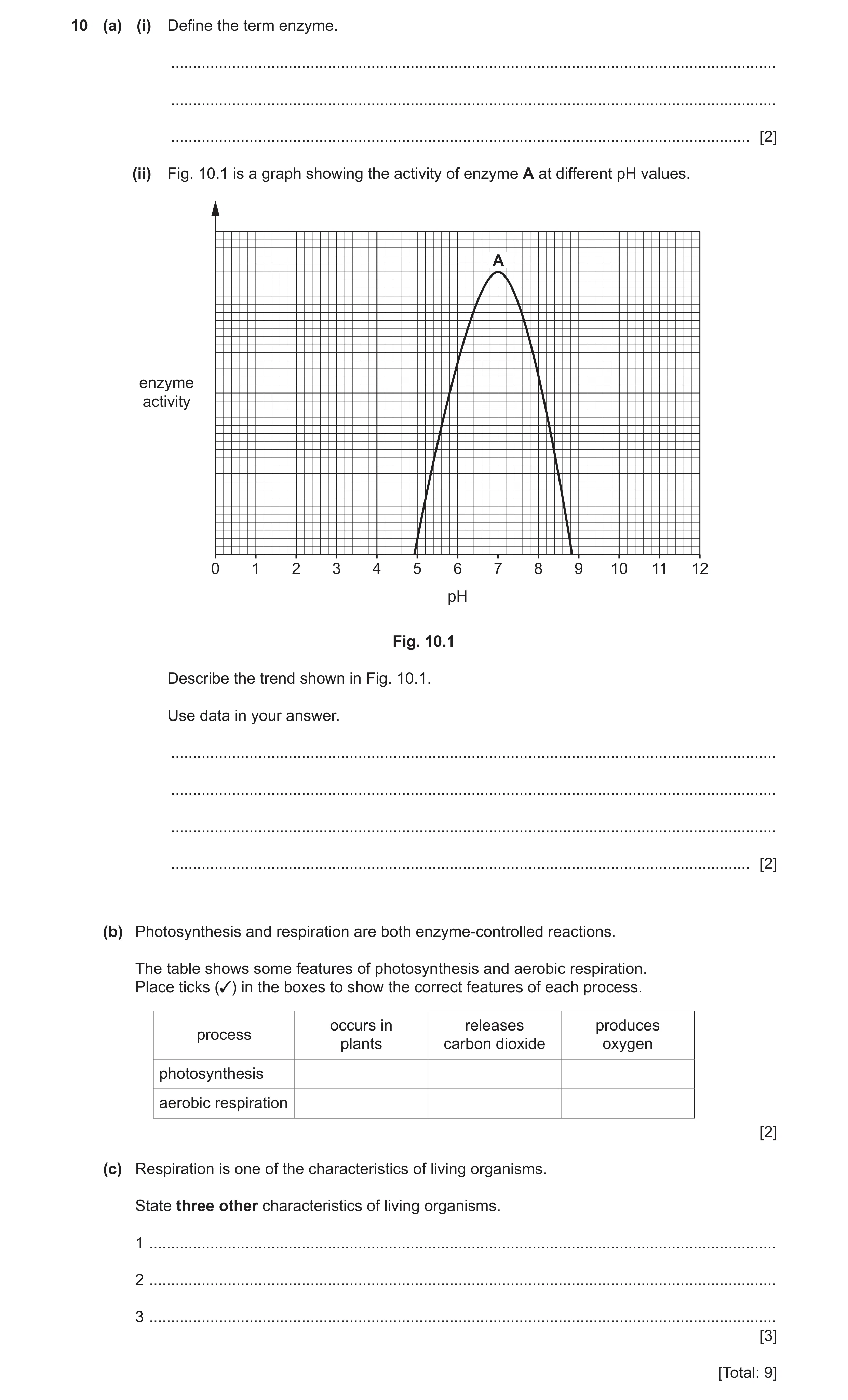
10 (a) (i) Define the term enzyme. … … … [2] (ii) Fig. 10.1 is a graph showing the activity of enzyme A at different pH values. A enzyme activity 0 1 2 3 4 5 6 7 8 9 10 11 12 pH Fig. 10.1 Describe the trend shown in Fig. 10.1. Use data in your answer. … … … … [2] (b) Photosynthesis and respiration are both enzyme-controlled reactions. The table shows some features of photosynthesis and aerobic respiration. Place ticks (3) in the boxes to show the correct features of each process. occurs in releases produces process plants carbon dioxide oxygen photosynthesis aerobic respiration [2] (c) Respiration is one of the characteristics of living organisms. State three other characteristics of living organisms. 1 … 2 … 3 … [3] [Total: 9]
9 marks
Mark scheme: 10(a)(i) a protein ; 2 (that functions as) a biological catalyst ; 10(a)(ii) enzyme activity increases then decreases (with increasing pH) ; 2 optimum / peak / maximum activity, at pH7 ; 10(b) 2 releases carbon process occurs in plants produces oxygen dioxide photosynthesis aerobic respiration ;; 10(c) any three from: 3 movement ; sensitivity ; reproduction ; growth ; excretion ; nutrition ;
This question in 0654/32 Feb/March 2023
Q13 · A diagram of a flower 0654/32 May/June 2023
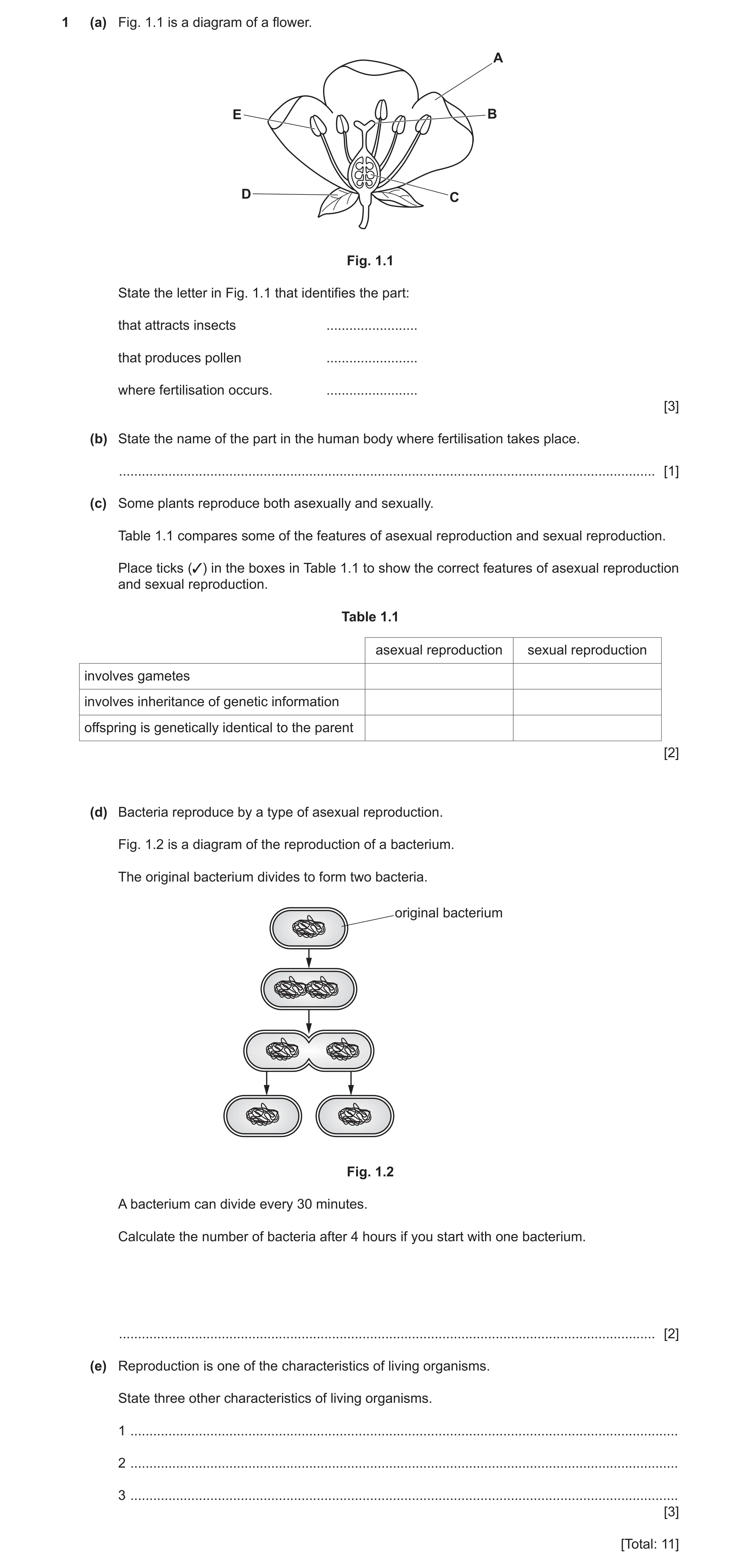
1 (a) Fig. 1.1 is a diagram of a flower. A E B D C Fig. 1.1 State the letter in Fig. 1.1 that identifies the part: that attracts insects … that produces pollen … where fertilisation occurs. … [3] (b) State the name of the part in the human body where fertilisation takes place. … [1] (c) Some plants reproduce both asexually and sexually. Table 1.1 compares some of the features of asexual reproduction and sexual reproduction. Place ticks (3) in the boxes in Table 1.1 to show the correct features of asexual reproduction and sexual reproduction. Table 1.1 asexual reproduction sexual reproduction involves gametes involves inheritance of genetic information offspring is genetically identical to the parent [2] (d) Bacteria reproduce by a type of asexual reproduction. Fig. 1.2 is a diagram of the reproduction of a bacterium. The original bacterium divides to form two bacteria. original bacterium Fig. 1.2 A bacterium can divide every 30 minutes. Calculate the number of bacteria after 4 hours if you start with one bacterium. … [2] (e) Reproduction is one of the characteristics of living organisms. State three other characteristics of living organisms. 1 … 2 … 3 … [3] [Total: 11]
11 marks
Mark scheme: 1(a) A ; E ; C ; 3 1(b) oviduct ; 1 1(c) asexual reproduction sexual reproduction involves gametes involves inheritance of genetic information offspring is genetically identical to the parent ;; 2 1(d) ref to 8 divisions ; 28 = 256 ; 2 1(e) any three from: movement ; respiration ; sensitivity ; growth ; excretion ; nutrition ; 3
This question in 0654/32 May/June 2023
Q14 · A diagram of a flower 0654/33 May/June 2023
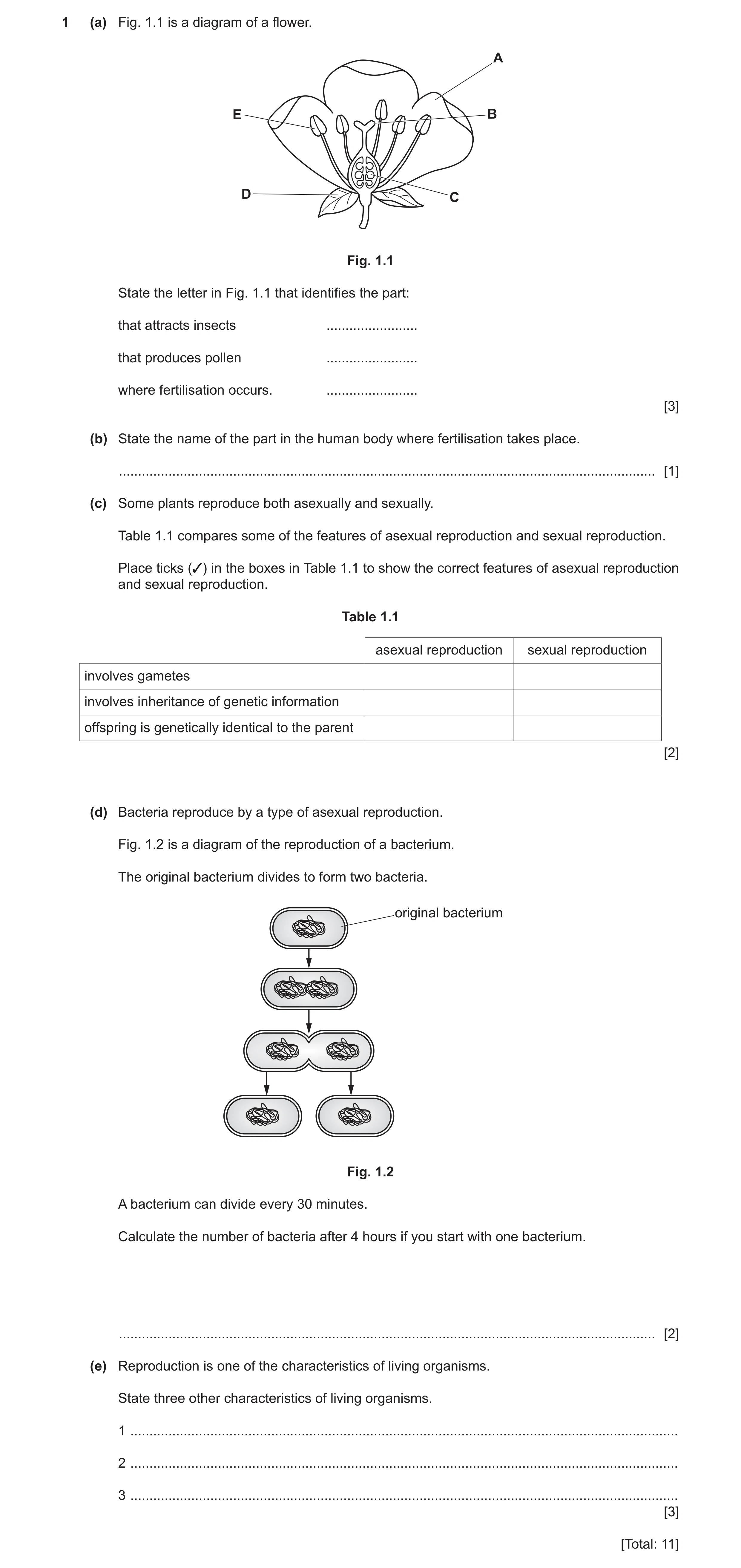
1 (a) Fig. 1.1 is a diagram of a flower. A E B D C Fig. 1.1 State the letter in Fig. 1.1 that identifies the part: that attracts insects … that produces pollen … where fertilisation occurs. … [3] (b) State the name of the part in the human body where fertilisation takes place. … [1] (c) Some plants reproduce both asexually and sexually. Table 1.1 compares some of the features of asexual reproduction and sexual reproduction. Place ticks (3) in the boxes in Table 1.1 to show the correct features of asexual reproduction and sexual reproduction. Table 1.1 asexual reproduction sexual reproduction involves gametes involves inheritance of genetic information offspring is genetically identical to the parent [2] (d) Bacteria reproduce by a type of asexual reproduction. Fig. 1.2 is a diagram of the reproduction of a bacterium. The original bacterium divides to form two bacteria. original bacterium Fig. 1.2 A bacterium can divide every 30 minutes. Calculate the number of bacteria after 4 hours if you start with one bacterium. … [2] (e) Reproduction is one of the characteristics of living organisms. State three other characteristics of living organisms. 1 … 2 … 3 … [3] [Total: 11]
11 marks
Mark scheme: 1(a) A ; E ; C ; 3 1(b) oviduct ; 1 1(c) asexual reproduction sexual reproduction involves gametes involves inheritance of genetic information offspring is genetically identical to the parent ;; 2 1(d) ref to 8 divisions ; 28 = 256 ; 2 1(e) any three from: movement ; respiration ; sensitivity ; growth ; excretion ; nutrition ; 3
This question in 0654/33 May/June 2023
Q15 · A student investigates the conditions required for the germination of seeds 0654/31 Oct/Nov 2023
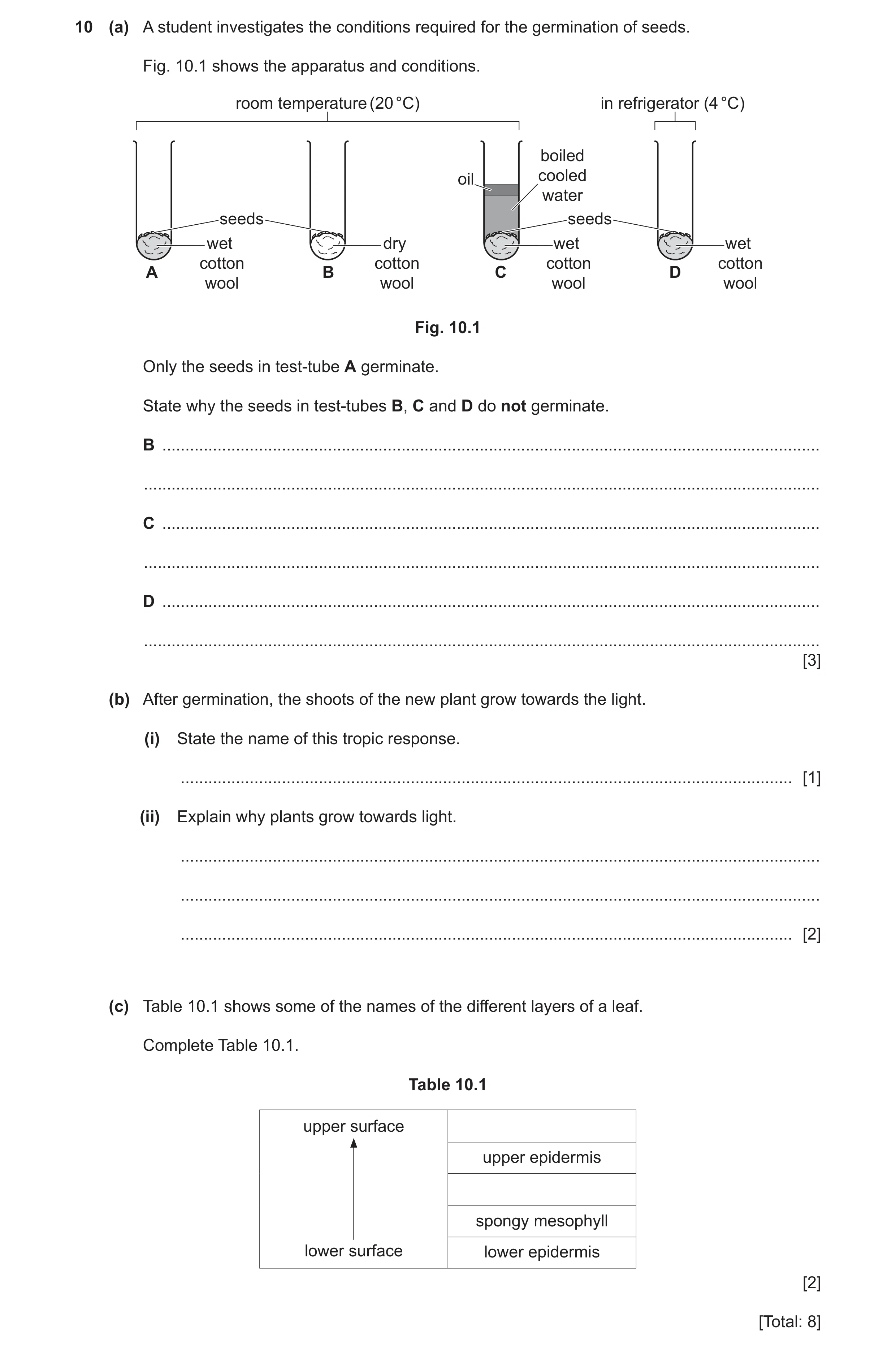
10 (a) A student investigates the conditions required for the germination of seeds. Fig. 10.1 shows the apparatus and conditions. room temperature (20 °C) in refrigerator (4 °C) boiled oil cooled water seeds seeds wet dry wet wet cotton cotton cotton cotton A B C D wool wool wool wool Fig. 10.1 Only the seeds in test-tube A germinate. State why the seeds in test-tubes B, C and D do not germinate. B … … C … … D … … [3] (b) After germination, the shoots of the new plant grow towards the light. (i) State the name of this tropic response. … [1] (ii) Explain why plants grow towards light. … … … [2] (c) Table 10.1 shows some of the names of the different layers of a leaf. Complete Table 10.1. Table 10.1 upper surface upper epidermis spongy mesophyll lower surface lower epidermis [2] [Total: 8]
8 marks
Mark scheme: 10(a) B – seeds did not have, water / moisture ; 3 C – seeds did not have oxygen ; D – seeds did not have, a suitable temperature / warmth ; 10(b)(i) phototropism ; 1 10(b)(ii) maximise exposure to light / increase light intensity / ref to requiring light → energy ; 2 for photosynthesis ; 10(c) cuticle ; 2 palisade (mesophyll) ;
This question in 0654/31 Oct/Nov 2023
Q16 · Reproduction is one of the characteristics of living things 0654/33 Oct/Nov 2023
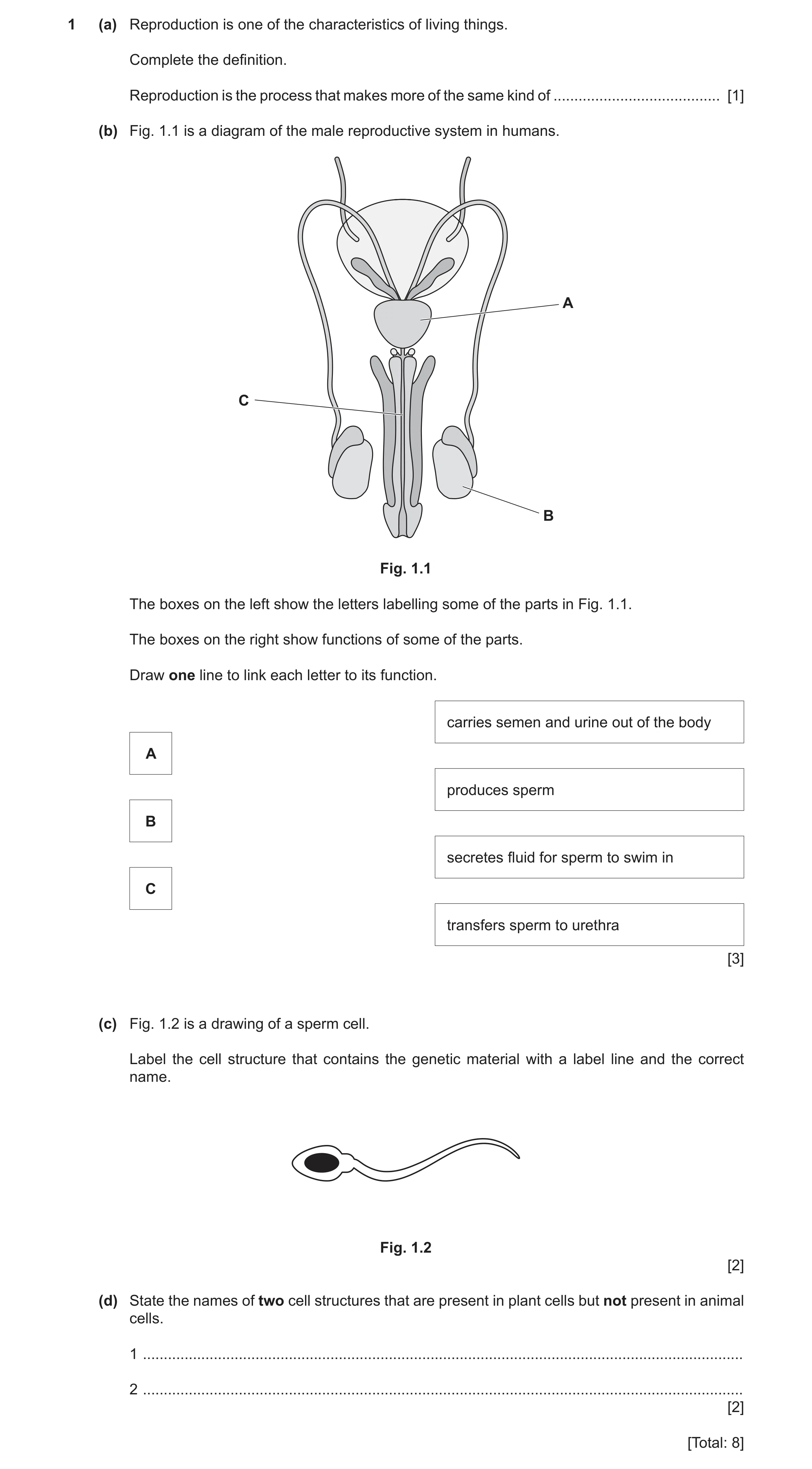
1 (a) Reproduction is one of the characteristics of living things. Complete the definition. Reproduction is the process that makes more of the same kind of … [1] (b) Fig. 1.1 is a diagram of the male reproductive system in humans. A C B Fig. 1.1 The boxes on the left show the letters labelling some of the parts in Fig. 1.1. The boxes on the right show functions of some of the parts. Draw one line to link each letter to its function. carries semen and urine out of the body A produces sperm B secretes fluid for sperm to swim in C transfers sperm to urethra [3] (c) Fig. 1.2 is a drawing of a sperm cell. Label the cell structure that contains the genetic material with a label line and the correct name. Fig. 1.2 [2] (d) State the names of two cell structures that are present in plant cells but not present in animal cells. 1 … 2 … [2] [Total: 8]
8 marks
Mark scheme: Question Answer Marks 1(a) organism ; 1 1(b) 3 carries semen and urine out of the body A produces sperm B secretes fluid for sperm to swim in C transfers sperm to urethra 1 mark for each line ;;; 1(c) nucleus correctly labelled 2 labelling correct structure ; correct name ; 1(d) any two from: 2 chloroplast ; cell wall ; (permanent) vacuole ;
This question in 0654/33 Oct/Nov 2023
Q17 · Euglena are single-celled organisms that have features of both animal and plant cells 0654/31 Oct/Nov 2024
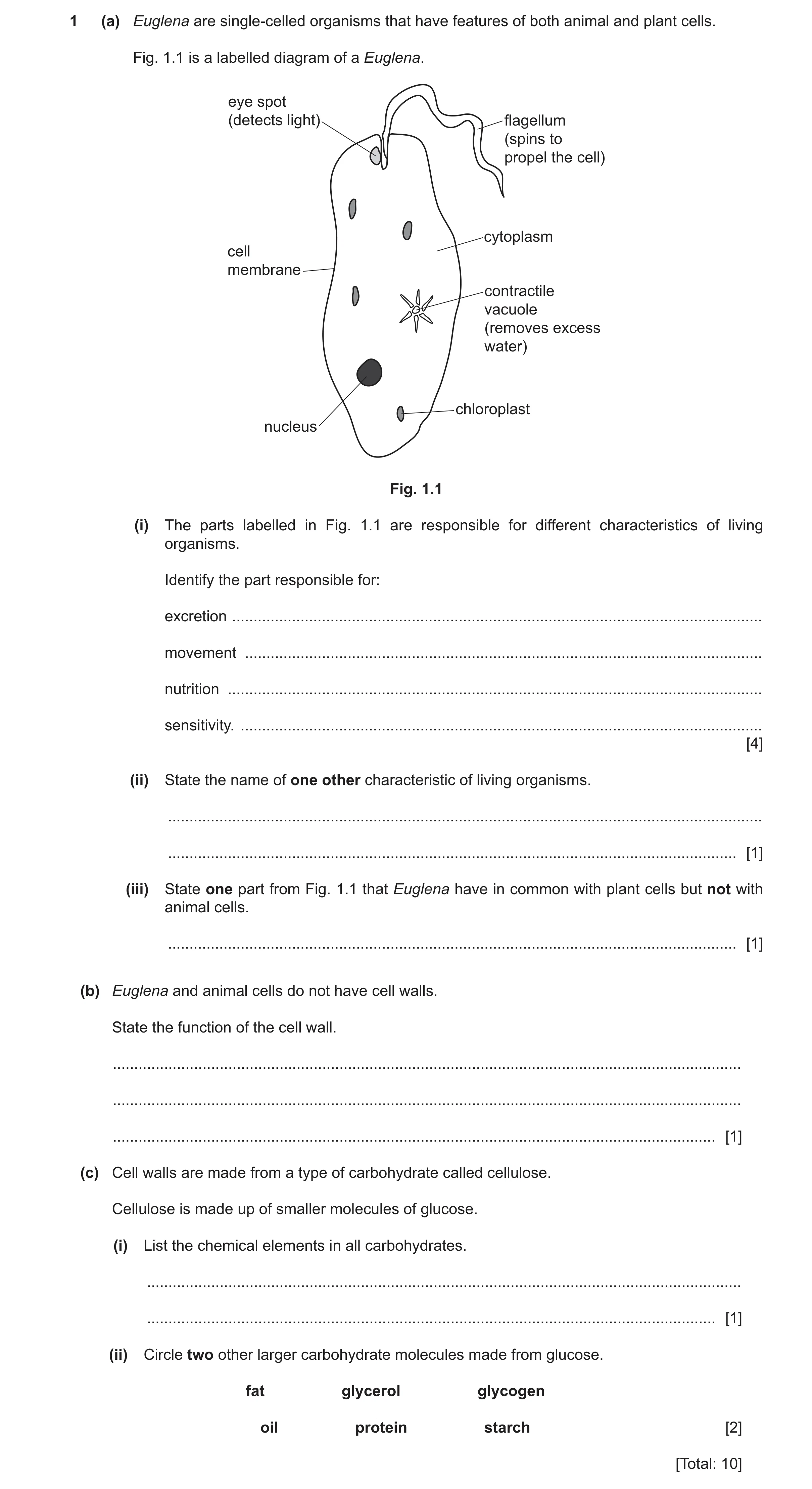
1 (a) Euglena are single-celled organisms that have features of both animal and plant cells. Fig. 1.1 is a labelled diagram of a Euglena. eye spot (detects light) flagellum (spins to propel the cell) cytoplasm cell membrane contractile vacuole (removes excess water) chloroplast nucleus Fig. 1.1 (i) The parts labelled in Fig. 1.1 are responsible for different characteristics of living organisms. Identify the part responsible for: excretion … movement … nutrition … sensitivity. … [4] (ii) State the name of one other characteristic of living organisms. … … [1] (iii) State one part from Fig. 1.1 that Euglena have in common with plant cells but not with animal cells. … [1] (b) Euglena and animal cells do not have cell walls. State the function of the cell wall. … … … [1] (c) Cell walls are made from a type of carbohydrate called cellulose. Cellulose is made up of smaller molecules of glucose. (i) List the chemical elements in all carbohydrates. … … [1] (ii) Circle two other larger carbohydrate molecules made from glucose. fat glycerol glycogen oil protein starch [2] [Total: 10]
10 marks
Mark scheme: Question Answer Marks 1(a)(i) contractile vacuole ; 4 flagellum ; chloroplast ; eyespot ; 1(a)(ii) respiration / growth / reproduction ; 1 1(a)(iii) chloroplast ; 1 1(b) strengthen cell / AW ; 1 1(c)(i) carbon, hydrogen, oxygen ; 1 1(c)(ii) glycogen circled ; 2 starch circled ;
This question in 0654/31 Oct/Nov 2024
Q18 · A diagram of a plant cell 0654/32 Feb/March 2025
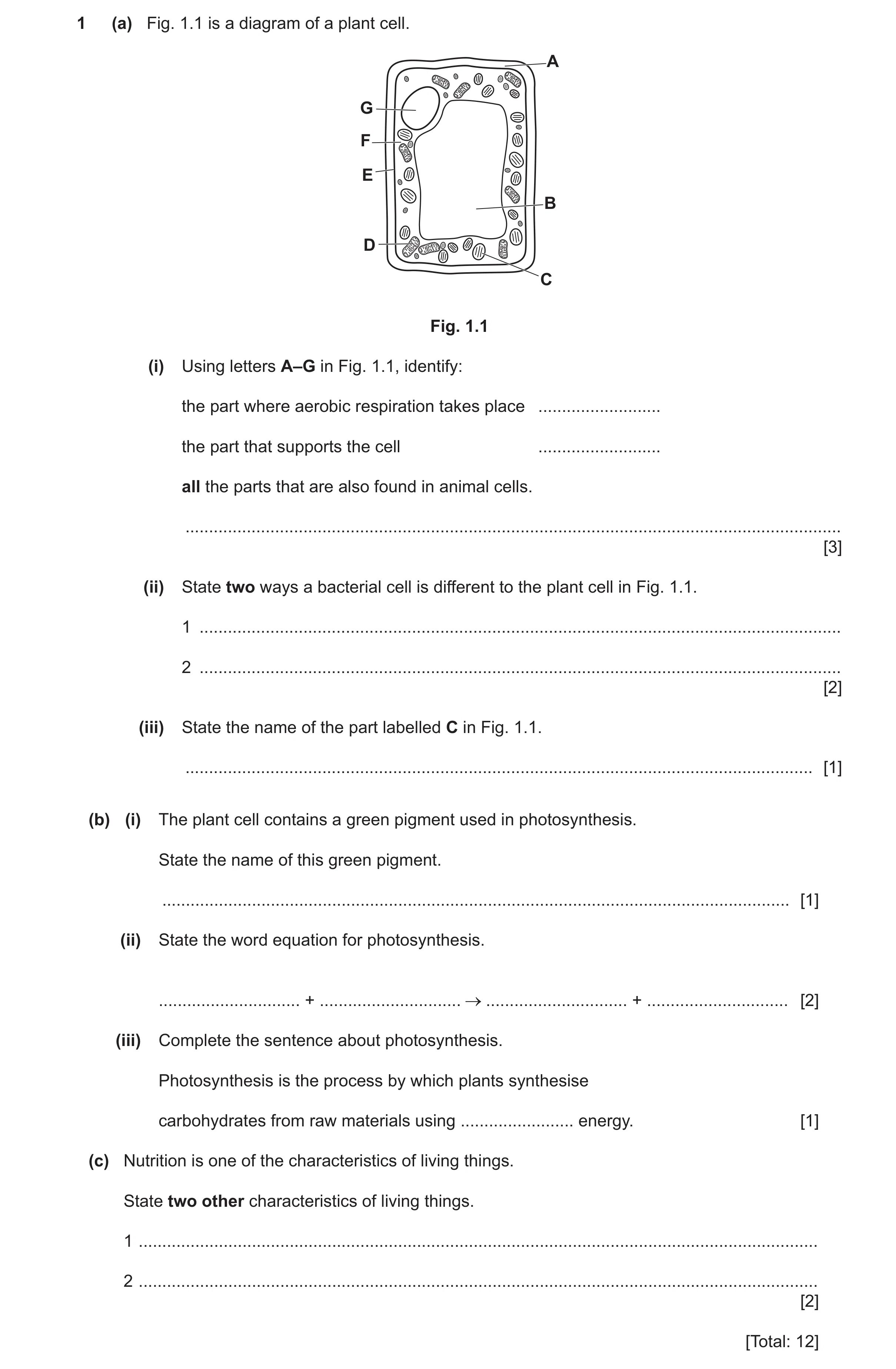
1 (a) Fig. 1.1 is a diagram of a plant cell. A G F E B D C Fig. 1.1 (i) Using letters A–G in Fig. 1.1, identify: the part where aerobic respiration takes place … the part that supports the cell … all the parts that are also found in animal cells. … [3] (ii) State two ways a bacterial cell is different to the plant cell in Fig. 1.1. 1 … 2 … [2] (iii) State the name of the part labelled C in Fig. 1.1. … [1] (b) (i) The plant cell contains a green pigment used in photosynthesis. State the name of this green pigment. … [1] (ii) State the word equation for photosynthesis. … + … … + … [2] (iii) Complete the sentence about photosynthesis. Photosynthesis is the process by which plants synthesise carbohydrates from raw materials using … energy. [1] (c) Nutrition is one of the characteristics of living things. State two other characteristics of living things. 1 … 2 … [2] [Total: 12]
12 marks
Mark scheme: Question Answer Marks 1(a)(i) D ; 3 A or B ; D, E, F and G ; 1(a)(ii) any two from: 2 no nucleus / G no chloroplast / C no mitochondria / D no vacuole / B ;; 1(a)(iii) chloroplast ; 1 1(b)(i) chlorophyll ; 1 1(b)(ii) LHS 2 carbon dioxide + water ; RHS glucose + oxygen ; 1(b)(iii) light ; 1 1(c) any two from: 2 movement respiration sensitivity growth reproduction excretion ;;
This question in 0654/32 Feb/March 2025
 1 / 24
 2 / 24
 3 / 24
 4 / 24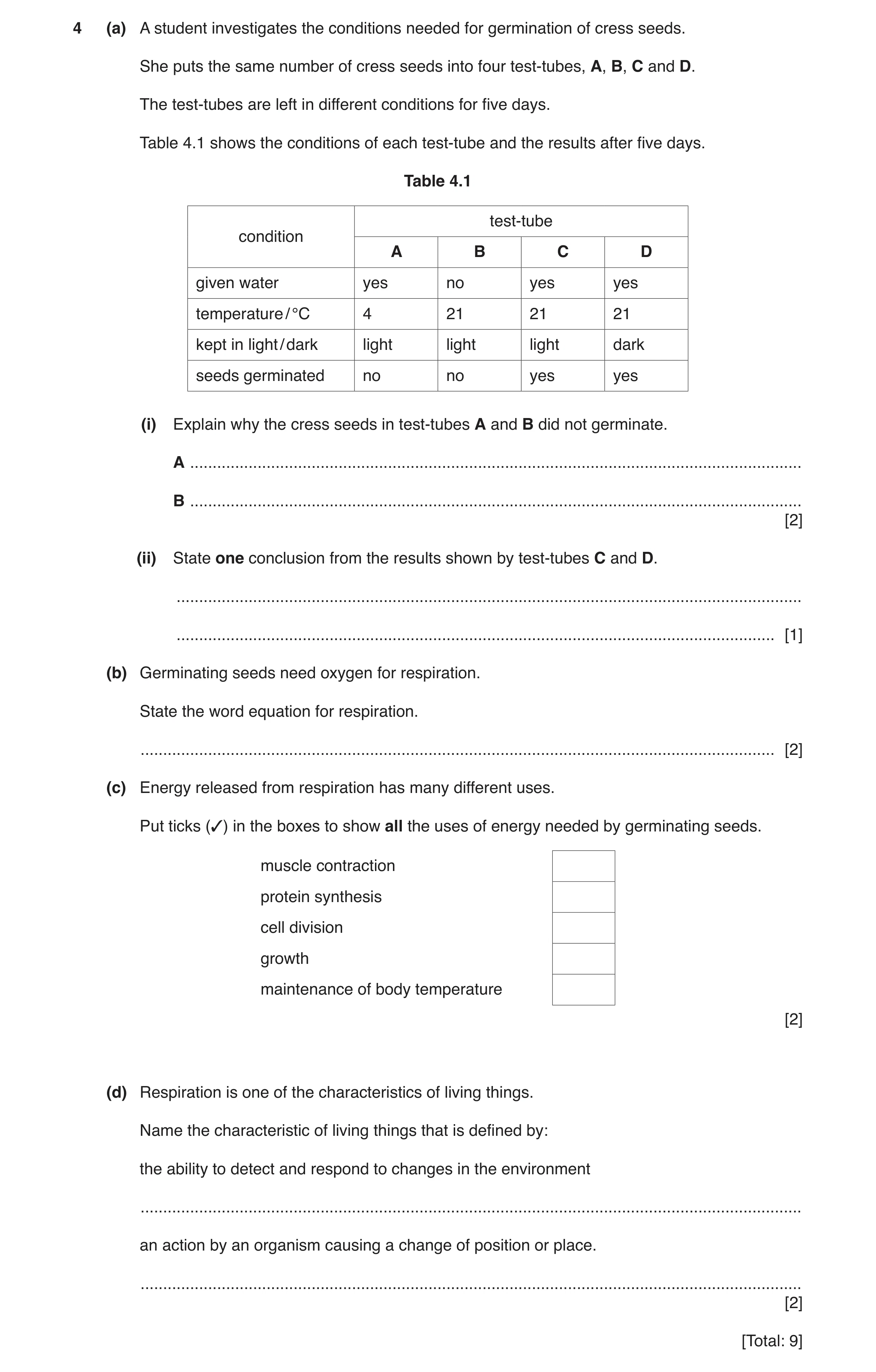
 10 / 24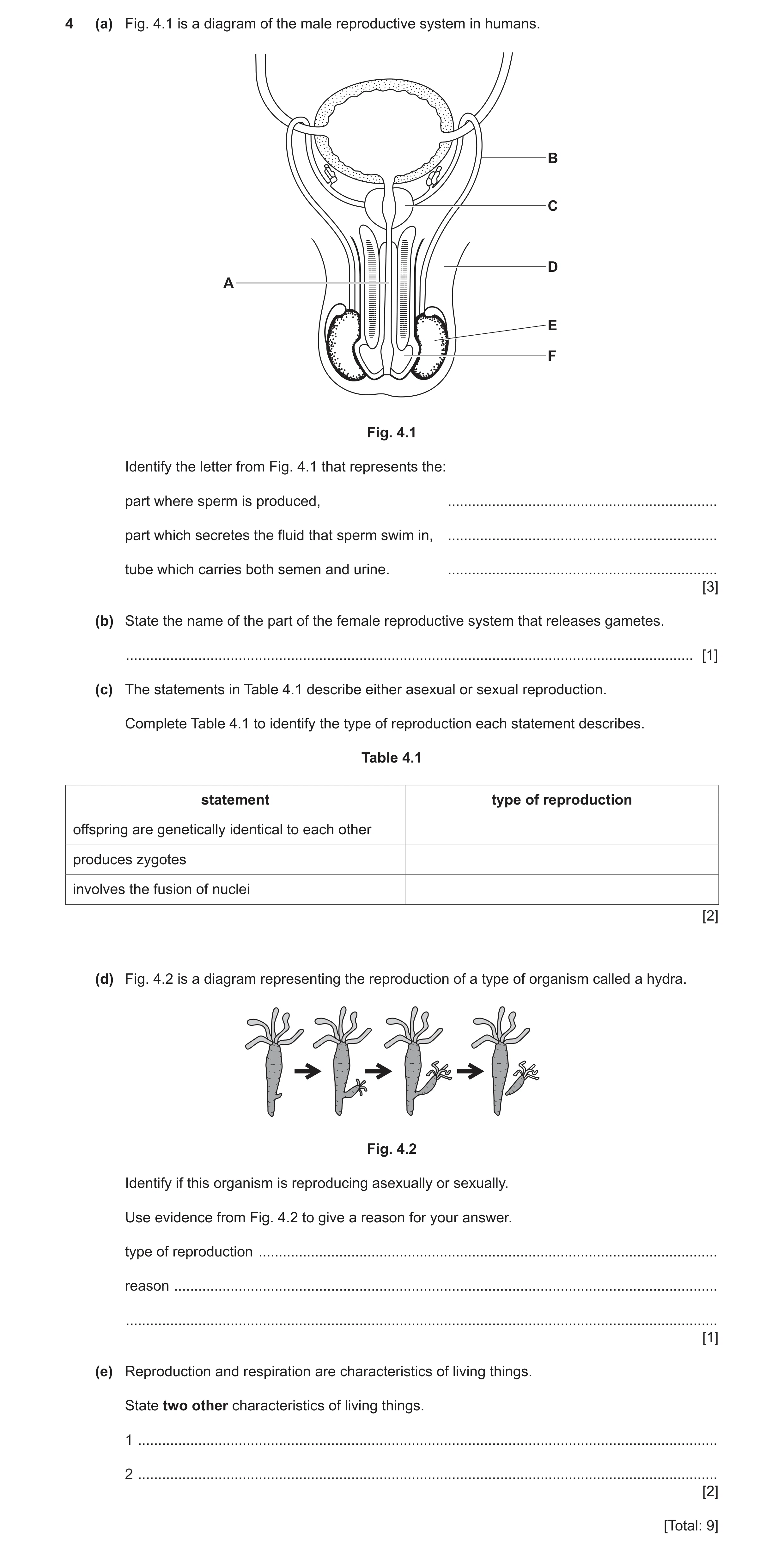
 8
8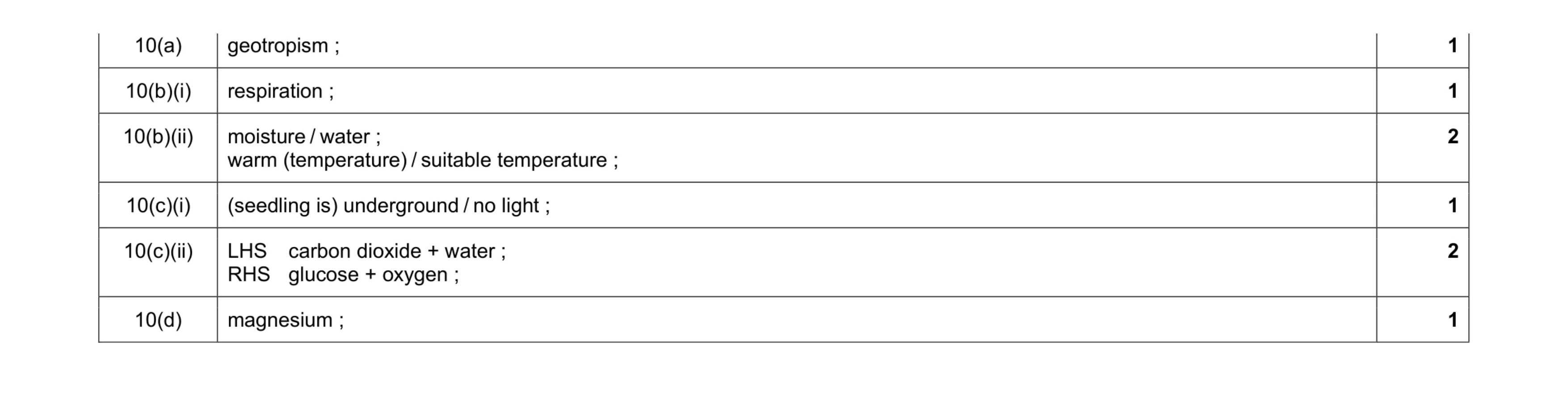 8
8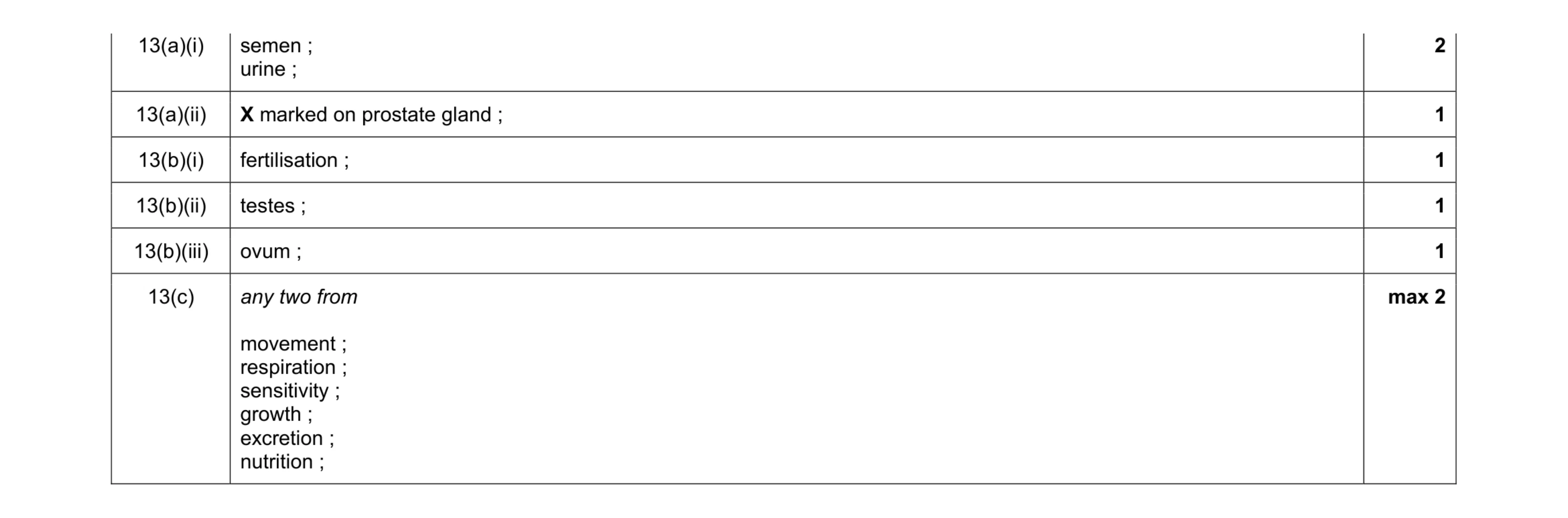 8
8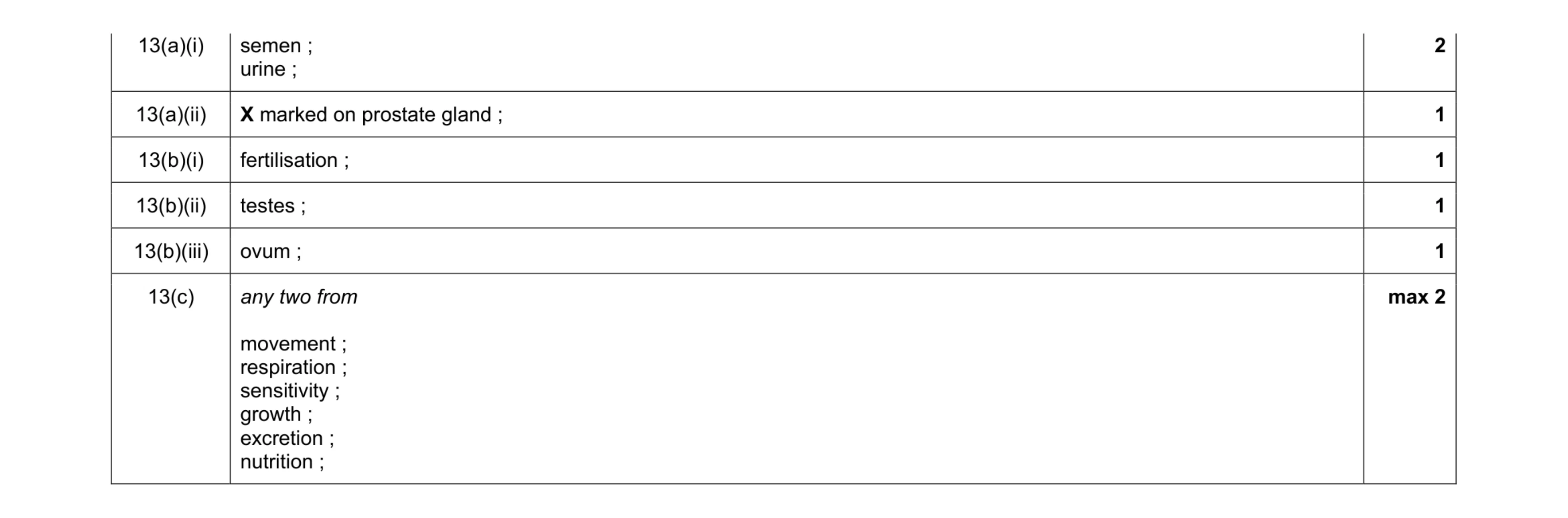 8
8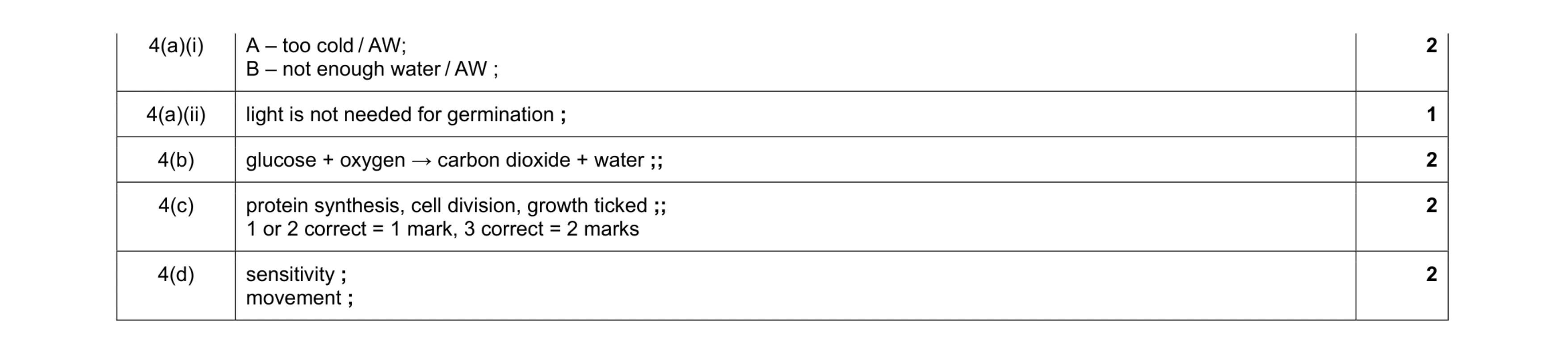 9
9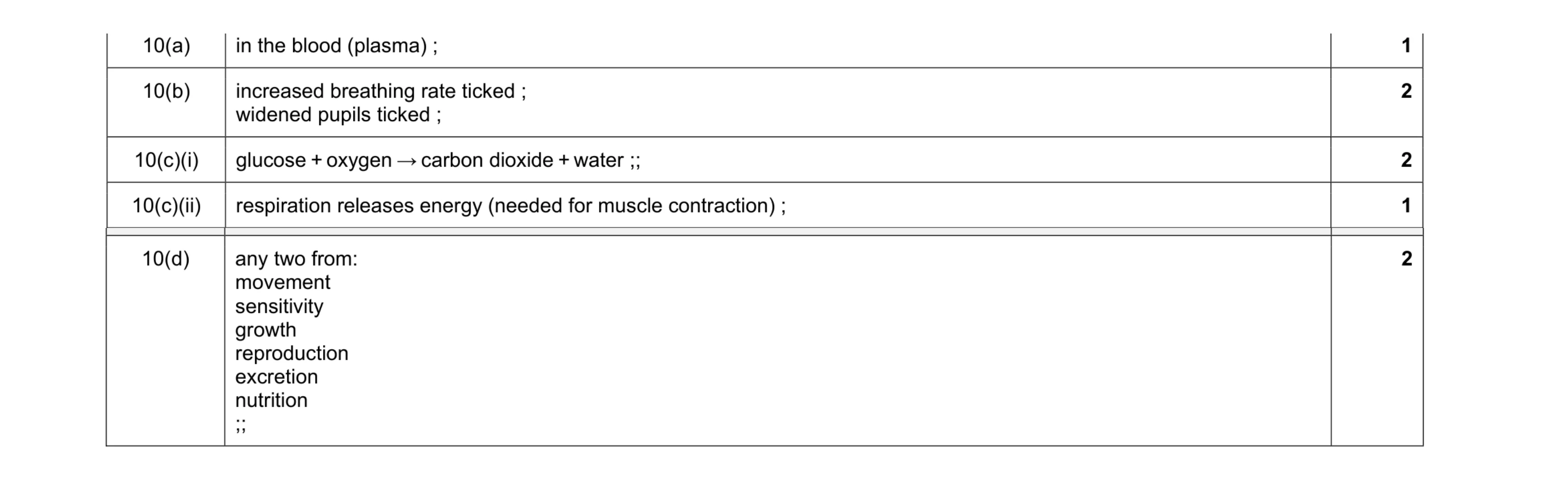 8
8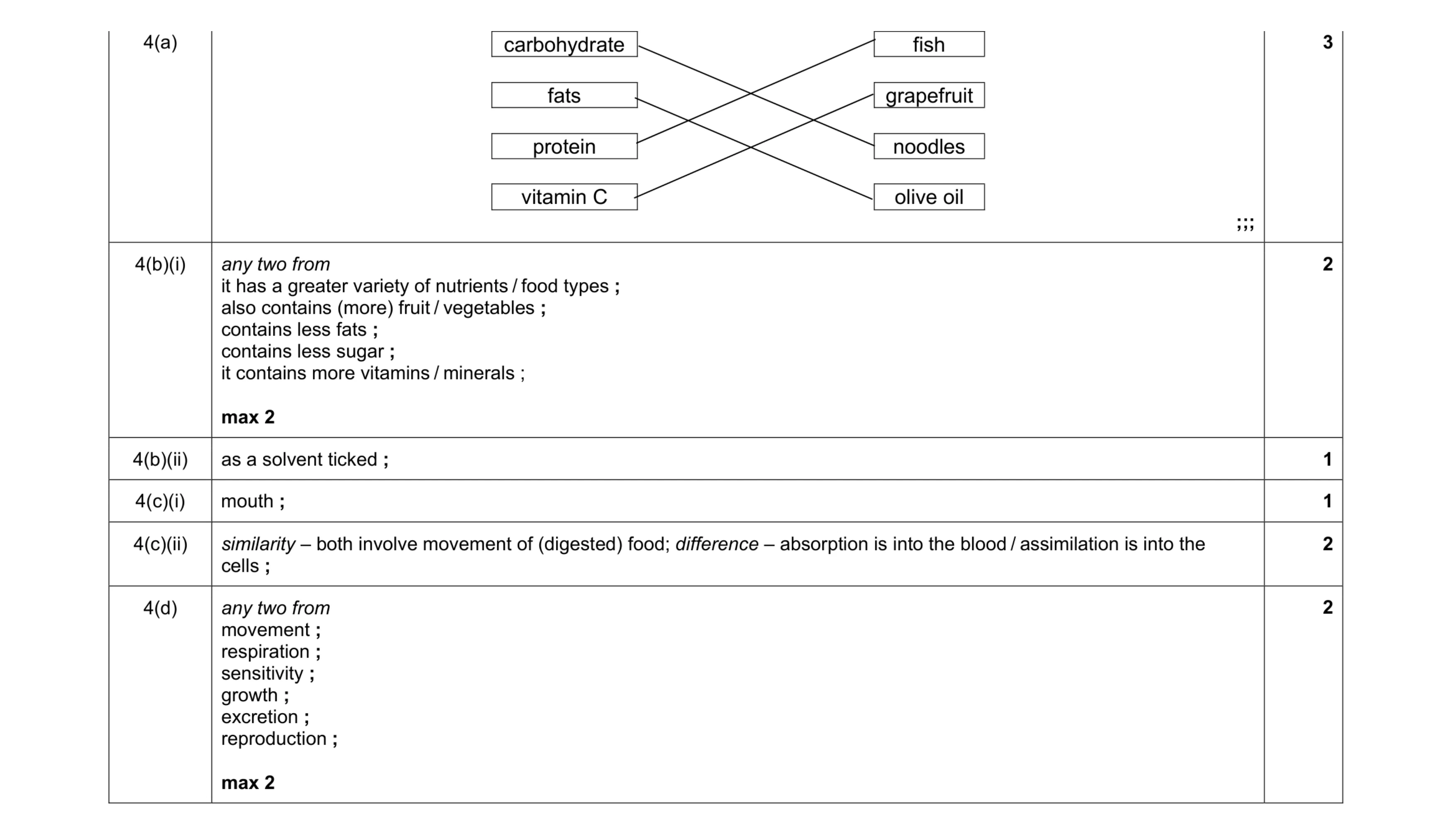 11
11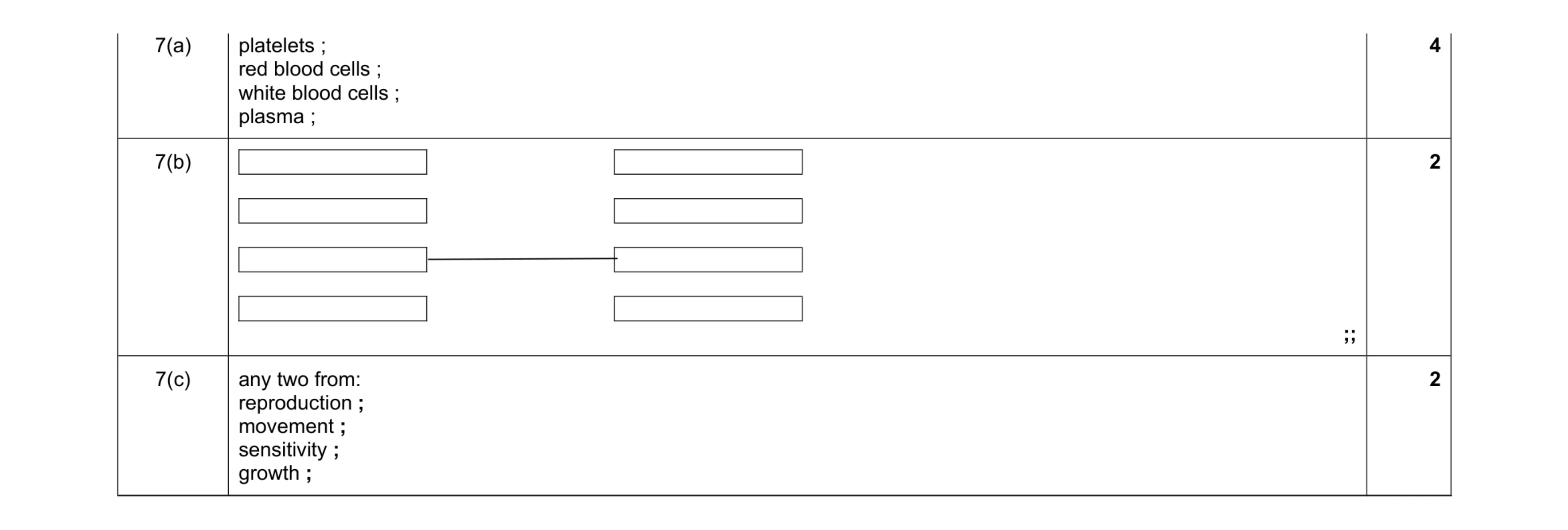 8
8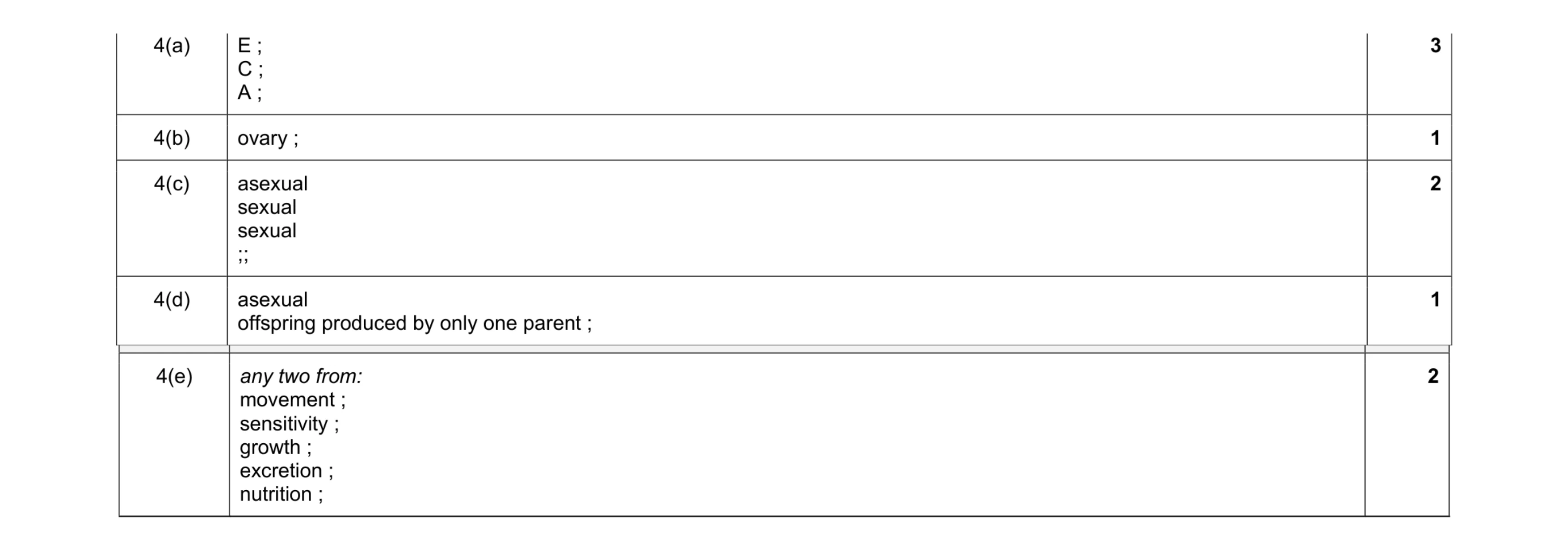 9
9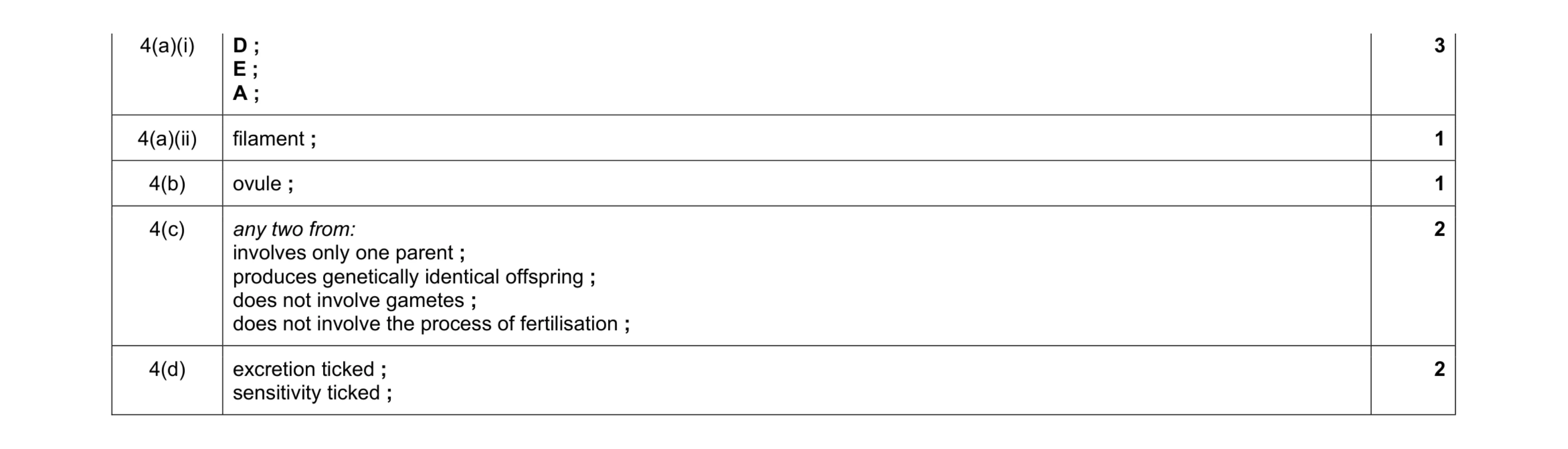 9
9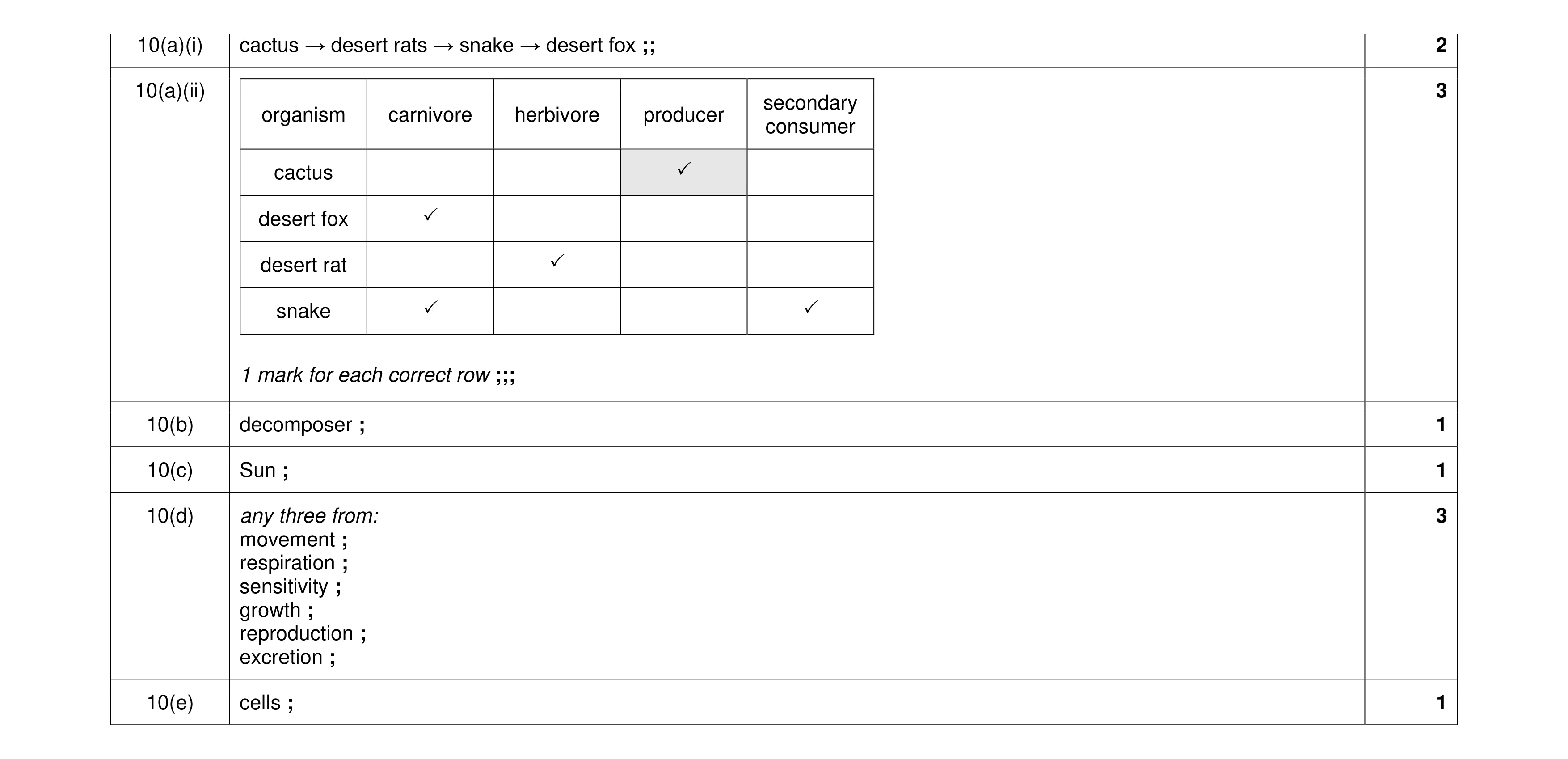 11
11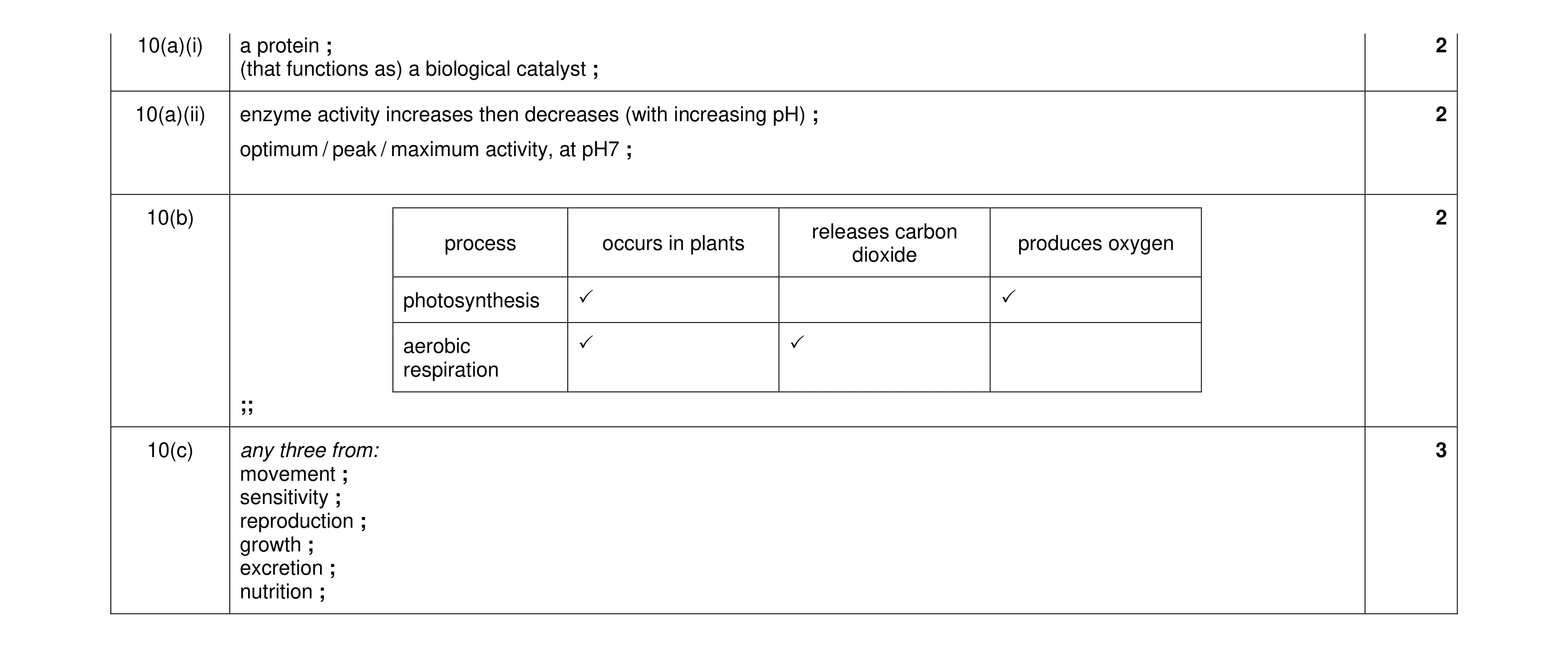 9
9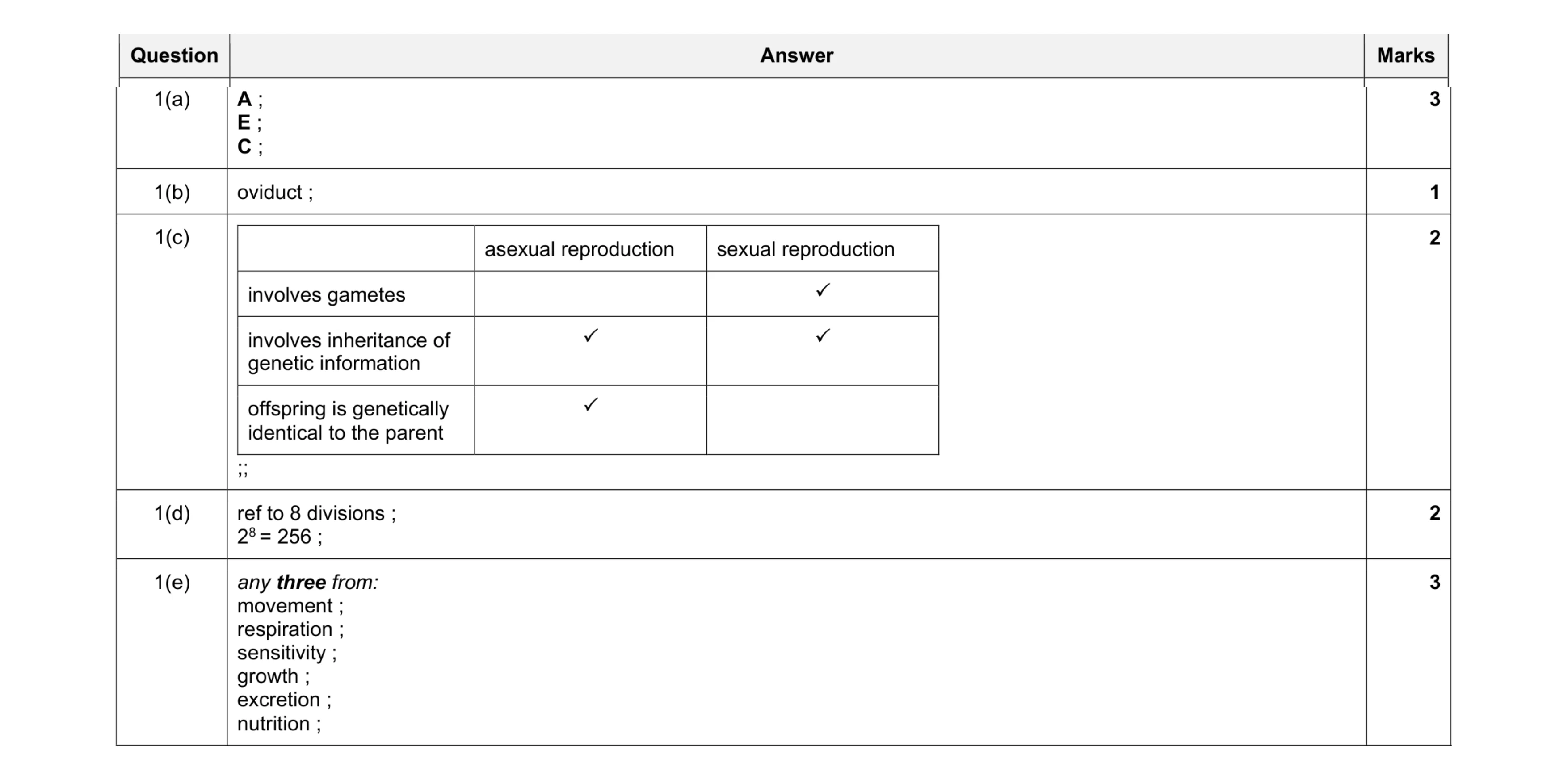 11
11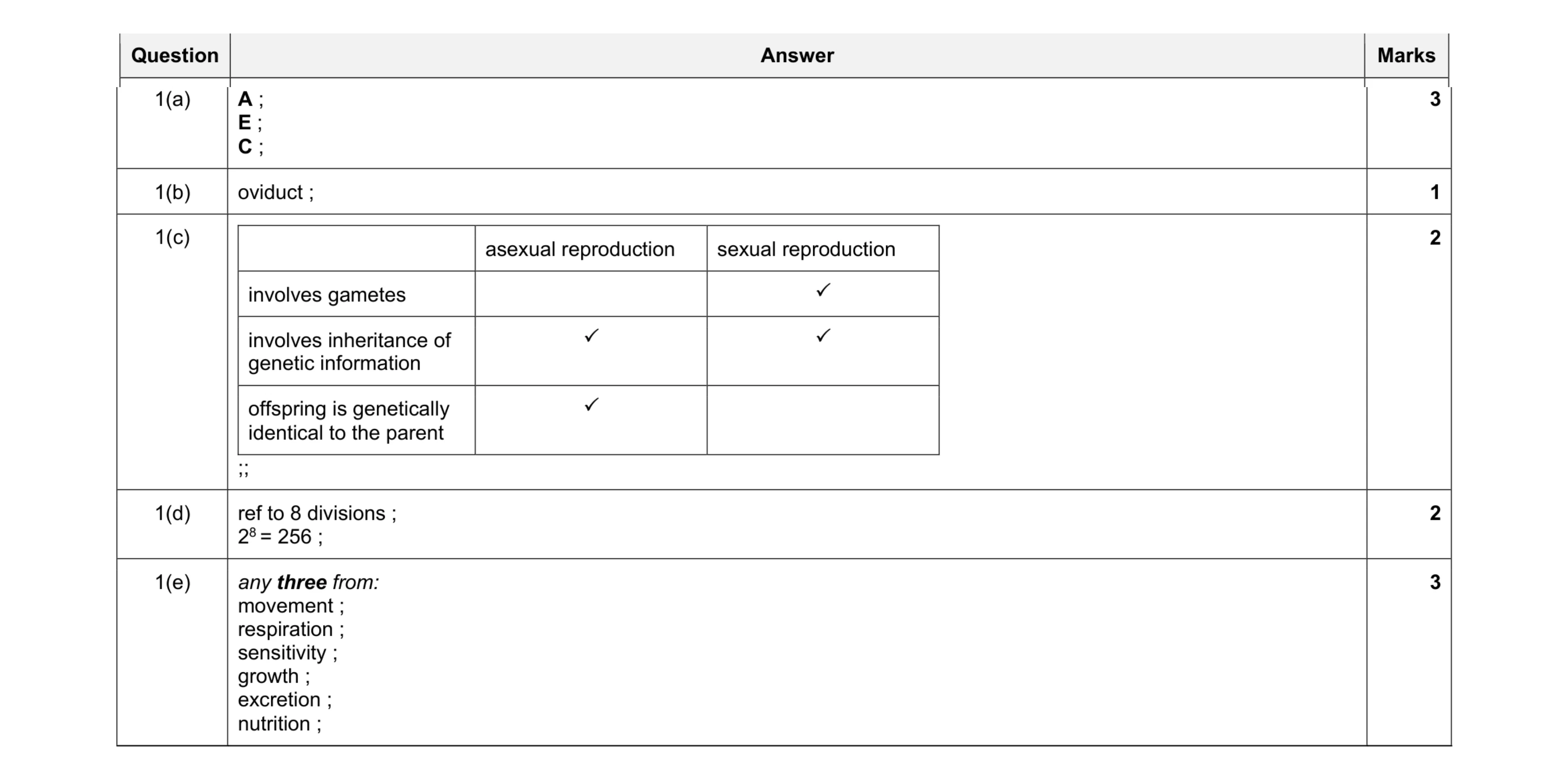 11
11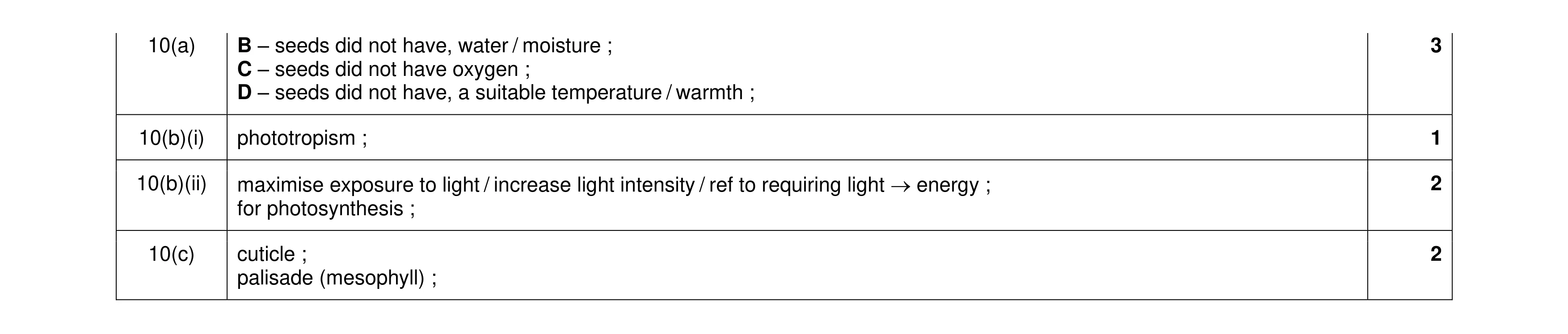 8
8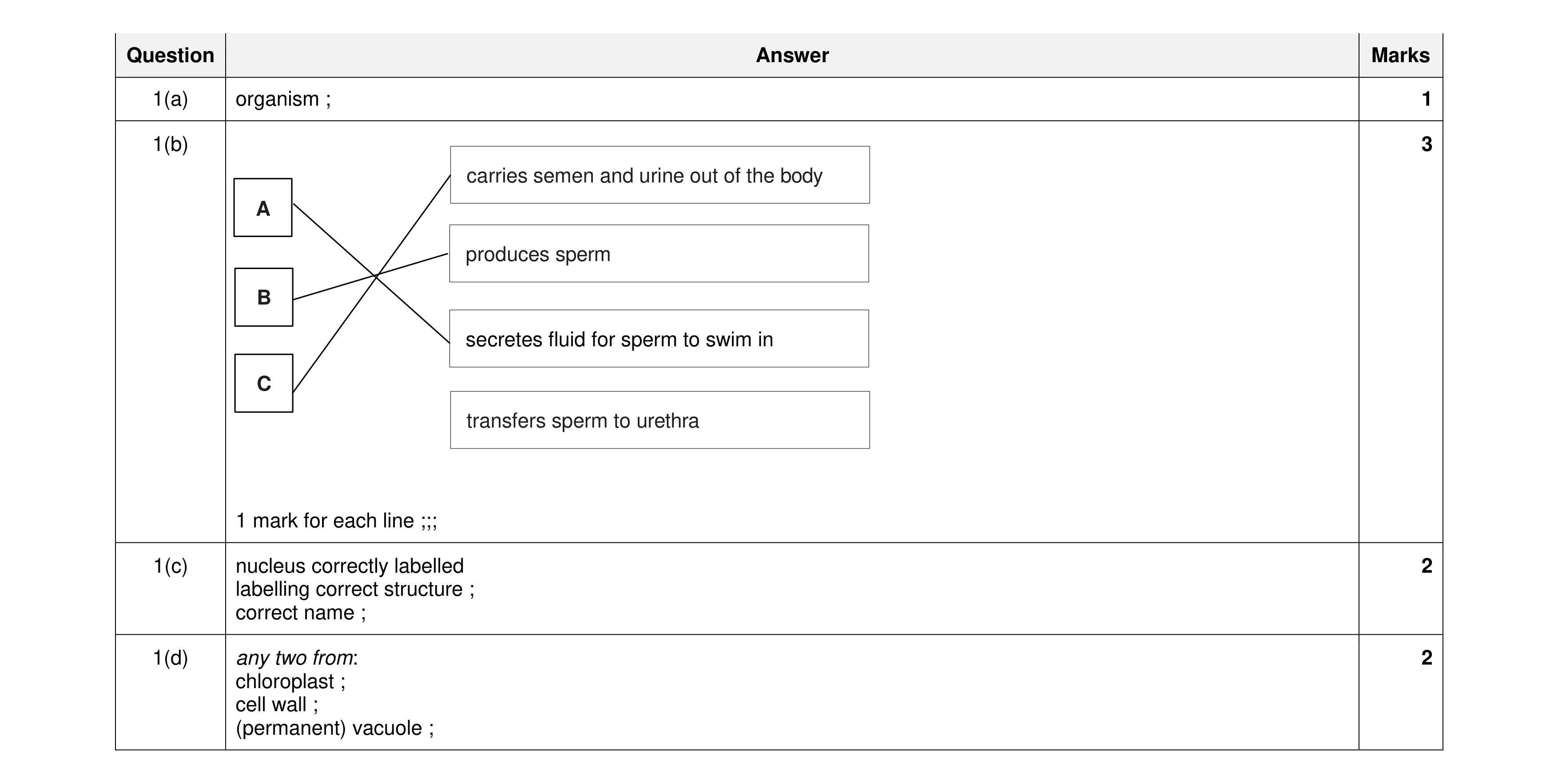 8
8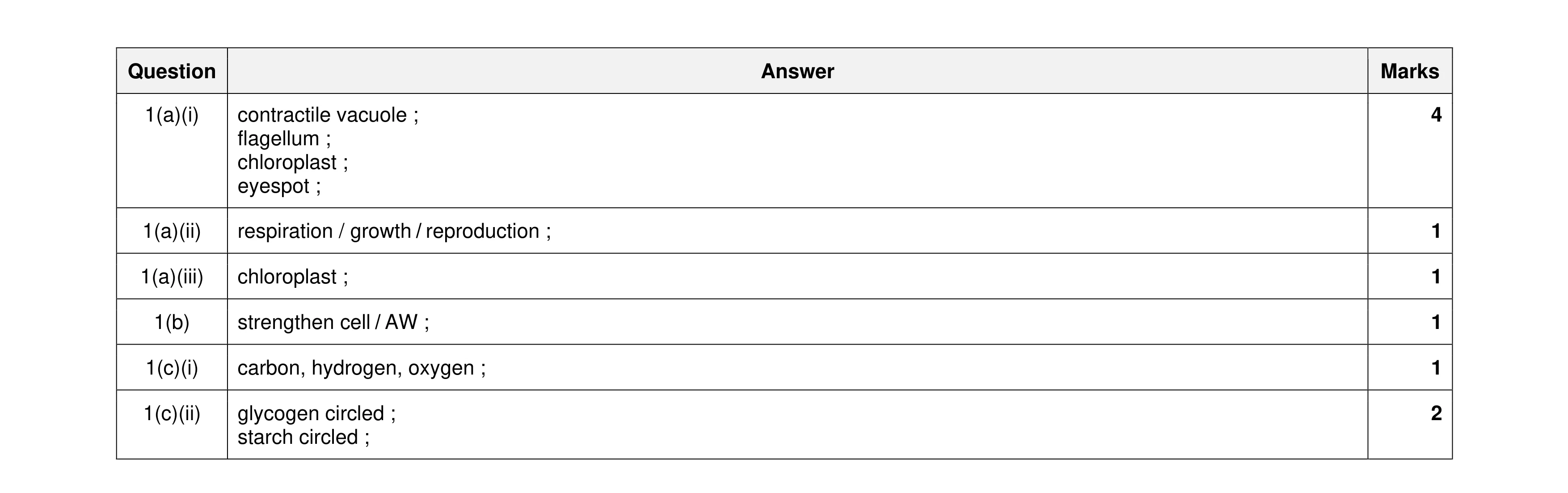 10
10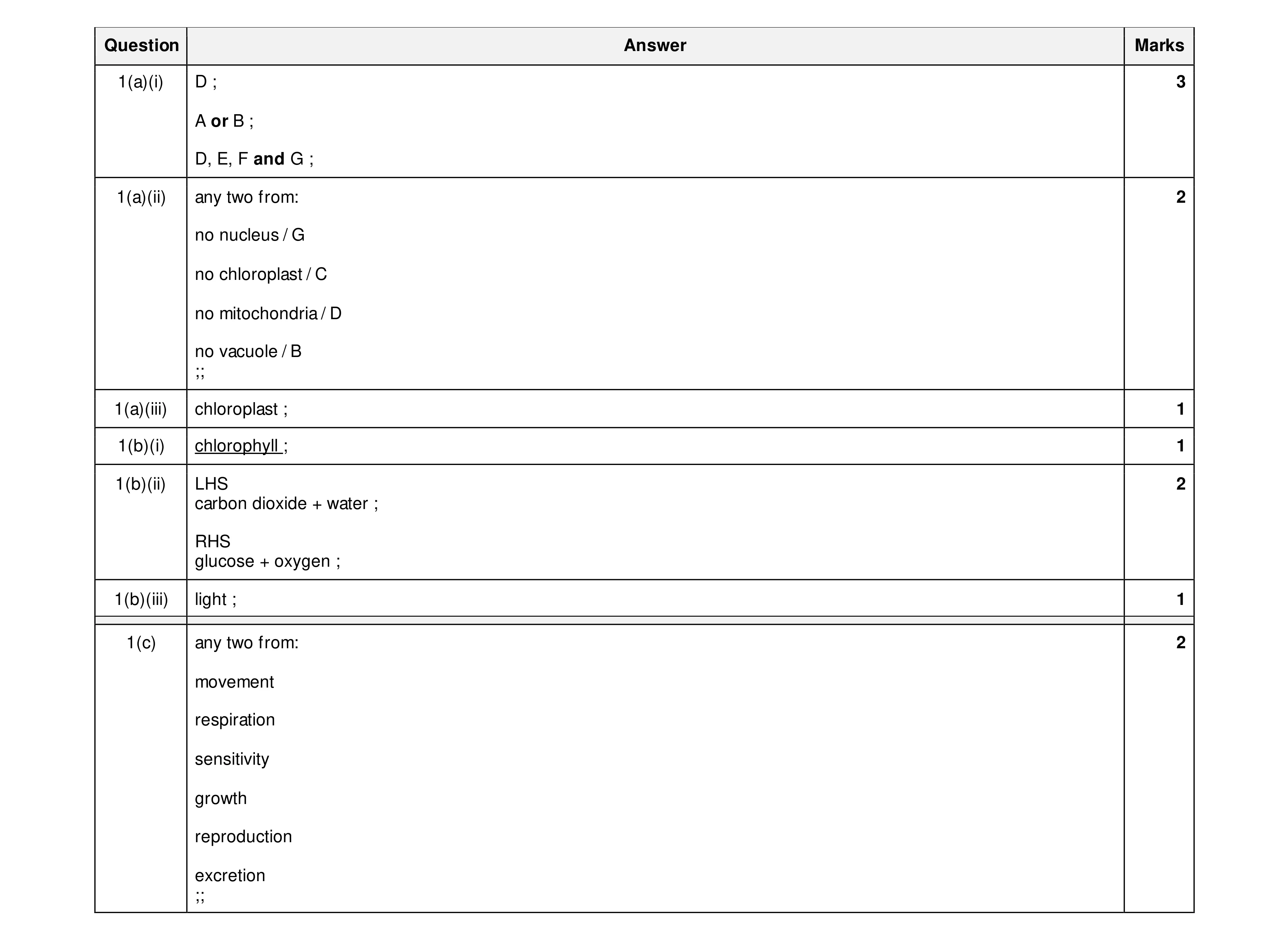 12
12