Questions as text
Q1 · A student carries out an investigation of the growth of a plant shoot by auxins 0654/42 May/June 2017
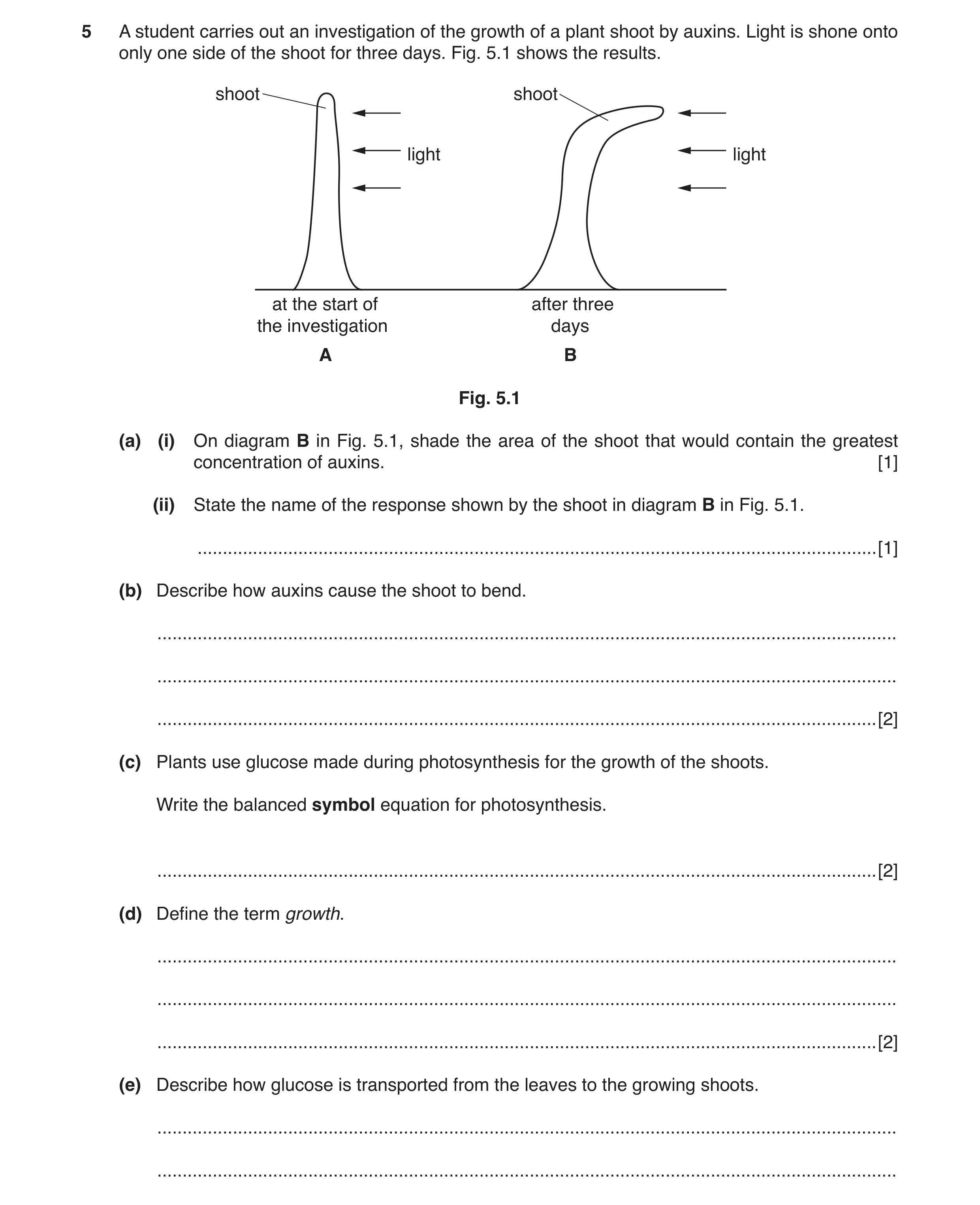
5 A student carries out an investigation of the growth of a plant shoot by auxins. Light is shone onto only one side of the shoot for three days. Fig. 5.1 shows the results. shoot shoot light light at the start of after three the investigation days A B Fig. 5.1 (a) (i) On diagram B in Fig. 5.1, shade the area of the shoot that would contain the greatest concentration of auxins. [1] (ii) State the name of the response shown by the shoot in diagram B in Fig. 5.1. … [1] (b) Describe how auxins cause the shoot to bend. … … … [2] (c) Plants use glucose made during photosynthesis for the growth of the shoots. Write the balanced symbol equation for photosynthesis. … [2] (d) Define the term growth. … … … [2] (e) Describe how glucose is transported from the leaves to the growing shoots. … …
10 marks
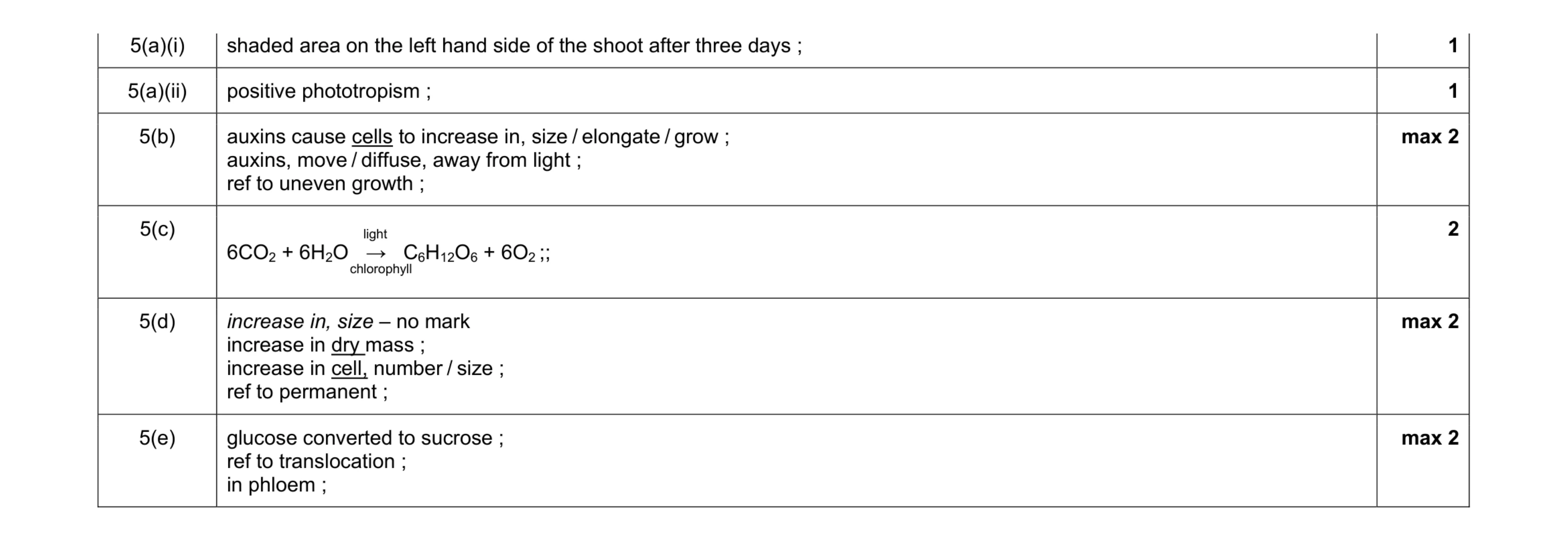
Mark scheme: 5(a)(i) shaded area on the left hand side of the shoot after three days ; 1 5(a)(ii) positive phototropism ; 1 5(b) auxins cause cells to increase in, size / elongate / grow ; auxins, move / diffuse, away from light ; ref to uneven growth ; max 2 5(c) light 6CO2 + 6H2O → C6H12O6 + 6O2 ;; chlorophyll 2 5(d) increase in, size – no mark increase in dry mass ; increase in cell, number / size ; ref to permanent ; max 2 5(e) glucose converted to sucrose ; ref to translocation ; in phloem ; max 2
This question in 0654/42 May/June 2017
Question 2 0654/43 Oct/Nov 2019
1 (a) Respiration releases energy. It can occur aerobically or anaerobically. (i) State the balanced chemical equation for aerobic respiration. … [2] (ii) Name the product of anaerobic respiration in muscles. … [1] (iii) Name the two products of anaerobic respiration in yeast. 1 … 2 … [2] (b) Respiration is one of the characteristics of living organisms. State two other characteristics of living organisms. 1 … 2 … [2] [Total: 7]
7 marks
Mark scheme: 1(a)(i) C6H12O6 + 6O2 → 6CO2 + 6H2O correct LHS ; correct RHS ; 2 1(a)(ii) lactic acid ; 1 1(a)(iii) alcohol ; carbon dioxide ; 2 1(b) any two from movement ; reproduction ; sensitivity ; growth ; excretion ; nutrition ; max 2 2
This question in 0654/43 Oct/Nov 2019
Q3 · Plant shoots respond to stimuli such as light 0654/41 May/June 2020
10 (a) Plant shoots respond to stimuli such as light. Fig. 10.1 shows the growth response of a shoot to light. direction of light shoot Fig. 10.1 (i) Name the response shown in Fig. 10.1. … [1] (ii) Draw an X on Fig. 10.1 to show the area with the greatest cell elongation. [1] (iii) Name the hormone that controls cell elongation. … [1] (b) Fig. 10.2 shows a plant shoot with the tip removed. direction of light shoot Fig. 10.2 State why the shoot in Fig. 10.2 did not bend. … … [1] (c) Explain why plants need magnesium ions for photosynthesis and healthy growth. Use ideas about energy in your answer. … … … … … … [3] (d) Growth is one of the characteristics of living things. (i) Complete the definition of the term growth. Growth is a … increase in size and dry … by an increase in cell number or cell size or both. [2] (ii) State the name of two other characteristics of living things. 1 … 2 … [2] [Total: 11]
11 marks
Mark scheme: 10(a)(i) phototropism ; 1 10(a)(ii) X drawn on the upper side of the shoot bend ; 1 10(a)(iii) auxin ; 1 10(b) auxin / hormone / chemical, produced at the shoot tip ; 1 10(c) magnesium ions required to make chlorophyll ; chlorophyll absorbs light energy (and converts this to chemical energy) ; (chemical) energy used to synthesise, carbohydrates or glucose / carbohydrates or glucose are used to make proteins (for growth) ; 3 10(d)(i) permanent ; mass ; 2 10(d)(ii) any two from: movement reproduction sensitivity excretion nutrition respiration ;; 2
This question in 0654/41 May/June 2020
Q4 · The temperature of a person’s skin is recorded in different environmental temperatures 0654/42 Oct/Nov 2020
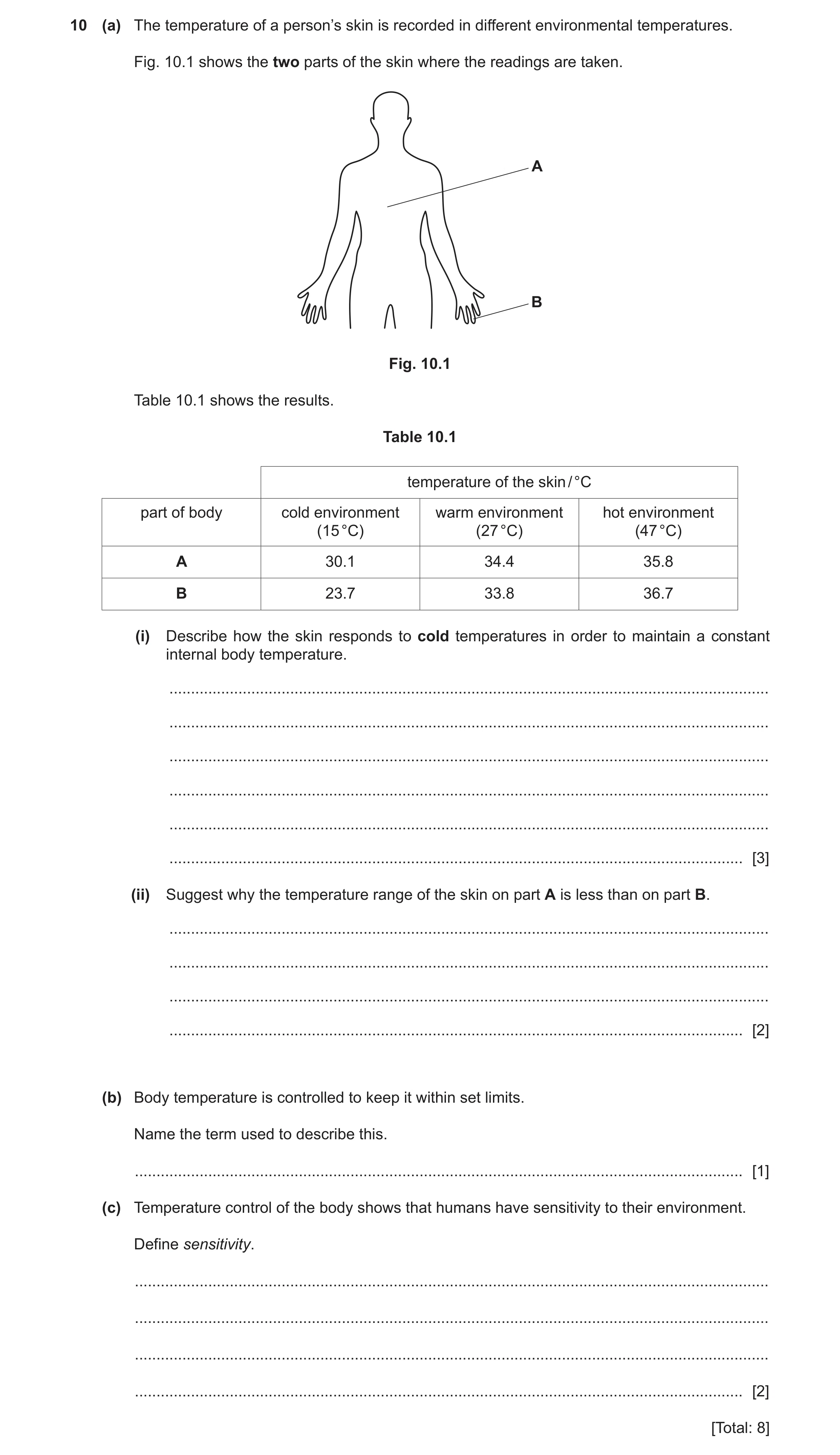
10 (a) The temperature of a person’s skin is recorded in different environmental temperatures. Fig. 10.1 shows the two parts of the skin where the readings are taken. A B Fig. 10.1 Table 10.1 shows the results. Table 10.1 temperature of the skin / °C part of body cold environment warm environment hot environment (15 °C) (27 °C) (47 °C) A 30.1 34.4 35.8 B 23.7 33.8 36.7 (i) Describe how the skin responds to cold temperatures in order to maintain a constant internal body temperature. … … … … … … [3] (ii) Suggest why the temperature range of the skin on part A is less than on part B. … … … … [2] (b) Body temperature is controlled to keep it within set limits. Name the term used to describe this. … [1] (c) Temperature control of the body shows that humans have sensitivity to their environment. Define sensitivity. … … … … [2] [Total: 8]
8 marks
Mark scheme: 10(a)(i) ref to vasoconstriction ; arterioles narrow ; blood flow to, surface capillaries / skin surface, reduced ; less heat lost by radiation ; hair stands on end ; AVP ; max 3 10(a)(ii) part A covers vital organs ; a suitable temperature is required for body / AW to function ; ref to enzymes ; AVP ; 2 10(b) homeostasis ; 1 10(c) ability to detect, stimuli / changes to the environment / surroundings ; and respond ; 2
This question in 0654/42 Oct/Nov 2020
Q5 · Sensitivity is one of the characteristics of living organisms 0654/42 Feb/March 2022
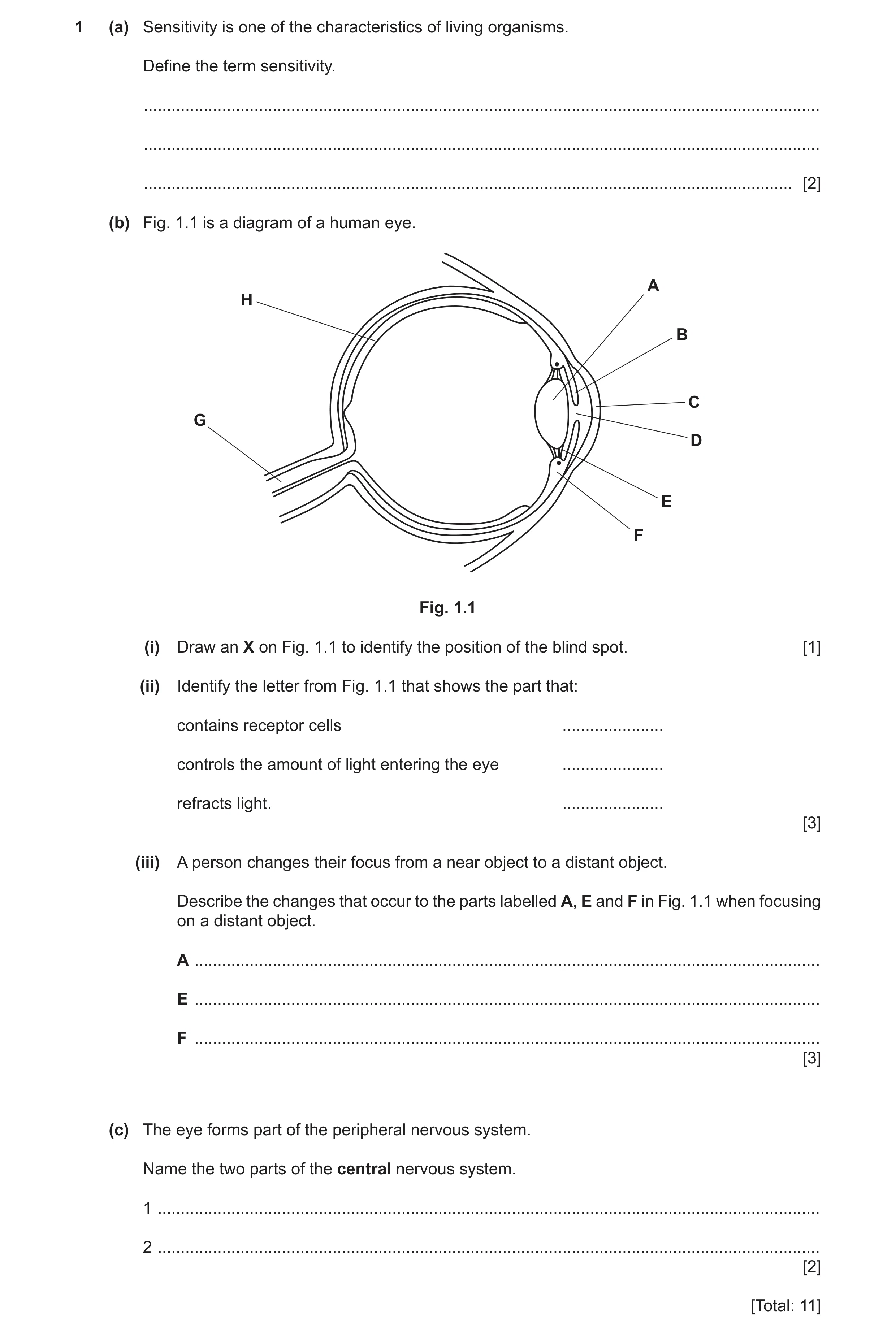
1 (a) Sensitivity is one of the characteristics of living organisms. Define the term sensitivity. … … … [2] (b) Fig. 1.1 is a diagram of a human eye. A H B C G D E F Fig. 1.1 (i) Draw an X on Fig. 1.1 to identify the position of the blind spot. [1] (ii) Identify the letter from Fig. 1.1 that shows the part that: contains receptor cells … controls the amount of light entering the eye … refracts light. … [3] (iii) A person changes their focus from a near object to a distant object. Describe the changes that occur to the parts labelled A, E and F in Fig. 1.1 when focusing on a distant object. A … E … F … [3] (c) The eye forms part of the peripheral nervous system. Name the two parts of the central nervous system. 1 … 2 … [2] [Total: 11]
11 marks
Mark scheme: 1(a) sensitivity is the ability to detect ; and respond to changes in the environment ; 2 1(b)(i) X drawn on blind spot ; 1 1(b)(ii) H ; B ; C ; 3 1(b)(iii) A becomes thin(ner) / AW ; E tighten / stretch / AW ; F relax ; 3 1(c) brain ; spinal cord ; 2
This question in 0654/42 Feb/March 2022
Q6 · Ammonium sulfate is used as a fertiliser 0654/42 Feb/March 2023
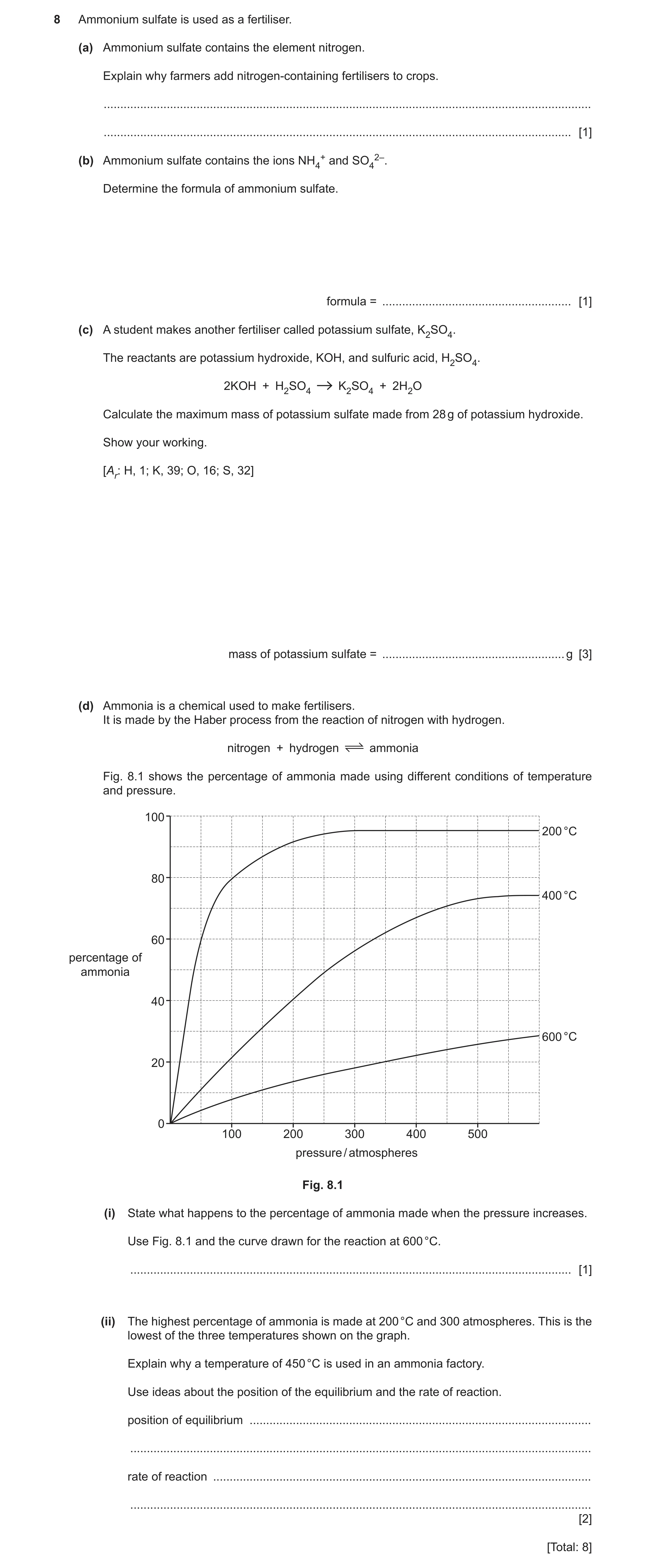
8 Ammonium sulfate is used as a fertiliser. (a) Ammonium sulfate contains the element nitrogen. Explain why farmers add nitrogen‑containing fertilisers to crops. … … [1] (b) Ammonium sulfate contains the ions NH4+ and SO42–. Determine the formula of ammonium sulfate. formula = … [1] (c) A student makes another fertiliser called potassium sulfate, K2SO4. The reactants are potassium hydroxide, KOH, and sulfuric acid, H2SO4. 2KOH + H2SO4 K2SO4 + 2H2O Calculate the maximum mass of potassium sulfate made from 28 g of potassium hydroxide. Show your working. [Ar: H, 1; K, 39; O, 16; S, 32] mass of potassium sulfate = … g [3] (d) Ammonia is a chemical used to make fertilisers. It is made by the Haber process from the reaction of nitrogen with hydrogen. nitrogen + hydrogen ammonia Fig. 8.1 shows the percentage of ammonia made using different conditions of temperature and pressure. 100 200 °C 80 400 °C 60 percentage of ammonia 40 600 °C 20 0 100 200 300 400 500 pressure / atmospheres Fig. 8.1 (i) State what happens to the percentage of ammonia made when the pressure increases. Use Fig. 8.1 and the curve drawn for the reaction at 600 °C. … [1] (ii) The highest percentage of ammonia is made at 200 °C and 300 atmospheres. This is the lowest of the three temperatures shown on the graph. Explain why a temperature of 450 °C is used in an ammonia factory. Use ideas about the position of the equilibrium and the rate of reaction. position of equilibrium … … rate of reaction … … [2] [Total: 8]
8 marks
Mark scheme: 8(a) increased crop yield / increased growth rate / idea of better-quality crops / idea of replacing or adding nutrients or 1 minerals / for synthesis of amino acids or proteins ; 8(b) (NH4)2SO4 ; 1 8(c) relative formula mass of KOH =56 and of K2SO4 = 174 ; 3 28 moles of KOH = = 0.5 ; 56 (2:1 ratio so) mass of potassium sulfate = 0.25 174 = 43.5 g ; 8(d)(i) increases / owtte ; 1 8(d)(ii) position of equilibrium 2 low temperature or 200 °C moves (position of) equilibrium to RHS / ORA ; rate of reaction reaction slow at low temperatures / ORA ;
This question in 0654/42 Feb/March 2023
Q7 · A diagram of parts of the eye 0654/42 May/June 2023
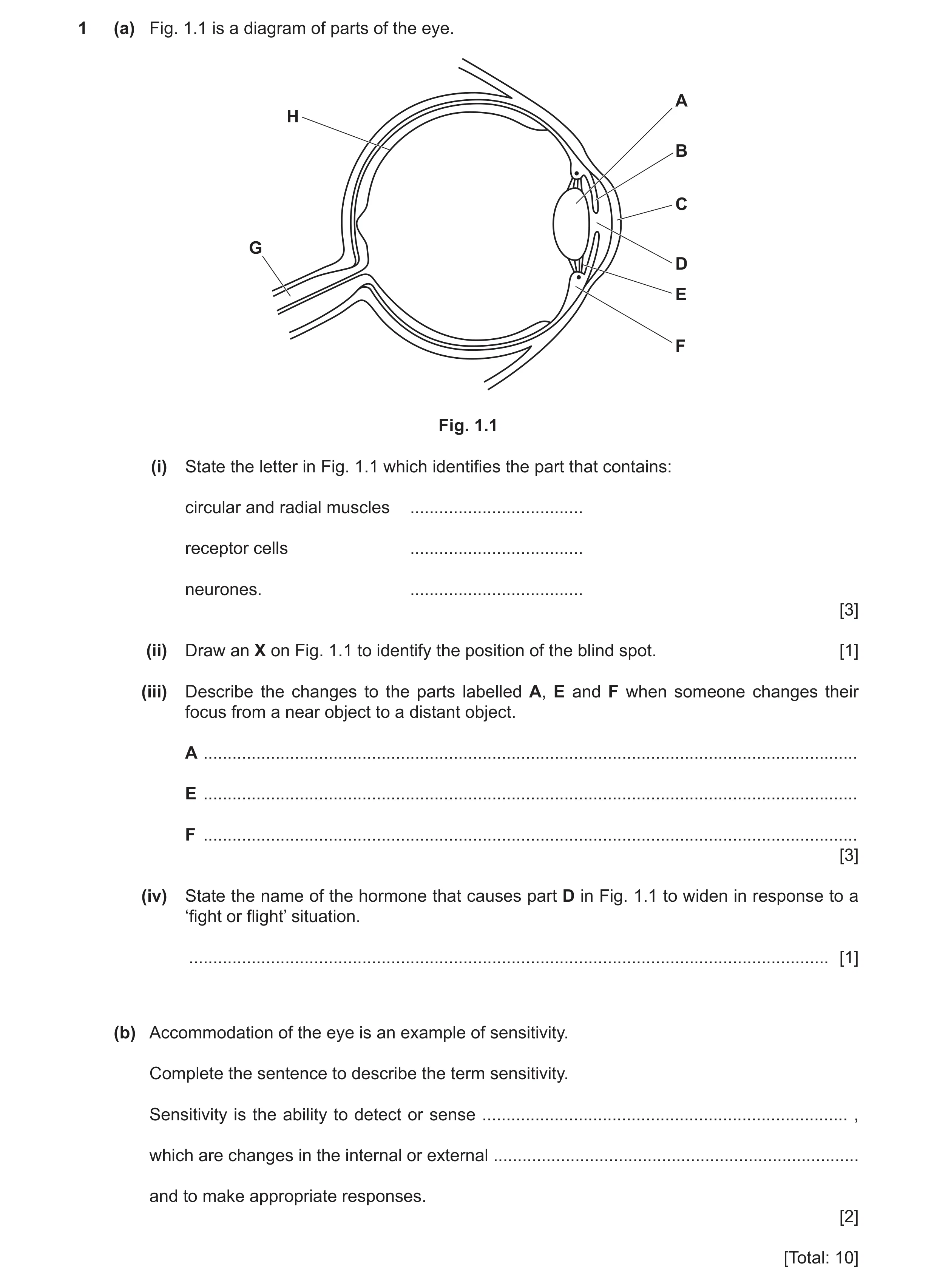
1 (a) Fig. 1.1 is a diagram of parts of the eye. A H B C G D E F Fig. 1.1 (i) State the letter in Fig. 1.1 which identifies the part that contains: circular and radial muscles … receptor cells … neurones. … [3] (ii) Draw an X on Fig. 1.1 to identify the position of the blind spot. [1] (iii) Describe the changes to the parts labelled A, E and F when someone changes their focus from a near object to a distant object. A … E … F … [3] (iv) State the name of the hormone that causes part D in Fig. 1.1 to widen in response to a ‘fight or flight’ situation. … [1] (b) Accommodation of the eye is an example of sensitivity. Complete the sentence to describe the term sensitivity. Sensitivity is the ability to detect or sense … , which are changes in the internal or external … and to make appropriate responses. [2] [Total: 10]
10 marks
Mark scheme: 1(a)(i) B ; H ; G / H ; 3 1(a)(ii) X drawn on blind spot ; 1 1(a)(iii) A – narrows / gets thinner / less convex ; E – tightens ; F – relaxes ; 3 1(a)(iv) adrenaline ; 1 1(b) stimuli ; environment ; 2
This question in 0654/42 May/June 2023
Q8 · The pH of the fluid in muscles changes during vigorous exercise due to the changing… 0654/43 May/June 2023
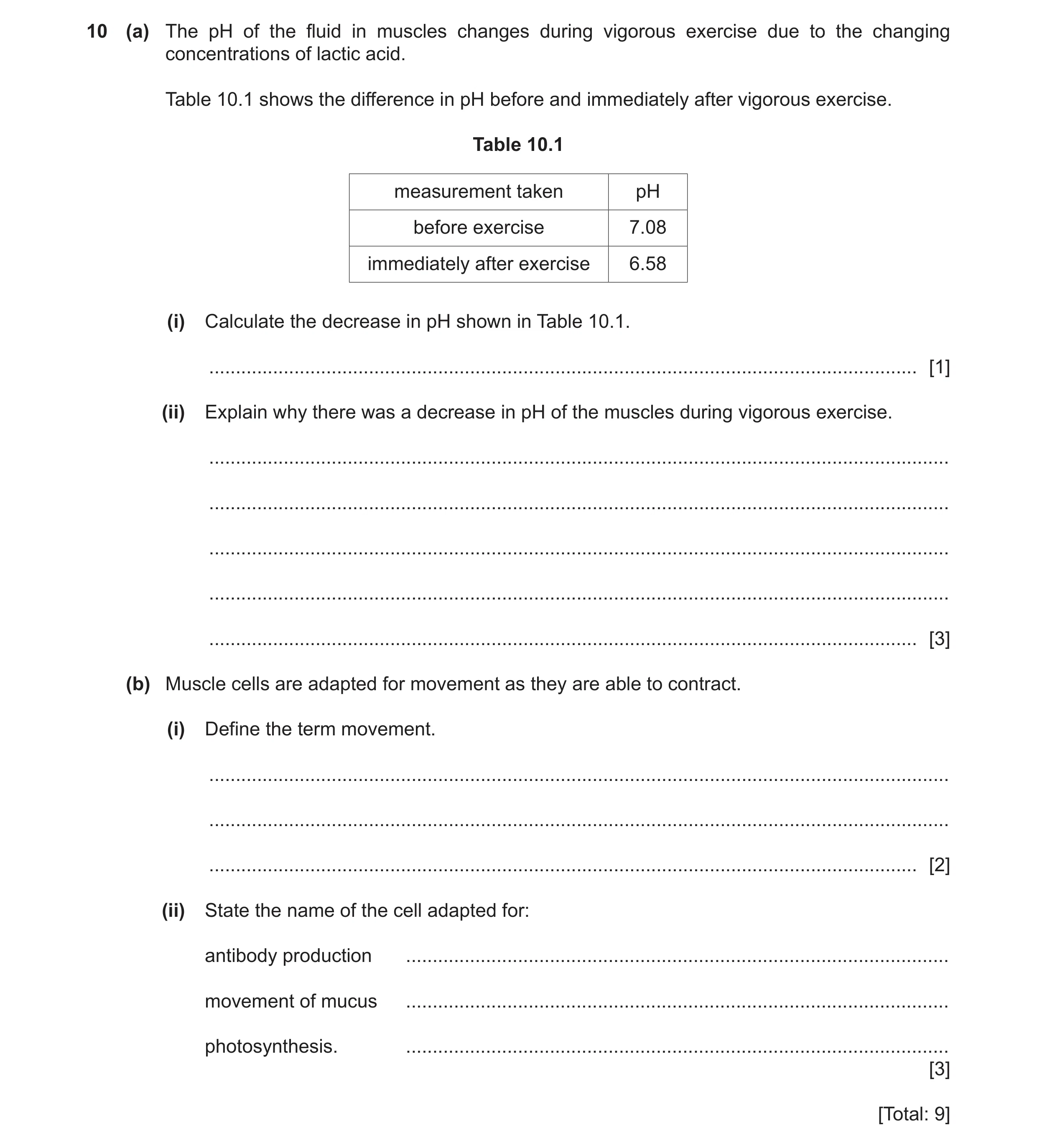
10 (a) The pH of the fluid in muscles changes during vigorous exercise due to the changing concentrations of lactic acid. Table 10.1 shows the difference in pH before and immediately after vigorous exercise. Table 10.1 measurement taken pH before exercise 7.08 immediately after exercise 6.58 (i) Calculate the decrease in pH shown in Table 10.1. … [1] (ii) Explain why there was a decrease in pH of the muscles during vigorous exercise. … … … … … [3] (b) Muscle cells are adapted for movement as they are able to contract. (i) Define the term movement. … … … [2] (ii) State the name of the cell adapted for: antibody production … movement of mucus … photosynthesis. … [3] [Total: 9]
9 marks
Mark scheme: 10(a)(i) 0.50 ; 1 10(a)(ii) not enough oxygen (for aerobic respiration) ; ref to anaerobic respiration ; increasing lactic acid (reduces the pH) ; 3 10(b)(i) (an action by,) an organism / part of an organism ; (causing a) change of, position / place ; 2 10(b)(ii) white blood (cell) ; ciliated (cell) ; palisade (mesophyll cell) ; 3
This question in 0654/43 May/June 2023
Q9 · A student investigates the effect of different types of sugar on the anaerobic… 0654/41 Oct/Nov 2023
4 (a) A student investigates the effect of different types of sugar on the anaerobic respiration in yeast. She mixes yeast with five different types of sugar solutions of the same concentration and measures the volume of gas produced after 2 hours. Table 4.1 shows the results. Table 4.1 sugar volume of gas produced in 2 hours / cm3 A 9 B 16 C 82 D 3 E 65 (i) Identify the sugar in Table 4.1 that produces the largest volume of gas. … [1] (ii) Calculate the rate of anaerobic respiration for sugar A in Table 4.1. rate of anaerobic respiration for sugar A = … cm3 / min [2] (iii) State the name of the gas produced in this investigation. … [1] (iv) State one practical use for the anaerobic respiration of yeast. … [1] (b) Describe three ways that aerobic respiration is different from anaerobic respiration in humans. 1 … … 2 … … 3 … … [3] (c) Respiration is one of the characteristics of living organisms. State one other characteristic. … [1] [Total: 9]
9 marks
Mark scheme: 4(a)(i) C ; 1 4(a)(ii) evidence of unit conversion / (2 hours =) 120 minutes ; 2 0.075 (cm3/min) ; 4(a)(iii) carbon dioxide ; 1 4(a)(iv) bread making / named practical use of anaerobic respiration by yeast ; 1 4(b) any three from: 3 requires oxygen ; (releases) more energy (per glucose molecule) ; produces carbon dioxide ; produces water ; does not produce lactic acid ; 4(c) any one from: 1 movement ; sensitivity ; growth ; reproduction ; excretion ; nutrition ;
This question in 0654/41 Oct/Nov 2023
Q10 · A diagram of a wind‑pollinated flower 0654/42 May/June 2024
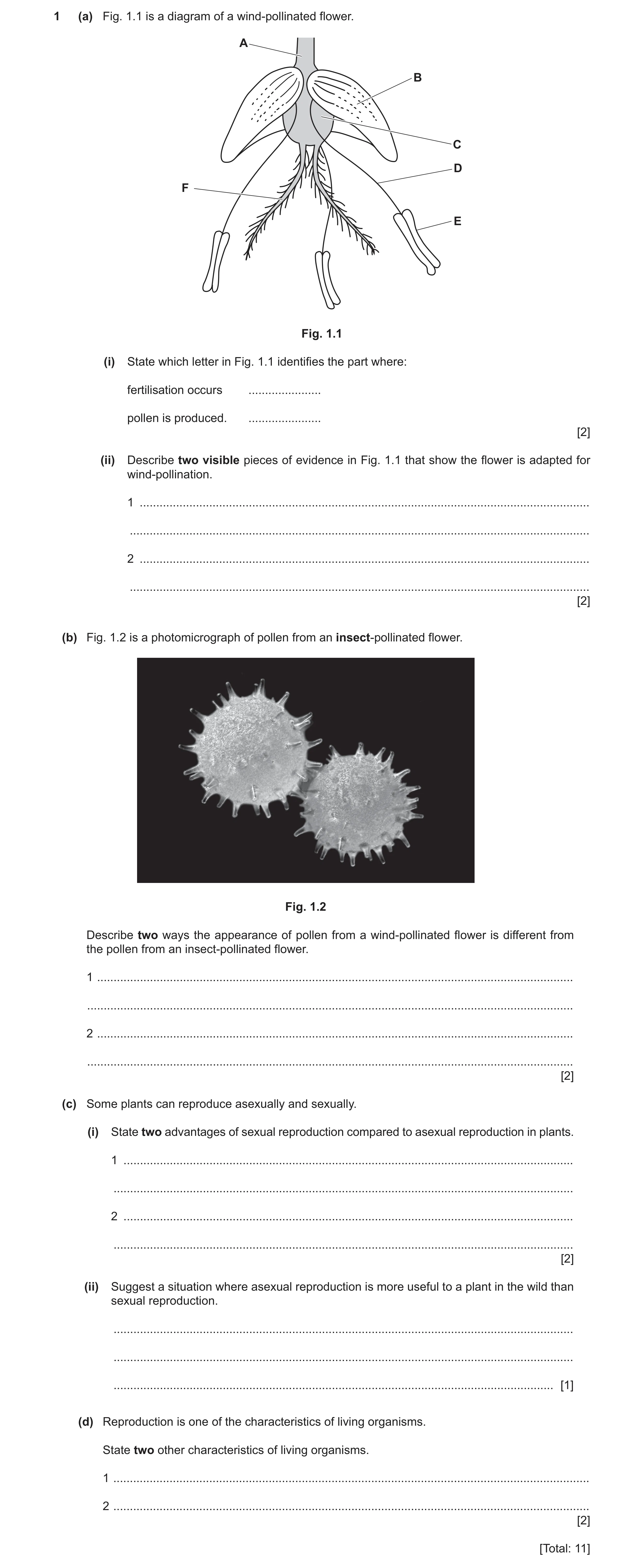
1 (a) Fig. 1.1 is a diagram of a wind‑pollinated flower. A B C D F E Fig. 1.1 (i) State which letter in Fig. 1.1 identifies the part where: fertilisation occurs … pollen is produced. … [2] (ii) Describe two visible pieces of evidence in Fig. 1.1 that show the flower is adapted for wind‑pollination. 1 … … 2 … … [2] (b) Fig. 1.2 is a photomicrograph of pollen from an insect‑pollinated flower. Fig. 1.2 Describe two ways the appearance of pollen from a wind‑pollinated flower is different from the pollen from an insect‑pollinated flower. 1 … … 2 … … [2] (c) Some plants can reproduce asexually and sexually. (i) State two advantages of sexual reproduction compared to asexual reproduction in plants. 1 … … 2 … … [2] (ii) Suggest a situation where asexual reproduction is more useful to a plant in the wild than sexual reproduction. … … … [1] (d) Reproduction is one of the characteristics of living organisms. State two other characteristics of living organisms. 1 … 2 … [2] [Total: 11]
11 marks
Mark scheme: 1(a)(i) C ; E ; 2 1(a)(ii) any two from: feathery stigma ; small / no, petals ; anther hangs outside (the, flower / petals) ; stigma hangs outside (the, flower / petals) ; 2 1(b) smooth(er) / not spiky ; small(er) ; 2 1(c)(i) any two from: genetic diversity ; disease unlikely to wipe out all the plants ; able to adapt to changes in the environment ; allows, natural selection / evolution / adaptation ; 2 1(c)(ii) when the plant becomes isolated (from other plants) / when there is a shortage of pollinators / lack of other plants ; 1 1(d) any two from: movement ; respiration ; sensitivity ; growth ; excretion ; nutrition ; 2
This question in 0654/42 May/June 2024
 1 / 14
 2 / 14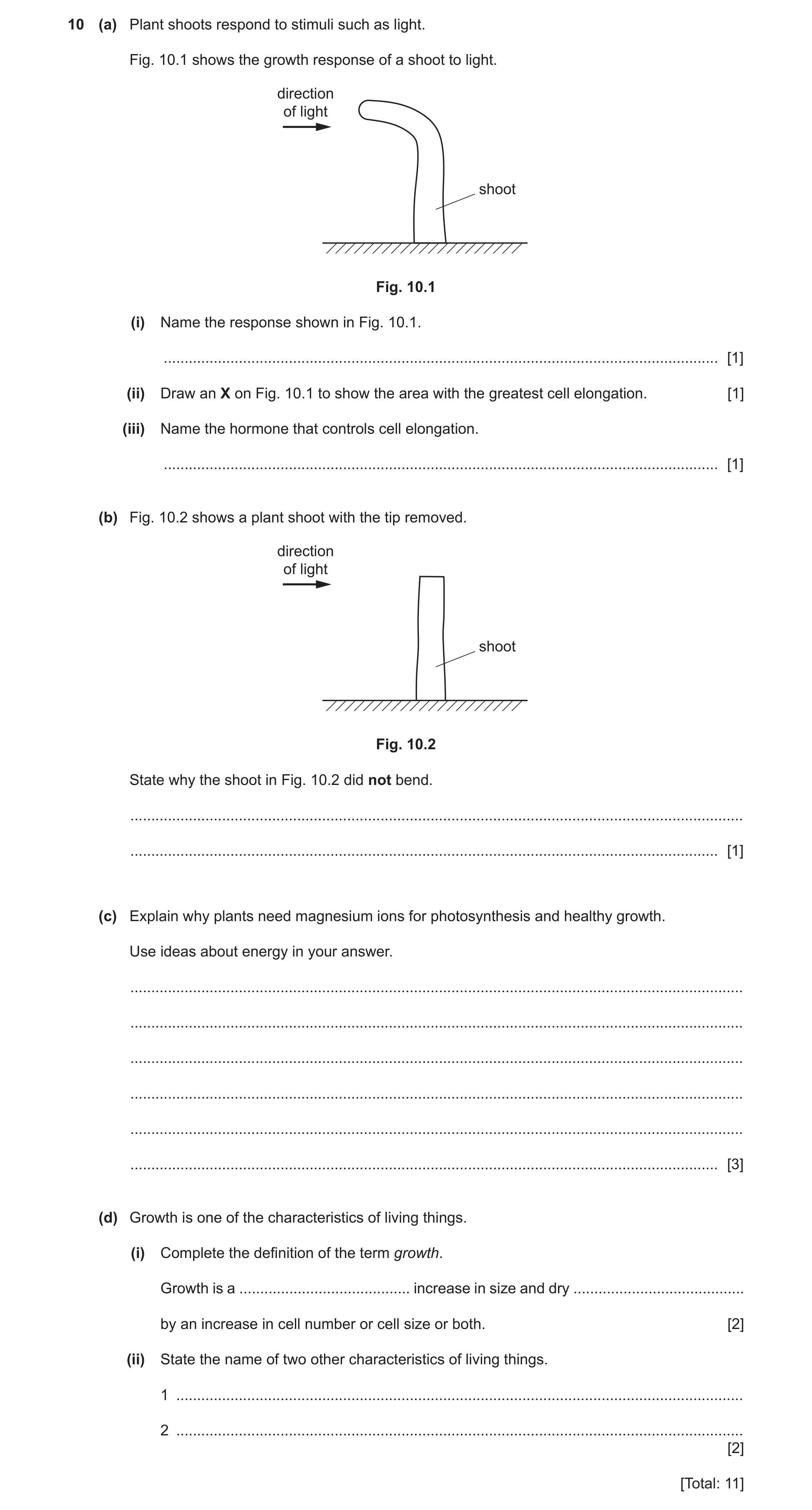
 9 / 14
 10 / 14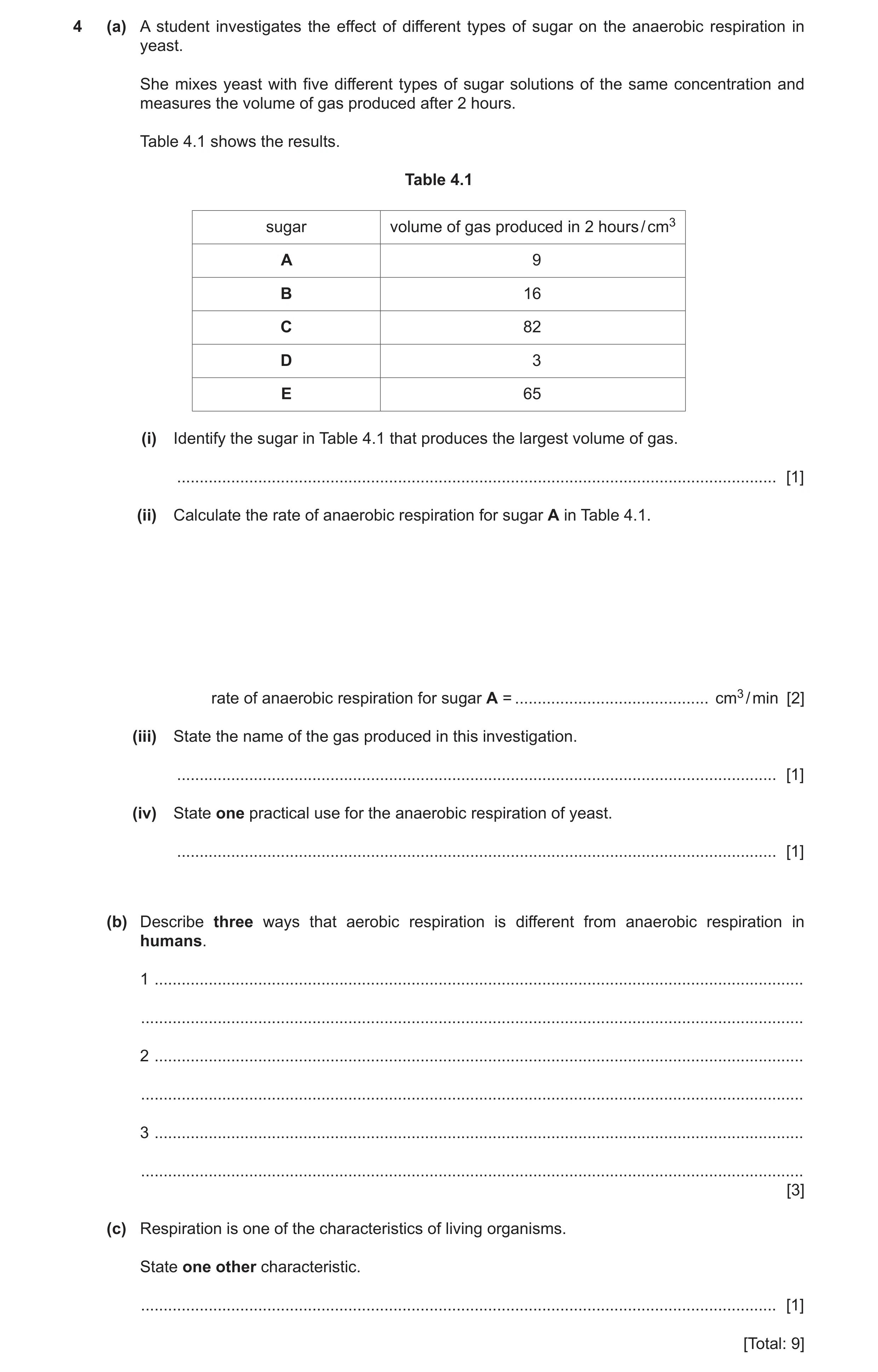
 10
10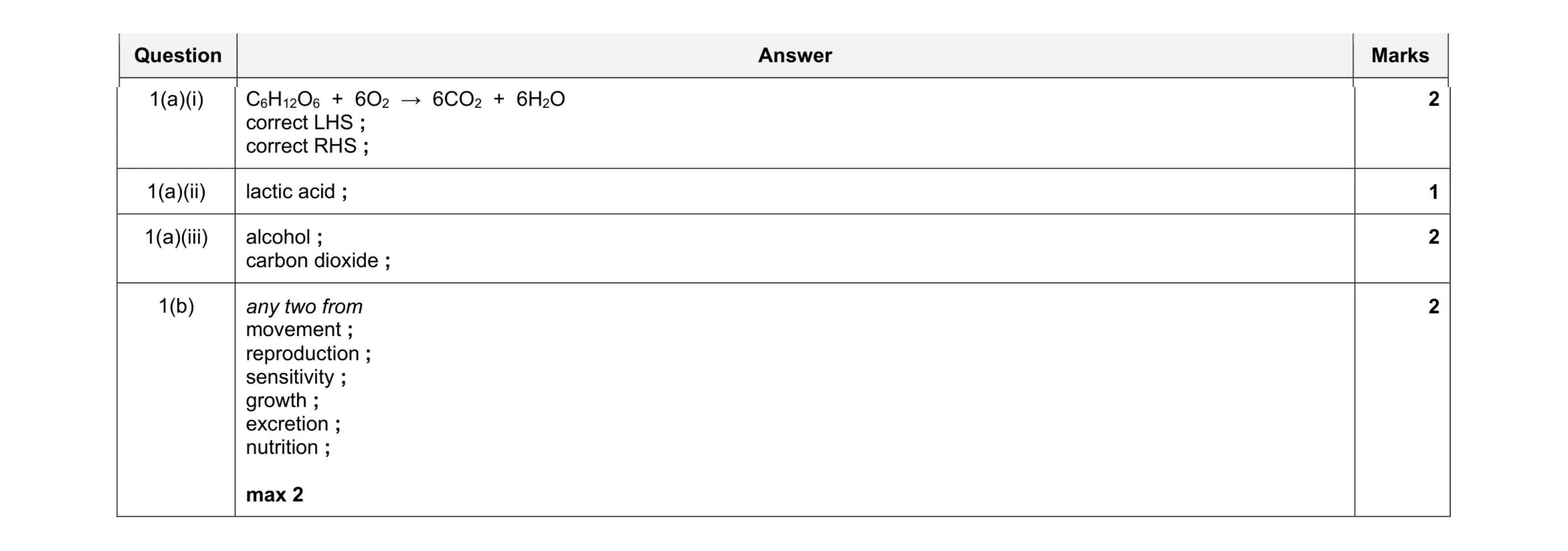 7
7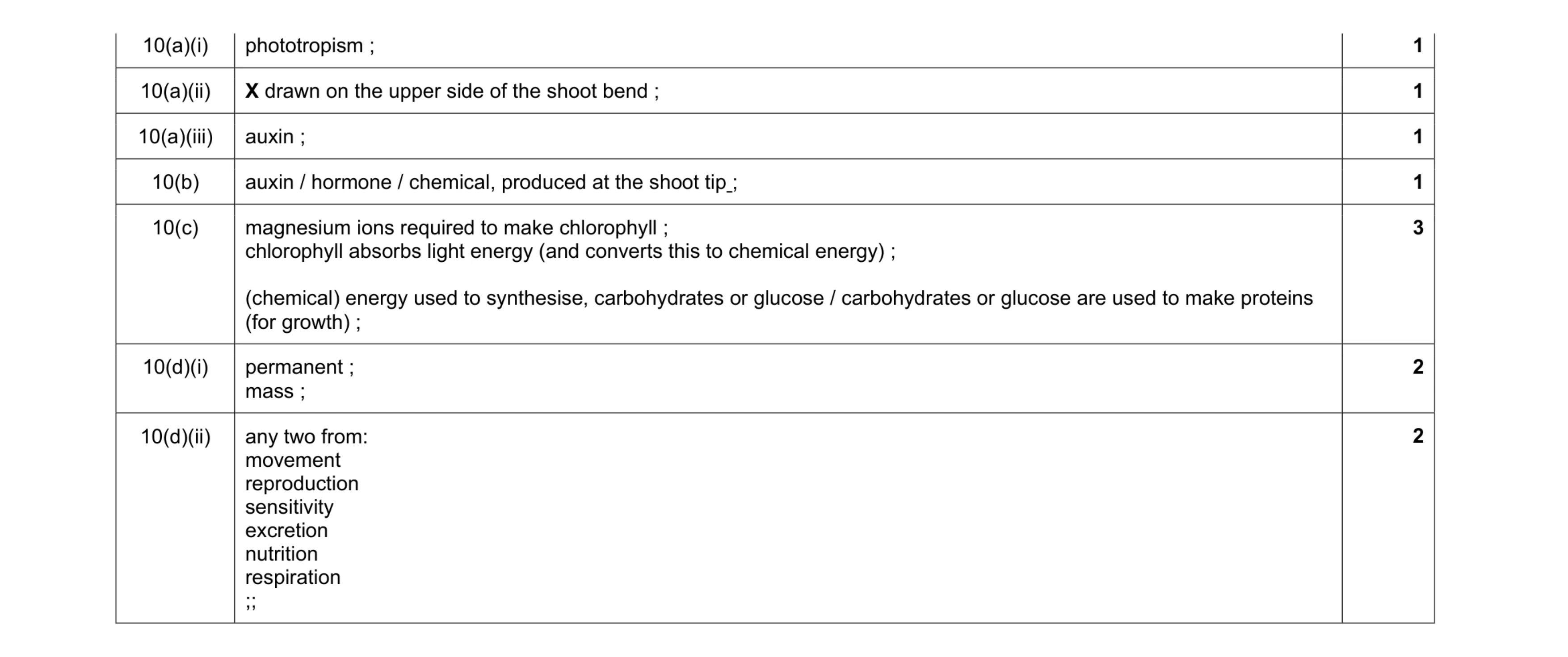 11
11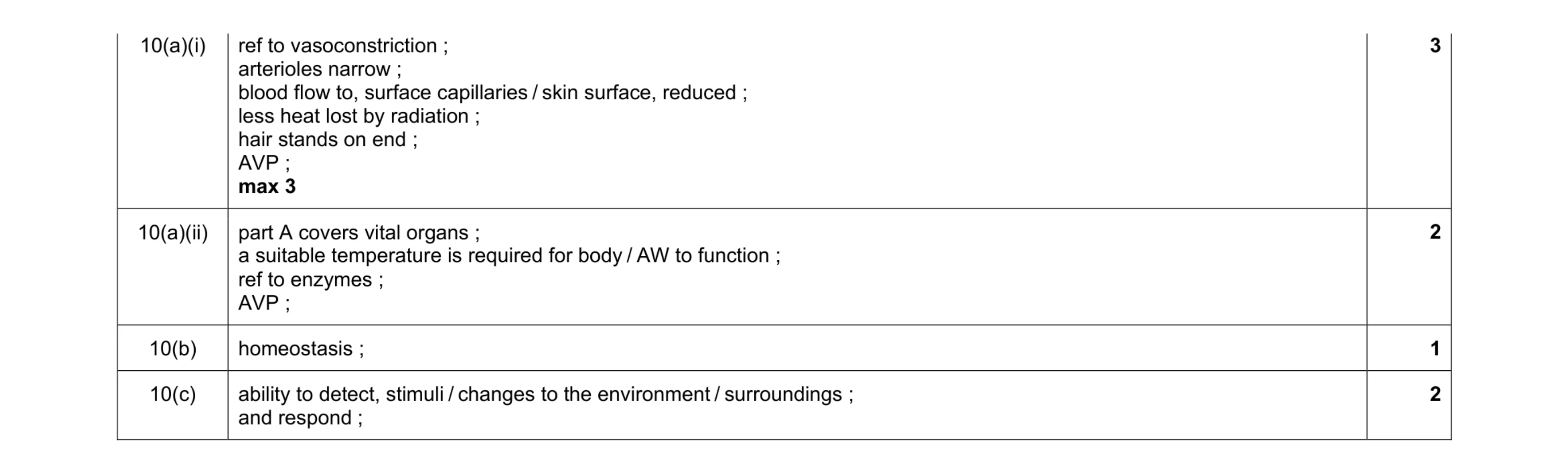 8
8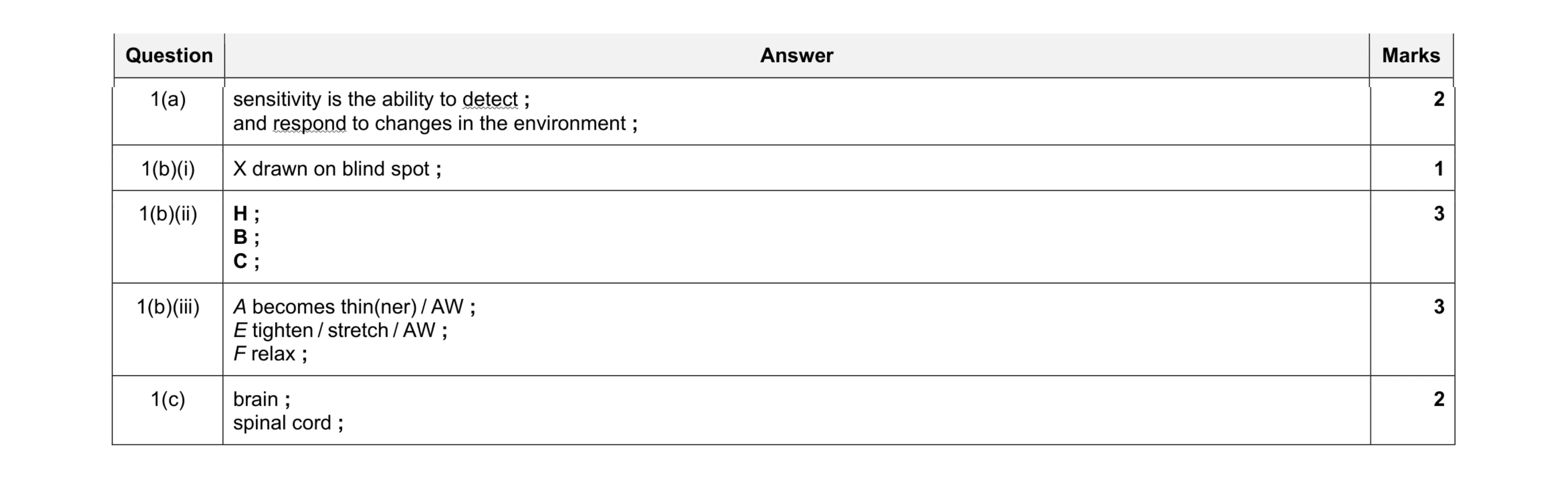 11
11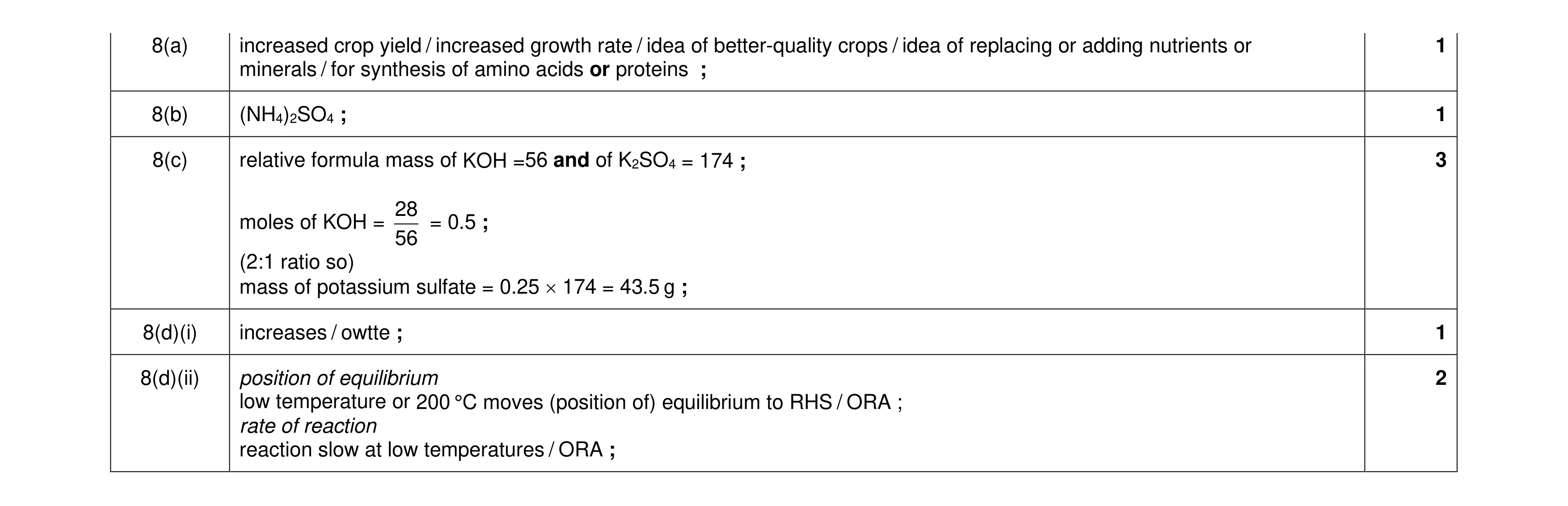 8
8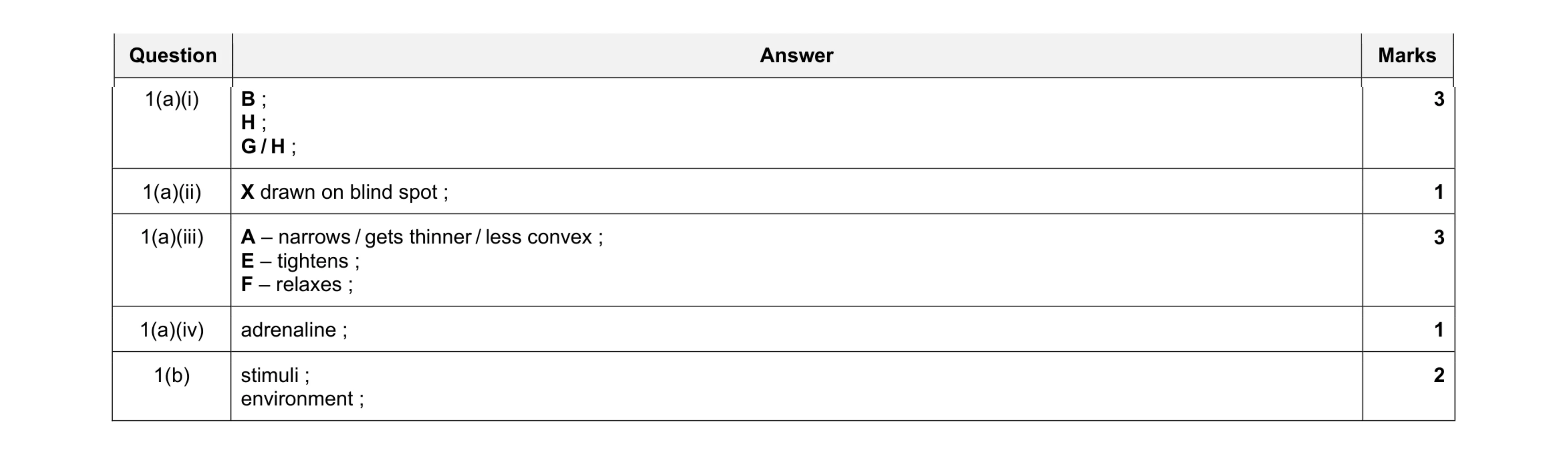 10
10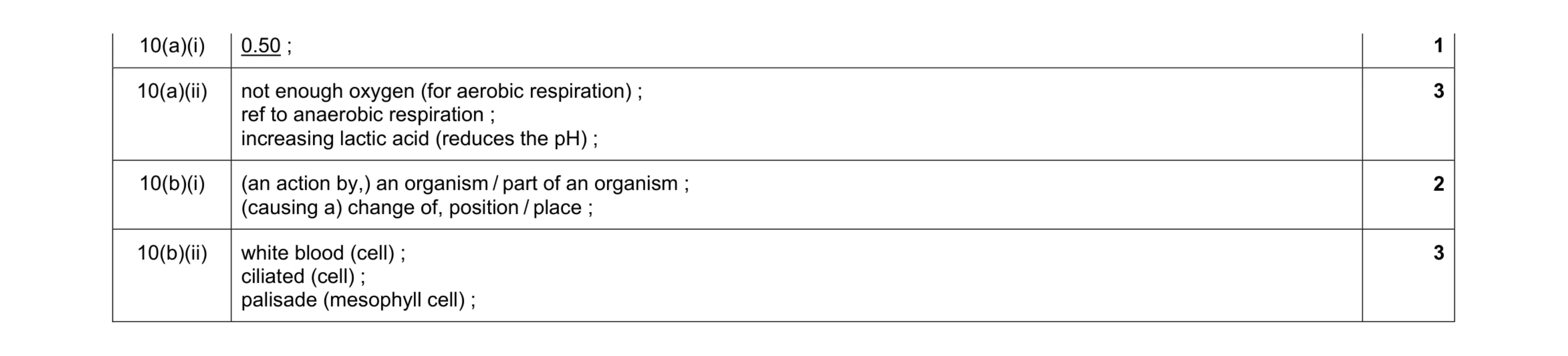 9
9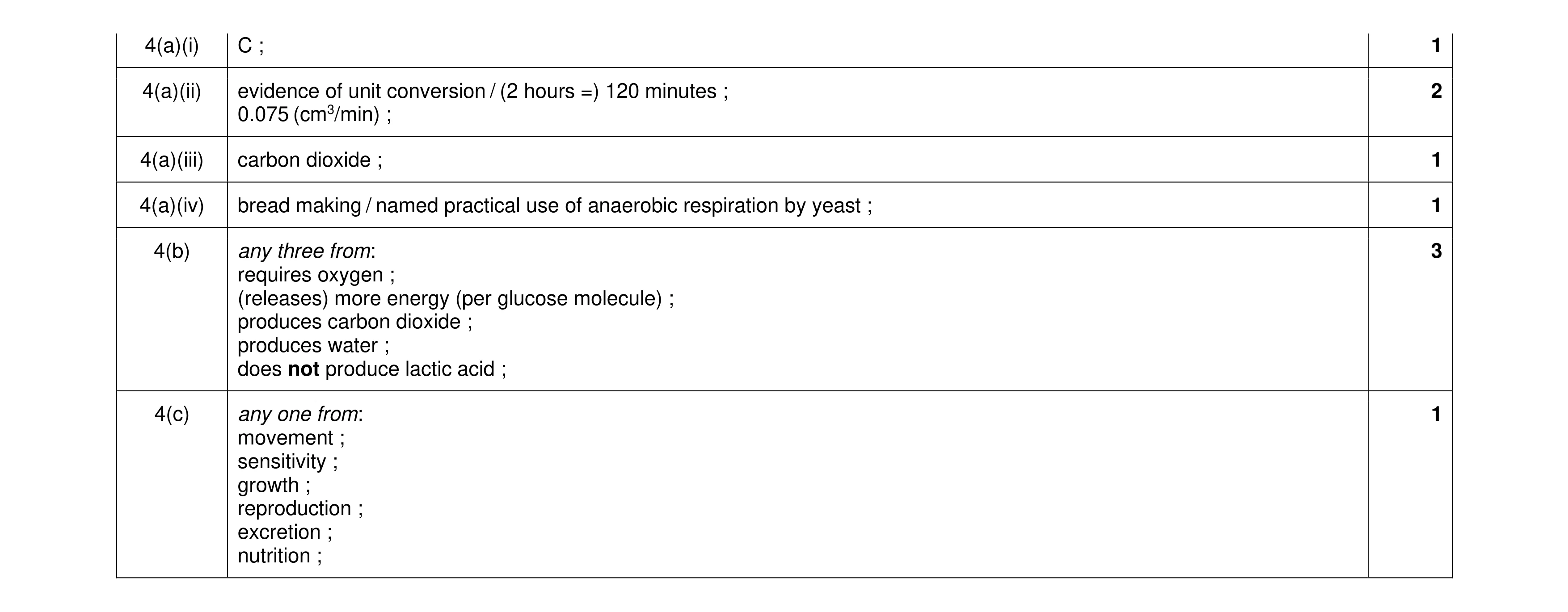 9
9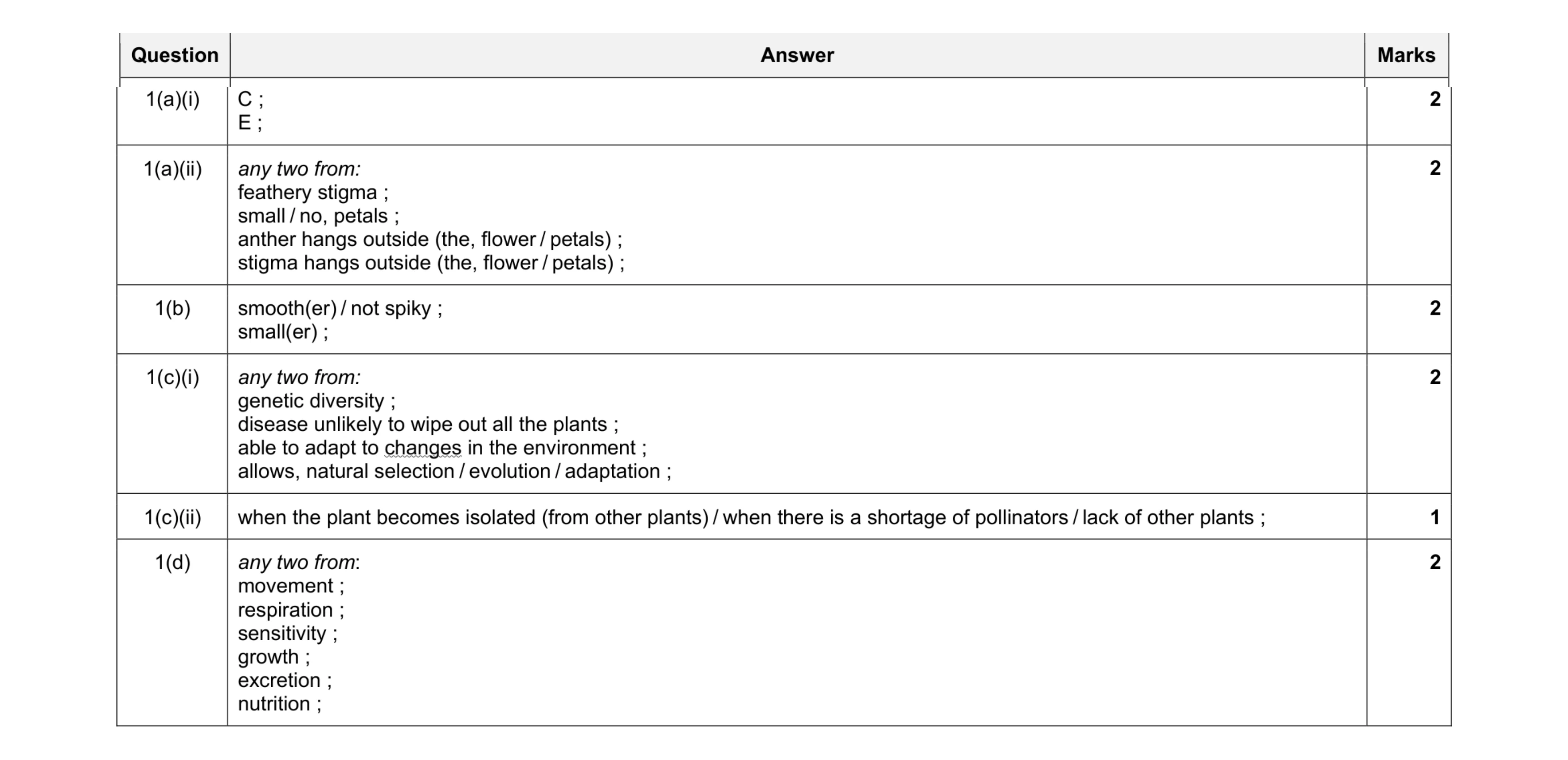 11
11