Questions as text
Q1 · Light initiates the following reaction 9701/11 May/June 2006
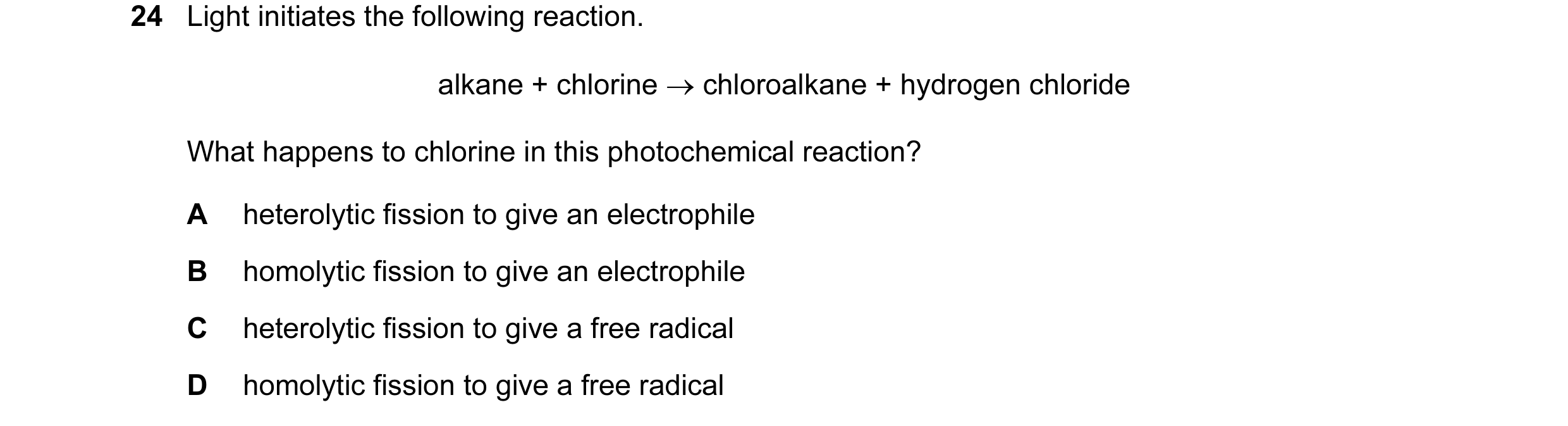
24 Light initiates the following reaction. alkane + chlorine → chloroalkane + hydrogen chloride What happens to chlorine in this photochemical reaction? A heterolytic fission to give an electrophile B homolytic fission to give an electrophile C heterolytic fission to give a free radical D homolytic fission to give a free radical
1 marks
Answer: D
This question in 9701/11 May/June 2006
Q2 · High-energy irradiation in the stratosphere produces radicals from chlorofluoroalkanes… 9701/11 May/June 2006
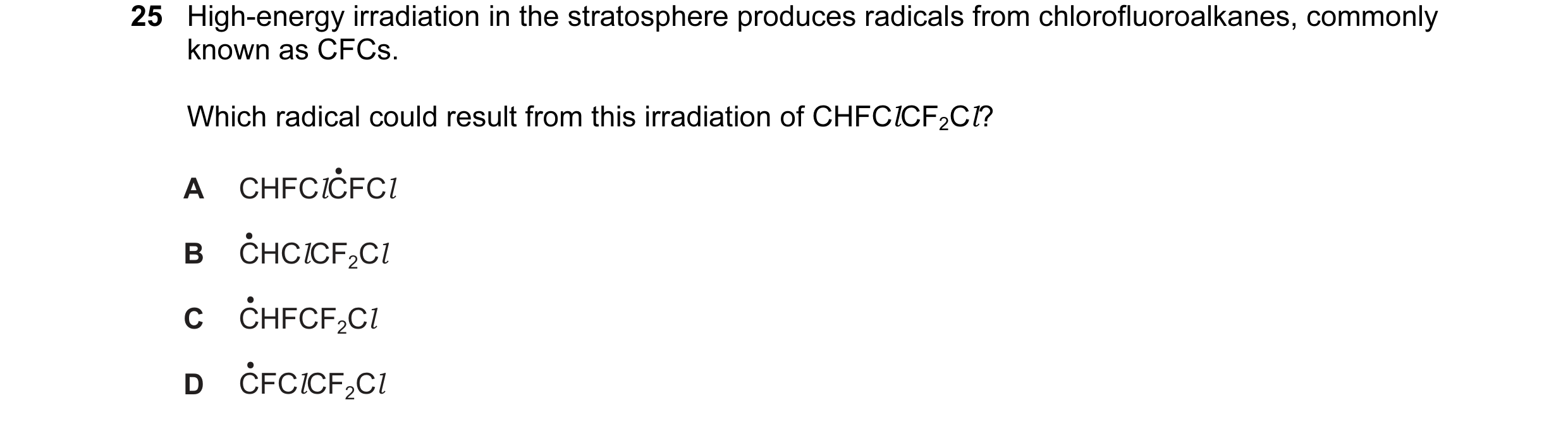
25 High-energy irradiation in the stratosphere produces radicals from chlorofluoroalkanes, commonly known as CFCs. Which radical could result from this irradiation of CHFClCF2Cl? A CHFClCFCl B CHClCF2Cl C CHFCF2Cl D CFClCF2Cl
1 marks
Answer: C
This question in 9701/11 May/June 2006
Q3 · Samples of 10 cm3 of each of the first four members of the alkane series are separately… 9701/11 Oct/Nov 2006
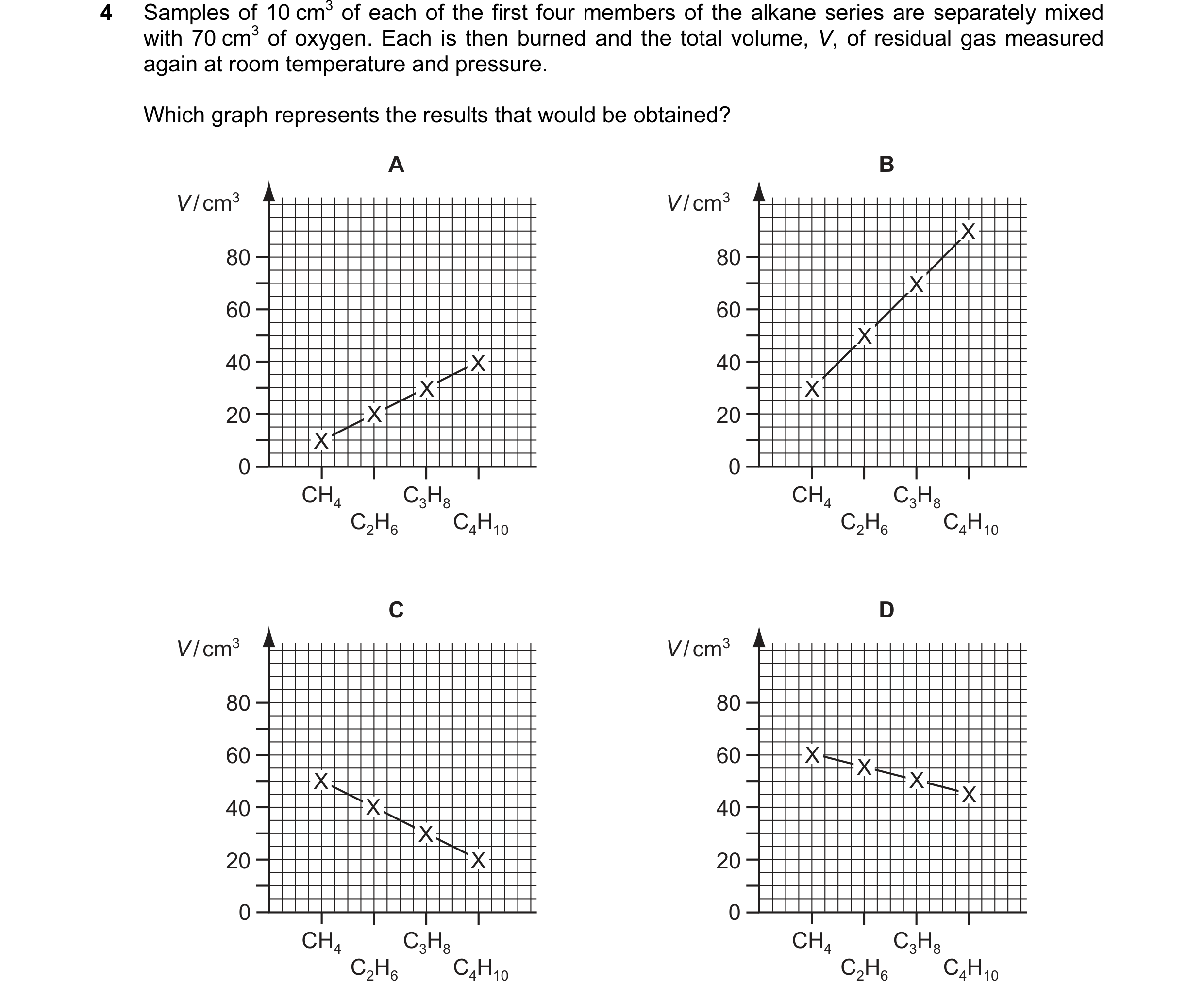
4 Samples of 10 cm3 of each of the first four members of the alkane series are separately mixed with 70 cm3 of oxygen. Each is then burned and the total volume, V, of residual gas measured again at room temperature and pressure. Which graph represents the results that would be obtained? A B V / cm3 V / cm3 X 80 80 X 60 60 X 40 X 40 X X 20 X 20 X 0 0 CH4 C3H8 CH4 C3H8 C2H6 C4H10 C2H6 C4H10 C D V / cm3 V / cm3 80 80 60 60 X X X X X 40 X 40 X 20 X 20 0 0 CH4 C3H8 CH4 C3H8 C2H6 C4H10 C2H6 C4H10
1 marks
Answer: D
This question in 9701/11 Oct/Nov 2006
Q4 · When gaseous chemicals are transported by road or by rail they are classified as follows 9701/11 Oct/Nov 2006
24 When gaseous chemicals are transported by road or by rail they are classified as follows. flammable non-flammable poisonous Which gas is non-flammable? A butane B hydrogen C oxygen D propene
1 marks
Answer: C
This question in 9701/11 Oct/Nov 2006
Q5 · Tetramethyl-lead(IV), (CH3)4Pb, increases the rate of the reaction of methane with… 9701/11 Oct/Nov 2007
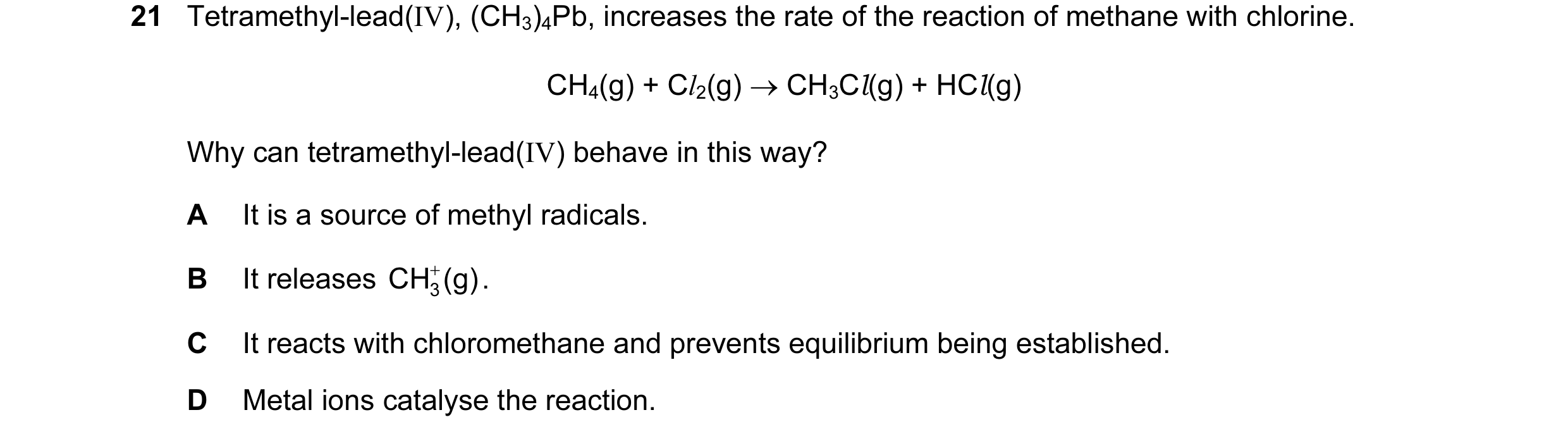
21 Tetramethyl-lead(IV), (CH3)4Pb, increases the rate of the reaction of methane with chlorine. CH4(g) + Cl2(g) → CH3Cl(g) + HCl(g) Why can tetramethyl-lead(IV) behave in this way? A It is a source of methyl radicals. B It releases CH3 + (g) . C It reacts with chloromethane and prevents equilibrium being established. D Metal ions catalyse the reaction.
1 marks
Answer: A
This question in 9701/11 Oct/Nov 2007
Q6 · Which reaction occurs when ethane and chlorine are mixed in diffused sunlight? 9701/11 Oct/Nov 2007
22 Which reaction occurs when ethane and chlorine are mixed in diffused sunlight? A a free-radical substitution with hydrogen given off B a free-radical substitution with hydrogen chloride given off C a free-radical substitution with no gas given off D a nucleophilic substitution with hydrogen chloride given off
1 marks
Answer: B
This question in 9701/11 Oct/Nov 2007
Q7 · Which hydrocarbon would not be collected in the inverted tube by heating pentane… 9701/11 May/June 2008
23 Which hydrocarbon would not be collected in the inverted tube by heating pentane, CH3(CH2)3CH3, in the apparatus shown? pentane on aluminium mineral fibre oxide hydrocarbons very strong heat water A CH4 B CH3CH3 C CH3CH2CH=CH2 D CH3(CH2)8CH3
1 marks
Answer: D
This question in 9701/11 May/June 2008
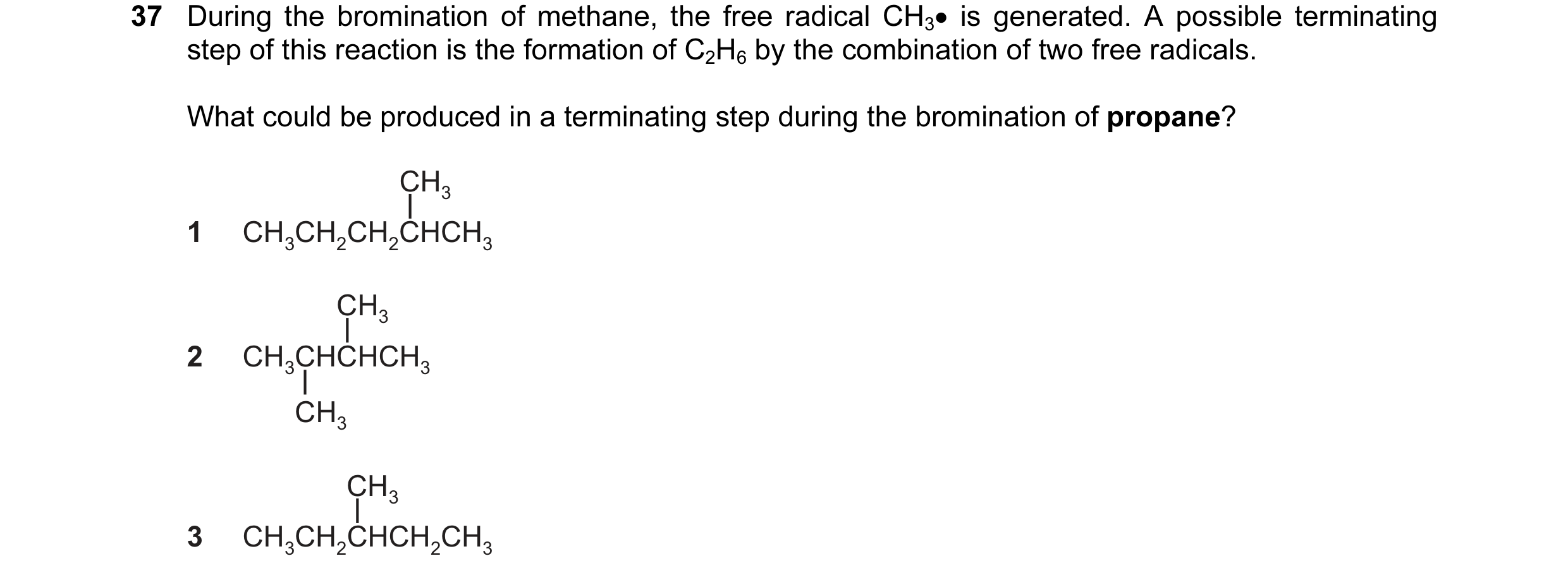
Q8 · During the bromination of methane, the free radical CH is generated and a possible… 9701/11 Oct/Nov 2008
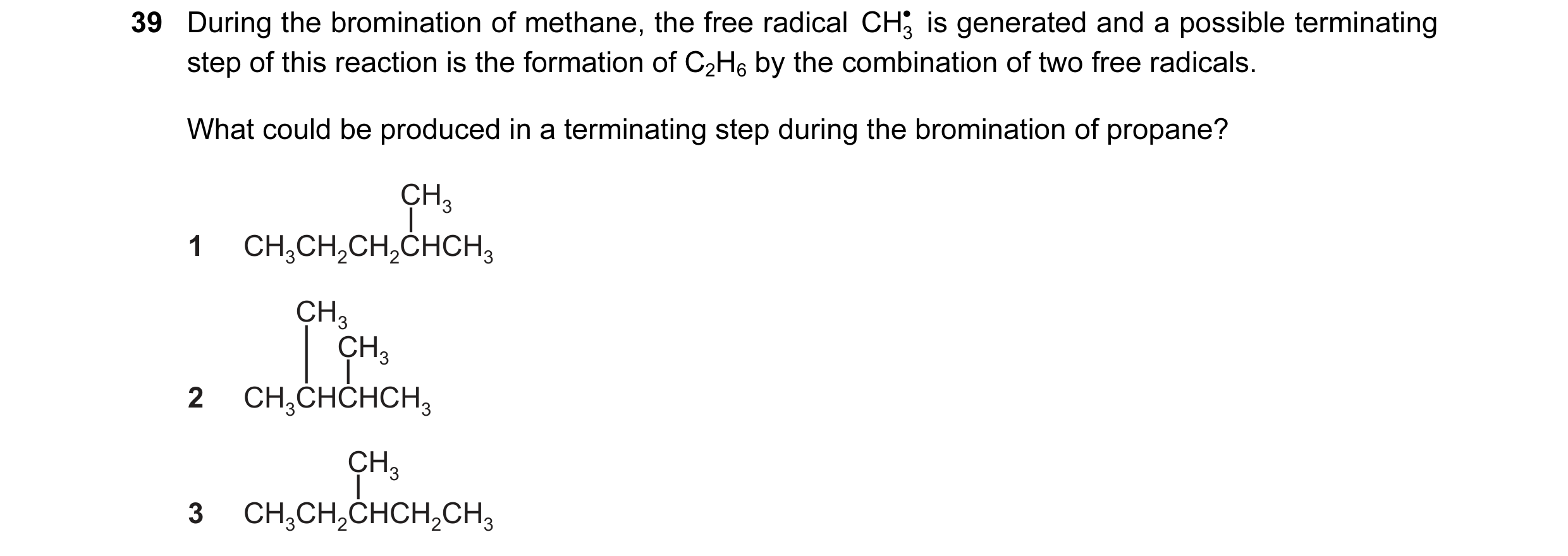
39 During the bromination of methane, the free radical CH is generated and a possible terminating • 3 step of this reaction is the formation of C2H6 by the combination of two free radicals. What could be produced in a terminating step during the bromination of propane? CH3 1 CH3CH2CH2CHCH3 CH3 CH3 2 CH3CHCHCH3 CH3 3 CH3CH2CHCH2CH3
1 marks
Answer: B
This question in 9701/11 Oct/Nov 2008
Q9 · Trichloroethanoic acid, CCl3CO2H, is used in cosmetic surgery to perform a ‘chemical… 9701/11 May/June 2009
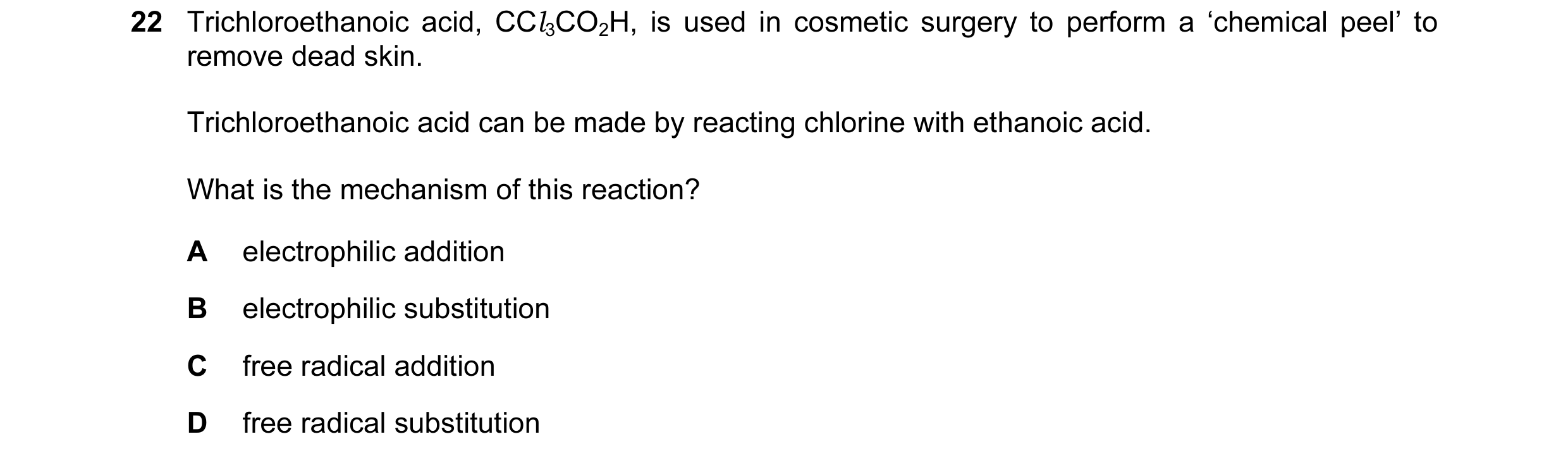
22 Trichloroethanoic acid, CCl3CO2H, is used in cosmetic surgery to perform a ‘chemical peel’ to remove dead skin. Trichloroethanoic acid can be made by reacting chlorine with ethanoic acid. What is the mechanism of this reaction? A electrophilic addition B electrophilic substitution C free radical addition D free radical substitution
1 marks
Answer: D
This question in 9701/11 May/June 2009
Q10 · A fraction of distilled crude oil contains molecules with between 15 and 19 carbon atoms 9701/11 May/June 2009
37 A fraction of distilled crude oil contains molecules with between 15 and 19 carbon atoms. This fraction is cracked by strong heating. Why is this done? 1 To produce alkenes. 2 To produce smaller molecules which are in higher demand. 3 To insert oxygen atoms into the hydrocarbons.
1 marks
Answer: B
This question in 9701/11 May/June 2009
Q11 · What is the least number of carbon atoms in a non-cyclic alkane molecule that has a… 9701/11 Oct/Nov 2009
22 What is the least number of carbon atoms in a non-cyclic alkane molecule that has a chiral centre? A 7 B 8 C 9 D 10
1 marks
Answer: A
This question in 9701/11 Oct/Nov 2009
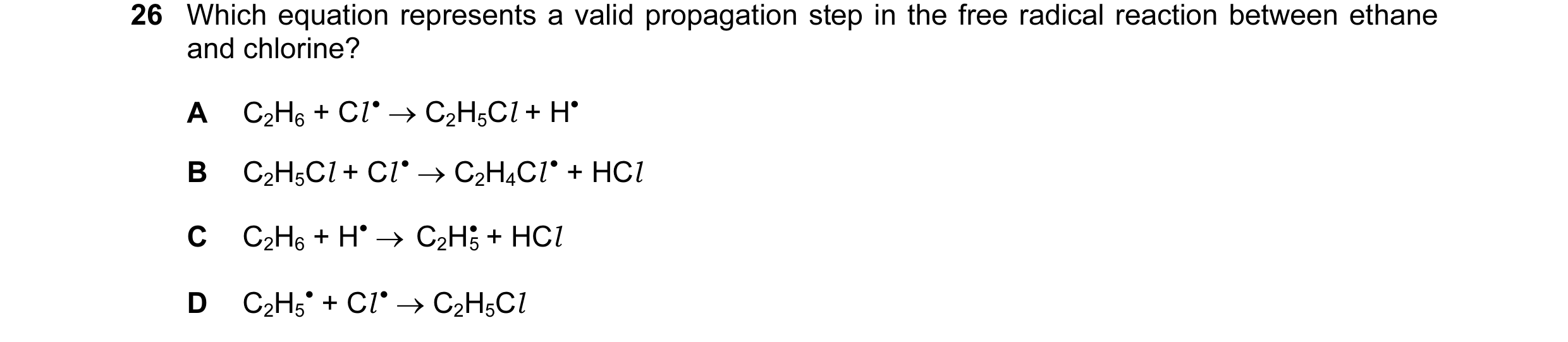
Q12 · Which equation represents a valid propagation step in the free radical reaction between… 9701/11 Oct/Nov 2009
26 Which equation represents a valid propagation step in the free radical reaction between ethane and chlorine? A C2H6 + Cl • → C2H5Cl + H• B C2H5Cl + Cl • → C2H4Cl • + HCl C C2H6 + H• → C 2H • + HCl 5 D C2H5 • + Cl • → C2H5Cl
1 marks
Answer: B
This question in 9701/11 Oct/Nov 2009
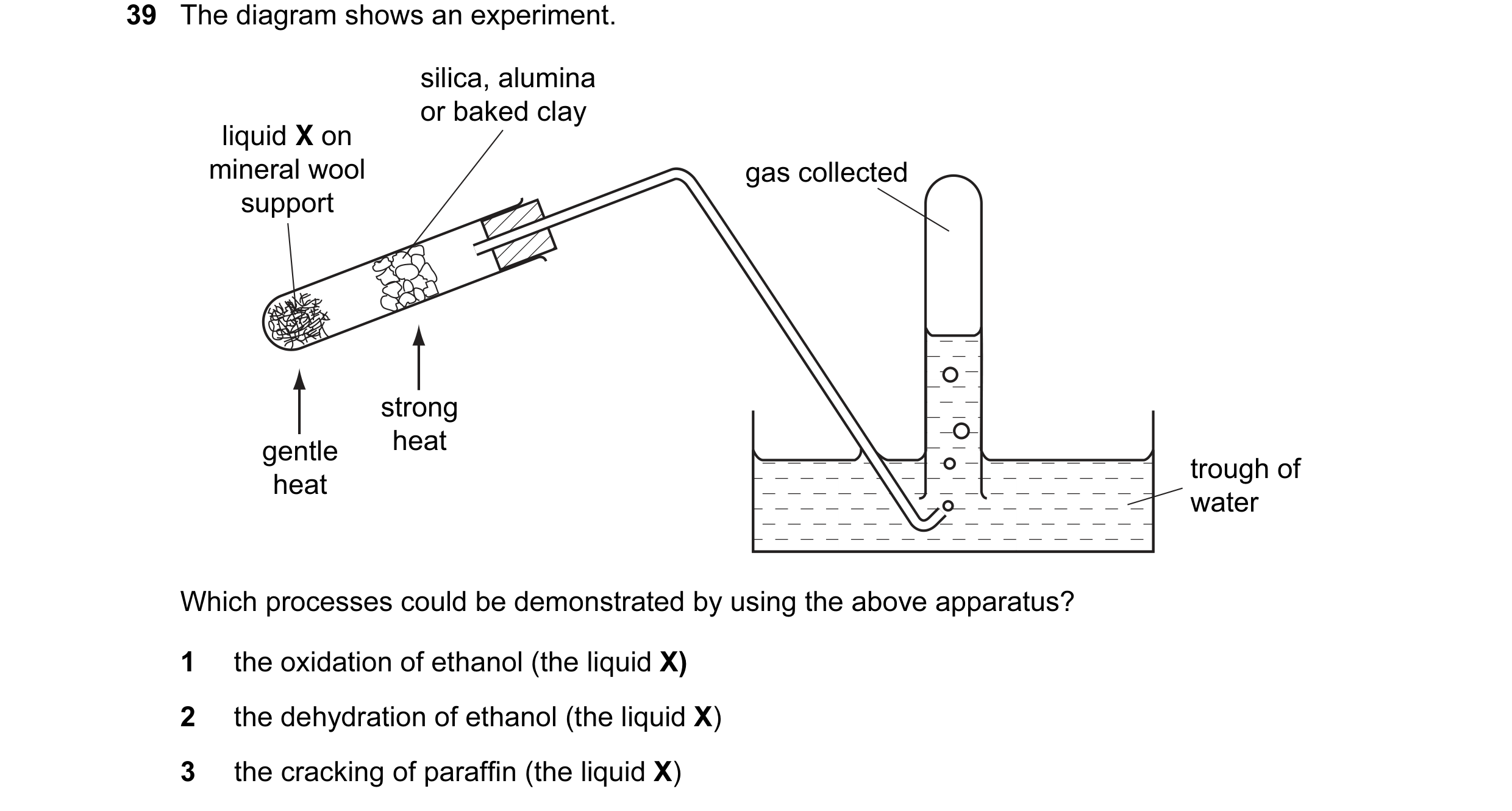
Q13 · The diagram shows an experiment 9701/11 Oct/Nov 2009
39 The diagram shows an experiment. silica, alumina or baked clay liquid X on mineral wool gas collected support strong gentle heat trough of heat water Which processes could be demonstrated by using the above apparatus? 1 the oxidation of ethanol (the liquid X) 2 the dehydration of ethanol (the liquid X) 3 the cracking of paraffin (the liquid X)
1 marks
Answer: C
This question in 9701/11 Oct/Nov 2009
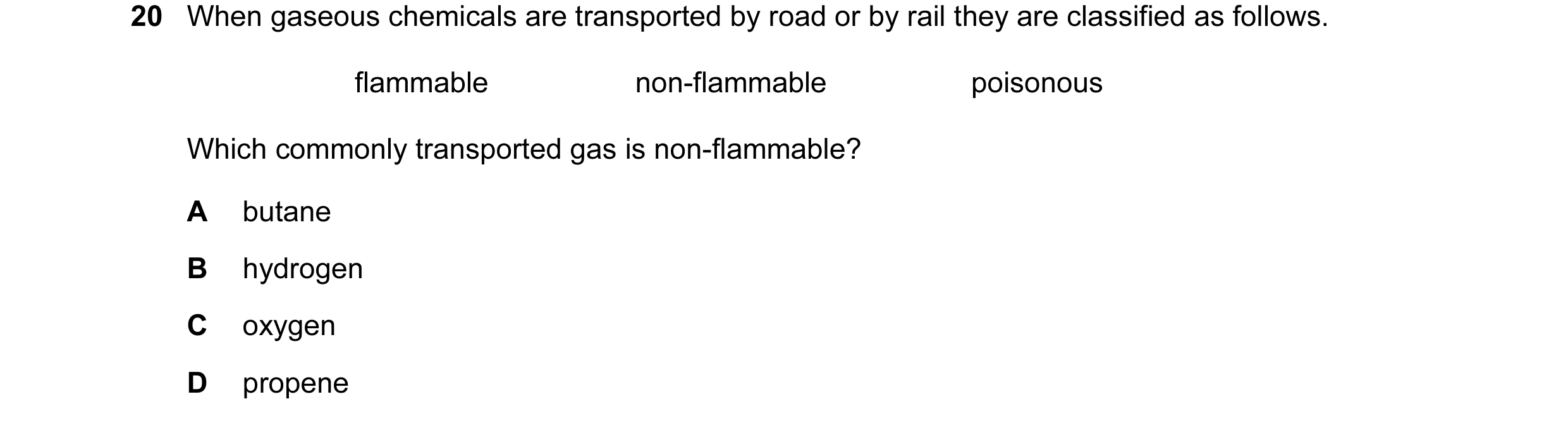
Q14 · When gaseous chemicals are transported by road or by rail they are classified as follows 9701/11 May/June 2010
20 When gaseous chemicals are transported by road or by rail they are classified as follows. flammable non-flammable poisonous Which commonly transported gas is non-flammable? A butane B hydrogen C oxygen D propene
1 marks
Answer: C
This question in 9701/11 May/June 2010
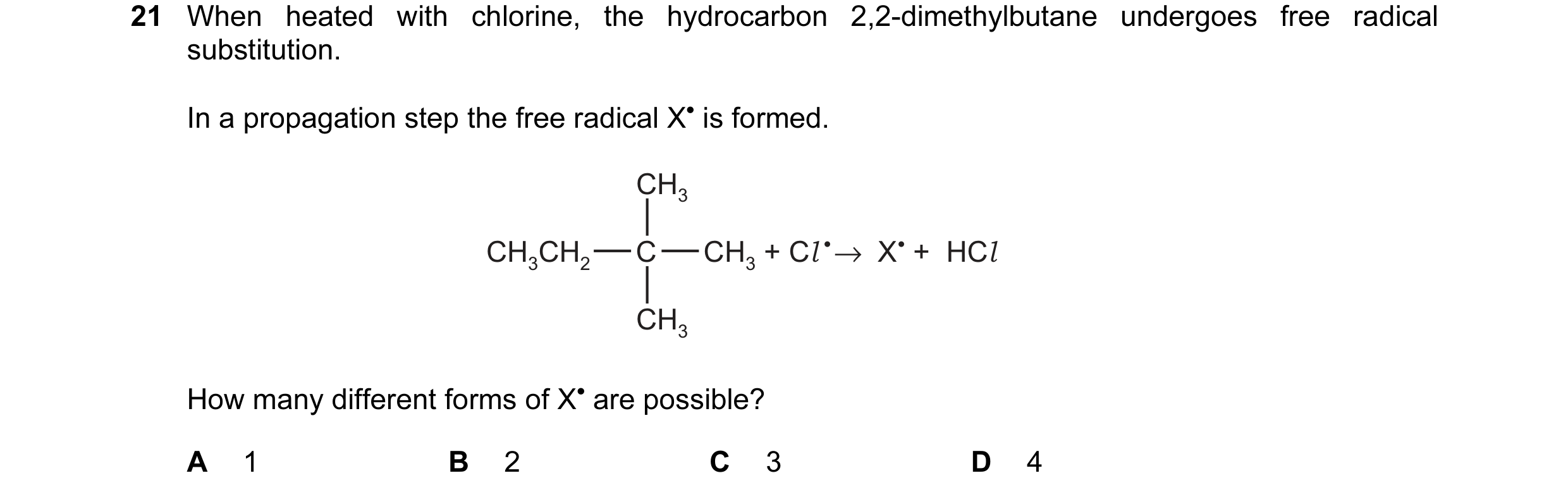
Q15 · When heated with chlorine, the hydrocarbon 2,2-dimethylbutane undergoes free radical… 9701/11 May/June 2010
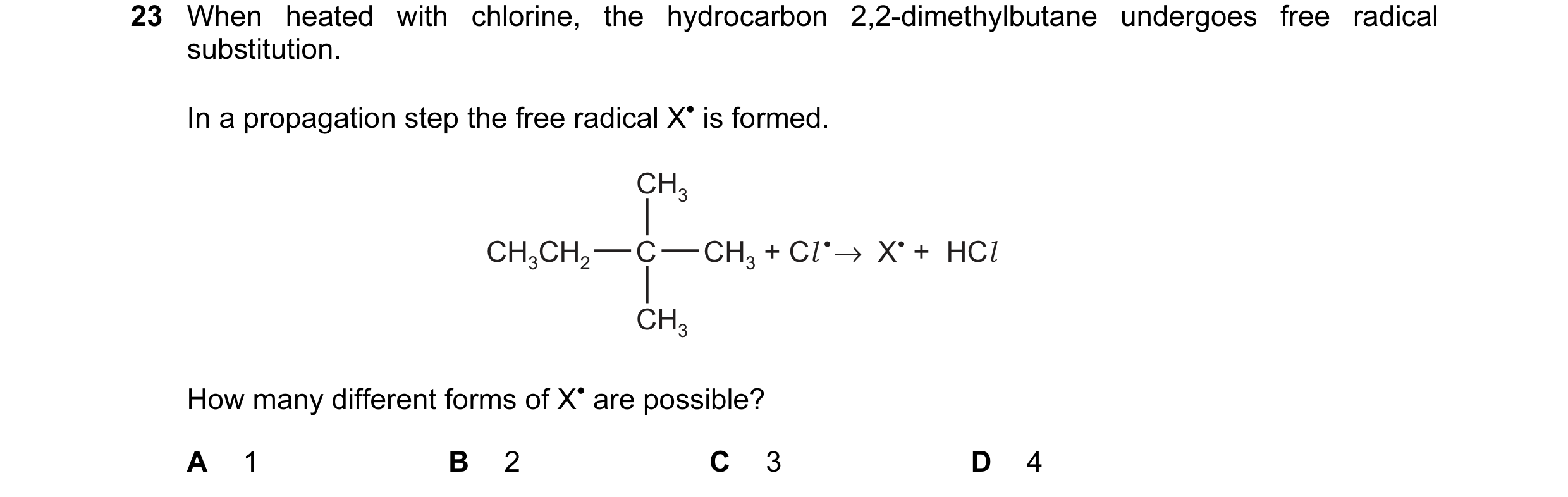
21 When heated with chlorine, the hydrocarbon 2,2-dimethylbutane undergoes free radical substitution. In a propagation step the free radical X• is formed. CH3 CH3CH2 C CH3 + Cl → X + HCl ● ● CH3 How many different forms of X• are possible? A 1 B 2 C 3 D 4
1 marks
Answer: C
This question in 9701/11 May/June 2010
Q16 · Which structural formulae represent 2,2-dimethylpentane? 9701/11 May/June 2010
38 Which structural formulae represent 2,2-dimethylpentane? 1 (CH3)2CHCH2CH(CH3)2 2 (CH3)3CCH2CH2CH3 3 CH3CH2CH2C(CH3)3
1 marks
Answer: C
This question in 9701/11 May/June 2010
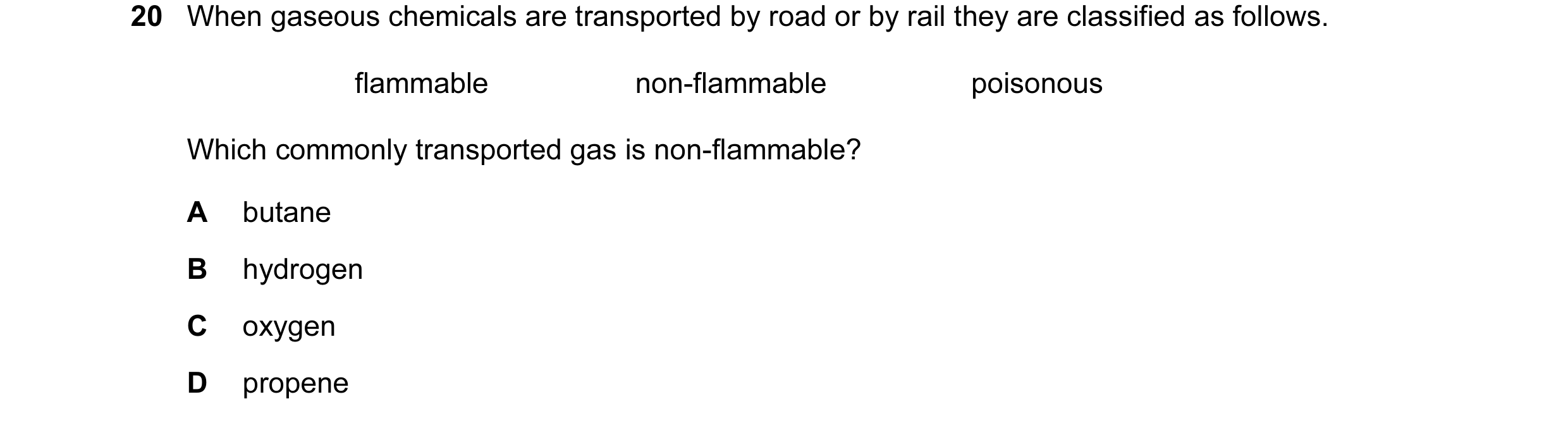
Q17 · When gaseous chemicals are transported by road or by rail they are classified as follows 9701/12 May/June 2010
20 When gaseous chemicals are transported by road or by rail they are classified as follows. flammable non-flammable poisonous Which commonly transported gas is non-flammable? A butane B hydrogen C oxygen D propene
1 marks
Answer: C
This question in 9701/12 May/June 2010
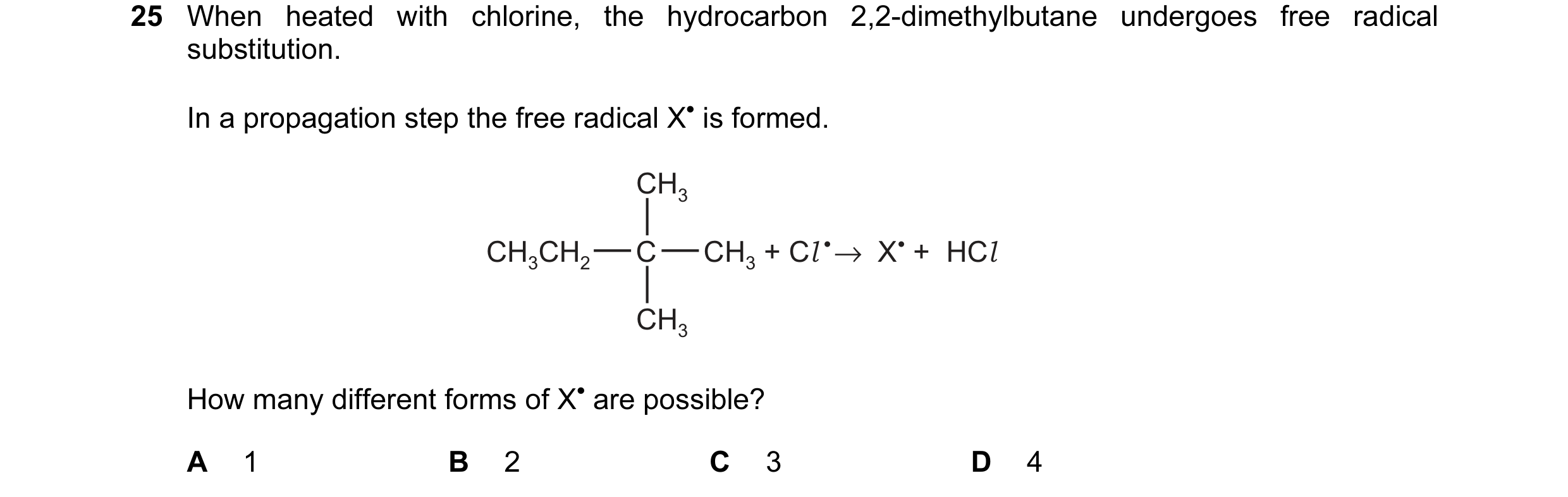
Q18 · When heated with chlorine, the hydrocarbon 2,2-dimethylbutane undergoes free radical… 9701/12 May/June 2010
25 When heated with chlorine, the hydrocarbon 2,2-dimethylbutane undergoes free radical substitution. In a propagation step the free radical X• is formed. CH3 CH3CH2 C CH3 + Cl → X + HCl ● ● CH3 How many different forms of X• are possible? A 1 B 2 C 3 D 4
1 marks
Answer: C
This question in 9701/12 May/June 2010
Q19 · Which structural formulae represent 2,2-dimethylpentane? 9701/12 May/June 2010
39 Which structural formulae represent 2,2-dimethylpentane? 1 (CH3)2CHCH2CH(CH3)2 2 (CH3)3CCH2CH2CH3 3 CH3CH2CH2C(CH3)3
1 marks
Answer: C
This question in 9701/12 May/June 2010
Q20 · When gaseous chemicals are transported by road or by rail they are classified as follows 9701/13 May/June 2010
20 When gaseous chemicals are transported by road or by rail they are classified as follows. flammable non-flammable poisonous Which commonly transported gas is non-flammable? A butane B hydrogen C oxygen D propene
1 marks
Answer: C
This question in 9701/13 May/June 2010
Q21 · When heated with chlorine, the hydrocarbon 2,2-dimethylbutane undergoes free radical… 9701/13 May/June 2010
23 When heated with chlorine, the hydrocarbon 2,2-dimethylbutane undergoes free radical substitution. In a propagation step the free radical X• is formed. CH3 CH3CH2 C CH3 + Cl → X + HCl ● ● CH3 How many different forms of X• are possible? A 1 B 2 C 3 D 4
1 marks
Answer: C
This question in 9701/13 May/June 2010
Q22 · Which structural formulae represent 2,2-dimethylpentane? 9701/13 May/June 2010
37 Which structural formulae represent 2,2-dimethylpentane? 1 (CH3)2CHCH2CH(CH3)2 2 (CH3)3CCH2CH2CH3 3 CH3CH2CH2C(CH3)3
1 marks
Answer: C
This question in 9701/13 May/June 2010
Q23 · The products obtained by cracking an alkane, X, are methane, ethene and propene 9701/12 May/June 2011
23 The products obtained by cracking an alkane, X, are methane, ethene and propene. The mole fraction of ethene in the products is 0.5. What is the identity of X? A C6H14 B C8H18 C C9H20 D C11H24
1 marks
Answer: B
This question in 9701/12 May/June 2011
Q24 · In the reaction pathway below, an alkane is converted into a carboxylic acid through… 9701/13 May/June 2011
22 In the reaction pathway below, an alkane is converted into a carboxylic acid through several stages. stage 1 stage 2 stage 3 C10H22 C2H4 C2H5OH CH3CO2H catalytic hydration Which processes occur at stage 1 and at stage 3? stage 1 stage 3 A condensation combustion B cracking dehydration C cracking oxidation D dehydration combustion
1 marks
Answer: C
This question in 9701/13 May/June 2011
Q25 · In the general formula of which class of compound, is the ratio of hydrogen atoms to… 9701/11 Oct/Nov 2011
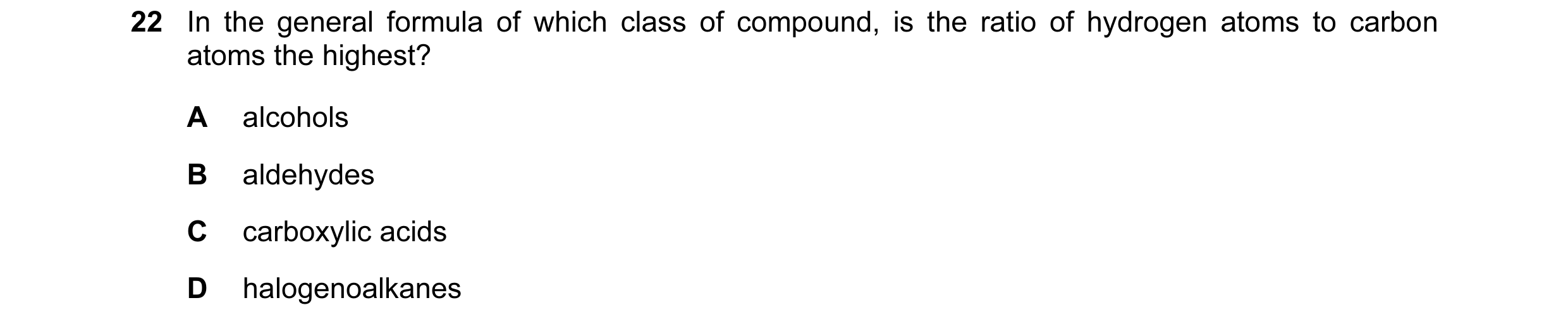
22 In the general formula of which class of compound, is the ratio of hydrogen atoms to carbon atoms the highest? A alcohols B aldehydes C carboxylic acids D halogenoalkanes
1 marks
Answer: A
This question in 9701/11 Oct/Nov 2011
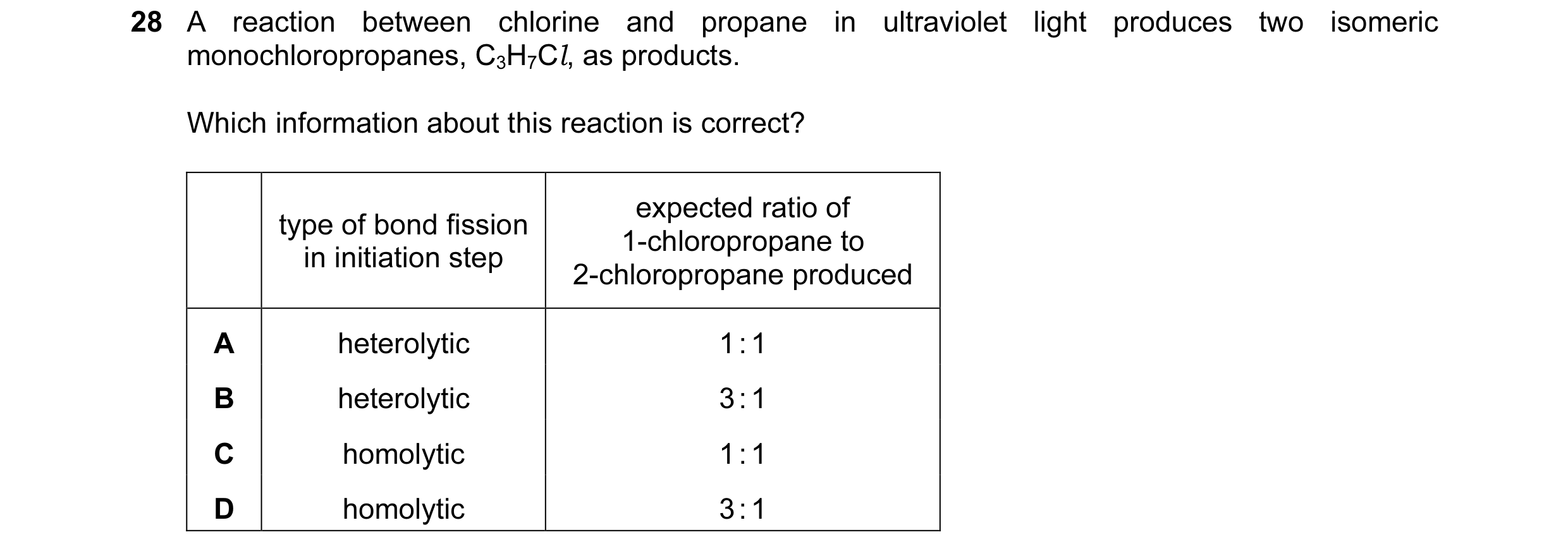
Q26 · A reaction between chlorine and propane in ultraviolet light produces two isomeric… 9701/11 Oct/Nov 2011
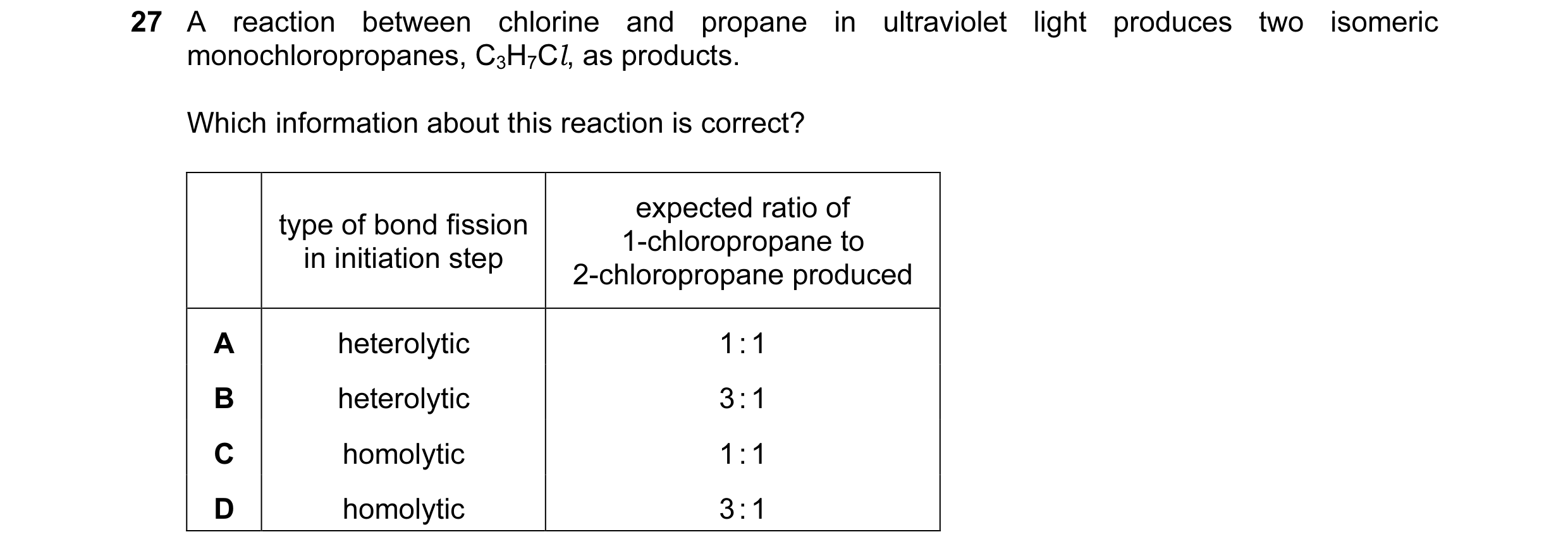
27 A reaction between chlorine and propane in ultraviolet light produces two isomeric monochloropropanes, C3H7Cl, as products. Which information about this reaction is correct? expected ratio of type of bond fission 1-chloropropane to in initiation step 2-chloropropane produced A heterolytic 1 : 1 B heterolytic 3 : 1 C homolytic 1 : 1 D homolytic 3 : 1
1 marks
Answer: D
This question in 9701/11 Oct/Nov 2011
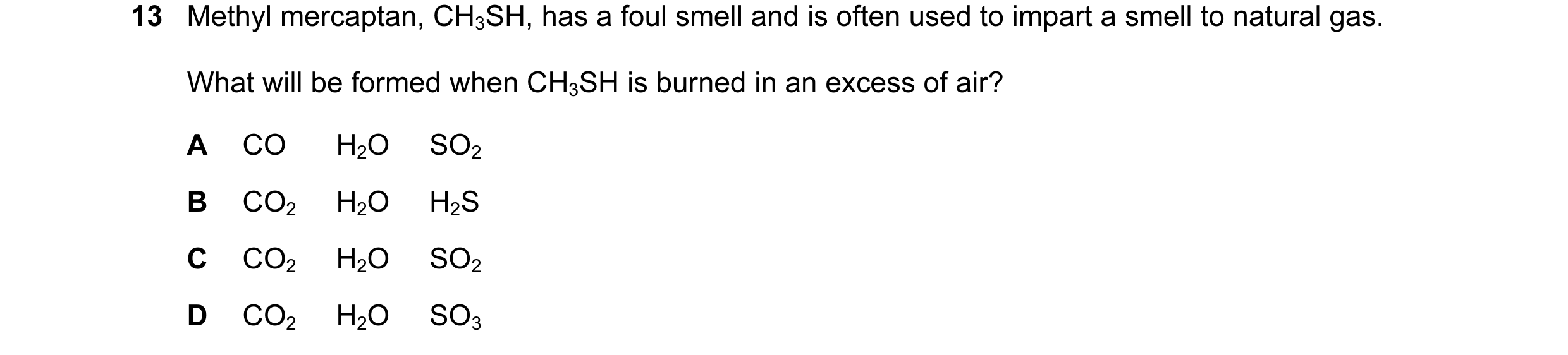
Q27 · Methyl mercaptan, CH3SH, has a foul smell and is often used to impart a smell to natural… 9701/12 Oct/Nov 2011
13 Methyl mercaptan, CH3SH, has a foul smell and is often used to impart a smell to natural gas. What will be formed when CH3SH is burned in an excess of air? A CO H2O SO2 B CO2 H2O H2S C CO2 H2O SO2 D CO2 H2O SO3
1 marks
This question in 9701/12 Oct/Nov 2011
Q28 · In the general formula of which class of compound, is the ratio of hydrogen atoms to… 9701/13 Oct/Nov 2011
23 In the general formula of which class of compound, is the ratio of hydrogen atoms to carbon atoms the highest? A alcohols B aldehydes C carboxylic acids D halogenoalkanes
1 marks
Answer: A
This question in 9701/13 Oct/Nov 2011
Q29 · A reaction between chlorine and propane in ultraviolet light produces two isomeric… 9701/13 Oct/Nov 2011
28 A reaction between chlorine and propane in ultraviolet light produces two isomeric monochloropropanes, C3H7Cl, as products. Which information about this reaction is correct? expected ratio of type of bond fission 1-chloropropane to in initiation step 2-chloropropane produced A heterolytic 1 : 1 B heterolytic 3 : 1 C homolytic 1 : 1 D homolytic 3 : 1
1 marks
Answer: D
This question in 9701/13 Oct/Nov 2011
Q30 · Which substance does not produce a poisonous gas, when burnt in a limited amount of air? 9701/12 May/June 2012
19 Which substance does not produce a poisonous gas, when burnt in a limited amount of air? A hydrogen B methane C propene D sulfur
1 marks
Answer: A
This question in 9701/12 May/June 2012
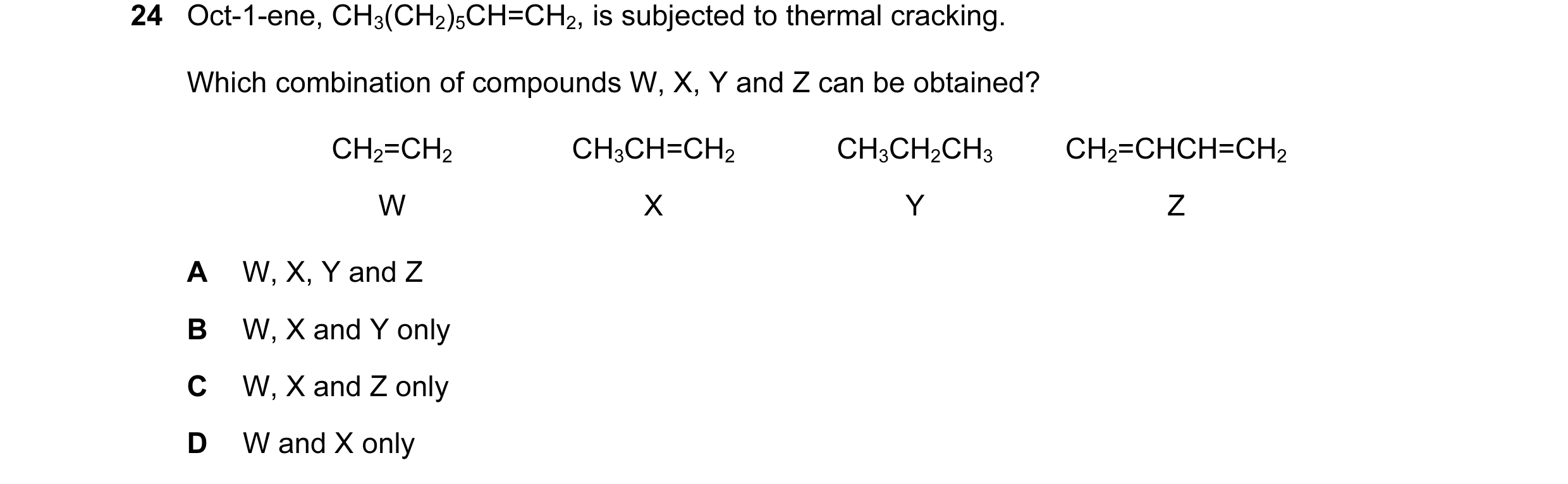
Q31 · Oct-1-ene, CH3(CH2)5CH=CH2, is subjected to thermal cracking 9701/12 May/June 2012
24 Oct-1-ene, CH3(CH2)5CH=CH2, is subjected to thermal cracking. Which combination of compounds W, X, Y and Z can be obtained? CH2=CH2 CH3CH=CH2 CH3CH2CH3 CH2=CHCH=CH2 W X Y Z A W, X, Y and Z B W, X and Y only C W, X and Z only D W and X only
1 marks
Answer: A
This question in 9701/12 May/June 2012
Q32 · Which statements about the photochemical chlorination of ethane are correct? 9701/12 May/June 2012
39 Which statements about the photochemical chlorination of ethane are correct? 1 Hydrogen gas is one of the products. 2 A propagation step in the mechanism is C2H6 + Cl • → C2H5• + HCl. 3 The initiation step is the homolytic fission of chlorine.
1 marks
Answer: C
This question in 9701/12 May/June 2012
Q33 · The cracking of a single hydrocarbon molecule, CnH2n+2, produces two hydrocarbon… 9701/11 Oct/Nov 2012
23 The cracking of a single hydrocarbon molecule, CnH2n+2, produces two hydrocarbon molecules only. Each hydrocarbon product contains the same number of carbon atoms in one molecule. Each hydrocarbon product has non-cyclic structural isomers. What is the value of n? A 4 B 6 C 8 D 9
1 marks
Answer: C
This question in 9701/11 Oct/Nov 2012
Q34 · One of the reactions taking place in a catalytic converter in a car exhaust system is… 9701/11 Oct/Nov 2012
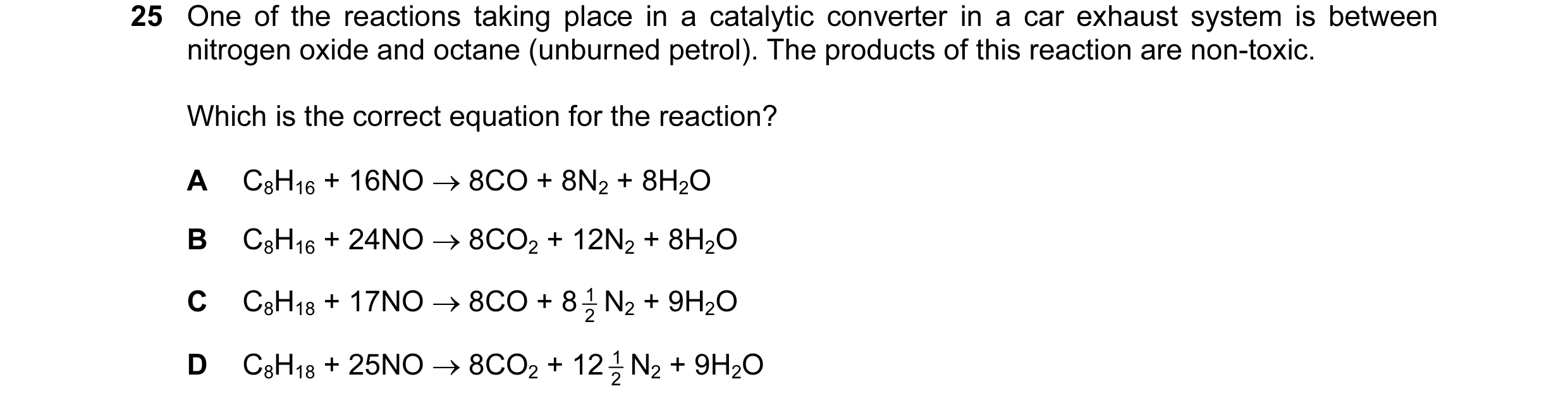
25 One of the reactions taking place in a catalytic converter in a car exhaust system is between nitrogen oxide and octane (unburned petrol). The products of this reaction are non-toxic. Which is the correct equation for the reaction? A C8H16 + 16NO → 8CO + 8N2 + 8H2O B C8H16 + 24NO → 8CO2 + 12N2 + 8H2O C C8H18 + 17NO → 8CO + 8 2 1 N2 + 9H2O D C8H18 + 25NO → 8CO2 + 12 2 1 N2 + 9H2O
1 marks
Answer: D
This question in 9701/11 Oct/Nov 2012
Q35 · Which reagents and conditions will convert propane into 1-chloropropane? 9701/11 Oct/Nov 2012
37 Which reagents and conditions will convert propane into 1-chloropropane? 1 Cl 2 and sunlight 2 conc. HCl, reflux 3 PCl 5
1 marks
Answer: D
This question in 9701/11 Oct/Nov 2012
Q36 · The cracking of a single hydrocarbon molecule, CnH2n+2, produces two hydrocarbon… 9701/12 Oct/Nov 2012
23 The cracking of a single hydrocarbon molecule, CnH2n+2, produces two hydrocarbon molecules only. Each hydrocarbon product contains the same number of carbon atoms in one molecule. Each hydrocarbon product has non-cyclic structural isomers. What is the value of n? A 4 B 6 C 8 D 9
1 marks
Answer: C
This question in 9701/12 Oct/Nov 2012
Q37 · One of the reactions taking place in a catalytic converter in a car exhaust system is… 9701/12 Oct/Nov 2012
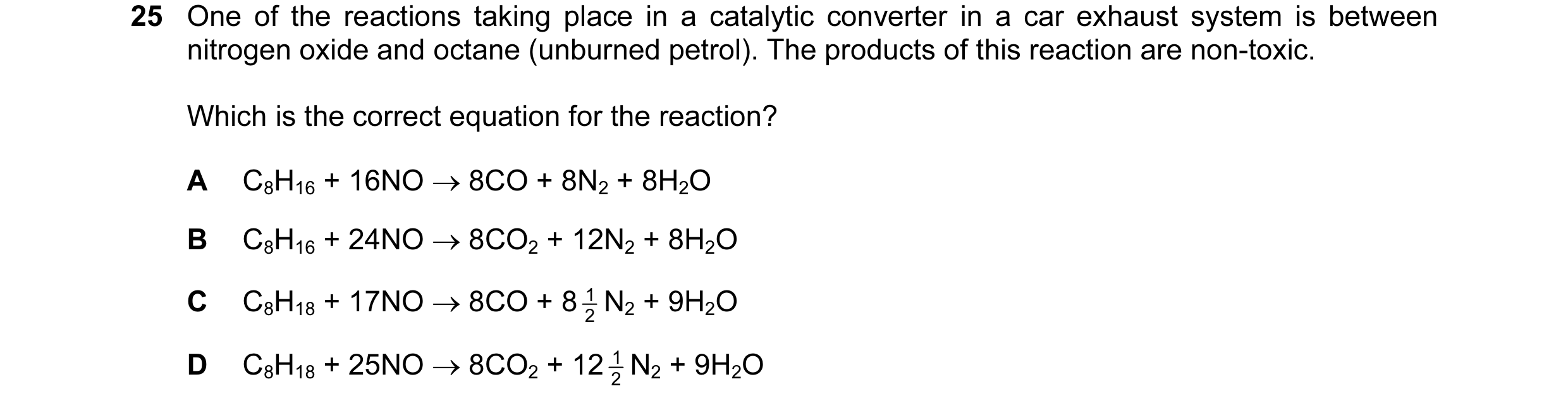
25 One of the reactions taking place in a catalytic converter in a car exhaust system is between nitrogen oxide and octane (unburned petrol). The products of this reaction are non-toxic. Which is the correct equation for the reaction? A C8H16 + 16NO → 8CO + 8N2 + 8H2O B C8H16 + 24NO → 8CO2 + 12N2 + 8H2O C C8H18 + 17NO → 8CO + 8 2 1 N2 + 9H2O D C8H18 + 25NO → 8CO2 + 12 2 1 N2 + 9H2O
1 marks
Answer: D
This question in 9701/12 Oct/Nov 2012
Q38 · Pentane, C5H12, is reacted with chlorine in the presence of ultraviolet light 9701/11 May/June 2013
25 Pentane, C5H12, is reacted with chlorine in the presence of ultraviolet light. A compound R is found in the products. R has molecular formula C5H10Cl 2. Each molecule of R contains one chiral carbon atom. Which two atoms of the pentane chain could be bonded to chlorine atoms in this isomer? A 1 and 3 B 1 and 5 C 2 and 3 D 2 and 4
1 marks
Answer: A
This question in 9701/11 May/June 2013
Q39 · Use of the Data Booklet is relevant to this question 9701/11 May/June 2013
31 Use of the Data Booklet is relevant to this question. Free-radicals play an important part in reactions involving the destruction of the ozone layer and the substitution of alkanes by chlorine. Some free-radicals contain two unpaired electrons. Such species are called diradicals. Which species are diradicals? 1 O 2 Cl 3 CH3
1 marks
Answer: D
This question in 9701/11 May/June 2013
Q40 · Which molecules would be present in the mixture produced by the photochemical… 9701/11 May/June 2013
37 Which molecules would be present in the mixture produced by the photochemical chlorination of methane? 1 hydrogen 2 hydrogen chloride 3 dichloromethane
1 marks
Answer: C
This question in 9701/11 May/June 2013
Q41 · When heated with chlorine, the hydrocarbon 2,2-dimethylbutane undergoes free radical… 9701/12 May/June 2013
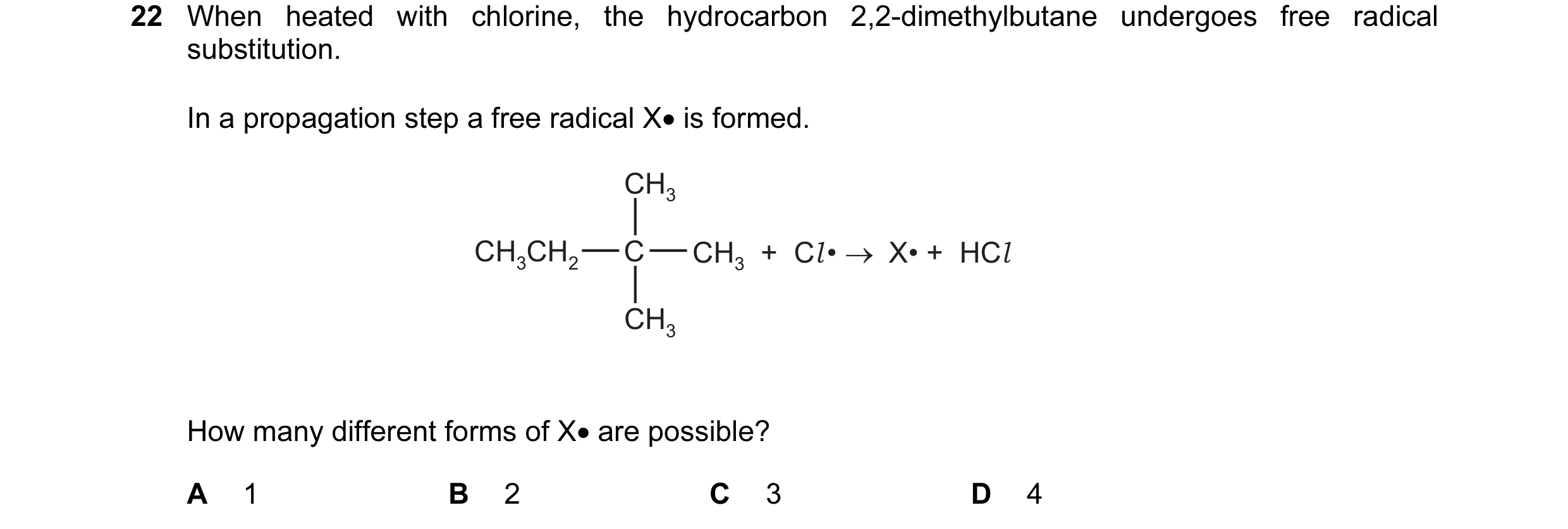
22 When heated with chlorine, the hydrocarbon 2,2-dimethylbutane undergoes free radical substitution. In a propagation step a free radical X• is formed. CH3 CH3CH2 C CH3 + Cl • → X• + HCl CH3 How many different forms of X• are possible? A 1 B 2 C 3 D 4
1 marks
Answer: C
This question in 9701/12 May/June 2013
Q42 · During the bromination of methane, the free radical CH3• is generated 9701/13 May/June 2013
37 During the bromination of methane, the free radical CH3• is generated. A possible terminating step of this reaction is the formation of C2H6 by the combination of two free radicals. What could be produced in a terminating step during the bromination of propane? CH3 1 CH3CH2CH2CHCH3 CH3 2 CH3CHCHCH3 CH3 CH3 3 CH3CH2CHCH2CH3
1 marks
Answer: B
This question in 9701/13 May/June 2013
Q43 · Which stage in the free radical substitution of methane by chlorine will have the lowest… 9701/11 Oct/Nov 2013
7 Which stage in the free radical substitution of methane by chlorine will have the lowest activation energy? A CH3• + Cl 2 → CH3Cl + Cl • B Cl • + Cl • → Cl 2 C Cl • + CH4 → CH3• + HCl D Cl 2 → Cl • + Cl •
1 marks
Answer: B
This question in 9701/11 Oct/Nov 2013
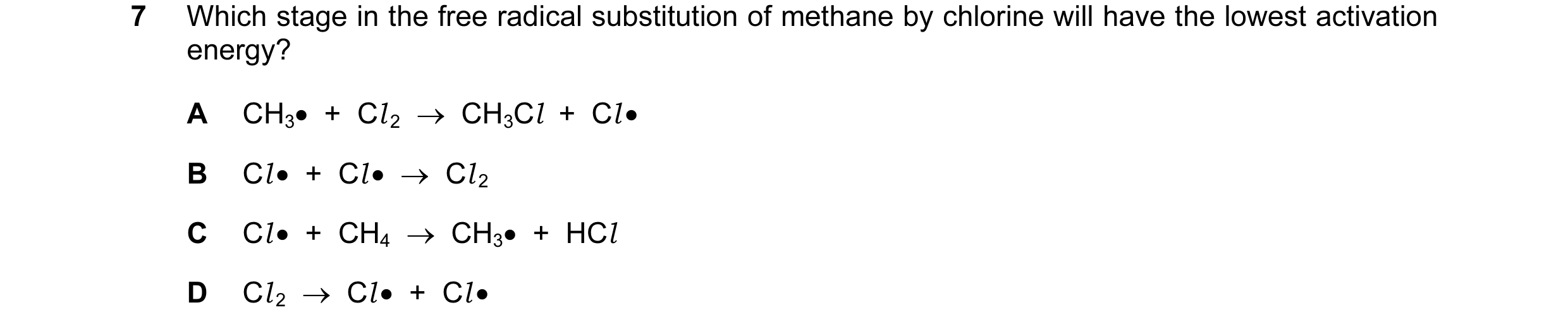
Q44 · Which stage in the free radical substitution of methane by chlorine will have the lowest… 9701/12 Oct/Nov 2013
7 Which stage in the free radical substitution of methane by chlorine will have the lowest activation energy? A CH3• + Cl 2 → CH3Cl + Cl • B Cl • + Cl • → Cl 2 C Cl • + CH4 → CH3• + HCl D Cl 2 → Cl • + Cl •
1 marks
Answer: B
This question in 9701/12 Oct/Nov 2013
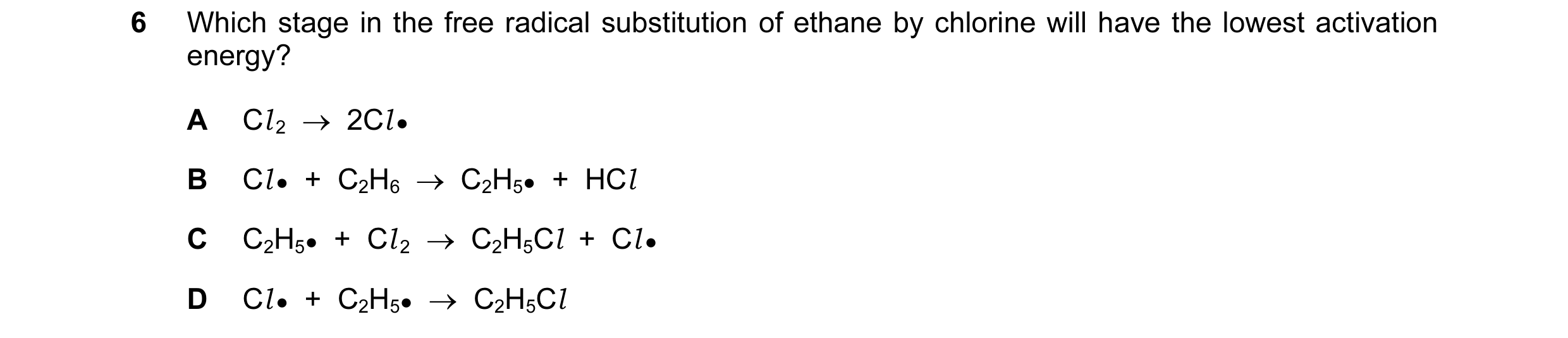
Q45 · Which stage in the free radical substitution of ethane by chlorine will have the lowest… 9701/13 Oct/Nov 2013
6 Which stage in the free radical substitution of ethane by chlorine will have the lowest activation energy? A Cl 2 → 2Cl ● B Cl ● + C2H6 → C2H5● + HCl C C2H5● + Cl 2 → C2H5Cl + Cl ● D Cl ● + C2H5● → C2H5Cl
1 marks
Answer: D
This question in 9701/13 Oct/Nov 2013
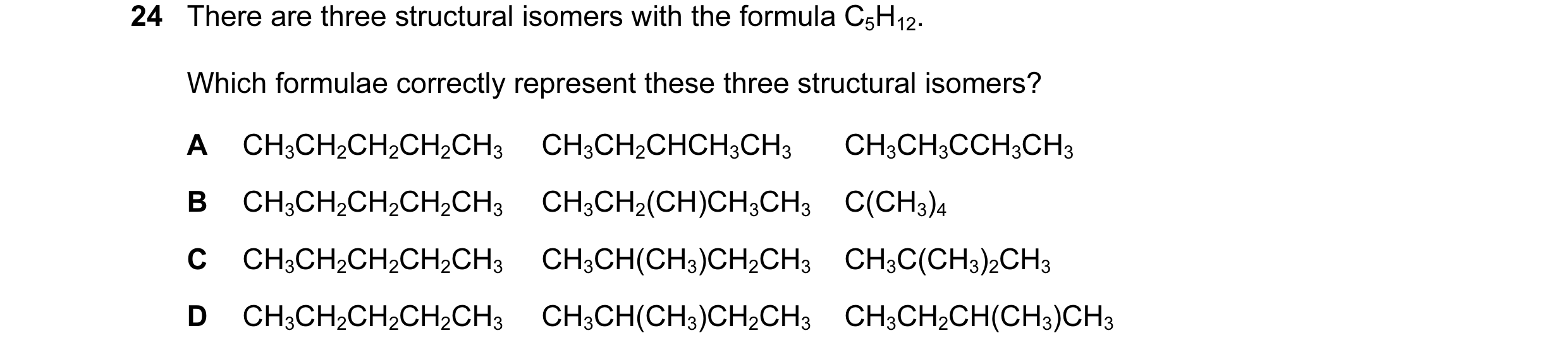
Q46 · There are three structural isomers with the formula C5H12 9701/11 May/June 2014
24 There are three structural isomers with the formula C5H12. Which formulae correctly represent these three structural isomers? A CH3CH2CH2CH2CH3 CH3CH2CHCH3CH3 CH3CH3CCH3CH3 B CH3CH2CH2CH2CH3 CH3CH2(CH)CH3CH3 C(CH3)4 C CH3CH2CH2CH2CH3 CH3CH(CH3)CH2CH3 CH3C(CH3)2CH3 D CH3CH2CH2CH2CH3 CH3CH(CH3)CH2CH3 CH3CH2CH(CH3)CH3
1 marks
Answer: C
This question in 9701/11 May/June 2014
Q47 · The hydrocarbon C17H36 can be cracked 9701/11 May/June 2014
27 The hydrocarbon C17H36 can be cracked. Which compound is the least likely to be produced in this reaction? A C3H8 B C4H8 C C8H16 D C16H34
1 marks
Answer: D
This question in 9701/11 May/June 2014
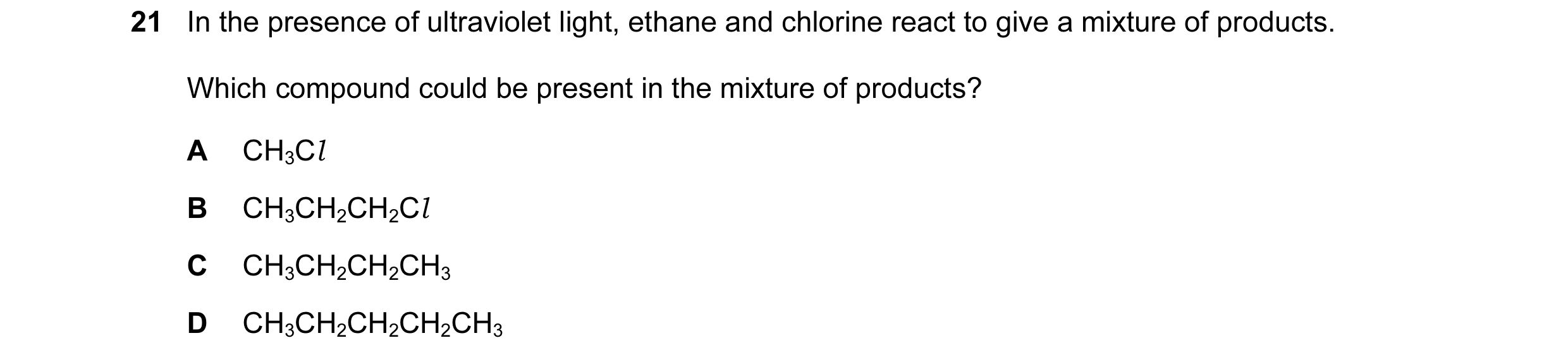
Q48 · In the presence of ultraviolet light, ethane and chlorine react to give a mixture of… 9701/13 May/June 2014
21 In the presence of ultraviolet light, ethane and chlorine react to give a mixture of products. Which compound could be present in the mixture of products? A CH3Cl B CH3CH2CH2Cl C CH3CH2CH2CH3 D CH3CH2CH2CH2CH3
1 marks
Answer: C
This question in 9701/13 May/June 2014
Q49 · Which molecule could not be obtained from the cracking of a molecule of nonane… 9701/13 May/June 2014
23 Which molecule could not be obtained from the cracking of a molecule of nonane, CH3(CH2)7CH3? A CH2=CHCH=CH2 B CH3CH2CH2CH2CH3 C CH3CH2CH2CH2CH2CH=CH2 D (CH3CH2CH2)3CH
1 marks
Answer: D
This question in 9701/13 May/June 2014
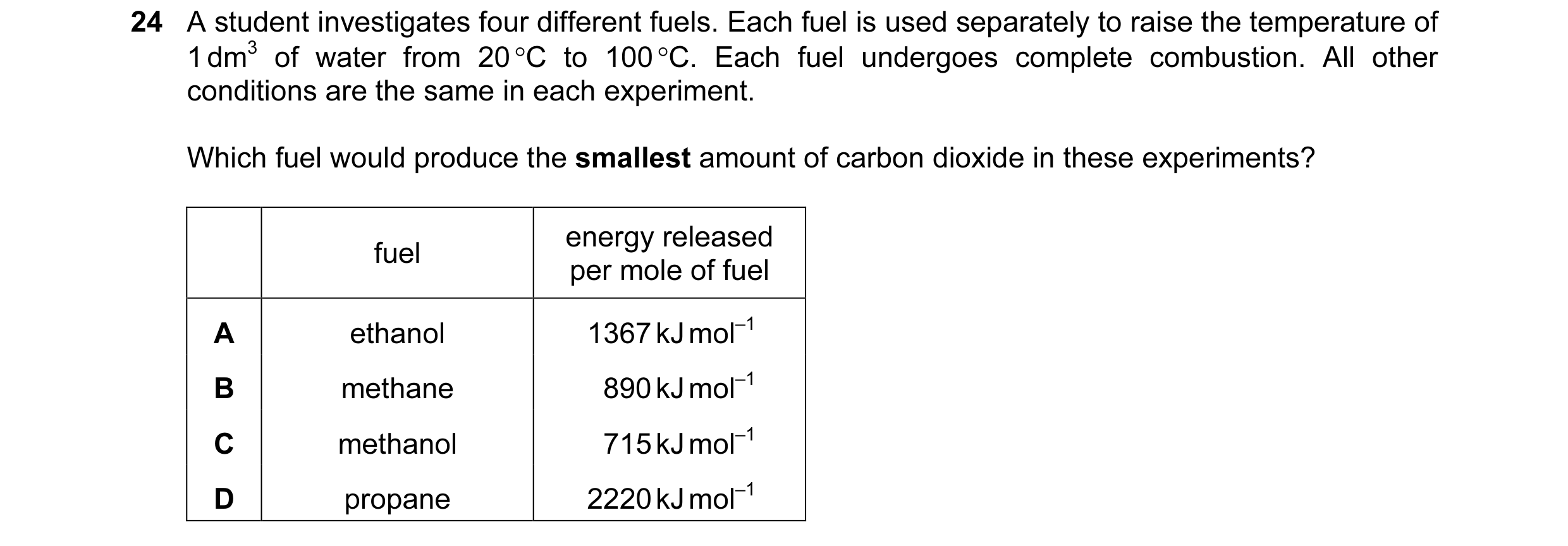
Q50 · A student investigates four different fuels 9701/13 May/June 2014
24 A student investigates four different fuels. Each fuel is used separately to raise the temperature of 1 dm3 of water from 20 °C to 100 °C. Each fuel undergoes complete combustion. All other conditions are the same in each experiment. Which fuel would produce the smallest amount of carbon dioxide in these experiments? energy released fuel per mole of fuel A ethanol 1367 kJ mol–1 B methane 890 kJ mol–1 C methanol 715 kJ mol–1 D propane 2220 kJ mol–1
1 marks
Answer: B
This question in 9701/13 May/June 2014
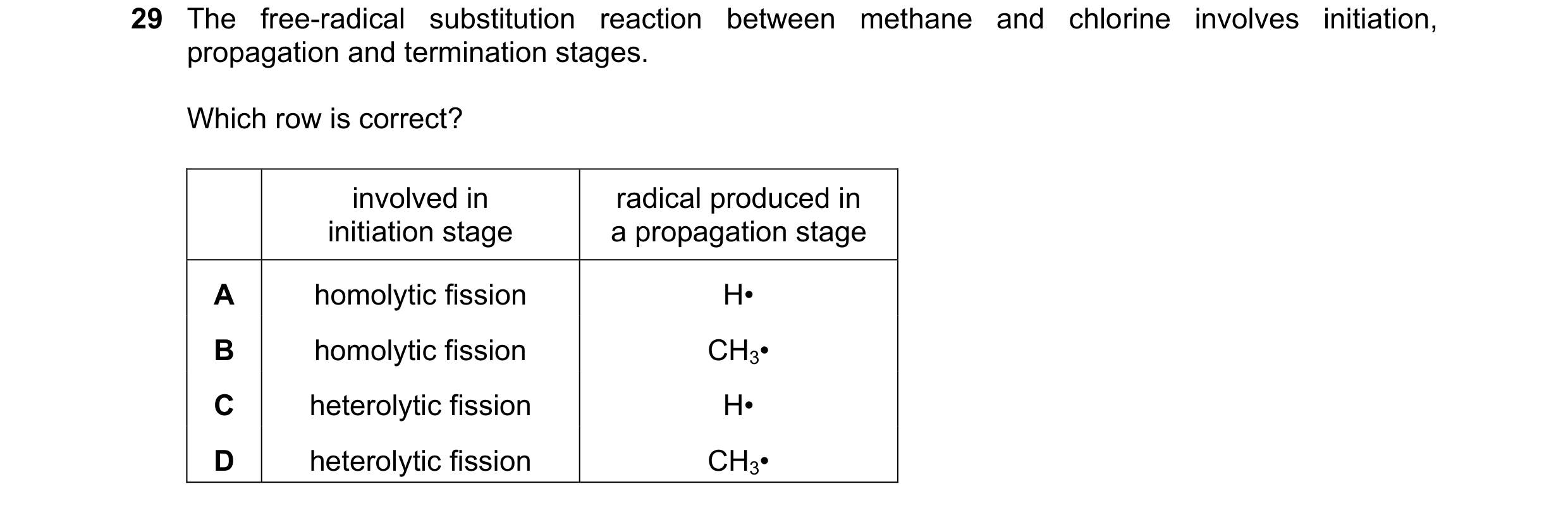
Q51 · The free radical substitution reaction between methane and chlorine involves initiation… 9701/13 May/June 2014
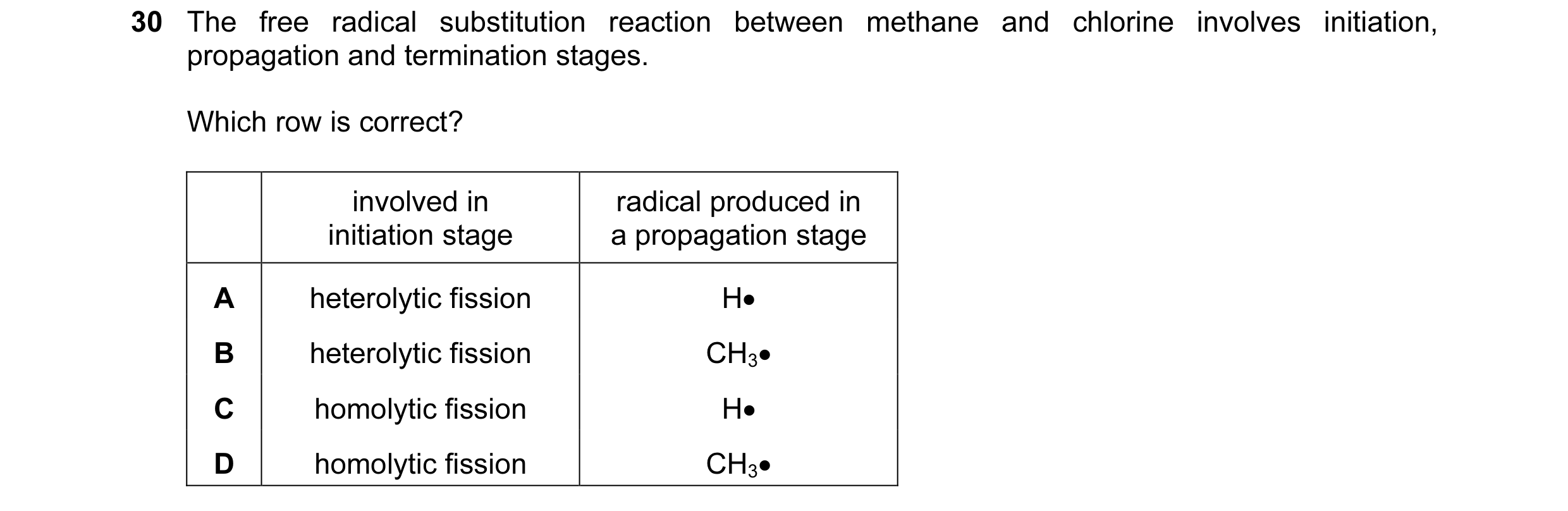
30 The free radical substitution reaction between methane and chlorine involves initiation, propagation and termination stages. Which row is correct? involved in radical produced in initiation stage a propagation stage A heterolytic fission H• B heterolytic fission CH3• C homolytic fission H• D homolytic fission CH3•
1 marks
Answer: D
This question in 9701/13 May/June 2014
Q52 · The diagram shows an experimental set-up which can be used in several different… 9701/13 May/June 2014
40 The diagram shows an experimental set-up which can be used in several different experiments. silica, alumina or baked clay liquid X on mineral wool gas collected support strong gentle heat trough of heat water Which processes could be demonstrated by using the above apparatus? 1 oxidation of ethanol (liquid X) 2 dehydration of ethanol (liquid X) 3 cracking of paraffin (liquid X)
1 marks
Answer: C
This question in 9701/13 May/June 2014
Q53 · Aluminium carbide, Al 4C3, reacts readily with aqueous sodium hydroxide 9701/11 Oct/Nov 2014
6 Aluminium carbide, Al 4C3, reacts readily with aqueous sodium hydroxide. The two products of the reaction are NaAl O2 and a hydrocarbon. Water molecules are also involved as reactants. What is the formula of the hydrocarbon? A CH4 B C2H6 C C3H8 D C6H12
1 marks
Answer: A
This question in 9701/11 Oct/Nov 2014
Q54 · Which equation correctly represents the balanced equation for the complete combustion of… 9701/11 Oct/Nov 2014
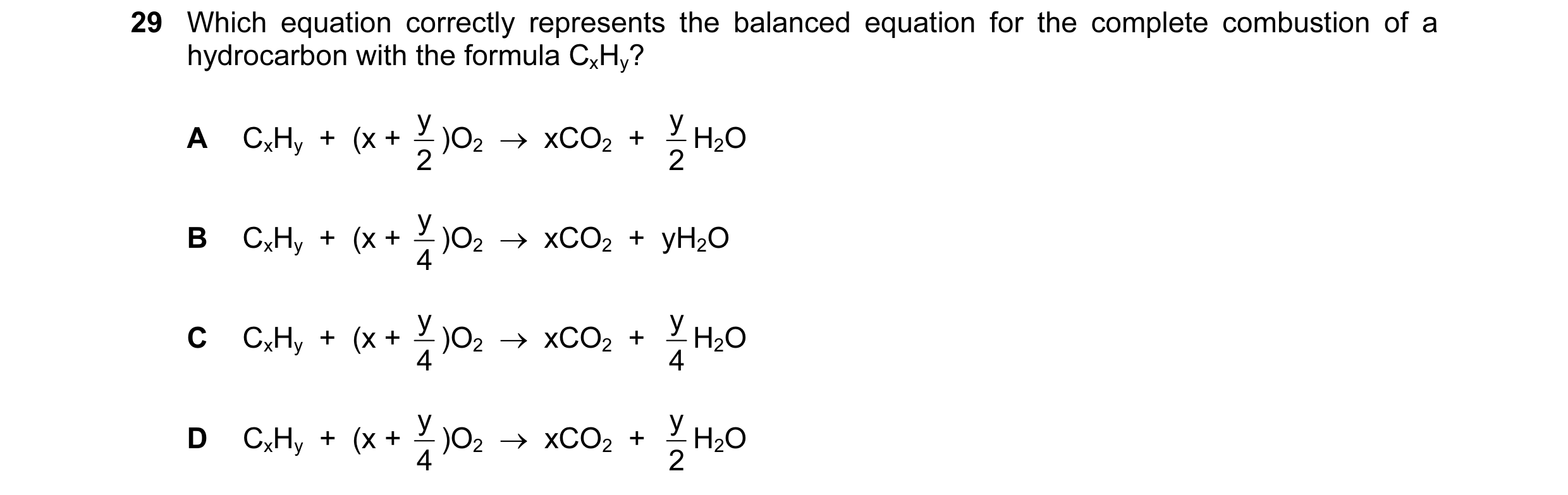
29 Which equation correctly represents the balanced equation for the complete combustion of a hydrocarbon with the formula CxHy? A y )O2 → xCO2 + 2 y H2O CxHy + (x + 2 B y )O2 → xCO2 + yH2O CxHy + (x + 4 C y )O2 → xCO2 + 4 y H2O CxHy + (x + 4 D y )O2 → xCO2 + 2 y H2O CxHy + (x + 4
1 marks
Answer: D
This question in 9701/11 Oct/Nov 2014
Q55 · Which equation correctly represents the balanced equation for the complete combustion of… 9701/12 Oct/Nov 2014
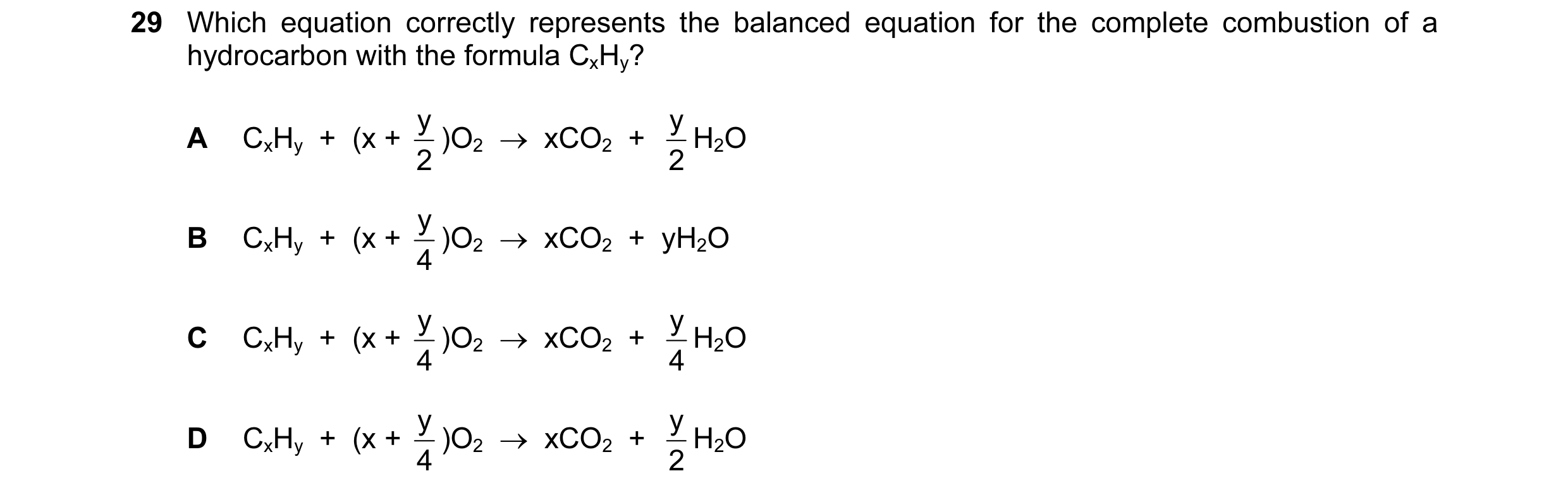
29 Which equation correctly represents the balanced equation for the complete combustion of a hydrocarbon with the formula CxHy? A y )O2 → xCO2 + 2 y H2O CxHy + (x + 2 B y )O2 → xCO2 + yH2O CxHy + (x + 4 C y )O2 → xCO2 + 4 y H2O CxHy + (x + 4 D y )O2 → xCO2 + 2 y H2O CxHy + (x + 4
1 marks
Answer: D
This question in 9701/12 Oct/Nov 2014
Q56 · Which statements about the photochemical chlorination of ethane are correct? 9701/13 Oct/Nov 2014
37 Which statements about the photochemical chlorination of ethane are correct? 1 A propagation step in the mechanism is C2H5• + Cl 2 → C2H5Cl + Cl •. 2 Butane is present in the products. 3 The initiation step is the heterolytic fission of chlorine.
1 marks
Answer: B
This question in 9701/13 Oct/Nov 2014
Q57 · Four students, W, X, Y and Z, made the following statements about alkanes and alkenes 9701/12 May/June 2015
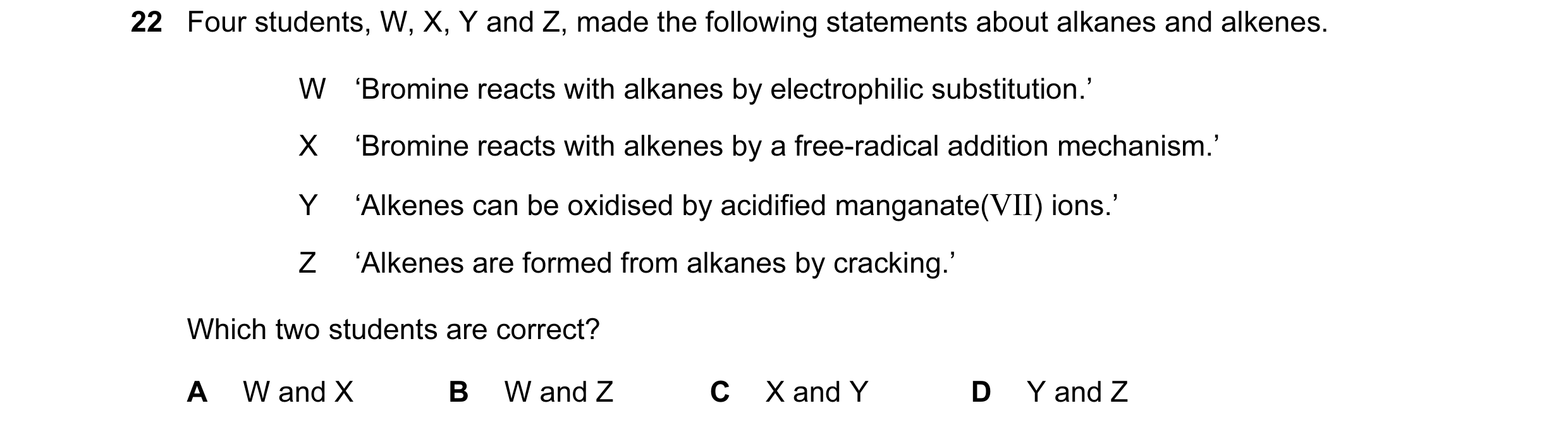
22 Four students, W, X, Y and Z, made the following statements about alkanes and alkenes. W ‘Bromine reacts with alkanes by electrophilic substitution.’ X ‘Bromine reacts with alkenes by a free-radical addition mechanism.’ Y ‘Alkenes can be oxidised by acidified manganate(VII) ions.’ Z ‘Alkenes are formed from alkanes by cracking.’ Which two students are correct? A W and X B W and Z C X and Y D Y and Z
1 marks
Answer: D
This question in 9701/12 May/June 2015
Q58 · The first propagation step in the reaction between methane and chlorine is shown 9701/11 May/June 2016
23 The first propagation step in the reaction between methane and chlorine is shown. CH4 + Cl • → CH3• + HCl How many different first propagation steps are possible in the reaction between pentane and chlorine? A 2 B 3 C 4 D 5
1 marks
Answer: B
This question in 9701/11 May/June 2016
Q59 · Which stage in the free radical substitution of ethane by chlorine has the lowest… 9701/12 May/June 2016
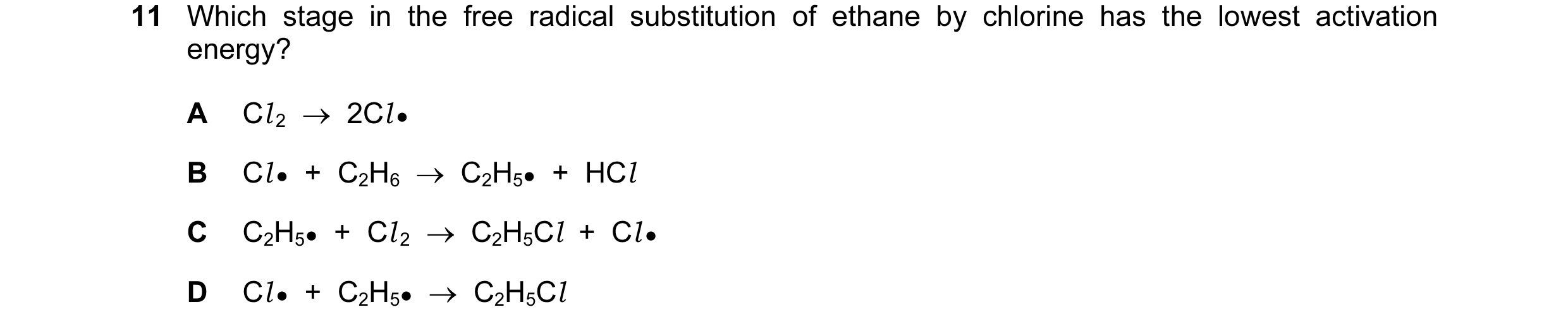
11 Which stage in the free radical substitution of ethane by chlorine has the lowest activation energy? A Cl 2 → 2Cl ● B Cl ● + C2H6 → C2H5● + HCl C C2H5● + Cl 2 → C2H5Cl + Cl ● D Cl ● + C2H5● → C2H5Cl
1 marks
Answer: D
This question in 9701/12 May/June 2016
Q60 · Chlorofluorocarbons damage the ozone layer by undergoing reactions with a free radical… 9701/12 May/June 2016
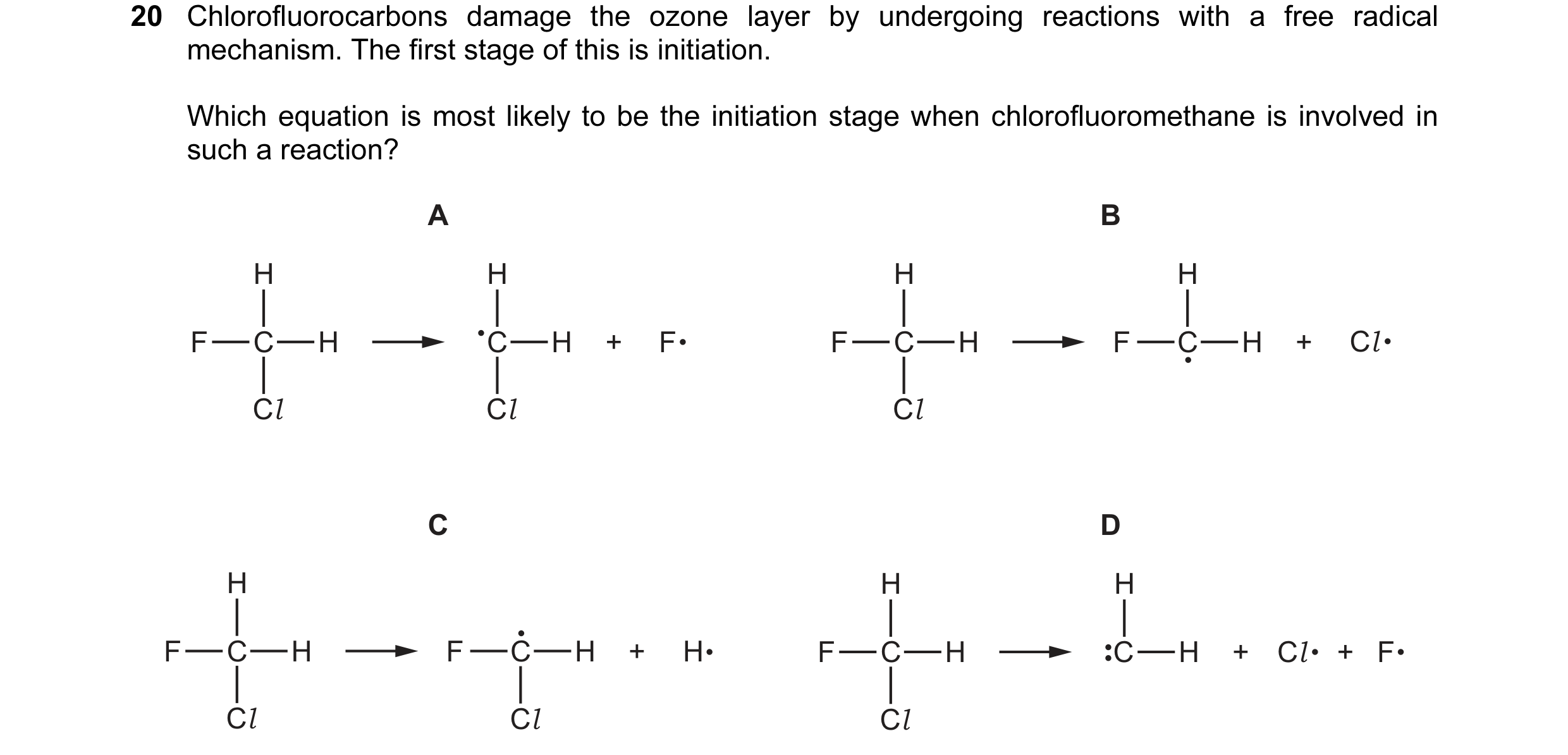
20 Chlorofluorocarbons damage the ozone layer by undergoing reactions with a free radical mechanism. The first stage of this is initiation. Which equation is most likely to be the initiation stage when chlorofluoromethane is involved in such a reaction? A B H H H H F C H C H + F F C H F C H + Cl Cl Cl Cl C D H H H F C H F C H + H F C H C H + Cl + F Cl Cl Cl
1 marks
Answer: B
This question in 9701/12 May/June 2016
Q61 · When heated with chlorine, the hydrocarbon 2,2-dimethylbutane undergoes free radical… 9701/13 May/June 2016
23 When heated with chlorine, the hydrocarbon 2,2-dimethylbutane undergoes free radical substitution. In a propagation step a free radical X• is formed. CH3 CH3CH2 C CH3 + Cl • → X• + HCl CH3 How many different structures of X• are possible? A 2 B 3 C 4 D 5
1 marks
Answer: B
This question in 9701/13 May/June 2016
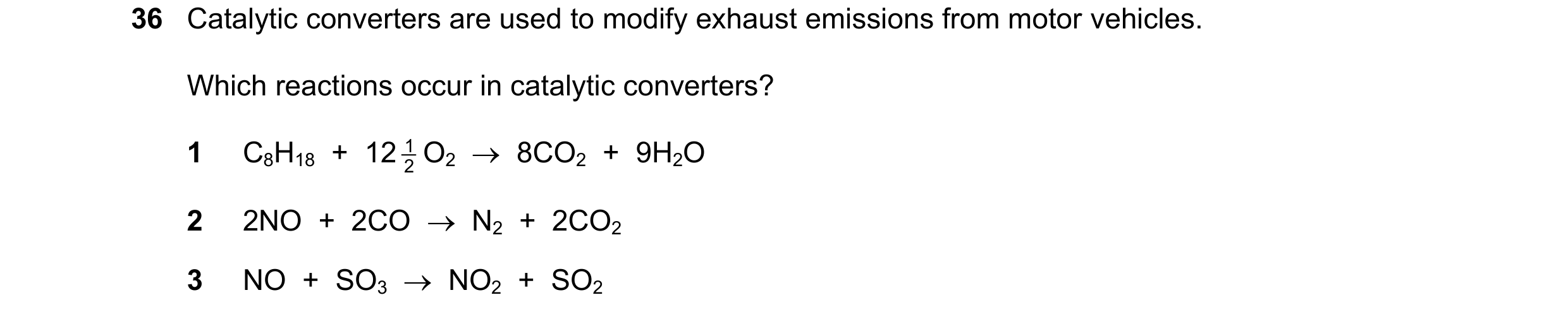
Q62 · Catalytic converters are used to modify exhaust emissions from motor vehicles 9701/11 Oct/Nov 2016
36 Catalytic converters are used to modify exhaust emissions from motor vehicles. Which reactions occur in catalytic converters? 1 C8H18 + 12 2 1 O2 → 8CO2 + 9H2O 2 2NO + 2CO → N2 + 2CO2 3 NO + SO3 → NO2 + SO2
1 marks
Answer: B
This question in 9701/11 Oct/Nov 2016
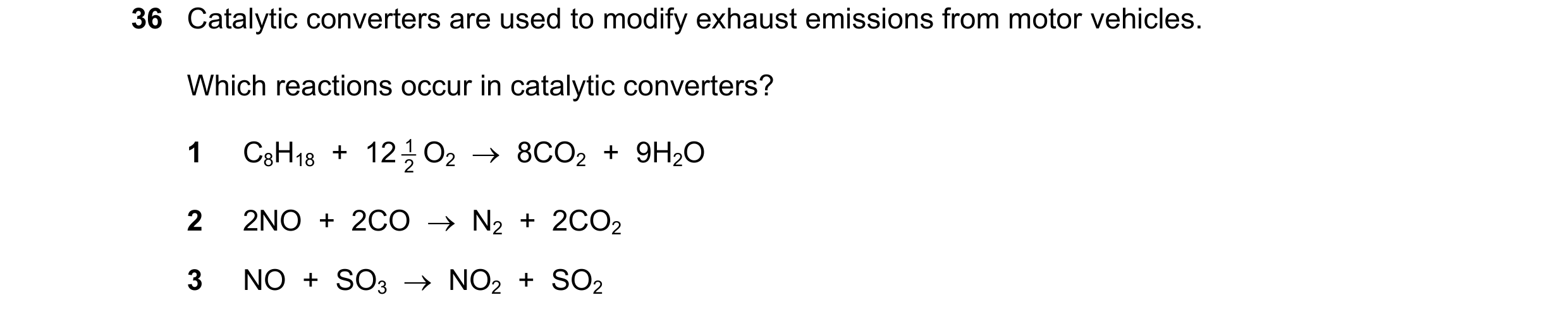
Q63 · Catalytic converters are used to modify exhaust emissions from motor vehicles 9701/13 Oct/Nov 2016
36 Catalytic converters are used to modify exhaust emissions from motor vehicles. Which reactions occur in catalytic converters? 1 C8H18 + 12 2 1 O2 → 8CO2 + 9H2O 2 2NO + 2CO → N2 + 2CO2 3 NO + SO3 → NO2 + SO2
1 marks
Answer: B
This question in 9701/13 Oct/Nov 2016
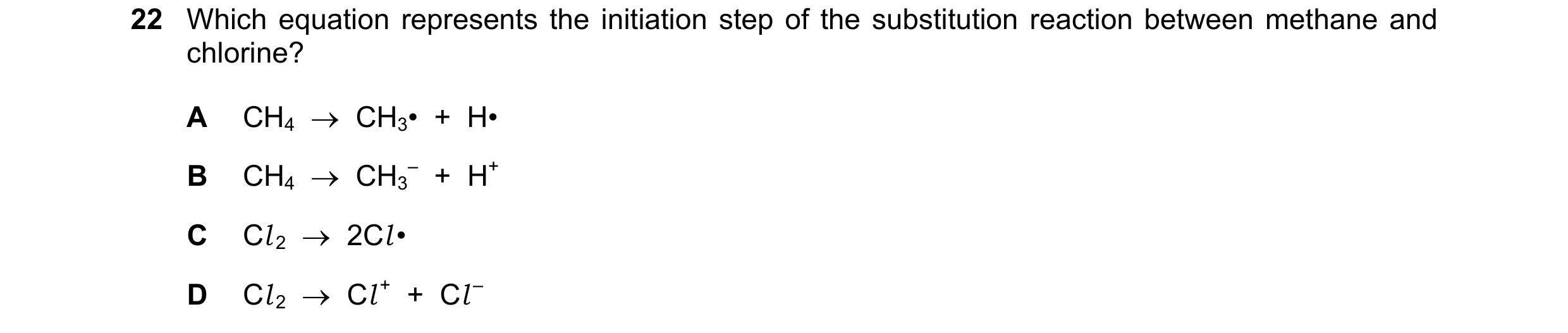
Q64 · Which equation represents the initiation step of the substitution reaction between… 9701/12 May/June 2017
22 Which equation represents the initiation step of the substitution reaction between methane and chlorine? A CH4 → CH3• + H• B CH4 → CH3 – + H+ C Cl 2 → 2Cl • D Cl 2 → Cl + + Cl –
1 marks
Answer: C
This question in 9701/12 May/June 2017
Q65 · A 0.216 g sample of an aluminium compound X reacts with an excess of water to produce a… 9701/13 May/June 2017
2 A 0.216 g sample of an aluminium compound X reacts with an excess of water to produce a single hydrocarbon gas. This gas burns completely in O2 to form H2O and CO2 only. The volume of CO2 at room temperature and pressure is 108 cm3. What is the formula of X? A Al 2C3 B Al 3C2 C Al 3C4 D Al 4C3
1 marks
Answer: D
This question in 9701/13 May/June 2017
Q66 · Which mechanisms are represented in this sequence of reactions? 9701/13 May/June 2017
37 Which mechanisms are represented in this sequence of reactions? CH3CH2CH3 → CH3CH2CH2Cl → CH3CH2CH2OH → CH3CHCH2 → CH3CHBrCH2Br 1 electrophilic addition 2 nucleophilic substitution 3 free radical substitution
1 marks
Answer: A
This question in 9701/13 May/June 2017
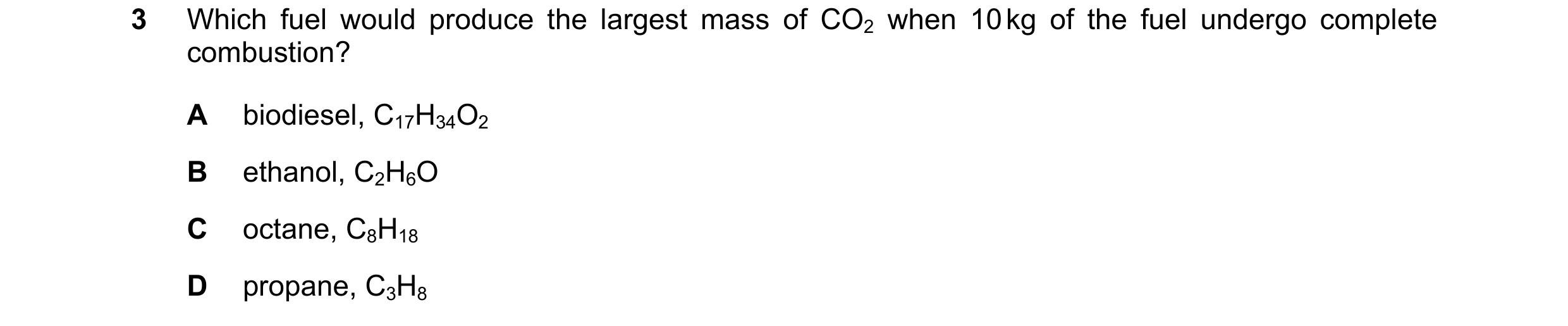
Q67 · Which fuel would produce the largest mass of CO2 when 10 kg of the fuel undergo complete… 9701/11 May/June 2018
3 Which fuel would produce the largest mass of CO2 when 10 kg of the fuel undergo complete combustion? A biodiesel, C17H34O2 B ethanol, C2H6O C octane, C8H18 D propane, C3H8
1 marks
Answer: C
This question in 9701/11 May/June 2018
Q68 · Which equation represents a valid propagation step in the chlorination of ethane? 9701/12 May/June 2018
21 Which equation represents a valid propagation step in the chlorination of ethane? A C2H6 + Cl • → C2H5Cl + H• B C2H5Cl + Cl • → C2H4Cl • + HCl C C2H5Cl + H• → C2H5• + HCl D C2H5• + Cl • → C2H5Cl
1 marks
Answer: B
This question in 9701/12 May/June 2018
Q69 · For complete combustion, 1 mol of an organic compound X requires 2.5 mol of O2 9701/12 May/June 2018
31 For complete combustion, 1 mol of an organic compound X requires 2.5 mol of O2. Which compounds could be X? 1 C2H5OH 2 C2H2 3 CH3CHO
1 marks
Answer: C
This question in 9701/12 May/June 2018
Q70 · A sample of the hydrocarbon C6H12 is completely burned in dry oxygen and the product… 9701/11 Oct/Nov 2018
3 A sample of the hydrocarbon C6H12 is completely burned in dry oxygen and the product gases are collected as shown. product gases, H2O + CO2 + excess of O2 excess of O2 P Q anhydrous soda lime calcium chloride (to absorb CO2) (to absorb H2O) The increases in mass of the collecting vessels P and Q are MP and MQ, respectively. What is the ratio MP / MQ? A 0.41 B 0.82 C 1.2 D 2.4
1 marks
Answer: A
This question in 9701/11 Oct/Nov 2018
Q71 · An organic molecule W contains 3 carbon atoms 9701/11 Oct/Nov 2018
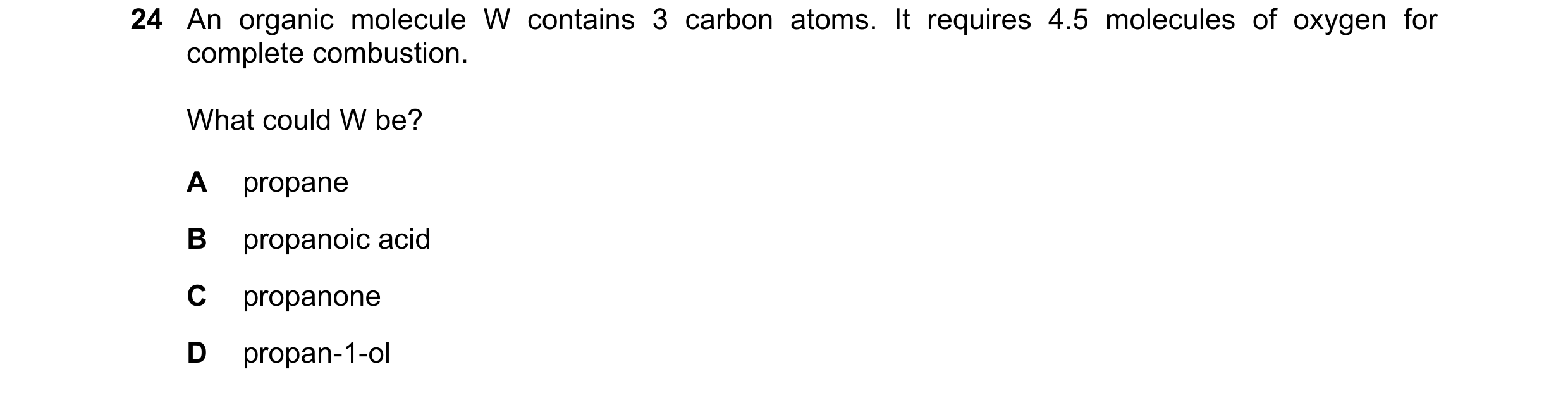
24 An organic molecule W contains 3 carbon atoms. It requires 4.5 molecules of oxygen for complete combustion. What could W be? A propane B propanoic acid C propanone D propan-1-ol
1 marks
Answer: D
This question in 9701/11 Oct/Nov 2018
Q72 · There are three structural isomers with the formula C5H12 9701/12 Oct/Nov 2018
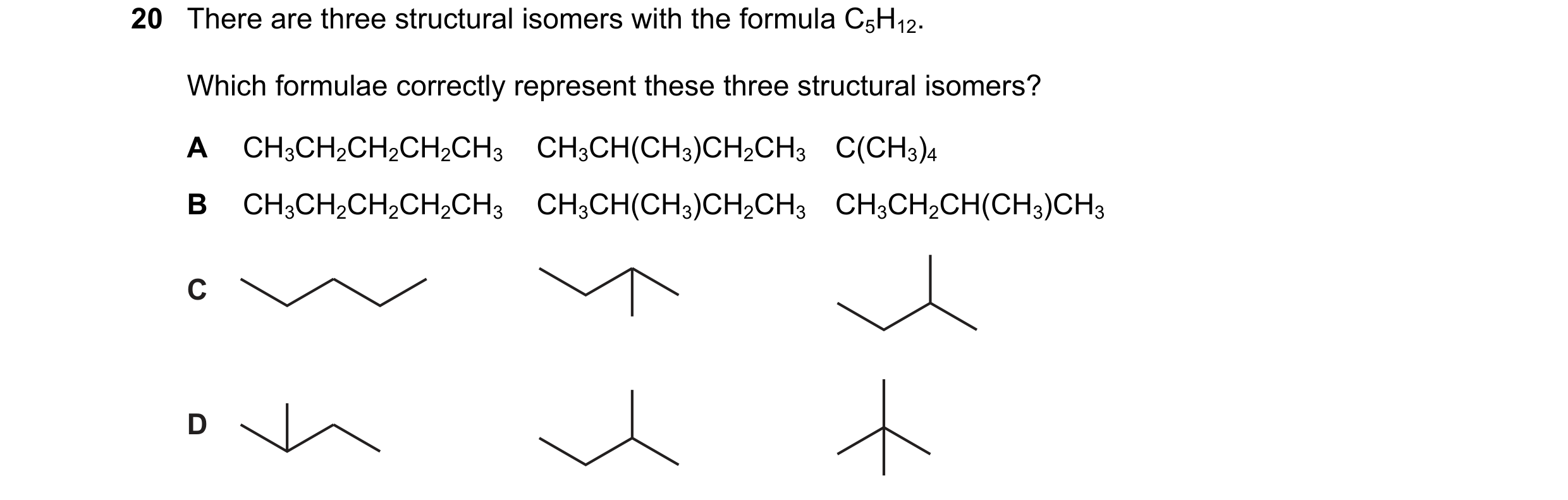
20 There are three structural isomers with the formula C5H12. Which formulae correctly represent these three structural isomers? A CH3CH2CH2CH2CH3 CH3CH(CH3)CH2CH3 C(CH3)4 B CH3CH2CH2CH2CH3 CH3CH(CH3)CH2CH3 CH3CH2CH(CH3)CH3 C D
1 marks
Answer: A
This question in 9701/12 Oct/Nov 2018
Q73 · A sample of the hydrocarbon C6H12 is completely burned in dry oxygen and the product… 9701/13 Oct/Nov 2018
3 A sample of the hydrocarbon C6H12 is completely burned in dry oxygen and the product gases are collected as shown. product gases, H2O + CO2 + excess of O2 excess of O2 P Q anhydrous soda lime calcium chloride (to absorb CO2) (to absorb H2O) The increases in mass of the collecting vessels P and Q are MP and MQ, respectively. What is the ratio MP / MQ? A 0.41 B 0.82 C 1.2 D 2.4
1 marks
Answer: A
This question in 9701/13 Oct/Nov 2018
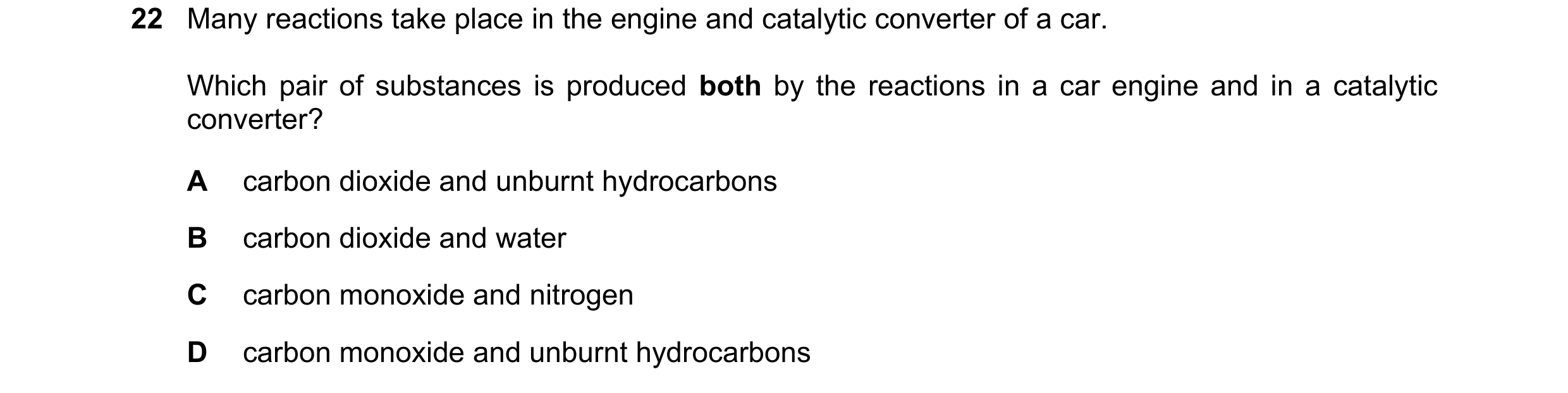
Q74 · Many reactions take place in the engine and catalytic converter of a car 9701/12 Feb/March 2019
22 Many reactions take place in the engine and catalytic converter of a car. Which pair of substances is produced both by the reactions in a car engine and in a catalytic converter? A carbon dioxide and unburnt hydrocarbons B carbon dioxide and water C carbon monoxide and nitrogen D carbon monoxide and unburnt hydrocarbons
1 marks
Answer: B
This question in 9701/12 Feb/March 2019
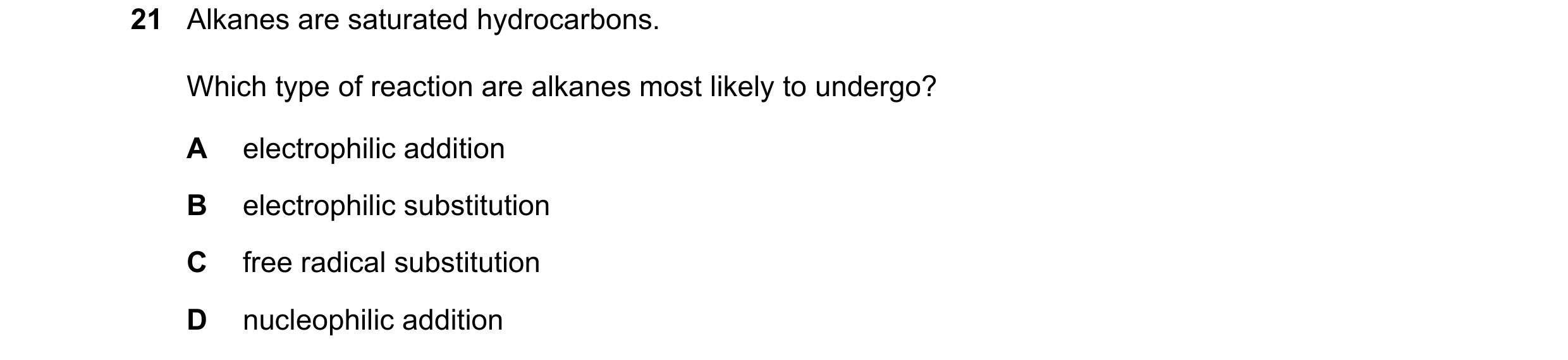
Q75 · Alkanes are saturated hydrocarbons 9701/11 Oct/Nov 2019
21 Alkanes are saturated hydrocarbons. Which type of reaction are alkanes most likely to undergo? A electrophilic addition B electrophilic substitution C free radical substitution D nucleophilic addition
1 marks
Answer: C
This question in 9701/11 Oct/Nov 2019
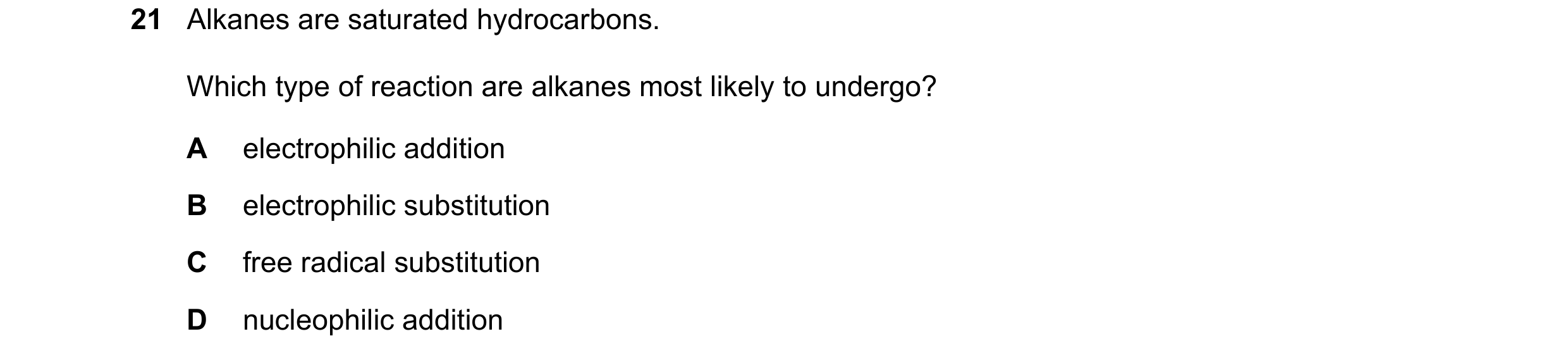
Q76 · Alkanes are saturated hydrocarbons 9701/13 Oct/Nov 2019
21 Alkanes are saturated hydrocarbons. Which type of reaction are alkanes most likely to undergo? A electrophilic addition B electrophilic substitution C free radical substitution D nucleophilic addition
1 marks
Answer: C
This question in 9701/13 Oct/Nov 2019
Q77 · Structural isomerism and stereoisomerism should be considered when answering this question 9701/12 Feb/March 2020
25 Structural isomerism and stereoisomerism should be considered when answering this question. How many non-cyclic isomers have the molecular formula C5H10? A 3 B 4 C 5 D 6
1 marks
Answer: D
This question in 9701/12 Feb/March 2020
Q78 · Which statements comparing ethene and ethane are correct? 9701/12 Feb/March 2020
40 Which statements comparing ethene and ethane are correct? 1 The bond angles in ethene are larger than the bond angles in ethane. 2 Ethene reacts much more quickly with bromine in the dark than ethane does. 3 Complete combustion of 0.01 mol of ethene or ethane produces the same volume of gas measured at room temperature and pressure.
1 marks
Answer: A
This question in 9701/12 Feb/March 2020
Q79 · In this question you should assume air contains 21% oxygen 9701/12 May/June 2020
6 In this question you should assume air contains 21% oxygen. What is the minimum volume of air required to ensure complete combustion of 10 cm3 of butane gas, under room conditions? A 14 cm3 B 27 cm3 C 65 cm3 D 310 cm3
1 marks
Answer: D
This question in 9701/12 May/June 2020
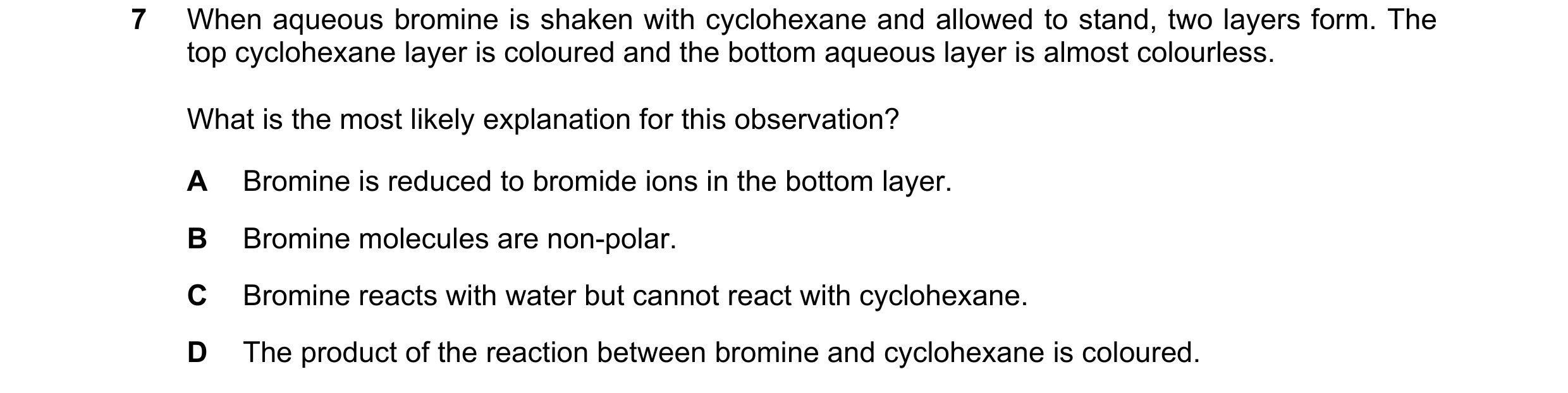
Q80 · When aqueous bromine is shaken with cyclohexane and allowed to stand, two layers form 9701/12 May/June 2020
7 When aqueous bromine is shaken with cyclohexane and allowed to stand, two layers form. The top cyclohexane layer is coloured and the bottom aqueous layer is almost colourless. What is the most likely explanation for this observation? A Bromine is reduced to bromide ions in the bottom layer. B Bromine molecules are non-polar. C Bromine reacts with water but cannot react with cyclohexane. D The product of the reaction between bromine and cyclohexane is coloured.
1 marks
Answer: B
This question in 9701/12 May/June 2020
Q81 · The complete combustion of 2 moles of an alkane produces 400 dm3 of carbon dioxide… 9701/12 May/June 2020
9 The complete combustion of 2 moles of an alkane produces 400 dm3 of carbon dioxide measured at 301 K and 1 × 10⁵ Pa. Carbon dioxide can be assumed to behave as an ideal gas under these conditions. What is the formula of the alkane? A C8H18 B C16H34 C C20H42 D C40H82
1 marks
Answer: A
This question in 9701/12 May/June 2020
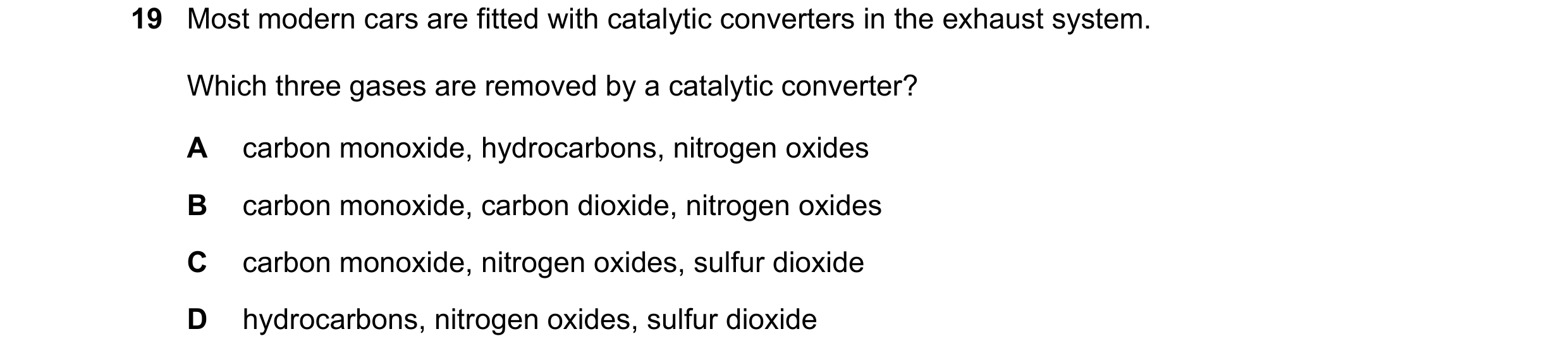
Q82 · Most modern cars are fitted with catalytic converters in the exhaust system 9701/12 May/June 2020
19 Most modern cars are fitted with catalytic converters in the exhaust system. Which three gases are removed by a catalytic converter? A carbon monoxide, hydrocarbons, nitrogen oxides B carbon monoxide, carbon dioxide, nitrogen oxides C carbon monoxide, nitrogen oxides, sulfur dioxide D hydrocarbons, nitrogen oxides, sulfur dioxide
1 marks
Answer: A
This question in 9701/12 May/June 2020
Q83 · On complete combustion, a sample of X produces 44 g of carbon dioxide and 27 g of water 9701/13 May/June 2020
39 On complete combustion, a sample of X produces 44 g of carbon dioxide and 27 g of water. On complete combustion, a sample of Y produces 44 g of carbon dioxide and 18 g of water. On complete combustion, a sample of Z produces 22 g of carbon dioxide and 9 g of water. Which substances could be straight chain alkanes? 1 X 2 Y 3 Z
1 marks
Answer: D
This question in 9701/13 May/June 2020
Q84 · Which statement is correct when referring to the complete combustion of PVC? 9701/11 Oct/Nov 2020
22 Which statement is correct when referring to the complete combustion of PVC? A A gas is made which contributes to global warming. B Carbon dioxide and water are the only products. C If water is used to clean the exhaust gases, the water becomes alkaline. D There is no need to treat the exhaust gases as the products are non-hazardous.
1 marks
Answer: A
This question in 9701/11 Oct/Nov 2020
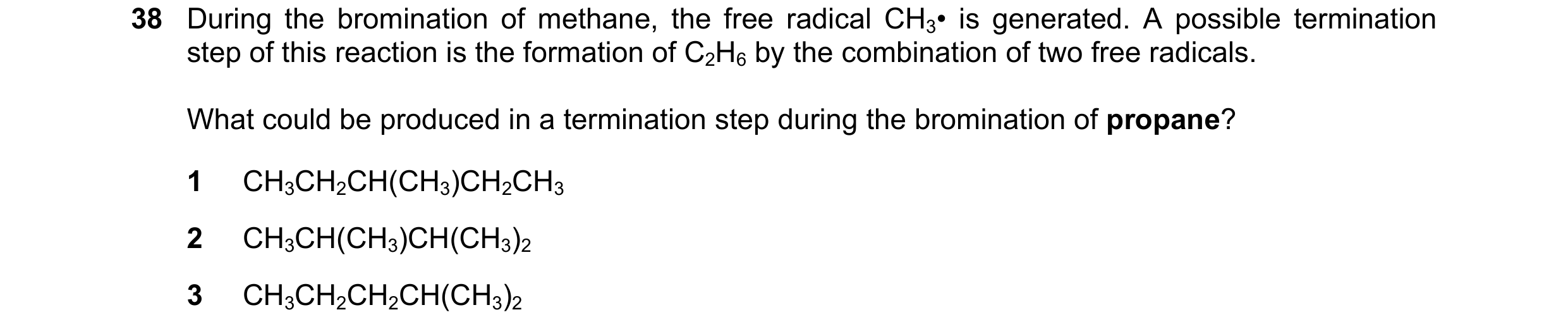
Q85 · During the bromination of methane, the free radical CH3• is generated 9701/11 Oct/Nov 2020
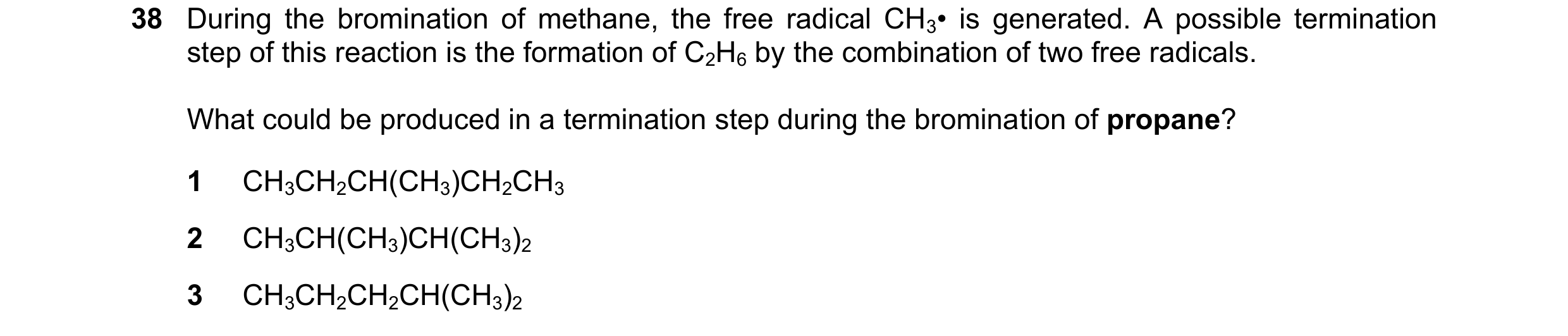
38 During the bromination of methane, the free radical CH3• is generated. A possible termination step of this reaction is the formation of C2H6 by the combination of two free radicals. What could be produced in a termination step during the bromination of propane? 1 CH3CH2CH(CH3)CH2CH3 2 CH3CH(CH3)CH(CH3)2 3 CH3CH2CH2CH(CH3)2
1 marks
Answer: C
This question in 9701/11 Oct/Nov 2020
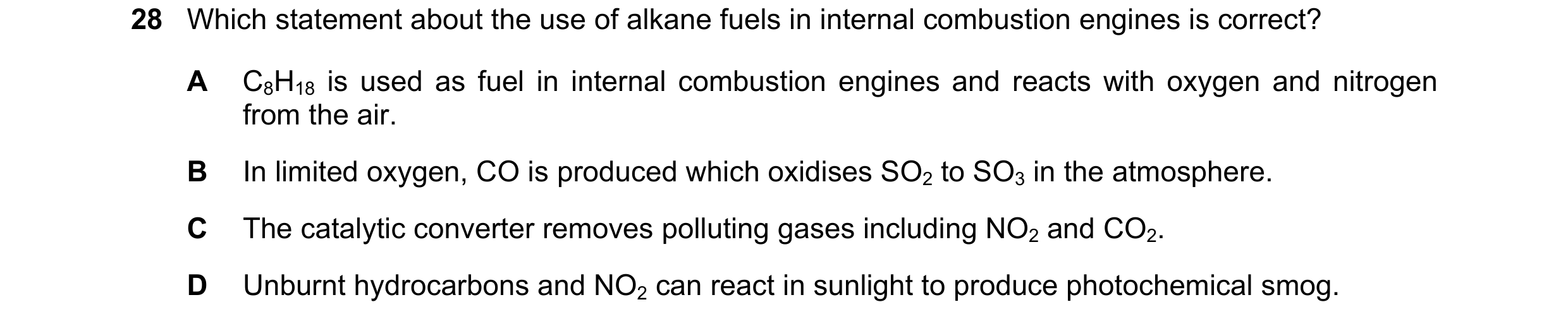
Q86 · Which statement about the use of alkane fuels in internal combustion engines is correct? 9701/12 Oct/Nov 2020
28 Which statement about the use of alkane fuels in internal combustion engines is correct? A C8H18 is used as fuel in internal combustion engines and reacts with oxygen and nitrogen from the air. B In limited oxygen, CO is produced which oxidises SO2 to SO3 in the atmosphere. C The catalytic converter removes polluting gases including NO2 and CO2. D Unburnt hydrocarbons and NO2 can react in sunlight to produce photochemical smog.
1 marks
Answer: D
This question in 9701/12 Oct/Nov 2020
Q87 · Which free radicals can be generated during a free-radical substitution reaction between… 9701/12 Oct/Nov 2020
38 Which free radicals can be generated during a free-radical substitution reaction between chlorine and ethane? 1 CH3• 2 CH2Cl CH2• 3 CH3CCl 2•
1 marks
Answer: C
This question in 9701/12 Oct/Nov 2020
Q88 · During the bromination of methane, the free radical CH3• is generated 9701/13 Oct/Nov 2020
38 During the bromination of methane, the free radical CH3• is generated. A possible termination step of this reaction is the formation of C2H6 by the combination of two free radicals. What could be produced in a termination step during the bromination of propane? 1 CH3CH2CH(CH3)CH2CH3 2 CH3CH(CH3)CH(CH3)2 3 CH3CH2CH2CH(CH3)2
1 marks
Answer: C
This question in 9701/13 Oct/Nov 2020
Q89 · Substance Q is a hydrocarbon 9701/12 Feb/March 2021
3 Substance Q is a hydrocarbon. When 1.00 g of Q is completely burned, 3.22 g of carbon dioxide is produced. What could be the identity of Q? A cyclohexene B cyclopentane C ethene D pentane
1 marks
Answer: A
This question in 9701/12 Feb/March 2021
Q90 · What is the minimum mass of oxygen required to ensure the complete combustion of 12 dm3… 9701/11 May/June 2021
6 What is the minimum mass of oxygen required to ensure the complete combustion of 12 dm3 of propane measured under room conditions? A 60 g B 80 g C 120 g D 160 g
1 marks
Answer: B
This question in 9701/11 May/June 2021
Q91 · Methane and bromine react by free radical substitution 9701/12 May/June 2021
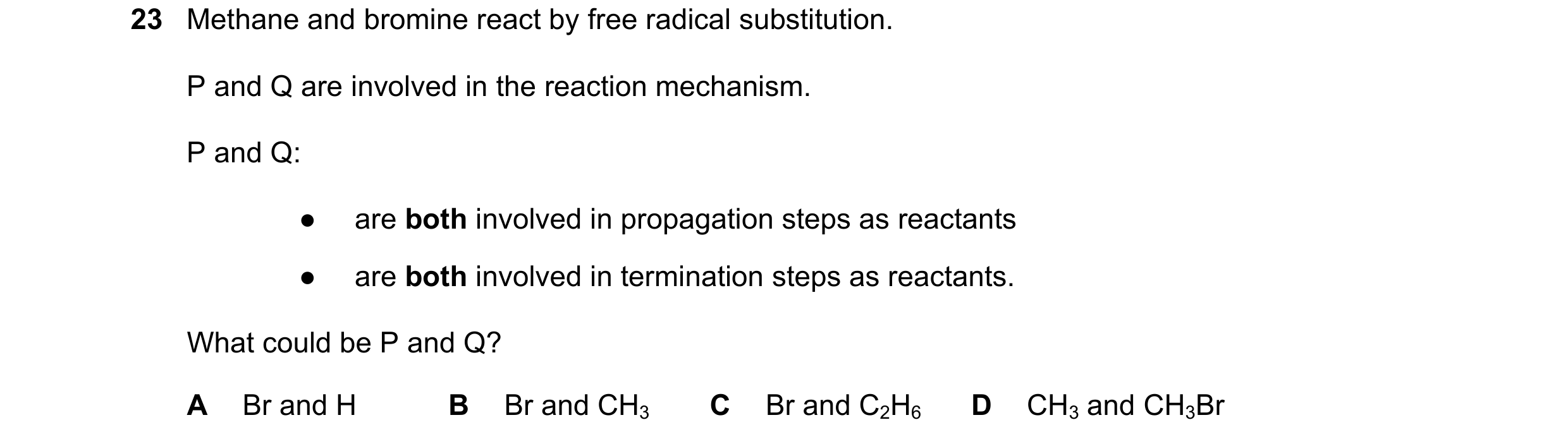
23 Methane and bromine react by free radical substitution. P and Q are involved in the reaction mechanism. P and Q: ● are both involved in propagation steps as reactants ● are both involved in termination steps as reactants. What could be P and Q? A Br and H B Br and CH3 C Br and C2H6 D CH3 and CH3Br
1 marks
Answer: B
This question in 9701/12 May/June 2021
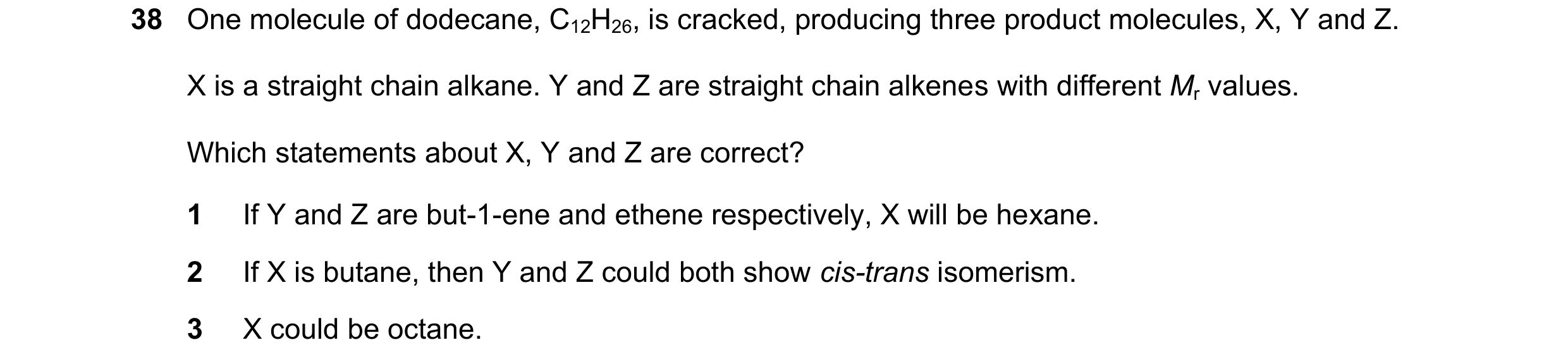
Q92 · One molecule of dodecane, C12H26, is cracked, producing three product molecules, X, Y and… 9701/11 Oct/Nov 2021
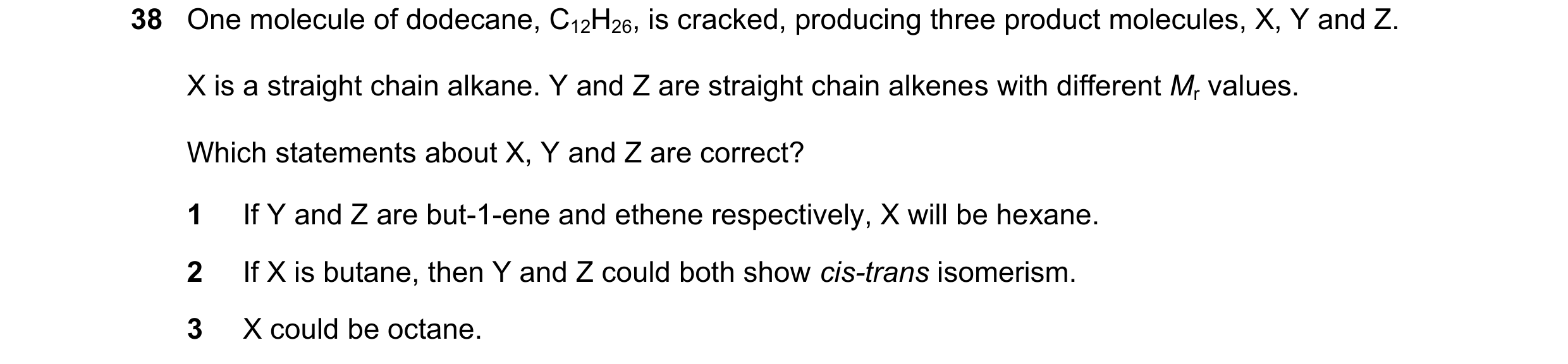
38 One molecule of dodecane, C12H26, is cracked, producing three product molecules, X, Y and Z. X is a straight chain alkane. Y and Z are straight chain alkenes with different Mr values. Which statements about X, Y and Z are correct? 1 If Y and Z are but-1-ene and ethene respectively, X will be hexane. 2 If X is butane, then Y and Z could both show cis-trans isomerism. 3 X could be octane.
1 marks
Answer: D
This question in 9701/11 Oct/Nov 2021
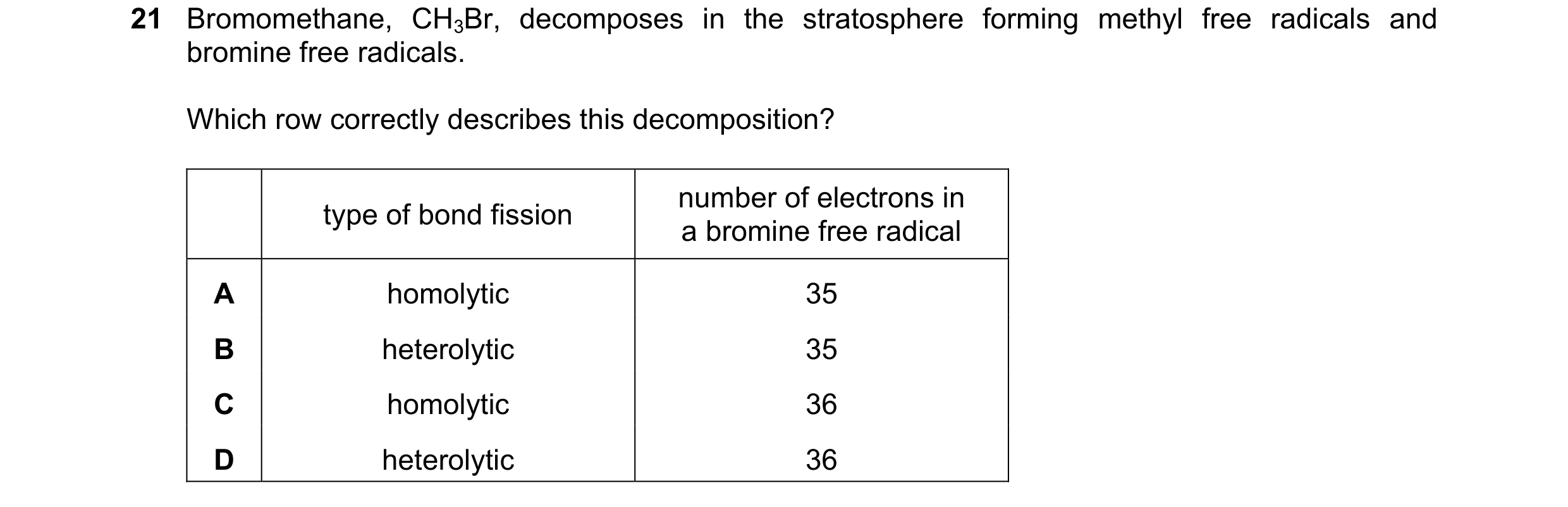
Q93 · Bromomethane, CH3Br, decomposes in the stratosphere forming methyl free radicals and… 9701/12 Oct/Nov 2021
21 Bromomethane, CH3Br, decomposes in the stratosphere forming methyl free radicals and bromine free radicals. Which row correctly describes this decomposition? number of electrons in type of bond fission a bromine free radical A homolytic 35 B heterolytic 35 C homolytic 36 D heterolytic 36
1 marks
Answer: A
This question in 9701/12 Oct/Nov 2021
Q94 · Which equation represents a valid propagation step in the chlorination of ethane? 9701/12 Oct/Nov 2021
23 Which equation represents a valid propagation step in the chlorination of ethane? A C2H5Cl + Cl • C2H4Cl • + HCl B C2H6 + Cl • C2H5Cl + H• C C2H5Cl + H• C2H5• + HCl D C2H5• + Cl • C2H5Cl
1 marks
Answer: A
This question in 9701/12 Oct/Nov 2021
Q95 · One molecule of dodecane, C12H26, is cracked, producing three product molecules, X, Y and… 9701/13 Oct/Nov 2021
38 One molecule of dodecane, C12H26, is cracked, producing three product molecules, X, Y and Z. X is a straight chain alkane. Y and Z are straight chain alkenes with different Mr values. Which statements about X, Y and Z are correct? 1 If Y and Z are but-1-ene and ethene respectively, X will be hexane. 2 If X is butane, then Y and Z could both show cis-trans isomerism. 3 X could be octane.
1 marks
Answer: D
This question in 9701/13 Oct/Nov 2021
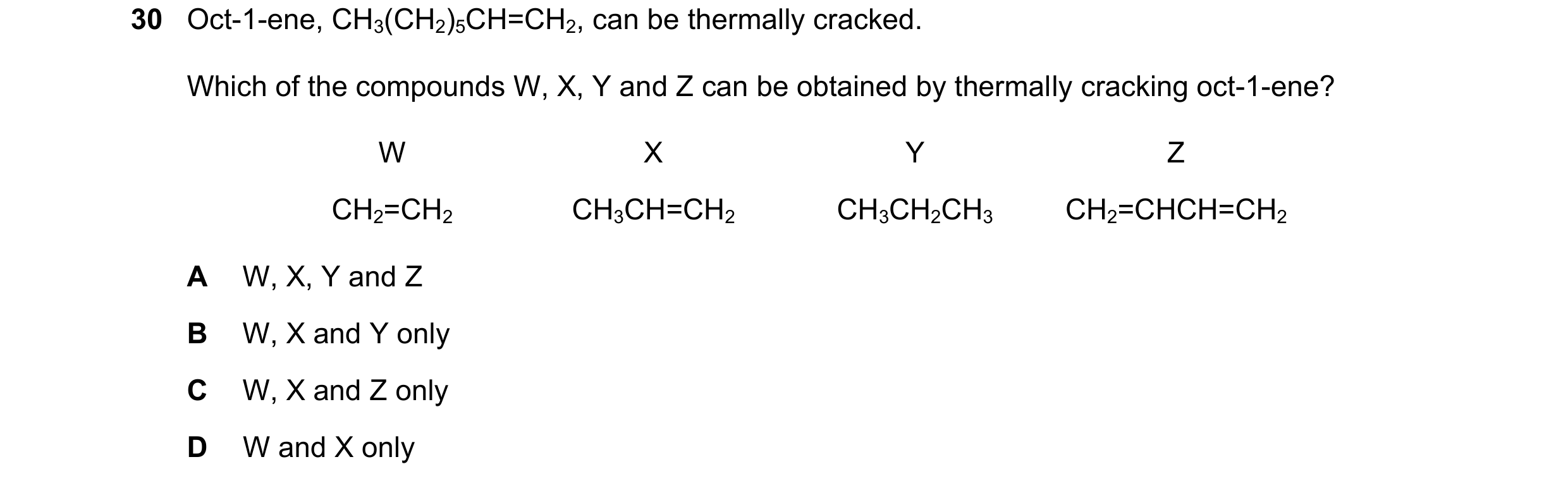
Q96 · Oct-1-ene, CH3(CH2)5CH=CH2, can be thermally cracked 9701/11 May/June 2022
30 Oct-1-ene, CH3(CH2)5CH=CH2, can be thermally cracked. Which of the compounds W, X, Y and Z can be obtained by thermally cracking oct-1-ene? W X Y Z CH2=CH2 CH3CH=CH2 CH3CH2CH3 CH2=CHCH=CH2 A W, X, Y and Z B W, X and Y only C W, X and Z only D W and X only
1 marks
Answer: A
This question in 9701/11 May/June 2022
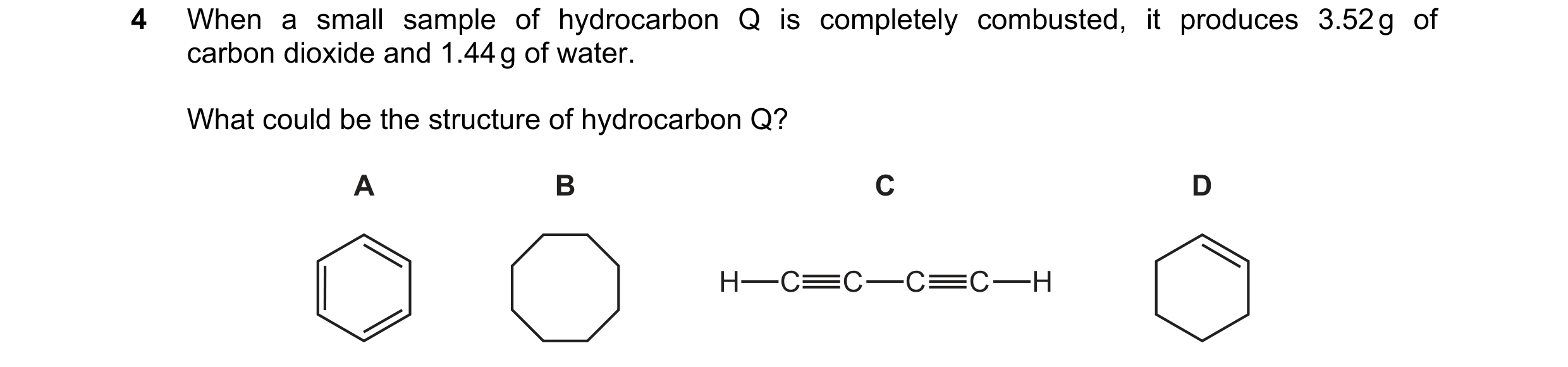
Q97 · When a small sample of hydrocarbon Q is completely combusted, it produces 3.52 g of… 9701/12 May/June 2022
4 When a small sample of hydrocarbon Q is completely combusted, it produces 3.52 g of carbon dioxide and 1.44 g of water. What could be the structure of hydrocarbon Q? A B C D H C C C C H
1 marks
Answer: B
This question in 9701/12 May/June 2022
Q98 · The free-radical substitution reaction between methane and chlorine involves initiation… 9701/12 May/June 2022
29 The free-radical substitution reaction between methane and chlorine involves initiation, propagation and termination stages. Which row is correct? involved in radical produced in initiation stage a propagation stage A homolytic fission H• B homolytic fission CH3• C heterolytic fission H• D heterolytic fission CH3•
1 marks
Answer: B
This question in 9701/12 May/June 2022
Q99 · Which pair includes a hydrocarbon without a chiral centre? 9701/12 Oct/Nov 2022
28 Which pair includes a hydrocarbon without a chiral centre? A CH3CH2CH2CH(CH3)CH2CH3 CH3CH(CH3)CH(CH3)CH2CH3 B CH3CH2CH2CH(CH2CH3)CH3 CH3CH2CH2CH(CH3)CH2CH3 C CH3CH2CH2CH(CH3)CH2CH3 CH3CH2CH(CH3)CH(CH3)2 D CH3CH(CH2CH3)CH(CH3)CH3 CH3CH(CH3)CH2CH(CH3)2
1 marks
Answer: D
This question in 9701/12 Oct/Nov 2022
Q100 · A mixture of ethane and an excess of chlorine is exposed to UV light 9701/13 May/June 2023
31 A mixture of ethane and an excess of chlorine is exposed to UV light. How many different products, each containing only two carbon atoms and at least one chlorine atom per molecule, can be formed? A 8 B 9 C 10 D 12
1 marks
Answer: B
This question in 9701/13 May/June 2023
Q101 · Aluminium carbide, Al 4C3, reacts readily with aqueous sodium hydroxide 9701/11 Oct/Nov 2023
3 Aluminium carbide, Al 4C3, reacts readily with aqueous sodium hydroxide. The two products of the reaction are NaAlO2 and a hydrocarbon. Water molecules are also involved as reactants. What is the formula of the hydrocarbon? A CH4 B C2H6 C C3H8 D C6H12
1 marks
Answer: A
This question in 9701/11 Oct/Nov 2023
Q102 · The hydrocarbon C17H36 can be cracked 9701/11 Oct/Nov 2023
28 The hydrocarbon C17H36 can be cracked. Which compound is the least likely to be produced in this reaction? A C3H8 B C4H8 C C8H16 D C16H34
1 marks
Answer: D
This question in 9701/11 Oct/Nov 2023
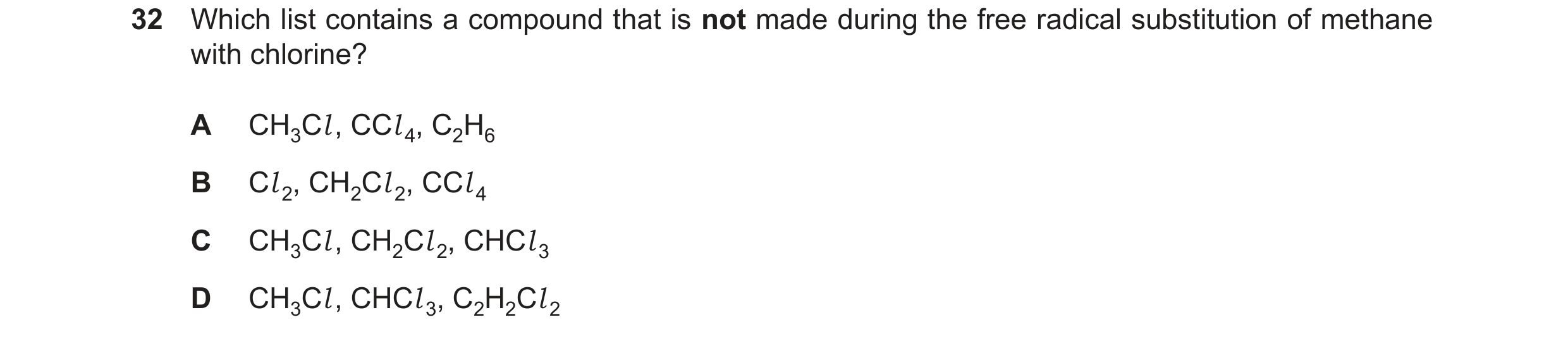
Q103 · Which list contains a compound that is not made during the free radical substitution of… 9701/12 Oct/Nov 2023
32 Which list contains a compound that is not made during the free radical substitution of methane with chlorine? A CH3Cl, CCl 4, C2H6 B Cl 2, CH2Cl 2, CCl 4 C CH3Cl, CH2Cl 2, CHCl 3 D CH3Cl, CHCl 3, C2H2Cl 2
1 marks
Answer: D
This question in 9701/12 Oct/Nov 2023
Q104 · The hydrocarbon C17H36 can be cracked 9701/13 Oct/Nov 2023
28 The hydrocarbon C17H36 can be cracked. Which compound is the least likely to be produced in this reaction? A C3H8 B C4H8 C C8H16 D C16H34
1 marks
Answer: D
This question in 9701/13 Oct/Nov 2023
Q105 · Which reaction occurs when ethane and chlorine are mixed in diffused sunlight? 9701/11 May/June 2024
28 Which reaction occurs when ethane and chlorine are mixed in diffused sunlight? A a free-radical substitution with hydrogen given off B a free-radical substitution with hydrogen chloride given off C a free-radical substitution with no gas given off D a nucleophilic substitution with hydrogen chloride given off
1 marks
Answer: B
This question in 9701/11 May/June 2024
Q106 · The alkane CH3CH2CH(CH3)2 undergoes free radical substitution with chlorine 9701/13 May/June 2024
27 The alkane CH3CH2CH(CH3)2 undergoes free radical substitution with chlorine. No C–C bonds are broken in this reaction. How many isomeric products, including positional and optical isomers, of molecular formula C5H11Cl can be formed? A 4 B 5 C 6 D 7
1 marks
Answer: C
This question in 9701/13 May/June 2024
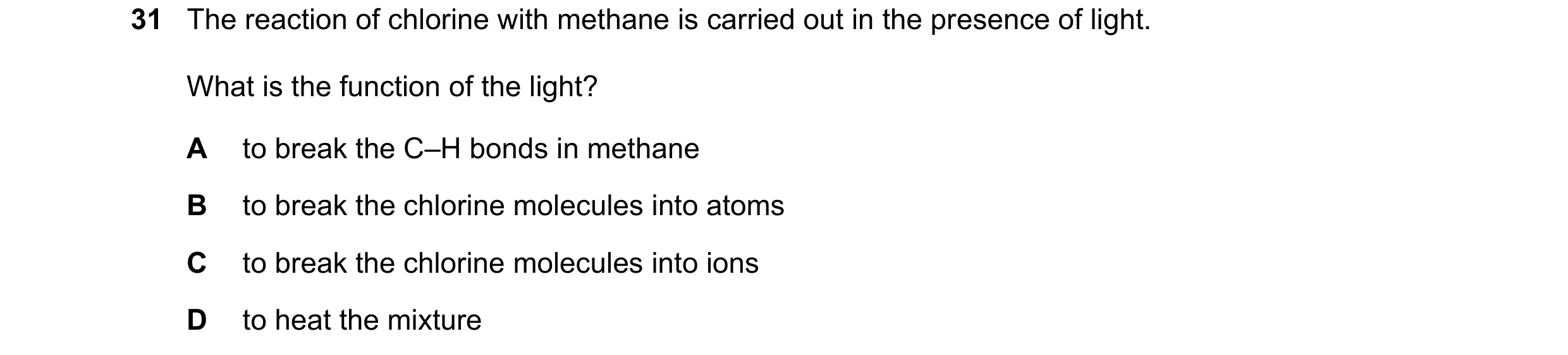
Q107 · The reaction of chlorine with methane is carried out in the presence of light 9701/11 Oct/Nov 2024
31 The reaction of chlorine with methane is carried out in the presence of light. What is the function of the light? A to break the C–H bonds in methane B to break the chlorine molecules into atoms C to break the chlorine molecules into ions D to heat the mixture
1 marks
Answer: B
This question in 9701/11 Oct/Nov 2024
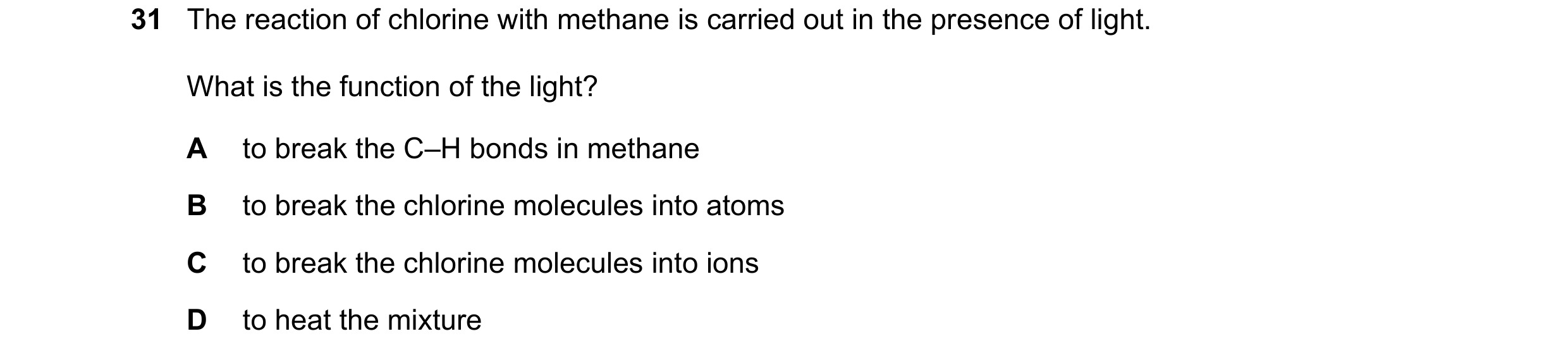
Q108 · The reaction of chlorine with methane is carried out in the presence of light 9701/13 Oct/Nov 2024
31 The reaction of chlorine with methane is carried out in the presence of light. What is the function of the light? A to break the C–H bonds in methane B to break the chlorine molecules into atoms C to break the chlorine molecules into ions D to heat the mixture
1 marks
Answer: B
This question in 9701/13 Oct/Nov 2024
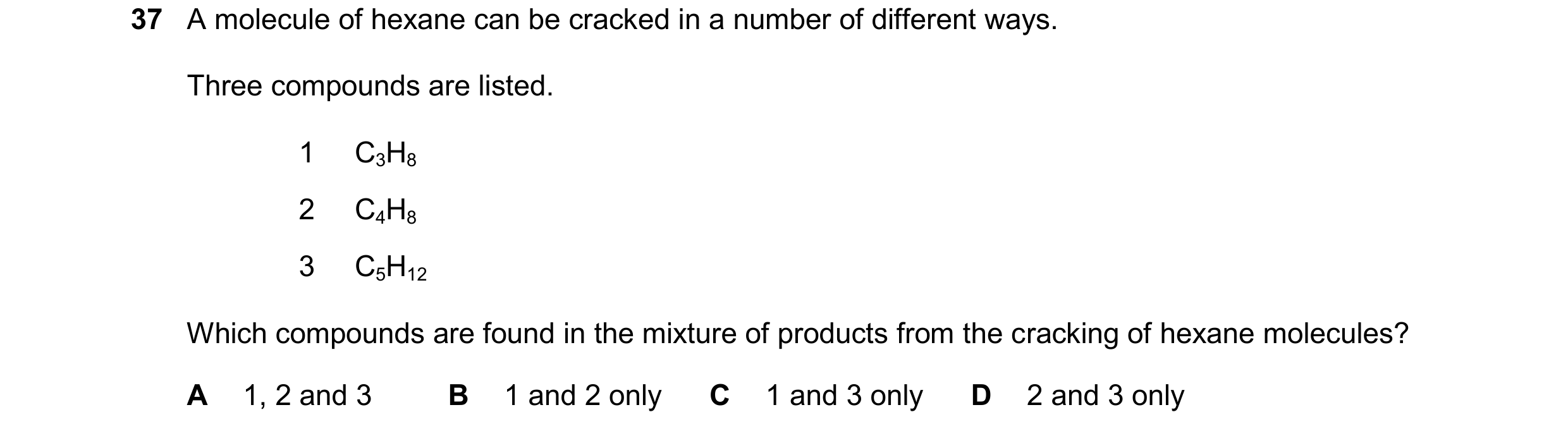
Q109 · A molecule of hexane can be cracked in a number of different ways 9701/12 Feb/March 2025
37 A molecule of hexane can be cracked in a number of different ways. Three compounds are listed. 1 C3H8 2 C4H8 3 C5H12 Which compounds are found in the mixture of products from the cracking of hexane molecules? A 1, 2 and 3 B 1 and 2 only C 1 and 3 only D 2 and 3 only
1 marks
Answer: B
This question in 9701/12 Feb/March 2025
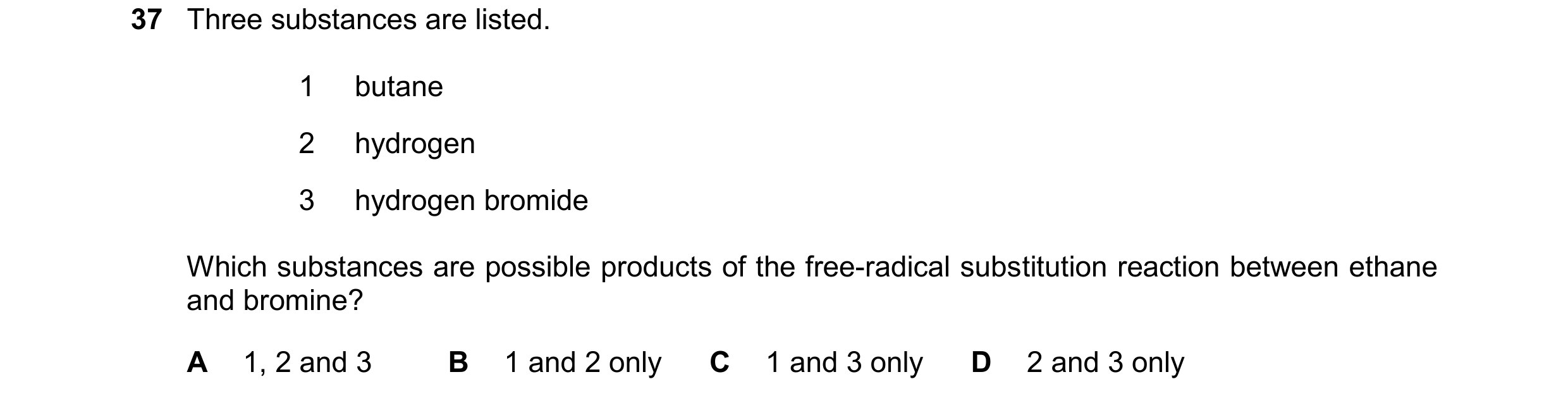
Q110 · Three substances are listed 9701/11 May/June 2025
37 Three substances are listed. 1 butane 2 hydrogen 3 hydrogen bromide Which substances are possible products of the free-radical substitution reaction between ethane and bromine? A 1, 2 and 3 B 1 and 2 only C 1 and 3 only D 2 and 3 only
1 marks
Answer: C
This question in 9701/11 May/June 2025
Q111 · Samples of the gases CH3Cl and Cl 2 are mixed together and irradiated with ultraviolet… 9701/12 May/June 2025
35 Samples of the gases CH3Cl and Cl 2 are mixed together and irradiated with ultraviolet light. Which compound is produced by a termination step in the reaction? A HCl B CH2=CH2 C CH2Cl CH2Cl D H2
1 marks
Answer: C
This question in 9701/12 May/June 2025
Q112 · Alkane S has molecular formula C4H10 9701/12 May/June 2025
37 Alkane S has molecular formula C4H10. S reacts with Cl 2(g) in the presence of sunlight to produce only two different monochloroalkanes, C4H9Cl. Both of these monochloroalkanes are treated with hot ethanolic KOH. They both produce the same alkene T, and no other organic products. What is produced when T is treated with hot concentrated acidified KMnO4? A CO2 and CH3CH2CO2H B CO2 and CH3COCH3 C HCO2H and CH3COCH3 D CH3CO2H only
1 marks
Answer: B
This question in 9701/12 May/June 2025
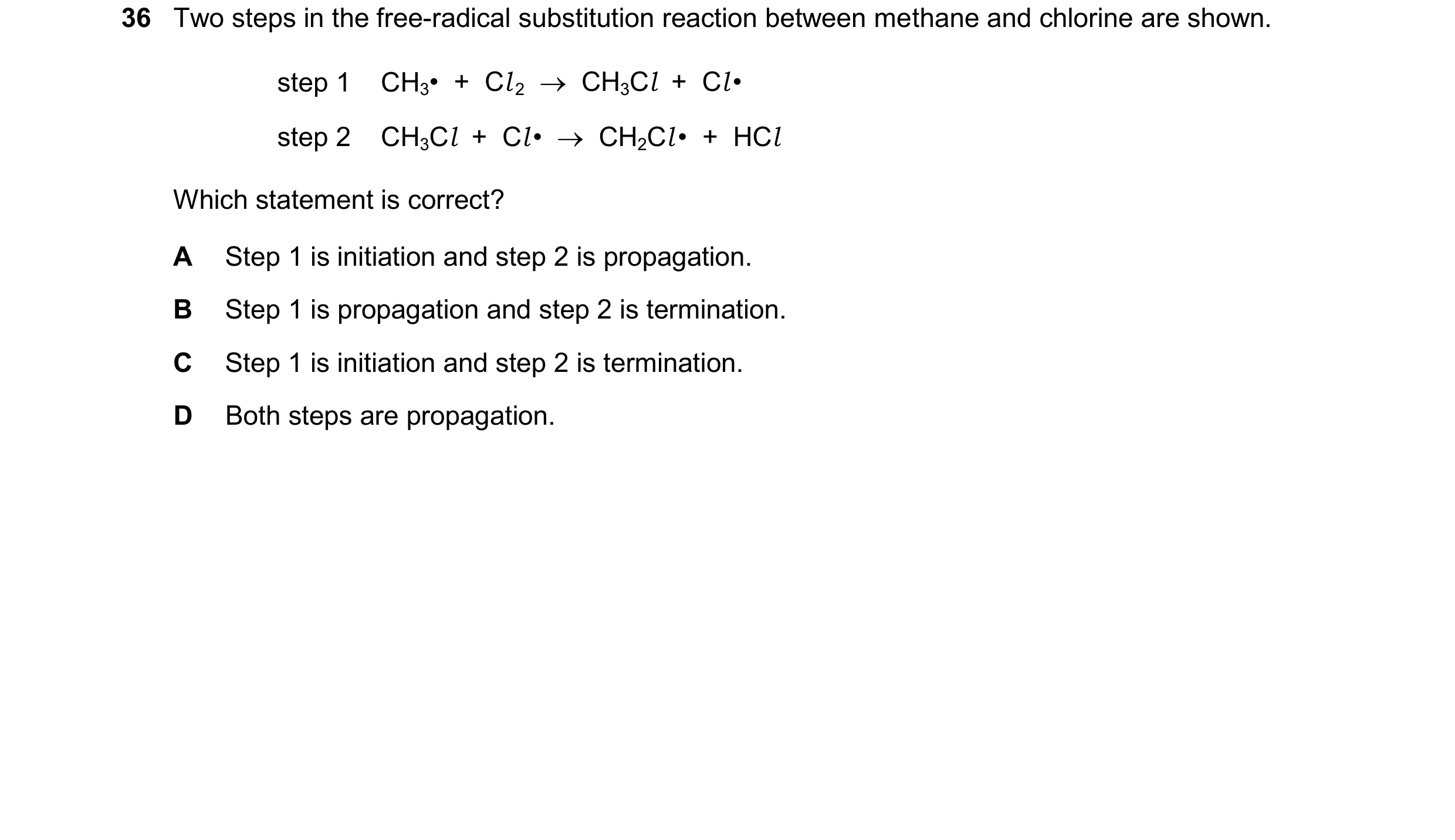
Q113 · Two steps in the free-radical substitution reaction between methane and chlorine are shown 9701/13 May/June 2025
36 Two steps in the free-radical substitution reaction between methane and chlorine are shown. step 1 CH3• + Cl2 CH3Cl + Cl• step 2 CH3Cl + Cl• CH2Cl• + HCl Which statement is correct? A Step 1 is initiation and step 2 is propagation. B Step 1 is propagation and step 2 is termination. C Step 1 is initiation and step 2 is termination. D Both steps are propagation.
1 marks
Answer: D
This question in 9701/13 May/June 2025
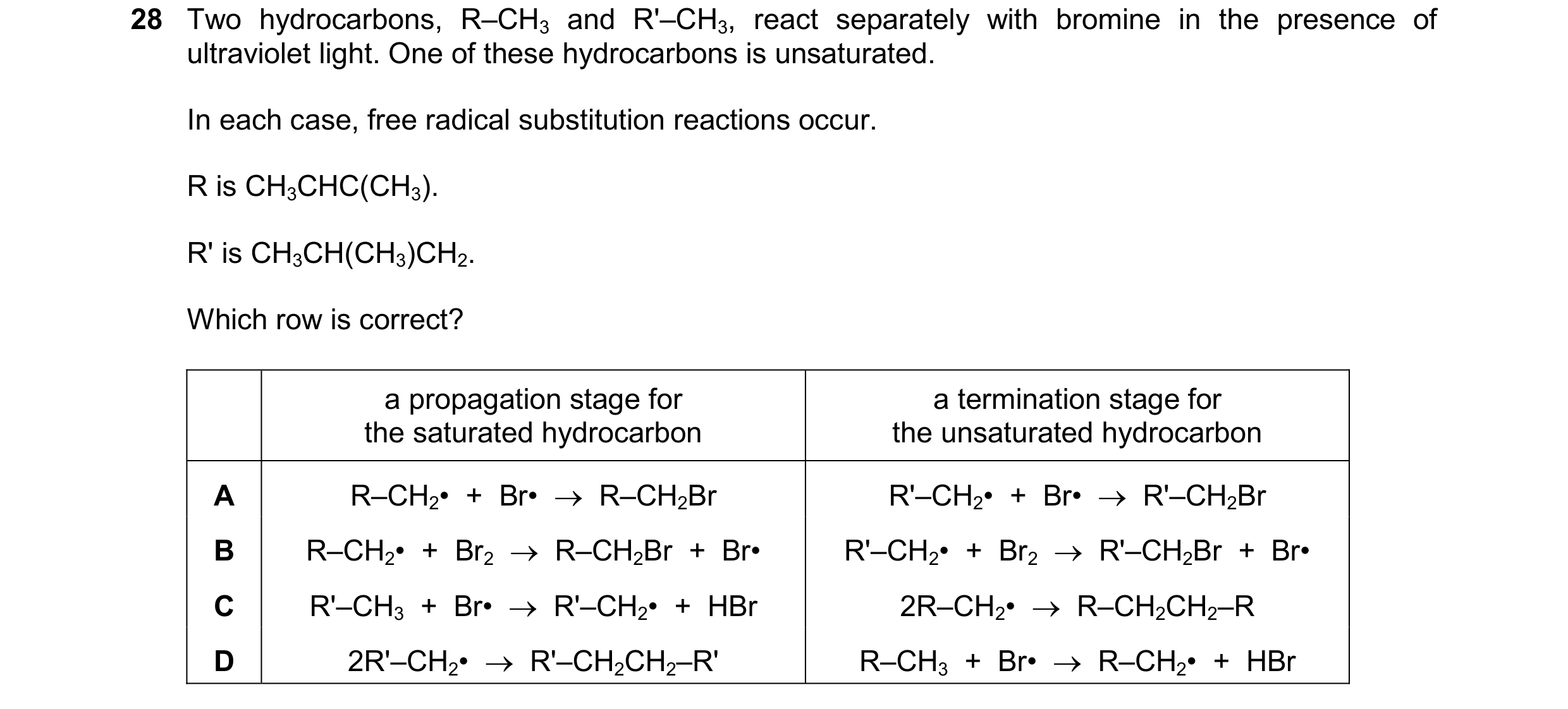
Q114 · Two hydrocarbons, R–CH3 and R'–CH3, react separately with bromine in the presence of… 9701/11 Oct/Nov 2025
28 Two hydrocarbons, R–CH3 and R'–CH3, react separately with bromine in the presence of ultraviolet light. One of these hydrocarbons is unsaturated. In each case, free radical substitution reactions occur. R is CH3CHC(CH3). R' is CH3CH(CH3)CH2. Which row is correct? a propagation stage for the saturated hydrocarbon a termination stage for the unsaturated hydrocarbon A R–CH2• + Br• R–CH2Br R'–CH2• + Br• R'–CH2Br B R–CH2• + Br2 R–CH2Br + Br• R'–CH2• + Br2 R'–CH2Br + Br• C R'–CH3 + Br• R'–CH2• + HBr 2R–CH2• R–CH2CH2–R D 2R'–CH2• R'–CH2CH2–R' R–CH3 + Br• R–CH2• + HBr
1 marks
Answer: C
This question in 9701/11 Oct/Nov 2025
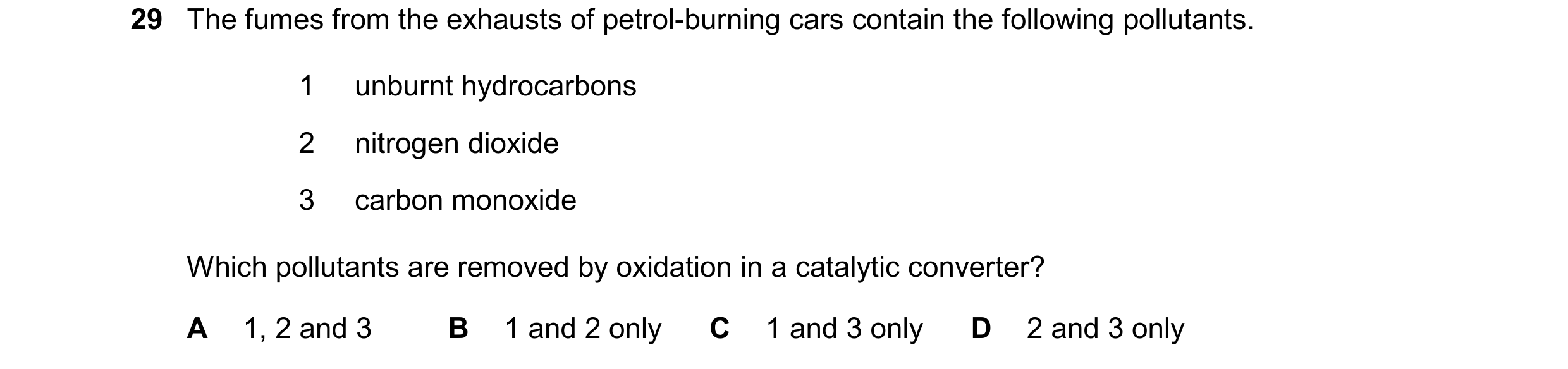
Q115 · The fumes from the exhausts of petrol-burning cars contain the following pollutants 9701/11 Oct/Nov 2025
29 The fumes from the exhausts of petrol-burning cars contain the following pollutants. 1 unburnt hydrocarbons 2 nitrogen dioxide 3 carbon monoxide Which pollutants are removed by oxidation in a catalytic converter? A 1, 2 and 3 B 1 and 2 only C 1 and 3 only D 2 and 3 only
1 marks
Answer: C
This question in 9701/11 Oct/Nov 2025
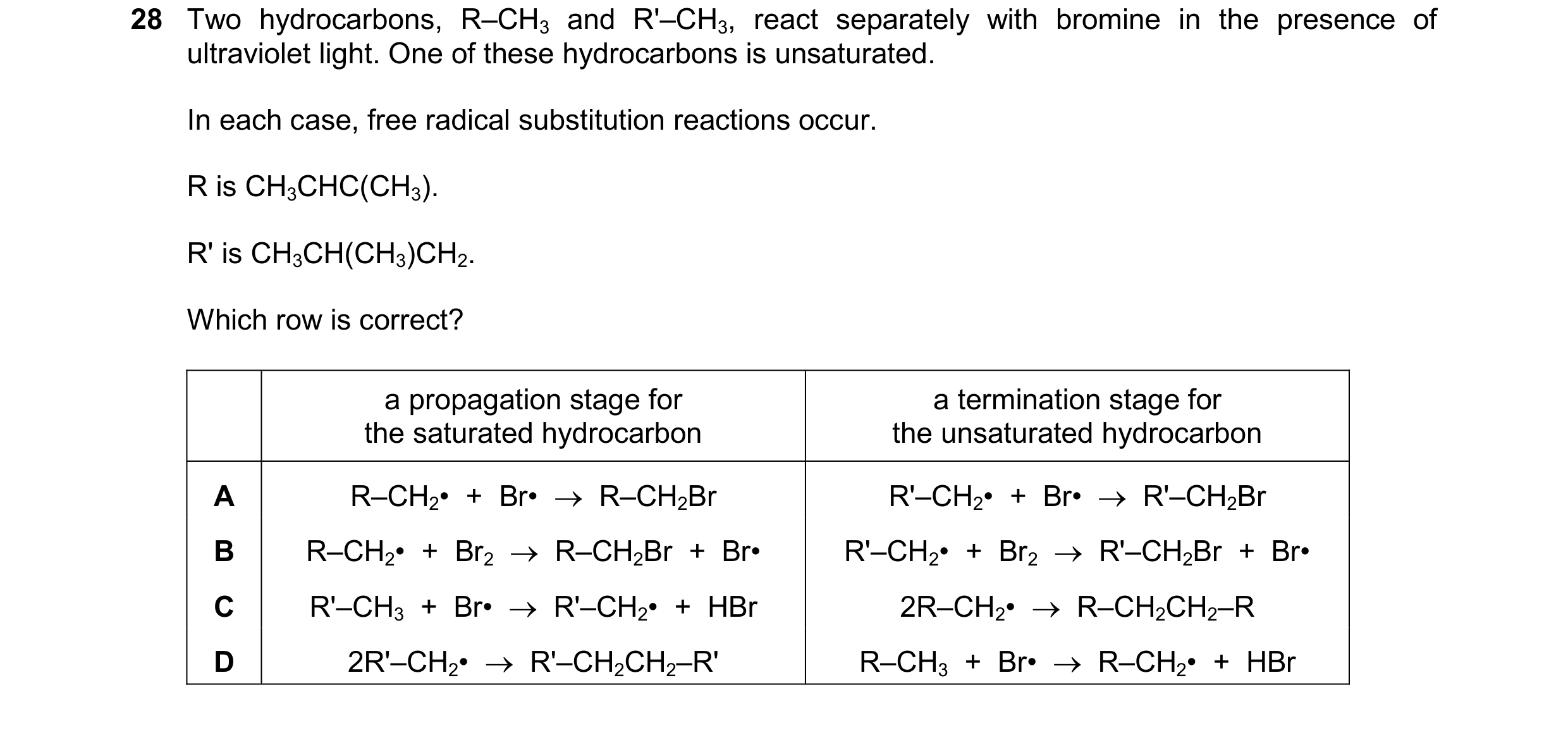
Q116 · Two hydrocarbons, R–CH3 and R'–CH3, react separately with bromine in the presence of… 9701/13 Oct/Nov 2025
28 Two hydrocarbons, R–CH3 and R'–CH3, react separately with bromine in the presence of ultraviolet light. One of these hydrocarbons is unsaturated. In each case, free radical substitution reactions occur. R is CH3CHC(CH3). R' is CH3CH(CH3)CH2. Which row is correct? a propagation stage for the saturated hydrocarbon a termination stage for the unsaturated hydrocarbon A R–CH2• + Br• R–CH2Br R'–CH2• + Br• R'–CH2Br B R–CH2• + Br2 R–CH2Br + Br• R'–CH2• + Br2 R'–CH2Br + Br• C R'–CH3 + Br• R'–CH2• + HBr 2R–CH2• R–CH2CH2–R D 2R'–CH2• R'–CH2CH2–R' R–CH3 + Br• R–CH2• + HBr
1 marks
Answer: C
This question in 9701/13 Oct/Nov 2025
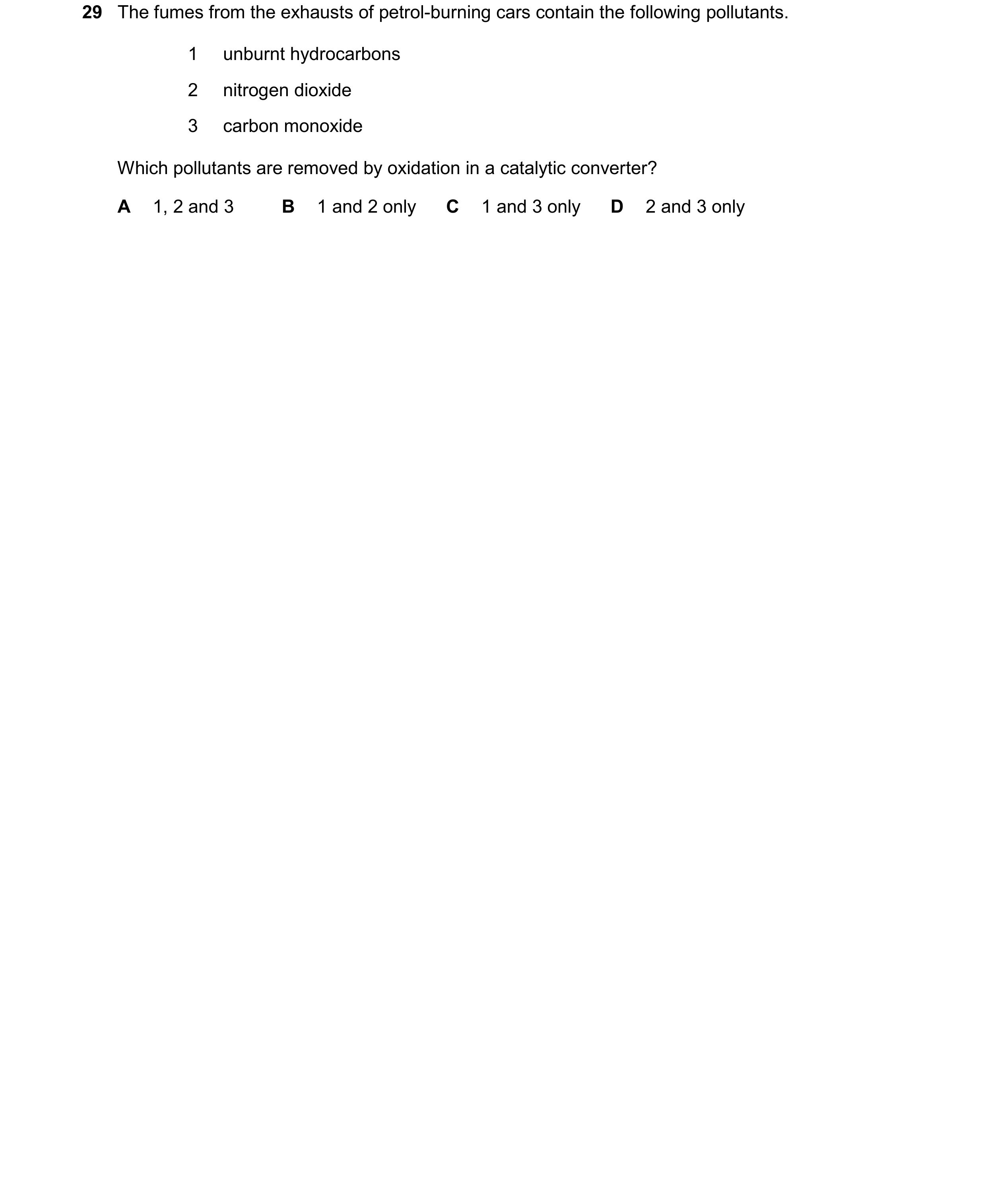
Q117 · The fumes from the exhausts of petrol-burning cars contain the following pollutants 9701/13 Oct/Nov 2025
29 The fumes from the exhausts of petrol-burning cars contain the following pollutants. 1 unburnt hydrocarbons 2 nitrogen dioxide 3 carbon monoxide Which pollutants are removed by oxidation in a catalytic converter? A 1, 2 and 3 B 1 and 2 only C 1 and 3 only D 2 and 3 only
1 marks
Answer: C
This question in 9701/13 Oct/Nov 2025
 1 / 28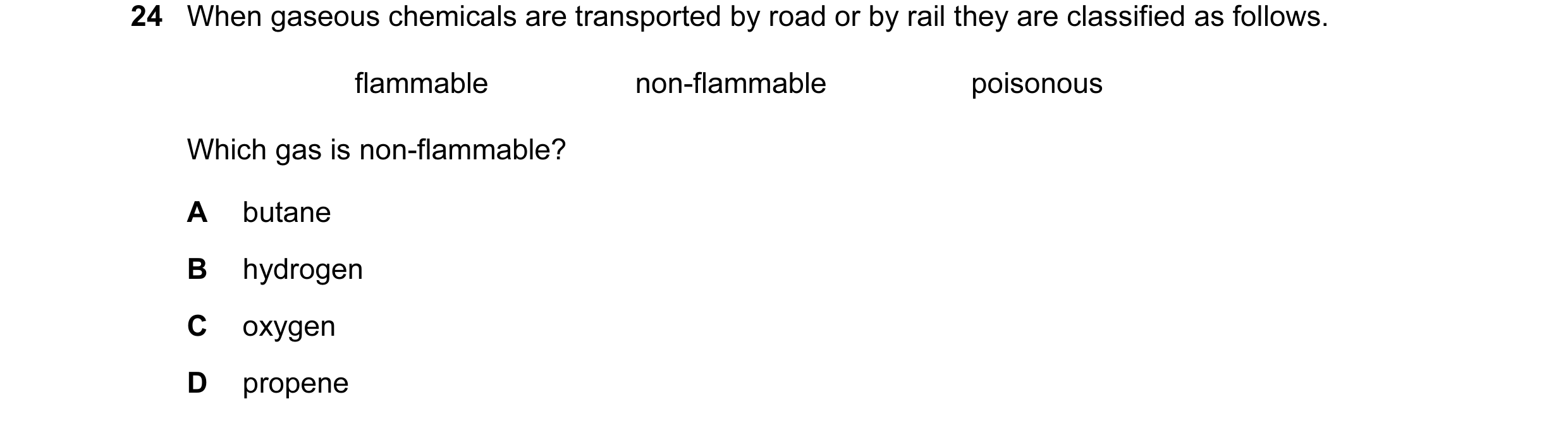
 2 / 28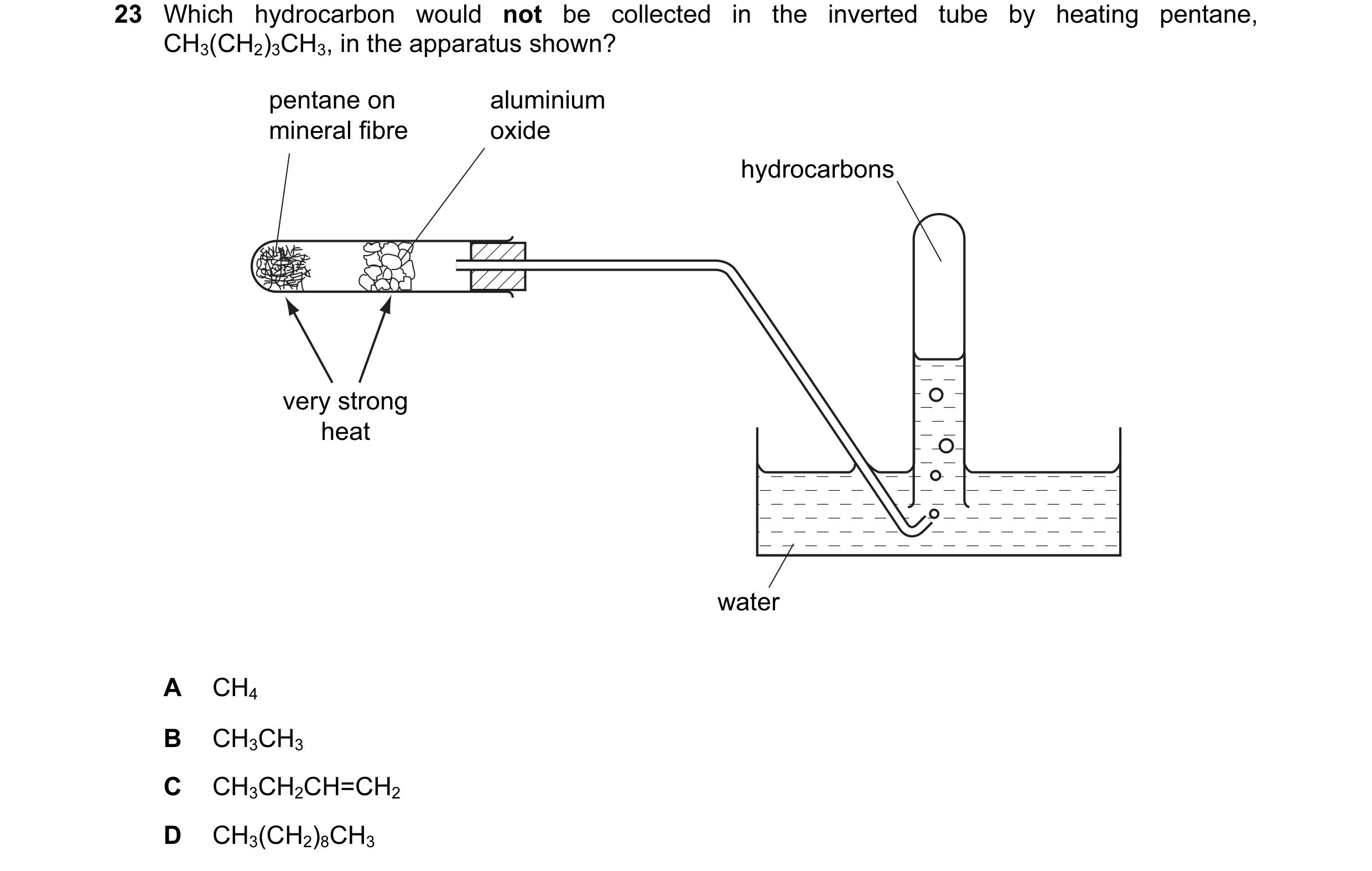
 3 / 28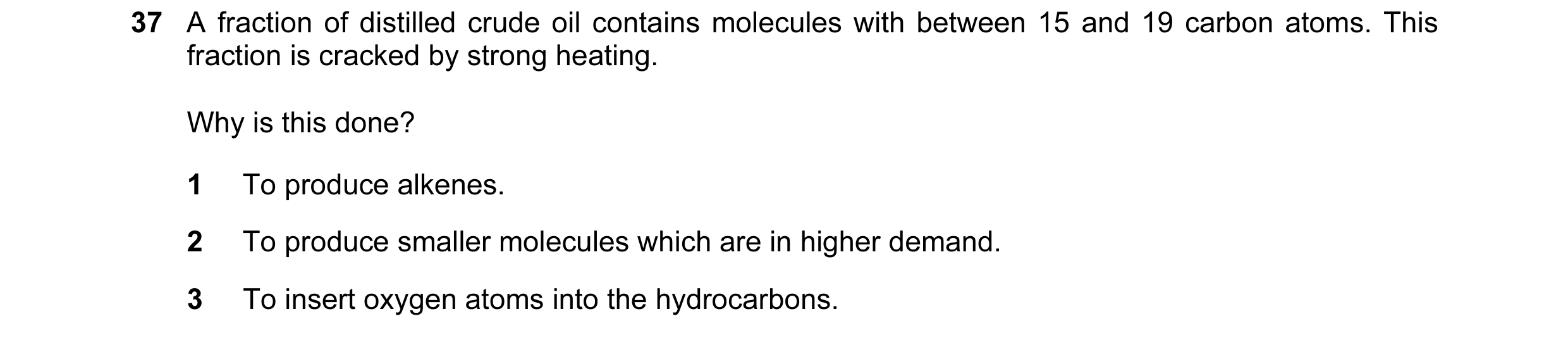

 4 / 28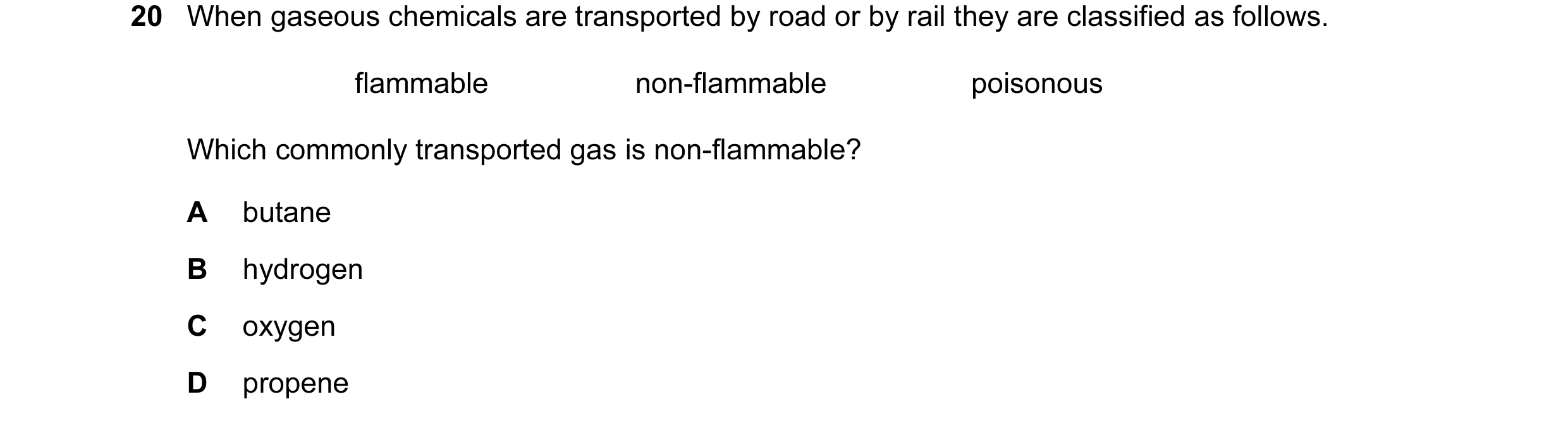

 5 / 28

 6 / 28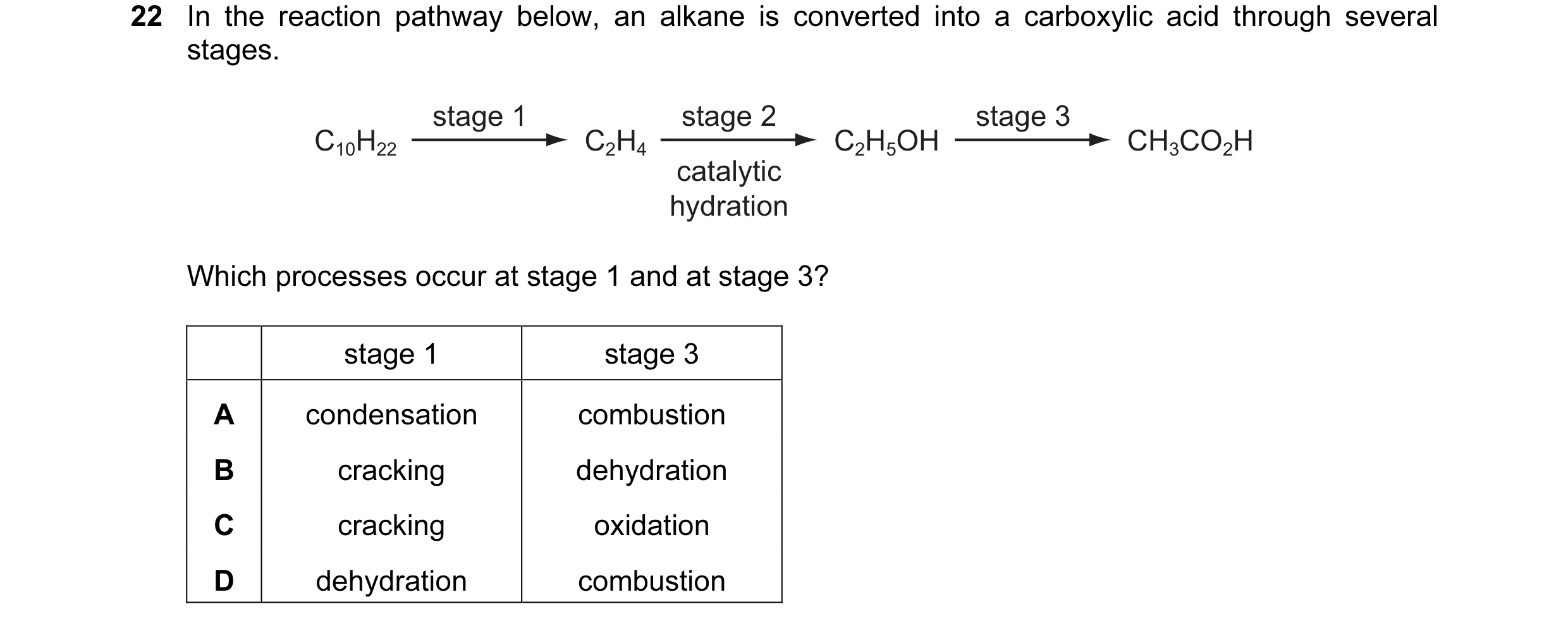
 7 / 28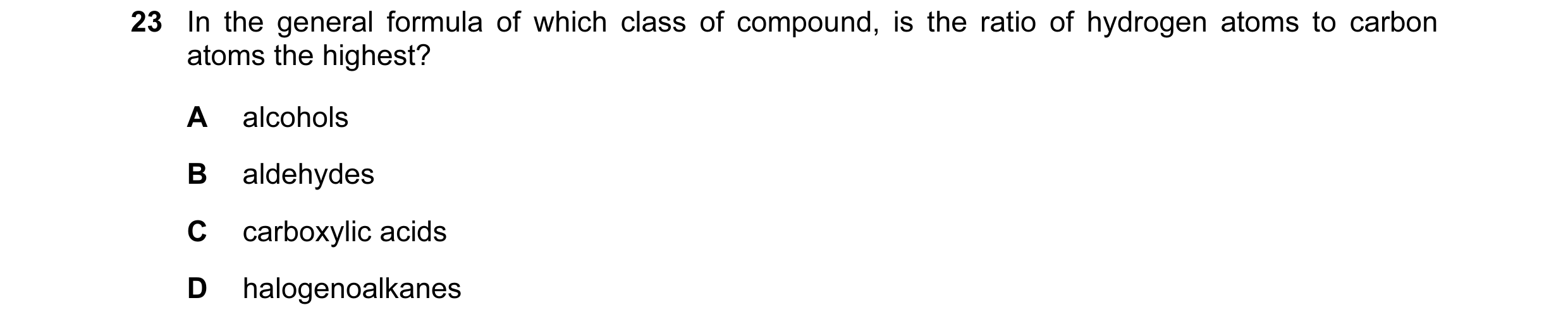

 8 / 28


 9 / 28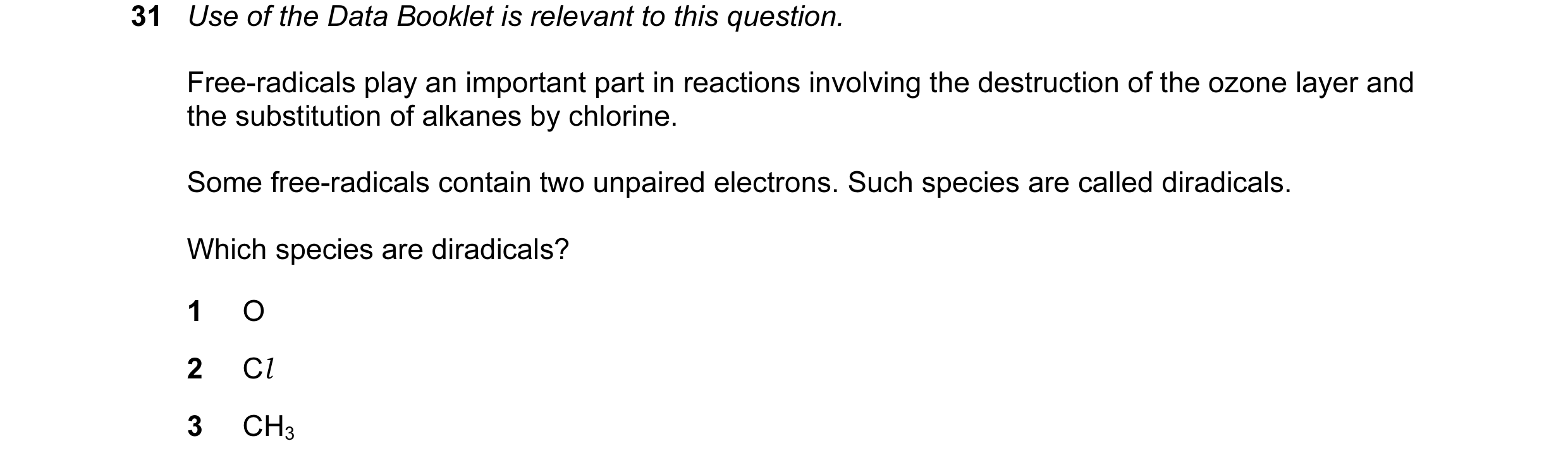

 10 / 28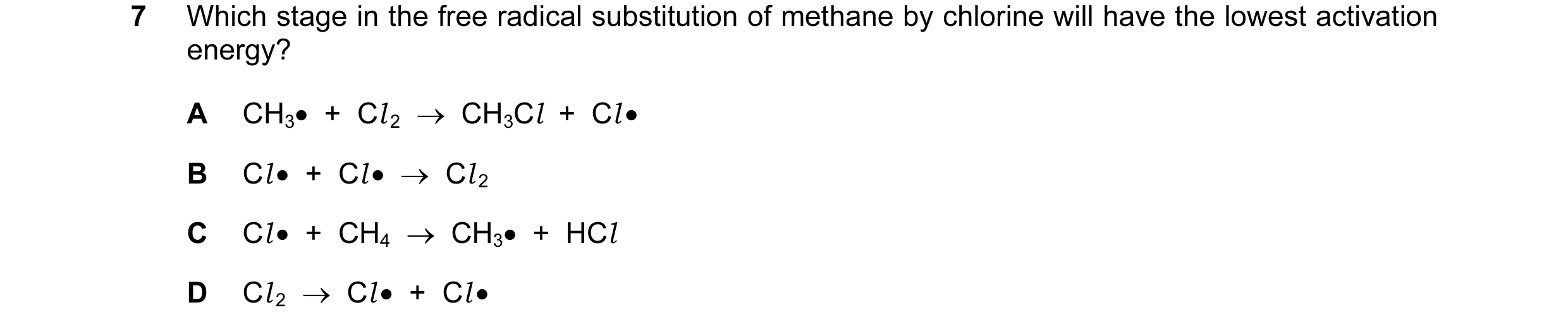

 11 / 28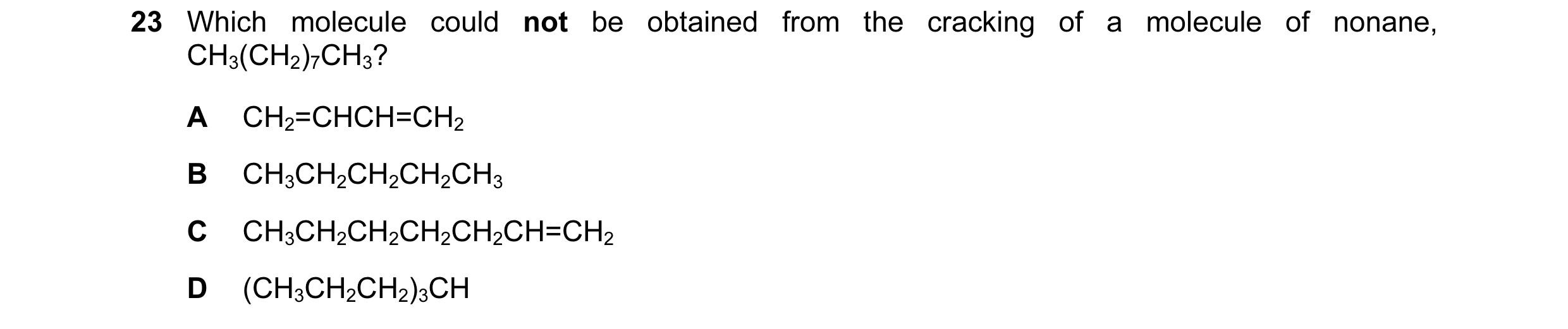
 12 / 28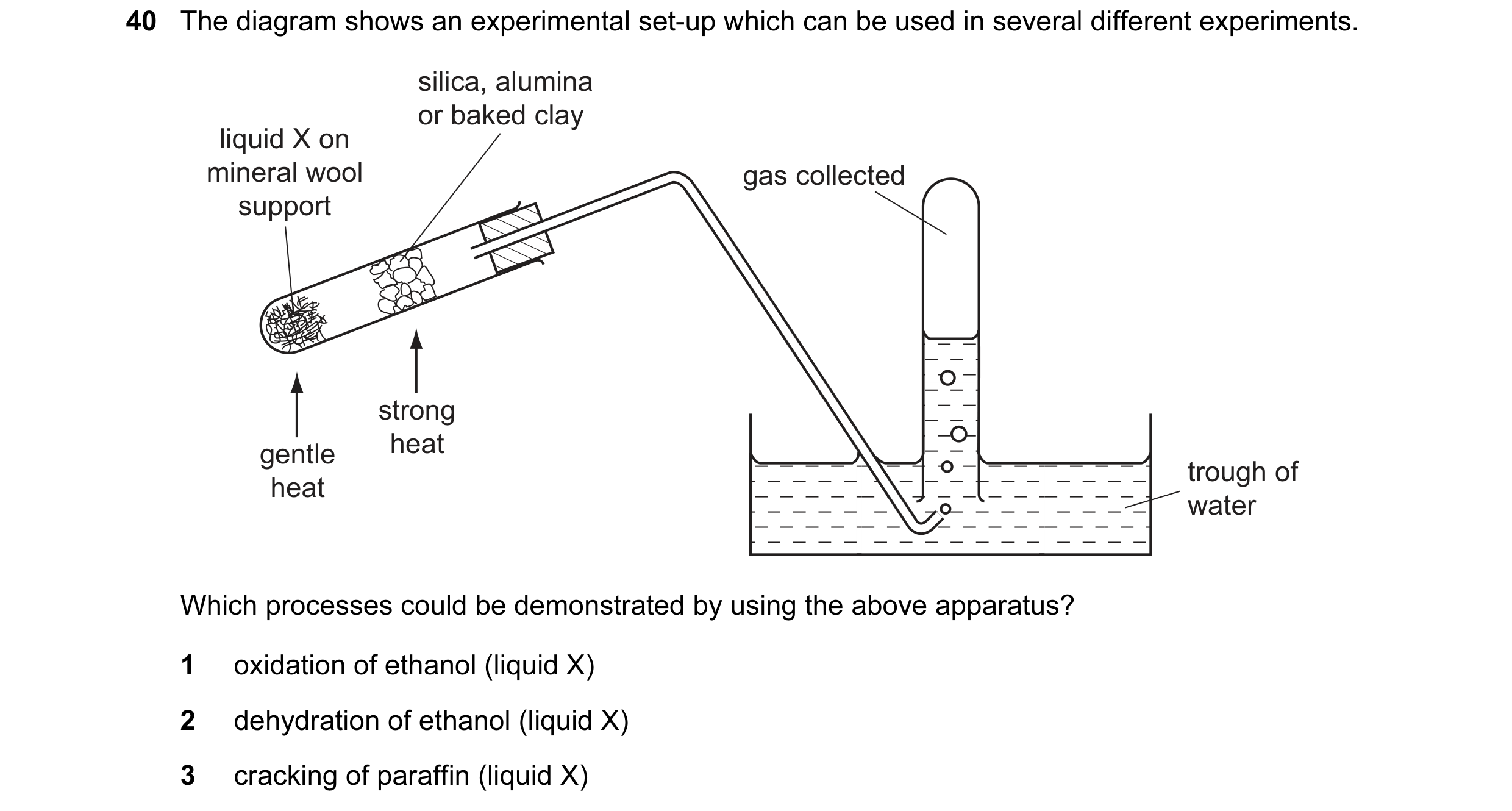

 13 / 28

 14 / 28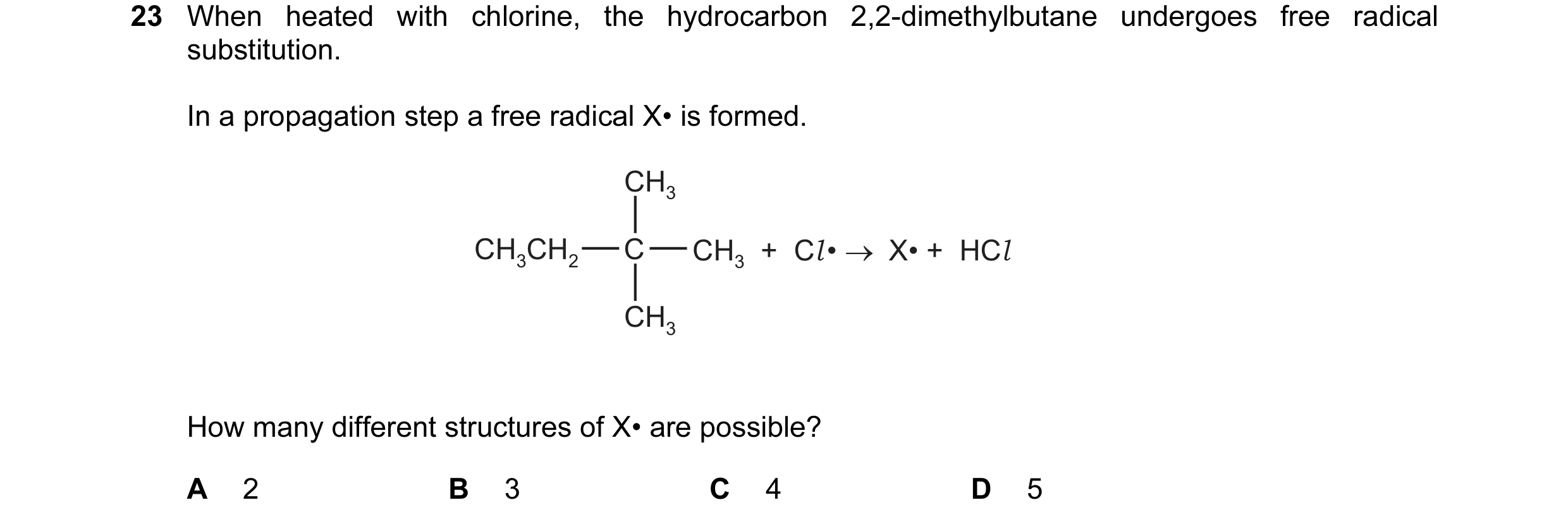
 15 / 28

 16 / 28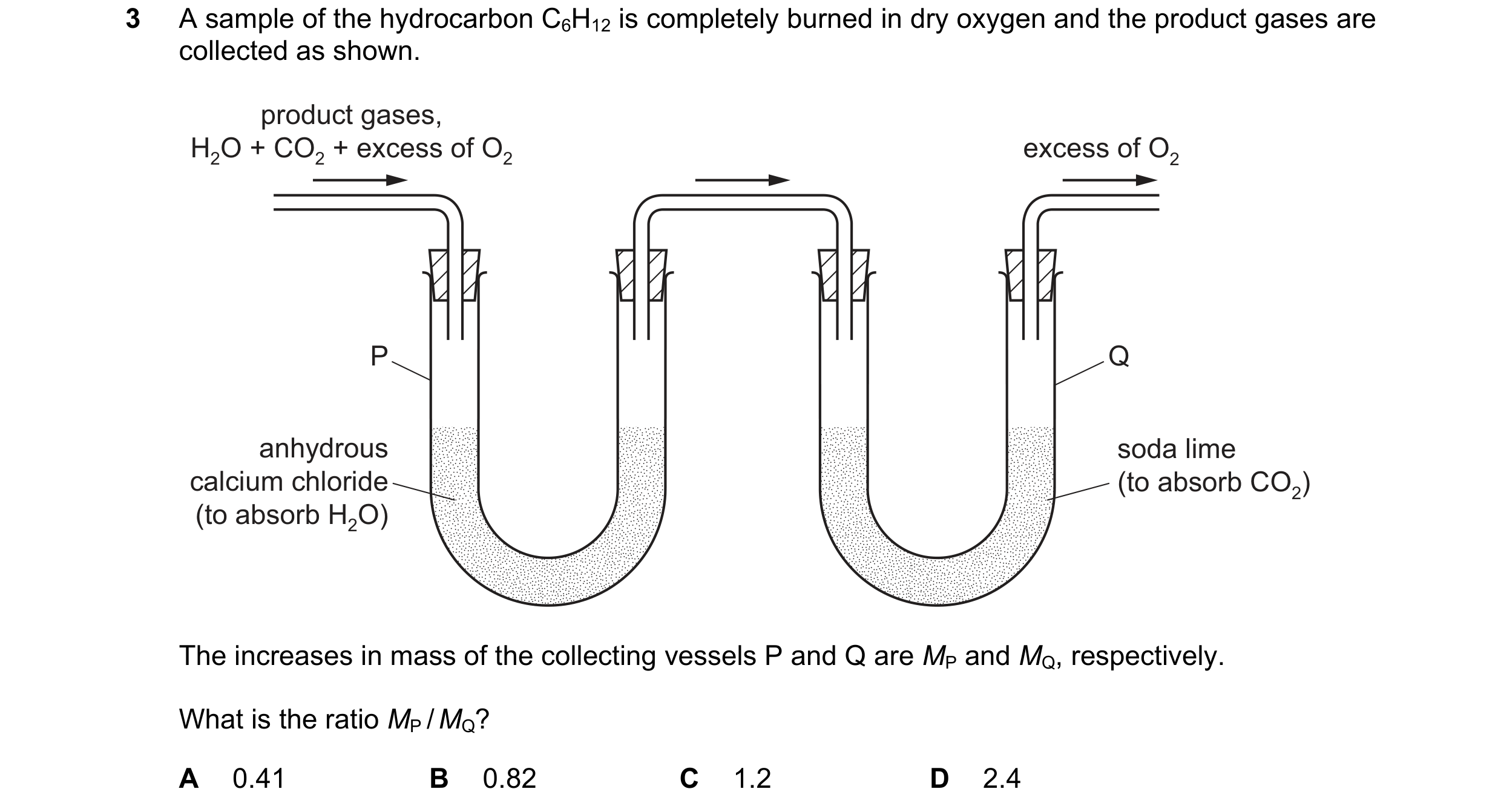
 17 / 28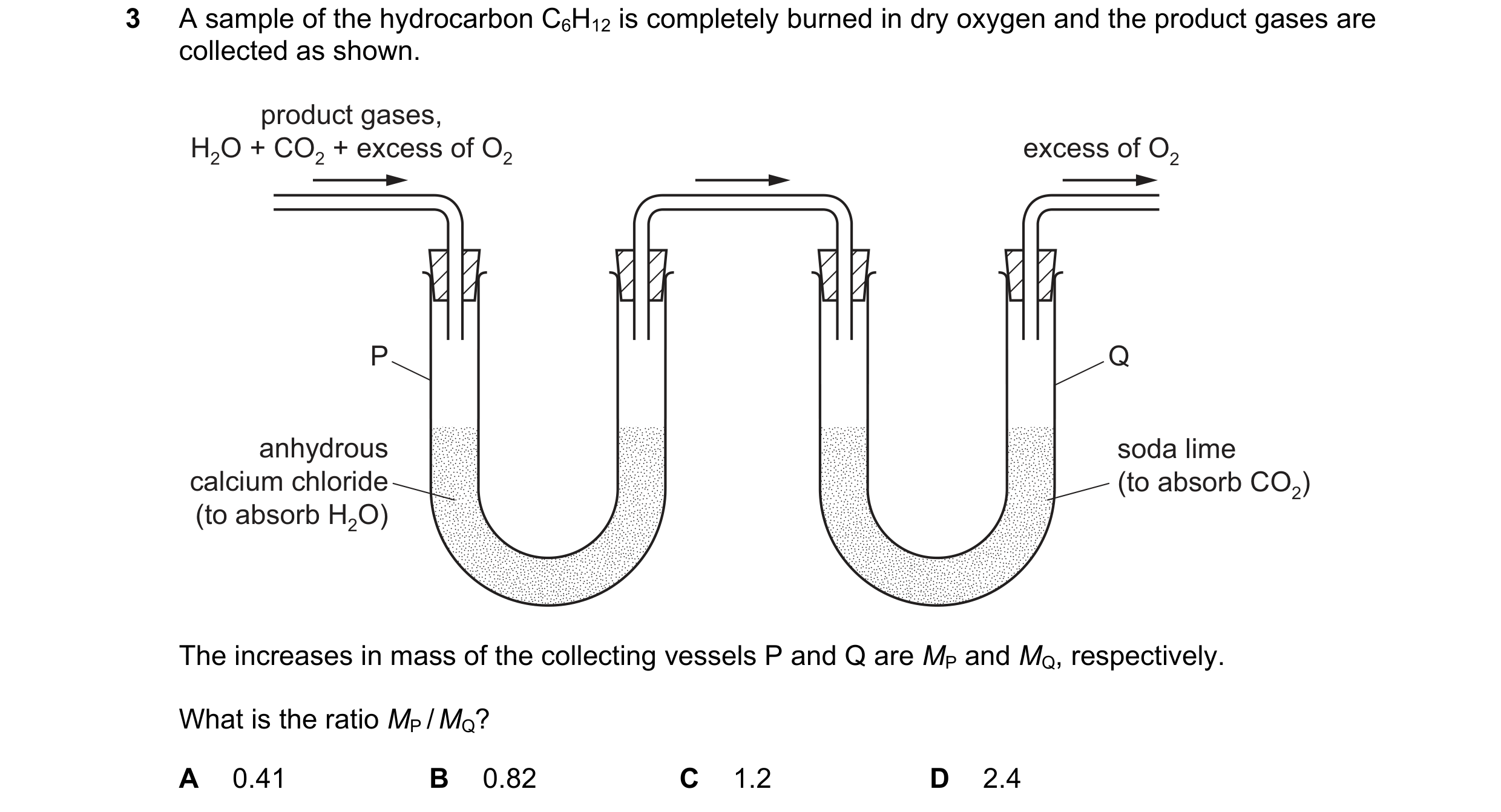
 18 / 28



 19 / 28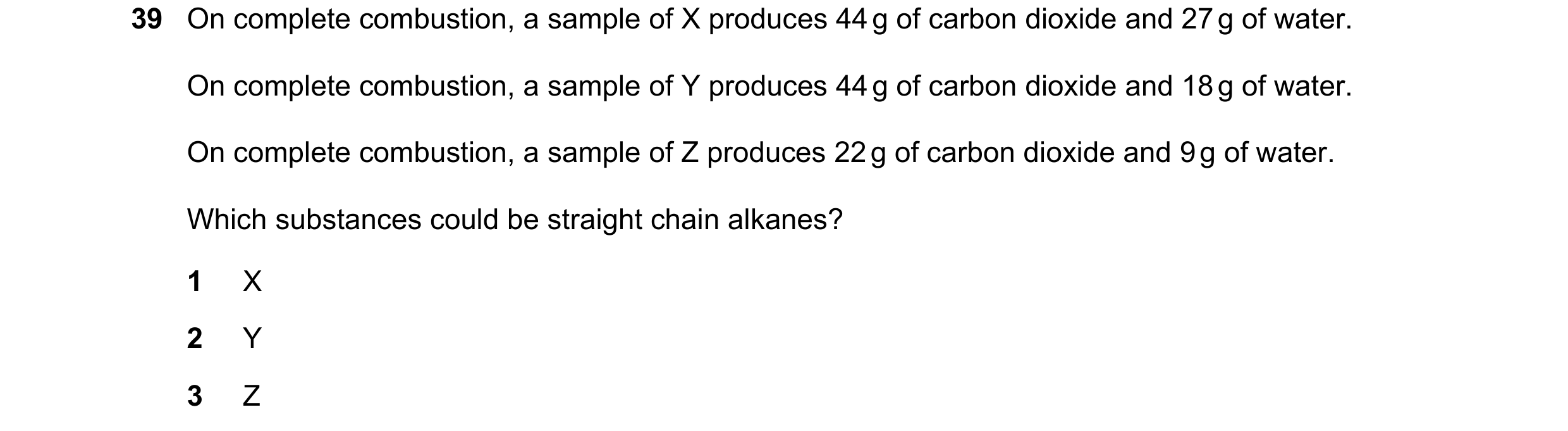


 20 / 28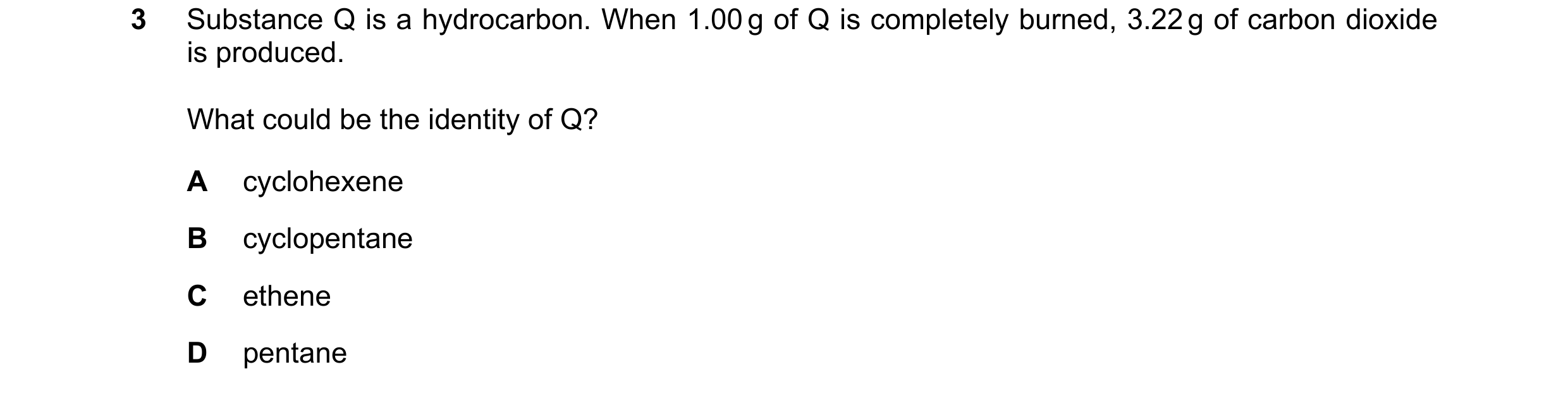

 21 / 28
 22 / 28




 23 / 28
 24 / 28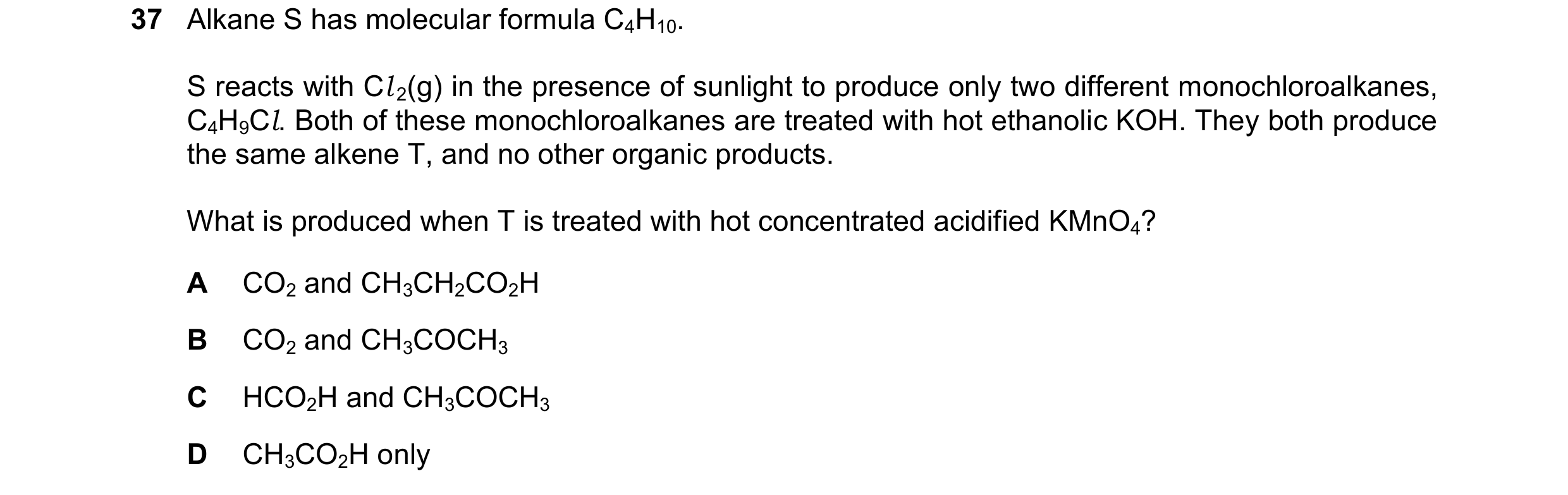
 25 / 28
 26 / 28
 27 / 28
 28 / 28