Questions as text
Q1 · Why is water often used to extinguish fires? 0653/11 Oct/Nov 2006
26 Why is water often used to extinguish fires? A Water is a compound. B Water is neutral. C Water reacts with most fuels. D Water removes heat from the fire.
1 marks
Answer: D
This question in 0653/11 Oct/Nov 2006
Q2 · Why is water often used to extinguish fires? 0653/11 May/June 2008
26 Why is water often used to extinguish fires? A The boiling point of water is 100 °C B Water is a compound containing oxygen and hydrogen. C Water removes heat from the fire. D Water reacts with most fuels.
1 marks
Answer: C
This question in 0653/11 May/June 2008
Q3 · On heating iron and sulphur together, the mixture starts to glow 0653/11 Oct/Nov 2008
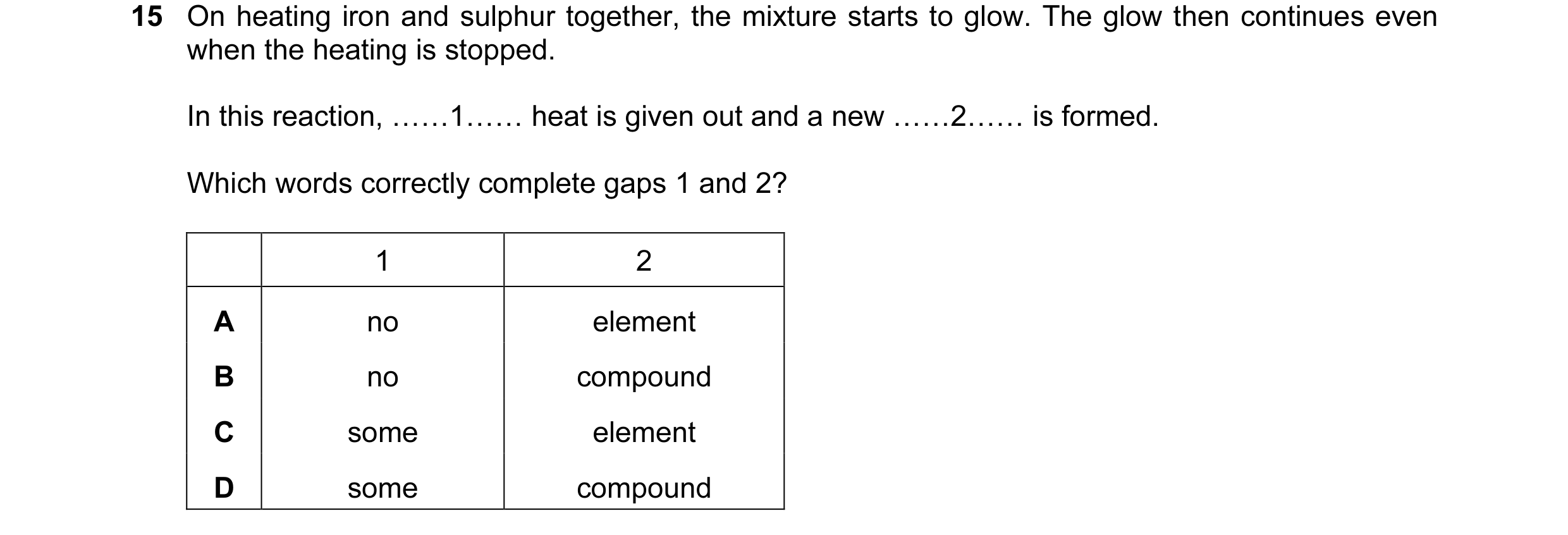
15 On heating iron and sulphur together, the mixture starts to glow. The glow then continues even when the heating is stopped. In this reaction, ……1…… heat is given out and a new ……2…… is formed. Which words correctly complete gaps 1 and 2? 1 2 A no element B no compound C some element D some compound
1 marks
Answer: D
This question in 0653/11 Oct/Nov 2008
Q4 · Kerosene is a hydrocarbon fuel obtained from crude oil 0653/12 May/June 2011
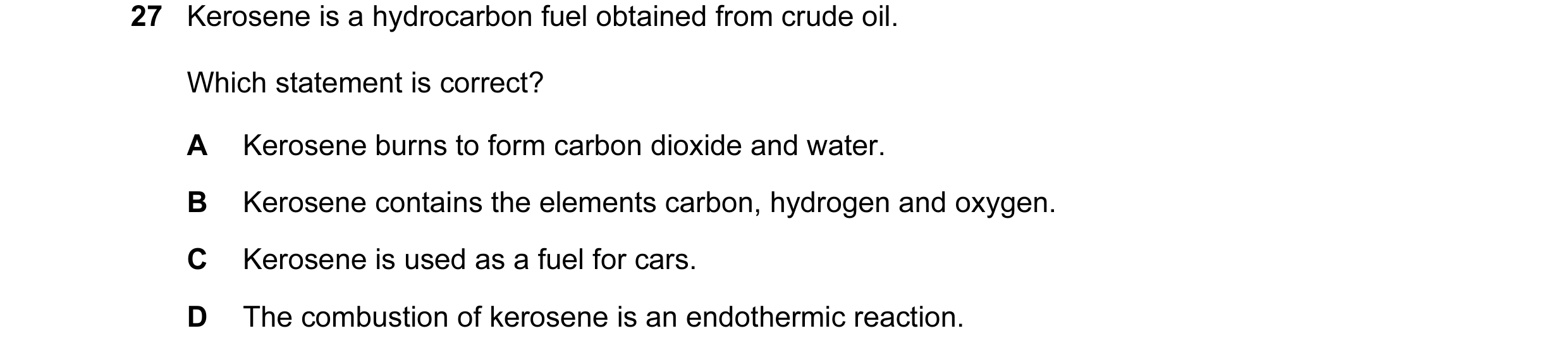
27 Kerosene is a hydrocarbon fuel obtained from crude oil. Which statement is correct? A Kerosene burns to form carbon dioxide and water. B Kerosene contains the elements carbon, hydrogen and oxygen. C Kerosene is used as a fuel for cars. D The combustion of kerosene is an endothermic reaction.
1 marks
Answer: A
This question in 0653/12 May/June 2011
Q5 · Ethene burns as shown 0653/11 Oct/Nov 2011
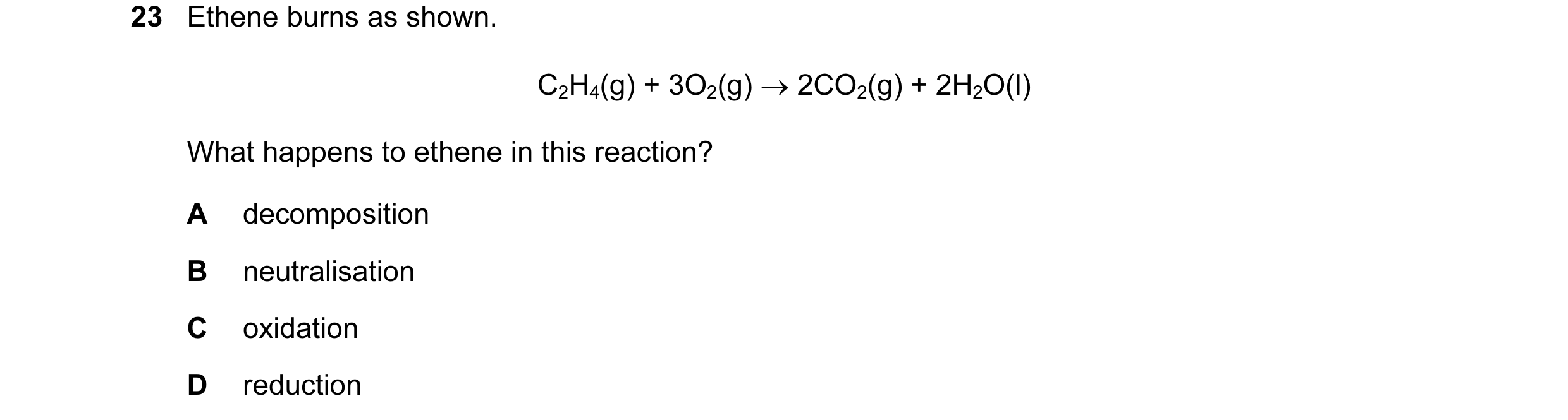
23 Ethene burns as shown. C2H4(g) + 3O2(g) → 2CO2(g) + 2H2O(l) What happens to ethene in this reaction? A decomposition B neutralisation C oxidation D reduction
1 marks
Answer: C
This question in 0653/11 Oct/Nov 2011
Q6 · The reaction of zinc and sulfur to form zinc sulfide is exothermic 0653/12 May/June 2013
16 The reaction of zinc and sulfur to form zinc sulfide is exothermic. Which information in the table is correct? energy change elements in during the formation of zinc sulfide zinc sulfide A difficult to separate heat given out B difficult to separate heat taken in C easy to separate heat given out D easy to separate heat taken in
1 marks
Answer: A
This question in 0653/12 May/June 2013
Q7 · Which statements about the complete combustion of methane are correct? 0653/12 May/June 2013
26 Which statements about the complete combustion of methane are correct? 1 The reaction is endothermic. 2 Carbon dioxide is formed. 3 Water is formed. A 1, 2 and 3 B 1 and 2 only C 1 and 3 only D 2 and 3 only
1 marks
Answer: D
This question in 0653/12 May/June 2013
Q8 · The reaction of zinc and sulfur to form zinc sulfide is exothermic 0653/13 May/June 2013
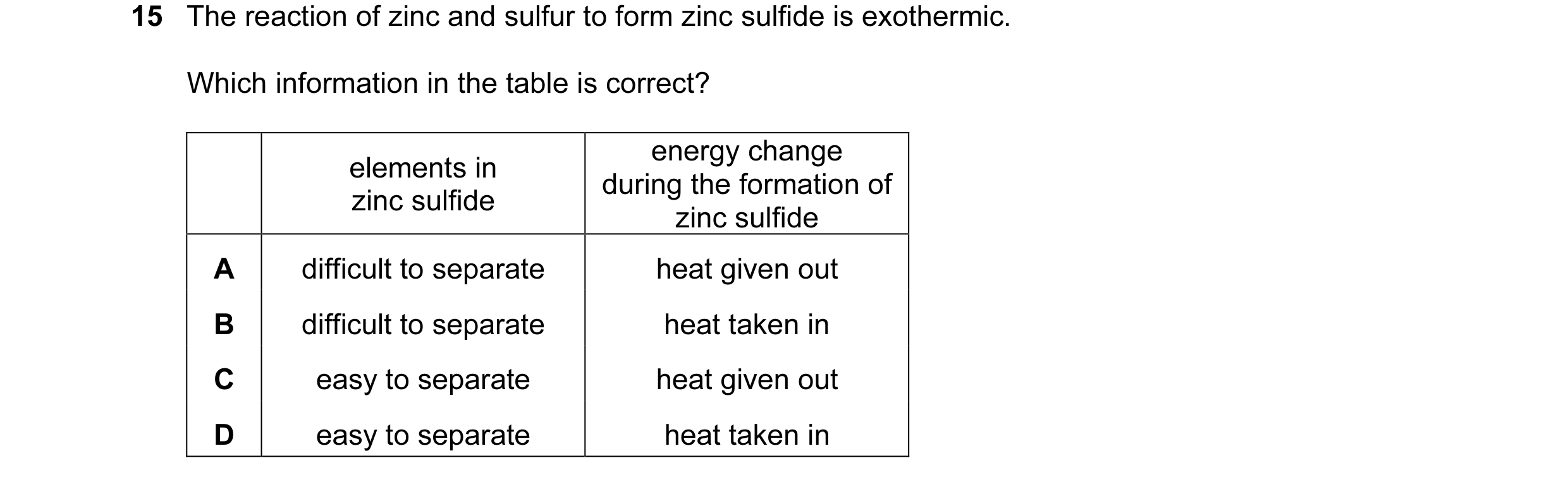
15 The reaction of zinc and sulfur to form zinc sulfide is exothermic. Which information in the table is correct? energy change elements in during the formation of zinc sulfide zinc sulfide A difficult to separate heat given out B difficult to separate heat taken in C easy to separate heat given out D easy to separate heat taken in
1 marks
Answer: A
This question in 0653/13 May/June 2013
Q9 · The diagram shows how the temperature change can be measured when magnesium reacts with… 0653/13 Oct/Nov 2013
27 The diagram shows how the temperature change can be measured when magnesium reacts with hydrochloric acid. magnesium powder dilute hydrochloric acid Thermometer reading before adding magnesium powder = 20.6 °C Thermometer reading after adding magnesium powder = 32.4 °C Which statement is correct? A The reaction is endothermic and gives out heat. B The reaction is endothermic and takes in heat. C The reaction is exothermic and gives out heat. D The reaction is exothermic and takes in heat.
1 marks
Answer: C
This question in 0653/13 Oct/Nov 2013
Q10 · The table shows the initial and final temperatures in a series of experiments 0653/11 Oct/Nov 2014
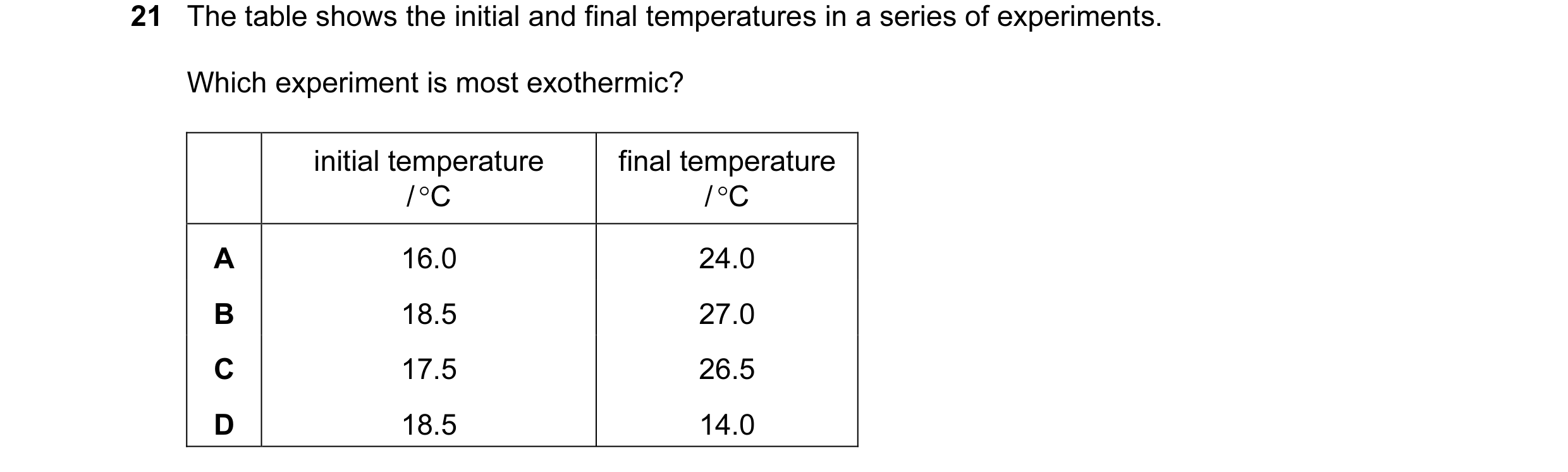
21 The table shows the initial and final temperatures in a series of experiments. Which experiment is most exothermic? initial temperature final temperature / °C / °C A 16.0 24.0 B 18.5 27.0 C 17.5 26.5 D 18.5 14.0
1 marks
Answer: C
This question in 0653/11 Oct/Nov 2014
Q11 · The table shows the initial and final temperatures in a series of experiments 0653/12 Oct/Nov 2014
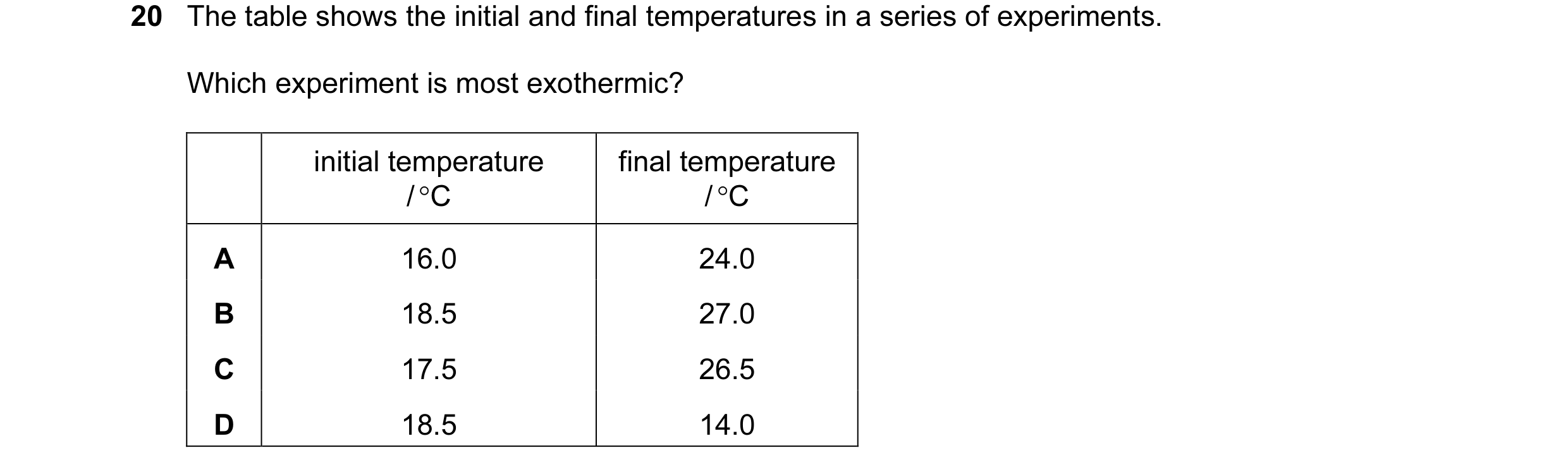
20 The table shows the initial and final temperatures in a series of experiments. Which experiment is most exothermic? initial temperature final temperature / °C / °C A 16.0 24.0 B 18.5 27.0 C 17.5 26.5 D 18.5 14.0
1 marks
Answer: C
This question in 0653/12 Oct/Nov 2014
Q12 · The initial and final temperatures of two chemical reactions are shown 0653/13 Oct/Nov 2014
21 The initial and final temperatures of two chemical reactions are shown. initial temperature final temperature reaction / °C /.°C 1 19 23 2 20 16 Which statement is correct? A Both reactions are endothermic. B Both reactions are exothermic. C Reaction 1 is endothermic and reaction 2 is exothermic. D Reaction 1 is exothermic and reaction 2 is endothermic.
1 marks
Answer: D
This question in 0653/13 Oct/Nov 2014
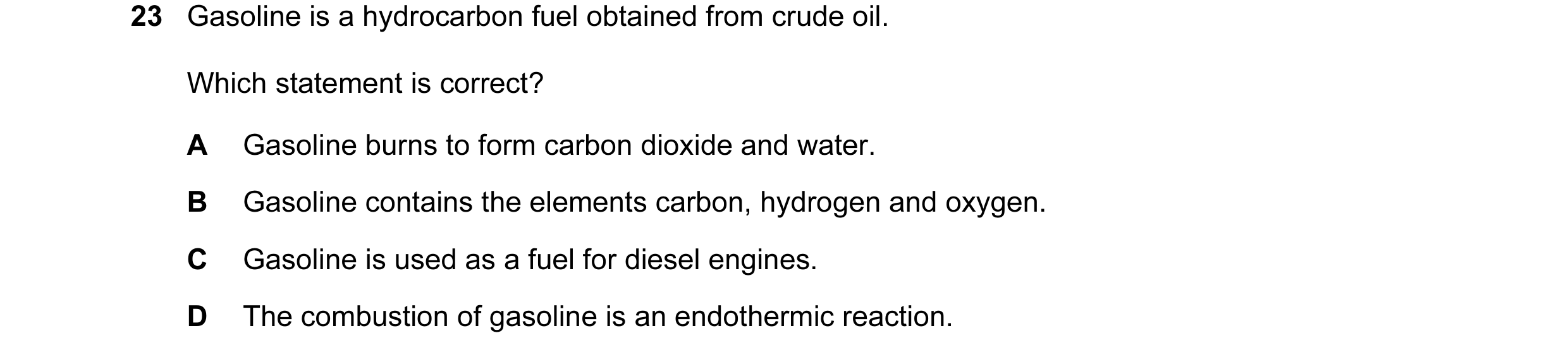
Q13 · Gasoline is a hydrocarbon fuel obtained from crude oil 0653/13 Oct/Nov 2014
23 Gasoline is a hydrocarbon fuel obtained from crude oil. Which statement is correct? A Gasoline burns to form carbon dioxide and water. B Gasoline contains the elements carbon, hydrogen and oxygen. C Gasoline is used as a fuel for diesel engines. D The combustion of gasoline is an endothermic reaction.
1 marks
Answer: A
This question in 0653/13 Oct/Nov 2014
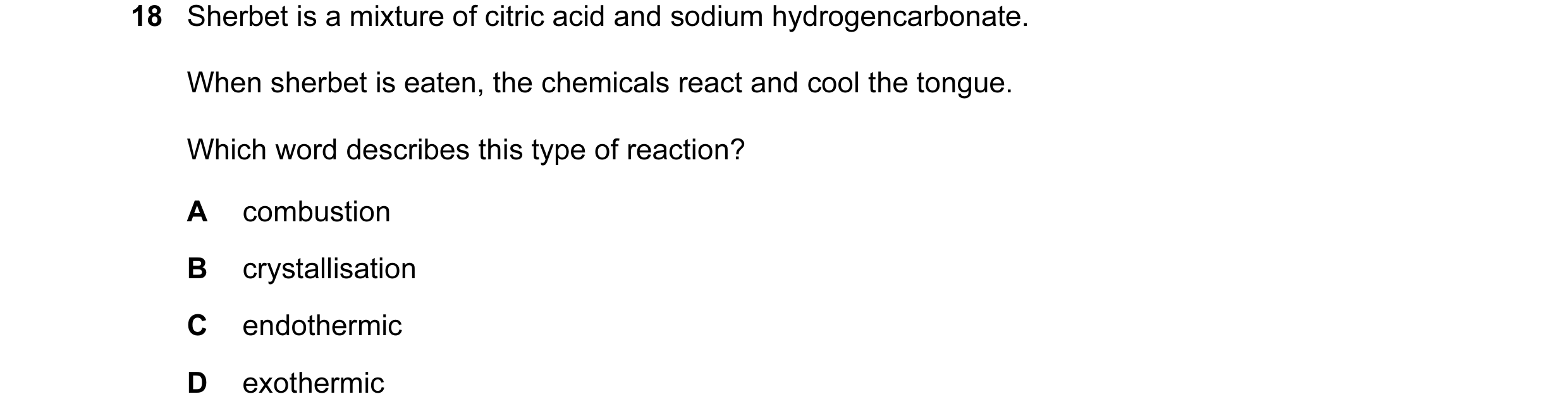
Q14 · Sherbet is a mixture of citric acid and sodium hydrogencarbonate 0653/11 May/June 2015
18 Sherbet is a mixture of citric acid and sodium hydrogencarbonate. When sherbet is eaten, the chemicals react and cool the tongue. Which word describes this type of reaction? A combustion B crystallisation C endothermic D exothermic
1 marks
Answer: C
This question in 0653/11 May/June 2015
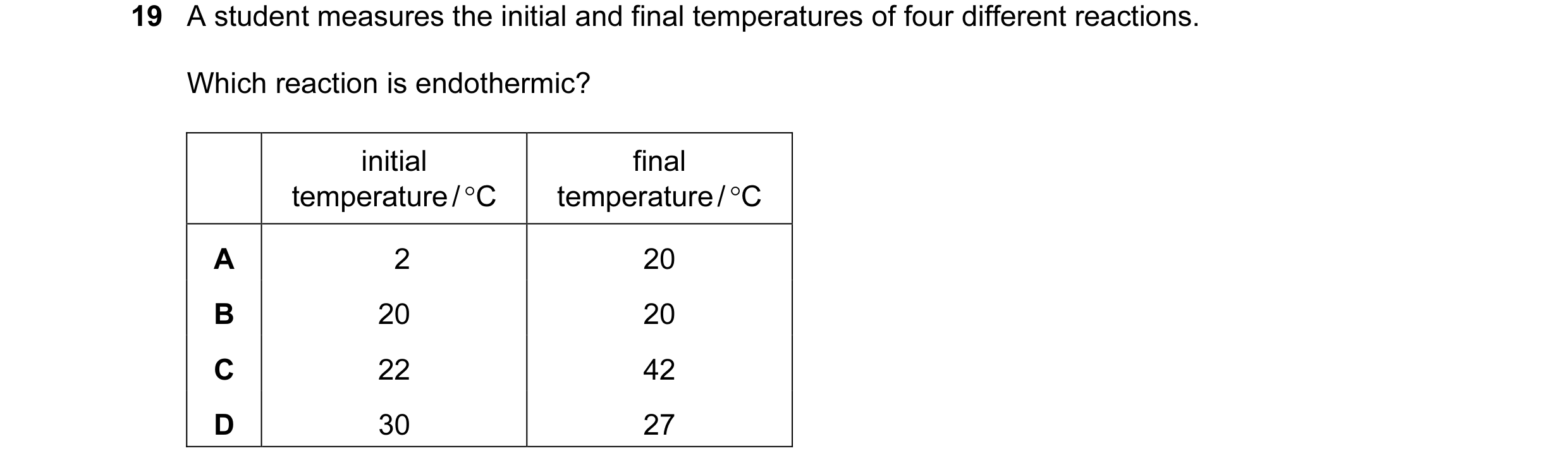
Q15 · A student measures the initial and final temperatures of four different reactions 0653/12 May/June 2015
19 A student measures the initial and final temperatures of four different reactions. Which reaction is endothermic? initial final temperature / °C temperature / °C A 2 20 B 20 20 C 22 42 D 30 27
1 marks
Answer: D
This question in 0653/12 May/June 2015
Q16 · Which change must take place in an endothermic reaction? 0653/13 May/June 2015
19 Which change must take place in an endothermic reaction? A Bubbles of gas are released. B The mass decreases. C The temperature decreases. D The temperature increases.
1 marks
Answer: C
This question in 0653/13 May/June 2015
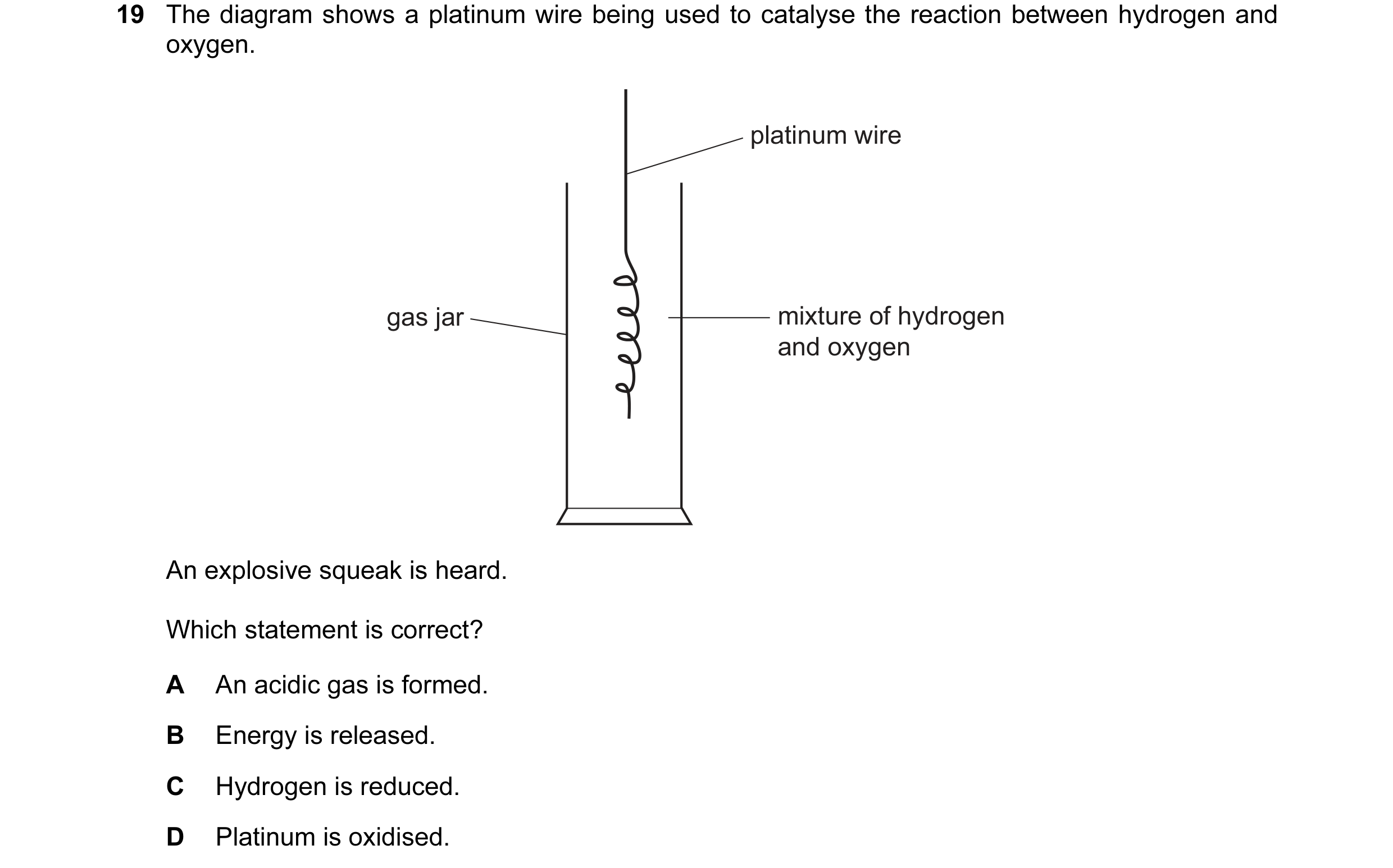
Q17 · The diagram shows a platinum wire being used to catalyse the reaction between hydrogen… 0653/11 Oct/Nov 2015
19 The diagram shows a platinum wire being used to catalyse the reaction between hydrogen and oxygen. platinum wire gas jar mixture of hydrogen and oxygen An explosive squeak is heard. Which statement is correct? A An acidic gas is formed. B Energy is released. C Hydrogen is reduced. D Platinum is oxidised.
1 marks
Answer: B
This question in 0653/11 Oct/Nov 2015
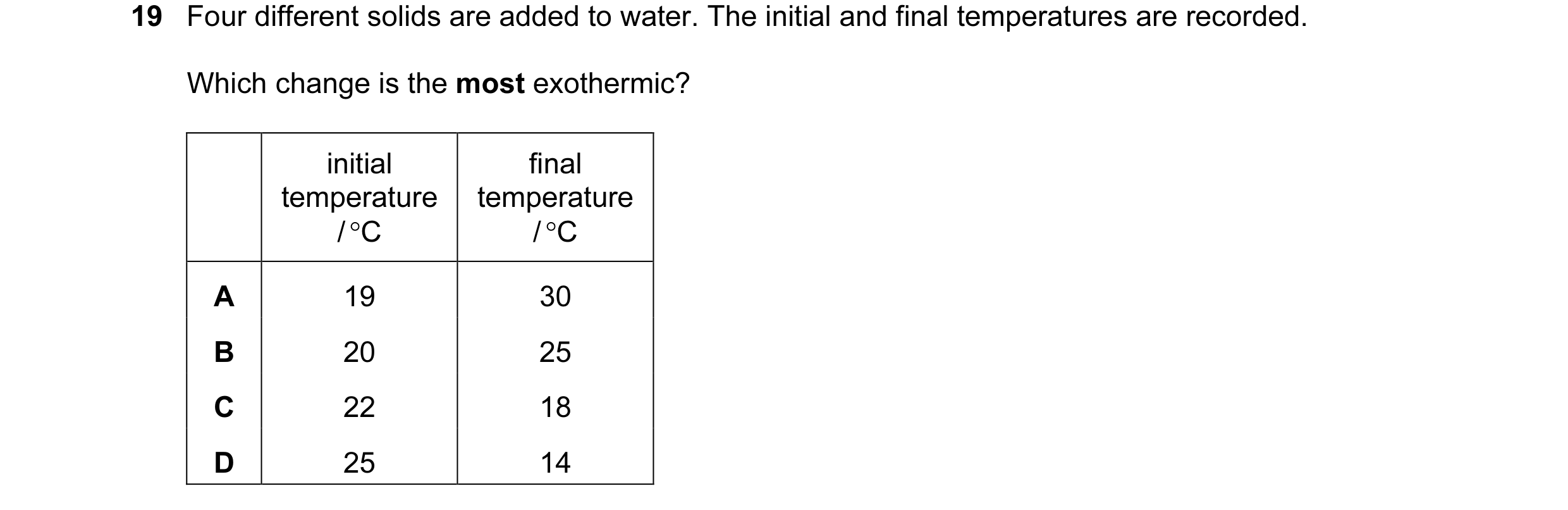
Q18 · Four different solids are added to water 0653/12 Oct/Nov 2015
19 Four different solids are added to water. The initial and final temperatures are recorded. Which change is the most exothermic? initial final temperature temperature / °C / °C A 19 30 B 20 25 C 22 18 D 25 14
1 marks
Answer: A
This question in 0653/12 Oct/Nov 2015
Q19 · Hydrochloric acid is slowly added to sodium hydroxide in an insulated beaker 0653/13 Oct/Nov 2015
19 Hydrochloric acid is slowly added to sodium hydroxide in an insulated beaker. The reaction is exothermic. Which graph shows how the temperature changes during the reaction? A B temperature / °C temperature / °C volume of volume of acid / cm3 acid / cm3 C D temperature / °C temperature / °C volume of volume of acid / cm3 acid / cm3
1 marks
Answer: A
This question in 0653/13 Oct/Nov 2015
Q20 · What happens during all endothermic changes? 0653/11 May/June 2016
18 What happens during all endothermic changes? A A gas is produced. B Solids melt. C The temperature decreases. D There is a colour change.
1 marks
Answer: C
This question in 0653/11 May/June 2016
Q21 · Solid sodium carbonate is added to vinegar in a beaker and stirred 0653/12 May/June 2016
18 Solid sodium carbonate is added to vinegar in a beaker and stirred. sodium carbonate beaker vinegar watch glass water The water in the watch glass freezes. Which statement about the reaction explains why the water freezes? A It is a redox reaction. B It is an endothermic reaction. C It is catalysed by sodium carbonate. D It is thermal decomposition.
1 marks
Answer: B
This question in 0653/12 May/June 2016
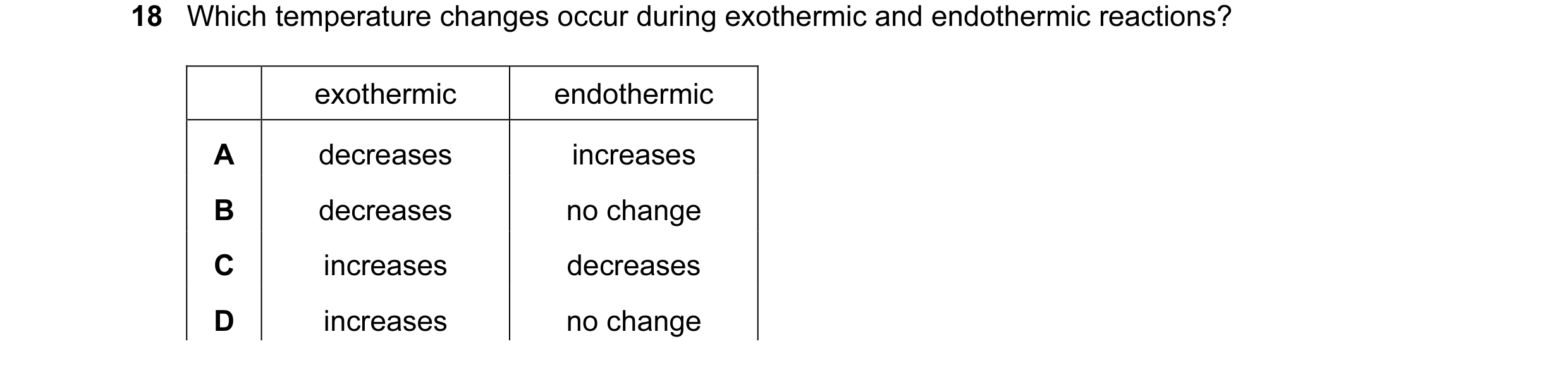
Q22 · Which temperature changes occur during exothermic and endothermic reactions? 0653/13 May/June 2016
18 Which temperature changes occur during exothermic and endothermic reactions? exothermic endothermic A decreases increases B decreases no change C increases decreases D increases no change
1 marks
Answer: C
This question in 0653/13 May/June 2016
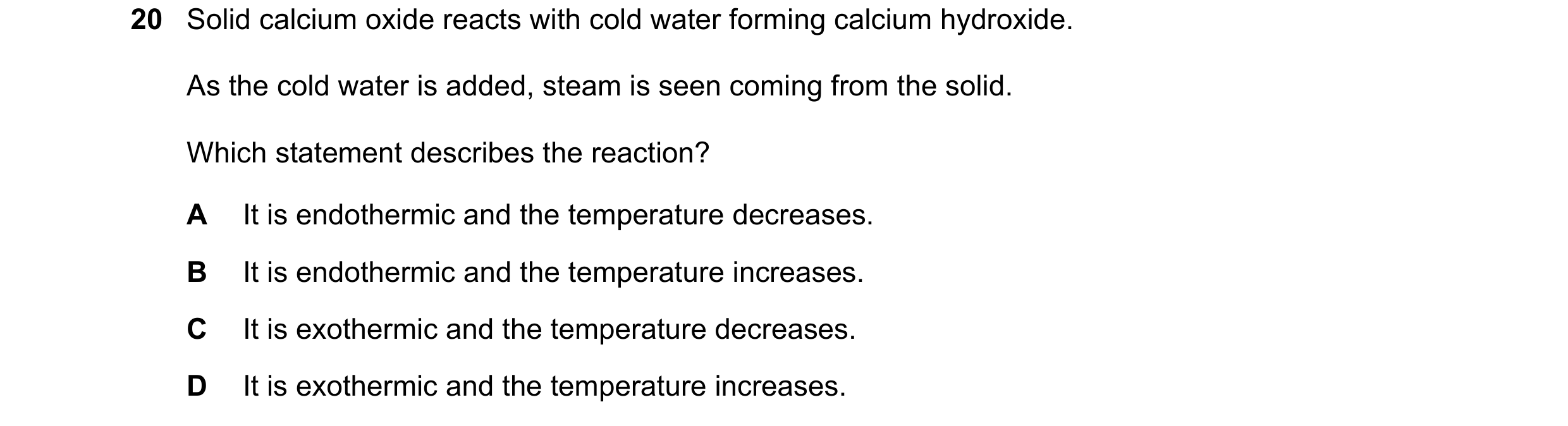
Q23 · Solid calcium oxide reacts with cold water forming calcium hydroxide 0653/11 Oct/Nov 2016
20 Solid calcium oxide reacts with cold water forming calcium hydroxide. As the cold water is added, steam is seen coming from the solid. Which statement describes the reaction? A It is endothermic and the temperature decreases. B It is endothermic and the temperature increases. C It is exothermic and the temperature decreases. D It is exothermic and the temperature increases.
1 marks
Answer: D
This question in 0653/11 Oct/Nov 2016
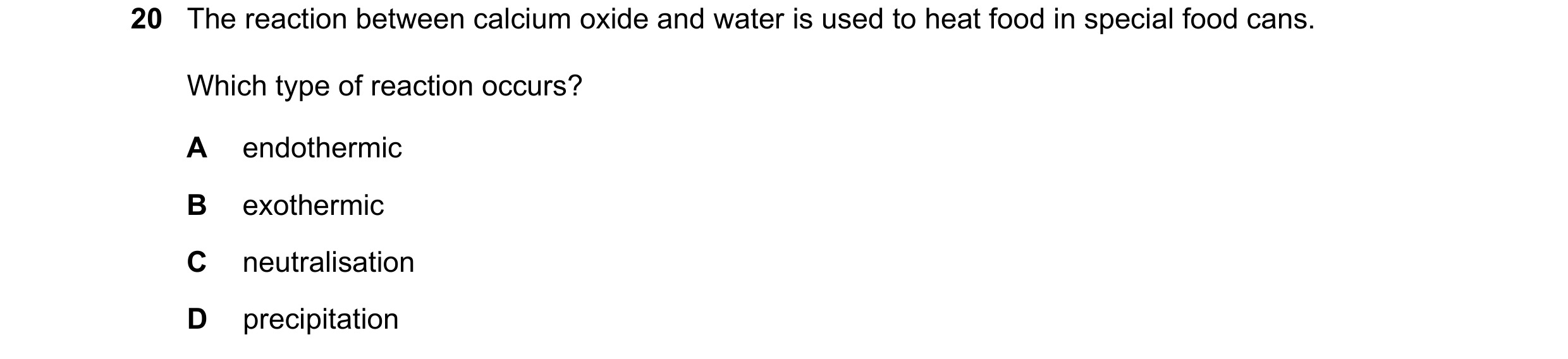
Q24 · The reaction between calcium oxide and water is used to heat food in special food cans 0653/12 Oct/Nov 2016
20 The reaction between calcium oxide and water is used to heat food in special food cans. Which type of reaction occurs? A endothermic B exothermic C neutralisation D precipitation
1 marks
Answer: B
This question in 0653/12 Oct/Nov 2016
Q25 · Which reaction is most endothermic? 0653/13 Oct/Nov 2016
20 Which reaction is most endothermic? initial temperature final temperature / °C / °C A 18 23 B 19 18 C 20 22 D 21 19
1 marks
Answer: D
This question in 0653/13 Oct/Nov 2016
Q26 · Solid ammonium nitrate is soluble in water 0653/12 Feb/March 2017
20 Solid ammonium nitrate is soluble in water. When a large quantity of ammonium nitrate is added to water, the water freezes. Which statement describes this change? A an endothermic chemical change B an endothermic physical change C an exothermic chemical change D an exothermic physical change
1 marks
Answer: B
This question in 0653/12 Feb/March 2017
Q27 · The diagram shows how the temperature change is measured when magnesium powder reacts… 0653/11 May/June 2017
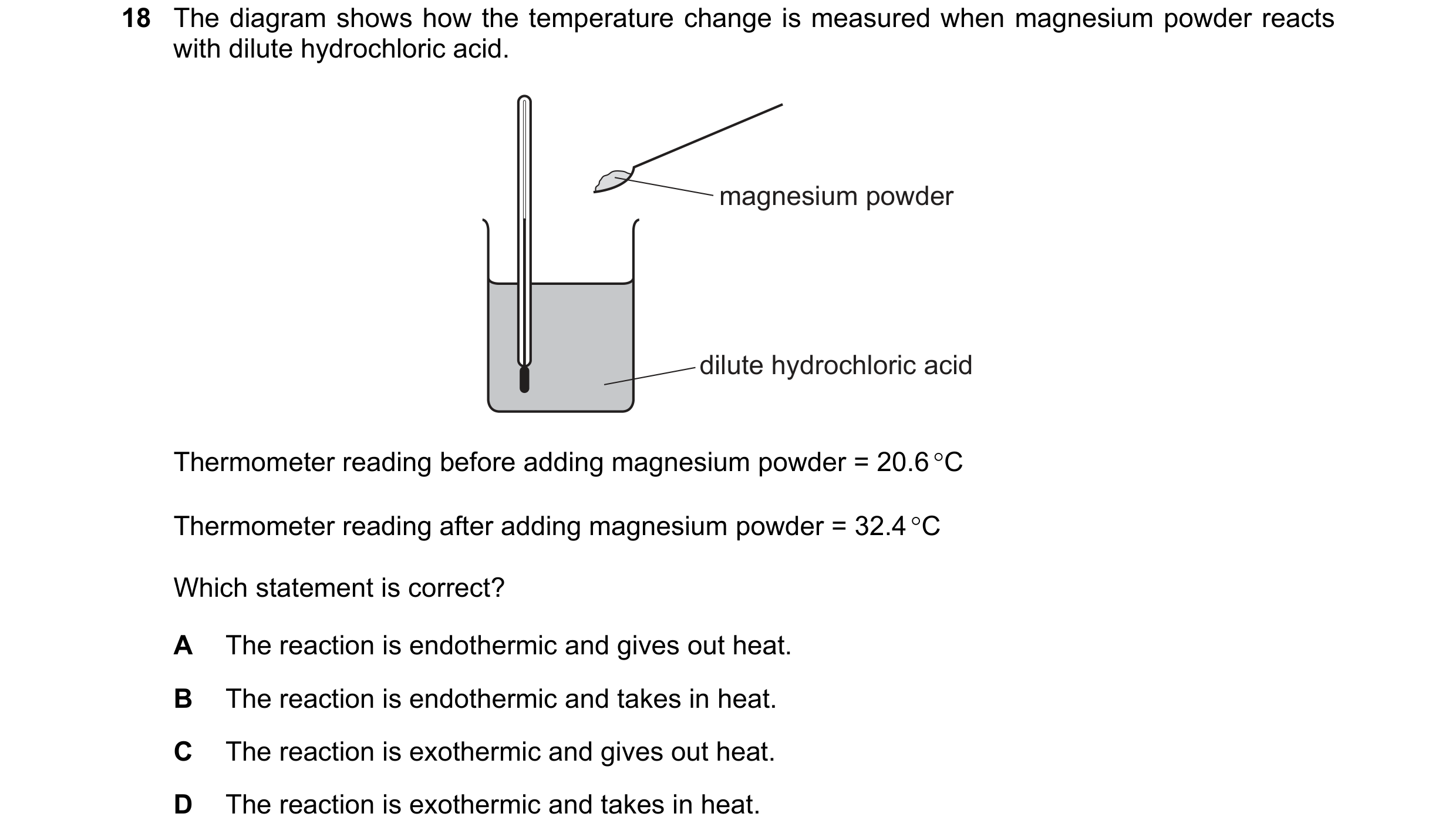
18 The diagram shows how the temperature change is measured when magnesium powder reacts with dilute hydrochloric acid. magnesium powder dilute hydrochloric acid Thermometer reading before adding magnesium powder = 20.6 °C Thermometer reading after adding magnesium powder = 32.4 °C Which statement is correct? A The reaction is endothermic and gives out heat. B The reaction is endothermic and takes in heat. C The reaction is exothermic and gives out heat. D The reaction is exothermic and takes in heat.
1 marks
Answer: C
This question in 0653/11 May/June 2017
Q28 · The diagram shows how the temperature change is measured when magnesium powder reacts… 0653/12 May/June 2017
18 The diagram shows how the temperature change is measured when magnesium powder reacts with dilute hydrochloric acid. magnesium powder dilute hydrochloric acid Thermometer reading before adding magnesium powder = 20.6 °C Thermometer reading after adding magnesium powder = 32.4 °C Which statement is correct? A The reaction is endothermic and gives out heat. B The reaction is endothermic and takes in heat. C The reaction is exothermic and gives out heat. D The reaction is exothermic and takes in heat.
1 marks
Answer: C
This question in 0653/12 May/June 2017
Q29 · The diagram shows how the temperature change is measured when magnesium powder reacts… 0653/13 May/June 2017
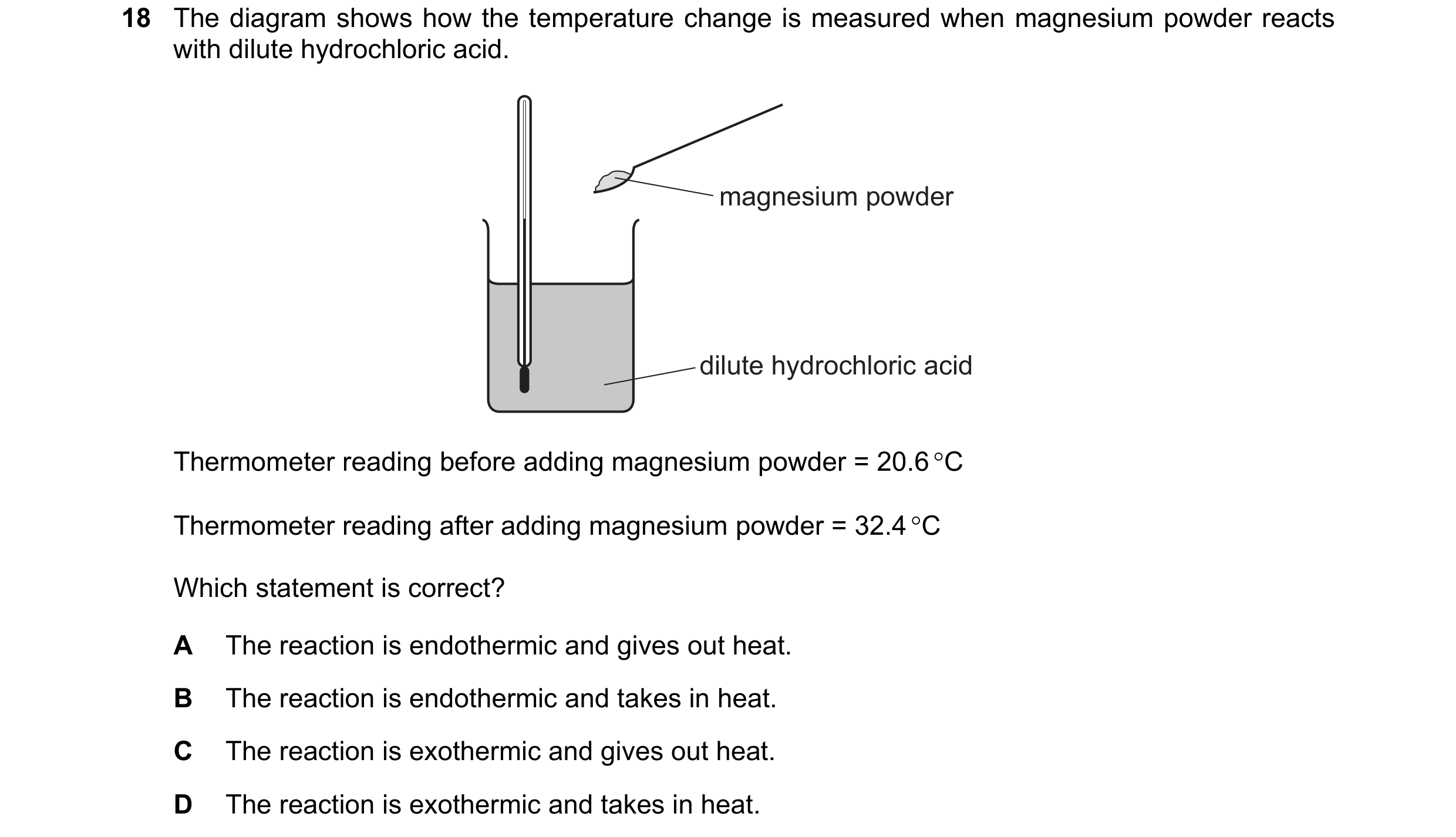
18 The diagram shows how the temperature change is measured when magnesium powder reacts with dilute hydrochloric acid. magnesium powder dilute hydrochloric acid Thermometer reading before adding magnesium powder = 20.6 °C Thermometer reading after adding magnesium powder = 32.4 °C Which statement is correct? A The reaction is endothermic and gives out heat. B The reaction is endothermic and takes in heat. C The reaction is exothermic and gives out heat. D The reaction is exothermic and takes in heat.
1 marks
Answer: C
This question in 0653/13 May/June 2017
Q30 · The diagram shows gas X burning and heating a liquid 0653/11 Oct/Nov 2017
19 The diagram shows gas X burning and heating a liquid.
Which row is correct?
gas X
0 Oo WwW >
gas X
hydrogen
hydrogen
oxygen
oxygen
the burning of gas X
is exothermic
x < x
liquid
flame
1 marks
Answer: A
This question in 0653/11 Oct/Nov 2017
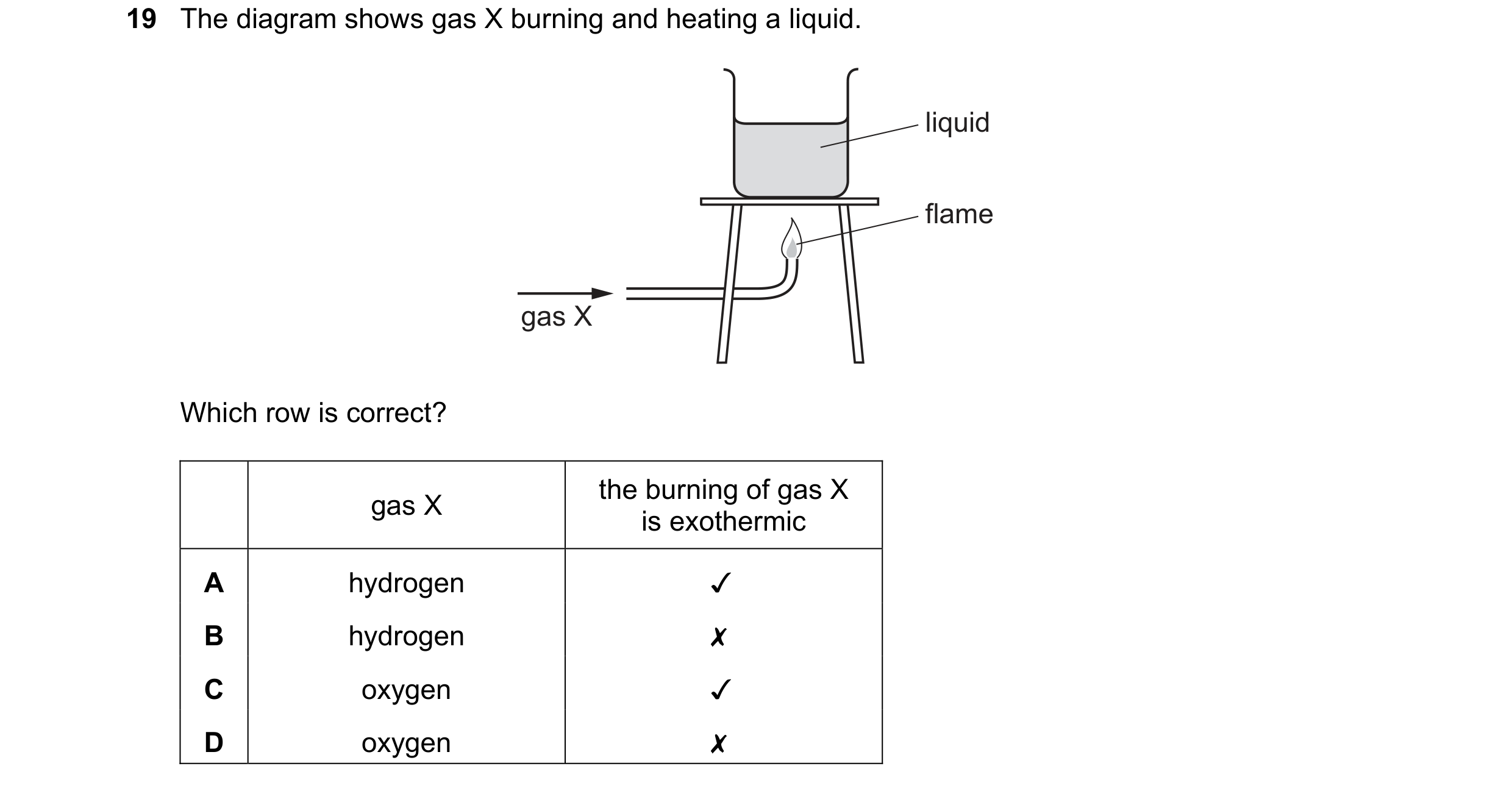
Q31 · The diagram shows gas X burning and heating a liquid 0653/12 Oct/Nov 2017
19 The diagram shows gas X burning and heating a liquid.
Which row is correct?
gas X
0 Oo WwW >
gas X
hydrogen
hydrogen
oxygen
oxygen
the burning of gas X
is exothermic
x < x
liquid
flame
1 marks
Answer: A
This question in 0653/12 Oct/Nov 2017
Q32 · The diagram shows gas X burning and heating a liquid 0653/13 Oct/Nov 2017
19 The diagram shows gas X burning and heating a liquid.
Which row is correct?
gas X
0 Oo WwW >
gas X
hydrogen
hydrogen
oxygen
oxygen
the burning of gas X
is exothermic
x < x
liquid
flame
1 marks
Answer: A
This question in 0653/13 Oct/Nov 2017
Q33 · Which change must take place in an endothermic reaction? 0653/11 May/June 2018
20 Which change must take place in an endothermic reaction? A Bubbles of gas are released. B The mass decreases. C The temperature decreases. D The temperature increases.
1 marks
Answer: C
This question in 0653/11 May/June 2018
Q34 · Which change must take place in an endothermic reaction? 0653/12 May/June 2018
20 Which change must take place in an endothermic reaction? A Bubbles of gas are released. B The mass decreases. C The temperature decreases. D The temperature increases.
1 marks
Answer: C
This question in 0653/12 May/June 2018
Q35 · Which change must take place in an endothermic reaction? 0653/13 May/June 2018
20 Which change must take place in an endothermic reaction? A Bubbles of gas are released. B The mass decreases. C The temperature decreases. D The temperature increases.
1 marks
Answer: C
This question in 0653/13 May/June 2018
Q36 · The temperature of aqueous copper sulfate is measured 0653/11 Oct/Nov 2018
18 The temperature of aqueous copper sulfate is measured. After three minutes, magnesium is stirred into the solution. The temperature of the mixture is recorded every minute. The results are shown. 60 50 40 temperature / °C 30 20 10 0 0 3 6 9 12 15 18 21 24 27 30 33 36 39 42 45 48 time / minutes Which description of the chemical reaction is correct? A endothermic then exothermic B endothermic only C exothermic then endothermic D exothermic only
1 marks
Answer: D
This question in 0653/11 Oct/Nov 2018
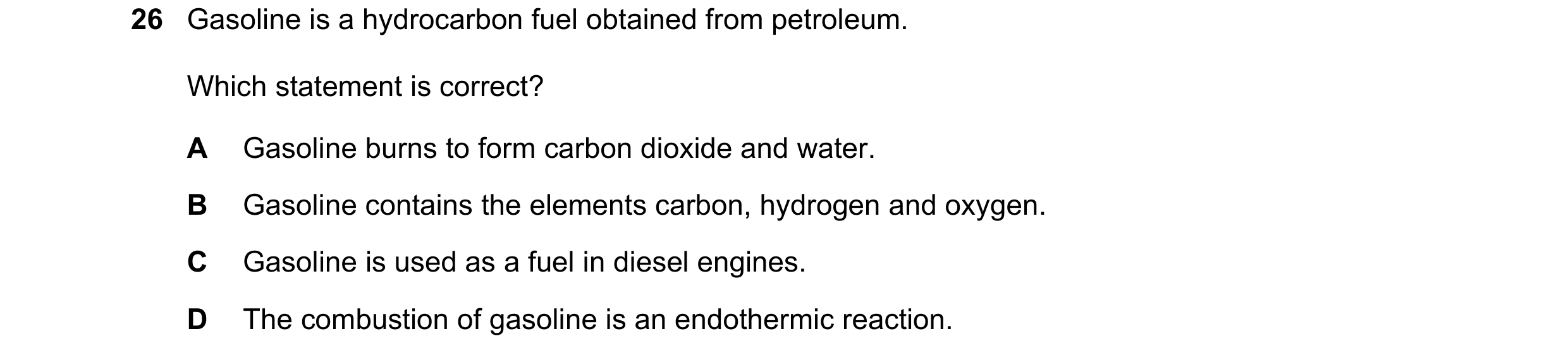
Q37 · Gasoline is a hydrocarbon fuel obtained from petroleum 0653/11 Oct/Nov 2018
26 Gasoline is a hydrocarbon fuel obtained from petroleum. Which statement is correct? A Gasoline burns to form carbon dioxide and water. B Gasoline contains the elements carbon, hydrogen and oxygen. C Gasoline is used as a fuel in diesel engines. D The combustion of gasoline is an endothermic reaction.
1 marks
Answer: A
This question in 0653/11 Oct/Nov 2018
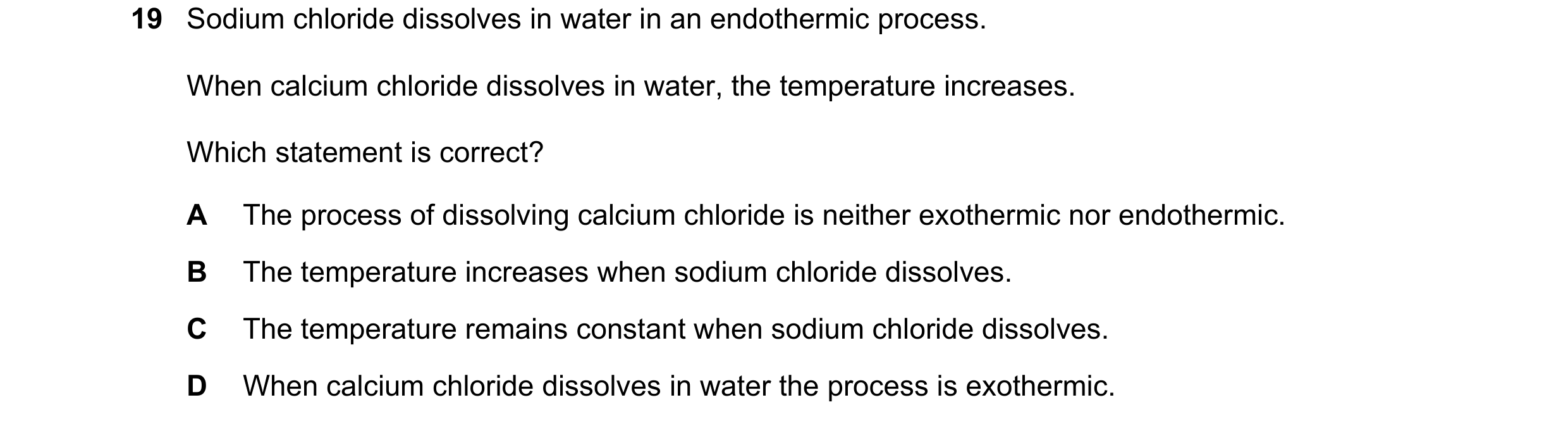
Q38 · Sodium chloride dissolves in water in an endothermic process 0653/12 Oct/Nov 2018
19 Sodium chloride dissolves in water in an endothermic process. When calcium chloride dissolves in water, the temperature increases. Which statement is correct? A The process of dissolving calcium chloride is neither exothermic nor endothermic. B The temperature increases when sodium chloride dissolves. C The temperature remains constant when sodium chloride dissolves. D When calcium chloride dissolves in water the process is exothermic.
1 marks
Answer: D
This question in 0653/12 Oct/Nov 2018
Q39 · Equal masses of four different solids are separately dissolved in 100 cm3 of water 0653/13 Oct/Nov 2018
19 Equal masses of four different solids are separately dissolved in 100 cm3 of water. The temperature of the water is recorded before the solid is added and then after the solid has dissolved. Which solid dissolves with the largest endothermic change? initial temperature final temperature / °C / °C A 18 15 B 18 22 C 19 15 D 20 26
1 marks
Answer: C
This question in 0653/13 Oct/Nov 2018
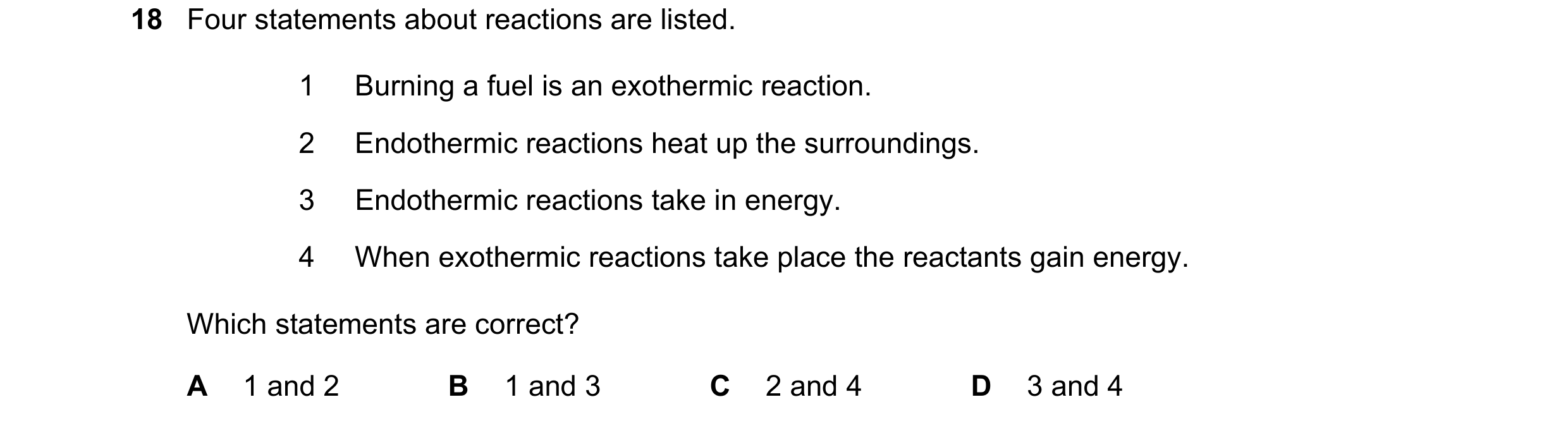
Q40 · Four statements about reactions are listed 0653/12 Feb/March 2019
18 Four statements about reactions are listed. 1 Burning a fuel is an exothermic reaction. 2 Endothermic reactions heat up the surroundings. 3 Endothermic reactions take in energy. 4 When exothermic reactions take place the reactants gain energy. Which statements are correct? A 1 and 2 B 1 and 3 C 2 and 4 D 3 and 4
1 marks
Answer: B
This question in 0653/12 Feb/March 2019
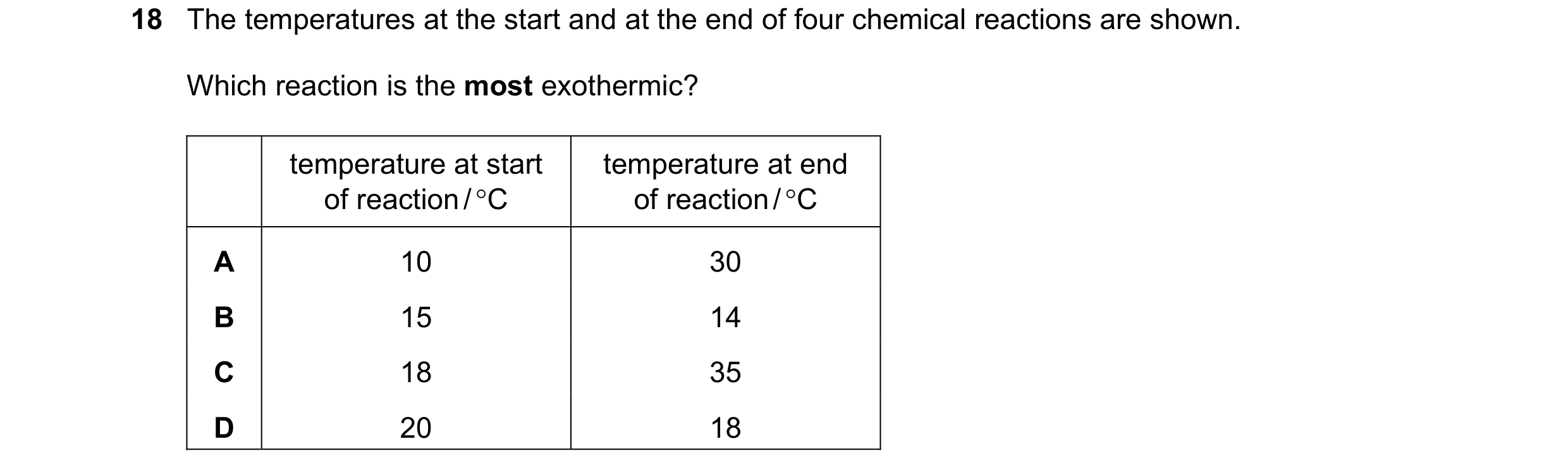
Q41 · The temperatures at the start and at the end of four chemical reactions are shown 0653/13 May/June 2019
18 The temperatures at the start and at the end of four chemical reactions are shown. Which reaction is the most exothermic? temperature at start temperature at end of reaction / °C of reaction / °C A 10 30 B 15 14 C 18 35 D 20 18
1 marks
Answer: A
This question in 0653/13 May/June 2019
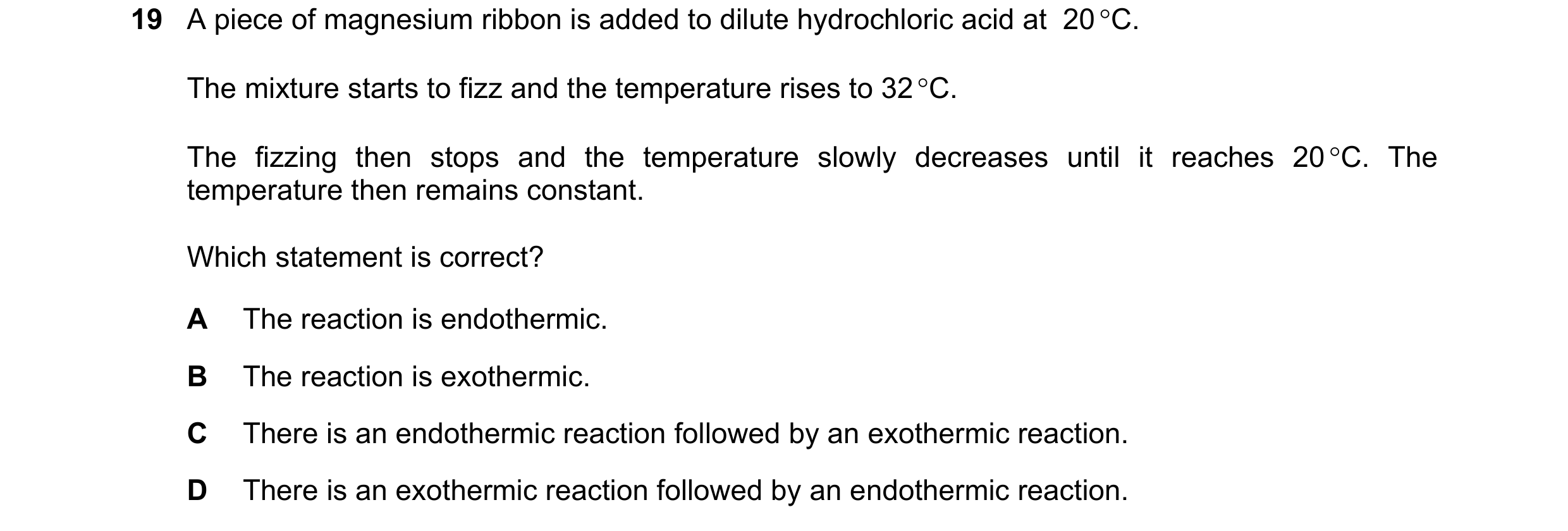
Q42 · A piece of magnesium ribbon is added to dilute hydrochloric acid at 20 °C 0653/11 Oct/Nov 2019
19 A piece of magnesium ribbon is added to dilute hydrochloric acid at 20 °C. The mixture starts to fizz and the temperature rises to 32 °C. The fizzing then stops and the temperature slowly decreases until it reaches 20 °C. The temperature then remains constant. Which statement is correct? A The reaction is endothermic. B The reaction is exothermic. C There is an endothermic reaction followed by an exothermic reaction. D There is an exothermic reaction followed by an endothermic reaction.
1 marks
Answer: B
This question in 0653/11 Oct/Nov 2019
Q43 · The initial and the final temperatures of four different reactions are recorded 0653/12 Oct/Nov 2019
19 The initial and the final temperatures of four different reactions are recorded. Which reaction is the most exothermic? initial temperature final temperature / °C / °C A 19 16 B 20 19 C 22 24 D 24 25
1 marks
Answer: C
This question in 0653/12 Oct/Nov 2019
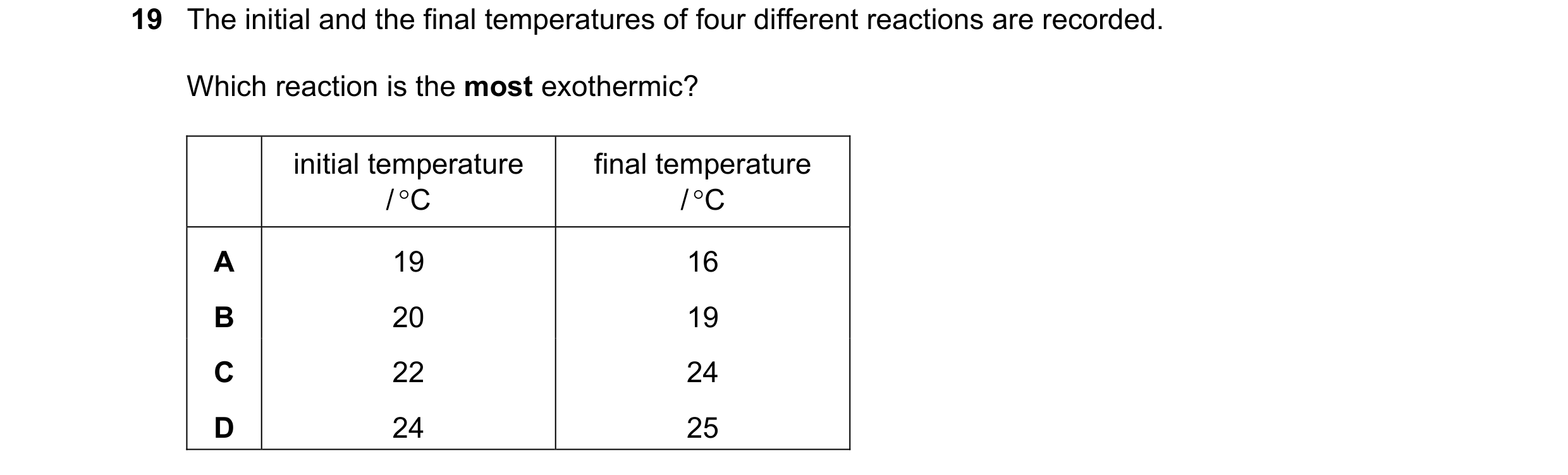
Q44 · The initial and the final temperatures of four different reactions are recorded 0653/13 Oct/Nov 2019
19 The initial and the final temperatures of four different reactions are recorded. Which reaction is the most exothermic? initial temperature final temperature / °C / °C A 19 16 B 20 19 C 22 24 D 24 25
1 marks
Answer: C
This question in 0653/13 Oct/Nov 2019
Q45 · What happens during all endothermic changes? 0653/12 Feb/March 2020
18 What happens during all endothermic changes? A A gas is produced. B Solids melt. C The temperature decreases. D There is a colour change.
1 marks
Answer: C
This question in 0653/12 Feb/March 2020
Q46 · Solid sodium carbonate is added to vinegar in a beaker and stirred 0653/11 May/June 2020
20 Solid sodium carbonate is added to vinegar in a beaker and stirred. sodium carbonate beaker vinegar watch glass water The water in the watch glass freezes. Which statement about the reaction explains why the water freezes? A It is a redox reaction. B It is an endothermic reaction. C It is catalysed by sodium carbonate. D It is thermal decomposition.
1 marks
Answer: B
This question in 0653/11 May/June 2020
Q47 · Which temperature changes occur during exothermic and endothermic reactions? 0653/11 Oct/Nov 2020
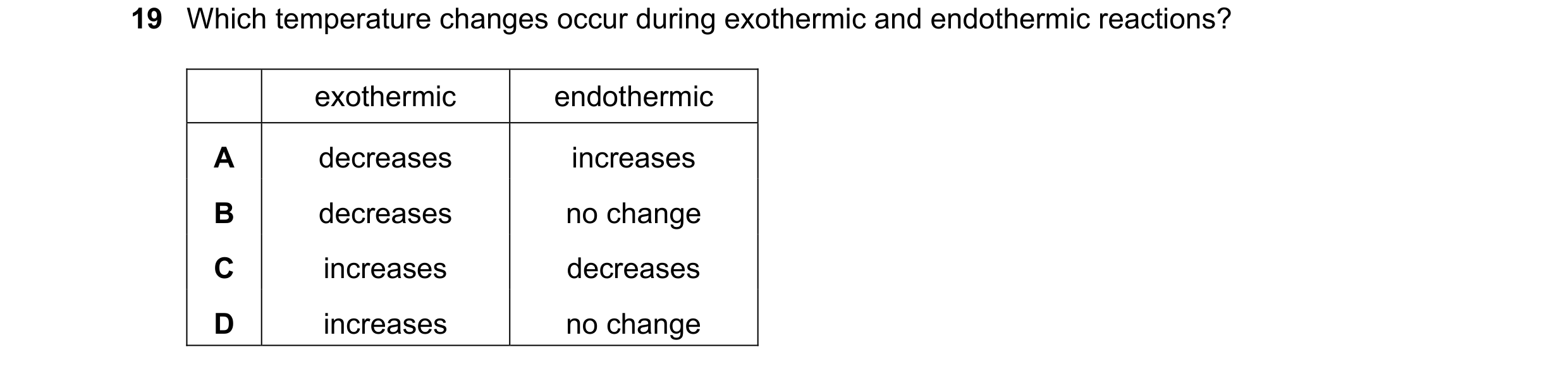
19 Which temperature changes occur during exothermic and endothermic reactions? exothermic endothermic A decreases increases B decreases no change C increases decreases D increases no change
1 marks
Answer: C
This question in 0653/11 Oct/Nov 2020
Q48 · Which temperature changes occur during exothermic and endothermic reactions? 0653/12 Oct/Nov 2020
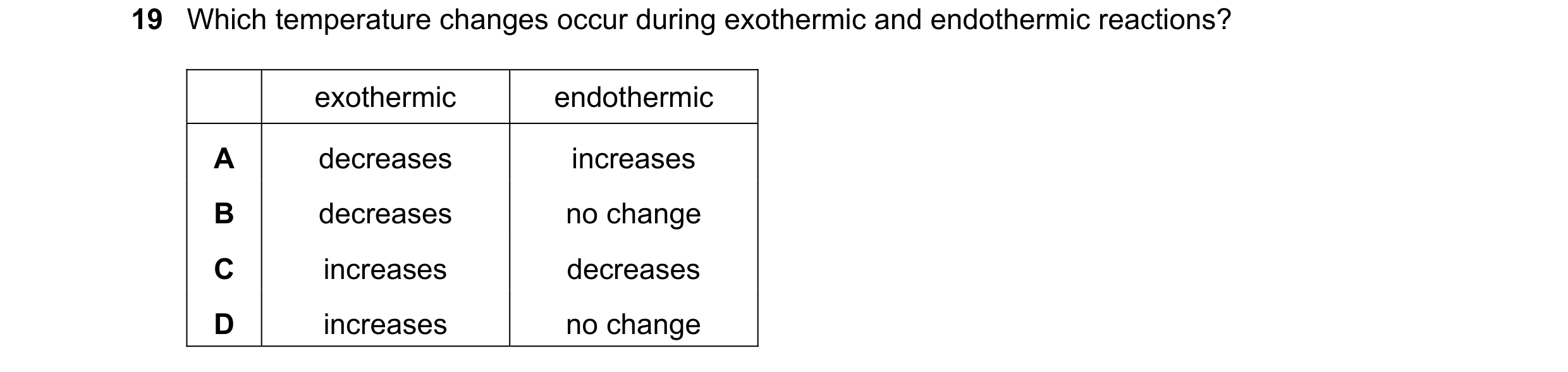
19 Which temperature changes occur during exothermic and endothermic reactions? exothermic endothermic A decreases increases B decreases no change C increases decreases D increases no change
1 marks
Answer: C
This question in 0653/12 Oct/Nov 2020
Q49 · Which temperature changes occur during exothermic and endothermic reactions? 0653/13 Oct/Nov 2020
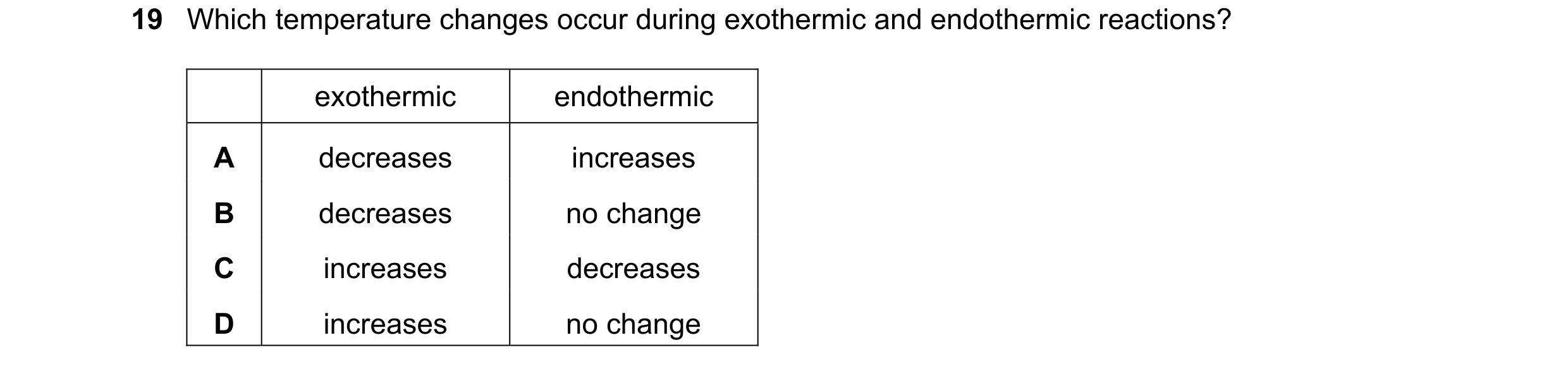
19 Which temperature changes occur during exothermic and endothermic reactions? exothermic endothermic A decreases increases B decreases no change C increases decreases D increases no change
1 marks
Answer: C
This question in 0653/13 Oct/Nov 2020
Q50 · Which word is used to describe a reaction that takes in heat energy from the surroundings? 0653/12 Feb/March 2021
17 Which word is used to describe a reaction that takes in heat energy from the surroundings? A endothermic B exothermic C oxidation D reduction
1 marks
Answer: A
This question in 0653/12 Feb/March 2021
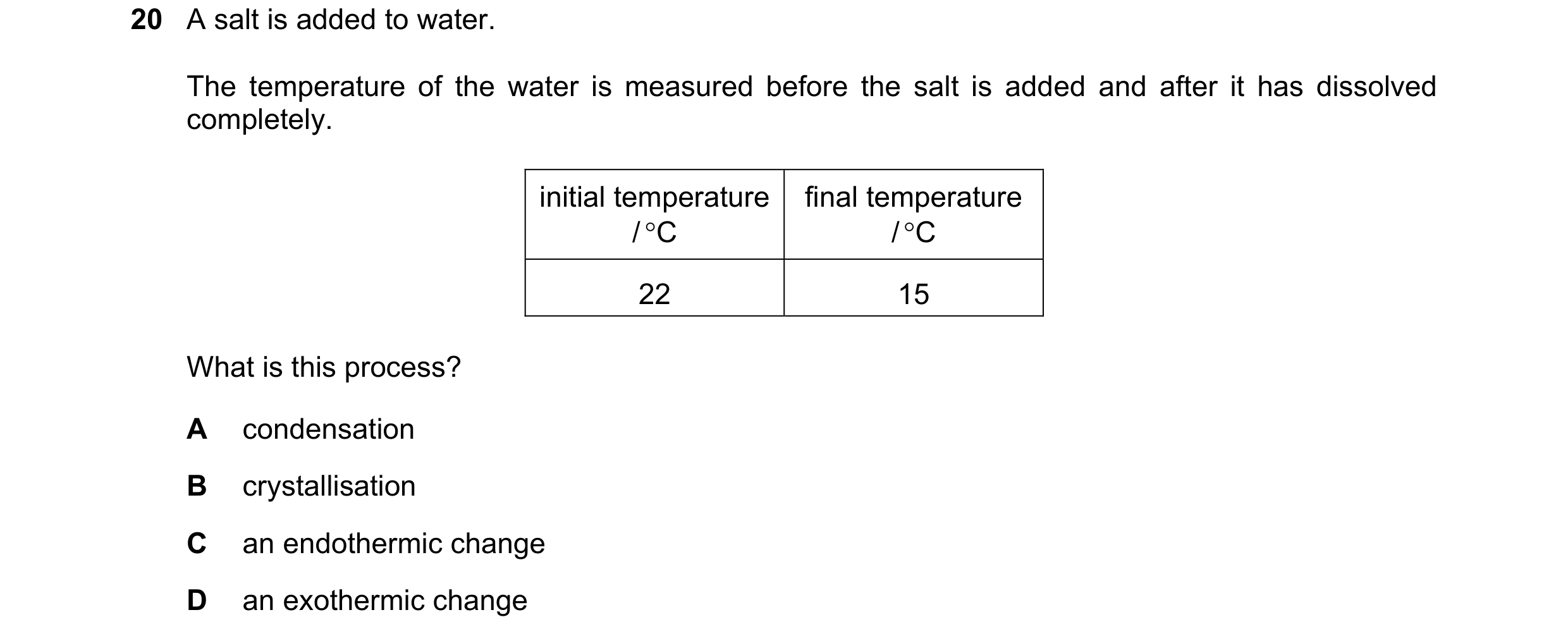
Q51 · A salt is added to water 0653/11 Oct/Nov 2021
20 A salt is added to water. The temperature of the water is measured before the salt is added and after it has dissolved completely. initial temperature final temperature / C / C 22 15 What is this process? A condensation B crystallisation C an endothermic change D an exothermic change
1 marks
Answer: C
This question in 0653/11 Oct/Nov 2021
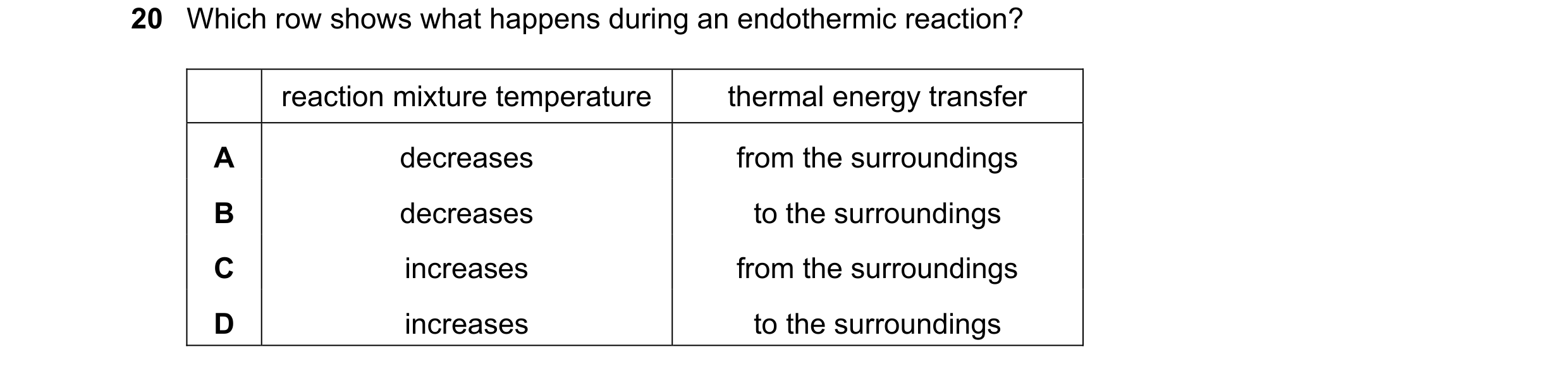
Q52 · Which row shows what happens during an endothermic reaction? 0653/11 May/June 2022
20 Which row shows what happens during an endothermic reaction? reaction mixture temperature thermal energy transfer A decreases from the surroundings B decreases to the surroundings C increases from the surroundings D increases to the surroundings
1 marks
Answer: A
This question in 0653/11 May/June 2022
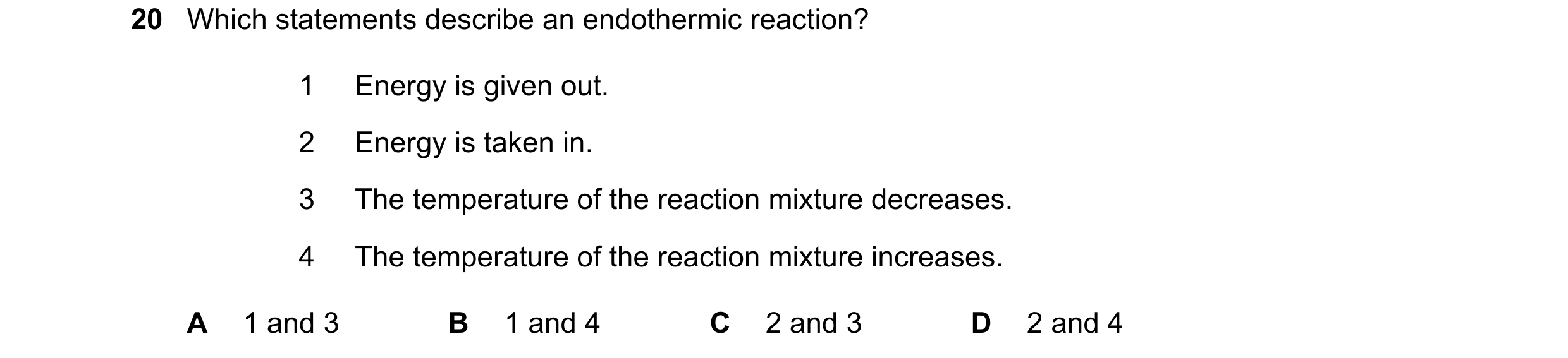
Q53 · Which statements describe an endothermic reaction? 0653/12 May/June 2022
20 Which statements describe an endothermic reaction? 1 Energy is given out. 2 Energy is taken in. 3 The temperature of the reaction mixture decreases. 4 The temperature of the reaction mixture increases. A 1 and 3 B 1 and 4 C 2 and 3 D 2 and 4
1 marks
Answer: C
This question in 0653/12 May/June 2022
Q54 · Which change occurs during an endothermic reaction? 0653/13 May/June 2022
20 Which change occurs during an endothermic reaction? A The mass of a solid changes from 2.0 g to 2.5 g. B The pH of a mixture changes from 5 to 7. C The temperature of a mixture changes from 22 C to 18 C. D The volume of a gas changes from 2.0 dm3 to 1.0 dm3.
1 marks
Answer: C
This question in 0653/13 May/June 2022
Q55 · Two chemical reactions are carried out 0653/11 Oct/Nov 2022
17 Two chemical reactions are carried out. In reaction 1, the temperature of the reaction mixture increases. In reaction 2, energy is released by the reaction mixture. Which reactions are exothermic? A both reaction 1 and reaction 2 B reaction 1 only C reaction 2 only D neither reaction 1 nor reaction 2
1 marks
Answer: A
This question in 0653/11 Oct/Nov 2022
Q56 · The initial and final temperature of four different reaction mixtures are measured 0653/12 Oct/Nov 2022
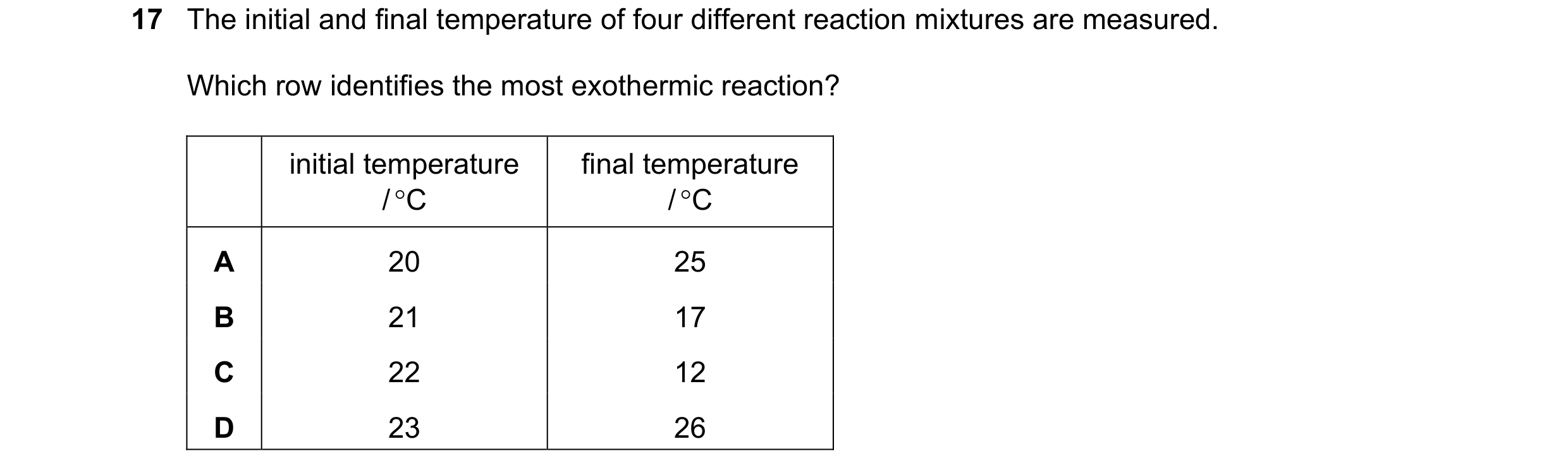
17 The initial and final temperature of four different reaction mixtures are measured. Which row identifies the most exothermic reaction? initial temperature final temperature / C / C A 20 25 B 21 17 C 22 12 D 23 26
1 marks
Answer: A
This question in 0653/12 Oct/Nov 2022
Q57 · The initial and final temperature of four different reaction mixtures are measured 0653/13 Oct/Nov 2022
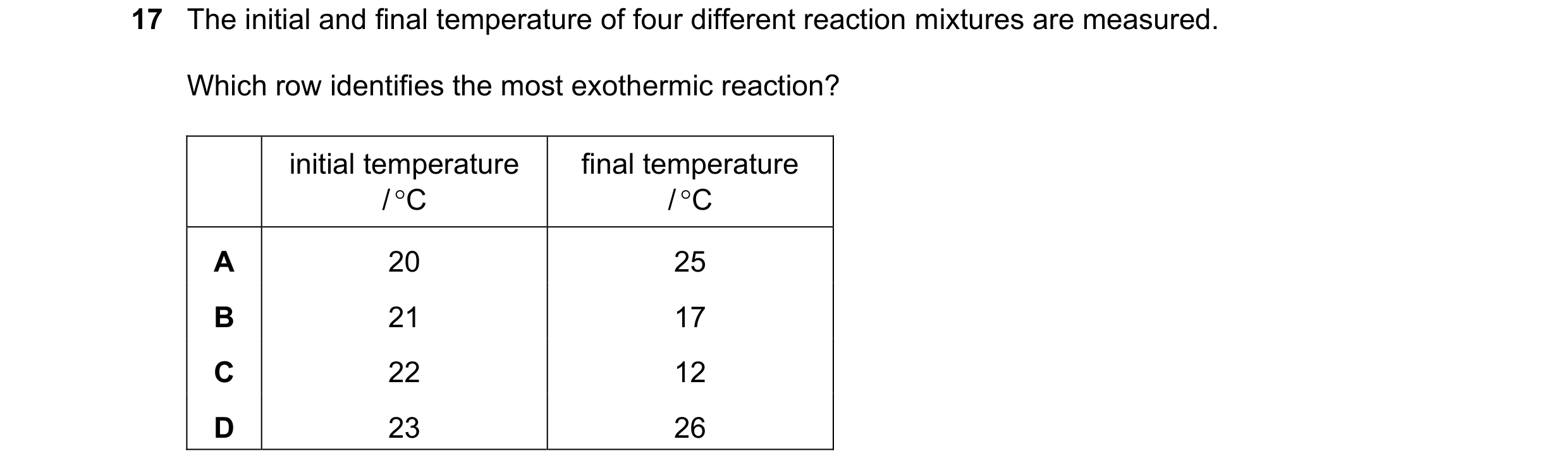
17 The initial and final temperature of four different reaction mixtures are measured. Which row identifies the most exothermic reaction? initial temperature final temperature / C / C A 20 25 B 21 17 C 22 12 D 23 26
1 marks
Answer: A
This question in 0653/13 Oct/Nov 2022
Q58 · A student measures the initial temperature and the final temperature in four different… 0653/12 Feb/March 2023
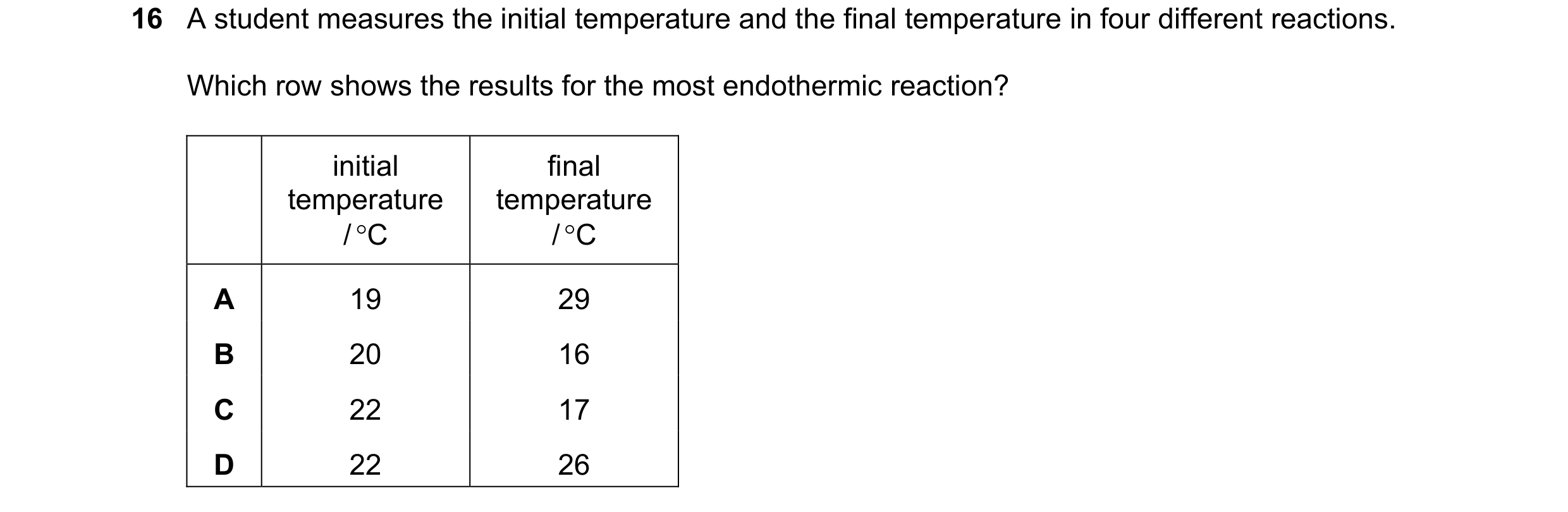
16 A student measures the initial temperature and the final temperature in four different reactions. Which row shows the results for the most endothermic reaction? initial final temperature temperature / C / C A 19 29 B 20 16 C 22 17 D 22 26
1 marks
Answer: C
This question in 0653/12 Feb/March 2023
Q59 · Which reactions are exothermic? 0653/11 May/June 2023
19 Which reactions are exothermic? 1 a reaction that gets cooler 2 a reaction that gives out energy 3 a reaction that takes in energy 4 the combustion of methane A 1 and 2 B 1 and 3 C 2 and 4 D 3 and 4
1 marks
Answer: C
This question in 0653/11 May/June 2023
Q60 · The initial and final temperatures of four different reactions are measured 0653/12 May/June 2023
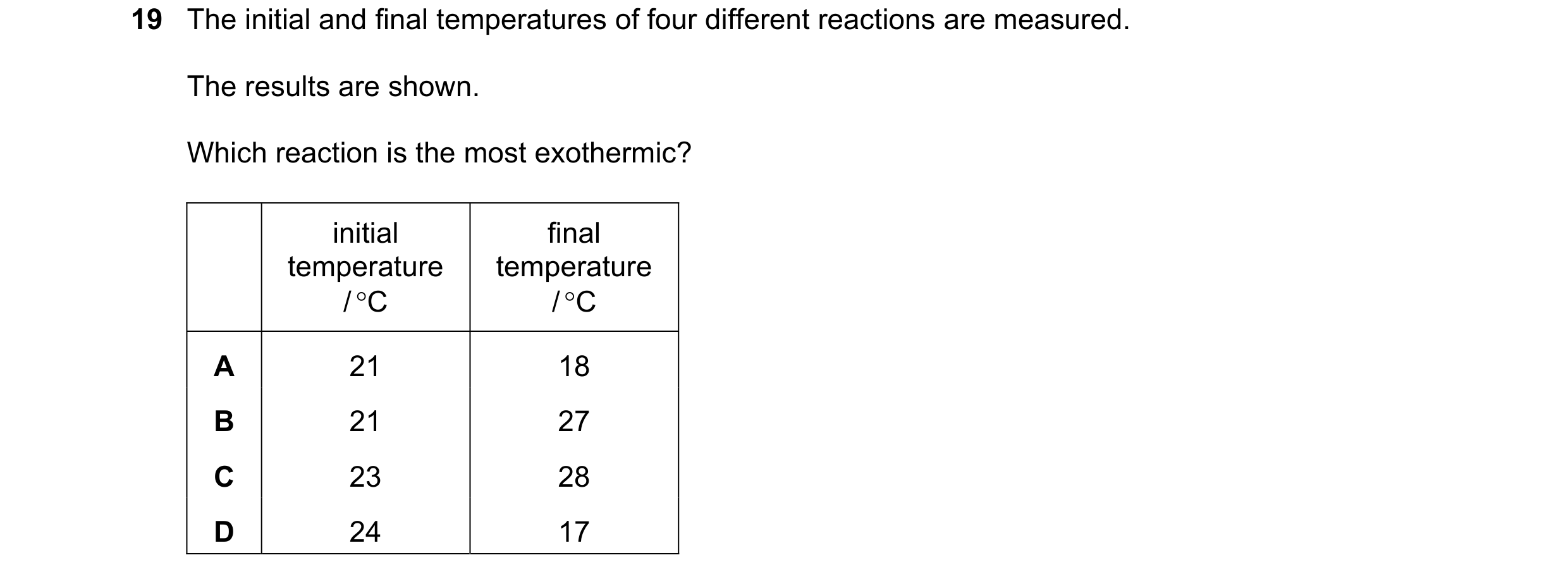
19 The initial and final temperatures of four different reactions are measured. The results are shown. Which reaction is the most exothermic? initial final temperature temperature / C / C A 21 18 B 21 27 C 23 28 D 24 17
1 marks
Answer: B
This question in 0653/12 May/June 2023
Q61 · Powdered zinc reacts with a blue solution of copper(II) sulfate 0653/13 May/June 2023
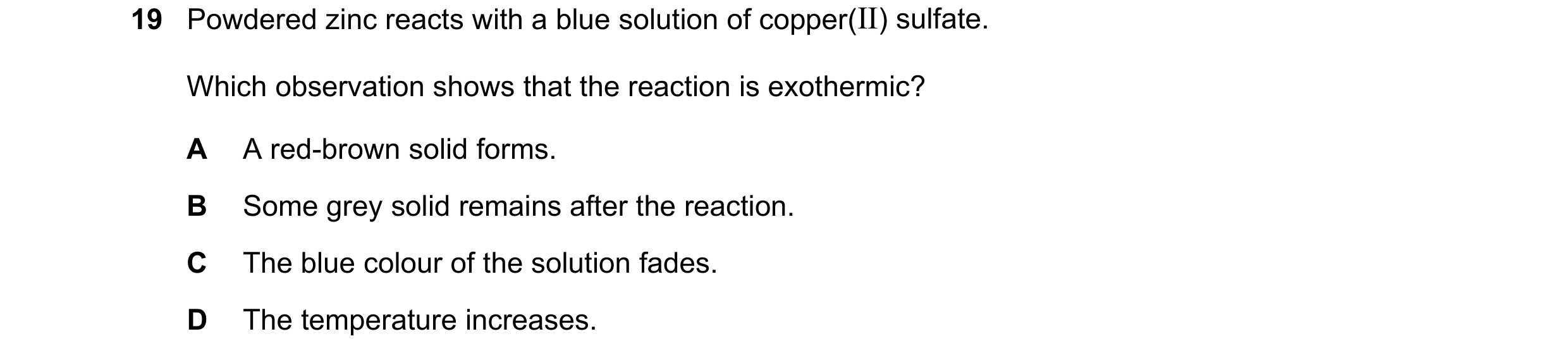
19 Powdered zinc reacts with a blue solution of copper(II) sulfate. Which observation shows that the reaction is exothermic? A A red-brown solid forms. B Some grey solid remains after the reaction. C The blue colour of the solution fades. D The temperature increases.
1 marks
Answer: D
This question in 0653/13 May/June 2023
Q62 · Which process is endothermic? 0653/11 Oct/Nov 2023
17 Which process is endothermic? A boiling water B burning wood C freezing water D neutralising an acid with a base
1 marks
Answer: A
This question in 0653/11 Oct/Nov 2023
Q63 · When solid sodium carbonate and dilute hydrochloric acid are mixed, a reaction occurs 0653/12 Oct/Nov 2023
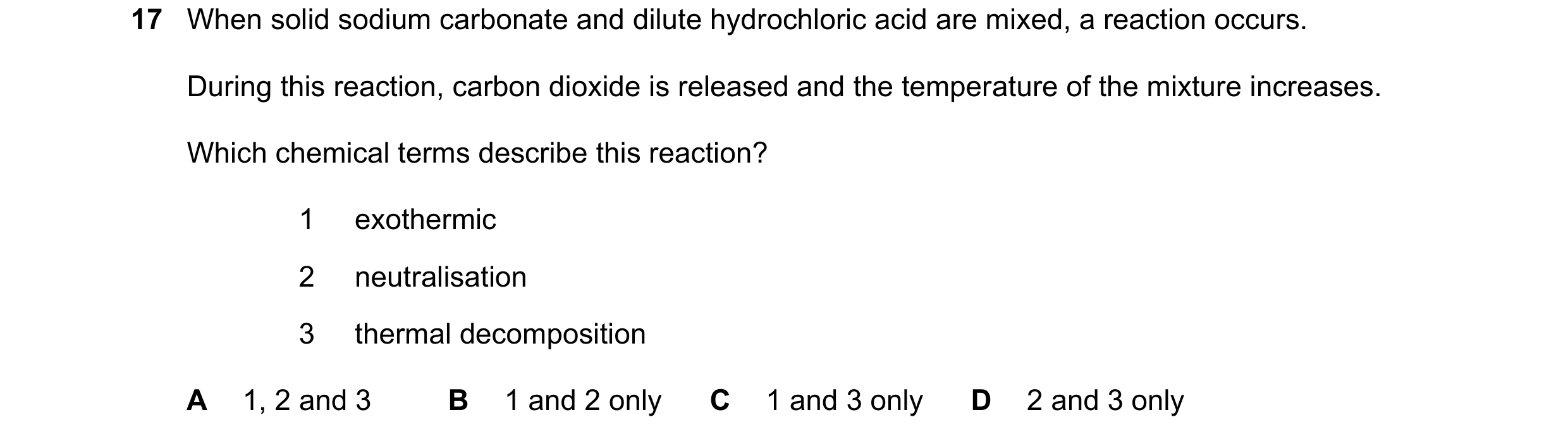
17 When solid sodium carbonate and dilute hydrochloric acid are mixed, a reaction occurs. During this reaction, carbon dioxide is released and the temperature of the mixture increases. Which chemical terms describe this reaction? 1 exothermic 2 neutralisation 3 thermal decomposition A 1, 2 and 3 B 1 and 2 only C 1 and 3 only D 2 and 3 only
1 marks
Answer: B
This question in 0653/12 Oct/Nov 2023
Q64 · When solid sodium carbonate and dilute hydrochloric acid are mixed, a reaction occurs 0653/13 Oct/Nov 2023
17 When solid sodium carbonate and dilute hydrochloric acid are mixed, a reaction occurs. During this reaction, carbon dioxide is released and the temperature of the mixture increases. Which chemical terms describe this reaction? 1 exothermic 2 neutralisation 3 thermal decomposition A 1, 2 and 3 B 1 and 2 only C 1 and 3 only D 2 and 3 only
1 marks
Answer: B
This question in 0653/13 Oct/Nov 2023
Q65 · Sodium chloride dissolves in water in an endothermic process 0653/12 Feb/March 2024
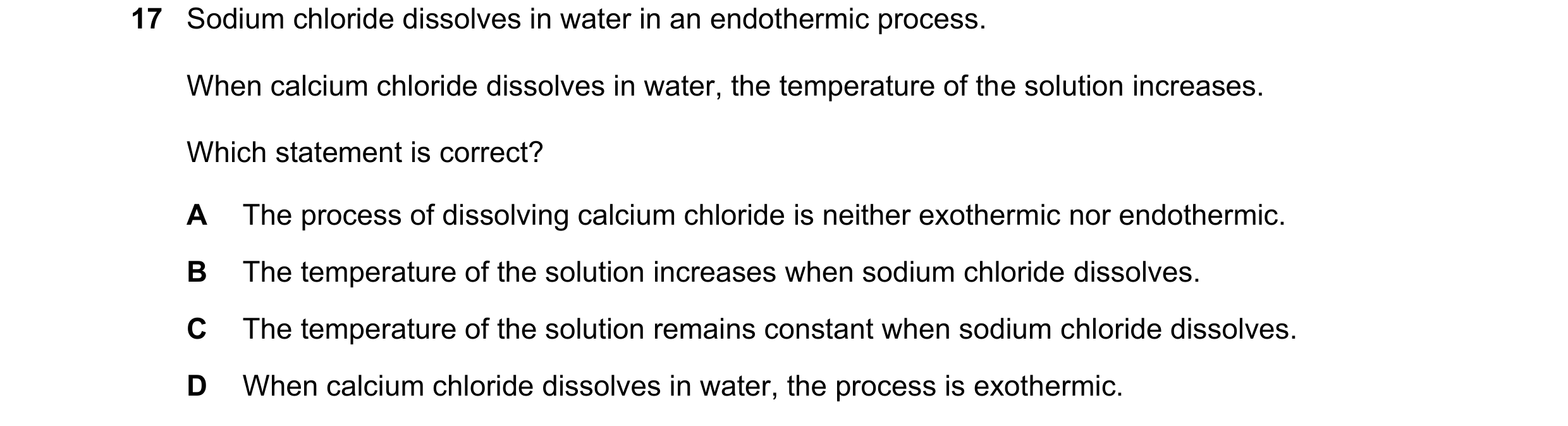
17 Sodium chloride dissolves in water in an endothermic process. When calcium chloride dissolves in water, the temperature of the solution increases. Which statement is correct? A The process of dissolving calcium chloride is neither exothermic nor endothermic. B The temperature of the solution increases when sodium chloride dissolves. C The temperature of the solution remains constant when sodium chloride dissolves. D When calcium chloride dissolves in water, the process is exothermic.
1 marks
Answer: D
This question in 0653/12 Feb/March 2024
Q66 · Which row describes an exothermic reaction? 0653/12 May/June 2024
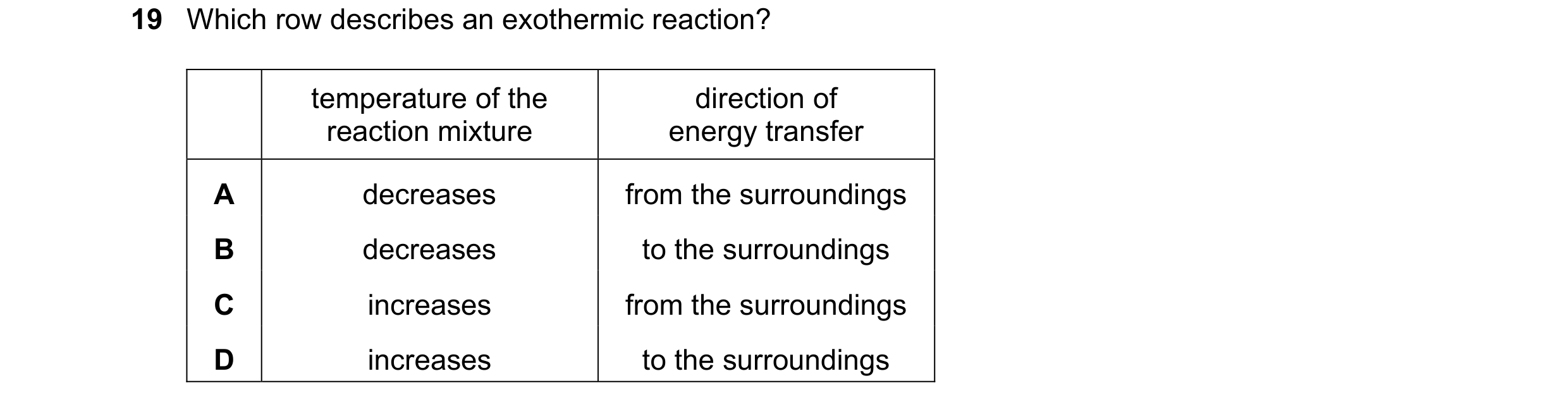
19 Which row describes an exothermic reaction? temperature of the direction of reaction mixture energy transfer A decreases from the surroundings B decreases to the surroundings C increases from the surroundings D increases to the surroundings
1 marks
Answer: D
This question in 0653/12 May/June 2024
Q67 · Which type of reaction always releases thermal energy into the surroundings? 0653/11 Oct/Nov 2024
17 Which type of reaction always releases thermal energy into the surroundings? A endothermic B evaporation C exothermic D redox
1 marks
Answer: C
This question in 0653/11 Oct/Nov 2024
Q68 · The initial temperature of a sample of water is measured 0653/11 May/June 2025
18 The initial temperature of a sample of water is measured. Ammonium nitrate is mixed with the water. The final temperature is measured. The diagram shows the thermometer readings. 21 19 20 18 initial temperature final temperature Which row shows the initial temperature, the final temperature and the type of reaction that occurs? initial final type of temperature temperature reaction / °C / °C A 20.4 18.7 endothermic B 20.4 18.7 exothermic C 21.6 19.3 endothermic D 21.6 19.3 exothermic
1 marks
Answer: A
This question in 0653/11 May/June 2025
Q69 · Which reaction is most endothermic? 0653/12 May/June 2025
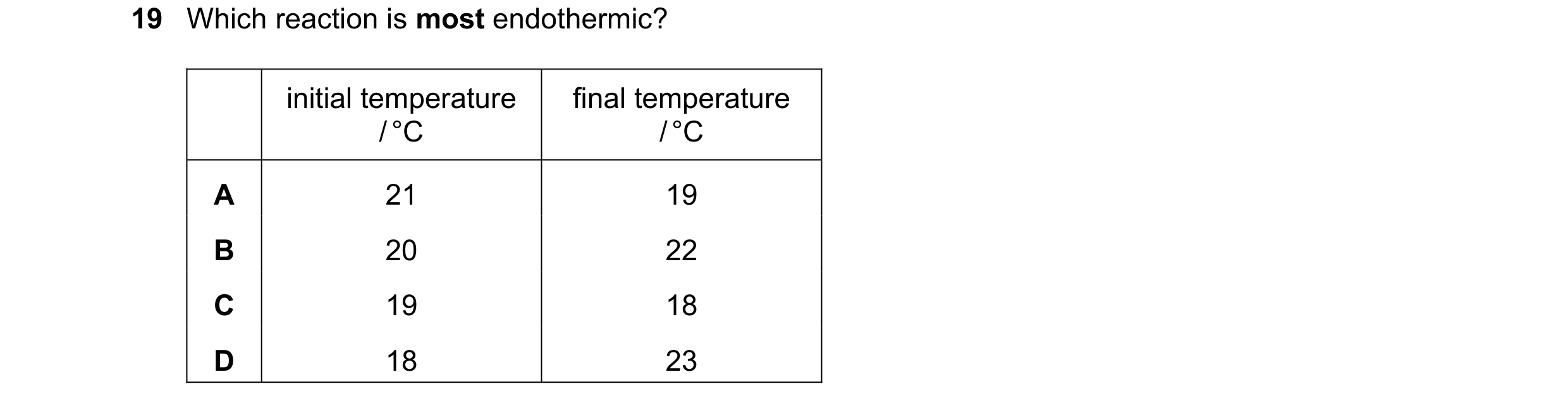
19 Which reaction is most endothermic? initial temperature final temperature / °C / °C A 21 19 B 20 22 C 19 18 D 18 23
1 marks
Answer: A
This question in 0653/12 May/June 2025
Q70 · Magnesium ribbon is added to dilute hydrochloric acid at 20 °C 0653/13 May/June 2025
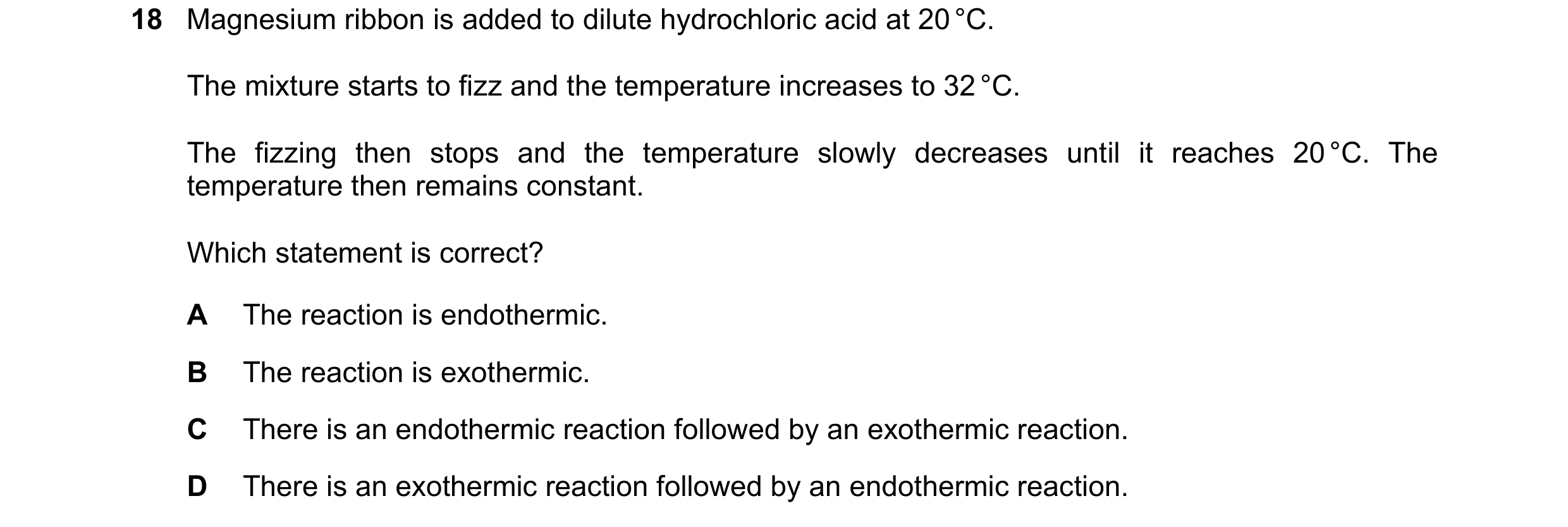
18 Magnesium ribbon is added to dilute hydrochloric acid at 20 °C. The mixture starts to fizz and the temperature increases to 32 °C. The fizzing then stops and the temperature slowly decreases until it reaches 20 °C. The temperature then remains constant. Which statement is correct? A The reaction is endothermic. B The reaction is exothermic. C There is an endothermic reaction followed by an exothermic reaction. D There is an exothermic reaction followed by an endothermic reaction.
1 marks
Answer: B
This question in 0653/13 May/June 2025
Q71 · The initial and the final temperatures of four different reactions are recorded 0653/12 Oct/Nov 2025
16 The initial and the final temperatures of four different reactions are recorded. Which reaction is the most exothermic? initial temperature final temperature / °C / °C A 19 16 B 20 19 C 22 24 D 24 25
1 marks
Answer: C
This question in 0653/12 Oct/Nov 2025
Q72 · The initial and the final temperatures of four different reactions are recorded 0653/13 Oct/Nov 2025
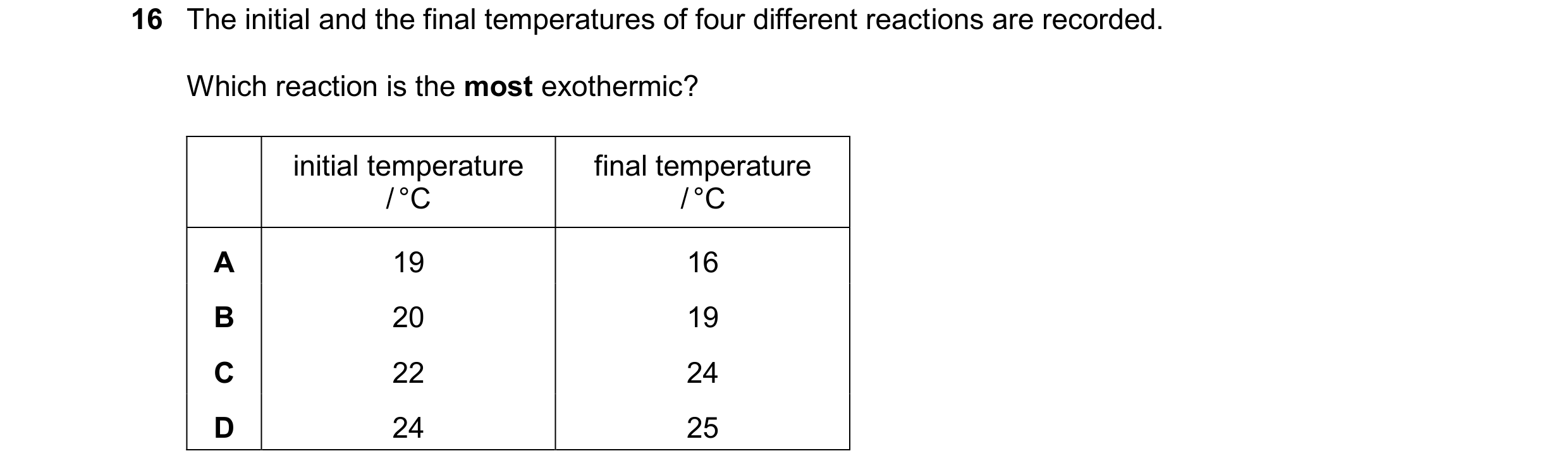
16 The initial and the final temperatures of four different reactions are recorded. Which reaction is the most exothermic? initial temperature final temperature / °C / °C A 19 16 B 20 19 C 22 24 D 24 25
1 marks
Answer: C
This question in 0653/13 Oct/Nov 2025


 1 / 21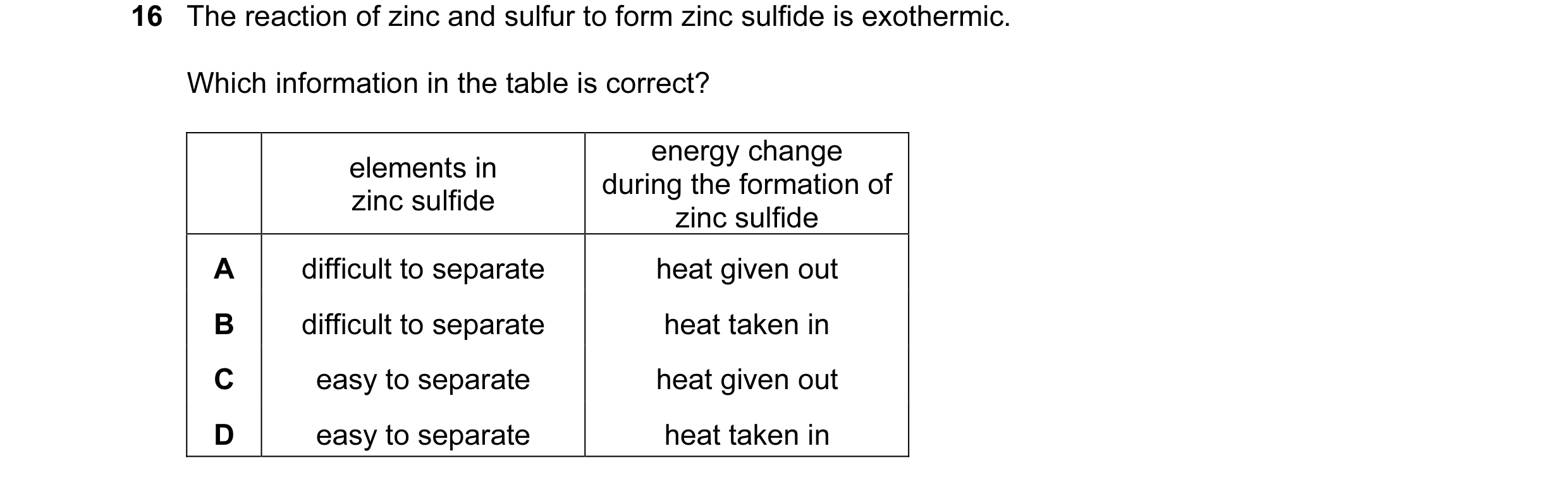

 2 / 21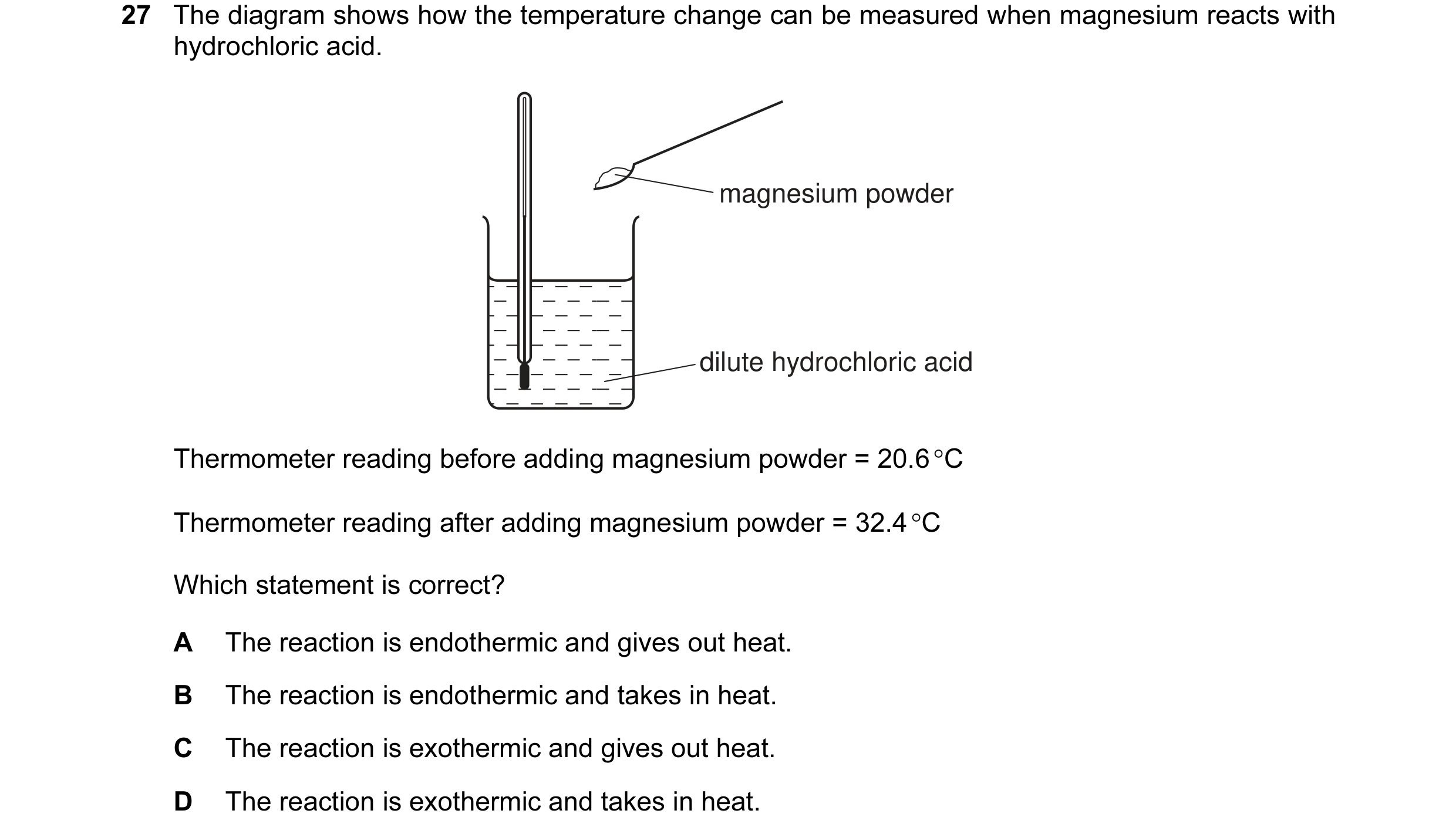
 3 / 21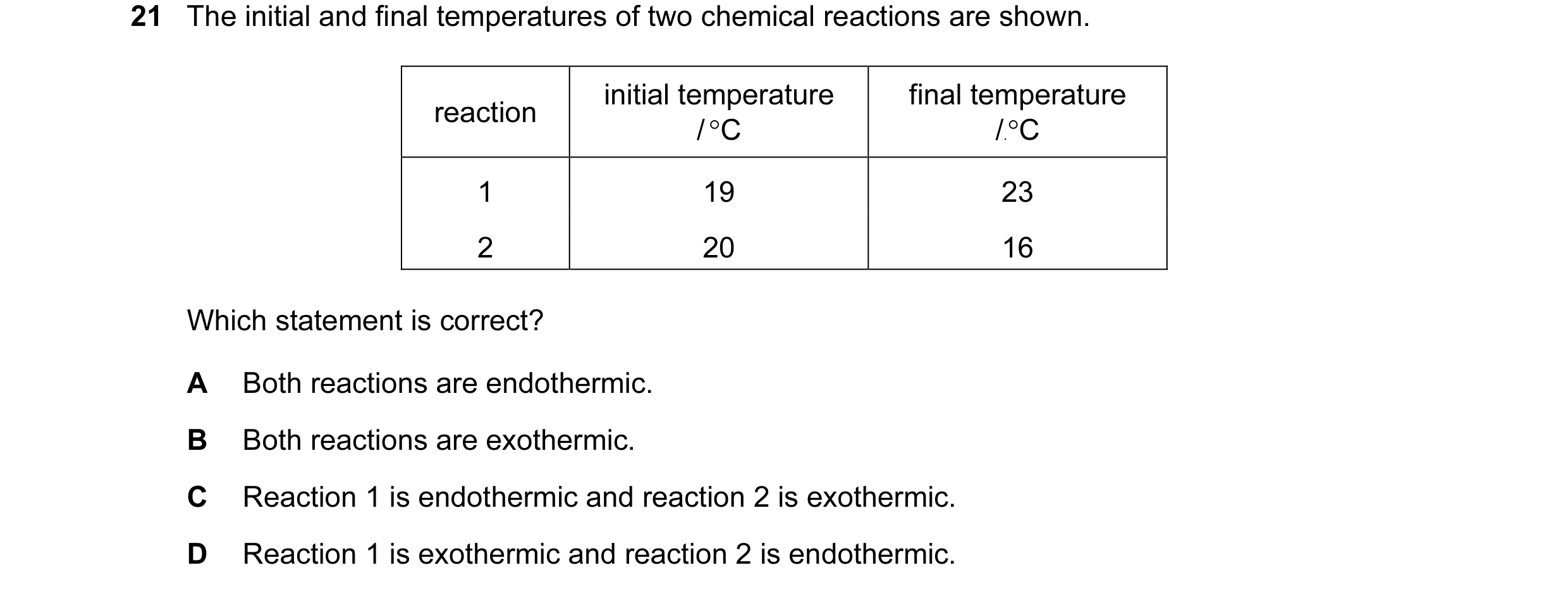
 4 / 21
 5 / 21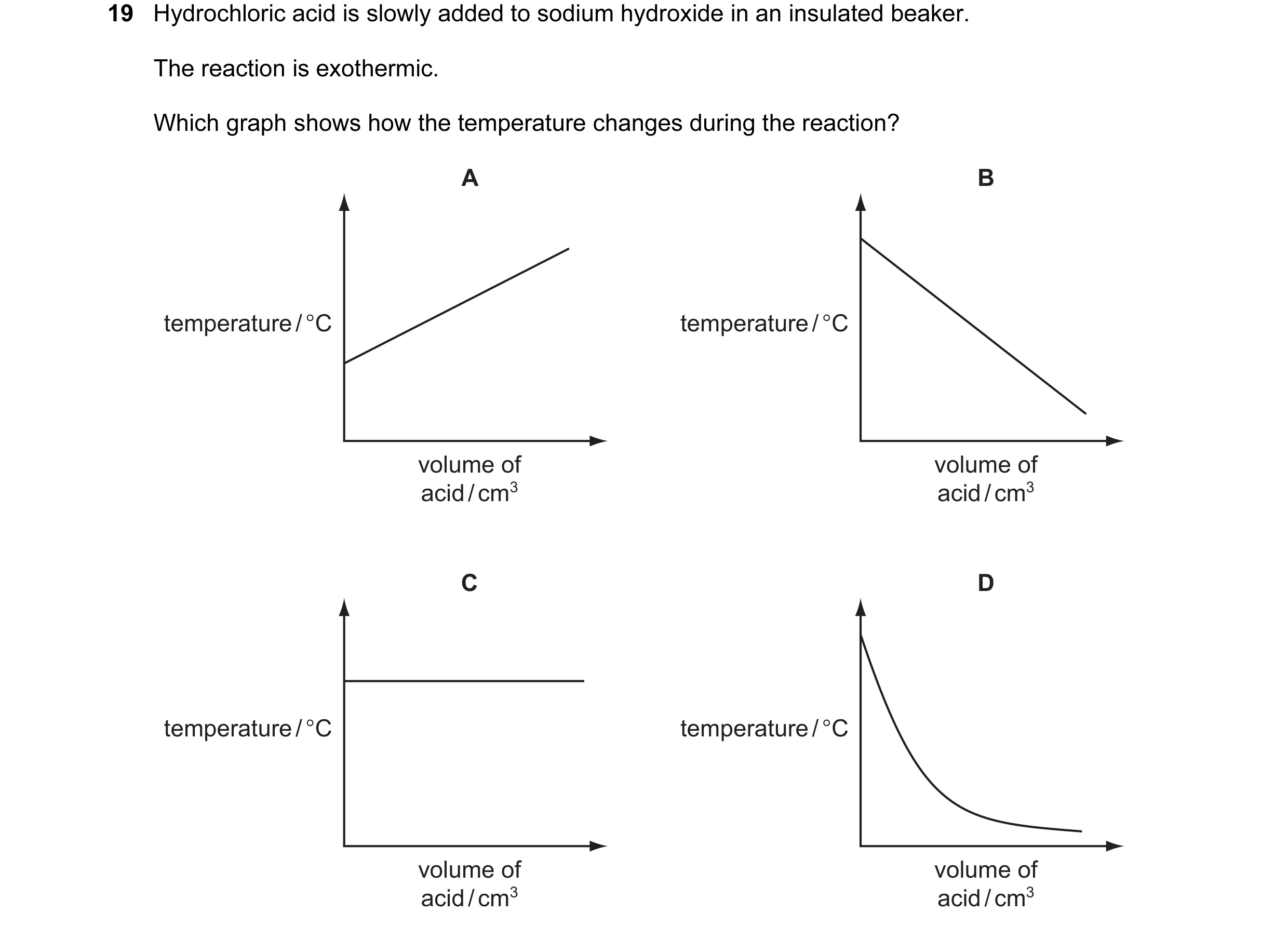
 6 / 21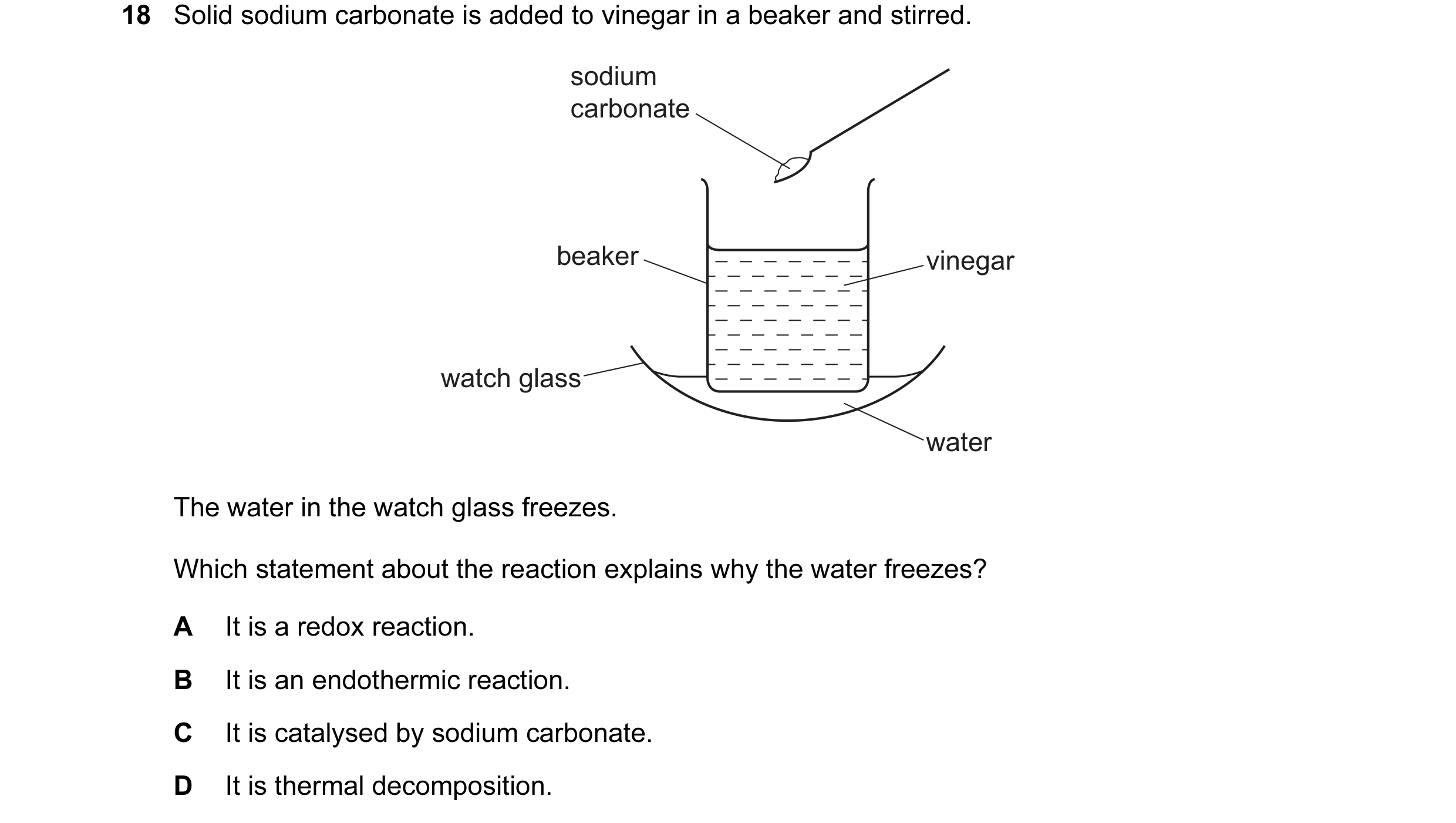
 7 / 21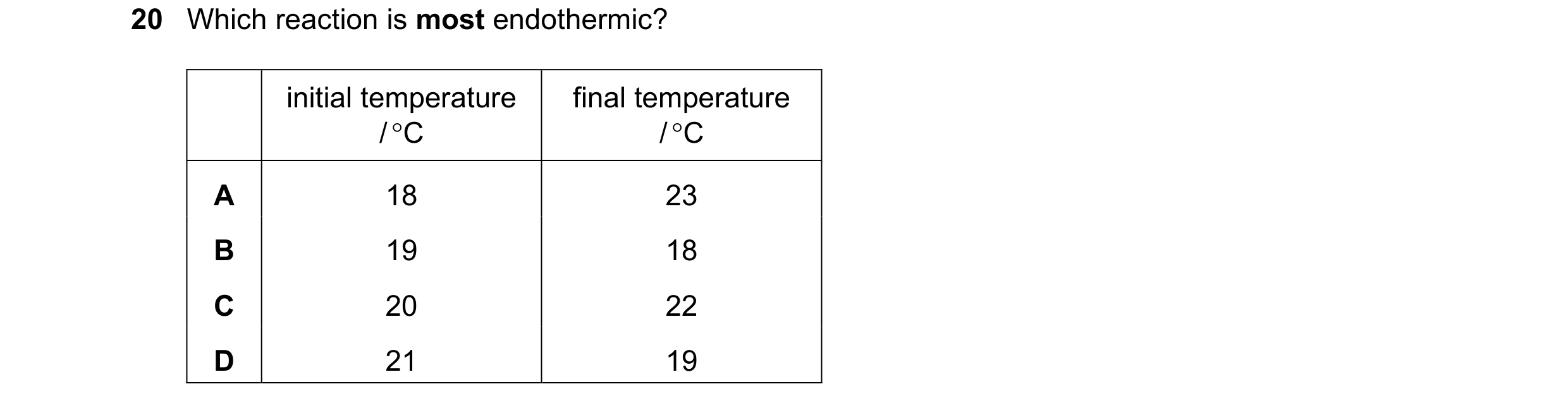
 8 / 21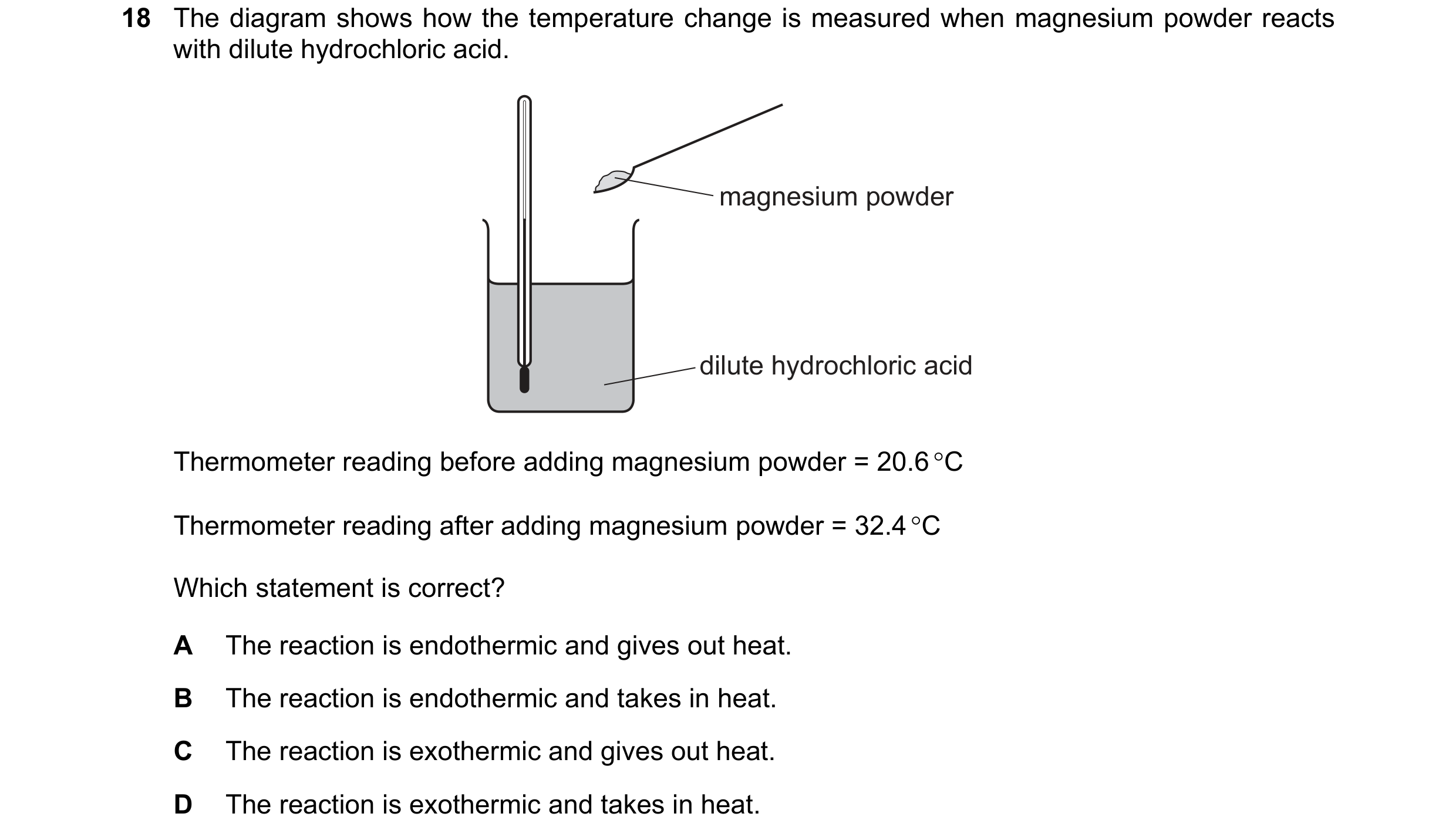
 9 / 21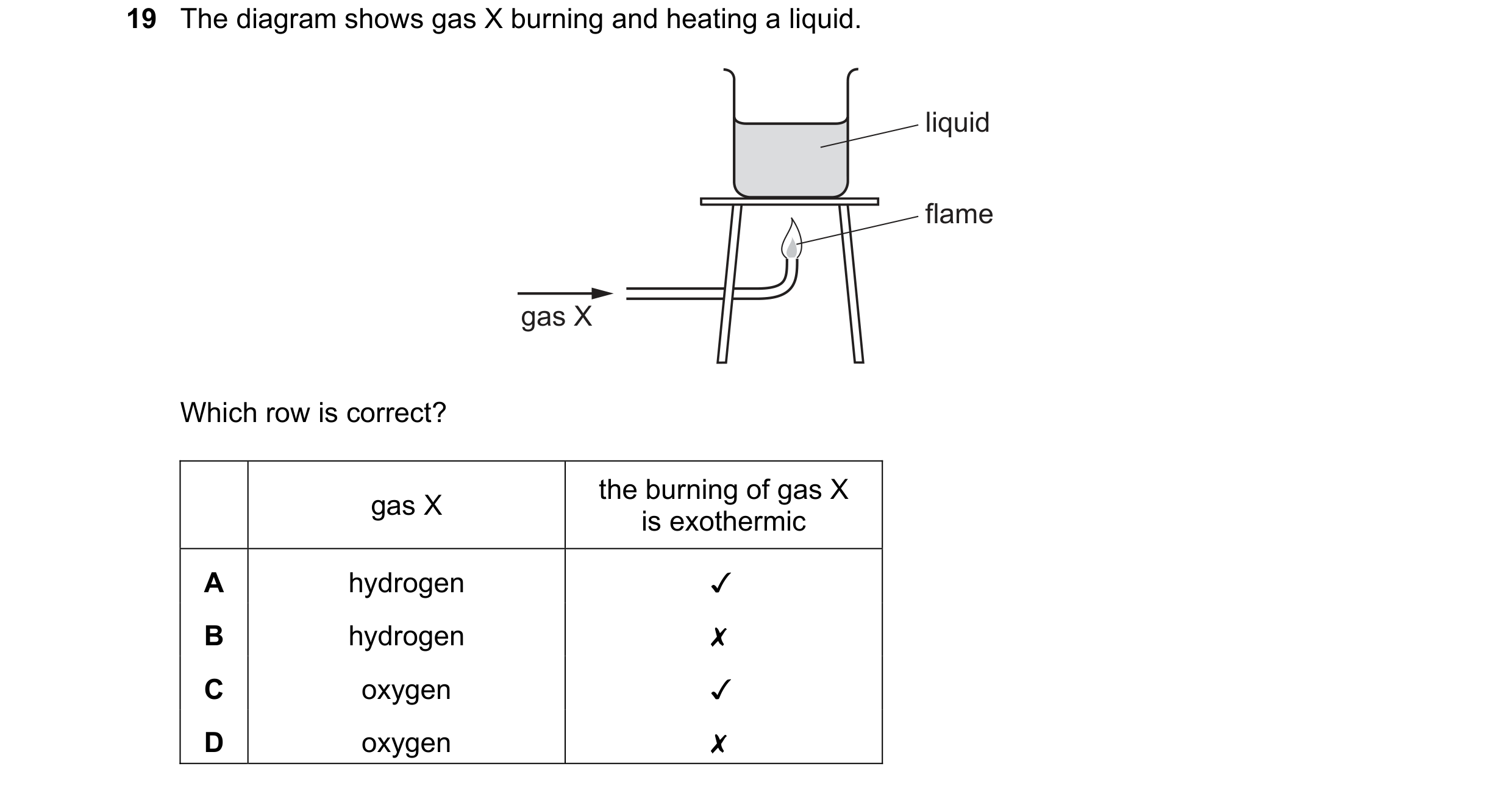
 10 / 21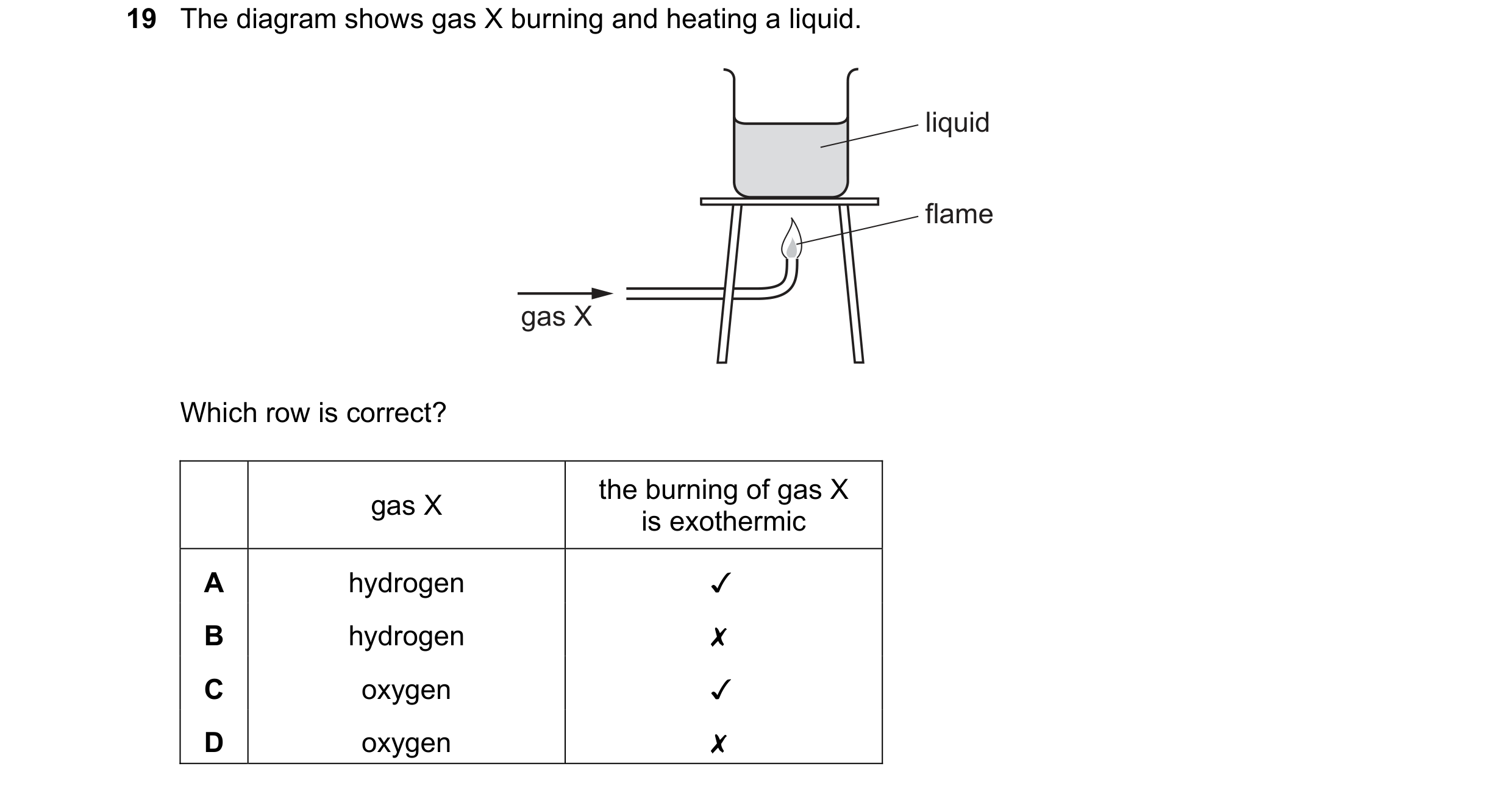


 11 / 21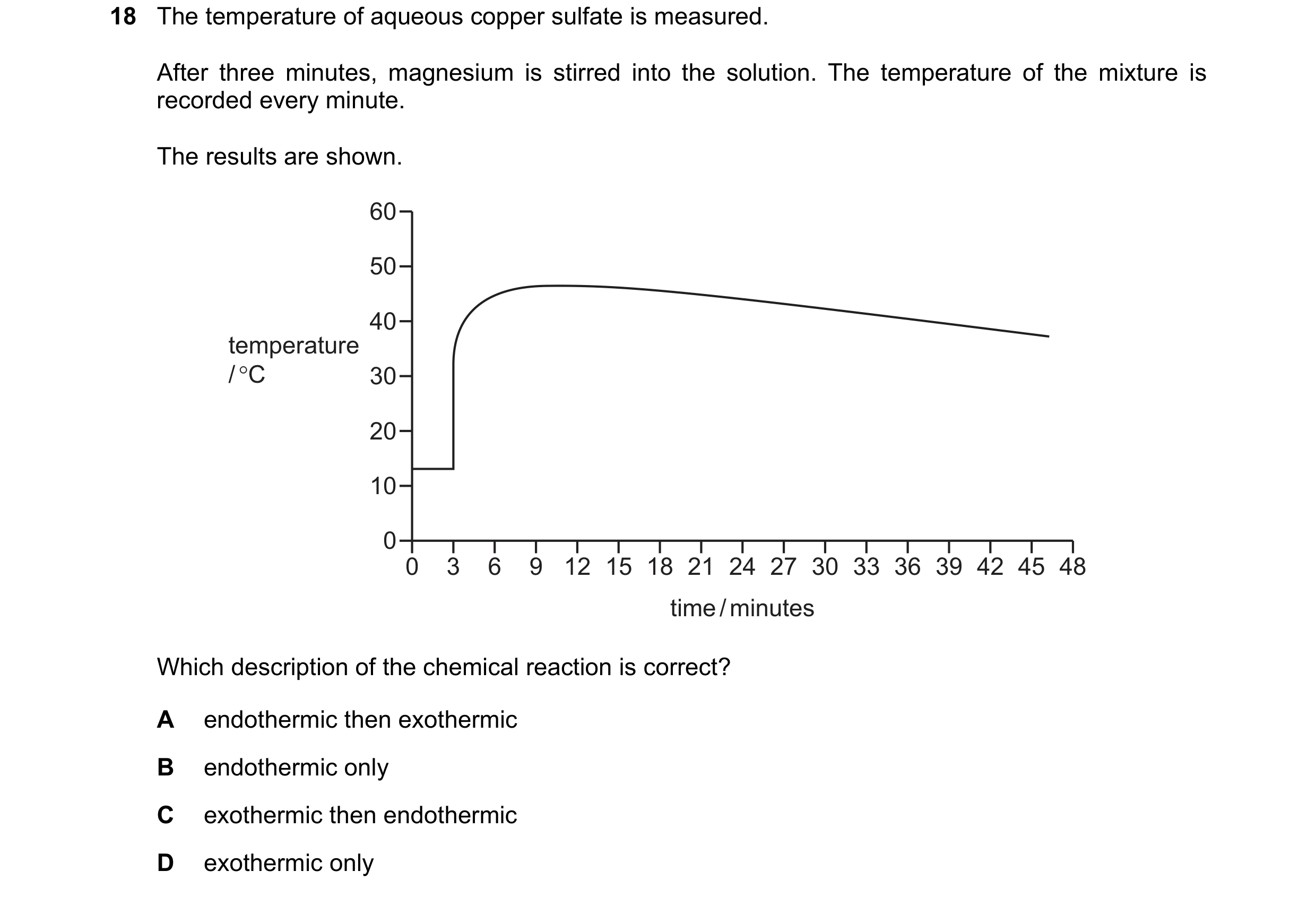
 12 / 21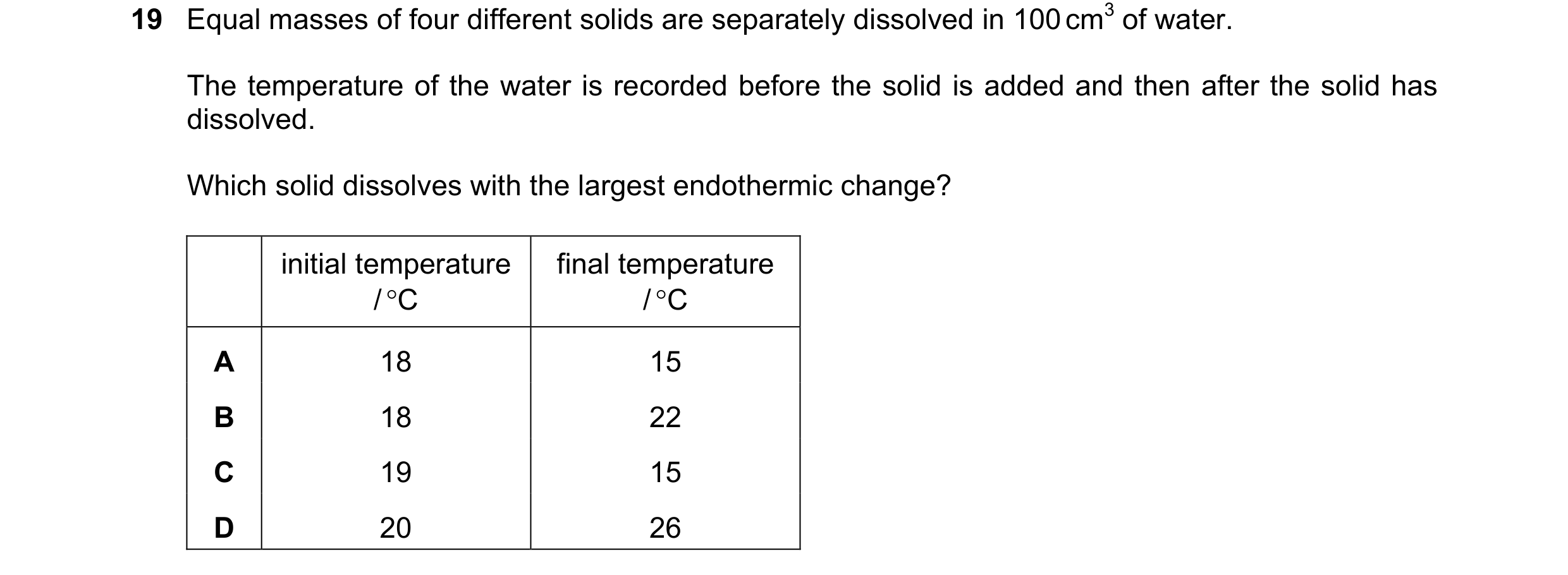
 13 / 21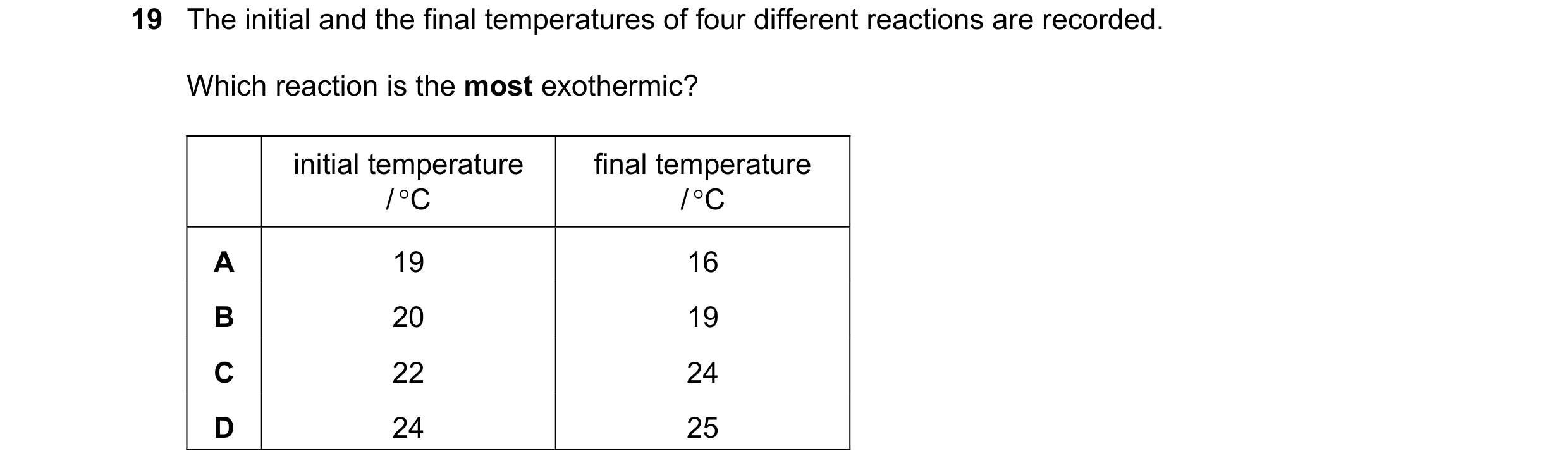
 14 / 21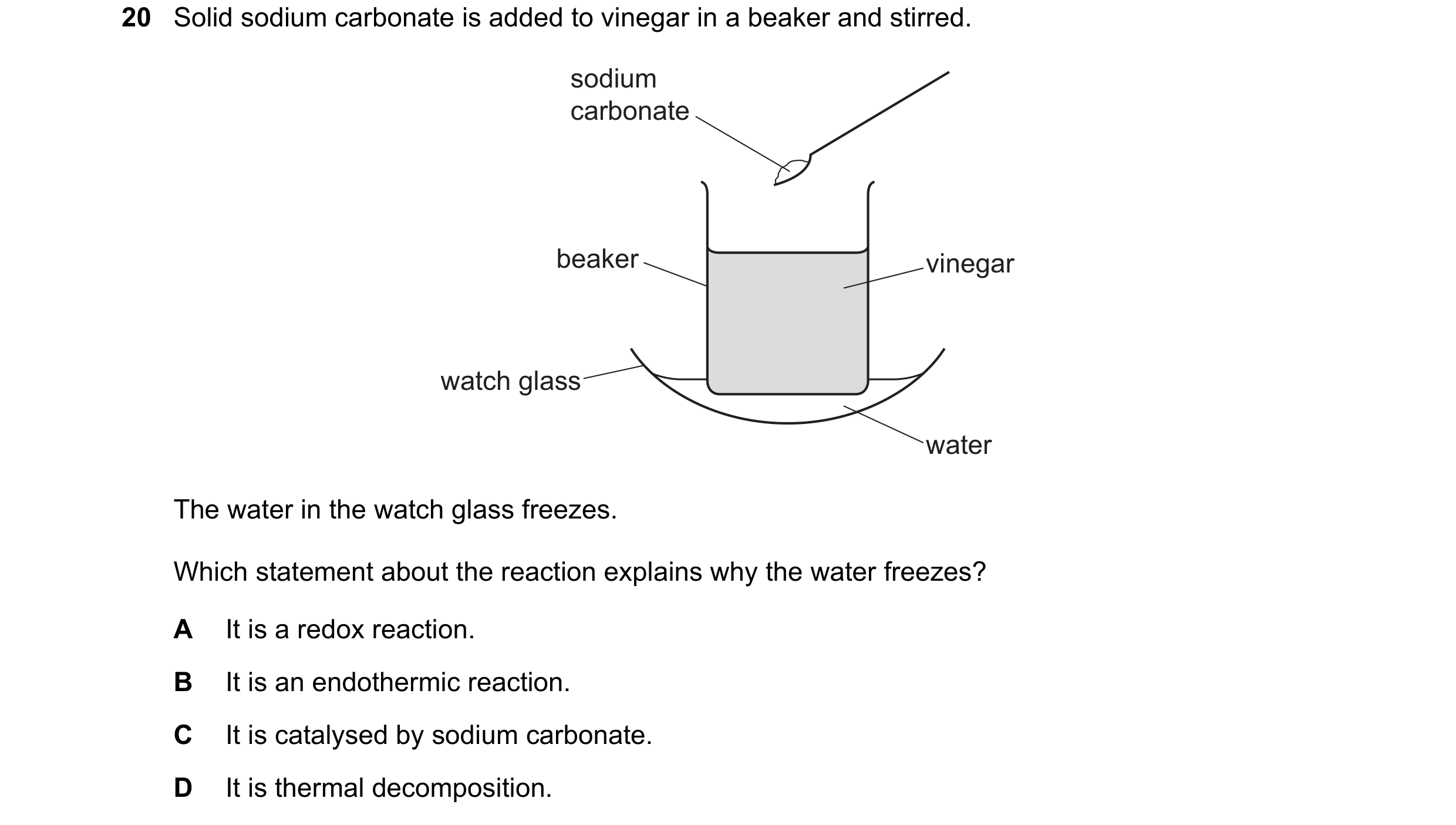
 15 / 21
 16 / 21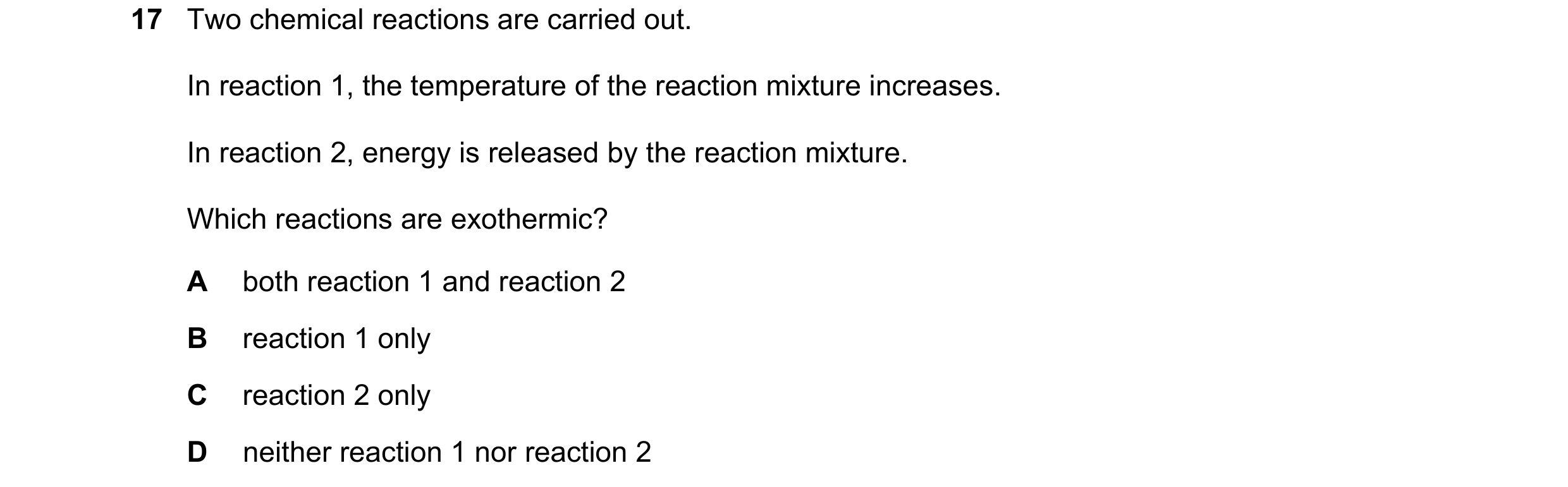
 17 / 21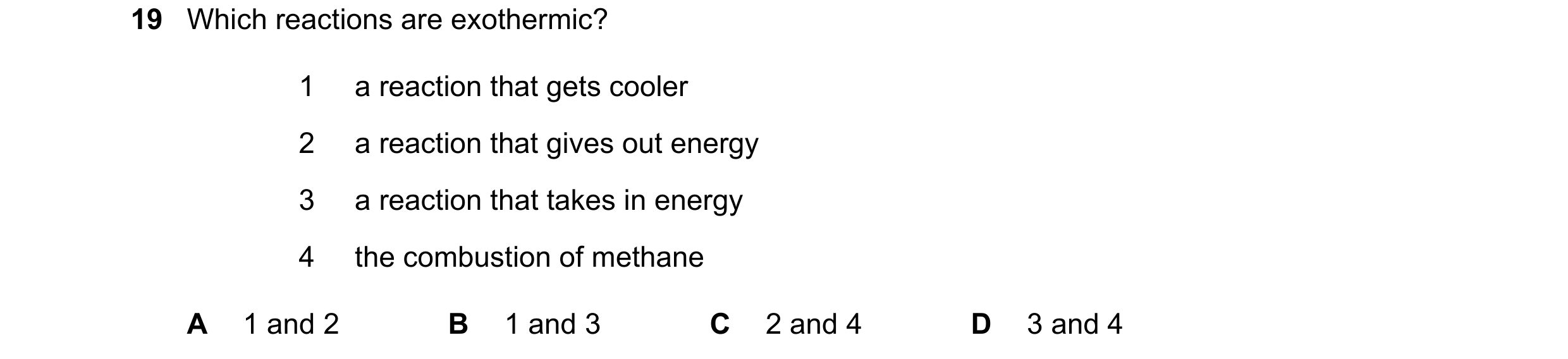

 18 / 21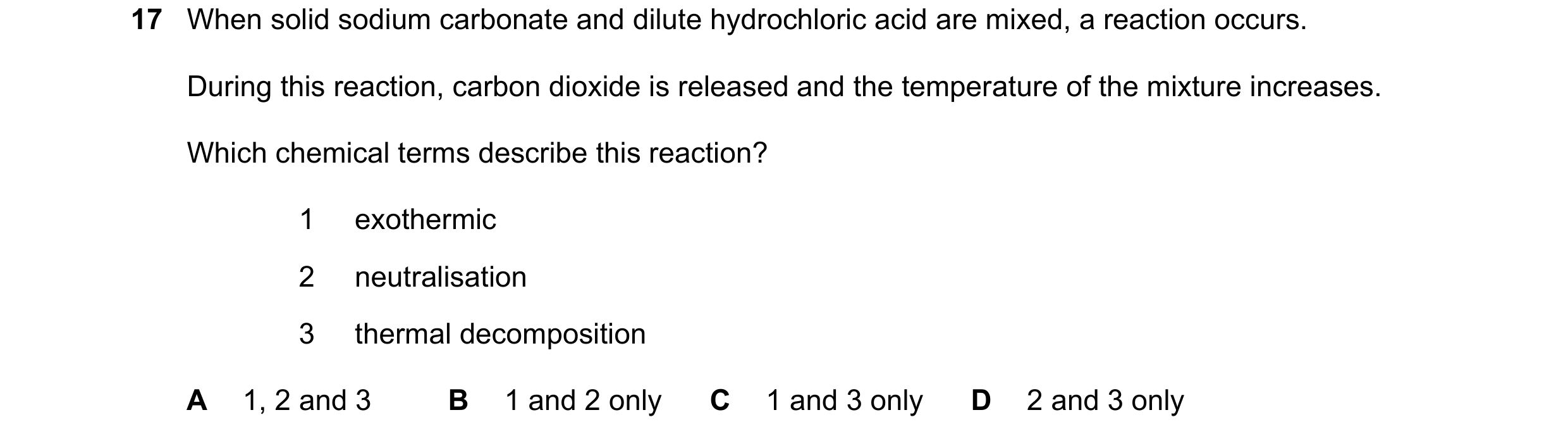
 19 / 21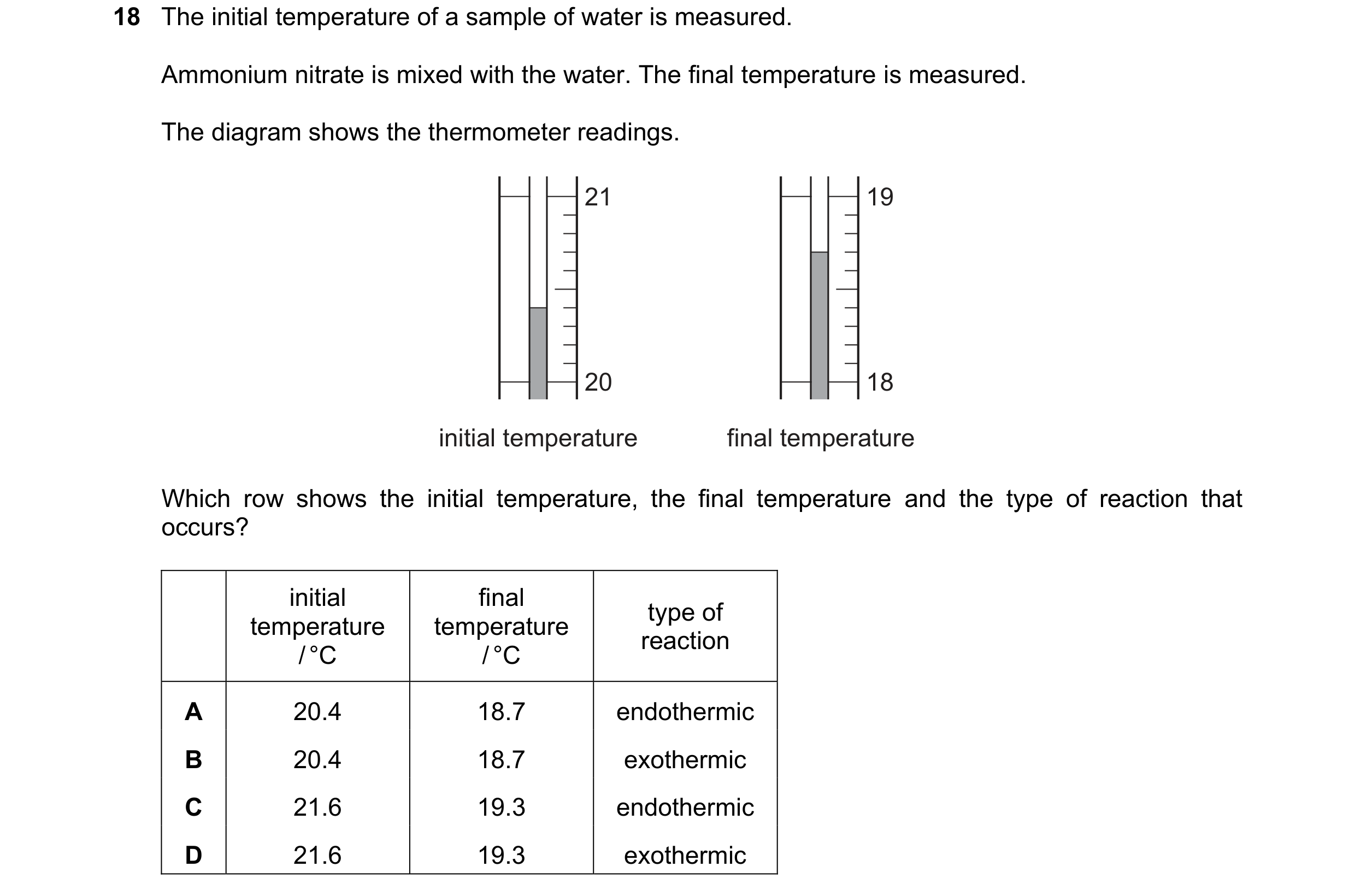
 20 / 21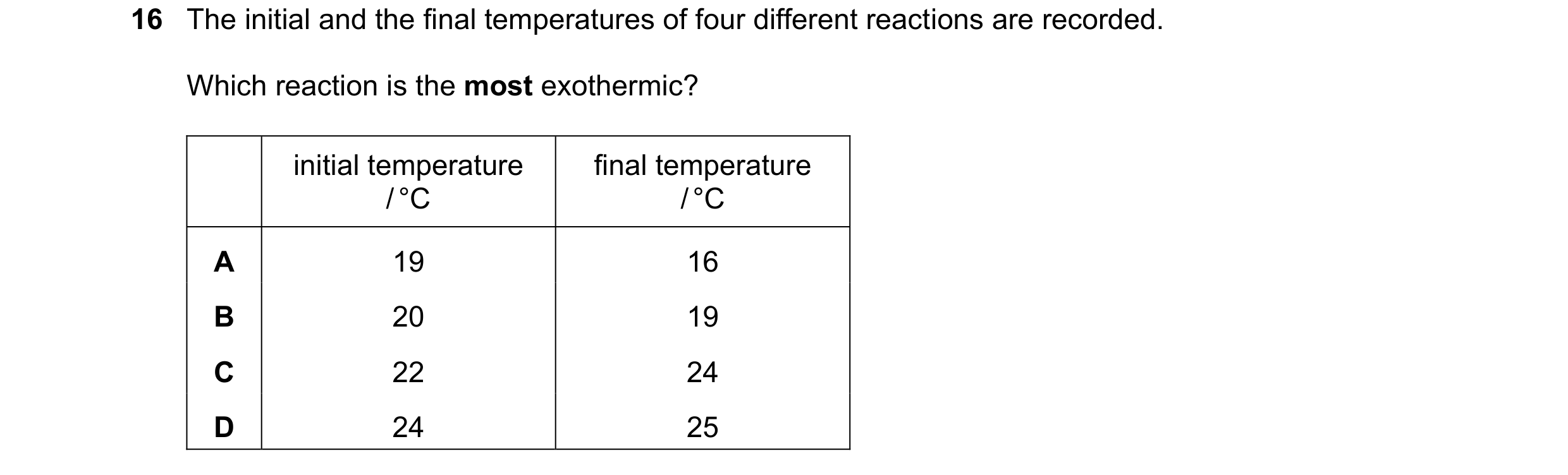
 21 / 21